
MathematicsQ1–64 of 64 questions
Page 1 of 1 · English
1
MathematicsMediumMCQAIEEE · 2004
If $|z^2 - 1| = |z|^2 + 1$,then $z$ lies on
A
An ellipse
B
The imaginary axis
C
$A$ circle
D
The real axis
Solution
(B) Given $|z^2 - 1| = |z|^2 + 1$.
Let $z = x + iy$. Then $|z|^2 = x^2 + y^2$.
Substituting $z = x + iy$ into the equation:
$|(x + iy)^2 - 1| = x^2 + y^2 + 1$
$|(x^2 - y^2 - 1) + i(2xy)| = x^2 + y^2 + 1$
Squaring both sides:
$(x^2 - y^2 - 1)^2 + (2xy)^2 = (x^2 + y^2 + 1)^2$
$(x^2 - y^2 - 1)^2 + 4x^2y^2 = (x^2 + y^2 + 1)^2$
Expanding both sides:
$(x^4 + y^4 + 1 - 2x^2y^2 - 2x^2 + 2y^2) + 4x^2y^2 = x^4 + y^4 + 1 + 2x^2y^2 + 2x^2 + 2y^2$
$x^4 + y^4 + 1 + 2x^2y^2 - 2x^2 + 2y^2 = x^4 + y^4 + 1 + 2x^2y^2 + 2x^2 + 2y^2$
Subtracting common terms from both sides:
$-2x^2 = 2x^2$
$4x^2 = 0 \implies x = 0$.
Since $x = 0$,the complex number $z = 0 + iy = iy$ lies on the imaginary axis.
Let $z = x + iy$. Then $|z|^2 = x^2 + y^2$.
Substituting $z = x + iy$ into the equation:
$|(x + iy)^2 - 1| = x^2 + y^2 + 1$
$|(x^2 - y^2 - 1) + i(2xy)| = x^2 + y^2 + 1$
Squaring both sides:
$(x^2 - y^2 - 1)^2 + (2xy)^2 = (x^2 + y^2 + 1)^2$
$(x^2 - y^2 - 1)^2 + 4x^2y^2 = (x^2 + y^2 + 1)^2$
Expanding both sides:
$(x^4 + y^4 + 1 - 2x^2y^2 - 2x^2 + 2y^2) + 4x^2y^2 = x^4 + y^4 + 1 + 2x^2y^2 + 2x^2 + 2y^2$
$x^4 + y^4 + 1 + 2x^2y^2 - 2x^2 + 2y^2 = x^4 + y^4 + 1 + 2x^2y^2 + 2x^2 + 2y^2$
Subtracting common terms from both sides:
$-2x^2 = 2x^2$
$4x^2 = 0 \implies x = 0$.
Since $x = 0$,the complex number $z = 0 + iy = iy$ lies on the imaginary axis.
0 likesView Solution
2
MathematicsMediumMCQAIEEE · 2004
Let $z$ and $w$ be complex numbers such that $\overline{z} + i\overline{w} = 0$ and $\text{arg}(zw) = \pi$. Then $\text{arg}(z)$ equals
A
$5\pi / 4$
B
$\pi / 2$
C
$3\pi / 4$
D
$\pi / 4$
Solution
(C) Given that $\text{arg}(zw) = \pi$ $(i)$
$\overline{z} + i\overline{w} = 0$ $\Rightarrow \overline{z} = -i\overline{w}$ $\Rightarrow z = i w$ $\Rightarrow w = -iz$
Substitute $w = -iz$ into $(i)$:
$\text{arg}(z(-iz)) = \pi$
$\text{arg}(-iz^2) = \pi$
$\text{arg}(-i) + \text{arg}(z^2) = \pi$
$\text{arg}(-i) + 2\text{arg}(z) = \pi$
Since $\text{arg}(-i) = -\pi / 2$,we have:
$-\pi / 2 + 2\text{arg}(z) = \pi$
$2\text{arg}(z) = 3\pi / 2$
$\text{arg}(z) = 3\pi / 4$
$\overline{z} + i\overline{w} = 0$ $\Rightarrow \overline{z} = -i\overline{w}$ $\Rightarrow z = i w$ $\Rightarrow w = -iz$
Substitute $w = -iz$ into $(i)$:
$\text{arg}(z(-iz)) = \pi$
$\text{arg}(-iz^2) = \pi$
$\text{arg}(-i) + \text{arg}(z^2) = \pi$
$\text{arg}(-i) + 2\text{arg}(z) = \pi$
Since $\text{arg}(-i) = -\pi / 2$,we have:
$-\pi / 2 + 2\text{arg}(z) = \pi$
$2\text{arg}(z) = 3\pi / 2$
$\text{arg}(z) = 3\pi / 4$
0 likesView Solution
3
MathematicsMediumMCQAIEEE · 2004
If a root of the equation $x^2 + px + 12 = 0$ is $4$,while the roots of the equation $x^2 + px + q = 0$ are equal,then the value of $q$ will be:
A
$4$
B
$4/49$
C
$49/4$
D
None of these
Solution
(C) Given that $4$ is a root of the equation $x^2 + px + 12 = 0$.
Substituting $x = 4$ into the equation: $4^2 + p(4) + 12 = 0$.
$16 + 4p + 12 = 0$ $\Rightarrow 4p = -28$ $\Rightarrow p = -7$.
Now,the second equation is $x^2 + px + q = 0$,which becomes $x^2 - 7x + q = 0$.
Since the roots of this equation are equal,the discriminant $D = b^2 - 4ac$ must be equal to $0$.
$(-7)^2 - 4(1)(q) = 0$.
$49 - 4q = 0$ $\Rightarrow 4q = 49$ $\Rightarrow q = \frac{49}{4}$.
Substituting $x = 4$ into the equation: $4^2 + p(4) + 12 = 0$.
$16 + 4p + 12 = 0$ $\Rightarrow 4p = -28$ $\Rightarrow p = -7$.
Now,the second equation is $x^2 + px + q = 0$,which becomes $x^2 - 7x + q = 0$.
Since the roots of this equation are equal,the discriminant $D = b^2 - 4ac$ must be equal to $0$.
$(-7)^2 - 4(1)(q) = 0$.
$49 - 4q = 0$ $\Rightarrow 4q = 49$ $\Rightarrow q = \frac{49}{4}$.
0 likesView Solution
4
MathematicsEasyMCQAIEEE · 2004
Let two numbers have an arithmetic mean of $9$ and a geometric mean of $4$. Then these numbers are the roots of the quadratic equation:
A
$x^2 - 18x - 16 = 0$
B
$x^2 - 18x + 16 = 0$
C
$x^2 + 18x - 16 = 0$
D
$x^2 + 18x + 16 = 0$
Solution
(B) Let the two numbers be $x_1$ and $x_2$.
The arithmetic mean is given by $\frac{x_1 + x_2}{2} = 9$,which implies $x_1 + x_2 = 18$.
The geometric mean is given by $\sqrt{x_1 x_2} = 4$,which implies $x_1 x_2 = 4^2 = 16$.
$A$ quadratic equation with roots $x_1$ and $x_2$ is given by $x^2 - (x_1 + x_2)x + (x_1 x_2) = 0$.
Substituting the values,we get $x^2 - 18x + 16 = 0$.
The arithmetic mean is given by $\frac{x_1 + x_2}{2} = 9$,which implies $x_1 + x_2 = 18$.
The geometric mean is given by $\sqrt{x_1 x_2} = 4$,which implies $x_1 x_2 = 4^2 = 16$.
$A$ quadratic equation with roots $x_1$ and $x_2$ is given by $x^2 - (x_1 + x_2)x + (x_1 x_2) = 0$.
Substituting the values,we get $x^2 - 18x + 16 = 0$.
0 likesView Solution
5
MathematicsDifficultMCQAIEEE · 2004
The coefficient of $x^n$ in the expansion of $(1 + x)(1 - x)^n$ is
A
$(-1)^{n-1}n$
B
$(-1)^n(1 - n)$
C
$(-1)^{n-1}(n - 1)^2$
D
$(n - 1)$
Solution
(B) The expression is $(1 + x)(1 - x)^n = (1 - x)^n + x(1 - x)^n$.
We need to find the coefficient of $x^n$ in this expression.
The coefficient of $x^n$ in $(1 - x)^n$ is given by the general term $T_{r+1} = \binom{n}{r} (1)^{n-r} (-x)^r = \binom{n}{r} (-1)^r x^r$.
For $r = n$,the coefficient is $\binom{n}{n} (-1)^n = (-1)^n$.
The coefficient of $x^n$ in $x(1 - x)^n$ is the coefficient of $x^{n-1}$ in $(1 - x)^n$.
For $r = n-1$,the coefficient is $\binom{n}{n-1} (-1)^{n-1} = n (-1)^{n-1} = -n (-1)^n$.
Adding these,the total coefficient is $(-1)^n - n(-1)^n = (-1)^n(1 - n)$.
We need to find the coefficient of $x^n$ in this expression.
The coefficient of $x^n$ in $(1 - x)^n$ is given by the general term $T_{r+1} = \binom{n}{r} (1)^{n-r} (-x)^r = \binom{n}{r} (-1)^r x^r$.
For $r = n$,the coefficient is $\binom{n}{n} (-1)^n = (-1)^n$.
The coefficient of $x^n$ in $x(1 - x)^n$ is the coefficient of $x^{n-1}$ in $(1 - x)^n$.
For $r = n-1$,the coefficient is $\binom{n}{n-1} (-1)^{n-1} = n (-1)^{n-1} = -n (-1)^n$.
Adding these,the total coefficient is $(-1)^n - n(-1)^n = (-1)^n(1 - n)$.
0 likesView Solution
6
MathematicsDifficultMCQAIEEE · 2004
If ${S_n} = \sum\limits_{r = 0}^n {\frac{1}{{^n{C_r}}}} $ and ${t_n} = \sum\limits_{r = 0}^n {\frac{r}{{^n{C_r}}}} $,then $\frac{{{t_n}}}{{{S_n}}}$ is equal to
A
$\frac{{2n - 1}}{2}$
B
$\frac{1}{2}n - 1$
C
$n - 1$
D
$\frac{1}{2}n$
Solution
(D) We have ${S_n} = \sum\limits_{r = 0}^n {\frac{1}{{^n{C_r}}}} $ and ${t_n} = \sum\limits_{r = 0}^n {\frac{r}{{^n{C_r}}}} $.
Using the property ${^n{C_r}} = {^n{C_{n - r}}}$,we can write ${t_n} = \sum\limits_{r = 0}^n {\frac{{n - r}}{{^n{C_{n - r}}}}} = \sum\limits_{r = 0}^n {\frac{{n - r}}{{^n{C_r}}}} $.
Thus,${t_n} = n \sum\limits_{r = 0}^n {\frac{1}{{^n{C_r}}}} - \sum\limits_{r = 0}^n {\frac{r}{{^n{C_r}}}} $.
This simplifies to ${t_n} = n \cdot {S_n} - {t_n}$.
Adding ${t_n}$ to both sides,we get $2{t_n} = n \cdot {S_n}$.
Therefore,$\frac{{{t_n}}}{{{S_n}}} = \frac{n}{2}$.
Using the property ${^n{C_r}} = {^n{C_{n - r}}}$,we can write ${t_n} = \sum\limits_{r = 0}^n {\frac{{n - r}}{{^n{C_{n - r}}}}} = \sum\limits_{r = 0}^n {\frac{{n - r}}{{^n{C_r}}}} $.
Thus,${t_n} = n \sum\limits_{r = 0}^n {\frac{1}{{^n{C_r}}}} - \sum\limits_{r = 0}^n {\frac{r}{{^n{C_r}}}} $.
This simplifies to ${t_n} = n \cdot {S_n} - {t_n}$.
Adding ${t_n}$ to both sides,we get $2{t_n} = n \cdot {S_n}$.
Therefore,$\frac{{{t_n}}}{{{S_n}}} = \frac{n}{2}$.
0 likesView Solution
7
MathematicsMediumMCQAIEEE · 2004
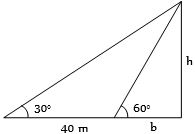
$A$ person standing on the bank of a river observes that the angle subtended by a tree on the opposite bank is $60^\circ$. When he moves $40 \ m$ away from the bank,he finds the angle to be $30^\circ$. The breadth of the river is.....$m$
A
$20$
B
$40$
C
$30$
D
$60$
Solution
(A) Let the height of the tree be $h$ and the breadth of the river be $b$.
From the given information:
In the first triangle,$\tan 60^\circ = \frac{h}{b} \Rightarrow h = b \tan 60^\circ = b\sqrt{3}$.
In the second triangle,$\tan 30^\circ = \frac{h}{b + 40} \Rightarrow h = (b + 40) \tan 30^\circ = \frac{b + 40}{\sqrt{3}}$.
Equating the two expressions for $h$:
$b\sqrt{3} = \frac{b + 40}{\sqrt{3}}$
$3b = b + 40$
$2b = 40$
$b = 20 \ m$.
From the given information:
In the first triangle,$\tan 60^\circ = \frac{h}{b} \Rightarrow h = b \tan 60^\circ = b\sqrt{3}$.
In the second triangle,$\tan 30^\circ = \frac{h}{b + 40} \Rightarrow h = (b + 40) \tan 30^\circ = \frac{b + 40}{\sqrt{3}}$.
Equating the two expressions for $h$:
$b\sqrt{3} = \frac{b + 40}{\sqrt{3}}$
$3b = b + 40$
$2b = 40$
$b = 20 \ m$.
0 likesView Solution
8
MathematicsMediumMCQAIEEE · 2004
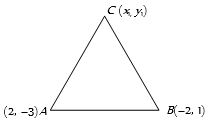
Let $A(2, -3)$ and $B(-2, 1)$ be vertices of a triangle $ABC$. If the centroid of this triangle moves on the line $2x + 3y = 1$,then the locus of the vertex $C$ is the line
A
$3x - 2y = 3$
B
$2x - 3y = 7$
C
$3x + 2y = 5$
D
$2x + 3y = 9$
Solution
(D) Let the third vertex $C$ be $(x, y)$.
The centroid $G$ of triangle $ABC$ is given by:
$G = \left( \frac{2 - 2 + x}{3}, \frac{-3 + 1 + y}{3} \right) = \left( \frac{x}{3}, \frac{y - 2}{3} \right)$.
Given that the centroid moves on the line $2x + 3y = 1$,we substitute the coordinates of $G$ into this equation:
$2\left( \frac{x}{3} \right) + 3\left( \frac{y - 2}{3} \right) = 1$.
Multiplying the entire equation by $3$,we get:
$2x + 3(y - 2) = 3$
$2x + 3y - 6 = 3$
$2x + 3y = 9$.
Thus,the locus of vertex $C$ is $2x + 3y = 9$.
The centroid $G$ of triangle $ABC$ is given by:
$G = \left( \frac{2 - 2 + x}{3}, \frac{-3 + 1 + y}{3} \right) = \left( \frac{x}{3}, \frac{y - 2}{3} \right)$.
Given that the centroid moves on the line $2x + 3y = 1$,we substitute the coordinates of $G$ into this equation:
$2\left( \frac{x}{3} \right) + 3\left( \frac{y - 2}{3} \right) = 1$.
Multiplying the entire equation by $3$,we get:
$2x + 3(y - 2) = 3$
$2x + 3y - 6 = 3$
$2x + 3y = 9$.
Thus,the locus of vertex $C$ is $2x + 3y = 9$.
0 likesView Solution
9
MathematicsMediumMCQAIEEE · 2004
The equation of the straight line passing through the point $(4, 3)$ and making intercepts on the coordinate axes whose sum is $-1$ is
A
$\frac{x}{2} - \frac{y}{3} = 1$ and $\frac{x}{-2} + \frac{y}{1} = 1$
B
$\frac{x}{2} - \frac{y}{3} = -1$ and $\frac{x}{-2} + \frac{y}{1} = -1$
C
$\frac{x}{2} - \frac{y}{3} = 1$ and $\frac{x}{2} + \frac{y}{1} = 1$
D
$\frac{x}{2} + \frac{y}{3} = 1$ and $\frac{x}{-2} + \frac{y}{1} = 1$
Solution
(A) Let the intercepts on the $x$-axis and $y$-axis be $a$ and $b$ respectively.
Given that $a + b = -1$,so $b = -1 - a$.
The equation of the line in intercept form is $\frac{x}{a} + \frac{y}{b} = 1$.
Substituting $b$,we get $\frac{x}{a} + \frac{y}{-(1+a)} = 1$,which is $\frac{x}{a} - \frac{y}{1+a} = 1$.
Since the line passes through $(4, 3)$,we have $\frac{4}{a} - \frac{3}{1+a} = 1$.
Multiplying by $a(1+a)$,we get $4(1+a) - 3a = a(1+a)$.
$4 + 4a - 3a = a + a^2$.
$4 + a = a + a^2$,which simplifies to $a^2 = 4$,so $a = 2$ or $a = -2$.
If $a = 2$,then $b = -1 - 2 = -3$. The equation is $\frac{x}{2} + \frac{y}{-3} = 1$,or $\frac{x}{2} - \frac{y}{3} = 1$.
If $a = -2$,then $b = -1 - (-2) = 1$. The equation is $\frac{x}{-2} + \frac{y}{1} = 1$.
Given that $a + b = -1$,so $b = -1 - a$.
The equation of the line in intercept form is $\frac{x}{a} + \frac{y}{b} = 1$.
Substituting $b$,we get $\frac{x}{a} + \frac{y}{-(1+a)} = 1$,which is $\frac{x}{a} - \frac{y}{1+a} = 1$.
Since the line passes through $(4, 3)$,we have $\frac{4}{a} - \frac{3}{1+a} = 1$.
Multiplying by $a(1+a)$,we get $4(1+a) - 3a = a(1+a)$.
$4 + 4a - 3a = a + a^2$.
$4 + a = a + a^2$,which simplifies to $a^2 = 4$,so $a = 2$ or $a = -2$.
If $a = 2$,then $b = -1 - 2 = -3$. The equation is $\frac{x}{2} + \frac{y}{-3} = 1$,or $\frac{x}{2} - \frac{y}{3} = 1$.
If $a = -2$,then $b = -1 - (-2) = 1$. The equation is $\frac{x}{-2} + \frac{y}{1} = 1$.
0 likesView Solution
10
MathematicsMediumMCQAIEEE · 2004
If one of the lines given by $6x^2 - xy + 4cy^2 = 0$ is $3x + 4y = 0$,then $c$ equals
A
$-3$
B
$-1$
C
$3$
D
$1$
Solution
(A) The given equation of the pair of lines is $6x^2 - xy + 4cy^2 = 0$ $(i)$.
Since $3x + 4y = 0$ is a line represented by this equation,its slope is $m_1 = -\frac{3}{4}$.
For a homogeneous equation $ax^2 + 2hxy + by^2 = 0$,the product of the slopes of the lines is $m_1 m_2 = \frac{a}{b}$.
Here,$a = 6$,$2h = -1$,and $b = 4c$. Thus,$m_1 m_2 = \frac{6}{4c} = \frac{3}{2c}$.
Substituting $m_1 = -\frac{3}{4}$,we get $(-\frac{3}{4}) m_2 = \frac{3}{2c}$,which implies $m_2 = -\frac{2}{c}$.
The sum of the slopes is $m_1 + m_2 = -\frac{2h}{b} = -\frac{-1}{4c} = \frac{1}{4c}$.
Substituting the values of $m_1$ and $m_2$: $-\frac{3}{4} - \frac{2}{c} = \frac{1}{4c}$.
Multiplying by $4c$,we get $-3c - 8 = 1$.
$-3c = 9$,so $c = -3$.
Since $3x + 4y = 0$ is a line represented by this equation,its slope is $m_1 = -\frac{3}{4}$.
For a homogeneous equation $ax^2 + 2hxy + by^2 = 0$,the product of the slopes of the lines is $m_1 m_2 = \frac{a}{b}$.
Here,$a = 6$,$2h = -1$,and $b = 4c$. Thus,$m_1 m_2 = \frac{6}{4c} = \frac{3}{2c}$.
Substituting $m_1 = -\frac{3}{4}$,we get $(-\frac{3}{4}) m_2 = \frac{3}{2c}$,which implies $m_2 = -\frac{2}{c}$.
The sum of the slopes is $m_1 + m_2 = -\frac{2h}{b} = -\frac{-1}{4c} = \frac{1}{4c}$.
Substituting the values of $m_1$ and $m_2$: $-\frac{3}{4} - \frac{2}{c} = \frac{1}{4c}$.
Multiplying by $4c$,we get $-3c - 8 = 1$.
$-3c = 9$,so $c = -3$.
0 likesView Solution
11
MathematicsMediumMCQAIEEE · 2004
If the sum of the slopes of the lines given by ${x^2} - 2cxy - 7{y^2} = 0$ is four times their product,then $c$ has the value
A
$-2$
B
$-1$
C
$2$
D
$1$
Solution
(C) The given equation of the pair of lines is ${x^2} - 2cxy - 7{y^2} = 0$.
Comparing this with the general equation $ax^2 + 2hxy + by^2 = 0$,we have $a = 1$,$2h = -2c$,and $b = -7$.
Let the slopes of the lines be $m_1$ and $m_2$.
The sum of the slopes is $m_1 + m_2 = -\frac{2h}{b} = -\frac{-2c}{-7} = -\frac{2c}{7}$.
The product of the slopes is $m_1m_2 = \frac{a}{b} = \frac{1}{-7} = -\frac{1}{7}$.
According to the problem,the sum of the slopes is four times their product:
$m_1 + m_2 = 4(m_1m_2)$
$-\frac{2c}{7} = 4 \times (-\frac{1}{7})$
$-\frac{2c}{7} = -\frac{4}{7}$
$2c = 4$
$c = 2$.
Comparing this with the general equation $ax^2 + 2hxy + by^2 = 0$,we have $a = 1$,$2h = -2c$,and $b = -7$.
Let the slopes of the lines be $m_1$ and $m_2$.
The sum of the slopes is $m_1 + m_2 = -\frac{2h}{b} = -\frac{-2c}{-7} = -\frac{2c}{7}$.
The product of the slopes is $m_1m_2 = \frac{a}{b} = \frac{1}{-7} = -\frac{1}{7}$.
According to the problem,the sum of the slopes is four times their product:
$m_1 + m_2 = 4(m_1m_2)$
$-\frac{2c}{7} = 4 \times (-\frac{1}{7})$
$-\frac{2c}{7} = -\frac{4}{7}$
$2c = 4$
$c = 2$.
0 likesView Solution
12
MathematicsMediumMCQAIEEE · 2004
If the lines $2x + 3y + 1 = 0$ and $3x - y - 4 = 0$ lie along diameters of a circle of circumference $10\pi$,then the equation of the circle is
A
$x^2 + y^2 + 2x - 2y - 23 = 0$
B
$x^2 + y^2 - 2x - 2y - 23 = 0$
C
$x^2 + y^2 + 2x + 2y - 23 = 0$
D
$x^2 + y^2 - 2x + 2y - 23 = 0$
Solution
(D) The center of the circle is the intersection point of its diameters. Solving the system of equations:
$2x + 3y = -1$ $(i)$
$3x - y = 4$ (ii)
Multiplying (ii) by $3$: $9x - 3y = 12$ (iii)
Adding $(i)$ and (iii): $11x = 11 \Rightarrow x = 1$.
Substituting $x = 1$ into (ii): $3(1) - y = 4 \Rightarrow y = -1$.
Thus,the center $(h, k)$ is $(1, -1)$.
Given the circumference $2\pi r = 10\pi$,we find the radius $r = 5$.
The equation of the circle is $(x - h)^2 + (y - k)^2 = r^2$.
$(x - 1)^2 + (y + 1)^2 = 5^2$
$x^2 - 2x + 1 + y^2 + 2y + 1 = 25$
$x^2 + y^2 - 2x + 2y - 23 = 0$.
$2x + 3y = -1$ $(i)$
$3x - y = 4$ (ii)
Multiplying (ii) by $3$: $9x - 3y = 12$ (iii)
Adding $(i)$ and (iii): $11x = 11 \Rightarrow x = 1$.
Substituting $x = 1$ into (ii): $3(1) - y = 4 \Rightarrow y = -1$.
Thus,the center $(h, k)$ is $(1, -1)$.
Given the circumference $2\pi r = 10\pi$,we find the radius $r = 5$.
The equation of the circle is $(x - h)^2 + (y - k)^2 = r^2$.
$(x - 1)^2 + (y + 1)^2 = 5^2$
$x^2 - 2x + 1 + y^2 + 2y + 1 = 25$
$x^2 + y^2 - 2x + 2y - 23 = 0$.
0 likesView Solution
13
MathematicsDifficultMCQAIEEE · 2004
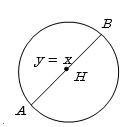
The intercept on the line $y = x$ by the circle ${x^2} + {y^2} - 2x = 0$ is $AB$. The equation of the circle having $AB$ as a diameter is
A
${x^2} + {y^2} + x - y = 0$
B
${x^2} + {y^2} - x + y = 0$
C
${x^2} + {y^2} + x + y = 0$
D
${x^2} + {y^2} - x - y = 0$
Solution
(D) Given,the circle is ${x^2} + {y^2} - 2x = 0$ $(i)$ and the line is $y = x$ $(ii)$.
Substituting $y = x$ in $(i)$,we get:
${x^2} + {x^2} - 2x = 0$
$2{x^2} - 2x = 0$
$2x(x - 1) = 0$
So,$x = 0$ or $x = 1$.
Since $y = x$,the points of intersection are $A = (0, 0)$ and $B = (1, 1)$.
The equation of a circle with diameter endpoints $(x_1, y_1)$ and $(x_2, y_2)$ is $(x - x_1)(x - x_2) + (y - y_1)(y - y_2) = 0$.
Substituting $A(0, 0)$ and $B(1, 1)$:
$(x - 0)(x - 1) + (y - 0)(y - 1) = 0$
$x(x - 1) + y(y - 1) = 0$
${x^2} - x + {y^2} - y = 0$
${x^2} + {y^2} - x - y = 0$.
Substituting $y = x$ in $(i)$,we get:
${x^2} + {x^2} - 2x = 0$
$2{x^2} - 2x = 0$
$2x(x - 1) = 0$
So,$x = 0$ or $x = 1$.
Since $y = x$,the points of intersection are $A = (0, 0)$ and $B = (1, 1)$.
The equation of a circle with diameter endpoints $(x_1, y_1)$ and $(x_2, y_2)$ is $(x - x_1)(x - x_2) + (y - y_1)(y - y_2) = 0$.
Substituting $A(0, 0)$ and $B(1, 1)$:
$(x - 0)(x - 1) + (y - 0)(y - 1) = 0$
$x(x - 1) + y(y - 1) = 0$
${x^2} - x + {y^2} - y = 0$
${x^2} + {y^2} - x - y = 0$.
0 likesView Solution
14
MathematicsDifficultMCQAIEEE · 2004
If a circle passes through the point $(a, b)$ and cuts the circle ${x^2} + {y^2} = 4$ orthogonally,then the locus of its centre is
A
$2ax - 2by - ({a^2} + {b^2} + 4) = 0$
B
$2ax + 2by - ({a^2} + {b^2} + 4) = 0$
C
$2ax - 2by + ({a^2} + {b^2} + 4) = 0$
D
$2ax + 2by + ({a^2} + {b^2} + 4) = 0$
Solution
(B) Let the equation of the variable circle be ${x^2} + {y^2} + 2gx + 2fy + c = 0$ $... (i)$.
Since circle $(i)$ cuts the circle ${x^2} + {y^2} - 4 = 0$ orthogonally,the condition $2g_1g_2 + 2f_1f_2 = c_1 + c_2$ gives $2g(0) + 2f(0) = c - 4$,which implies $c = 4$.
Since the circle $(i)$ passes through the point $(a, b)$,we have ${a^2} + {b^2} + 2ga + 2fb + 4 = 0$.
To find the locus of the centre $(-g, -f)$,let $x = -g$ and $y = -f$,so $g = -x$ and $f = -y$.
Substituting these into the equation,we get ${a^2} + {b^2} + 2(-x)a + 2(-y)b + 4 = 0$.
Thus,the locus is $2ax + 2by - ({a^2} + {b^2} + 4) = 0$.
Since circle $(i)$ cuts the circle ${x^2} + {y^2} - 4 = 0$ orthogonally,the condition $2g_1g_2 + 2f_1f_2 = c_1 + c_2$ gives $2g(0) + 2f(0) = c - 4$,which implies $c = 4$.
Since the circle $(i)$ passes through the point $(a, b)$,we have ${a^2} + {b^2} + 2ga + 2fb + 4 = 0$.
To find the locus of the centre $(-g, -f)$,let $x = -g$ and $y = -f$,so $g = -x$ and $f = -y$.
Substituting these into the equation,we get ${a^2} + {b^2} + 2(-x)a + 2(-y)b + 4 = 0$.
Thus,the locus is $2ax + 2by - ({a^2} + {b^2} + 4) = 0$.
0 likesView Solution
15
MathematicsMediumMCQAIEEE · 2004
If $a \ne 0$ and the line $2bx + 3cy + 4d = 0$ passes through the points of intersection of the parabolas $y^2 = 4ax$ and $x^2 = 4ay$,then
A
$d^2 + (3b - 2c)^2 = 0$
B
$d^2 + (3b + 2c)^2 = 0$
C
$d^2 + (2b - 3c)^2 = 0$
D
$d^2 + (2b + 3c)^2 = 0$
Solution
(D) The given parabolas are $y^2 = 4ax$ $(i)$ and $x^2 = 4ay$ $(ii)$.
Substituting $y = \frac{x^2}{4a}$ from $(ii)$ into $(i)$,we get $\frac{x^4}{16a^2} = 4ax$.
This simplifies to $x^4 - 64a^3x = 0$,or $x(x^3 - 64a^3) = 0$.
Thus,$x = 0$ or $x = 4a$.
For $x = 0$,$y = 0$. For $x = 4a$,$y = 4a$.
The points of intersection are $A(0, 0)$ and $B(4a, 4a)$.
The line $2bx + 3cy + 4d = 0$ passes through $(0, 0)$,so $2b(0) + 3c(0) + 4d = 0$,which implies $d = 0$.
The line also passes through $(4a, 4a)$,so $2b(4a) + 3c(4a) + 4(0) = 0$.
Dividing by $4a$ (since $a \ne 0$),we get $2b + 3c = 0$.
Since $d = 0$ and $2b + 3c = 0$,it follows that $d^2 + (2b + 3c)^2 = 0$.
Substituting $y = \frac{x^2}{4a}$ from $(ii)$ into $(i)$,we get $\frac{x^4}{16a^2} = 4ax$.
This simplifies to $x^4 - 64a^3x = 0$,or $x(x^3 - 64a^3) = 0$.
Thus,$x = 0$ or $x = 4a$.
For $x = 0$,$y = 0$. For $x = 4a$,$y = 4a$.
The points of intersection are $A(0, 0)$ and $B(4a, 4a)$.
The line $2bx + 3cy + 4d = 0$ passes through $(0, 0)$,so $2b(0) + 3c(0) + 4d = 0$,which implies $d = 0$.
The line also passes through $(4a, 4a)$,so $2b(4a) + 3c(4a) + 4(0) = 0$.
Dividing by $4a$ (since $a \ne 0$),we get $2b + 3c = 0$.
Since $d = 0$ and $2b + 3c = 0$,it follows that $d^2 + (2b + 3c)^2 = 0$.
0 likesView Solution
16
MathematicsEasyMCQAIEEE · 2004
The eccentricity of an ellipse,with its centre at the origin,is $\frac{1}{2}$. If one of the directrices is $x = 4$,then the equation of the ellipse is
A
$4{x^2} + 3{y^2} = 1$
B
$3{x^2} + 4{y^2} = 12$
C
$4{x^2} + 3{y^2} = 12$
D
$3{x^2} + 4{y^2} = 1$
Solution
(B) Given that the directrix is $x = 4$,which is parallel to the $y$-axis,the major axis of the ellipse lies along the $x$-axis.
Let the equation of the ellipse be $\frac{x^2}{a^2} + \frac{y^2}{b^2} = 1$,where $a > b$.
The eccentricity $e$ is given as $\frac{1}{2}$.
Using the relation $e^2 = 1 - \frac{b^2}{a^2}$,we have $\frac{b^2}{a^2} = 1 - e^2 = 1 - (\frac{1}{2})^2 = 1 - \frac{1}{4} = \frac{3}{4}$.
The equation of the directrix is $x = \frac{a}{e}$. Given $x = 4$,we have $\frac{a}{e} = 4$.
Substituting $e = \frac{1}{2}$,we get $a = 4e = 4 \times \frac{1}{2} = 2$.
Now,$b^2 = \frac{3}{4}a^2 = \frac{3}{4} \times (2)^2 = \frac{3}{4} \times 4 = 3$.
Substituting $a^2 = 4$ and $b^2 = 3$ into the ellipse equation,we get $\frac{x^2}{4} + \frac{y^2}{3} = 1$.
Multiplying by $12$,we get $3x^2 + 4y^2 = 12$.
Let the equation of the ellipse be $\frac{x^2}{a^2} + \frac{y^2}{b^2} = 1$,where $a > b$.
The eccentricity $e$ is given as $\frac{1}{2}$.
Using the relation $e^2 = 1 - \frac{b^2}{a^2}$,we have $\frac{b^2}{a^2} = 1 - e^2 = 1 - (\frac{1}{2})^2 = 1 - \frac{1}{4} = \frac{3}{4}$.
The equation of the directrix is $x = \frac{a}{e}$. Given $x = 4$,we have $\frac{a}{e} = 4$.
Substituting $e = \frac{1}{2}$,we get $a = 4e = 4 \times \frac{1}{2} = 2$.
Now,$b^2 = \frac{3}{4}a^2 = \frac{3}{4} \times (2)^2 = \frac{3}{4} \times 4 = 3$.
Substituting $a^2 = 4$ and $b^2 = 3$ into the ellipse equation,we get $\frac{x^2}{4} + \frac{y^2}{3} = 1$.
Multiplying by $12$,we get $3x^2 + 4y^2 = 12$.
0 likesView Solution
17
MathematicsMediumMCQAIEEE · 2004
If $\mathop {\lim }\limits_{x \to \infty } {\left( {1 + \frac{a}{x} + \frac{b}{{{x^2}}}} \right)^{2x}} = {e^2},$ then the values of $a$ and $b$ are
A
$a = 1, b = 2$
B
$a = 1, b \in \mathbb{R}$
C
$a \in \mathbb{R}, b = 2$
D
$a \in \mathbb{R}, b \in \mathbb{R}$
Solution
(B) We know that $\mathop {\lim }\limits_{x \to \infty } {(1 + f(x))^{g(x)}} = e^{\mathop {\lim }\limits_{x \to \infty } f(x)g(x)}$ if $\mathop {\lim }\limits_{x \to \infty } f(x) = 0$.
Given $\mathop {\lim }\limits_{x \to \infty } {\left( {1 + \frac{a}{x} + \frac{b}{{{x^2}}}} \right)^{2x}} = {e^2}$.
Applying the formula,we get $e^{\mathop {\lim }\limits_{x \to \infty } (\frac{a}{x} + \frac{b}{{{x^2}}}) \cdot 2x} = {e^2}$.
This simplifies to $e^{\mathop {\lim }\limits_{x \to \infty } (2a + \frac{2b}{x})} = {e^2}$.
Evaluating the limit,we get $e^{2a + 0} = {e^2}$.
Thus,$e^{2a} = {e^2}$,which implies $2a = 2$,so $a = 1$.
Since the term $\frac{b}{x^2}$ vanishes as $x \to \infty$ regardless of the value of $b$,$b$ can be any real number.
Therefore,$a = 1$ and $b \in \mathbb{R}$.
Given $\mathop {\lim }\limits_{x \to \infty } {\left( {1 + \frac{a}{x} + \frac{b}{{{x^2}}}} \right)^{2x}} = {e^2}$.
Applying the formula,we get $e^{\mathop {\lim }\limits_{x \to \infty } (\frac{a}{x} + \frac{b}{{{x^2}}}) \cdot 2x} = {e^2}$.
This simplifies to $e^{\mathop {\lim }\limits_{x \to \infty } (2a + \frac{2b}{x})} = {e^2}$.
Evaluating the limit,we get $e^{2a + 0} = {e^2}$.
Thus,$e^{2a} = {e^2}$,which implies $2a = 2$,so $a = 1$.
Since the term $\frac{b}{x^2}$ vanishes as $x \to \infty$ regardless of the value of $b$,$b$ can be any real number.
Therefore,$a = 1$ and $b \in \mathbb{R}$.
0 likesView Solution
18
MathematicsDifficultMCQAIEEE · 2004
The range of the function $f(x) = {}^{7 - x}P_{x - 3}$ is
A
$\{1, 2, 3, 4, 5\}$
B
$\{1, 2, 3, 4, 5, 6\}$
C
$\{1, 2, 3, 4\}$
D
$\{1, 2, 3\}$
Solution
(D) For the permutation ${}^{n}P_{r}$ to be defined,we must have $n \ge r \ge 0$ and $n, r \in \mathbb{Z}^+ \cup \{0\}$.
Here,$n = 7 - x$ and $r = x - 3$.
$1$. $n \ge r \implies 7 - x \ge x - 3 \implies 10 \ge 2x \implies x \le 5$.
$2$. $r \ge 0 \implies x - 3 \ge 0 \implies x \ge 3$.
$3$. $n \ge 0 \implies 7 - x \ge 0 \implies x \le 7$.
Combining these,the domain is $x \in \{3, 4, 5\}$.
Now,calculate $f(x)$ for each value in the domain:
For $x = 3$: $f(3) = {}^{7-3}P_{3-3} = {}^{4}P_{0} = 1$.
For $x = 4$: $f(4) = {}^{7-4}P_{4-3} = {}^{3}P_{1} = 3$.
For $x = 5$: $f(5) = {}^{7-5}P_{5-3} = {}^{2}P_{2} = 2$.
The range is the set of values ${f(3), f(4), f(5)} = \{1, 3, 2\}$,which is $\{1, 2, 3\}$.
Here,$n = 7 - x$ and $r = x - 3$.
$1$. $n \ge r \implies 7 - x \ge x - 3 \implies 10 \ge 2x \implies x \le 5$.
$2$. $r \ge 0 \implies x - 3 \ge 0 \implies x \ge 3$.
$3$. $n \ge 0 \implies 7 - x \ge 0 \implies x \le 7$.
Combining these,the domain is $x \in \{3, 4, 5\}$.
Now,calculate $f(x)$ for each value in the domain:
For $x = 3$: $f(3) = {}^{7-3}P_{3-3} = {}^{4}P_{0} = 1$.
For $x = 4$: $f(4) = {}^{7-4}P_{4-3} = {}^{3}P_{1} = 3$.
For $x = 5$: $f(5) = {}^{7-5}P_{5-3} = {}^{2}P_{2} = 2$.
The range is the set of values ${f(3), f(4), f(5)} = \{1, 3, 2\}$,which is $\{1, 2, 3\}$.
0 likesView Solution
19
MathematicsMediumMCQAIEEE · 2004
$A$ point on the parabola $y^2 = 18x$ at which the ordinate increases at twice the rate of the abscissa is
A
$\left( \frac{9}{8}, \frac{9}{2} \right)$
B
$(2, -4)$
C
$\left( -\frac{9}{8}, \frac{9}{2} \right)$
D
$(2, 4)$
Solution
(A) Given the equation of the parabola: $y^2 = 18x$.
Differentiating both sides with respect to $t$:
$2y \left( \frac{dy}{dt} \right) = 18 \left( \frac{dx}{dt} \right)$.
We are given that the ordinate $(y)$ increases at twice the rate of the abscissa $(x)$,so $\frac{dy}{dt} = 2 \frac{dx}{dt}$.
Substituting this into the differentiated equation:
$2y \left( 2 \frac{dx}{dt} \right) = 18 \left( \frac{dx}{dt} \right)$.
Assuming $\frac{dx}{dt} \neq 0$,we get:
$4y = 18 \implies y = \frac{18}{4} = \frac{9}{2}$.
Now,substitute $y = \frac{9}{2}$ into the original parabola equation to find $x$:
$\left( \frac{9}{2} \right)^2 = 18x$
$\frac{81}{4} = 18x$
$x = \frac{81}{4 \times 18} = \frac{81}{72} = \frac{9}{8}$.
Thus,the required point is $\left( \frac{9}{8}, \frac{9}{2} \right)$.
Differentiating both sides with respect to $t$:
$2y \left( \frac{dy}{dt} \right) = 18 \left( \frac{dx}{dt} \right)$.
We are given that the ordinate $(y)$ increases at twice the rate of the abscissa $(x)$,so $\frac{dy}{dt} = 2 \frac{dx}{dt}$.
Substituting this into the differentiated equation:
$2y \left( 2 \frac{dx}{dt} \right) = 18 \left( \frac{dx}{dt} \right)$.
Assuming $\frac{dx}{dt} \neq 0$,we get:
$4y = 18 \implies y = \frac{18}{4} = \frac{9}{2}$.
Now,substitute $y = \frac{9}{2}$ into the original parabola equation to find $x$:
$\left( \frac{9}{2} \right)^2 = 18x$
$\frac{81}{4} = 18x$
$x = \frac{81}{4 \times 18} = \frac{81}{72} = \frac{9}{8}$.
Thus,the required point is $\left( \frac{9}{8}, \frac{9}{2} \right)$.
0 likesView Solution
20
MathematicsMediumMCQAIEEE · 2004
The probability that $A$ speaks the truth is $\frac{4}{5}$,while the probability that $B$ speaks the truth is $\frac{3}{4}$. What is the probability that they contradict each other when asked to speak on a fact?
A
$\frac{4}{5}$
B
$\frac{1}{5}$
C
$\frac{7}{20}$
D
$\frac{3}{20}$
Solution
(C) Let $P(A)$ be the probability that $A$ speaks the truth and $P(B)$ be the probability that $B$ speaks the truth.
Given: $P(A) = \frac{4}{5}$ and $P(B) = \frac{3}{4}$.
Then,the probability that $A$ lies is $P(\bar{A}) = 1 - \frac{4}{5} = \frac{1}{5}$.
The probability that $B$ lies is $P(\bar{B}) = 1 - \frac{3}{4} = \frac{1}{4}$.
They contradict each other if ($A$ speaks the truth and $B$ lies) $OR$ ($A$ lies and $B$ speaks the truth).
Required probability $= P(A) \times P(\bar{B}) + P(\bar{A}) \times P(B)$.
$= (\frac{4}{5} \times \frac{1}{4}) + (\frac{1}{5} \times \frac{3}{4})$.
$= \frac{4}{20} + \frac{3}{20} = \frac{7}{20}$.
Given: $P(A) = \frac{4}{5}$ and $P(B) = \frac{3}{4}$.
Then,the probability that $A$ lies is $P(\bar{A}) = 1 - \frac{4}{5} = \frac{1}{5}$.
The probability that $B$ lies is $P(\bar{B}) = 1 - \frac{3}{4} = \frac{1}{4}$.
They contradict each other if ($A$ speaks the truth and $B$ lies) $OR$ ($A$ lies and $B$ speaks the truth).
Required probability $= P(A) \times P(\bar{B}) + P(\bar{A}) \times P(B)$.
$= (\frac{4}{5} \times \frac{1}{4}) + (\frac{1}{5} \times \frac{3}{4})$.
$= \frac{4}{20} + \frac{3}{20} = \frac{7}{20}$.
0 likesView Solution
21
MathematicsMediumMCQAIEEE · 2004
Consider the following statements:
$(1)$ Mode can be computed from a histogram.
$(2)$ Median is not independent of change of scale.
$(3)$ Variance is independent of change of origin and scale.
Which of these is/are correct?
$(1)$ Mode can be computed from a histogram.
$(2)$ Median is not independent of change of scale.
$(3)$ Variance is independent of change of origin and scale.
Which of these is/are correct?
A
$(1), (2)$ and $(3)$
B
Only $(2)$
C
Only $(1)$ and $(2)$
D
Only $(1)$
Solution
(D) Statement $(1)$ is correct: The mode of a grouped frequency distribution can be determined graphically using a histogram.
Statement $(2)$ is incorrect: Median is independent of the change of origin,but it is $NOT$ independent of the change of scale. If $y = a + bx$,then $Median(y) = a + b \times Median(x)$. Since it depends on $b$,it is not independent of the change of scale.
Statement $(3)$ is incorrect: Variance is independent of the change of origin,but it is $NOT$ independent of the change of scale. If $y = a + bx$,then $Var(y) = b^2 \times Var(x)$. Since it depends on $b^2$,it is not independent of the change of scale.
Therefore,only statement $(1)$ is correct.
Statement $(2)$ is incorrect: Median is independent of the change of origin,but it is $NOT$ independent of the change of scale. If $y = a + bx$,then $Median(y) = a + b \times Median(x)$. Since it depends on $b$,it is not independent of the change of scale.
Statement $(3)$ is incorrect: Variance is independent of the change of origin,but it is $NOT$ independent of the change of scale. If $y = a + bx$,then $Var(y) = b^2 \times Var(x)$. Since it depends on $b^2$,it is not independent of the change of scale.
Therefore,only statement $(1)$ is correct.
0 likesView Solution
22
MathematicsDifficultMCQAIEEE · 2004
In a series of $2n$ observations,half of them are equal to $a$ and the remaining half are equal to $-a$. If the standard deviation of the observations is $2$,then $|a|$ equals:
A
$\frac{\sqrt{2}}{n}$
B
$\sqrt{2}$
C
$2$
D
$\frac{1}{n}$
Solution
(C) The total number of observations is $2n$.
There are $n$ observations equal to $a$ and $n$ observations equal to $-a$.
The mean $\bar{x} = \frac{n(a) + n(-a)}{2n} = \frac{0}{2n} = 0$.
The standard deviation $\sigma$ is given by $\sigma = \sqrt{\frac{\sum (x_i - \bar{x})^2}{2n}}$.
Substituting the values: $2 = \sqrt{\frac{n(a - 0)^2 + n(-a - 0)^2}{2n}}$.
$2 = \sqrt{\frac{na^2 + na^2}{2n}} = \sqrt{\frac{2na^2}{2n}} = \sqrt{a^2} = |a|$.
Therefore,$|a| = 2$.
There are $n$ observations equal to $a$ and $n$ observations equal to $-a$.
The mean $\bar{x} = \frac{n(a) + n(-a)}{2n} = \frac{0}{2n} = 0$.
The standard deviation $\sigma$ is given by $\sigma = \sqrt{\frac{\sum (x_i - \bar{x})^2}{2n}}$.
Substituting the values: $2 = \sqrt{\frac{n(a - 0)^2 + n(-a - 0)^2}{2n}}$.
$2 = \sqrt{\frac{na^2 + na^2}{2n}} = \sqrt{\frac{2na^2}{2n}} = \sqrt{a^2} = |a|$.
Therefore,$|a| = 2$.
0 likesView Solution
23
MathematicsMediumMCQAIEEE · 2004
If $z = x - iy$ and $z^{1/3} = p + iq$,then $\left( \frac{x}{p} + \frac{y}{q} \right) / (p^2 + q^2)$ is equal to
A
$-2$
B
$-1$
C
$2$
D
$1$
Solution
(A) Given $z = x - iy$ and $z^{1/3} = p + iq$.
Taking the cube on both sides,we get $z = (p + iq)^3$.
$z = p^3 + 3p^2(iq) + 3p(iq)^2 + (iq)^3$.
$z = p^3 + 3ip^2q - 3pq^2 - iq^3$.
$z = (p^3 - 3pq^2) + i(3p^2q - q^3)$.
Comparing the real and imaginary parts with $z = x - iy$,we have:
$x = p^3 - 3pq^2 = p(p^2 - 3q^2)$ and $-y = 3p^2q - q^3$,which implies $y = q^2 - 3p^2q = q(q^2 - 3p^2)$.
Now,$\frac{x}{p} = p^2 - 3q^2$ and $\frac{y}{q} = q^2 - 3p^2$.
Adding these two expressions:
$\frac{x}{p} + \frac{y}{q} = (p^2 - 3q^2) + (q^2 - 3p^2) = -2p^2 - 2q^2 = -2(p^2 + q^2)$.
Therefore,$\frac{\frac{x}{p} + \frac{y}{q}}{p^2 + q^2} = \frac{-2(p^2 + q^2)}{p^2 + q^2} = -2$.
Taking the cube on both sides,we get $z = (p + iq)^3$.
$z = p^3 + 3p^2(iq) + 3p(iq)^2 + (iq)^3$.
$z = p^3 + 3ip^2q - 3pq^2 - iq^3$.
$z = (p^3 - 3pq^2) + i(3p^2q - q^3)$.
Comparing the real and imaginary parts with $z = x - iy$,we have:
$x = p^3 - 3pq^2 = p(p^2 - 3q^2)$ and $-y = 3p^2q - q^3$,which implies $y = q^2 - 3p^2q = q(q^2 - 3p^2)$.
Now,$\frac{x}{p} = p^2 - 3q^2$ and $\frac{y}{q} = q^2 - 3p^2$.
Adding these two expressions:
$\frac{x}{p} + \frac{y}{q} = (p^2 - 3q^2) + (q^2 - 3p^2) = -2p^2 - 2q^2 = -2(p^2 + q^2)$.
Therefore,$\frac{\frac{x}{p} + \frac{y}{q}}{p^2 + q^2} = \frac{-2(p^2 + q^2)}{p^2 + q^2} = -2$.
0 likesView Solution
24
MathematicsDifficultMCQAIEEE · 2004
The coefficient of the middle term in the binomial expansion in powers of $x$ of $(1 + \alpha x)^4$ and of $(1 - \alpha x)^6$ is the same if $\alpha$ equals
A
$3/5$
B
$10/3$
C
$-3/10$
D
$3/10$
Solution
(C) The middle term in the expansion of $(1 + \alpha x)^4$ is the $3^{rd}$ term,given by $T_3 = ^4C_2 (\alpha x)^2 = 6 \alpha^2 x^2$. The coefficient is $6 \alpha^2$.
The middle term in the expansion of $(1 - \alpha x)^6$ is the $4^{th}$ term,given by $T_4 = ^6C_3 (-\alpha x)^3 = -20 \alpha^3 x^3$. The coefficient is $-20 \alpha^3$.
According to the problem,the coefficients are equal:
$6 \alpha^2 = -20 \alpha^3$
Since $\alpha \neq 0$ (otherwise the middle terms would be constants,not involving $x$ in the same way),we can divide by $2 \alpha^2$:
$3 = -10 \alpha$
$\alpha = -3/10$.
The middle term in the expansion of $(1 - \alpha x)^6$ is the $4^{th}$ term,given by $T_4 = ^6C_3 (-\alpha x)^3 = -20 \alpha^3 x^3$. The coefficient is $-20 \alpha^3$.
According to the problem,the coefficients are equal:
$6 \alpha^2 = -20 \alpha^3$
Since $\alpha \neq 0$ (otherwise the middle terms would be constants,not involving $x$ in the same way),we can divide by $2 \alpha^2$:
$3 = -10 \alpha$
$\alpha = -3/10$.
0 likesView Solution
25
MathematicsMediumMCQAIEEE · 2004
Let $S(k) = 1 + 3 + 5 + \dots + (2k - 1) = 3 + k^2$. Then which of the following is true?
A
Principle of mathematical induction can be used to prove the formula
B
$S(k) \not\Rightarrow S(k + 1)$
C
$S(k) \Rightarrow S(k + 1)$
D
$S(1)$ is correct
Solution
(C) Given $S(k) = 1 + 3 + 5 + \dots + (2k - 1) = 3 + k^2$.
For $k = 1$,$S(1) \Rightarrow 1 = 3 + 1^2 = 4$,which is false.
For $k = 2$,$S(2) \Rightarrow 1 + 3 = 3 + 2^2 = 7$,which is false.
Now,assume $S(k)$ is true,i.e.,$1 + 3 + 5 + \dots + (2k - 1) = 3 + k^2$.
Adding $(2(k + 1) - 1) = 2k + 1$ to both sides:
$1 + 3 + 5 + \dots + (2k - 1) + (2k + 1) = 3 + k^2 + 2k + 1 = 3 + (k + 1)^2$.
This shows that $S(k) \Rightarrow S(k + 1)$ is true,even though the base case $S(1)$ is false.
For $k = 1$,$S(1) \Rightarrow 1 = 3 + 1^2 = 4$,which is false.
For $k = 2$,$S(2) \Rightarrow 1 + 3 = 3 + 2^2 = 7$,which is false.
Now,assume $S(k)$ is true,i.e.,$1 + 3 + 5 + \dots + (2k - 1) = 3 + k^2$.
Adding $(2(k + 1) - 1) = 2k + 1$ to both sides:
$1 + 3 + 5 + \dots + (2k - 1) + (2k + 1) = 3 + k^2 + 2k + 1 = 3 + (k + 1)^2$.
This shows that $S(k) \Rightarrow S(k + 1)$ is true,even though the base case $S(1)$ is false.
0 likesView Solution
26
MathematicsMediumMCQAIEEE · 2004
The sum of the series $\frac{1}{2!} + \frac{1}{4!} + \frac{1}{6!} + \dots$ is
A
$\frac{e^2 - 2}{e}$
B
$\frac{(e - 1)^2}{2e}$
C
$\frac{e^2 - 1}{2e}$
D
$\frac{e^2 - 1}{2}$
Solution
(B) We know the expansion of $\cosh(x)$ is given by $\frac{e^x + e^{-x}}{2} = 1 + \frac{x^2}{2!} + \frac{x^4}{4!} + \frac{x^6}{6!} + \dots$
Setting $x = 1$,we get:
$\frac{e^1 + e^{-1}}{2} = 1 + \frac{1}{2!} + \frac{1}{4!} + \frac{1}{6!} + \dots$
$\frac{e + \frac{1}{e}}{2} = 1 + \left( \frac{1}{2!} + \frac{1}{4!} + \frac{1}{6!} + \dots \right)$
$\frac{e^2 + 1}{2e} = 1 + \left( \frac{1}{2!} + \frac{1}{4!} + \frac{1}{6!} + \dots \right)$
Therefore,the sum of the series is:
$\frac{1}{2!} + \frac{1}{4!} + \frac{1}{6!} + \dots = \frac{e^2 + 1}{2e} - 1$
$= \frac{e^2 + 1 - 2e}{2e} = \frac{(e - 1)^2}{2e}$.
Setting $x = 1$,we get:
$\frac{e^1 + e^{-1}}{2} = 1 + \frac{1}{2!} + \frac{1}{4!} + \frac{1}{6!} + \dots$
$\frac{e + \frac{1}{e}}{2} = 1 + \left( \frac{1}{2!} + \frac{1}{4!} + \frac{1}{6!} + \dots \right)$
$\frac{e^2 + 1}{2e} = 1 + \left( \frac{1}{2!} + \frac{1}{4!} + \frac{1}{6!} + \dots \right)$
Therefore,the sum of the series is:
$\frac{1}{2!} + \frac{1}{4!} + \frac{1}{6!} + \dots = \frac{e^2 + 1}{2e} - 1$
$= \frac{e^2 + 1 - 2e}{2e} = \frac{(e - 1)^2}{2e}$.
0 likesView Solution
27
MathematicsDifficultMCQAIEEE · 2004
Let $\alpha, \beta$ be such that $\pi < (\alpha - \beta) < 3\pi$. If $\sin \alpha + \sin \beta = -\frac{21}{65}$ and $\cos \alpha + \cos \beta = -\frac{27}{65}$,then the value of $\cos \frac{\alpha - \beta}{2}$ is
A
$-\frac{6}{65}$
B
$\frac{3}{\sqrt{130}}$
C
$\frac{6}{65}$
D
$-\frac{3}{\sqrt{130}}$
Solution
(D) Given $\sin \alpha + \sin \beta = -\frac{21}{65}$ and $\cos \alpha + \cos \beta = -\frac{27}{65}$.
Squaring and adding both equations:
$(\sin \alpha + \sin \beta)^2 + (\cos \alpha + \cos \beta)^2 = \left(-\frac{21}{65}\right)^2 + \left(-\frac{27}{65}\right)^2$
$2 + 2(\cos \alpha \cos \beta + \sin \alpha \sin \beta) = \frac{441 + 729}{4225}$
$2 + 2\cos(\alpha - \beta) = \frac{1170}{4225} = \frac{18}{65}$
$2(1 + \cos(\alpha - \beta)) = \frac{18}{65}$
$4 \cos^2\left(\frac{\alpha - \beta}{2}\right) = \frac{18}{65}$
$\cos^2\left(\frac{\alpha - \beta}{2}\right) = \frac{18}{260} = \frac{9}{130}$
$\cos\left(\frac{\alpha - \beta}{2}\right) = \pm \frac{3}{\sqrt{130}}$
Since $\pi < \alpha - \beta < 3\pi$,dividing by $2$ gives $\frac{\pi}{2} < \frac{\alpha - \beta}{2} < \frac{3\pi}{2}$.
In this interval,the cosine function is negative.
Therefore,$\cos\left(\frac{\alpha - \beta}{2}\right) = -\frac{3}{\sqrt{130}}$.
Squaring and adding both equations:
$(\sin \alpha + \sin \beta)^2 + (\cos \alpha + \cos \beta)^2 = \left(-\frac{21}{65}\right)^2 + \left(-\frac{27}{65}\right)^2$
$2 + 2(\cos \alpha \cos \beta + \sin \alpha \sin \beta) = \frac{441 + 729}{4225}$
$2 + 2\cos(\alpha - \beta) = \frac{1170}{4225} = \frac{18}{65}$
$2(1 + \cos(\alpha - \beta)) = \frac{18}{65}$
$4 \cos^2\left(\frac{\alpha - \beta}{2}\right) = \frac{18}{65}$
$\cos^2\left(\frac{\alpha - \beta}{2}\right) = \frac{18}{260} = \frac{9}{130}$
$\cos\left(\frac{\alpha - \beta}{2}\right) = \pm \frac{3}{\sqrt{130}}$
Since $\pi < \alpha - \beta < 3\pi$,dividing by $2$ gives $\frac{\pi}{2} < \frac{\alpha - \beta}{2} < \frac{3\pi}{2}$.
In this interval,the cosine function is negative.
Therefore,$\cos\left(\frac{\alpha - \beta}{2}\right) = -\frac{3}{\sqrt{130}}$.
0 likesView Solution
28
MathematicsMediumMCQAIEEE · 2004
The sides of a triangle are $\sin \alpha$,$\cos \alpha$,and $\sqrt{1 + \sin \alpha \cos \alpha}$ for some $0 < \alpha < \frac{\pi}{2}$. Then the greatest angle of the triangle is.....$^o$
A
$150$
B
$90$
C
$120$
D
$60$
Solution
(C) Let the sides be $a = \sin \alpha$,$b = \cos \alpha$,and $c = \sqrt{1 + \sin \alpha \cos \alpha}$.
Since $0 < \alpha < \frac{\pi}{2}$,both $\sin \alpha$ and $\cos \alpha$ are positive,and $c$ is clearly the longest side because $c^2 = 1 + \sin \alpha \cos \alpha > \sin^2 \alpha + \cos^2 \alpha = 1$.
Using the Law of Cosines for the angle $C$ opposite to side $c$:
$\cos C = \frac{a^2 + b^2 - c^2}{2ab}$
$\cos C = \frac{\sin^2 \alpha + \cos^2 \alpha - (1 + \sin \alpha \cos \alpha)}{2 \sin \alpha \cos \alpha}$
$\cos C = \frac{1 - 1 - \sin \alpha \cos \alpha}{2 \sin \alpha \cos \alpha}$
$\cos C = \frac{-\sin \alpha \cos \alpha}{2 \sin \alpha \cos \alpha} = -\frac{1}{2}$
Since $\cos C = -\frac{1}{2}$,the angle $C = 120^\circ$.
Since $0 < \alpha < \frac{\pi}{2}$,both $\sin \alpha$ and $\cos \alpha$ are positive,and $c$ is clearly the longest side because $c^2 = 1 + \sin \alpha \cos \alpha > \sin^2 \alpha + \cos^2 \alpha = 1$.
Using the Law of Cosines for the angle $C$ opposite to side $c$:
$\cos C = \frac{a^2 + b^2 - c^2}{2ab}$
$\cos C = \frac{\sin^2 \alpha + \cos^2 \alpha - (1 + \sin \alpha \cos \alpha)}{2 \sin \alpha \cos \alpha}$
$\cos C = \frac{1 - 1 - \sin \alpha \cos \alpha}{2 \sin \alpha \cos \alpha}$
$\cos C = \frac{-\sin \alpha \cos \alpha}{2 \sin \alpha \cos \alpha} = -\frac{1}{2}$
Since $\cos C = -\frac{1}{2}$,the angle $C = 120^\circ$.
0 likesView Solution
29
MathematicsDifficultMCQAIEEE · 2004
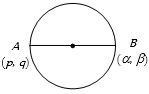
$A$ variable circle passes through the fixed point $A(p, q)$ and touches the $x$-axis. The locus of the other end of the diameter through $A$ is
A
$(y - q)^2 = 4px$
B
$(x - q)^2 = 4py$
C
$(y - p)^2 = 4qx$
D
$(x - p)^2 = 4qy$
Solution
(D) Let the other end of the diameter be $B(\alpha, \beta)$.
The circle has $AB$ as its diameter,so its equation is $(x - p)(x - \alpha) + (y - q)(y - \beta) = 0$.
Expanding this,we get $x^2 - (p + \alpha)x + p\alpha + y^2 - (q + \beta)y + q\beta = 0$,or $x^2 + y^2 - (p + \alpha)x - (q + \beta)y + (p\alpha + q\beta) = 0$.
Since the circle touches the $x$-axis,the $y$-coordinate of the center is equal to the radius,or the discriminant of the equation when $y=0$ is zero.
Setting $y = 0$,we get $x^2 - (p + \alpha)x + (p\alpha + q\beta) = 0$.
For the circle to touch the $x$-axis,the discriminant $D = 0$.
$D = (p + \alpha)^2 - 4(p\alpha + q\beta) = 0$.
$p^2 + 2p\alpha + \alpha^2 - 4p\alpha - 4q\beta = 0$.
$p^2 - 2p\alpha + \alpha^2 - 4q\beta = 0$.
$(p - \alpha)^2 = 4q\beta$.
Replacing $(\alpha, \beta)$ with $(x, y)$,the locus is $(x - p)^2 = 4qy$.
The circle has $AB$ as its diameter,so its equation is $(x - p)(x - \alpha) + (y - q)(y - \beta) = 0$.
Expanding this,we get $x^2 - (p + \alpha)x + p\alpha + y^2 - (q + \beta)y + q\beta = 0$,or $x^2 + y^2 - (p + \alpha)x - (q + \beta)y + (p\alpha + q\beta) = 0$.
Since the circle touches the $x$-axis,the $y$-coordinate of the center is equal to the radius,or the discriminant of the equation when $y=0$ is zero.
Setting $y = 0$,we get $x^2 - (p + \alpha)x + (p\alpha + q\beta) = 0$.
For the circle to touch the $x$-axis,the discriminant $D = 0$.
$D = (p + \alpha)^2 - 4(p\alpha + q\beta) = 0$.
$p^2 + 2p\alpha + \alpha^2 - 4p\alpha - 4q\beta = 0$.
$p^2 - 2p\alpha + \alpha^2 - 4q\beta = 0$.
$(p - \alpha)^2 = 4q\beta$.
Replacing $(\alpha, \beta)$ with $(x, y)$,the locus is $(x - p)^2 = 4qy$.
0 likesView Solution
30
MathematicsDifficultMCQAIEEE · 2004
If $u = \sqrt {{a^2}{{\cos }^2}\theta + {b^2}{{\sin }^2}\theta } + \sqrt {{a^2}{{\sin }^2}\theta + {b^2}{{\cos }^2}\theta } $,then the difference between the maximum and minimum values of ${u^2}$ is given by
A
${(a - b)^2}$
B
$2\sqrt {{a^2} + {b^2}}$
C
${(a + b)^2}$
D
$2({a^2} + {b^2})$
Solution
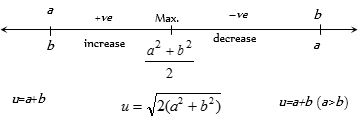
(A) Given $u = \sqrt {{a^2}{{\cos }^2}\theta + {b^2}{{\sin }^2}\theta } + \sqrt {{a^2}{{\sin }^2}\theta + {b^2}{{\cos }^2}\theta } $.
Squaring both sides,we get:
${u^2} = ({a^2}{{\cos }^2}\theta + {b^2}{{\sin }^2}\theta ) + ({a^2}{{\sin }^2}\theta + {b^2}{{\cos }^2}\theta ) + 2\sqrt {({a^2}{{\cos }^2}\theta + {b^2}{{\sin }^2}\theta )({a^2}{{\sin }^2}\theta + {b^2}{{\cos }^2}\theta )} $
${u^2} = {a^2} + {b^2} + 2\sqrt {({a^2}{{\cos }^2}\theta + {b^2}{{\sin }^2}\theta )({a^2}{{\sin }^2}\theta + {b^2}{{\cos }^2}\theta )} $
Let $t = {a^2}{{\cos }^2}\theta + {b^2}{{\sin }^2}\theta $. Then ${a^2}{{\sin }^2}\theta + {b^2}{{\cos }^2}\theta = {a^2} + {b^2} - t$.
So,${u^2} = {a^2} + {b^2} + 2\sqrt {t({a^2} + {b^2} - t)} = {a^2} + {b^2} + 2\sqrt { - {t^2} + ({a^2} + {b^2})t} $.
Let $f(t) = - {t^2} + ({a^2} + {b^2})t$. The maximum value of $f(t)$ occurs at $t = \frac{{{a^2} + {b^2}}}{2}$,which is $f\left( \frac{{{a^2} + {b^2}}}{2} \right) = \frac{{{({a^2} + {b^2})^2}}}{4}$.
Thus,${({u^2})_{\max }} = {a^2} + {b^2} + 2\sqrt {\frac{{{({a^2} + {b^2})^2}}}{4}} = {a^2} + {b^2} + ({a^2} + {b^2}) = 2({a^2} + {b^2})$.
The minimum value of $f(t)$ occurs at the boundaries of $t$,i.e.,$t = {a^2}$ or $t = {b^2}$.
At $t = {a^2}$,$f({a^2}) = - {a^4} + ({a^2} + {b^2}){a^2} = {a^2}{b^2}$.
Thus,${({u^2})_{\min }} = {a^2} + {b^2} + 2\sqrt {{a^2}{b^2}} = {a^2} + {b^2} + 2ab = {(a + b)^2}$.
The difference is ${({u^2})_{\max }} - {({u^2})_{\min }} = 2{a^2} + 2{b^2} - ({a^2} + {b^2} + 2ab) = {a^2} + {b^2} - 2ab = {(a - b)^2}$.
Squaring both sides,we get:
${u^2} = ({a^2}{{\cos }^2}\theta + {b^2}{{\sin }^2}\theta ) + ({a^2}{{\sin }^2}\theta + {b^2}{{\cos }^2}\theta ) + 2\sqrt {({a^2}{{\cos }^2}\theta + {b^2}{{\sin }^2}\theta )({a^2}{{\sin }^2}\theta + {b^2}{{\cos }^2}\theta )} $
${u^2} = {a^2} + {b^2} + 2\sqrt {({a^2}{{\cos }^2}\theta + {b^2}{{\sin }^2}\theta )({a^2}{{\sin }^2}\theta + {b^2}{{\cos }^2}\theta )} $
Let $t = {a^2}{{\cos }^2}\theta + {b^2}{{\sin }^2}\theta $. Then ${a^2}{{\sin }^2}\theta + {b^2}{{\cos }^2}\theta = {a^2} + {b^2} - t$.
So,${u^2} = {a^2} + {b^2} + 2\sqrt {t({a^2} + {b^2} - t)} = {a^2} + {b^2} + 2\sqrt { - {t^2} + ({a^2} + {b^2})t} $.
Let $f(t) = - {t^2} + ({a^2} + {b^2})t$. The maximum value of $f(t)$ occurs at $t = \frac{{{a^2} + {b^2}}}{2}$,which is $f\left( \frac{{{a^2} + {b^2}}}{2} \right) = \frac{{{({a^2} + {b^2})^2}}}{4}$.
Thus,${({u^2})_{\max }} = {a^2} + {b^2} + 2\sqrt {\frac{{{({a^2} + {b^2})^2}}}{4}} = {a^2} + {b^2} + ({a^2} + {b^2}) = 2({a^2} + {b^2})$.
The minimum value of $f(t)$ occurs at the boundaries of $t$,i.e.,$t = {a^2}$ or $t = {b^2}$.
At $t = {a^2}$,$f({a^2}) = - {a^4} + ({a^2} + {b^2}){a^2} = {a^2}{b^2}$.
Thus,${({u^2})_{\min }} = {a^2} + {b^2} + 2\sqrt {{a^2}{b^2}} = {a^2} + {b^2} + 2ab = {(a + b)^2}$.
The difference is ${({u^2})_{\max }} - {({u^2})_{\min }} = 2{a^2} + 2{b^2} - ({a^2} + {b^2} + 2ab) = {a^2} + {b^2} - 2ab = {(a - b)^2}$.
0 likesView Solution
31
MathematicsMediumMCQAIEEE · 2004
Let $R = \{(1, 3), (4, 2), (2, 4), (2, 3), (3, 1)\}$ be a relation on the set $A = \{1, 2, 3, 4\}$. The relation $R$ is
A
Reflexive
B
Transitive
C
Not symmetric
D
$A$ function
Solution
(C) Given $A = \{1, 2, 3, 4\}$ and $R = \{(1, 3), (4, 2), (2, 4), (2, 3), (3, 1)\}$.
$1$. For $R$ to be symmetric,$(a, b) \in R$ must imply $(b, a) \in R$. Here,$(2, 3) \in R$ but $(3, 2) \notin R$. Hence,$R$ is not symmetric.
$2$. For $R$ to be reflexive,$(a, a) \in R$ for all $a \in A$. Since $(1, 1) \notin R$,$R$ is not reflexive.
$3$. For $R$ to be a function,each element in $A$ must have a unique image. Here,$2$ is mapped to both $4$ and $3$ (i.e.,$(2, 4) \in R$ and $(2, 3) \in R$),so $R$ is not a function.
$4$. For $R$ to be transitive,$(a, b) \in R$ and $(b, c) \in R$ must imply $(a, c) \in R$. Here,$(1, 3) \in R$ and $(3, 1) \in R$,but $(1, 1) \notin R$. Thus,$R$ is not transitive.
Therefore,the correct statement is that $R$ is not symmetric.
$1$. For $R$ to be symmetric,$(a, b) \in R$ must imply $(b, a) \in R$. Here,$(2, 3) \in R$ but $(3, 2) \notin R$. Hence,$R$ is not symmetric.
$2$. For $R$ to be reflexive,$(a, a) \in R$ for all $a \in A$. Since $(1, 1) \notin R$,$R$ is not reflexive.
$3$. For $R$ to be a function,each element in $A$ must have a unique image. Here,$2$ is mapped to both $4$ and $3$ (i.e.,$(2, 4) \in R$ and $(2, 3) \in R$),so $R$ is not a function.
$4$. For $R$ to be transitive,$(a, b) \in R$ and $(b, c) \in R$ must imply $(a, c) \in R$. Here,$(1, 3) \in R$ and $(3, 1) \in R$,but $(1, 1) \notin R$. Thus,$R$ is not transitive.
Therefore,the correct statement is that $R$ is not symmetric.
0 likesView Solution
32
MathematicsDifficultMCQAIEEE · 2004
If $2a + 3b + 6c = 0$,then at least one root of the equation $ax^2 + bx + c = 0$ lies in the interval:
A
$(0, 1)$
B
$(1, 2)$
C
$(2, 3)$
D
$(3, 4)$
Solution
(A) Let $f(x) = ax^2 + bx + c$.
Define $F(x) = \int_{0}^{x} f(t) dt = \frac{a}{3}x^3 + \frac{b}{2}x^2 + cx$.
Clearly,$F(0) = 0$.
Also,$F(1) = \frac{a}{3} + \frac{b}{2} + c = \frac{2a + 3b + 6c}{6}$.
Given $2a + 3b + 6c = 0$,we have $F(1) = 0$.
Since $F(0) = F(1) = 0$ and $F(x)$ is a polynomial (and thus continuous and differentiable),by Rolle's Theorem,there exists at least one $x \in (0, 1)$ such that $F'(x) = 0$.
Since $F'(x) = f(x) = ax^2 + bx + c$,there exists at least one root of $ax^2 + bx + c = 0$ in the interval $(0, 1)$.
Define $F(x) = \int_{0}^{x} f(t) dt = \frac{a}{3}x^3 + \frac{b}{2}x^2 + cx$.
Clearly,$F(0) = 0$.
Also,$F(1) = \frac{a}{3} + \frac{b}{2} + c = \frac{2a + 3b + 6c}{6}$.
Given $2a + 3b + 6c = 0$,we have $F(1) = 0$.
Since $F(0) = F(1) = 0$ and $F(x)$ is a polynomial (and thus continuous and differentiable),by Rolle's Theorem,there exists at least one $x \in (0, 1)$ such that $F'(x) = 0$.
Since $F'(x) = f(x) = ax^2 + bx + c$,there exists at least one root of $ax^2 + bx + c = 0$ in the interval $(0, 1)$.
0 likesView Solution
33
MathematicsEasyMCQAIEEE · 2004
Let $A = \begin{bmatrix} 0 & 0 & -1 \\ 0 & -1 & 0 \\ -1 & 0 & 0 \end{bmatrix}$. The only correct statement about the matrix $A$ is:
A
$A^2 = I$
B
$A = (-1)I$,where $I$ is the identity matrix
C
$A^{-1}$ does not exist
D
$A$ is a zero matrix
Solution
(A) Given $A = \begin{bmatrix} 0 & 0 & -1 \\ 0 & -1 & 0 \\ -1 & 0 & 0 \end{bmatrix}$.
We evaluate the options:
$(i)$ Calculate $A^2$:
$A^2 = \begin{bmatrix} 0 & 0 & -1 \\ 0 & -1 & 0 \\ -1 & 0 & 0 \end{bmatrix} \begin{bmatrix} 0 & 0 & -1 \\ 0 & -1 & 0 \\ -1 & 0 & 0 \end{bmatrix} = \begin{bmatrix} 1 & 0 & 0 \\ 0 & 1 & 0 \\ 0 & 0 & 1 \end{bmatrix} = I$.
Thus,option $A$ is correct.
$(ii)$ $(-1)I = \begin{bmatrix} -1 & 0 & 0 \\ 0 & -1 & 0 \\ 0 & 0 & -1 \end{bmatrix} \neq A$.
$(iii)$ Calculate the determinant $|A|$:
$|A| = 0(0 - 0) - 0(0 - 0) - 1(0 - 1) = 1$.
Since $|A| \neq 0$,$A^{-1}$ exists.
$(iv)$ $A$ is clearly not a zero matrix as it contains non-zero elements.
We evaluate the options:
$(i)$ Calculate $A^2$:
$A^2 = \begin{bmatrix} 0 & 0 & -1 \\ 0 & -1 & 0 \\ -1 & 0 & 0 \end{bmatrix} \begin{bmatrix} 0 & 0 & -1 \\ 0 & -1 & 0 \\ -1 & 0 & 0 \end{bmatrix} = \begin{bmatrix} 1 & 0 & 0 \\ 0 & 1 & 0 \\ 0 & 0 & 1 \end{bmatrix} = I$.
Thus,option $A$ is correct.
$(ii)$ $(-1)I = \begin{bmatrix} -1 & 0 & 0 \\ 0 & -1 & 0 \\ 0 & 0 & -1 \end{bmatrix} \neq A$.
$(iii)$ Calculate the determinant $|A|$:
$|A| = 0(0 - 0) - 0(0 - 0) - 1(0 - 1) = 1$.
Since $|A| \neq 0$,$A^{-1}$ exists.
$(iv)$ $A$ is clearly not a zero matrix as it contains non-zero elements.
0 likesView Solution
34
MathematicsMediumMCQAIEEE · 2004
Let $A = \begin{bmatrix} 1 & -1 & 1 \\ 2 & 1 & -3 \\ 1 & 1 & 1 \end{bmatrix}$ and $10B = \begin{bmatrix} 4 & 2 & 2 \\ -5 & 0 & \alpha \\ 1 & -2 & 3 \end{bmatrix}$. If $B$ is the inverse of matrix $A$,then $\alpha$ is
A
$5$
B
$-1$
C
$2$
D
$-2$
Solution
(A) Given that $B = A^{-1}$,we have $10B = 10A^{-1}$.
Therefore,$10A^{-1} = \begin{bmatrix} 4 & 2 & 2 \\ -5 & 0 & \alpha \\ 1 & -2 & 3 \end{bmatrix}$.
Multiplying both sides by $A$ on the right,we get $10I = \begin{bmatrix} 4 & 2 & 2 \\ -5 & 0 & \alpha \\ 1 & -2 & 3 \end{bmatrix} \begin{bmatrix} 1 & -1 & 1 \\ 2 & 1 & -3 \\ 1 & 1 & 1 \end{bmatrix}$.
This results in $10I = \begin{bmatrix} 10 & 0 & 0 \\ 0 & 10 & 0 \\ 0 & 0 & 10 \end{bmatrix}$.
To find $\alpha$,we equate the element in the $2^{nd}$ row and $1^{st}$ column of the product matrix to the corresponding element in $10I$ (which is $0$):
$(-5 \times 1) + (0 \times 2) + (\alpha \times 1) = 0$.
$-5 + 0 + \alpha = 0$.
$\alpha = 5$.
Therefore,$10A^{-1} = \begin{bmatrix} 4 & 2 & 2 \\ -5 & 0 & \alpha \\ 1 & -2 & 3 \end{bmatrix}$.
Multiplying both sides by $A$ on the right,we get $10I = \begin{bmatrix} 4 & 2 & 2 \\ -5 & 0 & \alpha \\ 1 & -2 & 3 \end{bmatrix} \begin{bmatrix} 1 & -1 & 1 \\ 2 & 1 & -3 \\ 1 & 1 & 1 \end{bmatrix}$.
This results in $10I = \begin{bmatrix} 10 & 0 & 0 \\ 0 & 10 & 0 \\ 0 & 0 & 10 \end{bmatrix}$.
To find $\alpha$,we equate the element in the $2^{nd}$ row and $1^{st}$ column of the product matrix to the corresponding element in $10I$ (which is $0$):
$(-5 \times 1) + (0 \times 2) + (\alpha \times 1) = 0$.
$-5 + 0 + \alpha = 0$.
$\alpha = 5$.
0 likesView Solution
35
MathematicsDifficultMCQAIEEE · 2004
If $a, b$ and $c$ are three non-zero vectors,no two of which are collinear. If the vector $a + 2b$ is collinear with $c$ and $b + 3c$ is collinear with $a$,then ($\lambda$ being some non-zero scalar) $a + 2b + 6c$ is equal to
A
$\lambda a$
B
$\lambda b$
C
$\lambda c$
D
$0$
Solution
(D) Given that $a + 2b$ is collinear with $c$,there exists a scalar $x$ such that $a + 2b = xc$.
Given that $b + 3c$ is collinear with $a$,there exists a scalar $y$ such that $b + 3c = ya$.
From the first equation,$a + 2b = xc$.
From the second equation,$b = ya - 3c$.
Substitute $b$ into the first equation: $a + 2(ya - 3c) = xc$.
$a + 2ya - 6c = xc$.
$(1 + 2y)a = (x + 6)c$.
Since $a$ and $c$ are non-zero and non-collinear,the coefficients must be zero:
$1 + 2y = 0 \implies y = -\frac{1}{2}$.
$x + 6 = 0 \implies x = -6$.
Substituting $x = -6$ into $a + 2b = xc$,we get $a + 2b = -6c$,which implies $a + 2b + 6c = 0$.
Given that $b + 3c$ is collinear with $a$,there exists a scalar $y$ such that $b + 3c = ya$.
From the first equation,$a + 2b = xc$.
From the second equation,$b = ya - 3c$.
Substitute $b$ into the first equation: $a + 2(ya - 3c) = xc$.
$a + 2ya - 6c = xc$.
$(1 + 2y)a = (x + 6)c$.
Since $a$ and $c$ are non-zero and non-collinear,the coefficients must be zero:
$1 + 2y = 0 \implies y = -\frac{1}{2}$.
$x + 6 = 0 \implies x = -6$.
Substituting $x = -6$ into $a + 2b = xc$,we get $a + 2b = -6c$,which implies $a + 2b + 6c = 0$.
0 likesView Solution
36
MathematicsMediumMCQAIEEE · 2004
$A$ particle acted on by constant forces $4i + j - 3k$ and $3i + j - k$ is displaced from the point $i + 2j + 3k$ to the point $5i + 4j + k$. The total work done by the force is ............... $unit$.
A
$20$
B
$30$
C
$40$
D
$50$
Solution
(C) The resultant force $\overrightarrow{F}$ is the sum of the individual forces:
$\overrightarrow{F} = (4i + j - 3k) + (3i + j - k) = (4+3)i + (1+1)j + (-3-1)k = 7i + 2j - 4k$.
The displacement vector $\overrightarrow{d}$ is the difference between the final position vector and the initial position vector:
$\overrightarrow{d} = (5i + 4j + k) - (i + 2j + 3k) = (5-1)i + (4-2)j + (1-3)k = 4i + 2j - 2k$.
The work done $W$ is the dot product of the force and displacement vectors:
$W = \overrightarrow{F} \cdot \overrightarrow{d} = (7i + 2j - 4k) \cdot (4i + 2j - 2k)$.
$W = (7 \times 4) + (2 \times 2) + (-4 \times -2) = 28 + 4 + 8 = 40 \text{ units}$.
$\overrightarrow{F} = (4i + j - 3k) + (3i + j - k) = (4+3)i + (1+1)j + (-3-1)k = 7i + 2j - 4k$.
The displacement vector $\overrightarrow{d}$ is the difference between the final position vector and the initial position vector:
$\overrightarrow{d} = (5i + 4j + k) - (i + 2j + 3k) = (5-1)i + (4-2)j + (1-3)k = 4i + 2j - 2k$.
The work done $W$ is the dot product of the force and displacement vectors:
$W = \overrightarrow{F} \cdot \overrightarrow{d} = (7i + 2j - 4k) \cdot (4i + 2j - 2k)$.
$W = (7 \times 4) + (2 \times 2) + (-4 \times -2) = 28 + 4 + 8 = 40 \text{ units}$.
0 likesView Solution
37
MathematicsDifficultMCQAIEEE · 2004
If $a, b, c$ are non-coplanar vectors and $\lambda$ is a real number,then the vectors $a + 2b + 3c, \lambda b + 4c$ and $(2\lambda - 1)c$ are non-coplanar for
A
No value of $\lambda$
B
All except one value of $\lambda$
C
All except two values of $\lambda$
D
All values of $\lambda$
Solution
(C) Since $a, b, c$ are non-coplanar vectors,their scalar triple product $[a, b, c] \neq 0$.
The vectors $a + 2b + 3c, \lambda b + 4c$,and $(2\lambda - 1)c$ are non-coplanar if and only if their scalar triple product is non-zero:
$[(a + 2b + 3c), (\lambda b + 4c), (2\lambda - 1)c] \neq 0$.
Using the properties of the scalar triple product,we can write this as:
$(a + 2b + 3c) \cdot [(\lambda b + 4c) \times (2\lambda - 1)c] \neq 0$
$(a + 2b + 3c) \cdot [\lambda(2\lambda - 1)(b \times c)] \neq 0$
Since $a \cdot (b \times c) = [a, b, c]$,$b \cdot (b \times c) = 0$,and $c \cdot (b \times c) = 0$,the expression simplifies to:
$\lambda(2\lambda - 1)[a, b, c] \neq 0$.
Given $[a, b, c] \neq 0$,the condition for non-coplanarity is $\lambda(2\lambda - 1) \neq 0$.
This implies $\lambda \neq 0$ and $\lambda \neq \frac{1}{2}$.
Thus,the vectors are non-coplanar for all values of $\lambda$ except $\lambda = 0$ and $\lambda = \frac{1}{2}$.
The vectors $a + 2b + 3c, \lambda b + 4c$,and $(2\lambda - 1)c$ are non-coplanar if and only if their scalar triple product is non-zero:
$[(a + 2b + 3c), (\lambda b + 4c), (2\lambda - 1)c] \neq 0$.
Using the properties of the scalar triple product,we can write this as:
$(a + 2b + 3c) \cdot [(\lambda b + 4c) \times (2\lambda - 1)c] \neq 0$
$(a + 2b + 3c) \cdot [\lambda(2\lambda - 1)(b \times c)] \neq 0$
Since $a \cdot (b \times c) = [a, b, c]$,$b \cdot (b \times c) = 0$,and $c \cdot (b \times c) = 0$,the expression simplifies to:
$\lambda(2\lambda - 1)[a, b, c] \neq 0$.
Given $[a, b, c] \neq 0$,the condition for non-coplanarity is $\lambda(2\lambda - 1) \neq 0$.
This implies $\lambda \neq 0$ and $\lambda \neq \frac{1}{2}$.
Thus,the vectors are non-coplanar for all values of $\lambda$ except $\lambda = 0$ and $\lambda = \frac{1}{2}$.
0 likesView Solution
38
MathematicsMediumMCQAIEEE · 2004
$A$ line makes the same angle $\theta$ with each of the $x$ and $z$-axes. If the angle $\beta$,which it makes with the $y$-axis,is such that $\sin^2 \beta = 3 \sin^2 \theta$,then $\cos^2 \theta$ equals:
A
$\frac{3}{5}$
B
$\frac{2}{3}$
C
$\frac{1}{5}$
D
None of these
Solution
(A) Let the direction cosines of the line be $l, m, n$.
Since the line makes the same angle $\theta$ with the $x$ and $z$-axes,we have $l = \cos \theta$ and $n = \cos \theta$.
The angle with the $y$-axis is $\beta$,so $m = \cos \beta$.
The sum of the squares of the direction cosines is always $1$,so $l^2 + m^2 + n^2 = 1$.
Substituting the values,we get $\cos^2 \theta + \cos^2 \beta + \cos^2 \theta = 1$,which simplifies to $2 \cos^2 \theta + \cos^2 \beta = 1$.
Using the identity $\cos^2 \beta = 1 - \sin^2 \beta$,we have $2 \cos^2 \theta + (1 - \sin^2 \beta) = 1$,which implies $2 \cos^2 \theta = \sin^2 \beta$.
Given the condition $\sin^2 \beta = 3 \sin^2 \theta$,we substitute this into our equation: $2 \cos^2 \theta = 3 \sin^2 \theta$.
Using the identity $\sin^2 \theta = 1 - \cos^2 \theta$,we get $2 \cos^2 \theta = 3(1 - \cos^2 \theta)$.
Expanding this,$2 \cos^2 \theta = 3 - 3 \cos^2 \theta$,which leads to $5 \cos^2 \theta = 3$.
Therefore,$\cos^2 \theta = \frac{3}{5}$.
Since the line makes the same angle $\theta$ with the $x$ and $z$-axes,we have $l = \cos \theta$ and $n = \cos \theta$.
The angle with the $y$-axis is $\beta$,so $m = \cos \beta$.
The sum of the squares of the direction cosines is always $1$,so $l^2 + m^2 + n^2 = 1$.
Substituting the values,we get $\cos^2 \theta + \cos^2 \beta + \cos^2 \theta = 1$,which simplifies to $2 \cos^2 \theta + \cos^2 \beta = 1$.
Using the identity $\cos^2 \beta = 1 - \sin^2 \beta$,we have $2 \cos^2 \theta + (1 - \sin^2 \beta) = 1$,which implies $2 \cos^2 \theta = \sin^2 \beta$.
Given the condition $\sin^2 \beta = 3 \sin^2 \theta$,we substitute this into our equation: $2 \cos^2 \theta = 3 \sin^2 \theta$.
Using the identity $\sin^2 \theta = 1 - \cos^2 \theta$,we get $2 \cos^2 \theta = 3(1 - \cos^2 \theta)$.
Expanding this,$2 \cos^2 \theta = 3 - 3 \cos^2 \theta$,which leads to $5 \cos^2 \theta = 3$.
Therefore,$\cos^2 \theta = \frac{3}{5}$.
0 likesView Solution
39
MathematicsEasyMCQAIEEE · 2004
The distance between two parallel planes $2x + y + 2z = 8$ and $4x + 2y + 4z + 5 = 0$ is:
A
$\frac{9}{2}$
B
$\frac{5}{2}$
C
$\frac{7}{2}$
D
$\frac{3}{2}$
Solution
(C) The given equations of the planes are $2x + y + 2z - 8 = 0$ and $4x + 2y + 4z + 5 = 0$.
To find the distance between parallel planes $Ax + By + Cz + D_1 = 0$ and $Ax + By + Cz + D_2 = 0$,we first make the coefficients of $x, y, z$ identical.
Multiply the first equation by $2$: $4x + 2y + 4z - 16 = 0$.
Now,the planes are $4x + 2y + 4z - 16 = 0$ and $4x + 2y + 4z + 5 = 0$.
The distance $d$ is given by the formula $d = \frac{|D_1 - D_2|}{\sqrt{A^2 + B^2 + C^2}}$.
Here,$A = 4, B = 2, C = 4, D_1 = -16, D_2 = 5$.
$d = \frac{|-16 - 5|}{\sqrt{4^2 + 2^2 + 4^2}} = \frac{|-21|}{\sqrt{16 + 4 + 16}} = \frac{21}{\sqrt{36}} = \frac{21}{6} = \frac{7}{2}$.
To find the distance between parallel planes $Ax + By + Cz + D_1 = 0$ and $Ax + By + Cz + D_2 = 0$,we first make the coefficients of $x, y, z$ identical.
Multiply the first equation by $2$: $4x + 2y + 4z - 16 = 0$.
Now,the planes are $4x + 2y + 4z - 16 = 0$ and $4x + 2y + 4z + 5 = 0$.
The distance $d$ is given by the formula $d = \frac{|D_1 - D_2|}{\sqrt{A^2 + B^2 + C^2}}$.
Here,$A = 4, B = 2, C = 4, D_1 = -16, D_2 = 5$.
$d = \frac{|-16 - 5|}{\sqrt{4^2 + 2^2 + 4^2}} = \frac{|-21|}{\sqrt{16 + 4 + 16}} = \frac{21}{\sqrt{36}} = \frac{21}{6} = \frac{7}{2}$.
0 likesView Solution
40
MathematicsEasyMCQAIEEE · 2004
If the straight lines $x = 1 + s, y = -3 - \lambda s, z = 1 + \lambda s$ and $x = t/2, y = 1 + t, z = 2 - t$,with parameters $s$ and $t$ respectively,are coplanar,then $\lambda$ equals
A
$0$
B
$-1$
C
$-1/2$
D
$-2$
Solution
(D) The given lines are:
Line $1$: $\frac{x - 1}{1} = \frac{y + 3}{-\lambda} = \frac{z - 1}{\lambda} = s$
Line $2$: $\frac{x - 0}{1/2} = \frac{y - 1}{1} = \frac{z - 2}{-1} = t$
The points on the lines are $P_1(1, -3, 1)$ and $P_2(0, 1, 2)$. The direction vectors are $\vec{v_1} = (1, -\lambda, \lambda)$ and $\vec{v_2} = (1/2, 1, -1)$.
Two lines are coplanar if the scalar triple product of the vector connecting the points and the two direction vectors is zero:
$\begin{vmatrix} x_2 - x_1 & y_2 - y_1 & z_2 - z_1 \\ l_1 & m_1 & n_1 \\ l_2 & m_2 & n_2 \end{vmatrix} = 0$
Substituting the values:
$\begin{vmatrix} -1 & 4 & 1 \\ 1 & -\lambda & \lambda \\ 1/2 & 1 & -1 \end{vmatrix} = 0$
Expanding the determinant:
$-1(\lambda - \lambda) - 4(-1 - \lambda/2) + 1(1 + \lambda/2) = 0$
$0 + 4 + 2\lambda + 1 + \lambda/2 = 0$
$5 + 5\lambda/2 = 0$
$5\lambda/2 = -5$
$\lambda = -2$.
Line $1$: $\frac{x - 1}{1} = \frac{y + 3}{-\lambda} = \frac{z - 1}{\lambda} = s$
Line $2$: $\frac{x - 0}{1/2} = \frac{y - 1}{1} = \frac{z - 2}{-1} = t$
The points on the lines are $P_1(1, -3, 1)$ and $P_2(0, 1, 2)$. The direction vectors are $\vec{v_1} = (1, -\lambda, \lambda)$ and $\vec{v_2} = (1/2, 1, -1)$.
Two lines are coplanar if the scalar triple product of the vector connecting the points and the two direction vectors is zero:
$\begin{vmatrix} x_2 - x_1 & y_2 - y_1 & z_2 - z_1 \\ l_1 & m_1 & n_1 \\ l_2 & m_2 & n_2 \end{vmatrix} = 0$
Substituting the values:
$\begin{vmatrix} -1 & 4 & 1 \\ 1 & -\lambda & \lambda \\ 1/2 & 1 & -1 \end{vmatrix} = 0$
Expanding the determinant:
$-1(\lambda - \lambda) - 4(-1 - \lambda/2) + 1(1 + \lambda/2) = 0$
$0 + 4 + 2\lambda + 1 + \lambda/2 = 0$
$5 + 5\lambda/2 = 0$
$5\lambda/2 = -5$
$\lambda = -2$.
0 likesView Solution
41
MathematicsMediumMCQAIEEE · 2004
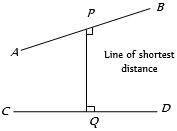
$A$ line with direction ratios proportional to $2, 1, 2$ meets each of the lines $x = y + a = z$ and $x + a = 2y = 2z$. The coordinates of each of the points of intersection are given by
A
$(2a, a, 3a), (2a, a, a)$
B
$(3a, 2a, 3a), (a, a, a)$
C
$(3a, 2a, 3a), (a, a, 2a)$
D
$(3a, 3a, 3a), (a, a, a)$
Solution
(B) Let the two lines be $L_1: x = y + a = z = \lambda$ and $L_2: x + a = 2y = 2z = 2\mu$.
From $L_1$,any point $P$ is $(\lambda, \lambda - a, \lambda)$.
From $L_2$,any point $Q$ is $(2\mu - a, \mu, \mu)$.
The direction ratios of the line $PQ$ are $(2\mu - a - \lambda, \mu - \lambda + a, \mu - \lambda)$.
Since the line $PQ$ is proportional to $2, 1, 2$,we have:
$\frac{2\mu - a - \lambda}{2} = \frac{\mu - \lambda + a}{1} = \frac{\mu - \lambda}{2} = k$.
From $\frac{\mu - \lambda}{2} = k$,we get $\mu - \lambda = 2k$.
Substituting this into the second ratio: $2k + a = k \implies k = -a$.
Then $\mu - \lambda = -2a$.
From the first ratio: $\frac{2\mu - \lambda - a}{2} = -a \implies 2\mu - \lambda = a$.
Solving $\mu - \lambda = -2a$ and $2\mu - \lambda = a$,we get $\mu = 3a$ and $\lambda = 3a$.
For $P$,substituting $\lambda = 3a$: $P = (3a, 3a - a, 3a) = (3a, 2a, 3a)$.
For $Q$,substituting $\mu = a$ (Wait,re-solving: $2\mu - \lambda = a$ and $\mu - \lambda = -2a \implies \mu = 3a, \lambda = 5a$ is incorrect. Let's re-evaluate: $\frac{2\mu - a - \lambda}{2} = \frac{\mu - \lambda + a}{1} = \frac{\mu - \lambda}{2}$.
Let $\mu - \lambda = m$. Then $\frac{2\mu - a - \lambda}{2} = \frac{m+a}{1} = \frac{m}{2}$.
$m = 2m + 2a \implies m = -2a$.
$2\mu - a - \lambda = 2(m+a) = 2(-2a+a) = -2a \implies 2\mu - \lambda = -a$.
With $\mu - \lambda = -2a$ and $2\mu - \lambda = -a$,we get $\mu = a$ and $\lambda = 3a$.
Thus,$P = (3a, 2a, 3a)$ and $Q = (2(a) - a, a, a) = (a, a, a)$.
From $L_1$,any point $P$ is $(\lambda, \lambda - a, \lambda)$.
From $L_2$,any point $Q$ is $(2\mu - a, \mu, \mu)$.
The direction ratios of the line $PQ$ are $(2\mu - a - \lambda, \mu - \lambda + a, \mu - \lambda)$.
Since the line $PQ$ is proportional to $2, 1, 2$,we have:
$\frac{2\mu - a - \lambda}{2} = \frac{\mu - \lambda + a}{1} = \frac{\mu - \lambda}{2} = k$.
From $\frac{\mu - \lambda}{2} = k$,we get $\mu - \lambda = 2k$.
Substituting this into the second ratio: $2k + a = k \implies k = -a$.
Then $\mu - \lambda = -2a$.
From the first ratio: $\frac{2\mu - \lambda - a}{2} = -a \implies 2\mu - \lambda = a$.
Solving $\mu - \lambda = -2a$ and $2\mu - \lambda = a$,we get $\mu = 3a$ and $\lambda = 3a$.
For $P$,substituting $\lambda = 3a$: $P = (3a, 3a - a, 3a) = (3a, 2a, 3a)$.
For $Q$,substituting $\mu = a$ (Wait,re-solving: $2\mu - \lambda = a$ and $\mu - \lambda = -2a \implies \mu = 3a, \lambda = 5a$ is incorrect. Let's re-evaluate: $\frac{2\mu - a - \lambda}{2} = \frac{\mu - \lambda + a}{1} = \frac{\mu - \lambda}{2}$.
Let $\mu - \lambda = m$. Then $\frac{2\mu - a - \lambda}{2} = \frac{m+a}{1} = \frac{m}{2}$.
$m = 2m + 2a \implies m = -2a$.
$2\mu - a - \lambda = 2(m+a) = 2(-2a+a) = -2a \implies 2\mu - \lambda = -a$.
With $\mu - \lambda = -2a$ and $2\mu - \lambda = -a$,we get $\mu = a$ and $\lambda = 3a$.
Thus,$P = (3a, 2a, 3a)$ and $Q = (2(a) - a, a, a) = (a, a, a)$.
0 likesView Solution
42
MathematicsDifficultMCQAIEEE · 2004
The graph of the function $y = f(x)$ is symmetrical about the line $x = 2$,then
A
$f(x) = -f(-x)$
B
$f(2 + x) = f(2 - x)$
C
$f(x) = f(-x)$
D
$f(x + 2) = f(x - 2)$
Solution
(B) function $y = f(x)$ is symmetrical about the line $x = a$ if $f(a + x) = f(a - x)$ for all $x$ in the domain.
Given that the graph is symmetrical about the line $x = 2$,we substitute $a = 2$ into the condition.
Therefore,$f(2 + x) = f(2 - x)$.
Given that the graph is symmetrical about the line $x = 2$,we substitute $a = 2$ into the condition.
Therefore,$f(2 + x) = f(2 - x)$.
0 likesView Solution
43
MathematicsMediumMCQAIEEE · 2004
If $f:R \to S$ defined by $f(x) = \sin x - \sqrt{3} \cos x + 1$ is onto,then the interval of $S$ is
A
$[-1, 3]$
B
$[1, 1]$
C
$[0, 1]$
D
$[0, -1]$
Solution
(A) The function is given by $f(x) = \sin x - \sqrt{3} \cos x + 1$.
We know that the expression $a \sin x + b \cos x$ lies in the interval $[-\sqrt{a^2 + b^2}, \sqrt{a^2 + b^2}]$.
Here,$a = 1$ and $b = -\sqrt{3}$.
Thus,the range of $\sin x - \sqrt{3} \cos x$ is $[-\sqrt{1^2 + (-\sqrt{3})^2}, \sqrt{1^2 + (-\sqrt{3})^2}] = [-\sqrt{1+3}, \sqrt{1+3}] = [-2, 2]$.
Adding $1$ to the entire inequality,we get:
$-2 + 1 \le \sin x - \sqrt{3} \cos x + 1 \le 2 + 1$.
$-1 \le f(x) \le 3$.
Since the function $f$ is onto,the codomain $S$ must be equal to the range of the function.
Therefore,$S = [-1, 3]$.
We know that the expression $a \sin x + b \cos x$ lies in the interval $[-\sqrt{a^2 + b^2}, \sqrt{a^2 + b^2}]$.
Here,$a = 1$ and $b = -\sqrt{3}$.
Thus,the range of $\sin x - \sqrt{3} \cos x$ is $[-\sqrt{1^2 + (-\sqrt{3})^2}, \sqrt{1^2 + (-\sqrt{3})^2}] = [-\sqrt{1+3}, \sqrt{1+3}] = [-2, 2]$.
Adding $1$ to the entire inequality,we get:
$-2 + 1 \le \sin x - \sqrt{3} \cos x + 1 \le 2 + 1$.
$-1 \le f(x) \le 3$.
Since the function $f$ is onto,the codomain $S$ must be equal to the range of the function.
Therefore,$S = [-1, 3]$.
0 likesView Solution
44
MathematicsEasyMCQAIEEE · 2004
The domain of the function $f(x) = \frac{\sin^{-1}(x - 3)}{\sqrt{9 - x^2}}$ is
A
$[1, 2)$
B
$[2, 3)$
C
$[1, 2]$
D
$[2, 3]$
Solution
(B) To define the function $f(x) = \frac{\sin^{-1}(x - 3)}{\sqrt{9 - x^2}}$,we must satisfy two conditions:
$1$. The argument of the square root in the denominator must be strictly positive:
$9 - x^2 > 0$
$x^2 < 9$
$-3 < x < 3$ --- $(i)$
$2$. The argument of the inverse sine function must lie in the interval $[-1, 1]$:
$-1 \le x - 3 \le 1$
Adding $3$ to all parts:
$2 \le x \le 4$ --- $(ii)$
Taking the intersection of conditions $(i)$ and $(ii)$:
$x \in (-3, 3) \cap [2, 4]$
$x \in [2, 3)$
Thus,the domain of the function is $[2, 3)$.
$1$. The argument of the square root in the denominator must be strictly positive:
$9 - x^2 > 0$
$x^2 < 9$
$-3 < x < 3$ --- $(i)$
$2$. The argument of the inverse sine function must lie in the interval $[-1, 1]$:
$-1 \le x - 3 \le 1$
Adding $3$ to all parts:
$2 \le x \le 4$ --- $(ii)$
Taking the intersection of conditions $(i)$ and $(ii)$:
$x \in (-3, 3) \cap [2, 4]$
$x \in [2, 3)$
Thus,the domain of the function is $[2, 3)$.
0 likesView Solution
45
MathematicsEasyMCQAIEEE · 2004
Let $f(x) = \frac{1 - \tan x}{4x - \pi }, x \ne \frac{\pi }{4}, x \in [0, \frac{\pi }{2}]$. If $f(x)$ is continuous in $[0, \frac{\pi }{2}]$,then $f(\frac{\pi }{4})$ is
A
$-1$
B
$\frac{1}{2}$
C
$-\frac{1}{2}$
D
$1$
Solution
(C) For $f(x)$ to be continuous at $x = \frac{\pi }{4}$,we must have $f(\frac{\pi }{4}) = \lim_{x \to \frac{\pi }{4}} f(x)$.
Evaluating the limit: $\lim_{x \to \frac{\pi }{4}} \frac{1 - \tan x}{4x - \pi }$.
Since this is a $\frac{0}{0}$ indeterminate form,we apply $L$'$H$ôpital's rule:
$\lim_{x \to \frac{\pi }{4}} \frac{\frac{d}{dx}(1 - \tan x)}{\frac{d}{dx}(4x - \pi )} = \lim_{x \to \frac{\pi }{4}} \frac{-\sec^2 x}{4}$.
Substituting $x = \frac{\pi }{4}$:
$\frac{-\sec^2(\frac{\pi }{4})}{4} = \frac{-(\sqrt{2})^2}{4} = \frac{-2}{4} = -\frac{1}{2}$.
Therefore,$f(\frac{\pi }{4}) = -\frac{1}{2}$.
Evaluating the limit: $\lim_{x \to \frac{\pi }{4}} \frac{1 - \tan x}{4x - \pi }$.
Since this is a $\frac{0}{0}$ indeterminate form,we apply $L$'$H$ôpital's rule:
$\lim_{x \to \frac{\pi }{4}} \frac{\frac{d}{dx}(1 - \tan x)}{\frac{d}{dx}(4x - \pi )} = \lim_{x \to \frac{\pi }{4}} \frac{-\sec^2 x}{4}$.
Substituting $x = \frac{\pi }{4}$:
$\frac{-\sec^2(\frac{\pi }{4})}{4} = \frac{-(\sqrt{2})^2}{4} = \frac{-2}{4} = -\frac{1}{2}$.
Therefore,$f(\frac{\pi }{4}) = -\frac{1}{2}$.
0 likesView Solution
46
MathematicsMediumMCQAIEEE · 2004
If $x = e^{y + e^{y + \dots \infty}}$,$x > 0$,then $\frac{dy}{dx}$ is
A
$\frac{1 + x}{x}$
B
$\frac{1}{x}$
C
$\frac{1 - x}{x}$
D
$\frac{x}{1 + x}$
Solution
(C) Given the equation $x = e^{y + e^{y + \dots \infty}}$.
Since the exponent is an infinite series,we can write it as $x = e^{y + x}$.
Taking the natural logarithm on both sides,we get $\ln(x) = y + x$.
Now,differentiate both sides with respect to $x$:
$\frac{d}{dx}(\ln(x)) = \frac{d}{dx}(y + x)$
$\frac{1}{x} = \frac{dy}{dx} + 1$.
Rearranging the terms to solve for $\frac{dy}{dx}$:
$\frac{dy}{dx} = \frac{1}{x} - 1 = \frac{1 - x}{x}$.
Since the exponent is an infinite series,we can write it as $x = e^{y + x}$.
Taking the natural logarithm on both sides,we get $\ln(x) = y + x$.
Now,differentiate both sides with respect to $x$:
$\frac{d}{dx}(\ln(x)) = \frac{d}{dx}(y + x)$
$\frac{1}{x} = \frac{dy}{dx} + 1$.
Rearranging the terms to solve for $\frac{dy}{dx}$:
$\frac{dy}{dx} = \frac{1}{x} - 1 = \frac{1 - x}{x}$.
0 likesView Solution
47
MathematicsMediumMCQAIEEE · 2004
The normal to the curve $x = a(1 + \cos \theta ), y = a \sin \theta$ at $\theta$ always passes through the fixed point
A
$(a, a)$
B
$(0, a)$
C
$(0, 0)$
D
$(a, 0)$
Solution
(D) Given the parametric equations of the curve: $x = a(1 + \cos \theta)$ and $y = a \sin \theta$.
First,we find the derivative $\frac{dy}{dx}$:
$\frac{dx}{d\theta} = -a \sin \theta$
$\frac{dy}{d\theta} = a \cos \theta$
$\frac{dy}{dx} = \frac{dy/d\theta}{dx/d\theta} = \frac{a \cos \theta}{-a \sin \theta} = -\cot \theta$.
The slope of the normal is the negative reciprocal of the slope of the tangent:
$m_n = -\frac{1}{dy/dx} = -\frac{1}{-\cot \theta} = \tan \theta$.
The equation of the normal at point $(a(1 + \cos \theta), a \sin \theta)$ is:
$y - a \sin \theta = \tan \theta (x - a(1 + \cos \theta))$
$y - a \sin \theta = \frac{\sin \theta}{\cos \theta} (x - a - a \cos \theta)$
$y \cos \theta - a \sin \theta \cos \theta = x \sin \theta - a \sin \theta - a \sin \theta \cos \theta$
$y \cos \theta = x \sin \theta - a \sin \theta$
$y \cos \theta = \sin \theta (x - a)$.
If we substitute the point $(a, 0)$ into the equation:
$0 \cdot \cos \theta = \sin \theta (a - a)$
$0 = 0$.
Thus,the normal always passes through the fixed point $(a, 0)$.
First,we find the derivative $\frac{dy}{dx}$:
$\frac{dx}{d\theta} = -a \sin \theta$
$\frac{dy}{d\theta} = a \cos \theta$
$\frac{dy}{dx} = \frac{dy/d\theta}{dx/d\theta} = \frac{a \cos \theta}{-a \sin \theta} = -\cot \theta$.
The slope of the normal is the negative reciprocal of the slope of the tangent:
$m_n = -\frac{1}{dy/dx} = -\frac{1}{-\cot \theta} = \tan \theta$.
The equation of the normal at point $(a(1 + \cos \theta), a \sin \theta)$ is:
$y - a \sin \theta = \tan \theta (x - a(1 + \cos \theta))$
$y - a \sin \theta = \frac{\sin \theta}{\cos \theta} (x - a - a \cos \theta)$
$y \cos \theta - a \sin \theta \cos \theta = x \sin \theta - a \sin \theta - a \sin \theta \cos \theta$
$y \cos \theta = x \sin \theta - a \sin \theta$
$y \cos \theta = \sin \theta (x - a)$.
If we substitute the point $(a, 0)$ into the equation:
$0 \cdot \cos \theta = \sin \theta (a - a)$
$0 = 0$.
Thus,the normal always passes through the fixed point $(a, 0)$.
0 likesView Solution
48
MathematicsMediumMCQAIEEE · 2004
$\int \frac{\sin x}{\sin (x - \alpha )} dx = $
A
$x \cos \alpha - \sin \alpha \log |\sin (x - \alpha )| + c$
B
$x \cos \alpha + \sin \alpha \log |\sin (x - \alpha )| + c$
C
$x \sin \alpha - \sin \alpha \log |\sin (x - \alpha )| + c$
D
None of these
Solution
(B) To evaluate the integral $I = \int \frac{\sin x}{\sin (x - \alpha )} dx$,we rewrite the numerator as $\sin(x - \alpha + \alpha)$.
Using the identity $\sin(A + B) = \sin A \cos B + \cos A \sin B$,we get:
$I = \int \frac{\sin(x - \alpha) \cos \alpha + \cos(x - \alpha) \sin \alpha}{\sin(x - \alpha)} dx$
$I = \int \left( \cos \alpha + \sin \alpha \cdot \cot(x - \alpha) \right) dx$
$I = \int \cos \alpha \, dx + \sin \alpha \int \cot(x - \alpha) \, dx$
Since $\int \cos \alpha \, dx = x \cos \alpha$ and $\int \cot(x - \alpha) \, dx = \log |\sin(x - \alpha)|$,we have:
$I = x \cos \alpha + \sin \alpha \log |\sin(x - \alpha)| + c$.
Using the identity $\sin(A + B) = \sin A \cos B + \cos A \sin B$,we get:
$I = \int \frac{\sin(x - \alpha) \cos \alpha + \cos(x - \alpha) \sin \alpha}{\sin(x - \alpha)} dx$
$I = \int \left( \cos \alpha + \sin \alpha \cdot \cot(x - \alpha) \right) dx$
$I = \int \cos \alpha \, dx + \sin \alpha \int \cot(x - \alpha) \, dx$
Since $\int \cos \alpha \, dx = x \cos \alpha$ and $\int \cot(x - \alpha) \, dx = \log |\sin(x - \alpha)|$,we have:
$I = x \cos \alpha + \sin \alpha \log |\sin(x - \alpha)| + c$.
0 likesView Solution
49
MathematicsMediumMCQAIEEE · 2004
$\int \frac{dx}{\cos x - \sin x}$ is equal to
A
$\frac{1}{\sqrt{2}} \log \left| \tan \left( \frac{x}{2} + \frac{3\pi}{8} \right) \right| + c$
B
$\frac{1}{\sqrt{2}} \log \left| \cot \left( \frac{x}{2} \right) \right| + c$
C
$\frac{1}{\sqrt{2}} \log \left| \tan \left( \frac{x}{2} - \frac{3\pi}{8} \right) \right| + c$
D
$\frac{1}{\sqrt{2}} \log \left| \tan \left( \frac{x}{2} - \frac{\pi}{8} \right) \right| + c$
Solution
(A) Let $I = \int \frac{dx}{\cos x - \sin x}$.
Multiply and divide by $\sqrt{2}$:
$I = \frac{1}{\sqrt{2}} \int \frac{dx}{\frac{1}{\sqrt{2}} \cos x - \frac{1}{\sqrt{2}} \sin x}$
Using $\cos \frac{\pi}{4} = \sin \frac{\pi}{4} = \frac{1}{\sqrt{2}}$,we get:
$I = \frac{1}{\sqrt{2}} \int \frac{dx}{\cos x \cos \frac{\pi}{4} - \sin x \sin \frac{\pi}{4}} = \frac{1}{\sqrt{2}} \int \frac{dx}{\cos(x + \frac{\pi}{4})}$
$I = \frac{1}{\sqrt{2}} \int \sec(x + \frac{\pi}{4}) dx$
Using the formula $\int \sec \theta d\theta = \log |\tan(\frac{\theta}{2} + \frac{\pi}{4})| + c$:
$I = \frac{1}{\sqrt{2}} \log \left| \tan \left( \frac{x + \frac{\pi}{4}}{2} + \frac{\pi}{4} \right) \right| + c$
$I = \frac{1}{\sqrt{2}} \log \left| \tan \left( \frac{x}{2} + \frac{\pi}{8} + \frac{2\pi}{8} \right) \right| + c$
$I = \frac{1}{\sqrt{2}} \log \left| \tan \left( \frac{x}{2} + \frac{3\pi}{8} \right) \right| + c$.
Multiply and divide by $\sqrt{2}$:
$I = \frac{1}{\sqrt{2}} \int \frac{dx}{\frac{1}{\sqrt{2}} \cos x - \frac{1}{\sqrt{2}} \sin x}$
Using $\cos \frac{\pi}{4} = \sin \frac{\pi}{4} = \frac{1}{\sqrt{2}}$,we get:
$I = \frac{1}{\sqrt{2}} \int \frac{dx}{\cos x \cos \frac{\pi}{4} - \sin x \sin \frac{\pi}{4}} = \frac{1}{\sqrt{2}} \int \frac{dx}{\cos(x + \frac{\pi}{4})}$
$I = \frac{1}{\sqrt{2}} \int \sec(x + \frac{\pi}{4}) dx$
Using the formula $\int \sec \theta d\theta = \log |\tan(\frac{\theta}{2} + \frac{\pi}{4})| + c$:
$I = \frac{1}{\sqrt{2}} \log \left| \tan \left( \frac{x + \frac{\pi}{4}}{2} + \frac{\pi}{4} \right) \right| + c$
$I = \frac{1}{\sqrt{2}} \log \left| \tan \left( \frac{x}{2} + \frac{\pi}{8} + \frac{2\pi}{8} \right) \right| + c$
$I = \frac{1}{\sqrt{2}} \log \left| \tan \left( \frac{x}{2} + \frac{3\pi}{8} \right) \right| + c$.
0 likesView Solution
50
MathematicsDifficultMCQAIEEE · 2004
The value of $I = \int_0^{\pi /2} \frac{(\sin x + \cos x)^2}{\sqrt{1 + \sin 2x}} dx$ is
A
$3$
B
$1$
C
$2$
D
$0$
Solution
(C) Given $I = \int_0^{\pi /2} \frac{(\sin x + \cos x)^2}{\sqrt{1 + \sin 2x}} dx$.
We know that $1 + \sin 2x = \sin^2 x + \cos^2 x + 2 \sin x \cos x = (\sin x + \cos x)^2$.
Substituting this into the integral,we get:
$I = \int_0^{\pi /2} \frac{(\sin x + \cos x)^2}{\sqrt{(\sin x + \cos x)^2}} dx$.
Since $\sin x + \cos x > 0$ for $x \in [0, \pi/2]$,$\sqrt{(\sin x + \cos x)^2} = \sin x + \cos x$.
Thus,$I = \int_0^{\pi /2} (\sin x + \cos x) dx$.
Evaluating the integral:
$I = [-\cos x + \sin x]_0^{\pi /2}$.
$I = (-\cos(\pi/2) + \sin(\pi/2)) - (-\cos(0) + \sin(0))$.
$I = (0 + 1) - (-1 + 0) = 1 + 1 = 2$.
We know that $1 + \sin 2x = \sin^2 x + \cos^2 x + 2 \sin x \cos x = (\sin x + \cos x)^2$.
Substituting this into the integral,we get:
$I = \int_0^{\pi /2} \frac{(\sin x + \cos x)^2}{\sqrt{(\sin x + \cos x)^2}} dx$.
Since $\sin x + \cos x > 0$ for $x \in [0, \pi/2]$,$\sqrt{(\sin x + \cos x)^2} = \sin x + \cos x$.
Thus,$I = \int_0^{\pi /2} (\sin x + \cos x) dx$.
Evaluating the integral:
$I = [-\cos x + \sin x]_0^{\pi /2}$.
$I = (-\cos(\pi/2) + \sin(\pi/2)) - (-\cos(0) + \sin(0))$.
$I = (0 + 1) - (-1 + 0) = 1 + 1 = 2$.
0 likesView Solution
51
MathematicsDifficultMCQAIEEE · 2004
The value of $\int_{-2}^{3} |1 - x^2| dx$ is
A
$\frac{1}{3}$
B
$\frac{14}{3}$
C
$\frac{7}{3}$
D
$\frac{28}{3}$
Solution
(D) We need to evaluate the integral $I = \int_{-2}^{3} |1 - x^2| dx$.
The expression $|1 - x^2|$ changes sign at $x = -1$ and $x = 1$.
For $x \in [-2, -1]$,$1 - x^2 \le 0$,so $|1 - x^2| = x^2 - 1$.
For $x \in [-1, 1]$,$1 - x^2 \ge 0$,so $|1 - x^2| = 1 - x^2$.
For $x \in [1, 3]$,$1 - x^2 \le 0$,so $|1 - x^2| = x^2 - 1$.
Thus,$I = \int_{-2}^{-1} (x^2 - 1) dx + \int_{-1}^{1} (1 - x^2) dx + \int_{1}^{3} (x^2 - 1) dx$.
Evaluating each integral:
$\int_{-2}^{-1} (x^2 - 1) dx = [\frac{x^3}{3} - x]_{-2}^{-1} = (-\frac{1}{3} + 1) - (-\frac{8}{3} + 2) = \frac{2}{3} - (-\frac{2}{3}) = \frac{4}{3}$.
$\int_{-1}^{1} (1 - x^2) dx = [x - \frac{x^3}{3}]_{-1}^{1} = (1 - \frac{1}{3}) - (-1 + \frac{1}{3}) = \frac{2}{3} - (-\frac{2}{3}) = \frac{4}{3}$.
$\int_{1}^{3} (x^2 - 1) dx = [\frac{x^3}{3} - x]_{1}^{3} = (9 - 3) - (\frac{1}{3} - 1) = 6 - (-\frac{2}{3}) = \frac{20}{3}$.
Summing these values: $I = \frac{4}{3} + \frac{4}{3} + \frac{20}{3} = \frac{28}{3}$.
The expression $|1 - x^2|$ changes sign at $x = -1$ and $x = 1$.
For $x \in [-2, -1]$,$1 - x^2 \le 0$,so $|1 - x^2| = x^2 - 1$.
For $x \in [-1, 1]$,$1 - x^2 \ge 0$,so $|1 - x^2| = 1 - x^2$.
For $x \in [1, 3]$,$1 - x^2 \le 0$,so $|1 - x^2| = x^2 - 1$.
Thus,$I = \int_{-2}^{-1} (x^2 - 1) dx + \int_{-1}^{1} (1 - x^2) dx + \int_{1}^{3} (x^2 - 1) dx$.
Evaluating each integral:
$\int_{-2}^{-1} (x^2 - 1) dx = [\frac{x^3}{3} - x]_{-2}^{-1} = (-\frac{1}{3} + 1) - (-\frac{8}{3} + 2) = \frac{2}{3} - (-\frac{2}{3}) = \frac{4}{3}$.
$\int_{-1}^{1} (1 - x^2) dx = [x - \frac{x^3}{3}]_{-1}^{1} = (1 - \frac{1}{3}) - (-1 + \frac{1}{3}) = \frac{2}{3} - (-\frac{2}{3}) = \frac{4}{3}$.
$\int_{1}^{3} (x^2 - 1) dx = [\frac{x^3}{3} - x]_{1}^{3} = (9 - 3) - (\frac{1}{3} - 1) = 6 - (-\frac{2}{3}) = \frac{20}{3}$.
Summing these values: $I = \frac{4}{3} + \frac{4}{3} + \frac{20}{3} = \frac{28}{3}$.
0 likesView Solution
52
MathematicsMediumMCQAIEEE · 2004
If $\int_0^\pi {xf(\sin x)dx = A} \int_0^{\pi /2} {f(\sin x)dx} $,then $A$ is
A
$2\pi $
B
$\pi $
C
$\frac{\pi }{4}$
D
$0$
Solution
(B) Let $I = \int_0^\pi {xf(\sin x)dx}$.
Using the property $\int_0^a f(x)dx = \int_0^a f(a-x)dx$,we have:
$I = \int_0^\pi {(\pi - x)f(\sin(\pi - x))dx} = \int_0^\pi {(\pi - x)f(\sin x)dx}$.
Adding the two expressions for $I$:
$2I = \int_0^\pi {xf(\sin x)dx} + \int_0^\pi {(\pi - x)f(\sin x)dx} = \int_0^\pi {\pi f(\sin x)dx} = \pi \int_0^\pi {f(\sin x)dx}$.
Using the property $\int_0^{2a} f(x)dx = 2\int_0^a f(x)dx$ if $f(2a-x) = f(x)$,we have $\int_0^\pi {f(\sin x)dx} = 2\int_0^{\pi /2} {f(\sin x)dx}$.
Thus,$2I = \pi \times 2 \int_0^{\pi /2} {f(\sin x)dx} = 2\pi \int_0^{\pi /2} {f(\sin x)dx}$.
Therefore,$I = \pi \int_0^{\pi /2} {f(\sin x)dx}$.
Comparing this with $A \int_0^{\pi /2} {f(\sin x)dx}$,we get $A = \pi$.
Using the property $\int_0^a f(x)dx = \int_0^a f(a-x)dx$,we have:
$I = \int_0^\pi {(\pi - x)f(\sin(\pi - x))dx} = \int_0^\pi {(\pi - x)f(\sin x)dx}$.
Adding the two expressions for $I$:
$2I = \int_0^\pi {xf(\sin x)dx} + \int_0^\pi {(\pi - x)f(\sin x)dx} = \int_0^\pi {\pi f(\sin x)dx} = \pi \int_0^\pi {f(\sin x)dx}$.
Using the property $\int_0^{2a} f(x)dx = 2\int_0^a f(x)dx$ if $f(2a-x) = f(x)$,we have $\int_0^\pi {f(\sin x)dx} = 2\int_0^{\pi /2} {f(\sin x)dx}$.
Thus,$2I = \pi \times 2 \int_0^{\pi /2} {f(\sin x)dx} = 2\pi \int_0^{\pi /2} {f(\sin x)dx}$.
Therefore,$I = \pi \int_0^{\pi /2} {f(\sin x)dx}$.
Comparing this with $A \int_0^{\pi /2} {f(\sin x)dx}$,we get $A = \pi$.
0 likesView Solution
53
MathematicsDifficultMCQAIEEE · 2004
$\mathop {\lim }\limits_{n \to \infty } \sum\limits_{r = 1}^n {\frac{1}{n}{e^{\frac{r}{n}}}} $ is
A
$e + 1$
B
$e - 1$
C
$1 - e$
D
$e$
Solution
(B) The given limit is of the form of a definite integral as a limit of a sum.
We know that $\mathop {\lim }\limits_{n \to \infty } \sum\limits_{r = 1}^n {\frac{1}{n}f\left( \frac{r}{n} \right) = \int_0^1 {f(x)dx} }$.
Here,$f\left( \frac{r}{n} \right) = e^{\frac{r}{n}}$,so $f(x) = e^x$.
Therefore,the expression becomes $\int_0^1 {e^x dx}$.
Evaluating the integral: $\int_0^1 {e^x dx} = [e^x]_0^1 = e^1 - e^0 = e - 1$.
Thus,the correct option is $B$.
We know that $\mathop {\lim }\limits_{n \to \infty } \sum\limits_{r = 1}^n {\frac{1}{n}f\left( \frac{r}{n} \right) = \int_0^1 {f(x)dx} }$.
Here,$f\left( \frac{r}{n} \right) = e^{\frac{r}{n}}$,so $f(x) = e^x$.
Therefore,the expression becomes $\int_0^1 {e^x dx}$.
Evaluating the integral: $\int_0^1 {e^x dx} = [e^x]_0^1 = e^1 - e^0 = e - 1$.
Thus,the correct option is $B$.
0 likesView Solution
54
MathematicsMediumMCQAIEEE · 2004
The area of the region bounded by the curves $y = |x - 2|$,$x = 1$,$x = 3$ and the $x$-axis is
A
$4$
B
$2$
C
$3$
D
$1$
Solution
(D) The required area is given by the integral $\int_{1}^{3} |x - 2| \, dx$.
Since $|x - 2| = -(x - 2)$ for $x < 2$ and $|x - 2| = (x - 2)$ for $x \geq 2$,we split the integral at $x = 2$:
$\text{Area} = \int_{1}^{2} -(x - 2) \, dx + \int_{2}^{3} (x - 2) \, dx$
$= \int_{1}^{2} (2 - x) \, dx + \int_{2}^{3} (x - 2) \, dx$
$= \left[ 2x - \frac{x^2}{2} \right]_{1}^{2} + \left[ \frac{x^2}{2} - 2x \right]_{2}^{3}$
$= \left( (4 - 2) - (2 - 0.5) \right) + \left( (4.5 - 6) - (2 - 4) \right)$
$= (2 - 1.5) + (-1.5 - (-2))$
$= 0.5 + 0.5 = 1$.
Thus,the area is $1$ square unit.
Since $|x - 2| = -(x - 2)$ for $x < 2$ and $|x - 2| = (x - 2)$ for $x \geq 2$,we split the integral at $x = 2$:
$\text{Area} = \int_{1}^{2} -(x - 2) \, dx + \int_{2}^{3} (x - 2) \, dx$
$= \int_{1}^{2} (2 - x) \, dx + \int_{2}^{3} (x - 2) \, dx$
$= \left[ 2x - \frac{x^2}{2} \right]_{1}^{2} + \left[ \frac{x^2}{2} - 2x \right]_{2}^{3}$
$= \left( (4 - 2) - (2 - 0.5) \right) + \left( (4.5 - 6) - (2 - 4) \right)$
$= (2 - 1.5) + (-1.5 - (-2))$
$= 0.5 + 0.5 = 1$.
Thus,the area is $1$ square unit.
0 likesView Solution
55
MathematicsDifficultMCQAIEEE · 2004
If $f(x) = \frac{e^x}{1 + e^x}$,$I_1 = \int_{f(-a)}^{f(a)} x g\{x(1 - x)\} dx$,and $I_2 = \int_{f(-a)}^{f(a)} g\{x(1 - x)\} dx$,then the value of $\frac{I_2}{I_1}$ is
A
$1$
B
$-3$
C
$-1$
D
$2$
Solution
(D) Given $f(x) = \frac{e^x}{1 + e^x}$. Note that $f(-a) = \frac{e^{-a}}{1 + e^{-a}} = \frac{1}{e^a + 1}$.
Thus,$f(a) + f(-a) = \frac{e^a}{1 + e^a} + \frac{1}{1 + e^a} = 1$.
Let $I_1 = \int_{f(-a)}^{f(a)} x g\{x(1 - x)\} dx$. Using the property $\int_{A}^{B} h(x) dx = \int_{A}^{B} h(A + B - x) dx$,where $A + B = 1$:
$I_1 = \int_{f(-a)}^{f(a)} (1 - x) g\{(1 - x)(1 - (1 - x))\} dx = \int_{f(-a)}^{f(a)} (1 - x) g\{(1 - x)x\} dx$.
$I_1 = \int_{f(-a)}^{f(a)} g\{x(1 - x)\} dx - \int_{f(-a)}^{f(a)} x g\{x(1 - x)\} dx$.
$I_1 = I_2 - I_1$.
$2I_1 = I_2$.
Therefore,$\frac{I_2}{I_1} = 2$.
Thus,$f(a) + f(-a) = \frac{e^a}{1 + e^a} + \frac{1}{1 + e^a} = 1$.
Let $I_1 = \int_{f(-a)}^{f(a)} x g\{x(1 - x)\} dx$. Using the property $\int_{A}^{B} h(x) dx = \int_{A}^{B} h(A + B - x) dx$,where $A + B = 1$:
$I_1 = \int_{f(-a)}^{f(a)} (1 - x) g\{(1 - x)(1 - (1 - x))\} dx = \int_{f(-a)}^{f(a)} (1 - x) g\{(1 - x)x\} dx$.
$I_1 = \int_{f(-a)}^{f(a)} g\{x(1 - x)\} dx - \int_{f(-a)}^{f(a)} x g\{x(1 - x)\} dx$.
$I_1 = I_2 - I_1$.
$2I_1 = I_2$.
Therefore,$\frac{I_2}{I_1} = 2$.
0 likesView Solution
56
MathematicsMediumMCQAIEEE · 2004
The solution of the equation $\frac{dy}{dx} = e^{x - y} + x^2 e^{-y}$ is
A
$e^y = e^x + \frac{x^3}{3} + c$
B
$e^y = e^x + 2x + c$
C
$e^y = e^x + x^3 + c$
D
$y = e^x + c$
Solution
(A) Given the differential equation: $\frac{dy}{dx} = e^{x - y} + x^2 e^{-y}$
We can rewrite the right side as: $\frac{dy}{dx} = e^{-y}(e^x + x^2)$
Separating the variables $x$ and $y$,we get: $e^y dy = (e^x + x^2) dx$
Integrating both sides: $\int e^y dy = \int (e^x + x^2) dx$
Performing the integration: $e^y = e^x + \frac{x^3}{3} + c$
Thus,the correct option is $A$.
We can rewrite the right side as: $\frac{dy}{dx} = e^{-y}(e^x + x^2)$
Separating the variables $x$ and $y$,we get: $e^y dy = (e^x + x^2) dx$
Integrating both sides: $\int e^y dy = \int (e^x + x^2) dx$
Performing the integration: $e^y = e^x + \frac{x^3}{3} + c$
Thus,the correct option is $A$.
0 likesView Solution
57
MathematicsDifficultMCQAIEEE · 2004
$A$ function $y = f(x)$ has a second-order derivative $f''(x) = 6(x - 1)$. If its graph passes through the point $(2, 1)$ and at that point the tangent to the graph is $y = 3x - 5$,then the function is
A
$(x + 1)^3$
B
$(x - 1)^3$
C
$(x + 1)^2$
D
$(x - 1)^2$
Solution
(B) Given $f''(x) = 6(x - 1)$.
Integrating with respect to $x$,we get $f'(x) = \int 6(x - 1) dx = 3(x - 1)^2 + c_1$.
Since the tangent at $(2, 1)$ is $y = 3x - 5$,the slope of the tangent at $x = 2$ is $f'(2) = 3$.
Substituting $x = 2$ into the expression for $f'(x)$,we get $3 = 3(2 - 1)^2 + c_1$,which implies $3 = 3 + c_1$,so $c_1 = 0$.
Thus,$f'(x) = 3(x - 1)^2$.
Integrating again with respect to $x$,we get $f(x) = \int 3(x - 1)^2 dx = (x - 1)^3 + c_2$.
Since the graph passes through $(2, 1)$,we have $f(2) = 1$.
Substituting $x = 2$ into the expression for $f(x)$,we get $1 = (2 - 1)^3 + c_2$,which implies $1 = 1 + c_2$,so $c_2 = 0$.
Therefore,the function is $f(x) = (x - 1)^3$.
Integrating with respect to $x$,we get $f'(x) = \int 6(x - 1) dx = 3(x - 1)^2 + c_1$.
Since the tangent at $(2, 1)$ is $y = 3x - 5$,the slope of the tangent at $x = 2$ is $f'(2) = 3$.
Substituting $x = 2$ into the expression for $f'(x)$,we get $3 = 3(2 - 1)^2 + c_1$,which implies $3 = 3 + c_1$,so $c_1 = 0$.
Thus,$f'(x) = 3(x - 1)^2$.
Integrating again with respect to $x$,we get $f(x) = \int 3(x - 1)^2 dx = (x - 1)^3 + c_2$.
Since the graph passes through $(2, 1)$,we have $f(2) = 1$.
Substituting $x = 2$ into the expression for $f(x)$,we get $1 = (2 - 1)^3 + c_2$,which implies $1 = 1 + c_2$,so $c_2 = 0$.
Therefore,the function is $f(x) = (x - 1)^3$.
0 likesView Solution
58
MathematicsMediumMCQAIEEE · 2004
$A$ random variable $X$ has the probability distribution as shown below. For the events $E = \{ X \text{ is a prime number} \}$ and $F = \{ X < 4 \}$,the probability $P(E \cup F)$ is:
| $X$ | $1$ | $2$ | $3$ | $4$ | $5$ | $6$ | $7$ | $8$ |
| $P(X)$ | $0.15$ | $0.23$ | $0.12$ | $0.10$ | $0.20$ | $0.08$ | $0.07$ | $0.05$ |
A
$0.5$
B
$0.77$
C
$0.35$
D
$0.87$
Solution
(B) The event $E$ is defined as $X$ being a prime number. The prime numbers in the given set are $\{2, 3, 5, 7\}$.
$P(E) = P(2) + P(3) + P(5) + P(7) = 0.23 + 0.12 + 0.20 + 0.07 = 0.62$.
The event $F$ is defined as $X < 4$. The values satisfying this are $\{1, 2, 3\}$.
$P(F) = P(1) + P(2) + P(3) = 0.15 + 0.23 + 0.12 = 0.50$.
The intersection event $E \cap F$ consists of values that are both prime and less than $4$,which are $\{2, 3\}$.
$P(E \cap F) = P(2) + P(3) = 0.23 + 0.12 = 0.35$.
Using the addition rule for probability,$P(E \cup F) = P(E) + P(F) - P(E \cap F)$.
$P(E \cup F) = 0.62 + 0.50 - 0.35 = 0.77$.
$P(E) = P(2) + P(3) + P(5) + P(7) = 0.23 + 0.12 + 0.20 + 0.07 = 0.62$.
The event $F$ is defined as $X < 4$. The values satisfying this are $\{1, 2, 3\}$.
$P(F) = P(1) + P(2) + P(3) = 0.15 + 0.23 + 0.12 = 0.50$.
The intersection event $E \cap F$ consists of values that are both prime and less than $4$,which are $\{2, 3\}$.
$P(E \cap F) = P(2) + P(3) = 0.23 + 0.12 = 0.35$.
Using the addition rule for probability,$P(E \cup F) = P(E) + P(F) - P(E \cap F)$.
$P(E \cup F) = 0.62 + 0.50 - 0.35 = 0.77$.
0 likesView Solution
59
MathematicsEasyMCQAIEEE · 2004
The mean and the variance of a binomial distribution are $4$ and $2$ respectively. Then the probability of $2$ successes is
A
$\frac{28}{256}$
B
$\frac{219}{256}$
C
$\frac{128}{256}$
D
$\frac{37}{256}$
Solution
(A) For a binomial distribution,the mean is given by $\mu = np = 4$ and the variance is given by $\sigma^2 = npq = 2$.
Dividing the variance by the mean,we get $\frac{npq}{np} = \frac{2}{4}$,which implies $q = \frac{1}{2}$.
Since $p + q = 1$,we have $p = 1 - \frac{1}{2} = \frac{1}{2}$.
Substituting $p = \frac{1}{2}$ into $np = 4$,we get $n(\frac{1}{2}) = 4$,so $n = 8$.
The probability of $X$ successes is given by $P(X = k) = \binom{n}{k} p^k q^{n-k}$.
For $k = 2$,we have $P(X = 2) = \binom{8}{2} (\frac{1}{2})^2 (\frac{1}{2})^{8-2} = \binom{8}{2} (\frac{1}{2})^8$.
Calculating the combination,$\binom{8}{2} = \frac{8 \times 7}{2 \times 1} = 28$.
Thus,$P(X = 2) = 28 \times \frac{1}{256} = \frac{28}{256}$.
Dividing the variance by the mean,we get $\frac{npq}{np} = \frac{2}{4}$,which implies $q = \frac{1}{2}$.
Since $p + q = 1$,we have $p = 1 - \frac{1}{2} = \frac{1}{2}$.
Substituting $p = \frac{1}{2}$ into $np = 4$,we get $n(\frac{1}{2}) = 4$,so $n = 8$.
The probability of $X$ successes is given by $P(X = k) = \binom{n}{k} p^k q^{n-k}$.
For $k = 2$,we have $P(X = 2) = \binom{8}{2} (\frac{1}{2})^2 (\frac{1}{2})^{8-2} = \binom{8}{2} (\frac{1}{2})^8$.
Calculating the combination,$\binom{8}{2} = \frac{8 \times 7}{2 \times 1} = 28$.
Thus,$P(X = 2) = 28 \times \frac{1}{256} = \frac{28}{256}$.
0 likesView Solution
60
MathematicsMediumMCQAIEEE · 2004
If ${a_1}, {a_2}, {a_3}, \dots, {a_n}, \dots$ are in $G.P.$,then the value of the determinant $\left| \begin{array}{ccc} \log {a_n} & \log {a_{n+1}} & \log {a_{n+2}} \\ \log {a_{n+3}} & \log {a_{n+4}} & \log {a_{n+5}} \\ \log {a_{n+6}} & \log {a_{n+7}} & \log {a_{n+8}} \end{array} \right|$ is
A
$-2$
B
$1$
C
$2$
D
$0$
Solution
(D) Given that ${a_1}, {a_2}, {a_3}, \dots$ are in $G.P.$ with common ratio $r$.
Thus,${a_{n+1}} = {a_n} \cdot r$,which implies $\log {a_{n+1}} = \log {a_n} + \log r$.
Similarly,$\log {a_{n+k}} = \log {a_n} + k \log r$.
Let the determinant be $\Delta = \left| \begin{array}{ccc} \log {a_n} & \log {a_{n+1}} & \log {a_{n+2}} \\ \log {a_{n+3}} & \log {a_{n+4}} & \log {a_{n+5}} \\ \log {a_{n+6}} & \log {a_{n+7}} & \log {a_{n+8}} \end{array} \right|$.
Applying column operations ${C_2} \to {C_2} - {C_1}$ and ${C_3} \to {C_3} - {C_2}$:
$\Delta = \left| \begin{array}{ccc} \log {a_n} & \log {a_{n+1}} - \log {a_n} & \log {a_{n+2}} - \log {a_{n+1}} \\ \log {a_{n+3}} & \log {a_{n+4}} - \log {a_{n+3}} & \log {a_{n+5}} - \log {a_{n+4}} \\ \log {a_{n+6}} & \log {a_{n+7}} - \log {a_{n+6}} & \log {a_{n+8}} - \log {a_{n+7}} \end{array} \right|$.
Since $\log {a_{n+k}} - \log {a_{n+k-1}} = \log r$ for any $k$,the determinant becomes:
$\Delta = \left| \begin{array}{ccc} \log {a_n} & \log r & \log r \\ \log {a_{n+3}} & \log r & \log r \\ \log {a_{n+6}} & \log r & \log r \end{array} \right|$.
Since column $2$ and column $3$ are identical,the value of the determinant is $0$.
Thus,${a_{n+1}} = {a_n} \cdot r$,which implies $\log {a_{n+1}} = \log {a_n} + \log r$.
Similarly,$\log {a_{n+k}} = \log {a_n} + k \log r$.
Let the determinant be $\Delta = \left| \begin{array}{ccc} \log {a_n} & \log {a_{n+1}} & \log {a_{n+2}} \\ \log {a_{n+3}} & \log {a_{n+4}} & \log {a_{n+5}} \\ \log {a_{n+6}} & \log {a_{n+7}} & \log {a_{n+8}} \end{array} \right|$.
Applying column operations ${C_2} \to {C_2} - {C_1}$ and ${C_3} \to {C_3} - {C_2}$:
$\Delta = \left| \begin{array}{ccc} \log {a_n} & \log {a_{n+1}} - \log {a_n} & \log {a_{n+2}} - \log {a_{n+1}} \\ \log {a_{n+3}} & \log {a_{n+4}} - \log {a_{n+3}} & \log {a_{n+5}} - \log {a_{n+4}} \\ \log {a_{n+6}} & \log {a_{n+7}} - \log {a_{n+6}} & \log {a_{n+8}} - \log {a_{n+7}} \end{array} \right|$.
Since $\log {a_{n+k}} - \log {a_{n+k-1}} = \log r$ for any $k$,the determinant becomes:
$\Delta = \left| \begin{array}{ccc} \log {a_n} & \log r & \log r \\ \log {a_{n+3}} & \log r & \log r \\ \log {a_{n+6}} & \log r & \log r \end{array} \right|$.
Since column $2$ and column $3$ are identical,the value of the determinant is $0$.
0 likesView Solution
61
MathematicsDifficultMCQAIEEE · 2004
Let $u, v, w$ be vectors such that $|u| = 1, |v| = 2, |w| = 3$. If the projection of $v$ along $u$ is equal to the projection of $w$ along $u$,and $v$ and $w$ are perpendicular to each other,then $|u - v + w|$ equals:
A
$14$
B
$\sqrt{7}$
C
$\sqrt{14}$
D
$2$
Solution
(C) Given $|u| = 1, |v| = 2, |w| = 3$. Since $v \perp w$,we have $v \cdot w = 0$.
Let the projection of $v$ along $u$ be equal to the projection of $w$ along $u$. This implies $\frac{v \cdot u}{|u|} = \frac{w \cdot u}{|u|}$.
Since $|u| = 1$,we have $v \cdot u = w \cdot u$,which means $(v - w) \cdot u = 0$.
We want to find $|u - v + w|$. Let $X = u - (v - w)$.
Then $|X|^2 = |u - (v - w)|^2 = |u|^2 + |v - w|^2 - 2u \cdot (v - w)$.
Since $u \cdot (v - w) = 0$,we have $|X|^2 = |u|^2 + |v - w|^2$.
$|v - w|^2 = |v|^2 + |w|^2 - 2(v \cdot w) = 2^2 + 3^2 - 2(0) = 4 + 9 = 13$.
Thus,$|u - v + w|^2 = 1^2 + 13 = 14$.
Therefore,$|u - v + w| = \sqrt{14}$.
Let the projection of $v$ along $u$ be equal to the projection of $w$ along $u$. This implies $\frac{v \cdot u}{|u|} = \frac{w \cdot u}{|u|}$.
Since $|u| = 1$,we have $v \cdot u = w \cdot u$,which means $(v - w) \cdot u = 0$.
We want to find $|u - v + w|$. Let $X = u - (v - w)$.
Then $|X|^2 = |u - (v - w)|^2 = |u|^2 + |v - w|^2 - 2u \cdot (v - w)$.
Since $u \cdot (v - w) = 0$,we have $|X|^2 = |u|^2 + |v - w|^2$.
$|v - w|^2 = |v|^2 + |w|^2 - 2(v \cdot w) = 2^2 + 3^2 - 2(0) = 4 + 9 = 13$.
Thus,$|u - v + w|^2 = 1^2 + 13 = 14$.
Therefore,$|u - v + w| = \sqrt{14}$.
0 likesView Solution
62
MathematicsMediumMCQAIEEE · 2004
Let $a, b$ and $c$ be non-zero vectors such that $(a \times b) \times c = \frac{1}{3}|b||c|a$. If $\theta$ is the acute angle between the vectors $b$ and $c$,then $\sin \theta$ equals
A
$\frac{2\sqrt{2}}{3}$
B
$\frac{\sqrt{2}}{3}$
C
$\frac{2}{3}$
D
$\frac{1}{3}$
Solution
(A) Given the vector triple product identity: $(a \times b) \times c = (a \cdot c)b - (b \cdot c)a$.
Substituting this into the given equation: $(a \cdot c)b - (b \cdot c)a = \frac{1}{3}|b||c|a$.
Rearranging the terms: $(a \cdot c)b = (b \cdot c + \frac{1}{3}|b||c|)a$.
Since $a$ and $b$ are non-zero and not parallel,the coefficients must be zero:
$a \cdot c = 0$ and $b \cdot c + \frac{1}{3}|b||c| = 0$.
Using the definition of the dot product $b \cdot c = |b||c| \cos \theta$,we get:
$|b||c| \cos \theta + \frac{1}{3}|b||c| = 0$.
Since $b$ and $c$ are non-zero,$\cos \theta = -\frac{1}{3}$.
However,the problem states $\theta$ is the acute angle between $b$ and $c$,implying $\cos \theta > 0$.
Re-evaluating the equation $(a \cdot c)b - (b \cdot c)a = \frac{1}{3}|b||c|a$,if $a$ and $b$ are linearly independent,then $a \cdot c = 0$ and $-(b \cdot c) = \frac{1}{3}|b||c|$.
Thus,$\cos \theta = -\frac{1}{3}$.
Given the constraint that $\theta$ is acute,there might be a sign convention in the problem statement. Assuming the magnitude of the cosine is $1/3$,$\sin \theta = \sqrt{1 - \cos^2 \theta} = \sqrt{1 - (1/3)^2} = \sqrt{8/9} = \frac{2\sqrt{2}}{3}$.
Substituting this into the given equation: $(a \cdot c)b - (b \cdot c)a = \frac{1}{3}|b||c|a$.
Rearranging the terms: $(a \cdot c)b = (b \cdot c + \frac{1}{3}|b||c|)a$.
Since $a$ and $b$ are non-zero and not parallel,the coefficients must be zero:
$a \cdot c = 0$ and $b \cdot c + \frac{1}{3}|b||c| = 0$.
Using the definition of the dot product $b \cdot c = |b||c| \cos \theta$,we get:
$|b||c| \cos \theta + \frac{1}{3}|b||c| = 0$.
Since $b$ and $c$ are non-zero,$\cos \theta = -\frac{1}{3}$.
However,the problem states $\theta$ is the acute angle between $b$ and $c$,implying $\cos \theta > 0$.
Re-evaluating the equation $(a \cdot c)b - (b \cdot c)a = \frac{1}{3}|b||c|a$,if $a$ and $b$ are linearly independent,then $a \cdot c = 0$ and $-(b \cdot c) = \frac{1}{3}|b||c|$.
Thus,$\cos \theta = -\frac{1}{3}$.
Given the constraint that $\theta$ is acute,there might be a sign convention in the problem statement. Assuming the magnitude of the cosine is $1/3$,$\sin \theta = \sqrt{1 - \cos^2 \theta} = \sqrt{1 - (1/3)^2} = \sqrt{8/9} = \frac{2\sqrt{2}}{3}$.
0 likesView Solution
63
MathematicsDifficultMCQAIEEE · 2004
The intersection of the spheres ${x^2} + {y^2} + {z^2} + 7x - 2y - z = 13$ and ${x^2} + {y^2} + {z^2} - 3x + 3y + 4z = 8$ is the same as the intersection of one of the spheres and the plane:
A
$2x - y - z = 1$
B
$x - 2y - z = 1$
C
$x - y - 2z = 1$
D
$x - y - z = 1$
Solution
(A) The equation of the plane passing through the intersection of two spheres ${S_1} = 0$ and ${S_2} = 0$ is given by ${S_1} - {S_2} = 0$.
Given the spheres:
${S_1}: {x^2} + {y^2} + {z^2} + 7x - 2y - z - 13 = 0$
${S_2}: {x^2} + {y^2} + {z^2} - 3x + 3y + 4z - 8 = 0$
Subtracting the two equations:
$({x^2} + {y^2} + {z^2} + 7x - 2y - z - 13) - ({x^2} + {y^2} + {z^2} - 3x + 3y + 4z - 8) = 0$
$(7x - (-3x)) + (-2y - 3y) + (-z - 4z) + (-13 - (-8)) = 0$
$10x - 5y - 5z - 5 = 0$
Dividing the entire equation by $5$:
$2x - y - z = 1$
Thus,the intersection of the two spheres lies on the plane $2x - y - z = 1$.
Given the spheres:
${S_1}: {x^2} + {y^2} + {z^2} + 7x - 2y - z - 13 = 0$
${S_2}: {x^2} + {y^2} + {z^2} - 3x + 3y + 4z - 8 = 0$
Subtracting the two equations:
$({x^2} + {y^2} + {z^2} + 7x - 2y - z - 13) - ({x^2} + {y^2} + {z^2} - 3x + 3y + 4z - 8) = 0$
$(7x - (-3x)) + (-2y - 3y) + (-z - 4z) + (-13 - (-8)) = 0$
$10x - 5y - 5z - 5 = 0$
Dividing the entire equation by $5$:
$2x - y - z = 1$
Thus,the intersection of the two spheres lies on the plane $2x - y - z = 1$.
0 likesView Solution
64
MathematicsMediumMCQAIEEE · 2004
The differential equation for the family of curves ${x^2} + {y^2} - 2ay = 0,$ where $a$ is an arbitrary constant,is
A
$({x^2} + {y^2})y' = 2xy$
B
$2({x^2} + {y^2})y' = 2xy$
C
$({x^2} - {y^2})y' = 2xy$
D
$2({x^2} - {y^2})y' = xy$
Solution
(C) Given the family of curves is ${x^2} + {y^2} - 2ay = 0$ ..... $(i)$
Differentiating both sides with respect to $x$,we get:
$2x + 2yy' - 2ay' = 0$
$2ay' = 2x + 2yy'$
$2a = \frac{2x + 2yy'}{y'} = \frac{2x}{y'} + 2y$ ..... $(ii)$
Substituting the value of $2a$ from equation $(ii)$ into equation $(i)$:
${x^2} + {y^2} - (\frac{2x}{y'} + 2y)y = 0$
${x^2} + {y^2} - \frac{2xy}{y'} - 2{y^2} = 0$
${x^2} - {y^2} - \frac{2xy}{y'} = 0$
Multiplying by $y'$,we get:
$({x^2} - {y^2})y' - 2xy = 0$
$({x^2} - {y^2})y' = 2xy$.
Differentiating both sides with respect to $x$,we get:
$2x + 2yy' - 2ay' = 0$
$2ay' = 2x + 2yy'$
$2a = \frac{2x + 2yy'}{y'} = \frac{2x}{y'} + 2y$ ..... $(ii)$
Substituting the value of $2a$ from equation $(ii)$ into equation $(i)$:
${x^2} + {y^2} - (\frac{2x}{y'} + 2y)y = 0$
${x^2} + {y^2} - \frac{2xy}{y'} - 2{y^2} = 0$
${x^2} - {y^2} - \frac{2xy}{y'} = 0$
Multiplying by $y'$,we get:
$({x^2} - {y^2})y' - 2xy = 0$
$({x^2} - {y^2})y' = 2xy$.
0 likesView Solution
Vedclass Products
For Students
Vedclass Test Series
Mock tests in real AIEEE style covering Mathematics with performance analysis. 5-day free trial.
Start Free TrialFor Teachers
Exam Paper Generator
Generate Set A/B/C/D Mathematics papers from 7.5L+ questions in 2 minutes. 3 chapters free.
Try FreeFor Institutes
Online Exam Module
Run live AIEEE mock exams with unlimited students, 360° analytics & white-label branding.
See DemoFrequently Asked Questions
How many Mathematics questions are in AIEEE 2004?
There are 64 Mathematics questions from the AIEEE 2004 paper on Vedclass, each with a detailed step-by-step solution in English.
Are AIEEE 2004 Mathematics solutions available in English?
Yes. All solutions on this page are in English. You can also switch to English or Hindi using the language buttons above the questions.
Can I practice AIEEE 2004 Mathematics as a timed test?
Yes. Use the Vedclass Test Series to attempt a full AIEEE mock test covering Mathematics with time limits and instant score analysis.
Can teachers create Mathematics papers from AIEEE previous year questions?
Yes. The Vedclass Exam Paper Generator lets teachers mix AIEEE Mathematics questions and generate Set A/B/C/D papers in minutes.
For Teachers & Institutes
Build a Custom Mathematics Paper
Pick AIEEE 2004 Mathematics questions, set difficulty, and generate Set A/B/C/D in 2 minutes.