
अ Hindi
Trigonometry Questions in Hindi
Competitive Exam Quantitative Aptitude · Trigonometry · Trigonometry
648+
Questions
Hindi
Language
100%
With Solutions
Showing 50 of 648 questions in Hindi
551
EasyMCQ
$(1+\cot A)^{2}+(1-\cot A)^{2}$ का मान क्या है?
A
$2 \operatorname{cosec}^{2} A$
B
$2 \operatorname{sec}^{2} A$
C
$1-2 \operatorname{cosec}^{2} A$
D
$1-2 \sec ^{2} A$
Solution
(A) दिया गया व्यंजक: $(1+\cot A)^{2}+(1-\cot A)^{2}$
$(a+b)^{2} = a^{2}+b^{2}+2ab$ और $(a-b)^{2} = a^{2}+b^{2}-2ab$ सर्वसमिकाओं का उपयोग करके वर्गों का विस्तार करने पर:
$= (1 + \cot^{2} A + 2 \cot A) + (1 + \cot^{2} A - 2 \cot A)$
समान पदों को जोड़ने पर:
$= 1 + \cot^{2} A + 2 \cot A + 1 + \cot^{2} A - 2 \cot A$
$= 2 + 2 \cot^{2} A$
$2$ को उभयनिष्ठ (common) लेने पर:
$= 2(1 + \cot^{2} A)$
त्रिकोणमितीय सर्वसमिका $1 + \cot^{2} A = \operatorname{cosec}^{2} A$ का उपयोग करने पर:
$= 2 \operatorname{cosec}^{2} A$
$(a+b)^{2} = a^{2}+b^{2}+2ab$ और $(a-b)^{2} = a^{2}+b^{2}-2ab$ सर्वसमिकाओं का उपयोग करके वर्गों का विस्तार करने पर:
$= (1 + \cot^{2} A + 2 \cot A) + (1 + \cot^{2} A - 2 \cot A)$
समान पदों को जोड़ने पर:
$= 1 + \cot^{2} A + 2 \cot A + 1 + \cot^{2} A - 2 \cot A$
$= 2 + 2 \cot^{2} A$
$2$ को उभयनिष्ठ (common) लेने पर:
$= 2(1 + \cot^{2} A)$
त्रिकोणमितीय सर्वसमिका $1 + \cot^{2} A = \operatorname{cosec}^{2} A$ का उपयोग करने पर:
$= 2 \operatorname{cosec}^{2} A$
0 likes
View Solution552
MediumMCQ
यदि $\frac{(\cot A \cot B - 1)}{(\cot B + \cot A)} = x$ है,तो $x$ का मान क्या है?
A
$\cot (A - B)$
B
$\tan (A + B)$
C
$\cot (A + B)$
D
$\tan (A - B)$
Solution
(C) दिया गया व्यंजक: $\frac{\cot A \cdot \cot B - 1}{\cot B + \cot A}$
$\cot \theta = \frac{1}{\tan \theta}$ प्रतिस्थापित करने पर:
$= \frac{\frac{1}{\tan A} \cdot \frac{1}{\tan B} - 1}{\frac{1}{\tan B} + \frac{1}{\tan A}}$
अंश और हर को सरल करने पर:
$= \frac{\frac{1 - \tan A \cdot \tan B}{\tan A \cdot \tan B}}{\frac{\tan A + \tan B}{\tan A \cdot \tan B}}$
$= \frac{1 - \tan A \cdot \tan B}{\tan A + \tan B}$
हम जानते हैं कि $\tan (A + B) = \frac{\tan A + \tan B}{1 - \tan A \cdot \tan B}$ होता है।
अतः,यह व्यंजक $\frac{1}{\tan (A + B)}$ के बराबर है।
$= \cot (A + B)$
$\cot \theta = \frac{1}{\tan \theta}$ प्रतिस्थापित करने पर:
$= \frac{\frac{1}{\tan A} \cdot \frac{1}{\tan B} - 1}{\frac{1}{\tan B} + \frac{1}{\tan A}}$
अंश और हर को सरल करने पर:
$= \frac{\frac{1 - \tan A \cdot \tan B}{\tan A \cdot \tan B}}{\frac{\tan A + \tan B}{\tan A \cdot \tan B}}$
$= \frac{1 - \tan A \cdot \tan B}{\tan A + \tan B}$
हम जानते हैं कि $\tan (A + B) = \frac{\tan A + \tan B}{1 - \tan A \cdot \tan B}$ होता है।
अतः,यह व्यंजक $\frac{1}{\tan (A + B)}$ के बराबर है।
$= \cot (A + B)$
0 likes
View Solution553
EasyMCQ
यदि $\theta+\phi=\frac{2 \pi}{3}$ और $\cos \theta=\frac{\sqrt{3}}{2}$ है,तो $\sin \phi$ का मान क्या होगा?
A
$0$
B
$\frac{1}{2}$
C
$\frac{1}{\sqrt{2}}$
D
$1$
Solution
(D) दिया गया है कि $\theta+\phi=\frac{2 \pi}{3}$ और $\cos \theta=\frac{\sqrt{3}}{2}.$
चूंकि $\cos \theta = \frac{\sqrt{3}}{2},$ हम जानते हैं कि $\theta = \frac{\pi}{6}$ (या $30^{\circ}$).
$\theta$ का मान पहले समीकरण में रखने पर:
$\frac{\pi}{6} + \phi = \frac{2 \pi}{3}$
$\phi = \frac{2 \pi}{3} - \frac{\pi}{6}$
$\phi = \frac{4 \pi - \pi}{6} = \frac{3 \pi}{6} = \frac{\pi}{2}$
अब,हमें $\sin \phi$ का मान ज्ञात करना है:
$\sin \phi = \sin \left(\frac{\pi}{2}\right) = 1.$
चूंकि $\cos \theta = \frac{\sqrt{3}}{2},$ हम जानते हैं कि $\theta = \frac{\pi}{6}$ (या $30^{\circ}$).
$\theta$ का मान पहले समीकरण में रखने पर:
$\frac{\pi}{6} + \phi = \frac{2 \pi}{3}$
$\phi = \frac{2 \pi}{3} - \frac{\pi}{6}$
$\phi = \frac{4 \pi - \pi}{6} = \frac{3 \pi}{6} = \frac{\pi}{2}$
अब,हमें $\sin \phi$ का मान ज्ञात करना है:
$\sin \phi = \sin \left(\frac{\pi}{2}\right) = 1.$
0 likes
View Solution554
DifficultMCQ
यदि $(1+\tan ^{2} \theta)=\frac{625}{49}$ और $\theta$ न्यूनकोण है,तो $\sqrt{\sin \theta+\cos \theta}$ का मान क्या है?
A
$1$
B
$\frac{5}{4} \sqrt{\frac{31}{42}}$
C
$\frac{\sqrt{31}}{5}$
D
$\frac{5}{7}$
Solution
(C) दिया गया है $(1+\tan ^{2} \theta)=\frac{625}{49}$.
त्रिकोणमितीय सर्वसमिका $1+\tan ^{2} \theta=\sec ^{2} \theta$ का उपयोग करने पर,$\sec ^{2} \theta=\frac{625}{49}$ प्राप्त होता है।
वर्गमूल लेने पर,$\sec \theta=\frac{25}{7}$ (चूंकि $\theta$ न्यूनकोण है,इसलिए $\sec \theta$ धनात्मक है)।
अतः,$\cos \theta=\frac{1}{\sec \theta}=\frac{7}{25}$.
$\sin ^{2} \theta + \cos ^{2} \theta = 1$ का उपयोग करने पर,$\sin \theta=\sqrt{1-\cos ^{2} \theta} = \sqrt{1-\left(\frac{7}{25}\right)^{2}}$.
$\sin \theta = \sqrt{1-\frac{49}{625}} = \sqrt{\frac{625-49}{625}} = \sqrt{\frac{576}{625}} = \frac{24}{25}$.
अब,$\sqrt{\sin \theta+\cos \theta} = \sqrt{\frac{24}{25}+\frac{7}{25}}$ की गणना करने पर।
$= \sqrt{\frac{31}{25}} = \frac{\sqrt{31}}{5}$.
त्रिकोणमितीय सर्वसमिका $1+\tan ^{2} \theta=\sec ^{2} \theta$ का उपयोग करने पर,$\sec ^{2} \theta=\frac{625}{49}$ प्राप्त होता है।
वर्गमूल लेने पर,$\sec \theta=\frac{25}{7}$ (चूंकि $\theta$ न्यूनकोण है,इसलिए $\sec \theta$ धनात्मक है)।
अतः,$\cos \theta=\frac{1}{\sec \theta}=\frac{7}{25}$.
$\sin ^{2} \theta + \cos ^{2} \theta = 1$ का उपयोग करने पर,$\sin \theta=\sqrt{1-\cos ^{2} \theta} = \sqrt{1-\left(\frac{7}{25}\right)^{2}}$.
$\sin \theta = \sqrt{1-\frac{49}{625}} = \sqrt{\frac{625-49}{625}} = \sqrt{\frac{576}{625}} = \frac{24}{25}$.
अब,$\sqrt{\sin \theta+\cos \theta} = \sqrt{\frac{24}{25}+\frac{7}{25}}$ की गणना करने पर।
$= \sqrt{\frac{31}{25}} = \frac{\sqrt{31}}{5}$.
0 likes
View Solution555
MediumMCQ
$\left[\frac{\left(\sec ^{3} x-\tan ^{3} x\right)}{(\sec x-\tan x)}\right]-2 \tan ^{2} x-\sec x \tan x $ का सरलीकृत मान क्या है?
A
$0$
B
$2$
C
$-1$
D
$1$
Solution
(D) दी गई व्यंजक: $\left[\frac{\sec ^{3} x-\tan ^{3} x}{\sec x-\tan x}\right]-2 \tan ^{2} x-\sec x \tan x$
बीजगणितीय सर्वसमिका $a^3 - b^3 = (a - b)(a^2 + b^2 + ab)$ का उपयोग करते हुए,जहाँ $a = \sec x$ और $b = \tan x$ है:
$= \frac{(\sec x - \tan x)(\sec^2 x + \tan^2 x + \sec x \tan x)}{\sec x - \tan x} - 2 \tan^2 x - \sec x \tan x$
$= (\sec^2 x + \tan^2 x + \sec x \tan x) - 2 \tan^2 x - \sec x \tan x$
$= \sec^2 x + \tan^2 x - 2 \tan^2 x + \sec x \tan x - \sec x \tan x$
$= \sec^2 x - \tan^2 x$
त्रिकोणमितीय सर्वसमिका $\sec^2 x - \tan^2 x = 1$ का उपयोग करने पर,सरलीकृत मान $1$ प्राप्त होता है।
बीजगणितीय सर्वसमिका $a^3 - b^3 = (a - b)(a^2 + b^2 + ab)$ का उपयोग करते हुए,जहाँ $a = \sec x$ और $b = \tan x$ है:
$= \frac{(\sec x - \tan x)(\sec^2 x + \tan^2 x + \sec x \tan x)}{\sec x - \tan x} - 2 \tan^2 x - \sec x \tan x$
$= (\sec^2 x + \tan^2 x + \sec x \tan x) - 2 \tan^2 x - \sec x \tan x$
$= \sec^2 x + \tan^2 x - 2 \tan^2 x + \sec x \tan x - \sec x \tan x$
$= \sec^2 x - \tan^2 x$
त्रिकोणमितीय सर्वसमिका $\sec^2 x - \tan^2 x = 1$ का उपयोग करने पर,सरलीकृत मान $1$ प्राप्त होता है।
0 likes
View Solution556
MediumMCQ
यदि $\sin \theta + \sin 5 \theta = \sin 3 \theta$ और $0 < \theta < \frac{\pi}{2}$ है,तो $\theta$ का मान (डिग्री में) क्या है?
A
$30$
B
$45$
C
$60$
D
$75$
Solution
(A) दिया गया समीकरण: $\sin \theta + \sin 5 \theta = \sin 3 \theta$
योग-से-गुणनफल सूत्र $\sin A + \sin B = 2 \sin \frac{A+B}{2} \cos \frac{A-B}{2}$ का उपयोग करने पर:
$2 \sin \frac{\theta + 5 \theta}{2} \cos \frac{5 \theta - \theta}{2} = \sin 3 \theta$
$2 \sin 3 \theta \cos 2 \theta = \sin 3 \theta$
पदों को व्यवस्थित करने पर:
$2 \sin 3 \theta \cos 2 \theta - \sin 3 \theta = 0$
$\sin 3 \theta (2 \cos 2 \theta - 1) = 0$
इससे दो स्थितियाँ प्राप्त होती हैं:
स्थिति $1$: $\sin 3 \theta = 0$. चूँकि $0 < \theta < \frac{\pi}{2}$,इसलिए $0 < 3 \theta < \frac{3 \pi}{2}$. अतः $3 \theta = \pi$,जिससे $\theta = \frac{\pi}{3} = 60^{\circ}$ प्राप्त होता है।
स्थिति $2$: $2 \cos 2 \theta - 1 = 0 \implies \cos 2 \theta = \frac{1}{2} = \cos 60^{\circ}$.
$2 \theta = 60^{\circ} \implies \theta = 30^{\circ}$.
$0 < \theta < 90^{\circ}$ की सीमा की जाँच करने पर,$30^{\circ}$ और $60^{\circ}$ दोनों मान्य हैं। हालाँकि,आमतौर पर सबसे छोटा धनात्मक मान लिया जाता है। दिए गए विकल्पों के अनुसार,$30^{\circ}$ सही उत्तर है।
योग-से-गुणनफल सूत्र $\sin A + \sin B = 2 \sin \frac{A+B}{2} \cos \frac{A-B}{2}$ का उपयोग करने पर:
$2 \sin \frac{\theta + 5 \theta}{2} \cos \frac{5 \theta - \theta}{2} = \sin 3 \theta$
$2 \sin 3 \theta \cos 2 \theta = \sin 3 \theta$
पदों को व्यवस्थित करने पर:
$2 \sin 3 \theta \cos 2 \theta - \sin 3 \theta = 0$
$\sin 3 \theta (2 \cos 2 \theta - 1) = 0$
इससे दो स्थितियाँ प्राप्त होती हैं:
स्थिति $1$: $\sin 3 \theta = 0$. चूँकि $0 < \theta < \frac{\pi}{2}$,इसलिए $0 < 3 \theta < \frac{3 \pi}{2}$. अतः $3 \theta = \pi$,जिससे $\theta = \frac{\pi}{3} = 60^{\circ}$ प्राप्त होता है।
स्थिति $2$: $2 \cos 2 \theta - 1 = 0 \implies \cos 2 \theta = \frac{1}{2} = \cos 60^{\circ}$.
$2 \theta = 60^{\circ} \implies \theta = 30^{\circ}$.
$0 < \theta < 90^{\circ}$ की सीमा की जाँच करने पर,$30^{\circ}$ और $60^{\circ}$ दोनों मान्य हैं। हालाँकि,आमतौर पर सबसे छोटा धनात्मक मान लिया जाता है। दिए गए विकल्पों के अनुसार,$30^{\circ}$ सही उत्तर है।
0 likes
View Solution557
EasyMCQ
$0^{\circ} < \theta < 90^{\circ}$ के लिए निम्नलिखित में से कौन सा संबंध सही है?
A
$\sin \theta = \sin^{2} \theta$
B
$\sin \theta < \sin^{2} \theta$
C
$\sin \theta > \sin^{2} \theta$
D
$\sin \theta = \operatorname{cosec} \theta$
Solution
(C) $0^{\circ} < \theta < 90^{\circ}$ के अंतराल के लिए,$\sin \theta$ का मान $0$ और $1$ के बीच होता है,अर्थात $0 < \sin \theta < 1$.
माना $x = \sin \theta$. चूँकि $0 < x < 1$,दोनों पक्षों को $x$ से गुणा करने पर हमें $x^2 < x$ प्राप्त होता है।
इसलिए,$\sin^{2} \theta < \sin \theta$,जिसे $\sin \theta > \sin^{2} \theta$ के रूप में लिखा जा सकता है।
उदाहरण: माना $\theta = 30^{\circ}$.
$\sin 30^{\circ} = 0.5$ और $\sin^{2} 30^{\circ} = (0.5)^{2} = 0.25$.
चूँकि $0.5 > 0.25$,अतः यह सिद्ध होता है कि $\sin \theta > \sin^{2} \theta$।
माना $x = \sin \theta$. चूँकि $0 < x < 1$,दोनों पक्षों को $x$ से गुणा करने पर हमें $x^2 < x$ प्राप्त होता है।
इसलिए,$\sin^{2} \theta < \sin \theta$,जिसे $\sin \theta > \sin^{2} \theta$ के रूप में लिखा जा सकता है।
उदाहरण: माना $\theta = 30^{\circ}$.
$\sin 30^{\circ} = 0.5$ और $\sin^{2} 30^{\circ} = (0.5)^{2} = 0.25$.
चूँकि $0.5 > 0.25$,अतः यह सिद्ध होता है कि $\sin \theta > \sin^{2} \theta$।
0 likes
View Solution558
DifficultMCQ
यदि $\cos ^{2} x+\cos ^{4} x=1$ है,तो $\tan ^{2} x+\tan ^{4} x=?$
A
$0$
B
$1$
C
$2 \tan ^{2} x$
D
$2 \tan ^{4} x$
Solution
(B) दिया गया है: $\cos ^{2} x+\cos ^{4} x=1$
हम जानते हैं कि $\sin ^{2} x = 1 - \cos ^{2} x$ होता है।
दिए गए समीकरण से,$\cos ^{4} x = 1 - \cos ^{2} x$,जिसका अर्थ है कि $\cos ^{4} x = \sin ^{2} x$ है।
अब,व्यंजक $\tan ^{2} x+\tan ^{4} x$ पर विचार करें।
$= \tan ^{2} x (1 + \tan ^{2} x)$
$= \tan ^{2} x (\sec ^{2} x)$
$= \frac{\sin ^{2} x}{\cos ^{2} x} \cdot \frac{1}{\cos ^{2} x}$
$= \frac{\sin ^{2} x}{\cos ^{4} x}$
चूंकि $\sin ^{2} x = \cos ^{4} x$,हम इस मान को व्यंजक में प्रतिस्थापित करते हैं:
$= \frac{\cos ^{4} x}{\cos ^{4} x} = 1$.
हम जानते हैं कि $\sin ^{2} x = 1 - \cos ^{2} x$ होता है।
दिए गए समीकरण से,$\cos ^{4} x = 1 - \cos ^{2} x$,जिसका अर्थ है कि $\cos ^{4} x = \sin ^{2} x$ है।
अब,व्यंजक $\tan ^{2} x+\tan ^{4} x$ पर विचार करें।
$= \tan ^{2} x (1 + \tan ^{2} x)$
$= \tan ^{2} x (\sec ^{2} x)$
$= \frac{\sin ^{2} x}{\cos ^{2} x} \cdot \frac{1}{\cos ^{2} x}$
$= \frac{\sin ^{2} x}{\cos ^{4} x}$
चूंकि $\sin ^{2} x = \cos ^{4} x$,हम इस मान को व्यंजक में प्रतिस्थापित करते हैं:
$= \frac{\cos ^{4} x}{\cos ^{4} x} = 1$.
0 likes
View Solution559
DifficultMCQ
यदि $\sec \theta + \tan \theta = m$ $(m > 1)$ है,तो $\sin \theta$ का मान ज्ञात कीजिए $(0^{\circ} < \theta < 90^{\circ})$।
A
$\frac{1-m^{2}}{1+m^{2}}$
B
$\frac{m^{2}-1}{m^{2}+1}$
C
$\frac{m^{2}+1}{m^{2}-1}$
D
$\frac{1+m^{2}}{1-m^{2}}$
Solution
(B) दिया गया है: $\sec \theta + \tan \theta = m$ ....$(i)$
हम जानते हैं कि सर्वसमिका: $\sec^{2} \theta - \tan^{2} \theta = 1$
$(a^{2} - b^{2}) = (a - b)(a + b)$ का उपयोग करने पर:
$(\sec \theta - \tan \theta)(\sec \theta + \tan \theta) = 1$
इसमें $(i)$ का मान रखने पर:
$(\sec \theta - \tan \theta) \cdot m = 1 \Rightarrow \sec \theta - \tan \theta = \frac{1}{m}$ ....$(ii)$
समीकरण $(i)$ और $(ii)$ को जोड़ने पर:
$2 \sec \theta = m + \frac{1}{m} = \frac{m^{2} + 1}{m} \Rightarrow \sec \theta = \frac{m^{2} + 1}{2m}$
चूँकि $\cos \theta = \frac{1}{\sec \theta}$,इसलिए $\cos \theta = \frac{2m}{m^{2} + 1}$।
समीकरण $(i)$ में से $(ii)$ को घटाने पर:
$2 \tan \theta = m - \frac{1}{m} = \frac{m^{2} - 1}{m} \Rightarrow \tan \theta = \frac{m^{2} - 1}{2m}$
अब,$\sin \theta = \tan \theta \cdot \cos \theta = \left( \frac{m^{2} - 1}{2m} \right) \cdot \left( \frac{2m}{m^{2} + 1} \right) = \frac{m^{2} - 1}{m^{2} + 1}$।
हम जानते हैं कि सर्वसमिका: $\sec^{2} \theta - \tan^{2} \theta = 1$
$(a^{2} - b^{2}) = (a - b)(a + b)$ का उपयोग करने पर:
$(\sec \theta - \tan \theta)(\sec \theta + \tan \theta) = 1$
इसमें $(i)$ का मान रखने पर:
$(\sec \theta - \tan \theta) \cdot m = 1 \Rightarrow \sec \theta - \tan \theta = \frac{1}{m}$ ....$(ii)$
समीकरण $(i)$ और $(ii)$ को जोड़ने पर:
$2 \sec \theta = m + \frac{1}{m} = \frac{m^{2} + 1}{m} \Rightarrow \sec \theta = \frac{m^{2} + 1}{2m}$
चूँकि $\cos \theta = \frac{1}{\sec \theta}$,इसलिए $\cos \theta = \frac{2m}{m^{2} + 1}$।
समीकरण $(i)$ में से $(ii)$ को घटाने पर:
$2 \tan \theta = m - \frac{1}{m} = \frac{m^{2} - 1}{m} \Rightarrow \tan \theta = \frac{m^{2} - 1}{2m}$
अब,$\sin \theta = \tan \theta \cdot \cos \theta = \left( \frac{m^{2} - 1}{2m} \right) \cdot \left( \frac{2m}{m^{2} + 1} \right) = \frac{m^{2} - 1}{m^{2} + 1}$।
0 likes
View Solution560
MediumMCQ
$ABC$ एक त्रिभुज है। यदि $\sin \left(\frac{A+B}{2}\right) = \frac{\sqrt{3}}{2}$ है,तो $\sin \frac{C}{2}$ का मान क्या होगा?
A
$\frac{1}{\sqrt{2}}$
B
$0$
C
$\frac{1}{2}$
D
$\frac{\sqrt{3}}{2}$
Solution
(C) दिया गया है कि $\sin \left(\frac{A+B}{2}\right) = \frac{\sqrt{3}}{2}$ है।
चूंकि $\sin 60^{\circ} = \frac{\sqrt{3}}{2}$,इसलिए $\frac{A+B}{2} = 60^{\circ}$,जिसका अर्थ है $A+B = 120^{\circ}$।
किसी भी त्रिभुज $ABC$ में,कोणों का योग $A+B+C = 180^{\circ}$ होता है।
$A+B = 120^{\circ}$ प्रतिस्थापित करने पर,हमें $120^{\circ} + C = 180^{\circ}$ प्राप्त होता है,अतः $C = 60^{\circ}$।
अब,हमें $\sin \frac{C}{2} = \sin \frac{60^{\circ}}{2} = \sin 30^{\circ}$ का मान ज्ञात करना है।
चूंकि $\sin 30^{\circ} = \frac{1}{2}$,इसलिए अंतिम मान $\frac{1}{2}$ है।
चूंकि $\sin 60^{\circ} = \frac{\sqrt{3}}{2}$,इसलिए $\frac{A+B}{2} = 60^{\circ}$,जिसका अर्थ है $A+B = 120^{\circ}$।
किसी भी त्रिभुज $ABC$ में,कोणों का योग $A+B+C = 180^{\circ}$ होता है।
$A+B = 120^{\circ}$ प्रतिस्थापित करने पर,हमें $120^{\circ} + C = 180^{\circ}$ प्राप्त होता है,अतः $C = 60^{\circ}$।
अब,हमें $\sin \frac{C}{2} = \sin \frac{60^{\circ}}{2} = \sin 30^{\circ}$ का मान ज्ञात करना है।
चूंकि $\sin 30^{\circ} = \frac{1}{2}$,इसलिए अंतिम मान $\frac{1}{2}$ है।
0 likes
View Solution561
MediumMCQ
यदि $\sqrt{2} \tan 2 \theta = \sqrt{6}$ और $0^{\circ} < \theta < 45^{\circ}$ है,तो $\sin \theta + \sqrt{3} \cos \theta - 2 \tan^{2} \theta$ का मान ज्ञात कीजिए।
A
$\frac{2}{3}$
B
$\frac{4}{3}$
C
$2$
D
$\frac{8}{3}$
Solution
(B) दिया गया है: $\sqrt{2} \tan 2 \theta = \sqrt{6}$
दोनों पक्षों को $\sqrt{2}$ से विभाजित करने पर:
$\tan 2 \theta = \frac{\sqrt{6}}{\sqrt{2}} = \sqrt{3}$
चूंकि $\tan 60^{\circ} = \sqrt{3}$,इसलिए:
$2 \theta = 60^{\circ}$
$\theta = 30^{\circ}$
अब,$\theta = 30^{\circ}$ का मान व्यंजक $\sin \theta + \sqrt{3} \cos \theta - 2 \tan^{2} \theta$ में रखने पर:
$= \sin 30^{\circ} + \sqrt{3} \cos 30^{\circ} - 2 \tan^{2} 30^{\circ}$
त्रिकोणमितीय मानों $\sin 30^{\circ} = \frac{1}{2}$,$\cos 30^{\circ} = \frac{\sqrt{3}}{2}$,और $\tan 30^{\circ} = \frac{1}{\sqrt{3}}$ का उपयोग करने पर:
$= \frac{1}{2} + \sqrt{3} \left( \frac{\sqrt{3}}{2} \right) - 2 \left( \frac{1}{\sqrt{3}} \right)^{2}$
$= \frac{1}{2} + \frac{3}{2} - 2 \left( \frac{1}{3} \right)$
$= \frac{4}{2} - \frac{2}{3}$
$= 2 - \frac{2}{3} = \frac{6-2}{3} = \frac{4}{3}$
दोनों पक्षों को $\sqrt{2}$ से विभाजित करने पर:
$\tan 2 \theta = \frac{\sqrt{6}}{\sqrt{2}} = \sqrt{3}$
चूंकि $\tan 60^{\circ} = \sqrt{3}$,इसलिए:
$2 \theta = 60^{\circ}$
$\theta = 30^{\circ}$
अब,$\theta = 30^{\circ}$ का मान व्यंजक $\sin \theta + \sqrt{3} \cos \theta - 2 \tan^{2} \theta$ में रखने पर:
$= \sin 30^{\circ} + \sqrt{3} \cos 30^{\circ} - 2 \tan^{2} 30^{\circ}$
त्रिकोणमितीय मानों $\sin 30^{\circ} = \frac{1}{2}$,$\cos 30^{\circ} = \frac{\sqrt{3}}{2}$,और $\tan 30^{\circ} = \frac{1}{\sqrt{3}}$ का उपयोग करने पर:
$= \frac{1}{2} + \sqrt{3} \left( \frac{\sqrt{3}}{2} \right) - 2 \left( \frac{1}{\sqrt{3}} \right)^{2}$
$= \frac{1}{2} + \frac{3}{2} - 2 \left( \frac{1}{3} \right)$
$= \frac{4}{2} - \frac{2}{3}$
$= 2 - \frac{2}{3} = \frac{6-2}{3} = \frac{4}{3}$
0 likes
View Solution562
MediumMCQ
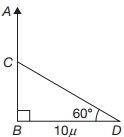
एक पेड़ एक निश्चित ऊँचाई से टूट जाता है और उसका ऊपरी हिस्सा जमीन को छूता है,जो उसके आधार से $10 \text{ m}$ की दूरी पर जमीन के साथ $60^{\circ}$ का कोण बनाता है। पेड़ की मूल ऊँचाई थी ($\text{m}$ में):
A
$20 \sqrt{3}$
B
$10 \sqrt{3}$
C
$10(2+\sqrt{3})$
D
$10(2-\sqrt{3})$
Solution
(C) मान लीजिए पेड़ $AB$ है और यह बिंदु $C$ पर टूट जाता है। ऊपरी हिस्सा $AC$ जमीन को बिंदु $D$ पर छूता है।
दिया गया है: $BD = 10 \text{ m}$ और $\angle BDC = 60^{\circ}$।
$\triangle BCD$ में,$\tan 60^{\circ} = \frac{BC}{BD} \implies \sqrt{3} = \frac{BC}{10} \implies BC = 10\sqrt{3} \text{ m}$।
साथ ही,$\cos 60^{\circ} = \frac{BD}{CD} \implies \frac{1}{2} = \frac{10}{CD} \implies CD = 20 \text{ m}$।
चूँकि $AC = CD$,इसलिए पेड़ की मूल ऊँचाई $AB = BC + AC = BC + CD = 10\sqrt{3} + 20 = 10(2 + \sqrt{3}) \text{ m}$ है।
दिया गया है: $BD = 10 \text{ m}$ और $\angle BDC = 60^{\circ}$।
$\triangle BCD$ में,$\tan 60^{\circ} = \frac{BC}{BD} \implies \sqrt{3} = \frac{BC}{10} \implies BC = 10\sqrt{3} \text{ m}$।
साथ ही,$\cos 60^{\circ} = \frac{BD}{CD} \implies \frac{1}{2} = \frac{10}{CD} \implies CD = 20 \text{ m}$।
चूँकि $AC = CD$,इसलिए पेड़ की मूल ऊँचाई $AB = BC + AC = BC + CD = 10\sqrt{3} + 20 = 10(2 + \sqrt{3}) \text{ m}$ है।
0 likes
View Solution563
DifficultMCQ
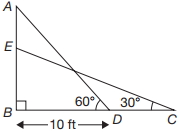
एक सीढ़ी को दीवार के सहारे इस प्रकार रखा गया है कि उसका ऊपरी सिरा दीवार के शीर्ष को छू रहा है। सीढ़ी का निचला सिरा दीवार से $10 \, ft$ दूर है और सीढ़ी जमीन के साथ $60^{\circ}$ का कोण बनाती है। जब एक आदमी उस पर चढ़ना शुरू करता है,तो वह फिसल जाती है और अब सीढ़ी जमीन के साथ $30^{\circ}$ का कोण बनाती है। सीढ़ी दीवार के शीर्ष से कितनी नीचे फिसली? ($ft$ में)
A
$12$
B
$20$
C
$7.32$
D
$18$
Solution
(C) माना $AB$ दीवार है और $AD$ सीढ़ी की प्रारंभिक स्थिति है। सीढ़ी का निचला सिरा $D$ पर है,जहाँ $BD = 10 \, ft$ है।
$\triangle ABD$ में,$\angle ADB = 60^{\circ}$ और $\angle B = 90^{\circ}$ है।
$\cos 60^{\circ} = \frac{BD}{AD} \implies \frac{1}{2} = \frac{10}{AD} \implies AD = 20 \, ft$.
$\tan 60^{\circ} = \frac{AB}{BD} \implies \sqrt{3} = \frac{AB}{10} \implies AB = 10\sqrt{3} \, ft$.
जब सीढ़ी फिसलती है,तो नई स्थिति $EC$ है,जहाँ $EC = AD = 20 \, ft$ (सीढ़ी की लंबाई समान रहती है)।
$\triangle EBC$ में,$\angle ECB = 30^{\circ}$ और $\angle B = 90^{\circ}$ है।
$\sin 30^{\circ} = \frac{EB}{EC} \implies \frac{1}{2} = \frac{EB}{20} \implies EB = 10 \, ft$.
सीढ़ी दीवार के शीर्ष से जितनी नीचे फिसली है,वह दूरी $AE = AB - EB = 10\sqrt{3} - 10 = 10(\sqrt{3} - 1) \, ft$ है।
$\sqrt{3} \approx 1.732$ का उपयोग करने पर,$AE = 10(1.732 - 1) = 10(0.732) = 7.32 \, ft$।
$\triangle ABD$ में,$\angle ADB = 60^{\circ}$ और $\angle B = 90^{\circ}$ है।
$\cos 60^{\circ} = \frac{BD}{AD} \implies \frac{1}{2} = \frac{10}{AD} \implies AD = 20 \, ft$.
$\tan 60^{\circ} = \frac{AB}{BD} \implies \sqrt{3} = \frac{AB}{10} \implies AB = 10\sqrt{3} \, ft$.
जब सीढ़ी फिसलती है,तो नई स्थिति $EC$ है,जहाँ $EC = AD = 20 \, ft$ (सीढ़ी की लंबाई समान रहती है)।
$\triangle EBC$ में,$\angle ECB = 30^{\circ}$ और $\angle B = 90^{\circ}$ है।
$\sin 30^{\circ} = \frac{EB}{EC} \implies \frac{1}{2} = \frac{EB}{20} \implies EB = 10 \, ft$.
सीढ़ी दीवार के शीर्ष से जितनी नीचे फिसली है,वह दूरी $AE = AB - EB = 10\sqrt{3} - 10 = 10(\sqrt{3} - 1) \, ft$ है।
$\sqrt{3} \approx 1.732$ का उपयोग करने पर,$AE = 10(1.732 - 1) = 10(0.732) = 7.32 \, ft$।
0 likes
View Solution564
DifficultMCQ
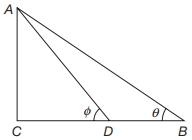
एक ही क्षैतिज रेखा पर स्थित दो बिंदुओं से,एक स्तंभ के शीर्ष के उन्नयन कोण $\theta$ और $\phi$ $(\theta < \phi)$ हैं। यदि स्तंभ की ऊँचाई $h$ $m$ है और दोनों बिंदु स्तंभ के एक ही ओर स्थित हैं,तो दोनों बिंदुओं के बीच की दूरी ($m$ में) है:
A
$h(\tan \theta - \tan \phi)$
B
$h(\cot \phi - \cot \theta)$
C
$h(\cot \theta - \cot \phi)$
D
$h = \frac{\tan \theta \tan \phi}{\tan \phi - \tan \theta}$
Solution
(C) माना $AC$ स्तंभ की ऊँचाई $= h \ m$ है।
माना $B$ और $D$ एक ही क्षैतिज रेखा पर स्थित दो बिंदु हैं ताकि $\angle ABC = \theta$ और $\angle ADC = \phi$ हो।
$\triangle ADC$ में,$\tan \phi = \frac{AC}{CD} = \frac{h}{CD}$,इसलिए $CD = h \cot \phi$ है।
$\triangle ABC$ में,$\tan \theta = \frac{AC}{CB} = \frac{h}{CB}$,इसलिए $CB = h \cot \theta$ है।
दोनों बिंदुओं $B$ और $D$ के बीच की दूरी $BD = CB - CD$ है।
मान रखने पर,$BD = h \cot \theta - h \cot \phi = h(\cot \theta - \cot \phi)$।
माना $B$ और $D$ एक ही क्षैतिज रेखा पर स्थित दो बिंदु हैं ताकि $\angle ABC = \theta$ और $\angle ADC = \phi$ हो।
$\triangle ADC$ में,$\tan \phi = \frac{AC}{CD} = \frac{h}{CD}$,इसलिए $CD = h \cot \phi$ है।
$\triangle ABC$ में,$\tan \theta = \frac{AC}{CB} = \frac{h}{CB}$,इसलिए $CB = h \cot \theta$ है।
दोनों बिंदुओं $B$ और $D$ के बीच की दूरी $BD = CB - CD$ है।
मान रखने पर,$BD = h \cot \theta - h \cot \phi = h(\cot \theta - \cot \phi)$।
0 likes
View Solution565
MediumMCQ
यदि $\sin \theta + \sin^2 \theta = 1$ है,तो $\cos^2 \theta + \cos^4 \theta$ का मान क्या होगा?
A
$1$
B
$\frac{\sin \theta}{\cos^2 \theta}$
C
$\frac{\cos^2 \theta}{\sin \theta}$
D
इनमें से कोई नहीं
Solution
(A) दिया गया है: $\sin \theta + \sin^2 \theta = 1$
हम जानते हैं कि $\sin^2 \theta = 1 - \cos^2 \theta$ होता है। इस मान को समीकरण में रखने पर:
$\sin \theta + (1 - \cos^2 \theta) = 1$
दोनों पक्षों से $1$ घटाने पर:
$\sin \theta - \cos^2 \theta = 0$
अतः,$\sin \theta = \cos^2 \theta$.
अब,दोनों पक्षों का वर्ग करने पर:
$\sin^2 \theta = (\cos^2 \theta)^2$
$\sin^2 \theta = \cos^4 \theta$
$\sin^2 \theta = 1 - \cos^2 \theta$ को समीकरण में प्रतिस्थापित करने पर:
$1 - \cos^2 \theta = \cos^4 \theta$
पदों को व्यवस्थित करने पर:
$1 = \cos^2 \theta + \cos^4 \theta$
इस प्रकार,$\cos^2 \theta + \cos^4 \theta$ का मान $1$ है।
हम जानते हैं कि $\sin^2 \theta = 1 - \cos^2 \theta$ होता है। इस मान को समीकरण में रखने पर:
$\sin \theta + (1 - \cos^2 \theta) = 1$
दोनों पक्षों से $1$ घटाने पर:
$\sin \theta - \cos^2 \theta = 0$
अतः,$\sin \theta = \cos^2 \theta$.
अब,दोनों पक्षों का वर्ग करने पर:
$\sin^2 \theta = (\cos^2 \theta)^2$
$\sin^2 \theta = \cos^4 \theta$
$\sin^2 \theta = 1 - \cos^2 \theta$ को समीकरण में प्रतिस्थापित करने पर:
$1 - \cos^2 \theta = \cos^4 \theta$
पदों को व्यवस्थित करने पर:
$1 = \cos^2 \theta + \cos^4 \theta$
इस प्रकार,$\cos^2 \theta + \cos^4 \theta$ का मान $1$ है।
0 likes
View Solution566
MediumMCQ
$\frac{\cos ^{2} 45^{\circ}}{\sin ^{2} 60^{\circ}}+\frac{\cos ^{2} 60^{\circ}}{\sin ^{2} 45^{\circ}}-\frac{\tan ^{2} 30^{\circ}}{\cot ^{2} 45^{\circ}}-\frac{\sin ^{2} 30^{\circ}}{\cot ^{2} 30^{\circ}}$ का संख्यात्मक मान है
A
$\frac{3}{4}$
B
$\frac{1}{4}$
C
$\frac{1}{2}$
D
$1\frac{1}{4}$
Solution
(A) दिया गया व्यंजक: $\frac{\cos ^{2} 45^{\circ}}{\sin ^{2} 60^{\circ}}+\frac{\cos ^{2} 60^{\circ}}{\sin ^{2} 45^{\circ}}-\frac{\tan ^{2} 30^{\circ}}{\cot ^{2} 45^{\circ}}-\frac{\sin ^{2} 30^{\circ}}{\cot ^{2} 30^{\circ}}$
त्रिकोणमितीय मान रखने पर: $\cos 45^{\circ} = \frac{1}{\sqrt{2}}$,$\sin 60^{\circ} = \frac{\sqrt{3}}{2}$,$\cos 60^{\circ} = \frac{1}{2}$,$\sin 45^{\circ} = \frac{1}{\sqrt{2}}$,$\tan 30^{\circ} = \frac{1}{\sqrt{3}}$,$\cot 45^{\circ} = 1$,$\sin 30^{\circ} = \frac{1}{2}$,$\cot 30^{\circ} = \sqrt{3}$.
$\Rightarrow \frac{(\frac{1}{\sqrt{2}})^{2}}{(\frac{\sqrt{3}}{2})^{2}} + \frac{(\frac{1}{2})^{2}}{(\frac{1}{\sqrt{2}})^{2}} - \frac{(\frac{1}{\sqrt{3}})^{2}}{(1)^{2}} - \frac{(\frac{1}{2})^{2}}{(\sqrt{3})^{2}}$
$\Rightarrow \frac{1/2}{3/4} + \frac{1/4}{1/2} - \frac{1/3}{1} - \frac{1/4}{3}$
$\Rightarrow (\frac{1}{2} \times \frac{4}{3}) + (\frac{1}{4} \times 2) - \frac{1}{3} - \frac{1}{12}$
$\Rightarrow \frac{2}{3} + \frac{1}{2} - \frac{1}{3} - \frac{1}{12}$
लघुत्तम समापवर्त्य $(LCM)$ $12$ लेने पर: $\frac{8 + 6 - 4 - 1}{12} = \frac{9}{12} = \frac{3}{4}$.
त्रिकोणमितीय मान रखने पर: $\cos 45^{\circ} = \frac{1}{\sqrt{2}}$,$\sin 60^{\circ} = \frac{\sqrt{3}}{2}$,$\cos 60^{\circ} = \frac{1}{2}$,$\sin 45^{\circ} = \frac{1}{\sqrt{2}}$,$\tan 30^{\circ} = \frac{1}{\sqrt{3}}$,$\cot 45^{\circ} = 1$,$\sin 30^{\circ} = \frac{1}{2}$,$\cot 30^{\circ} = \sqrt{3}$.
$\Rightarrow \frac{(\frac{1}{\sqrt{2}})^{2}}{(\frac{\sqrt{3}}{2})^{2}} + \frac{(\frac{1}{2})^{2}}{(\frac{1}{\sqrt{2}})^{2}} - \frac{(\frac{1}{\sqrt{3}})^{2}}{(1)^{2}} - \frac{(\frac{1}{2})^{2}}{(\sqrt{3})^{2}}$
$\Rightarrow \frac{1/2}{3/4} + \frac{1/4}{1/2} - \frac{1/3}{1} - \frac{1/4}{3}$
$\Rightarrow (\frac{1}{2} \times \frac{4}{3}) + (\frac{1}{4} \times 2) - \frac{1}{3} - \frac{1}{12}$
$\Rightarrow \frac{2}{3} + \frac{1}{2} - \frac{1}{3} - \frac{1}{12}$
लघुत्तम समापवर्त्य $(LCM)$ $12$ लेने पर: $\frac{8 + 6 - 4 - 1}{12} = \frac{9}{12} = \frac{3}{4}$.
0 likes
View Solution567
DifficultMCQ
यदि $x \cos \theta - \sin \theta = 1$ है,तो $x^2 - (1 + x^2) \sin \theta$ का मान ज्ञात कीजिए।
A
$1$
B
$-1$
C
$0$
D
$2$
Solution
(A) दिया गया है: $x \cos \theta - \sin \theta = 1$
समीकरण को पुनर्व्यवस्थित करने पर: $x \cos \theta = 1 + \sin \theta$
दोनों पक्षों का वर्ग करने पर: $x^2 \cos^2 \theta = (1 + \sin \theta)^2$
$x^2 (1 - \sin^2 \theta) = (1 + \sin \theta)^2$
$x^2 (1 - \sin \theta)(1 + \sin \theta) = (1 + \sin \theta)^2$
चूंकि $1 + \sin \theta \neq 0$,इसलिए $(1 + \sin \theta)$ से भाग देने पर:
$x^2 (1 - \sin \theta) = 1 + \sin \theta$
$x^2 - x^2 \sin \theta = 1 + \sin \theta$
$x^2 - 1 = x^2 \sin \theta + \sin \theta$
$x^2 - 1 = (1 + x^2) \sin \theta$
$x^2 - (1 + x^2) \sin \theta = 1$
समीकरण को पुनर्व्यवस्थित करने पर: $x \cos \theta = 1 + \sin \theta$
दोनों पक्षों का वर्ग करने पर: $x^2 \cos^2 \theta = (1 + \sin \theta)^2$
$x^2 (1 - \sin^2 \theta) = (1 + \sin \theta)^2$
$x^2 (1 - \sin \theta)(1 + \sin \theta) = (1 + \sin \theta)^2$
चूंकि $1 + \sin \theta \neq 0$,इसलिए $(1 + \sin \theta)$ से भाग देने पर:
$x^2 (1 - \sin \theta) = 1 + \sin \theta$
$x^2 - x^2 \sin \theta = 1 + \sin \theta$
$x^2 - 1 = x^2 \sin \theta + \sin \theta$
$x^2 - 1 = (1 + x^2) \sin \theta$
$x^2 - (1 + x^2) \sin \theta = 1$
0 likes
View Solution568
MediumMCQ
$\tan 4^{\circ} \tan 43^{\circ} \tan 47^{\circ} \tan 86^{\circ}$ का मान ज्ञात कीजिए।
A
$1$
B
$\frac{1}{2}$
C
$2$
D
$\frac{2}{3}$
Solution
(A) दी गई व्यंजक: $\tan 4^{\circ} \tan 43^{\circ} \tan 47^{\circ} \tan 86^{\circ}$।
त्रिकोणमितीय सर्वसमिका $\tan(90^{\circ} - \theta) = \cot \theta$ का उपयोग करने पर:
$\tan 4^{\circ} = \tan(90^{\circ} - 86^{\circ}) = \cot 86^{\circ}$।
इसी प्रकार,$\tan 43^{\circ} = \tan(90^{\circ} - 47^{\circ}) = \cot 47^{\circ}$।
इन मानों को व्यंजक में प्रतिस्थापित करने पर:
$(\cot 86^{\circ} \times \tan 86^{\circ}) \times (\cot 47^{\circ} \times \tan 47^{\circ})$।
चूंकि $\tan \theta \times \cot \theta = 1$:
$1 \times 1 = 1$।
त्रिकोणमितीय सर्वसमिका $\tan(90^{\circ} - \theta) = \cot \theta$ का उपयोग करने पर:
$\tan 4^{\circ} = \tan(90^{\circ} - 86^{\circ}) = \cot 86^{\circ}$।
इसी प्रकार,$\tan 43^{\circ} = \tan(90^{\circ} - 47^{\circ}) = \cot 47^{\circ}$।
इन मानों को व्यंजक में प्रतिस्थापित करने पर:
$(\cot 86^{\circ} \times \tan 86^{\circ}) \times (\cot 47^{\circ} \times \tan 47^{\circ})$।
चूंकि $\tan \theta \times \cot \theta = 1$:
$1 \times 1 = 1$।
0 likes
View Solution569
MediumMCQ
यदि $\sec \theta - \tan \theta = \frac{1}{\sqrt{3}}$ है,तो $\sec \theta \cdot \tan \theta$ का मान ज्ञात कीजिए।
A
$\frac{2}{3}$
B
$\frac{4}{\sqrt{3}}$
C
$\frac{2}{\sqrt{3}}$
D
$\frac{1}{\sqrt{3}}$
Solution
(A) हम जानते हैं कि सर्वसमिका $\sec^2 \theta - \tan^2 \theta = 1$ होती है।
इसे गुणनखंडित करने पर $(\sec \theta - \tan \theta)(\sec \theta + \tan \theta) = 1$ प्राप्त होता है।
दिया गया है कि $\sec \theta - \tan \theta = \frac{1}{\sqrt{3}}$,इस मान को सर्वसमिका में रखने पर:
$\frac{1}{\sqrt{3}}(\sec \theta + \tan \theta) = 1 \implies \sec \theta + \tan \theta = \sqrt{3}$।
अब,हमारे पास दो समीकरण हैं:
$1) \sec \theta - \tan \theta = \frac{1}{\sqrt{3}}$
$2) \sec \theta + \tan \theta = \sqrt{3}$
दोनों समीकरणों को जोड़ने पर: $2 \sec \theta = \frac{1}{\sqrt{3}} + \sqrt{3} = \frac{1+3}{\sqrt{3}} = \frac{4}{\sqrt{3}} \implies \sec \theta = \frac{2}{\sqrt{3}}$।
दूसरे समीकरण में से पहला समीकरण घटाने पर: $2 \tan \theta = \sqrt{3} - \frac{1}{\sqrt{3}} = \frac{3-1}{\sqrt{3}} = \frac{2}{\sqrt{3}} \implies \tan \theta = \frac{1}{\sqrt{3}}$।
अतः,$\sec \theta \cdot \tan \theta = \left(\frac{2}{\sqrt{3}}\right) \cdot \left(\frac{1}{\sqrt{3}}\right) = \frac{2}{3}$।
इसे गुणनखंडित करने पर $(\sec \theta - \tan \theta)(\sec \theta + \tan \theta) = 1$ प्राप्त होता है।
दिया गया है कि $\sec \theta - \tan \theta = \frac{1}{\sqrt{3}}$,इस मान को सर्वसमिका में रखने पर:
$\frac{1}{\sqrt{3}}(\sec \theta + \tan \theta) = 1 \implies \sec \theta + \tan \theta = \sqrt{3}$।
अब,हमारे पास दो समीकरण हैं:
$1) \sec \theta - \tan \theta = \frac{1}{\sqrt{3}}$
$2) \sec \theta + \tan \theta = \sqrt{3}$
दोनों समीकरणों को जोड़ने पर: $2 \sec \theta = \frac{1}{\sqrt{3}} + \sqrt{3} = \frac{1+3}{\sqrt{3}} = \frac{4}{\sqrt{3}} \implies \sec \theta = \frac{2}{\sqrt{3}}$।
दूसरे समीकरण में से पहला समीकरण घटाने पर: $2 \tan \theta = \sqrt{3} - \frac{1}{\sqrt{3}} = \frac{3-1}{\sqrt{3}} = \frac{2}{\sqrt{3}} \implies \tan \theta = \frac{1}{\sqrt{3}}$।
अतः,$\sec \theta \cdot \tan \theta = \left(\frac{2}{\sqrt{3}}\right) \cdot \left(\frac{1}{\sqrt{3}}\right) = \frac{2}{3}$।
0 likes
View Solution570
DifficultMCQ
यदि $\tan A = n \tan B$ और $\sin A = m \sin B$ है,तो $\cos ^{2} A$ का मान क्या होगा?
A
$\frac{m^{2}-1}{n^{2}-1}$
B
$\frac{m^{2}+1}{n^{2}+1}$
C
$\frac{m^{2}+1}{n^{2}-1}$
D
$\frac{m^{2}-1}{n^{2}+1}$
Solution
(A) दिया गया है: $\tan A = n \tan B$ और $\sin A = m \sin B$.
प्रथम समीकरण से: $\frac{\sin A}{\cos A} = n \frac{\sin B}{\cos B} \Rightarrow \frac{\sin A}{\sin B} = n \frac{\cos A}{\cos B}$.
चूंकि $\sin A = m \sin B$,इसलिए $\frac{\sin A}{\sin B} = m$.
$\frac{\sin A}{\sin B}$ के दोनों व्यंजकों की तुलना करने पर,हमें प्राप्त होता है $m = n \frac{\cos A}{\cos B}$,जिसका अर्थ है $\cos B = \frac{n}{m} \cos A$.
साथ ही,$\sin A = m \sin B$ से,$\sin B = \frac{1}{m} \sin A$.
सर्वसमिका $\sin^2 B + \cos^2 B = 1$ का उपयोग करने पर:
$(\frac{1}{m} \sin A)^2 + (\frac{n}{m} \cos A)^2 = 1$.
$\frac{1}{m^2} \sin^2 A + \frac{n^2}{m^2} \cos^2 A = 1$.
$\sin^2 A + n^2 \cos^2 A = m^2$.
$\sin^2 A = 1 - \cos^2 A$ प्रतिस्थापित करने पर:
$(1 - \cos^2 A) + n^2 \cos^2 A = m^2$.
$(n^2 - 1) \cos^2 A = m^2 - 1$.
अतः,$\cos^2 A = \frac{m^2 - 1}{n^2 - 1}$.
प्रथम समीकरण से: $\frac{\sin A}{\cos A} = n \frac{\sin B}{\cos B} \Rightarrow \frac{\sin A}{\sin B} = n \frac{\cos A}{\cos B}$.
चूंकि $\sin A = m \sin B$,इसलिए $\frac{\sin A}{\sin B} = m$.
$\frac{\sin A}{\sin B}$ के दोनों व्यंजकों की तुलना करने पर,हमें प्राप्त होता है $m = n \frac{\cos A}{\cos B}$,जिसका अर्थ है $\cos B = \frac{n}{m} \cos A$.
साथ ही,$\sin A = m \sin B$ से,$\sin B = \frac{1}{m} \sin A$.
सर्वसमिका $\sin^2 B + \cos^2 B = 1$ का उपयोग करने पर:
$(\frac{1}{m} \sin A)^2 + (\frac{n}{m} \cos A)^2 = 1$.
$\frac{1}{m^2} \sin^2 A + \frac{n^2}{m^2} \cos^2 A = 1$.
$\sin^2 A + n^2 \cos^2 A = m^2$.
$\sin^2 A = 1 - \cos^2 A$ प्रतिस्थापित करने पर:
$(1 - \cos^2 A) + n^2 \cos^2 A = m^2$.
$(n^2 - 1) \cos^2 A = m^2 - 1$.
अतः,$\cos^2 A = \frac{m^2 - 1}{n^2 - 1}$.
0 likes
View Solution571
MediumMCQ
यदि $\tan \theta - \cot \theta = 0$ और $\theta$ एक धनात्मक न्यून कोण है,तो $\frac{\tan (\theta + 15^{\circ})}{\tan (\theta - 15^{\circ})}$ का मान क्या है?
A
$\frac{1}{\sqrt{3}}$
B
$3$
C
$\frac{1}{3}$
D
$\sqrt{3}$
Solution
(B) दिया गया समीकरण $\tan \theta - \cot \theta = 0$ है।
इसका अर्थ है $\tan \theta = \cot \theta$.
चूँकि $\cot \theta = \tan(90^{\circ} - \theta)$,इसलिए $\tan \theta = \tan(90^{\circ} - \theta)$.
कोणों की तुलना करने पर,$\theta = 90^{\circ} - \theta$,जिससे $2\theta = 90^{\circ}$ प्राप्त होता है,अतः $\theta = 45^{\circ}$.
अब,$\theta = 45^{\circ}$ को व्यंजक में रखने पर:
$\frac{\tan(45^{\circ} + 15^{\circ})}{\tan(45^{\circ} - 15^{\circ})} = \frac{\tan 60^{\circ}}{\tan 30^{\circ}}$.
चूँकि $\tan 60^{\circ} = \sqrt{3}$ और $\tan 30^{\circ} = \frac{1}{\sqrt{3}}$,
अतः व्यंजक का मान $\frac{\sqrt{3}}{1/\sqrt{3}} = \sqrt{3} \times \sqrt{3} = 3$ होगा।
इसका अर्थ है $\tan \theta = \cot \theta$.
चूँकि $\cot \theta = \tan(90^{\circ} - \theta)$,इसलिए $\tan \theta = \tan(90^{\circ} - \theta)$.
कोणों की तुलना करने पर,$\theta = 90^{\circ} - \theta$,जिससे $2\theta = 90^{\circ}$ प्राप्त होता है,अतः $\theta = 45^{\circ}$.
अब,$\theta = 45^{\circ}$ को व्यंजक में रखने पर:
$\frac{\tan(45^{\circ} + 15^{\circ})}{\tan(45^{\circ} - 15^{\circ})} = \frac{\tan 60^{\circ}}{\tan 30^{\circ}}$.
चूँकि $\tan 60^{\circ} = \sqrt{3}$ और $\tan 30^{\circ} = \frac{1}{\sqrt{3}}$,
अतः व्यंजक का मान $\frac{\sqrt{3}}{1/\sqrt{3}} = \sqrt{3} \times \sqrt{3} = 3$ होगा।
0 likes
View Solution572
EasyMCQ
यदि $\sin A + \sin^2 A = 1$ है,तो $\cos^2 A + \cos^4 A$ का मान क्या है?
A
$2$
B
$1$
C
$1\frac{2}{3}$
D
$1\frac{1}{2}$
Solution
(B) दिया गया समीकरण: $\sin A + \sin^2 A = 1$.
पदों को पुनर्व्यवस्थित करने पर,हमें प्राप्त होता है: $\sin A = 1 - \sin^2 A$.
त्रिकोणमितीय सर्वसमिका $\cos^2 A = 1 - \sin^2 A$ का उपयोग करते हुए,हम इसे समीकरण में प्रतिस्थापित करते हैं: $\sin A = \cos^2 A$.
अब,हमें $\cos^2 A + \cos^4 A$ का मान ज्ञात करना है।
इस व्यंजक में $\cos^2 A = \sin A$ रखने पर,हमें प्राप्त होता है: $\cos^2 A + (\cos^2 A)^2 = \sin A + (\sin A)^2$.
चूंकि हम जानते हैं कि $\sin A + \sin^2 A = 1$,इसलिए इस व्यंजक का मान $1$ है।
पदों को पुनर्व्यवस्थित करने पर,हमें प्राप्त होता है: $\sin A = 1 - \sin^2 A$.
त्रिकोणमितीय सर्वसमिका $\cos^2 A = 1 - \sin^2 A$ का उपयोग करते हुए,हम इसे समीकरण में प्रतिस्थापित करते हैं: $\sin A = \cos^2 A$.
अब,हमें $\cos^2 A + \cos^4 A$ का मान ज्ञात करना है।
इस व्यंजक में $\cos^2 A = \sin A$ रखने पर,हमें प्राप्त होता है: $\cos^2 A + (\cos^2 A)^2 = \sin A + (\sin A)^2$.
चूंकि हम जानते हैं कि $\sin A + \sin^2 A = 1$,इसलिए इस व्यंजक का मान $1$ है।
0 likes
View Solution573
MediumMCQ
यदि $7 \sin^{2} \theta + 3 \cos^{2} \theta = 4$ है,तो $\tan \theta$ का मान ज्ञात कीजिए (जहाँ $\theta$ न्यूनकोण है)।
A
$1/\sqrt{2}$
B
$1$
C
$\sqrt{3}$
D
$1/\sqrt{3}$
Solution
(D) दिया गया समीकरण: $7 \sin^{2} \theta + 3 \cos^{2} \theta = 4$.
सर्वसमिका $\cos^{2} \theta = 1 - \sin^{2} \theta$ का उपयोग करते हुए:
$7 \sin^{2} \theta + 3(1 - \sin^{2} \theta) = 4$
$7 \sin^{2} \theta + 3 - 3 \sin^{2} \theta = 4$
$4 \sin^{2} \theta = 4 - 3$
$4 \sin^{2} \theta = 1$
$\sin^{2} \theta = 1/4$
चूँकि $\theta$ न्यूनकोण है,इसलिए $\sin \theta = 1/2$.
अतः,$\theta = 30^{\circ}$.
इसलिए,$\tan \theta = \tan 30^{\circ} = 1/\sqrt{3}$.
सर्वसमिका $\cos^{2} \theta = 1 - \sin^{2} \theta$ का उपयोग करते हुए:
$7 \sin^{2} \theta + 3(1 - \sin^{2} \theta) = 4$
$7 \sin^{2} \theta + 3 - 3 \sin^{2} \theta = 4$
$4 \sin^{2} \theta = 4 - 3$
$4 \sin^{2} \theta = 1$
$\sin^{2} \theta = 1/4$
चूँकि $\theta$ न्यूनकोण है,इसलिए $\sin \theta = 1/2$.
अतः,$\theta = 30^{\circ}$.
इसलिए,$\tan \theta = \tan 30^{\circ} = 1/\sqrt{3}$.
0 likes
View Solution574
EasyMCQ
यदि $5 \cos \theta + 12 \sin \theta = 13$ और $0^{\circ} < \theta < 90^{\circ}$ है,तो $\sin \theta$ का मान ज्ञात कीजिए।
A
$\frac{12}{13}$
B
$-\frac{12}{13}$
C
$\frac{5}{13}$
D
$\frac{6}{13}$
Solution
(A) दिया गया समीकरण: $5 \cos \theta + 12 \sin \theta = 13$ है।
दोनों पक्षों को $13$ से विभाजित करने पर:
$\frac{5}{13} \cos \theta + \frac{12}{13} \sin \theta = 1$ प्राप्त होता है।
हम जानते हैं कि सर्वसमिका $\sin^2 \theta + \cos^2 \theta = 1$ होती है। इसे मानक रूप $\cos \alpha \cos \theta + \sin \alpha \sin \theta = \cos(\theta - \alpha) = 1$ के साथ तुलना करने पर,हम $\cos \alpha = \frac{5}{13}$ और $\sin \alpha = \frac{12}{13}$ ले सकते हैं।
अतः $\cos \alpha \cos \theta + \sin \alpha \sin \theta = 1 \implies \cos(\theta - \alpha) = 1$ है।
चूंकि $0^{\circ} < \theta < 90^{\circ}$ है,इसलिए $\theta = \alpha$ होगा।
अतः,$\sin \theta = \sin \alpha = \frac{12}{13}$।
दोनों पक्षों को $13$ से विभाजित करने पर:
$\frac{5}{13} \cos \theta + \frac{12}{13} \sin \theta = 1$ प्राप्त होता है।
हम जानते हैं कि सर्वसमिका $\sin^2 \theta + \cos^2 \theta = 1$ होती है। इसे मानक रूप $\cos \alpha \cos \theta + \sin \alpha \sin \theta = \cos(\theta - \alpha) = 1$ के साथ तुलना करने पर,हम $\cos \alpha = \frac{5}{13}$ और $\sin \alpha = \frac{12}{13}$ ले सकते हैं।
अतः $\cos \alpha \cos \theta + \sin \alpha \sin \theta = 1 \implies \cos(\theta - \alpha) = 1$ है।
चूंकि $0^{\circ} < \theta < 90^{\circ}$ है,इसलिए $\theta = \alpha$ होगा।
अतः,$\sin \theta = \sin \alpha = \frac{12}{13}$।
0 likes
View Solution575
EasyMCQ
$\cos 41^{\circ} \cdot \cos 42^{\circ} \cdot \cos 43^{\circ} \cdot \cos 44^{\circ} \cdot \cos 45^{\circ} \cdot \cos 46^{\circ} \cdot \cos 47^{\circ} \cdot \cos 48^{\circ} \cdot \cos 49^{\circ}$ का मान क्या है?
A
$\frac{1}{\sqrt{2}}$
B
$1$
C
$0$
D
$\frac{\sqrt{3}}{2}$
Solution
(C) दी गई व्यंजक $E = \cos 41^{\circ} \cdot \cos 42^{\circ} \cdot \cos 43^{\circ} \cdot \cos 44^{\circ} \cdot \cos 45^{\circ} \cdot \cos 46^{\circ} \cdot \cos 47^{\circ} \cdot \cos 48^{\circ} \cdot \cos 49^{\circ}$ है।
चूंकि $\cos(90^{\circ} - \theta) = \sin \theta$,हम पदों को इस प्रकार लिख सकते हैं:
$E = \cos 41^{\circ} \cdot \cos 42^{\circ} \cdot \cos 43^{\circ} \cdot \cos 44^{\circ} \cdot \cos 45^{\circ} \cdot \sin 44^{\circ} \cdot \sin 43^{\circ} \cdot \sin 42^{\circ} \cdot \sin 41^{\circ}$.
समान कोण वाले पदों को समूहबद्ध करने पर:
$E = (\sin 41^{\circ} \cos 41^{\circ}) \cdot (\sin 42^{\circ} \cos 42^{\circ}) \cdot (\sin 43^{\circ} \cos 43^{\circ}) \cdot (\sin 44^{\circ} \cos 44^{\circ}) \cdot \cos 45^{\circ}$.
सर्वसमिका $\sin \theta \cos \theta = \frac{1}{2} \sin(2\theta)$ का उपयोग करते हुए:
$E = \frac{1}{2^4} \sin 82^{\circ} \cdot \sin 84^{\circ} \cdot \sin 86^{\circ} \cdot \sin 88^{\circ} \cdot \frac{1}{\sqrt{2}}$.
यदि प्रश्न में $\cos 90^{\circ}$ शामिल होता,तो उत्तर $0$ होता। दिए गए विकल्पों के आधार पर,यदि इस श्रृंखला में $\cos 90^{\circ}$ को शामिल माना जाए,तो सही उत्तर $0$ है।
चूंकि $\cos(90^{\circ} - \theta) = \sin \theta$,हम पदों को इस प्रकार लिख सकते हैं:
$E = \cos 41^{\circ} \cdot \cos 42^{\circ} \cdot \cos 43^{\circ} \cdot \cos 44^{\circ} \cdot \cos 45^{\circ} \cdot \sin 44^{\circ} \cdot \sin 43^{\circ} \cdot \sin 42^{\circ} \cdot \sin 41^{\circ}$.
समान कोण वाले पदों को समूहबद्ध करने पर:
$E = (\sin 41^{\circ} \cos 41^{\circ}) \cdot (\sin 42^{\circ} \cos 42^{\circ}) \cdot (\sin 43^{\circ} \cos 43^{\circ}) \cdot (\sin 44^{\circ} \cos 44^{\circ}) \cdot \cos 45^{\circ}$.
सर्वसमिका $\sin \theta \cos \theta = \frac{1}{2} \sin(2\theta)$ का उपयोग करते हुए:
$E = \frac{1}{2^4} \sin 82^{\circ} \cdot \sin 84^{\circ} \cdot \sin 86^{\circ} \cdot \sin 88^{\circ} \cdot \frac{1}{\sqrt{2}}$.
यदि प्रश्न में $\cos 90^{\circ}$ शामिल होता,तो उत्तर $0$ होता। दिए गए विकल्पों के आधार पर,यदि इस श्रृंखला में $\cos 90^{\circ}$ को शामिल माना जाए,तो सही उत्तर $0$ है।
0 likes
View Solution576
MediumMCQ
यदि $x = a \sin \theta - b \cos \theta$ और $y = a \cos \theta + b \sin \theta$ है,तो निम्नलिखित में से कौन सा सत्य है?
A
$x^{2} + y^{2} = a^{2} - b^{2}$
B
$x^{2} + y^{2} = a^{2} + b^{2}$
C
$\frac{x^{2}}{a^{2}} + \frac{y^{2}}{b^{2}} = 1$
D
$\frac{x^{2}}{y^{2}} + \frac{a^{2}}{b^{2}} = 1$
Solution
(B) दिए गए समीकरण हैं:
$x = a \sin \theta - b \cos \theta$ ..... $(1)$
$y = a \cos \theta + b \sin \theta$ ..... $(2)$
दोनों समीकरणों का वर्ग करने पर:
$x^{2} = (a \sin \theta - b \cos \theta)^{2} = a^{2} \sin^{2} \theta + b^{2} \cos^{2} \theta - 2ab \sin \theta \cos \theta$ ..... $(3)$
$y^{2} = (a \cos \theta + b \sin \theta)^{2} = a^{2} \cos^{2} \theta + b^{2} \sin^{2} \theta + 2ab \sin \theta \cos \theta$ ..... $(4)$
समीकरण $(3)$ और $(4)$ को जोड़ने पर:
$x^{2} + y^{2} = a^{2} \sin^{2} \theta + b^{2} \cos^{2} \theta - 2ab \sin \theta \cos \theta + a^{2} \cos^{2} \theta + b^{2} \sin^{2} \theta + 2ab \sin \theta \cos \theta$
$x^{2} + y^{2} = a^{2} (\sin^{2} \theta + \cos^{2} \theta) + b^{2} (\cos^{2} \theta + \sin^{2} \theta)$
चूंकि $\sin^{2} \theta + \cos^{2} \theta = 1$,हमें प्राप्त होता है:
$x^{2} + y^{2} = a^{2}(1) + b^{2}(1)$
$x^{2} + y^{2} = a^{2} + b^{2}$
$x = a \sin \theta - b \cos \theta$ ..... $(1)$
$y = a \cos \theta + b \sin \theta$ ..... $(2)$
दोनों समीकरणों का वर्ग करने पर:
$x^{2} = (a \sin \theta - b \cos \theta)^{2} = a^{2} \sin^{2} \theta + b^{2} \cos^{2} \theta - 2ab \sin \theta \cos \theta$ ..... $(3)$
$y^{2} = (a \cos \theta + b \sin \theta)^{2} = a^{2} \cos^{2} \theta + b^{2} \sin^{2} \theta + 2ab \sin \theta \cos \theta$ ..... $(4)$
समीकरण $(3)$ और $(4)$ को जोड़ने पर:
$x^{2} + y^{2} = a^{2} \sin^{2} \theta + b^{2} \cos^{2} \theta - 2ab \sin \theta \cos \theta + a^{2} \cos^{2} \theta + b^{2} \sin^{2} \theta + 2ab \sin \theta \cos \theta$
$x^{2} + y^{2} = a^{2} (\sin^{2} \theta + \cos^{2} \theta) + b^{2} (\cos^{2} \theta + \sin^{2} \theta)$
चूंकि $\sin^{2} \theta + \cos^{2} \theta = 1$,हमें प्राप्त होता है:
$x^{2} + y^{2} = a^{2}(1) + b^{2}(1)$
$x^{2} + y^{2} = a^{2} + b^{2}$
0 likes
View Solution577
MediumMCQ
एक टेलीग्राफ का खंभा तूफान के कारण जमीन से ऊपर एक बिंदु पर मुड़ जाता है। इसका ऊपरी सिरा इसके आधार से $10 \sqrt{3} \text{ m}$ की दूरी पर जमीन को छूता है और क्षैतिज के साथ $30^{\circ}$ का कोण बनाता है। तो टेलीग्राफ के खंभे की ऊंचाई (मीटर में) क्या है?
A
$20$
B
$25$
C
$24$
D
$30$
Solution
(D) मान लीजिए टेलीग्राफ के खंभे की मूल ऊंचाई $AB$ है। यह बिंदु $C$ पर मुड़ जाता है। ऊपरी सिरा $A$ जमीन पर बिंदु $D$ को छूता है।
दिया गया है: $BD = 10 \sqrt{3} \text{ m}$ और $\angle BDC = 30^{\circ}$।
$\Delta BCD$ में,$\tan 30^{\circ} = \frac{BC}{BD}$।
$\frac{1}{\sqrt{3}} = \frac{BC}{10 \sqrt{3}} \implies BC = 10 \text{ m}$।
पुनः,$\Delta BCD$ में,$\sin 30^{\circ} = \frac{BC}{CD}$।
$\frac{1}{2} = \frac{10}{CD} \implies CD = 20 \text{ m}$।
खंभे की कुल ऊंचाई $AB = BC + CD$ है (क्योंकि $AC = CD$ है,क्योंकि ऊपरी सिरा जमीन को छूता है)।
$AB = 10 + 20 = 30 \text{ m}$।
दिया गया है: $BD = 10 \sqrt{3} \text{ m}$ और $\angle BDC = 30^{\circ}$।
$\Delta BCD$ में,$\tan 30^{\circ} = \frac{BC}{BD}$।
$\frac{1}{\sqrt{3}} = \frac{BC}{10 \sqrt{3}} \implies BC = 10 \text{ m}$।
पुनः,$\Delta BCD$ में,$\sin 30^{\circ} = \frac{BC}{CD}$।
$\frac{1}{2} = \frac{10}{CD} \implies CD = 20 \text{ m}$।
खंभे की कुल ऊंचाई $AB = BC + CD$ है (क्योंकि $AC = CD$ है,क्योंकि ऊपरी सिरा जमीन को छूता है)।
$AB = 10 + 20 = 30 \text{ m}$।
0 likes
View Solution578
MediumMCQ
$(\operatorname{cosec} a - \sin a)(\sec a - \cos a)(\tan a + \cot a)$ का मान ज्ञात कीजिए।
A
$1$
B
$6$
C
$2$
D
$4$
Solution
(A) दी गई व्यंजक: $(\operatorname{cosec} a - \sin a)(\sec a - \cos a)(\tan a + \cot a)$
चरण $1$: सभी त्रिकोणमितीय फलनों को $\sin a$ और $\cos a$ में बदलें।
$= \left(\frac{1}{\sin a} - \sin a\right) \left(\frac{1}{\cos a} - \cos a\right) \left(\frac{\sin a}{\cos a} + \frac{\cos a}{\sin a}\right)$
चरण $2$: प्रत्येक कोष्ठक को सरल करें।
$= \left(\frac{1 - \sin^2 a}{\sin a}\right) \left(\frac{1 - \cos^2 a}{\cos a}\right) \left(\frac{\sin^2 a + \cos^2 a}{\sin a \cos a}\right)$
चरण $3$: सर्वसमिका $\sin^2 a + \cos^2 a = 1$ का उपयोग करें।
$= \left(\frac{\cos^2 a}{\sin a}\right) \left(\frac{\sin^2 a}{\cos a}\right) \left(\frac{1}{\sin a \cos a}\right)$
चरण $4$: पदों का गुणा करें।
$= \frac{\cos^2 a \cdot \sin^2 a}{\sin a \cdot \cos a \cdot \sin a \cdot \cos a} = \frac{\sin^2 a \cdot \cos^2 a}{\sin^2 a \cdot \cos^2 a} = 1$
चरण $1$: सभी त्रिकोणमितीय फलनों को $\sin a$ और $\cos a$ में बदलें।
$= \left(\frac{1}{\sin a} - \sin a\right) \left(\frac{1}{\cos a} - \cos a\right) \left(\frac{\sin a}{\cos a} + \frac{\cos a}{\sin a}\right)$
चरण $2$: प्रत्येक कोष्ठक को सरल करें।
$= \left(\frac{1 - \sin^2 a}{\sin a}\right) \left(\frac{1 - \cos^2 a}{\cos a}\right) \left(\frac{\sin^2 a + \cos^2 a}{\sin a \cos a}\right)$
चरण $3$: सर्वसमिका $\sin^2 a + \cos^2 a = 1$ का उपयोग करें।
$= \left(\frac{\cos^2 a}{\sin a}\right) \left(\frac{\sin^2 a}{\cos a}\right) \left(\frac{1}{\sin a \cos a}\right)$
चरण $4$: पदों का गुणा करें।
$= \frac{\cos^2 a \cdot \sin^2 a}{\sin a \cdot \cos a \cdot \sin a \cdot \cos a} = \frac{\sin^2 a \cdot \cos^2 a}{\sin^2 a \cdot \cos^2 a} = 1$
0 likes
View Solution579
EasyMCQ
यदि $\tan \theta + \cot \theta = 5$ है,तो $\tan^2 \theta + \cot^2 \theta$ का मान क्या होगा?
A
$24$
B
$25$
C
$26$
D
$23$
Solution
(D) दिया गया है कि $\tan \theta + \cot \theta = 5.$
दोनों पक्षों का वर्ग करने पर,हमें प्राप्त होता है:
$(\tan \theta + \cot \theta)^2 = 5^2$
बीजगणितीय सर्वसमिका $(a + b)^2 = a^2 + b^2 + 2ab$ का उपयोग करने पर:
$\tan^2 \theta + \cot^2 \theta + 2 \tan \theta \cot \theta = 25$
चूंकि $\tan \theta \cot \theta = 1$,इसलिए समीकरण इस प्रकार होगा:
$\tan^2 \theta + \cot^2 \theta + 2(1) = 25$
$\tan^2 \theta + \cot^2 \theta = 25 - 2$
$\tan^2 \theta + \cot^2 \theta = 23$
दोनों पक्षों का वर्ग करने पर,हमें प्राप्त होता है:
$(\tan \theta + \cot \theta)^2 = 5^2$
बीजगणितीय सर्वसमिका $(a + b)^2 = a^2 + b^2 + 2ab$ का उपयोग करने पर:
$\tan^2 \theta + \cot^2 \theta + 2 \tan \theta \cot \theta = 25$
चूंकि $\tan \theta \cot \theta = 1$,इसलिए समीकरण इस प्रकार होगा:
$\tan^2 \theta + \cot^2 \theta + 2(1) = 25$
$\tan^2 \theta + \cot^2 \theta = 25 - 2$
$\tan^2 \theta + \cot^2 \theta = 23$
0 likes
View Solution580
MediumMCQ
दिए गए व्यंजक $\sin A \cos A(\tan A - \cot A)$ का सरलीकृत रूप क्या है? (जहाँ $0^{\circ} \leq A \leq 90^{\circ}$)
A
$1 - \cos^{2} A$
B
$1 - 2\sin^{2} A$
C
$2\sin^{2} A - 1$
D
$1$
Solution
(C) दिया गया व्यंजक: $\sin A \cos A(\tan A - \cot A)$
$\tan A = \frac{\sin A}{\cos A}$ और $\cot A = \frac{\cos A}{\sin A}$ प्रतिस्थापित करने पर:
$= \sin A \cos A \left( \frac{\sin A}{\cos A} - \frac{\cos A}{\sin A} \right)$
कोष्ठक के अंदर लघुत्तम समापवर्त्य $(LCM)$ लेने पर:
$= \sin A \cos A \left( \frac{\sin^{2} A - \cos^{2} A}{\sin A \cos A} \right)$
अंश और हर से $\sin A \cos A$ को काटने पर:
$= \sin^{2} A - \cos^{2} A$
सर्वसमिका $\cos^{2} A = 1 - \sin^{2} A$ का उपयोग करने पर:
$= \sin^{2} A - (1 - \sin^{2} A)$
$= \sin^{2} A - 1 + \sin^{2} A$
$= 2\sin^{2} A - 1$
$\tan A = \frac{\sin A}{\cos A}$ और $\cot A = \frac{\cos A}{\sin A}$ प्रतिस्थापित करने पर:
$= \sin A \cos A \left( \frac{\sin A}{\cos A} - \frac{\cos A}{\sin A} \right)$
कोष्ठक के अंदर लघुत्तम समापवर्त्य $(LCM)$ लेने पर:
$= \sin A \cos A \left( \frac{\sin^{2} A - \cos^{2} A}{\sin A \cos A} \right)$
अंश और हर से $\sin A \cos A$ को काटने पर:
$= \sin^{2} A - \cos^{2} A$
सर्वसमिका $\cos^{2} A = 1 - \sin^{2} A$ का उपयोग करने पर:
$= \sin^{2} A - (1 - \sin^{2} A)$
$= \sin^{2} A - 1 + \sin^{2} A$
$= 2\sin^{2} A - 1$
0 likes
View Solution581
MediumMCQ
यदि $\frac{\cos \alpha}{\sin \beta} = n$ और $\frac{\cos \alpha}{\cos \beta} = m$ है,तो $\cos^2 \beta$ का मान ज्ञात कीजिए।
A
$\frac{1}{m^2 + n^2}$
B
$0$
C
$\frac{n^2}{m^2 + n^2}$
D
$\frac{m^2}{m^2 + n^2}$
Solution
(C) दिया गया है:
$n = \frac{\cos \alpha}{\sin \beta} \implies \cos \alpha = n \sin \beta \quad (1)$
$m = \frac{\cos \alpha}{\cos \beta} \implies \cos \alpha = m \cos \beta \quad (2)$
$(1)$ और $(2)$ की तुलना करने पर:
$n \sin \beta = m \cos \beta$
दोनों पक्षों का वर्ग करने पर:
$n^2 \sin^2 \beta = m^2 \cos^2 \beta$
सर्वसमिका $\sin^2 \beta = 1 - \cos^2 \beta$ का उपयोग करने पर:
$n^2 (1 - \cos^2 \beta) = m^2 \cos^2 \beta$
$n^2 - n^2 \cos^2 \beta = m^2 \cos^2 \beta$
$n^2 = (m^2 + n^2) \cos^2 \beta$
अतः,$\cos^2 \beta = \frac{n^2}{m^2 + n^2}$.
$n = \frac{\cos \alpha}{\sin \beta} \implies \cos \alpha = n \sin \beta \quad (1)$
$m = \frac{\cos \alpha}{\cos \beta} \implies \cos \alpha = m \cos \beta \quad (2)$
$(1)$ और $(2)$ की तुलना करने पर:
$n \sin \beta = m \cos \beta$
दोनों पक्षों का वर्ग करने पर:
$n^2 \sin^2 \beta = m^2 \cos^2 \beta$
सर्वसमिका $\sin^2 \beta = 1 - \cos^2 \beta$ का उपयोग करने पर:
$n^2 (1 - \cos^2 \beta) = m^2 \cos^2 \beta$
$n^2 - n^2 \cos^2 \beta = m^2 \cos^2 \beta$
$n^2 = (m^2 + n^2) \cos^2 \beta$
अतः,$\cos^2 \beta = \frac{n^2}{m^2 + n^2}$.
0 likes
View Solution582
EasyMCQ
$\tan 1^{\circ} \tan 2^{\circ} \tan 3^{\circ} \ldots \tan 89^{\circ}$ का मान क्या है?
A
$1$
B
$0$
C
$-1$
D
कोई नहीं
Solution
(A) हमें व्यंजक दिया गया है: $\tan 1^{\circ} \tan 2^{\circ} \tan 3^{\circ} \cdots \tan 89^{\circ}$.
त्रिकोणमितीय सर्वसमिका $\tan(90^{\circ} - \theta) = \cot \theta$ का उपयोग करते हुए,हम $46^{\circ}$ से $89^{\circ}$ तक के पदों को इस प्रकार लिख सकते हैं:
$\tan 89^{\circ} = \cot 1^{\circ}$,$\tan 88^{\circ} = \cot 2^{\circ}$,...,$\tan 46^{\circ} = \cot 44^{\circ}$.
इन मानों को व्यंजक में रखने पर:
$= (\tan 1^{\circ} \tan 2^{\circ} \cdots \tan 44^{\circ}) \cdot \tan 45^{\circ} \cdot (\tan 46^{\circ} \cdots \tan 88^{\circ} \tan 89^{\circ})$
$= (\tan 1^{\circ} \tan 2^{\circ} \cdots \tan 44^{\circ}) \cdot 1 \cdot (\cot 44^{\circ} \cdots \cot 2^{\circ} \cot 1^{\circ})$
चूँकि $\tan \theta \cdot \cot \theta = 1$,प्रत्येक युग्म $(\tan \theta \cdot \cot \theta)$ का गुणनफल $1$ होता है।
$= 1 \cdot 1 \cdot 1 \cdots 1 = 1$.
त्रिकोणमितीय सर्वसमिका $\tan(90^{\circ} - \theta) = \cot \theta$ का उपयोग करते हुए,हम $46^{\circ}$ से $89^{\circ}$ तक के पदों को इस प्रकार लिख सकते हैं:
$\tan 89^{\circ} = \cot 1^{\circ}$,$\tan 88^{\circ} = \cot 2^{\circ}$,...,$\tan 46^{\circ} = \cot 44^{\circ}$.
इन मानों को व्यंजक में रखने पर:
$= (\tan 1^{\circ} \tan 2^{\circ} \cdots \tan 44^{\circ}) \cdot \tan 45^{\circ} \cdot (\tan 46^{\circ} \cdots \tan 88^{\circ} \tan 89^{\circ})$
$= (\tan 1^{\circ} \tan 2^{\circ} \cdots \tan 44^{\circ}) \cdot 1 \cdot (\cot 44^{\circ} \cdots \cot 2^{\circ} \cot 1^{\circ})$
चूँकि $\tan \theta \cdot \cot \theta = 1$,प्रत्येक युग्म $(\tan \theta \cdot \cot \theta)$ का गुणनफल $1$ होता है।
$= 1 \cdot 1 \cdot 1 \cdots 1 = 1$.
0 likes
View Solution583
MediumMCQ
यदि $\theta$ एक न्यून कोण है और $\tan^{2} \theta + \frac{1}{\tan^{2} \theta} = 2$ है,तो $\theta$ का मान ($^{\circ}$ में) क्या है?
A
$30$
B
$60$
C
$15$
D
$45$
Solution
(D) दिया गया समीकरण: $\tan^{2} \theta + \frac{1}{\tan^{2} \theta} = 2$.
माना $x = \tan^{2} \theta$ है। तब समीकरण $x + \frac{1}{x} = 2$ बन जाता है।
$x$ से गुणा करने पर,हमें $x^{2} + 1 = 2x$ प्राप्त होता है,जिसे सरल करने पर $x^{2} - 2x + 1 = 0$ मिलता है।
यह एक पूर्ण वर्ग है: $(x - 1)^{2} = 0$,अतः $x = 1$.
मान वापस रखने पर,$\tan^{2} \theta = 1$.
चूंकि $\theta$ एक न्यून कोण है,इसलिए $\tan \theta = 1$.
अतः,$\theta = 45^{\circ}$।
माना $x = \tan^{2} \theta$ है। तब समीकरण $x + \frac{1}{x} = 2$ बन जाता है।
$x$ से गुणा करने पर,हमें $x^{2} + 1 = 2x$ प्राप्त होता है,जिसे सरल करने पर $x^{2} - 2x + 1 = 0$ मिलता है।
यह एक पूर्ण वर्ग है: $(x - 1)^{2} = 0$,अतः $x = 1$.
मान वापस रखने पर,$\tan^{2} \theta = 1$.
चूंकि $\theta$ एक न्यून कोण है,इसलिए $\tan \theta = 1$.
अतः,$\theta = 45^{\circ}$।
0 likes
View Solution584
MediumMCQ
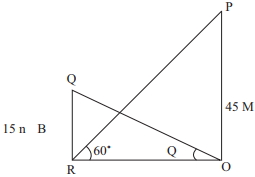
दो टावरों $A$ और $B$ की ऊँचाई क्रमशः $45 \, m$ और $15 \, m$ है। टावर $B$ के निचले सिरे से टावर $A$ के शीर्ष का उन्नयन कोण $60^{\circ}$ है। यदि टावर $A$ के निचले सिरे से टावर $B$ के शीर्ष का उन्नयन कोण $\theta$ है,तो $\sin \theta$ का मान ज्ञात कीजिए:
A
$\frac{1}{2}$
B
$\frac{2}{\sqrt{3}}$
C
$\frac{\sqrt{3}}{2}$
D
$\frac{1}{\sqrt{2}}$
Solution
(A) माना टावर $A$ की ऊँचाई $AP = 45 \, m$ और टावर $B$ की ऊँचाई $BQ = 15 \, m$ है। माना टावरों के आधारों के बीच की दूरी $RO = d$ है।
$\Delta PRO$ में,टावर $B$ के निचले सिरे $(R)$ से टावर $A$ के शीर्ष $(P)$ का उन्नयन कोण $60^{\circ}$ है।
$\tan 60^{\circ} = \frac{AP}{RO} = \frac{45}{d}$
$\sqrt{3} = \frac{45}{d} \implies d = \frac{45}{\sqrt{3}} = 15\sqrt{3} \, m$.
अब,$\Delta QOR$ में,टावर $A$ के निचले सिरे $(O)$ से टावर $B$ के शीर्ष $(Q)$ का उन्नयन कोण $\theta$ है।
$\tan \theta = \frac{BQ}{RO} = \frac{15}{15\sqrt{3}} = \frac{1}{\sqrt{3}}$.
चूँकि $\tan 30^{\circ} = \frac{1}{\sqrt{3}}$,इसलिए $\theta = 30^{\circ}$ प्राप्त होता है।
अतः,$\sin \theta = \sin 30^{\circ} = \frac{1}{2}$.
$\Delta PRO$ में,टावर $B$ के निचले सिरे $(R)$ से टावर $A$ के शीर्ष $(P)$ का उन्नयन कोण $60^{\circ}$ है।
$\tan 60^{\circ} = \frac{AP}{RO} = \frac{45}{d}$
$\sqrt{3} = \frac{45}{d} \implies d = \frac{45}{\sqrt{3}} = 15\sqrt{3} \, m$.
अब,$\Delta QOR$ में,टावर $A$ के निचले सिरे $(O)$ से टावर $B$ के शीर्ष $(Q)$ का उन्नयन कोण $\theta$ है।
$\tan \theta = \frac{BQ}{RO} = \frac{15}{15\sqrt{3}} = \frac{1}{\sqrt{3}}$.
चूँकि $\tan 30^{\circ} = \frac{1}{\sqrt{3}}$,इसलिए $\theta = 30^{\circ}$ प्राप्त होता है।
अतः,$\sin \theta = \sin 30^{\circ} = \frac{1}{2}$.
0 likes
View Solution585
MediumMCQ
निम्नलिखित व्यंजक का मान $3(\sin^{4} \theta + \cos^{4} \theta) + 2(\sin^{6} \theta + \cos^{6} \theta) + 12\sin^{2} \theta \cos^{2} \theta$ ज्ञात कीजिए।
A
$2$
B
$3$
C
$0$
D
$5$
Solution
(D) व्यंजक का मान ज्ञात करने के लिए,हम $\theta$ का एक सुविधाजनक मान रख सकते हैं। मान लीजिए $\theta = 0^{\circ}$.
चूंकि $\sin 0^{\circ} = 0$ और $\cos 0^{\circ} = 1$,हम इन मानों को व्यंजक में प्रतिस्थापित करते हैं:
$= 3(0^{4} + 1^{4}) + 2(0^{6} + 1^{6}) + 12(0^{2})(1^{2})$
$= 3(0 + 1) + 2(0 + 1) + 12(0)(1)$
$= 3(1) + 2(1) + 0$
$= 3 + 2 = 5$.
वैकल्पिक रूप से,सर्वसमिकाओं का उपयोग करते हुए:
$\sin^{4} \theta + \cos^{4} \theta = 1 - 2\sin^{2} \theta \cos^{2} \theta$
$\sin^{6} \theta + \cos^{6} \theta = 1 - 3\sin^{2} \theta \cos^{2} \theta$
इन मानों को रखने पर:
$= 3(1 - 2\sin^{2} \theta \cos^{2} \theta) + 2(1 - 3\sin^{2} \theta \cos^{2} \theta) + 12\sin^{2} \theta \cos^{2} \theta$
$= 3 - 6\sin^{2} \theta \cos^{2} \theta + 2 - 6\sin^{2} \theta \cos^{2} \theta + 12\sin^{2} \theta \cos^{2} \theta$
$= 3 + 2 + (-6 - 6 + 12)\sin^{2} \theta \cos^{2} \theta$
$= 5 + 0 = 5$.
चूंकि $\sin 0^{\circ} = 0$ और $\cos 0^{\circ} = 1$,हम इन मानों को व्यंजक में प्रतिस्थापित करते हैं:
$= 3(0^{4} + 1^{4}) + 2(0^{6} + 1^{6}) + 12(0^{2})(1^{2})$
$= 3(0 + 1) + 2(0 + 1) + 12(0)(1)$
$= 3(1) + 2(1) + 0$
$= 3 + 2 = 5$.
वैकल्पिक रूप से,सर्वसमिकाओं का उपयोग करते हुए:
$\sin^{4} \theta + \cos^{4} \theta = 1 - 2\sin^{2} \theta \cos^{2} \theta$
$\sin^{6} \theta + \cos^{6} \theta = 1 - 3\sin^{2} \theta \cos^{2} \theta$
इन मानों को रखने पर:
$= 3(1 - 2\sin^{2} \theta \cos^{2} \theta) + 2(1 - 3\sin^{2} \theta \cos^{2} \theta) + 12\sin^{2} \theta \cos^{2} \theta$
$= 3 - 6\sin^{2} \theta \cos^{2} \theta + 2 - 6\sin^{2} \theta \cos^{2} \theta + 12\sin^{2} \theta \cos^{2} \theta$
$= 3 + 2 + (-6 - 6 + 12)\sin^{2} \theta \cos^{2} \theta$
$= 5 + 0 = 5$.
0 likes
View Solution586
MediumMCQ
यदि $\sec \theta + \tan \theta = 2 + \sqrt{5}$ है,तो $\sin \theta$ का मान ज्ञात कीजिए।
A
$\frac{2}{\sqrt{5}}$
B
$\frac{1}{\sqrt{5}}$
C
$\frac{4}{5}$
D
$\frac{\sqrt{3}}{23}$
Solution
(A) दिया गया है: $\sec \theta + \tan \theta = 2 + \sqrt{5} \quad \dots(1)$
हम जानते हैं कि $\sec^2 \theta - \tan^2 \theta = 1$,जिसे $(\sec \theta - \tan \theta)(\sec \theta + \tan \theta) = 1$ के रूप में लिखा जा सकता है।
अतः,$\sec \theta - \tan \theta = \frac{1}{\sec \theta + \tan \theta} = \frac{1}{2 + \sqrt{5}}$.
हर का परिमेयकरण करने पर: $\sec \theta - \tan \theta = \frac{1}{2 + \sqrt{5}} \times \frac{\sqrt{5} - 2}{\sqrt{5} - 2} = \frac{\sqrt{5} - 2}{5 - 4} = \sqrt{5} - 2 \quad \dots(2)$.
समीकरण $(1)$ और $(2)$ को जोड़ने पर:
$(\sec \theta + \tan \theta) + (\sec \theta - \tan \theta) = (2 + \sqrt{5}) + (\sqrt{5} - 2)$
$2 \sec \theta = 2 \sqrt{5} \implies \sec \theta = \sqrt{5}$.
चूंकि $\sec \theta = \frac{\text{कर्ण}}{\text{आधार}} = \frac{\sqrt{5}}{1}$,इसलिए $\text{कर्ण} = \sqrt{5}$ और $\text{आधार} = 1$ है।
पाइथागोरस प्रमेय के अनुसार,$\text{लंब} = \sqrt{(\text{कर्ण})^2 - (\text{आधार})^2} = \sqrt{(\sqrt{5})^2 - 1^2} = \sqrt{5 - 1} = \sqrt{4} = 2$.
अतः,$\sin \theta = \frac{\text{लंब}}{\text{कर्ण}} = \frac{2}{\sqrt{5}}$.
हम जानते हैं कि $\sec^2 \theta - \tan^2 \theta = 1$,जिसे $(\sec \theta - \tan \theta)(\sec \theta + \tan \theta) = 1$ के रूप में लिखा जा सकता है।
अतः,$\sec \theta - \tan \theta = \frac{1}{\sec \theta + \tan \theta} = \frac{1}{2 + \sqrt{5}}$.
हर का परिमेयकरण करने पर: $\sec \theta - \tan \theta = \frac{1}{2 + \sqrt{5}} \times \frac{\sqrt{5} - 2}{\sqrt{5} - 2} = \frac{\sqrt{5} - 2}{5 - 4} = \sqrt{5} - 2 \quad \dots(2)$.
समीकरण $(1)$ और $(2)$ को जोड़ने पर:
$(\sec \theta + \tan \theta) + (\sec \theta - \tan \theta) = (2 + \sqrt{5}) + (\sqrt{5} - 2)$
$2 \sec \theta = 2 \sqrt{5} \implies \sec \theta = \sqrt{5}$.
चूंकि $\sec \theta = \frac{\text{कर्ण}}{\text{आधार}} = \frac{\sqrt{5}}{1}$,इसलिए $\text{कर्ण} = \sqrt{5}$ और $\text{आधार} = 1$ है।
पाइथागोरस प्रमेय के अनुसार,$\text{लंब} = \sqrt{(\text{कर्ण})^2 - (\text{आधार})^2} = \sqrt{(\sqrt{5})^2 - 1^2} = \sqrt{5 - 1} = \sqrt{4} = 2$.
अतः,$\sin \theta = \frac{\text{लंब}}{\text{कर्ण}} = \frac{2}{\sqrt{5}}$.
0 likes
View Solution587
MediumMCQ
$\cos 24^{\circ} + \cos 55^{\circ} + \cos 125^{\circ} + \cos 204^{\circ} + \cos 300^{\circ}$ का मान ज्ञात कीजिए।
A
$-\frac{1}{2}$
B
$\frac{1}{2}$
C
$2$
D
$1$
Solution
(B) दी गई व्यंजक: $\cos 24^{\circ} + \cos 55^{\circ} + \cos 125^{\circ} + \cos 204^{\circ} + \cos 300^{\circ}$ है।
पदों को पुनर्व्यवस्थित करने पर: $(\cos 24^{\circ} + \cos 204^{\circ}) + (\cos 55^{\circ} + \cos 125^{\circ}) + \cos 300^{\circ}$ प्राप्त होता है।
सर्वसमिका $\cos(180^{\circ} + \theta) = -\cos \theta$ और $\cos(180^{\circ} - \theta) = -\cos \theta$ का उपयोग करने पर:
$\cos 204^{\circ} = \cos(180^{\circ} + 24^{\circ}) = -\cos 24^{\circ}$।
$\cos 125^{\circ} = \cos(180^{\circ} - 55^{\circ}) = -\cos 55^{\circ}$।
अंतिम पद के लिए,$\cos 300^{\circ} = \cos(360^{\circ} - 60^{\circ}) = \cos 60^{\circ} = \frac{1}{2}$।
इन मानों को व्यंजक में रखने पर:
$(\cos 24^{\circ} - \cos 24^{\circ}) + (\cos 55^{\circ} - \cos 55^{\circ}) + \frac{1}{2} = 0 + 0 + \frac{1}{2} = \frac{1}{2}$।
पदों को पुनर्व्यवस्थित करने पर: $(\cos 24^{\circ} + \cos 204^{\circ}) + (\cos 55^{\circ} + \cos 125^{\circ}) + \cos 300^{\circ}$ प्राप्त होता है।
सर्वसमिका $\cos(180^{\circ} + \theta) = -\cos \theta$ और $\cos(180^{\circ} - \theta) = -\cos \theta$ का उपयोग करने पर:
$\cos 204^{\circ} = \cos(180^{\circ} + 24^{\circ}) = -\cos 24^{\circ}$।
$\cos 125^{\circ} = \cos(180^{\circ} - 55^{\circ}) = -\cos 55^{\circ}$।
अंतिम पद के लिए,$\cos 300^{\circ} = \cos(360^{\circ} - 60^{\circ}) = \cos 60^{\circ} = \frac{1}{2}$।
इन मानों को व्यंजक में रखने पर:
$(\cos 24^{\circ} - \cos 24^{\circ}) + (\cos 55^{\circ} - \cos 55^{\circ}) + \frac{1}{2} = 0 + 0 + \frac{1}{2} = \frac{1}{2}$।
0 likes
View Solution588
DifficultMCQ
यदि $\frac{\sec \theta+\tan \theta}{\sec \theta-\tan \theta}=2 \frac{51}{79}$ है,तो $\sin \theta$ का मान ज्ञात कीजिए।
A
$\frac{65}{144}$
B
$\frac{39}{72}$
C
$\frac{91}{144}$
D
$\frac{35}{72}$
Solution
(A) दिया गया है: $\frac{\sec \theta+\tan \theta}{\sec \theta-\tan \theta} = 2 \frac{51}{79} = \frac{2 \times 79 + 51}{79} = \frac{158 + 51}{79} = \frac{209}{79}$.
योगानुपात और अंतरानुपात $(C \& D)$ का उपयोग करने पर:
$\frac{(\sec \theta+\tan \theta) + (\sec \theta-\tan \theta)}{(\sec \theta+\tan \theta) - (\sec \theta-\tan \theta)} = \frac{209 + 79}{209 - 79}$.
$\frac{2 \sec \theta}{2 \tan \theta} = \frac{288}{130}$.
$\frac{1}{\cos \theta} \times \frac{\cos \theta}{\sin \theta} = \frac{144}{65}$.
$\frac{1}{\sin \theta} = \frac{144}{65}$.
अतः,$\sin \theta = \frac{65}{144}$.
योगानुपात और अंतरानुपात $(C \& D)$ का उपयोग करने पर:
$\frac{(\sec \theta+\tan \theta) + (\sec \theta-\tan \theta)}{(\sec \theta+\tan \theta) - (\sec \theta-\tan \theta)} = \frac{209 + 79}{209 - 79}$.
$\frac{2 \sec \theta}{2 \tan \theta} = \frac{288}{130}$.
$\frac{1}{\cos \theta} \times \frac{\cos \theta}{\sin \theta} = \frac{144}{65}$.
$\frac{1}{\sin \theta} = \frac{144}{65}$.
अतः,$\sin \theta = \frac{65}{144}$.
0 likes
View Solution589
EasyMCQ
यदि $\tan A + \cot A = 2$ है,तो $\tan^{10} A + \cot^{10} A$ का मान क्या होगा?
A
$2^{10}$
B
$1$
C
$2$
D
$4$
Solution
(C) दिया गया समीकरण $\tan A + \cot A = 2$ है।
हम जानते हैं कि $\cot A = \frac{1}{\tan A}$ होता है।
इसे समीकरण में प्रतिस्थापित करने पर,$\tan A + \frac{1}{\tan A} = 2$ प्राप्त होता है।
माना $\tan A = x$,तो $x + \frac{1}{x} = 2$,जिसे सरल करने पर $x^2 - 2x + 1 = 0$ प्राप्त होता है।
यह $(x - 1)^2 = 0$ है,इसलिए $x = 1$ है।
अतः,$\tan A = 1$,जिसका अर्थ है कि $\cot A = 1$ है।
अब,हमें $\tan^{10} A + \cot^{10} A$ का मान ज्ञात करना है।
मान रखने पर,$(1)^{10} + (1)^{10} = 1 + 1 = 2$ प्राप्त होता है।
हम जानते हैं कि $\cot A = \frac{1}{\tan A}$ होता है।
इसे समीकरण में प्रतिस्थापित करने पर,$\tan A + \frac{1}{\tan A} = 2$ प्राप्त होता है।
माना $\tan A = x$,तो $x + \frac{1}{x} = 2$,जिसे सरल करने पर $x^2 - 2x + 1 = 0$ प्राप्त होता है।
यह $(x - 1)^2 = 0$ है,इसलिए $x = 1$ है।
अतः,$\tan A = 1$,जिसका अर्थ है कि $\cot A = 1$ है।
अब,हमें $\tan^{10} A + \cot^{10} A$ का मान ज्ञात करना है।
मान रखने पर,$(1)^{10} + (1)^{10} = 1 + 1 = 2$ प्राप्त होता है।
0 likes
View Solution590
MediumMCQ
यदि $1+\cos^{2} \theta = 3 \sin \theta \cos \theta$ है,तो $\cot \theta$ का पूर्णांक मान $(0 < \theta < \frac{\pi}{2})$ ज्ञात कीजिए।
A
$3$
B
$1$
C
$0$
D
$2$
Solution
(B) दिया गया समीकरण: $1 + \cos^{2} \theta = 3 \sin \theta \cos \theta$.
दोनों पक्षों को $\cos^{2} \theta$ से विभाजित करने पर (चूंकि $0 < \theta < \frac{\pi}{2}$ के लिए $\cos \theta \neq 0$):
$\frac{1}{\cos^{2} \theta} + \frac{\cos^{2} \theta}{\cos^{2} \theta} = 3 \frac{\sin \theta \cos \theta}{\cos^{2} \theta}$.
$\sec^{2} \theta + 1 = 3 \tan \theta$.
सर्वसमिका $\sec^{2} \theta = 1 + \tan^{2} \theta$ का उपयोग करने पर:
$(1 + \tan^{2} \theta) + 1 = 3 \tan \theta$.
$\tan^{2} \theta - 3 \tan \theta + 2 = 0$.
द्विघात समीकरण का गुणनखंड करने पर:
$(\tan \theta - 1)(\tan \theta - 2) = 0$.
अतः,$\tan \theta = 1$ या $\tan \theta = 2$.
यदि $\tan \theta = 1$ है,तो $\cot \theta = \frac{1}{\tan \theta} = 1$.
यदि $\tan \theta = 2$ है,तो $\cot \theta = \frac{1}{2} = 0.5$.
चूंकि प्रश्न में पूर्णांक मान पूछा गया है,इसलिए सही मान $1$ है।
दोनों पक्षों को $\cos^{2} \theta$ से विभाजित करने पर (चूंकि $0 < \theta < \frac{\pi}{2}$ के लिए $\cos \theta \neq 0$):
$\frac{1}{\cos^{2} \theta} + \frac{\cos^{2} \theta}{\cos^{2} \theta} = 3 \frac{\sin \theta \cos \theta}{\cos^{2} \theta}$.
$\sec^{2} \theta + 1 = 3 \tan \theta$.
सर्वसमिका $\sec^{2} \theta = 1 + \tan^{2} \theta$ का उपयोग करने पर:
$(1 + \tan^{2} \theta) + 1 = 3 \tan \theta$.
$\tan^{2} \theta - 3 \tan \theta + 2 = 0$.
द्विघात समीकरण का गुणनखंड करने पर:
$(\tan \theta - 1)(\tan \theta - 2) = 0$.
अतः,$\tan \theta = 1$ या $\tan \theta = 2$.
यदि $\tan \theta = 1$ है,तो $\cot \theta = \frac{1}{\tan \theta} = 1$.
यदि $\tan \theta = 2$ है,तो $\cot \theta = \frac{1}{2} = 0.5$.
चूंकि प्रश्न में पूर्णांक मान पूछा गया है,इसलिए सही मान $1$ है।
0 likes
View Solution591
MediumMCQ
$\sin ^{2} 22^{\circ}+\sin ^{2} 68^{\circ}+\cot ^{2} 30^{\circ}$ का मान ज्ञात कीजिए।
A
$3/4$
B
$4$
C
$5/4$
D
$3$
Solution
(B) दिया गया व्यंजक: $\sin ^{2} 22^{\circ}+\sin ^{2} 68^{\circ}+\cot ^{2} 30^{\circ}$
हम जानते हैं कि $\sin(90^{\circ}-\theta) = \cos \theta$.
अतः,$\sin 22^{\circ} = \sin(90^{\circ}-68^{\circ}) = \cos 68^{\circ}$.
इस मान को व्यंजक में प्रतिस्थापित करने पर:
$\cos ^{2} 68^{\circ} + \sin ^{2} 68^{\circ} + \cot ^{2} 30^{\circ}$
सर्वसमिका $\sin ^{2} \theta + \cos ^{2} \theta = 1$ का उपयोग करने पर:
$1 + \cot ^{2} 30^{\circ}$
चूंकि $\cot 30^{\circ} = \sqrt{3}$,इसलिए $\cot ^{2} 30^{\circ} = (\sqrt{3})^{2} = 3$.
अतः,कुल मान $1 + 3 = 4$ है।
हम जानते हैं कि $\sin(90^{\circ}-\theta) = \cos \theta$.
अतः,$\sin 22^{\circ} = \sin(90^{\circ}-68^{\circ}) = \cos 68^{\circ}$.
इस मान को व्यंजक में प्रतिस्थापित करने पर:
$\cos ^{2} 68^{\circ} + \sin ^{2} 68^{\circ} + \cot ^{2} 30^{\circ}$
सर्वसमिका $\sin ^{2} \theta + \cos ^{2} \theta = 1$ का उपयोग करने पर:
$1 + \cot ^{2} 30^{\circ}$
चूंकि $\cot 30^{\circ} = \sqrt{3}$,इसलिए $\cot ^{2} 30^{\circ} = (\sqrt{3})^{2} = 3$.
अतः,कुल मान $1 + 3 = 4$ है।
0 likes
View Solution592
MediumMCQ
यदि $\theta$ एक न्यून कोण है और $\tan(4\theta - 50^{\circ}) = \cot(50^{\circ} - \theta)$ है,तो $\theta$ का मान डिग्री में क्या है?
A
$30$
B
$40$
C
$20$
D
$50$
Solution
(A) दिया गया समीकरण: $\tan(4\theta - 50^{\circ}) = \cot(50^{\circ} - \theta)$.
हम जानते हैं कि त्रिकोणमितीय सर्वसमिका: $\tan(A) = \cot(90^{\circ} - A)$.
बाएँ पक्ष पर इस सर्वसमिका का उपयोग करने पर: $\tan(4\theta - 50^{\circ}) = \cot(90^{\circ} - (4\theta - 50^{\circ}))$.
कोटि-पूरक कोण के पद को सरल करने पर: $90^{\circ} - 4\theta + 50^{\circ} = 140^{\circ} - 4\theta$.
अतः,$\cot(140^{\circ} - 4\theta) = \cot(50^{\circ} - \theta)$.
कोणों की तुलना करने पर: $140^{\circ} - 4\theta = 50^{\circ} - \theta$.
पदों को व्यवस्थित करने पर: $140^{\circ} - 50^{\circ} = 4\theta - \theta$.
$90^{\circ} = 3\theta$.
इसलिए,$\theta = 30^{\circ}$.
हम जानते हैं कि त्रिकोणमितीय सर्वसमिका: $\tan(A) = \cot(90^{\circ} - A)$.
बाएँ पक्ष पर इस सर्वसमिका का उपयोग करने पर: $\tan(4\theta - 50^{\circ}) = \cot(90^{\circ} - (4\theta - 50^{\circ}))$.
कोटि-पूरक कोण के पद को सरल करने पर: $90^{\circ} - 4\theta + 50^{\circ} = 140^{\circ} - 4\theta$.
अतः,$\cot(140^{\circ} - 4\theta) = \cot(50^{\circ} - \theta)$.
कोणों की तुलना करने पर: $140^{\circ} - 4\theta = 50^{\circ} - \theta$.
पदों को व्यवस्थित करने पर: $140^{\circ} - 50^{\circ} = 4\theta - \theta$.
$90^{\circ} = 3\theta$.
इसलिए,$\theta = 30^{\circ}$.
0 likes
View Solution593
MediumMCQ
यदि $5 \sin \theta = 3$ है,तो $\frac{\sec \theta - \tan \theta}{\sec \theta + \tan \theta}$ का संख्यात्मक मान ज्ञात कीजिए।
A
$1/3$
B
$1/2$
C
$1/4$
D
$1/5$
Solution
(C) दिया गया है कि $5 \sin \theta = 3$,इसलिए $\sin \theta = 3/5$ है।
हम जानते हैं कि $\cos \theta = \sqrt{1 - \sin^2 \theta}$ होता है।
मान रखने पर,$\cos \theta = \sqrt{1 - (3/5)^2} = \sqrt{1 - 9/25} = \sqrt{16/25} = 4/5$ प्राप्त होता है।
अब,$\tan \theta = \frac{\sin \theta}{\cos \theta} = \frac{3/5}{4/5} = 3/4$ है।
साथ ही,$\sec \theta = \frac{1}{\cos \theta} = 5/4$ है।
इन मानों को व्यंजक में रखने पर: $\frac{\sec \theta - \tan \theta}{\sec \theta + \tan \theta} = \frac{5/4 - 3/4}{5/4 + 3/4} = \frac{2/4}{8/4} = 2/8 = 1/4$।
हम जानते हैं कि $\cos \theta = \sqrt{1 - \sin^2 \theta}$ होता है।
मान रखने पर,$\cos \theta = \sqrt{1 - (3/5)^2} = \sqrt{1 - 9/25} = \sqrt{16/25} = 4/5$ प्राप्त होता है।
अब,$\tan \theta = \frac{\sin \theta}{\cos \theta} = \frac{3/5}{4/5} = 3/4$ है।
साथ ही,$\sec \theta = \frac{1}{\cos \theta} = 5/4$ है।
इन मानों को व्यंजक में रखने पर: $\frac{\sec \theta - \tan \theta}{\sec \theta + \tan \theta} = \frac{5/4 - 3/4}{5/4 + 3/4} = \frac{2/4}{8/4} = 2/8 = 1/4$।
0 likes
View Solution594
MediumMCQ
यदि $\sec \theta + \tan \theta = p, (p \neq 0)$ है,तो $\sec \theta$ का मान क्या होगा?
A
$(p + 1/p), p \neq 0$
B
$\frac{1}{2}(p + 1/p), p \neq 0$
C
$2(p - 1/p), p \neq 0$
D
$(p - 1/p), p \neq 0$
Solution
(B) दिया गया है: $\sec \theta + \tan \theta = p$ ......... $(1)$
हम जानते हैं कि सर्वसमिका: $\sec^2 \theta - \tan^2 \theta = 1$
इसे इस प्रकार गुणनखंडित किया जा सकता है: $(\sec \theta + \tan \theta)(\sec \theta - \tan \theta) = 1$
समीकरण $(1)$ का मान सर्वसमिका में रखने पर: $p(\sec \theta - \tan \theta) = 1$
अतः: $\sec \theta - \tan \theta = \frac{1}{p}$ ......... $(2)$
समीकरण $(1)$ और $(2)$ को जोड़ने पर:
$(\sec \theta + \tan \theta) + (\sec \theta - \tan \theta) = p + \frac{1}{p}$
$2 \sec \theta = p + \frac{1}{p}$
$\sec \theta = \frac{1}{2}(p + \frac{1}{p})$
हम जानते हैं कि सर्वसमिका: $\sec^2 \theta - \tan^2 \theta = 1$
इसे इस प्रकार गुणनखंडित किया जा सकता है: $(\sec \theta + \tan \theta)(\sec \theta - \tan \theta) = 1$
समीकरण $(1)$ का मान सर्वसमिका में रखने पर: $p(\sec \theta - \tan \theta) = 1$
अतः: $\sec \theta - \tan \theta = \frac{1}{p}$ ......... $(2)$
समीकरण $(1)$ और $(2)$ को जोड़ने पर:
$(\sec \theta + \tan \theta) + (\sec \theta - \tan \theta) = p + \frac{1}{p}$
$2 \sec \theta = p + \frac{1}{p}$
$\sec \theta = \frac{1}{2}(p + \frac{1}{p})$
0 likes
View Solution595
DifficultMCQ
$2 \sin ^{2} \theta + 3 \cos ^{2} \theta$ का न्यूनतम मान क्या है?
A
$1$
B
$3$
C
$2$
D
$4$
Solution
(C) दी गई व्यंजक: $2 \sin ^{2} \theta + 3 \cos ^{2} \theta$
हम जानते हैं कि $\sin ^{2} \theta = 1 - \cos ^{2} \theta$.
इस मान को व्यंजक में प्रतिस्थापित करने पर:
$2(1 - \cos ^{2} \theta) + 3 \cos ^{2} \theta$
$= 2 - 2 \cos ^{2} \theta + 3 \cos ^{2} \theta$
$= \cos ^{2} \theta + 2$
चूंकि $\cos ^{2} \theta$ का परिसर $[0, 1]$ है,इसलिए $\cos ^{2} \theta$ का न्यूनतम मान $0$ है।
अतः,व्यंजक का न्यूनतम मान $0 + 2 = 2$ है।
हम जानते हैं कि $\sin ^{2} \theta = 1 - \cos ^{2} \theta$.
इस मान को व्यंजक में प्रतिस्थापित करने पर:
$2(1 - \cos ^{2} \theta) + 3 \cos ^{2} \theta$
$= 2 - 2 \cos ^{2} \theta + 3 \cos ^{2} \theta$
$= \cos ^{2} \theta + 2$
चूंकि $\cos ^{2} \theta$ का परिसर $[0, 1]$ है,इसलिए $\cos ^{2} \theta$ का न्यूनतम मान $0$ है।
अतः,व्यंजक का न्यूनतम मान $0 + 2 = 2$ है।
0 likes
View Solution596
MediumMCQ
$\sin ^{2} 30^{\circ} \cos ^{2} 45^{\circ}+5 \tan ^{2} 30^{\circ}+\frac{3}{2}\sin ^{2} 90^{\circ}-3 \cos ^{2} 90^{\circ}$ का मान ज्ञात कीजिए।
A
$3 \frac{7}{24}$
B
$3 \frac{3}{24}$
C
$3 \frac{1}{24}$
D
$3 \frac{5}{24}$
Solution
(A) दी गई व्यंजक: $\sin ^{2} 30^{\circ} \cos ^{2} 45^{\circ}+5 \tan ^{2} 30^{\circ}+\frac{3}{2} \sin ^{2} 90^{\circ}-3 \cos ^{2} 90^{\circ}$
त्रिकोणमितीय मान रखने पर: $\sin 30^{\circ} = \frac{1}{2}$,$\cos 45^{\circ} = \frac{1}{\sqrt{2}}$,$\tan 30^{\circ} = \frac{1}{\sqrt{3}}$,$\sin 90^{\circ} = 1$,$\cos 90^{\circ} = 0$.
$= \left[\left(\frac{1}{2}\right)^{2} \times \left(\frac{1}{\sqrt{2}}\right)^{2}\right] + 5\left(\frac{1}{\sqrt{3}}\right)^{2} + \frac{3}{2}(1)^{2} - 3(0)^{2}$
$= \left(\frac{1}{4} \times \frac{1}{2}\right) + 5\left(\frac{1}{3}\right) + \frac{3}{2} - 0$
$= \frac{1}{8} + \frac{5}{3} + \frac{3}{2}$
$8, 3, 2$ का लघुत्तम समापवर्त्य $(LCM)$ $24$ लेने पर:
$= \frac{3 + 40 + 36}{24} = \frac{79}{24}$
मिश्रित भिन्न में बदलने पर: $\frac{79}{24} = 3 \frac{7}{24}$.
त्रिकोणमितीय मान रखने पर: $\sin 30^{\circ} = \frac{1}{2}$,$\cos 45^{\circ} = \frac{1}{\sqrt{2}}$,$\tan 30^{\circ} = \frac{1}{\sqrt{3}}$,$\sin 90^{\circ} = 1$,$\cos 90^{\circ} = 0$.
$= \left[\left(\frac{1}{2}\right)^{2} \times \left(\frac{1}{\sqrt{2}}\right)^{2}\right] + 5\left(\frac{1}{\sqrt{3}}\right)^{2} + \frac{3}{2}(1)^{2} - 3(0)^{2}$
$= \left(\frac{1}{4} \times \frac{1}{2}\right) + 5\left(\frac{1}{3}\right) + \frac{3}{2} - 0$
$= \frac{1}{8} + \frac{5}{3} + \frac{3}{2}$
$8, 3, 2$ का लघुत्तम समापवर्त्य $(LCM)$ $24$ लेने पर:
$= \frac{3 + 40 + 36}{24} = \frac{79}{24}$
मिश्रित भिन्न में बदलने पर: $\frac{79}{24} = 3 \frac{7}{24}$.
0 likes
View Solution597
DifficultMCQ
यदि $\cos ^{2} \theta-\sin ^{2} \theta=\frac{1}{3},$ जहाँ $0 \leq \theta \leq \frac{\pi}{2}$ है,तो $\cos ^{4} \theta-\sin ^{4} \theta$ का मान क्या है?
A
$\frac{1}{3}$
B
$\frac{2}{3}$
C
$\frac{1}{9}$
D
$\frac{2}{9}$
Solution
(A) हमें दिया गया है कि $\cos ^{2} \theta - \sin ^{2} \theta = \frac{1}{3}$.....$(1)$
हम त्रिकोणमितीय सर्वसमिका जानते हैं कि $\cos ^{2} \theta + \sin ^{2} \theta = 1$.....$(2)$
हमें $\cos ^{4} \theta - \sin ^{4} \theta$ का मान ज्ञात करना है।
बीजगणितीय सर्वसमिका $a^{2} - b^{2} = (a - b)(a + b)$ का उपयोग करते हुए,हम लिख सकते हैं:
$\cos ^{4} \theta - \sin ^{4} \theta = (\cos ^{2} \theta - \sin ^{2} \theta)(\cos ^{2} \theta + \sin ^{2} \theta)$
समीकरण $(1)$ और $(2)$ से मान रखने पर:
$\cos ^{4} \theta - \sin ^{4} \theta = (\frac{1}{3}) \times (1)$
$\cos ^{4} \theta - \sin ^{4} \theta = \frac{1}{3}$
हम त्रिकोणमितीय सर्वसमिका जानते हैं कि $\cos ^{2} \theta + \sin ^{2} \theta = 1$.....$(2)$
हमें $\cos ^{4} \theta - \sin ^{4} \theta$ का मान ज्ञात करना है।
बीजगणितीय सर्वसमिका $a^{2} - b^{2} = (a - b)(a + b)$ का उपयोग करते हुए,हम लिख सकते हैं:
$\cos ^{4} \theta - \sin ^{4} \theta = (\cos ^{2} \theta - \sin ^{2} \theta)(\cos ^{2} \theta + \sin ^{2} \theta)$
समीकरण $(1)$ और $(2)$ से मान रखने पर:
$\cos ^{4} \theta - \sin ^{4} \theta = (\frac{1}{3}) \times (1)$
$\cos ^{4} \theta - \sin ^{4} \theta = \frac{1}{3}$
0 likes
View Solution598
MediumMCQ
यदि $\tan \theta = \frac{1}{\sqrt{11}}$ और $0 < \theta < \frac{\pi}{2}$ है,तो $\frac{\operatorname{cosec}^{2} \theta - \sec ^{2} \theta}{\operatorname{cosec}^{2} \theta + \sec ^{2} \theta}$ का मान ज्ञात कीजिए।
A
$\frac{3}{4}$
B
$\frac{4}{5}$
C
$\frac{5}{6}$
D
$\frac{6}{7}$
Solution
(C) दिया गया है कि $\tan \theta = \frac{1}{\sqrt{11}}.$
हम जानते हैं कि $\sec^{2} \theta = 1 + \tan^{2} \theta = 1 + \frac{1}{11} = \frac{12}{11}.$
साथ ही,$\operatorname{cosec}^{2} \theta = 1 + \cot^{2} \theta = 1 + (\frac{1}{\tan \theta})^{2} = 1 + (\sqrt{11})^{2} = 1 + 11 = 12.$
अब,इन मानों को व्यंजक में प्रतिस्थापित करने पर:
$\frac{\operatorname{cosec}^{2} \theta - \sec ^{2} \theta}{\operatorname{cosec}^{2} \theta + \sec ^{2} \theta} = \frac{12 - \frac{12}{11}}{12 + \frac{12}{11}}.$
अंश और हर को $12$ से विभाजित करने पर:
$\frac{1 - \frac{1}{11}}{1 + \frac{1}{11}} = \frac{\frac{10}{11}}{\frac{12}{11}} = \frac{10}{12} = \frac{5}{6}.$
हम जानते हैं कि $\sec^{2} \theta = 1 + \tan^{2} \theta = 1 + \frac{1}{11} = \frac{12}{11}.$
साथ ही,$\operatorname{cosec}^{2} \theta = 1 + \cot^{2} \theta = 1 + (\frac{1}{\tan \theta})^{2} = 1 + (\sqrt{11})^{2} = 1 + 11 = 12.$
अब,इन मानों को व्यंजक में प्रतिस्थापित करने पर:
$\frac{\operatorname{cosec}^{2} \theta - \sec ^{2} \theta}{\operatorname{cosec}^{2} \theta + \sec ^{2} \theta} = \frac{12 - \frac{12}{11}}{12 + \frac{12}{11}}.$
अंश और हर को $12$ से विभाजित करने पर:
$\frac{1 - \frac{1}{11}}{1 + \frac{1}{11}} = \frac{\frac{10}{11}}{\frac{12}{11}} = \frac{10}{12} = \frac{5}{6}.$
0 likes
View Solution599
MediumMCQ
$\frac{1}{\sqrt{2}} \sin \frac{\pi}{6} \cos \frac{\pi}{4} - \cot \frac{\pi}{3} \sec \frac{\pi}{6} + \frac{5 \tan \frac{\pi}{4}}{12 \sin \frac{\pi}{2}}$ का मान किसके बराबर है?
A
$0$
B
$1$
C
$2$
D
$\frac{3}{2}$
Solution
(A) दी गई व्यंजक: $\frac{1}{\sqrt{2}} \sin \frac{\pi}{6} \cos \frac{\pi}{4} - \cot \frac{\pi}{3} \sec \frac{\pi}{6} + \frac{5 \tan \frac{\pi}{4}}{12 \sin \frac{\pi}{2}}$
मानक त्रिकोणमितीय मान रखने पर:
$\sin \frac{\pi}{6} = \frac{1}{2}$,$\cos \frac{\pi}{4} = \frac{1}{\sqrt{2}}$,$\cot \frac{\pi}{3} = \frac{1}{\sqrt{3}}$,$\sec \frac{\pi}{6} = \frac{2}{\sqrt{3}}$,$\tan \frac{\pi}{4} = 1$,$\sin \frac{\pi}{2} = 1$
इन मानों को व्यंजक में रखने पर:
$= \frac{1}{\sqrt{2}} \left( \frac{1}{2} \times \frac{1}{\sqrt{2}} \right) - \left( \frac{1}{\sqrt{3}} \times \frac{2}{\sqrt{3}} \right) + \frac{5 \times 1}{12 \times 1}$
$= \left( \frac{1}{\sqrt{2}} \times \frac{1}{2\sqrt{2}} \right) - \frac{2}{3} + \frac{5}{12}$
$= \frac{1}{4} - \frac{2}{3} + \frac{5}{12}$
$= \frac{3 - 8 + 5}{12} = \frac{0}{12} = 0$
मानक त्रिकोणमितीय मान रखने पर:
$\sin \frac{\pi}{6} = \frac{1}{2}$,$\cos \frac{\pi}{4} = \frac{1}{\sqrt{2}}$,$\cot \frac{\pi}{3} = \frac{1}{\sqrt{3}}$,$\sec \frac{\pi}{6} = \frac{2}{\sqrt{3}}$,$\tan \frac{\pi}{4} = 1$,$\sin \frac{\pi}{2} = 1$
इन मानों को व्यंजक में रखने पर:
$= \frac{1}{\sqrt{2}} \left( \frac{1}{2} \times \frac{1}{\sqrt{2}} \right) - \left( \frac{1}{\sqrt{3}} \times \frac{2}{\sqrt{3}} \right) + \frac{5 \times 1}{12 \times 1}$
$= \left( \frac{1}{\sqrt{2}} \times \frac{1}{2\sqrt{2}} \right) - \frac{2}{3} + \frac{5}{12}$
$= \frac{1}{4} - \frac{2}{3} + \frac{5}{12}$
$= \frac{3 - 8 + 5}{12} = \frac{0}{12} = 0$
0 likes
View Solution600
MediumMCQ
यदि $\sin \theta = \frac{3}{5}$ है,तो $\frac{\tan \theta + \cos \theta}{\cot \theta + \operatorname{cosec} \theta}$ का मान ज्ञात कीजिए।
A
$\frac{29}{60}$
B
$\frac{31}{60}$
C
$\frac{34}{60}$
D
$\frac{37}{60}$
Solution
(B) दिया गया है $\sin \theta = \frac{3}{5}.$
सर्वसमिका $\cos^2 \theta + \sin^2 \theta = 1$ का उपयोग करते हुए,$\cos \theta = \sqrt{1 - \sin^2 \theta}.$
$\cos \theta = \sqrt{1 - (\frac{3}{5})^2} = \sqrt{1 - \frac{9}{25}} = \sqrt{\frac{16}{25}} = \frac{4}{5}.$
अब,अन्य त्रिकोणमितीय अनुपात ज्ञात करते हैं:
$\tan \theta = \frac{\sin \theta}{\cos \theta} = \frac{3/5}{4/5} = \frac{3}{4}.$
$\cot \theta = \frac{1}{\tan \theta} = \frac{4}{3}.$
$\operatorname{cosec} \theta = \frac{1}{\sin \theta} = \frac{5}{3}.$
इन मानों को व्यंजक $\frac{\tan \theta + \cos \theta}{\cot \theta + \operatorname{cosec} \theta}$ में प्रतिस्थापित करने पर:
अंश: $\frac{3}{4} + \frac{4}{5} = \frac{15 + 16}{20} = \frac{31}{20}.$
हर: $\frac{4}{3} + \frac{5}{3} = \frac{9}{3} = 3.$
परिणाम: $\frac{31/20}{3} = \frac{31}{60}.$
सर्वसमिका $\cos^2 \theta + \sin^2 \theta = 1$ का उपयोग करते हुए,$\cos \theta = \sqrt{1 - \sin^2 \theta}.$
$\cos \theta = \sqrt{1 - (\frac{3}{5})^2} = \sqrt{1 - \frac{9}{25}} = \sqrt{\frac{16}{25}} = \frac{4}{5}.$
अब,अन्य त्रिकोणमितीय अनुपात ज्ञात करते हैं:
$\tan \theta = \frac{\sin \theta}{\cos \theta} = \frac{3/5}{4/5} = \frac{3}{4}.$
$\cot \theta = \frac{1}{\tan \theta} = \frac{4}{3}.$
$\operatorname{cosec} \theta = \frac{1}{\sin \theta} = \frac{5}{3}.$
इन मानों को व्यंजक $\frac{\tan \theta + \cos \theta}{\cot \theta + \operatorname{cosec} \theta}$ में प्रतिस्थापित करने पर:
अंश: $\frac{3}{4} + \frac{4}{5} = \frac{15 + 16}{20} = \frac{31}{20}.$
हर: $\frac{4}{3} + \frac{5}{3} = \frac{9}{3} = 3.$
परिणाम: $\frac{31/20}{3} = \frac{31}{60}.$
0 likes
View SolutionTrigonometry — Trigonometry · Frequently Asked Questions
1Are these Trigonometry questions useful for JEE and NEET?
Yes. All questions in this section are mapped to JEE Main and NEET exam patterns. Previous year questions from JEE Main, NEET, GUJCET and state-level exams are included with full solutions.
2Can I switch to Hindi or Gujarati for these questions?
Yes. Use the language tabs in the hero section or the sidebar to view the same questions and solutions in English, Hindi or Gujarati.
3How do I generate a question paper from this subtopic?
Use the Vedclass Exam Paper Generator — select the chapter and subtopic, set difficulty, and generate Sets A, B, C, D automatically. First 3 chapters of every subject are free.
Vedclass Products
For Students
Vedclass Test Series
Mock tests in real JEE/NEET style with performance analysis. 5-day free trial.
Start Free TrialFor Teachers
Exam Paper Generator
Generate Set A/B/C/D papers from this chapter in 2 minutes. 3 chapters free.
Try FreeFor Institutes
Online Exam Module
Live online exams with unlimited students, 360° analytics & white-label branding.
See DemoFor Teachers & Institutes
Generate a Trigonometry Exam Paper in 2 Minutes
Select subtopic & difficulty — Sets A, B, C, D auto-generated with No Repeat logic.
First 3 chapters of every subject are free — no payment required.