
अ Hindi
Trigonometry Questions in Hindi
Competitive Exam Quantitative Aptitude · Trigonometry · Trigonometry
648+
Questions
Hindi
Language
100%
With Solutions
Showing 50 of 648 questions in Hindi
501
EasyMCQ
$\sqrt{\frac{1+\cos \theta}{1-\cos \theta}}+\sqrt{\frac{1-\cos \theta}{1+\cos \theta}}=$
A
$2 \sin \theta$
B
$2 \cos \theta$
C
$\frac{2}{|\cos \theta|}$
D
$\frac{2}{|\sin \theta|}$
Solution
(D) माना व्यंजक $E = \sqrt{\frac{1+\cos \theta}{1-\cos \theta}} + \sqrt{\frac{1-\cos \theta}{1+\cos \theta}}$ है।
समान हर लेने पर,हमें प्राप्त होता है:
$E = \frac{\sqrt{1+\cos \theta} \cdot \sqrt{1+\cos \theta} + \sqrt{1-\cos \theta} \cdot \sqrt{1-\cos \theta}}{\sqrt{1-\cos \theta} \cdot \sqrt{1+\cos \theta}}$
$E = \frac{(1+\cos \theta) + (1-\cos \theta)}{\sqrt{(1-\cos \theta)(1+\cos \theta)}}$
$E = \frac{2}{\sqrt{1-\cos^2 \theta}}$
चूँकि $1-\cos^2 \theta = \sin^2 \theta$,इसलिए $\sqrt{\sin^2 \theta} = |\sin \theta|$ होता है।
अतः,$E = \frac{2}{|\sin \theta|}$।
समान हर लेने पर,हमें प्राप्त होता है:
$E = \frac{\sqrt{1+\cos \theta} \cdot \sqrt{1+\cos \theta} + \sqrt{1-\cos \theta} \cdot \sqrt{1-\cos \theta}}{\sqrt{1-\cos \theta} \cdot \sqrt{1+\cos \theta}}$
$E = \frac{(1+\cos \theta) + (1-\cos \theta)}{\sqrt{(1-\cos \theta)(1+\cos \theta)}}$
$E = \frac{2}{\sqrt{1-\cos^2 \theta}}$
चूँकि $1-\cos^2 \theta = \sin^2 \theta$,इसलिए $\sqrt{\sin^2 \theta} = |\sin \theta|$ होता है।
अतः,$E = \frac{2}{|\sin \theta|}$।
0 likes
View Solution502
MediumMCQ
यदि $\operatorname{cosec} \theta - \cot \theta = p$ है,तो $\operatorname{cosec} \theta$ का मान क्या होगा?
A
$\frac{1}{2} \left( p + \frac{1}{p} \right)$
B
$\frac{1}{2} \left( p - \frac{1}{p} \right)$
C
$p + \frac{1}{p}$
D
$p - \frac{1}{p}$
Solution
(A) दिया गया है कि $\operatorname{cosec} \theta - \cot \theta = p$ (समीकरण $1$)।
हम जानते हैं कि त्रिकोणमितीय सर्वसमिका $\operatorname{cosec}^2 \theta - \cot^2 \theta = 1$ होती है।
इसे $(\operatorname{cosec} \theta - \cot \theta)(\operatorname{cosec} \theta + \cot \theta) = 1$ के रूप में लिखा जा सकता है।
समीकरण $1$ से $p$ का मान रखने पर,हमें $p(\operatorname{cosec} \theta + \cot \theta) = 1$ प्राप्त होता है।
अतः,$\operatorname{cosec} \theta + \cot \theta = \frac{1}{p}$ (समीकरण $2$)।
समीकरण $1$ और समीकरण $2$ को जोड़ने पर:
$(\operatorname{cosec} \theta - \cot \theta) + (\operatorname{cosec} \theta + \cot \theta) = p + \frac{1}{p}$.
$2 \operatorname{cosec} \theta = p + \frac{1}{p}$.
$\operatorname{cosec} \theta = \frac{1}{2} \left( p + \frac{1}{p} \right)$.
हम जानते हैं कि त्रिकोणमितीय सर्वसमिका $\operatorname{cosec}^2 \theta - \cot^2 \theta = 1$ होती है।
इसे $(\operatorname{cosec} \theta - \cot \theta)(\operatorname{cosec} \theta + \cot \theta) = 1$ के रूप में लिखा जा सकता है।
समीकरण $1$ से $p$ का मान रखने पर,हमें $p(\operatorname{cosec} \theta + \cot \theta) = 1$ प्राप्त होता है।
अतः,$\operatorname{cosec} \theta + \cot \theta = \frac{1}{p}$ (समीकरण $2$)।
समीकरण $1$ और समीकरण $2$ को जोड़ने पर:
$(\operatorname{cosec} \theta - \cot \theta) + (\operatorname{cosec} \theta + \cot \theta) = p + \frac{1}{p}$.
$2 \operatorname{cosec} \theta = p + \frac{1}{p}$.
$\operatorname{cosec} \theta = \frac{1}{2} \left( p + \frac{1}{p} \right)$.
0 likes
View Solution503
EasyMCQ
$\tan 1^{\circ} \tan 2^{\circ} \ldots \tan 89^{\circ}$ का मान है
A
$-1$
B
$1$
C
$0$
D
इनमें से कोई नहीं
Solution
(B) दिया गया व्यंजक $E = \tan 1^{\circ} \tan 2^{\circ} \ldots \tan 44^{\circ} \tan 45^{\circ} \tan 46^{\circ} \ldots \tan 88^{\circ} \tan 89^{\circ}$ है।
हम जानते हैं कि $\tan(90^{\circ} - \theta) = \cot \theta$ होता है।
इसलिए,$\tan 89^{\circ} = \tan(90^{\circ} - 1^{\circ}) = \cot 1^{\circ}$,$\tan 88^{\circ} = \cot 2^{\circ}$,इत्यादि।
इन मानों को प्रतिस्थापित करने पर,हमें प्राप्त होता है $E = (\tan 1^{\circ} \cot 1^{\circ}) (\tan 2^{\circ} \cot 2^{\circ}) \ldots (\tan 44^{\circ} \cot 44^{\circ}) \tan 45^{\circ}$।
चूंकि $\tan \theta \cdot \cot \theta = 1$ और $\tan 45^{\circ} = 1$,इसलिए व्यंजक का मान $1 \cdot 1 \cdot \ldots \cdot 1 = 1$ हो जाता है।
हम जानते हैं कि $\tan(90^{\circ} - \theta) = \cot \theta$ होता है।
इसलिए,$\tan 89^{\circ} = \tan(90^{\circ} - 1^{\circ}) = \cot 1^{\circ}$,$\tan 88^{\circ} = \cot 2^{\circ}$,इत्यादि।
इन मानों को प्रतिस्थापित करने पर,हमें प्राप्त होता है $E = (\tan 1^{\circ} \cot 1^{\circ}) (\tan 2^{\circ} \cot 2^{\circ}) \ldots (\tan 44^{\circ} \cot 44^{\circ}) \tan 45^{\circ}$।
चूंकि $\tan \theta \cdot \cot \theta = 1$ और $\tan 45^{\circ} = 1$,इसलिए व्यंजक का मान $1 \cdot 1 \cdot \ldots \cdot 1 = 1$ हो जाता है।
0 likes
View Solution504
EasyMCQ
यदि $\operatorname{cosec}^{2} \theta = \frac{4xy}{(x+y)^{2}}$ है,तो
A
$x = -y$
B
$x = \frac{1}{y}$
C
$x = y$
D
इनमें से कोई नहीं
Solution
(C) हम जानते हैं कि किसी भी वास्तविक कोण $\theta$ के लिए,$\operatorname{cosec}^{2} \theta \geq 1$ होता है।
दिया गया है कि $\operatorname{cosec}^{2} \theta = \frac{4xy}{(x+y)^{2}}$,इसलिए $\frac{4xy}{(x+y)^{2}} \geq 1$ है।
इसका अर्थ है कि $4xy \geq (x+y)^{2}$ (यह मानते हुए कि $(x+y)^2 > 0$ है)।
पदों को पुनर्व्यवस्थित करने पर,हमें $4xy - (x^{2} + 2xy + y^{2}) \geq 0$ प्राप्त होता है।
इसे सरल करने पर $-(x^{2} - 2xy + y^{2}) \geq 0$ प्राप्त होता है,जो $-(x-y)^{2} \geq 0$ है।
$-1$ से गुणा करने पर,हमें $(x-y)^{2} \leq 0$ प्राप्त होता है।
चूँकि किसी भी वास्तविक संख्या का वर्ग ऋणात्मक नहीं हो सकता,इसलिए एकमात्र संभावना यह है कि $(x-y)^{2} = 0$ हो।
अतः,$x - y = 0$,जिसका अर्थ है कि $x = y$।
दिया गया है कि $\operatorname{cosec}^{2} \theta = \frac{4xy}{(x+y)^{2}}$,इसलिए $\frac{4xy}{(x+y)^{2}} \geq 1$ है।
इसका अर्थ है कि $4xy \geq (x+y)^{2}$ (यह मानते हुए कि $(x+y)^2 > 0$ है)।
पदों को पुनर्व्यवस्थित करने पर,हमें $4xy - (x^{2} + 2xy + y^{2}) \geq 0$ प्राप्त होता है।
इसे सरल करने पर $-(x^{2} - 2xy + y^{2}) \geq 0$ प्राप्त होता है,जो $-(x-y)^{2} \geq 0$ है।
$-1$ से गुणा करने पर,हमें $(x-y)^{2} \leq 0$ प्राप्त होता है।
चूँकि किसी भी वास्तविक संख्या का वर्ग ऋणात्मक नहीं हो सकता,इसलिए एकमात्र संभावना यह है कि $(x-y)^{2} = 0$ हो।
अतः,$x - y = 0$,जिसका अर्थ है कि $x = y$।
0 likes
View Solution505
MediumMCQ
$\frac{\sin 300^{\circ} \tan 240^{\circ} \sec \left(-420^{\circ}\right)}{\cot \left(-315^{\circ}\right) \cos \left(210^{\circ}\right) \operatorname{cosec}\left(-315^{\circ}\right)}$ का मान ज्ञात कीजिए।
A
$\sqrt{3}$
B
$\sqrt{2}$
C
$\sqrt{6}$
D
$\sqrt{8}$
Solution
(C) प्रत्येक त्रिकोणमितीय पद का मान रिडक्शन सूत्रों का उपयोग करके निकालते हैं:
$\sin 300^{\circ} = \sin(360^{\circ} - 60^{\circ}) = -\sin 60^{\circ} = -\frac{\sqrt{3}}{2}$
$\tan 240^{\circ} = \tan(180^{\circ} + 60^{\circ}) = \tan 60^{\circ} = \sqrt{3}$
$\sec(-420^{\circ}) = \sec(420^{\circ}) = \sec(360^{\circ} + 60^{\circ}) = \sec 60^{\circ} = 2$
$\cot(-315^{\circ}) = -\cot(315^{\circ}) = -\cot(360^{\circ} - 45^{\circ}) = -(-\cot 45^{\circ}) = 1$
$\cos 210^{\circ} = \cos(180^{\circ} + 30^{\circ}) = -\cos 30^{\circ} = -\frac{\sqrt{3}}{2}$
$\operatorname{cosec}(-315^{\circ}) = -\operatorname{cosec}(315^{\circ}) = -\operatorname{cosec}(360^{\circ} - 45^{\circ}) = -(-\operatorname{cosec} 45^{\circ}) = \sqrt{2}$
इन मानों को व्यंजक में रखने पर:
$= \frac{(-\frac{\sqrt{3}}{2}) \cdot (\sqrt{3}) \cdot (2)}{(1) \cdot (-\frac{\sqrt{3}}{2}) \cdot (\sqrt{2})} = \frac{-\sqrt{3} \cdot \sqrt{3}}{-\frac{\sqrt{3}}{2} \cdot \sqrt{2}} = \frac{-3}{-\frac{\sqrt{6}}{2}} = \frac{6}{\sqrt{6}} = \sqrt{6}$
$\sin 300^{\circ} = \sin(360^{\circ} - 60^{\circ}) = -\sin 60^{\circ} = -\frac{\sqrt{3}}{2}$
$\tan 240^{\circ} = \tan(180^{\circ} + 60^{\circ}) = \tan 60^{\circ} = \sqrt{3}$
$\sec(-420^{\circ}) = \sec(420^{\circ}) = \sec(360^{\circ} + 60^{\circ}) = \sec 60^{\circ} = 2$
$\cot(-315^{\circ}) = -\cot(315^{\circ}) = -\cot(360^{\circ} - 45^{\circ}) = -(-\cot 45^{\circ}) = 1$
$\cos 210^{\circ} = \cos(180^{\circ} + 30^{\circ}) = -\cos 30^{\circ} = -\frac{\sqrt{3}}{2}$
$\operatorname{cosec}(-315^{\circ}) = -\operatorname{cosec}(315^{\circ}) = -\operatorname{cosec}(360^{\circ} - 45^{\circ}) = -(-\operatorname{cosec} 45^{\circ}) = \sqrt{2}$
इन मानों को व्यंजक में रखने पर:
$= \frac{(-\frac{\sqrt{3}}{2}) \cdot (\sqrt{3}) \cdot (2)}{(1) \cdot (-\frac{\sqrt{3}}{2}) \cdot (\sqrt{2})} = \frac{-\sqrt{3} \cdot \sqrt{3}}{-\frac{\sqrt{3}}{2} \cdot \sqrt{2}} = \frac{-3}{-\frac{\sqrt{6}}{2}} = \frac{6}{\sqrt{6}} = \sqrt{6}$
0 likes
View Solution506
EasyMCQ
$6 \text{ cm}$ त्रिज्या वाले वृत्त के केंद्र पर $18^{\circ}$ का कोण अंतरित करने वाले चाप की लंबाई ($\text{cm}$ में) क्या है?
A
$\frac{\pi}{5}$
B
$\frac{2\pi}{5}$
C
$\frac{3\pi}{5}$
D
इनमें से कोई नहीं
Solution
(C) चाप की लंबाई $l$ का सूत्र $l = r\theta$ है,जहाँ $r$ त्रिज्या है और $\theta$ रेडियन में कोण है।
दिया गया है: त्रिज्या $r = 6 \text{ cm}$ और कोण $\theta = 18^{\circ}$।
सबसे पहले,कोण को डिग्री से रेडियन में बदलें: $\theta = 18^{\circ} \times \frac{\pi}{180^{\circ}} = \frac{\pi}{10} \text{ रेडियन}$।
अब,मानों को सूत्र में रखने पर: $l = 6 \times \frac{\pi}{10} = \frac{6\pi}{10} = \frac{3\pi}{5} \text{ cm}$।
अतः,सही विकल्प $C$ है।
दिया गया है: त्रिज्या $r = 6 \text{ cm}$ और कोण $\theta = 18^{\circ}$।
सबसे पहले,कोण को डिग्री से रेडियन में बदलें: $\theta = 18^{\circ} \times \frac{\pi}{180^{\circ}} = \frac{\pi}{10} \text{ रेडियन}$।
अब,मानों को सूत्र में रखने पर: $l = 6 \times \frac{\pi}{10} = \frac{6\pi}{10} = \frac{3\pi}{5} \text{ cm}$।
अतः,सही विकल्प $C$ है।
0 likes
View Solution507
MediumMCQ
यदि $x$ वास्तविक है और $x+\frac{1}{x}=2 \cos \theta$ है,तो $\cos \theta=$
A
$\pm \frac{1}{2}$
B
$\pm \frac{1}{3}$
C
$\pm 1$
D
इनमें से कोई नहीं
Solution
(C) दिया गया समीकरण $x+\frac{1}{x}=2 \cos \theta$ है।
$x$ से गुणा करने पर,हमें $x^2 - 2x \cos \theta + 1 = 0$ प्राप्त होता है।
चूंकि $x$ एक वास्तविक संख्या है,इसलिए इस द्विघात समीकरण का विविक्तकर (discriminant) $D$,$0$ से बड़ा या उसके बराबर होना चाहिए।
$D = b^2 - 4ac = (-2 \cos \theta)^2 - 4(1)(1) = 4 \cos^2 \theta - 4$।
$D \geq 0$ रखने पर,हमें $4 \cos^2 \theta - 4 \geq 0$ प्राप्त होता है,जिसका अर्थ है कि $\cos^2 \theta \geq 1$।
चूंकि $\cos \theta$ का परिसर $[-1, 1]$ है,इसलिए $\cos^2 \theta \geq 1$ को संतुष्ट करने वाले एकमात्र संभव मान $\cos \theta = 1$ या $\cos \theta = -1$ हैं।
अतः,$\cos \theta = \pm 1$।
$x$ से गुणा करने पर,हमें $x^2 - 2x \cos \theta + 1 = 0$ प्राप्त होता है।
चूंकि $x$ एक वास्तविक संख्या है,इसलिए इस द्विघात समीकरण का विविक्तकर (discriminant) $D$,$0$ से बड़ा या उसके बराबर होना चाहिए।
$D = b^2 - 4ac = (-2 \cos \theta)^2 - 4(1)(1) = 4 \cos^2 \theta - 4$।
$D \geq 0$ रखने पर,हमें $4 \cos^2 \theta - 4 \geq 0$ प्राप्त होता है,जिसका अर्थ है कि $\cos^2 \theta \geq 1$।
चूंकि $\cos \theta$ का परिसर $[-1, 1]$ है,इसलिए $\cos^2 \theta \geq 1$ को संतुष्ट करने वाले एकमात्र संभव मान $\cos \theta = 1$ या $\cos \theta = -1$ हैं।
अतः,$\cos \theta = \pm 1$।
0 likes
View Solution508
DifficultMCQ
निम्नलिखित में से कौन सा सही है?
A
$\sin 1^{\circ} > \sin 1$
B
$\sin 1^{\circ} = \sin 1$
C
$\sin 1^{\circ} < \sin 1$
D
$\sin 1^{\circ} = \left(\frac{\pi}{180}\right) \sin 1$
Solution
(C) हम जानते हैं कि $1^{c} = \left(\frac{180}{\pi}\right)^{\circ} \approx 57.3^{\circ}$ होता है।
इसलिए,$\sin 1 = \sin(57.3^{\circ})$ होगा।
चूंकि साइन फलन $[0, 90^{\circ}]$ अंतराल में एक वर्धमान फलन है,और $1^{\circ} < 57.3^{\circ}$ है,इसलिए $\sin 1^{\circ} < \sin 57.3^{\circ}$ होगा।
अतः,$\sin 1^{\circ} < \sin 1$ सही है।
इसलिए,$\sin 1 = \sin(57.3^{\circ})$ होगा।
चूंकि साइन फलन $[0, 90^{\circ}]$ अंतराल में एक वर्धमान फलन है,और $1^{\circ} < 57.3^{\circ}$ है,इसलिए $\sin 1^{\circ} < \sin 57.3^{\circ}$ होगा।
अतः,$\sin 1^{\circ} < \sin 1$ सही है।
0 likes
View Solution509
EasyMCQ
निम्नलिखित में से कौन सा सत्य है?
A
$\tan 1 = 1$
B
$\tan 1 = \tan 2$
C
$\tan 1 < \tan 2$
D
$\tan 1 > \tan 2$
Solution
(D) $1$ का मान $1$ रेडियन है।
हम जानते हैं कि $1 \text{ रेडियन} = \frac{180^{\circ}}{\pi} \approx 57.3^{\circ}$ होता है।
चूंकि $0^{\circ} < 57.3^{\circ} < 90^{\circ}$,इसलिए $\tan 1$ धनात्मक है (प्रथम चतुर्थांश में)।
अब,$2 \text{ रेडियन} = 2 \times \frac{180^{\circ}}{\pi} \approx 114.6^{\circ}$ होता है।
चूंकि $90^{\circ} < 114.6^{\circ} < 180^{\circ}$,इसलिए $\tan 2$ ऋणात्मक है (द्वितीय चतुर्थांश में)।
चूंकि कोई भी धनात्मक मान ऋणात्मक मान से बड़ा होता है,इसलिए $\tan 1 > \tan 2$ सत्य है।
हम जानते हैं कि $1 \text{ रेडियन} = \frac{180^{\circ}}{\pi} \approx 57.3^{\circ}$ होता है।
चूंकि $0^{\circ} < 57.3^{\circ} < 90^{\circ}$,इसलिए $\tan 1$ धनात्मक है (प्रथम चतुर्थांश में)।
अब,$2 \text{ रेडियन} = 2 \times \frac{180^{\circ}}{\pi} \approx 114.6^{\circ}$ होता है।
चूंकि $90^{\circ} < 114.6^{\circ} < 180^{\circ}$,इसलिए $\tan 2$ ऋणात्मक है (द्वितीय चतुर्थांश में)।
चूंकि कोई भी धनात्मक मान ऋणात्मक मान से बड़ा होता है,इसलिए $\tan 1 > \tan 2$ सत्य है।
0 likes
View Solution510
EasyMCQ
$\cos ^{2} \theta+\sec ^{2} \theta$ का मान हमेशा
A
$1$ से कम होता है
B
$1$ के बराबर होता है
C
$1$ और $2$ के बीच होता है
D
$2$ से अधिक या उसके बराबर होता है
Solution
(D) हम व्यंजक को इस प्रकार लिख सकते हैं: $\cos ^{2} \theta+\sec ^{2} \theta = (\cos \theta - \sec \theta)^{2} + 2 \cos \theta \sec \theta$.
चूंकि $\cos \theta \sec \theta = 1$ है,इसलिए व्यंजक $(\cos \theta - \sec \theta)^{2} + 2$ हो जाता है।
चूंकि किसी भी वास्तविक संख्या का वर्ग हमेशा गैर-ऋणात्मक होता है,इसलिए $(\cos \theta - \sec \theta)^{2} \ge 0$ होता है।
अतः,$(\cos \theta - \sec \theta)^{2} + 2 \ge 2$.
इस प्रकार,$\cos ^{2} \theta+\sec ^{2} \theta$ का मान हमेशा $2$ से अधिक या उसके बराबर होता है।
चूंकि $\cos \theta \sec \theta = 1$ है,इसलिए व्यंजक $(\cos \theta - \sec \theta)^{2} + 2$ हो जाता है।
चूंकि किसी भी वास्तविक संख्या का वर्ग हमेशा गैर-ऋणात्मक होता है,इसलिए $(\cos \theta - \sec \theta)^{2} \ge 0$ होता है।
अतः,$(\cos \theta - \sec \theta)^{2} + 2 \ge 2$.
इस प्रकार,$\cos ^{2} \theta+\sec ^{2} \theta$ का मान हमेशा $2$ से अधिक या उसके बराबर होता है।
0 likes
View Solution511
MediumMCQ
यदि $\sin \alpha = \frac{2pq}{p^2 + q^2}$ है,तो $\sec \alpha - \tan \alpha = $
A
$\frac{p-q}{p+q}$
B
$\frac{pq}{p^2 + q^2}$
C
$\frac{p+q}{p-q}$
D
इनमें से कोई नहीं
Solution
(A) दिया गया है $\sin \alpha = \frac{2pq}{p^2 + q^2}$.
हम जानते हैं कि $\cos^2 \alpha = 1 - \sin^2 \alpha = 1 - \frac{4p^2q^2}{(p^2 + q^2)^2} = \frac{(p^2 + q^2)^2 - 4p^2q^2}{(p^2 + q^2)^2} = \frac{(p^2 - q^2)^2}{(p^2 + q^2)^2}$.
अतः,$\cos \alpha = \frac{p^2 - q^2}{p^2 + q^2}$.
तब,$\sec \alpha = \frac{1}{\cos \alpha} = \frac{p^2 + q^2}{p^2 - q^2}$ और $\tan \alpha = \frac{\sin \alpha}{\cos \alpha} = \frac{2pq}{p^2 - q^2}$.
अब,$\sec \alpha - \tan \alpha = \frac{p^2 + q^2}{p^2 - q^2} - \frac{2pq}{p^2 - q^2} = \frac{p^2 + q^2 - 2pq}{p^2 - q^2} = \frac{(p-q)^2}{(p-q)(p+q)} = \frac{p-q}{p+q}$.
हम जानते हैं कि $\cos^2 \alpha = 1 - \sin^2 \alpha = 1 - \frac{4p^2q^2}{(p^2 + q^2)^2} = \frac{(p^2 + q^2)^2 - 4p^2q^2}{(p^2 + q^2)^2} = \frac{(p^2 - q^2)^2}{(p^2 + q^2)^2}$.
अतः,$\cos \alpha = \frac{p^2 - q^2}{p^2 + q^2}$.
तब,$\sec \alpha = \frac{1}{\cos \alpha} = \frac{p^2 + q^2}{p^2 - q^2}$ और $\tan \alpha = \frac{\sin \alpha}{\cos \alpha} = \frac{2pq}{p^2 - q^2}$.
अब,$\sec \alpha - \tan \alpha = \frac{p^2 + q^2}{p^2 - q^2} - \frac{2pq}{p^2 - q^2} = \frac{p^2 + q^2 - 2pq}{p^2 - q^2} = \frac{(p-q)^2}{(p-q)(p+q)} = \frac{p-q}{p+q}$.
0 likes
View Solution512
MediumMCQ
यदि $13 \sin A = 12$ जहाँ $\frac{\pi}{2} < A < \pi$ और $5 \sec B = 13$ जहाँ $\frac{3\pi}{2} < B < 2\pi$ है,तो $5 \tan A + 3 \tan^2 B$ का मान ज्ञात कीजिए।
A
$\frac{20}{3}$
B
$-\frac{20}{3}$
C
$\frac{22}{3}$
D
$-\frac{22}{3}$
Solution
(B) दिया है $13 \sin A = 12 \Rightarrow \sin A = \frac{12}{13}$. चूँकि $\frac{\pi}{2} < A < \pi$,$A$ दूसरे चतुर्थांश में है जहाँ $\tan A$ ऋणात्मक होता है।
$\cos^2 A = 1 - \sin^2 A = 1 - (\frac{12}{13})^2 = \frac{25}{169}$ से,$\cos A = -\frac{5}{13}$ प्राप्त होता है।
अतः,$\tan A = \frac{\sin A}{\cos A} = \frac{12/13}{-5/13} = -\frac{12}{5}$।
दिया है $5 \sec B = 13 \Rightarrow \sec B = \frac{13}{5}$. चूँकि $\frac{3\pi}{2} < B < 2\pi$,$B$ चौथे चतुर्थांश में है जहाँ $\tan B$ ऋणात्मक होता है।
$\tan^2 B = \sec^2 B - 1 = (\frac{13}{5})^2 - 1 = \frac{144}{25}$ प्राप्त होता है।
अब,मान रखने पर: $5 \tan A + 3 \tan^2 B = 5(-\frac{12}{5}) + 3(\frac{144}{25}) = -12 + \frac{432}{25} = \frac{132}{25}$।
नोट: यदि हम मूल समाधान के अनुसार $\tan B = -4/3$ लें,तो $5(-12/5) + 3(-4/3)^2 = -12 + 16/3 = -20/3$ प्राप्त होता है।
$\cos^2 A = 1 - \sin^2 A = 1 - (\frac{12}{13})^2 = \frac{25}{169}$ से,$\cos A = -\frac{5}{13}$ प्राप्त होता है।
अतः,$\tan A = \frac{\sin A}{\cos A} = \frac{12/13}{-5/13} = -\frac{12}{5}$।
दिया है $5 \sec B = 13 \Rightarrow \sec B = \frac{13}{5}$. चूँकि $\frac{3\pi}{2} < B < 2\pi$,$B$ चौथे चतुर्थांश में है जहाँ $\tan B$ ऋणात्मक होता है।
$\tan^2 B = \sec^2 B - 1 = (\frac{13}{5})^2 - 1 = \frac{144}{25}$ प्राप्त होता है।
अब,मान रखने पर: $5 \tan A + 3 \tan^2 B = 5(-\frac{12}{5}) + 3(\frac{144}{25}) = -12 + \frac{432}{25} = \frac{132}{25}$।
नोट: यदि हम मूल समाधान के अनुसार $\tan B = -4/3$ लें,तो $5(-12/5) + 3(-4/3)^2 = -12 + 16/3 = -20/3$ प्राप्त होता है।
0 likes
View Solution513
EasyMCQ
$\sin 105^{\circ} + \cos 105^{\circ}$ का मान क्या है?
A
$\frac{1}{\sqrt{2}}$
B
$-\frac{1}{\sqrt{2}}$
C
$0$
D
इनमें से कोई नहीं
Solution
(A) हम जानते हैं कि $\sin 105^{\circ} = \sin(60^{\circ} + 45^{\circ}) = \sin 60^{\circ} \cos 45^{\circ} + \cos 60^{\circ} \sin 45^{\circ} = \frac{\sqrt{3}}{2} \cdot \frac{1}{\sqrt{2}} + \frac{1}{2} \cdot \frac{1}{\sqrt{2}} = \frac{\sqrt{3} + 1}{2\sqrt{2}}$.
साथ ही,$\cos 105^{\circ} = \cos(60^{\circ} + 45^{\circ}) = \cos 60^{\circ} \cos 45^{\circ} - \sin 60^{\circ} \sin 45^{\circ} = \frac{1}{2} \cdot \frac{1}{\sqrt{2}} - \frac{\sqrt{3}}{2} \cdot \frac{1}{\sqrt{2}} = \frac{1 - \sqrt{3}}{2\sqrt{2}}$.
इन दोनों मानों को जोड़ने पर:
$\sin 105^{\circ} + \cos 105^{\circ} = \frac{\sqrt{3} + 1}{2\sqrt{2}} + \frac{1 - \sqrt{3}}{2\sqrt{2}} = \frac{\sqrt{3} + 1 + 1 - \sqrt{3}}{2\sqrt{2}} = \frac{2}{2\sqrt{2}} = \frac{1}{\sqrt{2}}$.
साथ ही,$\cos 105^{\circ} = \cos(60^{\circ} + 45^{\circ}) = \cos 60^{\circ} \cos 45^{\circ} - \sin 60^{\circ} \sin 45^{\circ} = \frac{1}{2} \cdot \frac{1}{\sqrt{2}} - \frac{\sqrt{3}}{2} \cdot \frac{1}{\sqrt{2}} = \frac{1 - \sqrt{3}}{2\sqrt{2}}$.
इन दोनों मानों को जोड़ने पर:
$\sin 105^{\circ} + \cos 105^{\circ} = \frac{\sqrt{3} + 1}{2\sqrt{2}} + \frac{1 - \sqrt{3}}{2\sqrt{2}} = \frac{\sqrt{3} + 1 + 1 - \sqrt{3}}{2\sqrt{2}} = \frac{2}{2\sqrt{2}} = \frac{1}{\sqrt{2}}$.
0 likes
View Solution514
EasyMCQ
यदि $\tan A = \frac{1}{2}$ और $\tan B = \frac{1}{3}$ है,तो $A + B$ का मान है
A
$\frac{\pi}{3}$
B
$\frac{\pi}{4}$
C
$\frac{\pi}{2}$
D
इनमें से कोई नहीं
Solution
(B) हम दो कोणों के योग के टेंजेंट का सूत्र उपयोग करते हैं: $\tan(A + B) = \frac{\tan A + \tan B}{1 - \tan A \tan B}$.
दिए गए मान $\tan A = \frac{1}{2}$ और $\tan B = \frac{1}{3}$ प्रतिस्थापित करने पर:
$\tan(A + B) = \frac{\frac{1}{2} + \frac{1}{3}}{1 - (\frac{1}{2})(\frac{1}{3})}$
$= \frac{\frac{3+2}{6}}{1 - \frac{1}{6}}$
$= \frac{\frac{5}{6}}{\frac{5}{6}} = 1$.
चूंकि $\tan(A + B) = 1$,इसलिए $A + B = \tan^{-1}(1)$.
अतः,$A + B = \frac{\pi}{4}$.
दिए गए मान $\tan A = \frac{1}{2}$ और $\tan B = \frac{1}{3}$ प्रतिस्थापित करने पर:
$\tan(A + B) = \frac{\frac{1}{2} + \frac{1}{3}}{1 - (\frac{1}{2})(\frac{1}{3})}$
$= \frac{\frac{3+2}{6}}{1 - \frac{1}{6}}$
$= \frac{\frac{5}{6}}{\frac{5}{6}} = 1$.
चूंकि $\tan(A + B) = 1$,इसलिए $A + B = \tan^{-1}(1)$.
अतः,$A + B = \frac{\pi}{4}$.
0 likes
View Solution515
MediumMCQ
यदि $\tan (A-B) = \frac{7}{24}$ और $\tan A = \frac{4}{3}$ है,जहाँ $A$ और $B$ न्यूनकोण हैं,तो $A+B = $
A
$\frac{\pi}{2}$
B
$\frac{\pi}{3}$
C
$\frac{\pi}{4}$
D
इनमें से कोई नहीं
Solution
(A) दिया गया है $\tan(A-B) = \frac{\tan A - \tan B}{1 + \tan A \tan B} = \frac{7}{24}$.
$\tan A = \frac{4}{3}$ प्रतिस्थापित करने पर,हमें प्राप्त होता है $\frac{\frac{4}{3} - \tan B}{1 + \frac{4}{3} \tan B} = \frac{7}{24}$.
वज्र-गुणन करने पर: $24(\frac{4}{3} - \tan B) = 7(1 + \frac{4}{3} \tan B)$.
$32 - 24 \tan B = 7 + \frac{28}{3} \tan B$.
$25 = (24 + \frac{28}{3}) \tan B = \frac{72 + 28}{3} \tan B = \frac{100}{3} \tan B$.
$\tan B = 25 \times \frac{3}{100} = \frac{3}{4}$.
अब,हमें $A+B$ ज्ञात करना है। चूँकि $\tan A = \frac{4}{3}$ और $\tan B = \frac{3}{4}$ है,इसलिए $\cot A = \frac{3}{4}$ और $\cot B = \frac{4}{3}$ होगा।
$\tan(A+B) = \frac{\tan A + \tan B}{1 - \tan A \tan B} = \frac{\frac{4}{3} + \frac{3}{4}}{1 - (\frac{4}{3})(\frac{3}{4})} = \frac{\frac{16+9}{12}}{1-1} = \frac{25/12}{0}$,जो अपरिभाषित है।
इसका अर्थ है कि $A+B = \frac{\pi}{2}$।
$\tan A = \frac{4}{3}$ प्रतिस्थापित करने पर,हमें प्राप्त होता है $\frac{\frac{4}{3} - \tan B}{1 + \frac{4}{3} \tan B} = \frac{7}{24}$.
वज्र-गुणन करने पर: $24(\frac{4}{3} - \tan B) = 7(1 + \frac{4}{3} \tan B)$.
$32 - 24 \tan B = 7 + \frac{28}{3} \tan B$.
$25 = (24 + \frac{28}{3}) \tan B = \frac{72 + 28}{3} \tan B = \frac{100}{3} \tan B$.
$\tan B = 25 \times \frac{3}{100} = \frac{3}{4}$.
अब,हमें $A+B$ ज्ञात करना है। चूँकि $\tan A = \frac{4}{3}$ और $\tan B = \frac{3}{4}$ है,इसलिए $\cot A = \frac{3}{4}$ और $\cot B = \frac{4}{3}$ होगा।
$\tan(A+B) = \frac{\tan A + \tan B}{1 - \tan A \tan B} = \frac{\frac{4}{3} + \frac{3}{4}}{1 - (\frac{4}{3})(\frac{3}{4})} = \frac{\frac{16+9}{12}}{1-1} = \frac{25/12}{0}$,जो अपरिभाषित है।
इसका अर्थ है कि $A+B = \frac{\pi}{2}$।
0 likes
View Solution516
EasyMCQ
$\frac{(\tan 69^{\circ} + \tan 66^{\circ})}{(1 - \tan 69^{\circ} \tan 66^{\circ})}$ का मान है
A
$1$
B
$0$
C
$2$
D
$-1$
Solution
(D) दिया गया व्यंजक त्रिकोणमितीय सर्वसमिका $\tan(A + B) = \frac{(\tan A + \tan B)}{(1 - \tan A \tan B)}$ के रूप में है।
यहाँ,$A = 69^{\circ}$ और $B = 66^{\circ}$ है।
अतः,व्यंजक $\tan(69^{\circ} + 66^{\circ})$ हो जाता है।
$\tan(69^{\circ} + 66^{\circ}) = \tan(135^{\circ})$.
हम $\tan(135^{\circ})$ को $\tan(180^{\circ} - 45^{\circ})$ के रूप में लिख सकते हैं।
सर्वसमिका $\tan(180^{\circ} - \theta) = -\tan \theta$ का उपयोग करने पर,हमें $-\tan 45^{\circ}$ प्राप्त होता है।
चूंकि $\tan 45^{\circ} = 1$ होता है,इसलिए अंतिम मान $-1$ है।
यहाँ,$A = 69^{\circ}$ और $B = 66^{\circ}$ है।
अतः,व्यंजक $\tan(69^{\circ} + 66^{\circ})$ हो जाता है।
$\tan(69^{\circ} + 66^{\circ}) = \tan(135^{\circ})$.
हम $\tan(135^{\circ})$ को $\tan(180^{\circ} - 45^{\circ})$ के रूप में लिख सकते हैं।
सर्वसमिका $\tan(180^{\circ} - \theta) = -\tan \theta$ का उपयोग करने पर,हमें $-\tan 45^{\circ}$ प्राप्त होता है।
चूंकि $\tan 45^{\circ} = 1$ होता है,इसलिए अंतिम मान $-1$ है।
0 likes
View Solution517
EasyMCQ
$\sin ^{2} 75^{\circ}-\sin ^{2} 15^{\circ}$ का मान है:
A
$\frac{\sqrt{3}}{2}$
B
$-\frac{\sqrt{3}}{2}$
C
$\frac{1}{2}$
D
इनमें से कोई नहीं
Solution
(A) हम त्रिकोणमितीय सर्वसमिका $\sin^{2} A - \sin^{2} B = \sin(A+B) \sin(A-B)$ का उपयोग करेंगे।
यहाँ,$A = 75^{\circ}$ और $B = 15^{\circ}$ है।
इन मानों को सर्वसमिका में रखने पर:
$= \sin(75^{\circ} + 15^{\circ}) \sin(75^{\circ} - 15^{\circ})$
$= \sin(90^{\circ}) \sin(60^{\circ})$
चूँकि $\sin(90^{\circ}) = 1$ और $\sin(60^{\circ}) = \frac{\sqrt{3}}{2}$ है,
$= 1 \times \frac{\sqrt{3}}{2} = \frac{\sqrt{3}}{2}$.
यहाँ,$A = 75^{\circ}$ और $B = 15^{\circ}$ है।
इन मानों को सर्वसमिका में रखने पर:
$= \sin(75^{\circ} + 15^{\circ}) \sin(75^{\circ} - 15^{\circ})$
$= \sin(90^{\circ}) \sin(60^{\circ})$
चूँकि $\sin(90^{\circ}) = 1$ और $\sin(60^{\circ}) = \frac{\sqrt{3}}{2}$ है,
$= 1 \times \frac{\sqrt{3}}{2} = \frac{\sqrt{3}}{2}$.
0 likes
View Solution518
EasyMCQ
यदि $\sin \alpha = \frac{8}{17}, 0 < \alpha < 90^{\circ}$ और $\tan \beta = \frac{5}{12}, 0 < \beta < 90^{\circ}$ है,तो $\cos (\alpha - \beta)$ का मान ज्ञात कीजिए।
A
$\frac{210}{221}$
B
$\frac{171}{221}$
C
$\frac{220}{221}$
D
इनमें से कोई नहीं
Solution
(C) दिया गया है $\sin \alpha = \frac{8}{17}$। चूंकि $0 < \alpha < 90^{\circ}$,इसलिए $\cos \alpha = \sqrt{1 - \sin^2 \alpha} = \sqrt{1 - (\frac{8}{17})^2} = \sqrt{1 - \frac{64}{289}} = \sqrt{\frac{225}{289}} = \frac{15}{17}$।
दिया गया है $\tan \beta = \frac{5}{12}$। चूंकि $0 < \beta < 90^{\circ}$,हम एक समकोण त्रिभुज बना सकते हैं जिसमें सम्मुख भुजा $5$ और आसन्न भुजा $12$ है। कर्ण की लंबाई $\sqrt{5^2 + 12^2} = \sqrt{25 + 144} = \sqrt{169} = 13$ होगी।
अतः,$\sin \beta = \frac{5}{13}$ और $\cos \beta = \frac{12}{13}$।
सूत्र $\cos (\alpha - \beta) = \cos \alpha \cos \beta + \sin \alpha \sin \beta$ का उपयोग करने पर:
$\cos (\alpha - \beta) = (\frac{15}{17})(\frac{12}{13}) + (\frac{8}{17})(\frac{5}{13})$
$= \frac{180}{221} + \frac{40}{221} = \frac{220}{221}$।
दिया गया है $\tan \beta = \frac{5}{12}$। चूंकि $0 < \beta < 90^{\circ}$,हम एक समकोण त्रिभुज बना सकते हैं जिसमें सम्मुख भुजा $5$ और आसन्न भुजा $12$ है। कर्ण की लंबाई $\sqrt{5^2 + 12^2} = \sqrt{25 + 144} = \sqrt{169} = 13$ होगी।
अतः,$\sin \beta = \frac{5}{13}$ और $\cos \beta = \frac{12}{13}$।
सूत्र $\cos (\alpha - \beta) = \cos \alpha \cos \beta + \sin \alpha \sin \beta$ का उपयोग करने पर:
$\cos (\alpha - \beta) = (\frac{15}{17})(\frac{12}{13}) + (\frac{8}{17})(\frac{5}{13})$
$= \frac{180}{221} + \frac{40}{221} = \frac{220}{221}$।
0 likes
View Solution519
MediumMCQ
$\sin^{2} \theta + \sin^{2}(\theta + 60^{\circ}) + \sin^{2}(\theta - 60^{\circ})$ का मान क्या है?
A
$\frac{1}{2}$
B
$0$
C
$\frac{3}{2}$
D
इनमें से कोई नहीं
Solution
(C) दिया गया व्यंजक: $E = \sin^{2} \theta + \sin^{2}(\theta + 60^{\circ}) + \sin^{2}(\theta - 60^{\circ})$
सर्वसमिका $\sin^{2} A = \frac{1 - \cos 2A}{2}$ का उपयोग करने पर:
$E = \frac{1 - \cos 2\theta}{2} + \frac{1 - \cos(2\theta + 120^{\circ})}{2} + \frac{1 - \cos(2\theta - 120^{\circ})}{2}$
$E = \frac{1}{2} [3 - (\cos 2\theta + \cos(2\theta + 120^{\circ}) + \cos(2\theta - 120^{\circ}))]$
$\cos(A+B) + \cos(A-B) = 2 \cos A \cos B$ सूत्र का उपयोग करने पर:
$E = \frac{1}{2} [3 - (\cos 2\theta + 2 \cos 2\theta \cos 120^{\circ})]$
चूंकि $\cos 120^{\circ} = -\frac{1}{2}$:
$E = \frac{1}{2} [3 - (\cos 2\theta + 2 \cos 2\theta (-1/2))]$
$E = \frac{1}{2} [3 - (\cos 2\theta - \cos 2\theta)] = \frac{3}{2}$
सर्वसमिका $\sin^{2} A = \frac{1 - \cos 2A}{2}$ का उपयोग करने पर:
$E = \frac{1 - \cos 2\theta}{2} + \frac{1 - \cos(2\theta + 120^{\circ})}{2} + \frac{1 - \cos(2\theta - 120^{\circ})}{2}$
$E = \frac{1}{2} [3 - (\cos 2\theta + \cos(2\theta + 120^{\circ}) + \cos(2\theta - 120^{\circ}))]$
$\cos(A+B) + \cos(A-B) = 2 \cos A \cos B$ सूत्र का उपयोग करने पर:
$E = \frac{1}{2} [3 - (\cos 2\theta + 2 \cos 2\theta \cos 120^{\circ})]$
चूंकि $\cos 120^{\circ} = -\frac{1}{2}$:
$E = \frac{1}{2} [3 - (\cos 2\theta + 2 \cos 2\theta (-1/2))]$
$E = \frac{1}{2} [3 - (\cos 2\theta - \cos 2\theta)] = \frac{3}{2}$
0 likes
View Solution520
EasyMCQ
यदि $\tan \alpha = \frac{m}{m+1}$ और $\tan \beta = \frac{1}{2m+1}$ है,तो $\alpha + \beta =$
A
$\frac{\pi}{3}$
B
$\frac{\pi}{2}$
C
$\frac{\pi}{4}$
D
इनमें से कोई नहीं
Solution
(C) हम दो कोणों के योग के लिए टेंजेंट के सूत्र का उपयोग करते हैं: $\tan(\alpha + \beta) = \frac{\tan \alpha + \tan \beta}{1 - \tan \alpha \tan \beta}$.
दिए गए मानों को प्रतिस्थापित करने पर:
$\tan(\alpha + \beta) = \frac{\frac{m}{m+1} + \frac{1}{2m+1}}{1 - \left(\frac{m}{m+1}\right) \left(\frac{1}{2m+1}\right)}$
अंश का सरलीकरण करने पर: $\frac{m(2m+1) + 1(m+1)}{(m+1)(2m+1)} = \frac{2m^2 + m + m + 1}{(m+1)(2m+1)} = \frac{2m^2 + 2m + 1}{(m+1)(2m+1)}$.
हर का सरलीकरण करने पर: $1 - \frac{m}{(m+1)(2m+1)} = \frac{(m+1)(2m+1) - m}{(m+1)(2m+1)} = \frac{2m^2 + 3m + 1 - m}{(m+1)(2m+1)} = \frac{2m^2 + 2m + 1}{(m+1)(2m+1)}$.
अंश को हर से विभाजित करने पर:
$\tan(\alpha + \beta) = \frac{2m^2 + 2m + 1}{2m^2 + 2m + 1} = 1$.
चूंकि $\tan(\alpha + \beta) = 1$,इसलिए $\alpha + \beta = \frac{\pi}{4}$ प्राप्त होता है।
दिए गए मानों को प्रतिस्थापित करने पर:
$\tan(\alpha + \beta) = \frac{\frac{m}{m+1} + \frac{1}{2m+1}}{1 - \left(\frac{m}{m+1}\right) \left(\frac{1}{2m+1}\right)}$
अंश का सरलीकरण करने पर: $\frac{m(2m+1) + 1(m+1)}{(m+1)(2m+1)} = \frac{2m^2 + m + m + 1}{(m+1)(2m+1)} = \frac{2m^2 + 2m + 1}{(m+1)(2m+1)}$.
हर का सरलीकरण करने पर: $1 - \frac{m}{(m+1)(2m+1)} = \frac{(m+1)(2m+1) - m}{(m+1)(2m+1)} = \frac{2m^2 + 3m + 1 - m}{(m+1)(2m+1)} = \frac{2m^2 + 2m + 1}{(m+1)(2m+1)}$.
अंश को हर से विभाजित करने पर:
$\tan(\alpha + \beta) = \frac{2m^2 + 2m + 1}{2m^2 + 2m + 1} = 1$.
चूंकि $\tan(\alpha + \beta) = 1$,इसलिए $\alpha + \beta = \frac{\pi}{4}$ प्राप्त होता है।
0 likes
View Solution521
MediumMCQ
$\frac{1}{\sin 10^{\circ}}-\frac{\sqrt{3}}{\cos 10^{\circ}}$ का मान ज्ञात कीजिए।
A
$1$
B
$4$
C
$3$
D
इनमें से कोई नहीं
Solution
(B) दिया गया व्यंजक $= \frac{\cos 10^{\circ} - \sqrt{3} \sin 10^{\circ}}{\sin 10^{\circ} \cos 10^{\circ}}$
अंश और हर को $2$ से गुणा करने पर:
$= \frac{2 \left( \frac{1}{2} \cos 10^{\circ} - \frac{\sqrt{3}}{2} \sin 10^{\circ} \right)}{\sin 10^{\circ} \cos 10^{\circ}}$
$\sin 30^{\circ} = \frac{1}{2}$ और $\cos 30^{\circ} = \frac{\sqrt{3}}{2}$ का उपयोग करने पर:
$= \frac{2 (\sin 30^{\circ} \cos 10^{\circ} - \cos 30^{\circ} \sin 10^{\circ})}{\sin 10^{\circ} \cos 10^{\circ}}$
सूत्र $\sin(A - B) = \sin A \cos B - \cos A \sin B$ का उपयोग करने पर:
$= \frac{2 \sin(30^{\circ} - 10^{\circ})}{\sin 10^{\circ} \cos 10^{\circ}} = \frac{2 \sin 20^{\circ}}{\sin 10^{\circ} \cos 10^{\circ}}$
सर्वसमिका $\sin 2\theta = 2 \sin \theta \cos \theta$ का उपयोग करने के लिए अंश और हर को $2$ से गुणा करने पर:
$= \frac{4 \sin 20^{\circ}}{2 \sin 10^{\circ} \cos 10^{\circ}} = \frac{4 \sin 20^{\circ}}{\sin 20^{\circ}} = 4$
अंश और हर को $2$ से गुणा करने पर:
$= \frac{2 \left( \frac{1}{2} \cos 10^{\circ} - \frac{\sqrt{3}}{2} \sin 10^{\circ} \right)}{\sin 10^{\circ} \cos 10^{\circ}}$
$\sin 30^{\circ} = \frac{1}{2}$ और $\cos 30^{\circ} = \frac{\sqrt{3}}{2}$ का उपयोग करने पर:
$= \frac{2 (\sin 30^{\circ} \cos 10^{\circ} - \cos 30^{\circ} \sin 10^{\circ})}{\sin 10^{\circ} \cos 10^{\circ}}$
सूत्र $\sin(A - B) = \sin A \cos B - \cos A \sin B$ का उपयोग करने पर:
$= \frac{2 \sin(30^{\circ} - 10^{\circ})}{\sin 10^{\circ} \cos 10^{\circ}} = \frac{2 \sin 20^{\circ}}{\sin 10^{\circ} \cos 10^{\circ}}$
सर्वसमिका $\sin 2\theta = 2 \sin \theta \cos \theta$ का उपयोग करने के लिए अंश और हर को $2$ से गुणा करने पर:
$= \frac{4 \sin 20^{\circ}}{2 \sin 10^{\circ} \cos 10^{\circ}} = \frac{4 \sin 20^{\circ}}{\sin 20^{\circ}} = 4$
0 likes
View Solution522
EasyMCQ
$\sqrt{2+\sqrt{2(1+\cos 4A)}}$ का मान किसके बराबर है?
A
$\cos A$
B
$\sin A$
C
$2\cos A$
D
$2\sin A$
Solution
(C) दिया गया व्यंजक $= \sqrt{2+\sqrt{2(1+\cos 4A)}}$ है।
त्रिकोणमितीय सर्वसमिका $1+\cos 2\theta = 2\cos^2 \theta$ का उपयोग करने पर,हमें $1+\cos 4A = 2\cos^2 2A$ प्राप्त होता है।
इस मान को व्यंजक में प्रतिस्थापित करने पर,हमें $\sqrt{2+\sqrt{2(2\cos^2 2A)}} = \sqrt{2+\sqrt{4\cos^2 2A}}$ प्राप्त होता है।
यह सरल होकर $\sqrt{2+2\cos 2A}$ हो जाता है।
पुनः,$1+\cos 2\theta = 2\cos^2 \theta$ सर्वसमिका का उपयोग करने पर,$2+2\cos 2A = 2(1+\cos 2A) = 2(2\cos^2 A) = 4\cos^2 A$ होता है।
अतः,व्यंजक का मान $\sqrt{4\cos^2 A} = 2\cos A$ है।
त्रिकोणमितीय सर्वसमिका $1+\cos 2\theta = 2\cos^2 \theta$ का उपयोग करने पर,हमें $1+\cos 4A = 2\cos^2 2A$ प्राप्त होता है।
इस मान को व्यंजक में प्रतिस्थापित करने पर,हमें $\sqrt{2+\sqrt{2(2\cos^2 2A)}} = \sqrt{2+\sqrt{4\cos^2 2A}}$ प्राप्त होता है।
यह सरल होकर $\sqrt{2+2\cos 2A}$ हो जाता है।
पुनः,$1+\cos 2\theta = 2\cos^2 \theta$ सर्वसमिका का उपयोग करने पर,$2+2\cos 2A = 2(1+\cos 2A) = 2(2\cos^2 A) = 4\cos^2 A$ होता है।
अतः,व्यंजक का मान $\sqrt{4\cos^2 A} = 2\cos A$ है।
0 likes
View Solution523
MediumMCQ
यदि $\tan A = \frac{1 - \cos B}{\sin B}$ है,तो $\tan 2A =$
A
$\tan B$
B
$\cot B$
C
$2 \tan B$
D
$2 \cot B$
Solution
(A) दिया गया है कि $\tan A = \frac{1 - \cos B}{\sin B}$।
त्रिकोणमितीय सर्वसमिकाओं $1 - \cos B = 2 \sin^2 \left( \frac{B}{2} \right)$ और $\sin B = 2 \sin \left( \frac{B}{2} \right) \cos \left( \frac{B}{2} \right)$ का उपयोग करने पर,हमें प्राप्त होता है:
$\tan A = \frac{2 \sin^2 \left( \frac{B}{2} \right)}{2 \sin \left( \frac{B}{2} \right) \cos \left( \frac{B}{2} \right)}$
$\tan A = \tan \left( \frac{B}{2} \right)$।
इसका अर्थ है कि $A = \frac{B}{2}$,जिसका तात्पर्य है कि $2A = B$।
अतः,$\tan 2A = \tan B$।
त्रिकोणमितीय सर्वसमिकाओं $1 - \cos B = 2 \sin^2 \left( \frac{B}{2} \right)$ और $\sin B = 2 \sin \left( \frac{B}{2} \right) \cos \left( \frac{B}{2} \right)$ का उपयोग करने पर,हमें प्राप्त होता है:
$\tan A = \frac{2 \sin^2 \left( \frac{B}{2} \right)}{2 \sin \left( \frac{B}{2} \right) \cos \left( \frac{B}{2} \right)}$
$\tan A = \tan \left( \frac{B}{2} \right)$।
इसका अर्थ है कि $A = \frac{B}{2}$,जिसका तात्पर्य है कि $2A = B$।
अतः,$\tan 2A = \tan B$।
0 likes
View Solution524
EasyMCQ
$\frac{\cos 2 \theta}{1-\sin 2 \theta}$ का मान क्या है?
A
$\tan \left(\frac{\pi}{4}-\theta\right)$
B
$\cot \left(\frac{\pi}{4}-\theta\right)$
C
$\tan \left(\frac{\pi}{4}+\theta\right)$
D
$\cot \left(\frac{\pi}{4}+\theta\right)$
Solution
(B) हम जानते हैं कि $\cos 2\theta = \sin \left(\frac{\pi}{2} - 2\theta\right)$ और $\sin 2\theta = \cos \left(\frac{\pi}{2} - 2\theta\right)$।
इन मानों को व्यंजक में प्रतिस्थापित करने पर:
$\frac{\cos 2\theta}{1 - \sin 2\theta} = \frac{\sin \left(\frac{\pi}{2} - 2\theta\right)}{1 - \cos \left(\frac{\pi}{2} - 2\theta\right)}$
द्वि-कोण सर्वसमिकाओं $\sin 2A = 2 \sin A \cos A$ और $1 - \cos 2A = 2 \sin^2 A$ का उपयोग करने पर,जहाँ $A = \frac{\pi}{4} - \theta$:
$= \frac{2 \sin \left(\frac{\pi}{4} - \theta\right) \cos \left(\frac{\pi}{4} - \theta\right)}{2 \sin^2 \left(\frac{\pi}{4} - \theta\right)}$
$= \frac{\cos \left(\frac{\pi}{4} - \theta\right)}{\sin \left(\frac{\pi}{4} - \theta\right)}$
$= \cot \left(\frac{\pi}{4} - \theta\right)$।
इन मानों को व्यंजक में प्रतिस्थापित करने पर:
$\frac{\cos 2\theta}{1 - \sin 2\theta} = \frac{\sin \left(\frac{\pi}{2} - 2\theta\right)}{1 - \cos \left(\frac{\pi}{2} - 2\theta\right)}$
द्वि-कोण सर्वसमिकाओं $\sin 2A = 2 \sin A \cos A$ और $1 - \cos 2A = 2 \sin^2 A$ का उपयोग करने पर,जहाँ $A = \frac{\pi}{4} - \theta$:
$= \frac{2 \sin \left(\frac{\pi}{4} - \theta\right) \cos \left(\frac{\pi}{4} - \theta\right)}{2 \sin^2 \left(\frac{\pi}{4} - \theta\right)}$
$= \frac{\cos \left(\frac{\pi}{4} - \theta\right)}{\sin \left(\frac{\pi}{4} - \theta\right)}$
$= \cot \left(\frac{\pi}{4} - \theta\right)$।
0 likes
View Solution525
MediumMCQ
$\frac{\tan 40^{\circ}+\tan 20^{\circ}}{1-\cot 70^{\circ} \cot 50^{\circ}}$ का मान किसके बराबर है?
A
$\sqrt{3}$
B
$\sqrt{2}$
C
$\frac{1}{\sqrt{3}}$
D
$\frac{1}{\sqrt{2}}$
Solution
(A) दी गई अभिव्यक्ति $\frac{\tan 40^{\circ}+\tan 20^{\circ}}{1-\cot 70^{\circ} \cot 50^{\circ}}$ है।
सर्वसमिका $\cot(90^{\circ}-\theta) = \tan \theta$ का उपयोग करके,हम हर (denominator) को इस प्रकार लिख सकते हैं:
$\cot 70^{\circ} = \cot(90^{\circ}-20^{\circ}) = \tan 20^{\circ}$
$\cot 50^{\circ} = \cot(90^{\circ}-40^{\circ}) = \tan 40^{\circ}$
इन मानों को अभिव्यक्ति में प्रतिस्थापित करने पर:
$= \frac{\tan 40^{\circ}+\tan 20^{\circ}}{1-\tan 20^{\circ} \tan 40^{\circ}}$
त्रिकोणमितीय सर्वसमिका $\tan(A+B) = \frac{\tan A + \tan B}{1-\tan A \tan B}$ का उपयोग करते हुए,जहाँ $A = 40^{\circ}$ और $B = 20^{\circ}$ है:
$= \tan(40^{\circ}+20^{\circ}) = \tan 60^{\circ}$
चूँकि $\tan 60^{\circ} = \sqrt{3}$,इसलिए अंतिम मान $\sqrt{3}$ है।
सर्वसमिका $\cot(90^{\circ}-\theta) = \tan \theta$ का उपयोग करके,हम हर (denominator) को इस प्रकार लिख सकते हैं:
$\cot 70^{\circ} = \cot(90^{\circ}-20^{\circ}) = \tan 20^{\circ}$
$\cot 50^{\circ} = \cot(90^{\circ}-40^{\circ}) = \tan 40^{\circ}$
इन मानों को अभिव्यक्ति में प्रतिस्थापित करने पर:
$= \frac{\tan 40^{\circ}+\tan 20^{\circ}}{1-\tan 20^{\circ} \tan 40^{\circ}}$
त्रिकोणमितीय सर्वसमिका $\tan(A+B) = \frac{\tan A + \tan B}{1-\tan A \tan B}$ का उपयोग करते हुए,जहाँ $A = 40^{\circ}$ और $B = 20^{\circ}$ है:
$= \tan(40^{\circ}+20^{\circ}) = \tan 60^{\circ}$
चूँकि $\tan 60^{\circ} = \sqrt{3}$,इसलिए अंतिम मान $\sqrt{3}$ है।
0 likes
View Solution526
MediumMCQ
$\sqrt{3} \operatorname{cosec} 20^{\circ} - \sec 20^{\circ}$ का मान है:
A
$2$
B
$4$
C
$3$
D
इनमें से कोई नहीं
Solution
(B) दिया गया व्यंजक $\sqrt{3} \operatorname{cosec} 20^{\circ} - \sec 20^{\circ}$ है।
$= \frac{\sqrt{3}}{\sin 20^{\circ}} - \frac{1}{\cos 20^{\circ}} = \frac{\sqrt{3} \cos 20^{\circ} - \sin 20^{\circ}}{\sin 20^{\circ} \cos 20^{\circ}}$
अंश और हर को $2$ से गुणा करने पर:
$= \frac{2 [(\frac{\sqrt{3}}{2}) \cos 20^{\circ} - (\frac{1}{2}) \sin 20^{\circ}]}{\sin 20^{\circ} \cos 20^{\circ}}$
सर्वसमिका $\sin 2\theta = 2 \sin \theta \cos \theta$ का उपयोग करने पर,$\sin 20^{\circ} \cos 20^{\circ} = \frac{1}{2} \sin 40^{\circ}$ प्राप्त होता है।
साथ ही,$\frac{\sqrt{3}}{2} = \sin 60^{\circ}$ और $\frac{1}{2} = \cos 60^{\circ}$ है।
$= \frac{2 [\sin 60^{\circ} \cos 20^{\circ} - \cos 60^{\circ} \sin 20^{\circ}]}{\frac{1}{2} \sin 40^{\circ}}$
सूत्र $\sin(A - B) = \sin A \cos B - \cos A \sin B$ का उपयोग करने पर:
$= \frac{2 \sin(60^{\circ} - 20^{\circ})}{\frac{1}{2} \sin 40^{\circ}} = \frac{2 \sin 40^{\circ}}{\frac{1}{2} \sin 40^{\circ}} = 4$.
$= \frac{\sqrt{3}}{\sin 20^{\circ}} - \frac{1}{\cos 20^{\circ}} = \frac{\sqrt{3} \cos 20^{\circ} - \sin 20^{\circ}}{\sin 20^{\circ} \cos 20^{\circ}}$
अंश और हर को $2$ से गुणा करने पर:
$= \frac{2 [(\frac{\sqrt{3}}{2}) \cos 20^{\circ} - (\frac{1}{2}) \sin 20^{\circ}]}{\sin 20^{\circ} \cos 20^{\circ}}$
सर्वसमिका $\sin 2\theta = 2 \sin \theta \cos \theta$ का उपयोग करने पर,$\sin 20^{\circ} \cos 20^{\circ} = \frac{1}{2} \sin 40^{\circ}$ प्राप्त होता है।
साथ ही,$\frac{\sqrt{3}}{2} = \sin 60^{\circ}$ और $\frac{1}{2} = \cos 60^{\circ}$ है।
$= \frac{2 [\sin 60^{\circ} \cos 20^{\circ} - \cos 60^{\circ} \sin 20^{\circ}]}{\frac{1}{2} \sin 40^{\circ}}$
सूत्र $\sin(A - B) = \sin A \cos B - \cos A \sin B$ का उपयोग करने पर:
$= \frac{2 \sin(60^{\circ} - 20^{\circ})}{\frac{1}{2} \sin 40^{\circ}} = \frac{2 \sin 40^{\circ}}{\frac{1}{2} \sin 40^{\circ}} = 4$.
0 likes
View Solution527
MediumMCQ
$\tan 9^{\circ} - \tan 27^{\circ} - \tan 63^{\circ} + \tan 81^{\circ}$ का मान क्या है?
A
$2$
B
$3$
C
$4$
D
इनमें से कोई नहीं
Solution
(C) दिया गया व्यंजक $E = \tan 81^{\circ} + \tan 9^{\circ} - (\tan 63^{\circ} + \tan 27^{\circ})$ है।
$\tan 81^{\circ} = \cot 9^{\circ}$ और $\tan 63^{\circ} = \cot 27^{\circ}$ का उपयोग करने पर:
$E = (\cot 9^{\circ} + \tan 9^{\circ}) - (\cot 27^{\circ} + \tan 27^{\circ})$.
चूंकि $\cot \theta + \tan \theta = \frac{2}{\sin 2\theta}$,इसलिए:
$E = \frac{2}{\sin 18^{\circ}} - \frac{2}{\sin 54^{\circ}}$.
$\sin 18^{\circ} = \frac{\sqrt{5}-1}{4}$ और $\sin 54^{\circ} = \frac{\sqrt{5}+1}{4}$ मान रखने पर:
$E = \frac{8}{\sqrt{5}-1} - \frac{8}{\sqrt{5}+1} = \frac{8(\sqrt{5}+1) - 8(\sqrt{5}-1)}{5-1} = \frac{16}{4} = 4$.
$\tan 81^{\circ} = \cot 9^{\circ}$ और $\tan 63^{\circ} = \cot 27^{\circ}$ का उपयोग करने पर:
$E = (\cot 9^{\circ} + \tan 9^{\circ}) - (\cot 27^{\circ} + \tan 27^{\circ})$.
चूंकि $\cot \theta + \tan \theta = \frac{2}{\sin 2\theta}$,इसलिए:
$E = \frac{2}{\sin 18^{\circ}} - \frac{2}{\sin 54^{\circ}}$.
$\sin 18^{\circ} = \frac{\sqrt{5}-1}{4}$ और $\sin 54^{\circ} = \frac{\sqrt{5}+1}{4}$ मान रखने पर:
$E = \frac{8}{\sqrt{5}-1} - \frac{8}{\sqrt{5}+1} = \frac{8(\sqrt{5}+1) - 8(\sqrt{5}-1)}{5-1} = \frac{16}{4} = 4$.
0 likes
View Solution528
EasyMCQ
$\tan 5x - \tan 3x - \tan 2x$ किसके बराबर है?
A
$\tan 2x \tan 3x \tan 5x$
B
$\frac{\sin 5x - \sin 3x - \sin 2x}{\cos 5x - \cos 3x - \cos 2x}$
C
$0$
D
इनमें से कोई नहीं
Solution
(A) हम जानते हैं कि $5x = 3x + 2x$ होता है।
दोनों पक्षों में टेंजेंट लेने पर,हमें $\tan(5x) = \tan(3x + 2x)$ प्राप्त होता है।
सूत्र $\tan(A + B) = \frac{\tan A + \tan B}{1 - \tan A \tan B}$ का उपयोग करने पर:
$\tan 5x = \frac{\tan 3x + \tan 2x}{1 - \tan 3x \tan 2x}$.
तिर्यक गुणा करने पर:
$\tan 5x(1 - \tan 3x \tan 2x) = \tan 3x + \tan 2x$.
$\tan 5x - \tan 5x \tan 3x \tan 2x = \tan 3x + \tan 2x$.
पदों को व्यवस्थित करने पर,हमें प्राप्त होता है:
$\tan 5x - \tan 3x - \tan 2x = \tan 5x \tan 3x \tan 2x$.
दोनों पक्षों में टेंजेंट लेने पर,हमें $\tan(5x) = \tan(3x + 2x)$ प्राप्त होता है।
सूत्र $\tan(A + B) = \frac{\tan A + \tan B}{1 - \tan A \tan B}$ का उपयोग करने पर:
$\tan 5x = \frac{\tan 3x + \tan 2x}{1 - \tan 3x \tan 2x}$.
तिर्यक गुणा करने पर:
$\tan 5x(1 - \tan 3x \tan 2x) = \tan 3x + \tan 2x$.
$\tan 5x - \tan 5x \tan 3x \tan 2x = \tan 3x + \tan 2x$.
पदों को व्यवस्थित करने पर,हमें प्राप्त होता है:
$\tan 5x - \tan 3x - \tan 2x = \tan 5x \tan 3x \tan 2x$.
0 likes
View Solution529
MediumMCQ
यदि $\tan A = \frac{n}{n+1}$ और $\tan B = \frac{1}{2n+1}$ है,तो $\tan (A+B)$ का मान ज्ञात कीजिए।
A
$1/2$
B
$1$
C
$2$
D
इनमें से कोई नहीं
Solution
(B) हम त्रिकोणमितीय सर्वसमिका का उपयोग करते हैं: $\tan (A+B) = \frac{\tan A + \tan B}{1 - \tan A \tan B}$.
दिए गए मानों को प्रतिस्थापित करने पर: $\tan (A+B) = \frac{\frac{n}{n+1} + \frac{1}{2n+1}}{1 - (\frac{n}{n+1} \times \frac{1}{2n+1})}$.
अंश को सरल करने पर: $\frac{n(2n+1) + 1(n+1)}{(n+1)(2n+1)} = \frac{2n^2 + n + n + 1}{(n+1)(2n+1)} = \frac{2n^2 + 2n + 1}{(n+1)(2n+1)}$.
हर को सरल करने पर: $1 - \frac{n}{(n+1)(2n+1)} = \frac{(n+1)(2n+1) - n}{(n+1)(2n+1)} = \frac{2n^2 + 3n + 1 - n}{(n+1)(2n+1)} = \frac{2n^2 + 2n + 1}{(n+1)(2n+1)}$.
अंश को हर से विभाजित करने पर: $\tan (A+B) = \frac{2n^2 + 2n + 1}{(n+1)(2n+1)} \times \frac{(n+1)(2n+1)}{2n^2 + 2n + 1} = 1$.
दिए गए मानों को प्रतिस्थापित करने पर: $\tan (A+B) = \frac{\frac{n}{n+1} + \frac{1}{2n+1}}{1 - (\frac{n}{n+1} \times \frac{1}{2n+1})}$.
अंश को सरल करने पर: $\frac{n(2n+1) + 1(n+1)}{(n+1)(2n+1)} = \frac{2n^2 + n + n + 1}{(n+1)(2n+1)} = \frac{2n^2 + 2n + 1}{(n+1)(2n+1)}$.
हर को सरल करने पर: $1 - \frac{n}{(n+1)(2n+1)} = \frac{(n+1)(2n+1) - n}{(n+1)(2n+1)} = \frac{2n^2 + 3n + 1 - n}{(n+1)(2n+1)} = \frac{2n^2 + 2n + 1}{(n+1)(2n+1)}$.
अंश को हर से विभाजित करने पर: $\tan (A+B) = \frac{2n^2 + 2n + 1}{(n+1)(2n+1)} \times \frac{(n+1)(2n+1)}{2n^2 + 2n + 1} = 1$.
0 likes
View Solution530
MediumMCQ
यदि $\sin A = \frac{1}{\sqrt{10}}$ और $\sin B = \frac{1}{\sqrt{5}}$ है,जहाँ $A$ और $B$ धनात्मक और न्यून कोण हैं,तो $A + B = $
A
$\frac{\pi}{2}$
B
$\frac{\pi}{4}$
C
$\frac{\pi}{3}$
D
इनमें से कोई नहीं
Solution
(B) दिया गया है कि $A$ और $B$ धनात्मक और न्यून कोण हैं $(0 < A, B < 90^{\circ})$।
चूंकि $\sin A = \frac{1}{\sqrt{10}}$,इसलिए $\cos A = \sqrt{1 - \sin^2 A} = \sqrt{1 - \frac{1}{10}} = \sqrt{\frac{9}{10}} = \frac{3}{\sqrt{10}}$।
चूंकि $\sin B = \frac{1}{\sqrt{5}}$,इसलिए $\cos B = \sqrt{1 - \sin^2 B} = \sqrt{1 - \frac{1}{5}} = \sqrt{\frac{4}{5}} = \frac{2}{\sqrt{5}}$।
सूत्र $\sin(A + B) = \sin A \cos B + \cos A \sin B$ का उपयोग करने पर:
$\sin(A + B) = \left(\frac{1}{\sqrt{10}}\right) \left(\frac{2}{\sqrt{5}}\right) + \left(\frac{3}{\sqrt{10}}\right) \left(\frac{1}{\sqrt{5}}\right)$
$= \frac{2}{\sqrt{50}} + \frac{3}{\sqrt{50}} = \frac{5}{\sqrt{50}} = \frac{5}{5\sqrt{2}} = \frac{1}{\sqrt{2}}$।
चूंकि $\sin(A + B) = \frac{1}{\sqrt{2}}$ और $A, B$ न्यून कोण हैं,इसलिए $A + B = \frac{\pi}{4}$।
चूंकि $\sin A = \frac{1}{\sqrt{10}}$,इसलिए $\cos A = \sqrt{1 - \sin^2 A} = \sqrt{1 - \frac{1}{10}} = \sqrt{\frac{9}{10}} = \frac{3}{\sqrt{10}}$।
चूंकि $\sin B = \frac{1}{\sqrt{5}}$,इसलिए $\cos B = \sqrt{1 - \sin^2 B} = \sqrt{1 - \frac{1}{5}} = \sqrt{\frac{4}{5}} = \frac{2}{\sqrt{5}}$।
सूत्र $\sin(A + B) = \sin A \cos B + \cos A \sin B$ का उपयोग करने पर:
$\sin(A + B) = \left(\frac{1}{\sqrt{10}}\right) \left(\frac{2}{\sqrt{5}}\right) + \left(\frac{3}{\sqrt{10}}\right) \left(\frac{1}{\sqrt{5}}\right)$
$= \frac{2}{\sqrt{50}} + \frac{3}{\sqrt{50}} = \frac{5}{\sqrt{50}} = \frac{5}{5\sqrt{2}} = \frac{1}{\sqrt{2}}$।
चूंकि $\sin(A + B) = \frac{1}{\sqrt{2}}$ और $A, B$ न्यून कोण हैं,इसलिए $A + B = \frac{\pi}{4}$।
0 likes
View Solution531
MediumMCQ
$\frac{1+\sin \theta-\cos \theta}{1+\sin \theta+\cos \theta}$ का मान ज्ञात कीजिए।
A
$\cot \left(\frac{\theta}{2}\right)$
B
$\tan \left(\frac{\theta}{2}\right)$
C
$\sec \left(\frac{\theta}{2}\right)$
D
$cosec \left(\frac{\theta}{2}\right)$
Solution
(B) हम सर्वसमिकाओं का उपयोग करते हैं: $1 - \cos \theta = 2 \sin^2 \left(\frac{\theta}{2}\right)$,$1 + \cos \theta = 2 \cos^2 \left(\frac{\theta}{2}\right)$,और $\sin \theta = 2 \sin \left(\frac{\theta}{2}\right) \cos \left(\frac{\theta}{2}\right)$.
इन मानों को व्यंजक में प्रतिस्थापित करने पर:
$= \frac{2 \sin^2 \left(\frac{\theta}{2}\right) + 2 \sin \left(\frac{\theta}{2}\right) \cos \left(\frac{\theta}{2}\right)}{2 \cos^2 \left(\frac{\theta}{2}\right) + 2 \sin \left(\frac{\theta}{2}\right) \cos \left(\frac{\theta}{2}\right)}$
$= \frac{2 \sin \left(\frac{\theta}{2}\right) [\sin \left(\frac{\theta}{2}\right) + \cos \left(\frac{\theta}{2}\right)]}{2 \cos \left(\frac{\theta}{2}\right) [\cos \left(\frac{\theta}{2}\right) + \sin \left(\frac{\theta}{2}\right)]}$
$= \frac{\sin \left(\frac{\theta}{2}\right)}{\cos \left(\frac{\theta}{2}\right)} = \tan \left(\frac{\theta}{2}\right)$.
इन मानों को व्यंजक में प्रतिस्थापित करने पर:
$= \frac{2 \sin^2 \left(\frac{\theta}{2}\right) + 2 \sin \left(\frac{\theta}{2}\right) \cos \left(\frac{\theta}{2}\right)}{2 \cos^2 \left(\frac{\theta}{2}\right) + 2 \sin \left(\frac{\theta}{2}\right) \cos \left(\frac{\theta}{2}\right)}$
$= \frac{2 \sin \left(\frac{\theta}{2}\right) [\sin \left(\frac{\theta}{2}\right) + \cos \left(\frac{\theta}{2}\right)]}{2 \cos \left(\frac{\theta}{2}\right) [\cos \left(\frac{\theta}{2}\right) + \sin \left(\frac{\theta}{2}\right)]}$
$= \frac{\sin \left(\frac{\theta}{2}\right)}{\cos \left(\frac{\theta}{2}\right)} = \tan \left(\frac{\theta}{2}\right)$.
0 likes
View Solution532
EasyMCQ
$\tan 7 \frac{1}{2}^{\circ}$ का मान किसके बराबर है?
A
$\frac{2 \sqrt{2}-(1+\sqrt{3})}{\sqrt{3}-1}$
B
$\frac{1+\sqrt{3}}{1-\sqrt{3}}$
C
$\frac{1}{\sqrt{3}}+\sqrt{3}$
D
$2 \sqrt{2}+\sqrt{3}$
Solution
(A) हम अर्ध-कोण सूत्र का उपयोग करते हैं: $\tan A = \frac{1 - \cos 2A}{\sin 2A}$.
$A = 7 \frac{1}{2}^{\circ}$ रखने पर,हमें $2A = 15^{\circ}$ प्राप्त होता है।
अतः,$\tan 7 \frac{1}{2}^{\circ} = \frac{1 - \cos 15^{\circ}}{\sin 15^{\circ}}$.
हम जानते हैं कि $\cos 15^{\circ} = \frac{\sqrt{3} + 1}{2 \sqrt{2}}$ और $\sin 15^{\circ} = \frac{\sqrt{3} - 1}{2 \sqrt{2}}$.
इन मानों को प्रतिस्थापित करने पर:
$\tan 7 \frac{1}{2}^{\circ} = \frac{1 - \frac{\sqrt{3} + 1}{2 \sqrt{2}}}{\frac{\sqrt{3} - 1}{2 \sqrt{2}}} = \frac{\frac{2 \sqrt{2} - (\sqrt{3} + 1)}{2 \sqrt{2}}}{\frac{\sqrt{3} - 1}{2 \sqrt{2}}} = \frac{2 \sqrt{2} - (1 + \sqrt{3})}{\sqrt{3} - 1}$.
$A = 7 \frac{1}{2}^{\circ}$ रखने पर,हमें $2A = 15^{\circ}$ प्राप्त होता है।
अतः,$\tan 7 \frac{1}{2}^{\circ} = \frac{1 - \cos 15^{\circ}}{\sin 15^{\circ}}$.
हम जानते हैं कि $\cos 15^{\circ} = \frac{\sqrt{3} + 1}{2 \sqrt{2}}$ और $\sin 15^{\circ} = \frac{\sqrt{3} - 1}{2 \sqrt{2}}$.
इन मानों को प्रतिस्थापित करने पर:
$\tan 7 \frac{1}{2}^{\circ} = \frac{1 - \frac{\sqrt{3} + 1}{2 \sqrt{2}}}{\frac{\sqrt{3} - 1}{2 \sqrt{2}}} = \frac{\frac{2 \sqrt{2} - (\sqrt{3} + 1)}{2 \sqrt{2}}}{\frac{\sqrt{3} - 1}{2 \sqrt{2}}} = \frac{2 \sqrt{2} - (1 + \sqrt{3})}{\sqrt{3} - 1}$.
0 likes
View Solution533
EasyMCQ
यदि $\frac{\cos 3A + \sin 3A}{\cos A - \sin A} = 1 - K \sin 2A$ है,तो $K$ का मान है
A
$-2$
B
$2$
C
$3$
D
$4$
Solution
(A) दिया गया व्यंजक: $\frac{\cos 3A + \sin 3A}{\cos A - \sin A} = 1 - K \sin 2A$
सर्वसमिकाओं $\cos 3A = 4 \cos^3 A - 3 \cos A$ और $\sin 3A = 3 \sin A - 4 \sin^3 A$ का उपयोग करने पर:
अंश $= (4 \cos^3 A - 3 \cos A) + (3 \sin A - 4 \sin^3 A)$
$= 4(\cos^3 A - \sin^3 A) - 3(\cos A - \sin A)$
$= 4(\cos A - \sin A)(\cos^2 A + \sin^2 A + \sin A \cos A) - 3(\cos A - \sin A)$
$= 4(\cos A - \sin A)(1 + \sin A \cos A) - 3(\cos A - \sin A)$
$(\cos A - \sin A)$ से भाग देने पर:
$= 4(1 + \sin A \cos A) - 3$
$= 4 + 4 \sin A \cos A - 3$
$= 1 + 2(2 \sin A \cos A)$
$= 1 + 2 \sin 2A$
इसकी तुलना $1 - K \sin 2A$ से करने पर,हमें $-K = 2$ प्राप्त होता है,अतः $K = -2$।
सर्वसमिकाओं $\cos 3A = 4 \cos^3 A - 3 \cos A$ और $\sin 3A = 3 \sin A - 4 \sin^3 A$ का उपयोग करने पर:
अंश $= (4 \cos^3 A - 3 \cos A) + (3 \sin A - 4 \sin^3 A)$
$= 4(\cos^3 A - \sin^3 A) - 3(\cos A - \sin A)$
$= 4(\cos A - \sin A)(\cos^2 A + \sin^2 A + \sin A \cos A) - 3(\cos A - \sin A)$
$= 4(\cos A - \sin A)(1 + \sin A \cos A) - 3(\cos A - \sin A)$
$(\cos A - \sin A)$ से भाग देने पर:
$= 4(1 + \sin A \cos A) - 3$
$= 4 + 4 \sin A \cos A - 3$
$= 1 + 2(2 \sin A \cos A)$
$= 1 + 2 \sin 2A$
इसकी तुलना $1 - K \sin 2A$ से करने पर,हमें $-K = 2$ प्राप्त होता है,अतः $K = -2$।
0 likes
View Solution534
EasyMCQ
$\tan 57^{\circ} - \tan 12^{\circ} - \tan 57^{\circ} \tan 12^{\circ}$ का मान क्या है?
A
$1$
B
$-1$
C
$0$
D
इनमें से कोई नहीं
Solution
(A) हम जानते हैं कि टेंजेंट के अंतर के लिए त्रिकोणमितीय सर्वसमिका: $\tan(A - B) = \frac{\tan A - \tan B}{1 + \tan A \tan B}$ है।
मान लीजिए $A = 57^{\circ}$ और $B = 12^{\circ}$ है।
अतः,$\tan(57^{\circ} - 12^{\circ}) = \frac{\tan 57^{\circ} - \tan 12^{\circ}}{1 + \tan 57^{\circ} \tan 12^{\circ}}$.
चूंकि $57^{\circ} - 12^{\circ} = 45^{\circ}$ है,इसलिए $\tan 45^{\circ} = 1$ होता है।
अतः,$1 = \frac{\tan 57^{\circ} - \tan 12^{\circ}}{1 + \tan 57^{\circ} \tan 12^{\circ}}$.
दोनों पक्षों को $(1 + \tan 57^{\circ} \tan 12^{\circ})$ से गुणा करने पर:
$1 + \tan 57^{\circ} \tan 12^{\circ} = \tan 57^{\circ} - \tan 12^{\circ}$.
दिए गए व्यंजक के अनुसार पदों को व्यवस्थित करने पर:
$\tan 57^{\circ} - \tan 12^{\circ} - \tan 57^{\circ} \tan 12^{\circ} = 1$.
मान लीजिए $A = 57^{\circ}$ और $B = 12^{\circ}$ है।
अतः,$\tan(57^{\circ} - 12^{\circ}) = \frac{\tan 57^{\circ} - \tan 12^{\circ}}{1 + \tan 57^{\circ} \tan 12^{\circ}}$.
चूंकि $57^{\circ} - 12^{\circ} = 45^{\circ}$ है,इसलिए $\tan 45^{\circ} = 1$ होता है।
अतः,$1 = \frac{\tan 57^{\circ} - \tan 12^{\circ}}{1 + \tan 57^{\circ} \tan 12^{\circ}}$.
दोनों पक्षों को $(1 + \tan 57^{\circ} \tan 12^{\circ})$ से गुणा करने पर:
$1 + \tan 57^{\circ} \tan 12^{\circ} = \tan 57^{\circ} - \tan 12^{\circ}$.
दिए गए व्यंजक के अनुसार पदों को व्यवस्थित करने पर:
$\tan 57^{\circ} - \tan 12^{\circ} - \tan 57^{\circ} \tan 12^{\circ} = 1$.
0 likes
View Solution535
MediumMCQ
यदि $180^{\circ} < \theta < 270^{\circ}$ है,तो $\sqrt{4 \sin^{4} \theta + \sin^{2} 2\theta} + 4 \cos^{2} \left(\frac{\pi}{4} - \frac{\theta}{2}\right)$ का मान ज्ञात कीजिए।
A
$2$
B
$4$
C
$3$
D
इनमें से कोई नहीं
Solution
(A) दिया गया व्यंजक: $E = \sqrt{4 \sin^{4} \theta + \sin^{2} 2\theta} + 4 \cos^{2} \left(\frac{\pi}{4} - \frac{\theta}{2}\right)$.
$\sin 2\theta = 2 \sin \theta \cos \theta$ का उपयोग करने पर,$\sin^{2} 2\theta = 4 \sin^{2} \theta \cos^{2} \theta$ प्राप्त होता है।
अतः,$\sqrt{4 \sin^{4} \theta + 4 \sin^{2} \theta \cos^{2} \theta} = \sqrt{4 \sin^{2} \theta (\sin^{2} \theta + \cos^{2} \theta)} = \sqrt{4 \sin^{2} \theta} = 2 |\sin \theta|$.
$2 \cos^{2} A = 1 + \cos 2A$ सूत्र का उपयोग करने पर,दूसरा पद $2 [1 + \cos(\frac{\pi}{2} - \theta)] = 2(1 + \sin \theta)$ हो जाता है।
इस प्रकार,$E = 2 |\sin \theta| + 2 + 2 \sin \theta$.
चूंकि $180^{\circ} < \theta < 270^{\circ}$ है,इसलिए $\sin \theta$ ऋणात्मक है,अतः $|\sin \theta| = -\sin \theta$.
अतः,$E = 2(-\sin \theta) + 2 + 2 \sin \theta = 2$.
$\sin 2\theta = 2 \sin \theta \cos \theta$ का उपयोग करने पर,$\sin^{2} 2\theta = 4 \sin^{2} \theta \cos^{2} \theta$ प्राप्त होता है।
अतः,$\sqrt{4 \sin^{4} \theta + 4 \sin^{2} \theta \cos^{2} \theta} = \sqrt{4 \sin^{2} \theta (\sin^{2} \theta + \cos^{2} \theta)} = \sqrt{4 \sin^{2} \theta} = 2 |\sin \theta|$.
$2 \cos^{2} A = 1 + \cos 2A$ सूत्र का उपयोग करने पर,दूसरा पद $2 [1 + \cos(\frac{\pi}{2} - \theta)] = 2(1 + \sin \theta)$ हो जाता है।
इस प्रकार,$E = 2 |\sin \theta| + 2 + 2 \sin \theta$.
चूंकि $180^{\circ} < \theta < 270^{\circ}$ है,इसलिए $\sin \theta$ ऋणात्मक है,अतः $|\sin \theta| = -\sin \theta$.
अतः,$E = 2(-\sin \theta) + 2 + 2 \sin \theta = 2$.
0 likes
View Solution536
EasyMCQ
$\tan 100^{\circ} + \tan 125^{\circ} + \tan 100^{\circ} \tan 125^{\circ}$ का मान क्या है?
A
$0$
B
$-1$
C
$\frac{1}{\sqrt{3}}$
D
$1$
Solution
(D) हम टेंजेंट के योग सूत्र का उपयोग करते हैं: $\tan(A + B) = \frac{\tan A + \tan B}{1 - \tan A \tan B}$.
मान लीजिए $A = 100^{\circ}$ और $B = 125^{\circ}$.
अतः $A + B = 225^{\circ}$.
इन मानों को सूत्र में रखने पर:
$\tan(225^{\circ}) = \frac{\tan 100^{\circ} + \tan 125^{\circ}}{1 - \tan 100^{\circ} \tan 125^{\circ}}$.
चूँकि $\tan(225^{\circ}) = \tan(180^{\circ} + 45^{\circ}) = \tan 45^{\circ} = 1$,इसलिए:
$1 = \frac{\tan 100^{\circ} + \tan 125^{\circ}}{1 - \tan 100^{\circ} \tan 125^{\circ}}$.
दोनों पक्षों को $(1 - \tan 100^{\circ} \tan 125^{\circ})$ से गुणा करने पर:
$1 - \tan 100^{\circ} \tan 125^{\circ} = \tan 100^{\circ} + \tan 125^{\circ}$.
पदों को व्यवस्थित करने पर:
$\tan 100^{\circ} + \tan 125^{\circ} + \tan 100^{\circ} \tan 125^{\circ} = 1$.
मान लीजिए $A = 100^{\circ}$ और $B = 125^{\circ}$.
अतः $A + B = 225^{\circ}$.
इन मानों को सूत्र में रखने पर:
$\tan(225^{\circ}) = \frac{\tan 100^{\circ} + \tan 125^{\circ}}{1 - \tan 100^{\circ} \tan 125^{\circ}}$.
चूँकि $\tan(225^{\circ}) = \tan(180^{\circ} + 45^{\circ}) = \tan 45^{\circ} = 1$,इसलिए:
$1 = \frac{\tan 100^{\circ} + \tan 125^{\circ}}{1 - \tan 100^{\circ} \tan 125^{\circ}}$.
दोनों पक्षों को $(1 - \tan 100^{\circ} \tan 125^{\circ})$ से गुणा करने पर:
$1 - \tan 100^{\circ} \tan 125^{\circ} = \tan 100^{\circ} + \tan 125^{\circ}$.
पदों को व्यवस्थित करने पर:
$\tan 100^{\circ} + \tan 125^{\circ} + \tan 100^{\circ} \tan 125^{\circ} = 1$.
0 likes
View Solution537
EasyMCQ
सभी $\theta$ के लिए,$\sqrt{\frac{1+\sin \theta}{1-\sin \theta}}$ का मान क्या है?
A
$\sec \theta - \tan \theta$
B
$(\sec \theta + \tan \theta)^2$
C
$(\sec \theta - \tan \theta)^2$
D
$\sec \theta + \tan \theta$
Solution
(D) व्यंजक $\sqrt{\frac{1+\sin \theta}{1-\sin \theta}}$ को सरल बनाने के लिए,हम वर्गमूल के अंदर अंश और हर को $(1+\sin \theta)$ से गुणा करते हैं।
$= \sqrt{\frac{(1+\sin \theta)(1+\sin \theta)}{(1-\sin \theta)(1+\sin \theta)}}$
$= \sqrt{\frac{(1+\sin \theta)^2}{1-\sin^2 \theta}}$
चूंकि $1-\sin^2 \theta = \cos^2 \theta$ होता है,
$= \sqrt{\frac{(1+\sin \theta)^2}{\cos^2 \theta}}$
$= \frac{1+\sin \theta}{\cos \theta}$
$= \frac{1}{\cos \theta} + \frac{\sin \theta}{\cos \theta}$
$= \sec \theta + \tan \theta$
$= \sqrt{\frac{(1+\sin \theta)(1+\sin \theta)}{(1-\sin \theta)(1+\sin \theta)}}$
$= \sqrt{\frac{(1+\sin \theta)^2}{1-\sin^2 \theta}}$
चूंकि $1-\sin^2 \theta = \cos^2 \theta$ होता है,
$= \sqrt{\frac{(1+\sin \theta)^2}{\cos^2 \theta}}$
$= \frac{1+\sin \theta}{\cos \theta}$
$= \frac{1}{\cos \theta} + \frac{\sin \theta}{\cos \theta}$
$= \sec \theta + \tan \theta$
0 likes
View Solution538
EasyMCQ
यदि $\tan \theta = \frac{\cos 15^{\circ} + \sin 15^{\circ}}{\cos 15^{\circ} - \sin 15^{\circ}}$ है,तो $\theta =$
A
$\frac{\pi}{4}$
B
$\frac{\pi}{3}$
C
$\frac{\pi}{6}$
D
$\frac{\pi}{2}$
Solution
(B) अंश और हर को $\cos 15^{\circ}$ से विभाजित करने पर:
$\tan \theta = \frac{1 + \tan 15^{\circ}}{1 - \tan 15^{\circ}}$
चूंकि $\tan 45^{\circ} = 1$,हम इसे इस प्रकार लिख सकते हैं:
$\tan \theta = \frac{\tan 45^{\circ} + \tan 15^{\circ}}{1 - \tan 45^{\circ} \tan 15^{\circ}}$
सूत्र $\tan(A + B) = \frac{\tan A + \tan B}{1 - \tan A \tan B}$ का उपयोग करने पर:
$\tan \theta = \tan(45^{\circ} + 15^{\circ})$
$\tan \theta = \tan 60^{\circ}$
चूंकि $60^{\circ} = \frac{\pi}{3}$ रेडियन है,इसलिए:
$\theta = \frac{\pi}{3}$
$\tan \theta = \frac{1 + \tan 15^{\circ}}{1 - \tan 15^{\circ}}$
चूंकि $\tan 45^{\circ} = 1$,हम इसे इस प्रकार लिख सकते हैं:
$\tan \theta = \frac{\tan 45^{\circ} + \tan 15^{\circ}}{1 - \tan 45^{\circ} \tan 15^{\circ}}$
सूत्र $\tan(A + B) = \frac{\tan A + \tan B}{1 - \tan A \tan B}$ का उपयोग करने पर:
$\tan \theta = \tan(45^{\circ} + 15^{\circ})$
$\tan \theta = \tan 60^{\circ}$
चूंकि $60^{\circ} = \frac{\pi}{3}$ रेडियन है,इसलिए:
$\theta = \frac{\pi}{3}$
0 likes
View Solution539
EasyMCQ
$\tan 56^{\circ} - \tan 11^{\circ} - \tan 56^{\circ} \tan 11^{\circ}$ का मान क्या है?
A
$-1$
B
$0$
C
$1$
D
इनमें से कोई नहीं
Solution
(C) हम अंतर के लिए टेंजेंट का सूत्र जानते हैं: $\tan(A - B) = \frac{\tan A - \tan B}{1 + \tan A \tan B}$.
मान लीजिए $A = 56^{\circ}$ और $B = 11^{\circ}$ है। तब $A - B = 45^{\circ}$ होगा।
इन मानों को सूत्र में प्रतिस्थापित करने पर:
$\tan 45^{\circ} = \frac{\tan 56^{\circ} - \tan 11^{\circ}}{1 + \tan 56^{\circ} \tan 11^{\circ}}$.
चूंकि $\tan 45^{\circ} = 1$,इसलिए:
$1 = \frac{\tan 56^{\circ} - \tan 11^{\circ}}{1 + \tan 56^{\circ} \tan 11^{\circ}}$.
दोनों पक्षों को $(1 + \tan 56^{\circ} \tan 11^{\circ})$ से गुणा करने पर:
$1 + \tan 56^{\circ} \tan 11^{\circ} = \tan 56^{\circ} - \tan 11^{\circ}$.
पदों को प्रश्न में दिए गए व्यंजक के अनुसार व्यवस्थित करने पर:
$\tan 56^{\circ} - \tan 11^{\circ} - \tan 56^{\circ} \tan 11^{\circ} = 1$.
मान लीजिए $A = 56^{\circ}$ और $B = 11^{\circ}$ है। तब $A - B = 45^{\circ}$ होगा।
इन मानों को सूत्र में प्रतिस्थापित करने पर:
$\tan 45^{\circ} = \frac{\tan 56^{\circ} - \tan 11^{\circ}}{1 + \tan 56^{\circ} \tan 11^{\circ}}$.
चूंकि $\tan 45^{\circ} = 1$,इसलिए:
$1 = \frac{\tan 56^{\circ} - \tan 11^{\circ}}{1 + \tan 56^{\circ} \tan 11^{\circ}}$.
दोनों पक्षों को $(1 + \tan 56^{\circ} \tan 11^{\circ})$ से गुणा करने पर:
$1 + \tan 56^{\circ} \tan 11^{\circ} = \tan 56^{\circ} - \tan 11^{\circ}$.
पदों को प्रश्न में दिए गए व्यंजक के अनुसार व्यवस्थित करने पर:
$\tan 56^{\circ} - \tan 11^{\circ} - \tan 56^{\circ} \tan 11^{\circ} = 1$.
0 likes
View Solution540
MediumMCQ
यदि $A+B=45^{\circ}$ और $(\cot A-1)(\cot B-1)=4 K$ है,तो $K=$
A
$\frac{1}{4}$
B
$\frac{1}{8}$
C
$\frac{1}{2}$
D
इनमें से कोई नहीं
Solution
(C) दिया गया है कि $A+B=45^{\circ}$ है।
दोनों पक्षों में $\cot$ लेने पर,हमें $\cot(A+B)=\cot 45^{\circ}$ प्राप्त होता है।
सूत्र $\cot(A+B)=\frac{\cot A \cot B-1}{\cot A+\cot B}$ का उपयोग करने पर:
$\frac{\cot A \cot B-1}{\cot A+\cot B}=1$.
$\cot A \cot B-1 = \cot A+\cot B$.
पदों को व्यवस्थित करने पर,हमें $\cot A \cot B - \cot A - \cot B = 1$ प्राप्त होता है।
गुणनखंड करने के लिए दोनों पक्षों में $1$ जोड़ने पर:
$\cot A \cot B - \cot A - \cot B + 1 = 1 + 1$.
$(\cot A-1)(\cot B-1) = 2$.
दिया गया है कि $(\cot A-1)(\cot B-1)=4K$,इसलिए:
$4K = 2$.
$K = \frac{2}{4} = \frac{1}{2}$.
दोनों पक्षों में $\cot$ लेने पर,हमें $\cot(A+B)=\cot 45^{\circ}$ प्राप्त होता है।
सूत्र $\cot(A+B)=\frac{\cot A \cot B-1}{\cot A+\cot B}$ का उपयोग करने पर:
$\frac{\cot A \cot B-1}{\cot A+\cot B}=1$.
$\cot A \cot B-1 = \cot A+\cot B$.
पदों को व्यवस्थित करने पर,हमें $\cot A \cot B - \cot A - \cot B = 1$ प्राप्त होता है।
गुणनखंड करने के लिए दोनों पक्षों में $1$ जोड़ने पर:
$\cot A \cot B - \cot A - \cot B + 1 = 1 + 1$.
$(\cot A-1)(\cot B-1) = 2$.
दिया गया है कि $(\cot A-1)(\cot B-1)=4K$,इसलिए:
$4K = 2$.
$K = \frac{2}{4} = \frac{1}{2}$.
0 likes
View Solution541
MediumMCQ
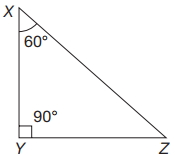
$\Delta XYZ$ में $Y$ पर समकोण है। यदि $m \angle X = 60^{\circ}$ है,तो $\left(\sec Z + \frac{2}{\sqrt{3}}\right)$ का मान ज्ञात कीजिए।
A
$\frac{4}{\sqrt{3}}$
B
$\frac{\sqrt{2}+2}{2\sqrt{2}}$
C
$\frac{7}{2\sqrt{3}}$
D
$\frac{4}{2\sqrt{3}}$
Solution
(A) त्रिभुज $\Delta XYZ$ में,सभी आंतरिक कोणों का योग $180^{\circ}$ होता है।
दिया गया है कि $\angle Y = 90^{\circ}$ और $\angle X = 60^{\circ}$ है।
इसलिए,$\angle Z = 180^{\circ} - (90^{\circ} + 60^{\circ}) = 180^{\circ} - 150^{\circ} = 30^{\circ}$।
अब,हमें $\sec Z + \frac{2}{\sqrt{3}}$ का मान ज्ञात करना है।
चूंकि $\angle Z = 30^{\circ}$ है,इसलिए $\sec Z = \sec 30^{\circ} = \frac{1}{\cos 30^{\circ}} = \frac{1}{\sqrt{3}/2} = \frac{2}{\sqrt{3}}$।
इस मान को व्यंजक में प्रतिस्थापित करने पर:
$\sec Z + \frac{2}{\sqrt{3}} = \frac{2}{\sqrt{3}} + \frac{2}{\sqrt{3}} = \frac{4}{\sqrt{3}}$।
दिया गया है कि $\angle Y = 90^{\circ}$ और $\angle X = 60^{\circ}$ है।
इसलिए,$\angle Z = 180^{\circ} - (90^{\circ} + 60^{\circ}) = 180^{\circ} - 150^{\circ} = 30^{\circ}$।
अब,हमें $\sec Z + \frac{2}{\sqrt{3}}$ का मान ज्ञात करना है।
चूंकि $\angle Z = 30^{\circ}$ है,इसलिए $\sec Z = \sec 30^{\circ} = \frac{1}{\cos 30^{\circ}} = \frac{1}{\sqrt{3}/2} = \frac{2}{\sqrt{3}}$।
इस मान को व्यंजक में प्रतिस्थापित करने पर:
$\sec Z + \frac{2}{\sqrt{3}} = \frac{2}{\sqrt{3}} + \frac{2}{\sqrt{3}} = \frac{4}{\sqrt{3}}$।
0 likes
View Solution542
EasyMCQ
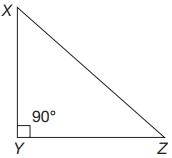
$\Delta XYZ$ में $\angle Y$ समकोण है। यदि $\cos X = \frac{3}{5}$ है,तो $\operatorname{cosec} Z$ का मान क्या है?
A
$\frac{3}{4}$
B
$\frac{5}{3}$
C
$\frac{4}{5}$
D
$\frac{4}{3}$
Solution
(B) $\Delta XYZ$ में,$\angle Y = 90^\circ$ है।
दिया गया है कि $\cos X = \frac{3}{5}$ है।
परिभाषा के अनुसार,$\cos X = \frac{\text{आसन्न भुजा}}{\text{कर्ण}} = \frac{XY}{XZ} = \frac{3}{5}$ है।
अब,$\angle Z$ के लिए,भुजा $XY$ सम्मुख भुजा है और $XZ$ कर्ण है।
इसलिए,$\sin Z = \frac{\text{सम्मुख भुजा}}{\text{कर्ण}} = \frac{XY}{XZ} = \frac{3}{5}$ है।
हम जानते हैं कि $\operatorname{cosec} Z = \frac{1}{\sin Z}$ होता है।
अतः,$\operatorname{cosec} Z = \frac{1}{3/5} = \frac{5}{3}$ है।
दिया गया है कि $\cos X = \frac{3}{5}$ है।
परिभाषा के अनुसार,$\cos X = \frac{\text{आसन्न भुजा}}{\text{कर्ण}} = \frac{XY}{XZ} = \frac{3}{5}$ है।
अब,$\angle Z$ के लिए,भुजा $XY$ सम्मुख भुजा है और $XZ$ कर्ण है।
इसलिए,$\sin Z = \frac{\text{सम्मुख भुजा}}{\text{कर्ण}} = \frac{XY}{XZ} = \frac{3}{5}$ है।
हम जानते हैं कि $\operatorname{cosec} Z = \frac{1}{\sin Z}$ होता है।
अतः,$\operatorname{cosec} Z = \frac{1}{3/5} = \frac{5}{3}$ है।
0 likes
View Solution543
MediumMCQ
$\frac{[\sin (y-z)+\sin (y+z)+2 \sin y]}{[\sin (x-z)+\sin (x+z)+2 \sin x]} = ?$ का मान क्या है?
A
$\cos x \sin y$
B
$\frac{\sin y}{\sin x}$
C
$\sin z$
D
$\sin x \tan y$
Solution
(B) दी गई व्यंजक: $\frac{\sin (y-z)+\sin (y+z)+2 \sin y}{\sin (x-z)+\sin (x+z)+2 \sin x}$
त्रिकोणमितीय सर्वसमिका $\sin A + \sin B = 2 \sin \left( \frac{A+B}{2} \right) \cos \left( \frac{A-B}{2} \right)$ का उपयोग करने पर:
अंश: $\sin (y-z) + \sin (y+z) + 2 \sin y = 2 \sin y \cos z + 2 \sin y = 2 \sin y (\cos z + 1)$
हर: $\sin (x-z) + \sin (x+z) + 2 \sin x = 2 \sin x \cos z + 2 \sin x = 2 \sin x (\cos z + 1)$
अंश को हर से विभाजित करने पर:
$= \frac{2 \sin y (\cos z + 1)}{2 \sin x (\cos z + 1)}$
$= \frac{\sin y}{\sin x}$
त्रिकोणमितीय सर्वसमिका $\sin A + \sin B = 2 \sin \left( \frac{A+B}{2} \right) \cos \left( \frac{A-B}{2} \right)$ का उपयोग करने पर:
अंश: $\sin (y-z) + \sin (y+z) + 2 \sin y = 2 \sin y \cos z + 2 \sin y = 2 \sin y (\cos z + 1)$
हर: $\sin (x-z) + \sin (x+z) + 2 \sin x = 2 \sin x \cos z + 2 \sin x = 2 \sin x (\cos z + 1)$
अंश को हर से विभाजित करने पर:
$= \frac{2 \sin y (\cos z + 1)}{2 \sin x (\cos z + 1)}$
$= \frac{\sin y}{\sin x}$
0 likes
View Solution544
DifficultMCQ
यदि $\sec \theta(\cos \theta+\sin \theta)=\sqrt{2}$ है,तो $\frac{2 \sin \theta}{\cos \theta-\sin \theta}$ का मान क्या है?
A
$3 \sqrt{2}$
B
$\frac{3}{\sqrt{2}}$
C
$\frac{1}{\sqrt{2}}$
D
$\sqrt{2}$
Solution
(D) दिया गया है: $\sec \theta(\cos \theta+\sin \theta)=\sqrt{2}$
चूंकि $\sec \theta = \frac{1}{\cos \theta}$,इसलिए:
$\frac{1}{\cos \theta}(\cos \theta+\sin \theta)=\sqrt{2}$
$1+\tan \theta=\sqrt{2}$
$\tan \theta=\sqrt{2}-1$ .....$(1)$
अब,हमें $\frac{2 \sin \theta}{\cos \theta-\sin \theta}$ का मान ज्ञात करना है।
अंश और हर को $\cos \theta$ से विभाजित करने पर:
$\frac{2 \tan \theta}{1-\tan \theta}$
समीकरण $(1)$ से $\tan \theta$ का मान रखने पर:
$= \frac{2(\sqrt{2}-1)}{1-(\sqrt{2}-1)}$
$= \frac{2(\sqrt{2}-1)}{2-\sqrt{2}}$
$= \frac{2(\sqrt{2}-1)}{\sqrt{2}(\sqrt{2}-1)}$
$= \frac{2}{\sqrt{2}} = \sqrt{2}$
चूंकि $\sec \theta = \frac{1}{\cos \theta}$,इसलिए:
$\frac{1}{\cos \theta}(\cos \theta+\sin \theta)=\sqrt{2}$
$1+\tan \theta=\sqrt{2}$
$\tan \theta=\sqrt{2}-1$ .....$(1)$
अब,हमें $\frac{2 \sin \theta}{\cos \theta-\sin \theta}$ का मान ज्ञात करना है।
अंश और हर को $\cos \theta$ से विभाजित करने पर:
$\frac{2 \tan \theta}{1-\tan \theta}$
समीकरण $(1)$ से $\tan \theta$ का मान रखने पर:
$= \frac{2(\sqrt{2}-1)}{1-(\sqrt{2}-1)}$
$= \frac{2(\sqrt{2}-1)}{2-\sqrt{2}}$
$= \frac{2(\sqrt{2}-1)}{\sqrt{2}(\sqrt{2}-1)}$
$= \frac{2}{\sqrt{2}} = \sqrt{2}$
0 likes
View Solution545
DifficultMCQ
यदि $\cos \theta = \frac{x^{2}-y^{2}}{x^{2}+y^{2}}$ है,तो $\cot \theta$ का मान ज्ञात कीजिए (जहाँ $0^{\circ} \leq \theta \leq 90^{\circ}$)
A
$\frac{2xy}{x^{2}-y^{2}}$
B
$\frac{2xy}{x^{2}+y^{2}}$
C
$\frac{x^{2}+y^{2}}{2xy}$
D
$\frac{x^{2}-y^{2}}{2xy}$
Solution
(D) दिया गया है कि $\cos \theta = \frac{x^{2}-y^{2}}{x^{2}+y^{2}}$.
सर्वसमिका $\sin^2 \theta + \cos^2 \theta = 1$ का उपयोग करने पर,$\sin \theta = \sqrt{1 - \cos^2 \theta}$.
$\sin \theta = \sqrt{1 - \left(\frac{x^2 - y^2}{x^2 + y^2}\right)^2} = \sqrt{\frac{(x^2 + y^2)^2 - (x^2 - y^2)^2}{(x^2 + y^2)^2}}$.
सूत्र $(a+b)^2 - (a-b)^2 = 4ab$ का उपयोग करने पर,$\sin \theta = \sqrt{\frac{4x^2y^2}{(x^2 + y^2)^2}} = \frac{2xy}{x^2 + y^2}$.
अब,$\cot \theta = \frac{\cos \theta}{\sin \theta} = \frac{(x^2 - y^2) / (x^2 + y^2)}{(2xy) / (x^2 + y^2)}$.
$\cot \theta = \frac{x^2 - y^2}{2xy}$.
सर्वसमिका $\sin^2 \theta + \cos^2 \theta = 1$ का उपयोग करने पर,$\sin \theta = \sqrt{1 - \cos^2 \theta}$.
$\sin \theta = \sqrt{1 - \left(\frac{x^2 - y^2}{x^2 + y^2}\right)^2} = \sqrt{\frac{(x^2 + y^2)^2 - (x^2 - y^2)^2}{(x^2 + y^2)^2}}$.
सूत्र $(a+b)^2 - (a-b)^2 = 4ab$ का उपयोग करने पर,$\sin \theta = \sqrt{\frac{4x^2y^2}{(x^2 + y^2)^2}} = \frac{2xy}{x^2 + y^2}$.
अब,$\cot \theta = \frac{\cos \theta}{\sin \theta} = \frac{(x^2 - y^2) / (x^2 + y^2)}{(2xy) / (x^2 + y^2)}$.
$\cot \theta = \frac{x^2 - y^2}{2xy}$.
0 likes
View Solution546
DifficultMCQ
यदि $\tan (A - B) = x$ है,तो $x$ का मान क्या है?
A
$\frac{\tan A + \tan B}{1 - \tan A \tan B}$
B
$\frac{\tan A + \tan B}{1 + \tan A \tan B}$
C
$\frac{\tan A - \tan B}{1 - \tan A \tan B}$
D
$\frac{\tan A - \tan B}{1 + \tan A \tan B}$
Solution
(D) हम जानते हैं कि दो कोणों के अंतर के लिए टैनजेंट का त्रिकोणमितीय सर्वसमिका है:
$\tan (A - B) = \frac{\sin (A - B)}{\cos (A - B)}$
साइन और कोसाइन के अंतर के लिए विस्तार सूत्रों का उपयोग करते हुए:
$\sin (A - B) = \sin A \cos B - \cos A \sin B$
$\cos (A - B) = \cos A \cos B + \sin A \sin B$
इन मानों को $\tan (A - B)$ के व्यंजक में रखने पर:
$\tan (A - B) = \frac{\sin A \cos B - \cos A \sin B}{\cos A \cos B + \sin A \sin B}$
अंश और हर दोनों को $\cos A \cos B$ से विभाजित करने पर:
$\tan (A - B) = \frac{\frac{\sin A \cos B}{\cos A \cos B} - \frac{\cos A \sin B}{\cos A \cos B}}{\frac{\cos A \cos B}{\cos A \cos B} + \frac{\sin A \sin B}{\cos A \cos B}}$
पदों को सरल करने पर:
$\tan (A - B) = \frac{\tan A - \tan B}{1 + \tan A \tan B}$
अतः,$x = \frac{\tan A - \tan B}{1 + \tan A \tan B}$।
$\tan (A - B) = \frac{\sin (A - B)}{\cos (A - B)}$
साइन और कोसाइन के अंतर के लिए विस्तार सूत्रों का उपयोग करते हुए:
$\sin (A - B) = \sin A \cos B - \cos A \sin B$
$\cos (A - B) = \cos A \cos B + \sin A \sin B$
इन मानों को $\tan (A - B)$ के व्यंजक में रखने पर:
$\tan (A - B) = \frac{\sin A \cos B - \cos A \sin B}{\cos A \cos B + \sin A \sin B}$
अंश और हर दोनों को $\cos A \cos B$ से विभाजित करने पर:
$\tan (A - B) = \frac{\frac{\sin A \cos B}{\cos A \cos B} - \frac{\cos A \sin B}{\cos A \cos B}}{\frac{\cos A \cos B}{\cos A \cos B} + \frac{\sin A \sin B}{\cos A \cos B}}$
पदों को सरल करने पर:
$\tan (A - B) = \frac{\tan A - \tan B}{1 + \tan A \tan B}$
अतः,$x = \frac{\tan A - \tan B}{1 + \tan A \tan B}$।
0 likes
View Solution547
DifficultMCQ
यदि $x = \operatorname{cosec} \theta - \sin \theta$ और $y = \sec \theta - \cos \theta$ है,तो $x$ और $y$ के बीच का संबंध क्या है?
A
$x^{2} + y^{2} + 3 = 1$
B
$x^{2} y^{2} (x^{2} + y^{2} + 3) = 1$
C
$x^{2} (x^{2} + y^{2} - 5) = 1$
D
$y^{2} (x^{2} + y^{2} - 5) = 1$
Solution
(B) दिया गया है: $x = \operatorname{cosec} \theta - \sin \theta = \frac{1}{\sin \theta} - \sin \theta = \frac{1 - \sin^{2} \theta}{\sin \theta} = \frac{\cos^{2} \theta}{\sin \theta}$.
दिया गया है: $y = \sec \theta - \cos \theta = \frac{1}{\cos \theta} - \cos \theta = \frac{1 - \cos^{2} \theta}{\cos \theta} = \frac{\sin^{2} \theta}{\cos \theta}$.
अब,व्यंजक $x^{2} y^{2} (x^{2} + y^{2} + 3)$ पर विचार करें:
$x^{2} y^{2} = \left( \frac{\cos^{4} \theta}{\sin^{2} \theta} \right) \left( \frac{\sin^{4} \theta}{\cos^{2} \theta} \right) = \cos^{2} \theta \sin^{2} \theta$.
$x^{2} + y^{2} + 3 = \frac{\cos^{4} \theta}{\sin^{2} \theta} + \frac{\sin^{4} \theta}{\cos^{2} \theta} + 3 = \frac{\cos^{6} \theta + \sin^{6} \theta + 3 \sin^{2} \theta \cos^{2} \theta}{\sin^{2} \theta \cos^{2} \theta}$.
सर्वसमिका $a^{3} + b^{3} = (a + b)(a^{2} - ab + b^{2})$ का उपयोग करते हुए,मान लें $a = \cos^{2} \theta$ और $b = \sin^{2} \theta$:
$\cos^{6} \theta + \sin^{6} \theta = (\cos^{2} \theta + \sin^{2} \theta)(\cos^{4} \theta - \cos^{2} \theta \sin^{2} \theta + \sin^{4} \theta) = 1 \cdot (\cos^{4} \theta - \cos^{2} \theta \sin^{2} \theta + \sin^{4} \theta)$.
इसे प्रतिस्थापित करने पर: $x^{2} + y^{2} + 3 = \frac{(\cos^{4} \theta - \cos^{2} \theta \sin^{2} \theta + \sin^{4} \theta) + 3 \sin^{2} \theta \cos^{2} \theta}{\sin^{2} \theta \cos^{2} \theta} = \frac{\cos^{4} \theta + 2 \sin^{2} \theta \cos^{2} \theta + \sin^{4} \theta}{\sin^{2} \theta \cos^{2} \theta} = \frac{(\cos^{2} \theta + \sin^{2} \theta)^{2}}{\sin^{2} \theta \cos^{2} \theta} = \frac{1}{\sin^{2} \theta \cos^{2} \theta}$.
अतः,$x^{2} y^{2} (x^{2} + y^{2} + 3) = (\cos^{2} \theta \sin^{2} \theta) \cdot \left( \frac{1}{\sin^{2} \theta \cos^{2} \theta} \right) = 1$.
दिया गया है: $y = \sec \theta - \cos \theta = \frac{1}{\cos \theta} - \cos \theta = \frac{1 - \cos^{2} \theta}{\cos \theta} = \frac{\sin^{2} \theta}{\cos \theta}$.
अब,व्यंजक $x^{2} y^{2} (x^{2} + y^{2} + 3)$ पर विचार करें:
$x^{2} y^{2} = \left( \frac{\cos^{4} \theta}{\sin^{2} \theta} \right) \left( \frac{\sin^{4} \theta}{\cos^{2} \theta} \right) = \cos^{2} \theta \sin^{2} \theta$.
$x^{2} + y^{2} + 3 = \frac{\cos^{4} \theta}{\sin^{2} \theta} + \frac{\sin^{4} \theta}{\cos^{2} \theta} + 3 = \frac{\cos^{6} \theta + \sin^{6} \theta + 3 \sin^{2} \theta \cos^{2} \theta}{\sin^{2} \theta \cos^{2} \theta}$.
सर्वसमिका $a^{3} + b^{3} = (a + b)(a^{2} - ab + b^{2})$ का उपयोग करते हुए,मान लें $a = \cos^{2} \theta$ और $b = \sin^{2} \theta$:
$\cos^{6} \theta + \sin^{6} \theta = (\cos^{2} \theta + \sin^{2} \theta)(\cos^{4} \theta - \cos^{2} \theta \sin^{2} \theta + \sin^{4} \theta) = 1 \cdot (\cos^{4} \theta - \cos^{2} \theta \sin^{2} \theta + \sin^{4} \theta)$.
इसे प्रतिस्थापित करने पर: $x^{2} + y^{2} + 3 = \frac{(\cos^{4} \theta - \cos^{2} \theta \sin^{2} \theta + \sin^{4} \theta) + 3 \sin^{2} \theta \cos^{2} \theta}{\sin^{2} \theta \cos^{2} \theta} = \frac{\cos^{4} \theta + 2 \sin^{2} \theta \cos^{2} \theta + \sin^{4} \theta}{\sin^{2} \theta \cos^{2} \theta} = \frac{(\cos^{2} \theta + \sin^{2} \theta)^{2}}{\sin^{2} \theta \cos^{2} \theta} = \frac{1}{\sin^{2} \theta \cos^{2} \theta}$.
अतः,$x^{2} y^{2} (x^{2} + y^{2} + 3) = (\cos^{2} \theta \sin^{2} \theta) \cdot \left( \frac{1}{\sin^{2} \theta \cos^{2} \theta} \right) = 1$.
0 likes
View Solution548
DifficultMCQ
व्यंजक $2(\sin^6 \theta + \cos^6 \theta) - 3(\sin^4 \theta + \cos^4 \theta) + 1$ का मान है
A
$-1$
B
$0$
C
$1$
D
$2$
Solution
(B) माना $E = 2(\sin^6 \theta + \cos^6 \theta) - 3(\sin^4 \theta + \cos^4 \theta) + 1$.
हम जानते हैं कि $\sin^2 \theta + \cos^2 \theta = 1$.
सबसे पहले,$\sin^4 \theta + \cos^4 \theta$ को इस प्रकार व्यक्त करें:
$\sin^4 \theta + \cos^4 \theta = (\sin^2 \theta + \cos^2 \theta)^2 - 2\sin^2 \theta \cos^2 \theta = 1 - 2\sin^2 \theta \cos^2 \theta$.
इसके बाद,$\sin^6 \theta + \cos^6 \theta$ को इस प्रकार व्यक्त करें:
$\sin^6 \theta + \cos^6 \theta = (\sin^2 \theta)^3 + (\cos^2 \theta)^3 = (\sin^2 \theta + \cos^2 \theta)(\sin^4 \theta + \cos^4 \theta - \sin^2 \theta \cos^2 \theta)$.
$\sin^4 \theta + \cos^4 \theta = 1 - 2\sin^2 \theta \cos^2 \theta$ प्रतिस्थापित करने पर,हमें प्राप्त होता है:
$\sin^6 \theta + \cos^6 \theta = 1 \cdot (1 - 2\sin^2 \theta \cos^2 \theta - \sin^2 \theta \cos^2 \theta) = 1 - 3\sin^2 \theta \cos^2 \theta$.
अब,इन मानों को व्यंजक $E$ में रखें:
$E = 2(1 - 3\sin^2 \theta \cos^2 \theta) - 3(1 - 2\sin^2 \theta \cos^2 \theta) + 1$.
$E = 2 - 6\sin^2 \theta \cos^2 \theta - 3 + 6\sin^2 \theta \cos^2 \theta + 1$.
$E = 2 - 3 + 1 = 0$.
अतः,व्यंजक का मान $0$ है।
हम जानते हैं कि $\sin^2 \theta + \cos^2 \theta = 1$.
सबसे पहले,$\sin^4 \theta + \cos^4 \theta$ को इस प्रकार व्यक्त करें:
$\sin^4 \theta + \cos^4 \theta = (\sin^2 \theta + \cos^2 \theta)^2 - 2\sin^2 \theta \cos^2 \theta = 1 - 2\sin^2 \theta \cos^2 \theta$.
इसके बाद,$\sin^6 \theta + \cos^6 \theta$ को इस प्रकार व्यक्त करें:
$\sin^6 \theta + \cos^6 \theta = (\sin^2 \theta)^3 + (\cos^2 \theta)^3 = (\sin^2 \theta + \cos^2 \theta)(\sin^4 \theta + \cos^4 \theta - \sin^2 \theta \cos^2 \theta)$.
$\sin^4 \theta + \cos^4 \theta = 1 - 2\sin^2 \theta \cos^2 \theta$ प्रतिस्थापित करने पर,हमें प्राप्त होता है:
$\sin^6 \theta + \cos^6 \theta = 1 \cdot (1 - 2\sin^2 \theta \cos^2 \theta - \sin^2 \theta \cos^2 \theta) = 1 - 3\sin^2 \theta \cos^2 \theta$.
अब,इन मानों को व्यंजक $E$ में रखें:
$E = 2(1 - 3\sin^2 \theta \cos^2 \theta) - 3(1 - 2\sin^2 \theta \cos^2 \theta) + 1$.
$E = 2 - 6\sin^2 \theta \cos^2 \theta - 3 + 6\sin^2 \theta \cos^2 \theta + 1$.
$E = 2 - 3 + 1 = 0$.
अतः,व्यंजक का मान $0$ है।
0 likes
View Solution549
EasyMCQ
यदि $\cot 3A = x$ है,तो $x$ का मान क्या है?
A
$\frac{3 \cot A + \cot^3 A}{1 + 3 \cot^2 A}$
B
$\frac{3 \cot A - \cot^3 A}{1 + 3 \cot^2 A}$
C
$\frac{3 \cot A + \cot^3 A}{1 - 3 \cot^2 A}$
D
$\frac{3 \cot A - \cot^3 A}{1 - 3 \cot^2 A}$
Solution
(D) हम जानते हैं कि $\cot 3A$ के लिए त्रिकोणमितीय सर्वसमिका इस प्रकार है:
$\cot 3A = \frac{\cot^3 A - 3 \cot A}{3 \cot^2 A - 1}$
अंश और हर को $-1$ से गुणा करने पर,हमें प्राप्त होता है:
$\cot 3A = \frac{3 \cot A - \cot^3 A}{1 - 3 \cot^2 A}$
चूँकि यह दिया गया है कि $\cot 3A = x$,इसलिए $x$ का मान $\frac{3 \cot A - \cot^3 A}{1 - 3 \cot^2 A}$ है।
$\cot 3A = \frac{\cot^3 A - 3 \cot A}{3 \cot^2 A - 1}$
अंश और हर को $-1$ से गुणा करने पर,हमें प्राप्त होता है:
$\cot 3A = \frac{3 \cot A - \cot^3 A}{1 - 3 \cot^2 A}$
चूँकि यह दिया गया है कि $\cot 3A = x$,इसलिए $x$ का मान $\frac{3 \cot A - \cot^3 A}{1 - 3 \cot^2 A}$ है।
0 likes
View Solution550
EasyMCQ
$\frac{\sin A - 2 \sin^3 A}{2 \cos^3 A - \cos A}$ का मान क्या है?
A
$\cot A$
B
$\operatorname{cosec} A$
C
$\sec A$
D
$\tan A$
Solution
(D) दी गई व्यंजक: $\frac{\sin A - 2 \sin^3 A}{2 \cos^3 A - \cos A}$
अंश से $\sin A$ और हर से $\cos A$ उभयनिष्ठ (common) लेने पर:
$= \frac{\sin A (1 - 2 \sin^2 A)}{\cos A (2 \cos^2 A - 1)}$
हम जानते हैं कि $\sin^2 A = 1 - \cos^2 A$:
$= \tan A \cdot \frac{1 - 2(1 - \cos^2 A)}{2 \cos^2 A - 1}$
$= \tan A \cdot \frac{1 - 2 + 2 \cos^2 A}{2 \cos^2 A - 1}$
$= \tan A \cdot \frac{2 \cos^2 A - 1}{2 \cos^2 A - 1}$
$= \tan A$
अंश से $\sin A$ और हर से $\cos A$ उभयनिष्ठ (common) लेने पर:
$= \frac{\sin A (1 - 2 \sin^2 A)}{\cos A (2 \cos^2 A - 1)}$
हम जानते हैं कि $\sin^2 A = 1 - \cos^2 A$:
$= \tan A \cdot \frac{1 - 2(1 - \cos^2 A)}{2 \cos^2 A - 1}$
$= \tan A \cdot \frac{1 - 2 + 2 \cos^2 A}{2 \cos^2 A - 1}$
$= \tan A \cdot \frac{2 \cos^2 A - 1}{2 \cos^2 A - 1}$
$= \tan A$
0 likes
View SolutionTrigonometry — Trigonometry · Frequently Asked Questions
1Are these Trigonometry questions useful for JEE and NEET?
Yes. All questions in this section are mapped to JEE Main and NEET exam patterns. Previous year questions from JEE Main, NEET, GUJCET and state-level exams are included with full solutions.
2Can I switch to Hindi or Gujarati for these questions?
Yes. Use the language tabs in the hero section or the sidebar to view the same questions and solutions in English, Hindi or Gujarati.
3How do I generate a question paper from this subtopic?
Use the Vedclass Exam Paper Generator — select the chapter and subtopic, set difficulty, and generate Sets A, B, C, D automatically. First 3 chapters of every subject are free.
Vedclass Products
For Students
Vedclass Test Series
Mock tests in real JEE/NEET style with performance analysis. 5-day free trial.
Start Free TrialFor Teachers
Exam Paper Generator
Generate Set A/B/C/D papers from this chapter in 2 minutes. 3 chapters free.
Try FreeFor Institutes
Online Exam Module
Live online exams with unlimited students, 360° analytics & white-label branding.
See DemoFor Teachers & Institutes
Generate a Trigonometry Exam Paper in 2 Minutes
Select subtopic & difficulty — Sets A, B, C, D auto-generated with No Repeat logic.
First 3 chapters of every subject are free — no payment required.