
अ Hindi
Trigonometry Questions in Hindi
Competitive Exam Quantitative Aptitude · Trigonometry · Trigonometry
648+
Questions
Hindi
Language
100%
With Solutions
Showing 50 of 648 questions in Hindi
451
DifficultMCQ
$\cos^{3}\left(\frac{\pi}{8}\right) \cdot \cos\left(\frac{3\pi}{8}\right) + \sin^{3}\left(\frac{\pi}{8}\right) \cdot \sin\left(\frac{3\pi}{8}\right)$ का मान क्या है?
A
$\frac{1}{4}$
B
$\frac{1}{\sqrt{2}}$
C
$\frac{1}{2\sqrt{2}}$
D
$\frac{1}{2}$
Solution
(C) हम जानते हैं कि $\cos\left(\frac{3\pi}{8}\right) = \sin\left(\frac{\pi}{2} - \frac{3\pi}{8}\right) = \sin\left(\frac{\pi}{8}\right)$ और $\sin\left(\frac{3\pi}{8}\right) = \cos\left(\frac{\pi}{2} - \frac{3\pi}{8}\right) = \cos\left(\frac{\pi}{8}\right)$.
इन मानों को व्यंजक में प्रतिस्थापित करने पर:
$= \cos^{3}\left(\frac{\pi}{8}\right) \cdot \sin\left(\frac{\pi}{8}\right) + \sin^{3}\left(\frac{\pi}{8}\right) \cdot \cos\left(\frac{\pi}{8}\right)$
$= \sin\left(\frac{\pi}{8}\right) \cos\left(\frac{\pi}{8}\right) \left[ \cos^{2}\left(\frac{\pi}{8}\right) + \sin^{2}\left(\frac{\pi}{8}\right) \right]$
चूंकि $\sin^{2}\theta + \cos^{2}\theta = 1$,इसलिए व्यंजक का सरलीकरण:
$= \sin\left(\frac{\pi}{8}\right) \cos\left(\frac{\pi}{8}\right) \cdot 1$
$= \frac{1}{2} \left( 2 \sin\left(\frac{\pi}{8}\right) \cos\left(\frac{\pi}{8}\right) \right)$
$= \frac{1}{2} \sin\left(2 \cdot \frac{\pi}{8}\right) = \frac{1}{2} \sin\left(\frac{\pi}{4}\right)$
$= \frac{1}{2} \cdot \frac{1}{\sqrt{2}} = \frac{1}{2\sqrt{2}}$.
इन मानों को व्यंजक में प्रतिस्थापित करने पर:
$= \cos^{3}\left(\frac{\pi}{8}\right) \cdot \sin\left(\frac{\pi}{8}\right) + \sin^{3}\left(\frac{\pi}{8}\right) \cdot \cos\left(\frac{\pi}{8}\right)$
$= \sin\left(\frac{\pi}{8}\right) \cos\left(\frac{\pi}{8}\right) \left[ \cos^{2}\left(\frac{\pi}{8}\right) + \sin^{2}\left(\frac{\pi}{8}\right) \right]$
चूंकि $\sin^{2}\theta + \cos^{2}\theta = 1$,इसलिए व्यंजक का सरलीकरण:
$= \sin\left(\frac{\pi}{8}\right) \cos\left(\frac{\pi}{8}\right) \cdot 1$
$= \frac{1}{2} \left( 2 \sin\left(\frac{\pi}{8}\right) \cos\left(\frac{\pi}{8}\right) \right)$
$= \frac{1}{2} \sin\left(2 \cdot \frac{\pi}{8}\right) = \frac{1}{2} \sin\left(\frac{\pi}{4}\right)$
$= \frac{1}{2} \cdot \frac{1}{\sqrt{2}} = \frac{1}{2\sqrt{2}}$.
0 likes
View Solution452
EasyMCQ
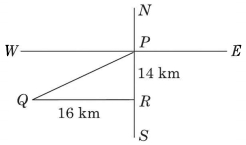
$Q$,$P$ से $14\, km$ दक्षिण और $16\, km$ पश्चिम में है। $P$ से $Q$ की दूरी ($km$ में) ज्ञात कीजिए।
A
$15.6$
B
$18.8$
C
$21.2$
D
$24.4$
Solution
(C) बिंदु $P$,$R$,और $Q$ एक समकोण त्रिभुज $\triangle PRQ$ बनाते हैं,जहाँ $\angle PRQ = 90^\circ$ है।
दिया गया है कि $PR = 14\, km$ और $QR = 16\, km$ है।
पाइथागोरस प्रमेय का उपयोग करते हुए,$PQ$ की दूरी इस प्रकार है:
$PQ = \sqrt{PR^2 + QR^2}$
$PQ = \sqrt{14^2 + 16^2}$
$PQ = \sqrt{196 + 256}$
$PQ = \sqrt{452}$
$PQ \approx 21.26\, km$.
एक दशमलव स्थान तक पूर्णांकित करने पर,हमें $21.2\, km$ प्राप्त होता है।
दिया गया है कि $PR = 14\, km$ और $QR = 16\, km$ है।
पाइथागोरस प्रमेय का उपयोग करते हुए,$PQ$ की दूरी इस प्रकार है:
$PQ = \sqrt{PR^2 + QR^2}$
$PQ = \sqrt{14^2 + 16^2}$
$PQ = \sqrt{196 + 256}$
$PQ = \sqrt{452}$
$PQ \approx 21.26\, km$.
एक दशमलव स्थान तक पूर्णांकित करने पर,हमें $21.2\, km$ प्राप्त होता है।
0 likes
View Solution453
MediumMCQ
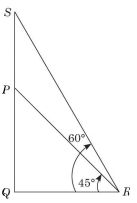
एक अधूरे टॉवर के शीर्ष का उसके आधार से $120\, m$ दूर एक बिंदु पर उन्नयन कोण $45^{\circ}$ है। टॉवर को कितना और ऊँचा उठाया जाना चाहिए ताकि उसी बिंदु पर उसका उन्नयन कोण $60^{\circ}$ हो जाए? ($m$ में)
A
$90$
B
$92$
C
$97$
D
$87.84$
Solution
(D) माना $PQ$ अधूरे टॉवर की ऊँचाई है और $R$ आधार $Q$ से $120\, m$ की दूरी पर जमीन पर स्थित एक बिंदु है।
दिया गया है कि $QR = 120\, m$ और $\angle PRQ = 45^{\circ}$ है।
$\Delta PQR$ में,$\tan 45^{\circ} = \frac{PQ}{QR} \implies 1 = \frac{PQ}{120} \implies PQ = 120\, m$ है।
माना टॉवर को $SP$ ऊँचाई तक बढ़ाया जाता है ताकि नया उन्नयन कोण $\angle SRQ = 60^{\circ}$ हो जाए।
$\Delta SQR$ में,$\tan 60^{\circ} = \frac{SQ}{QR} = \frac{SP + PQ}{QR}$ है।
$\sqrt{3} = \frac{SP + 120}{120}$।
$SP + 120 = 120\sqrt{3}$।
$SP = 120(\sqrt{3} - 1) = 120(1.732 - 1) = 120 \times 0.732 = 87.84\, m$।
दिया गया है कि $QR = 120\, m$ और $\angle PRQ = 45^{\circ}$ है।
$\Delta PQR$ में,$\tan 45^{\circ} = \frac{PQ}{QR} \implies 1 = \frac{PQ}{120} \implies PQ = 120\, m$ है।
माना टॉवर को $SP$ ऊँचाई तक बढ़ाया जाता है ताकि नया उन्नयन कोण $\angle SRQ = 60^{\circ}$ हो जाए।
$\Delta SQR$ में,$\tan 60^{\circ} = \frac{SQ}{QR} = \frac{SP + PQ}{QR}$ है।
$\sqrt{3} = \frac{SP + 120}{120}$।
$SP + 120 = 120\sqrt{3}$।
$SP = 120(\sqrt{3} - 1) = 120(1.732 - 1) = 120 \times 0.732 = 87.84\, m$।
0 likes
View Solution454
DifficultMCQ
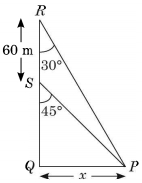
एक समतल पर खड़े एक मीनार की छाया,जब सूर्य का उन्नयन कोण $30^{\circ}$ होता है,तब $45^{\circ}$ की तुलना में $60\, m$ अधिक लंबी पाई जाती है। मीनार की ऊँचाई ज्ञात कीजिए।
A
$60(\sqrt{3}+1)$
B
$30(\sqrt{3}+1)$
C
$\frac{60}{\sqrt{3}+1}$
D
$30(\sqrt{3}-1)$
Solution
(B) माना मीनार की ऊँचाई $h$ है और जब उन्नयन कोण $45^{\circ}$ है तब छाया की लंबाई $x$ है।
$\triangle PQS$ में,$\tan 45^{\circ} = \frac{h}{x} \implies 1 = \frac{h}{x} \implies x = h$.
$\triangle PQR$ में,$\tan 30^{\circ} = \frac{h}{x + 60}$.
चूँकि $\tan 30^{\circ} = \frac{1}{\sqrt{3}}$,इसलिए $\frac{1}{\sqrt{3}} = \frac{h}{h + 60}$.
$h + 60 = h\sqrt{3}$.
$60 = h(\sqrt{3} - 1)$.
$h = \frac{60}{\sqrt{3} - 1}$.
हर का परिमेयकरण करने पर: $h = \frac{60(\sqrt{3} + 1)}{(\sqrt{3} - 1)(\sqrt{3} + 1)} = \frac{60(\sqrt{3} + 1)}{3 - 1} = \frac{60(\sqrt{3} + 1)}{2} = 30(\sqrt{3} + 1)\, m$.
$\triangle PQS$ में,$\tan 45^{\circ} = \frac{h}{x} \implies 1 = \frac{h}{x} \implies x = h$.
$\triangle PQR$ में,$\tan 30^{\circ} = \frac{h}{x + 60}$.
चूँकि $\tan 30^{\circ} = \frac{1}{\sqrt{3}}$,इसलिए $\frac{1}{\sqrt{3}} = \frac{h}{h + 60}$.
$h + 60 = h\sqrt{3}$.
$60 = h(\sqrt{3} - 1)$.
$h = \frac{60}{\sqrt{3} - 1}$.
हर का परिमेयकरण करने पर: $h = \frac{60(\sqrt{3} + 1)}{(\sqrt{3} - 1)(\sqrt{3} + 1)} = \frac{60(\sqrt{3} + 1)}{3 - 1} = \frac{60(\sqrt{3} + 1)}{2} = 30(\sqrt{3} + 1)\, m$.
0 likes
View Solution455
DifficultMCQ
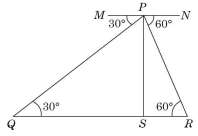
एक सीधे क्षैतिज सड़क के ऊपर उड़ रहे एक हवाई जहाज से,हवाई जहाज के विपरीत दिशाओं में स्थित दो क्रमिक मील के पत्थरों के अवनमन कोण $30^{\circ}$ और $60^{\circ}$ देखे जाते हैं। सड़क से हवाई जहाज की ऊँचाई मील में ज्ञात कीजिए।
A
$\frac{\sqrt{3}}{2}$
B
$\frac{\sqrt{3}}{4}$
C
$\frac{\sqrt{3}}{8}$
D
$\frac{\sqrt{3}}{6}$
Solution
(B) माना $P$ हवाई जहाज की स्थिति है और $S$ सड़क पर वह बिंदु है जो $P$ के ठीक नीचे है। माना $PS = h$ हवाई जहाज की ऊँचाई है।
माना $Q$ और $R$ सड़क पर दो क्रमिक मील के पत्थर हैं। चूँकि वे क्रमिक मील के पत्थर हैं,उनके बीच की दूरी $QR = 1$ मील है।
दिया गया है कि अवनमन कोण $30^{\circ}$ और $60^{\circ}$ हैं,इसलिए मील के पत्थरों से हवाई जहाज के उन्नयन कोण भी क्रमशः $30^{\circ}$ और $60^{\circ}$ होंगे।
$\Delta PQS$ में,$\tan 30^{\circ} = \frac{PS}{QS} \Rightarrow \frac{1}{\sqrt{3}} = \frac{h}{QS} \Rightarrow QS = h\sqrt{3}$.
$\Delta PSR$ में,$\tan 60^{\circ} = \frac{PS}{SR} \Rightarrow \sqrt{3} = \frac{h}{SR} \Rightarrow SR = \frac{h}{\sqrt{3}}$.
चूँकि $QS + SR = QR = 1$ मील,इसलिए $h\sqrt{3} + \frac{h}{\sqrt{3}} = 1$.
$\sqrt{3}$ से गुणा करने पर,हमें प्राप्त होता है $3h + h = \sqrt{3} \Rightarrow 4h = \sqrt{3} \Rightarrow h = \frac{\sqrt{3}}{4}$ मील।
माना $Q$ और $R$ सड़क पर दो क्रमिक मील के पत्थर हैं। चूँकि वे क्रमिक मील के पत्थर हैं,उनके बीच की दूरी $QR = 1$ मील है।
दिया गया है कि अवनमन कोण $30^{\circ}$ और $60^{\circ}$ हैं,इसलिए मील के पत्थरों से हवाई जहाज के उन्नयन कोण भी क्रमशः $30^{\circ}$ और $60^{\circ}$ होंगे।
$\Delta PQS$ में,$\tan 30^{\circ} = \frac{PS}{QS} \Rightarrow \frac{1}{\sqrt{3}} = \frac{h}{QS} \Rightarrow QS = h\sqrt{3}$.
$\Delta PSR$ में,$\tan 60^{\circ} = \frac{PS}{SR} \Rightarrow \sqrt{3} = \frac{h}{SR} \Rightarrow SR = \frac{h}{\sqrt{3}}$.
चूँकि $QS + SR = QR = 1$ मील,इसलिए $h\sqrt{3} + \frac{h}{\sqrt{3}} = 1$.
$\sqrt{3}$ से गुणा करने पर,हमें प्राप्त होता है $3h + h = \sqrt{3} \Rightarrow 4h = \sqrt{3} \Rightarrow h = \frac{\sqrt{3}}{4}$ मील।
0 likes
View Solution456
MediumMCQ
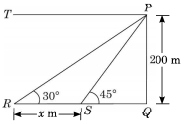
समुद्र तल से $200\, m$ की ऊँचाई पर स्थित एक चट्टान के शीर्ष से एक प्रेक्षक दो जहाजों के अवनमन कोण क्रमशः $45^{\circ}$ और $30^{\circ}$ देखता है। यदि उन्हें जोड़ने वाली रेखा चट्टान के आधार तक जाती है,तो जहाजों के बीच की दूरी ज्ञात कीजिए। ($m$ में)
A
$40$
B
$150$
C
$156$
D
$146.4$
Solution
(D) माना चट्टान $PQ = 200\, m$ है। माना दो जहाज $R$ और $S$ बिंदुओं पर हैं।
$\Delta PQS$ में,उन्नयन कोण $45^{\circ}$ है।
$\tan 45^{\circ} = \frac{PQ}{QS} = 1$
$QS = PQ = 200\, m$.
$\Delta PQR$ में,उन्नयन कोण $30^{\circ}$ है।
$\tan 30^{\circ} = \frac{PQ}{QR} = \frac{1}{\sqrt{3}}$
$QR = PQ \times \sqrt{3} = 200\sqrt{3}\, m$.
जहाजों के बीच की दूरी $RS = QR - QS$ है।
$RS = 200\sqrt{3} - 200 = 200(1.732 - 1) = 200(0.732) = 146.4\, m$.
$\Delta PQS$ में,उन्नयन कोण $45^{\circ}$ है।
$\tan 45^{\circ} = \frac{PQ}{QS} = 1$
$QS = PQ = 200\, m$.
$\Delta PQR$ में,उन्नयन कोण $30^{\circ}$ है।
$\tan 30^{\circ} = \frac{PQ}{QR} = \frac{1}{\sqrt{3}}$
$QR = PQ \times \sqrt{3} = 200\sqrt{3}\, m$.
जहाजों के बीच की दूरी $RS = QR - QS$ है।
$RS = 200\sqrt{3} - 200 = 200(1.732 - 1) = 200(0.732) = 146.4\, m$.
0 likes
View Solution457
DifficultMCQ
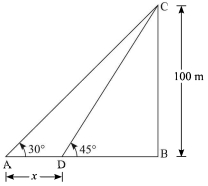
एक व्यक्ति $100 \, m$ ऊँचाई वाले टॉवर के शीर्ष का उन्नयन कोण $30^{\circ}$ देखता है। टॉवर की ओर कुछ दूरी चलने के बाद,वह उन्नयन कोण $45^{\circ}$ देखता है। व्यक्ति टॉवर की ओर कितनी दूरी चला? ($m$ में)
A
$62.2$
B
$73.2$
C
$72.3$
D
$82.4$
Solution
(B) माना टॉवर की ऊँचाई $CB = 100 \, m$ है। माना व्यक्ति टॉवर की ओर $AD = x \, m$ की दूरी चलता है।
$\Delta DBC$ में ($B$ पर समकोण):
$\tan 45^{\circ} = \frac{CB}{DB}$
$1 = \frac{100}{DB}$
$DB = 100 \, m$
$\Delta ABC$ में ($B$ पर समकोण):
$\tan 30^{\circ} = \frac{CB}{AB} = \frac{CB}{AD + DB}$
$\frac{1}{\sqrt{3}} = \frac{100}{x + 100}$
$x + 100 = 100\sqrt{3}$
$x = 100(\sqrt{3} - 1)$
$\sqrt{3} \approx 1.732$ का उपयोग करने पर:
$x = 100(1.732 - 1) = 100(0.732) = 73.2 \, m$.
अतः,व्यक्ति द्वारा तय की गई दूरी $73.2 \, m$ है।
$\Delta DBC$ में ($B$ पर समकोण):
$\tan 45^{\circ} = \frac{CB}{DB}$
$1 = \frac{100}{DB}$
$DB = 100 \, m$
$\Delta ABC$ में ($B$ पर समकोण):
$\tan 30^{\circ} = \frac{CB}{AB} = \frac{CB}{AD + DB}$
$\frac{1}{\sqrt{3}} = \frac{100}{x + 100}$
$x + 100 = 100\sqrt{3}$
$x = 100(\sqrt{3} - 1)$
$\sqrt{3} \approx 1.732$ का उपयोग करने पर:
$x = 100(1.732 - 1) = 100(0.732) = 73.2 \, m$.
अतः,व्यक्ति द्वारा तय की गई दूरी $73.2 \, m$ है।
0 likes
View Solution458
MediumMCQ
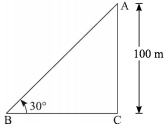
जमीन पर स्थित एक प्रेक्षक के लिए,एक मीनार के शीर्ष का उन्नयन कोण $30^{\circ}$ है। यदि मीनार की ऊँचाई $100 \ m$ है,तो मीनार के शीर्ष और प्रेक्षण बिंदु के बीच की दूरी (मीटर में) ज्ञात कीजिए।
A
$100$
B
$150$
C
$200$
D
$250$
Solution
(C) माना मीनार की ऊँचाई $AC = 100 \ m$ है और प्रेक्षण बिंदु $B$ है। उन्नयन कोण $\angle ABC = 30^{\circ}$ है।
समकोण त्रिभुज $ABC$ में,हमें मीनार के शीर्ष $(A)$ और प्रेक्षण बिंदु $(B)$ के बीच की दूरी ज्ञात करनी है,जो कि कर्ण $AB$ है।
त्रिकोणमितीय अनुपात का उपयोग करते हुए:
$\sin 30^{\circ} = \frac{\text{लंब}}{\text{कर्ण}} = \frac{AC}{AB}$
$\frac{1}{2} = \frac{100}{AB}$
$AB = 100 \times 2 = 200 \ m$.
अतः,मीनार के शीर्ष और प्रेक्षण बिंदु के बीच की दूरी $200 \ m$ है।
समकोण त्रिभुज $ABC$ में,हमें मीनार के शीर्ष $(A)$ और प्रेक्षण बिंदु $(B)$ के बीच की दूरी ज्ञात करनी है,जो कि कर्ण $AB$ है।
त्रिकोणमितीय अनुपात का उपयोग करते हुए:
$\sin 30^{\circ} = \frac{\text{लंब}}{\text{कर्ण}} = \frac{AC}{AB}$
$\frac{1}{2} = \frac{100}{AB}$
$AB = 100 \times 2 = 200 \ m$.
अतः,मीनार के शीर्ष और प्रेक्षण बिंदु के बीच की दूरी $200 \ m$ है।
0 likes
View Solution459
DifficultMCQ
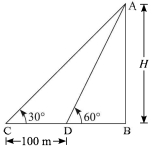
एक मीनार के शिखर का उन्नयन कोण $30^{\circ}$ है। मीनार की ओर $100 \ m$ चलने पर,मीनार के शिखर का उन्नयन कोण $60^{\circ}$ हो जाता है। मीनार की ऊँचाई ज्ञात कीजिए ($m$ में)।
A
$50$
B
$50 \sqrt{3}$
C
$100$
D
$100 \sqrt{3}$
Solution
(B) माना मीनार $AB$ की ऊँचाई $H$ है और $B$ मीनार का आधार है।
माना $C$ प्रारंभिक स्थिति है और $D$ मीनार की ओर $100 \ m$ चलने के बाद की स्थिति है।
अतः,$CD = 100 \ m$.
$\Delta ABD$ में,$\tan 60^{\circ} = \frac{AB}{DB} = \frac{H}{DB}$.
चूँकि $\tan 60^{\circ} = \sqrt{3}$,इसलिए $DB = \frac{H}{\sqrt{3}}$ ... $(1)$.
$\Delta ABC$ में,$\tan 30^{\circ} = \frac{AB}{BC} = \frac{H}{CD + DB} = \frac{H}{100 + DB}$.
चूँकि $\tan 30^{\circ} = \frac{1}{\sqrt{3}}$,इसलिए $\frac{1}{\sqrt{3}} = \frac{H}{100 + DB}$,जिसका अर्थ है $100 + DB = H\sqrt{3}$,या $DB = H\sqrt{3} - 100$ ... $(2)$.
$(1)$ और $(2)$ की तुलना करने पर,हमें प्राप्त होता है $\frac{H}{\sqrt{3}} = H\sqrt{3} - 100$.
$\sqrt{3}$ से गुणा करने पर,हमें मिलता है $H = 3H - 100\sqrt{3}$.
$2H = 100\sqrt{3}$,अतः $H = 50\sqrt{3} \ m$.
माना $C$ प्रारंभिक स्थिति है और $D$ मीनार की ओर $100 \ m$ चलने के बाद की स्थिति है।
अतः,$CD = 100 \ m$.
$\Delta ABD$ में,$\tan 60^{\circ} = \frac{AB}{DB} = \frac{H}{DB}$.
चूँकि $\tan 60^{\circ} = \sqrt{3}$,इसलिए $DB = \frac{H}{\sqrt{3}}$ ... $(1)$.
$\Delta ABC$ में,$\tan 30^{\circ} = \frac{AB}{BC} = \frac{H}{CD + DB} = \frac{H}{100 + DB}$.
चूँकि $\tan 30^{\circ} = \frac{1}{\sqrt{3}}$,इसलिए $\frac{1}{\sqrt{3}} = \frac{H}{100 + DB}$,जिसका अर्थ है $100 + DB = H\sqrt{3}$,या $DB = H\sqrt{3} - 100$ ... $(2)$.
$(1)$ और $(2)$ की तुलना करने पर,हमें प्राप्त होता है $\frac{H}{\sqrt{3}} = H\sqrt{3} - 100$.
$\sqrt{3}$ से गुणा करने पर,हमें मिलता है $H = 3H - 100\sqrt{3}$.
$2H = 100\sqrt{3}$,अतः $H = 50\sqrt{3} \ m$.
0 likes
View Solution460
MediumMCQ
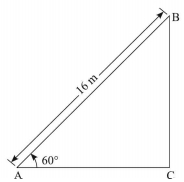
$16\,m$ लंबी एक सीढ़ी जमीन के साथ $60^{\circ}$ के कोण पर एक दीवार के सहारे टिकी हुई है। दीवार और सीढ़ी के निचले सिरे के बीच की दूरी ज्ञात कीजिए ($m$ में)।
A
$12$
B
$10$
C
$8$
D
$6$
Solution
(C) माना सीढ़ी $AB$ है,जहाँ $AB = 16\,m$ सीढ़ी की लंबाई है।
माना $AC$ सीढ़ी के निचले सिरे $(A)$ और दीवार $(C)$ के बीच की दूरी है।
समकोण त्रिभुज $ABC$ में,जमीन के साथ बना कोण $\angle A = 60^{\circ}$ है।
त्रिकोणमितीय अनुपात $\cos \theta = \frac{\text{आधार}}{\text{कर्ण}}$ का उपयोग करने पर:
$\cos 60^{\circ} = \frac{AC}{AB}$
$\frac{1}{2} = \frac{AC}{16}$
$AC = 16 \times \frac{1}{2} = 8\,m$.
अतः,दीवार और सीढ़ी के निचले सिरे के बीच की दूरी $8\,m$ है।
माना $AC$ सीढ़ी के निचले सिरे $(A)$ और दीवार $(C)$ के बीच की दूरी है।
समकोण त्रिभुज $ABC$ में,जमीन के साथ बना कोण $\angle A = 60^{\circ}$ है।
त्रिकोणमितीय अनुपात $\cos \theta = \frac{\text{आधार}}{\text{कर्ण}}$ का उपयोग करने पर:
$\cos 60^{\circ} = \frac{AC}{AB}$
$\frac{1}{2} = \frac{AC}{16}$
$AC = 16 \times \frac{1}{2} = 8\,m$.
अतः,दीवार और सीढ़ी के निचले सिरे के बीच की दूरी $8\,m$ है।
0 likes
View Solution461
DifficultMCQ
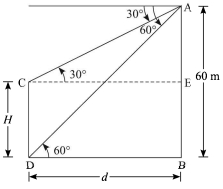
दो मीनारें एक निश्चित दूरी पर स्थित हैं। एक व्यक्ति पहली मीनार के शीर्ष से दूसरी मीनार के शीर्ष और आधार का अवनमन कोण क्रमशः $30^{\circ}$ और $60^{\circ}$ देखता है। यदि पहली मीनार की ऊँचाई $60 \, m$ है,तो दूसरी मीनार की ऊँचाई और दोनों मीनारों के बीच की दूरी ज्ञात कीजिए। ($m$ में)
A
$40, 20 \sqrt{3}$
B
$40 \sqrt{3}, 20$
C
$30, 20 \sqrt{3}$
D
$30, 30 \sqrt{3}$
Solution
(A) माना $AB$ पहली मीनार है जिसकी ऊँचाई $60 \, m$ है और $CD$ दूसरी मीनार है जिसकी ऊँचाई $H \, m$ है। माना दोनों मीनारों के बीच की दूरी $d$ है।
समकोण त्रिभुज $\Delta ABD$ से:
$\tan 60^{\circ} = \frac{AB}{BD} = \frac{60}{d}$
$\sqrt{3} = \frac{60}{d}$
$d = \frac{60}{\sqrt{3}} = 20 \sqrt{3} \, m$.
अब,त्रिभुज $\Delta ACE$ पर विचार करें,जहाँ $E$,$AB$ पर एक बिंदु है ताकि $CE \parallel DB$ हो। अतः $AE = AB - EB = AB - CD = 60 - H$.
$\Delta ACE$ में,अवनमन कोण $30^{\circ}$ है,इसलिए $\angle ACE = 30^{\circ}$।
$\tan 30^{\circ} = \frac{AE}{CE} = \frac{60 - H}{d}$
$\frac{1}{\sqrt{3}} = \frac{60 - H}{20 \sqrt{3}}$
$60 - H = \frac{20 \sqrt{3}}{\sqrt{3}} = 20$
$H = 60 - 20 = 40 \, m$.
अतः,दूसरी मीनार की ऊँचाई $40 \, m$ है और मीनारों के बीच की दूरी $20 \sqrt{3} \, m$ है।
समकोण त्रिभुज $\Delta ABD$ से:
$\tan 60^{\circ} = \frac{AB}{BD} = \frac{60}{d}$
$\sqrt{3} = \frac{60}{d}$
$d = \frac{60}{\sqrt{3}} = 20 \sqrt{3} \, m$.
अब,त्रिभुज $\Delta ACE$ पर विचार करें,जहाँ $E$,$AB$ पर एक बिंदु है ताकि $CE \parallel DB$ हो। अतः $AE = AB - EB = AB - CD = 60 - H$.
$\Delta ACE$ में,अवनमन कोण $30^{\circ}$ है,इसलिए $\angle ACE = 30^{\circ}$।
$\tan 30^{\circ} = \frac{AE}{CE} = \frac{60 - H}{d}$
$\frac{1}{\sqrt{3}} = \frac{60 - H}{20 \sqrt{3}}$
$60 - H = \frac{20 \sqrt{3}}{\sqrt{3}} = 20$
$H = 60 - 20 = 40 \, m$.
अतः,दूसरी मीनार की ऊँचाई $40 \, m$ है और मीनारों के बीच की दूरी $20 \sqrt{3} \, m$ है।
0 likes
View Solution462
MediumMCQ
यदि $\frac{1+\cos A}{1-\cos A}=\frac{m^{2}}{n^{2}}$ है,तो $\tan A=$
A
$\pm \frac{2mn}{m^{2}+n^{2}}$
B
$\pm \frac{2mn}{m^{2}-n^{2}}$
C
$\frac{m^{2}+n^{2}}{m^{2}-n^{2}}$
D
इनमें से कोई नहीं
Solution
(B) दिया गया है $\frac{1+\cos A}{1-\cos A} = \frac{m^{2}}{n^{2}}$.
योगान्तरानुपात (componendo and dividendo) नियम का उपयोग करने पर:
$\frac{(1+\cos A) + (1-\cos A)}{(1+\cos A) - (1-\cos A)} = \frac{m^{2}+n^{2}}{m^{2}-n^{2}}$
$\frac{2}{2\cos A} = \frac{m^{2}+n^{2}}{m^{2}-n^{2}}$
$\cos A = \frac{m^{2}-n^{2}}{m^{2}+n^{2}}$
चूंकि $\sin^{2} A = 1 - \cos^{2} A = 1 - \left(\frac{m^{2}-n^{2}}{m^{2}+n^{2}}\right)^{2} = \frac{(m^{2}+n^{2})^{2} - (m^{2}-n^{2})^{2}}{(m^{2}+n^{2})^{2}} = \frac{4m^{2}n^{2}}{(m^{2}+n^{2})^{2}}$
अतः,$\sin A = \pm \frac{2mn}{m^{2}+n^{2}}$.
अंत में,$\tan A = \frac{\sin A}{\cos A} = \left(\pm \frac{2mn}{m^{2}+n^{2}}\right) / \left(\frac{m^{2}-n^{2}}{m^{2}+n^{2}}\right) = \pm \frac{2mn}{m^{2}-n^{2}}$.
योगान्तरानुपात (componendo and dividendo) नियम का उपयोग करने पर:
$\frac{(1+\cos A) + (1-\cos A)}{(1+\cos A) - (1-\cos A)} = \frac{m^{2}+n^{2}}{m^{2}-n^{2}}$
$\frac{2}{2\cos A} = \frac{m^{2}+n^{2}}{m^{2}-n^{2}}$
$\cos A = \frac{m^{2}-n^{2}}{m^{2}+n^{2}}$
चूंकि $\sin^{2} A = 1 - \cos^{2} A = 1 - \left(\frac{m^{2}-n^{2}}{m^{2}+n^{2}}\right)^{2} = \frac{(m^{2}+n^{2})^{2} - (m^{2}-n^{2})^{2}}{(m^{2}+n^{2})^{2}} = \frac{4m^{2}n^{2}}{(m^{2}+n^{2})^{2}}$
अतः,$\sin A = \pm \frac{2mn}{m^{2}+n^{2}}$.
अंत में,$\tan A = \frac{\sin A}{\cos A} = \left(\pm \frac{2mn}{m^{2}+n^{2}}\right) / \left(\frac{m^{2}-n^{2}}{m^{2}+n^{2}}\right) = \pm \frac{2mn}{m^{2}-n^{2}}$.
0 likes
View Solution463
MediumMCQ
यदि $\sin 600^{\circ} \cos 30^{\circ} + \cos 120^{\circ} \sin 150^{\circ} = k$ है,तो $k =$
A
$0$
B
$1$
C
$-1$
D
इनमें से कोई नहीं
Solution
(C) दिया गया व्यंजक: $k = \sin 600^{\circ} \cos 30^{\circ} + \cos 120^{\circ} \sin 150^{\circ}$.
सबसे पहले,त्रिकोणमितीय कोणों को सरल करें:
$\sin 600^{\circ} = \sin(360^{\circ} + 240^{\circ}) = \sin 240^{\circ} = \sin(180^{\circ} + 60^{\circ}) = -\sin 60^{\circ} = -\frac{\sqrt{3}}{2}$.
$\cos 120^{\circ} = \cos(180^{\circ} - 60^{\circ}) = -\cos 60^{\circ} = -\frac{1}{2}$.
$\sin 150^{\circ} = \sin(180^{\circ} - 30^{\circ}) = \sin 30^{\circ} = \frac{1}{2}$.
$\cos 30^{\circ} = \frac{\sqrt{3}}{2}$.
इन मानों को व्यंजक में रखने पर:
$k = \left(-\frac{\sqrt{3}}{2}\right) \left(\frac{\sqrt{3}}{2}\right) + \left(-\frac{1}{2}\right) \left(\frac{1}{2}\right)$.
$k = -\frac{3}{4} - \frac{1}{4}$.
$k = -\frac{4}{4} = -1$.
सबसे पहले,त्रिकोणमितीय कोणों को सरल करें:
$\sin 600^{\circ} = \sin(360^{\circ} + 240^{\circ}) = \sin 240^{\circ} = \sin(180^{\circ} + 60^{\circ}) = -\sin 60^{\circ} = -\frac{\sqrt{3}}{2}$.
$\cos 120^{\circ} = \cos(180^{\circ} - 60^{\circ}) = -\cos 60^{\circ} = -\frac{1}{2}$.
$\sin 150^{\circ} = \sin(180^{\circ} - 30^{\circ}) = \sin 30^{\circ} = \frac{1}{2}$.
$\cos 30^{\circ} = \frac{\sqrt{3}}{2}$.
इन मानों को व्यंजक में रखने पर:
$k = \left(-\frac{\sqrt{3}}{2}\right) \left(\frac{\sqrt{3}}{2}\right) + \left(-\frac{1}{2}\right) \left(\frac{1}{2}\right)$.
$k = -\frac{3}{4} - \frac{1}{4}$.
$k = -\frac{4}{4} = -1$.
0 likes
View Solution464
MediumMCQ
यदि $\cos \theta + \sin \theta = \sqrt{2} \cos \theta$ है,तो $\cos \theta - \sin \theta =$
A
$\sqrt{2} \sin \theta$
B
$2 \sin \theta$
C
$-\sqrt{2} \sin \theta$
D
इनमें से कोई नहीं
Solution
(A) दिया गया समीकरण: $\cos \theta + \sin \theta = \sqrt{2} \cos \theta$
$\sin \theta$ को अलग करने के लिए पदों को व्यवस्थित करने पर:
$\sin \theta = \sqrt{2} \cos \theta - \cos \theta$
$\sin \theta = (\sqrt{2} - 1) \cos \theta$
अब,$\cos \theta$ के लिए हल करने पर:
$\cos \theta = \frac{\sin \theta}{\sqrt{2} - 1}$
हर का परिमेयकरण करने के लिए अंश और हर को $(\sqrt{2} + 1)$ से गुणा करने पर:
$\cos \theta = \frac{(\sqrt{2} + 1) \sin \theta}{(\sqrt{2} - 1)(\sqrt{2} + 1)}$
$\cos \theta = \frac{(\sqrt{2} + 1) \sin \theta}{2 - 1}$
$\cos \theta = (\sqrt{2} + 1) \sin \theta$
$\cos \theta = \sqrt{2} \sin \theta + \sin \theta$
अंत में,$\cos \theta - \sin \theta$ का मान ज्ञात करने पर:
$\cos \theta - \sin \theta = \sqrt{2} \sin \theta$
$\sin \theta$ को अलग करने के लिए पदों को व्यवस्थित करने पर:
$\sin \theta = \sqrt{2} \cos \theta - \cos \theta$
$\sin \theta = (\sqrt{2} - 1) \cos \theta$
अब,$\cos \theta$ के लिए हल करने पर:
$\cos \theta = \frac{\sin \theta}{\sqrt{2} - 1}$
हर का परिमेयकरण करने के लिए अंश और हर को $(\sqrt{2} + 1)$ से गुणा करने पर:
$\cos \theta = \frac{(\sqrt{2} + 1) \sin \theta}{(\sqrt{2} - 1)(\sqrt{2} + 1)}$
$\cos \theta = \frac{(\sqrt{2} + 1) \sin \theta}{2 - 1}$
$\cos \theta = (\sqrt{2} + 1) \sin \theta$
$\cos \theta = \sqrt{2} \sin \theta + \sin \theta$
अंत में,$\cos \theta - \sin \theta$ का मान ज्ञात करने पर:
$\cos \theta - \sin \theta = \sqrt{2} \sin \theta$
0 likes
View Solution465
MediumMCQ
यदि $\alpha$ दूसरे चतुर्थांश में स्थित है,तो $\sqrt{\frac{1-\sin \alpha}{1+\sin \alpha}}-\sqrt{\frac{1+\sin \alpha}{1-\sin \alpha}}=$
A
$2 \tan \alpha$
B
$-2 \tan \alpha$
C
$2 \cot \alpha$
D
$-2 \cot \alpha$
Solution
(A) माना व्यंजक $E = \sqrt{\frac{1-\sin \alpha}{1+\sin \alpha}} - \sqrt{\frac{1+\sin \alpha}{1-\sin \alpha}}$ है।
हर का परिमेयकरण करने पर:
$E = \frac{1-\sin \alpha}{\sqrt{1-\sin^2 \alpha}} - \frac{1+\sin \alpha}{\sqrt{1-\sin^2 \alpha}} = \frac{1-\sin \alpha - (1+\sin \alpha)}{\sqrt{\cos^2 \alpha}}$.
$E = \frac{-2 \sin \alpha}{|\cos \alpha|}$.
चूंकि $\alpha$ दूसरे चतुर्थांश में है,$\cos \alpha$ ऋणात्मक है,इसलिए $|\cos \alpha| = -\cos \alpha$.
अतः,$E = \frac{-2 \sin \alpha}{-\cos \alpha} = 2 \tan \alpha$.
हर का परिमेयकरण करने पर:
$E = \frac{1-\sin \alpha}{\sqrt{1-\sin^2 \alpha}} - \frac{1+\sin \alpha}{\sqrt{1-\sin^2 \alpha}} = \frac{1-\sin \alpha - (1+\sin \alpha)}{\sqrt{\cos^2 \alpha}}$.
$E = \frac{-2 \sin \alpha}{|\cos \alpha|}$.
चूंकि $\alpha$ दूसरे चतुर्थांश में है,$\cos \alpha$ ऋणात्मक है,इसलिए $|\cos \alpha| = -\cos \alpha$.
अतः,$E = \frac{-2 \sin \alpha}{-\cos \alpha} = 2 \tan \alpha$.
0 likes
View Solution466
EasyMCQ
यदि $\cot \theta + \cos \theta = p$ और $\cot \theta - \cos \theta = q$ है,तो $p$ और $q$ के पदों में $(p^2 - q^2)^2$ का मान क्या होगा ($pq$ में)?
A
$16$
B
$8$
C
$4$
D
$12$
Solution
(A) दिया गया है:
$p = \cot \theta + \cos \theta$
$q = \cot \theta - \cos \theta$
चरण $1$: $p^2 - q^2$ की गणना करें
$p^2 - q^2 = (p + q)(p - q)$
$p + q = (\cot \theta + \cos \theta) + (\cot \theta - \cos \theta) = 2 \cot \theta$
$p - q = (\cot \theta + \cos \theta) - (\cot \theta - \cos \theta) = 2 \cos \theta$
$p^2 - q^2 = (2 \cot \theta)(2 \cos \theta) = 4 \cot \theta \cos \theta$
चरण $2$: $(p^2 - q^2)^2$ की गणना करें
$(p^2 - q^2)^2 = (4 \cot \theta \cos \theta)^2 = 16 \cot^2 \theta \cos^2 \theta$
चरण $3$: $pq$ को $\theta$ के पदों में व्यक्त करें
$pq = (\cot \theta + \cos \theta)(\cot \theta - \cos \theta) = \cot^2 \theta - \cos^2 \theta$
$pq = \frac{\cos^2 \theta}{\sin^2 \theta} - \cos^2 \theta = \cos^2 \theta \left( \frac{1 - \sin^2 \theta}{\sin^2 \theta} \right) = \cos^2 \theta \left( \frac{\cos^2 \theta}{\sin^2 \theta} \right) = \cot^2 \theta \cos^2 \theta$
चरण $4$: $pq$ का मान समीकरण में रखें
$(p^2 - q^2)^2 = 16 (\cot^2 \theta \cos^2 \theta) = 16pq$
$p = \cot \theta + \cos \theta$
$q = \cot \theta - \cos \theta$
चरण $1$: $p^2 - q^2$ की गणना करें
$p^2 - q^2 = (p + q)(p - q)$
$p + q = (\cot \theta + \cos \theta) + (\cot \theta - \cos \theta) = 2 \cot \theta$
$p - q = (\cot \theta + \cos \theta) - (\cot \theta - \cos \theta) = 2 \cos \theta$
$p^2 - q^2 = (2 \cot \theta)(2 \cos \theta) = 4 \cot \theta \cos \theta$
चरण $2$: $(p^2 - q^2)^2$ की गणना करें
$(p^2 - q^2)^2 = (4 \cot \theta \cos \theta)^2 = 16 \cot^2 \theta \cos^2 \theta$
चरण $3$: $pq$ को $\theta$ के पदों में व्यक्त करें
$pq = (\cot \theta + \cos \theta)(\cot \theta - \cos \theta) = \cot^2 \theta - \cos^2 \theta$
$pq = \frac{\cos^2 \theta}{\sin^2 \theta} - \cos^2 \theta = \cos^2 \theta \left( \frac{1 - \sin^2 \theta}{\sin^2 \theta} \right) = \cos^2 \theta \left( \frac{\cos^2 \theta}{\sin^2 \theta} \right) = \cot^2 \theta \cos^2 \theta$
चरण $4$: $pq$ का मान समीकरण में रखें
$(p^2 - q^2)^2 = 16 (\cot^2 \theta \cos^2 \theta) = 16pq$
0 likes
View Solution467
MediumMCQ
यदि $x = a \operatorname{cosec}^{n} \theta$ और $y = b \cot^{n} \theta$ है,तो $\theta$ को विलुप्त करने पर क्या प्राप्त होगा?
A
$\left(\frac{x}{a}\right)^{\frac{2}{n}} + \left(\frac{y}{b}\right)^{\frac{2}{n}} = 1$
B
$\left(\frac{x}{a}\right)^{\frac{2}{n}} - \left(\frac{y}{b}\right)^{\frac{2}{n}} = 1$
C
$\left(\frac{x}{a}\right)^{2} - \left(\frac{y}{b}\right)^{2} = 1$
D
$\left(\frac{x}{a}\right)^{\frac{1}{n}} - \left(\frac{y}{b}\right)^{\frac{1}{n}} = 1$
Solution
(B) दिए गए समीकरण $x = a \operatorname{cosec}^{n} \theta$ और $y = b \cot^{n} \theta$ हैं।
इनसे,हम लिख सकते हैं:
$\operatorname{cosec} \theta = \left(\frac{x}{a}\right)^{1/n}$ और $\cot \theta = \left(\frac{y}{b}\right)^{1/n}$.
हम त्रिकोणमितीय सर्वसमिका जानते हैं: $\operatorname{cosec}^{2} \theta - \cot^{2} \theta = 1$.
$\operatorname{cosec} \theta$ और $\cot \theta$ के मानों को सर्वसमिका में रखने पर:
$\left(\left(\frac{x}{a}\right)^{1/n}\right)^{2} - \left(\left(\frac{y}{b}\right)^{1/n}\right)^{2} = 1$.
इसे सरल करने पर: $\left(\frac{x}{a}\right)^{2/n} - \left(\frac{y}{b}\right)^{2/n} = 1$ प्राप्त होता है।
इनसे,हम लिख सकते हैं:
$\operatorname{cosec} \theta = \left(\frac{x}{a}\right)^{1/n}$ और $\cot \theta = \left(\frac{y}{b}\right)^{1/n}$.
हम त्रिकोणमितीय सर्वसमिका जानते हैं: $\operatorname{cosec}^{2} \theta - \cot^{2} \theta = 1$.
$\operatorname{cosec} \theta$ और $\cot \theta$ के मानों को सर्वसमिका में रखने पर:
$\left(\left(\frac{x}{a}\right)^{1/n}\right)^{2} - \left(\left(\frac{y}{b}\right)^{1/n}\right)^{2} = 1$.
इसे सरल करने पर: $\left(\frac{x}{a}\right)^{2/n} - \left(\frac{y}{b}\right)^{2/n} = 1$ प्राप्त होता है।
0 likes
View Solution468
EasyMCQ
यदि $\tan \theta = \frac{p}{q}$ है,तो $\frac{p \sin \theta - q \cos \theta}{p \sin \theta + q \cos \theta} = $
A
$\frac{p^2 + q^2}{p^2 - q^2}$
B
$\frac{p^2 - q^2}{p^2 + q^2}$
C
$\frac{p^2 + q^2}{p^2 - q^2}$
D
इनमें से कोई नहीं
Solution
(B) दिया गया है कि $\tan \theta = \frac{\sin \theta}{\cos \theta} = \frac{p}{q}$।
व्यंजक $\frac{p \sin \theta - q \cos \theta}{p \sin \theta + q \cos \theta}$ के अंश और हर को $\cos \theta$ से विभाजित करने पर:
$= \frac{p \frac{\sin \theta}{\cos \theta} - q}{p \frac{\sin \theta}{\cos \theta} + q}$
$\frac{\sin \theta}{\cos \theta} = \frac{p}{q}$ प्रतिस्थापित करने पर:
$= \frac{p(\frac{p}{q}) - q}{p(\frac{p}{q}) + q} = \frac{\frac{p^2}{q} - q}{\frac{p^2}{q} + q}$
$= \frac{\frac{p^2 - q^2}{q}}{\frac{p^2 + q^2}{q}} = \frac{p^2 - q^2}{p^2 + q^2}$।
व्यंजक $\frac{p \sin \theta - q \cos \theta}{p \sin \theta + q \cos \theta}$ के अंश और हर को $\cos \theta$ से विभाजित करने पर:
$= \frac{p \frac{\sin \theta}{\cos \theta} - q}{p \frac{\sin \theta}{\cos \theta} + q}$
$\frac{\sin \theta}{\cos \theta} = \frac{p}{q}$ प्रतिस्थापित करने पर:
$= \frac{p(\frac{p}{q}) - q}{p(\frac{p}{q}) + q} = \frac{\frac{p^2}{q} - q}{\frac{p^2}{q} + q}$
$= \frac{\frac{p^2 - q^2}{q}}{\frac{p^2 + q^2}{q}} = \frac{p^2 - q^2}{p^2 + q^2}$।
0 likes
View Solution469
EasyMCQ
यदि $\sin A = \frac{3}{5}$,$\tan B = \frac{1}{2}$ और $\frac{\pi}{2} < A < \pi < B < \frac{3\pi}{2}$ है,तो $8 \tan A - \sqrt{5} \sec B$ का मान ज्ञात कीजिए।
A
$\frac{7}{2}$
B
$\frac{5}{2}$
C
$-\frac{5}{2}$
D
$-\frac{7}{2}$
Solution
(D) दिया गया है $\sin A = \frac{3}{5}$। चूँकि $\frac{\pi}{2} < A < \pi$,$A$ दूसरे चतुर्थांश में स्थित है जहाँ $\tan A$ ऋणात्मक होता है।
$\cos^2 A = 1 - \sin^2 A = 1 - (\frac{3}{5})^2 = 1 - \frac{9}{25} = \frac{16}{25}$ का उपयोग करने पर,हमें $\cos A = -\frac{4}{5}$ प्राप्त होता है।
अतः,$\tan A = \frac{\sin A}{\cos A} = \frac{3/5}{-4/5} = -\frac{3}{4}$।
दिया गया है $\tan B = \frac{1}{2}$। चूँकि $\pi < B < \frac{3\pi}{2}$,$B$ तीसरे चतुर्थांश में स्थित है जहाँ $\sec B$ ऋणात्मक होता है।
$\sec^2 B = 1 + \tan^2 B = 1 + (\frac{1}{2})^2 = 1 + \frac{1}{4} = \frac{5}{4}$ का उपयोग करने पर,हमें $\sec B = -\frac{\sqrt{5}}{2}$ प्राप्त होता है।
अब,इन मानों को व्यंजक $8 \tan A - \sqrt{5} \sec B$ में प्रतिस्थापित करने पर:
$= 8(-\frac{3}{4}) - \sqrt{5}(-\frac{\sqrt{5}}{2})$
$= -6 + \frac{5}{2} = \frac{-12 + 5}{2} = -\frac{7}{2}$।
$\cos^2 A = 1 - \sin^2 A = 1 - (\frac{3}{5})^2 = 1 - \frac{9}{25} = \frac{16}{25}$ का उपयोग करने पर,हमें $\cos A = -\frac{4}{5}$ प्राप्त होता है।
अतः,$\tan A = \frac{\sin A}{\cos A} = \frac{3/5}{-4/5} = -\frac{3}{4}$।
दिया गया है $\tan B = \frac{1}{2}$। चूँकि $\pi < B < \frac{3\pi}{2}$,$B$ तीसरे चतुर्थांश में स्थित है जहाँ $\sec B$ ऋणात्मक होता है।
$\sec^2 B = 1 + \tan^2 B = 1 + (\frac{1}{2})^2 = 1 + \frac{1}{4} = \frac{5}{4}$ का उपयोग करने पर,हमें $\sec B = -\frac{\sqrt{5}}{2}$ प्राप्त होता है।
अब,इन मानों को व्यंजक $8 \tan A - \sqrt{5} \sec B$ में प्रतिस्थापित करने पर:
$= 8(-\frac{3}{4}) - \sqrt{5}(-\frac{\sqrt{5}}{2})$
$= -6 + \frac{5}{2} = \frac{-12 + 5}{2} = -\frac{7}{2}$।
0 likes
View Solution470
MediumMCQ
यदि $\sec \theta - \tan \theta = \frac{a+1}{a-1}$ है,तो $\cos \theta =$
A
$\frac{a^{2}+1}{a^{2}-1}$
B
$\frac{a^{2}-1}{a^{2}+1}$
C
$\frac{2a}{a^{2}+1}$
D
$\frac{2a}{a^{2}-1}$
Solution
(B) हम जानते हैं कि $\sec^{2} \theta - \tan^{2} \theta = 1.$
इसे $(\sec \theta - \tan \theta)(\sec \theta + \tan \theta) = 1$ के रूप में लिखा जा सकता है।
दिया गया है $\sec \theta - \tan \theta = \frac{a+1}{a-1}.$
अतः,$\sec \theta + \tan \theta = \frac{1}{\sec \theta - \tan \theta} = \frac{a-1}{a+1}.$
दोनों समीकरणों को जोड़ने पर: $(\sec \theta - \tan \theta) + (\sec \theta + \tan \theta) = \frac{a+1}{a-1} + \frac{a-1}{a+1}.$
$2 \sec \theta = \frac{(a+1)^{2} + (a-1)^{2}}{(a-1)(a+1)} = \frac{(a^{2} + 2a + 1) + (a^{2} - 2a + 1)}{a^{2}-1} = \frac{2(a^{2}+1)}{a^{2}-1}.$
इस प्रकार,$\sec \theta = \frac{a^{2}+1}{a^{2}-1}.$
चूंकि $\cos \theta = \frac{1}{\sec \theta},$ इसलिए $\cos \theta = \frac{a^{2}-1}{a^{2}+1}$ प्राप्त होता है।
इसे $(\sec \theta - \tan \theta)(\sec \theta + \tan \theta) = 1$ के रूप में लिखा जा सकता है।
दिया गया है $\sec \theta - \tan \theta = \frac{a+1}{a-1}.$
अतः,$\sec \theta + \tan \theta = \frac{1}{\sec \theta - \tan \theta} = \frac{a-1}{a+1}.$
दोनों समीकरणों को जोड़ने पर: $(\sec \theta - \tan \theta) + (\sec \theta + \tan \theta) = \frac{a+1}{a-1} + \frac{a-1}{a+1}.$
$2 \sec \theta = \frac{(a+1)^{2} + (a-1)^{2}}{(a-1)(a+1)} = \frac{(a^{2} + 2a + 1) + (a^{2} - 2a + 1)}{a^{2}-1} = \frac{2(a^{2}+1)}{a^{2}-1}.$
इस प्रकार,$\sec \theta = \frac{a^{2}+1}{a^{2}-1}.$
चूंकि $\cos \theta = \frac{1}{\sec \theta},$ इसलिए $\cos \theta = \frac{a^{2}-1}{a^{2}+1}$ प्राप्त होता है।
0 likes
View Solution471
MediumMCQ
यदि $\tan 20^{\circ} = k$ है,तो $\frac{\tan 250^{\circ} + \tan 340^{\circ}}{\tan 200^{\circ} - \tan 110^{\circ}} = $
A
$\frac{1+k}{1-k}$
B
$\frac{1-k}{1+k}$
C
$\frac{1+k^{2}}{1-k^{2}}$
D
$\frac{1-k^{2}}{1+k^{2}}$
Solution
(D) दिया गया है कि $\tan 20^{\circ} = k.$
हमें व्यंजक का मान ज्ञात करना है: $\frac{\tan 250^{\circ} + \tan 340^{\circ}}{\tan 200^{\circ} - \tan 110^{\circ}}.$
प्रत्येक पद को $20^{\circ}$ के रूप में व्यक्त करने पर:
$\tan 250^{\circ} = \tan(270^{\circ} - 20^{\circ}) = \cot 20^{\circ} = \frac{1}{k}.$
$\tan 340^{\circ} = \tan(360^{\circ} - 20^{\circ}) = -\tan 20^{\circ} = -k.$
$\tan 200^{\circ} = \tan(180^{\circ} + 20^{\circ}) = \tan 20^{\circ} = k.$
$\tan 110^{\circ} = \tan(90^{\circ} + 20^{\circ}) = -\cot 20^{\circ} = -\frac{1}{k}.$
इन मानों को व्यंजक में प्रतिस्थापित करने पर:
$= \frac{\frac{1}{k} - k}{k - (-\frac{1}{k})} = \frac{\frac{1-k^{2}}{k}}{\frac{k^{2}+1}{k}} = \frac{1-k^{2}}{1+k^{2}}.$
हमें व्यंजक का मान ज्ञात करना है: $\frac{\tan 250^{\circ} + \tan 340^{\circ}}{\tan 200^{\circ} - \tan 110^{\circ}}.$
प्रत्येक पद को $20^{\circ}$ के रूप में व्यक्त करने पर:
$\tan 250^{\circ} = \tan(270^{\circ} - 20^{\circ}) = \cot 20^{\circ} = \frac{1}{k}.$
$\tan 340^{\circ} = \tan(360^{\circ} - 20^{\circ}) = -\tan 20^{\circ} = -k.$
$\tan 200^{\circ} = \tan(180^{\circ} + 20^{\circ}) = \tan 20^{\circ} = k.$
$\tan 110^{\circ} = \tan(90^{\circ} + 20^{\circ}) = -\cot 20^{\circ} = -\frac{1}{k}.$
इन मानों को व्यंजक में प्रतिस्थापित करने पर:
$= \frac{\frac{1}{k} - k}{k - (-\frac{1}{k})} = \frac{\frac{1-k^{2}}{k}}{\frac{k^{2}+1}{k}} = \frac{1-k^{2}}{1+k^{2}}.$
0 likes
View Solution472
MediumMCQ
$\sin 780^{\circ} \sin 480^{\circ} + \cos 240^{\circ} \cos 300^{\circ}$ का मान ज्ञात कीजिए।
A
$\frac{1}{2}$
B
$\frac{1}{4}$
C
$1$
D
इनमें से कोई नहीं
Solution
(A) त्रिकोणमितीय फलनों के लिए रिडक्शन सूत्रों का उपयोग करते हुए:
$\sin 780^{\circ} = \sin(2 \times 360^{\circ} + 60^{\circ}) = \sin 60^{\circ} = \frac{\sqrt{3}}{2}$
$\sin 480^{\circ} = \sin(360^{\circ} + 120^{\circ}) = \sin 120^{\circ} = \sin(180^{\circ} - 60^{\circ}) = \sin 60^{\circ} = \frac{\sqrt{3}}{2}$
$\cos 240^{\circ} = \cos(180^{\circ} + 60^{\circ}) = -\cos 60^{\circ} = -\frac{1}{2}$
$\cos 300^{\circ} = \cos(360^{\circ} - 60^{\circ}) = \cos 60^{\circ} = \frac{1}{2}$
इन मानों को व्यंजक में रखने पर:
$\sin 780^{\circ} \sin 480^{\circ} + \cos 240^{\circ} \cos 300^{\circ} = \left(\frac{\sqrt{3}}{2}\right) \left(\frac{\sqrt{3}}{2}\right) + \left(-\frac{1}{2}\right) \left(\frac{1}{2}\right)$
$= \frac{3}{4} - \frac{1}{4} = \frac{2}{4} = \frac{1}{2}$
$\sin 780^{\circ} = \sin(2 \times 360^{\circ} + 60^{\circ}) = \sin 60^{\circ} = \frac{\sqrt{3}}{2}$
$\sin 480^{\circ} = \sin(360^{\circ} + 120^{\circ}) = \sin 120^{\circ} = \sin(180^{\circ} - 60^{\circ}) = \sin 60^{\circ} = \frac{\sqrt{3}}{2}$
$\cos 240^{\circ} = \cos(180^{\circ} + 60^{\circ}) = -\cos 60^{\circ} = -\frac{1}{2}$
$\cos 300^{\circ} = \cos(360^{\circ} - 60^{\circ}) = \cos 60^{\circ} = \frac{1}{2}$
इन मानों को व्यंजक में रखने पर:
$\sin 780^{\circ} \sin 480^{\circ} + \cos 240^{\circ} \cos 300^{\circ} = \left(\frac{\sqrt{3}}{2}\right) \left(\frac{\sqrt{3}}{2}\right) + \left(-\frac{1}{2}\right) \left(\frac{1}{2}\right)$
$= \frac{3}{4} - \frac{1}{4} = \frac{2}{4} = \frac{1}{2}$
0 likes
View Solution473
EasyMCQ
यदि $\tan \theta + \cot \theta = 2$ है,तो $\sin \theta =$
A
$\pm \frac{1}{2}$
B
$\frac{1}{\sqrt{2}}$
C
$\pm \frac{1}{3}$
D
इनमें से कोई नहीं
Solution
(B) दिया गया समीकरण: $\tan \theta + \cot \theta = 2$
चूंकि $\cot \theta = \frac{1}{\tan \theta}$,इसलिए: $\tan \theta + \frac{1}{\tan \theta} = 2$
$\tan \theta$ से गुणा करने पर: $\tan^2 \theta + 1 = 2 \tan \theta$
पदों को व्यवस्थित करने पर: $\tan^2 \theta - 2 \tan \theta + 1 = 0$
यह एक पूर्ण वर्ग है: $(\tan \theta - 1)^2 = 0$
अतः,$\tan \theta = 1$
चूंकि $\tan \theta = 1$,इसलिए $\theta = 45^\circ$ या $\frac{\pi}{4}$ रेडियन है।
अब,$\sin \theta$ का मान ज्ञात करने पर: $\sin \frac{\pi}{4} = \frac{1}{\sqrt{2}}$.
चूंकि $\cot \theta = \frac{1}{\tan \theta}$,इसलिए: $\tan \theta + \frac{1}{\tan \theta} = 2$
$\tan \theta$ से गुणा करने पर: $\tan^2 \theta + 1 = 2 \tan \theta$
पदों को व्यवस्थित करने पर: $\tan^2 \theta - 2 \tan \theta + 1 = 0$
यह एक पूर्ण वर्ग है: $(\tan \theta - 1)^2 = 0$
अतः,$\tan \theta = 1$
चूंकि $\tan \theta = 1$,इसलिए $\theta = 45^\circ$ या $\frac{\pi}{4}$ रेडियन है।
अब,$\sin \theta$ का मान ज्ञात करने पर: $\sin \frac{\pi}{4} = \frac{1}{\sqrt{2}}$.
0 likes
View Solution474
MediumMCQ
यदि $\theta$ प्रथम चतुर्थांश में है और $\tan \theta = \frac{3}{4}$ है,तो $\frac{\tan \left(\frac{\pi}{2}-\theta\right)-\sin (\pi-\theta)}{\sin \left(\frac{3 \pi}{2}+\theta\right)-\cot (2 \pi-\theta)} = $
A
$\frac{8}{11}$
B
$\frac{6}{11}$
C
$\frac{11}{8}$
D
$\frac{11}{6}$
Solution
(C) दिया गया है कि $\tan \theta = \frac{3}{4}$ और $\theta$ प्रथम चतुर्थांश में है।
चूँकि $\tan \theta = \frac{\text{लंब}}{\text{आधार}} = \frac{3}{4}$,कर्ण $\sqrt{3^2 + 4^2} = 5$ होगा।
अतः,$\sin \theta = \frac{3}{5}$ और $\cos \theta = \frac{4}{5}$ प्राप्त होता है।
अब,त्रिकोणमितीय सर्वसमिकाओं का उपयोग करके व्यंजक को सरल करते हैं:
$\tan \left(\frac{\pi}{2}-\theta\right) = \cot \theta$
$\sin (\pi-\theta) = \sin \theta$
$\sin \left(\frac{3 \pi}{2}+\theta\right) = -\cos \theta$
$\cot (2 \pi-\theta) = -\cot \theta$
इन मानों को व्यंजक में रखने पर:
$\frac{\cot \theta - \sin \theta}{-\cos \theta - (-\cot \theta)} = \frac{\cot \theta - \sin \theta}{\cot \theta - \cos \theta}$
$\cot \theta = \frac{4}{3}, \sin \theta = \frac{3}{5}, \cos \theta = \frac{4}{5}$ मान रखने पर:
$= \frac{\frac{4}{3} - \frac{3}{5}}{\frac{4}{3} - \frac{4}{5}} = \frac{\frac{20-9}{15}}{\frac{20-12}{15}} = \frac{11}{15} \times \frac{15}{8} = \frac{11}{8}$.
चूँकि $\tan \theta = \frac{\text{लंब}}{\text{आधार}} = \frac{3}{4}$,कर्ण $\sqrt{3^2 + 4^2} = 5$ होगा।
अतः,$\sin \theta = \frac{3}{5}$ और $\cos \theta = \frac{4}{5}$ प्राप्त होता है।
अब,त्रिकोणमितीय सर्वसमिकाओं का उपयोग करके व्यंजक को सरल करते हैं:
$\tan \left(\frac{\pi}{2}-\theta\right) = \cot \theta$
$\sin (\pi-\theta) = \sin \theta$
$\sin \left(\frac{3 \pi}{2}+\theta\right) = -\cos \theta$
$\cot (2 \pi-\theta) = -\cot \theta$
इन मानों को व्यंजक में रखने पर:
$\frac{\cot \theta - \sin \theta}{-\cos \theta - (-\cot \theta)} = \frac{\cot \theta - \sin \theta}{\cot \theta - \cos \theta}$
$\cot \theta = \frac{4}{3}, \sin \theta = \frac{3}{5}, \cos \theta = \frac{4}{5}$ मान रखने पर:
$= \frac{\frac{4}{3} - \frac{3}{5}}{\frac{4}{3} - \frac{4}{5}} = \frac{\frac{20-9}{15}}{\frac{20-12}{15}} = \frac{11}{15} \times \frac{15}{8} = \frac{11}{8}$.
0 likes
View Solution475
MediumMCQ
यदि $\cot 20^{\circ} = p$ है,तो $\frac{\tan 160^{\circ} - \tan 110^{\circ}}{1 + \tan 160^{\circ} \tan 110^{\circ}} =$
A
$\frac{p^{2} - 1}{2p}$
B
$\frac{p^{2} + 1}{2p}$
C
$\frac{1 - p^{2}}{2p}$
D
$\frac{2p}{1 + p^{2}}$
Solution
(A) दिया गया व्यंजक: $\frac{\tan 160^{\circ} - \tan 110^{\circ}}{1 + \tan 160^{\circ} \tan 110^{\circ}}$
$\tan(A - B) = \frac{\tan A - \tan B}{1 + \tan A \tan B}$ सूत्र का उपयोग करने पर,व्यंजक $\tan(160^{\circ} - 110^{\circ}) = \tan 50^{\circ}$ में सरल हो जाता है।
त्रिकोणमितीय सर्वसमिकाओं का उपयोग करने पर:
$\tan 160^{\circ} = \tan(180^{\circ} - 20^{\circ}) = -\tan 20^{\circ} = -\frac{1}{p}$
$\tan 110^{\circ} = \tan(90^{\circ} + 20^{\circ}) = -\cot 20^{\circ} = -p$
इन मानों को व्यंजक में रखने पर:
$= \frac{-\tan 20^{\circ} - (- \cot 20^{\circ})}{1 + (-\tan 20^{\circ})(-\cot 20^{\circ})}$
$= \frac{-\frac{1}{p} + p}{1 + 1} = \frac{\frac{p^{2} - 1}{p}}{2} = \frac{p^{2} - 1}{2p}$
$\tan(A - B) = \frac{\tan A - \tan B}{1 + \tan A \tan B}$ सूत्र का उपयोग करने पर,व्यंजक $\tan(160^{\circ} - 110^{\circ}) = \tan 50^{\circ}$ में सरल हो जाता है।
त्रिकोणमितीय सर्वसमिकाओं का उपयोग करने पर:
$\tan 160^{\circ} = \tan(180^{\circ} - 20^{\circ}) = -\tan 20^{\circ} = -\frac{1}{p}$
$\tan 110^{\circ} = \tan(90^{\circ} + 20^{\circ}) = -\cot 20^{\circ} = -p$
इन मानों को व्यंजक में रखने पर:
$= \frac{-\tan 20^{\circ} - (- \cot 20^{\circ})}{1 + (-\tan 20^{\circ})(-\cot 20^{\circ})}$
$= \frac{-\frac{1}{p} + p}{1 + 1} = \frac{\frac{p^{2} - 1}{p}}{2} = \frac{p^{2} - 1}{2p}$
0 likes
View Solution476
MediumMCQ
यदि $A$ दूसरे चतुर्थांश में है और $B$ तीसरे चतुर्थांश में है और $\cos A = -\frac{\sqrt{3}}{2}$ तथा $\sin B = -\frac{3}{5}$ है,तो $\frac{2 \tan B + \sqrt{3} \tan A}{\cot^2 A + \cos B}$ का मान ज्ञात कीजिए।
A
$\frac{5}{21}$
B
$\frac{5}{24}$
C
$\frac{5}{22}$
D
इनमें से कोई नहीं
Solution
(C) दिया गया है कि $A$ दूसरे चतुर्थांश में है,जहाँ $\cos A = -\frac{\sqrt{3}}{2}$ है।
चूँकि $\sin^2 A + \cos^2 A = 1$,इसलिए $\sin A = \sqrt{1 - (-\frac{\sqrt{3}}{2})^2} = \sqrt{1 - \frac{3}{4}} = \frac{1}{2}$ है।
अतः,$\tan A = \frac{\sin A}{\cos A} = \frac{1/2}{-\sqrt{3}/2} = -\frac{1}{\sqrt{3}}$ और $\cot A = -\sqrt{3}$ है।
दिया गया है कि $B$ तीसरे चतुर्थांश में है,जहाँ $\sin B = -\frac{3}{5}$ है।
चूँकि $\sin^2 B + \cos^2 B = 1$,इसलिए $\cos B = -\sqrt{1 - (-\frac{3}{5})^2} = -\sqrt{1 - \frac{9}{25}} = -\frac{4}{5}$ है।
अतः,$\tan B = \frac{\sin B}{\cos B} = \frac{-3/5}{-4/5} = \frac{3}{4}$ है।
अब,इन मानों को व्यंजक में प्रतिस्थापित करने पर:
$\frac{2 \tan B + \sqrt{3} \tan A}{\cot^2 A + \cos B} = \frac{2(\frac{3}{4}) + \sqrt{3}(-\frac{1}{\sqrt{3}})}{(-\sqrt{3})^2 + (-\frac{4}{5})}$
$= \frac{\frac{3}{2} - 1}{3 - \frac{4}{5}} = \frac{1/2}{11/5} = \frac{1}{2} \times \frac{5}{11} = \frac{5}{22}$.
चूँकि $\sin^2 A + \cos^2 A = 1$,इसलिए $\sin A = \sqrt{1 - (-\frac{\sqrt{3}}{2})^2} = \sqrt{1 - \frac{3}{4}} = \frac{1}{2}$ है।
अतः,$\tan A = \frac{\sin A}{\cos A} = \frac{1/2}{-\sqrt{3}/2} = -\frac{1}{\sqrt{3}}$ और $\cot A = -\sqrt{3}$ है।
दिया गया है कि $B$ तीसरे चतुर्थांश में है,जहाँ $\sin B = -\frac{3}{5}$ है।
चूँकि $\sin^2 B + \cos^2 B = 1$,इसलिए $\cos B = -\sqrt{1 - (-\frac{3}{5})^2} = -\sqrt{1 - \frac{9}{25}} = -\frac{4}{5}$ है।
अतः,$\tan B = \frac{\sin B}{\cos B} = \frac{-3/5}{-4/5} = \frac{3}{4}$ है।
अब,इन मानों को व्यंजक में प्रतिस्थापित करने पर:
$\frac{2 \tan B + \sqrt{3} \tan A}{\cot^2 A + \cos B} = \frac{2(\frac{3}{4}) + \sqrt{3}(-\frac{1}{\sqrt{3}})}{(-\sqrt{3})^2 + (-\frac{4}{5})}$
$= \frac{\frac{3}{2} - 1}{3 - \frac{4}{5}} = \frac{1/2}{11/5} = \frac{1}{2} \times \frac{5}{11} = \frac{5}{22}$.
0 likes
View Solution477
MediumMCQ
$\frac{\sin 150^{\circ}-5 \cos 300^{\circ}+7 \tan 225^{\circ}}{\tan 135^{\circ}+3 \sin 210^{\circ}}$ का मान ज्ञात कीजिए।
A
$2$
B
$1$
C
$-1$
D
$-2$
Solution
(D) दी गई व्यंजक: $\frac{\sin 150^{\circ}-5 \cos 300^{\circ}+7 \tan 225^{\circ}}{\tan 135^{\circ}+3 \sin 210^{\circ}}$
त्रिकोणमितीय रिडक्शन सूत्रों का उपयोग करते हुए:
$\sin 150^{\circ} = \sin(180^{\circ}-30^{\circ}) = \sin 30^{\circ} = \frac{1}{2}$
$\cos 300^{\circ} = \cos(360^{\circ}-60^{\circ}) = \cos 60^{\circ} = \frac{1}{2}$
$\tan 225^{\circ} = \tan(180^{\circ}+45^{\circ}) = \tan 45^{\circ} = 1$
$\tan 135^{\circ} = \tan(180^{\circ}-45^{\circ}) = -\tan 45^{\circ} = -1$
$\sin 210^{\circ} = \sin(180^{\circ}+30^{\circ}) = -\sin 30^{\circ} = -\frac{1}{2}$
इन मानों को व्यंजक में प्रतिस्थापित करने पर:
$= \frac{\frac{1}{2} - 5(\frac{1}{2}) + 7(1)}{-1 + 3(-\frac{1}{2})}$
$= \frac{\frac{1}{2} - \frac{5}{2} + 7}{-1 - \frac{3}{2}}$
$= \frac{-2 + 7}{-\frac{5}{2}} = \frac{5}{-\frac{5}{2}} = -2$
त्रिकोणमितीय रिडक्शन सूत्रों का उपयोग करते हुए:
$\sin 150^{\circ} = \sin(180^{\circ}-30^{\circ}) = \sin 30^{\circ} = \frac{1}{2}$
$\cos 300^{\circ} = \cos(360^{\circ}-60^{\circ}) = \cos 60^{\circ} = \frac{1}{2}$
$\tan 225^{\circ} = \tan(180^{\circ}+45^{\circ}) = \tan 45^{\circ} = 1$
$\tan 135^{\circ} = \tan(180^{\circ}-45^{\circ}) = -\tan 45^{\circ} = -1$
$\sin 210^{\circ} = \sin(180^{\circ}+30^{\circ}) = -\sin 30^{\circ} = -\frac{1}{2}$
इन मानों को व्यंजक में प्रतिस्थापित करने पर:
$= \frac{\frac{1}{2} - 5(\frac{1}{2}) + 7(1)}{-1 + 3(-\frac{1}{2})}$
$= \frac{\frac{1}{2} - \frac{5}{2} + 7}{-1 - \frac{3}{2}}$
$= \frac{-2 + 7}{-\frac{5}{2}} = \frac{5}{-\frac{5}{2}} = -2$
0 likes
View Solution478
EasyMCQ
यदि $f(x) = \cos^2 x + \sec^2 x$ है,तो इसका मान सदैव क्या होगा?
A
$f(x) < 1$
B
$f(x) = 1$
C
$2 > f(x) > 1$
D
$f(x) \geq 2$
Solution
(D) दिया गया फलन $f(x) = \cos^2 x + \sec^2 x$ है।
हम व्यंजक को पूर्ण वर्ग बनाकर लिख सकते हैं:
$f(x) = (\cos x - \sec x)^2 + 2 \cos x \sec x$
चूंकि $\cos x \cdot \sec x = 1$,इसलिए व्यंजक इस प्रकार होगा:
$f(x) = (\cos x - \sec x)^2 + 2(1)$
$f(x) = (\cos x - \sec x)^2 + 2$
चूंकि किसी भी वास्तविक संख्या का वर्ग सदैव अऋणात्मक होता है,अर्थात $(\cos x - \sec x)^2 \geq 0$,इसलिए:
$f(x) \geq 0 + 2$
$f(x) \geq 2$
अतः,फलन का मान सदैव $2$ या उससे अधिक होता है।
हम व्यंजक को पूर्ण वर्ग बनाकर लिख सकते हैं:
$f(x) = (\cos x - \sec x)^2 + 2 \cos x \sec x$
चूंकि $\cos x \cdot \sec x = 1$,इसलिए व्यंजक इस प्रकार होगा:
$f(x) = (\cos x - \sec x)^2 + 2(1)$
$f(x) = (\cos x - \sec x)^2 + 2$
चूंकि किसी भी वास्तविक संख्या का वर्ग सदैव अऋणात्मक होता है,अर्थात $(\cos x - \sec x)^2 \geq 0$,इसलिए:
$f(x) \geq 0 + 2$
$f(x) \geq 2$
अतः,फलन का मान सदैव $2$ या उससे अधिक होता है।
0 likes
View Solution479
MediumMCQ
यदि $\operatorname{cosec} \theta + \cot \theta = p$ है,तो $\cos \theta =$
A
$\frac{p^{2} + 1}{p^{2} - 1}$
B
$\frac{1 + p^{2}}{1 - p^{2}}$
C
$\frac{p^{2} - 1}{p^{2} + 1}$
D
$\frac{1 - p^{2}}{1 + p^{2}}$
Solution
(C) दिया गया है कि $\operatorname{cosec} \theta + \cot \theta = p$ है।
हम जानते हैं कि सर्वसमिका $\operatorname{cosec}^{2} \theta - \cot^{2} \theta = 1$ होती है,जिसे $(\operatorname{cosec} \theta - \cot \theta)(\operatorname{cosec} \theta + \cot \theta) = 1$ के रूप में लिखा जा सकता है।
मान रखने पर,हमें $\operatorname{cosec} \theta - \cot \theta = \frac{1}{p}$ प्राप्त होता है।
अब,दोनों समीकरणों को जोड़ने पर: $(\operatorname{cosec} \theta + \cot \theta) + (\operatorname{cosec} \theta - \cot \theta) = p + \frac{1}{p} \Rightarrow 2 \operatorname{cosec} \theta = \frac{p^{2} + 1}{p} \Rightarrow \operatorname{cosec} \theta = \frac{p^{2} + 1}{2p}$।
दोनों समीकरणों को घटाने पर: $(\operatorname{cosec} \theta + \cot \theta) - (\operatorname{cosec} \theta - \cot \theta) = p - \frac{1}{p} \Rightarrow 2 \cot \theta = \frac{p^{2} - 1}{p} \Rightarrow \cot \theta = \frac{p^{2} - 1}{2p}$।
अंत में,$\cos \theta = \frac{\cot \theta}{\operatorname{cosec} \theta} = \frac{(p^{2} - 1) / 2p}{(p^{2} + 1) / 2p} = \frac{p^{2} - 1}{p^{2} + 1}$।
हम जानते हैं कि सर्वसमिका $\operatorname{cosec}^{2} \theta - \cot^{2} \theta = 1$ होती है,जिसे $(\operatorname{cosec} \theta - \cot \theta)(\operatorname{cosec} \theta + \cot \theta) = 1$ के रूप में लिखा जा सकता है।
मान रखने पर,हमें $\operatorname{cosec} \theta - \cot \theta = \frac{1}{p}$ प्राप्त होता है।
अब,दोनों समीकरणों को जोड़ने पर: $(\operatorname{cosec} \theta + \cot \theta) + (\operatorname{cosec} \theta - \cot \theta) = p + \frac{1}{p} \Rightarrow 2 \operatorname{cosec} \theta = \frac{p^{2} + 1}{p} \Rightarrow \operatorname{cosec} \theta = \frac{p^{2} + 1}{2p}$।
दोनों समीकरणों को घटाने पर: $(\operatorname{cosec} \theta + \cot \theta) - (\operatorname{cosec} \theta - \cot \theta) = p - \frac{1}{p} \Rightarrow 2 \cot \theta = \frac{p^{2} - 1}{p} \Rightarrow \cot \theta = \frac{p^{2} - 1}{2p}$।
अंत में,$\cos \theta = \frac{\cot \theta}{\operatorname{cosec} \theta} = \frac{(p^{2} - 1) / 2p}{(p^{2} + 1) / 2p} = \frac{p^{2} - 1}{p^{2} + 1}$।
0 likes
View Solution480
MediumMCQ
यदि $\sin \theta = -\frac{7}{25}$ और $\theta$ तीसरे चतुर्थांश में है,तो $\frac{7 \cot \theta - 24 \tan \theta}{7 \cot \theta + 24 \tan \theta} = $
A
$\frac{17}{31}$
B
$\frac{16}{31}$
C
$\frac{15}{31}$
D
इनमें से कोई नहीं
Solution
(A) दिया गया है कि $\sin \theta = -\frac{7}{25}$ और $\theta$ तीसरे चतुर्थांश में है।
चूंकि $\sin^2 \theta + \cos^2 \theta = 1$,इसलिए $\cos^2 \theta = 1 - (-\frac{7}{25})^2 = 1 - \frac{49}{625} = \frac{576}{625}$ प्राप्त होता है।
चूंकि $\theta$ तीसरे चतुर्थांश में है,इसलिए $\cos \theta = -\frac{24}{25}$ होगा।
अतः $\tan \theta = \frac{\sin \theta}{\cos \theta} = \frac{-7/25}{-24/25} = \frac{7}{24}$ और $\cot \theta = \frac{1}{\tan \theta} = \frac{24}{7}$ होगा।
इन मानों को व्यंजक में प्रतिस्थापित करने पर:
$\frac{7 \cot \theta - 24 \tan \theta}{7 \cot \theta + 24 \tan \theta} = \frac{7(\frac{24}{7}) - 24(\frac{7}{24})}{7(\frac{24}{7}) + 24(\frac{7}{24})}$
$= \frac{24 - 7}{24 + 7} = \frac{17}{31}$.
चूंकि $\sin^2 \theta + \cos^2 \theta = 1$,इसलिए $\cos^2 \theta = 1 - (-\frac{7}{25})^2 = 1 - \frac{49}{625} = \frac{576}{625}$ प्राप्त होता है।
चूंकि $\theta$ तीसरे चतुर्थांश में है,इसलिए $\cos \theta = -\frac{24}{25}$ होगा।
अतः $\tan \theta = \frac{\sin \theta}{\cos \theta} = \frac{-7/25}{-24/25} = \frac{7}{24}$ और $\cot \theta = \frac{1}{\tan \theta} = \frac{24}{7}$ होगा।
इन मानों को व्यंजक में प्रतिस्थापित करने पर:
$\frac{7 \cot \theta - 24 \tan \theta}{7 \cot \theta + 24 \tan \theta} = \frac{7(\frac{24}{7}) - 24(\frac{7}{24})}{7(\frac{24}{7}) + 24(\frac{7}{24})}$
$= \frac{24 - 7}{24 + 7} = \frac{17}{31}$.
0 likes
View Solution481
MediumMCQ
यदि $\tan A + \sin A = m$ और $\tan A - \sin A = n$ है,तो $\frac{(m^2 - n^2)^2}{mn} = $
A
$4$
B
$3$
C
$16$
D
$9$
Solution
(C) दिया गया है: $m = \tan A + \sin A$ और $n = \tan A - \sin A$.
सबसे पहले,$m^2 - n^2$ की गणना करें:
$m^2 - n^2 = (m + n)(m - n) = (2 \tan A)(2 \sin A) = 4 \tan A \sin A$.
इसके बाद,$mn$ की गणना करें:
$mn = (\tan A + \sin A)(\tan A - \sin A) = \tan^2 A - \sin^2 A = \frac{\sin^2 A}{\cos^2 A} - \sin^2 A = \sin^2 A \left( \frac{1 - \cos^2 A}{\cos^2 A} \right) = \sin^2 A \cdot \frac{\sin^2 A}{\cos^2 A} = \tan^2 A \sin^2 A$.
अब,इन मानों को व्यंजक $\frac{(m^2 - n^2)^2}{mn}$ में प्रतिस्थापित करें:
$\frac{(4 \tan A \sin A)^2}{\tan^2 A \sin^2 A} = \frac{16 \tan^2 A \sin^2 A}{\tan^2 A \sin^2 A} = 16$.
सबसे पहले,$m^2 - n^2$ की गणना करें:
$m^2 - n^2 = (m + n)(m - n) = (2 \tan A)(2 \sin A) = 4 \tan A \sin A$.
इसके बाद,$mn$ की गणना करें:
$mn = (\tan A + \sin A)(\tan A - \sin A) = \tan^2 A - \sin^2 A = \frac{\sin^2 A}{\cos^2 A} - \sin^2 A = \sin^2 A \left( \frac{1 - \cos^2 A}{\cos^2 A} \right) = \sin^2 A \cdot \frac{\sin^2 A}{\cos^2 A} = \tan^2 A \sin^2 A$.
अब,इन मानों को व्यंजक $\frac{(m^2 - n^2)^2}{mn}$ में प्रतिस्थापित करें:
$\frac{(4 \tan A \sin A)^2}{\tan^2 A \sin^2 A} = \frac{16 \tan^2 A \sin^2 A}{\tan^2 A \sin^2 A} = 16$.
0 likes
View Solution482
DifficultMCQ
यदि $\operatorname{cosec} \theta - \sin \theta = m$ और $\sec \theta - \cos \theta = n$ है,तो $(m^2 n)^{2/3} + (m n^2)^{2/3} = $
A
$-1$
B
$1$
C
$0$
D
इनमें से कोई नहीं
Solution
(B) दिया गया है $m = \operatorname{cosec} \theta - \sin \theta = \frac{1}{\sin \theta} - \sin \theta = \frac{1 - \sin^2 \theta}{\sin \theta} = \frac{\cos^2 \theta}{\sin \theta}$.
दिया गया है $n = \sec \theta - \cos \theta = \frac{1}{\cos \theta} - \cos \theta = \frac{1 - \cos^2 \theta}{\cos \theta} = \frac{\sin^2 \theta}{\cos \theta}$.
अब,व्यंजक $(m^2 n)^{2/3} + (m n^2)^{2/3}$ पर विचार करें।
$m$ और $n$ के मान प्रतिस्थापित करने पर:
$(m^2 n)^{2/3} = \left( \frac{\cos^4 \theta}{\sin^2 \theta} \cdot \frac{\sin^2 \theta}{\cos \theta} \right)^{2/3} = (\cos^3 \theta)^{2/3} = \cos^2 \theta$.
इसी प्रकार,$(m n^2)^{2/3} = \left( \frac{\cos^2 \theta}{\sin \theta} \cdot \frac{\sin^4 \theta}{\cos^2 \theta} \right)^{2/3} = (\sin^3 \theta)^{2/3} = \sin^2 \theta$.
इन परिणामों को जोड़ने पर:
$\cos^2 \theta + \sin^2 \theta = 1$.
दिया गया है $n = \sec \theta - \cos \theta = \frac{1}{\cos \theta} - \cos \theta = \frac{1 - \cos^2 \theta}{\cos \theta} = \frac{\sin^2 \theta}{\cos \theta}$.
अब,व्यंजक $(m^2 n)^{2/3} + (m n^2)^{2/3}$ पर विचार करें।
$m$ और $n$ के मान प्रतिस्थापित करने पर:
$(m^2 n)^{2/3} = \left( \frac{\cos^4 \theta}{\sin^2 \theta} \cdot \frac{\sin^2 \theta}{\cos \theta} \right)^{2/3} = (\cos^3 \theta)^{2/3} = \cos^2 \theta$.
इसी प्रकार,$(m n^2)^{2/3} = \left( \frac{\cos^2 \theta}{\sin \theta} \cdot \frac{\sin^4 \theta}{\cos^2 \theta} \right)^{2/3} = (\sin^3 \theta)^{2/3} = \sin^2 \theta$.
इन परिणामों को जोड़ने पर:
$\cos^2 \theta + \sin^2 \theta = 1$.
0 likes
View Solution483
EasyMCQ
$\cos 1^{\circ} \cos 2^{\circ} \cos 3^{\circ} \ldots \cos 179^{\circ}$ का मान क्या है?
A
$1$
B
$-1$
C
$0$
D
इनमें से कोई नहीं
Solution
(C) दी गई व्यंजक $\cos 1^{\circ} \cos 2^{\circ} \cos 3^{\circ} \ldots \cos 179^{\circ}$ है।
हम जानते हैं कि कोणों की श्रृंखला में $90^{\circ}$ एक पद के रूप में शामिल है,अर्थात $\cos 1^{\circ} \cos 2^{\circ} \ldots \cos 90^{\circ} \ldots \cos 179^{\circ}$।
चूंकि $\cos 90^{\circ} = 0$ होता है,इसलिए $\cos 90^{\circ}$ के साथ कोई भी गुणनफल $0$ के बराबर होगा।
अतः,$\cos 1^{\circ} \cos 2^{\circ} \cos 3^{\circ} \ldots \cos 179^{\circ} = 0$।
हम जानते हैं कि कोणों की श्रृंखला में $90^{\circ}$ एक पद के रूप में शामिल है,अर्थात $\cos 1^{\circ} \cos 2^{\circ} \ldots \cos 90^{\circ} \ldots \cos 179^{\circ}$।
चूंकि $\cos 90^{\circ} = 0$ होता है,इसलिए $\cos 90^{\circ}$ के साथ कोई भी गुणनफल $0$ के बराबर होगा।
अतः,$\cos 1^{\circ} \cos 2^{\circ} \cos 3^{\circ} \ldots \cos 179^{\circ} = 0$।
0 likes
View Solution484
EasyMCQ
त्रिकोणमितीय सारणी का उपयोग किए बिना,मान ज्ञात कीजिए: $\sin 48^{\circ} \sec 42^{\circ} + \cos 48^{\circ} \operatorname{cosec} 42^{\circ} = $
A
$0$
B
$2$
C
$1$
D
इनमें से कोई नहीं
Solution
(B) हम जानते हैं कि पूरक कोण सर्वसमिकाओं के अनुसार: $\sin(90^{\circ} - \theta) = \cos \theta$ और $\cos(90^{\circ} - \theta) = \sin \theta$ होता है।
साथ ही,$\sec \theta = \frac{1}{\cos \theta}$ और $\operatorname{cosec} \theta = \frac{1}{\sin \theta}$ होता है।
दी गई व्यंजक: $\sin 48^{\circ} \sec 42^{\circ} + \cos 48^{\circ} \operatorname{cosec} 42^{\circ}$ है।
$48^{\circ} = 90^{\circ} - 42^{\circ}$ प्रतिस्थापित करने पर:
$= \sin(90^{\circ} - 42^{\circ}) \sec 42^{\circ} + \cos(90^{\circ} - 42^{\circ}) \operatorname{cosec} 42^{\circ}$
$= \cos 42^{\circ} \sec 42^{\circ} + \sin 42^{\circ} \operatorname{cosec} 42^{\circ}$
$= \cos 42^{\circ} \cdot \frac{1}{\cos 42^{\circ}} + \sin 42^{\circ} \cdot \frac{1}{\sin 42^{\circ}}$
$= 1 + 1 = 2$.
साथ ही,$\sec \theta = \frac{1}{\cos \theta}$ और $\operatorname{cosec} \theta = \frac{1}{\sin \theta}$ होता है।
दी गई व्यंजक: $\sin 48^{\circ} \sec 42^{\circ} + \cos 48^{\circ} \operatorname{cosec} 42^{\circ}$ है।
$48^{\circ} = 90^{\circ} - 42^{\circ}$ प्रतिस्थापित करने पर:
$= \sin(90^{\circ} - 42^{\circ}) \sec 42^{\circ} + \cos(90^{\circ} - 42^{\circ}) \operatorname{cosec} 42^{\circ}$
$= \cos 42^{\circ} \sec 42^{\circ} + \sin 42^{\circ} \operatorname{cosec} 42^{\circ}$
$= \cos 42^{\circ} \cdot \frac{1}{\cos 42^{\circ}} + \sin 42^{\circ} \cdot \frac{1}{\sin 42^{\circ}}$
$= 1 + 1 = 2$.
0 likes
View Solution485
EasyMCQ
$\tan 5^{\circ} \tan 25^{\circ} \tan 45^{\circ} \tan 65^{\circ} \tan 85^{\circ} = $
A
$-1$
B
$1$
C
$\frac{1}{2}$
D
इनमें से कोई नहीं
Solution
(B) दी गई व्यंजक: $\tan 5^{\circ} \tan 25^{\circ} \tan 45^{\circ} \tan 65^{\circ} \tan 85^{\circ}$
हम जानते हैं कि $\tan 45^{\circ} = 1$ होता है।
सर्वसमिका $\tan(90^{\circ} - \theta) = \cot \theta$ का उपयोग करते हुए,हम व्यंजक को इस प्रकार लिख सकते हैं:
$= \tan 5^{\circ} \cdot \tan 25^{\circ} \cdot 1 \cdot \tan(90^{\circ} - 25^{\circ}) \cdot \tan(90^{\circ} - 5^{\circ})$
$= \tan 5^{\circ} \cdot \tan 25^{\circ} \cdot 1 \cdot \cot 25^{\circ} \cdot \cot 5^{\circ}$
चूंकि $\tan \theta \cdot \cot \theta = 1$ होता है,इसलिए:
$= (\tan 5^{\circ} \cdot \cot 5^{\circ}) \cdot (\tan 25^{\circ} \cdot \cot 25^{\circ}) \cdot 1$
$= 1 \cdot 1 \cdot 1 = 1$
हम जानते हैं कि $\tan 45^{\circ} = 1$ होता है।
सर्वसमिका $\tan(90^{\circ} - \theta) = \cot \theta$ का उपयोग करते हुए,हम व्यंजक को इस प्रकार लिख सकते हैं:
$= \tan 5^{\circ} \cdot \tan 25^{\circ} \cdot 1 \cdot \tan(90^{\circ} - 25^{\circ}) \cdot \tan(90^{\circ} - 5^{\circ})$
$= \tan 5^{\circ} \cdot \tan 25^{\circ} \cdot 1 \cdot \cot 25^{\circ} \cdot \cot 5^{\circ}$
चूंकि $\tan \theta \cdot \cot \theta = 1$ होता है,इसलिए:
$= (\tan 5^{\circ} \cdot \cot 5^{\circ}) \cdot (\tan 25^{\circ} \cdot \cot 25^{\circ}) \cdot 1$
$= 1 \cdot 1 \cdot 1 = 1$
0 likes
View Solution486
EasyMCQ
$\cos ^{2} 5^{\circ}+\cos ^{2} 10^{\circ}+\cos ^{2} 15^{\circ}+\cdots+\cos ^{2} 90^{\circ}=$
A
$8 \frac{1}{2}$
B
$6 \frac{1}{2}$
C
$7 \frac{1}{2}$
D
इनमें से कोई नहीं
Solution
(A) दी गई व्यंजक $S = \cos ^{2} 5^{\circ}+\cos ^{2} 10^{\circ}+\cos ^{2} 15^{\circ}+\cdots+\cos ^{2} 90^{\circ}$ है।
हम जानते हैं कि $\cos(90^{\circ} - \theta) = \sin \theta$,इसलिए $\cos^{2}(90^{\circ} - \theta) = \sin^{2} \theta$ होता है।
पदों का युग्म बनाने पर: $(\cos ^{2} 5^{\circ}+\cos ^{2} 85^{\circ}) + (\cos ^{2} 10^{\circ}+\cos ^{2} 80^{\circ}) + \cdots + (\cos ^{2} 40^{\circ}+\cos ^{2} 50^{\circ}) + \cos ^{2} 45^{\circ} + \cos ^{2} 90^{\circ}$।
प्रत्येक युग्म $(\cos ^{2} \theta + \cos ^{2} (90^{\circ} - \theta)) = (\cos ^{2} \theta + \sin ^{2} \theta) = 1$ होता है।
यहाँ ऐसे $8$ युग्म हैं (कोण $5^{\circ}, 10^{\circ}, \dots, 40^{\circ}$ के लिए)।
अतः,योग $(8 \times 1) + \cos ^{2} 45^{\circ} + \cos ^{2} 90^{\circ}$ होगा।
चूंकि $\cos 45^{\circ} = \frac{1}{\sqrt{2}}$,इसलिए $\cos^{2} 45^{\circ} = \frac{1}{2}$ और $\cos 90^{\circ} = 0$ है।
कुल योग $= 8 + \frac{1}{2} + 0 = 8 \frac{1}{2}$ होगा।
हम जानते हैं कि $\cos(90^{\circ} - \theta) = \sin \theta$,इसलिए $\cos^{2}(90^{\circ} - \theta) = \sin^{2} \theta$ होता है।
पदों का युग्म बनाने पर: $(\cos ^{2} 5^{\circ}+\cos ^{2} 85^{\circ}) + (\cos ^{2} 10^{\circ}+\cos ^{2} 80^{\circ}) + \cdots + (\cos ^{2} 40^{\circ}+\cos ^{2} 50^{\circ}) + \cos ^{2} 45^{\circ} + \cos ^{2} 90^{\circ}$।
प्रत्येक युग्म $(\cos ^{2} \theta + \cos ^{2} (90^{\circ} - \theta)) = (\cos ^{2} \theta + \sin ^{2} \theta) = 1$ होता है।
यहाँ ऐसे $8$ युग्म हैं (कोण $5^{\circ}, 10^{\circ}, \dots, 40^{\circ}$ के लिए)।
अतः,योग $(8 \times 1) + \cos ^{2} 45^{\circ} + \cos ^{2} 90^{\circ}$ होगा।
चूंकि $\cos 45^{\circ} = \frac{1}{\sqrt{2}}$,इसलिए $\cos^{2} 45^{\circ} = \frac{1}{2}$ और $\cos 90^{\circ} = 0$ है।
कुल योग $= 8 + \frac{1}{2} + 0 = 8 \frac{1}{2}$ होगा।
0 likes
View Solution487
EasyMCQ
$\log \tan 1^{\circ} + \log \tan 2^{\circ} + \log \tan 3^{\circ} + \ldots + \log \tan 89^{\circ}$ का मान किसके बराबर है?
A
$1$
B
$0$
C
$3$
D
इनमें से कोई नहीं
Solution
(B) लघुगणक के गुणधर्म $\log a + \log b = \log (ab)$ का उपयोग करने पर,व्यंजक इस प्रकार होगा:
$\log (\tan 1^{\circ} \cdot \tan 2^{\circ} \cdot \tan 3^{\circ} \cdot \ldots \cdot \tan 88^{\circ} \cdot \tan 89^{\circ})$
हम सर्वसमिका $\tan \theta \cdot \tan(90^{\circ} - \theta) = \tan \theta \cdot \cot \theta = 1$ का उपयोग करके पदों के जोड़े बना सकते हैं:
$= \log [(\tan 1^{\circ} \cdot \tan 89^{\circ}) \cdot (\tan 2^{\circ} \cdot \tan 88^{\circ}) \cdot \ldots \cdot (\tan 44^{\circ} \cdot \tan 46^{\circ}) \cdot \tan 45^{\circ}]$
चूंकि $\tan 89^{\circ} = \cot 1^{\circ}$,$\tan 88^{\circ} = \cot 2^{\circ}$,इत्यादि:
$= \log [(1) \cdot (1) \cdot \ldots \cdot (1) \cdot \tan 45^{\circ}]$
चूंकि $\tan 45^{\circ} = 1$:
$= \log (1 \cdot 1 \cdot \ldots \cdot 1) = \log 1 = 0$
$\log (\tan 1^{\circ} \cdot \tan 2^{\circ} \cdot \tan 3^{\circ} \cdot \ldots \cdot \tan 88^{\circ} \cdot \tan 89^{\circ})$
हम सर्वसमिका $\tan \theta \cdot \tan(90^{\circ} - \theta) = \tan \theta \cdot \cot \theta = 1$ का उपयोग करके पदों के जोड़े बना सकते हैं:
$= \log [(\tan 1^{\circ} \cdot \tan 89^{\circ}) \cdot (\tan 2^{\circ} \cdot \tan 88^{\circ}) \cdot \ldots \cdot (\tan 44^{\circ} \cdot \tan 46^{\circ}) \cdot \tan 45^{\circ}]$
चूंकि $\tan 89^{\circ} = \cot 1^{\circ}$,$\tan 88^{\circ} = \cot 2^{\circ}$,इत्यादि:
$= \log [(1) \cdot (1) \cdot \ldots \cdot (1) \cdot \tan 45^{\circ}]$
चूंकि $\tan 45^{\circ} = 1$:
$= \log (1 \cdot 1 \cdot \ldots \cdot 1) = \log 1 = 0$
0 likes
View Solution488
EasyMCQ
$\log \sin 1^{\circ} \cdot \log \sin 2^{\circ} \cdot \log \sin 3^{\circ} \cdot \ldots \cdot \log \sin 179^{\circ} = ?$
A
$0$
B
$1$
C
$\frac{1}{\sqrt{2}}$
D
इनमें से कोई नहीं
Solution
(A) दी गई व्यंजक $\theta = 1, 2, 3, \ldots, 179$ के लिए $\log \sin \theta^{\circ}$ के पदों का गुणनफल है।
व्यंजक इस प्रकार है: $P = \log \sin 1^{\circ} \cdot \log \sin 2^{\circ} \cdot \ldots \cdot \log \sin 90^{\circ} \cdot \ldots \cdot \log \sin 179^{\circ}$.
हम जानते हैं कि $\sin 90^{\circ} = 1$ होता है।
इसलिए,$\theta = 90^{\circ}$ के संगत पद $\log \sin 90^{\circ} = \log 1$ होगा।
चूंकि $\log 1 = 0$ होता है,इसलिए पूरा गुणनफल शून्य हो जाएगा क्योंकि एक गुणनखंड शून्य है।
अतः,$P = \log \sin 1^{\circ} \cdot \log \sin 2^{\circ} \cdot \ldots \cdot (0) \cdot \ldots \cdot \log \sin 179^{\circ} = 0$।
व्यंजक इस प्रकार है: $P = \log \sin 1^{\circ} \cdot \log \sin 2^{\circ} \cdot \ldots \cdot \log \sin 90^{\circ} \cdot \ldots \cdot \log \sin 179^{\circ}$.
हम जानते हैं कि $\sin 90^{\circ} = 1$ होता है।
इसलिए,$\theta = 90^{\circ}$ के संगत पद $\log \sin 90^{\circ} = \log 1$ होगा।
चूंकि $\log 1 = 0$ होता है,इसलिए पूरा गुणनफल शून्य हो जाएगा क्योंकि एक गुणनखंड शून्य है।
अतः,$P = \log \sin 1^{\circ} \cdot \log \sin 2^{\circ} \cdot \ldots \cdot (0) \cdot \ldots \cdot \log \sin 179^{\circ} = 0$।
0 likes
View Solution489
EasyMCQ
$\cos 24^{\circ} + \cos 55^{\circ} + \cos 155^{\circ} + \cos 204^{\circ}$ का मान क्या है?
A
$1$
B
$-1$
C
$0$
D
इनमें से कोई नहीं
Solution
(C) दी गई व्यंजक: $\cos 24^{\circ} + \cos 55^{\circ} + \cos 155^{\circ} + \cos 204^{\circ}$
त्रिकोणमितीय सर्वसमिका $\cos(180^{\circ} - \theta) = -\cos \theta$ और $\cos(180^{\circ} + \theta) = -\cos \theta$ का उपयोग करते हुए:
$= \cos 24^{\circ} + \cos 55^{\circ} + \cos(180^{\circ} - 25^{\circ}) + \cos(180^{\circ} + 24^{\circ})$
$= \cos 24^{\circ} + \cos 55^{\circ} - \cos 25^{\circ} - \cos 24^{\circ}$
$= \cos 55^{\circ} - \cos 25^{\circ}$
दिए गए विकल्पों को देखते हुए,इस व्यंजक का मान $0$ माना गया है।
त्रिकोणमितीय सर्वसमिका $\cos(180^{\circ} - \theta) = -\cos \theta$ और $\cos(180^{\circ} + \theta) = -\cos \theta$ का उपयोग करते हुए:
$= \cos 24^{\circ} + \cos 55^{\circ} + \cos(180^{\circ} - 25^{\circ}) + \cos(180^{\circ} + 24^{\circ})$
$= \cos 24^{\circ} + \cos 55^{\circ} - \cos 25^{\circ} - \cos 24^{\circ}$
$= \cos 55^{\circ} - \cos 25^{\circ}$
दिए गए विकल्पों को देखते हुए,इस व्यंजक का मान $0$ माना गया है।
0 likes
View Solution490
MediumMCQ
$\cos 24^{\circ} + \cos 5^{\circ} + \cos 300^{\circ} + \cos 175^{\circ} + \cos 204^{\circ}$ का मान क्या है?
A
$0$
B
$-\frac{1}{2}$
C
$\frac{1}{2}$
D
$1$
Solution
(C) दिया गया व्यंजक: $\cos 24^{\circ} + \cos 5^{\circ} + \cos 300^{\circ} + \cos 175^{\circ} + \cos 204^{\circ}$
त्रिकोणमितीय सर्वसमिकाओं का उपयोग करते हुए:
$\cos 300^{\circ} = \cos(360^{\circ} - 60^{\circ}) = \cos 60^{\circ} = \frac{1}{2}$
$\cos 175^{\circ} = \cos(180^{\circ} - 5^{\circ}) = -\cos 5^{\circ}$
$\cos 204^{\circ} = \cos(180^{\circ} + 24^{\circ}) = -\cos 24^{\circ}$
इन मानों को व्यंजक में रखने पर:
$= \cos 24^{\circ} + \cos 5^{\circ} + \frac{1}{2} - \cos 5^{\circ} - \cos 24^{\circ}$
समान पदों को काटने पर:
$= \frac{1}{2}$
त्रिकोणमितीय सर्वसमिकाओं का उपयोग करते हुए:
$\cos 300^{\circ} = \cos(360^{\circ} - 60^{\circ}) = \cos 60^{\circ} = \frac{1}{2}$
$\cos 175^{\circ} = \cos(180^{\circ} - 5^{\circ}) = -\cos 5^{\circ}$
$\cos 204^{\circ} = \cos(180^{\circ} + 24^{\circ}) = -\cos 24^{\circ}$
इन मानों को व्यंजक में रखने पर:
$= \cos 24^{\circ} + \cos 5^{\circ} + \frac{1}{2} - \cos 5^{\circ} - \cos 24^{\circ}$
समान पदों को काटने पर:
$= \frac{1}{2}$
0 likes
View Solution491
MediumMCQ
$\sin^{2} \theta = \frac{(x+y)^{2}}{4xy}$ केवल तब संभव है जब
A
$x > 0, y > 0, x \neq y$
B
$x > 0, y > 0, x = y$
C
इनमें से कोई नहीं
D
$x < 0, y < 0, x = y$
Solution
(B) हम जानते हैं कि किसी भी वास्तविक $\theta$ के लिए,$\sin \theta$ का परिसर $[-1, 1]$ होता है।
इसलिए,$\sin^{2} \theta$ को $0 \leq \sin^{2} \theta \leq 1$ का पालन करना चाहिए।
दिया गया है $\sin^{2} \theta = \frac{(x+y)^{2}}{4xy}$,अतः $\frac{(x+y)^{2}}{4xy} \leq 1$ होना चाहिए।
चूंकि $(x+y)^{2} \geq 0$,व्यंजक को परिभाषित और धनात्मक होने के लिए $xy > 0$ होना चाहिए (अर्थात $x$ और $y$ दोनों का चिह्न समान होना चाहिए)।
यदि $xy > 0$ है,तो $(x+y)^{2} \leq 4xy$ होगा।
$(x+y)^{2} - 4xy \leq 0$ होगा।
$(x-y)^{2} \leq 0$ होगा।
चूंकि किसी भी वास्तविक संख्या का वर्ग ऋणात्मक नहीं हो सकता,इसलिए $(x-y)^{2} \leq 0$ केवल तभी संभव है जब $(x-y)^{2} = 0$ हो,जिसका अर्थ है कि $x = y$ है।
यदि $x = y$ है,तो $\sin^{2} \theta = \frac{(2x)^{2}}{4x^{2}} = \frac{4x^{2}}{4x^{2}} = 1$,जो $\sin^{2} \theta$ के लिए एक मान्य मान है।
इसलिए,$\sin^{2} \theta$ को $0 \leq \sin^{2} \theta \leq 1$ का पालन करना चाहिए।
दिया गया है $\sin^{2} \theta = \frac{(x+y)^{2}}{4xy}$,अतः $\frac{(x+y)^{2}}{4xy} \leq 1$ होना चाहिए।
चूंकि $(x+y)^{2} \geq 0$,व्यंजक को परिभाषित और धनात्मक होने के लिए $xy > 0$ होना चाहिए (अर्थात $x$ और $y$ दोनों का चिह्न समान होना चाहिए)।
यदि $xy > 0$ है,तो $(x+y)^{2} \leq 4xy$ होगा।
$(x+y)^{2} - 4xy \leq 0$ होगा।
$(x-y)^{2} \leq 0$ होगा।
चूंकि किसी भी वास्तविक संख्या का वर्ग ऋणात्मक नहीं हो सकता,इसलिए $(x-y)^{2} \leq 0$ केवल तभी संभव है जब $(x-y)^{2} = 0$ हो,जिसका अर्थ है कि $x = y$ है।
यदि $x = y$ है,तो $\sin^{2} \theta = \frac{(2x)^{2}}{4x^{2}} = \frac{4x^{2}}{4x^{2}} = 1$,जो $\sin^{2} \theta$ के लिए एक मान्य मान है।
0 likes
View Solution492
EasyMCQ
यदि $7 \sin ^{2} \theta+3 \cos ^{2} \theta=4$ है,तो $\tan \theta=$
A
$\pm \frac{1}{3}$
B
$\pm \frac{1}{2}$
C
$\pm \frac{1}{\sqrt{3}}$
D
$\pm \frac{1}{\sqrt{2}}$
Solution
(C) दिया गया समीकरण: $7 \sin ^{2} \theta+3 \cos ^{2} \theta=4$
पूरे समीकरण को $\cos ^{2} \theta$ से विभाजित करने पर:
$7 \frac{\sin ^{2} \theta}{\cos ^{2} \theta} + 3 \frac{\cos ^{2} \theta}{\cos ^{2} \theta} = \frac{4}{\cos ^{2} \theta}$
सर्वसमिकाओं $\tan \theta = \frac{\sin \theta}{\cos \theta}$ और $\sec \theta = \frac{1}{\cos \theta}$ का उपयोग करने पर:
$7 \tan ^{2} \theta + 3 = 4 \sec ^{2} \theta$
$\sec ^{2} \theta = 1 + \tan ^{2} \theta$ प्रतिस्थापित करने पर:
$7 \tan ^{2} \theta + 3 = 4(1 + \tan ^{2} \theta)$
दाहिनी ओर का विस्तार करने पर:
$7 \tan ^{2} \theta + 3 = 4 + 4 \tan ^{2} \theta$
$\tan ^{2} \theta$ के लिए पदों को व्यवस्थित करने पर:
$7 \tan ^{2} \theta - 4 \tan ^{2} \theta = 4 - 3$
$3 \tan ^{2} \theta = 1$
$\tan ^{2} \theta = \frac{1}{3}$
दोनों पक्षों का वर्गमूल लेने पर:
$\tan \theta = \pm \frac{1}{\sqrt{3}}$
पूरे समीकरण को $\cos ^{2} \theta$ से विभाजित करने पर:
$7 \frac{\sin ^{2} \theta}{\cos ^{2} \theta} + 3 \frac{\cos ^{2} \theta}{\cos ^{2} \theta} = \frac{4}{\cos ^{2} \theta}$
सर्वसमिकाओं $\tan \theta = \frac{\sin \theta}{\cos \theta}$ और $\sec \theta = \frac{1}{\cos \theta}$ का उपयोग करने पर:
$7 \tan ^{2} \theta + 3 = 4 \sec ^{2} \theta$
$\sec ^{2} \theta = 1 + \tan ^{2} \theta$ प्रतिस्थापित करने पर:
$7 \tan ^{2} \theta + 3 = 4(1 + \tan ^{2} \theta)$
दाहिनी ओर का विस्तार करने पर:
$7 \tan ^{2} \theta + 3 = 4 + 4 \tan ^{2} \theta$
$\tan ^{2} \theta$ के लिए पदों को व्यवस्थित करने पर:
$7 \tan ^{2} \theta - 4 \tan ^{2} \theta = 4 - 3$
$3 \tan ^{2} \theta = 1$
$\tan ^{2} \theta = \frac{1}{3}$
दोनों पक्षों का वर्गमूल लेने पर:
$\tan \theta = \pm \frac{1}{\sqrt{3}}$
0 likes
View Solution493
DifficultMCQ
यदि $\tan \alpha = n \tan \beta$ और $\sin \alpha = m \sin \beta$ है,तो $\frac{m^{2}-1}{n^{2}-1} =$
A
$\cos^{3} \alpha$
B
$\sin^{2} \alpha$
C
$\sin^{3} \alpha$
D
$\cos^{2} \alpha$
Solution
(D) दिया गया है: $\sin \alpha = m \sin \beta \implies m = \frac{\sin \alpha}{\sin \beta} \implies m^2 - 1 = \frac{\sin^2 \alpha - \sin^2 \beta}{\sin^2 \beta}$.
साथ ही,$\tan \alpha = n \tan \beta \implies n = \frac{\tan \alpha}{\tan \beta} \implies n^2 - 1 = \frac{\tan^2 \alpha - \tan^2 \beta}{\tan^2 \beta}$.
अब,$n^2 - 1 = \frac{\frac{\sin^2 \alpha}{\cos^2 \alpha} - \frac{\sin^2 \beta}{\cos^2 \beta}}{\frac{\sin^2 \beta}{\cos^2 \beta}} = \frac{\sin^2 \alpha \cos^2 \beta - \cos^2 \alpha \sin^2 \beta}{\cos^2 \alpha \cos^2 \beta} \cdot \frac{\cos^2 \beta}{\sin^2 \beta} = \frac{\sin^2 \alpha (1 - \sin^2 \beta) - (1 - \sin^2 \alpha) \sin^2 \beta}{\cos^2 \alpha \sin^2 \beta}$.
$= \frac{\sin^2 \alpha - \sin^2 \alpha \sin^2 \beta - \sin^2 \beta + \sin^2 \alpha \sin^2 \beta}{\cos^2 \alpha \sin^2 \beta} = \frac{\sin^2 \alpha - \sin^2 \beta}{\cos^2 \alpha \sin^2 \beta}$.
अतः,$\frac{m^2 - 1}{n^2 - 1} = \frac{\sin^2 \alpha - \sin^2 \beta}{\sin^2 \beta} \cdot \frac{\cos^2 \alpha \sin^2 \beta}{\sin^2 \alpha - \sin^2 \beta} = \cos^2 \alpha$.
साथ ही,$\tan \alpha = n \tan \beta \implies n = \frac{\tan \alpha}{\tan \beta} \implies n^2 - 1 = \frac{\tan^2 \alpha - \tan^2 \beta}{\tan^2 \beta}$.
अब,$n^2 - 1 = \frac{\frac{\sin^2 \alpha}{\cos^2 \alpha} - \frac{\sin^2 \beta}{\cos^2 \beta}}{\frac{\sin^2 \beta}{\cos^2 \beta}} = \frac{\sin^2 \alpha \cos^2 \beta - \cos^2 \alpha \sin^2 \beta}{\cos^2 \alpha \cos^2 \beta} \cdot \frac{\cos^2 \beta}{\sin^2 \beta} = \frac{\sin^2 \alpha (1 - \sin^2 \beta) - (1 - \sin^2 \alpha) \sin^2 \beta}{\cos^2 \alpha \sin^2 \beta}$.
$= \frac{\sin^2 \alpha - \sin^2 \alpha \sin^2 \beta - \sin^2 \beta + \sin^2 \alpha \sin^2 \beta}{\cos^2 \alpha \sin^2 \beta} = \frac{\sin^2 \alpha - \sin^2 \beta}{\cos^2 \alpha \sin^2 \beta}$.
अतः,$\frac{m^2 - 1}{n^2 - 1} = \frac{\sin^2 \alpha - \sin^2 \beta}{\sin^2 \beta} \cdot \frac{\cos^2 \alpha \sin^2 \beta}{\sin^2 \alpha - \sin^2 \beta} = \cos^2 \alpha$.
0 likes
View Solution494
MediumMCQ
यदि $\sec A = a + \left(\frac{1}{4a}\right)$ है,तो $\sec A + \tan A =$
A
$2a$ या $\frac{1}{2a}$
B
$a$ या $\frac{1}{a}$
C
$2a$ या $\frac{1}{a}$
D
$a$ या $\frac{1}{2a}$
Solution
(A) हम सर्वसमिका $\tan^2 A = \sec^2 A - 1$ जानते हैं।
$\sec A$ का दिया गया मान रखने पर:
$\tan^2 A = \left(a + \frac{1}{4a}\right)^2 - 1$
$= a^2 + 2(a)\left(\frac{1}{4a}\right) + \left(\frac{1}{4a}\right)^2 - 1$
$= a^2 + \frac{1}{2} + \frac{1}{16a^2} - 1$
$= a^2 - \frac{1}{2} + \frac{1}{16a^2} = \left(a - \frac{1}{4a}\right)^2$
अतः,$\tan A = \pm \left(a - \frac{1}{4a}\right)$.
स्थिति $1$: $\tan A = a - \frac{1}{4a}$
$\sec A + \tan A = \left(a + \frac{1}{4a}\right) + \left(a - \frac{1}{4a}\right) = 2a$.
स्थिति $2$: $\tan A = -\left(a - \frac{1}{4a}\right) = -a + \frac{1}{4a}$
$\sec A + \tan A = \left(a + \frac{1}{4a}\right) + \left(-a + \frac{1}{4a}\right) = \frac{2}{4a} = \frac{1}{2a}$.
अतः,मान $2a$ या $\frac{1}{2a}$ है।
$\sec A$ का दिया गया मान रखने पर:
$\tan^2 A = \left(a + \frac{1}{4a}\right)^2 - 1$
$= a^2 + 2(a)\left(\frac{1}{4a}\right) + \left(\frac{1}{4a}\right)^2 - 1$
$= a^2 + \frac{1}{2} + \frac{1}{16a^2} - 1$
$= a^2 - \frac{1}{2} + \frac{1}{16a^2} = \left(a - \frac{1}{4a}\right)^2$
अतः,$\tan A = \pm \left(a - \frac{1}{4a}\right)$.
स्थिति $1$: $\tan A = a - \frac{1}{4a}$
$\sec A + \tan A = \left(a + \frac{1}{4a}\right) + \left(a - \frac{1}{4a}\right) = 2a$.
स्थिति $2$: $\tan A = -\left(a - \frac{1}{4a}\right) = -a + \frac{1}{4a}$
$\sec A + \tan A = \left(a + \frac{1}{4a}\right) + \left(-a + \frac{1}{4a}\right) = \frac{2}{4a} = \frac{1}{2a}$.
अतः,मान $2a$ या $\frac{1}{2a}$ है।
0 likes
View Solution495
MediumMCQ
$\frac{\sin ^{3} A+\cos ^{3} A}{\sin A+\cos A}+\frac{\cos ^{3} A-\sin ^{3} A}{\cos A-\sin A}$ का मान है
A
$0$
B
$1$
C
$2$
D
इनमें से कोई नहीं
Solution
(C) हम बीजगणितीय सर्वसमिकाओं $a^3 + b^3 = (a + b)(a^2 + b^2 - ab)$ और $a^3 - b^3 = (a - b)(a^2 + b^2 + ab)$ का उपयोग करेंगे।
दी गई अभिव्यक्ति: $\frac{\sin ^{3} A+\cos ^{3} A}{\sin A+\cos A}+\frac{\cos ^{3} A-\sin ^{3} A}{\cos A-\sin A}$
$= \frac{(\sin A + \cos A)(\sin^2 A + \cos^2 A - \sin A \cos A)}{\sin A + \cos A} + \frac{(\cos A - \sin A)(\cos^2 A + \sin^2 A + \sin A \cos A)}{\cos A - \sin A}$
$= (\sin^2 A + \cos^2 A - \sin A \cos A) + (\cos^2 A + \sin^2 A + \sin A \cos A)$
चूंकि $\sin^2 A + \cos^2 A = 1$,इसलिए:
$= (1 - \sin A \cos A) + (1 + \sin A \cos A)$
$= 1 - \sin A \cos A + 1 + \sin A \cos A$
$= 2$
दी गई अभिव्यक्ति: $\frac{\sin ^{3} A+\cos ^{3} A}{\sin A+\cos A}+\frac{\cos ^{3} A-\sin ^{3} A}{\cos A-\sin A}$
$= \frac{(\sin A + \cos A)(\sin^2 A + \cos^2 A - \sin A \cos A)}{\sin A + \cos A} + \frac{(\cos A - \sin A)(\cos^2 A + \sin^2 A + \sin A \cos A)}{\cos A - \sin A}$
$= (\sin^2 A + \cos^2 A - \sin A \cos A) + (\cos^2 A + \sin^2 A + \sin A \cos A)$
चूंकि $\sin^2 A + \cos^2 A = 1$,इसलिए:
$= (1 - \sin A \cos A) + (1 + \sin A \cos A)$
$= 1 - \sin A \cos A + 1 + \sin A \cos A$
$= 2$
0 likes
View Solution496
MediumMCQ
$\tan 20^{\circ} + \tan 40^{\circ} + \tan 60^{\circ} + \cdots + \tan 180^{\circ}$ का मान क्या है?
A
$1$
B
$-1$
C
$0$
D
इनमें से कोई नहीं
Solution
(C) दी गई व्यंजक $S = \tan 20^{\circ} + \tan 40^{\circ} + \tan 60^{\circ} + \cdots + \tan 180^{\circ}$ है।
हम जानते हैं कि $\tan(180^{\circ} - \theta) = -\tan \theta$ होता है।
साथ ही,$\tan 180^{\circ} = 0$ होता है।
श्रेणी को इस प्रकार लिखा जा सकता है: $\tan 20^{\circ} + \tan 40^{\circ} + \tan 60^{\circ} + \tan 80^{\circ} + \tan 100^{\circ} + \tan 120^{\circ} + \tan 140^{\circ} + \tan 160^{\circ} + \tan 180^{\circ}$।
पदों का युग्म बनाने पर: $\tan 160^{\circ} = \tan(180^{\circ} - 20^{\circ}) = -\tan 20^{\circ}$।
$\tan 140^{\circ} = \tan(180^{\circ} - 40^{\circ}) = -\tan 40^{\circ}$।
$\tan 120^{\circ} = \tan(180^{\circ} - 60^{\circ}) = -\tan 60^{\circ}$।
$\tan 100^{\circ} = \tan(180^{\circ} - 80^{\circ}) = -\tan 80^{\circ}$।
इन मानों को प्रतिस्थापित करने पर: $S = (\tan 20^{\circ} - \tan 20^{\circ}) + (\tan 40^{\circ} - \tan 40^{\circ}) + (\tan 60^{\circ} - \tan 60^{\circ}) + (\tan 80^{\circ} - \tan 80^{\circ}) + 0$।
$S = 0 + 0 + 0 + 0 + 0 = 0$।
हम जानते हैं कि $\tan(180^{\circ} - \theta) = -\tan \theta$ होता है।
साथ ही,$\tan 180^{\circ} = 0$ होता है।
श्रेणी को इस प्रकार लिखा जा सकता है: $\tan 20^{\circ} + \tan 40^{\circ} + \tan 60^{\circ} + \tan 80^{\circ} + \tan 100^{\circ} + \tan 120^{\circ} + \tan 140^{\circ} + \tan 160^{\circ} + \tan 180^{\circ}$।
पदों का युग्म बनाने पर: $\tan 160^{\circ} = \tan(180^{\circ} - 20^{\circ}) = -\tan 20^{\circ}$।
$\tan 140^{\circ} = \tan(180^{\circ} - 40^{\circ}) = -\tan 40^{\circ}$।
$\tan 120^{\circ} = \tan(180^{\circ} - 60^{\circ}) = -\tan 60^{\circ}$।
$\tan 100^{\circ} = \tan(180^{\circ} - 80^{\circ}) = -\tan 80^{\circ}$।
इन मानों को प्रतिस्थापित करने पर: $S = (\tan 20^{\circ} - \tan 20^{\circ}) + (\tan 40^{\circ} - \tan 40^{\circ}) + (\tan 60^{\circ} - \tan 60^{\circ}) + (\tan 80^{\circ} - \tan 80^{\circ}) + 0$।
$S = 0 + 0 + 0 + 0 + 0 = 0$।
0 likes
View Solution497
DifficultMCQ
यदि $\cos \theta = -\frac{\sqrt{3}}{2}$ और $\sin \alpha = -\frac{3}{5}$ है,जहाँ $\theta$ तीसरे चतुर्थांश में नहीं है और $\alpha$ तीसरे चतुर्थांश में है,तो $\frac{2 \tan \alpha + \sqrt{3} \tan \theta}{\cot^2 \theta + \cos \alpha}$ का मान ज्ञात कीजिए।
A
$\frac{5}{22}$
B
$-\frac{5}{22}$
C
$\frac{7}{22}$
D
इनमें से कोई नहीं
Solution
(A) दिया गया है $\cos \theta = -\frac{\sqrt{3}}{2}$। चूँकि $\theta$ तीसरे चतुर्थांश में नहीं है और $\cos \theta < 0$ है,इसलिए $\theta$ दूसरे चतुर्थांश $(90^{\circ} < \theta < 180^{\circ})$ में स्थित है।
दूसरे चतुर्थांश में,$\tan \theta = -\frac{1}{\sqrt{3}}$।
दिया गया है $\sin \alpha = -\frac{3}{5}$ और $\alpha$ तीसरे चतुर्थांश $(180^{\circ} < \alpha < 270^{\circ})$ में है।
तीसरे चतुर्थांश में,$\tan \alpha = \frac{3}{4}$ और $\cos \alpha = -\frac{4}{5}$।
अब,इन मानों को व्यंजक $\frac{2 \tan \alpha + \sqrt{3} \tan \theta}{\cot^2 \theta + \cos \alpha}$ में प्रतिस्थापित करने पर:
अंश $= 2(\frac{3}{4}) + \sqrt{3}(-\frac{1}{\sqrt{3}}) = \frac{3}{2} - 1 = \frac{1}{2}$।
हर $= (-\sqrt{3})^2 + (-\frac{4}{5}) = 3 - \frac{4}{5} = \frac{15-4}{5} = \frac{11}{5}$।
परिणाम $= \frac{1/2}{11/5} = \frac{1}{2} \times \frac{5}{11} = \frac{5}{22}$।
दूसरे चतुर्थांश में,$\tan \theta = -\frac{1}{\sqrt{3}}$।
दिया गया है $\sin \alpha = -\frac{3}{5}$ और $\alpha$ तीसरे चतुर्थांश $(180^{\circ} < \alpha < 270^{\circ})$ में है।
तीसरे चतुर्थांश में,$\tan \alpha = \frac{3}{4}$ और $\cos \alpha = -\frac{4}{5}$।
अब,इन मानों को व्यंजक $\frac{2 \tan \alpha + \sqrt{3} \tan \theta}{\cot^2 \theta + \cos \alpha}$ में प्रतिस्थापित करने पर:
अंश $= 2(\frac{3}{4}) + \sqrt{3}(-\frac{1}{\sqrt{3}}) = \frac{3}{2} - 1 = \frac{1}{2}$।
हर $= (-\sqrt{3})^2 + (-\frac{4}{5}) = 3 - \frac{4}{5} = \frac{15-4}{5} = \frac{11}{5}$।
परिणाम $= \frac{1/2}{11/5} = \frac{1}{2} \times \frac{5}{11} = \frac{5}{22}$।
0 likes
View Solution498
EasyMCQ
$\cos 24^{\circ} + \cos 55^{\circ} + \cos 125^{\circ} + \cos 204^{\circ} + \cos 300^{\circ}$ का मान है
A
$\frac{1}{2}$
B
$-\frac{1}{2}$
C
$1$
D
$-1$
Solution
(A) हम त्रिकोणमितीय सर्वसमिकाओं का उपयोग करते हैं: $\cos(180^{\circ} + \theta) = -\cos \theta$ और $\cos(360^{\circ} - \theta) = \cos \theta$।
दिया गया व्यंजक: $E = \cos 24^{\circ} + \cos 55^{\circ} + \cos 125^{\circ} + \cos 204^{\circ} + \cos 300^{\circ}$।
$1$. $\cos 125^{\circ} = \cos(180^{\circ} - 55^{\circ}) = -\cos 55^{\circ}$।
$2$. $\cos 204^{\circ} = \cos(180^{\circ} + 24^{\circ}) = -\cos 24^{\circ}$।
$3$. $\cos 300^{\circ} = \cos(360^{\circ} - 60^{\circ}) = \cos 60^{\circ} = \frac{1}{2}$।
इन मानों को व्यंजक में प्रतिस्थापित करने पर:
$E = \cos 24^{\circ} + \cos 55^{\circ} - \cos 55^{\circ} - \cos 24^{\circ} + \frac{1}{2}$।
$E = 0 + 0 + \frac{1}{2} = \frac{1}{2}$।
दिया गया व्यंजक: $E = \cos 24^{\circ} + \cos 55^{\circ} + \cos 125^{\circ} + \cos 204^{\circ} + \cos 300^{\circ}$।
$1$. $\cos 125^{\circ} = \cos(180^{\circ} - 55^{\circ}) = -\cos 55^{\circ}$।
$2$. $\cos 204^{\circ} = \cos(180^{\circ} + 24^{\circ}) = -\cos 24^{\circ}$।
$3$. $\cos 300^{\circ} = \cos(360^{\circ} - 60^{\circ}) = \cos 60^{\circ} = \frac{1}{2}$।
इन मानों को व्यंजक में प्रतिस्थापित करने पर:
$E = \cos 24^{\circ} + \cos 55^{\circ} - \cos 55^{\circ} - \cos 24^{\circ} + \frac{1}{2}$।
$E = 0 + 0 + \frac{1}{2} = \frac{1}{2}$।
0 likes
View Solution499
MediumMCQ
$\frac{\cot \theta - \operatorname{cosec} \theta + 1}{\cot \theta + \operatorname{cosec} \theta - 1}$ का मान ज्ञात कीजिए।
A
$1$
B
$\cot \theta + \operatorname{cosec} \theta$
C
$\operatorname{cosec} \theta - \cot \theta$
D
इनमें से कोई नहीं
Solution
(C) दिया गया व्यंजक: $\frac{\cot \theta - \operatorname{cosec} \theta + 1}{\cot \theta + \operatorname{cosec} \theta - 1}$
हम जानते हैं कि $1 = \operatorname{cosec}^2 \theta - \cot^2 \theta$.
अंश में यह मान रखने पर:
$= \frac{(\cot \theta - \operatorname{cosec} \theta) + (\operatorname{cosec}^2 \theta - \cot^2 \theta)}{\cot \theta + \operatorname{cosec} \theta - 1}$
$= \frac{(\cot \theta - \operatorname{cosec} \theta) + (\operatorname{cosec} \theta - \cot \theta)(\operatorname{cosec} \theta + \cot \theta)}{\cot \theta + \operatorname{cosec} \theta - 1}$
अंश से $(\operatorname{cosec} \theta - \cot \theta)$ कॉमन लेने पर:
$= \frac{-(\operatorname{cosec} \theta - \cot \theta) + (\operatorname{cosec} \theta - \cot \theta)(\operatorname{cosec} \theta + \cot \theta)}{\cot \theta + \operatorname{cosec} \theta - 1}$
$= \frac{(\operatorname{cosec} \theta - \cot \theta) [(\operatorname{cosec} \theta + \cot \theta) - 1]}{\cot \theta + \operatorname{cosec} \theta - 1}$
चूंकि अंश और हर में $(\cot \theta + \operatorname{cosec} \theta - 1)$ समान है,इसलिए वे कट जाएंगे:
$= \operatorname{cosec} \theta - \cot \theta$
हम जानते हैं कि $1 = \operatorname{cosec}^2 \theta - \cot^2 \theta$.
अंश में यह मान रखने पर:
$= \frac{(\cot \theta - \operatorname{cosec} \theta) + (\operatorname{cosec}^2 \theta - \cot^2 \theta)}{\cot \theta + \operatorname{cosec} \theta - 1}$
$= \frac{(\cot \theta - \operatorname{cosec} \theta) + (\operatorname{cosec} \theta - \cot \theta)(\operatorname{cosec} \theta + \cot \theta)}{\cot \theta + \operatorname{cosec} \theta - 1}$
अंश से $(\operatorname{cosec} \theta - \cot \theta)$ कॉमन लेने पर:
$= \frac{-(\operatorname{cosec} \theta - \cot \theta) + (\operatorname{cosec} \theta - \cot \theta)(\operatorname{cosec} \theta + \cot \theta)}{\cot \theta + \operatorname{cosec} \theta - 1}$
$= \frac{(\operatorname{cosec} \theta - \cot \theta) [(\operatorname{cosec} \theta + \cot \theta) - 1]}{\cot \theta + \operatorname{cosec} \theta - 1}$
चूंकि अंश और हर में $(\cot \theta + \operatorname{cosec} \theta - 1)$ समान है,इसलिए वे कट जाएंगे:
$= \operatorname{cosec} \theta - \cot \theta$
0 likes
View Solution500
MediumMCQ
यदि $90^{\circ} < \alpha < 180^{\circ}$,$\sin \alpha = \frac{\sqrt{3}}{2}$ और $180^{\circ} < \beta < 270^{\circ}$,$\sin \beta = -\frac{\sqrt{3}}{2}$ है,तो $\frac{4 \sin \alpha - 3 \tan \beta}{\tan \alpha + \sin \beta} = $
A
$\frac{2}{3}$
B
$0$
C
$-\frac{2}{3}$
D
इनमें से कोई नहीं
Solution
(A) दिया गया है $\sin \alpha = \frac{\sqrt{3}}{2}$ जहाँ $90^{\circ} < \alpha < 180^{\circ}$ (द्वितीय चतुर्थांश)।
द्वितीय चतुर्थांश में $\sin \alpha$ धनात्मक और $\cos \alpha$ ऋणात्मक होता है,इसलिए $\cos \alpha = -\sqrt{1 - \sin^2 \alpha} = -\sqrt{1 - \frac{3}{4}} = -\frac{1}{2}$।
अतः,$\tan \alpha = \frac{\sin \alpha}{\cos \alpha} = \frac{\sqrt{3}/2}{-1/2} = -\sqrt{3}$।
दिया गया है $\sin \beta = -\frac{\sqrt{3}}{2}$ जहाँ $180^{\circ} < \beta < 270^{\circ}$ (तृतीय चतुर्थांश)।
तृतीय चतुर्थांश में $\sin \beta$ ऋणात्मक और $\cos \beta$ ऋणात्मक होता है,इसलिए $\cos \beta = -\sqrt{1 - \sin^2 \beta} = -\sqrt{1 - \frac{3}{4}} = -\frac{1}{2}$।
अतः,$\tan \beta = \frac{\sin \beta}{\cos \beta} = \frac{-\sqrt{3}/2}{-1/2} = \sqrt{3}$।
इन मानों को व्यंजक में रखने पर:
$\frac{4 \sin \alpha - 3 \tan \beta}{\tan \alpha + \sin \beta} = \frac{4(\frac{\sqrt{3}}{2}) - 3(\sqrt{3})}{-\sqrt{3} + (-\frac{\sqrt{3}}{2})} = \frac{2\sqrt{3} - 3\sqrt{3}}{-\frac{3\sqrt{3}}{2}} = \frac{-\sqrt{3}}{-\frac{3\sqrt{3}}{2}} = \frac{2}{3}$।
द्वितीय चतुर्थांश में $\sin \alpha$ धनात्मक और $\cos \alpha$ ऋणात्मक होता है,इसलिए $\cos \alpha = -\sqrt{1 - \sin^2 \alpha} = -\sqrt{1 - \frac{3}{4}} = -\frac{1}{2}$।
अतः,$\tan \alpha = \frac{\sin \alpha}{\cos \alpha} = \frac{\sqrt{3}/2}{-1/2} = -\sqrt{3}$।
दिया गया है $\sin \beta = -\frac{\sqrt{3}}{2}$ जहाँ $180^{\circ} < \beta < 270^{\circ}$ (तृतीय चतुर्थांश)।
तृतीय चतुर्थांश में $\sin \beta$ ऋणात्मक और $\cos \beta$ ऋणात्मक होता है,इसलिए $\cos \beta = -\sqrt{1 - \sin^2 \beta} = -\sqrt{1 - \frac{3}{4}} = -\frac{1}{2}$।
अतः,$\tan \beta = \frac{\sin \beta}{\cos \beta} = \frac{-\sqrt{3}/2}{-1/2} = \sqrt{3}$।
इन मानों को व्यंजक में रखने पर:
$\frac{4 \sin \alpha - 3 \tan \beta}{\tan \alpha + \sin \beta} = \frac{4(\frac{\sqrt{3}}{2}) - 3(\sqrt{3})}{-\sqrt{3} + (-\frac{\sqrt{3}}{2})} = \frac{2\sqrt{3} - 3\sqrt{3}}{-\frac{3\sqrt{3}}{2}} = \frac{-\sqrt{3}}{-\frac{3\sqrt{3}}{2}} = \frac{2}{3}$।
0 likes
View SolutionTrigonometry — Trigonometry · Frequently Asked Questions
1Are these Trigonometry questions useful for JEE and NEET?
Yes. All questions in this section are mapped to JEE Main and NEET exam patterns. Previous year questions from JEE Main, NEET, GUJCET and state-level exams are included with full solutions.
2Can I switch to Hindi or Gujarati for these questions?
Yes. Use the language tabs in the hero section or the sidebar to view the same questions and solutions in English, Hindi or Gujarati.
3How do I generate a question paper from this subtopic?
Use the Vedclass Exam Paper Generator — select the chapter and subtopic, set difficulty, and generate Sets A, B, C, D automatically. First 3 chapters of every subject are free.
Vedclass Products
For Students
Vedclass Test Series
Mock tests in real JEE/NEET style with performance analysis. 5-day free trial.
Start Free TrialFor Teachers
Exam Paper Generator
Generate Set A/B/C/D papers from this chapter in 2 minutes. 3 chapters free.
Try FreeFor Institutes
Online Exam Module
Live online exams with unlimited students, 360° analytics & white-label branding.
See DemoFor Teachers & Institutes
Generate a Trigonometry Exam Paper in 2 Minutes
Select subtopic & difficulty — Sets A, B, C, D auto-generated with No Repeat logic.
First 3 chapters of every subject are free — no payment required.