
अ Hindi
Trigonometry Questions in Hindi
Competitive Exam Quantitative Aptitude · Trigonometry · Trigonometry
648+
Questions
Hindi
Language
100%
With Solutions
Showing 48 of 648 questions in Hindi
601
MediumMCQ
यदि $a \cos \theta + b \sin \theta = p$ और $a \sin \theta - b \cos \theta = q$ है,तो $a, b, p$ और $q$ के बीच का संबंध क्या है?
A
$a^{2} - b^{2} = p^{2} - q^{2}$
B
$a^{2} + b^{2} = p^{2} + q^{2}$
C
$a + b = p + q$
D
$a - b = p - q$
Solution
(B) दिए गए समीकरण हैं:
$a \cos \theta + b \sin \theta = p$ ....$(1)$
$a \sin \theta - b \cos \theta = q$ ....$(2)$
दोनों समीकरणों का वर्ग करने पर:
$(a \cos \theta + b \sin \theta)^{2} = p^{2}$
$a^{2} \cos^{2} \theta + b^{2} \sin^{2} \theta + 2ab \sin \theta \cos \theta = p^{2}$ ....$(3)$
$(a \sin \theta - b \cos \theta)^{2} = q^{2}$
$a^{2} \sin^{2} \theta + b^{2} \cos^{2} \theta - 2ab \sin \theta \cos \theta = q^{2}$ ....$(4)$
समीकरण $(3)$ और $(4)$ को जोड़ने पर:
$(a^{2} \cos^{2} \theta + a^{2} \sin^{2} \theta) + (b^{2} \sin^{2} \theta + b^{2} \cos^{2} \theta) + (2ab \sin \theta \cos \theta - 2ab \sin \theta \cos \theta) = p^{2} + q^{2}$
$a^{2}(\cos^{2} \theta + \sin^{2} \theta) + b^{2}(\sin^{2} \theta + \cos^{2} \theta) = p^{2} + q^{2}$
चूंकि $\sin^{2} \theta + \cos^{2} \theta = 1$,इसलिए:
$a^{2} + b^{2} = p^{2} + q^{2}$
$a \cos \theta + b \sin \theta = p$ ....$(1)$
$a \sin \theta - b \cos \theta = q$ ....$(2)$
दोनों समीकरणों का वर्ग करने पर:
$(a \cos \theta + b \sin \theta)^{2} = p^{2}$
$a^{2} \cos^{2} \theta + b^{2} \sin^{2} \theta + 2ab \sin \theta \cos \theta = p^{2}$ ....$(3)$
$(a \sin \theta - b \cos \theta)^{2} = q^{2}$
$a^{2} \sin^{2} \theta + b^{2} \cos^{2} \theta - 2ab \sin \theta \cos \theta = q^{2}$ ....$(4)$
समीकरण $(3)$ और $(4)$ को जोड़ने पर:
$(a^{2} \cos^{2} \theta + a^{2} \sin^{2} \theta) + (b^{2} \sin^{2} \theta + b^{2} \cos^{2} \theta) + (2ab \sin \theta \cos \theta - 2ab \sin \theta \cos \theta) = p^{2} + q^{2}$
$a^{2}(\cos^{2} \theta + \sin^{2} \theta) + b^{2}(\sin^{2} \theta + \cos^{2} \theta) = p^{2} + q^{2}$
चूंकि $\sin^{2} \theta + \cos^{2} \theta = 1$,इसलिए:
$a^{2} + b^{2} = p^{2} + q^{2}$
0 likes
View Solution602
MediumMCQ
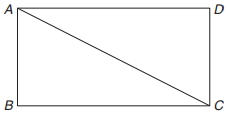
$ABCD$ एक आयत है जिसमें $AC$ एक विकर्ण है। $(\tan^2 \angle CAD + 1) \sin^2 \angle BAC$ का मान ज्ञात कीजिए।
A
$2$
B
$\frac{1}{4}$
C
$1$
D
$0$
Solution
(C) आयत $ABCD$ में,विकर्ण $AC$ आयत को दो सर्वांगसम समकोण त्रिभुजों $\triangle ABC$ और $\triangle ADC$ में विभाजित करता है।
माना $\angle CAD = \theta$ है। चूंकि $AD \parallel BC$,इसलिए $\angle CAD = \angle ACB = \theta$ होगा।
साथ ही,$\angle BAC = 90^{\circ} - \theta$ होगा।
सर्वसमिका $1 + \tan^2 \theta = \sec^2 \theta$ का उपयोग करने पर,व्यंजक इस प्रकार होगा:
$(\tan^2 \angle CAD + 1) \sin^2 \angle BAC = \sec^2 \angle CAD \cdot \sin^2 \angle BAC$
$= \frac{1}{\cos^2 \angle CAD} \cdot \sin^2 (90^{\circ} - \angle CAD)$
$= \frac{1}{\cos^2 \angle CAD} \cdot \cos^2 \angle CAD = 1$.
माना $\angle CAD = \theta$ है। चूंकि $AD \parallel BC$,इसलिए $\angle CAD = \angle ACB = \theta$ होगा।
साथ ही,$\angle BAC = 90^{\circ} - \theta$ होगा।
सर्वसमिका $1 + \tan^2 \theta = \sec^2 \theta$ का उपयोग करने पर,व्यंजक इस प्रकार होगा:
$(\tan^2 \angle CAD + 1) \sin^2 \angle BAC = \sec^2 \angle CAD \cdot \sin^2 \angle BAC$
$= \frac{1}{\cos^2 \angle CAD} \cdot \sin^2 (90^{\circ} - \angle CAD)$
$= \frac{1}{\cos^2 \angle CAD} \cdot \cos^2 \angle CAD = 1$.
0 likes
View Solution603
EasyMCQ
यदि $\tan x = (\sin 45^{\circ})(\cos 45^{\circ}) + \sin 30^{\circ}$ है,तो $x$ का मान ($^{\circ}$ में) ज्ञात कीजिए।
A
$30$
B
$45$
C
$60$
D
$90$
Solution
(B) दिया गया समीकरण: $\tan x = \sin 45^{\circ} \cdot \cos 45^{\circ} + \sin 30^{\circ}$
मानक त्रिकोणमितीय मान रखने पर:
$\sin 45^{\circ} = \frac{1}{\sqrt{2}}$,$\cos 45^{\circ} = \frac{1}{\sqrt{2}}$,और $\sin 30^{\circ} = \frac{1}{2}$
$\tan x = \left(\frac{1}{\sqrt{2}}\right) \cdot \left(\frac{1}{\sqrt{2}}\right) + \frac{1}{2}$
$\tan x = \frac{1}{2} + \frac{1}{2}$
$\tan x = 1$
चूंकि $\tan 45^{\circ} = 1$,इसलिए $\tan x = \tan 45^{\circ}$
अतः,$x = 45^{\circ}$.
मानक त्रिकोणमितीय मान रखने पर:
$\sin 45^{\circ} = \frac{1}{\sqrt{2}}$,$\cos 45^{\circ} = \frac{1}{\sqrt{2}}$,और $\sin 30^{\circ} = \frac{1}{2}$
$\tan x = \left(\frac{1}{\sqrt{2}}\right) \cdot \left(\frac{1}{\sqrt{2}}\right) + \frac{1}{2}$
$\tan x = \frac{1}{2} + \frac{1}{2}$
$\tan x = 1$
चूंकि $\tan 45^{\circ} = 1$,इसलिए $\tan x = \tan 45^{\circ}$
अतः,$x = 45^{\circ}$.
0 likes
View Solution604
MediumMCQ
$\theta$ के किसी भी वास्तविक मान के लिए,$\sqrt{\frac{\sec \theta-1}{\sec \theta+1}} = ?$
A
$\cot \theta - \operatorname{cosec} \theta$
B
$\sec \theta - \tan \theta$
C
$\operatorname{cosec} \theta - \cot \theta$
D
$\tan \theta - \sec \theta$
Solution
(C) हम व्यंजक $\sqrt{\frac{\sec \theta - 1}{\sec \theta + 1}}$ से शुरुआत करते हैं।
$\sec \theta$ को $\frac{1}{\cos \theta}$ में बदलने पर,हमें $\sqrt{\frac{\frac{1}{\cos \theta} - 1}{\frac{1}{\cos \theta} + 1}} = \sqrt{\frac{1 - \cos \theta}{1 + \cos \theta}}$ प्राप्त होता है।
अंश और हर को $(1 - \cos \theta)$ से गुणा करने पर,हमें $\sqrt{\frac{(1 - \cos \theta)^2}{1 - \cos^2 \theta}}$ प्राप्त होता है।
सर्वसमिका $1 - \cos^2 \theta = \sin^2 \theta$ का उपयोग करने पर,व्यंजक $\sqrt{\frac{(1 - \cos \theta)^2}{\sin^2 \theta}} = \frac{1 - \cos \theta}{\sin \theta}$ हो जाता है।
इसे सरल करने पर $\frac{1}{\sin \theta} - \frac{\cos \theta}{\sin \theta} = \operatorname{cosec} \theta - \cot \theta$ प्राप्त होता है।
$\sec \theta$ को $\frac{1}{\cos \theta}$ में बदलने पर,हमें $\sqrt{\frac{\frac{1}{\cos \theta} - 1}{\frac{1}{\cos \theta} + 1}} = \sqrt{\frac{1 - \cos \theta}{1 + \cos \theta}}$ प्राप्त होता है।
अंश और हर को $(1 - \cos \theta)$ से गुणा करने पर,हमें $\sqrt{\frac{(1 - \cos \theta)^2}{1 - \cos^2 \theta}}$ प्राप्त होता है।
सर्वसमिका $1 - \cos^2 \theta = \sin^2 \theta$ का उपयोग करने पर,व्यंजक $\sqrt{\frac{(1 - \cos \theta)^2}{\sin^2 \theta}} = \frac{1 - \cos \theta}{\sin \theta}$ हो जाता है।
इसे सरल करने पर $\frac{1}{\sin \theta} - \frac{\cos \theta}{\sin \theta} = \operatorname{cosec} \theta - \cot \theta$ प्राप्त होता है।
0 likes
View Solution605
MediumMCQ
यदि दो कोणों का योग और अंतर क्रमशः $\pi$ और $\frac{\pi}{12}$ है,तो डिग्री माप में कोणों के मान ($^{\circ}$ में) ज्ञात कीजिए।
A
$70, 65$
B
$75, 60$
C
$45, 90$
D
$80, 55$
Solution
(B) माना कि दो कोण $A$ और $B$ हैं,जहाँ $A > B$ है।
दिया गया है कि कोणों का योग $\pi$ रेडियन है।
$\pi$ रेडियन को डिग्री में बदलने पर: $\pi \times \frac{180^{\circ}}{\pi} = 180^{\circ}$।
अतः,$A + B = 180^{\circ}$।
दिया गया है कि कोणों का अंतर $\frac{\pi}{12}$ रेडियन है।
$\frac{\pi}{12}$ रेडियन को डिग्री में बदलने पर: $\frac{\pi}{12} \times \frac{180^{\circ}}{\pi} = 15^{\circ}$।
अतः,$A - B = 15^{\circ}$।
दोनों समीकरणों को जोड़ने पर: $(A + B) + (A - B) = 180^{\circ} + 15^{\circ}$।
$2A = 195^{\circ} \Rightarrow A = 97.5^{\circ}$।
दोनों समीकरणों को घटाने पर: $(A + B) - (A - B) = 180^{\circ} - 15^{\circ}$।
$2B = 165^{\circ} \Rightarrow B = 82.5^{\circ}$।
नोट: विकल्प $B$ के अनुसार,यदि योग $135^{\circ}$ है,तो $A = 75^{\circ}$ और $B = 60^{\circ}$ प्राप्त होता है।
दिया गया है कि कोणों का योग $\pi$ रेडियन है।
$\pi$ रेडियन को डिग्री में बदलने पर: $\pi \times \frac{180^{\circ}}{\pi} = 180^{\circ}$।
अतः,$A + B = 180^{\circ}$।
दिया गया है कि कोणों का अंतर $\frac{\pi}{12}$ रेडियन है।
$\frac{\pi}{12}$ रेडियन को डिग्री में बदलने पर: $\frac{\pi}{12} \times \frac{180^{\circ}}{\pi} = 15^{\circ}$।
अतः,$A - B = 15^{\circ}$।
दोनों समीकरणों को जोड़ने पर: $(A + B) + (A - B) = 180^{\circ} + 15^{\circ}$।
$2A = 195^{\circ} \Rightarrow A = 97.5^{\circ}$।
दोनों समीकरणों को घटाने पर: $(A + B) - (A - B) = 180^{\circ} - 15^{\circ}$।
$2B = 165^{\circ} \Rightarrow B = 82.5^{\circ}$।
नोट: विकल्प $B$ के अनुसार,यदि योग $135^{\circ}$ है,तो $A = 75^{\circ}$ और $B = 60^{\circ}$ प्राप्त होता है।
0 likes
View Solution606
DifficultMCQ
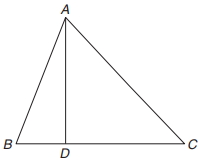
एक $\Delta ABC$ में,$\angle B = \frac{\pi}{3}$,$\angle C = \frac{\pi}{4}$ और $D$,$BC$ को $1:3$ के अनुपात में आंतरिक रूप से विभाजित करता है,तो $\frac{\sin \angle BAD}{\sin \angle CAD}$ का मान ज्ञात कीजिए।
A
$\frac{1}{\sqrt{2}}$
B
$\frac{1}{\sqrt{3}}$
C
$\frac{1}{\sqrt{6}}$
D
$\sqrt{6}$
Solution
(C) दिया गया है: $\angle B = \frac{\pi}{3}$,$\angle C = \frac{\pi}{4}$ और $\frac{BD}{DC} = \frac{1}{3}$.
$\Delta ABD$ में,ज्या (Sine) नियम के अनुसार:
$\frac{BD}{\sin \angle BAD} = \frac{AD}{\sin \angle B}$
$\Rightarrow \frac{BD}{\sin \angle BAD} = \frac{AD}{\sin(\pi/3)} = \frac{AD}{\sqrt{3}/2}$
$\Rightarrow AD = \frac{\sqrt{3}}{2} \cdot \frac{BD}{\sin \angle BAD}$ .... $(1)$
$\Delta ADC$ में,ज्या (Sine) नियम के अनुसार:
$\frac{DC}{\sin \angle CAD} = \frac{AD}{\sin \angle C}$
$\Rightarrow \frac{DC}{\sin \angle CAD} = \frac{AD}{\sin(\pi/4)} = \frac{AD}{1/\sqrt{2}}$
$\Rightarrow AD = \frac{1}{\sqrt{2}} \cdot \frac{DC}{\sin \angle CAD}$ .... $(2)$
समीकरण $(1)$ और $(2)$ की तुलना करने पर:
$\frac{\sqrt{3}}{2} \cdot \frac{BD}{\sin \angle BAD} = \frac{1}{\sqrt{2}} \cdot \frac{DC}{\sin \angle CAD}$
$\Rightarrow \frac{\sin \angle BAD}{\sin \angle CAD} = \frac{\sqrt{3}/2}{1/\sqrt{2}} \cdot \frac{BD}{DC}$
$\Rightarrow \frac{\sin \angle BAD}{\sin \angle CAD} = \frac{\sqrt{3}}{2} \cdot \sqrt{2} \cdot \frac{1}{3} = \frac{\sqrt{3}}{\sqrt{2} \cdot 3} = \frac{1}{\sqrt{2} \cdot \sqrt{3}} = \frac{1}{\sqrt{6}}$.
$\Delta ABD$ में,ज्या (Sine) नियम के अनुसार:
$\frac{BD}{\sin \angle BAD} = \frac{AD}{\sin \angle B}$
$\Rightarrow \frac{BD}{\sin \angle BAD} = \frac{AD}{\sin(\pi/3)} = \frac{AD}{\sqrt{3}/2}$
$\Rightarrow AD = \frac{\sqrt{3}}{2} \cdot \frac{BD}{\sin \angle BAD}$ .... $(1)$
$\Delta ADC$ में,ज्या (Sine) नियम के अनुसार:
$\frac{DC}{\sin \angle CAD} = \frac{AD}{\sin \angle C}$
$\Rightarrow \frac{DC}{\sin \angle CAD} = \frac{AD}{\sin(\pi/4)} = \frac{AD}{1/\sqrt{2}}$
$\Rightarrow AD = \frac{1}{\sqrt{2}} \cdot \frac{DC}{\sin \angle CAD}$ .... $(2)$
समीकरण $(1)$ और $(2)$ की तुलना करने पर:
$\frac{\sqrt{3}}{2} \cdot \frac{BD}{\sin \angle BAD} = \frac{1}{\sqrt{2}} \cdot \frac{DC}{\sin \angle CAD}$
$\Rightarrow \frac{\sin \angle BAD}{\sin \angle CAD} = \frac{\sqrt{3}/2}{1/\sqrt{2}} \cdot \frac{BD}{DC}$
$\Rightarrow \frac{\sin \angle BAD}{\sin \angle CAD} = \frac{\sqrt{3}}{2} \cdot \sqrt{2} \cdot \frac{1}{3} = \frac{\sqrt{3}}{\sqrt{2} \cdot 3} = \frac{1}{\sqrt{2} \cdot \sqrt{3}} = \frac{1}{\sqrt{6}}$.
0 likes
View Solution607
MediumMCQ
यदि $\sin 3A = \cos (A - 26^{\circ})$ है,जहाँ $3A$ एक न्यून कोण है,तो $A$ का मान ($^{\circ}$ में) ज्ञात कीजिए।
A
$29$
B
$26$
C
$23$
D
$28$
Solution
(A) दिया गया है: $\sin 3A = \cos (A - 26^{\circ})$
हम जानते हैं कि $\sin \theta = \cos (90^{\circ} - \theta)$.
अतः,$\cos (90^{\circ} - 3A) = \cos (A - 26^{\circ})$.
कोणों की तुलना करने पर: $90^{\circ} - 3A = A - 26^{\circ}$.
पदों को व्यवस्थित करने पर: $90^{\circ} + 26^{\circ} = 3A + A$.
$116^{\circ} = 4A$.
$A = \frac{116^{\circ}}{4} = 29^{\circ}$.
हम जानते हैं कि $\sin \theta = \cos (90^{\circ} - \theta)$.
अतः,$\cos (90^{\circ} - 3A) = \cos (A - 26^{\circ})$.
कोणों की तुलना करने पर: $90^{\circ} - 3A = A - 26^{\circ}$.
पदों को व्यवस्थित करने पर: $90^{\circ} + 26^{\circ} = 3A + A$.
$116^{\circ} = 4A$.
$A = \frac{116^{\circ}}{4} = 29^{\circ}$.
0 likes
View Solution608
MediumMCQ
$\sec ^{2} \theta - \frac{\sin ^{2} \theta - 2 \sin ^{4} \theta}{2 \cos ^{4} \theta - \cos ^{2} \theta}$ का मान ज्ञात कीजिए।
A
$1$
B
$2$
C
$-1$
D
$0$
Solution
(A) दिया गया व्यंजक: $\sec ^{2} \theta - \frac{\sin ^{2} \theta - 2 \sin ^{4} \theta}{2 \cos ^{4} \theta - \cos ^{2} \theta}$
अंश से $\sin^2 \theta$ और हर से $\cos^2 \theta$ उभयनिष्ठ लेने पर:
$= \sec ^{2} \theta - \frac{\sin ^{2} \theta (1 - 2 \sin ^{2} \theta)}{\cos ^{2} \theta (2 \cos ^{2} \theta - 1)}$
अंश में सर्वसमिका $\sin^2 \theta = 1 - \cos^2 \theta$ का उपयोग करने पर:
$= \sec ^{2} \theta - \frac{\sin ^{2} \theta [1 - 2(1 - \cos ^{2} \theta)]}{\cos ^{2} \theta (2 \cos ^{2} \theta - 1)}$
कोष्ठक के अंदर के व्यंजक को सरल करने पर:
$= \sec ^{2} \theta - \frac{\sin ^{2} \theta (1 - 2 + 2 \cos ^{2} \theta)}{\cos ^{2} \theta (2 \cos ^{2} \theta - 1)}$
$= \sec ^{2} \theta - \frac{\sin ^{2} \theta (2 \cos ^{2} \theta - 1)}{\cos ^{2} \theta (2 \cos ^{2} \theta - 1)}$
उभयनिष्ठ पद $(2 \cos^2 \theta - 1)$ को काटने पर:
$= \sec ^{2} \theta - \tan ^{2} \theta$
सर्वसमिका $\sec^2 \theta - \tan^2 \theta = 1$ का उपयोग करने पर,अंतिम मान $1$ प्राप्त होता है।
अंश से $\sin^2 \theta$ और हर से $\cos^2 \theta$ उभयनिष्ठ लेने पर:
$= \sec ^{2} \theta - \frac{\sin ^{2} \theta (1 - 2 \sin ^{2} \theta)}{\cos ^{2} \theta (2 \cos ^{2} \theta - 1)}$
अंश में सर्वसमिका $\sin^2 \theta = 1 - \cos^2 \theta$ का उपयोग करने पर:
$= \sec ^{2} \theta - \frac{\sin ^{2} \theta [1 - 2(1 - \cos ^{2} \theta)]}{\cos ^{2} \theta (2 \cos ^{2} \theta - 1)}$
कोष्ठक के अंदर के व्यंजक को सरल करने पर:
$= \sec ^{2} \theta - \frac{\sin ^{2} \theta (1 - 2 + 2 \cos ^{2} \theta)}{\cos ^{2} \theta (2 \cos ^{2} \theta - 1)}$
$= \sec ^{2} \theta - \frac{\sin ^{2} \theta (2 \cos ^{2} \theta - 1)}{\cos ^{2} \theta (2 \cos ^{2} \theta - 1)}$
उभयनिष्ठ पद $(2 \cos^2 \theta - 1)$ को काटने पर:
$= \sec ^{2} \theta - \tan ^{2} \theta$
सर्वसमिका $\sec^2 \theta - \tan^2 \theta = 1$ का उपयोग करने पर,अंतिम मान $1$ प्राप्त होता है।
0 likes
View Solution609
MediumMCQ
यदि $x=a(\sin \theta+\cos \theta)$ और $y=b(\sin \theta-\cos \theta)$ है,तो $\frac{x^{2}}{a^{2}}+\frac{y^{2}}{b^{2}}$ का मान ज्ञात कीजिए।
A
$0$
B
$1$
C
$2$
D
$-2$
Solution
(C) दिया गया है: $x=a(\sin \theta+\cos \theta)$ और $y=b(\sin \theta-\cos \theta)$।
क्रमशः $a$ और $b$ से विभाजित करने पर,हमें $\frac{x}{a}=\sin \theta+\cos \theta$ और $\frac{y}{b}=\sin \theta-\cos \theta$ प्राप्त होता है।
अब,व्यंजक $\frac{x^{2}}{a^{2}}+\frac{y^{2}}{b^{2}}$ पर विचार करें।
मान प्रतिस्थापित करने पर,हमें $(\sin \theta+\cos \theta)^{2}+(\sin \theta-\cos \theta)^{2}$ प्राप्त होता है।
$(A+B)^2 = A^2+B^2+2AB$ और $(A-B)^2 = A^2+B^2-2AB$ का उपयोग करके वर्गों का विस्तार करने पर:
$(\sin^2 \theta + \cos^2 \theta + 2\sin \theta \cos \theta) + (\sin^2 \theta + \cos^2 \theta - 2\sin \theta \cos \theta)$।
चूंकि $\sin^2 \theta + \cos^2 \theta = 1$,इसलिए व्यंजक सरल होकर $1 + 2\sin \theta \cos \theta + 1 - 2\sin \theta \cos \theta$ हो जाता है।
अतः,परिणाम $1 + 1 = 2$ प्राप्त होता है।
क्रमशः $a$ और $b$ से विभाजित करने पर,हमें $\frac{x}{a}=\sin \theta+\cos \theta$ और $\frac{y}{b}=\sin \theta-\cos \theta$ प्राप्त होता है।
अब,व्यंजक $\frac{x^{2}}{a^{2}}+\frac{y^{2}}{b^{2}}$ पर विचार करें।
मान प्रतिस्थापित करने पर,हमें $(\sin \theta+\cos \theta)^{2}+(\sin \theta-\cos \theta)^{2}$ प्राप्त होता है।
$(A+B)^2 = A^2+B^2+2AB$ और $(A-B)^2 = A^2+B^2-2AB$ का उपयोग करके वर्गों का विस्तार करने पर:
$(\sin^2 \theta + \cos^2 \theta + 2\sin \theta \cos \theta) + (\sin^2 \theta + \cos^2 \theta - 2\sin \theta \cos \theta)$।
चूंकि $\sin^2 \theta + \cos^2 \theta = 1$,इसलिए व्यंजक सरल होकर $1 + 2\sin \theta \cos \theta + 1 - 2\sin \theta \cos \theta$ हो जाता है।
अतः,परिणाम $1 + 1 = 2$ प्राप्त होता है।
0 likes
View Solution610
EasyMCQ
यदि $\sin 5 \theta = \cos 20^{\circ}$ है,जहाँ $0^{\circ} < \theta < 90^{\circ}$,तो $\theta$ का मान (डिग्री में) क्या है?
A
$4$
B
$22$
C
$10$
D
$14$
Solution
(D) दिया गया समीकरण: $\sin 5 \theta = \cos 20^{\circ}$ है।
हम त्रिकोणमितीय सर्वसमिका जानते हैं: $\cos A = \sin(90^{\circ} - A)$।
दाहिनी ओर इस सर्वसमिका को लागू करने पर: $\cos 20^{\circ} = \sin(90^{\circ} - 20^{\circ}) = \sin 70^{\circ}$ प्राप्त होता है।
अब,समीकरण इस प्रकार है: $\sin 5 \theta = \sin 70^{\circ}$।
कोणों की तुलना करने पर,हमें प्राप्त होता है: $5 \theta = 70^{\circ}$।
$\theta$ के लिए हल करने पर: $\theta = \frac{70^{\circ}}{5} = 14^{\circ}$।
अतः,$\theta$ का मान $14^{\circ}$ है।
हम त्रिकोणमितीय सर्वसमिका जानते हैं: $\cos A = \sin(90^{\circ} - A)$।
दाहिनी ओर इस सर्वसमिका को लागू करने पर: $\cos 20^{\circ} = \sin(90^{\circ} - 20^{\circ}) = \sin 70^{\circ}$ प्राप्त होता है।
अब,समीकरण इस प्रकार है: $\sin 5 \theta = \sin 70^{\circ}$।
कोणों की तुलना करने पर,हमें प्राप्त होता है: $5 \theta = 70^{\circ}$।
$\theta$ के लिए हल करने पर: $\theta = \frac{70^{\circ}}{5} = 14^{\circ}$।
अतः,$\theta$ का मान $14^{\circ}$ है।
0 likes
View Solution611
MediumMCQ
$\tan 1^{\circ} \tan 2^{\circ} \tan 3^{\circ} \ldots \tan 89^{\circ}$ का सरलतम मान क्या है?
A
$\frac{1}{2}$
B
$0$
C
$1$
D
$\frac{2}{3}$
Solution
(C) हमें व्यंजक दिया गया है: $\tan 1^{\circ} \tan 2^{\circ} \tan 3^{\circ} \ldots \tan 89^{\circ}$।
सर्वसमिका $\tan(90^{\circ} - \theta) = \cot \theta$ का उपयोग करके,हम पदों को इस प्रकार लिख सकते हैं:
$\tan 89^{\circ} = \tan(90^{\circ} - 1^{\circ}) = \cot 1^{\circ} = \frac{1}{\tan 1^{\circ}}$।
$\tan 88^{\circ} = \tan(90^{\circ} - 2^{\circ}) = \cot 2^{\circ} = \frac{1}{\tan 2^{\circ}}$।
यह क्रम $\tan 46^{\circ} = \cot 44^{\circ} = \frac{1}{\tan 44^{\circ}}$ तक जारी रहता है।
मध्य पद $\tan 45^{\circ} = 1$ है।
इन मानों को गुणनफल में रखने पर:
$(\tan 1^{\circ} \cdot \cot 1^{\circ}) \cdot (\tan 2^{\circ} \cdot \cot 2^{\circ}) \cdots (\tan 44^{\circ} \cdot \cot 44^{\circ}) \cdot \tan 45^{\circ}$।
चूंकि $\tan \theta \cdot \cot \theta = 1$,इसलिए गुणनफल $1 \cdot 1 \cdots 1 \cdot 1 = 1$ प्राप्त होता है।
सर्वसमिका $\tan(90^{\circ} - \theta) = \cot \theta$ का उपयोग करके,हम पदों को इस प्रकार लिख सकते हैं:
$\tan 89^{\circ} = \tan(90^{\circ} - 1^{\circ}) = \cot 1^{\circ} = \frac{1}{\tan 1^{\circ}}$।
$\tan 88^{\circ} = \tan(90^{\circ} - 2^{\circ}) = \cot 2^{\circ} = \frac{1}{\tan 2^{\circ}}$।
यह क्रम $\tan 46^{\circ} = \cot 44^{\circ} = \frac{1}{\tan 44^{\circ}}$ तक जारी रहता है।
मध्य पद $\tan 45^{\circ} = 1$ है।
इन मानों को गुणनफल में रखने पर:
$(\tan 1^{\circ} \cdot \cot 1^{\circ}) \cdot (\tan 2^{\circ} \cdot \cot 2^{\circ}) \cdots (\tan 44^{\circ} \cdot \cot 44^{\circ}) \cdot \tan 45^{\circ}$।
चूंकि $\tan \theta \cdot \cot \theta = 1$,इसलिए गुणनफल $1 \cdot 1 \cdots 1 \cdot 1 = 1$ प्राप्त होता है।
0 likes
View Solution612
MediumMCQ
यदि $(\sin \alpha + \operatorname{cosec} \alpha)^{2} + (\cos \alpha + \sec \alpha)^{2} = K + \tan^{2} \alpha + \cot^{2} \alpha$ है,तो $K$ का मान ज्ञात कीजिए।
A
$1$
B
$7$
C
$3$
D
$5$
Solution
(B) दी गई व्यंजक: $(\sin \alpha + \operatorname{cosec} \alpha)^{2} + (\cos \alpha + \sec \alpha)^{2}$
$(a+b)^{2} = a^{2} + b^{2} + 2ab$ का उपयोग करके विस्तार करने पर:
$= (\sin^{2} \alpha + \operatorname{cosec}^{2} \alpha + 2 \sin \alpha \operatorname{cosec} \alpha) + (\cos^{2} \alpha + \sec^{2} \alpha + 2 \cos \alpha \sec \alpha)$
चूंकि $\sin \alpha \operatorname{cosec} \alpha = 1$ और $\cos \alpha \sec \alpha = 1$:
$= \sin^{2} \alpha + \operatorname{cosec}^{2} \alpha + 2 + \cos^{2} \alpha + \sec^{2} \alpha + 2$
$= (\sin^{2} \alpha + \cos^{2} \alpha) + \operatorname{cosec}^{2} \alpha + \sec^{2} \alpha + 4$
सर्वसमिका $\sin^{2} \alpha + \cos^{2} \alpha = 1$,$\operatorname{cosec}^{2} \alpha = 1 + \cot^{2} \alpha$,और $\sec^{2} \alpha = 1 + \tan^{2} \alpha$ का उपयोग करने पर:
$= 1 + (1 + \cot^{2} \alpha) + (1 + \tan^{2} \alpha) + 4$
$= 7 + \tan^{2} \alpha + \cot^{2} \alpha$
इसकी तुलना $K + \tan^{2} \alpha + \cot^{2} \alpha$ से करने पर,हमें $K = 7$ प्राप्त होता है।
$(a+b)^{2} = a^{2} + b^{2} + 2ab$ का उपयोग करके विस्तार करने पर:
$= (\sin^{2} \alpha + \operatorname{cosec}^{2} \alpha + 2 \sin \alpha \operatorname{cosec} \alpha) + (\cos^{2} \alpha + \sec^{2} \alpha + 2 \cos \alpha \sec \alpha)$
चूंकि $\sin \alpha \operatorname{cosec} \alpha = 1$ और $\cos \alpha \sec \alpha = 1$:
$= \sin^{2} \alpha + \operatorname{cosec}^{2} \alpha + 2 + \cos^{2} \alpha + \sec^{2} \alpha + 2$
$= (\sin^{2} \alpha + \cos^{2} \alpha) + \operatorname{cosec}^{2} \alpha + \sec^{2} \alpha + 4$
सर्वसमिका $\sin^{2} \alpha + \cos^{2} \alpha = 1$,$\operatorname{cosec}^{2} \alpha = 1 + \cot^{2} \alpha$,और $\sec^{2} \alpha = 1 + \tan^{2} \alpha$ का उपयोग करने पर:
$= 1 + (1 + \cot^{2} \alpha) + (1 + \tan^{2} \alpha) + 4$
$= 7 + \tan^{2} \alpha + \cot^{2} \alpha$
इसकी तुलना $K + \tan^{2} \alpha + \cot^{2} \alpha$ से करने पर,हमें $K = 7$ प्राप्त होता है।
0 likes
View Solution613
MediumMCQ
एक समतल पर लंबवत स्थित एक ऊर्ध्वाधर मीनार के शीर्ष का उन्नयन कोण उसी समतल पर स्थित बिंदु $P$ से $60^{\circ}$ देखा जाता है। बिंदु $P$ से $10\, m$ ऊर्ध्वाधर ऊपर स्थित दूसरे बिंदु $Q$ से मीनार के पाद का अवनमन कोण $30^{\circ}$ है। मीनार की ऊँचाई ($m$ में) है:
A
$15$
B
$30$
C
$20$
D
$25$
Solution
(B) माना मीनार की ऊँचाई $h$ है और मीनार तथा बिंदु $P$ के बीच की दूरी $d$ है।
बिंदु $P$ से मीनार के शीर्ष का उन्नयन कोण $60^{\circ}$ है,अतः $\tan 60^{\circ} = h / d$,जिसका अर्थ है $d = h / \sqrt{3}$।
बिंदु $Q$,$P$ से $10\, m$ ऊर्ध्वाधर ऊपर है। मीनार के पाद का अवनमन कोण $30^{\circ}$ है। यह $10\, m$ ऊँचाई और $d$ आधार वाला एक समकोण त्रिभुज बनाता है,अतः $\tan 30^{\circ} = 10 / d$,जिसका अर्थ है $d = 10 / \tan 30^{\circ} = 10\sqrt{3}$।
$d$ के लिए दोनों समीकरणों की तुलना करने पर: $h / \sqrt{3} = 10\sqrt{3}$।
अतः,$h = 10\sqrt{3} \times \sqrt{3} = 10 \times 3 = 30\, m$।
बिंदु $P$ से मीनार के शीर्ष का उन्नयन कोण $60^{\circ}$ है,अतः $\tan 60^{\circ} = h / d$,जिसका अर्थ है $d = h / \sqrt{3}$।
बिंदु $Q$,$P$ से $10\, m$ ऊर्ध्वाधर ऊपर है। मीनार के पाद का अवनमन कोण $30^{\circ}$ है। यह $10\, m$ ऊँचाई और $d$ आधार वाला एक समकोण त्रिभुज बनाता है,अतः $\tan 30^{\circ} = 10 / d$,जिसका अर्थ है $d = 10 / \tan 30^{\circ} = 10\sqrt{3}$।
$d$ के लिए दोनों समीकरणों की तुलना करने पर: $h / \sqrt{3} = 10\sqrt{3}$।
अतः,$h = 10\sqrt{3} \times \sqrt{3} = 10 \times 3 = 30\, m$।
0 likes
View Solution614
DifficultMCQ
यदि $\sin 21^{\circ} = \frac{x}{y}$ है,तो $\sec 21^{\circ} - \sin 69^{\circ}$ का मान ज्ञात कीजिए।
A
$\frac{x^{2}}{y \sqrt{y^{2}-x^{2}}}$
B
$\frac{y^{2}}{x \sqrt{y^{2}-x^{2}}}$
C
$\frac{x^{2}}{y \sqrt{x^{2}-y^{2}}}$
D
$\frac{y^{2}}{x \sqrt{x^{2}-y^{2}}}$
Solution
(A) दिया गया है कि $\sin 21^{\circ} = \frac{x}{y}.$
चूंकि $\cos 21^{\circ} = \sqrt{1 - \sin^{2} 21^{\circ}},$ इसलिए $\cos 21^{\circ} = \sqrt{1 - \frac{x^{2}}{y^{2}}} = \frac{\sqrt{y^{2}-x^{2}}}{y}.$
अब,$\sec 21^{\circ} = \frac{1}{\cos 21^{\circ}} = \frac{y}{\sqrt{y^{2}-x^{2}}}.$
साथ ही,$\sin 69^{\circ} = \sin(90^{\circ} - 21^{\circ}) = \cos 21^{\circ} = \frac{\sqrt{y^{2}-x^{2}}}{y}.$
अतः,$\sec 21^{\circ} - \sin 69^{\circ} = \frac{y}{\sqrt{y^{2}-x^{2}}} - \frac{\sqrt{y^{2}-x^{2}}}{y}.$
लघुत्तम समापवर्त्य $y\sqrt{y^{2}-x^{2}}$ लेने पर,हमें प्राप्त होता है:
$= \frac{y^{2} - (y^{2}-x^{2})}{y\sqrt{y^{2}-x^{2}}} = \frac{x^{2}}{y\sqrt{y^{2}-x^{2}}}.$
चूंकि $\cos 21^{\circ} = \sqrt{1 - \sin^{2} 21^{\circ}},$ इसलिए $\cos 21^{\circ} = \sqrt{1 - \frac{x^{2}}{y^{2}}} = \frac{\sqrt{y^{2}-x^{2}}}{y}.$
अब,$\sec 21^{\circ} = \frac{1}{\cos 21^{\circ}} = \frac{y}{\sqrt{y^{2}-x^{2}}}.$
साथ ही,$\sin 69^{\circ} = \sin(90^{\circ} - 21^{\circ}) = \cos 21^{\circ} = \frac{\sqrt{y^{2}-x^{2}}}{y}.$
अतः,$\sec 21^{\circ} - \sin 69^{\circ} = \frac{y}{\sqrt{y^{2}-x^{2}}} - \frac{\sqrt{y^{2}-x^{2}}}{y}.$
लघुत्तम समापवर्त्य $y\sqrt{y^{2}-x^{2}}$ लेने पर,हमें प्राप्त होता है:
$= \frac{y^{2} - (y^{2}-x^{2})}{y\sqrt{y^{2}-x^{2}}} = \frac{x^{2}}{y\sqrt{y^{2}-x^{2}}}.$
0 likes
View Solution615
EasyMCQ
यदि $\sec \alpha + \tan \alpha = 2$ है,तो $\sin \alpha$ का मान ज्ञात कीजिए (मान लीजिए कि $0 < \alpha < 90^{\circ}$)।
A
$0.4$
B
$0.5$
C
$0.6$
D
$0.8$
Solution
(C) हम जानते हैं कि सर्वसमिका $\sec^{2} \alpha - \tan^{2} \alpha = 1$ होती है।
इसे गुणनखंडित करने पर $(\sec \alpha + \tan \alpha)(\sec \alpha - \tan \alpha) = 1$ प्राप्त होता है।
दिया गया है कि $\sec \alpha + \tan \alpha = 2,$ अतः इस मान को रखने पर:
$2(\sec \alpha - \tan \alpha) = 1 \implies \sec \alpha - \tan \alpha = 0.5.$
अब,दोनों समीकरणों को जोड़ने पर:
$(\sec \alpha + \tan \alpha) + (\sec \alpha - \tan \alpha) = 2 + 0.5 = 2.5.$
$2 \sec \alpha = 2.5 \implies \sec \alpha = 1.25 = 5/4.$
चूंकि $\cos \alpha = 1 / \sec \alpha,$ इसलिए $\cos \alpha = 4/5 = 0.8.$
$\sin^{2} \alpha + \cos^{2} \alpha = 1$ का उपयोग करने पर,$\sin^{2} \alpha = 1 - (4/5)^{2} = 1 - 16/25 = 9/25.$
चूंकि $0 < \alpha < 90^{\circ}$ है,इसलिए $\sin \alpha$ धनात्मक होना चाहिए,अतः $\sin \alpha = \sqrt{9/25} = 3/5 = 0.6.$
इसे गुणनखंडित करने पर $(\sec \alpha + \tan \alpha)(\sec \alpha - \tan \alpha) = 1$ प्राप्त होता है।
दिया गया है कि $\sec \alpha + \tan \alpha = 2,$ अतः इस मान को रखने पर:
$2(\sec \alpha - \tan \alpha) = 1 \implies \sec \alpha - \tan \alpha = 0.5.$
अब,दोनों समीकरणों को जोड़ने पर:
$(\sec \alpha + \tan \alpha) + (\sec \alpha - \tan \alpha) = 2 + 0.5 = 2.5.$
$2 \sec \alpha = 2.5 \implies \sec \alpha = 1.25 = 5/4.$
चूंकि $\cos \alpha = 1 / \sec \alpha,$ इसलिए $\cos \alpha = 4/5 = 0.8.$
$\sin^{2} \alpha + \cos^{2} \alpha = 1$ का उपयोग करने पर,$\sin^{2} \alpha = 1 - (4/5)^{2} = 1 - 16/25 = 9/25.$
चूंकि $0 < \alpha < 90^{\circ}$ है,इसलिए $\sin \alpha$ धनात्मक होना चाहिए,अतः $\sin \alpha = \sqrt{9/25} = 3/5 = 0.6.$
0 likes
View Solution616
MediumMCQ
यदि $3 \sin \theta + 5 \cos \theta = 5$ है,तो $5 \sin \theta - 3 \cos \theta$ का मान क्या होगा?
A
$\pm 3$
B
$\pm 5$
C
$\pm 2$
D
$\pm 1$
Solution
(A) दिए गए समीकरण हैं:
$3 \sin \theta + 5 \cos \theta = 5$ ..... $(1)$
$5 \sin \theta - 3 \cos \theta = x$ ..... $(2)$
दोनों समीकरणों का वर्ग करके उन्हें जोड़ने पर:
$(3 \sin \theta + 5 \cos \theta)^2 + (5 \sin \theta - 3 \cos \theta)^2 = 5^2 + x^2$
$(9 \sin^2 \theta + 25 \cos^2 \theta + 30 \sin \theta \cos \theta) + (25 \sin^2 \theta + 9 \cos^2 \theta - 30 \sin \theta \cos \theta) = 25 + x^2$
$(9 + 25) \sin^2 \theta + (25 + 9) \cos^2 \theta = 25 + x^2$
$34(\sin^2 \theta + \cos^2 \theta) = 25 + x^2$
चूंकि $\sin^2 \theta + \cos^2 \theta = 1$,इसलिए:
$34 = 25 + x^2$
$x^2 = 34 - 25 = 9$
$x = \pm 3$
$3 \sin \theta + 5 \cos \theta = 5$ ..... $(1)$
$5 \sin \theta - 3 \cos \theta = x$ ..... $(2)$
दोनों समीकरणों का वर्ग करके उन्हें जोड़ने पर:
$(3 \sin \theta + 5 \cos \theta)^2 + (5 \sin \theta - 3 \cos \theta)^2 = 5^2 + x^2$
$(9 \sin^2 \theta + 25 \cos^2 \theta + 30 \sin \theta \cos \theta) + (25 \sin^2 \theta + 9 \cos^2 \theta - 30 \sin \theta \cos \theta) = 25 + x^2$
$(9 + 25) \sin^2 \theta + (25 + 9) \cos^2 \theta = 25 + x^2$
$34(\sin^2 \theta + \cos^2 \theta) = 25 + x^2$
चूंकि $\sin^2 \theta + \cos^2 \theta = 1$,इसलिए:
$34 = 25 + x^2$
$x^2 = 34 - 25 = 9$
$x = \pm 3$
0 likes
View Solution617
EasyMCQ
यदि $\theta$ एक न्यून कोण है और $\tan \theta + \cot \theta = 2$ है,तो $\tan^{5} \theta + \cot^{5} \theta$ का मान ज्ञात कीजिए।
A
$1$
B
$2$
C
$3$
D
$4$
Solution
(B) दिया गया समीकरण: $\tan \theta + \cot \theta = 2$.
चूंकि $\cot \theta = \frac{1}{\tan \theta}$,हम समीकरण को $\tan \theta + \frac{1}{\tan \theta} = 2$ के रूप में लिख सकते हैं।
मान लीजिए $x = \tan \theta$ है। तब $x + \frac{1}{x} = 2$,जिसे सरल करने पर $x^2 - 2x + 1 = 0$ प्राप्त होता है।
यह $(x - 1)^2 = 0$ है,जिसका अर्थ है कि $x = 1$ है।
अतः,$\tan \theta = 1$,जिसका अर्थ है कि $\theta = 45^{\circ}$ (क्योंकि $\theta$ एक न्यून कोण है)।
अब,हमें $\tan^{5} \theta + \cot^{5} \theta$ का मान ज्ञात करना है।
$\tan \theta = 1$ और $\cot \theta = 1$ रखने पर:
$1^{5} + 1^{5} = 1 + 1 = 2$.
चूंकि $\cot \theta = \frac{1}{\tan \theta}$,हम समीकरण को $\tan \theta + \frac{1}{\tan \theta} = 2$ के रूप में लिख सकते हैं।
मान लीजिए $x = \tan \theta$ है। तब $x + \frac{1}{x} = 2$,जिसे सरल करने पर $x^2 - 2x + 1 = 0$ प्राप्त होता है।
यह $(x - 1)^2 = 0$ है,जिसका अर्थ है कि $x = 1$ है।
अतः,$\tan \theta = 1$,जिसका अर्थ है कि $\theta = 45^{\circ}$ (क्योंकि $\theta$ एक न्यून कोण है)।
अब,हमें $\tan^{5} \theta + \cot^{5} \theta$ का मान ज्ञात करना है।
$\tan \theta = 1$ और $\cot \theta = 1$ रखने पर:
$1^{5} + 1^{5} = 1 + 1 = 2$.
0 likes
View Solution618
EasyMCQ
जब $\theta = 45^{\circ}$ हो, तो $(\sec \theta + \operatorname{cosec} \theta)$ का मान क्या होगा ($\sqrt{2}$ में)?
A
$2$
B
$5$
C
$3$
D
$4$
Solution
(A) हम जानते हैं कि $\sec \theta = \frac{1}{\cos \theta}$ और $\operatorname{cosec} \theta = \frac{1}{\sin \theta}$ होता है।
जब $\theta = 45^{\circ}$ हो, तो $\cos 45^{\circ} = \frac{1}{\sqrt{2}}$ और $\sin 45^{\circ} = \frac{1}{\sqrt{2}}$ होता है।
अतः, $\sec 45^{\circ} = \sqrt{2}$ और $\operatorname{cosec} 45^{\circ} = \sqrt{2}$ प्राप्त होता है।
इन मानों को व्यंजक में रखने पर: $\sec 45^{\circ} + \operatorname{cosec} 45^{\circ} = \sqrt{2} + \sqrt{2} = 2 \sqrt{2}$।
जब $\theta = 45^{\circ}$ हो, तो $\cos 45^{\circ} = \frac{1}{\sqrt{2}}$ और $\sin 45^{\circ} = \frac{1}{\sqrt{2}}$ होता है।
अतः, $\sec 45^{\circ} = \sqrt{2}$ और $\operatorname{cosec} 45^{\circ} = \sqrt{2}$ प्राप्त होता है।
इन मानों को व्यंजक में रखने पर: $\sec 45^{\circ} + \operatorname{cosec} 45^{\circ} = \sqrt{2} + \sqrt{2} = 2 \sqrt{2}$।
0 likes
View Solution619
MediumMCQ
$\frac{\tan ^{2} \theta}{\sec \theta+1}-\sec \theta$ का मान ज्ञात कीजिए।
A
$-1$
B
$0$
C
$1$
D
इनमें से कोई नहीं
Solution
(A) हम जानते हैं कि $1 + \tan^{2} \theta = \sec^{2} \theta$,जिसका अर्थ है कि $\tan^{2} \theta = \sec^{2} \theta - 1$.
इस मान को व्यंजक में प्रतिस्थापित करने पर:
$\frac{\tan^{2} \theta}{\sec \theta + 1} - \sec \theta = \frac{\sec^{2} \theta - 1}{\sec \theta + 1} - \sec \theta$
बीजगणितीय सर्वसमिका $a^{2} - b^{2} = (a - b)(a + b)$ का उपयोग करते हुए,हम $\sec^{2} \theta - 1$ को $(\sec \theta - 1)(\sec \theta + 1)$ के रूप में लिख सकते हैं:
$= \frac{(\sec \theta - 1)(\sec \theta + 1)}{\sec \theta + 1} - \sec \theta$
समान पद $(\sec \theta + 1)$ को काटने पर:
$= (\sec \theta - 1) - \sec \theta$
$= \sec \theta - 1 - \sec \theta = -1$.
इस मान को व्यंजक में प्रतिस्थापित करने पर:
$\frac{\tan^{2} \theta}{\sec \theta + 1} - \sec \theta = \frac{\sec^{2} \theta - 1}{\sec \theta + 1} - \sec \theta$
बीजगणितीय सर्वसमिका $a^{2} - b^{2} = (a - b)(a + b)$ का उपयोग करते हुए,हम $\sec^{2} \theta - 1$ को $(\sec \theta - 1)(\sec \theta + 1)$ के रूप में लिख सकते हैं:
$= \frac{(\sec \theta - 1)(\sec \theta + 1)}{\sec \theta + 1} - \sec \theta$
समान पद $(\sec \theta + 1)$ को काटने पर:
$= (\sec \theta - 1) - \sec \theta$
$= \sec \theta - 1 - \sec \theta = -1$.
0 likes
View Solution620
DifficultMCQ
$\sin ^{6} \theta+\cos ^{6} \theta$ का मान क्या है?
A
$1+3 \sin ^{2} \theta \cos ^{2} \theta$
B
$1$
C
$1-3 \sin ^{2} \theta \cos ^{2} \theta$
D
$1-3 \sin \theta \cos \theta$
Solution
(C) हम जानते हैं कि $a^3 + b^3 = (a + b)^3 - 3ab(a + b)$.
मान लीजिए $a = \sin^2 \theta$ और $b = \cos^2 \theta$ है।
अतः,$\sin^6 \theta + \cos^6 \theta = (\sin^2 \theta)^3 + (\cos^2 \theta)^3$.
सर्वसमिका का उपयोग करने पर:
$\sin^6 \theta + \cos^6 \theta = (\sin^2 \theta + \cos^2 \theta)^3 - 3(\sin^2 \theta)(\cos^2 \theta)(\sin^2 \theta + \cos^2 \theta)$.
चूंकि $\sin^2 \theta + \cos^2 \theta = 1$,इस मान को प्रतिस्थापित करने पर:
$\sin^6 \theta + \cos^6 \theta = (1)^3 - 3 \sin^2 \theta \cos^2 \theta (1)$.
अतः,$\sin^6 \theta + \cos^6 \theta = 1 - 3 \sin^2 \theta \cos^2 \theta$.
मान लीजिए $a = \sin^2 \theta$ और $b = \cos^2 \theta$ है।
अतः,$\sin^6 \theta + \cos^6 \theta = (\sin^2 \theta)^3 + (\cos^2 \theta)^3$.
सर्वसमिका का उपयोग करने पर:
$\sin^6 \theta + \cos^6 \theta = (\sin^2 \theta + \cos^2 \theta)^3 - 3(\sin^2 \theta)(\cos^2 \theta)(\sin^2 \theta + \cos^2 \theta)$.
चूंकि $\sin^2 \theta + \cos^2 \theta = 1$,इस मान को प्रतिस्थापित करने पर:
$\sin^6 \theta + \cos^6 \theta = (1)^3 - 3 \sin^2 \theta \cos^2 \theta (1)$.
अतः,$\sin^6 \theta + \cos^6 \theta = 1 - 3 \sin^2 \theta \cos^2 \theta$.
0 likes
View Solution621
MediumMCQ
यदि $\tan \theta + \cot \theta = 2$ और $0^{\circ} < \theta < 90^{\circ}$ है,तो $\theta$ का मान $(\text{in } ^{\circ})$ क्या होगा?
A
$60$
B
$75$
C
$30$
D
$45$
Solution
(D) दिया गया समीकरण: $\tan \theta + \cot \theta = 2$.
चूँकि $\cot \theta = \frac{1}{\tan \theta}$,हम लिख सकते हैं: $\tan \theta + \frac{1}{\tan \theta} = 2$.
माना $x = \tan \theta$. तब $x + \frac{1}{x} = 2$.
$x$ से गुणा करने पर,हमें $x^2 + 1 = 2x$ प्राप्त होता है,जिसे सरल करने पर $x^2 - 2x + 1 = 0$ मिलता है।
यह एक पूर्ण वर्ग है: $(x - 1)^2 = 0$.
अतः,$x = 1$,जिसका अर्थ है $\tan \theta = 1$.
चूँकि $0^{\circ} < \theta < 90^{\circ}$ है,$\tan \theta = 1$ का अर्थ है $\theta = 45^{\circ}$।
चूँकि $\cot \theta = \frac{1}{\tan \theta}$,हम लिख सकते हैं: $\tan \theta + \frac{1}{\tan \theta} = 2$.
माना $x = \tan \theta$. तब $x + \frac{1}{x} = 2$.
$x$ से गुणा करने पर,हमें $x^2 + 1 = 2x$ प्राप्त होता है,जिसे सरल करने पर $x^2 - 2x + 1 = 0$ मिलता है।
यह एक पूर्ण वर्ग है: $(x - 1)^2 = 0$.
अतः,$x = 1$,जिसका अर्थ है $\tan \theta = 1$.
चूँकि $0^{\circ} < \theta < 90^{\circ}$ है,$\tan \theta = 1$ का अर्थ है $\theta = 45^{\circ}$।
0 likes
View Solution622
DifficultMCQ
यदि $x \sin^{2} 60^{\circ} - \frac{3}{2} \sec 60^{\circ} \tan^{2} 30^{\circ} + \frac{4}{5} \sin^{2} 45^{\circ} \tan^{2} 60^{\circ} = 0$ है,तो $x$ का मान ज्ञात कीजिए।
A
$-\frac{4}{15}$
B
$-2$
C
$-\frac{1}{15}$
D
$-4$
Solution
(A) हम जानते हैं कि $\sin 60^{\circ} = \frac{\sqrt{3}}{2}$,$\sin 45^{\circ} = \frac{1}{\sqrt{2}}$,$\tan 30^{\circ} = \frac{1}{\sqrt{3}}$,$\sec 60^{\circ} = 2$,और $\tan 60^{\circ} = \sqrt{3}$ है।
इन मानों को दिए गए समीकरण में प्रतिस्थापित करने पर:
$x \left( \frac{\sqrt{3}}{2} \right)^{2} - \frac{3}{2} \times 2 \times \left( \frac{1}{\sqrt{3}} \right)^{2} + \frac{4}{5} \times \left( \frac{1}{\sqrt{2}} \right)^{2} \times (\sqrt{3})^{2} = 0$
$x \left( \frac{3}{4} \right) - 3 \times \left( \frac{1}{3} \right) + \frac{4}{5} \times \left( \frac{1}{2} \right) \times 3 = 0$
$\frac{3x}{4} - 1 + \frac{6}{5} = 0$
$\frac{3x}{4} = 1 - \frac{6}{5}$
$\frac{3x}{4} = -\frac{1}{5}$
$x = -\frac{1}{5} \times \frac{4}{3} = -\frac{4}{15}$.
इन मानों को दिए गए समीकरण में प्रतिस्थापित करने पर:
$x \left( \frac{\sqrt{3}}{2} \right)^{2} - \frac{3}{2} \times 2 \times \left( \frac{1}{\sqrt{3}} \right)^{2} + \frac{4}{5} \times \left( \frac{1}{\sqrt{2}} \right)^{2} \times (\sqrt{3})^{2} = 0$
$x \left( \frac{3}{4} \right) - 3 \times \left( \frac{1}{3} \right) + \frac{4}{5} \times \left( \frac{1}{2} \right) \times 3 = 0$
$\frac{3x}{4} - 1 + \frac{6}{5} = 0$
$\frac{3x}{4} = 1 - \frac{6}{5}$
$\frac{3x}{4} = -\frac{1}{5}$
$x = -\frac{1}{5} \times \frac{4}{3} = -\frac{4}{15}$.
0 likes
View Solution623
EasyMCQ
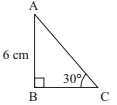
यदि $\Delta ABC$ में कोण $B$ समकोण है,$AB = 6$ इकाई,और $\angle C = 30^{\circ}$ है,तो $AC$ का मान (इकाई में) क्या होगा?
A
$8$
B
$10$
C
$12$
D
$15$
Solution
(C) समकोण त्रिभुज $\Delta ABC$ में,भुजा $AB$ कोण $\angle C = 30^{\circ}$ के सम्मुख (सामने) है और $AC$ कर्ण (hypotenuse) है।
त्रिकोणमितीय अनुपात $\sin$ का उपयोग करने पर:
$\sin C = \frac{\text{सम्मुख भुजा}}{\text{कर्ण}} = \frac{AB}{AC}$
यहाँ $\angle C = 30^{\circ}$ और $AB = 6$ इकाई दिया गया है:
$\sin 30^{\circ} = \frac{6}{AC}$
चूँकि $\sin 30^{\circ} = \frac{1}{2}$,इसलिए:
$\frac{1}{2} = \frac{6}{AC}$
$AC = 6 \times 2 = 12$ इकाई।
त्रिकोणमितीय अनुपात $\sin$ का उपयोग करने पर:
$\sin C = \frac{\text{सम्मुख भुजा}}{\text{कर्ण}} = \frac{AB}{AC}$
यहाँ $\angle C = 30^{\circ}$ और $AB = 6$ इकाई दिया गया है:
$\sin 30^{\circ} = \frac{6}{AC}$
चूँकि $\sin 30^{\circ} = \frac{1}{2}$,इसलिए:
$\frac{1}{2} = \frac{6}{AC}$
$AC = 6 \times 2 = 12$ इकाई।
0 likes
View Solution624
MediumMCQ
यदि $7 \sin a = 24 \cos a$ है,तो $14 \tan a - 75 \cos a - 7 \sec a$ का मान ज्ञात कीजिए:
A
$1$
B
$2$
C
$3$
D
$4$
Solution
(B) दिया गया समीकरण $7 \sin a = 24 \cos a$ है।
दोनों पक्षों को $\cos a$ से विभाजित करने पर,हमें $\frac{\sin a}{\cos a} = \tan a = \frac{24}{7}$ प्राप्त होता है।
त्रिकोणमितीय सर्वसमिका $\sec^2 a = 1 + \tan^2 a$ का उपयोग करने पर,$\sec^2 a = 1 + (\frac{24}{7})^2 = 1 + \frac{576}{49} = \frac{49 + 576}{49} = \frac{625}{49}$ प्राप्त होता है।
वर्गमूल लेने पर,$\sec a = \frac{25}{7}$ प्राप्त होता है।
चूंकि $\cos a = \frac{1}{\sec a}$,इसलिए $\cos a = \frac{7}{25}$ होगा।
अब,इन मानों को व्यंजक $14 \tan a - 75 \cos a - 7 \sec a$ में प्रतिस्थापित करने पर:
$= 14(\frac{24}{7}) - 75(\frac{7}{25}) - 7(\frac{25}{7})$
$= 2(24) - 3(7) - 25$
$= 48 - 21 - 25$
$= 48 - 46 = 2$.
दोनों पक्षों को $\cos a$ से विभाजित करने पर,हमें $\frac{\sin a}{\cos a} = \tan a = \frac{24}{7}$ प्राप्त होता है।
त्रिकोणमितीय सर्वसमिका $\sec^2 a = 1 + \tan^2 a$ का उपयोग करने पर,$\sec^2 a = 1 + (\frac{24}{7})^2 = 1 + \frac{576}{49} = \frac{49 + 576}{49} = \frac{625}{49}$ प्राप्त होता है।
वर्गमूल लेने पर,$\sec a = \frac{25}{7}$ प्राप्त होता है।
चूंकि $\cos a = \frac{1}{\sec a}$,इसलिए $\cos a = \frac{7}{25}$ होगा।
अब,इन मानों को व्यंजक $14 \tan a - 75 \cos a - 7 \sec a$ में प्रतिस्थापित करने पर:
$= 14(\frac{24}{7}) - 75(\frac{7}{25}) - 7(\frac{25}{7})$
$= 2(24) - 3(7) - 25$
$= 48 - 21 - 25$
$= 48 - 46 = 2$.
0 likes
View Solution625
MediumMCQ
$x$ का मान ज्ञात कीजिए जो समीकरण $2 \operatorname{cosec}^{2} 30^{\circ} + x \sin^{2} 60^{\circ} - \frac{3}{4} \tan^{2} 30^{\circ} = 10$ को संतुष्ट करता है।
A
$0$
B
$1$
C
$2$
D
$3$
Solution
(D) हम जानते हैं कि $\sin 60^{\circ} = \frac{\sqrt{3}}{2}$,$\operatorname{cosec} 30^{\circ} = \frac{1}{\sin 30^{\circ}} = \frac{1}{1/2} = 2$,और $\tan 30^{\circ} = \frac{1}{\sqrt{3}}$.
इन मानों को दिए गए समीकरण में प्रतिस्थापित करने पर:
$2(2)^{2} + x(\frac{\sqrt{3}}{2})^{2} - \frac{3}{4}(\frac{1}{\sqrt{3}})^{2} = 10$
$2(4) + x(\frac{3}{4}) - \frac{3}{4}(\frac{1}{3}) = 10$
$8 + \frac{3x}{4} - \frac{1}{4} = 10$
हर को हटाने के लिए पूरे समीकरण को $4$ से गुणा करने पर:
$32 + 3x - 1 = 40$
$31 + 3x = 40$
$3x = 40 - 31$
$3x = 9$
$x = 3$
इन मानों को दिए गए समीकरण में प्रतिस्थापित करने पर:
$2(2)^{2} + x(\frac{\sqrt{3}}{2})^{2} - \frac{3}{4}(\frac{1}{\sqrt{3}})^{2} = 10$
$2(4) + x(\frac{3}{4}) - \frac{3}{4}(\frac{1}{3}) = 10$
$8 + \frac{3x}{4} - \frac{1}{4} = 10$
हर को हटाने के लिए पूरे समीकरण को $4$ से गुणा करने पर:
$32 + 3x - 1 = 40$
$31 + 3x = 40$
$3x = 40 - 31$
$3x = 9$
$x = 3$
0 likes
View Solution626
EasyMCQ
यदि $2 \sin \theta + \cos \theta = \frac{7}{3}$ है,तो $(\tan^2 \theta - \sec^2 \theta)$ का मान क्या होगा?
A
$\frac{3}{7}$
B
$\frac{7}{3}$
C
$0$
D
$-1$
Solution
(D) हम मूलभूत त्रिकोणमितीय सर्वसमिका जानते हैं: $\sec^2 \theta - \tan^2 \theta = 1.$
इस सर्वसमिका को पुनर्व्यवस्थित करने पर,हमें प्राप्त होता है: $\tan^2 \theta - \sec^2 \theta = -1.$
चूंकि व्यंजक $(\tan^2 \theta - \sec^2 \theta)$ का मान $\theta$ के मान पर निर्भर नहीं करता है (बशर्ते $\theta$ फलनों के डोमेन में हो),इसलिए दिया गया समीकरण $2 \sin \theta + \cos \theta = \frac{7}{3}$ अंतिम परिणाम के लिए अप्रासंगिक है।
अतः,इसका मान $-1$ है।
इस सर्वसमिका को पुनर्व्यवस्थित करने पर,हमें प्राप्त होता है: $\tan^2 \theta - \sec^2 \theta = -1.$
चूंकि व्यंजक $(\tan^2 \theta - \sec^2 \theta)$ का मान $\theta$ के मान पर निर्भर नहीं करता है (बशर्ते $\theta$ फलनों के डोमेन में हो),इसलिए दिया गया समीकरण $2 \sin \theta + \cos \theta = \frac{7}{3}$ अंतिम परिणाम के लिए अप्रासंगिक है।
अतः,इसका मान $-1$ है।
0 likes
View Solution627
DifficultMCQ
यदि $29 \tan \theta = 31$ है,तो $\frac{1+2 \sin \theta \cos \theta}{1-2 \sin \theta \cos \theta}$ का मान किसके बराबर है?
A
$540$
B
$490$
C
$810$
D
$900$
Solution
(D) दिया गया है,$29 \tan \theta = 31 \implies \tan \theta = \frac{31}{29}$.
चूंकि $\tan \theta = \frac{\sin \theta}{\cos \theta}$,इसलिए $\frac{\sin \theta}{\cos \theta} = \frac{31}{29}$ है।
अनुपात के गुणधर्म का उपयोग करते हुए,$\frac{\sin \theta + \cos \theta}{\sin \theta - \cos \theta} = \frac{31 + 29}{31 - 29} = \frac{60}{2} = 30$ प्राप्त होता है।
अब,व्यंजक $\frac{1+2 \sin \theta \cos \theta}{1-2 \sin \theta \cos \theta}$ पर विचार करें।
हम जानते हैं कि $1 = \sin^2 \theta + \cos^2 \theta$,इसलिए व्यंजक इस प्रकार होगा:
$\frac{\sin^2 \theta + \cos^2 \theta + 2 \sin \theta \cos \theta}{\sin^2 \theta + \cos^2 \theta - 2 \sin \theta \cos \theta} = \frac{(\sin \theta + \cos \theta)^2}{(\sin \theta - \cos \theta)^2}$.
पहले प्राप्त मान को प्रतिस्थापित करने पर:
$= \left( \frac{\sin \theta + \cos \theta}{\sin \theta - \cos \theta} \right)^2 = (30)^2 = 900$.
चूंकि $\tan \theta = \frac{\sin \theta}{\cos \theta}$,इसलिए $\frac{\sin \theta}{\cos \theta} = \frac{31}{29}$ है।
अनुपात के गुणधर्म का उपयोग करते हुए,$\frac{\sin \theta + \cos \theta}{\sin \theta - \cos \theta} = \frac{31 + 29}{31 - 29} = \frac{60}{2} = 30$ प्राप्त होता है।
अब,व्यंजक $\frac{1+2 \sin \theta \cos \theta}{1-2 \sin \theta \cos \theta}$ पर विचार करें।
हम जानते हैं कि $1 = \sin^2 \theta + \cos^2 \theta$,इसलिए व्यंजक इस प्रकार होगा:
$\frac{\sin^2 \theta + \cos^2 \theta + 2 \sin \theta \cos \theta}{\sin^2 \theta + \cos^2 \theta - 2 \sin \theta \cos \theta} = \frac{(\sin \theta + \cos \theta)^2}{(\sin \theta - \cos \theta)^2}$.
पहले प्राप्त मान को प्रतिस्थापित करने पर:
$= \left( \frac{\sin \theta + \cos \theta}{\sin \theta - \cos \theta} \right)^2 = (30)^2 = 900$.
0 likes
View Solution628
DifficultMCQ
यदि $\sin \theta + \cos \theta = \sqrt{2} \cos \theta$ है,तो $(\cos \theta - \sin \theta)$ का मान ज्ञात कीजिए।
A
$\sqrt{3} \cos \theta$
B
$\sqrt{2} \sin \theta$
C
$\sqrt{2} \cos \theta$
D
$\sqrt{2} \sin \theta$
Solution
(B) दिया गया है: $\sin \theta + \cos \theta = \sqrt{2} \cos \theta$ .... $(1)$
माना $x = \cos \theta - \sin \theta$ .... $(2)$
दोनों समीकरणों का वर्ग करने पर:
$(\sin \theta + \cos \theta)^2 = (\sqrt{2} \cos \theta)^2 \Rightarrow \sin^2 \theta + \cos^2 \theta + 2 \sin \theta \cos \theta = 2 \cos^2 \theta$
$1 + 2 \sin \theta \cos \theta = 2 \cos^2 \theta$ .... $(3)$
$x^2 = (\cos \theta - \sin \theta)^2 = \cos^2 \theta + \sin^2 \theta - 2 \sin \theta \cos \theta$
$x^2 = 1 - 2 \sin \theta \cos \theta$ .... $(4)$
समीकरण $(3)$ और $(4)$ को जोड़ने पर:
$1 + 2 \sin \theta \cos \theta + x^2 = 2 \cos^2 \theta + 1 - 2 \sin \theta \cos \theta$
$1 + x^2 = 2 \cos^2 \theta + 1$
$x^2 = 2 \cos^2 \theta$ (नोट: यहाँ सर्वसमिका $(\sin \theta + \cos \theta)^2 + (\cos \theta - \sin \theta)^2 = 2$ का उपयोग करने पर)
$x^2 = 2 - (\sqrt{2} \cos \theta)^2 = 2 - 2 \cos^2 \theta = 2(1 - \cos^2 \theta) = 2 \sin^2 \theta$
अतः,$x = \sqrt{2} \sin \theta$.
माना $x = \cos \theta - \sin \theta$ .... $(2)$
दोनों समीकरणों का वर्ग करने पर:
$(\sin \theta + \cos \theta)^2 = (\sqrt{2} \cos \theta)^2 \Rightarrow \sin^2 \theta + \cos^2 \theta + 2 \sin \theta \cos \theta = 2 \cos^2 \theta$
$1 + 2 \sin \theta \cos \theta = 2 \cos^2 \theta$ .... $(3)$
$x^2 = (\cos \theta - \sin \theta)^2 = \cos^2 \theta + \sin^2 \theta - 2 \sin \theta \cos \theta$
$x^2 = 1 - 2 \sin \theta \cos \theta$ .... $(4)$
समीकरण $(3)$ और $(4)$ को जोड़ने पर:
$1 + 2 \sin \theta \cos \theta + x^2 = 2 \cos^2 \theta + 1 - 2 \sin \theta \cos \theta$
$1 + x^2 = 2 \cos^2 \theta + 1$
$x^2 = 2 \cos^2 \theta$ (नोट: यहाँ सर्वसमिका $(\sin \theta + \cos \theta)^2 + (\cos \theta - \sin \theta)^2 = 2$ का उपयोग करने पर)
$x^2 = 2 - (\sqrt{2} \cos \theta)^2 = 2 - 2 \cos^2 \theta = 2(1 - \cos^2 \theta) = 2 \sin^2 \theta$
अतः,$x = \sqrt{2} \sin \theta$.
0 likes
View Solution629
MediumMCQ
यदि $x \sin 45^{\circ} = y \operatorname{cosec} 30^{\circ}$ है,तो $\frac{x^{4}}{y^{4}}$ का मान क्या होगा ($^{3}$ में)?
A
$4$
B
$6$
C
$2$
D
$8$
Solution
(A) दिया गया समीकरण: $x \sin 45^{\circ} = y \operatorname{cosec} 30^{\circ}$.
त्रिकोणमितीय मान रखने पर: $\sin 45^{\circ} = \frac{1}{\sqrt{2}}$ और $\operatorname{cosec} 30^{\circ} = 2$.
अतः,$x \times \frac{1}{\sqrt{2}} = y \times 2$.
अनुपात $\frac{x}{y}$ ज्ञात करने पर: $\frac{x}{y} = 2 \sqrt{2}$.
अब,$\frac{x^{4}}{y^{4}}$ की गणना करने पर: $\left(\frac{x}{y}\right)^{4} = (2 \sqrt{2})^{4}$.
$(2 \sqrt{2})^{4} = 2^{4} \times (\sqrt{2})^{4} = 16 \times 4 = 64$.
चूंकि $64 = 4^{3}$,इसलिए सही उत्तर $4^{3}$ है।
त्रिकोणमितीय मान रखने पर: $\sin 45^{\circ} = \frac{1}{\sqrt{2}}$ और $\operatorname{cosec} 30^{\circ} = 2$.
अतः,$x \times \frac{1}{\sqrt{2}} = y \times 2$.
अनुपात $\frac{x}{y}$ ज्ञात करने पर: $\frac{x}{y} = 2 \sqrt{2}$.
अब,$\frac{x^{4}}{y^{4}}$ की गणना करने पर: $\left(\frac{x}{y}\right)^{4} = (2 \sqrt{2})^{4}$.
$(2 \sqrt{2})^{4} = 2^{4} \times (\sqrt{2})^{4} = 16 \times 4 = 64$.
चूंकि $64 = 4^{3}$,इसलिए सही उत्तर $4^{3}$ है।
0 likes
View Solution630
MediumMCQ
यदि $\tan \theta + \cot \theta = 2$ है,तो $\tan^{100} \theta + \cot^{100} \theta$ का मान ज्ञात कीजिए।
A
$2$
B
$0$
C
$1$
D
$\sqrt{3}$
Solution
(A) दिया गया है कि $\tan \theta + \cot \theta = 2$ है।
चूंकि $\cot \theta = \frac{1}{\tan \theta}$ होता है,इसलिए समीकरण को $\tan \theta + \frac{1}{\tan \theta} = 2$ के रूप में लिखा जा सकता है।
दोनों पक्षों को $\tan \theta$ से गुणा करने पर,हमें $\tan^2 \theta + 1 = 2 \tan \theta$ प्राप्त होता है।
पदों को व्यवस्थित करने पर,$\tan^2 \theta - 2 \tan \theta + 1 = 0$ प्राप्त होता है।
यह एक पूर्ण वर्ग है: $(\tan \theta - 1)^2 = 0$।
अतः,$\tan \theta = 1$ है।
यदि $\tan \theta = 1$ है,तो $\cot \theta = \frac{1}{1} = 1$ होगा।
अब,इन मानों को $\tan^{100} \theta + \cot^{100} \theta$ में प्रतिस्थापित करने पर,हमें $1^{100} + 1^{100} = 1 + 1 = 2$ प्राप्त होता है।
चूंकि $\cot \theta = \frac{1}{\tan \theta}$ होता है,इसलिए समीकरण को $\tan \theta + \frac{1}{\tan \theta} = 2$ के रूप में लिखा जा सकता है।
दोनों पक्षों को $\tan \theta$ से गुणा करने पर,हमें $\tan^2 \theta + 1 = 2 \tan \theta$ प्राप्त होता है।
पदों को व्यवस्थित करने पर,$\tan^2 \theta - 2 \tan \theta + 1 = 0$ प्राप्त होता है।
यह एक पूर्ण वर्ग है: $(\tan \theta - 1)^2 = 0$।
अतः,$\tan \theta = 1$ है।
यदि $\tan \theta = 1$ है,तो $\cot \theta = \frac{1}{1} = 1$ होगा।
अब,इन मानों को $\tan^{100} \theta + \cot^{100} \theta$ में प्रतिस्थापित करने पर,हमें $1^{100} + 1^{100} = 1 + 1 = 2$ प्राप्त होता है।
0 likes
View Solution631
MediumMCQ
$\frac{\tan \theta}{1-\cot \theta}+\frac{\cot \theta}{1-\tan \theta}$ का मान ज्ञात कीजिए।
A
$1-\tan \theta-\cot \theta$
B
$1+\tan \theta-\cot \theta$
C
$1-\tan \theta+\cot \theta$
D
$1+\tan \theta+\cot \theta$
Solution
(D) दिया गया व्यंजक $\frac{\tan \theta}{1-\cot \theta}+\frac{\cot \theta}{1-\tan \theta}$ है।
$\cot \theta = \frac{1}{\tan \theta}$ प्रतिस्थापित करने पर:
$= \frac{\tan \theta}{1-\frac{1}{\tan \theta}} + \frac{\frac{1}{\tan \theta}}{1-\tan \theta} = \frac{\tan^2 \theta}{\tan \theta - 1} + \frac{1}{\tan \theta(1-\tan \theta)}$.
दूसरे पद को समान हर $(\tan \theta - 1)$ में बदलने पर:
$= \frac{\tan^2 \theta}{\tan \theta - 1} - \frac{1}{\tan \theta(\tan \theta - 1)}$.
भिन्नों को संयोजित करने पर:
$= \frac{\tan^3 \theta - 1}{\tan \theta(\tan \theta - 1)}$.
बीजगणितीय सर्वसमिका $a^3 - b^3 = (a-b)(a^2 + ab + b^2)$ का उपयोग करने पर,जहाँ $a = \tan \theta$ और $b = 1$:
$= \frac{(\tan \theta - 1)(\tan^2 \theta + \tan \theta + 1)}{\tan \theta(\tan \theta - 1)}$.
समान पद $(\tan \theta - 1)$ को काटने पर:
$= \frac{\tan^2 \theta + \tan \theta + 1}{\tan \theta} = \frac{\tan^2 \theta}{\tan \theta} + \frac{\tan \theta}{\tan \theta} + \frac{1}{\tan \theta}$.
$= \tan \theta + 1 + \cot \theta = 1 + \tan \theta + \cot \theta$.
$\cot \theta = \frac{1}{\tan \theta}$ प्रतिस्थापित करने पर:
$= \frac{\tan \theta}{1-\frac{1}{\tan \theta}} + \frac{\frac{1}{\tan \theta}}{1-\tan \theta} = \frac{\tan^2 \theta}{\tan \theta - 1} + \frac{1}{\tan \theta(1-\tan \theta)}$.
दूसरे पद को समान हर $(\tan \theta - 1)$ में बदलने पर:
$= \frac{\tan^2 \theta}{\tan \theta - 1} - \frac{1}{\tan \theta(\tan \theta - 1)}$.
भिन्नों को संयोजित करने पर:
$= \frac{\tan^3 \theta - 1}{\tan \theta(\tan \theta - 1)}$.
बीजगणितीय सर्वसमिका $a^3 - b^3 = (a-b)(a^2 + ab + b^2)$ का उपयोग करने पर,जहाँ $a = \tan \theta$ और $b = 1$:
$= \frac{(\tan \theta - 1)(\tan^2 \theta + \tan \theta + 1)}{\tan \theta(\tan \theta - 1)}$.
समान पद $(\tan \theta - 1)$ को काटने पर:
$= \frac{\tan^2 \theta + \tan \theta + 1}{\tan \theta} = \frac{\tan^2 \theta}{\tan \theta} + \frac{\tan \theta}{\tan \theta} + \frac{1}{\tan \theta}$.
$= \tan \theta + 1 + \cot \theta = 1 + \tan \theta + \cot \theta$.
0 likes
View Solution632
DifficultMCQ
यदि $\sec \theta = x + \frac{1}{4x}$ जहाँ $0^{\circ} < \theta < 90^{\circ}$ है,तो $\sec \theta + \tan \theta$ का मान ज्ञात कीजिए:
A
$x/2$
B
$2x$
C
$x$
D
$1/(2x)$
Solution
(B) दिया गया है $\sec \theta = x + \frac{1}{4x} = \frac{4x^2 + 1}{4x}$.
हम जानते हैं कि $\tan^2 \theta = \sec^2 \theta - 1$.
$\tan \theta = \sqrt{\sec^2 \theta - 1} = \sqrt{\left(x + \frac{1}{4x}\right)^2 - 1}$.
$\tan \theta = \sqrt{x^2 + 2(x)(\frac{1}{4x}) + \frac{1}{16x^2} - 1} = \sqrt{x^2 + \frac{1}{2} + \frac{1}{16x^2} - 1} = \sqrt{x^2 - \frac{1}{2} + \frac{1}{16x^2}}$.
इसे $\sqrt{\left(x - \frac{1}{4x}\right)^2} = x - \frac{1}{4x}$ के रूप में लिखा जा सकता है (चूंकि $0^{\circ} < \theta < 90^{\circ}$,इसलिए $\tan \theta > 0$).
अब,$\sec \theta + \tan \theta = \left(x + \frac{1}{4x}\right) + \left(x - \frac{1}{4x}\right) = 2x$.
हम जानते हैं कि $\tan^2 \theta = \sec^2 \theta - 1$.
$\tan \theta = \sqrt{\sec^2 \theta - 1} = \sqrt{\left(x + \frac{1}{4x}\right)^2 - 1}$.
$\tan \theta = \sqrt{x^2 + 2(x)(\frac{1}{4x}) + \frac{1}{16x^2} - 1} = \sqrt{x^2 + \frac{1}{2} + \frac{1}{16x^2} - 1} = \sqrt{x^2 - \frac{1}{2} + \frac{1}{16x^2}}$.
इसे $\sqrt{\left(x - \frac{1}{4x}\right)^2} = x - \frac{1}{4x}$ के रूप में लिखा जा सकता है (चूंकि $0^{\circ} < \theta < 90^{\circ}$,इसलिए $\tan \theta > 0$).
अब,$\sec \theta + \tan \theta = \left(x + \frac{1}{4x}\right) + \left(x - \frac{1}{4x}\right) = 2x$.
0 likes
View Solution633
EasyMCQ
एक समद्विबाहु त्रिभुज के एक कोण का वृत्तीय माप $\frac{5 \pi}{9}$ है। अन्य कोणों में से एक का वृत्तीय माप क्या होना चाहिए?
A
$\frac{5 \pi}{18}$
B
$\frac{5 \pi}{9}$
C
$\frac{2 \pi}{9}$
D
$\frac{4 \pi}{9}$
Solution
(C) त्रिभुज के सभी कोणों का योग $\pi$ रेडियन होता है।
दिया गया एक कोण $\frac{5 \pi}{9}$ है।
शेष दो कोणों का योग $\pi - \frac{5 \pi}{9} = \frac{4 \pi}{9}$ है।
चूंकि त्रिभुज समद्विबाहु है,इसलिए दो स्थितियाँ संभव हैं:
स्थिति $1$: यदि दिया गया कोण शीर्ष कोण है,तो आधार के दोनों कोण समान होंगे। प्रत्येक आधार कोण $= \frac{1}{2} \times \frac{4 \pi}{9} = \frac{2 \pi}{9}$ होगा।
स्थिति $2$: यदि दिया गया कोण आधार का एक कोण है,तो दूसरा आधार कोण भी $\frac{5 \pi}{9}$ होगा। लेकिन,दो कोणों का योग $\frac{5 \pi}{9} + \frac{5 \pi}{9} = \frac{10 \pi}{9}$ होगा,जो $\pi$ से अधिक है। त्रिभुज के लिए यह संभव नहीं है।
इसलिए,अन्य कोण $\frac{2 \pi}{9}$ होने चाहिए।
दिया गया एक कोण $\frac{5 \pi}{9}$ है।
शेष दो कोणों का योग $\pi - \frac{5 \pi}{9} = \frac{4 \pi}{9}$ है।
चूंकि त्रिभुज समद्विबाहु है,इसलिए दो स्थितियाँ संभव हैं:
स्थिति $1$: यदि दिया गया कोण शीर्ष कोण है,तो आधार के दोनों कोण समान होंगे। प्रत्येक आधार कोण $= \frac{1}{2} \times \frac{4 \pi}{9} = \frac{2 \pi}{9}$ होगा।
स्थिति $2$: यदि दिया गया कोण आधार का एक कोण है,तो दूसरा आधार कोण भी $\frac{5 \pi}{9}$ होगा। लेकिन,दो कोणों का योग $\frac{5 \pi}{9} + \frac{5 \pi}{9} = \frac{10 \pi}{9}$ होगा,जो $\pi$ से अधिक है। त्रिभुज के लिए यह संभव नहीं है।
इसलिए,अन्य कोण $\frac{2 \pi}{9}$ होने चाहिए।
0 likes
View Solution634
DifficultMCQ
यदि $x = r \cos \theta \cos \phi$,$y = r \cos \theta \sin \phi$ और $z = r \sin \theta$ है,तो $x^{2} + y^{2} + z^{2}$ का मान ज्ञात कीजिए।
A
$r^{2}$
B
$r$
C
$\frac{1}{r^{2}}$
D
$\frac{1}{r}$
Solution
(A) दिया गया है:
$x = r \cos \theta \cos \phi$
$y = r \cos \theta \sin \phi$
$z = r \sin \theta$
इन मानों को $x^{2} + y^{2} + z^{2}$ में प्रतिस्थापित करने पर:
$x^{2} + y^{2} + z^{2} = (r \cos \theta \cos \phi)^{2} + (r \cos \theta \sin \phi)^{2} + (r \sin \theta)^{2}$
$= r^{2} \cos^{2} \theta \cos^{2} \phi + r^{2} \cos^{2} \theta \sin^{2} \phi + r^{2} \sin^{2} \theta$
पहले दो पदों से $r^{2} \cos^{2} \theta$ को उभयनिष्ठ (common) लेने पर:
$= r^{2} \cos^{2} \theta (\cos^{2} \phi + \sin^{2} \phi) + r^{2} \sin^{2} \theta$
चूंकि $\cos^{2} \phi + \sin^{2} \phi = 1$:
$= r^{2} \cos^{2} \theta (1) + r^{2} \sin^{2} \theta$
$= r^{2} (\cos^{2} \theta + \sin^{2} \theta)$
चूंकि $\cos^{2} \theta + \sin^{2} \theta = 1$:
$= r^{2} (1) = r^{2}$
$x = r \cos \theta \cos \phi$
$y = r \cos \theta \sin \phi$
$z = r \sin \theta$
इन मानों को $x^{2} + y^{2} + z^{2}$ में प्रतिस्थापित करने पर:
$x^{2} + y^{2} + z^{2} = (r \cos \theta \cos \phi)^{2} + (r \cos \theta \sin \phi)^{2} + (r \sin \theta)^{2}$
$= r^{2} \cos^{2} \theta \cos^{2} \phi + r^{2} \cos^{2} \theta \sin^{2} \phi + r^{2} \sin^{2} \theta$
पहले दो पदों से $r^{2} \cos^{2} \theta$ को उभयनिष्ठ (common) लेने पर:
$= r^{2} \cos^{2} \theta (\cos^{2} \phi + \sin^{2} \phi) + r^{2} \sin^{2} \theta$
चूंकि $\cos^{2} \phi + \sin^{2} \phi = 1$:
$= r^{2} \cos^{2} \theta (1) + r^{2} \sin^{2} \theta$
$= r^{2} (\cos^{2} \theta + \sin^{2} \theta)$
चूंकि $\cos^{2} \theta + \sin^{2} \theta = 1$:
$= r^{2} (1) = r^{2}$
0 likes
View Solution635
MediumMCQ
यदि $5 \cos \theta + 12 \sin \theta = 13$ है,तो $\tan \theta = ?$
A
$\frac{13}{12}$
B
$\frac{12}{13}$
C
$\frac{12}{5}$
D
$\frac{5}{12}$
Solution
(C) दिया गया समीकरण: $5 \cos \theta + 12 \sin \theta = 13$
दोनों पक्षों को $13$ से विभाजित करने पर:
$\frac{5}{13} \cos \theta + \frac{12}{13} \sin \theta = 1$
माना $\cos \alpha = \frac{5}{13}$ और $\sin \alpha = \frac{12}{13}$ है। तब $\tan \alpha = \frac{12}{5}$ होगा।
समीकरण इस प्रकार हो जाता है: $\cos \alpha \cos \theta + \sin \alpha \sin \theta = 1$
$\cos(\theta - \alpha) = 1$
इसका अर्थ है कि $\theta - \alpha = 0$,अतः $\theta = \alpha$ है।
इसलिए,$\tan \theta = \tan \alpha = \frac{12}{5}$।
दोनों पक्षों को $13$ से विभाजित करने पर:
$\frac{5}{13} \cos \theta + \frac{12}{13} \sin \theta = 1$
माना $\cos \alpha = \frac{5}{13}$ और $\sin \alpha = \frac{12}{13}$ है। तब $\tan \alpha = \frac{12}{5}$ होगा।
समीकरण इस प्रकार हो जाता है: $\cos \alpha \cos \theta + \sin \alpha \sin \theta = 1$
$\cos(\theta - \alpha) = 1$
इसका अर्थ है कि $\theta - \alpha = 0$,अतः $\theta = \alpha$ है।
इसलिए,$\tan \theta = \tan \alpha = \frac{12}{5}$।
0 likes
View Solution636
EasyMCQ
$\sec ^{2} 12^{\circ}-\frac{1}{\tan ^{2} 78^{\circ}}$ का मान है
A
$0$
B
$1$
C
$2$
D
$3$
Solution
(B) दिया गया व्यंजक: $\sec ^{2} 12^{\circ}-\frac{1}{\tan ^{2} 78^{\circ}}$
चूंकि $\frac{1}{\tan \theta} = \cot \theta$,व्यंजक $\sec ^{2} 12^{\circ}-\cot ^{2} 78^{\circ}$ हो जाता है।
पूरक कोण सर्वसमिका $\cot(90^{\circ} - \theta) = \tan \theta$ का उपयोग करते हुए,हमारे पास $\cot 78^{\circ} = \cot(90^{\circ} - 12^{\circ}) = \tan 12^{\circ}$ है।
इसे व्यंजक में प्रतिस्थापित करने पर: $\sec ^{2} 12^{\circ}-\tan ^{2} 12^{\circ}$ प्राप्त होता है।
त्रिकोणमितीय सर्वसमिका $\sec ^{2} \theta - \tan ^{2} \theta = 1$ का उपयोग करने पर,मान $1$ है।
चूंकि $\frac{1}{\tan \theta} = \cot \theta$,व्यंजक $\sec ^{2} 12^{\circ}-\cot ^{2} 78^{\circ}$ हो जाता है।
पूरक कोण सर्वसमिका $\cot(90^{\circ} - \theta) = \tan \theta$ का उपयोग करते हुए,हमारे पास $\cot 78^{\circ} = \cot(90^{\circ} - 12^{\circ}) = \tan 12^{\circ}$ है।
इसे व्यंजक में प्रतिस्थापित करने पर: $\sec ^{2} 12^{\circ}-\tan ^{2} 12^{\circ}$ प्राप्त होता है।
त्रिकोणमितीय सर्वसमिका $\sec ^{2} \theta - \tan ^{2} \theta = 1$ का उपयोग करने पर,मान $1$ है।
0 likes
View Solution637
MediumMCQ
यदि $\tan \theta \cdot \cos 60^{\circ} = \frac{\sqrt{3}}{2}$ है,तो $\sin (\theta - 15^{\circ})$ का मान ज्ञात कीजिए।
A
$\frac{\sqrt{3}}{2}$
B
$\frac{1}{2}$
C
$1$
D
$\frac{1}{\sqrt{2}}$
Solution
(D) दिया गया है: $\tan \theta \cdot \cos 60^{\circ} = \frac{\sqrt{3}}{2}$
हम जानते हैं कि $\cos 60^{\circ} = \frac{1}{2}$ होता है।
यह मान रखने पर: $\tan \theta \times \frac{1}{2} = \frac{\sqrt{3}}{2}$
दोनों पक्षों को $2$ से गुणा करने पर,हमें प्राप्त होता है: $\tan \theta = \sqrt{3}$
चूंकि $\tan 60^{\circ} = \sqrt{3}$ होता है,इसलिए $\theta = 60^{\circ}$ है।
अब,हमें $\sin (\theta - 15^{\circ})$ का मान ज्ञात करना है।
$\theta = 60^{\circ}$ रखने पर: $\sin (60^{\circ} - 15^{\circ}) = \sin 45^{\circ}$।
चूंकि $\sin 45^{\circ} = \frac{1}{\sqrt{2}}$ होता है,इसलिए अंतिम उत्तर $\frac{1}{\sqrt{2}}$ है।
हम जानते हैं कि $\cos 60^{\circ} = \frac{1}{2}$ होता है।
यह मान रखने पर: $\tan \theta \times \frac{1}{2} = \frac{\sqrt{3}}{2}$
दोनों पक्षों को $2$ से गुणा करने पर,हमें प्राप्त होता है: $\tan \theta = \sqrt{3}$
चूंकि $\tan 60^{\circ} = \sqrt{3}$ होता है,इसलिए $\theta = 60^{\circ}$ है।
अब,हमें $\sin (\theta - 15^{\circ})$ का मान ज्ञात करना है।
$\theta = 60^{\circ}$ रखने पर: $\sin (60^{\circ} - 15^{\circ}) = \sin 45^{\circ}$।
चूंकि $\sin 45^{\circ} = \frac{1}{\sqrt{2}}$ होता है,इसलिए अंतिम उत्तर $\frac{1}{\sqrt{2}}$ है।
0 likes
View Solution638
MediumMCQ
यदि $\theta$ एक धनात्मक न्यून कोण है और $\tan 2\theta \cdot \tan 3\theta = 1$ है,तो $(2 \cos^2 \frac{5\theta}{2} - 1)$ का मान ज्ञात कीजिए:
A
$-\frac{1}{2}$
B
$1$
C
$0$
D
$\frac{1}{2}$
Solution
(C) दिया गया समीकरण $\tan 2\theta \cdot \tan 3\theta = 1$ है।
इसे $\tan 3\theta = \frac{1}{\tan 2\theta} = \cot 2\theta$ के रूप में लिखा जा सकता है।
सर्वसमिका $\cot A = \tan(90^{\circ} - A)$ का उपयोग करने पर,$\tan 3\theta = \tan(90^{\circ} - 2\theta)$ प्राप्त होता है।
कोणों की तुलना करने पर,$3\theta = 90^{\circ} - 2\theta$,जिससे $5\theta = 90^{\circ}$ प्राप्त होता है,अतः $\theta = 18^{\circ}$।
अब,हमें $(2 \cos^2 \frac{5\theta}{2} - 1)$ का मान ज्ञात करना है।
$\theta = 18^{\circ}$ रखने पर,$\frac{5\theta}{2} = \frac{5 \times 18^{\circ}}{2} = 45^{\circ}$ प्राप्त होता है।
अतः,व्यंजक $2 \cos^2 45^{\circ} - 1$ बन जाता है।
चूंकि $\cos 45^{\circ} = \frac{1}{\sqrt{2}}$,इसलिए $\cos^2 45^{\circ} = \frac{1}{2}$।
अतः,$2 \times (\frac{1}{2}) - 1 = 1 - 1 = 0$।
इसे $\tan 3\theta = \frac{1}{\tan 2\theta} = \cot 2\theta$ के रूप में लिखा जा सकता है।
सर्वसमिका $\cot A = \tan(90^{\circ} - A)$ का उपयोग करने पर,$\tan 3\theta = \tan(90^{\circ} - 2\theta)$ प्राप्त होता है।
कोणों की तुलना करने पर,$3\theta = 90^{\circ} - 2\theta$,जिससे $5\theta = 90^{\circ}$ प्राप्त होता है,अतः $\theta = 18^{\circ}$।
अब,हमें $(2 \cos^2 \frac{5\theta}{2} - 1)$ का मान ज्ञात करना है।
$\theta = 18^{\circ}$ रखने पर,$\frac{5\theta}{2} = \frac{5 \times 18^{\circ}}{2} = 45^{\circ}$ प्राप्त होता है।
अतः,व्यंजक $2 \cos^2 45^{\circ} - 1$ बन जाता है।
चूंकि $\cos 45^{\circ} = \frac{1}{\sqrt{2}}$,इसलिए $\cos^2 45^{\circ} = \frac{1}{2}$।
अतः,$2 \times (\frac{1}{2}) - 1 = 1 - 1 = 0$।
0 likes
View Solution639
DifficultMCQ
यदि $\sin 17^{\circ} = \frac{x}{y}$ है,तो $(\sec 17^{\circ} - \sin 73^{\circ})$ का मान ज्ञात कीजिए।
A
$\frac{y^{2}}{x \sqrt{y^{2}-x^{2}}}$
B
$\frac{x^{2}}{y \sqrt{y^{2}-x^{2}}}$
C
$\frac{x^{2}}{y \sqrt{x^{2}-y^{2}}}$
D
$\frac{y^{2}}{x \sqrt{x^{2}-y^{2}}}$
Solution
(B) दिया गया है कि $\sin 17^{\circ} = \frac{x}{y}.$
सर्वसमिका $\cos^{2} \theta + \sin^{2} \theta = 1$ का उपयोग करते हुए,हमें प्राप्त होता है $\cos 17^{\circ} = \sqrt{1 - \sin^{2} 17^{\circ}}.$
$\cos 17^{\circ} = \sqrt{1 - \frac{x^{2}}{y^{2}}} = \sqrt{\frac{y^{2} - x^{2}}{y^{2}}} = \frac{\sqrt{y^{2} - x^{2}}}{y}.$
अतः,$\sec 17^{\circ} = \frac{1}{\cos 17^{\circ}} = \frac{y}{\sqrt{y^{2} - x^{2}}}.$
पूरक कोण सर्वसमिका $\sin(90^{\circ} - \theta) = \cos \theta$ का उपयोग करते हुए,$\sin 73^{\circ} = \sin(90^{\circ} - 17^{\circ}) = \cos 17^{\circ} = \frac{\sqrt{y^{2} - x^{2}}}{y}.$
अब,$(\sec 17^{\circ} - \sin 73^{\circ}) = \frac{y}{\sqrt{y^{2} - x^{2}}} - \frac{\sqrt{y^{2} - x^{2}}}{y}$ की गणना करने पर.
लघुत्तम समापवर्त्य $(LCM)$ लेने पर: $\frac{y^{2} - (\sqrt{y^{2} - x^{2}})^{2}}{y \sqrt{y^{2} - x^{2}}} = \frac{y^{2} - (y^{2} - x^{2})}{y \sqrt{y^{2} - x^{2}}} = \frac{x^{2}}{y \sqrt{y^{2} - x^{2}}}.$
सर्वसमिका $\cos^{2} \theta + \sin^{2} \theta = 1$ का उपयोग करते हुए,हमें प्राप्त होता है $\cos 17^{\circ} = \sqrt{1 - \sin^{2} 17^{\circ}}.$
$\cos 17^{\circ} = \sqrt{1 - \frac{x^{2}}{y^{2}}} = \sqrt{\frac{y^{2} - x^{2}}{y^{2}}} = \frac{\sqrt{y^{2} - x^{2}}}{y}.$
अतः,$\sec 17^{\circ} = \frac{1}{\cos 17^{\circ}} = \frac{y}{\sqrt{y^{2} - x^{2}}}.$
पूरक कोण सर्वसमिका $\sin(90^{\circ} - \theta) = \cos \theta$ का उपयोग करते हुए,$\sin 73^{\circ} = \sin(90^{\circ} - 17^{\circ}) = \cos 17^{\circ} = \frac{\sqrt{y^{2} - x^{2}}}{y}.$
अब,$(\sec 17^{\circ} - \sin 73^{\circ}) = \frac{y}{\sqrt{y^{2} - x^{2}}} - \frac{\sqrt{y^{2} - x^{2}}}{y}$ की गणना करने पर.
लघुत्तम समापवर्त्य $(LCM)$ लेने पर: $\frac{y^{2} - (\sqrt{y^{2} - x^{2}})^{2}}{y \sqrt{y^{2} - x^{2}}} = \frac{y^{2} - (y^{2} - x^{2})}{y \sqrt{y^{2} - x^{2}}} = \frac{x^{2}}{y \sqrt{y^{2} - x^{2}}}.$
0 likes
View Solution640
DifficultMCQ
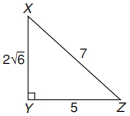
एक समकोण त्रिभुज $XYZ$ में,जो $Y$ पर समकोण है,यदि $XY = 2\sqrt{6}$ और $XZ - YZ = 2$ है,तो $\sec X + \tan X$ का मान ज्ञात कीजिए।
A
$\frac{1}{\sqrt{6}}$
B
$\sqrt{6}$
C
$2\sqrt{6}$
D
$\frac{\sqrt{6}}{2}$
Solution
(B) दिया गया है: $XZ - YZ = 2$ और $XY = 2\sqrt{6}$।
समकोण त्रिभुज $XYZ$ में,पाइथागोरस प्रमेय के अनुसार:
$XY^2 + YZ^2 = XZ^2$
$(2\sqrt{6})^2 = XZ^2 - YZ^2$
$24 = (XZ - YZ)(XZ + YZ)$
चूंकि $XZ - YZ = 2$,इसलिए:
$24 = 2(XZ + YZ)$
$XZ + YZ = 12$
अब,हमारे पास दो रैखिक समीकरण हैं:
$1$) $XZ - YZ = 2$
$2$) $XZ + YZ = 12$
समीकरण $(1)$ और $(2)$ को जोड़ने पर:
$2XZ = 14 \Rightarrow XZ = 7$
समीकरण $(1)$ में $XZ = 7$ रखने पर:
$7 - YZ = 2 \Rightarrow YZ = 5$
अब,कोण $X$ के लिए:
$\sec X = \frac{\text{कर्ण}}{\text{आसन्न भुजा}} = \frac{XZ}{XY} = \frac{7}{2\sqrt{6}}$
$\tan X = \frac{\text{सम्मुख भुजा}}{\text{आसन्न भुजा}} = \frac{YZ}{XY} = \frac{5}{2\sqrt{6}}$
अतः,$\sec X + \tan X = \frac{7}{2\sqrt{6}} + \frac{5}{2\sqrt{6}} = \frac{12}{2\sqrt{6}} = \frac{6}{\sqrt{6}} = \sqrt{6}$।
समकोण त्रिभुज $XYZ$ में,पाइथागोरस प्रमेय के अनुसार:
$XY^2 + YZ^2 = XZ^2$
$(2\sqrt{6})^2 = XZ^2 - YZ^2$
$24 = (XZ - YZ)(XZ + YZ)$
चूंकि $XZ - YZ = 2$,इसलिए:
$24 = 2(XZ + YZ)$
$XZ + YZ = 12$
अब,हमारे पास दो रैखिक समीकरण हैं:
$1$) $XZ - YZ = 2$
$2$) $XZ + YZ = 12$
समीकरण $(1)$ और $(2)$ को जोड़ने पर:
$2XZ = 14 \Rightarrow XZ = 7$
समीकरण $(1)$ में $XZ = 7$ रखने पर:
$7 - YZ = 2 \Rightarrow YZ = 5$
अब,कोण $X$ के लिए:
$\sec X = \frac{\text{कर्ण}}{\text{आसन्न भुजा}} = \frac{XZ}{XY} = \frac{7}{2\sqrt{6}}$
$\tan X = \frac{\text{सम्मुख भुजा}}{\text{आसन्न भुजा}} = \frac{YZ}{XY} = \frac{5}{2\sqrt{6}}$
अतः,$\sec X + \tan X = \frac{7}{2\sqrt{6}} + \frac{5}{2\sqrt{6}} = \frac{12}{2\sqrt{6}} = \frac{6}{\sqrt{6}} = \sqrt{6}$।
0 likes
View Solution641
MediumMCQ
यदि $0^{\circ} < \theta < 90^{\circ}$ है,तो $\sin \theta + \cos \theta$ का मान है
A
$1$ के बराबर
B
$1$ से अधिक
C
$1$ से कम
D
$2$ के बराबर
Solution
(B) माना $Z = \sin \theta + \cos \theta$ है।
दोनों पक्षों का वर्ग करने पर,हमें प्राप्त होता है:
$Z^{2} = (\sin \theta + \cos \theta)^{2} = \sin^{2} \theta + \cos^{2} \theta + 2 \sin \theta \cos \theta$.
चूँकि $\sin^{2} \theta + \cos^{2} \theta = 1$,इसलिए $Z^{2} = 1 + 2 \sin \theta \cos \theta$ है।
$0^{\circ} < \theta < 90^{\circ}$ के लिए,$\sin \theta$ और $\cos \theta$ दोनों धनात्मक होते हैं,इसलिए $2 \sin \theta \cos \theta > 0$ है।
अतः,$Z^{2} = 1 + (\text{एक धनात्मक मान}) > 1$ है।
वर्गमूल लेने पर,$Z > 1$ प्राप्त होता है।
इस प्रकार,$0^{\circ} < \theta < 90^{\circ}$ के लिए $\sin \theta + \cos \theta$ का मान हमेशा $1$ से अधिक होता है।
दोनों पक्षों का वर्ग करने पर,हमें प्राप्त होता है:
$Z^{2} = (\sin \theta + \cos \theta)^{2} = \sin^{2} \theta + \cos^{2} \theta + 2 \sin \theta \cos \theta$.
चूँकि $\sin^{2} \theta + \cos^{2} \theta = 1$,इसलिए $Z^{2} = 1 + 2 \sin \theta \cos \theta$ है।
$0^{\circ} < \theta < 90^{\circ}$ के लिए,$\sin \theta$ और $\cos \theta$ दोनों धनात्मक होते हैं,इसलिए $2 \sin \theta \cos \theta > 0$ है।
अतः,$Z^{2} = 1 + (\text{एक धनात्मक मान}) > 1$ है।
वर्गमूल लेने पर,$Z > 1$ प्राप्त होता है।
इस प्रकार,$0^{\circ} < \theta < 90^{\circ}$ के लिए $\sin \theta + \cos \theta$ का मान हमेशा $1$ से अधिक होता है।
0 likes
View Solution642
MediumMCQ
व्यंजक $\frac{\tan 57^{\circ}+\cot 37^{\circ}}{\tan 33^{\circ}+\cot 53^{\circ}}$ का मान किसके बराबर है?
A
$\tan 33^{\circ} \cot 57^{\circ}$
B
$\tan 57^{\circ} \cot 37^{\circ}$
C
$\tan 33^{\circ} \cot 53^{\circ}$
D
$\tan 53^{\circ} \cot 37^{\circ}$
Solution
(B) दिया गया व्यंजक: $\frac{\tan 57^{\circ}+\cot 37^{\circ}}{\tan 33^{\circ}+\cot 53^{\circ}}$
पूरक कोण सर्वसमिकाओं $\tan(90^{\circ}-\theta) = \cot \theta$ और $\cot(90^{\circ}-\theta) = \tan \theta$ का उपयोग करने पर:
$\tan 57^{\circ} = \tan(90^{\circ}-33^{\circ}) = \cot 33^{\circ}$
$\cot 37^{\circ} = \cot(90^{\circ}-53^{\circ}) = \tan 53^{\circ}$
इन मानों को व्यंजक में प्रतिस्थापित करने पर:
$= \frac{\cot 33^{\circ} + \tan 53^{\circ}}{\tan 33^{\circ} + \cot 53^{\circ}}$
$= \frac{\frac{1}{\tan 33^{\circ}} + \tan 53^{\circ}}{\tan 33^{\circ} + \frac{1}{\tan 53^{\circ}}}$
$= \frac{\frac{1 + \tan 33^{\circ} \tan 53^{\circ}}{\tan 33^{\circ}}}{\frac{\tan 33^{\circ} \tan 53^{\circ} + 1}{\tan 53^{\circ}}}$
$= \frac{1 + \tan 33^{\circ} \tan 53^{\circ}}{\tan 33^{\circ}} \times \frac{\tan 53^{\circ}}{1 + \tan 33^{\circ} \tan 53^{\circ}}$
$= \frac{\tan 53^{\circ}}{\tan 33^{\circ}} = \tan 53^{\circ} \cot 33^{\circ}$
चूंकि $\tan 53^{\circ} = \cot 37^{\circ}$ और $\cot 33^{\circ} = \tan 57^{\circ}$,इसलिए व्यंजक का मान $\tan 57^{\circ} \cot 37^{\circ}$ के बराबर है।
पूरक कोण सर्वसमिकाओं $\tan(90^{\circ}-\theta) = \cot \theta$ और $\cot(90^{\circ}-\theta) = \tan \theta$ का उपयोग करने पर:
$\tan 57^{\circ} = \tan(90^{\circ}-33^{\circ}) = \cot 33^{\circ}$
$\cot 37^{\circ} = \cot(90^{\circ}-53^{\circ}) = \tan 53^{\circ}$
इन मानों को व्यंजक में प्रतिस्थापित करने पर:
$= \frac{\cot 33^{\circ} + \tan 53^{\circ}}{\tan 33^{\circ} + \cot 53^{\circ}}$
$= \frac{\frac{1}{\tan 33^{\circ}} + \tan 53^{\circ}}{\tan 33^{\circ} + \frac{1}{\tan 53^{\circ}}}$
$= \frac{\frac{1 + \tan 33^{\circ} \tan 53^{\circ}}{\tan 33^{\circ}}}{\frac{\tan 33^{\circ} \tan 53^{\circ} + 1}{\tan 53^{\circ}}}$
$= \frac{1 + \tan 33^{\circ} \tan 53^{\circ}}{\tan 33^{\circ}} \times \frac{\tan 53^{\circ}}{1 + \tan 33^{\circ} \tan 53^{\circ}}$
$= \frac{\tan 53^{\circ}}{\tan 33^{\circ}} = \tan 53^{\circ} \cot 33^{\circ}$
चूंकि $\tan 53^{\circ} = \cot 37^{\circ}$ और $\cot 33^{\circ} = \tan 57^{\circ}$,इसलिए व्यंजक का मान $\tan 57^{\circ} \cot 37^{\circ}$ के बराबर है।
0 likes
View Solution643
EasyMCQ
$\sin^{2} \theta + \cos^{2} \theta + \sec^{2} \theta + \operatorname{cosec}^{2} \theta + \tan^{2} \theta + \cot^{2} \theta$ का न्यूनतम मान क्या है?
A
$1$
B
$3$
C
$5$
D
$7$
Solution
(D) माना व्यंजक $E = \sin^{2} \theta + \cos^{2} \theta + \sec^{2} \theta + \operatorname{cosec}^{2} \theta + \tan^{2} \theta + \cot^{2} \theta$ है।
सर्वसमिका $\sin^{2} \theta + \cos^{2} \theta = 1$ का उपयोग करने पर,हमें प्राप्त होता है $E = 1 + \sec^{2} \theta + \operatorname{cosec}^{2} \theta + \tan^{2} \theta + \cot^{2} \theta$.
$\sec^{2} \theta = 1 + \tan^{2} \theta$ और $\operatorname{cosec}^{2} \theta = 1 + \cot^{2} \theta$ का उपयोग करने पर:
$E = 1 + (1 + \tan^{2} \theta) + (1 + \cot^{2} \theta) + \tan^{2} \theta + \cot^{2} \theta$.
$E = 3 + 2(\tan^{2} \theta + \cot^{2} \theta)$.
समांतर माध्य-गुणोत्तर माध्य असमिका के अनुसार,$\tan^{2} \theta + \cot^{2} \theta \ge 2 \sqrt{\tan^{2} \theta \cdot \cot^{2} \theta} = 2(1) = 2$.
अतः,$E$ का न्यूनतम मान $3 + 2(2) = 3 + 4 = 7$ है।
सर्वसमिका $\sin^{2} \theta + \cos^{2} \theta = 1$ का उपयोग करने पर,हमें प्राप्त होता है $E = 1 + \sec^{2} \theta + \operatorname{cosec}^{2} \theta + \tan^{2} \theta + \cot^{2} \theta$.
$\sec^{2} \theta = 1 + \tan^{2} \theta$ और $\operatorname{cosec}^{2} \theta = 1 + \cot^{2} \theta$ का उपयोग करने पर:
$E = 1 + (1 + \tan^{2} \theta) + (1 + \cot^{2} \theta) + \tan^{2} \theta + \cot^{2} \theta$.
$E = 3 + 2(\tan^{2} \theta + \cot^{2} \theta)$.
समांतर माध्य-गुणोत्तर माध्य असमिका के अनुसार,$\tan^{2} \theta + \cot^{2} \theta \ge 2 \sqrt{\tan^{2} \theta \cdot \cot^{2} \theta} = 2(1) = 2$.
अतः,$E$ का न्यूनतम मान $3 + 2(2) = 3 + 4 = 7$ है।
0 likes
View Solution644
MediumMCQ
यदि $2 \sin \left(\frac{\pi}{2}\right) = x^{2} + \frac{1}{x^{2}}$ है,तो $\left(x - \frac{1}{x}\right)$ का मान ज्ञात कीजिए।
A
$-1$
B
$2$
C
$1$
D
$0$
Solution
(D) दिया गया समीकरण: $2 \sin \left(\frac{\pi}{2}\right) = x^{2} + \frac{1}{x^{2}}$.
चूंकि $\sin \left(\frac{\pi}{2}\right) = 1$,इसलिए समीकरण $2(1) = x^{2} + \frac{1}{x^{2}}$ हो जाता है,जिसे सरल करने पर $x^{2} + \frac{1}{x^{2}} = 2$ प्राप्त होता है।
हम सर्वसमिका $(x - \frac{1}{x})^{2} = x^{2} + \frac{1}{x^{2}} - 2$ जानते हैं।
इस सर्वसमिका में $x^{2} + \frac{1}{x^{2}} = 2$ का मान रखने पर,हमें $(x - \frac{1}{x})^{2} = 2 - 2 = 0$ प्राप्त होता है।
अतः,$x - \frac{1}{x} = 0$ है।
चूंकि $\sin \left(\frac{\pi}{2}\right) = 1$,इसलिए समीकरण $2(1) = x^{2} + \frac{1}{x^{2}}$ हो जाता है,जिसे सरल करने पर $x^{2} + \frac{1}{x^{2}} = 2$ प्राप्त होता है।
हम सर्वसमिका $(x - \frac{1}{x})^{2} = x^{2} + \frac{1}{x^{2}} - 2$ जानते हैं।
इस सर्वसमिका में $x^{2} + \frac{1}{x^{2}} = 2$ का मान रखने पर,हमें $(x - \frac{1}{x})^{2} = 2 - 2 = 0$ प्राप्त होता है।
अतः,$x - \frac{1}{x} = 0$ है।
0 likes
View Solution645
MediumMCQ
यदि $\sin ^{2} \alpha+\sin ^{2} \beta=2$ है,तो $\cos \left(\frac{\alpha+\beta}{2}\right)$ का मान क्या है?
A
$1$
B
$-1$
C
$0$
D
$0.5$
Solution
(C) दिया गया है कि $\sin ^{2} \alpha+\sin ^{2} \beta=2$ है।
चूंकि $\sin ^{2} \theta$ का अधिकतम मान $1$ होता है,इसलिए समीकरण $\sin ^{2} \alpha+\sin ^{2} \beta=2$ तभी संभव है जब $\sin ^{2} \alpha=1$ और $\sin ^{2} \beta=1$ हो।
इसका अर्थ है कि $\sin \alpha = \pm 1$ और $\sin \beta = \pm 1$ है।
$\sin ^{2} \alpha=1$ के लिए,$\alpha = \frac{\pi}{2}, \frac{3\pi}{2}, \dots$ और $\sin ^{2} \beta=1$ के लिए,$\beta = \frac{\pi}{2}, \frac{3\pi}{2}, \dots$ प्राप्त होता है।
मुख्य मान लेने पर,$\alpha = \frac{\pi}{2}$ और $\beta = \frac{\pi}{2}$ प्राप्त होता है।
इन मानों को व्यंजक में रखने पर:
$\cos \left(\frac{\alpha+\beta}{2}\right) = \cos \left(\frac{\frac{\pi}{2}+\frac{\pi}{2}}{2}\right) = \cos \left(\frac{\pi}{2}\right) = 0$।
चूंकि $\sin ^{2} \theta$ का अधिकतम मान $1$ होता है,इसलिए समीकरण $\sin ^{2} \alpha+\sin ^{2} \beta=2$ तभी संभव है जब $\sin ^{2} \alpha=1$ और $\sin ^{2} \beta=1$ हो।
इसका अर्थ है कि $\sin \alpha = \pm 1$ और $\sin \beta = \pm 1$ है।
$\sin ^{2} \alpha=1$ के लिए,$\alpha = \frac{\pi}{2}, \frac{3\pi}{2}, \dots$ और $\sin ^{2} \beta=1$ के लिए,$\beta = \frac{\pi}{2}, \frac{3\pi}{2}, \dots$ प्राप्त होता है।
मुख्य मान लेने पर,$\alpha = \frac{\pi}{2}$ और $\beta = \frac{\pi}{2}$ प्राप्त होता है।
इन मानों को व्यंजक में रखने पर:
$\cos \left(\frac{\alpha+\beta}{2}\right) = \cos \left(\frac{\frac{\pi}{2}+\frac{\pi}{2}}{2}\right) = \cos \left(\frac{\pi}{2}\right) = 0$।
0 likes
View Solution646
DifficultMCQ
$\cot \frac{\pi}{20} \cot \frac{3 \pi}{20} \cot \frac{5 \pi}{20} \cot \frac{7 \pi}{20} \cot \frac{9 \pi}{20}$ का मान है
A
$-1$
B
$\frac{1}{2}$
C
$0$
D
$1$
Solution
(D) दी गई व्यंजक: $\cot \frac{\pi}{20} \cdot \cot \frac{3 \pi}{20} \cdot \cot \frac{5 \pi}{20} \cdot \cot \frac{7 \pi}{20} \cdot \cot \frac{9 \pi}{20}$
चूँकि $\pi = 180^{\circ}$,इसलिए:
$= \cot 9^{\circ} \cdot \cot 27^{\circ} \cdot \cot 45^{\circ} \cdot \cot 63^{\circ} \cdot \cot 81^{\circ}$
सर्वसमिका $\cot(90^{\circ} - \theta) = \tan \theta$ का उपयोग करने पर:
$= \cot 9^{\circ} \cdot \cot 27^{\circ} \cdot \cot 45^{\circ} \cdot \cot(90^{\circ} - 27^{\circ}) \cdot \cot(90^{\circ} - 9^{\circ})$
$= \cot 9^{\circ} \cdot \cot 27^{\circ} \cdot \cot 45^{\circ} \cdot \tan 27^{\circ} \cdot \tan 9^{\circ}$
चूँकि $\tan \theta \cdot \cot \theta = 1$:
$= (\cot 9^{\circ} \cdot \tan 9^{\circ}) \cdot (\cot 27^{\circ} \cdot \tan 27^{\circ}) \cdot \cot 45^{\circ}$
$= 1 \cdot 1 \cdot 1 = 1$
चूँकि $\pi = 180^{\circ}$,इसलिए:
$= \cot 9^{\circ} \cdot \cot 27^{\circ} \cdot \cot 45^{\circ} \cdot \cot 63^{\circ} \cdot \cot 81^{\circ}$
सर्वसमिका $\cot(90^{\circ} - \theta) = \tan \theta$ का उपयोग करने पर:
$= \cot 9^{\circ} \cdot \cot 27^{\circ} \cdot \cot 45^{\circ} \cdot \cot(90^{\circ} - 27^{\circ}) \cdot \cot(90^{\circ} - 9^{\circ})$
$= \cot 9^{\circ} \cdot \cot 27^{\circ} \cdot \cot 45^{\circ} \cdot \tan 27^{\circ} \cdot \tan 9^{\circ}$
चूँकि $\tan \theta \cdot \cot \theta = 1$:
$= (\cot 9^{\circ} \cdot \tan 9^{\circ}) \cdot (\cot 27^{\circ} \cdot \tan 27^{\circ}) \cdot \cot 45^{\circ}$
$= 1 \cdot 1 \cdot 1 = 1$
0 likes
View Solution647
DifficultMCQ
यदि $\sin \theta + \cos \theta = \frac{17}{13}, 0 < \theta < 90^{\circ}$ है,तो $\sin \theta - \cos \theta$ का मान ज्ञात कीजिए।
A
$\frac{5}{17}$
B
$\frac{3}{19}$
C
$\frac{7}{10}$
D
$\frac{7}{13}$
Solution
(D) दिया गया है: $\sin \theta + \cos \theta = \frac{17}{13}$ ..... $(1)$
माना $\sin \theta - \cos \theta = x$ ..... $(2)$
दोनों समीकरणों का वर्ग करने पर:
$(\sin \theta + \cos \theta)^2 = (\frac{17}{13})^2 \Rightarrow \sin^2 \theta + \cos^2 \theta + 2 \sin \theta \cos \theta = \frac{289}{169}$
चूंकि $\sin^2 \theta + \cos^2 \theta = 1$,इसलिए $1 + 2 \sin \theta \cos \theta = \frac{289}{169} \Rightarrow 2 \sin \theta \cos \theta = \frac{289}{169} - 1 = \frac{120}{169}$ ..... $(3)$
अब,$x^2 = (\sin \theta - \cos \theta)^2 = \sin^2 \theta + \cos^2 \theta - 2 \sin \theta \cos \theta$
$x^2 = 1 - 2 \sin \theta \cos \theta$
समीकरण $(3)$ से मान प्रतिस्थापित करने पर:
$x^2 = 1 - \frac{120}{169} = \frac{169 - 120}{169} = \frac{49}{169}$
$x = \pm \sqrt{\frac{49}{169}} = \pm \frac{7}{13}$
चूंकि $0 < \theta < 90^{\circ}$ है,इसलिए सही मान $\frac{7}{13}$ है।
माना $\sin \theta - \cos \theta = x$ ..... $(2)$
दोनों समीकरणों का वर्ग करने पर:
$(\sin \theta + \cos \theta)^2 = (\frac{17}{13})^2 \Rightarrow \sin^2 \theta + \cos^2 \theta + 2 \sin \theta \cos \theta = \frac{289}{169}$
चूंकि $\sin^2 \theta + \cos^2 \theta = 1$,इसलिए $1 + 2 \sin \theta \cos \theta = \frac{289}{169} \Rightarrow 2 \sin \theta \cos \theta = \frac{289}{169} - 1 = \frac{120}{169}$ ..... $(3)$
अब,$x^2 = (\sin \theta - \cos \theta)^2 = \sin^2 \theta + \cos^2 \theta - 2 \sin \theta \cos \theta$
$x^2 = 1 - 2 \sin \theta \cos \theta$
समीकरण $(3)$ से मान प्रतिस्थापित करने पर:
$x^2 = 1 - \frac{120}{169} = \frac{169 - 120}{169} = \frac{49}{169}$
$x = \pm \sqrt{\frac{49}{169}} = \pm \frac{7}{13}$
चूंकि $0 < \theta < 90^{\circ}$ है,इसलिए सही मान $\frac{7}{13}$ है।
0 likes
View Solution648
DifficultMCQ
यदि $\tan \theta \cdot \tan 2 \theta = 1$ है,तो $\sin ^{2} 2 \theta + \tan ^{2} 2 \theta$ का मान ज्ञात कीजिए।
A
$\frac{3}{4}$
B
$\frac{10}{3}$
C
$3 \frac{3}{4}$
D
$3$
Solution
(C) दिया गया है कि $\tan \theta \cdot \tan 2 \theta = 1.$
इसका अर्थ है कि $\tan \theta = \frac{1}{\tan 2 \theta} = \cot 2 \theta.$
हम $\cot 2 \theta$ को $\tan(90^{\circ} - 2 \theta)$ के रूप में लिख सकते हैं।
अतः,$\tan \theta = \tan(90^{\circ} - 2 \theta).$
कोणों की तुलना करने पर,$\theta = 90^{\circ} - 2 \theta \Rightarrow 3 \theta = 90^{\circ} \Rightarrow \theta = 30^{\circ}.$
अब,$\theta = 30^{\circ}$ का मान $\sin ^{2} 2 \theta + \tan ^{2} 2 \theta$ में रखने पर।
यह पद $\sin ^{2} 60^{\circ} + \tan ^{2} 60^{\circ}$ बन जाता है।
चूंकि $\sin 60^{\circ} = \frac{\sqrt{3}}{2}$ और $\tan 60^{\circ} = \sqrt{3},$
इसलिए हमें $(\frac{\sqrt{3}}{2})^{2} + (\sqrt{3})^{2} = \frac{3}{4} + 3 = 3 \frac{3}{4}$ प्राप्त होता है।
इसका अर्थ है कि $\tan \theta = \frac{1}{\tan 2 \theta} = \cot 2 \theta.$
हम $\cot 2 \theta$ को $\tan(90^{\circ} - 2 \theta)$ के रूप में लिख सकते हैं।
अतः,$\tan \theta = \tan(90^{\circ} - 2 \theta).$
कोणों की तुलना करने पर,$\theta = 90^{\circ} - 2 \theta \Rightarrow 3 \theta = 90^{\circ} \Rightarrow \theta = 30^{\circ}.$
अब,$\theta = 30^{\circ}$ का मान $\sin ^{2} 2 \theta + \tan ^{2} 2 \theta$ में रखने पर।
यह पद $\sin ^{2} 60^{\circ} + \tan ^{2} 60^{\circ}$ बन जाता है।
चूंकि $\sin 60^{\circ} = \frac{\sqrt{3}}{2}$ और $\tan 60^{\circ} = \sqrt{3},$
इसलिए हमें $(\frac{\sqrt{3}}{2})^{2} + (\sqrt{3})^{2} = \frac{3}{4} + 3 = 3 \frac{3}{4}$ प्राप्त होता है।
0 likes
View SolutionTrigonometry — Trigonometry · Frequently Asked Questions
1Are these Trigonometry questions useful for JEE and NEET?
Yes. All questions in this section are mapped to JEE Main and NEET exam patterns. Previous year questions from JEE Main, NEET, GUJCET and state-level exams are included with full solutions.
2Can I switch to Hindi or Gujarati for these questions?
Yes. Use the language tabs in the hero section or the sidebar to view the same questions and solutions in English, Hindi or Gujarati.
3How do I generate a question paper from this subtopic?
Use the Vedclass Exam Paper Generator — select the chapter and subtopic, set difficulty, and generate Sets A, B, C, D automatically. First 3 chapters of every subject are free.
Vedclass Products
For Students
Vedclass Test Series
Mock tests in real JEE/NEET style with performance analysis. 5-day free trial.
Start Free TrialFor Teachers
Exam Paper Generator
Generate Set A/B/C/D papers from this chapter in 2 minutes. 3 chapters free.
Try FreeFor Institutes
Online Exam Module
Live online exams with unlimited students, 360° analytics & white-label branding.
See DemoFor Teachers & Institutes
Generate a Trigonometry Exam Paper in 2 Minutes
Select subtopic & difficulty — Sets A, B, C, D auto-generated with No Repeat logic.
First 3 chapters of every subject are free — no payment required.