
A English
Motion of Charged Particle In Magnetic Field Questions in English
Class 12 Physics · Moving Charges and Magnetism · Motion of Charged Particle In Magnetic Field
513+
Questions
English
Language
100%
With Solutions
Showing 50 of 513 questions in English
101
EasyMCQ
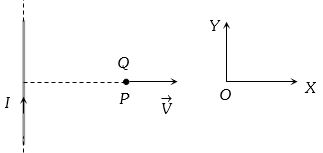
$A$ very long straight wire carries a current $I$. At the instant when a charge $+Q$ at point $P$ has velocity $\vec{V}$,as shown,the force on the charge is
A
Opposite to $OX$
B
Along $OX$
C
Opposite to $OY$
D
Along $OY$
Solution
(D) $1$. According to the right-hand thumb rule,the magnetic field $\vec{B}$ produced by the current-carrying wire at point $P$ is directed perpendicular to the plane of the paper and inwards (into the page).
$2$. The force $\vec{F}$ on a moving charge $+Q$ in a magnetic field is given by the Lorentz force formula: $\vec{F} = Q(\vec{V} \times \vec{B})$.
$3$. Here,the velocity $\vec{V}$ is along the positive $X$-axis (to the right) and the magnetic field $\vec{B}$ is directed inwards (into the page,represented by $-\hat{k}$ direction).
$4$. Using the right-hand rule for the cross product $\vec{V} \times \vec{B}$,where $\vec{V}$ is along $\hat{i}$ and $\vec{B}$ is along $-\hat{k}$,the direction of the force is $\hat{i} \times (-\hat{k}) = -(\hat{i} \times \hat{k}) = -(-\hat{j}) = \hat{j}$.
$5$. This corresponds to the positive $Y$-axis direction,which is along $OY$.
$2$. The force $\vec{F}$ on a moving charge $+Q$ in a magnetic field is given by the Lorentz force formula: $\vec{F} = Q(\vec{V} \times \vec{B})$.
$3$. Here,the velocity $\vec{V}$ is along the positive $X$-axis (to the right) and the magnetic field $\vec{B}$ is directed inwards (into the page,represented by $-\hat{k}$ direction).
$4$. Using the right-hand rule for the cross product $\vec{V} \times \vec{B}$,where $\vec{V}$ is along $\hat{i}$ and $\vec{B}$ is along $-\hat{k}$,the direction of the force is $\hat{i} \times (-\hat{k}) = -(\hat{i} \times \hat{k}) = -(-\hat{j}) = \hat{j}$.
$5$. This corresponds to the positive $Y$-axis direction,which is along $OY$.
0 likes
View Solution102
EasyMCQ
The electrons in the beam of a television tube move horizontally from south to north. The vertical component of the Earth's magnetic field points down. The electron is deflected towards:
A
West
B
No deflection
C
East
D
North to south
Solution
(C) The force on a moving charge in a magnetic field is given by the Lorentz force formula: $\vec{F} = q(\vec{v} \times \vec{B})$.
Here,the velocity $\vec{v}$ of the electron is directed from south to north.
The magnetic field $\vec{B}$ is directed vertically downwards.
According to the right-hand rule for the cross product $\vec{v} \times \vec{B}$,the direction of $\vec{v} \times \vec{B}$ is towards the west.
Since the electron has a negative charge $(q = -e)$,the force $\vec{F} = -e(\vec{v} \times \vec{B})$ will be in the opposite direction of $\vec{v} \times \vec{B}$.
Therefore,the force on the electron is towards the east.
Alternatively,using Fleming's Left-Hand Rule for a negative charge,the force is directed towards the east.
Here,the velocity $\vec{v}$ of the electron is directed from south to north.
The magnetic field $\vec{B}$ is directed vertically downwards.
According to the right-hand rule for the cross product $\vec{v} \times \vec{B}$,the direction of $\vec{v} \times \vec{B}$ is towards the west.
Since the electron has a negative charge $(q = -e)$,the force $\vec{F} = -e(\vec{v} \times \vec{B})$ will be in the opposite direction of $\vec{v} \times \vec{B}$.
Therefore,the force on the electron is towards the east.
Alternatively,using Fleming's Left-Hand Rule for a negative charge,the force is directed towards the east.
0 likes
View Solution103
EasyMCQ
An electric field of $1500\, V/m$ and a magnetic field of $0.40\, Wb/m^2$ act on a moving electron. The minimum uniform speed along a straight line the electron could have is
A
$1.6 \times 10^{15}\, m/s$
B
$6 \times 10^{-16}\, m/s$
C
$3.75 \times 10^{3}\, m/s$
D
$3.75 \times 10^{2}\, m/s$
Solution
(C) For an electron to move in a straight line through crossed electric and magnetic fields,the net Lorentz force must be zero.
This occurs when the electric force $F_E = qE$ is balanced by the magnetic force $F_B = qvB$.
Setting $F_E = F_B$,we get $qE = qvB$.
Solving for the velocity $v$,we have $v = \frac{E}{B}$.
Given $E = 1500\, V/m$ and $B = 0.40\, Wb/m^2$,the speed is $v = \frac{1500}{0.40} = 3750\, m/s$.
This can be expressed in scientific notation as $3.75 \times 10^3\, m/s$.
This occurs when the electric force $F_E = qE$ is balanced by the magnetic force $F_B = qvB$.
Setting $F_E = F_B$,we get $qE = qvB$.
Solving for the velocity $v$,we have $v = \frac{E}{B}$.
Given $E = 1500\, V/m$ and $B = 0.40\, Wb/m^2$,the speed is $v = \frac{1500}{0.40} = 3750\, m/s$.
This can be expressed in scientific notation as $3.75 \times 10^3\, m/s$.
0 likes
View Solution104
EasyMCQ
An electron,moving in a uniform magnetic field of induction of intensity $\vec{B}$,has its radius directly proportional to
A
Its charge
B
Magnetic field
C
Speed
D
None of these
Solution
(C) When a charged particle moves in a uniform magnetic field,the magnetic Lorentz force provides the necessary centripetal force for circular motion.
$F_m = F_c$
$qvB = \frac{mv^2}{r}$
Rearranging for the radius $r$:
$r = \frac{mv}{qB}$
Since $m$,$q$,and $B$ are constants for a given electron in a uniform magnetic field,we have:
$r \propto v$
Therefore,the radius is directly proportional to the speed of the electron.
$F_m = F_c$
$qvB = \frac{mv^2}{r}$
Rearranging for the radius $r$:
$r = \frac{mv}{qB}$
Since $m$,$q$,and $B$ are constants for a given electron in a uniform magnetic field,we have:
$r \propto v$
Therefore,the radius is directly proportional to the speed of the electron.
0 likes
View Solution105
EasyMCQ
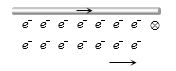
$A$ stream of electrons is projected horizontally to the right. $A$ straight conductor carrying a current is supported parallel to the electron stream and above it. If the current in the conductor is from left to right,then what will be the effect on the electron stream?
A
The electron stream will be pulled upward.
B
The electron stream will be pulled downward.
C
The electron stream will be retarded.
D
The electron beam will be speeded up towards the right.
Solution
(B) $1$. According to the right-hand thumb rule,the magnetic field produced by the current-carrying conductor at the position of the electron stream (below the conductor) is directed into the plane of the paper.
$2$. The electrons are moving to the right. The force on a moving charge $q$ in a magnetic field $B$ is given by the Lorentz force formula $F = q(v \times B)$.
$3$. Since the charge of an electron is negative $(q = -e)$,the direction of the force is opposite to the direction of $(v \times B)$.
$4$. Using the right-hand rule for the cross product $(v \times B)$,where $v$ is to the right and $B$ is into the page,the direction of $(v \times B)$ is upward.
$5$. Therefore,the force on the electrons is downward. Alternatively,using Fleming's left-hand rule for negative charges,the force is directed downward.
$2$. The electrons are moving to the right. The force on a moving charge $q$ in a magnetic field $B$ is given by the Lorentz force formula $F = q(v \times B)$.
$3$. Since the charge of an electron is negative $(q = -e)$,the direction of the force is opposite to the direction of $(v \times B)$.
$4$. Using the right-hand rule for the cross product $(v \times B)$,where $v$ is to the right and $B$ is into the page,the direction of $(v \times B)$ is upward.
$5$. Therefore,the force on the electrons is downward. Alternatively,using Fleming's left-hand rule for negative charges,the force is directed downward.
0 likes
View Solution106
MediumMCQ
${H^ + },\,H{e^ + }$ and ${O^{ + + }}$ ions having same kinetic energy pass through a region of space filled with a uniform magnetic field $B$ directed perpendicular to the velocity of the ions. The masses of the ions ${H^ + },\,H{e^ + }$ and ${O^{ + + }}$ are respectively in the ratio $1:4:16$. As a result:
A
${H^ + }$ ions will be deflected most
B
${O^{ + + }}$ ions will be deflected least
C
$H{e^ + }$ and ${O^{ + + }}$ ions will suffer same deflection
D
Both $(a)$ and $(c)$
Solution
(D) The radius of the circular path of a charged particle in a magnetic field is given by $r = \frac{mv}{qB}$.
Since kinetic energy $K = \frac{1}{2}mv^2$,we have $v = \sqrt{\frac{2K}{m}}$.
Substituting $v$ into the radius formula: $r = \frac{m}{qB} \sqrt{\frac{2K}{m}} = \frac{\sqrt{2mK}}{qB}$.
Since $K$ and $B$ are constant,$r \propto \frac{\sqrt{m}}{q}$.
Given mass ratios $m_H:m_{He}:m_O = 1:4:16$ and charges $q_H=1, q_{He}=1, q_O=2$ (in units of $e$):
$r_H \propto \frac{\sqrt{1}}{1} = 1$
$r_{He} \propto \frac{\sqrt{4}}{1} = 2$
$r_O \propto \frac{\sqrt{16}}{2} = \frac{4}{2} = 2$
Thus,the ratio of radii is $r_H:r_{He}:r_O = 1:2:2$.
Since deflection is inversely proportional to the radius $(d \propto 1/r)$,the ion with the smallest radius $(H^+)$ is deflected the most,and $He^+$ and $O^{++}$ have the same radius,hence the same deflection. Therefore,both $(a)$ and $(c)$ are correct.
Since kinetic energy $K = \frac{1}{2}mv^2$,we have $v = \sqrt{\frac{2K}{m}}$.
Substituting $v$ into the radius formula: $r = \frac{m}{qB} \sqrt{\frac{2K}{m}} = \frac{\sqrt{2mK}}{qB}$.
Since $K$ and $B$ are constant,$r \propto \frac{\sqrt{m}}{q}$.
Given mass ratios $m_H:m_{He}:m_O = 1:4:16$ and charges $q_H=1, q_{He}=1, q_O=2$ (in units of $e$):
$r_H \propto \frac{\sqrt{1}}{1} = 1$
$r_{He} \propto \frac{\sqrt{4}}{1} = 2$
$r_O \propto \frac{\sqrt{16}}{2} = \frac{4}{2} = 2$
Thus,the ratio of radii is $r_H:r_{He}:r_O = 1:2:2$.
Since deflection is inversely proportional to the radius $(d \propto 1/r)$,the ion with the smallest radius $(H^+)$ is deflected the most,and $He^+$ and $O^{++}$ have the same radius,hence the same deflection. Therefore,both $(a)$ and $(c)$ are correct.
0 likes
View Solution107
MediumMCQ
An ionized gas contains both positive and negative ions. If it is subjected simultaneously to an electric field along the $+x$ direction and a magnetic field along the $+z$ direction,then
A
Positive ions deflect towards $+y$ direction and negative ions towards $-y$ direction
B
All ions deflect towards $+y$ direction
C
All ions deflect towards $-y$ direction
D
Positive ions deflect towards $-y$ direction and negative ions towards $+y$ direction
Solution
(C) The electric field $\vec{E}$ is along the $+x$ direction. Positive ions experience an electric force $\vec{F}_e = q\vec{E}$ along the $+x$ direction,while negative ions experience an electric force along the $-x$ direction.
As a result,positive ions acquire a velocity $\vec{v}$ in the $+x$ direction,and negative ions acquire a velocity $\vec{v}$ in the $-x$ direction.
The magnetic field $\vec{B}$ is along the $+z$ direction.
The magnetic force on a charged particle is given by $\vec{F}_m = q(\vec{v} \times \vec{B})$.
For positive ions: $\vec{F}_m = (+q)(v\hat{i} \times B\hat{k}) = -qvB\hat{j}$,which is in the $-y$ direction.
For negative ions: $\vec{F}_m = (-q)(-v\hat{i} \times B\hat{k}) = (-q)(-vB(-\hat{j})) = -qvB\hat{j}$,which is also in the $-y$ direction.
Thus,both types of ions deflect towards the $-y$ direction.
As a result,positive ions acquire a velocity $\vec{v}$ in the $+x$ direction,and negative ions acquire a velocity $\vec{v}$ in the $-x$ direction.
The magnetic field $\vec{B}$ is along the $+z$ direction.
The magnetic force on a charged particle is given by $\vec{F}_m = q(\vec{v} \times \vec{B})$.
For positive ions: $\vec{F}_m = (+q)(v\hat{i} \times B\hat{k}) = -qvB\hat{j}$,which is in the $-y$ direction.
For negative ions: $\vec{F}_m = (-q)(-v\hat{i} \times B\hat{k}) = (-q)(-vB(-\hat{j})) = -qvB\hat{j}$,which is also in the $-y$ direction.
Thus,both types of ions deflect towards the $-y$ direction.
0 likes
View Solution108
DifficultMCQ
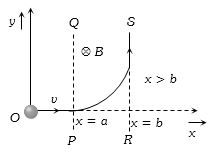
$A$ particle of mass $m$ and charge $q$ moves with a constant velocity $v$ along the positive $x$ direction. It enters a region containing a uniform magnetic field $B$ directed along the negative $z$ direction,extending from $x = a$ to $x = b$. The minimum value of $v$ required so that the particle can just enter the region $x > b$ is
A
$qbB/m$
B
$q(b - a)B/m$
C
$qaB/m$
D
$q(b + a)B/2m$
Solution
(B) The particle moves in a straight line until it reaches $x = a$. Upon entering the magnetic field region $(a \le x \le b)$,the magnetic force acts as a centripetal force,causing the particle to move in a circular path of radius $r = \frac{mv}{qB}$.
For the particle to just reach the region $x > b$,the radius of the circular path must be at least equal to the width of the magnetic field region,which is $(b - a)$.
Therefore,the condition is $r \ge (b - a)$.
Substituting the expression for $r$,we get $\frac{mv}{qB} \ge (b - a)$.
Solving for $v$,we find $v \ge \frac{q(b - a)B}{m}$.
Thus,the minimum velocity required is $v_{\min} = \frac{q(b - a)B}{m}$.
For the particle to just reach the region $x > b$,the radius of the circular path must be at least equal to the width of the magnetic field region,which is $(b - a)$.
Therefore,the condition is $r \ge (b - a)$.
Substituting the expression for $r$,we get $\frac{mv}{qB} \ge (b - a)$.
Solving for $v$,we find $v \ge \frac{q(b - a)B}{m}$.
Thus,the minimum velocity required is $v_{\min} = \frac{q(b - a)B}{m}$.
0 likes
View Solution109
DifficultMCQ
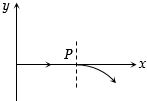
For a positively charged particle moving in a $x-y$ plane initially along the $x$-axis,there is a sudden change in its path due to the presence of electric and/or magnetic fields beyond $P$. The curved path is shown in the $x-y$ plane and is found to be non-circular. Which one of the following combinations is possible?
A
$\overrightarrow E = 0; \overrightarrow B = b\hat i + c\hat k$
B
$\overrightarrow E = a\hat i; \overrightarrow B = c\hat k + a\hat i$
C
$\overrightarrow E = 0; \overrightarrow B = c\hat j + b\hat k$
D
$\overrightarrow E = a\hat i; \overrightarrow B = c\hat k + b\hat j$
Solution
(B) The particle moves in the $x-y$ plane. For the motion to remain in the $x-y$ plane,the net force $\overrightarrow F_{net} = q(\overrightarrow E + \overrightarrow v \times \overrightarrow B)$ must have no component along the $z$-axis.
Initial velocity is $\overrightarrow v = v\hat i$.
In option $(d)$,$\overrightarrow F_{net} = q(a\hat i) + q(v\hat i \times (c\hat k + b\hat j)) = qa\hat i - qvc\hat j + qvb\hat k$. The presence of a $z$-component $(qvb\hat k)$ forces the particle out of the $x-y$ plane,so $(d)$ is incorrect.
In option $(b)$,$\overrightarrow F_{net} = q(a\hat i) + q(v\hat i \times (c\hat k + a\hat i)) = qa\hat i - qvc\hat j$. Here,the force has only $x$ and $y$ components,keeping the particle in the $x-y$ plane. The path is non-circular because the electric field changes the speed of the particle. Thus,option $(b)$ is the correct combination.
Initial velocity is $\overrightarrow v = v\hat i$.
In option $(d)$,$\overrightarrow F_{net} = q(a\hat i) + q(v\hat i \times (c\hat k + b\hat j)) = qa\hat i - qvc\hat j + qvb\hat k$. The presence of a $z$-component $(qvb\hat k)$ forces the particle out of the $x-y$ plane,so $(d)$ is incorrect.
In option $(b)$,$\overrightarrow F_{net} = q(a\hat i) + q(v\hat i \times (c\hat k + a\hat i)) = qa\hat i - qvc\hat j$. Here,the force has only $x$ and $y$ components,keeping the particle in the $x-y$ plane. The path is non-circular because the electric field changes the speed of the particle. Thus,option $(b)$ is the correct combination.
0 likes
View Solution110
DifficultMCQ
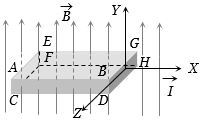
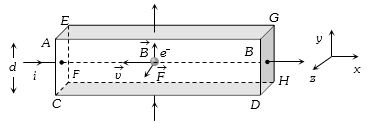
$A$ metallic block carrying current $I$ is subjected to a uniform magnetic induction $\overrightarrow{B}$ as shown in the figure. The moving charges experience a force $\overrightarrow{F}$ given by ........... which results in the lowering of the potential of the face ........ Assume the speed of the carriers to be $v$.
A
$evB\,\hat{k}$,$ABCD$
B
$evB\,\hat{k}$,$EFGH$
C
$-evB\,\hat{k}$,$ABCD$
D
$-evB\,\hat{k}$,$EFGH$
Solution
(A) Since the block is metallic,the charge carriers are electrons. For a current $I$ along the positive $x$-axis,the electrons move along the negative $x$-axis,i.e.,$\overrightarrow{v} = -v\hat{i}$.
The magnetic field is along the $y$-axis,i.e.,$\overrightarrow{B} = B\hat{j}$.
The Lorentz force is given by $\overrightarrow{F} = q(\overrightarrow{v} \times \overrightarrow{B})$.
Substituting the values,$\overrightarrow{F} = (-e)(-v\hat{i} \times B\hat{j}) = evB(\hat{i} \times \hat{j}) = evB\hat{k}$.
Since the force on the electrons is in the positive $z$-direction,they accumulate on the face $ABCD$ (as per the coordinate system shown in the figure). The accumulation of negative charges on face $ABCD$ results in the lowering of its potential.
The magnetic field is along the $y$-axis,i.e.,$\overrightarrow{B} = B\hat{j}$.
The Lorentz force is given by $\overrightarrow{F} = q(\overrightarrow{v} \times \overrightarrow{B})$.
Substituting the values,$\overrightarrow{F} = (-e)(-v\hat{i} \times B\hat{j}) = evB(\hat{i} \times \hat{j}) = evB\hat{k}$.
Since the force on the electrons is in the positive $z$-direction,they accumulate on the face $ABCD$ (as per the coordinate system shown in the figure). The accumulation of negative charges on face $ABCD$ results in the lowering of its potential.
0 likes
View Solution111
MediumMCQ
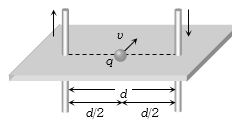
Two very long,straight,and parallel wires carry steady currents $I$ and $I$ respectively in opposite directions. The distance between the wires is $d$. At a certain instant of time,a point charge $q$ is at a point equidistant from the two wires in the plane of the wires. Its instantaneous velocity $v$ is perpendicular to this plane. The magnitude of the force due to the magnetic field acting on the charge at this instant is
A
$\frac{\mu_0 I q v}{2\pi d}$
B
$\frac{\mu_0 I q v}{\pi d}$
C
$\frac{2\mu_0 I q v}{\pi d}$
D
$0$
Solution
(D) Let the two wires be placed in the $xy$-plane,parallel to the $y$-axis,at $x = -d/2$ and $x = d/2$. The currents are in opposite directions (e.g.,$+I$ in the $y$-direction and $-I$ in the $y$-direction).
At the midpoint (origin),the magnetic field $B_1$ due to the first wire is directed into the plane ($-z$ direction),and the magnetic field $B_2$ due to the second wire is also directed into the plane ($-z$ direction).
The resultant magnetic field $B = B_1 + B_2$ is perpendicular to the plane of the wires (along the $-z$ direction).
The velocity $v$ of the charge $q$ is given as perpendicular to the plane of the wires (along the $z$ direction).
The magnetic force on a moving charge is given by $F = q(v \times B)$.
Since the velocity vector $v$ and the magnetic field vector $B$ are collinear (both along the $z$-axis),the cross product $v \times B = 0$.
Therefore,the magnitude of the magnetic force acting on the charge is $0$.
At the midpoint (origin),the magnetic field $B_1$ due to the first wire is directed into the plane ($-z$ direction),and the magnetic field $B_2$ due to the second wire is also directed into the plane ($-z$ direction).
The resultant magnetic field $B = B_1 + B_2$ is perpendicular to the plane of the wires (along the $-z$ direction).
The velocity $v$ of the charge $q$ is given as perpendicular to the plane of the wires (along the $z$ direction).
The magnetic force on a moving charge is given by $F = q(v \times B)$.
Since the velocity vector $v$ and the magnetic field vector $B$ are collinear (both along the $z$-axis),the cross product $v \times B = 0$.
Therefore,the magnitude of the magnetic force acting on the charge is $0$.
0 likes
View Solution112
DifficultMCQ
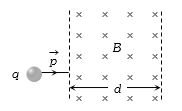
$A$ particle with charge $q$,moving with a momentum $p$,enters a uniform magnetic field normally. The magnetic field has magnitude $B$ and is confined to a region of width $d$,where $d < \frac{p}{Bq}$. The particle is deflected by an angle $\theta$ in crossing the field.
A
$\sin \theta = \frac{Bqd}{p}$
B
$\sin \theta = \frac{p}{Bqd}$
C
$\sin \theta = \frac{Bp}{qd}$
D
$\sin \theta = \frac{pd}{Bq}$
Solution
(A) When a charged particle enters a uniform magnetic field perpendicularly,it follows a circular path of radius $r = \frac{mv}{qB} = \frac{p}{qB}$.
From the geometry of the path,the particle travels a horizontal distance $d$ within the magnetic field region.
In the right-angled triangle formed by the radius $r$,the horizontal distance $d$,and the deflection angle $\theta$,we have $\sin \theta = \frac{d}{r}$.
Substituting the value of $r$,we get $\sin \theta = \frac{d}{p / (qB)} = \frac{Bqd}{p}$.
Thus,the correct option is $A$.
From the geometry of the path,the particle travels a horizontal distance $d$ within the magnetic field region.
In the right-angled triangle formed by the radius $r$,the horizontal distance $d$,and the deflection angle $\theta$,we have $\sin \theta = \frac{d}{r}$.
Substituting the value of $r$,we get $\sin \theta = \frac{d}{p / (qB)} = \frac{Bqd}{p}$.
Thus,the correct option is $A$.
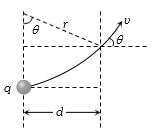
0 likes
View Solution113
DifficultMCQ
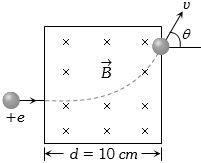
$A$ proton accelerated by a potential difference of $500 \; kV$ moves through a transverse magnetic field of $0.51 \; T$ as shown in the figure. The angle $\theta$ through which the proton deviates from the initial direction of its motion is......$^o$
A
$15$
B
$30$
C
$45$
D
$60$
Solution
(B) From the geometry of the path of the proton in the magnetic field,we have $\sin \theta = \frac{d}{r}$,where $d = 0.1 \; m$ is the width of the magnetic field region and $r$ is the radius of the circular path.
The radius of the circular path is given by $r = \frac{mv}{qB} = \frac{\sqrt{2mK}}{qB} = \frac{1}{B} \sqrt{\frac{2mV}{q}}$,where $V = 500 \times 10^3 \; V$ is the accelerating potential.
Substituting $r$ into the expression for $\sin \theta$:
$\sin \theta = \frac{d}{r} = Bd \sqrt{\frac{q}{2mV}}$
Given values: $B = 0.51 \; T$,$d = 0.1 \; m$,$q = 1.6 \times 10^{-19} \; C$,$m = 1.67 \times 10^{-27} \; kg$,$V = 500 \times 10^3 \; V$.
$\sin \theta = 0.51 \times 0.1 \times \sqrt{\frac{1.6 \times 10^{-19}}{2 \times 1.67 \times 10^{-27} \times 500 \times 10^3}}$
$\sin \theta = 0.051 \times \sqrt{\frac{1.6 \times 10^{-19}}{1.67 \times 10^{-21}}} \approx 0.051 \times \sqrt{95.8} \approx 0.051 \times 9.78 \approx 0.5$
Since $\sin \theta = 0.5$,we have $\theta = 30^o$.
The radius of the circular path is given by $r = \frac{mv}{qB} = \frac{\sqrt{2mK}}{qB} = \frac{1}{B} \sqrt{\frac{2mV}{q}}$,where $V = 500 \times 10^3 \; V$ is the accelerating potential.
Substituting $r$ into the expression for $\sin \theta$:
$\sin \theta = \frac{d}{r} = Bd \sqrt{\frac{q}{2mV}}$
Given values: $B = 0.51 \; T$,$d = 0.1 \; m$,$q = 1.6 \times 10^{-19} \; C$,$m = 1.67 \times 10^{-27} \; kg$,$V = 500 \times 10^3 \; V$.
$\sin \theta = 0.51 \times 0.1 \times \sqrt{\frac{1.6 \times 10^{-19}}{2 \times 1.67 \times 10^{-27} \times 500 \times 10^3}}$
$\sin \theta = 0.051 \times \sqrt{\frac{1.6 \times 10^{-19}}{1.67 \times 10^{-21}}} \approx 0.051 \times \sqrt{95.8} \approx 0.051 \times 9.78 \approx 0.5$
Since $\sin \theta = 0.5$,we have $\theta = 30^o$.
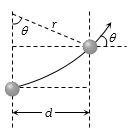
0 likes
View Solution114
EasyMCQ
An electron is moving along the positive $X$-axis. You want to apply a magnetic field for a short time so that the electron may reverse its direction and move parallel to the negative $X$-axis. This can be done by applying the magnetic field along
A
$Y$-axis
B
$X$-axis
C
$Z$-axis
D
None of these
Solution
(A) The force on a moving charge in a magnetic field is given by the Lorentz force formula: $\vec{F} = q(\vec{v} \times \vec{B})$.
For the electron to reverse its direction,it must follow a semi-circular path in a plane perpendicular to the magnetic field.
If the electron is moving along the positive $X$-axis (velocity $\vec{v} = v\hat{i}$),and we apply a magnetic field along the $Y$-axis $(\vec{B} = B\hat{j})$,the force will be $\vec{F} = -e(v\hat{i} \times B\hat{j}) = -evB\hat{k}$.
This force acts in the $Z$-direction,causing the electron to move in a semi-circle in the $X-Z$ plane.
After completing a semi-circle,the velocity vector will point in the negative $X$-direction $(-v\hat{i})$,effectively reversing the electron's direction.
Thus,applying the magnetic field along the $Y$-axis (or $Z$-axis) will achieve the desired result.
For the electron to reverse its direction,it must follow a semi-circular path in a plane perpendicular to the magnetic field.
If the electron is moving along the positive $X$-axis (velocity $\vec{v} = v\hat{i}$),and we apply a magnetic field along the $Y$-axis $(\vec{B} = B\hat{j})$,the force will be $\vec{F} = -e(v\hat{i} \times B\hat{j}) = -evB\hat{k}$.
This force acts in the $Z$-direction,causing the electron to move in a semi-circle in the $X-Z$ plane.
After completing a semi-circle,the velocity vector will point in the negative $X$-direction $(-v\hat{i})$,effectively reversing the electron's direction.
Thus,applying the magnetic field along the $Y$-axis (or $Z$-axis) will achieve the desired result.
0 likes
View Solution115
MediumMCQ
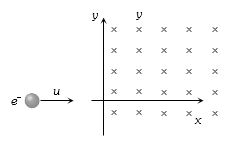
An electron moving with a speed $u$ along the positive $x$-axis at $y = 0$ enters a region of uniform magnetic field $\overrightarrow B = -B_0 \hat k$ which exists to the right of the $y$-axis. The electron exits from the region after some time with the speed $v$ at coordinate $y$,then
A
$v > u, y < 0$
B
$v = u, y > 0$
C
$v > u, y > 0$
D
$v = u, y < 0$
Solution
(D) The magnetic force acting on a charged particle is given by $\overrightarrow F = q(\overrightarrow v \times \overrightarrow B)$.
Since the magnetic force is always perpendicular to the velocity of the particle,it does no work on the electron. Therefore,the kinetic energy of the electron remains constant,which implies that the speed $v$ of the electron remains equal to its initial speed $u$,so $v = u$.
Using the right-hand rule for the magnetic force on a negative charge (electron): the velocity $\overrightarrow v$ is along the $+x$-direction and the magnetic field $\overrightarrow B$ is along the $-z$-direction $(-B_0 \hat k)$. The force $\overrightarrow F = -e(\overrightarrow v \times \overrightarrow B) = -e(u \hat i \times -B_0 \hat k) = -e(u B_0 \hat j) = -e u B_0 \hat j$. Thus,the initial force is in the negative $y$-direction.
The electron will follow a circular path in the clockwise direction and will exit the magnetic field region at a point where $y < 0$.
Since the magnetic force is always perpendicular to the velocity of the particle,it does no work on the electron. Therefore,the kinetic energy of the electron remains constant,which implies that the speed $v$ of the electron remains equal to its initial speed $u$,so $v = u$.
Using the right-hand rule for the magnetic force on a negative charge (electron): the velocity $\overrightarrow v$ is along the $+x$-direction and the magnetic field $\overrightarrow B$ is along the $-z$-direction $(-B_0 \hat k)$. The force $\overrightarrow F = -e(\overrightarrow v \times \overrightarrow B) = -e(u \hat i \times -B_0 \hat k) = -e(u B_0 \hat j) = -e u B_0 \hat j$. Thus,the initial force is in the negative $y$-direction.
The electron will follow a circular path in the clockwise direction and will exit the magnetic field region at a point where $y < 0$.
0 likes
View Solution116
MediumMCQ
$A$ uniform magnetic field $B$ and a uniform electric field $E$ act in a common region. An electron is entering this region of space. The correct arrangement for it to escape undeviated is
A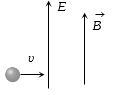
B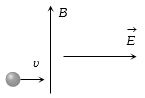
C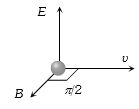
D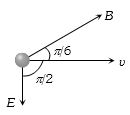
Solution
(C) For an electron to pass through the region undeviated,the net Lorentz force acting on it must be zero. The total force is given by $\overrightarrow{F} = q(\overrightarrow{E} + \overrightarrow{v} \times \overrightarrow{B})$.
For $\overrightarrow{F} = 0$,we must have $\overrightarrow{F_e} = -\overrightarrow{F_m}$,which implies $|\overrightarrow{F_e}| = |\overrightarrow{F_m}|$.
This condition is satisfied when the electric force $\overrightarrow{F_e} = q\overrightarrow{E}$,the magnetic force $\overrightarrow{F_m} = q(\overrightarrow{v} \times \overrightarrow{B})$,and the velocity $\overrightarrow{v}$ are oriented such that $\overrightarrow{v}$,$\overrightarrow{E}$,and $\overrightarrow{B}$ are mutually perpendicular to each other.
In option $C$,the velocity $\overrightarrow{v}$,electric field $\overrightarrow{E}$,and magnetic field $\overrightarrow{B}$ are shown to be mutually perpendicular (each at $90^\circ$ to the others),which allows the electric and magnetic forces to balance each other.
For $\overrightarrow{F} = 0$,we must have $\overrightarrow{F_e} = -\overrightarrow{F_m}$,which implies $|\overrightarrow{F_e}| = |\overrightarrow{F_m}|$.
This condition is satisfied when the electric force $\overrightarrow{F_e} = q\overrightarrow{E}$,the magnetic force $\overrightarrow{F_m} = q(\overrightarrow{v} \times \overrightarrow{B})$,and the velocity $\overrightarrow{v}$ are oriented such that $\overrightarrow{v}$,$\overrightarrow{E}$,and $\overrightarrow{B}$ are mutually perpendicular to each other.
In option $C$,the velocity $\overrightarrow{v}$,electric field $\overrightarrow{E}$,and magnetic field $\overrightarrow{B}$ are shown to be mutually perpendicular (each at $90^\circ$ to the others),which allows the electric and magnetic forces to balance each other.
0 likes
View Solution117
EasyMCQ
When an electron beam passes through an electric field,it gains kinetic energy. If the same beam passes through a magnetic field,then:
A
Their energy increases
B
Their momentum increases
C
Their potential energy increases
D
Energy and momentum both remain unchanged
Solution
(D) The magnetic force acting on a charged particle moving in a magnetic field is given by $\vec{F} = q(\vec{v} \times \vec{B})$.
Since the force is always perpendicular to the velocity vector $\vec{v}$,the work done by the magnetic field on the electron is zero $(W = \vec{F} \cdot \vec{d} = 0)$.
Because the work done is zero,the kinetic energy of the electron remains constant.
Since the kinetic energy $(K = \frac{1}{2}mv^2)$ is constant and the mass $m$ is constant,the speed $v$ remains constant.
Consequently,the magnitude of the momentum $(p = mv)$ also remains unchanged.
Therefore,both energy and momentum remain unchanged.
Since the force is always perpendicular to the velocity vector $\vec{v}$,the work done by the magnetic field on the electron is zero $(W = \vec{F} \cdot \vec{d} = 0)$.
Because the work done is zero,the kinetic energy of the electron remains constant.
Since the kinetic energy $(K = \frac{1}{2}mv^2)$ is constant and the mass $m$ is constant,the speed $v$ remains constant.
Consequently,the magnitude of the momentum $(p = mv)$ also remains unchanged.
Therefore,both energy and momentum remain unchanged.
0 likes
View Solution118
MediumMCQ
$A$ narrow electron beam passes undeviated through an electric field $E = 3 \times 10^4 \ V/m$ and an overlapping magnetic field $B = 2 \times 10^{-3} \ Wb/m^2$. If the electric field and magnetic field are mutually perpendicular,the speed of the electrons is:
A
$60 \ m/s$
B
$10.3 \times 10^7 \ m/s$
C
$1.5 \times 10^7 \ m/s$
D
$0.67 \times 10^{-7} \ m/s$
Solution
(C) When an electron beam passes undeviated through mutually perpendicular electric and magnetic fields,the electric force is balanced by the magnetic force.
$F_e = F_m$
$eE = evB$
Therefore,the speed $v$ is given by:
$v = \frac{E}{B}$
Substituting the given values:
$v = \frac{3 \times 10^4}{2 \times 10^{-3}}$
$v = 1.5 \times 10^7 \ m/s$
Thus,the correct option is $C$.
$F_e = F_m$
$eE = evB$
Therefore,the speed $v$ is given by:
$v = \frac{E}{B}$
Substituting the given values:
$v = \frac{3 \times 10^4}{2 \times 10^{-3}}$
$v = 1.5 \times 10^7 \ m/s$
Thus,the correct option is $C$.
0 likes
View Solution119
EasyMCQ
$A$ beam of electrons is moving with constant velocity in a region having electric and magnetic fields of strength $20 \ V m^{-1}$ and $0.5 \ T$ at right angles to the direction of motion of the electrons. What is the velocity of the electrons in $m s^{-1}$?
A
$20$
B
$40$
C
$8$
D
$5.5$
Solution
(B) When a charged particle moves with a constant velocity through a region containing both electric field $(E)$ and magnetic field $(B)$ that are mutually perpendicular to each other and to the velocity vector,the net Lorentz force acting on the particle is zero.
Given,the electric field $E = 20 \ V m^{-1}$ and the magnetic field $B = 0.5 \ T$.
The condition for the particle to move with constant velocity is given by the balance of electric and magnetic forces:
$qE = qvB$
$v = \frac{E}{B}$
Substituting the given values:
$v = \frac{20}{0.5} = 40 \ m s^{-1}$.
Thus,the velocity of the electrons is $40 \ m s^{-1}$.
Given,the electric field $E = 20 \ V m^{-1}$ and the magnetic field $B = 0.5 \ T$.
The condition for the particle to move with constant velocity is given by the balance of electric and magnetic forces:
$qE = qvB$
$v = \frac{E}{B}$
Substituting the given values:
$v = \frac{20}{0.5} = 40 \ m s^{-1}$.
Thus,the velocity of the electrons is $40 \ m s^{-1}$.
0 likes
View Solution120
MediumMCQ
In the Thomson experiment for finding $e/m$ for electrons,the beam of electrons is replaced by a beam of muons (particles with the same charge as electrons but with a mass $208$ times that of electrons). The condition for no deflection is satisfied if:
A
$B$ is increased $208$ times
B
$E$ is increased $208$ times
C
$B$ is increased $14.4$ times
D
None of these
Solution
(C) In the Thomson experiment,the condition for no deflection of a charged particle moving through crossed electric field $E$ and magnetic field $B$ is given by the balance of forces: $qE = qvB$,which implies $v = E/B$.
The kinetic energy gained by the particle accelerated through a potential difference $V$ is $qV = \frac{1}{2}mv^2$,which gives $v = \sqrt{\frac{2qV}{m}}$.
Equating the two expressions for velocity: $\frac{E}{B} = \sqrt{\frac{2qV}{m}}$.
Squaring both sides: $\frac{E^2}{B^2} = \frac{2qV}{m}$,which leads to $\frac{q}{m} = \frac{E^2}{2VB^2}$.
For a fixed potential $V$ and electric field $E$,we have $B^2 \propto \frac{1}{m}$.
If the mass $m$ is increased by a factor of $208$,then $B^2$ must change by a factor of $1/208$.
Therefore,$B$ must change by a factor of $\sqrt{1/208}$,meaning $B$ must be multiplied by $\sqrt{208} \approx 14.4$ to maintain the condition.
The kinetic energy gained by the particle accelerated through a potential difference $V$ is $qV = \frac{1}{2}mv^2$,which gives $v = \sqrt{\frac{2qV}{m}}$.
Equating the two expressions for velocity: $\frac{E}{B} = \sqrt{\frac{2qV}{m}}$.
Squaring both sides: $\frac{E^2}{B^2} = \frac{2qV}{m}$,which leads to $\frac{q}{m} = \frac{E^2}{2VB^2}$.
For a fixed potential $V$ and electric field $E$,we have $B^2 \propto \frac{1}{m}$.
If the mass $m$ is increased by a factor of $208$,then $B^2$ must change by a factor of $1/208$.
Therefore,$B$ must change by a factor of $\sqrt{1/208}$,meaning $B$ must be multiplied by $\sqrt{208} \approx 14.4$ to maintain the condition.
0 likes
View Solution121
MediumMCQ
In a Bainbridge mass spectrograph,a potential difference of $1000 \ V$ is applied between two plates separated by a distance of $1 \ cm$. If the magnetic field is $B = 1 \ T$,what is the velocity of the undeflected positive ions in $m/s$ from the velocity selector?
A
$10^7 \ m/s$
B
$10^4 \ m/s$
C
$10^5 \ m/s$
D
$10^2 \ m/s$
Solution
(C) In a velocity selector,the electric force $F_e = qE$ and the magnetic force $F_m = qvB$ act in opposite directions.
For the ions to pass undeflected,the forces must be balanced: $qE = qvB$,which simplifies to $v = \frac{E}{B}$.
The electric field $E$ between the plates is given by $E = \frac{V}{d}$.
Given $V = 1000 \ V$ and $d = 1 \ cm = 0.01 \ m = 10^{-2} \ m$.
$E = \frac{1000}{10^{-2}} = 10^5 \ V/m$.
Given $B = 1 \ T$.
Substituting these values into the velocity formula: $v = \frac{10^5}{1} = 10^5 \ m/s$.
For the ions to pass undeflected,the forces must be balanced: $qE = qvB$,which simplifies to $v = \frac{E}{B}$.
The electric field $E$ between the plates is given by $E = \frac{V}{d}$.
Given $V = 1000 \ V$ and $d = 1 \ cm = 0.01 \ m = 10^{-2} \ m$.
$E = \frac{1000}{10^{-2}} = 10^5 \ V/m$.
Given $B = 1 \ T$.
Substituting these values into the velocity formula: $v = \frac{10^5}{1} = 10^5 \ m/s$.
1 likes
View Solution122
EasyMCQ
In Thomson's experiment,if the value of $q/m$ is the same for all positive ions striking the photographic plate,then the trace would be
A
Straight line
B
Parabolic
C
Circular
D
Elliptical
Solution
(B) In Thomson's positive ray experiment,the deflection of ions in electric and magnetic fields is governed by the Lorentz force and kinematics.
The displacement $y$ along the electric field direction is proportional to $(q/m) \cdot (1/v^2)$,and the displacement $z$ along the magnetic field direction is proportional to $(q/m) \cdot (1/v)$.
By eliminating the velocity $v$,we obtain the trajectory equation: $z^2 = k \cdot (q/m) \cdot y$,where $k$ is a constant related to the field strengths and geometry.
Since $q/m$ is constant for all ions,the equation simplifies to the form $z^2 = C \cdot y$,which represents a parabola.
Therefore,the trace on the photographic plate is parabolic.
The displacement $y$ along the electric field direction is proportional to $(q/m) \cdot (1/v^2)$,and the displacement $z$ along the magnetic field direction is proportional to $(q/m) \cdot (1/v)$.
By eliminating the velocity $v$,we obtain the trajectory equation: $z^2 = k \cdot (q/m) \cdot y$,where $k$ is a constant related to the field strengths and geometry.
Since $q/m$ is constant for all ions,the equation simplifies to the form $z^2 = C \cdot y$,which represents a parabola.
Therefore,the trace on the photographic plate is parabolic.
0 likes
View Solution123
EasyMCQ
${O^{++}}, {C^+}, {He^{++}}$ and ${H^+}$ ions are projected on a photographic plate with the same velocity in a mass spectrograph. Which one will strike the farthest?
A
${O^{++}}$
B
${C^+}$
C
${He^{++}}$
D
${H^+}$
Solution
(B) In a mass spectrograph,when ions are projected with the same velocity $v$ in a uniform magnetic field $B$,they follow a circular path of radius $r$ given by $r = \frac{mv}{qB}$.
Since the ions strike a photographic plate,the distance from the point of entry is the diameter $D = 2r = \frac{2mv}{qB}$.
Given that $v$ and $B$ are constant,the diameter $D$ is directly proportional to the mass-to-charge ratio: $D \propto \frac{m}{q}$.
Calculating the $\frac{m}{q}$ ratio for each ion (taking mass number $A$ as proportional to mass $m$):
$1$. For ${O^{++}}$: $\frac{m}{q} \propto \frac{16}{2} = 8$
$2$. For ${C^+}$: $\frac{m}{q} \propto \frac{12}{1} = 12$
$3$. For ${He^{++}}$: $\frac{m}{q} \propto \frac{4}{2} = 2$
$4$. For ${H^+}$: $\frac{m}{q} \propto \frac{1}{1} = 1$
Since ${C^+}$ has the highest $\frac{m}{q}$ ratio,it will strike the farthest.
Since the ions strike a photographic plate,the distance from the point of entry is the diameter $D = 2r = \frac{2mv}{qB}$.
Given that $v$ and $B$ are constant,the diameter $D$ is directly proportional to the mass-to-charge ratio: $D \propto \frac{m}{q}$.
Calculating the $\frac{m}{q}$ ratio for each ion (taking mass number $A$ as proportional to mass $m$):
$1$. For ${O^{++}}$: $\frac{m}{q} \propto \frac{16}{2} = 8$
$2$. For ${C^+}$: $\frac{m}{q} \propto \frac{12}{1} = 12$
$3$. For ${He^{++}}$: $\frac{m}{q} \propto \frac{4}{2} = 2$
$4$. For ${H^+}$: $\frac{m}{q} \propto \frac{1}{1} = 1$
Since ${C^+}$ has the highest $\frac{m}{q}$ ratio,it will strike the farthest.
0 likes
View Solution124
EasyMCQ
An electron beam is moving between two parallel plates having an electric field of $1.125 \times 10^{-6} \, N/C$. $A$ magnetic field of $3 \times 10^{-10} \, T$ is also applied so that the beam of electrons does not deflect. The velocity of the electron is ............ $m/s$.
A
$4225$
B
$3750$
C
$2750$
D
$3200$
Solution
(B) For an electron beam to pass undeflected through crossed electric and magnetic fields,the electric force must be equal and opposite to the magnetic force.
$F_e = F_m$
$qE = qvB$
$v = \frac{E}{B}$
Given $E = 1.125 \times 10^{-6} \, N/C$ and $B = 3 \times 10^{-10} \, T$.
$v = \frac{1.125 \times 10^{-6}}{3 \times 10^{-10}} = 0.375 \times 10^4 = 3750 \, m/s$.
$F_e = F_m$
$qE = qvB$
$v = \frac{E}{B}$
Given $E = 1.125 \times 10^{-6} \, N/C$ and $B = 3 \times 10^{-10} \, T$.
$v = \frac{1.125 \times 10^{-6}}{3 \times 10^{-10}} = 0.375 \times 10^4 = 3750 \, m/s$.
0 likes
View Solution125
MediumMCQ
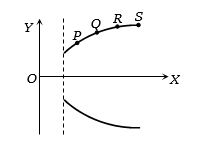
In a parabola spectrograph,the velocities of four positive ions $P, Q, R,$ and $S$ are $v_1, v_2, v_3,$ and $v_4$ respectively. Based on the provided parabola spectrograph image,determine the relationship between their velocities.
A
$v_1 > v_2 > v_3 > v_4$
B
$v_1 < v_2 < v_3 < v_4$
C
$v_1 = v_2 = v_3 = v_4$
D
$v_1 < v_2 > v_3 < v_4$
Solution
(A) In a parabola spectrograph,the deflection $x$ of an ion is inversely proportional to the square of its velocity,i.e.,$x \propto \frac{1}{v^2}$.
This means that the ion which experiences less deflection will have a higher velocity.
From the given graph,the horizontal distances (deflections) of the ions $P, Q, R,$ and $S$ from the vertical axis are $x_1, x_2, x_3,$ and $x_4$ respectively.
Observing the graph,we can see that $x_1 < x_2 < x_3 < x_4$.
Since $v \propto \frac{1}{\sqrt{x}}$,it follows that $v_1 > v_2 > v_3 > v_4$.
This means that the ion which experiences less deflection will have a higher velocity.
From the given graph,the horizontal distances (deflections) of the ions $P, Q, R,$ and $S$ from the vertical axis are $x_1, x_2, x_3,$ and $x_4$ respectively.
Observing the graph,we can see that $x_1 < x_2 < x_3 < x_4$.
Since $v \propto \frac{1}{\sqrt{x}}$,it follows that $v_1 > v_2 > v_3 > v_4$.
0 likes
View Solution126
EasyMCQ
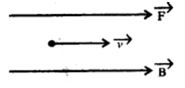
In a region,there are uniform and constant electric and magnetic fields. Both these fields are parallel to each other. $A$ stationary charged particle is released in this region. The path of the particle will be.......
A
Hyperbolic
B
Circular
C
Helical
D
Straight line
Solution
(D) In this region,the charged particle experiences an electric force given by $\vec{F_e} = q\vec{E}$.
Since the particle starts from rest,it will begin to accelerate in the direction of the electric field (if positive) or opposite to it (if negative).
As the particle gains velocity $\vec{v}$,it experiences a magnetic force given by $\vec{F_m} = q(\vec{v} \times \vec{B})$.
Since the electric and magnetic fields are parallel,and the particle's velocity $\vec{v}$ is generated by the electric field,the velocity $\vec{v}$ will always be parallel to the magnetic field $\vec{B}$ (i.e.,$\vec{v} \parallel \vec{B}$).
Therefore,the magnetic force $F_m = qvB \sin(0^\circ) = 0$.
Since there is no magnetic force acting on the particle and the electric force acts along the line of the fields,the particle will move in a straight line.
Since the particle starts from rest,it will begin to accelerate in the direction of the electric field (if positive) or opposite to it (if negative).
As the particle gains velocity $\vec{v}$,it experiences a magnetic force given by $\vec{F_m} = q(\vec{v} \times \vec{B})$.
Since the electric and magnetic fields are parallel,and the particle's velocity $\vec{v}$ is generated by the electric field,the velocity $\vec{v}$ will always be parallel to the magnetic field $\vec{B}$ (i.e.,$\vec{v} \parallel \vec{B}$).
Therefore,the magnetic force $F_m = qvB \sin(0^\circ) = 0$.
Since there is no magnetic force acting on the particle and the electric force acts along the line of the fields,the particle will move in a straight line.
0 likes
View Solution127
EasyMCQ
In Thomson's method for determining the $e/m$ ratio of an electron,which of the following conditions is true regarding the fields?
A
The electric field and magnetic field are parallel to each other and to the electron beam.
B
The electric field and magnetic field are perpendicular to each other and both are perpendicular to the electron beam.
C
The magnetic field is perpendicular to the electron beam.
D
The electric field is parallel to the electron beam.
Solution
(B) In $J$.$J$. Thomson's experiment to determine the specific charge $(e/m)$ of an electron,the electron beam is subjected to both electric and magnetic fields.
$1$. The electric field $(E)$ and the magnetic field $(B)$ are applied perpendicular to each other.
$2$. Both the electric field $(E)$ and the magnetic field $(B)$ are applied perpendicular to the direction of the electron beam.
$3$. By adjusting the fields such that the electron beam passes undeflected,the velocity of the electrons can be determined,and subsequently,the $e/m$ ratio is calculated.
Therefore,the electric and magnetic fields are perpendicular to each other and both are perpendicular to the electron beam.
$1$. The electric field $(E)$ and the magnetic field $(B)$ are applied perpendicular to each other.
$2$. Both the electric field $(E)$ and the magnetic field $(B)$ are applied perpendicular to the direction of the electron beam.
$3$. By adjusting the fields such that the electron beam passes undeflected,the velocity of the electrons can be determined,and subsequently,the $e/m$ ratio is calculated.
Therefore,the electric and magnetic fields are perpendicular to each other and both are perpendicular to the electron beam.
0 likes
View Solution128
MediumMCQ
$A$ proton and an $\alpha$-particle enter a magnetic field perpendicularly with the same velocity. If the proton takes $25 \mu \text{sec}$ to complete $5$ revolutions,what is the time period of the $\alpha$-particle in $\mu \text{sec}$?
A
$50$
B
$25$
C
$10$
D
$5$
Solution
(C) The time period of the proton $(T_p)$ is the time taken for one revolution.
Given that the proton takes $25 \mu \text{sec}$ for $5$ revolutions,$T_p = \frac{25}{5} = 5 \mu \text{sec}$.
The formula for the time period of a charged particle in a magnetic field is $T = \frac{2\pi m}{qB}$.
Comparing the time periods of the $\alpha$-particle $(T_{\alpha})$ and the proton $(T_p)$: $\frac{T_{\alpha}}{T_p} = \frac{m_{\alpha}}{m_p} \times \frac{q_p}{q_{\alpha}}$.
Since $m_{\alpha} = 4m_p$ and $q_{\alpha} = 2q_p$,we have $\frac{T_{\alpha}}{T_p} = \frac{4m_p}{m_p} \times \frac{q_p}{2q_p} = 4 \times \frac{1}{2} = 2$.
Therefore,$T_{\alpha} = 2 \times T_p = 2 \times 5 \mu \text{sec} = 10 \mu \text{sec}$.
Given that the proton takes $25 \mu \text{sec}$ for $5$ revolutions,$T_p = \frac{25}{5} = 5 \mu \text{sec}$.
The formula for the time period of a charged particle in a magnetic field is $T = \frac{2\pi m}{qB}$.
Comparing the time periods of the $\alpha$-particle $(T_{\alpha})$ and the proton $(T_p)$: $\frac{T_{\alpha}}{T_p} = \frac{m_{\alpha}}{m_p} \times \frac{q_p}{q_{\alpha}}$.
Since $m_{\alpha} = 4m_p$ and $q_{\alpha} = 2q_p$,we have $\frac{T_{\alpha}}{T_p} = \frac{4m_p}{m_p} \times \frac{q_p}{2q_p} = 4 \times \frac{1}{2} = 2$.
Therefore,$T_{\alpha} = 2 \times T_p = 2 \times 5 \mu \text{sec} = 10 \mu \text{sec}$.
0 likes
View Solution129
DifficultMCQ
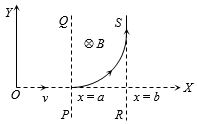
$A$ particle of mass $M$ and charge $q$ moves with a constant velocity $V$ in the positive $x$-direction. $A$ constant magnetic field $B$ exists in the negative $z$-direction between $x = a$ and $x = b$. Find the minimum value of $V$ such that the particle enters the region $x > b$.
A
$qbB/M$
B
$q(b - a)B/M$
C
$qaB/M$
D
$q(b + a)B/2M$
Solution
(B) When the particle enters the magnetic field at $x = a$,it experiences a magnetic force that causes it to move in a circular path of radius $R = \frac{MV}{qB}$.
For the particle to emerge from the region $x = b$,the radius of its circular path must be at least equal to the width of the magnetic field region,which is $(b - a)$.
Therefore,we have the condition: $R \ge (b - a)$.
Substituting the expression for $R$: $\frac{MV}{qB} \ge (b - a)$.
Solving for $V$: $V \ge \frac{q(b - a)B}{M}$.
Thus,the minimum velocity required is $V_{\min} = \frac{q(b - a)B}{M}$.
For the particle to emerge from the region $x = b$,the radius of its circular path must be at least equal to the width of the magnetic field region,which is $(b - a)$.
Therefore,we have the condition: $R \ge (b - a)$.
Substituting the expression for $R$: $\frac{MV}{qB} \ge (b - a)$.
Solving for $V$: $V \ge \frac{q(b - a)B}{M}$.
Thus,the minimum velocity required is $V_{\min} = \frac{q(b - a)B}{M}$.
0 likes
View Solution130
MediumMCQ
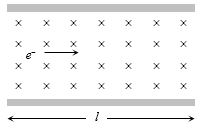
$A$ capacitor with surface charge density $\sigma$ has a magnetic field $\overrightarrow{B}$ between its two plates. If an electron passes through without any deflection,how long will it take to exit the plates of length $l$?
A
$\frac{e\sigma}{\varepsilon_0 l B}$
B
$\frac{\varepsilon_0 l B}{\sigma}$
C
$\frac{e\sigma}{\varepsilon_0 B}$
D
$\frac{\varepsilon_0 B}{e\sigma}$
Solution
(B) For the electron to pass without deflection,the electric force must be balanced by the magnetic force: $|\overrightarrow{F}_e| = |\overrightarrow{F}_m|$.
Since $|\overrightarrow{F}_e| = eE$ and $|\overrightarrow{F}_m| = evB$,we have $eE = evB$,which implies $v = \frac{E}{B}$.
The electric field between the plates of a capacitor is given by $E = \frac{\sigma}{\varepsilon_0}$.
Substituting this into the velocity equation,we get $v = \frac{\sigma}{\varepsilon_0 B}$.
The time $t$ taken to travel the length $l$ is $t = \frac{l}{v}$.
Substituting the value of $v$,we get $t = \frac{l}{(\sigma / \varepsilon_0 B)} = \frac{\varepsilon_0 l B}{\sigma}$.
Since $|\overrightarrow{F}_e| = eE$ and $|\overrightarrow{F}_m| = evB$,we have $eE = evB$,which implies $v = \frac{E}{B}$.
The electric field between the plates of a capacitor is given by $E = \frac{\sigma}{\varepsilon_0}$.
Substituting this into the velocity equation,we get $v = \frac{\sigma}{\varepsilon_0 B}$.
The time $t$ taken to travel the length $l$ is $t = \frac{l}{v}$.
Substituting the value of $v$,we get $t = \frac{l}{(\sigma / \varepsilon_0 B)} = \frac{\varepsilon_0 l B}{\sigma}$.
0 likes
View Solution131
MediumMCQ
When an electron is accelerated by a potential difference of $V$ volts and enters a magnetic field,the force acting on it is $F$. What will be the force acting on the electron when it is accelerated by a potential difference of $5V$ volts and enters the same magnetic field?
A
$F$
B
$5F$
C
$F/5$
D
$\sqrt{5}F$
Solution
(D) The kinetic energy gained by the electron is given by $\frac{1}{2}mv^2 = qV$,which implies the velocity $v = \sqrt{\frac{2qV}{m}}$.
The magnetic force acting on a charged particle moving in a magnetic field is $F = qvB$.
Substituting the expression for velocity,we get $F = qB\sqrt{\frac{2qV}{m}}$.
From this expression,it is clear that $F \propto \sqrt{V}$.
If the potential is increased to $5V$,the new force $F'$ will be $F' = F \sqrt{\frac{5V}{V}} = \sqrt{5}F$.
The magnetic force acting on a charged particle moving in a magnetic field is $F = qvB$.
Substituting the expression for velocity,we get $F = qB\sqrt{\frac{2qV}{m}}$.
From this expression,it is clear that $F \propto \sqrt{V}$.
If the potential is increased to $5V$,the new force $F'$ will be $F' = F \sqrt{\frac{5V}{V}} = \sqrt{5}F$.
0 likes
View Solution132
EasyMCQ
The distance between two plates is $1 \ cm$ and the potential difference is $1000 \ V$. $A$ magnetic field $B = 1 \ T$ is applied. If an electron passes through without any deflection,what will be its velocity?
A
$10^7 \ m/s$
B
$10^4 \ m/s$
C
$10^5 \ m/s$
D
$10^2 \ m/s$
Solution
(C) For an electron to pass through the region of crossed electric and magnetic fields without deflection,the electric force must be equal to the magnetic force.
$F_e = F_m$
$qE = qvB$
$v = \frac{E}{B}$
Given,potential difference $V = 1000 \ V$ and distance $d = 1 \ cm = 10^{-2} \ m$.
The electric field $E = \frac{V}{d} = \frac{1000}{10^{-2}} = 10^5 \ V/m$.
Given magnetic field $B = 1 \ T$.
Substituting the values,$v = \frac{10^5}{1} = 10^5 \ m/s$.
$F_e = F_m$
$qE = qvB$
$v = \frac{E}{B}$
Given,potential difference $V = 1000 \ V$ and distance $d = 1 \ cm = 10^{-2} \ m$.
The electric field $E = \frac{V}{d} = \frac{1000}{10^{-2}} = 10^5 \ V/m$.
Given magnetic field $B = 1 \ T$.
Substituting the values,$v = \frac{10^5}{1} = 10^5 \ m/s$.
0 likes
View Solution133
MediumMCQ
When a charged particle moving with velocity $\vec{v}$ is subjected to a magnetic field of induction $\vec{B}$,the force on it is non-zero. This implies that
A
angle between is either zero or $180^{\circ}$
B
angle between is necessarily $90^{\circ}$
C
angle between can have any value other than $90^{\circ}$
D
angle between can have any value other than zero and $180^{\circ}$
Solution
(D) The force acting on a charged particle moving with velocity $\vec{v}$ in a magnetic field $\vec{B}$ is given by the Lorentz force formula:
$\vec{F} = q(\vec{v} \times \vec{B})$
The magnitude of this force is given by:
$F = qvB \sin \theta$
where $\theta$ is the angle between the velocity vector $\vec{v}$ and the magnetic field vector $\vec{B}$.
For the force to be non-zero $(F \neq 0)$,we must have $\sin \theta \neq 0$.
Since $\sin \theta = 0$ at $\theta = 0^{\circ}$ and $\theta = 180^{\circ}$,the force is zero in these cases.
Therefore,for the force to be non-zero,the angle $\theta$ can have any value other than $0^{\circ}$ and $180^{\circ}$.
$\vec{F} = q(\vec{v} \times \vec{B})$
The magnitude of this force is given by:
$F = qvB \sin \theta$
where $\theta$ is the angle between the velocity vector $\vec{v}$ and the magnetic field vector $\vec{B}$.
For the force to be non-zero $(F \neq 0)$,we must have $\sin \theta \neq 0$.
Since $\sin \theta = 0$ at $\theta = 0^{\circ}$ and $\theta = 180^{\circ}$,the force is zero in these cases.
Therefore,for the force to be non-zero,the angle $\theta$ can have any value other than $0^{\circ}$ and $180^{\circ}$.
0 likes
View Solution134
EasyMCQ
$A$ particle of mass $m$,charge $Q$,and kinetic energy $K$ enters a transverse uniform magnetic field of induction $B$. After $3$ $seconds$,the kinetic energy of the particle will be .......$K$.
A
$1$
B
$2$
C
$3$
D
$4$
Solution
(A) When a charged particle enters a uniform magnetic field perpendicular to its velocity,it experiences a magnetic Lorentz force given by $\vec{F} = Q(\vec{v} \times \vec{B})$.
Since the force is always perpendicular to the velocity of the particle,the magnetic field does no work on the particle $(W = \int \vec{F} \cdot d\vec{r} = 0)$.
According to the work-energy theorem,the change in kinetic energy is equal to the work done by the net force.
Since the work done is zero,the kinetic energy of the particle remains constant throughout its motion.
Therefore,after $3$ $seconds$,the kinetic energy remains $K$.
Since the force is always perpendicular to the velocity of the particle,the magnetic field does no work on the particle $(W = \int \vec{F} \cdot d\vec{r} = 0)$.
According to the work-energy theorem,the change in kinetic energy is equal to the work done by the net force.
Since the work done is zero,the kinetic energy of the particle remains constant throughout its motion.
Therefore,after $3$ $seconds$,the kinetic energy remains $K$.
0 likes
View Solution135
MediumMCQ
The magnetic force acting on a charged particle of charge $-2\, \mu C$ in a magnetic field of $2\, T$ acting in the $y$-direction,when the particle velocity is $(2\hat{i} + 3\hat{j}) \times 10^6\, m/s$,is:
A
$4\, N$ in $+z$ direction
B
$8\, N$ in $+y$ direction
C
$8\, N$ in $+z$ direction
D
$8\, N$ in $-z$ direction
Solution
(D) The magnetic force $\vec{F}$ on a charged particle is given by the Lorentz force formula: $\vec{F} = q(\vec{v} \times \vec{B})$.
Given:
Charge $q = -2 \times 10^{-6}\, C$
Velocity $\vec{v} = (2\hat{i} + 3\hat{j}) \times 10^6\, m/s$
Magnetic field $\vec{B} = 2\hat{j}\, T$
Substituting these values into the formula:
$\vec{F} = (-2 \times 10^{-6}) \times [(2\hat{i} + 3\hat{j}) \times 10^6] \times (2\hat{j})$
$\vec{F} = -2 \times 2 \times [ (2\hat{i} \times \hat{j}) + (3\hat{j} \times \hat{j}) ]$
Since $\hat{i} \times \hat{j} = \hat{k}$ and $\hat{j} \times \hat{j} = 0$:
$\vec{F} = -4 \times (2\hat{k} + 0)$
$\vec{F} = -8\hat{k}\, N$
The negative sign indicates the force is in the $-z$ direction.
Thus,the force is $8\, N$ in the $-z$ direction.
Given:
Charge $q = -2 \times 10^{-6}\, C$
Velocity $\vec{v} = (2\hat{i} + 3\hat{j}) \times 10^6\, m/s$
Magnetic field $\vec{B} = 2\hat{j}\, T$
Substituting these values into the formula:
$\vec{F} = (-2 \times 10^{-6}) \times [(2\hat{i} + 3\hat{j}) \times 10^6] \times (2\hat{j})$
$\vec{F} = -2 \times 2 \times [ (2\hat{i} \times \hat{j}) + (3\hat{j} \times \hat{j}) ]$
Since $\hat{i} \times \hat{j} = \hat{k}$ and $\hat{j} \times \hat{j} = 0$:
$\vec{F} = -4 \times (2\hat{k} + 0)$
$\vec{F} = -8\hat{k}\, N$
The negative sign indicates the force is in the $-z$ direction.
Thus,the force is $8\, N$ in the $-z$ direction.
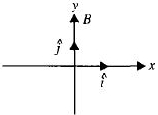
0 likes
View Solution136
MediumMCQ
$A$ particle having a mass of $10^{-2} \, kg$ carries a charge of $5 \times 10^{-8} \, C$. The particle is given an initial horizontal velocity of $10^5 \, m/s$ in the presence of an electric field $\vec{E}$ and a magnetic field $\vec{B}$. To keep the particle moving in a horizontal direction,it is necessary that:
$(1)$ $\vec{B}$ should be perpendicular to the direction of velocity and $\vec{E}$ should be along the direction of velocity.
$(2)$ Both $\vec{B}$ and $\vec{E}$ should be along the direction of velocity.
$(3)$ Both $\vec{B}$ and $\vec{E}$ are mutually perpendicular and perpendicular to the direction of velocity.
$(4)$ $\vec{B}$ should be along the direction of velocity and $\vec{E}$ should be perpendicular to the direction of velocity.
Which one of the following pairs of statements is possible?
$(1)$ $\vec{B}$ should be perpendicular to the direction of velocity and $\vec{E}$ should be along the direction of velocity.
$(2)$ Both $\vec{B}$ and $\vec{E}$ should be along the direction of velocity.
$(3)$ Both $\vec{B}$ and $\vec{E}$ are mutually perpendicular and perpendicular to the direction of velocity.
$(4)$ $\vec{B}$ should be along the direction of velocity and $\vec{E}$ should be perpendicular to the direction of velocity.
Which one of the following pairs of statements is possible?
A
$(1)$ and $(3)$
B
$(3)$ and $(4)$
C
$(2)$ and $(3)$
D
$(2)$ and $(4)$
Solution
(C) The net Lorentz force on the particle is given by $\vec{F} = q(\vec{E} + \vec{v} \times \vec{B})$. For the particle to move in a straight horizontal line,the net force must be zero.
For statement $(2)$: If both $\vec{B}$ and $\vec{E}$ are along the direction of velocity $\vec{v}$,then $\vec{v} \times \vec{B} = 0$. The electric force $q\vec{E}$ acts along the direction of velocity,causing acceleration but no deflection. Thus,the particle continues to move in a straight line.
For statement $(3)$: If $\vec{v}$,$\vec{E}$,and $\vec{B}$ are mutually perpendicular,the magnetic force $\vec{F}_m = q(\vec{v} \times \vec{B})$ acts perpendicular to $\vec{v}$. By choosing $\vec{E}$ such that the electric force $\vec{F}_e = q\vec{E}$ is equal and opposite to $\vec{F}_m$,the net force becomes zero. This is the principle of a velocity selector.
Therefore,both $(2)$ and $(3)$ are possible scenarios for maintaining a straight-line path.
For statement $(2)$: If both $\vec{B}$ and $\vec{E}$ are along the direction of velocity $\vec{v}$,then $\vec{v} \times \vec{B} = 0$. The electric force $q\vec{E}$ acts along the direction of velocity,causing acceleration but no deflection. Thus,the particle continues to move in a straight line.
For statement $(3)$: If $\vec{v}$,$\vec{E}$,and $\vec{B}$ are mutually perpendicular,the magnetic force $\vec{F}_m = q(\vec{v} \times \vec{B})$ acts perpendicular to $\vec{v}$. By choosing $\vec{E}$ such that the electric force $\vec{F}_e = q\vec{E}$ is equal and opposite to $\vec{F}_m$,the net force becomes zero. This is the principle of a velocity selector.
Therefore,both $(2)$ and $(3)$ are possible scenarios for maintaining a straight-line path.
0 likes
View Solution137
MediumMCQ
$A$ uniform electric field and a uniform magnetic field are acting along the same direction in a certain region. If an electron is projected in the region such that its velocity is pointed along the direction of fields,then the electron
A
will turn towards right of direction of motion
B
will turn towards left of direction of motion
C
speed will increase
D
speed will decrease
Solution
(D) The force on an electron due to an electric field is given by $\vec{F}_{E} = -e\vec{E}$.
The force on an electron due to a magnetic field is given by $\vec{F}_{B} = -e(\vec{v} \times \vec{B})$.
Since the velocity $\vec{v}$ and the magnetic field $\vec{B}$ are in the same direction,the angle between them is $0^{\circ}$. Therefore,$\vec{v} \times \vec{B} = 0$,which means $\vec{F}_{B} = 0$.
The total force on the electron is $\vec{F} = \vec{F}_{E} + \vec{F}_{B} = -e\vec{E}$.
Since the electric field $\vec{E}$ acts in the same direction as the velocity,the force $-e\vec{E}$ acts in the opposite direction to the velocity of the electron.
Because the force is opposite to the direction of motion,the speed of the electron will decrease.
The force on an electron due to a magnetic field is given by $\vec{F}_{B} = -e(\vec{v} \times \vec{B})$.
Since the velocity $\vec{v}$ and the magnetic field $\vec{B}$ are in the same direction,the angle between them is $0^{\circ}$. Therefore,$\vec{v} \times \vec{B} = 0$,which means $\vec{F}_{B} = 0$.
The total force on the electron is $\vec{F} = \vec{F}_{E} + \vec{F}_{B} = -e\vec{E}$.
Since the electric field $\vec{E}$ acts in the same direction as the velocity,the force $-e\vec{E}$ acts in the opposite direction to the velocity of the electron.
Because the force is opposite to the direction of motion,the speed of the electron will decrease.
0 likes
View Solution138
DifficultMCQ
$A$ proton carrying $1\, MeV$ kinetic energy is moving in a circular path of radius $R$ in a uniform magnetic field. What should be the energy of an $\alpha$-particle to describe a circle of the same radius in the same field? ........$MeV$
A
$1$
B
$4$
C
$2$
D
$0.5$
Solution
(A) The radius $R$ of a circular path of a charged particle with mass $m$,charge $q$,and kinetic energy $K$ in a uniform magnetic field $B$ is given by:
$R = \frac{\sqrt{2mK}}{Bq}$
For a proton: $m_p = m$,$q_p = e$,$K_p = 1\, MeV$.
$R_p = \frac{\sqrt{2m(1)}}{Be}$
For an $\alpha$-particle: $m_{\alpha} = 4m$,$q_{\alpha} = 2e$.
$R_{\alpha} = \frac{\sqrt{2(4m)K_{\alpha}}}{B(2e)} = \frac{\sqrt{8mK_{\alpha}}}{2Be} = \frac{\sqrt{2mK_{\alpha}}}{Be}$
Since the radii are equal $(R_p = R_{\alpha})$:
$\frac{\sqrt{2m(1)}}{Be} = \frac{\sqrt{2mK_{\alpha}}}{Be}$
$1 = K_{\alpha}$
Therefore,the kinetic energy of the $\alpha$-particle is $1\, MeV$.
$R = \frac{\sqrt{2mK}}{Bq}$
For a proton: $m_p = m$,$q_p = e$,$K_p = 1\, MeV$.
$R_p = \frac{\sqrt{2m(1)}}{Be}$
For an $\alpha$-particle: $m_{\alpha} = 4m$,$q_{\alpha} = 2e$.
$R_{\alpha} = \frac{\sqrt{2(4m)K_{\alpha}}}{B(2e)} = \frac{\sqrt{8mK_{\alpha}}}{2Be} = \frac{\sqrt{2mK_{\alpha}}}{Be}$
Since the radii are equal $(R_p = R_{\alpha})$:
$\frac{\sqrt{2m(1)}}{Be} = \frac{\sqrt{2mK_{\alpha}}}{Be}$
$1 = K_{\alpha}$
Therefore,the kinetic energy of the $\alpha$-particle is $1\, MeV$.
0 likes
View Solution139
DifficultMCQ
$A$ proton and an alpha particle both enter a region of uniform magnetic field $B,$ moving at right angles to the field $B.$ If the radius of circular orbits for both the particles is equal and the kinetic energy acquired by proton is $1 \, MeV,$ the energy acquired by the alpha particle will be......$MeV$
A
$1$
B
$4$
C
$0.5$
D
$1.5$
Solution
(A) The radius of a circular orbit for a charged particle in a uniform magnetic field $B$ is given by $R = \frac{mv}{qB} = \frac{\sqrt{2mK}}{qB}$, where $K$ is the kinetic energy.
Rearranging for kinetic energy $K$, we get $K = \frac{q^2 B^2 R^2}{2m}$.
For the proton $(p)$ and alpha particle $(\alpha)$, since $B$ and $R$ are equal, the ratio of their kinetic energies is:
$\frac{K_{\alpha}}{K_{p}} = \left(\frac{q_{\alpha}}{q_{p}}\right)^2 \left(\frac{m_{p}}{m_{\alpha}}\right)$.
Given $q_{\alpha} = 2q_{p}$ and $m_{\alpha} = 4m_{p}$, we have:
$\frac{K_{\alpha}}{K_{p}} = (2)^2 \times \left(\frac{1}{4}\right) = 4 \times \frac{1}{4} = 1$.
Therefore, $K_{\alpha} = K_{p} = 1 \, MeV$.
Rearranging for kinetic energy $K$, we get $K = \frac{q^2 B^2 R^2}{2m}$.
For the proton $(p)$ and alpha particle $(\alpha)$, since $B$ and $R$ are equal, the ratio of their kinetic energies is:
$\frac{K_{\alpha}}{K_{p}} = \left(\frac{q_{\alpha}}{q_{p}}\right)^2 \left(\frac{m_{p}}{m_{\alpha}}\right)$.
Given $q_{\alpha} = 2q_{p}$ and $m_{\alpha} = 4m_{p}$, we have:
$\frac{K_{\alpha}}{K_{p}} = (2)^2 \times \left(\frac{1}{4}\right) = 4 \times \frac{1}{4} = 1$.
Therefore, $K_{\alpha} = K_{p} = 1 \, MeV$.
0 likes
View Solution140
MediumMCQ
An electron is moving in a circular path under the influence of a transverse magnetic field of $3.57 \times 10^{-2} \, T$. If the value of $e/m$ is $1.76 \times 10^{11} \, C/kg$,the frequency of revolution of the electron is
A
$62.8 \, MHz$
B
$6.28 \, MHz$
C
$1 \, GHz$
D
$100 \, MHz$
Solution
(C) Given: Magnetic field $B = 3.57 \times 10^{-2} \, T$ and specific charge $\frac{e}{m} = 1.76 \times 10^{11} \, C/kg$.
The frequency of revolution $f$ of a charged particle in a magnetic field is given by the formula:
$f = \frac{1}{T} = \frac{qB}{2 \pi m}$
Substituting the given values:
$f = \frac{1}{2 \times 3.14} \times (1.76 \times 10^{11}) \times (3.57 \times 10^{-2})$
$f = \frac{1}{6.28} \times 6.2832 \times 10^9$
$f \approx 1 \times 10^9 \, Hz = 1 \, GHz$.
The frequency of revolution $f$ of a charged particle in a magnetic field is given by the formula:
$f = \frac{1}{T} = \frac{qB}{2 \pi m}$
Substituting the given values:
$f = \frac{1}{2 \times 3.14} \times (1.76 \times 10^{11}) \times (3.57 \times 10^{-2})$
$f = \frac{1}{6.28} \times 6.2832 \times 10^9$
$f \approx 1 \times 10^9 \, Hz = 1 \, GHz$.
0 likes
View Solution141
EasyMCQ
$A$ charged particle is projected in a plane perpendicular to a uniform magnetic field. The area bounded by the path described by the particle is proportional to
A
The velocity
B
The momentum
C
The kinetic energy
D
None of these
Solution
(C) When a charged particle of mass $m$,charge $q$,and kinetic energy $K$ is projected perpendicular to a uniform magnetic field $B$,it follows a circular path.
The radius $r$ of this circular path is given by $r = \frac{mv}{qB}$.
Since kinetic energy $K = \frac{1}{2}mv^2$,we have $mv = \sqrt{2mK}$.
Substituting this into the radius formula,we get $r = \frac{\sqrt{2mK}}{qB}$.
The area $A$ bounded by the circular path is $A = \pi r^2$.
Substituting the expression for $r$,we get $A = \pi \left( \frac{\sqrt{2mK}}{qB} \right)^2 = \frac{\pi (2mK)}{q^2 B^2}$.
Since $m$,$q$,and $B$ are constants,$A \propto K$.
The radius $r$ of this circular path is given by $r = \frac{mv}{qB}$.
Since kinetic energy $K = \frac{1}{2}mv^2$,we have $mv = \sqrt{2mK}$.
Substituting this into the radius formula,we get $r = \frac{\sqrt{2mK}}{qB}$.
The area $A$ bounded by the circular path is $A = \pi r^2$.
Substituting the expression for $r$,we get $A = \pi \left( \frac{\sqrt{2mK}}{qB} \right)^2 = \frac{\pi (2mK)}{q^2 B^2}$.
Since $m$,$q$,and $B$ are constants,$A \propto K$.
0 likes
View Solution142
MediumMCQ
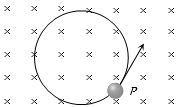
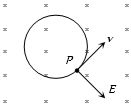
$A$ particle having a charge of $10.0\,\mu C$ and mass $1\,\mu g$ moves in a circle of radius $10\,cm$ under the influence of a magnetic field of induction $0.1\,T$. When the particle is at a point $P$, a uniform electric field is switched on so that the particle starts moving along the tangent with a uniform velocity. The electric field is......$V/m$
A
$0.1$
B
$1$
C
$10$
D
$100$
Solution
(C) When a charged particle moves in a circle within a magnetic field $B$, it experiences a magnetic force $F_m = qvB$ directed towards the center of the circle.
To make the particle move in a straight line with uniform velocity, the net force on it must be zero.
This is achieved by applying an electric field $E$ such that the electric force $F_e = qE$ exactly balances the magnetic force $F_m$.
Thus, $qE = qvB$, which simplifies to $E = vB$.
The radius of the circular path is given by $r = \frac{mv}{qB}$, so the velocity is $v = \frac{qBr}{m}$.
Substituting this expression for $v$ into the equation for $E$, we get $E = \left(\frac{qBr}{m}\right)B = \frac{qB^2r}{m}$.
Given values: $q = 10.0\,\mu C = 10 \times 10^{-6}\,C$, $m = 1\,\mu g = 1 \times 10^{-9}\,kg$, $r = 10\,cm = 0.1\,m$, and $B = 0.1\,T$.
Substituting these values: $E = \frac{(10 \times 10^{-6}) \times (0.1)^2 \times 0.1}{1 \times 10^{-9}} = \frac{10^{-5} \times 0.01 \times 0.1}{10^{-9}} = \frac{10^{-8}}{10^{-9}} = 10\,V/m$.
To make the particle move in a straight line with uniform velocity, the net force on it must be zero.
This is achieved by applying an electric field $E$ such that the electric force $F_e = qE$ exactly balances the magnetic force $F_m$.
Thus, $qE = qvB$, which simplifies to $E = vB$.
The radius of the circular path is given by $r = \frac{mv}{qB}$, so the velocity is $v = \frac{qBr}{m}$.
Substituting this expression for $v$ into the equation for $E$, we get $E = \left(\frac{qBr}{m}\right)B = \frac{qB^2r}{m}$.
Given values: $q = 10.0\,\mu C = 10 \times 10^{-6}\,C$, $m = 1\,\mu g = 1 \times 10^{-9}\,kg$, $r = 10\,cm = 0.1\,m$, and $B = 0.1\,T$.
Substituting these values: $E = \frac{(10 \times 10^{-6}) \times (0.1)^2 \times 0.1}{1 \times 10^{-9}} = \frac{10^{-5} \times 0.01 \times 0.1}{10^{-9}} = \frac{10^{-8}}{10^{-9}} = 10\,V/m$.
0 likes
View Solution143
MediumMCQ
$A$ charge of $2.0\,\mu C$ moves with a speed of $3.0 \times 10^6\,m/s$ along the positive $X$-axis. $A$ magnetic field of strength $\vec B = -0.2\,\hat k\,T$ exists in space. What is the magnetic force $(\vec F_m)$ on the charge?
A
$F_m = 1.2\,N$ along the positive $x$-direction
B
$F_m = 1.2\,N$ along the negative $x$-direction
C
$F_m = 1.2\,N$ along the positive $y$-direction
D
$F_m = 1.2\,N$ along the negative $y$-direction
Solution
(C) The magnetic force on a moving charge is given by the formula $\vec F_m = q(\vec v \times \vec B)$.
Given:
Charge $q = 2.0 \times 10^{-6}\,C$
Velocity $\vec v = 3.0 \times 10^6\,\hat i\,m/s$
Magnetic field $\vec B = -0.2\,\hat k\,T$
Substituting these values into the formula:
$\vec F_m = (2.0 \times 10^{-6}) \times (3.0 \times 10^6\,\hat i \times -0.2\,\hat k)$
$\vec F_m = (2.0 \times 3.0 \times -0.2) \times (\hat i \times \hat k)$
Since $\hat i \times \hat k = -\hat j$,we have:
$\vec F_m = -1.2 \times (-\hat j) = 1.2\,\hat j\,N$
Therefore,the force is $1.2\,N$ along the positive $y$-direction.
Given:
Charge $q = 2.0 \times 10^{-6}\,C$
Velocity $\vec v = 3.0 \times 10^6\,\hat i\,m/s$
Magnetic field $\vec B = -0.2\,\hat k\,T$
Substituting these values into the formula:
$\vec F_m = (2.0 \times 10^{-6}) \times (3.0 \times 10^6\,\hat i \times -0.2\,\hat k)$
$\vec F_m = (2.0 \times 3.0 \times -0.2) \times (\hat i \times \hat k)$
Since $\hat i \times \hat k = -\hat j$,we have:
$\vec F_m = -1.2 \times (-\hat j) = 1.2\,\hat j\,N$
Therefore,the force is $1.2\,N$ along the positive $y$-direction.
0 likes
View Solution144
EasyMCQ
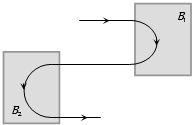
The following figure shows the path of an electron that passes through two regions containing uniform magnetic fields of magnitudes $B_1$ and $B_2$. Its path in each region is a half-circle. Choose the correct option.
A
$B_1$ is into the page and it is stronger than $B_2$
B
$B_1$ is into the page and it is weaker than $B_2$
C
$B_1$ is out of the page and it is weaker than $B_2$
D
$B_1$ is out of the page and it is stronger than $B_2$
Solution
(A) $1$. For an electron (negatively charged particle) moving with velocity $v$ in a magnetic field $B$,the magnetic force is given by $F = q(v \times B)$. Since the charge $q$ is negative,the force is in the direction opposite to $(v \times B)$.
$2$. Using Fleming's Left-Hand Rule for a positive charge,the force is perpendicular to both $v$ and $B$. For an electron,we use the Right-Hand Rule or reverse the direction obtained from the Left-Hand Rule.
$3$. In region $B_1$,the electron enters and turns clockwise. By applying the right-hand rule for a negative charge,the magnetic field $B_1$ must be directed into the page.
$4$. In region $B_2$,the electron turns counter-clockwise. By applying the same rule,the magnetic field $B_2$ must be directed out of the page.
$5$. The radius of the circular path is given by $r = \frac{mv}{qB}$. Since $m, v,$ and $q$ are constant,$r \propto \frac{1}{B}$.
$6$. From the figure,the radius of the path in region $B_1$ $(r_1)$ is smaller than the radius of the path in region $B_2$ $(r_2)$.
$7$. Since $r_1 < r_2$,it follows that $B_1 > B_2$. Thus,$B_1$ is stronger than $B_2$.
$2$. Using Fleming's Left-Hand Rule for a positive charge,the force is perpendicular to both $v$ and $B$. For an electron,we use the Right-Hand Rule or reverse the direction obtained from the Left-Hand Rule.
$3$. In region $B_1$,the electron enters and turns clockwise. By applying the right-hand rule for a negative charge,the magnetic field $B_1$ must be directed into the page.
$4$. In region $B_2$,the electron turns counter-clockwise. By applying the same rule,the magnetic field $B_2$ must be directed out of the page.
$5$. The radius of the circular path is given by $r = \frac{mv}{qB}$. Since $m, v,$ and $q$ are constant,$r \propto \frac{1}{B}$.
$6$. From the figure,the radius of the path in region $B_1$ $(r_1)$ is smaller than the radius of the path in region $B_2$ $(r_2)$.
$7$. Since $r_1 < r_2$,it follows that $B_1 > B_2$. Thus,$B_1$ is stronger than $B_2$.
0 likes
View Solution145
MediumMCQ
An electron is moving along the positive $x$-axis. $A$ uniform electric field exists towards the negative $y$-axis. What should be the direction of a magnetic field of suitable magnitude so that the net force on the electron is zero?
A
positive $z$-axis
B
negative $z$-axis
C
positive $y$-axis
D
negative $y$-axis
Solution
(B) The net force on the electron is given by the Lorentz force equation: $\vec{F}_{net} = \vec{F}_{e} + \vec{F}_{m} = 0$.
Since $\vec{F}_{e} = q\vec{E}$ and $\vec{F}_{m} = q(\vec{v} \times \vec{B})$,we have $q\vec{E} + q(\vec{v} \times \vec{B}) = 0$,which simplifies to $\vec{E} + (\vec{v} \times \vec{B}) = 0$.
Given $\vec{v} = v\hat{i}$ and $\vec{E} = -E\hat{j}$,substituting these into the equation gives: $-E\hat{j} + (v\hat{i} \times \vec{B}) = 0$,or $v\hat{i} \times \vec{B} = E\hat{j}$.
For the cross product of $\hat{i}$ and $\vec{B}$ to result in $\hat{j}$,the vector $\vec{B}$ must be along the negative $z$-axis $(-\hat{k})$,because $\hat{i} \times (-\hat{k}) = \hat{j}$.
Thus,the magnetic field must be directed along the negative $z$-axis.
Since $\vec{F}_{e} = q\vec{E}$ and $\vec{F}_{m} = q(\vec{v} \times \vec{B})$,we have $q\vec{E} + q(\vec{v} \times \vec{B}) = 0$,which simplifies to $\vec{E} + (\vec{v} \times \vec{B}) = 0$.
Given $\vec{v} = v\hat{i}$ and $\vec{E} = -E\hat{j}$,substituting these into the equation gives: $-E\hat{j} + (v\hat{i} \times \vec{B}) = 0$,or $v\hat{i} \times \vec{B} = E\hat{j}$.
For the cross product of $\hat{i}$ and $\vec{B}$ to result in $\hat{j}$,the vector $\vec{B}$ must be along the negative $z$-axis $(-\hat{k})$,because $\hat{i} \times (-\hat{k}) = \hat{j}$.
Thus,the magnetic field must be directed along the negative $z$-axis.
0 likes
View Solution146
AdvancedMCQ
$A$ particle of charge $q$ and mass $m$ starts moving from the origin under the action of an electric field $\vec{E} = E_0 \hat{i}$ and a magnetic field $\vec{B} = B_0 \hat{i}$ with an initial velocity $\vec{v} = v_0 \hat{j}$. The speed of the particle will become $2v_0$ after a time:
A
$t = \frac{2mv_0}{qE_0}$
B
$t = \frac{2B_0q}{mv_0}$
C
$t = \frac{\sqrt{3}B_0q}{mv_0}$
D
$t = \frac{\sqrt{3}mv_0}{qE_0}$
Solution
(D) The electric field $\vec{E} = E_0 \hat{i}$ exerts a force $\vec{F}_e = qE_0 \hat{i}$,causing acceleration $a_x = \frac{qE_0}{m}$ along the $x$-axis.
The magnetic field $\vec{B} = B_0 \hat{i}$ is parallel to the electric field and the $x$-axis. Since the initial velocity $\vec{v} = v_0 \hat{j}$ is perpendicular to the magnetic field,the particle undergoes helical motion in the $yz$-plane while accelerating along the $x$-axis.
The velocity components at time $t$ are $v_x = a_x t = \frac{qE_0}{m} t$ and the speed in the $yz$-plane remains constant at $v_{\perp} = v_0$.
The total speed $v$ at time $t$ is given by $v = \sqrt{v_x^2 + v_{\perp}^2} = \sqrt{(\frac{qE_0}{m} t)^2 + v_0^2}$.
We are given that the speed becomes $2v_0$ at time $t$:
$2v_0 = \sqrt{(\frac{qE_0}{m} t)^2 + v_0^2}$
Squaring both sides:
$4v_0^2 = (\frac{qE_0}{m} t)^2 + v_0^2$
$3v_0^2 = (\frac{qE_0}{m} t)^2$
Taking the square root:
$\sqrt{3}v_0 = \frac{qE_0}{m} t$
Solving for $t$:
$t = \frac{\sqrt{3}mv_0}{qE_0}$
The magnetic field $\vec{B} = B_0 \hat{i}$ is parallel to the electric field and the $x$-axis. Since the initial velocity $\vec{v} = v_0 \hat{j}$ is perpendicular to the magnetic field,the particle undergoes helical motion in the $yz$-plane while accelerating along the $x$-axis.
The velocity components at time $t$ are $v_x = a_x t = \frac{qE_0}{m} t$ and the speed in the $yz$-plane remains constant at $v_{\perp} = v_0$.
The total speed $v$ at time $t$ is given by $v = \sqrt{v_x^2 + v_{\perp}^2} = \sqrt{(\frac{qE_0}{m} t)^2 + v_0^2}$.
We are given that the speed becomes $2v_0$ at time $t$:
$2v_0 = \sqrt{(\frac{qE_0}{m} t)^2 + v_0^2}$
Squaring both sides:
$4v_0^2 = (\frac{qE_0}{m} t)^2 + v_0^2$
$3v_0^2 = (\frac{qE_0}{m} t)^2$
Taking the square root:
$\sqrt{3}v_0 = \frac{qE_0}{m} t$
Solving for $t$:
$t = \frac{\sqrt{3}mv_0}{qE_0}$
0 likes
View Solution147
MediumMCQ
$A$ uniform magnetic field $\vec{B} = B_0 \hat{j}$ exists in space. $A$ particle of mass $m$ and charge $q$ is projected towards the negative $x$-axis with speed $v$ from the point $(d, 0, 0)$. The maximum value of $v$ for which the particle does not hit the $y-z$ plane is
A
$\frac{2B_0 q}{dm}$
B
$\frac{B_0 q d}{m}$
C
$\frac{B_0 q}{2dm}$
D
$\frac{B_0 q d}{2m}$
Solution
(B) When a charged particle enters a uniform magnetic field perpendicular to its velocity,it follows a circular path.
The radius of this circular path is given by $R = \frac{mv}{qB_0}$.
The particle is projected from $(d, 0, 0)$ towards the negative $x$-axis. The $y-z$ plane is the plane where $x = 0$.
For the particle not to hit the $y-z$ plane,the radius of the circular path must be less than or equal to the distance $d$ from the $y-z$ plane.
Thus,$R \leq d$.
Substituting the expression for $R$: $\frac{mv}{qB_0} \leq d$.
Solving for $v$: $v \leq \frac{B_0 q d}{m}$.
Therefore,the maximum value of $v$ is $v_{\text{max}} = \frac{B_0 q d}{m}$.
The radius of this circular path is given by $R = \frac{mv}{qB_0}$.
The particle is projected from $(d, 0, 0)$ towards the negative $x$-axis. The $y-z$ plane is the plane where $x = 0$.
For the particle not to hit the $y-z$ plane,the radius of the circular path must be less than or equal to the distance $d$ from the $y-z$ plane.
Thus,$R \leq d$.
Substituting the expression for $R$: $\frac{mv}{qB_0} \leq d$.
Solving for $v$: $v \leq \frac{B_0 q d}{m}$.
Therefore,the maximum value of $v$ is $v_{\text{max}} = \frac{B_0 q d}{m}$.
0 likes
View Solution148
AdvancedMCQ
$A$ charged particle of specific charge $\alpha$ is released from the origin at time $t = 0$ with velocity $\vec{V} = V_o \hat{i} + V_o \hat{j}$ in a magnetic field $\vec{B} = B_o \hat{i}$. The coordinates of the particle at time $t = \frac{\pi}{B_o \alpha}$ are (specific charge $\alpha = q/m$):
A
$\left( \frac{V_o}{2 B_o \alpha}, \frac{\sqrt{2} V_o}{\alpha B_o}, \frac{-V_o}{B_o \alpha} \right)$
B
$\left( \frac{-V_o}{2 B_o \alpha}, 0, 0 \right)$
C
$\left( 0, \frac{2 V_o}{B_o \alpha}, \frac{V_o \pi}{2 B_o \alpha} \right)$
D
$\left( \frac{V_o \pi}{B_o \alpha}, 0, - \frac{2 V_o}{B_o \alpha} \right)$
Solution
(D) The specific charge is given by $\alpha = q/m$. The particle moves in a helical path in a uniform magnetic field.
The time period of the helical motion is $T = \frac{2 \pi m}{B_o q} = \frac{2 \pi}{B_o \alpha}$.
The given time is $t = \frac{\pi}{B_o \alpha} = \frac{T}{2}$.
The velocity component parallel to the magnetic field is $v_x = V_o$,which remains constant. Thus,the $x$-coordinate at $t = T/2$ is $x = v_x \cdot t = V_o \cdot \frac{\pi}{B_o \alpha} = \frac{V_o \pi}{B_o \alpha}$.
The velocity component perpendicular to the magnetic field is $v_y = V_o$. The particle undergoes circular motion in the $yz$-plane with radius $r = \frac{m v_y}{B_o q} = \frac{V_o}{B_o \alpha}$.
At $t = T/2$,the particle completes half a circle in the $yz$-plane. Starting from $(0, 0)$ in the $yz$-plane with initial velocity in the $+y$ direction,after half a period,the displacement in the $y$-direction is $0$ and in the $z$-direction is $-2r = -\frac{2 V_o}{B_o \alpha}$.
Therefore,the coordinates are $\left( \frac{V_o \pi}{B_o \alpha}, 0, - \frac{2 V_o}{B_o \alpha} \right)$.
The time period of the helical motion is $T = \frac{2 \pi m}{B_o q} = \frac{2 \pi}{B_o \alpha}$.
The given time is $t = \frac{\pi}{B_o \alpha} = \frac{T}{2}$.
The velocity component parallel to the magnetic field is $v_x = V_o$,which remains constant. Thus,the $x$-coordinate at $t = T/2$ is $x = v_x \cdot t = V_o \cdot \frac{\pi}{B_o \alpha} = \frac{V_o \pi}{B_o \alpha}$.
The velocity component perpendicular to the magnetic field is $v_y = V_o$. The particle undergoes circular motion in the $yz$-plane with radius $r = \frac{m v_y}{B_o q} = \frac{V_o}{B_o \alpha}$.
At $t = T/2$,the particle completes half a circle in the $yz$-plane. Starting from $(0, 0)$ in the $yz$-plane with initial velocity in the $+y$ direction,after half a period,the displacement in the $y$-direction is $0$ and in the $z$-direction is $-2r = -\frac{2 V_o}{B_o \alpha}$.
Therefore,the coordinates are $\left( \frac{V_o \pi}{B_o \alpha}, 0, - \frac{2 V_o}{B_o \alpha} \right)$.
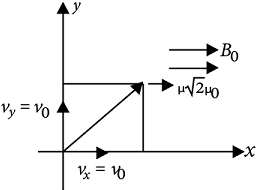
0 likes
View Solution149
DifficultMCQ
Three ions $H^+$,$He^+$,and $O^{2+}$ having the same kinetic energy pass through a region in which there is a uniform magnetic field perpendicular to their velocity. Then:
A
$H^+$ will be least deflected.
B
$He^+$ and $O^{2+}$ will be deflected equally.
C
$O^{2+}$ will be deflected most.
D
All will be deflected equally.
Solution
(B) The radius of the circular path of a charged particle in a uniform magnetic field is given by $r = \frac{mv}{qB}$.
Since kinetic energy $K = \frac{1}{2}mv^2$,we have $v = \sqrt{\frac{2K}{m}}$.
Substituting this into the radius formula: $r = \frac{m}{qB} \sqrt{\frac{2K}{m}} = \frac{\sqrt{2mK}}{qB}$.
For constant $K$ and $B$,the radius $r \propto \frac{\sqrt{m}}{q}$.
Deflection is inversely proportional to the radius $(d \propto \frac{1}{r})$,so $d \propto \frac{q}{\sqrt{m}}$.
For $H^+$: $q=1, m=1 \Rightarrow d \propto \frac{1}{\sqrt{1}} = 1$.
For $He^+$: $q=1, m=4 \Rightarrow d \propto \frac{1}{\sqrt{4}} = 0.5$.
For $O^{2+}$: $q=2, m=16 \Rightarrow d \propto \frac{2}{\sqrt{16}} = \frac{2}{4} = 0.5$.
Comparing the values,$H^+$ has the highest deflection,while $He^+$ and $O^{2+}$ have equal and lower deflection.
Since kinetic energy $K = \frac{1}{2}mv^2$,we have $v = \sqrt{\frac{2K}{m}}$.
Substituting this into the radius formula: $r = \frac{m}{qB} \sqrt{\frac{2K}{m}} = \frac{\sqrt{2mK}}{qB}$.
For constant $K$ and $B$,the radius $r \propto \frac{\sqrt{m}}{q}$.
Deflection is inversely proportional to the radius $(d \propto \frac{1}{r})$,so $d \propto \frac{q}{\sqrt{m}}$.
For $H^+$: $q=1, m=1 \Rightarrow d \propto \frac{1}{\sqrt{1}} = 1$.
For $He^+$: $q=1, m=4 \Rightarrow d \propto \frac{1}{\sqrt{4}} = 0.5$.
For $O^{2+}$: $q=2, m=16 \Rightarrow d \propto \frac{2}{\sqrt{16}} = \frac{2}{4} = 0.5$.
Comparing the values,$H^+$ has the highest deflection,while $He^+$ and $O^{2+}$ have equal and lower deflection.
0 likes
View Solution150
MediumMCQ
An electron having kinetic energy $T$ is moving in a circular orbit of radius $R$ perpendicular to a uniform magnetic induction $\vec{B}$. If kinetic energy is doubled and magnetic induction is tripled,the radius will become
A
$\frac{3R}{2}$
B
$\sqrt{\frac{3}{2}} R$
C
$\sqrt{\frac{2}{9}} R$
D
$\sqrt{\frac{4}{3}} R$
Solution
(C) The radius $r$ of a charged particle moving in a uniform magnetic field is given by $r = \frac{mv}{qB}$.
Since kinetic energy $T = \frac{1}{2}mv^2$,we have $mv = \sqrt{2mT}$.
Substituting this into the radius formula,we get $r = \frac{\sqrt{2mT}}{qB}$.
Given the initial state: $R = \frac{\sqrt{2mT}}{qB}$.
For the new state,kinetic energy $T' = 2T$ and magnetic field $B' = 3B$.
The new radius $R'$ is given by $R' = \frac{\sqrt{2m(2T)}}{q(3B)}$.
$R' = \frac{\sqrt{2} \cdot \sqrt{2mT}}{3qB} = \frac{\sqrt{2}}{3} \left( \frac{\sqrt{2mT}}{qB} \right)$.
Substituting $R$ for the term in the parentheses,we get $R' = \frac{\sqrt{2}}{3} R = \sqrt{\frac{2}{9}} R$.
Since kinetic energy $T = \frac{1}{2}mv^2$,we have $mv = \sqrt{2mT}$.
Substituting this into the radius formula,we get $r = \frac{\sqrt{2mT}}{qB}$.
Given the initial state: $R = \frac{\sqrt{2mT}}{qB}$.
For the new state,kinetic energy $T' = 2T$ and magnetic field $B' = 3B$.
The new radius $R'$ is given by $R' = \frac{\sqrt{2m(2T)}}{q(3B)}$.
$R' = \frac{\sqrt{2} \cdot \sqrt{2mT}}{3qB} = \frac{\sqrt{2}}{3} \left( \frac{\sqrt{2mT}}{qB} \right)$.
Substituting $R$ for the term in the parentheses,we get $R' = \frac{\sqrt{2}}{3} R = \sqrt{\frac{2}{9}} R$.
0 likes
View SolutionMoving Charges and Magnetism — Motion of Charged Particle In Magnetic Field · Frequently Asked Questions
1Are these Moving Charges and Magnetism questions useful for JEE and NEET?
Yes. All questions in this section are mapped to JEE Main and NEET exam patterns. Previous year questions from JEE Main, NEET, GUJCET and state-level exams are included with full solutions.
2Can I switch to Hindi or Gujarati for these questions?
Yes. Use the language tabs in the hero section or the sidebar to view the same questions and solutions in English, Hindi or Gujarati.
3How do I generate a question paper from this subtopic?
Use the Vedclass Exam Paper Generator — select the chapter and subtopic, set difficulty, and generate Sets A, B, C, D automatically. First 3 chapters of every subject are free.
Vedclass Products
For Students
Vedclass Test Series
Mock tests in real JEE/NEET style with performance analysis. 5-day free trial.
Start Free TrialFor Teachers
Exam Paper Generator
Generate Set A/B/C/D papers from this chapter in 2 minutes. 3 chapters free.
Try FreeFor Institutes
Online Exam Module
Live online exams with unlimited students, 360° analytics & white-label branding.
See DemoFor Teachers & Institutes
Generate a Moving Charges and Magnetism Exam Paper in 2 Minutes
Select subtopic & difficulty — Sets A, B, C, D auto-generated with No Repeat logic.
First 3 chapters of every subject are free — no payment required.