
A English
Motion of Charged Particle In Magnetic Field Questions in English
Class 12 Physics · Moving Charges and Magnetism · Motion of Charged Particle In Magnetic Field
513+
Questions
English
Language
100%
With Solutions
Showing 50 of 513 questions in English
51
EasyMCQ
$A$ charged particle moves in a uniform magnetic field. The velocity of the particle at some instant makes an acute angle with the magnetic field. The path of the particle will be
A
$A$ straight line
B
$A$ circle
C
$A$ helix with uniform pitch
D
$A$ helix with non-uniform pitch
Solution
(C) When a charged particle enters a uniform magnetic field with a velocity that makes an acute angle $\theta$ (where $\theta \neq 0^\circ, 90^\circ, 180^\circ$) with the magnetic field,the velocity can be resolved into two components:
$1$. $A$ component parallel to the magnetic field $(v_{\parallel} = v \cos \theta)$,which causes the particle to move linearly along the field lines.
$2$. $A$ component perpendicular to the magnetic field $(v_{\perp} = v \sin \theta)$,which causes the particle to move in a circular path.
The combination of these two motions results in a helical path. Since the magnetic field is uniform and the angle $\theta$ remains constant,the pitch of the helix remains uniform.
$1$. $A$ component parallel to the magnetic field $(v_{\parallel} = v \cos \theta)$,which causes the particle to move linearly along the field lines.
$2$. $A$ component perpendicular to the magnetic field $(v_{\perp} = v \sin \theta)$,which causes the particle to move in a circular path.
The combination of these two motions results in a helical path. Since the magnetic field is uniform and the angle $\theta$ remains constant,the pitch of the helix remains uniform.
0 likes
View Solution52
EasyMCQ
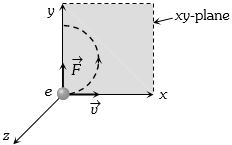
An electron is moving along the positive $x$-axis. To make it move in an anticlockwise circular path in the $x-y$ plane,a magnetic field must be applied:
A
Along the positive $y$-axis
B
Along the positive $z$-axis
C
Along the negative $y$-axis
D
Along the negative $z$-axis
Solution
(D) The electron has a velocity $\vec{v} = v \hat{i}$. For it to move in an anticlockwise circular path in the $xy$-plane,the initial magnetic force $\vec{F}_m$ must be directed along the positive $y$-axis (towards the center of the circular path).
Using the Lorentz force formula $\vec{F}_m = q(\vec{v} \times \vec{B})$,where $q = -e$ (for an electron),we have:
$\vec{F}_m = -e(v \hat{i} \times \vec{B}) = F_0 \hat{j}$.
This implies $(\hat{i} \times \vec{B}) = -\frac{F_0}{ev} \hat{j}$.
Since $\hat{i} \times \hat{k} = \hat{j}$,we have $\hat{i} \times (-\hat{k}) = -\hat{j}$.
Therefore,the magnetic field $\vec{B}$ must be directed along the negative $z$-axis.
Using the Lorentz force formula $\vec{F}_m = q(\vec{v} \times \vec{B})$,where $q = -e$ (for an electron),we have:
$\vec{F}_m = -e(v \hat{i} \times \vec{B}) = F_0 \hat{j}$.
This implies $(\hat{i} \times \vec{B}) = -\frac{F_0}{ev} \hat{j}$.
Since $\hat{i} \times \hat{k} = \hat{j}$,we have $\hat{i} \times (-\hat{k}) = -\hat{j}$.
Therefore,the magnetic field $\vec{B}$ must be directed along the negative $z$-axis.
0 likes
View Solution53
DifficultMCQ
$A$ proton,a deuteron and an $\alpha$-particle having the same kinetic energy are moving in circular trajectories in a constant magnetic field. If ${r_p}$,${r_d}$ and ${r_\alpha}$ denote respectively the radii of the trajectories of these particles,then:
A
${r_\alpha} = {r_p} < {r_d}$
B
${r_\alpha} > {r_d} > {r_p}$
C
${r_\alpha} = {r_d} > {r_p}$
D
${r_p} = {r_d} = {r_\alpha}$
Solution
(A) Given that the kinetic energy $K$ is the same for all particles: ${K_p} = {K_d} = {K_\alpha} = K$.
We know the mass and charge relations: $m_p = m$,$m_d = 2m$,${m_\alpha} = 4m$ and $q_p = e$,$q_d = e$,${q_\alpha} = 2e$.
The radius of a charged particle in a magnetic field is given by $r = \frac{mv}{qB} = \frac{\sqrt{2mK}}{qB}$.
For the proton: ${r_p} = \frac{\sqrt{2mK}}{eB}$.
For the deuteron: ${r_d} = \frac{\sqrt{2(2m)K}}{eB} = \sqrt{2} \left( \frac{\sqrt{2mK}}{eB} \right) = \sqrt{2} {r_p}$.
For the $\alpha$-particle: ${r_\alpha} = \frac{\sqrt{2(4m)K}}{(2e)B} = \frac{2\sqrt{2mK}}{2eB} = \frac{\sqrt{2mK}}{eB} = {r_p}$.
Comparing these,we get ${r_\alpha} = {r_p} < {r_d}$.
We know the mass and charge relations: $m_p = m$,$m_d = 2m$,${m_\alpha} = 4m$ and $q_p = e$,$q_d = e$,${q_\alpha} = 2e$.
The radius of a charged particle in a magnetic field is given by $r = \frac{mv}{qB} = \frac{\sqrt{2mK}}{qB}$.
For the proton: ${r_p} = \frac{\sqrt{2mK}}{eB}$.
For the deuteron: ${r_d} = \frac{\sqrt{2(2m)K}}{eB} = \sqrt{2} \left( \frac{\sqrt{2mK}}{eB} \right) = \sqrt{2} {r_p}$.
For the $\alpha$-particle: ${r_\alpha} = \frac{\sqrt{2(4m)K}}{(2e)B} = \frac{2\sqrt{2mK}}{2eB} = \frac{\sqrt{2mK}}{eB} = {r_p}$.
Comparing these,we get ${r_\alpha} = {r_p} < {r_d}$.
0 likes
View Solution54
EasyMCQ
The time period of a charged particle undergoing a circular motion in a uniform magnetic field is independent of its
A
Magnetic induction
B
Charge
C
Mass
D
Velocity
Solution
(D) When a charged particle of mass $m$ and charge $q$ moves with velocity $v$ perpendicular to a uniform magnetic field $B$,it experiences a magnetic Lorentz force $F = qvB$ which acts as the centripetal force.
Thus,$qvB = \frac{mv^2}{r}$,where $r$ is the radius of the circular path.
Solving for $r$,we get $r = \frac{mv}{qB}$.
The time period $T$ is the time taken to complete one circular orbit,given by $T = \frac{2\pi r}{v}$.
Substituting the value of $r$,we get $T = \frac{2\pi (mv/qB)}{v} = \frac{2\pi m}{qB}$.
From this expression,it is clear that the time period $T$ depends only on the mass $m$,charge $q$,and magnetic field $B$.
It is independent of the velocity $v$ of the particle.
Thus,$qvB = \frac{mv^2}{r}$,where $r$ is the radius of the circular path.
Solving for $r$,we get $r = \frac{mv}{qB}$.
The time period $T$ is the time taken to complete one circular orbit,given by $T = \frac{2\pi r}{v}$.
Substituting the value of $r$,we get $T = \frac{2\pi (mv/qB)}{v} = \frac{2\pi m}{qB}$.
From this expression,it is clear that the time period $T$ depends only on the mass $m$,charge $q$,and magnetic field $B$.
It is independent of the velocity $v$ of the particle.
0 likes
View Solution55
MediumMCQ
$A$ proton of energy $200\, MeV$ enters a magnetic field of $5\, T$. If the direction of the field is from south to north and the motion is upward,the force acting on it will be:
A
Zero
B
$1.6 \times 10^{-10}\,N$
C
$3.2 \times 10^{-8}\,N$
D
$1.6 \times 10^{-6}\,N$
Solution
(B) The magnetic force on a moving charge is given by $F = qvB \sin \theta$. Since the motion is upward and the field is horizontal (south to north),the angle $\theta = 90^\circ$,so $F = qvB$.
Given kinetic energy $K = 200\, MeV = 200 \times 10^6 \times 1.6 \times 10^{-19}\,J = 3.2 \times 10^{-11}\,J$.
Using $K = \frac{1}{2}mv^2$,we find velocity $v = \sqrt{\frac{2K}{m}}$.
Substituting this into the force equation: $F = qB \sqrt{\frac{2K}{m}}$.
$F = (1.6 \times 10^{-19}) \times 5 \times \sqrt{\frac{2 \times 3.2 \times 10^{-11}}{1.67 \times 10^{-27}}}$.
$F = 8 \times 10^{-19} \times \sqrt{3.83 \times 10^{16}} \approx 8 \times 10^{-19} \times 1.95 \times 10^8 \approx 1.56 \times 10^{-10}\,N$.
Rounding to the nearest option,$F = 1.6 \times 10^{-10}\,N$.
Given kinetic energy $K = 200\, MeV = 200 \times 10^6 \times 1.6 \times 10^{-19}\,J = 3.2 \times 10^{-11}\,J$.
Using $K = \frac{1}{2}mv^2$,we find velocity $v = \sqrt{\frac{2K}{m}}$.
Substituting this into the force equation: $F = qB \sqrt{\frac{2K}{m}}$.
$F = (1.6 \times 10^{-19}) \times 5 \times \sqrt{\frac{2 \times 3.2 \times 10^{-11}}{1.67 \times 10^{-27}}}$.
$F = 8 \times 10^{-19} \times \sqrt{3.83 \times 10^{16}} \approx 8 \times 10^{-19} \times 1.95 \times 10^8 \approx 1.56 \times 10^{-10}\,N$.
Rounding to the nearest option,$F = 1.6 \times 10^{-10}\,N$.
0 likes
View Solution56
EasyMCQ
$A$ charge moving with velocity $v$ in $X$-direction is subjected to a field of magnetic induction in the negative $X$-direction. As a result,the charge will
A
Remain unaffected
B
Start moving in a circular path in the $Y-Z$ plane
C
Retard along $X$-axis
D
Move along a helical path around $X$-axis
Solution
(A) The magnetic force on a moving charge is given by the Lorentz force formula: $\overrightarrow{F_m} = q(\overrightarrow{v} \times \overrightarrow{B})$.
Here,the velocity vector $\overrightarrow{v}$ is in the $+X$-direction,and the magnetic field $\overrightarrow{B}$ is in the $-X$-direction.
The angle $\theta$ between $\overrightarrow{v}$ and $\overrightarrow{B}$ is $180^\circ$.
Since the cross product $\overrightarrow{v} \times \overrightarrow{B} = vB \sin(180^\circ) = 0$,the magnetic force $\overrightarrow{F_m}$ is zero.
Therefore,the charge will continue to move in the $X$-direction with constant velocity and remain unaffected.
Here,the velocity vector $\overrightarrow{v}$ is in the $+X$-direction,and the magnetic field $\overrightarrow{B}$ is in the $-X$-direction.
The angle $\theta$ between $\overrightarrow{v}$ and $\overrightarrow{B}$ is $180^\circ$.
Since the cross product $\overrightarrow{v} \times \overrightarrow{B} = vB \sin(180^\circ) = 0$,the magnetic force $\overrightarrow{F_m}$ is zero.
Therefore,the charge will continue to move in the $X$-direction with constant velocity and remain unaffected.
0 likes
View Solution57
EasyMCQ
If an electron and a proton having same momenta enter perpendicular to a magnetic field,then
A
The path of proton shall be more curved than that of electron
B
The path of proton shall be less curved than that of electron
C
Both are equally curved
D
Path of both will be straight line
Solution
(C) The radius of the circular path of a charged particle moving perpendicular to a magnetic field $B$ is given by $r = \frac{mv}{qB}$.
Since momentum $p = mv$,we can rewrite the expression as $r = \frac{p}{qB}$.
Given that both the electron and the proton have the same momentum $p$ and are moving in the same magnetic field $B$,the radius depends only on the charge $q$.
However,the magnitude of the charge of an electron and a proton is the same $(|q_e| = |q_p| = e)$.
Therefore,the radius of the path for both particles is $r = \frac{p}{eB}$,which is identical for both.
Thus,both paths are equally curved.
Since momentum $p = mv$,we can rewrite the expression as $r = \frac{p}{qB}$.
Given that both the electron and the proton have the same momentum $p$ and are moving in the same magnetic field $B$,the radius depends only on the charge $q$.
However,the magnitude of the charge of an electron and a proton is the same $(|q_e| = |q_p| = e)$.
Therefore,the radius of the path for both particles is $r = \frac{p}{eB}$,which is identical for both.
Thus,both paths are equally curved.
0 likes
View Solution58
EasyMCQ
$A$ positively charged particle moving due east enters a region of uniform magnetic field directed vertically upwards. The particle will
A
Get deflected vertically upwards
B
Move in a circular orbit with its speed increased
C
Move in a circular orbit with its speed unchanged
D
Continue to move due east
Solution
(C) According to the Lorentz force formula,$\vec{F} = q(\vec{v} \times \vec{B})$.
Here,the velocity $\vec{v}$ is directed towards the east,and the magnetic field $\vec{B}$ is directed vertically upwards.
Using the right-hand rule for the cross product $\vec{v} \times \vec{B}$,the force $\vec{F}$ acts in the horizontal plane towards the north.
Since the magnetic force is always perpendicular to the velocity of the particle,it does no work on the particle $(W = \vec{F} \cdot \vec{d} = 0)$.
Consequently,the kinetic energy and the speed of the particle remain constant.
$A$ particle moving perpendicular to a uniform magnetic field follows a circular path with a constant speed.
Here,the velocity $\vec{v}$ is directed towards the east,and the magnetic field $\vec{B}$ is directed vertically upwards.
Using the right-hand rule for the cross product $\vec{v} \times \vec{B}$,the force $\vec{F}$ acts in the horizontal plane towards the north.
Since the magnetic force is always perpendicular to the velocity of the particle,it does no work on the particle $(W = \vec{F} \cdot \vec{d} = 0)$.
Consequently,the kinetic energy and the speed of the particle remain constant.
$A$ particle moving perpendicular to a uniform magnetic field follows a circular path with a constant speed.
0 likes
View Solution59
EasyMCQ
$A$ particle moving in a magnetic field increases its velocity,then its radius of the circle
A
Decreases
B
Increases
C
Remains the same
D
Becomes half
Solution
(B) The radius $r$ of the circular path of a charged particle moving in a uniform magnetic field is given by the formula $r = \frac{mv}{qB}$.
Here,$m$ is the mass of the particle,$v$ is its velocity,$q$ is the charge,and $B$ is the magnetic field strength.
From the formula,it is clear that the radius $r$ is directly proportional to the velocity $v$ of the particle $(r \propto v)$.
Therefore,if the velocity of the particle increases,the radius of the circular path also increases.
Here,$m$ is the mass of the particle,$v$ is its velocity,$q$ is the charge,and $B$ is the magnetic field strength.
From the formula,it is clear that the radius $r$ is directly proportional to the velocity $v$ of the particle $(r \propto v)$.
Therefore,if the velocity of the particle increases,the radius of the circular path also increases.
0 likes
View Solution60
EasyMCQ
$A$ particle is moving in a uniform magnetic field,then
A
Its momentum changes but total energy remains the same
B
Both momentum and total energy remain the same
C
Both will change
D
Total energy changes but momentum remains the same
Solution
(A) When a charged particle moves in a uniform magnetic field,the magnetic force acting on it is given by $\vec{F} = q(\vec{v} \times \vec{B})$.
Since the force is always perpendicular to the velocity vector $\vec{v}$,the work done by the magnetic field on the particle is $W = \int \vec{F} \cdot d\vec{s} = \int \vec{F} \cdot \vec{v} dt = 0$.
Because the work done is zero,the kinetic energy (and thus the total energy) of the particle remains constant.
However,the direction of the velocity vector changes continuously due to the magnetic force,which implies that the momentum $\vec{p} = m\vec{v}$ changes because momentum is a vector quantity.
Therefore,the momentum changes while the total energy remains the same.
Since the force is always perpendicular to the velocity vector $\vec{v}$,the work done by the magnetic field on the particle is $W = \int \vec{F} \cdot d\vec{s} = \int \vec{F} \cdot \vec{v} dt = 0$.
Because the work done is zero,the kinetic energy (and thus the total energy) of the particle remains constant.
However,the direction of the velocity vector changes continuously due to the magnetic force,which implies that the momentum $\vec{p} = m\vec{v}$ changes because momentum is a vector quantity.
Therefore,the momentum changes while the total energy remains the same.
0 likes
View Solution61
EasyMCQ
If an electron is moving in the direction of the magnetic field $\overrightarrow{B}$ with a velocity $\overrightarrow{v}$,then the force on the electron is:
A
Zero
B
$e(\overrightarrow{v} \cdot \overrightarrow{B})$
C
$e(\overrightarrow{v} \times \overrightarrow{B})$
D
None of these
Solution
(A) The Lorentz force acting on a charged particle moving in a magnetic field is given by the formula $\overrightarrow{F} = q(\overrightarrow{v} \times \overrightarrow{B})$.
Here,the charge of an electron is $q = -e$.
Since the electron is moving in the direction of the magnetic field,the angle $\theta$ between the velocity vector $\overrightarrow{v}$ and the magnetic field vector $\overrightarrow{B}$ is $0^\circ$.
The magnitude of the force is given by $F = |q|vB \sin \theta$.
Substituting $\theta = 0^\circ$,we get $F = evB \sin(0^\circ) = evB(0) = 0$.
Therefore,the force on the electron is zero.
Here,the charge of an electron is $q = -e$.
Since the electron is moving in the direction of the magnetic field,the angle $\theta$ between the velocity vector $\overrightarrow{v}$ and the magnetic field vector $\overrightarrow{B}$ is $0^\circ$.
The magnitude of the force is given by $F = |q|vB \sin \theta$.
Substituting $\theta = 0^\circ$,we get $F = evB \sin(0^\circ) = evB(0) = 0$.
Therefore,the force on the electron is zero.
0 likes
View Solution62
EasyMCQ
$A$ proton beam enters a magnetic field of $10^{-4} \ T$ normally. Given the specific charge $\frac{q}{m} = 10^{11} \ C/kg$ and velocity $v = 10^7 \ m/s$,what is the radius of the circular path described by the beam in meters?
A
$0.1$
B
$1$
C
$10$
D
None of these
Solution
(B) The radius $r$ of the circular path of a charged particle moving perpendicular to a magnetic field is given by the formula: $r = \frac{mv}{qB}$.
We are given the specific charge $\frac{q}{m} = 10^{11} \ C/kg$,which implies $\frac{m}{q} = \frac{1}{10^{11}} \ kg/C$.
Given values are $v = 10^7 \ m/s$ and $B = 10^{-4} \ T$.
Substituting these values into the formula:
$r = \left(\frac{m}{q}\right) \times \frac{v}{B} = \left(\frac{1}{10^{11}}\right) \times \frac{10^7}{10^{-4}}$
$r = \frac{10^7}{10^{11} \times 10^{-4}} = \frac{10^7}{10^7} = 1 \ m$.
Therefore,the radius is $1 \ m$.
We are given the specific charge $\frac{q}{m} = 10^{11} \ C/kg$,which implies $\frac{m}{q} = \frac{1}{10^{11}} \ kg/C$.
Given values are $v = 10^7 \ m/s$ and $B = 10^{-4} \ T$.
Substituting these values into the formula:
$r = \left(\frac{m}{q}\right) \times \frac{v}{B} = \left(\frac{1}{10^{11}}\right) \times \frac{10^7}{10^{-4}}$
$r = \frac{10^7}{10^{11} \times 10^{-4}} = \frac{10^7}{10^7} = 1 \ m$.
Therefore,the radius is $1 \ m$.
0 likes
View Solution63
MediumMCQ
$A$ charged particle is moving in a uniform magnetic field in a circular path. The radius of the circular path is $R$. When the energy of the particle is doubled,the new radius will be:
A
$R\sqrt{2}$
B
$R\sqrt{3}$
C
$2R$
D
$3R$
Solution
(A) The radius $r$ of a charged particle moving in a uniform magnetic field is given by the formula $r = \frac{mv}{qB}$.
Since the kinetic energy $K$ is given by $K = \frac{1}{2}mv^2$,we have $mv = \sqrt{2mK}$.
Substituting this into the radius formula,we get $r = \frac{\sqrt{2mK}}{qB}$.
This shows that $r \propto \sqrt{K}$.
Let the initial radius be $R$ with energy $K$,and the new radius be $R_2$ with energy $2K$.
Then,$\frac{R_2}{R} = \sqrt{\frac{2K}{K}} = \sqrt{2}$.
Therefore,$R_2 = R\sqrt{2}$.
Since the kinetic energy $K$ is given by $K = \frac{1}{2}mv^2$,we have $mv = \sqrt{2mK}$.
Substituting this into the radius formula,we get $r = \frac{\sqrt{2mK}}{qB}$.
This shows that $r \propto \sqrt{K}$.
Let the initial radius be $R$ with energy $K$,and the new radius be $R_2$ with energy $2K$.
Then,$\frac{R_2}{R} = \sqrt{\frac{2K}{K}} = \sqrt{2}$.
Therefore,$R_2 = R\sqrt{2}$.
0 likes
View Solution64
EasyMCQ
The radius of curvature of the path of a charged particle moving in a static uniform magnetic field is
A
Directly proportional to the magnitude of the charge on the particle
B
Directly proportional to the magnitude of the linear momentum of the particle
C
Inversely proportional to the magnitude of the magnetic field
D
Both $(b)$ and $(c)$
Solution
(D) When a charged particle with charge $q$,mass $m$,and velocity $v$ moves in a uniform magnetic field $B$ perpendicular to its motion,it experiences a magnetic Lorentz force $F = qvB$.
This force provides the necessary centripetal force for circular motion: $qvB = \frac{mv^2}{r}$.
Rearranging for the radius $r$,we get $r = \frac{mv}{qB}$.
Since linear momentum $P = mv$,the expression becomes $r = \frac{P}{qB}$.
From this formula,it is clear that $r$ is directly proportional to the linear momentum $P$ and inversely proportional to the magnetic field $B$.
Therefore,both statements $(b)$ and $(c)$ are correct.
This force provides the necessary centripetal force for circular motion: $qvB = \frac{mv^2}{r}$.
Rearranging for the radius $r$,we get $r = \frac{mv}{qB}$.
Since linear momentum $P = mv$,the expression becomes $r = \frac{P}{qB}$.
From this formula,it is clear that $r$ is directly proportional to the linear momentum $P$ and inversely proportional to the magnetic field $B$.
Therefore,both statements $(b)$ and $(c)$ are correct.
0 likes
View Solution65
MediumMCQ
$A$ proton moving with a velocity of $2.5 \times 10^7 \, m/s$ enters a magnetic field of intensity $2.5 \, T$ making an angle of $30^o$ with the magnetic field. The force on the proton is:
A
$3 \times 10^{-12} \, N$
B
$5 \times 10^{-12} \, N$
C
$6 \times 10^{-12} \, N$
D
$9 \times 10^{-12} \, N$
Solution
(B) The magnetic force $F$ on a charged particle moving in a magnetic field is given by the formula: $F = qvB \sin \theta$.
Given:
Charge of a proton $q = 1.6 \times 10^{-19} \, C$
Velocity $v = 2.5 \times 10^7 \, m/s$
Magnetic field $B = 2.5 \, T$
Angle $\theta = 30^o$
Substituting the values:
$F = (1.6 \times 10^{-19}) \times (2.5 \times 10^7) \times 2.5 \times \sin(30^o)$
$F = (1.6 \times 10^{-19}) \times (6.25 \times 10^7) \times 0.5$
$F = 10 \times 10^{-12} \times 0.5$
$F = 5 \times 10^{-12} \, N$
Given:
Charge of a proton $q = 1.6 \times 10^{-19} \, C$
Velocity $v = 2.5 \times 10^7 \, m/s$
Magnetic field $B = 2.5 \, T$
Angle $\theta = 30^o$
Substituting the values:
$F = (1.6 \times 10^{-19}) \times (2.5 \times 10^7) \times 2.5 \times \sin(30^o)$
$F = (1.6 \times 10^{-19}) \times (6.25 \times 10^7) \times 0.5$
$F = 10 \times 10^{-12} \times 0.5$
$F = 5 \times 10^{-12} \, N$
0 likes
View Solution66
EasyMCQ
$A$ charge $q$ is moving in a magnetic field. Then,the magnetic force does not depend upon:
A
Charge
B
Mass
C
Velocity
D
Magnetic field
Solution
(B) The magnetic force $F$ acting on a charge $q$ moving with velocity $v$ in a magnetic field $B$ is given by the Lorentz force formula: $F = q(v \times B)$.
In terms of magnitude,this is expressed as $F = qvB \sin \theta$,where $\theta$ is the angle between the velocity vector and the magnetic field vector.
From this formula,it is clear that the force depends on the charge $(q)$,the velocity $(v)$,the magnetic field $(B)$,and the angle $(\theta)$.
It does not depend on the mass $(m)$ of the particle.
Therefore,the correct option is $B$.
In terms of magnitude,this is expressed as $F = qvB \sin \theta$,where $\theta$ is the angle between the velocity vector and the magnetic field vector.
From this formula,it is clear that the force depends on the charge $(q)$,the velocity $(v)$,the magnetic field $(B)$,and the angle $(\theta)$.
It does not depend on the mass $(m)$ of the particle.
Therefore,the correct option is $B$.
0 likes
View Solution67
EasyMCQ
An electron is travelling in the east direction and a magnetic field is applied in the upward direction. In which direction will the electron deflect?
A
South
B
North
C
West
D
East
Solution
(A) The force on a moving charge in a magnetic field is given by the Lorentz force formula: $\vec{F} = q(\vec{v} \times \vec{B})$.
Here,the charge of an electron is negative $(q = -e)$.
The velocity $\vec{v}$ is in the east direction,and the magnetic field $\vec{B}$ is in the upward direction.
Using the right-hand rule for the cross product $\vec{v} \times \vec{B}$: the direction of $\vec{v} \times \vec{B}$ is towards the north.
Since the electron has a negative charge,the force $\vec{F} = -e(\vec{v} \times \vec{B})$ will be in the opposite direction of $\vec{v} \times \vec{B}$.
Therefore,the force on the electron is towards the south.
Alternatively,using Fleming's left-hand rule for a negative charge: point the index finger upward (magnetic field),the middle finger towards the west (opposite to the electron's velocity),and the thumb will point towards the south.
Here,the charge of an electron is negative $(q = -e)$.
The velocity $\vec{v}$ is in the east direction,and the magnetic field $\vec{B}$ is in the upward direction.
Using the right-hand rule for the cross product $\vec{v} \times \vec{B}$: the direction of $\vec{v} \times \vec{B}$ is towards the north.
Since the electron has a negative charge,the force $\vec{F} = -e(\vec{v} \times \vec{B})$ will be in the opposite direction of $\vec{v} \times \vec{B}$.
Therefore,the force on the electron is towards the south.
Alternatively,using Fleming's left-hand rule for a negative charge: point the index finger upward (magnetic field),the middle finger towards the west (opposite to the electron's velocity),and the thumb will point towards the south.
0 likes
View Solution68
EasyMCQ
$A$ charge of $1\,C$ is moving in a magnetic field of $0.5\,T$ with a velocity of $10\,m/s$ perpendicular to the field. The force experienced is.....$N$.
A
$5$
B
$10$
C
$0.5$
D
$0$
Solution
(A) The magnetic force $F$ on a moving charge is given by the formula $F = qvB \sin(\theta)$.
Given:
Charge $q = 1\,C$
Velocity $v = 10\,m/s$
Magnetic field $B = 0.5\,T$
Angle $\theta = 90^\circ$ (since the velocity is perpendicular to the field).
Substituting the values:
$F = 1 \times 10 \times 0.5 \times \sin(90^\circ)$
$F = 1 \times 10 \times 0.5 \times 1$
$F = 5\,N$.
Given:
Charge $q = 1\,C$
Velocity $v = 10\,m/s$
Magnetic field $B = 0.5\,T$
Angle $\theta = 90^\circ$ (since the velocity is perpendicular to the field).
Substituting the values:
$F = 1 \times 10 \times 0.5 \times \sin(90^\circ)$
$F = 1 \times 10 \times 0.5 \times 1$
$F = 5\,N$.
0 likes
View Solution69
MediumMCQ
An electron of mass $m$ and charge $q$ is travelling with a speed $v$ along a circular path of radius $r$ at right angles to a uniform magnetic field $B$. If the speed of the electron is doubled and the magnetic field is halved,then the resulting path would have a radius of:
A
$r/4$
B
$r/2$
C
$2r$
D
$4r$
Solution
(D) The radius $r$ of a charged particle moving in a uniform magnetic field is given by the formula $r = \frac{mv}{qB}$.
Given the initial state: $r_1 = \frac{mv}{qB}$.
For the final state,the speed is doubled $(v_2 = 2v)$ and the magnetic field is halved $(B_2 = B/2)$.
The new radius $r_2$ is given by $r_2 = \frac{m(2v)}{q(B/2)}$.
Simplifying this expression: $r_2 = 4 \times \frac{mv}{qB} = 4r_1$.
Therefore,the resulting path has a radius of $4r$.
Given the initial state: $r_1 = \frac{mv}{qB}$.
For the final state,the speed is doubled $(v_2 = 2v)$ and the magnetic field is halved $(B_2 = B/2)$.
The new radius $r_2$ is given by $r_2 = \frac{m(2v)}{q(B/2)}$.
Simplifying this expression: $r_2 = 4 \times \frac{mv}{qB} = 4r_1$.
Therefore,the resulting path has a radius of $4r$.
0 likes
View Solution70
EasyMCQ
If an electron enters a magnetic field with its velocity pointing in the same direction as the magnetic field,then
A
The electron will turn to its right
B
The electron will turn to its left
C
The velocity of the electron will increase
D
The velocity of the electron will remain unchanged
Solution
(D) The magnetic force $F$ acting on a charged particle moving in a magnetic field is given by the Lorentz force formula: $F = q(\vec{v} \times \vec{B}) = qvB \sin(\theta)$.
Here,$\theta$ is the angle between the velocity vector $\vec{v}$ and the magnetic field vector $\vec{B}$.
Since the electron enters the magnetic field in the same direction as the magnetic field,the angle $\theta = 0^\circ$.
Therefore,the magnetic force $F = qvB \sin(0^\circ) = 0$.
Since the net force on the electron is zero,there is no change in its velocity (both magnitude and direction remain constant). Thus,the velocity of the electron remains unchanged.
Here,$\theta$ is the angle between the velocity vector $\vec{v}$ and the magnetic field vector $\vec{B}$.
Since the electron enters the magnetic field in the same direction as the magnetic field,the angle $\theta = 0^\circ$.
Therefore,the magnetic force $F = qvB \sin(0^\circ) = 0$.
Since the net force on the electron is zero,there is no change in its velocity (both magnitude and direction remain constant). Thus,the velocity of the electron remains unchanged.
0 likes
View Solution71
EasyMCQ
$A$ particle of mass $m$ and charge $q$ enters a magnetic field $B$ perpendicularly with a velocity $v$. The radius of the circular path described by it will be:
A
$Bq/mv$
B
$mq/Bv$
C
$mB/qv$
D
$mv/Bq$
Solution
(D) When a charged particle of mass $m$ and charge $q$ enters a magnetic field $B$ perpendicularly with a velocity $v$,it experiences a magnetic Lorentz force given by $F = q(v \times B)$.
Since the velocity is perpendicular to the magnetic field,the magnitude of the force is $F = qvB$.
This magnetic force acts as the centripetal force required for circular motion,so $F = mv^2/r$.
Equating the two expressions: $qvB = mv^2/r$.
Solving for the radius $r$,we get $r = mv/qB$.
Since the velocity is perpendicular to the magnetic field,the magnitude of the force is $F = qvB$.
This magnetic force acts as the centripetal force required for circular motion,so $F = mv^2/r$.
Equating the two expressions: $qvB = mv^2/r$.
Solving for the radius $r$,we get $r = mv/qB$.
0 likes
View Solution72
EasyMCQ
An electron moving towards the east enters a magnetic field directed towards the north. The force on the electron will be directed
A
Vertically upward
B
Vertically downward
C
Towards the west
D
Towards the south
Solution
(B) The force on a moving charge in a magnetic field is given by the Lorentz force formula: $\vec{F} = q(\vec{v} \times \vec{B})$.
Here,the charge of the electron is negative $(q = -e)$.
The velocity $\vec{v}$ is towards the east,and the magnetic field $\vec{B}$ is towards the north.
Using the right-hand rule for the cross product $\vec{v} \times \vec{B}$,the direction of $\vec{v} \times \vec{B}$ is vertically upward (from east to north).
Since the electron has a negative charge,the force $\vec{F} = -e(\vec{v} \times \vec{B})$ will be in the opposite direction of $\vec{v} \times \vec{B}$.
Therefore,the force on the electron is directed vertically downward.
Here,the charge of the electron is negative $(q = -e)$.
The velocity $\vec{v}$ is towards the east,and the magnetic field $\vec{B}$ is towards the north.
Using the right-hand rule for the cross product $\vec{v} \times \vec{B}$,the direction of $\vec{v} \times \vec{B}$ is vertically upward (from east to north).
Since the electron has a negative charge,the force $\vec{F} = -e(\vec{v} \times \vec{B})$ will be in the opposite direction of $\vec{v} \times \vec{B}$.
Therefore,the force on the electron is directed vertically downward.
0 likes
View Solution73
EasyMCQ
An electron (mass = $9.0 \times 10^{-31} \ kg$ and charge = $1.6 \times 10^{-19} \ C$) is moving in a circular orbit in a magnetic field of $1.0 \times 10^{-4} \ Wb/m^2$. Its period of revolution is:
A
$3.5 \times 10^{-7} \ s$
B
$7.0 \times 10^{-7} \ s$
C
$1.05 \times 10^{-6} \ s$
D
$2.1 \times 10^{-6} \ s$
Solution
(A) The period of revolution $T$ of a charged particle moving in a circular orbit in a uniform magnetic field is given by the formula:
$T = \frac{2\pi m}{qB}$
Given:
Mass $m = 9.0 \times 10^{-31} \ kg$
Charge $q = 1.6 \times 10^{-19} \ C$
Magnetic field $B = 1.0 \times 10^{-4} \ Wb/m^2$
Substituting the values into the formula:
$T = \frac{2 \times 3.14 \times 9.0 \times 10^{-31}}{1.6 \times 10^{-19} \times 1.0 \times 10^{-4}}$
$T = \frac{56.52 \times 10^{-31}}{1.6 \times 10^{-23}}$
$T = 35.325 \times 10^{-8} \ s \approx 3.5 \times 10^{-7} \ s$
Thus,the correct option is $A$.
$T = \frac{2\pi m}{qB}$
Given:
Mass $m = 9.0 \times 10^{-31} \ kg$
Charge $q = 1.6 \times 10^{-19} \ C$
Magnetic field $B = 1.0 \times 10^{-4} \ Wb/m^2$
Substituting the values into the formula:
$T = \frac{2 \times 3.14 \times 9.0 \times 10^{-31}}{1.6 \times 10^{-19} \times 1.0 \times 10^{-4}}$
$T = \frac{56.52 \times 10^{-31}}{1.6 \times 10^{-23}}$
$T = 35.325 \times 10^{-8} \ s \approx 3.5 \times 10^{-7} \ s$
Thus,the correct option is $A$.
0 likes
View Solution74
EasyMCQ
An electron (charge $q$ $C$) enters a magnetic field of $B$ $Wb/m^2$ with a velocity of $v$ $m/s$ in the same direction as that of the field. The force on the electron is:
A
$Bqv$ $N$ in the direction of the magnetic field
B
$Bqv$ dynes in the direction of the magnetic field
C
$Bqv$ $N$ at right angles to the direction of the magnetic field
D
Zero
Solution
(D) The magnetic force $\overrightarrow{F}$ on a charged particle moving in a magnetic field is given by the Lorentz force formula: $\overrightarrow{F} = q(\overrightarrow{v} \times \overrightarrow{B})$.
This can be expressed in magnitude as $F = qvB \sin(\theta)$,where $\theta$ is the angle between the velocity vector $\overrightarrow{v}$ and the magnetic field vector $\overrightarrow{B}$.
In this problem,the electron enters the magnetic field in the same direction as the field,which means the angle $\theta = 0^\circ$.
Since $\sin(0^\circ) = 0$,the force $F = qvB \sin(0^\circ) = 0$.
Therefore,the force on the electron is zero.
This can be expressed in magnitude as $F = qvB \sin(\theta)$,where $\theta$ is the angle between the velocity vector $\overrightarrow{v}$ and the magnetic field vector $\overrightarrow{B}$.
In this problem,the electron enters the magnetic field in the same direction as the field,which means the angle $\theta = 0^\circ$.
Since $\sin(0^\circ) = 0$,the force $F = qvB \sin(0^\circ) = 0$.
Therefore,the force on the electron is zero.
0 likes
View Solution75
EasyMCQ
$A$ homogeneous electric field $\vec{E}$ and a uniform magnetic field $\vec{B}$ are pointing in the same direction. $A$ proton is projected with its velocity parallel to $\vec{E}$. It will
A
Go on moving in the same direction with increasing velocity
B
Go on moving in the same direction with constant velocity
C
Turn to its right
D
Turn to its left
Solution
(A) The force on a charged particle moving in combined electric and magnetic fields is given by the Lorentz force equation: $\vec{F} = q(\vec{E} + \vec{v} \times \vec{B})$.
Since the proton is projected with its velocity $\vec{v}$ parallel to the electric field $\vec{E}$ and the magnetic field $\vec{B}$ is in the same direction as $\vec{E}$,the velocity $\vec{v}$ is also parallel to $\vec{B}$.
The magnetic force $\vec{F}_m = q(\vec{v} \times \vec{B}) = 0$ because the angle between $\vec{v}$ and $\vec{B}$ is $0^\circ$.
The electric force $\vec{F}_e = q\vec{E}$ acts on the proton in the direction of the electric field,which is the same as the direction of its initial velocity.
Since there is a constant force acting in the direction of motion,the proton will continue to move in the same direction with an increasing velocity.
Since the proton is projected with its velocity $\vec{v}$ parallel to the electric field $\vec{E}$ and the magnetic field $\vec{B}$ is in the same direction as $\vec{E}$,the velocity $\vec{v}$ is also parallel to $\vec{B}$.
The magnetic force $\vec{F}_m = q(\vec{v} \times \vec{B}) = 0$ because the angle between $\vec{v}$ and $\vec{B}$ is $0^\circ$.
The electric force $\vec{F}_e = q\vec{E}$ acts on the proton in the direction of the electric field,which is the same as the direction of its initial velocity.
Since there is a constant force acting in the direction of motion,the proton will continue to move in the same direction with an increasing velocity.
0 likes
View Solution76
EasyMCQ
The radius of the circular path of an electron when subjected to a perpendicular magnetic field is:
A
$mv / Be$
B
$me / Be$
C
$mE / Be$
D
$Be / mv$
Solution
(A) When a charged particle (electron) moves perpendicular to a uniform magnetic field $B$,it experiences a magnetic Lorentz force $F = qvB \sin(90^\circ) = evB$.
This magnetic force acts as the centripetal force required for circular motion,given by $F_c = mv^2 / r$.
Equating the two forces: $evB = mv^2 / r$.
Solving for the radius $r$,we get $r = mv / eB$ or $r = mv / Be$.
This magnetic force acts as the centripetal force required for circular motion,given by $F_c = mv^2 / r$.
Equating the two forces: $evB = mv^2 / r$.
Solving for the radius $r$,we get $r = mv / eB$ or $r = mv / Be$.
0 likes
View Solution77
MediumMCQ
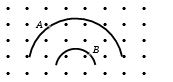
Two particles $A$ and $B$ of masses $m_A$ and $m_B$ respectively,having the same charge,are moving in a plane. $A$ uniform magnetic field exists perpendicular to this plane. The speeds of the particles are $v_A$ and $v_B$ respectively,and the trajectories are as shown in the figure. Then:
A
$m_A v_A < m_B v_B$
B
$m_A v_A > m_B v_B$
C
$m_A < m_B$ and $v_A < v_B$
D
$m_A = m_B$ and $v_A = v_B$
Solution
(B) When a charged particle moves in a uniform magnetic field perpendicular to its velocity,it follows a circular path.
The radius $r$ of this circular path is given by the formula $r = \frac{mv}{qB}$.
Since the charge $q$ and the magnetic field $B$ are the same for both particles,we have $r \propto mv$.
From the figure,it is clear that the radius of the trajectory of particle $A$ is greater than the radius of the trajectory of particle $B$,i.e.,$r_A > r_B$.
Therefore,$m_A v_A > m_B v_B$.
The radius $r$ of this circular path is given by the formula $r = \frac{mv}{qB}$.
Since the charge $q$ and the magnetic field $B$ are the same for both particles,we have $r \propto mv$.
From the figure,it is clear that the radius of the trajectory of particle $A$ is greater than the radius of the trajectory of particle $B$,i.e.,$r_A > r_B$.
Therefore,$m_A v_A > m_B v_B$.
0 likes
View Solution78
MediumMCQ
$A$ proton and an alpha particle are separately projected in a region where a uniform magnetic field exists. Their initial velocities are perpendicular to the direction of the magnetic field. If both the particles move around the magnetic field in circles of equal radii,the ratio of the momentum of the proton to the alpha particle $\left( \frac{P_p}{P_\alpha} \right)$ is
A
$1$
B
$0.5$
C
$2$
D
$0.25$
Solution
(B) The radius of the circular path of a charged particle moving in a uniform magnetic field is given by $r = \frac{p}{qB}$,where $p$ is the momentum,$q$ is the charge,and $B$ is the magnetic field strength.
Since the radii $r$ and the magnetic field $B$ are the same for both particles,the momentum $p$ is directly proportional to the charge $q$ $(p \propto q)$.
Therefore,the ratio of the momentum of the proton $(p_p)$ to the alpha particle $(p_\alpha)$ is $\frac{p_p}{p_\alpha} = \frac{q_p}{q_\alpha}$.
We know that the charge of a proton is $q_p = e$ and the charge of an alpha particle is $q_\alpha = 2e$.
Substituting these values,we get $\frac{p_p}{p_\alpha} = \frac{e}{2e} = \frac{1}{2} = 0.5$.
Since the radii $r$ and the magnetic field $B$ are the same for both particles,the momentum $p$ is directly proportional to the charge $q$ $(p \propto q)$.
Therefore,the ratio of the momentum of the proton $(p_p)$ to the alpha particle $(p_\alpha)$ is $\frac{p_p}{p_\alpha} = \frac{q_p}{q_\alpha}$.
We know that the charge of a proton is $q_p = e$ and the charge of an alpha particle is $q_\alpha = 2e$.
Substituting these values,we get $\frac{p_p}{p_\alpha} = \frac{e}{2e} = \frac{1}{2} = 0.5$.
0 likes
View Solution79
MediumMCQ
$A$ particle of mass $0.6\, g$ and having a charge of $25\, nC$ is moving horizontally with a uniform velocity $1.2 \times 10^4\, m/s$ in a uniform magnetic field. If the particle continues to move with uniform velocity,the value of the magnetic induction is $(g = 10\, m/s^2)$.
A
Zero
B
$10\, T$
C
$20\, T$
D
$200\, T$
Solution
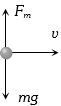
(C) For the particle to move with a uniform velocity,the net force acting on it must be zero. This means the magnetic force must balance the gravitational force acting on the particle.
$|F_m| = mg$
Since the magnetic force is given by $F_m = qvB$ (assuming the magnetic field is perpendicular to the velocity),we have:
$qvB = mg$
$B = \frac{mg}{qv}$
Given:
$m = 0.6\, g = 0.6 \times 10^{-3}\, kg$
$q = 25\, nC = 25 \times 10^{-9}\, C$
$v = 1.2 \times 10^4\, m/s$
$g = 10\, m/s^2$
Substituting the values:
$B = \frac{0.6 \times 10^{-3} \times 10}{25 \times 10^{-9} \times 1.2 \times 10^4}$
$B = \frac{6 \times 10^{-3}}{30 \times 10^{-5}}$
$B = \frac{6 \times 10^{-3}}{0.3 \times 10^{-3}} = \frac{6}{0.3} = 20\, T$
Thus,the magnetic induction is $20\, T$.
$|F_m| = mg$
Since the magnetic force is given by $F_m = qvB$ (assuming the magnetic field is perpendicular to the velocity),we have:
$qvB = mg$
$B = \frac{mg}{qv}$
Given:
$m = 0.6\, g = 0.6 \times 10^{-3}\, kg$
$q = 25\, nC = 25 \times 10^{-9}\, C$
$v = 1.2 \times 10^4\, m/s$
$g = 10\, m/s^2$
Substituting the values:
$B = \frac{0.6 \times 10^{-3} \times 10}{25 \times 10^{-9} \times 1.2 \times 10^4}$
$B = \frac{6 \times 10^{-3}}{30 \times 10^{-5}}$
$B = \frac{6 \times 10^{-3}}{0.3 \times 10^{-3}} = \frac{6}{0.3} = 20\, T$
Thus,the magnetic induction is $20\, T$.
0 likes
View Solution80
MediumMCQ
An $\alpha$-particle and a proton travel with the same velocity in a magnetic field perpendicular to the direction of their velocities. Find the ratio of the radii of their circular paths.
A
$4:1$
B
$1:4$
C
$2:1$
D
$1:2$
Solution
(C) The radius of the circular path of a charged particle moving in a perpendicular magnetic field is given by $r = \frac{mv}{qB}$.
Since the velocity $v$ and magnetic field $B$ are the same for both particles,the ratio of the radii is $\frac{r_{\alpha}}{r_p} = \frac{m_{\alpha}}{m_p} \times \frac{q_p}{q_{\alpha}}$.
For an $\alpha$-particle,the mass $m_{\alpha} = 4m_p$ and the charge $q_{\alpha} = 2q_p$.
Substituting these values,we get $\frac{r_{\alpha}}{r_p} = \frac{4m_p}{m_p} \times \frac{q_p}{2q_p} = 4 \times \frac{1}{2} = \frac{2}{1}$.
Therefore,the ratio is $2:1$.
Since the velocity $v$ and magnetic field $B$ are the same for both particles,the ratio of the radii is $\frac{r_{\alpha}}{r_p} = \frac{m_{\alpha}}{m_p} \times \frac{q_p}{q_{\alpha}}$.
For an $\alpha$-particle,the mass $m_{\alpha} = 4m_p$ and the charge $q_{\alpha} = 2q_p$.
Substituting these values,we get $\frac{r_{\alpha}}{r_p} = \frac{4m_p}{m_p} \times \frac{q_p}{2q_p} = 4 \times \frac{1}{2} = \frac{2}{1}$.
Therefore,the ratio is $2:1$.
0 likes
View Solution81
EasyMCQ
The motion of a moving electron is not affected by:
A
An electric field applied in the direction of motion
B
$A$ magnetic field applied in the direction of motion
C
An electric field applied perpendicular to the direction of motion
D
$A$ magnetic field applied perpendicular to the direction of motion
Solution
(B) The magnetic force on a moving charge is given by the Lorentz force formula: $\vec{F} = q(\vec{v} \times \vec{B})$.
When the magnetic field $\vec{B}$ is applied in the direction of motion (parallel to velocity $\vec{v}$),the angle between $\vec{v}$ and $\vec{B}$ is $0^\circ$ or $180^\circ$.
Since the cross product $\vec{v} \times \vec{B} = vB \sin(\theta)$,and $\sin(0^\circ) = \sin(180^\circ) = 0$,the magnetic force $\vec{F}$ becomes zero.
Therefore,the motion of the electron remains unaffected by a magnetic field applied parallel to its direction of motion.
When the magnetic field $\vec{B}$ is applied in the direction of motion (parallel to velocity $\vec{v}$),the angle between $\vec{v}$ and $\vec{B}$ is $0^\circ$ or $180^\circ$.
Since the cross product $\vec{v} \times \vec{B} = vB \sin(\theta)$,and $\sin(0^\circ) = \sin(180^\circ) = 0$,the magnetic force $\vec{F}$ becomes zero.
Therefore,the motion of the electron remains unaffected by a magnetic field applied parallel to its direction of motion.
0 likes
View Solution82
EasyMCQ
When a charged particle enters a uniform magnetic field,its kinetic energy
A
Remains constant
B
Increases
C
Decreases
D
Becomes zero
Solution
(A) The magnetic force acting on a charged particle moving in a magnetic field is given by $\overrightarrow{F} = q(\overrightarrow{v} \times \overrightarrow{B})$.
Since the force $\overrightarrow{F}$ is always perpendicular to the velocity vector $\overrightarrow{v}$,the work done by the magnetic force on the particle is $W = \int \overrightarrow{F} \cdot d\overrightarrow{s} = \int \overrightarrow{F} \cdot \overrightarrow{v} dt = 0$.
According to the work-energy theorem,the change in kinetic energy is equal to the work done by the net force.
Since the work done is zero,the change in kinetic energy is zero,which means the kinetic energy remains constant.
Since the force $\overrightarrow{F}$ is always perpendicular to the velocity vector $\overrightarrow{v}$,the work done by the magnetic force on the particle is $W = \int \overrightarrow{F} \cdot d\overrightarrow{s} = \int \overrightarrow{F} \cdot \overrightarrow{v} dt = 0$.
According to the work-energy theorem,the change in kinetic energy is equal to the work done by the net force.
Since the work done is zero,the change in kinetic energy is zero,which means the kinetic energy remains constant.
0 likes
View Solution83
EasyMCQ
If cathode rays are projected at right angles to a magnetic field,their trajectory is
A
Ellipse
B
Circle
C
Parabola
D
None of these
Solution
(B) When a charged particle enters a uniform magnetic field $B$ with a velocity $v$ perpendicular to the field,the magnetic Lorentz force $F = q(v \times B)$ acts on it.
This force is always perpendicular to both the velocity and the magnetic field.
Since the force is perpendicular to the velocity,it does not change the speed of the particle but changes its direction continuously.
This constant perpendicular force acts as a centripetal force,causing the particle to move in a circular path.
Cathode rays consist of a stream of electrons (negatively charged particles),which follow the same principle of circular motion under a perpendicular magnetic field.
This force is always perpendicular to both the velocity and the magnetic field.
Since the force is perpendicular to the velocity,it does not change the speed of the particle but changes its direction continuously.
This constant perpendicular force acts as a centripetal force,causing the particle to move in a circular path.
Cathode rays consist of a stream of electrons (negatively charged particles),which follow the same principle of circular motion under a perpendicular magnetic field.
0 likes
View Solution84
EasyMCQ
Which particles will have the minimum frequency of revolution when projected with the same velocity perpendicular to a magnetic field?
A
$Li^+$
B
Electron
C
Proton
D
$He^+$
Solution
(A) The frequency of revolution $\nu$ of a charged particle moving in a magnetic field is given by the formula: $\nu = \frac{qB}{2\pi m}$.
Since the magnetic field $B$ is constant and the velocity is the same,the frequency $\nu$ is directly proportional to the charge-to-mass ratio: $\nu \propto \frac{q}{m}$.
To find the minimum frequency,we need to find the particle with the minimum $\frac{q}{m}$ ratio.
For $Li^+$: $q = +1e$,$m \approx 7u$,so $\frac{q}{m} \approx \frac{1}{7}$.
For Electron: $q = -1e$,$m \approx \frac{1}{1836}u$,so $\frac{q}{m} \approx 1836$.
For Proton: $q = +1e$,$m \approx 1u$,so $\frac{q}{m} = 1$.
For $He^+$: $q = +1e$,$m \approx 4u$,so $\frac{q}{m} = 0.25$.
Comparing the ratios,$Li^+$ has the smallest $\frac{q}{m}$ value. Therefore,$Li^+$ will have the minimum frequency of revolution.
Since the magnetic field $B$ is constant and the velocity is the same,the frequency $\nu$ is directly proportional to the charge-to-mass ratio: $\nu \propto \frac{q}{m}$.
To find the minimum frequency,we need to find the particle with the minimum $\frac{q}{m}$ ratio.
For $Li^+$: $q = +1e$,$m \approx 7u$,so $\frac{q}{m} \approx \frac{1}{7}$.
For Electron: $q = -1e$,$m \approx \frac{1}{1836}u$,so $\frac{q}{m} \approx 1836$.
For Proton: $q = +1e$,$m \approx 1u$,so $\frac{q}{m} = 1$.
For $He^+$: $q = +1e$,$m \approx 4u$,so $\frac{q}{m} = 0.25$.
Comparing the ratios,$Li^+$ has the smallest $\frac{q}{m}$ value. Therefore,$Li^+$ will have the minimum frequency of revolution.
0 likes
View Solution85
MediumMCQ
$A$ mixed beam of $He^+$ and $O^{2+}$ ions (mass of $He^+ = 4 \ amu$ and that of $O^{2+} = 16 \ amu$) passes through a region of a constant perpendicular magnetic field. If the kinetic energy of all the ions is the same,then:
A
$He^+$ ions will be deflected more than those of $O^{2+}$
B
$He^+$ ions will be deflected less than those of $O^{2+}$
C
All the ions will be deflected equally
D
No ions will be deflected
Solution
(C) The radius of the circular path of a charged particle in a magnetic field is given by $r = \frac{mv}{qB}$.
Since kinetic energy $K = \frac{1}{2}mv^2$,we have $v = \sqrt{\frac{2K}{m}}$.
Substituting this into the radius formula,we get $r = \frac{m}{qB} \sqrt{\frac{2K}{m}} = \frac{\sqrt{2mK}}{qB}$.
Given that $K$ and $B$ are constant for all ions,the radius $r \propto \frac{\sqrt{m}}{q}$.
For $He^+$ ions: $m_1 = 4 \ amu$,$q_1 = 1e$.
For $O^{2+}$ ions: $m_2 = 16 \ amu$,$q_2 = 2e$.
Calculating the ratio of radii: $\frac{r_{He^+}}{r_{O^{2+}}} = \sqrt{\frac{m_1}{m_2}} \times \frac{q_2}{q_1} = \sqrt{\frac{4}{16}} \times \frac{2}{1} = \frac{1}{2} \times 2 = 1$.
Since the radii of the paths are equal,all ions will be deflected equally.
Since kinetic energy $K = \frac{1}{2}mv^2$,we have $v = \sqrt{\frac{2K}{m}}$.
Substituting this into the radius formula,we get $r = \frac{m}{qB} \sqrt{\frac{2K}{m}} = \frac{\sqrt{2mK}}{qB}$.
Given that $K$ and $B$ are constant for all ions,the radius $r \propto \frac{\sqrt{m}}{q}$.
For $He^+$ ions: $m_1 = 4 \ amu$,$q_1 = 1e$.
For $O^{2+}$ ions: $m_2 = 16 \ amu$,$q_2 = 2e$.
Calculating the ratio of radii: $\frac{r_{He^+}}{r_{O^{2+}}} = \sqrt{\frac{m_1}{m_2}} \times \frac{q_2}{q_1} = \sqrt{\frac{4}{16}} \times \frac{2}{1} = \frac{1}{2} \times 2 = 1$.
Since the radii of the paths are equal,all ions will be deflected equally.
0 likes
View Solution86
MediumMCQ
An electron (mass $= 9 \times 10^{-31} \, kg$,charge $= 1.6 \times 10^{-19} \, C$) with a kinetic energy of $7.2 \times 10^{-18} \, J$ is moving in a circular orbit in a magnetic field of $9 \times 10^{-5} \, Wb/m^2$. The radius of the orbit is ..... $cm$.
A
$1.25$
B
$2.5$
C
$12.5$
D
$25$
Solution
(D) The radius $r$ of a charged particle moving in a circular orbit in a magnetic field is given by the formula $r = \frac{mv}{qB}$.
Since kinetic energy $E = \frac{1}{2}mv^2$,we have $mv = \sqrt{2mE}$.
Substituting this into the radius formula: $r = \frac{\sqrt{2mE}}{qB}$.
Given values: $m = 9 \times 10^{-31} \, kg$,$E = 7.2 \times 10^{-18} \, J$,$q = 1.6 \times 10^{-19} \, C$,and $B = 9 \times 10^{-5} \, Wb/m^2$.
$r = \frac{\sqrt{2 \times 9 \times 10^{-31} \times 7.2 \times 10^{-18}}}{1.6 \times 10^{-19} \times 9 \times 10^{-5}}$
$r = \frac{\sqrt{129.6 \times 10^{-49}}}{14.4 \times 10^{-24}} = \frac{\sqrt{12.96 \times 10^{-48}}}{14.4 \times 10^{-24}}$
$r = \frac{3.6 \times 10^{-24}}{14.4 \times 10^{-24}} = \frac{3.6}{14.4} = 0.25 \, m$.
Converting to centimeters: $0.25 \, m = 25 \, cm$.
Since kinetic energy $E = \frac{1}{2}mv^2$,we have $mv = \sqrt{2mE}$.
Substituting this into the radius formula: $r = \frac{\sqrt{2mE}}{qB}$.
Given values: $m = 9 \times 10^{-31} \, kg$,$E = 7.2 \times 10^{-18} \, J$,$q = 1.6 \times 10^{-19} \, C$,and $B = 9 \times 10^{-5} \, Wb/m^2$.
$r = \frac{\sqrt{2 \times 9 \times 10^{-31} \times 7.2 \times 10^{-18}}}{1.6 \times 10^{-19} \times 9 \times 10^{-5}}$
$r = \frac{\sqrt{129.6 \times 10^{-49}}}{14.4 \times 10^{-24}} = \frac{\sqrt{12.96 \times 10^{-48}}}{14.4 \times 10^{-24}}$
$r = \frac{3.6 \times 10^{-24}}{14.4 \times 10^{-24}} = \frac{3.6}{14.4} = 0.25 \, m$.
Converting to centimeters: $0.25 \, m = 25 \, cm$.
0 likes
View Solution87
EasyMCQ
An electron enters a region where the electrostatic field is $20\,N/C$ and the magnetic field is $5\,T$. If the electron passes undeflected through the region,then the velocity of the electron will be.....$m\,s^{-1}$.
A
$0.25$
B
$2$
C
$4$
D
$8$
Solution
(C) When a charged particle moves through a region containing both electric field $(E)$ and magnetic field $(B)$ without being deflected,the net Lorentz force acting on it must be zero.
The Lorentz force is given by $\vec{F} = q(\vec{E} + \vec{v} \times \vec{B})$.
For the particle to pass undeflected,$\vec{F} = 0$,which implies $\vec{E} + \vec{v} \times \vec{B} = 0$,or $E = vB$ (assuming $\vec{v}$ is perpendicular to $\vec{B}$).
Therefore,the velocity of the electron is $v = \frac{E}{B}$.
Given $E = 20\,N/C$ and $B = 5\,T$,we have $v = \frac{20}{5} = 4\,m\,s^{-1}$.
The Lorentz force is given by $\vec{F} = q(\vec{E} + \vec{v} \times \vec{B})$.
For the particle to pass undeflected,$\vec{F} = 0$,which implies $\vec{E} + \vec{v} \times \vec{B} = 0$,or $E = vB$ (assuming $\vec{v}$ is perpendicular to $\vec{B}$).
Therefore,the velocity of the electron is $v = \frac{E}{B}$.
Given $E = 20\,N/C$ and $B = 5\,T$,we have $v = \frac{20}{5} = 4\,m\,s^{-1}$.
0 likes
View Solution88
EasyMCQ
$A$ charged particle is released from rest in a region of steady uniform electric and magnetic fields which are parallel to each other. The particle will move in a:
A
Straight line
B
Circle
C
Helix
D
Cycloid
Solution
(A) The force on a charged particle $q$ moving with velocity $\vec{v}$ in electric field $\vec{E}$ and magnetic field $\vec{B}$ is given by the Lorentz force equation: $\vec{F} = q(\vec{E} + \vec{v} \times \vec{B})$.
Since the particle is released from rest,its initial velocity $\vec{v} = 0$.
Initially,the magnetic force $\vec{F}_m = q(\vec{v} \times \vec{B}) = 0$.
The electric force $\vec{F}_e = q\vec{E}$ acts on the particle,causing it to accelerate in the direction of the electric field.
As the particle gains velocity $\vec{v}$ in the direction of $\vec{E}$,and since $\vec{E}$ and $\vec{B}$ are parallel,the velocity $\vec{v}$ remains parallel to the magnetic field $\vec{B}$ at all times.
Therefore,the magnetic force $\vec{F}_m = q(\vec{v} \times \vec{B}) = 0$ throughout the motion because the angle between $\vec{v}$ and $\vec{B}$ is $0^\circ$.
The particle continues to accelerate in a straight line due to the electric field.
Since the particle is released from rest,its initial velocity $\vec{v} = 0$.
Initially,the magnetic force $\vec{F}_m = q(\vec{v} \times \vec{B}) = 0$.
The electric force $\vec{F}_e = q\vec{E}$ acts on the particle,causing it to accelerate in the direction of the electric field.
As the particle gains velocity $\vec{v}$ in the direction of $\vec{E}$,and since $\vec{E}$ and $\vec{B}$ are parallel,the velocity $\vec{v}$ remains parallel to the magnetic field $\vec{B}$ at all times.
Therefore,the magnetic force $\vec{F}_m = q(\vec{v} \times \vec{B}) = 0$ throughout the motion because the angle between $\vec{v}$ and $\vec{B}$ is $0^\circ$.
The particle continues to accelerate in a straight line due to the electric field.
0 likes
View Solution89
EasyMCQ
$A$ particle of mass $M$ and charge $Q$ moving with velocity $\vec{v}$ describes a circular path of radius $R$ when subjected to a uniform transverse magnetic field of induction $B$. The work done by the field when the particle completes one full circle is
A
$B Q v 2 \pi R$
B
$\left( \frac{M v^2}{R} \right) 2 \pi R$
C
Zero
D
$B Q 2 \pi R$
Solution
(C) The magnetic force $\vec{F}_m$ acting on a charged particle moving in a magnetic field is given by $\vec{F}_m = Q(\vec{v} \times \vec{B})$.
Since the force $\vec{F}_m$ is always perpendicular to the velocity vector $\vec{v}$,the force is always directed towards the center of the circular path (centripetal force).
Work done $W$ is defined as the line integral of the force over the displacement: $W = \int \vec{F} \cdot d\vec{s}$.
Since the force $\vec{F}_m$ is always perpendicular to the displacement $d\vec{s}$ at every point on the circular path,the dot product $\vec{F}_m \cdot d\vec{s} = F_m ds \cos(90^\circ) = 0$.
Therefore,the total work done by the magnetic field on the particle in one full circle is $0$.
Since the force $\vec{F}_m$ is always perpendicular to the velocity vector $\vec{v}$,the force is always directed towards the center of the circular path (centripetal force).
Work done $W$ is defined as the line integral of the force over the displacement: $W = \int \vec{F} \cdot d\vec{s}$.
Since the force $\vec{F}_m$ is always perpendicular to the displacement $d\vec{s}$ at every point on the circular path,the dot product $\vec{F}_m \cdot d\vec{s} = F_m ds \cos(90^\circ) = 0$.
Therefore,the total work done by the magnetic field on the particle in one full circle is $0$.
0 likes
View Solution90
MediumMCQ
$A$ particle of charge $q = -16 \times 10^{-18} \, C$ moving with velocity $v = 10 \, m/s$ along the $x$-axis enters a region where a magnetic field of induction $B$ is along the $y$-axis,and an electric field of magnitude $E = 10^4 \, V/m$ is along the negative $z$-axis. If the charged particle continues moving along the $x$-axis,the magnitude of $B$ is:
A
$10^{-3} \, Wb/m^2$
B
$10^3 \, Wb/m^2$
C
$10^5 \, Wb/m^2$
D
$10^{16} \, Wb/m^2$
Solution
(B) The particle moves undeflected along the $x$-axis,which means the net Lorentz force acting on the particle is zero.
The Lorentz force is given by $\vec{F} = q(\vec{E} + \vec{v} \times \vec{B})$.
For the particle to move undeflected,the electric force must be equal and opposite to the magnetic force: $q\vec{E} + q(\vec{v} \times \vec{B}) = 0$.
Given $\vec{v} = v\hat{i}$,$\vec{B} = B\hat{j}$,and $\vec{E} = -E\hat{k}$.
The magnetic force is $\vec{F}_m = q(v\hat{i} \times B\hat{j}) = qvB\hat{k}$.
The electric force is $\vec{F}_e = q(-E\hat{k}) = -qE\hat{k}$.
Equating the magnitudes: $qvB = qE$.
Therefore,$B = E/v$.
Substituting the given values: $B = \frac{10^4}{10} = 10^3 \, Wb/m^2$.
The Lorentz force is given by $\vec{F} = q(\vec{E} + \vec{v} \times \vec{B})$.
For the particle to move undeflected,the electric force must be equal and opposite to the magnetic force: $q\vec{E} + q(\vec{v} \times \vec{B}) = 0$.
Given $\vec{v} = v\hat{i}$,$\vec{B} = B\hat{j}$,and $\vec{E} = -E\hat{k}$.
The magnetic force is $\vec{F}_m = q(v\hat{i} \times B\hat{j}) = qvB\hat{k}$.
The electric force is $\vec{F}_e = q(-E\hat{k}) = -qE\hat{k}$.
Equating the magnitudes: $qvB = qE$.
Therefore,$B = E/v$.
Substituting the given values: $B = \frac{10^4}{10} = 10^3 \, Wb/m^2$.
0 likes
View Solution91
EasyMCQ
An electron and a proton have equal kinetic energies. They enter a magnetic field perpendicularly. Then:
A
Both will follow a circular path with the same radius.
B
Both will follow a helical path.
C
Both will follow a parabolic path.
D
All the statements are false.
Solution
(D) When a charged particle enters a magnetic field perpendicularly,it follows a circular path.
The radius of the circular path is given by $r = \frac{mv}{qB}$.
Since kinetic energy $K = \frac{1}{2}mv^2$,we have $mv = \sqrt{2mK}$.
Substituting this into the radius formula,we get $r = \frac{\sqrt{2mK}}{qB}$.
Since the electron and proton have the same kinetic energy $(K)$ and enter the same magnetic field $(B)$,the radius $r$ depends on $\frac{\sqrt{m}}{q}$.
Because the mass of a proton $(m_p)$ is much larger than the mass of an electron $(m_e)$,their radii will be different.
Therefore,both follow circular paths,but with different radii. Thus,options $A$,$B$,and $C$ are incorrect,making $D$ the correct statement.
The radius of the circular path is given by $r = \frac{mv}{qB}$.
Since kinetic energy $K = \frac{1}{2}mv^2$,we have $mv = \sqrt{2mK}$.
Substituting this into the radius formula,we get $r = \frac{\sqrt{2mK}}{qB}$.
Since the electron and proton have the same kinetic energy $(K)$ and enter the same magnetic field $(B)$,the radius $r$ depends on $\frac{\sqrt{m}}{q}$.
Because the mass of a proton $(m_p)$ is much larger than the mass of an electron $(m_e)$,their radii will be different.
Therefore,both follow circular paths,but with different radii. Thus,options $A$,$B$,and $C$ are incorrect,making $D$ the correct statement.
0 likes
View Solution92
DifficultMCQ
Electrons move at right angles to a magnetic field of $1.5 \times 10^{-2} \text{ T}$ with a speed of $6 \times 10^7 \text{ m/s}$. If the specific charge of the electron is $1.7 \times 10^{11} \text{ C/kg}$,the radius of the circular path will be...... $\text{cm}$.
A
$2.9$
B
$3.9$
C
$2.35$
D
$3$
Solution
(C) The radius $r$ of the circular path of a charged particle moving perpendicular to a magnetic field is given by the formula $r = \frac{mv}{qB}$.
Given that the specific charge (charge-to-mass ratio) is $\frac{q}{m} = 1.7 \times 10^{11} \text{ C/kg}$,we can rewrite the formula as $r = \frac{v}{(q/m)B}$.
Substituting the given values:
$v = 6 \times 10^7 \text{ m/s}$
$\frac{q}{m} = 1.7 \times 10^{11} \text{ C/kg}$
$B = 1.5 \times 10^{-2} \text{ T}$
$r = \frac{6 \times 10^7}{(1.7 \times 10^{11}) \times (1.5 \times 10^{-2})}$
$r = \frac{6 \times 10^7}{2.55 \times 10^9}$
$r \approx 2.35 \times 10^{-2} \text{ m}$
Converting to centimeters: $r = 2.35 \text{ cm}$.
Given that the specific charge (charge-to-mass ratio) is $\frac{q}{m} = 1.7 \times 10^{11} \text{ C/kg}$,we can rewrite the formula as $r = \frac{v}{(q/m)B}$.
Substituting the given values:
$v = 6 \times 10^7 \text{ m/s}$
$\frac{q}{m} = 1.7 \times 10^{11} \text{ C/kg}$
$B = 1.5 \times 10^{-2} \text{ T}$
$r = \frac{6 \times 10^7}{(1.7 \times 10^{11}) \times (1.5 \times 10^{-2})}$
$r = \frac{6 \times 10^7}{2.55 \times 10^9}$
$r \approx 2.35 \times 10^{-2} \text{ m}$
Converting to centimeters: $r = 2.35 \text{ cm}$.
0 likes
View Solution93
EasyMCQ
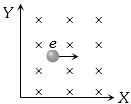
In the given figure,an electron enters a magnetic field directed into the plane of the paper. It deflects in which direction?
A
$+ve\, X$ direction
B
$-ve\, X$ direction
C
$+ve\, Y$ direction
D
$-ve\, Y$ direction
Solution
(D) The magnetic force on a moving charge is given by the Lorentz force formula: $\vec{F} = q(\vec{v} \times \vec{B})$.
Here,the electron has a negative charge $(q = -e)$.
The velocity $\vec{v}$ is in the $+X$ direction,and the magnetic field $\vec{B}$ is directed into the plane ($-Z$ direction).
Using the right-hand rule for the cross product $\vec{v} \times \vec{B}$,the direction is $(+X) \times (-Z) = +Y$.
Since the charge is negative,the force $\vec{F}$ is in the opposite direction,which is $-Y$.
Alternatively,using Fleming's left-hand rule: Point the index finger into the plane (magnetic field),the middle finger in the direction opposite to the electron's motion (conventional current direction,which is $-X$),then the thumb points in the direction of the force,which is $-Y$.
Here,the electron has a negative charge $(q = -e)$.
The velocity $\vec{v}$ is in the $+X$ direction,and the magnetic field $\vec{B}$ is directed into the plane ($-Z$ direction).
Using the right-hand rule for the cross product $\vec{v} \times \vec{B}$,the direction is $(+X) \times (-Z) = +Y$.
Since the charge is negative,the force $\vec{F}$ is in the opposite direction,which is $-Y$.
Alternatively,using Fleming's left-hand rule: Point the index finger into the plane (magnetic field),the middle finger in the direction opposite to the electron's motion (conventional current direction,which is $-X$),then the thumb points in the direction of the force,which is $-Y$.
0 likes
View Solution94
MediumMCQ
$A$ proton of energy $8\, eV$ is moving in a circular path in a uniform magnetic field. The energy of an alpha particle moving in the same magnetic field and along the same path will be.....$eV$
A
$4$
B
$2$
C
$8$
D
$6$
Solution
(C) The radius of a charged particle moving in a circular path in a uniform magnetic field is given by $r = \frac{\sqrt{2mK}}{qB}$,where $m$ is the mass,$K$ is the kinetic energy,and $q$ is the charge of the particle.
Since the radius $r$ and the magnetic field $B$ are the same for both particles,we have $q \propto \sqrt{mK}$,which implies $K \propto \frac{q^2}{m}$.
For a proton,$q_p = e$ and $m_p = m$. For an alpha particle,$q_{\alpha} = 2e$ and $m_{\alpha} = 4m$.
Taking the ratio of kinetic energies: $\frac{K_{\alpha}}{K_p} = \left( \frac{q_{\alpha}}{q_p} \right)^2 \times \frac{m_p}{m_{\alpha}}$.
Substituting the values: $\frac{K_{\alpha}}{8} = \left( \frac{2e}{e} \right)^2 \times \frac{m}{4m} = 4 \times \frac{1}{4} = 1$.
Therefore,$K_{\alpha} = 8\, eV$.
Since the radius $r$ and the magnetic field $B$ are the same for both particles,we have $q \propto \sqrt{mK}$,which implies $K \propto \frac{q^2}{m}$.
For a proton,$q_p = e$ and $m_p = m$. For an alpha particle,$q_{\alpha} = 2e$ and $m_{\alpha} = 4m$.
Taking the ratio of kinetic energies: $\frac{K_{\alpha}}{K_p} = \left( \frac{q_{\alpha}}{q_p} \right)^2 \times \frac{m_p}{m_{\alpha}}$.
Substituting the values: $\frac{K_{\alpha}}{8} = \left( \frac{2e}{e} \right)^2 \times \frac{m}{4m} = 4 \times \frac{1}{4} = 1$.
Therefore,$K_{\alpha} = 8\, eV$.
0 likes
View Solution95
MediumMCQ
An electron,a proton,a deuteron,and an alpha particle,each having the same speed,are in a region of constant magnetic field perpendicular to the direction of the velocities of the particles. The radii of the circular orbits of these particles are respectively $R_e, R_p, R_d$,and $R_\alpha$. It follows that:
A
$R_e = R_p$
B
$R_p = R_d$
C
$R_d = R_\alpha$
D
$R_p = R_\alpha$
Solution
(C) The radius of a charged particle moving in a magnetic field is given by $r = \frac{mv}{qB}$.
Since the speed $v$ and magnetic field $B$ are constant for all particles,we have $r \propto \frac{m}{q}$,or $r \propto \frac{1}{(q/m)}$.
For the given particles:
$1$. Electron $(e^-)$: charge $q$,mass $m_e$.
$2$. Proton $(p^+)$: charge $q$,mass $m_p \approx 1836 m_e$.
$3$. Deuteron $(d)$: charge $q$,mass $m_d \approx 2 m_p$.
$4$. Alpha particle $(\alpha)$: charge $2q$,mass $m_\alpha \approx 4 m_p$.
Comparing the charge-to-mass ratios $(q/m)$:
$(q/m)_d = q / (2 m_p) = 0.5 (q/m_p)$
$(q/m)_\alpha = 2q / (4 m_p) = 0.5 (q/m_p)$
Since $(q/m)_d = (q/m)_\alpha$,it follows that $R_d = R_\alpha$.
Since the speed $v$ and magnetic field $B$ are constant for all particles,we have $r \propto \frac{m}{q}$,or $r \propto \frac{1}{(q/m)}$.
For the given particles:
$1$. Electron $(e^-)$: charge $q$,mass $m_e$.
$2$. Proton $(p^+)$: charge $q$,mass $m_p \approx 1836 m_e$.
$3$. Deuteron $(d)$: charge $q$,mass $m_d \approx 2 m_p$.
$4$. Alpha particle $(\alpha)$: charge $2q$,mass $m_\alpha \approx 4 m_p$.
Comparing the charge-to-mass ratios $(q/m)$:
$(q/m)_d = q / (2 m_p) = 0.5 (q/m_p)$
$(q/m)_\alpha = 2q / (4 m_p) = 0.5 (q/m_p)$
Since $(q/m)_d = (q/m)_\alpha$,it follows that $R_d = R_\alpha$.
0 likes
View Solution96
EasyMCQ
An electron moving with a uniform velocity along the positive $x$-direction enters a magnetic field directed along the positive $y$-direction. The force on the electron is directed along
A
Positive $y$-direction
B
Negative $y$-direction
C
Positive $z$-direction
D
Negative $z$-direction
Solution
(D) The magnetic Lorentz force on a moving charge is given by the formula $\vec{F} = q(\vec{v} \times \vec{B})$.
Here,the charge of the electron is $q = -e$ (negative).
The velocity vector is $\vec{v} = v \hat{i}$ and the magnetic field vector is $\vec{B} = B \hat{j}$.
Substituting these into the formula,we get $\vec{F} = -e(v \hat{i} \times B \hat{j})$.
Since $\hat{i} \times \hat{j} = \hat{k}$,the force becomes $\vec{F} = -evB \hat{k}$.
Therefore,the force is directed along the negative $z$-direction.
Here,the charge of the electron is $q = -e$ (negative).
The velocity vector is $\vec{v} = v \hat{i}$ and the magnetic field vector is $\vec{B} = B \hat{j}$.
Substituting these into the formula,we get $\vec{F} = -e(v \hat{i} \times B \hat{j})$.
Since $\hat{i} \times \hat{j} = \hat{k}$,the force becomes $\vec{F} = -evB \hat{k}$.
Therefore,the force is directed along the negative $z$-direction.
0 likes
View Solution97
EasyMCQ
An electron is projected along the axis of a circular conductor carrying some current. The electron will experience a force:
A
Along the axis
B
Perpendicular to the axis
C
At an angle of $4^o$ with the axis
D
No force experienced
Solution
(D) The magnetic field $\overrightarrow{B}$ produced by a circular current-carrying coil is directed along its axis at all points on the axis.
Since the electron is projected along the axis,its velocity vector $\overrightarrow{v}$ is parallel to the magnetic field vector $\overrightarrow{B}$.
The magnetic force on a moving charge is given by $\overrightarrow{F} = q(\overrightarrow{v} \times \overrightarrow{B})$.
Since $\overrightarrow{v}$ and $\overrightarrow{B}$ are parallel,the angle $\theta$ between them is $0^o$ or $180^o$.
Therefore,$\overrightarrow{F} = qvB \sin(\theta) = qvB \sin(0^o) = 0$.
Thus,the electron experiences no force.
Since the electron is projected along the axis,its velocity vector $\overrightarrow{v}$ is parallel to the magnetic field vector $\overrightarrow{B}$.
The magnetic force on a moving charge is given by $\overrightarrow{F} = q(\overrightarrow{v} \times \overrightarrow{B})$.
Since $\overrightarrow{v}$ and $\overrightarrow{B}$ are parallel,the angle $\theta$ between them is $0^o$ or $180^o$.
Therefore,$\overrightarrow{F} = qvB \sin(\theta) = qvB \sin(0^o) = 0$.
Thus,the electron experiences no force.
0 likes
View Solution98
EasyMCQ
$A$ very high magnetic field is applied to a stationary charge. Then the charge experiences
A
$A$ force in the direction of magnetic field
B
$A$ force perpendicular to the magnetic field
C
$A$ force in an arbitrary direction
D
No force
Solution
(D) The magnetic Lorentz force acting on a moving charge $q$ in a magnetic field $B$ is given by the formula $F_m = q(v \times B)$,which has a magnitude of $F_m = qvB \sin \theta$.
Since the charge is stationary,its velocity $v = 0$.
Substituting $v = 0$ into the formula,we get $F_m = q(0)B \sin \theta = 0$.
Therefore,a stationary charge does not experience any magnetic force,regardless of the strength of the magnetic field.
Since the charge is stationary,its velocity $v = 0$.
Substituting $v = 0$ into the formula,we get $F_m = q(0)B \sin \theta = 0$.
Therefore,a stationary charge does not experience any magnetic force,regardless of the strength of the magnetic field.
0 likes
View Solution99
EasyMCQ
An electron $(q = 1.6 \times 10^{-19}\, C)$ is moving at a right angle to a uniform magnetic field of $3.534 \times 10^{-5}\, T$. The time taken by the electron to complete one circular orbit is ...... $\mu s$.
A
$2$
B
$4$
C
$3$
D
$1$
Solution
(D) The time period $T$ of a charged particle moving in a circular path in a uniform magnetic field is given by the formula: $T = \frac{2\pi m}{qB}$.
Given:
Mass of electron $m = 9.1 \times 10^{-31}\, kg$
Charge $q = 1.6 \times 10^{-19}\, C$
Magnetic field $B = 3.534 \times 10^{-5}\, T$
Substituting the values:
$T = \frac{2 \times 3.14 \times 9.1 \times 10^{-31}}{1.6 \times 10^{-19} \times 3.534 \times 10^{-5}}$
$T = \frac{57.148 \times 10^{-31}}{5.6544 \times 10^{-24}}$
$T \approx 10.106 \times 10^{-7}\, s \approx 1 \times 10^{-6}\, s = 1\,\mu s$.
Therefore,the correct option is $D$.
Given:
Mass of electron $m = 9.1 \times 10^{-31}\, kg$
Charge $q = 1.6 \times 10^{-19}\, C$
Magnetic field $B = 3.534 \times 10^{-5}\, T$
Substituting the values:
$T = \frac{2 \times 3.14 \times 9.1 \times 10^{-31}}{1.6 \times 10^{-19} \times 3.534 \times 10^{-5}}$
$T = \frac{57.148 \times 10^{-31}}{5.6544 \times 10^{-24}}$
$T \approx 10.106 \times 10^{-7}\, s \approx 1 \times 10^{-6}\, s = 1\,\mu s$.
Therefore,the correct option is $D$.
0 likes
View Solution100
EasyMCQ
$A$ charged particle of mass $m$ and charge $q$ travels on a circular path of radius $r$ that is perpendicular to a magnetic field $B$. The time taken by the particle to complete one revolution is
A
$\frac{2\pi qB}{m}$
B
$\frac{2\pi m}{qB}$
C
$\frac{2\pi mq}{B}$
D
$\frac{2\pi q^2B}{m}$
Solution
(B) When a charged particle moves perpendicular to a magnetic field,the magnetic Lorentz force provides the necessary centripetal force for circular motion.
Equating the magnetic force to the centripetal force:
$qvB = \frac{mv^2}{r}$
From this,we can find the velocity $v$ or the radius $r$:
$v = \frac{qBr}{m}$
The time period $T$ for one complete revolution is the circumference divided by the speed:
$T = \frac{2\pi r}{v}$
Substituting the expression for $v$:
$T = \frac{2\pi r}{(qBr/m)} = \frac{2\pi m}{qB}$
Thus,the time taken to complete one revolution is $\frac{2\pi m}{qB}$.
Equating the magnetic force to the centripetal force:
$qvB = \frac{mv^2}{r}$
From this,we can find the velocity $v$ or the radius $r$:
$v = \frac{qBr}{m}$
The time period $T$ for one complete revolution is the circumference divided by the speed:
$T = \frac{2\pi r}{v}$
Substituting the expression for $v$:
$T = \frac{2\pi r}{(qBr/m)} = \frac{2\pi m}{qB}$
Thus,the time taken to complete one revolution is $\frac{2\pi m}{qB}$.
0 likes
View SolutionMoving Charges and Magnetism — Motion of Charged Particle In Magnetic Field · Frequently Asked Questions
1Are these Moving Charges and Magnetism questions useful for JEE and NEET?
Yes. All questions in this section are mapped to JEE Main and NEET exam patterns. Previous year questions from JEE Main, NEET, GUJCET and state-level exams are included with full solutions.
2Can I switch to Hindi or Gujarati for these questions?
Yes. Use the language tabs in the hero section or the sidebar to view the same questions and solutions in English, Hindi or Gujarati.
3How do I generate a question paper from this subtopic?
Use the Vedclass Exam Paper Generator — select the chapter and subtopic, set difficulty, and generate Sets A, B, C, D automatically. First 3 chapters of every subject are free.
Vedclass Products
For Students
Vedclass Test Series
Mock tests in real JEE/NEET style with performance analysis. 5-day free trial.
Start Free TrialFor Teachers
Exam Paper Generator
Generate Set A/B/C/D papers from this chapter in 2 minutes. 3 chapters free.
Try FreeFor Institutes
Online Exam Module
Live online exams with unlimited students, 360° analytics & white-label branding.
See DemoFor Teachers & Institutes
Generate a Moving Charges and Magnetism Exam Paper in 2 Minutes
Select subtopic & difficulty — Sets A, B, C, D auto-generated with No Repeat logic.
First 3 chapters of every subject are free — no payment required.