
A English
Force on a Current Carrying Conductor Questions in English
Class 12 Physics · Moving Charges and Magnetism · Force on a Current Carrying Conductor
260+
Questions
English
Language
100%
With Solutions
Showing 48 of 260 questions in English
1
EasyMCQ
Two free parallel wires carrying currents in opposite directions:
A
Attract each other
B
Repel each other
C
Neither attract nor repel
D
Get rotated to be perpendicular to each other
Solution
(B) When two parallel wires carry currents in the same direction,they attract each other due to the magnetic force.
Conversely,when two parallel wires carry currents in opposite directions,the magnetic fields produced by the wires result in a force that pushes them apart.
Therefore,the wires repel each other.
Conversely,when two parallel wires carry currents in opposite directions,the magnetic fields produced by the wires result in a force that pushes them apart.
Therefore,the wires repel each other.
0 likes
View Solution2
MediumMCQ
$A$ rectangular loop carrying a current $i$ is situated near a long straight wire such that the wire is parallel to one of the sides of the loop and is in the plane of the loop. If a steady current $i$ is established in the wire as shown in the figure,the loop will
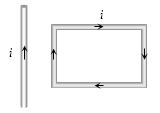
A
Rotate about an axis parallel to the wire
B
Move away from the wire or towards the right
C
Move towards the wire
D
Remain stationary
Solution
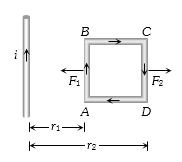
(C) The magnetic field produced by the long straight wire at a distance $r$ is given by $B = \frac{\mu_0 i}{2\pi r}$.
For the side of the loop closer to the wire at distance $r_1$,the current flows in the same direction as the wire. According to Fleming's left-hand rule,the force $F_1$ on this side is attractive (towards the wire).
For the side of the loop farther from the wire at distance $r_2$,the current flows in the opposite direction to the wire. The force $F_2$ on this side is repulsive (away from the wire).
Since $r_1 < r_2$,the magnetic field $B_1$ at the closer side is stronger than the magnetic field $B_2$ at the farther side $(B_1 > B_2)$.
Consequently,the attractive force $F_1$ is greater than the repulsive force $F_2$ $(F_1 > F_2)$.
Therefore,the net force $F_{net} = F_1 - F_2$ acts towards the wire,and the loop will move towards the wire.
For the side of the loop closer to the wire at distance $r_1$,the current flows in the same direction as the wire. According to Fleming's left-hand rule,the force $F_1$ on this side is attractive (towards the wire).
For the side of the loop farther from the wire at distance $r_2$,the current flows in the opposite direction to the wire. The force $F_2$ on this side is repulsive (away from the wire).
Since $r_1 < r_2$,the magnetic field $B_1$ at the closer side is stronger than the magnetic field $B_2$ at the farther side $(B_1 > B_2)$.
Consequently,the attractive force $F_1$ is greater than the repulsive force $F_2$ $(F_1 > F_2)$.
Therefore,the net force $F_{net} = F_1 - F_2$ acts towards the wire,and the loop will move towards the wire.
0 likes
View Solution3
EasyMCQ
$A$ conducting circular loop of radius $r$ carries a constant current $i$. It is placed in a uniform magnetic field $\overrightarrow{B}$,such that $\overrightarrow{B}$ is perpendicular to the plane of the loop. The magnetic force acting on the loop is
A
$ir\overrightarrow{B}$
B
$2\pi ri\overrightarrow{B}$
C
Zero
D
$\pi ri\overrightarrow{B}$
Solution
(C) The magnetic force on a small current element $d\overrightarrow{l}$ in a magnetic field $\overrightarrow{B}$ is given by $d\overrightarrow{F} = i(d\overrightarrow{l} \times \overrightarrow{B})$.
For a closed loop,the net magnetic force is $\overrightarrow{F} = \oint i(d\overrightarrow{l} \times \overrightarrow{B})$.
Since the magnetic field $\overrightarrow{B}$ is uniform,it can be taken out of the integral: $\overrightarrow{F} = i(\oint d\overrightarrow{l}) \times \overrightarrow{B}$.
For any closed loop,the vector sum of all infinitesimal length elements $\oint d\overrightarrow{l}$ is zero.
Therefore,the net magnetic force $\overrightarrow{F} = i(0) \times \overrightarrow{B} = 0$.
For a closed loop,the net magnetic force is $\overrightarrow{F} = \oint i(d\overrightarrow{l} \times \overrightarrow{B})$.
Since the magnetic field $\overrightarrow{B}$ is uniform,it can be taken out of the integral: $\overrightarrow{F} = i(\oint d\overrightarrow{l}) \times \overrightarrow{B}$.
For any closed loop,the vector sum of all infinitesimal length elements $\oint d\overrightarrow{l}$ is zero.
Therefore,the net magnetic force $\overrightarrow{F} = i(0) \times \overrightarrow{B} = 0$.
0 likes
View Solution4
MediumMCQ
Two thin long parallel wires separated by a distance $b$ are carrying a current $i$ $A$ each. The magnitude of the force per unit length exerted by one wire on the other is
A
$\frac{\mu_0 i^2}{b^2}$
B
$\frac{\mu_0 i^2}{2\pi b}$
C
$\frac{\mu_0 i}{2\pi b}$
D
$\frac{\mu_0 i}{2\pi b^2}$
Solution
(B) The magnetic field $B$ produced by one wire at a distance $b$ is given by the formula: $B = \frac{\mu_0 i}{2\pi b}$.
According to the Lorentz force law,the force $F$ on a length $L$ of the second wire carrying current $i$ in this magnetic field is $F = i L B \sin(\theta)$.
Since the wires are parallel,the angle $\theta = 90^\circ$,so $\sin(90^\circ) = 1$.
Therefore,the force per unit length $f = \frac{F}{L} = i B$.
Substituting the value of $B$,we get $f = i \left( \frac{\mu_0 i}{2\pi b} \right) = \frac{\mu_0 i^2}{2\pi b}$.
According to the Lorentz force law,the force $F$ on a length $L$ of the second wire carrying current $i$ in this magnetic field is $F = i L B \sin(\theta)$.
Since the wires are parallel,the angle $\theta = 90^\circ$,so $\sin(90^\circ) = 1$.
Therefore,the force per unit length $f = \frac{F}{L} = i B$.
Substituting the value of $B$,we get $f = i \left( \frac{\mu_0 i}{2\pi b} \right) = \frac{\mu_0 i^2}{2\pi b}$.
0 likes
View Solution5
MediumMCQ
Through two parallel wires $A$ and $B$,$10 \, A$ and $2 \, A$ of currents are passed respectively in opposite directions. If the wire $A$ is infinitely long and the length of the wire $B$ is $2 \, m$,the force on the conductor $B$,which is situated at a $10 \, cm$ distance from $A$,will be:
A
$8 \times 10^{-5} \, N$
B
$4 \times 10^{-7} \, N$
C
$4 \times 10^{-5} \, N$
D
$4\pi \times 10^{-7} \, N$
Solution
(A) The force per unit length between two parallel current-carrying wires is given by $F = \frac{\mu_0 i_1 i_2}{2\pi r}$.
For a wire of length $l$,the total force is $F = \frac{\mu_0 i_1 i_2 l}{2\pi r} = \frac{\mu_0}{4\pi} \cdot \frac{2 i_1 i_2 l}{r}$.
Given: $i_1 = 10 \, A$,$i_2 = 2 \, A$,$r = 10 \, cm = 0.1 \, m$,$l = 2 \, m$,and $\frac{\mu_0}{4\pi} = 10^{-7} \, T \cdot m/A$.
Substituting the values:
$F = 10^{-7} \times \frac{2 \times 10 \times 2 \times 2}{0.1} = 10^{-7} \times \frac{80}{0.1} = 10^{-7} \times 800 = 8 \times 10^{-5} \, N$.
For a wire of length $l$,the total force is $F = \frac{\mu_0 i_1 i_2 l}{2\pi r} = \frac{\mu_0}{4\pi} \cdot \frac{2 i_1 i_2 l}{r}$.
Given: $i_1 = 10 \, A$,$i_2 = 2 \, A$,$r = 10 \, cm = 0.1 \, m$,$l = 2 \, m$,and $\frac{\mu_0}{4\pi} = 10^{-7} \, T \cdot m/A$.
Substituting the values:
$F = 10^{-7} \times \frac{2 \times 10 \times 2 \times 2}{0.1} = 10^{-7} \times \frac{80}{0.1} = 10^{-7} \times 800 = 8 \times 10^{-5} \, N$.
0 likes
View Solution6
EasyMCQ
If two streams of protons move parallel to each other in the same direction,then they
A
Do not exert any force on each other
B
Repel each other
C
Attract each other
D
Get rotated to be perpendicular to each other
Solution
(B) When two streams of protons move parallel to each other in the same direction,two types of forces act between them: the electrostatic force and the magnetic force.
$1$. The electrostatic force between two streams of protons is repulsive because both streams consist of positively charged particles.
$2$. The magnetic force between two parallel currents moving in the same direction is attractive.
$3$. However,for charged particles moving in space,the electrostatic repulsive force is significantly stronger than the magnetic attractive force.
$4$. Therefore,the net force between the two streams is repulsive,causing them to repel each other.
$1$. The electrostatic force between two streams of protons is repulsive because both streams consist of positively charged particles.
$2$. The magnetic force between two parallel currents moving in the same direction is attractive.
$3$. However,for charged particles moving in space,the electrostatic repulsive force is significantly stronger than the magnetic attractive force.
$4$. Therefore,the net force between the two streams is repulsive,causing them to repel each other.
0 likes
View Solution7
EasyMCQ
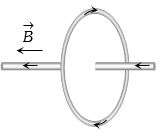
$A$ straight wire carrying a current $i_1 \, A$ runs along the axis of a circular loop carrying a current $i_2 \, A$. The force of interaction between the two current-carrying conductors is
A
$\infty$
B
Zero
C
$\frac{\mu_0}{4\pi} \frac{2i_1 i_2}{r} \, N/m$
D
$\frac{2i_1 i_2}{r} \, N/m$
Solution
(B) The magnetic field produced by a circular current-carrying loop at any point on its axis is directed along the axis itself.
As shown in the figure,the straight wire is placed along the axis of the circular loop.
Therefore,the current in the straight wire flows parallel (or anti-parallel) to the magnetic field produced by the circular loop.
The magnetic force on a current-carrying conductor is given by $\vec{F} = i(\vec{L} \times \vec{B})$.
Since the current element $\vec{L}$ is parallel to the magnetic field $\vec{B}$,the angle $\theta$ between them is $0^\circ$ or $180^\circ$.
Thus,$\vec{F} = iLB \sin(0^\circ) = 0$.
Hence,the force of interaction between the two conductors is zero.
As shown in the figure,the straight wire is placed along the axis of the circular loop.
Therefore,the current in the straight wire flows parallel (or anti-parallel) to the magnetic field produced by the circular loop.
The magnetic force on a current-carrying conductor is given by $\vec{F} = i(\vec{L} \times \vec{B})$.
Since the current element $\vec{L}$ is parallel to the magnetic field $\vec{B}$,the angle $\theta$ between them is $0^\circ$ or $180^\circ$.
Thus,$\vec{F} = iLB \sin(0^\circ) = 0$.
Hence,the force of interaction between the two conductors is zero.
0 likes
View Solution8
EasyMCQ
Two parallel wires are carrying electric currents of equal magnitude and in the same direction. They exert
A
An attractive force on each other
B
$A$ repulsive force on each other
C
No force on each other
D
$A$ rotational torque on each other
Solution
(A) When two parallel wires carry electric currents in the same direction,each wire produces a magnetic field at the location of the other wire.
According to the right-hand rule,the magnetic field produced by one wire at the position of the second wire is perpendicular to the direction of the current in the second wire.
By applying the Lorentz force law $(F = I(L \times B))$,it is determined that the magnetic force acting on each wire is directed towards the other wire.
Therefore,two parallel wires carrying currents in the same direction exert an attractive force on each other.
According to the right-hand rule,the magnetic field produced by one wire at the position of the second wire is perpendicular to the direction of the current in the second wire.
By applying the Lorentz force law $(F = I(L \times B))$,it is determined that the magnetic force acting on each wire is directed towards the other wire.
Therefore,two parallel wires carrying currents in the same direction exert an attractive force on each other.
0 likes
View Solution9
EasyMCQ
Two long and parallel wires are at a distance of $0.1\, m$ and a current of $5\, A$ is flowing in each of these wires. The force per unit length due to these wires will be
A
$5 \times 10^{-5}\,N/m$
B
$5 \times 10^{-3}\,N/m$
C
$2.5 \times 10^{-5}\,N/m$
D
$2.5 \times 10^{-4}\,N/m$
Solution
(A) The force per unit length between two parallel current-carrying wires is given by the formula:
$f = \frac{\mu_0}{4\pi} \frac{2 i_1 i_2}{r}$
Given:
$i_1 = i_2 = 5\, A$
$r = 0.1\, m$
$\frac{\mu_0}{4\pi} = 10^{-7}\, T\cdot m/A$
Substituting the values:
$f = 10^{-7} \times \frac{2 \times 5 \times 5}{0.1}$
$f = 10^{-7} \times \frac{50}{0.1}$
$f = 10^{-7} \times 500 = 5 \times 10^{-5}\, N/m$
Thus,the correct option is $A$.
$f = \frac{\mu_0}{4\pi} \frac{2 i_1 i_2}{r}$
Given:
$i_1 = i_2 = 5\, A$
$r = 0.1\, m$
$\frac{\mu_0}{4\pi} = 10^{-7}\, T\cdot m/A$
Substituting the values:
$f = 10^{-7} \times \frac{2 \times 5 \times 5}{0.1}$
$f = 10^{-7} \times \frac{50}{0.1}$
$f = 10^{-7} \times 500 = 5 \times 10^{-5}\, N/m$
Thus,the correct option is $A$.
0 likes
View Solution10
EasyMCQ
Two straight parallel wires,both carrying $10 \ A$ in the same direction,attract each other with a force of $1 \times 10^{-3} \ N$. If both currents are doubled,the force of attraction will be:
A
$1 \times 10^{-3} \ N$
B
$2 \times 10^{-3} \ N$
C
$4 \times 10^{-3} \ N$
D
$0.25 \times 10^{-3} \ N$
Solution
(C) The force per unit length between two parallel wires carrying currents $i_1$ and $i_2$ separated by distance $a$ is given by $F = \frac{\mu_0}{4\pi} \frac{2 i_1 i_2}{a}$.
Given,$F = 1 \times 10^{-3} \ N$ for $i_1 = 10 \ A$ and $i_2 = 10 \ A$.
When both currents are doubled,the new currents are $i_1' = 2 i_1$ and $i_2' = 2 i_2$.
The new force $F'$ is given by $F' = \frac{\mu_0}{4\pi} \frac{2 (2 i_1) (2 i_2)}{a} = 4 \times \left( \frac{\mu_0}{4\pi} \frac{2 i_1 i_2}{a} \right) = 4 \times F$.
Substituting the value of $F$,we get $F' = 4 \times 1 \times 10^{-3} \ N = 4 \times 10^{-3} \ N$.
Given,$F = 1 \times 10^{-3} \ N$ for $i_1 = 10 \ A$ and $i_2 = 10 \ A$.
When both currents are doubled,the new currents are $i_1' = 2 i_1$ and $i_2' = 2 i_2$.
The new force $F'$ is given by $F' = \frac{\mu_0}{4\pi} \frac{2 (2 i_1) (2 i_2)}{a} = 4 \times \left( \frac{\mu_0}{4\pi} \frac{2 i_1 i_2}{a} \right) = 4 \times F$.
Substituting the value of $F$,we get $F' = 4 \times 1 \times 10^{-3} \ N = 4 \times 10^{-3} \ N$.
0 likes
View Solution11
MediumMCQ
$A$ current of $3\, A$ is flowing in a linear conductor of length $40\, cm$. The conductor is placed in a magnetic field of strength $500\, G$ and makes an angle of $30^\circ$ with the direction of the field. The magnitude of the force experienced by the conductor is:
A
$3 \times 10^4\, N$
B
$3 \times 10^2\, N$
C
$3 \times 10^{-2}\, N$
D
$3 \times 10^{-4}\, N$
Solution
(C) The force $F$ experienced by a current-carrying conductor in a magnetic field is given by the formula: $F = B I L \sin \theta$.
Given:
Current $I = 3\, A$,
Length $L = 40\, cm = 0.4\, m$,
Magnetic field $B = 500\, G = 500 \times 10^{-4}\, T = 0.05\, T$,
Angle $\theta = 30^\circ$.
Substituting the values:
$F = (0.05) \times 3 \times 0.4 \times \sin(30^\circ)$
$F = 0.05 \times 3 \times 0.4 \times 0.5$
$F = 0.03\, N = 3 \times 10^{-2}\, N$.
Given:
Current $I = 3\, A$,
Length $L = 40\, cm = 0.4\, m$,
Magnetic field $B = 500\, G = 500 \times 10^{-4}\, T = 0.05\, T$,
Angle $\theta = 30^\circ$.
Substituting the values:
$F = (0.05) \times 3 \times 0.4 \times \sin(30^\circ)$
$F = 0.05 \times 3 \times 0.4 \times 0.5$
$F = 0.03\, N = 3 \times 10^{-2}\, N$.
0 likes
View Solution12
MediumMCQ
Two long parallel wires are at a distance of $1 \ m$. Both of them carry $1 \ A$ of current. The force of attraction per unit length between the two wires is
A
$1 \ N/m$
B
$2 \times 10^{-7} \ N/m$
C
$1 \times 10^{-2} \ N/m$
D
$4\pi \times 10^{-7} \ N/m$
Solution
(B) The force per unit length between two long parallel current-carrying wires is given by the formula: $\frac{F}{l} = \frac{\mu_0}{2\pi} \frac{i_1 i_2}{r}$.
Given: $i_1 = 1 \ A$,$i_2 = 1 \ A$,$r = 1 \ m$,and $\frac{\mu_0}{4\pi} = 10^{-7} \ T \cdot m/A$.
Substituting these values into the formula:
$\frac{F}{l} = 2 \times 10^{-7} \times \frac{1 \times 1}{1} = 2 \times 10^{-7} \ N/m$.
Given: $i_1 = 1 \ A$,$i_2 = 1 \ A$,$r = 1 \ m$,and $\frac{\mu_0}{4\pi} = 10^{-7} \ T \cdot m/A$.
Substituting these values into the formula:
$\frac{F}{l} = 2 \times 10^{-7} \times \frac{1 \times 1}{1} = 2 \times 10^{-7} \ N/m$.
0 likes
View Solution13
EasyMCQ
$A$ current of $10\, A$ is flowing in a wire of length $1.5\, m$. $A$ force of $15\, N$ acts on it when it is placed in a uniform magnetic field of $2\, T$. The angle between the magnetic field and the direction of the current is.....$^o$
A
$30$
B
$45$
C
$60$
D
$90$
Solution
(A) The force $F$ on a current-carrying conductor in a magnetic field is given by the formula: $F = BIl \sin \theta$.
Here,$F = 15\, N$,$B = 2\, T$,$I = 10\, A$,and $l = 1.5\, m$.
Substituting these values into the formula:
$15 = 2 \times 10 \times 1.5 \times \sin \theta$
$15 = 30 \times \sin \theta$
$\sin \theta = \frac{15}{30} = \frac{1}{2}$
Since $\sin \theta = \frac{1}{2}$,the angle $\theta = 30^\circ$.
Here,$F = 15\, N$,$B = 2\, T$,$I = 10\, A$,and $l = 1.5\, m$.
Substituting these values into the formula:
$15 = 2 \times 10 \times 1.5 \times \sin \theta$
$15 = 30 \times \sin \theta$
$\sin \theta = \frac{15}{30} = \frac{1}{2}$
Since $\sin \theta = \frac{1}{2}$,the angle $\theta = 30^\circ$.
0 likes
View Solution14
EasyMCQ
Two parallel conductors $A$ and $B$ of equal lengths carry currents $I$ and $10\, I$,respectively,in the same direction. Then
A
$A$ and $B$ will repel each other with the same force.
B
$A$ and $B$ will attract each other with the same force.
C
$A$ will attract $B$,but $B$ will repel $A$.
D
$A$ and $B$ will attract each other with different forces.
Solution
(B) According to the law of magnetic force between two parallel current-carrying conductors,the force per unit length is given by $f = \frac{\mu_0 I_1 I_2}{2\pi d}$.
Since the currents $I_1 = I$ and $I_2 = 10I$ are in the same direction,the force is attractive.
According to Newton's third law of motion,the force exerted by conductor $A$ on $B$ must be equal in magnitude and opposite in direction to the force exerted by conductor $B$ on $A$.
Therefore,both conductors attract each other with the same force.
Since the currents $I_1 = I$ and $I_2 = 10I$ are in the same direction,the force is attractive.
According to Newton's third law of motion,the force exerted by conductor $A$ on $B$ must be equal in magnitude and opposite in direction to the force exerted by conductor $B$ on $A$.
Therefore,both conductors attract each other with the same force.
0 likes
View Solution15
DifficultMCQ
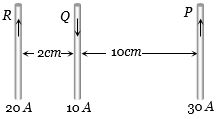
Three long,straight and parallel wires carrying currents are arranged as shown in the figure. The force experienced by $10\, cm$ length of wire $Q$ is
A
$1.4 \times 10^{-4}\,N$ towards the right
B
$1.4 \times 10^{-4}\,N$ towards the left
C
$2.6 \times 10^{-4}\,N$ to the right
D
$2.6 \times 10^{-4}\,N$ to the left
Solution
(A) The force per unit length between two parallel wires carrying currents $I_1$ and $I_2$ separated by distance $r$ is given by $f = \frac{\mu_0 I_1 I_2}{2\pi r}$. The total force on a length $L$ is $F = \frac{\mu_0 I_1 I_2 L}{2\pi r} = 2 \times 10^{-7} \frac{I_1 I_2 L}{r}$.
$1$. Force on wire $Q$ due to wire $P$ $(I_P = 30\,A, I_Q = 10\,A, r = 0.1\,m, L = 0.1\,m)$:
Since currents are in opposite directions,the force is repulsive (towards the left).
$F_P = 2 \times 10^{-7} \times \frac{30 \times 10 \times 0.1}{0.1} = 6 \times 10^{-5}\,N$ (towards the left).
$2$. Force on wire $Q$ due to wire $R$ $(I_R = 20\,A, I_Q = 10\,A, r = 0.02\,m, L = 0.1\,m)$:
Since currents are in opposite directions,the force is repulsive (towards the right).
$F_R = 2 \times 10^{-7} \times \frac{20 \times 10 \times 0.1}{0.02} = 20 \times 10^{-5}\,N$ (towards the right).
$3$. Net force on wire $Q$:
$F_{net} = F_R - F_P = 20 \times 10^{-5} - 6 \times 10^{-5} = 14 \times 10^{-5}\,N = 1.4 \times 10^{-4}\,N$ (towards the right).
$1$. Force on wire $Q$ due to wire $P$ $(I_P = 30\,A, I_Q = 10\,A, r = 0.1\,m, L = 0.1\,m)$:
Since currents are in opposite directions,the force is repulsive (towards the left).
$F_P = 2 \times 10^{-7} \times \frac{30 \times 10 \times 0.1}{0.1} = 6 \times 10^{-5}\,N$ (towards the left).
$2$. Force on wire $Q$ due to wire $R$ $(I_R = 20\,A, I_Q = 10\,A, r = 0.02\,m, L = 0.1\,m)$:
Since currents are in opposite directions,the force is repulsive (towards the right).
$F_R = 2 \times 10^{-7} \times \frac{20 \times 10 \times 0.1}{0.02} = 20 \times 10^{-5}\,N$ (towards the right).
$3$. Net force on wire $Q$:
$F_{net} = F_R - F_P = 20 \times 10^{-5} - 6 \times 10^{-5} = 14 \times 10^{-5}\,N = 1.4 \times 10^{-4}\,N$ (towards the right).
0 likes
View Solution16
EasyMCQ
$A$ current of $5 \ A$ is flowing in a wire of length $1.5 \ m$. $A$ force of $7.5 \ N$ acts on it when it is placed in a uniform magnetic field of $2 \ T$. The angle between the magnetic field and the direction of the current is......$^o$
A
$30$
B
$45$
C
$60$
D
$90$
Solution
(A) The force $F$ on a current-carrying conductor in a uniform magnetic field is given by the formula: $F = B I L \sin \theta$,where $B$ is the magnetic field,$I$ is the current,$L$ is the length of the wire,and $\theta$ is the angle between the magnetic field and the current direction.
Given values are: $F = 7.5 \ N$,$B = 2 \ T$,$I = 5 \ A$,and $L = 1.5 \ m$.
Substituting these values into the formula:
$7.5 = 2 \times 5 \times 1.5 \times \sin \theta$
$7.5 = 15 \times \sin \theta$
$\sin \theta = \frac{7.5}{15} = 0.5$
Since $\sin \theta = 0.5$,we have $\theta = 30^\circ$.
Given values are: $F = 7.5 \ N$,$B = 2 \ T$,$I = 5 \ A$,and $L = 1.5 \ m$.
Substituting these values into the formula:
$7.5 = 2 \times 5 \times 1.5 \times \sin \theta$
$7.5 = 15 \times \sin \theta$
$\sin \theta = \frac{7.5}{15} = 0.5$
Since $\sin \theta = 0.5$,we have $\theta = 30^\circ$.
0 likes
View Solution17
MediumMCQ
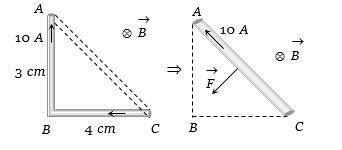
$A$ conductor in the form of a right angle $ABC$ with $AB = 3\, cm$ and $BC = 4\, cm$ carries a current of $10\, A$. There is a uniform magnetic field of $5\, T$ perpendicular to the plane of the conductor. The force on the conductor will be......$N$
A
$1.5$
B
$2$
C
$2.5$
D
$3.5$
Solution
(C) The force on a current-carrying conductor in a uniform magnetic field is given by $\vec{F} = I(\vec{L} \times \vec{B})$.
For a bent wire,the total force is equivalent to the force on a straight wire connecting the initial and final points,which is the displacement vector $\vec{L}_{AC}$.
Given $AB = 3\, cm$ and $BC = 4\, cm$,the length of the hypotenuse $AC$ is $\sqrt{AB^2 + BC^2} = \sqrt{3^2 + 4^2} = 5\, cm = 0.05\, m$.
The magnitude of the force is $F = I L_{AC} B \sin(\theta)$. Since the magnetic field is perpendicular to the plane,$\theta = 90^\circ$ and $\sin(90^\circ) = 1$.
Substituting the values: $F = 10\, A \times 0.05\, m \times 5\, T = 2.5\, N$.
For a bent wire,the total force is equivalent to the force on a straight wire connecting the initial and final points,which is the displacement vector $\vec{L}_{AC}$.
Given $AB = 3\, cm$ and $BC = 4\, cm$,the length of the hypotenuse $AC$ is $\sqrt{AB^2 + BC^2} = \sqrt{3^2 + 4^2} = 5\, cm = 0.05\, m$.
The magnitude of the force is $F = I L_{AC} B \sin(\theta)$. Since the magnetic field is perpendicular to the plane,$\theta = 90^\circ$ and $\sin(90^\circ) = 1$.
Substituting the values: $F = 10\, A \times 0.05\, m \times 5\, T = 2.5\, N$.
0 likes
View Solution18
MediumMCQ
If a current is passed through a spring,then the spring will:
A
compress
B
remain the same
C
none of these
D
remain unchanged
Solution
(A) When a current is passed through a spring,each turn of the spring acts as a circular loop carrying current.
Since the current flows in the same direction in all adjacent turns,these turns attract each other due to the magnetic force between parallel currents.
As a result,the spring experiences an attractive force between its coils,causing it to compress.
Since the current flows in the same direction in all adjacent turns,these turns attract each other due to the magnetic force between parallel currents.
As a result,the spring experiences an attractive force between its coils,causing it to compress.
0 likes
View Solution19
MediumMCQ
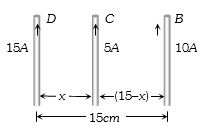
Three long,straight and parallel wires carrying currents are arranged as shown in the figure. The wire $C$ which carries a current of $5.0\, A$ is so placed that it experiences no force. The distance of wire $C$ from wire $D$ is (in $, cm$)
A
$9$
B
$7$
C
$5$
D
$3$
Solution
(A) For wire $C$ to experience no net force,the magnetic force exerted on it by wire $D$ must be equal in magnitude and opposite in direction to the force exerted by wire $B$.
Since all currents are in the same direction,the force between parallel wires is attractive.
Let $x$ be the distance of wire $C$ from wire $D$. Then the distance of wire $C$ from wire $B$ is $(15 - x)\, cm$.
The force per unit length between two parallel wires carrying currents $I_1$ and $I_2$ separated by distance $r$ is given by $f = \frac{\mu_0 I_1 I_2}{2\pi r}$.
Equating the forces on wire $C$:
$\frac{\mu_0 I_D I_C}{2\pi x} = \frac{\mu_0 I_B I_C}{2\pi (15 - x)}$
$\frac{15 \times 5}{x} = \frac{10 \times 5}{15 - x}$
$\frac{15}{x} = \frac{10}{15 - x}$
$15(15 - x) = 10x$
$225 - 15x = 10x$
$25x = 225$
$x = 9\, cm$.
Since all currents are in the same direction,the force between parallel wires is attractive.
Let $x$ be the distance of wire $C$ from wire $D$. Then the distance of wire $C$ from wire $B$ is $(15 - x)\, cm$.
The force per unit length between two parallel wires carrying currents $I_1$ and $I_2$ separated by distance $r$ is given by $f = \frac{\mu_0 I_1 I_2}{2\pi r}$.
Equating the forces on wire $C$:
$\frac{\mu_0 I_D I_C}{2\pi x} = \frac{\mu_0 I_B I_C}{2\pi (15 - x)}$
$\frac{15 \times 5}{x} = \frac{10 \times 5}{15 - x}$
$\frac{15}{x} = \frac{10}{15 - x}$
$15(15 - x) = 10x$
$225 - 15x = 10x$
$25x = 225$
$x = 9\, cm$.
0 likes
View Solution20
EasyMCQ
$A$ vertical wire carrying a current in the upward direction is placed in a horizontal magnetic field directed towards the north. The wire will experience a force directed towards:
A
North
B
South
C
East
D
West
Solution
(D) According to Fleming's Left-Hand Rule,if we stretch the thumb,forefinger,and middle finger of the left hand such that they are mutually perpendicular to each other:
$1$. The forefinger points in the direction of the magnetic field (North).
$2$. The middle finger points in the direction of the current (Upward).
$3$. The thumb will point in the direction of the force.
Using the right-hand coordinate system where North is $+y$,Up is $+z$,and East is $+x$:
- Current $\vec{I} = I \hat{k}$
- Magnetic field $\vec{B} = B \hat{j}$
- Force $\vec{F} = I(\vec{L} \times \vec{B}) = I(L \hat{k} \times B \hat{j}) = ILB(\hat{k} \times \hat{j}) = -ILB \hat{i}$
Since the negative $x$-direction corresponds to West,the force is directed towards the West.
$1$. The forefinger points in the direction of the magnetic field (North).
$2$. The middle finger points in the direction of the current (Upward).
$3$. The thumb will point in the direction of the force.
Using the right-hand coordinate system where North is $+y$,Up is $+z$,and East is $+x$:
- Current $\vec{I} = I \hat{k}$
- Magnetic field $\vec{B} = B \hat{j}$
- Force $\vec{F} = I(\vec{L} \times \vec{B}) = I(L \hat{k} \times B \hat{j}) = ILB(\hat{k} \times \hat{j}) = -ILB \hat{i}$
Since the negative $x$-direction corresponds to West,the force is directed towards the West.
0 likes
View Solution21
EasyMCQ
$A$ power line lies along the east-west direction and carries a current of $10\, A$. The force per metre due to the earth's magnetic field of ${10^{ - 4}}\, T$ is
A
${10^{ - 5}}\, N$
B
${10^{ - 4}}\, N$
C
${10^{ - 3}}\, N$
D
${10^{ - 2}}\, N$
Solution
(C) The force on a current-carrying conductor in a magnetic field is given by the formula $F = BIl \sin(\theta)$.
Here,the current $I = 10\, A$ and the magnetic field $B = {10^{ - 4}}\, T$.
Since the power line is along the east-west direction and the earth's magnetic field is generally considered to be perpendicular to the wire in this context for maximum force calculation,we take $\theta = 90^\circ$,so $\sin(90^\circ) = 1$.
The force per unit length is given by $f = \frac{F}{l} = BI$.
Substituting the values: $f = {10^{ - 4}} \times 10 = {10^{ - 3}}\, N/m$.
Therefore,the correct option is $C$.
Here,the current $I = 10\, A$ and the magnetic field $B = {10^{ - 4}}\, T$.
Since the power line is along the east-west direction and the earth's magnetic field is generally considered to be perpendicular to the wire in this context for maximum force calculation,we take $\theta = 90^\circ$,so $\sin(90^\circ) = 1$.
The force per unit length is given by $f = \frac{F}{l} = BI$.
Substituting the values: $f = {10^{ - 4}} \times 10 = {10^{ - 3}}\, N/m$.
Therefore,the correct option is $C$.
0 likes
View Solution22
EasyMCQ
$A$ straight wire of length $0.5\,m$ carrying a current of $1.2\,A$ is placed in a uniform magnetic field of induction $2\,T$. The magnetic field is perpendicular to the length of the wire. The force on the wire is.......$N$.
A
$2.4$
B
$1.2$
C
$3$
D
$2$
Solution
(B) The force $F$ on a current-carrying wire in a magnetic field is given by the formula $F = BIl \sin(\theta)$.
Here,$B = 2\,T$ (magnetic field induction),
$I = 1.2\,A$ (current),
$l = 0.5\,m$ (length of the wire),
and $\theta = 90^\circ$ (since the magnetic field is perpendicular to the wire),so $\sin(90^\circ) = 1$.
Substituting the values into the formula:
$F = 2 \times 1.2 \times 0.5 \times 1$
$F = 1.2\,N$.
Therefore,the force on the wire is $1.2\,N$.
Here,$B = 2\,T$ (magnetic field induction),
$I = 1.2\,A$ (current),
$l = 0.5\,m$ (length of the wire),
and $\theta = 90^\circ$ (since the magnetic field is perpendicular to the wire),so $\sin(90^\circ) = 1$.
Substituting the values into the formula:
$F = 2 \times 1.2 \times 0.5 \times 1$
$F = 1.2\,N$.
Therefore,the force on the wire is $1.2\,N$.
0 likes
View Solution23
MediumMCQ
Two parallel wires in free space are $10\, cm$ apart and each carries a current of $10\, A$ in the same direction. The force one wire exerts on the other per metre of length is
A
$2 \times 10^{-4}\,N$,attractive
B
$2 \times 10^{-4}\,N$,repulsive
C
$2 \times 10^{-7}\,N$,attractive
D
$2 \times 10^{-7}\,N$,repulsive
Solution
(A) The force per unit length between two parallel current-carrying wires is given by the formula: $F/L = \frac{\mu_0}{4\pi} \frac{2i_1 i_2}{d}$.
Given: $\mu_0/4\pi = 10^{-7}\,T\cdot m/A$,$i_1 = i_2 = 10\,A$,and $d = 10\,cm = 0.1\,m$.
Substituting the values: $F/L = 10^{-7} \times \frac{2 \times 10 \times 10}{0.1} = 10^{-7} \times \frac{200}{0.1} = 10^{-7} \times 2000 = 2 \times 10^{-4}\,N/m$.
Since the currents are in the same direction,the force between the wires is attractive.
Given: $\mu_0/4\pi = 10^{-7}\,T\cdot m/A$,$i_1 = i_2 = 10\,A$,and $d = 10\,cm = 0.1\,m$.
Substituting the values: $F/L = 10^{-7} \times \frac{2 \times 10 \times 10}{0.1} = 10^{-7} \times \frac{200}{0.1} = 10^{-7} \times 2000 = 2 \times 10^{-4}\,N/m$.
Since the currents are in the same direction,the force between the wires is attractive.
0 likes
View Solution24
MediumMCQ
Two long parallel wires carrying equal current separated by $1\,m$,exert a force of $2 \times 10^{-7}\,N/m$ on one another. The current flowing through them is
A
$2.0\,A$
B
$2.0 \times 10^{-7}\,A$
C
$1.0\,A$
D
$1.0 \times 10^{-7}\,A$
Solution
(C) The force per unit length between two long parallel wires carrying currents $i_1$ and $i_2$ separated by a distance $a$ is given by the formula:
$\frac{F}{l} = \frac{\mu_0}{4\pi} \times \frac{2i_1i_2}{a}$
Given that the currents are equal,$i_1 = i_2 = i$,and the separation $a = 1\,m$. The force per unit length is $\frac{F}{l} = 2 \times 10^{-7}\,N/m$.
Substituting the values into the formula:
$2 \times 10^{-7} = 10^{-7} \times \frac{2i^2}{1}$
$2 \times 10^{-7} = 2 \times 10^{-7} \times i^2$
$i^2 = 1$
$i = 1\,A$
Therefore,the current flowing through each wire is $1.0\,A$.
$\frac{F}{l} = \frac{\mu_0}{4\pi} \times \frac{2i_1i_2}{a}$
Given that the currents are equal,$i_1 = i_2 = i$,and the separation $a = 1\,m$. The force per unit length is $\frac{F}{l} = 2 \times 10^{-7}\,N/m$.
Substituting the values into the formula:
$2 \times 10^{-7} = 10^{-7} \times \frac{2i^2}{1}$
$2 \times 10^{-7} = 2 \times 10^{-7} \times i^2$
$i^2 = 1$
$i = 1\,A$
Therefore,the current flowing through each wire is $1.0\,A$.
0 likes
View Solution25
MediumMCQ
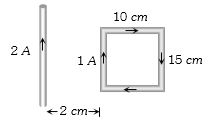
What is the net force on the square coil?
A
$25 \times 10^{-7} \, N$ moving towards wire
B
$25 \times 10^{-7} \, N$ moving away from wire
C
$35 \times 10^{-7} \, N$ moving towards wire
D
$35 \times 10^{-7} \, N$ moving away from wire
Solution
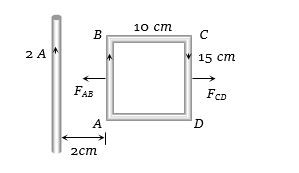
(A) The force on sides $BC$ and $AD$ are equal in magnitude but opposite in direction,so their net force is zero.
For side $AB$ (at distance $r_1 = 2 \, cm = 2 \times 10^{-2} \, m$):
$F_{AB} = \frac{\mu_0 I_1 I_2 L}{2 \pi r_1} = 2 \times 10^{-7} \times \frac{2 \times 1 \times 0.15}{2 \times 10^{-2}} = 3 \times 10^{-6} \, N$ (attractive,towards the wire).
For side $CD$ (at distance $r_2 = 2 \, cm + 10 \, cm = 12 \, cm = 12 \times 10^{-2} \, m$):
$F_{CD} = \frac{\mu_0 I_1 I_2 L}{2 \pi r_2} = 2 \times 10^{-7} \times \frac{2 \times 1 \times 0.15}{12 \times 10^{-2}} = 0.5 \times 10^{-6} \, N$ (repulsive,away from the wire).
The net force is $F_{net} = F_{AB} - F_{CD} = 3 \times 10^{-6} - 0.5 \times 10^{-6} = 2.5 \times 10^{-6} \, N = 25 \times 10^{-7} \, N$,directed towards the wire.
For side $AB$ (at distance $r_1 = 2 \, cm = 2 \times 10^{-2} \, m$):
$F_{AB} = \frac{\mu_0 I_1 I_2 L}{2 \pi r_1} = 2 \times 10^{-7} \times \frac{2 \times 1 \times 0.15}{2 \times 10^{-2}} = 3 \times 10^{-6} \, N$ (attractive,towards the wire).
For side $CD$ (at distance $r_2 = 2 \, cm + 10 \, cm = 12 \, cm = 12 \times 10^{-2} \, m$):
$F_{CD} = \frac{\mu_0 I_1 I_2 L}{2 \pi r_2} = 2 \times 10^{-7} \times \frac{2 \times 1 \times 0.15}{12 \times 10^{-2}} = 0.5 \times 10^{-6} \, N$ (repulsive,away from the wire).
The net force is $F_{net} = F_{AB} - F_{CD} = 3 \times 10^{-6} - 0.5 \times 10^{-6} = 2.5 \times 10^{-6} \, N = 25 \times 10^{-7} \, N$,directed towards the wire.
0 likes
View Solution26
EasyMCQ
Two long parallel copper wires carry currents of $5\,A$ each in opposite directions. If the wires are separated by a distance of $0.5\,m$,then the force between the two wires is
A
$10^{-5}\,N$,attractive
B
$10^{-5}\,N$,repulsive
C
$2 \times 10^{-5}\,N$,attractive
D
$2 \times 10^{-5}\,N$,repulsive
Solution
(B) The force per unit length between two parallel wires carrying currents $i_1$ and $i_2$ separated by a distance $d$ is given by $F/L = \frac{\mu_0 i_1 i_2}{2\pi d}$.
Given: $i_1 = i_2 = 5\,A$,$d = 0.5\,m$,and $\frac{\mu_0}{2\pi} = 2 \times 10^{-7}\,T\cdot m/A$.
Substituting the values: $F/L = \frac{2 \times 10^{-7} \times 5 \times 5}{0.5} = \frac{50 \times 10^{-7}}{0.5} = 100 \times 10^{-7} = 10^{-5}\,N/m$.
Since the currents are in opposite directions,the force between the wires is repulsive.
Given: $i_1 = i_2 = 5\,A$,$d = 0.5\,m$,and $\frac{\mu_0}{2\pi} = 2 \times 10^{-7}\,T\cdot m/A$.
Substituting the values: $F/L = \frac{2 \times 10^{-7} \times 5 \times 5}{0.5} = \frac{50 \times 10^{-7}}{0.5} = 100 \times 10^{-7} = 10^{-5}\,N/m$.
Since the currents are in opposite directions,the force between the wires is repulsive.
0 likes
View Solution27
EasyMCQ
$A$ long wire $A$ carries a current of $10 \, A$. Another long wire $B$,which is parallel to $A$ and separated by $0.1 \, m$ from $A$,carries a current of $5 \, A$ in the opposite direction to that in $A$. What is the magnitude and nature of the force experienced per unit length of $B$ $(\mu_0 = 4\pi \times 10^{-7} \, T \cdot m/A)$?
A
Repulsive force of $10^{-4} \, N/m$
B
Attractive force of $10^{-4} \, N/m$
C
Repulsive force of $2\pi \times 10^{-5} \, N/m$
D
Attractive force of $2\pi \times 10^{-5} \, N/m$
Solution
(A) The force per unit length between two parallel current-carrying wires is given by the formula: $f = \frac{\mu_0}{4\pi} \frac{2 i_1 i_2}{r}$.
Given values are $i_1 = 10 \, A$,$i_2 = 5 \, A$,$r = 0.1 \, m$,and $\mu_0 = 4\pi \times 10^{-7} \, T \cdot m/A$.
Substituting these values into the formula:
$f = 10^{-7} \times \frac{2 \times 10 \times 5}{0.1} = 10^{-7} \times \frac{100}{0.1} = 10^{-7} \times 1000 = 10^{-4} \, N/m$.
Since the currents are flowing in opposite directions,the force between the wires is repulsive.
Given values are $i_1 = 10 \, A$,$i_2 = 5 \, A$,$r = 0.1 \, m$,and $\mu_0 = 4\pi \times 10^{-7} \, T \cdot m/A$.
Substituting these values into the formula:
$f = 10^{-7} \times \frac{2 \times 10 \times 5}{0.1} = 10^{-7} \times \frac{100}{0.1} = 10^{-7} \times 1000 = 10^{-4} \, N/m$.
Since the currents are flowing in opposite directions,the force between the wires is repulsive.
0 likes
View Solution28
EasyMCQ
If a wire of length $1\, m$ is placed in a uniform magnetic field of $1.5\, T$ at an angle of ${30^\circ}$ with the magnetic field,and the current in the wire is $10\, A$,then the force on the wire will be.......$N$. (in $.5$)
A
$7$
B
$1$
C
$0$
D
$2$
Solution
(A) The force $F$ on a current-carrying conductor in a magnetic field is given by the formula: $F = B I L \sin \theta$.
Given:
Magnetic field $B = 1.5\, T$,
Current $I = 10\, A$,
Length $L = 1\, m$,
Angle $\theta = {30^\circ}$.
Substituting these values into the formula:
$F = 1.5 \times 10 \times 1 \times \sin({30^\circ})$
$F = 15 \times 0.5$
$F = 7.5\, N$.
Given:
Magnetic field $B = 1.5\, T$,
Current $I = 10\, A$,
Length $L = 1\, m$,
Angle $\theta = {30^\circ}$.
Substituting these values into the formula:
$F = 1.5 \times 10 \times 1 \times \sin({30^\circ})$
$F = 15 \times 0.5$
$F = 7.5\, N$.
0 likes
View Solution29
EasyMCQ
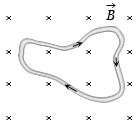
An arbitrarily shaped closed coil is made of a wire of length $L$ and a current $I$ ampere is flowing in it. If the plane of the coil is perpendicular to a uniform magnetic field $\vec{B}$, the net magnetic force on the coil is
A
$Zero$
B
$IBL$
C
$2IBL$
D
$\frac{1}{2}IBL$
Solution
(A) The magnetic force on a current-carrying wire segment is given by $\vec{F} = I(\vec{L}_{eff} \times \vec{B})$, where $\vec{L}_{eff}$ is the vector displacement from the starting point to the ending point of the wire segment.
For any closed loop, the starting point and the ending point are the same. Therefore, the effective length vector $\vec{L}_{eff}$ for a closed loop is zero.
Since $\vec{L}_{eff} = 0$, the net magnetic force $\vec{F} = I(0 \times \vec{B}) = 0$.
Thus, the net force on the closed coil is $Zero$.
For any closed loop, the starting point and the ending point are the same. Therefore, the effective length vector $\vec{L}_{eff}$ for a closed loop is zero.
Since $\vec{L}_{eff} = 0$, the net magnetic force $\vec{F} = I(0 \times \vec{B}) = 0$.
Thus, the net force on the closed coil is $Zero$.
0 likes
View Solution30
MediumMCQ
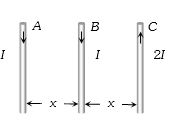
$A, B$ and $C$ are parallel conductors of equal length carrying currents $I, I$ and $2I$ respectively. The distance between $A$ and $B$ is $x$. The distance between $B$ and $C$ is also $x$. If $F_1$ is the force exerted by $B$ on $A$ and $F_2$ is the force exerted by $C$ on $B$,choose the correct answer.
A
$F_1 = 2F_2$
B
$F_2 = 2F_1$
C
$F_1 = F_2$
D
$F_1 = -F_2$
Solution
(B) The force per unit length between two parallel conductors carrying currents $i_1$ and $i_2$ separated by distance $r$ is given by $f = \frac{\mu_0}{2\pi} \frac{i_1 i_2}{r}$.
For conductor $A$ and $B$: Both carry current $I$ in the same direction,so the force $F_1$ exerted by $B$ on $A$ is attractive.
$F_1 = \frac{\mu_0}{2\pi} \frac{I \cdot I}{x} = \frac{\mu_0 I^2}{2\pi x}$.
For conductor $B$ and $C$: $B$ carries current $I$ and $C$ carries current $2I$ in opposite directions,so the force $F_2$ exerted by $C$ on $B$ is repulsive.
$F_2 = \frac{\mu_0}{2\pi} \frac{I \cdot 2I}{x} = \frac{2 \mu_0 I^2}{2\pi x} = 2 F_1$.
Since $F_1$ is attractive and $F_2$ is repulsive,they act in opposite directions. Thus,$F_2 = -2F_1$ or $F_1 = -0.5 F_2$. However,looking at the magnitudes and directions,the force $F_2$ is twice the magnitude of $F_1$ and acts in the opposite direction. Given the options,$F_2 = 2F_1$ represents the relationship between the magnitudes.
For conductor $A$ and $B$: Both carry current $I$ in the same direction,so the force $F_1$ exerted by $B$ on $A$ is attractive.
$F_1 = \frac{\mu_0}{2\pi} \frac{I \cdot I}{x} = \frac{\mu_0 I^2}{2\pi x}$.
For conductor $B$ and $C$: $B$ carries current $I$ and $C$ carries current $2I$ in opposite directions,so the force $F_2$ exerted by $C$ on $B$ is repulsive.
$F_2 = \frac{\mu_0}{2\pi} \frac{I \cdot 2I}{x} = \frac{2 \mu_0 I^2}{2\pi x} = 2 F_1$.
Since $F_1$ is attractive and $F_2$ is repulsive,they act in opposite directions. Thus,$F_2 = -2F_1$ or $F_1 = -0.5 F_2$. However,looking at the magnitudes and directions,the force $F_2$ is twice the magnitude of $F_1$ and acts in the opposite direction. Given the options,$F_2 = 2F_1$ represents the relationship between the magnitudes.
0 likes
View Solution31
EasyMCQ
Two long straight parallel conductors separated by a distance of $0.5\,m$ carry currents of $5\,A$ and $8\,A$ in the same direction. The force per unit length experienced by each other is
A
$1.6 \times 10^{-5}\,N$ (attractive)
B
$1.6 \times 10^{-5}\,N$ (repulsive)
C
$16 \times 10^{-5}\,N$ (attractive)
D
$16 \times 10^{-5}\,N$ (repulsive)
Solution
(A) The force per unit length between two parallel current-carrying conductors is given by the formula:
$f = \frac{\mu_0}{4\pi} \frac{2 I_1 I_2}{r}$
Given:
$I_1 = 5\,A$,$I_2 = 8\,A$,$r = 0.5\,m$,and $\frac{\mu_0}{4\pi} = 10^{-7}\,T\cdot m/A$.
Substituting the values:
$f = 10^{-7} \times \frac{2 \times 5 \times 8}{0.5}$
$f = 10^{-7} \times \frac{80}{0.5}$
$f = 10^{-7} \times 160$
$f = 1.6 \times 10^{-5}\,N/m$.
Since the currents are in the same direction,the force is attractive.
$f = \frac{\mu_0}{4\pi} \frac{2 I_1 I_2}{r}$
Given:
$I_1 = 5\,A$,$I_2 = 8\,A$,$r = 0.5\,m$,and $\frac{\mu_0}{4\pi} = 10^{-7}\,T\cdot m/A$.
Substituting the values:
$f = 10^{-7} \times \frac{2 \times 5 \times 8}{0.5}$
$f = 10^{-7} \times \frac{80}{0.5}$
$f = 10^{-7} \times 160$
$f = 1.6 \times 10^{-5}\,N/m$.
Since the currents are in the same direction,the force is attractive.
0 likes
View Solution32
EasyMCQ
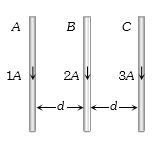
Three long straight wires $A$,$B$,and $C$ are carrying currents as shown in the figure. Then the resultant force on $B$ is directed .....
A
Towards $A$
B
Towards $C$
C
Perpendicular to the plane of paper and outward
D
Perpendicular to the plane of paper and inward
Solution
(B) The force per unit length between two parallel current-carrying wires is given by $f = \frac{\mu_0 i_1 i_2}{2\pi r}$.
Since the currents in all three wires are in the same direction,the force between any two wires is attractive.
Let $i_A = 1 \text{ A}$,$i_B = 2 \text{ A}$,and $i_C = 3 \text{ A}$. The distance between adjacent wires is $d$.
Force on $B$ due to $A$ $(F_{BA})$ is attractive,so it acts towards $A$: $F_{BA} = \frac{\mu_0 i_A i_B}{2\pi d} = \frac{\mu_0 (1)(2)}{2\pi d} = \frac{\mu_0}{\pi d}$.
Force on $B$ due to $C$ $(F_{BC})$ is attractive,so it acts towards $C$: $F_{BC} = \frac{\mu_0 i_B i_C}{2\pi d} = \frac{\mu_0 (2)(3)}{2\pi d} = \frac{3\mu_0}{\pi d}$.
Since $F_{BC} > F_{BA}$,the net force on $B$ is $F_{net} = F_{BC} - F_{BA} = \frac{2\mu_0}{\pi d}$ directed towards $C$.
Since the currents in all three wires are in the same direction,the force between any two wires is attractive.
Let $i_A = 1 \text{ A}$,$i_B = 2 \text{ A}$,and $i_C = 3 \text{ A}$. The distance between adjacent wires is $d$.
Force on $B$ due to $A$ $(F_{BA})$ is attractive,so it acts towards $A$: $F_{BA} = \frac{\mu_0 i_A i_B}{2\pi d} = \frac{\mu_0 (1)(2)}{2\pi d} = \frac{\mu_0}{\pi d}$.
Force on $B$ due to $C$ $(F_{BC})$ is attractive,so it acts towards $C$: $F_{BC} = \frac{\mu_0 i_B i_C}{2\pi d} = \frac{\mu_0 (2)(3)}{2\pi d} = \frac{3\mu_0}{\pi d}$.
Since $F_{BC} > F_{BA}$,the net force on $B$ is $F_{net} = F_{BC} - F_{BA} = \frac{2\mu_0}{\pi d}$ directed towards $C$.
0 likes
View Solution33
MediumMCQ
Two long parallel conductors,separated by a distance $d$,carry currents $I_1$ and $I_2$ in the same direction. They exert a force $F$ on each other. Now,the current in one of them is increased to $2I$ and its direction is reversed. The distance between them is also increased to $3d$. The new value of the force between them is:
A
$-2F$
B
$F/3$
C
$-2F/3$
D
$F/3$
Solution
(C) The force per unit length between two long parallel conductors is given by $F = \frac{\mu_0 I_1 I_2}{2 \pi d}$.
Initially,the force is $F = k \frac{I_1 I_2}{d}$,where $k = \frac{\mu_0}{2 \pi}$.
In the new scenario,the current $I_1$ becomes $2I_1$ and the direction is reversed,so the new current is $-2I_1$. The distance $d$ becomes $3d$.
The new force $F'$ is given by $F' = k \frac{(-2I_1) I_2}{3d} = -\frac{2}{3} \left( k \frac{I_1 I_2}{d} \right)$.
Substituting the initial force $F$,we get $F' = -\frac{2}{3} F$.
Initially,the force is $F = k \frac{I_1 I_2}{d}$,where $k = \frac{\mu_0}{2 \pi}$.
In the new scenario,the current $I_1$ becomes $2I_1$ and the direction is reversed,so the new current is $-2I_1$. The distance $d$ becomes $3d$.
The new force $F'$ is given by $F' = k \frac{(-2I_1) I_2}{3d} = -\frac{2}{3} \left( k \frac{I_1 I_2}{d} \right)$.
Substituting the initial force $F$,we get $F' = -\frac{2}{3} F$.
0 likes
View Solution34
EasyMCQ
$A$ $1\, m$ long wire is placed at right angles to a magnetic field. $A$ force of $1\, kg$ wt. acts on it in a magnetic field of $0.98\, T$. The current flowing through the wire is: (in $, A$)
A
$100$
B
$10$
C
$1$
D
$0$
Solution
(B) The force on a current-carrying conductor in a magnetic field is given by $F = B i l \sin(\theta)$.
Given:
Length $l = 1\, m$
Magnetic field $B = 0.98\, T$
Force $F = 1\, kg\text{-wt} = 1 \times 9.8\, N = 9.8\, N$
Angle $\theta = 90^\circ$ (since it is at right angles),so $\sin(90^\circ) = 1$.
Substituting the values:
$9.8 = 0.98 \times i \times 1$
$i = \frac{9.8}{0.98} = 10\, A$.
Therefore,the current flowing through the wire is $10\, A$.
Given:
Length $l = 1\, m$
Magnetic field $B = 0.98\, T$
Force $F = 1\, kg\text{-wt} = 1 \times 9.8\, N = 9.8\, N$
Angle $\theta = 90^\circ$ (since it is at right angles),so $\sin(90^\circ) = 1$.
Substituting the values:
$9.8 = 0.98 \times i \times 1$
$i = \frac{9.8}{0.98} = 10\, A$.
Therefore,the current flowing through the wire is $10\, A$.
0 likes
View Solution35
EasyMCQ
Two parallel wires of length $9 \, m$ each are separated by a distance $0.15 \, m$. If they carry equal currents in the same direction and exert a total force of $30 \times 10^{-7} \, N$ on each other,then the value of current must be ........ $A$. (in $.5$)
A
$2$
B
$3$
C
$1$
D
$0$
Solution
(D) The force per unit length between two parallel wires carrying currents $i_1$ and $i_2$ separated by distance $d$ is given by $F = \frac{\mu_0 i_1 i_2 l}{2 \pi d}$.
Given that $i_1 = i_2 = i$,the formula becomes $F = \frac{\mu_0 i^2 l}{2 \pi d} = 2 \times 10^{-7} \times \frac{i^2 l}{d}$.
Substituting the given values: $30 \times 10^{-7} = 2 \times 10^{-7} \times \frac{i^2 \times 9}{0.15}$.
Simplifying the equation: $30 = 2 \times \frac{i^2 \times 9}{0.15}$.
$30 = \frac{18 i^2}{0.15}$.
$i^2 = \frac{30 \times 0.15}{18} = \frac{4.5}{18} = 0.25$.
Therefore,$i = \sqrt{0.25} = 0.5 \, A$.
Given that $i_1 = i_2 = i$,the formula becomes $F = \frac{\mu_0 i^2 l}{2 \pi d} = 2 \times 10^{-7} \times \frac{i^2 l}{d}$.
Substituting the given values: $30 \times 10^{-7} = 2 \times 10^{-7} \times \frac{i^2 \times 9}{0.15}$.
Simplifying the equation: $30 = 2 \times \frac{i^2 \times 9}{0.15}$.
$30 = \frac{18 i^2}{0.15}$.
$i^2 = \frac{30 \times 0.15}{18} = \frac{4.5}{18} = 0.25$.
Therefore,$i = \sqrt{0.25} = 0.5 \, A$.
0 likes
View Solution36
MediumMCQ
Two thin,long,parallel wires,separated by a distance $d$,carry a current of $i$ in the same direction. They will
A
Attract each other with a force of $\frac{\mu_0 i^2}{2\pi d^2}$
B
Repel each other with a force of $\frac{\mu_0 i^2}{2\pi d^2}$
C
Attract each other with a force of $\frac{\mu_0 i^2}{2\pi d}$
D
Repel each other with a force of $\frac{\mu_0 i^2}{2\pi d}$
Solution
(C) The force per unit length between two parallel wires carrying currents $i_1$ and $i_2$ separated by a distance $d$ is given by the formula: $\frac{F}{l} = \frac{\mu_0 i_1 i_2}{2\pi d}$.
Since both wires carry the same current $i$ in the same direction,$i_1 = i_2 = i$.
Substituting these values,we get: $\frac{F}{l} = \frac{\mu_0 i^2}{2\pi d}$.
According to the right-hand rule,parallel currents in the same direction exert an attractive force on each other.
Therefore,the wires will attract each other with a force of $\frac{\mu_0 i^2}{2\pi d}$ per unit length.
Since both wires carry the same current $i$ in the same direction,$i_1 = i_2 = i$.
Substituting these values,we get: $\frac{F}{l} = \frac{\mu_0 i^2}{2\pi d}$.
According to the right-hand rule,parallel currents in the same direction exert an attractive force on each other.
Therefore,the wires will attract each other with a force of $\frac{\mu_0 i^2}{2\pi d}$ per unit length.
0 likes
View Solution37
MediumMCQ
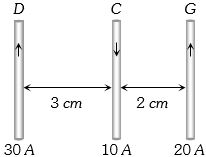
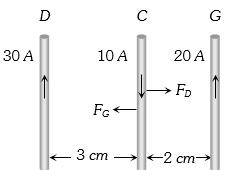
Three long,straight parallel wires carrying current are arranged as shown in the figure. The force experienced by a $25\, cm$ length of wire $C$ is
A
$10^{-3}\, N$
B
$2.5 \times 10^{-3}\, N$
C
Zero
D
$1.5 \times 10^{-3}\, N$
Solution
(C) The force per unit length between two parallel wires carrying currents $I_1$ and $I_2$ separated by a distance $r$ is given by $f = \frac{\mu_0 I_1 I_2}{2\pi r}$.
For a length $L$,the force is $F = \frac{\mu_0 I_1 I_2 L}{2\pi r} = 2 \times 10^{-7} \times \frac{I_1 I_2 L}{r}$.
$1$. Force on wire $C$ due to wire $D$ $(F_D)$:
$I_D = 30\, A$,$I_C = 10\, A$,$r_{DC} = 3\, cm = 3 \times 10^{-2}\, m$,$L = 25\, cm = 0.25\, m$.
Since currents are in opposite directions,the force is repulsive (towards the right).
$F_D = 2 \times 10^{-7} \times \frac{30 \times 10 \times 0.25}{3 \times 10^{-2}} = 2 \times 10^{-7} \times \frac{75}{3 \times 10^{-2}} = 5 \times 10^{-4}\, N$ (towards right).
$2$. Force on wire $C$ due to wire $G$ $(F_G)$:
$I_G = 20\, A$,$I_C = 10\, A$,$r_{CG} = 2\, cm = 2 \times 10^{-2}\, m$,$L = 0.25\, m$.
Since currents are in opposite directions,the force is repulsive (towards the left).
$F_G = 2 \times 10^{-7} \times \frac{20 \times 10 \times 0.25}{2 \times 10^{-2}} = 2 \times 10^{-7} \times \frac{50}{2 \times 10^{-2}} = 5 \times 10^{-4}\, N$ (towards left).
$3$. Net force on wire $C$:
Since $F_D$ and $F_G$ are equal in magnitude and opposite in direction,the net force is $F_{net} = F_D - F_G = 5 \times 10^{-4} - 5 \times 10^{-4} = 0\, N$.
For a length $L$,the force is $F = \frac{\mu_0 I_1 I_2 L}{2\pi r} = 2 \times 10^{-7} \times \frac{I_1 I_2 L}{r}$.
$1$. Force on wire $C$ due to wire $D$ $(F_D)$:
$I_D = 30\, A$,$I_C = 10\, A$,$r_{DC} = 3\, cm = 3 \times 10^{-2}\, m$,$L = 25\, cm = 0.25\, m$.
Since currents are in opposite directions,the force is repulsive (towards the right).
$F_D = 2 \times 10^{-7} \times \frac{30 \times 10 \times 0.25}{3 \times 10^{-2}} = 2 \times 10^{-7} \times \frac{75}{3 \times 10^{-2}} = 5 \times 10^{-4}\, N$ (towards right).
$2$. Force on wire $C$ due to wire $G$ $(F_G)$:
$I_G = 20\, A$,$I_C = 10\, A$,$r_{CG} = 2\, cm = 2 \times 10^{-2}\, m$,$L = 0.25\, m$.
Since currents are in opposite directions,the force is repulsive (towards the left).
$F_G = 2 \times 10^{-7} \times \frac{20 \times 10 \times 0.25}{2 \times 10^{-2}} = 2 \times 10^{-7} \times \frac{50}{2 \times 10^{-2}} = 5 \times 10^{-4}\, N$ (towards left).
$3$. Net force on wire $C$:
Since $F_D$ and $F_G$ are equal in magnitude and opposite in direction,the net force is $F_{net} = F_D - F_G = 5 \times 10^{-4} - 5 \times 10^{-4} = 0\, N$.
0 likes
View Solution38
DifficultMCQ
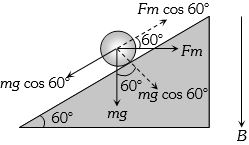
$A$ horizontal rod of mass $10 \, g$ and length $10 \, cm$ is placed on a smooth plane inclined at an angle of $60^\circ$ with the horizontal,with the length of the rod parallel to the edge of the inclined plane. $A$ uniform magnetic field of induction $B$ is applied vertically downwards. If the current through the rod is $1.73 \, A$,then the value of $B$ for which the rod remains stationary on the inclined plane is......$T$
A
$1.73$
B
$\frac{1}{1.73}$
C
$1$
D
None of the above
Solution
(C) The forces acting on the rod are the gravitational force $(mg)$ acting downwards and the magnetic force $(F_m = ilB)$ acting horizontally. For the rod to remain stationary on the smooth inclined plane,the component of the gravitational force down the plane must be balanced by the component of the magnetic force up the plane.
The component of gravitational force down the plane is $F_g = mg \sin 60^\circ$.
The component of magnetic force up the plane is $F_m \cos 60^\circ = (ilB) \cos 60^\circ$.
Equating these two forces for equilibrium:
$mg \sin 60^\circ = ilB \cos 60^\circ$
$B = \frac{mg \sin 60^\circ}{il \cos 60^\circ} = \frac{mg}{il} \tan 60^\circ$
Given: $m = 10 \, g = 0.01 \, kg$,$l = 10 \, cm = 0.1 \, m$,$i = 1.73 \, A$,$g = 10 \, m/s^2$,$\tan 60^\circ = \sqrt{3} \approx 1.73$.
$B = \frac{0.01 \times 10}{0.1 \times 1.73} \times 1.73 = \frac{0.1}{0.173} \times 1.73 = 1 \, T$.
The component of gravitational force down the plane is $F_g = mg \sin 60^\circ$.
The component of magnetic force up the plane is $F_m \cos 60^\circ = (ilB) \cos 60^\circ$.
Equating these two forces for equilibrium:
$mg \sin 60^\circ = ilB \cos 60^\circ$
$B = \frac{mg \sin 60^\circ}{il \cos 60^\circ} = \frac{mg}{il} \tan 60^\circ$
Given: $m = 10 \, g = 0.01 \, kg$,$l = 10 \, cm = 0.1 \, m$,$i = 1.73 \, A$,$g = 10 \, m/s^2$,$\tan 60^\circ = \sqrt{3} \approx 1.73$.
$B = \frac{0.01 \times 10}{0.1 \times 1.73} \times 1.73 = \frac{0.1}{0.173} \times 1.73 = 1 \, T$.
0 likes
View Solution39
EasyMCQ
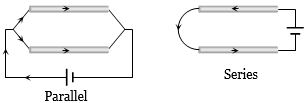
Two long wires are hanging freely. They are joined first in parallel and then in series and then are connected with a battery. In both cases,which type of force acts between the two wires?
A
Attraction force when in parallel and repulsion force when in series
B
Repulsion force when in parallel and attraction force when in series
C
Repulsion force in both cases
D
Attraction force in both cases
Solution
(A) When two current-carrying wires are placed parallel to each other,the magnetic force between them depends on the direction of the current.
$1$. When the wires are connected in parallel,the current flows in the same direction in both wires. According to Ampere's law,currents flowing in the same direction attract each other.
$2$. When the wires are connected in series,the current flows in opposite directions in the two wires. Currents flowing in opposite directions repel each other.
Therefore,there is an attraction force when in parallel and a repulsion force when in series.
$1$. When the wires are connected in parallel,the current flows in the same direction in both wires. According to Ampere's law,currents flowing in the same direction attract each other.
$2$. When the wires are connected in series,the current flows in opposite directions in the two wires. Currents flowing in opposite directions repel each other.
Therefore,there is an attraction force when in parallel and a repulsion force when in series.
0 likes
View Solution40
EasyMCQ
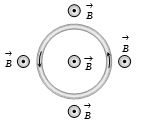
An elastic circular wire of length $l$ carries a current $I$. It is placed in a uniform magnetic field $\vec{B}$ (out of the paper) such that its plane is perpendicular to the direction of $\vec{B}$. The wire will experience:
A
No force
B
$A$ stretching force
C
$A$ compressive force
D
$A$ torque
Solution
(B) The magnetic force on a small current element $d\vec{l}$ is given by $d\vec{F} = I(d\vec{l} \times \vec{B})$.
Given that the magnetic field $\vec{B}$ is directed out of the paper and the current $I$ flows in the circular wire,we apply Fleming's left-hand rule or the right-hand rule for the cross product.
For any small segment of the circular wire,the current $I$ flows tangentially,and the magnetic field $\vec{B}$ is perpendicular to the plane of the wire (outwards).
The cross product $d\vec{l} \times \vec{B}$ results in a force vector that points radially outward from the center of the circle at every point along the wire.
Since the wire is elastic,these radially outward forces acting on all parts of the wire will cause it to expand,resulting in a stretching force.
Given that the magnetic field $\vec{B}$ is directed out of the paper and the current $I$ flows in the circular wire,we apply Fleming's left-hand rule or the right-hand rule for the cross product.
For any small segment of the circular wire,the current $I$ flows tangentially,and the magnetic field $\vec{B}$ is perpendicular to the plane of the wire (outwards).
The cross product $d\vec{l} \times \vec{B}$ results in a force vector that points radially outward from the center of the circle at every point along the wire.
Since the wire is elastic,these radially outward forces acting on all parts of the wire will cause it to expand,resulting in a stretching force.
0 likes
View Solution41
MediumMCQ
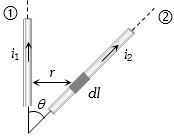
Wires $1$ and $2$ carrying currents $i_1$ and $i_2$ respectively are inclined at an angle $\theta$ to each other. What is the force on a small element $dl$ of wire $2$ at a distance of $r$ from wire $1$ (as shown in figure) due to the magnetic field of wire $1$?
A
$\frac{\mu_0}{2\pi r} i_1 i_2 dl \tan \theta$
B
$\frac{\mu_0}{2\pi r} i_1 i_2 dl \sin \theta$
C
$\frac{\mu_0}{2\pi r} i_1 i_2 dl \cos \theta$
D
$\frac{\mu_0}{4\pi r} i_1 i_2 dl \sin \theta$
Solution
(C) The magnetic field $B$ produced by wire $1$ at a distance $r$ is given by $B = \frac{\mu_0 i_1}{2\pi r}$.
This magnetic field is directed perpendicular to the plane containing the wires.
The force $dF$ on a current element $i_2 dl$ in a magnetic field $B$ is given by $dF = i_2 (dl \times B)$.
The magnitude of the force is $dF = i_2 B dl \sin \phi$,where $\phi$ is the angle between the current element $dl$ and the magnetic field $B$.
Since the magnetic field $B$ is perpendicular to the plane of the wires,it is perpendicular to the current element $dl$ as well. Thus,$\phi = 90^\circ$ and $\sin \phi = 1$.
However,the force between two current-carrying wires is specifically due to the component of the current element that is parallel to the other wire.
The component of $dl$ parallel to wire $1$ is $dl \cos \theta$.
The force on this component is $dF = B \cdot i_2 \cdot (dl \cos \theta) = \left( \frac{\mu_0 i_1}{2\pi r} \right) i_2 dl \cos \theta = \frac{\mu_0 i_1 i_2 dl \cos \theta}{2\pi r}$.
This magnetic field is directed perpendicular to the plane containing the wires.
The force $dF$ on a current element $i_2 dl$ in a magnetic field $B$ is given by $dF = i_2 (dl \times B)$.
The magnitude of the force is $dF = i_2 B dl \sin \phi$,where $\phi$ is the angle between the current element $dl$ and the magnetic field $B$.
Since the magnetic field $B$ is perpendicular to the plane of the wires,it is perpendicular to the current element $dl$ as well. Thus,$\phi = 90^\circ$ and $\sin \phi = 1$.
However,the force between two current-carrying wires is specifically due to the component of the current element that is parallel to the other wire.
The component of $dl$ parallel to wire $1$ is $dl \cos \theta$.
The force on this component is $dF = B \cdot i_2 \cdot (dl \cos \theta) = \left( \frac{\mu_0 i_1}{2\pi r} \right) i_2 dl \cos \theta = \frac{\mu_0 i_1 i_2 dl \cos \theta}{2\pi r}$.
0 likes
View Solution42
DifficultMCQ
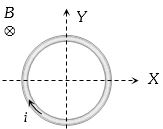
$A$ conducting loop carrying a current $I$ is placed in a uniform magnetic field pointing into the plane of the paper as shown. The loop will have a tendency to
A
Contract
B
Expand
C
Move towards $+ve$ $x$-axis
D
Move towards $-ve$ $x$-axis
Solution
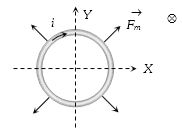
(B) The net magnetic force on a current-carrying closed loop placed in a uniform magnetic field is zero. Therefore,the loop cannot undergo translational motion. This eliminates options $(c)$ and $(d)$.
According to Fleming's left-hand rule,the magnetic force $\overrightarrow{F_m} = I(\overrightarrow{dl} \times \overrightarrow{B})$ acts on each small element of the loop. Given that the magnetic field $\overrightarrow{B}$ is directed into the plane of the paper and the current $I$ flows in a counter-clockwise direction (as shown in the figure),the force on each element is directed radially outwards. Consequently,the loop will have a tendency to expand.
According to Fleming's left-hand rule,the magnetic force $\overrightarrow{F_m} = I(\overrightarrow{dl} \times \overrightarrow{B})$ acts on each small element of the loop. Given that the magnetic field $\overrightarrow{B}$ is directed into the plane of the paper and the current $I$ flows in a counter-clockwise direction (as shown in the figure),the force on each element is directed radially outwards. Consequently,the loop will have a tendency to expand.
0 likes
View Solution43
MediumMCQ
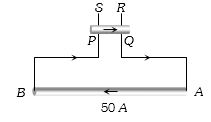
$A$ long wire $AB$ is placed on a table. Another wire $PQ$ of mass $1.0\, g$ and length $50\, cm$ is set to slide on two rails $PS$ and $QR$. $A$ current of $50\, A$ is passed through the wires. At what distance above $AB$ will the wire $PQ$ be in equilibrium? (in $mm$)
A
$25$
B
$50$
C
$75$
D
$100$
Solution
(A) In equilibrium,the magnetic force on wire $PQ$ must balance its weight.
$mg = B i l$
Here,$B$ is the magnetic field produced by the long wire $AB$ at a distance $r$ from it,given by $B = \frac{\mu_0}{4\pi} \frac{2i}{r}$.
Substituting this into the equilibrium condition:
$mg = \left( \frac{\mu_0}{4\pi} \frac{2i}{r} \right) i l$
Given: $m = 1.0\, g = 10^{-3}\, kg$,$l = 50\, cm = 0.5\, m$,$i = 50\, A$,$g = 10\, m/s^2$.
$10^{-3} \times 10 = 10^{-7} \times \frac{2 \times (50)^2}{r} \times 0.5$
$10^{-2} = 10^{-7} \times \frac{5000}{r} \times 0.5$
$10^{-2} = \frac{2.5 \times 10^{-4}}{r}$
$r = \frac{2.5 \times 10^{-4}}{10^{-2}} = 2.5 \times 10^{-2}\, m = 25\, mm$.
$mg = B i l$
Here,$B$ is the magnetic field produced by the long wire $AB$ at a distance $r$ from it,given by $B = \frac{\mu_0}{4\pi} \frac{2i}{r}$.
Substituting this into the equilibrium condition:
$mg = \left( \frac{\mu_0}{4\pi} \frac{2i}{r} \right) i l$
Given: $m = 1.0\, g = 10^{-3}\, kg$,$l = 50\, cm = 0.5\, m$,$i = 50\, A$,$g = 10\, m/s^2$.
$10^{-3} \times 10 = 10^{-7} \times \frac{2 \times (50)^2}{r} \times 0.5$
$10^{-2} = 10^{-7} \times \frac{5000}{r} \times 0.5$
$10^{-2} = \frac{2.5 \times 10^{-4}}{r}$
$r = \frac{2.5 \times 10^{-4}}{10^{-2}} = 2.5 \times 10^{-2}\, m = 25\, mm$.
0 likes
View Solution44
MediumMCQ
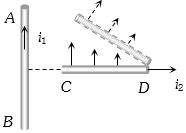
An infinitely long,straight conductor $AB$ is fixed and a current $i_1$ is passed through it. Another movable straight wire $CD$ of finite length carrying current $i_2$ is held perpendicular to it and released. Neglect the weight of the wire.
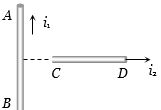
A
The rod $CD$ will move upwards parallel to itself.
B
The rod $CD$ will move downward parallel to itself.
C
The rod $CD$ will move upward and turn clockwise at the same time.
D
The rod $CD$ will move upward and turn anti-clockwise at the same time.
Solution
(C) The magnetic field $B$ produced by the long wire $AB$ at a distance $r$ is given by $B = \frac{\mu_0 i_1}{2 \pi r}$.
According to the right-hand rule,the direction of this magnetic field is into the plane of the paper.
The force $dF$ on an element $dx$ of the wire $CD$ at distance $x$ from $AB$ is $dF = i_2 (dx) B = i_2 (dx) \frac{\mu_0 i_1}{2 \pi x}$.
Using Fleming's left-hand rule,the direction of this force is upward (away from $AB$ if $i_1$ and $i_2$ are directed as shown).
Since the magnetic field $B$ decreases as the distance $x$ increases,the force per unit length is greater near $C$ and smaller near $D$.
This non-uniform force distribution results in a net upward force and a torque that causes the rod to rotate clockwise.
According to the right-hand rule,the direction of this magnetic field is into the plane of the paper.
The force $dF$ on an element $dx$ of the wire $CD$ at distance $x$ from $AB$ is $dF = i_2 (dx) B = i_2 (dx) \frac{\mu_0 i_1}{2 \pi x}$.
Using Fleming's left-hand rule,the direction of this force is upward (away from $AB$ if $i_1$ and $i_2$ are directed as shown).
Since the magnetic field $B$ decreases as the distance $x$ increases,the force per unit length is greater near $C$ and smaller near $D$.
This non-uniform force distribution results in a net upward force and a torque that causes the rod to rotate clockwise.
0 likes
View Solution45
MediumMCQ
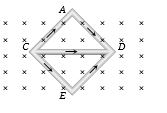
$A$ current $i = 2 \, A$ flows through a wire frame as shown in the figure. The frame is a combination of two equilateral triangles $ACD$ and $CDE$ with side length $1 \, m$. It is placed in a uniform magnetic field $B = 4 \, T$ acting perpendicular to the plane of the frame. The magnitude of the net magnetic force acting on the frame is.......$N$.
A
$24$
B
$0$
C
$16$
D
$8$
Solution
(A) The magnetic force on a current-carrying wire is given by $\vec{F} = i(\vec{L} \times \vec{B})$,where $\vec{L}$ is the displacement vector from the start to the end of the wire segment.
For the upper triangle $ACD$,the path is $C \to A \to D$. The displacement vector $\vec{L}_{CAD}$ is the vector from $C$ to $D$,which is the same as the segment $CD$.
Similarly,for the lower triangle $CDE$,the path is $C \to E \to D$. The displacement vector $\vec{L}_{CED}$ is also the vector from $C$ to $D$.
There is also a wire segment directly from $C$ to $D$ with current $i$ flowing from $C$ to $D$.
Thus,the total force is the sum of forces on three parallel segments,each of length $l = 1 \, m$ carrying current $i = 2 \, A$ in the same direction from $C$ to $D$.
$F_{net} = F_{CAD} + F_{CED} + F_{CD} = 3 \times (i \cdot l \cdot B)$
$F_{net} = 3 \times (2 \, A \times 1 \, m \times 4 \, T) = 3 \times 8 \, N = 24 \, N$.
For the upper triangle $ACD$,the path is $C \to A \to D$. The displacement vector $\vec{L}_{CAD}$ is the vector from $C$ to $D$,which is the same as the segment $CD$.
Similarly,for the lower triangle $CDE$,the path is $C \to E \to D$. The displacement vector $\vec{L}_{CED}$ is also the vector from $C$ to $D$.
There is also a wire segment directly from $C$ to $D$ with current $i$ flowing from $C$ to $D$.
Thus,the total force is the sum of forces on three parallel segments,each of length $l = 1 \, m$ carrying current $i = 2 \, A$ in the same direction from $C$ to $D$.
$F_{net} = F_{CAD} + F_{CED} + F_{CD} = 3 \times (i \cdot l \cdot B)$
$F_{net} = 3 \times (2 \, A \times 1 \, m \times 4 \, T) = 3 \times 8 \, N = 24 \, N$.
0 likes
View Solution46
MediumMCQ
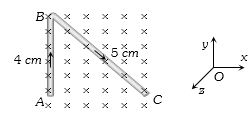
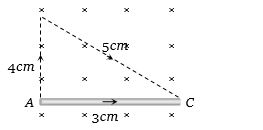
$A$ uniform conducting wire $ABC$ has a mass of $10\,g$. $A$ current of $2\,A$ flows through it. The wire is kept in a uniform magnetic field $B = 2\,T$ directed into the plane of the paper. The acceleration of the wire will be
A
Zero
B
$12\,m\,s^{-2}$ along the $x$-axis
C
$1.2 \times 10^{-3}\,m\,s^{-2}$ along the $x$-axis
D
$0.6 \times 10^{-3}\,m\,s^{-2}$ along the $x$-axis
Solution
(B) The magnetic force on a current-carrying wire is given by $\vec{F} = I(\vec{L}_{eff} \times \vec{B})$,where $\vec{L}_{eff}$ is the vector displacement from the starting point $A$ to the end point $C$.
From the figure,the displacement vector $\vec{AC}$ has a magnitude of $3\,cm = 3 \times 10^{-2}\,m$ and is directed along the positive $x$-axis.
The magnetic field $\vec{B}$ is directed into the plane (negative $z$-direction,$-2\hat{k}\,T$).
The effective length vector is $\vec{L}_{eff} = 3 \times 10^{-2}\hat{i}\,m$.
The force is $\vec{F} = I(\vec{L}_{eff} \times \vec{B}) = 2 \times (3 \times 10^{-2}\hat{i} \times -2\hat{k}) = 2 \times (6 \times 10^{-2}\hat{j}) = 12 \times 10^{-2}\,N$ along the positive $y$-axis.
Given mass $m = 10\,g = 10^{-2}\,kg$.
The acceleration $a = \frac{F}{m} = \frac{12 \times 10^{-2}}{10^{-2}} = 12\,m\,s^{-2}$ along the $y$-axis.
Note: The provided options contain a discrepancy regarding the direction. Based on the calculation,the force and acceleration are along the $y$-axis.
From the figure,the displacement vector $\vec{AC}$ has a magnitude of $3\,cm = 3 \times 10^{-2}\,m$ and is directed along the positive $x$-axis.
The magnetic field $\vec{B}$ is directed into the plane (negative $z$-direction,$-2\hat{k}\,T$).
The effective length vector is $\vec{L}_{eff} = 3 \times 10^{-2}\hat{i}\,m$.
The force is $\vec{F} = I(\vec{L}_{eff} \times \vec{B}) = 2 \times (3 \times 10^{-2}\hat{i} \times -2\hat{k}) = 2 \times (6 \times 10^{-2}\hat{j}) = 12 \times 10^{-2}\,N$ along the positive $y$-axis.
Given mass $m = 10\,g = 10^{-2}\,kg$.
The acceleration $a = \frac{F}{m} = \frac{12 \times 10^{-2}}{10^{-2}} = 12\,m\,s^{-2}$ along the $y$-axis.
Note: The provided options contain a discrepancy regarding the direction. Based on the calculation,the force and acceleration are along the $y$-axis.
0 likes
View Solution47
MediumMCQ
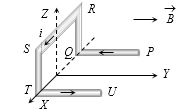
$A$ magnetic field is in the $+Y$ direction. $A$ current $i$ flows through the wire $PQRSTU$. Each side has a length $L$. What is the net force on the wire?
A
$2iBL$
B
$5iBL$
C
$iBL$
D
$3iBL$
Solution
(C) The magnetic field is $\vec{B} = B\hat{j}$. The force on a current-carrying wire is given by $\vec{F} = i(\vec{L} \times \vec{B})$.
For segments $PQ$ and $TU$,the length vector is parallel to the magnetic field (along $Y$-axis),so $\vec{F}_{PQ} = 0$ and $\vec{F}_{TU} = 0$.
For segment $QR$,the length vector is along the $Z$-axis $(\vec{L} = L\hat{k})$,so $\vec{F}_{QR} = i(L\hat{k} \times B\hat{j}) = -iLB\hat{i}$.
For segment $RS$,the length vector is along the $-X$-axis $(\vec{L} = -L\hat{i})$,so $\vec{F}_{RS} = i(-L\hat{i} \times B\hat{j}) = -iLB\hat{k}$.
For segment $ST$,the length vector is along the $-Z$-axis $(\vec{L} = -L\hat{k})$,so $\vec{F}_{ST} = i(-L\hat{k} \times B\hat{j}) = iLB\hat{i}$.
The net force is $\vec{F}_{net} = \vec{F}_{PQ} + \vec{F}_{QR} + \vec{F}_{RS} + \vec{F}_{ST} + \vec{F}_{TU} = 0 + (-iLB\hat{i}) + (-iLB\hat{k}) + (iLB\hat{i}) + 0 = -iLB\hat{k}$.
The magnitude of the net force is $iLB$.
For segments $PQ$ and $TU$,the length vector is parallel to the magnetic field (along $Y$-axis),so $\vec{F}_{PQ} = 0$ and $\vec{F}_{TU} = 0$.
For segment $QR$,the length vector is along the $Z$-axis $(\vec{L} = L\hat{k})$,so $\vec{F}_{QR} = i(L\hat{k} \times B\hat{j}) = -iLB\hat{i}$.
For segment $RS$,the length vector is along the $-X$-axis $(\vec{L} = -L\hat{i})$,so $\vec{F}_{RS} = i(-L\hat{i} \times B\hat{j}) = -iLB\hat{k}$.
For segment $ST$,the length vector is along the $-Z$-axis $(\vec{L} = -L\hat{k})$,so $\vec{F}_{ST} = i(-L\hat{k} \times B\hat{j}) = iLB\hat{i}$.
The net force is $\vec{F}_{net} = \vec{F}_{PQ} + \vec{F}_{QR} + \vec{F}_{RS} + \vec{F}_{ST} + \vec{F}_{TU} = 0 + (-iLB\hat{i}) + (-iLB\hat{k}) + (iLB\hat{i}) + 0 = -iLB\hat{k}$.
The magnitude of the net force is $iLB$.
0 likes
View Solution48
MediumMCQ
$A$ current $i$ flows through a wire in the positive $X$-direction. The magnetic field is $\overrightarrow{B} = B_0(\hat{i} + \hat{j} + \hat{k}) \ T$. What is the magnitude of the force acting on a wire segment of length $l$?
A
$B_0il$
B
$\sqrt{2} B_0il$
C
$2B_0il$
D
$\frac{1}{\sqrt{2}} B_0il$
Solution
(B) The magnetic force on a current-carrying wire is given by $\overrightarrow{F} = i(\overrightarrow{l} \times \overrightarrow{B})$.
Given $\overrightarrow{l} = l\hat{i}$ and $\overrightarrow{B} = B_0(\hat{i} + \hat{j} + \hat{k})$.
Substituting these values: $\overrightarrow{F} = i[l\hat{i} \times B_0(\hat{i} + \hat{j} + \hat{k})] = B_0il[\hat{i} \times \hat{i} + \hat{i} \times \hat{j} + \hat{i} \times \hat{k}]$.
Using cross product rules $\hat{i} \times \hat{i} = 0$,$\hat{i} \times \hat{j} = \hat{k}$,and $\hat{i} \times \hat{k} = -\hat{j}$,we get:
$\overrightarrow{F} = B_0il(0 + \hat{k} - \hat{j}) = B_0il(\hat{k} - \hat{j})$.
The magnitude of the force is $F = |\overrightarrow{F}| = B_0il \sqrt{(1)^2 + (-1)^2} = \sqrt{2} B_0il$.
Given $\overrightarrow{l} = l\hat{i}$ and $\overrightarrow{B} = B_0(\hat{i} + \hat{j} + \hat{k})$.
Substituting these values: $\overrightarrow{F} = i[l\hat{i} \times B_0(\hat{i} + \hat{j} + \hat{k})] = B_0il[\hat{i} \times \hat{i} + \hat{i} \times \hat{j} + \hat{i} \times \hat{k}]$.
Using cross product rules $\hat{i} \times \hat{i} = 0$,$\hat{i} \times \hat{j} = \hat{k}$,and $\hat{i} \times \hat{k} = -\hat{j}$,we get:
$\overrightarrow{F} = B_0il(0 + \hat{k} - \hat{j}) = B_0il(\hat{k} - \hat{j})$.
The magnitude of the force is $F = |\overrightarrow{F}| = B_0il \sqrt{(1)^2 + (-1)^2} = \sqrt{2} B_0il$.
0 likes
View SolutionMoving Charges and Magnetism — Force on a Current Carrying Conductor · Frequently Asked Questions
1Are these Moving Charges and Magnetism questions useful for JEE and NEET?
Yes. All questions in this section are mapped to JEE Main and NEET exam patterns. Previous year questions from JEE Main, NEET, GUJCET and state-level exams are included with full solutions.
2Can I switch to Hindi or Gujarati for these questions?
Yes. Use the language tabs in the hero section or the sidebar to view the same questions and solutions in English, Hindi or Gujarati.
3How do I generate a question paper from this subtopic?
Use the Vedclass Exam Paper Generator — select the chapter and subtopic, set difficulty, and generate Sets A, B, C, D automatically. First 3 chapters of every subject are free.
Vedclass Products
For Students
Vedclass Test Series
Mock tests in real JEE/NEET style with performance analysis. 5-day free trial.
Start Free TrialFor Teachers
Exam Paper Generator
Generate Set A/B/C/D papers from this chapter in 2 minutes. 3 chapters free.
Try FreeFor Institutes
Online Exam Module
Live online exams with unlimited students, 360° analytics & white-label branding.
See DemoFor Teachers & Institutes
Generate a Moving Charges and Magnetism Exam Paper in 2 Minutes
Select subtopic & difficulty — Sets A, B, C, D auto-generated with No Repeat logic.
First 3 chapters of every subject are free — no payment required.