
A English
Ampere’s circuital law and its application (Solenoid and Toroid) Questions in English
Class 12 Physics · Moving Charges and Magnetism · Ampere’s circuital law and its application (Solenoid and Toroid)
206+
Questions
English
Language
100%
With Solutions
Showing 48 of 206 questions in English
1
EasyMCQ
If a copper rod carries a direct current,the magnetic field associated with the current will be
A
Only inside the rod
B
Only outside the rod
C
Both inside and outside the rod
D
Neither inside nor outside the rod
Solution
(C) According to Ampere's circuital law,the magnetic field $B$ at a distance $r$ from the axis of a cylindrical conductor carrying a current $I$ is given by:
$1$. For $r < R$ (inside the rod): $B = \frac{\mu_0 I r}{2 \pi R^2}$,where $R$ is the radius of the rod.
$2$. For $r > R$ (outside the rod): $B = \frac{\mu_0 I}{2 \pi r}$.
Since the magnetic field is non-zero in both regions,the magnetic field exists both inside and outside the rod.
$1$. For $r < R$ (inside the rod): $B = \frac{\mu_0 I r}{2 \pi R^2}$,where $R$ is the radius of the rod.
$2$. For $r > R$ (outside the rod): $B = \frac{\mu_0 I}{2 \pi r}$.
Since the magnetic field is non-zero in both regions,the magnetic field exists both inside and outside the rod.
2 likes
View Solution2
EasyMCQ
If a long hollow copper pipe carries a current,then the magnetic field is produced:
A
Only inside the pipe
B
Only outside the pipe
C
Neither inside nor outside the pipe
D
Both inside and outside the pipe
Solution
(B) According to Ampere's circuital law,$\oint B \cdot dl = \mu_0 I_{enclosed}$.
For a long hollow pipe,the current $I$ flows only through the surface of the pipe.
Inside the pipe,any Amperian loop will enclose zero current $(I_{enclosed} = 0)$,so the magnetic field $B = 0$.
Outside the pipe,at a distance $r$ from the axis,the Amperian loop encloses the total current $I$,resulting in a magnetic field $B = \frac{\mu_0 I}{2\pi r}$.
Therefore,the magnetic field is produced only outside the pipe.
For a long hollow pipe,the current $I$ flows only through the surface of the pipe.
Inside the pipe,any Amperian loop will enclose zero current $(I_{enclosed} = 0)$,so the magnetic field $B = 0$.
Outside the pipe,at a distance $r$ from the axis,the Amperian loop encloses the total current $I$,resulting in a magnetic field $B = \frac{\mu_0 I}{2\pi r}$.
Therefore,the magnetic field is produced only outside the pipe.
0 likes
View Solution3
EasyMCQ
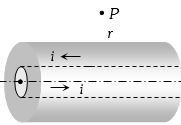
$A$ current $i$ ampere flows along the inner conductor of a coaxial cable and returns along the outer conductor of the cable. The magnetic induction at any point outside the conductor at a distance $r$ metre from the axis is
A
$\infty$
B
Zero
C
$\frac{\mu_0}{4\pi} \frac{2i}{r}$
D
$\frac{\mu_0}{4\pi} \frac{2\pi i}{r}$
Solution
(B) According to Ampere's circuital law,the line integral of the magnetic field $\vec{B}$ around a closed loop is equal to $\mu_0$ times the net current enclosed by the loop,i.e.,$\oint \vec{B} \cdot d\vec{l} = \mu_0 I_{\text{enclosed}}$.
For a point outside the coaxial cable at a distance $r$ from the axis,we consider an Amperian loop of radius $r$.
The net current enclosed by this loop is the sum of the current flowing through the inner conductor $(+i)$ and the current returning through the outer conductor $(-i)$.
Therefore,$I_{\text{enclosed}} = i + (-i) = 0$.
Since the net current enclosed is zero,the magnetic field $\vec{B}$ at any point outside the cable must be zero.
For a point outside the coaxial cable at a distance $r$ from the axis,we consider an Amperian loop of radius $r$.
The net current enclosed by this loop is the sum of the current flowing through the inner conductor $(+i)$ and the current returning through the outer conductor $(-i)$.
Therefore,$I_{\text{enclosed}} = i + (-i) = 0$.
Since the net current enclosed is zero,the magnetic field $\vec{B}$ at any point outside the cable must be zero.
0 likes
View Solution4
EasyMCQ
$A$ solenoid of $1.5 \ m$ length and $4.0 \ cm$ diameter possesses $10 \ turns/cm$. $A$ current of $5 \ A$ is flowing through it. The magnetic induction at the axis inside the solenoid is:
A
$2\pi \times 10^{-3} \ T$
B
$2\pi \times 10^{-5} \ T$
C
$4\pi \times 10^{-2} \ G$
D
$2\pi \times 10^{-5} \ G$
Solution
(A) The magnetic field $B$ inside a long solenoid is given by the formula $B = \mu_0 n I$.
Here,the number of turns per unit length $n = 10 \ turns/cm = 1000 \ turns/m$.
The current $I = 5 \ A$.
The permeability of free space $\mu_0 = 4\pi \times 10^{-7} \ T \cdot m/A$.
Substituting these values into the formula:
$B = (4\pi \times 10^{-7}) \times 1000 \times 5$
$B = 4\pi \times 10^{-7} \times 5 \times 10^3$
$B = 20\pi \times 10^{-4} \ T$
$B = 2\pi \times 10^{-3} \ T$.
Here,the number of turns per unit length $n = 10 \ turns/cm = 1000 \ turns/m$.
The current $I = 5 \ A$.
The permeability of free space $\mu_0 = 4\pi \times 10^{-7} \ T \cdot m/A$.
Substituting these values into the formula:
$B = (4\pi \times 10^{-7}) \times 1000 \times 5$
$B = 4\pi \times 10^{-7} \times 5 \times 10^3$
$B = 20\pi \times 10^{-4} \ T$
$B = 2\pi \times 10^{-3} \ T$.
0 likes
View Solution5
EasyMCQ
The magnetic field $B$ within a solenoid having $n$ turns per meter length and carrying a current of $i$ amperes is given by:
A
$\frac{\mu_0 ni}{e}$
B
$\mu_0 ni$
C
$4\pi \mu_0 ni$
D
$ni$
Solution
(B) The magnetic field $B$ inside a long solenoid is derived using Ampere's circuital law.
For a solenoid with $n$ turns per unit length carrying a current $i$,the magnetic field at any point well inside the solenoid is given by the formula:
$B = \mu_0 ni$
where $\mu_0$ is the permeability of free space.
For a solenoid with $n$ turns per unit length carrying a current $i$,the magnetic field at any point well inside the solenoid is given by the formula:
$B = \mu_0 ni$
where $\mu_0$ is the permeability of free space.
0 likes
View Solution6
EasyMCQ
The magnetic field inside a long solenoid is:
A
Directly proportional to its length
B
Directly proportional to current
C
Inversely proportional to the total number of turns
D
Inversely proportional to current
Solution
(B) The magnetic field $B$ inside a long solenoid is given by the formula $B = \mu_0 n I$,where $\mu_0$ is the permeability of free space,$n$ is the number of turns per unit length,and $I$ is the current flowing through the solenoid.
From this relation,it is clear that the magnetic field $B$ is directly proportional to the current $I$ flowing through the solenoid.
Therefore,option $B$ is correct.
From this relation,it is clear that the magnetic field $B$ is directly proportional to the current $I$ flowing through the solenoid.
Therefore,option $B$ is correct.
0 likes
View Solution7
EasyMCQ
$A$ long solenoid has a radius $a$ and the number of turns per unit length is $n$. If it carries a current $i$,then the magnetic field on its axis is directly proportional to
A
$ani$
B
$ni$
C
$\frac{ni}{a}$
D
$n^2i$
Solution
(B) The magnetic field $B$ inside a long solenoid at any point on its axis is given by the formula $B = \mu_0 ni$,where $\mu_0$ is the permeability of free space,$n$ is the number of turns per unit length,and $i$ is the current flowing through the solenoid.
From this expression,it is clear that the magnetic field $B$ is directly proportional to the product of the number of turns per unit length $n$ and the current $i$.
Therefore,$B \propto ni$.
Thus,the correct option is $B$.
From this expression,it is clear that the magnetic field $B$ is directly proportional to the product of the number of turns per unit length $n$ and the current $i$.
Therefore,$B \propto ni$.
Thus,the correct option is $B$.
0 likes
View Solution8
MediumMCQ
$A$ long solenoid is formed by winding $20$ $turns/cm$. The current necessary to produce a magnetic field of $20$ $mT$ inside the solenoid will be approximately ..... $A$ $(\frac{\mu_0}{4\pi} = 10^{-7} \text{ T m/A})$.
A
$8$
B
$4$
C
$2$
D
$1$
Solution
(A) The magnetic field $B$ inside a long solenoid is given by the formula $B = \mu_0 n i$,where $n$ is the number of turns per unit length and $i$ is the current.
Given:
$B = 20 \text{ mT} = 20 \times 10^{-3} \text{ T}$
$n = 20 \text{ turns/cm} = 20 \times 100 \text{ turns/m} = 2000 \text{ turns/m}$
$\frac{\mu_0}{4\pi} = 10^{-7} \text{ T m/A} \Rightarrow \mu_0 = 4\pi \times 10^{-7} \text{ T m/A}$
Rearranging the formula for current $i$:
$i = \frac{B}{\mu_0 n}$
Substituting the values:
$i = \frac{20 \times 10^{-3}}{4\pi \times 10^{-7} \times 2000}$
$i = \frac{20 \times 10^{-3}}{8\pi \times 10^{-4}}$
$i = \frac{200}{8\pi} = \frac{25}{\pi} \approx \frac{25}{3.14} \approx 7.96 \text{ A}$
Rounding to the nearest integer,we get $i \approx 8 \text{ A}$.
Given:
$B = 20 \text{ mT} = 20 \times 10^{-3} \text{ T}$
$n = 20 \text{ turns/cm} = 20 \times 100 \text{ turns/m} = 2000 \text{ turns/m}$
$\frac{\mu_0}{4\pi} = 10^{-7} \text{ T m/A} \Rightarrow \mu_0 = 4\pi \times 10^{-7} \text{ T m/A}$
Rearranging the formula for current $i$:
$i = \frac{B}{\mu_0 n}$
Substituting the values:
$i = \frac{20 \times 10^{-3}}{4\pi \times 10^{-7} \times 2000}$
$i = \frac{20 \times 10^{-3}}{8\pi \times 10^{-4}}$
$i = \frac{200}{8\pi} = \frac{25}{\pi} \approx \frac{25}{3.14} \approx 7.96 \text{ A}$
Rounding to the nearest integer,we get $i \approx 8 \text{ A}$.
0 likes
View Solution9
EasyMCQ
$A$ long copper tube of inner radius $R$ carries a current $i$. The magnetic field $B$ inside the tube is
A
$\frac{\mu_0 i}{2\pi R}$
B
$\frac{\mu_0 i}{4\pi R}$
C
$\frac{\mu_0 i}{2R}$
D
Zero
Solution
(D) According to Ampere's circuital law,the line integral of the magnetic field $\vec{B}$ around any closed path is equal to $\mu_0$ times the net current $i_{enclosed}$ passing through the surface bounded by the path,i.e.,$\oint \vec{B} \cdot d\vec{l} = \mu_0 i_{enclosed}$.
For a long hollow copper tube,if we consider an Amperian loop inside the tube (at a radius $r < R$),the current enclosed by this loop is zero because the current flows only through the material of the tube.
Since $i_{enclosed} = 0$,the magnetic field $B$ inside the tube must be zero.
For a long hollow copper tube,if we consider an Amperian loop inside the tube (at a radius $r < R$),the current enclosed by this loop is zero because the current flows only through the material of the tube.
Since $i_{enclosed} = 0$,the magnetic field $B$ inside the tube must be zero.
0 likes
View Solution10
MediumMCQ
There are $50$ turns of a wire in every $1$ $cm$ length of a long solenoid. If $4$ $A$ current is flowing in the solenoid,the approximate value of the magnetic field along its axis at an internal point and at one end will be respectively:
A
$12.6 \times 10^{-3} \, Wb/m^2, \; 6.3 \times 10^{-3} \, Wb/m^2$
B
$12.6 \times 10^{-3} \, Wb/m^2, \; 25.1 \times 10^{-3} \, Wb/m^2$
C
$25.1 \times 10^{-3} \, Wb/m^2, \; 12.6 \times 10^{-3} \, Wb/m^2$
D
$25.1 \times 10^{-5} \, Wb/m^2, \; 12.6 \times 10^{-5} \, Wb/m^2$
Solution
(C) The number of turns per unit length $n = 50 \, turns/cm = 5000 \, turns/m$. The current $I = 4 \, A$. The permeability of free space $\mu_0 = 4\pi \times 10^{-7} \, T \cdot m/A$.
$(i)$ Magnetic field at an internal point: $B_{in} = \mu_0 n I = (4\pi \times 10^{-7}) \times 5000 \times 4 = 25.12 \times 10^{-3} \, Wb/m^2 \approx 25.1 \times 10^{-3} \, Wb/m^2$.
(ii) Magnetic field at one end: $B_{end} = \frac{1}{2} B_{in} = \frac{25.1 \times 10^{-3}}{2} = 12.55 \times 10^{-3} \, Wb/m^2 \approx 12.6 \times 10^{-3} \, Wb/m^2$.
$(i)$ Magnetic field at an internal point: $B_{in} = \mu_0 n I = (4\pi \times 10^{-7}) \times 5000 \times 4 = 25.12 \times 10^{-3} \, Wb/m^2 \approx 25.1 \times 10^{-3} \, Wb/m^2$.
(ii) Magnetic field at one end: $B_{end} = \frac{1}{2} B_{in} = \frac{25.1 \times 10^{-3}}{2} = 12.55 \times 10^{-3} \, Wb/m^2 \approx 12.6 \times 10^{-3} \, Wb/m^2$.
0 likes
View Solution11
EasyMCQ
$A$ solenoid is $1.0 \ m$ long and it has $4250$ turns. If a current of $5.0 \ A$ is flowing through it, what is the magnetic field at its centre? $[\mu_0 = 4\pi \times 10^{-7} \ T \cdot m/A]$
A
$5.4 \times 10^{-2} \ Wb/m^2$
B
$2.7 \times 10^{-2} \ Wb/m^2$
C
$1.35 \times 10^{-2} \ Wb/m^2$
D
$0.675 \times 10^{-2} \ Wb/m^2$
Solution
(B) The magnetic field $B$ at the centre of a long solenoid is given by the formula: $B = \mu_0 n I$.
Here, $n$ is the number of turns per unit length, which is calculated as $n = N/L$.
Given: $N = 4250$, $L = 1.0 \ m$, $I = 5.0 \ A$, and $\mu_0 = 4\pi \times 10^{-7} \ T \cdot m/A$.
First, calculate $n$: $n = 4250 / 1.0 = 4250 \ turns/m$.
Now, substitute the values into the formula: $B = (4\pi \times 10^{-7}) \times 4250 \times 5.0$.
$B = (4 \times 3.14159 \times 10^{-7}) \times 21250$.
$B \approx 12.566 \times 10^{-7} \times 21250 \approx 0.0267 \ T$.
Thus, $B \approx 2.7 \times 10^{-2} \ Wb/m^2$.
Here, $n$ is the number of turns per unit length, which is calculated as $n = N/L$.
Given: $N = 4250$, $L = 1.0 \ m$, $I = 5.0 \ A$, and $\mu_0 = 4\pi \times 10^{-7} \ T \cdot m/A$.
First, calculate $n$: $n = 4250 / 1.0 = 4250 \ turns/m$.
Now, substitute the values into the formula: $B = (4\pi \times 10^{-7}) \times 4250 \times 5.0$.
$B = (4 \times 3.14159 \times 10^{-7}) \times 21250$.
$B \approx 12.566 \times 10^{-7} \times 21250 \approx 0.0267 \ T$.
Thus, $B \approx 2.7 \times 10^{-2} \ Wb/m^2$.
0 likes
View Solution12
EasyMCQ
The expression for magnetic induction inside a solenoid of length $L$ carrying a current $I$ and having $N$ number of turns is
A
$\frac{\mu_0}{4\pi} \frac{N}{LI}$
B
$\mu_0 NI$
C
$\frac{\mu_0}{4\pi} NLI$
D
$\mu_0 \frac{N}{L} I$
Solution
(D) The magnetic field $B$ inside a long solenoid is given by the formula $B = \mu_0 n I$,where $n$ is the number of turns per unit length.
Given that the total number of turns is $N$ and the length of the solenoid is $L$,the number of turns per unit length is $n = \frac{N}{L}$.
Substituting this into the formula,we get $B = \mu_0 \left( \frac{N}{L} \right) I$.
Therefore,the correct expression is $\mu_0 \frac{N}{L} I$.
Given that the total number of turns is $N$ and the length of the solenoid is $L$,the number of turns per unit length is $n = \frac{N}{L}$.
Substituting this into the formula,we get $B = \mu_0 \left( \frac{N}{L} \right) I$.
Therefore,the correct expression is $\mu_0 \frac{N}{L} I$.
0 likes
View Solution13
EasyMCQ
In a current-carrying long solenoid,the magnetic field produced does not depend upon:
A
Number of turns per unit length
B
Current flowing
C
Radius of the solenoid
D
All of the above three
Solution
(C) The magnetic field $B$ at the center of a long solenoid is given by the formula:
$B = \mu_0 n i$
where $n$ is the number of turns per unit length $(n = N/l)$,
$i$ is the current flowing through the solenoid,
and $\mu_0$ is the permeability of free space.
From this formula,it is evident that the magnetic field $B$ depends only on the number of turns per unit length $(n)$ and the current $(i)$.
It does not depend on the radius of the solenoid.
Therefore,the correct option is $C$.
$B = \mu_0 n i$
where $n$ is the number of turns per unit length $(n = N/l)$,
$i$ is the current flowing through the solenoid,
and $\mu_0$ is the permeability of free space.
From this formula,it is evident that the magnetic field $B$ depends only on the number of turns per unit length $(n)$ and the current $(i)$.
It does not depend on the radius of the solenoid.
Therefore,the correct option is $C$.
0 likes
View Solution14
EasyMCQ
$A$ current $I$ flows along the length of an infinitely long,straight and thin-walled pipe. Then
A
The magnetic field at all points inside the pipe is the same but not zero
B
The magnetic field at any point inside the pipe is zero
C
The magnetic field is zero only on the axis of the pipe
D
The magnetic field is different at different points inside the pipe
Solution
(B) According to Ampere's circuital law,the line integral of the magnetic field $\vec{B}$ around any closed loop is equal to $\mu_0$ times the total current $I_{\text{enclosed}}$ passing through the surface bounded by the loop: $\oint \vec{B} \cdot d\vec{l} = \mu_0 I_{\text{enclosed}}$.
For an infinitely long,thin-walled pipe carrying current $I$ along its length,any closed loop chosen inside the pipe encloses zero current $(I_{\text{enclosed}} = 0)$.
Therefore,$\oint \vec{B} \cdot d\vec{l} = 0$,which implies that the magnetic field $\vec{B}$ at any point inside the pipe is zero.
For an infinitely long,thin-walled pipe carrying current $I$ along its length,any closed loop chosen inside the pipe encloses zero current $(I_{\text{enclosed}} = 0)$.
Therefore,$\oint \vec{B} \cdot d\vec{l} = 0$,which implies that the magnetic field $\vec{B}$ at any point inside the pipe is zero.
0 likes
View Solution15
MediumMCQ
$A$ toroid has a number of turns per unit length $n$ and current $i$. What is the magnetic field inside the toroid?
A
$\mu_0 ni$
B
$\mu_0 n^2 i$
C
$\mu_0 i/n$
D
None of these
Solution
(A) toroid is essentially a solenoid bent into a circular shape.
For a toroid with $n$ turns per unit length and carrying a current $i$,the magnetic field $B$ inside the core is derived using Ampere's Circuital Law.
According to Ampere's Law,$\oint B \cdot dl = \mu_0 I_{\text{enclosed}}$.
For a circular path of radius $r$ inside the toroid,the length is $2\pi r$ and the total number of turns is $N = n(2\pi r)$.
Thus,$B(2\pi r) = \mu_0 (n \cdot 2\pi r) i$.
Simplifying this,we get $B = \mu_0 ni$.
For a toroid with $n$ turns per unit length and carrying a current $i$,the magnetic field $B$ inside the core is derived using Ampere's Circuital Law.
According to Ampere's Law,$\oint B \cdot dl = \mu_0 I_{\text{enclosed}}$.
For a circular path of radius $r$ inside the toroid,the length is $2\pi r$ and the total number of turns is $N = n(2\pi r)$.
Thus,$B(2\pi r) = \mu_0 (n \cdot 2\pi r) i$.
Simplifying this,we get $B = \mu_0 ni$.
0 likes
View Solution16
EasyMCQ
$A$ long solenoid has $200$ turns per cm and carries a current of $2.5 \, A$. The magnetic field at its centre is (given $\mu_0 = 4\pi \times 10^{-7} \, T \cdot m/A$):
A
$3.14 \times 10^{-2} \, Wb/m^2$
B
$6.28 \times 10^{-2} \, Wb/m^2$
C
$9.42 \times 10^{-2} \, Wb/m^2$
D
$12.56 \times 10^{-2} \, Wb/m^2$
Solution
(B) The magnetic field $B$ at the centre of a long solenoid is given by the formula $B = \mu_0 n I$, where $n$ is the number of turns per unit length and $I$ is the current.
Given:
Turns per cm, $n' = 200 \, \text{turns/cm} = 200 \times 10^2 \, \text{turns/m} = 2 \times 10^4 \, \text{turns/m}$.
Current, $I = 2.5 \, A$.
Permeability, $\mu_0 = 4\pi \times 10^{-7} \, T \cdot m/A$.
Substituting these values into the formula:
$B = (4\pi \times 10^{-7}) \times (2 \times 10^4) \times 2.5$
$B = 4\pi \times 10^{-7} \times 5 \times 10^4$
$B = 20\pi \times 10^{-3} \, T$
$B = 2 \times 3.14 \times 10^{-2} \, T = 6.28 \times 10^{-2} \, Wb/m^2$.
Thus, the correct option is $B$.
Given:
Turns per cm, $n' = 200 \, \text{turns/cm} = 200 \times 10^2 \, \text{turns/m} = 2 \times 10^4 \, \text{turns/m}$.
Current, $I = 2.5 \, A$.
Permeability, $\mu_0 = 4\pi \times 10^{-7} \, T \cdot m/A$.
Substituting these values into the formula:
$B = (4\pi \times 10^{-7}) \times (2 \times 10^4) \times 2.5$
$B = 4\pi \times 10^{-7} \times 5 \times 10^4$
$B = 20\pi \times 10^{-3} \, T$
$B = 2 \times 3.14 \times 10^{-2} \, T = 6.28 \times 10^{-2} \, Wb/m^2$.
Thus, the correct option is $B$.
0 likes
View Solution17
EasyMCQ
$A$ current of $2\, A$ flows in a long,straight wire of radius $2\, mm$. The intensity of the magnetic field on the axis of the wire is:
A
$\left( \frac{\mu_0}{\pi} \right) \times 10^3\, T$
B
$\left( \frac{\mu_0}{2\pi} \right) \times 10^3\, T$
C
$\left( \frac{2\mu_0}{\pi} \right) \times 10^3\, T$
D
Zero
Solution
(D) According to Ampere's circuital law,the magnetic field $B$ at a distance $r$ from the axis of a long straight cylindrical wire carrying a current $I$ is given by $\oint B \cdot dl = \mu_0 I_{enclosed}$.
For a point on the axis of the wire,the distance $r = 0$.
Since the current is distributed over the cross-section of the wire,the current enclosed by a loop of radius $r = 0$ is zero $(I_{enclosed} = 0)$.
Therefore,the magnetic field $B$ at the axis of the wire is $0\, T$.
For a point on the axis of the wire,the distance $r = 0$.
Since the current is distributed over the cross-section of the wire,the current enclosed by a loop of radius $r = 0$ is zero $(I_{enclosed} = 0)$.
Therefore,the magnetic field $B$ at the axis of the wire is $0\, T$.
0 likes
View Solution18
EasyMCQ
$A$ long solenoid has $n$ turns per meter and current $I \ A$ is flowing through it. The magnetic field at the ends of the solenoid is
A
$\frac{\mu_0 nI}{2}$
B
$\mu_0 nI$
C
Zero
D
$2\mu_0 nI$
Solution
(A) The magnetic field $B$ inside a long solenoid at its center is given by $B_{center} = \mu_0 nI$.
At the ends of a long solenoid,the magnetic field is exactly half of the field at the center.
Therefore,the magnetic field at the ends is $B_{ends} = \frac{\mu_0 nI}{2}$.
At the ends of a long solenoid,the magnetic field is exactly half of the field at the center.
Therefore,the magnetic field at the ends is $B_{ends} = \frac{\mu_0 nI}{2}$.
1 likes
View Solution19
EasyMCQ
"On flowing current in a conducting wire, a magnetic field is produced around it." This is a law of
A
Lenz
B
Ampere
C
Ohm
D
Maxwell
Solution
(B) The statement "On flowing current in a conducting wire, a magnetic field is produced around it" describes the fundamental observation that led to the development of Ampere's Law.
Ampere's Law relates the integrated magnetic field around a closed loop to the electric current passing through the loop.
Therefore, the correct option is $B$.
Ampere's Law relates the integrated magnetic field around a closed loop to the electric current passing through the loop.
Therefore, the correct option is $B$.
0 likes
View Solution20
EasyMCQ
$A$ long solenoid carrying a current produces a magnetic field $B$ along its axis. If the current is doubled and the number of turns per cm is halved,the new value of the magnetic field is
A
$B$
B
$2 B$
C
$4 B$
D
$B/2$
Solution
(A) The magnetic field $B$ inside a long solenoid is given by the formula $B = \mu_0 n i$,where $n$ is the number of turns per unit length and $i$ is the current.
Let the initial magnetic field be $B = \mu_0 n i$.
When the current is doubled,the new current $i' = 2i$.
When the number of turns per cm is halved,the new number of turns per unit length $n' = n/2$.
The new magnetic field $B'$ is given by $B' = \mu_0 n' i' = \mu_0 (n/2) (2i) = \mu_0 n i$.
Therefore,$B' = B$.
Let the initial magnetic field be $B = \mu_0 n i$.
When the current is doubled,the new current $i' = 2i$.
When the number of turns per cm is halved,the new number of turns per unit length $n' = n/2$.
The new magnetic field $B'$ is given by $B' = \mu_0 n' i' = \mu_0 (n/2) (2i) = \mu_0 n i$.
Therefore,$B' = B$.
0 likes
View Solution21
MediumMCQ
Two coaxial solenoids $1$ and $2$ of the same length are placed such that one is inside the other. The number of turns per unit length are ${n_1}$ and ${n_2}$. The currents ${i_1}$ and ${i_2}$ are flowing in opposite directions. The magnetic field inside the inner coil is zero. This is possible when:
A
${i_1} \neq {i_2}$ and ${n_1} = {n_2}$
B
${i_1}{n_1} = {i_2}{n_2}$
C
${i_1} = {i_2}$ and ${n_1} = {n_2}$
D
Both $(b)$ and $(c)$
Solution
(D) The magnetic field inside a long solenoid is given by $B = \mu_0 ni$.
Since the two solenoids are coaxial and the currents flow in opposite directions,the net magnetic field $B_{net}$ inside the inner coil is the difference between the individual magnetic fields: $B_{net} = |B_1 - B_2|$.
For the magnetic field to be zero,we must have $B_1 = B_2$.
Substituting the formula,we get $\mu_0 n_1 i_1 = \mu_0 n_2 i_2$,which simplifies to $n_1 i_1 = n_2 i_2$.
This condition is satisfied if $n_1 i_1 = n_2 i_2$ (Option $b$).
Additionally,if $n_1 = n_2$ and $i_1 = i_2$,the condition $n_1 i_1 = n_2 i_2$ is also satisfied (Option $c$).
Therefore,both conditions $(b)$ and $(c)$ are correct.
Since the two solenoids are coaxial and the currents flow in opposite directions,the net magnetic field $B_{net}$ inside the inner coil is the difference between the individual magnetic fields: $B_{net} = |B_1 - B_2|$.
For the magnetic field to be zero,we must have $B_1 = B_2$.
Substituting the formula,we get $\mu_0 n_1 i_1 = \mu_0 n_2 i_2$,which simplifies to $n_1 i_1 = n_2 i_2$.
This condition is satisfied if $n_1 i_1 = n_2 i_2$ (Option $b$).
Additionally,if $n_1 = n_2$ and $i_1 = i_2$,the condition $n_1 i_1 = n_2 i_2$ is also satisfied (Option $c$).
Therefore,both conditions $(b)$ and $(c)$ are correct.
0 likes
View Solution22
MediumMCQ
The correct curve between the magnetic induction $B$ along the axis of a long solenoid due to current flow $i$ in it and distance $x$ from one end is:
A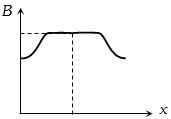
B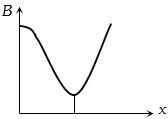
C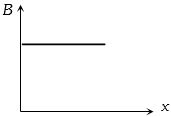
D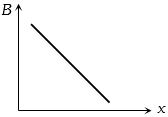
Solution
(A) For a long solenoid,the magnetic field $B$ at the center is given by $B_{center} = \mu_0 n i$.
At the ends of the solenoid,the magnetic field is $B_{end} = \frac{1}{2} \mu_0 n i = \frac{1}{2} B_{center}$.
As we move from one end $(x=0)$ towards the center,the magnetic field increases from $\frac{1}{2} B_{center}$ to $B_{center}$ and then remains approximately constant near the center before decreasing again as we approach the other end.
Graph $A$ correctly represents this variation,showing a gradual increase from the end,a plateau at the center,and a symmetric decrease towards the other end.
At the ends of the solenoid,the magnetic field is $B_{end} = \frac{1}{2} \mu_0 n i = \frac{1}{2} B_{center}$.
As we move from one end $(x=0)$ towards the center,the magnetic field increases from $\frac{1}{2} B_{center}$ to $B_{center}$ and then remains approximately constant near the center before decreasing again as we approach the other end.
Graph $A$ correctly represents this variation,showing a gradual increase from the end,a plateau at the center,and a symmetric decrease towards the other end.
0 likes
View Solution23
EasyMCQ
$A$ solenoid is $1.5 \, m$ long and its inner diameter is $4.0 \, cm$. It has three layers of windings of $1000$ turns each and carries a current of $2.0 \, A$. The magnetic flux for a cross-section of the solenoid is nearly:
A
$2.5 \times 10^{-7} \, Wb$
B
$6.31 \times 10^{-6} \, Wb$
C
$5.2 \times 10^{-5} \, Wb$
D
$4.1 \times 10^{-5} \, Wb$
Solution
(B) The magnetic field $B$ inside a long solenoid is given by $B = \mu_0 n I$,where $n$ is the number of turns per unit length.
Total number of turns $N = 3 \times 1000 = 3000$.
Length $L = 1.5 \, m$.
Number of turns per unit length $n = N/L = 3000 / 1.5 = 2000 \, turns/m$.
Current $I = 2.0 \, A$.
Radius $r = 2.0 \, cm = 0.02 \, m$.
Area of cross-section $A = \pi r^2 = \pi (0.02)^2 = 4\pi \times 10^{-4} \, m^2$.
Magnetic flux $\phi = B \cdot A = (\mu_0 n I) A$.
$\phi = (4\pi \times 10^{-7}) \times 2000 \times 2.0 \times (4\pi \times 10^{-4})$.
$\phi = 16 \pi^2 \times 10^{-7} \times 4000 \times 10^{-4} = 64 \pi^2 \times 10^{-7} \times 10^{-1} \approx 64 \times 9.87 \times 10^{-8} \approx 6.31 \times 10^{-6} \, Wb$.
Total number of turns $N = 3 \times 1000 = 3000$.
Length $L = 1.5 \, m$.
Number of turns per unit length $n = N/L = 3000 / 1.5 = 2000 \, turns/m$.
Current $I = 2.0 \, A$.
Radius $r = 2.0 \, cm = 0.02 \, m$.
Area of cross-section $A = \pi r^2 = \pi (0.02)^2 = 4\pi \times 10^{-4} \, m^2$.
Magnetic flux $\phi = B \cdot A = (\mu_0 n I) A$.
$\phi = (4\pi \times 10^{-7}) \times 2000 \times 2.0 \times (4\pi \times 10^{-4})$.
$\phi = 16 \pi^2 \times 10^{-7} \times 4000 \times 10^{-4} = 64 \pi^2 \times 10^{-7} \times 10^{-1} \approx 64 \times 9.87 \times 10^{-8} \approx 6.31 \times 10^{-6} \, Wb$.
0 likes
View Solution24
MediumMCQ
What current must be passed through a solenoid with $20 \text{ turns/cm}$ to produce a magnetic field of $20 \text{ mT}$ (in $\text{ A}$)? (Given: $\frac{\mu_0}{4\pi} = 10^{-7} \text{ T m/A}$)
A
$8$
B
$4$
C
$2$
D
$1$
Solution
(A) The magnetic field inside a long solenoid is given by the formula: $B = \mu_0 n i$, where $n$ is the number of turns per unit length and $i$ is the current.
Given: $n = 20 \text{ turns/cm} = 2000 \text{ turns/m}$.
Given: $B = 20 \text{ mT} = 20 \times 10^{-3} \text{ T}$.
We know $\mu_0 = 4\pi \times 10^{-7} \text{ T m/A}$.
Substituting the values into the formula:
$20 \times 10^{-3} = (4\pi \times 10^{-7}) \times 2000 \times i$
$20 \times 10^{-3} = 8\pi \times 10^{-4} \times i$
$i = \frac{20 \times 10^{-3}}{8\pi \times 10^{-4}} = \frac{200}{8\pi} = \frac{25}{\pi} \approx 7.96 \text{ A}$.
Rounding to the nearest integer, the current is $8 \text{ A}$.
Given: $n = 20 \text{ turns/cm} = 2000 \text{ turns/m}$.
Given: $B = 20 \text{ mT} = 20 \times 10^{-3} \text{ T}$.
We know $\mu_0 = 4\pi \times 10^{-7} \text{ T m/A}$.
Substituting the values into the formula:
$20 \times 10^{-3} = (4\pi \times 10^{-7}) \times 2000 \times i$
$20 \times 10^{-3} = 8\pi \times 10^{-4} \times i$
$i = \frac{20 \times 10^{-3}}{8\pi \times 10^{-4}} = \frac{200}{8\pi} = \frac{25}{\pi} \approx 7.96 \text{ A}$.
Rounding to the nearest integer, the current is $8 \text{ A}$.
0 likes
View Solution25
EasyMCQ
What is the magnetic field inside a toroid having $0.1 \ m$ radius and $500$ turns when a current of $0.5 \ A$ is passed through it?
A
$25 \times 10^{-2} \ T$
B
$5 \times 10^{-2} \ T$
C
$25 \times 10^{-4} \ T$
D
$5 \times 10^{-4} \ T$
Solution
(D) The magnetic field $B$ inside a toroid is given by the formula $B = \mu_0 n i$,where $n$ is the number of turns per unit length.
Given: Radius $R = 0.1 \ m$,Number of turns $N = 500$,Current $i = 0.5 \ A$.
The number of turns per unit length is $n = \frac{N}{2\pi R}$.
Substituting the values: $n = \frac{500}{2\pi \times 0.1} = \frac{500}{0.2\pi} = \frac{2500}{\pi} \ m^{-1}$.
Now,$B = (4\pi \times 10^{-7}) \times \left(\frac{2500}{\pi}\right) \times 0.5$.
$B = 4 \times 10^{-7} \times 2500 \times 0.5$.
$B = 4 \times 10^{-7} \times 1250$.
$B = 5000 \times 10^{-7} \ T = 5 \times 10^{-4} \ T$.
Given: Radius $R = 0.1 \ m$,Number of turns $N = 500$,Current $i = 0.5 \ A$.
The number of turns per unit length is $n = \frac{N}{2\pi R}$.
Substituting the values: $n = \frac{500}{2\pi \times 0.1} = \frac{500}{0.2\pi} = \frac{2500}{\pi} \ m^{-1}$.
Now,$B = (4\pi \times 10^{-7}) \times \left(\frac{2500}{\pi}\right) \times 0.5$.
$B = 4 \times 10^{-7} \times 2500 \times 0.5$.
$B = 4 \times 10^{-7} \times 1250$.
$B = 5000 \times 10^{-7} \ T = 5 \times 10^{-4} \ T$.
0 likes
View Solution26
DifficultMCQ
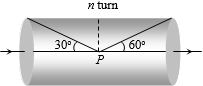
What is the magnetic field at point $P$ in the given figure?
A
$\frac{{{\mu _0}ni}}{4}(\sqrt 3 + 1)$
B
$\frac{{\sqrt 3 {\mu _0}ni}}{4}$
C
$\frac{{{\mu _0}ni}}{2}(\sqrt 3 + 1)$
D
$\frac{{{\mu _0}ni}}{4}(\sqrt 3 - 1)$
Solution
(A) The magnetic field on the axis of a finite solenoid at a point $P$ is given by the formula:
$B = \frac{{{\mu _0}ni}}{2}(\sin \theta_1 + \sin \theta_2)$
where $\theta_1$ and $\theta_2$ are the angles subtended by the ends of the solenoid at point $P$.
From the figure,$\theta_1 = 60^\circ$ and $\theta_2 = 30^\circ$.
Substituting these values into the formula:
$B = \frac{{{\mu _0}ni}}{2}(\sin 60^\circ + \sin 30^\circ)$
$B = \frac{{{\mu _0}ni}}{2}(\frac{\sqrt{3}}{2} + \frac{1}{2})$
$B = \frac{{{\mu _0}ni}}{4}(\sqrt{3} + 1)$
$B = \frac{{{\mu _0}ni}}{2}(\sin \theta_1 + \sin \theta_2)$
where $\theta_1$ and $\theta_2$ are the angles subtended by the ends of the solenoid at point $P$.
From the figure,$\theta_1 = 60^\circ$ and $\theta_2 = 30^\circ$.
Substituting these values into the formula:
$B = \frac{{{\mu _0}ni}}{2}(\sin 60^\circ + \sin 30^\circ)$
$B = \frac{{{\mu _0}ni}}{2}(\frac{\sqrt{3}}{2} + \frac{1}{2})$
$B = \frac{{{\mu _0}ni}}{4}(\sqrt{3} + 1)$
0 likes
View Solution27
DifficultMCQ
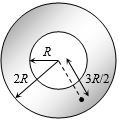
What is the magnetic field at point $P$ located at a distance of $\frac{3R}{2}$ from the center of the cylindrical conductor with inner radius $R$ and outer radius $2R$ carrying a current $i$?
A
Zero
B
$\frac{5{\mu _0}i}{72\pi R}$
C
$\frac{7{\mu _0}i}{18\pi R}$
D
$\frac{5{\mu _0}i}{36\pi R}$
Solution
(D) For a cylindrical conductor with inner radius $a = R$ and outer radius $b = 2R$,the magnetic field $B$ at a distance $r$ from the center (where $a < r < b$) is given by Ampere's Law:
$B(2\pi r) = \mu_0 I_{enclosed}$
$I_{enclosed} = i \left( \frac{r^2 - a^2}{b^2 - a^2} \right)$
Substituting $a = R$,$b = 2R$,and $r = \frac{3R}{2}$:
$I_{enclosed} = i \left( \frac{(\frac{3R}{2})^2 - R^2}{(2R)^2 - R^2} \right) = i \left( \frac{\frac{9R^2}{4} - R^2}{4R^2 - R^2} \right) = i \left( \frac{\frac{5R^2}{4}}{3R^2} \right) = i \left( \frac{5}{12} \right)$
Now,$B = \frac{\mu_0 I_{enclosed}}{2\pi r} = \frac{\mu_0 (i \cdot \frac{5}{12})}{2\pi (\frac{3R}{2})}$
$B = \frac{5\mu_0 i}{12 \cdot 2\pi \cdot \frac{3R}{2}} = \frac{5\mu_0 i}{36\pi R}$
$B(2\pi r) = \mu_0 I_{enclosed}$
$I_{enclosed} = i \left( \frac{r^2 - a^2}{b^2 - a^2} \right)$
Substituting $a = R$,$b = 2R$,and $r = \frac{3R}{2}$:
$I_{enclosed} = i \left( \frac{(\frac{3R}{2})^2 - R^2}{(2R)^2 - R^2} \right) = i \left( \frac{\frac{9R^2}{4} - R^2}{4R^2 - R^2} \right) = i \left( \frac{\frac{5R^2}{4}}{3R^2} \right) = i \left( \frac{5}{12} \right)$
Now,$B = \frac{\mu_0 I_{enclosed}}{2\pi r} = \frac{\mu_0 (i \cdot \frac{5}{12})}{2\pi (\frac{3R}{2})}$
$B = \frac{5\mu_0 i}{12 \cdot 2\pi \cdot \frac{3R}{2}} = \frac{5\mu_0 i}{36\pi R}$
0 likes
View Solution28
DifficultMCQ
$A$ solenoid of length $80 \, cm$ and radius $3 \, cm$ produces a magnetic field of $B = 0.2 \, T$ when a current of $10 \, A$ is passed through it. What is the total length of the wire used in the solenoid?
A
$1.2 \times 10^2 \, m$
B
$4.8 \times 10^2 \, m$
C
$2.4 \times 10^3 \, m$
D
$6 \times 10^3 \, m$
Solution
(C) The magnetic field inside a solenoid is given by $B = \frac{\mu_0 N i}{l}$,where $N$ is the total number of turns,$i$ is the current,and $l$ is the length of the solenoid.
Given: $B = 0.2 \, T$,$l = 0.8 \, m$,$i = 10 \, A$,$\mu_0 = 4\pi \times 10^{-7} \, T \cdot m/A$.
Substituting the values: $0.2 = \frac{4\pi \times 10^{-7} \times N \times 10}{0.8}$.
Solving for $N$: $N = \frac{0.2 \times 0.8}{4\pi \times 10^{-6}} = \frac{0.16}{4\pi \times 10^{-6}} = \frac{4 \times 10^4}{\pi}$.
The total length of the wire $L$ is given by $L = (2\pi r) \times N$,where $r = 3 \, cm = 3 \times 10^{-2} \, m$.
$L = 2\pi \times (3 \times 10^{-2}) \times \frac{4 \times 10^4}{\pi}$.
$L = 6 \times 10^{-2} \times 4 \times 10^4 = 24 \times 10^2 = 2.4 \times 10^3 \, m$.
Given: $B = 0.2 \, T$,$l = 0.8 \, m$,$i = 10 \, A$,$\mu_0 = 4\pi \times 10^{-7} \, T \cdot m/A$.
Substituting the values: $0.2 = \frac{4\pi \times 10^{-7} \times N \times 10}{0.8}$.
Solving for $N$: $N = \frac{0.2 \times 0.8}{4\pi \times 10^{-6}} = \frac{0.16}{4\pi \times 10^{-6}} = \frac{4 \times 10^4}{\pi}$.
The total length of the wire $L$ is given by $L = (2\pi r) \times N$,where $r = 3 \, cm = 3 \times 10^{-2} \, m$.
$L = 2\pi \times (3 \times 10^{-2}) \times \frac{4 \times 10^4}{\pi}$.
$L = 6 \times 10^{-2} \times 4 \times 10^4 = 24 \times 10^2 = 2.4 \times 10^3 \, m$.
0 likes
View Solution29
MediumMCQ
$A$ winding wire which is used to frame a solenoid can bear a maximum $10\, A$ current. If the length of the solenoid is $80\, cm$ and its cross-sectional radius is $3\, cm$,then the required length of the winding wire is $(B = 0.2\, T)$.
A
$1.2 \times 10^2\, m$
B
$4.8 \times 10^2\, m$
C
$2.4 \times 10^3\, m$
D
$6 \times 10^3\, m$
Solution
(C) The magnetic field inside a solenoid is given by $B = \frac{\mu_0 N i}{l}$,where $N$ is the total number of turns,$i$ is the current,and $l$ is the length of the solenoid.
Given: $B = 0.2\, T$,$i = 10\, A$,$l = 0.8\, m$,and $\mu_0 = 4\pi \times 10^{-7}\, T\cdot m/A$.
Substituting the values: $0.2 = \frac{4\pi \times 10^{-7} \times N \times 10}{0.8}$.
Solving for $N$: $N = \frac{0.2 \times 0.8}{4\pi \times 10^{-6}} = \frac{0.16}{4\pi \times 10^{-6}} = \frac{4 \times 10^4}{\pi}$.
The length of the winding wire $L$ is equal to the circumference of one turn multiplied by the total number of turns: $L = (2\pi r) \times N$.
Given $r = 3\, cm = 3 \times 10^{-2}\, m$.
$L = 2\pi \times (3 \times 10^{-2}) \times \frac{4 \times 10^4}{\pi} = 6 \times 10^{-2} \times 4 \times 10^4 = 24 \times 10^2 = 2.4 \times 10^3\, m$.
Given: $B = 0.2\, T$,$i = 10\, A$,$l = 0.8\, m$,and $\mu_0 = 4\pi \times 10^{-7}\, T\cdot m/A$.
Substituting the values: $0.2 = \frac{4\pi \times 10^{-7} \times N \times 10}{0.8}$.
Solving for $N$: $N = \frac{0.2 \times 0.8}{4\pi \times 10^{-6}} = \frac{0.16}{4\pi \times 10^{-6}} = \frac{4 \times 10^4}{\pi}$.
The length of the winding wire $L$ is equal to the circumference of one turn multiplied by the total number of turns: $L = (2\pi r) \times N$.
Given $r = 3\, cm = 3 \times 10^{-2}\, m$.
$L = 2\pi \times (3 \times 10^{-2}) \times \frac{4 \times 10^4}{\pi} = 6 \times 10^{-2} \times 4 \times 10^4 = 24 \times 10^2 = 2.4 \times 10^3\, m$.
0 likes
View Solution30
MediumMCQ
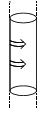
$A$ hollow cylinder of infinite length carries a uniform current per unit length $\lambda$ along its circumference,as shown. The magnetic field inside the cylinder is:
A
$\frac{\mu_0 \lambda}{2}$
B
$\mu_0 \lambda$
C
$2\mu_0 \lambda$
D
Zero
Solution
(D) According to Ampere's Circuital Law,the line integral of the magnetic field $\vec{B}$ around any closed loop is equal to $\mu_0$ times the total current $I_{enclosed}$ passing through the surface bounded by the loop.
For a hollow cylinder of infinite length with a surface current density $\lambda$ (current per unit length along the axis),the magnetic field inside the cylinder is zero. This is because the current flows along the circumference,creating a solenoid-like configuration where the magnetic field is confined to the interior of the solenoid (if it were a coil) or,in this specific case of a surface current flowing around the cylinder,the field inside is zero due to the symmetry and the nature of the current distribution.
Alternatively,using Ampere's law for a loop inside the cylinder,the enclosed current is zero,hence $\oint \vec{B} \cdot d\vec{l} = \mu_0 I_{enclosed} = 0$,which implies $B = 0$ inside the hollow cylinder.
For a hollow cylinder of infinite length with a surface current density $\lambda$ (current per unit length along the axis),the magnetic field inside the cylinder is zero. This is because the current flows along the circumference,creating a solenoid-like configuration where the magnetic field is confined to the interior of the solenoid (if it were a coil) or,in this specific case of a surface current flowing around the cylinder,the field inside is zero due to the symmetry and the nature of the current distribution.
Alternatively,using Ampere's law for a loop inside the cylinder,the enclosed current is zero,hence $\oint \vec{B} \cdot d\vec{l} = \mu_0 I_{enclosed} = 0$,which implies $B = 0$ inside the hollow cylinder.
0 likes
View Solution31
AdvancedMCQ
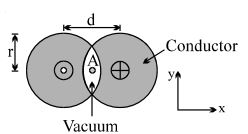
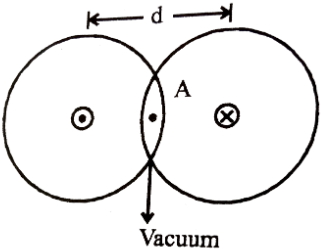
Two long conductors are arranged as shown above to form overlapping cylinders,each of radius $r$,whose centers are separated by a distance $d$. Current of density $J$ flows into the plane of the page along the shaded part of one conductor and an equal current flows out of the plane of the page along the shaded portion of the other,as shown. What are the magnitude and direction of the magnetic field at point $A$?
A
$(\mu_0/2\pi) \pi dJ$,in the $+y$-direction
B
$(\mu_0/2\pi) d^2/r$,in the $+y$-direction
C
$(\mu_0/2\pi) 4d^2J/r$,in the $-y$-direction
D
$\mu_0 J d/2$,in the $+y$-direction
Solution
(D) For a long cylindrical conductor with uniform current density $J$,the magnetic field at a distance $x$ from the center (where $x < r$) is given by Ampere's circuital law: $\oint \vec{B} \cdot d\vec{l} = \mu_0 I_{enclosed}$.
$B(2\pi x) = \mu_0 (J \cdot \pi x^2) \implies B = \frac{\mu_0 J x}{2}$.
Let the center of the left cylinder be at $x = -d/2$ and the right cylinder at $x = d/2$. Point $A$ is at the origin $(0,0)$.
The field due to the left cylinder (current out of the page) at $A$ is $B_1 = \frac{\mu_0 J (d/2)}{2} = \frac{\mu_0 J d}{4}$ in the $+y$-direction.
The field due to the right cylinder (current into the page) at $A$ is $B_2 = \frac{\mu_0 J (d/2)}{2} = \frac{\mu_0 J d}{4}$ in the $+y$-direction.
The total magnetic field is $B_{net} = B_1 + B_2 = \frac{\mu_0 J d}{2}$ in the $+y$-direction.
$B(2\pi x) = \mu_0 (J \cdot \pi x^2) \implies B = \frac{\mu_0 J x}{2}$.
Let the center of the left cylinder be at $x = -d/2$ and the right cylinder at $x = d/2$. Point $A$ is at the origin $(0,0)$.
The field due to the left cylinder (current out of the page) at $A$ is $B_1 = \frac{\mu_0 J (d/2)}{2} = \frac{\mu_0 J d}{4}$ in the $+y$-direction.
The field due to the right cylinder (current into the page) at $A$ is $B_2 = \frac{\mu_0 J (d/2)}{2} = \frac{\mu_0 J d}{4}$ in the $+y$-direction.
The total magnetic field is $B_{net} = B_1 + B_2 = \frac{\mu_0 J d}{2}$ in the $+y$-direction.
0 likes
View Solution32
MediumMCQ
$A$ long solenoid has $200$ turns per $cm$ and carries a current $i$. The magnetic field at its centre is $6.28 \times 10^{-2} \ Wb/m^2$. Another long solenoid has $100$ turns per $cm$ and it carries a current $i/3$. The value of the magnetic field at its centre is:
A
$1.05 \times 10^{-4} \ Wb/m^2$
B
$1.05 \times 10^{-2} \ Wb/m^2$
C
$1.05 \times 10^{-5} \ Wb/m^2$
D
$1.05 \times 10^{-3} \ Wb/m^2$
Solution
(B) The magnetic field at the centre of a long solenoid is given by $B = \mu_0 n i$,where $n$ is the number of turns per unit length and $i$ is the current.
For the first solenoid: $B_1 = \mu_0 n_1 i_1 = 6.28 \times 10^{-2} \ Wb/m^2$,where $n_1 = 200 \ turns/cm$ and $i_1 = i$.
For the second solenoid: $n_2 = 100 \ turns/cm$ and $i_2 = i/3$.
Taking the ratio: $\frac{B_2}{B_1} = \frac{\mu_0 n_2 i_2}{\mu_0 n_1 i_1} = \frac{n_2 i_2}{n_1 i_1}$.
Substituting the values: $\frac{B_2}{6.28 \times 10^{-2}} = \frac{100 \times (i/3)}{200 \times i} = \frac{100}{200 \times 3} = \frac{1}{6}$.
Therefore,$B_2 = \frac{6.28 \times 10^{-2}}{6} \approx 1.05 \times 10^{-2} \ Wb/m^2$.
For the first solenoid: $B_1 = \mu_0 n_1 i_1 = 6.28 \times 10^{-2} \ Wb/m^2$,where $n_1 = 200 \ turns/cm$ and $i_1 = i$.
For the second solenoid: $n_2 = 100 \ turns/cm$ and $i_2 = i/3$.
Taking the ratio: $\frac{B_2}{B_1} = \frac{\mu_0 n_2 i_2}{\mu_0 n_1 i_1} = \frac{n_2 i_2}{n_1 i_1}$.
Substituting the values: $\frac{B_2}{6.28 \times 10^{-2}} = \frac{100 \times (i/3)}{200 \times i} = \frac{100}{200 \times 3} = \frac{1}{6}$.
Therefore,$B_2 = \frac{6.28 \times 10^{-2}}{6} \approx 1.05 \times 10^{-2} \ Wb/m^2$.
0 likes
View Solution33
EasyMCQ
$A$ current $I$ flows along the length of an infinitely long,straight,thin-walled pipe. Then:
A
the magnetic field is different at different points inside the pipe
B
the magnetic field at any point inside the pipe is zero
C
the magnetic field at all points inside the pipe is the same,but not zero
D
the magnetic field is zero only on the axis of the pipe
Solution
(B) According to Ampere's circuital law,the line integral of the magnetic field $\vec{B}$ around any closed loop is equal to $\mu_0$ times the net current $I_{\text{enclosed}}$ passing through the surface bounded by the loop.
$\oint \vec{B} \cdot d\vec{l} = \mu_0 I_{\text{enclosed}}$
For a thin-walled pipe carrying current $I$ along its length,any closed loop drawn inside the pipe encloses zero net current $(I_{\text{enclosed}} = 0)$.
Since the current is distributed only on the surface of the pipe,there is no current flowing through the interior region.
Therefore,$\oint \vec{B} \cdot d\vec{l} = 0$,which implies that the magnetic field $\vec{B}$ at any point inside the pipe is zero.
$\oint \vec{B} \cdot d\vec{l} = \mu_0 I_{\text{enclosed}}$
For a thin-walled pipe carrying current $I$ along its length,any closed loop drawn inside the pipe encloses zero net current $(I_{\text{enclosed}} = 0)$.
Since the current is distributed only on the surface of the pipe,there is no current flowing through the interior region.
Therefore,$\oint \vec{B} \cdot d\vec{l} = 0$,which implies that the magnetic field $\vec{B}$ at any point inside the pipe is zero.
0 likes
View Solution34
MediumMCQ
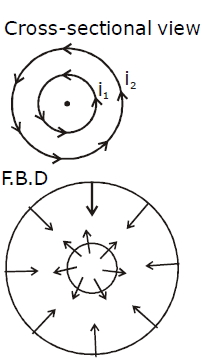
Two coaxial solenoids of different radii carry current $I$ in the same direction. Let $\overrightarrow{F_1}$ be the magnetic force on the inner solenoid due to the outer one and $\overrightarrow{F_2}$ be the magnetic force on the outer solenoid due to the inner one. Then
A
$\overrightarrow{F_1}$ is radially inwards and $\overrightarrow{F_2}$ is radially outwards
B
$\overrightarrow{F_1}$ is radially inwards and $\overrightarrow{F_2} = 0$
C
$\overrightarrow{F_1}$ is radially outwards and $\overrightarrow{F_2} = 0$
D
$\overrightarrow{F_1} = \overrightarrow{F_2} = 0$
Solution
(D) For two coaxial solenoids carrying current in the same direction,the magnetic field produced by the outer solenoid is uniform inside it and zero outside it. The inner solenoid is placed in this uniform magnetic field. Since the current in the inner solenoid is distributed symmetrically,the net magnetic force on the inner solenoid is zero because the forces on opposite sides cancel each other out.
Similarly,the magnetic field produced by the inner solenoid is confined within its own volume and is zero outside it. Therefore,the outer solenoid is placed in a region where the magnetic field due to the inner solenoid is zero. Thus,the net magnetic force on the outer solenoid is also zero.
Hence,$\overrightarrow{F_1} = 0$ and $\overrightarrow{F_2} = 0$.
Similarly,the magnetic field produced by the inner solenoid is confined within its own volume and is zero outside it. Therefore,the outer solenoid is placed in a region where the magnetic field due to the inner solenoid is zero. Thus,the net magnetic force on the outer solenoid is also zero.
Hence,$\overrightarrow{F_1} = 0$ and $\overrightarrow{F_2} = 0$.
0 likes
View Solution35
DifficultMCQ
There is a long cylindrical pipe wire of internal radius $r$ and external radius $R$ carrying current $i$ along its length. The variation of magnetic field with distance from the axis of the wire can be represented by the :-
A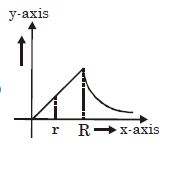
B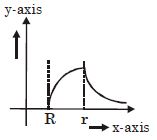
C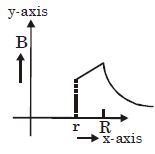
D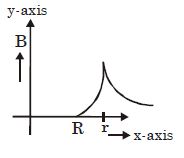
Solution
(C) For a long cylindrical pipe (hollow cylinder) carrying current $i$ uniformly distributed over its cross-section:
$1$. Inside the hollow region $(x < r)$: By Ampere's circuital law,$\oint B \cdot dl = \mu_0 I_{enclosed}$. Since no current is enclosed,$B = 0$.
$2$. Within the material of the pipe $(r < x < R)$: The current enclosed by a loop of radius $x$ is $I_{enclosed} = i \cdot \frac{\pi x^2 - \pi r^2}{\pi R^2 - \pi r^2}$. Thus,$B(2\pi x) = \mu_0 i \frac{x^2 - r^2}{R^2 - r^2}$,which implies $B \propto \frac{x^2 - r^2}{x}$. This shows a non-linear increase.
$3$. Outside the pipe $(x > R)$: The total current enclosed is $i$. Thus,$B(2\pi x) = \mu_0 i$,which implies $B = \frac{\mu_0 i}{2\pi x}$,so $B \propto 1/x$.
Comparing these characteristics,the graph shows $B=0$ for $x < r$,a non-linear increase for $r < x < R$,and a $1/x$ decay for $x > R$. Option $C$ correctly depicts this behavior.
$1$. Inside the hollow region $(x < r)$: By Ampere's circuital law,$\oint B \cdot dl = \mu_0 I_{enclosed}$. Since no current is enclosed,$B = 0$.
$2$. Within the material of the pipe $(r < x < R)$: The current enclosed by a loop of radius $x$ is $I_{enclosed} = i \cdot \frac{\pi x^2 - \pi r^2}{\pi R^2 - \pi r^2}$. Thus,$B(2\pi x) = \mu_0 i \frac{x^2 - r^2}{R^2 - r^2}$,which implies $B \propto \frac{x^2 - r^2}{x}$. This shows a non-linear increase.
$3$. Outside the pipe $(x > R)$: The total current enclosed is $i$. Thus,$B(2\pi x) = \mu_0 i$,which implies $B = \frac{\mu_0 i}{2\pi x}$,so $B \propto 1/x$.
Comparing these characteristics,the graph shows $B=0$ for $x < r$,a non-linear increase for $r < x < R$,and a $1/x$ decay for $x > R$. Option $C$ correctly depicts this behavior.
0 likes
View Solution36
MediumMCQ
Statement-$1$: Ampere's law can be used to find the magnetic field due to a finite length of a straight current-carrying wire.
Statement-$2$: The magnetic field due to a finite length of a straight current-carrying wire is symmetric about the wire.
Statement-$2$: The magnetic field due to a finite length of a straight current-carrying wire is symmetric about the wire.
A
Statement-$1$ is true,statement-$2$ is true,and statement-$2$ is the correct explanation for statement-$1$.
B
Statement-$1$ is true,statement-$2$ is true,and statement-$2$ is $NOT$ the correct explanation for statement-$1$.
C
Statement-$1$ is true,statement-$2$ is false.
D
Statement-$1$ is false,statement-$2$ is true.
Solution
(D) Ampere's circuital law is most effective for calculating the magnetic field when there is high degree of symmetry,such as in an infinitely long straight wire,a solenoid,or a toroid.
For a finite length wire,the magnetic field does not possess the required symmetry to apply Ampere's law easily,as the field lines are not simple circles centered on the wire axis throughout the length.
Therefore,Statement-$1$ is false.
Regarding Statement-$2$,the magnetic field of a finite wire is indeed symmetric about the wire (cylindrical symmetry),but this symmetry is not sufficient to apply Ampere's law to find the field magnitude.
Thus,Statement-$2$ is true.
For a finite length wire,the magnetic field does not possess the required symmetry to apply Ampere's law easily,as the field lines are not simple circles centered on the wire axis throughout the length.
Therefore,Statement-$1$ is false.
Regarding Statement-$2$,the magnetic field of a finite wire is indeed symmetric about the wire (cylindrical symmetry),but this symmetry is not sufficient to apply Ampere's law to find the field magnitude.
Thus,Statement-$2$ is true.
0 likes
View Solution37
MediumMCQ
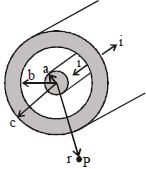
$A$ coaxial cable having radii $a, b$ and $c$ carries equal and opposite currents of magnitude $i$ in the inner and outer conductors. What is the magnitude of the magnetic induction at point $P$ outside of the cable at a distance $r$ from the axis?
A
$0$
B
$\frac{\mu_0 i r}{2 \pi a^2}$
C
$\frac{\mu_0 i}{2 \pi r}$
D
$\frac{\mu_0 i}{2 \pi r} \frac{c^2 - r^2}{c^2 - b^2}$
Solution
(A) According to Ampere's circuital law,the line integral of the magnetic field $\vec{B}$ around a closed path is equal to $\mu_0$ times the total current $i_{\text{enclosed}}$ passing through the surface bounded by the path.
$\oint \vec{B} \cdot d\vec{\ell} = \mu_0 i_{\text{enclosed}}$
For a point $P$ outside the cable at a distance $r > c$ from the axis,we consider a circular Amperian loop of radius $r$.
The total current enclosed by this loop is the sum of the current in the inner conductor $(+i)$ and the current in the outer conductor $(-i)$.
$i_{\text{enclosed}} = i + (-i) = 0$
Therefore,the magnetic induction $B$ at point $P$ is:
$B(2 \pi r) = \mu_0 (0)$
$B = 0$
$\oint \vec{B} \cdot d\vec{\ell} = \mu_0 i_{\text{enclosed}}$
For a point $P$ outside the cable at a distance $r > c$ from the axis,we consider a circular Amperian loop of radius $r$.
The total current enclosed by this loop is the sum of the current in the inner conductor $(+i)$ and the current in the outer conductor $(-i)$.
$i_{\text{enclosed}} = i + (-i) = 0$
Therefore,the magnetic induction $B$ at point $P$ is:
$B(2 \pi r) = \mu_0 (0)$
$B = 0$
0 likes
View Solution38
AdvancedMCQ
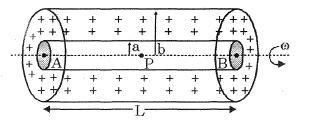
$A$ thick uniformly charged hollow cylinder of inner radius $a$ and outer radius $b$ rotates with constant angular speed $\omega$ about its axis $APB$,with charge density $\rho$. Given that $L \gg a$ and $L \gg b$,and $P$ is the midpoint of $AB$. Choose the incorrect option.
A
Magnetic field at point $P$ is $\frac{\mu_0 \omega \rho (b^2 - a^2)}{2}$.
B
Magnetic field at point $B$ is $\frac{\mu_0 \omega \rho (b^2 - a^2)}{4}$.
C
Direction of magnetic field at $A, B, P$ is same.
D
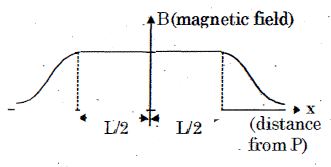
Graph of magnetic field on the axis of cylinder with distance from point $P$ is as shown in the image.
Solution
(D) Consider a thin cylindrical shell of radius $r$ and thickness $dr$ within the thick cylinder.
The charge on this thin shell is $dQ = \rho (2\pi r dr) L$.
The current $dI$ produced by this rotating shell is $dI = \frac{dQ}{T} = \frac{dQ \cdot \omega}{2\pi} = \rho \omega r L dr$.
This acts as a solenoid with $n = \frac{1}{L}$ turns per unit length (effectively). The magnetic field produced by this shell at the center $P$ is $dB = \mu_0 n dI = \mu_0 \left(\frac{1}{L}\right) (\rho \omega r L dr) = \mu_0 \omega \rho r dr$.
Integrating from $r = a$ to $r = b$,the total magnetic field at $P$ is $B_P = \int_a^b \mu_0 \omega \rho r dr = \frac{\mu_0 \omega \rho (b^2 - a^2)}{2}$.
For a long solenoid,the magnetic field at the ends ($A$ or $B$) is exactly half of the field at the center: $B_A = B_B = \frac{B_P}{2} = \frac{\mu_0 \omega \rho (b^2 - a^2)}{4}$.
The direction of the magnetic field is determined by the right-hand rule and is the same along the axis. The graph of the magnetic field along the axis shows a constant value in the middle and a decrease towards the ends,which is consistent with the properties of a long solenoid.
The charge on this thin shell is $dQ = \rho (2\pi r dr) L$.
The current $dI$ produced by this rotating shell is $dI = \frac{dQ}{T} = \frac{dQ \cdot \omega}{2\pi} = \rho \omega r L dr$.
This acts as a solenoid with $n = \frac{1}{L}$ turns per unit length (effectively). The magnetic field produced by this shell at the center $P$ is $dB = \mu_0 n dI = \mu_0 \left(\frac{1}{L}\right) (\rho \omega r L dr) = \mu_0 \omega \rho r dr$.
Integrating from $r = a$ to $r = b$,the total magnetic field at $P$ is $B_P = \int_a^b \mu_0 \omega \rho r dr = \frac{\mu_0 \omega \rho (b^2 - a^2)}{2}$.
For a long solenoid,the magnetic field at the ends ($A$ or $B$) is exactly half of the field at the center: $B_A = B_B = \frac{B_P}{2} = \frac{\mu_0 \omega \rho (b^2 - a^2)}{4}$.
The direction of the magnetic field is determined by the right-hand rule and is the same along the axis. The graph of the magnetic field along the axis shows a constant value in the middle and a decrease towards the ends,which is consistent with the properties of a long solenoid.
0 likes
View Solution39
MediumMCQ
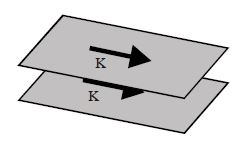
What are the directions of the magnetic field between and outside a pair of two parallel large sheets carrying currents in the same directions,as illustrated in the figure?
A
towards us between the plates and away from us above and below the plates.
B
toward us above the plates and away from us below plates and zero between plates.
C
towards us above and below the plates and zero between the plates
D
towards us between the plates and zero above and below the plates.
Solution
(B) Consider two large parallel sheets carrying surface current density $K$ in the same direction.
Using the right-hand rule for a single sheet,the magnetic field $B$ is parallel to the sheet and perpendicular to the current direction.
For a sheet with current $K$ flowing to the right,the magnetic field points 'out' (towards us) above the sheet and 'in' (away from us) below the sheet.
Let the top sheet be $S_1$ and the bottom sheet be $S_2$.
Above $S_1$: Both sheets produce a field pointing 'out' (towards us).
Between $S_1$ and $S_2$: $S_1$ produces a field pointing 'in' (away from us),and $S_2$ produces a field pointing 'out' (towards us). Since the magnitudes are equal,they cancel out,resulting in zero field.
Below $S_2$: Both sheets produce a field pointing 'in' (away from us).
Thus,the magnetic field is zero between the plates and points towards us above the plates and away from us below the plates.
Using the right-hand rule for a single sheet,the magnetic field $B$ is parallel to the sheet and perpendicular to the current direction.
For a sheet with current $K$ flowing to the right,the magnetic field points 'out' (towards us) above the sheet and 'in' (away from us) below the sheet.
Let the top sheet be $S_1$ and the bottom sheet be $S_2$.
Above $S_1$: Both sheets produce a field pointing 'out' (towards us).
Between $S_1$ and $S_2$: $S_1$ produces a field pointing 'in' (away from us),and $S_2$ produces a field pointing 'out' (towards us). Since the magnitudes are equal,they cancel out,resulting in zero field.
Below $S_2$: Both sheets produce a field pointing 'in' (away from us).
Thus,the magnetic field is zero between the plates and points towards us above the plates and away from us below the plates.
0 likes
View Solution40
DifficultMCQ
$A$ current $i$ is uniformly distributed over the cross section of a long hollow cylindrical wire of inner radius $R_1$ and outer radius $R_2$. The magnetic field $B$ varies with distance $r$ from the axis of the cylinder as:
A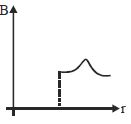
B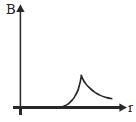
C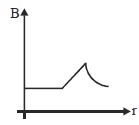
D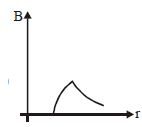
Solution
(D) For a long hollow cylindrical wire with inner radius $R_1$ and outer radius $R_2$ carrying a total current $i$ uniformly distributed:
$1$. For $r < R_1$: The enclosed current is zero,so by Ampere's Law,$\oint B \cdot dl = \mu_0 I_{enclosed} = 0$,which implies $B = 0$.
$2$. For $R_1 \le r \le R_2$: The enclosed current $I(r)$ is $i \cdot \frac{\pi(r^2 - R_1^2)}{\pi(R_2^2 - R_1^2)}$. Applying Ampere's Law: $B(2\pi r) = \mu_0 i \frac{r^2 - R_1^2}{R_2^2 - R_1^2}$,so $B = \frac{\mu_0 i}{2\pi r} \frac{r^2 - R_1^2}{R_2^2 - R_1^2}$. This shows $B$ increases from $0$ at $r = R_1$ to a maximum value at $r = R_2$.
$3$. For $r > R_2$: The enclosed current is the total current $i$. Applying Ampere's Law: $B(2\pi r) = \mu_0 i$,so $B = \frac{\mu_0 i}{2\pi r}$. This shows $B$ decreases as $1/r$.
The correct graph shows $B=0$ for $r < R_1$,a smooth increase for $R_1 \le r \le R_2$,and a $1/r$ decay for $r > R_2$. Option $D$ correctly represents this behavior.
$1$. For $r < R_1$: The enclosed current is zero,so by Ampere's Law,$\oint B \cdot dl = \mu_0 I_{enclosed} = 0$,which implies $B = 0$.
$2$. For $R_1 \le r \le R_2$: The enclosed current $I(r)$ is $i \cdot \frac{\pi(r^2 - R_1^2)}{\pi(R_2^2 - R_1^2)}$. Applying Ampere's Law: $B(2\pi r) = \mu_0 i \frac{r^2 - R_1^2}{R_2^2 - R_1^2}$,so $B = \frac{\mu_0 i}{2\pi r} \frac{r^2 - R_1^2}{R_2^2 - R_1^2}$. This shows $B$ increases from $0$ at $r = R_1$ to a maximum value at $r = R_2$.
$3$. For $r > R_2$: The enclosed current is the total current $i$. Applying Ampere's Law: $B(2\pi r) = \mu_0 i$,so $B = \frac{\mu_0 i}{2\pi r}$. This shows $B$ decreases as $1/r$.
The correct graph shows $B=0$ for $r < R_1$,a smooth increase for $R_1 \le r \le R_2$,and a $1/r$ decay for $r > R_2$. Option $D$ correctly represents this behavior.
0 likes
View Solution41
MediumMCQ
$A$ solenoid has a turn density of $5000 \, \text{turns/m}$ and a cross-sectional area of $10 \, \text{cm}^2$. If a current of $1 \, \text{A}$ flows through it and the core material has a relative permeability of $1000$, find the energy per unit length of the solenoid in $\text{J/m}$.
A
$15.7$
B
$18.9$
C
$12.31$
D
$8.53$
Solution
(A) The energy stored in a solenoid is given by $U = \frac{1}{2} LI^2$.
The self-inductance $L$ of a solenoid is $L = \frac{\mu_0 \mu_r N^2 A}{\ell}$, where $N$ is the total number of turns and $\ell$ is the length.
Energy per unit length $u = \frac{U}{\ell} = \frac{1}{\ell} \left( \frac{1}{2} \frac{\mu_0 \mu_r N^2 A}{\ell} I^2 \right) = \frac{1}{2} \mu_0 \mu_r \left( \frac{N}{\ell} \right)^2 A I^2$.
Given: turn density $n = \frac{N}{\ell} = 5000 \, \text{turns/m}$, area $A = 10 \, \text{cm}^2 = 10 \times 10^{-4} \, \text{m}^2$, current $I = 1 \, \text{A}$, relative permeability $\mu_r = 1000$, and $\mu_0 = 4\pi \times 10^{-7} \, \text{T} \cdot \text{m/A}$.
Substituting the values:
$u = \frac{1}{2} \times (4\pi \times 10^{-7}) \times 1000 \times (5000)^2 \times (10 \times 10^{-4}) \times (1)^2$
$u = \frac{1}{2} \times 4\pi \times 10^{-7} \times 10^3 \times 25 \times 10^6 \times 10^{-3} \times 1$
$u = 2\pi \times 10^{-7} \times 25 \times 10^9 \times 10^{-3} = 50\pi \approx 157.08 \times 0.1 = 15.7 \, \text{J/m}$.
The self-inductance $L$ of a solenoid is $L = \frac{\mu_0 \mu_r N^2 A}{\ell}$, where $N$ is the total number of turns and $\ell$ is the length.
Energy per unit length $u = \frac{U}{\ell} = \frac{1}{\ell} \left( \frac{1}{2} \frac{\mu_0 \mu_r N^2 A}{\ell} I^2 \right) = \frac{1}{2} \mu_0 \mu_r \left( \frac{N}{\ell} \right)^2 A I^2$.
Given: turn density $n = \frac{N}{\ell} = 5000 \, \text{turns/m}$, area $A = 10 \, \text{cm}^2 = 10 \times 10^{-4} \, \text{m}^2$, current $I = 1 \, \text{A}$, relative permeability $\mu_r = 1000$, and $\mu_0 = 4\pi \times 10^{-7} \, \text{T} \cdot \text{m/A}$.
Substituting the values:
$u = \frac{1}{2} \times (4\pi \times 10^{-7}) \times 1000 \times (5000)^2 \times (10 \times 10^{-4}) \times (1)^2$
$u = \frac{1}{2} \times 4\pi \times 10^{-7} \times 10^3 \times 25 \times 10^6 \times 10^{-3} \times 1$
$u = 2\pi \times 10^{-7} \times 25 \times 10^9 \times 10^{-3} = 50\pi \approx 157.08 \times 0.1 = 15.7 \, \text{J/m}$.
0 likes
View Solution42
MediumMCQ
Rank the value of $\oint \vec{B} \cdot d\vec{l}$ for the closed paths shown in the figure from the smallest to largest.
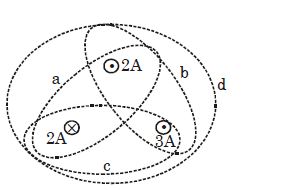
A
$a, b, c, d$
B
$a, c, d, b$
C
$a, d, c, b$
D
$a, c, b, d$
Solution
(B) According to Ampere's circuital law,$\oint \vec{B} \cdot d\vec{l} = \mu_0 I_{\text{enclosed}}$.
Let the current flowing out of the plane be positive and into the plane be negative.
For path $a$: It encloses $2\, A$ (out) and $2\, A$ (in). Net current $I_a = 2 - 2 = 0\, A$.
For path $b$: It encloses $2\, A$ (out) and $3\, A$ (out). Net current $I_b = 2 + 3 = 5\, A$.
For path $c$: It encloses $2\, A$ (in) and $3\, A$ (out). Net current $I_c = 3 - 2 = 1\, A$.
For path $d$: It encloses $2\, A$ (out),$2\, A$ (in),and $3\, A$ (out). Net current $I_d = 2 - 2 + 3 = 3\, A$.
Comparing the net currents: $I_a = 0\, A$,$I_c = 1\, A$,$I_d = 3\, A$,$I_b = 5\, A$.
Therefore,the order from smallest to largest is $a, c, d, b$.
Let the current flowing out of the plane be positive and into the plane be negative.
For path $a$: It encloses $2\, A$ (out) and $2\, A$ (in). Net current $I_a = 2 - 2 = 0\, A$.
For path $b$: It encloses $2\, A$ (out) and $3\, A$ (out). Net current $I_b = 2 + 3 = 5\, A$.
For path $c$: It encloses $2\, A$ (in) and $3\, A$ (out). Net current $I_c = 3 - 2 = 1\, A$.
For path $d$: It encloses $2\, A$ (out),$2\, A$ (in),and $3\, A$ (out). Net current $I_d = 2 - 2 + 3 = 3\, A$.
Comparing the net currents: $I_a = 0\, A$,$I_c = 1\, A$,$I_d = 3\, A$,$I_b = 5\, A$.
Therefore,the order from smallest to largest is $a, c, d, b$.
0 likes
View Solution43
EasyMCQ
$A$ current $i$ $A$ flows along an infinitely long straight thin-walled tube. The magnetic induction at any point inside the tube is:
A
$\infty$
B
Zero
C
$\frac{\mu_0}{4\pi} \cdot \frac{2i}{r} \text{ T}$
D
$\frac{2i}{r} \text{ T}$
Solution
(B) According to Ampere's circuital law,the line integral of the magnetic field $\vec{B}$ around any closed loop is equal to $\mu_0$ times the net current $I_{\text{en}}$ enclosed by the loop: $\oint \vec{B} \cdot d\vec{l} = \mu_0 I_{\text{en}}$.
For any point inside an infinitely long thin-walled tube,we can consider a circular Amperian loop of radius $r$ (where $r < R$,the radius of the tube).
Since the current $i$ flows only along the surface of the tube,the current enclosed by this Amperian loop is $I_{\text{en}} = 0$.
Therefore,$\oint \vec{B} \cdot d\vec{l} = \mu_0(0) = 0$.
This implies that the magnetic induction $B$ at any point inside the tube is $0$.
For any point inside an infinitely long thin-walled tube,we can consider a circular Amperian loop of radius $r$ (where $r < R$,the radius of the tube).
Since the current $i$ flows only along the surface of the tube,the current enclosed by this Amperian loop is $I_{\text{en}} = 0$.
Therefore,$\oint \vec{B} \cdot d\vec{l} = \mu_0(0) = 0$.
This implies that the magnetic induction $B$ at any point inside the tube is $0$.
0 likes
View Solution44
MediumMCQ
$A$ $25\,cm$ long solenoid has radius $2\,cm$ and $500$ total number of turns. It carries a current of $15\,A.$ If it is equivalent to a magnet of the same size and magnetization $\vec M$ (magnetic moment per unit volume),then $\left| {\vec M} \right|$ is
A
$30000\pi \,A m^{-1}$
B
$3\pi \,A m^{-1}$
C
$30000 \,A m^{-1}$
D
$300 \,A m^{-1}$
Solution
(C) The magnetic moment $m$ of a solenoid is given by $m = N i A$,where $N$ is the number of turns,$i$ is the current,and $A$ is the cross-sectional area.
Magnetization $\vec M$ is defined as the magnetic moment per unit volume $V$.
$V = A \ell$,where $\ell$ is the length of the solenoid.
Therefore,$|\vec M| = \frac{m}{V} = \frac{N i A}{A \ell} = \frac{N i}{\ell}$.
Given $N = 500$,$i = 15\,A$,and $\ell = 25\,cm = 0.25\,m$.
$|\vec M| = \frac{500 \times 15}{0.25} = \frac{7500}{0.25} = 30000\,A m^{-1}$.
Magnetization $\vec M$ is defined as the magnetic moment per unit volume $V$.
$V = A \ell$,where $\ell$ is the length of the solenoid.
Therefore,$|\vec M| = \frac{m}{V} = \frac{N i A}{A \ell} = \frac{N i}{\ell}$.
Given $N = 500$,$i = 15\,A$,and $\ell = 25\,cm = 0.25\,m$.
$|\vec M| = \frac{500 \times 15}{0.25} = \frac{7500}{0.25} = 30000\,A m^{-1}$.
0 likes
View Solution45
DifficultMCQ
$A$ $90\, cm$ long solenoid has six layers of windings of $450\, turns$ each. If the diameter of the solenoid is $2.2\, cm$ and the current carried is $6\, A$, then the magnitude of the magnetic field inside the solenoid, near its centre is: (in $\pi\, G$)
A
$50$
B
$60$
C
$72$
D
$80$
Solution
(C) The total number of turns $N$ for $6$ layers, each with $450$ turns, is given by:
$N = 6 \times 450 = 2700$
The number of turns per unit length $n$ is calculated as:
$n = \frac{N}{l} = \frac{2700}{90 \times 10^{-2}\, m} = \frac{2700}{0.9}\, m^{-1} = 3000\, m^{-1}$
The magnetic field $B$ inside a long solenoid near its centre is given by the formula:
$B = \mu_{0} n I$
Substituting the values $\mu_{0} = 4\pi \times 10^{-7}\, T\cdot m/A$, $n = 3000\, m^{-1}$, and $I = 6\, A$:
$B = (4\pi \times 10^{-7}) \times 3000 \times 6$
$B = 72\pi \times 10^{-4}\, T$
Since $1\, T = 10^4\, G$ (Gauss), we have:
$B = 72\pi \times 10^{-4} \times 10^4\, G = 72\pi\, G$
$N = 6 \times 450 = 2700$
The number of turns per unit length $n$ is calculated as:
$n = \frac{N}{l} = \frac{2700}{90 \times 10^{-2}\, m} = \frac{2700}{0.9}\, m^{-1} = 3000\, m^{-1}$
The magnetic field $B$ inside a long solenoid near its centre is given by the formula:
$B = \mu_{0} n I$
Substituting the values $\mu_{0} = 4\pi \times 10^{-7}\, T\cdot m/A$, $n = 3000\, m^{-1}$, and $I = 6\, A$:
$B = (4\pi \times 10^{-7}) \times 3000 \times 6$
$B = 72\pi \times 10^{-4}\, T$
Since $1\, T = 10^4\, G$ (Gauss), we have:
$B = 72\pi \times 10^{-4} \times 10^4\, G = 72\pi\, G$
0 likes
View Solution46
MediumMCQ
Consider two idealized systems: $(i)$ a parallel plate capacitor with large plates and small separation,and $(ii)$ a long solenoid of length $L \gg R$,where $R$ is the radius of the cross-section. In $(i)$,$E$ is ideally treated as a constant between the plates and zero outside. In $(ii)$,the magnetic field is constant inside the solenoid and zero outside. These idealized assumptions,however,contradict fundamental laws as follows:
A
Case $(i)$ contradicts Gauss's law for electrostatic fields.
B
Case $(ii)$ contradicts Gauss's law for magnetic fields.
C
Case $(i)$ agrees with $\oint E \cdot dl = 0$.
D
Case $(ii)$ contradicts $\oint H \cdot dl = I_{en}$.
Solution
(B) Gauss's law for magnetism states that the net magnetic flux through any closed surface is zero,expressed as $\oint_S B \cdot dS = 0$.
In the case of an ideal solenoid,the magnetic field is assumed to be uniform inside and zero outside.
If we consider a Gaussian surface (a cylinder) partially inside and partially outside the solenoid,the flux through the end caps would be non-zero because the field lines are confined within the solenoid and do not exit through the sides,implying a violation of the divergence-free nature of magnetic fields $(
abla \cdot B = 0)$.
Therefore,the assumption of a perfectly confined magnetic field in an ideal solenoid contradicts Gauss's law for magnetism.
In the case of an ideal solenoid,the magnetic field is assumed to be uniform inside and zero outside.
If we consider a Gaussian surface (a cylinder) partially inside and partially outside the solenoid,the flux through the end caps would be non-zero because the field lines are confined within the solenoid and do not exit through the sides,implying a violation of the divergence-free nature of magnetic fields $(
abla \cdot B = 0)$.
Therefore,the assumption of a perfectly confined magnetic field in an ideal solenoid contradicts Gauss's law for magnetism.
0 likes
View Solution47
MediumMCQ
Current is flowing through a conducting hollow pipe whose cross-section is shown in the figure. The value of magnetic induction will be zero at:
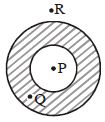
A
points $P$,$Q$ and $R$.
B
point $R$ but not at $P$ and $Q$.
C
$Q$ but not at $P$ and $R$.
D
$P$ but not at $Q$ and $R$.
Solution
(D) According to Ampere's circuital law,the magnetic field $B$ at a distance $r$ from the axis of a current-carrying conductor is given by $\oint B \cdot dl = \mu_0 I_{enclosed}$.
For point $P$,which is in the hollow cavity,the enclosed current $I_{enclosed} = 0$,so the magnetic field $B_P = 0$.
For point $Q$,which is inside the material of the conducting pipe,the enclosed current is non-zero,so the magnetic field $B_Q \neq 0$.
For point $R$,which is outside the pipe,the total current enclosed by an Amperian loop passing through $R$ is the total current $I$ flowing through the pipe. However,for a long straight cylindrical conductor,the magnetic field outside is $B = \frac{\mu_0 I}{2 \pi r}$. This is only zero if $I=0$ or $r \to \infty$. Thus,$B_R \neq 0$.
Therefore,the magnetic field is zero only at point $P$.
For point $P$,which is in the hollow cavity,the enclosed current $I_{enclosed} = 0$,so the magnetic field $B_P = 0$.
For point $Q$,which is inside the material of the conducting pipe,the enclosed current is non-zero,so the magnetic field $B_Q \neq 0$.
For point $R$,which is outside the pipe,the total current enclosed by an Amperian loop passing through $R$ is the total current $I$ flowing through the pipe. However,for a long straight cylindrical conductor,the magnetic field outside is $B = \frac{\mu_0 I}{2 \pi r}$. This is only zero if $I=0$ or $r \to \infty$. Thus,$B_R \neq 0$.
Therefore,the magnetic field is zero only at point $P$.
0 likes
View Solution48
MediumMCQ
$A$ long solenoid with $20$ turns per $cm$ is made. To produce a magnetic field of $20$ $mT$ inside the solenoid, the necessary current will be approximately......$A$.
A
$8$
B
$4$
C
$2$
D
$1$
Solution
(A) The magnetic field $B$ inside a long solenoid is given by the formula $B = \mu_0 n i$.
Here, $n$ is the number of turns per unit length.
Given: $n = 20 \text{ turns/cm} = 2000 \text{ turns/m}$.
Given: $B = 20 \text{ mT} = 20 \times 10^{-3} \text{ T}$.
Given: $\mu_0 = 4\pi \times 10^{-7} \text{ T} \cdot \text{m/A}$.
Substituting the values into the formula:
$20 \times 10^{-3} = (4\pi \times 10^{-7}) \times 2000 \times i$
$20 \times 10^{-3} = 8\pi \times 10^{-4} \times i$
$i = \frac{20 \times 10^{-3}}{8\pi \times 10^{-4}} = \frac{200}{8\pi} = \frac{25}{\pi} \approx \frac{25}{3.14} \approx 7.96 \text{ A}$.
Rounding to the nearest integer, the current is approximately $8 \text{ A}$.
Here, $n$ is the number of turns per unit length.
Given: $n = 20 \text{ turns/cm} = 2000 \text{ turns/m}$.
Given: $B = 20 \text{ mT} = 20 \times 10^{-3} \text{ T}$.
Given: $\mu_0 = 4\pi \times 10^{-7} \text{ T} \cdot \text{m/A}$.
Substituting the values into the formula:
$20 \times 10^{-3} = (4\pi \times 10^{-7}) \times 2000 \times i$
$20 \times 10^{-3} = 8\pi \times 10^{-4} \times i$
$i = \frac{20 \times 10^{-3}}{8\pi \times 10^{-4}} = \frac{200}{8\pi} = \frac{25}{\pi} \approx \frac{25}{3.14} \approx 7.96 \text{ A}$.
Rounding to the nearest integer, the current is approximately $8 \text{ A}$.
0 likes
View SolutionMoving Charges and Magnetism — Ampere’s circuital law and its application (Solenoid and Toroid) · Frequently Asked Questions
1Are these Moving Charges and Magnetism questions useful for JEE and NEET?
Yes. All questions in this section are mapped to JEE Main and NEET exam patterns. Previous year questions from JEE Main, NEET, GUJCET and state-level exams are included with full solutions.
2Can I switch to Hindi or Gujarati for these questions?
Yes. Use the language tabs in the hero section or the sidebar to view the same questions and solutions in English, Hindi or Gujarati.
3How do I generate a question paper from this subtopic?
Use the Vedclass Exam Paper Generator — select the chapter and subtopic, set difficulty, and generate Sets A, B, C, D automatically. First 3 chapters of every subject are free.
Vedclass Products
For Students
Vedclass Test Series
Mock tests in real JEE/NEET style with performance analysis. 5-day free trial.
Start Free TrialFor Teachers
Exam Paper Generator
Generate Set A/B/C/D papers from this chapter in 2 minutes. 3 chapters free.
Try FreeFor Institutes
Online Exam Module
Live online exams with unlimited students, 360° analytics & white-label branding.
See DemoFor Teachers & Institutes
Generate a Moving Charges and Magnetism Exam Paper in 2 Minutes
Select subtopic & difficulty — Sets A, B, C, D auto-generated with No Repeat logic.
First 3 chapters of every subject are free — no payment required.