
A English
Motion of Charged Particle In Magnetic Field Questions in English
Class 12 Physics · Moving Charges and Magnetism · Motion of Charged Particle In Magnetic Field
513+
Questions
English
Language
100%
With Solutions
Showing 49 of 513 questions in English
1
EasyMCQ
Tesla is the unit of
A
Electric flux
B
Magnetic flux
C
Electric field
D
Magnetic field
Solution
(D) The $SI$ unit of magnetic field induction $(B)$ is Tesla $(T)$.
One Tesla is defined as the magnetic field that exerts a force of $1 \ N$ on a charge of $1 \ C$ moving with a velocity of $1 \ m/s$ perpendicular to the field.
One Tesla is defined as the magnetic field that exerts a force of $1 \ N$ on a charge of $1 \ C$ moving with a velocity of $1 \ m/s$ perpendicular to the field.
0 likes
View Solution2
EasyMCQ
Gauss is the unit of which physical quantity?
A
$H$
B
$B$
C
$\varphi$
D
$I$
Solution
(B) The unit of magnetic field induction $(B)$ in the $CGS$ system is Gauss $(G)$.
$1 \text{ Gauss} = 10^{-4} \text{ Tesla}$.
Therefore,Gauss is the unit of magnetic field $(B)$.
$1 \text{ Gauss} = 10^{-4} \text{ Tesla}$.
Therefore,Gauss is the unit of magnetic field $(B)$.
0 likes
View Solution3
EasyMCQ
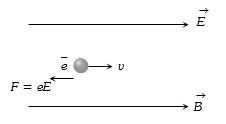
$A$ uniform electric field and a uniform magnetic field are produced,pointing in the same direction. An electron is projected with its velocity pointing in the same direction.
A
The electron will turn to its right.
B
The electron will turn to its left.
C
The electron velocity will increase in magnitude.
D
The electron velocity will decrease in magnitude.
Solution
(D) The magnetic force on a moving charge is given by $\vec{F}_m = q(\vec{v} \times \vec{B})$. Since the electron is moving parallel to the magnetic field,the angle between $\vec{v}$ and $\vec{B}$ is $0^\circ$,so $\vec{F}_m = 0$.
The electric force on the electron is given by $\vec{F}_e = q\vec{E}$. Since the charge of an electron is negative $(q = -e)$,the electric force acts in the direction opposite to the electric field $\vec{E}$.
As the electron is projected in the direction of the electric field,the electric force acts in the opposite direction to its velocity. This force acts as a retarding force,causing the electron to decelerate. Therefore,the magnitude of the electron's velocity will decrease.
The electric force on the electron is given by $\vec{F}_e = q\vec{E}$. Since the charge of an electron is negative $(q = -e)$,the electric force acts in the direction opposite to the electric field $\vec{E}$.
As the electron is projected in the direction of the electric field,the electric force acts in the opposite direction to its velocity. This force acts as a retarding force,causing the electron to decelerate. Therefore,the magnitude of the electron's velocity will decrease.
0 likes
View Solution4
DifficultMCQ
Two particles $X$ and $Y$ having equal charges,after being accelerated through the same potential difference,enter a region of uniform magnetic field and describe circular paths of radii $R_1$ and $R_2$ respectively. The ratio of the mass of $X$ to that of $Y$ is
A
$(\frac{R_1}{R_2})^{1/2}$
B
$\frac{R_2}{R_1}$
C
$(\frac{R_1}{R_2})^2$
D
$\frac{R_1}{R_2}$
Solution
(C) The radius $r$ of a charged particle moving in a magnetic field $B$ after being accelerated through a potential difference $V$ is given by the formula:
$r = \frac{mv}{qB} = \frac{\sqrt{2mK}}{qB} = \frac{1}{B}\sqrt{\frac{2mV}{q}}$
Since the charges $q$,potential difference $V$,and magnetic field $B$ are the same for both particles,we have $r \propto \sqrt{m}$.
Therefore,$\frac{R_1}{R_2} = \sqrt{\frac{m_X}{m_Y}}$.
Squaring both sides,we get $\frac{m_X}{m_Y} = (\frac{R_1}{R_2})^2$.
$r = \frac{mv}{qB} = \frac{\sqrt{2mK}}{qB} = \frac{1}{B}\sqrt{\frac{2mV}{q}}$
Since the charges $q$,potential difference $V$,and magnetic field $B$ are the same for both particles,we have $r \propto \sqrt{m}$.
Therefore,$\frac{R_1}{R_2} = \sqrt{\frac{m_X}{m_Y}}$.
Squaring both sides,we get $\frac{m_X}{m_Y} = (\frac{R_1}{R_2})^2$.
0 likes
View Solution5
MediumMCQ
$A$ beam of ions with velocity $2 \times 10^5 \ m/s$ enters normally into a uniform magnetic field of $4 \times 10^{-2} \ T$. If the specific charge of the ion is $5 \times 10^7 \ C/kg$,then the radius of the circular path described will be $....... \ m$.
A
$0.10$
B
$0.16$
C
$0.20$
D
$0.25$
Solution
(A) When a charged particle enters a uniform magnetic field perpendicularly,it follows a circular path.
The radius $r$ of the circular path is given by the formula $r = \frac{mv}{Bq}$.
Here,$v = 2 \times 10^5 \ m/s$,$B = 4 \times 10^{-2} \ T$,and the specific charge $\frac{q}{m} = 5 \times 10^7 \ C/kg$.
We can rewrite the formula as $r = \frac{v}{(\frac{q}{m})B}$.
Substituting the given values:
$r = \frac{2 \times 10^5}{(5 \times 10^7) \times (4 \times 10^{-2})}$
$r = \frac{2 \times 10^5}{20 \times 10^5}$
$r = \frac{2}{20} = 0.1 \ m$.
The radius $r$ of the circular path is given by the formula $r = \frac{mv}{Bq}$.
Here,$v = 2 \times 10^5 \ m/s$,$B = 4 \times 10^{-2} \ T$,and the specific charge $\frac{q}{m} = 5 \times 10^7 \ C/kg$.
We can rewrite the formula as $r = \frac{v}{(\frac{q}{m})B}$.
Substituting the given values:
$r = \frac{2 \times 10^5}{(5 \times 10^7) \times (4 \times 10^{-2})}$
$r = \frac{2 \times 10^5}{20 \times 10^5}$
$r = \frac{2}{20} = 0.1 \ m$.
0 likes
View Solution6
EasyMCQ
The radius of curvature of the path of a charged particle in a uniform magnetic field is directly proportional to
A
The charge on the particle
B
The momentum of the particle
C
The energy of the particle
D
The intensity of the field
Solution
(B) When a charged particle with charge $q$ and momentum $p$ moves in a uniform magnetic field $B$ perpendicular to the field,it follows a circular path.
The magnetic Lorentz force provides the necessary centripetal force:
$F_m = F_c$
$qvB = \frac{mv^2}{r}$
Since momentum $p = mv$,we can write $qvB = \frac{pv}{r}$.
Solving for the radius $r$,we get:
$r = \frac{p}{qB}$
From this expression,it is clear that the radius $r$ is directly proportional to the momentum $p$ of the particle $(r \propto p)$.
The magnetic Lorentz force provides the necessary centripetal force:
$F_m = F_c$
$qvB = \frac{mv^2}{r}$
Since momentum $p = mv$,we can write $qvB = \frac{pv}{r}$.
Solving for the radius $r$,we get:
$r = \frac{p}{qB}$
From this expression,it is clear that the radius $r$ is directly proportional to the momentum $p$ of the particle $(r \propto p)$.
0 likes
View Solution7
MediumMCQ
An electron has mass $9 \times 10^{-31} \ kg$ and charge $1.6 \times 10^{-19} \ C$ is moving with a velocity of $10^6 \ m/s$. It enters a region where a magnetic field exists. If it describes a circle of radius $0.10 \ m$,the intensity of the magnetic field must be:
A
$1.8 \times 10^{-4} \ T$
B
$5.6 \times 10^{-5} \ T$
C
$14.4 \times 10^{-5} \ T$
D
$1.3 \times 10^{-6} \ T$
Solution
(B) When a charged particle moves in a magnetic field perpendicular to its velocity,it follows a circular path.
The radius $r$ of the circular path is given by the formula: $r = \frac{mv}{qB}$.
Rearranging the formula to solve for the magnetic field intensity $B$,we get: $B = \frac{mv}{qr}$.
Given values:
Mass of electron $(m)$ = $9 \times 10^{-31} \ kg$
Velocity $(v)$ = $10^6 \ m/s$
Charge $(q)$ = $1.6 \times 10^{-19} \ C$
Radius $(r)$ = $0.10 \ m$
Substituting these values into the formula:
$B = \frac{9 \times 10^{-31} \times 10^6}{1.6 \times 10^{-19} \times 0.1}$
$B = \frac{9 \times 10^{-25}}{0.16 \times 10^{-19}}$
$B = \frac{9}{0.16} \times 10^{-6} \ T$
$B = 56.25 \times 10^{-6} \ T = 5.625 \times 10^{-5} \ T$.
Rounding to the nearest option,we get $B = 5.6 \times 10^{-5} \ T$.
The radius $r$ of the circular path is given by the formula: $r = \frac{mv}{qB}$.
Rearranging the formula to solve for the magnetic field intensity $B$,we get: $B = \frac{mv}{qr}$.
Given values:
Mass of electron $(m)$ = $9 \times 10^{-31} \ kg$
Velocity $(v)$ = $10^6 \ m/s$
Charge $(q)$ = $1.6 \times 10^{-19} \ C$
Radius $(r)$ = $0.10 \ m$
Substituting these values into the formula:
$B = \frac{9 \times 10^{-31} \times 10^6}{1.6 \times 10^{-19} \times 0.1}$
$B = \frac{9 \times 10^{-25}}{0.16 \times 10^{-19}}$
$B = \frac{9}{0.16} \times 10^{-6} \ T$
$B = 56.25 \times 10^{-6} \ T = 5.625 \times 10^{-5} \ T$.
Rounding to the nearest option,we get $B = 5.6 \times 10^{-5} \ T$.
0 likes
View Solution8
MediumMCQ
$A$ proton (mass $m$ and charge $+e$) and an $\alpha$-particle (mass $4m$ and charge $+2e$) are projected with the same kinetic energy at right angles to a uniform magnetic field. Which one of the following statements will be true?
A
The $\alpha$-particle will be bent in a circular path with a smaller radius than that of the proton.
B
The radius of the path of the $\alpha$-particle will be greater than that of the proton.
C
The $\alpha$-particle and the proton will be bent in a circular path with the same radius.
D
The $\alpha$-particle and the proton will go through the field in a straight line.
Solution
(C) The radius $r$ of a charged particle moving in a uniform magnetic field $B$ with kinetic energy $K$ is given by the formula $r = \frac{\sqrt{2mK}}{qB}$.
Since $K$ and $B$ are the same for both particles,we have $r \propto \frac{\sqrt{m}}{q}$.
For the proton: $m_p = m$ and $q_p = e$. Thus,$r_p \propto \frac{\sqrt{m}}{e}$.
For the $\alpha$-particle: $m_{\alpha} = 4m$ and $q_{\alpha} = 2e$. Thus,$r_{\alpha} \propto \frac{\sqrt{4m}}{2e} = \frac{2\sqrt{m}}{2e} = \frac{\sqrt{m}}{e}$.
Comparing the two,we find that $r_p = r_{\alpha}$.
Therefore,both particles will move in a circular path with the same radius.
Since $K$ and $B$ are the same for both particles,we have $r \propto \frac{\sqrt{m}}{q}$.
For the proton: $m_p = m$ and $q_p = e$. Thus,$r_p \propto \frac{\sqrt{m}}{e}$.
For the $\alpha$-particle: $m_{\alpha} = 4m$ and $q_{\alpha} = 2e$. Thus,$r_{\alpha} \propto \frac{\sqrt{4m}}{2e} = \frac{2\sqrt{m}}{2e} = \frac{\sqrt{m}}{e}$.
Comparing the two,we find that $r_p = r_{\alpha}$.
Therefore,both particles will move in a circular path with the same radius.
0 likes
View Solution9
EasyMCQ
$A$ charged particle moving in a magnetic field experiences a resultant force:
A
In the direction of the field
B
In the direction opposite to the field
C
In the direction perpendicular to both the field and its velocity
D
None of the above
Solution
(C) The magnetic Lorentz force acting on a charged particle moving with velocity $\overrightarrow{v}$ in a magnetic field $\overrightarrow{B}$ is given by the formula: $\overrightarrow{F} = q(\overrightarrow{v} \times \overrightarrow{B})$.
According to the properties of the cross product,the resulting vector $\overrightarrow{F}$ is always perpendicular to the plane containing the vectors $\overrightarrow{v}$ and $\overrightarrow{B}$.
Therefore,the force is perpendicular to both the velocity of the particle and the magnetic field.
According to the properties of the cross product,the resulting vector $\overrightarrow{F}$ is always perpendicular to the plane containing the vectors $\overrightarrow{v}$ and $\overrightarrow{B}$.
Therefore,the force is perpendicular to both the velocity of the particle and the magnetic field.
0 likes
View Solution10
EasyMCQ
If the direction of the initial velocity of the charged particle is perpendicular to the magnetic field,then the orbit will be or The path executed by a charged particle whose motion is perpendicular to magnetic field is
A
$A$ straight line
B
An ellipse
C
$A$ circle
D
$A$ helix
Solution
(C) When a charged particle with charge $q$ and mass $m$ moves with velocity $v$ in a uniform magnetic field $B$,the magnetic Lorentz force is given by $F = q(v \times B)$.
If the velocity $v$ is perpendicular to the magnetic field $B$,the angle between them is $90^\circ$.
The magnitude of the force is $F = qvB \sin(90^\circ) = qvB$.
This force acts perpendicular to both the velocity and the magnetic field,acting as a centripetal force.
Since the force is always perpendicular to the velocity,the speed of the particle remains constant,but the direction changes continuously.
This constant perpendicular force results in a uniform circular motion.
Therefore,the path of the charged particle is a circle.
If the velocity $v$ is perpendicular to the magnetic field $B$,the angle between them is $90^\circ$.
The magnitude of the force is $F = qvB \sin(90^\circ) = qvB$.
This force acts perpendicular to both the velocity and the magnetic field,acting as a centripetal force.
Since the force is always perpendicular to the velocity,the speed of the particle remains constant,but the direction changes continuously.
This constant perpendicular force results in a uniform circular motion.
Therefore,the path of the charged particle is a circle.
0 likes
View Solution11
EasyMCQ
If the direction of the initial velocity of the charged particle is neither along nor perpendicular to that of the magnetic field,then the orbit will be
A
$A$ straight line
B
An ellipse
C
$A$ circle
D
$A$ helix
Solution
(D) When a charged particle enters a magnetic field with a velocity $v$ at an angle $\theta$ (where $\theta \neq 0^\circ, 90^\circ, 180^\circ$) with respect to the magnetic field $B$,the velocity can be resolved into two components:
$1$. The component $v \sin \theta$ perpendicular to the magnetic field,which provides the necessary centripetal force for circular motion.
$2$. The component $v \cos \theta$ parallel to the magnetic field,which causes the particle to move linearly along the field lines.
The combination of these two motions results in a helical path.
$1$. The component $v \sin \theta$ perpendicular to the magnetic field,which provides the necessary centripetal force for circular motion.
$2$. The component $v \cos \theta$ parallel to the magnetic field,which causes the particle to move linearly along the field lines.
The combination of these two motions results in a helical path.
0 likes
View Solution12
EasyMCQ
Particles having positive charges occasionally come with high velocity from the sky towards the earth. On account of the magnetic field of the earth,they would be deflected towards the
A
North
B
South
C
East
D
West
Solution
(C) The force on a moving charged particle in a magnetic field is given by the Lorentz force formula: $\overrightarrow{F} = q(\overrightarrow{v} \times \overrightarrow{B})$.
Here,the velocity $\overrightarrow{v}$ of the positively charged particles is directed downwards towards the Earth.
The Earth's magnetic field $\overrightarrow{B}$ at the equator is directed from South to North.
Using the right-hand rule for the cross product $\overrightarrow{v} \times \overrightarrow{B}$ (where $\overrightarrow{v}$ is downward and $\overrightarrow{B}$ is towards the North),the direction of the force $\overrightarrow{F}$ is towards the East.
Therefore,the positively charged particles are deflected towards the East.
Here,the velocity $\overrightarrow{v}$ of the positively charged particles is directed downwards towards the Earth.
The Earth's magnetic field $\overrightarrow{B}$ at the equator is directed from South to North.
Using the right-hand rule for the cross product $\overrightarrow{v} \times \overrightarrow{B}$ (where $\overrightarrow{v}$ is downward and $\overrightarrow{B}$ is towards the North),the direction of the force $\overrightarrow{F}$ is towards the East.
Therefore,the positively charged particles are deflected towards the East.
0 likes
View Solution13
MediumMCQ
$A$ $2 \, MeV$ proton is moving perpendicular to a uniform magnetic field of $2.5 \, T$. The force on the proton is
A
$2.5 \times 10^{-10} \, N$
B
$7.6 \times 10^{-11} \, N$
C
$2.5 \times 10^{-11} \, N$
D
$7.6 \times 10^{-12} \, N$
Solution
(D) The force on a charged particle moving in a magnetic field is given by $F = qvB \sin \theta$. Since the proton moves perpendicular to the field,$\theta = 90^\circ$,so $F = qvB$.
Given: Energy $E = 2 \, MeV = 2 \times 10^6 \times 1.6 \times 10^{-19} \, J = 3.2 \times 10^{-13} \, J$.
Mass of proton $m \approx 1.67 \times 10^{-27} \, kg$.
Velocity $v = \sqrt{\frac{2E}{m}} = \sqrt{\frac{2 \times 3.2 \times 10^{-13}}{1.67 \times 10^{-27}}} \approx \sqrt{3.83 \times 10^{14}} \approx 1.96 \times 10^7 \, m/s$.
Force $F = (1.6 \times 10^{-19} \, C) \times (1.96 \times 10^7 \, m/s) \times (2.5 \, T) \approx 7.84 \times 10^{-12} \, N$.
Rounding to the nearest provided option,the force is $7.6 \times 10^{-12} \, N$.
Given: Energy $E = 2 \, MeV = 2 \times 10^6 \times 1.6 \times 10^{-19} \, J = 3.2 \times 10^{-13} \, J$.
Mass of proton $m \approx 1.67 \times 10^{-27} \, kg$.
Velocity $v = \sqrt{\frac{2E}{m}} = \sqrt{\frac{2 \times 3.2 \times 10^{-13}}{1.67 \times 10^{-27}}} \approx \sqrt{3.83 \times 10^{14}} \approx 1.96 \times 10^7 \, m/s$.
Force $F = (1.6 \times 10^{-19} \, C) \times (1.96 \times 10^7 \, m/s) \times (2.5 \, T) \approx 7.84 \times 10^{-12} \, N$.
Rounding to the nearest provided option,the force is $7.6 \times 10^{-12} \, N$.
0 likes
View Solution14
EasyMCQ
$A$ charged particle moves with velocity $\overrightarrow{v}$ in a uniform magnetic field $\overrightarrow{B}$. The magnetic force experienced by the particle is
A
Always zero
B
Zero,if $\overrightarrow{B}$ and $\overrightarrow{v}$ are parallel
C
Zero,if $\overrightarrow{B}$ and $\overrightarrow{v}$ are perpendicular
D
Never zero
Solution
(B) The magnetic force $\overrightarrow{F}$ on a charged particle moving with velocity $\overrightarrow{v}$ in a magnetic field $\overrightarrow{B}$ is given by the Lorentz force formula: $\overrightarrow{F} = q(\overrightarrow{v} \times \overrightarrow{B})$.
Since the cross product $\overrightarrow{v} \times \overrightarrow{B} = vB \sin(\theta) \hat{n}$,where $\theta$ is the angle between $\overrightarrow{v}$ and $\overrightarrow{B}$,the force is zero when $\sin(\theta) = 0$.
This occurs when $\theta = 0^\circ$ or $\theta = 180^\circ$,which means $\overrightarrow{v}$ and $\overrightarrow{B}$ are parallel or anti-parallel.
Therefore,the force is zero if $\overrightarrow{B}$ and $\overrightarrow{v}$ are parallel.
Since the cross product $\overrightarrow{v} \times \overrightarrow{B} = vB \sin(\theta) \hat{n}$,where $\theta$ is the angle between $\overrightarrow{v}$ and $\overrightarrow{B}$,the force is zero when $\sin(\theta) = 0$.
This occurs when $\theta = 0^\circ$ or $\theta = 180^\circ$,which means $\overrightarrow{v}$ and $\overrightarrow{B}$ are parallel or anti-parallel.
Therefore,the force is zero if $\overrightarrow{B}$ and $\overrightarrow{v}$ are parallel.
0 likes
View Solution15
EasyMCQ
$A$ proton is moving along the $Z$-axis in a magnetic field. The magnetic field is along the $X$-axis. The proton will experience a force along
A
$X$-axis
B
$Y$-axis
C
$Z$-axis
D
Negative $Z$-axis
Solution
(B) The force experienced by a charged particle moving in a magnetic field is given by the Lorentz force formula: $\overrightarrow{F} = q(\overrightarrow{v} \times \overrightarrow{B})$.
Here,the velocity of the proton is along the $Z$-axis,so $\overrightarrow{v} = v\hat{k}$.
The magnetic field is along the $X$-axis,so $\overrightarrow{B} = B\hat{i}$.
Substituting these into the formula: $\overrightarrow{F} = q(v\hat{k} \times B\hat{i})$.
Using the cross product rules for unit vectors $(\hat{k} \times \hat{i} = \hat{j})$,we get $\overrightarrow{F} = qvB\hat{j}$.
Since $\hat{j}$ represents the $Y$-axis,the force acts along the $Y$-axis.
Here,the velocity of the proton is along the $Z$-axis,so $\overrightarrow{v} = v\hat{k}$.
The magnetic field is along the $X$-axis,so $\overrightarrow{B} = B\hat{i}$.
Substituting these into the formula: $\overrightarrow{F} = q(v\hat{k} \times B\hat{i})$.
Using the cross product rules for unit vectors $(\hat{k} \times \hat{i} = \hat{j})$,we get $\overrightarrow{F} = qvB\hat{j}$.
Since $\hat{j}$ represents the $Y$-axis,the force acts along the $Y$-axis.
0 likes
View Solution16
MediumMCQ
$A$ proton of mass $m$ and charge $+e$ is moving in a circular orbit in a magnetic field with energy $1\, MeV$. What should be the energy of $\alpha$-particle (mass = $4m$ and charge = $+2e$) so that it can revolve in the path of the same radius?
A
$1$
B
$4$
C
$2$
D
$0.5$
Solution
(A) The radius of a charged particle moving in a magnetic field is given by $r = \frac{\sqrt{2mK}}{qB}$,where $K$ is the kinetic energy.
For the same radius $r$ and same magnetic field $B$,we have $r \propto \frac{\sqrt{mK}}{q}$.
Squaring both sides,$r^2 \propto \frac{mK}{q^2}$,which implies $K \propto \frac{q^2}{m}$.
Therefore,$\frac{K_p}{K_\alpha} = \left( \frac{q_p}{q_\alpha} \right)^2 \times \frac{m_\alpha}{m_p}$.
Given $q_p = e$,$q_\alpha = 2e$,$m_p = m$,and $m_\alpha = 4m$.
Substituting these values: $\frac{1\, MeV}{K_\alpha} = \left( \frac{e}{2e} \right)^2 \times \frac{4m}{m} = \left( \frac{1}{4} \right) \times 4 = 1$.
Thus,$K_\alpha = 1\, MeV$.
For the same radius $r$ and same magnetic field $B$,we have $r \propto \frac{\sqrt{mK}}{q}$.
Squaring both sides,$r^2 \propto \frac{mK}{q^2}$,which implies $K \propto \frac{q^2}{m}$.
Therefore,$\frac{K_p}{K_\alpha} = \left( \frac{q_p}{q_\alpha} \right)^2 \times \frac{m_\alpha}{m_p}$.
Given $q_p = e$,$q_\alpha = 2e$,$m_p = m$,and $m_\alpha = 4m$.
Substituting these values: $\frac{1\, MeV}{K_\alpha} = \left( \frac{e}{2e} \right)^2 \times \frac{4m}{m} = \left( \frac{1}{4} \right) \times 4 = 1$.
Thus,$K_\alpha = 1\, MeV$.
0 likes
View Solution17
EasyMCQ
An electron is moving with a speed of $10^8 \ m/s$ perpendicular to a uniform magnetic field of intensity $B$. Suddenly,the intensity of the magnetic field is reduced to $B/2$. The radius of the path becomes from the original value of $r$:
A
No change
B
Reduces to $r/2$
C
Increases to $2r$
D
Stops moving
Solution
(C) The radius $r$ of a charged particle moving in a uniform magnetic field $B$ is given by the formula $r = \frac{mv}{qB}$,where $m$ is the mass,$v$ is the velocity,and $q$ is the charge of the particle.
From this formula,we can see that $r \propto \frac{1}{B}$.
Let the initial radius be $r_1 = r$ at magnetic field $B_1 = B$.
Let the final radius be $r_2$ at magnetic field $B_2 = B/2$.
Using the proportionality $r_1 B_1 = r_2 B_2$,we get:
$r \times B = r_2 \times (B/2)$
$r_2 = \frac{r \times B}{B/2} = 2r$.
Therefore,the radius increases to $2r$.
From this formula,we can see that $r \propto \frac{1}{B}$.
Let the initial radius be $r_1 = r$ at magnetic field $B_1 = B$.
Let the final radius be $r_2$ at magnetic field $B_2 = B/2$.
Using the proportionality $r_1 B_1 = r_2 B_2$,we get:
$r \times B = r_2 \times (B/2)$
$r_2 = \frac{r \times B}{B/2} = 2r$.
Therefore,the radius increases to $2r$.
0 likes
View Solution18
MediumMCQ
$A$ proton and an $\alpha$-particle enter a uniform magnetic field perpendicularly with the same speed. If a proton takes $25 \ \mu s$ to make $5$ revolutions,then the periodic time for the $\alpha$-particle would be ........ $\mu s$.
A
$50$
B
$25$
C
$10$
D
$5$
Solution
(C) The time period of a charged particle moving in a uniform magnetic field is given by $T = \frac{2\pi m}{qB}$.
For a proton,the time taken for $5$ revolutions is $25 \ \mu s$,so the time period $T_p = \frac{25 \ \mu s}{5} = 5 \ \mu s$.
For an $\alpha$-particle,the mass is $m_{\alpha} = 4m_p$ and the charge is $q_{\alpha} = 2q_p$.
Using the ratio: $\frac{T_{\alpha}}{T_p} = \frac{m_{\alpha}}{m_p} \times \frac{q_p}{q_{\alpha}} = \frac{4m_p}{m_p} \times \frac{q_p}{2q_p} = 4 \times \frac{1}{2} = 2$.
Therefore,$T_{\alpha} = 2 \times T_p = 2 \times 5 \ \mu s = 10 \ \mu s$.
For a proton,the time taken for $5$ revolutions is $25 \ \mu s$,so the time period $T_p = \frac{25 \ \mu s}{5} = 5 \ \mu s$.
For an $\alpha$-particle,the mass is $m_{\alpha} = 4m_p$ and the charge is $q_{\alpha} = 2q_p$.
Using the ratio: $\frac{T_{\alpha}}{T_p} = \frac{m_{\alpha}}{m_p} \times \frac{q_p}{q_{\alpha}} = \frac{4m_p}{m_p} \times \frac{q_p}{2q_p} = 4 \times \frac{1}{2} = 2$.
Therefore,$T_{\alpha} = 2 \times T_p = 2 \times 5 \ \mu s = 10 \ \mu s$.
0 likes
View Solution19
MediumMCQ
$A$ proton (mass $m = 1.67 \times 10^{-27} \, kg$ and charge $q = 1.6 \times 10^{-19} \, C$) enters perpendicular to a magnetic field of intensity $B = 2 \, Wb/m^2$ with a velocity $v = 3.4 \times 10^7 \, m/s$. The acceleration of the proton is:
A
$6.5 \times 10^{15} \, m/s^2$
B
$6.5 \times 10^{13} \, m/s^2$
C
$6.5 \times 10^{11} \, m/s^2$
D
$6.5 \times 10^9 \, m/s^2$
Solution
(A) The magnetic force acting on a charged particle moving in a magnetic field is given by $F = qvB \sin(\theta)$.
Since the proton enters perpendicular to the magnetic field,$\theta = 90^\circ$,so $\sin(90^\circ) = 1$.
Thus,the force is $F = qvB$.
According to Newton's second law,$F = ma$,therefore $ma = qvB$.
The acceleration $a$ is given by $a = \frac{qvB}{m}$.
Substituting the given values:
$a = \frac{(1.6 \times 10^{-19} \, C) \times (3.4 \times 10^7 \, m/s) \times (2 \, Wb/m^2)}{1.67 \times 10^{-27} \, kg}$.
$a = \frac{10.88 \times 10^{-12}}{1.67 \times 10^{-27}} \, m/s^2$.
$a \approx 6.515 \times 10^{15} \, m/s^2$.
Rounding to the given options,$a = 6.5 \times 10^{15} \, m/s^2$.
Since the proton enters perpendicular to the magnetic field,$\theta = 90^\circ$,so $\sin(90^\circ) = 1$.
Thus,the force is $F = qvB$.
According to Newton's second law,$F = ma$,therefore $ma = qvB$.
The acceleration $a$ is given by $a = \frac{qvB}{m}$.
Substituting the given values:
$a = \frac{(1.6 \times 10^{-19} \, C) \times (3.4 \times 10^7 \, m/s) \times (2 \, Wb/m^2)}{1.67 \times 10^{-27} \, kg}$.
$a = \frac{10.88 \times 10^{-12}}{1.67 \times 10^{-27}} \, m/s^2$.
$a \approx 6.515 \times 10^{15} \, m/s^2$.
Rounding to the given options,$a = 6.5 \times 10^{15} \, m/s^2$.
0 likes
View Solution20
EasyMCQ
An $\alpha$-particle travels in a circular path of radius $0.45\,m$ in a magnetic field $B = 1.2\,Wb/m^2$ with a speed of $2.6 \times 10^7\,m/s$. The period of revolution of the $\alpha$-particle is:
A
$1.1 \times 10^{-5}\,s$
B
$1.1 \times 10^{-6}\,s$
C
$1.1 \times 10^{-7}\,s$
D
$1.1 \times 10^{-8}\,s$
Solution
(C) The time period $T$ of a charged particle moving in a circular path in a magnetic field is given by the formula $T = \frac{2\pi r}{v}$.
Given:
Radius $r = 0.45\,m$
Speed $v = 2.6 \times 10^7\,m/s$
Substituting the values into the formula:
$T = \frac{2 \times 3.14 \times 0.45}{2.6 \times 10^7}$
$T = \frac{2.826}{2.6 \times 10^7}$
$T \approx 1.0869 \times 10^{-7}\,s$
Rounding to two significant figures,we get $T \approx 1.1 \times 10^{-7}\,s$.
Given:
Radius $r = 0.45\,m$
Speed $v = 2.6 \times 10^7\,m/s$
Substituting the values into the formula:
$T = \frac{2 \times 3.14 \times 0.45}{2.6 \times 10^7}$
$T = \frac{2.826}{2.6 \times 10^7}$
$T \approx 1.0869 \times 10^{-7}\,s$
Rounding to two significant figures,we get $T \approx 1.1 \times 10^{-7}\,s$.
0 likes
View Solution21
MediumMCQ
$A$ uniform magnetic field $B$ is acting from south to north and is of magnitude $1.5 \ Wb/m^2$. If a proton having mass $m = 1.7 \times 10^{-27} \ kg$ and charge $q = 1.6 \times 10^{-19} \ C$ moves in this field vertically downwards with energy $5 \ MeV$,then the force acting on it will be
A
$7.4 \times 10^{12} \ N$
B
$7.4 \times 10^{-12} \ N$
C
$7.4 \times 10^{19} \ N$
D
$7.4 \times 10^{-19} \ N$
Solution
(B) The force on a charged particle moving in a magnetic field is given by $F = qvB \sin \theta$. Since the particle moves vertically downwards and the field is horizontal (south to north),the angle $\theta = 90^\circ$,so $\sin 90^\circ = 1$. Thus,$F = qvB$.
Given kinetic energy $K = 5 \ MeV = 5 \times 10^6 \times 1.6 \times 10^{-19} \ J = 8 \times 10^{-13} \ J$.
Using $K = \frac{1}{2}mv^2$,we find velocity $v = \sqrt{\frac{2K}{m}}$.
Substituting $v$ into the force equation: $F = qB \sqrt{\frac{2K}{m}}$.
$F = (1.6 \times 10^{-19}) \times 1.5 \times \sqrt{\frac{2 \times 8 \times 10^{-13}}{1.7 \times 10^{-27}}}$.
$F = 2.4 \times 10^{-19} \times \sqrt{9.41 \times 10^{14}} \approx 2.4 \times 10^{-19} \times 3.067 \times 10^7$.
$F \approx 7.36 \times 10^{-12} \ N$,which is approximately $7.4 \times 10^{-12} \ N$.
Given kinetic energy $K = 5 \ MeV = 5 \times 10^6 \times 1.6 \times 10^{-19} \ J = 8 \times 10^{-13} \ J$.
Using $K = \frac{1}{2}mv^2$,we find velocity $v = \sqrt{\frac{2K}{m}}$.
Substituting $v$ into the force equation: $F = qB \sqrt{\frac{2K}{m}}$.
$F = (1.6 \times 10^{-19}) \times 1.5 \times \sqrt{\frac{2 \times 8 \times 10^{-13}}{1.7 \times 10^{-27}}}$.
$F = 2.4 \times 10^{-19} \times \sqrt{9.41 \times 10^{14}} \approx 2.4 \times 10^{-19} \times 3.067 \times 10^7$.
$F \approx 7.36 \times 10^{-12} \ N$,which is approximately $7.4 \times 10^{-12} \ N$.
0 likes
View Solution22
EasyMCQ
$A$ strong magnetic field is applied on a stationary electron,then
A
The electron moves in the direction of the field
B
The electron moves in an opposite direction
C
The electron remains stationary
D
The electron starts spinning
Solution
(C) The magnetic force $F$ acting on a charged particle moving with velocity $v$ in a magnetic field $B$ is given by the Lorentz force formula: $F = q(v \times B)$.
Since the electron is stationary,its velocity $v = 0$.
Therefore,the magnetic force $F = q(0 \times B) = 0$.
Because no net force acts on the stationary electron,it remains stationary.
Since the electron is stationary,its velocity $v = 0$.
Therefore,the magnetic force $F = q(0 \times B) = 0$.
Because no net force acts on the stationary electron,it remains stationary.
0 likes
View Solution23
EasyMCQ
$A$ uniform magnetic field acts at right angles to the direction of motion of electrons. As a result,the electron moves in a circular path of radius $2\, cm$. If the speed of the electrons is doubled,then the radius of the circular path will be.....$cm$.
A
$2$
B
$0.5$
C
$4$
D
$1$
Solution
(C) The radius $r$ of a circular path of a charged particle moving in a uniform magnetic field is given by the formula $r = \frac{mv}{qB}$,where $m$ is the mass,$v$ is the speed,$q$ is the charge,and $B$ is the magnetic field strength.
Since $m$,$q$,and $B$ are constant,the radius is directly proportional to the speed,i.e.,$r \propto v$.
Given the initial radius $r_1 = 2\, cm$ and the initial speed $v_1 = v$.
If the speed is doubled,$v_2 = 2v$.
Therefore,the new radius $r_2$ is given by $\frac{r_2}{r_1} = \frac{v_2}{v_1} = \frac{2v}{v} = 2$.
Thus,$r_2 = 2 \times r_1 = 2 \times 2\, cm = 4\, cm$.
Since $m$,$q$,and $B$ are constant,the radius is directly proportional to the speed,i.e.,$r \propto v$.
Given the initial radius $r_1 = 2\, cm$ and the initial speed $v_1 = v$.
If the speed is doubled,$v_2 = 2v$.
Therefore,the new radius $r_2$ is given by $\frac{r_2}{r_1} = \frac{v_2}{v_1} = \frac{2v}{v} = 2$.
Thus,$r_2 = 2 \times r_1 = 2 \times 2\, cm = 4\, cm$.
0 likes
View Solution24
MediumMCQ
$A$ deuteron of kinetic energy $50 \, keV$ is describing a circular orbit of radius $0.5 \, m$ in a plane perpendicular to a magnetic field $\vec{B}$. The kinetic energy of a proton that describes a circular orbit of radius $0.5 \, m$ in the same plane with the same $\vec{B}$ is ........ $keV$.
A
$25$
B
$50$
C
$200$
D
$100$
Solution
(D) The radius of a circular path of a charged particle in a magnetic field is given by $r = \frac{\sqrt{2mK}}{qB}$,where $m$ is the mass,$K$ is the kinetic energy,and $q$ is the charge.
From this,we can write $K = \frac{r^2 q^2 B^2}{2m}$.
Since $r$ and $B$ are the same for both particles,$K \propto \frac{q^2}{m}$.
For a deuteron $(d)$,$q_d = e$ and $m_d = 2m_p$. For a proton $(p)$,$q_p = e$ and $m_p = m_p$.
Taking the ratio: $\frac{K_p}{K_d} = \left( \frac{q_p}{q_d} \right)^2 \times \left( \frac{m_d}{m_p} \right) = \left( \frac{e}{e} \right)^2 \times \left( \frac{2m_p}{m_p} \right) = 1^2 \times 2 = 2$.
Therefore,$K_p = 2 \times K_d = 2 \times 50 \, keV = 100 \, keV$.
From this,we can write $K = \frac{r^2 q^2 B^2}{2m}$.
Since $r$ and $B$ are the same for both particles,$K \propto \frac{q^2}{m}$.
For a deuteron $(d)$,$q_d = e$ and $m_d = 2m_p$. For a proton $(p)$,$q_p = e$ and $m_p = m_p$.
Taking the ratio: $\frac{K_p}{K_d} = \left( \frac{q_p}{q_d} \right)^2 \times \left( \frac{m_d}{m_p} \right) = \left( \frac{e}{e} \right)^2 \times \left( \frac{2m_p}{m_p} \right) = 1^2 \times 2 = 2$.
Therefore,$K_p = 2 \times K_d = 2 \times 50 \, keV = 100 \, keV$.
0 likes
View Solution25
EasyMCQ
If a proton is projected in a direction perpendicular to a uniform magnetic field with velocity $v$ and an electron is projected along the lines of force,what will happen to the proton and electron?
A
The electron will travel along a circle with constant speed and the proton will move along a straight line.
B
Proton will move in a circle with constant speed and there will be no effect on the motion of electron.
C
There will not be any effect on the motion of electron and proton.
D
The electron and proton both will follow the path of a parabola.
Solution
(B) The magnetic force on a charged particle is given by $F = q(v \times B) = qvB \sin \theta$.
For the proton,the velocity is perpendicular to the magnetic field,so $\theta = 90^\circ$. The force $F = qvB \sin 90^\circ = qvB$ acts as a centripetal force,causing the proton to move in a circular path with constant speed.
For the electron,the velocity is parallel to the magnetic field lines,so $\theta = 0^\circ$. The force $F = qvB \sin 0^\circ = 0$. Since no force acts on the electron,its motion remains unaffected (it continues to move in a straight line).
For the proton,the velocity is perpendicular to the magnetic field,so $\theta = 90^\circ$. The force $F = qvB \sin 90^\circ = qvB$ acts as a centripetal force,causing the proton to move in a circular path with constant speed.
For the electron,the velocity is parallel to the magnetic field lines,so $\theta = 0^\circ$. The force $F = qvB \sin 0^\circ = 0$. Since no force acts on the electron,its motion remains unaffected (it continues to move in a straight line).
0 likes
View Solution26
EasyMCQ
An electron is travelling horizontally towards the east. $A$ magnetic field in the vertically downward direction exerts a force on the electron along:
A
East
B
West
C
North
D
South
Solution
(D) The force on a moving charge in a magnetic field is given by the Lorentz force formula: $\vec{F} = q(\vec{v} \times \vec{B})$.
Here,the charge of the electron is negative $(q = -e)$.
The velocity $\vec{v}$ is towards the east (let this be the $+x$ direction).
The magnetic field $\vec{B}$ is vertically downward (let this be the $-z$ direction).
Using the cross product: $\vec{v} \times \vec{B} = (v \hat{i}) \times (-B \hat{k}) = -vB(\hat{i} \times \hat{k}) = -vB(-\hat{j}) = vB \hat{j}$ (which is North).
Since the electron has a negative charge,the force $\vec{F} = -e(vB \hat{j}) = -evB \hat{j}$.
The direction $-\hat{j}$ corresponds to the South direction.
Therefore,the force on the electron is towards the South.
Here,the charge of the electron is negative $(q = -e)$.
The velocity $\vec{v}$ is towards the east (let this be the $+x$ direction).
The magnetic field $\vec{B}$ is vertically downward (let this be the $-z$ direction).
Using the cross product: $\vec{v} \times \vec{B} = (v \hat{i}) \times (-B \hat{k}) = -vB(\hat{i} \times \hat{k}) = -vB(-\hat{j}) = vB \hat{j}$ (which is North).
Since the electron has a negative charge,the force $\vec{F} = -e(vB \hat{j}) = -evB \hat{j}$.
The direction $-\hat{j}$ corresponds to the South direction.
Therefore,the force on the electron is towards the South.
0 likes
View Solution27
EasyMCQ
$A$ magnetic field:
A
Always exerts a force on a charged particle
B
Never exerts a force on a charged particle
C
Exerts a force,if the charged particle is moving across the magnetic field lines
D
Exerts a force,if the charged particle is moving along the magnetic field lines
Solution
(C) The magnetic force on a charged particle moving with velocity $\vec{v}$ in a magnetic field $\vec{B}$ is given by the Lorentz force formula: $\vec{F} = q(\vec{v} \times \vec{B})$.
This force is $\vec{F} = qvB \sin \theta$,where $\theta$ is the angle between the velocity vector and the magnetic field vector.
If the particle moves across the magnetic field lines,$\theta \neq 0$ and $\theta \neq 180^{\circ}$,so $\sin \theta \neq 0$,resulting in a non-zero magnetic force.
If the particle moves along the magnetic field lines,$\theta = 0^{\circ}$ or $180^{\circ}$,so $\sin \theta = 0$,resulting in zero magnetic force.
Therefore,the correct option is $C$.
This force is $\vec{F} = qvB \sin \theta$,where $\theta$ is the angle between the velocity vector and the magnetic field vector.
If the particle moves across the magnetic field lines,$\theta \neq 0$ and $\theta \neq 180^{\circ}$,so $\sin \theta \neq 0$,resulting in a non-zero magnetic force.
If the particle moves along the magnetic field lines,$\theta = 0^{\circ}$ or $180^{\circ}$,so $\sin \theta = 0$,resulting in zero magnetic force.
Therefore,the correct option is $C$.
0 likes
View Solution28
MediumMCQ
If a particle of charge $10^{-12} \, C$ moving along the $\hat{x}$ direction with a velocity $10^5 \, m/s$ experiences a force of $10^{-10} \, N$ in the $\hat{y}$ direction due to a magnetic field,then the minimum magnetic field is:
A
$6.25 \times 10^3 \, T$ in $\hat{z}$ direction
B
$10^{-15} \, T$ in $\hat{z}$ direction
C
$6.25 \times 10^{-3} \, T$ in $\hat{z}$ direction
D
$10^{-3} \, T$ in $\hat{z}$ direction
Solution
(D) The magnetic force on a moving charge is given by $\vec{F} = q(\vec{v} \times \vec{B})$.
Given: $q = 10^{-12} \, C$,$\vec{v} = 10^5 \hat{i} \, m/s$,and $\vec{F} = 10^{-10} \hat{j} \, N$.
The magnitude of the force is $F = qvB \sin \theta$.
For the minimum magnetic field,we assume $\sin \theta = 1$ (i.e.,$\theta = 90^\circ$),so $F = qvB$.
Thus,$B_{\min} = \frac{F}{qv} = \frac{10^{-10}}{10^{-12} \times 10^5} = \frac{10^{-10}}{10^{-7}} = 10^{-3} \, T$.
Using the right-hand rule,since $\vec{v}$ is in $\hat{i}$ and $\vec{F}$ is in $\hat{j}$,the magnetic field $\vec{B}$ must be in the $\hat{k}$ direction (since $\hat{i} \times \hat{k} = -\hat{j}$,we check the direction: $\vec{F} = q(\vec{v} \times \vec{B}) \implies \hat{j} = \hat{i} \times \hat{B} \implies \hat{B} = \hat{k}$).
Given: $q = 10^{-12} \, C$,$\vec{v} = 10^5 \hat{i} \, m/s$,and $\vec{F} = 10^{-10} \hat{j} \, N$.
The magnitude of the force is $F = qvB \sin \theta$.
For the minimum magnetic field,we assume $\sin \theta = 1$ (i.e.,$\theta = 90^\circ$),so $F = qvB$.
Thus,$B_{\min} = \frac{F}{qv} = \frac{10^{-10}}{10^{-12} \times 10^5} = \frac{10^{-10}}{10^{-7}} = 10^{-3} \, T$.
Using the right-hand rule,since $\vec{v}$ is in $\hat{i}$ and $\vec{F}$ is in $\hat{j}$,the magnetic field $\vec{B}$ must be in the $\hat{k}$ direction (since $\hat{i} \times \hat{k} = -\hat{j}$,we check the direction: $\vec{F} = q(\vec{v} \times \vec{B}) \implies \hat{j} = \hat{i} \times \hat{B} \implies \hat{B} = \hat{k}$).
0 likes
View Solution29
MediumMCQ
If a proton, deuteron, and $\alpha$-particle are accelerated by the same potential difference and enter perpendicular to a magnetic field, then the ratio of their kinetic energies is:
A
$1:1:2$
B
$2:2:1$
C
$1:2:1$
D
$1:1:2$
Solution
(D) When a charged particle of charge $q$ is accelerated from rest through a potential difference $V$, its kinetic energy $K$ is given by the work-energy theorem as $K = qV$.
Since the potential difference $V$ is the same for all particles, the kinetic energy is directly proportional to the charge of the particle, i.e., $K \propto q$.
For a proton $(p)$, deuteron $(d)$, and $\alpha$-particle $(\alpha)$, the charges are:
$q_p = e$
$q_d = e$
$q_\alpha = 2e$
Therefore, the ratio of their kinetic energies is:
$K_p : K_d : K_\alpha = q_p : q_d : q_\alpha = e : e : 2e = 1 : 1 : 2$.
Since the potential difference $V$ is the same for all particles, the kinetic energy is directly proportional to the charge of the particle, i.e., $K \propto q$.
For a proton $(p)$, deuteron $(d)$, and $\alpha$-particle $(\alpha)$, the charges are:
$q_p = e$
$q_d = e$
$q_\alpha = 2e$
Therefore, the ratio of their kinetic energies is:
$K_p : K_d : K_\alpha = q_p : q_d : q_\alpha = e : e : 2e = 1 : 1 : 2$.
0 likes
View Solution30
EasyMCQ
Which of the following statements is true?
A
The presence of a large magnetic flux through a coil maintains a current in the coil if the circuit is continuous.
B
$A$ coil of a metal wire kept stationary in a non-uniform magnetic field has an $e.m.f.$ induced in it.
C
$A$ charged particle enters a region of uniform magnetic field at an angle of $85^\circ$ to the magnetic lines of force; the path of the particle is a circle.
D
There is no change in the energy of a charged particle moving in a magnetic field although a magnetic force is acting on it.
Solution
(D) Option $(D)$ is correct.
According to the Lorentz force law,the magnetic force acting on a charged particle is given by $\vec{F} = q(\vec{v} \times \vec{B})$.
Since the magnetic force $\vec{F}$ is always perpendicular to the velocity vector $\vec{v}$,the work done by the magnetic force on the particle is $W = \int \vec{F} \cdot d\vec{r} = \int \vec{F} \cdot \vec{v} dt = 0$.
According to the work-energy theorem,the change in kinetic energy is equal to the work done by the net force.
Since the work done by the magnetic force is zero,the kinetic energy of the charged particle remains constant,even though a magnetic force acts on it.
According to the Lorentz force law,the magnetic force acting on a charged particle is given by $\vec{F} = q(\vec{v} \times \vec{B})$.
Since the magnetic force $\vec{F}$ is always perpendicular to the velocity vector $\vec{v}$,the work done by the magnetic force on the particle is $W = \int \vec{F} \cdot d\vec{r} = \int \vec{F} \cdot \vec{v} dt = 0$.
According to the work-energy theorem,the change in kinetic energy is equal to the work done by the net force.
Since the work done by the magnetic force is zero,the kinetic energy of the charged particle remains constant,even though a magnetic force acts on it.
0 likes
View Solution31
MediumMCQ
An electron and a proton enter a region of uniform magnetic field in a direction at right angles to the field with the same kinetic energy. They describe circular paths of radius $r_e$ and $r_p$ respectively. Then:
A
$r_e = r_p$
B
$r_e < r_p$
C
$r_e > r_p$
D
$r_e$ may be less than or greater than $r_p$ depending on the direction of the magnetic field.
Solution
(B) The radius of a circular path for a charged particle in a magnetic field is given by $r = \frac{mv}{qB}$.
Since kinetic energy $K = \frac{1}{2}mv^2$,we have $mv = \sqrt{2mK}$.
Substituting this into the radius formula,we get $r = \frac{\sqrt{2mK}}{qB}$.
Given that kinetic energy $K$ and magnetic field $B$ are the same for both particles,we have $r \propto \frac{\sqrt{m}}{q}$.
Since the magnitude of charge for an electron and a proton is the same $(|q_e| = |q_p| = e)$,the ratio of the radii is $\frac{r_e}{r_p} = \sqrt{\frac{m_e}{m_p}}$.
Because the mass of an electron $m_e$ is much smaller than the mass of a proton $m_p$ $(m_e < m_p)$,it follows that $r_e < r_p$.
Since kinetic energy $K = \frac{1}{2}mv^2$,we have $mv = \sqrt{2mK}$.
Substituting this into the radius formula,we get $r = \frac{\sqrt{2mK}}{qB}$.
Given that kinetic energy $K$ and magnetic field $B$ are the same for both particles,we have $r \propto \frac{\sqrt{m}}{q}$.
Since the magnitude of charge for an electron and a proton is the same $(|q_e| = |q_p| = e)$,the ratio of the radii is $\frac{r_e}{r_p} = \sqrt{\frac{m_e}{m_p}}$.
Because the mass of an electron $m_e$ is much smaller than the mass of a proton $m_p$ $(m_e < m_p)$,it follows that $r_e < r_p$.
0 likes
View Solution32
DifficultMCQ
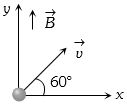
$A$ proton of mass $1.67 \times 10^{-27} \, kg$ and charge $1.6 \times 10^{-19} \, C$ is projected with a speed of $2 \times 10^6 \, m/s$ at an angle of $60^\circ$ to the $X$-axis. If a uniform magnetic field of $0.104 \, T$ is applied along the $Y$-axis,the path of the proton is:
A
$A$ circle of radius $0.2 \, m$ and time period $\pi \times 10^{-7} \, s$
B
$A$ circle of radius $0.1 \, m$ and time period $2\pi \times 10^{-7} \, s$
C
$A$ helix of radius $0.1 \, m$ and time period $2\pi \times 10^{-7} \, s$
D
$A$ helix of radius $0.2 \, m$ and time period $4\pi \times 10^{-7} \, s$
Solution
(C) The magnetic field $\vec{B}$ is along the $Y$-axis. The velocity $\vec{v}$ makes an angle of $60^\circ$ with the $X$-axis,so it makes an angle $\theta = 90^\circ - 60^\circ = 30^\circ$ with the $Y$-axis (the direction of $\vec{B}$).
Since the velocity has a component parallel to the magnetic field,the path of the proton is a helix.
The radius of the helix is given by $r = \frac{mv \sin \theta}{qB}$,where $\theta = 30^\circ$ is the angle between $\vec{v}$ and $\vec{B}$.
$r = \frac{1.67 \times 10^{-27} \times 2 \times 10^6 \times \sin 30^\circ}{1.6 \times 10^{-19} \times 0.104} = \frac{1.67 \times 10^{-21} \times 0.5}{1.664 \times 10^{-20}} \approx 0.1 \, m$.
The time period is $T = \frac{2\pi m}{qB} = \frac{2\pi \times 1.67 \times 10^{-27}}{1.6 \times 10^{-19} \times 0.104} \approx 2\pi \times 10^{-7} \, s$.
Since the velocity has a component parallel to the magnetic field,the path of the proton is a helix.
The radius of the helix is given by $r = \frac{mv \sin \theta}{qB}$,where $\theta = 30^\circ$ is the angle between $\vec{v}$ and $\vec{B}$.
$r = \frac{1.67 \times 10^{-27} \times 2 \times 10^6 \times \sin 30^\circ}{1.6 \times 10^{-19} \times 0.104} = \frac{1.67 \times 10^{-21} \times 0.5}{1.664 \times 10^{-20}} \approx 0.1 \, m$.
The time period is $T = \frac{2\pi m}{qB} = \frac{2\pi \times 1.67 \times 10^{-27}}{1.6 \times 10^{-19} \times 0.104} \approx 2\pi \times 10^{-7} \, s$.
0 likes
View Solution33
MediumMCQ
$A$ proton and a deuteron,both having the same kinetic energy,enter perpendicularly into a uniform magnetic field $B$. For the motion of the proton and deuteron on circular paths of radii ${R_p}$ and ${R_d}$ respectively,the correct statement is:
A
${R_d} = \sqrt{2} \,{R_p}$
B
${R_d} = {R_p}/\sqrt{2}$
C
${R_d} = {R_p}$
D
${R_d} = 2{R_p}$
Solution
(A) The magnetic force provides the necessary centripetal force for circular motion: $\frac{mv^2}{R} = qvB$,which simplifies to $R = \frac{mv}{qB}$.
Since the kinetic energy $E = \frac{1}{2}mv^2$,we have $mv = \sqrt{2mE}$.
Substituting this into the radius formula: $R = \frac{\sqrt{2mE}}{qB}$.
For a proton,${R_p} = \frac{\sqrt{2{m_p}E}}{{q_p}B}$. For a deuteron,${R_d} = \frac{\sqrt{2{m_d}E}}{{q_d}B}$.
Since a deuteron has the same charge as a proton $(q_d = q_p)$ and its mass is twice that of a proton $(m_d = 2{m_p})$,we get:
$\frac{{R_d}}{{R_p}} = \sqrt{\frac{m_d}{m_p}} = \sqrt{\frac{2{m_p}}{{m_p}}} = \sqrt{2}$.
Therefore,${R_d} = \sqrt{2} {R_p}$.
Since the kinetic energy $E = \frac{1}{2}mv^2$,we have $mv = \sqrt{2mE}$.
Substituting this into the radius formula: $R = \frac{\sqrt{2mE}}{qB}$.
For a proton,${R_p} = \frac{\sqrt{2{m_p}E}}{{q_p}B}$. For a deuteron,${R_d} = \frac{\sqrt{2{m_d}E}}{{q_d}B}$.
Since a deuteron has the same charge as a proton $(q_d = q_p)$ and its mass is twice that of a proton $(m_d = 2{m_p})$,we get:
$\frac{{R_d}}{{R_p}} = \sqrt{\frac{m_d}{m_p}} = \sqrt{\frac{2{m_p}}{{m_p}}} = \sqrt{2}$.
Therefore,${R_d} = \sqrt{2} {R_p}$.
0 likes
View Solution34
EasyMCQ
$A$ proton (or charged particle) moving with velocity $v$ is acted upon by an electric field $E$ and a magnetic field $B$. The proton will move undeflected if
A
$E$ is perpendicular to $B$
B
$E$ is parallel to $v$ and perpendicular to $B$
C
$E$,$B$,and $v$ are mutually perpendicular and $v = \frac{E}{B}$
D
$E$ and $B$ both are parallel to $v$
Solution
(C) The total force acting on a charged particle moving in both electric and magnetic fields is given by the Lorentz force equation: $\overrightarrow{F} = q(\overrightarrow{E} + \overrightarrow{v} \times \overrightarrow{B})$.
For the proton to move undeflected,the net force must be zero,meaning $\overrightarrow{F} = 0$.
This implies $q\overrightarrow{E} = -q(\overrightarrow{v} \times \overrightarrow{B})$,or $\overrightarrow{E} = -(\overrightarrow{v} \times \overrightarrow{B})$.
This condition is satisfied when $\overrightarrow{E}$,$\overrightarrow{B}$,and $\overrightarrow{v}$ are mutually perpendicular to each other.
In this configuration,the magnitude of the electric force $|F_e| = qE$ must equal the magnitude of the magnetic force $|F_m| = qvB$.
Therefore,$qE = qvB$,which simplifies to $v = \frac{E}{B}$.
For the proton to move undeflected,the net force must be zero,meaning $\overrightarrow{F} = 0$.
This implies $q\overrightarrow{E} = -q(\overrightarrow{v} \times \overrightarrow{B})$,or $\overrightarrow{E} = -(\overrightarrow{v} \times \overrightarrow{B})$.
This condition is satisfied when $\overrightarrow{E}$,$\overrightarrow{B}$,and $\overrightarrow{v}$ are mutually perpendicular to each other.
In this configuration,the magnitude of the electric force $|F_e| = qE$ must equal the magnitude of the magnetic force $|F_m| = qvB$.
Therefore,$qE = qvB$,which simplifies to $v = \frac{E}{B}$.
0 likes
View Solution35
EasyMCQ
$A$ proton and an electron both moving with the same velocity $v$ enter into a region of magnetic field directed perpendicular to the velocity of the particles. They will now move in circular orbits such that
A
Their time periods will be same
B
The time period for proton will be higher
C
The time period for electron will be higher
D
Their orbital radii will be same
Solution
(B) The time period $T$ of a charged particle moving in a uniform magnetic field $B$ is given by the formula $T = \frac{2\pi m}{qB}$.
Since the charge magnitude $q$ (for both proton and electron) and the magnetic field $B$ are the same,the time period is directly proportional to the mass of the particle,i.e.,$T \propto m$.
We know that the mass of a proton $(m_p)$ is significantly greater than the mass of an electron $(m_e)$,i.e.,$m_p > m_e$.
Therefore,the time period of the proton will be greater than the time period of the electron.
Since the charge magnitude $q$ (for both proton and electron) and the magnetic field $B$ are the same,the time period is directly proportional to the mass of the particle,i.e.,$T \propto m$.
We know that the mass of a proton $(m_p)$ is significantly greater than the mass of an electron $(m_e)$,i.e.,$m_p > m_e$.
Therefore,the time period of the proton will be greater than the time period of the electron.
0 likes
View Solution36
EasyMCQ
An electron is moving on a circular path of radius $r$ with speed $v$ in a transverse magnetic field $B$. The $e/m$ ratio for it will be:
A
$\frac{v}{Br}$
B
$\frac{B}{rv}$
C
$Bvr$
D
$\frac{vr}{B}$
Solution
(A) When a charged particle moves in a transverse magnetic field,the magnetic Lorentz force provides the necessary centripetal force for circular motion.
$F_m = F_c$
$evB = \frac{mv^2}{r}$
Rearranging the terms to solve for the specific charge $e/m$:
$eB = \frac{mv}{r}$
$\frac{e}{m} = \frac{v}{Br}$
Therefore,the correct option is $A$.
$F_m = F_c$
$evB = \frac{mv^2}{r}$
Rearranging the terms to solve for the specific charge $e/m$:
$eB = \frac{mv}{r}$
$\frac{e}{m} = \frac{v}{Br}$
Therefore,the correct option is $A$.
0 likes
View Solution37
MediumMCQ
$A$ beam of well-collimated cathode rays travelling with a speed of $5 \times 10^6 \, m/s$ enters a region of mutually perpendicular electric and magnetic fields and emerges undeviated from this region. If $|B| = 0.02 \, T$,the magnitude of the electric field is:
A
$10^5 \, V/m$
B
$2.5 \times 10^8 \, V/m$
C
$1.25 \times 10^{10} \, V/m$
D
$2 \times 10^3 \, V/m$
Solution
(A) When a charged particle moves through mutually perpendicular electric and magnetic fields without being deviated,the net Lorentz force acting on it is zero.
This implies that the electric force is equal in magnitude and opposite in direction to the magnetic force.
Mathematically,$F_e = F_m$.
Since $F_e = qE$ and $F_m = qvB$,we have $qE = qvB$.
Therefore,$E = vB$.
Given $v = 5 \times 10^6 \, m/s$ and $B = 0.02 \, T$.
Substituting these values,$E = (5 \times 10^6) \times 0.02 = 10^5 \, V/m$.
This implies that the electric force is equal in magnitude and opposite in direction to the magnetic force.
Mathematically,$F_e = F_m$.
Since $F_e = qE$ and $F_m = qvB$,we have $qE = qvB$.
Therefore,$E = vB$.
Given $v = 5 \times 10^6 \, m/s$ and $B = 0.02 \, T$.
Substituting these values,$E = (5 \times 10^6) \times 0.02 = 10^5 \, V/m$.
0 likes
View Solution38
MediumMCQ
An electron having charge $1.6 \times 10^{-19} \, C$ and mass $9 \times 10^{-31} \, kg$ is moving with $4 \times 10^6 \, m/s$ speed in a magnetic field of $2 \times 10^{-1} \, T$ in a circular orbit. The force acting on the electron and the radius of the circular orbit are:
A
$12.8 \times 10^{-13} \, N, 1.1 \times 10^{-4} \, m$
B
$1.28 \times 10^{-14} \, N, 1.1 \times 10^{-3} \, m$
C
$1.28 \times 10^{-13} \, N, 1.1 \times 10^{-3} \, m$
D
$1.28 \times 10^{-13} \, N, 1.1 \times 10^{-4} \, m$
Solution
(D) The magnetic force $F$ acting on a charged particle moving in a magnetic field is given by $F = qvB \sin \theta$. Since the electron moves in a circular orbit,$\theta = 90^\circ$,so $F = evB$.
$F = (1.6 \times 10^{-19} \, C) \times (4 \times 10^6 \, m/s) \times (2 \times 10^{-1} \, T) = 1.28 \times 10^{-13} \, N$.
The centripetal force required for circular motion is provided by the magnetic force: $\frac{mv^2}{r} = evB$.
Rearranging for the radius $r$,we get $r = \frac{mv}{eB}$.
$r = \frac{(9 \times 10^{-31} \, kg) \times (4 \times 10^6 \, m/s)}{(1.6 \times 10^{-19} \, C) \times (2 \times 10^{-1} \, T)} = \frac{36 \times 10^{-25}}{3.2 \times 10^{-20}} = 1.125 \times 10^{-4} \, m \approx 1.1 \times 10^{-4} \, m$.
$F = (1.6 \times 10^{-19} \, C) \times (4 \times 10^6 \, m/s) \times (2 \times 10^{-1} \, T) = 1.28 \times 10^{-13} \, N$.
The centripetal force required for circular motion is provided by the magnetic force: $\frac{mv^2}{r} = evB$.
Rearranging for the radius $r$,we get $r = \frac{mv}{eB}$.
$r = \frac{(9 \times 10^{-31} \, kg) \times (4 \times 10^6 \, m/s)}{(1.6 \times 10^{-19} \, C) \times (2 \times 10^{-1} \, T)} = \frac{36 \times 10^{-25}}{3.2 \times 10^{-20}} = 1.125 \times 10^{-4} \, m \approx 1.1 \times 10^{-4} \, m$.
0 likes
View Solution39
EasyMCQ
An electron enters a magnetic field whose direction is perpendicular to the velocity of the electron. Then
A
The speed of the electron will increase
B
The speed of the electron will decrease
C
The speed of the electron will remain the same
D
The velocity of the electron will remain the same
Solution
(C) When a charged particle enters a magnetic field with velocity $\vec{v}$,it experiences a magnetic Lorentz force given by $\vec{F} = q(\vec{v} \times \vec{B})$.
Since the force $\vec{F}$ is always perpendicular to the velocity $\vec{v}$,the work done by the magnetic force on the electron is $W = \int \vec{F} \cdot d\vec{s} = \int \vec{F} \cdot \vec{v} dt = 0$.
According to the work-energy theorem,the change in kinetic energy is equal to the work done. Since the work done is $0$,the kinetic energy remains constant.
Therefore,the speed of the electron remains the same,although its direction of motion changes.
Since the force $\vec{F}$ is always perpendicular to the velocity $\vec{v}$,the work done by the magnetic force on the electron is $W = \int \vec{F} \cdot d\vec{s} = \int \vec{F} \cdot \vec{v} dt = 0$.
According to the work-energy theorem,the change in kinetic energy is equal to the work done. Since the work done is $0$,the kinetic energy remains constant.
Therefore,the speed of the electron remains the same,although its direction of motion changes.
0 likes
View Solution40
EasyMCQ
An electron is moving in the north direction. It experiences a force in the vertically upward direction. The magnetic field at the position of the electron is in the direction of
A
East
B
West
C
North
D
South
Solution
(B) The force on a moving charge is given by the Lorentz force formula: $\vec{F} = q(\vec{v} \times \vec{B})$.
For an electron,the charge $q$ is negative $(-e)$.
Given: Velocity $\vec{v}$ is in the North direction,and Force $\vec{F}$ is in the vertically upward direction.
Using the right-hand rule for the cross product $\vec{v} \times \vec{B}$,if $\vec{v}$ is North and $\vec{F}$ (which is $-e(\vec{v} \times \vec{B})$) is Upward,then $(\vec{v} \times \vec{B})$ must be in the downward direction.
If we point our fingers in the North direction and curl them such that the thumb points downward,the fingers point towards the West.
Therefore,the magnetic field $\vec{B}$ is in the West direction.
For an electron,the charge $q$ is negative $(-e)$.
Given: Velocity $\vec{v}$ is in the North direction,and Force $\vec{F}$ is in the vertically upward direction.
Using the right-hand rule for the cross product $\vec{v} \times \vec{B}$,if $\vec{v}$ is North and $\vec{F}$ (which is $-e(\vec{v} \times \vec{B})$) is Upward,then $(\vec{v} \times \vec{B})$ must be in the downward direction.
If we point our fingers in the North direction and curl them such that the thumb points downward,the fingers point towards the West.
Therefore,the magnetic field $\vec{B}$ is in the West direction.
0 likes
View Solution41
EasyMCQ
$A$ current-carrying long solenoid is placed on the ground with its axis vertical. $A$ proton is falling along the axis of the solenoid with a velocity $v$. When the proton enters into the solenoid,it will
A
Be deflected from its path
B
Be accelerated along the same path
C
Be decelerated along the same path
D
Move along the same path with no change in velocity
Solution
(D) The magnetic field inside a long current-carrying solenoid is directed along its axis.
Since the proton is moving along the axis of the solenoid,its velocity vector $v$ is parallel to the magnetic field vector $B$.
The magnetic force $F$ on a charged particle is given by the Lorentz force formula: $F = q(v \times B)$.
Since $v$ and $B$ are parallel,the angle $\theta$ between them is $0^\circ$ or $180^\circ$.
Therefore,the magnetic force $F = qvB \sin(\theta) = qvB \sin(0^\circ) = 0$.
As there is no magnetic force acting on the proton,it will continue to move along the same path with no change in its velocity.
Since the proton is moving along the axis of the solenoid,its velocity vector $v$ is parallel to the magnetic field vector $B$.
The magnetic force $F$ on a charged particle is given by the Lorentz force formula: $F = q(v \times B)$.
Since $v$ and $B$ are parallel,the angle $\theta$ between them is $0^\circ$ or $180^\circ$.
Therefore,the magnetic force $F = qvB \sin(\theta) = qvB \sin(0^\circ) = 0$.
As there is no magnetic force acting on the proton,it will continue to move along the same path with no change in its velocity.
0 likes
View Solution42
EasyMCQ
$A$ charged particle of mass $m$ and charge $q$ describes circular motion of radius $r$ in a uniform magnetic field of strength $B$. The frequency of revolution is
A
$\frac{Bq}{2\pi m}$
B
$\frac{Bq}{2\pi rm}$
C
$\frac{2\pi m}{Bq}$
D
$\frac{Bm}{2\pi q}$
Solution
(A) When a charged particle moves in a uniform magnetic field $B$ perpendicular to its velocity,it experiences a magnetic Lorentz force which provides the necessary centripetal force for circular motion.
$F_m = F_c$
$qvB = \frac{mv^2}{r}$
$v = \frac{qBr}{m}$
The time period $T$ of revolution is the distance covered in one circle divided by the speed:
$T = \frac{2\pi r}{v} = \frac{2\pi r}{(qBr/m)} = \frac{2\pi m}{qB}$
The frequency of revolution $\nu$ is the reciprocal of the time period:
$\nu = \frac{1}{T} = \frac{qB}{2\pi m}$
$F_m = F_c$
$qvB = \frac{mv^2}{r}$
$v = \frac{qBr}{m}$
The time period $T$ of revolution is the distance covered in one circle divided by the speed:
$T = \frac{2\pi r}{v} = \frac{2\pi r}{(qBr/m)} = \frac{2\pi m}{qB}$
The frequency of revolution $\nu$ is the reciprocal of the time period:
$\nu = \frac{1}{T} = \frac{qB}{2\pi m}$
0 likes
View Solution43
MediumMCQ
An electron is accelerated by a potential difference of $12000\, V$. It then enters a uniform magnetic field of $10^{-3}\, T$ applied perpendicular to the path of the electron. Find the radius of the path. Given: mass of electron $m = 9 \times 10^{-31}\, kg$ and charge on electron $q = 1.6 \times 10^{-19}\, C$.
A
$36.7\, m$
B
$36.7\, cm$
C
$3.67\, m$
D
$3.67\, cm$
Solution
(B) The kinetic energy $K$ gained by an electron accelerated through a potential difference $V$ is given by $K = qV$.
The radius $r$ of the circular path of a charged particle in a uniform magnetic field $B$ is given by $r = \frac{mv}{qB}$.
Since $K = \frac{1}{2}mv^2$,we have $v = \sqrt{\frac{2K}{m}} = \sqrt{\frac{2qV}{m}}$.
Substituting $v$ into the radius formula: $r = \frac{m}{qB} \sqrt{\frac{2qV}{m}} = \frac{1}{B} \sqrt{\frac{2mV}{q}}$.
Given values: $V = 12000\, V$,$B = 10^{-3}\, T$,$m = 9 \times 10^{-31}\, kg$,$q = 1.6 \times 10^{-19}\, C$.
$r = \frac{1}{10^{-3}} \sqrt{\frac{2 \times 9 \times 10^{-31} \times 12000}{1.6 \times 10^{-19}}} = 10^3 \sqrt{\frac{216 \times 10^{-28}}{1.6 \times 10^{-19}}} = 10^3 \sqrt{135 \times 10^{-9}} = 10^3 \sqrt{1.35 \times 10^{-7}} \approx 0.367\, m$.
Therefore,$r = 36.7\, cm$.
The radius $r$ of the circular path of a charged particle in a uniform magnetic field $B$ is given by $r = \frac{mv}{qB}$.
Since $K = \frac{1}{2}mv^2$,we have $v = \sqrt{\frac{2K}{m}} = \sqrt{\frac{2qV}{m}}$.
Substituting $v$ into the radius formula: $r = \frac{m}{qB} \sqrt{\frac{2qV}{m}} = \frac{1}{B} \sqrt{\frac{2mV}{q}}$.
Given values: $V = 12000\, V$,$B = 10^{-3}\, T$,$m = 9 \times 10^{-31}\, kg$,$q = 1.6 \times 10^{-19}\, C$.
$r = \frac{1}{10^{-3}} \sqrt{\frac{2 \times 9 \times 10^{-31} \times 12000}{1.6 \times 10^{-19}}} = 10^3 \sqrt{\frac{216 \times 10^{-28}}{1.6 \times 10^{-19}}} = 10^3 \sqrt{135 \times 10^{-9}} = 10^3 \sqrt{1.35 \times 10^{-7}} \approx 0.367\, m$.
Therefore,$r = 36.7\, cm$.
0 likes
View Solution44
DifficultMCQ
The charge on a particle $Y$ is double the charge on particle $X$. These two particles $X$ and $Y$,after being accelerated through the same potential difference,enter a region of uniform magnetic field and describe circular paths of radii $R_1$ and $R_2$ respectively. The ratio of the mass of $X$ to that of $Y$ is
A
$(\frac{2R_1}{R_2})^2$
B
$(\frac{R_1}{2R_2})^2$
C
$\frac{R_1^2}{2R_2^2}$
D
$\frac{2R_1}{R_2}$
Solution
(C) The radius of a circular path of a charged particle accelerated through a potential difference $V$ in a magnetic field $B$ is given by $r = \frac{1}{B}\sqrt{\frac{2mV}{q}}$.
Since $B$ and $V$ are the same for both particles,we have $r \propto \sqrt{\frac{m}{q}}$.
Therefore,$\frac{R_1}{R_2} = \sqrt{\frac{m_X}{m_Y} \cdot \frac{q_Y}{q_X}}$.
Given that $q_Y = 2q_X$,we substitute this into the equation:
$\frac{R_1}{R_2} = \sqrt{\frac{m_X}{m_Y} \cdot \frac{2q_X}{q_X}} = \sqrt{\frac{m_X}{m_Y} \cdot 2}$.
Squaring both sides,we get $\frac{R_1^2}{R_2^2} = \frac{m_X}{m_Y} \cdot 2$.
Thus,the ratio of the mass of $X$ to that of $Y$ is $\frac{m_X}{m_Y} = \frac{R_1^2}{2R_2^2}$.
Since $B$ and $V$ are the same for both particles,we have $r \propto \sqrt{\frac{m}{q}}$.
Therefore,$\frac{R_1}{R_2} = \sqrt{\frac{m_X}{m_Y} \cdot \frac{q_Y}{q_X}}$.
Given that $q_Y = 2q_X$,we substitute this into the equation:
$\frac{R_1}{R_2} = \sqrt{\frac{m_X}{m_Y} \cdot \frac{2q_X}{q_X}} = \sqrt{\frac{m_X}{m_Y} \cdot 2}$.
Squaring both sides,we get $\frac{R_1^2}{R_2^2} = \frac{m_X}{m_Y} \cdot 2$.
Thus,the ratio of the mass of $X$ to that of $Y$ is $\frac{m_X}{m_Y} = \frac{R_1^2}{2R_2^2}$.
0 likes
View Solution45
MediumMCQ
$A$ particle with $10^{-11} \, C$ of charge and $10^{-7} \, kg$ mass is moving with a velocity of $10^8 \, m/s$ along the $y$-axis. $A$ uniform static magnetic field $B = 0.5 \, T$ is acting along the $x$-direction. The force on the particle is:
A
$5 \times 10^{-11} \, N$ along $\hat{i}$
B
$5 \times 10^3 \, N$ along $\hat{k}$
C
$5 \times 10^{-11} \, N$ along $-\hat{j}$
D
$5 \times 10^{-4} \, N$ along $-\hat{k}$
Solution
(D) The magnetic force on a moving charge is given by the Lorentz force formula: $\overrightarrow{F} = q(\overrightarrow{v} \times \overrightarrow{B})$.
Given: $q = 10^{-11} \, C$,$\overrightarrow{v} = 10^8 \hat{j} \, m/s$,and $\overrightarrow{B} = 0.5 \hat{i} \, T$.
Substituting these values into the formula:
$\overrightarrow{F} = 10^{-11} \times (10^8 \hat{j} \times 0.5 \hat{i})$
$\overrightarrow{F} = 10^{-11} \times 10^8 \times 0.5 \times (\hat{j} \times \hat{i})$
Since $\hat{j} \times \hat{i} = -\hat{k}$,we get:
$\overrightarrow{F} = 0.5 \times 10^{-3} \times (-\hat{k})$
$\overrightarrow{F} = 5 \times 10^{-4} \, N$ along $-\hat{k}$.
Given: $q = 10^{-11} \, C$,$\overrightarrow{v} = 10^8 \hat{j} \, m/s$,and $\overrightarrow{B} = 0.5 \hat{i} \, T$.
Substituting these values into the formula:
$\overrightarrow{F} = 10^{-11} \times (10^8 \hat{j} \times 0.5 \hat{i})$
$\overrightarrow{F} = 10^{-11} \times 10^8 \times 0.5 \times (\hat{j} \times \hat{i})$
Since $\hat{j} \times \hat{i} = -\hat{k}$,we get:
$\overrightarrow{F} = 0.5 \times 10^{-3} \times (-\hat{k})$
$\overrightarrow{F} = 5 \times 10^{-4} \, N$ along $-\hat{k}$.
0 likes
View Solution46
EasyMCQ
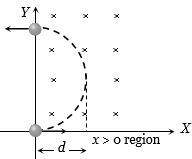
$A$ particle of charge $q$ and mass $m$ moving with a velocity $v$ along the $x$-axis enters the region $x > 0$ with a uniform magnetic field $B$ along the $\hat{k}$ direction. The particle will penetrate this region in the $x$-direction up to a distance $d$ equal to:
A
Zero
B
$\frac{mv}{qB}$
C
$\frac{2mv}{qB}$
D
Infinity
Solution
(B) When a charged particle enters a uniform magnetic field perpendicular to its velocity,it follows a circular path.
The magnetic force provides the necessary centripetal force: $qvB = \frac{mv^2}{r}$.
Solving for the radius $r$,we get $r = \frac{mv}{qB}$.
As shown in the figure,the particle enters at $x=0$ and moves in a semi-circular path before exiting the region $x > 0$. The maximum distance $d$ it penetrates into the region $x > 0$ is equal to the radius of this circular path.
Therefore,$d = r = \frac{mv}{qB}$.
The magnetic force provides the necessary centripetal force: $qvB = \frac{mv^2}{r}$.
Solving for the radius $r$,we get $r = \frac{mv}{qB}$.
As shown in the figure,the particle enters at $x=0$ and moves in a semi-circular path before exiting the region $x > 0$. The maximum distance $d$ it penetrates into the region $x > 0$ is equal to the radius of this circular path.
Therefore,$d = r = \frac{mv}{qB}$.
0 likes
View Solution47
EasyMCQ
$A$ charged particle is moving with velocity $v$ in a magnetic field of induction $B$. The force on the particle will be maximum when
A
$v$ and $B$ are in the same direction
B
$v$ and $B$ are in opposite directions
C
$v$ and $B$ are perpendicular
D
$v$ and $B$ are at an angle of $45^{\circ}$
Solution
(C) The magnetic Lorentz force acting on a charged particle moving with velocity $v$ in a magnetic field $B$ is given by the vector product: $F = q(v \times B)$.
The magnitude of this force is given by $F = qvB \sin \theta$,where $\theta$ is the angle between the velocity vector $v$ and the magnetic field vector $B$.
For the force $F$ to be maximum,the value of $\sin \theta$ must be maximum.
The maximum value of $\sin \theta$ is $1$,which occurs when $\theta = 90^{\circ}$.
Therefore,the force is maximum when the velocity $v$ and the magnetic field $B$ are perpendicular to each other.
The magnitude of this force is given by $F = qvB \sin \theta$,where $\theta$ is the angle between the velocity vector $v$ and the magnetic field vector $B$.
For the force $F$ to be maximum,the value of $\sin \theta$ must be maximum.
The maximum value of $\sin \theta$ is $1$,which occurs when $\theta = 90^{\circ}$.
Therefore,the force is maximum when the velocity $v$ and the magnetic field $B$ are perpendicular to each other.
0 likes
View Solution48
EasyMCQ
$A$ charged particle enters a magnetic field $B$ with its initial velocity making an angle of $45^\circ$ with $B$. The path of the particle will be
A
$A$ straight line
B
$A$ circle
C
An ellipse
D
$A$ helix
Solution
(D) When a charged particle enters a magnetic field $B$ at an angle $\theta$ (where $\theta \neq 0^\circ, 90^\circ, 180^\circ$),its velocity $v$ can be resolved into two components:
$1$. The component $v \cos \theta$ parallel to the magnetic field,which causes the particle to move in a straight line along the direction of the field.
$2$. The component $v \sin \theta$ perpendicular to the magnetic field,which causes the particle to move in a circular path.
Since the particle has both a parallel and a perpendicular velocity component,the resultant path is a helix. Given $\theta = 45^\circ$,the path is a helix.
$1$. The component $v \cos \theta$ parallel to the magnetic field,which causes the particle to move in a straight line along the direction of the field.
$2$. The component $v \sin \theta$ perpendicular to the magnetic field,which causes the particle to move in a circular path.
Since the particle has both a parallel and a perpendicular velocity component,the resultant path is a helix. Given $\theta = 45^\circ$,the path is a helix.
0 likes
View Solution49
EasyMCQ
An electron and a proton enter a magnetic field perpendicularly. Both have the same kinetic energy. Which of the following is true?
A
Trajectory of electron is less curved
B
Trajectory of proton is less curved
C
Both trajectories are equally curved
D
Both move on straight-line path
Solution
(B) The magnetic force acting on a charged particle moving perpendicularly to a magnetic field provides the centripetal force: $qvB = \frac{mv^2}{r}$.
Rearranging for the radius of the path,we get $r = \frac{mv}{qB}$.
Since kinetic energy $K = \frac{1}{2}mv^2$,we can write $mv = \sqrt{2mK}$.
Substituting this into the radius formula,we get $r = \frac{\sqrt{2mK}}{qB}$.
For the same kinetic energy $K$ and same charge magnitude $q$,the radius is proportional to the square root of the mass: $r \propto \sqrt{m}$.
Since the mass of a proton $(m_p)$ is much greater than the mass of an electron $(m_e)$,the radius of the proton's path $(r_p)$ will be greater than the radius of the electron's path $(r_e)$.
$A$ larger radius of curvature implies that the path is less curved. Therefore,the trajectory of the proton is less curved.
Rearranging for the radius of the path,we get $r = \frac{mv}{qB}$.
Since kinetic energy $K = \frac{1}{2}mv^2$,we can write $mv = \sqrt{2mK}$.
Substituting this into the radius formula,we get $r = \frac{\sqrt{2mK}}{qB}$.
For the same kinetic energy $K$ and same charge magnitude $q$,the radius is proportional to the square root of the mass: $r \propto \sqrt{m}$.
Since the mass of a proton $(m_p)$ is much greater than the mass of an electron $(m_e)$,the radius of the proton's path $(r_p)$ will be greater than the radius of the electron's path $(r_e)$.
$A$ larger radius of curvature implies that the path is less curved. Therefore,the trajectory of the proton is less curved.
0 likes
View SolutionMoving Charges and Magnetism — Motion of Charged Particle In Magnetic Field · Frequently Asked Questions
1Are these Moving Charges and Magnetism questions useful for JEE and NEET?
Yes. All questions in this section are mapped to JEE Main and NEET exam patterns. Previous year questions from JEE Main, NEET, GUJCET and state-level exams are included with full solutions.
2Can I switch to Hindi or Gujarati for these questions?
Yes. Use the language tabs in the hero section or the sidebar to view the same questions and solutions in English, Hindi or Gujarati.
3How do I generate a question paper from this subtopic?
Use the Vedclass Exam Paper Generator — select the chapter and subtopic, set difficulty, and generate Sets A, B, C, D automatically. First 3 chapters of every subject are free.
Vedclass Products
For Students
Vedclass Test Series
Mock tests in real JEE/NEET style with performance analysis. 5-day free trial.
Start Free TrialFor Teachers
Exam Paper Generator
Generate Set A/B/C/D papers from this chapter in 2 minutes. 3 chapters free.
Try FreeFor Institutes
Online Exam Module
Live online exams with unlimited students, 360° analytics & white-label branding.
See DemoFor Teachers & Institutes
Generate a Moving Charges and Magnetism Exam Paper in 2 Minutes
Select subtopic & difficulty — Sets A, B, C, D auto-generated with No Repeat logic.
First 3 chapters of every subject are free — no payment required.