
A English
The Moving Coil Galvanometer (Sensitivity) and Ammeter and Voltmeter Conversion Questions in English
Class 12 Physics · Moving Charges and Magnetism · The Moving Coil Galvanometer (Sensitivity) and Ammeter and Voltmeter Conversion
388+
Questions
English
Language
100%
With Solutions
Showing 50 of 388 questions in English
1
EasyMCQ
In a suspended-type moving coil galvanometer,a quartz suspension is used because:
A
It is a good conductor of electricity.
B
Elastic after-effects are negligible.
C
Young's modulus is greater.
D
There is no elastic limit.
Solution
(B) In a suspended-type moving coil galvanometer,the coil is suspended by a thin fiber.
Quartz is preferred for this suspension because it exhibits negligible elastic after-effects.
This means that when the coil returns to its original position after a deflection,the fiber does not retain any residual deformation,ensuring high accuracy and sensitivity in measurements.
Therefore,the correct option is $B$.
Quartz is preferred for this suspension because it exhibits negligible elastic after-effects.
This means that when the coil returns to its original position after a deflection,the fiber does not retain any residual deformation,ensuring high accuracy and sensitivity in measurements.
Therefore,the correct option is $B$.
0 likes
View Solution2
EasyMCQ
$A$ galvanometer can be converted into an ammeter by connecting:
A
Low resistance in series
B
High resistance in parallel
C
Low resistance in parallel
D
High resistance in series
Solution
(C) To convert a galvanometer into an ammeter,a low resistance,known as a shunt,must be connected in parallel with the galvanometer. This arrangement reduces the overall resistance of the device and allows the majority of the current to pass through the shunt,protecting the galvanometer coil from damage.
0 likes
View Solution3
EasyMCQ
$A$ current of $10^{-3} \ A$ is flowing through a resistance of $1000 \ \Omega$. To measure the correct potential difference across this resistance,a voltmeter must be used whose resistance should be:
A
$0 \ \Omega$
B
$500 \ \Omega$
C
$1000 \ \Omega$
D
$>> 1000 \ \Omega$
Solution
(D) To measure the potential difference across a component accurately,the voltmeter is connected in parallel with it.
If the voltmeter has a finite resistance,it draws some current from the circuit,which changes the potential difference being measured.
To minimize this error,the voltmeter must have a very high resistance compared to the resistance across which the potential difference is being measured.
An ideal voltmeter has an infinite resistance,so that it draws no current from the circuit.
Therefore,for a resistance of $1000 \ \Omega$,the voltmeter resistance should be much greater than $1000 \ \Omega$ (i.e.,$>> 1000 \ \Omega$).
If the voltmeter has a finite resistance,it draws some current from the circuit,which changes the potential difference being measured.
To minimize this error,the voltmeter must have a very high resistance compared to the resistance across which the potential difference is being measured.
An ideal voltmeter has an infinite resistance,so that it draws no current from the circuit.
Therefore,for a resistance of $1000 \ \Omega$,the voltmeter resistance should be much greater than $1000 \ \Omega$ (i.e.,$>> 1000 \ \Omega$).
0 likes
View Solution4
MediumMCQ
$A$ galvanometer of $100\,\Omega$ resistance gives full-scale deflection when $10\,mA$ of current is passed. To convert it into a $10\,A$ range ammeter,the resistance of the shunt required will be ............... $\Omega$.
A
$10$
B
$1$
C
$0.1$
D
$0.01$
Solution
(C) Given: Galvanometer resistance $G = 100\,\Omega$,full-scale deflection current $i_g = 10\,mA = 0.01\,A$,and desired range $i = 10\,A$.
To convert a galvanometer into an ammeter,a shunt resistance $S$ is connected in parallel.
The formula for shunt resistance is $S = \frac{i_g G}{i - i_g}$.
Substituting the values: $S = \frac{0.01 \times 100}{10 - 0.01} = \frac{1}{9.99} \approx 0.1\,\Omega$ (approximately).
Given the options,$0.1\,\Omega$ is the correct choice.
To convert a galvanometer into an ammeter,a shunt resistance $S$ is connected in parallel.
The formula for shunt resistance is $S = \frac{i_g G}{i - i_g}$.
Substituting the values: $S = \frac{0.01 \times 100}{10 - 0.01} = \frac{1}{9.99} \approx 0.1\,\Omega$ (approximately).
Given the options,$0.1\,\Omega$ is the correct choice.
0 likes
View Solution5
EasyMCQ
By ammeter,which of the following can be measured?
A
Electric potential
B
Potential difference
C
Current
D
Resistance
Solution
(C) An ammeter is an instrument used to measure the electric current flowing through a circuit.
It is always connected in series with the component through which the current is to be measured.
Therefore,the correct option is $C$.
It is always connected in series with the component through which the current is to be measured.
Therefore,the correct option is $C$.
0 likes
View Solution6
EasyMCQ
The resistance of a $1\, A$ ammeter is $0.018\,\Omega$. To convert it into a $10\, A$ ammeter,the shunt resistance required will be:
A
$0.18\,\Omega$
B
$0.0018\,\Omega$
C
$0.002\,\Omega$
D
$0.12\,\Omega$
Solution
(C) To convert a galvanometer (or ammeter) into a higher range ammeter,a shunt resistance $S$ is connected in parallel.
The formula for shunt resistance is given by $S = \frac{I_g G}{I - I_g}$,where:
$I_g = 1\, A$ (current capacity of the original ammeter)
$G = 0.018\,\Omega$ (resistance of the original ammeter)
$I = 10\, A$ (new range of the ammeter)
Substituting the values:
$S = \frac{1 \times 0.018}{10 - 1}$
$S = \frac{0.018}{9}$
$S = 0.002\,\Omega$
Therefore,the required shunt resistance is $0.002\,\Omega$.
The formula for shunt resistance is given by $S = \frac{I_g G}{I - I_g}$,where:
$I_g = 1\, A$ (current capacity of the original ammeter)
$G = 0.018\,\Omega$ (resistance of the original ammeter)
$I = 10\, A$ (new range of the ammeter)
Substituting the values:
$S = \frac{1 \times 0.018}{10 - 1}$
$S = \frac{0.018}{9}$
$S = 0.002\,\Omega$
Therefore,the required shunt resistance is $0.002\,\Omega$.
0 likes
View Solution7
EasyMCQ
In order to pass $10\,\%$ of the main current through a moving coil galvanometer of $99\,\Omega$,the resistance of the required shunt is ............ $\Omega$.
A
$9.9$
B
$10$
C
$11$
D
$9$
Solution
(C) Let the main current be $I$ and the galvanometer resistance be $G = 99\,\Omega$.
Given that the current through the galvanometer is $I_g = 10\,\% \text{ of } I = 0.1I$.
The current through the shunt resistance $S$ is $I_s = I - I_g = I - 0.1I = 0.9I$.
Since the galvanometer and shunt are in parallel,the potential difference across them is equal:
$I_g G = I_s S$
$0.1I \times 99 = 0.9I \times S$
$S = \frac{0.1 \times 99}{0.9} = \frac{9.9}{0.9} = 11\,\Omega$.
Therefore,the required shunt resistance is $11\,\Omega$.
Given that the current through the galvanometer is $I_g = 10\,\% \text{ of } I = 0.1I$.
The current through the shunt resistance $S$ is $I_s = I - I_g = I - 0.1I = 0.9I$.
Since the galvanometer and shunt are in parallel,the potential difference across them is equal:
$I_g G = I_s S$
$0.1I \times 99 = 0.9I \times S$
$S = \frac{0.1 \times 99}{0.9} = \frac{9.9}{0.9} = 11\,\Omega$.
Therefore,the required shunt resistance is $11\,\Omega$.
0 likes
View Solution8
EasyMCQ
An ammeter of $5\,\Omega$ resistance can read $5\,mA$. If it is to be used to read $100\,V$,how much resistance is to be connected in series? (in $\Omega$)
A
$19.9995$
B
$199.995$
C
$1999.95$
D
$19995$
Solution
(D) To convert a galvanometer (or ammeter) into a voltmeter,a high resistance $R$ must be connected in series with it.
Given:
Resistance of the device $G = 5\,\Omega$
Full-scale current $I_g = 5\,mA = 5 \times 10^{-3}\,A$
Required voltage range $V = 100\,V$
The formula for series resistance is $V = I_g(R + G)$.
Rearranging for $R$: $R = \frac{V}{I_g} - G$.
Substituting the values:
$R = \frac{100}{5 \times 10^{-3}} - 5$
$R = 20,000 - 5$
$R = 19,995\,\Omega$.
Given:
Resistance of the device $G = 5\,\Omega$
Full-scale current $I_g = 5\,mA = 5 \times 10^{-3}\,A$
Required voltage range $V = 100\,V$
The formula for series resistance is $V = I_g(R + G)$.
Rearranging for $R$: $R = \frac{V}{I_g} - G$.
Substituting the values:
$R = \frac{100}{5 \times 10^{-3}} - 5$
$R = 20,000 - 5$
$R = 19,995\,\Omega$.
0 likes
View Solution9
MediumMCQ
$100\,mA$ current gives a full scale deflection in a galvanometer of $2\,\Omega$ resistance. The resistance connected with the galvanometer to convert it into a voltmeter to measure $5\,V$ is ............... $\Omega$.
A
$98$
B
$52$
C
$50$
D
$48$
Solution
(D) To convert a galvanometer into a voltmeter,a high resistance $R$ is connected in series with it.
The formula for the series resistance is $R = \frac{V}{I_g} - G$.
Given:
Full scale current $I_g = 100\,mA = 100 \times 10^{-3}\,A = 0.1\,A$.
Galvanometer resistance $G = 2\,\Omega$.
Voltage to be measured $V = 5\,V$.
Substituting the values:
$R = \frac{5}{0.1} - 2$
$R = 50 - 2 = 48\,\Omega$.
Thus,a resistance of $48\,\Omega$ must be connected in series.
The formula for the series resistance is $R = \frac{V}{I_g} - G$.
Given:
Full scale current $I_g = 100\,mA = 100 \times 10^{-3}\,A = 0.1\,A$.
Galvanometer resistance $G = 2\,\Omega$.
Voltage to be measured $V = 5\,V$.
Substituting the values:
$R = \frac{5}{0.1} - 2$
$R = 50 - 2 = 48\,\Omega$.
Thus,a resistance of $48\,\Omega$ must be connected in series.
0 likes
View Solution10
MediumMCQ
When a $12\,\Omega$ resistor is connected in parallel with a moving coil galvanometer,its deflection reduces from $50$ divisions to $10$ divisions. The resistance of the galvanometer is ............. $\Omega$.
A
$24$
B
$36$
C
$48$
D
$60$
Solution
(C) The deflection of a galvanometer is directly proportional to the current passing through it,i.e.,$\theta \propto I$.
Initially,the current $I$ corresponds to $50$ divisions. When a shunt resistor $S = 12\,\Omega$ is connected in parallel,the current $I_g$ through the galvanometer corresponds to $10$ divisions.
Using the current divider rule for a galvanometer with resistance $G$ and shunt $S$:
$I_g = I \left( \frac{S}{S + G} \right)$
Given $\theta_1 = 50$ and $\theta_2 = 10$,we have $\frac{I_g}{I} = \frac{10}{50} = \frac{1}{5}$.
Substituting the values: $\frac{1}{5} = \frac{12}{12 + G}$.
$12 + G = 60$.
$G = 60 - 12 = 48\,\Omega$.
Therefore,the resistance of the galvanometer is $48\,\Omega$.
Initially,the current $I$ corresponds to $50$ divisions. When a shunt resistor $S = 12\,\Omega$ is connected in parallel,the current $I_g$ through the galvanometer corresponds to $10$ divisions.
Using the current divider rule for a galvanometer with resistance $G$ and shunt $S$:
$I_g = I \left( \frac{S}{S + G} \right)$
Given $\theta_1 = 50$ and $\theta_2 = 10$,we have $\frac{I_g}{I} = \frac{10}{50} = \frac{1}{5}$.
Substituting the values: $\frac{1}{5} = \frac{12}{12 + G}$.
$12 + G = 60$.
$G = 60 - 12 = 48\,\Omega$.
Therefore,the resistance of the galvanometer is $48\,\Omega$.
0 likes
View Solution11
MediumMCQ
$A$ galvanometer of $10 \,\Omega$ resistance gives full scale deflection with $0.01 \, A$ of current. It is to be converted into an ammeter for measuring $10 \, A$ current. The value of shunt resistance required will be
A
$\frac{10}{999} \,\Omega$
B
$0.1 \,\Omega$
C
$0.5 \,\Omega$
D
$1.0 \,\Omega$
Solution
(A) To convert a galvanometer into an ammeter,a shunt resistance $S$ is connected in parallel with the galvanometer.
Given:
Galvanometer resistance $G = 10 \,\Omega$
Full scale deflection current $I_g = 0.01 \, A$
Range of ammeter $I = 10 \, A$
The formula for shunt resistance is $S = \frac{I_g G}{I - I_g}$.
Substituting the values:
$S = \frac{0.01 \times 10}{10 - 0.01}$
$S = \frac{0.1}{9.99}$
$S = \frac{10}{999} \,\Omega$.
Given:
Galvanometer resistance $G = 10 \,\Omega$
Full scale deflection current $I_g = 0.01 \, A$
Range of ammeter $I = 10 \, A$
The formula for shunt resistance is $S = \frac{I_g G}{I - I_g}$.
Substituting the values:
$S = \frac{0.01 \times 10}{10 - 0.01}$
$S = \frac{0.1}{9.99}$
$S = \frac{10}{999} \,\Omega$.
0 likes
View Solution12
MediumMCQ
The resistance of a galvanometer is $90\, \Omega$. If only $10\%$ of the main current is to flow through the galvanometer,how should a resistor be connected and what should be its value?
A
$10\, \Omega$ in series
B
$10\, \Omega$ in parallel
C
$810\, \Omega$ in series
D
$810\, \Omega$ in parallel
Solution
(B) Let the main current be $I$ and the galvanometer resistance be $G = 90\, \Omega$.
Given that the current through the galvanometer $I_g = 10\% \text{ of } I = \frac{I}{10}$.
To allow only a fraction of the current to pass through the galvanometer,a shunt resistor $S$ must be connected in parallel with it.
The formula for the shunt resistance is $S = \frac{I_g \cdot G}{I - I_g}$.
Substituting the values: $S = \frac{(\frac{I}{10}) \cdot 90}{I - \frac{I}{10}} = \frac{9I}{0.9I} = \frac{90}{9} = 10\, \Omega$.
Thus,a resistor of $10\, \Omega$ should be connected in parallel.
Given that the current through the galvanometer $I_g = 10\% \text{ of } I = \frac{I}{10}$.
To allow only a fraction of the current to pass through the galvanometer,a shunt resistor $S$ must be connected in parallel with it.
The formula for the shunt resistance is $S = \frac{I_g \cdot G}{I - I_g}$.
Substituting the values: $S = \frac{(\frac{I}{10}) \cdot 90}{I - \frac{I}{10}} = \frac{9I}{0.9I} = \frac{90}{9} = 10\, \Omega$.
Thus,a resistor of $10\, \Omega$ should be connected in parallel.
0 likes
View Solution13
MediumMCQ
$A$ voltmeter has a resistance of $G \, \Omega$ and a range of $V \, \text{volts}$. The value of the resistance that must be connected in series to convert it into a voltmeter of range $nV \, \text{volts}$ is:
A
$nG$
B
$(n - 1)G$
C
$\frac{G}{n}$
D
$\frac{G}{n - 1}$
Solution
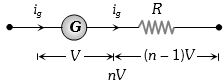
(B) Let the resistance $R$ be connected in series with the voltmeter as shown in the diagram.
The initial range of the voltmeter is $V = i_g G$, where $i_g$ is the full-scale deflection current.
To increase the range to $V' = nV$, we connect a resistance $R$ in series.
The new total voltage is $V' = i_g(G + R)$.
Substituting $V' = nV$ and $i_g = \frac{V}{G}$:
$nV = \frac{V}{G}(G + R)$
$n = \frac{G + R}{G}$
$n = 1 + \frac{R}{G}$
$\frac{R}{G} = n - 1$
$R = (n - 1)G$
The initial range of the voltmeter is $V = i_g G$, where $i_g$ is the full-scale deflection current.
To increase the range to $V' = nV$, we connect a resistance $R$ in series.
The new total voltage is $V' = i_g(G + R)$.
Substituting $V' = nV$ and $i_g = \frac{V}{G}$:
$nV = \frac{V}{G}(G + R)$
$n = \frac{G + R}{G}$
$n = 1 + \frac{R}{G}$
$\frac{R}{G} = n - 1$
$R = (n - 1)G$
0 likes
View Solution14
EasyMCQ
Which of the following statements is wrong?
A
Voltmeter should have high resistance
B
Ammeter should have low resistance
C
Ammeter is placed in parallel across the conductor in a circuit
D
Voltmeter is placed in parallel across the conductor in a circuit
Solution
(C) An ammeter is a device used to measure the current flowing through a circuit. To measure the total current,it must be connected in series with the circuit component. If it were connected in parallel,it would create a short circuit due to its very low resistance,potentially damaging the device. Therefore,statement $C$ is incorrect because an ammeter is always connected in series,not in parallel.
0 likes
View Solution15
MediumMCQ
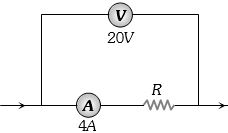
In the diagram shown,the reading of the voltmeter is $20\, V$ and that of the ammeter is $4\, A$. The value of $R$ should be (Consider the given ammeter and voltmeter are not ideal).
A
Equal to $5\,\Omega $
B
Greater than $5\,\Omega $
C
Less than $5\,\Omega $
D
Greater or less than $5\,\Omega $ depends on the material of $R$
Solution
(C) The voltmeter is connected in parallel to the combination of the ammeter and the resistor $R$.
Let the resistance of the ammeter be $r_A$.
Since the ammeter and resistor $R$ are in series,the total resistance of this branch is $(R + r_A)$.
The voltage across this branch is given by the voltmeter reading,$V = 20\, V$.
The current flowing through this branch is given by the ammeter reading,$I = 4\, A$.
According to Ohm's law,$V = I(R + r_A)$.
Substituting the given values,$20 = 4(R + r_A)$.
Dividing by $4$,we get $R + r_A = 5\,\Omega$.
Since the ammeter is not ideal,it must have some finite positive resistance,$r_A > 0$.
Therefore,$R = 5 - r_A$.
Since $r_A > 0$,it follows that $R < 5\,\Omega$.
Let the resistance of the ammeter be $r_A$.
Since the ammeter and resistor $R$ are in series,the total resistance of this branch is $(R + r_A)$.
The voltage across this branch is given by the voltmeter reading,$V = 20\, V$.
The current flowing through this branch is given by the ammeter reading,$I = 4\, A$.
According to Ohm's law,$V = I(R + r_A)$.
Substituting the given values,$20 = 4(R + r_A)$.
Dividing by $4$,we get $R + r_A = 5\,\Omega$.
Since the ammeter is not ideal,it must have some finite positive resistance,$r_A > 0$.
Therefore,$R = 5 - r_A$.
Since $r_A > 0$,it follows that $R < 5\,\Omega$.
0 likes
View Solution16
MediumMCQ
$A$ moving coil galvanometer has a resistance of $50\,\Omega$ and gives full-scale deflection for $10\,mA$. How could it be converted into an ammeter with a full-scale deflection for $1\,A$?
A
$50/99\,\Omega$ in series
B
$50/99\,\Omega$ in parallel
C
$0.01\,\Omega$ in series
D
$0.01\,\Omega$ in parallel
Solution
(B) To convert a galvanometer into an ammeter,a shunt resistance $S$ must be connected in parallel with the galvanometer.
Given: Galvanometer resistance $G = 50\,\Omega$,full-scale current $i_g = 10\,mA = 10 \times 10^{-3}\,A$,and desired range $i = 1\,A$.
The formula for shunt resistance is $S = \frac{i_g \times G}{i - i_g}$.
Substituting the values: $S = \frac{10 \times 10^{-3} \times 50}{1 - 10 \times 10^{-3}} = \frac{0.5}{1 - 0.01} = \frac{0.5}{0.99} = \frac{50}{99}\,\Omega$.
Therefore,a resistance of $50/99\,\Omega$ must be connected in parallel.
Given: Galvanometer resistance $G = 50\,\Omega$,full-scale current $i_g = 10\,mA = 10 \times 10^{-3}\,A$,and desired range $i = 1\,A$.
The formula for shunt resistance is $S = \frac{i_g \times G}{i - i_g}$.
Substituting the values: $S = \frac{10 \times 10^{-3} \times 50}{1 - 10 \times 10^{-3}} = \frac{0.5}{1 - 0.01} = \frac{0.5}{0.99} = \frac{50}{99}\,\Omega$.
Therefore,a resistance of $50/99\,\Omega$ must be connected in parallel.
0 likes
View Solution17
MediumMCQ
The current flowing through a coil of resistance $900 \, \Omega$ is to be reduced by $90 \, \%$. What value of shunt should be connected across the coil in $\Omega$?
A
$90$
B
$100$
C
$9$
D
$10$
Solution
(B) Let the initial current be $i$. The current through the coil $i_g$ is to be reduced by $90 \, \%$, so $i_g = i - 0.9i = 0.1i = \frac{i}{10}$.
Here, the ratio $n = \frac{i}{i_g} = 10$.
The resistance of the coil is $G = 900 \, \Omega$.
The formula for the shunt resistance $S$ required to reduce the current is $S = \frac{G}{n - 1}$.
Substituting the values, $S = \frac{900}{10 - 1} = \frac{900}{9} = 100 \, \Omega$.
Here, the ratio $n = \frac{i}{i_g} = 10$.
The resistance of the coil is $G = 900 \, \Omega$.
The formula for the shunt resistance $S$ required to reduce the current is $S = \frac{G}{n - 1}$.
Substituting the values, $S = \frac{900}{10 - 1} = \frac{900}{9} = 100 \, \Omega$.
0 likes
View Solution18
EasyMCQ
$A$ galvanometer of resistance $25\,\Omega$ gives full-scale deflection for a current of $10\,mA$. It is to be converted into a voltmeter of range $100\,V$ by connecting a resistance $R$ in series with the galvanometer. The value of resistance $R$ in $\Omega$ is:
A
$10000$
B
$10025$
C
$975$
D
$9975$
Solution
(D) To convert a galvanometer into a voltmeter,a high resistance $R$ is connected in series with the galvanometer.
The formula for the series resistance is given by $R = \frac{V}{I_g} - G$,where:
$V = 100\,V$ (desired range of the voltmeter)
$I_g = 10\,mA = 10 \times 10^{-3}\,A = 0.01\,A$ (current for full-scale deflection)
$G = 25\,\Omega$ (resistance of the galvanometer)
Substituting the values:
$R = \frac{100}{0.01} - 25$
$R = 10000 - 25$
$R = 9975\,\Omega$
Therefore,the correct option is $D$.
The formula for the series resistance is given by $R = \frac{V}{I_g} - G$,where:
$V = 100\,V$ (desired range of the voltmeter)
$I_g = 10\,mA = 10 \times 10^{-3}\,A = 0.01\,A$ (current for full-scale deflection)
$G = 25\,\Omega$ (resistance of the galvanometer)
Substituting the values:
$R = \frac{100}{0.01} - 25$
$R = 10000 - 25$
$R = 9975\,\Omega$
Therefore,the correct option is $D$.
0 likes
View Solution19
MediumMCQ
The resistance of a galvanometer is $25\,\Omega$ and it requires $50\,\mu A$ for full-scale deflection. The value of the shunt resistance required to convert it into an ammeter of $5\,A$ range is:
A
$2.5 \times 10^{-4}\,\Omega$
B
$1.25 \times 10^{-3}\,\Omega$
C
$0.05\,\Omega$
D
$2.5\,\Omega$
Solution
(A) Given:
Galvanometer resistance,$G = 25\,\Omega$
Full-scale deflection current,$i_g = 50\,\mu A = 50 \times 10^{-6}\,A = 5 \times 10^{-5}\,A$
Required range of ammeter,$i = 5\,A$
The formula for shunt resistance $S$ is given by:
$S = \frac{G \cdot i_g}{i - i_g}$
Since $i_g$ is very small compared to $i$,we can approximate $i - i_g \approx i$ or use the exact formula:
$S = \frac{25 \times 5 \times 10^{-5}}{5 - 5 \times 10^{-5}}$
$S = \frac{125 \times 10^{-5}}{4.99995} \approx \frac{125 \times 10^{-5}}{5} = 25 \times 10^{-5} = 2.5 \times 10^{-4}\,\Omega$
Galvanometer resistance,$G = 25\,\Omega$
Full-scale deflection current,$i_g = 50\,\mu A = 50 \times 10^{-6}\,A = 5 \times 10^{-5}\,A$
Required range of ammeter,$i = 5\,A$
The formula for shunt resistance $S$ is given by:
$S = \frac{G \cdot i_g}{i - i_g}$
Since $i_g$ is very small compared to $i$,we can approximate $i - i_g \approx i$ or use the exact formula:
$S = \frac{25 \times 5 \times 10^{-5}}{5 - 5 \times 10^{-5}}$
$S = \frac{125 \times 10^{-5}}{4.99995} \approx \frac{125 \times 10^{-5}}{5} = 25 \times 10^{-5} = 2.5 \times 10^{-4}\,\Omega$
1 likes
View Solution20
DifficultMCQ
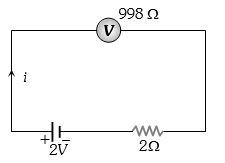
$A$ voltmeter having a resistance of $998 \, \Omega$ is connected to a cell of $e.m.f.$ $2 \, V$ and internal resistance $2 \, \Omega$. The error in the measurement of $e.m.f.$ will be
A
$4 \times 10^{-1} \, V$
B
$2 \times 10^{-3} \, V$
C
$4 \times 10^{-3} \, V$
D
$2 \times 10^{-1} \, V$
Solution
(C) The error in measurement is given by the difference between the actual $e.m.f.$ and the measured terminal voltage.
Actual $e.m.f.$ $(E)$ = $2 \, V$.
The circuit consists of the cell (with internal resistance $r = 2 \, \Omega$) and the voltmeter (with resistance $R = 998 \, \Omega$) in series.
The current $(i)$ in the circuit is given by $i = \frac{E}{R + r} = \frac{2}{998 + 2} = \frac{2}{1000} = \frac{1}{500} \, A$.
The measured voltage $(V)$ across the voltmeter is the terminal voltage of the cell, given by $V = E - ir$.
Substituting the values: $V = 2 - (\frac{1}{500} \times 2) = 2 - \frac{2}{500} = 2 - 0.004 = 1.996 \, V$.
The error in measurement = $E - V = 2 - 1.996 = 0.004 \, V = 4 \times 10^{-3} \, V$.
Actual $e.m.f.$ $(E)$ = $2 \, V$.
The circuit consists of the cell (with internal resistance $r = 2 \, \Omega$) and the voltmeter (with resistance $R = 998 \, \Omega$) in series.
The current $(i)$ in the circuit is given by $i = \frac{E}{R + r} = \frac{2}{998 + 2} = \frac{2}{1000} = \frac{1}{500} \, A$.
The measured voltage $(V)$ across the voltmeter is the terminal voltage of the cell, given by $V = E - ir$.
Substituting the values: $V = 2 - (\frac{1}{500} \times 2) = 2 - \frac{2}{500} = 2 - 0.004 = 1.996 \, V$.
The error in measurement = $E - V = 2 - 1.996 = 0.004 \, V = 4 \times 10^{-3} \, V$.
0 likes
View Solution21
EasyMCQ
Which of the following statements is correct?
A
Ammeter has low resistance and is connected in series.
B
Ammeter has low resistance and is connected in parallel.
C
Voltmeter has low resistance and is connected in parallel.
D
None of the above.
Solution
(A) An ammeter is used to measure the electric current flowing through a circuit.
To measure current accurately without significantly altering the circuit's behavior,an ammeter must have a very low resistance.
Furthermore,to measure the current passing through a component,the ammeter must be connected in series with that component.
Therefore,the correct statement is that an ammeter has low resistance and is connected in series.
To measure current accurately without significantly altering the circuit's behavior,an ammeter must have a very low resistance.
Furthermore,to measure the current passing through a component,the ammeter must be connected in series with that component.
Therefore,the correct statement is that an ammeter has low resistance and is connected in series.
0 likes
View Solution22
EasyMCQ
An ammeter with internal resistance $90\,\Omega$ reads $1.85\,A$ when connected in a circuit containing a battery and two resistors $700\,\Omega$ and $410\,\Omega$ in series. The actual current in the circuit (without the ammeter) will be:
A
$1.85\,A$
B
Greater than $1.85\,A$
C
Less than $1.85\,A$
D
None of these
Solution
(B) Let the electromotive force $(EMF)$ of the battery be $E$.
When the ammeter is connected in series,the total resistance of the circuit is $R_{total} = R_1 + R_2 + R_A = 700\,\Omega + 410\,\Omega + 90\,\Omega = 1200\,\Omega$.
The current measured by the ammeter is $I_{measured} = E / R_{total} = 1.85\,A$.
Therefore,$E = 1.85\,A \times 1200\,\Omega = 2220\,V$.
When the ammeter is removed,the actual resistance of the circuit is $R_{actual} = R_1 + R_2 = 700\,\Omega + 410\,\Omega = 1110\,\Omega$.
The actual current is $I_{actual} = E / R_{actual} = 2220\,V / 1110\,\Omega = 2.0\,A$.
Since $2.0\,A > 1.85\,A$,the actual current is greater than the measured current.
When the ammeter is connected in series,the total resistance of the circuit is $R_{total} = R_1 + R_2 + R_A = 700\,\Omega + 410\,\Omega + 90\,\Omega = 1200\,\Omega$.
The current measured by the ammeter is $I_{measured} = E / R_{total} = 1.85\,A$.
Therefore,$E = 1.85\,A \times 1200\,\Omega = 2220\,V$.
When the ammeter is removed,the actual resistance of the circuit is $R_{actual} = R_1 + R_2 = 700\,\Omega + 410\,\Omega = 1110\,\Omega$.
The actual current is $I_{actual} = E / R_{actual} = 2220\,V / 1110\,\Omega = 2.0\,A$.
Since $2.0\,A > 1.85\,A$,the actual current is greater than the measured current.
0 likes
View Solution23
MediumMCQ
The resistance of a galvanometer is $50\,\Omega$ and the current required to give full-scale deflection is $100\,\mu A$. In order to convert it into an ammeter reading up to $10\,A$,it is necessary to put a resistance of
A
$5 \times 10^{-3}\,\Omega$ in parallel
B
$5 \times 10^{-4}\,\Omega$ in parallel
C
$10^5\,\Omega$ in series
D
$99,950\,\Omega$ in series
Solution
(B) To convert a galvanometer into an ammeter,a shunt resistance $S$ must be connected in parallel with the galvanometer.
Given:
Galvanometer resistance $G = 50\,\Omega$
Full-scale deflection current $i_g = 100\,\mu A = 100 \times 10^{-6}\,A = 10^{-4}\,A$
Desired range of ammeter $i = 10\,A$
The formula for shunt resistance is $S = \frac{G \cdot i_g}{i - i_g}$.
Substituting the values:
$S = \frac{50 \times 10^{-4}}{10 - 10^{-4}}$
Since $10^{-4}$ is very small compared to $10$,we can approximate the denominator as $10$.
$S \approx \frac{50 \times 10^{-4}}{10} = 5 \times 10^{-4}\,\Omega$.
Thus,a resistance of $5 \times 10^{-4}\,\Omega$ must be connected in parallel.
Given:
Galvanometer resistance $G = 50\,\Omega$
Full-scale deflection current $i_g = 100\,\mu A = 100 \times 10^{-6}\,A = 10^{-4}\,A$
Desired range of ammeter $i = 10\,A$
The formula for shunt resistance is $S = \frac{G \cdot i_g}{i - i_g}$.
Substituting the values:
$S = \frac{50 \times 10^{-4}}{10 - 10^{-4}}$
Since $10^{-4}$ is very small compared to $10$,we can approximate the denominator as $10$.
$S \approx \frac{50 \times 10^{-4}}{10} = 5 \times 10^{-4}\,\Omega$.
Thus,a resistance of $5 \times 10^{-4}\,\Omega$ must be connected in parallel.
0 likes
View Solution24
MediumMCQ
If only $2\%$ of the main current is to be passed through a galvanometer of resistance $G$,then the resistance of the shunt will be
A
$\frac{G}{50}$
B
$\frac{G}{49}$
C
$50\,G$
D
$49\,G$
Solution
(B) Let the main current be $I$ and the current through the galvanometer be $I_g$.
Given that $I_g = 2\%$ of $I$,so $I_g = \frac{2}{100} I = \frac{I}{50}$.
Let $S$ be the shunt resistance connected in parallel to the galvanometer of resistance $G$.
The formula for the current through the galvanometer is $I_g = I \left( \frac{S}{S + G} \right)$.
Substituting the values: $\frac{I}{50} = I \left( \frac{S}{S + G} \right)$.
$\frac{1}{50} = \frac{S}{S + G} \Rightarrow S + G = 50S$.
$G = 49S \Rightarrow S = \frac{G}{49}$.
Given that $I_g = 2\%$ of $I$,so $I_g = \frac{2}{100} I = \frac{I}{50}$.
Let $S$ be the shunt resistance connected in parallel to the galvanometer of resistance $G$.
The formula for the current through the galvanometer is $I_g = I \left( \frac{S}{S + G} \right)$.
Substituting the values: $\frac{I}{50} = I \left( \frac{S}{S + G} \right)$.
$\frac{1}{50} = \frac{S}{S + G} \Rightarrow S + G = 50S$.
$G = 49S \Rightarrow S = \frac{G}{49}$.
0 likes
View Solution25
EasyMCQ
The net resistance of a voltmeter should be large to ensure that
A
It does not get overheated
B
It does not draw excessive current
C
It can measure large potential difference
D
It does not appreciably change the potential difference to be measured
Solution
(D) The resistance of a voltmeter is kept very high so that it draws negligible current from the circuit when connected in parallel across a component.
If the voltmeter had low resistance,it would draw a significant amount of current,which would alter the potential difference across the component being measured due to the internal resistance of the source or other circuit elements.
Therefore,a high resistance ensures that the measurement does not appreciably change the potential difference across the component.
If the voltmeter had low resistance,it would draw a significant amount of current,which would alter the potential difference across the component being measured due to the internal resistance of the source or other circuit elements.
Therefore,a high resistance ensures that the measurement does not appreciably change the potential difference across the component.
0 likes
View Solution26
MediumMCQ
$A$ galvanometer has a resistance of $7\,\Omega$ and gives a full-scale deflection for a current of $1.0\,A$. How will you convert it into a voltmeter of range $10\,V$?
A
$3\,\Omega$ in series
B
$3\,\Omega$ in parallel
C
$17\,\Omega$ in series
D
$30\,\Omega$ in series
Solution
(A) To convert a galvanometer into a voltmeter,a high resistance $R$ must be connected in series with the galvanometer.
Given:
Galvanometer resistance $G = 7\,\Omega$
Full-scale deflection current $i_g = 1.0\,A$
Desired voltage range $V = 10\,V$
The formula for the series resistance $R$ is:
$R = \frac{V}{i_g} - G$
Substituting the values:
$R = \frac{10}{1.0} - 7 = 10 - 7 = 3\,\Omega$
Therefore,a resistance of $3\,\Omega$ must be connected in series with the galvanometer.
Given:
Galvanometer resistance $G = 7\,\Omega$
Full-scale deflection current $i_g = 1.0\,A$
Desired voltage range $V = 10\,V$
The formula for the series resistance $R$ is:
$R = \frac{V}{i_g} - G$
Substituting the values:
$R = \frac{10}{1.0} - 7 = 10 - 7 = 3\,\Omega$
Therefore,a resistance of $3\,\Omega$ must be connected in series with the galvanometer.
0 likes
View Solution27
MediumMCQ
$A$ galvanometer having a resistance of $9 \, \Omega$ is shunted by a wire of resistance $2 \, \Omega$. If the total current is $1 \, A$, the part of it passing through the shunt will be ............ $A$.
A
$0.25$
B
$0.8$
C
$0.2$
D
$0.5$
Solution
(B) Let $G = 9 \, \Omega$ be the resistance of the galvanometer and $S = 2 \, \Omega$ be the resistance of the shunt.
Let $I = 1 \, A$ be the total current.
Let $I_s$ be the current passing through the shunt and $I_g$ be the current passing through the galvanometer.
According to the principle of parallel circuits, the voltage across the galvanometer and the shunt is the same: $V = I_g G = I_s S$.
Since $I = I_g + I_s$, we have $I_g = I - I_s$.
Substituting this into the voltage equation: $(I - I_s) G = I_s S$.
Rearranging to solve for $I_s$: $I G - I_s G = I_s S \implies I G = I_s (S + G)$.
Therefore, $I_s = I \times \frac{G}{S + G}$.
Substituting the given values: $I_s = 1 \times \frac{9}{2 + 9} = \frac{9}{11} \approx 0.818 \, A$.
Rounding to the nearest provided option, the current through the shunt is approximately $0.8 \, A$.
Let $I = 1 \, A$ be the total current.
Let $I_s$ be the current passing through the shunt and $I_g$ be the current passing through the galvanometer.
According to the principle of parallel circuits, the voltage across the galvanometer and the shunt is the same: $V = I_g G = I_s S$.
Since $I = I_g + I_s$, we have $I_g = I - I_s$.
Substituting this into the voltage equation: $(I - I_s) G = I_s S$.
Rearranging to solve for $I_s$: $I G - I_s G = I_s S \implies I G = I_s (S + G)$.
Therefore, $I_s = I \times \frac{G}{S + G}$.
Substituting the given values: $I_s = 1 \times \frac{9}{2 + 9} = \frac{9}{11} \approx 0.818 \, A$.
Rounding to the nearest provided option, the current through the shunt is approximately $0.8 \, A$.
0 likes
View Solution28
MediumMCQ
An ammeter whose resistance is $180\,\Omega$ gives full scale deflection when the current is $2\,mA$. The shunt required to convert it into an ammeter reading $20\,mA$ (in $\Omega$) is
A
$18$
B
$20$
C
$0.1$
D
$10$
Solution
(B) Given: Galvanometer resistance $G = 180\,\Omega$,full-scale deflection current $i_g = 2\,mA$,and the desired range $i = 20\,mA$.
To convert a galvanometer into an ammeter,a shunt resistance $S$ is connected in parallel.
The formula for the shunt resistance is given by $S = \frac{i_g G}{i - i_g}$.
Substituting the values: $S = \frac{2\,mA \times 180\,\Omega}{20\,mA - 2\,mA}$.
$S = \frac{2 \times 180}{18} = \frac{360}{18} = 20\,\Omega$.
Therefore,the required shunt resistance is $20\,\Omega$.
To convert a galvanometer into an ammeter,a shunt resistance $S$ is connected in parallel.
The formula for the shunt resistance is given by $S = \frac{i_g G}{i - i_g}$.
Substituting the values: $S = \frac{2\,mA \times 180\,\Omega}{20\,mA - 2\,mA}$.
$S = \frac{2 \times 180}{18} = \frac{360}{18} = 20\,\Omega$.
Therefore,the required shunt resistance is $20\,\Omega$.
0 likes
View Solution29
MediumMCQ
$A$ galvanometer whose resistance is $120 \, \Omega$ gives full-scale deflection with a current of $0.05 \, A$. To enable it to read a maximum current of $10 \, A$,a shunt resistance is added in parallel with it. The resistance of the ammeter so formed is .............. $\Omega$.
A
$0.06$
B
$0.006$
C
$0.6$
D
$6$
Solution
(C) The resistance of the galvanometer is $G = 120 \, \Omega$ and the full-scale deflection current is $i_g = 0.05 \, A$.
The maximum current to be measured is $i = 10 \, A$.
The shunt resistance $S$ is connected in parallel to the galvanometer.
The resistance of the resulting ammeter $R_A$ is given by the parallel combination of $G$ and $S$: $R_A = \frac{G \cdot S}{G + S}$.
From the principle of shunting,the voltage across the galvanometer and shunt is equal: $i_g \cdot G = (i - i_g) \cdot S$.
Thus,$S = \frac{i_g \cdot G}{i - i_g} = \frac{0.05 \times 120}{10 - 0.05} = \frac{6}{9.95} \approx 0.603 \, \Omega$.
Alternatively,the equivalent resistance $R_A$ is simply the voltage across the parallel combination divided by the total current: $R_A = \frac{V}{i} = \frac{i_g \cdot G}{i} = \frac{0.05 \times 120}{10} = \frac{6}{10} = 0.6 \, \Omega$.
The maximum current to be measured is $i = 10 \, A$.
The shunt resistance $S$ is connected in parallel to the galvanometer.
The resistance of the resulting ammeter $R_A$ is given by the parallel combination of $G$ and $S$: $R_A = \frac{G \cdot S}{G + S}$.
From the principle of shunting,the voltage across the galvanometer and shunt is equal: $i_g \cdot G = (i - i_g) \cdot S$.
Thus,$S = \frac{i_g \cdot G}{i - i_g} = \frac{0.05 \times 120}{10 - 0.05} = \frac{6}{9.95} \approx 0.603 \, \Omega$.
Alternatively,the equivalent resistance $R_A$ is simply the voltage across the parallel combination divided by the total current: $R_A = \frac{V}{i} = \frac{i_g \cdot G}{i} = \frac{0.05 \times 120}{10} = \frac{6}{10} = 0.6 \, \Omega$.
0 likes
View Solution30
MediumMCQ
$A$ voltmeter of resistance $1000\,\Omega$ gives full scale deflection when a current of $100\,mA$ flows through it. The shunt resistance required across it to enable it to be used as an ammeter reading $1\,A$ at full scale deflection is ............... $\Omega$.
A
$10000$
B
$9000$
C
$222$
D
$111$
Solution
(D) Given: Resistance of the device $G = 1000\,\Omega$,full-scale current $I_g = 100\,mA = 0.1\,A$,and the desired range $I = 1\,A$.
To convert a galvanometer (or voltmeter) into an ammeter,a shunt resistance $S$ is connected in parallel.
The formula for shunt resistance is $S = \frac{I_g \cdot G}{I - I_g}$.
Substituting the values: $S = \frac{0.1 \times 1000}{1 - 0.1}$.
$S = \frac{100}{0.9} = \frac{1000}{9} \approx 111.11\,\Omega$.
Rounding to the nearest integer,we get $111\,\Omega$.
To convert a galvanometer (or voltmeter) into an ammeter,a shunt resistance $S$ is connected in parallel.
The formula for shunt resistance is $S = \frac{I_g \cdot G}{I - I_g}$.
Substituting the values: $S = \frac{0.1 \times 1000}{1 - 0.1}$.
$S = \frac{100}{0.9} = \frac{1000}{9} \approx 111.11\,\Omega$.
Rounding to the nearest integer,we get $111\,\Omega$.
0 likes
View Solution31
MediumMCQ
We have a galvanometer of resistance $25\,\Omega$. It is shunted by a $2.5\,\Omega$ wire. The part of the total current that flows through the galvanometer is given as:
A
$\frac{I_g}{I} = \frac{1}{11}$
B
$\frac{I_g}{I} = \frac{1}{10}$
C
$\frac{I_g}{I} = \frac{3}{11}$
D
$\frac{I_g}{I} = \frac{4}{11}$
Solution
(A) Let $G$ be the resistance of the galvanometer and $S$ be the shunt resistance.
Given: $G = 25\,\Omega$ and $S = 2.5\,\Omega$.
Let $I$ be the total current and $I_g$ be the current flowing through the galvanometer.
According to the current divider rule,the current through the galvanometer is given by:
$I_g = I \times \frac{S}{G + S}$
Therefore,the ratio of the current through the galvanometer to the total current is:
$\frac{I_g}{I} = \frac{S}{G + S}$
Substituting the given values:
$\frac{I_g}{I} = \frac{2.5}{25 + 2.5} = \frac{2.5}{27.5}$
$\frac{I_g}{I} = \frac{25}{275} = \frac{1}{11}$
Given: $G = 25\,\Omega$ and $S = 2.5\,\Omega$.
Let $I$ be the total current and $I_g$ be the current flowing through the galvanometer.
According to the current divider rule,the current through the galvanometer is given by:
$I_g = I \times \frac{S}{G + S}$
Therefore,the ratio of the current through the galvanometer to the total current is:
$\frac{I_g}{I} = \frac{S}{G + S}$
Substituting the given values:
$\frac{I_g}{I} = \frac{2.5}{25 + 2.5} = \frac{2.5}{27.5}$
$\frac{I_g}{I} = \frac{25}{275} = \frac{1}{11}$
0 likes
View Solution32
MediumMCQ
$A$ voltmeter has a resistance of $2000 \, \Omega$ and it can measure up to $2 \, V$. If we want to increase its range to $10 \, V$, then the required resistance in series will be ........... $\Omega$.
A
$2000$
B
$4000$
C
$6000$
D
$8000$
Solution
(D) Given: Resistance of the voltmeter $G = 2000 \, \Omega$, initial range $V_g = 2 \, V$, and desired range $V = 10 \, V$.
To convert a voltmeter to a higher range, a resistance $R$ is connected in series with the voltmeter.
The formula for the series resistance is $R = G \left( \frac{V}{V_g} - 1 \right)$.
Substituting the values: $R = 2000 \left( \frac{10}{2} - 1 \right)$.
$R = 2000 (5 - 1) = 2000 \times 4 = 8000 \, \Omega$.
Therefore, the required resistance is $8000 \, \Omega$.
To convert a voltmeter to a higher range, a resistance $R$ is connected in series with the voltmeter.
The formula for the series resistance is $R = G \left( \frac{V}{V_g} - 1 \right)$.
Substituting the values: $R = 2000 \left( \frac{10}{2} - 1 \right)$.
$R = 2000 (5 - 1) = 2000 \times 4 = 8000 \, \Omega$.
Therefore, the required resistance is $8000 \, \Omega$.
0 likes
View Solution33
MediumMCQ
The resistance of a galvanometer coil is $R$. What is the shunt resistance required to convert it into an ammeter of range $4$ times?
A
$\frac{R}{5}$
B
$\frac{R}{4}$
C
$\frac{R}{3}$
D
$4R$
Solution
(C) Let the full-scale deflection current of the galvanometer be $i_g$ and its resistance be $R$.
To convert the galvanometer into an ammeter of range $n$ times the original range,the required shunt resistance $S$ is given by the formula:
$S = \frac{R}{n-1}$
Here,the range is $4$ times the original range,so $n = 4$.
Substituting the value of $n$ into the formula:
$S = \frac{R}{4-1} = \frac{R}{3}$.
Therefore,the required shunt resistance is $\frac{R}{3}$.
To convert the galvanometer into an ammeter of range $n$ times the original range,the required shunt resistance $S$ is given by the formula:
$S = \frac{R}{n-1}$
Here,the range is $4$ times the original range,so $n = 4$.
Substituting the value of $n$ into the formula:
$S = \frac{R}{4-1} = \frac{R}{3}$.
Therefore,the required shunt resistance is $\frac{R}{3}$.
0 likes
View Solution34
EasyMCQ
If an ammeter is connected in parallel to a circuit,it is likely to be damaged due to excess
A
Current
B
Voltage
C
Resistance
D
All of these
Solution
(A) An ammeter is designed to have a very low resistance so that it can measure current without significantly altering the circuit.
When an ammeter is connected in parallel to a circuit element,the effective resistance of that branch becomes extremely low.
According to Ohm's law,$I = V/R$,a very low resistance leads to a very high current flow through the ammeter.
This excessive current exceeds the rated capacity of the ammeter,which is likely to cause damage to the device.
When an ammeter is connected in parallel to a circuit element,the effective resistance of that branch becomes extremely low.
According to Ohm's law,$I = V/R$,a very low resistance leads to a very high current flow through the ammeter.
This excessive current exceeds the rated capacity of the ammeter,which is likely to cause damage to the device.
0 likes
View Solution35
MediumMCQ
$A$ galvanometer with a resistance of $12 \,\Omega$ gives full-scale deflection when a current of $3 \, mA$ is passed. It is required to convert it into a voltmeter which can read up to $18 \, V$. The resistance to be connected is ............... $\Omega$.
A
$6000$
B
$5988$
C
$5000$
D
$4988$
Solution
(B) To convert a galvanometer into a voltmeter,a high resistance $R$ must be connected in series with the galvanometer.
The formula for the series resistance is given by $R = \frac{V}{I_g} - G$,where $V$ is the maximum voltage to be measured,$I_g$ is the full-scale deflection current,and $G$ is the galvanometer resistance.
Given: $V = 18 \, V$,$I_g = 3 \, mA = 3 \times 10^{-3} \, A$,and $G = 12 \, \Omega$.
Substituting the values: $R = \frac{18}{3 \times 10^{-3}} - 12$.
$R = 6000 - 12 = 5988 \, \Omega$.
Thus,a resistance of $5988 \, \Omega$ must be connected in series.
The formula for the series resistance is given by $R = \frac{V}{I_g} - G$,where $V$ is the maximum voltage to be measured,$I_g$ is the full-scale deflection current,and $G$ is the galvanometer resistance.
Given: $V = 18 \, V$,$I_g = 3 \, mA = 3 \times 10^{-3} \, A$,and $G = 12 \, \Omega$.
Substituting the values: $R = \frac{18}{3 \times 10^{-3}} - 12$.
$R = 6000 - 12 = 5988 \, \Omega$.
Thus,a resistance of $5988 \, \Omega$ must be connected in series.
0 likes
View Solution36
EasyMCQ
The resistance of an ideal ammeter is
A
Infinite
B
Very high
C
Small
D
Zero
Solution
(D) An ammeter is a device connected in series to a circuit to measure the current flowing through it.
If an ammeter has significant resistance,it increases the total equivalent resistance of the circuit,which in turn reduces the current being measured,leading to an error.
In practice,no conductor has zero resistance,but practical ammeters are designed to have very low resistance to minimize this error.
For an ideal or perfect ammeter,the resistance must be $0 \ \Omega$ so that the measuring instrument does not alter the circuit's characteristics or the current it is intended to measure.
If an ammeter has significant resistance,it increases the total equivalent resistance of the circuit,which in turn reduces the current being measured,leading to an error.
In practice,no conductor has zero resistance,but practical ammeters are designed to have very low resistance to minimize this error.
For an ideal or perfect ammeter,the resistance must be $0 \ \Omega$ so that the measuring instrument does not alter the circuit's characteristics or the current it is intended to measure.
0 likes
View Solution37
MediumMCQ
$A$ galvanometer of $25 \,\Omega$ resistance can read a maximum current of $6 \,mA$. It can be used as a voltmeter to measure a maximum of $6 \,V$ by connecting a resistance to the galvanometer. Identify the correct choice in the given answers.
A
$1025 \,\Omega$ in series
B
$1025 \,\Omega$ in parallel
C
$975 \,\Omega$ in series
D
$975 \,\Omega$ in parallel
Solution
(C) To convert a galvanometer into a voltmeter,a high resistance $R$ must be connected in series with the galvanometer.
Given: Galvanometer resistance $G = 25 \,\Omega$,full-scale deflection current $i_g = 6 \,mA = 6 \times 10^{-3} \,A$,and maximum voltage to be measured $V = 6 \,V$.
The formula for the series resistance $R$ is given by $R = \frac{V}{i_g} - G$.
Substituting the values: $R = \frac{6}{6 \times 10^{-3}} - 25$.
$R = 1000 - 25 = 975 \,\Omega$.
Thus,a resistance of $975 \,\Omega$ must be connected in series.
Given: Galvanometer resistance $G = 25 \,\Omega$,full-scale deflection current $i_g = 6 \,mA = 6 \times 10^{-3} \,A$,and maximum voltage to be measured $V = 6 \,V$.
The formula for the series resistance $R$ is given by $R = \frac{V}{i_g} - G$.
Substituting the values: $R = \frac{6}{6 \times 10^{-3}} - 25$.
$R = 1000 - 25 = 975 \,\Omega$.
Thus,a resistance of $975 \,\Omega$ must be connected in series.
0 likes
View Solution38
MediumMCQ
$A$ galvanometer has a resistance of $25 \, \Omega$ and a maximum of $0.01 \, A$ current can be passed through it. In order to change it into an ammeter of range $10 \, A$, the shunt resistance required is
A
$5/999 \, \Omega$
B
$10/999 \, \Omega$
C
$20/999 \, \Omega$
D
$25/999 \, \Omega$
Solution
(D) The formula for the shunt resistance $S$ required to convert a galvanometer of resistance $G$ into an ammeter of range $I$ is given by $S = \frac{I_g G}{I - I_g}$, where $I_g$ is the maximum current the galvanometer can measure.
Given values are $G = 25 \, \Omega$, $I_g = 0.01 \, A$, and $I = 10 \, A$.
Substituting these values into the formula:
$S = \frac{0.01 \times 25}{10 - 0.01}$
$S = \frac{0.25}{9.99}$
$S = \frac{25}{999} \, \Omega$.
Thus, the required shunt resistance is $25/999 \, \Omega$.
Given values are $G = 25 \, \Omega$, $I_g = 0.01 \, A$, and $I = 10 \, A$.
Substituting these values into the formula:
$S = \frac{0.01 \times 25}{10 - 0.01}$
$S = \frac{0.25}{9.99}$
$S = \frac{25}{999} \, \Omega$.
Thus, the required shunt resistance is $25/999 \, \Omega$.
0 likes
View Solution39
MediumMCQ
$A$ galvanometer has $30$ divisions and a sensitivity of $16\,\mu A/\text{div}$. It can be converted into a voltmeter to read $3\,V$ by connecting:
A
Resistance nearly $6\,k\Omega$ in series
B
$6\,k\Omega$ in parallel
C
$500\,\Omega$ in series
D
It cannot be converted
Solution
(A) The full-scale deflection current $i_g$ of the galvanometer is given by:
$i_g = \text{number of divisions} \times \text{sensitivity}$
$i_g = 30 \times 16 \times 10^{-6} \, A = 480 \times 10^{-6} \, A = 4.8 \times 10^{-4} \, A$
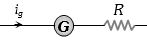
To convert a galvanometer into a voltmeter,a high resistance $R$ is connected in series with it.
The formula for the total resistance is:
$V = i_g(R + G)$
Assuming the internal resistance $G$ of the galvanometer is negligible compared to the high series resistance $R$ (or considering $R+G \approx R$):
$R \approx \frac{V}{i_g} = \frac{3}{4.8 \times 10^{-4}} = \frac{30000}{4.8} = 6250 \, \Omega = 6.25 \, k\Omega$
Thus,a resistance of nearly $6 \, k\Omega$ connected in series is required.
$i_g = \text{number of divisions} \times \text{sensitivity}$
$i_g = 30 \times 16 \times 10^{-6} \, A = 480 \times 10^{-6} \, A = 4.8 \times 10^{-4} \, A$
To convert a galvanometer into a voltmeter,a high resistance $R$ is connected in series with it.
The formula for the total resistance is:
$V = i_g(R + G)$
Assuming the internal resistance $G$ of the galvanometer is negligible compared to the high series resistance $R$ (or considering $R+G \approx R$):
$R \approx \frac{V}{i_g} = \frac{3}{4.8 \times 10^{-4}} = \frac{30000}{4.8} = 6250 \, \Omega = 6.25 \, k\Omega$
Thus,a resistance of nearly $6 \, k\Omega$ connected in series is required.
0 likes
View Solution40
DifficultMCQ
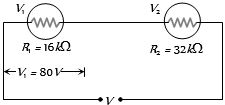
Voltmeters $V_1$ and $V_2$ are connected in series across a $D.C.$ line. $V_1$ reads $80 \, V$ and has a resistance per volt of $200 \, \Omega/V$. $V_2$ has a total resistance of $32 \, k\Omega$. The line voltage is ............. (in $V$)
A
$120$
B
$160$
C
$220$
D
$240$
Solution
(D) The resistance of voltmeter $V_1$ is $R_1 = 80 \, V \times 200 \, \Omega/V = 16000 \, \Omega = 16 \, k\Omega$.
Since the voltmeters are connected in series, the current $I$ flowing through both is the same.
$I = \frac{V_1}{R_1} = \frac{80 \, V}{16 \times 10^3 \, \Omega} = 5 \times 10^{-3} \, A$.
The potential difference across $V_2$ is $V_2 = I \times R_2 = (5 \times 10^{-3} \, A) \times (32 \times 10^3 \, \Omega) = 160 \, V$.
The total line voltage $V$ is the sum of the potential differences across the series components:
$V = V_1 + V_2 = 80 \, V + 160 \, V = 240 \, V$.
Since the voltmeters are connected in series, the current $I$ flowing through both is the same.
$I = \frac{V_1}{R_1} = \frac{80 \, V}{16 \times 10^3 \, \Omega} = 5 \times 10^{-3} \, A$.
The potential difference across $V_2$ is $V_2 = I \times R_2 = (5 \times 10^{-3} \, A) \times (32 \times 10^3 \, \Omega) = 160 \, V$.
The total line voltage $V$ is the sum of the potential differences across the series components:
$V = V_1 + V_2 = 80 \, V + 160 \, V = 240 \, V$.
0 likes
View Solution41
MediumMCQ
An ammeter gives full-scale deflection when a current of $2 \, A$ flows through it. The resistance of the ammeter is $12 \, \Omega$. If the same ammeter is to be used for measuring a maximum current of $5 \, A$,then the ammeter must be connected with a resistance of:
A
$8 \, \Omega$ in series
B
$18 \, \Omega$ in series
C
$8 \, \Omega$ in parallel
D
$18 \, \Omega$ in parallel
Solution
(C) To convert an ammeter (or galvanometer) to measure a higher current range,a shunt resistance $S$ must be connected in parallel with it.
Given:
Full-scale current of ammeter,$I_g = 2 \, A$
Resistance of ammeter,$G = 12 \, \Omega$
Maximum current to be measured,$I = 5 \, A$
The formula for shunt resistance is given by:
$S = \frac{I_g \cdot G}{I - I_g}$
Substituting the values:
$S = \frac{2 \cdot 12}{5 - 2}$
$S = \frac{24}{3} = 8 \, \Omega$
Therefore,a resistance of $8 \, \Omega$ must be connected in parallel.
Given:
Full-scale current of ammeter,$I_g = 2 \, A$
Resistance of ammeter,$G = 12 \, \Omega$
Maximum current to be measured,$I = 5 \, A$
The formula for shunt resistance is given by:
$S = \frac{I_g \cdot G}{I - I_g}$
Substituting the values:
$S = \frac{2 \cdot 12}{5 - 2}$
$S = \frac{24}{3} = 8 \, \Omega$
Therefore,a resistance of $8 \, \Omega$ must be connected in parallel.
0 likes
View Solution42
MediumMCQ
In a circuit,$5$ percent of the total current passes through a galvanometer. If the resistance of the galvanometer is $G$,then the value of the shunt is:
A
$19\, G$
B
$20\, G$
C
$\frac{G}{20}$
D
$\frac{G}{19}$
Solution
(D) Let the total current in the circuit be $I$ and the current through the galvanometer be $I_g$.
Given that $I_g = 5\% \text{ of } I = \frac{5}{100} I = \frac{1}{20} I$.
The formula for the current through a galvanometer in parallel with a shunt resistance $S$ is given by $I_g = I \left( \frac{S}{G + S} \right)$.
Substituting the values: $\frac{1}{20} I = I \left( \frac{S}{G + S} \right)$.
$\frac{1}{20} = \frac{S}{G + S}$.
$G + S = 20S$.
$G = 19S$.
Therefore,$S = \frac{G}{19}$.
Given that $I_g = 5\% \text{ of } I = \frac{5}{100} I = \frac{1}{20} I$.
The formula for the current through a galvanometer in parallel with a shunt resistance $S$ is given by $I_g = I \left( \frac{S}{G + S} \right)$.
Substituting the values: $\frac{1}{20} I = I \left( \frac{S}{G + S} \right)$.
$\frac{1}{20} = \frac{S}{G + S}$.
$G + S = 20S$.
$G = 19S$.
Therefore,$S = \frac{G}{19}$.
0 likes
View Solution43
MediumMCQ
$A$ voltmeter having a resistance of $50 \times 10^3 \, \Omega$ is used to measure the voltage in a circuit. To increase the range of measurement $3$ times,the additional series resistance required is:
A
$10^5 \, \Omega$
B
$150 \, k\Omega$
C
$900 \, k\Omega$
D
$9 \times 10^6 \, \Omega$
Solution
(A) The resistance of the voltmeter is given as $G = 50 \times 10^3 \, \Omega$.
To increase the range of a voltmeter by a factor of $n$,we connect a resistance $R$ in series with the voltmeter.
The formula for the required series resistance is $R = G(n - 1)$.
Here,the range is to be increased $3$ times,so $n = 3$.
Substituting the values: $R = (50 \times 10^3 \, \Omega) \times (3 - 1)$.
$R = 50 \times 10^3 \times 2 = 100 \times 10^3 \, \Omega = 10^5 \, \Omega$.
To increase the range of a voltmeter by a factor of $n$,we connect a resistance $R$ in series with the voltmeter.
The formula for the required series resistance is $R = G(n - 1)$.
Here,the range is to be increased $3$ times,so $n = 3$.
Substituting the values: $R = (50 \times 10^3 \, \Omega) \times (3 - 1)$.
$R = 50 \times 10^3 \times 2 = 100 \times 10^3 \, \Omega = 10^5 \, \Omega$.
0 likes
View Solution44
MediumMCQ
$A$ milliammeter of range $10 \, mA$ has a coil of resistance $1 \, \Omega$. To use it as a voltmeter of range $10 \, V$,the resistance that must be connected in series with it will be ............. $\Omega$.
A
$999$
B
$99$
C
$1000$
D
None of these
Solution
(A) To convert a milliammeter into a voltmeter,a high resistance $R$ must be connected in series with the coil.
Given:
Range of milliammeter $(I_g)$ = $10 \, mA = 10 \times 10^{-3} \, A = 0.01 \, A$.
Resistance of the coil $(G)$ = $1 \, \Omega$.
Required range of voltmeter $(V)$ = $10 \, V$.
The formula for the series resistance $R$ is given by:
$R = \frac{V}{I_g} - G$
Substituting the values:
$R = \frac{10}{0.01} - 1$
$R = 1000 - 1 = 999 \, \Omega$.
Therefore,a resistance of $999 \, \Omega$ must be connected in series.
Given:
Range of milliammeter $(I_g)$ = $10 \, mA = 10 \times 10^{-3} \, A = 0.01 \, A$.
Resistance of the coil $(G)$ = $1 \, \Omega$.
Required range of voltmeter $(V)$ = $10 \, V$.
The formula for the series resistance $R$ is given by:
$R = \frac{V}{I_g} - G$
Substituting the values:
$R = \frac{10}{0.01} - 1$
$R = 1000 - 1 = 999 \, \Omega$.
Therefore,a resistance of $999 \, \Omega$ must be connected in series.
0 likes
View Solution45
DifficultMCQ
$A$ voltmeter has a range $0-V$ with a series resistance $R$. With a series resistance $2R$,the range is $0-V'$. The correct relation between $V$ and $V'$ is
A
$V' = 2V$
B
$V' > 2V$
C
$V' >> 2V$
D
$V' < 2V$
Solution
(D) For a galvanometer with resistance $G$ to be converted into a voltmeter,a resistance $R$ is connected in series. The full-scale deflection current $i_g$ remains constant.
For the first case: $i_g = \frac{V}{R + G}$
For the second case: $i_g = \frac{V'}{2R + G}$
Equating the two expressions for $i_g$: $\frac{V}{R + G} = \frac{V'}{2R + G}$
Rearranging for $V'$: $V' = V \times \frac{2R + G}{R + G}$
$V' = V \times \frac{2(R + G) - G}{R + G} = V \times \left( 2 - \frac{G}{R + G} \right)$
$V' = 2V - \frac{VG}{R + G}$
Since $\frac{VG}{R + G} > 0$,it follows that $V' < 2V$.
For the first case: $i_g = \frac{V}{R + G}$
For the second case: $i_g = \frac{V'}{2R + G}$
Equating the two expressions for $i_g$: $\frac{V}{R + G} = \frac{V'}{2R + G}$
Rearranging for $V'$: $V' = V \times \frac{2R + G}{R + G}$
$V' = V \times \frac{2(R + G) - G}{R + G} = V \times \left( 2 - \frac{G}{R + G} \right)$
$V' = 2V - \frac{VG}{R + G}$
Since $\frac{VG}{R + G} > 0$,it follows that $V' < 2V$.
0 likes
View Solution46
MediumMCQ
$A$ $36 \,\Omega$ galvanometer is shunted by a resistance of $4 \,\Omega$. The percentage of the total current that passes through the galvanometer is (in $\%$)
A
$8$
B
$9$
C
$10$
D
$91$
Solution
(C) Let $G$ be the resistance of the galvanometer and $S$ be the shunt resistance.
Given: $G = 36 \,\Omega$ and $S = 4 \,\Omega$.
The current $i_g$ passing through the galvanometer is related to the total current $i$ by the formula:
$i_g = i \left( \frac{S}{G + S} \right)$
Substituting the given values:
$\frac{i_g}{i} = \frac{4}{36 + 4} = \frac{4}{40} = \frac{1}{10}$
To find the percentage,multiply by $100$:
$\text{Percentage} = \frac{1}{10} \times 100 = 10\%$.
Thus,$10\%$ of the total current passes through the galvanometer.
Given: $G = 36 \,\Omega$ and $S = 4 \,\Omega$.
The current $i_g$ passing through the galvanometer is related to the total current $i$ by the formula:
$i_g = i \left( \frac{S}{G + S} \right)$
Substituting the given values:
$\frac{i_g}{i} = \frac{4}{36 + 4} = \frac{4}{40} = \frac{1}{10}$
To find the percentage,multiply by $100$:
$\text{Percentage} = \frac{1}{10} \times 100 = 10\%$.
Thus,$10\%$ of the total current passes through the galvanometer.
0 likes
View Solution47
MediumMCQ
$A$ galvanometer of resistance $20 \,\Omega$ is to be converted into an ammeter of range $1 \, A$. If a current of $1 \, mA$ produces full scale deflection,the shunt required for the purpose is ................ $\Omega $.
A
$0.01$
B
$0.05$
C
$0.02$
D
$0.04$
Solution
(C) The resistance of the galvanometer is $G = 20 \,\Omega$.
The full-scale deflection current is $I_g = 1 \, mA = 10^{-3} \, A$.
The desired range of the ammeter is $I = 1 \, A$.
To convert a galvanometer into an ammeter,a shunt resistance $S$ is connected in parallel with the galvanometer.
The formula for the shunt resistance is $S = \frac{I_g \cdot G}{I - I_g}$.
Substituting the values: $S = \frac{10^{-3} \times 20}{1 - 10^{-3}} = \frac{0.02}{0.999} \approx 0.02 \,\Omega$.
The full-scale deflection current is $I_g = 1 \, mA = 10^{-3} \, A$.
The desired range of the ammeter is $I = 1 \, A$.
To convert a galvanometer into an ammeter,a shunt resistance $S$ is connected in parallel with the galvanometer.
The formula for the shunt resistance is $S = \frac{I_g \cdot G}{I - I_g}$.
Substituting the values: $S = \frac{10^{-3} \times 20}{1 - 10^{-3}} = \frac{0.02}{0.999} \approx 0.02 \,\Omega$.
0 likes
View Solution48
MediumMCQ
There are three voltmeters of the same range but of resistances $10000\,\Omega$,$8000\,\Omega$,and $4000\,\Omega$ respectively. The best voltmeter among these is the one whose resistance is ................ $\Omega$.
A
$10000$
B
$8000$
C
$4000$
D
All are equally good
Solution
(A) voltmeter is used to measure the potential difference between two points in a circuit.
To ensure that the voltmeter does not draw significant current from the circuit and does not alter the potential difference being measured,it must have a very high resistance.
An ideal voltmeter has infinite resistance.
Therefore,among the given options,the voltmeter with the highest resistance,which is $10000\,\Omega$,is the best.
To ensure that the voltmeter does not draw significant current from the circuit and does not alter the potential difference being measured,it must have a very high resistance.
An ideal voltmeter has infinite resistance.
Therefore,among the given options,the voltmeter with the highest resistance,which is $10000\,\Omega$,is the best.
0 likes
View Solution49
EasyMCQ
If an ammeter is to be used in place of a voltmeter,then we must connect with the ammeter a
A
Low resistance in parallel
B
High resistance in parallel
C
High resistance in series
D
Low resistance in series
Solution
(C) An ammeter is designed to have a very low resistance so that it can measure current without significantly altering the circuit. $A$ voltmeter is designed to have a very high resistance to ensure it draws negligible current from the circuit.
If an ammeter is connected in parallel (as a voltmeter is),the low resistance of the ammeter would cause a very large current to flow through it,potentially damaging the device.
To convert an ammeter into a voltmeter,we must increase its total resistance to a very high value. This is achieved by connecting a high resistance in series with the ammeter.
If an ammeter is connected in parallel (as a voltmeter is),the low resistance of the ammeter would cause a very large current to flow through it,potentially damaging the device.
To convert an ammeter into a voltmeter,we must increase its total resistance to a very high value. This is achieved by connecting a high resistance in series with the ammeter.
0 likes
View Solution50
MediumMCQ
To convert a $800\, mV$ range millivoltmeter of resistance $40\,\Omega$ into an ammeter of $100\, mA$ range,the resistance to be connected as a shunt is .............. $\Omega$.
A
$10$
B
$20$
C
$30$
D
$40$
Solution
(A) The millivoltmeter has a full-scale deflection voltage $V_g = 800\, mV = 0.8\, V$ and internal resistance $G = 40\,\Omega$.
To convert this into an ammeter of range $I = 100\, mA = 0.1\, A$,we connect a shunt resistance $S$ in parallel.
The current through the galvanometer is $I_g = \frac{V_g}{G} = \frac{0.8}{40} = 0.02\, A$.
The current through the shunt is $I_s = I - I_g = 0.1 - 0.02 = 0.08\, A$.
Since the shunt is in parallel with the galvanometer,the voltage across them is equal: $I_g \times G = I_s \times S$.
$0.02 \times 40 = 0.08 \times S$.
$0.8 = 0.08 \times S$.
$S = \frac{0.8}{0.08} = 10\,\Omega$.
To convert this into an ammeter of range $I = 100\, mA = 0.1\, A$,we connect a shunt resistance $S$ in parallel.
The current through the galvanometer is $I_g = \frac{V_g}{G} = \frac{0.8}{40} = 0.02\, A$.
The current through the shunt is $I_s = I - I_g = 0.1 - 0.02 = 0.08\, A$.
Since the shunt is in parallel with the galvanometer,the voltage across them is equal: $I_g \times G = I_s \times S$.
$0.02 \times 40 = 0.08 \times S$.
$0.8 = 0.08 \times S$.
$S = \frac{0.8}{0.08} = 10\,\Omega$.
0 likes
View SolutionMoving Charges and Magnetism — The Moving Coil Galvanometer (Sensitivity) and Ammeter and Voltmeter Conversion · Frequently Asked Questions
1Are these Moving Charges and Magnetism questions useful for JEE and NEET?
Yes. All questions in this section are mapped to JEE Main and NEET exam patterns. Previous year questions from JEE Main, NEET, GUJCET and state-level exams are included with full solutions.
2Can I switch to Hindi or Gujarati for these questions?
Yes. Use the language tabs in the hero section or the sidebar to view the same questions and solutions in English, Hindi or Gujarati.
3How do I generate a question paper from this subtopic?
Use the Vedclass Exam Paper Generator — select the chapter and subtopic, set difficulty, and generate Sets A, B, C, D automatically. First 3 chapters of every subject are free.
Vedclass Products
For Students
Vedclass Test Series
Mock tests in real JEE/NEET style with performance analysis. 5-day free trial.
Start Free TrialFor Teachers
Exam Paper Generator
Generate Set A/B/C/D papers from this chapter in 2 minutes. 3 chapters free.
Try FreeFor Institutes
Online Exam Module
Live online exams with unlimited students, 360° analytics & white-label branding.
See DemoFor Teachers & Institutes
Generate a Moving Charges and Magnetism Exam Paper in 2 Minutes
Select subtopic & difficulty — Sets A, B, C, D auto-generated with No Repeat logic.
First 3 chapters of every subject are free — no payment required.