
A English
Bohr Magnetron Questions in English
Class 12 Physics · Moving Charges and Magnetism · Bohr Magnetron
31+
Questions
English
Language
100%
With Solutions
Showing 30 of 31 questions in English
1
MediumMCQ
The magnetic moment $(\mu)$ of a revolving electron around the nucleus varies with principal quantum number $n$ as
A
$\mu \propto n$
B
$\mu \propto 1/n$
C
$\mu \propto n^2$
D
$\mu \propto 1/n^2$
Solution
(A) The magnetic moment $(\mu)$ of a revolving electron is given by the relation $\mu = \frac{e}{2m} L$,where $L$ is the angular momentum.
According to Bohr's quantization condition,the angular momentum $L$ of an electron in the $n$-th orbit is $L = \frac{nh}{2\pi}$.
Substituting this value into the expression for magnetic moment,we get $\mu = \frac{e}{2m} \left( \frac{nh}{2\pi} \right)$.
Rearranging the terms,we have $\mu = n \left( \frac{eh}{4\pi m} \right)$.
Since $e$,$h$,and $m$ are constants,the term $\frac{eh}{4\pi m}$ is also a constant (related to the Bohr magneton $\mu_B = \frac{eh}{4\pi m}$).
Therefore,$\mu \propto n$.
According to Bohr's quantization condition,the angular momentum $L$ of an electron in the $n$-th orbit is $L = \frac{nh}{2\pi}$.
Substituting this value into the expression for magnetic moment,we get $\mu = \frac{e}{2m} \left( \frac{nh}{2\pi} \right)$.
Rearranging the terms,we have $\mu = n \left( \frac{eh}{4\pi m} \right)$.
Since $e$,$h$,and $m$ are constants,the term $\frac{eh}{4\pi m}$ is also a constant (related to the Bohr magneton $\mu_B = \frac{eh}{4\pi m}$).
Therefore,$\mu \propto n$.
0 likes
View Solution2
MediumMCQ
$A$ proton moves on a circular path with a constant angular speed. What is the correct relation between its magnetic moment $\vec{M}$ and angular momentum $\vec{L}$?
A
$\vec{M} = -\frac{e\vec{L}}{2m_p}$
B
$\vec{M} = \frac{e\vec{L}}{2m_p}$
C
$\vec{M} = \left(\frac{2e}{m_p}\right)\vec{L}$
D
$\vec{M} = -\left(\frac{2e}{m_p}\right)\vec{L}$
Solution
(B) The magnetic moment $\vec{M}$ of a current loop is given by $\vec{M} = I\vec{A}$,where $I$ is the current and $\vec{A}$ is the area vector.
For a proton of charge $e$ moving in a circular path of radius $r$ with speed $v$,the current $I$ is $I = \frac{e}{T} = \frac{e}{2\pi r / v} = \frac{ev}{2\pi r}$.
The area of the loop is $A = \pi r^2$.
Thus,the magnitude of the magnetic moment is $M = IA = \left(\frac{ev}{2\pi r}\right)(\pi r^2) = \frac{evr}{2}$.
The angular momentum of the proton is $L = m_pvr$.
Substituting $vr = L/m_p$ into the expression for $M$,we get $M = \frac{eL}{2m_p}$.
Since the proton is positively charged,the direction of the magnetic moment is the same as the direction of the angular momentum vector. Therefore,$\vec{M} = \frac{e\vec{L}}{2m_p}$.
For a proton of charge $e$ moving in a circular path of radius $r$ with speed $v$,the current $I$ is $I = \frac{e}{T} = \frac{e}{2\pi r / v} = \frac{ev}{2\pi r}$.
The area of the loop is $A = \pi r^2$.
Thus,the magnitude of the magnetic moment is $M = IA = \left(\frac{ev}{2\pi r}\right)(\pi r^2) = \frac{evr}{2}$.
The angular momentum of the proton is $L = m_pvr$.
Substituting $vr = L/m_p$ into the expression for $M$,we get $M = \frac{eL}{2m_p}$.
Since the proton is positively charged,the direction of the magnetic moment is the same as the direction of the angular momentum vector. Therefore,$\vec{M} = \frac{e\vec{L}}{2m_p}$.
0 likes
View Solution3
MediumMCQ
If the angular momentum of an electron is $\vec{J}$,then the magnitude of the magnetic moment will be:
A
$\frac{eJ}{m}$
B
$\frac{eJ}{2m}$
C
$eJ \cdot 2m$
D
$\frac{2m}{eJ}$
Solution
(B) The magnetic moment $M$ of an electron revolving in a circular orbit is given by $M = I A$,where $I$ is the current and $A$ is the area of the orbit.
Since $I = \frac{e}{T}$ and $T = \frac{2\pi r}{v}$,we have $I = \frac{ev}{2\pi r}$.
The area $A = \pi r^2$.
Thus,$M = \left(\frac{ev}{2\pi r}\right) (\pi r^2) = \frac{1}{2} evr$.
We know that the angular momentum $J = mvr$.
Substituting $vr = \frac{J}{m}$ into the expression for $M$,we get:
$M = \frac{1}{2} e \left(\frac{J}{m}\right) = \frac{eJ}{2m}$.
Since $I = \frac{e}{T}$ and $T = \frac{2\pi r}{v}$,we have $I = \frac{ev}{2\pi r}$.
The area $A = \pi r^2$.
Thus,$M = \left(\frac{ev}{2\pi r}\right) (\pi r^2) = \frac{1}{2} evr$.
We know that the angular momentum $J = mvr$.
Substituting $vr = \frac{J}{m}$ into the expression for $M$,we get:
$M = \frac{1}{2} e \left(\frac{J}{m}\right) = \frac{eJ}{2m}$.
0 likes
View Solution4
DifficultMCQ
In the Bohr model,an electron moves in a circular orbit around the proton. Considering the orbiting electron to be a circular current loop,the magnetic moment of the hydrogen atom when the electron is in the $n^{th}$ orbit is:
A
$\left( \frac{e}{2m} \right) \frac{n^2 h}{2\pi}$
B
$\left( \frac{e}{m} \right) \frac{nh}{2\pi}$
C
$\left( \frac{e}{2m} \right) \frac{nh}{2\pi}$
D
$\left( \frac{e}{m} \right) \frac{n^2 h}{2\pi}$
Solution
(C) The magnetic moment $M$ of a current loop is given by $M = I A$,where $I$ is the current and $A$ is the area of the loop.
For an electron of charge $e$ moving in an orbit of radius $r$ with velocity $v$,the current $I = \frac{e}{T} = \frac{ev}{2\pi r}$.
The area of the orbit is $A = \pi r^2$.
Thus,$M = \left( \frac{ev}{2\pi r} \right) (\pi r^2) = \frac{evr}{2}$.
Multiplying and dividing by mass $m$,we get $M = \frac{e}{2m} (mvr)$.
According to Bohr's quantization condition,the angular momentum $L = mvr = \frac{nh}{2\pi}$.
Substituting this into the expression for $M$,we get $M = \left( \frac{e}{2m} \right) \frac{nh}{2\pi}$.
For an electron of charge $e$ moving in an orbit of radius $r$ with velocity $v$,the current $I = \frac{e}{T} = \frac{ev}{2\pi r}$.
The area of the orbit is $A = \pi r^2$.
Thus,$M = \left( \frac{ev}{2\pi r} \right) (\pi r^2) = \frac{evr}{2}$.
Multiplying and dividing by mass $m$,we get $M = \frac{e}{2m} (mvr)$.
According to Bohr's quantization condition,the angular momentum $L = mvr = \frac{nh}{2\pi}$.
Substituting this into the expression for $M$,we get $M = \left( \frac{e}{2m} \right) \frac{nh}{2\pi}$.
0 likes
View Solution5
Medium
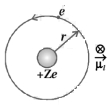
Obtain an expression for the orbital magnetic moment of an electron rotating about the nucleus in an atom and explain the gyromagnetic ratio.
Solution
(N/A) Consider an electron of charge $(-e)$ performing uniform circular motion around a stationary heavy nucleus of charge $(+Ze)$ with orbital radius $r$ and speed $v$.
The circulating electron constitutes a current $I$ given by:
$I = \frac{e}{T} \quad \dots (1)$
where $T$ is the time period of revolution.
Since $v = \frac{2 \pi r}{T}$,we have $T = \frac{2 \pi r}{v} \quad \dots (2)$
Substituting $(2)$ into $(1)$:
$I = \frac{e v}{2 \pi r} \quad \dots (3)$
The magnetic moment $\mu_l$ associated with this current loop of area $A = \pi r^2$ is:
$\mu_l = I A = \left( \frac{e v}{2 \pi r} \right) (\pi r^2) = \frac{e v r}{2} \quad \dots (4)$
Multiplying and dividing by the electron mass $m_e$:
$\mu_l = \frac{e}{2 m_e} (m_e v r)$
Since the orbital angular momentum $L = m_e v r$,we get:
$\mu_l = \frac{e}{2 m_e} L$
The ratio $\frac{\mu_l}{L} = \frac{e}{2 m_e}$ is called the gyromagnetic ratio,which is a constant for an electron.
The circulating electron constitutes a current $I$ given by:
$I = \frac{e}{T} \quad \dots (1)$
where $T$ is the time period of revolution.
Since $v = \frac{2 \pi r}{T}$,we have $T = \frac{2 \pi r}{v} \quad \dots (2)$
Substituting $(2)$ into $(1)$:
$I = \frac{e v}{2 \pi r} \quad \dots (3)$
The magnetic moment $\mu_l$ associated with this current loop of area $A = \pi r^2$ is:
$\mu_l = I A = \left( \frac{e v}{2 \pi r} \right) (\pi r^2) = \frac{e v r}{2} \quad \dots (4)$
Multiplying and dividing by the electron mass $m_e$:
$\mu_l = \frac{e}{2 m_e} (m_e v r)$
Since the orbital angular momentum $L = m_e v r$,we get:
$\mu_l = \frac{e}{2 m_e} L$
The ratio $\frac{\mu_l}{L} = \frac{e}{2 m_e}$ is called the gyromagnetic ratio,which is a constant for an electron.
0 likes
View Solution6
Difficult
Define Bohr magneton using Bohr's first hypothesis.
Solution
(N/A) Bohr magneton is defined as the magnetic moment associated with an electron due to its orbital motion in the first orbit of a hydrogen atom.
Bohr's first hypothesis states that the angular momentum of an electron in an orbit is quantized and given by:
$L = n \left( \frac{h}{2 \pi} \right)$
where $n = 1, 2, 3, \ldots$ and $h$ is Planck's constant $(h = 6.626 \times 10^{-34} \text{ J s})$.
The magnetic moment $\mu_l$ associated with an orbital electron is given by:
$\mu_l = \frac{e}{2 m_e} L$
Substituting the expression for angular momentum for the first orbit $(n = 1)$:
$\mu_l = \frac{e}{2 m_e} \left( \frac{h}{2 \pi} \right)$
This minimum value of the magnetic moment is called the Bohr magneton $(\mu_B)$:
$\mu_B = \frac{eh}{4 \pi m_e}$
Substituting the values $e = 1.6 \times 10^{-19} \text{ C}$,$h = 6.63 \times 10^{-34} \text{ J s}$,and $m_e = 9.11 \times 10^{-31} \text{ kg}$:
$\mu_B = \frac{(1.6 \times 10^{-19}) \times (6.63 \times 10^{-34})}{4 \times 3.14 \times 9.11 \times 10^{-31}}$
$\mu_B \approx 9.27 \times 10^{-24} \text{ A m}^2$
Bohr's first hypothesis states that the angular momentum of an electron in an orbit is quantized and given by:
$L = n \left( \frac{h}{2 \pi} \right)$
where $n = 1, 2, 3, \ldots$ and $h$ is Planck's constant $(h = 6.626 \times 10^{-34} \text{ J s})$.
The magnetic moment $\mu_l$ associated with an orbital electron is given by:
$\mu_l = \frac{e}{2 m_e} L$
Substituting the expression for angular momentum for the first orbit $(n = 1)$:
$\mu_l = \frac{e}{2 m_e} \left( \frac{h}{2 \pi} \right)$
This minimum value of the magnetic moment is called the Bohr magneton $(\mu_B)$:
$\mu_B = \frac{eh}{4 \pi m_e}$
Substituting the values $e = 1.6 \times 10^{-19} \text{ C}$,$h = 6.63 \times 10^{-34} \text{ J s}$,and $m_e = 9.11 \times 10^{-31} \text{ kg}$:
$\mu_B = \frac{(1.6 \times 10^{-19}) \times (6.63 \times 10^{-34})}{4 \times 3.14 \times 9.11 \times 10^{-31}}$
$\mu_B \approx 9.27 \times 10^{-24} \text{ A m}^2$
0 likes
View Solution7
Medium
Explain orbital magnetic moment and spin magnetic moment.
Solution
(N/A) Any charge in uniform circular motion has an associated magnetic moment given by the expression:
$\mu_{l} = \frac{e}{2m_{e}}(l)$
This dipole moment is known as the orbital magnetic moment. Its magnitude is related to the Bohr magneton,which has a value of $9.27 \times 10^{-24} \text{ A m}^2$.
In addition to the orbital magnetic moment,the electron possesses an intrinsic magnetic moment,which has the same numerical value of $9.27 \times 10^{-24} \text{ A m}^2$. This is called the spin magnetic moment.
It is important to note that this does not imply the electron is physically spinning. The electron is an elementary particle and does not have an axis to rotate around like a top or the Earth.
$\mu_{l} = \frac{e}{2m_{e}}(l)$
This dipole moment is known as the orbital magnetic moment. Its magnitude is related to the Bohr magneton,which has a value of $9.27 \times 10^{-24} \text{ A m}^2$.
In addition to the orbital magnetic moment,the electron possesses an intrinsic magnetic moment,which has the same numerical value of $9.27 \times 10^{-24} \text{ A m}^2$. This is called the spin magnetic moment.
It is important to note that this does not imply the electron is physically spinning. The electron is an elementary particle and does not have an axis to rotate around like a top or the Earth.
0 likes
View Solution8
Difficult
Write the equation for the orbital magnetic moment of an electron rotating about the nucleus in an atom.
Solution
(N/A) An electron of charge $e$ revolving in a circular orbit of radius $r$ with a speed $v$ constitutes a current $I = \frac{e}{T}$,where $T$ is the time period of revolution.
Since $T = \frac{2\pi r}{v}$,the current is $I = \frac{ev}{2\pi r}$.
The orbital magnetic moment $\mu_l$ is given by the product of current $I$ and the area of the orbit $A = \pi r^2$.
$\mu_l = I \times A = \left( \frac{ev}{2\pi r} \right) \times (\pi r^2) = \frac{evr}{2}$.
In terms of angular momentum $L = mvr$,we can write $\mu_l = \frac{e}{2m} L$.
Since $T = \frac{2\pi r}{v}$,the current is $I = \frac{ev}{2\pi r}$.
The orbital magnetic moment $\mu_l$ is given by the product of current $I$ and the area of the orbit $A = \pi r^2$.
$\mu_l = I \times A = \left( \frac{ev}{2\pi r} \right) \times (\pi r^2) = \frac{evr}{2}$.
In terms of angular momentum $L = mvr$,we can write $\mu_l = \frac{e}{2m} L$.
0 likes
View Solution9
MediumMCQ
What is the gyromagnetic ratio? Give its magnitude for an electron.
A
The ratio of magnetic moment to angular momentum.
B
The ratio of angular momentum to magnetic moment.
C
The product of magnetic moment and angular momentum.
D
The square of the magnetic moment.
Solution
(A) The gyromagnetic ratio is defined as the ratio of the magnetic dipole moment $(\mu)$ of a particle to its angular momentum $(L)$.
Mathematically, it is expressed as: $\gamma = \frac{\mu}{L}$.
For an electron, the magnetic moment is $\mu = \frac{e}{2m} L$, where $e$ is the charge of the electron and $m$ is its mass.
Therefore, the gyromagnetic ratio for an electron is $\gamma = \frac{e}{2m}$.
The magnitude of the gyromagnetic ratio for an electron is approximately $8.8 \times 10^{10} \text{ C/kg}$.
Mathematically, it is expressed as: $\gamma = \frac{\mu}{L}$.
For an electron, the magnetic moment is $\mu = \frac{e}{2m} L$, where $e$ is the charge of the electron and $m$ is its mass.
Therefore, the gyromagnetic ratio for an electron is $\gamma = \frac{e}{2m}$.
The magnitude of the gyromagnetic ratio for an electron is approximately $8.8 \times 10^{10} \text{ C/kg}$.
0 likes
View Solution10
Medium
What is the gyromagnetic ratio? Give its magnitude.
Solution
The gyromagnetic ratio is defined as the ratio of the magnetic dipole moment $(M)$ of an electron to its angular momentum $(L)$.
Mathematically,it is expressed as: $\gamma = \frac{M}{L}$.
For an electron revolving in a circular orbit,the magnetic moment is $M = \frac{evr}{2}$ and the angular momentum is $L = mvr$.
Therefore,$\gamma = \frac{evr/2}{mvr} = \frac{e}{2m}$.
Substituting the values of the charge of an electron $(e \approx 1.6 \times 10^{-19} \ C)$ and the mass of an electron $(m \approx 9.1 \times 10^{-31} \ kg)$,the magnitude is:
$\gamma = \frac{1.6 \times 10^{-19}}{2 \times 9.1 \times 10^{-31}} \approx 8.8 \times 10^{10} \ C/kg$.
Mathematically,it is expressed as: $\gamma = \frac{M}{L}$.
For an electron revolving in a circular orbit,the magnetic moment is $M = \frac{evr}{2}$ and the angular momentum is $L = mvr$.
Therefore,$\gamma = \frac{evr/2}{mvr} = \frac{e}{2m}$.
Substituting the values of the charge of an electron $(e \approx 1.6 \times 10^{-19} \ C)$ and the mass of an electron $(m \approx 9.1 \times 10^{-31} \ kg)$,the magnitude is:
$\gamma = \frac{1.6 \times 10^{-19}}{2 \times 9.1 \times 10^{-31}} \approx 8.8 \times 10^{10} \ C/kg$.
0 likes
View Solution11
Difficult
What is orbital magnetic moment? And what is intrinsic magnetic moment?
Solution
(N/A) $1$. Orbital Magnetic Moment: An electron revolving in an orbit around the nucleus behaves like a tiny current loop. The magnetic moment associated with this orbital motion is called the orbital magnetic moment. It is given by the formula $\mu_L = -\frac{e}{2m_e} L$,where $e$ is the charge of the electron,$m_e$ is the mass of the electron,and $L$ is the orbital angular momentum.
$2$. Intrinsic Magnetic Moment (Spin Magnetic Moment): Electrons possess an inherent property called spin,which is independent of their orbital motion. This spin gives rise to an intrinsic magnetic moment,often called the spin magnetic moment. It is associated with the intrinsic angular momentum (spin) of the electron and is approximately equal to one Bohr magneton,$\mu_B = \frac{eh}{4\pi m_e}$.
$2$. Intrinsic Magnetic Moment (Spin Magnetic Moment): Electrons possess an inherent property called spin,which is independent of their orbital motion. This spin gives rise to an intrinsic magnetic moment,often called the spin magnetic moment. It is associated with the intrinsic angular momentum (spin) of the electron and is approximately equal to one Bohr magneton,$\mu_B = \frac{eh}{4\pi m_e}$.
0 likes
View Solution12
MediumMCQ
The magnetic moment of an electron $(e)$ revolving in an orbit around a nucleus with an orbital angular momentum $\vec{L}$ is given by:
A
$\vec{\mu}_{L} = \frac{e \vec{L}}{2m}$
B
$\vec{\mu}_{L} = -\frac{e \vec{L}}{2m}$
C
$\vec{\mu}_{L} = -\frac{e \vec{L}}{m}$
D
$\vec{\mu}_{L} = \frac{2e \vec{L}}{m}$
Solution
(B) The magnetic moment $\vec{\mu}$ of a current loop is given by $\vec{\mu} = I \vec{A}$.
For an electron of charge $-e$ revolving in an orbit of radius $r$ with speed $v$,the equivalent current is $I = \frac{-e}{T} = \frac{-ev}{2\pi r}$.
The area of the orbit is $A = \pi r^2$.
Thus,$\vec{\mu} = I \vec{A} = \left( \frac{-ev}{2\pi r} \right) (\pi r^2) = \frac{-evr}{2}$.
The orbital angular momentum is $\vec{L} = mvr$.
Substituting $vr = \frac{L}{m}$,we get $\vec{\mu} = -\frac{e}{2m} \vec{L}$.
For an electron of charge $-e$ revolving in an orbit of radius $r$ with speed $v$,the equivalent current is $I = \frac{-e}{T} = \frac{-ev}{2\pi r}$.
The area of the orbit is $A = \pi r^2$.
Thus,$\vec{\mu} = I \vec{A} = \left( \frac{-ev}{2\pi r} \right) (\pi r^2) = \frac{-evr}{2}$.
The orbital angular momentum is $\vec{L} = mvr$.
Substituting $vr = \frac{L}{m}$,we get $\vec{\mu} = -\frac{e}{2m} \vec{L}$.
0 likes
View Solution13
EasyMCQ
Bohr magneton is given by (symbols have their usual meanings)
A
$\frac{4 \pi m_e}{e h^2}$
B
$\frac{4 \pi m_e}{e h}$
C
$\frac{e h^2}{4 \pi m_e}$
D
$\frac{e h}{4 \pi m_e}$
Solution
(D) The Bohr magneton $(\mu_B)$ is defined as the magnetic moment of an electron orbiting in the first Bohr orbit of a hydrogen atom.
According to Bohr's quantization condition, the angular momentum $L$ is given by $L = m_e v r = \frac{n h}{2 \pi}$.
For the first orbit $(n = 1)$, $L = \frac{h}{2 \pi}$.
The magnetic moment $\mu$ of a current loop is given by $\mu = I A$, where $I = \frac{e}{T}$ and $T = \frac{2 \pi r}{v}$.
Thus, $\mu = \frac{e v}{2 \pi r} \times (\pi r^2) = \frac{e v r}{2}$.
Substituting $L = m_e v r$, we get $\mu = \frac{e L}{2 m_e}$.
Substituting $L = \frac{h}{2 \pi}$, we get $\mu_B = \frac{e}{2 m_e} \times \frac{h}{2 \pi} = \frac{e h}{4 \pi m_e}$.
According to Bohr's quantization condition, the angular momentum $L$ is given by $L = m_e v r = \frac{n h}{2 \pi}$.
For the first orbit $(n = 1)$, $L = \frac{h}{2 \pi}$.
The magnetic moment $\mu$ of a current loop is given by $\mu = I A$, where $I = \frac{e}{T}$ and $T = \frac{2 \pi r}{v}$.
Thus, $\mu = \frac{e v}{2 \pi r} \times (\pi r^2) = \frac{e v r}{2}$.
Substituting $L = m_e v r$, we get $\mu = \frac{e L}{2 m_e}$.
Substituting $L = \frac{h}{2 \pi}$, we get $\mu_B = \frac{e}{2 m_e} \times \frac{h}{2 \pi} = \frac{e h}{4 \pi m_e}$.
0 likes
View Solution14
DifficultMCQ
$A$ model for quantized motion of an electron in a uniform magnetic field $B$ states that the flux passing through the orbit of the electron is $n(h / e)$ where $n$ is an integer,$h$ is Planck's constant and $e$ is the magnitude of electron's charge. According to the model,the magnetic moment of an electron in its lowest energy state will be ($m$ is the mass of the electron).
A
$\frac{h e}{\pi m}$
B
$\frac{h e}{2 \pi m}$
C
$\frac{h e B}{\pi m}$
D
$\frac{h e B}{2 \pi m}$
Solution
(B) The magnetic moment $M$ is given by $M = I A$,where $I$ is the current and $A$ is the area of the orbit.
$I = \frac{e}{T} = \frac{ev}{2 \pi r}$ and $A = \pi r^2$.
Thus,$M = \left( \frac{ev}{2 \pi r} \right) (\pi r^2) = \frac{evr}{2}$.
Given the flux condition: $B(\pi r^2) = n(h/e)$. For the lowest energy state,$n = 1$,so $B \pi r^2 = h/e$,which implies $r^2 = \frac{h}{B \pi e}$.
Also,for an electron in a magnetic field,the centripetal force is provided by the Lorentz force: $\frac{mv^2}{r} = evB$,which gives $\frac{v}{r} = \frac{eB}{m}$.
Substituting $v = \frac{eBr}{m}$ into the expression for $M$:
$M = \frac{e}{2} \left( \frac{eBr}{m} \right) r = \frac{e^2 B r^2}{2m}$.
Substituting $r^2 = \frac{h}{B \pi e}$ into the equation for $M$:
$M = \frac{e^2 B}{2m} \left( \frac{h}{B \pi e} \right) = \frac{eh}{2 \pi m}$.
$I = \frac{e}{T} = \frac{ev}{2 \pi r}$ and $A = \pi r^2$.
Thus,$M = \left( \frac{ev}{2 \pi r} \right) (\pi r^2) = \frac{evr}{2}$.
Given the flux condition: $B(\pi r^2) = n(h/e)$. For the lowest energy state,$n = 1$,so $B \pi r^2 = h/e$,which implies $r^2 = \frac{h}{B \pi e}$.
Also,for an electron in a magnetic field,the centripetal force is provided by the Lorentz force: $\frac{mv^2}{r} = evB$,which gives $\frac{v}{r} = \frac{eB}{m}$.
Substituting $v = \frac{eBr}{m}$ into the expression for $M$:
$M = \frac{e}{2} \left( \frac{eBr}{m} \right) r = \frac{e^2 B r^2}{2m}$.
Substituting $r^2 = \frac{h}{B \pi e}$ into the equation for $M$:
$M = \frac{e^2 B}{2m} \left( \frac{h}{B \pi e} \right) = \frac{eh}{2 \pi m}$.
0 likes
View Solution15
EasyMCQ
The ratio of angular momentum $\overrightarrow{L}$ of an electron to the magnetic dipole moment $\overrightarrow{m}_{\text{orb}}$ is (where $m$ is the mass of the electron and $e$ is the charge on the electron).
A
$\frac{e}{m}$
B
$\frac{2m}{e}$
C
$\frac{2m}{e}$
D
$\frac{m}{e}$
Solution
(B) The magnetic dipole moment $\overrightarrow{m}_{\text{orb}}$ of an electron revolving in a circular orbit is given by $\overrightarrow{m}_{\text{orb}} = -\frac{e}{2m} \overrightarrow{L}$,where $\overrightarrow{L}$ is the orbital angular momentum of the electron.
Taking the magnitude of both sides,we have $m_{\text{orb}} = \frac{e}{2m} L$.
Therefore,the ratio of angular momentum $L$ to the magnetic dipole moment $m_{\text{orb}}$ is given by $\frac{L}{m_{\text{orb}}} = \frac{2m}{e}$.
Taking the magnitude of both sides,we have $m_{\text{orb}} = \frac{e}{2m} L$.
Therefore,the ratio of angular momentum $L$ to the magnetic dipole moment $m_{\text{orb}}$ is given by $\frac{L}{m_{\text{orb}}} = \frac{2m}{e}$.
0 likes
View Solution16
DifficultMCQ
An electron is moving in an orbit around the nucleus in an atom. Let $m$ be the orbital magnetic moment and $L$ be the angular momentum of the electron,then
A
$m$ and $L$ are in opposite directions perpendicular to the plane of the orbit.
B
$m$ and $L$ are in opposite directions parallel to the plane of the orbit.
C
$m$ and $L$ are in the same direction perpendicular to the plane of the orbit.
D
$m$ and $L$ are in the same direction parallel to the plane of the orbit.
Solution
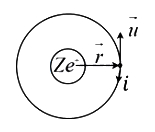
(A) The orbital magnetic moment $\vec{m}$ of an electron revolving in a circular orbit is given by $\vec{m} = I \vec{A}$,where $I$ is the current and $\vec{A}$ is the area vector. Since the electron is negatively charged,the direction of the equivalent current $I$ is opposite to the direction of the electron's motion. By the right-hand rule,the direction of $\vec{m}$ is perpendicular to the plane of the orbit.
The angular momentum $\vec{L}$ of the electron is given by $\vec{L} = \vec{r} \times \vec{p}$,where $\vec{p} = m_e \vec{v}$ is the linear momentum. According to the right-hand rule for the cross product,the direction of $\vec{L}$ is also perpendicular to the plane of the orbit.
Because the electron has a negative charge,the direction of the magnetic moment $\vec{m}$ is opposite to the direction of the angular momentum $\vec{L}$. Therefore,$\vec{m}$ and $\vec{L}$ are in opposite directions perpendicular to the plane of the orbit.
The angular momentum $\vec{L}$ of the electron is given by $\vec{L} = \vec{r} \times \vec{p}$,where $\vec{p} = m_e \vec{v}$ is the linear momentum. According to the right-hand rule for the cross product,the direction of $\vec{L}$ is also perpendicular to the plane of the orbit.
Because the electron has a negative charge,the direction of the magnetic moment $\vec{m}$ is opposite to the direction of the angular momentum $\vec{L}$. Therefore,$\vec{m}$ and $\vec{L}$ are in opposite directions perpendicular to the plane of the orbit.
0 likes
View Solution17
MediumMCQ
An electron moving around the nucleus with an angular momentum $L$ has a magnetic moment ( $e=$ charge on electron,$m=$ mass of electron )
A
$\frac{2 e}{m} L$
B
$\frac{e}{m} L$
C
$\frac{e}{2 m} L$
D
$\frac{e}{2 \pi m} L$
Solution
(C) The magnetic moment $\mu$ of a current loop is given by $\mu = iA$,where $i$ is the current and $A$ is the area of the loop.
For an electron revolving in a circular orbit of radius $r$ with period $T$,the equivalent current is $i = \frac{e}{T}$.
The area of the orbit is $A = \pi r^2$.
Thus,$\mu = \left(\frac{e}{T}\right) \pi r^2$.
The period $T$ is related to the orbital velocity $v$ by $T = \frac{2 \pi r}{v}$,so $\frac{1}{T} = \frac{v}{2 \pi r}$.
Substituting this into the expression for $\mu$,we get $\mu = e \left(\frac{v}{2 \pi r}\right) \pi r^2 = \frac{evr}{2}$.
The angular momentum of the electron is $L = mvr$,which implies $vr = \frac{L}{m}$.
Substituting $vr$ into the expression for $\mu$,we obtain $\mu = \frac{e}{2} \left(\frac{L}{m}\right) = \frac{e}{2m} L$.
For an electron revolving in a circular orbit of radius $r$ with period $T$,the equivalent current is $i = \frac{e}{T}$.
The area of the orbit is $A = \pi r^2$.
Thus,$\mu = \left(\frac{e}{T}\right) \pi r^2$.
The period $T$ is related to the orbital velocity $v$ by $T = \frac{2 \pi r}{v}$,so $\frac{1}{T} = \frac{v}{2 \pi r}$.
Substituting this into the expression for $\mu$,we get $\mu = e \left(\frac{v}{2 \pi r}\right) \pi r^2 = \frac{evr}{2}$.
The angular momentum of the electron is $L = mvr$,which implies $vr = \frac{L}{m}$.
Substituting $vr$ into the expression for $\mu$,we obtain $\mu = \frac{e}{2} \left(\frac{L}{m}\right) = \frac{e}{2m} L$.
0 likes
View Solution18
EasyMCQ
The angle made by the orbital angular momentum of an electron with the direction of its orbital magnetic moment is: (in $^{\circ}$)
A
$120$
B
$60$
C
$180$
D
$90$
Solution
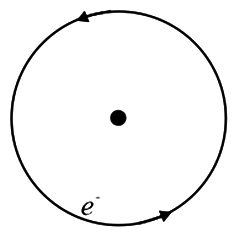
(C) The orbital angular momentum $\vec{L}$ of an electron is given by $\vec{L} = \vec{r} \times \vec{p}$. For an electron revolving in a circular orbit,$\vec{L}$ is directed perpendicular to the plane of the orbit (upward,following the right-hand rule).
The orbital magnetic moment $\vec{M}$ is related to the orbital angular momentum $\vec{L}$ by the relation $\vec{M} = -\frac{e}{2m} \vec{L}$.
The negative sign indicates that the orbital magnetic moment $\vec{M}$ is in the direction opposite to the orbital angular momentum $\vec{L}$.
Since $\vec{M}$ and $\vec{L}$ are in opposite directions,the angle between them is $180^{\circ}$.
The orbital magnetic moment $\vec{M}$ is related to the orbital angular momentum $\vec{L}$ by the relation $\vec{M} = -\frac{e}{2m} \vec{L}$.
The negative sign indicates that the orbital magnetic moment $\vec{M}$ is in the direction opposite to the orbital angular momentum $\vec{L}$.
Since $\vec{M}$ and $\vec{L}$ are in opposite directions,the angle between them is $180^{\circ}$.
0 likes
View Solution19
EasyMCQ
If $M_0$ and $L_0$ denote the magnetic moment and angular momentum of the electron due to its orbital motion respectively,then the gyromagnetic ratio is given by
A
$\frac{M_0}{L_0}$
B
$L_0 M_0$
C
$\sqrt{\frac{M_0}{L_0}}$
D
$\frac{L_0}{M_0}$
Solution
(A) The gyromagnetic ratio is defined as the ratio of the magnetic moment $(M_0)$ to the angular momentum $(L_0)$ of a particle.
Mathematically,it is expressed as:
$\text{Gyromagnetic ratio} = \frac{M_0}{L_0}$
For an electron revolving in an orbit,the magnetic moment $M_0 = \frac{e}{2m} L_0$,where $e$ is the charge and $m$ is the mass of the electron.
Thus,the ratio $\frac{M_0}{L_0} = \frac{e}{2m}$,which is a constant.
Mathematically,it is expressed as:
$\text{Gyromagnetic ratio} = \frac{M_0}{L_0}$
For an electron revolving in an orbit,the magnetic moment $M_0 = \frac{e}{2m} L_0$,where $e$ is the charge and $m$ is the mass of the electron.
Thus,the ratio $\frac{M_0}{L_0} = \frac{e}{2m}$,which is a constant.
0 likes
View Solution20
EasyMCQ
If the charge to mass ratio of an electron is $A \ C/kg$,then the gyromagnetic ratio of an orbital electron in $C/kg$ is
A
$\frac{A}{4}$
B
$A$
C
$2A$
D
$\frac{A}{2}$
Solution
(D) The gyromagnetic ratio is defined as the ratio of the magnetic moment $(\mu_L)$ to the angular momentum $(L)$ of an orbital electron.
$\text{Gyromagnetic ratio} = \frac{\mu_L}{L} = \frac{e}{2m}$.
Given that the charge to mass ratio of an electron is $\frac{e}{m} = A \ C/kg$.
Substituting this into the expression,we get:
$\text{Gyromagnetic ratio} = \frac{1}{2} \times \left(\frac{e}{m}\right) = \frac{A}{2} \ C/kg$.
$\text{Gyromagnetic ratio} = \frac{\mu_L}{L} = \frac{e}{2m}$.
Given that the charge to mass ratio of an electron is $\frac{e}{m} = A \ C/kg$.
Substituting this into the expression,we get:
$\text{Gyromagnetic ratio} = \frac{1}{2} \times \left(\frac{e}{m}\right) = \frac{A}{2} \ C/kg$.
0 likes
View Solution21
EasyMCQ
The magnetic moment of a revolving electron of charge $e$ and mass $m$ in terms of the angular momentum $L$ of the electron is:
A
$\frac{eL}{8m}$
B
$\frac{eL}{4m}$
C
$\frac{eL}{2m}$
D
$\frac{eL}{m}$
Solution
(C) Consider an electron of charge $e$ and mass $m$ revolving in a circular orbit of radius $r$ with a speed $v$ and time period $T$.
The current $I$ associated with this revolving electron is $I = \frac{e}{T} = \frac{e}{2\pi r / v} = \frac{ev}{2\pi r}$.
The magnetic moment $M$ is given by $M = I \times A = I \times (\pi r^2)$.
Substituting the value of $I$,we get $M = \left(\frac{ev}{2\pi r}\right) \times (\pi r^2) = \frac{evr}{2}$.
The angular momentum $L$ of the electron is $L = mvr$.
Thus,$vr = \frac{L}{m}$.
Substituting this into the expression for $M$,we get $M = \frac{e}{2} \times \left(\frac{L}{m}\right) = \frac{eL}{2m}$.
The current $I$ associated with this revolving electron is $I = \frac{e}{T} = \frac{e}{2\pi r / v} = \frac{ev}{2\pi r}$.
The magnetic moment $M$ is given by $M = I \times A = I \times (\pi r^2)$.
Substituting the value of $I$,we get $M = \left(\frac{ev}{2\pi r}\right) \times (\pi r^2) = \frac{evr}{2}$.
The angular momentum $L$ of the electron is $L = mvr$.
Thus,$vr = \frac{L}{m}$.
Substituting this into the expression for $M$,we get $M = \frac{e}{2} \times \left(\frac{L}{m}\right) = \frac{eL}{2m}$.
0 likes
View Solution22
MediumMCQ
An electron $(e)$ is revolving in a circular orbit of radius $r$ in a hydrogen atom. The angular momentum of the electron is (where $M$ is the magnetic dipole moment associated with it and $m$ is the mass of the electron).
A
$\frac{4 mM}{e}$
B
$\frac{2 m M}{e}$
C
$\frac{3 mM}{e}$
D
$\frac{mM}{e}$
Solution
(B) The angular momentum of an electron in a circular orbit is given by $L = mvr$.
Since $v = r\omega$,we have $L = m(r\omega)r = m\omega r^2$.
Therefore,$\omega r^2 = \frac{L}{m} \quad \dots(i)$
The magnetic dipole moment $M$ associated with the revolving electron is given by $M = iA$.
Here,the current $i = \frac{e}{T} = \frac{e}{2\pi/\omega} = \frac{e\omega}{2\pi}$ and the area $A = \pi r^2$.
Substituting these values,$M = \left(\frac{e\omega}{2\pi}\right)(\pi r^2) = \frac{e}{2} \omega r^2$.
Substituting the value of $\omega r^2$ from equation $(i)$ into the expression for $M$:
$M = \frac{e}{2} \left(\frac{L}{m}\right)$.
Rearranging the terms to solve for $L$:
$L = \frac{2mM}{e}$.
Since $v = r\omega$,we have $L = m(r\omega)r = m\omega r^2$.
Therefore,$\omega r^2 = \frac{L}{m} \quad \dots(i)$
The magnetic dipole moment $M$ associated with the revolving electron is given by $M = iA$.
Here,the current $i = \frac{e}{T} = \frac{e}{2\pi/\omega} = \frac{e\omega}{2\pi}$ and the area $A = \pi r^2$.
Substituting these values,$M = \left(\frac{e\omega}{2\pi}\right)(\pi r^2) = \frac{e}{2} \omega r^2$.
Substituting the value of $\omega r^2$ from equation $(i)$ into the expression for $M$:
$M = \frac{e}{2} \left(\frac{L}{m}\right)$.
Rearranging the terms to solve for $L$:
$L = \frac{2mM}{e}$.
0 likes
View Solution23
EasyMCQ
The gyromagnetic ratio and Bohr magneton are given respectively by [Given $\rightarrow e=$ charge on electron,$m=$ mass of electron,$h=$ Planck's constant].
A
$\frac{e}{2m}, \frac{eh}{4\pi m}$
B
$\frac{eh}{4\pi m}, \frac{e}{2m}$
C
$\frac{2m}{e}, \frac{4\pi m}{eh}$
D
$\frac{4\pi m}{eh}, \frac{2m}{e}$
Solution
(A) The gyromagnetic ratio is defined as the ratio of the magnetic dipole moment $(M)$ to the angular momentum $(L)$ of an electron orbiting in an atom.
For an electron in an orbit,the magnetic moment $M = I A = (\frac{e}{T}) (\pi r^2) = \frac{e}{2\pi r/v} (\pi r^2) = \frac{evr}{2}$.
The angular momentum $L = mvr$.
Thus,the gyromagnetic ratio $\gamma = \frac{M}{L} = \frac{evr/2}{mvr} = \frac{e}{2m}$.
The Bohr magneton $(\mu_B)$ is the fundamental unit of magnetic moment,given by $\mu_B = \frac{eh}{4\pi m}$.
Therefore,the gyromagnetic ratio and Bohr magneton are $\frac{e}{2m}$ and $\frac{eh}{4\pi m}$ respectively.
For an electron in an orbit,the magnetic moment $M = I A = (\frac{e}{T}) (\pi r^2) = \frac{e}{2\pi r/v} (\pi r^2) = \frac{evr}{2}$.
The angular momentum $L = mvr$.
Thus,the gyromagnetic ratio $\gamma = \frac{M}{L} = \frac{evr/2}{mvr} = \frac{e}{2m}$.
The Bohr magneton $(\mu_B)$ is the fundamental unit of magnetic moment,given by $\mu_B = \frac{eh}{4\pi m}$.
Therefore,the gyromagnetic ratio and Bohr magneton are $\frac{e}{2m}$ and $\frac{eh}{4\pi m}$ respectively.
0 likes
View Solution24
EasyMCQ
The gyromagnetic ratio of an electron is equal to . . . . . . times the specific charge of an electron.
A
$1/2$
B
$1$
C
$2$
D
$4$
Solution
(A) The gyromagnetic ratio is defined as the ratio of the magnetic dipole moment $\mu$ to the angular momentum $L$ of an electron.
For an electron orbiting a nucleus,$\mu = \frac{e}{2m} L$.
Therefore,the gyromagnetic ratio $\gamma = \frac{\mu}{L} = \frac{e}{2m}$.
The specific charge of an electron is defined as $\frac{e}{m}$.
Comparing the two expressions,we get $\gamma = \frac{1}{2} \times (\frac{e}{m})$.
Thus,the gyromagnetic ratio is $1/2$ times the specific charge of an electron.
For an electron orbiting a nucleus,$\mu = \frac{e}{2m} L$.
Therefore,the gyromagnetic ratio $\gamma = \frac{\mu}{L} = \frac{e}{2m}$.
The specific charge of an electron is defined as $\frac{e}{m}$.
Comparing the two expressions,we get $\gamma = \frac{1}{2} \times (\frac{e}{m})$.
Thus,the gyromagnetic ratio is $1/2$ times the specific charge of an electron.
0 likes
View Solution25
EasyMCQ
The ratio of the magnetic dipole moment to the angular momentum of the electron in the $1^{st}$ orbit of a hydrogen atom is
A
$\frac{m}{e}$
B
$\frac{e}{2m}$
C
$\frac{e}{m}$
D
$\frac{2m}{e}$
Solution
(B) The angular momentum of an electron in an orbit is given by $L = mvr$.
The magnetic dipole moment $M$ associated with the orbital motion of the electron is given by $M = IA$,where $I$ is the current and $A$ is the area of the orbit.
Since $I = \frac{e}{T} = \frac{ev}{2 \pi r}$ and $A = \pi r^2$,we have $M = \left( \frac{ev}{2 \pi r} \right) \times (\pi r^2) = \frac{1}{2} evr$.
Taking the ratio of the magnetic dipole moment to the angular momentum:
$\frac{M}{L} = \frac{\frac{1}{2} evr}{mvr} = \frac{e}{2m}$.
Thus,the ratio is $\frac{e}{2m}$.
The magnetic dipole moment $M$ associated with the orbital motion of the electron is given by $M = IA$,where $I$ is the current and $A$ is the area of the orbit.
Since $I = \frac{e}{T} = \frac{ev}{2 \pi r}$ and $A = \pi r^2$,we have $M = \left( \frac{ev}{2 \pi r} \right) \times (\pi r^2) = \frac{1}{2} evr$.
Taking the ratio of the magnetic dipole moment to the angular momentum:
$\frac{M}{L} = \frac{\frac{1}{2} evr}{mvr} = \frac{e}{2m}$.
Thus,the ratio is $\frac{e}{2m}$.
0 likes
View Solution26
EasyMCQ
The gyromagnetic ratio of an electron revolving in a circular orbit of a hydrogen atom is $ 8.8 \times 10^{10} \ C \ kg^{-1} $. What is the mass of the electron? Given the charge of the electron $ e = 1.6 \times 10^{-19} \ C $.
A
$ 1 \times 10^{-29} \ kg $
B
$ 0.1 \times 10^{-29} \ kg $
C
$ 1.1 \times 10^{-29} \ kg $
D
$ \frac{1}{11} \times 10^{-29} \ kg $
Solution
(D) The gyromagnetic ratio is defined as the ratio of the magnetic dipole moment to the angular momentum of the electron,which is given by the formula: $\gamma = \frac{e}{2m_e}$.
Given,gyromagnetic ratio $\gamma = 8.8 \times 10^{10} \ C \ kg^{-1}$.
Charge of the electron $e = 1.6 \times 10^{-19} \ C$.
Rearranging the formula to solve for the mass of the electron $m_e$:
$m_e = \frac{e}{2\gamma}$.
Substituting the given values:
$m_e = \frac{1.6 \times 10^{-19}}{2 \times 8.8 \times 10^{10}}$.
$m_e = \frac{1.6 \times 10^{-19}}{17.6 \times 10^{10}}$.
$m_e = \frac{16}{176} \times 10^{-29} \ kg$.
$m_e = \frac{1}{11} \times 10^{-29} \ kg$.
Thus,the mass of the electron is $\frac{1}{11} \times 10^{-29} \ kg$.
Given,gyromagnetic ratio $\gamma = 8.8 \times 10^{10} \ C \ kg^{-1}$.
Charge of the electron $e = 1.6 \times 10^{-19} \ C$.
Rearranging the formula to solve for the mass of the electron $m_e$:
$m_e = \frac{e}{2\gamma}$.
Substituting the given values:
$m_e = \frac{1.6 \times 10^{-19}}{2 \times 8.8 \times 10^{10}}$.
$m_e = \frac{1.6 \times 10^{-19}}{17.6 \times 10^{10}}$.
$m_e = \frac{16}{176} \times 10^{-29} \ kg$.
$m_e = \frac{1}{11} \times 10^{-29} \ kg$.
Thus,the mass of the electron is $\frac{1}{11} \times 10^{-29} \ kg$.
0 likes
View Solution27
EasyMCQ
What is the magnetic moment of an orbiting electron in a simple hydrogen atom? Assume $e=$ charge of electron,$m_e=$ mass of electron,and $\vec{L}=$ orbital angular momentum of the electron.
A
$\vec{\mu}=\left(\frac{e}{m_e}\right) \vec{L}$
B
$\vec{\mu}=-\left(\frac{e}{2 m_e}\right) \vec{L}$
C
$\vec{\mu}=\left(\frac{2 e}{m_e}\right) \vec{L}$
D
$\vec{\mu}=\left(\frac{e}{4 m_e}\right) \vec{L}$
Solution
(B) When an electron orbits around the hydrogen nucleus,it constitutes a current loop.
The current $i$ is given by $i = \frac{e}{T}$,where $T$ is the time period of revolution.
The magnetic moment is $\mu = i A = \frac{e}{T} (\pi r^2)$.
The time period $T = \frac{2 \pi r}{v}$. Substituting this into the expression for $\mu$:
$\mu = \frac{e v}{2 \pi r} (\pi r^2) = \frac{e v r}{2}$.
The orbital angular momentum is $L = m_e v r$,which implies $v r = \frac{L}{m_e}$.
Substituting $v r$ into the expression for $\mu$:
$\mu = \frac{e}{2} \left(\frac{L}{m_e}\right) = \frac{e}{2 m_e} L$.
Since the electron is negatively charged,the magnetic moment vector $\vec{\mu}$ and angular momentum vector $\vec{L}$ are in opposite directions:
$\vec{\mu} = -\left(\frac{e}{2 m_e}\right) \vec{L}$.
The current $i$ is given by $i = \frac{e}{T}$,where $T$ is the time period of revolution.
The magnetic moment is $\mu = i A = \frac{e}{T} (\pi r^2)$.
The time period $T = \frac{2 \pi r}{v}$. Substituting this into the expression for $\mu$:
$\mu = \frac{e v}{2 \pi r} (\pi r^2) = \frac{e v r}{2}$.
The orbital angular momentum is $L = m_e v r$,which implies $v r = \frac{L}{m_e}$.
Substituting $v r$ into the expression for $\mu$:
$\mu = \frac{e}{2} \left(\frac{L}{m_e}\right) = \frac{e}{2 m_e} L$.
Since the electron is negatively charged,the magnetic moment vector $\vec{\mu}$ and angular momentum vector $\vec{L}$ are in opposite directions:
$\vec{\mu} = -\left(\frac{e}{2 m_e}\right) \vec{L}$.
0 likes
View Solution28
EasyMCQ
$A$ particle of charge $q$ and mass $m$ moves in a circular orbit of radius $r$ with angular speed $\omega$. The ratio of the magnitude of its magnetic moment to that of its angular momentum is
A
$\frac{q}{m \omega}$
B
$\frac{q}{2 m r}$
C
$\frac{q}{2 m}$
D
$\frac{2 q}{m}$
Solution
(C) The magnetic moment $M$ of a particle of charge $q$ moving in a circular orbit of radius $r$ with speed $v$ is given by $M = I A = (\frac{q}{T}) (\pi r^2) = (\frac{q \omega}{2 \pi}) (\pi r^2) = \frac{1}{2} q \omega r^2$.
The angular momentum $L$ of the particle is given by $L = mvr = m(\omega r)r = m \omega r^2$.
The ratio of the magnitude of magnetic moment to angular momentum is $\frac{M}{L} = \frac{\frac{1}{2} q \omega r^2}{m \omega r^2} = \frac{q}{2m}$.
This ratio is known as the gyromagnetic ratio.
The angular momentum $L$ of the particle is given by $L = mvr = m(\omega r)r = m \omega r^2$.
The ratio of the magnitude of magnetic moment to angular momentum is $\frac{M}{L} = \frac{\frac{1}{2} q \omega r^2}{m \omega r^2} = \frac{q}{2m}$.
This ratio is known as the gyromagnetic ratio.
0 likes
View Solution29
MediumMCQ
$A$ particle of charge '$q$' and mass '$m$' moves in a circular orbit of radius '$r$' with angular speed '$\omega$'. The ratio of the magnitude of its magnetic moment to that of its angular momentum depends on
A
$\omega$ and $q$
B
$\omega, q$ and $m$
C
$q$ and $m$
D
$\omega$ and $m$
Solution
(C) The magnetic moment $M$ of a particle of charge $q$ moving in a circular orbit is given by $M = IA$,where $I$ is the current and $A$ is the area of the orbit.
The current $I = \frac{q}{T} = \frac{q\omega}{2\pi}$.
The area $A = \pi r^2$.
Thus,$M = \left(\frac{q\omega}{2\pi}\right)(\pi r^2) = \frac{q\omega r^2}{2}$.
The angular momentum $L$ of the particle is $L = mvr = m(\omega r)r = m\omega r^2$.
The ratio of the magnetic moment to the angular momentum is $\frac{M}{L} = \frac{q\omega r^2 / 2}{m\omega r^2} = \frac{q}{2m}$.
This ratio is known as the gyromagnetic ratio and depends only on the charge '$q$' and mass '$m$' of the particle.
The current $I = \frac{q}{T} = \frac{q\omega}{2\pi}$.
The area $A = \pi r^2$.
Thus,$M = \left(\frac{q\omega}{2\pi}\right)(\pi r^2) = \frac{q\omega r^2}{2}$.
The angular momentum $L$ of the particle is $L = mvr = m(\omega r)r = m\omega r^2$.
The ratio of the magnetic moment to the angular momentum is $\frac{M}{L} = \frac{q\omega r^2 / 2}{m\omega r^2} = \frac{q}{2m}$.
This ratio is known as the gyromagnetic ratio and depends only on the charge '$q$' and mass '$m$' of the particle.
0 likes
View Solution30
EasyMCQ
An electron of charge $e$ and mass $m$ is moving in a circular path of radius $r$ with a uniform angular speed $\omega$. Which of the following statements are correct?
A
The equivalent current flowing in the circular path is proportional to $r^{2}$.
B
The magnetic moment due to the circular current loop is independent of $m$.
C
The magnetic moment due to the circular current loop is equal to $e / (2m)$ times the angular momentum of the electron.
D
The angular momentum of the particle is proportional to the areal velocity of the electron.
Solution
(C) The current $I$ is given by $I = \frac{e}{T} = \frac{e \omega}{2 \pi}$. This is independent of $r$.
The magnetic moment $\mu = I A = \left( \frac{e \omega}{2 \pi} \right) (\pi r^2) = \frac{e \omega r^2}{2}$.
The angular momentum $L = m v r = m (\omega r) r = m \omega r^2$.
Comparing $\mu$ and $L$,we get $\mu = \frac{e}{2m} L$.
Thus,the magnetic moment is proportional to the angular momentum,and the ratio $\mu / L = e / (2m)$ is known as the gyromagnetic ratio. Statement $C$ is correct as it relates $\mu$ and $L$ via the factor $e / (2m)$.
The magnetic moment $\mu = I A = \left( \frac{e \omega}{2 \pi} \right) (\pi r^2) = \frac{e \omega r^2}{2}$.
The angular momentum $L = m v r = m (\omega r) r = m \omega r^2$.
Comparing $\mu$ and $L$,we get $\mu = \frac{e}{2m} L$.
Thus,the magnetic moment is proportional to the angular momentum,and the ratio $\mu / L = e / (2m)$ is known as the gyromagnetic ratio. Statement $C$ is correct as it relates $\mu$ and $L$ via the factor $e / (2m)$.
0 likes
View SolutionMoving Charges and Magnetism — Bohr Magnetron · Frequently Asked Questions
1Are these Moving Charges and Magnetism questions useful for JEE and NEET?
Yes. All questions in this section are mapped to JEE Main and NEET exam patterns. Previous year questions from JEE Main, NEET, GUJCET and state-level exams are included with full solutions.
2Can I switch to Hindi or Gujarati for these questions?
Yes. Use the language tabs in the hero section or the sidebar to view the same questions and solutions in English, Hindi or Gujarati.
3How do I generate a question paper from this subtopic?
Use the Vedclass Exam Paper Generator — select the chapter and subtopic, set difficulty, and generate Sets A, B, C, D automatically. First 3 chapters of every subject are free.
Vedclass Products
For Students
Vedclass Test Series
Mock tests in real JEE/NEET style with performance analysis. 5-day free trial.
Start Free TrialFor Teachers
Exam Paper Generator
Generate Set A/B/C/D papers from this chapter in 2 minutes. 3 chapters free.
Try FreeFor Institutes
Online Exam Module
Live online exams with unlimited students, 360° analytics & white-label branding.
See DemoFor Teachers & Institutes
Generate a Moving Charges and Magnetism Exam Paper in 2 Minutes
Select subtopic & difficulty — Sets A, B, C, D auto-generated with No Repeat logic.
First 3 chapters of every subject are free — no payment required.