
A English
Motion of Charged Particle In Magnetic Field Questions in English
Class 12 Physics · Moving Charges and Magnetism · Motion of Charged Particle In Magnetic Field
513+
Questions
English
Language
100%
With Solutions
Showing 50 of 513 questions in English
201
MediumMCQ
$A$ particle is projected with a velocity of $10 \ m/s$ along the $y-$axis from the point $(2, 3)$. $A$ uniform magnetic field of $(3\hat{i} + 4\hat{j}) \ T$ exists in the space. What is its speed when the particle passes through the $y-$axis for the third time? (Neglect gravity)
A
$10 \ m/s$
B
$\sqrt{20} \ m/s$
C
$\sqrt{60} \ m/s$
D
$\sqrt{30} \ m/s$
Solution
(A) The magnetic force acting on a moving charged particle is given by $\vec{F} = q(\vec{v} \times \vec{B})$.
Since the magnetic force is always perpendicular to the velocity vector $\vec{v}$,the work done by the magnetic field on the particle is zero $(W = \int \vec{F} \cdot d\vec{r} = 0)$.
According to the work-energy theorem,the change in kinetic energy is equal to the work done by all forces.
Since the work done is zero,the kinetic energy remains constant $(K_f = K_i)$.
Therefore,the speed of the particle remains constant throughout its motion.
Given the initial speed $v_0 = 10 \ m/s$,the speed at any point in time,including when it passes through the $y-$axis for the third time,will be $10 \ m/s$.
Since the magnetic force is always perpendicular to the velocity vector $\vec{v}$,the work done by the magnetic field on the particle is zero $(W = \int \vec{F} \cdot d\vec{r} = 0)$.
According to the work-energy theorem,the change in kinetic energy is equal to the work done by all forces.
Since the work done is zero,the kinetic energy remains constant $(K_f = K_i)$.
Therefore,the speed of the particle remains constant throughout its motion.
Given the initial speed $v_0 = 10 \ m/s$,the speed at any point in time,including when it passes through the $y-$axis for the third time,will be $10 \ m/s$.
0 likes
View Solution202
MediumMCQ
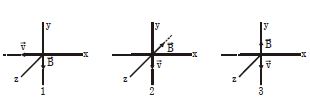
The figure shows three situations when an electron with velocity $\vec v$ travels through a uniform magnetic field $\vec B$. In each case,what is the direction of the magnetic force on the electron?
A
positive $z-$ axis,negative $x-$ axis,positive $y-$ axis
B
negative $z-$ axis,negative $x-$ axis and zero
C
positive $z-$ axis,positive $y-$ axis and zero
D
negative $z-$ axis,positive $x-$ axis and zero
Solution
(B) The magnetic force on a moving charge is given by $\vec F = q(\vec v \times \vec B)$. Since the electron has a negative charge $(q = -e)$,the force is $\vec F = -e(\vec v \times \vec B) = e(\vec B \times \vec v)$.
Case $1$: $\vec v$ is along the negative $x-$ axis $(-\hat i)$ and $\vec B$ is along the negative $y-$ axis $(-\hat j)$.
$\vec F = -e((-\hat i) \times (-\hat j)) = -e(\hat k) = -e\hat k$. This is along the negative $z-$ axis.
Case $2$: $\vec v$ is along the negative $y-$ axis $(-\hat j)$ and $\vec B$ is along the positive $x-$ axis $(\hat i)$.
$\vec F = -e((-\hat j) \times \hat i) = -e(\hat k) = -e\hat k$. Wait,let's re-evaluate: $\vec v = -v\hat j$,$\vec B = B\hat i$. $\vec v \times \vec B = (-v\hat j) \times (B\hat i) = -vB(\hat j \times \hat i) = -vB(-\hat k) = vB\hat k$. Since $q = -e$,$\vec F = -e(vB\hat k) = -evB\hat k$. This is along the negative $z-$ axis.
Re-evaluating Case $2$ from image: $\vec v$ is along negative $y-$ axis $(-\hat j)$,$\vec B$ is along positive $x-$ axis $(\hat i)$. $\vec F = -e((-\hat j) \times \hat i) = -e(\hat k) = -e\hat k$. Actually,$\vec v \times \vec B = -\hat j \times \hat i = \hat k$. So $\vec F = -e(\hat k) = -e\hat k$. The force is along negative $z-$ axis.
Case $3$: $\vec v$ is along negative $y-$ axis $(-\hat j)$ and $\vec B$ is along positive $y-$ axis $(\hat j)$.
Since $\vec v$ and $\vec B$ are anti-parallel,$\vec v \times \vec B = 0$. Thus,the force is zero.
Case $1$: $\vec v$ is along the negative $x-$ axis $(-\hat i)$ and $\vec B$ is along the negative $y-$ axis $(-\hat j)$.
$\vec F = -e((-\hat i) \times (-\hat j)) = -e(\hat k) = -e\hat k$. This is along the negative $z-$ axis.
Case $2$: $\vec v$ is along the negative $y-$ axis $(-\hat j)$ and $\vec B$ is along the positive $x-$ axis $(\hat i)$.
$\vec F = -e((-\hat j) \times \hat i) = -e(\hat k) = -e\hat k$. Wait,let's re-evaluate: $\vec v = -v\hat j$,$\vec B = B\hat i$. $\vec v \times \vec B = (-v\hat j) \times (B\hat i) = -vB(\hat j \times \hat i) = -vB(-\hat k) = vB\hat k$. Since $q = -e$,$\vec F = -e(vB\hat k) = -evB\hat k$. This is along the negative $z-$ axis.
Re-evaluating Case $2$ from image: $\vec v$ is along negative $y-$ axis $(-\hat j)$,$\vec B$ is along positive $x-$ axis $(\hat i)$. $\vec F = -e((-\hat j) \times \hat i) = -e(\hat k) = -e\hat k$. Actually,$\vec v \times \vec B = -\hat j \times \hat i = \hat k$. So $\vec F = -e(\hat k) = -e\hat k$. The force is along negative $z-$ axis.
Case $3$: $\vec v$ is along negative $y-$ axis $(-\hat j)$ and $\vec B$ is along positive $y-$ axis $(\hat j)$.
Since $\vec v$ and $\vec B$ are anti-parallel,$\vec v \times \vec B = 0$. Thus,the force is zero.
0 likes
View Solution203
AdvancedMCQ
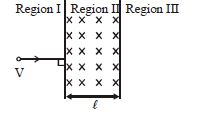
$A$ particle of mass $m$ and charge $q$,moving with velocity $V$,enters region $II$ normal to the boundary as shown in the figure. Region $II$ has a uniform magnetic field $B$ perpendicular to the plane of the paper. The length of the region $II$ is $l$. Choose the incorrect option.
A
The particle enters Region $III$ only if its velocity $V > \frac{qlB}{m}$.
B
The particle enters Region $III$ only if its velocity $V < \frac{qlB}{m}$.
C
Path length of the particle in Region $II$ is maximum when velocity $V = \frac{qlB}{m}$.
D
Time spent in Region $II$ is the same for any velocity $V$ as long as the particle returns to Region $I$.
Solution
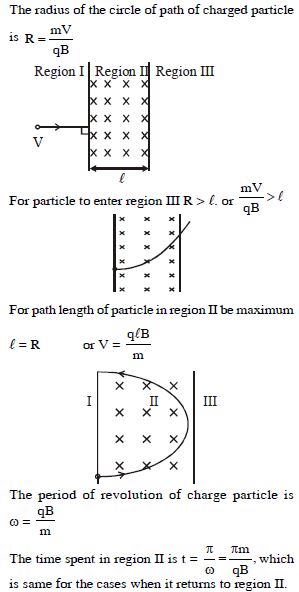
(B) The radius of the circular path of the charged particle in the magnetic field is given by $R = \frac{mV}{qB}$.
For the particle to enter Region $III$,the radius of the path must be greater than the width of Region $II$,i.e.,$R > l$.
Substituting the expression for $R$,we get $\frac{mV}{qB} > l$,which implies $V > \frac{qlB}{m}$. Thus,option $A$ is correct and option $B$ is incorrect.
The path length of the particle in Region $II$ is the arc length of the circular path. This length is maximum when the particle completes a semi-circle before exiting Region $II$,which occurs when $R = l$,or $V = \frac{qlB}{m}$. Thus,option $C$ is correct.
The time spent in the magnetic field is $t = \frac{\theta}{\omega}$,where $\omega = \frac{qB}{m}$ is the angular frequency. For a particle returning to Region $I$,it traces a semi-circle,so $\theta = \pi$. Thus,$t = \frac{\pi}{\omega} = \frac{\pi m}{qB}$,which is independent of velocity $V$. Thus,option $D$ is correct.
For the particle to enter Region $III$,the radius of the path must be greater than the width of Region $II$,i.e.,$R > l$.
Substituting the expression for $R$,we get $\frac{mV}{qB} > l$,which implies $V > \frac{qlB}{m}$. Thus,option $A$ is correct and option $B$ is incorrect.
The path length of the particle in Region $II$ is the arc length of the circular path. This length is maximum when the particle completes a semi-circle before exiting Region $II$,which occurs when $R = l$,or $V = \frac{qlB}{m}$. Thus,option $C$ is correct.
The time spent in the magnetic field is $t = \frac{\theta}{\omega}$,where $\omega = \frac{qB}{m}$ is the angular frequency. For a particle returning to Region $I$,it traces a semi-circle,so $\theta = \pi$. Thus,$t = \frac{\pi}{\omega} = \frac{\pi m}{qB}$,which is independent of velocity $V$. Thus,option $D$ is correct.
0 likes
View Solution204
EasyMCQ
$A$ beam of electrons passes undeflected through mutually perpendicular electric and magnetic fields. If the electric field is switched off,and the same magnetic field is maintained,the electrons move
A
in an elliptical orbit
B
in a circular orbit
C
along a parabolic path
D
along a straight line
Solution
(B) When a charged particle enters a magnetic field with a velocity perpendicular to the magnetic field,it experiences a magnetic Lorentz force $F = q(v \times B)$.
Since the force is always perpendicular to the velocity,it acts as a centripetal force.
This centripetal force causes the particle to move in a circular path with a constant speed.
Therefore,when the electric field is switched off,the electrons will move in a circular orbit.
Since the force is always perpendicular to the velocity,it acts as a centripetal force.
This centripetal force causes the particle to move in a circular path with a constant speed.
Therefore,when the electric field is switched off,the electrons will move in a circular orbit.
0 likes
View Solution205
EasyMCQ
$A$ negatively charged particle projected towards east is deflected towards north by a magnetic field. The direction of the magnetic field is
A
towards west
B
towards south
C
downward
D
upward
Solution
(C) The force on a charged particle in a magnetic field is given by the Lorentz force formula: $\vec{F} = q(\vec{v} \times \vec{B})$.
For a negatively charged particle $(q < 0)$,the force $\vec{F}$ is in the opposite direction of $\vec{v} \times \vec{B}$.
The particle is projected towards the east,so the velocity vector $\vec{v}$ is towards the east.
The particle is deflected towards the north,so the force vector $\vec{F}$ is towards the north.
Since $q$ is negative,the direction of $\vec{v} \times \vec{B}$ must be opposite to the force,i.e.,towards the south.
Using the right-hand rule for the cross product $\vec{v} \times \vec{B}$ (where $\vec{v}$ is east and the result is south),the magnetic field $\vec{B}$ must be directed downward.
For a negatively charged particle $(q < 0)$,the force $\vec{F}$ is in the opposite direction of $\vec{v} \times \vec{B}$.
The particle is projected towards the east,so the velocity vector $\vec{v}$ is towards the east.
The particle is deflected towards the north,so the force vector $\vec{F}$ is towards the north.
Since $q$ is negative,the direction of $\vec{v} \times \vec{B}$ must be opposite to the force,i.e.,towards the south.
Using the right-hand rule for the cross product $\vec{v} \times \vec{B}$ (where $\vec{v}$ is east and the result is south),the magnetic field $\vec{B}$ must be directed downward.
0 likes
View Solution206
EasyMCQ
$A$ particle having some charge is projected in the $x-y$ plane with a speed of $5\ m/s$ in a region having a uniform magnetic field along the $z-$ axis. Which of the following cannot be the possible value of velocity at any time?
A
$3\hat i - 4\hat j$
B
$4\hat i + 3\hat j$
C
$5\hat j$
D
$3\hat i - 4\hat k$
Solution
(D) The magnetic force acting on a charged particle is given by $\vec{F} = q(\vec{v} \times \vec{B})$.
Since the magnetic force is always perpendicular to the velocity vector,it does no work on the particle.
Therefore,the kinetic energy and the speed of the particle remain constant.
The initial speed is $v = 5\ m/s$,so the magnitude of the velocity at any time must be $5\ m/s$.
Additionally,since the magnetic field is along the $z-$ axis,the force $\vec{F} = q(\vec{v} \times B\hat k)$ will always lie in the $x-y$ plane.
If the particle starts in the $x-y$ plane,its velocity will remain in the $x-y$ plane for all time.
Thus,the velocity cannot have a $z-$ component (i.e.,$\hat k$ component).
Option $D$ has a $\hat k$ component,which is impossible.
Since the magnetic force is always perpendicular to the velocity vector,it does no work on the particle.
Therefore,the kinetic energy and the speed of the particle remain constant.
The initial speed is $v = 5\ m/s$,so the magnitude of the velocity at any time must be $5\ m/s$.
Additionally,since the magnetic field is along the $z-$ axis,the force $\vec{F} = q(\vec{v} \times B\hat k)$ will always lie in the $x-y$ plane.
If the particle starts in the $x-y$ plane,its velocity will remain in the $x-y$ plane for all time.
Thus,the velocity cannot have a $z-$ component (i.e.,$\hat k$ component).
Option $D$ has a $\hat k$ component,which is impossible.
0 likes
View Solution207
MediumMCQ
Which of the following particles will experience maximum acceleration when projected with the same speed in a transverse magnetic field?
A
$He^{+2}$
B
$H^+$
C
$Be^{+2}$
D
$Li^+$
Solution
(B) The magnetic force on a charged particle is given by $F_m = qvB \sin \theta$. Since the field is transverse,$\theta = 90^o$,so $F_m = qvB$.
The acceleration $a$ is given by $a = \frac{F_m}{m} = \frac{qvB}{m}$.
Given that $v$ and $B$ are constant,$a \propto \frac{q}{m}$.
Let's calculate the charge-to-mass ratio $(q/m)$ for each particle:
$H^+$: $q=1e, m \approx 1u \Rightarrow q/m = 1/1 = 1$
$He^{+2}$: $q=2e, m \approx 4u \Rightarrow q/m = 2/4 = 0.5$
$Li^+$: $q=1e, m \approx 7u \Rightarrow q/m = 1/7 \approx 0.14$
$Be^{+2}$: $q=2e, m \approx 9u \Rightarrow q/m = 2/9 \approx 0.22$
Comparing the ratios,$H^+$ has the maximum $q/m$ ratio.
Therefore,$H^+$ will experience the maximum acceleration.
The acceleration $a$ is given by $a = \frac{F_m}{m} = \frac{qvB}{m}$.
Given that $v$ and $B$ are constant,$a \propto \frac{q}{m}$.
Let's calculate the charge-to-mass ratio $(q/m)$ for each particle:
$H^+$: $q=1e, m \approx 1u \Rightarrow q/m = 1/1 = 1$
$He^{+2}$: $q=2e, m \approx 4u \Rightarrow q/m = 2/4 = 0.5$
$Li^+$: $q=1e, m \approx 7u \Rightarrow q/m = 1/7 \approx 0.14$
$Be^{+2}$: $q=2e, m \approx 9u \Rightarrow q/m = 2/9 \approx 0.22$
Comparing the ratios,$H^+$ has the maximum $q/m$ ratio.
Therefore,$H^+$ will experience the maximum acceleration.
0 likes
View Solution208
DifficultMCQ
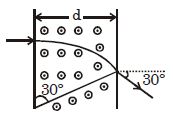
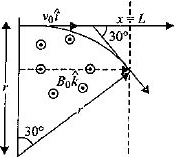
$A$ particle of charge $q$,mass $m$ enters a region of magnetic field $B$ with velocity $v_0 \widehat{i}$. Find the value of $d$ if the particle emerges from the region of magnetic field at an angle $30^{\circ}$ to its initial velocity:-
A
$\frac{mv_0}{2qB}$
B
$\frac{mv_0}{qB}$
C
$\frac{mv_0}{3qB}$
D
$\frac{mv_0}{4qB}$
Solution
(A) As the initial velocity of the particle is perpendicular to the magnetic field,the particle moves along the arc of a circle.
If $r$ is the radius of the circular path,then the magnetic force provides the necessary centripetal force:
$\frac{mv_0^2}{r} = qv_0B \Rightarrow r = \frac{mv_0}{qB}$
From the geometry of the path,the particle enters at $x=0$ and exits at $x=d$. The angle of deviation is $30^{\circ}$.
In the right-angled triangle formed by the radius $r$,the horizontal distance $d$,and the vertical component,we have:
$\sin(30^{\circ}) = \frac{d}{r}$
Substituting the value of $r$:
$d = r \sin(30^{\circ}) = \left( \frac{mv_0}{qB} \right) \times \frac{1}{2} = \frac{mv_0}{2qB}$
Thus,the correct option is $A$.
If $r$ is the radius of the circular path,then the magnetic force provides the necessary centripetal force:
$\frac{mv_0^2}{r} = qv_0B \Rightarrow r = \frac{mv_0}{qB}$
From the geometry of the path,the particle enters at $x=0$ and exits at $x=d$. The angle of deviation is $30^{\circ}$.
In the right-angled triangle formed by the radius $r$,the horizontal distance $d$,and the vertical component,we have:
$\sin(30^{\circ}) = \frac{d}{r}$
Substituting the value of $r$:
$d = r \sin(30^{\circ}) = \left( \frac{mv_0}{qB} \right) \times \frac{1}{2} = \frac{mv_0}{2qB}$
Thus,the correct option is $A$.
0 likes
View Solution209
MediumMCQ
An electron with energy $880 \,eV$ enters a uniform magnetic field of induction $2.5 \times 10^{-3} \,T$. The radius of the circular path will approximately be:
A
$4 \,km$
B
$4 \,m$
C
$4 \,cm$
D
$4 \,mm$
Solution
(C) The magnetic force provides the necessary centripetal force for circular motion: $evB = \frac{mv^2}{r}$.
Rearranging for radius $r$: $r = \frac{mv}{eB}$.
Since kinetic energy $E = \frac{1}{2}mv^2$,we have $v = \sqrt{\frac{2E}{m}}$.
Substituting $v$ into the radius formula: $r = \frac{\sqrt{2mE}}{eB}$.
Given: $E = 880 \times 1.6 \times 10^{-19} \,J$,$m = 9.1 \times 10^{-31} \,kg$,$B = 2.5 \times 10^{-3} \,T$,and $e = 1.6 \times 10^{-19} \,C$.
$r = \frac{\sqrt{2 \times 9.1 \times 10^{-31} \times 880 \times 1.6 \times 10^{-19}}}{1.6 \times 10^{-19} \times 2.5 \times 10^{-3}}$.
$r = \frac{\sqrt{25.6256 \times 10^{-47}}}{4 \times 10^{-22}} \approx \frac{5.06 \times 10^{-23}}{4 \times 10^{-22}} \approx 0.04 \,m = 4 \,cm$.
Rearranging for radius $r$: $r = \frac{mv}{eB}$.
Since kinetic energy $E = \frac{1}{2}mv^2$,we have $v = \sqrt{\frac{2E}{m}}$.
Substituting $v$ into the radius formula: $r = \frac{\sqrt{2mE}}{eB}$.
Given: $E = 880 \times 1.6 \times 10^{-19} \,J$,$m = 9.1 \times 10^{-31} \,kg$,$B = 2.5 \times 10^{-3} \,T$,and $e = 1.6 \times 10^{-19} \,C$.
$r = \frac{\sqrt{2 \times 9.1 \times 10^{-31} \times 880 \times 1.6 \times 10^{-19}}}{1.6 \times 10^{-19} \times 2.5 \times 10^{-3}}$.
$r = \frac{\sqrt{25.6256 \times 10^{-47}}}{4 \times 10^{-22}} \approx \frac{5.06 \times 10^{-23}}{4 \times 10^{-22}} \approx 0.04 \,m = 4 \,cm$.
0 likes
View Solution210
MediumMCQ
$A$ particle of mass $m$ and charge $q$ moving with velocity $\vec v$ enters a region of uniform magnetic field $\vec B.$ Then:
A
Its path in the region of field is always circular.
B
Its path in the region of field is circular if $\vec v \times \vec B = \vec 0$.
C
Its path in the region is helical if $\vec v \times \vec B = \vec 0$.
D
Time period $T$ does not depend on the angle between $\vec v$ and $\vec B$.
Solution
(D) The magnetic force on a moving charge is given by $\vec F = q(\vec v \times \vec B)$.
If $\vec v \times \vec B = \vec 0$,the magnetic force is zero,and the particle continues to move in a straight line.
If $\vec v$ is perpendicular to $\vec B$,the path is circular with time period $T = \frac{2\pi m}{qB}$.
If $\vec v$ makes an angle $\theta$ with $\vec B$,the velocity component perpendicular to the field is $v_{\perp} = v \sin \theta$.
The radius of the circular path is $r = \frac{mv \sin \theta}{qB}$.
The time period is $T = \frac{2\pi r}{v_{\perp}} = \frac{2\pi (mv \sin \theta / qB)}{v \sin \theta} = \frac{2\pi m}{qB}$.
Thus,the time period $T$ is independent of the angle $\theta$ between $\vec v$ and $\vec B$.
If $\vec v \times \vec B = \vec 0$,the magnetic force is zero,and the particle continues to move in a straight line.
If $\vec v$ is perpendicular to $\vec B$,the path is circular with time period $T = \frac{2\pi m}{qB}$.
If $\vec v$ makes an angle $\theta$ with $\vec B$,the velocity component perpendicular to the field is $v_{\perp} = v \sin \theta$.
The radius of the circular path is $r = \frac{mv \sin \theta}{qB}$.
The time period is $T = \frac{2\pi r}{v_{\perp}} = \frac{2\pi (mv \sin \theta / qB)}{v \sin \theta} = \frac{2\pi m}{qB}$.
Thus,the time period $T$ is independent of the angle $\theta$ between $\vec v$ and $\vec B$.
0 likes
View Solution211
EasyMCQ
$A$ charged particle is projected with velocity $\vec{v}$ in a uniform magnetic field $\vec{B}$. For the magnetic force on it to be maximum,which of the following is correct?
A
$\vec{v} \cdot \vec{B} = 0$
B
$\vec{v} \times \vec{B} = 0$
C
$\vec{v} \parallel \vec{B}$
D
$\vec{v}$ is anti-parallel to $\vec{B}$
Solution
(A) The magnetic force $\vec{F}$ on a charged particle moving with velocity $\vec{v}$ in a magnetic field $\vec{B}$ is given by the Lorentz force formula: $\vec{F} = q(\vec{v} \times \vec{B})$.
The magnitude of this force is $F = qvB \sin \theta$,where $\theta$ is the angle between the velocity vector $\vec{v}$ and the magnetic field vector $\vec{B}$.
For the force to be maximum,$\sin \theta$ must be maximum,which occurs when $\theta = 90^\circ$.
When $\theta = 90^\circ$,the velocity vector $\vec{v}$ is perpendicular to the magnetic field vector $\vec{B}$.
Mathematically,two vectors are perpendicular if their dot product is zero,i.e.,$\vec{v} \cdot \vec{B} = 0$.
The magnitude of this force is $F = qvB \sin \theta$,where $\theta$ is the angle between the velocity vector $\vec{v}$ and the magnetic field vector $\vec{B}$.
For the force to be maximum,$\sin \theta$ must be maximum,which occurs when $\theta = 90^\circ$.
When $\theta = 90^\circ$,the velocity vector $\vec{v}$ is perpendicular to the magnetic field vector $\vec{B}$.
Mathematically,two vectors are perpendicular if their dot product is zero,i.e.,$\vec{v} \cdot \vec{B} = 0$.
0 likes
View Solution212
MediumMCQ
$A$ proton of velocity $(3\hat i + 2\hat j) \, ms^{-1}$ enters a magnetic field of $(2\hat j + 3\hat k) \, T$. The acceleration produced in the proton is (charge to mass ratio of proton $= 0.96 \times 10^8 \, C/kg$)
A
$2.88 \times 10^8 (2\hat i - 3\hat j) \, m/s^2$
B
$2.88 \times 10^8 (2\hat i - 3\hat j + 2\hat k) \, m/s^2$
C
$2.88 \times 10^8 (2\hat i + 3\hat k) \, m/s^2$
D
$2.88 \times 10^8 (\hat i - 3\hat j + 2\hat k) \, m/s^2$
Solution
(B) Given velocity $\vec{v} = (3\hat i + 2\hat j) \, m/s$ and magnetic field $\vec{B} = (2\hat j + 3\hat k) \, T$.
The magnetic force on a charged particle is given by $\vec{F} = q(\vec{v} \times \vec{B})$.
$\vec{v} \times \vec{B} = (3\hat i + 2\hat j) \times (2\hat j + 3\hat k) = 3\hat i \times 2\hat j + 3\hat i \times 3\hat k + 2\hat j \times 2\hat j + 2\hat j \times 3\hat k$
Using cross product rules $(\hat i \times \hat j = \hat k, \hat i \times \hat k = -\hat j, \hat j \times \hat j = 0, \hat j \times \hat k = \hat i)$:
$\vec{v} \times \vec{B} = 6\hat k - 9\hat j + 0 + 6\hat i = (6\hat i - 9\hat j + 6\hat k) = 3(2\hat i - 3\hat j + 2\hat k)$.
Acceleration $\vec{a} = \frac{\vec{F}}{m} = \frac{q}{m}(\vec{v} \times \vec{B})$.
Given $\frac{q}{m} = 0.96 \times 10^8 \, C/kg$.
$\vec{a} = (0.96 \times 10^8) \times 3(2\hat i - 3\hat j + 2\hat k) = 2.88 \times 10^8 (2\hat i - 3\hat j + 2\hat k) \, m/s^2$.
The magnetic force on a charged particle is given by $\vec{F} = q(\vec{v} \times \vec{B})$.
$\vec{v} \times \vec{B} = (3\hat i + 2\hat j) \times (2\hat j + 3\hat k) = 3\hat i \times 2\hat j + 3\hat i \times 3\hat k + 2\hat j \times 2\hat j + 2\hat j \times 3\hat k$
Using cross product rules $(\hat i \times \hat j = \hat k, \hat i \times \hat k = -\hat j, \hat j \times \hat j = 0, \hat j \times \hat k = \hat i)$:
$\vec{v} \times \vec{B} = 6\hat k - 9\hat j + 0 + 6\hat i = (6\hat i - 9\hat j + 6\hat k) = 3(2\hat i - 3\hat j + 2\hat k)$.
Acceleration $\vec{a} = \frac{\vec{F}}{m} = \frac{q}{m}(\vec{v} \times \vec{B})$.
Given $\frac{q}{m} = 0.96 \times 10^8 \, C/kg$.
$\vec{a} = (0.96 \times 10^8) \times 3(2\hat i - 3\hat j + 2\hat k) = 2.88 \times 10^8 (2\hat i - 3\hat j + 2\hat k) \, m/s^2$.
0 likes
View Solution213
DifficultMCQ
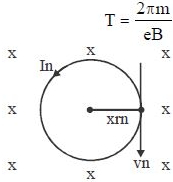
An electron is orbiting in a circular orbit under the influence of a constant transverse magnetic field of strength $B$. Assuming that Bohr's postulate regarding the quantisation of angular momentum holds good for this electron,find the kinetic energy of the electron in the $n^{th}$ orbit. ($m_e =$ mass of electron,$e =$ magnitude of charge of electron)
A
$K.E = \frac{nhBe}{2\pi m_e}$
B
$K.E = \frac{nhBe}{12\pi m_e}$
C
$K.E = \frac{nhBe}{8\pi m_e}$
D
$K.E = \frac{nhBe}{4\pi m_e}$
Solution
(D) The magnetic force provides the necessary centripetal force for the circular motion of the electron: $e v_n B = \frac{m_e v_n^2}{r_n} \Rightarrow r_n = \frac{m_e v_n}{e B}$.
According to Bohr's quantization postulate,the angular momentum is $L = m_e v_n r_n = \frac{nh}{2\pi}$.
Substituting the expression for $r_n$ into the quantization condition:
$m_e v_n \left( \frac{m_e v_n}{e B} \right) = \frac{nh}{2\pi} \Rightarrow m_e^2 v_n^2 = \frac{nh e B}{2\pi} \Rightarrow v_n^2 = \frac{nh e B}{2\pi m_e^2}$.
The kinetic energy is $K.E = \frac{1}{2} m_e v_n^2$.
Substituting $v_n^2$: $K.E = \frac{1}{2} m_e \left( \frac{nh e B}{2\pi m_e^2} \right) = \frac{nh e B}{4\pi m_e}$.
According to Bohr's quantization postulate,the angular momentum is $L = m_e v_n r_n = \frac{nh}{2\pi}$.
Substituting the expression for $r_n$ into the quantization condition:
$m_e v_n \left( \frac{m_e v_n}{e B} \right) = \frac{nh}{2\pi} \Rightarrow m_e^2 v_n^2 = \frac{nh e B}{2\pi} \Rightarrow v_n^2 = \frac{nh e B}{2\pi m_e^2}$.
The kinetic energy is $K.E = \frac{1}{2} m_e v_n^2$.
Substituting $v_n^2$: $K.E = \frac{1}{2} m_e \left( \frac{nh e B}{2\pi m_e^2} \right) = \frac{nh e B}{4\pi m_e}$.
0 likes
View Solution214
EasyMCQ
Work done by a magnetic field of $1\,T$ on a particle of charge $1\,C$ moving with a speed of $5\,m/s$ in one second is........$J$.
A
$5$
B
$10$
C
$0$
D
$25$
Solution
(C) The magnetic force $\vec{F}_m$ acting on a charged particle moving with velocity $\vec{v}$ in a magnetic field $\vec{B}$ is given by the Lorentz force formula: $\vec{F}_m = q(\vec{v} \times \vec{B})$.
Since the magnetic force is always perpendicular to the velocity vector $\vec{v}$,the instantaneous power delivered by the magnetic field is $P = \vec{F}_m \cdot \vec{v} = 0$.
Because the power is zero at every instant,the total work done $W = \int P \, dt$ by the magnetic field on the charged particle is always $0\,J$,regardless of the speed,charge,or time duration.
Since the magnetic force is always perpendicular to the velocity vector $\vec{v}$,the instantaneous power delivered by the magnetic field is $P = \vec{F}_m \cdot \vec{v} = 0$.
Because the power is zero at every instant,the total work done $W = \int P \, dt$ by the magnetic field on the charged particle is always $0\,J$,regardless of the speed,charge,or time duration.
0 likes
View Solution215
MediumMCQ
$A$ monoenergetic beam of electrons moving along the $+y$ direction enters a region of uniform electric and magnetic fields. If the beam goes straight undeflected,then fields $B$ and $E$ are directed respectively along:
A
$-y$ axis and $-z$ axis
B
$+z$ axis and $+x$ axis
C
$+x$ axis and $+z$ axis
D
$-x$ axis and $-y$ axis
Solution
(C) The total Lorentz force on the electron is given by $\overrightarrow{F} = -e(\overrightarrow{E} + \vec{v} \times \overrightarrow{B})$.
For the electron to move undeflected,the net force must be zero,i.e.,$\overrightarrow{F} = 0$.
This implies $\overrightarrow{E} = -(\vec{v} \times \overrightarrow{B}) = \overrightarrow{B} \times \vec{v}$.
Given the velocity $\vec{v} = v\hat{j}$,if we choose the magnetic field $\overrightarrow{B}$ along the $+x$ direction (i.e.,$\overrightarrow{B} = B\hat{i}$),then the magnetic force is $\vec{F}_m = -e(v\hat{j} \times B\hat{i}) = -evB(-\hat{k}) = evB\hat{k}$.
To cancel this,the electric force $\vec{F}_e = -e\overrightarrow{E}$ must be in the $-z$ direction,meaning $\overrightarrow{E}$ must be in the $+z$ direction.
Thus,for the beam to remain undeflected,the magnetic field $\overrightarrow{B}$ must be along the $+x$ axis and the electric field $\overrightarrow{E}$ must be along the $+z$ axis.
For the electron to move undeflected,the net force must be zero,i.e.,$\overrightarrow{F} = 0$.
This implies $\overrightarrow{E} = -(\vec{v} \times \overrightarrow{B}) = \overrightarrow{B} \times \vec{v}$.
Given the velocity $\vec{v} = v\hat{j}$,if we choose the magnetic field $\overrightarrow{B}$ along the $+x$ direction (i.e.,$\overrightarrow{B} = B\hat{i}$),then the magnetic force is $\vec{F}_m = -e(v\hat{j} \times B\hat{i}) = -evB(-\hat{k}) = evB\hat{k}$.
To cancel this,the electric force $\vec{F}_e = -e\overrightarrow{E}$ must be in the $-z$ direction,meaning $\overrightarrow{E}$ must be in the $+z$ direction.
Thus,for the beam to remain undeflected,the magnetic field $\overrightarrow{B}$ must be along the $+x$ axis and the electric field $\overrightarrow{E}$ must be along the $+z$ axis.
0 likes
View Solution216
DifficultMCQ
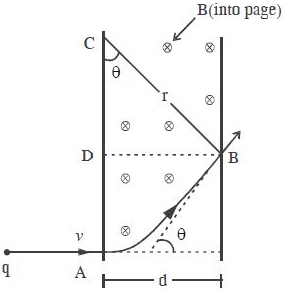
$A$ particle of mass $m$ and charge $q$,accelerated by a potential difference $V$,enters a region of a uniform transverse magnetic field $B$. If $d$ is the thickness of the region of $B$,the angle $\theta$ through which the particle deviates from the initial direction on leaving the region is given by
A
$\sin \theta = Bd{\left( {\frac{q}{{2mV}}} \right)^{\frac{1}{2}}}$
B
$\cos \theta = Bd{\left( {\frac{q}{{2mV}}} \right)^{\frac{1}{2}}}$
C
$\tan \theta = Bd{\left( {\frac{q}{{2mV}}} \right)^{\frac{1}{2}}}$
D
$\cot \theta = Bd{\left( {\frac{q}{{2mV}}} \right)^{\frac{1}{2}}}$
Solution
(A) Let $v$ be the velocity of the particle. Its kinetic energy is given by:
$\frac{1}{2}mv^2 = qV \implies v = \sqrt{\frac{2qV}{m}} \quad ... (1)$
The particle follows a circular path of radius $r$ in the magnetic field,where:
$\frac{mv^2}{r} = qvB \implies r = \frac{mv}{qB} \quad ... (2)$
Substituting the value of $v$ from equation $(1)$ into equation $(2)$:
$r = \frac{m}{qB} \sqrt{\frac{2qV}{m}} = \frac{1}{B} \sqrt{\frac{2mV}{q}}$
From the geometry of the path shown in the figure,in the right-angled triangle formed,the angle of deviation $\theta$ satisfies:
$\sin \theta = \frac{d}{r}$
Substituting the expression for $r$:
$\sin \theta = \frac{d}{\frac{1}{B} \sqrt{\frac{2mV}{q}}} = Bd \sqrt{\frac{q}{2mV}} = Bd \left( \frac{q}{2mV} \right)^{1/2}$
Thus,the correct option is $(A)$.
$\frac{1}{2}mv^2 = qV \implies v = \sqrt{\frac{2qV}{m}} \quad ... (1)$
The particle follows a circular path of radius $r$ in the magnetic field,where:
$\frac{mv^2}{r} = qvB \implies r = \frac{mv}{qB} \quad ... (2)$
Substituting the value of $v$ from equation $(1)$ into equation $(2)$:
$r = \frac{m}{qB} \sqrt{\frac{2qV}{m}} = \frac{1}{B} \sqrt{\frac{2mV}{q}}$
From the geometry of the path shown in the figure,in the right-angled triangle formed,the angle of deviation $\theta$ satisfies:
$\sin \theta = \frac{d}{r}$
Substituting the expression for $r$:
$\sin \theta = \frac{d}{\frac{1}{B} \sqrt{\frac{2mV}{q}}} = Bd \sqrt{\frac{q}{2mV}} = Bd \left( \frac{q}{2mV} \right)^{1/2}$
Thus,the correct option is $(A)$.
0 likes
View Solution217
MediumMCQ
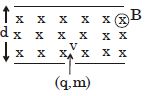
$A$ charged particle of mass $m$ and charge $q$ is projected with velocity $v$ into a region of uniform magnetic field $B$ confined between two parallel plates separated by a distance $d$,as shown in the figure. What is the condition for the charged particle not to strike the opposite plate?
A
$B > \frac{qd}{mv}$
B
$B < \frac{mv}{qd}$
C
$B < \frac{qd}{mv}$
D
$B > \frac{mv}{qd}$
Solution
(D) When a charged particle enters a uniform magnetic field perpendicular to its velocity,it follows a circular path with a radius $r$ given by $r = \frac{mv}{qB}$.
For the particle not to strike the opposite plate,the radius of its circular path must be less than the distance $d$ between the plates.
Therefore,the condition is $r < d$.
Substituting the expression for $r$,we get $\frac{mv}{qB} < d$.
Rearranging this inequality to solve for $B$,we obtain $B > \frac{mv}{qd}$.
For the particle not to strike the opposite plate,the radius of its circular path must be less than the distance $d$ between the plates.
Therefore,the condition is $r < d$.
Substituting the expression for $r$,we get $\frac{mv}{qB} < d$.
Rearranging this inequality to solve for $B$,we obtain $B > \frac{mv}{qd}$.
0 likes
View Solution218
MediumMCQ
An electron $(e^-)$ is moving parallel to a long current-carrying wire as shown in the figure. Calculate the magnetic force acting on the electron. (Given: $I = 10 \ A$,$v = 10^5 \ m/s$,$r = 4 \ cm = 0.04 \ m$)
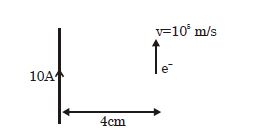
A
$0.4 \times 10^{-18} \ N$
B
$0.8 \times 10^{-18} \ N$
C
$0.8 \times 10^{-16} \ N$
D
$1.6 \times 10^{-18} \ N$
Solution
(B) The magnetic field $(B)$ produced by a long straight wire at a distance $(r)$ is given by $B = \frac{\mu_0 I}{2 \pi r}$.
Substituting the values: $B = \frac{2 \times 10^{-7} \times 10}{0.04} = 0.5 \times 10^{-4} \ T$.
The magnetic force $(F_m)$ on a moving charge is $F_m = qvB \sin \theta$.
Here,the velocity is parallel to the wire,so the angle $(\theta)$ between velocity and magnetic field is $90^{\circ}$.
$F_m = (1.6 \times 10^{-19} \ C) \times (10^5 \ m/s) \times (0.5 \times 10^{-4} \ T) \times \sin 90^{\circ}$.
$F_m = 1.6 \times 10^{-19} \times 10^5 \times 0.5 \times 10^{-4} = 0.8 \times 10^{-18} \ N$.
Substituting the values: $B = \frac{2 \times 10^{-7} \times 10}{0.04} = 0.5 \times 10^{-4} \ T$.
The magnetic force $(F_m)$ on a moving charge is $F_m = qvB \sin \theta$.
Here,the velocity is parallel to the wire,so the angle $(\theta)$ between velocity and magnetic field is $90^{\circ}$.
$F_m = (1.6 \times 10^{-19} \ C) \times (10^5 \ m/s) \times (0.5 \times 10^{-4} \ T) \times \sin 90^{\circ}$.
$F_m = 1.6 \times 10^{-19} \times 10^5 \times 0.5 \times 10^{-4} = 0.8 \times 10^{-18} \ N$.
0 likes
View Solution219
MediumMCQ
When a charged particle moving with velocity $\vec{V}$ is subjected to a magnetic field of induction $\vec{B}$,the force on it is non-zero. This implies that the:
A
Angle between $\vec{V}$ and $\vec{B}$ is necessarily $90^{\circ}$.
B
Angle between $\vec{V}$ and $\vec{B}$ can have any value other than $90^{\circ}$.
C
Angle between $\vec{V}$ and $\vec{B}$ can have any value other than $0^{\circ}$ and $180^{\circ}$.
D
Angle between $\vec{V}$ and $\vec{B}$ is either $0^{\circ}$ or $180^{\circ}$.
Solution
(C) The magnetic Lorentz force on a charged particle is given by the formula $\vec{F} = q(\vec{V} \times \vec{B})$.
In terms of magnitude,this is expressed as $F = qVB \sin \theta$,where $\theta$ is the angle between the velocity vector $\vec{V}$ and the magnetic field vector $\vec{B}$.
For the force to be non-zero $(F \neq 0)$,the term $\sin \theta$ must be non-zero.
Since $\sin \theta = 0$ when $\theta = 0^{\circ}$ or $\theta = 180^{\circ}$,the force is zero at these angles.
Therefore,for the force to be non-zero,$\theta$ must not be $0^{\circ}$ or $180^{\circ}$.
In terms of magnitude,this is expressed as $F = qVB \sin \theta$,where $\theta$ is the angle between the velocity vector $\vec{V}$ and the magnetic field vector $\vec{B}$.
For the force to be non-zero $(F \neq 0)$,the term $\sin \theta$ must be non-zero.
Since $\sin \theta = 0$ when $\theta = 0^{\circ}$ or $\theta = 180^{\circ}$,the force is zero at these angles.
Therefore,for the force to be non-zero,$\theta$ must not be $0^{\circ}$ or $180^{\circ}$.
0 likes
View Solution220
DifficultMCQ
Two particles $A$ and $B$ having equal charges $+6\,C$,after being accelerated through the same potential difference,enter a region of uniform magnetic field and describe circular paths of radii $2\,cm$ and $3\,cm$ respectively. The ratio of mass of $A$ to that of $B$ is
A
$\frac{4}{9}$
B
$\frac{9}{5}$
C
$\frac{1}{2}$
D
$\frac{1}{3}$
Solution
(A) Let $v$ be the velocity acquired by the charged particle when accelerated through the potential difference $V$.
$\frac{1}{2}mv^2 = qV \implies v = \sqrt{\frac{2qV}{m}}$
When a charged particle enters a uniform magnetic field $B$ perpendicular to its velocity,it describes a circular path of radius $R$ given by:
$R = \frac{mv}{qB}$
Substituting the value of $v$:
$R = \frac{m}{qB} \sqrt{\frac{2qV}{m}} = \frac{1}{B} \sqrt{\frac{2mV}{q}}$
Since $q, V,$ and $B$ are the same for both particles,we have $R \propto \sqrt{m}$.
Therefore,$\frac{R_A}{R_B} = \sqrt{\frac{m_A}{m_B}}$.
Squaring both sides:
$\frac{m_A}{m_B} = \left(\frac{R_A}{R_B}\right)^2 = \left(\frac{2\,cm}{3\,cm}\right)^2 = \frac{4}{9}$.
$\frac{1}{2}mv^2 = qV \implies v = \sqrt{\frac{2qV}{m}}$
When a charged particle enters a uniform magnetic field $B$ perpendicular to its velocity,it describes a circular path of radius $R$ given by:
$R = \frac{mv}{qB}$
Substituting the value of $v$:
$R = \frac{m}{qB} \sqrt{\frac{2qV}{m}} = \frac{1}{B} \sqrt{\frac{2mV}{q}}$
Since $q, V,$ and $B$ are the same for both particles,we have $R \propto \sqrt{m}$.
Therefore,$\frac{R_A}{R_B} = \sqrt{\frac{m_A}{m_B}}$.
Squaring both sides:
$\frac{m_A}{m_B} = \left(\frac{R_A}{R_B}\right)^2 = \left(\frac{2\,cm}{3\,cm}\right)^2 = \frac{4}{9}$.
0 likes
View Solution221
EasyMCQ
Which of the following particles will describe the smallest circle when projected with the same velocity perpendicular to the magnetic field?
A
Electron
B
Proton
C
$\alpha$-particle
D
Deuteron
Solution
(A) When a charged particle is projected perpendicular to a magnetic field,it follows a circular path.
The magnetic force provides the necessary centripetal force: $Bqv = \frac{mv^2}{r}$.
Rearranging for the radius of the path,we get $r = \frac{mv}{Bq}$.
Since $v$ and $B$ are constant for all particles,the radius is proportional to the mass-to-charge ratio: $r \propto \frac{m}{q}$.
Comparing the mass-to-charge ratios $(m/q)$:
For an electron: $m_e / e \approx 5.68 \times 10^{-12} \ kg/C$.
For a proton: $m_p / e \approx 1.04 \times 10^{-8} \ kg/C$.
For a deuteron: $m_d / e \approx 2.08 \times 10^{-8} \ kg/C$.
For an $\alpha$-particle: $m_{\alpha} / (2e) \approx 2.08 \times 10^{-8} \ kg/C$.
The ratio $m/q$ is the smallest for the electron. Therefore,the electron will describe the smallest circle.
The magnetic force provides the necessary centripetal force: $Bqv = \frac{mv^2}{r}$.
Rearranging for the radius of the path,we get $r = \frac{mv}{Bq}$.
Since $v$ and $B$ are constant for all particles,the radius is proportional to the mass-to-charge ratio: $r \propto \frac{m}{q}$.
Comparing the mass-to-charge ratios $(m/q)$:
For an electron: $m_e / e \approx 5.68 \times 10^{-12} \ kg/C$.
For a proton: $m_p / e \approx 1.04 \times 10^{-8} \ kg/C$.
For a deuteron: $m_d / e \approx 2.08 \times 10^{-8} \ kg/C$.
For an $\alpha$-particle: $m_{\alpha} / (2e) \approx 2.08 \times 10^{-8} \ kg/C$.
The ratio $m/q$ is the smallest for the electron. Therefore,the electron will describe the smallest circle.
0 likes
View Solution222
MediumMCQ
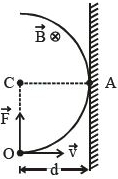
$A$ particle with charge-to-mass ratio $\frac{q}{m} = \alpha$ is shot with a speed $v$ towards a wall at a distance $d$,moving perpendicular to the wall. The minimum value of the magnetic field $\vec{B}$ that exists in this region,perpendicular to the velocity of the particle,such that the particle does not hit the wall is:
A
$\frac{v}{\alpha d}$
B
$\frac{2v}{\alpha d}$
C
$\frac{v}{2\alpha d}$
D
$\frac{v}{4\alpha d}$
Solution
(A) The particle moves in a circular path due to the Lorentz force $\vec{F} = q(\vec{v} \times \vec{B})$.
For the particle to just miss the wall,the radius of the circular path $r$ must be equal to the distance $d$ from the wall.
The radius of the circular path is given by $r = \frac{mv}{qB}$.
Setting $r = d$,we get $d = \frac{mv}{qB}$.
Rearranging for $B$,we have $B = \frac{mv}{qd}$.
Since $\frac{q}{m} = \alpha$,we can write $\frac{m}{q} = \frac{1}{\alpha}$.
Substituting this into the expression for $B$,we get $B = \frac{v}{\alpha d}$.
For the particle to just miss the wall,the radius of the circular path $r$ must be equal to the distance $d$ from the wall.
The radius of the circular path is given by $r = \frac{mv}{qB}$.
Setting $r = d$,we get $d = \frac{mv}{qB}$.
Rearranging for $B$,we have $B = \frac{mv}{qd}$.
Since $\frac{q}{m} = \alpha$,we can write $\frac{m}{q} = \frac{1}{\alpha}$.
Substituting this into the expression for $B$,we get $B = \frac{v}{\alpha d}$.
0 likes
View Solution223
MediumMCQ
$A$ charge having $q/m$ equal to $10^8 \, C/kg$ and with velocity $3 \times 10^5 \, m/s$ enters into a uniform magnetic field $0.3 \, T$ at an angle $30^{\circ}$ with the direction of the field. The radius of curvature will be ...... $cm$.
A
$2$
B
$0.5$
C
$0.01$
D
$1$
Solution
(B) The radius of the helical path of a charged particle moving in a uniform magnetic field is given by the formula:
$r = \frac{mv_{\perp}}{qB} = \frac{mv \sin \theta}{qB}$
Given values:
$q/m = 10^8 \, C/kg \implies m/q = 10^{-8} \, kg/C$
$v = 3 \times 10^5 \, m/s$
$B = 0.3 \, T$
$\theta = 30^{\circ}$
Substituting the values into the formula:
$r = \left( \frac{m}{q} \right) \frac{v \sin 30^{\circ}}{B}$
$r = (10^{-8}) \times \frac{3 \times 10^5 \times 0.5}{0.3}$
$r = 10^{-8} \times \frac{1.5 \times 10^5}{0.3}$
$r = 10^{-8} \times 5 \times 10^5 = 5 \times 10^{-3} \, m$
Converting meters to centimeters:
$r = 5 \times 10^{-3} \times 10^2 \, cm = 0.5 \, cm$.
$r = \frac{mv_{\perp}}{qB} = \frac{mv \sin \theta}{qB}$
Given values:
$q/m = 10^8 \, C/kg \implies m/q = 10^{-8} \, kg/C$
$v = 3 \times 10^5 \, m/s$
$B = 0.3 \, T$
$\theta = 30^{\circ}$
Substituting the values into the formula:
$r = \left( \frac{m}{q} \right) \frac{v \sin 30^{\circ}}{B}$
$r = (10^{-8}) \times \frac{3 \times 10^5 \times 0.5}{0.3}$
$r = 10^{-8} \times \frac{1.5 \times 10^5}{0.3}$
$r = 10^{-8} \times 5 \times 10^5 = 5 \times 10^{-3} \, m$
Converting meters to centimeters:
$r = 5 \times 10^{-3} \times 10^2 \, cm = 0.5 \, cm$.
0 likes
View Solution224
DifficultMCQ
$A$ proton, a deuteron, and an $\alpha$-particle enter a region of a uniform magnetic field perpendicular to their velocities with the same kinetic energy. If $r_p, r_d,$ and $r_\alpha$ are the radii of the circular paths of these particles, respectively, then:
A
$r_\alpha = r_p < r_d$
B
$r_\alpha = r_d = r_p$
C
$r_\alpha < r_d < r_p$
D
$r_\alpha > r_d > r_p$
Solution
(A) The radius of the circular path of a charged particle in a magnetic field is given by $r = \frac{mv}{qB}$.
Since kinetic energy $E = \frac{1}{2}mv^2$, we have $mv = \sqrt{2mE}$.
Substituting this into the radius formula, we get $r = \frac{\sqrt{2mE}}{qB}$.
Given that $E$ and $B$ are the same for all particles, we have $r \propto \frac{\sqrt{m}}{q}$.
For a proton $(p)$: mass $= m$, charge $= e$. So, $r_p \propto \frac{\sqrt{m}}{e}$.
For a deuteron $(d)$: mass $= 2m$, charge $= e$. So, $r_d \propto \frac{\sqrt{2m}}{e}$.
For an $\alpha$-particle $(\alpha)$: mass $= 4m$, charge $= 2e$. So, $r_\alpha \propto \frac{\sqrt{4m}}{2e} = \frac{2\sqrt{m}}{2e} = \frac{\sqrt{m}}{e}$.
Comparing the ratios: $r_p : r_d : r_\alpha = 1 : \sqrt{2} : 1$.
Therefore, $r_p = r_\alpha < r_d$.
Since kinetic energy $E = \frac{1}{2}mv^2$, we have $mv = \sqrt{2mE}$.
Substituting this into the radius formula, we get $r = \frac{\sqrt{2mE}}{qB}$.
Given that $E$ and $B$ are the same for all particles, we have $r \propto \frac{\sqrt{m}}{q}$.
For a proton $(p)$: mass $= m$, charge $= e$. So, $r_p \propto \frac{\sqrt{m}}{e}$.
For a deuteron $(d)$: mass $= 2m$, charge $= e$. So, $r_d \propto \frac{\sqrt{2m}}{e}$.
For an $\alpha$-particle $(\alpha)$: mass $= 4m$, charge $= 2e$. So, $r_\alpha \propto \frac{\sqrt{4m}}{2e} = \frac{2\sqrt{m}}{2e} = \frac{\sqrt{m}}{e}$.
Comparing the ratios: $r_p : r_d : r_\alpha = 1 : \sqrt{2} : 1$.
Therefore, $r_p = r_\alpha < r_d$.
0 likes
View Solution225
DifficultMCQ
An electron moves at a right angle to a magnetic field of $1.5 \times 10^{-2} \, T$ with a speed of $6 \times 10^7 \, m/s$. If the specific charge of the electron is $1.7 \times 10^{11} \, C/kg$,the radius of the circular path will be.....$cm$
A
$3.31$
B
$4.31$
C
$1.31$
D
$2.35$
Solution
(D) The radius $r$ of the circular path of a charged particle moving perpendicular to a magnetic field is given by the formula $r = \frac{mv}{qB}$.
Here,$v = 6 \times 10^7 \, m/s$,$B = 1.5 \times 10^{-2} \, T$,and the specific charge $\frac{q}{m} = 1.7 \times 10^{11} \, C/kg$.
Substituting these values into the formula:
$r = \frac{v}{(\frac{q}{m})B} = \frac{6 \times 10^7}{(1.7 \times 10^{11}) \times (1.5 \times 10^{-2})}$
$r = \frac{6 \times 10^7}{2.55 \times 10^9} = 2.35 \times 10^{-2} \, m$
Converting the result into centimeters:
$r = 2.35 \times 10^{-2} \times 10^2 \, cm = 2.35 \, cm$.
Here,$v = 6 \times 10^7 \, m/s$,$B = 1.5 \times 10^{-2} \, T$,and the specific charge $\frac{q}{m} = 1.7 \times 10^{11} \, C/kg$.
Substituting these values into the formula:
$r = \frac{v}{(\frac{q}{m})B} = \frac{6 \times 10^7}{(1.7 \times 10^{11}) \times (1.5 \times 10^{-2})}$
$r = \frac{6 \times 10^7}{2.55 \times 10^9} = 2.35 \times 10^{-2} \, m$
Converting the result into centimeters:
$r = 2.35 \times 10^{-2} \times 10^2 \, cm = 2.35 \, cm$.
0 likes
View Solution226
DifficultMCQ
$A$ positively charged $(+q)$ particle of mass $m$ has kinetic energy $K$ and enters vertically downward into a horizontal magnetic field of induction $\vec{B}$. The acceleration of the particle is:
A
$qB\sqrt{\frac{2K}{m}}$
B
$\frac{qB\sqrt{2K}}{m^{3/2}}$
C
$\frac{2qB}{m^{3/2}}\sqrt{2K}$
D
$2qB\sqrt{\frac{2K}{m}}$
Solution
(B) The kinetic energy $K$ of the particle is given by $K = \frac{1}{2}mv^2$.
From this,the velocity $v$ is $v = \sqrt{\frac{2K}{m}}$.
The magnetic force acting on a moving charge is given by $\vec{F} = q(\vec{v} \times \vec{B})$.
Since the particle enters the magnetic field perpendicularly,the magnitude of the force is $F = qvB \sin(90^{\circ}) = qvB$.
Substituting the value of $v$,we get $F = qB \sqrt{\frac{2K}{m}}$.
The acceleration $a$ of the particle is given by $a = \frac{F}{m}$.
Substituting $F$,we get $a = \frac{qB}{m} \sqrt{\frac{2K}{m}} = \frac{qB\sqrt{2K}}{m \cdot m^{1/2}} = \frac{qB\sqrt{2K}}{m^{3/2}}$.
From this,the velocity $v$ is $v = \sqrt{\frac{2K}{m}}$.
The magnetic force acting on a moving charge is given by $\vec{F} = q(\vec{v} \times \vec{B})$.
Since the particle enters the magnetic field perpendicularly,the magnitude of the force is $F = qvB \sin(90^{\circ}) = qvB$.
Substituting the value of $v$,we get $F = qB \sqrt{\frac{2K}{m}}$.
The acceleration $a$ of the particle is given by $a = \frac{F}{m}$.
Substituting $F$,we get $a = \frac{qB}{m} \sqrt{\frac{2K}{m}} = \frac{qB\sqrt{2K}}{m \cdot m^{1/2}} = \frac{qB\sqrt{2K}}{m^{3/2}}$.
0 likes
View Solution227
MediumMCQ
An electron $(e^-)$ is moving in the North direction and the magnetic field at this place is in the upward direction. Then,the electron $(e^-)$ will be deviated towards:
A
East
B
West
C
North
D
South
Solution
(B) The force on a moving charge in a magnetic field is given by the Lorentz force formula: $\vec{F} = q(\vec{v} \times \vec{B})$.
For an electron,the charge $q = -e$.
The velocity $\vec{v}$ is in the North direction (let this be $+\hat{j}$).
The magnetic field $\vec{B}$ is in the upward direction (let this be $+\hat{k}$).
Calculating the cross product: $\vec{v} \times \vec{B} = (v\hat{j}) \times (B\hat{k}) = vB(\hat{j} \times \hat{k}) = vB\hat{i}$ (East direction).
Now,applying the charge: $\vec{F} = -e(vB\hat{i}) = -evB\hat{i}$.
The negative sign indicates the force is in the opposite direction of East,which is West.
Therefore,the electron will deviate towards the West.
For an electron,the charge $q = -e$.
The velocity $\vec{v}$ is in the North direction (let this be $+\hat{j}$).
The magnetic field $\vec{B}$ is in the upward direction (let this be $+\hat{k}$).
Calculating the cross product: $\vec{v} \times \vec{B} = (v\hat{j}) \times (B\hat{k}) = vB(\hat{j} \times \hat{k}) = vB\hat{i}$ (East direction).
Now,applying the charge: $\vec{F} = -e(vB\hat{i}) = -evB\hat{i}$.
The negative sign indicates the force is in the opposite direction of East,which is West.
Therefore,the electron will deviate towards the West.
0 likes
View Solution228
MediumMCQ
$A$ charged particle of charge $q$ and mass $m$ is accelerated through a potential difference of $V$ volts. It enters a region of orthogonal magnetic field $B$. The radius of its circular path will be:
A
$\sqrt{\frac{2mV}{qB^2}}$
B
$\frac{2mV}{qB^2}$
C
$\frac{1}{B} \sqrt{\frac{2mV}{q}}$
D
$\frac{1}{B} \sqrt{\frac{mV}{q}}$
Solution
(C) The kinetic energy $K$ gained by the particle when accelerated through a potential difference $V$ is given by $K = qV$.
Since $K = \frac{1}{2}mv^2$,we have $\frac{1}{2}mv^2 = qV$,which implies $v = \sqrt{\frac{2qV}{m}}$.
When a charged particle enters a magnetic field $B$ perpendicularly,it moves in a circular path of radius $R = \frac{mv}{qB}$.
Substituting the value of $v$ into the radius formula:
$R = \frac{m}{qB} \sqrt{\frac{2qV}{m}} = \frac{1}{B} \sqrt{\frac{m^2 \cdot 2qV}{q^2 \cdot m}} = \frac{1}{B} \sqrt{\frac{2mV}{q}}$.
Thus,the correct option is $C$.
Since $K = \frac{1}{2}mv^2$,we have $\frac{1}{2}mv^2 = qV$,which implies $v = \sqrt{\frac{2qV}{m}}$.
When a charged particle enters a magnetic field $B$ perpendicularly,it moves in a circular path of radius $R = \frac{mv}{qB}$.
Substituting the value of $v$ into the radius formula:
$R = \frac{m}{qB} \sqrt{\frac{2qV}{m}} = \frac{1}{B} \sqrt{\frac{m^2 \cdot 2qV}{q^2 \cdot m}} = \frac{1}{B} \sqrt{\frac{2mV}{q}}$.
Thus,the correct option is $C$.
0 likes
View Solution229
DifficultMCQ
$H^+$,$He^+$,and $O^{++}$ are projected in a uniform transverse magnetic field with equal accelerating potential. If their masses are $1 \, a.m.u.$,$4 \, a.m.u.$,and $16 \, a.m.u.$ respectively,find the ratio of their radii.
A
$1 : \sqrt{2} : 2\sqrt{2}$
B
$1 : \sqrt{2} : \sqrt{2}$
C
$1 : 2 : 2\sqrt{2}$
D
$\sqrt{2} : 2 : 1$
Solution
(C) The radius $r$ of a charged particle moving in a uniform magnetic field $B$ after being accelerated by a potential difference $\Delta V$ is given by $r = \frac{mv}{qB}$.
Since $q\Delta V = \frac{1}{2}mv^2$,we have $v = \sqrt{\frac{2q\Delta V}{m}}$.
Substituting $v$ into the radius formula: $r = \frac{m}{qB} \sqrt{\frac{2q\Delta V}{m}} = \frac{1}{B} \sqrt{\frac{2m\Delta V}{q}}$.
Since $B$ and $\Delta V$ are constant,$r \propto \sqrt{\frac{m}{q}}$.
For $H^+$: $m_1 = 1, q_1 = 1 \Rightarrow \sqrt{\frac{1}{1}} = 1$.
For $He^+$: $m_2 = 4, q_2 = 1 \Rightarrow \sqrt{\frac{4}{1}} = 2$.
For $O^{++}$: $m_3 = 16, q_3 = 2 \Rightarrow \sqrt{\frac{16}{2}} = \sqrt{8} = 2\sqrt{2}$.
Thus,the ratio is $1 : 2 : 2\sqrt{2}$.
Since $q\Delta V = \frac{1}{2}mv^2$,we have $v = \sqrt{\frac{2q\Delta V}{m}}$.
Substituting $v$ into the radius formula: $r = \frac{m}{qB} \sqrt{\frac{2q\Delta V}{m}} = \frac{1}{B} \sqrt{\frac{2m\Delta V}{q}}$.
Since $B$ and $\Delta V$ are constant,$r \propto \sqrt{\frac{m}{q}}$.
For $H^+$: $m_1 = 1, q_1 = 1 \Rightarrow \sqrt{\frac{1}{1}} = 1$.
For $He^+$: $m_2 = 4, q_2 = 1 \Rightarrow \sqrt{\frac{4}{1}} = 2$.
For $O^{++}$: $m_3 = 16, q_3 = 2 \Rightarrow \sqrt{\frac{16}{2}} = \sqrt{8} = 2\sqrt{2}$.
Thus,the ratio is $1 : 2 : 2\sqrt{2}$.
0 likes
View Solution230
MediumMCQ
An electron is projected with velocity $\vec{v}$ in a uniform magnetic field $\vec{B}$. The angle $\theta$ between $\vec{v}$ and $\vec{B}$ lies between $0^\circ$ and $\frac{\pi}{2}$. Its velocity vector $\vec{v}$ returns to its initial value in a time interval of:
A
$\frac{2 \pi m}{eB}$
B
$\frac{\pi m}{eB}$
C
$\frac{\pi m}{2 eB}$
D
Depends upon the angle between $\vec{v}$ and $\vec{B}$
Solution
(A) When a charged particle is projected in a uniform magnetic field at an angle $\theta$ (where $0 < \theta < \frac{\pi}{2}$),it follows a helical path.
The velocity vector $\vec{v}$ can be resolved into two components: $v_{\parallel} = v \cos \theta$ (parallel to $\vec{B}$) and $v_{\perp} = v \sin \theta$ (perpendicular to $\vec{B}$).
The perpendicular component $v_{\perp}$ causes the particle to move in a circle,while the parallel component $v_{\parallel}$ causes it to move linearly along the field lines.
The velocity vector $\vec{v}$ returns to its initial value after one complete revolution in the circular path. The time taken for one complete revolution is the time period $T$.
The time period $T$ is given by the formula $T = \frac{2 \pi m}{qB}$.
For an electron,$q = e$,so $T = \frac{2 \pi m}{eB}$.
This time period is independent of the angle $\theta$ and the velocity $v$.
The velocity vector $\vec{v}$ can be resolved into two components: $v_{\parallel} = v \cos \theta$ (parallel to $\vec{B}$) and $v_{\perp} = v \sin \theta$ (perpendicular to $\vec{B}$).
The perpendicular component $v_{\perp}$ causes the particle to move in a circle,while the parallel component $v_{\parallel}$ causes it to move linearly along the field lines.
The velocity vector $\vec{v}$ returns to its initial value after one complete revolution in the circular path. The time taken for one complete revolution is the time period $T$.
The time period $T$ is given by the formula $T = \frac{2 \pi m}{qB}$.
For an electron,$q = e$,so $T = \frac{2 \pi m}{eB}$.
This time period is independent of the angle $\theta$ and the velocity $v$.
0 likes
View Solution231
MediumMCQ
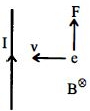
$A$ negative test charge is moving near a long straight wire carrying a current. The force acting on the test charge is parallel to the direction of the current. The motion of the charge is
A
away from the wire
B
towards the wire
C
parallel to the wire along the current
D
parallel to the wire opposite to the current
Solution
(B) The magnetic field $\vec{B}$ produced by a long straight wire carrying current $I$ is directed into the plane of the paper (using the right-hand thumb rule).
The magnetic Lorentz force on a charge $q$ moving with velocity $\vec{v}$ is given by $\vec{F} = q(\vec{v} \times \vec{B})$.
For a negative charge $(q < 0)$,the force $\vec{F}$ is directed opposite to the direction of $(\vec{v} \times \vec{B})$.
According to the right-hand rule for the cross product,if the charge is moving towards the wire,the direction of $(\vec{v} \times \vec{B})$ is parallel to the current. Since the charge is negative,the force $\vec{F} = q(\vec{v} \times \vec{B})$ will be directed opposite to this,which would not match the problem statement.
However,if the charge is moving towards the wire,the force direction is determined by the cross product. Given the force is parallel to the current,the velocity vector must be directed towards the wire for a negative charge to experience a force in the direction of the current.
The magnetic Lorentz force on a charge $q$ moving with velocity $\vec{v}$ is given by $\vec{F} = q(\vec{v} \times \vec{B})$.
For a negative charge $(q < 0)$,the force $\vec{F}$ is directed opposite to the direction of $(\vec{v} \times \vec{B})$.
According to the right-hand rule for the cross product,if the charge is moving towards the wire,the direction of $(\vec{v} \times \vec{B})$ is parallel to the current. Since the charge is negative,the force $\vec{F} = q(\vec{v} \times \vec{B})$ will be directed opposite to this,which would not match the problem statement.
However,if the charge is moving towards the wire,the force direction is determined by the cross product. Given the force is parallel to the current,the velocity vector must be directed towards the wire for a negative charge to experience a force in the direction of the current.
0 likes
View Solution232
DifficultMCQ
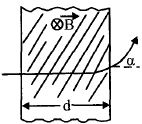
$A$ proton (mass $m$,charge $q$) accelerated by a potential difference $V$ flies through a uniform transverse magnetic field $B$. The field occupies a region of space of width $d$. If $\alpha$ is the angle of deviation of the proton from the initial direction of motion (see figure),the value of $\sin \alpha$ will be:
A
$qV \sqrt{\frac{Bd}{2m}}$
B
$\frac{B}{2} \sqrt{\frac{qd}{mV}}$
C
$\frac{B}{d} \sqrt{\frac{q}{2mV}}$
D
$Bd \sqrt{\frac{q}{2mV}}$
Solution
(D) From the geometry of the path,the proton moves in a circular arc of radius $R$ within the magnetic field. From the figure,we have $\sin \alpha = \frac{d}{R}$.
The magnetic force provides the necessary centripetal force,so $\frac{mv^2}{R} = qvB$,which gives the radius $R = \frac{mv}{qB}$.
Substituting $R$ into the expression for $\sin \alpha$,we get $\sin \alpha = \frac{d}{mv/qB} = \frac{dqB}{mv}$.
The kinetic energy gained by the proton is $\frac{1}{2}mv^2 = qV$,which implies $v = \sqrt{\frac{2qV}{m}}$.
Substituting the value of $v$ into the expression for $\sin \alpha$:
$\sin \alpha = \frac{dqB}{m \sqrt{\frac{2qV}{m}}} = \frac{dqB}{\sqrt{2mqV}} = Bd \sqrt{\frac{q^2}{2mqV}} = Bd \sqrt{\frac{q}{2mV}}$.
Thus,the correct option is $D$.
The magnetic force provides the necessary centripetal force,so $\frac{mv^2}{R} = qvB$,which gives the radius $R = \frac{mv}{qB}$.
Substituting $R$ into the expression for $\sin \alpha$,we get $\sin \alpha = \frac{d}{mv/qB} = \frac{dqB}{mv}$.
The kinetic energy gained by the proton is $\frac{1}{2}mv^2 = qV$,which implies $v = \sqrt{\frac{2qV}{m}}$.
Substituting the value of $v$ into the expression for $\sin \alpha$:
$\sin \alpha = \frac{dqB}{m \sqrt{\frac{2qV}{m}}} = \frac{dqB}{\sqrt{2mqV}} = Bd \sqrt{\frac{q^2}{2mqV}} = Bd \sqrt{\frac{q}{2mV}}$.
Thus,the correct option is $D$.
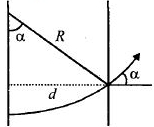
0 likes
View Solution233
DifficultMCQ
$A$ positive charge $q$ of mass $m$ is moving along the $+x$ axis with velocity $v$. We wish to apply a uniform magnetic field $B$ for time $\Delta t$ so that the charge reverses its direction,crossing the $y$ axis at a distance $d$. Then:
A
$B = \frac{mv}{qd}$ and $\Delta t = \frac{\pi d}{v}$
B
$B = \frac{mv}{2qd}$ and $\Delta t = \frac{\pi d}{2v}$
C
$B = \frac{2mv}{qd}$ and $\Delta t = \frac{\pi d}{2v}$
D
$B = \frac{2mv}{qd}$ and $\Delta t = \frac{\pi d}{v}$
Solution
(C) The magnetic field provides the necessary centripetal force for the particle to move in a semi-circular path of diameter $d$,so the radius $R = \frac{d}{2}$.
Using the centripetal force formula: $Bqv = \frac{mv^2}{R} = \frac{mv^2}{d/2}$.
Solving for $B$: $B = \frac{2mv}{qd}$.
The time $\Delta t$ taken to complete a semi-circle is half the time period of a full circular orbit.
The time period $T = \frac{2\pi m}{Bq}$.
Thus,$\Delta t = \frac{T}{2} = \frac{\pi m}{Bq}$.
Substituting $B = \frac{2mv}{qd}$ into the expression for $\Delta t$:
$\Delta t = \frac{\pi m}{(2mv/qd)q} = \frac{\pi d}{2v}$.
Using the centripetal force formula: $Bqv = \frac{mv^2}{R} = \frac{mv^2}{d/2}$.
Solving for $B$: $B = \frac{2mv}{qd}$.
The time $\Delta t$ taken to complete a semi-circle is half the time period of a full circular orbit.
The time period $T = \frac{2\pi m}{Bq}$.
Thus,$\Delta t = \frac{T}{2} = \frac{\pi m}{Bq}$.
Substituting $B = \frac{2mv}{qd}$ into the expression for $\Delta t$:
$\Delta t = \frac{\pi m}{(2mv/qd)q} = \frac{\pi d}{2v}$.
0 likes
View Solution234
MediumMCQ
$A$ particle of charge $16 \times 10^{-16} \, C$ moving with velocity $10 \, ms^{-1}$ along the $x$-axis enters a region where a magnetic field of induction $\vec{B}$ is along the $y$-axis and an electric field of magnitude $10^4 \, Vm^{-1}$ is along the negative $z$-axis. If the charged particle continues moving along the $x$-axis,the magnitude of $\vec{B}$ is:
A
$16 \times 10^3 \, Wb \, m^{-2}$
B
$2 \times 10^3 \, Wb \, m^{-2}$
C
$1 \times 10^3 \, Wb \, m^{-2}$
D
$4 \times 10^3 \, Wb \, m^{-2}$
Solution
(C) For the particle to move undeflected along the $x$-axis,the net Lorentz force acting on it must be zero.
The Lorentz force is given by $\vec{F} = q(\vec{E} + \vec{v} \times \vec{B})$.
For the force to be zero,the electric force must be equal and opposite to the magnetic force: $qE = qvB$.
Thus,$B = \frac{E}{v}$.
Given $E = 10^4 \, Vm^{-1}$ and $v = 10 \, ms^{-1}$.
Substituting the values: $B = \frac{10^4}{10} = 10^3 \, Wb \, m^{-2}$.
The Lorentz force is given by $\vec{F} = q(\vec{E} + \vec{v} \times \vec{B})$.
For the force to be zero,the electric force must be equal and opposite to the magnetic force: $qE = qvB$.
Thus,$B = \frac{E}{v}$.
Given $E = 10^4 \, Vm^{-1}$ and $v = 10 \, ms^{-1}$.
Substituting the values: $B = \frac{10^4}{10} = 10^3 \, Wb \, m^{-2}$.
0 likes
View Solution235
EasyMCQ
The velocity of certain ions that pass undeflected through crossed electric field $E = 7.7 \, kV/m$ and magnetic field $B = 0.14 \, T$ is.....$km/s$
A
$18$
B
$77$
C
$55$
D
$1078$
Solution
(C) When a charged particle passes undeflected through crossed electric and magnetic fields,the electric force is balanced by the magnetic force.
$F_e = F_m$
$qE = qvB$
$v = \frac{E}{B}$
Given $E = 7.7 \, kV/m = 7.7 \times 10^3 \, V/m$ and $B = 0.14 \, T$.
$v = \frac{7.7 \times 10^3}{0.14} \, m/s$
$v = 55000 \, m/s = 55 \, km/s$.
$F_e = F_m$
$qE = qvB$
$v = \frac{E}{B}$
Given $E = 7.7 \, kV/m = 7.7 \times 10^3 \, V/m$ and $B = 0.14 \, T$.
$v = \frac{7.7 \times 10^3}{0.14} \, m/s$
$v = 55000 \, m/s = 55 \, km/s$.
0 likes
View Solution236
MediumMCQ
The magnetic force acting on a charged particle of charge $2\,\mu C$ in a magnetic field of $2\, T$ acting in the $y-$ direction,when the particle velocity is $(2\hat{i} + 3\hat{j}) \times 10^6\, m/s$ is:
A
$8\, N$ in $z-$ direction
B
$8\, N$ in $y-$ direction
C
$4\, N$ in $y-$ direction
D
$4\, N$ in $z-$ direction
Solution
(A) The magnetic force $\vec{F}$ on a charged particle is given by the Lorentz force formula: $\vec{F} = q(\vec{v} \times \vec{B})$.
Given:
$q = 2\,\mu C = 2 \times 10^{-6}\, C$
$\vec{v} = (2\hat{i} + 3\hat{j}) \times 10^6\, m/s$
$\vec{B} = 2\hat{j}\, T$
Substituting the values:
$\vec{F} = (2 \times 10^{-6}) \times [(2\hat{i} + 3\hat{j}) \times 10^6] \times (2\hat{j})$
$\vec{F} = 2 \times [ (2\hat{i} \times 2\hat{j}) + (3\hat{j} \times 2\hat{j}) ]$
Since $\hat{i} \times \hat{j} = \hat{k}$ and $\hat{j} \times \hat{j} = 0$:
$\vec{F} = 2 \times [ 4\hat{k} + 0 ] = 8\hat{k}\, N$.
Thus,the force is $8\, N$ in the $z-$ direction.
Given:
$q = 2\,\mu C = 2 \times 10^{-6}\, C$
$\vec{v} = (2\hat{i} + 3\hat{j}) \times 10^6\, m/s$
$\vec{B} = 2\hat{j}\, T$
Substituting the values:
$\vec{F} = (2 \times 10^{-6}) \times [(2\hat{i} + 3\hat{j}) \times 10^6] \times (2\hat{j})$
$\vec{F} = 2 \times [ (2\hat{i} \times 2\hat{j}) + (3\hat{j} \times 2\hat{j}) ]$
Since $\hat{i} \times \hat{j} = \hat{k}$ and $\hat{j} \times \hat{j} = 0$:
$\vec{F} = 2 \times [ 4\hat{k} + 0 ] = 8\hat{k}\, N$.
Thus,the force is $8\, N$ in the $z-$ direction.
0 likes
View Solution237
DifficultMCQ
$A$ proton and a deuteron are both accelerated through the same potential difference and enter a magnetic field perpendicular to the direction of the field. If the deuteron follows a path of radius $R$,assuming the neutron and proton masses are nearly equal,the radius of the proton's path will be
A
$R/\sqrt{2}$
B
$R/2$
C
$R$
D
$\sqrt{2}R$
Solution
(A) The radius of a charged particle moving in a magnetic field is given by $r = \frac{mv}{qB}$.
Since the particle is accelerated through a potential difference $V$,its kinetic energy is $K = qV = \frac{1}{2}mv^2$,which implies $v = \sqrt{\frac{2qV}{m}}$.
Substituting $v$ into the radius formula: $r = \frac{m}{qB} \sqrt{\frac{2qV}{m}} = \frac{1}{B} \sqrt{\frac{2mV}{q}}$.
For a proton,$q_p = e$ and $m_p = m$. Thus,$r_p = \frac{1}{B} \sqrt{\frac{2mV}{e}}$.
For a deuteron,$q_d = e$ and $m_d = 2m$. Thus,$r_d = \frac{1}{B} \sqrt{\frac{2(2m)V}{e}} = \sqrt{2} \times \frac{1}{B} \sqrt{\frac{2mV}{e}} = \sqrt{2} r_p$.
Given $r_d = R$,we have $R = \sqrt{2} r_p$,which implies $r_p = \frac{R}{\sqrt{2}}$.
Since the particle is accelerated through a potential difference $V$,its kinetic energy is $K = qV = \frac{1}{2}mv^2$,which implies $v = \sqrt{\frac{2qV}{m}}$.
Substituting $v$ into the radius formula: $r = \frac{m}{qB} \sqrt{\frac{2qV}{m}} = \frac{1}{B} \sqrt{\frac{2mV}{q}}$.
For a proton,$q_p = e$ and $m_p = m$. Thus,$r_p = \frac{1}{B} \sqrt{\frac{2mV}{e}}$.
For a deuteron,$q_d = e$ and $m_d = 2m$. Thus,$r_d = \frac{1}{B} \sqrt{\frac{2(2m)V}{e}} = \sqrt{2} \times \frac{1}{B} \sqrt{\frac{2mV}{e}} = \sqrt{2} r_p$.
Given $r_d = R$,we have $R = \sqrt{2} r_p$,which implies $r_p = \frac{R}{\sqrt{2}}$.
0 likes
View Solution238
DifficultMCQ
This question has Statement $1$ and Statement $2$. Of the four choices given after the Statements,choose the one that best describes the two Statements.
Statement $1$: $A$ charged particle is moving at a right angle to a static magnetic field. During the motion,the kinetic energy of the charge remains unchanged.
Statement $2$: $A$ static magnetic field exerts a force on a moving charge in the direction perpendicular to the magnetic field.
Statement $1$: $A$ charged particle is moving at a right angle to a static magnetic field. During the motion,the kinetic energy of the charge remains unchanged.
Statement $2$: $A$ static magnetic field exerts a force on a moving charge in the direction perpendicular to the magnetic field.
A
Statement $1$ is false,Statement $2$ is true.
B
Statement $1$ is true,Statement $2$ is true,Statement $2$ is not the correct explanation of Statement $1$.
C
Statement $1$ is true,Statement $2$ is false.
D
Statement $1$ is true,Statement $2$ is true,Statement $2$ is the correct explanation of Statement $1$.
Solution
(D) The magnetic force on a moving charge is given by $\vec{F} = q(\vec{v} \times \vec{B})$.
Since the force $\vec{F}$ is always perpendicular to the velocity vector $\vec{v}$,the work done by the magnetic force on the charge is $W = \int \vec{F} \cdot d\vec{r} = \int \vec{F} \cdot \vec{v} dt = 0$.
According to the work-energy theorem,the change in kinetic energy is equal to the work done by the net force.
Since the work done is zero,the kinetic energy remains constant.
Thus,Statement $1$ is true.
Statement $2$ is also true because the magnetic force $\vec{F} = q(\vec{v} \times \vec{B})$ is always perpendicular to both $\vec{v}$ and $\vec{B}$,and this perpendicular force is the reason why the speed (and thus kinetic energy) does not change.
Therefore,Statement $2$ is the correct explanation of Statement $1$.
Since the force $\vec{F}$ is always perpendicular to the velocity vector $\vec{v}$,the work done by the magnetic force on the charge is $W = \int \vec{F} \cdot d\vec{r} = \int \vec{F} \cdot \vec{v} dt = 0$.
According to the work-energy theorem,the change in kinetic energy is equal to the work done by the net force.
Since the work done is zero,the kinetic energy remains constant.
Thus,Statement $1$ is true.
Statement $2$ is also true because the magnetic force $\vec{F} = q(\vec{v} \times \vec{B})$ is always perpendicular to both $\vec{v}$ and $\vec{B}$,and this perpendicular force is the reason why the speed (and thus kinetic energy) does not change.
Therefore,Statement $2$ is the correct explanation of Statement $1$.
0 likes
View Solution239
MediumMCQ
$A$ particle having the same charge as an electron moves in a circular path of radius $0.5 \, cm$ under the influence of a magnetic field of $0.5 \, T$. If an electric field of $100 \, V/m$ makes it move in a straight path,then the mass of the particle is (given charge of electron $= 1.6 \times 10^{-19} \, C$):
A
$9.1 \times 10^{-31} \, kg$
B
$1.6 \times 10^{-27} \, kg$
C
$1.6 \times 10^{-19} \, kg$
D
$2.0 \times 10^{-24} \, kg$
Solution
(D) For a particle moving in a circular path in a magnetic field,the magnetic force provides the centripetal force: $qvB = \frac{mv^2}{r} \Rightarrow v = \frac{qBr}{m}$.
When the particle moves in a straight path under the influence of both electric and magnetic fields,the net force is zero,meaning the electric force balances the magnetic force: $qE = qvB \Rightarrow E = vB$.
Substituting the expression for $v$: $E = \left(\frac{qBr}{m}\right)B = \frac{qB^2r}{m}$.
Rearranging for mass $m$: $m = \frac{qB^2r}{E}$.
Given $q = 1.6 \times 10^{-19} \, C$,$B = 0.5 \, T$,$r = 0.5 \times 10^{-2} \, m$,and $E = 100 \, V/m$.
$m = \frac{(1.6 \times 10^{-19}) \times (0.5)^2 \times (0.5 \times 10^{-2})}{100} = \frac{1.6 \times 10^{-19} \times 0.25 \times 0.005}{100} = \frac{0.002 \times 10^{-19}}{100} = 2.0 \times 10^{-24} \, kg$.
When the particle moves in a straight path under the influence of both electric and magnetic fields,the net force is zero,meaning the electric force balances the magnetic force: $qE = qvB \Rightarrow E = vB$.
Substituting the expression for $v$: $E = \left(\frac{qBr}{m}\right)B = \frac{qB^2r}{m}$.
Rearranging for mass $m$: $m = \frac{qB^2r}{E}$.
Given $q = 1.6 \times 10^{-19} \, C$,$B = 0.5 \, T$,$r = 0.5 \times 10^{-2} \, m$,and $E = 100 \, V/m$.
$m = \frac{(1.6 \times 10^{-19}) \times (0.5)^2 \times (0.5 \times 10^{-2})}{100} = \frac{1.6 \times 10^{-19} \times 0.25 \times 0.005}{100} = \frac{0.002 \times 10^{-19}}{100} = 2.0 \times 10^{-24} \, kg$.
0 likes
View Solution240
MediumMCQ
In an experiment,electrons are accelerated from rest by applying a voltage of $500 \, V$. Calculate the radius of the path if a magnetic field of $100 \, mT$ is then applied. [Charge of the electron $= 1.6 \times 10^{-19} \, C$,Mass of the electron $= 9.1 \times 10^{-31} \, kg$]
A
$7.5 \times 10^{-3} \, m$
B
$7.5 \times 10^{-2} \, m$
C
$7.5 \, m$
D
$7.5 \times 10^{-4} \, m$
Solution
(D) The kinetic energy of the electron accelerated by potential $V$ is given by $K = eV = \frac{p^2}{2m}$.
Thus,the momentum $p = \sqrt{2meV}$.
The radius of the circular path in a magnetic field $B$ is $R = \frac{p}{eB} = \frac{\sqrt{2meV}}{eB} = \frac{1}{B} \sqrt{\frac{2mV}{e}}$.
Given: $V = 500 \, V$,$B = 100 \, mT = 0.1 \, T$,$m = 9.1 \times 10^{-31} \, kg$,$e = 1.6 \times 10^{-19} \, C$.
Substituting the values:
$R = \frac{1}{0.1} \sqrt{\frac{2 \times 9.1 \times 10^{-31} \times 500}{1.6 \times 10^{-19}}}$
$R = 10 \times \sqrt{\frac{910 \times 10^{-31}}{1.6 \times 10^{-19}}} = 10 \times \sqrt{568.75 \times 10^{-12}}$
$R = 10 \times 23.85 \times 10^{-6} \approx 2.38 \times 10^{-4} \, m$.
Wait,re-calculating: $p = \sqrt{2 \times 9.1 \times 10^{-31} \times 500 \times 1.6 \times 10^{-19}} = \sqrt{145600 \times 10^{-50}} = 1.206 \times 10^{-23} \, kg \cdot m/s$.
$R = \frac{1.206 \times 10^{-23}}{1.6 \times 10^{-19} \times 0.1} = \frac{1.206 \times 10^{-23}}{1.6 \times 10^{-20}} = 0.753 \times 10^{-3} \, m = 7.53 \times 10^{-4} \, m$.
Thus,the momentum $p = \sqrt{2meV}$.
The radius of the circular path in a magnetic field $B$ is $R = \frac{p}{eB} = \frac{\sqrt{2meV}}{eB} = \frac{1}{B} \sqrt{\frac{2mV}{e}}$.
Given: $V = 500 \, V$,$B = 100 \, mT = 0.1 \, T$,$m = 9.1 \times 10^{-31} \, kg$,$e = 1.6 \times 10^{-19} \, C$.
Substituting the values:
$R = \frac{1}{0.1} \sqrt{\frac{2 \times 9.1 \times 10^{-31} \times 500}{1.6 \times 10^{-19}}}$
$R = 10 \times \sqrt{\frac{910 \times 10^{-31}}{1.6 \times 10^{-19}}} = 10 \times \sqrt{568.75 \times 10^{-12}}$
$R = 10 \times 23.85 \times 10^{-6} \approx 2.38 \times 10^{-4} \, m$.
Wait,re-calculating: $p = \sqrt{2 \times 9.1 \times 10^{-31} \times 500 \times 1.6 \times 10^{-19}} = \sqrt{145600 \times 10^{-50}} = 1.206 \times 10^{-23} \, kg \cdot m/s$.
$R = \frac{1.206 \times 10^{-23}}{1.6 \times 10^{-19} \times 0.1} = \frac{1.206 \times 10^{-23}}{1.6 \times 10^{-20}} = 0.753 \times 10^{-3} \, m = 7.53 \times 10^{-4} \, m$.
0 likes
View Solution241
DifficultMCQ
The region between $y = 0$ and $y = d$ contains a magnetic field $\vec B = B\hat k$. $A$ particle of mass $m$ and charge $q$ enters the region with a velocity $\vec v = v\hat i$. If $d = \frac{mv}{2qB}$,the acceleration of the charged particle at the point of its emergence at the other side is
A
$\frac{qvB}{m} \left( \frac{\hat j + \hat i}{\sqrt{2}} \right)$
B
$\frac{qvB}{m} \left( \frac{\sqrt{3}}{2} \hat i + \frac{1}{2} \hat j \right)$
C
$\frac{qvB}{m} \left( \frac{-\hat j + \hat i}{\sqrt{2}} \right)$
D
$\frac{qvB}{m} \left( \frac{1}{2} \hat j - \frac{\sqrt{3}}{2} \hat i \right)$
Solution
(D) The magnetic field is $\vec B = B \hat k$. The radius of the circular path of the particle is $r = \frac{mv}{qB}$.
Given $d = \frac{mv}{2qB}$,we have $r = 2d$.
When the particle emerges at $y = d$,the angle $\theta$ that the velocity vector makes with the $x$-axis is given by $\sin \theta = \frac{d}{r} = \frac{d}{2d} = \frac{1}{2}$,which implies $\theta = 30^\circ$ or $\frac{\pi}{6}$.
The force on the particle is $\vec F = q(\vec v \times \vec B)$. The acceleration is $\vec a = \frac{\vec F}{m} = \frac{q}{m}(\vec v \times \vec B)$.
At the point of emergence,the velocity vector is $\vec v = v(\cos \theta \hat i + \sin \theta \hat j)$.
Thus,$\vec a = \frac{q}{m} [v(\cos \theta \hat i + \sin \theta \hat j) \times B \hat k] = \frac{qvB}{m} (\cos \theta (-\hat j) + \sin \theta (\hat i)) = \frac{qvB}{m} (\sin \theta \hat i - \cos \theta \hat j)$.
Substituting $\theta = 30^\circ$,$\sin 30^\circ = \frac{1}{2}$ and $\cos 30^\circ = \frac{\sqrt{3}}{2}$,we get $\vec a = \frac{qvB}{m} (\frac{1}{2} \hat i - \frac{\sqrt{3}}{2} \hat j)$.
Comparing with the options,the magnitude and direction correspond to option $D$ (considering the sign of charge or direction of deflection).
Given $d = \frac{mv}{2qB}$,we have $r = 2d$.
When the particle emerges at $y = d$,the angle $\theta$ that the velocity vector makes with the $x$-axis is given by $\sin \theta = \frac{d}{r} = \frac{d}{2d} = \frac{1}{2}$,which implies $\theta = 30^\circ$ or $\frac{\pi}{6}$.
The force on the particle is $\vec F = q(\vec v \times \vec B)$. The acceleration is $\vec a = \frac{\vec F}{m} = \frac{q}{m}(\vec v \times \vec B)$.
At the point of emergence,the velocity vector is $\vec v = v(\cos \theta \hat i + \sin \theta \hat j)$.
Thus,$\vec a = \frac{q}{m} [v(\cos \theta \hat i + \sin \theta \hat j) \times B \hat k] = \frac{qvB}{m} (\cos \theta (-\hat j) + \sin \theta (\hat i)) = \frac{qvB}{m} (\sin \theta \hat i - \cos \theta \hat j)$.
Substituting $\theta = 30^\circ$,$\sin 30^\circ = \frac{1}{2}$ and $\cos 30^\circ = \frac{\sqrt{3}}{2}$,we get $\vec a = \frac{qvB}{m} (\frac{1}{2} \hat i - \frac{\sqrt{3}}{2} \hat j)$.
Comparing with the options,the magnitude and direction correspond to option $D$ (considering the sign of charge or direction of deflection).
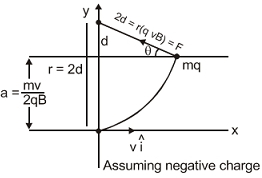
0 likes
View Solution242
MediumMCQ
$A$ proton and an $\alpha$-particle (with their masses in the ratio of $1:4$ and charges in the ratio of $1:2$) are accelerated from rest through a potential difference $V$. If a uniform magnetic field $B$ is set up perpendicular to their velocities,the ratio of the radii $r_p : r_{\alpha}$ of the circular paths described by them will be
A
$1 : \sqrt{2}$
B
$1 : 2$
C
$1 : 3$
D
$1 : \sqrt{3}$
Solution
(A) The kinetic energy $K$ acquired by a particle of charge $q$ accelerated through a potential difference $V$ is $K = qV$.
For a proton: $m_p = m$,$q_p = q$,$K_p = qV$.
For an $\alpha$-particle: $m_{\alpha} = 4m$,$q_{\alpha} = 2q$,$K_{\alpha} = (2q)V = 2qV$.
The radius $r$ of the circular path of a charged particle in a magnetic field $B$ is given by $r = \frac{mv}{qB} = \frac{\sqrt{2mK}}{qB}$.
Taking the ratio of the radii:
$\frac{r_p}{r_{\alpha}} = \frac{\sqrt{2m_p K_p} / q_p B}{\sqrt{2m_{\alpha} K_{\alpha}} / q_{\alpha} B} = \frac{\sqrt{m_p K_p}}{q_p} \cdot \frac{q_{\alpha}}{\sqrt{m_{\alpha} K_{\alpha}}}$
Substituting the values:
$\frac{r_p}{r_{\alpha}} = \frac{\sqrt{m \cdot qV}}{q} \cdot \frac{2q}{\sqrt{4m \cdot 2qV}} = \frac{\sqrt{mqV}}{q} \cdot \frac{2q}{\sqrt{8mqV}} = \frac{2}{\sqrt{8}} = \frac{2}{2\sqrt{2}} = \frac{1}{\sqrt{2}}$.
For a proton: $m_p = m$,$q_p = q$,$K_p = qV$.
For an $\alpha$-particle: $m_{\alpha} = 4m$,$q_{\alpha} = 2q$,$K_{\alpha} = (2q)V = 2qV$.
The radius $r$ of the circular path of a charged particle in a magnetic field $B$ is given by $r = \frac{mv}{qB} = \frac{\sqrt{2mK}}{qB}$.
Taking the ratio of the radii:
$\frac{r_p}{r_{\alpha}} = \frac{\sqrt{2m_p K_p} / q_p B}{\sqrt{2m_{\alpha} K_{\alpha}} / q_{\alpha} B} = \frac{\sqrt{m_p K_p}}{q_p} \cdot \frac{q_{\alpha}}{\sqrt{m_{\alpha} K_{\alpha}}}$
Substituting the values:
$\frac{r_p}{r_{\alpha}} = \frac{\sqrt{m \cdot qV}}{q} \cdot \frac{2q}{\sqrt{4m \cdot 2qV}} = \frac{\sqrt{mqV}}{q} \cdot \frac{2q}{\sqrt{8mqV}} = \frac{2}{\sqrt{8}} = \frac{2}{2\sqrt{2}} = \frac{1}{\sqrt{2}}$.
0 likes
View Solution243
MediumMCQ
$A$ proton,an electron,and a Helium nucleus have the same kinetic energy. They are moving in circular orbits in a plane due to a magnetic field perpendicular to the plane. Let $r_p, r_e$,and $r_{He}$ be their respective radii. Then:
A
$r_e > r_p = r_{He}$
B
$r_e > r_p > r_{He}$
C
$r_e < r_p < r_{He}$
D
$r_e < r_p = r_{He}$
Solution
(D) The radius of a charged particle moving in a magnetic field is given by $r = \frac{mv}{qB}$.
Since kinetic energy $K = \frac{1}{2}mv^2$,we have $mv = \sqrt{2mK}$.
Substituting this into the radius formula,we get $r = \frac{\sqrt{2mK}}{qB}$.
Given that $K$ and $B$ are the same for all particles,$r \propto \frac{\sqrt{m}}{q}$.
For a proton $(p)$: $m_p = m, q_p = e$,so $r_p \propto \frac{\sqrt{m}}{e}$.
For an electron $(e)$: $m_e \approx \frac{m}{1836}, q_e = e$,so $r_e \propto \frac{\sqrt{m/1836}}{e} = \frac{r_p}{\sqrt{1836}}$. Thus,$r_e < r_p$.
For a Helium nucleus $(He^{2+})$: $m_{He} \approx 4m, q_{He} = 2e$,so $r_{He} \propto \frac{\sqrt{4m}}{2e} = \frac{2\sqrt{m}}{2e} = \frac{\sqrt{m}}{e} = r_p$.
Therefore,$r_e < r_p = r_{He}$.
Since kinetic energy $K = \frac{1}{2}mv^2$,we have $mv = \sqrt{2mK}$.
Substituting this into the radius formula,we get $r = \frac{\sqrt{2mK}}{qB}$.
Given that $K$ and $B$ are the same for all particles,$r \propto \frac{\sqrt{m}}{q}$.
For a proton $(p)$: $m_p = m, q_p = e$,so $r_p \propto \frac{\sqrt{m}}{e}$.
For an electron $(e)$: $m_e \approx \frac{m}{1836}, q_e = e$,so $r_e \propto \frac{\sqrt{m/1836}}{e} = \frac{r_p}{\sqrt{1836}}$. Thus,$r_e < r_p$.
For a Helium nucleus $(He^{2+})$: $m_{He} \approx 4m, q_{He} = 2e$,so $r_{He} \propto \frac{\sqrt{4m}}{2e} = \frac{2\sqrt{m}}{2e} = \frac{\sqrt{m}}{e} = r_p$.
Therefore,$r_e < r_p = r_{He}$.
0 likes
View Solution244
DifficultMCQ
An electron,moving along the $x-$ axis with an initial energy of $100\, eV$,enters a region of magnetic field $\vec B = (1.5 \times 10^{-3} \, T) \hat k$ at $S$ (See figure). The field extends between $x = 0$ and $x = 2 \, cm$. The electron is detected at the point $Q$ on a screen placed $8 \, cm$ away from the point $S$. The distance $d$ between $P$ and $Q$ (on the screen) is :......$cm$ (electron's charge $= 1.6 \times 10^{-19} \, C$,mass of electron $= 9.1 \times 10^{-31} \, kg$)
A
$1.22$
B
$2.25$
C
$12.87$
D
$11.65$
Solution
(C) The radius of the circular path of the electron in the magnetic field is given by $R = \frac{mv}{qB} = \frac{\sqrt{2m(KE)}}{qB}$.
Substituting the given values: $R = \frac{\sqrt{2 \times 9.1 \times 10^{-31} \times 100 \times 1.6 \times 10^{-19}}}{1.6 \times 10^{-19} \times 1.5 \times 10^{-3}} \approx 0.02248 \, m = 2.248 \, cm$.
From the geometry,$\sin \theta = \frac{x}{R} = \frac{2}{2.248} \approx 0.8896$,so $\theta \approx 62.8^\circ$.
The vertical displacement $y$ at the exit point $T$ is $y = R(1 - \cos \theta) = 2.248(1 - \cos(62.8^\circ)) \approx 2.248(1 - 0.457) \approx 1.22 \, cm$.
The electron travels in a straight line after leaving the magnetic field. The distance from the exit point $T$ to the screen is $8 \, cm - 2 \, cm = 6 \, cm$.
The additional vertical displacement is $\Delta y = (6 \, cm) \tan \theta = 6 \times \tan(62.8^\circ) \approx 6 \times 1.945 \approx 11.67 \, cm$.
The total distance $d = y + \Delta y = 1.22 + 11.67 = 12.89 \, cm$. The closest option is $12.87 \, cm$.
Substituting the given values: $R = \frac{\sqrt{2 \times 9.1 \times 10^{-31} \times 100 \times 1.6 \times 10^{-19}}}{1.6 \times 10^{-19} \times 1.5 \times 10^{-3}} \approx 0.02248 \, m = 2.248 \, cm$.
From the geometry,$\sin \theta = \frac{x}{R} = \frac{2}{2.248} \approx 0.8896$,so $\theta \approx 62.8^\circ$.
The vertical displacement $y$ at the exit point $T$ is $y = R(1 - \cos \theta) = 2.248(1 - \cos(62.8^\circ)) \approx 2.248(1 - 0.457) \approx 1.22 \, cm$.
The electron travels in a straight line after leaving the magnetic field. The distance from the exit point $T$ to the screen is $8 \, cm - 2 \, cm = 6 \, cm$.
The additional vertical displacement is $\Delta y = (6 \, cm) \tan \theta = 6 \times \tan(62.8^\circ) \approx 6 \times 1.945 \approx 11.67 \, cm$.
The total distance $d = y + \Delta y = 1.22 + 11.67 = 12.89 \, cm$. The closest option is $12.87 \, cm$.
0 likes
View Solution245
MediumMCQ
An electron,a proton,a deuteron,and an $\alpha -$ particle enter a uniform magnetic field normally with the same velocity. Which particle will have the maximum rotational frequency?
A
electron
B
proton
C
deuteron
D
$\alpha -$ particle
Solution
(A) The frequency of a charged particle moving in a uniform magnetic field is given by the formula $f = \frac{qB}{2\pi m}$.
Since the magnetic field $B$ is uniform and the velocity $v$ is the same for all particles,the frequency $f$ depends on the charge-to-mass ratio,i.e.,$f \propto \frac{q}{m}$.
Let us compare the $q/m$ ratios for the given particles:
$1$. Electron: $q = e$,$m = m_e$. Ratio $\approx \frac{e}{m_e}$.
$2$. Proton: $q = e$,$m = m_p \approx 1836 m_e$. Ratio $\approx \frac{e}{1836 m_e}$.
$3$. Deuteron: $q = e$,$m = 2m_p \approx 3672 m_e$. Ratio $\approx \frac{e}{3672 m_e}$.
$4$. $\alpha -$ particle: $q = 2e$,$m = 4m_p \approx 7344 m_e$. Ratio $\approx \frac{2e}{7344 m_e} = \frac{e}{3672 m_e}$.
Comparing these values,the electron has the largest $q/m$ ratio because its mass $m_e$ is significantly smaller than the mass of the other particles.
Therefore,the electron will have the maximum rotational frequency.
Since the magnetic field $B$ is uniform and the velocity $v$ is the same for all particles,the frequency $f$ depends on the charge-to-mass ratio,i.e.,$f \propto \frac{q}{m}$.
Let us compare the $q/m$ ratios for the given particles:
$1$. Electron: $q = e$,$m = m_e$. Ratio $\approx \frac{e}{m_e}$.
$2$. Proton: $q = e$,$m = m_p \approx 1836 m_e$. Ratio $\approx \frac{e}{1836 m_e}$.
$3$. Deuteron: $q = e$,$m = 2m_p \approx 3672 m_e$. Ratio $\approx \frac{e}{3672 m_e}$.
$4$. $\alpha -$ particle: $q = 2e$,$m = 4m_p \approx 7344 m_e$. Ratio $\approx \frac{2e}{7344 m_e} = \frac{e}{3672 m_e}$.
Comparing these values,the electron has the largest $q/m$ ratio because its mass $m_e$ is significantly smaller than the mass of the other particles.
Therefore,the electron will have the maximum rotational frequency.
0 likes
View Solution246
MediumMCQ
As shown in the figure,the uniform magnetic field between the two identical plates is $B$. There is a hole in the bottom plate. If a particle of charge $q$,mass $m$,and energy $E$ enters this magnetic field through this hole,then the particle will not collide with the upper plate provided:
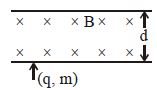
A
$B > \frac{2mE}{qd}$
B
$B > \frac{\sqrt{2mE}}{qd}$
C
$B < \frac{2mE}{qd}$
D
$B < \frac{\sqrt{2mE}}{qd}$
Solution
(B) The particle enters a uniform magnetic field $B$ perpendicular to its velocity and will follow a circular path.
The radius $r$ of the circular path is given by $r = \frac{mv}{qB}$,where $v$ is the velocity of the particle.
Given the kinetic energy $E = \frac{1}{2}mv^2$,we can write $v = \sqrt{\frac{2E}{m}}$.
Substituting $v$ into the radius formula,we get $r = \frac{m}{qB} \sqrt{\frac{2E}{m}} = \frac{\sqrt{2mE}}{qB}$.
For the particle not to collide with the upper plate,the diameter of the circular path must be less than or equal to the distance $d$ between the plates. However,since the particle enters from the bottom plate and moves in a semicircle,the radius $r$ must be less than or equal to $d$ $(r \leq d)$.
Therefore,$\frac{\sqrt{2mE}}{qB} \leq d$.
Rearranging for $B$,we get $B \geq \frac{\sqrt{2mE}}{qd}$.
Thus,the condition for the particle not to collide with the upper plate is $B > \frac{\sqrt{2mE}}{qd}$.
The radius $r$ of the circular path is given by $r = \frac{mv}{qB}$,where $v$ is the velocity of the particle.
Given the kinetic energy $E = \frac{1}{2}mv^2$,we can write $v = \sqrt{\frac{2E}{m}}$.
Substituting $v$ into the radius formula,we get $r = \frac{m}{qB} \sqrt{\frac{2E}{m}} = \frac{\sqrt{2mE}}{qB}$.
For the particle not to collide with the upper plate,the diameter of the circular path must be less than or equal to the distance $d$ between the plates. However,since the particle enters from the bottom plate and moves in a semicircle,the radius $r$ must be less than or equal to $d$ $(r \leq d)$.
Therefore,$\frac{\sqrt{2mE}}{qB} \leq d$.
Rearranging for $B$,we get $B \geq \frac{\sqrt{2mE}}{qd}$.
Thus,the condition for the particle not to collide with the upper plate is $B > \frac{\sqrt{2mE}}{qd}$.
0 likes
View Solution247
MediumMCQ
An electron having mass $m$ and kinetic energy $K$ enters a uniform magnetic field $B$ perpendicularly. Its frequency will be:
A
$\frac{e K}{m v B}$
B
$\frac{e B}{2 \pi m}$
C
$\frac{2 \pi m}{e B}$
D
$\frac{2 m}{e B K}$
Solution
(B) When a charged particle enters a magnetic field perpendicularly,it undergoes circular motion.
The magnetic force provides the necessary centripetal force:
$F_m = F_c$
$qvB = \frac{mv^2}{r}$
From this,the angular velocity $\omega$ is given by:
$\omega = \frac{v}{r} = \frac{qB}{m}$
Since the frequency $f$ is related to angular velocity by $\omega = 2\pi f$,we have:
$f = \frac{\omega}{2\pi} = \frac{qB}{2\pi m}$
For an electron,the charge $q = e$,so the frequency is:
$f = \frac{eB}{2\pi m}$
The magnetic force provides the necessary centripetal force:
$F_m = F_c$
$qvB = \frac{mv^2}{r}$
From this,the angular velocity $\omega$ is given by:
$\omega = \frac{v}{r} = \frac{qB}{m}$
Since the frequency $f$ is related to angular velocity by $\omega = 2\pi f$,we have:
$f = \frac{\omega}{2\pi} = \frac{qB}{2\pi m}$
For an electron,the charge $q = e$,so the frequency is:
$f = \frac{eB}{2\pi m}$
0 likes
View Solution248
EasyMCQ
If $\alpha$ and $\beta$ particles are moving with equal velocity perpendicular to the magnetic flux density $B$,then the radii of their paths will be
A
unequal and in the opposite direction
B
equal and in the opposite direction
C
unequal and in the same direction
D
equal and in the same direction
Solution
(A) The radius $r$ of the path of a charged particle moving perpendicular to a magnetic field $B$ is given by $r = \frac{mv}{qB}$.
Here,$m$ is the mass,$v$ is the velocity,and $q$ is the charge of the particle.
For an $\alpha$ particle,$q_{\alpha} = +2e$ and $m_{\alpha} \approx 4m_p$ (where $m_p$ is the mass of a proton).
For a $\beta$ particle (electron),$q_{\beta} = -e$ and $m_{\beta} \approx \frac{1}{1836}m_p$.
Since the masses and charges are different,the radii $r_{\alpha} = \frac{m_{\alpha}v}{2eB}$ and $r_{\beta} = \frac{m_{\beta}v}{eB}$ will be unequal.
Because the charges have opposite signs ($+2e$ and $-e$),the Lorentz force $\vec{F} = q(\vec{v} \times \vec{B})$ will act in opposite directions for the two particles,causing them to curve in opposite directions.
Here,$m$ is the mass,$v$ is the velocity,and $q$ is the charge of the particle.
For an $\alpha$ particle,$q_{\alpha} = +2e$ and $m_{\alpha} \approx 4m_p$ (where $m_p$ is the mass of a proton).
For a $\beta$ particle (electron),$q_{\beta} = -e$ and $m_{\beta} \approx \frac{1}{1836}m_p$.
Since the masses and charges are different,the radii $r_{\alpha} = \frac{m_{\alpha}v}{2eB}$ and $r_{\beta} = \frac{m_{\beta}v}{eB}$ will be unequal.
Because the charges have opposite signs ($+2e$ and $-e$),the Lorentz force $\vec{F} = q(\vec{v} \times \vec{B})$ will act in opposite directions for the two particles,causing them to curve in opposite directions.
0 likes
View Solution249
MediumMCQ
An ion beam of specific charge $5 \times 10^7 \ C/kg$ enters a uniform magnetic field of $4 \times 10^{-2} \ T$ with a velocity $2 \times 10^5 \ m/s$ perpendicularly. The radius of the circular path of the ions in meters will be:
A
$0.10$
B
$0.16$
C
$0.20$
D
$0.25$
Solution
(A) Given: Specific charge $\frac{q}{m} = 5 \times 10^7 \ C/kg$,Magnetic field $B = 4 \times 10^{-2} \ T$,Velocity $v = 2 \times 10^5 \ m/s$.
When a charged particle enters a uniform magnetic field perpendicularly,it follows a circular path.
The radius $r$ of the circular path is given by the formula:
$r = \frac{mv}{qB} = \frac{v}{(\frac{q}{m})B}$
Substituting the given values:
$r = \frac{2 \times 10^5}{(5 \times 10^7) \times (4 \times 10^{-2})}$
$r = \frac{2 \times 10^5}{20 \times 10^5}$
$r = \frac{2}{20} = 0.1 \ m$
Therefore,the radius of the circular path is $0.1 \ m$.
When a charged particle enters a uniform magnetic field perpendicularly,it follows a circular path.
The radius $r$ of the circular path is given by the formula:
$r = \frac{mv}{qB} = \frac{v}{(\frac{q}{m})B}$
Substituting the given values:
$r = \frac{2 \times 10^5}{(5 \times 10^7) \times (4 \times 10^{-2})}$
$r = \frac{2 \times 10^5}{20 \times 10^5}$
$r = \frac{2}{20} = 0.1 \ m$
Therefore,the radius of the circular path is $0.1 \ m$.
0 likes
View Solution250
MediumMCQ
An electron enters the space between the plates of a charged capacitor as shown. The charge density on the plate is $\sigma$. Electric intensity in the space between the plates is $E$. $A$ uniform magnetic field $B$ also exists in that space perpendicular to the direction of $E$. The electron moves perpendicular to both $\vec{E}$ and $\vec{B}$ without any change in direction. The time taken by the electron to travel a distance $\ell$ in the space is
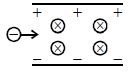
A
$\frac{\sigma \ell}{\varepsilon_0 B}$
B
$\frac{\sigma B}{\varepsilon_0 \ell}$
C
$\frac{\varepsilon_0 \ell B}{\sigma}$
D
$\frac{\varepsilon_0 \ell}{\sigma B}$
Solution
(C) The force on the electron due to the electric field $E$ is $F_E = eE$.
The force on the electron due to the magnetic field $B$ is $F_B = evB$.
For the electron to move undeflected,these two forces must be equal and opposite:
$eE = evB \implies v = \frac{E}{B}$.
The electric field between the plates of a capacitor is given by $E = \frac{\sigma}{\varepsilon_0}$.
Substituting this into the velocity expression,we get $v = \frac{\sigma}{\varepsilon_0 B}$.
The time $t$ taken to travel a distance $\ell$ is $t = \frac{\ell}{v}$.
Substituting the value of $v$,we get $t = \frac{\ell}{\frac{\sigma}{\varepsilon_0 B}} = \frac{\varepsilon_0 \ell B}{\sigma}$.
The force on the electron due to the magnetic field $B$ is $F_B = evB$.
For the electron to move undeflected,these two forces must be equal and opposite:
$eE = evB \implies v = \frac{E}{B}$.
The electric field between the plates of a capacitor is given by $E = \frac{\sigma}{\varepsilon_0}$.
Substituting this into the velocity expression,we get $v = \frac{\sigma}{\varepsilon_0 B}$.
The time $t$ taken to travel a distance $\ell$ is $t = \frac{\ell}{v}$.
Substituting the value of $v$,we get $t = \frac{\ell}{\frac{\sigma}{\varepsilon_0 B}} = \frac{\varepsilon_0 \ell B}{\sigma}$.
0 likes
View SolutionMoving Charges and Magnetism — Motion of Charged Particle In Magnetic Field · Frequently Asked Questions
1Are these Moving Charges and Magnetism questions useful for JEE and NEET?
Yes. All questions in this section are mapped to JEE Main and NEET exam patterns. Previous year questions from JEE Main, NEET, GUJCET and state-level exams are included with full solutions.
2Can I switch to Hindi or Gujarati for these questions?
Yes. Use the language tabs in the hero section or the sidebar to view the same questions and solutions in English, Hindi or Gujarati.
3How do I generate a question paper from this subtopic?
Use the Vedclass Exam Paper Generator — select the chapter and subtopic, set difficulty, and generate Sets A, B, C, D automatically. First 3 chapters of every subject are free.
Vedclass Products
For Students
Vedclass Test Series
Mock tests in real JEE/NEET style with performance analysis. 5-day free trial.
Start Free TrialFor Teachers
Exam Paper Generator
Generate Set A/B/C/D papers from this chapter in 2 minutes. 3 chapters free.
Try FreeFor Institutes
Online Exam Module
Live online exams with unlimited students, 360° analytics & white-label branding.
See DemoFor Teachers & Institutes
Generate a Moving Charges and Magnetism Exam Paper in 2 Minutes
Select subtopic & difficulty — Sets A, B, C, D auto-generated with No Repeat logic.
First 3 chapters of every subject are free — no payment required.