
A English
Cyclotron Questions in English
Class 12 Physics · Moving Charges and Magnetism · Cyclotron
42+
Questions
English
Language
100%
With Solutions
Showing 42 of 42 questions in English
1
EasyMCQ
In a cyclotron,the angular frequency of a charged particle is independent of
A
Mass
B
Speed
C
Charge
D
Magnetic field
Solution
(B) The angular frequency $\omega$ of a charged particle moving in a magnetic field $B$ is given by the formula $\omega = \frac{qB}{m}$.
Here,$q$ is the charge of the particle,$B$ is the magnetic field strength,and $m$ is the mass of the particle.
From this expression,it is clear that the angular frequency $\omega$ depends only on the charge,the mass of the particle,and the magnetic field.
It does not depend on the velocity or speed $v$ of the particle.
Therefore,the angular frequency is independent of the speed of the charged particle.
Here,$q$ is the charge of the particle,$B$ is the magnetic field strength,and $m$ is the mass of the particle.
From this expression,it is clear that the angular frequency $\omega$ depends only on the charge,the mass of the particle,and the magnetic field.
It does not depend on the velocity or speed $v$ of the particle.
Therefore,the angular frequency is independent of the speed of the charged particle.
0 likes
View Solution2
MediumMCQ
The maximum kinetic energy of a positive ion in a cyclotron is given by:
A
$\frac{q^2 B r_0}{2m}$
B
$\frac{q B^2 r_0}{2m}$
C
$\frac{q^2 B^2 r_0^2}{2m}$
D
$\frac{q B r_0}{2m^2}$
Solution
(C) The kinetic energy is given by $K = \frac{1}{2}mv^2$.
In a cyclotron,the radius of the circular path of a charged particle is $r_0 = \frac{mv}{qB}$.
Rearranging this for velocity,we get $v = \frac{qB r_0}{m}$.
Substituting this value of $v$ into the kinetic energy formula:
$K_{\max} = \frac{1}{2}m \left( \frac{qB r_0}{m} \right)^2$
$K_{\max} = \frac{1}{2}m \left( \frac{q^2 B^2 r_0^2}{m^2} \right)$
$K_{\max} = \frac{q^2 B^2 r_0^2}{2m}$.
In a cyclotron,the radius of the circular path of a charged particle is $r_0 = \frac{mv}{qB}$.
Rearranging this for velocity,we get $v = \frac{qB r_0}{m}$.
Substituting this value of $v$ into the kinetic energy formula:
$K_{\max} = \frac{1}{2}m \left( \frac{qB r_0}{m} \right)^2$
$K_{\max} = \frac{1}{2}m \left( \frac{q^2 B^2 r_0^2}{m^2} \right)$
$K_{\max} = \frac{q^2 B^2 r_0^2}{2m}$.
0 likes
View Solution3
EasyMCQ
Cyclotron is used to accelerate
A
Electrons
B
Neutrons
C
Positive ions
D
Negative ions
Solution
(C) cyclotron is a device used to accelerate positively charged particles such as protons,deuterons,and alpha particles.
It works on the principle that a positively charged particle can be accelerated to a sufficiently high energy by repeatedly crossing an oscillating electric field,while being guided in a circular path by a strong magnetic field.
Electrons are not accelerated in a cyclotron because their mass is very small,causing them to reach relativistic speeds quickly,which leads to a loss of synchrony with the oscillating electric field.
It works on the principle that a positively charged particle can be accelerated to a sufficiently high energy by repeatedly crossing an oscillating electric field,while being guided in a circular path by a strong magnetic field.
Electrons are not accelerated in a cyclotron because their mass is very small,causing them to reach relativistic speeds quickly,which leads to a loss of synchrony with the oscillating electric field.
0 likes
View Solution4
MediumMCQ
The cyclotron frequency of an electron gyrating in a magnetic field of $1\, T$ is approximately
A
$28\, MHz$
B
$280\, MHz$
C
$2.8\, GHz$
D
$28\, GHz$
Solution
(D) The cyclotron frequency $v$ is given by the formula $v = \frac{qB}{2\pi m}$.
Given: $B = 1\, T$,$q = 1.6 \times 10^{-19}\, C$,and $m = 9.1 \times 10^{-31}\, kg$.
Substituting the values:
$v = \frac{1 \times 1.6 \times 10^{-19}}{2 \times 3.14 \times 9.1 \times 10^{-31}}$
$v = \frac{1.6}{57.148} \times 10^{12}\, Hz$
$v \approx 0.02799 \times 10^{12}\, Hz = 27.99 \times 10^9\, Hz$
$v \approx 28\, GHz$.
Given: $B = 1\, T$,$q = 1.6 \times 10^{-19}\, C$,and $m = 9.1 \times 10^{-31}\, kg$.
Substituting the values:
$v = \frac{1 \times 1.6 \times 10^{-19}}{2 \times 3.14 \times 9.1 \times 10^{-31}}$
$v = \frac{1.6}{57.148} \times 10^{12}\, Hz$
$v \approx 0.02799 \times 10^{12}\, Hz = 27.99 \times 10^9\, Hz$
$v \approx 28\, GHz$.
0 likes
View Solution5
MediumMCQ
An alternating electric field,of frequency $f$,is applied across the dees (radius $\approx R$) of a cyclotron that is being used to accelerate protons (mass $\approx m$). The operating magnetic field $(B)$ used in the cyclotron and the kinetic energy $(K)$ of the proton beam,produced by it,are given by:
A
$B = \frac{mf}{e}$,$K = 2m\pi^2f^2R^2$
B
$B = \frac{2\pi mf}{e}$,$K = \pi m^2f^2R^2$
C
$B = \frac{2\pi mf}{e}$,$K = 2m\pi^2f^2R^2$
D
$B = \frac{mf}{e}$,$K = \pi m^2f^2R^2$
Solution
(C) The cyclotron frequency $f$ is given by $f = \frac{eB}{2\pi m}$.
Rearranging for the magnetic field $B$,we get $B = \frac{2\pi mf}{e}$.
The maximum velocity $v$ of the proton at the exit of the dee (radius $R$) is given by $v = \omega R = (2\pi f)R$.
The kinetic energy $K$ is given by $K = \frac{1}{2}mv^2$.
Substituting $v = 2\pi fR$ into the kinetic energy formula:
$K = \frac{1}{2}m(2\pi fR)^2 = \frac{1}{2}m(4\pi^2f^2R^2) = 2m\pi^2f^2R^2$.
Thus,$B = \frac{2\pi mf}{e}$ and $K = 2m\pi^2f^2R^2$.
Rearranging for the magnetic field $B$,we get $B = \frac{2\pi mf}{e}$.
The maximum velocity $v$ of the proton at the exit of the dee (radius $R$) is given by $v = \omega R = (2\pi f)R$.
The kinetic energy $K$ is given by $K = \frac{1}{2}mv^2$.
Substituting $v = 2\pi fR$ into the kinetic energy formula:
$K = \frac{1}{2}m(2\pi fR)^2 = \frac{1}{2}m(4\pi^2f^2R^2) = 2m\pi^2f^2R^2$.
Thus,$B = \frac{2\pi mf}{e}$ and $K = 2m\pi^2f^2R^2$.
0 likes
View Solution6
EasyMCQ
In a cyclotron,a charged particle
A
Undergoes acceleration all the time
B
Speeds up between the dees because of the magnetic field
C
Speeds up in a dee
D
Slows down within a dee and speeds up between dees
Solution
(A) In a cyclotron,the charged particle is accelerated by the oscillating electric field present in the gap between the two dees.
$(i)$ The particle speeds up between the dees due to the electric field.
$(ii)$ Inside the dees,the magnetic field acts on the particle,causing it to move in a circular path with a constant speed,but its direction changes continuously.
Therefore,the particle undergoes acceleration due to the electric field in the gap.
$(i)$ The particle speeds up between the dees due to the electric field.
$(ii)$ Inside the dees,the magnetic field acts on the particle,causing it to move in a circular path with a constant speed,but its direction changes continuously.
Therefore,the particle undergoes acceleration due to the electric field in the gap.
0 likes
View Solution7
EasyMCQ
In a cyclotron experiment, if we assume that the maximum radius attained by any charged particle is equal to the radius of the dees, then the minimum kinetic energy gained by the particles will be for
A
Alpha particle
B
Proton
C
Deuteron
D
Same for all
Solution
(C) The maximum kinetic energy $KE_{\max}$ of a particle in a cyclotron is given by the formula $KE_{\max} = \frac{q^2 B^2 R^2}{2m}$, where $q$ is the charge, $B$ is the magnetic field, $R$ is the radius of the dees, and $m$ is the mass of the particle.
Since $B$ and $R$ are constant for a given cyclotron, $KE_{\max} \propto \frac{q^2}{m}$.
For a proton $(p)$: $q = e, m = m_p \implies \frac{q^2}{m} = \frac{e^2}{m_p}$.
For a deuteron $(d)$: $q = e, m = 2m_p \implies \frac{q^2}{m} = \frac{e^2}{2m_p}$.
For an alpha particle $(\alpha)$: $q = 2e, m = 4m_p \implies \frac{q^2}{m} = \frac{4e^2}{4m_p} = \frac{e^2}{m_p}$.
Comparing the values, the ratio $\frac{q^2}{m}$ is minimum for the deuteron. Therefore, the minimum kinetic energy gained is for the deuteron.
Since $B$ and $R$ are constant for a given cyclotron, $KE_{\max} \propto \frac{q^2}{m}$.
For a proton $(p)$: $q = e, m = m_p \implies \frac{q^2}{m} = \frac{e^2}{m_p}$.
For a deuteron $(d)$: $q = e, m = 2m_p \implies \frac{q^2}{m} = \frac{e^2}{2m_p}$.
For an alpha particle $(\alpha)$: $q = 2e, m = 4m_p \implies \frac{q^2}{m} = \frac{4e^2}{4m_p} = \frac{e^2}{m_p}$.
Comparing the values, the ratio $\frac{q^2}{m}$ is minimum for the deuteron. Therefore, the minimum kinetic energy gained is for the deuteron.
0 likes
View Solution8
MediumMCQ
The oscillating frequency of a cyclotron is $10 \, MHz$. If the radius of its dee is $0.5 \, m$,the kinetic energy of a proton,which is accelerated by the cyclotron,is ...... $MeV$.
A
$10.2$
B
$2.55$
C
$20.4$
D
$5.1$
Solution
(D) The kinetic energy $(E_k)$ of a charged particle in a cyclotron is given by the formula: $E_k = \frac{q^2 B^2 r^2}{2m}$.
The frequency of the cyclotron is given by: $f = \frac{qB}{2 \pi m}$,which implies $qB = 2 \pi m f$.
Substituting $qB$ into the kinetic energy formula:
$E_k = \frac{(2 \pi m f)^2 r^2}{2m} = 2 \pi^2 m f^2 r^2$.
Given values:
$m = 1.67 \times 10^{-27} \, kg$ (mass of proton)
$f = 10 \times 10^6 \, Hz$
$r = 0.5 \, m$
Calculating $E_k$ in Joules:
$E_k = 2 \times (3.14)^2 \times (1.67 \times 10^{-27}) \times (10^7)^2 \times (0.5)^2$
$E_k = 2 \times 9.8596 \times 1.67 \times 10^{-27} \times 10^{14} \times 0.25$
$E_k \approx 8.23 \times 10^{-13} \, J$.
Converting to $MeV$:
$E_k (in \, eV) = \frac{8.23 \times 10^{-13}}{1.6 \times 10^{-19}} \approx 5.14 \times 10^6 \, eV = 5.14 \, MeV$.
Rounding to the nearest option,we get $5.1 \, MeV$.
The frequency of the cyclotron is given by: $f = \frac{qB}{2 \pi m}$,which implies $qB = 2 \pi m f$.
Substituting $qB$ into the kinetic energy formula:
$E_k = \frac{(2 \pi m f)^2 r^2}{2m} = 2 \pi^2 m f^2 r^2$.
Given values:
$m = 1.67 \times 10^{-27} \, kg$ (mass of proton)
$f = 10 \times 10^6 \, Hz$
$r = 0.5 \, m$
Calculating $E_k$ in Joules:
$E_k = 2 \times (3.14)^2 \times (1.67 \times 10^{-27}) \times (10^7)^2 \times (0.5)^2$
$E_k = 2 \times 9.8596 \times 1.67 \times 10^{-27} \times 10^{14} \times 0.25$
$E_k \approx 8.23 \times 10^{-13} \, J$.
Converting to $MeV$:
$E_k (in \, eV) = \frac{8.23 \times 10^{-13}}{1.6 \times 10^{-19}} \approx 5.14 \times 10^6 \, eV = 5.14 \, MeV$.
Rounding to the nearest option,we get $5.1 \, MeV$.
0 likes
View Solution9
EasyMCQ
The maximum velocity to which a proton can be accelerated in a cyclotron of $10\, MHz$ frequency and radius $50\, cm$ is
A
$6.28 \times 10^8\, m/s$
B
$3.14 \times 10^8\, m/s$
C
$6.28 \times 10^7\, m/s$
D
$3.14 \times 10^7\, m/s$
Solution
(D) In a cyclotron,the maximum velocity $v$ of a particle is related to the radius $r$ and frequency $f$ by the formula $v = r \omega = r(2 \pi f)$.
Given:
Frequency $f = 10\, MHz = 10 \times 10^6\, Hz = 10^7\, Hz$.
Radius $r = 50\, cm = 0.5\, m$.
Substituting these values into the formula:
$v = 2 \times \pi \times r \times f$
$v = 2 \times 3.14 \times 0.5 \times 10^7$
$v = 1 \times 3.14 \times 10^7\, m/s$
$v = 3.14 \times 10^7\, m/s$.
Given:
Frequency $f = 10\, MHz = 10 \times 10^6\, Hz = 10^7\, Hz$.
Radius $r = 50\, cm = 0.5\, m$.
Substituting these values into the formula:
$v = 2 \times \pi \times r \times f$
$v = 2 \times 3.14 \times 0.5 \times 10^7$
$v = 1 \times 3.14 \times 10^7\, m/s$
$v = 3.14 \times 10^7\, m/s$.
0 likes
View Solution10
MediumMCQ
Assertion : Cyclotron is a device which is used to accelerate the positive ion.
Reason : Cyclotron frequency depends upon the velocity.
Reason : Cyclotron frequency depends upon the velocity.
A
If both Assertion and Reason are correct and the Reason is a correct explanation of the Assertion.
B
If both Assertion and Reason are correct but Reason is not a correct explanation of the Assertion.
C
If the Assertion is correct but Reason is incorrect.
D
If both the Assertion and Reason are incorrect.
Solution
(C) cyclotron is a particle accelerator used to accelerate charged particles,such as positive ions,to high energies. Thus,the Assertion is correct.
The cyclotron frequency $f$ is given by the formula:
$f = \frac{Bq}{2 \pi m}$
where $B$ is the magnetic field,$q$ is the charge,and $m$ is the mass of the particle.
From this formula,it is clear that the cyclotron frequency depends only on the magnetic field,the charge,and the mass of the particle. It is independent of the velocity $v$ and the radius $r$ of the orbit.
Therefore,the Reason is incorrect.
The cyclotron frequency $f$ is given by the formula:
$f = \frac{Bq}{2 \pi m}$
where $B$ is the magnetic field,$q$ is the charge,and $m$ is the mass of the particle.
From this formula,it is clear that the cyclotron frequency depends only on the magnetic field,the charge,and the mass of the particle. It is independent of the velocity $v$ and the radius $r$ of the orbit.
Therefore,the Reason is incorrect.
0 likes
View Solution11
EasyMCQ
Assertion: Cyclotron does not accelerate electrons.
Reason: Mass of the electrons is very small.
Reason: Mass of the electrons is very small.
A
If the Assertion is correct but Reason is incorrect.
B
If both Assertion and Reason are correct but Reason is not a correct explanation of the Assertion.
C
If both Assertion and Reason are correct and the Reason is a correct explanation of the Assertion.
D
If both the Assertion and Reason are incorrect.
Solution
(C) cyclotron operates on the principle that the frequency of the oscillating electric field matches the cyclotron frequency of the particle,which is given by $f = \frac{qB}{2\pi m}$.
Because the mass of an electron $(m)$ is very small,it gains speed very rapidly when accelerated.
According to the theory of relativity,as the speed of the electron approaches the speed of light,its relativistic mass increases significantly $(m = \frac{m_0}{\sqrt{1 - v^2/c^2}})$.
This increase in mass causes the cyclotron frequency to change,leading to a mismatch between the frequency of the $a.c.$ source and the particle's rotation frequency in the Dees.
Consequently,the electron falls out of phase with the electric field and is no longer accelerated effectively. Thus,both the assertion and the reason are correct,and the reason is the correct explanation for the assertion.
Because the mass of an electron $(m)$ is very small,it gains speed very rapidly when accelerated.
According to the theory of relativity,as the speed of the electron approaches the speed of light,its relativistic mass increases significantly $(m = \frac{m_0}{\sqrt{1 - v^2/c^2}})$.
This increase in mass causes the cyclotron frequency to change,leading to a mismatch between the frequency of the $a.c.$ source and the particle's rotation frequency in the Dees.
Consequently,the electron falls out of phase with the electric field and is no longer accelerated effectively. Thus,both the assertion and the reason are correct,and the reason is the correct explanation for the assertion.
0 likes
View Solution12
Medium
$A$ cyclotron's oscillator frequency is $10 \; MHz$. What should be the operating magnetic field for accelerating protons? If the radius of its 'dees' is $60 \; cm$,what is the kinetic energy (in $MeV$) of the proton beam produced by the accelerator? $(e = 1.60 \times 10^{-19} \; C, m_p = 1.67 \times 10^{-27} \; kg, 1 \; MeV = 1.6 \times 10^{-13} \; J)$
Solution
(A) The oscillator frequency $f$ must be equal to the cyclotron frequency of the proton.
$f = \frac{qB}{2\pi m_p} \implies B = \frac{2\pi m_p f}{q}$
Substituting the values: $B = \frac{2 \times 3.14 \times 1.67 \times 10^{-27} \times 10^7}{1.60 \times 10^{-19}} \approx 0.656 \; T \approx 0.66 \; T$.
The maximum velocity $v$ of the proton at the exit radius $r = 0.6 \; m$ is given by $v = r\omega = r(2\pi f)$.
$v = 0.6 \times 2 \times 3.14 \times 10^7 = 3.77 \times 10^7 \; m/s$.
The kinetic energy $K$ is given by $K = \frac{1}{2} m_p v^2$.
$K = \frac{1}{2} \times 1.67 \times 10^{-27} \times (3.77 \times 10^7)^2 = 1.186 \times 10^{-12} \; J$.
Converting to $MeV$: $K = \frac{1.186 \times 10^{-12}}{1.6 \times 10^{-13}} \approx 7.41 \; MeV$.
$f = \frac{qB}{2\pi m_p} \implies B = \frac{2\pi m_p f}{q}$
Substituting the values: $B = \frac{2 \times 3.14 \times 1.67 \times 10^{-27} \times 10^7}{1.60 \times 10^{-19}} \approx 0.656 \; T \approx 0.66 \; T$.
The maximum velocity $v$ of the proton at the exit radius $r = 0.6 \; m$ is given by $v = r\omega = r(2\pi f)$.
$v = 0.6 \times 2 \times 3.14 \times 10^7 = 3.77 \times 10^7 \; m/s$.
The kinetic energy $K$ is given by $K = \frac{1}{2} m_p v^2$.
$K = \frac{1}{2} \times 1.67 \times 10^{-27} \times (3.77 \times 10^7)^2 = 1.186 \times 10^{-12} \; J$.
Converting to $MeV$: $K = \frac{1.186 \times 10^{-12}}{1.6 \times 10^{-13}} \approx 7.41 \; MeV$.
0 likes
View Solution13
Easy
Discuss the motion of a charged particle in a uniform magnetic field with initial velocity perpendicular to the magnetic field. $OR$ Explain the principle of a cyclotron.
Solution
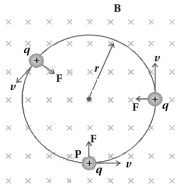
(N/A) When a charged particle having charge $q$ and velocity $\vec{v}$ enters a uniform magnetic field $\vec{B}$,it experiences a magnetic Lorentz force given by:
$\vec{F} = q(\vec{v} \times \vec{B})$
Since the velocity $\vec{v}$ is perpendicular to the magnetic field $\vec{B}$,the force $\vec{F}$ acts perpendicular to both $\vec{v}$ and $\vec{B}$. This force acts as a centripetal force,causing the particle to move in a uniform circular path.
For uniform circular motion,the magnetic force provides the necessary centripetal force:
$\text{Centripetal force} = \text{Magnetic force}$
$\frac{mv^2}{r} = qvB$
Solving for the radius $r$:
$r = \frac{mv}{qB} \quad \dots (1)$
Since linear momentum $p = mv$,we can write:
$r = \frac{p}{qB}$
This indicates that as the momentum increases,the radius of the circular path also increases.
Using the relation between linear velocity and angular velocity,$v = \omega r$:
$\frac{v}{\omega} = \frac{mv}{qB}$
$\omega = \frac{qB}{m}$
where $\omega$ is the angular frequency.
The frequency of revolution $f$ is given by:
$f = \frac{\omega}{2\pi} = \frac{qB}{2\pi m}$
This is known as the cyclotron frequency,which is independent of the speed of the particle and the radius of the orbit. This principle is used in a cyclotron to accelerate charged particles.
$\vec{F} = q(\vec{v} \times \vec{B})$
Since the velocity $\vec{v}$ is perpendicular to the magnetic field $\vec{B}$,the force $\vec{F}$ acts perpendicular to both $\vec{v}$ and $\vec{B}$. This force acts as a centripetal force,causing the particle to move in a uniform circular path.
For uniform circular motion,the magnetic force provides the necessary centripetal force:
$\text{Centripetal force} = \text{Magnetic force}$
$\frac{mv^2}{r} = qvB$
Solving for the radius $r$:
$r = \frac{mv}{qB} \quad \dots (1)$
Since linear momentum $p = mv$,we can write:
$r = \frac{p}{qB}$
This indicates that as the momentum increases,the radius of the circular path also increases.
Using the relation between linear velocity and angular velocity,$v = \omega r$:
$\frac{v}{\omega} = \frac{mv}{qB}$
$\omega = \frac{qB}{m}$
where $\omega$ is the angular frequency.
The frequency of revolution $f$ is given by:
$f = \frac{\omega}{2\pi} = \frac{qB}{2\pi m}$
This is known as the cyclotron frequency,which is independent of the speed of the particle and the radius of the orbit. This principle is used in a cyclotron to accelerate charged particles.
0 likes
View Solution14
Medium
What is a cyclotron? Discuss the principle of a cyclotron.
Solution
(N/A) cyclotron is a device used to accelerate charged particles like protons,deuterons,$\alpha$-particles,etc.,to very high energies. It was invented by $E.O. Lawrence$ and $M.S. Livingston$ in $1934$.
The cyclotron uses both electric and magnetic fields in combination to increase the energy of charged particles. As the fields are perpendicular to each other,they are called crossed fields.
The cyclotron operates on the principle that the frequency of revolution of a charged particle in a magnetic field is independent of its energy.
Principle: $A$ charged particle can be accelerated to very high energies by making it pass through a moderate electric field multiple times. This is achieved with the help of a perpendicular magnetic field,which forces the charged particle into a circular motion. The frequency of this circular motion (cyclotron frequency) is independent of the speed of the particle and the radius of the circular orbit.
The cyclotron uses both electric and magnetic fields in combination to increase the energy of charged particles. As the fields are perpendicular to each other,they are called crossed fields.
The cyclotron operates on the principle that the frequency of revolution of a charged particle in a magnetic field is independent of its energy.
Principle: $A$ charged particle can be accelerated to very high energies by making it pass through a moderate electric field multiple times. This is achieved with the help of a perpendicular magnetic field,which forces the charged particle into a circular motion. The frequency of this circular motion (cyclotron frequency) is independent of the speed of the particle and the radius of the circular orbit.
0 likes
View Solution15
Medium
Explain the construction of a cyclotron with a diagram.
Solution
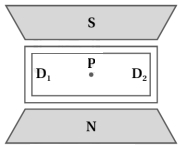
(N/A) The construction of a cyclotron is as shown in the diagram.
It consists of two small hollow,metallic half-cylinders,$D_{1}$ and $D_{2}$,called 'dees' because they are in the shape of the letter $D$.
They are mounted inside a vacuum chamber between the poles of a powerful electromagnet.
The dees are connected to a source of high-frequency alternating voltage of a few hundred kilovolts.
The beam of charged particles to be accelerated is injected into the dees near their center $P$,in a plane perpendicular to the magnetic field.
The charged particles are pulled out of the dees by a negatively charged deflecting plate through a window $W$.
The whole device is kept in a high vacuum so that air molecules do not collide with the charged particles.
It consists of two small hollow,metallic half-cylinders,$D_{1}$ and $D_{2}$,called 'dees' because they are in the shape of the letter $D$.
They are mounted inside a vacuum chamber between the poles of a powerful electromagnet.
The dees are connected to a source of high-frequency alternating voltage of a few hundred kilovolts.
The beam of charged particles to be accelerated is injected into the dees near their center $P$,in a plane perpendicular to the magnetic field.
The charged particles are pulled out of the dees by a negatively charged deflecting plate through a window $W$.
The whole device is kept in a high vacuum so that air molecules do not collide with the charged particles.
0 likes
View Solution16
Medium
Explain the working of a cyclotron and give its uses.
Solution
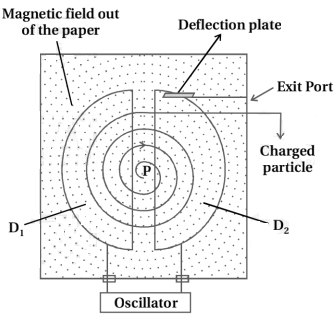
(N/A) The figure shows a schematic view of the cyclotron.
Inside the metal boxes (dees),the particle is shielded and is not acted upon by the electric field. The electric field prevails only in the gap between the two dees.
The magnetic field acts on the particle and forces it to move in a circular path inside the dee.
Every time the particle moves from one dee to another,it is accelerated by the electric field.
The polarity of the electric field is reversed in synchronization with the circular motion of the particle.
This ensures that the particle is always accelerated by the electric field. Each acceleration increases the kinetic energy of the particle. As energy increases,the radius of the circular path increases,resulting in a spiral path.
Charged particles (e.g.,protons) move in a semicircular path in one of the dees and arrive in the gap between the dees in a time interval of $\frac{T}{2}$,where $T$ is the time period of revolution.
$T = \frac{1}{v_{c}} = \frac{2 \pi m}{q B}$ or $v_{c} = \frac{q B}{2 \pi m} \quad \dots (1)$
This frequency is called the cyclotron frequency and is denoted by $v_{c}$. It is independent of the speed,momentum,and kinetic energy of the particle.
The uses of a cyclotron are as follows:
$(1)$ The high-energy particles produced in a cyclotron are used to bombard nuclei to study nuclear reactions and investigate nuclear structure.
$(2)$ It is used to implant ions into solids to modify their properties or to synthesize new materials.
$(3)$ It is used to produce radioactive isotopes,which are utilized in hospitals for medical diagnosis and treatment.
Inside the metal boxes (dees),the particle is shielded and is not acted upon by the electric field. The electric field prevails only in the gap between the two dees.
The magnetic field acts on the particle and forces it to move in a circular path inside the dee.
Every time the particle moves from one dee to another,it is accelerated by the electric field.
The polarity of the electric field is reversed in synchronization with the circular motion of the particle.
This ensures that the particle is always accelerated by the electric field. Each acceleration increases the kinetic energy of the particle. As energy increases,the radius of the circular path increases,resulting in a spiral path.
Charged particles (e.g.,protons) move in a semicircular path in one of the dees and arrive in the gap between the dees in a time interval of $\frac{T}{2}$,where $T$ is the time period of revolution.
$T = \frac{1}{v_{c}} = \frac{2 \pi m}{q B}$ or $v_{c} = \frac{q B}{2 \pi m} \quad \dots (1)$
This frequency is called the cyclotron frequency and is denoted by $v_{c}$. It is independent of the speed,momentum,and kinetic energy of the particle.
The uses of a cyclotron are as follows:
$(1)$ The high-energy particles produced in a cyclotron are used to bombard nuclei to study nuclear reactions and investigate nuclear structure.
$(2)$ It is used to implant ions into solids to modify their properties or to synthesize new materials.
$(3)$ It is used to produce radioactive isotopes,which are utilized in hospitals for medical diagnosis and treatment.
0 likes
View Solution17
EasyMCQ
For which purpose is the device of cyclotron used?
A
To accelerate charged particles
B
To decelerate charged particles
C
To measure the charge of particles
D
To measure the mass of particles
Solution
(A) cyclotron is a type of particle accelerator.
It uses a magnetic field to keep charged particles in a circular path and an oscillating electric field to increase their kinetic energy (accelerate them) each time they cross the gap between the two dees.
Therefore,the primary purpose of a cyclotron is to accelerate charged particles like protons,deuterons,and alpha particles to high energies.
It uses a magnetic field to keep charged particles in a circular path and an oscillating electric field to increase their kinetic energy (accelerate them) each time they cross the gap between the two dees.
Therefore,the primary purpose of a cyclotron is to accelerate charged particles like protons,deuterons,and alpha particles to high energies.
0 likes
View Solution18
Medium
What do you mean by 'dees' which is used in cyclotron?
Solution
(N/A) In a cyclotron,'dees' are two hollow,semi-circular metal chambers shaped like the letter '$D$'.
They are placed in a vacuum chamber with a small gap between them.
$A$ high-frequency alternating voltage is applied across these dees.
The interior of the dees is a field-free region,meaning the electric field inside them is zero.
As a charged particle enters a dee,it moves in a semi-circular path due to the presence of a uniform perpendicular magnetic field.
When the particle reaches the gap,the electric field accelerates it,increasing its kinetic energy before it enters the next dee.
They are placed in a vacuum chamber with a small gap between them.
$A$ high-frequency alternating voltage is applied across these dees.
The interior of the dees is a field-free region,meaning the electric field inside them is zero.
As a charged particle enters a dee,it moves in a semi-circular path due to the presence of a uniform perpendicular magnetic field.
When the particle reaches the gap,the electric field accelerates it,increasing its kinetic energy before it enters the next dee.
0 likes
View Solution19
Medium
Write the resonance condition for a cyclotron.
Solution
(N/A) The resonance condition for a cyclotron occurs when the frequency of the applied alternating electric field $(f_a)$ matches the cyclotron frequency $(f_c)$ of the charged particle moving in a magnetic field.
The cyclotron frequency is given by the formula:
$f_c = \frac{qB}{2\pi m}$
Where:
$q$ = charge of the particle
$B$ = magnetic field strength
$m$ = mass of the particle
Therefore,the resonance condition is:
$f_a = f_c = \frac{qB}{2\pi m}$
The cyclotron frequency is given by the formula:
$f_c = \frac{qB}{2\pi m}$
Where:
$q$ = charge of the particle
$B$ = magnetic field strength
$m$ = mass of the particle
Therefore,the resonance condition is:
$f_a = f_c = \frac{qB}{2\pi m}$
0 likes
View Solution20
Medium
Verify that the cyclotron frequency $\omega = \frac{eB}{m}$ has the correct dimensions of $[T]^{-1}$.
Solution
(A) When a charged particle enters a perpendicular magnetic field,the magnetic force provides the necessary centripetal force for circular motion.
$F_m = F_c$
$qvB = \frac{mv^2}{R}$
Rearranging for angular velocity $\omega = \frac{v}{R}$:
$\frac{v}{R} = \frac{qB}{m}$
Since $\omega = \frac{v}{R}$ and $q = e$,we have $\omega = \frac{eB}{m}$.
Now,checking the dimensions:
$[\omega] = \frac{[e][B]}{[m]}$
From $F = qvB$,the dimension of $B$ is $[B] = \frac{[F]}{[q][v]} = \frac{MLT^{-2}}{IT \cdot LT^{-1}} = [M I^{-1} T^{-2}]$.
Substituting the dimensions:
$[\omega] = \frac{[I T] \cdot [M I^{-1} T^{-2}]}{[M]} = \frac{M I^0 T^{-1}}{M} = [T^{-1}]$.
Thus,the dimensions of cyclotron frequency are $[T]^{-1}$.
$F_m = F_c$
$qvB = \frac{mv^2}{R}$
Rearranging for angular velocity $\omega = \frac{v}{R}$:
$\frac{v}{R} = \frac{qB}{m}$
Since $\omega = \frac{v}{R}$ and $q = e$,we have $\omega = \frac{eB}{m}$.
Now,checking the dimensions:
$[\omega] = \frac{[e][B]}{[m]}$
From $F = qvB$,the dimension of $B$ is $[B] = \frac{[F]}{[q][v]} = \frac{MLT^{-2}}{IT \cdot LT^{-1}} = [M I^{-1} T^{-2}]$.
Substituting the dimensions:
$[\omega] = \frac{[I T] \cdot [M I^{-1} T^{-2}]}{[M]} = \frac{M I^0 T^{-1}}{M} = [T^{-1}]$.
Thus,the dimensions of cyclotron frequency are $[T]^{-1}$.
0 likes
View Solution21
Medium
Describe the motion of a charged particle in a cyclotron if the frequency of the radio frequency $(rf)$ field were doubled.
Solution
(N/A) The frequency of the radio frequency $(rf)$ field is given by $f = \frac{qB}{2\pi m}$. The time period of the particle in the cyclotron is $T = \frac{2\pi m}{qB}$.
If the frequency of the $(rf)$ field is doubled,the oscillator frequency becomes $2f$,which means the time period of the $(rf)$ field becomes $T' = \frac{T}{2}$.
Since the time taken by the particle to complete a semi-circle inside a dee is $t = \frac{T}{2}$,the particle will now reach the gap between the dees before the electric field has completed its cycle.
Consequently,the particle will not be accelerated consistently at the gap,as the electric field polarity will not match the arrival of the particle. This disrupts the resonance condition required for the cyclotron to function,and the particle will not gain energy effectively.
If the frequency of the $(rf)$ field is doubled,the oscillator frequency becomes $2f$,which means the time period of the $(rf)$ field becomes $T' = \frac{T}{2}$.
Since the time taken by the particle to complete a semi-circle inside a dee is $t = \frac{T}{2}$,the particle will now reach the gap between the dees before the electric field has completed its cycle.
Consequently,the particle will not be accelerated consistently at the gap,as the electric field polarity will not match the arrival of the particle. This disrupts the resonance condition required for the cyclotron to function,and the particle will not gain energy effectively.
0 likes
View Solution22
DifficultMCQ
If the maximum value of accelerating potential provided by a radio frequency oscillator is $12 \, kV$,the number of revolutions made by a proton in a cyclotron to achieve one-sixth of the speed of light is ....... .
$[m_p = 1.67 \times 10^{-27} \, kg, e = 1.6 \times 10^{-19} \, C, c = 3 \times 10^8 \, m/s]$
$[m_p = 1.67 \times 10^{-27} \, kg, e = 1.6 \times 10^{-19} \, C, c = 3 \times 10^8 \, m/s]$
A
$343$
B
$345$
C
$543$
D
$534$
Solution
(C) The kinetic energy gained by a proton after $n$ revolutions in a cyclotron is given by $K = n \times (2qV)$,where $V$ is the maximum accelerating potential per gap and there are two gaps per revolution.
Given:
$V = 12 \times 10^3 \, V$
$q = 1.6 \times 10^{-19} \, C$
$m_p = 1.67 \times 10^{-27} \, kg$
$v = \frac{c}{6} = \frac{3 \times 10^8}{6} = 0.5 \times 10^8 \, m/s$
Equating the kinetic energy to the work done:
$n(2qV) = \frac{1}{2} m_p v^2$
$n = \frac{m_p v^2}{4qV}$
$n = \frac{1.67 \times 10^{-27} \times (0.5 \times 10^8)^2}{4 \times 1.6 \times 10^{-19} \times 12 \times 10^3}$
$n = \frac{1.67 \times 10^{-27} \times 0.25 \times 10^{16}}{76.8 \times 10^{-16}}$
$n = \frac{0.4175 \times 10^{-11}}{76.8 \times 10^{-16}} \approx 543.6$
Rounding to the nearest integer,the number of revolutions is $543$.
Given:
$V = 12 \times 10^3 \, V$
$q = 1.6 \times 10^{-19} \, C$
$m_p = 1.67 \times 10^{-27} \, kg$
$v = \frac{c}{6} = \frac{3 \times 10^8}{6} = 0.5 \times 10^8 \, m/s$
Equating the kinetic energy to the work done:
$n(2qV) = \frac{1}{2} m_p v^2$
$n = \frac{m_p v^2}{4qV}$
$n = \frac{1.67 \times 10^{-27} \times (0.5 \times 10^8)^2}{4 \times 1.6 \times 10^{-19} \times 12 \times 10^3}$
$n = \frac{1.67 \times 10^{-27} \times 0.25 \times 10^{16}}{76.8 \times 10^{-16}}$
$n = \frac{0.4175 \times 10^{-11}}{76.8 \times 10^{-16}} \approx 543.6$
Rounding to the nearest integer,the number of revolutions is $543$.
0 likes
View Solution23
MediumMCQ
$A$ charged particle moves along a circular path in a uniform magnetic field in a cyclotron. The kinetic energy of the charged particle increases to $4$ times its initial value. What will be the ratio of the new radius to the original radius of the circular path of the charged particle?
A
$1: 1$
B
$1: 2$
C
$2: 1$
D
$1: 4$
Solution
(C) The radius $r$ of a charged particle moving in a uniform magnetic field $B$ is given by the formula $r = \frac{mv}{qB}$.
Since the kinetic energy $K$ is related to momentum $p$ by $K = \frac{p^2}{2m}$,we have $p = \sqrt{2mK}$.
Substituting $p = mv$ into the radius formula,we get $r = \frac{\sqrt{2mK}}{qB}$.
This shows that the radius is directly proportional to the square root of the kinetic energy: $r \propto \sqrt{K}$.
Given that the new kinetic energy $K_n = 4K_0$,where $K_0$ is the initial kinetic energy.
The ratio of the new radius $r_n$ to the original radius $r_0$ is $\frac{r_n}{r_0} = \sqrt{\frac{K_n}{K_0}} = \sqrt{\frac{4K_0}{K_0}} = \sqrt{4} = 2$.
Therefore,the ratio is $2: 1$.
Since the kinetic energy $K$ is related to momentum $p$ by $K = \frac{p^2}{2m}$,we have $p = \sqrt{2mK}$.
Substituting $p = mv$ into the radius formula,we get $r = \frac{\sqrt{2mK}}{qB}$.
This shows that the radius is directly proportional to the square root of the kinetic energy: $r \propto \sqrt{K}$.
Given that the new kinetic energy $K_n = 4K_0$,where $K_0$ is the initial kinetic energy.
The ratio of the new radius $r_n$ to the original radius $r_0$ is $\frac{r_n}{r_0} = \sqrt{\frac{K_n}{K_0}} = \sqrt{\frac{4K_0}{K_0}} = \sqrt{4} = 2$.
Therefore,the ratio is $2: 1$.
0 likes
View Solution24
MediumMCQ
$A$ cyclotron is used to accelerate protons. If the operating magnetic field is $1.0\,T$ and the radius of the cyclotron 'dees' is $60\,cm$,the kinetic energy of the accelerated protons in $MeV$ will be.
[use $m_{p} = 1.6 \times 10^{-27}\,kg, e = 1.6 \times 10^{-19}\,C$]
[use $m_{p} = 1.6 \times 10^{-27}\,kg, e = 1.6 \times 10^{-19}\,C$]
A
$12$
B
$18$
C
$16$
D
$32$
Solution
(B) The kinetic energy $K$ of a particle of charge $q$ and mass $m$ in a cyclotron with magnetic field $B$ and radius $r$ is given by the formula:
$K = \frac{q^2 B^2 r^2}{2m}$
Given:
$q = 1.6 \times 10^{-19}\,C$
$B = 1.0\,T$
$r = 60\,cm = 0.6\,m$
$m = 1.6 \times 10^{-27}\,kg$
Substituting the values:
$K = \frac{(1.6 \times 10^{-19})^2 \times (1.0)^2 \times (0.6)^2}{2 \times 1.6 \times 10^{-27}}$
$K = \frac{2.56 \times 10^{-38} \times 0.36}{3.2 \times 10^{-27}}$
$K = 0.8 \times 10^{-11} \times 0.36 = 0.288 \times 10^{-11}\,J$
To convert Joules to $MeV$,divide by $1.6 \times 10^{-13}$:
$K = \frac{0.288 \times 10^{-11}}{1.6 \times 10^{-13}} = 0.18 \times 10^2 = 18\,MeV$
$K = \frac{q^2 B^2 r^2}{2m}$
Given:
$q = 1.6 \times 10^{-19}\,C$
$B = 1.0\,T$
$r = 60\,cm = 0.6\,m$
$m = 1.6 \times 10^{-27}\,kg$
Substituting the values:
$K = \frac{(1.6 \times 10^{-19})^2 \times (1.0)^2 \times (0.6)^2}{2 \times 1.6 \times 10^{-27}}$
$K = \frac{2.56 \times 10^{-38} \times 0.36}{3.2 \times 10^{-27}}$
$K = 0.8 \times 10^{-11} \times 0.36 = 0.288 \times 10^{-11}\,J$
To convert Joules to $MeV$,divide by $1.6 \times 10^{-13}$:
$K = \frac{0.288 \times 10^{-11}}{1.6 \times 10^{-13}} = 0.18 \times 10^2 = 18\,MeV$
0 likes
View Solution25
EasyMCQ
The oscillator frequency of a cyclotron is $10 \,MHz$. What should be the operating magnetic field for accelerating protons (in $,T$)? (Given: mass of proton $m = 1.67 \times 10^{-27} \,kg$,charge of proton $q = 1.6 \times 10^{-19} \,C$)
A
$0.156$
B
$0.256$
C
$0.356$
D
$0.656$
Solution
(D) The cyclotron frequency $f$ is given by the formula: $f = \frac{qB}{2 \pi m}$.
Rearranging the formula to solve for the magnetic field $B$,we get: $B = \frac{2 \pi m f}{q}$.
Given values are: $f = 10 \,MHz = 10^7 \,Hz$,$m = 1.67 \times 10^{-27} \,kg$,and $q = 1.6 \times 10^{-19} \,C$.
Substituting these values into the equation:
$B = \frac{2 \times 3.14159 \times 1.67 \times 10^{-27} \times 10^7}{1.6 \times 10^{-19}}$.
$B = \frac{10.493 \times 10^{-20}}{1.6 \times 10^{-19}}$.
$B \approx 0.656 \,T$.
Thus,the correct option is $D$.
Rearranging the formula to solve for the magnetic field $B$,we get: $B = \frac{2 \pi m f}{q}$.
Given values are: $f = 10 \,MHz = 10^7 \,Hz$,$m = 1.67 \times 10^{-27} \,kg$,and $q = 1.6 \times 10^{-19} \,C$.
Substituting these values into the equation:
$B = \frac{2 \times 3.14159 \times 1.67 \times 10^{-27} \times 10^7}{1.6 \times 10^{-19}}$.
$B = \frac{10.493 \times 10^{-20}}{1.6 \times 10^{-19}}$.
$B \approx 0.656 \,T$.
Thus,the correct option is $D$.
0 likes
View Solution26
MediumMCQ
$A$ proton is accelerating in a cyclotron where the applied magnetic field is $2 \,T$. If the potential gap is effectively $100 \,kV$, then how many revolutions does the proton have to make between the "dees" to acquire a kinetic energy of $20 \,MeV$?
A
$100$
B
$150$
C
$200$
D
$300$
Solution
$(A)$ In a cyclotron, a particle gains energy equal to $qV$ every time it crosses the gap between the two "dees".
Since there are two gaps per revolution, the energy gained per revolution is $\Delta E = 2qV$.
Given: Potential difference $V = 100 \,kV = 10^5 \,V$.
Energy gained per revolution $= 2 \times e \times 10^5 \,V = 2 \times 10^5 \,eV$.
Target kinetic energy $E = 20 \,MeV = 20 \times 10^6 \,eV = 2 \times 10^7 \,eV$.
Number of revolutions $n = \frac{E}{\Delta E} = \frac{2 \times 10^7 \,eV}{2 \times 10^5 \,eV} = 100$.
Since there are two gaps per revolution, the energy gained per revolution is $\Delta E = 2qV$.
Given: Potential difference $V = 100 \,kV = 10^5 \,V$.
Energy gained per revolution $= 2 \times e \times 10^5 \,V = 2 \times 10^5 \,eV$.
Target kinetic energy $E = 20 \,MeV = 20 \times 10^6 \,eV = 2 \times 10^7 \,eV$.
Number of revolutions $n = \frac{E}{\Delta E} = \frac{2 \times 10^7 \,eV}{2 \times 10^5 \,eV} = 100$.
0 likes
View Solution27
MediumMCQ
Bohr's model is applied to a particle of mass $m$ and charge $q$ moving in a plane under the influence of a transverse magnetic field $B$. The energy of the charged particle in the second level will be $(h = \text{Planck's constant})$
A
$\frac{qBh}{\pi m}$
B
$\frac{q^2 B^2 h^2}{4 \pi m}$
C
$\frac{qBh}{2 \pi m}$
D
$\frac{2 qBh}{\pi m}$
Solution
(C) For a particle of mass $m$ and charge $q$ moving in a magnetic field $B$, the cyclotron frequency is given by $\omega = \frac{qB}{m}$.
According to Bohr's quantization condition, the angular momentum $L$ in the $n^{th}$ level is $L = n \frac{h}{2 \pi}$.
Since $L = mvr = mr^2 \omega$, we have $mr^2 \omega = n \frac{h}{2 \pi}$.
Substituting $\omega = \frac{qB}{m}$, we get $mr^2 (\frac{qB}{m}) = n \frac{h}{2 \pi}$, which simplifies to $r^2 = \frac{nh}{2 \pi qB}$.
The kinetic energy $K$ is given by $K = \frac{1}{2} mv^2 = \frac{1}{2} m(r \omega)^2 = \frac{1}{2} m r^2 \omega^2$.
Substituting $r^2$ and $\omega$, we get $K = \frac{1}{2} m (\frac{nh}{2 \pi qB}) (\frac{qB}{m})^2 = \frac{n h q B}{4 \pi m}$.
For the second level, $n = 2$, so $K = \frac{2 h q B}{4 \pi m} = \frac{qBh}{2 \pi m}$.
According to Bohr's quantization condition, the angular momentum $L$ in the $n^{th}$ level is $L = n \frac{h}{2 \pi}$.
Since $L = mvr = mr^2 \omega$, we have $mr^2 \omega = n \frac{h}{2 \pi}$.
Substituting $\omega = \frac{qB}{m}$, we get $mr^2 (\frac{qB}{m}) = n \frac{h}{2 \pi}$, which simplifies to $r^2 = \frac{nh}{2 \pi qB}$.
The kinetic energy $K$ is given by $K = \frac{1}{2} mv^2 = \frac{1}{2} m(r \omega)^2 = \frac{1}{2} m r^2 \omega^2$.
Substituting $r^2$ and $\omega$, we get $K = \frac{1}{2} m (\frac{nh}{2 \pi qB}) (\frac{qB}{m})^2 = \frac{n h q B}{4 \pi m}$.
For the second level, $n = 2$, so $K = \frac{2 h q B}{4 \pi m} = \frac{qBh}{2 \pi m}$.
0 likes
View Solution28
EasyMCQ
Cyclotron is used to
A
accelerate neutrons.
B
accelerate positively charged particles only.
C
accelerate negatively charged particles only.
D
accelerate positively and negatively charged particles.
Solution
(B) cyclotron is a particle accelerator that uses a combination of magnetic and electric fields to accelerate charged particles. It is primarily designed to accelerate positively charged particles,such as protons,deuterons,and alpha particles,to high energies. Neutrons cannot be accelerated by a cyclotron because they lack an electric charge.
0 likes
View Solution29
MediumMCQ
In a cyclotron,the time taken by an ion to describe a semicircular path in a dee is
A
dependent on the speed of the ion.
B
independent of the mass of the ion.
C
independent of the speed of the ion and the radius of the circular path.
D
dependent on the radius of the circular path.
Solution
(C) The time period $T$ for a full circular orbit of a charged particle in a magnetic field $B$ is given by $T = \frac{2 \pi m}{q B}$.
Since the ion describes a semicircular path in a dee,the time taken is $t = \frac{T}{2} = \frac{\pi m}{q B}$.
From this expression,it is clear that the time taken is independent of the speed of the ion $(v)$ and the radius of the circular path $(r)$.
Since the ion describes a semicircular path in a dee,the time taken is $t = \frac{T}{2} = \frac{\pi m}{q B}$.
From this expression,it is clear that the time taken is independent of the speed of the ion $(v)$ and the radius of the circular path $(r)$.
0 likes
View Solution30
MediumMCQ
$A$ cyclotron's oscillator frequency is $n$ and the radius of the dees is $r$. The operating magnetic field $(B)$ for accelerating protons of charge $q$ and the kinetic energy of the protons produced by the accelerator are respectively ($m$ and $v$ are the mass and velocity of the proton).
A
$\frac{2 \pi n m}{q}, \frac{q v B r}{2}$
B
$\frac{\pi n m}{q}, \frac{q v B r}{2}$
C
$\frac{2 \pi n m}{q}, q v B r$
D
$\frac{4 \pi n m}{q}, \frac{q v B r}{2}$
Solution
(A) The cyclotron frequency is given by $n = \frac{q B}{2 \pi m}$.
Rearranging for the magnetic field $B$,we get $B = \frac{2 \pi n m}{q}$.
For a proton moving in a circular path of radius $r$ inside the dees,the magnetic force provides the centripetal force: $\frac{m v^2}{r} = q v B$.
This simplifies to $m v^2 = q v B r$.
The kinetic energy $(K.E.)$ is given by $K.E. = \frac{1}{2} m v^2$.
Substituting $m v^2 = q v B r$ into the kinetic energy formula,we get $K.E. = \frac{q v B r}{2}$.
Rearranging for the magnetic field $B$,we get $B = \frac{2 \pi n m}{q}$.
For a proton moving in a circular path of radius $r$ inside the dees,the magnetic force provides the centripetal force: $\frac{m v^2}{r} = q v B$.
This simplifies to $m v^2 = q v B r$.
The kinetic energy $(K.E.)$ is given by $K.E. = \frac{1}{2} m v^2$.
Substituting $m v^2 = q v B r$ into the kinetic energy formula,we get $K.E. = \frac{q v B r}{2}$.
0 likes
View Solution31
MediumMCQ
An alternating electric field of frequency '$v$' is applied across the dees of a cyclotron which is used to accelerate protons of mass '$m$'. The radius of the dees is '$R$'. The operating magnetic field used in the cyclotron is '$B$'. The kinetic energy of the proton beam is given by
A
$2 m \pi^{2} v^{2} R^{2}$
B
$2 m \pi v^{2} R^{2}$
C
$m \pi^{2} v^{2} R^{2}$
D
$m \pi v^{2} R^{2}$
Solution
(A) The resonance condition for a cyclotron is that the frequency of the oscillator '$v$' must be equal to the cyclotron frequency: $v = \frac{eB}{2 \pi m}$.
From this,we can express the magnetic field as $B = \frac{2 \pi m v}{e}$.
The radius of the path of the proton in the cyclotron is given by $R = \frac{mv}{eB}$,where '$v_{p}$' is the velocity of the proton.
Rearranging for velocity: $v_{p} = \frac{eBR}{m}$.
Substituting the expression for '$B$': $v_{p} = \frac{e}{m} \times \left( \frac{2 \pi m v}{e} \right) \times R = 2 \pi v R$.
The kinetic energy $(K.E.)$ of the proton is given by $K.E. = \frac{1}{2} m v_{p}^{2}$.
Substituting '$v_{p}$': $K.E. = \frac{1}{2} m (2 \pi v R)^{2} = \frac{1}{2} m (4 \pi^{2} v^{2} R^{2}) = 2 m \pi^{2} v^{2} R^{2}$.
From this,we can express the magnetic field as $B = \frac{2 \pi m v}{e}$.
The radius of the path of the proton in the cyclotron is given by $R = \frac{mv}{eB}$,where '$v_{p}$' is the velocity of the proton.
Rearranging for velocity: $v_{p} = \frac{eBR}{m}$.
Substituting the expression for '$B$': $v_{p} = \frac{e}{m} \times \left( \frac{2 \pi m v}{e} \right) \times R = 2 \pi v R$.
The kinetic energy $(K.E.)$ of the proton is given by $K.E. = \frac{1}{2} m v_{p}^{2}$.
Substituting '$v_{p}$': $K.E. = \frac{1}{2} m (2 \pi v R)^{2} = \frac{1}{2} m (4 \pi^{2} v^{2} R^{2}) = 2 m \pi^{2} v^{2} R^{2}$.
0 likes
View Solution32
MediumMCQ
Maximum kinetic energy gained by the charged particle in the cyclotron is independent of
A
Radius of the dees
B
Charge
C
Mass
D
Frequency of revolution
Solution
(D) The maximum kinetic energy $E_K$ gained by a charged particle in a cyclotron is given by the formula:
$E_K = \frac{q^2 B^2 R^2}{2m}$
where,
$q$ is the charge of the particle,
$B$ is the magnetic field intensity,
$R$ is the maximum radius of the orbit (radius of the dees),
and $m$ is the mass of the particle.
From the formula,it is evident that $E_K$ depends on $q$,$B$,$R$,and $m$.
However,$E_K$ does not depend on the frequency of revolution $(f = \frac{qB}{2\pi m})$,as the frequency is determined by the cyclotron resonance condition and is independent of the energy or radius of the particle's path.
$E_K = \frac{q^2 B^2 R^2}{2m}$
where,
$q$ is the charge of the particle,
$B$ is the magnetic field intensity,
$R$ is the maximum radius of the orbit (radius of the dees),
and $m$ is the mass of the particle.
From the formula,it is evident that $E_K$ depends on $q$,$B$,$R$,and $m$.
However,$E_K$ does not depend on the frequency of revolution $(f = \frac{qB}{2\pi m})$,as the frequency is determined by the cyclotron resonance condition and is independent of the energy or radius of the particle's path.
0 likes
View Solution33
DifficultMCQ
An alternating electric field of frequency $f$ is applied across the radius $R$ of a cyclotron to accelerate protons (mass $m$). The operating magnetic field $B$ used and kinetic energy $(K.E.)$ of the proton beam produced by it are respectively ($e=$ charge on proton).
A
$\frac{2 \pi m f}{e}, 2 \pi^2 m f^2 R^2$
B
$\frac{2 \pi^2 m f}{e^2}, 4 \pi^2 m f^2 R^2$
C
$\frac{\pi m f}{e}, \pi^2 m f^2 R^2$
D
$\frac{2 \pi^2 m^2 f^2}{e}, 2 \pi^2 m^2 f^2 R^2$
Solution
(A) In a cyclotron,the frequency of the alternating electric field $f$ is equal to the cyclotron frequency $f_c = \frac{eB}{2\pi m}$.
From this,the magnetic field $B$ is given by $B = \frac{2\pi mf}{e}$.
The maximum velocity $v$ of the proton at the exit radius $R$ is given by $v = \omega R = (2\pi f)R$.
The kinetic energy $K.E.$ is given by $K.E. = \frac{1}{2}mv^2$.
Substituting $v = 2\pi f R$,we get $K.E. = \frac{1}{2}m(2\pi f R)^2 = \frac{1}{2}m(4\pi^2 f^2 R^2) = 2\pi^2 mf^2 R^2$.
Thus,the magnetic field is $\frac{2\pi mf}{e}$ and the kinetic energy is $2\pi^2 mf^2 R^2$.
From this,the magnetic field $B$ is given by $B = \frac{2\pi mf}{e}$.
The maximum velocity $v$ of the proton at the exit radius $R$ is given by $v = \omega R = (2\pi f)R$.
The kinetic energy $K.E.$ is given by $K.E. = \frac{1}{2}mv^2$.
Substituting $v = 2\pi f R$,we get $K.E. = \frac{1}{2}m(2\pi f R)^2 = \frac{1}{2}m(4\pi^2 f^2 R^2) = 2\pi^2 mf^2 R^2$.
Thus,the magnetic field is $\frac{2\pi mf}{e}$ and the kinetic energy is $2\pi^2 mf^2 R^2$.
0 likes
View Solution34
MediumMCQ
$A$ cyclotron is used to accelerate
A
neutrons
B
only positively charged particles
C
only negatively charged particles
D
both positively and negatively charged particles
Solution
(B) cyclotron is a particle accelerator that uses a magnetic field to keep charged particles in a circular path and an alternating electric field to increase their kinetic energy.
It is primarily used to accelerate positively charged particles such as protons,deuterons,and alpha particles.
Neutrons cannot be accelerated by a cyclotron because they are electrically neutral and do not experience the Lorentz force $(F = q(v \times B))$ required for circular motion or the electric force $(F = qE)$ required for acceleration.
It is primarily used to accelerate positively charged particles such as protons,deuterons,and alpha particles.
Neutrons cannot be accelerated by a cyclotron because they are electrically neutral and do not experience the Lorentz force $(F = q(v \times B))$ required for circular motion or the electric force $(F = qE)$ required for acceleration.
0 likes
View Solution35
EasyMCQ
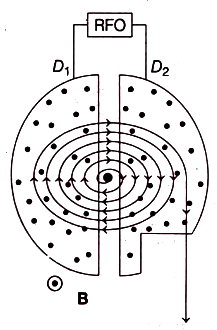
$A$ charged particle is subjected to acceleration in a cyclotron as shown. The charged particle undergoes an increase in its speed:
A
Only in the gap between $D_1$ and $D_2$
B
Only inside $D_2$
C
Inside $D_1$,$D_2$ and the gaps
D
Only inside $D_1$
Solution
(A) In a cyclotron,the charged particle moves in a circular path inside the dees ($D_1$ and $D_2$) due to a perpendicular magnetic field. The magnetic force acting on the particle is given by $\vec{F} = q(\vec{v} \times \vec{B})$,which is always perpendicular to the velocity $\vec{v}$. Since the force is perpendicular to the velocity,it does no work on the particle,and therefore,the speed of the particle remains constant inside the dees.
When the particle crosses the gap between the dees,it is subjected to an oscillating electric field. This electric field exerts an electric force on the particle,which does work on it,thereby increasing its kinetic energy and speed. Thus,the speed of the charged particle increases only in the gap between $D_1$ and $D_2$.
When the particle crosses the gap between the dees,it is subjected to an oscillating electric field. This electric field exerts an electric force on the particle,which does work on it,thereby increasing its kinetic energy and speed. Thus,the speed of the charged particle increases only in the gap between $D_1$ and $D_2$.
0 likes
View Solution36
MediumMCQ
$A$ cyclotron is used to accelerate protons $\left({ }_{1}^{1} H\right)$,deuterons $\left({ }_{1}^{2} H\right)$,and $\alpha$-particles $\left({ }_{2}^{4} He\right)$. While exiting under similar conditions,the minimum kinetic energy $(KE)$ is gained by:
A
$\alpha$-particles
B
protons
C
deuterons
D
Same for all
Solution
(C) When a charged particle is accelerated in a cyclotron,the radius $r$ of its path is given by $r = \frac{\sqrt{2Km}}{Bq}$.
Squaring both sides,we get $r^2 = \frac{2Km}{B^2q^2}$,which implies $K = \frac{B^2q^2r^2}{2m}$.
Since $B$ and $r$ are the same for all particles at the exit,$K \propto \frac{q^2}{m}$.
For protons $\left({ }_{1}^{1} H\right)$,deuterons $\left({ }_{1}^{2} H\right)$,and $\alpha$-particles $\left({ }_{2}^{4} He\right)$:
Charge ratio: $q_p : q_d : q_{\alpha} = 1 : 1 : 2$.
Mass ratio: $m_p : m_d : m_{\alpha} = 1 : 2 : 4$.
Calculating the ratio of kinetic energies $K \propto \frac{q^2}{m}$:
$K_p \propto \frac{1^2}{1} = 1$.
$K_d \propto \frac{1^2}{2} = 0.5$.
$K_{\alpha} \propto \frac{2^2}{4} = 1$.
Comparing the values,the minimum kinetic energy is gained by deuterons.
Squaring both sides,we get $r^2 = \frac{2Km}{B^2q^2}$,which implies $K = \frac{B^2q^2r^2}{2m}$.
Since $B$ and $r$ are the same for all particles at the exit,$K \propto \frac{q^2}{m}$.
For protons $\left({ }_{1}^{1} H\right)$,deuterons $\left({ }_{1}^{2} H\right)$,and $\alpha$-particles $\left({ }_{2}^{4} He\right)$:
Charge ratio: $q_p : q_d : q_{\alpha} = 1 : 1 : 2$.
Mass ratio: $m_p : m_d : m_{\alpha} = 1 : 2 : 4$.
Calculating the ratio of kinetic energies $K \propto \frac{q^2}{m}$:
$K_p \propto \frac{1^2}{1} = 1$.
$K_d \propto \frac{1^2}{2} = 0.5$.
$K_{\alpha} \propto \frac{2^2}{4} = 1$.
Comparing the values,the minimum kinetic energy is gained by deuterons.
0 likes
View Solution37
MediumMCQ
In a cyclotron,a charged particle:
A
speeds up in the dee
B
undergoes acceleration all the time
C
slows down within a dee and speeds up between dees
D
speeds up between the dees because of the magnetic field
Solution
(B) In a cyclotron,the charged particle is accelerated by an electric field in the gap between the two dees.
Within the dees,the particle moves in a circular path due to the perpendicular magnetic field,where its speed remains constant.
Since the particle is constantly changing its direction of motion while moving in a circle,it experiences centripetal acceleration at all times.
Therefore,the particle undergoes acceleration throughout its motion.
Within the dees,the particle moves in a circular path due to the perpendicular magnetic field,where its speed remains constant.
Since the particle is constantly changing its direction of motion while moving in a circle,it experiences centripetal acceleration at all times.
Therefore,the particle undergoes acceleration throughout its motion.
0 likes
View Solution38
MediumMCQ
$A$ cyclotron's oscillator frequency is $10 \text{ MHz}$ and the operating magnetic field is $0.66 \text{ T}$. If the radius of its dees is $60 \text{ cm}$, then the kinetic energy of the proton beam produced by the accelerator is: (in $\text{ MeV}$)
A
$9$
B
$10$
C
$7$
D
$11$
Solution
(C) The cyclotron frequency is given by $f = \frac{qB}{2\pi m}$.
The maximum velocity $v$ of the proton at the radius $r$ is $v = \frac{qBr}{m} = 2\pi fr$.
The kinetic energy $K$ is given by $K = \frac{1}{2}mv^2 = \frac{1}{2}m(2\pi fr)^2 = 2\pi^2 mf^2r^2$.
Given values: $f = 10 \times 10^6 \text{ Hz}$, $r = 0.6 \text{ m}$, $m = 1.67 \times 10^{-27} \text{ kg}$.
Substituting these values:
$K = 2 \times (3.14)^2 \times (1.67 \times 10^{-27}) \times (10^7)^2 \times (0.6)^2$
$K = 2 \times 9.8596 \times 1.67 \times 10^{-27} \times 10^{14} \times 0.36$
$K \approx 1.185 \times 10^{-12} \text{ J}$.
To convert to $\text{MeV}$, divide by $1.6 \times 10^{-13} \text{ J/MeV}$:
$K = \frac{1.185 \times 10^{-12}}{1.6 \times 10^{-13}} \approx 7.4 \text{ MeV}$.
Rounding to the nearest given option, the kinetic energy is $7 \text{ MeV}$.
The maximum velocity $v$ of the proton at the radius $r$ is $v = \frac{qBr}{m} = 2\pi fr$.
The kinetic energy $K$ is given by $K = \frac{1}{2}mv^2 = \frac{1}{2}m(2\pi fr)^2 = 2\pi^2 mf^2r^2$.
Given values: $f = 10 \times 10^6 \text{ Hz}$, $r = 0.6 \text{ m}$, $m = 1.67 \times 10^{-27} \text{ kg}$.
Substituting these values:
$K = 2 \times (3.14)^2 \times (1.67 \times 10^{-27}) \times (10^7)^2 \times (0.6)^2$
$K = 2 \times 9.8596 \times 1.67 \times 10^{-27} \times 10^{14} \times 0.36$
$K \approx 1.185 \times 10^{-12} \text{ J}$.
To convert to $\text{MeV}$, divide by $1.6 \times 10^{-13} \text{ J/MeV}$:
$K = \frac{1.185 \times 10^{-12}}{1.6 \times 10^{-13}} \approx 7.4 \text{ MeV}$.
Rounding to the nearest given option, the kinetic energy is $7 \text{ MeV}$.
0 likes
View Solution39
MediumMCQ
In the cyclotron,as the radius of the circular path of the charged particle increases,what happens to the angular velocity $(\omega)$ and linear velocity $(v)$?
A
Both $\omega$ and $v$ increase
B
$\omega$ only increases,$v$ remains constant
C
$v$ increases,$\omega$ remains constant
D
$v$ increases,$\omega$ decreases
Solution
(C) The radius $(r)$ of the circular path of a charged particle moving perpendicular to a magnetic field $(B)$ is given by $r = \frac{mv}{qB}$.
From this relation,we can see that $r \propto v$,which means as the radius $(r)$ increases,the linear velocity $(v)$ of the particle must also increase.
The angular velocity $(\omega)$ is given by $\omega = \frac{v}{r}$.
Substituting $v = \frac{rqB}{m}$ into the expression for $\omega$,we get $\omega = \frac{rqB}{mr} = \frac{qB}{m}$.
Since the charge $(q)$,magnetic field $(B)$,and mass $(m)$ are constants,the angular velocity $(\omega)$ remains independent of the radius and velocity.
Therefore,as the radius increases,$v$ increases and $\omega$ remains constant.
From this relation,we can see that $r \propto v$,which means as the radius $(r)$ increases,the linear velocity $(v)$ of the particle must also increase.
The angular velocity $(\omega)$ is given by $\omega = \frac{v}{r}$.
Substituting $v = \frac{rqB}{m}$ into the expression for $\omega$,we get $\omega = \frac{rqB}{mr} = \frac{qB}{m}$.
Since the charge $(q)$,magnetic field $(B)$,and mass $(m)$ are constants,the angular velocity $(\omega)$ remains independent of the radius and velocity.
Therefore,as the radius increases,$v$ increases and $\omega$ remains constant.
0 likes
View Solution40
MediumMCQ
If $q$ is the electric charge,$B$ is the magnetic field,$R$ is the dee radius,and $m$ is the mass of ions,the kinetic energy of the ions in a cyclotron is given by
A
$\frac{qBR}{2m}$
B
$\frac{qBR}{m}$
C
$\frac{q^2B^2R^2}{4\pi m}$
D
$\frac{q^2B^2R^2}{2m}$
Solution
(D) In a cyclotron,the radius $R$ of the path of an ion is given by the relation $R = \frac{mv}{qB}$,where $v$ is the velocity of the ion.
Rearranging this for velocity,we get $v = \frac{qBR}{m}$.
The kinetic energy $(K.E.)$ of the ion is given by the formula $K.E. = \frac{1}{2}mv^2$.
Substituting the expression for $v$ into the kinetic energy formula:
$K.E. = \frac{1}{2}m \left( \frac{qBR}{m} \right)^2$
$K.E. = \frac{1}{2}m \left( \frac{q^2B^2R^2}{m^2} \right)$
$K.E. = \frac{q^2B^2R^2}{2m}$.
Rearranging this for velocity,we get $v = \frac{qBR}{m}$.
The kinetic energy $(K.E.)$ of the ion is given by the formula $K.E. = \frac{1}{2}mv^2$.
Substituting the expression for $v$ into the kinetic energy formula:
$K.E. = \frac{1}{2}m \left( \frac{qBR}{m} \right)^2$
$K.E. = \frac{1}{2}m \left( \frac{q^2B^2R^2}{m^2} \right)$
$K.E. = \frac{q^2B^2R^2}{2m}$.
0 likes
View Solution41
MediumMCQ
$A$ cyclotron's oscillator frequency is $20 MHz$. The operating magnetic field for accelerating protons is (charge of proton $= 1.6 \times 10^{-19} C$,mass of proton $= 1.67 \times 10^{-27} kg$). (in $T$)
A
$0.66$
B
$1.1$
C
$0.33$
D
$1.31$
Solution
(D) The cyclotron frequency is given by the formula $f = \frac{qB}{2\pi m}$.
Rearranging the formula to solve for the magnetic field $B$,we get $B = \frac{2\pi mf}{q}$.
Given values are:
Frequency $f = 20 MHz = 20 \times 10^6 Hz$
Charge of proton $q = 1.6 \times 10^{-19} C$
Mass of proton $m = 1.67 \times 10^{-27} kg$
Substituting these values into the formula:
$B = \frac{2 \times 3.14 \times 1.67 \times 10^{-27} \times 20 \times 10^6}{1.6 \times 10^{-19}}$
$B = \frac{209.536 \times 10^{-21}}{1.6 \times 10^{-19}}$
$B \approx 1.31 T$.
Rearranging the formula to solve for the magnetic field $B$,we get $B = \frac{2\pi mf}{q}$.
Given values are:
Frequency $f = 20 MHz = 20 \times 10^6 Hz$
Charge of proton $q = 1.6 \times 10^{-19} C$
Mass of proton $m = 1.67 \times 10^{-27} kg$
Substituting these values into the formula:
$B = \frac{2 \times 3.14 \times 1.67 \times 10^{-27} \times 20 \times 10^6}{1.6 \times 10^{-19}}$
$B = \frac{209.536 \times 10^{-21}}{1.6 \times 10^{-19}}$
$B \approx 1.31 T$.
0 likes
View Solution42
MediumMCQ
$A$ particle of mass $m$ and charge $q$ is moving in a cyclotron with magnetic field $B$. The frequency of the circular motion of the particle is proportional to
A
$\frac{q B}{m}$
B
$\frac{2 m}{q B}$
C
$\frac{m B}{q}$
D
$\frac{m q}{B}$
Solution
(A) The magnetic force acting on a charged particle moving in a magnetic field provides the necessary centripetal force for circular motion:
$F_m = F_c \Rightarrow qvB = \frac{mv^2}{r}$
From this, the radius of the path is $r = \frac{mv}{qB}$.
The time period of one revolution is $T = \frac{2\pi r}{v} = \frac{2\pi m}{qB}$.
The frequency of rotation $f$ is the reciprocal of the time period:
$f = \frac{1}{T} = \frac{qB}{2\pi m}$.
Since $2\pi$ is a constant, the frequency is proportional to $\frac{qB}{m}$.
$F_m = F_c \Rightarrow qvB = \frac{mv^2}{r}$
From this, the radius of the path is $r = \frac{mv}{qB}$.
The time period of one revolution is $T = \frac{2\pi r}{v} = \frac{2\pi m}{qB}$.
The frequency of rotation $f$ is the reciprocal of the time period:
$f = \frac{1}{T} = \frac{qB}{2\pi m}$.
Since $2\pi$ is a constant, the frequency is proportional to $\frac{qB}{m}$.
0 likes
View SolutionMoving Charges and Magnetism — Cyclotron · Frequently Asked Questions
1Are these Moving Charges and Magnetism questions useful for JEE and NEET?
Yes. All questions in this section are mapped to JEE Main and NEET exam patterns. Previous year questions from JEE Main, NEET, GUJCET and state-level exams are included with full solutions.
2Can I switch to Hindi or Gujarati for these questions?
Yes. Use the language tabs in the hero section or the sidebar to view the same questions and solutions in English, Hindi or Gujarati.
3How do I generate a question paper from this subtopic?
Use the Vedclass Exam Paper Generator — select the chapter and subtopic, set difficulty, and generate Sets A, B, C, D automatically. First 3 chapters of every subject are free.
Vedclass Products
For Students
Vedclass Test Series
Mock tests in real JEE/NEET style with performance analysis. 5-day free trial.
Start Free TrialFor Teachers
Exam Paper Generator
Generate Set A/B/C/D papers from this chapter in 2 minutes. 3 chapters free.
Try FreeFor Institutes
Online Exam Module
Live online exams with unlimited students, 360° analytics & white-label branding.
See DemoFor Teachers & Institutes
Generate a Moving Charges and Magnetism Exam Paper in 2 Minutes
Select subtopic & difficulty — Sets A, B, C, D auto-generated with No Repeat logic.
First 3 chapters of every subject are free — no payment required.