
A English
Electric potential Questions in English
Class 12 Physics · Electric Potential and Capacitance · Electric potential
432+
Questions
English
Language
100%
With Solutions
Showing 50 of 432 questions in English
201
DifficultMCQ
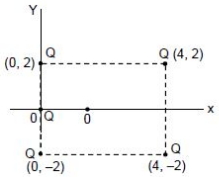
Four equal point charges $Q$ are placed in the $xy$ plane at $(0, 2), (4, 2), (4, -2)$ and $(0, -2)$. The work required to put a fifth charge $Q$ at the origin of the coordinate system will be
A
$\frac{Q^2}{4\pi \varepsilon_0}\left(1 + \frac{1}{\sqrt{3}}\right)$
B
$\frac{Q^2}{4\pi \varepsilon_0}\left(1 + \frac{1}{\sqrt{5}}\right)$
C
$\frac{Q^2}{2\sqrt{2}\pi \varepsilon_0}$
D
$\frac{Q^2}{4\pi \varepsilon_0}$
Solution
(B) The work done $W$ to bring a charge $Q$ from infinity to the origin is given by $W = V \cdot Q$,where $V$ is the electric potential at the origin due to the four charges.
The distances of the four charges from the origin $(0, 0)$ are:
$r_1 = \sqrt{0^2 + 2^2} = 2$
$r_2 = \sqrt{4^2 + 2^2} = \sqrt{16 + 4} = \sqrt{20} = 2\sqrt{5}$
$r_3 = \sqrt{4^2 + (-2)^2} = \sqrt{16 + 4} = \sqrt{20} = 2\sqrt{5}$
$r_4 = \sqrt{0^2 + (-2)^2} = 2$
The potential $V$ at the origin is:
$V = \frac{1}{4\pi \varepsilon_0} \left( \frac{Q}{r_1} + \frac{Q}{r_2} + \frac{Q}{r_3} + \frac{Q}{r_4} \right)$
$V = \frac{Q}{4\pi \varepsilon_0} \left( \frac{1}{2} + \frac{1}{2\sqrt{5}} + \frac{1}{2\sqrt{5}} + \frac{1}{2} \right)$
$V = \frac{Q}{4\pi \varepsilon_0} \left( 1 + \frac{2}{2\sqrt{5}} \right) = \frac{Q}{4\pi \varepsilon_0} \left( 1 + \frac{1}{\sqrt{5}} \right)$
Thus,the work done is $W = V \cdot Q = \frac{Q^2}{4\pi \varepsilon_0} \left( 1 + \frac{1}{\sqrt{5}} \right)$.
The distances of the four charges from the origin $(0, 0)$ are:
$r_1 = \sqrt{0^2 + 2^2} = 2$
$r_2 = \sqrt{4^2 + 2^2} = \sqrt{16 + 4} = \sqrt{20} = 2\sqrt{5}$
$r_3 = \sqrt{4^2 + (-2)^2} = \sqrt{16 + 4} = \sqrt{20} = 2\sqrt{5}$
$r_4 = \sqrt{0^2 + (-2)^2} = 2$
The potential $V$ at the origin is:
$V = \frac{1}{4\pi \varepsilon_0} \left( \frac{Q}{r_1} + \frac{Q}{r_2} + \frac{Q}{r_3} + \frac{Q}{r_4} \right)$
$V = \frac{Q}{4\pi \varepsilon_0} \left( \frac{1}{2} + \frac{1}{2\sqrt{5}} + \frac{1}{2\sqrt{5}} + \frac{1}{2} \right)$
$V = \frac{Q}{4\pi \varepsilon_0} \left( 1 + \frac{2}{2\sqrt{5}} \right) = \frac{Q}{4\pi \varepsilon_0} \left( 1 + \frac{1}{\sqrt{5}} \right)$
Thus,the work done is $W = V \cdot Q = \frac{Q^2}{4\pi \varepsilon_0} \left( 1 + \frac{1}{\sqrt{5}} \right)$.
0 likes
View Solution202
DifficultMCQ
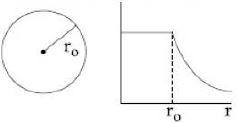
The given graph shows the variation (with distance $r$ from the centre) of:
A
Electric field of a uniformly charged sphere
B
Potential of a uniformly charged spherical shell
C
Potential of a uniformly charged sphere
D
Electric field of a uniformly charged spherical shell
Solution
(B) For a uniformly charged spherical shell of radius $r_0$:
$1$. The electric potential $V$ inside the shell $(r < r_0)$ is constant and equal to the potential at the surface,$V = \frac{kq}{r_0}$.
$2$. The electric potential $V$ outside the shell $(r > r_0)$ decreases as $V = \frac{kq}{r}$,which is a hyperbolic variation.
$3$. The graph shows a constant value for $r < r_0$ and a hyperbolic decrease for $r > r_0$,which matches the behavior of the potential of a uniformly charged spherical shell.
$1$. The electric potential $V$ inside the shell $(r < r_0)$ is constant and equal to the potential at the surface,$V = \frac{kq}{r_0}$.
$2$. The electric potential $V$ outside the shell $(r > r_0)$ decreases as $V = \frac{kq}{r}$,which is a hyperbolic variation.
$3$. The graph shows a constant value for $r < r_0$ and a hyperbolic decrease for $r > r_0$,which matches the behavior of the potential of a uniformly charged spherical shell.
0 likes
View Solution203
DifficultMCQ
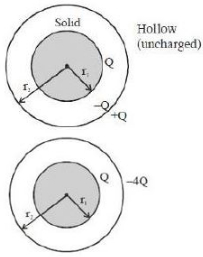
$A$ solid conducting sphere, having a charge $Q$, is surrounded by an uncharged conducting hollow spherical shell. Let the potential difference between the surface of the solid sphere and that of the outer surface of the hollow shell be $V$. If the shell is now given a charge of $-4\, Q$, the new potential difference between the same two surfaces is......$V$.
A
$2$
B
$-2$
C
$4$
D
$1$
Solution
(D) Let the radius of the solid sphere be $r_1$ and the radius of the hollow shell be $r_2$.
In the first condition, the solid sphere has charge $Q$ and the shell is uncharged.
The potential of the solid sphere is $V_{in} = \frac{kQ}{r_1} + \frac{k(0)}{r_2} = \frac{kQ}{r_1}$.
The potential of the hollow shell is $V_{out} = \frac{kQ}{r_2} + \frac{k(0)}{r_2} = \frac{kQ}{r_2}$.
The potential difference is $V = V_{in} - V_{out} = kQ \left( \frac{1}{r_1} - \frac{1}{r_2} \right)$.
In the second condition, the shell is given a charge of $-4Q$.
The potential of the solid sphere is $V'_{in} = \frac{kQ}{r_1} + \frac{k(-4Q)}{r_2} = \frac{kQ}{r_1} - \frac{4kQ}{r_2}$.
The potential of the hollow shell is $V'_{out} = \frac{kQ}{r_2} + \frac{k(-4Q)}{r_2} = -\frac{3kQ}{r_2}$.
The new potential difference is $V' = V'_{in} - V'_{out} = \left( \frac{kQ}{r_1} - \frac{4kQ}{r_2} \right) - \left( -\frac{3kQ}{r_2} \right)$.
$V' = \frac{kQ}{r_1} - \frac{4kQ}{r_2} + \frac{3kQ}{r_2} = \frac{kQ}{r_1} - \frac{kQ}{r_2} = kQ \left( \frac{1}{r_1} - \frac{1}{r_2} \right) = V$.
Thus, the potential difference remains $V$.
In the first condition, the solid sphere has charge $Q$ and the shell is uncharged.
The potential of the solid sphere is $V_{in} = \frac{kQ}{r_1} + \frac{k(0)}{r_2} = \frac{kQ}{r_1}$.
The potential of the hollow shell is $V_{out} = \frac{kQ}{r_2} + \frac{k(0)}{r_2} = \frac{kQ}{r_2}$.
The potential difference is $V = V_{in} - V_{out} = kQ \left( \frac{1}{r_1} - \frac{1}{r_2} \right)$.
In the second condition, the shell is given a charge of $-4Q$.
The potential of the solid sphere is $V'_{in} = \frac{kQ}{r_1} + \frac{k(-4Q)}{r_2} = \frac{kQ}{r_1} - \frac{4kQ}{r_2}$.
The potential of the hollow shell is $V'_{out} = \frac{kQ}{r_2} + \frac{k(-4Q)}{r_2} = -\frac{3kQ}{r_2}$.
The new potential difference is $V' = V'_{in} - V'_{out} = \left( \frac{kQ}{r_1} - \frac{4kQ}{r_2} \right) - \left( -\frac{3kQ}{r_2} \right)$.
$V' = \frac{kQ}{r_1} - \frac{4kQ}{r_2} + \frac{3kQ}{r_2} = \frac{kQ}{r_1} - \frac{kQ}{r_2} = kQ \left( \frac{1}{r_1} - \frac{1}{r_2} \right) = V$.
Thus, the potential difference remains $V$.
0 likes
View Solution204
DifficultMCQ
$A$ uniformly charged ring of radius $3a$ and total charge $q$ is placed in the $xy$-plane centered at the origin. $A$ point charge $q$ is moving towards the ring along the $z$-axis and has speed $v$ at $z = 4a$. The minimum value of $v$ such that it crosses the origin is
A
$\sqrt {\frac{2}{m}} {\left( {\frac{1}{5}\frac{{{q^2}}}{{4\pi { \in _0}a}}} \right)^{1/2}}$
B
$\sqrt {\frac{2}{m}} {\left( {\frac{1}{15}\frac{{{q^2}}}{{4\pi { \in _0}a}}} \right)^{1/2}}$
C
$\sqrt {\frac{2}{m}} {\left( {\frac{4}{15}\frac{{{q^2}}}{{4\pi { \in _0}a}}} \right)^{1/2}}$
D
$\sqrt {\frac{2}{m}} {\left( {\frac{2}{15}\frac{{{q^2}}}{{4\pi { \in _0}a}}} \right)^{1/2}}$
Solution
(D) The potential at a distance $z$ on the axis of a ring of radius $R$ and charge $q$ is $V = \frac{1}{4\pi \epsilon_0} \frac{q}{\sqrt{R^2 + z^2}}$.
Here,$R = 3a$. At $z = 4a$,the potential energy is $U_i = qV = \frac{q^2}{4\pi \epsilon_0 \sqrt{(3a)^2 + (4a)^2}} = \frac{q^2}{4\pi \epsilon_0 (5a)}$.
At the origin $(z = 0)$,the potential energy is $U_f = qV = \frac{q^2}{4\pi \epsilon_0 (3a)}$.
By the law of conservation of energy,$K_i + U_i = K_f + U_f$. For the charge to just cross the origin,$K_f = 0$.
$\frac{1}{2}mv^2 + \frac{q^2}{4\pi \epsilon_0 (5a)} = 0 + \frac{q^2}{4\pi \epsilon_0 (3a)}$.
$\frac{1}{2}mv^2 = \frac{q^2}{4\pi \epsilon_0 a} (\frac{1}{3} - \frac{1}{5}) = \frac{q^2}{4\pi \epsilon_0 a} (\frac{2}{15})$.
$v^2 = \frac{2}{m} \cdot \frac{2}{15} \cdot \frac{q^2}{4\pi \epsilon_0 a}$.
$v = \sqrt{\frac{2}{m}} \left( \frac{2}{15} \frac{q^2}{4\pi \epsilon_0 a} \right)^{1/2}$.
Here,$R = 3a$. At $z = 4a$,the potential energy is $U_i = qV = \frac{q^2}{4\pi \epsilon_0 \sqrt{(3a)^2 + (4a)^2}} = \frac{q^2}{4\pi \epsilon_0 (5a)}$.
At the origin $(z = 0)$,the potential energy is $U_f = qV = \frac{q^2}{4\pi \epsilon_0 (3a)}$.
By the law of conservation of energy,$K_i + U_i = K_f + U_f$. For the charge to just cross the origin,$K_f = 0$.
$\frac{1}{2}mv^2 + \frac{q^2}{4\pi \epsilon_0 (5a)} = 0 + \frac{q^2}{4\pi \epsilon_0 (3a)}$.
$\frac{1}{2}mv^2 = \frac{q^2}{4\pi \epsilon_0 a} (\frac{1}{3} - \frac{1}{5}) = \frac{q^2}{4\pi \epsilon_0 a} (\frac{2}{15})$.
$v^2 = \frac{2}{m} \cdot \frac{2}{15} \cdot \frac{q^2}{4\pi \epsilon_0 a}$.
$v = \sqrt{\frac{2}{m}} \left( \frac{2}{15} \frac{q^2}{4\pi \epsilon_0 a} \right)^{1/2}$.
0 likes
View Solution205
MediumMCQ
$A$ particle of charge $Q$ and mass $m$ travels through a potential difference $V$ from rest. The final momentum of the particle is
A
$\frac{mV}{Q}$
B
$2Q\sqrt{mV}$
C
$\sqrt{2mQV}$
D
$\sqrt{\frac{2QV}{m}}$
Solution
(C) The kinetic energy $K$ gained by a particle of charge $Q$ accelerated through a potential difference $V$ is given by $K = QV$.
Since the particle starts from rest,its final kinetic energy is $K = \frac{1}{2}mv^2$,where $v$ is the velocity.
The relation between momentum $p$ and kinetic energy $K$ is $p = \sqrt{2mK}$.
Substituting $K = QV$ into the momentum equation,we get $p = \sqrt{2mQV}$.
Since the particle starts from rest,its final kinetic energy is $K = \frac{1}{2}mv^2$,where $v$ is the velocity.
The relation between momentum $p$ and kinetic energy $K$ is $p = \sqrt{2mK}$.
Substituting $K = QV$ into the momentum equation,we get $p = \sqrt{2mQV}$.
0 likes
View Solution206
EasyMCQ
The work done to take an electron from rest where potential is $-60\, V$ to another point where potential is $-20\, V$ is given by.....$eV$.
A
$40$
B
$-40$
C
$60$
D
$-60$
Solution
(A) The work done $W$ in moving a charge $q$ between two points with potentials $V_1$ and $V_2$ is given by the formula $W = q(V_2 - V_1)$.
Here,the charge is an electron,so $q = -e$.
The initial potential $V_1 = -60\, V$ and the final potential $V_2 = -20\, V$.
Substituting these values into the formula:
$W = -e(-20\, V - (-60\, V))$
$W = -e(-20\, V + 60\, V)$
$W = -e(40\, V)$
$W = -40\, eV$.
Note: The question asks for the work done by an external agent to move the electron. Since the electron is moved from a lower potential to a higher potential,the external work is positive if we consider the change in potential energy. However,using the standard definition $W = q\Delta V$,we get $-40\, eV$. Given the options provided,the magnitude is $40\, eV$.
Here,the charge is an electron,so $q = -e$.
The initial potential $V_1 = -60\, V$ and the final potential $V_2 = -20\, V$.
Substituting these values into the formula:
$W = -e(-20\, V - (-60\, V))$
$W = -e(-20\, V + 60\, V)$
$W = -e(40\, V)$
$W = -40\, eV$.
Note: The question asks for the work done by an external agent to move the electron. Since the electron is moved from a lower potential to a higher potential,the external work is positive if we consider the change in potential energy. However,using the standard definition $W = q\Delta V$,we get $-40\, eV$. Given the options provided,the magnitude is $40\, eV$.
0 likes
View Solution207
EasyMCQ
If a charge is shifted from a low potential region to a high potential region,the electric potential energy
A
Increases
B
Decreases
C
Remains constant
D
May increase or decrease
Solution
(D) The change in electric potential energy is given by the formula $\Delta U = q \Delta V$,where $q$ is the charge and $\Delta V$ is the change in potential.
When a charge is moved from a low potential region to a high potential region,the change in potential $\Delta V = V_{final} - V_{initial}$ is positive.
If the charge $q$ is positive,then $\Delta U = (+q)(+\Delta V) > 0$,meaning the potential energy increases.
If the charge $q$ is negative,then $\Delta U = (-q)(+\Delta V) < 0$,meaning the potential energy decreases.
Therefore,the change in electric potential energy depends on the sign of the charge $q$.
When a charge is moved from a low potential region to a high potential region,the change in potential $\Delta V = V_{final} - V_{initial}$ is positive.
If the charge $q$ is positive,then $\Delta U = (+q)(+\Delta V) > 0$,meaning the potential energy increases.
If the charge $q$ is negative,then $\Delta U = (-q)(+\Delta V) < 0$,meaning the potential energy decreases.
Therefore,the change in electric potential energy depends on the sign of the charge $q$.
0 likes
View Solution208
EasyMCQ
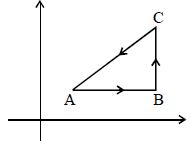
As shown in the figure,on bringing a charge $Q$ from point $A$ to $B$ and from $B$ to $C$,the work done is $2 \, J$ and $-3 \, J$ respectively. The work done to bring the charge from $C$ to $A$ is (in $, J$)
A
$-1$
B
$1$
C
$2$
D
$5$
Solution
(B) The electrostatic force is a conservative force. For any closed path in an electrostatic field,the total work done is zero.
Given that the work done in moving a charge from $A$ to $B$ is $W_{AB} = 2 \, J$.
The work done in moving a charge from $B$ to $C$ is $W_{BC} = -3 \, J$.
According to the property of conservative forces,the sum of work done along a closed path $A \rightarrow B \rightarrow C \rightarrow A$ is zero:
$W_{AB} + W_{BC} + W_{CA} = 0$
Substituting the given values:
$2 + (-3) + W_{CA} = 0$
$-1 + W_{CA} = 0$
$W_{CA} = 1 \, J$
Therefore,the work done to bring the charge from $C$ to $A$ is $1 \, J$.
Given that the work done in moving a charge from $A$ to $B$ is $W_{AB} = 2 \, J$.
The work done in moving a charge from $B$ to $C$ is $W_{BC} = -3 \, J$.
According to the property of conservative forces,the sum of work done along a closed path $A \rightarrow B \rightarrow C \rightarrow A$ is zero:
$W_{AB} + W_{BC} + W_{CA} = 0$
Substituting the given values:
$2 + (-3) + W_{CA} = 0$
$-1 + W_{CA} = 0$
$W_{CA} = 1 \, J$
Therefore,the work done to bring the charge from $C$ to $A$ is $1 \, J$.
0 likes
View Solution209
EasyMCQ
Two points $P$ and $Q$ are maintained at the potentials of $10\, V$ and $-4\, V$,respectively. The work done in moving $100$ electrons from $P$ to $Q$ is:
A
$-9.60 \times 10^{-17} \, J$
B
$9.60 \times 10^{-17} \, J$
C
$-2.24 \times 10^{-16} \, J$
D
$2.24 \times 10^{-16} \, J$
Solution
(D) The work done $W$ in moving a charge $q$ from point $P$ to point $Q$ is given by $W = q(V_Q - V_P)$.
Here,the charge $q$ is the total charge of $100$ electrons,so $q = 100 \times (-e) = 100 \times (-1.6 \times 10^{-19} \, C) = -1.6 \times 10^{-17} \, C$.
The potential difference is $V_Q - V_P = -4 \, V - 10 \, V = -14 \, V$.
Therefore,the work done is $W = (-1.6 \times 10^{-17} \, C) \times (-14 \, V) = 22.4 \times 10^{-17} \, J = 2.24 \times 10^{-16} \, J$.
Here,the charge $q$ is the total charge of $100$ electrons,so $q = 100 \times (-e) = 100 \times (-1.6 \times 10^{-19} \, C) = -1.6 \times 10^{-17} \, C$.
The potential difference is $V_Q - V_P = -4 \, V - 10 \, V = -14 \, V$.
Therefore,the work done is $W = (-1.6 \times 10^{-17} \, C) \times (-14 \, V) = 22.4 \times 10^{-17} \, J = 2.24 \times 10^{-16} \, J$.
0 likes
View Solution210
MediumMCQ
Two charged spheres of radii $R_1$ and $R_2$ have equal surface charge density. The ratio of their potential is
A
$R_1/R_2$
B
$R_2/R_1$
C
$(R_1/R_2)^2$
D
$(R_2/R_1)^2$
Solution
(A) The surface charge density $\sigma$ is defined as the charge per unit area,$\sigma = \frac{q}{4 \pi R^2}$.
Since the surface charge density is equal for both spheres,we have $\sigma_1 = \sigma_2 = \sigma$.
Thus,the charge on the spheres is $q_1 = \sigma (4 \pi R_1^2)$ and $q_2 = \sigma (4 \pi R_2^2)$.
The electric potential $V$ at the surface of a charged sphere is given by $V = \frac{kq}{R}$.
Substituting the expression for $q$,we get $V = \frac{k (\sigma 4 \pi R^2)}{R} = k \sigma 4 \pi R$.
Since $k$,$\sigma$,and $4 \pi$ are constants,the potential is directly proportional to the radius: $V \propto R$.
Therefore,the ratio of their potentials is $\frac{V_1}{V_2} = \frac{R_1}{R_2}$.
Since the surface charge density is equal for both spheres,we have $\sigma_1 = \sigma_2 = \sigma$.
Thus,the charge on the spheres is $q_1 = \sigma (4 \pi R_1^2)$ and $q_2 = \sigma (4 \pi R_2^2)$.
The electric potential $V$ at the surface of a charged sphere is given by $V = \frac{kq}{R}$.
Substituting the expression for $q$,we get $V = \frac{k (\sigma 4 \pi R^2)}{R} = k \sigma 4 \pi R$.
Since $k$,$\sigma$,and $4 \pi$ are constants,the potential is directly proportional to the radius: $V \propto R$.
Therefore,the ratio of their potentials is $\frac{V_1}{V_2} = \frac{R_1}{R_2}$.
0 likes
View Solution211
MediumMCQ
Three charges $q, \sqrt{2}q$,and $2q$ are placed at the corners $A, B$,and $C$ respectively of a square $ABCD$ of side length $a$. Find the electric potential at point $D$.
A
$\frac{2kq}{a}$
B
$\frac{4kq}{a}$
C
$\frac{kq}{a}(1 + \sqrt{2})$
D
$\frac{kq}{a} \left( 1 + \sqrt{2} + \frac{1}{\sqrt{2}} \right)$
Solution
(B) The electric potential $V$ at a point due to a system of point charges is the algebraic sum of the potentials due to each charge individually: $V = \sum \frac{kq_i}{r_i}$.
In square $ABCD$ of side $a$:
$1$. The distance from $A$ to $D$ is $r_A = a$.
$2$. The distance from $B$ to $D$ is the diagonal of the square,$r_B = a\sqrt{2}$.
$3$. The distance from $C$ to $D$ is $r_C = a$.
The potential at $D$ is $V_D = \frac{kq_A}{r_A} + \frac{kq_B}{r_B} + \frac{kq_C}{r_C}$.
Substituting the values: $V_D = \frac{kq}{a} + \frac{k(\sqrt{2}q)}{a\sqrt{2}} + \frac{k(2q)}{a}$.
$V_D = \frac{kq}{a} + \frac{kq}{a} + \frac{2kq}{a} = \frac{kq}{a}(1 + 1 + 2) = \frac{4kq}{a}$.
In square $ABCD$ of side $a$:
$1$. The distance from $A$ to $D$ is $r_A = a$.
$2$. The distance from $B$ to $D$ is the diagonal of the square,$r_B = a\sqrt{2}$.
$3$. The distance from $C$ to $D$ is $r_C = a$.
The potential at $D$ is $V_D = \frac{kq_A}{r_A} + \frac{kq_B}{r_B} + \frac{kq_C}{r_C}$.
Substituting the values: $V_D = \frac{kq}{a} + \frac{k(\sqrt{2}q)}{a\sqrt{2}} + \frac{k(2q)}{a}$.
$V_D = \frac{kq}{a} + \frac{kq}{a} + \frac{2kq}{a} = \frac{kq}{a}(1 + 1 + 2) = \frac{4kq}{a}$.
0 likes
View Solution212
MediumMCQ
Two conducting spheres of radii $r_1$ and $r_2$ have the same electric field intensity near their surfaces. The ratio of their electric potentials is
A
$(r_1^2 / r_2^2)$
B
$(r_2^2 / r_1^2)$
C
$(r_1 / r_2)$
D
$(r_2 / r_1)$
Solution
(C) The electric field $E$ on the surface of a conducting sphere of radius $R$ and charge $q$ is given by $E = \frac{kq}{R^2}$.
Given that the electric fields near the surfaces are equal:
$\frac{kq_1}{r_1^2} = \frac{kq_2}{r_2^2}$
$\frac{q_1}{q_2} = \frac{r_1^2}{r_2^2} \quad -(1)$
The electric potential $V$ on the surface of a conducting sphere is given by $V = \frac{kq}{R}$.
The ratio of their potentials is:
$\frac{V_1}{V_2} = \frac{kq_1 / r_1}{kq_2 / r_2} = \frac{q_1}{q_2} \cdot \frac{r_2}{r_1}$
Substituting the value of $\frac{q_1}{q_2}$ from equation $(1)$:
$\frac{V_1}{V_2} = \left( \frac{r_1^2}{r_2^2} \right) \cdot \left( \frac{r_2}{r_1} \right) = \frac{r_1}{r_2}$
Thus,the ratio of their electric potentials is $(r_1 / r_2)$.
Given that the electric fields near the surfaces are equal:
$\frac{kq_1}{r_1^2} = \frac{kq_2}{r_2^2}$
$\frac{q_1}{q_2} = \frac{r_1^2}{r_2^2} \quad -(1)$
The electric potential $V$ on the surface of a conducting sphere is given by $V = \frac{kq}{R}$.
The ratio of their potentials is:
$\frac{V_1}{V_2} = \frac{kq_1 / r_1}{kq_2 / r_2} = \frac{q_1}{q_2} \cdot \frac{r_2}{r_1}$
Substituting the value of $\frac{q_1}{q_2}$ from equation $(1)$:
$\frac{V_1}{V_2} = \left( \frac{r_1^2}{r_2^2} \right) \cdot \left( \frac{r_2}{r_1} \right) = \frac{r_1}{r_2}$
Thus,the ratio of their electric potentials is $(r_1 / r_2)$.
0 likes
View Solution213
DifficultMCQ
Two identical metal balls of radius $r$ are at a distance $a$ $(a \gg r)$ from each other and are charged,one with potential $V_1$ and other with potential $V_2$. The charges $q_1$ and $q_2$ on these balls in $CGS$ $esu$ are
A
$q_1 = \frac{rV_1 + aV_1}{r^2 + a^2}, q_2 = \frac{rV_1 + aV_2}{r^2 + a^2}$
B
$q_1 = \frac{1}{k} \left( \frac{rV_1 - aV_2}{r^2 - a^2} \right) ra, q_2 = \frac{1}{k} \left( \frac{rV_2 - aV_1}{r^2 - a^2} \right) ra$
C
$q_1 = \frac{aV_2}{k(r^2 - a^2)}, q_2 = \frac{rV_1}{k(r^2 - a^2)}$
D
$q_1 = \frac{rV_1}{k(r^2 - a^2)}, q_2 = \frac{rV_2}{(r^2 - a^2)k}$
Solution
(B) The potential of the first ball is $V_1 = K \left( \frac{q_1}{r} + \frac{q_2}{a} \right)$ and the potential of the second ball is $V_2 = K \left( \frac{q_2}{r} + \frac{q_1}{a} \right)$,where $K$ is the electrostatic constant.
We have the system of equations:
$V_1 = K \left( \frac{q_1}{r} + \frac{q_2}{a} \right) \implies \frac{V_1}{K} = \frac{q_1}{r} + \frac{q_2}{a} \quad (1)$
$V_2 = K \left( \frac{q_2}{r} + \frac{q_1}{a} \right) \implies \frac{V_2}{K} = \frac{q_2}{r} + \frac{q_1}{a} \quad (2)$
Multiply equation $(1)$ by $a$ and equation $(2)$ by $r$:
$a \frac{V_1}{K} = \frac{aq_1}{r} + q_2$
$r \frac{V_2}{K} = \frac{rq_2}{r} + \frac{rq_1}{a} = q_2 + \frac{rq_1}{a}$
Subtracting the two equations:
$\frac{rV_2 - aV_1}{K} = q_1 \left( \frac{r}{a} - \frac{a}{r} \right) = q_1 \left( \frac{r^2 - a^2}{ar} \right)$
Solving for $q_1$:
$q_1 = \frac{1}{K} \left( \frac{rV_2 - aV_1}{r^2 - a^2} \right) ra$
Similarly,solving for $q_2$:
$q_2 = \frac{1}{K} \left( \frac{rV_1 - aV_2}{r^2 - a^2} \right) ra$
We have the system of equations:
$V_1 = K \left( \frac{q_1}{r} + \frac{q_2}{a} \right) \implies \frac{V_1}{K} = \frac{q_1}{r} + \frac{q_2}{a} \quad (1)$
$V_2 = K \left( \frac{q_2}{r} + \frac{q_1}{a} \right) \implies \frac{V_2}{K} = \frac{q_2}{r} + \frac{q_1}{a} \quad (2)$
Multiply equation $(1)$ by $a$ and equation $(2)$ by $r$:
$a \frac{V_1}{K} = \frac{aq_1}{r} + q_2$
$r \frac{V_2}{K} = \frac{rq_2}{r} + \frac{rq_1}{a} = q_2 + \frac{rq_1}{a}$
Subtracting the two equations:
$\frac{rV_2 - aV_1}{K} = q_1 \left( \frac{r}{a} - \frac{a}{r} \right) = q_1 \left( \frac{r^2 - a^2}{ar} \right)$
Solving for $q_1$:
$q_1 = \frac{1}{K} \left( \frac{rV_2 - aV_1}{r^2 - a^2} \right) ra$
Similarly,solving for $q_2$:
$q_2 = \frac{1}{K} \left( \frac{rV_1 - aV_2}{r^2 - a^2} \right) ra$
0 likes
View Solution214
MediumMCQ
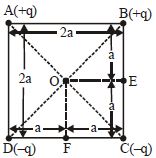
The ratio of electric potentials at the point $E$ to that at the point $F$ is
A
$\left( \frac{\sqrt{5} - 1}{\sqrt{5}} \right)$
B
$-\left( \frac{\sqrt{5} - 1}{\sqrt{5}} \right)$
C
$\sqrt{2}$
D
Zero
Solution
(D) The electric potential $V$ at a point due to a system of point charges is given by $V = \sum \frac{kq_i}{r_i}$.
For point $E$,which is the midpoint of side $BC$,the distances are $AE = \sqrt{(2a)^2 + a^2} = a\sqrt{5}$,$BE = a$,$CE = a$,and $DE = \sqrt{(2a)^2 + a^2} = a\sqrt{5}$.
The potential at $E$ is $V_E = \frac{1}{4\pi\varepsilon_0} \left( \frac{q}{a\sqrt{5}} + \frac{q}{a} - \frac{q}{a} - \frac{q}{a\sqrt{5}} \right) = 0$.
Since $V_E = 0$,the ratio of the potential at $E$ to that at $F$ is $\frac{V_E}{V_F} = \frac{0}{V_F} = 0$ (assuming $V_F \neq 0$).
For point $E$,which is the midpoint of side $BC$,the distances are $AE = \sqrt{(2a)^2 + a^2} = a\sqrt{5}$,$BE = a$,$CE = a$,and $DE = \sqrt{(2a)^2 + a^2} = a\sqrt{5}$.
The potential at $E$ is $V_E = \frac{1}{4\pi\varepsilon_0} \left( \frac{q}{a\sqrt{5}} + \frac{q}{a} - \frac{q}{a} - \frac{q}{a\sqrt{5}} \right) = 0$.
Since $V_E = 0$,the ratio of the potential at $E$ to that at $F$ is $\frac{V_E}{V_F} = \frac{0}{V_F} = 0$ (assuming $V_F \neq 0$).
0 likes
View Solution215
EasyMCQ
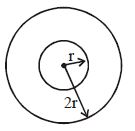
If the potential of the inner shell of radius $r$ is $10\,V$ and that of the outer shell of radius $2r$ is $5\,V$, then the potential at the centre will be....$V$
A
$10$
B
$5$
C
$15$
D
$0$
Solution
(A) Let $Q_1$ be the charge on the inner shell of radius $r$ and $Q_2$ be the charge on the outer shell of radius $2r$.
The potential at the surface of the inner shell is given by:
$V_{in} = \frac{kQ_1}{r} + \frac{kQ_2}{2r} = 10\,V$ --- $(1)$
The potential at the surface of the outer shell is given by:
$V_{out} = \frac{kQ_1}{2r} + \frac{kQ_2}{2r} = 5\,V$ --- $(2)$
The potential at the centre of the shells is the sum of potentials due to both shells:
$V_{centre} = \frac{kQ_1}{r} + \frac{kQ_2}{2r}$
Comparing this expression with equation $(1)$, we see that the potential at the centre is exactly equal to the potential at the surface of the inner shell.
Therefore, $V_{centre} = 10\,V$.
The potential at the surface of the inner shell is given by:
$V_{in} = \frac{kQ_1}{r} + \frac{kQ_2}{2r} = 10\,V$ --- $(1)$
The potential at the surface of the outer shell is given by:
$V_{out} = \frac{kQ_1}{2r} + \frac{kQ_2}{2r} = 5\,V$ --- $(2)$
The potential at the centre of the shells is the sum of potentials due to both shells:
$V_{centre} = \frac{kQ_1}{r} + \frac{kQ_2}{2r}$
Comparing this expression with equation $(1)$, we see that the potential at the centre is exactly equal to the potential at the surface of the inner shell.
Therefore, $V_{centre} = 10\,V$.
0 likes
View Solution216
MediumMCQ
$A$ spherical charged conductor has surface charge density $\sigma$. The electric field on its surface is $E$ and the electric potential of the conductor is $V$. Now,the radius of the sphere is halved while keeping the charge constant. The new values of the electric field and potential would be:
A
$2E, 2V$
B
$4E, 2V$
C
$4E, 4V$
D
$2E, 4V$
Solution
(B) The electric field on the surface of a charged spherical conductor is given by $E = \frac{1}{4 \pi \varepsilon_{0}} \frac{q}{R^{2}}$.
Since the charge $q$ is constant,$E \propto \frac{1}{R^{2}}$.
When the radius is halved $(R' = R/2)$,the new electric field $E'$ becomes $E' = \frac{1}{4 \pi \varepsilon_{0}} \frac{q}{(R/2)^{2}} = 4 \times \left( \frac{1}{4 \pi \varepsilon_{0}} \frac{q}{R^{2}} \right) = 4E$.
The electric potential of the conductor is given by $V = \frac{1}{4 \pi \varepsilon_{0}} \frac{q}{R}$.
Since the charge $q$ is constant,$V \propto \frac{1}{R}$.
When the radius is halved $(R' = R/2)$,the new potential $V'$ becomes $V' = \frac{1}{4 \pi \varepsilon_{0}} \frac{q}{(R/2)} = 2 \times \left( \frac{1}{4 \pi \varepsilon_{0}} \frac{q}{R} \right) = 2V$.
Thus,the new values are $4E$ and $2V$.
Since the charge $q$ is constant,$E \propto \frac{1}{R^{2}}$.
When the radius is halved $(R' = R/2)$,the new electric field $E'$ becomes $E' = \frac{1}{4 \pi \varepsilon_{0}} \frac{q}{(R/2)^{2}} = 4 \times \left( \frac{1}{4 \pi \varepsilon_{0}} \frac{q}{R^{2}} \right) = 4E$.
The electric potential of the conductor is given by $V = \frac{1}{4 \pi \varepsilon_{0}} \frac{q}{R}$.
Since the charge $q$ is constant,$V \propto \frac{1}{R}$.
When the radius is halved $(R' = R/2)$,the new potential $V'$ becomes $V' = \frac{1}{4 \pi \varepsilon_{0}} \frac{q}{(R/2)} = 2 \times \left( \frac{1}{4 \pi \varepsilon_{0}} \frac{q}{R} \right) = 2V$.
Thus,the new values are $4E$ and $2V$.
0 likes
View Solution217
MediumMCQ
$A$ charge $2\,\mu C$ is taken from infinity to a point in an electric field,without changing its velocity. If the work done against the electric forces is $20\,\mu J$,then the potential at that point will be.....$V$
A
$20$
B
$10$
C
$-10$
D
$30$
Solution
(B) The electric potential $V$ at a point is defined as the work done by an external agent in moving a unit positive charge from infinity to that point without any change in kinetic energy.
Formula: $V = \frac{W_{ext}}{q}$
Given:
Work done $W_{ext} = 20\,\mu J = 20 \times 10^{-6}\,J$
Charge $q = 2\,\mu C = 2 \times 10^{-6}\,C$
Calculation:
$V = \frac{20 \times 10^{-6}}{2 \times 10^{-6}} = 10\,V$
Therefore,the potential at that point is $10\,V$.
Formula: $V = \frac{W_{ext}}{q}$
Given:
Work done $W_{ext} = 20\,\mu J = 20 \times 10^{-6}\,J$
Charge $q = 2\,\mu C = 2 \times 10^{-6}\,C$
Calculation:
$V = \frac{20 \times 10^{-6}}{2 \times 10^{-6}} = 10\,V$
Therefore,the potential at that point is $10\,V$.
0 likes
View Solution218
EasyMCQ
$A$ conducting sphere of radius $R$ is given a charge $Q$. The electric potential and the electric field at the centre of the sphere respectively are
A
Zero and $\frac{Q}{4\pi \epsilon_0 R^2}$
B
$\frac{Q}{4\pi \epsilon_0 R}$ and Zero
C
$\frac{Q}{4\pi \epsilon_0 R}$ and $\frac{Q}{4\pi \epsilon_0 R^2}$
D
Both are zero
Solution
(B) For a conducting sphere of radius $R$ carrying a charge $Q$,the charge resides entirely on its outer surface.
Inside the conductor,the electric field $E$ is zero everywhere because the charges are in electrostatic equilibrium.
However,the electric potential $V$ inside the conductor is constant and equal to the potential at its surface.
The potential at the surface is given by $V = \frac{Q}{4\pi \epsilon_0 R}$.
Therefore,at the centre of the sphere,the electric potential is $\frac{Q}{4\pi \epsilon_0 R}$ and the electric field is $0$.
Inside the conductor,the electric field $E$ is zero everywhere because the charges are in electrostatic equilibrium.
However,the electric potential $V$ inside the conductor is constant and equal to the potential at its surface.
The potential at the surface is given by $V = \frac{Q}{4\pi \epsilon_0 R}$.
Therefore,at the centre of the sphere,the electric potential is $\frac{Q}{4\pi \epsilon_0 R}$ and the electric field is $0$.
0 likes
View Solution219
EasyMCQ
$A$ hollow metallic sphere of radius $10 \; cm$ is charged such that the potential at its surface is $80 \; V$. The potential at the centre of the sphere would be (in $; V$)
A
$800$
B
$8$
C
$80$
D
$0$
Solution
(C) For a hollow metallic sphere,the electric field inside is zero $(E = 0)$.
Since the electric field is the negative gradient of the potential $(E = -dV/dr)$,if $E = 0$,then the potential $V$ must be constant throughout the interior.
Therefore,the potential at any point inside the sphere,including the centre,is equal to the potential at its surface.
Given that the potential at the surface is $80 \; V$,the potential at the centre is also $80 \; V$.
Since the electric field is the negative gradient of the potential $(E = -dV/dr)$,if $E = 0$,then the potential $V$ must be constant throughout the interior.
Therefore,the potential at any point inside the sphere,including the centre,is equal to the potential at its surface.
Given that the potential at the surface is $80 \; V$,the potential at the centre is also $80 \; V$.
0 likes
View Solution220
DifficultMCQ
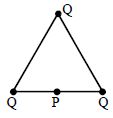
The side length of an equilateral triangle is $d$. Three charges,each of magnitude $Q$,are placed at the three vertices. If $P$ is the midpoint of one side,find the electric potential $V_P$ at point $P$.
A
$\frac{Q}{{2\pi { \in _0}d}}\left[ {2 + \sqrt 3 } \right]$
B
$\frac{Q}{{2\pi { \in _0}d}}\left[ {2 + \frac{1}{{\sqrt 3 }}} \right]$
C
$\frac{Q}{{4\pi { \in _0}d}}\left[ {4 + \sqrt 3 } \right]$
D
Zero
Solution
(B) Let the vertices of the equilateral triangle be $A, B,$ and $C$. Let charges $Q$ be placed at each vertex. Let $P$ be the midpoint of side $BC$.
The distance from $P$ to the vertices $B$ and $C$ is $r_1 = r_2 = d/2$.
The distance from $P$ to vertex $A$ is the altitude of the triangle,$h = \frac{\sqrt{3}}{2}d$.
The total potential at $P$ is the sum of potentials due to the three charges: $V_P = V_A + V_B + V_C$.
$V_P = \frac{1}{4\pi \epsilon_0} \left( \frac{Q}{h} + \frac{Q}{d/2} + \frac{Q}{d/2} \right) = \frac{Q}{4\pi \epsilon_0} \left( \frac{1}{\frac{\sqrt{3}}{2}d} + \frac{2}{d} + \frac{2}{d} \right)$.
$V_P = \frac{Q}{4\pi \epsilon_0 d} \left( \frac{2}{\sqrt{3}} + 4 \right) = \frac{Q}{2\pi \epsilon_0 d} \left( \frac{1}{\sqrt{3}} + 2 \right)$.
The distance from $P$ to the vertices $B$ and $C$ is $r_1 = r_2 = d/2$.
The distance from $P$ to vertex $A$ is the altitude of the triangle,$h = \frac{\sqrt{3}}{2}d$.
The total potential at $P$ is the sum of potentials due to the three charges: $V_P = V_A + V_B + V_C$.
$V_P = \frac{1}{4\pi \epsilon_0} \left( \frac{Q}{h} + \frac{Q}{d/2} + \frac{Q}{d/2} \right) = \frac{Q}{4\pi \epsilon_0} \left( \frac{1}{\frac{\sqrt{3}}{2}d} + \frac{2}{d} + \frac{2}{d} \right)$.
$V_P = \frac{Q}{4\pi \epsilon_0 d} \left( \frac{2}{\sqrt{3}} + 4 \right) = \frac{Q}{2\pi \epsilon_0 d} \left( \frac{1}{\sqrt{3}} + 2 \right)$.
0 likes
View Solution221
EasyMCQ
Assertion: Electrons move away from a region of higher potential to a region of lower potential.
Reason: An electron has a negative charge.
Reason: An electron has a negative charge.
A
If both Assertion and Reason are correct and the Reason is a correct explanation of the Assertion.
B
If both Assertion and Reason are correct but Reason is not a correct explanation of the Assertion.
C
If the Assertion is correct but Reason is incorrect.
D
If the Assertion is incorrect but the Reason is correct.
Solution
(D) The electric field $E$ is directed from a region of higher potential to a region of lower potential.
An electron carries a negative charge $q = -e$.
The force on a charged particle in an electric field is given by $F = qE$.
Since the charge is negative,the force on the electron is in the direction opposite to the electric field.
Therefore,an electron moves from a region of lower potential to a region of higher potential.
Thus,the Assertion is incorrect,and the Reason is correct.
An electron carries a negative charge $q = -e$.
The force on a charged particle in an electric field is given by $F = qE$.
Since the charge is negative,the force on the electron is in the direction opposite to the electric field.
Therefore,an electron moves from a region of lower potential to a region of higher potential.
Thus,the Assertion is incorrect,and the Reason is correct.
0 likes
View Solution222
MediumMCQ
The maximum electric field that can be held in air without producing ionization of air is $10^7\,V/m$. The maximum potential,therefore,to which a conducting sphere of radius $0.10\,m$ can be charged in air is:
A
$10^9\,V$
B
$10^8\,V$
C
$10^7\,V$
D
$10^6\,V$
Solution
(D) The electric field $E$ at the surface of a conducting sphere of radius $r$ is given by $E = \frac{V}{r}$,where $V$ is the potential of the sphere.
Given,the maximum electric field $E_{max} = 10^7\,V/m$ and the radius $r = 0.10\,m$.
To find the maximum potential $V_{max}$,we use the relation $V_{max} = E_{max} \times r$.
Substituting the values: $V_{max} = 10^7\,V/m \times 0.10\,m$.
$V_{max} = 10^7 \times 10^{-1} = 10^6\,V$.
Thus,the maximum potential to which the sphere can be charged is $10^6\,V$.
Given,the maximum electric field $E_{max} = 10^7\,V/m$ and the radius $r = 0.10\,m$.
To find the maximum potential $V_{max}$,we use the relation $V_{max} = E_{max} \times r$.
Substituting the values: $V_{max} = 10^7\,V/m \times 0.10\,m$.
$V_{max} = 10^7 \times 10^{-1} = 10^6\,V$.
Thus,the maximum potential to which the sphere can be charged is $10^6\,V$.
0 likes
View Solution223
MediumMCQ
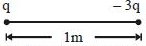
Two charges of magnitude $+q$ and $-3q$ are placed $100 \, cm$ apart. The distance from $+q$ between the charges where the electrostatic potential is zero is ....... $cm$.
A
$25$
B
$50$
C
$75$
D
$80$
Solution
(A) Let the distance from the charge $+q$ where the potential is zero be $x$ (in meters).
The total potential $V$ at this point is the sum of the potentials due to both charges:
$V = \frac{1}{4 \pi \varepsilon_0} \left( \frac{q}{x} + \frac{-3q}{1-x} \right) = 0$
Since $\frac{1}{4 \pi \varepsilon_0} \neq 0$,we have:
$\frac{q}{x} - \frac{3q}{1-x} = 0$
$\frac{1}{x} = \frac{3}{1-x}$
$1 - x = 3x$
$1 = 4x$
$x = \frac{1}{4} \, m = 0.25 \, m = 25 \, cm$.
Thus,the distance is $25 \, cm$.
The total potential $V$ at this point is the sum of the potentials due to both charges:
$V = \frac{1}{4 \pi \varepsilon_0} \left( \frac{q}{x} + \frac{-3q}{1-x} \right) = 0$
Since $\frac{1}{4 \pi \varepsilon_0} \neq 0$,we have:
$\frac{q}{x} - \frac{3q}{1-x} = 0$
$\frac{1}{x} = \frac{3}{1-x}$
$1 - x = 3x$
$1 = 4x$
$x = \frac{1}{4} \, m = 0.25 \, m = 25 \, cm$.
Thus,the distance is $25 \, cm$.
0 likes
View Solution224
MediumMCQ
$A$ charge $+q$ is fixed at each of the points $x = x_0, x = 3x_0, x = 5x_0, \dots$ up to $\infty$ on the $X$-axis and a charge $-q$ is fixed at each of the points $x = 2x_0, x = 4x_0, x = 6x_0, \dots$ up to $\infty$. Here $x_0$ is a positive constant. Taking the potential at a point due to a charge $Q$ at a distance $r$ from it to be $\frac{Q}{4\pi\varepsilon_0 r}$,find the potential at the origin due to the above system of charges.
A
zero
B
$\frac{q}{8\pi\varepsilon_0 x_0 \log_e 2}$
C
infinity
D
$\frac{q \log_e 2}{4\pi\varepsilon_0 x_0}$
Solution
(D) The potential $V$ at the origin due to a system of point charges is given by the sum $V = \sum \frac{1}{4\pi\varepsilon_0} \frac{q_i}{r_i}$.
For the given system,the charges $+q$ are at $x = x_0, 3x_0, 5x_0, \dots$ and charges $-q$ are at $x = 2x_0, 4x_0, 6x_0, \dots$.
The potential at the origin is:
$V = \frac{q}{4\pi\varepsilon_0} \left( \frac{1}{x_0} - \frac{1}{2x_0} + \frac{1}{3x_0} - \frac{1}{4x_0} + \dots \right)$
$V = \frac{q}{4\pi\varepsilon_0 x_0} \left( 1 - \frac{1}{2} + \frac{1}{3} - \frac{1}{4} + \dots \right)$
Using the Taylor series expansion for $\log_e(1+x) = x - \frac{x^2}{2} + \frac{x^3}{3} - \dots$,for $x=1$,we get $\log_e(2) = 1 - \frac{1}{2} + \frac{1}{3} - \frac{1}{4} + \dots$.
Substituting this into the expression for $V$:
$V = \frac{q}{4\pi\varepsilon_0 x_0} \log_e 2$.
For the given system,the charges $+q$ are at $x = x_0, 3x_0, 5x_0, \dots$ and charges $-q$ are at $x = 2x_0, 4x_0, 6x_0, \dots$.
The potential at the origin is:
$V = \frac{q}{4\pi\varepsilon_0} \left( \frac{1}{x_0} - \frac{1}{2x_0} + \frac{1}{3x_0} - \frac{1}{4x_0} + \dots \right)$
$V = \frac{q}{4\pi\varepsilon_0 x_0} \left( 1 - \frac{1}{2} + \frac{1}{3} - \frac{1}{4} + \dots \right)$
Using the Taylor series expansion for $\log_e(1+x) = x - \frac{x^2}{2} + \frac{x^3}{3} - \dots$,for $x=1$,we get $\log_e(2) = 1 - \frac{1}{2} + \frac{1}{3} - \frac{1}{4} + \dots$.
Substituting this into the expression for $V$:
$V = \frac{q}{4\pi\varepsilon_0 x_0} \log_e 2$.
0 likes
View Solution225
MediumMCQ
Assertion : Two concentric charged shells are given. The potential difference between the shells depends on the charge of the inner shell.
Reason : Potential due to the charge of the outer shell remains the same at every point inside the sphere.
Reason : Potential due to the charge of the outer shell remains the same at every point inside the sphere.

A
If both Assertion and Reason are correct and Reason is the correct explanation of Assertion.
B
If both Assertion and Reason are correct,but Reason is not the correct explanation of Assertion.
C
If Assertion is correct but Reason is incorrect.
D
If both the Assertion and Reason are incorrect.
Solution
(A) Let the inner shell $B$ have radius $R_1$ and charge $Q_1$,and the outer shell $A$ have radius $R_2$ and charge $Q_2$.
The potential at the surface of the outer shell $A$ is $V_A = \frac{1}{4 \pi \varepsilon_0} \frac{Q_1 + Q_2}{R_2}$.
The potential at the surface of the inner shell $B$ is $V_B = \frac{1}{4 \pi \varepsilon_0} \left( \frac{Q_1}{R_1} + \frac{Q_2}{R_2} \right)$.
The potential difference between the shells is $V_B - V_A = \frac{1}{4 \pi \varepsilon_0} \left( \frac{Q_1}{R_1} + \frac{Q_2}{R_2} - \frac{Q_1 + Q_2}{R_2} \right) = \frac{1}{4 \pi \varepsilon_0} Q_1 \left( \frac{1}{R_1} - \frac{1}{R_2} \right)$.
This shows that the potential difference depends only on the charge of the inner shell $Q_1$. Thus,the Assertion is correct.
The potential due to the charge of the outer shell $Q_2$ at any point inside it (including the surface of the inner shell) is constant and equal to $\frac{1}{4 \pi \varepsilon_0} \frac{Q_2}{R_2}$. Thus,the Reason is also correct and explains why the $Q_2$ term cancels out in the potential difference calculation.
The potential at the surface of the outer shell $A$ is $V_A = \frac{1}{4 \pi \varepsilon_0} \frac{Q_1 + Q_2}{R_2}$.
The potential at the surface of the inner shell $B$ is $V_B = \frac{1}{4 \pi \varepsilon_0} \left( \frac{Q_1}{R_1} + \frac{Q_2}{R_2} \right)$.
The potential difference between the shells is $V_B - V_A = \frac{1}{4 \pi \varepsilon_0} \left( \frac{Q_1}{R_1} + \frac{Q_2}{R_2} - \frac{Q_1 + Q_2}{R_2} \right) = \frac{1}{4 \pi \varepsilon_0} Q_1 \left( \frac{1}{R_1} - \frac{1}{R_2} \right)$.
This shows that the potential difference depends only on the charge of the inner shell $Q_1$. Thus,the Assertion is correct.
The potential due to the charge of the outer shell $Q_2$ at any point inside it (including the surface of the inner shell) is constant and equal to $\frac{1}{4 \pi \varepsilon_0} \frac{Q_2}{R_2}$. Thus,the Reason is also correct and explains why the $Q_2$ term cancels out in the potential difference calculation.
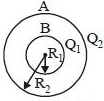
0 likes
View Solution226
EasyMCQ
Assertion : Electric potential and electric potential energy are different quantities.
Reason : For a system of a positive test charge and a point charge,electric potential energy $=$ electric potential.
Reason : For a system of a positive test charge and a point charge,electric potential energy $=$ electric potential.
A
If both Assertion and Reason are correct and Reason is the correct explanation of Assertion.
B
If both Assertion and Reason are correct,but Reason is not the correct explanation of Assertion.
C
If Assertion is correct but Reason is incorrect.
D
If both the Assertion and Reason are incorrect.
Solution
(C) Electric potential $(V)$ at a point is defined as the work done per unit positive charge in bringing it from infinity to that point,given by $V = W/q$.
Electric potential energy $(U)$ is the total work done in assembling a system of charges,given by $U = qV$.
Since $U$ and $V$ have different physical dimensions ($[ML^2T^{-3}A^{-1}]$ for $V$ and $[ML^2T^{-2}A^{-1}]$ for $U$),they are distinct physical quantities.
The Assertion is correct.
The Reason states that $U = V$,which is dimensionally inconsistent and physically incorrect.
Therefore,the Assertion is correct but the Reason is incorrect.
Electric potential energy $(U)$ is the total work done in assembling a system of charges,given by $U = qV$.
Since $U$ and $V$ have different physical dimensions ($[ML^2T^{-3}A^{-1}]$ for $V$ and $[ML^2T^{-2}A^{-1}]$ for $U$),they are distinct physical quantities.
The Assertion is correct.
The Reason states that $U = V$,which is dimensionally inconsistent and physically incorrect.
Therefore,the Assertion is correct but the Reason is incorrect.
0 likes
View Solution227
Easy
$(a)$ Calculate the potential at a point $P$ due to a charge of $4 \times 10^{-7} \; C$ located $9 \; cm$ away.
$(b)$ Hence,obtain the work done in bringing a charge of $2 \times 10^{-9} \; C$ from infinity to the point $P$. Does the answer depend on the path along which the charge is brought?
$(b)$ Hence,obtain the work done in bringing a charge of $2 \times 10^{-9} \; C$ from infinity to the point $P$. Does the answer depend on the path along which the charge is brought?
Solution
(N/A) The electric potential $V$ at a distance $r$ due to a charge $Q$ is given by $V = \frac{1}{4 \pi \varepsilon_{0}} \frac{Q}{r}$.
Given $Q = 4 \times 10^{-7} \; C$ and $r = 9 \; cm = 0.09 \; m$.
$V = (9 \times 10^{9} \; N \cdot m^{2} \cdot C^{-2}) \times \frac{4 \times 10^{-7} \; C}{0.09 \; m} = 4 \times 10^{4} \; V$.
$(b)$ The work done $W$ in bringing a charge $q$ from infinity to a point $P$ is $W = qV$.
Given $q = 2 \times 10^{-9} \; C$.
$W = (2 \times 10^{-9} \; C) \times (4 \times 10^{4} \; V) = 8 \times 10^{-5} \; J$.
No,the work done is path-independent because the electrostatic force is a conservative force. The work done depends only on the initial and final positions.
Given $Q = 4 \times 10^{-7} \; C$ and $r = 9 \; cm = 0.09 \; m$.
$V = (9 \times 10^{9} \; N \cdot m^{2} \cdot C^{-2}) \times \frac{4 \times 10^{-7} \; C}{0.09 \; m} = 4 \times 10^{4} \; V$.
$(b)$ The work done $W$ in bringing a charge $q$ from infinity to a point $P$ is $W = qV$.
Given $q = 2 \times 10^{-9} \; C$.
$W = (2 \times 10^{-9} \; C) \times (4 \times 10^{4} \; V) = 8 \times 10^{-5} \; J$.
No,the work done is path-independent because the electrostatic force is a conservative force. The work done depends only on the initial and final positions.
0 likes
View Solution228
Medium
Two charges $3 \times 10^{-8} \; C$ and $-2 \times 10^{-8} \; C$ are located $15 \; cm$ apart. At what point on the line joining the two charges is the electric potential zero? Take the potential at infinity to be zero.
Solution
(N/A) Let us take the origin $O$ at the location of the positive charge. The line joining the two charges is taken to be the $x$-axis; the negative charge is taken to be on the right side of the origin.
Let $P$ be the required point on the $x$-axis where the potential is zero.
If $x$ is the $x$-coordinate of $P$,obviously $x$ must be positive. If $x$ lies between $O$ and $A$,we have:
$\frac{1}{4 \pi \varepsilon_{0}} \left[ \frac{3 \times 10^{-8}}{x \times 10^{-2}} - \frac{2 \times 10^{-8}}{(15-x) \times 10^{-2}} \right] = 0$
where $x$ is in $cm$. That is,
$\frac{3}{x} - \frac{2}{15-x} = 0$
which gives $x = 9 \; cm$.
If $x$ lies on the extended line $OA$,the required condition is:
$\frac{3}{x} - \frac{2}{x-15} = 0$
which gives $x = 45 \; cm$.
Thus,the electric potential is zero at $9 \; cm$ and $45 \; cm$ away from the positive charge on the side of the negative charge.
Let $P$ be the required point on the $x$-axis where the potential is zero.
If $x$ is the $x$-coordinate of $P$,obviously $x$ must be positive. If $x$ lies between $O$ and $A$,we have:
$\frac{1}{4 \pi \varepsilon_{0}} \left[ \frac{3 \times 10^{-8}}{x \times 10^{-2}} - \frac{2 \times 10^{-8}}{(15-x) \times 10^{-2}} \right] = 0$
where $x$ is in $cm$. That is,
$\frac{3}{x} - \frac{2}{15-x} = 0$
which gives $x = 9 \; cm$.
If $x$ lies on the extended line $OA$,the required condition is:
$\frac{3}{x} - \frac{2}{x-15} = 0$
which gives $x = 45 \; cm$.
Thus,the electric potential is zero at $9 \; cm$ and $45 \; cm$ away from the positive charge on the side of the negative charge.

0 likes
View Solution229
Medium
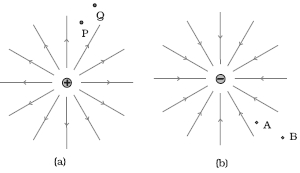
Figures $(a)$ and $(b)$ show the field lines of a positive and negative point charge respectively.
$(a)$ Give the signs of the potential difference $V_{P}-V_{Q}$ and $V_{B}-V_{A}$.
$(b)$ Give the sign of the potential energy difference of a small negative charge between the points $Q$ and $P$,and $A$ and $B$.
$(c)$ Give the sign of the work done by the field in moving a small positive charge from $Q$ to $P$.
$(d)$ Give the sign of the work done by the external agency in moving a small negative charge from $B$ to $A$.
$(e)$ Does the kinetic energy of a small negative charge increase or decrease in going from $B$ to $A$?
$(a)$ Give the signs of the potential difference $V_{P}-V_{Q}$ and $V_{B}-V_{A}$.
$(b)$ Give the sign of the potential energy difference of a small negative charge between the points $Q$ and $P$,and $A$ and $B$.
$(c)$ Give the sign of the work done by the field in moving a small positive charge from $Q$ to $P$.
$(d)$ Give the sign of the work done by the external agency in moving a small negative charge from $B$ to $A$.
$(e)$ Does the kinetic energy of a small negative charge increase or decrease in going from $B$ to $A$?
Solution
(A-D) As $V \propto \frac{1}{r}$,the potential is higher closer to the positive charge. Thus,$V_{P} > V_{Q}$,so $(V_{P}-V_{Q})$ is positive. For the negative charge,the potential is more negative closer to the charge. Thus,$V_{B} > V_{A}$ (since $V_{A}$ is more negative),so $(V_{B}-V_{A})$ is positive.
$(b)$ Potential energy $U = qV$. For a negative charge $q < 0$,if $V_{P} > V_{Q}$,then $U_{P} < U_{Q}$. The difference $(U_{P}-U_{Q})$ is negative. Similarly,for the negative charge,since $V_{B} > V_{A}$,$U_{B} > U_{A}$,so $(U_{A}-U_{B})$ is negative.
$(c)$ $A$ positive charge experiences a repulsive force from the positive source charge. Moving it from $Q$ to $P$ (closer) requires work against the field. Thus,the work done by the field is negative.
$(d)$ $A$ negative charge is attracted to the positive source charge but repelled by the negative source charge. Moving a negative charge from $B$ to $A$ (closer to the negative source) requires work against the repulsive force. Thus,the work done by the external agency is positive.
$(e)$ As the negative charge moves from $B$ to $A$,it moves closer to the negative source charge,experiencing a stronger repulsive force. This force does negative work,causing the kinetic energy to decrease.
$(b)$ Potential energy $U = qV$. For a negative charge $q < 0$,if $V_{P} > V_{Q}$,then $U_{P} < U_{Q}$. The difference $(U_{P}-U_{Q})$ is negative. Similarly,for the negative charge,since $V_{B} > V_{A}$,$U_{B} > U_{A}$,so $(U_{A}-U_{B})$ is negative.
$(c)$ $A$ positive charge experiences a repulsive force from the positive source charge. Moving it from $Q$ to $P$ (closer) requires work against the field. Thus,the work done by the field is negative.
$(d)$ $A$ negative charge is attracted to the positive source charge but repelled by the negative source charge. Moving a negative charge from $B$ to $A$ (closer to the negative source) requires work against the repulsive force. Thus,the work done by the external agency is positive.
$(e)$ As the negative charge moves from $B$ to $A$,it moves closer to the negative source charge,experiencing a stronger repulsive force. This force does negative work,causing the kinetic energy to decrease.
0 likes
View Solution230
Medium
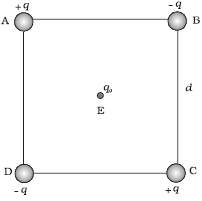
Four charges are arranged at the corners of a square $ABCD$ of side $d$,as shown in Figure.
$(a)$ Find the work required to put together this arrangement.
$(b)$ $A$ charge $q_{0}$ is brought to the centre $E$ of the square,the four charges being held fixed at its corners. How much extra work is needed to do this?
$(a)$ Find the work required to put together this arrangement.
$(b)$ $A$ charge $q_{0}$ is brought to the centre $E$ of the square,the four charges being held fixed at its corners. How much extra work is needed to do this?
Solution
(N/A) Since the work done depends on the final arrangement of the charges,and not on how they are put together,we calculate the work needed for one way of placing the charges at $A, B, C$ and $D$. Suppose,first the charge $+q$ is brought to $A$,and then the charges $-q, +q,$ and $-q$ are brought to $B, C$ and $D$,respectively. The total work needed can be calculated in steps:
$(i)$ Work needed to bring charge $+q$ to $A$ when no charge is present elsewhere: This is $0$.
$(ii)$ Work needed to bring $-q$ to $B$ when $+q$ is at $A$. This is given by (charge at $B$) $\times$ (electrostatic potential at $B$ due to charge $+q$ at $A$):
$W_2 = -q \times \left(\frac{q}{4 \pi \varepsilon_{0} d}\right) = -\frac{q^{2}}{4 \pi \varepsilon_{0} d}$
$(iii)$ Work needed to bring charge $+q$ to $C$ when $+q$ is at $A$ and $-q$ is at $B$. This is given by (charge at $C$) $\times$ (potential at $C$ due to charges at $A$ and $B$):
$W_3 = +q \left(\frac{+q}{4 \pi \varepsilon_{0} d \sqrt{2}} + \frac{-q}{4 \pi \varepsilon_{0} d}\right) = \frac{q^2}{4 \pi \varepsilon_{0} d} \left(\frac{1}{\sqrt{2}} - 1\right)$
$(iv)$ Work needed to bring $-q$ to $D$ when $+q$ at $A, -q$ at $B,$ and $+q$ at $C$. This is given by (charge at $D$) $\times$ (potential at $D$ due to charges at $A, B$ and $C$):
$W_4 = -q \left(\frac{+q}{4 \pi \varepsilon_{0} d} + \frac{-q}{4 \pi \varepsilon_{0} d \sqrt{2}} + \frac{+q}{4 \pi \varepsilon_{0} d}\right) = -\frac{q^2}{4 \pi \varepsilon_{0} d} \left(2 - \frac{1}{\sqrt{2}}\right)$
Adding the work done in steps $(i), (ii), (iii)$ and $(iv)$,the total work required is:
$W = W_1 + W_2 + W_3 + W_4 = \frac{-q^{2}}{4 \pi \varepsilon_{0} d} \left(0 + 1 + (1 - \frac{1}{\sqrt{2}}) + (2 - \frac{1}{\sqrt{2}})\right) = \frac{-q^{2}}{4 \pi \varepsilon_{0} d} (4 - \sqrt{2})$
$(b)$ The extra work necessary to bring a charge $q_{0}$ to the point $E$ when the four charges are at $A, B, C$ and $D$ is $q_{0} \times$ (electrostatic potential at $E$ due to the charges at $A, B, C$ and $D$). The electrostatic potential at $E$ is zero since the potential due to $A$ and $C$ is cancelled by that due to $B$ and $D$. Hence,no work is required to bring any charge to point $E$.
$(i)$ Work needed to bring charge $+q$ to $A$ when no charge is present elsewhere: This is $0$.
$(ii)$ Work needed to bring $-q$ to $B$ when $+q$ is at $A$. This is given by (charge at $B$) $\times$ (electrostatic potential at $B$ due to charge $+q$ at $A$):
$W_2 = -q \times \left(\frac{q}{4 \pi \varepsilon_{0} d}\right) = -\frac{q^{2}}{4 \pi \varepsilon_{0} d}$
$(iii)$ Work needed to bring charge $+q$ to $C$ when $+q$ is at $A$ and $-q$ is at $B$. This is given by (charge at $C$) $\times$ (potential at $C$ due to charges at $A$ and $B$):
$W_3 = +q \left(\frac{+q}{4 \pi \varepsilon_{0} d \sqrt{2}} + \frac{-q}{4 \pi \varepsilon_{0} d}\right) = \frac{q^2}{4 \pi \varepsilon_{0} d} \left(\frac{1}{\sqrt{2}} - 1\right)$
$(iv)$ Work needed to bring $-q$ to $D$ when $+q$ at $A, -q$ at $B,$ and $+q$ at $C$. This is given by (charge at $D$) $\times$ (potential at $D$ due to charges at $A, B$ and $C$):
$W_4 = -q \left(\frac{+q}{4 \pi \varepsilon_{0} d} + \frac{-q}{4 \pi \varepsilon_{0} d \sqrt{2}} + \frac{+q}{4 \pi \varepsilon_{0} d}\right) = -\frac{q^2}{4 \pi \varepsilon_{0} d} \left(2 - \frac{1}{\sqrt{2}}\right)$
Adding the work done in steps $(i), (ii), (iii)$ and $(iv)$,the total work required is:
$W = W_1 + W_2 + W_3 + W_4 = \frac{-q^{2}}{4 \pi \varepsilon_{0} d} \left(0 + 1 + (1 - \frac{1}{\sqrt{2}}) + (2 - \frac{1}{\sqrt{2}})\right) = \frac{-q^{2}}{4 \pi \varepsilon_{0} d} (4 - \sqrt{2})$
$(b)$ The extra work necessary to bring a charge $q_{0}$ to the point $E$ when the four charges are at $A, B, C$ and $D$ is $q_{0} \times$ (electrostatic potential at $E$ due to the charges at $A, B, C$ and $D$). The electrostatic potential at $E$ is zero since the potential due to $A$ and $C$ is cancelled by that due to $B$ and $D$. Hence,no work is required to bring any charge to point $E$.
0 likes
View Solution231
Medium
Two charges $5 \times 10^{-8} \; C$ and $-3 \times 10^{-8} \; C$ are located $16 \; cm$ apart. At what point$(s)$ on the line joining the two charges is the electric potential zero? Take the potential at infinity to be zero.
Solution
(N/A) Given charges are $q_{1} = 5 \times 10^{-8} \; C$ and $q_{2} = -3 \times 10^{-8} \; C$. The distance between them is $d = 16 \; cm = 0.16 \; m$.
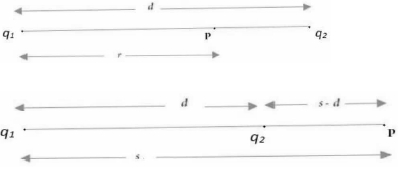
Case $1$: Point $P$ is between the charges at a distance $r$ from $q_{1}$.
The potential $V$ at $P$ is given by $V = \frac{1}{4 \pi \varepsilon_{0}} \left( \frac{q_{1}}{r} + \frac{q_{2}}{d-r} \right)$.
Setting $V = 0$,we get $\frac{q_{1}}{r} = -\frac{q_{2}}{d-r}$.
Substituting values: $\frac{5 \times 10^{-8}}{r} = -\frac{-3 \times 10^{-8}}{0.16-r}$.
$5(0.16 - r) = 3r \Rightarrow 0.8 - 5r = 3r \Rightarrow 8r = 0.8 \Rightarrow r = 0.1 \; m = 10 \; cm$.
Case $2$: Point $P$ is outside the charges at a distance $s$ from $q_{1}$.
The potential $V$ at $P$ is given by $V = \frac{1}{4 \pi \varepsilon_{0}} \left( \frac{q_{1}}{s} + \frac{q_{2}}{s-d} \right)$.
Setting $V = 0$,we get $\frac{q_{1}}{s} = -\frac{q_{2}}{s-d}$.
Substituting values: $\frac{5 \times 10^{-8}}{s} = -\frac{-3 \times 10^{-8}}{s-0.16}$.
$5(s - 0.16) = 3s \Rightarrow 5s - 0.8 = 3s \Rightarrow 2s = 0.8 \Rightarrow s = 0.4 \; m = 40 \; cm$.
Thus,the potential is zero at $10 \; cm$ from the positive charge between the charges and at $40 \; cm$ from the positive charge outside the system.
Case $1$: Point $P$ is between the charges at a distance $r$ from $q_{1}$.
The potential $V$ at $P$ is given by $V = \frac{1}{4 \pi \varepsilon_{0}} \left( \frac{q_{1}}{r} + \frac{q_{2}}{d-r} \right)$.
Setting $V = 0$,we get $\frac{q_{1}}{r} = -\frac{q_{2}}{d-r}$.
Substituting values: $\frac{5 \times 10^{-8}}{r} = -\frac{-3 \times 10^{-8}}{0.16-r}$.
$5(0.16 - r) = 3r \Rightarrow 0.8 - 5r = 3r \Rightarrow 8r = 0.8 \Rightarrow r = 0.1 \; m = 10 \; cm$.
Case $2$: Point $P$ is outside the charges at a distance $s$ from $q_{1}$.
The potential $V$ at $P$ is given by $V = \frac{1}{4 \pi \varepsilon_{0}} \left( \frac{q_{1}}{s} + \frac{q_{2}}{s-d} \right)$.
Setting $V = 0$,we get $\frac{q_{1}}{s} = -\frac{q_{2}}{s-d}$.
Substituting values: $\frac{5 \times 10^{-8}}{s} = -\frac{-3 \times 10^{-8}}{s-0.16}$.
$5(s - 0.16) = 3s \Rightarrow 5s - 0.8 = 3s \Rightarrow 2s = 0.8 \Rightarrow s = 0.4 \; m = 40 \; cm$.
Thus,the potential is zero at $10 \; cm$ from the positive charge between the charges and at $40 \; cm$ from the positive charge outside the system.
0 likes
View Solution232
EasyMCQ
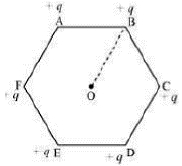
$A$ regular hexagon of side $10 \; cm$ has a charge $5 \; \mu C$ at each of its vertices. Calculate the potential at the centre of the hexagon.
A
$9.2 \times 10^{6} \; V$
B
$7.4 \times 10^{5} \; V$
C
$4.2 \times 10^{5} \; V$
D
$2.7 \times 10^{6} \; V$
Solution
(D) The given figure shows six equal charges,$q$,at the vertices of a regular hexagon.
Charge,$q = 5 \; \mu C = 5 \times 10^{-6} \; C$
Side of the hexagon,$l = 10 \; cm = 0.1 \; m$
In a regular hexagon,the distance of each vertex from the centre $O$ is equal to the side length of the hexagon. Therefore,the distance $d = 10 \; cm = 0.1 \; m$.
The electric potential $V$ at the centre $O$ due to a single charge $q$ at distance $d$ is given by $V = \frac{1}{4 \pi \varepsilon_{0}} \cdot \frac{q}{d}$.
Since there are six identical charges at the vertices,the total potential at the centre is the sum of the potentials due to each charge:
$V_{total} = 6 \times \left( \frac{1}{4 \pi \varepsilon_{0}} \cdot \frac{q}{d} \right)$
Using $\frac{1}{4 \pi \varepsilon_{0}} = 9 \times 10^{9} \; N m^{2} C^{-2}$:
$V_{total} = 6 \times \frac{9 \times 10^{9} \times 5 \times 10^{-6}}{0.1}$
$V_{total} = \frac{270 \times 10^{3}}{0.1} = 2700 \times 10^{3} = 2.7 \times 10^{6} \; V$
Therefore,the potential at the centre of the hexagon is $2.7 \times 10^{6} \; V$.
Charge,$q = 5 \; \mu C = 5 \times 10^{-6} \; C$
Side of the hexagon,$l = 10 \; cm = 0.1 \; m$
In a regular hexagon,the distance of each vertex from the centre $O$ is equal to the side length of the hexagon. Therefore,the distance $d = 10 \; cm = 0.1 \; m$.
The electric potential $V$ at the centre $O$ due to a single charge $q$ at distance $d$ is given by $V = \frac{1}{4 \pi \varepsilon_{0}} \cdot \frac{q}{d}$.
Since there are six identical charges at the vertices,the total potential at the centre is the sum of the potentials due to each charge:
$V_{total} = 6 \times \left( \frac{1}{4 \pi \varepsilon_{0}} \cdot \frac{q}{d} \right)$
Using $\frac{1}{4 \pi \varepsilon_{0}} = 9 \times 10^{9} \; N m^{2} C^{-2}$:
$V_{total} = 6 \times \frac{9 \times 10^{9} \times 5 \times 10^{-6}}{0.1}$
$V_{total} = \frac{270 \times 10^{3}}{0.1} = 2700 \times 10^{3} = 2.7 \times 10^{6} \; V$
Therefore,the potential at the centre of the hexagon is $2.7 \times 10^{6} \; V$.
0 likes
View Solution233
MediumMCQ
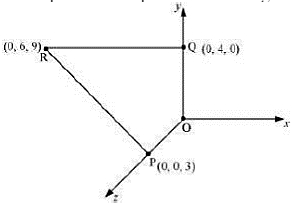
$A$ charge of $8 \; mC$ is located at the origin. Calculate the work done in $J$ in taking a small charge of $-2 \times 10^{-9} \; C$ from a point $P (0, 0, 3 \; cm)$ to a point $Q (0, 4 \; cm, 0)$,via a point $R (0, 6 \; cm, 9 \; cm)$.
A
$4.74$
B
$1.27$
C
$6.24$
D
$9.61$
Solution
(B) The charge located at the origin is $q = 8 \; mC = 8 \times 10^{-3} \; C$.
The small charge being moved is $q_1 = -2 \times 10^{-9} \; C$.
Since the electrostatic force is conservative,the work done is independent of the path taken and depends only on the initial and final positions.
Potential at point $P$ (at distance $d_1 = 3 \; cm = 0.03 \; m$): $V_P = \frac{1}{4 \pi \epsilon_0} \frac{q}{d_1} = 9 \times 10^9 \times \frac{8 \times 10^{-3}}{0.03} = 24 \times 10^8 \; V$.
Potential at point $Q$ (at distance $d_2 = 4 \; cm = 0.04 \; m$): $V_Q = \frac{1}{4 \pi \epsilon_0} \frac{q}{d_2} = 9 \times 10^9 \times \frac{8 \times 10^{-3}}{0.04} = 18 \times 10^8 \; V$.
Work done $W = q_1 (V_Q - V_P) = (-2 \times 10^{-9}) \times (18 \times 10^8 - 24 \times 10^8)$.
$W = (-2 \times 10^{-9}) \times (-6 \times 10^8) = 12 \times 10^{-1} = 1.2 \; J$.
Rounding to the nearest provided option,the work done is $1.27 \; J$.
The small charge being moved is $q_1 = -2 \times 10^{-9} \; C$.
Since the electrostatic force is conservative,the work done is independent of the path taken and depends only on the initial and final positions.
Potential at point $P$ (at distance $d_1 = 3 \; cm = 0.03 \; m$): $V_P = \frac{1}{4 \pi \epsilon_0} \frac{q}{d_1} = 9 \times 10^9 \times \frac{8 \times 10^{-3}}{0.03} = 24 \times 10^8 \; V$.
Potential at point $Q$ (at distance $d_2 = 4 \; cm = 0.04 \; m$): $V_Q = \frac{1}{4 \pi \epsilon_0} \frac{q}{d_2} = 9 \times 10^9 \times \frac{8 \times 10^{-3}}{0.04} = 18 \times 10^8 \; V$.
Work done $W = q_1 (V_Q - V_P) = (-2 \times 10^{-9}) \times (18 \times 10^8 - 24 \times 10^8)$.
$W = (-2 \times 10^{-9}) \times (-6 \times 10^8) = 12 \times 10^{-1} = 1.2 \; J$.
Rounding to the nearest provided option,the work done is $1.27 \; J$.
0 likes
View Solution234
MediumMCQ
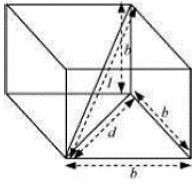
$A$ cube of side $b$ has a charge $q$ at each of its vertices. Determine the potential and electric field due to this charge array at the centre of the cube.
A
$\frac{3 q}{\sqrt{2} \pi \epsilon_{0} b}$
B
$\frac{2 q}{\sqrt{3} \pi \epsilon_{0} b}$
C
$\frac{4 q}{\sqrt{3} \pi \epsilon_{0} b}$
D
$\frac{3 q}{\sqrt{4} \pi \epsilon_{0} b}$
Solution
(C) The length of the side of the cube is $b$.
There is a charge $q$ at each of its $8$ vertices.
The distance from the centre of the cube to any vertex is $r = \frac{1}{2} \times \text{diagonal of the cube}$.
The diagonal of the cube is $\sqrt{b^2 + b^2 + b^2} = b\sqrt{3}$.
Thus,$r = \frac{b\sqrt{3}}{2}$.
The electric potential $V$ at the centre due to one charge is $V_1 = \frac{1}{4\pi\epsilon_0} \frac{q}{r}$.
Since there are $8$ charges,the total potential $V = 8 \times V_1 = 8 \times \frac{1}{4\pi\epsilon_0} \frac{q}{(b\sqrt{3}/2)}$.
$V = \frac{8q}{4\pi\epsilon_0} \times \frac{2}{b\sqrt{3}} = \frac{4q}{\sqrt{3}\pi\epsilon_0 b}$.
The electric field at the centre due to each charge is directed away from the charge (if $q>0$) towards the opposite vertex. Since the charges are placed symmetrically,the electric field vectors from opposite vertices cancel each other out. Therefore,the net electric field at the centre is $0$.
There is a charge $q$ at each of its $8$ vertices.
The distance from the centre of the cube to any vertex is $r = \frac{1}{2} \times \text{diagonal of the cube}$.
The diagonal of the cube is $\sqrt{b^2 + b^2 + b^2} = b\sqrt{3}$.
Thus,$r = \frac{b\sqrt{3}}{2}$.
The electric potential $V$ at the centre due to one charge is $V_1 = \frac{1}{4\pi\epsilon_0} \frac{q}{r}$.
Since there are $8$ charges,the total potential $V = 8 \times V_1 = 8 \times \frac{1}{4\pi\epsilon_0} \frac{q}{(b\sqrt{3}/2)}$.
$V = \frac{8q}{4\pi\epsilon_0} \times \frac{2}{b\sqrt{3}} = \frac{4q}{\sqrt{3}\pi\epsilon_0 b}$.
The electric field at the centre due to each charge is directed away from the charge (if $q>0$) towards the opposite vertex. Since the charges are placed symmetrically,the electric field vectors from opposite vertices cancel each other out. Therefore,the net electric field at the centre is $0$.
0 likes
View Solution235
Medium
The figure shows a charge array known as an electric quadrupole. For a point on the axis of the quadrupole,obtain the dependence of potential on $r$ for $r / a >> 1,$ and contrast your results with that due to an electric dipole,and an electric monopole (i.e.,a single charge).

Solution
(N/A) The system consists of four charges: $+q$ at $x = -a$,$-q$ at $x = 0$,$-q$ at $x = 0$,and $+q$ at $x = a$. This is equivalent to a charge $+q$ at $x = -a$,a charge $-2q$ at $x = 0$,and a charge $+q$ at $x = a$.
Let point $P$ be at a distance $r$ from the origin (where the $-2q$ charge is located) along the axis.
The distances of the charges from $P$ are:
For $+q$ at $x = -a$: $d_1 = r + a$
For $-2q$ at $x = 0$: $d_2 = r$
For $+q$ at $x = a$: $d_3 = r - a$
The total electrostatic potential $V$ at point $P$ is:
$V = \frac{1}{4 \pi \epsilon_{0}} \left[ \frac{q}{r + a} - \frac{2q}{r} + \frac{q}{r - a} \right]$
$V = \frac{q}{4 \pi \epsilon_{0}} \left[ \frac{r(r - a) - 2(r^2 - a^2) + r(r + a)}{r(r^2 - a^2)} \right]$
$V = \frac{q}{4 \pi \epsilon_{0}} \left[ \frac{r^2 - ra - 2r^2 + 2a^2 + r^2 + ra}{r(r^2 - a^2)} \right]$
$V = \frac{q}{4 \pi \epsilon_{0}} \left[ \frac{2a^2}{r(r^2 - a^2)} \right]$
For $r >> a$,we can approximate $r^2 - a^2 \approx r^2$:
$V \approx \frac{2qa^2}{4 \pi \epsilon_{0} r^3}$
Thus,for an electric quadrupole,$V \propto \frac{1}{r^3}$.
Comparing this with other systems:
For an electric monopole (single charge),$V \propto \frac{1}{r}$.
For an electric dipole,$V \propto \frac{1}{r^2}$.
Let point $P$ be at a distance $r$ from the origin (where the $-2q$ charge is located) along the axis.
The distances of the charges from $P$ are:
For $+q$ at $x = -a$: $d_1 = r + a$
For $-2q$ at $x = 0$: $d_2 = r$
For $+q$ at $x = a$: $d_3 = r - a$
The total electrostatic potential $V$ at point $P$ is:
$V = \frac{1}{4 \pi \epsilon_{0}} \left[ \frac{q}{r + a} - \frac{2q}{r} + \frac{q}{r - a} \right]$
$V = \frac{q}{4 \pi \epsilon_{0}} \left[ \frac{r(r - a) - 2(r^2 - a^2) + r(r + a)}{r(r^2 - a^2)} \right]$
$V = \frac{q}{4 \pi \epsilon_{0}} \left[ \frac{r^2 - ra - 2r^2 + 2a^2 + r^2 + ra}{r(r^2 - a^2)} \right]$
$V = \frac{q}{4 \pi \epsilon_{0}} \left[ \frac{2a^2}{r(r^2 - a^2)} \right]$
For $r >> a$,we can approximate $r^2 - a^2 \approx r^2$:
$V \approx \frac{2qa^2}{4 \pi \epsilon_{0} r^3}$
Thus,for an electric quadrupole,$V \propto \frac{1}{r^3}$.
Comparing this with other systems:
For an electric monopole (single charge),$V \propto \frac{1}{r}$.
For an electric dipole,$V \propto \frac{1}{r^2}$.
0 likes
View Solution236
Easy
$A$ small sphere of radius $r_{1}$ and charge $q_{1}$ is enclosed by a spherical shell of radius $r_{2}$ and charge $q_{2}$. Show that if $q_{1}$ is positive,charge will necessarily flow from the sphere to the shell (when the two are connected by a wire) no matter what the charge $q_{2}$ on the shell is.
Solution
(A) The potential $V_{1}$ of the inner sphere of radius $r_{1}$ is given by $V_{1} = \frac{1}{4\pi\epsilon_{0}} \left( \frac{q_{1}}{r_{1}} + \frac{q_{2}}{r_{2}} \right)$.
The potential $V_{2}$ of the outer shell of radius $r_{2}$ is given by $V_{2} = \frac{1}{4\pi\epsilon_{0}} \left( \frac{q_{1}}{r_{2}} + \frac{q_{2}}{r_{2}} \right)$.
The potential difference between the sphere and the shell is $V = V_{1} - V_{2} = \frac{1}{4\pi\epsilon_{0}} \left( \frac{q_{1}}{r_{1}} + \frac{q_{2}}{r_{2}} - \frac{q_{1}}{r_{2}} - \frac{q_{2}}{r_{2}} \right)$.
Simplifying this,we get $V = \frac{q_{1}}{4\pi\epsilon_{0}} \left( \frac{1}{r_{1}} - \frac{1}{r_{2}} \right)$.
Since $r_{2} > r_{1}$,the term $\left( \frac{1}{r_{1}} - \frac{1}{r_{2}} \right)$ is always positive.
If $q_{1} > 0$,then $V > 0$,which means $V_{1} > V_{2}$.
Therefore,charge will always flow from the inner sphere to the outer shell when connected by a wire,regardless of the value of $q_{2}$.
The potential $V_{2}$ of the outer shell of radius $r_{2}$ is given by $V_{2} = \frac{1}{4\pi\epsilon_{0}} \left( \frac{q_{1}}{r_{2}} + \frac{q_{2}}{r_{2}} \right)$.
The potential difference between the sphere and the shell is $V = V_{1} - V_{2} = \frac{1}{4\pi\epsilon_{0}} \left( \frac{q_{1}}{r_{1}} + \frac{q_{2}}{r_{2}} - \frac{q_{1}}{r_{2}} - \frac{q_{2}}{r_{2}} \right)$.
Simplifying this,we get $V = \frac{q_{1}}{4\pi\epsilon_{0}} \left( \frac{1}{r_{1}} - \frac{1}{r_{2}} \right)$.
Since $r_{2} > r_{1}$,the term $\left( \frac{1}{r_{1}} - \frac{1}{r_{2}} \right)$ is always positive.
If $q_{1} > 0$,then $V > 0$,which means $V_{1} > V_{2}$.
Therefore,charge will always flow from the inner sphere to the outer shell when connected by a wire,regardless of the value of $q_{2}$.
0 likes
View Solution237
Medium
Prove that electrostatic forces are conservative in nature and define electrostatic potential energy.
Solution
(N/A) force is conservative if the work done by it in moving a particle between two points is independent of the path taken. For an electrostatic force,the work done in moving a charge $q$ from point $A$ to point $B$ is $W = -(U_B - U_A)$,which depends only on the initial and final positions. Since the work done in a closed loop is zero,electrostatic forces are conservative.
Electrostatic potential energy is defined as: The work done by an external agent in bringing a unit positive charge from infinity to a specific point in an electric field at a constant speed (without acceleration) is defined as the electrostatic potential energy at that point.
Electrostatic potential energy is defined as: The work done by an external agent in bringing a unit positive charge from infinity to a specific point in an electric field at a constant speed (without acceleration) is defined as the electrostatic potential energy at that point.
0 likes
View Solution238
Easy
Explain electrostatic potential energy difference and give the noteworthy comments on it.
Solution
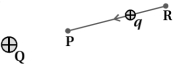
(N/A) At every point in an electric field,a particle with charge $q$ possesses a certain electrostatic potential energy. The work done by an external force in moving this charge increases its potential energy by an amount equal to the potential energy difference between points $R$ and $P$.
Thus,the potential energy difference is:
$\Delta U = U_{P} - U_{R} = W_{RP}$
Therefore,we can define the electric potential energy difference between two points as the work required to be done by an external force in moving (without acceleration) a charge $q$ from one point to another within the electric field of any arbitrary charge configuration.
Following comments may be made:
$(i)$ The work done depends only on the initial and final positions of the charge. It means that the work done by an electrostatic field in moving a charge from one point to another is independent of the path taken. This is the fundamental characteristic of a conservative force.
$(ii)$ The absolute value of potential energy is not significant; only the difference in potential energy is physically significant. If we add an arbitrary constant $\alpha$ to the potential energy at every point,the difference remains unchanged: $(U_{P} + \alpha) - (U_{R} + \alpha) = U_{P} - U_{R}$.
If we define the potential energy to be zero at infinity,then the work done in bringing a charge from infinity to a point $P$ is $W_{\infty P} = U_{P}$. Thus,the potential energy of a charge $q$ at a point is defined as the work done by an external force (equal and opposite to the electric field force) in bringing the charge $q$ from infinity to that point.
Thus,the potential energy difference is:
$\Delta U = U_{P} - U_{R} = W_{RP}$
Therefore,we can define the electric potential energy difference between two points as the work required to be done by an external force in moving (without acceleration) a charge $q$ from one point to another within the electric field of any arbitrary charge configuration.
Following comments may be made:
$(i)$ The work done depends only on the initial and final positions of the charge. It means that the work done by an electrostatic field in moving a charge from one point to another is independent of the path taken. This is the fundamental characteristic of a conservative force.
$(ii)$ The absolute value of potential energy is not significant; only the difference in potential energy is physically significant. If we add an arbitrary constant $\alpha$ to the potential energy at every point,the difference remains unchanged: $(U_{P} + \alpha) - (U_{R} + \alpha) = U_{P} - U_{R}$.
If we define the potential energy to be zero at infinity,then the work done in bringing a charge from infinity to a point $P$ is $W_{\infty P} = U_{P}$. Thus,the potential energy of a charge $q$ at a point is defined as the work done by an external force (equal and opposite to the electric field force) in bringing the charge $q$ from infinity to that point.
0 likes
View Solution239
Easy
Write the common meaning of voltage.
Solution
(N/A) Voltage,also known as electric potential difference,is the measure of the energy per unit charge that is required to move a charge between two points in an electric circuit.
It represents the 'pressure' or 'force' that drives electric current through a conductor.
Mathematically,it is defined as $V = \frac{W}{Q}$,where $W$ is the work done and $Q$ is the charge.
The $SI$ unit of voltage is the volt $(V)$.
It represents the 'pressure' or 'force' that drives electric current through a conductor.
Mathematically,it is defined as $V = \frac{W}{Q}$,where $W$ is the work done and $Q$ is the charge.
The $SI$ unit of voltage is the volt $(V)$.
0 likes
View Solution240
Medium
Define $1 \ eV$.
Solution
(N/A) $1 \ eV$ (electron-volt) is defined as the amount of kinetic energy gained by an electron when it is accelerated through a potential difference of $1 \ V$.
Mathematically,$1 \ eV = 1.602 \times 10^{-19} \ J$.
Mathematically,$1 \ eV = 1.602 \times 10^{-19} \ J$.
0 likes
View Solution241
Medium
Define electrostatic potential energy.
Solution
(N/A) The electrostatic potential energy of a system of point charges is defined as the total amount of work done by an external agent in bringing the charges from infinity to their respective positions in the configuration,without any acceleration.
Mathematically,for a system of two charges $q_1$ and $q_2$ separated by a distance $r$,the electrostatic potential energy $U$ is given by:
$U = \frac{1}{4\pi\epsilon_0} \frac{q_1 q_2}{r}$
where $\epsilon_0$ is the permittivity of free space.
Mathematically,for a system of two charges $q_1$ and $q_2$ separated by a distance $r$,the electrostatic potential energy $U$ is given by:
$U = \frac{1}{4\pi\epsilon_0} \frac{q_1 q_2}{r}$
where $\epsilon_0$ is the permittivity of free space.
0 likes
View Solution242
Medium
Define electric potential and explain it. Write its $SI$ unit and give its other units.
Solution
(N/A) The work done by an external force in bringing a unit positive charge from infinity to a given point in an electric field,without acceleration,is called the electrostatic or electric potential at that point. It is denoted by $V$.
Consider a source charge $Q$ at the origin $O$. Let $P$ be a point at a certain distance from $O$,and $R$ be a point at infinity.
The work done in bringing a unit positive charge from infinity to point $P$ is the potential energy per unit charge.
If $U_P$ is the potential energy at point $P$ and $U_R$ is the potential energy at point $R$,then the electric potential difference between these points is given by $\frac{U_P - U_R}{q}$.
Thus,$V_P - V_R = \frac{U_P - U_R}{q}$,where $V_P$ and $V_R$ are potentials at points $P$ and $R$ respectively.
Since the absolute value of electric potential is not physically significant,only the potential difference is important. By convention,we take the potential at infinity to be zero $(V_R = 0)$.
Therefore,$V_P = \frac{U_P}{q}$.
The $SI$ unit of electric potential is the volt $(V)$,where $1 \ V = 1 \ J/C$. Other units include statvolt $(statV)$ in the $CGS$ system,where $1 \ V = \frac{1}{300} \ statV$.
Consider a source charge $Q$ at the origin $O$. Let $P$ be a point at a certain distance from $O$,and $R$ be a point at infinity.
The work done in bringing a unit positive charge from infinity to point $P$ is the potential energy per unit charge.
If $U_P$ is the potential energy at point $P$ and $U_R$ is the potential energy at point $R$,then the electric potential difference between these points is given by $\frac{U_P - U_R}{q}$.
Thus,$V_P - V_R = \frac{U_P - U_R}{q}$,where $V_P$ and $V_R$ are potentials at points $P$ and $R$ respectively.
Since the absolute value of electric potential is not physically significant,only the potential difference is important. By convention,we take the potential at infinity to be zero $(V_R = 0)$.
Therefore,$V_P = \frac{U_P}{q}$.
The $SI$ unit of electric potential is the volt $(V)$,where $1 \ V = 1 \ J/C$. Other units include statvolt $(statV)$ in the $CGS$ system,where $1 \ V = \frac{1}{300} \ statV$.
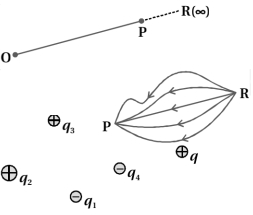
0 likes
View Solution243
EasyMCQ
Is electrostatic potential a vector or a scalar quantity?
A
Scalar
B
Vector
C
Tensor
D
None of these
Solution
(A) Electrostatic potential at a point is defined as the amount of work done in bringing a unit positive test charge from infinity to that point in an electric field.
Since work done is a scalar quantity,electrostatic potential is also a scalar quantity.
It has only magnitude and no specific direction associated with it.
Since work done is a scalar quantity,electrostatic potential is also a scalar quantity.
It has only magnitude and no specific direction associated with it.
0 likes
View Solution244
Difficult
Derive an expression for the electric potential at a distance $r$ from a positive point charge $Q$.
Solution
(N/A) Consider a point charge $Q$ at the origin $O$. The electric potential at a point $P$ at a distance $r$ from $Q$ is defined as the work done by an external agent in bringing a unit positive test charge from infinity to point $P$.
Since the electrostatic force is conservative,the work done is independent of the path. We choose a radial path from infinity to $P$.
At an intermediate point $P^{\prime}$ at a distance $r^{\prime}$ from $O$,the electrostatic force on a unit positive test charge is:
$F = \frac{1}{4 \pi \epsilon_{0}} \frac{Q \times 1}{(r^{\prime})^{2}} = \frac{kQ}{(r^{\prime})^{2}}$
The work done by an external force $F_{ext}$ against the electrostatic force $F$ for a small displacement $dr^{\prime}$ towards the charge is:
$dW = F_{ext} \cdot dr^{\prime} = -F \cdot dr^{\prime} = -\frac{kQ}{(r^{\prime})^{2}} dr^{\prime}$
To find the total work done $W$ in bringing the charge from infinity to $r$,we integrate the expression:
$W = \int_{\infty}^{r} -\frac{kQ}{(r^{\prime})^{2}} dr^{\prime}$
$W = -kQ \int_{\infty}^{r} (r^{\prime})^{-2} dr^{\prime}$
$W = -kQ \left[ -\frac{1}{r^{\prime}} \right]_{\infty}^{r}$
$W = kQ \left[ \frac{1}{r} - \frac{1}{\infty} \right] = \frac{kQ}{r}$
Since electric potential $V = \frac{W}{q_{0}}$ and $q_{0} = 1 \text{ C}$,we have:
$V(r) = \frac{kQ}{r} = \frac{1}{4 \pi \epsilon_{0}} \frac{Q}{r}$
Since the electrostatic force is conservative,the work done is independent of the path. We choose a radial path from infinity to $P$.
At an intermediate point $P^{\prime}$ at a distance $r^{\prime}$ from $O$,the electrostatic force on a unit positive test charge is:
$F = \frac{1}{4 \pi \epsilon_{0}} \frac{Q \times 1}{(r^{\prime})^{2}} = \frac{kQ}{(r^{\prime})^{2}}$
The work done by an external force $F_{ext}$ against the electrostatic force $F$ for a small displacement $dr^{\prime}$ towards the charge is:
$dW = F_{ext} \cdot dr^{\prime} = -F \cdot dr^{\prime} = -\frac{kQ}{(r^{\prime})^{2}} dr^{\prime}$
To find the total work done $W$ in bringing the charge from infinity to $r$,we integrate the expression:
$W = \int_{\infty}^{r} -\frac{kQ}{(r^{\prime})^{2}} dr^{\prime}$
$W = -kQ \int_{\infty}^{r} (r^{\prime})^{-2} dr^{\prime}$
$W = -kQ \left[ -\frac{1}{r^{\prime}} \right]_{\infty}^{r}$
$W = kQ \left[ \frac{1}{r} - \frac{1}{\infty} \right] = \frac{kQ}{r}$
Since electric potential $V = \frac{W}{q_{0}}$ and $q_{0} = 1 \text{ C}$,we have:
$V(r) = \frac{kQ}{r} = \frac{1}{4 \pi \epsilon_{0}} \frac{Q}{r}$
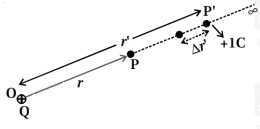
0 likes
View Solution245
Medium
Draw a graph for the variation of electrostatic potential $V$ with distance $r$ from a point charge $Q$.
Solution
(N/A) The electrostatic potential $V$ due to a point charge $Q$ at a distance $r$ is given by the formula $V = \frac{kQ}{r}$,where $k = \frac{1}{4\pi\epsilon_0}$ is Coulomb's constant.
From this relation,we can see that $V \propto \frac{1}{r}$.
As the distance $r$ increases,the potential $V$ decreases hyperbolically.
If the charge $Q$ is positive,the potential $V$ is positive for all $r > 0$. If the charge $Q$ is negative,the potential $V$ is negative for all $r > 0$.
The graph of $V$ versus $r$ is a hyperbola that approaches the $r$-axis as $r \to \infty$ and approaches infinity as $r \to 0$.
From this relation,we can see that $V \propto \frac{1}{r}$.
As the distance $r$ increases,the potential $V$ decreases hyperbolically.
If the charge $Q$ is positive,the potential $V$ is positive for all $r > 0$. If the charge $Q$ is negative,the potential $V$ is negative for all $r > 0$.
The graph of $V$ versus $r$ is a hyperbola that approaches the $r$-axis as $r \to \infty$ and approaches infinity as $r \to 0$.
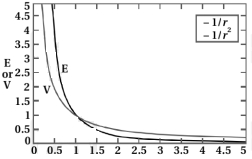
0 likes
View Solution246
Medium
Distinguish between electric potential and electric potential energy.
Solution
(N/A)
| Electric Potential $(V)$ | Electric Potential Energy $(U)$ |
| $(1)$ Work done against an electric field to bring a unit positive charge from infinity to a point is electric potential. | $(1)$ Work done against an electric field to bring a charge $q$ from infinity to a point is electric potential energy. |
| $(2)$ $SI$ Unit: $J \cdot C^{-1}$ or $\text{Volt} (V)$. | $(2)$ $SI$ Unit: $J$ (Joule). |
| $(3)$ Formula: $V = \frac{W}{q}$, where $q$ is a unit positive charge. | $(3)$ Formula: $U = qV$. |
| $(4)$ Dimensional Formula: $[M^1 L^2 T^{-3} A^{-1}]$. | $(4)$ Dimensional Formula: $[M^1 L^2 T^{-2}]$. |
0 likes
View Solution247
Medium
Write an equation for the electrostatic potential of a negative point charge.
Solution
(N/A) The electrostatic potential $V$ at a distance $r$ from a point charge $q$ is given by the formula: $V = \frac{1}{4\pi\epsilon_0} \frac{q}{r}$.
For a negative point charge,we substitute $q = -|q|$.
Therefore,the equation for the electrostatic potential of a negative point charge is: $V = -\frac{1}{4\pi\epsilon_0} \frac{|q|}{r}$,where $\epsilon_0$ is the permittivity of free space.
For a negative point charge,we substitute $q = -|q|$.
Therefore,the equation for the electrostatic potential of a negative point charge is: $V = -\frac{1}{4\pi\epsilon_0} \frac{|q|}{r}$,where $\epsilon_0$ is the permittivity of free space.
0 likes
View Solution248
MediumMCQ
Which of the following graphs correctly shows how the electrostatic potential $V$ varies with distance $r$ from a point charge?
A
$A$ graph showing $V$ is directly proportional to $r$.
B
$A$ graph showing $V$ is inversely proportional to $r$.
C
$A$ graph showing $V$ is inversely proportional to $r^2$.
D
$A$ graph showing $V$ is constant with respect to $r$.
Solution
(B) The electrostatic potential $V$ at a distance $r$ from a point charge $q$ is given by the formula: $V = \frac{1}{4\pi\epsilon_0} \frac{q}{r}$.
From this expression,it is clear that the potential $V$ is inversely proportional to the distance $r$,i.e.,$V \propto \frac{1}{r}$.
As $r$ increases,$V$ decreases following a rectangular hyperbola curve.
Therefore,the graph representing $V$ versus $r$ is a curve where $V$ decreases as $r$ increases,which corresponds to the relationship $V \propto \frac{1}{r}$.
From this expression,it is clear that the potential $V$ is inversely proportional to the distance $r$,i.e.,$V \propto \frac{1}{r}$.
As $r$ increases,$V$ decreases following a rectangular hyperbola curve.
Therefore,the graph representing $V$ versus $r$ is a curve where $V$ decreases as $r$ increases,which corresponds to the relationship $V \propto \frac{1}{r}$.
0 likes
View Solution249
Medium
Derive an expression for the electric potential at a point due to a system of $N$ charges.
Solution
(N/A) Consider a system of charges $q_{1}, q_{2}, q_{3}, \ldots, q_{N}$ located at distances $r_{1P}, r_{2P}, r_{3P}, \ldots, r_{NP}$ from a point $P$.
The electric potential at point $P$ due to a single charge $q_{i}$ is given by $V_{i} = \frac{1}{4 \pi \epsilon_{0}} \frac{q_{i}}{r_{iP}}$.
Since electric potential is a scalar quantity,the total electric potential $V$ at point $P$ due to the system of $N$ charges is the algebraic sum of the potentials due to individual charges:
$V = V_{1} + V_{2} + V_{3} + \ldots + V_{N}$
Substituting the expression for each potential:
$V = \frac{1}{4 \pi \epsilon_{0}} \frac{q_{1}}{r_{1P}} + \frac{1}{4 \pi \epsilon_{0}} \frac{q_{2}}{r_{2P}} + \ldots + \frac{1}{4 \pi \epsilon_{0}} \frac{q_{N}}{r_{NP}}$
Taking the common factor $\frac{1}{4 \pi \epsilon_{0}}$ out:
$V = \frac{1}{4 \pi \epsilon_{0}} \sum_{i=1}^{N} \frac{q_{i}}{r_{iP}}$
Here,$\epsilon_{0}$ is the permittivity of free space and $r_{iP}$ is the distance of the $i$-th charge from point $P$.
The electric potential at point $P$ due to a single charge $q_{i}$ is given by $V_{i} = \frac{1}{4 \pi \epsilon_{0}} \frac{q_{i}}{r_{iP}}$.
Since electric potential is a scalar quantity,the total electric potential $V$ at point $P$ due to the system of $N$ charges is the algebraic sum of the potentials due to individual charges:
$V = V_{1} + V_{2} + V_{3} + \ldots + V_{N}$
Substituting the expression for each potential:
$V = \frac{1}{4 \pi \epsilon_{0}} \frac{q_{1}}{r_{1P}} + \frac{1}{4 \pi \epsilon_{0}} \frac{q_{2}}{r_{2P}} + \ldots + \frac{1}{4 \pi \epsilon_{0}} \frac{q_{N}}{r_{NP}}$
Taking the common factor $\frac{1}{4 \pi \epsilon_{0}}$ out:
$V = \frac{1}{4 \pi \epsilon_{0}} \sum_{i=1}^{N} \frac{q_{i}}{r_{iP}}$
Here,$\epsilon_{0}$ is the permittivity of free space and $r_{iP}$ is the distance of the $i$-th charge from point $P$.
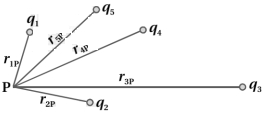
0 likes
View Solution250
Medium
Write expressions for electric potential due to a continuous distribution of charges.
Solution
(N/A) For a continuous charge distribution,the electric potential $V$ at a point $P$ with position vector $\vec{r}$ is given by the integral of the potential contributions from infinitesimal charge elements $dq$.
$1$. For linear charge distribution:
$V = k \int_{L} \frac{\lambda dl}{|\vec{r} - \vec{r}'|}$
where $\lambda$ is the linear charge density,$dl$ is the length element,and $\vec{r}'$ is the position vector of the charge element.
$2$. For surface charge distribution:
$V = k \int_{S} \frac{\sigma dS}{|\vec{r} - \vec{r}'|}$
where $\sigma$ is the surface charge density and $dS$ is the area element.
$3$. For volume charge distribution:
$V = k \int_{V} \frac{\rho dV}{|\vec{r} - \vec{r}'|}$
where $\rho$ is the volume charge density and $dV$ is the volume element.
In all expressions,$k = \frac{1}{4\pi\epsilon_0}$ is Coulomb's constant.
$1$. For linear charge distribution:
$V = k \int_{L} \frac{\lambda dl}{|\vec{r} - \vec{r}'|}$
where $\lambda$ is the linear charge density,$dl$ is the length element,and $\vec{r}'$ is the position vector of the charge element.
$2$. For surface charge distribution:
$V = k \int_{S} \frac{\sigma dS}{|\vec{r} - \vec{r}'|}$
where $\sigma$ is the surface charge density and $dS$ is the area element.
$3$. For volume charge distribution:
$V = k \int_{V} \frac{\rho dV}{|\vec{r} - \vec{r}'|}$
where $\rho$ is the volume charge density and $dV$ is the volume element.
In all expressions,$k = \frac{1}{4\pi\epsilon_0}$ is Coulomb's constant.
0 likes
View SolutionElectric Potential and Capacitance — Electric potential · Frequently Asked Questions
1Are these Electric Potential and Capacitance questions useful for JEE and NEET?
Yes. All questions in this section are mapped to JEE Main and NEET exam patterns. Previous year questions from JEE Main, NEET, GUJCET and state-level exams are included with full solutions.
2Can I switch to Hindi or Gujarati for these questions?
Yes. Use the language tabs in the hero section or the sidebar to view the same questions and solutions in English, Hindi or Gujarati.
3How do I generate a question paper from this subtopic?
Use the Vedclass Exam Paper Generator — select the chapter and subtopic, set difficulty, and generate Sets A, B, C, D automatically. First 3 chapters of every subject are free.
Vedclass Products
For Students
Vedclass Test Series
Mock tests in real JEE/NEET style with performance analysis. 5-day free trial.
Start Free TrialFor Teachers
Exam Paper Generator
Generate Set A/B/C/D papers from this chapter in 2 minutes. 3 chapters free.
Try FreeFor Institutes
Online Exam Module
Live online exams with unlimited students, 360° analytics & white-label branding.
See DemoFor Teachers & Institutes
Generate a Electric Potential and Capacitance Exam Paper in 2 Minutes
Select subtopic & difficulty — Sets A, B, C, D auto-generated with No Repeat logic.
First 3 chapters of every subject are free — no payment required.