
A English
Electric potential Questions in English
Class 12 Physics · Electric Potential and Capacitance · Electric potential
432+
Questions
English
Language
100%
With Solutions
Showing 48 of 432 questions in English
301
MediumMCQ
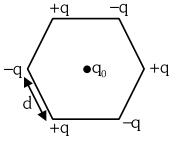
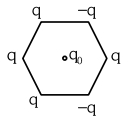
Six charges $+q, -q, +q, -q, +q$ and $-q$ are fixed at the corners of a hexagon of side $d$ as shown in the figure. The work done in bringing a charge $q_0$ to the centre of the hexagon from infinity is: ($\varepsilon_0$ = permittivity of free space)
A
$0$
B
$\frac{-q^2}{4 \pi \varepsilon_0 d}$
C
$\frac{-q^2}{4 \pi \varepsilon_0 d} \left(3-\frac{1}{\sqrt{2}}\right)$
D
$\frac{-q^2}{4 \pi \varepsilon_0 d} \left(6-\frac{1}{\sqrt{2}}\right)$
Solution
(A) The work done in bringing a charge $q_0$ from infinity to a point is given by $W = q_0 V$,where $V$ is the electric potential at that point due to the existing charges.
In a regular hexagon of side $d$,the distance of each corner from the centre is $d$.
The electric potential $V$ at the centre due to the six charges is the sum of the potentials due to each individual charge:
$V = \frac{1}{4 \pi \varepsilon_0} \left( \frac{+q}{d} + \frac{-q}{d} + \frac{+q}{d} + \frac{-q}{d} + \frac{+q}{d} + \frac{-q}{d} \right)$
$V = \frac{1}{4 \pi \varepsilon_0 d} (q - q + q - q + q - q)$
$V = 0$
Therefore,the work done $W = q_0 \times 0 = 0$.
In a regular hexagon of side $d$,the distance of each corner from the centre is $d$.
The electric potential $V$ at the centre due to the six charges is the sum of the potentials due to each individual charge:
$V = \frac{1}{4 \pi \varepsilon_0} \left( \frac{+q}{d} + \frac{-q}{d} + \frac{+q}{d} + \frac{-q}{d} + \frac{+q}{d} + \frac{-q}{d} \right)$
$V = \frac{1}{4 \pi \varepsilon_0 d} (q - q + q - q + q - q)$
$V = 0$
Therefore,the work done $W = q_0 \times 0 = 0$.
0 likes
View Solution302
MediumMCQ
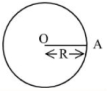
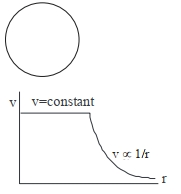
For a uniformly charged thin spherical shell,the electric potential $(V)$ radially away from the center $(O)$ of the shell can be graphically represented as:
A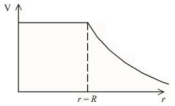
B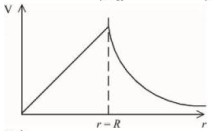
C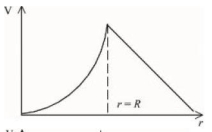
D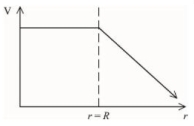
Solution
(A) For a uniformly charged thin spherical shell of radius $R$ and charge $Q$:
$1$. Inside the shell $(r < R)$,the electric field is zero,which implies that the electric potential is constant and equal to the potential at the surface,i.e.,$V_{\text{inside}} = \frac{kQ}{R}$.
$2$. Outside the shell $(r \ge R)$,the shell behaves like a point charge placed at its center,so the potential follows the inverse relation $V_{\text{outside}} = \frac{kQ}{r}$,where $r$ is the distance from the center.
$3$. Thus,the graph of $V$ versus $r$ is a horizontal line for $r \le R$ and a rectangular hyperbola for $r > R$.
$1$. Inside the shell $(r < R)$,the electric field is zero,which implies that the electric potential is constant and equal to the potential at the surface,i.e.,$V_{\text{inside}} = \frac{kQ}{R}$.
$2$. Outside the shell $(r \ge R)$,the shell behaves like a point charge placed at its center,so the potential follows the inverse relation $V_{\text{outside}} = \frac{kQ}{r}$,where $r$ is the distance from the center.
$3$. Thus,the graph of $V$ versus $r$ is a horizontal line for $r \le R$ and a rectangular hyperbola for $r > R$.
0 likes
View Solution303
EasyMCQ
Electric potential at a point $P$ due to a point charge of $5 \times 10^{-9} \; C$ is $50 \; V$. The distance of $P$ from the point charge is ......... $cm$. (Assume,$\frac{1}{4 \pi \varepsilon_0} = 9 \times 10^9 \; N m^2 C^{-2}$)
A
$3$
B
$9$
C
$90$
D
$0.9$
Solution
(C) The formula for electric potential $V$ due to a point charge $Q$ at a distance $r$ is given by $V = \frac{1}{4 \pi \varepsilon_0} \frac{Q}{r}$.
Given: $V = 50 \; V$,$Q = 5 \times 10^{-9} \; C$,and $k = \frac{1}{4 \pi \varepsilon_0} = 9 \times 10^9 \; N m^2 C^{-2}$.
Substituting the values into the formula: $50 = \frac{9 \times 10^9 \times 5 \times 10^{-9}}{r}$.
Simplifying the numerator: $50 = \frac{45}{r}$.
Solving for $r$: $r = \frac{45}{50} = 0.9 \; m$.
Converting meters to centimeters: $r = 0.9 \times 100 \; cm = 90 \; cm$.
Given: $V = 50 \; V$,$Q = 5 \times 10^{-9} \; C$,and $k = \frac{1}{4 \pi \varepsilon_0} = 9 \times 10^9 \; N m^2 C^{-2}$.
Substituting the values into the formula: $50 = \frac{9 \times 10^9 \times 5 \times 10^{-9}}{r}$.
Simplifying the numerator: $50 = \frac{45}{r}$.
Solving for $r$: $r = \frac{45}{50} = 0.9 \; m$.
Converting meters to centimeters: $r = 0.9 \times 100 \; cm = 90 \; cm$.
0 likes
View Solution304
DifficultMCQ
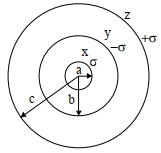
Three concentric spherical metallic shells $X$,$Y$,and $Z$ of radii $a$,$b$,and $c$ respectively $[a < b < c]$ have surface charge densities $\sigma$,$-\sigma$,and $\sigma$,respectively. The shells $X$ and $Z$ are at the same potential. If the radii of $X$ and $Y$ are $2\,cm$ and $3\,cm$,respectively,then the radius of shell $Z$ is $......\,cm$.
A
$4$
B
$3$
C
$2$
D
$5$
Solution
(D) The charges on the shells are:
$q_x = \sigma(4\pi a^2)$
$q_y = -\sigma(4\pi b^2)$
$q_z = \sigma(4\pi c^2)$
Since the potential of shell $X$ is equal to the potential of shell $Z$ $(V_x = V_z)$:
$V_x = \frac{1}{4\pi\varepsilon_0} \left( \frac{q_x}{a} + \frac{q_y}{b} + \frac{q_z}{c} \right)$
$V_z = \frac{1}{4\pi\varepsilon_0} \left( \frac{q_x}{c} + \frac{q_y}{c} + \frac{q_z}{c} \right)$
Equating $V_x$ and $V_z$:
$\frac{\sigma 4\pi a^2}{a} - \frac{\sigma 4\pi b^2}{b} + \frac{\sigma 4\pi c^2}{c} = \frac{\sigma 4\pi a^2}{c} - \frac{\sigma 4\pi b^2}{c} + \frac{\sigma 4\pi c^2}{c}$
Simplifying the equation:
$a - b + \frac{c^2}{c} = \frac{a^2 - b^2 + c^2}{c}$
$a - b + c = \frac{a^2 - b^2 + c^2}{c}$
$c(a - b + c) = a^2 - b^2 + c^2$
$c(a - b) + c^2 = a^2 - b^2 + c^2$
$c(a - b) = a^2 - b^2$
$c(a - b) = (a - b)(a + b)$
$c = a + b$
Given $a = 2\,cm$ and $b = 3\,cm$:
$c = 2 + 3 = 5\,cm$.
$q_x = \sigma(4\pi a^2)$
$q_y = -\sigma(4\pi b^2)$
$q_z = \sigma(4\pi c^2)$
Since the potential of shell $X$ is equal to the potential of shell $Z$ $(V_x = V_z)$:
$V_x = \frac{1}{4\pi\varepsilon_0} \left( \frac{q_x}{a} + \frac{q_y}{b} + \frac{q_z}{c} \right)$
$V_z = \frac{1}{4\pi\varepsilon_0} \left( \frac{q_x}{c} + \frac{q_y}{c} + \frac{q_z}{c} \right)$
Equating $V_x$ and $V_z$:
$\frac{\sigma 4\pi a^2}{a} - \frac{\sigma 4\pi b^2}{b} + \frac{\sigma 4\pi c^2}{c} = \frac{\sigma 4\pi a^2}{c} - \frac{\sigma 4\pi b^2}{c} + \frac{\sigma 4\pi c^2}{c}$
Simplifying the equation:
$a - b + \frac{c^2}{c} = \frac{a^2 - b^2 + c^2}{c}$
$a - b + c = \frac{a^2 - b^2 + c^2}{c}$
$c(a - b + c) = a^2 - b^2 + c^2$
$c(a - b) + c^2 = a^2 - b^2 + c^2$
$c(a - b) = a^2 - b^2$
$c(a - b) = (a - b)(a + b)$
$c = a + b$
Given $a = 2\,cm$ and $b = 3\,cm$:
$c = 2 + 3 = 5\,cm$.
0 likes
View Solution305
MediumMCQ
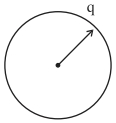
$64$ identical drops each charged up to a potential of $10 \, mV$ are combined to form a bigger drop. The potential of the bigger drop will be $.......... \, mV$.
A
$150$
B
$140$
C
$130$
D
$160$
Solution
(D) Let $q$ be the charge and $r$ be the radius of each small drop.
The potential of each small drop is given by $V = \frac{Kq}{r} = 10 \, mV$.
When $n = 64$ drops combine to form a bigger drop of radius $R$ and charge $Q$,the volume remains conserved:
$n \times (\frac{4}{3} \pi r^3) = \frac{4}{3} \pi R^3$
$64 r^3 = R^3 \implies R = 4r$.
The total charge on the bigger drop is $Q = nq = 64q$.
The potential of the bigger drop is $V' = \frac{KQ}{R} = \frac{K(64q)}{4r} = 16 \times (\frac{Kq}{r})$.
Substituting the value of $V$,we get $V' = 16 \times 10 \, mV = 160 \, mV$.
The potential of each small drop is given by $V = \frac{Kq}{r} = 10 \, mV$.
When $n = 64$ drops combine to form a bigger drop of radius $R$ and charge $Q$,the volume remains conserved:
$n \times (\frac{4}{3} \pi r^3) = \frac{4}{3} \pi R^3$
$64 r^3 = R^3 \implies R = 4r$.
The total charge on the bigger drop is $Q = nq = 64q$.
The potential of the bigger drop is $V' = \frac{KQ}{R} = \frac{K(64q)}{4r} = 16 \times (\frac{Kq}{r})$.
Substituting the value of $V$,we get $V' = 16 \times 10 \, mV = 160 \, mV$.
0 likes
View Solution306
MediumMCQ
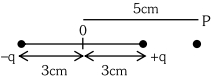
An electric dipole is placed as shown in the figure. The electric potential (in $10^2 \ V$) at point $P$ due to the dipole is ($\epsilon_0 =$ permittivity of free space and $\frac{1}{4 \pi \epsilon_0} = K$):
A
$\left(\frac{8}{3}\right) qK$
B
$\left(\frac{3}{8}\right) qK$
C
$\left(\frac{5}{8}\right) qK$
D
$\left(\frac{8}{5}\right) qK$
Solution
(B) The electric potential $V$ at a point due to a system of charges is the algebraic sum of the potentials due to individual charges.
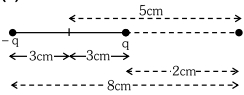
From the figure,the distance of point $P$ from the charge $+q$ is $r_1 = 2 \ cm = 2 \times 10^{-2} \ m$.
The distance of point $P$ from the charge $-q$ is $r_2 = 3 \ cm + 3 \ cm + 2 \ cm = 8 \ cm = 8 \times 10^{-2} \ m$.
The potential at point $P$ is given by:
$V = V_{+q} + V_{-q} = \frac{Kq}{r_1} + \frac{K(-q)}{r_2}$
$V = Kq \left( \frac{1}{2 \times 10^{-2}} - \frac{1}{8 \times 10^{-2}} \right)$
$V = Kq \left( \frac{4 - 1}{8 \times 10^{-2}} \right) = Kq \left( \frac{3}{8 \times 10^{-2}} \right)$
$V = Kq \left( \frac{3}{8} \right) \times 10^2 \ V$.
Thus,the potential in units of $10^2 \ V$ is $\left( \frac{3}{8} \right) qK$.
From the figure,the distance of point $P$ from the charge $+q$ is $r_1 = 2 \ cm = 2 \times 10^{-2} \ m$.
The distance of point $P$ from the charge $-q$ is $r_2 = 3 \ cm + 3 \ cm + 2 \ cm = 8 \ cm = 8 \times 10^{-2} \ m$.
The potential at point $P$ is given by:
$V = V_{+q} + V_{-q} = \frac{Kq}{r_1} + \frac{K(-q)}{r_2}$
$V = Kq \left( \frac{1}{2 \times 10^{-2}} - \frac{1}{8 \times 10^{-2}} \right)$
$V = Kq \left( \frac{4 - 1}{8 \times 10^{-2}} \right) = Kq \left( \frac{3}{8 \times 10^{-2}} \right)$
$V = Kq \left( \frac{3}{8} \right) \times 10^2 \ V$.
Thus,the potential in units of $10^2 \ V$ is $\left( \frac{3}{8} \right) qK$.
0 likes
View Solution307
DifficultMCQ
An electric charge $10^{-6} \mu C$ is placed at the origin $(0,0) \text{ m}$ of an $X-Y$ coordinate system. Two points $P$ and $Q$ are situated at $(\sqrt{3}, \sqrt{3}) \text{ m}$ and $(\sqrt{6}, 0) \text{ m}$ respectively. The potential difference between the points $P$ and $Q$ will be:
A
$\sqrt{3} \text{ V}$
B
$\sqrt{6} \text{ V}$
C
$0 \text{ V}$
D
$3 \text{ V}$
Solution
(C) The electric potential $V$ at a distance $r$ from a point charge $Q$ is given by $V = \frac{kQ}{r}$.
The distance of point $P(\sqrt{3}, \sqrt{3})$ from the origin $(0,0)$ is $r_1 = \sqrt{(\sqrt{3})^2 + (\sqrt{3})^2} = \sqrt{3 + 3} = \sqrt{6} \text{ m}$.
The distance of point $Q(\sqrt{6}, 0)$ from the origin $(0,0)$ is $r_2 = \sqrt{(\sqrt{6})^2 + 0^2} = \sqrt{6} \text{ m}$.
Since $r_1 = r_2 = \sqrt{6} \text{ m}$,the potential at point $P$ is $V_P = \frac{kQ}{r_1}$ and the potential at point $Q$ is $V_Q = \frac{kQ}{r_2}$.
Therefore,the potential difference $V_P - V_Q = \frac{kQ}{r_1} - \frac{kQ}{r_2} = 0 \text{ V}$.
The distance of point $P(\sqrt{3}, \sqrt{3})$ from the origin $(0,0)$ is $r_1 = \sqrt{(\sqrt{3})^2 + (\sqrt{3})^2} = \sqrt{3 + 3} = \sqrt{6} \text{ m}$.
The distance of point $Q(\sqrt{6}, 0)$ from the origin $(0,0)$ is $r_2 = \sqrt{(\sqrt{6})^2 + 0^2} = \sqrt{6} \text{ m}$.
Since $r_1 = r_2 = \sqrt{6} \text{ m}$,the potential at point $P$ is $V_P = \frac{kQ}{r_1}$ and the potential at point $Q$ is $V_Q = \frac{kQ}{r_2}$.
Therefore,the potential difference $V_P - V_Q = \frac{kQ}{r_1} - \frac{kQ}{r_2} = 0 \text{ V}$.
0 likes
View Solution308
DifficultMCQ
At the centre of a half ring of radius $R=10 \ cm$ and linear charge density $\lambda = 4 \ nC \ m^{-1}$,the potential is $x \pi \ V$. The value of $x$ is . . . . .
A
$35$
B
$36$
C
$37$
D
$38$
Solution
(B) The potential $V$ at the centre of a charged ring is given by $V = \frac{1}{4\pi \epsilon_0} \int \frac{dq}{R}$.
For a half ring of radius $R$,the total charge $Q = \lambda \times (\pi R)$.
Since every point on the half ring is at the same distance $R$ from the centre,the potential is $V = \frac{1}{4\pi \epsilon_0} \frac{Q}{R}$.
Substituting $Q = \lambda \pi R$,we get $V = \frac{1}{4\pi \epsilon_0} \frac{\lambda \pi R}{R} = \frac{\lambda}{4 \epsilon_0}$.
Given $\lambda = 4 \times 10^{-9} \ C/m$ and $k = \frac{1}{4\pi \epsilon_0} = 9 \times 10^9 \ N \ m^2/C^2$.
$V = k \lambda \pi = (9 \times 10^9) \times (4 \times 10^{-9}) \times \pi$.
$V = 36 \pi \ V$.
Comparing this with $x \pi \ V$,we find $x = 36$.
For a half ring of radius $R$,the total charge $Q = \lambda \times (\pi R)$.
Since every point on the half ring is at the same distance $R$ from the centre,the potential is $V = \frac{1}{4\pi \epsilon_0} \frac{Q}{R}$.
Substituting $Q = \lambda \pi R$,we get $V = \frac{1}{4\pi \epsilon_0} \frac{\lambda \pi R}{R} = \frac{\lambda}{4 \epsilon_0}$.
Given $\lambda = 4 \times 10^{-9} \ C/m$ and $k = \frac{1}{4\pi \epsilon_0} = 9 \times 10^9 \ N \ m^2/C^2$.
$V = k \lambda \pi = (9 \times 10^9) \times (4 \times 10^{-9}) \times \pi$.
$V = 36 \pi \ V$.
Comparing this with $x \pi \ V$,we find $x = 36$.
0 likes
View Solution309
MediumMCQ
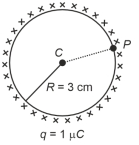
$A$ thin spherical shell is charged by some source. The potential difference between the two points $C$ (the center) and $P$ (a point on the surface) as shown in the figure is: (Take $\frac{1}{4 \pi \varepsilon_0} = 9 \times 10^9 \text{ SI units}$)
A
$1 \times 10^5 \text{ V}$
B
$0.5 \times 10^5 \text{ V}$
C
Zero
D
$3 \times 10^5 \text{ V}$
Solution
(C) For a uniformly charged thin spherical shell of radius $R$ and charge $q$,the electric potential at any point inside the shell (including the center) is constant and equal to the potential at the surface.
The potential at any point $r \leq R$ is given by $V = \frac{1}{4 \pi \varepsilon_0} \frac{q}{R}$.
Since point $C$ is at the center $(r = 0)$ and point $P$ is on the surface $(r = R)$,both points are at the same potential.
Therefore,$V_C = V_P = \frac{1}{4 \pi \varepsilon_0} \frac{q}{R}$.
The potential difference between points $C$ and $P$ is $V_C - V_P = 0$.
The potential at any point $r \leq R$ is given by $V = \frac{1}{4 \pi \varepsilon_0} \frac{q}{R}$.
Since point $C$ is at the center $(r = 0)$ and point $P$ is on the surface $(r = R)$,both points are at the same potential.
Therefore,$V_C = V_P = \frac{1}{4 \pi \varepsilon_0} \frac{q}{R}$.
The potential difference between points $C$ and $P$ is $V_C - V_P = 0$.
0 likes
View Solution310
AdvancedMCQ
$A$ long,hollow conducting cylinder is kept coaxially inside another long,hollow conducting cylinder of larger radius. Both the cylinders are initially electrically neutral.
A
$A$ potential difference appears between the two cylinders when a charge density is given to the inner cylinder.
B
$A$ potential difference appears between the two cylinders when a charge density is given to the outer cylinder.
C
No potential difference appears between the two cylinders when a uniform line charge is kept along the axis of the cylinders.
D
No potential difference appears between the two cylinders when same charge density is given to both the cylinders.
Solution
(A) For a charged conducting cylinder of radius $R$ and linear charge density $\lambda$,the electric field $E$ at a distance $r > R$ is given by $E = \frac{\lambda}{2 \pi \varepsilon_0 r}$.
When a charge is given to the inner cylinder,an electric field exists in the region between the two cylinders,resulting in a potential difference $V = \int_{R_1}^{R_2} E \, dr$.
If a charge is given to the outer cylinder,the electric field inside the cavity of the outer cylinder is zero due to the properties of a hollow conductor (Gauss's Law). Thus,no potential difference exists between the cylinders.
If the same charge density $\lambda$ is given to both,the inner cylinder creates a field,but the outer cylinder does not contribute to the field in the region between them. Therefore,a potential difference will still exist due to the inner cylinder.
Thus,option $A$ is correct because charging the inner cylinder creates a radial electric field between the cylinders,leading to a potential difference.
When a charge is given to the inner cylinder,an electric field exists in the region between the two cylinders,resulting in a potential difference $V = \int_{R_1}^{R_2} E \, dr$.
If a charge is given to the outer cylinder,the electric field inside the cavity of the outer cylinder is zero due to the properties of a hollow conductor (Gauss's Law). Thus,no potential difference exists between the cylinders.
If the same charge density $\lambda$ is given to both,the inner cylinder creates a field,but the outer cylinder does not contribute to the field in the region between them. Therefore,a potential difference will still exist due to the inner cylinder.
Thus,option $A$ is correct because charging the inner cylinder creates a radial electric field between the cylinders,leading to a potential difference.
0 likes
View Solution311
MediumMCQ
The electrostatic potential on the surface of a uniformly charged spherical shell of radius $R = 10 \ cm$ is $120 \ V$. The potential at the centre of the shell,at a distance $r = 5 \ cm$ from the centre,and at a distance $r = 15 \ cm$ from the centre of the shell respectively,are:
A
$120 \ V, 120 \ V, 80 \ V$
B
$40 \ V, 40 \ V, 80 \ V$
C
$0 \ V, 0 \ V, 80 \ V$
D
$0 \ V, 120 \ V, 40 \ V$
Solution
(A) For a uniformly charged spherical shell,the electrostatic potential inside the shell is constant and equal to the potential on its surface.
Given: Potential on the surface $V_{surface} = 120 \ V$ and radius $R = 10 \ cm$.
$1$. At the centre $(r = 0 \ cm)$: Since $r < R$,the potential is equal to the surface potential,so $V_{centre} = 120 \ V$.
$2$. At a distance $r = 5 \ cm$ from the centre: Since $r < R$,the potential is constant throughout the interior,so $V_{r=5cm} = 120 \ V$.
$3$. At a distance $r = 15 \ cm$ from the centre: Since $r > R$,the shell acts as a point charge. The potential is given by $V = \frac{kQ}{r}$.
We know $V_{surface} = \frac{kQ}{R} = 120 \ V$,so $kQ = 120 \times 10 = 1200 \ V \cdot cm$.
Thus,$V_{r=15cm} = \frac{1200}{15} = 80 \ V$.
Therefore,the potentials are $120 \ V, 120 \ V, 80 \ V$.
Given: Potential on the surface $V_{surface} = 120 \ V$ and radius $R = 10 \ cm$.
$1$. At the centre $(r = 0 \ cm)$: Since $r < R$,the potential is equal to the surface potential,so $V_{centre} = 120 \ V$.
$2$. At a distance $r = 5 \ cm$ from the centre: Since $r < R$,the potential is constant throughout the interior,so $V_{r=5cm} = 120 \ V$.
$3$. At a distance $r = 15 \ cm$ from the centre: Since $r > R$,the shell acts as a point charge. The potential is given by $V = \frac{kQ}{r}$.
We know $V_{surface} = \frac{kQ}{R} = 120 \ V$,so $kQ = 120 \times 10 = 1200 \ V \cdot cm$.
Thus,$V_{r=15cm} = \frac{1200}{15} = 80 \ V$.
Therefore,the potentials are $120 \ V, 120 \ V, 80 \ V$.
0 likes
View Solution312
DifficultMCQ
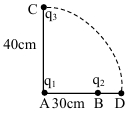
Two charges $q_1$ and $q_2$ are separated by a distance of $30\ cm$. $A$ third charge $q_3$,initially at $C$ as shown in the figure,is moved along the circular path of radius $40\ cm$ from $C$ to $D$. If the difference in potential energy due to the movement of $q_3$ from $C$ to $D$ is given by $\frac{q_3 K}{4 \pi \epsilon_0}$,find the value of $K$.
A
$8 q_2$
B
$6 q_2$
C
$8 q_1$
D
$6 q_1$
Solution
(A) The potential at point $C$ due to charges $q_1$ and $q_2$ is:
$V_C = \frac{1}{4 \pi \epsilon_0} \left( \frac{q_1}{AC} + \frac{q_2}{BC} \right)$
Given $AC = 40\ cm = 0.4\ m$. Since $AB = 30\ cm$ and $AC = 40\ cm$,by Pythagoras theorem,$BC = \sqrt{0.3^2 + 0.4^2} = 0.5\ m$.
So,$V_C = \frac{1}{4 \pi \epsilon_0} \left( \frac{q_1}{0.4} + \frac{q_2}{0.5} \right)$.
The potential at point $D$ due to charges $q_1$ and $q_2$ is:
$V_D = \frac{1}{4 \pi \epsilon_0} \left( \frac{q_1}{AD} + \frac{q_2}{BD} \right)$
Given $AD = 40\ cm = 0.4\ m$ (radius of the circular path) and $BD = AD - AB = 40\ cm - 30\ cm = 10\ cm = 0.1\ m$.
So,$V_D = \frac{1}{4 \pi \epsilon_0} \left( \frac{q_1}{0.4} + \frac{q_2}{0.1} \right)$.
The change in potential energy $\Delta U$ is given by:
$\Delta U = q_3 (V_D - V_C) = q_3 \left[ \frac{1}{4 \pi \epsilon_0} \left( \frac{q_1}{0.4} + \frac{q_2}{0.1} \right) - \frac{1}{4 \pi \epsilon_0} \left( \frac{q_1}{0.4} + \frac{q_2}{0.5} \right) \right]$
$\Delta U = \frac{q_3}{4 \pi \epsilon_0} \left( \frac{q_2}{0.1} - \frac{q_2}{0.5} \right) = \frac{q_3}{4 \pi \epsilon_0} (10 q_2 - 2 q_2) = \frac{8 q_2 q_3}{4 \pi \epsilon_0}$.
Comparing this with $\frac{q_3 K}{4 \pi \epsilon_0}$,we get $K = 8 q_2$.
$V_C = \frac{1}{4 \pi \epsilon_0} \left( \frac{q_1}{AC} + \frac{q_2}{BC} \right)$
Given $AC = 40\ cm = 0.4\ m$. Since $AB = 30\ cm$ and $AC = 40\ cm$,by Pythagoras theorem,$BC = \sqrt{0.3^2 + 0.4^2} = 0.5\ m$.
So,$V_C = \frac{1}{4 \pi \epsilon_0} \left( \frac{q_1}{0.4} + \frac{q_2}{0.5} \right)$.
The potential at point $D$ due to charges $q_1$ and $q_2$ is:
$V_D = \frac{1}{4 \pi \epsilon_0} \left( \frac{q_1}{AD} + \frac{q_2}{BD} \right)$
Given $AD = 40\ cm = 0.4\ m$ (radius of the circular path) and $BD = AD - AB = 40\ cm - 30\ cm = 10\ cm = 0.1\ m$.
So,$V_D = \frac{1}{4 \pi \epsilon_0} \left( \frac{q_1}{0.4} + \frac{q_2}{0.1} \right)$.
The change in potential energy $\Delta U$ is given by:
$\Delta U = q_3 (V_D - V_C) = q_3 \left[ \frac{1}{4 \pi \epsilon_0} \left( \frac{q_1}{0.4} + \frac{q_2}{0.1} \right) - \frac{1}{4 \pi \epsilon_0} \left( \frac{q_1}{0.4} + \frac{q_2}{0.5} \right) \right]$
$\Delta U = \frac{q_3}{4 \pi \epsilon_0} \left( \frac{q_2}{0.1} - \frac{q_2}{0.5} \right) = \frac{q_3}{4 \pi \epsilon_0} (10 q_2 - 2 q_2) = \frac{8 q_2 q_3}{4 \pi \epsilon_0}$.
Comparing this with $\frac{q_3 K}{4 \pi \epsilon_0}$,we get $K = 8 q_2$.
0 likes
View Solution313
MediumMCQ
Given below are two statements $:$ one is labelled as Assertion $A$ and the other is labelled as Reason $R$.
Assertion $A :$ Work done in moving a test charge between two points inside a uniformly charged spherical shell is zero,no matter which path is chosen.
Reason $R :$ Electrostatic potential inside a uniformly charged spherical shell is constant and is same as that on the surface of the shell.
In the light of the above statements,choose the correct answer from the options given below.
Assertion $A :$ Work done in moving a test charge between two points inside a uniformly charged spherical shell is zero,no matter which path is chosen.
Reason $R :$ Electrostatic potential inside a uniformly charged spherical shell is constant and is same as that on the surface of the shell.
In the light of the above statements,choose the correct answer from the options given below.
A
$A$ is true but $R$ is false
B
Both $A$ and $R$ are true and $R$ is the correct explanation of $A$
C
$A$ is false but $R$ is true
D
Both $A$ and $R$ are true but $R$ is $\text{NOT}$ the correct explanation of $A$
Solution
(B) $1$. For a uniformly charged spherical shell of radius $R$ and charge $Q$,the electric field inside the shell is zero $(E = 0)$.
$2$. Since the electric field is zero inside,the potential $V$ is constant throughout the interior and is equal to the potential at the surface,given by $V = \frac{1}{4\pi\epsilon_0} \frac{Q}{R}$.
$3$. The work done $W$ in moving a test charge $q$ between two points $1$ and $2$ is given by $W = q(V_2 - V_1)$.
$4$. Since $V_1 = V_2$ at any two points inside the shell,$W = q(0) = 0$.
$5$. Thus,Assertion $A$ is true because the potential is constant,and Reason $R$ is true and provides the correct explanation for why the work done is zero.
$2$. Since the electric field is zero inside,the potential $V$ is constant throughout the interior and is equal to the potential at the surface,given by $V = \frac{1}{4\pi\epsilon_0} \frac{Q}{R}$.
$3$. The work done $W$ in moving a test charge $q$ between two points $1$ and $2$ is given by $W = q(V_2 - V_1)$.
$4$. Since $V_1 = V_2$ at any two points inside the shell,$W = q(0) = 0$.
$5$. Thus,Assertion $A$ is true because the potential is constant,and Reason $R$ is true and provides the correct explanation for why the work done is zero.
0 likes
View Solution314
MediumMCQ
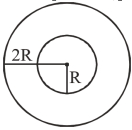
Two concentric hollow spherical conductors of radii $R$ and $2R$ have charges $Q$ and $-Q$ respectively. Find the electric potential at a distance of $\frac{3R}{2}$ from the centre. $\left[K=\frac{1}{4\pi\varepsilon_0}\right]$
A
$\frac{KQ}{6R}$
B
$\frac{KQ}{3R}$
C
$-\frac{KQ}{2R}$
D
zero
Solution
(A) The electric potential $V$ at a point due to a spherical shell is given by:
$1$. Inside the shell $(r < \text{radius})$: $V = \frac{KQ}{\text{radius}}$
$2$. Outside the shell $(r > \text{radius})$: $V = \frac{KQ}{r}$
For a point at $r = \frac{3R}{2}$:
- This point is outside the inner shell (radius $R$), so the potential due to the inner shell is $V_1 = \frac{KQ}{3R/2} = \frac{2KQ}{3R}$.
- This point is inside the outer shell (radius $2R$), so the potential due to the outer shell is $V_2 = \frac{K(-Q)}{2R} = -\frac{KQ}{2R}$.
The total potential $V$ is the sum of the potentials due to both shells:
$V = V_1 + V_2 = \frac{2KQ}{3R} - \frac{KQ}{2R}$
$V = \frac{4KQ - 3KQ}{6R} = \frac{KQ}{6R}$
$1$. Inside the shell $(r < \text{radius})$: $V = \frac{KQ}{\text{radius}}$
$2$. Outside the shell $(r > \text{radius})$: $V = \frac{KQ}{r}$
For a point at $r = \frac{3R}{2}$:
- This point is outside the inner shell (radius $R$), so the potential due to the inner shell is $V_1 = \frac{KQ}{3R/2} = \frac{2KQ}{3R}$.
- This point is inside the outer shell (radius $2R$), so the potential due to the outer shell is $V_2 = \frac{K(-Q)}{2R} = -\frac{KQ}{2R}$.
The total potential $V$ is the sum of the potentials due to both shells:
$V = V_1 + V_2 = \frac{2KQ}{3R} - \frac{KQ}{2R}$
$V = \frac{4KQ - 3KQ}{6R} = \frac{KQ}{6R}$
0 likes
View Solution315
MediumMCQ
Eight equal charges $q$ are placed at each corner of a cube of side $a$. The work done in carrying a charge $-q$ from its centre to infinity is:
A
zero
B
$\frac{3 \sqrt{2} q^2}{\pi \epsilon_0 a}$
C
$\frac{\sqrt{2} q^2}{\pi \epsilon_0 a}$
D
$\frac{4 q^2}{\sqrt{3} \pi \epsilon_0 a}$
Solution
(D) The work done $W$ in moving a charge $q_0$ from point $I$ to $F$ is given by $W = q_0 (V_F - V_I)$.
Here,the charge being moved is $q_0 = -q$.
The potential at infinity is $V_F = 0$.
The distance of each corner from the centre of the cube of side $a$ is $r = \frac{\sqrt{3}}{2} a$.
The potential at the centre $V_I$ due to $8$ charges $q$ is $V_I = 8 \times \frac{1}{4 \pi \epsilon_0} \frac{q}{r} = 8 \times \frac{1}{4 \pi \epsilon_0} \frac{q}{(\sqrt{3} a / 2)} = \frac{4 q}{\sqrt{3} \pi \epsilon_0 a}$.
Therefore,$W = -q (0 - V_I) = q V_I = q \left( \frac{4 q}{\sqrt{3} \pi \epsilon_0 a} \right) = \frac{4 q^2}{\sqrt{3} \pi \epsilon_0 a}$.
Here,the charge being moved is $q_0 = -q$.
The potential at infinity is $V_F = 0$.
The distance of each corner from the centre of the cube of side $a$ is $r = \frac{\sqrt{3}}{2} a$.
The potential at the centre $V_I$ due to $8$ charges $q$ is $V_I = 8 \times \frac{1}{4 \pi \epsilon_0} \frac{q}{r} = 8 \times \frac{1}{4 \pi \epsilon_0} \frac{q}{(\sqrt{3} a / 2)} = \frac{4 q}{\sqrt{3} \pi \epsilon_0 a}$.
Therefore,$W = -q (0 - V_I) = q V_I = q \left( \frac{4 q}{\sqrt{3} \pi \epsilon_0 a} \right) = \frac{4 q^2}{\sqrt{3} \pi \epsilon_0 a}$.
0 likes
View Solution316
MediumMCQ
$A$ thin spherical conducting shell of radius $R$ has a charge $q$. Another charge $Q$ is placed at the centre of the shell. The electrostatic potential at a point $P$ at a distance $R/2$ from the centre of the shell is:
A
$\frac{(q + Q)}{4 \pi \varepsilon_0} \frac{2}{R}$
B
$\frac{2Q}{4 \pi \varepsilon_0 R}$
C
$\frac{2Q}{4 \pi \varepsilon_0 R} - \frac{2q}{4 \pi \varepsilon_0 R}$
D
$\frac{2Q}{4 \pi \varepsilon_0 R} + \frac{q}{4 \pi \varepsilon_0 R}$
Solution
(D) The potential at point $P$ inside the shell is the sum of the potential due to the charge $Q$ at the center and the potential due to the charge $q$ on the shell.
For a point inside a conducting shell,the potential due to the shell's charge $q$ is constant and equal to the potential at its surface,which is $V_{shell} = \frac{kq}{R}$.
The potential due to the point charge $Q$ at distance $r = R/2$ is $V_{point} = \frac{kQ}{R/2} = \frac{2kQ}{R}$.
Therefore,the total potential at point $P$ is $V_P = V_{point} + V_{shell} = \frac{2kQ}{R} + \frac{kq}{R}$.
Substituting $k = \frac{1}{4 \pi \varepsilon_0}$,we get $V_P = \frac{2Q}{4 \pi \varepsilon_0 R} + \frac{q}{4 \pi \varepsilon_0 R}$.
For a point inside a conducting shell,the potential due to the shell's charge $q$ is constant and equal to the potential at its surface,which is $V_{shell} = \frac{kq}{R}$.
The potential due to the point charge $Q$ at distance $r = R/2$ is $V_{point} = \frac{kQ}{R/2} = \frac{2kQ}{R}$.
Therefore,the total potential at point $P$ is $V_P = V_{point} + V_{shell} = \frac{2kQ}{R} + \frac{kq}{R}$.
Substituting $k = \frac{1}{4 \pi \varepsilon_0}$,we get $V_P = \frac{2Q}{4 \pi \varepsilon_0 R} + \frac{q}{4 \pi \varepsilon_0 R}$.

0 likes
View Solution317
DifficultMCQ
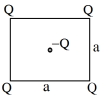
Four equal charges $Q$ are placed at the four corners of a square of side $a$. The work done in moving a charge $-Q$ from its centre to infinity is
A
$0$
B
$\sqrt{2} Q^2 / 4 \pi \varepsilon_0 a$
C
$\sqrt{2} Q^2 / \pi \varepsilon_0 a$
D
$Q^2 / 2 \pi \varepsilon_0 a$
Solution
(C) The potential $V$ at the center of the square due to the four charges $Q$ at the corners is given by $V = 4 \times \frac{kQ}{r}$,where $r$ is the distance from the corner to the center. For a square of side $a$,the diagonal is $a\sqrt{2}$,so $r = \frac{a\sqrt{2}}{2} = \frac{a}{\sqrt{2}}$.
Thus,$V = 4 \times \frac{kQ}{a/\sqrt{2}} = \frac{4\sqrt{2}kQ}{a}$.
The potential energy $U_i$ of the charge $-Q$ at the center is $U_i = (-Q)V = -\frac{4\sqrt{2}kQ^2}{a}$.
The potential energy $U_f$ at infinity is $0$.
The work done $W$ is $W = U_f - U_i = 0 - (-\frac{4\sqrt{2}kQ^2}{a}) = \frac{4\sqrt{2}kQ^2}{a}$.
Substituting $k = \frac{1}{4\pi\varepsilon_0}$,we get $W = \frac{4\sqrt{2}Q^2}{4\pi\varepsilon_0 a} = \frac{\sqrt{2}Q^2}{\pi\varepsilon_0 a}$.
Thus,$V = 4 \times \frac{kQ}{a/\sqrt{2}} = \frac{4\sqrt{2}kQ}{a}$.
The potential energy $U_i$ of the charge $-Q$ at the center is $U_i = (-Q)V = -\frac{4\sqrt{2}kQ^2}{a}$.
The potential energy $U_f$ at infinity is $0$.
The work done $W$ is $W = U_f - U_i = 0 - (-\frac{4\sqrt{2}kQ^2}{a}) = \frac{4\sqrt{2}kQ^2}{a}$.
Substituting $k = \frac{1}{4\pi\varepsilon_0}$,we get $W = \frac{4\sqrt{2}Q^2}{4\pi\varepsilon_0 a} = \frac{\sqrt{2}Q^2}{\pi\varepsilon_0 a}$.
0 likes
View Solution318
DifficultMCQ
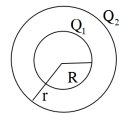
If on two concentric hollow spheres of radii $R$ and $r$ $(R < r)$,a total charge $Q$ is distributed such that their surface charge densities are equal,then the potential at their common centre is:
A
$\frac{Q(R^2+r^2)}{4\pi\varepsilon_0(R+r)}$
B
$\frac{QR}{R+r}$
C
zero
D
$\frac{Q(R+r)}{4\pi\varepsilon_0(R^2+r^2)}$
Solution
(D) Let the charges on the spheres of radii $R$ and $r$ be $Q_1$ and $Q_2$ respectively,such that $Q_1 + Q_2 = Q$.
Given that the surface charge densities are equal,$\sigma = \frac{Q_1}{4\pi R^2} = \frac{Q_2}{4\pi r^2}$.
This implies $\frac{Q_1}{R^2} = \frac{Q_2}{r^2} = k'$,where $k'$ is a constant.
Thus,$Q_1 = k' R^2$ and $Q_2 = k' r^2$.
Since $Q_1 + Q_2 = Q$,we have $k'(R^2 + r^2) = Q$,so $k' = \frac{Q}{R^2 + r^2}$.
The potential at the common centre is $V = \frac{1}{4\pi\varepsilon_0} \left( \frac{Q_1}{R} + \frac{Q_2}{r} \right)$.
Substituting the values of $Q_1$ and $Q_2$:
$V = \frac{1}{4\pi\varepsilon_0} \left( \frac{k' R^2}{R} + \frac{k' r^2}{r} \right) = \frac{k'}{4\pi\varepsilon_0} (R + r)$.
Substituting $k' = \frac{Q}{R^2 + r^2}$:
$V = \frac{Q(R+r)}{4\pi\varepsilon_0(R^2+r^2)}$.
Given that the surface charge densities are equal,$\sigma = \frac{Q_1}{4\pi R^2} = \frac{Q_2}{4\pi r^2}$.
This implies $\frac{Q_1}{R^2} = \frac{Q_2}{r^2} = k'$,where $k'$ is a constant.
Thus,$Q_1 = k' R^2$ and $Q_2 = k' r^2$.
Since $Q_1 + Q_2 = Q$,we have $k'(R^2 + r^2) = Q$,so $k' = \frac{Q}{R^2 + r^2}$.
The potential at the common centre is $V = \frac{1}{4\pi\varepsilon_0} \left( \frac{Q_1}{R} + \frac{Q_2}{r} \right)$.
Substituting the values of $Q_1$ and $Q_2$:
$V = \frac{1}{4\pi\varepsilon_0} \left( \frac{k' R^2}{R} + \frac{k' r^2}{r} \right) = \frac{k'}{4\pi\varepsilon_0} (R + r)$.
Substituting $k' = \frac{Q}{R^2 + r^2}$:
$V = \frac{Q(R+r)}{4\pi\varepsilon_0(R^2+r^2)}$.
0 likes
View Solution319
MediumMCQ
$A$ particle '$A$' has charge '$+q$' and a particle '$B$' has charge '$+4q$'. Each has the same mass '$m$'. When they are allowed to fall from rest through the same potential difference '$V$',the ratio of their speeds will be (particle $A$ to particle $B$):
A
$2: 1$
B
$1: 2$
C
$1: 4$
D
$4: 1$
Solution
(B) The kinetic energy gained by a charged particle accelerated through a potential difference '$V$' is given by $K = qV$.
Since both particles start from rest,the kinetic energy is equal to the work done by the electric field: $\frac{1}{2}mv^2 = qV$.
For particle '$A$': $\frac{1}{2}mv_A^2 = qV \implies v_A = \sqrt{\frac{2qV}{m}}$.
For particle '$B$': $\frac{1}{2}mv_B^2 = (4q)V \implies v_B = \sqrt{\frac{8qV}{m}}$.
Taking the ratio of their speeds $(v_A : v_B)$:
$\frac{v_A}{v_B} = \frac{\sqrt{2qV/m}}{\sqrt{8qV/m}} = \sqrt{\frac{2}{8}} = \sqrt{\frac{1}{4}} = \frac{1}{2}$.
Thus,the ratio of their speeds is $1: 2$.
Since both particles start from rest,the kinetic energy is equal to the work done by the electric field: $\frac{1}{2}mv^2 = qV$.
For particle '$A$': $\frac{1}{2}mv_A^2 = qV \implies v_A = \sqrt{\frac{2qV}{m}}$.
For particle '$B$': $\frac{1}{2}mv_B^2 = (4q)V \implies v_B = \sqrt{\frac{8qV}{m}}$.
Taking the ratio of their speeds $(v_A : v_B)$:
$\frac{v_A}{v_B} = \frac{\sqrt{2qV/m}}{\sqrt{8qV/m}} = \sqrt{\frac{2}{8}} = \sqrt{\frac{1}{4}} = \frac{1}{2}$.
Thus,the ratio of their speeds is $1: 2$.
0 likes
View Solution320
DifficultMCQ
Three charges each of value $+q$ are placed at the corners of an isosceles triangle $ABC$ with sides $AB = AC = 2a$. The midpoints of $AB$ and $AC$ are $D$ and $E$ respectively. The work done in taking a charge $Q$ from $D$ to $E$ is (where $\varepsilon_0$ is the permittivity of free space):
A
Zero
B
$\frac{3 qQ}{4 \pi \varepsilon_0 a}$
C
$\frac{qQ}{8 \pi \varepsilon_0 a}$
D
$\frac{3 qQ}{8 \pi \varepsilon_0 a}$
Solution
(A) The potential at any point $P$ due to a system of charges is given by $V = \sum \frac{1}{4 \pi \varepsilon_0} \frac{q_i}{r_i}$.
In the isosceles triangle $ABC$,charges $+q$ are placed at $A, B,$ and $C$. $D$ is the midpoint of $AB$ and $E$ is the midpoint of $AC$.
By symmetry,the distance of $D$ from $A$ is $a$,from $B$ is $a$,and from $C$ is $\sqrt{AC^2 + AD^2 - 2(AC)(AD) \cos A} = \sqrt{(2a)^2 + a^2 - 2(2a)(a) \cos A}$.
Similarly,the distance of $E$ from $A$ is $a$,from $C$ is $a$,and from $B$ is $\sqrt{AB^2 + AE^2 - 2(AB)(AE) \cos A} = \sqrt{(2a)^2 + a^2 - 2(2a)(a) \cos A}$.
Since the configuration is symmetric with respect to the angle $A$,the potential at $D$ $(V_D)$ and the potential at $E$ $(V_E)$ are equal.
$V_D = \frac{1}{4 \pi \varepsilon_0} \left( \frac{q}{AD} + \frac{q}{BD} + \frac{q}{CD} \right) = \frac{1}{4 \pi \varepsilon_0} \left( \frac{q}{a} + \frac{q}{a} + \frac{q}{CD} \right)$.
$V_E = \frac{1}{4 \pi \varepsilon_0} \left( \frac{q}{AE} + \frac{q}{CE} + \frac{q}{BE} \right) = \frac{1}{4 \pi \varepsilon_0} \left( \frac{q}{a} + \frac{q}{a} + \frac{q}{BE} \right)$.
Since $CD = BE$ by symmetry,$V_D = V_E$.
The work done $W = Q(V_E - V_D) = Q(0) = 0$.
In the isosceles triangle $ABC$,charges $+q$ are placed at $A, B,$ and $C$. $D$ is the midpoint of $AB$ and $E$ is the midpoint of $AC$.
By symmetry,the distance of $D$ from $A$ is $a$,from $B$ is $a$,and from $C$ is $\sqrt{AC^2 + AD^2 - 2(AC)(AD) \cos A} = \sqrt{(2a)^2 + a^2 - 2(2a)(a) \cos A}$.
Similarly,the distance of $E$ from $A$ is $a$,from $C$ is $a$,and from $B$ is $\sqrt{AB^2 + AE^2 - 2(AB)(AE) \cos A} = \sqrt{(2a)^2 + a^2 - 2(2a)(a) \cos A}$.
Since the configuration is symmetric with respect to the angle $A$,the potential at $D$ $(V_D)$ and the potential at $E$ $(V_E)$ are equal.
$V_D = \frac{1}{4 \pi \varepsilon_0} \left( \frac{q}{AD} + \frac{q}{BD} + \frac{q}{CD} \right) = \frac{1}{4 \pi \varepsilon_0} \left( \frac{q}{a} + \frac{q}{a} + \frac{q}{CD} \right)$.
$V_E = \frac{1}{4 \pi \varepsilon_0} \left( \frac{q}{AE} + \frac{q}{CE} + \frac{q}{BE} \right) = \frac{1}{4 \pi \varepsilon_0} \left( \frac{q}{a} + \frac{q}{a} + \frac{q}{BE} \right)$.
Since $CD = BE$ by symmetry,$V_D = V_E$.
The work done $W = Q(V_E - V_D) = Q(0) = 0$.
0 likes
View Solution321
EasyMCQ
$A$ conducting sphere of radius $R$ is given a charge $Q$ uniformly. The electric field and the electric potential at the centre of the sphere are respectively [$\epsilon_0 =$ permittivity of free space].
A
zero and $\frac{Q}{4 \pi \epsilon_0 R}$
B
$\frac{Q}{4 \pi \epsilon_0 R^2}$ and zero
C
$\frac{Q}{4 \pi \epsilon_0 R}$ and $\frac{Q}{4 \pi \epsilon_0 R^2}$
D
zero and zero
Solution
(A) For a conducting sphere,the charge $Q$ resides entirely on its outer surface.
Inside a conducting sphere,the electric field $E$ is zero everywhere because there is no enclosed charge $(q_{enclosed} = 0)$ according to Gauss's Law.
Since the electric field is zero inside the sphere,the potential $V$ is constant throughout the interior and is equal to the potential at the surface.
The potential at the surface (and thus at the centre) is given by $V = \frac{Q}{4 \pi \epsilon_0 R}$.
Therefore,the electric field at the centre is $0$ and the electric potential at the centre is $\frac{Q}{4 \pi \epsilon_0 R}$.
Inside a conducting sphere,the electric field $E$ is zero everywhere because there is no enclosed charge $(q_{enclosed} = 0)$ according to Gauss's Law.
Since the electric field is zero inside the sphere,the potential $V$ is constant throughout the interior and is equal to the potential at the surface.
The potential at the surface (and thus at the centre) is given by $V = \frac{Q}{4 \pi \epsilon_0 R}$.
Therefore,the electric field at the centre is $0$ and the electric potential at the centre is $\frac{Q}{4 \pi \epsilon_0 R}$.
0 likes
View Solution322
EasyMCQ
Let $W$ joule be the work done to move an electric charge $q$ coulomb from a place $A$,where potential is $-5 \ V$,to another place $B$,where potential is $V$ volt. The value of $V$ is
A
$Wq - 5$
B
$\frac{q}{W} + 5$
C
$W - \frac{5}{q}$
D
$\frac{W}{q} - 5$
Solution
(D) The work done $W$ in moving a charge $q$ from point $A$ to point $B$ is given by the formula:
$W = q(V_B - V_A)$
Here,the potential at point $A$ is $V_A = -5 \ V$ and the potential at point $B$ is $V_B = V$.
Substituting these values into the formula:
$W = q(V - (-5))$
$W = q(V + 5)$
Now,solve for $V$:
$\frac{W}{q} = V + 5$
$V = \frac{W}{q} - 5$
Therefore,the correct option is $D$.
$W = q(V_B - V_A)$
Here,the potential at point $A$ is $V_A = -5 \ V$ and the potential at point $B$ is $V_B = V$.
Substituting these values into the formula:
$W = q(V - (-5))$
$W = q(V + 5)$
Now,solve for $V$:
$\frac{W}{q} = V + 5$
$V = \frac{W}{q} - 5$
Therefore,the correct option is $D$.
0 likes
View Solution323
MediumMCQ
Three point charges $+Q$,$+2Q$,and $q$ are placed at the vertices of an equilateral triangle. The value of charge $q$ in terms of $Q$,so that the electrical potential energy of the system is zero,is given by:
A
$q = -\frac{2}{3} Q$
B
$q = -\frac{3}{2} Q$
C
$q = -\frac{1}{3} Q$
D
$q = -\frac{2}{5} Q$
Solution
(A) The electrical potential energy $U$ of a system of point charges is given by the sum of the potential energies of all pairs of charges: $U = k \left( \frac{q_1 q_2}{r_{12}} + \frac{q_2 q_3}{r_{23}} + \frac{q_3 q_1}{r_{31}} \right)$.
For an equilateral triangle with side length $a$,the distance between any two charges is $a$.
Given charges are $q_1 = Q$,$q_2 = 2Q$,and $q_3 = q$.
The total potential energy is $U = \frac{k}{a} (Q \cdot 2Q + 2Q \cdot q + q \cdot Q)$.
Setting $U = 0$ for the system to have zero potential energy:
$2Q^2 + 2Qq + qQ = 0$.
$2Q^2 + 3Qq = 0$.
$Q(2Q + 3q) = 0$.
Since $Q \neq 0$,we have $2Q + 3q = 0$.
Therefore,$q = -\frac{2}{3} Q$.
For an equilateral triangle with side length $a$,the distance between any two charges is $a$.
Given charges are $q_1 = Q$,$q_2 = 2Q$,and $q_3 = q$.
The total potential energy is $U = \frac{k}{a} (Q \cdot 2Q + 2Q \cdot q + q \cdot Q)$.
Setting $U = 0$ for the system to have zero potential energy:
$2Q^2 + 2Qq + qQ = 0$.
$2Q^2 + 3Qq = 0$.
$Q(2Q + 3q) = 0$.
Since $Q \neq 0$,we have $2Q + 3q = 0$.
Therefore,$q = -\frac{2}{3} Q$.
0 likes
View Solution324
MediumMCQ
Three concentric charged metallic spherical shells $A$,$B$,and $C$ have radii $a$,$b$,and $c$ (where $a < b < c$) and surface charge densities $+\sigma$,$-\sigma$,and $+\sigma$ respectively. The potential $V_A$ at the surface of shell $A$ is ($\epsilon_0$ = permittivity of free space).
A
$\frac{\sigma}{\epsilon_0}(a-b+c)$
B
$\frac{\sigma}{\epsilon_0}(a+b-c)$
C
$\frac{\sigma}{\epsilon_0}(-a+b+c)$
D
$\frac{\sigma}{\epsilon_0}(a+b+c)$
Solution
(A) The surface charge densities are $\sigma_A = +\sigma$,$\sigma_B = -\sigma$,and $\sigma_C = +\sigma$. The charges on the shells are $Q_A = 4\pi a^2 \sigma$,$Q_B = 4\pi b^2 (-\sigma) = -4\pi b^2 \sigma$,and $Q_C = 4\pi c^2 \sigma$.
The potential at the surface of shell $A$ is the sum of potentials due to all three shells: $V_A = V_{A,A} + V_{A,B} + V_{A,C}$.
Since $A$ is inside $B$ and $C$,the potential due to $B$ and $C$ at the surface of $A$ is equal to the potential at their respective surfaces: $V_A = \frac{1}{4\pi\epsilon_0} \left( \frac{Q_A}{a} + \frac{Q_B}{b} + \frac{Q_C}{c} \right)$.
Substituting the values: $V_A = \frac{1}{4\pi\epsilon_0} \left( \frac{4\pi a^2 \sigma}{a} + \frac{-4\pi b^2 \sigma}{b} + \frac{4\pi c^2 \sigma}{c} \right)$.
$V_A = \frac{1}{4\pi\epsilon_0} (4\pi a \sigma - 4\pi b \sigma + 4\pi c \sigma)$.
$V_A = \frac{\sigma}{\epsilon_0} (a - b + c)$.
The potential at the surface of shell $A$ is the sum of potentials due to all three shells: $V_A = V_{A,A} + V_{A,B} + V_{A,C}$.
Since $A$ is inside $B$ and $C$,the potential due to $B$ and $C$ at the surface of $A$ is equal to the potential at their respective surfaces: $V_A = \frac{1}{4\pi\epsilon_0} \left( \frac{Q_A}{a} + \frac{Q_B}{b} + \frac{Q_C}{c} \right)$.
Substituting the values: $V_A = \frac{1}{4\pi\epsilon_0} \left( \frac{4\pi a^2 \sigma}{a} + \frac{-4\pi b^2 \sigma}{b} + \frac{4\pi c^2 \sigma}{c} \right)$.
$V_A = \frac{1}{4\pi\epsilon_0} (4\pi a \sigma - 4\pi b \sigma + 4\pi c \sigma)$.
$V_A = \frac{\sigma}{\epsilon_0} (a - b + c)$.
0 likes
View Solution325
MediumMCQ
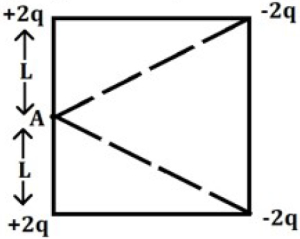
The electric charges $+2q$, $+2q$, $-2q$ and $-2q$ are placed at the corners of a square of side $2L$ as shown in the figure. The electric potential at point $A$, midway between the two charges $+2q$ and $+2q$, is $(\epsilon_0 = \text{permittivity of free space})$
A
$\frac{1}{4 \pi \epsilon_0}\left(\frac{2 q}{L}\right)\left[1+\frac{1}{\sqrt{5}}\right]$
B
$\frac{q}{\pi \epsilon_0 L}\left[1-\frac{1}{\sqrt{5}}\right]$
C
$\frac{q}{\pi \epsilon_0 L}\left[1+\frac{1}{\sqrt{5}}\right]$
D
$\frac{1}{4 \pi \epsilon_0}\left(\frac{2 q}{L}\right)\left[1-\frac{1}{\sqrt{5}}\right]$
Solution
(B) The electric potential $V$ at a point due to a charge $q$ at a distance $r$ is given by $V = \frac{1}{4\pi\epsilon_0} \frac{q}{r}$.
Point $A$ is at the midpoint of the side with charges $+2q$ and $+2q$. The distance of $A$ from each of these charges is $L$.
The distance of $A$ from each of the charges $-2q$ at the opposite corners can be found using the Pythagorean theorem. The horizontal distance is $2L$ and the vertical distance is $L$, so the distance $r = \sqrt{(2L)^2 + L^2} = \sqrt{5L^2} = L\sqrt{5}$.
The total potential at $A$ is the sum of potentials due to all four charges:
$V_A = \frac{1}{4\pi\epsilon_0} \left[ \frac{2q}{L} + \frac{2q}{L} + \frac{-2q}{L\sqrt{5}} + \frac{-2q}{L\sqrt{5}} \right]$
$V_A = \frac{1}{4\pi\epsilon_0} \left[ \frac{4q}{L} - \frac{4q}{L\sqrt{5}} \right]$
$V_A = \frac{4q}{4\pi\epsilon_0 L} \left[ 1 - \frac{1}{\sqrt{5}} \right] = \frac{q}{\pi\epsilon_0 L} \left[ 1 - \frac{1}{\sqrt{5}} \right]$.
Point $A$ is at the midpoint of the side with charges $+2q$ and $+2q$. The distance of $A$ from each of these charges is $L$.
The distance of $A$ from each of the charges $-2q$ at the opposite corners can be found using the Pythagorean theorem. The horizontal distance is $2L$ and the vertical distance is $L$, so the distance $r = \sqrt{(2L)^2 + L^2} = \sqrt{5L^2} = L\sqrt{5}$.
The total potential at $A$ is the sum of potentials due to all four charges:
$V_A = \frac{1}{4\pi\epsilon_0} \left[ \frac{2q}{L} + \frac{2q}{L} + \frac{-2q}{L\sqrt{5}} + \frac{-2q}{L\sqrt{5}} \right]$
$V_A = \frac{1}{4\pi\epsilon_0} \left[ \frac{4q}{L} - \frac{4q}{L\sqrt{5}} \right]$
$V_A = \frac{4q}{4\pi\epsilon_0 L} \left[ 1 - \frac{1}{\sqrt{5}} \right] = \frac{q}{\pi\epsilon_0 L} \left[ 1 - \frac{1}{\sqrt{5}} \right]$.
0 likes
View Solution326
MediumMCQ
$A$ regular hexagon of side $6 \ cm$ has a charge of $2 \ \mu C$ at each of its vertices. What is the potential at the centre of the hexagon? $\left[\frac{1}{4 \pi \epsilon_0}=9 \times 10^9 \text{ SI units}\right]$
A
$1.5 \times 10^5 \ V$
B
$1.8 \times 10^6 \ V$
C
$2.4 \times 10^5 \ V$
D
$3.2 \times 10^6 \ V$
Solution
(B) In a regular hexagon,the distance from the centre to each vertex is equal to the side length of the hexagon. Given side $a = 6 \ cm = 0.06 \ m$.
Since there are $6$ vertices,each with a charge $q = 2 \ \mu C = 2 \times 10^{-6} \ C$,the total potential $V$ at the centre is the sum of the potentials due to each charge.
$V = 6 \times \left( \frac{1}{4 \pi \epsilon_0} \cdot \frac{q}{a} \right)$
Substituting the values:
$V = 6 \times 9 \times 10^9 \times \frac{2 \times 10^{-6}}{0.06}$
$V = 54 \times 10^9 \times \frac{2 \times 10^{-6}}{6 \times 10^{-2}}$
$V = 54 \times 10^9 \times \frac{1}{3} \times 10^{-4}$
$V = 18 \times 10^5 \ V = 1.8 \times 10^6 \ V$.
Since there are $6$ vertices,each with a charge $q = 2 \ \mu C = 2 \times 10^{-6} \ C$,the total potential $V$ at the centre is the sum of the potentials due to each charge.
$V = 6 \times \left( \frac{1}{4 \pi \epsilon_0} \cdot \frac{q}{a} \right)$
Substituting the values:
$V = 6 \times 9 \times 10^9 \times \frac{2 \times 10^{-6}}{0.06}$
$V = 54 \times 10^9 \times \frac{2 \times 10^{-6}}{6 \times 10^{-2}}$
$V = 54 \times 10^9 \times \frac{1}{3} \times 10^{-4}$
$V = 18 \times 10^5 \ V = 1.8 \times 10^6 \ V$.
0 likes
View Solution327
MediumMCQ
Charges of $2 \mu C$ and $-3 \mu C$ are placed at two points $A$ and $B$ separated by a distance of $1 \ m$. The distance of the point from $A$ where the net potential is zero is: (in $m$)
A
$0.4$
B
$0.5$
C
$0.6$
D
$0.667$
Solution
(A) Let the point where the net potential is zero be at a distance $x$ from charge $A$ $(2 \mu C)$ along the line joining $A$ and $B$.
The potential $V$ due to a point charge $q$ at a distance $r$ is given by $V = \frac{kq}{r}$.
For the net potential to be zero,the sum of potentials from both charges must be zero:
$V_A + V_B = 0$
$\frac{k(2 \times 10^{-6})}{x} + \frac{k(-3 \times 10^{-6})}{1 - x} = 0$
$\frac{2}{x} = \frac{3}{1 - x}$
$2(1 - x) = 3x$
$2 - 2x = 3x$
$2 = 5x$
$x = \frac{2}{5} = 0.4 \ m$.
Thus,the distance from $A$ is $0.4 \ m$.
The potential $V$ due to a point charge $q$ at a distance $r$ is given by $V = \frac{kq}{r}$.
For the net potential to be zero,the sum of potentials from both charges must be zero:
$V_A + V_B = 0$
$\frac{k(2 \times 10^{-6})}{x} + \frac{k(-3 \times 10^{-6})}{1 - x} = 0$
$\frac{2}{x} = \frac{3}{1 - x}$
$2(1 - x) = 3x$
$2 - 2x = 3x$
$2 = 5x$
$x = \frac{2}{5} = 0.4 \ m$.
Thus,the distance from $A$ is $0.4 \ m$.
0 likes
View Solution328
EasyMCQ
Two conducting spheres of radii $r_1$ and $r_2$ are equally charged. The ratio of their potentials is (potential of $r_1$ to potential of $r_2$):
A
$r_1^2/r_2^2$
B
$r_2^2/r_1^2$
C
$r_1/r_2$
D
$r_2/r_1$
Solution
(D) The potential $V$ of a conducting sphere of radius $r$ carrying a charge $q$ is given by the formula $V = \frac{1}{4\pi\epsilon_0} \frac{q}{r}$.
Given that both spheres have the same charge,let $q_1 = q_2 = q$.
The potential of the first sphere is $V_1 = \frac{1}{4\pi\epsilon_0} \frac{q}{r_1}$.
The potential of the second sphere is $V_2 = \frac{1}{4\pi\epsilon_0} \frac{q}{r_2}$.
The ratio of their potentials is $\frac{V_1}{V_2} = \frac{\frac{1}{4\pi\epsilon_0} \frac{q}{r_1}}{\frac{1}{4\pi\epsilon_0} \frac{q}{r_2}} = \frac{r_2}{r_1}$.
Therefore,the correct option is $D$.
Given that both spheres have the same charge,let $q_1 = q_2 = q$.
The potential of the first sphere is $V_1 = \frac{1}{4\pi\epsilon_0} \frac{q}{r_1}$.
The potential of the second sphere is $V_2 = \frac{1}{4\pi\epsilon_0} \frac{q}{r_2}$.
The ratio of their potentials is $\frac{V_1}{V_2} = \frac{\frac{1}{4\pi\epsilon_0} \frac{q}{r_1}}{\frac{1}{4\pi\epsilon_0} \frac{q}{r_2}} = \frac{r_2}{r_1}$.
Therefore,the correct option is $D$.
0 likes
View Solution329
EasyMCQ
$90 \ J$ of work is done to move an electric charge of magnitude $3 \ C$ from a place $A$,where potential is $-10 \ V$,to another place $B$,where potential is $V_1 \ V$. The value of $V_1$ is: (in $V$)
A
$10$
B
$20$
C
$30$
D
$-40$
Solution
(B) The work done $W$ in moving a charge $q$ from point $A$ to point $B$ is given by the formula: $W = q(V_B - V_A)$.
Given:
Work done $W = 90 \ J$
Charge $q = 3 \ C$
Potential at $A$,$V_A = -10 \ V$
Potential at $B$,$V_B = V_1$
Substituting the values in the formula:
$90 = 3 \times (V_1 - (-10))$
$90 = 3 \times (V_1 + 10)$
Divide both sides by $3$:
$30 = V_1 + 10$
$V_1 = 30 - 10$
$V_1 = 20 \ V$.
Given:
Work done $W = 90 \ J$
Charge $q = 3 \ C$
Potential at $A$,$V_A = -10 \ V$
Potential at $B$,$V_B = V_1$
Substituting the values in the formula:
$90 = 3 \times (V_1 - (-10))$
$90 = 3 \times (V_1 + 10)$
Divide both sides by $3$:
$30 = V_1 + 10$
$V_1 = 30 - 10$
$V_1 = 20 \ V$.
0 likes
View Solution330
MediumMCQ
Four point charges each $+q$ are placed on the circumference of a circle of diameter $2d$ in such a way that they form a square. The potential at the centre is proportional to
A
$q^2/d^2$
B
$q/d$
C
$d/q$
D
$d^2/q^2$
Solution
(B) The charges are placed on the circumference of a circle of diameter $2d$. The radius of the circle is $r = \text{Diameter} / 2 = (2d) / 2 = d$.
Since the charges form a square inscribed in the circle,each charge is at a distance $r = d$ from the center.
The electric potential $V$ at the center due to a single point charge $q$ at distance $r$ is given by $V = \frac{1}{4 \pi \varepsilon_0} \frac{q}{r}$.
Since there are four identical charges,the total potential $V_{total}$ at the center is the sum of the potentials due to each charge:
$V_{total} = \frac{1}{4 \pi \varepsilon_0} \left( \frac{q}{d} + \frac{q}{d} + \frac{q}{d} + \frac{q}{d} \right)$
$V_{total} = \frac{1}{4 \pi \varepsilon_0} \left( \frac{4q}{d} \right) = \frac{q}{\pi \varepsilon_0 d}$.
Thus,the potential at the center is proportional to $q/d$.
Since the charges form a square inscribed in the circle,each charge is at a distance $r = d$ from the center.
The electric potential $V$ at the center due to a single point charge $q$ at distance $r$ is given by $V = \frac{1}{4 \pi \varepsilon_0} \frac{q}{r}$.
Since there are four identical charges,the total potential $V_{total}$ at the center is the sum of the potentials due to each charge:
$V_{total} = \frac{1}{4 \pi \varepsilon_0} \left( \frac{q}{d} + \frac{q}{d} + \frac{q}{d} + \frac{q}{d} \right)$
$V_{total} = \frac{1}{4 \pi \varepsilon_0} \left( \frac{4q}{d} \right) = \frac{q}{\pi \varepsilon_0 d}$.
Thus,the potential at the center is proportional to $q/d$.
0 likes
View Solution331
MediumMCQ
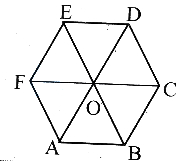
$A$ regular hexagon of side $10 \text{ cm}$ has a charge of $1 \mu\text{C}$ at each of its vertices. The potential at the centre of the hexagon is $\left[\frac{1}{4 \pi \varepsilon_0} = 9 \times 10^9 \text{ SI unit}\right]$.
A
$1.8 \times 10^5 \text{ volt}$
B
$3.6 \times 10^5 \text{ volt}$
C
$5.4 \times 10^5 \text{ volt}$
D
$7.2 \times 10^5 \text{ volt}$
Solution
(C) The potential at the centre $O$ of the hexagon due to a charge $q$ at each vertex is the sum of the potentials due to each individual charge.
Since the distance from the centre to each vertex of a regular hexagon is equal to the side length $r = 10 \text{ cm} = 0.1 \text{ m}$,the potential $V$ at the centre is given by:
$V = 6 \times \left( \frac{1}{4 \pi \varepsilon_0} \cdot \frac{q}{r} \right)$
Given $q = 1 \mu\text{C} = 1 \times 10^{-6} \text{ C}$,$r = 0.1 \text{ m}$,and $\frac{1}{4 \pi \varepsilon_0} = 9 \times 10^9 \text{ N m}^2/\text{C}^2$:
$V = 6 \times \left( 9 \times 10^9 \times \frac{1 \times 10^{-6}}{0.1} \right)$
$V = 6 \times 9 \times 10^9 \times 10^{-5}$
$V = 54 \times 10^4 = 5.4 \times 10^5 \text{ volt}$.
Since the distance from the centre to each vertex of a regular hexagon is equal to the side length $r = 10 \text{ cm} = 0.1 \text{ m}$,the potential $V$ at the centre is given by:
$V = 6 \times \left( \frac{1}{4 \pi \varepsilon_0} \cdot \frac{q}{r} \right)$
Given $q = 1 \mu\text{C} = 1 \times 10^{-6} \text{ C}$,$r = 0.1 \text{ m}$,and $\frac{1}{4 \pi \varepsilon_0} = 9 \times 10^9 \text{ N m}^2/\text{C}^2$:
$V = 6 \times \left( 9 \times 10^9 \times \frac{1 \times 10^{-6}}{0.1} \right)$
$V = 6 \times 9 \times 10^9 \times 10^{-5}$
$V = 54 \times 10^4 = 5.4 \times 10^5 \text{ volt}$.
0 likes
View Solution332
EasyMCQ
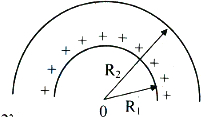
The electric potential at the centre of two concentric half rings of radii $R_1$ and $R_2$,having the same linear charge density $\lambda$,is $(\varepsilon_0 = \text{permittivity of free space})$
A
$\frac{2 \lambda}{\varepsilon_0}$
B
$\frac{\lambda}{2 \varepsilon_0}$
C
$\frac{\lambda}{4 \varepsilon_0}$
D
$\frac{\lambda}{\varepsilon_0}$
Solution
(B) The electric potential $V$ due to a charged arc at its centre is given by $V = \frac{1}{4 \pi \varepsilon_0} \frac{Q}{R}$,where $Q$ is the total charge on the arc and $R$ is its radius.
For a half ring of radius $R$,the total charge $Q = \lambda \times (\pi R)$.
Thus,the potential at the centre due to the first half ring is $V_1 = \frac{1}{4 \pi \varepsilon_0} \frac{\lambda (\pi R_1)}{R_1} = \frac{\lambda}{4 \varepsilon_0}$.
Similarly,the potential at the centre due to the second half ring is $V_2 = \frac{1}{4 \pi \varepsilon_0} \frac{\lambda (\pi R_2)}{R_2} = \frac{\lambda}{4 \varepsilon_0}$.
The net potential at the centre is $V_{net} = V_1 + V_2 = \frac{\lambda}{4 \varepsilon_0} + \frac{\lambda}{4 \varepsilon_0} = \frac{\lambda}{2 \varepsilon_0}$.
For a half ring of radius $R$,the total charge $Q = \lambda \times (\pi R)$.
Thus,the potential at the centre due to the first half ring is $V_1 = \frac{1}{4 \pi \varepsilon_0} \frac{\lambda (\pi R_1)}{R_1} = \frac{\lambda}{4 \varepsilon_0}$.
Similarly,the potential at the centre due to the second half ring is $V_2 = \frac{1}{4 \pi \varepsilon_0} \frac{\lambda (\pi R_2)}{R_2} = \frac{\lambda}{4 \varepsilon_0}$.
The net potential at the centre is $V_{net} = V_1 + V_2 = \frac{\lambda}{4 \varepsilon_0} + \frac{\lambda}{4 \varepsilon_0} = \frac{\lambda}{2 \varepsilon_0}$.
0 likes
View Solution333
EasyMCQ
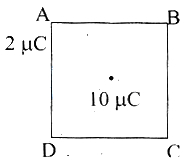
If a $10 \mu C$ charge exists at the centre of a square,the work done in moving a $2 \mu C$ point charge from corner $A$ to corner $B$ of a square $ABCD$ is
A
Zero
B
$2$
C
$5$
D
$20$
Solution
(A) The electric potential $V$ at any point at a distance $r$ from a point charge $Q$ is given by $V = \frac{kQ}{r}$.
Since the charge $10 \mu C$ is at the centre of the square,all four corners $(A, B, C, D)$ are at the same distance $r$ from the centre.
Therefore,the electric potential at corner $A$ $(V_A)$ and corner $B$ $(V_B)$ are equal,i.e.,$V_A = V_B$.
The work done $W$ in moving a charge $q$ from point $A$ to point $B$ is given by $W = q(V_B - V_A)$.
Since $V_A = V_B$,the potential difference $(V_B - V_A) = 0$.
Thus,the work done $W = 2 \mu C \times 0 = 0$.
Since the charge $10 \mu C$ is at the centre of the square,all four corners $(A, B, C, D)$ are at the same distance $r$ from the centre.
Therefore,the electric potential at corner $A$ $(V_A)$ and corner $B$ $(V_B)$ are equal,i.e.,$V_A = V_B$.
The work done $W$ in moving a charge $q$ from point $A$ to point $B$ is given by $W = q(V_B - V_A)$.
Since $V_A = V_B$,the potential difference $(V_B - V_A) = 0$.
Thus,the work done $W = 2 \mu C \times 0 = 0$.
0 likes
View Solution334
MediumMCQ
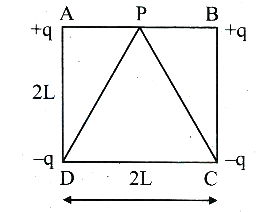
Four electric charges $+q, +q, -q$ and $-q$ are placed in order at the corners of a square of side $2L$. The electric potential at point $P$,which is midway between the two positive charges,is:
A
$\frac{1}{4 \pi \varepsilon_0} \frac{2q}{L} \left(1 + \frac{1}{\sqrt{5}}\right)$
B
$\frac{1}{4 \pi \varepsilon_0} \frac{2q}{L} \left(1 - \frac{1}{\sqrt{5}}\right)$
C
$\frac{1}{4 \pi \varepsilon_0} \frac{2q}{L} (1 - \sqrt{5})$
D
$\frac{1}{4 \pi \varepsilon_0} \frac{2q}{L} (1 + \sqrt{5})$
Solution
(B) Let the square be $ABCD$ with side length $2L$. The charges are placed as follows: $A(+q), B(+q), C(-q), D(-q)$. Point $P$ is the midpoint of side $AB$.
The distances from point $P$ to the charges are:
$AP = L$
$BP = L$
$DP = \sqrt{(2L)^2 + L^2} = \sqrt{5L^2} = L\sqrt{5}$
$CP = \sqrt{(2L)^2 + L^2} = \sqrt{5L^2} = L\sqrt{5}$
The total electric potential $V$ at point $P$ is the sum of potentials due to individual charges:
$V = V_A + V_B + V_C + V_D$
$V = \frac{1}{4 \pi \varepsilon_0} \left( \frac{q}{AP} + \frac{q}{BP} + \frac{-q}{CP} + \frac{-q}{DP} \right)$
$V = \frac{1}{4 \pi \varepsilon_0} \left( \frac{q}{L} + \frac{q}{L} - \frac{q}{L\sqrt{5}} - \frac{q}{L\sqrt{5}} \right)$
$V = \frac{1}{4 \pi \varepsilon_0} \left( \frac{2q}{L} - \frac{2q}{L\sqrt{5}} \right)$
$V = \frac{1}{4 \pi \varepsilon_0} \frac{2q}{L} \left( 1 - \frac{1}{\sqrt{5}} \right)$
The distances from point $P$ to the charges are:
$AP = L$
$BP = L$
$DP = \sqrt{(2L)^2 + L^2} = \sqrt{5L^2} = L\sqrt{5}$
$CP = \sqrt{(2L)^2 + L^2} = \sqrt{5L^2} = L\sqrt{5}$
The total electric potential $V$ at point $P$ is the sum of potentials due to individual charges:
$V = V_A + V_B + V_C + V_D$
$V = \frac{1}{4 \pi \varepsilon_0} \left( \frac{q}{AP} + \frac{q}{BP} + \frac{-q}{CP} + \frac{-q}{DP} \right)$
$V = \frac{1}{4 \pi \varepsilon_0} \left( \frac{q}{L} + \frac{q}{L} - \frac{q}{L\sqrt{5}} - \frac{q}{L\sqrt{5}} \right)$
$V = \frac{1}{4 \pi \varepsilon_0} \left( \frac{2q}{L} - \frac{2q}{L\sqrt{5}} \right)$
$V = \frac{1}{4 \pi \varepsilon_0} \frac{2q}{L} \left( 1 - \frac{1}{\sqrt{5}} \right)$
0 likes
View Solution335
EasyMCQ
If a unit positive charge is shifted from a region of low potential to a region of high potential,then the electric potential energy of the system
A
increases.
B
decreases.
C
does not change.
D
is zero.
Solution
(A) The electric potential energy $U$ of a charge $q$ in an electric potential $V$ is given by $U = qV$.
When a unit positive charge $(q = 1)$ is moved from a region of low potential $(V_L)$ to a region of high potential $(V_H)$,the change in potential energy is $\Delta U = q(V_H - V_L)$.
Since $V_H > V_L$,the term $(V_H - V_L)$ is positive.
Therefore,$\Delta U > 0$,which means the potential energy increases.
Alternatively,work must be done by an external agent against the electric field to move a positive charge from low potential to high potential,and this work is stored as potential energy in the system.
When a unit positive charge $(q = 1)$ is moved from a region of low potential $(V_L)$ to a region of high potential $(V_H)$,the change in potential energy is $\Delta U = q(V_H - V_L)$.
Since $V_H > V_L$,the term $(V_H - V_L)$ is positive.
Therefore,$\Delta U > 0$,which means the potential energy increases.
Alternatively,work must be done by an external agent against the electric field to move a positive charge from low potential to high potential,and this work is stored as potential energy in the system.
0 likes
View Solution336
DifficultMCQ
Two point charges $q_1$ and $q_2$ are separated by a distance $d$. What is the increase in potential energy of the system when $q_2$ is moved towards $q_1$ by a distance $x$? $(x < d)$ (where $\frac{1}{4 \pi \varepsilon_0} = K$ is a constant).
A
$-\frac{K q_1 q_2 x}{d(d-x)}$
B
$-\frac{K q_1 q_2}{d(d-x)}$
C
$\frac{K q_1 q_2 x}{(d^2-x^2)}$
D
$\frac{K q_1 q_2 x}{(d^2-x^2)}$
Solution
(C) The electrostatic potential energy $U$ of a system of two point charges $q_1$ and $q_2$ separated by a distance $r$ is given by $U = \frac{K q_1 q_2}{r}$.
Initial potential energy $U_i$ at distance $d$ is $U_i = \frac{K q_1 q_2}{d}$.
When charge $q_2$ is moved towards $q_1$ by a distance $x$,the new separation becomes $r' = d - x$.
The final potential energy $U_f$ is $U_f = \frac{K q_1 q_2}{d - x}$.
The increase in potential energy $\Delta U$ is given by $\Delta U = U_f - U_i$.
Substituting the values:
$\Delta U = \frac{K q_1 q_2}{d - x} - \frac{K q_1 q_2}{d}$
$\Delta U = K q_1 q_2 \left( \frac{1}{d - x} - \frac{1}{d} \right)$
$\Delta U = K q_1 q_2 \left( \frac{d - (d - x)}{d(d - x)} \right)$
$\Delta U = \frac{K q_1 q_2 x}{d(d - x)}$.
Initial potential energy $U_i$ at distance $d$ is $U_i = \frac{K q_1 q_2}{d}$.
When charge $q_2$ is moved towards $q_1$ by a distance $x$,the new separation becomes $r' = d - x$.
The final potential energy $U_f$ is $U_f = \frac{K q_1 q_2}{d - x}$.
The increase in potential energy $\Delta U$ is given by $\Delta U = U_f - U_i$.
Substituting the values:
$\Delta U = \frac{K q_1 q_2}{d - x} - \frac{K q_1 q_2}{d}$
$\Delta U = K q_1 q_2 \left( \frac{1}{d - x} - \frac{1}{d} \right)$
$\Delta U = K q_1 q_2 \left( \frac{d - (d - x)}{d(d - x)} \right)$
$\Delta U = \frac{K q_1 q_2 x}{d(d - x)}$.
0 likes
View Solution337
DifficultMCQ
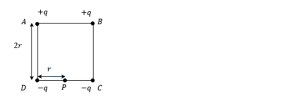
Four electric charges $+q, +q, -q$ and $-q$ are placed in order at the corners of a square of side $2r$. The electric potential at a point $P$ midway between the two negative charges is:
A
$\frac{1}{4 \pi \varepsilon_0} \frac{2q}{r}[1-\sqrt{5}]$
B
$\frac{1}{4 \pi \varepsilon_0} \frac{2q}{r}\left[\frac{1}{\sqrt{5}}+1\right]$
C
$\frac{1}{4 \pi \varepsilon_0} \frac{2q}{r}\left[\frac{1}{\sqrt{5}}-1\right]$
D
Zero
Solution
(C) Let the corners of the square be $A, B, C, D$ in order,with charges $+q$ at $A$ and $B$,and $-q$ at $C$ and $D$. The side length is $2r$. Point $P$ is the midpoint of side $CD$.
Thus,the distances are: $DP = PC = r$.
The distances from $A$ and $B$ to $P$ are: $AP = BP = \sqrt{AD^2 + DP^2} = \sqrt{(2r)^2 + r^2} = \sqrt{5r^2} = r\sqrt{5}$.
The electric potential $V_P$ at point $P$ is the sum of potentials due to all four charges:
$V_P = \frac{1}{4 \pi \varepsilon_0} \left[ \frac{q}{AP} + \frac{q}{BP} + \frac{-q}{CP} + \frac{-q}{DP} \right]$
$V_P = \frac{1}{4 \pi \varepsilon_0} \left[ \frac{q}{r\sqrt{5}} + \frac{q}{r\sqrt{5}} - \frac{q}{r} - \frac{q}{r} \right]$
$V_P = \frac{1}{4 \pi \varepsilon_0} \left[ \frac{2q}{r\sqrt{5}} - \frac{2q}{r} \right]$
$V_P = \frac{1}{4 \pi \varepsilon_0} \frac{2q}{r} \left[ \frac{1}{\sqrt{5}} - 1 \right]$
Thus,the distances are: $DP = PC = r$.
The distances from $A$ and $B$ to $P$ are: $AP = BP = \sqrt{AD^2 + DP^2} = \sqrt{(2r)^2 + r^2} = \sqrt{5r^2} = r\sqrt{5}$.
The electric potential $V_P$ at point $P$ is the sum of potentials due to all four charges:
$V_P = \frac{1}{4 \pi \varepsilon_0} \left[ \frac{q}{AP} + \frac{q}{BP} + \frac{-q}{CP} + \frac{-q}{DP} \right]$
$V_P = \frac{1}{4 \pi \varepsilon_0} \left[ \frac{q}{r\sqrt{5}} + \frac{q}{r\sqrt{5}} - \frac{q}{r} - \frac{q}{r} \right]$
$V_P = \frac{1}{4 \pi \varepsilon_0} \left[ \frac{2q}{r\sqrt{5}} - \frac{2q}{r} \right]$
$V_P = \frac{1}{4 \pi \varepsilon_0} \frac{2q}{r} \left[ \frac{1}{\sqrt{5}} - 1 \right]$
0 likes
View Solution338
EasyMCQ
$A$ hollow charged metal sphere has radius $R$. If the potential difference between its surface and a point at a distance $5R$ from the centre is $V$,then the magnitude of the electric field intensity at a distance $5R$ from the centre of the sphere is:
A
$\frac{V}{2R}$
B
$\frac{V}{20R}$
C
$10VR$
D
$20VR$
Solution
(B) The potential at the surface of the sphere is $V_s = \frac{1}{4\pi\epsilon_0} \frac{q}{R}$.
The potential at a distance $5R$ from the centre is $V_p = \frac{1}{4\pi\epsilon_0} \frac{q}{5R}$.
The potential difference $V$ is given by $V = V_s - V_p = \frac{q}{4\pi\epsilon_0} (\frac{1}{R} - \frac{1}{5R}) = \frac{q}{4\pi\epsilon_0} (\frac{4}{5R}) = \frac{q}{5\pi\epsilon_0 R}$.
From this,we can express the charge $q$ as $q = \frac{5\pi\epsilon_0 RV}{1}$.
The electric field intensity $E$ at a distance $r = 5R$ is given by $E = \frac{1}{4\pi\epsilon_0} \frac{q}{r^2} = \frac{1}{4\pi\epsilon_0} \frac{q}{(5R)^2} = \frac{q}{100\pi\epsilon_0 R^2}$.
Substituting the value of $q$ in terms of $V$: $E = \frac{1}{100\pi\epsilon_0 R^2} \cdot (5\pi\epsilon_0 RV) = \frac{5}{100} \frac{V}{R} = \frac{V}{20R}$.
The potential at a distance $5R$ from the centre is $V_p = \frac{1}{4\pi\epsilon_0} \frac{q}{5R}$.
The potential difference $V$ is given by $V = V_s - V_p = \frac{q}{4\pi\epsilon_0} (\frac{1}{R} - \frac{1}{5R}) = \frac{q}{4\pi\epsilon_0} (\frac{4}{5R}) = \frac{q}{5\pi\epsilon_0 R}$.
From this,we can express the charge $q$ as $q = \frac{5\pi\epsilon_0 RV}{1}$.
The electric field intensity $E$ at a distance $r = 5R$ is given by $E = \frac{1}{4\pi\epsilon_0} \frac{q}{r^2} = \frac{1}{4\pi\epsilon_0} \frac{q}{(5R)^2} = \frac{q}{100\pi\epsilon_0 R^2}$.
Substituting the value of $q$ in terms of $V$: $E = \frac{1}{100\pi\epsilon_0 R^2} \cdot (5\pi\epsilon_0 RV) = \frac{5}{100} \frac{V}{R} = \frac{V}{20R}$.
0 likes
View Solution339
MediumMCQ
$A$ uniformly charged half-ring of radius $R$ has a linear charge density $\sigma$. The electric potential at the centre of the half-ring is ($\epsilon_0$ = permittivity of free space).
A
$\frac{\sigma}{6 \epsilon_0}$
B
$\frac{\sigma}{2 \epsilon_0}$
C
$\frac{\sigma}{\epsilon_0}$
D
$\frac{\sigma}{4 \epsilon_0}$
Solution
(D) The electric potential $dV$ due to a small charge element $dq$ at the centre of the ring is given by $dV = \frac{1}{4 \pi \epsilon_0} \cdot \frac{dq}{R}$.
Since the ring is a half-ring,the total charge $q$ is the product of the linear charge density $\sigma$ and the length of the half-ring $(L = \pi R)$.
Thus,$q = \sigma \cdot \pi R$.
The total potential $V$ at the centre is the integral of $dV$ over the entire half-ring:
$V = \int dV = \int \frac{1}{4 \pi \epsilon_0} \cdot \frac{dq}{R} = \frac{1}{4 \pi \epsilon_0 R} \int dq$.
Substituting the total charge $q = \sigma \pi R$:
$V = \frac{1}{4 \pi \epsilon_0 R} \cdot (\sigma \pi R) = \frac{\sigma}{4 \epsilon_0}$.
Since the ring is a half-ring,the total charge $q$ is the product of the linear charge density $\sigma$ and the length of the half-ring $(L = \pi R)$.
Thus,$q = \sigma \cdot \pi R$.
The total potential $V$ at the centre is the integral of $dV$ over the entire half-ring:
$V = \int dV = \int \frac{1}{4 \pi \epsilon_0} \cdot \frac{dq}{R} = \frac{1}{4 \pi \epsilon_0 R} \int dq$.
Substituting the total charge $q = \sigma \pi R$:
$V = \frac{1}{4 \pi \epsilon_0 R} \cdot (\sigma \pi R) = \frac{\sigma}{4 \epsilon_0}$.
0 likes
View Solution340
DifficultMCQ
Two spherical conductors of radii $4 \ cm$ and $5 \ cm$ are charged to the same potential. If $\sigma_1$ and $\sigma_2$ are the respective values of the surface charge density on the two conductors,then the ratio $\sigma_1 : \sigma_2$ is
A
$5$:$4$
B
$3$:$2$
C
$4$:$3$
D
$2$:$1$
Solution
(A) Given that the two spherical conductors are at the same potential $V$.
For a spherical conductor of radius $r$ and charge $q$,the potential is given by $V = \frac{1}{4 \pi \varepsilon_0} \cdot \frac{q}{r}$.
Since $V_1 = V_2$,we have $\frac{q_1}{r_1} = \frac{q_2}{r_2}$,which implies $\frac{q_1}{q_2} = \frac{r_1}{r_2}$.
The surface charge density $\sigma$ is defined as $\sigma = \frac{q}{4 \pi r^2}$.
Therefore,the ratio of surface charge densities is $\frac{\sigma_1}{\sigma_2} = \frac{q_1 / (4 \pi r_1^2)}{q_2 / (4 \pi r_2^2)} = \frac{q_1}{q_2} \cdot \frac{r_2^2}{r_1^2}$.
Substituting $\frac{q_1}{q_2} = \frac{r_1}{r_2}$,we get $\frac{\sigma_1}{\sigma_2} = \frac{r_1}{r_2} \cdot \frac{r_2^2}{r_1^2} = \frac{r_2}{r_1}$.
Given $r_1 = 4 \ cm$ and $r_2 = 5 \ cm$,the ratio is $\frac{\sigma_1}{\sigma_2} = \frac{5}{4}$.
For a spherical conductor of radius $r$ and charge $q$,the potential is given by $V = \frac{1}{4 \pi \varepsilon_0} \cdot \frac{q}{r}$.
Since $V_1 = V_2$,we have $\frac{q_1}{r_1} = \frac{q_2}{r_2}$,which implies $\frac{q_1}{q_2} = \frac{r_1}{r_2}$.
The surface charge density $\sigma$ is defined as $\sigma = \frac{q}{4 \pi r^2}$.
Therefore,the ratio of surface charge densities is $\frac{\sigma_1}{\sigma_2} = \frac{q_1 / (4 \pi r_1^2)}{q_2 / (4 \pi r_2^2)} = \frac{q_1}{q_2} \cdot \frac{r_2^2}{r_1^2}$.
Substituting $\frac{q_1}{q_2} = \frac{r_1}{r_2}$,we get $\frac{\sigma_1}{\sigma_2} = \frac{r_1}{r_2} \cdot \frac{r_2^2}{r_1^2} = \frac{r_2}{r_1}$.
Given $r_1 = 4 \ cm$ and $r_2 = 5 \ cm$,the ratio is $\frac{\sigma_1}{\sigma_2} = \frac{5}{4}$.
0 likes
View Solution341
EasyMCQ
Two particles $A$ and $B$ having the same mass have charges $+q$ and $+4q$ respectively. When they are allowed to fall from rest through the same electric potential difference,the ratio of their speeds $v_A$ to $v_B$ will be:
A
$1$:$2$
B
$2$:$1$
C
$1$:$4$
D
$4$:$1$
Solution
(A) The kinetic energy gained by a particle of charge $q$ and mass $m$ falling through a potential difference $V$ is given by $K = qV = \frac{1}{2}mv^2$.
For particle $A$ with charge $q$:
$\frac{1}{2}mv_A^2 = qV$ (Equation $1$)
For particle $B$ with charge $4q$:
$\frac{1}{2}mv_B^2 = 4qV$ (Equation $2$)
Dividing Equation $1$ by Equation $2$:
$\frac{v_A^2}{v_B^2} = \frac{qV}{4qV} = \frac{1}{4}$
Taking the square root on both sides:
$\frac{v_A}{v_B} = \sqrt{\frac{1}{4}} = \frac{1}{2}$
Therefore,the ratio of their speeds $v_A : v_B$ is $1:2$.
For particle $A$ with charge $q$:
$\frac{1}{2}mv_A^2 = qV$ (Equation $1$)
For particle $B$ with charge $4q$:
$\frac{1}{2}mv_B^2 = 4qV$ (Equation $2$)
Dividing Equation $1$ by Equation $2$:
$\frac{v_A^2}{v_B^2} = \frac{qV}{4qV} = \frac{1}{4}$
Taking the square root on both sides:
$\frac{v_A}{v_B} = \sqrt{\frac{1}{4}} = \frac{1}{2}$
Therefore,the ratio of their speeds $v_A : v_B$ is $1:2$.
0 likes
View Solution342
EasyMCQ
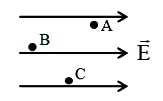
Let $A, B$ and $C$ be the three points in a uniform electric field $(\overrightarrow{E})$ as shown. The electric potential is
A
maximum at point $C$
B
maximum at point $A$
C
maximum at point $B$
D
same at all points $A, B$ and $C$
Solution
(C) The electric potential $V$ in an electric field $\overrightarrow{E}$ is given by the relation $dV = -\overrightarrow{E} \cdot d\overrightarrow{r}$.
This implies that the electric potential decreases as we move in the direction of the electric field.
In the given figure,point $B$ is at the leftmost position,meaning it is at the highest potential among the three points.
Points $A$ and $C$ are further along the direction of the electric field compared to point $B$,so their potentials will be lower than that of point $B$.
Therefore,the electric potential is maximum at point $B$.
This implies that the electric potential decreases as we move in the direction of the electric field.
In the given figure,point $B$ is at the leftmost position,meaning it is at the highest potential among the three points.
Points $A$ and $C$ are further along the direction of the electric field compared to point $B$,so their potentials will be lower than that of point $B$.
Therefore,the electric potential is maximum at point $B$.
0 likes
View Solution343
MediumMCQ
$A$ charged spherical conductor has radius '$r$'. The potential difference between its surface and a point at a distance '$3r$' from the center is '$V$'. The electric intensity at a distance '$3r$' from the center of the conductor is:
A
$\frac{V}{8r}$
B
$\frac{V}{2r}$
C
$\frac{V}{4r}$
D
$\frac{V}{6r}$
Solution
(D) The potential at the surface of the conductor is $V_s = \frac{q}{4\pi\varepsilon_0 r}$.
The potential at a distance $3r$ from the center is $V_p = \frac{q}{4\pi\varepsilon_0 (3r)}$.
The potential difference $V$ is given by $V = V_s - V_p = \frac{q}{4\pi\varepsilon_0 r} - \frac{q}{12\pi\varepsilon_0 r} = \frac{q}{4\pi\varepsilon_0 r} \left(1 - \frac{1}{3}\right) = \frac{2q}{12\pi\varepsilon_0 r} = \frac{q}{6\pi\varepsilon_0 r}$.
Thus,$\frac{q}{4\pi\varepsilon_0} = \frac{3}{2} Vr$.
The electric intensity $E$ at a distance $3r$ is $E = \frac{q}{4\pi\varepsilon_0 (3r)^2} = \frac{q}{4\pi\varepsilon_0 (9r^2)}$.
Substituting the value of $\frac{q}{4\pi\varepsilon_0}$,we get $E = \frac{3Vr}{2(9r^2)} = \frac{V}{6r}$.
The potential at a distance $3r$ from the center is $V_p = \frac{q}{4\pi\varepsilon_0 (3r)}$.
The potential difference $V$ is given by $V = V_s - V_p = \frac{q}{4\pi\varepsilon_0 r} - \frac{q}{12\pi\varepsilon_0 r} = \frac{q}{4\pi\varepsilon_0 r} \left(1 - \frac{1}{3}\right) = \frac{2q}{12\pi\varepsilon_0 r} = \frac{q}{6\pi\varepsilon_0 r}$.
Thus,$\frac{q}{4\pi\varepsilon_0} = \frac{3}{2} Vr$.
The electric intensity $E$ at a distance $3r$ is $E = \frac{q}{4\pi\varepsilon_0 (3r)^2} = \frac{q}{4\pi\varepsilon_0 (9r^2)}$.
Substituting the value of $\frac{q}{4\pi\varepsilon_0}$,we get $E = \frac{3Vr}{2(9r^2)} = \frac{V}{6r}$.
0 likes
View Solution344
MediumMCQ
Four electric charges $+q, +q, -q$ and $-q$ are placed in order at the corners of a square of side $2L$. The electric potential at point $P$ midway between the two positive charges is
A
$\frac{1}{4 \pi \epsilon_0} \frac{2q}{L}(1-\sqrt{5})$
B
zero
C
$\frac{1}{4 \pi \epsilon_0} \frac{2q}{L}\left(1+\frac{1}{\sqrt{5}}\right)$
D
$\frac{1}{4 \pi \epsilon_0} \frac{2q}{L}\left(1-\frac{1}{\sqrt{5}}\right)$
Solution
(D) Let the square be $ABCD$ with side length $2L$. Charges $+q$ are at $A$ and $B$,and charges $-q$ are at $D$ and $C$. Point $P$ is the midpoint of $AB$.
Distance $AP = PB = L$.
The distance from $P$ to $D$ and $C$ can be found using the Pythagorean theorem in $\triangle ADP$ and $\triangle BCP$:
$PD = PC = \sqrt{(2L)^2 + L^2} = \sqrt{4L^2 + L^2} = \sqrt{5}L$.
The electric potential $V$ at point $P$ is the sum of potentials due to all four charges:
$V = \frac{1}{4 \pi \epsilon_0} \left( \frac{q}{AP} + \frac{q}{BP} + \frac{-q}{PD} + \frac{-q}{PC} \right)$
$V = \frac{1}{4 \pi \epsilon_0} \left( \frac{q}{L} + \frac{q}{L} - \frac{q}{\sqrt{5}L} - \frac{q}{\sqrt{5}L} \right)$
$V = \frac{1}{4 \pi \epsilon_0} \left( \frac{2q}{L} - \frac{2q}{\sqrt{5}L} \right)$
$V = \frac{1}{4 \pi \epsilon_0} \frac{2q}{L} \left( 1 - \frac{1}{\sqrt{5}} \right)$
Distance $AP = PB = L$.
The distance from $P$ to $D$ and $C$ can be found using the Pythagorean theorem in $\triangle ADP$ and $\triangle BCP$:
$PD = PC = \sqrt{(2L)^2 + L^2} = \sqrt{4L^2 + L^2} = \sqrt{5}L$.
The electric potential $V$ at point $P$ is the sum of potentials due to all four charges:
$V = \frac{1}{4 \pi \epsilon_0} \left( \frac{q}{AP} + \frac{q}{BP} + \frac{-q}{PD} + \frac{-q}{PC} \right)$
$V = \frac{1}{4 \pi \epsilon_0} \left( \frac{q}{L} + \frac{q}{L} - \frac{q}{\sqrt{5}L} - \frac{q}{\sqrt{5}L} \right)$
$V = \frac{1}{4 \pi \epsilon_0} \left( \frac{2q}{L} - \frac{2q}{\sqrt{5}L} \right)$
$V = \frac{1}{4 \pi \epsilon_0} \frac{2q}{L} \left( 1 - \frac{1}{\sqrt{5}} \right)$
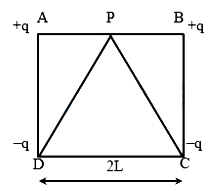
0 likes
View Solution345
EasyMCQ
$A$ radius of a spherical charged shell is $10 \ cm$ and the electric potential on its surface is $100 \ V$. Then,the potential at $2 \ cm$ from the centre of the shell will be $.......$ (in $V$)
A
$100$
B
$1$
C
$200$
D
$0$
Solution
(A) For a spherical charged shell,the electric potential at any point inside the shell is constant and equal to the potential at its surface.
Given that the radius of the shell is $R = 10 \ cm$ and the potential on the surface is $V_{surface} = 100 \ V$.
Since $2 \ cm < 10 \ cm$,the point is inside the shell.
Therefore,the potential at $2 \ cm$ from the centre is the same as the potential on the surface,which is $100 \ V$.
Given that the radius of the shell is $R = 10 \ cm$ and the potential on the surface is $V_{surface} = 100 \ V$.
Since $2 \ cm < 10 \ cm$,the point is inside the shell.
Therefore,the potential at $2 \ cm$ from the centre is the same as the potential on the surface,which is $100 \ V$.
0 likes
View Solution346
EasyMCQ
An electron is accelerated through a potential difference of $2.5 \ V$. The energy gained by the electron is . . . . . . . (Charge of an electron = $1.6 \times 10^{-19} \ C$)
A
$2.5 \ J$
B
$2.5 \ MeV$
C
$2.5 \ eV$
D
$2.5 \ erg$
Solution
(C) The energy gained by a charged particle accelerated through a potential difference $V$ is given by the formula: $E = qV$.
Here,the charge of an electron is $q = e = 1.6 \times 10^{-19} \ C$ and the potential difference is $V = 2.5 \ V$.
Therefore,the energy gained is $E = e \times 2.5 \ V = 2.5 \ eV$.
Since $1 \ eV$ is the energy gained by an electron when accelerated through a potential difference of $1 \ V$,the energy gained is $2.5 \ eV$.
Here,the charge of an electron is $q = e = 1.6 \times 10^{-19} \ C$ and the potential difference is $V = 2.5 \ V$.
Therefore,the energy gained is $E = e \times 2.5 \ V = 2.5 \ eV$.
Since $1 \ eV$ is the energy gained by an electron when accelerated through a potential difference of $1 \ V$,the energy gained is $2.5 \ eV$.
0 likes
View Solution347
EasyMCQ
Charges of $1 \mu C$ are placed at each of the four corners of a square of side $2 \sqrt{2} \text{ m}$. The potential at the point of intersection of the diagonals is . . . . . . .
A
$18 \times 10^3 \text{ V}$
B
$1800 \text{ V}$
C
$18 \sqrt{2} \times 10^3 \text{ V}$
D
None of these.
Solution
(A) The length of the diagonal of a square with side $a$ is $a \sqrt{2}$.
Given side $a = 2 \sqrt{2} \text{ m}$,the diagonal length is $d = (2 \sqrt{2}) \times \sqrt{2} = 4 \text{ m}$.
The distance $r$ of each vertex from the center (intersection of diagonals) is half the diagonal length:
$r = \frac{d}{2} = \frac{4}{2} = 2 \text{ m}$.
The electric potential $V$ at the center due to four identical charges $q = 1 \mu C = 10^{-6} \text{ C}$ at distance $r$ is given by:
$V = 4 \times \frac{k q}{r}$,where $k = 9 \times 10^9 \text{ N m}^2/\text{C}^2$.
Substituting the values:
$V = 4 \times \frac{9 \times 10^9 \times 10^{-6}}{2}$
$V = 2 \times 9 \times 10^3 = 18 \times 10^3 \text{ V}$.
Given side $a = 2 \sqrt{2} \text{ m}$,the diagonal length is $d = (2 \sqrt{2}) \times \sqrt{2} = 4 \text{ m}$.
The distance $r$ of each vertex from the center (intersection of diagonals) is half the diagonal length:
$r = \frac{d}{2} = \frac{4}{2} = 2 \text{ m}$.
The electric potential $V$ at the center due to four identical charges $q = 1 \mu C = 10^{-6} \text{ C}$ at distance $r$ is given by:
$V = 4 \times \frac{k q}{r}$,where $k = 9 \times 10^9 \text{ N m}^2/\text{C}^2$.
Substituting the values:
$V = 4 \times \frac{9 \times 10^9 \times 10^{-6}}{2}$
$V = 2 \times 9 \times 10^3 = 18 \times 10^3 \text{ V}$.
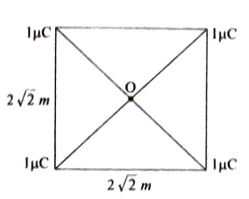
0 likes
View Solution348
EasyMCQ
$A$ total electric charge $Q$ is distributed on the surface of a sphere of radius $R$. What is the electrical potential energy of this system?
A
$\frac{k Q^2}{R}$
B
$\frac{k Q^2}{R^2}$
C
$\frac{1}{2} \frac{k Q^2}{R}$
D
$\frac{1}{2} \frac{k Q^2}{R^2}$
Solution
(C) The electrical potential energy $U$ of a charged sphere can be calculated by considering the work done in bringing small charge elements $dq$ from infinity to the surface of the sphere.
Alternatively,we can use the average potential method.
Initially,when there is no charge on the sphere,the potential $V_1 = 0$.
When the total charge $Q$ is on the sphere,the potential $V_2 = \frac{k Q}{R}$.
The average potential $V$ during the charging process is $V = \frac{V_1 + V_2}{2} = \frac{0 + \frac{k Q}{R}}{2} = \frac{k Q}{2 R}$.
The total potential energy $U$ is the work done to charge the sphere,which is given by $U = \int_0^Q V(q) dq = \int_0^Q \frac{k q}{R} dq = \frac{k}{R} \left[ \frac{q^2}{2} \right]_0^Q = \frac{1}{2} \frac{k Q^2}{R}$.
Alternatively,we can use the average potential method.
Initially,when there is no charge on the sphere,the potential $V_1 = 0$.
When the total charge $Q$ is on the sphere,the potential $V_2 = \frac{k Q}{R}$.
The average potential $V$ during the charging process is $V = \frac{V_1 + V_2}{2} = \frac{0 + \frac{k Q}{R}}{2} = \frac{k Q}{2 R}$.
The total potential energy $U$ is the work done to charge the sphere,which is given by $U = \int_0^Q V(q) dq = \int_0^Q \frac{k q}{R} dq = \frac{k}{R} \left[ \frac{q^2}{2} \right]_0^Q = \frac{1}{2} \frac{k Q^2}{R}$.
0 likes
View SolutionElectric Potential and Capacitance — Electric potential · Frequently Asked Questions
1Are these Electric Potential and Capacitance questions useful for JEE and NEET?
Yes. All questions in this section are mapped to JEE Main and NEET exam patterns. Previous year questions from JEE Main, NEET, GUJCET and state-level exams are included with full solutions.
2Can I switch to Hindi or Gujarati for these questions?
Yes. Use the language tabs in the hero section or the sidebar to view the same questions and solutions in English, Hindi or Gujarati.
3How do I generate a question paper from this subtopic?
Use the Vedclass Exam Paper Generator — select the chapter and subtopic, set difficulty, and generate Sets A, B, C, D automatically. First 3 chapters of every subject are free.
Vedclass Products
For Students
Vedclass Test Series
Mock tests in real JEE/NEET style with performance analysis. 5-day free trial.
Start Free TrialFor Teachers
Exam Paper Generator
Generate Set A/B/C/D papers from this chapter in 2 minutes. 3 chapters free.
Try FreeFor Institutes
Online Exam Module
Live online exams with unlimited students, 360° analytics & white-label branding.
See DemoFor Teachers & Institutes
Generate a Electric Potential and Capacitance Exam Paper in 2 Minutes
Select subtopic & difficulty — Sets A, B, C, D auto-generated with No Repeat logic.
First 3 chapters of every subject are free — no payment required.