
A English
Electric potential Questions in English
Class 12 Physics · Electric Potential and Capacitance · Electric potential
432+
Questions
English
Language
100%
With Solutions
Showing 50 of 432 questions in English
101
MediumMCQ
$A$ proton is $1840$ times heavier than an electron. When it is accelerated through a potential difference of $1 \ kV$,its kinetic energy is .......... $keV$.
A
$1840$
B
$1/1840$
C
$1$
D
$920$
Solution
(C) The kinetic energy $(KE)$ acquired by a charged particle of charge $q$ when accelerated through a potential difference $V$ is given by the formula:
$KE = q \times V$
Here,the charge of a proton is $q = +e$.
The accelerating potential difference is $V = 1 \ kV$.
Substituting these values into the formula:
$KE = 1e \times 1 \ kV$
$KE = 1 \ keV$
The mass of the particle does not affect the kinetic energy gained when accelerated through a potential difference,as the energy depends only on the charge and the potential difference.
$KE = q \times V$
Here,the charge of a proton is $q = +e$.
The accelerating potential difference is $V = 1 \ kV$.
Substituting these values into the formula:
$KE = 1e \times 1 \ kV$
$KE = 1 \ keV$
The mass of the particle does not affect the kinetic energy gained when accelerated through a potential difference,as the energy depends only on the charge and the potential difference.
0 likes
View Solution102
MediumMCQ
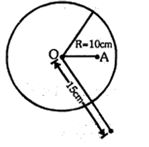
If the electric potential at a distance of $5 \, cm$ from the center of a charged conducting sphere of radius $10 \, cm$ is $V$,then what will be the potential at a point at a distance of $15 \, cm$ from the center?
A
$3 \, V$
B
$3/2 \, V$
C
$2/3 \, V$
D
$1/3 \, V$
Solution
(C) For a charged conducting sphere,the potential inside the sphere is constant and equal to the potential at its surface.
Given radius $R = 10 \, cm$.
The potential at any point inside the sphere (including the center) is equal to the potential at the surface: $V_{surface} = \frac{KQ}{R} = \frac{KQ}{10} = V$.
Thus,$KQ = 10V$.
For a point outside the sphere at a distance $r = 15 \, cm$,the potential is given by $V_{outside} = \frac{KQ}{r}$.
Substituting the values: $V_{outside} = \frac{10V}{15} = \frac{2}{3}V$.
Given radius $R = 10 \, cm$.
The potential at any point inside the sphere (including the center) is equal to the potential at the surface: $V_{surface} = \frac{KQ}{R} = \frac{KQ}{10} = V$.
Thus,$KQ = 10V$.
For a point outside the sphere at a distance $r = 15 \, cm$,the potential is given by $V_{outside} = \frac{KQ}{r}$.
Substituting the values: $V_{outside} = \frac{10V}{15} = \frac{2}{3}V$.
0 likes
View Solution103
DifficultMCQ
$A$ charge $Q$ is uniformly distributed over a rod $AB$ of length $L$ as shown in the figure. The electric potential at point $O$,which is at a distance $L$ from end $A$,is:

A
$\frac{Q}{8\pi \epsilon_0 L}$
B
$\frac{3Q}{4\pi \epsilon_0 L}$
C
$\frac{Q}{4\pi \epsilon_0 L \ln 2}$
D
$\frac{Q \ln 2}{4\pi \epsilon_0 L}$
Solution
(D) The linear charge density of the rod is $\lambda = \frac{Q}{L}$.
Consider a small element of length $dx$ at a distance $x$ from point $O$.
The charge of this element is $dq = \lambda dx = \frac{Q}{L} dx$.
The potential $dV$ at point $O$ due to this element is $dV = \frac{k dq}{x} = \frac{1}{4\pi \epsilon_0} \frac{Q}{L} \frac{dx}{x}$.
To find the total potential $V$,integrate from $x = L$ to $x = 2L$:
$V = \int_{L}^{2L} \frac{Q}{4\pi \epsilon_0 L} \frac{dx}{x} = \frac{Q}{4\pi \epsilon_0 L} [\ln x]_{L}^{2L}$.
$V = \frac{Q}{4\pi \epsilon_0 L} (\ln 2L - \ln L) = \frac{Q}{4\pi \epsilon_0 L} \ln\left(\frac{2L}{L}\right) = \frac{Q \ln 2}{4\pi \epsilon_0 L}$.
Consider a small element of length $dx$ at a distance $x$ from point $O$.
The charge of this element is $dq = \lambda dx = \frac{Q}{L} dx$.
The potential $dV$ at point $O$ due to this element is $dV = \frac{k dq}{x} = \frac{1}{4\pi \epsilon_0} \frac{Q}{L} \frac{dx}{x}$.
To find the total potential $V$,integrate from $x = L$ to $x = 2L$:
$V = \int_{L}^{2L} \frac{Q}{4\pi \epsilon_0 L} \frac{dx}{x} = \frac{Q}{4\pi \epsilon_0 L} [\ln x]_{L}^{2L}$.
$V = \frac{Q}{4\pi \epsilon_0 L} (\ln 2L - \ln L) = \frac{Q}{4\pi \epsilon_0 L} \ln\left(\frac{2L}{L}\right) = \frac{Q \ln 2}{4\pi \epsilon_0 L}$.

0 likes
View Solution104
MediumMCQ
Particle $A$ has a charge of $+q$ and particle $B$ has a charge of $+4q$. Both particles have the same mass. If they are released from rest under the same electric potential difference,what is the ratio of their speeds $V_A / V_B$?
A
$2:1$
B
$1:2$
C
$1:4$
D
$4:1$
Solution
(B) The kinetic energy gained by a particle of charge $Q$ and mass $m$ when accelerated through a potential difference $V$ is given by $K = QV$.
Since the particles start from rest,$K = \frac{1}{2}mv^2$.
Equating the two,we get $\frac{1}{2}mv^2 = QV$,which implies $v = \sqrt{\frac{2QV}{m}}$.
Since $m$ and $V$ are the same for both particles,the speed $v$ is proportional to the square root of the charge: $v \propto \sqrt{Q}$.
Therefore,the ratio of their speeds is $\frac{v_A}{v_B} = \sqrt{\frac{Q_A}{Q_B}}$.
Substituting the given values $Q_A = q$ and $Q_B = 4q$,we get $\frac{v_A}{v_B} = \sqrt{\frac{q}{4q}} = \sqrt{\frac{1}{4}} = \frac{1}{2}$.
Thus,the ratio $V_A / V_B$ is $1:2$.
Since the particles start from rest,$K = \frac{1}{2}mv^2$.
Equating the two,we get $\frac{1}{2}mv^2 = QV$,which implies $v = \sqrt{\frac{2QV}{m}}$.
Since $m$ and $V$ are the same for both particles,the speed $v$ is proportional to the square root of the charge: $v \propto \sqrt{Q}$.
Therefore,the ratio of their speeds is $\frac{v_A}{v_B} = \sqrt{\frac{Q_A}{Q_B}}$.
Substituting the given values $Q_A = q$ and $Q_B = 4q$,we get $\frac{v_A}{v_B} = \sqrt{\frac{q}{4q}} = \sqrt{\frac{1}{4}} = \frac{1}{2}$.
Thus,the ratio $V_A / V_B$ is $1:2$.
0 likes
View Solution105
EasyMCQ
$A$ hollow conducting sphere of radius $R$ carries a charge $(+Q)$ on its surface. Find the electric potential at a distance $r = R/3$ from its center.
A
Zero
B
$\frac{1}{4\pi \varepsilon_0} \frac{Q}{r}$
C
$\frac{1}{4\pi \varepsilon_0} \frac{Q}{R}$
D
$\frac{1}{4\pi \varepsilon_0} \frac{Q}{r^2}$
Solution
(C) For a hollow conducting sphere,the electric field inside the sphere is zero.
This implies that the electric potential is constant throughout the interior of the sphere.
The potential at any point inside the sphere is equal to the potential at its surface.
The potential at the surface of a sphere of radius $R$ with charge $Q$ is given by $V = \frac{1}{4\pi \varepsilon_0} \frac{Q}{R}$.
Since $r = R/3$ is inside the sphere,the potential at this point is also $\frac{1}{4\pi \varepsilon_0} \frac{Q}{R}$.
This implies that the electric potential is constant throughout the interior of the sphere.
The potential at any point inside the sphere is equal to the potential at its surface.
The potential at the surface of a sphere of radius $R$ with charge $Q$ is given by $V = \frac{1}{4\pi \varepsilon_0} \frac{Q}{R}$.
Since $r = R/3$ is inside the sphere,the potential at this point is also $\frac{1}{4\pi \varepsilon_0} \frac{Q}{R}$.
0 likes
View Solution106
MediumMCQ
The electric potentials at two points $P$ and $Q$ are $10 \ V$ and $-4 \ V$ respectively. The work done in moving $100$ electrons from $P$ to $Q$ is:
A
$22.4 \times 10^{-16} \ J$
B
$2.24 \times 10^{-16} \ J$
C
$-2.24 \times 10^{-16} \ J$
D
$9.6 \times 10^{-17} \ J$
Solution
(B) The charge of $100$ electrons is $q = 100 \times (-1.6 \times 10^{-19} \ C) = -1.6 \times 10^{-17} \ C$.
The work done $W$ in moving a charge $q$ from point $P$ to point $Q$ is given by $W = q(V_Q - V_P)$.
Substituting the given values:
$W = (-1.6 \times 10^{-17} \ C) \times (-4 \ V - 10 \ V)$
$W = (-1.6 \times 10^{-17}) \times (-14)$
$W = 22.4 \times 10^{-17} \ J$
$W = 2.24 \times 10^{-16} \ J$.
The work done $W$ in moving a charge $q$ from point $P$ to point $Q$ is given by $W = q(V_Q - V_P)$.
Substituting the given values:
$W = (-1.6 \times 10^{-17} \ C) \times (-4 \ V - 10 \ V)$
$W = (-1.6 \times 10^{-17}) \times (-14)$
$W = 22.4 \times 10^{-17} \ J$
$W = 2.24 \times 10^{-16} \ J$.
0 likes
View Solution107
EasyMCQ
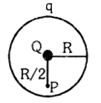
$A$ thin conducting spherical shell of radius $R$ has a charge $q$. Another charge $Q$ is placed at the center of the shell. The electrostatic potential at a point $P$ at a distance $R/2$ from the center of the shell is:
A
$\frac{2Q}{4\pi \epsilon_0 R}$
B
$\frac{2Q}{4\pi \epsilon_0 R} - \frac{2q}{4\pi \epsilon_0 R}$
C
$\frac{2Q}{4\pi \epsilon_0 R} + \frac{q}{4\pi \epsilon_0 R}$
D
$\frac{(q + Q)}{4\pi \epsilon_0} \frac{2}{R}$
Solution
(C) The total electric potential $V$ at point $P$ is the sum of the potential due to the charge $q$ on the shell and the potential due to the charge $Q$ at the center.
For a point inside a conducting shell,the potential due to the shell is constant and equal to the potential at its surface,which is $V_{shell} = \frac{1}{4\pi \epsilon_0} \frac{q}{R}$.
The potential due to the point charge $Q$ at a distance $r = R/2$ is $V_{point} = \frac{1}{4\pi \epsilon_0} \frac{Q}{R/2} = \frac{1}{4\pi \epsilon_0} \frac{2Q}{R}$.
Therefore,the total potential $V = V_{shell} + V_{point} = \frac{q}{4\pi \epsilon_0 R} + \frac{2Q}{4\pi \epsilon_0 R} = \frac{1}{4\pi \epsilon_0 R} (q + 2Q)$.
For a point inside a conducting shell,the potential due to the shell is constant and equal to the potential at its surface,which is $V_{shell} = \frac{1}{4\pi \epsilon_0} \frac{q}{R}$.
The potential due to the point charge $Q$ at a distance $r = R/2$ is $V_{point} = \frac{1}{4\pi \epsilon_0} \frac{Q}{R/2} = \frac{1}{4\pi \epsilon_0} \frac{2Q}{R}$.
Therefore,the total potential $V = V_{shell} + V_{point} = \frac{q}{4\pi \epsilon_0 R} + \frac{2Q}{4\pi \epsilon_0 R} = \frac{1}{4\pi \epsilon_0 R} (q + 2Q)$.
0 likes
View Solution108
EasyMCQ
$A$ charge of $10 \, \text{esu}$ is placed at a distance of $2 \, \text{cm}$ from a charge of $40 \, \text{esu}$ and at a distance of $4 \, \text{cm}$ from another charge of $-20 \, \text{esu}$. The potential energy of the $10 \, \text{esu}$ charge in ergs is:
A
$87.5$
B
$112.5$
C
$150$
D
$0$
Solution
(C) The potential energy $U$ of a charge $q$ in an electric field $V$ is given by $U = qV$.
In the $CGS$ system, the electrostatic constant $k = 1$.
The potential $V_A$ at the position of the $10 \, \text{esu}$ charge due to the other two charges is:
$V_A = \frac{q_B}{r_1} + \frac{q_C}{r_2}$
Given $q_B = 40 \, \text{esu}$, $r_1 = 2 \, \text{cm}$, $q_C = -20 \, \text{esu}$, and $r_2 = 4 \, \text{cm}$.
$V_A = \frac{40}{2} + \frac{-20}{4} = 20 - 5 = 15 \, \text{statvolts}$.
The potential energy $U_A$ of the $10 \, \text{esu}$ charge is:
$U_A = q_A \times V_A = 10 \times 15 = 150 \, \text{ergs}$.
In the $CGS$ system, the electrostatic constant $k = 1$.
The potential $V_A$ at the position of the $10 \, \text{esu}$ charge due to the other two charges is:
$V_A = \frac{q_B}{r_1} + \frac{q_C}{r_2}$
Given $q_B = 40 \, \text{esu}$, $r_1 = 2 \, \text{cm}$, $q_C = -20 \, \text{esu}$, and $r_2 = 4 \, \text{cm}$.
$V_A = \frac{40}{2} + \frac{-20}{4} = 20 - 5 = 15 \, \text{statvolts}$.
The potential energy $U_A$ of the $10 \, \text{esu}$ charge is:
$U_A = q_A \times V_A = 10 \times 15 = 150 \, \text{ergs}$.

0 likes
View Solution109
EasyMCQ
$A$ point charge $q$ of mass $m$ is placed at the center of a ring of radius $R$ carrying a charge $Q$. When it is slightly displaced,the point charge accelerates to infinity along the $x$-axis. The ultimate speed of the point charge is .......
A
$\sqrt{\frac{2kQq}{mR}}$
B
$\sqrt{\frac{kQq}{mR}}$
C
$\sqrt{\frac{kQq}{2mR}}$
D
$0$
Solution
(A) The potential energy of the charge $q$ at the center of the ring is $U_i = \frac{kQq}{R}$.
When the charge is at infinity,the potential energy is $U_f = 0$.
By the law of conservation of mechanical energy,the initial potential energy is converted into the final kinetic energy of the charge.
$U_i + K_i = U_f + K_f$
$\frac{kQq}{R} + 0 = 0 + \frac{1}{2}mv^2$
$\frac{1}{2}mv^2 = \frac{kQq}{R}$
$v^2 = \frac{2kQq}{mR}$
$v = \sqrt{\frac{2kQq}{mR}}$
When the charge is at infinity,the potential energy is $U_f = 0$.
By the law of conservation of mechanical energy,the initial potential energy is converted into the final kinetic energy of the charge.
$U_i + K_i = U_f + K_f$
$\frac{kQq}{R} + 0 = 0 + \frac{1}{2}mv^2$
$\frac{1}{2}mv^2 = \frac{kQq}{R}$
$v^2 = \frac{2kQq}{mR}$
$v = \sqrt{\frac{2kQq}{mR}}$
0 likes
View Solution110
EasyMCQ
$A$ charge of $20 \, C$ moves through a distance of $2 \, cm$. The work done is $2 \, J$. The potential difference between the two points is ........ $V$.
A
$0.1$
B
$8$
C
$2$
D
$0.5$
Solution
(A) The potential difference $\Delta V$ between two points is defined as the work done $W$ per unit charge $q$ to move the charge between those points.
Formula: $\Delta V = \frac{W}{q}$
Given:
Work done $W = 2 \, J$
Charge $q = 20 \, C$
Calculation:
$\Delta V = \frac{2 \, J}{20 \, C} = 0.1 \, V$
Therefore,the potential difference between the two points is $0.1 \, V$.
Formula: $\Delta V = \frac{W}{q}$
Given:
Work done $W = 2 \, J$
Charge $q = 20 \, C$
Calculation:
$\Delta V = \frac{2 \, J}{20 \, C} = 0.1 \, V$
Therefore,the potential difference between the two points is $0.1 \, V$.
0 likes
View Solution111
MediumMCQ
Identical charges $(-q)$ are placed at each corner of a cube of side $b$. The electrostatic potential energy of a charge $(+q)$ placed at the center of the cube is:
A
$\frac{8\sqrt{2}q^2}{4\pi\varepsilon_0 b}$
B
$\frac{-8\sqrt{2}q^2}{\pi\varepsilon_0 b}$
C
$\frac{-4\sqrt{2}q^2}{\pi\varepsilon_0 b}$
D
$\frac{-4q^2}{\sqrt{3}\pi\varepsilon_0 b}$
Solution
(D) The length of the body diagonal of a cube with side $b$ is $\sqrt{3}b$.
Therefore,the distance from the center of the cube to each corner is $r = \frac{\sqrt{3}b}{2}$.
The electrostatic potential energy $U$ of a charge $q_2$ at a distance $r$ from a charge $q_1$ is given by $U = \frac{1}{4\pi\varepsilon_0} \frac{q_1 q_2}{r}$.
Since there are $8$ such charges of $(-q)$ at the corners and a charge $(+q)$ at the center,the total potential energy is:
$U = 8 \times \left[ \frac{1}{4\pi\varepsilon_0} \cdot \frac{(-q)(q)}{\frac{\sqrt{3}b}{2}} \right]$
$U = 8 \times \left[ \frac{1}{4\pi\varepsilon_0} \cdot \frac{-2q^2}{\sqrt{3}b} \right]$
$U = \frac{-16q^2}{4\sqrt{3}\pi\varepsilon_0 b} = \frac{-4q^2}{\sqrt{3}\pi\varepsilon_0 b}$.
Therefore,the distance from the center of the cube to each corner is $r = \frac{\sqrt{3}b}{2}$.
The electrostatic potential energy $U$ of a charge $q_2$ at a distance $r$ from a charge $q_1$ is given by $U = \frac{1}{4\pi\varepsilon_0} \frac{q_1 q_2}{r}$.
Since there are $8$ such charges of $(-q)$ at the corners and a charge $(+q)$ at the center,the total potential energy is:
$U = 8 \times \left[ \frac{1}{4\pi\varepsilon_0} \cdot \frac{(-q)(q)}{\frac{\sqrt{3}b}{2}} \right]$
$U = 8 \times \left[ \frac{1}{4\pi\varepsilon_0} \cdot \frac{-2q^2}{\sqrt{3}b} \right]$
$U = \frac{-16q^2}{4\sqrt{3}\pi\varepsilon_0 b} = \frac{-4q^2}{\sqrt{3}\pi\varepsilon_0 b}$.
0 likes
View Solution112
MediumMCQ
$A$ particle $A$ has a charge of $+q$ and a particle $B$ has a charge of $+9q$. Both particles have the same mass $m$. If both particles are released from rest through the same potential difference,the ratio of their speeds will be .......
A
$1 : 2$
B
$1 : 3$
C
$1 : 2\sqrt{2}$
D
None of these
Solution
(B) The work done by the electric field on a charge $q$ accelerated through a potential difference $V$ is equal to its kinetic energy.
$W = qV = \frac{1}{2}mv^2$
Since the mass $m$ and potential difference $V$ are the same for both particles,we have $v^2 \propto q$,which implies $v \propto \sqrt{q}$.
Therefore,the ratio of their speeds is:
$\frac{v_A}{v_B} = \sqrt{\frac{q_A}{q_B}} = \sqrt{\frac{q}{9q}} = \sqrt{\frac{1}{9}} = \frac{1}{3}$.
Thus,the ratio of their speeds is $1 : 3$.
$W = qV = \frac{1}{2}mv^2$
Since the mass $m$ and potential difference $V$ are the same for both particles,we have $v^2 \propto q$,which implies $v \propto \sqrt{q}$.
Therefore,the ratio of their speeds is:
$\frac{v_A}{v_B} = \sqrt{\frac{q_A}{q_B}} = \sqrt{\frac{q}{9q}} = \sqrt{\frac{1}{9}} = \frac{1}{3}$.
Thus,the ratio of their speeds is $1 : 3$.
0 likes
View Solution113
EasyMCQ
Two points $P$ and $Q$ are at potentials of $10 \ V$ and $-4 \ V$ respectively. The work done in moving $100$ electrons from $P$ to $Q$ is .....
A
$-2.24 \times 10^{-16} \ J$
B
$2.24 \times 10^{-16} \ J$
C
$-9.60 \times 10^{-17} \ J$
D
$9.60 \times 10^{-17} \ J$
Solution
(B) The work done $W$ in moving a charge $q$ from point $P$ to point $Q$ is given by $W = q(V_Q - V_P)$.
Here,the charge $q$ is the total charge of $100$ electrons,so $q = -100e = -100 \times 1.6 \times 10^{-19} \ C = -1.6 \times 10^{-17} \ C$.
The potential difference is $V_Q - V_P = (-4 \ V) - (10 \ V) = -14 \ V$.
Substituting these values into the work formula:
$W = (-1.6 \times 10^{-17} \ C) \times (-14 \ V) = 22.4 \times 10^{-17} \ J = 2.24 \times 10^{-16} \ J$.
Here,the charge $q$ is the total charge of $100$ electrons,so $q = -100e = -100 \times 1.6 \times 10^{-19} \ C = -1.6 \times 10^{-17} \ C$.
The potential difference is $V_Q - V_P = (-4 \ V) - (10 \ V) = -14 \ V$.
Substituting these values into the work formula:
$W = (-1.6 \times 10^{-17} \ C) \times (-14 \ V) = 22.4 \times 10^{-17} \ J = 2.24 \times 10^{-16} \ J$.
0 likes
View Solution114
EasyMCQ
For a point charge,the electric potential and electric field at a given point are $600 \, V$ and $200 \, N/C$ respectively. The magnitude of the point charge is ......... $\mu C$.
A
$3$
B
$30$
C
$0.2$
D
$0.5$
Solution
(C) The electric potential $V$ due to a point charge $q$ at a distance $r$ is given by $V = \frac{kq}{r}$.
The electric field $E$ due to a point charge $q$ at a distance $r$ is given by $E = \frac{kq}{r^2}$.
Dividing the two equations: $\frac{V}{E} = \frac{kq/r}{kq/r^2} = r$.
Substituting the given values: $r = \frac{600}{200} = 3 \, m$.
Now,using $V = \frac{kq}{r}$,we solve for $q$: $q = \frac{V \cdot r}{k}$.
Given $k = 9 \times 10^9 \, N \cdot m^2/C^2$,$V = 600 \, V$,and $r = 3 \, m$:
$q = \frac{600 \times 3}{9 \times 10^9} = \frac{1800}{9 \times 10^9} = 200 \times 10^{-9} \, C = 0.2 \times 10^{-6} \, C = 0.2 \, \mu C$.
The electric field $E$ due to a point charge $q$ at a distance $r$ is given by $E = \frac{kq}{r^2}$.
Dividing the two equations: $\frac{V}{E} = \frac{kq/r}{kq/r^2} = r$.
Substituting the given values: $r = \frac{600}{200} = 3 \, m$.
Now,using $V = \frac{kq}{r}$,we solve for $q$: $q = \frac{V \cdot r}{k}$.
Given $k = 9 \times 10^9 \, N \cdot m^2/C^2$,$V = 600 \, V$,and $r = 3 \, m$:
$q = \frac{600 \times 3}{9 \times 10^9} = \frac{1800}{9 \times 10^9} = 200 \times 10^{-9} \, C = 0.2 \times 10^{-6} \, C = 0.2 \, \mu C$.
0 likes
View Solution115
EasyMCQ
When a charge of $0.01 \ C$ is moved from point $A$ to point $B$ against an electric field,the work done is $15 \ J$. The potential difference $(V_B - V_A)$ is ....... $V$.
A
$1500$
B
$-1500$
C
$0.15$
D
None of these
Solution
(A) The work done $W$ in moving a charge $Q$ from point $A$ to point $B$ is given by the formula: $W = Q(V_B - V_A)$.
Given: $Q = 0.01 \ C$ and $W = 15 \ J$.
Substituting the values into the formula: $15 = 0.01 \times (V_B - V_A)$.
Solving for the potential difference: $(V_B - V_A) = \frac{15}{0.01} = 1500 \ V$.
Given: $Q = 0.01 \ C$ and $W = 15 \ J$.
Substituting the values into the formula: $15 = 0.01 \times (V_B - V_A)$.
Solving for the potential difference: $(V_B - V_A) = \frac{15}{0.01} = 1500 \ V$.
0 likes
View Solution116
EasyMCQ
Calculate the electrostatic potential energy of a system of two charges $7\ \mu C$ and $-2\ \mu C$ placed at points $(-9\ cm, 0, 0)$ and $(9\ cm, 0, 0)$ respectively (in the absence of an external field).
A
$-0.7$
B
$0.7$
C
$9$
D
$-7$
Solution
(A) The electrostatic potential energy $U$ of a system of two point charges $q_1$ and $q_2$ separated by a distance $r$ is given by the formula: $U = \frac{1}{4\pi \epsilon_0} \frac{q_1 q_2}{r}$.
Given:
$q_1 = 7\ \mu C = 7 \times 10^{-6}\ C$
$q_2 = -2\ \mu C = -2 \times 10^{-6}\ C$
The distance $r$ between the points $(-9\ cm, 0, 0)$ and $(9\ cm, 0, 0)$ is $r = 9\ cm - (-9\ cm) = 18\ cm = 0.18\ m$.
Substituting the values:
$U = (9 \times 10^9) \times \frac{(7 \times 10^{-6}) \times (-2 \times 10^{-6})}{0.18}$
$U = (9 \times 10^9) \times \frac{-14 \times 10^{-12}}{0.18}$
$U = \frac{-126 \times 10^{-3}}{0.18} = -0.7\ J$.
Given:
$q_1 = 7\ \mu C = 7 \times 10^{-6}\ C$
$q_2 = -2\ \mu C = -2 \times 10^{-6}\ C$
The distance $r$ between the points $(-9\ cm, 0, 0)$ and $(9\ cm, 0, 0)$ is $r = 9\ cm - (-9\ cm) = 18\ cm = 0.18\ m$.
Substituting the values:
$U = (9 \times 10^9) \times \frac{(7 \times 10^{-6}) \times (-2 \times 10^{-6})}{0.18}$
$U = (9 \times 10^9) \times \frac{-14 \times 10^{-12}}{0.18}$
$U = \frac{-126 \times 10^{-3}}{0.18} = -0.7\ J$.
0 likes
View Solution117
MediumMCQ
Three identical charges of $10 \ \mu C$ are placed at the vertices of an equilateral triangle of side $10 \ cm$. The electrostatic potential energy of the system is ....... $J$.
A
$0$
B
Infinite
C
$27$
D
$100$
Solution
(C) The electrostatic potential energy $U$ of a system of three point charges is given by the formula:
$U = \frac{1}{4\pi\epsilon_0} \left( \frac{q_1q_2}{r_{12}} + \frac{q_2q_3}{r_{23}} + \frac{q_3q_1}{r_{31}} \right)$
Given: $q_1 = q_2 = q_3 = 10 \ \mu C = 10 \times 10^{-6} \ C = 10^{-5} \ C$,and side $a = 10 \ cm = 0.1 \ m = 10^{-1} \ m$.
Since the triangle is equilateral,$r_{12} = r_{23} = r_{31} = a = 10^{-1} \ m$.
Substituting the values:
$U = 3 \times \left( \frac{k \cdot q^2}{a} \right)$
$U = 3 \times \left( \frac{9 \times 10^9 \times (10^{-5})^2}{10^{-1}} \right)$
$U = 3 \times \left( \frac{9 \times 10^9 \times 10^{-10}}{10^{-1}} \right)$
$U = 3 \times 9 \times 10^9 \times 10^{-10} \times 10^1$
$U = 27 \times 10^0 = 27 \ J$.
$U = \frac{1}{4\pi\epsilon_0} \left( \frac{q_1q_2}{r_{12}} + \frac{q_2q_3}{r_{23}} + \frac{q_3q_1}{r_{31}} \right)$
Given: $q_1 = q_2 = q_3 = 10 \ \mu C = 10 \times 10^{-6} \ C = 10^{-5} \ C$,and side $a = 10 \ cm = 0.1 \ m = 10^{-1} \ m$.
Since the triangle is equilateral,$r_{12} = r_{23} = r_{31} = a = 10^{-1} \ m$.
Substituting the values:
$U = 3 \times \left( \frac{k \cdot q^2}{a} \right)$
$U = 3 \times \left( \frac{9 \times 10^9 \times (10^{-5})^2}{10^{-1}} \right)$
$U = 3 \times \left( \frac{9 \times 10^9 \times 10^{-10}}{10^{-1}} \right)$
$U = 3 \times 9 \times 10^9 \times 10^{-10} \times 10^1$
$U = 27 \times 10^0 = 27 \ J$.
0 likes
View Solution118
MediumMCQ
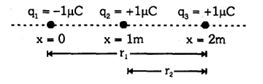
Two point charges are located on the $x$-axis. $q_1 = -1 \ \mu C$ at $x = 0$ and $q_2 = +1 \ \mu C$ at $x = 1 \ m$. Find the work done in bringing a third charge $q_3 = +1 \ \mu C$ from infinity to $x = 2 \ m$.
A
$45 \times 10^{-3} \ J$
B
$4.5 \times 10^{-3} \ J$
C
$0.4 \times 10^{-3} \ J$
D
$4.5 \times 10^{-8} \ J$
Solution
(B) The work done $W$ in bringing a charge $q_3$ from infinity to a point is equal to the change in potential energy of the system,which is $W = q_3 \times V$,where $V$ is the electric potential at the point $x = 2 \ m$ due to charges $q_1$ and $q_2$.
The potential $V$ at $x = 2 \ m$ is given by:
$V = \frac{1}{4\pi \epsilon_0} \left( \frac{q_1}{r_1} + \frac{q_2}{r_2} \right)$
Here,$r_1$ is the distance from $q_1$ to $x = 2 \ m$,so $r_1 = 2 \ m$. $r_2$ is the distance from $q_2$ to $x = 2 \ m$,so $r_2 = 1 \ m$.
Substituting the values:
$W = q_3 \times \frac{1}{4\pi \epsilon_0} \left( \frac{-1 \times 10^{-6}}{2} + \frac{1 \times 10^{-6}}{1} \right)$
$W = (9 \times 10^9) \times (1 \times 10^{-6}) \times \left( -0.5 \times 10^{-6} + 1 \times 10^{-6} \right)$
$W = 9 \times 10^3 \times (0.5 \times 10^{-6})$
$W = 4.5 \times 10^{-3} \ J$
The potential $V$ at $x = 2 \ m$ is given by:
$V = \frac{1}{4\pi \epsilon_0} \left( \frac{q_1}{r_1} + \frac{q_2}{r_2} \right)$
Here,$r_1$ is the distance from $q_1$ to $x = 2 \ m$,so $r_1 = 2 \ m$. $r_2$ is the distance from $q_2$ to $x = 2 \ m$,so $r_2 = 1 \ m$.
Substituting the values:
$W = q_3 \times \frac{1}{4\pi \epsilon_0} \left( \frac{-1 \times 10^{-6}}{2} + \frac{1 \times 10^{-6}}{1} \right)$
$W = (9 \times 10^9) \times (1 \times 10^{-6}) \times \left( -0.5 \times 10^{-6} + 1 \times 10^{-6} \right)$
$W = 9 \times 10^3 \times (0.5 \times 10^{-6})$
$W = 4.5 \times 10^{-3} \ J$
0 likes
View Solution119
DifficultMCQ
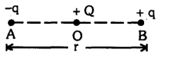
As shown in the figure,positive and negative charges of $1\ \mu C$ are placed at two points. Find the potential difference between $A$ and $B$ in $volt$.
A
$2700$
B
$2000$
C
$2500$
D
$3000$
Solution
(D) The potential at point $A$ due to the charges $+1\ \mu C$ and $-1\ \mu C$ is:
$V_A = \frac{k(1 \times 10^{-6})}{2} + \frac{k(-1 \times 10^{-6})}{3} = k \times 10^{-6} \left( \frac{1}{2} - \frac{1}{3} \right) = k \times 10^{-6} \left( \frac{1}{6} \right)$
$V_A = \frac{9 \times 10^9 \times 10^{-6}}{6} = 1.5 \times 10^3 \ V$
The potential at point $B$ due to the charges $+1\ \mu C$ and $-1\ \mu C$ is:
$V_B = \frac{k(1 \times 10^{-6})}{3} + \frac{k(-1 \times 10^{-6})}{2} = k \times 10^{-6} \left( \frac{1}{3} - \frac{1}{2} \right) = k \times 10^{-6} \left( -\frac{1}{6} \right)$
$V_B = -\frac{9 \times 10^9 \times 10^{-6}}{6} = -1.5 \times 10^3 \ V$
The potential difference between $A$ and $B$ is:
$V_A - V_B = 1.5 \times 10^3 - (-1.5 \times 10^3) = 3.0 \times 10^3 \ V = 3000 \ V$
$V_A = \frac{k(1 \times 10^{-6})}{2} + \frac{k(-1 \times 10^{-6})}{3} = k \times 10^{-6} \left( \frac{1}{2} - \frac{1}{3} \right) = k \times 10^{-6} \left( \frac{1}{6} \right)$
$V_A = \frac{9 \times 10^9 \times 10^{-6}}{6} = 1.5 \times 10^3 \ V$
The potential at point $B$ due to the charges $+1\ \mu C$ and $-1\ \mu C$ is:
$V_B = \frac{k(1 \times 10^{-6})}{3} + \frac{k(-1 \times 10^{-6})}{2} = k \times 10^{-6} \left( \frac{1}{3} - \frac{1}{2} \right) = k \times 10^{-6} \left( -\frac{1}{6} \right)$
$V_B = -\frac{9 \times 10^9 \times 10^{-6}}{6} = -1.5 \times 10^3 \ V$
The potential difference between $A$ and $B$ is:
$V_A - V_B = 1.5 \times 10^3 - (-1.5 \times 10^3) = 3.0 \times 10^3 \ V = 3000 \ V$

0 likes
View Solution120
MediumMCQ
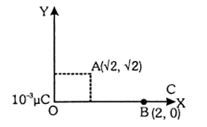
$A$ charge of $10^{-3} \ \mu C$ is placed at the origin $(0, 0)$ of an $X-Y$ coordinate system. Two points $A$ and $B$ are located at $(\sqrt{2}, \sqrt{2})$ and $(2, 0)$ respectively. The potential difference between points $A$ and $B$ is ....... $V$.
A
$9$
B
$0$
C
$2$
D
$4.5$
Solution
(B) The electric potential $V$ at a distance $r$ from a point charge $q$ is given by $V = \frac{kq}{r}$.
For point $A$ at $(\sqrt{2}, \sqrt{2})$,the distance from the origin $(0, 0)$ is $r_A = \sqrt{(\sqrt{2})^2 + (\sqrt{2})^2} = \sqrt{2 + 2} = \sqrt{4} = 2$.
For point $B$ at $(2, 0)$,the distance from the origin $(0, 0)$ is $r_B = \sqrt{2^2 + 0^2} = 2$.
Since the distances $r_A$ and $r_B$ are equal,the electric potentials at points $A$ and $B$ are equal:
$V_A = \frac{kq}{r_A} = \frac{kq}{2}$
$V_B = \frac{kq}{r_B} = \frac{kq}{2}$
Therefore,the potential difference between points $A$ and $B$ is:
$V_A - V_B = \frac{kq}{2} - \frac{kq}{2} = 0 \ V$.
For point $A$ at $(\sqrt{2}, \sqrt{2})$,the distance from the origin $(0, 0)$ is $r_A = \sqrt{(\sqrt{2})^2 + (\sqrt{2})^2} = \sqrt{2 + 2} = \sqrt{4} = 2$.
For point $B$ at $(2, 0)$,the distance from the origin $(0, 0)$ is $r_B = \sqrt{2^2 + 0^2} = 2$.
Since the distances $r_A$ and $r_B$ are equal,the electric potentials at points $A$ and $B$ are equal:
$V_A = \frac{kq}{r_A} = \frac{kq}{2}$
$V_B = \frac{kq}{r_B} = \frac{kq}{2}$
Therefore,the potential difference between points $A$ and $B$ is:
$V_A - V_B = \frac{kq}{2} - \frac{kq}{2} = 0 \ V$.
0 likes
View Solution121
MediumMCQ
Two concentric conducting spherical shells of radii $30 \, cm$ and $5 \, cm$ are charged. If the outer shell has a charge of $3 \, \mu C$ and the inner shell has a charge of $0.5 \, \mu C$,what is the electric potential on the outer spherical shell?
A
$10.5 \times 10^4 \, V$
B
$9 \times 10^3 \, V$
C
$9 \times 10^4 \, V$
D
$7.5 \times 10^3 \, V$
Solution
(A) The electric potential $V$ at the surface of the outer shell (radius $R_2 = 30 \, cm = 0.3 \, m$) is the sum of the potentials due to both the inner shell (charge $q_1 = 0.5 \, \mu C$) and the outer shell (charge $q_2 = 3 \, \mu C$).
The potential due to the inner shell at its surface and outside is $V_1 = \frac{k q_1}{R_2}$.
The potential due to the outer shell at its surface is $V_2 = \frac{k q_2}{R_2}$.
Total potential $V = V_1 + V_2 = \frac{k}{R_2} (q_1 + q_2)$.
Substituting the values: $k = 9 \times 10^9 \, N \cdot m^2/C^2$,$q_1 = 0.5 \times 10^{-6} \, C$,$q_2 = 3 \times 10^{-6} \, C$,and $R_2 = 0.3 \, m$.
$V = \frac{9 \times 10^9}{0.3} (0.5 \times 10^{-6} + 3 \times 10^{-6})$
$V = (30 \times 10^9) \times (3.5 \times 10^{-6})$
$V = 105 \times 10^3 \, V = 1.05 \times 10^5 \, V = 10.5 \times 10^4 \, V$.
The potential due to the inner shell at its surface and outside is $V_1 = \frac{k q_1}{R_2}$.
The potential due to the outer shell at its surface is $V_2 = \frac{k q_2}{R_2}$.
Total potential $V = V_1 + V_2 = \frac{k}{R_2} (q_1 + q_2)$.
Substituting the values: $k = 9 \times 10^9 \, N \cdot m^2/C^2$,$q_1 = 0.5 \times 10^{-6} \, C$,$q_2 = 3 \times 10^{-6} \, C$,and $R_2 = 0.3 \, m$.
$V = \frac{9 \times 10^9}{0.3} (0.5 \times 10^{-6} + 3 \times 10^{-6})$
$V = (30 \times 10^9) \times (3.5 \times 10^{-6})$
$V = 105 \times 10^3 \, V = 1.05 \times 10^5 \, V = 10.5 \times 10^4 \, V$.
0 likes
View Solution122
MediumMCQ
Eight identical charged drops combine to form a single large drop. If the potential of each small drop is $10 \ V$,then the potential of the large drop will be ........ $V$?
A
$40$
B
$10$
C
$30$
D
$20$
Solution
(A) Let the radius of each small drop be $r$ and the charge be $q$. The potential of a small drop is $V_{tiny} = \frac{kq}{r} = 10 \ V$.
When $8$ small drops combine to form a large drop of radius $R$,the volume remains conserved:
$8 \times (\frac{4}{3} \pi r^3) = \frac{4}{3} \pi R^3$
$8r^3 = R^3 \Rightarrow R = 2r$.
The total charge on the large drop is $Q = 8q$.
The potential of the large drop is $V_{big} = \frac{kQ}{R} = \frac{k(8q)}{2r}$.
$V_{big} = 4 \times (\frac{kq}{r}) = 4 \times 10 \ V = 40 \ V$.
When $8$ small drops combine to form a large drop of radius $R$,the volume remains conserved:
$8 \times (\frac{4}{3} \pi r^3) = \frac{4}{3} \pi R^3$
$8r^3 = R^3 \Rightarrow R = 2r$.
The total charge on the large drop is $Q = 8q$.
The potential of the large drop is $V_{big} = \frac{kQ}{R} = \frac{k(8q)}{2r}$.
$V_{big} = 4 \times (\frac{kq}{r}) = 4 \times 10 \ V = 40 \ V$.
0 likes
View Solution123
MediumMCQ
$A$ hollow metal sphere is charged with a charge of $3.2 \times 10^{-19} \ C$. If the radius of the sphere is $10 \ cm$,then the electric potential at a distance of $4 \ cm$ from its center will be:
A
$9 \times 10^{-9} \ V$
B
$28.8 \times 10^{-9} \ V$
C
$28.8 \times 10^{-8} \ V$
D
$28.8 \ V$
Solution
(B) For a hollow metal sphere,the electric charge resides entirely on its outer surface.
Inside the hollow sphere,the electric field is zero everywhere.
Since the electric field is zero inside the sphere,the electric potential is constant throughout the interior and is equal to the potential at the surface.
The potential at the surface (and thus at any point inside) is given by $V = \frac{kQ}{R}$,where $k = 9 \times 10^9 \ N \cdot m^2/C^2$,$Q = 3.2 \times 10^{-19} \ C$,and $R = 10 \ cm = 0.1 \ m$.
Substituting the values: $V = \frac{9 \times 10^9 \times 3.2 \times 10^{-19}}{0.1}$.
$V = \frac{28.8 \times 10^{-10}}{0.1} = 28.8 \times 10^{-9} \ V$.
Inside the hollow sphere,the electric field is zero everywhere.
Since the electric field is zero inside the sphere,the electric potential is constant throughout the interior and is equal to the potential at the surface.
The potential at the surface (and thus at any point inside) is given by $V = \frac{kQ}{R}$,where $k = 9 \times 10^9 \ N \cdot m^2/C^2$,$Q = 3.2 \times 10^{-19} \ C$,and $R = 10 \ cm = 0.1 \ m$.
Substituting the values: $V = \frac{9 \times 10^9 \times 3.2 \times 10^{-19}}{0.1}$.
$V = \frac{28.8 \times 10^{-10}}{0.1} = 28.8 \times 10^{-9} \ V$.
0 likes
View Solution124
EasyMCQ
$A$ proton is accelerated through a potential difference of $1 \,V$. The kinetic energy $(KE)$ of the proton will be $....... \,eV$.
A
$1840$
B
$0.1$
C
$1$
D
$1/1840$
Solution
(C) The kinetic energy $(KE)$ gained by a charged particle when accelerated through a potential difference $(V)$ is given by the formula:
$KE = q \times V$
Where:
$q$ is the charge of the particle.
$V$ is the potential difference.
For a proton,the charge $q = e$ (elementary charge).
Given,$V = 1 \,V$.
Substituting these values:
$KE = e \times 1 \,V = 1 \,eV$.
Therefore,the kinetic energy of the proton is $1 \,eV$.
$KE = q \times V$
Where:
$q$ is the charge of the particle.
$V$ is the potential difference.
For a proton,the charge $q = e$ (elementary charge).
Given,$V = 1 \,V$.
Substituting these values:
$KE = e \times 1 \,V = 1 \,eV$.
Therefore,the kinetic energy of the proton is $1 \,eV$.
0 likes
View Solution125
MediumMCQ
Two point charges $q_1 = 4 \times 10^{-8} \ C$ and $q_2 = -6 \times 10^{-8} \ C$ are placed at points $A$ and $B$ respectively,which are $50 \ cm$ apart. At what distance from point $A$ on the line $AB$ is the electric potential zero (in $cm$)?
A
$40$
B
$20$
C
$10$
D
$30$
Solution
(B) Let the point where the electric potential is zero be at a distance $x$ from point $A$ along the line $AB$.
The potential $V$ due to a point charge $q$ at a distance $r$ is given by $V = \frac{kq}{r}$.
The total potential at the point is the algebraic sum of the potentials due to $q_1$ and $q_2$.
$V_{total} = \frac{k q_1}{x} + \frac{k q_2}{50 - x} = 0$.
Substituting the values: $\frac{4 \times 10^{-8}}{x} + \frac{-6 \times 10^{-8}}{50 - x} = 0$.
$\frac{4}{x} = \frac{6}{50 - x}$.
$4(50 - x) = 6x$.
$200 - 4x = 6x$.
$10x = 200$.
$x = 20 \ cm$.
Thus,the potential is zero at a distance of $20 \ cm$ from point $A$.
The potential $V$ due to a point charge $q$ at a distance $r$ is given by $V = \frac{kq}{r}$.
The total potential at the point is the algebraic sum of the potentials due to $q_1$ and $q_2$.
$V_{total} = \frac{k q_1}{x} + \frac{k q_2}{50 - x} = 0$.
Substituting the values: $\frac{4 \times 10^{-8}}{x} + \frac{-6 \times 10^{-8}}{50 - x} = 0$.
$\frac{4}{x} = \frac{6}{50 - x}$.
$4(50 - x) = 6x$.
$200 - 4x = 6x$.
$10x = 200$.
$x = 20 \ cm$.
Thus,the potential is zero at a distance of $20 \ cm$ from point $A$.
0 likes
View Solution126
MediumMCQ
$A$ spherical shell of radius $5 \ cm$ is charged to a potential of $10 \ V$ on its surface. The potential at the center of the shell will be ...... $V$.
A
$0$
B
$10$
C
$20$
D
$50$
Solution
(B) For a charged spherical shell,the electric field inside the shell is zero $(E = 0)$.
Since the electric field is the negative gradient of the potential $(E = -dV/dr)$,if $E = 0$,then the potential $V$ must be constant throughout the interior of the shell.
Therefore,the potential at any point inside the shell is equal to the potential at its surface.
Given that the potential at the surface is $10 \ V$,the potential at the center of the shell is also $10 \ V$.
Since the electric field is the negative gradient of the potential $(E = -dV/dr)$,if $E = 0$,then the potential $V$ must be constant throughout the interior of the shell.
Therefore,the potential at any point inside the shell is equal to the potential at its surface.
Given that the potential at the surface is $10 \ V$,the potential at the center of the shell is also $10 \ V$.
0 likes
View Solution127
EasyMCQ
$A$ nerve fiber membrane separates two conducting fluids and maintains a constant potential difference. What is the order of this potential difference?
A
Approximately $1 \ V$
B
Approximately $0.1 \ V$
C
Approximately $0.01 \ V$
D
Approximately $0.001 \ V$
Solution
(B) The resting membrane potential of a nerve fiber is the electrical potential difference across the cell membrane when the neuron is at rest.
This potential is maintained by the unequal distribution of ions (primarily $Na^+$,$K^+$,and $Cl^-$) across the membrane.
The typical value for the resting membrane potential in a nerve cell is approximately $-70 \ mV$.
Converting this to volts,we get $-70 \times 10^{-3} \ V = -0.07 \ V$.
Comparing this value with the given options,$0.1 \ V$ is the closest order of magnitude.
This potential is maintained by the unequal distribution of ions (primarily $Na^+$,$K^+$,and $Cl^-$) across the membrane.
The typical value for the resting membrane potential in a nerve cell is approximately $-70 \ mV$.
Converting this to volts,we get $-70 \times 10^{-3} \ V = -0.07 \ V$.
Comparing this value with the given options,$0.1 \ V$ is the closest order of magnitude.
0 likes
View Solution128
MediumMCQ
Particles $A$ and $B$ have charges $+q$ and $+4q$ respectively. Both have the same mass $m$. If they are released from rest and accelerated through the same potential difference $V$,the ratio of their velocities $v_A/v_B$ is:
A
$2 : 1$
B
$1 : 2$
C
$1 : 4$
D
$4 : 1$
Solution
(B) The work done by the electric field on a charge $q$ accelerated through a potential difference $V$ is given by $W = qV$.
According to the work-energy theorem,this work is equal to the change in kinetic energy: $W = \frac{1}{2}mv^2$.
Equating the two,we get $qV = \frac{1}{2}mv^2$,which implies $v = \sqrt{\frac{2qV}{m}}$.
Since both particles have the same mass $m$ and are accelerated through the same potential difference $V$,the velocity $v$ is directly proportional to the square root of the charge: $v \propto \sqrt{q}$.
Therefore,the ratio of their velocities is $\frac{v_A}{v_B} = \sqrt{\frac{q_A}{q_B}}$.
Substituting the given values $q_A = q$ and $q_B = 4q$,we get $\frac{v_A}{v_B} = \sqrt{\frac{q}{4q}} = \sqrt{\frac{1}{4}} = \frac{1}{2}$.
Thus,the ratio $v_A/v_B = 1:2$.
According to the work-energy theorem,this work is equal to the change in kinetic energy: $W = \frac{1}{2}mv^2$.
Equating the two,we get $qV = \frac{1}{2}mv^2$,which implies $v = \sqrt{\frac{2qV}{m}}$.
Since both particles have the same mass $m$ and are accelerated through the same potential difference $V$,the velocity $v$ is directly proportional to the square root of the charge: $v \propto \sqrt{q}$.
Therefore,the ratio of their velocities is $\frac{v_A}{v_B} = \sqrt{\frac{q_A}{q_B}}$.
Substituting the given values $q_A = q$ and $q_B = 4q$,we get $\frac{v_A}{v_B} = \sqrt{\frac{q}{4q}} = \sqrt{\frac{1}{4}} = \frac{1}{2}$.
Thus,the ratio $v_A/v_B = 1:2$.
0 likes
View Solution129
MediumMCQ
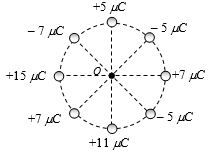
What is the electric potential at the center $O$ of a circle of radius $0.4 \ m$ with the charges arranged as shown in the figure?
A
$63 \times 10^4 \ V$
B
$63 \times 10^{10} \ V$
C
$63 \times 10^6 \ V$
D
$0 \ V$
Solution
(A) The electric potential $V$ at the center of a circle due to multiple point charges is the algebraic sum of the potentials due to each individual charge.
$V = \sum \frac{k q_i}{r}$,where $k = 9 \times 10^9 \ N \cdot m^2/C^2$ and $r = 0.4 \ m$.
Sum of charges $Q_{total} = (+5 - 5 + 7 - 5 + 11 + 7 + 15 - 7) \ \mu C = 28 \ \mu C = 28 \times 10^{-6} \ C$.
$V = \frac{9 \times 10^9 \times 28 \times 10^{-6}}{0.4} = \frac{9 \times 28 \times 10^3}{0.4} = \frac{252 \times 10^3}{0.4} = 630 \times 10^3 \ V = 63 \times 10^4 \ V$.
$V = \sum \frac{k q_i}{r}$,where $k = 9 \times 10^9 \ N \cdot m^2/C^2$ and $r = 0.4 \ m$.
Sum of charges $Q_{total} = (+5 - 5 + 7 - 5 + 11 + 7 + 15 - 7) \ \mu C = 28 \ \mu C = 28 \times 10^{-6} \ C$.
$V = \frac{9 \times 10^9 \times 28 \times 10^{-6}}{0.4} = \frac{9 \times 28 \times 10^3}{0.4} = \frac{252 \times 10^3}{0.4} = 630 \times 10^3 \ V = 63 \times 10^4 \ V$.
0 likes
View Solution130
EasyMCQ
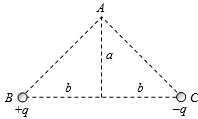
What is the electric potential at point $A$ due to the given charges?
A
$\frac{1}{{4\pi {\varepsilon _0}}}.\frac{{2q}}{{\sqrt {{a^2} + {b^2}} }}$
B
$\frac{1}{{4\pi {\varepsilon _0}}}.\frac{q}{{\sqrt {{a^2} + {b^2}} }}$
C
$\frac{1}{{4\pi {\varepsilon _0}}}.\frac{{( - q)}}{{\sqrt {{a^2} + {b^2}} }}$
D
$0$
Solution
(D) The electric potential $V$ at a point due to a charge $Q$ at a distance $r$ is given by $V = \frac{1}{4\pi\varepsilon_0} \frac{Q}{r}$.
From the figure,the distance from both charges $+q$ (at $B$) and $-q$ (at $C$) to point $A$ is $r = \sqrt{a^2 + b^2}$.
The total potential at $A$ is the algebraic sum of the potentials due to both charges:
$V_A = V_B + V_C$
$V_A = \frac{1}{4\pi\varepsilon_0} \frac{q}{\sqrt{a^2 + b^2}} + \frac{1}{4\pi\varepsilon_0} \frac{(-q)}{\sqrt{a^2 + b^2}}$
$V_A = \frac{1}{4\pi\varepsilon_0} \left( \frac{q - q}{\sqrt{a^2 + b^2}} \right) = 0$.
From the figure,the distance from both charges $+q$ (at $B$) and $-q$ (at $C$) to point $A$ is $r = \sqrt{a^2 + b^2}$.
The total potential at $A$ is the algebraic sum of the potentials due to both charges:
$V_A = V_B + V_C$
$V_A = \frac{1}{4\pi\varepsilon_0} \frac{q}{\sqrt{a^2 + b^2}} + \frac{1}{4\pi\varepsilon_0} \frac{(-q)}{\sqrt{a^2 + b^2}}$
$V_A = \frac{1}{4\pi\varepsilon_0} \left( \frac{q - q}{\sqrt{a^2 + b^2}} \right) = 0$.
0 likes
View Solution131
MediumMCQ
$A$ spherical shell of radius $R$ carries a charge $Q$. What is the potential at point $B$ on the surface,at the center $A$,and at point $C$ at a distance $R/2$ from the center?
A
$V_A = V_B = V_C$
B
$V_A = V_B \neq V_C$
C
$V_A \neq V_B \neq V_C$
D
$V_A \neq V_B = V_C$
Solution
(A) For a charged spherical shell of radius $R$ and charge $Q$:
$1$. The potential at any point on the surface (point $B$) is $V_B = \frac{1}{4\pi\epsilon_0} \frac{Q}{R}$.
$2$. The potential at any point inside the shell (including the center $A$ and point $C$ at $R/2$) is constant and equal to the potential at the surface.
$3$. Therefore,$V_A = V_B = V_C = \frac{1}{4\pi\epsilon_0} \frac{Q}{R}$.
Thus,the correct option is $A$.
$1$. The potential at any point on the surface (point $B$) is $V_B = \frac{1}{4\pi\epsilon_0} \frac{Q}{R}$.
$2$. The potential at any point inside the shell (including the center $A$ and point $C$ at $R/2$) is constant and equal to the potential at the surface.
$3$. Therefore,$V_A = V_B = V_C = \frac{1}{4\pi\epsilon_0} \frac{Q}{R}$.
Thus,the correct option is $A$.
0 likes
View Solution132
MediumMCQ
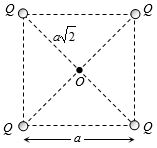
Four charges,each of value $Q = \frac{10}{3} \times 10^{-9} \ C$,are placed at the four corners of a square of side $a = 8 \ cm$. What is the electric potential at the center of the square?
A
$900 \ V$
B
$900\sqrt{2} \ V$
C
$150\sqrt{2} \ V$
D
$1500\sqrt{2} \ V$
Solution
(D) The electric potential $V$ at the center of a square due to four identical charges $Q$ at its corners is given by the sum of potentials due to each charge.
Each charge is at a distance $r$ from the center,where $r$ is half the diagonal of the square.
Diagonal of the square $= a\sqrt{2}$.
So,$r = \frac{a\sqrt{2}}{2} = \frac{a}{\sqrt{2}}$.
The potential at the center is $V = 4 \times \frac{kQ}{r} = 4 \times \frac{kQ}{a/\sqrt{2}} = \frac{4\sqrt{2}kQ}{a}$.
Given $Q = \frac{10}{3} \times 10^{-9} \ C$,$a = 8 \times 10^{-2} \ m$,and $k = 9 \times 10^9 \ N \cdot m^2/C^2$.
$V = \frac{4 \times \sqrt{2} \times 9 \times 10^9 \times (\frac{10}{3} \times 10^{-9})}{8 \times 10^{-2}}$.
$V = \frac{4 \times \sqrt{2} \times 3 \times 10}{8 \times 10^{-2}} = \frac{120\sqrt{2}}{8 \times 10^{-2}} = 15 \times 10^2 \sqrt{2} = 1500\sqrt{2} \ V$.
Each charge is at a distance $r$ from the center,where $r$ is half the diagonal of the square.
Diagonal of the square $= a\sqrt{2}$.
So,$r = \frac{a\sqrt{2}}{2} = \frac{a}{\sqrt{2}}$.
The potential at the center is $V = 4 \times \frac{kQ}{r} = 4 \times \frac{kQ}{a/\sqrt{2}} = \frac{4\sqrt{2}kQ}{a}$.
Given $Q = \frac{10}{3} \times 10^{-9} \ C$,$a = 8 \times 10^{-2} \ m$,and $k = 9 \times 10^9 \ N \cdot m^2/C^2$.
$V = \frac{4 \times \sqrt{2} \times 9 \times 10^9 \times (\frac{10}{3} \times 10^{-9})}{8 \times 10^{-2}}$.
$V = \frac{4 \times \sqrt{2} \times 3 \times 10}{8 \times 10^{-2}} = \frac{120\sqrt{2}}{8 \times 10^{-2}} = 15 \times 10^2 \sqrt{2} = 1500\sqrt{2} \ V$.
0 likes
View Solution133
MediumMCQ
The electric potential on the surface of a hollow sphere of radius $5 \ cm$ is $10 \ V$. What is the electric potential at its center?
A
$0$
B
$10$
C
$15$
D
$20$
Solution
(B) For a hollow conducting sphere (or a charged spherical shell),the electric field inside the sphere is zero $(E = 0)$.
Since the electric field is the negative gradient of the potential $(E = -dV/dr)$,if $E = 0$,then the potential $V$ must be constant throughout the interior of the sphere.
Therefore,the potential at any point inside the sphere,including the center,is equal to the potential at its surface.
Given that the potential at the surface is $10 \ V$,the potential at the center is also $10 \ V$.
Since the electric field is the negative gradient of the potential $(E = -dV/dr)$,if $E = 0$,then the potential $V$ must be constant throughout the interior of the sphere.
Therefore,the potential at any point inside the sphere,including the center,is equal to the potential at its surface.
Given that the potential at the surface is $10 \ V$,the potential at the center is also $10 \ V$.
0 likes
View Solution134
DifficultMCQ
$A$ total charge $Q$ is distributed between two concentric spherical shells of radii $r$ and $R$ $(R > r)$ such that their surface charge densities are equal. What is the electric potential at their common center?
A
$\frac{Q(R^2 + r^2)}{4\pi \varepsilon_0(R + r)}$
B
$\frac{Q}{R + r}$
C
Zero
D
$\frac{Q(R + r)}{4\pi \varepsilon_0(R^2 + r^2)}$
Solution
(D) Let $q_1$ and $q_2$ be the charges on the inner and outer shells respectively. Given $Q = q_1 + q_2$ ... $(i)$
Since surface charge densities are equal,$\sigma_1 = \sigma_2$,so $\frac{q_1}{4\pi r^2} = \frac{q_2}{4\pi R^2} \implies \frac{q_1}{q_2} = \frac{r^2}{R^2}$ ... $(ii)$
From $(i)$ and $(ii)$,we get $q_1 = \frac{Q r^2}{R^2 + r^2}$ and $q_2 = \frac{Q R^2}{R^2 + r^2}$.
The potential at the center is the sum of potentials due to both shells: $V = \frac{1}{4\pi \varepsilon_0} \left[ \frac{q_1}{r} + \frac{q_2}{R} \right]$.
Substituting the values of $q_1$ and $q_2$: $V = \frac{1}{4\pi \varepsilon_0} \left[ \frac{Q r^2}{r(R^2 + r^2)} + \frac{Q R^2}{R(R^2 + r^2)} \right] = \frac{1}{4\pi \varepsilon_0} \left[ \frac{Qr}{R^2 + r^2} + \frac{QR}{R^2 + r^2} \right]$.
Thus,$V = \frac{Q(R + r)}{4\pi \varepsilon_0(R^2 + r^2)}$.
Since surface charge densities are equal,$\sigma_1 = \sigma_2$,so $\frac{q_1}{4\pi r^2} = \frac{q_2}{4\pi R^2} \implies \frac{q_1}{q_2} = \frac{r^2}{R^2}$ ... $(ii)$
From $(i)$ and $(ii)$,we get $q_1 = \frac{Q r^2}{R^2 + r^2}$ and $q_2 = \frac{Q R^2}{R^2 + r^2}$.
The potential at the center is the sum of potentials due to both shells: $V = \frac{1}{4\pi \varepsilon_0} \left[ \frac{q_1}{r} + \frac{q_2}{R} \right]$.
Substituting the values of $q_1$ and $q_2$: $V = \frac{1}{4\pi \varepsilon_0} \left[ \frac{Q r^2}{r(R^2 + r^2)} + \frac{Q R^2}{R(R^2 + r^2)} \right] = \frac{1}{4\pi \varepsilon_0} \left[ \frac{Qr}{R^2 + r^2} + \frac{QR}{R^2 + r^2} \right]$.
Thus,$V = \frac{Q(R + r)}{4\pi \varepsilon_0(R^2 + r^2)}$.
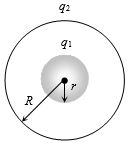
0 likes
View Solution135
DifficultMCQ
$A$ sphere with charge $Q$ is placed concentrically inside an uncharged spherical shell. The potential difference between them is $V$. Now,if a charge of $-3Q$ is given to the spherical shell,what will be the potential difference between them?
A
$1$
B
$2$
C
$4$
D
$V$
Solution
(D) Let the radius of the inner sphere be $a$ and the radius of the outer shell be $b$.
Initially,the potential of the sphere is $V_{\text{sphere}} = \frac{1}{4\pi\epsilon_0} \cdot \frac{Q}{a}$ and the potential of the shell is $V_{\text{shell}} = \frac{1}{4\pi\epsilon_0} \cdot \frac{Q}{b}$.
The potential difference is $V = V_{\text{sphere}} - V_{\text{shell}} = \frac{Q}{4\pi\epsilon_0} \left( \frac{1}{a} - \frac{1}{b} \right)$.
Now,a charge of $-3Q$ is given to the shell.
The new potential of the sphere is $V'_{\text{sphere}} = \frac{1}{4\pi\epsilon_0} \left( \frac{Q}{a} - \frac{3Q}{b} \right)$.
The new potential of the shell is $V'_{\text{shell}} = \frac{1}{4\pi\epsilon_0} \left( \frac{Q}{b} - \frac{3Q}{b} \right) = \frac{1}{4\pi\epsilon_0} \left( -\frac{2Q}{b} \right)$.
The new potential difference is $V' = V'_{\text{sphere}} - V'_{\text{shell}} = \frac{1}{4\pi\epsilon_0} \left( \frac{Q}{a} - \frac{3Q}{b} - (-\frac{2Q}{b}) \right) = \frac{1}{4\pi\epsilon_0} \left( \frac{Q}{a} - \frac{3Q}{b} + \frac{2Q}{b} \right) = \frac{Q}{4\pi\epsilon_0} \left( \frac{1}{a} - \frac{1}{b} \right) = V$.
Thus,the potential difference remains $V$.
Initially,the potential of the sphere is $V_{\text{sphere}} = \frac{1}{4\pi\epsilon_0} \cdot \frac{Q}{a}$ and the potential of the shell is $V_{\text{shell}} = \frac{1}{4\pi\epsilon_0} \cdot \frac{Q}{b}$.
The potential difference is $V = V_{\text{sphere}} - V_{\text{shell}} = \frac{Q}{4\pi\epsilon_0} \left( \frac{1}{a} - \frac{1}{b} \right)$.
Now,a charge of $-3Q$ is given to the shell.
The new potential of the sphere is $V'_{\text{sphere}} = \frac{1}{4\pi\epsilon_0} \left( \frac{Q}{a} - \frac{3Q}{b} \right)$.
The new potential of the shell is $V'_{\text{shell}} = \frac{1}{4\pi\epsilon_0} \left( \frac{Q}{b} - \frac{3Q}{b} \right) = \frac{1}{4\pi\epsilon_0} \left( -\frac{2Q}{b} \right)$.
The new potential difference is $V' = V'_{\text{sphere}} - V'_{\text{shell}} = \frac{1}{4\pi\epsilon_0} \left( \frac{Q}{a} - \frac{3Q}{b} - (-\frac{2Q}{b}) \right) = \frac{1}{4\pi\epsilon_0} \left( \frac{Q}{a} - \frac{3Q}{b} + \frac{2Q}{b} \right) = \frac{Q}{4\pi\epsilon_0} \left( \frac{1}{a} - \frac{1}{b} \right) = V$.
Thus,the potential difference remains $V$.
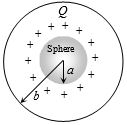
0 likes
View Solution136
DifficultMCQ
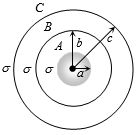
Three concentric metallic shells $A, B$ and $C$ of radii $a, b$ and $c$ $(a < b < c)$ have surface charge densities $\sigma, -\sigma$ and $\sigma$ respectively. Find the potentials ${V_A}$ and ${V_B}$.
A
$\frac{\sigma}{\varepsilon_0}(a - b + c), \frac{\sigma}{\varepsilon_0}\left( \frac{a^2}{b} - b + c \right)$
B
$(a - b - c), \frac{a^2}{c}$
C
$\frac{\varepsilon_0}{\sigma}(a - b - c), \frac{\varepsilon_0}{\sigma}\left( \frac{a^2}{c} - b + c \right)$
D
$\frac{\sigma}{\varepsilon_0}\left( \frac{a^2}{c} - \frac{b^2}{c} + c \right), \frac{\sigma}{\varepsilon_0}(a - b + c)$
Solution
(A) The charges on the shells are given by $q = \sigma \times 4\pi r^2$.
Thus,$q_a = \sigma(4\pi a^2)$,$q_b = -\sigma(4\pi b^2)$,and $q_c = \sigma(4\pi c^2)$.
The potential at any point is the sum of potentials due to all shells.
For shell $A$ (at radius $a$):
$V_A = \frac{1}{4\pi\varepsilon_0} \left[ \frac{q_a}{a} + \frac{q_b}{b} + \frac{q_c}{c} \right] = \frac{1}{4\pi\varepsilon_0} \left[ \frac{\sigma(4\pi a^2)}{a} + \frac{-\sigma(4\pi b^2)}{b} + \frac{\sigma(4\pi c^2)}{c} \right] = \frac{\sigma}{\varepsilon_0} (a - b + c)$.
For shell $B$ (at radius $b$):
$V_B = \frac{1}{4\pi\varepsilon_0} \left[ \frac{q_a}{b} + \frac{q_b}{b} + \frac{q_c}{c} \right] = \frac{1}{4\pi\varepsilon_0} \left[ \frac{\sigma(4\pi a^2)}{b} + \frac{-\sigma(4\pi b^2)}{b} + \frac{\sigma(4\pi c^2)}{c} \right] = \frac{\sigma}{\varepsilon_0} \left( \frac{a^2}{b} - b + c \right)$.
Thus,$q_a = \sigma(4\pi a^2)$,$q_b = -\sigma(4\pi b^2)$,and $q_c = \sigma(4\pi c^2)$.
The potential at any point is the sum of potentials due to all shells.
For shell $A$ (at radius $a$):
$V_A = \frac{1}{4\pi\varepsilon_0} \left[ \frac{q_a}{a} + \frac{q_b}{b} + \frac{q_c}{c} \right] = \frac{1}{4\pi\varepsilon_0} \left[ \frac{\sigma(4\pi a^2)}{a} + \frac{-\sigma(4\pi b^2)}{b} + \frac{\sigma(4\pi c^2)}{c} \right] = \frac{\sigma}{\varepsilon_0} (a - b + c)$.
For shell $B$ (at radius $b$):
$V_B = \frac{1}{4\pi\varepsilon_0} \left[ \frac{q_a}{b} + \frac{q_b}{b} + \frac{q_c}{c} \right] = \frac{1}{4\pi\varepsilon_0} \left[ \frac{\sigma(4\pi a^2)}{b} + \frac{-\sigma(4\pi b^2)}{b} + \frac{\sigma(4\pi c^2)}{c} \right] = \frac{\sigma}{\varepsilon_0} \left( \frac{a^2}{b} - b + c \right)$.
0 likes
View Solution137
EasyMCQ
The work done in moving a charge of $20 \ C$ from point $A$ to point $B$ is $2 \ J$. What is the potential difference between the two points (in $V$)?
A
$0.2$
B
$0.8$
C
$0.1$
D
$0.4$
Solution
(C) The potential difference $\Delta V$ between two points is defined as the work done $W$ per unit charge $Q$ in moving the charge from one point to another.
Formula: $W = Q \cdot \Delta V$
Given: $Q = 20 \ C$,$W = 2 \ J$
Substituting the values: $2 = 20 \cdot \Delta V$
$\Delta V = \frac{2}{20} = 0.1 \ V$
Therefore,the potential difference between the two points is $0.1 \ V$.
Formula: $W = Q \cdot \Delta V$
Given: $Q = 20 \ C$,$W = 2 \ J$
Substituting the values: $2 = 20 \cdot \Delta V$
$\Delta V = \frac{2}{20} = 0.1 \ V$
Therefore,the potential difference between the two points is $0.1 \ V$.
0 likes
View Solution138
DifficultMCQ
Charges $Q$ are placed at each corner of a square of side $a$. How much work is required to remove a charge $-Q$ from the center of the square and move it to infinity?
A
$0$
B
$\frac{\sqrt{2} Q^2}{4\pi \varepsilon_0 a}$
C
$\frac{\sqrt{2} Q^2}{\pi \varepsilon_0 a}$
D
$\frac{Q^2}{2\pi \varepsilon_0 a}$
Solution
(C) The work required to move a charge $q$ from a point with potential $V_0$ to infinity is given by $W = q(V_{\infty} - V_0)$. Since $V_{\infty} = 0$,the work required is $W = -qV_0$. Here,$q = -Q$,so $W = -(-Q)V_0 = QV_0$.
The potential $V_0$ at the center of the square due to the four charges $Q$ at the corners is the sum of the potentials due to each charge.
The distance from each corner to the center is $r = \frac{a}{\sqrt{2}}$.
$V_0 = 4 \times \left( \frac{1}{4\pi \varepsilon_0} \cdot \frac{Q}{a/\sqrt{2}} \right) = \frac{4\sqrt{2} Q}{4\pi \varepsilon_0 a} = \frac{\sqrt{2} Q}{\pi \varepsilon_0 a}$.
Therefore,the work required is $W = (-Q) \times (-V_0) = Q \times \left( \frac{\sqrt{2} Q}{\pi \varepsilon_0 a} \right) = \frac{\sqrt{2} Q^2}{\pi \varepsilon_0 a}$.
The potential $V_0$ at the center of the square due to the four charges $Q$ at the corners is the sum of the potentials due to each charge.
The distance from each corner to the center is $r = \frac{a}{\sqrt{2}}$.
$V_0 = 4 \times \left( \frac{1}{4\pi \varepsilon_0} \cdot \frac{Q}{a/\sqrt{2}} \right) = \frac{4\sqrt{2} Q}{4\pi \varepsilon_0 a} = \frac{\sqrt{2} Q}{\pi \varepsilon_0 a}$.
Therefore,the work required is $W = (-Q) \times (-V_0) = Q \times \left( \frac{\sqrt{2} Q}{\pi \varepsilon_0 a} \right) = \frac{\sqrt{2} Q^2}{\pi \varepsilon_0 a}$.
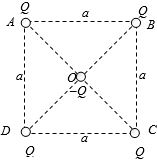
0 likes
View Solution139
DifficultMCQ
Two rings of radius $R$ are placed coaxially at a distance $R$ apart. They carry charges $Q_1$ and $Q_2$ respectively. How much work is required to move a charge $q$ from the center of one ring to the center of the other?
A
$Zero$
B
$\frac{q(Q_1 - Q_2)(\sqrt{2} - 1)}{4\pi \varepsilon_0 R\sqrt{2}}$
C
$\frac{q(Q_1 + Q_2)\sqrt{2}}{4\pi \varepsilon_0 R}$
D
$\frac{q(Q_1 / Q_2)(\sqrt{2} - 1)}{4\pi \varepsilon_0 R\sqrt{2}}$
Solution
(B) The electric potential at the center $A$ of the first ring is the sum of the potential due to ring $1$ and ring $2$:
$V_A = \frac{Q_1}{4\pi \varepsilon_0 R} + \frac{Q_2}{4\pi \varepsilon_0 \sqrt{R^2 + R^2}} = \frac{1}{4\pi \varepsilon_0 R} \left( Q_1 + \frac{Q_2}{\sqrt{2}} \right)$
The electric potential at the center $B$ of the second ring is:
$V_B = \frac{Q_2}{4\pi \varepsilon_0 R} + \frac{Q_1}{4\pi \varepsilon_0 \sqrt{R^2 + R^2}} = \frac{1}{4\pi \varepsilon_0 R} \left( Q_2 + \frac{Q_1}{\sqrt{2}} \right)$
The work done $W$ to move a charge $q$ from $A$ to $B$ is given by $W = q(V_B - V_A)$:
$V_B - V_A = \frac{1}{4\pi \varepsilon_0 R} \left( Q_2 + \frac{Q_1}{\sqrt{2}} - Q_1 - \frac{Q_2}{\sqrt{2}} \right)$
$V_B - V_A = \frac{1}{4\pi \varepsilon_0 R} \left( Q_2(1 - \frac{1}{\sqrt{2}}) - Q_1(1 - \frac{1}{\sqrt{2}}) \right)$
$V_B - V_A = \frac{1}{4\pi \varepsilon_0 R} (Q_2 - Q_1) \left( \frac{\sqrt{2} - 1}{\sqrt{2}} \right)$
Since $W = q(V_B - V_A)$,we have:
$W = \frac{q(Q_2 - Q_1)(\sqrt{2} - 1)}{4\pi \varepsilon_0 R\sqrt{2}}$
Note: The magnitude of work is $\frac{q(Q_1 - Q_2)(\sqrt{2} - 1)}{4\pi \varepsilon_0 R\sqrt{2}}$.
$V_A = \frac{Q_1}{4\pi \varepsilon_0 R} + \frac{Q_2}{4\pi \varepsilon_0 \sqrt{R^2 + R^2}} = \frac{1}{4\pi \varepsilon_0 R} \left( Q_1 + \frac{Q_2}{\sqrt{2}} \right)$
The electric potential at the center $B$ of the second ring is:
$V_B = \frac{Q_2}{4\pi \varepsilon_0 R} + \frac{Q_1}{4\pi \varepsilon_0 \sqrt{R^2 + R^2}} = \frac{1}{4\pi \varepsilon_0 R} \left( Q_2 + \frac{Q_1}{\sqrt{2}} \right)$
The work done $W$ to move a charge $q$ from $A$ to $B$ is given by $W = q(V_B - V_A)$:
$V_B - V_A = \frac{1}{4\pi \varepsilon_0 R} \left( Q_2 + \frac{Q_1}{\sqrt{2}} - Q_1 - \frac{Q_2}{\sqrt{2}} \right)$
$V_B - V_A = \frac{1}{4\pi \varepsilon_0 R} \left( Q_2(1 - \frac{1}{\sqrt{2}}) - Q_1(1 - \frac{1}{\sqrt{2}}) \right)$
$V_B - V_A = \frac{1}{4\pi \varepsilon_0 R} (Q_2 - Q_1) \left( \frac{\sqrt{2} - 1}{\sqrt{2}} \right)$
Since $W = q(V_B - V_A)$,we have:
$W = \frac{q(Q_2 - Q_1)(\sqrt{2} - 1)}{4\pi \varepsilon_0 R\sqrt{2}}$
Note: The magnitude of work is $\frac{q(Q_1 - Q_2)(\sqrt{2} - 1)}{4\pi \varepsilon_0 R\sqrt{2}}$.
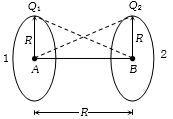
0 likes
View Solution140
EasyMCQ
What is the change in kinetic energy of an $\alpha$-particle when it moves from a point at $70\ V$ to a point at $50\ V$?
A
$40\ eV$
B
$40\ keV$
C
$40\ MeV$
D
$0\ eV$
Solution
(A) The change in kinetic energy $\Delta K$ of a charged particle moving in an electric field is given by $\Delta K = -\Delta U = -q\Delta V = q(V_i - V_f)$.
For an $\alpha$-particle,the charge $q = +2e$.
The potential difference is $\Delta V = V_f - V_i = 50\ V - 70\ V = -20\ V$.
Therefore,the change in kinetic energy is $\Delta K = -q\Delta V = -(2e) \times (-20\ V) = 40\ eV$.
Since the particle moves from a higher potential to a lower potential,its kinetic energy increases by $40\ eV$.
For an $\alpha$-particle,the charge $q = +2e$.
The potential difference is $\Delta V = V_f - V_i = 50\ V - 70\ V = -20\ V$.
Therefore,the change in kinetic energy is $\Delta K = -q\Delta V = -(2e) \times (-20\ V) = 40\ eV$.
Since the particle moves from a higher potential to a lower potential,its kinetic energy increases by $40\ eV$.
0 likes
View Solution141
DifficultMCQ
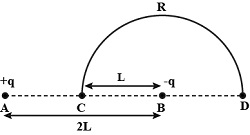
Charges $+q$ and $-q$ are placed at points $A$ and $B$ respectively,which are a distance $2L$ apart. $C$ is the midpoint between $A$ and $B$. The work done in moving a charge $+Q$ along the semicircle $CRD$ is
A
$\frac{qQ}{2\pi\varepsilon_0 L}$
B
$\frac{qQ}{6\pi\varepsilon_0 L}$
C
$-\frac{qQ}{6\pi\varepsilon_0 L}$
D
$\frac{qQ}{4\pi\varepsilon_0 L}$
Solution
(C) From the figure,$AC = L$,$BC = L$. Since $C$ is the midpoint of $AB$ and $CD$ is a semicircle with diameter $CD$,the distance $BD = L$ (as $C, B, D$ are collinear and $CD$ is the diameter of the semicircle,$CB = BD = L$).
Potential at $C$ is given by:
$V_C = \frac{1}{4\pi\varepsilon_0} \left[ \frac{q}{AC} + \frac{-q}{BC} \right] = \frac{1}{4\pi\varepsilon_0} \left[ \frac{q}{L} - \frac{q}{L} \right] = 0$
Potential at $D$ is given by:
$AD = AB + BD = 2L + L = 3L$
$V_D = \frac{1}{4\pi\varepsilon_0} \left[ \frac{q}{AD} + \frac{-q}{BD} \right] = \frac{1}{4\pi\varepsilon_0} \left[ \frac{q}{3L} - \frac{q}{L} \right]$
$V_D = \frac{q}{4\pi\varepsilon_0 L} \left[ \frac{1}{3} - 1 \right] = \frac{q}{4\pi\varepsilon_0 L} \left( -\frac{2}{3} \right) = -\frac{q}{6\pi\varepsilon_0 L}$
Work done in moving charge $+Q$ from $C$ to $D$ is:
$W = Q(V_D - V_C) = Q \left( -\frac{q}{6\pi\varepsilon_0 L} - 0 \right) = -\frac{qQ}{6\pi\varepsilon_0 L}$
Potential at $C$ is given by:
$V_C = \frac{1}{4\pi\varepsilon_0} \left[ \frac{q}{AC} + \frac{-q}{BC} \right] = \frac{1}{4\pi\varepsilon_0} \left[ \frac{q}{L} - \frac{q}{L} \right] = 0$
Potential at $D$ is given by:
$AD = AB + BD = 2L + L = 3L$
$V_D = \frac{1}{4\pi\varepsilon_0} \left[ \frac{q}{AD} + \frac{-q}{BD} \right] = \frac{1}{4\pi\varepsilon_0} \left[ \frac{q}{3L} - \frac{q}{L} \right]$
$V_D = \frac{q}{4\pi\varepsilon_0 L} \left[ \frac{1}{3} - 1 \right] = \frac{q}{4\pi\varepsilon_0 L} \left( -\frac{2}{3} \right) = -\frac{q}{6\pi\varepsilon_0 L}$
Work done in moving charge $+Q$ from $C$ to $D$ is:
$W = Q(V_D - V_C) = Q \left( -\frac{q}{6\pi\varepsilon_0 L} - 0 \right) = -\frac{qQ}{6\pi\varepsilon_0 L}$
0 likes
View Solution142
MediumMCQ
Three concentric spherical shells have radii $a, b$ and $c$ $(a < b < c)$ and have surface charge densities $\sigma, -\sigma$ and $\sigma$ respectively. If $V_A, V_B$ and $V_C$ denote the potentials of the three shells,then,for $c = a + b$,we have
A
$V_C = V_B \neq V_A$
B
$V_C \neq V_B \neq V_A$
C
$V_C = V_B = V_A$
D
$V_C = V_A \neq V_B$
Solution
(D) The potential at any point on a shell is the sum of potentials due to all shells. The charge on a shell of radius $r$ and surface charge density $\sigma$ is $q = 4\pi r^2 \sigma$.
Thus,$q_A = 4\pi a^2 \sigma$,$q_B = -4\pi b^2 \sigma$,and $q_C = 4\pi c^2 \sigma$.
The potentials are:
$V_A = \frac{1}{4\pi\epsilon_0} [\frac{q_A}{a} + \frac{q_B}{b} + \frac{q_C}{c}] = \frac{1}{\epsilon_0} [a\sigma - b\sigma + \frac{c^2\sigma}{c}] = \frac{\sigma}{\epsilon_0} [a - b + c]$
$V_B = \frac{1}{4\pi\epsilon_0} [\frac{q_A}{b} + \frac{q_B}{b} + \frac{q_C}{c}] = \frac{1}{\epsilon_0} [\frac{a^2\sigma}{b} - b\sigma + \frac{c^2\sigma}{c}] = \frac{\sigma}{\epsilon_0} [\frac{a^2}{b} - b + c]$
$V_C = \frac{1}{4\pi\epsilon_0} [\frac{q_A}{c} + \frac{q_B}{c} + \frac{q_C}{c}] = \frac{1}{\epsilon_0} [\frac{a^2\sigma}{c} - \frac{b^2\sigma}{c} + c\sigma] = \frac{\sigma}{\epsilon_0} [\frac{a^2 - b^2}{c} + c]$
Given $c = a + b$,then $c - b = a$ and $c - a = b$. Also $a^2 - b^2 = (a - b)(a + b) = (a - b)c$.
Substituting $c = a + b$ into $V_A$: $V_A = \frac{\sigma}{\epsilon_0} [a - b + (a + b)] = \frac{2a\sigma}{\epsilon_0}$.
Substituting $c = a + b$ into $V_C$: $V_C = \frac{\sigma}{\epsilon_0} [\frac{(a - b)(a + b)}{c} + c] = \frac{\sigma}{\epsilon_0} [\frac{(a - b)c}{c} + c] = \frac{\sigma}{\epsilon_0} [a - b + a + b] = \frac{2a\sigma}{\epsilon_0}$.
Since $V_A = V_C = \frac{2a\sigma}{\epsilon_0}$ and $V_B = \frac{\sigma}{\epsilon_0} [\frac{a^2}{b} - b + a + b] = \frac{\sigma}{\epsilon_0} [\frac{a^2}{b} + a]$,clearly $V_A = V_C \neq V_B$.
Thus,$q_A = 4\pi a^2 \sigma$,$q_B = -4\pi b^2 \sigma$,and $q_C = 4\pi c^2 \sigma$.
The potentials are:
$V_A = \frac{1}{4\pi\epsilon_0} [\frac{q_A}{a} + \frac{q_B}{b} + \frac{q_C}{c}] = \frac{1}{\epsilon_0} [a\sigma - b\sigma + \frac{c^2\sigma}{c}] = \frac{\sigma}{\epsilon_0} [a - b + c]$
$V_B = \frac{1}{4\pi\epsilon_0} [\frac{q_A}{b} + \frac{q_B}{b} + \frac{q_C}{c}] = \frac{1}{\epsilon_0} [\frac{a^2\sigma}{b} - b\sigma + \frac{c^2\sigma}{c}] = \frac{\sigma}{\epsilon_0} [\frac{a^2}{b} - b + c]$
$V_C = \frac{1}{4\pi\epsilon_0} [\frac{q_A}{c} + \frac{q_B}{c} + \frac{q_C}{c}] = \frac{1}{\epsilon_0} [\frac{a^2\sigma}{c} - \frac{b^2\sigma}{c} + c\sigma] = \frac{\sigma}{\epsilon_0} [\frac{a^2 - b^2}{c} + c]$
Given $c = a + b$,then $c - b = a$ and $c - a = b$. Also $a^2 - b^2 = (a - b)(a + b) = (a - b)c$.
Substituting $c = a + b$ into $V_A$: $V_A = \frac{\sigma}{\epsilon_0} [a - b + (a + b)] = \frac{2a\sigma}{\epsilon_0}$.
Substituting $c = a + b$ into $V_C$: $V_C = \frac{\sigma}{\epsilon_0} [\frac{(a - b)(a + b)}{c} + c] = \frac{\sigma}{\epsilon_0} [\frac{(a - b)c}{c} + c] = \frac{\sigma}{\epsilon_0} [a - b + a + b] = \frac{2a\sigma}{\epsilon_0}$.
Since $V_A = V_C = \frac{2a\sigma}{\epsilon_0}$ and $V_B = \frac{\sigma}{\epsilon_0} [\frac{a^2}{b} - b + a + b] = \frac{\sigma}{\epsilon_0} [\frac{a^2}{b} + a]$,clearly $V_A = V_C \neq V_B$.
0 likes
View Solution143
MediumMCQ
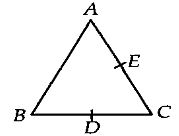
Three charges,each $+q$,are placed at the corners of an isosceles triangle $ABC$ with sides $BC = AC = 2a$. $D$ and $E$ are the midpoints of $BC$ and $AC$,respectively. The work done in taking a charge $Q$ from $D$ to $E$ is
A
$\frac{3qQ}{4\pi \varepsilon_0 a}$
B
$\frac{3qQ}{8\pi \varepsilon_0 a}$
C
$\frac{qQ}{4\pi \varepsilon_0 a}$
D
zero
Solution
(D) Given that $AC = BC = 2a$. $D$ and $E$ are the midpoints of $BC$ and $AC$ respectively.
Therefore,$AE = EC = a$ and $BD = DC = a$.
In $\Delta ADC$,by the Pythagorean theorem,$(AD)^2 = (AC)^2 - (DC)^2 = (2a)^2 - (a)^2 = 4a^2 - a^2 = 3a^2$,so $AD = a\sqrt{3}$.
Similarly,in $\Delta BEC$,$(BE)^2 = (BC)^2 - (EC)^2 = (2a)^2 - (a)^2 = 3a^2$,so $BE = a\sqrt{3}$.
The electric potential at point $D$ due to the charges at $A, B,$ and $C$ is:
$V_D = \frac{1}{4\pi\varepsilon_0} \left[ \frac{q}{BD} + \frac{q}{DC} + \frac{q}{AD} \right] = \frac{q}{4\pi\varepsilon_0} \left[ \frac{1}{a} + \frac{1}{a} + \frac{1}{a\sqrt{3}} \right] = \frac{q}{4\pi\varepsilon_0 a} \left[ 2 + \frac{1}{\sqrt{3}} \right]$.
The electric potential at point $E$ due to the charges at $A, B,$ and $C$ is:
$V_E = \frac{1}{4\pi\varepsilon_0} \left[ \frac{q}{AE} + \frac{q}{EC} + \frac{q}{BE} \right] = \frac{q}{4\pi\varepsilon_0} \left[ \frac{1}{a} + \frac{1}{a} + \frac{1}{a\sqrt{3}} \right] = \frac{q}{4\pi\varepsilon_0 a} \left[ 2 + \frac{1}{\sqrt{3}} \right]$.
Since $V_D = V_E$,the work done $W = Q(V_E - V_D) = 0$.
Therefore,$AE = EC = a$ and $BD = DC = a$.
In $\Delta ADC$,by the Pythagorean theorem,$(AD)^2 = (AC)^2 - (DC)^2 = (2a)^2 - (a)^2 = 4a^2 - a^2 = 3a^2$,so $AD = a\sqrt{3}$.
Similarly,in $\Delta BEC$,$(BE)^2 = (BC)^2 - (EC)^2 = (2a)^2 - (a)^2 = 3a^2$,so $BE = a\sqrt{3}$.
The electric potential at point $D$ due to the charges at $A, B,$ and $C$ is:
$V_D = \frac{1}{4\pi\varepsilon_0} \left[ \frac{q}{BD} + \frac{q}{DC} + \frac{q}{AD} \right] = \frac{q}{4\pi\varepsilon_0} \left[ \frac{1}{a} + \frac{1}{a} + \frac{1}{a\sqrt{3}} \right] = \frac{q}{4\pi\varepsilon_0 a} \left[ 2 + \frac{1}{\sqrt{3}} \right]$.
The electric potential at point $E$ due to the charges at $A, B,$ and $C$ is:
$V_E = \frac{1}{4\pi\varepsilon_0} \left[ \frac{q}{AE} + \frac{q}{EC} + \frac{q}{BE} \right] = \frac{q}{4\pi\varepsilon_0} \left[ \frac{1}{a} + \frac{1}{a} + \frac{1}{a\sqrt{3}} \right] = \frac{q}{4\pi\varepsilon_0 a} \left[ 2 + \frac{1}{\sqrt{3}} \right]$.
Since $V_D = V_E$,the work done $W = Q(V_E - V_D) = 0$.
0 likes
View Solution144
DifficultMCQ
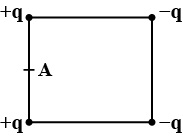
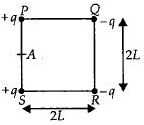
Four electric charges $+q, +q, -q$ and $-q$ are placed at the corners of a square of side $2L$ (see figure). The electric potential at point $A$,midway between the two charges $+q$ and $+q$,is
A
$\frac{1}{4\pi \varepsilon_0} \frac{2q}{L} (1 + \sqrt{5})$
B
$\frac{1}{4\pi \varepsilon_0} \frac{2q}{L} (1 + \frac{1}{\sqrt{5}})$
C
$\frac{1}{4\pi \varepsilon_0} \frac{2q}{L} (1 - \frac{1}{\sqrt{5}})$
D
zero
Solution
(C) Let the corners of the square be $P, Q, R, S$ in order. Let $P$ and $S$ have charges $+q$,and $Q$ and $R$ have charges $-q$. Point $A$ is the midpoint of side $PS$.
Since the side length is $2L$,the distance from $A$ to $P$ and $A$ to $S$ is $L$.
The distance from $A$ to $Q$ and $A$ to $R$ can be calculated using the Pythagorean theorem: $AQ = AR = \sqrt{(2L)^2 + L^2} = \sqrt{4L^2 + L^2} = L\sqrt{5}$.
The electric potential $V_A$ at point $A$ is the algebraic sum of potentials due to all four charges:
$V_A = \frac{1}{4\pi \varepsilon_0} [\frac{q}{AP} + \frac{q}{AS} + \frac{-q}{AQ} + \frac{-q}{AR}]$
$V_A = \frac{1}{4\pi \varepsilon_0} [\frac{q}{L} + \frac{q}{L} - \frac{q}{L\sqrt{5}} - \frac{q}{L\sqrt{5}}]$
$V_A = \frac{1}{4\pi \varepsilon_0} [\frac{2q}{L} - \frac{2q}{L\sqrt{5}}]$
$V_A = \frac{1}{4\pi \varepsilon_0} \frac{2q}{L} (1 - \frac{1}{\sqrt{5}})$
Since the side length is $2L$,the distance from $A$ to $P$ and $A$ to $S$ is $L$.
The distance from $A$ to $Q$ and $A$ to $R$ can be calculated using the Pythagorean theorem: $AQ = AR = \sqrt{(2L)^2 + L^2} = \sqrt{4L^2 + L^2} = L\sqrt{5}$.
The electric potential $V_A$ at point $A$ is the algebraic sum of potentials due to all four charges:
$V_A = \frac{1}{4\pi \varepsilon_0} [\frac{q}{AP} + \frac{q}{AS} + \frac{-q}{AQ} + \frac{-q}{AR}]$
$V_A = \frac{1}{4\pi \varepsilon_0} [\frac{q}{L} + \frac{q}{L} - \frac{q}{L\sqrt{5}} - \frac{q}{L\sqrt{5}}]$
$V_A = \frac{1}{4\pi \varepsilon_0} [\frac{2q}{L} - \frac{2q}{L\sqrt{5}}]$
$V_A = \frac{1}{4\pi \varepsilon_0} \frac{2q}{L} (1 - \frac{1}{\sqrt{5}})$
0 likes
View Solution145
MediumMCQ
Four point charges $-Q, -q, 2q$ and $2Q$ are placed,one at each corner of a square. The relation between $Q$ and $q$ for which the potential at the center of the square is zero is:
A
$Q = -q$
B
$Q = -1/q$
C
$Q = q$
D
$Q = 1/q$
Solution
(A) Let the distance from the center of the square to each corner be $r$. The electric potential $V$ at the center due to a point charge $q_i$ at distance $r$ is given by $V = \frac{1}{4\pi\epsilon_0} \frac{q_i}{r}$.
Since the distance $r$ is the same for all four corners,the total potential at the center is the algebraic sum of the potentials due to each charge:
$V_{total} = \frac{1}{4\pi\epsilon_0} \left( \frac{-Q}{r} + \frac{-q}{r} + \frac{2q}{r} + \frac{2Q}{r} \right)$
$V_{total} = \frac{1}{4\pi\epsilon_0 r} (-Q - q + 2q + 2Q)$
$V_{total} = \frac{1}{4\pi\epsilon_0 r} (Q + q)$
For the potential at the center to be zero,we must have $V_{total} = 0$,which implies:
$Q + q = 0$
$Q = -q$
Since the distance $r$ is the same for all four corners,the total potential at the center is the algebraic sum of the potentials due to each charge:
$V_{total} = \frac{1}{4\pi\epsilon_0} \left( \frac{-Q}{r} + \frac{-q}{r} + \frac{2q}{r} + \frac{2Q}{r} \right)$
$V_{total} = \frac{1}{4\pi\epsilon_0 r} (-Q - q + 2q + 2Q)$
$V_{total} = \frac{1}{4\pi\epsilon_0 r} (Q + q)$
For the potential at the center to be zero,we must have $V_{total} = 0$,which implies:
$Q + q = 0$
$Q = -q$
0 likes
View Solution146
EasyMCQ
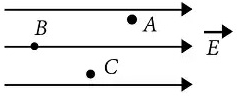
$A, B$ and $C$ are three points in a uniform electric field as shown in the figure. The electric potential is
A
maximum at $A$
B
maximum at $B$
C
maximum at $C$
D
the same at all three points $A, B$ and $C$
Solution
(B) The electric potential decreases in the direction of the electric field.
From the given figure,point $B$ is at the leftmost position,followed by point $C$,and then point $A$ in the direction of the electric field $\vec{E}$.
Therefore,the potential at these points follows the relation $V_B > V_C > V_A$.
Thus,the electric potential is maximum at point $B$.
From the given figure,point $B$ is at the leftmost position,followed by point $C$,and then point $A$ in the direction of the electric field $\vec{E}$.
Therefore,the potential at these points follows the relation $V_B > V_C > V_A$.
Thus,the electric potential is maximum at point $B$.
0 likes
View Solution147
EasyMCQ
$A$ conducting sphere of radius $R$ is given a charge $Q$. The electric potential and the electric field at the centre of the sphere respectively are
A
$0, \frac{Q}{4\pi \varepsilon_0 R^2}$
B
$\frac{Q}{4\pi \varepsilon_0 R}, 0$
C
$\frac{Q}{4\pi \varepsilon_0 R}, \frac{Q}{4\pi \varepsilon_0 R^2}$
D
$0, 0$
Solution
(B) For a conducting sphere,the charge $Q$ resides entirely on its outer surface.
The electric field $E$ inside a conducting sphere is zero because the charges are distributed on the surface such that they cancel each other's field at every point inside.
The electric potential $V$ inside a conducting sphere is constant and equal to the potential at its surface.
Therefore,the potential at the centre is $V = \frac{1}{4\pi \varepsilon_0} \frac{Q}{R}$.
The electric field at the centre is $E = 0$.
The electric field $E$ inside a conducting sphere is zero because the charges are distributed on the surface such that they cancel each other's field at every point inside.
The electric potential $V$ inside a conducting sphere is constant and equal to the potential at its surface.
Therefore,the potential at the centre is $V = \frac{1}{4\pi \varepsilon_0} \frac{Q}{R}$.
The electric field at the centre is $E = 0$.
0 likes
View Solution148
MediumMCQ
An arc of radius $r$ carries a charge. The linear charge density is $\lambda$ and the arc subtends an angle of $\frac{\pi}{3}$ at the centre. What is the electric potential at the centre?
A
$\frac{\lambda}{4\varepsilon_0}$
B
$\frac{\lambda}{8\varepsilon_0}$
C
$\frac{\lambda}{12\varepsilon_0}$
D
$\frac{\lambda}{16\varepsilon_0}$
Solution
(C) The length of the arc is given by $L = r\theta = r \times \frac{\pi}{3} = \frac{r\pi}{3}$.
Since the linear charge density is $\lambda$,the total charge $q$ on the arc is $q = \lambda \times L = \lambda \times \frac{r\pi}{3}$.
All points on the arc are at an equal distance $r$ from the centre.
The electric potential $V$ at the centre due to a charge $q$ at distance $r$ is given by $V = \frac{1}{4\pi\varepsilon_0} \frac{q}{r}$.
Substituting the value of $q$,we get $V = \frac{1}{4\pi\varepsilon_0} \times \frac{(\lambda r\pi / 3)}{r}$.
Simplifying this,$V = \frac{\lambda r\pi}{12\pi\varepsilon_0 r} = \frac{\lambda}{12\varepsilon_0}$.
Since the linear charge density is $\lambda$,the total charge $q$ on the arc is $q = \lambda \times L = \lambda \times \frac{r\pi}{3}$.
All points on the arc are at an equal distance $r$ from the centre.
The electric potential $V$ at the centre due to a charge $q$ at distance $r$ is given by $V = \frac{1}{4\pi\varepsilon_0} \frac{q}{r}$.
Substituting the value of $q$,we get $V = \frac{1}{4\pi\varepsilon_0} \times \frac{(\lambda r\pi / 3)}{r}$.
Simplifying this,$V = \frac{\lambda r\pi}{12\pi\varepsilon_0 r} = \frac{\lambda}{12\varepsilon_0}$.
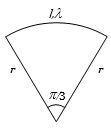
0 likes
View Solution149
EasyMCQ
Which of the following is a volt?
A
$Erg$ per $cm$
B
$Joule$ per $coulomb$
C
$Erg$ per $ampere$
D
$Newton / (coulomb \times m^2)$
Solution
(B) The electric potential $V$ is defined as the work done per unit charge to move a charge from infinity to a point in an electric field.
Mathematically,$V = W / Q$.
The $SI$ unit of work $W$ is $Joule$ $(J)$ and the $SI$ unit of charge $Q$ is $coulomb$ $(C)$.
Therefore,the unit of potential $V$ is $Joule / coulomb$ $(J/C)$,which is equivalent to $1 \text{ volt}$.
Thus,the correct option is $B$.
Mathematically,$V = W / Q$.
The $SI$ unit of work $W$ is $Joule$ $(J)$ and the $SI$ unit of charge $Q$ is $coulomb$ $(C)$.
Therefore,the unit of potential $V$ is $Joule / coulomb$ $(J/C)$,which is equivalent to $1 \text{ volt}$.
Thus,the correct option is $B$.
0 likes
View Solution150
AdvancedMCQ
The potential difference between the center and the surface of a sphere of radius $R$ with a uniform volume charge density $\rho$ within it will be:
A
$\frac{\rho R^2}{6 \epsilon_0}$
B
$\frac{\rho R^2}{4 \epsilon_0}$
C
$0$
D
$\frac{\rho R^2}{2 \epsilon_0}$
Solution
(A) The electric potential at the surface of a uniformly charged sphere is given by $V_S = \frac{1}{4 \pi \epsilon_0} \cdot \frac{q}{R}$.
Substituting $q = \rho \cdot \frac{4}{3} \pi R^3$,we get $V_S = \frac{\rho R^2}{3 \epsilon_0}$.
The electric potential at the center of the sphere is given by $V_C = \frac{3}{2} \cdot \frac{1}{4 \pi \epsilon_0} \cdot \frac{q}{R}$.
Substituting $q = \rho \cdot \frac{4}{3} \pi R^3$,we get $V_C = \frac{\rho R^2}{2 \epsilon_0}$.
The potential difference between the center and the surface is $\Delta V = V_C - V_S$.
$\Delta V = \frac{\rho R^2}{2 \epsilon_0} - \frac{\rho R^2}{3 \epsilon_0} = \frac{3 \rho R^2 - 2 \rho R^2}{6 \epsilon_0} = \frac{\rho R^2}{6 \epsilon_0}$.
Substituting $q = \rho \cdot \frac{4}{3} \pi R^3$,we get $V_S = \frac{\rho R^2}{3 \epsilon_0}$.
The electric potential at the center of the sphere is given by $V_C = \frac{3}{2} \cdot \frac{1}{4 \pi \epsilon_0} \cdot \frac{q}{R}$.
Substituting $q = \rho \cdot \frac{4}{3} \pi R^3$,we get $V_C = \frac{\rho R^2}{2 \epsilon_0}$.
The potential difference between the center and the surface is $\Delta V = V_C - V_S$.
$\Delta V = \frac{\rho R^2}{2 \epsilon_0} - \frac{\rho R^2}{3 \epsilon_0} = \frac{3 \rho R^2 - 2 \rho R^2}{6 \epsilon_0} = \frac{\rho R^2}{6 \epsilon_0}$.
0 likes
View SolutionElectric Potential and Capacitance — Electric potential · Frequently Asked Questions
1Are these Electric Potential and Capacitance questions useful for JEE and NEET?
Yes. All questions in this section are mapped to JEE Main and NEET exam patterns. Previous year questions from JEE Main, NEET, GUJCET and state-level exams are included with full solutions.
2Can I switch to Hindi or Gujarati for these questions?
Yes. Use the language tabs in the hero section or the sidebar to view the same questions and solutions in English, Hindi or Gujarati.
3How do I generate a question paper from this subtopic?
Use the Vedclass Exam Paper Generator — select the chapter and subtopic, set difficulty, and generate Sets A, B, C, D automatically. First 3 chapters of every subject are free.
Vedclass Products
For Students
Vedclass Test Series
Mock tests in real JEE/NEET style with performance analysis. 5-day free trial.
Start Free TrialFor Teachers
Exam Paper Generator
Generate Set A/B/C/D papers from this chapter in 2 minutes. 3 chapters free.
Try FreeFor Institutes
Online Exam Module
Live online exams with unlimited students, 360° analytics & white-label branding.
See DemoFor Teachers & Institutes
Generate a Electric Potential and Capacitance Exam Paper in 2 Minutes
Select subtopic & difficulty — Sets A, B, C, D auto-generated with No Repeat logic.
First 3 chapters of every subject are free — no payment required.