
A English
Electric potential Questions in English
Class 12 Physics · Electric Potential and Capacitance · Electric potential
432+
Questions
English
Language
100%
With Solutions
Showing 49 of 432 questions in English
251
Medium
Write an expression for the potential at a point outside a uniformly charged spherical shell,on the surface,and inside the shell.
Solution
(N/A) For a uniformly charged spherical shell of radius $R$ and total charge $q$,the electric potential $V$ is determined as follows:
$1$. Outside the shell $(r > R)$: The potential is equivalent to that of a point charge concentrated at the center: $V = \frac{kq}{r}$.
$2$. On the surface of the shell $(r = R)$: The potential is $V = \frac{kq}{R}$.
$3$. Inside the shell $(r < R)$: Since the electric field inside a charged spherical shell is zero,the potential remains constant and equal to the potential at the surface: $V = \frac{kq}{R}$.
Thus,the expressions are:
$V = \frac{kq}{r}$ for $r \geq R$
$V = \frac{kq}{R}$ for $r < R$
$1$. Outside the shell $(r > R)$: The potential is equivalent to that of a point charge concentrated at the center: $V = \frac{kq}{r}$.
$2$. On the surface of the shell $(r = R)$: The potential is $V = \frac{kq}{R}$.
$3$. Inside the shell $(r < R)$: Since the electric field inside a charged spherical shell is zero,the potential remains constant and equal to the potential at the surface: $V = \frac{kq}{R}$.
Thus,the expressions are:
$V = \frac{kq}{r}$ for $r \geq R$
$V = \frac{kq}{R}$ for $r < R$
0 likes
View Solution252
Medium
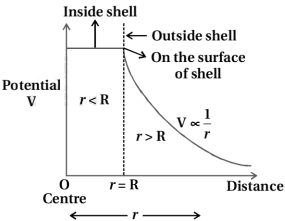
Draw a graph showing the variation of electric potential $V$ with distance $r$ from the center for a uniformly charged spherical shell of radius $R$.
Solution
(N/A) For a uniformly charged spherical shell of radius $R$ and total charge $Q$:
$1$. Inside the shell $(r < R)$,the electric field is zero,so the potential is constant and equal to the potential at the surface: $V = \frac{1}{4\pi\epsilon_0} \frac{Q}{R}$.
$2$. On the surface $(r = R)$,the potential is $V = \frac{1}{4\pi\epsilon_0} \frac{Q}{R}$.
$3$. Outside the shell $(r > R)$,the shell behaves like a point charge at the center,so the potential varies as $V \propto \frac{1}{r}$,specifically $V = \frac{1}{4\pi\epsilon_0} \frac{Q}{r}$.
The graph shows a constant potential line for $r \leq R$ and a hyperbolic decay curve for $r > R$.
$1$. Inside the shell $(r < R)$,the electric field is zero,so the potential is constant and equal to the potential at the surface: $V = \frac{1}{4\pi\epsilon_0} \frac{Q}{R}$.
$2$. On the surface $(r = R)$,the potential is $V = \frac{1}{4\pi\epsilon_0} \frac{Q}{R}$.
$3$. Outside the shell $(r > R)$,the shell behaves like a point charge at the center,so the potential varies as $V \propto \frac{1}{r}$,specifically $V = \frac{1}{4\pi\epsilon_0} \frac{Q}{r}$.
The graph shows a constant potential line for $r \leq R$ and a hyperbolic decay curve for $r > R$.
0 likes
View Solution253
Difficult
Write an equation for the electric potential due to a system of charges.
Solution
(N/A) The electric potential $V$ at a point due to a system of $n$ point charges $q_1, q_2, ..., q_n$ at distances $r_1, r_2, ..., r_n$ from the point is given by the algebraic sum of the potentials due to each individual charge.
The equation is:
$V = \sum_{i=1}^{n} \frac{1}{4\pi\epsilon_0} \frac{q_i}{r_i}$
Where:
$V$ is the total electric potential.
$\epsilon_0$ is the permittivity of free space.
$q_i$ is the $i^{th}$ charge.
$r_i$ is the distance of the $i^{th}$ charge from the point where the potential is calculated.
The equation is:
$V = \sum_{i=1}^{n} \frac{1}{4\pi\epsilon_0} \frac{q_i}{r_i}$
Where:
$V$ is the total electric potential.
$\epsilon_0$ is the permittivity of free space.
$q_i$ is the $i^{th}$ charge.
$r_i$ is the distance of the $i^{th}$ charge from the point where the potential is calculated.
0 likes
View Solution254
Medium
Write an equation for the electric potential due to a volume charge distribution.
Solution
(N/A) The electric potential $V$ at a point $P$ due to a volume charge distribution with charge density $\rho$ in a volume $V'$ is given by the integral equation:
$V = \frac{1}{4\pi\epsilon_0} \int_{V'} \frac{\rho(r') \, dV'}{|r - r'|}$
Where:
$1. \epsilon_0$ is the permittivity of free space.
$2. \rho(r')$ is the volume charge density at a position vector $r'$.
$3. dV'$ is the infinitesimal volume element.
$4. |r - r'|$ is the distance between the observation point $r$ and the source point $r'$.
$V = \frac{1}{4\pi\epsilon_0} \int_{V'} \frac{\rho(r') \, dV'}{|r - r'|}$
Where:
$1. \epsilon_0$ is the permittivity of free space.
$2. \rho(r')$ is the volume charge density at a position vector $r'$.
$3. dV'$ is the infinitesimal volume element.
$4. |r - r'|$ is the distance between the observation point $r$ and the source point $r'$.
0 likes
View Solution255
Easy
Write an equation for the potential at a point in a uniformly charged spherical shell.
Solution
(N/A) For a uniformly charged spherical shell of radius $R$ and total charge $Q$:
$1$. Outside the shell $(r \ge R)$: The potential is given by $V = \frac{1}{4\pi\epsilon_0} \frac{Q}{r}$.
$2$. Inside the shell $(r < R)$: The electric field inside a charged spherical shell is zero. Therefore,the potential is constant and equal to the potential at the surface. The potential is given by $V = \frac{1}{4\pi\epsilon_0} \frac{Q}{R}$.
$1$. Outside the shell $(r \ge R)$: The potential is given by $V = \frac{1}{4\pi\epsilon_0} \frac{Q}{r}$.
$2$. Inside the shell $(r < R)$: The electric field inside a charged spherical shell is zero. Therefore,the potential is constant and equal to the potential at the surface. The potential is given by $V = \frac{1}{4\pi\epsilon_0} \frac{Q}{R}$.
0 likes
View Solution256
EasyMCQ
Draw a graph of $V$ versus $r$ for a uniformly charged spherical shell of radius $R$.
A
Graph showing $V$ is constant for $r < R$ and $V \propto 1/r$ for $r \ge R$.
B
Graph showing $V \propto r$ for $r < R$ and $V \propto 1/r^2$ for $r \ge R$.
C
Graph showing $V = 0$ for $r < R$ and $V \propto 1/r$ for $r \ge R$.
D
Graph showing $V \propto 1/r$ for all $r$.
Solution
(A) For a uniformly charged spherical shell of radius $R$ and total charge $Q$:
$1$. Inside the shell $(r < R)$,the electric field $E = 0$. Therefore,the potential $V$ is constant and equal to the potential at the surface,$V = kQ/R$.
$2$. Outside the shell $(r \ge R)$,the shell behaves like a point charge located at the center. Therefore,the potential $V = kQ/r$,which means $V \propto 1/r$.
$3$. The graph of $V$ versus $r$ starts as a horizontal line from $r = 0$ to $r = R$ at a value of $V = kQ/R$,and then follows a hyperbolic decay curve for $r > R$.
$1$. Inside the shell $(r < R)$,the electric field $E = 0$. Therefore,the potential $V$ is constant and equal to the potential at the surface,$V = kQ/R$.
$2$. Outside the shell $(r \ge R)$,the shell behaves like a point charge located at the center. Therefore,the potential $V = kQ/r$,which means $V \propto 1/r$.
$3$. The graph of $V$ versus $r$ starts as a horizontal line from $r = 0$ to $r = R$ at a value of $V = kQ/R$,and then follows a hyperbolic decay curve for $r > R$.
0 likes
View Solution257
Medium
Derive the formula for the electric potential energy of a system of three charges.
Solution
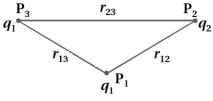
(N/A) Consider three charges $q_{1}, q_{2},$ and $q_{3}$ brought from infinity to positions $P_{1}, P_{2},$ and $P_{3}$ respectively.
$1$. Work done to bring charge $q_{1}$ to $P_{1}$:
Since there is no external electric field,the work done $W_{1} = 0$.
$2$. Work done to bring charge $q_{2}$ to $P_{2}$:
The electric potential at $P_{2}$ due to $q_{1}$ is $V_{1} = \frac{k q_{1}}{r_{12}}$.
Therefore,the work done $W_{2} = V_{1} \times q_{2} = \frac{k q_{1} q_{2}}{r_{12}}$.
$3$. Work done to bring charge $q_{3}$ to $P_{3}$:
The electric potential at $P_{3}$ due to $q_{1}$ and $q_{2}$ is $V_{2} = \frac{k q_{1}}{r_{13}} + \frac{k q_{2}}{r_{23}}$.
Therefore,the work done $W_{3} = V_{2} \times q_{3} = k \left[ \frac{q_{1} q_{3}}{r_{13}} + \frac{q_{2} q_{3}}{r_{23}} \right]$.
$4$. Total potential energy $(U)$:
The total potential energy of the system is the sum of the work done:
$U = W_{1} + W_{2} + W_{3} = 0 + \frac{k q_{1} q_{2}}{r_{12}} + k \left[ \frac{q_{1} q_{3}}{r_{13}} + \frac{q_{2} q_{3}}{r_{23}} \right]$
$U = k \left[ \frac{q_{1} q_{2}}{r_{12}} + \frac{q_{1} q_{3}}{r_{13}} + \frac{q_{2} q_{3}}{r_{23}} \right]$
$1$. Work done to bring charge $q_{1}$ to $P_{1}$:
Since there is no external electric field,the work done $W_{1} = 0$.
$2$. Work done to bring charge $q_{2}$ to $P_{2}$:
The electric potential at $P_{2}$ due to $q_{1}$ is $V_{1} = \frac{k q_{1}}{r_{12}}$.
Therefore,the work done $W_{2} = V_{1} \times q_{2} = \frac{k q_{1} q_{2}}{r_{12}}$.
$3$. Work done to bring charge $q_{3}$ to $P_{3}$:
The electric potential at $P_{3}$ due to $q_{1}$ and $q_{2}$ is $V_{2} = \frac{k q_{1}}{r_{13}} + \frac{k q_{2}}{r_{23}}$.
Therefore,the work done $W_{3} = V_{2} \times q_{3} = k \left[ \frac{q_{1} q_{3}}{r_{13}} + \frac{q_{2} q_{3}}{r_{23}} \right]$.
$4$. Total potential energy $(U)$:
The total potential energy of the system is the sum of the work done:
$U = W_{1} + W_{2} + W_{3} = 0 + \frac{k q_{1} q_{2}}{r_{12}} + k \left[ \frac{q_{1} q_{3}}{r_{13}} + \frac{q_{2} q_{3}}{r_{23}} \right]$
$U = k \left[ \frac{q_{1} q_{2}}{r_{12}} + \frac{q_{1} q_{3}}{r_{13}} + \frac{q_{2} q_{3}}{r_{23}} \right]$
0 likes
View Solution258
Medium
Define electron volt and convert it into Joule unit.
Solution
An electron volt $(eV)$ is defined as the amount of kinetic energy gained by a single electron when it is accelerated through a potential difference of $1 \text{ volt}$.
Calculation:
The energy $U$ gained by a charge $q$ accelerated through a potential difference $\Delta V$ is given by $U = q \Delta V$.
For an electron,the charge $q = e = 1.6 \times 10^{-19} \text{ C}$.
If $\Delta V = 1 \text{ V}$,then:
$1 \text{ eV} = (1.6 \times 10^{-19} \text{ C}) \times (1 \text{ V})$
$1 \text{ eV} = 1.6 \times 10^{-19} \text{ J}$.
This unit is commonly used in atomic,nuclear,and particle physics.
Multipliers of $eV$:
$1 \text{ meV} = 1.6 \times 10^{-22} \text{ J}$
$1 \text{ keV} = 1.6 \times 10^{-16} \text{ J}$
$1 \text{ MeV} = 1.6 \times 10^{-13} \text{ J}$
$1 \text{ GeV} = 1.6 \times 10^{-10} \text{ J}$
$1 \text{ TeV} = 1.6 \times 10^{-7} \text{ J}$
Calculation:
The energy $U$ gained by a charge $q$ accelerated through a potential difference $\Delta V$ is given by $U = q \Delta V$.
For an electron,the charge $q = e = 1.6 \times 10^{-19} \text{ C}$.
If $\Delta V = 1 \text{ V}$,then:
$1 \text{ eV} = (1.6 \times 10^{-19} \text{ C}) \times (1 \text{ V})$
$1 \text{ eV} = 1.6 \times 10^{-19} \text{ J}$.
This unit is commonly used in atomic,nuclear,and particle physics.
Multipliers of $eV$:
$1 \text{ meV} = 1.6 \times 10^{-22} \text{ J}$
$1 \text{ keV} = 1.6 \times 10^{-16} \text{ J}$
$1 \text{ MeV} = 1.6 \times 10^{-13} \text{ J}$
$1 \text{ GeV} = 1.6 \times 10^{-10} \text{ J}$
$1 \text{ TeV} = 1.6 \times 10^{-7} \text{ J}$
0 likes
View Solution259
Easy
Define an electron Volt $(eV)$ and express its value in Joule $(J)$ units.
Solution
(N/A) An electron volt $(eV)$ is defined as the amount of kinetic energy gained or lost by a single electron accelerating from rest through an electric potential difference of $1 \ V$.
Mathematically,the energy $E$ is given by $E = qV$.
Here,the charge of an electron $q = 1.602 \times 10^{-19} \ C$ and the potential difference $V = 1 \ V$.
Therefore,$1 \ eV = (1.602 \times 10^{-19} \ C) \times (1 \ V) = 1.602 \times 10^{-19} \ J$.
Mathematically,the energy $E$ is given by $E = qV$.
Here,the charge of an electron $q = 1.602 \times 10^{-19} \ C$ and the potential difference $V = 1 \ V$.
Therefore,$1 \ eV = (1.602 \times 10^{-19} \ C) \times (1 \ V) = 1.602 \times 10^{-19} \ J$.
0 likes
View Solution260
Easy
$1 \ eV = ...... \ J$. (Fill in the gap)
Solution
$(1.602 \times 10^{-19})$ The electron volt $(eV)$ is a unit of energy defined as the amount of kinetic energy gained by a single electron accelerating from rest through an electric potential difference of $1 \ V$.
Since the charge of an electron is $e = 1.602 \times 10^{-19} \ C$, the energy in Joules is given by $E = qV = (1.602 \times 10^{-19} \ C) \times (1 \ V) = 1.602 \times 10^{-19} \ J$.
Therefore, $1 \ eV = 1.602 \times 10^{-19} \ J$.
Since the charge of an electron is $e = 1.602 \times 10^{-19} \ C$, the energy in Joules is given by $E = qV = (1.602 \times 10^{-19} \ C) \times (1 \ V) = 1.602 \times 10^{-19} \ J$.
Therefore, $1 \ eV = 1.602 \times 10^{-19} \ J$.
0 likes
View Solution261
EasyMCQ
What is the order of electric potential generated by a Van de Graaff generator?
A
$10^3 \ V$
B
$10^4 \ V$
C
$10^6 \ V$
D
$10^2 \ V$
Solution
(C) Van de Graaff generator is an electrostatic accelerator that can produce very high electric potentials,typically in the range of $6$ to $8$ million volts ($6 \times 10^6 \ V$ to $8 \times 10^6 \ V$).
This high potential is used to accelerate charged particles to high energies to study the structure of matter.
This high potential is used to accelerate charged particles to high energies to study the structure of matter.
0 likes
View Solution262
EasyMCQ
$A$ metal sphere of radius $r$ carrying charge $q$ is placed at the center of a metallic shell of radius $R$ carrying charge $Q$. Find the expression for the potential difference between the sphere and the shell.
A
$V = \frac{1}{4\pi\epsilon_0} \frac{q}{r}$
B
$V = \frac{1}{4\pi\epsilon_0} \frac{q}{R}$
C
$V = \frac{q}{4\pi\epsilon_0} \left( \frac{1}{r} - \frac{1}{R} \right)$
D
$V = \frac{1}{4\pi\epsilon_0} \left( \frac{q+Q}{r} \right)$
Solution
(C) The potential at the surface of the inner sphere of radius $r$ due to its own charge $q$ is $V_{q,r} = \frac{1}{4\pi\epsilon_0} \frac{q}{r}$.
The potential at the surface of the inner sphere due to the charge $Q$ on the outer shell of radius $R$ is $V_{Q,r} = \frac{1}{4\pi\epsilon_0} \frac{Q}{R}$ (since the point is inside the shell).
Total potential of the inner sphere is $V_{inner} = \frac{1}{4\pi\epsilon_0} \left( \frac{q}{r} + \frac{Q}{R} \right)$.
The potential at the surface of the outer shell of radius $R$ due to the charge $q$ is $V_{q,R} = \frac{1}{4\pi\epsilon_0} \frac{q}{R}$.
The potential at the surface of the outer shell due to its own charge $Q$ is $V_{Q,R} = \frac{1}{4\pi\epsilon_0} \frac{Q}{R}$.
Total potential of the outer shell is $V_{outer} = \frac{1}{4\pi\epsilon_0} \left( \frac{q}{R} + \frac{Q}{R} \right)$.
The potential difference $\Delta V = V_{inner} - V_{outer} = \frac{1}{4\pi\epsilon_0} \left( \frac{q}{r} + \frac{Q}{R} - \frac{q}{R} - \frac{Q}{R} \right) = \frac{q}{4\pi\epsilon_0} \left( \frac{1}{r} - \frac{1}{R} \right)$.
The potential at the surface of the inner sphere due to the charge $Q$ on the outer shell of radius $R$ is $V_{Q,r} = \frac{1}{4\pi\epsilon_0} \frac{Q}{R}$ (since the point is inside the shell).
Total potential of the inner sphere is $V_{inner} = \frac{1}{4\pi\epsilon_0} \left( \frac{q}{r} + \frac{Q}{R} \right)$.
The potential at the surface of the outer shell of radius $R$ due to the charge $q$ is $V_{q,R} = \frac{1}{4\pi\epsilon_0} \frac{q}{R}$.
The potential at the surface of the outer shell due to its own charge $Q$ is $V_{Q,R} = \frac{1}{4\pi\epsilon_0} \frac{Q}{R}$.
Total potential of the outer shell is $V_{outer} = \frac{1}{4\pi\epsilon_0} \left( \frac{q}{R} + \frac{Q}{R} \right)$.
The potential difference $\Delta V = V_{inner} - V_{outer} = \frac{1}{4\pi\epsilon_0} \left( \frac{q}{r} + \frac{Q}{R} - \frac{q}{R} - \frac{Q}{R} \right) = \frac{q}{4\pi\epsilon_0} \left( \frac{1}{r} - \frac{1}{R} \right)$.
0 likes
View Solution263
MediumMCQ
Do free electrons travel to a region of higher potential or lower potential?
A
Higher potential
B
Lower potential
C
They do not move
D
Randomly
Solution
(A) Free electrons carry a negative charge.
According to the definition of electric field,the direction of the electric field is from higher potential to lower potential.
The electrostatic force $F$ on a charge $q$ is given by $F = qE$.
Since the charge of an electron is negative $(q = -e)$,the force experienced by the electron is $F = -eE$.
This indicates that the force on the electron is in the direction opposite to the electric field.
Therefore,free electrons move from a region of lower potential to a region of higher potential.
According to the definition of electric field,the direction of the electric field is from higher potential to lower potential.
The electrostatic force $F$ on a charge $q$ is given by $F = qE$.
Since the charge of an electron is negative $(q = -e)$,the force experienced by the electron is $F = -eE$.
This indicates that the force on the electron is in the direction opposite to the electric field.
Therefore,free electrons move from a region of lower potential to a region of higher potential.
0 likes
View Solution264
Easy
Can the potential function have a maximum or minimum in free space? Explain.
Solution
(N/A) No,the potential function cannot have a maximum or minimum in free space. According to Laplace's equation,$\nabla^2 V = 0$ in a charge-free region. If $V$ had a local maximum or minimum at a point,the Laplacian $\nabla^2 V$ would be non-zero at that point,which contradicts the condition of free space. Physically,this means that a test charge placed in free space will not be in stable equilibrium under the influence of electrostatic forces alone.
0 likes
View Solution265
Difficult
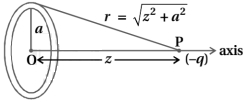
Calculate the potential energy of a point charge $-q$ placed along the axis due to a charge $+Q$ uniformly distributed along a ring of radius $R$. Sketch the potential energy $(P.E.)$ as a function of axial distance $z$ from the centre of the ring. Looking at the graph,can you determine what would happen if $-q$ is displaced slightly from the centre of the ring along the axis?
Solution
(N/A) Consider a ring of radius $R=a$ having charge $Q$ distributed uniformly. Let a point $P$ be at a distance $z$ on its axis. The distance of $P$ from any charge element $dq$ on the ring is $r = \sqrt{z^2 + a^2}$.
The electric potential $V$ at point $P$ is given by:
$V = \int \frac{k dq}{r} = \frac{k}{\sqrt{z^2 + a^2}} \int dq = \frac{kQ}{\sqrt{z^2 + a^2}}$
The potential energy $U$ of a charge $-q$ placed at point $P$ is:
$U = (-q)V = -\frac{kQq}{\sqrt{z^2 + a^2}}$
Let $S = \frac{kQq}{a}$. Then $U = -\frac{S}{\sqrt{1 + (z/a)^2}}$.
At $z=0$,$U = -S$ (minimum potential energy). As $|z|$ increases,$U$ increases towards $0$. The graph of $U$ vs $z$ is a potential well with a minimum at $z=0$. If $-q$ is displaced slightly from the centre,it experiences a restoring force towards the centre,leading to simple harmonic motion $(SHM)$ for small displacements.
The electric potential $V$ at point $P$ is given by:
$V = \int \frac{k dq}{r} = \frac{k}{\sqrt{z^2 + a^2}} \int dq = \frac{kQ}{\sqrt{z^2 + a^2}}$
The potential energy $U$ of a charge $-q$ placed at point $P$ is:
$U = (-q)V = -\frac{kQq}{\sqrt{z^2 + a^2}}$
Let $S = \frac{kQq}{a}$. Then $U = -\frac{S}{\sqrt{1 + (z/a)^2}}$.
At $z=0$,$U = -S$ (minimum potential energy). As $|z|$ increases,$U$ increases towards $0$. The graph of $U$ vs $z$ is a potential well with a minimum at $z=0$. If $-q$ is displaced slightly from the centre,it experiences a restoring force towards the centre,leading to simple harmonic motion $(SHM)$ for small displacements.
0 likes
View Solution266
Difficult
Calculate the electric potential on the axis of a ring of radius $R$ due to a charge $Q$ uniformly distributed along it.
Solution
(N/A) Suppose a charge $+Q$ is uniformly distributed on a ring of radius $R=a$.
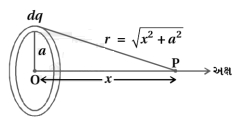
Let us consider a point $P$ at a distance $x$ from the center of the ring along its axis.
The distance $r$ from any small charge element $dq$ on the ring to point $P$ is given by:
$r = \sqrt{x^{2} + a^{2}}$
The electric potential $dV$ at point $P$ due to the charge element $dq$ is:
$dV = \frac{k dq}{r} = \frac{k dq}{\sqrt{x^{2} + a^{2}}}$
To find the total potential $V$ at point $P$ due to the entire ring,we integrate over the whole charge $Q$:
$V = \int dV = \int \frac{k dq}{\sqrt{x^{2} + a^{2}}}$
Since $k$,$x$,and $a$ are constants for all points on the ring:
$V = \frac{k}{\sqrt{x^{2} + a^{2}}} \int dq$
Since $\int dq = Q$ and $k = \frac{1}{4 \pi \epsilon_{0}}$,we get:
$V = \frac{Q}{4 \pi \epsilon_{0} \sqrt{x^{2} + a^{2}}}$
Let us consider a point $P$ at a distance $x$ from the center of the ring along its axis.
The distance $r$ from any small charge element $dq$ on the ring to point $P$ is given by:
$r = \sqrt{x^{2} + a^{2}}$
The electric potential $dV$ at point $P$ due to the charge element $dq$ is:
$dV = \frac{k dq}{r} = \frac{k dq}{\sqrt{x^{2} + a^{2}}}$
To find the total potential $V$ at point $P$ due to the entire ring,we integrate over the whole charge $Q$:
$V = \int dV = \int \frac{k dq}{\sqrt{x^{2} + a^{2}}}$
Since $k$,$x$,and $a$ are constants for all points on the ring:
$V = \frac{k}{\sqrt{x^{2} + a^{2}}} \int dq$
Since $\int dq = Q$ and $k = \frac{1}{4 \pi \epsilon_{0}}$,we get:
$V = \frac{Q}{4 \pi \epsilon_{0} \sqrt{x^{2} + a^{2}}}$
0 likes
View Solution267
Difficult
Calculate the electric potential on the axis of a disc of radius $R$ due to a charge $Q$ uniformly distributed on its surface.
Solution
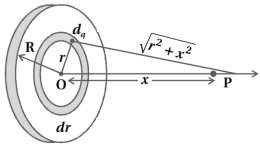
(N/A) Let us consider a point $P$ on the axis of the disc at a distance $x$ from the centre $O$ of the disc. The disc has a surface charge density $\sigma = \frac{Q}{\pi R^2}$.
Consider a thin elemental ring of radius $r$ and width $dr$ on the disc. The area of this ring is $dA = 2\pi r dr$.
The charge on this elemental ring is $dq = \sigma dA = \sigma (2\pi r dr)$.
The distance of every point on this ring from point $P$ is $\sqrt{r^2 + x^2}$.
The potential $dV$ at point $P$ due to this ring is $dV = \frac{k dq}{\sqrt{r^2 + x^2}} = \frac{1}{4\pi \epsilon_0} \frac{\sigma (2\pi r dr)}{\sqrt{r^2 + x^2}}$.
To find the total potential $V$,we integrate from $r = 0$ to $r = R$:
$V = \int_0^R \frac{\sigma 2\pi r dr}{4\pi \epsilon_0 \sqrt{r^2 + x^2}} = \frac{\sigma}{2\epsilon_0} \int_0^R \frac{r dr}{\sqrt{r^2 + x^2}}$.
Let $u = r^2 + x^2$,then $du = 2r dr$,or $r dr = \frac{du}{2}$.
$V = \frac{\sigma}{2\epsilon_0} \int_{x^2}^{R^2+x^2} \frac{du/2}{\sqrt{u}} = \frac{\sigma}{4\epsilon_0} [2\sqrt{u}]_{x^2}^{R^2+x^2} = \frac{\sigma}{2\epsilon_0} [\sqrt{R^2 + x^2} - x]$.
Substituting $\sigma = \frac{Q}{\pi R^2}$,we get:
$V = \frac{Q}{2\pi \epsilon_0 R^2} [\sqrt{R^2 + x^2} - x]$.
Consider a thin elemental ring of radius $r$ and width $dr$ on the disc. The area of this ring is $dA = 2\pi r dr$.
The charge on this elemental ring is $dq = \sigma dA = \sigma (2\pi r dr)$.
The distance of every point on this ring from point $P$ is $\sqrt{r^2 + x^2}$.
The potential $dV$ at point $P$ due to this ring is $dV = \frac{k dq}{\sqrt{r^2 + x^2}} = \frac{1}{4\pi \epsilon_0} \frac{\sigma (2\pi r dr)}{\sqrt{r^2 + x^2}}$.
To find the total potential $V$,we integrate from $r = 0$ to $r = R$:
$V = \int_0^R \frac{\sigma 2\pi r dr}{4\pi \epsilon_0 \sqrt{r^2 + x^2}} = \frac{\sigma}{2\epsilon_0} \int_0^R \frac{r dr}{\sqrt{r^2 + x^2}}$.
Let $u = r^2 + x^2$,then $du = 2r dr$,or $r dr = \frac{du}{2}$.
$V = \frac{\sigma}{2\epsilon_0} \int_{x^2}^{R^2+x^2} \frac{du/2}{\sqrt{u}} = \frac{\sigma}{4\epsilon_0} [2\sqrt{u}]_{x^2}^{R^2+x^2} = \frac{\sigma}{2\epsilon_0} [\sqrt{R^2 + x^2} - x]$.
Substituting $\sigma = \frac{Q}{\pi R^2}$,we get:
$V = \frac{Q}{2\pi \epsilon_0 R^2} [\sqrt{R^2 + x^2} - x]$.
0 likes
View Solution268
Difficult
Two charges $q_1$ and $q_2$ are placed at $(0, 0, d)$ and $(0, 0, -d)$ respectively. Find the locus of points where the potential is zero.
Solution
(N/A) Let the coordinates of a point on the locus be $(x, y, z)$. The potential $V$ at this point due to the two charges is the sum of the individual potentials: $V = V_1 + V_2 = 0$.
Using the formula for electric potential $V = \frac{kq}{r}$,we have:
$\frac{kq_1}{\sqrt{x^2 + y^2 + (z - d)^2}} + \frac{kq_2}{\sqrt{x^2 + y^2 + (z + d)^2}} = 0$
Rearranging the terms:
$\frac{q_1}{\sqrt{x^2 + y^2 + (z - d)^2}} = -\frac{q_2}{\sqrt{x^2 + y^2 + (z + d)^2}}$
Squaring both sides:
$\frac{q_1^2}{x^2 + y^2 + (z - d)^2} = \frac{q_2^2}{x^2 + y^2 + (z + d)^2}$
Let $\lambda^2 = \frac{q_1^2}{q_2^2}$. Then:
$\lambda^2 (x^2 + y^2 + z^2 + 2zd + d^2) = x^2 + y^2 + z^2 - 2zd + d^2$
$(\lambda^2 - 1)(x^2 + y^2 + z^2 + d^2) = -2zd(1 + \lambda^2)$
$x^2 + y^2 + z^2 + 2zd \left( \frac{\lambda^2 + 1}{\lambda^2 - 1} \right) + d^2 = 0$
Substituting $\lambda^2 = \frac{q_1^2}{q_2^2}$:
$x^2 + y^2 + z^2 + 2zd \left( \frac{q_1^2 + q_2^2}{q_1^2 - q_2^2} \right) + d^2 = 0$
This represents a sphere.
Using the formula for electric potential $V = \frac{kq}{r}$,we have:
$\frac{kq_1}{\sqrt{x^2 + y^2 + (z - d)^2}} + \frac{kq_2}{\sqrt{x^2 + y^2 + (z + d)^2}} = 0$
Rearranging the terms:
$\frac{q_1}{\sqrt{x^2 + y^2 + (z - d)^2}} = -\frac{q_2}{\sqrt{x^2 + y^2 + (z + d)^2}}$
Squaring both sides:
$\frac{q_1^2}{x^2 + y^2 + (z - d)^2} = \frac{q_2^2}{x^2 + y^2 + (z + d)^2}$
Let $\lambda^2 = \frac{q_1^2}{q_2^2}$. Then:
$\lambda^2 (x^2 + y^2 + z^2 + 2zd + d^2) = x^2 + y^2 + z^2 - 2zd + d^2$
$(\lambda^2 - 1)(x^2 + y^2 + z^2 + d^2) = -2zd(1 + \lambda^2)$
$x^2 + y^2 + z^2 + 2zd \left( \frac{\lambda^2 + 1}{\lambda^2 - 1} \right) + d^2 = 0$
Substituting $\lambda^2 = \frac{q_1^2}{q_2^2}$:
$x^2 + y^2 + z^2 + 2zd \left( \frac{q_1^2 + q_2^2}{q_1^2 - q_2^2} \right) + d^2 = 0$
This represents a sphere.
0 likes
View Solution269
MediumMCQ
Which is the important quantity used to describe any force field?
A
Force
B
Potential
C
Work
D
Momentum
Solution
(B) The important quantity used to describe any force field is the potential. In a conservative force field,the force can be expressed as the negative gradient of the potential,i.e.,$\vec{F} = -\nabla V$. This scalar field provides a simpler way to analyze the dynamics of particles within the field.
0 likes
View Solution270
DifficultMCQ
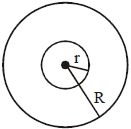
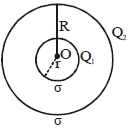
$A$ charge $Q$ is distributed over two concentric conducting thin spherical shells of radii $r$ and $R$ $(R > r)$. If the surface charge densities on the two shells are equal,the electric potential at the common centre is
A
$\frac{1}{4 \pi \varepsilon_{0}} \frac{(R+2r)Q}{2(R^{2}+r^{2})}$
B
$\frac{1}{4 \pi \varepsilon_{0}} \frac{(R+r)}{2(R^{2}+r^{2})}Q$
C
$\frac{1}{4 \pi \varepsilon_{0}} \frac{(R+r)}{(R^{2}+r^{2})}Q$
D
$\frac{1}{4 \pi \varepsilon_{0}} \frac{(2R+r)}{(R^{2}+r^{2})}Q$
Solution
(C) Let the charges on the inner and outer spheres be $Q_{1}$ and $Q_{2}$ respectively.
Since the surface charge density $\sigma$ is the same for both spheres,we have:
$\sigma = \frac{Q_{1}}{4 \pi r^{2}} = \frac{Q_{2}}{4 \pi R^{2}} \Rightarrow \frac{Q_{1}}{Q_{2}} = \frac{r^{2}}{R^{2}}$
Given that the total charge is $Q_{1} + Q_{2} = Q$,we substitute $Q_{1} = Q_{2} \frac{r^{2}}{R^{2}}$:
$Q_{2} \frac{r^{2}}{R^{2}} + Q_{2} = Q \Rightarrow Q_{2} \left( \frac{r^{2} + R^{2}}{R^{2}} \right) = Q \Rightarrow Q_{2} = \frac{Q R^{2}}{R^{2} + r^{2}}$
Similarly,$Q_{1} = Q - Q_{2} = Q - \frac{Q R^{2}}{R^{2} + r^{2}} = \frac{Q r^{2}}{R^{2} + r^{2}}$
The electric potential at the common centre $O$ is the sum of potentials due to both shells:
$V = \frac{1}{4 \pi \varepsilon_{0}} \frac{Q_{1}}{r} + \frac{1}{4 \pi \varepsilon_{0}} \frac{Q_{2}}{R}$
$V = \frac{1}{4 \pi \varepsilon_{0}} \left[ \frac{Q r^{2}}{r(R^{2} + r^{2})} + \frac{Q R^{2}}{R(R^{2} + r^{2})} \right]$
$V = \frac{1}{4 \pi \varepsilon_{0}} \left[ \frac{Q r}{R^{2} + r^{2}} + \frac{Q R}{R^{2} + r^{2}} \right]$
$V = \frac{1}{4 \pi \varepsilon_{0}} \frac{(R + r)Q}{R^{2} + r^{2}}$
Since the surface charge density $\sigma$ is the same for both spheres,we have:
$\sigma = \frac{Q_{1}}{4 \pi r^{2}} = \frac{Q_{2}}{4 \pi R^{2}} \Rightarrow \frac{Q_{1}}{Q_{2}} = \frac{r^{2}}{R^{2}}$
Given that the total charge is $Q_{1} + Q_{2} = Q$,we substitute $Q_{1} = Q_{2} \frac{r^{2}}{R^{2}}$:
$Q_{2} \frac{r^{2}}{R^{2}} + Q_{2} = Q \Rightarrow Q_{2} \left( \frac{r^{2} + R^{2}}{R^{2}} \right) = Q \Rightarrow Q_{2} = \frac{Q R^{2}}{R^{2} + r^{2}}$
Similarly,$Q_{1} = Q - Q_{2} = Q - \frac{Q R^{2}}{R^{2} + r^{2}} = \frac{Q r^{2}}{R^{2} + r^{2}}$
The electric potential at the common centre $O$ is the sum of potentials due to both shells:
$V = \frac{1}{4 \pi \varepsilon_{0}} \frac{Q_{1}}{r} + \frac{1}{4 \pi \varepsilon_{0}} \frac{Q_{2}}{R}$
$V = \frac{1}{4 \pi \varepsilon_{0}} \left[ \frac{Q r^{2}}{r(R^{2} + r^{2})} + \frac{Q R^{2}}{R(R^{2} + r^{2})} \right]$
$V = \frac{1}{4 \pi \varepsilon_{0}} \left[ \frac{Q r}{R^{2} + r^{2}} + \frac{Q R}{R^{2} + r^{2}} \right]$
$V = \frac{1}{4 \pi \varepsilon_{0}} \frac{(R + r)Q}{R^{2} + r^{2}}$
0 likes
View Solution271
MediumMCQ
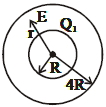
Concentric metallic hollow spheres of radii $R$ and $4R$ hold charges $Q_1$ and $Q_2$ respectively. Given that surface charge densities of the concentric spheres are equal,the potential difference $V(R) - V(4R)$ is
A
$\frac{3 Q_1}{16 \pi \varepsilon_0 R}$
B
$\frac{Q_2}{4 \pi \varepsilon_0 R}$
C
$\frac{3 Q_1}{4 \pi \varepsilon_0 R}$
D
$\frac{3 Q_2}{4 \pi \varepsilon_0 R}$
Solution
(A) Let $\sigma$ be the surface charge density. Since $\sigma_1 = \sigma_2$,we have $\frac{Q_1}{4 \pi R^2} = \frac{Q_2}{4 \pi (4R)^2}$,which implies $Q_2 = 16 Q_1$.
The potential at the surface of the inner sphere $(r=R)$ is $V(R) = \frac{k Q_1}{R} + \frac{k Q_2}{4R}$.
The potential at the surface of the outer sphere $(r=4R)$ is $V(4R) = \frac{k Q_1}{4R} + \frac{k Q_2}{4R}$.
The potential difference is $V(R) - V(4R) = (\frac{k Q_1}{R} + \frac{k Q_2}{4R}) - (\frac{k Q_1}{4R} + \frac{k Q_2}{4R}) = \frac{k Q_1}{R} - \frac{k Q_1}{4R} = \frac{3 k Q_1}{4R}$.
Substituting $k = \frac{1}{4 \pi \varepsilon_0}$,we get $V(R) - V(4R) = \frac{3 Q_1}{16 \pi \varepsilon_0 R}$.
The potential at the surface of the inner sphere $(r=R)$ is $V(R) = \frac{k Q_1}{R} + \frac{k Q_2}{4R}$.
The potential at the surface of the outer sphere $(r=4R)$ is $V(4R) = \frac{k Q_1}{4R} + \frac{k Q_2}{4R}$.
The potential difference is $V(R) - V(4R) = (\frac{k Q_1}{R} + \frac{k Q_2}{4R}) - (\frac{k Q_1}{4R} + \frac{k Q_2}{4R}) = \frac{k Q_1}{R} - \frac{k Q_1}{4R} = \frac{3 k Q_1}{4R}$.
Substituting $k = \frac{1}{4 \pi \varepsilon_0}$,we get $V(R) - V(4R) = \frac{3 Q_1}{16 \pi \varepsilon_0 R}$.
0 likes
View Solution272
DifficultMCQ
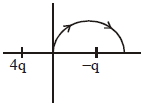
Two point charges $4q$ and $-q$ are fixed on the $x$-axis at $x = -d/2$ and $x = d/2$,respectively. If a third point charge $q$ is moved from the origin to $x = d$ along the semicircle as shown in the figure,the potential energy of the charge will:
A
increase by $\frac{2q^2}{3\pi\varepsilon_0 d}$
B
increase by $\frac{3q^2}{4\pi\varepsilon_0 d}$
C
decrease by $\frac{4q^2}{3\pi\varepsilon_0 d}$
D
decrease by $\frac{q^2}{4\pi\varepsilon_0 d}$
Solution
(C) The potential energy of a charge $q$ at a point is given by $U = qV$,where $V$ is the electric potential due to the fixed charges.
Initial position: $x_i = 0$. The distances from $4q$ and $-q$ are $r_1 = d/2$ and $r_2 = d/2$.
Initial potential $V_i = \frac{1}{4\pi\varepsilon_0} \left( \frac{4q}{d/2} + \frac{-q}{d/2} \right) = \frac{1}{4\pi\varepsilon_0} \left( \frac{3q}{d/2} \right) = \frac{6q}{4\pi\varepsilon_0 d}$.
Final position: $x_f = d$. The distances from $4q$ and $-q$ are $r_1' = d + d/2 = 3d/2$ and $r_2' = d - d/2 = d/2$.
Final potential $V_f = \frac{1}{4\pi\varepsilon_0} \left( \frac{4q}{3d/2} + \frac{-q}{d/2} \right) = \frac{1}{4\pi\varepsilon_0} \left( \frac{8q}{3d} - \frac{2q}{d} \right) = \frac{1}{4\pi\varepsilon_0} \left( \frac{8q - 6q}{3d} \right) = \frac{2q}{12\pi\varepsilon_0 d} = \frac{q}{6\pi\varepsilon_0 d}$.
Change in potential energy $\Delta U = q(V_f - V_i) = q \left( \frac{q}{6\pi\varepsilon_0 d} - \frac{6q}{4\pi\varepsilon_0 d} \right) = \frac{q^2}{4\pi\varepsilon_0 d} \left( \frac{2}{3} - 6 \right) = \frac{q^2}{4\pi\varepsilon_0 d} \left( -\frac{16}{3} \right) = -\frac{4q^2}{3\pi\varepsilon_0 d}$.
The negative sign indicates a decrease in potential energy by $\frac{4q^2}{3\pi\varepsilon_0 d}$.
Initial position: $x_i = 0$. The distances from $4q$ and $-q$ are $r_1 = d/2$ and $r_2 = d/2$.
Initial potential $V_i = \frac{1}{4\pi\varepsilon_0} \left( \frac{4q}{d/2} + \frac{-q}{d/2} \right) = \frac{1}{4\pi\varepsilon_0} \left( \frac{3q}{d/2} \right) = \frac{6q}{4\pi\varepsilon_0 d}$.
Final position: $x_f = d$. The distances from $4q$ and $-q$ are $r_1' = d + d/2 = 3d/2$ and $r_2' = d - d/2 = d/2$.
Final potential $V_f = \frac{1}{4\pi\varepsilon_0} \left( \frac{4q}{3d/2} + \frac{-q}{d/2} \right) = \frac{1}{4\pi\varepsilon_0} \left( \frac{8q}{3d} - \frac{2q}{d} \right) = \frac{1}{4\pi\varepsilon_0} \left( \frac{8q - 6q}{3d} \right) = \frac{2q}{12\pi\varepsilon_0 d} = \frac{q}{6\pi\varepsilon_0 d}$.
Change in potential energy $\Delta U = q(V_f - V_i) = q \left( \frac{q}{6\pi\varepsilon_0 d} - \frac{6q}{4\pi\varepsilon_0 d} \right) = \frac{q^2}{4\pi\varepsilon_0 d} \left( \frac{2}{3} - 6 \right) = \frac{q^2}{4\pi\varepsilon_0 d} \left( -\frac{16}{3} \right) = -\frac{4q^2}{3\pi\varepsilon_0 d}$.
The negative sign indicates a decrease in potential energy by $\frac{4q^2}{3\pi\varepsilon_0 d}$.
0 likes
View Solution273
MediumMCQ
The variation of electrostatic potential $V$ with radial distance $r$ from the centre of a positively charged metallic thin shell of radius $R$ is given by the graph:
A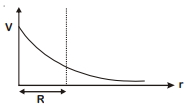
B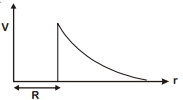
C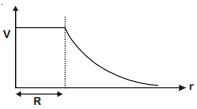
D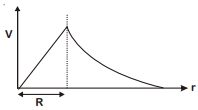
Solution
(C) For a positively charged metallic thin shell of radius $R$:
$1$. Inside the shell $(r < R)$,the electric field is zero,which implies that the electrostatic potential $V$ is constant and equal to the potential at the surface.
$V = \frac{q}{4 \pi \varepsilon_{0} R} = \text{constant}$
$2$. Outside the shell $(r \geq R)$,the shell behaves as a point charge placed at the centre. Thus,the potential varies inversely with distance.
$V = \frac{q}{4 \pi \varepsilon_{0} r} \implies V \propto \frac{1}{r}$
Therefore,the graph shows a constant potential for $r < R$ and a hyperbolic decrease for $r \geq R$,which matches the graph in option $C$.
$1$. Inside the shell $(r < R)$,the electric field is zero,which implies that the electrostatic potential $V$ is constant and equal to the potential at the surface.
$V = \frac{q}{4 \pi \varepsilon_{0} R} = \text{constant}$
$2$. Outside the shell $(r \geq R)$,the shell behaves as a point charge placed at the centre. Thus,the potential varies inversely with distance.
$V = \frac{q}{4 \pi \varepsilon_{0} r} \implies V \propto \frac{1}{r}$
Therefore,the graph shows a constant potential for $r < R$ and a hyperbolic decrease for $r \geq R$,which matches the graph in option $C$.
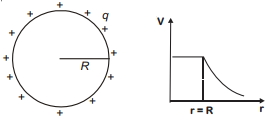
0 likes
View Solution274
DifficultMCQ
Two thin coaxial rings,each of radius $a$ and having charges $+Q$ and $-Q$ respectively,are separated by a distance $s$. The potential difference between the centres of the two rings is:
A
$\frac{Q}{2 \pi \varepsilon_{0}}\left[\frac{1}{a}+\frac{1}{\sqrt{s^{2}+a^{2}}}\right]$
B
$\frac{Q}{4 \pi \varepsilon_{0}}\left[\frac{1}{a}+\frac{1}{\sqrt{s^{2}+a^{2}}}\right]$
C
$\frac{Q}{4 \pi \varepsilon_{0}}\left[\frac{1}{a}-\frac{1}{\sqrt{s^{2}+a^{2}}}\right]$
D
$\frac{Q}{2 \pi \varepsilon_{0}}\left[\frac{1}{a}-\frac{1}{\sqrt{s^{2}+a^{2}}}\right]$
Solution
(D) Let $V_A$ be the potential at the centre of ring $A$ and $V_B$ be the potential at the centre of ring $B$.
Potential at centre $A$ due to ring $A$ is $V_{A1} = \frac{KQ}{a}$.
Potential at centre $A$ due to ring $B$ is $V_{A2} = \frac{K(-Q)}{\sqrt{a^2 + s^2}}$.
So,$V_A = V_{A1} + V_{A2} = \frac{KQ}{a} - \frac{KQ}{\sqrt{a^2 + s^2}}$.
Potential at centre $B$ due to ring $B$ is $V_{B1} = \frac{K(-Q)}{a}$.
Potential at centre $B$ due to ring $A$ is $V_{B2} = \frac{KQ}{\sqrt{a^2 + s^2}}$.
So,$V_B = V_{B1} + V_{B2} = -\frac{KQ}{a} + \frac{KQ}{\sqrt{a^2 + s^2}}$.
The potential difference is $V_A - V_B = \left(\frac{KQ}{a} - \frac{KQ}{\sqrt{a^2 + s^2}}\right) - \left(-\frac{KQ}{a} + \frac{KQ}{\sqrt{a^2 + s^2}}\right)$.
$V_A - V_B = \frac{2KQ}{a} - \frac{2KQ}{\sqrt{a^2 + s^2}} = 2KQ \left(\frac{1}{a} - \frac{1}{\sqrt{a^2 + s^2}}\right)$.
Substituting $K = \frac{1}{4 \pi \varepsilon_0}$,we get $V_A - V_B = \frac{2}{4 \pi \varepsilon_0} Q \left(\frac{1}{a} - \frac{1}{\sqrt{a^2 + s^2}}\right) = \frac{Q}{2 \pi \varepsilon_0} \left(\frac{1}{a} - \frac{1}{\sqrt{a^2 + s^2}}\right)$.
Potential at centre $A$ due to ring $A$ is $V_{A1} = \frac{KQ}{a}$.
Potential at centre $A$ due to ring $B$ is $V_{A2} = \frac{K(-Q)}{\sqrt{a^2 + s^2}}$.
So,$V_A = V_{A1} + V_{A2} = \frac{KQ}{a} - \frac{KQ}{\sqrt{a^2 + s^2}}$.
Potential at centre $B$ due to ring $B$ is $V_{B1} = \frac{K(-Q)}{a}$.
Potential at centre $B$ due to ring $A$ is $V_{B2} = \frac{KQ}{\sqrt{a^2 + s^2}}$.
So,$V_B = V_{B1} + V_{B2} = -\frac{KQ}{a} + \frac{KQ}{\sqrt{a^2 + s^2}}$.
The potential difference is $V_A - V_B = \left(\frac{KQ}{a} - \frac{KQ}{\sqrt{a^2 + s^2}}\right) - \left(-\frac{KQ}{a} + \frac{KQ}{\sqrt{a^2 + s^2}}\right)$.
$V_A - V_B = \frac{2KQ}{a} - \frac{2KQ}{\sqrt{a^2 + s^2}} = 2KQ \left(\frac{1}{a} - \frac{1}{\sqrt{a^2 + s^2}}\right)$.
Substituting $K = \frac{1}{4 \pi \varepsilon_0}$,we get $V_A - V_B = \frac{2}{4 \pi \varepsilon_0} Q \left(\frac{1}{a} - \frac{1}{\sqrt{a^2 + s^2}}\right) = \frac{Q}{2 \pi \varepsilon_0} \left(\frac{1}{a} - \frac{1}{\sqrt{a^2 + s^2}}\right)$.
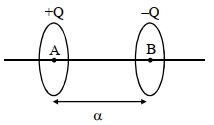
0 likes
View Solution275
EasyMCQ
Two hollow conducting spheres of radii $R_{1}$ and $R_{2}$ $(R_{1} >> R_{2})$ have equal charges. The potential would be:
A
more on smaller sphere
B
equal on both the spheres
C
dependent on the material property of the sphere
D
more on bigger sphere
Solution
(A) The electric potential $V$ at the surface of a hollow conducting sphere of radius $R$ carrying charge $Q$ is given by the formula: $V = \frac{1}{4 \pi \epsilon_{0}} \cdot \frac{Q}{R}$.
Here,$\frac{1}{4 \pi \epsilon_{0}}$ is a constant.
It is given that both spheres have the same charge $Q$.
Therefore,the potential $V$ is inversely proportional to the radius $R$,i.e.,$V \propto \frac{1}{R}$.
Since $R_{1} >> R_{2}$,the radius of the smaller sphere is $R_{2}$.
Because $R_{2} < R_{1}$,it follows that $V_{2} > V_{1}$.
Thus,the potential is higher on the smaller sphere.
Here,$\frac{1}{4 \pi \epsilon_{0}}$ is a constant.
It is given that both spheres have the same charge $Q$.
Therefore,the potential $V$ is inversely proportional to the radius $R$,i.e.,$V \propto \frac{1}{R}$.
Since $R_{1} >> R_{2}$,the radius of the smaller sphere is $R_{2}$.
Because $R_{2} < R_{1}$,it follows that $V_{2} > V_{1}$.
Thus,the potential is higher on the smaller sphere.
0 likes
View Solution276
AdvancedMCQ
Consider a sphere of radius $R$ with uniform charge density and total charge $Q$. The electrostatic potential distribution inside the sphere is given by $V(r) = \frac{Q}{4 \pi \varepsilon_{0} R} \left( a + b(r/R)^c \right)$. Note that the zero of potential is at infinity. The values of $(a, b, c)$ are
A
$(\frac{1}{2}, \frac{3}{2}, 1)$
B
$(\frac{3}{2}, -\frac{1}{2}, 2)$
C
$(\frac{1}{2}, -\frac{1}{2}, 1)$
D
$(\frac{1}{2}, -\frac{1}{2}, 2)$
Solution
(B) The electrostatic potential $V$ inside a uniformly charged sphere of radius $R$ and total charge $Q$ is given by the formula:
$V(r) = \frac{kQ}{2R^3} (3R^2 - r^2)$
Substituting $k = \frac{1}{4 \pi \varepsilon_0}$,we get:
$V(r) = \frac{Q}{4 \pi \varepsilon_0 R^3} \left( \frac{3R^2 - r^2}{2} \right)$
$V(r) = \frac{Q}{4 \pi \varepsilon_0 R} \left( \frac{3}{2} - \frac{1}{2} \left( \frac{r}{R} \right)^2 \right)$
Comparing this expression with the given form $V(r) = \frac{Q}{4 \pi \varepsilon_0 R} (a + b(r/R)^c)$,we identify:
$a = \frac{3}{2}$
$b = -\frac{1}{2}$
$c = 2$
Thus,the values are $(a, b, c) = (\frac{3}{2}, -\frac{1}{2}, 2)$.
$V(r) = \frac{kQ}{2R^3} (3R^2 - r^2)$
Substituting $k = \frac{1}{4 \pi \varepsilon_0}$,we get:
$V(r) = \frac{Q}{4 \pi \varepsilon_0 R^3} \left( \frac{3R^2 - r^2}{2} \right)$
$V(r) = \frac{Q}{4 \pi \varepsilon_0 R} \left( \frac{3}{2} - \frac{1}{2} \left( \frac{r}{R} \right)^2 \right)$
Comparing this expression with the given form $V(r) = \frac{Q}{4 \pi \varepsilon_0 R} (a + b(r/R)^c)$,we identify:
$a = \frac{3}{2}$
$b = -\frac{1}{2}$
$c = 2$
Thus,the values are $(a, b, c) = (\frac{3}{2}, -\frac{1}{2}, 2)$.
0 likes
View Solution277
AdvancedMCQ
$A$ neutral spherical copper particle has a radius of $10 \,nm$ $(1 \,nm = 10^{-9} \,m)$. It gets charged by applying the voltage,slowly adding one electron at a time. Then,the graph of the total charge on the particle versus the applied voltage would look like:
A
B
C
D
Solution
(A) The potential $V$ of a spherical conductor of radius $r$ carrying a charge $q$ is given by $V = \frac{k q}{r}$,where $k$ is the electrostatic constant.
Since the charge is added one electron at a time,the total charge $q$ on the particle is quantized,i.e.,$q = n e$,where $n$ is an integer and $e$ is the elementary charge.
Substituting $q = n e$ into the potential formula,we get $V = \frac{k (n e)}{r}$.
This shows that the potential $V$ increases in discrete steps as each electron is added to the particle.
Therefore,the graph of the total charge $q$ versus the applied voltage $V$ will be a step function,where the charge remains constant at each integer multiple of $e$ for a specific range of potential,and then jumps to the next level as the next electron is added.
Since the charge is added one electron at a time,the total charge $q$ on the particle is quantized,i.e.,$q = n e$,where $n$ is an integer and $e$ is the elementary charge.
Substituting $q = n e$ into the potential formula,we get $V = \frac{k (n e)}{r}$.
This shows that the potential $V$ increases in discrete steps as each electron is added to the particle.
Therefore,the graph of the total charge $q$ versus the applied voltage $V$ will be a step function,where the charge remains constant at each integer multiple of $e$ for a specific range of potential,and then jumps to the next level as the next electron is added.
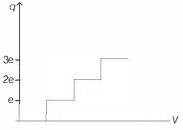
0 likes
View Solution278
MediumMCQ
$A$ charge $+q$ is distributed over a thin ring of radius $r$ with line charge density $\lambda = q \sin^2 \theta / (\pi r)$. Note that the ring is in the $XY$-plane and $\theta$ is the angle made by the position vector with the $X$-axis. The work done by the electric force in displacing a point charge $+Q$ from the centre of the ring to infinity is
A
equal to $qQ / 2\pi \varepsilon_0 r$
B
equal to $qQ / 4\pi \varepsilon_0 r$
C
equal to zero only,if the path is a straight line perpendicular to the plane of the ring
D
equal to $qQ / 8\pi \varepsilon_0 r$
Solution
(B) The total charge $q_{\text{total}}$ on the ring is given by the integral of the charge density $\lambda$ over the circumference:
$q_{\text{total}} = \int_0^{2\pi} \lambda (r d\theta) = \int_0^{2\pi} \frac{q \sin^2 \theta}{\pi r} (r d\theta) = \frac{q}{\pi} \int_0^{2\pi} \sin^2 \theta d\theta$
Using the identity $\sin^2 \theta = (1 - \cos 2\theta) / 2$:
$q_{\text{total}} = \frac{q}{\pi} \int_0^{2\pi} \frac{1 - \cos 2\theta}{2} d\theta = \frac{q}{2\pi} [\theta - \frac{\sin 2\theta}{2}]_0^{2\pi} = \frac{q}{2\pi} (2\pi) = q$
Since all points on the ring are at a distance $r$ from the centre,the electric potential $V$ at the centre is:
$V = \frac{1}{4\pi \varepsilon_0} \int \frac{dq}{r} = \frac{1}{4\pi \varepsilon_0 r} \int dq = \frac{q_{\text{total}}}{4\pi \varepsilon_0 r} = \frac{q}{4\pi \varepsilon_0 r}$
The work done by the electric force in moving a charge $Q$ from the centre to infinity is $W = Q(V_{\text{centre}} - V_{\infty})$. Since $V_{\infty} = 0$:
$W = Q \cdot V = \frac{qQ}{4\pi \varepsilon_0 r}$
$q_{\text{total}} = \int_0^{2\pi} \lambda (r d\theta) = \int_0^{2\pi} \frac{q \sin^2 \theta}{\pi r} (r d\theta) = \frac{q}{\pi} \int_0^{2\pi} \sin^2 \theta d\theta$
Using the identity $\sin^2 \theta = (1 - \cos 2\theta) / 2$:
$q_{\text{total}} = \frac{q}{\pi} \int_0^{2\pi} \frac{1 - \cos 2\theta}{2} d\theta = \frac{q}{2\pi} [\theta - \frac{\sin 2\theta}{2}]_0^{2\pi} = \frac{q}{2\pi} (2\pi) = q$
Since all points on the ring are at a distance $r$ from the centre,the electric potential $V$ at the centre is:
$V = \frac{1}{4\pi \varepsilon_0} \int \frac{dq}{r} = \frac{1}{4\pi \varepsilon_0 r} \int dq = \frac{q_{\text{total}}}{4\pi \varepsilon_0 r} = \frac{q}{4\pi \varepsilon_0 r}$
The work done by the electric force in moving a charge $Q$ from the centre to infinity is $W = Q(V_{\text{centre}} - V_{\infty})$. Since $V_{\infty} = 0$:
$W = Q \cdot V = \frac{qQ}{4\pi \varepsilon_0 r}$
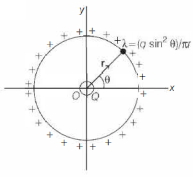
0 likes
View Solution279
MediumMCQ
$A$ thin metallic disc is rotating with constant angular velocity about a vertical axis that is perpendicular to its plane and passes through its centre. The rotation causes the free electrons in the disc to redistribute. Assume that there is no external electric or magnetic field. Then,
A
a point on the rim of the disc is at a higher potential than its centre
B
a point on the rim of the disc is at a lower potential than its centre
C
a point on the rim of the disc is at the same potential as its centre
D
the potential in the material has an extremum between centre and the rim
Solution
(B) When the metallic disc rotates,the free electrons within the disc experience a centrifugal force directed radially outward,given by $F_c = m\omega^2 r$,where $m$ is the mass of the electron,$\omega$ is the angular velocity,and $r$ is the distance from the axis of rotation.
Due to this centrifugal force,the free electrons migrate from the centre towards the rim of the disc.
As a result,the rim of the disc accumulates a net negative charge,while the centre becomes positively charged.
Since the potential $V$ is related to the electric field $E$ by $E = -dV/dr$,and the electric field is directed from the positive centre to the negative rim,the potential decreases as we move from the centre to the rim.
Therefore,a point on the rim of the disc is at a lower potential than its centre.
Due to this centrifugal force,the free electrons migrate from the centre towards the rim of the disc.
As a result,the rim of the disc accumulates a net negative charge,while the centre becomes positively charged.
Since the potential $V$ is related to the electric field $E$ by $E = -dV/dr$,and the electric field is directed from the positive centre to the negative rim,the potential decreases as we move from the centre to the rim.
Therefore,a point on the rim of the disc is at a lower potential than its centre.
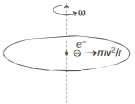
0 likes
View Solution280
DifficultMCQ
Consider a cube of uniform charge density $\rho$. The ratio of electrostatic potential at the centre of the cube to that at one of the corners of the cube is
A
$2$
B
$\sqrt{3} / 2$
C
$\sqrt{2}$
D
$1$
Solution
(A) Let the side length of the small cube be $a$. The large cube has a side length of $2a$ and is composed of $8$ such small cubes.
Let $V_c$ be the potential at the centre of a small cube of side $a$ and charge density $\rho$. The total potential at the centre of the large cube (point $A$) is the sum of potentials due to the $8$ small cubes surrounding it.
Since the centre of the large cube is the common corner of the $8$ small cubes,the potential at the centre $A$ is $V_A = 8 \times V_{\text{corner of small cube}}$.
For a small cube of side $a$,the potential at its corner due to its own charge $Q = \rho a^3$ is $V_{\text{corner}} = k \frac{Q}{a} = k \rho a^2$ (where $k$ is a constant).
Thus,$V_A = 8 \times (k \rho a^2) = 8 k \rho a^2$.
Now,consider the potential at the corner $B$ of the large cube of side $2a$. The potential at the corner of a cube of side $L$ and charge density $\rho$ is proportional to $\rho L^2$.
For the large cube of side $2a$,$V_B = k \rho (2a)^2 = 4 k \rho a^2$.
The ratio of the potential at the centre to that at the corner is $\frac{V_A}{V_B} = \frac{8 k \rho a^2}{4 k \rho a^2} = 2$.
Let $V_c$ be the potential at the centre of a small cube of side $a$ and charge density $\rho$. The total potential at the centre of the large cube (point $A$) is the sum of potentials due to the $8$ small cubes surrounding it.
Since the centre of the large cube is the common corner of the $8$ small cubes,the potential at the centre $A$ is $V_A = 8 \times V_{\text{corner of small cube}}$.
For a small cube of side $a$,the potential at its corner due to its own charge $Q = \rho a^3$ is $V_{\text{corner}} = k \frac{Q}{a} = k \rho a^2$ (where $k$ is a constant).
Thus,$V_A = 8 \times (k \rho a^2) = 8 k \rho a^2$.
Now,consider the potential at the corner $B$ of the large cube of side $2a$. The potential at the corner of a cube of side $L$ and charge density $\rho$ is proportional to $\rho L^2$.
For the large cube of side $2a$,$V_B = k \rho (2a)^2 = 4 k \rho a^2$.
The ratio of the potential at the centre to that at the corner is $\frac{V_A}{V_B} = \frac{8 k \rho a^2}{4 k \rho a^2} = 2$.
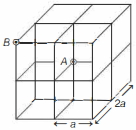
0 likes
View Solution281
MediumMCQ
An electron with an initial speed of $4.0 \times 10^6 \, m/s$ is brought to rest by an electric field. The mass and charge of an electron are $9 \times 10^{-31} \, kg$ and $1.6 \times 10^{-19} \, C$, respectively. Identify the correct statement.
A
The electron moves from a region of lower potential to higher potential through a potential difference of $11.4 \, \mu V$.
B
The electron moves from a region of higher potential to lower potential through a potential difference of $11.4 \, \mu V$.
C
The electron moves from a region of lower potential to higher potential through a potential difference of $45 \, V$.
D
The electron moves from a region of higher potential to lower potential through a potential difference of $45 \, V$.
Solution
$(D)$ The work done by the electric field on the electron is equal to the change in its kinetic energy.
According to the work-energy theorem, $W = \Delta K = K_f - K_i$.
Since the electron is brought to rest, $K_f = 0$, so $W = -K_i = -\frac{1}{2}mv^2$.
The work done by an electric field is $W = -qV$, where $V$ is the potential difference.
Equating the two, $-qV = -\frac{1}{2}mv^2$, which gives $V = \frac{mv^2}{2q}$.
Substituting the given values: $V = \frac{9 \times 10^{-31} \times (4.0 \times 10^6)^2}{2 \times 1.6 \times 10^{-19}}$.
$V = \frac{9 \times 10^{-31} \times 16 \times 10^{12}}{3.2 \times 10^{-19}} = \frac{144 \times 10^{-19}}{3.2 \times 10^{-19}} = 45 \, V$.
Since an electron is negatively charged, it gains potential energy when moving from higher potential to lower potential, which results in a loss of kinetic energy. Thus, it moves from a region of higher potential to lower potential.
According to the work-energy theorem, $W = \Delta K = K_f - K_i$.
Since the electron is brought to rest, $K_f = 0$, so $W = -K_i = -\frac{1}{2}mv^2$.
The work done by an electric field is $W = -qV$, where $V$ is the potential difference.
Equating the two, $-qV = -\frac{1}{2}mv^2$, which gives $V = \frac{mv^2}{2q}$.
Substituting the given values: $V = \frac{9 \times 10^{-31} \times (4.0 \times 10^6)^2}{2 \times 1.6 \times 10^{-19}}$.
$V = \frac{9 \times 10^{-31} \times 16 \times 10^{12}}{3.2 \times 10^{-19}} = \frac{144 \times 10^{-19}}{3.2 \times 10^{-19}} = 45 \, V$.
Since an electron is negatively charged, it gains potential energy when moving from higher potential to lower potential, which results in a loss of kinetic energy. Thus, it moves from a region of higher potential to lower potential.
0 likes
View Solution282
EasyMCQ
$A$ charge of $10 \,\mu C$ is placed at the origin of an $x-y$ coordinate system. The potential difference between two points $(0, a)$ and $(a, 0)$ in volts will be
A
$\frac{9 \times 10^4}{a}$
B
$\frac{9 \times 10^4}{a \sqrt{2}}$
C
$\frac{9 \times 10^4}{2 a}$
D
$0$
Solution
(D) The electric potential $V$ at a distance $r$ from a point charge $q$ is given by $V = \frac{kq}{r}$,where $k = 9 \times 10^9 \, N \cdot m^2/C^2$.
For point $A(0, a)$,the distance from the origin is $r_A = \sqrt{0^2 + a^2} = a$.
Thus,the potential at $A$ is $V_A = \frac{kq}{a}$.
For point $B(a, 0)$,the distance from the origin is $r_B = \sqrt{a^2 + 0^2} = a$.
Thus,the potential at $B$ is $V_B = \frac{kq}{a}$.
The potential difference between points $A$ and $B$ is $\Delta V = V_A - V_B = \frac{kq}{a} - \frac{kq}{a} = 0$.
For point $A(0, a)$,the distance from the origin is $r_A = \sqrt{0^2 + a^2} = a$.
Thus,the potential at $A$ is $V_A = \frac{kq}{a}$.
For point $B(a, 0)$,the distance from the origin is $r_B = \sqrt{a^2 + 0^2} = a$.
Thus,the potential at $B$ is $V_B = \frac{kq}{a}$.
The potential difference between points $A$ and $B$ is $\Delta V = V_A - V_B = \frac{kq}{a} - \frac{kq}{a} = 0$.
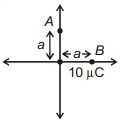
0 likes
View Solution283
MediumMCQ
Two identical positive charges are placed on the $y$-axis at $y=-a$ and $y=+a$. The variation of $V$ (electric potential) along the $x$-axis is shown by which graph?
A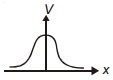
B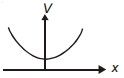
C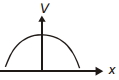
D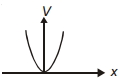
Solution
(A) The electric potential $V$ at a point $x$ on the $x$-axis due to two identical charges $q$ placed at $(0, a)$ and $(0, -a)$ is given by the sum of the potentials due to each charge.
The distance of a point $(x, 0)$ from each charge is $r = \sqrt{x^2 + a^2}$.
Therefore,the total potential $V$ is:
$V = \frac{kq}{r} + \frac{kq}{r} = \frac{2kq}{\sqrt{x^2 + a^2}}$
At $x = 0$,$V = \frac{2kq}{a}$,which is the maximum value.
As $x \to \infty$,$V \to 0$.
As $x \to -\infty$,$V \to 0$.
The graph of $V$ versus $x$ is a bell-shaped curve symmetric about the $y$-axis,which corresponds to the graph shown in option $A$.
The distance of a point $(x, 0)$ from each charge is $r = \sqrt{x^2 + a^2}$.
Therefore,the total potential $V$ is:
$V = \frac{kq}{r} + \frac{kq}{r} = \frac{2kq}{\sqrt{x^2 + a^2}}$
At $x = 0$,$V = \frac{2kq}{a}$,which is the maximum value.
As $x \to \infty$,$V \to 0$.
As $x \to -\infty$,$V \to 0$.
The graph of $V$ versus $x$ is a bell-shaped curve symmetric about the $y$-axis,which corresponds to the graph shown in option $A$.
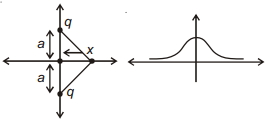
0 likes
View Solution284
EasyMCQ
Two concentric hollow conducting spheres of radius $r$ and $R$ $(r < R)$ are shown. The charge on the outer shell is $Q$. What charge $q$ should be given to the inner sphere so that the potential at any point $P$ at a distance $x$ $(x > R)$ from the center is zero?
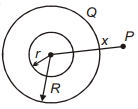
A
$-\frac{Q r}{R}$
B
$-\frac{Q R}{r}$
C
$-Q$
D
$-\frac{2 Q R}{r}$
Solution
(C) Let the charge on the inner sphere be $q$ and the charge on the outer sphere be $Q$.
For any point $P$ at a distance $x$ from the center,where $x > R$,both spheres act as point charges located at the center.
The electric potential $V$ at point $P$ is given by the sum of the potentials due to both spheres:
$V = \frac{1}{4 \pi \epsilon_0} \frac{q}{x} + \frac{1}{4 \pi \epsilon_0} \frac{Q}{x}$
We are given that the potential at point $P$ is zero,so:
$V = \frac{1}{4 \pi \epsilon_0 x} (q + Q) = 0$
Since $\frac{1}{4 \pi \epsilon_0 x} \neq 0$,we must have:
$q + Q = 0$
$q = -Q$
Thus,the charge that should be given to the inner sphere is $-Q$.
For any point $P$ at a distance $x$ from the center,where $x > R$,both spheres act as point charges located at the center.
The electric potential $V$ at point $P$ is given by the sum of the potentials due to both spheres:
$V = \frac{1}{4 \pi \epsilon_0} \frac{q}{x} + \frac{1}{4 \pi \epsilon_0} \frac{Q}{x}$
We are given that the potential at point $P$ is zero,so:
$V = \frac{1}{4 \pi \epsilon_0 x} (q + Q) = 0$
Since $\frac{1}{4 \pi \epsilon_0 x} \neq 0$,we must have:
$q + Q = 0$
$q = -Q$
Thus,the charge that should be given to the inner sphere is $-Q$.
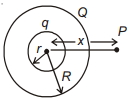
0 likes
View Solution285
EasyMCQ
The work done in moving an electric charge $q$ in an electric field does not depend upon
A
Mass of the particle
B
Potential difference between two points
C
Magnitude of charge
D
All of these
Solution
(A) The work done $W$ in moving a charge $q$ from point $A$ to point $B$ in an electric field is given by the formula $W = q(V_B - V_A)$,where $V_B - V_A$ is the potential difference between the two points.
From this formula,it is clear that the work done depends on the magnitude of the charge $q$ and the potential difference between the two points.
However,the work done is independent of the mass of the particle moving in the electric field.
Therefore,the correct option is $A$.
From this formula,it is clear that the work done depends on the magnitude of the charge $q$ and the potential difference between the two points.
However,the work done is independent of the mass of the particle moving in the electric field.
Therefore,the correct option is $A$.
0 likes
View Solution286
EasyMCQ
$A$ particle $A$ has charge $+q$ and particle $B$ has charge $+4q$,with each of them having the same mass $m$. When allowed to fall from rest through the same electric potential difference $V$,the ratio of their speeds $\frac{v_A}{v_B}$ will be:
A
$1: 2$
B
$2: 1$
C
$1: 4$
D
$4: 1$
Solution
(A) The kinetic energy gained by a charged particle accelerated through a potential difference $V$ is given by $K = qV = \frac{1}{2}mv^2$.
From this,the speed $v$ is given by $v = \sqrt{\frac{2qV}{m}}$.
For particle $A$ with charge $q_A = q$ and mass $m$,the speed is $v_A = \sqrt{\frac{2qV}{m}}$.
For particle $B$ with charge $q_B = 4q$ and mass $m$,the speed is $v_B = \sqrt{\frac{2(4q)V}{m}} = \sqrt{\frac{8qV}{m}} = 2\sqrt{\frac{2qV}{m}}$.
Taking the ratio of their speeds:
$\frac{v_A}{v_B} = \frac{\sqrt{\frac{2qV}{m}}}{2\sqrt{\frac{2qV}{m}}} = \frac{1}{2}$.
Thus,the ratio is $1:2$.
From this,the speed $v$ is given by $v = \sqrt{\frac{2qV}{m}}$.
For particle $A$ with charge $q_A = q$ and mass $m$,the speed is $v_A = \sqrt{\frac{2qV}{m}}$.
For particle $B$ with charge $q_B = 4q$ and mass $m$,the speed is $v_B = \sqrt{\frac{2(4q)V}{m}} = \sqrt{\frac{8qV}{m}} = 2\sqrt{\frac{2qV}{m}}$.
Taking the ratio of their speeds:
$\frac{v_A}{v_B} = \frac{\sqrt{\frac{2qV}{m}}}{2\sqrt{\frac{2qV}{m}}} = \frac{1}{2}$.
Thus,the ratio is $1:2$.
0 likes
View Solution287
EasyMCQ
If $50 \, J$ of work must be done to move an electric charge of $2 \, C$ from a point,where potential is $-10 \, V$ to another point,where potential is $V \, V$,the value of $V$ is ......... $V$.
A
$5$
B
$-15$
C
$+15$
D
$+10$
Solution
(C) The work done $W$ in moving a charge $q$ from a point with potential $V_A$ to a point with potential $V_B$ is given by the formula:
$W = q(V_B - V_A)$
Given:
$W = 50 \, J$
$q = 2 \, C$
$V_A = -10 \, V$
$V_B = V$
Substituting the values into the formula:
$50 = 2(V - (-10))$
$50 = 2(V + 10)$
Dividing both sides by $2$:
$25 = V + 10$
$V = 25 - 10$
$V = 15 \, V$
Therefore,the value of $V$ is $15 \, V$.
$W = q(V_B - V_A)$
Given:
$W = 50 \, J$
$q = 2 \, C$
$V_A = -10 \, V$
$V_B = V$
Substituting the values into the formula:
$50 = 2(V - (-10))$
$50 = 2(V + 10)$
Dividing both sides by $2$:
$25 = V + 10$
$V = 25 - 10$
$V = 15 \, V$
Therefore,the value of $V$ is $15 \, V$.
0 likes
View Solution288
EasyMCQ
$A$ proton has a mass $1.67 \times 10^{-27} \,kg$ and charge $+1.6 \times 10^{-19} \,C$. If the proton is accelerated through a potential difference of $1$ million volts,then the kinetic energy is ......... $J$.
A
$1.6 \times 10^{-15}$
B
$1.6 \times 10^{-13}$
C
$1.6 \times 10^{-21}$
D
$3.2 \times 10^{-13}$
Solution
(B) The kinetic energy $(KE)$ gained by a charged particle accelerated through a potential difference $(V)$ is given by the formula: $KE = qV$.
Here,the charge of the proton is $q = 1.6 \times 10^{-19} \,C$.
The potential difference is $V = 1 \text{ million volts} = 10^6 \,V$.
Substituting these values into the formula:
$KE = (1.6 \times 10^{-19} \,C) \times (10^6 \,V)$
$KE = 1.6 \times 10^{-13} \,J$.
Thus,the kinetic energy gained by the proton is $1.6 \times 10^{-13} \,J$.
Here,the charge of the proton is $q = 1.6 \times 10^{-19} \,C$.
The potential difference is $V = 1 \text{ million volts} = 10^6 \,V$.
Substituting these values into the formula:
$KE = (1.6 \times 10^{-19} \,C) \times (10^6 \,V)$
$KE = 1.6 \times 10^{-13} \,J$.
Thus,the kinetic energy gained by the proton is $1.6 \times 10^{-13} \,J$.
0 likes
View Solution289
DifficultMCQ
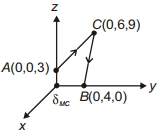
Calculate the work done in taking a charge $q_0 = -2 \times 10^{-9} \, C$ from point $A$ to point $B$ via point $C$,as shown in the diagram. The source charge $q = 8 \, mC$ is located at the origin $O$. (in $, J$)
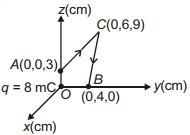
A
$0.2$
B
$1.2$
C
$2.2$
D
$0$
Solution
(B) The electrostatic force is a conservative force,so the work done depends only on the initial and final positions,not on the path taken. The work done $W$ in moving a charge $q_0$ from $A$ to $B$ is given by $W = q_0(V_B - V_A)$.
The potential at a distance $r$ from a point charge $q$ is $V = \frac{kq}{r}$.
Given $q = 8 \, mC = 8 \times 10^{-3} \, C$ at the origin $O(0,0,0)$.
Point $A$ is at $(0,0,3 \, cm)$,so $r_A = 3 \, cm = 3 \times 10^{-2} \, m$.
$V_A = \frac{9 \times 10^9 \times 8 \times 10^{-3}}{3 \times 10^{-2}} = 24 \times 10^8 \, V$.
Point $B$ is at $(0,4 \, cm, 0)$,so $r_B = 4 \, cm = 4 \times 10^{-2} \, m$.
$V_B = \frac{9 \times 10^9 \times 8 \times 10^{-3}}{4 \times 10^{-2}} = 18 \times 10^8 \, V$.
Work done $W = q_0(V_B - V_A) = (-2 \times 10^{-9} \, C) \times (18 \times 10^8 - 24 \times 10^8) \, V$.
$W = (-2 \times 10^{-9}) \times (-6 \times 10^8) \, J = 12 \times 10^{-1} \, J = 1.2 \, J$.
The potential at a distance $r$ from a point charge $q$ is $V = \frac{kq}{r}$.
Given $q = 8 \, mC = 8 \times 10^{-3} \, C$ at the origin $O(0,0,0)$.
Point $A$ is at $(0,0,3 \, cm)$,so $r_A = 3 \, cm = 3 \times 10^{-2} \, m$.
$V_A = \frac{9 \times 10^9 \times 8 \times 10^{-3}}{3 \times 10^{-2}} = 24 \times 10^8 \, V$.
Point $B$ is at $(0,4 \, cm, 0)$,so $r_B = 4 \, cm = 4 \times 10^{-2} \, m$.
$V_B = \frac{9 \times 10^9 \times 8 \times 10^{-3}}{4 \times 10^{-2}} = 18 \times 10^8 \, V$.
Work done $W = q_0(V_B - V_A) = (-2 \times 10^{-9} \, C) \times (18 \times 10^8 - 24 \times 10^8) \, V$.
$W = (-2 \times 10^{-9}) \times (-6 \times 10^8) \, J = 12 \times 10^{-1} \, J = 1.2 \, J$.
0 likes
View Solution290
EasyMCQ
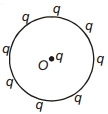
$A$ point charge $q$ is surrounded by eight identical charges,each of magnitude $q$,at a distance $r$ as shown in the figure. How much work is done by the forces of electrostatic repulsion when the point charge at the center is moved to infinity?
A
$0$
B
$\frac{8 q^2}{4 \pi \varepsilon_0 r}$
C
$\frac{8 q}{4 \pi \varepsilon_0 r}$
D
$\frac{64 q^2}{4 \pi \varepsilon_0 r}$
Solution
(B) The work done by the electrostatic force when a charge is moved from an initial position to a final position is given by $W = -\Delta U = -(U_f - U_i) = U_i - U_f$.
Initially,the potential energy $U_i$ of the central charge $q$ due to the eight surrounding charges is the sum of the potential energies of the central charge with each of the eight charges.
Since each of the eight charges is at a distance $r$ from the center,the potential at the center due to the eight charges is $V_i = 8 \times \frac{1}{4 \pi \varepsilon_0} \frac{q}{r} = \frac{8 q}{4 \pi \varepsilon_0 r}$.
The initial potential energy of the central charge is $U_i = q V_i = \frac{8 q^2}{4 \pi \varepsilon_0 r}$.
When the central charge is moved to infinity,the final potential energy $U_f$ is $0$ because the distance becomes infinite.
Therefore,the work done by the electrostatic force is $W = U_i - U_f = \frac{8 q^2}{4 \pi \varepsilon_0 r} - 0 = \frac{8 q^2}{4 \pi \varepsilon_0 r}$.
Initially,the potential energy $U_i$ of the central charge $q$ due to the eight surrounding charges is the sum of the potential energies of the central charge with each of the eight charges.
Since each of the eight charges is at a distance $r$ from the center,the potential at the center due to the eight charges is $V_i = 8 \times \frac{1}{4 \pi \varepsilon_0} \frac{q}{r} = \frac{8 q}{4 \pi \varepsilon_0 r}$.
The initial potential energy of the central charge is $U_i = q V_i = \frac{8 q^2}{4 \pi \varepsilon_0 r}$.
When the central charge is moved to infinity,the final potential energy $U_f$ is $0$ because the distance becomes infinite.
Therefore,the work done by the electrostatic force is $W = U_i - U_f = \frac{8 q^2}{4 \pi \varepsilon_0 r} - 0 = \frac{8 q^2}{4 \pi \varepsilon_0 r}$.
0 likes
View Solution291
MediumMCQ
There is a uniformly charged non-conducting solid sphere made of material of dielectric constant $1$. If the electric potential at infinity is zero,then the potential at its surface is $V$. If we take the electric potential at its surface to be zero,then the potential at the centre will be
A
$\frac{3V}{2}$
B
$\frac{V}{2}$
C
$V$
D
$0$
Solution
(B) For a uniformly charged non-conducting solid sphere of radius $R$ and total charge $Q$,the potential at the surface $(V_s)$ and the potential at the centre $(V_c)$ with respect to infinity are given by:
$V_s = \frac{1}{4\pi\epsilon_0} \frac{Q}{R} = V$
$V_c = \frac{3}{2} \frac{1}{4\pi\epsilon_0} \frac{Q}{R} = \frac{3}{2}V$
If we shift the reference point such that the potential at the surface becomes zero,we subtract $V$ from the potential at every point.
New potential at the surface,$V'_s = V_s - V = V - V = 0$
New potential at the centre,$V'_c = V_c - V = \frac{3}{2}V - V = \frac{V}{2}$
$V_s = \frac{1}{4\pi\epsilon_0} \frac{Q}{R} = V$
$V_c = \frac{3}{2} \frac{1}{4\pi\epsilon_0} \frac{Q}{R} = \frac{3}{2}V$
If we shift the reference point such that the potential at the surface becomes zero,we subtract $V$ from the potential at every point.
New potential at the surface,$V'_s = V_s - V = V - V = 0$
New potential at the centre,$V'_c = V_c - V = \frac{3}{2}V - V = \frac{V}{2}$

0 likes
View Solution292
DifficultMCQ
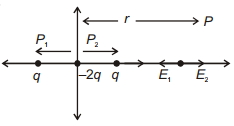
Three charged particles having charges $q, -2q$,and $q$ are placed in a line at points $(-a, 0), (0, 0)$,and $(a, 0)$ respectively. The expression for electric potential at $P(r, 0)$ for $r \gg a$ is ...............
A
$\frac{1}{4 \pi \varepsilon_0} \frac{q a^2}{r^4}$
B
$\frac{1}{4 \pi \varepsilon_0} \frac{2 q a^2}{r^3}$
C
$\frac{1}{4 \pi \varepsilon_0} \frac{4 q a^2}{r^2}$
D
$\frac{1}{4 \pi \varepsilon_0} \frac{8 q a^2}{r}$
Solution
(B) The electric potential $V$ at a point $P(r, 0)$ due to a system of charges is the algebraic sum of the potentials due to individual charges.
$V = V_1 + V_2 + V_3$
$V = \frac{1}{4 \pi \varepsilon_0} \left[ \frac{q}{r+a} + \frac{-2q}{r} + \frac{q}{r-a} \right]$
$V = \frac{q}{4 \pi \varepsilon_0} \left[ \frac{1}{r+a} + \frac{1}{r-a} - \frac{2}{r} \right]$
$V = \frac{q}{4 \pi \varepsilon_0} \left[ \frac{(r-a) + (r+a)}{r^2 - a^2} - \frac{2}{r} \right]$
$V = \frac{q}{4 \pi \varepsilon_0} \left[ \frac{2r}{r^2 - a^2} - \frac{2}{r} \right]$
$V = \frac{2q}{4 \pi \varepsilon_0} \left[ \frac{r^2 - (r^2 - a^2)}{r(r^2 - a^2)} \right]$
$V = \frac{2q}{4 \pi \varepsilon_0} \left[ \frac{a^2}{r(r^2 - a^2)} \right]$
Since $r \gg a$,we can approximate $r^2 - a^2 \approx r^2$.
$V \approx \frac{2q}{4 \pi \varepsilon_0} \frac{a^2}{r^3} = \frac{1}{4 \pi \varepsilon_0} \frac{2 q a^2}{r^3}$.
$V = V_1 + V_2 + V_3$
$V = \frac{1}{4 \pi \varepsilon_0} \left[ \frac{q}{r+a} + \frac{-2q}{r} + \frac{q}{r-a} \right]$
$V = \frac{q}{4 \pi \varepsilon_0} \left[ \frac{1}{r+a} + \frac{1}{r-a} - \frac{2}{r} \right]$
$V = \frac{q}{4 \pi \varepsilon_0} \left[ \frac{(r-a) + (r+a)}{r^2 - a^2} - \frac{2}{r} \right]$
$V = \frac{q}{4 \pi \varepsilon_0} \left[ \frac{2r}{r^2 - a^2} - \frac{2}{r} \right]$
$V = \frac{2q}{4 \pi \varepsilon_0} \left[ \frac{r^2 - (r^2 - a^2)}{r(r^2 - a^2)} \right]$
$V = \frac{2q}{4 \pi \varepsilon_0} \left[ \frac{a^2}{r(r^2 - a^2)} \right]$
Since $r \gg a$,we can approximate $r^2 - a^2 \approx r^2$.
$V \approx \frac{2q}{4 \pi \varepsilon_0} \frac{a^2}{r^3} = \frac{1}{4 \pi \varepsilon_0} \frac{2 q a^2}{r^3}$.
0 likes
View Solution293
MediumMCQ
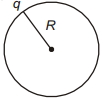
Consider a sphere of radius $R$ having charge $q$ uniformly distributed inside it. At what minimum distance from its surface is the electric potential half of the electric potential at its centre?
A
$R$
B
$\frac{R}{2}$
C
$\frac{4 R}{3}$
D
$\frac{R}{3}$
Solution
(D) The electric potential at the centre of a uniformly charged non-conducting sphere is given by $V_c = \frac{3 k q}{2 R}$.
We want to find the distance $x$ from the surface such that the potential $V_s$ at that point is half of $V_c$. The distance from the centre of the sphere to this point is $r = R + x$.
Since the point is outside the sphere $(r > R)$,the potential is $V_s = \frac{k q}{r} = \frac{k q}{R + x}$.
According to the problem,$V_s = \frac{1}{2} V_c$.
Substituting the expressions:
$\frac{k q}{R + x} = \frac{1}{2} \left( \frac{3 k q}{2 R} \right)$
$\frac{k q}{R + x} = \frac{3 k q}{4 R}$
$\frac{1}{R + x} = \frac{3}{4 R}$
$4 R = 3(R + x)$
$4 R = 3 R + 3 x$
$3 x = R$
$x = \frac{R}{3}$
We want to find the distance $x$ from the surface such that the potential $V_s$ at that point is half of $V_c$. The distance from the centre of the sphere to this point is $r = R + x$.
Since the point is outside the sphere $(r > R)$,the potential is $V_s = \frac{k q}{r} = \frac{k q}{R + x}$.
According to the problem,$V_s = \frac{1}{2} V_c$.
Substituting the expressions:
$\frac{k q}{R + x} = \frac{1}{2} \left( \frac{3 k q}{2 R} \right)$
$\frac{k q}{R + x} = \frac{3 k q}{4 R}$
$\frac{1}{R + x} = \frac{3}{4 R}$
$4 R = 3(R + x)$
$4 R = 3 R + 3 x$
$3 x = R$
$x = \frac{R}{3}$
0 likes
View Solution294
MediumMCQ
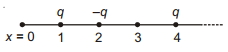
Electric charges having the same magnitude $q$ are placed at $x = 1 \, m, 2 \, m, 4 \, m, 8 \, m, \dots$ and so on. If any two consecutive charges have opposite signs but the first charge is necessarily positive,what will be the potential at $x = 0$?
A
Infinity
B
Zero
C
$\frac{1}{4 \pi \varepsilon_0} \left( \frac{2q}{3} \right)$
D
$\frac{1}{4 \pi \varepsilon_0} (2q)$
Solution
(C) The electric potential $V$ at a point due to a system of point charges is the algebraic sum of the potentials due to individual charges.
Given charges $q_1 = q$ at $x_1 = 1 \, m$,$q_2 = -q$ at $x_2 = 2 \, m$,$q_3 = q$ at $x_3 = 4 \, m$,$q_4 = -q$ at $x_4 = 8 \, m$,and so on.
The potential at $x = 0$ is given by $V = \sum \frac{k q_i}{r_i}$,where $k = \frac{1}{4 \pi \varepsilon_0}$.
$V = k \left( \frac{q}{1} - \frac{q}{2} + \frac{q}{4} - \frac{q}{8} + \dots \right)$
$V = kq \left( 1 - \frac{1}{2} + \frac{1}{4} - \frac{1}{8} + \dots \right)$
The term in the bracket is a geometric series with first term $a = 1$ and common ratio $r = -1/2$.
The sum of an infinite geometric series is $S = \frac{a}{1 - r}$.
$S = \frac{1}{1 - (-1/2)} = \frac{1}{1 + 1/2} = \frac{1}{3/2} = \frac{2}{3}$.
Therefore,$V = kq \left( \frac{2}{3} \right) = \frac{1}{4 \pi \varepsilon_0} \left( \frac{2q}{3} \right)$.
Given charges $q_1 = q$ at $x_1 = 1 \, m$,$q_2 = -q$ at $x_2 = 2 \, m$,$q_3 = q$ at $x_3 = 4 \, m$,$q_4 = -q$ at $x_4 = 8 \, m$,and so on.
The potential at $x = 0$ is given by $V = \sum \frac{k q_i}{r_i}$,where $k = \frac{1}{4 \pi \varepsilon_0}$.
$V = k \left( \frac{q}{1} - \frac{q}{2} + \frac{q}{4} - \frac{q}{8} + \dots \right)$
$V = kq \left( 1 - \frac{1}{2} + \frac{1}{4} - \frac{1}{8} + \dots \right)$
The term in the bracket is a geometric series with first term $a = 1$ and common ratio $r = -1/2$.
The sum of an infinite geometric series is $S = \frac{a}{1 - r}$.
$S = \frac{1}{1 - (-1/2)} = \frac{1}{1 + 1/2} = \frac{1}{3/2} = \frac{2}{3}$.
Therefore,$V = kq \left( \frac{2}{3} \right) = \frac{1}{4 \pi \varepsilon_0} \left( \frac{2q}{3} \right)$.
0 likes
View Solution295
MediumMCQ
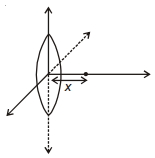
$A$ positively charged ring is in the $y-z$ plane with its centre at the origin. $A$ positive test charge $q_0$,held at the origin,is released along the $x$-axis. Then its speed
A
Increases continuously
B
Decreases continuously
C
First increases then decreases
D
First decreases then increases
Solution
(A) The electric potential $V$ at a distance $x$ from the center of a charged ring of radius $a$ and charge $q$ is given by $V = \frac{kq}{\sqrt{x^2 + a^2}}$.
At the origin $(x=0)$,the potential is $V_{center} = \frac{kq}{a}$.
As the test charge $q_0$ moves along the $x$-axis away from the origin,the distance $\sqrt{x^2 + a^2}$ increases,which means the potential $V$ decreases.
The potential energy $U$ of the test charge is $U = q_0 V$. Since $V$ decreases as $x$ increases,the potential energy $U$ also decreases.
According to the law of conservation of energy,the total mechanical energy remains constant. As the potential energy $U$ decreases,the kinetic energy $K$ must increase to compensate.
Therefore,the speed of the test charge increases continuously as it moves away from the origin.
At the origin $(x=0)$,the potential is $V_{center} = \frac{kq}{a}$.
As the test charge $q_0$ moves along the $x$-axis away from the origin,the distance $\sqrt{x^2 + a^2}$ increases,which means the potential $V$ decreases.
The potential energy $U$ of the test charge is $U = q_0 V$. Since $V$ decreases as $x$ increases,the potential energy $U$ also decreases.
According to the law of conservation of energy,the total mechanical energy remains constant. As the potential energy $U$ decreases,the kinetic energy $K$ must increase to compensate.
Therefore,the speed of the test charge increases continuously as it moves away from the origin.
0 likes
View Solution296
MediumMCQ
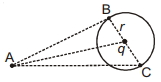
$A$ point charge $q$ is held at the centre of a circle of radius $r$. $B$ and $C$ are two points on the circumference of the circle,and $A$ is a point outside the circle. If $W_{AB}$ represents the work done by the electric field in taking a charge $q_0$ from $A$ to $B$,and $W_{AC}$ represents the work done from $A$ to $C$,then:
A
$W_{AB} > W_{AC}$
B
$W_{AB} < W_{AC}$
C
$W_{AB} = W_{AC} \neq 0$
D
$W_{AB} = W_{AC} = 0$
Solution
(C) The work done by the electric field in moving a charge $q_0$ from point $A$ to point $B$ is given by $W_{AB} = q_0(V_A - V_B)$.
Similarly,the work done in moving the charge from $A$ to $C$ is $W_{AC} = q_0(V_A - V_C)$.
Since $B$ and $C$ lie on the circumference of a circle with the charge $q$ at its center,both points are at the same distance $r$ from the charge $q$.
Therefore,the electric potential at $B$ and $C$ is the same,i.e.,$V_B = V_C = \frac{kq}{r}$.
Since $V_B = V_C$,it follows that $W_{AB} = q_0(V_A - V_B) = q_0(V_A - V_C) = W_{AC}$.
Since $A$ is outside the circle,$V_A \neq V_B$,so $W_{AB} = W_{AC} \neq 0$.
Similarly,the work done in moving the charge from $A$ to $C$ is $W_{AC} = q_0(V_A - V_C)$.
Since $B$ and $C$ lie on the circumference of a circle with the charge $q$ at its center,both points are at the same distance $r$ from the charge $q$.
Therefore,the electric potential at $B$ and $C$ is the same,i.e.,$V_B = V_C = \frac{kq}{r}$.
Since $V_B = V_C$,it follows that $W_{AB} = q_0(V_A - V_B) = q_0(V_A - V_C) = W_{AC}$.
Since $A$ is outside the circle,$V_A \neq V_B$,so $W_{AB} = W_{AC} \neq 0$.
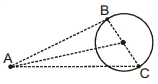
0 likes
View Solution297
EasyMCQ
$A$ pellet carrying a charge of $0.5 \, C$ is accelerated through a potential difference of $2000 \, V$. The kinetic energy attained by the pellet is:
A
$1000 \, erg$
B
$1000 \, J$
C
$1000 \, kWh$
D
$500 \, erg$
Solution
(B) The kinetic energy $(KE)$ gained by a charge $q$ accelerated through a potential difference $V$ is given by the formula:
$KE = q \times V$
Given:
Charge $q = 0.5 \, C$
Potential difference $V = 2000 \, V$
Substituting the values:
$KE = 0.5 \times 2000 = 1000 \, J$
Therefore,the kinetic energy attained is $1000 \, J$.
$KE = q \times V$
Given:
Charge $q = 0.5 \, C$
Potential difference $V = 2000 \, V$
Substituting the values:
$KE = 0.5 \times 2000 = 1000 \, J$
Therefore,the kinetic energy attained is $1000 \, J$.
0 likes
View Solution298
DifficultMCQ
The electric potential at the centre of two concentric half rings of radii $R_1$ and $R_2$,having same linear charge density $\lambda$ is
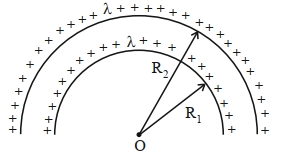
A
$\frac{2 \lambda}{\epsilon_0}$
B
$\frac{\lambda}{2 \epsilon_0}$
C
$\frac{\lambda}{4 \epsilon_0}$
D
$\frac{\lambda}{\epsilon_0}$
Solution
(B) The electric potential $V$ due to a charge $q$ at a distance $r$ is given by $V = \frac{1}{4 \pi \epsilon_0} \frac{q}{r}$.
For a half ring of radius $R$ and linear charge density $\lambda$,the total charge $q$ is $\lambda \times (\pi R)$.
The potential at the centre due to the first half ring of radius $R_1$ is $V_1 = \frac{1}{4 \pi \epsilon_0} \frac{\lambda \pi R_1}{R_1} = \frac{\lambda}{4 \epsilon_0}$.
The potential at the centre due to the second half ring of radius $R_2$ is $V_2 = \frac{1}{4 \pi \epsilon_0} \frac{\lambda \pi R_2}{R_2} = \frac{\lambda}{4 \epsilon_0}$.
The total potential at the centre is $V = V_1 + V_2 = \frac{\lambda}{4 \epsilon_0} + \frac{\lambda}{4 \epsilon_0} = \frac{2 \lambda}{4 \epsilon_0} = \frac{\lambda}{2 \epsilon_0}$.
For a half ring of radius $R$ and linear charge density $\lambda$,the total charge $q$ is $\lambda \times (\pi R)$.
The potential at the centre due to the first half ring of radius $R_1$ is $V_1 = \frac{1}{4 \pi \epsilon_0} \frac{\lambda \pi R_1}{R_1} = \frac{\lambda}{4 \epsilon_0}$.
The potential at the centre due to the second half ring of radius $R_2$ is $V_2 = \frac{1}{4 \pi \epsilon_0} \frac{\lambda \pi R_2}{R_2} = \frac{\lambda}{4 \epsilon_0}$.
The total potential at the centre is $V = V_1 + V_2 = \frac{\lambda}{4 \epsilon_0} + \frac{\lambda}{4 \epsilon_0} = \frac{2 \lambda}{4 \epsilon_0} = \frac{\lambda}{2 \epsilon_0}$.
0 likes
View Solution299
MediumMCQ
Which of the following correctly represents the variation of electric potential $(V)$ of a charged spherical conductor of radius $(R)$ with radial distance $(r)$ from the centre?
A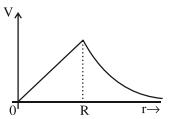
B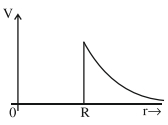
C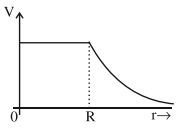
D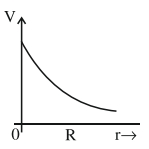
Solution
(C) For a charged spherical conductor of radius $(R)$,the electric potential $(V)$ inside the conductor (for $r < R$) is constant and equal to the potential at the surface,given by $V = \frac{1}{4\pi\epsilon_0} \frac{Q}{R}$.
Outside the conductor (for $r \geq R$),the potential varies inversely with distance as $V = \frac{1}{4\pi\epsilon_0} \frac{Q}{r}$.
Thus,the potential remains constant from the centre to the surface and then decreases as $1/r$ for distances greater than the radius.
Graph $C$ correctly depicts this behavior,showing a constant value for $r \leq R$ and a hyperbolic decrease for $r > R$.
Outside the conductor (for $r \geq R$),the potential varies inversely with distance as $V = \frac{1}{4\pi\epsilon_0} \frac{Q}{r}$.
Thus,the potential remains constant from the centre to the surface and then decreases as $1/r$ for distances greater than the radius.
Graph $C$ correctly depicts this behavior,showing a constant value for $r \leq R$ and a hyperbolic decrease for $r > R$.
0 likes
View SolutionElectric Potential and Capacitance — Electric potential · Frequently Asked Questions
1Are these Electric Potential and Capacitance questions useful for JEE and NEET?
Yes. All questions in this section are mapped to JEE Main and NEET exam patterns. Previous year questions from JEE Main, NEET, GUJCET and state-level exams are included with full solutions.
2Can I switch to Hindi or Gujarati for these questions?
Yes. Use the language tabs in the hero section or the sidebar to view the same questions and solutions in English, Hindi or Gujarati.
3How do I generate a question paper from this subtopic?
Use the Vedclass Exam Paper Generator — select the chapter and subtopic, set difficulty, and generate Sets A, B, C, D automatically. First 3 chapters of every subject are free.
Vedclass Products
For Students
Vedclass Test Series
Mock tests in real JEE/NEET style with performance analysis. 5-day free trial.
Start Free TrialFor Teachers
Exam Paper Generator
Generate Set A/B/C/D papers from this chapter in 2 minutes. 3 chapters free.
Try FreeFor Institutes
Online Exam Module
Live online exams with unlimited students, 360° analytics & white-label branding.
See DemoFor Teachers & Institutes
Generate a Electric Potential and Capacitance Exam Paper in 2 Minutes
Select subtopic & difficulty — Sets A, B, C, D auto-generated with No Repeat logic.
First 3 chapters of every subject are free — no payment required.