
A English
Electric potential Questions in English
Class 12 Physics · Electric Potential and Capacitance · Electric potential
432+
Questions
English
Language
100%
With Solutions
Showing 48 of 432 questions in English
151
MediumMCQ
If the electric potential of the inner metal sphere of radius $a$ is $10 \text{ V}$ and that of the outer spherical shell of radius $b$ is $5 \text{ V}$,then the potential at the centre will be ...... $\text{V}$.

A
$10$
B
$5$
C
$15$
D
$0$
Solution
(A) Let $q_1$ be the charge on the inner sphere of radius $a$ and $q_2$ be the charge on the outer shell of radius $b$.
The potential at the surface of the inner sphere is given by the sum of potentials due to both spheres: $V_a = \frac{kq_1}{a} + \frac{kq_2}{b} = 10 \text{ V}$.
The potential at the surface of the outer shell is given by: $V_b = \frac{kq_1}{b} + \frac{kq_2}{b} = \frac{k(q_1 + q_2)}{b} = 5 \text{ V}$.
The potential at the centre of the spheres is the sum of the potentials due to both spheres at that point. Since the potential inside a spherical shell is constant and equal to the potential at its surface,the potential at the centre is: $V_c = \frac{kq_1}{a} + \frac{kq_2}{b}$.
Comparing this with the expression for $V_a$,we see that $V_c = V_a = 10 \text{ V}$.
The potential at the surface of the inner sphere is given by the sum of potentials due to both spheres: $V_a = \frac{kq_1}{a} + \frac{kq_2}{b} = 10 \text{ V}$.
The potential at the surface of the outer shell is given by: $V_b = \frac{kq_1}{b} + \frac{kq_2}{b} = \frac{k(q_1 + q_2)}{b} = 5 \text{ V}$.
The potential at the centre of the spheres is the sum of the potentials due to both spheres at that point. Since the potential inside a spherical shell is constant and equal to the potential at its surface,the potential at the centre is: $V_c = \frac{kq_1}{a} + \frac{kq_2}{b}$.
Comparing this with the expression for $V_a$,we see that $V_c = V_a = 10 \text{ V}$.
0 likes
View Solution152
DifficultMCQ
Three concentric metallic spherical shells $A, B,$ and $C$ of radii $a, b,$ and $c$ $(a < b < c)$ have surface charge densities $-\sigma, +\sigma,$ and $-\sigma$ respectively. The potential of shell $A$ is:
A
$(\sigma/\varepsilon_0) [a - b + c]$
B
$(\sigma/\varepsilon_0) [a + b - c]$
C
$(\sigma/\varepsilon_0) [b - a - c]$
D
None of these
Solution
(C) The charges on the shells are given by $q = \text{surface charge density} \times \text{area}$.
For shell $A$ (radius $a$): $q_A = -\sigma(4\pi a^2)$.
For shell $B$ (radius $b$): $q_B = +\sigma(4\pi b^2)$.
For shell $C$ (radius $c$): $q_C = -\sigma(4\pi c^2)$.
The potential at the surface of shell $A$ is the sum of potentials due to all three shells:
$V_A = V_{A,A} + V_{A,B} + V_{A,C} = \frac{1}{4\pi\varepsilon_0} [\frac{q_A}{a} + \frac{q_B}{b} + \frac{q_C}{c}]$.
Substituting the values:
$V_A = \frac{1}{4\pi\varepsilon_0} [\frac{-\sigma(4\pi a^2)}{a} + \frac{\sigma(4\pi b^2)}{b} + \frac{-\sigma(4\pi c^2)}{c}]$.
$V_A = \frac{1}{4\pi\varepsilon_0} [-\sigma(4\pi a) + \sigma(4\pi b) - \sigma(4\pi c)]$.
$V_A = \frac{\sigma}{\varepsilon_0} [-a + b - c] = \frac{\sigma}{\varepsilon_0} [b - a - c]$.
For shell $A$ (radius $a$): $q_A = -\sigma(4\pi a^2)$.
For shell $B$ (radius $b$): $q_B = +\sigma(4\pi b^2)$.
For shell $C$ (radius $c$): $q_C = -\sigma(4\pi c^2)$.
The potential at the surface of shell $A$ is the sum of potentials due to all three shells:
$V_A = V_{A,A} + V_{A,B} + V_{A,C} = \frac{1}{4\pi\varepsilon_0} [\frac{q_A}{a} + \frac{q_B}{b} + \frac{q_C}{c}]$.
Substituting the values:
$V_A = \frac{1}{4\pi\varepsilon_0} [\frac{-\sigma(4\pi a^2)}{a} + \frac{\sigma(4\pi b^2)}{b} + \frac{-\sigma(4\pi c^2)}{c}]$.
$V_A = \frac{1}{4\pi\varepsilon_0} [-\sigma(4\pi a) + \sigma(4\pi b) - \sigma(4\pi c)]$.
$V_A = \frac{\sigma}{\varepsilon_0} [-a + b - c] = \frac{\sigma}{\varepsilon_0} [b - a - c]$.
0 likes
View Solution153
DifficultMCQ
$A$ solid sphere of radius $R$ is charged uniformly. At what distance from its surface is the electrostatic potential half of the potential at the centre?
A
$R$
B
$R/2$
C
$R/3$
D
$2R$
Solution
(C) The electrostatic potential at the center of a uniformly charged solid sphere of radius $R$ is given by $V_c = \frac{3}{2} \frac{kQ}{R}$.
For a point outside the sphere at a distance $x$ from the center (where $x > R$),the potential is $V(x) = \frac{kQ}{x}$.
According to the problem,the potential at distance $x$ is half of the potential at the center:
$V(x) = \frac{1}{2} V_c$
$\frac{kQ}{x} = \frac{1}{2} \left( \frac{3}{2} \frac{kQ}{R} \right)$
$\frac{1}{x} = \frac{3}{4R}$
$x = \frac{4R}{3}$.
The distance from the surface of the sphere is $d = x - R = \frac{4R}{3} - R = \frac{R}{3}$.
For a point outside the sphere at a distance $x$ from the center (where $x > R$),the potential is $V(x) = \frac{kQ}{x}$.
According to the problem,the potential at distance $x$ is half of the potential at the center:
$V(x) = \frac{1}{2} V_c$
$\frac{kQ}{x} = \frac{1}{2} \left( \frac{3}{2} \frac{kQ}{R} \right)$
$\frac{1}{x} = \frac{3}{4R}$
$x = \frac{4R}{3}$.
The distance from the surface of the sphere is $d = x - R = \frac{4R}{3} - R = \frac{R}{3}$.
0 likes
View Solution154
DifficultMCQ
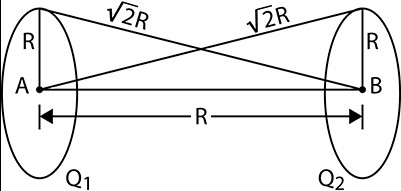
Two identical thin rings,each of radius $R \text{ m}$,are coaxially placed at a distance $R \text{ m}$ apart. If $Q_1$ and $Q_2$ coulombs are the charges uniformly spread on the two rings respectively,the work done in moving a charge $q$ from the centre of one ring to that of the other is
A
zero
B
$q(Q_1 - Q_2)(\sqrt{2} - 1) / (\sqrt{2} \cdot 4\pi \varepsilon_0 R)$
C
$q\sqrt{2}(Q_1 + Q_2) / (4\pi \varepsilon_0 R)$
D
$q(Q_1 - Q_2)(\sqrt{2} + 1) / (\sqrt{2} \cdot 4\pi \varepsilon_0 R)$
Solution
(B) The work done in moving a charge $q$ from point $A$ to point $B$ is given by $W = q(V_B - V_A)$.
The potential at the centre $A$ of the first ring due to both rings is:
$V_A = \frac{1}{4\pi \varepsilon_0} \left( \frac{Q_1}{R} + \frac{Q_2}{\sqrt{R^2 + R^2}} \right) = \frac{1}{4\pi \varepsilon_0} \left( \frac{Q_1}{R} + \frac{Q_2}{\sqrt{2}R} \right)$.
The potential at the centre $B$ of the second ring due to both rings is:
$V_B = \frac{1}{4\pi \varepsilon_0} \left( \frac{Q_2}{R} + \frac{Q_1}{\sqrt{R^2 + R^2}} \right) = \frac{1}{4\pi \varepsilon_0} \left( \frac{Q_2}{R} + \frac{Q_1}{\sqrt{2}R} \right)$.
The work done is $W = q(V_B - V_A)$:
$W = \frac{q}{4\pi \varepsilon_0} \left[ \left( \frac{Q_2}{R} + \frac{Q_1}{\sqrt{2}R} \right) - \left( \frac{Q_1}{R} + \frac{Q_2}{\sqrt{2}R} \right) \right]$.
$W = \frac{q}{4\pi \varepsilon_0 R} \left[ (Q_2 - Q_1) + \frac{Q_1 - Q_2}{\sqrt{2}} \right]$.
$W = \frac{q(Q_2 - Q_1)}{4\pi \varepsilon_0 R} \left( 1 - \frac{1}{\sqrt{2}} \right) = \frac{q(Q_2 - Q_1)}{4\pi \varepsilon_0 R} \left( \frac{\sqrt{2} - 1}{\sqrt{2}} \right)$.
Since the question asks for work done moving from $A$ to $B$,and the options are expressed in terms of $(Q_1 - Q_2)$,we note that $W_{A \to B} = -W_{B \to A}$. The magnitude or the expression matching the options is $q(Q_1 - Q_2)(\sqrt{2} - 1) / (\sqrt{2} \cdot 4\pi \varepsilon_0 R)$.
The potential at the centre $A$ of the first ring due to both rings is:
$V_A = \frac{1}{4\pi \varepsilon_0} \left( \frac{Q_1}{R} + \frac{Q_2}{\sqrt{R^2 + R^2}} \right) = \frac{1}{4\pi \varepsilon_0} \left( \frac{Q_1}{R} + \frac{Q_2}{\sqrt{2}R} \right)$.
The potential at the centre $B$ of the second ring due to both rings is:
$V_B = \frac{1}{4\pi \varepsilon_0} \left( \frac{Q_2}{R} + \frac{Q_1}{\sqrt{R^2 + R^2}} \right) = \frac{1}{4\pi \varepsilon_0} \left( \frac{Q_2}{R} + \frac{Q_1}{\sqrt{2}R} \right)$.
The work done is $W = q(V_B - V_A)$:
$W = \frac{q}{4\pi \varepsilon_0} \left[ \left( \frac{Q_2}{R} + \frac{Q_1}{\sqrt{2}R} \right) - \left( \frac{Q_1}{R} + \frac{Q_2}{\sqrt{2}R} \right) \right]$.
$W = \frac{q}{4\pi \varepsilon_0 R} \left[ (Q_2 - Q_1) + \frac{Q_1 - Q_2}{\sqrt{2}} \right]$.
$W = \frac{q(Q_2 - Q_1)}{4\pi \varepsilon_0 R} \left( 1 - \frac{1}{\sqrt{2}} \right) = \frac{q(Q_2 - Q_1)}{4\pi \varepsilon_0 R} \left( \frac{\sqrt{2} - 1}{\sqrt{2}} \right)$.
Since the question asks for work done moving from $A$ to $B$,and the options are expressed in terms of $(Q_1 - Q_2)$,we note that $W_{A \to B} = -W_{B \to A}$. The magnitude or the expression matching the options is $q(Q_1 - Q_2)(\sqrt{2} - 1) / (\sqrt{2} \cdot 4\pi \varepsilon_0 R)$.
0 likes
View Solution155
AdvancedMCQ
$m$ દળ અને $q$ વિદ્યુતભાર ધરાવતી એક ગોળીને $R$ ત્રિજ્યા અને કુલ $+q$ વિદ્યુતભાર ધરાવતા સમાન રીતે વિદ્યુતભારીત નક્કર ગોળા તરફ છોડવામાં આવે છે. જો તે $u$ ઝડપ સાથે ગોળાની સપાટી પર અથડાય,તો ગોળામાંથી પસાર થવા માટે જરૂરી લઘુત્તમ ઝડપ $u$ શોધો. (સ્થિત વિદ્યુત બળો સિવાય ગોળી પર લાગતા તમામ અવરોધક બળો અથવા ઘર્ષણને અવગણો.)
A
$\frac{q}{\sqrt{2\pi\varepsilon_0 mR}}$
B
$\frac{q}{\sqrt{4\pi\varepsilon_0 mR}}$
C
$\frac{q}{\sqrt{8\pi\varepsilon_0 mR}}$
D
$\frac{\sqrt{3}q}{\sqrt{4\pi\varepsilon_0 mR}}$
Solution
(B) ગોળાની સપાટી પર ગોળીની સ્થિતિ ઉર્જા $U_s = qV_s = q \left( \frac{kq}{R} \right) = \frac{kq^2}{R}$ છે.
ગોળાના કેન્દ્ર પર ગોળીની સ્થિતિ ઉર્જા $U_c = qV_c = q \left( \frac{3kq}{2R} \right) = \frac{3kq^2}{2R}$ છે.
ગોળી ગોળામાંથી પસાર થઈ શકે તે માટે,સપાટી પર તેની ગતિ ઉર્જા સપાટીથી કેન્દ્ર સુધી જતી વખતે થતા સ્થિતિ ઉર્જાના ફેરફાર જેટલી હોવી જોઈએ.
$\frac{1}{2}mu^2 = U_c - U_s$
$\frac{1}{2}mu^2 = \frac{3kq^2}{2R} - \frac{kq^2}{R} = \frac{kq^2}{2R}$
$u^2 = \frac{kq^2}{mR}$
$k = \frac{1}{4\pi\varepsilon_0}$ મૂકતા,આપણને $u^2 = \frac{q^2}{4\pi\varepsilon_0 mR}$ મળે છે.
તેથી,$u = \frac{q}{\sqrt{4\pi\varepsilon_0 mR}}$.
ગોળાના કેન્દ્ર પર ગોળીની સ્થિતિ ઉર્જા $U_c = qV_c = q \left( \frac{3kq}{2R} \right) = \frac{3kq^2}{2R}$ છે.
ગોળી ગોળામાંથી પસાર થઈ શકે તે માટે,સપાટી પર તેની ગતિ ઉર્જા સપાટીથી કેન્દ્ર સુધી જતી વખતે થતા સ્થિતિ ઉર્જાના ફેરફાર જેટલી હોવી જોઈએ.
$\frac{1}{2}mu^2 = U_c - U_s$
$\frac{1}{2}mu^2 = \frac{3kq^2}{2R} - \frac{kq^2}{R} = \frac{kq^2}{2R}$
$u^2 = \frac{kq^2}{mR}$
$k = \frac{1}{4\pi\varepsilon_0}$ મૂકતા,આપણને $u^2 = \frac{q^2}{4\pi\varepsilon_0 mR}$ મળે છે.
તેથી,$u = \frac{q}{\sqrt{4\pi\varepsilon_0 mR}}$.
0 likes
View Solution156
AdvancedMCQ
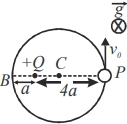
The diagram shows a small bead of mass $m$ carrying charge $q$. The bead can freely move on a smooth fixed ring placed on a smooth horizontal plane. In the same plane,a charge $+Q$ has also been fixed as shown. The potential at point $P$ due to $+Q$ is $V$. The velocity with which the bead should be projected from point $P$ so that it can complete a circle should be greater than:

A
$\sqrt{\frac{6qV}{m}}$
B
$\sqrt{\frac{qV}{m}}$
C
$\sqrt{\frac{3qV}{m}}$
D
none
Solution
(A) Let the radius of the ring be $R$. From the diagram,the distance of $P$ from $+Q$ is $4a$. Thus,$V = \frac{Q}{4\pi\epsilon_0(4a)}$.
The bead must reach the point $B$ (the point closest to $+Q$) to complete the circle. The distance of $B$ from $+Q$ is $a$. The potential at $B$ is $V_B = \frac{Q}{4\pi\epsilon_0 a} = 4V$.
Using the principle of conservation of mechanical energy between point $P$ and point $B$:
$U_P + K_P = U_B + K_B$
$qV + \frac{1}{2}mv_0^2 = qV_B + K_B$
$qV + \frac{1}{2}mv_0^2 = q(4V) + K_B$
For the bead to complete the circle,it must have a non-zero kinetic energy at point $B$ $(K_B > 0)$.
$\frac{1}{2}mv_0^2 = 3qV + K_B$
Since $K_B > 0$,we have $\frac{1}{2}mv_0^2 > 3qV$.
$v_0^2 > \frac{6qV}{m}$
$v_0 > \sqrt{\frac{6qV}{m}}$.
The bead must reach the point $B$ (the point closest to $+Q$) to complete the circle. The distance of $B$ from $+Q$ is $a$. The potential at $B$ is $V_B = \frac{Q}{4\pi\epsilon_0 a} = 4V$.
Using the principle of conservation of mechanical energy between point $P$ and point $B$:
$U_P + K_P = U_B + K_B$
$qV + \frac{1}{2}mv_0^2 = qV_B + K_B$
$qV + \frac{1}{2}mv_0^2 = q(4V) + K_B$
For the bead to complete the circle,it must have a non-zero kinetic energy at point $B$ $(K_B > 0)$.
$\frac{1}{2}mv_0^2 = 3qV + K_B$
Since $K_B > 0$,we have $\frac{1}{2}mv_0^2 > 3qV$.
$v_0^2 > \frac{6qV}{m}$
$v_0 > \sqrt{\frac{6qV}{m}}$.
0 likes
View Solution157
MediumMCQ
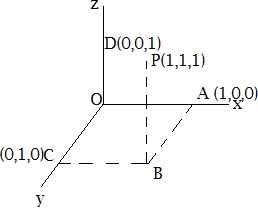
In a uniform electric field,the potential is $10 \ V$ at the origin of coordinates,and $8 \ V$ at each of the points $(1, 0, 0), (0, 1, 0)$ and $(0, 0, 1)$. The potential at the point $(1, 1, 1)$ will be....$V$
A
$0$
B
$4$
C
$8$
D
$10$
Solution
(B) In a uniform electric field,the potential $V$ can be expressed as $V(x, y, z) = V_0 - (E_x x + E_y y + E_z z)$.
Given $V(0, 0, 0) = 10 \ V$,so $V_0 = 10 \ V$.
Given $V(1, 0, 0) = 8 \ V$,so $10 - E_x(1) = 8 \implies E_x = 2 \ V$.
Given $V(0, 1, 0) = 8 \ V$,so $10 - E_y(1) = 8 \implies E_y = 2 \ V$.
Given $V(0, 0, 1) = 8 \ V$,so $10 - E_z(1) = 8 \implies E_z = 2 \ V$.
Now,the potential at point $(1, 1, 1)$ is $V(1, 1, 1) = 10 - (2 \times 1 + 2 \times 1 + 2 \times 1) = 10 - 6 = 4 \ V$.
Given $V(0, 0, 0) = 10 \ V$,so $V_0 = 10 \ V$.
Given $V(1, 0, 0) = 8 \ V$,so $10 - E_x(1) = 8 \implies E_x = 2 \ V$.
Given $V(0, 1, 0) = 8 \ V$,so $10 - E_y(1) = 8 \implies E_y = 2 \ V$.
Given $V(0, 0, 1) = 8 \ V$,so $10 - E_z(1) = 8 \implies E_z = 2 \ V$.
Now,the potential at point $(1, 1, 1)$ is $V(1, 1, 1) = 10 - (2 \times 1 + 2 \times 1 + 2 \times 1) = 10 - 6 = 4 \ V$.
0 likes
View Solution158
MediumMCQ
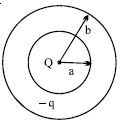
$A$ spherical shell with an inner radius $a$ and an outer radius $b$ is made of conducting material. $A$ point charge $+Q$ is placed at the centre of the spherical shell and a total charge $-q$ is placed on the shell. Assume that the electrostatic potential is zero at an infinite distance from the spherical shell. The electrostatic potential at a distance $R$ $(a < R < b)$ from the centre of the shell is (where $K = \frac{1}{4\pi\varepsilon_0}$):
A
$0$
B
$\frac{KQ}{a}$
C
$K\frac{Q-q}{R}$
D
$K\frac{Q-q}{b}$
Solution
(D) $1$. Since the shell is made of conducting material,the electric field inside the material of the shell $(a < R < b)$ must be zero.
$2$. To ensure the electric field is zero inside the conductor,an induced charge of $-Q$ must appear on the inner surface of the shell (at radius $a$).
$3$. The total charge on the shell is $-q$. Since the inner surface has a charge of $-Q$,the charge on the outer surface (at radius $b$) must be $q_{outer} = (-q) - (-Q) = Q - q$.
$4$. The potential at a point $R$ inside the material of the shell $(a < R < b)$ is the sum of the potentials due to the point charge $+Q$ at the center,the induced charge $-Q$ on the inner surface,and the charge $(Q-q)$ on the outer surface.
$5$. Potential $V(R) = V_{point} + V_{inner} + V_{outer} = \frac{KQ}{R} + \frac{K(-Q)}{R} + \frac{K(Q-q)}{b}$.
$6$. Simplifying this,$V(R) = 0 + \frac{K(Q-q)}{b} = \frac{K(Q-q)}{b}$.
$2$. To ensure the electric field is zero inside the conductor,an induced charge of $-Q$ must appear on the inner surface of the shell (at radius $a$).
$3$. The total charge on the shell is $-q$. Since the inner surface has a charge of $-Q$,the charge on the outer surface (at radius $b$) must be $q_{outer} = (-q) - (-Q) = Q - q$.
$4$. The potential at a point $R$ inside the material of the shell $(a < R < b)$ is the sum of the potentials due to the point charge $+Q$ at the center,the induced charge $-Q$ on the inner surface,and the charge $(Q-q)$ on the outer surface.
$5$. Potential $V(R) = V_{point} + V_{inner} + V_{outer} = \frac{KQ}{R} + \frac{K(-Q)}{R} + \frac{K(Q-q)}{b}$.
$6$. Simplifying this,$V(R) = 0 + \frac{K(Q-q)}{b} = \frac{K(Q-q)}{b}$.
0 likes
View Solution159
AdvancedMCQ
There are four concentric shells $A, B, C$ and $D$ of radii $a, 2a, 3a$ and $4a$ respectively. Shells $B$ and $D$ are given charges $+q$ and $-q$ respectively. Shell $C$ is now earthed. The potential difference $V_A - V_C$ is:
A
$\frac{Kq}{2a}$
B
$\frac{Kq}{3a}$
C
$\frac{Kq}{4a}$
D
$\frac{Kq}{6a}$
Solution
(D) Let the charge on shell $C$ be $q'$.
Since shell $C$ is earthed,its potential $V_C = 0$.
The potential at shell $C$ (radius $3a$) is due to charges on $B, C,$ and $D$:
$V_C = \frac{Kq}{3a} + \frac{Kq'}{3a} - \frac{Kq}{4a} = 0$
$\frac{q}{3a} + \frac{q'}{3a} = \frac{q}{4a}$
$q + q' = \frac{3q}{4} \implies q' = -\frac{q}{4}$.
Now,calculate the potential at shell $A$ (radius $a$):
$V_A = \frac{Kq}{2a} + \frac{Kq'}{3a} - \frac{Kq}{4a}$
Substitute $q' = -\frac{q}{4}$:
$V_A = \frac{Kq}{2a} + \frac{K(-q/4)}{3a} - \frac{Kq}{4a} = \frac{Kq}{2a} - \frac{Kq}{12a} - \frac{Kq}{4a}$
$V_A = Kq \left( \frac{6 - 1 - 3}{12a} \right) = \frac{2Kq}{12a} = \frac{Kq}{6a}$.
Since $V_C = 0$,the potential difference $V_A - V_C = \frac{Kq}{6a} - 0 = \frac{Kq}{6a}$.
Since shell $C$ is earthed,its potential $V_C = 0$.
The potential at shell $C$ (radius $3a$) is due to charges on $B, C,$ and $D$:
$V_C = \frac{Kq}{3a} + \frac{Kq'}{3a} - \frac{Kq}{4a} = 0$
$\frac{q}{3a} + \frac{q'}{3a} = \frac{q}{4a}$
$q + q' = \frac{3q}{4} \implies q' = -\frac{q}{4}$.
Now,calculate the potential at shell $A$ (radius $a$):
$V_A = \frac{Kq}{2a} + \frac{Kq'}{3a} - \frac{Kq}{4a}$
Substitute $q' = -\frac{q}{4}$:
$V_A = \frac{Kq}{2a} + \frac{K(-q/4)}{3a} - \frac{Kq}{4a} = \frac{Kq}{2a} - \frac{Kq}{12a} - \frac{Kq}{4a}$
$V_A = Kq \left( \frac{6 - 1 - 3}{12a} \right) = \frac{2Kq}{12a} = \frac{Kq}{6a}$.
Since $V_C = 0$,the potential difference $V_A - V_C = \frac{Kq}{6a} - 0 = \frac{Kq}{6a}$.
0 likes
View Solution160
MediumMCQ
An electric charge $10^{-8} \ C$ is placed at the point $(4 \ m, 7 \ m, 2 \ m)$. At the point $(1 \ m, 3 \ m, 2 \ m)$,the electric
A
potential will be $18 \ V$
B
field has no $Y-$ component
C
field will be along $Z-$ axis
D
potential will be $1.8 \ V$
Solution
(A) The electric potential $V$ at a distance $r$ from a point charge $Q$ is given by $V = \frac{KQ}{r}$.
Here,$Q = 10^{-8} \ C$.
The position of the charge is $(4, 7, 2)$ and the observation point is $(1, 3, 2)$.
The distance $r$ is calculated as $r = \sqrt{(1-4)^2 + (3-7)^2 + (2-2)^2} = \sqrt{(-3)^2 + (-4)^2 + 0^2} = \sqrt{9 + 16} = \sqrt{25} = 5 \ m$.
Substituting the values,$V = \frac{(9 \times 10^9) \times 10^{-8}}{5} = \frac{90}{5} = 18 \ V$.
Thus,the electric potential at the given point is $18 \ V$.
Here,$Q = 10^{-8} \ C$.
The position of the charge is $(4, 7, 2)$ and the observation point is $(1, 3, 2)$.
The distance $r$ is calculated as $r = \sqrt{(1-4)^2 + (3-7)^2 + (2-2)^2} = \sqrt{(-3)^2 + (-4)^2 + 0^2} = \sqrt{9 + 16} = \sqrt{25} = 5 \ m$.
Substituting the values,$V = \frac{(9 \times 10^9) \times 10^{-8}}{5} = \frac{90}{5} = 18 \ V$.
Thus,the electric potential at the given point is $18 \ V$.
0 likes
View Solution161
MediumMCQ
The potential at point $A$ is $3 \ V$ and at point $B$ is $7 \ V$. An electron is moving towards $A$ from $B$. Which of the following statements is correct?
A
It must have some kinetic energy at $B$ to reach $A$.
B
It need not have any kinetic energy at $B$ to reach $A$.
C
To reach $A$,it must have kinetic energy greater than or equal to $4 \ eV$ at $B$.
D
Both $A$ and $C$ are correct.
Solution
(D) The potential at point $A$ is $V_A = 3 \ V$ and at point $B$ is $V_B = 7 \ V$.
An electron has a negative charge $q = -e$.
The potential energy of an electron at any point is given by $U = qV = -eV$.
Therefore,the potential energy at $A$ is $U_A = -3e \ V$ and at $B$ is $U_B = -7e \ V$.
Since the electron is moving from $B$ to $A$,it is moving from a region of lower potential energy $(-7e \ V)$ to a region of higher potential energy $(-3e \ V)$.
By the law of conservation of energy,$K_i + U_i = K_f + U_f$,where $K$ is kinetic energy.
$K_B + U_B = K_A + U_A$
$K_A = K_B + (U_B - U_A) = K_B + (-7e - (-3e)) = K_B - 4e$.
For the electron to reach $A$,its kinetic energy at $A$ must be non-negative $(K_A \ge 0)$.
$K_B - 4e \ge 0 \implies K_B \ge 4 \ eV$.
Thus,the electron must have at least $4 \ eV$ of kinetic energy at $B$ to reach $A$. This also implies it must have some kinetic energy at $B$.
An electron has a negative charge $q = -e$.
The potential energy of an electron at any point is given by $U = qV = -eV$.
Therefore,the potential energy at $A$ is $U_A = -3e \ V$ and at $B$ is $U_B = -7e \ V$.
Since the electron is moving from $B$ to $A$,it is moving from a region of lower potential energy $(-7e \ V)$ to a region of higher potential energy $(-3e \ V)$.
By the law of conservation of energy,$K_i + U_i = K_f + U_f$,where $K$ is kinetic energy.
$K_B + U_B = K_A + U_A$
$K_A = K_B + (U_B - U_A) = K_B + (-7e - (-3e)) = K_B - 4e$.
For the electron to reach $A$,its kinetic energy at $A$ must be non-negative $(K_A \ge 0)$.
$K_B - 4e \ge 0 \implies K_B \ge 4 \ eV$.
Thus,the electron must have at least $4 \ eV$ of kinetic energy at $B$ to reach $A$. This also implies it must have some kinetic energy at $B$.
0 likes
View Solution162
EasyMCQ
Two points $P$ and $Q$ are maintained at the potentials of $10 \ V$ and $-4 \ V$,respectively. The work done in moving $100$ electrons from $P$ to $Q$ is
A
$-9.6 \times 10^{-17} \ J$
B
$9.6 \times 10^{-17} \ J$
C
$-2.24 \times 10^{-16} \ J$
D
$2.24 \times 10^{-16} \ J$
Solution
(D) The work done $W$ in moving a charge $q$ from point $P$ to point $Q$ is given by the formula: $W = q(V_Q - V_P)$.
Here,the charge $q$ is the total charge of $100$ electrons. Since the charge of one electron is $-1.6 \times 10^{-19} \ C$,the total charge is $q = 100 \times (-1.6 \times 10^{-19} \ C) = -1.6 \times 10^{-17} \ C$.
The potentials are $V_P = 10 \ V$ and $V_Q = -4 \ V$.
Substituting these values into the formula:
$W = (-1.6 \times 10^{-17} \ C) \times (-4 \ V - 10 \ V)$
$W = (-1.6 \times 10^{-17}) \times (-14) \ J$
$W = 22.4 \times 10^{-17} \ J = 2.24 \times 10^{-16} \ J$.
Here,the charge $q$ is the total charge of $100$ electrons. Since the charge of one electron is $-1.6 \times 10^{-19} \ C$,the total charge is $q = 100 \times (-1.6 \times 10^{-19} \ C) = -1.6 \times 10^{-17} \ C$.
The potentials are $V_P = 10 \ V$ and $V_Q = -4 \ V$.
Substituting these values into the formula:
$W = (-1.6 \times 10^{-17} \ C) \times (-4 \ V - 10 \ V)$
$W = (-1.6 \times 10^{-17}) \times (-14) \ J$
$W = 22.4 \times 10^{-17} \ J = 2.24 \times 10^{-16} \ J$.
0 likes
View Solution163
MediumMCQ
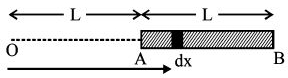
$A$ charge $Q$ is uniformly distributed over a long rod $AB$ of length $L$ as shown in the figure. The electric potential at the point $O$ lying at a distance $L$ from the end $A$ is

A
$\frac{Q \ln 2}{4 \pi \varepsilon_0 L}$
B
$\frac{Q}{8 \pi \varepsilon_0 L}$
C
$\frac{3Q}{4 \pi \varepsilon_0 L}$
D
$\frac{3Q}{4 \pi \varepsilon_0 L \ln 2}$
Solution
(A) Let the linear charge density of the rod be $\lambda = \frac{Q}{L}$.
Consider a small element of length $dx$ on the rod at a distance $x$ from point $O$.
The charge on this element is $dq = \lambda dx = \frac{Q}{L} dx$.
The electric potential $dV$ at point $O$ due to this element is given by $dV = \frac{1}{4 \pi \varepsilon_0} \frac{dq}{x} = \frac{1}{4 \pi \varepsilon_0} \frac{Q}{L} \frac{dx}{x}$.
The total potential $V$ at point $O$ is obtained by integrating from $x = L$ (at end $A$) to $x = 2L$ (at end $B$):
$V = \int_{L}^{2L} \frac{Q}{4 \pi \varepsilon_0 L} \frac{dx}{x} = \frac{Q}{4 \pi \varepsilon_0 L} [\ln x]_{L}^{2L} = \frac{Q}{4 \pi \varepsilon_0 L} (\ln 2L - \ln L) = \frac{Q \ln 2}{4 \pi \varepsilon_0 L}$.
Consider a small element of length $dx$ on the rod at a distance $x$ from point $O$.
The charge on this element is $dq = \lambda dx = \frac{Q}{L} dx$.
The electric potential $dV$ at point $O$ due to this element is given by $dV = \frac{1}{4 \pi \varepsilon_0} \frac{dq}{x} = \frac{1}{4 \pi \varepsilon_0} \frac{Q}{L} \frac{dx}{x}$.
The total potential $V$ at point $O$ is obtained by integrating from $x = L$ (at end $A$) to $x = 2L$ (at end $B$):
$V = \int_{L}^{2L} \frac{Q}{4 \pi \varepsilon_0 L} \frac{dx}{x} = \frac{Q}{4 \pi \varepsilon_0 L} [\ln x]_{L}^{2L} = \frac{Q}{4 \pi \varepsilon_0 L} (\ln 2L - \ln L) = \frac{Q \ln 2}{4 \pi \varepsilon_0 L}$.
0 likes
View Solution164
MediumMCQ
$A$ uniformly charged solid sphere of radius $R$ has potential $V_0$ (measured with respect to $\infty$) on its surface. For this sphere, the equipotential surfaces with potentials $\frac{3V_0}{2}, \frac{5V_0}{4}, \frac{3V_0}{4}$, and $\frac{V_0}{4}$ have radii $R_1, R_2, R_3$, and $R_4$ respectively. Then:
A
$R_1 \neq 0$ and $(R_2 - R_1) > (R_4 - R_3)$
B
$R_1 = 0$ and $R_2 < (R_4 - R_3)$
C
$2R < R_4$
D
$R_1 = 0$ and $R_2 > (R_4 - R_3)$
Solution
(B) The potential on the surface of a uniformly charged solid sphere is $V_0 = \frac{Kq}{R}$.
For $r < R$, the potential is $V_i = \frac{Kq}{2R^3}(3R^2 - r^2)$.
At the center $(r = 0)$, $V_{center} = \frac{3Kq}{2R} = \frac{3}{2}V_0$. Thus, $R_1 = 0$ for potential $\frac{3V_0}{2}$.
For potential $\frac{5V_0}{4}$ $(r < R)$: $\frac{5}{4} \frac{Kq}{R} = \frac{Kq}{2R^3}(3R^2 - R_2^2) \implies \frac{5}{2} = 3 - \frac{R_2^2}{R^2} \implies \frac{R_2^2}{R^2} = \frac{1}{2} \implies R_2 = \frac{R}{\sqrt{2}} \approx 0.707R$.
For potential $\frac{3V_0}{4}$ $(r > R)$: $\frac{3}{4} \frac{Kq}{R} = \frac{Kq}{R_3} \implies R_3 = \frac{4}{3}R \approx 1.333R$.
For potential $\frac{V_0}{4}$ $(r > R)$: $\frac{1}{4} \frac{Kq}{R} = \frac{Kq}{R_4} \implies R_4 = 4R$.
Now, $R_2 = 0.707R$ and $(R_4 - R_3) = 4R - 1.333R = 2.667R$.
Since $0.707R < 2.667R$, we have $R_2 < (R_4 - R_3)$.
For $r < R$, the potential is $V_i = \frac{Kq}{2R^3}(3R^2 - r^2)$.
At the center $(r = 0)$, $V_{center} = \frac{3Kq}{2R} = \frac{3}{2}V_0$. Thus, $R_1 = 0$ for potential $\frac{3V_0}{2}$.
For potential $\frac{5V_0}{4}$ $(r < R)$: $\frac{5}{4} \frac{Kq}{R} = \frac{Kq}{2R^3}(3R^2 - R_2^2) \implies \frac{5}{2} = 3 - \frac{R_2^2}{R^2} \implies \frac{R_2^2}{R^2} = \frac{1}{2} \implies R_2 = \frac{R}{\sqrt{2}} \approx 0.707R$.
For potential $\frac{3V_0}{4}$ $(r > R)$: $\frac{3}{4} \frac{Kq}{R} = \frac{Kq}{R_3} \implies R_3 = \frac{4}{3}R \approx 1.333R$.
For potential $\frac{V_0}{4}$ $(r > R)$: $\frac{1}{4} \frac{Kq}{R} = \frac{Kq}{R_4} \implies R_4 = 4R$.
Now, $R_2 = 0.707R$ and $(R_4 - R_3) = 4R - 1.333R = 2.667R$.
Since $0.707R < 2.667R$, we have $R_2 < (R_4 - R_3)$.
1 likes
View Solution165
DifficultMCQ
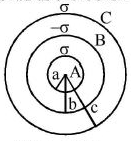
Three concentric metal shells $A, B$ and $C$ of respective radii $a, b$ and $c$ $(a < b < c)$ have surface charge densities $+\sigma, -\sigma$ and $+\sigma$ respectively. The potential of shell $B$ is
A
$\frac{\sigma}{\epsilon_0} \left[ \frac{a^2-b^2}{b}+c \right]$
B
$\frac{\sigma}{\epsilon_0} \left[ \frac{b^2-c^2}{b}+a \right]$
C
$\frac{\sigma}{\epsilon_0} \left[ \frac{b^2-c^2}{c}+a \right]$
D
$\frac{\sigma}{\epsilon_0} \left[ \frac{a^2-b^2}{a}+c \right]$
Solution
(A) The potential at any point on the surface of a shell is the sum of potentials due to all three shells.
For a point at distance $r$ from the center,the potential due to a shell of radius $R$ and charge $Q$ is $V = \frac{KQ}{R}$ if $r \le R$ and $V = \frac{KQ}{r}$ if $r > R$,where $K = \frac{1}{4\pi\epsilon_0}$.
The charges on the shells are $q_A = \sigma(4\pi a^2)$,$q_B = -\sigma(4\pi b^2)$,and $q_C = \sigma(4\pi c^2)$.
For shell $B$ (radius $b$),the potential $V_B$ is the sum of potentials due to shell $A$ (at distance $b > a$),shell $B$ (at distance $b = b$),and shell $C$ (at distance $b < c$):
$V_B = \frac{K q_A}{b} + \frac{K q_B}{b} + \frac{K q_C}{c}$
$V_B = \frac{1}{4\pi\epsilon_0} \left[ \frac{\sigma(4\pi a^2)}{b} + \frac{-\sigma(4\pi b^2)}{b} + \frac{\sigma(4\pi c^2)}{c} \right]$
$V_B = \frac{\sigma}{\epsilon_0} \left[ \frac{a^2}{b} - \frac{b^2}{b} + \frac{c^2}{c} \right]$
$V_B = \frac{\sigma}{\epsilon_0} \left[ \frac{a^2 - b^2}{b} + c \right]$
For a point at distance $r$ from the center,the potential due to a shell of radius $R$ and charge $Q$ is $V = \frac{KQ}{R}$ if $r \le R$ and $V = \frac{KQ}{r}$ if $r > R$,where $K = \frac{1}{4\pi\epsilon_0}$.
The charges on the shells are $q_A = \sigma(4\pi a^2)$,$q_B = -\sigma(4\pi b^2)$,and $q_C = \sigma(4\pi c^2)$.
For shell $B$ (radius $b$),the potential $V_B$ is the sum of potentials due to shell $A$ (at distance $b > a$),shell $B$ (at distance $b = b$),and shell $C$ (at distance $b < c$):
$V_B = \frac{K q_A}{b} + \frac{K q_B}{b} + \frac{K q_C}{c}$
$V_B = \frac{1}{4\pi\epsilon_0} \left[ \frac{\sigma(4\pi a^2)}{b} + \frac{-\sigma(4\pi b^2)}{b} + \frac{\sigma(4\pi c^2)}{c} \right]$
$V_B = \frac{\sigma}{\epsilon_0} \left[ \frac{a^2}{b} - \frac{b^2}{b} + \frac{c^2}{c} \right]$
$V_B = \frac{\sigma}{\epsilon_0} \left[ \frac{a^2 - b^2}{b} + c \right]$
0 likes
View Solution166
MediumMCQ
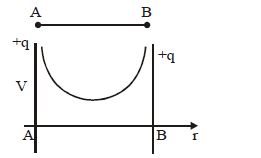
Two equal positive point charges are kept at points $A$ and $B$. What happens to the electric potential while moving from $A$ to $B$ along the straight line connecting them?
A
continuously increases
B
remains constant
C
decreases then increases
D
increases then decreases
Solution
(C) Let the distance between points $A$ and $B$ be $d$. Let the charges at $A$ and $B$ be $+q$.
At any point $P$ on the line segment $AB$ at a distance $x$ from $A$, the distance from $B$ is $(d - x)$.
The total electric potential $V$ at point $P$ is the sum of potentials due to both charges:
$V = \frac{kq}{x} + \frac{kq}{d - x}$
To find the variation, we differentiate $V$ with respect to $x$:
$\frac{dV}{dx} = -\frac{kq}{x^2} + \frac{kq}{(d - x)^2}$
Setting $\frac{dV}{dx} = 0$ for the minimum potential:
$\frac{1}{x^2} = \frac{1}{(d - x)^2} \implies x = d - x \implies x = d/2$.
At $x = d/2$, the potential is minimum.
Thus, as we move from $A$ to $B$, the potential first decreases until the midpoint and then increases.
At any point $P$ on the line segment $AB$ at a distance $x$ from $A$, the distance from $B$ is $(d - x)$.
The total electric potential $V$ at point $P$ is the sum of potentials due to both charges:
$V = \frac{kq}{x} + \frac{kq}{d - x}$
To find the variation, we differentiate $V$ with respect to $x$:
$\frac{dV}{dx} = -\frac{kq}{x^2} + \frac{kq}{(d - x)^2}$
Setting $\frac{dV}{dx} = 0$ for the minimum potential:
$\frac{1}{x^2} = \frac{1}{(d - x)^2} \implies x = d - x \implies x = d/2$.
At $x = d/2$, the potential is minimum.
Thus, as we move from $A$ to $B$, the potential first decreases until the midpoint and then increases.
0 likes
View Solution167
MediumMCQ
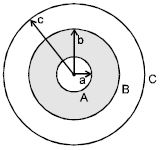
$A$ and $C$ are concentric conducting spherical shells of radius $a$ and $c$ respectively. $A$ is surrounded by a concentric dielectric of inner radius $a$,outer radius $b$ and dielectric constant $k$. If sphere $A$ is given a charge $Q$,the potential at the outer surface of the dielectric (at radius $b$) is:
A
$\frac{Q}{4\pi \varepsilon _0 kb}$
B
$\frac{Q}{4\pi \varepsilon _0}\left( \frac{1}{a} + \frac{1}{k(b - a)} \right)$
C
$\frac{Q}{4\pi \varepsilon _0 b}$
D
None of these
Solution
(C) The electric field at a distance $r$ from the center,where $r > b$,is the same as that of a point charge $Q$ at the center,because the dielectric shell is spherically symmetric and the total charge enclosed by a Gaussian surface of radius $r > b$ is $Q$.
Using Gauss's Law for dielectrics,the electric field $E$ for $r > b$ is given by $E = \frac{1}{4\pi \varepsilon _0} \frac{Q}{r^2}$.
The potential $V$ at a distance $b$ is calculated by integrating the electric field from infinity to $b$:
$V = -\int_{\infty}^{b} E \cdot dr = \int_{b}^{\infty} \frac{1}{4\pi \varepsilon _0} \frac{Q}{r^2} dr = \frac{Q}{4\pi \varepsilon _0} \left[ -\frac{1}{r} \right]_{b}^{\infty} = \frac{Q}{4\pi \varepsilon _0 b}$.
Thus,the dielectric does not affect the potential at points outside the dielectric shell.
Using Gauss's Law for dielectrics,the electric field $E$ for $r > b$ is given by $E = \frac{1}{4\pi \varepsilon _0} \frac{Q}{r^2}$.
The potential $V$ at a distance $b$ is calculated by integrating the electric field from infinity to $b$:
$V = -\int_{\infty}^{b} E \cdot dr = \int_{b}^{\infty} \frac{1}{4\pi \varepsilon _0} \frac{Q}{r^2} dr = \frac{Q}{4\pi \varepsilon _0} \left[ -\frac{1}{r} \right]_{b}^{\infty} = \frac{Q}{4\pi \varepsilon _0 b}$.
Thus,the dielectric does not affect the potential at points outside the dielectric shell.
0 likes
View Solution168
DifficultMCQ
The electrostatic potential $V$ at a point on the circumference of a thin non-conducting disk of radius $r$ and uniform charge density $\sigma$ is given by the equation $V = 4 \sigma r$. Which of the following expressions correctly represents the electrostatic energy stored in the electric field of a similarly charged disk of radius $R$?
A
$U = \frac{8}{3}\pi \sigma^2 R^3$
B
$U = \frac{4}{3}\pi \sigma^2 R^3$
C
$U = \frac{2}{3}\pi \sigma^2 R^3$
D
None of these.
Solution
(A) To find the total electrostatic energy,we consider building the disk by adding concentric rings of charge.
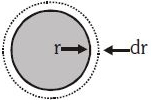
Consider a disk of radius $r$ with uniform surface charge density $\sigma$. The charge on a thin ring of radius $r$ and width $dr$ is given by:
$dq = (2\pi r dr) \sigma$
The potential at the circumference of a disk of radius $r$ is given as $V = 4\sigma r$. The work done to bring an additional charge $dq$ from infinity to the circumference of the disk is the electrostatic potential energy $dU$:
$dU = V dq = (4\sigma r) \cdot (2\pi r dr \sigma) = 8\pi \sigma^2 r^2 dr$
To find the total energy $U$ for a disk of radius $R$,we integrate from $r = 0$ to $r = R$:
$U = \int_0^R 8\pi \sigma^2 r^2 dr = 8\pi \sigma^2 \left[ \frac{r^3}{3} \right]_0^R = \frac{8}{3}\pi \sigma^2 R^3$
Consider a disk of radius $r$ with uniform surface charge density $\sigma$. The charge on a thin ring of radius $r$ and width $dr$ is given by:
$dq = (2\pi r dr) \sigma$
The potential at the circumference of a disk of radius $r$ is given as $V = 4\sigma r$. The work done to bring an additional charge $dq$ from infinity to the circumference of the disk is the electrostatic potential energy $dU$:
$dU = V dq = (4\sigma r) \cdot (2\pi r dr \sigma) = 8\pi \sigma^2 r^2 dr$
To find the total energy $U$ for a disk of radius $R$,we integrate from $r = 0$ to $r = R$:
$U = \int_0^R 8\pi \sigma^2 r^2 dr = 8\pi \sigma^2 \left[ \frac{r^3}{3} \right]_0^R = \frac{8}{3}\pi \sigma^2 R^3$
0 likes
View Solution169
MediumMCQ
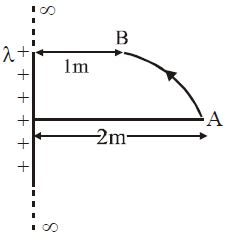
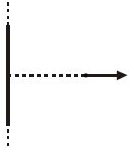
The figure shows a positively charged infinite wire. $A$ particle of charge $q = 2 \, C$ moves from point $A$ to $B$ with constant speed. (Given linear charge density on the wire is $\lambda = 4 \pi \varepsilon_0$)
A
work done by external agent $= 4 \, \ln 2$
B
work done by electric force $= -2 \, \ln 2$
C
work done by electric force $= 4 \, \ln 2$
D
$V_A - V_B = 2 \, \ln 2$
Solution
(A) The electric field due to an infinite wire at a distance $r$ is $E = \frac{\lambda}{2 \pi \varepsilon_0 r}$.
Given $\lambda = 4 \pi \varepsilon_0$,we have $E = \frac{4 \pi \varepsilon_0}{2 \pi \varepsilon_0 r} = \frac{2}{r}$.
The potential difference between points $A$ $(r_A = 2 \, m)$ and $B$ $(r_B = 1 \, m)$ is:
$V_B - V_A = - \int_{r_A}^{r_B} E \, dr = - \int_{2}^{1} \frac{2}{r} \, dr = -2 [\ln r]_2^1 = -2 (\ln 1 - \ln 2) = 2 \ln 2$.
Since the particle moves with constant speed,the net work done is zero $(W_{ext} + W_{elec} = 0)$.
The work done by the electric force is $W_{elec} = q(V_A - V_B) = q(-(V_B - V_A)) = 2 \times (-2 \ln 2) = -4 \ln 2$.
The work done by the external agent is $W_{ext} = -W_{elec} = 4 \ln 2$.
Given $\lambda = 4 \pi \varepsilon_0$,we have $E = \frac{4 \pi \varepsilon_0}{2 \pi \varepsilon_0 r} = \frac{2}{r}$.
The potential difference between points $A$ $(r_A = 2 \, m)$ and $B$ $(r_B = 1 \, m)$ is:
$V_B - V_A = - \int_{r_A}^{r_B} E \, dr = - \int_{2}^{1} \frac{2}{r} \, dr = -2 [\ln r]_2^1 = -2 (\ln 1 - \ln 2) = 2 \ln 2$.
Since the particle moves with constant speed,the net work done is zero $(W_{ext} + W_{elec} = 0)$.
The work done by the electric force is $W_{elec} = q(V_A - V_B) = q(-(V_B - V_A)) = 2 \times (-2 \ln 2) = -4 \ln 2$.
The work done by the external agent is $W_{ext} = -W_{elec} = 4 \ln 2$.
0 likes
View Solution170
MediumMCQ
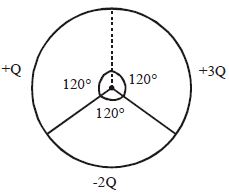
The figure shows three circular arcs,each of radius $R$ and total charge as indicated. The net electric potential at the centre of curvature is
A
$\frac{Q}{{4\pi { \in _0}R}}$
B
$\frac{Q}{{2\pi { \in _0}R}}$
C
$\frac{2Q}{{\pi { \in _0}R}}$
D
$\frac{Q}{{\pi { \in _0}R}}$
Solution
(B) The electric potential $V$ due to a charged arc of radius $R$ and charge $Q$ at its center is given by $V = \frac{1}{4\pi \epsilon_0} \frac{Q}{R}$.
Since the potential is a scalar quantity,the net potential at the center is the algebraic sum of the potentials due to the three arcs.
$V_{net} = V_1 + V_2 + V_3$
$V_{net} = \frac{1}{4\pi \epsilon_0 R} (Q_1 + Q_2 + Q_3)$
Given charges are $Q_1 = +Q$,$Q_2 = +3Q$,and $Q_3 = -2Q$.
$V_{net} = \frac{1}{4\pi \epsilon_0 R} (Q + 3Q - 2Q)$
$V_{net} = \frac{1}{4\pi \epsilon_0 R} (2Q)$
$V_{net} = \frac{2Q}{4\pi \epsilon_0 R} = \frac{Q}{2\pi \epsilon_0 R}$.
Since the potential is a scalar quantity,the net potential at the center is the algebraic sum of the potentials due to the three arcs.
$V_{net} = V_1 + V_2 + V_3$
$V_{net} = \frac{1}{4\pi \epsilon_0 R} (Q_1 + Q_2 + Q_3)$
Given charges are $Q_1 = +Q$,$Q_2 = +3Q$,and $Q_3 = -2Q$.
$V_{net} = \frac{1}{4\pi \epsilon_0 R} (Q + 3Q - 2Q)$
$V_{net} = \frac{1}{4\pi \epsilon_0 R} (2Q)$
$V_{net} = \frac{2Q}{4\pi \epsilon_0 R} = \frac{Q}{2\pi \epsilon_0 R}$.
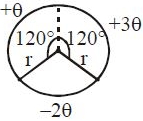
0 likes
View Solution171
MediumMCQ
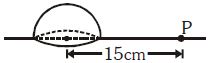
The figure shows a solid hemisphere with a charge of $5 \ nC$ distributed uniformly throughout its volume. The hemisphere lies on a plane and point $P$ is located on this plane,along a radial line from the center of curvature at a distance of $15 \ cm$. The electric potential at point $P$ due to the hemisphere is ..... $V$.
A
$150$
B
$300$
C
$450$
D
$600$
Solution
(B) For a point outside a spherically symmetric charge distribution,the entire charge can be considered to be concentrated at its center.
Given:
Total charge $q = 5 \ nC = 5 \times 10^{-9} \ C$.
Distance $r = 15 \ cm = 0.15 \ m = 15 \times 10^{-2} \ m$.
The electric potential $V$ at a distance $r$ from a point charge $q$ is given by:
$V = \frac{1}{4 \pi \epsilon_0} \frac{q}{r} = \frac{k q}{r}$
Substituting the values:
$V = \frac{9 \times 10^9 \times 5 \times 10^{-9}}{15 \times 10^{-2}}$
$V = \frac{45}{0.15} = \frac{4500}{15} = 300 \ V$
Therefore,the electric potential at point $P$ is $300 \ V$.
Given:
Total charge $q = 5 \ nC = 5 \times 10^{-9} \ C$.
Distance $r = 15 \ cm = 0.15 \ m = 15 \times 10^{-2} \ m$.
The electric potential $V$ at a distance $r$ from a point charge $q$ is given by:
$V = \frac{1}{4 \pi \epsilon_0} \frac{q}{r} = \frac{k q}{r}$
Substituting the values:
$V = \frac{9 \times 10^9 \times 5 \times 10^{-9}}{15 \times 10^{-2}}$
$V = \frac{45}{0.15} = \frac{4500}{15} = 300 \ V$
Therefore,the electric potential at point $P$ is $300 \ V$.
0 likes
View Solution172
EasyMCQ
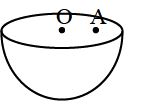
Charge is uniformly distributed on the surface of a hollow hemisphere. Let $O$ and $A$ be two points on the base of the hemisphere,where $O$ is the center of the base and $A$ is a point between the center and the rim. Let $V_O$ and $V_A$ be the electric potentials at $O$ and $A$ respectively. Then,
A
$V_A = V_O$
B
$V_A < V_O$
C
$V_A > V_O$
D
insufficient data
Solution
(B) The electric potential $V$ at any point inside or on the surface of a charged object is given by the integral of the potential contribution from all surface charge elements $dq$,i.e.,$V = \int \frac{k dq}{r}$.
For a hollow hemisphere with uniform surface charge density $\sigma$,the potential at the center $O$ is higher than at any other point on the base because the center is,on average,closer to the charged surface elements than any other point on the base.
As we move from the center $O$ towards the rim $A$,the distance to the various parts of the charged surface increases on average,leading to a decrease in the electric potential.
Therefore,the potential at the center $O$ is the maximum potential on the base of the hemisphere.
Thus,$V_O > V_A$ or $V_A < V_O$.
For a hollow hemisphere with uniform surface charge density $\sigma$,the potential at the center $O$ is higher than at any other point on the base because the center is,on average,closer to the charged surface elements than any other point on the base.
As we move from the center $O$ towards the rim $A$,the distance to the various parts of the charged surface increases on average,leading to a decrease in the electric potential.
Therefore,the potential at the center $O$ is the maximum potential on the base of the hemisphere.
Thus,$V_O > V_A$ or $V_A < V_O$.
0 likes
View Solution173
MediumMCQ
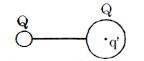
Two conducting hollow spheres of radii $R$ and $3R$ are found to have $Q$ charge on their outer surfaces when both are connected with a long wire. $A$ charge $q'$ is kept at the centre of the bigger sphere. Which of the following is true?
A
$q' = 2Q$
B
$q' = 3Q$
C
$q' = 4Q$
D
$q' = 6Q$
Solution
(A) When two conducting spheres are connected by a long wire,they reach the same electric potential.
Let $V_1$ be the potential of the smaller sphere of radius $R$ and $V_2$ be the potential of the larger sphere of radius $3R$.
The potential of the smaller sphere is $V_1 = \frac{kQ}{R}$.
The potential of the larger sphere is due to its own charge $Q$ and the charge $q'$ at its centre: $V_2 = \frac{kQ}{3R} + \frac{kq'}{3R}$.
Since they are connected,$V_1 = V_2$.
$\frac{kQ}{R} = \frac{kQ}{3R} + \frac{kq'}{3R}$.
Multiplying by $\frac{3R}{k}$,we get $3Q = Q + q'$.
Therefore,$q' = 2Q$.
Let $V_1$ be the potential of the smaller sphere of radius $R$ and $V_2$ be the potential of the larger sphere of radius $3R$.
The potential of the smaller sphere is $V_1 = \frac{kQ}{R}$.
The potential of the larger sphere is due to its own charge $Q$ and the charge $q'$ at its centre: $V_2 = \frac{kQ}{3R} + \frac{kq'}{3R}$.
Since they are connected,$V_1 = V_2$.
$\frac{kQ}{R} = \frac{kQ}{3R} + \frac{kq'}{3R}$.
Multiplying by $\frac{3R}{k}$,we get $3Q = Q + q'$.
Therefore,$q' = 2Q$.
0 likes
View Solution174
MediumMCQ
Three equal charges are placed at the corners of an equilateral triangle. Which of the graphs below correctly depicts the equally-spaced equipotential surfaces in the plane of the triangle? (All graphs have the same scale.)
A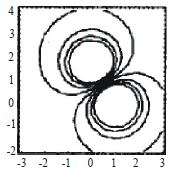
B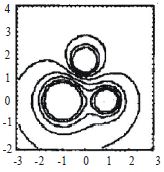
C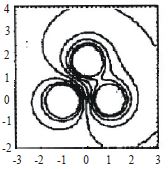
D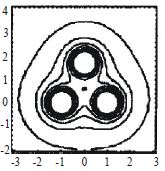
Solution
(D) The electric potential $V$ due to a system of charges is the algebraic sum of the potentials due to each individual charge: $V = \sum \frac{kq_i}{r_i}$.
For three equal charges placed at the vertices of an equilateral triangle, the system possesses $C_{3v}$ symmetry.
Near each charge, the equipotential surfaces are nearly spherical (circular in the plane of the triangle) due to the dominance of the local charge's potential.
As we move further away from the charges, the equipotential surfaces begin to merge and eventually take on a shape that reflects the overall symmetry of the charge distribution.
For three equal charges, the far-field equipotential surfaces will approach a circular shape, but in the near-to-mid field, they must exhibit the three-fold rotational symmetry of the equilateral triangle.
Graph $D$ shows equipotential lines that are circular near each charge and form a larger, roughly triangular shape enclosing all three charges, which correctly represents the symmetry of the system.
For three equal charges placed at the vertices of an equilateral triangle, the system possesses $C_{3v}$ symmetry.
Near each charge, the equipotential surfaces are nearly spherical (circular in the plane of the triangle) due to the dominance of the local charge's potential.
As we move further away from the charges, the equipotential surfaces begin to merge and eventually take on a shape that reflects the overall symmetry of the charge distribution.
For three equal charges, the far-field equipotential surfaces will approach a circular shape, but in the near-to-mid field, they must exhibit the three-fold rotational symmetry of the equilateral triangle.
Graph $D$ shows equipotential lines that are circular near each charge and form a larger, roughly triangular shape enclosing all three charges, which correctly represents the symmetry of the system.
0 likes
View Solution175
DifficultMCQ
$A$ solid conducting sphere having a charge $Q$ is surrounded by an uncharged concentric conducting hollow spherical shell. Let the potential difference between the surface of the solid sphere and that of the outer surface of the hollow shell be $V$. If the shell is now given a charge $-3Q$,the new potential difference between the same two surfaces is:
A
$V$
B
$2V$
C
$4V$
D
$-2V$
Solution
(A) Let the radius of the solid sphere be $r_a$ and the radius of the hollow shell be $r_b$.
The potential at the surface of the solid sphere is $V_{sphere} = \frac{KQ}{r_a} + \frac{K(0)}{r_b} = \frac{KQ}{r_a}$.
The potential at the surface of the hollow shell is $V_{shell} = \frac{KQ}{r_b} + \frac{K(0)}{r_b} = \frac{KQ}{r_b}$.
The initial potential difference is $V = V_{sphere} - V_{shell} = K Q \left( \frac{1}{r_a} - \frac{1}{r_b} \right)$.
When the shell is given a charge $-3Q$,the new potential at the surface of the solid sphere is $V'_{sphere} = \frac{KQ}{r_a} + \frac{K(-3Q)}{r_b}$.
The new potential at the surface of the hollow shell is $V'_{shell} = \frac{KQ}{r_b} + \frac{K(-3Q)}{r_b} = -\frac{2KQ}{r_b}$.
The new potential difference is $V' = V'_{sphere} - V'_{shell} = \left( \frac{KQ}{r_a} - \frac{3KQ}{r_b} \right) - \left( -\frac{2KQ}{r_b} \right) = \frac{KQ}{r_a} - \frac{KQ}{r_b} = V$.
Thus,the potential difference remains unchanged.
The potential at the surface of the solid sphere is $V_{sphere} = \frac{KQ}{r_a} + \frac{K(0)}{r_b} = \frac{KQ}{r_a}$.
The potential at the surface of the hollow shell is $V_{shell} = \frac{KQ}{r_b} + \frac{K(0)}{r_b} = \frac{KQ}{r_b}$.
The initial potential difference is $V = V_{sphere} - V_{shell} = K Q \left( \frac{1}{r_a} - \frac{1}{r_b} \right)$.
When the shell is given a charge $-3Q$,the new potential at the surface of the solid sphere is $V'_{sphere} = \frac{KQ}{r_a} + \frac{K(-3Q)}{r_b}$.
The new potential at the surface of the hollow shell is $V'_{shell} = \frac{KQ}{r_b} + \frac{K(-3Q)}{r_b} = -\frac{2KQ}{r_b}$.
The new potential difference is $V' = V'_{sphere} - V'_{shell} = \left( \frac{KQ}{r_a} - \frac{3KQ}{r_b} \right) - \left( -\frac{2KQ}{r_b} \right) = \frac{KQ}{r_a} - \frac{KQ}{r_b} = V$.
Thus,the potential difference remains unchanged.
0 likes
View Solution176
MediumMCQ
Three charged concentric nonconducting shells are given as shown in the figure. Find the potential at point $A$.
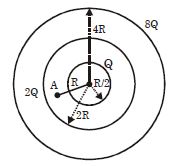
A
$\frac{5kQ}{R}$
B
$\frac{4kQ}{R}$
C
$\frac{3kQ}{R}$
D
$\frac{2kQ}{R}$
Solution
(B) The potential at a point due to a charged shell is given by $V = \frac{kQ}{r}$ for $r \ge R$ and $V = \frac{kQ}{R}$ for $r < R$,where $R$ is the radius of the shell.
Point $A$ is located at a distance $r = R$ from the center.
$1$. Potential due to the inner shell (radius $R/2$,charge $Q$): Since $r > R/2$,$V_1 = \frac{kQ}{R}$.
$2$. Potential due to the middle shell (radius $2R$,charge $2Q$): Since $r < 2R$,$V_2 = \frac{k(2Q)}{2R} = \frac{kQ}{R}$.
$3$. Potential due to the outer shell (radius $4R$,charge $8Q$): Since $r < 4R$,$V_3 = \frac{k(8Q)}{4R} = \frac{2kQ}{R}$.
The total potential at point $A$ is $V_A = V_1 + V_2 + V_3 = \frac{kQ}{R} + \frac{kQ}{R} + \frac{2kQ}{R} = \frac{4kQ}{R}$.
Point $A$ is located at a distance $r = R$ from the center.
$1$. Potential due to the inner shell (radius $R/2$,charge $Q$): Since $r > R/2$,$V_1 = \frac{kQ}{R}$.
$2$. Potential due to the middle shell (radius $2R$,charge $2Q$): Since $r < 2R$,$V_2 = \frac{k(2Q)}{2R} = \frac{kQ}{R}$.
$3$. Potential due to the outer shell (radius $4R$,charge $8Q$): Since $r < 4R$,$V_3 = \frac{k(8Q)}{4R} = \frac{2kQ}{R}$.
The total potential at point $A$ is $V_A = V_1 + V_2 + V_3 = \frac{kQ}{R} + \frac{kQ}{R} + \frac{2kQ}{R} = \frac{4kQ}{R}$.
0 likes
View Solution177
MediumMCQ
Choose the $CORRECT$ option.
A
Work done by an external agent to move a negative charge from a higher potential to a lower potential is negative.
B
Work done by an external agent to move a positive charge from a lower potential to a higher potential is positive.
C
Work done by the electric field on a negative charge for motion from higher potential energy to lower potential energy is negative.
D
Work done by the electric field on a positive charge for motion from lower potential energy to higher potential energy is positive.
Solution
(B) The work done by an external agent to move a charge $q$ from point $A$ to point $B$ is given by $W_{ext} = q(V_B - V_A)$.
For option $B$: Moving a positive charge $(q > 0)$ from lower potential $(V_A)$ to higher potential $(V_B)$ means $V_B > V_A$,so $V_B - V_A > 0$. Thus,$W_{ext} = q(V_B - V_A) > 0$. This is positive.
For option $A$: Moving a negative charge $(q < 0)$ from higher potential $(V_A)$ to lower potential $(V_B)$ means $V_B < V_A$,so $V_B - V_A < 0$. Thus,$W_{ext} = q(V_B - V_A) > 0$. This is positive,not negative.
For option $C$: Work done by the electric field $W_{field} = -\Delta U = -(U_{final} - U_{initial})$. If moving from higher potential energy to lower potential energy,$U_{final} < U_{initial}$,so $\Delta U < 0$. Thus,$W_{field} = -(\text{negative}) = \text{positive}$.
Therefore,option $B$ is the correct statement.
For option $B$: Moving a positive charge $(q > 0)$ from lower potential $(V_A)$ to higher potential $(V_B)$ means $V_B > V_A$,so $V_B - V_A > 0$. Thus,$W_{ext} = q(V_B - V_A) > 0$. This is positive.
For option $A$: Moving a negative charge $(q < 0)$ from higher potential $(V_A)$ to lower potential $(V_B)$ means $V_B < V_A$,so $V_B - V_A < 0$. Thus,$W_{ext} = q(V_B - V_A) > 0$. This is positive,not negative.
For option $C$: Work done by the electric field $W_{field} = -\Delta U = -(U_{final} - U_{initial})$. If moving from higher potential energy to lower potential energy,$U_{final} < U_{initial}$,so $\Delta U < 0$. Thus,$W_{field} = -(\text{negative}) = \text{positive}$.
Therefore,option $B$ is the correct statement.
0 likes
View Solution178
MediumMCQ
$A$ hemispherical bowl of radius $R$ is uniformly charged with surface charge density $\sigma$. Find the electric potential at point $A$,which lies on the base at a distance $R/2$ from the center $O$ of the base.
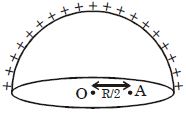
A
$\frac{\sigma R}{2\varepsilon_0}$
B
$\frac{\sigma R}{4\varepsilon_0}$
C
$\frac{\sigma R}{\varepsilon_0}$
D
$\frac{3\sigma R}{4\varepsilon_0}$
Solution
(A) Consider a thin ring element on the hemispherical shell at an angle $\theta$ with the base,having width $R d\theta$ and radius $r = R \cos \theta$. The charge on this ring is $dq = \sigma (2\pi r) (R d\theta) = 2\pi \sigma R^2 \cos \theta d\theta$.
The distance of every point on this ring from point $A$ (at distance $x = R/2$ from center) can be found using the law of cosines. However,a simpler approach is to use the potential due to a charged spherical shell. The potential at any point inside a uniformly charged spherical shell is constant and equal to $V = \frac{\sigma R}{\varepsilon_0}$.
For a hemispherical shell,the potential at the center $O$ is $V_O = \frac{\sigma R}{2\varepsilon_0}$.
For a point $A$ at a distance $x = R/2$ from the center on the base,the potential is given by $V_A = \frac{\sigma R}{2\varepsilon_0}$. This is because the potential at any point on the base of a hemispherical shell is constant and equal to the potential at the center.
The distance of every point on this ring from point $A$ (at distance $x = R/2$ from center) can be found using the law of cosines. However,a simpler approach is to use the potential due to a charged spherical shell. The potential at any point inside a uniformly charged spherical shell is constant and equal to $V = \frac{\sigma R}{\varepsilon_0}$.
For a hemispherical shell,the potential at the center $O$ is $V_O = \frac{\sigma R}{2\varepsilon_0}$.
For a point $A$ at a distance $x = R/2$ from the center on the base,the potential is given by $V_A = \frac{\sigma R}{2\varepsilon_0}$. This is because the potential at any point on the base of a hemispherical shell is constant and equal to the potential at the center.
0 likes
View Solution179
MediumMCQ
$A$ thin conducting spherical shell (center at $O$) having charge $Q_0$,radius $R$ and three point charges $Q_0$,$-2Q_0$,$3Q_0$ are kept at points $A$,$B$,and $C$ respectively as shown in the figure. Find the potential at any point on the conducting shell. (Potential at infinity is assumed to be zero)
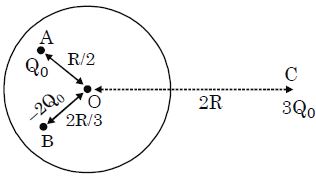
A
$\frac{5KQ_0}{2R}$
B
$\frac{3KQ_0}{2R}$
C
$\frac{KQ_0}{3R}$
D
None of these
Solution
(B) The potential at any point on a conducting shell is the same as the potential at its center due to all charges present in the system.
Potential $V = V_{\text{shell}} + V_A + V_B + V_C$
$V = \frac{KQ_0}{R} + \frac{KQ_0}{R/2} + \frac{K(-2Q_0)}{2R/3} + \frac{K(3Q_0)}{2R}$
$V = \frac{KQ_0}{R} + \frac{2KQ_0}{R} - \frac{3KQ_0}{R} + \frac{1.5KQ_0}{R}$
$V = \frac{1.5KQ_0}{R} = \frac{3KQ_0}{2R}$
Potential $V = V_{\text{shell}} + V_A + V_B + V_C$
$V = \frac{KQ_0}{R} + \frac{KQ_0}{R/2} + \frac{K(-2Q_0)}{2R/3} + \frac{K(3Q_0)}{2R}$
$V = \frac{KQ_0}{R} + \frac{2KQ_0}{R} - \frac{3KQ_0}{R} + \frac{1.5KQ_0}{R}$
$V = \frac{1.5KQ_0}{R} = \frac{3KQ_0}{2R}$
0 likes
View Solution180
DifficultMCQ
The electrostatic potential energy of the given system of charges placed at the corners of a square of side $a$ is:
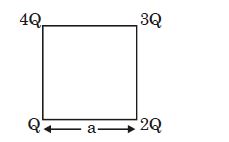
A
$\frac{kQ^2}{a} \times 10$
B
$24 \frac{kQ^2}{a}$
C
$\frac{kQ^2}{a} \left( 24 + \frac{11}{\sqrt{2}} \right)$
D
$12 \frac{kQ^2}{a}$
Solution
(C) The electrostatic potential energy $U$ of a system of point charges is given by the sum of the potential energies of all pairs of charges: $U = \sum \frac{k q_i q_j}{r_{ij}}$.
For a square with side $a$,there are $4$ pairs of charges at distance $a$ (sides) and $2$ pairs of charges at distance $a\sqrt{2}$ (diagonals).
Let the charges be $q_1 = Q$,$q_2 = 2Q$,$q_3 = 3Q$,and $q_4 = 4Q$ in counter-clockwise order starting from the bottom-left.
The pairs at distance $a$ are:
$(q_1, q_2) = (Q, 2Q) \implies U_1 = \frac{k(Q)(2Q)}{a} = 2 \frac{kQ^2}{a}$
$(q_2, q_3) = (2Q, 3Q) \implies U_2 = \frac{k(2Q)(3Q)}{a} = 6 \frac{kQ^2}{a}$
$(q_3, q_4) = (3Q, 4Q) \implies U_3 = \frac{k(3Q)(4Q)}{a} = 12 \frac{kQ^2}{a}$
$(q_4, q_1) = (4Q, Q) \implies U_4 = \frac{k(4Q)(Q)}{a} = 4 \frac{kQ^2}{a}$
The pairs at distance $a\sqrt{2}$ are:
$(q_1, q_3) = (Q, 3Q) \implies U_5 = \frac{k(Q)(3Q)}{a\sqrt{2}} = 3 \frac{kQ^2}{a\sqrt{2}}$
$(q_2, q_4) = (2Q, 4Q) \implies U_6 = \frac{k(2Q)(4Q)}{a\sqrt{2}} = 8 \frac{kQ^2}{a\sqrt{2}}$
Total potential energy $U = U_1 + U_2 + U_3 + U_4 + U_5 + U_6 = (2 + 6 + 12 + 4) \frac{kQ^2}{a} + (3 + 8) \frac{kQ^2}{a\sqrt{2}} = 24 \frac{kQ^2}{a} + 11 \frac{kQ^2}{a\sqrt{2}} = \frac{kQ^2}{a} \left( 24 + \frac{11}{\sqrt{2}} \right)$.
For a square with side $a$,there are $4$ pairs of charges at distance $a$ (sides) and $2$ pairs of charges at distance $a\sqrt{2}$ (diagonals).
Let the charges be $q_1 = Q$,$q_2 = 2Q$,$q_3 = 3Q$,and $q_4 = 4Q$ in counter-clockwise order starting from the bottom-left.
The pairs at distance $a$ are:
$(q_1, q_2) = (Q, 2Q) \implies U_1 = \frac{k(Q)(2Q)}{a} = 2 \frac{kQ^2}{a}$
$(q_2, q_3) = (2Q, 3Q) \implies U_2 = \frac{k(2Q)(3Q)}{a} = 6 \frac{kQ^2}{a}$
$(q_3, q_4) = (3Q, 4Q) \implies U_3 = \frac{k(3Q)(4Q)}{a} = 12 \frac{kQ^2}{a}$
$(q_4, q_1) = (4Q, Q) \implies U_4 = \frac{k(4Q)(Q)}{a} = 4 \frac{kQ^2}{a}$
The pairs at distance $a\sqrt{2}$ are:
$(q_1, q_3) = (Q, 3Q) \implies U_5 = \frac{k(Q)(3Q)}{a\sqrt{2}} = 3 \frac{kQ^2}{a\sqrt{2}}$
$(q_2, q_4) = (2Q, 4Q) \implies U_6 = \frac{k(2Q)(4Q)}{a\sqrt{2}} = 8 \frac{kQ^2}{a\sqrt{2}}$
Total potential energy $U = U_1 + U_2 + U_3 + U_4 + U_5 + U_6 = (2 + 6 + 12 + 4) \frac{kQ^2}{a} + (3 + 8) \frac{kQ^2}{a\sqrt{2}} = 24 \frac{kQ^2}{a} + 11 \frac{kQ^2}{a\sqrt{2}} = \frac{kQ^2}{a} \left( 24 + \frac{11}{\sqrt{2}} \right)$.
0 likes
View Solution181
MediumMCQ
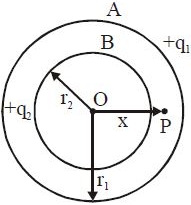
Two concentric hollow metallic spheres of radii $r_1$ and $r_2$ $(r_1 > r_2)$ contain charges $q_1$ and $q_2$ respectively. The potential at a distance $x$ between $r_1$ and $r_2$ will be
A
$\frac{q_1 + q_2}{4\pi \varepsilon_0 x}$
B
$\frac{q_1}{4\pi \varepsilon_0 r_1} + \frac{q_2}{4\pi \varepsilon_0 r_2}$
C
$\frac{q_1}{4\pi \varepsilon_0 x} + \frac{q_2}{4\pi \varepsilon_0 r_2}$
D
$\frac{q_1}{4\pi \varepsilon_0 r_1} + \frac{q_2}{4\pi \varepsilon_0 x}$
Solution
(D) The potential at a point $P$ at a distance $x$ from the center,where $r_2 < x < r_1$,is the sum of the potentials due to both spheres.
$1$. The potential due to the outer sphere (radius $r_1$,charge $q_1$) at any point inside it is constant and equal to the potential at its surface: $V_1 = \frac{q_1}{4\pi \varepsilon_0 r_1}$.
$2$. The potential due to the inner sphere (radius $r_2$,charge $q_2$) at a point outside it at distance $x$ is: $V_2 = \frac{q_2}{4\pi \varepsilon_0 x}$.
$3$. The net potential at distance $x$ is $V = V_1 + V_2 = \frac{q_1}{4\pi \varepsilon_0 r_1} + \frac{q_2}{4\pi \varepsilon_0 x}$.
$1$. The potential due to the outer sphere (radius $r_1$,charge $q_1$) at any point inside it is constant and equal to the potential at its surface: $V_1 = \frac{q_1}{4\pi \varepsilon_0 r_1}$.
$2$. The potential due to the inner sphere (radius $r_2$,charge $q_2$) at a point outside it at distance $x$ is: $V_2 = \frac{q_2}{4\pi \varepsilon_0 x}$.
$3$. The net potential at distance $x$ is $V = V_1 + V_2 = \frac{q_1}{4\pi \varepsilon_0 r_1} + \frac{q_2}{4\pi \varepsilon_0 x}$.
0 likes
View Solution182
MediumMCQ
An infinite number of charges, each numerically equal to $q$ and of the same sign, are placed along the $x-$axis at $x = 1, 2, 4, 8, \dots \, \text{meters}$. The electric potential at $x = 0$ due to this set of charges is:
A
$\frac{q}{4\pi \varepsilon_0}$
B
$\frac{q}{3\pi \varepsilon_0}$
C
$\frac{q}{2\pi \varepsilon_0}$
D
$\frac{q}{\pi \varepsilon_0}$
Solution
(C) The electric potential $V$ at a point due to a system of charges is given by $V = \sum \frac{1}{4\pi\varepsilon_0} \frac{q_i}{r_i}$.
Here, the charges are $q$ at distances $r = 1, 2, 4, 8, \dots \, \text{m}$.
$V = \frac{1}{4\pi\varepsilon_0} \left[ \frac{q}{1} + \frac{q}{2} + \frac{q}{4} + \frac{q}{8} + \dots \right]$
$V = \frac{q}{4\pi\varepsilon_0} \left[ 1 + \frac{1}{2} + \frac{1}{4} + \frac{1}{8} + \dots \right]$
The term in the bracket is a geometric progression with first term $a = 1$ and common ratio $r = 1/2$.
The sum of an infinite geometric series is $S = \frac{a}{1-r} = \frac{1}{1 - 1/2} = \frac{1}{1/2} = 2$.
Therefore, $V = \frac{q}{4\pi\varepsilon_0} \times 2 = \frac{2q}{4\pi\varepsilon_0} = \frac{q}{2\pi\varepsilon_0}$.
Here, the charges are $q$ at distances $r = 1, 2, 4, 8, \dots \, \text{m}$.
$V = \frac{1}{4\pi\varepsilon_0} \left[ \frac{q}{1} + \frac{q}{2} + \frac{q}{4} + \frac{q}{8} + \dots \right]$
$V = \frac{q}{4\pi\varepsilon_0} \left[ 1 + \frac{1}{2} + \frac{1}{4} + \frac{1}{8} + \dots \right]$
The term in the bracket is a geometric progression with first term $a = 1$ and common ratio $r = 1/2$.
The sum of an infinite geometric series is $S = \frac{a}{1-r} = \frac{1}{1 - 1/2} = \frac{1}{1/2} = 2$.
Therefore, $V = \frac{q}{4\pi\varepsilon_0} \times 2 = \frac{2q}{4\pi\varepsilon_0} = \frac{q}{2\pi\varepsilon_0}$.
0 likes
View Solution183
EasyMCQ
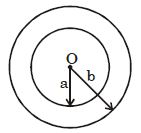
If the electric potential of the inner sphere is $10\, V$ and that of the outer shell is $50\, V$,then the potential at the common centre is :- (in $, V$)
A
$10$
B
$60$
C
$40$
D
$50$
Solution
(A) Let the radius of the inner sphere be $a$ and the radius of the outer shell be $b$. Let the charge on the inner sphere be $q_1$ and the charge on the outer shell be $q_2$.
The potential at the surface of the inner sphere is given by: $V_a = \frac{kq_1}{a} + \frac{kq_2}{b} = 10\, V$.
The potential at the surface of the outer shell is given by: $V_b = \frac{kq_1}{b} + \frac{kq_2}{b} = 50\, V$.
The potential at the common centre $O$ is given by: $V_O = \frac{kq_1}{a} + \frac{kq_2}{b}$.
Comparing this with the expression for $V_a$,we see that the potential at the centre is equal to the potential at the surface of the inner sphere.
Therefore,$V_O = 10\, V$.
The potential at the surface of the inner sphere is given by: $V_a = \frac{kq_1}{a} + \frac{kq_2}{b} = 10\, V$.
The potential at the surface of the outer shell is given by: $V_b = \frac{kq_1}{b} + \frac{kq_2}{b} = 50\, V$.
The potential at the common centre $O$ is given by: $V_O = \frac{kq_1}{a} + \frac{kq_2}{b}$.
Comparing this with the expression for $V_a$,we see that the potential at the centre is equal to the potential at the surface of the inner sphere.
Therefore,$V_O = 10\, V$.
0 likes
View Solution184
MediumMCQ
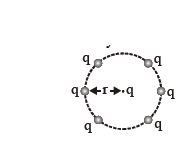
$A$ point charge $q$ is surrounded symmetrically by six identical charges each of magnitude $q$ at a distance $r$ as shown in the figure. How much work is done by the forces of electrostatic repulsion when the point charge $q$ at the centre is moved to infinity?
A
zero
B
$6q^2 / 4\pi\varepsilon_0 r$
C
$q^2 / 4\pi\varepsilon_0 r$
D
$12q^2 / 4\pi\varepsilon_0 r$
Solution
(B) The work done by the electrostatic force is equal to the negative change in the potential energy of the system.
$W = -\Delta U = U_i - U_f$
Initially,the central charge $q$ is at a distance $r$ from each of the six charges $q$. The potential energy of the central charge due to the six surrounding charges is $U_i = 6 \times (kq^2 / r) = 6q^2 / 4\pi\varepsilon_0 r$.
When the central charge is moved to infinity,its potential energy becomes $U_f = 0$.
Therefore,the work done by the electrostatic force is $W = U_i - U_f = 6q^2 / 4\pi\varepsilon_0 r - 0 = 6q^2 / 4\pi\varepsilon_0 r$.
$W = -\Delta U = U_i - U_f$
Initially,the central charge $q$ is at a distance $r$ from each of the six charges $q$. The potential energy of the central charge due to the six surrounding charges is $U_i = 6 \times (kq^2 / r) = 6q^2 / 4\pi\varepsilon_0 r$.
When the central charge is moved to infinity,its potential energy becomes $U_f = 0$.
Therefore,the work done by the electrostatic force is $W = U_i - U_f = 6q^2 / 4\pi\varepsilon_0 r - 0 = 6q^2 / 4\pi\varepsilon_0 r$.
0 likes
View Solution185
MediumMCQ
An electric charge $10^{-3} \, \mu C$ is placed at the origin $(0, 0)$ of an $X-Y$ coordinate system. Two points $A$ and $B$ are situated at $(\sqrt{2}, \sqrt{2})$ and $(2, 0)$ respectively. The potential difference between the points $A$ and $B$ will be $V$.
A
$9$
B
$0$
C
$2$
D
$3.5$
Solution
(B) The electric potential $V$ at a distance $r$ from a point charge $q$ is given by the formula $V = \frac{kq}{r}$,where $k = 9 \times 10^9 \, N \cdot m^2/C^2$.
For point $A$ at $(\sqrt{2}, \sqrt{2})$,the distance from the origin $(0, 0)$ is $r_A = \sqrt{(\sqrt{2})^2 + (\sqrt{2})^2} = \sqrt{2 + 2} = \sqrt{4} = 2 \, m$.
For point $B$ at $(2, 0)$,the distance from the origin $(0, 0)$ is $r_B = \sqrt{2^2 + 0^2} = \sqrt{4} = 2 \, m$.
Since the distances $r_A$ and $r_B$ are equal,the electric potentials at points $A$ and $B$ are equal: $V_A = V_B = \frac{kq}{2}$.
The potential difference between points $A$ and $B$ is $\Delta V = V_A - V_B = 0 \, V$.
For point $A$ at $(\sqrt{2}, \sqrt{2})$,the distance from the origin $(0, 0)$ is $r_A = \sqrt{(\sqrt{2})^2 + (\sqrt{2})^2} = \sqrt{2 + 2} = \sqrt{4} = 2 \, m$.
For point $B$ at $(2, 0)$,the distance from the origin $(0, 0)$ is $r_B = \sqrt{2^2 + 0^2} = \sqrt{4} = 2 \, m$.
Since the distances $r_A$ and $r_B$ are equal,the electric potentials at points $A$ and $B$ are equal: $V_A = V_B = \frac{kq}{2}$.
The potential difference between points $A$ and $B$ is $\Delta V = V_A - V_B = 0 \, V$.
0 likes
View Solution186
MediumMCQ
An infinite number of charges,each equal to $0.2\,\mu C$,are arranged in a line at distances $1\,m, 2\,m, 4\,m, 8\,m, \dots$ from a fixed point. The potential at the fixed point is $......\,kV$.
A
$1.80$
B
$2$
C
$3.60$
D
$2.25$
Solution
(C) The electric potential $V$ due to a point charge $q$ at a distance $r$ is given by $V = \frac{kq}{r}$.
For an infinite number of charges,the total potential is the sum of individual potentials:
$V = \sum \frac{kq}{r} = kq \left( \frac{1}{1} + \frac{1}{2} + \frac{1}{4} + \frac{1}{8} + \dots \right)$.
Here,$k = 9 \times 10^9 \, N\cdot m^2/C^2$ and $q = 0.2 \times 10^{-6} \, C$.
The term in the bracket is a geometric progression with first term $a = 1$ and common ratio $r = 1/2$. The sum is $S = \frac{a}{1-r} = \frac{1}{1 - 1/2} = 2$.
Substituting the values:
$V = (9 \times 10^9) \times (0.2 \times 10^{-6}) \times 2 = 1.8 \times 10^3 \times 2 = 3600 \, V$.
Since $1000 \, V = 1 \, kV$,the potential is $3.60 \, kV$.
For an infinite number of charges,the total potential is the sum of individual potentials:
$V = \sum \frac{kq}{r} = kq \left( \frac{1}{1} + \frac{1}{2} + \frac{1}{4} + \frac{1}{8} + \dots \right)$.
Here,$k = 9 \times 10^9 \, N\cdot m^2/C^2$ and $q = 0.2 \times 10^{-6} \, C$.
The term in the bracket is a geometric progression with first term $a = 1$ and common ratio $r = 1/2$. The sum is $S = \frac{a}{1-r} = \frac{1}{1 - 1/2} = 2$.
Substituting the values:
$V = (9 \times 10^9) \times (0.2 \times 10^{-6}) \times 2 = 1.8 \times 10^3 \times 2 = 3600 \, V$.
Since $1000 \, V = 1 \, kV$,the potential is $3.60 \, kV$.
0 likes
View Solution187
EasyMCQ
$A$ hollow metal sphere of radius $5\, cm$ is charged so that the potential on its surface is $10\, V$. The potential at the centre of the sphere is.....$V$
A
$0$
B
$10$
C
same as at point $5\, cm$ away from the surface
D
same as at point $25\, cm$ away from the surface
Solution
(B) hollow metal sphere acts as a spherical conductor shell.
For any charged spherical conductor,the electric field inside the conductor is $E = 0$.
Since the electric field is the negative gradient of the potential $(E = -dV/dr)$,if $E = 0$,then the potential $V$ must be constant throughout the interior of the sphere.
Therefore,the potential at any point inside the sphere,including the centre,is equal to the potential on its surface.
Given that the potential on the surface is $10\, V$,the potential at the centre is also $10\, V$.
For any charged spherical conductor,the electric field inside the conductor is $E = 0$.
Since the electric field is the negative gradient of the potential $(E = -dV/dr)$,if $E = 0$,then the potential $V$ must be constant throughout the interior of the sphere.
Therefore,the potential at any point inside the sphere,including the centre,is equal to the potential on its surface.
Given that the potential on the surface is $10\, V$,the potential at the centre is also $10\, V$.
0 likes
View Solution188
EasyMCQ
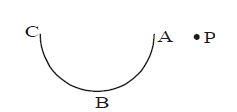
In the following diagram, the work done in moving a point charge from point $P$ to points $A, B$ and $C$ is $W_A, W_B$ and $W_C$ respectively. If there is no charge nearby, then:
A
$W_A = W_B = W_C \ne 0$
B
$W_A = W_B = W_C = 0$
C
$W_A > W_B > W_C$
D
$W_A < W_B < W_C$
Solution
(B) The work done in moving a charge $q$ from one point to another is given by $W = q(V_{final} - V_{initial})$.
Since there is no charge nearby, the electric potential $V$ is constant throughout the region (or zero if we consider infinity as reference).
Points $A, B,$ and $C$ lie on a curve, but without any external electric field or source charge, the potential at all points in the space is the same.
Therefore, the potential difference between point $P$ and any point $A, B,$ or $C$ is zero.
Thus, $W_A = q(V_A - V_P) = 0$, $W_B = q(V_B - V_P) = 0$, and $W_C = q(V_C - V_P) = 0$.
Hence, $W_A = W_B = W_C = 0$.
Since there is no charge nearby, the electric potential $V$ is constant throughout the region (or zero if we consider infinity as reference).
Points $A, B,$ and $C$ lie on a curve, but without any external electric field or source charge, the potential at all points in the space is the same.
Therefore, the potential difference between point $P$ and any point $A, B,$ or $C$ is zero.
Thus, $W_A = q(V_A - V_P) = 0$, $W_B = q(V_B - V_P) = 0$, and $W_C = q(V_C - V_P) = 0$.
Hence, $W_A = W_B = W_C = 0$.
0 likes
View Solution189
MediumMCQ
Two identical positive charges are placed at $x = -a$ and $x = a$. The correct variation of potential $V$ along the $x$-axis is given by:
A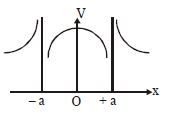
B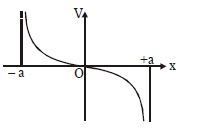
C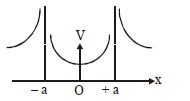
D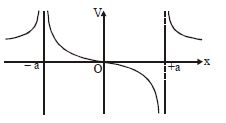
Solution
(C) The electric potential $V$ due to a point charge $q$ at a distance $r$ is given by $V = \frac{kq}{r}$.
For two identical positive charges $q$ placed at $x = -a$ and $x = a$,the total potential at any point $x$ is $V(x) = \frac{kq}{|x+a|} + \frac{kq}{|x-a|}$.
$1$. As $x \to a$,$V \to +\infty$. As $x \to -a$,$V \to +\infty$. This means the potential must show vertical asymptotes at $x = a$ and $x = -a$.
$2$. At the origin $(x = 0)$,the potential is $V(0) = \frac{kq}{a} + \frac{kq}{a} = \frac{2kq}{a}$,which is a positive finite value.
$3$. As $x \to \pm\infty$,$V \to 0$.
Comparing these properties with the given graphs,the potential is positive everywhere and has a local minimum at the origin between the two charges. Graph $C$ correctly represents this behavior,showing a $U$-shaped curve between the charges and approaching zero at infinity.
For two identical positive charges $q$ placed at $x = -a$ and $x = a$,the total potential at any point $x$ is $V(x) = \frac{kq}{|x+a|} + \frac{kq}{|x-a|}$.
$1$. As $x \to a$,$V \to +\infty$. As $x \to -a$,$V \to +\infty$. This means the potential must show vertical asymptotes at $x = a$ and $x = -a$.
$2$. At the origin $(x = 0)$,the potential is $V(0) = \frac{kq}{a} + \frac{kq}{a} = \frac{2kq}{a}$,which is a positive finite value.
$3$. As $x \to \pm\infty$,$V \to 0$.
Comparing these properties with the given graphs,the potential is positive everywhere and has a local minimum at the origin between the two charges. Graph $C$ correctly represents this behavior,showing a $U$-shaped curve between the charges and approaching zero at infinity.
0 likes
View Solution190
DifficultMCQ
If the electric potential of the inner shell of radius $a$ is $10\,V$ and that of the outer shell of radius $2a$ is $5\,V$,then the potential at the centre will be.....$V$
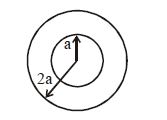
A
$10$
B
$5$
C
$15$
D
$0$
Solution
(A) Let $q_1$ be the charge on the inner shell of radius $a$ and $q_2$ be the charge on the outer shell of radius $2a$.
The potential at the surface of the inner shell is given by: $V_{inner} = \frac{kq_1}{a} + \frac{kq_2}{2a} = 10\,V$.
The potential at the surface of the outer shell is given by: $V_{outer} = \frac{kq_1}{2a} + \frac{kq_2}{2a} = 5\,V$.
The potential at the centre of the shells is given by: $V_{centre} = \frac{kq_1}{a} + \frac{kq_2}{2a}$.
Comparing this expression with the equation for the potential at the inner shell,we can see that $V_{centre} = V_{inner} = 10\,V$.
The potential at the surface of the inner shell is given by: $V_{inner} = \frac{kq_1}{a} + \frac{kq_2}{2a} = 10\,V$.
The potential at the surface of the outer shell is given by: $V_{outer} = \frac{kq_1}{2a} + \frac{kq_2}{2a} = 5\,V$.
The potential at the centre of the shells is given by: $V_{centre} = \frac{kq_1}{a} + \frac{kq_2}{2a}$.
Comparing this expression with the equation for the potential at the inner shell,we can see that $V_{centre} = V_{inner} = 10\,V$.
0 likes
View Solution191
MediumMCQ
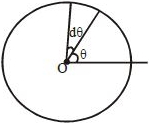
The linear charge density on a dielectric ring of radius $R$ varies with $\theta$ as $\lambda = \lambda_0 \cos(\theta/2)$,where $\lambda_0$ is a constant. Find the potential at the centre $O$ of the ring.
A
$\lambda_0 R$
B
$\frac{\lambda_0 R}{2}$
C
$\frac{\lambda_0}{4\pi \epsilon_0 R}$
D
zero
Solution
(D) The charge on an infinitesimal element of the arc which subtends an angle $d\theta$ at the center of the ring is given by:
$dQ = \lambda R d\theta = \lambda_0 \cos(\theta/2) R d\theta$
The potential $dV$ at the centre of the ring due to this charge $dQ$ is:
$dV = \frac{1}{4 \pi \epsilon_0} \frac{dQ}{R} = \frac{\lambda_0 \cos(\theta/2) R d\theta}{4 \pi \epsilon_0 R} = \frac{\lambda_0}{4 \pi \epsilon_0} \cos(\theta/2) d\theta$
To find the total potential $V$,we integrate over the entire ring from $\theta = 0$ to $\theta = 2\pi$:
$V = \int_0^{2\pi} dV = \frac{\lambda_0}{4 \pi \epsilon_0} \int_0^{2\pi} \cos(\theta/2) d\theta$
$V = \frac{\lambda_0}{4 \pi \epsilon_0} \left[ 2 \sin(\theta/2) \right]_0^{2\pi}$
$V = \frac{\lambda_0}{4 \pi \epsilon_0} \left[ 2 \sin(\pi) - 2 \sin(0) \right] = \frac{\lambda_0}{4 \pi \epsilon_0} [0 - 0] = 0 \text{ V}$
$dQ = \lambda R d\theta = \lambda_0 \cos(\theta/2) R d\theta$
The potential $dV$ at the centre of the ring due to this charge $dQ$ is:
$dV = \frac{1}{4 \pi \epsilon_0} \frac{dQ}{R} = \frac{\lambda_0 \cos(\theta/2) R d\theta}{4 \pi \epsilon_0 R} = \frac{\lambda_0}{4 \pi \epsilon_0} \cos(\theta/2) d\theta$
To find the total potential $V$,we integrate over the entire ring from $\theta = 0$ to $\theta = 2\pi$:
$V = \int_0^{2\pi} dV = \frac{\lambda_0}{4 \pi \epsilon_0} \int_0^{2\pi} \cos(\theta/2) d\theta$
$V = \frac{\lambda_0}{4 \pi \epsilon_0} \left[ 2 \sin(\theta/2) \right]_0^{2\pi}$
$V = \frac{\lambda_0}{4 \pi \epsilon_0} \left[ 2 \sin(\pi) - 2 \sin(0) \right] = \frac{\lambda_0}{4 \pi \epsilon_0} [0 - 0] = 0 \text{ V}$
0 likes
View Solution192
DifficultMCQ
$A$ charge $Q$ is distributed over two concentric hollow spheres of radii $r$ and $R$ $(R > r)$ such that their surface charge densities are equal. The potential at the common centre is
A
$\frac{Q(R^2 + r^2)}{4\pi\varepsilon_0(R + r)}$
B
$\frac{Q}{4\pi\varepsilon_0(R + r)}$
C
Zero
D
$\frac{Q(R + r)}{4\pi\varepsilon_0(R^2 + r^2)}$
Solution
(D) Let $q_1$ and $q_2$ be the charges on the spheres of radii $r$ and $R$ respectively. Given $q_1 + q_2 = Q$.
Since surface charge densities are equal,$\sigma = \frac{q_1}{4\pi r^2} = \frac{q_2}{4\pi R^2}$.
Using the property of ratios,$\frac{q_1}{r^2} = \frac{q_2}{R^2} = \frac{q_1 + q_2}{r^2 + R^2} = \frac{Q}{r^2 + R^2}$.
Thus,$q_1 = \frac{Q r^2}{r^2 + R^2}$ and $q_2 = \frac{Q R^2}{r^2 + R^2}$.
The potential at the common centre is $V = \frac{1}{4\pi\varepsilon_0} \left( \frac{q_1}{r} + \frac{q_2}{R} \right)$.
Substituting the values of $q_1$ and $q_2$,we get $V = \frac{1}{4\pi\varepsilon_0} \left( \frac{Q r^2}{r(r^2 + R^2)} + \frac{Q R^2}{R(r^2 + R^2)} \right)$.
$V = \frac{Q}{4\pi\varepsilon_0(r^2 + R^2)} (r + R)$.
Since surface charge densities are equal,$\sigma = \frac{q_1}{4\pi r^2} = \frac{q_2}{4\pi R^2}$.
Using the property of ratios,$\frac{q_1}{r^2} = \frac{q_2}{R^2} = \frac{q_1 + q_2}{r^2 + R^2} = \frac{Q}{r^2 + R^2}$.
Thus,$q_1 = \frac{Q r^2}{r^2 + R^2}$ and $q_2 = \frac{Q R^2}{r^2 + R^2}$.
The potential at the common centre is $V = \frac{1}{4\pi\varepsilon_0} \left( \frac{q_1}{r} + \frac{q_2}{R} \right)$.
Substituting the values of $q_1$ and $q_2$,we get $V = \frac{1}{4\pi\varepsilon_0} \left( \frac{Q r^2}{r(r^2 + R^2)} + \frac{Q R^2}{R(r^2 + R^2)} \right)$.
$V = \frac{Q}{4\pi\varepsilon_0(r^2 + R^2)} (r + R)$.
0 likes
View Solution193
MediumMCQ
Two thin concentric hollow conducting spheres of radii $R_1$ and $R_2$ bear charges $Q_1$ and $Q_2$ respectively. If $R_1 < R_2$,then the potential of a point at a distance $r$ from the centre $(R_1 < r < R_2)$ is
A
$\frac{1}{4\pi \varepsilon_0} \left( \frac{Q_1 + Q_2}{r} \right)$
B
$\frac{1}{4\pi \varepsilon_0} \left( \frac{Q_1}{r} + \frac{Q_2}{R_2} \right)$
C
$\frac{1}{4\pi \varepsilon_0} \left( \frac{Q_1}{R_1} + \frac{Q_2}{R_2} \right)$
D
$\frac{1}{4\pi \varepsilon_0} \left( \frac{Q_1}{R_1} + \frac{Q_2}{r} \right)$
Solution
(B) For a point at a distance $r$ such that $R_1 < r < R_2$,the potential $V$ is the sum of the potentials due to both spheres.
$1$. The potential due to the inner sphere (radius $R_1$,charge $Q_1$) at a distance $r$ (where $r > R_1$) is $V_1 = \frac{1}{4\pi \varepsilon_0} \frac{Q_1}{r}$.
$2$. The potential due to the outer sphere (radius $R_2$,charge $Q_2$) at a distance $r$ (where $r < R_2$) is constant throughout its interior,given by $V_2 = \frac{1}{4\pi \varepsilon_0} \frac{Q_2}{R_2}$.
$3$. The total potential $V$ at distance $r$ is $V = V_1 + V_2 = \frac{1}{4\pi \varepsilon_0} \left( \frac{Q_1}{r} + \frac{Q_2}{R_2} \right)$.
$1$. The potential due to the inner sphere (radius $R_1$,charge $Q_1$) at a distance $r$ (where $r > R_1$) is $V_1 = \frac{1}{4\pi \varepsilon_0} \frac{Q_1}{r}$.
$2$. The potential due to the outer sphere (radius $R_2$,charge $Q_2$) at a distance $r$ (where $r < R_2$) is constant throughout its interior,given by $V_2 = \frac{1}{4\pi \varepsilon_0} \frac{Q_2}{R_2}$.
$3$. The total potential $V$ at distance $r$ is $V = V_1 + V_2 = \frac{1}{4\pi \varepsilon_0} \left( \frac{Q_1}{r} + \frac{Q_2}{R_2} \right)$.
0 likes
View Solution194
MediumMCQ
An electric point charge $10^{-3} \mu C$ is placed at the origin $(0, 0)$ of an $X-Y$ coordinate system. Two points $A$ and $B$ are situated at $(\sqrt{2}, \sqrt{2})$ and $(2, 0)$ respectively. The potential difference between the points $A$ and $B$ will be.....$volt$.
A
$9$
B
$0$
C
$2$
D
$3.5$
Solution
(B) The electric potential $V$ at a distance $r$ from a point charge $q$ is given by $V = \frac{kq}{r}$.
For point $A$ at $(\sqrt{2}, \sqrt{2})$,the distance from the origin is $r_A = \sqrt{(\sqrt{2})^2 + (\sqrt{2})^2} = \sqrt{2 + 2} = \sqrt{4} = 2 \ m$.
For point $B$ at $(2, 0)$,the distance from the origin is $r_B = \sqrt{2^2 + 0^2} = \sqrt{4} = 2 \ m$.
Since $r_A = r_B$,the potential at both points is equal: $V_A = V_B = \frac{kq}{2}$.
The potential difference between $A$ and $B$ is $V_A - V_B = 0 \ volt$.
For point $A$ at $(\sqrt{2}, \sqrt{2})$,the distance from the origin is $r_A = \sqrt{(\sqrt{2})^2 + (\sqrt{2})^2} = \sqrt{2 + 2} = \sqrt{4} = 2 \ m$.
For point $B$ at $(2, 0)$,the distance from the origin is $r_B = \sqrt{2^2 + 0^2} = \sqrt{4} = 2 \ m$.
Since $r_A = r_B$,the potential at both points is equal: $V_A = V_B = \frac{kq}{2}$.
The potential difference between $A$ and $B$ is $V_A - V_B = 0 \ volt$.
0 likes
View Solution195
DifficultMCQ
There is a uniform electrostatic field in a region. The potential at various points on a small sphere centered at $P$,in the region,is found to vary between the limits $589.0\,V$ to $589.8\,V$. What is the potential at a point on the sphere whose radius vector makes an angle of $60^o$ with the direction of the field (in $,V$)?
A
$589.5$
B
$589.2$
C
$589.4$
D
$589.6$
Solution
(B) In a uniform electric field $\vec{E}$,the potential $V$ at a position $\vec{r}$ relative to point $P$ is given by $V = V_P - \vec{E} \cdot \vec{r} = V_P - Er \cos \theta$,where $\theta$ is the angle between the radius vector and the field direction.
The potential varies between $V_{min} = V_P - Er$ (at $\theta = 0^o$) and $V_{max} = V_P + Er$ (at $\theta = 180^o$).
Given $V_{min} = 589.0\,V$ and $V_{max} = 589.8\,V$,the potential difference across the diameter is $2Er = 589.8 - 589.0 = 0.8\,V$. Thus,$Er = 0.4\,V$.
The center potential $V_P$ is the average: $V_P = (589.0 + 589.8) / 2 = 589.4\,V$.
For a point at an angle $\theta = 60^o$,the potential is $V = V_P - Er \cos(60^o) = 589.4 - 0.4 \times 0.5 = 589.4 - 0.2 = 589.2\,V$.
The potential varies between $V_{min} = V_P - Er$ (at $\theta = 0^o$) and $V_{max} = V_P + Er$ (at $\theta = 180^o$).
Given $V_{min} = 589.0\,V$ and $V_{max} = 589.8\,V$,the potential difference across the diameter is $2Er = 589.8 - 589.0 = 0.8\,V$. Thus,$Er = 0.4\,V$.
The center potential $V_P$ is the average: $V_P = (589.0 + 589.8) / 2 = 589.4\,V$.
For a point at an angle $\theta = 60^o$,the potential is $V = V_P - Er \cos(60^o) = 589.4 - 0.4 \times 0.5 = 589.4 - 0.2 = 589.2\,V$.
0 likes
View Solution196
DifficultMCQ
Two small equal point charges of magnitude $q$ are suspended from a common point on the ceiling by insulating massless strings of equal lengths. They come to equilibrium with each string making an angle $\theta$ from the vertical. If the mass of each charge is $m$,then the electrostatic potential at the centre of the line joining them will be $\left( \frac{1}{4\pi \epsilon_0} = k \right).$
A
$2\sqrt{k\,mg\,\tan \theta}$
B
$\sqrt{k\,mg\,\tan \theta}$
C
$4\sqrt{k\,mg\tan \theta}$
D
$6\sqrt{k\,mg/\tan \theta}$
Solution
(C) Let $L$ be the length of each string. The distance between the two charges is $x = 2L \sin \theta$.
In equilibrium,the forces acting on each charge are tension $T$,weight $mg$,and electrostatic force $F_e = \frac{kq^2}{x^2}$.
Resolving forces: $T \sin \theta = F_e$ and $T \cos \theta = mg$.
Dividing these gives $\tan \theta = \frac{F_e}{mg} = \frac{kq^2}{x^2 mg}$.
Thus,$x^2 = \frac{kq^2}{mg \tan \theta}$,which implies $x = q \sqrt{\frac{k}{mg \tan \theta}}$.
The electrostatic potential $V$ at the centre of the line joining the charges (at distance $x/2$ from each charge) is:
$V = \frac{kq}{x/2} + \frac{kq}{x/2} = \frac{4kq}{x}$.
Substituting $x$:
$V = \frac{4kq}{q \sqrt{\frac{k}{mg \tan \theta}}} = 4 \sqrt{k^2 \cdot \frac{mg \tan \theta}{k}} = 4 \sqrt{k \, mg \tan \theta}$.
In equilibrium,the forces acting on each charge are tension $T$,weight $mg$,and electrostatic force $F_e = \frac{kq^2}{x^2}$.
Resolving forces: $T \sin \theta = F_e$ and $T \cos \theta = mg$.
Dividing these gives $\tan \theta = \frac{F_e}{mg} = \frac{kq^2}{x^2 mg}$.
Thus,$x^2 = \frac{kq^2}{mg \tan \theta}$,which implies $x = q \sqrt{\frac{k}{mg \tan \theta}}$.
The electrostatic potential $V$ at the centre of the line joining the charges (at distance $x/2$ from each charge) is:
$V = \frac{kq}{x/2} + \frac{kq}{x/2} = \frac{4kq}{x}$.
Substituting $x$:
$V = \frac{4kq}{q \sqrt{\frac{k}{mg \tan \theta}}} = 4 \sqrt{k^2 \cdot \frac{mg \tan \theta}{k}} = 4 \sqrt{k \, mg \tan \theta}$.
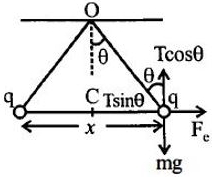
0 likes
View Solution197
DifficultMCQ
$A$ charge of total amount $Q$ is distributed over two concentric hollow spheres of radii $r$ and $R$ $(R > r)$ such that the surface charge densities on the two spheres are equal. The electric potential at the common centre is
A
$\frac{1}{4\pi \varepsilon_0} \frac{(R - r)Q}{(R^2 + r^2)}$
B
$\frac{1}{4\pi \varepsilon_0} \frac{(R + r)Q}{2(R^3 + r^3)}$
C
$\frac{1}{4\pi \varepsilon_0} \frac{(R + r)Q}{(R^2 + r^2)}$
D
$\frac{1}{4\pi \varepsilon_0} \frac{(R - r)Q}{2(R^2 + r^2)}$
Solution
(C) Let $q_1$ and $q_2$ be the charges on the spheres of radii $r$ and $R$ respectively.
Given $q_1 + q_2 = Q$.
Since surface charge densities are equal,$\sigma_1 = \sigma_2$.
$\frac{q_1}{4\pi r^2} = \frac{q_2}{4\pi R^2} \implies \frac{q_1}{r^2} = \frac{q_2}{R^2}$.
Using componendo and dividendo,$\frac{q_1}{r^2} = \frac{q_2}{R^2} = \frac{q_1 + q_2}{r^2 + R^2} = \frac{Q}{r^2 + R^2}$.
Thus,$q_1 = \frac{Q r^2}{R^2 + r^2}$ and $q_2 = \frac{Q R^2}{R^2 + r^2}$.
The electric potential at the common centre is $V = \frac{1}{4\pi \varepsilon_0} \left( \frac{q_1}{r} + \frac{q_2}{R} \right)$.
Substituting the values of $q_1$ and $q_2$:
$V = \frac{1}{4\pi \varepsilon_0} \left( \frac{Q r^2}{r(R^2 + r^2)} + \frac{Q R^2}{R(R^2 + r^2)} \right) = \frac{1}{4\pi \varepsilon_0} \left( \frac{Q r + Q R}{R^2 + r^2} \right)$.
$V = \frac{1}{4\pi \varepsilon_0} \frac{(R + r)Q}{R^2 + r^2}$.
Given $q_1 + q_2 = Q$.
Since surface charge densities are equal,$\sigma_1 = \sigma_2$.
$\frac{q_1}{4\pi r^2} = \frac{q_2}{4\pi R^2} \implies \frac{q_1}{r^2} = \frac{q_2}{R^2}$.
Using componendo and dividendo,$\frac{q_1}{r^2} = \frac{q_2}{R^2} = \frac{q_1 + q_2}{r^2 + R^2} = \frac{Q}{r^2 + R^2}$.
Thus,$q_1 = \frac{Q r^2}{R^2 + r^2}$ and $q_2 = \frac{Q R^2}{R^2 + r^2}$.
The electric potential at the common centre is $V = \frac{1}{4\pi \varepsilon_0} \left( \frac{q_1}{r} + \frac{q_2}{R} \right)$.
Substituting the values of $q_1$ and $q_2$:
$V = \frac{1}{4\pi \varepsilon_0} \left( \frac{Q r^2}{r(R^2 + r^2)} + \frac{Q R^2}{R(R^2 + r^2)} \right) = \frac{1}{4\pi \varepsilon_0} \left( \frac{Q r + Q R}{R^2 + r^2} \right)$.
$V = \frac{1}{4\pi \varepsilon_0} \frac{(R + r)Q}{R^2 + r^2}$.
0 likes
View Solution198
DifficultMCQ
$A$ charge $Q$ is distributed over three concentric spherical shells of radii $a, b, c$ $(a < b < c)$ such that their surface charge densities are equal to one another. The total potential at a point at distance $r$ from their common centre,where $r < a$,would be
A
$\frac{Q}{4\pi \epsilon_0} \frac{a+b+c}{a^2+b^2+c^2}$
B
$\frac{Q(a^2+b^2+c^2)}{4\pi \epsilon_0(a^3+b^3+c^3)}$
C
$\frac{Q}{4\pi \epsilon_0(a+b+c)}$
D
$\frac{Q(a+b+c)}{4\pi \epsilon_0(a^2+b^2+c^2)}$
Solution
(D) Let the charges on the shells be $Q_1, Q_2, Q_3$ and surface charge density be $\sigma$. Since $\sigma$ is equal for all,$\sigma = \frac{Q_1}{4\pi a^2} = \frac{Q_2}{4\pi b^2} = \frac{Q_3}{4\pi c^2}$.
Thus,$Q_1 = 4\pi a^2 \sigma$,$Q_2 = 4\pi b^2 \sigma$,$Q_3 = 4\pi c^2 \sigma$.
The total charge $Q = Q_1 + Q_2 + Q_3 = 4\pi \sigma (a^2 + b^2 + c^2)$,so $\sigma = \frac{Q}{4\pi (a^2 + b^2 + c^2)}$.
The potential at $r < a$ is the sum of potentials due to each shell: $V = \frac{1}{4\pi \epsilon_0} (\frac{Q_1}{a} + \frac{Q_2}{b} + \frac{Q_3}{c})$.
Substituting the values of $Q_1, Q_2, Q_3$: $V = \frac{1}{4\pi \epsilon_0} (\frac{4\pi a^2 \sigma}{a} + \frac{4\pi b^2 \sigma}{b} + \frac{4\pi c^2 \sigma}{c}) = \frac{\sigma}{\epsilon_0} (a + b + c)$.
Substituting $\sigma$: $V = \frac{Q}{4\pi \epsilon_0 (a^2 + b^2 + c^2)} (a + b + c)$.
Thus,$Q_1 = 4\pi a^2 \sigma$,$Q_2 = 4\pi b^2 \sigma$,$Q_3 = 4\pi c^2 \sigma$.
The total charge $Q = Q_1 + Q_2 + Q_3 = 4\pi \sigma (a^2 + b^2 + c^2)$,so $\sigma = \frac{Q}{4\pi (a^2 + b^2 + c^2)}$.
The potential at $r < a$ is the sum of potentials due to each shell: $V = \frac{1}{4\pi \epsilon_0} (\frac{Q_1}{a} + \frac{Q_2}{b} + \frac{Q_3}{c})$.
Substituting the values of $Q_1, Q_2, Q_3$: $V = \frac{1}{4\pi \epsilon_0} (\frac{4\pi a^2 \sigma}{a} + \frac{4\pi b^2 \sigma}{b} + \frac{4\pi c^2 \sigma}{c}) = \frac{\sigma}{\epsilon_0} (a + b + c)$.
Substituting $\sigma$: $V = \frac{Q}{4\pi \epsilon_0 (a^2 + b^2 + c^2)} (a + b + c)$.
0 likes
View SolutionElectric Potential and Capacitance — Electric potential · Frequently Asked Questions
1Are these Electric Potential and Capacitance questions useful for JEE and NEET?
Yes. All questions in this section are mapped to JEE Main and NEET exam patterns. Previous year questions from JEE Main, NEET, GUJCET and state-level exams are included with full solutions.
2Can I switch to Hindi or Gujarati for these questions?
Yes. Use the language tabs in the hero section or the sidebar to view the same questions and solutions in English, Hindi or Gujarati.
3How do I generate a question paper from this subtopic?
Use the Vedclass Exam Paper Generator — select the chapter and subtopic, set difficulty, and generate Sets A, B, C, D automatically. First 3 chapters of every subject are free.
Vedclass Products
For Students
Vedclass Test Series
Mock tests in real JEE/NEET style with performance analysis. 5-day free trial.
Start Free TrialFor Teachers
Exam Paper Generator
Generate Set A/B/C/D papers from this chapter in 2 minutes. 3 chapters free.
Try FreeFor Institutes
Online Exam Module
Live online exams with unlimited students, 360° analytics & white-label branding.
See DemoFor Teachers & Institutes
Generate a Electric Potential and Capacitance Exam Paper in 2 Minutes
Select subtopic & difficulty — Sets A, B, C, D auto-generated with No Repeat logic.
First 3 chapters of every subject are free — no payment required.