
A English
Electric potential Questions in English
Class 12 Physics · Electric Potential and Capacitance · Electric potential
432+
Questions
English
Language
100%
With Solutions
Showing 50 of 432 questions in English
51
EasyMCQ
The work done in carrying a charge of $5\,\mu C$ from a point $A$ to a point $B$ in an electric field is $10\,mJ$. The potential difference $(V_B - V_A)$ is then
A
$+2\,kV$
B
$-2\,kV$
C
$+200\,V$
D
$-200\,V$
Solution
(A) The work done $W$ in moving a charge $Q$ from point $A$ to point $B$ is given by the formula: $W = Q(V_B - V_A)$.
Given: $Q = 5\,\mu C = 5 \times 10^{-6}\,C$ and $W = 10\,mJ = 10 \times 10^{-3}\,J$.
Rearranging the formula to find the potential difference: $(V_B - V_A) = \frac{W}{Q}$.
Substituting the values: $(V_B - V_A) = \frac{10 \times 10^{-3}}{5 \times 10^{-6}} = 2 \times 10^3\,V = 2\,kV$.
Given: $Q = 5\,\mu C = 5 \times 10^{-6}\,C$ and $W = 10\,mJ = 10 \times 10^{-3}\,J$.
Rearranging the formula to find the potential difference: $(V_B - V_A) = \frac{W}{Q}$.
Substituting the values: $(V_B - V_A) = \frac{10 \times 10^{-3}}{5 \times 10^{-6}} = 2 \times 10^3\,V = 2\,kV$.
0 likes
View Solution52
EasyMCQ
The value of the electric potential at a point due to a point charge is:
A
Inversely proportional to the square of the distance
B
Directly proportional to the square of the distance
C
Inversely proportional to the distance
D
Directly proportional to the distance
Solution
(C) The electric potential $V$ at a distance $r$ from a point charge $Q$ is given by the formula:
$V = \frac{1}{4\pi\varepsilon_0} \cdot \frac{Q}{r}$
From this expression,it is clear that the potential $V$ is inversely proportional to the distance $r$ from the charge $(V \propto \frac{1}{r})$.
Therefore,option $(c)$ is correct.
$V = \frac{1}{4\pi\varepsilon_0} \cdot \frac{Q}{r}$
From this expression,it is clear that the potential $V$ is inversely proportional to the distance $r$ from the charge $(V \propto \frac{1}{r})$.
Therefore,option $(c)$ is correct.
0 likes
View Solution53
EasyMCQ
The electric potential of the Earth is taken to be zero because the Earth is a good:
A
Insulator
B
Conductor
C
Semiconductor
D
Dielectric
Solution
(B) The Earth is considered a good conductor. Due to its massive size,it can accept or provide an almost unlimited amount of charge without a significant change in its potential. By convention,the electric potential of the Earth is taken to be $0 \ V$.
0 likes
View Solution54
EasyMCQ
The electric potential inside a conducting sphere:
A
Increases from centre to surface
B
Decreases from centre to surface
C
Remains constant from centre to surface
D
Is zero at every point inside
Solution
(C) For a charged conducting sphere,the electric field inside the conductor is zero $(E = 0)$.
Since the electric field is the negative gradient of the electric potential $(E = -dV/dr)$,if $E = 0$,then $dV/dr = 0$,which implies that the potential $(V)$ is constant throughout the interior of the conductor.
Therefore,the electric potential at any point inside the conducting sphere is the same as the potential on its surface.
Since the electric field is the negative gradient of the electric potential $(E = -dV/dr)$,if $E = 0$,then $dV/dr = 0$,which implies that the potential $(V)$ is constant throughout the interior of the conductor.
Therefore,the electric potential at any point inside the conducting sphere is the same as the potential on its surface.
0 likes
View Solution55
EasyMCQ
The potential at a distance $R/2$ from the centre of a conducting sphere of radius $R$ will be
A
$0$
B
$\frac{Q}{8\pi \varepsilon_0 R}$
C
$\frac{Q}{4\pi \varepsilon_0 R}$
D
$\frac{Q}{2\pi \varepsilon_0 R}$
Solution
(C) For a conducting sphere of radius $R$ carrying a charge $Q$,the electric potential is constant throughout its interior and is equal to the potential at its surface.
Since the distance $R/2$ is less than the radius $R$,the point lies inside the conducting sphere.
Therefore,the potential at $R/2$ is the same as the potential at the surface,which is given by $V = \frac{Q}{4\pi \varepsilon_0 R}$.
Since the distance $R/2$ is less than the radius $R$,the point lies inside the conducting sphere.
Therefore,the potential at $R/2$ is the same as the potential at the surface,which is given by $V = \frac{Q}{4\pi \varepsilon_0 R}$.
0 likes
View Solution56
DifficultMCQ
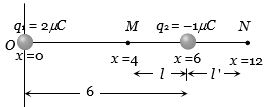
Point charges $q_1 = 2\,\mu C$ and $q_2 = -1\,\mu C$ are kept at points $x = 0$ and $x = 6$ respectively. Electrical potential will be zero at points
A
$x = 2$ and $x = 9$
B
$x = 1$ and $x = 5$
C
$x = 4$ and $x = 12$
D
$x = -2$ and $x = 2$
Solution
(C) The electric potential $V$ due to a point charge $q$ at a distance $r$ is given by $V = \frac{1}{4\pi\varepsilon_0} \frac{q}{r}$. The total potential is the algebraic sum of potentials due to individual charges.
Let the point where potential is zero be at position $x$. The potential is given by:
$V = \frac{1}{4\pi\varepsilon_0} \left[ \frac{q_1}{x} + \frac{q_2}{|x - 6|} \right] = 0$
Case $1$: Point between the charges $(0 < x < 6)$:
$\frac{2 \times 10^{-6}}{x} + \frac{-1 \times 10^{-6}}{6 - x} = 0$
$\frac{2}{x} = \frac{1}{6 - x} \implies 12 - 2x = x \implies 3x = 12 \implies x = 4$.
Case $2$: Point outside the charges $(x > 6)$:
$\frac{2 \times 10^{-6}}{x} + \frac{-1 \times 10^{-6}}{x - 6} = 0$
$\frac{2}{x} = \frac{1}{x - 6} \implies 2x - 12 = x \implies x = 12$.
Thus,the potential is zero at $x = 4$ and $x = 12$.
Let the point where potential is zero be at position $x$. The potential is given by:
$V = \frac{1}{4\pi\varepsilon_0} \left[ \frac{q_1}{x} + \frac{q_2}{|x - 6|} \right] = 0$
Case $1$: Point between the charges $(0 < x < 6)$:
$\frac{2 \times 10^{-6}}{x} + \frac{-1 \times 10^{-6}}{6 - x} = 0$
$\frac{2}{x} = \frac{1}{6 - x} \implies 12 - 2x = x \implies 3x = 12 \implies x = 4$.
Case $2$: Point outside the charges $(x > 6)$:
$\frac{2 \times 10^{-6}}{x} + \frac{-1 \times 10^{-6}}{x - 6} = 0$
$\frac{2}{x} = \frac{1}{x - 6} \implies 2x - 12 = x \implies x = 12$.
Thus,the potential is zero at $x = 4$ and $x = 12$.
0 likes
View Solution57
EasyMCQ
$A$ bullet of mass $2\,g$ has a charge of $2\,\mu C$. Through what potential difference must it be accelerated, starting from rest, to acquire a speed of $10\,m/s$?
A
$5\,kV$
B
$50\,kV$
C
$5\,V$
D
$50\,V$
Solution
(B) Given: Mass $m = 2\,g = 2 \times 10^{-3}\,kg$, Charge $q = 2\,\mu C = 2 \times 10^{-6}\,C$, Final velocity $v = 10\,m/s$, Initial velocity $u = 0\,m/s$.
According to the work-energy theorem, the work done by the electric field is equal to the change in kinetic energy:
$W = \Delta K$
$qV = \frac{1}{2}mv^2 - \frac{1}{2}mu^2$
Since $u = 0$, we have:
$qV = \frac{1}{2}mv^2$
$V = \frac{mv^2}{2q}$
Substituting the values:
$V = \frac{(2 \times 10^{-3}\,kg) \times (10\,m/s)^2}{2 \times (2 \times 10^{-6}\,C)}$
$V = \frac{2 \times 10^{-3} \times 100}{4 \times 10^{-6}}$
$V = \frac{2 \times 10^{-1}}{4 \times 10^{-6}} = 0.5 \times 10^5\,V = 50,000\,V = 50\,kV$.
Therefore, the required potential difference is $50\,kV$.
According to the work-energy theorem, the work done by the electric field is equal to the change in kinetic energy:
$W = \Delta K$
$qV = \frac{1}{2}mv^2 - \frac{1}{2}mu^2$
Since $u = 0$, we have:
$qV = \frac{1}{2}mv^2$
$V = \frac{mv^2}{2q}$
Substituting the values:
$V = \frac{(2 \times 10^{-3}\,kg) \times (10\,m/s)^2}{2 \times (2 \times 10^{-6}\,C)}$
$V = \frac{2 \times 10^{-3} \times 100}{4 \times 10^{-6}}$
$V = \frac{2 \times 10^{-1}}{4 \times 10^{-6}} = 0.5 \times 10^5\,V = 50,000\,V = 50\,kV$.
Therefore, the required potential difference is $50\,kV$.
0 likes
View Solution58
EasyMCQ
In a certain charge distribution,all points having zero potential can be joined by a circle $S$. Points inside $S$ have positive potential and points outside $S$ have negative potential. $A$ positive charge,which is free to move,is placed inside $S$. What will happen to the charge?
A
It will remain in equilibrium
B
It can move inside $S$,but it cannot cross $S$
C
It must cross $S$ at some time
D
It may move,but will ultimately return to its starting point
Solution
(C) positive charge naturally moves from a region of higher potential to a region of lower potential.
Since the potential inside the circle $S$ is positive and the potential outside is negative,the electric field lines will point from the inside to the outside.
Therefore,a free positive charge placed inside $S$ will experience an electric force directed towards the outside of $S$.
As a result,the charge will move from the region of positive potential to the region of negative potential,meaning it must cross the circle $S$ at some time.
Since the potential inside the circle $S$ is positive and the potential outside is negative,the electric field lines will point from the inside to the outside.
Therefore,a free positive charge placed inside $S$ will experience an electric force directed towards the outside of $S$.
As a result,the charge will move from the region of positive potential to the region of negative potential,meaning it must cross the circle $S$ at some time.
0 likes
View Solution59
DifficultMCQ
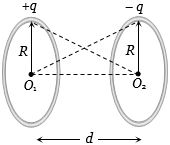
Two thin wire rings each having a radius $R$ are placed at a distance $d$ apart with their axes coinciding. The charges on the two rings are $+q$ and $-q$. The potential difference between the centres of the two rings is
A
Zero
B
$\frac{q}{4\pi \varepsilon_0} \left[ \frac{1}{R} - \frac{1}{\sqrt{R^2 + d^2}} \right]$
C
$\frac{qR}{4\pi \varepsilon_0 d^2}$
D
$\frac{q}{2\pi \varepsilon_0} \left[ \frac{1}{R} - \frac{1}{\sqrt{R^2 + d^2}} \right]$
Solution
(D) Let the centres of the two rings be $O_1$ and $O_2$. The potential at any point on the axis of a charged ring of radius $R$ and charge $Q$ at a distance $x$ from its centre is given by $V = \frac{1}{4\pi \varepsilon_0} \frac{Q}{\sqrt{R^2 + x^2}}$.
For the first ring (charge $+q$) at centre $O_1$:
Potential due to itself is $V_{1, self} = \frac{1}{4\pi \varepsilon_0} \frac{q}{R}$.
Potential due to the second ring (charge $-q$) at distance $d$ is $V_{1, other} = \frac{1}{4\pi \varepsilon_0} \frac{-q}{\sqrt{R^2 + d^2}}$.
So,$V_{O_1} = \frac{q}{4\pi \varepsilon_0} \left[ \frac{1}{R} - \frac{1}{\sqrt{R^2 + d^2}} \right]$.
For the second ring (charge $-q$) at centre $O_2$:
Potential due to itself is $V_{2, self} = \frac{1}{4\pi \varepsilon_0} \frac{-q}{R}$.
Potential due to the first ring (charge $+q$) at distance $d$ is $V_{2, other} = \frac{1}{4\pi \varepsilon_0} \frac{q}{\sqrt{R^2 + d^2}}$.
So,$V_{O_2} = \frac{q}{4\pi \varepsilon_0} \left[ -\frac{1}{R} + \frac{1}{\sqrt{R^2 + d^2}} \right] = -V_{O_1}$.
The potential difference is $\Delta V = V_{O_1} - V_{O_2} = V_{O_1} - (-V_{O_1}) = 2V_{O_1}$.
$\Delta V = 2 \cdot \frac{q}{4\pi \varepsilon_0} \left[ \frac{1}{R} - \frac{1}{\sqrt{R^2 + d^2}} \right] = \frac{q}{2\pi \varepsilon_0} \left[ \frac{1}{R} - \frac{1}{\sqrt{R^2 + d^2}} \right]$.
For the first ring (charge $+q$) at centre $O_1$:
Potential due to itself is $V_{1, self} = \frac{1}{4\pi \varepsilon_0} \frac{q}{R}$.
Potential due to the second ring (charge $-q$) at distance $d$ is $V_{1, other} = \frac{1}{4\pi \varepsilon_0} \frac{-q}{\sqrt{R^2 + d^2}}$.
So,$V_{O_1} = \frac{q}{4\pi \varepsilon_0} \left[ \frac{1}{R} - \frac{1}{\sqrt{R^2 + d^2}} \right]$.
For the second ring (charge $-q$) at centre $O_2$:
Potential due to itself is $V_{2, self} = \frac{1}{4\pi \varepsilon_0} \frac{-q}{R}$.
Potential due to the first ring (charge $+q$) at distance $d$ is $V_{2, other} = \frac{1}{4\pi \varepsilon_0} \frac{q}{\sqrt{R^2 + d^2}}$.
So,$V_{O_2} = \frac{q}{4\pi \varepsilon_0} \left[ -\frac{1}{R} + \frac{1}{\sqrt{R^2 + d^2}} \right] = -V_{O_1}$.
The potential difference is $\Delta V = V_{O_1} - V_{O_2} = V_{O_1} - (-V_{O_1}) = 2V_{O_1}$.
$\Delta V = 2 \cdot \frac{q}{4\pi \varepsilon_0} \left[ \frac{1}{R} - \frac{1}{\sqrt{R^2 + d^2}} \right] = \frac{q}{2\pi \varepsilon_0} \left[ \frac{1}{R} - \frac{1}{\sqrt{R^2 + d^2}} \right]$.
0 likes
View Solution60
EasyMCQ
If an electron moves from rest from a point at which potential is $50\, V$ to another point at which potential is $70\, V$,then its kinetic energy in the final state will be:
A
$3.2 \times 10^{-10} \, J$
B
$3.2 \times 10^{-18} \, J$
C
$1 \, N$
D
$1 \, dyne$
Solution
(B) The work done on a charge $q$ moving between two points with a potential difference $\Delta V$ is given by $W = q \Delta V$.
Since the electron starts from rest,the work done by the electric field is equal to the change in its kinetic energy.
The potential difference is $\Delta V = V_{final} - V_{initial} = 70\, V - 50\, V = 20\, V$.
The charge of an electron is $q = 1.6 \times 10^{-19} \, C$.
Therefore,the kinetic energy $K.E. = q \times \Delta V = (1.6 \times 10^{-19} \, C) \times (20 \, V) = 3.2 \times 10^{-18} \, J$.
Since the electron starts from rest,the work done by the electric field is equal to the change in its kinetic energy.
The potential difference is $\Delta V = V_{final} - V_{initial} = 70\, V - 50\, V = 20\, V$.
The charge of an electron is $q = 1.6 \times 10^{-19} \, C$.
Therefore,the kinetic energy $K.E. = q \times \Delta V = (1.6 \times 10^{-19} \, C) \times (20 \, V) = 3.2 \times 10^{-18} \, J$.
0 likes
View Solution61
EasyMCQ
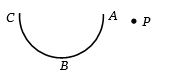
In the following diagram,the work done in moving a point charge from point $P$ to points $A$,$B$,and $C$ is $W_A$,$W_B$,and $W_C$ respectively. Then:
A
$W_A = W_B = W_C$
B
$W_A = W_B = W_C = 0$
C
$W_A > W_B > W_C$
D
$W_A < W_B < W_C$
Solution
(B) According to the figure,there is no external electric field present.
Work done in moving a charge $q$ in an electric field is given by $W = q \Delta V$.
Since there is no external charge or field,the electric potential $V$ is zero everywhere in the region.
Therefore,the potential difference between any two points is zero.
Consequently,the work done in moving a point charge from point $P$ to any point $A$,$B$,or $C$ is zero.
Thus,$W_A = W_B = W_C = 0$.
Work done in moving a charge $q$ in an electric field is given by $W = q \Delta V$.
Since there is no external charge or field,the electric potential $V$ is zero everywhere in the region.
Therefore,the potential difference between any two points is zero.
Consequently,the work done in moving a point charge from point $P$ to any point $A$,$B$,or $C$ is zero.
Thus,$W_A = W_B = W_C = 0$.
0 likes
View Solution62
EasyMCQ
$A$ hollow metallic sphere of radius $R$ is given a charge $Q$. Then the potential at the centre is
A
Zero
B
$\frac{1}{4\pi \varepsilon_0} \cdot \frac{Q}{R}$
C
$\frac{1}{4\pi \varepsilon_0} \cdot \frac{2Q}{R}$
D
$\frac{1}{4\pi \varepsilon_0} \cdot \frac{Q}{2R}$
Solution
(B) For a hollow metallic sphere of radius $R$ carrying a charge $Q$,the electric field inside the sphere is zero.
Since the electric field $E = -\frac{dV}{dr} = 0$,the potential $V$ must be constant throughout the interior of the sphere.
The potential at the surface of the sphere is given by $V = \frac{1}{4\pi \varepsilon_0} \cdot \frac{Q}{R}$.
Since the potential is constant inside,the potential at the centre is the same as the potential at the surface,which is $V = \frac{1}{4\pi \varepsilon_0} \cdot \frac{Q}{R}$.
Since the electric field $E = -\frac{dV}{dr} = 0$,the potential $V$ must be constant throughout the interior of the sphere.
The potential at the surface of the sphere is given by $V = \frac{1}{4\pi \varepsilon_0} \cdot \frac{Q}{R}$.
Since the potential is constant inside,the potential at the centre is the same as the potential at the surface,which is $V = \frac{1}{4\pi \varepsilon_0} \cdot \frac{Q}{R}$.
0 likes
View Solution63
EasyMCQ
No current flows between two charged bodies connected together when they have the same
A
Capacitance or $\frac{Q}{V}$ ratio
B
Charge
C
Resistance
D
Potential or $\frac{Q}{C}$ ratio
Solution
(D) Current flows between two conductors only when there is a potential difference between them.
When two charged bodies are connected,charge flows from the body at a higher potential to the body at a lower potential.
If both bodies are at the same potential,there is no potential difference,and therefore,no current will flow between them.
Thus,the correct condition is that they must have the same potential.
When two charged bodies are connected,charge flows from the body at a higher potential to the body at a lower potential.
If both bodies are at the same potential,there is no potential difference,and therefore,no current will flow between them.
Thus,the correct condition is that they must have the same potential.
0 likes
View Solution64
MediumMCQ
Eight small drops,each of radius $r$ and having same charge $q$,are combined to form a big drop. The ratio between the potentials of the bigger drop and the smaller drop is
A
$8:1$
B
$4:1$
C
$2:1$
D
$1:8$
Solution
(B) Let the radius of each small drop be $r$ and the charge be $q$. The potential of a small drop is $v = \frac{kq}{r}$.
When $n = 8$ drops combine to form a big drop of radius $R$,the volume remains constant: $\frac{4}{3} \pi R^3 = n \times \frac{4}{3} \pi r^3$,which gives $R = n^{1/3} r = 8^{1/3} r = 2r$.
The total charge on the big drop is $Q = nq = 8q$.
The potential of the big drop is $V = \frac{kQ}{R} = \frac{k(8q)}{2r} = 4 \left( \frac{kq}{r} \right) = 4v$.
Therefore,the ratio of the potential of the big drop to the small drop is $\frac{V}{v} = 4:1$.
When $n = 8$ drops combine to form a big drop of radius $R$,the volume remains constant: $\frac{4}{3} \pi R^3 = n \times \frac{4}{3} \pi r^3$,which gives $R = n^{1/3} r = 8^{1/3} r = 2r$.
The total charge on the big drop is $Q = nq = 8q$.
The potential of the big drop is $V = \frac{kQ}{R} = \frac{k(8q)}{2r} = 4 \left( \frac{kq}{r} \right) = 4v$.
Therefore,the ratio of the potential of the big drop to the small drop is $\frac{V}{v} = 4:1$.
0 likes
View Solution65
EasyMCQ
Twenty-seven drops of water of the same size are equally and similarly charged. They are then united to form a bigger drop. By what factor will the electrical potential change?
A
$9$
B
$27$
C
$6$
D
$3$
Solution
(A) Let the radius of each small drop be $r$ and the charge on each be $q$.
The potential of a small drop is $v = \frac{kq}{r}$.
When $n = 27$ drops unite to form a big drop of radius $R$,the volume remains conserved:
$\frac{4}{3} \pi R^3 = n \cdot \frac{4}{3} \pi r^3 \implies R^3 = n r^3 \implies R = n^{1/3} r$.
For $n = 27$,$R = (27)^{1/3} r = 3r$.
The total charge on the big drop is $Q = nq = 27q$.
The potential of the big drop is $V = \frac{kQ}{R} = \frac{k(nq)}{n^{1/3}r} = n^{2/3} \left( \frac{kq}{r} \right) = n^{2/3} v$.
Substituting $n = 27$,we get $V = (27)^{2/3} v = (3^3)^{2/3} v = 3^2 v = 9v$.
Thus,the potential increases by a factor of $9$.
The potential of a small drop is $v = \frac{kq}{r}$.
When $n = 27$ drops unite to form a big drop of radius $R$,the volume remains conserved:
$\frac{4}{3} \pi R^3 = n \cdot \frac{4}{3} \pi r^3 \implies R^3 = n r^3 \implies R = n^{1/3} r$.
For $n = 27$,$R = (27)^{1/3} r = 3r$.
The total charge on the big drop is $Q = nq = 27q$.
The potential of the big drop is $V = \frac{kQ}{R} = \frac{k(nq)}{n^{1/3}r} = n^{2/3} \left( \frac{kq}{r} \right) = n^{2/3} v$.
Substituting $n = 27$,we get $V = (27)^{2/3} v = (3^3)^{2/3} v = 3^2 v = 9v$.
Thus,the potential increases by a factor of $9$.
0 likes
View Solution66
MediumMCQ
$A$ charge of $10^{-9} \, C$ is placed on each of the $64$ identical drops of radius $2 \, cm$. They are then combined to form a bigger drop. Find its potential.
A
$7.2 \times 10^3 \, V$
B
$7.2 \times 10^2 \, V$
C
$1.44 \times 10^2 \, V$
D
$1.44 \times 10^3 \, V$
Solution
(A) Let the radius of each small drop be $r = 2 \, cm = 0.02 \, m$ and the charge on each be $q = 10^{-9} \, C$.
The potential of a small drop is $v = \frac{kq}{r} = \frac{9 \times 10^9 \times 10^{-9}}{0.02} = \frac{9}{0.02} = 450 \, V$.
When $n = 64$ drops combine to form a bigger drop of radius $R$,the volume remains constant: $\frac{4}{3}\pi R^3 = n \times \frac{4}{3}\pi r^3$,so $R = n^{1/3}r$.
The total charge on the big drop is $Q = nq$.
The potential of the big drop is $V = \frac{kQ}{R} = \frac{k(nq)}{n^{1/3}r} = n^{2/3} \times \frac{kq}{r} = n^{2/3}v$.
Substituting the values: $V = (64)^{2/3} \times 450 = (4^3)^{2/3} \times 450 = 4^2 \times 450 = 16 \times 450 = 7200 \, V$.
Thus,$V = 7.2 \times 10^3 \, V$.
The potential of a small drop is $v = \frac{kq}{r} = \frac{9 \times 10^9 \times 10^{-9}}{0.02} = \frac{9}{0.02} = 450 \, V$.
When $n = 64$ drops combine to form a bigger drop of radius $R$,the volume remains constant: $\frac{4}{3}\pi R^3 = n \times \frac{4}{3}\pi r^3$,so $R = n^{1/3}r$.
The total charge on the big drop is $Q = nq$.
The potential of the big drop is $V = \frac{kQ}{R} = \frac{k(nq)}{n^{1/3}r} = n^{2/3} \times \frac{kq}{r} = n^{2/3}v$.
Substituting the values: $V = (64)^{2/3} \times 450 = (4^3)^{2/3} \times 450 = 4^2 \times 450 = 16 \times 450 = 7200 \, V$.
Thus,$V = 7.2 \times 10^3 \, V$.
0 likes
View Solution67
EasyMCQ
$64$ drops of mercury,each charged to a potential of $10\,V$,are combined to form one bigger drop. The potential of this bigger drop will be.......$V$ (Assume all the drops to be spherical).
A
$160$
B
$80$
C
$10$
D
$640$
Solution
(A) Let the radius of each small drop be $r$ and its charge be $q$. The potential of a small drop is $v = \frac{kq}{r} = 10\,V$.
Let the radius of the big drop be $R$ and its charge be $Q$. Since the volume is conserved,the volume of $64$ small drops equals the volume of the big drop: $\frac{4}{3}\pi R^3 = 64 \times \frac{4}{3}\pi r^3$,which gives $R^3 = 64r^3$,so $R = 4r$.
The total charge of the big drop is $Q = 64q$.
The potential of the big drop is $V = \frac{kQ}{R} = \frac{k(64q)}{4r} = 16 \times \frac{kq}{r}$.
Substituting $v = \frac{kq}{r} = 10\,V$,we get $V = 16 \times 10 = 160\,V$.
Let the radius of the big drop be $R$ and its charge be $Q$. Since the volume is conserved,the volume of $64$ small drops equals the volume of the big drop: $\frac{4}{3}\pi R^3 = 64 \times \frac{4}{3}\pi r^3$,which gives $R^3 = 64r^3$,so $R = 4r$.
The total charge of the big drop is $Q = 64q$.
The potential of the big drop is $V = \frac{kQ}{R} = \frac{k(64q)}{4r} = 16 \times \frac{kq}{r}$.
Substituting $v = \frac{kq}{r} = 10\,V$,we get $V = 16 \times 10 = 160\,V$.
0 likes
View Solution68
MediumMCQ
If eight identical drops are joined to form a bigger drop,the potential on the bigger drop as compared to that on the smaller drop will be:
A
Double
B
Four times
C
Eight times
D
One time
Solution
(B) Let the radius of each small drop be $r$ and the charge on each be $q$. The potential of a small drop is $V = \frac{kq}{r}$.
When $n = 8$ drops are joined to form a bigger drop of radius $R$,the volume remains conserved: $\frac{4}{3}\pi R^3 = n \cdot \frac{4}{3}\pi r^3$,which gives $R = n^{1/3}r = 8^{1/3}r = 2r$.
The total charge on the bigger drop is $Q = nq = 8q$.
The potential of the bigger drop is $V' = \frac{kQ}{R} = \frac{k(nq)}{n^{1/3}r} = n^{2/3} \left( \frac{kq}{r} \right) = n^{2/3}V$.
Substituting $n = 8$,we get $V' = 8^{2/3}V = (2^3)^{2/3}V = 2^2 V = 4V$.
Therefore,the potential on the bigger drop is $4$ times that of the smaller drop.
When $n = 8$ drops are joined to form a bigger drop of radius $R$,the volume remains conserved: $\frac{4}{3}\pi R^3 = n \cdot \frac{4}{3}\pi r^3$,which gives $R = n^{1/3}r = 8^{1/3}r = 2r$.
The total charge on the bigger drop is $Q = nq = 8q$.
The potential of the bigger drop is $V' = \frac{kQ}{R} = \frac{k(nq)}{n^{1/3}r} = n^{2/3} \left( \frac{kq}{r} \right) = n^{2/3}V$.
Substituting $n = 8$,we get $V' = 8^{2/3}V = (2^3)^{2/3}V = 2^2 V = 4V$.
Therefore,the potential on the bigger drop is $4$ times that of the smaller drop.
0 likes
View Solution69
EasyMCQ
The potential to which a conductor is raised,depends on
A
The amount of charge
B
Geometry and size of the conductor
C
Both $(a)$ and $(b)$
D
Only on $(a)$
Solution
(C) The electric potential $V$ of a conductor is given by the relation $V = Q/C$.
Here,$Q$ represents the amount of charge given to the conductor.
$C$ represents the capacitance of the conductor,which is determined by its geometry,size,and the surrounding medium.
Therefore,the potential $V$ depends on both the amount of charge $Q$ and the capacitance $C$ (which depends on geometry and size).
Thus,the correct option is $(c)$.
Here,$Q$ represents the amount of charge given to the conductor.
$C$ represents the capacitance of the conductor,which is determined by its geometry,size,and the surrounding medium.
Therefore,the potential $V$ depends on both the amount of charge $Q$ and the capacitance $C$ (which depends on geometry and size).
Thus,the correct option is $(c)$.
0 likes
View Solution70
DifficultMCQ
If on the concentric hollow spheres of radii $r$ and $R$ $(R > r)$ the charge $Q$ is distributed such that their surface charge densities are the same,then the potential at their common centre is:
A
$\frac{Q(R^2 + r^2)}{4\pi \varepsilon_0(R + r)}$
B
$\frac{QR}{R + r}$
C
Zero
D
$\frac{Q(R + r)}{4\pi \varepsilon_0(R^2 + r^2)}$
Solution
(D) Let $q_1$ and $q_2$ be the charges on the spheres of radii $r$ and $R$ respectively. Given that $q_1 + q_2 = Q$.
Since surface charge densities are equal,$\sigma = \frac{q_1}{4\pi r^2} = \frac{q_2}{4\pi R^2}$.
This implies $\frac{q_1}{r^2} = \frac{q_2}{R^2}$,so $q_1 = q_2 \frac{r^2}{R^2}$.
Substituting this into the total charge equation: $q_2 \frac{r^2}{R^2} + q_2 = Q \implies q_2 \left( \frac{r^2 + R^2}{R^2} \right) = Q \implies q_2 = \frac{Q R^2}{R^2 + r^2}$.
Similarly,$q_1 = \frac{Q r^2}{R^2 + r^2}$.
The potential at the common centre is the sum of potentials due to both spheres: $V = \frac{1}{4\pi \varepsilon_0} \left( \frac{q_1}{r} + \frac{q_2}{R} \right)$.
Substituting the values of $q_1$ and $q_2$: $V = \frac{1}{4\pi \varepsilon_0} \left( \frac{Q r^2}{r(R^2 + r^2)} + \frac{Q R^2}{R(R^2 + r^2)} \right)$.
$V = \frac{1}{4\pi \varepsilon_0} \left( \frac{Q r}{R^2 + r^2} + \frac{Q R}{R^2 + r^2} \right) = \frac{Q(R + r)}{4\pi \varepsilon_0(R^2 + r^2)}$.
Since surface charge densities are equal,$\sigma = \frac{q_1}{4\pi r^2} = \frac{q_2}{4\pi R^2}$.
This implies $\frac{q_1}{r^2} = \frac{q_2}{R^2}$,so $q_1 = q_2 \frac{r^2}{R^2}$.
Substituting this into the total charge equation: $q_2 \frac{r^2}{R^2} + q_2 = Q \implies q_2 \left( \frac{r^2 + R^2}{R^2} \right) = Q \implies q_2 = \frac{Q R^2}{R^2 + r^2}$.
Similarly,$q_1 = \frac{Q r^2}{R^2 + r^2}$.
The potential at the common centre is the sum of potentials due to both spheres: $V = \frac{1}{4\pi \varepsilon_0} \left( \frac{q_1}{r} + \frac{q_2}{R} \right)$.
Substituting the values of $q_1$ and $q_2$: $V = \frac{1}{4\pi \varepsilon_0} \left( \frac{Q r^2}{r(R^2 + r^2)} + \frac{Q R^2}{R(R^2 + r^2)} \right)$.
$V = \frac{1}{4\pi \varepsilon_0} \left( \frac{Q r}{R^2 + r^2} + \frac{Q R}{R^2 + r^2} \right) = \frac{Q(R + r)}{4\pi \varepsilon_0(R^2 + r^2)}$.
0 likes
View Solution71
DifficultMCQ
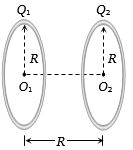
Two identical thin rings each of radius $R$ meters are coaxially placed at a distance $R$ meters apart. If $Q_1$ coulomb and $Q_2$ coulomb are respectively the charges uniformly spread on the two rings,the work done in moving a charge $q$ from the centre of one ring to that of other is
A
Zero
B
$\frac{q(Q_2 - Q_1)(\sqrt{2} - 1)}{\sqrt{2} \cdot 4\pi \varepsilon_0 R}$
C
$\frac{q\sqrt{2}(Q_1 + Q_2)}{4\pi \varepsilon_0 R}$
D
$\frac{q(Q_1 + Q_2)(\sqrt{2} + 1)}{\sqrt{2} \cdot 4\pi \varepsilon_0 R}$
Solution
(B) The work done $W$ in moving a charge $q$ from the centre of the first ring $(O_1)$ to the centre of the second ring $(O_2)$ is given by $W = q(V_{O_2} - V_{O_1})$.
The potential at the centre of the first ring $(O_1)$ due to both rings is:
$V_{O_1} = \frac{Q_1}{4\pi \varepsilon_0 R} + \frac{Q_2}{4\pi \varepsilon_0 \sqrt{R^2 + R^2}} = \frac{1}{4\pi \varepsilon_0 R} \left( Q_1 + \frac{Q_2}{\sqrt{2}} \right)$.
The potential at the centre of the second ring $(O_2)$ due to both rings is:
$V_{O_2} = \frac{Q_2}{4\pi \varepsilon_0 R} + \frac{Q_1}{4\pi \varepsilon_0 \sqrt{R^2 + R^2}} = \frac{1}{4\pi \varepsilon_0 R} \left( Q_2 + \frac{Q_1}{\sqrt{2}} \right)$.
The potential difference is:
$V_{O_2} - V_{O_1} = \frac{1}{4\pi \varepsilon_0 R} \left( Q_2 + \frac{Q_1}{\sqrt{2}} - Q_1 - \frac{Q_2}{\sqrt{2}} \right) = \frac{1}{4\pi \varepsilon_0 R} \left( (Q_2 - Q_1) - \frac{1}{\sqrt{2}}(Q_2 - Q_1) \right) = \frac{Q_2 - Q_1}{4\pi \varepsilon_0 R} \left( 1 - \frac{1}{\sqrt{2}} \right) = \frac{(Q_2 - Q_1)(\sqrt{2} - 1)}{\sqrt{2} \cdot 4\pi \varepsilon_0 R}$.
Therefore,the work done is $W = \frac{q(Q_2 - Q_1)(\sqrt{2} - 1)}{\sqrt{2} \cdot 4\pi \varepsilon_0 R}$.
The potential at the centre of the first ring $(O_1)$ due to both rings is:
$V_{O_1} = \frac{Q_1}{4\pi \varepsilon_0 R} + \frac{Q_2}{4\pi \varepsilon_0 \sqrt{R^2 + R^2}} = \frac{1}{4\pi \varepsilon_0 R} \left( Q_1 + \frac{Q_2}{\sqrt{2}} \right)$.
The potential at the centre of the second ring $(O_2)$ due to both rings is:
$V_{O_2} = \frac{Q_2}{4\pi \varepsilon_0 R} + \frac{Q_1}{4\pi \varepsilon_0 \sqrt{R^2 + R^2}} = \frac{1}{4\pi \varepsilon_0 R} \left( Q_2 + \frac{Q_1}{\sqrt{2}} \right)$.
The potential difference is:
$V_{O_2} - V_{O_1} = \frac{1}{4\pi \varepsilon_0 R} \left( Q_2 + \frac{Q_1}{\sqrt{2}} - Q_1 - \frac{Q_2}{\sqrt{2}} \right) = \frac{1}{4\pi \varepsilon_0 R} \left( (Q_2 - Q_1) - \frac{1}{\sqrt{2}}(Q_2 - Q_1) \right) = \frac{Q_2 - Q_1}{4\pi \varepsilon_0 R} \left( 1 - \frac{1}{\sqrt{2}} \right) = \frac{(Q_2 - Q_1)(\sqrt{2} - 1)}{\sqrt{2} \cdot 4\pi \varepsilon_0 R}$.
Therefore,the work done is $W = \frac{q(Q_2 - Q_1)(\sqrt{2} - 1)}{\sqrt{2} \cdot 4\pi \varepsilon_0 R}$.
0 likes
View Solution72
DifficultMCQ
A charge $+q$ is fixed at each of the points $x = x_0, x = 3x_0, x = 5x_0, \dots, \infty$ on the $x$-axis, and a charge $-q$ is fixed at each of the points $x = 2x_0, x = 4x_0, x = 6x_0, \dots, \infty$. Here $x_0$ is a positive constant. Take the electric potential at a point due to a charge $Q$ at a distance $r$ from it to be $Q/(4\pi\varepsilon_0 r)$. Then, the potential at the origin due to the above system of charges is:
A
$0$
B
$\frac{q}{8\pi\varepsilon_0 x_0 \ln 2}$
C
$\infty$
D
$\frac{q \ln 2}{4\pi\varepsilon_0 x_0}$
Solution
(D) The electric potential $V$ at the origin due to a system of point charges is given by the sum $V = \sum \frac{1}{4\pi\varepsilon_0} \frac{q_i}{r_i}$.
Substituting the given positions and charges:
$V = \frac{1}{4\pi\varepsilon_0} \left[ \left( \frac{q}{x_0} + \frac{q}{3x_0} + \frac{q}{5x_0} + \dots \right) - \left( \frac{q}{2x_0} + \frac{q}{4x_0} + \frac{q}{6x_0} + \dots \right) \right]$
$V = \frac{q}{4\pi\varepsilon_0 x_0} \left[ 1 - \frac{1}{2} + \frac{1}{3} - \frac{1}{4} + \frac{1}{5} - \dots \right]$
Using the Taylor series expansion for $\ln(1+x) = x - \frac{x^2}{2} + \frac{x^3}{3} - \dots$, for $x=1$, we get $\ln(2) = 1 - \frac{1}{2} + \frac{1}{3} - \frac{1}{4} + \dots$
Therefore, $V = \frac{q \ln 2}{4\pi\varepsilon_0 x_0}$.
Substituting the given positions and charges:
$V = \frac{1}{4\pi\varepsilon_0} \left[ \left( \frac{q}{x_0} + \frac{q}{3x_0} + \frac{q}{5x_0} + \dots \right) - \left( \frac{q}{2x_0} + \frac{q}{4x_0} + \frac{q}{6x_0} + \dots \right) \right]$
$V = \frac{q}{4\pi\varepsilon_0 x_0} \left[ 1 - \frac{1}{2} + \frac{1}{3} - \frac{1}{4} + \frac{1}{5} - \dots \right]$
Using the Taylor series expansion for $\ln(1+x) = x - \frac{x^2}{2} + \frac{x^3}{3} - \dots$, for $x=1$, we get $\ln(2) = 1 - \frac{1}{2} + \frac{1}{3} - \frac{1}{4} + \dots$
Therefore, $V = \frac{q \ln 2}{4\pi\varepsilon_0 x_0}$.
0 likes
View Solution73
MediumMCQ
$A$ non-conducting ring of radius $0.5\,m$ carries a total charge of $1.11 \times 10^{-10}\,C$ distributed non-uniformly on its circumference,producing an electric field $\vec{E}$ everywhere in space. The value of the line integral $\int_{l = \infty }^{l = 0} { - \vec{E} \cdot d\vec{l} }$ (where $l = 0$ is the centre of the ring) in volts is:
A
$2$
B
$-1$
C
$-2$
D
$0$
Solution
(A) The line integral of the electric field from infinity to a point $P$ is defined as the electric potential $V$ at that point.
$\int_{\infty}^{P} -\vec{E} \cdot d\vec{l} = V_P - V_{\infty}$.
Since the potential at infinity $V_{\infty} = 0$,the integral represents the potential at the centre of the ring.
For a ring of radius $R$ with total charge $q$,the potential at the centre is given by $V = \frac{1}{4\pi\epsilon_0} \frac{q}{R}$.
Given $q = 1.11 \times 10^{-10}\,C$,$R = 0.5\,m$,and $\frac{1}{4\pi\epsilon_0} = 9 \times 10^9\,N\cdot m^2/C^2$.
$V = (9 \times 10^9) \times \frac{1.11 \times 10^{-10}}{0.5} = \frac{9.99 \times 10^{-1}}{0.5} = \frac{0.999}{0.5} \approx 2\,V$.
$\int_{\infty}^{P} -\vec{E} \cdot d\vec{l} = V_P - V_{\infty}$.
Since the potential at infinity $V_{\infty} = 0$,the integral represents the potential at the centre of the ring.
For a ring of radius $R$ with total charge $q$,the potential at the centre is given by $V = \frac{1}{4\pi\epsilon_0} \frac{q}{R}$.
Given $q = 1.11 \times 10^{-10}\,C$,$R = 0.5\,m$,and $\frac{1}{4\pi\epsilon_0} = 9 \times 10^9\,N\cdot m^2/C^2$.
$V = (9 \times 10^9) \times \frac{1.11 \times 10^{-10}}{0.5} = \frac{9.99 \times 10^{-1}}{0.5} = \frac{0.999}{0.5} \approx 2\,V$.
0 likes
View Solution74
DifficultMCQ
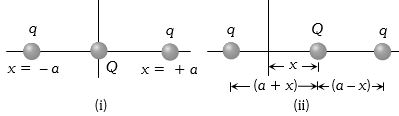
Two equal point charges are fixed at $x = -a$ and $x = +a$ on the $x$-axis. Another point charge $Q$ is placed at the origin. The change in the electrical potential energy of $Q$,when it is displaced by a small distance $x$ along the $x$-axis,is approximately proportional to
A
$x$
B
$x^2$
C
$x^3$
D
$1/x$
Solution
(B) Initially,according to figure $(i)$,the potential energy of $Q$ is $U_i = \frac{2kqQ}{a}$ ... $(i)$
According to figure $(ii)$,when charge $Q$ is displaced by a small distance $x$,its potential energy becomes:
$U_f = kqQ \left[ \frac{1}{a+x} + \frac{1}{a-x} \right] = kqQ \left[ \frac{(a-x) + (a+x)}{a^2 - x^2} \right] = \frac{2kqQa}{a^2 - x^2}$ ... $(ii)$
Hence,the change in potential energy is:
$\Delta U = U_f - U_i = 2kqQ \left[ \frac{a}{a^2 - x^2} - \frac{1}{a} \right] = 2kqQ \left[ \frac{a^2 - (a^2 - x^2)}{a(a^2 - x^2)} \right] = \frac{2kqQx^2}{a(a^2 - x^2)}$
Since $x << a$,we can approximate $a^2 - x^2 \approx a^2$. Therefore:
$\Delta U \approx \frac{2kqQx^2}{a(a^2)} = \frac{2kqQ}{a^3} x^2$
Thus,$\Delta U \propto x^2$.
According to figure $(ii)$,when charge $Q$ is displaced by a small distance $x$,its potential energy becomes:
$U_f = kqQ \left[ \frac{1}{a+x} + \frac{1}{a-x} \right] = kqQ \left[ \frac{(a-x) + (a+x)}{a^2 - x^2} \right] = \frac{2kqQa}{a^2 - x^2}$ ... $(ii)$
Hence,the change in potential energy is:
$\Delta U = U_f - U_i = 2kqQ \left[ \frac{a}{a^2 - x^2} - \frac{1}{a} \right] = 2kqQ \left[ \frac{a^2 - (a^2 - x^2)}{a(a^2 - x^2)} \right] = \frac{2kqQx^2}{a(a^2 - x^2)}$
Since $x << a$,we can approximate $a^2 - x^2 \approx a^2$. Therefore:
$\Delta U \approx \frac{2kqQx^2}{a(a^2)} = \frac{2kqQ}{a^3} x^2$
Thus,$\Delta U \propto x^2$.
0 likes
View Solution75
DifficultMCQ
$A$ solid conducting sphere having a charge $Q$ is surrounded by an uncharged concentric conducting hollow spherical shell. Let the potential difference between the surface of the solid sphere and that of the outer surface of the hollow shell be $V$. If the shell is now given a charge of $-3Q$,the new potential difference between the same two surfaces is......$V$
A
$1$
B
$2$
C
$4$
D
$-2$
Solution
(A) Let the radius of the solid sphere be $a$ and the radius of the hollow shell be $b$.
Initially,the solid sphere has charge $Q$ and the shell has charge $0$.
The potential at the surface of the solid sphere is $V_{\text{sphere}} = \frac{1}{4\pi\varepsilon_0} \frac{Q}{a} + \frac{1}{4\pi\varepsilon_0} \frac{0}{b} = \frac{1}{4\pi\varepsilon_0} \frac{Q}{a}$.
The potential at the surface of the hollow shell is $V_{\text{shell}} = \frac{1}{4\pi\varepsilon_0} \frac{Q}{b} + \frac{1}{4\pi\varepsilon_0} \frac{0}{b} = \frac{1}{4\pi\varepsilon_0} \frac{Q}{b}$.
The initial potential difference is $V = V_{\text{sphere}} - V_{\text{shell}} = \frac{Q}{4\pi\varepsilon_0} \left( \frac{1}{a} - \frac{1}{b} \right)$.
Now,the shell is given a charge of $-3Q$.
The new potential at the surface of the solid sphere is $V'_{\text{sphere}} = \frac{1}{4\pi\varepsilon_0} \frac{Q}{a} + \frac{1}{4\pi\varepsilon_0} \frac{-3Q}{b}$.
The new potential at the surface of the hollow shell is $V'_{\text{shell}} = \frac{1}{4\pi\varepsilon_0} \frac{Q}{b} + \frac{1}{4\pi\varepsilon_0} \frac{-3Q}{b} = \frac{1}{4\pi\varepsilon_0} \left( -\frac{2Q}{b} \right)$.
The new potential difference is $V' = V'_{\text{sphere}} - V'_{\text{shell}} = \frac{1}{4\pi\varepsilon_0} \left( \frac{Q}{a} - \frac{3Q}{b} - (-\frac{2Q}{b}) \right) = \frac{1}{4\pi\varepsilon_0} \left( \frac{Q}{a} - \frac{Q}{b} \right) = V$.
Initially,the solid sphere has charge $Q$ and the shell has charge $0$.
The potential at the surface of the solid sphere is $V_{\text{sphere}} = \frac{1}{4\pi\varepsilon_0} \frac{Q}{a} + \frac{1}{4\pi\varepsilon_0} \frac{0}{b} = \frac{1}{4\pi\varepsilon_0} \frac{Q}{a}$.
The potential at the surface of the hollow shell is $V_{\text{shell}} = \frac{1}{4\pi\varepsilon_0} \frac{Q}{b} + \frac{1}{4\pi\varepsilon_0} \frac{0}{b} = \frac{1}{4\pi\varepsilon_0} \frac{Q}{b}$.
The initial potential difference is $V = V_{\text{sphere}} - V_{\text{shell}} = \frac{Q}{4\pi\varepsilon_0} \left( \frac{1}{a} - \frac{1}{b} \right)$.
Now,the shell is given a charge of $-3Q$.
The new potential at the surface of the solid sphere is $V'_{\text{sphere}} = \frac{1}{4\pi\varepsilon_0} \frac{Q}{a} + \frac{1}{4\pi\varepsilon_0} \frac{-3Q}{b}$.
The new potential at the surface of the hollow shell is $V'_{\text{shell}} = \frac{1}{4\pi\varepsilon_0} \frac{Q}{b} + \frac{1}{4\pi\varepsilon_0} \frac{-3Q}{b} = \frac{1}{4\pi\varepsilon_0} \left( -\frac{2Q}{b} \right)$.
The new potential difference is $V' = V'_{\text{sphere}} - V'_{\text{shell}} = \frac{1}{4\pi\varepsilon_0} \left( \frac{Q}{a} - \frac{3Q}{b} - (-\frac{2Q}{b}) \right) = \frac{1}{4\pi\varepsilon_0} \left( \frac{Q}{a} - \frac{Q}{b} \right) = V$.
0 likes
View Solution76
EasyMCQ
For a hollow spherical shell,how does the potential $(V)$ change with respect to the distance $(r)$ from the centre?
A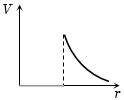
B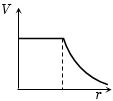
C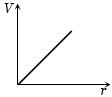
D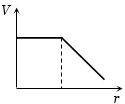
Solution
(B) For a hollow spherical shell of radius $R$ carrying charge $Q$:
$1$. Inside the shell $(r \le R)$,the electric field is zero,which implies that the potential is constant and equal to the potential at the surface: $V_{inside} = \frac{Q}{4\pi \varepsilon_0 R}$.
$2$. Outside the shell $(r \ge R)$,the shell behaves like a point charge placed at the centre,so the potential varies as $V_{out} = \frac{Q}{4\pi \varepsilon_0 r}$,which means $V \propto \frac{1}{r}$.
$3$. Comparing this with the given options,Graph $B$ correctly shows a constant potential for $r \le R$ and a hyperbolic decrease for $r > R$.
$1$. Inside the shell $(r \le R)$,the electric field is zero,which implies that the potential is constant and equal to the potential at the surface: $V_{inside} = \frac{Q}{4\pi \varepsilon_0 R}$.
$2$. Outside the shell $(r \ge R)$,the shell behaves like a point charge placed at the centre,so the potential varies as $V_{out} = \frac{Q}{4\pi \varepsilon_0 r}$,which means $V \propto \frac{1}{r}$.
$3$. Comparing this with the given options,Graph $B$ correctly shows a constant potential for $r \le R$ and a hyperbolic decrease for $r > R$.
0 likes
View Solution77
EasyMCQ
The mass of a particle is $400$ times that of an electron and its charge is double that of an electron. The particle is accelerated by a potential difference of $5 \; V$. If the particle was initially at rest,what will be its final kinetic energy in $eV$?
A
$5$
B
$10$
C
$100$
D
$2000$
Solution
(B) The kinetic energy $K$ gained by a charged particle accelerated through a potential difference $V$ is given by the formula $K = qV$.
Here,the charge of the particle is $q = 2e$,where $e$ is the elementary charge of an electron.
The potential difference is $V = 5 \; V$.
Substituting these values into the formula:
$K = (2e) \times (5 \; V)$
$K = 10 \; eV$.
Therefore,the final kinetic energy of the particle is $10 \; eV$.
Here,the charge of the particle is $q = 2e$,where $e$ is the elementary charge of an electron.
The potential difference is $V = 5 \; V$.
Substituting these values into the formula:
$K = (2e) \times (5 \; V)$
$K = 10 \; eV$.
Therefore,the final kinetic energy of the particle is $10 \; eV$.
0 likes
View Solution78
EasyMCQ
An electron (charge = $1.6 \times 10^{-19} \text{ C}$) is accelerated through a potential of $100,000 \text{ V}$. The energy acquired by the electron is:
A
$1.6 \times 10^{-24} \text{ J}$
B
$1.6 \times 10^{-14} \text{ erg}$
C
$0.53 \times 10^{-17} \text{ J}$
D
$1.6 \times 10^{-14} \text{ J}$
Solution
(D) The energy $E$ acquired by a charged particle accelerated through a potential difference $V$ is given by the formula $E = qV$.
Here,the charge of the electron is $q = 1.6 \times 10^{-19} \text{ C}$ and the potential difference is $V = 100,000 \text{ V} = 10^5 \text{ V}$.
Substituting these values into the formula:
$E = (1.6 \times 10^{-19} \text{ C}) \times (10^5 \text{ V})$
$E = 1.6 \times 10^{-14} \text{ J}$.
Therefore,the correct option is $D$.
Here,the charge of the electron is $q = 1.6 \times 10^{-19} \text{ C}$ and the potential difference is $V = 100,000 \text{ V} = 10^5 \text{ V}$.
Substituting these values into the formula:
$E = (1.6 \times 10^{-19} \text{ C}) \times (10^5 \text{ V})$
$E = 1.6 \times 10^{-14} \text{ J}$.
Therefore,the correct option is $D$.
0 likes
View Solution79
EasyMCQ
Energy of electrons can be increased by allowing them
A
To fall through electric potential
B
To move in a high magnetic field
C
To fall from great heights
D
To pass through lead blocks
Solution
(A) When an electron of charge $e$ is accelerated through a potential difference $V$,the work done on the electron by the electric field is $W = eV$.
This work done is converted into the kinetic energy $(K)$ of the electron.
Therefore,$K = eV$.
As the potential difference $V$ increases,the kinetic energy of the electron increases.
Thus,the energy of electrons can be increased by allowing them to fall through an electric potential.
This work done is converted into the kinetic energy $(K)$ of the electron.
Therefore,$K = eV$.
As the potential difference $V$ increases,the kinetic energy of the electron increases.
Thus,the energy of electrons can be increased by allowing them to fall through an electric potential.
0 likes
View Solution80
EasyMCQ
An electron of charge $e$ coulomb passes through a potential difference of $V$ volts. Its energy in joules will be
A
$V/e$
B
$eV$
C
$e/V$
D
$V$
Solution
(B) The work done on a charge $q$ moving through a potential difference $V$ is given by the formula $W = qV$.
Here,the charge of the electron is $q = e$ and the potential difference is $V$.
Therefore,the energy acquired by the electron is $K = e \times V = eV$ joules.
Here,the charge of the electron is $q = e$ and the potential difference is $V$.
Therefore,the energy acquired by the electron is $K = e \times V = eV$ joules.
0 likes
View Solution81
EasyMCQ
Electron volt is a unit of
A
Potential
B
Charge
C
Power
D
Energy
Solution
(D) The correct option is $D$.
The electron volt (symbol $eV$) is a unit of energy.
By definition,$1 \ eV$ is the amount of kinetic energy gained by a single electron accelerating from rest through an electric potential difference of $1 \ V$.
Mathematically,$1 \ eV = 1.602 \times 10^{-19} \ J$,where $J$ is the $SI$ unit of energy,the Joule.
The electron volt (symbol $eV$) is a unit of energy.
By definition,$1 \ eV$ is the amount of kinetic energy gained by a single electron accelerating from rest through an electric potential difference of $1 \ V$.
Mathematically,$1 \ eV = 1.602 \times 10^{-19} \ J$,where $J$ is the $SI$ unit of energy,the Joule.
0 likes
View Solution82
EasyMCQ
The electric potential at a distance of $R/2$ from the center of a charged conducting sphere of radius $R$ is .......
A
$0$
B
$\frac{Q}{8\pi \epsilon_0 R}$
C
$\frac{Q}{4\pi \epsilon_0 R}$
D
$\frac{Q}{2\pi \epsilon_0 R}$
Solution
(C) For a charged conducting sphere of radius $R$,the charge $Q$ resides entirely on its surface.
Inside the sphere (for distance $r < R$),the electric field is zero.
Since the electric field is zero inside the conductor,the potential remains constant and is equal to the potential at the surface.
The potential at the surface of the sphere is given by $V = \frac{Q}{4\pi \epsilon_0 R}$.
Therefore,at any point inside the sphere,including the distance $R/2$ from the center,the potential is $V = \frac{Q}{4\pi \epsilon_0 R}$.
Inside the sphere (for distance $r < R$),the electric field is zero.
Since the electric field is zero inside the conductor,the potential remains constant and is equal to the potential at the surface.
The potential at the surface of the sphere is given by $V = \frac{Q}{4\pi \epsilon_0 R}$.
Therefore,at any point inside the sphere,including the distance $R/2$ from the center,the potential is $V = \frac{Q}{4\pi \epsilon_0 R}$.
0 likes
View Solution83
DifficultMCQ
Two thin circular rings of radius $R$ are placed with their axes coinciding. The charges on the two rings are $+q$ and $-q$. The potential difference between the centers of the two rings is:
A
$\frac{qR}{4\pi \epsilon_0 d^2}$
B
$\frac{q}{2\pi \epsilon_0} \left[ \frac{1}{R} - \frac{1}{\sqrt{R^2 + d^2}} \right]$
C
$0$
D
$\frac{q}{4\pi \epsilon_0} \left[ \frac{1}{R} - \frac{1}{\sqrt{R^2 + d^2}} \right]$
Solution
(B) The electric potential at a distance $x$ from the center of a charged ring of radius $R$ along its axis is $V = \frac{q}{4\pi \epsilon_0 \sqrt{x^2 + R^2}}$.
Let the centers of the rings be $C_1$ and $C_2$,separated by distance $d$. The potential at $C_1$ is the sum of the potential due to the ring at $C_1$ (charge $+q$) and the potential due to the ring at $C_2$ (charge $-q$):
$V_1 = \frac{q}{4\pi \epsilon_0 R} + \frac{-q}{4\pi \epsilon_0 \sqrt{d^2 + R^2}}$.
The potential at $C_2$ is the sum of the potential due to the ring at $C_2$ (charge $-q$) and the potential due to the ring at $C_1$ (charge $+q$):
$V_2 = \frac{-q}{4\pi \epsilon_0 R} + \frac{q}{4\pi \epsilon_0 \sqrt{d^2 + R^2}}$.
The potential difference between the centers is $\Delta V = V_1 - V_2$:
$\Delta V = \left( \frac{q}{4\pi \epsilon_0 R} - \frac{q}{4\pi \epsilon_0 \sqrt{d^2 + R^2}} \right) - \left( -\frac{q}{4\pi \epsilon_0 R} + \frac{q}{4\pi \epsilon_0 \sqrt{d^2 + R^2}} \right)$
$\Delta V = \frac{q}{4\pi \epsilon_0} \left( \frac{1}{R} - \frac{1}{\sqrt{d^2 + R^2}} + \frac{1}{R} - \frac{1}{\sqrt{d^2 + R^2}} \right)$
$\Delta V = \frac{q}{4\pi \epsilon_0} \cdot 2 \left( \frac{1}{R} - \frac{1}{\sqrt{d^2 + R^2}} \right) = \frac{q}{2\pi \epsilon_0} \left( \frac{1}{R} - \frac{1}{\sqrt{d^2 + R^2}} \right)$.
Let the centers of the rings be $C_1$ and $C_2$,separated by distance $d$. The potential at $C_1$ is the sum of the potential due to the ring at $C_1$ (charge $+q$) and the potential due to the ring at $C_2$ (charge $-q$):
$V_1 = \frac{q}{4\pi \epsilon_0 R} + \frac{-q}{4\pi \epsilon_0 \sqrt{d^2 + R^2}}$.
The potential at $C_2$ is the sum of the potential due to the ring at $C_2$ (charge $-q$) and the potential due to the ring at $C_1$ (charge $+q$):
$V_2 = \frac{-q}{4\pi \epsilon_0 R} + \frac{q}{4\pi \epsilon_0 \sqrt{d^2 + R^2}}$.
The potential difference between the centers is $\Delta V = V_1 - V_2$:
$\Delta V = \left( \frac{q}{4\pi \epsilon_0 R} - \frac{q}{4\pi \epsilon_0 \sqrt{d^2 + R^2}} \right) - \left( -\frac{q}{4\pi \epsilon_0 R} + \frac{q}{4\pi \epsilon_0 \sqrt{d^2 + R^2}} \right)$
$\Delta V = \frac{q}{4\pi \epsilon_0} \left( \frac{1}{R} - \frac{1}{\sqrt{d^2 + R^2}} + \frac{1}{R} - \frac{1}{\sqrt{d^2 + R^2}} \right)$
$\Delta V = \frac{q}{4\pi \epsilon_0} \cdot 2 \left( \frac{1}{R} - \frac{1}{\sqrt{d^2 + R^2}} \right) = \frac{q}{2\pi \epsilon_0} \left( \frac{1}{R} - \frac{1}{\sqrt{d^2 + R^2}} \right)$.
0 likes
View Solution84
EasyMCQ
The electric potential at a distance $r$ outside a uniformly charged sphere (where $a$ is the radius of the sphere) is proportional to:
A
Proportional to $a^3$
B
Proportional to $r$
C
Inversely proportional to $r$
D
Inversely proportional to $a^3$
Solution
(C) For a uniformly charged sphere of radius $a$ and total charge $Q$,the electric potential $V$ at a distance $r$ from the center,where $r > a$,is given by the formula:
$V = \frac{1}{4\pi\epsilon_0} \cdot \frac{Q}{r}$
Here,$\frac{1}{4\pi\epsilon_0}$ and $Q$ are constants.
Therefore,the electric potential $V$ is inversely proportional to the distance $r$ from the center of the sphere $(V \propto \frac{1}{r})$.
Thus,the correct option is $C$.
$V = \frac{1}{4\pi\epsilon_0} \cdot \frac{Q}{r}$
Here,$\frac{1}{4\pi\epsilon_0}$ and $Q$ are constants.
Therefore,the electric potential $V$ is inversely proportional to the distance $r$ from the center of the sphere $(V \propto \frac{1}{r})$.
Thus,the correct option is $C$.
0 likes
View Solution85
EasyMCQ
Which of the following statements is correct?
A
If the electric field due to a point charge varied as $1/r^2$ instead of $1/r^2$,Gauss's law would still be valid.
B
Gauss's law is used to calculate the field distribution around an electric dipole.
C
If the electric field between two point charges is zero at some point,the two charges must have the same sign.
D
The work done by an external force in moving a unit positive charge from a point $A$ at potential $V_A$ to a point $B$ at potential $V_B$ is $(V_B - V_A)$.
Solution
(D) $1$. Option $A$ is incorrect because Gauss's law is a direct consequence of the inverse square law $(1/r^2)$. If the field varied as $1/r^n$ where $n \neq 2$,the flux would depend on the shape of the surface,not just the enclosed charge.
$2$. Option $B$ is incorrect because while Gauss's law is always true,it is only useful for calculating field distributions when there is high symmetry (like spherical,cylindrical,or planar symmetry). $A$ dipole lacks such symmetry.
$3$. Option $C$ is incorrect because for two point charges,the electric field is zero at a point between them only if the charges have the same sign (repulsive force). If they had opposite signs,the field would be zero outside the region between them.
$4$. Option $D$ is correct. By definition,the potential difference $V_B - V_A$ is the work done by an external agent in moving a unit positive charge from $A$ to $B$ without acceleration.
$2$. Option $B$ is incorrect because while Gauss's law is always true,it is only useful for calculating field distributions when there is high symmetry (like spherical,cylindrical,or planar symmetry). $A$ dipole lacks such symmetry.
$3$. Option $C$ is incorrect because for two point charges,the electric field is zero at a point between them only if the charges have the same sign (repulsive force). If they had opposite signs,the field would be zero outside the region between them.
$4$. Option $D$ is correct. By definition,the potential difference $V_B - V_A$ is the work done by an external agent in moving a unit positive charge from $A$ to $B$ without acceleration.
0 likes
View Solution86
MediumMCQ
For a conducting sphere of radius $R$ carrying a charge $Q$,what is the electric potential at a distance $x$ from the center inside the sphere?
A
$\frac{1}{4\pi \varepsilon_0} \frac{Q}{R}$
B
$\frac{1}{4\pi \varepsilon_0} \frac{Q}{x}$
C
$\frac{1}{4\pi \varepsilon_0} \frac{Qx}{R^2}$
D
Zero
Solution
(A) For a conducting sphere,the charge $Q$ resides entirely on its outer surface.
Since the electric field $E$ inside a conducting sphere is zero,the potential $V$ remains constant throughout the interior.
The potential inside the sphere is equal to the potential at its surface.
Therefore,at any distance $x < R$ from the center,the potential is $V = \frac{1}{4\pi \varepsilon_0} \frac{Q}{R}$.
Since the electric field $E$ inside a conducting sphere is zero,the potential $V$ remains constant throughout the interior.
The potential inside the sphere is equal to the potential at its surface.
Therefore,at any distance $x < R$ from the center,the potential is $V = \frac{1}{4\pi \varepsilon_0} \frac{Q}{R}$.
0 likes
View Solution87
MediumMCQ
The electric potential at the surface of a hollow metallic sphere is $10\, V$. What will be the electric potential at its center (in $, V$)?
A
$10$
B
$5$
C
$2.5$
D
$0$
Solution
(A) For a hollow metallic sphere,the electric field inside the sphere is zero $(E = 0)$.
Since the electric field is the negative gradient of the potential $(E = -dV/dr)$,if $E = 0$,then the potential $V$ must be constant throughout the interior of the sphere.
Therefore,the potential at the center $(V_C)$ is equal to the potential at the surface $(V_S)$.
Given $V_S = 10\, V$,the potential at the center is $V_C = 10\, V$.
Since the electric field is the negative gradient of the potential $(E = -dV/dr)$,if $E = 0$,then the potential $V$ must be constant throughout the interior of the sphere.
Therefore,the potential at the center $(V_C)$ is equal to the potential at the surface $(V_S)$.
Given $V_S = 10\, V$,the potential at the center is $V_C = 10\, V$.
0 likes
View Solution88
DifficultMCQ
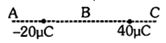
Two point charges $-20 \,\mu C$ and $+40 \,\mu C$ are separated by a distance $r$. At which region$(s)$ will the electric potential be zero?
A
Region $A$
B
Region $B$
C
Region $C$
D
Region $A$ and $B$
Solution
(D) The electric potential $V$ due to a point charge $q$ at a distance $x$ is given by $V = \frac{kq}{x}$.
For two charges $q_1 = -20 \,\mu C$ and $q_2 = +40 \,\mu C$ separated by distance $r$,the total potential $V = V_1 + V_2 = 0$.
This implies $\frac{kq_1}{x_1} + \frac{kq_2}{x_2} = 0$,or $\frac{|q_1|}{x_1} = \frac{|q_2|}{x_2}$.
Since $|q_1| < |q_2|$,the point where potential is zero must be closer to the smaller charge $(-20 \,\mu C)$.
$1$. In Region $A$ (to the left of $-20 \,\mu C$): Let the distance from $-20 \,\mu C$ be $x$. Then $\frac{20}{x} = \frac{40}{r+x} \implies 20r + 20x = 40x \implies 20x = 20r \implies x = r$. Thus,potential is zero in Region $A$.
$2$. In Region $B$ (between the charges): Let the distance from $-20 \,\mu C$ be $x$. Then $\frac{20}{x} = \frac{40}{r-x} \implies 20r - 20x = 40x \implies 60x = 20r \implies x = r/3$. Thus,potential is zero in Region $B$.
$3$. In Region $C$ (to the right of $+40 \,\mu C$): Since the magnitude of the positive charge is larger,the potential will never be zero here.
Therefore,the potential is zero in both Region $A$ and Region $B$.
For two charges $q_1 = -20 \,\mu C$ and $q_2 = +40 \,\mu C$ separated by distance $r$,the total potential $V = V_1 + V_2 = 0$.
This implies $\frac{kq_1}{x_1} + \frac{kq_2}{x_2} = 0$,or $\frac{|q_1|}{x_1} = \frac{|q_2|}{x_2}$.
Since $|q_1| < |q_2|$,the point where potential is zero must be closer to the smaller charge $(-20 \,\mu C)$.
$1$. In Region $A$ (to the left of $-20 \,\mu C$): Let the distance from $-20 \,\mu C$ be $x$. Then $\frac{20}{x} = \frac{40}{r+x} \implies 20r + 20x = 40x \implies 20x = 20r \implies x = r$. Thus,potential is zero in Region $A$.
$2$. In Region $B$ (between the charges): Let the distance from $-20 \,\mu C$ be $x$. Then $\frac{20}{x} = \frac{40}{r-x} \implies 20r - 20x = 40x \implies 60x = 20r \implies x = r/3$. Thus,potential is zero in Region $B$.
$3$. In Region $C$ (to the right of $+40 \,\mu C$): Since the magnitude of the positive charge is larger,the potential will never be zero here.
Therefore,the potential is zero in both Region $A$ and Region $B$.
0 likes
View Solution89
EasyMCQ
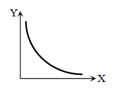
Which physical quantities are represented by $X$ and $Y$ in the given graph? ($Y$ represents the first quantity.)
A
Pressure versus temperature graph for a given gas
B
Kinetic energy versus particle velocity
C
Capacitance versus charge for a constant electric potential
D
Electric potential versus capacitance for a constant charge
Solution
(D) The given graph shows a rectangular hyperbola,which represents an inverse relationship between the two variables,i.e.,$Y \propto 1/X$.
From the formula for electric potential,$V = Q/C$.
For a constant charge $Q$,the potential $V$ is inversely proportional to the capacitance $C$,i.e.,$V \propto 1/C$.
This relationship is represented by a rectangular hyperbola where $V$ is on the $Y$-axis and $C$ is on the $X$-axis.
Therefore,the graph represents electric potential $(V)$ versus capacitance $(C)$ for a constant charge $(Q)$.
From the formula for electric potential,$V = Q/C$.
For a constant charge $Q$,the potential $V$ is inversely proportional to the capacitance $C$,i.e.,$V \propto 1/C$.
This relationship is represented by a rectangular hyperbola where $V$ is on the $Y$-axis and $C$ is on the $X$-axis.
Therefore,the graph represents electric potential $(V)$ versus capacitance $(C)$ for a constant charge $(Q)$.
0 likes
View Solution90
MediumMCQ
The electric potential $V$ of a charged spherical shell depends on the distance $r$ from its center. Which of the following graphs represents this dependence?
A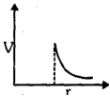
B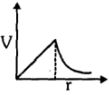
C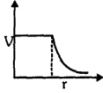
D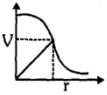
Solution
(C) For a charged spherical shell of radius $R$ and charge $Q$:
$1$. Inside the shell $(r < R)$,the electric field is zero,which means the electric potential is constant and equal to the potential at the surface,i.e.,$V = \frac{1}{4\pi\epsilon_0} \frac{Q}{R}$.
$2$. Outside the shell $(r \geq R)$,the shell behaves like a point charge at its center,so the potential is given by $V = \frac{1}{4\pi\epsilon_0} \frac{Q}{r}$,which means $V \propto \frac{1}{r}$.
Thus,the graph of $V$ versus $r$ should be a horizontal line for $r < R$ and a curve following $V \propto \frac{1}{r}$ for $r \geq R$. This corresponds to graph $C$.
$1$. Inside the shell $(r < R)$,the electric field is zero,which means the electric potential is constant and equal to the potential at the surface,i.e.,$V = \frac{1}{4\pi\epsilon_0} \frac{Q}{R}$.
$2$. Outside the shell $(r \geq R)$,the shell behaves like a point charge at its center,so the potential is given by $V = \frac{1}{4\pi\epsilon_0} \frac{Q}{r}$,which means $V \propto \frac{1}{r}$.
Thus,the graph of $V$ versus $r$ should be a horizontal line for $r < R$ and a curve following $V \propto \frac{1}{r}$ for $r \geq R$. This corresponds to graph $C$.
0 likes
View Solution91
EasyMCQ
Which of the following is a dimension of volt?
A
$J/C$
B
$N/C$
C
$wb/m^2$
D
$A/C$
Solution
(A) Volt is the electrical unit of voltage or potential difference $(V)$.
- $V$ is related to the change in potential energy $\Delta U$ as:
$V = \frac{\Delta U}{q}$
From the above formula,we get $1$ Volt of potential difference when a change of $1$ Joule of potential energy occurs in moving a charge of $1$ Coulomb.
Therefore,$1$ Volt $= 1$ Joule/Coulomb $(J/C)$.
- $V$ is related to the change in potential energy $\Delta U$ as:
$V = \frac{\Delta U}{q}$
From the above formula,we get $1$ Volt of potential difference when a change of $1$ Joule of potential energy occurs in moving a charge of $1$ Coulomb.
Therefore,$1$ Volt $= 1$ Joule/Coulomb $(J/C)$.
0 likes
View Solution92
EasyMCQ
Identify the incorrect statement.
A
Electric potential at a point in an electric field is defined as the potential energy per unit positive charge.
B
The work done in moving a charge from one point to another in an electric field depends on the path taken.
C
If a positive charge moves against the Coulomb force,the potential energy of the system increases.
D
The value of the elementary charge is not equivalent to the charge itself.
Solution
(B) $1$. Electric potential is defined as the work done per unit positive charge to bring it from infinity to a point,which is equivalent to potential energy per unit charge. Thus,statement $A$ is correct.
$2$. Electrostatic force is a conservative force. The work done by a conservative force is independent of the path taken and depends only on the initial and final positions. Therefore,statement $B$ is incorrect because it claims the work depends on the path.
$3$. When a positive charge moves against the repulsive Coulomb force,external work is done on the system,which increases the potential energy of the system. Thus,statement $C$ is correct.
$4$. The elementary charge $(e \approx 1.6 \times 10^{-19} \ C)$ is a fundamental constant,while 'charge' is a physical property that can be any integer multiple of $e$. Thus,statement $D$ is correct.
$2$. Electrostatic force is a conservative force. The work done by a conservative force is independent of the path taken and depends only on the initial and final positions. Therefore,statement $B$ is incorrect because it claims the work depends on the path.
$3$. When a positive charge moves against the repulsive Coulomb force,external work is done on the system,which increases the potential energy of the system. Thus,statement $C$ is correct.
$4$. The elementary charge $(e \approx 1.6 \times 10^{-19} \ C)$ is a fundamental constant,while 'charge' is a physical property that can be any integer multiple of $e$. Thus,statement $D$ is correct.
0 likes
View Solution93
MediumMCQ
$A$ solid conducting sphere with charge $Q$ is surrounded by an uncharged concentric conducting spherical shell. Let $V$ be the potential difference between the surface of the solid sphere and the outer surface of the shell. If the shell is now given a charge of $-3Q$,the new potential difference between the two surfaces is .........$V$.
A
$1$
B
$2$
C
$4$
D
$-2$
Solution
(A) Let the radius of the inner solid sphere be $r$ and the radius of the outer shell be $R$.
According to Gauss's law,the electric field $E$ in the region between the sphere and the shell $(r < x < R)$ depends only on the charge enclosed by the Gaussian surface of radius $x$.
The charge enclosed is the charge on the inner sphere,which is $Q$.
Thus,$E = \frac{Q}{4 \pi \epsilon_0 x^2}$.
The potential difference $V$ between the surface of the inner sphere and the surface of the outer shell is given by $V = \int_{r}^{R} E \, dx = \int_{r}^{R} \frac{Q}{4 \pi \epsilon_0 x^2} \, dx$.
Evaluating the integral,$V = \frac{Q}{4 \pi \epsilon_0} \left[ -\frac{1}{x} \right]_{r}^{R} = \frac{Q}{4 \pi \epsilon_0} \left( \frac{1}{r} - \frac{1}{R} \right)$.
Since the potential difference $V$ depends only on the charge $Q$ of the inner sphere and the radii $r$ and $R$,changing the charge on the outer shell does not affect the potential difference between the two surfaces.
Therefore,the new potential difference remains $V$.
According to Gauss's law,the electric field $E$ in the region between the sphere and the shell $(r < x < R)$ depends only on the charge enclosed by the Gaussian surface of radius $x$.
The charge enclosed is the charge on the inner sphere,which is $Q$.
Thus,$E = \frac{Q}{4 \pi \epsilon_0 x^2}$.
The potential difference $V$ between the surface of the inner sphere and the surface of the outer shell is given by $V = \int_{r}^{R} E \, dx = \int_{r}^{R} \frac{Q}{4 \pi \epsilon_0 x^2} \, dx$.
Evaluating the integral,$V = \frac{Q}{4 \pi \epsilon_0} \left[ -\frac{1}{x} \right]_{r}^{R} = \frac{Q}{4 \pi \epsilon_0} \left( \frac{1}{r} - \frac{1}{R} \right)$.
Since the potential difference $V$ depends only on the charge $Q$ of the inner sphere and the radii $r$ and $R$,changing the charge on the outer shell does not affect the potential difference between the two surfaces.
Therefore,the new potential difference remains $V$.
0 likes
View Solution94
EasyMCQ
Statement-$1$: For a charged particle moving from point $P$ to point $Q$,the net work done by the electrostatic force is independent of the path connecting point $P$ to point $Q$.
Statement-$2$: The net work done by a conservative force on an object in a closed loop is zero.
Statement-$2$: The net work done by a conservative force on an object in a closed loop is zero.
A
Statement-$1$ is true,Statement-$2$ is true. Statement-$2$ is not the correct explanation of Statement-$1$.
B
Statement-$1$ is false,Statement-$2$ is true.
C
Statement-$1$ is true,Statement-$2$ is false.
D
Statement-$1$ is true,Statement-$2$ is true. Statement-$2$ is the correct explanation of Statement-$1$.
Solution
(D) The electrostatic force is a conservative force.
By definition,a force is conservative if the work done by it on a particle moving between two points is independent of the path taken.
Therefore,Statement-$1$ is true.
Furthermore,a fundamental property of conservative forces is that the net work done by them over any closed path is zero.
Since the electrostatic force is conservative,it follows this property.
Thus,Statement-$2$ is true and it provides the correct explanation for why the work done is path-independent (Statement-$1$).
Hence,the correct option is $D$.
By definition,a force is conservative if the work done by it on a particle moving between two points is independent of the path taken.
Therefore,Statement-$1$ is true.
Furthermore,a fundamental property of conservative forces is that the net work done by them over any closed path is zero.
Since the electrostatic force is conservative,it follows this property.
Thus,Statement-$2$ is true and it provides the correct explanation for why the work done is path-independent (Statement-$1$).
Hence,the correct option is $D$.
0 likes
View Solution95
EasyMCQ
The electric potential inside a charged hollow conducting sphere is . . . . . . .
A
Constant
B
Directly proportional to the distance from the center
C
Inversely proportional to the distance from the center
D
Inversely proportional to the square of the distance from the center
Solution
(A) For a charged hollow conducting sphere of radius $R$ and charge $Q$,the electric field $E$ inside the sphere $(r < R)$ is zero.
Since the electric field $E = -\frac{dV}{dr}$,if $E = 0$,then the potential $V$ must be constant throughout the interior of the sphere.
The value of the potential inside the sphere is equal to the potential at the surface,which is $V = \frac{1}{4\pi\epsilon_0} \frac{Q}{R}$.
Therefore,the potential inside a charged hollow conducting sphere is constant.
Since the electric field $E = -\frac{dV}{dr}$,if $E = 0$,then the potential $V$ must be constant throughout the interior of the sphere.
The value of the potential inside the sphere is equal to the potential at the surface,which is $V = \frac{1}{4\pi\epsilon_0} \frac{Q}{R}$.
Therefore,the potential inside a charged hollow conducting sphere is constant.
0 likes
View Solution96
DifficultMCQ
Two concentric hollow spheres of radii $r$ and $R$ $(R > r)$ have the same surface charge density $\sigma$. The total charge $Q$ is distributed between them. The electric potential at the common center is:
A
$\frac{1}{4\pi \varepsilon_0} \frac{(R - r)Q}{2(R^2 + r^2)}$
B
$\frac{1}{4\pi \varepsilon_0} \frac{(R + r)Q}{(R^2 + r^2)}$
C
$\frac{1}{4\pi \varepsilon_0} \frac{(R + r)Q}{2(R^2 + r^2)}$
D
$\frac{1}{4\pi \varepsilon_0} \frac{(R - r)Q}{(R^2 + r^2)}$
Solution
(B) Let $\sigma$ be the surface charge density. The charges on the spheres are $q_1 = 4\pi r^2 \sigma$ and $q_2 = 4\pi R^2 \sigma$.
The total charge $Q = q_1 + q_2 = 4\pi \sigma (r^2 + R^2)$,so $\sigma = \frac{Q}{4\pi (r^2 + R^2)}$.
The potential at the center due to the inner sphere is $V_1 = \frac{1}{4\pi \varepsilon_0} \frac{q_1}{r} = \frac{1}{4\pi \varepsilon_0} \frac{4\pi r^2 \sigma}{r} = \frac{r \sigma}{\varepsilon_0}$.
The potential at the center due to the outer sphere is $V_2 = \frac{1}{4\pi \varepsilon_0} \frac{q_2}{R} = \frac{1}{4\pi \varepsilon_0} \frac{4\pi R^2 \sigma}{R} = \frac{R \sigma}{\varepsilon_0}$.
The total potential at the center is $V = V_1 + V_2 = \frac{\sigma}{\varepsilon_0} (r + R)$.
Substituting $\sigma = \frac{Q}{4\pi (r^2 + R^2)}$,we get $V = \frac{1}{4\pi \varepsilon_0} \frac{(R + r)Q}{(R^2 + r^2)}$.
The total charge $Q = q_1 + q_2 = 4\pi \sigma (r^2 + R^2)$,so $\sigma = \frac{Q}{4\pi (r^2 + R^2)}$.
The potential at the center due to the inner sphere is $V_1 = \frac{1}{4\pi \varepsilon_0} \frac{q_1}{r} = \frac{1}{4\pi \varepsilon_0} \frac{4\pi r^2 \sigma}{r} = \frac{r \sigma}{\varepsilon_0}$.
The potential at the center due to the outer sphere is $V_2 = \frac{1}{4\pi \varepsilon_0} \frac{q_2}{R} = \frac{1}{4\pi \varepsilon_0} \frac{4\pi R^2 \sigma}{R} = \frac{R \sigma}{\varepsilon_0}$.
The total potential at the center is $V = V_1 + V_2 = \frac{\sigma}{\varepsilon_0} (r + R)$.
Substituting $\sigma = \frac{Q}{4\pi (r^2 + R^2)}$,we get $V = \frac{1}{4\pi \varepsilon_0} \frac{(R + r)Q}{(R^2 + r^2)}$.
0 likes
View Solution97
MediumMCQ
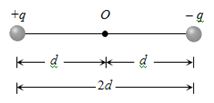
Two particles with charges $+q$ and $-q$ are separated by a distance of $2d$. What is the electric potential at the midpoint of the line joining them?
A
$0$
B
$\frac{1}{4\pi\varepsilon_0}$
C
$\frac{1}{4\pi\varepsilon_0} \cdot \frac{q}{d}$
D
$\frac{1}{4\pi\varepsilon_0} \cdot \frac{2q}{d^2}$
Solution
(A) The electric potential $V$ at a point due to a charge $q$ at a distance $r$ is given by $V = \frac{kq}{r}$,where $k = \frac{1}{4\pi\varepsilon_0}$.
At the midpoint $O$,the distance from both charges $+q$ and $-q$ is $d$.
The total electric potential $V_{total}$ at the midpoint is the algebraic sum of the potentials due to both charges:
$V_{total} = V_{+q} + V_{-q}$
$V_{total} = \frac{k(+q)}{d} + \frac{k(-q)}{d}$
$V_{total} = \frac{kq}{d} - \frac{kq}{d} = 0$.
At the midpoint $O$,the distance from both charges $+q$ and $-q$ is $d$.
The total electric potential $V_{total}$ at the midpoint is the algebraic sum of the potentials due to both charges:
$V_{total} = V_{+q} + V_{-q}$
$V_{total} = \frac{k(+q)}{d} + \frac{k(-q)}{d}$
$V_{total} = \frac{kq}{d} - \frac{kq}{d} = 0$.
0 likes
View Solution98
MediumMCQ
$A$ uniform electric field exists in the positive $x$-direction. Let $A$ be the origin. Point $B$ is at $x = +1 \ cm$ on the $x$-axis and point $C$ is at $y = +1 \ cm$ on the $y$-axis. Which of the following relations is correct regarding the potentials at $A, B,$ and $C$?
A
$V_A > V_B$ and $V_A = V_C$
B
$V_A < V_B$ and $V_A = V_C$
C
$V_A > V_B$ and $V_A > V_C$
D
$V_A < V_B$ and $V_A < V_C$
Solution
(A) The electric field is given as $\vec{E} = E_0 \hat{i}$,where $E_0 > 0$.
$1$. For points $A(0,0)$ and $B(1,0)$: The potential difference is $V_B - V_A = -\int_A^B \vec{E} \cdot d\vec{r} = -\int_0^1 E_0 dx = -E_0$.
Since $E_0 > 0$,$V_B - V_A < 0$,which implies $V_A > V_B$.
$2$. For points $A(0,0)$ and $C(0,1)$: The potential difference is $V_C - V_A = -\int_A^C \vec{E} \cdot d\vec{r}$. Since the electric field is in the $x$-direction and the displacement $d\vec{r}$ is in the $y$-direction,$\vec{E} \cdot d\vec{r} = 0$.
Therefore,$V_C - V_A = 0$,which implies $V_A = V_C$.
Combining these,we get $V_A > V_B$ and $V_A = V_C$.
$1$. For points $A(0,0)$ and $B(1,0)$: The potential difference is $V_B - V_A = -\int_A^B \vec{E} \cdot d\vec{r} = -\int_0^1 E_0 dx = -E_0$.
Since $E_0 > 0$,$V_B - V_A < 0$,which implies $V_A > V_B$.
$2$. For points $A(0,0)$ and $C(0,1)$: The potential difference is $V_C - V_A = -\int_A^C \vec{E} \cdot d\vec{r}$. Since the electric field is in the $x$-direction and the displacement $d\vec{r}$ is in the $y$-direction,$\vec{E} \cdot d\vec{r} = 0$.
Therefore,$V_C - V_A = 0$,which implies $V_A = V_C$.
Combining these,we get $V_A > V_B$ and $V_A = V_C$.
0 likes
View Solution99
MediumMCQ
If identical charges $(-q)$ are placed at each corner of a cube of side '$b$',what will be the $E.P.E$ (Electrostatic Potential Energy) of a charge $(+q)$ placed at the center of the cube?
A
$\frac{-4\sqrt{2}q^2}{\pi \epsilon_0 b}$
B
$\frac{-8\sqrt{2}q^2}{\pi \epsilon_0 b}$
C
$\frac{-4q^2}{\sqrt{3}\pi \epsilon_0 b}$
D
$\frac{8\sqrt{2}q^2}{4\pi \epsilon_0 b}$
Solution
(C) The distance of each corner of the cube from its center is $r = \frac{\sqrt{3}b}{2}$.
There are $8$ charges of magnitude $(-q)$ at the corners.
The potential energy $U$ of a charge $q_0$ at the center is given by $U = \sum \frac{1}{4\pi \epsilon_0} \frac{q_i q_0}{r}$.
Here,$q_i = -q$,$q_0 = q$,and $r = \frac{\sqrt{3}b}{2}$.
$U = 8 \times \left[ \frac{1}{4\pi \epsilon_0} \frac{(-q)(q)}{\frac{\sqrt{3}b}{2}} \right]$.
$U = 8 \times \left[ \frac{-q^2}{4\pi \epsilon_0} \times \frac{2}{\sqrt{3}b} \right]$.
$U = \frac{-16q^2}{4\sqrt{3}\pi \epsilon_0 b} = \frac{-4q^2}{\sqrt{3}\pi \epsilon_0 b}$.
There are $8$ charges of magnitude $(-q)$ at the corners.
The potential energy $U$ of a charge $q_0$ at the center is given by $U = \sum \frac{1}{4\pi \epsilon_0} \frac{q_i q_0}{r}$.
Here,$q_i = -q$,$q_0 = q$,and $r = \frac{\sqrt{3}b}{2}$.
$U = 8 \times \left[ \frac{1}{4\pi \epsilon_0} \frac{(-q)(q)}{\frac{\sqrt{3}b}{2}} \right]$.
$U = 8 \times \left[ \frac{-q^2}{4\pi \epsilon_0} \times \frac{2}{\sqrt{3}b} \right]$.
$U = \frac{-16q^2}{4\sqrt{3}\pi \epsilon_0 b} = \frac{-4q^2}{\sqrt{3}\pi \epsilon_0 b}$.
0 likes
View Solution100
MediumMCQ
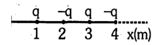
Find the electric potential at the origin due to the given distribution of charges.
A
$kq \ln(2)$
B
$k \ln(2)$
C
$kq \ln^2(2)$
D
$kq^2 \ln^2(2)$
Solution
(A) The electric potential $V$ at the origin due to a point charge $q$ at distance $x$ is given by $V = \frac{kq}{x}$.
For the given distribution,the charges are $q$ at $x=1$,$-q$ at $x=2$,$q$ at $x=3$,$-q$ at $x=4$,and so on.
The total potential at the origin is:
$V = kq \left( \frac{1}{1} - \frac{1}{2} + \frac{1}{3} - \frac{1}{4} + \dots \right)$
Using the Taylor series expansion $\ln(1+x) = x - \frac{x^2}{2} + \frac{x^3}{3} - \frac{x^4}{4} + \dots$,for $x=1$,we get $\ln(2) = 1 - \frac{1}{2} + \frac{1}{3} - \frac{1}{4} + \dots$
Therefore,$V = kq \ln(2)$.
For the given distribution,the charges are $q$ at $x=1$,$-q$ at $x=2$,$q$ at $x=3$,$-q$ at $x=4$,and so on.
The total potential at the origin is:
$V = kq \left( \frac{1}{1} - \frac{1}{2} + \frac{1}{3} - \frac{1}{4} + \dots \right)$
Using the Taylor series expansion $\ln(1+x) = x - \frac{x^2}{2} + \frac{x^3}{3} - \frac{x^4}{4} + \dots$,for $x=1$,we get $\ln(2) = 1 - \frac{1}{2} + \frac{1}{3} - \frac{1}{4} + \dots$
Therefore,$V = kq \ln(2)$.
0 likes
View SolutionElectric Potential and Capacitance — Electric potential · Frequently Asked Questions
1Are these Electric Potential and Capacitance questions useful for JEE and NEET?
Yes. All questions in this section are mapped to JEE Main and NEET exam patterns. Previous year questions from JEE Main, NEET, GUJCET and state-level exams are included with full solutions.
2Can I switch to Hindi or Gujarati for these questions?
Yes. Use the language tabs in the hero section or the sidebar to view the same questions and solutions in English, Hindi or Gujarati.
3How do I generate a question paper from this subtopic?
Use the Vedclass Exam Paper Generator — select the chapter and subtopic, set difficulty, and generate Sets A, B, C, D automatically. First 3 chapters of every subject are free.
Vedclass Products
For Students
Vedclass Test Series
Mock tests in real JEE/NEET style with performance analysis. 5-day free trial.
Start Free TrialFor Teachers
Exam Paper Generator
Generate Set A/B/C/D papers from this chapter in 2 minutes. 3 chapters free.
Try FreeFor Institutes
Online Exam Module
Live online exams with unlimited students, 360° analytics & white-label branding.
See DemoFor Teachers & Institutes
Generate a Electric Potential and Capacitance Exam Paper in 2 Minutes
Select subtopic & difficulty — Sets A, B, C, D auto-generated with No Repeat logic.
First 3 chapters of every subject are free — no payment required.