
A English
Properties of Haloalkanes Questions in English
Class 12 Chemistry · Haloalkanes and Haloarenes · Properties of Haloalkanes
1196+
Questions
English
Language
100%
With Solutions
Showing 50 of 1196 questions in English
551
MediumMCQ
The order of reactivity of the given haloalkanes towards nucleophiles is:
A
$R-I > R-Br > R-Cl$
B
$R-Cl > R-Br > R-I$
C
$R-Br > R-Cl > R-I$
D
$R-Br > R-I > R-Cl$
Solution
(A) For a given alkyl group,the order of reactivity towards nucleophilic substitution is determined by the strength of the carbon-halogen bond.
The bond dissociation energy decreases as the size of the halogen atom increases $(I > Br > Cl > F)$.
Since the $C-I$ bond is the weakest,it is the easiest to break,making alkyl iodides the most reactive.
Therefore,the correct order of reactivity is $R-I > R-Br > R-Cl$.
The bond dissociation energy decreases as the size of the halogen atom increases $(I > Br > Cl > F)$.
Since the $C-I$ bond is the weakest,it is the easiest to break,making alkyl iodides the most reactive.
Therefore,the correct order of reactivity is $R-I > R-Br > R-Cl$.
0 likes
View Solution552
MediumMCQ
In a nucleophilic substitution reaction,the order of halogens as incoming (attacking) nucleophiles is: $I^{-} > Br^{-} > Cl^{-}$. The order of halogens as departing (leaving) nucleophiles should be:
A
$Br^{-} > I^{-} > Cl^{-}$
B
$I^{-} > Br^{-} > Cl^{-}$
C
$Cl^{-} > Br^{-} > I^{-}$
D
$Cl^{-} > I^{-} > Br^{-}$
Solution
(B) In a nucleophilic substitution reaction,the leaving group ability is inversely proportional to the basic strength of the group.
Weaker bases are better leaving groups because they are more stable in the solution after departing.
The basic strength order of the given halide ions is: $I^{-} < Br^{-} < Cl^{-}$.
Since $I^{-}$ is the weakest base among the three,it is the best leaving group.
Therefore,the order of leaving group ability is: $I^{-} > Br^{-} > Cl^{-}$.
Weaker bases are better leaving groups because they are more stable in the solution after departing.
The basic strength order of the given halide ions is: $I^{-} < Br^{-} < Cl^{-}$.
Since $I^{-}$ is the weakest base among the three,it is the best leaving group.
Therefore,the order of leaving group ability is: $I^{-} > Br^{-} > Cl^{-}$.
0 likes
View Solution553
MediumMCQ
Among the following chloro-compounds,the one having the lowest dipole moment is:
A
$CH_3Cl$
B
$cis-1,2-dichloroethene$
C
$CH_2Cl_2$
D
$trans-1,2-dichloroethene$
Solution
(D) The dipole moment $(\mu)$ is a vector quantity.
In $trans-1,2-dichloroethene$,the two $C-Cl$ bonds are oriented in opposite directions at an angle of $180^{\circ}$.
Due to the symmetry of the molecule,the bond dipoles cancel each other out,resulting in a net dipole moment of $\mu = 0$.
In contrast,$CH_3Cl$,$cis-1,2-dichloroethene$,and $CH_2Cl_2$ have non-zero dipole moments due to their asymmetric structures.
In $trans-1,2-dichloroethene$,the two $C-Cl$ bonds are oriented in opposite directions at an angle of $180^{\circ}$.
Due to the symmetry of the molecule,the bond dipoles cancel each other out,resulting in a net dipole moment of $\mu = 0$.
In contrast,$CH_3Cl$,$cis-1,2-dichloroethene$,and $CH_2Cl_2$ have non-zero dipole moments due to their asymmetric structures.
0 likes
View Solution554
DifficultMCQ
The product of the reaction between ethylbenzene and $N$-bromosuccinimide $(NBS)$ is:
A
$1-$bromo$-2-$phenylethane
B
$1-$bromo$-1-$phenylethane
C
$p$-bromoethylbenzene
D
$o$-bromoethylbenzene
Solution
(B) $N$-bromosuccinimide $(NBS)$ is a reagent used for allylic or benzylic bromination via a free radical mechanism.
In ethylbenzene $(C_6H_5CH_2CH_3)$,the benzylic position is the carbon atom directly attached to the benzene ring.
The hydrogen atoms at the benzylic position are more reactive due to the stability of the resulting benzylic radical.
Therefore,$NBS$ selectively replaces a hydrogen atom at the benzylic position with a bromine atom,yielding $1$-bromo-$1$-phenylethane $(C_6H_5CH(Br)CH_3)$.
In ethylbenzene $(C_6H_5CH_2CH_3)$,the benzylic position is the carbon atom directly attached to the benzene ring.
The hydrogen atoms at the benzylic position are more reactive due to the stability of the resulting benzylic radical.
Therefore,$NBS$ selectively replaces a hydrogen atom at the benzylic position with a bromine atom,yielding $1$-bromo-$1$-phenylethane $(C_6H_5CH(Br)CH_3)$.
0 likes
View Solution555
DifficultMCQ
The compounds $A$ and $B$ in the following reaction are,respectively:
$Benzene$ $\xrightarrow{HCHO + HCl}$ $A$ $\xrightarrow{AgCN}$ $B$
$Benzene$ $\xrightarrow{HCHO + HCl}$ $A$ $\xrightarrow{AgCN}$ $B$
A
$A =$ Benzyl alcohol,$B =$ Benzyl cyanide
B
$A =$ Benzyl chloride,$B =$ Benzyl cyanide
C
$A =$ Benzyl alcohol,$B =$ Benzyl isocyanide
D
$A =$ Benzyl chloride,$B =$ Benzyl isocyanide
Solution
(D) $1$. The reaction of $Benzene$ with $HCHO$ and $HCl$ is a chloromethylation reaction (Blanc reaction),which produces $Benzyl$ $chloride$ $(C_6H_5CH_2Cl)$ as compound $A$.
$2$. The reaction of $Benzyl$ $chloride$ with $AgCN$ is a nucleophilic substitution reaction. Since $AgCN$ is a covalent reagent,the nitrogen atom acts as the nucleophile,leading to the formation of $Benzyl$ $isocyanide$ $(C_6H_5CH_2NC)$ as compound $B$.
$2$. The reaction of $Benzyl$ $chloride$ with $AgCN$ is a nucleophilic substitution reaction. Since $AgCN$ is a covalent reagent,the nitrogen atom acts as the nucleophile,leading to the formation of $Benzyl$ $isocyanide$ $(C_6H_5CH_2NC)$ as compound $B$.
0 likes
View Solution556
DifficultMCQ
The major product of the following reaction is:
$Ph-CH(CH_3)-CH(Br)-CH_2-CH_2-Br \xrightarrow{KOH \text{ (alc, excess)}, \Delta} ?$
$Ph-CH(CH_3)-CH(Br)-CH_2-CH_2-Br \xrightarrow{KOH \text{ (alc, excess)}, \Delta} ?$
A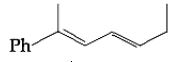
B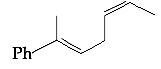
C
D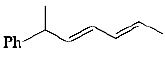
Solution
(A) The reaction involves the dehydrohalogenation of a vicinal dibromide (or a dihaloalkane) using excess alcoholic $KOH$ at high temperature $(\Delta)$.
This is an $E_2$ elimination reaction that proceeds to form a conjugated diene.
The starting material is $Ph-CH(CH_3)-CH(Br)-CH_2-CH_2-Br$.
Upon treatment with excess alcoholic $KOH$,two molecules of $HBr$ are eliminated to form a conjugated system.
The most stable product is the one with extended conjugation,which is $Ph-C(CH_3)=CH-CH=CH_2$ (or a similar conjugated diene structure as shown in option $A$).
Thus,the major product is the conjugated diene.
This is an $E_2$ elimination reaction that proceeds to form a conjugated diene.
The starting material is $Ph-CH(CH_3)-CH(Br)-CH_2-CH_2-Br$.
Upon treatment with excess alcoholic $KOH$,two molecules of $HBr$ are eliminated to form a conjugated system.
The most stable product is the one with extended conjugation,which is $Ph-C(CH_3)=CH-CH=CH_2$ (or a similar conjugated diene structure as shown in option $A$).
Thus,the major product is the conjugated diene.
0 likes
View Solution557
MediumMCQ
Which of the following compounds will produce a precipitate with $AgNO_3$?
A
$3-$Bromopyridine
B
Cycloheptatrienyl bromide
C
Bromobenzene
D
Bromocyclohexane
Solution
(B) The reaction with $AgNO_3$ involves the formation of a silver halide precipitate $(AgBr)$ upon the ionization of the carbon-halogen bond to form a carbocation.
For the reaction to occur readily,the resulting carbocation must be stable.
Cycloheptatrienyl bromide ionizes to form the cycloheptatrienyl cation (tropylium ion),which is a $7$-membered aromatic ring with $6\pi$ electrons,making it highly stable due to aromaticity.
Therefore,it readily reacts with $AgNO_3$ to form a precipitate of $AgBr$.
For the reaction to occur readily,the resulting carbocation must be stable.
Cycloheptatrienyl bromide ionizes to form the cycloheptatrienyl cation (tropylium ion),which is a $7$-membered aromatic ring with $6\pi$ electrons,making it highly stable due to aromaticity.
Therefore,it readily reacts with $AgNO_3$ to form a precipitate of $AgBr$.
0 likes
View Solution558
DifficultMCQ
The major product obtained in the following conversion is
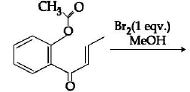
A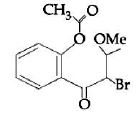
B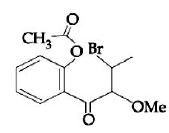
C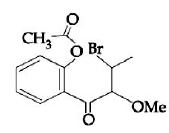
D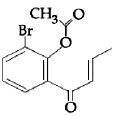
Solution
(A) The reaction involves the electrophilic addition of $Br_2$ to the $C=C$ double bond in the presence of $MeOH$ as a nucleophilic solvent.
This is a classic bromomethoxylation reaction.
The $Br_2$ molecule forms a cyclic bromonium ion intermediate with the alkene.
Then,the nucleophilic solvent $MeOH$ attacks the more substituted carbon of the bromonium ion (following Markovnikov-like regioselectivity due to the stability of the developing positive charge),leading to the anti-addition of $Br$ and $OMe$ across the double bond.
Therefore,the product is the one where $Br$ and $OMe$ are added across the double bond,which corresponds to the structure in option $A$.
This is a classic bromomethoxylation reaction.
The $Br_2$ molecule forms a cyclic bromonium ion intermediate with the alkene.
Then,the nucleophilic solvent $MeOH$ attacks the more substituted carbon of the bromonium ion (following Markovnikov-like regioselectivity due to the stability of the developing positive charge),leading to the anti-addition of $Br$ and $OMe$ across the double bond.
Therefore,the product is the one where $Br$ and $OMe$ are added across the double bond,which corresponds to the structure in option $A$.
0 likes
View Solution559
AdvancedMCQ
The major product of the following reaction is:
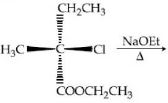
A
$CH_3-CH_2-C(CO_2CH_2CH_3)=CH_2$
B
$CH_3-C(CO_2CH_2CH_3)=CH-CH_3$
C
$CH_3-CH(CO_2CH_2CH_3)-CH=CH_2$
D
$CH_3-CH_2-CH_2-CO_2CH_2CH_3$
Solution
(B) The reaction is an $E2$ elimination reaction of a secondary alkyl chloride with a strong base $(NaOEt)$.
According to Saytzeff's rule,the major product is the more substituted alkene,as it is more stable.
In the given substrate,$CH_3-CH(Cl)-CH_2-CH_3$ (with a $CO_2Et$ group),the elimination of $HCl$ can occur from either the $CH_3$ group or the $CH_2$ group.
Elimination from the $CH_2$ group leads to a trisubstituted alkene $(CH_3-C(CO_2Et)=CH-CH_3)$,which is more stable than the disubstituted alkene $(CH_3-CH_2-C(CO_2Et)=CH_2)$ formed by elimination from the $CH_3$ group.
Therefore,the major product is $CH_3-C(CO_2CH_2CH_3)=CH-CH_3$.
According to Saytzeff's rule,the major product is the more substituted alkene,as it is more stable.
In the given substrate,$CH_3-CH(Cl)-CH_2-CH_3$ (with a $CO_2Et$ group),the elimination of $HCl$ can occur from either the $CH_3$ group or the $CH_2$ group.
Elimination from the $CH_2$ group leads to a trisubstituted alkene $(CH_3-C(CO_2Et)=CH-CH_3)$,which is more stable than the disubstituted alkene $(CH_3-CH_2-C(CO_2Et)=CH_2)$ formed by elimination from the $CH_3$ group.
Therefore,the major product is $CH_3-C(CO_2CH_2CH_3)=CH-CH_3$.
0 likes
View Solution560
AdvancedMCQ
The major product of the following reaction is:
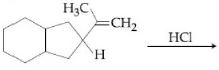
A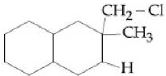
$A$
B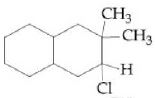
$B$
C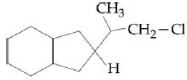
$C$
D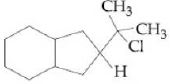
$D$
Solution
(D) The reaction involves the electrophilic addition of $HCl$ to an alkene.
According to Markovnikov's rule,the electrophile $(H^+)$ adds to the carbon atom of the double bond that has more hydrogen atoms,resulting in the formation of the most stable carbocation intermediate.
In this case,the double bond is between a terminal $CH_2$ group and a tertiary carbon atom.
Addition of $H^+$ to the $CH_2$ group forms a stable tertiary carbocation at the adjacent carbon.
Subsequently,the nucleophile $(Cl^-)$ attacks this tertiary carbocation to form the major product,which is a tertiary alkyl chloride.
According to Markovnikov's rule,the electrophile $(H^+)$ adds to the carbon atom of the double bond that has more hydrogen atoms,resulting in the formation of the most stable carbocation intermediate.
In this case,the double bond is between a terminal $CH_2$ group and a tertiary carbon atom.
Addition of $H^+$ to the $CH_2$ group forms a stable tertiary carbocation at the adjacent carbon.
Subsequently,the nucleophile $(Cl^-)$ attacks this tertiary carbocation to form the major product,which is a tertiary alkyl chloride.

0 likes
View Solution561
DifficultMCQ
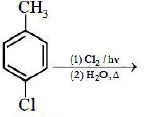
The major product of the following reaction is:
A
$4-$chlorobenzyl alcohol
B
$4-$chlorobenzal chloride
C
$4-$chlorobenzaldehyde
D
$4-$chlorobenzoic acid
Solution
(A) The reaction of $4$-chlorotoluene with $Cl_2$ in the presence of $h\nu$ (sunlight) is a free radical substitution reaction that occurs at the benzylic position.
Step $1$: Free radical chlorination of $4$-chlorotoluene gives $4$-chlorobenzyl chloride $(Cl-C_6H_4-CH_2Cl)$.
Step $2$: Hydrolysis of $4$-chlorobenzyl chloride with water $(H_2O, \Delta)$ replaces the chlorine atom with a hydroxyl group to form $4$-chlorobenzyl alcohol $(Cl-C_6H_4-CH_2OH)$.
Therefore,the major product is $4$-chlorobenzyl alcohol.
Step $1$: Free radical chlorination of $4$-chlorotoluene gives $4$-chlorobenzyl chloride $(Cl-C_6H_4-CH_2Cl)$.
Step $2$: Hydrolysis of $4$-chlorobenzyl chloride with water $(H_2O, \Delta)$ replaces the chlorine atom with a hydroxyl group to form $4$-chlorobenzyl alcohol $(Cl-C_6H_4-CH_2OH)$.
Therefore,the major product is $4$-chlorobenzyl alcohol.
1 likes
View Solution562
DifficultMCQ
Polysubstitution is a major drawback in
A
Friedel-Crafts alkylation
B
Reimer-Tiemann reaction
C
Acetylation of aniline
D
Friedel-Crafts acylation
Solution
(A) Polysubstitution is a major drawback of Friedel-Crafts alkylation.
This occurs because the alkyl group introduced on the benzene ring is electron-donating in nature,which increases the electron density of the ring.
Consequently,the ring becomes more reactive towards further electrophilic substitution,leading to the formation of polyalkylated products.
This occurs because the alkyl group introduced on the benzene ring is electron-donating in nature,which increases the electron density of the ring.
Consequently,the ring becomes more reactive towards further electrophilic substitution,leading to the formation of polyalkylated products.
0 likes
View Solution563
DifficultMCQ
Increasing order of reactivity of the following compounds for $S_N1$ substitution is:
$(a)$ $(CH_3)_2CH-CH_2Cl$
$(b)$ $CH_3CH_2Cl$
$(c)$ $CH_3O-C_6H_4-CH_2Cl$
$(d)$ $C_6H_5-CH_2Cl$
$(a)$ $(CH_3)_2CH-CH_2Cl$
$(b)$ $CH_3CH_2Cl$
$(c)$ $CH_3O-C_6H_4-CH_2Cl$
$(d)$ $C_6H_5-CH_2Cl$
A
$(b) < (c) < (d) < (a)$
B
$(a) < (b) < (d) < (c)$
C
$(b) < (a) < (d) < (c)$
D
$(b) < (c) < (a) < (d)$
Solution
(C) The reactivity of compounds towards $S_N1$ substitution depends on the stability of the carbocation intermediate formed after the departure of the leaving group $(Cl^-)$.
$1$. The carbocations formed are:
$(a)$ $(CH_3)_2CH-CH_2^+$ (primary carbocation with branching)
$(b)$ $CH_3CH_2^+$ (primary carbocation)
$(c)$ $CH_3O-C_6H_4-CH_2^+$ (benzylic carbocation stabilized by $+M$ effect of $-OCH_3$ group)
$(d)$ $C_6H_5-CH_2^+$ (benzylic carbocation stabilized by resonance)
$2$. Stability order of carbocations:
$CH_3O-C_6H_4-CH_2^+ > C_6H_5-CH_2^+ > (CH_3)_2CH-CH_2^+ > CH_3CH_2^+$
$3$. Since reactivity $\propto$ stability of carbocation,the increasing order of reactivity is:
$(b) < (a) < (d) < (c)$
$1$. The carbocations formed are:
$(a)$ $(CH_3)_2CH-CH_2^+$ (primary carbocation with branching)
$(b)$ $CH_3CH_2^+$ (primary carbocation)
$(c)$ $CH_3O-C_6H_4-CH_2^+$ (benzylic carbocation stabilized by $+M$ effect of $-OCH_3$ group)
$(d)$ $C_6H_5-CH_2^+$ (benzylic carbocation stabilized by resonance)
$2$. Stability order of carbocations:
$CH_3O-C_6H_4-CH_2^+ > C_6H_5-CH_2^+ > (CH_3)_2CH-CH_2^+ > CH_3CH_2^+$
$3$. Since reactivity $\propto$ stability of carbocation,the increasing order of reactivity is:
$(b) < (a) < (d) < (c)$
0 likes
View Solution564
DifficultMCQ
Which of the following potential energy $(PE)$ diagrams represents the $S_N^1$ reaction?
A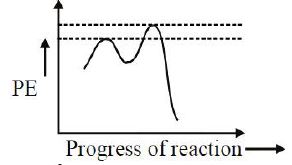
B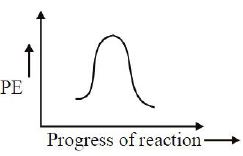
C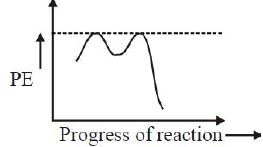
D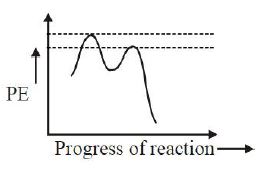
Solution
(A) The $S_N^1$ reaction is a two-step mechanism involving the formation of a carbocation intermediate.
In the first step,the leaving group departs to form a carbocation,which is the rate-determining step and has a higher activation energy.
In the second step,the nucleophile attacks the carbocation,which has a lower activation energy.
Therefore,the potential energy diagram must show two peaks,where the first transition state $(T.S. I)$ is higher in energy than the second transition state $(T.S. II)$.
In the first step,the leaving group departs to form a carbocation,which is the rate-determining step and has a higher activation energy.
In the second step,the nucleophile attacks the carbocation,which has a lower activation energy.
Therefore,the potential energy diagram must show two peaks,where the first transition state $(T.S. I)$ is higher in energy than the second transition state $(T.S. II)$.
0 likes
View Solution565
DifficultMCQ
The major product of the following reaction is $CH_3-CH(CH_3)-CH(Br)-CH_3 \xrightarrow{CH_3OH}$
A
$CH_3-C(CH_3)(OCH_3)-CH_2-CH_3$
B
$CH_3-CH(CH_3)-CH=CH_2$
C
$CH_3-C(CH_3)=CH-CH_3$
D
$CH_3-CH(CH_3)-CH(OCH_3)-CH_3$
Solution
(A) The reaction of $2$-bromo-$3$-methylbutane with methanol $(CH_3OH)$ proceeds via an $S_N1$ mechanism.
First,the $Br^-$ ion leaves to form a secondary carbocation $CH_3-CH(CH_3)-C^+H-CH_3$.
This carbocation undergoes a $1,2$-hydride shift to form a more stable tertiary carbocation $CH_3-C^+(CH_3)-CH_2-CH_3$.
Finally,the nucleophile $CH_3OH$ attacks the tertiary carbocation,followed by deprotonation,to yield $2$-methoxy-$2$-methylbutane $(CH_3-C(CH_3)(OCH_3)-CH_2-CH_3)$ as the major product.
First,the $Br^-$ ion leaves to form a secondary carbocation $CH_3-CH(CH_3)-C^+H-CH_3$.
This carbocation undergoes a $1,2$-hydride shift to form a more stable tertiary carbocation $CH_3-C^+(CH_3)-CH_2-CH_3$.
Finally,the nucleophile $CH_3OH$ attacks the tertiary carbocation,followed by deprotonation,to yield $2$-methoxy-$2$-methylbutane $(CH_3-C(CH_3)(OCH_3)-CH_2-CH_3)$ as the major product.
0 likes
View Solution566
DifficultMCQ
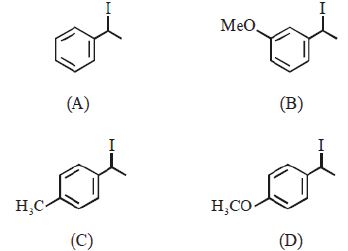
The increasing rate of $S_N1$ reaction in the following compounds is:
A
$A < B < C < D$
B
$A < B < D < C$
C
$B < A < D < C$
D
$B < A < C < D$
Solution
(D) The rate of $S_N1$ reaction is directly proportional to the stability of the carbocation intermediate formed after the loss of the leaving group $(I^-)$.
$(A)$ The carbocation is a secondary benzylic carbocation.
$(B)$ The $-OCH_3$ group is at the meta position. It exerts a strong $-I$ effect and no resonance effect on the carbocation. This destabilizes the carbocation compared to $(A)$.
$(C)$ The $-CH_3$ group is at the para position. It provides stability through $+I$ and hyperconjugation effects.
$(D)$ The $-OCH_3$ group is at the para position. It provides significant stability through the $+M$ (resonance) effect,which outweighs its $-I$ effect.
Comparing the stability: The meta-methoxy substituted carbocation $(B)$ is the least stable due to the $-I$ effect. The unsubstituted benzylic carbocation $(A)$ is next. The para-methyl substituted carbocation $(C)$ is more stable due to hyperconjugation. The para-methoxy substituted carbocation $(D)$ is the most stable due to the strong $+M$ effect.
Therefore,the order of increasing rate is $B < A < C < D$.
$(A)$ The carbocation is a secondary benzylic carbocation.
$(B)$ The $-OCH_3$ group is at the meta position. It exerts a strong $-I$ effect and no resonance effect on the carbocation. This destabilizes the carbocation compared to $(A)$.
$(C)$ The $-CH_3$ group is at the para position. It provides stability through $+I$ and hyperconjugation effects.
$(D)$ The $-OCH_3$ group is at the para position. It provides significant stability through the $+M$ (resonance) effect,which outweighs its $-I$ effect.
Comparing the stability: The meta-methoxy substituted carbocation $(B)$ is the least stable due to the $-I$ effect. The unsubstituted benzylic carbocation $(A)$ is next. The para-methyl substituted carbocation $(C)$ is more stable due to hyperconjugation. The para-methoxy substituted carbocation $(D)$ is the most stable due to the strong $+M$ effect.
Therefore,the order of increasing rate is $B < A < C < D$.
0 likes
View Solution567
DifficultMCQ
The major product obtained in the given reaction is:

A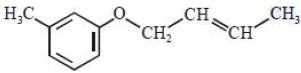
$A$
B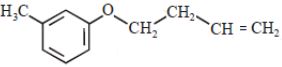
$B$
C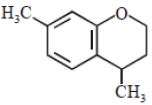
$C$
D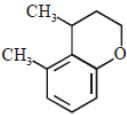
$D$
Solution
(D) The given reaction is an intramolecular Friedel-Crafts alkylation.
$AlCl_3$ acts as a Lewis acid and reacts with the chlorine atom to form a carbocation at the secondary carbon position.
This carbocation then undergoes an electrophilic aromatic substitution on the benzene ring.
Since the oxygen atom is ortho/para directing,the cyclization occurs at the ortho position relative to the ether linkage,leading to the formation of a six-membered ring fused to the benzene ring.
Thus,the major product is the structure shown in option $D$.
$AlCl_3$ acts as a Lewis acid and reacts with the chlorine atom to form a carbocation at the secondary carbon position.
This carbocation then undergoes an electrophilic aromatic substitution on the benzene ring.
Since the oxygen atom is ortho/para directing,the cyclization occurs at the ortho position relative to the ether linkage,leading to the formation of a six-membered ring fused to the benzene ring.
Thus,the major product is the structure shown in option $D$.
0 likes
View Solution568
DifficultMCQ
The major product '$Y$' in the following reaction is
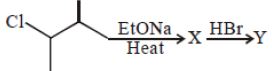
A
$2-$bromo$-3-$methylbutane
B
$2-$bromo$-2-$methylbutane
C
$1-$bromo$-3-$methylbutane
D
$2-$bromo$-3-$methylbutane (same as $A$)
Solution
(B) The reaction starts with $2$-chloro-$3$-methylbutane.
Treatment with $EtONa$ (a strong base) and heat leads to an $E2$ elimination reaction.
The major product formed is the more substituted alkene,which is $2$-methylbut-$2$-ene (Saytzeff product).
Subsequent addition of $HBr$ to $2$-methylbut-$2$-ene follows Markovnikov's rule,where the $H^+$ adds to the carbon with more hydrogens and the $Br^-$ adds to the more substituted carbon.
This results in the formation of $2$-bromo-$2$-methylbutane as the major product '$Y$'.
Treatment with $EtONa$ (a strong base) and heat leads to an $E2$ elimination reaction.
The major product formed is the more substituted alkene,which is $2$-methylbut-$2$-ene (Saytzeff product).
Subsequent addition of $HBr$ to $2$-methylbut-$2$-ene follows Markovnikov's rule,where the $H^+$ adds to the carbon with more hydrogens and the $Br^-$ adds to the more substituted carbon.
This results in the formation of $2$-bromo-$2$-methylbutane as the major product '$Y$'.
0 likes
View Solution569
DifficultMCQ
Which one of the following is likely to give a precipitate with $AgNO_3$ solution?
A
$CH_2=CHCl$
B
$CHCl_3$
C
$(CH_3)_3CCl$
D
$CCl_4$
Solution
(C) $(CH_3)_3CCl$ undergoes ionization to form a stable $tert$-butyl carbocation $(CH_3)_3C^+$ and a chloride ion $Cl^-$.
The $Cl^-$ ion reacts with $Ag^+$ ions from $AgNO_3$ to form a white precipitate of $AgCl$.
Other compounds like $CH_2=CHCl$ (vinyl chloride) have partial double bond character due to resonance,and $CHCl_3$ and $CCl_4$ are covalent and do not easily ionize to give $Cl^-$ ions under these conditions.
The $Cl^-$ ion reacts with $Ag^+$ ions from $AgNO_3$ to form a white precipitate of $AgCl$.
Other compounds like $CH_2=CHCl$ (vinyl chloride) have partial double bond character due to resonance,and $CHCl_3$ and $CCl_4$ are covalent and do not easily ionize to give $Cl^-$ ions under these conditions.
0 likes
View Solution570
DifficultMCQ
An 'Assertion' $(A)$ and a 'Reason' $(R)$ are given below. Choose the correct answer from the following options.
Assertion $(A)$: Vinyl halides do not undergo nucleophilic substitution easily.
Reason $(R)$: Even though the intermediate carbocation is stabilized by loosely held $p-$ electrons,the cleavage is difficult because of strong bonding.
Assertion $(A)$: Vinyl halides do not undergo nucleophilic substitution easily.
Reason $(R)$: Even though the intermediate carbocation is stabilized by loosely held $p-$ electrons,the cleavage is difficult because of strong bonding.
A
Both $(A)$ and $(R)$ are correct statements but $(R)$ is not the correct explanation of $(A)$
B
Both $(A)$ and $(R)$ are wrong statements
C
Both $(A)$ and $(R)$ are correct statements and $(R)$ is the correct explanation of $(A)$
D
$(A)$ is a correct statement but $(R)$ is a wrong statement.
Solution
(D) Vinyl halides $(CH_2=CH-X)$ do not undergo nucleophilic substitution reactions easily because of the partial double bond character between the carbon and the halogen atom due to resonance.
The reason provided is incorrect because the intermediate carbocation formed from vinyl halides is highly unstable,not stabilized,and the $C-X$ bond is strong due to $sp^2$ hybridization and resonance,making cleavage difficult.
Therefore,$(A)$ is a correct statement,but $(R)$ is a wrong statement.
The reason provided is incorrect because the intermediate carbocation formed from vinyl halides is highly unstable,not stabilized,and the $C-X$ bond is strong due to $sp^2$ hybridization and resonance,making cleavage difficult.
Therefore,$(A)$ is a correct statement,but $(R)$ is a wrong statement.
0 likes
View Solution571
MediumMCQ
The structure of product $(A)$ is:
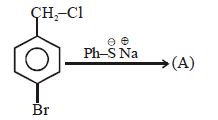
A
$4-$bromobenzyl phenyl sulfide
B
$1-$chloro$-4-$(phenylthio)benzene
C
$1,4-$bis(phenylthio)benzene
D
None of these
Solution
(A) The reaction involves a nucleophilic substitution reaction. The nucleophile $PhS^-$ attacks the electrophilic carbon of the $-CH_2Cl$ group,which is a primary benzylic halide. The $-Br$ group attached directly to the benzene ring is much less reactive towards nucleophilic substitution under these conditions compared to the benzylic chloride. Therefore,the $PhS^-$ group replaces the $-Cl$ atom to form $4$-bromobenzyl phenyl sulfide as the major product $(A)$.
0 likes
View Solution572
MediumMCQ
Which of the following is most reactive towards $S_N2$ reaction?
A
Cyclohexyl-CH_2-Cl
B
Cyclohexyl-Cl
C
Cyclohexyl-$I$
D
Cyclohexyl-CH_2-$I$
Solution
(D) The reactivity of alkyl halides towards $S_N2$ reactions depends on two main factors: steric hindrance and the nature of the leaving group.
$1.$ Steric hindrance: $S_N2$ reactions are highly sensitive to steric hindrance. Primary alkyl halides are more reactive than secondary or tertiary alkyl halides because the nucleophile can easily approach the carbon atom.
$2.$ Leaving group: $A$ better leaving group increases the rate of the $S_N2$ reaction. Iodide $(I^-)$ is a better leaving group than chloride $(Cl^-)$ because it is a weaker base.
Comparing the given options:
- Option $A$ and $D$ are primary alkyl halides,while $B$ and $C$ are secondary alkyl halides. Therefore,$A$ and $D$ are more reactive than $B$ and $C$.
- Between $A$ $(R-CH_2-Cl)$ and $D$ $(R-CH_2-I)$,$D$ is more reactive because $I^-$ is a better leaving group than $Cl^-$.
Thus,Cyclohexyl-CH_2-$I$ is the most reactive towards $S_N2$ reaction.
$1.$ Steric hindrance: $S_N2$ reactions are highly sensitive to steric hindrance. Primary alkyl halides are more reactive than secondary or tertiary alkyl halides because the nucleophile can easily approach the carbon atom.
$2.$ Leaving group: $A$ better leaving group increases the rate of the $S_N2$ reaction. Iodide $(I^-)$ is a better leaving group than chloride $(Cl^-)$ because it is a weaker base.
Comparing the given options:
- Option $A$ and $D$ are primary alkyl halides,while $B$ and $C$ are secondary alkyl halides. Therefore,$A$ and $D$ are more reactive than $B$ and $C$.
- Between $A$ $(R-CH_2-Cl)$ and $D$ $(R-CH_2-I)$,$D$ is more reactive because $I^-$ is a better leaving group than $Cl^-$.
Thus,Cyclohexyl-CH_2-$I$ is the most reactive towards $S_N2$ reaction.
0 likes
View Solution573
DifficultMCQ
Which of the following is/are the product$(s)$ of the given reaction?
$1$-chloro-$1$-ethyl-$2$-methylcyclohexane $\xrightarrow{C_2H_5O^-K^+ / \Delta}$ ?
$1$-chloro-$1$-ethyl-$2$-methylcyclohexane $\xrightarrow{C_2H_5O^-K^+ / \Delta}$ ?
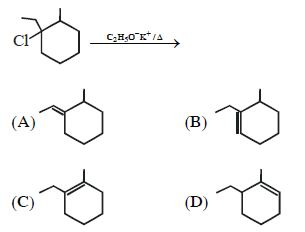
A
$A, B, C$
B
$A, B, C, D$
C
Only $B$
D
Only $C$
Solution
(A) The given reaction is an $E2$ elimination reaction involving a tertiary alkyl halide with a strong base $(C_2H_5O^-K^+)$ and heat $(\Delta)$.
$1$. The substrate is $1$-chloro-$1$-ethyl-$2$-methylcyclohexane.
$2$. Elimination can occur by removing a proton from the $\beta$-carbons:
- Removing a proton from the ethyl group leads to the exocyclic double bond product $(A)$.
- Removing a proton from the $C_2$ position (which has the methyl group) leads to the endocyclic double bond product $(C)$.
- Removing a proton from the $C_6$ position leads to the endocyclic double bond product $(D)$.
$3$. Product $(B)$ is not possible as it would require a double bond at a bridgehead position or an impossible geometry for this specific substrate structure.
$4$. Among the possible products,$C$ is the most substituted (tetrasubstituted) and thus the most stable (Saytzeff product).
$5$. However,$A, C,$ and $D$ are all possible elimination products depending on the kinetic and thermodynamic control of the reaction.
$6$. Therefore,$A, C,$ and $D$ are the products.
$1$. The substrate is $1$-chloro-$1$-ethyl-$2$-methylcyclohexane.
$2$. Elimination can occur by removing a proton from the $\beta$-carbons:
- Removing a proton from the ethyl group leads to the exocyclic double bond product $(A)$.
- Removing a proton from the $C_2$ position (which has the methyl group) leads to the endocyclic double bond product $(C)$.
- Removing a proton from the $C_6$ position leads to the endocyclic double bond product $(D)$.
$3$. Product $(B)$ is not possible as it would require a double bond at a bridgehead position or an impossible geometry for this specific substrate structure.
$4$. Among the possible products,$C$ is the most substituted (tetrasubstituted) and thus the most stable (Saytzeff product).
$5$. However,$A, C,$ and $D$ are all possible elimination products depending on the kinetic and thermodynamic control of the reaction.
$6$. Therefore,$A, C,$ and $D$ are the products.
0 likes
View Solution574
DifficultMCQ
The following reaction is supposed to take place through the $S_N1$ mechanism: $CH_3-C(Ph)(OH)-CH_2-CH_3 \xrightarrow{HI} \text{products}$. If the configuration of the substrate is $D$,then the configuration of the products will be:
A
$D$
B
$L$
C
$50\% D$ and $50\% L$
D
May be $D$ or $L$
Solution
(C) In $S_N1$ reactions,the mechanism involves the formation of a planar carbocation intermediate.
Since the carbocation is planar,the nucleophile $(I^-)$ can attack from either side with equal probability.
This leads to racemization,resulting in a mixture of $50\% D$ and $50\% L$ configurations.
Since the carbocation is planar,the nucleophile $(I^-)$ can attack from either side with equal probability.
This leads to racemization,resulting in a mixture of $50\% D$ and $50\% L$ configurations.
0 likes
View Solution575
DifficultMCQ
Which of the following compounds gives the same $S_N1$ and $S_N2$ product?
A
$3-$chlorocyclohex$-1-$ene
B
$3-$chlorocyclohexa$-1,4-$diene
C
$4-$chlorocyclohex$-1-$ene
D
$2-$chlorocyclohexane
Solution
(A) For a compound to give the same product in both $S_N1$ and $S_N2$ reactions,the carbocation formed in $S_N1$ must be symmetric or lead to the same product as the $S_N2$ inversion.
In $3$-chlorocyclohex-$1$-ene,the $S_N1$ mechanism involves the formation of a resonance-stabilized allylic carbocation. The positive charge can be delocalized between $C_1$ and $C_3$ positions. Nucleophilic attack can occur at either position,leading to a mixture of products.
However,in $3$-chlorocyclohex-$1$-ene,the structure is such that the allylic carbocation formed is symmetric with respect to the double bond position,or the substitution leads to the same product due to the resonance stabilization of the allylic cation. Specifically,the $3$-chlorocyclohex-$1$-ene molecule allows for the nucleophile to attack the allylic position,and due to the symmetry of the resonance structures,the product is the same.
In $3$-chlorocyclohex-$1$-ene,the $S_N1$ mechanism involves the formation of a resonance-stabilized allylic carbocation. The positive charge can be delocalized between $C_1$ and $C_3$ positions. Nucleophilic attack can occur at either position,leading to a mixture of products.
However,in $3$-chlorocyclohex-$1$-ene,the structure is such that the allylic carbocation formed is symmetric with respect to the double bond position,or the substitution leads to the same product due to the resonance stabilization of the allylic cation. Specifically,the $3$-chlorocyclohex-$1$-ene molecule allows for the nucleophile to attack the allylic position,and due to the symmetry of the resonance structures,the product is the same.
0 likes
View Solution576
MediumMCQ
Ethylene dichloride $(ClCH_2-CH_2Cl)$ and ethylidene chloride $(CH_3-CHCl_2)$ are isomeric compounds. Identify the statement which is not applicable to both of them.
A
They react with alcoholic $KOH$.
B
They are dihalides.
C
They react with aq. $KOH$ and give the same product.
D
They are position isomers.
Solution
(C) Ethylene dichloride $(ClCH_2-CH_2Cl)$ is a vicinal dihalide,and ethylidene chloride $(CH_3-CHCl_2)$ is a geminal dihalide.
Both react with alcoholic $KOH$ to undergo dehydrohalogenation.
Both are dihalides.
When they react with aqueous $KOH$ (a nucleophilic substitution reaction),they yield different products:
$1$. Ethylene dichloride reacts with aqueous $KOH$ to form ethylene glycol $(HOCH_2-CH_2OH)$.
$2$. Ethylidene chloride reacts with aqueous $KOH$ to form an unstable gem-diol $(CH_3-CH(OH)_2)$,which immediately loses a water molecule to form acetaldehyde $(CH_3CHO)$.
Therefore,the statement that they give the same product with aqueous $KOH$ is incorrect.
Both react with alcoholic $KOH$ to undergo dehydrohalogenation.
Both are dihalides.
When they react with aqueous $KOH$ (a nucleophilic substitution reaction),they yield different products:
$1$. Ethylene dichloride reacts with aqueous $KOH$ to form ethylene glycol $(HOCH_2-CH_2OH)$.
$2$. Ethylidene chloride reacts with aqueous $KOH$ to form an unstable gem-diol $(CH_3-CH(OH)_2)$,which immediately loses a water molecule to form acetaldehyde $(CH_3CHO)$.
Therefore,the statement that they give the same product with aqueous $KOH$ is incorrect.
0 likes
View Solution577
DifficultMCQ
Compound $C_4H_8Cl_2$ $(A)$ on hydrolysis gives a compound $C_4H_8O$ $(B)$ which reacts with hydroxylamine and does not give any test with Tollen's reagent. What are $(A)$ and $(B)$?
A
$1,1-$Dichlorobutane and butanal
B
$2,2-$Dichlorobutane and butanal
C
$1,1-$Dichlorobutane and butanone
D
$2,2-$Dichlorobutane and butanone
Solution
(D) Compound $(B)$ $(C_4H_8O)$ reacts with hydroxylamine $(NH_2OH)$ to form an oxime,which indicates that it is a carbonyl compound.
Since it does not give a Tollen's test,it must be a ketone.
The only $4-$carbon ketone is butanone $(CH_3-CO-CH_2-CH_3)$.
Hydrolysis of a gem-dichloride $(A)$ gives a ketone,so $(A)$ must be $2,2-$dichlorobutane $(CH_3-CCl_2-CH_2-CH_3)$.
$CH_3-CCl_2-CH_2-CH_3 \xrightarrow{H_2O} CH_3-CO-CH_2-CH_3$
Since it does not give a Tollen's test,it must be a ketone.
The only $4-$carbon ketone is butanone $(CH_3-CO-CH_2-CH_3)$.
Hydrolysis of a gem-dichloride $(A)$ gives a ketone,so $(A)$ must be $2,2-$dichlorobutane $(CH_3-CCl_2-CH_2-CH_3)$.
$CH_3-CCl_2-CH_2-CH_3 \xrightarrow{H_2O} CH_3-CO-CH_2-CH_3$
0 likes
View Solution578
MediumMCQ
Correct order of nucleophilicity for $S_N2$ reaction
A
$OH^{-} > H_2O > CH_3COO^{-}$
B
$OH^{-} > CH_3COO^{-} > H_2O$
C
$H_2O > CH_3COO^{-} > OH^{-}$
D
$H_2O = OH^{-} = CH_3COO^{-}$
Solution
(B) Nucleophilicity is defined as the ability of a species to donate an electron pair to an electrophilic carbon atom.
For $S_N2$ reactions,nucleophilicity generally correlates with basicity when the attacking atoms are the same or in the same period.
Comparing the basicity:
$OH^{-}$ is a strong base.
$CH_3COO^{-}$ is a weaker base due to resonance stabilization of the negative charge.
$H_2O$ is a neutral molecule and is the weakest nucleophile among the three.
Therefore,the order of nucleophilicity is $OH^{-} > CH_3COO^{-} > H_2O$.
For $S_N2$ reactions,nucleophilicity generally correlates with basicity when the attacking atoms are the same or in the same period.
Comparing the basicity:
$OH^{-}$ is a strong base.
$CH_3COO^{-}$ is a weaker base due to resonance stabilization of the negative charge.
$H_2O$ is a neutral molecule and is the weakest nucleophile among the three.
Therefore,the order of nucleophilicity is $OH^{-} > CH_3COO^{-} > H_2O$.
0 likes
View Solution579
MediumMCQ
In the following reaction $C_{6}H_{5}CH_{2}Br \xrightarrow[(ii)H_{3}O^{+}]{(i)Mg, \text{Ether}} X$
Product $X$ is
Product $X$ is
A
$C_{6}H_{5}CH_{3}$
B
$C_{6}H_{5}CH_{2}OH$
C
$C_{6}H_{5}CH_{2}CH_{2}C_{6}H_{5}$
D
$C_{6}H_{5}CH_{2}OCH_{2}C_{6}H_{5}$
Solution
(A) The reaction proceeds as follows:
$1$. $C_{6}H_{5}CH_{2}Br$ reacts with $Mg$ in the presence of dry ether to form the Grignard reagent,$C_{6}H_{5}CH_{2}MgBr$.
$2$. Subsequent hydrolysis with $H_{3}O^{+}$ replaces the $MgBr$ group with a hydrogen atom,yielding toluene $(C_{6}H_{5}CH_{3})$.
The overall reaction is: $C_{6}H_{5}CH_{2}Br \xrightarrow{(i)Mg, \text{Ether}, (ii)H_{3}O^{+}} C_{6}H_{5}CH_{3} + Mg(Br)(OH)$.
$1$. $C_{6}H_{5}CH_{2}Br$ reacts with $Mg$ in the presence of dry ether to form the Grignard reagent,$C_{6}H_{5}CH_{2}MgBr$.
$2$. Subsequent hydrolysis with $H_{3}O^{+}$ replaces the $MgBr$ group with a hydrogen atom,yielding toluene $(C_{6}H_{5}CH_{3})$.
The overall reaction is: $C_{6}H_{5}CH_{2}Br \xrightarrow{(i)Mg, \text{Ether}, (ii)H_{3}O^{+}} C_{6}H_{5}CH_{3} + Mg(Br)(OH)$.
0 likes
View Solution580
MediumMCQ
Consider the following anions:
$(I)$ $CF_3SO_3^-$
$(II)$ $C_6H_5SO_3^-$
$(III)$ $C_6H_5O^-$
$(IV)$ $CH_3COO^-$
When attached to $sp^3$ hybridized carbon,their leaving group ability in nucleophilic substitution reaction decreases in the order:
$(I)$ $CF_3SO_3^-$
$(II)$ $C_6H_5SO_3^-$
$(III)$ $C_6H_5O^-$
$(IV)$ $CH_3COO^-$
When attached to $sp^3$ hybridized carbon,their leaving group ability in nucleophilic substitution reaction decreases in the order:
A
$I > II > III > IV$
B
$I > II > IV > III$
C
$IV > I > II > III$
D
$IV > III > II > I$
Solution
(B) The leaving group ability is directly proportional to the stability of the resulting anion. $A$ more stable anion is a better leaving group.
$(I)$ $CF_3SO_3^-$ (Triflate): The negative charge is delocalized over three oxygen atoms,and the $CF_3$ group exerts a strong electron-withdrawing $(-I)$ effect,making it the most stable anion.
$(II)$ $C_6H_5SO_3^-$ (Tosylate/Benzenesulfonate): The negative charge is delocalized over three oxygen atoms,but the phenyl group is less electron-withdrawing than $CF_3$,making it less stable than $(I)$.
$(IV)$ $CH_3COO^-$ (Acetate): The negative charge is delocalized over two oxygen atoms.
$(III)$ $C_6H_5O^-$ (Phenoxide): The negative charge is delocalized over carbon atoms in the ring,which is less effective than delocalization over oxygen atoms.
Thus,the stability order of anions is $I > II > IV > III$,which corresponds to the leaving group ability order $I > II > IV > III$.
$(I)$ $CF_3SO_3^-$ (Triflate): The negative charge is delocalized over three oxygen atoms,and the $CF_3$ group exerts a strong electron-withdrawing $(-I)$ effect,making it the most stable anion.
$(II)$ $C_6H_5SO_3^-$ (Tosylate/Benzenesulfonate): The negative charge is delocalized over three oxygen atoms,but the phenyl group is less electron-withdrawing than $CF_3$,making it less stable than $(I)$.
$(IV)$ $CH_3COO^-$ (Acetate): The negative charge is delocalized over two oxygen atoms.
$(III)$ $C_6H_5O^-$ (Phenoxide): The negative charge is delocalized over carbon atoms in the ring,which is less effective than delocalization over oxygen atoms.
Thus,the stability order of anions is $I > II > IV > III$,which corresponds to the leaving group ability order $I > II > IV > III$.
0 likes
View Solution581
MediumMCQ
Among the bromides $(I)-(III)$ given below,the order of reactivity for ${S_N}^1$ reaction is:
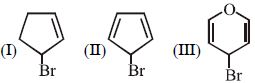
A
$III > II > I$
B
$III > I > II$
C
$II > III > I$
D
$II > I > III$
Solution
(A) The reactivity of ${S_N}^1$ reaction depends on the stability of the carbocation intermediate formed after the departure of the leaving group $(Br^-)$.
$1$. For $(I)$,the carbocation formed is a cyclopentenyl cation,which is stabilized by resonance with one double bond.
$2$. For $(II)$,the carbocation formed is a cyclopentadienyl cation,which is aromatic ($6 \pi$ electrons,Huckel's rule).
$3$. For $(III)$,the carbocation formed is stabilized by resonance with two double bonds and the lone pair of the oxygen atom,making it highly stable due to the $+M$ effect of the oxygen atom.
Comparing the stabilities:
- The carbocation from $(III)$ is the most stable due to the $+M$ effect of the oxygen atom.
- The carbocation from $(II)$ is aromatic and very stable.
- The carbocation from $(I)$ is the least stable among the three as it has the least resonance stabilization.
Therefore,the order of reactivity is $III > II > I$.
$1$. For $(I)$,the carbocation formed is a cyclopentenyl cation,which is stabilized by resonance with one double bond.
$2$. For $(II)$,the carbocation formed is a cyclopentadienyl cation,which is aromatic ($6 \pi$ electrons,Huckel's rule).
$3$. For $(III)$,the carbocation formed is stabilized by resonance with two double bonds and the lone pair of the oxygen atom,making it highly stable due to the $+M$ effect of the oxygen atom.
Comparing the stabilities:
- The carbocation from $(III)$ is the most stable due to the $+M$ effect of the oxygen atom.
- The carbocation from $(II)$ is aromatic and very stable.
- The carbocation from $(I)$ is the least stable among the three as it has the least resonance stabilization.
Therefore,the order of reactivity is $III > II > I$.
0 likes
View Solution582
DifficultMCQ
The decreasing order of reactivity of the compounds given below towards solvolysis under identical conditions is:
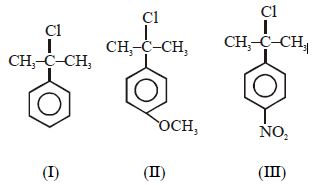
A
$II > I > III$
B
$I > II > III$
C
$III > II > I$
D
$II > III > I$
Solution
(A) Solvolysis reactions typically proceed via an $S_N1$ mechanism,which involves the formation of a carbocation intermediate as the rate-determining step.
The stability of the carbocation formed determines the reactivity of the substrate. More stable carbocations are formed faster,leading to higher reactivity.
$1$. In compound $(I)$,the carbocation formed is a benzylic carbocation: $Ph-C^+(CH_3)_2$.
$2$. In compound $(II)$,the carbocation formed is $p-CH_3O-C_6H_4-C^+(CH_3)_2$. The methoxy group $(-OCH_3)$ is a strong electron-donating group by resonance ($+M$ effect),which significantly stabilizes the carbocation.
$3$. In compound $(III)$,the carbocation formed is $p-O_2N-C_6H_4-C^+(CH_3)_2$. The nitro group $(-NO_2)$ is a strong electron-withdrawing group by both inductive $(-I)$ and resonance $(-M)$ effects,which destabilizes the carbocation.
Comparing the stability: The carbocation from $(II)$ is the most stable due to the $+M$ effect of $-OCH_3$. The carbocation from $(I)$ is intermediate. The carbocation from $(III)$ is the least stable due to the $-I$ and $-M$ effects of $-NO_2$.
Therefore,the decreasing order of reactivity is $II > I > III$.
The stability of the carbocation formed determines the reactivity of the substrate. More stable carbocations are formed faster,leading to higher reactivity.
$1$. In compound $(I)$,the carbocation formed is a benzylic carbocation: $Ph-C^+(CH_3)_2$.
$2$. In compound $(II)$,the carbocation formed is $p-CH_3O-C_6H_4-C^+(CH_3)_2$. The methoxy group $(-OCH_3)$ is a strong electron-donating group by resonance ($+M$ effect),which significantly stabilizes the carbocation.
$3$. In compound $(III)$,the carbocation formed is $p-O_2N-C_6H_4-C^+(CH_3)_2$. The nitro group $(-NO_2)$ is a strong electron-withdrawing group by both inductive $(-I)$ and resonance $(-M)$ effects,which destabilizes the carbocation.
Comparing the stability: The carbocation from $(II)$ is the most stable due to the $+M$ effect of $-OCH_3$. The carbocation from $(I)$ is intermediate. The carbocation from $(III)$ is the least stable due to the $-I$ and $-M$ effects of $-NO_2$.
Therefore,the decreasing order of reactivity is $II > I > III$.
0 likes
View Solution583
MediumMCQ
$CH_3-CH_2-CH(Br)-CH_3 \xrightarrow{Alc. KOH} X$ (major)
$CH_3-CH_2-CH(NMe_3^+) - CH_3 \xrightarrow{EtONa, \Delta} Y$ (major)
Product $(X)$ and $(Y)$ respectively are:
$CH_3-CH_2-CH(NMe_3^+) - CH_3 \xrightarrow{EtONa, \Delta} Y$ (major)
Product $(X)$ and $(Y)$ respectively are:
A
$1-butene$,trans-$2-butene$
B
$1-butene$,cis-$2-butene$
C
cis-$2-butene$,$1-butene$
D
trans-$2-butene$,$1-butene$
Solution
(D) In the first reaction,$2-bromobutane$ reacts with alcoholic $KOH$ to undergo dehydrohalogenation via an $E2$ mechanism. According to Zaitsev's rule,the more substituted alkene is the major product. Since trans-$2-butene$ is more stable than cis-$2-butene$,$(X)$ is trans-$2-butene$.
In the second reaction,the quaternary ammonium salt undergoes Hofmann elimination. According to Hofmann's rule,the less substituted alkene is the major product due to steric hindrance. Thus,$(Y)$ is $1-butene$.
In the second reaction,the quaternary ammonium salt undergoes Hofmann elimination. According to Hofmann's rule,the less substituted alkene is the major product due to steric hindrance. Thus,$(Y)$ is $1-butene$.
0 likes
View Solution584
MediumMCQ
Why is the alkyl halide shown below not capable of undergoing an $E2$ reaction upon treatment with sodium ethoxide?

A
$Br^-$ is a too poor leaving group.
B
Too much angle strain would be present in the alkene product.
C
Sodium ethoxide is a poor base to use in $E2$ reaction.
D
The $C-H$ and $C-Br$ bonds which need to break cannot achieve an anti-periplanar orientation.
Solution
(D) For an $E2$ reaction to occur,the leaving group $(Br^-)$ and the $\beta$-hydrogen must be in an anti-periplanar orientation ($180^\circ$ dihedral angle).
In the provided molecule,the bromine atom is in an axial position (if we consider the chair conformation). However,the adjacent $\beta$-hydrogens are not anti-periplanar to the bromine atom due to the specific stereochemistry of the methyl groups.
Specifically,the $C-H$ bonds at the $\beta$-carbons are not oriented anti to the $C-Br$ bond,preventing the necessary orbital overlap for the concerted $E2$ mechanism.
In the provided molecule,the bromine atom is in an axial position (if we consider the chair conformation). However,the adjacent $\beta$-hydrogens are not anti-periplanar to the bromine atom due to the specific stereochemistry of the methyl groups.
Specifically,the $C-H$ bonds at the $\beta$-carbons are not oriented anti to the $C-Br$ bond,preventing the necessary orbital overlap for the concerted $E2$ mechanism.
0 likes
View Solution585
DifficultMCQ
Identify the product $B$ in the following reaction sequence:
$1$-bromo-$4$-chlorobenzene $\xrightarrow[\text{Dry ether}]{Mg (1 \text{ equivalent})} (A)$ $\xrightarrow{HO-CH_2-CH_2-Cl} (B)$
$1$-bromo-$4$-chlorobenzene $\xrightarrow[\text{Dry ether}]{Mg (1 \text{ equivalent})} (A)$ $\xrightarrow{HO-CH_2-CH_2-Cl} (B)$
A
$1-$chloro$-4-$($2$-chloroethyl)benzene
B
$1-$chloro$-4-$($2$-hydroxyethyl)benzene
C
Chlorobenzene
D
$1-$chloro$-4-$($2$-chloroethoxy)benzene
Solution
(C) $1$. The reaction of $1$-bromo-$4$-chlorobenzene with $1$ equivalent of $Mg$ in dry ether selectively forms the Grignard reagent at the more reactive $C-Br$ bond,yielding $4$-chlorophenylmagnesium bromide as product $(A)$.
$2$. The Grignard reagent $(A)$ acts as a strong nucleophile. It reacts with $2$-chloroethanol $(HO-CH_2-CH_2-Cl)$.
$3$. The acidic hydrogen of the hydroxyl group $(-OH)$ in $2$-chloroethanol is abstracted by the Grignard reagent,leading to the formation of chlorobenzene and the alkoxide salt of $2$-chloroethanol. However,in the context of typical organic synthesis questions of this type,if the reaction is intended to be a nucleophilic substitution,it would be problematic due to the acidic proton. Given the options,the reaction is likely intended to be an acid-base reaction where the Grignard reagent is protonated by the $-OH$ group,yielding chlorobenzene.
$4$. Re-evaluating the options: Option $(C)$ is chlorobenzene. This is the most chemically sound product of the reaction between a Grignard reagent and an alcohol.
$2$. The Grignard reagent $(A)$ acts as a strong nucleophile. It reacts with $2$-chloroethanol $(HO-CH_2-CH_2-Cl)$.
$3$. The acidic hydrogen of the hydroxyl group $(-OH)$ in $2$-chloroethanol is abstracted by the Grignard reagent,leading to the formation of chlorobenzene and the alkoxide salt of $2$-chloroethanol. However,in the context of typical organic synthesis questions of this type,if the reaction is intended to be a nucleophilic substitution,it would be problematic due to the acidic proton. Given the options,the reaction is likely intended to be an acid-base reaction where the Grignard reagent is protonated by the $-OH$ group,yielding chlorobenzene.
$4$. Re-evaluating the options: Option $(C)$ is chlorobenzene. This is the most chemically sound product of the reaction between a Grignard reagent and an alcohol.
0 likes
View Solution586
MediumMCQ
Which of the following represents the $(R)$-enantiomer of $1$-chloro-$1$-deutero-$1$-($4$-chlorophenyl)methane?
A
The structure with $D$ on the wedge,$Cl$ on the dash,and a $4$-chlorophenyl group.
B
The structure with $D$ on the wedge,$I$ on the dash,and a $4$-iodophenyl group.
C
The structure with $I$ on the wedge,$D$ on the dash,and a $4$-chlorophenyl group.
D
The structure with $I$ on the wedge,$D$ on the dash,and a $4$-iodophenyl group.
Solution
(A) To determine the $(R)$ or $(S)$ configuration,we assign priorities to the groups attached to the chiral carbon based on the Cahn-Ingold-Prelog $(CIP)$ rules:
$1$. $-Cl$ (atomic number $17$) has the highest priority $(1)$.
$2$. The $4$-chlorophenyl group (attached to $C$ bonded to $C, C, H$) has priority $(2)$.
$3$. $-D$ (deuterium,mass number $2$) has priority $(3)$.
$4$. $-H$ (hydrogen,mass number $1$) has priority $(4)$.
In the structure given in option $(A)$,the $Cl$ is on the dash (away from the viewer),$D$ is on the wedge (towards the viewer),and $H$ is in the plane. If we look down the $C-H$ bond,the sequence $1(Cl)$ $\rightarrow 2(phenyl)$ $\rightarrow 3(D)$ appears clockwise,which corresponds to the $(R)$-configuration. Thus,the structure in $(A)$ represents the $(R)$-enantiomer.
$1$. $-Cl$ (atomic number $17$) has the highest priority $(1)$.
$2$. The $4$-chlorophenyl group (attached to $C$ bonded to $C, C, H$) has priority $(2)$.
$3$. $-D$ (deuterium,mass number $2$) has priority $(3)$.
$4$. $-H$ (hydrogen,mass number $1$) has priority $(4)$.
In the structure given in option $(A)$,the $Cl$ is on the dash (away from the viewer),$D$ is on the wedge (towards the viewer),and $H$ is in the plane. If we look down the $C-H$ bond,the sequence $1(Cl)$ $\rightarrow 2(phenyl)$ $\rightarrow 3(D)$ appears clockwise,which corresponds to the $(R)$-configuration. Thus,the structure in $(A)$ represents the $(R)$-enantiomer.
0 likes
View Solution587
MediumMCQ
Which is most reactive for $SN^2$ reaction?
A
$CH_3CH_2CH_2CH_2Cl$
B
$CH_3CH(Cl)CH_3$
C
$CH_3CH_2Br$
D
$(CH_3)_2CHCH_2Cl$
Solution
(C) The reactivity of alkyl halides towards $SN^2$ reaction follows the order: $Primary > Secondary > Tertiary$ due to steric hindrance.
Additionally,for the same alkyl group,the leaving group ability follows the order: $I^- > Br^- > Cl^- > F^-$.
Comparing the given options:
$(A)$ $CH_3CH_2CH_2CH_2Cl$ is a primary alkyl chloride.
$(B)$ $CH_3CH(Cl)CH_3$ is a secondary alkyl chloride.
$(C)$ $CH_3CH_2Br$ is a primary alkyl bromide.
$(D)$ $(CH_3)_2CHCH_2Cl$ is a primary alkyl chloride with branching at the $\beta$-carbon.
Between primary alkyl halides,$CH_3CH_2Br$ $(C)$ is more reactive than $CH_3CH_2CH_2CH_2Cl$ $(A)$ because $Br^-$ is a better leaving group than $Cl^-$. Therefore,$CH_3CH_2Br$ is the most reactive towards $SN^2$ reaction.
Additionally,for the same alkyl group,the leaving group ability follows the order: $I^- > Br^- > Cl^- > F^-$.
Comparing the given options:
$(A)$ $CH_3CH_2CH_2CH_2Cl$ is a primary alkyl chloride.
$(B)$ $CH_3CH(Cl)CH_3$ is a secondary alkyl chloride.
$(C)$ $CH_3CH_2Br$ is a primary alkyl bromide.
$(D)$ $(CH_3)_2CHCH_2Cl$ is a primary alkyl chloride with branching at the $\beta$-carbon.
Between primary alkyl halides,$CH_3CH_2Br$ $(C)$ is more reactive than $CH_3CH_2CH_2CH_2Cl$ $(A)$ because $Br^-$ is a better leaving group than $Cl^-$. Therefore,$CH_3CH_2Br$ is the most reactive towards $SN^2$ reaction.
0 likes
View Solution588
MediumMCQ
When $AgNO_3$ comes in contact with skin,it leaves a black stain. This is because of
A
$HNO_3$ produced by hydrolysis of $AgNO_3$
B
$AgOH$ produced by hydrolysis of $AgNO_3$
C
Its reduction to metallic silver
D
Its oxidation to silver oxide
Solution
(C) When $AgNO_3$ comes in contact with skin,it is reduced to metallic silver $(Ag)$.
The black stain is caused by the formation of finely divided metallic silver,which appears black in color.
The black stain is caused by the formation of finely divided metallic silver,which appears black in color.
0 likes
View Solution589
DifficultMCQ
What is $A$ in the following reaction?
$3\text{-iodobenzyl chloride} \xrightarrow{NaCN, DMF} A$
$3\text{-iodobenzyl chloride} \xrightarrow{NaCN, DMF} A$
A
$3-$iodophenylacetonitrile
B
$4-$cyano$-3-$iodobenzyl chloride
C
$3-$chlorobenzyl cyanide
D
$3-$iodobenzyl cyanide
Solution
(D) The reaction involves the nucleophilic substitution of the chlorine atom in $3\text{-iodobenzyl chloride}$ with a cyanide ion $(CN^-)$.
The reagent $NaCN$ in $DMF$ (a polar aprotic solvent) promotes the $S_N2$ reaction.
The benzylic carbon is highly reactive towards $S_N2$ substitution due to the stability of the transition state.
The iodine atom attached to the benzene ring is much less reactive towards nucleophilic substitution compared to the benzylic chloride.
Therefore,the $CN^-$ ion selectively replaces the $Cl$ atom at the benzylic position,resulting in $3\text{-iodobenzyl cyanide}$ (also known as $2\text{-(3-iodophenyl)acetonitrile}$).
The correct option is $D$.
The reagent $NaCN$ in $DMF$ (a polar aprotic solvent) promotes the $S_N2$ reaction.
The benzylic carbon is highly reactive towards $S_N2$ substitution due to the stability of the transition state.
The iodine atom attached to the benzene ring is much less reactive towards nucleophilic substitution compared to the benzylic chloride.
Therefore,the $CN^-$ ion selectively replaces the $Cl$ atom at the benzylic position,resulting in $3\text{-iodobenzyl cyanide}$ (also known as $2\text{-(3-iodophenyl)acetonitrile}$).
The correct option is $D$.
0 likes
View Solution590
DifficultMCQ
Monochlorination of toluene in the presence of sunlight followed by hydrolysis gives:
A
$o-$cresol
B
$m-$cresol
C
$2,4-$dihydroxytoluene
D
benzyl alcohol
Solution
(D) Halogenation in the presence of light follows a free radical pathway and reacts with the alkyl group to give a haloalkyl compound.
The formed haloalkyl,in the presence of an alkaline medium,undergoes a nucleophilic substitution reaction where the halogen atom is replaced by a hydroxyl group to form an alcohol.
The reaction with toluene can be represented as:
$C_6H_5CH_3$ $\xrightarrow{Cl_2, hv} C_6H_5CH_2Cl$ $\xrightarrow{\text{aq. } NaOH} C_6H_5CH_2OH$
Thus,the monochlorination of toluene in sunlight followed by hydrolysis with aqueous $NaOH$ yields benzyl alcohol.
The formed haloalkyl,in the presence of an alkaline medium,undergoes a nucleophilic substitution reaction where the halogen atom is replaced by a hydroxyl group to form an alcohol.
The reaction with toluene can be represented as:
$C_6H_5CH_3$ $\xrightarrow{Cl_2, hv} C_6H_5CH_2Cl$ $\xrightarrow{\text{aq. } NaOH} C_6H_5CH_2OH$
Thus,the monochlorination of toluene in sunlight followed by hydrolysis with aqueous $NaOH$ yields benzyl alcohol.
0 likes
View Solution591
AdvancedMCQ
The main product of the following reaction will be:
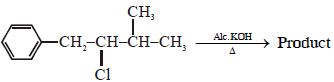
A
$Ph-CH_2-CH=C(CH_3)_2$
B
$Ph-CH=C(CH_3)-CH_2-CH_3$
C
$Ph-CH_2-CH(CH_3)-CH=CH_2$
D
$Ph-CH_2-CH=CH-CH_3$
Solution
(A) The reaction is a dehydrohalogenation of an alkyl halide using alcoholic $KOH$ (an elimination reaction,specifically $E2$ mechanism).
The substrate is $Ph-CH_2-CH(Cl)-CH(CH_3)_2$.
Elimination occurs by removing the $Cl$ atom from the $\alpha$-carbon and a hydrogen atom from an adjacent $\beta$-carbon.
There are two possible $\beta$-carbons:
$1$. The $\beta$-carbon towards the phenyl group $(Ph-CH_2-)$: Removing $H$ from here gives $Ph-CH=CH-CH(CH_3)_2$.
$2$. The $\beta$-carbon towards the isopropyl group (the $CH$ of the isopropyl group): Removing $H$ from here gives $Ph-CH_2-CH=C(CH_3)_2$.
According to Zaitsev's rule,the more substituted alkene is the major product.
$Ph-CH_2-CH=C(CH_3)_2$ is a trisubstituted alkene,while $Ph-CH=CH-CH(CH_3)_2$ is a disubstituted alkene.
Therefore,$Ph-CH_2-CH=C(CH_3)_2$ is the major product.
The substrate is $Ph-CH_2-CH(Cl)-CH(CH_3)_2$.
Elimination occurs by removing the $Cl$ atom from the $\alpha$-carbon and a hydrogen atom from an adjacent $\beta$-carbon.
There are two possible $\beta$-carbons:
$1$. The $\beta$-carbon towards the phenyl group $(Ph-CH_2-)$: Removing $H$ from here gives $Ph-CH=CH-CH(CH_3)_2$.
$2$. The $\beta$-carbon towards the isopropyl group (the $CH$ of the isopropyl group): Removing $H$ from here gives $Ph-CH_2-CH=C(CH_3)_2$.
According to Zaitsev's rule,the more substituted alkene is the major product.
$Ph-CH_2-CH=C(CH_3)_2$ is a trisubstituted alkene,while $Ph-CH=CH-CH(CH_3)_2$ is a disubstituted alkene.
Therefore,$Ph-CH_2-CH=C(CH_3)_2$ is the major product.
0 likes
View Solution592
MediumMCQ
The increasing order of reduction of alkyl halides with zinc and dil. $HCl$ is:
A
$R-Cl < R-I < R-Br$
B
$R-Cl < R-Br < R-I$
C
$R-I < R-Br < R-Cl$
D
$R-Br < R-I < R-Cl$
Solution
(B) The reduction of alkyl halides $(R-X)$ with zinc and dilute $HCl$ involves the cleavage of the $C-X$ bond.
As the size of the halogen atom increases down the group $(Cl < Br < I)$,the bond length increases and the bond dissociation energy of the $C-X$ bond decreases.
Consequently,the reactivity of alkyl halides towards reduction increases in the order $R-Cl < R-Br < R-I$.
As the size of the halogen atom increases down the group $(Cl < Br < I)$,the bond length increases and the bond dissociation energy of the $C-X$ bond decreases.
Consequently,the reactivity of alkyl halides towards reduction increases in the order $R-Cl < R-Br < R-I$.
0 likes
View Solution593
AdvancedMCQ
Which among the following alkyl halides gives more than one product upon dehydrohalogenation?
A
Isobutyl chloride
B
$t-$butyl chloride
C
$s-$butyl chloride
D
$1-$Chloro$-1-$phenylethane
Solution
(C) Dehydrohalogenation follows $Saytzeff$ rule,where the more substituted alkene is the major product.
$s-$butyl chloride $(CH_3-CH_2-CHCl-CH_3)$ has two different types of $\beta-$hydrogens available.
Upon treatment with $Alc. KOH$,it undergoes elimination to form a mixture of products:
$CH_3-CH_2-CHCl-CH_3 \xrightarrow{Alc. KOH} CH_3-CH=CH-CH_3$ (but$-2-$ene) $+ CH_3-CH_2-CH=CH_2$ (but$-1-$ene).
Thus,$s-$butyl chloride gives more than one product.
$s-$butyl chloride $(CH_3-CH_2-CHCl-CH_3)$ has two different types of $\beta-$hydrogens available.
Upon treatment with $Alc. KOH$,it undergoes elimination to form a mixture of products:
$CH_3-CH_2-CHCl-CH_3 \xrightarrow{Alc. KOH} CH_3-CH=CH-CH_3$ (but$-2-$ene) $+ CH_3-CH_2-CH=CH_2$ (but$-1-$ene).
Thus,$s-$butyl chloride gives more than one product.
0 likes
View Solution594
DifficultMCQ
Benzyl bromide on reaction with magnesium in the presence of dry ether gives $'X'$. $'X'$ on reaction with ethanol gives $'Y'$. Then the compound $Y$ is
A
Ethylbenzene
B
Toluene
C
Phenol
D
Phenoxy magnesium bromide
Solution
(B) $1$. Benzyl bromide $(C_6H_5CH_2Br)$ reacts with magnesium in the presence of dry ether to form a Grignard reagent,benzylmagnesium bromide $(C_6H_5CH_2MgBr)$,which is $'X'$.
$2$. Grignard reagents are strong bases and react with protic compounds like ethanol $(C_2H_5OH)$ to form the corresponding hydrocarbon.
$3$. The reaction is: $C_6H_5CH_2MgBr + C_2H_5OH \rightarrow C_6H_5CH_3 + C_2H_5OMgBr$.
$4$. Here,$C_6H_5CH_3$ is toluene,which is the compound $'Y'$.
$2$. Grignard reagents are strong bases and react with protic compounds like ethanol $(C_2H_5OH)$ to form the corresponding hydrocarbon.
$3$. The reaction is: $C_6H_5CH_2MgBr + C_2H_5OH \rightarrow C_6H_5CH_3 + C_2H_5OMgBr$.
$4$. Here,$C_6H_5CH_3$ is toluene,which is the compound $'Y'$.
0 likes
View Solution595
MediumMCQ
The correct decreasing order of $SN^2$ reactivity of the following alkyl halides is:
$(I)$ $CH_2=CH-Br$
$(II)$ $CH_3-Br$
$(III)$ $CH_3-CH(Br)-CH_3$
$(IV)$ $CH_3-CH_2-Br$
$(I)$ $CH_2=CH-Br$
$(II)$ $CH_3-Br$
$(III)$ $CH_3-CH(Br)-CH_3$
$(IV)$ $CH_3-CH_2-Br$
A
$I > II > III > IV$
B
$II > IV > III > I$
C
$IV > III > II > I$
D
$III > IV > II > I$
Solution
(B) In $SN^2$ reactions,the reactivity depends primarily on steric hindrance. The general order of reactivity for alkyl halides is $Methyl > Primary (1^\circ) > Secondary (2^\circ) > Tertiary (3^\circ)$.
$(II)$ $CH_3-Br$ is a methyl halide,which has the least steric hindrance and is most reactive.
$(IV)$ $CH_3-CH_2-Br$ is a primary $(1^\circ)$ alkyl halide.
$(III)$ $CH_3-CH(Br)-CH_3$ is a secondary $(2^\circ)$ alkyl halide.
$(I)$ $CH_2=CH-Br$ is a vinyl halide,which is the least reactive because the $C-Br$ bond has partial double bond character due to resonance,making it very difficult to break.
Therefore,the correct decreasing order of reactivity is $II > IV > III > I$.
$(II)$ $CH_3-Br$ is a methyl halide,which has the least steric hindrance and is most reactive.
$(IV)$ $CH_3-CH_2-Br$ is a primary $(1^\circ)$ alkyl halide.
$(III)$ $CH_3-CH(Br)-CH_3$ is a secondary $(2^\circ)$ alkyl halide.
$(I)$ $CH_2=CH-Br$ is a vinyl halide,which is the least reactive because the $C-Br$ bond has partial double bond character due to resonance,making it very difficult to break.
Therefore,the correct decreasing order of reactivity is $II > IV > III > I$.
0 likes
View Solution596
DifficultMCQ
Identify $A$ in the following reaction:

A
$1-$bromo$-1-$phenylethane
B
$3-$bromo$-1-$phenylpropane
C
$1-$bromo$-2-$phenylethane
D
$2-$bromo$-1-$phenylethane
Solution
(C) The reaction of styrene with $HBr$ in the presence of peroxide $(R_2O_2)$ proceeds via a free radical mechanism,which follows anti-Markovnikov addition.
$1$. The peroxide undergoes homolytic cleavage to form alkoxy radicals $(RO^{\bullet})$.
$2$. The alkoxy radical reacts with $HBr$ to generate a bromine radical $(Br^{\bullet})$.
$3$. The bromine radical attacks the double bond of styrene to form a carbon-centered radical. There are two possibilities:
- Attack at the terminal carbon leads to a more stable benzylic radical $(Ph-CH^{\bullet}-CH_2Br)$.
- Attack at the internal carbon leads to a less stable secondary radical $(Ph-CH(Br)-CH_2^{\bullet})$.
$4$. The more stable benzylic radical reacts with $HBr$ to form the major product,$1$-bromo-$2$-phenylethane $(Ph-CH_2-CH_2Br)$.
$1$. The peroxide undergoes homolytic cleavage to form alkoxy radicals $(RO^{\bullet})$.
$2$. The alkoxy radical reacts with $HBr$ to generate a bromine radical $(Br^{\bullet})$.
$3$. The bromine radical attacks the double bond of styrene to form a carbon-centered radical. There are two possibilities:
- Attack at the terminal carbon leads to a more stable benzylic radical $(Ph-CH^{\bullet}-CH_2Br)$.
- Attack at the internal carbon leads to a less stable secondary radical $(Ph-CH(Br)-CH_2^{\bullet})$.
$4$. The more stable benzylic radical reacts with $HBr$ to form the major product,$1$-bromo-$2$-phenylethane $(Ph-CH_2-CH_2Br)$.
0 likes
View Solution597
MediumMCQ
Chloropicrin is a strong lachrymatory compound and is used in war. It is prepared by
A
Heating acetone with chloroform in the presence of dilute $NaOH$
B
Heating chloroform with $HNO_3$
C
Heating nitro methane with carbon tetrachloride
D
The reaction of acetylene with $AsCl_3$
Solution
(B) Chloropicrin,also known as trichloronitromethane $(CCl_3NO_2)$,is prepared by the reaction of chloroform $(CHCl_3)$ with concentrated nitric acid $(HNO_3)$.
The chemical reaction is: $CHCl_3 + HNO_3 \xrightarrow{\Delta} CCl_3NO_2 + H_2O$.
This compound is a potent lachrymator (tear-inducing agent) and has been used as a chemical warfare agent.
The chemical reaction is: $CHCl_3 + HNO_3 \xrightarrow{\Delta} CCl_3NO_2 + H_2O$.
This compound is a potent lachrymator (tear-inducing agent) and has been used as a chemical warfare agent.
0 likes
View Solution598
MediumMCQ
Which one of the following compounds is most reactive towards $S_N1$ reaction?
A
Benzyl bromide $(C_6H_5CH_2Br)$
B
Benzyl chloride $(C_6H_5CH_2Cl)$
C
$1-$Methylcyclohexyl chloride
D
Chlorobenzene $(C_6H_5Cl)$
Solution
(C) The reactivity towards $S_N1$ reaction depends on the stability of the carbocation formed as an intermediate. The more stable the carbocation,the faster the reaction.
$1.$ Benzyl bromide and benzyl chloride form a benzyl carbocation $(C_6H_5CH_2^+)$,which is resonance stabilized.
$2.$ $1-$Methylcyclohexyl chloride forms a tertiary $(3^{\circ})$ carbocation,which is more stable than the primary benzyl carbocation due to inductive effect and hyperconjugation.
$3.$ Chlorobenzene does not undergo $S_N1$ reaction easily because the $C-Cl$ bond has partial double bond character due to resonance.
Comparing the leaving group ability,$Br^-$ is a better leaving group than $Cl^-$. Therefore,benzyl bromide is more reactive than benzyl chloride. However,the tertiary carbocation formed from $1-$methylcyclohexyl chloride is significantly more stable than the primary benzyl carbocation. Thus,$1$-methylcyclohexyl chloride is the most reactive towards $S_N1$.
$1.$ Benzyl bromide and benzyl chloride form a benzyl carbocation $(C_6H_5CH_2^+)$,which is resonance stabilized.
$2.$ $1-$Methylcyclohexyl chloride forms a tertiary $(3^{\circ})$ carbocation,which is more stable than the primary benzyl carbocation due to inductive effect and hyperconjugation.
$3.$ Chlorobenzene does not undergo $S_N1$ reaction easily because the $C-Cl$ bond has partial double bond character due to resonance.
Comparing the leaving group ability,$Br^-$ is a better leaving group than $Cl^-$. Therefore,benzyl bromide is more reactive than benzyl chloride. However,the tertiary carbocation formed from $1-$methylcyclohexyl chloride is significantly more stable than the primary benzyl carbocation. Thus,$1$-methylcyclohexyl chloride is the most reactive towards $S_N1$.
0 likes
View Solution599
MediumMCQ
Which of the following compounds gives a racemic mixture on nucleophilic substitution?
$(a)$ $CH_3-CH(Br)-C_2H_5$
$(b)$ $CH_3-C(Br)(CH_3)-C_2H_5$
$(c)$ $C_2H_5-CH(C_2H_5)-CH_2Br$
$(a)$ $CH_3-CH(Br)-C_2H_5$
$(b)$ $CH_3-C(Br)(CH_3)-C_2H_5$
$(c)$ $C_2H_5-CH(C_2H_5)-CH_2Br$
A
$(a)$
B
$(a), (b), (c)$
C
$(b), (c)$
D
$(a), (c)$
Solution
(A) racemic mixture is formed when a nucleophilic substitution reaction occurs at a chiral carbon atom,typically via the $S_N1$ mechanism.
Compound $(a)$ $CH_3-CH(Br)-C_2H_5$ ($2$-bromobutane) is chiral because the carbon atom is bonded to four different groups: $-H$,$-CH_3$,$-C_2H_5$,and $-Br$.
Upon substitution,it forms a planar carbocation intermediate,leading to racemization.
Compound $(b)$ $CH_3-C(Br)(CH_3)-C_2H_5$ is achiral because it has two identical methyl groups attached to the carbon bearing the bromine atom.
Compound $(c)$ $C_2H_5-CH(C_2H_5)-CH_2Br$ is achiral because it has two identical ethyl groups attached to the carbon atom adjacent to the $CH_2Br$ group.
Therefore,only compound $(a)$ forms a racemic mixture.
Compound $(a)$ $CH_3-CH(Br)-C_2H_5$ ($2$-bromobutane) is chiral because the carbon atom is bonded to four different groups: $-H$,$-CH_3$,$-C_2H_5$,and $-Br$.
Upon substitution,it forms a planar carbocation intermediate,leading to racemization.
Compound $(b)$ $CH_3-C(Br)(CH_3)-C_2H_5$ is achiral because it has two identical methyl groups attached to the carbon bearing the bromine atom.
Compound $(c)$ $C_2H_5-CH(C_2H_5)-CH_2Br$ is achiral because it has two identical ethyl groups attached to the carbon atom adjacent to the $CH_2Br$ group.
Therefore,only compound $(a)$ forms a racemic mixture.
0 likes
View Solution600
DifficultMCQ
Which of the following is most reactive towards dehydrohalogenation?
A
Chlorocyclohexane
B
$1-$Methyl$-1-$chlorocyclohexane
C
$3-$Chlorocyclohexene
D
$4-$Chlorocyclohexene
Solution
(C) Dehydrohalogenation involves the elimination of a hydrogen atom and a halogen atom to form a double bond. The reactivity depends on the stability of the transition state and the resulting alkene.
$A$: Chlorocyclohexane is a secondary alkyl halide.
$B$: $1$-Methyl-$1$-chlorocyclohexane is a tertiary alkyl halide. Tertiary halides are generally more reactive towards elimination ($E2$ or $E1$) due to the formation of more stable alkenes (Zaitsev's rule).
$C$: $3$-Chlorocyclohexene is an allylic halide. Allylic halides are highly reactive towards elimination because the resulting product is a conjugated diene ($1,3$-cyclohexadiene),which is significantly more stable due to resonance.
$D$: $4$-Chlorocyclohexene is also an allylic halide,but the double bond formed would not be conjugated with the existing double bond,making it less stable than the product from $C$.
Therefore,$3$-chlorocyclohexene is the most reactive.
$A$: Chlorocyclohexane is a secondary alkyl halide.
$B$: $1$-Methyl-$1$-chlorocyclohexane is a tertiary alkyl halide. Tertiary halides are generally more reactive towards elimination ($E2$ or $E1$) due to the formation of more stable alkenes (Zaitsev's rule).
$C$: $3$-Chlorocyclohexene is an allylic halide. Allylic halides are highly reactive towards elimination because the resulting product is a conjugated diene ($1,3$-cyclohexadiene),which is significantly more stable due to resonance.
$D$: $4$-Chlorocyclohexene is also an allylic halide,but the double bond formed would not be conjugated with the existing double bond,making it less stable than the product from $C$.
Therefore,$3$-chlorocyclohexene is the most reactive.
0 likes
View SolutionHaloalkanes and Haloarenes — Properties of Haloalkanes · Frequently Asked Questions
1Are these Haloalkanes and Haloarenes questions useful for JEE and NEET?
Yes. All questions in this section are mapped to JEE Main and NEET exam patterns. Previous year questions from JEE Main, NEET, GUJCET and state-level exams are included with full solutions.
2Can I switch to Hindi or Gujarati for these questions?
Yes. Use the language tabs in the hero section or the sidebar to view the same questions and solutions in English, Hindi or Gujarati.
3How do I generate a question paper from this subtopic?
Use the Vedclass Exam Paper Generator — select the chapter and subtopic, set difficulty, and generate Sets A, B, C, D automatically. First 3 chapters of every subject are free.
Vedclass Products
For Students
Vedclass Test Series
Mock tests in real JEE/NEET style with performance analysis. 5-day free trial.
Start Free TrialFor Teachers
Exam Paper Generator
Generate Set A/B/C/D papers from this chapter in 2 minutes. 3 chapters free.
Try FreeFor Institutes
Online Exam Module
Live online exams with unlimited students, 360° analytics & white-label branding.
See DemoFor Teachers & Institutes
Generate a Haloalkanes and Haloarenes Exam Paper in 2 Minutes
Select subtopic & difficulty — Sets A, B, C, D auto-generated with No Repeat logic.
First 3 chapters of every subject are free — no payment required.