
A English
Preparation of Haloalkanes Questions in English
Class 12 Chemistry · Haloalkanes and Haloarenes · Preparation of Haloalkanes
104+
Questions
English
Language
100%
With Solutions
Showing 50 of 104 questions in English
1
EasyMCQ
$Cl_2$ reacts with $CS_2$ in the presence of an $I_2$ catalyst to form:
A
$CHCl_3$
B
$CCl_4$
C
$C_2H_5Cl$
D
$C_2H_6$
Solution
(B) The reaction of carbon disulfide $(CS_2)$ with chlorine $(Cl_2)$ in the presence of an iodine $(I_2)$ catalyst is a standard method for the preparation of carbon tetrachloride $(CCl_4)$.
The balanced chemical equation is:
$CS_2 + 3Cl_2 \xrightarrow{I_2} CCl_4 + S_2Cl_2$
The balanced chemical equation is:
$CS_2 + 3Cl_2 \xrightarrow{I_2} CCl_4 + S_2Cl_2$
0 likes
View Solution2
MediumMCQ
How many enantiomer pairs are obtained by monochlorination of $2, 3-$dimethylbutane?
A
$1$
B
$4$
C
$2$
D
$3$
Solution
(A) The structure of $2, 3-$dimethylbutane is $CH_3-CH(CH_3)-CH(CH_3)-CH_3$.
There are two types of equivalent hydrogens in this molecule:
$1.$ Primary hydrogens: Monochlorination at a primary carbon gives $ClCH_2-CH(CH_3)-CH(CH_3)-CH_3$ ($1-$chloro$-2, 3-$dimethylbutane). This molecule has one chiral center at $C-2$,so it exists as one pair of enantiomers ($d$ and $l$ forms).
$2.$ Tertiary hydrogens: Monochlorination at a tertiary carbon gives $CH_3-CCl(CH_3)-CH(CH_3)-CH_3$ ($2-$chloro$-2, 3-$dimethylbutane). This molecule is achiral because it does not have a chiral center.
Thus,only $1$ pair of enantiomers is obtained.
There are two types of equivalent hydrogens in this molecule:
$1.$ Primary hydrogens: Monochlorination at a primary carbon gives $ClCH_2-CH(CH_3)-CH(CH_3)-CH_3$ ($1-$chloro$-2, 3-$dimethylbutane). This molecule has one chiral center at $C-2$,so it exists as one pair of enantiomers ($d$ and $l$ forms).
$2.$ Tertiary hydrogens: Monochlorination at a tertiary carbon gives $CH_3-CCl(CH_3)-CH(CH_3)-CH_3$ ($2-$chloro$-2, 3-$dimethylbutane). This molecule is achiral because it does not have a chiral center.
Thus,only $1$ pair of enantiomers is obtained.
0 likes
View Solution3
EasyMCQ
In the preparation of Grignard reagent from haloalkane,the metal used is:
A
$Mg$
B
$Zn$
C
$Li$
D
$K$
Solution
(A) The metal used in the preparation of Grignard reagent is Magnesium $(Mg)$.
Haloalkanes,aryl halides,and vinyl halides react with magnesium metal in the presence of a dry ether solvent to yield organomagnesium halides,which are known as Grignard reagents.
The general reaction is: $R-X + Mg \xrightarrow{\text{dry ether}} R-Mg-X$.
Haloalkanes,aryl halides,and vinyl halides react with magnesium metal in the presence of a dry ether solvent to yield organomagnesium halides,which are known as Grignard reagents.
The general reaction is: $R-X + Mg \xrightarrow{\text{dry ether}} R-Mg-X$.
0 likes
View Solution4
MediumMCQ
Which one of the following reactions would be the best for the formation of $2-$bromobutane?
$(1)$ $CH_3CH=CHCH_2CH_3$ $\xrightarrow{HBr}$
$(2)$ $CH_3CH_2CH=CH_2$ $\xrightarrow{HBr}$
$(3)$ $CH_3CH=CHCH_3$ $\xrightarrow{Br_2}$
$(4)$ $CH_3CH_2CH=CH_2$ $\xrightarrow[Peroxide]{HBr}$
$(1)$ $CH_3CH=CHCH_2CH_3$ $\xrightarrow{HBr}$
$(2)$ $CH_3CH_2CH=CH_2$ $\xrightarrow{HBr}$
$(3)$ $CH_3CH=CHCH_3$ $\xrightarrow{Br_2}$
$(4)$ $CH_3CH_2CH=CH_2$ $\xrightarrow[Peroxide]{HBr}$
A
$1$
B
$2$
C
$3$
D
$4$
Solution
(B) The reaction of $1-$butene $(CH_3CH_2CH=CH_2)$ with $HBr$ follows Markovnikov's rule.
According to Markovnikov's rule,the negative part of the addendum $(Br^-)$ attaches to the carbon atom with fewer hydrogen atoms.
Therefore,$CH_3CH_2CH=CH_2 + HBr \rightarrow CH_3CH_2CH(Br)CH_3$ ($2-$bromobutane).
Reaction $(1)$ gives a mixture of $2-$bromopentane and $3-$bromopentane.
Reaction $(3)$ gives $2,3-$dibromobutane.
Reaction $(4)$ follows anti-Markovnikov addition,yielding $1-$bromobutane.
According to Markovnikov's rule,the negative part of the addendum $(Br^-)$ attaches to the carbon atom with fewer hydrogen atoms.
Therefore,$CH_3CH_2CH=CH_2 + HBr \rightarrow CH_3CH_2CH(Br)CH_3$ ($2-$bromobutane).
Reaction $(1)$ gives a mixture of $2-$bromopentane and $3-$bromopentane.
Reaction $(3)$ gives $2,3-$dibromobutane.
Reaction $(4)$ follows anti-Markovnikov addition,yielding $1-$bromobutane.
0 likes
View Solution5
MediumMCQ
In the presence of light,toluene reacts with chlorine to give:
A
Benzoyl chloride
B
Ortho-chlorotoluene
C
Para-chlorotoluene
D
Benzyl chloride
Solution
(D) The reaction of toluene with chlorine in the presence of light (ultraviolet light) proceeds via a free radical mechanism.
This reaction occurs at the side chain (methyl group) rather than the benzene ring.
The reaction is as follows:
$C_6H_5CH_3 + Cl_2 \xrightarrow{h\nu} C_6H_5CH_2Cl + HCl$
The product formed is $Benzyl \ chloride$.
Side-chain chlorination is favored by high temperature,light,and the absence of a halogen carrier (like $FeCl_3$ or $AlCl_3$).
This reaction occurs at the side chain (methyl group) rather than the benzene ring.
The reaction is as follows:
$C_6H_5CH_3 + Cl_2 \xrightarrow{h\nu} C_6H_5CH_2Cl + HCl$
The product formed is $Benzyl \ chloride$.
Side-chain chlorination is favored by high temperature,light,and the absence of a halogen carrier (like $FeCl_3$ or $AlCl_3$).
0 likes
View Solution6
MediumMCQ
The preparation of alkyl halides in the laboratory is least preferred by:
A
Treatment of alcohols
B
Addition of hydrogen halides to alkenes
C
Halide exchange
D
Direct halogenation of alkanes
Solution
(D) The preparation of alkyl halides is least preferred by direct halogenation of alkanes because it results in a mixture of mono-,di-,tri-,and poly-substituted alkyl halide derivatives,which are difficult to separate. The reaction proceeds as follows:
$CH_4 + Cl_2 \rightarrow CH_3Cl + HCl$ (chloromethane)
$CH_3Cl + Cl_2 \rightarrow CH_2Cl_2 + HCl$ (dichloromethane)
$CH_2Cl_2 + Cl_2 \rightarrow CHCl_3 + HCl$ (trichloromethane)
$CHCl_3 + Cl_2 \rightarrow CCl_4 + HCl$ (tetrachloromethane)
$CH_4 + Cl_2 \rightarrow CH_3Cl + HCl$ (chloromethane)
$CH_3Cl + Cl_2 \rightarrow CH_2Cl_2 + HCl$ (dichloromethane)
$CH_2Cl_2 + Cl_2 \rightarrow CHCl_3 + HCl$ (trichloromethane)
$CHCl_3 + Cl_2 \rightarrow CCl_4 + HCl$ (tetrachloromethane)
0 likes
View Solution7
AdvancedMCQ
In the preparation of $CHCl_3$ from ethanol and bleaching powder,the latter provides:
A
$Ca(OH)_2$
B
$Cl_2$
C
Both $(a)$ and $(b)$
D
None of these
Solution
(C) The preparation of chloroform $(CHCl_3)$ from ethanol $(C_2H_5OH)$ and bleaching powder $(CaOCl_2)$ involves the following steps:
$1$. Bleaching powder reacts with water to produce calcium hydroxide and chlorine gas: $CaOCl_2 + H_2O \to Ca(OH)_2 + Cl_2$.
$2$. Chlorine acts as an oxidizing agent to oxidize ethanol to acetaldehyde,and then as a chlorinating agent to form chloral $(CCl_3CHO)$.
$3$. Calcium hydroxide then reacts with chloral to produce chloroform: $2CCl_3CHO + Ca(OH)_2 \to 2CHCl_3 + (HCOO)_2Ca$.
Thus,bleaching powder provides both $Ca(OH)_2$ and $Cl_2$ for the reaction.
$1$. Bleaching powder reacts with water to produce calcium hydroxide and chlorine gas: $CaOCl_2 + H_2O \to Ca(OH)_2 + Cl_2$.
$2$. Chlorine acts as an oxidizing agent to oxidize ethanol to acetaldehyde,and then as a chlorinating agent to form chloral $(CCl_3CHO)$.
$3$. Calcium hydroxide then reacts with chloral to produce chloroform: $2CCl_3CHO + Ca(OH)_2 \to 2CHCl_3 + (HCOO)_2Ca$.
Thus,bleaching powder provides both $Ca(OH)_2$ and $Cl_2$ for the reaction.
0 likes
View Solution8
DifficultMCQ
Which one of the following processes does not occur during the formation of $CHCl_3$ from $C_2H_5OH$ and bleaching powder?
A
Hydrolysis
B
Oxidation
C
Reduction
D
Chlorination
Solution
(C) The formation of chloroform $(CHCl_3)$ from ethanol $(C_2H_5OH)$ and bleaching powder $(CaOCl_2)$ involves the following steps:
$1.$ Hydrolysis of bleaching powder: $CaOCl_2 + H_2O \rightarrow Ca(OH)_2 + Cl_2$
$2.$ Oxidation of ethanol: $CH_3CH_2OH + Cl_2 \rightarrow CH_3CHO + 2HCl$
$3.$ Chlorination of acetaldehyde: $CH_3CHO + 3Cl_2 \rightarrow CCl_3CHO + 3HCl$
$4.$ Hydrolysis of chloral: $2CCl_3CHO + Ca(OH)_2 \rightarrow 2CHCl_3 + (HCOO)_2Ca$
Reduction does not occur in this reaction sequence.
$1.$ Hydrolysis of bleaching powder: $CaOCl_2 + H_2O \rightarrow Ca(OH)_2 + Cl_2$
$2.$ Oxidation of ethanol: $CH_3CH_2OH + Cl_2 \rightarrow CH_3CHO + 2HCl$
$3.$ Chlorination of acetaldehyde: $CH_3CHO + 3Cl_2 \rightarrow CCl_3CHO + 3HCl$
$4.$ Hydrolysis of chloral: $2CCl_3CHO + Ca(OH)_2 \rightarrow 2CHCl_3 + (HCOO)_2Ca$
Reduction does not occur in this reaction sequence.
0 likes
View Solution9
MediumMCQ
Ethanol is converted into ethyl chloride by reacting with
A
$Cl_2$
B
$SOCl_2$
C
$HCl$
D
$NaCl$
Solution
(B) The reaction of ethanol $(C_2H_5OH)$ with thionyl chloride $(SOCl_2)$ in the presence of pyridine is the preferred method for preparing ethyl chloride $(C_2H_5Cl)$.
This is because the by-products,$SO_2$ and $HCl$,are gases and escape,leaving behind pure ethyl chloride.
The reaction is: $C_2H_5OH + SOCl_2 \xrightarrow{\text{Pyridine}} C_2H_5Cl + SO_2 \uparrow + HCl \uparrow$
This is because the by-products,$SO_2$ and $HCl$,are gases and escape,leaving behind pure ethyl chloride.
The reaction is: $C_2H_5OH + SOCl_2 \xrightarrow{\text{Pyridine}} C_2H_5Cl + SO_2 \uparrow + HCl \uparrow$
0 likes
View Solution10
DifficultMCQ
The starting substance for the preparation of $CH_3I$ is
A
$CH_3OH$
B
$C_2H_5OH$
C
$CH_3CHO$
D
$(CH_3)_2CO$
Solution
(A) $CH_3I$ can be prepared by the reaction of methanol $(CH_3OH)$ with hydrogen iodide $(HI)$ in the presence of a catalyst like $ZnCl_2$ or by heating.
The reaction is: $CH_3OH + HI \rightarrow CH_3I + H_2O$.
The reaction is: $CH_3OH + HI \rightarrow CH_3I + H_2O$.
0 likes
View Solution11
MediumMCQ
$A$ Grignard reagent may be made by reacting magnesium with
A
Methyl amine
B
Diethyl ether
C
Ethyl iodide
D
Ethyl alcohol
Solution
(C) Grignard reagents are prepared by the reaction of an alkyl halide with magnesium metal in the presence of dry ether as a solvent.
$C_2H_5I + Mg \xrightarrow{\text{Dry ether}} C_2H_5MgI$
Here,$C_2H_5I$ (Ethyl iodide) is an alkyl halide,which reacts with $Mg$ to form the Grignard reagent,Ethyl magnesium iodide.
$C_2H_5I + Mg \xrightarrow{\text{Dry ether}} C_2H_5MgI$
Here,$C_2H_5I$ (Ethyl iodide) is an alkyl halide,which reacts with $Mg$ to form the Grignard reagent,Ethyl magnesium iodide.
0 likes
View Solution12
MediumMCQ
Which reagent cannot be used to prepare an alkyl halide from an alcohol?
A
$HCl + ZnCl_2$
B
$NaCl$
C
$PCl_5$
D
$SOCl_2$
Solution
(B) The reaction of an alcohol with $NaCl$ does not occur because the chloride ion $(Cl^-)$ is a poor nucleophile and the hydroxyl group $(-OH)$ is a poor leaving group.
To convert an alcohol to an alkyl chloride,stronger reagents like $HCl$ in the presence of $ZnCl_2$ (Lucas reagent),$PCl_5$,or $SOCl_2$ are required.
To convert an alcohol to an alkyl chloride,stronger reagents like $HCl$ in the presence of $ZnCl_2$ (Lucas reagent),$PCl_5$,or $SOCl_2$ are required.
0 likes
View Solution13
MediumMCQ
The best method for preparing alkyl chloride is:
A
$ROH + SOCl_2 \xrightarrow{Pyridine} RCl + SO_2 \uparrow + HCl \uparrow$
B
$ROH + PCl_5 \rightarrow RCl + POCl_3 + HCl$
C
$ROH + PCl_3 \rightarrow 3RCl + H_3PO_3$
D
$ROH + HCl \xrightarrow{anhy. ZnCl_2} RCl + H_2O$
Solution
(A) The reaction of alcohols with $SOCl_2$ (thionyl chloride) is considered the best method for preparing alkyl chlorides.
This is because the by-products formed,$SO_2$ and $HCl$,are both gases.
Since these by-products escape into the atmosphere,the resulting alkyl chloride is obtained in a highly pure state.
The reaction is: $R-OH + SOCl_2 \xrightarrow{Pyridine} R-Cl + SO_2 \uparrow + HCl \uparrow$
This is because the by-products formed,$SO_2$ and $HCl$,are both gases.
Since these by-products escape into the atmosphere,the resulting alkyl chloride is obtained in a highly pure state.
The reaction is: $R-OH + SOCl_2 \xrightarrow{Pyridine} R-Cl + SO_2 \uparrow + HCl \uparrow$
0 likes
View Solution14
EasyMCQ
Alkyl halides can be converted into Grignard reagents by:
A
Boiling them with $Mg$ ribbon in alcoholic solution
B
Warming them with magnesium powder in dry ether
C
Refluxing them with $MgCl_2$ solution
D
Warming them with $MgCl_2$
Solution
(B) Grignard reagents are prepared by the reaction of alkyl halides with magnesium metal in the presence of dry ether as a solvent.
The general reaction is: $RX + Mg \xrightarrow{\text{Dry ether}} RMgX$.
The general reaction is: $RX + Mg \xrightarrow{\text{Dry ether}} RMgX$.
0 likes
View Solution15
MediumMCQ
Grignard reagent is prepared by the reaction between
A
Zinc and alkyl halide
B
Magnesium and alkyl halide
C
Magnesium and alkane
D
Magnesium and aromatic hydrocarbon
Solution
(B) is the correct answer.
Grignard reagent $(RMgX)$ is prepared by the reaction of an alkyl halide $(RX)$ with magnesium metal in the presence of dry ether.
The reaction is: $RX + Mg \xrightarrow{\text{Dry ether}} RMgX$.
Grignard reagent $(RMgX)$ is prepared by the reaction of an alkyl halide $(RX)$ with magnesium metal in the presence of dry ether.
The reaction is: $RX + Mg \xrightarrow{\text{Dry ether}} RMgX$.
0 likes
View Solution16
AdvancedMCQ
$CHCl_3$ and $HF$ lead to the formation of a compound of fluorine of molecular weight $70$. The compound is
A
Fluoroform
B
Fluorine monoxide
C
Fluorine dioxide
D
Fluoromethanol
Solution
(A) The reaction between $CHCl_3$ and $HF$ is a nucleophilic substitution reaction known as the Swarts reaction.
The chemical equation is: $CHCl_3 + 3HF \to CHF_3 + 3HCl$.
The product formed is $CHF_3$,which is known as fluoroform.
The molecular weight of $CHF_3$ is calculated as: $12.01 + 1.01 + 3 \times 19.00 = 70.02 \approx 70 \ g/mol$.
The chemical equation is: $CHCl_3 + 3HF \to CHF_3 + 3HCl$.
The product formed is $CHF_3$,which is known as fluoroform.
The molecular weight of $CHF_3$ is calculated as: $12.01 + 1.01 + 3 \times 19.00 = 70.02 \approx 70 \ g/mol$.
0 likes
View Solution17
EasyMCQ
Which of the following is used as a catalyst for preparing Grignard reagent?
A
Iron powder
B
Iodine powder
C
Activated charcoal
D
Manganese dioxide
Solution
(B) The preparation of Grignard reagent $(RMgX)$ involves the reaction of an alkyl halide $(RX)$ with magnesium metal in the presence of dry ether.
$I_2$ (iodine) powder is often used as a catalyst or initiator to remove the oxide layer from the surface of the magnesium metal,thereby facilitating the reaction.
Therefore,the correct option is $B$.
$I_2$ (iodine) powder is often used as a catalyst or initiator to remove the oxide layer from the surface of the magnesium metal,thereby facilitating the reaction.
Therefore,the correct option is $B$.
0 likes
View Solution18
MediumMCQ
Which reagent is useful in converting $1$-butanol to $1$-bromobutane?
A
$CHBr_3$
B
$Br_2$
C
$CH_3Br$
D
$PBr_3$
Solution
(D) The conversion of an alcohol to an alkyl bromide is best achieved using phosphorus tribromide $(PBr_3)$.
The reaction is as follows:
$3CH_3CH_2CH_2CH_2OH + PBr_3 \rightarrow 3CH_3CH_2CH_2CH_2Br + H_3PO_3$
Thus,option $(d)$ is the correct reagent.
The reaction is as follows:
$3CH_3CH_2CH_2CH_2OH + PBr_3 \rightarrow 3CH_3CH_2CH_2CH_2Br + H_3PO_3$
Thus,option $(d)$ is the correct reagent.
0 likes
View Solution19
MediumMCQ
Which of the following is used as a catalyst for preparing a Grignard reagent?
A
Iron powder
B
Dry ether
C
Activated charcoal
D
$MnO_2$
Solution
(B) The preparation of a Grignard reagent involves the reaction of an alkyl halide with magnesium metal in the presence of dry ether as a solvent/catalyst.
$R-X + Mg \xrightarrow{\text{Dry ether}} R-MgX$
For example: $CH_3I + Mg \xrightarrow{\text{Dry ether}} CH_3MgI$
Therefore,the correct option is $B$.
$R-X + Mg \xrightarrow{\text{Dry ether}} R-MgX$
For example: $CH_3I + Mg \xrightarrow{\text{Dry ether}} CH_3MgI$
Therefore,the correct option is $B$.
0 likes
View Solution20
MediumMCQ
What is the major product of the reaction: $CH_3COOAg + Br_2 \xrightarrow{CS_2} \dots$?
A
$CH_3Br$
B
$CH_3COI$
C
$CH_3COOH$
D
None of these
Solution
(A) The given reaction is the $Hunsdiecker$ reaction,where a silver salt of a carboxylic acid reacts with bromine in the presence of $CS_2$ to form an alkyl bromide.
The reaction is: $CH_3COOAg + Br_2 \xrightarrow{CS_2} CH_3Br + AgBr + CO_2$.
Therefore,the major product is $CH_3Br$.
The reaction is: $CH_3COOAg + Br_2 \xrightarrow{CS_2} CH_3Br + AgBr + CO_2$.
Therefore,the major product is $CH_3Br$.
0 likes
View Solution21
MediumMCQ
Which reagent is used to convert ethanol into ethyl chloride?
A
$Cl_2$
B
$SOCl_2$
C
$HCl$
D
$NaCl$
Solution
(B) The reaction of ethanol with thionyl chloride $(SOCl_2)$ in the presence of pyridine is the most preferred method for the preparation of ethyl chloride because the by-products ($SO_2$ and $HCl$) are gases and escape,leaving pure alkyl halide.
Reaction: $C_2H_5OH + SOCl_2 \xrightarrow{\text{Pyridine}} C_2H_5Cl + SO_2(g) + HCl(g)$
Reaction: $C_2H_5OH + SOCl_2 \xrightarrow{\text{Pyridine}} C_2H_5Cl + SO_2(g) + HCl(g)$
0 likes
View Solution22
MediumMCQ
Butanenitrile can be prepared by heating $KCN$ with which of the following?
A
Propyl alcohol with $KCN$
B
Butyl alcohol with $KCN$
C
Butyl chloride with $KCN$
D
Propyl chloride with $KCN$
Solution
(D) The preparation of butanenitrile $(CH_3CH_2CH_2CN)$ involves the nucleophilic substitution reaction of an alkyl halide with potassium cyanide $(KCN)$.
To obtain a four-carbon nitrile,we need a three-carbon alkyl halide.
$CH_3-CH_2-CH_2-Cl + KCN \xrightarrow{S_N2} CH_3-CH_2-CH_2-CN + KCl$.
Thus,propyl chloride $(CH_3CH_2CH_2Cl)$ reacts with $KCN$ to form butanenitrile.
To obtain a four-carbon nitrile,we need a three-carbon alkyl halide.
$CH_3-CH_2-CH_2-Cl + KCN \xrightarrow{S_N2} CH_3-CH_2-CH_2-CN + KCl$.
Thus,propyl chloride $(CH_3CH_2CH_2Cl)$ reacts with $KCN$ to form butanenitrile.
0 likes
View Solution23
MediumMCQ
The product formed by the reaction of $C_2H_5OH$ with thionyl chloride is ...... .
A
$CH_3CH_2Cl + HCl$
B
$CH_3CH_2Cl + HCl + SO_2$
C
$CH_3CH_2Cl + H_2O + SO_2$
D
$CH_3COCl + HCl + SO_2$
Solution
(B) The reaction of an alcohol with thionyl chloride $(SOCl_2)$ is a standard method for the preparation of alkyl chlorides.
The chemical equation is: $C_2H_5OH + SOCl_2 \rightarrow C_2H_5Cl + SO_2(g) + HCl(g)$.
Since both by-products ($SO_2$ and $HCl$) are gases,they escape the reaction mixture,leaving behind pure alkyl chloride.
Therefore,the correct products are $CH_3CH_2Cl$,$HCl$,and $SO_2$.
The chemical equation is: $C_2H_5OH + SOCl_2 \rightarrow C_2H_5Cl + SO_2(g) + HCl(g)$.
Since both by-products ($SO_2$ and $HCl$) are gases,they escape the reaction mixture,leaving behind pure alkyl chloride.
Therefore,the correct products are $CH_3CH_2Cl$,$HCl$,and $SO_2$.
0 likes
View Solution24
MediumMCQ
To obtain a Grignard reagent,magnesium is reacted with......?
A
Alkyl halide in the presence of alcohol
B
Alkyl halide in the presence of phenol
C
Alkyl halide in the presence of dry ether
D
Alkyl halide in the presence of alkoxylated ether
Solution
(C) The Grignard reagent $(RMgX)$ is prepared by the reaction of an alkyl halide $(RX)$ with magnesium metal in the presence of dry ether $(R-X + Mg \xrightarrow{\text{dry ether}} RMgX)$.
Dry ether is essential because it acts as a solvent and stabilizes the Grignard reagent through coordination,while also preventing the reagent from reacting with moisture or protic solvents.
Dry ether is essential because it acts as a solvent and stabilizes the Grignard reagent through coordination,while also preventing the reagent from reacting with moisture or protic solvents.
0 likes
View Solution25
MediumMCQ
Ethanol is converted to chloroethane by reaction with . . . . . . .
A
$Cl_2$
B
$SOCl_2$
C
$HCl$
D
$NaCl$
Solution
(B) The reaction of ethanol $(CH_3CH_2OH)$ with thionyl chloride $(SOCl_2)$ in the presence of pyridine is the best method for preparing chloroethane $(CH_3CH_2Cl)$.
The reaction is: $CH_3CH_2OH + SOCl_2 \xrightarrow{\text{pyridine}} CH_3CH_2Cl + SO_2(g) + HCl(g)$.
This method is preferred because the by-products ($SO_2$ and $HCl$) are gases,which escape,leaving behind pure chloroethane.
The reaction is: $CH_3CH_2OH + SOCl_2 \xrightarrow{\text{pyridine}} CH_3CH_2Cl + SO_2(g) + HCl(g)$.
This method is preferred because the by-products ($SO_2$ and $HCl$) are gases,which escape,leaving behind pure chloroethane.
0 likes
View Solution26
MediumMCQ
$2$-Bromobutane is obtained by the reaction of:
A
$CH_3-CH=CH-CH_3 + HBr$
B
$CH_3-CH_2-CH=CH_2 + HBr$
C
$CH_3-CH=CH-CH_3 + Br_2$
D
$CH_3-CH_2-CH=CH_2 + HBr$ (Note: This is a duplicate of $B$,assuming intended reactant is $CH_3-CH=CH-CH_3$)
Solution
(A) The addition of $HBr$ to alkenes follows Markovnikov's rule.
For the formation of $2$-bromobutane $(CH_3-CH(Br)-CH_2-CH_3)$,the starting material should be but-$2$-ene $(CH_3-CH=CH-CH_3)$.
When $CH_3-CH=CH-CH_3$ reacts with $HBr$,the proton $(H^+)$ adds to one of the $sp^2$ carbons and the bromide ion $(Br^-)$ adds to the other,resulting in $2$-bromobutane.
Reaction: $CH_3-CH=CH-CH_3 + HBr \rightarrow CH_3-CH(Br)-CH_2-CH_3$.
For the formation of $2$-bromobutane $(CH_3-CH(Br)-CH_2-CH_3)$,the starting material should be but-$2$-ene $(CH_3-CH=CH-CH_3)$.
When $CH_3-CH=CH-CH_3$ reacts with $HBr$,the proton $(H^+)$ adds to one of the $sp^2$ carbons and the bromide ion $(Br^-)$ adds to the other,resulting in $2$-bromobutane.
Reaction: $CH_3-CH=CH-CH_3 + HBr \rightarrow CH_3-CH(Br)-CH_2-CH_3$.
0 likes
View Solution27
MediumMCQ
Benzyl chloride $(C_6H_5CH_2Cl)$ is prepared from toluene by chlorination with ................?
A
$Cl_2 / UV \ light$
B
$SO_2Cl_2$
C
$PCl_5$
D
$NaOCl$
Solution
(B) The preparation of benzyl chloride $(C_6H_5CH_2Cl)$ from toluene $(C_6H_5CH_3)$ involves free radical substitution of a hydrogen atom on the methyl group.
This reaction is typically carried out using chlorine gas $(Cl_2)$ in the presence of ultraviolet $(UV)$ light or heat.
Alternatively,sulfuryl chloride $(SO_2Cl_2)$ can also be used as a chlorinating agent in the presence of a radical initiator like benzoyl peroxide to achieve the same product.
Given the options provided,$SO_2Cl_2$ is a standard reagent used for side-chain chlorination of toluene.
This reaction is typically carried out using chlorine gas $(Cl_2)$ in the presence of ultraviolet $(UV)$ light or heat.
Alternatively,sulfuryl chloride $(SO_2Cl_2)$ can also be used as a chlorinating agent in the presence of a radical initiator like benzoyl peroxide to achieve the same product.
Given the options provided,$SO_2Cl_2$ is a standard reagent used for side-chain chlorination of toluene.
0 likes
View Solution28
MediumMCQ
How many pairs of enantiomers are obtained from the monochlorination of $2,3-$dimethylbutane?
A
$0$
B
$4$
C
$2$
D
$3$
Solution
(A) The structure of $2,3-$dimethylbutane is $(CH_3)_2CH-CH(CH_3)_2$.
Monochlorination can occur at two types of hydrogen atoms:
$1$. At the primary carbon atoms (terminal $CH_3$ groups): There are $12$ equivalent primary hydrogens. Replacing one gives $1-$chloro-$2,3-$dimethylbutane. This molecule has no chiral center,so it is achiral.
$2$. At the secondary carbon atoms (the $CH$ groups): There are $2$ equivalent secondary hydrogens. Replacing one gives $2-$chloro-$2,3-$dimethylbutane. This molecule has a chiral center at $C_2$. Thus,it exists as a pair of enantiomers ($R$ and $S$ forms).
Therefore,only $1$ pair of enantiomers is obtained.
Monochlorination can occur at two types of hydrogen atoms:
$1$. At the primary carbon atoms (terminal $CH_3$ groups): There are $12$ equivalent primary hydrogens. Replacing one gives $1-$chloro-$2,3-$dimethylbutane. This molecule has no chiral center,so it is achiral.
$2$. At the secondary carbon atoms (the $CH$ groups): There are $2$ equivalent secondary hydrogens. Replacing one gives $2-$chloro-$2,3-$dimethylbutane. This molecule has a chiral center at $C_2$. Thus,it exists as a pair of enantiomers ($R$ and $S$ forms).
Therefore,only $1$ pair of enantiomers is obtained.
0 likes
View Solution29
MediumMCQ
Grignard reagent is not prepared in an aqueous medium but is prepared in an ether medium because:
A
The reagent forms a complex with water.
B
The reagent becomes inert in water.
C
It is insoluble in water.
D
The reagent is highly reactive with water.
Solution
(D) Grignard reagents $(RMgX)$ are highly reactive towards compounds containing active hydrogen atoms,such as water $(H_2O)$,alcohols,or acids.
They react violently with water to form alkanes $(RH)$ and magnesium hydroxide halide $(Mg(OH)X)$.
Therefore,the preparation must be carried out in an anhydrous ether medium to prevent decomposition.
They react violently with water to form alkanes $(RH)$ and magnesium hydroxide halide $(Mg(OH)X)$.
Therefore,the preparation must be carried out in an anhydrous ether medium to prevent decomposition.
0 likes
View Solution30
DifficultMCQ
Preparation of alkyl halides in the laboratory is least preferred by:
A
Halide exchange
B
Direct halogenation of alkanes
C
Treatment of alcohols
D
Addition of hydrogen halides to alkenes
Solution
(B) Direct halogenation of alkanes is not preferred because it results in a mixture of mono-,di-,tri-,and tetra-halogenated products,which are difficult to separate.
For example: $CH_4$ $\xrightarrow{Cl_2} CH_3Cl$ $\xrightarrow{Cl_2} CH_2Cl_2$ $\xrightarrow{Cl_2} CHCl_3$ $\xrightarrow{Cl_2} CCl_4$
For example: $CH_4$ $\xrightarrow{Cl_2} CH_3Cl$ $\xrightarrow{Cl_2} CH_2Cl_2$ $\xrightarrow{Cl_2} CHCl_3$ $\xrightarrow{Cl_2} CCl_4$
0 likes
View Solution31
MediumMCQ
In the replacement reaction:
$R-Cl + MF \rightarrow R-F + MCl$
The reaction will be most favourable if $M$ happens to be:
$R-Cl + MF \rightarrow R-F + MCl$
The reaction will be most favourable if $M$ happens to be:
A
$Na$
B
$K$
C
$Rb$
D
$Li$
Solution
(C) The given reaction is a Swarts reaction,which is used to prepare alkyl fluorides from alkyl chlorides or bromides.
The reaction is driven by the precipitation of the metal halide $(MCl)$ formed as a byproduct.
For the reaction to be most favourable,the metal fluoride $(MF)$ should be soluble in the reaction medium,and the metal chloride $(MCl)$ should be insoluble (precipitate out).
Among the given options,$RbF$ is the most soluble in organic solvents due to its lower lattice energy compared to $LiF$,$NaF$,and $KF$. Consequently,$RbCl$ is more likely to precipitate,driving the reaction forward.
The reaction is driven by the precipitation of the metal halide $(MCl)$ formed as a byproduct.
For the reaction to be most favourable,the metal fluoride $(MF)$ should be soluble in the reaction medium,and the metal chloride $(MCl)$ should be insoluble (precipitate out).
Among the given options,$RbF$ is the most soluble in organic solvents due to its lower lattice energy compared to $LiF$,$NaF$,and $KF$. Consequently,$RbCl$ is more likely to precipitate,driving the reaction forward.
0 likes
View Solution32
MediumMCQ
Which of the following reaction$(s)$ can be used for the preparation of alkyl halides?
$I$. $CH_3CH_2OH + HCl \xrightarrow{Anh. ZnCl_2}$
$II$. $CH_3CH_2OH + HCl \rightarrow$
$III$. $(CH_3)_3COH + HCl \rightarrow$
$IV$. $(CH_3)_2CHOH + HCl \xrightarrow{Anh. ZnCl_2}$
$I$. $CH_3CH_2OH + HCl \xrightarrow{Anh. ZnCl_2}$
$II$. $CH_3CH_2OH + HCl \rightarrow$
$III$. $(CH_3)_3COH + HCl \rightarrow$
$IV$. $(CH_3)_2CHOH + HCl \xrightarrow{Anh. ZnCl_2}$
A
$I$ and $II$ only
B
$IV$ only
C
$III$ and $IV$ only
D
$I$,$III$ and $IV$ only
Solution
(D) The reaction of alcohols with $HCl$ to form alkyl halides is known as the $Groove's$ process.
$I$. Primary alcohols like $CH_3CH_2OH$ require the catalyst anhydrous $ZnCl_2$ to proceed.
$II$. Primary alcohols do not react with $HCl$ in the absence of $ZnCl_2$.
$III$. Tertiary alcohols like $(CH_3)_3COH$ are highly reactive and form alkyl halides with $HCl$ even at room temperature without $ZnCl_2$ due to the formation of a stable tertiary carbocation.
$IV$. Secondary alcohols like $(CH_3)_2CHOH$ require anhydrous $ZnCl_2$ to react with $HCl$.
Therefore,reactions $I$,$III$,and $IV$ are suitable for the preparation of alkyl halides.
$I$. Primary alcohols like $CH_3CH_2OH$ require the catalyst anhydrous $ZnCl_2$ to proceed.
$II$. Primary alcohols do not react with $HCl$ in the absence of $ZnCl_2$.
$III$. Tertiary alcohols like $(CH_3)_3COH$ are highly reactive and form alkyl halides with $HCl$ even at room temperature without $ZnCl_2$ due to the formation of a stable tertiary carbocation.
$IV$. Secondary alcohols like $(CH_3)_2CHOH$ require anhydrous $ZnCl_2$ to react with $HCl$.
Therefore,reactions $I$,$III$,and $IV$ are suitable for the preparation of alkyl halides.
0 likes
View Solution33
MediumMCQ
Which of the following is incorrectly matched?
(Formation of) (Best synthesis by)
(Formation of) (Best synthesis by)
A
Alkyl fluoride : Swarts reaction
B
Alkyl chloride : Darzen process
C
Alkyl ether : Williamson synthesis
D
Alkyl iodide : Wurtz reaction
Solution
(D) The $Wurtz$ reaction is used for the preparation of higher alkanes from alkyl halides,not for the synthesis of alkyl iodides.
Alkyl iodides are typically prepared by the $Finkelstein$ reaction,which involves the reaction of alkyl chlorides or bromides with $NaI$ in dry acetone.
Therefore,the pair $Alkyl \text{ } iodide : Wurtz \text{ } reaction$ is incorrectly matched.
Alkyl iodides are typically prepared by the $Finkelstein$ reaction,which involves the reaction of alkyl chlorides or bromides with $NaI$ in dry acetone.
Therefore,the pair $Alkyl \text{ } iodide : Wurtz \text{ } reaction$ is incorrectly matched.
0 likes
View Solution34
MediumMCQ
In the given reaction:
$CH_3-CH_2-COOH \xrightarrow[(ii) \ Br_2/\Delta]{(i) \ AgNO_3} [X]$
$[X]$ will be:
$CH_3-CH_2-COOH \xrightarrow[(ii) \ Br_2/\Delta]{(i) \ AgNO_3} [X]$
$[X]$ will be:
A
Ethyl bromide
B
Propyl bromide
C
Propyl propanoate
D
All of these
Solution
(A) The reaction described is the Hunsdiecker reaction,which involves the decarboxylation of the silver salt of a carboxylic acid in the presence of bromine.
Step $1$: $CH_3-CH_2-COOH + AgNO_3 \rightarrow CH_3-CH_2-COOAg + HNO_3$
Step $2$: $CH_3-CH_2-COOAg + Br_2 \xrightarrow{\Delta} CH_3-CH_2-Br + CO_2 + AgBr$
Thus,the product $[X]$ is ethyl bromide $(CH_3-CH_2-Br)$.
Step $1$: $CH_3-CH_2-COOH + AgNO_3 \rightarrow CH_3-CH_2-COOAg + HNO_3$
Step $2$: $CH_3-CH_2-COOAg + Br_2 \xrightarrow{\Delta} CH_3-CH_2-Br + CO_2 + AgBr$
Thus,the product $[X]$ is ethyl bromide $(CH_3-CH_2-Br)$.
0 likes
View Solution35
DifficultMCQ
The reaction of $SOCl_2$ on alkanols to form alkyl chlorides gives good yields because
A
Alkyl chlorides are immiscible with $SOCl_2$
B
The other products of the reaction are gaseous and escape out
C
Alcohol and $SOCl_2$ are soluble in water
D
The reaction does not occur via intermediate formation of an alkyl chloro sulphite
Solution
(B) The reaction of alcohols with thionyl chloride $(SOCl_2)$ is represented as: $R-OH + SOCl_2 \rightarrow R-Cl + SO_2(g) + HCl(g)$.
In this reaction,the by-products formed are $SO_2$ and $HCl$,both of which are gases.
Since these gases escape from the reaction mixture,the equilibrium shifts in the forward direction according to Le Chatelier's principle,resulting in high yields of pure alkyl chlorides.
In this reaction,the by-products formed are $SO_2$ and $HCl$,both of which are gases.
Since these gases escape from the reaction mixture,the equilibrium shifts in the forward direction according to Le Chatelier's principle,resulting in high yields of pure alkyl chlorides.
0 likes
View Solution36
DifficultMCQ
$A$ gem-dichloride is formed in the reaction except:
A
$CH_3CHO$ and $PCl_5$
B
$CH_3COCH_3$ and $PCl_5$
C
$CH_2 = CH_2$ and $Cl_2$
D
$CH_2 = CHCl$ and $HCl$
Solution
(C) gem-dichloride (geminal dichloride) has two chlorine atoms attached to the same carbon atom.
$1$. $CH_3CHO + PCl_5 \rightarrow CH_3CHCl_2 + POCl_3$ (This forms $1,1$-dichloroethane,which is a gem-dichloride).
$2$. $CH_3COCH_3 + PCl_5 \rightarrow CH_3CCl_2CH_3 + POCl_3$ (This forms $2,2$-dichloropropane,which is a gem-dichloride).
$3$. $CH_2 = CH_2 + Cl_2 \rightarrow ClCH_2-CH_2Cl$ (This forms $1,2$-dichloroethane,which is a vicinal dichloride,not a gem-dichloride).
$4$. $CH_2 = CHCl + HCl \rightarrow CH_3CHCl_2$ (This follows Markovnikov's rule to form $1,1$-dichloroethane,which is a gem-dichloride).
Therefore,the reaction that does not form a gem-dichloride is $CH_2 = CH_2$ and $Cl_2$.
$1$. $CH_3CHO + PCl_5 \rightarrow CH_3CHCl_2 + POCl_3$ (This forms $1,1$-dichloroethane,which is a gem-dichloride).
$2$. $CH_3COCH_3 + PCl_5 \rightarrow CH_3CCl_2CH_3 + POCl_3$ (This forms $2,2$-dichloropropane,which is a gem-dichloride).
$3$. $CH_2 = CH_2 + Cl_2 \rightarrow ClCH_2-CH_2Cl$ (This forms $1,2$-dichloroethane,which is a vicinal dichloride,not a gem-dichloride).
$4$. $CH_2 = CHCl + HCl \rightarrow CH_3CHCl_2$ (This follows Markovnikov's rule to form $1,1$-dichloroethane,which is a gem-dichloride).
Therefore,the reaction that does not form a gem-dichloride is $CH_2 = CH_2$ and $Cl_2$.
0 likes
View Solution37
MediumMCQ
Which product is obtained when bleaching powder is distilled with acetone?
A
$CCl_4$
B
$CHCl_3$
C
$CH_2Cl_2$
D
$CH_3Cl$
Solution
(B) Bleaching powder $(CaOCl_2)$ acts as a source of chlorine and an oxidizing agent. When it is distilled with acetone $(CH_3COCH_3)$,it undergoes a haloform reaction to produce chloroform $(CHCl_3)$.
The chemical reaction is:
$2 CH_3COCH_3 + 3 Ca(OCl)_2 \rightarrow 2 CHCl_3 + (CH_3COO)_2Ca + 2 Ca(OH)_2 + CaCl_2$
Thus,the product obtained is $CHCl_3$ (chloroform).
The chemical reaction is:
$2 CH_3COCH_3 + 3 Ca(OCl)_2 \rightarrow 2 CHCl_3 + (CH_3COO)_2Ca + 2 Ca(OH)_2 + CaCl_2$
Thus,the product obtained is $CHCl_3$ (chloroform).
0 likes
View Solution38
DifficultMCQ
Identify the reactions that are correctly matched with their major product.
A
$R-Cl + NaCN \rightarrow R-CN$
B
$R-OH + NaI \xrightarrow{Conc. H_2SO_4} R-I$
C
$R-I + AgF \rightarrow R-F$
D
$R-OH + SOCl_2 \rightarrow R-Cl + SO_2 + HCl$
Solution
(A, B, C, D) All the given reactions are standard chemical transformations for the preparation of haloalkanes.
$1$. $R-Cl + NaCN \rightarrow R-CN$ is a nucleophilic substitution reaction (cyanide displacement).
$2$. $R-OH + NaI \xrightarrow{Conc. H_2SO_4} R-I$ is a method to prepare alkyl iodides,though $H_3PO_4$ is preferred over $H_2SO_4$ to avoid oxidation of $I^-$ to $I_2$.
$3$. $R-I + AgF \rightarrow R-F$ is the Swarts reaction,used for the synthesis of alkyl fluorides.
$4$. $R-OH + SOCl_2 \rightarrow R-Cl + SO_2 + HCl$ is the Darzens process,which is the best method for preparing alkyl chlorides as the by-products are gases.
Since all reactions are correctly represented,the question implies identifying all valid reactions.
$1$. $R-Cl + NaCN \rightarrow R-CN$ is a nucleophilic substitution reaction (cyanide displacement).
$2$. $R-OH + NaI \xrightarrow{Conc. H_2SO_4} R-I$ is a method to prepare alkyl iodides,though $H_3PO_4$ is preferred over $H_2SO_4$ to avoid oxidation of $I^-$ to $I_2$.
$3$. $R-I + AgF \rightarrow R-F$ is the Swarts reaction,used for the synthesis of alkyl fluorides.
$4$. $R-OH + SOCl_2 \rightarrow R-Cl + SO_2 + HCl$ is the Darzens process,which is the best method for preparing alkyl chlorides as the by-products are gases.
Since all reactions are correctly represented,the question implies identifying all valid reactions.
0 likes
View Solution39
MediumMCQ
Alkyl halides are prepared from alcohols by treating with
A
$HCl + ZnCl_2$
B
$Red \ P + Br_2$
C
$PCl_5$
D
All of above
Solution
(D) Alkyl halides can be prepared from alcohols using various reagents:
$1$. $HCl + ZnCl_2$ (Lucas reagent) is used to convert alcohols to alkyl chlorides.
$2$. $Red \ P + Br_2$ (or $I_2$) is used to convert alcohols to alkyl bromides or iodides.
$3$. $PCl_5$ reacts with alcohols to form alkyl chlorides.
Since all these reagents are standard methods for the preparation of alkyl halides from alcohols,the correct answer is $D$.
$1$. $HCl + ZnCl_2$ (Lucas reagent) is used to convert alcohols to alkyl chlorides.
$2$. $Red \ P + Br_2$ (or $I_2$) is used to convert alcohols to alkyl bromides or iodides.
$3$. $PCl_5$ reacts with alcohols to form alkyl chlorides.
Since all these reagents are standard methods for the preparation of alkyl halides from alcohols,the correct answer is $D$.
0 likes
View Solution40
MediumMCQ
In the following reaction,the major product will be:
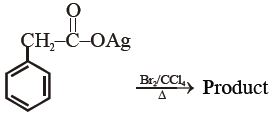
A
$C_6H_5-Br$
B
$C_6H_5-CH_2-Br$
C
$C_6H_5-CH_2-CH_2-Br$
D
$C_6H_5-CH(Br)-CH_3$
Solution
(B) The given reaction is the Hunsdiecker reaction,which involves the treatment of a silver salt of a carboxylic acid with bromine in the presence of carbon tetrachloride $(CCl_4)$ under reflux conditions.
In this reaction,the carboxylate group $(-COOAg)$ is replaced by a bromine atom,resulting in the loss of $CO_2$ and the formation of an alkyl bromide with one carbon atom less than the original carboxylic acid.
The reaction is: $C_6H_5-CH_2-COOAg + Br_2 \xrightarrow{CCl_4, \Delta} C_6H_5-CH_2-Br + CO_2 + AgBr$.
Therefore,the major product is benzyl bromide $(C_6H_5-CH_2-Br)$.
In this reaction,the carboxylate group $(-COOAg)$ is replaced by a bromine atom,resulting in the loss of $CO_2$ and the formation of an alkyl bromide with one carbon atom less than the original carboxylic acid.
The reaction is: $C_6H_5-CH_2-COOAg + Br_2 \xrightarrow{CCl_4, \Delta} C_6H_5-CH_2-Br + CO_2 + AgBr$.
Therefore,the major product is benzyl bromide $(C_6H_5-CH_2-Br)$.
0 likes
View Solution41
MediumMCQ
$Ph-CH(OH)-CH_3 \xrightarrow{SOCl_2}$ major product
A
$Ph-CH(Cl)-CH_3$
B
$Ph-CH_2-CH_2-Cl$
C
$Ph-CH_2-Cl$
D
$Ph-C(Cl)_2-CH_3$
Solution
(A) The reaction of $1$-phenylethanol with thionyl chloride $(SOCl_2)$ follows the $S_Ni$ mechanism in the absence of pyridine.
In this reaction,the hydroxyl group $(-OH)$ is replaced by a chlorine atom $(-Cl)$ with retention of configuration.
The chemical equation is: $Ph-CH(OH)-CH_3 + SOCl_2 \rightarrow Ph-CH(Cl)-CH_3 + SO_2 + HCl$.
In this reaction,the hydroxyl group $(-OH)$ is replaced by a chlorine atom $(-Cl)$ with retention of configuration.
The chemical equation is: $Ph-CH(OH)-CH_3 + SOCl_2 \rightarrow Ph-CH(Cl)-CH_3 + SO_2 + HCl$.
0 likes
View Solution42
MediumMCQ
Alkyl halides can be obtained by all methods except:
A
$CH_3CH_2OH + HCl/ZnCl_2 \to$
B
$CH_3-CH_2-CH_2-CH_3 \xrightarrow{Cl_2/UV \ light}$
C
$C_2H_5OH + NaCl \to$
D
$CH_3COOAg + Br_2/CCl_4 \to$
Solution
(C) The reaction $C_2H_5OH + NaCl \to C_2H_5Cl + NaOH$ does not occur because the hydroxyl group $(-OH)$ is a poor leaving group and cannot be displaced by a chloride ion $(Cl^-)$ in a simple nucleophilic substitution reaction.
In the other options:
$(A)$ This is the Lucas test reaction,which produces alkyl chloride.
$(B)$ This is free radical chlorination of an alkane.
$(D)$ This is the Hunsdiecker reaction,which produces alkyl bromide.
In the other options:
$(A)$ This is the Lucas test reaction,which produces alkyl chloride.
$(B)$ This is free radical chlorination of an alkane.
$(D)$ This is the Hunsdiecker reaction,which produces alkyl bromide.
0 likes
View Solution43
MediumMCQ
$C_2H_5Cl + AgF \longrightarrow C_2H_5F + AgCl$
The above reaction is called:
The above reaction is called:
A
Hunsdiecker reaction
B
Swarts reaction
C
Strecker reaction
D
Wurtz reaction
Solution
(B) The given reaction is $C_2H_5Cl + AgF \longrightarrow C_2H_5F + AgCl$.
This is a classic example of a halogen exchange reaction where an alkyl chloride is converted into an alkyl fluoride using a metallic fluoride like $AgF$.
This specific reaction is known as the $Swarts$ reaction.
This is a classic example of a halogen exchange reaction where an alkyl chloride is converted into an alkyl fluoride using a metallic fluoride like $AgF$.
This specific reaction is known as the $Swarts$ reaction.
0 likes
View Solution44
MediumMCQ
The product obtained when ethyl alcohol is distilled with bleaching powder is
A
Chloroform
B
Ethyl chloride
C
Acetaldehyde
D
Chloral
Solution
(A) The reaction of ethyl alcohol with bleaching powder involves three steps: oxidation,chlorination,and hydrolysis.
$1$. Oxidation of ethyl alcohol to acetaldehyde:
$CH_{3}CH_{2}OH + [O] \longrightarrow CH_{3}CHO + H_{2}O$
$2$. Chlorination of acetaldehyde to chloral:
$CH_{3}CHO + 3Cl_{2} \longrightarrow CCl_{3}CHO + 3HCl$
$3$. Hydrolysis of chloral by calcium hydroxide (formed from bleaching powder) to produce chloroform:
$2CCl_{3}CHO + Ca(OH)_{2} \longrightarrow 2CHCl_{3} + (HCOO)_{2}Ca$
Thus,the final product obtained is chloroform.
$1$. Oxidation of ethyl alcohol to acetaldehyde:
$CH_{3}CH_{2}OH + [O] \longrightarrow CH_{3}CHO + H_{2}O$
$2$. Chlorination of acetaldehyde to chloral:
$CH_{3}CHO + 3Cl_{2} \longrightarrow CCl_{3}CHO + 3HCl$
$3$. Hydrolysis of chloral by calcium hydroxide (formed from bleaching powder) to produce chloroform:
$2CCl_{3}CHO + Ca(OH)_{2} \longrightarrow 2CHCl_{3} + (HCOO)_{2}Ca$
Thus,the final product obtained is chloroform.
0 likes
View Solution45
MediumMCQ
Identify the product $Z$ in the following reaction sequence:
$Benzene + (CH_3CO)_2O$ $\xrightarrow{AlCl_3} X$ $\xrightarrow{Zn-Hg/HCl} Y$ $\xrightarrow{NBS} Z$
$Benzene + (CH_3CO)_2O$ $\xrightarrow{AlCl_3} X$ $\xrightarrow{Zn-Hg/HCl} Y$ $\xrightarrow{NBS} Z$
A
$1-$bromo$-1-$phenylethane
B
($2$-bromoethyl)benzene
C
$1-$bromo$-3-$ethylbenzene
D
$1-$bromo$-4-$ethylbenzene
Solution
(A) $1$. The reaction of benzene with acetic anhydride $(CH_3CO)_2O$ in the presence of $AlCl_3$ is a Friedel-Crafts acylation reaction,which yields acetophenone $(X = C_6H_5COCH_3)$.
$2$. The Clemmensen reduction of acetophenone using $Zn-Hg/HCl$ reduces the carbonyl group to a methylene group,yielding ethylbenzene $(Y = C_6H_5CH_2CH_3)$.
$3$. The reaction of ethylbenzene with $NBS$ ($N$-bromosuccinimide) is a radical substitution reaction that occurs at the benzylic position,yielding $1-$bromo$-1-$phenylethane $(Z = C_6H_5CH(Br)CH_3)$.
$2$. The Clemmensen reduction of acetophenone using $Zn-Hg/HCl$ reduces the carbonyl group to a methylene group,yielding ethylbenzene $(Y = C_6H_5CH_2CH_3)$.
$3$. The reaction of ethylbenzene with $NBS$ ($N$-bromosuccinimide) is a radical substitution reaction that occurs at the benzylic position,yielding $1-$bromo$-1-$phenylethane $(Z = C_6H_5CH(Br)CH_3)$.
0 likes
View Solution46
MediumMCQ
The given reaction is known as $CH_3CH_2-Cl + NaI \xrightarrow{Acetone} CH_3CH_2-I + NaCl$.
A
Swartz Reaction
B
Finkelstein Reaction
C
Gattermann Reaction
D
Zerewitinoff Method
Solution
(B) The reaction $R-X + NaI \xrightarrow{Acetone} R-I + NaX$ (where $X = Cl, Br$) is a halogen exchange reaction used to prepare alkyl iodides.
This specific reaction is known as the Finkelstein reaction.
This specific reaction is known as the Finkelstein reaction.
0 likes
View Solution47
MediumMCQ
Alkyl halides are prepared from alcohol by treating with:
A
$HCl + ZnCl_2$
B
$Br_2 + \text{Red } P$
C
$KI + H_3PO_4$
D
All of the above
Solution
(D) Alkyl halides can be prepared from alcohols using various reagents:
$1$. $HCl + ZnCl_2$ (Lucas reagent) is used to convert alcohols to alkyl chlorides.
$2$. $Br_2 + \text{Red } P$ is used to convert alcohols to alkyl bromides.
$3$. $KI + H_3PO_4$ is used to convert alcohols to alkyl iodides.
Since all these methods are standard laboratory procedures for the synthesis of alkyl halides from alcohols,the correct option is $D$.
$1$. $HCl + ZnCl_2$ (Lucas reagent) is used to convert alcohols to alkyl chlorides.
$2$. $Br_2 + \text{Red } P$ is used to convert alcohols to alkyl bromides.
$3$. $KI + H_3PO_4$ is used to convert alcohols to alkyl iodides.
Since all these methods are standard laboratory procedures for the synthesis of alkyl halides from alcohols,the correct option is $D$.
0 likes
View Solution48
MediumMCQ
$RCOOAg + Br_2 \xrightarrow[\Delta ]{CCl_4} R - Br + AgBr + CO_2$. This reaction is called
A
Wurtz reaction
B
Hunsdiecker reaction
C
Friedel-Crafts reaction
D
Kolbe reaction
Solution
(B) The $Hunsdiecker$ reaction is a name reaction in organic chemistry whereby silver salts of carboxylic acids react with a halogen to produce an organic halide.
It is an example of both a decarboxylation and a halogenation reaction as the product has one fewer carbon atoms than the starting material (lost as $CO_2$) and a halogen atom is introduced in its place.
It is an example of both a decarboxylation and a halogenation reaction as the product has one fewer carbon atoms than the starting material (lost as $CO_2$) and a halogen atom is introduced in its place.
0 likes
View Solution49
EasyMCQ
Alkyl iodides can be best prepared by
A
Swarts reaction
B
Finkelstein reaction
C
Sandmeyer's reaction
D
$A$ and $C$ both
Solution
(B) The $Finkelstein$ reaction is a classic method for the preparation of alkyl iodides from alkyl chlorides or alkyl bromides.
In this reaction,an alkyl halide ($R-X$,where $X = Cl, Br$) is treated with sodium iodide $(NaI)$ in dry acetone.
The reaction proceeds as follows: $R-X + NaI \xrightarrow{\text{dry acetone}} R-I + NaX$.
Since $NaCl$ or $NaBr$ is less soluble in dry acetone than $NaI$,the precipitation of the salt drives the reaction forward according to $Le$ $Chatelier's$ principle.
In this reaction,an alkyl halide ($R-X$,where $X = Cl, Br$) is treated with sodium iodide $(NaI)$ in dry acetone.
The reaction proceeds as follows: $R-X + NaI \xrightarrow{\text{dry acetone}} R-I + NaX$.
Since $NaCl$ or $NaBr$ is less soluble in dry acetone than $NaI$,the precipitation of the salt drives the reaction forward according to $Le$ $Chatelier's$ principle.
0 likes
View Solution50
DifficultMCQ
When toluene is treated with $Br_2$ in the presence of sunlight,it mainly gives:
A
$p-$bromotoluene
B
Benzyl bromide
C
$o-$bromotoluene
D
$o-$ and $p-$bromotoluene
Solution
(B) The reaction of toluene with $Br_2$ in the presence of sunlight (or $UV$ light) proceeds via a free radical mechanism.
This is a side-chain halogenation reaction.
$C_6H_5CH_3 + Br_2 \xrightarrow{h\nu} C_6H_5CH_2Br + HBr$.
The product formed is benzyl bromide.
This is a side-chain halogenation reaction.
$C_6H_5CH_3 + Br_2 \xrightarrow{h\nu} C_6H_5CH_2Br + HBr$.
The product formed is benzyl bromide.
0 likes
View SolutionHaloalkanes and Haloarenes — Preparation of Haloalkanes · Frequently Asked Questions
1Are these Haloalkanes and Haloarenes questions useful for JEE and NEET?
Yes. All questions in this section are mapped to JEE Main and NEET exam patterns. Previous year questions from JEE Main, NEET, GUJCET and state-level exams are included with full solutions.
2Can I switch to Hindi or Gujarati for these questions?
Yes. Use the language tabs in the hero section or the sidebar to view the same questions and solutions in English, Hindi or Gujarati.
3How do I generate a question paper from this subtopic?
Use the Vedclass Exam Paper Generator — select the chapter and subtopic, set difficulty, and generate Sets A, B, C, D automatically. First 3 chapters of every subject are free.
Vedclass Products
For Students
Vedclass Test Series
Mock tests in real JEE/NEET style with performance analysis. 5-day free trial.
Start Free TrialFor Teachers
Exam Paper Generator
Generate Set A/B/C/D papers from this chapter in 2 minutes. 3 chapters free.
Try FreeFor Institutes
Online Exam Module
Live online exams with unlimited students, 360° analytics & white-label branding.
See DemoFor Teachers & Institutes
Generate a Haloalkanes and Haloarenes Exam Paper in 2 Minutes
Select subtopic & difficulty — Sets A, B, C, D auto-generated with No Repeat logic.
First 3 chapters of every subject are free — no payment required.