
A English
Properties of Haloalkanes Questions in English
Class 12 Chemistry · Haloalkanes and Haloarenes · Properties of Haloalkanes
1196+
Questions
English
Language
100%
With Solutions
Showing 50 of 1196 questions in English
601
MediumMCQ
The rate of the following reaction is influenced by the hyperconjugation of group $R$. The rate of reaction will be maximum when $R$ is:
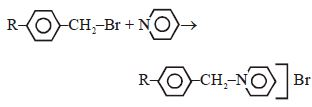
A
$CH_3-$
B
$CH_3-CH_2-$
C
$CH_3-CH(CH_3)-$
D
$CH_3-C(CH_3)_2-$
Solution
(A) The reaction is a nucleophilic substitution $(S_N2)$ reaction where the rate is influenced by the electron-donating ability of the group $R$ attached to the benzene ring. Hyperconjugation is directly proportional to the number of $\alpha$-hydrogens available on the carbon atom directly attached to the benzene ring.
$1$. For $R = CH_3-$,there are $3$ $\alpha$-hydrogens.
$2$. For $R = CH_3-CH_2-$,there are $2$ $\alpha$-hydrogens.
$3$. For $R = CH_3-CH(CH_3)-$,there is $1$ $\alpha$-hydrogen.
$4$. For $R = CH_3-C(CH_3)_2-$,there are $0$ $\alpha$-hydrogens.
Since the $CH_3-$ group provides the maximum number of $\alpha$-hydrogens $(3)$,it exhibits the strongest electron-donating effect via hyperconjugation,which stabilizes the transition state and leads to the maximum reaction rate.
$1$. For $R = CH_3-$,there are $3$ $\alpha$-hydrogens.
$2$. For $R = CH_3-CH_2-$,there are $2$ $\alpha$-hydrogens.
$3$. For $R = CH_3-CH(CH_3)-$,there is $1$ $\alpha$-hydrogen.
$4$. For $R = CH_3-C(CH_3)_2-$,there are $0$ $\alpha$-hydrogens.
Since the $CH_3-$ group provides the maximum number of $\alpha$-hydrogens $(3)$,it exhibits the strongest electron-donating effect via hyperconjugation,which stabilizes the transition state and leads to the maximum reaction rate.
0 likes
View Solution602
MediumMCQ
Which halide will be most reactive towards $SN^2$ reaction?
A
$Ph-CH_2-CH_2-CH_2-Br$
B
$Ph-CH(CH_3)-CH_2-Br$
C
$Ph-C(CH_3)_2-Br$
D
$Ph-CH_2-CH(Br)-CH_3$
Solution
(A) The reactivity of alkyl halides towards $SN^2$ reactions is primarily governed by steric hindrance. The order of reactivity is $1^\circ > 2^\circ > 3^\circ$.
$(A)$ $Ph-CH_2-CH_2-CH_2-Br$ is a primary $(1^\circ)$ halide with the least steric hindrance at the reaction site.
$(B)$ $Ph-CH(CH_3)-CH_2-Br$ is a primary $(1^\circ)$ halide but has a methyl group at the $\beta$-carbon,which increases steric hindrance compared to $(A)$.
$(C)$ $Ph-C(CH_3)_2-Br$ is a tertiary $(3^\circ)$ halide,making it the least reactive towards $SN^2$ due to high steric crowding.
$(D)$ $Ph-CH_2-CH(Br)-CH_3$ is a secondary $(2^\circ)$ halide,which is less reactive than primary halides.
Therefore,the primary halide with the least steric hindrance,$(A)$,is the most reactive.
$(A)$ $Ph-CH_2-CH_2-CH_2-Br$ is a primary $(1^\circ)$ halide with the least steric hindrance at the reaction site.
$(B)$ $Ph-CH(CH_3)-CH_2-Br$ is a primary $(1^\circ)$ halide but has a methyl group at the $\beta$-carbon,which increases steric hindrance compared to $(A)$.
$(C)$ $Ph-C(CH_3)_2-Br$ is a tertiary $(3^\circ)$ halide,making it the least reactive towards $SN^2$ due to high steric crowding.
$(D)$ $Ph-CH_2-CH(Br)-CH_3$ is a secondary $(2^\circ)$ halide,which is less reactive than primary halides.
Therefore,the primary halide with the least steric hindrance,$(A)$,is the most reactive.
0 likes
View Solution603
AdvancedMCQ
The major product formed in the reaction is:
$C_6H_5OCH_3 + (CH_3)_2CHCH_2Br \xrightarrow{AlCl_3}$
$C_6H_5OCH_3 + (CH_3)_2CHCH_2Br \xrightarrow{AlCl_3}$
A
$1-$methoxy$-2-$isobutylbenzene
B
$1-$methoxy$-4-$isobutylbenzene
C
$1-$methoxy$-2-$tert-butylbenzene
D
$1-$methoxy$-4-$tert-butylbenzene
Solution
(D) The reaction of anisole $(C_6H_5OCH_3)$ with isobutyl bromide $((CH_3)_2CHCH_2Br)$ in the presence of $AlCl_3$ is a Friedel-Crafts alkylation reaction.
$AlCl_3$ is a Lewis acid that coordinates with the bromine atom of the alkyl halide to form a carbocation intermediate.
Initially,a primary carbocation $(CH_3)_2CHCH_2^+$ is formed,which undergoes a $1,2-$hydride shift to form a more stable tertiary carbocation $(CH_3)_3C^+$.
This tertiary carbocation then acts as an electrophile and attacks the benzene ring of anisole.
The $-OCH_3$ group is an ortho/para directing group.
Due to steric hindrance at the ortho position,the para-substituted product is the major product.
Therefore,the major product is $1-$methoxy$-4-$tert-butylbenzene.
$AlCl_3$ is a Lewis acid that coordinates with the bromine atom of the alkyl halide to form a carbocation intermediate.
Initially,a primary carbocation $(CH_3)_2CHCH_2^+$ is formed,which undergoes a $1,2-$hydride shift to form a more stable tertiary carbocation $(CH_3)_3C^+$.
This tertiary carbocation then acts as an electrophile and attacks the benzene ring of anisole.
The $-OCH_3$ group is an ortho/para directing group.
Due to steric hindrance at the ortho position,the para-substituted product is the major product.
Therefore,the major product is $1-$methoxy$-4-$tert-butylbenzene.
0 likes
View Solution604
MediumMCQ
Arrange the following in order of their leaving group tendency:
$(I) Br^{-}$,$(II) CH_3COO^{-}$,$(III) CH_3CH_2O^{-}$,$(IV) PhO^{-}$
$(I) Br^{-}$,$(II) CH_3COO^{-}$,$(III) CH_3CH_2O^{-}$,$(IV) PhO^{-}$
A
$I > II > III > IV$
B
$I > III > II > IV$
C
$I > II > IV > III$
D
$I > IV > III > II$
Solution
(C) The leaving group ability is inversely proportional to the basicity of the group. $A$ weaker base is a better leaving group.
The basicity is determined by the strength of the conjugate acid.
Conjugate acids are: $HBr$ $(pK_a \approx -9)$,$CH_3COOH$ $(pK_a \approx 4.76)$,$PhOH$ $(pK_a \approx 10)$,and $CH_3CH_2OH$ $(pK_a \approx 16)$.
The order of acid strength is: $HBr > CH_3COOH > PhOH > CH_3CH_2OH$.
Therefore,the order of basicity is: $Br^{-} < CH_3COO^{-} < PhO^{-} < CH_3CH_2O^{-}$.
Since the leaving group tendency is the reverse of basicity,the order is: $Br^{-} > CH_3COO^{-} > PhO^{-} > CH_3CH_2O^{-}$,which corresponds to $I > II > IV > III$.
The basicity is determined by the strength of the conjugate acid.
Conjugate acids are: $HBr$ $(pK_a \approx -9)$,$CH_3COOH$ $(pK_a \approx 4.76)$,$PhOH$ $(pK_a \approx 10)$,and $CH_3CH_2OH$ $(pK_a \approx 16)$.
The order of acid strength is: $HBr > CH_3COOH > PhOH > CH_3CH_2OH$.
Therefore,the order of basicity is: $Br^{-} < CH_3COO^{-} < PhO^{-} < CH_3CH_2O^{-}$.
Since the leaving group tendency is the reverse of basicity,the order is: $Br^{-} > CH_3COO^{-} > PhO^{-} > CH_3CH_2O^{-}$,which corresponds to $I > II > IV > III$.
0 likes
View Solution605
MediumMCQ
Which one of the following is most reactive towards nucleophilic substitution reaction?
A
$CH_2=CHCl$
B
$C_6H_5Cl$
C
$CH_3CH=CHCl$
D
$ClCH_2-CH=CH_2$
Solution
(D) In nucleophilic substitution reactions,the reactivity depends on the stability of the carbocation intermediate (in $S_N1$) or the ease of leaving group departure and steric hindrance (in $S_N2$).
$A$,$B$,and $C$ are vinylic or aryl halides where the $C-Cl$ bond has partial double bond character due to resonance,making them very unreactive towards nucleophilic substitution.
$D$ $(ClCH_2-CH=CH_2)$ is an allyl chloride. The carbocation formed after the loss of $Cl^-$ is an allyl carbocation $(CH_2^+=CH-CH_2^+\leftrightarrow CH_2=CH-CH_2^+)$,which is resonance-stabilized.
Additionally,in $S_N2$ reactions,the allyl position is highly reactive due to the overlap of the $p$-orbital of the transition state with the $\pi$-system of the double bond.
Therefore,$ClCH_2-CH=CH_2$ is the most reactive.
$A$,$B$,and $C$ are vinylic or aryl halides where the $C-Cl$ bond has partial double bond character due to resonance,making them very unreactive towards nucleophilic substitution.
$D$ $(ClCH_2-CH=CH_2)$ is an allyl chloride. The carbocation formed after the loss of $Cl^-$ is an allyl carbocation $(CH_2^+=CH-CH_2^+\leftrightarrow CH_2=CH-CH_2^+)$,which is resonance-stabilized.
Additionally,in $S_N2$ reactions,the allyl position is highly reactive due to the overlap of the $p$-orbital of the transition state with the $\pi$-system of the double bond.
Therefore,$ClCH_2-CH=CH_2$ is the most reactive.
0 likes
View Solution606
MediumMCQ
The main product of the reaction between alcoholic silver nitrite $(AgNO_2)$ and ethyl bromide $(C_2H_5Br)$ is:
A
Ethane
B
Ethyl nitrite
C
Ethyl isocyanide
D
Nitroethane
Solution
(D) The reaction between ethyl bromide $(C_2H_5Br)$ and alcoholic silver nitrite $(AgNO_2)$ is a nucleophilic substitution reaction.
Silver nitrite $(AgNO_2)$ is a covalent compound,and the nitrogen atom acts as the nucleophilic center.
Therefore,the reaction proceeds as follows:
$C_2H_5Br + AgNO_2 \rightarrow C_2H_5NO_2 + AgBr$
The product formed is nitroethane $(C_2H_5NO_2)$.
Silver nitrite $(AgNO_2)$ is a covalent compound,and the nitrogen atom acts as the nucleophilic center.
Therefore,the reaction proceeds as follows:
$C_2H_5Br + AgNO_2 \rightarrow C_2H_5NO_2 + AgBr$
The product formed is nitroethane $(C_2H_5NO_2)$.
0 likes
View Solution607
MediumMCQ
Identify the major product $X$ in the following reaction: $CH_3-CH_2-CHF-CH_3 \xrightarrow[\Delta]{alc. KOH} X$ (Major)
A
But$-2-$ene
B
But$-2-$ene (cis)
C
But$-1-$ene
D
None of these
Solution
(C) In the dehydrohalogenation of $2$-fluorobutane with alcoholic $KOH$,the reaction follows Hofmann's rule.
Since $F^-$ is a poor leaving group,the transition state has significant carbanion character.
The more stable carbanion is formed at the terminal carbon (primary carbon),leading to the formation of But$-1-$ene $(CH_3-CH_2-CH=CH_2)$ as the major product.
Since $F^-$ is a poor leaving group,the transition state has significant carbanion character.
The more stable carbanion is formed at the terminal carbon (primary carbon),leading to the formation of But$-1-$ene $(CH_3-CH_2-CH=CH_2)$ as the major product.
0 likes
View Solution608
MediumMCQ
Which of the following is most reactive toward $S_N2$ reaction?
A
$CH_3-Cl$
B
$CH_2=CH-Cl$
C
Chlorobenzene
D
$CH_3-F$
Solution
(A) The reactivity of alkyl halides toward $S_N2$ reactions depends on steric hindrance and the strength of the $C-X$ bond.
$S_N2$ reactions are favored by less steric hindrance.
Among the given options,$CH_3-Cl$ is a primary halide with minimal steric hindrance.
$CH_2=CH-Cl$ and chlorobenzene show partial double bond character due to resonance,making them less reactive.
Although $F^-$ is a better leaving group in some contexts,the $C-Cl$ bond is generally more reactive in $S_N2$ compared to $C-F$ due to the high bond strength of $C-F$.
Thus,$CH_3-Cl$ is the most reactive toward $S_N2$.
$S_N2$ reactions are favored by less steric hindrance.
Among the given options,$CH_3-Cl$ is a primary halide with minimal steric hindrance.
$CH_2=CH-Cl$ and chlorobenzene show partial double bond character due to resonance,making them less reactive.
Although $F^-$ is a better leaving group in some contexts,the $C-Cl$ bond is generally more reactive in $S_N2$ compared to $C-F$ due to the high bond strength of $C-F$.
Thus,$CH_3-Cl$ is the most reactive toward $S_N2$.
0 likes
View Solution609
AdvancedMCQ
$n-$Heptane $\xrightarrow[\Delta ]{Al_2O_3} P$ $\xrightarrow{[1 \ mole]}{NBS} Q$. Product $Q$ will be
A
Benzyl bromide
B
$o-$Bromo toluene
C
$m-$Bromo toluene
D
$p-$Bromo toluene
Solution
(A) $1$. $n-$Heptane undergoes dehydrocyclization in the presence of $Al_2O_3$ at high temperature to form toluene $(P)$.
$2$. Toluene reacts with $NBS$ ($N-$bromosuccinimide),which is a specific reagent for allylic or benzylic bromination.
$3$. The benzylic hydrogen of toluene is replaced by bromine to form benzyl bromide $(C_6H_5CH_2Br)$ as the product $Q$.
$2$. Toluene reacts with $NBS$ ($N-$bromosuccinimide),which is a specific reagent for allylic or benzylic bromination.
$3$. The benzylic hydrogen of toluene is replaced by bromine to form benzyl bromide $(C_6H_5CH_2Br)$ as the product $Q$.
0 likes
View Solution610
MediumMCQ
Which of the following is most reactive for $SN^1$ reaction?
A
p-Methoxybenzyl chloride
B
p-Nitrobenzyl chloride
C
p-Methylbenzyl chloride
D
p-Chlorobenzyl chloride
Solution
(A) The reactivity of a compound towards $SN^1$ reaction depends on the stability of the carbocation intermediate formed after the departure of the leaving group (chloride ion).
In these cases,the carbocation formed is a substituted benzyl carbocation $(Ar-CH_2^+)$.
The stability of the benzyl carbocation is increased by electron-donating groups $(EDG)$ and decreased by electron-withdrawing groups $(EWG)$ attached to the benzene ring.
$1$. $p$-Methoxybenzyl chloride: The $-OCH_3$ group is a strong electron-donating group by resonance ($+R$ effect),which significantly stabilizes the carbocation.
$2$. $p$-Nitrobenzyl chloride: The $-NO_2$ group is a strong electron-withdrawing group ($-R$ and $-I$ effect),which destabilizes the carbocation.
$3$. $p$-Methylbenzyl chloride: The $-CH_3$ group is a weak electron-donating group by hyperconjugation ($+H$ effect).
$4$. $p$-Chlorobenzyl chloride: The $-Cl$ group is electron-withdrawing by induction ($-I$ effect),although it can donate electrons by resonance ($+R$ effect),the net effect is electron-withdrawing.
Since the $-OCH_3$ group provides the greatest stabilization to the carbocation through its strong $+R$ effect,$p$-methoxybenzyl chloride is the most reactive towards $SN^1$.
In these cases,the carbocation formed is a substituted benzyl carbocation $(Ar-CH_2^+)$.
The stability of the benzyl carbocation is increased by electron-donating groups $(EDG)$ and decreased by electron-withdrawing groups $(EWG)$ attached to the benzene ring.
$1$. $p$-Methoxybenzyl chloride: The $-OCH_3$ group is a strong electron-donating group by resonance ($+R$ effect),which significantly stabilizes the carbocation.
$2$. $p$-Nitrobenzyl chloride: The $-NO_2$ group is a strong electron-withdrawing group ($-R$ and $-I$ effect),which destabilizes the carbocation.
$3$. $p$-Methylbenzyl chloride: The $-CH_3$ group is a weak electron-donating group by hyperconjugation ($+H$ effect).
$4$. $p$-Chlorobenzyl chloride: The $-Cl$ group is electron-withdrawing by induction ($-I$ effect),although it can donate electrons by resonance ($+R$ effect),the net effect is electron-withdrawing.
Since the $-OCH_3$ group provides the greatest stabilization to the carbocation through its strong $+R$ effect,$p$-methoxybenzyl chloride is the most reactive towards $SN^1$.
0 likes
View Solution611
DifficultMCQ
Consider the following reaction. Which of the following bases will give the best yield of the alkene $(II)$ as the major product?
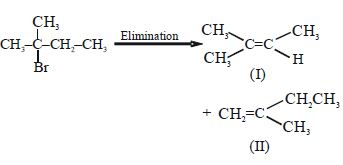
A
Alc. $KOH$
B
$C_2H_5O^{-}$
C
$(CH_3)_3CO^{-}$
D
$NaNH_2$
Solution
(C) The substrate is $2-bromo-2-methylbutane$.
Elimination can occur to form the more substituted alkene $(I)$ (Zaitsev product) or the less substituted alkene $(II)$ (Hofmann product).
To obtain the less substituted alkene $(II)$ as the major product,a bulky base is required to minimize steric hindrance during the abstraction of the less hindered proton.
$(CH_3)_3CO^{-}$ (potassium tert-butoxide) is a bulky base and is known to favor the formation of the Hofmann product.
Elimination can occur to form the more substituted alkene $(I)$ (Zaitsev product) or the less substituted alkene $(II)$ (Hofmann product).
To obtain the less substituted alkene $(II)$ as the major product,a bulky base is required to minimize steric hindrance during the abstraction of the less hindered proton.
$(CH_3)_3CO^{-}$ (potassium tert-butoxide) is a bulky base and is known to favor the formation of the Hofmann product.
0 likes
View Solution612
DifficultMCQ
When ethyl iodide is heated with silver nitrite,the product obtained is:
A
$C_2H_5-Ag$
B
$Ag-O-NO$
C
$C_2H_5-O-N=O$
D
$C_2H_5-NO_2$
Solution
(D) The reaction between ethyl iodide $(C_2H_5I)$ and silver nitrite $(AgNO_2)$ is a nucleophilic substitution reaction.
Since $AgNO_2$ is a covalent compound,the nitrogen atom acts as the nucleophile,leading to the formation of nitroethane $(C_2H_5NO_2)$ as the major product.
The chemical equation is: $C_2H_5I + AgNO_2 \rightarrow C_2H_5NO_2 + AgI$.
Since $AgNO_2$ is a covalent compound,the nitrogen atom acts as the nucleophile,leading to the formation of nitroethane $(C_2H_5NO_2)$ as the major product.
The chemical equation is: $C_2H_5I + AgNO_2 \rightarrow C_2H_5NO_2 + AgI$.
0 likes
View Solution613
MediumMCQ
In which of the following reactions is an anti-Markovnikov product formed?
A
$CF_3CH = CH_2 \xrightarrow{HCl}$
B
$ClCH = CH_2 \xrightarrow{HCl}$
C
$CH_3OCH = CH_2 \xrightarrow{HCl}$
D
None of these
Solution
(A) In the reaction $CF_3CH = CH_2 + HCl \rightarrow CF_3CH_2CH_2Cl$,the $-CF_3$ group is a strong electron-withdrawing group ($-I$ effect).
This destabilizes the carbocation intermediate that would form at the carbon adjacent to the $-CF_3$ group.
Consequently,the proton $(H^+)$ attacks the terminal carbon to form a more stable carbocation or follows a pathway that results in the anti-Markovnikov product,where the chlorine atom attaches to the terminal carbon.
This destabilizes the carbocation intermediate that would form at the carbon adjacent to the $-CF_3$ group.
Consequently,the proton $(H^+)$ attacks the terminal carbon to form a more stable carbocation or follows a pathway that results in the anti-Markovnikov product,where the chlorine atom attaches to the terminal carbon.
0 likes
View Solution614
MediumMCQ
Compare the rate of reaction with $AgNO_3$ for the following compounds:
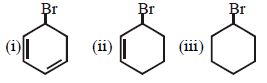
A
$(i) > (ii) > (iii)$
B
$(ii) > (iii) > (i)$
C
$(iii) > (ii) > (i)$
D
$(ii) > (i) > (iii)$
Solution
(A) The reaction with $AgNO_3$ proceeds via the formation of a carbocation intermediate ($S_N1$ mechanism).
The rate of reaction is directly proportional to the stability of the carbocation formed after the removal of the $Br^-$ ion.
$(i)$ Forms an allylic carbocation,which is resonance-stabilized.
(ii) Forms a vinylic carbocation,which is highly unstable due to the positive charge on an $sp^2$ hybridized carbon.
(iii) Forms a secondary $(2^{\circ})$ alkyl carbocation,which is more stable than a vinylic carbocation but less stable than an allylic carbocation.
Therefore,the stability order of the carbocations is: Allylic > Secondary alkyl > Vinylic.
The rate of reaction follows the same order: $(i) > (iii) > (ii)$.
The rate of reaction is directly proportional to the stability of the carbocation formed after the removal of the $Br^-$ ion.
$(i)$ Forms an allylic carbocation,which is resonance-stabilized.
(ii) Forms a vinylic carbocation,which is highly unstable due to the positive charge on an $sp^2$ hybridized carbon.
(iii) Forms a secondary $(2^{\circ})$ alkyl carbocation,which is more stable than a vinylic carbocation but less stable than an allylic carbocation.
Therefore,the stability order of the carbocations is: Allylic > Secondary alkyl > Vinylic.
The rate of reaction follows the same order: $(i) > (iii) > (ii)$.
0 likes
View Solution615
DifficultMCQ
Consider the following reaction:
(Cyclohexyl)methyl chloride + $CH_3ONa$ $\rightarrow$ $1-$(methoxymethyl)cyclohex$-1-$ene.
The mechanism of the reaction will be:
(Cyclohexyl)methyl chloride + $CH_3ONa$ $\rightarrow$ $1-$(methoxymethyl)cyclohex$-1-$ene.
The mechanism of the reaction will be:
A
$S_{N}1$
B
$S_{N}2$
C
$E_2$
D
$E_1$
Solution
(C) The given reaction involves the conversion of (cyclohexyl)methyl chloride to $1-$(methoxymethyl)cyclohex$-1-$ene using sodium methoxide $(CH_3ONa)$.
$1$. The substrate is a primary alkyl halide,but it is sterically hindered due to the cyclohexyl group attached to the $CH_2$ carbon.
$2$. $CH_3ONa$ is a strong base and a strong nucleophile.
$3$. The product formed is an alkene,which indicates an elimination reaction.
$4$. Since the base is strong and the substrate is primary,the reaction proceeds via the $E_2$ mechanism,where the base abstracts a proton from the ring and the chloride ion leaves simultaneously to form the double bond.
$1$. The substrate is a primary alkyl halide,but it is sterically hindered due to the cyclohexyl group attached to the $CH_2$ carbon.
$2$. $CH_3ONa$ is a strong base and a strong nucleophile.
$3$. The product formed is an alkene,which indicates an elimination reaction.
$4$. Since the base is strong and the substrate is primary,the reaction proceeds via the $E_2$ mechanism,where the base abstracts a proton from the ring and the chloride ion leaves simultaneously to form the double bond.
0 likes
View Solution616
DifficultMCQ
What will be the product in the following reaction?
$1$-chloro-$1$-methylcyclohexane $\xrightarrow{H_2O}$ ?
$1$-chloro-$1$-methylcyclohexane $\xrightarrow{H_2O}$ ?
A
$1-$methylcyclohexanol
B
$1-$isopropylcyclohexanol
C
$2,2-$dimethylcyclohexanol
D
$1-$methylcyclohexanol (with rearrangement)
Solution
(A) The reaction proceeds via an $S_N1$ mechanism.
$1$. The leaving group $Cl^-$ departs to form a tertiary $(3^{\circ})$ carbocation at the $1$-position of the cyclohexane ring.
$2$. This $3^{\circ}$ carbocation is already stable and does not undergo rearrangement.
$3$. Water $(H_2O)$ acts as a nucleophile and attacks the carbocation.
$4$. Subsequent deprotonation yields $1$-methylcyclohexanol as the final product.
$1$. The leaving group $Cl^-$ departs to form a tertiary $(3^{\circ})$ carbocation at the $1$-position of the cyclohexane ring.
$2$. This $3^{\circ}$ carbocation is already stable and does not undergo rearrangement.
$3$. Water $(H_2O)$ acts as a nucleophile and attacks the carbocation.
$4$. Subsequent deprotonation yields $1$-methylcyclohexanol as the final product.
0 likes
View Solution617
MediumMCQ
Consider the following reaction sequence:
$Cyclohexylidene-methane$ $\xrightarrow[CH_3OH]{Br_2} A$ $\xrightarrow{KCN} B$
Identify the correct structures for $A$ and $B$ from the given options:
$A$ is:
$A) \text{ 1-(bromomethyl)-1-methoxycyclohexane}$
$B) \text{ 1-(methoxymethyl)-1-bromocyclohexane}$
$B$ is:
$C) \text{ 1-(bromomethyl)-1-methoxycyclohexane}$
$D) \text{ 1-(cyanomethyl)-1-methoxycyclohexane}$
$Cyclohexylidene-methane$ $\xrightarrow[CH_3OH]{Br_2} A$ $\xrightarrow{KCN} B$
Identify the correct structures for $A$ and $B$ from the given options:
$A$ is:
$A) \text{ 1-(bromomethyl)-1-methoxycyclohexane}$
$B) \text{ 1-(methoxymethyl)-1-bromocyclohexane}$
$B$ is:
$C) \text{ 1-(bromomethyl)-1-methoxycyclohexane}$
$D) \text{ 1-(cyanomethyl)-1-methoxycyclohexane}$
A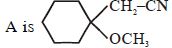
B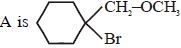
C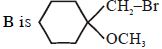
D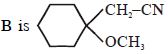
Solution
(A, D) The reaction of $methylenecyclohexane$ with $Br_2$ in $CH_3OH$ is a halohydrin-type reaction (specifically,a haloetherification).
$1$. The $Br_2$ forms a cyclic bromonium ion with the double bond of $methylenecyclohexane$.
$2$. The nucleophile $CH_3OH$ attacks the more substituted carbon (the one attached to the cyclohexane ring) to open the bromonium ring,following Markovnikov-like regioselectivity due to the stability of the developing carbocation character.
$3$. This yields $A$,which is $1-(bromomethyl)-1-methoxycyclohexane$.
$4$. In the next step,$A$ reacts with $KCN$. The $CN^-$ ion acts as a nucleophile and performs a nucleophilic substitution $(S_N2)$ on the primary alkyl bromide ($CH_2Br$ group).
$5$. The $Br$ atom is replaced by the $CN$ group,resulting in $B$,which is $1-(cyanomethyl)-1-methoxycyclohexane$.
$1$. The $Br_2$ forms a cyclic bromonium ion with the double bond of $methylenecyclohexane$.
$2$. The nucleophile $CH_3OH$ attacks the more substituted carbon (the one attached to the cyclohexane ring) to open the bromonium ring,following Markovnikov-like regioselectivity due to the stability of the developing carbocation character.
$3$. This yields $A$,which is $1-(bromomethyl)-1-methoxycyclohexane$.
$4$. In the next step,$A$ reacts with $KCN$. The $CN^-$ ion acts as a nucleophile and performs a nucleophilic substitution $(S_N2)$ on the primary alkyl bromide ($CH_2Br$ group).
$5$. The $Br$ atom is replaced by the $CN$ group,resulting in $B$,which is $1-(cyanomethyl)-1-methoxycyclohexane$.
0 likes
View Solution618
DifficultMCQ
Benzene $\xrightarrow[{Anhy. AlCl_3}]{{CH_3Cl}} A \,$ $\xrightarrow[{hv}]{{Cl_2 (1 \, mole)}} B$ $\xrightarrow{{AgCN}} C$
Which is correct for the above reaction?
Which is correct for the above reaction?
A
$A = \text{Toluene}$
B
$B = p-\text{Chlorotoluene}$
C
$C = \text{Benzyl cyanide}$
D
$C = \text{Benzyl isocyanide}$
Solution
(D) $1$. Benzene reacts with $CH_3Cl$ in the presence of anhydrous $AlCl_3$ (Friedel-Crafts alkylation) to form Toluene $(A)$:
$C_6H_6 + CH_3Cl \xrightarrow{AlCl_3} C_6H_5CH_3 (A) + HCl$
$2$. Toluene reacts with $Cl_2$ in the presence of light $(hv)$ via free radical substitution at the side chain to form Benzyl chloride $(B)$:
$C_6H_5CH_3 + Cl_2 \xrightarrow{hv} C_6H_5CH_2Cl (B) + HCl$
$3$. Benzyl chloride reacts with $AgCN$ (an ionic cyanide source) to form Benzyl isocyanide $(C)$ as the major product,because $AgCN$ is covalent and the nitrogen atom is more nucleophilic:
$C_6H_5CH_2Cl + AgCN \rightarrow C_6H_5CH_2NC (C) + AgCl$
Thus,the correct statement is $C = \text{Benzyl isocyanide}$.
$C_6H_6 + CH_3Cl \xrightarrow{AlCl_3} C_6H_5CH_3 (A) + HCl$
$2$. Toluene reacts with $Cl_2$ in the presence of light $(hv)$ via free radical substitution at the side chain to form Benzyl chloride $(B)$:
$C_6H_5CH_3 + Cl_2 \xrightarrow{hv} C_6H_5CH_2Cl (B) + HCl$
$3$. Benzyl chloride reacts with $AgCN$ (an ionic cyanide source) to form Benzyl isocyanide $(C)$ as the major product,because $AgCN$ is covalent and the nitrogen atom is more nucleophilic:
$C_6H_5CH_2Cl + AgCN \rightarrow C_6H_5CH_2NC (C) + AgCl$
Thus,the correct statement is $C = \text{Benzyl isocyanide}$.
0 likes
View Solution619
MediumMCQ
The correct order of $S_N1$ reactivity for the following compounds is:
$(I)$ $CH_3CH_2CH_2CH_2Br$
$(II)$ $CH_2=CH-CH(Br)CH_3$
$(III)$ $CH_3CH_2CH(Br)CH_3$
$(I)$ $CH_3CH_2CH_2CH_2Br$
$(II)$ $CH_2=CH-CH(Br)CH_3$
$(III)$ $CH_3CH_2CH(Br)CH_3$
A
$I > II > III$
B
$II > III > I$
C
$II > I > III$
D
$III > II > I$
Solution
(B) The reactivity of alkyl halides towards $S_N1$ reactions depends on the stability of the intermediate carbocation formed.
$(I)$ $CH_3CH_2CH_2CH_2Br$ forms a primary $(1^{\circ})$ carbocation,$CH_3CH_2CH_2CH_2^+$,which is the least stable.
$(II)$ $CH_2=CH-CH(Br)CH_3$ forms an allylic carbocation,$CH_2=CH-CH^+CH_3$,which is resonance-stabilized and thus the most stable.
$(III)$ $CH_3CH_2CH(Br)CH_3$ forms a secondary $(2^{\circ})$ carbocation,$CH_3CH_2CH^+CH_3$,which is more stable than a primary carbocation but less stable than a resonance-stabilized allylic carbocation.
Therefore,the order of stability of carbocations is $II > III > I$.
Since $S_N1$ reactivity follows the order of carbocation stability,the correct order is $II > III > I$.
$(I)$ $CH_3CH_2CH_2CH_2Br$ forms a primary $(1^{\circ})$ carbocation,$CH_3CH_2CH_2CH_2^+$,which is the least stable.
$(II)$ $CH_2=CH-CH(Br)CH_3$ forms an allylic carbocation,$CH_2=CH-CH^+CH_3$,which is resonance-stabilized and thus the most stable.
$(III)$ $CH_3CH_2CH(Br)CH_3$ forms a secondary $(2^{\circ})$ carbocation,$CH_3CH_2CH^+CH_3$,which is more stable than a primary carbocation but less stable than a resonance-stabilized allylic carbocation.
Therefore,the order of stability of carbocations is $II > III > I$.
Since $S_N1$ reactivity follows the order of carbocation stability,the correct order is $II > III > I$.
0 likes
View Solution620
MediumMCQ
Consider the reaction: $CH_3-CH_2-CH(F)-CH_3 \xrightarrow{CH_3O^{-}} X$. The alkene formed in major amount is:
A
$CH_3-CH=CH-CH_3$
B
$CH_3-C(CH_3)=CH_2$
C
$CH_3-CH_2-CH=CH_2$
D
Both $(A)$ and $(C)$
Solution
(C) In the $E2$ elimination reaction of alkyl fluorides with a strong base like $CH_3O^{-}$,the $Hofmann$ product (the less substituted alkene) is the major product.
This occurs because the fluorine atom is a poor leaving group and highly electronegative,which imparts significant carbanion character to the transition state.
The more stable carbanion-like transition state is formed by removing a proton from the less substituted carbon atom.
Therefore,$CH_3-CH_2-CH=CH_2$ $(but-1-ene)$ is the major product.
This occurs because the fluorine atom is a poor leaving group and highly electronegative,which imparts significant carbanion character to the transition state.
The more stable carbanion-like transition state is formed by removing a proton from the less substituted carbon atom.
Therefore,$CH_3-CH_2-CH=CH_2$ $(but-1-ene)$ is the major product.
0 likes
View Solution621
AdvancedMCQ
For the given reaction $R-C(R_1)(R_2)-X \xrightarrow{HOH} R-C(R_1)(R_2)-OH$,which substrate will give maximum racemisation?
A
$C_6H_5-C(CH_3)(C_2H_5)-Br$
B
$CH_2=CH-C(CH_3)(C_2H_5)-Br$
C
$C_6H_5-C(Br)(C_6H_4-OCH_3)(C_6H_4-CH_3)$
D
$C_6H_5-C(Br)(C_6H_4-NO_2)(C_6H_4-NH_3^+)$
Solution
(C) Racemisation occurs via an $S_N1$ mechanism,which involves the formation of a carbocation intermediate. The stability of the carbocation determines the ease of $S_N1$ reaction and the extent of racemisation.
Greater stability of the carbocation leads to a more planar and long-lived intermediate,which allows for more effective attack from both sides,resulting in higher racemisation.
Comparing the substrates:
Option $A$ and $B$ form secondary carbocations,which are less stable.
Option $C$ forms a tertiary carbocation stabilized by two phenyl rings,one of which has an electron-donating $-OCH_3$ group at the para position,significantly increasing the stability of the carbocation via resonance.
Option $D$ forms a tertiary carbocation,but it is destabilized by the electron-withdrawing $-NO_2$ and $-NH_3^+$ groups.
Therefore,the substrate in option $C$ forms the most stable carbocation,leading to maximum racemisation.
Greater stability of the carbocation leads to a more planar and long-lived intermediate,which allows for more effective attack from both sides,resulting in higher racemisation.
Comparing the substrates:
Option $A$ and $B$ form secondary carbocations,which are less stable.
Option $C$ forms a tertiary carbocation stabilized by two phenyl rings,one of which has an electron-donating $-OCH_3$ group at the para position,significantly increasing the stability of the carbocation via resonance.
Option $D$ forms a tertiary carbocation,but it is destabilized by the electron-withdrawing $-NO_2$ and $-NH_3^+$ groups.
Therefore,the substrate in option $C$ forms the most stable carbocation,leading to maximum racemisation.
0 likes
View Solution622
MediumMCQ
Which of the following is an incorrect match?
A
Benzene $\xrightarrow[AlCl_3 \text{ (Anhy.)}]{CH_3Cl}$ Friedel-Crafts reaction
B
Benzene $+ HCN + HCl \xrightarrow{AlCl_3 \text{ (Anhy.)}}$ Gattermann aldehyde synthesis
C
Benzene $+ CHCl_3 \xrightarrow{AlCl_3 \text{ (Anhy.)}}$ Reimer-Tiemann reaction
D
$CH_3-Br + AgF \xrightarrow{\Delta}$ Swarts reaction
Solution
(C) Option $A$ is correct: Benzene reacts with $CH_3Cl$ in the presence of anhydrous $AlCl_3$ to form toluene via Friedel-Crafts alkylation.
Option $B$ is correct: The Gattermann-Koch reaction (often referred to as Gattermann aldehyde synthesis) involves the formylation of benzene using $CO + HCl$ or $HCN + HCl$ in the presence of $AlCl_3$.
Option $C$ is incorrect: The Reimer-Tiemann reaction is specifically used for the formylation of phenols using $CHCl_3$ and $NaOH$,not benzene.
Option $D$ is incorrect: The reaction of alkyl halides with $AgF$ is known as the Swarts reaction,not the Finkelstein reaction (which uses $NaI$ in acetone). Note: Both $C$ and $D$ are technically incorrect matches based on standard organic chemistry nomenclature.
Option $B$ is correct: The Gattermann-Koch reaction (often referred to as Gattermann aldehyde synthesis) involves the formylation of benzene using $CO + HCl$ or $HCN + HCl$ in the presence of $AlCl_3$.
Option $C$ is incorrect: The Reimer-Tiemann reaction is specifically used for the formylation of phenols using $CHCl_3$ and $NaOH$,not benzene.
Option $D$ is incorrect: The reaction of alkyl halides with $AgF$ is known as the Swarts reaction,not the Finkelstein reaction (which uses $NaI$ in acetone). Note: Both $C$ and $D$ are technically incorrect matches based on standard organic chemistry nomenclature.
0 likes
View Solution623
MediumMCQ
In which reaction is a racemic mixture not obtained?
A
$CH_3-CH=CH-CH_3 + HCl \to$
B
$Ph-CH(Cl)-CH_3 + KCN \to$
C
$CH_3-C(=O)-Ph + HCN \to$
D
$CH_3-C(=O)-CH_3 + HCN \to$
Solution
(D) In reaction $(d)$,the product formed is $CH_3-C(OH)(CN)-CH_3$ ($2$-hydroxy$-2-$methylpropanenitrile).
Since the central carbon atom is attached to two identical methyl $(-CH_3)$ groups,it is not a chiral center.
Therefore,the product is achiral and cannot exist as a racemic mixture.
In options $(a)$,$(b)$,and $(c)$,the products contain at least one chiral carbon atom and are formed as racemic mixtures.
Since the central carbon atom is attached to two identical methyl $(-CH_3)$ groups,it is not a chiral center.
Therefore,the product is achiral and cannot exist as a racemic mixture.
In options $(a)$,$(b)$,and $(c)$,the products contain at least one chiral carbon atom and are formed as racemic mixtures.
0 likes
View Solution624
MediumMCQ
Which of the following is most reactive for $S_{N}1$ reaction?
A
$C_6H_5CH_2Cl$
B
$CH_3OCH_2Cl$
C
$C_6H_5Cl$
D
$(CH_3)_3CCl$
Solution
(B) The reactivity of an alkyl halide towards $S_{N}1$ reaction depends on the stability of the carbocation intermediate formed in the rate-determining step.
$1$. For $C_6H_5CH_2Cl$,the carbocation formed is $C_6H_5CH_2^+$,which is resonance-stabilized by the phenyl ring.
$2$. For $CH_3OCH_2Cl$,the carbocation formed is $CH_3OCH_2^+$. This carbocation is highly stabilized by the lone pair of electrons on the oxygen atom through resonance $(CH_3-O^+=CH_2)$. This is more stable than the benzyl carbocation due to the strong electron-donating effect of the oxygen atom.
$3$. For $C_6H_5Cl$,the carbocation $C_6H_5^+$ is highly unstable and not formed easily.
$4$. For $(CH_3)_3CCl$,the carbocation formed is $(CH_3)_3C^+$,which is a tertiary carbocation stabilized by inductive effect and hyperconjugation.
Comparing the stability,the methoxymethyl carbocation $(CH_3OCH_2^+)$ is the most stable due to the strong resonance stabilization by the oxygen atom. Therefore,$CH_3OCH_2Cl$ is the most reactive towards $S_{N}1$ reaction.
$1$. For $C_6H_5CH_2Cl$,the carbocation formed is $C_6H_5CH_2^+$,which is resonance-stabilized by the phenyl ring.
$2$. For $CH_3OCH_2Cl$,the carbocation formed is $CH_3OCH_2^+$. This carbocation is highly stabilized by the lone pair of electrons on the oxygen atom through resonance $(CH_3-O^+=CH_2)$. This is more stable than the benzyl carbocation due to the strong electron-donating effect of the oxygen atom.
$3$. For $C_6H_5Cl$,the carbocation $C_6H_5^+$ is highly unstable and not formed easily.
$4$. For $(CH_3)_3CCl$,the carbocation formed is $(CH_3)_3C^+$,which is a tertiary carbocation stabilized by inductive effect and hyperconjugation.
Comparing the stability,the methoxymethyl carbocation $(CH_3OCH_2^+)$ is the most stable due to the strong resonance stabilization by the oxygen atom. Therefore,$CH_3OCH_2Cl$ is the most reactive towards $S_{N}1$ reaction.
0 likes
View Solution625
MediumMCQ
Most reactive for $S_{N}1$ reaction is
A
Benzyl chloride $(C_6H_5CH_2Cl)$
B
Chlorobenzene $(C_6H_5Cl)$
C
Cyclohexyl chloride $(C_6H_{11}Cl)$
D
$1-$Chlorobicyclo[$2.2$.$1$]heptane
Solution
(A) The reactivity of alkyl halides towards $S_{N}1$ reaction depends on the stability of the carbocation intermediate formed after the departure of the leaving group.
$1$. Benzyl chloride forms a benzyl carbocation $(C_6H_5CH_2^+)$,which is highly stabilized by resonance with the benzene ring.
$2$. Chlorobenzene does not undergo $S_{N}1$ reaction easily because the $C-Cl$ bond has partial double bond character due to resonance,and the phenyl cation is highly unstable.
$3$. Cyclohexyl chloride forms a secondary carbocation,which is less stable than the resonance-stabilized benzyl carbocation.
$4$. $1-$Chlorobicyclo[$2.2$.$1$]heptane is highly unreactive towards $S_{N}1$ because the formation of a carbocation at the bridgehead position is forbidden by Bredt's rule due to the strain involved in achieving a planar geometry.
Therefore,benzyl chloride is the most reactive towards $S_{N}1$ reaction.
$1$. Benzyl chloride forms a benzyl carbocation $(C_6H_5CH_2^+)$,which is highly stabilized by resonance with the benzene ring.
$2$. Chlorobenzene does not undergo $S_{N}1$ reaction easily because the $C-Cl$ bond has partial double bond character due to resonance,and the phenyl cation is highly unstable.
$3$. Cyclohexyl chloride forms a secondary carbocation,which is less stable than the resonance-stabilized benzyl carbocation.
$4$. $1-$Chlorobicyclo[$2.2$.$1$]heptane is highly unreactive towards $S_{N}1$ because the formation of a carbocation at the bridgehead position is forbidden by Bredt's rule due to the strain involved in achieving a planar geometry.
Therefore,benzyl chloride is the most reactive towards $S_{N}1$ reaction.
0 likes
View Solution626
DifficultMCQ
In the reaction shown,the major product obtained is:
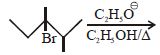
A
$3-$methylpent$-2-$ene
B
$3-$ethoxypentane derivative
C
$2-$methylpent$-2-$ene
D
$2-$methylpent$-1-$ene
Solution
(C) The reaction involves the dehydrohalogenation of $3$-bromo-$2$-methylpentane using a strong base,ethoxide ion $(C_2H_5O^-)$,in ethanol $(C_2H_5OH)$ at elevated temperatures $(\Delta)$.
This is an $E2$ elimination reaction.
The base abstracts a proton from the $\beta$-carbon atoms adjacent to the carbon bearing the bromine atom.
There are two types of $\beta$-hydrogens available:
$1$. Protons on the $C_2$ position (leading to $2$-methylpent$-2-$ene).
$2$. Protons on the $C_4$ position (leading to $3$-methylpent$-2-$ene).
$3$. Protons on the methyl group attached to $C_2$ (leading to $2$-methylpent$-1-$ene).
According to Zaitsev's rule,the most substituted alkene is the major product.
$2$-methylpent$-2-$ene is a trisubstituted alkene,which is more stable than the disubstituted alkenes ($3$-methylpent$-2-$ene and $2$-methylpent$-1-$ene).
Therefore,$2$-methylpent$-2-$ene is the major product.
This is an $E2$ elimination reaction.
The base abstracts a proton from the $\beta$-carbon atoms adjacent to the carbon bearing the bromine atom.
There are two types of $\beta$-hydrogens available:
$1$. Protons on the $C_2$ position (leading to $2$-methylpent$-2-$ene).
$2$. Protons on the $C_4$ position (leading to $3$-methylpent$-2-$ene).
$3$. Protons on the methyl group attached to $C_2$ (leading to $2$-methylpent$-1-$ene).
According to Zaitsev's rule,the most substituted alkene is the major product.
$2$-methylpent$-2-$ene is a trisubstituted alkene,which is more stable than the disubstituted alkenes ($3$-methylpent$-2-$ene and $2$-methylpent$-1-$ene).
Therefore,$2$-methylpent$-2-$ene is the major product.
0 likes
View Solution627
DifficultMCQ
The relative reactivity of the following halides toward $S_{N}2$ reaction follows the order:
$(P)$ $CH_2=CH-Cl$
$(Q)$ $CH_3-CH_2-Cl$
$(R)$ $CH_3-O-CH_2-CH_2-Cl$
$(S)$ $C_6H_5-CH_2-Cl$
$(P)$ $CH_2=CH-Cl$
$(Q)$ $CH_3-CH_2-Cl$
$(R)$ $CH_3-O-CH_2-CH_2-Cl$
$(S)$ $C_6H_5-CH_2-Cl$
A
$R > S > Q > P$
B
$P > S > R > Q$
C
$S > R > Q > P$
D
$P > R > S > Q$
Solution
(C) The reactivity toward $S_{N}2$ reaction depends on steric hindrance and the stability of the transition state.
$(P)$ $CH_2=CH-Cl$ is a vinyl halide where the $C-Cl$ bond has partial double bond character due to resonance,making it highly unreactive toward $S_{N}2$.
$(Q)$ $CH_3-CH_2-Cl$ is a primary alkyl halide with minimal steric hindrance.
$(R)$ $CH_3-O-CH_2-CH_2-Cl$ is a primary alkyl halide where the oxygen atom provides an electron-withdrawing inductive effect ($-I$ effect),which stabilizes the transition state of the $S_{N}2$ reaction,making it more reactive than a simple primary alkyl halide.
$(S)$ $C_6H_5-CH_2-Cl$ is a benzyl chloride. The transition state is stabilized by resonance with the phenyl ring,making it highly reactive toward $S_{N}2$.
Comparing these,the order of reactivity is $S > R > Q > P$.
$(P)$ $CH_2=CH-Cl$ is a vinyl halide where the $C-Cl$ bond has partial double bond character due to resonance,making it highly unreactive toward $S_{N}2$.
$(Q)$ $CH_3-CH_2-Cl$ is a primary alkyl halide with minimal steric hindrance.
$(R)$ $CH_3-O-CH_2-CH_2-Cl$ is a primary alkyl halide where the oxygen atom provides an electron-withdrawing inductive effect ($-I$ effect),which stabilizes the transition state of the $S_{N}2$ reaction,making it more reactive than a simple primary alkyl halide.
$(S)$ $C_6H_5-CH_2-Cl$ is a benzyl chloride. The transition state is stabilized by resonance with the phenyl ring,making it highly reactive toward $S_{N}2$.
Comparing these,the order of reactivity is $S > R > Q > P$.
0 likes
View Solution628
MediumMCQ
In the above reaction,the maximum Saytzeff product will be obtained when $X$ is:
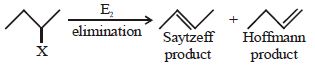
A
$-I$
B
$-Cl$
C
$-Br$
D
$-F$
Solution
(A) In an $E_2$ elimination reaction,the nature of the leaving group $X$ significantly influences the product distribution.
For alkyl halides,the transition state for the $E_2$ mechanism has significant carbanion character.
Fluorine $(-F)$ is the most electronegative halogen,which makes the $\beta$-hydrogen more acidic and stabilizes the transition state leading to the less substituted alkene (Hoffmann product).
Conversely,better leaving groups like $-I$,$-Br$,and $-Cl$ facilitate the formation of the more stable,more substituted alkene (Saytzeff product) because the transition state resembles the product more closely.
Among the given options,$-F$ is the poorest leaving group,which promotes the formation of the Hoffmann product,while $-I$ is the best leaving group,which promotes the formation of the Saytzeff product.
Therefore,the maximum Saytzeff product is obtained when $X = -I$.
For alkyl halides,the transition state for the $E_2$ mechanism has significant carbanion character.
Fluorine $(-F)$ is the most electronegative halogen,which makes the $\beta$-hydrogen more acidic and stabilizes the transition state leading to the less substituted alkene (Hoffmann product).
Conversely,better leaving groups like $-I$,$-Br$,and $-Cl$ facilitate the formation of the more stable,more substituted alkene (Saytzeff product) because the transition state resembles the product more closely.
Among the given options,$-F$ is the poorest leaving group,which promotes the formation of the Hoffmann product,while $-I$ is the best leaving group,which promotes the formation of the Saytzeff product.
Therefore,the maximum Saytzeff product is obtained when $X = -I$.
0 likes
View Solution629
MediumMCQ
$CH_3-CH_2-CH_2-Cl$ $\xrightarrow{KOH_{(aq)}} X$ $\xrightarrow{H^{+}/\Delta} Y$ $\xrightarrow{Cl_2/H_2O} Z$ (Major); $Z$ is
A
$CH_3-CH(Cl)-CH_2OH$
B
$CH_3-CH(OH)-CH_2Cl$
C
$CH_3-CH(OH)-CH_2OH$
D
$CH_3-CH(Cl)-CH_2Cl$
Solution
(B) The reaction sequence is as follows:
$CH_3-CH_2-CH_2-Cl \xrightarrow{KOH_{(aq)}} CH_3-CH_2-CH_2-OH (X)$
$CH_3-CH_2-CH_2-OH \xrightarrow{H^{+}/\Delta} CH_3-CH=CH_2 (Y)$
$CH_3-CH=CH_2 \xrightarrow{Cl_2/H_2O} CH_3-CH(OH)-CH_2Cl (Z)$
In the addition of $HOCl$ $(Cl_2/H_2O)$ to propene,the $OH^{-}$ group (nucleophile) attacks the more substituted carbon atom according to Markovnikov's rule.
$CH_3-CH_2-CH_2-Cl \xrightarrow{KOH_{(aq)}} CH_3-CH_2-CH_2-OH (X)$
$CH_3-CH_2-CH_2-OH \xrightarrow{H^{+}/\Delta} CH_3-CH=CH_2 (Y)$
$CH_3-CH=CH_2 \xrightarrow{Cl_2/H_2O} CH_3-CH(OH)-CH_2Cl (Z)$
In the addition of $HOCl$ $(Cl_2/H_2O)$ to propene,the $OH^{-}$ group (nucleophile) attacks the more substituted carbon atom according to Markovnikov's rule.
0 likes
View Solution630
DifficultMCQ
Which of the following products is not formed in the following reaction?
$Vinylcyclopentane + HBr \rightarrow ?$
$Vinylcyclopentane + HBr \rightarrow ?$
A
$1-$Bromo$-1-$cyclopentyl-ethane
B
$1-$Bromo$-2-$cyclopentyl-ethane
C
Bromocyclohexane
D
$1-$Bromo$-1-$methyl-cyclohexane
Solution
(B) The reaction of $Vinylcyclopentane$ with $HBr$ proceeds via the formation of a carbocation intermediate.
$1$. Protonation of the double bond leads to the formation of a secondary carbocation at the $\alpha$-position relative to the cyclopentyl ring.
$2$. This secondary carbocation can undergo a ring expansion rearrangement to form a more stable tertiary carbocation (cyclohexyl cation).
$3$. The secondary carbocation can also directly react with $Br^-$ to form $1-Bromo-1-cyclopentyl-ethane$ (Markovnikov product).
$4$. The anti-Markovnikov product $1-Bromo-2-cyclopentyl-ethane$ is not formed under standard electrophilic addition conditions.
$5$. The rearranged carbocation can react with $Br^-$ to form $Bromocyclohexane$ or $1-Bromo-1-methyl-cyclohexane$ depending on the specific rearrangement pathway.
Therefore,$1-Bromo-2-cyclopentyl-ethane$ is not the expected product.
$1$. Protonation of the double bond leads to the formation of a secondary carbocation at the $\alpha$-position relative to the cyclopentyl ring.
$2$. This secondary carbocation can undergo a ring expansion rearrangement to form a more stable tertiary carbocation (cyclohexyl cation).
$3$. The secondary carbocation can also directly react with $Br^-$ to form $1-Bromo-1-cyclopentyl-ethane$ (Markovnikov product).
$4$. The anti-Markovnikov product $1-Bromo-2-cyclopentyl-ethane$ is not formed under standard electrophilic addition conditions.
$5$. The rearranged carbocation can react with $Br^-$ to form $Bromocyclohexane$ or $1-Bromo-1-methyl-cyclohexane$ depending on the specific rearrangement pathway.
Therefore,$1-Bromo-2-cyclopentyl-ethane$ is not the expected product.
0 likes
View Solution631
DifficultMCQ
An alkyl bromide $(A)$ forms a Grignard reagent which on treatment with water yields $n$-hexane. When $(A)$ is treated with sodium in dry ether,$4,5$-diethyloctane is formed. The structure of $(A)$ is:
A
$CH_3(CH_2)_5Br$
B
$CH_3CH_2CH_2CH_2CH(Br)CH_3$
C
$CH_3CH_2CH_2CH(Br)CH_2CH_3$
D
$CH_3CH_2CH_2CH_2CH_2CH_2Br$
Solution
(C) $1$. The alkyl bromide $(A)$ forms $n$-hexane $(C_6H_{14})$ upon treatment with water after forming a Grignard reagent. This implies $(A)$ is a $6$-carbon chain alkyl bromide,$C_6H_{13}Br$.
$2$. Wurtz reaction of $(A)$ with sodium in dry ether yields $4,5$-diethyloctane. The structure of $4,5$-diethyloctane is $CH_3CH_2CH_2CH(C_2H_5)CH(C_2H_5)CH_2CH_2CH_3$.
$3$. In the Wurtz reaction,$2R-Br + 2Na \rightarrow R-R + 2NaBr$. The product $4,5$-diethyloctane is formed by coupling two $3$-hexyl radicals.
$4$. Therefore,$(A)$ is $3$-bromohexane,which is $CH_3CH_2CH_2CH(Br)CH_2CH_3$.
$2$. Wurtz reaction of $(A)$ with sodium in dry ether yields $4,5$-diethyloctane. The structure of $4,5$-diethyloctane is $CH_3CH_2CH_2CH(C_2H_5)CH(C_2H_5)CH_2CH_2CH_3$.
$3$. In the Wurtz reaction,$2R-Br + 2Na \rightarrow R-R + 2NaBr$. The product $4,5$-diethyloctane is formed by coupling two $3$-hexyl radicals.
$4$. Therefore,$(A)$ is $3$-bromohexane,which is $CH_3CH_2CH_2CH(Br)CH_2CH_3$.
0 likes
View Solution632
MediumMCQ
The relative reactivity of
$(I)$ Benzyl chloride
$(II)$ $p$-methoxy benzyl chloride
$(III)$ $p$-Nitrobenzyl chloride
Towards $S_N^1$ reaction follows the order
$(I)$ Benzyl chloride
$(II)$ $p$-methoxy benzyl chloride
$(III)$ $p$-Nitrobenzyl chloride
Towards $S_N^1$ reaction follows the order
A
$I > II > III$
B
$II > I > III$
C
$III > II > I$
D
$I > III > II$
Solution
(B) The reactivity of alkyl halides towards $S_N^1$ reaction is directly proportional to the stability of the intermediate carbocation formed.
In the given compounds,the carbocations formed are benzyl carbocations.
$(II)$ $p$-methoxy benzyl carbocation is most stable due to the strong $+M$ effect of the $-OCH_3$ group.
$(I)$ Benzyl carbocation has no substituent.
$(III)$ $p$-Nitrobenzyl carbocation is least stable due to the strong $-M$ and $-I$ effects of the $-NO_2$ group,which destabilize the positive charge.
Therefore,the order of stability of carbocations and hence the reactivity towards $S_N^1$ is $II > I > III$.
In the given compounds,the carbocations formed are benzyl carbocations.
$(II)$ $p$-methoxy benzyl carbocation is most stable due to the strong $+M$ effect of the $-OCH_3$ group.
$(I)$ Benzyl carbocation has no substituent.
$(III)$ $p$-Nitrobenzyl carbocation is least stable due to the strong $-M$ and $-I$ effects of the $-NO_2$ group,which destabilize the positive charge.
Therefore,the order of stability of carbocations and hence the reactivity towards $S_N^1$ is $II > I > III$.
0 likes
View Solution633
MediumMCQ
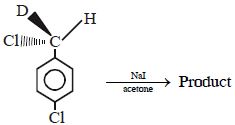
Predict the product of the following reaction:
(Image: $A$ chiral carbon attached to a phenyl ring with a para-chloro group,a deuterium atom $(D)$,a hydrogen atom $(H)$,and a chlorine atom (Cl) in a specific stereochemical configuration. The reaction is with $NaI$ in acetone.)
(Image: $A$ chiral carbon attached to a phenyl ring with a para-chloro group,a deuterium atom $(D)$,a hydrogen atom $(H)$,and a chlorine atom (Cl) in a specific stereochemical configuration. The reaction is with $NaI$ in acetone.)
A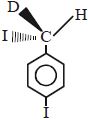
B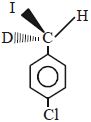
C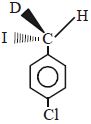
D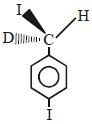
Solution
(D) The reaction of an alkyl halide with $NaI$ in acetone is the Finkelstein reaction,which proceeds via an $S_N2$ mechanism.
$1$. The $S_N2$ mechanism involves a backside attack by the nucleophile $(I^-)$,leading to the inversion of configuration at the chiral center (Walden inversion).
$2$. The starting material is a benzylic chloride. The $Cl$ atom attached to the chiral center is replaced by $I$ with inversion of configuration.
$3$. The para-chloro group on the benzene ring is an aryl halide and does not undergo $S_N2$ substitution under these conditions.
$4$. Therefore,the product is the one where the chiral center has undergone inversion,and the para-chloro group remains unchanged. This corresponds to option $D$.
$1$. The $S_N2$ mechanism involves a backside attack by the nucleophile $(I^-)$,leading to the inversion of configuration at the chiral center (Walden inversion).
$2$. The starting material is a benzylic chloride. The $Cl$ atom attached to the chiral center is replaced by $I$ with inversion of configuration.
$3$. The para-chloro group on the benzene ring is an aryl halide and does not undergo $S_N2$ substitution under these conditions.
$4$. Therefore,the product is the one where the chiral center has undergone inversion,and the para-chloro group remains unchanged. This corresponds to option $D$.
0 likes
View Solution634
MediumMCQ
Which is most reactive for $S_{N}2$ reaction?
A
$CH_3CH_2CH_2Cl$
B
$(CH_3)_2CHCl$
C
$CH_3CH_2Br$
D
$(CH_3)_2CHCH_2Cl$
0 likes
View Solution635
DifficultMCQ
The reaction $Ph-CH_2-CH(F)-CH_3 \xrightarrow[EtOH]{KOH} X$. What is $X$?
A
$Ph-CH_2-C(CH_3)=CH_2$
B
$Ph-CH=CH_2$
C
$Ph-CH=CH-CH_3$
D
$Ph-CH_2-CH(OEt)-CH_3$
Solution
(C) The reaction involves the treatment of $1-phenyl-2-fluoropropane$ with $KOH$ in $EtOH$. This is a dehydrohalogenation reaction,which proceeds via an $E2$ mechanism to form an alkene.
The base $KOH$ in $EtOH$ abstracts a proton from the $\beta$-carbon. There are two possible $\beta$-carbons:
$1$. The $\beta$-carbon attached to the phenyl group $(Ph-CH_2-)$,which would lead to $Ph-CH=CH-CH_3$.
$2$. The $\beta$-carbon of the methyl group $(-CH_3)$,which would lead to $Ph-CH_2-CH=CH_2$.
The formation of $Ph-CH=CH-CH_3$ ($1$-phenylprop$-1-$ene) is favored because the resulting double bond is conjugated with the phenyl ring,making the product more stable. Thus,the major product $X$ is $Ph-CH=CH-CH_3$.
The base $KOH$ in $EtOH$ abstracts a proton from the $\beta$-carbon. There are two possible $\beta$-carbons:
$1$. The $\beta$-carbon attached to the phenyl group $(Ph-CH_2-)$,which would lead to $Ph-CH=CH-CH_3$.
$2$. The $\beta$-carbon of the methyl group $(-CH_3)$,which would lead to $Ph-CH_2-CH=CH_2$.
The formation of $Ph-CH=CH-CH_3$ ($1$-phenylprop$-1-$ene) is favored because the resulting double bond is conjugated with the phenyl ring,making the product more stable. Thus,the major product $X$ is $Ph-CH=CH-CH_3$.
0 likes
View Solution636
MediumMCQ
Arrange the following compounds in order of increasing $S_N1$ reaction rate:
$(i)$ $Ph-C(CH_3)_2-Br$
(ii) $CH_3-CH_2-CH(CH_3)-Br$
(iii) $(CH_3)_3C-Br$
(iv) $CH_3-CH_2-CH(CH_3)-Cl$
$(i)$ $Ph-C(CH_3)_2-Br$
(ii) $CH_3-CH_2-CH(CH_3)-Br$
(iii) $(CH_3)_3C-Br$
(iv) $CH_3-CH_2-CH(CH_3)-Cl$
A
$iv < ii < iii < i$
B
$i < ii < iii < iv$
C
$iv < i < iii < ii$
D
$iv < i < ii < iii$
Solution
(A) The rate of $S_N1$ reaction depends on the stability of the carbocation intermediate formed.
$(i)$ Forms a benzylic carbocation $(Ph-C^+(CH_3)_2)$,which is highly stable due to resonance.
(ii) Forms a secondary carbocation $(CH_3-CH_2-CH^+-CH_3)$.
(iii) Forms a tertiary carbocation $((CH_3)_3C^+)$.
(iv) Forms a secondary carbocation $(CH_3-CH_2-CH^+-CH_3)$ but has $Cl^-$ as a leaving group,which is a poorer leaving group than $Br^-$.
Comparing stabilities: Benzylic > Tertiary > Secondary.
Comparing leaving groups: $Br^- > Cl^-$.
Thus,the order of stability/rate is: (iv) < (ii) < (iii) < $(i)$.
Therefore,the correct option is $A$.
$(i)$ Forms a benzylic carbocation $(Ph-C^+(CH_3)_2)$,which is highly stable due to resonance.
(ii) Forms a secondary carbocation $(CH_3-CH_2-CH^+-CH_3)$.
(iii) Forms a tertiary carbocation $((CH_3)_3C^+)$.
(iv) Forms a secondary carbocation $(CH_3-CH_2-CH^+-CH_3)$ but has $Cl^-$ as a leaving group,which is a poorer leaving group than $Br^-$.
Comparing stabilities: Benzylic > Tertiary > Secondary.
Comparing leaving groups: $Br^- > Cl^-$.
Thus,the order of stability/rate is: (iv) < (ii) < (iii) < $(i)$.
Therefore,the correct option is $A$.
0 likes
View Solution637
DifficultMCQ
Heating methyl chloride with zinc in a closed tube produces...............
A
Methane
B
Ethane
C
Ethylene
D
Methanol
Solution
(B) The reaction of an alkyl halide with zinc is known as the Frankland reaction. When methyl chloride $(CH_3Cl)$ is heated with zinc $(Zn)$ in a closed tube,it undergoes a coupling reaction to form ethane $(C_2H_6)$.
The chemical equation is: $2CH_3Cl + Zn \rightarrow CH_3-CH_3 + ZnCl_2$.
The chemical equation is: $2CH_3Cl + Zn \rightarrow CH_3-CH_3 + ZnCl_2$.
0 likes
View Solution638
MediumMCQ
The reaction of a mixture of two alkyl halides with sodium in ether gives $2-$methylpropane. The alkyl halides are:
A
$2-$chloropropane and chloromethane
B
$2-$chloropropane and chloroethane
C
chloromethane and chloroethane
D
chloromethane and $1-$chloropropane
Solution
(A) The reaction of alkyl halides with sodium in dry ether is known as the Wurtz reaction.
To obtain $2-$methylpropane $(CH_3-CH(CH_3)-CH_3)$,we need to combine a propyl group and a methyl group.
This can be achieved by the reaction of $2-$chloropropane $(CH_3-CHCl-CH_3)$ and chloromethane $(CH_3Cl)$ in the presence of sodium.
The reaction is: $CH_3-CHCl-CH_3 + 2Na + CH_3Cl \rightarrow CH_3-CH(CH_3)-CH_3 + 2NaCl$.
To obtain $2-$methylpropane $(CH_3-CH(CH_3)-CH_3)$,we need to combine a propyl group and a methyl group.
This can be achieved by the reaction of $2-$chloropropane $(CH_3-CHCl-CH_3)$ and chloromethane $(CH_3Cl)$ in the presence of sodium.
The reaction is: $CH_3-CHCl-CH_3 + 2Na + CH_3Cl \rightarrow CH_3-CH(CH_3)-CH_3 + 2NaCl$.
0 likes
View Solution639
MediumMCQ
$CH_3CH(Br)CH_2CH_3 + \text{alc. } KOH \to$ ?
A
$But-1-ene$
B
$But-2-ene$
C
$Butene$
D
$Butan-2-ol$
Solution
(B) The reaction of $2-bromobutane$ with alcoholic $KOH$ is a dehydrohalogenation reaction (elimination reaction).
According to $Saytzeff$ rule,the major product is the more substituted alkene.
$CH_3-CH(Br)-CH_2-CH_3 + \text{alc. } KOH \to CH_3-CH=CH-CH_3$ ($But-2-ene$,major) $+ CH_3-CH_2-CH=CH_2$ ($But-1-ene$,minor).
Since $But-2-ene$ is the major product,it is the expected answer.
According to $Saytzeff$ rule,the major product is the more substituted alkene.
$CH_3-CH(Br)-CH_2-CH_3 + \text{alc. } KOH \to CH_3-CH=CH-CH_3$ ($But-2-ene$,major) $+ CH_3-CH_2-CH=CH_2$ ($But-1-ene$,minor).
Since $But-2-ene$ is the major product,it is the expected answer.
0 likes
View Solution640
DifficultMCQ
The product obtained by the reaction of propene with $ICl$ is .............
A
$CH_3CHClCH_2I$
B
$CH_3CHICH_2Cl$
C
$CH_3CHClCH_2Cl$
D
$CH_3CHICH_2I$
0 likes
View Solution641
MediumMCQ
Which of the following will react with a halogen acid at the slowest rate?
A
$CH_2 = CH-Cl$
B
$CH_2 = CH_2$
C
$CH_3CH = CH_2$
D
$(CH_3)_2C = CH_2$
Solution
(A) The reaction of alkenes with halogen acids $(HX)$ proceeds via an electrophilic addition mechanism,where the rate-determining step is the formation of a carbocation intermediate.
$1$. The stability of the carbocation formed determines the rate of reaction. More stable carbocations are formed faster.
$2$. In $CH_2 = CH-Cl$,the chlorine atom exerts a strong $-I$ effect and a $+M$ effect. The $-I$ effect is dominant,which destabilizes the carbocation formed at the adjacent carbon atom,making the alkene less reactive towards electrophilic addition.
$3$. In $CH_2 = CH_2$,$CH_3CH = CH_2$,and $(CH_3)_2C = CH_2$,the alkyl groups provide $+I$ effects and hyperconjugation,which stabilize the carbocation intermediate,thus increasing the rate of reaction.
$4$. Therefore,$CH_2 = CH-Cl$ reacts at the slowest rate.
$1$. The stability of the carbocation formed determines the rate of reaction. More stable carbocations are formed faster.
$2$. In $CH_2 = CH-Cl$,the chlorine atom exerts a strong $-I$ effect and a $+M$ effect. The $-I$ effect is dominant,which destabilizes the carbocation formed at the adjacent carbon atom,making the alkene less reactive towards electrophilic addition.
$3$. In $CH_2 = CH_2$,$CH_3CH = CH_2$,and $(CH_3)_2C = CH_2$,the alkyl groups provide $+I$ effects and hyperconjugation,which stabilize the carbocation intermediate,thus increasing the rate of reaction.
$4$. Therefore,$CH_2 = CH-Cl$ reacts at the slowest rate.
0 likes
View Solution642
DifficultMCQ
What is the product obtained when $2-$methylpropene is heated with acetyl chloride in the presence of anhydrous $ZnCl_2$?
A
$CH_3CO-C(CH_3)=CH_2$
B
$CH_3CO-C(CH_3)_3$
C
$(CH_3)_2C(Cl)-CH_2COCH_3$
D
$(CH_3)_2CH-CH_2COCH_3$
Solution
(C) The reaction of an alkene with an acyl chloride in the presence of a Lewis acid like anhydrous $ZnCl_2$ is an electrophilic addition reaction (specifically,a Friedel-Crafts type acylation of the alkene).
In this reaction,the acetyl cation $(CH_3CO^+)$ acts as an electrophile and attacks the double bond of $2-$methylpropene.
Following the attack,the chloride ion $(Cl^-)$ adds to the carbocation formed,resulting in a $\beta-$chloro ketone.
For $2-$methylpropene $((CH_3)_2C=CH_2)$,the reaction proceeds as follows:
$(CH_3)_2C=CH_2 + CH_3COCl \xrightarrow{ZnCl_2} (CH_3)_2C(Cl)-CH_2COCH_3$.
Thus,the correct product is $1-$chloro$-4,4-$dimethylpentan$-2-$one,which corresponds to option $C$.
In this reaction,the acetyl cation $(CH_3CO^+)$ acts as an electrophile and attacks the double bond of $2-$methylpropene.
Following the attack,the chloride ion $(Cl^-)$ adds to the carbocation formed,resulting in a $\beta-$chloro ketone.
For $2-$methylpropene $((CH_3)_2C=CH_2)$,the reaction proceeds as follows:
$(CH_3)_2C=CH_2 + CH_3COCl \xrightarrow{ZnCl_2} (CH_3)_2C(Cl)-CH_2COCH_3$.
Thus,the correct product is $1-$chloro$-4,4-$dimethylpentan$-2-$one,which corresponds to option $C$.
0 likes
View Solution643
MediumMCQ
What is the product formed by the reaction of $2-$methylpropene with $HBr$ in the presence of peroxide?
A
$2-$bromo$-2-$methylpropane
B
$1-$bromo$-2-$methylpropane
C
$2-$bromo$-2-$methylpropane
D
$2-$methyl$-2-$bromopropane
Solution
(B) The reaction of $2-$methylpropene $(CH_3)_2C=CH_2$ with $HBr$ in the presence of peroxide follows the anti-Markovnikov addition mechanism (Kharasch effect).
In this mechanism,the bromine atom attaches to the carbon atom with more hydrogen atoms.
$2-$methylpropene has the structure $(CH_3)_2C=CH_2$.
The terminal carbon has two hydrogen atoms,while the central carbon has none.
Therefore,the $Br$ atom adds to the terminal $CH_2$ group,and the $H$ atom adds to the central $C$ atom.
The product formed is $1-$bromo$-2-$methylpropane.
In this mechanism,the bromine atom attaches to the carbon atom with more hydrogen atoms.
$2-$methylpropene has the structure $(CH_3)_2C=CH_2$.
The terminal carbon has two hydrogen atoms,while the central carbon has none.
Therefore,the $Br$ atom adds to the terminal $CH_2$ group,and the $H$ atom adds to the central $C$ atom.
The product formed is $1-$bromo$-2-$methylpropane.
0 likes
View Solution644
DifficultMCQ
Toluene reacts with $Cl_2$ in the presence of .............. to form benzyl chloride.
A
Presence of sunlight
B
Absence of sunlight
C
Presence of anhydrous $AlCl_3$
D
Presence of $FeCl_3$
Solution
(A) The reaction of toluene with $Cl_2$ in the presence of sunlight (or $UV$ light) proceeds via a free radical mechanism to form benzyl chloride $(C_6H_5CH_2Cl)$.
This is a side-chain chlorination reaction.
In the presence of Lewis acids like anhydrous $AlCl_3$ or $FeCl_3$,the reaction would instead undergo electrophilic aromatic substitution to form ortho- and para-chlorotoluene.
This is a side-chain chlorination reaction.
In the presence of Lewis acids like anhydrous $AlCl_3$ or $FeCl_3$,the reaction would instead undergo electrophilic aromatic substitution to form ortho- and para-chlorotoluene.
0 likes
View Solution645
MediumMCQ
Chlorination of toluene in the presence of light and heat followed by reaction with aqueous $NaOH$ gives ...................
A
$o-$ Cresol
B
$p-$ Cresol
C
$2, 4-$ Dihydroxytoluene
D
Benzyl alcohol
Solution
(D) $1$. Chlorination of toluene in the presence of light and heat (free radical substitution) yields benzal chloride $(C_6H_5CHCl_2)$ or benzyl chloride $(C_6H_5CH_2Cl)$ depending on the extent of chlorination. Assuming side-chain chlorination to benzyl chloride: $C_6H_5CH_3 + Cl_2 \xrightarrow{h\nu} C_6H_5CH_2Cl + HCl$.
$2$. Subsequent reaction with aqueous $NaOH$ (nucleophilic substitution) replaces the chlorine atom with a hydroxyl group: $C_6H_5CH_2Cl + NaOH(aq) \rightarrow C_6H_5CH_2OH + NaCl$.
$3$. The product formed is benzyl alcohol. Since benzyl alcohol is not explicitly listed in the options provided,and assuming the question implies hydrolysis of benzyl chloride,the correct product is benzyl alcohol.
$2$. Subsequent reaction with aqueous $NaOH$ (nucleophilic substitution) replaces the chlorine atom with a hydroxyl group: $C_6H_5CH_2Cl + NaOH(aq) \rightarrow C_6H_5CH_2OH + NaCl$.
$3$. The product formed is benzyl alcohol. Since benzyl alcohol is not explicitly listed in the options provided,and assuming the question implies hydrolysis of benzyl chloride,the correct product is benzyl alcohol.
0 likes
View Solution646
DifficultMCQ
How many of the four monochloro derivatives of $(CH_3)_2CHCH_2CH_3$ are optically active?
A
$4$
B
$3$
C
$2$
D
$1$
Solution
(C) The structure of $2$-methylbutane is $(CH_3)_2CHCH_2CH_3$.
There are four possible monochloro derivatives formed by replacing a hydrogen atom:
$1$. $1$-chloro-$2$-methylbutane: $ClCH_2-CH(CH_3)-CH_2-CH_3$ (Chiral center at $C_2$,optically active).
$2$. $2$-chloro-$2$-methylbutane: $(CH_3)_2C(Cl)-CH_2-CH_3$ (No chiral center,optically inactive).
$3$. $2$-chloro-$3$-methylbutane: $(CH_3)_2CH-CH(Cl)-CH_3$ (Chiral center at $C_2$,optically active).
$4$. $1$-chloro-$3$-methylbutane: $(CH_3)_2CH-CH_2-CH_2Cl$ (No chiral center,optically inactive).
Thus,there are $2$ optically active isomers.
There are four possible monochloro derivatives formed by replacing a hydrogen atom:
$1$. $1$-chloro-$2$-methylbutane: $ClCH_2-CH(CH_3)-CH_2-CH_3$ (Chiral center at $C_2$,optically active).
$2$. $2$-chloro-$2$-methylbutane: $(CH_3)_2C(Cl)-CH_2-CH_3$ (No chiral center,optically inactive).
$3$. $2$-chloro-$3$-methylbutane: $(CH_3)_2CH-CH(Cl)-CH_3$ (Chiral center at $C_2$,optically active).
$4$. $1$-chloro-$3$-methylbutane: $(CH_3)_2CH-CH_2-CH_2Cl$ (No chiral center,optically inactive).
Thus,there are $2$ optically active isomers.
0 likes
View Solution647
MediumMCQ
The ${S_{N}2}$ reaction of an asymmetric carbon compound always gives:
A
Enantiomers
B
$A$ product with inverted optical rotation
C
$A$ mixture of diastereomers
D
$A$ single configurational isomer
Solution
(B) The ${S_{N}2}$ mechanism involves a backside attack by the nucleophile on the electrophilic carbon atom.
This process results in the inversion of configuration at the chiral center,which is known as the $Walden$ inversion.
Therefore,if the starting material is optically active,the product will have the opposite configuration,leading to a product with inverted optical rotation.
This process results in the inversion of configuration at the chiral center,which is known as the $Walden$ inversion.
Therefore,if the starting material is optically active,the product will have the opposite configuration,leading to a product with inverted optical rotation.
0 likes
View Solution648
DifficultMCQ
What is the product formed by the reaction of $HBr$ with $CH_2=CH-OCH_3$ under anhydrous conditions at room temperature?
A
$BrCH_2-CH_2-OCH_3$
B
$CH_3-CHBr-OCH_3$
C
$CH_3CHO$ and $CH_3Br$
D
$BrCH_2CHO$ and $CH_3OH$
Solution
(B) The reaction involves the electrophilic addition of $HBr$ to the vinyl ether $CH_2=CH-OCH_3$.
$1$. The proton $(H^+)$ from $HBr$ attacks the terminal carbon $(CH_2)$ to form a stable carbocation,$CH_3-CH^+-OCH_3$,which is stabilized by the resonance effect of the oxygen atom (lone pair donation).
$2$. The bromide ion $(Br^-)$ then attacks the carbocation to form the product $CH_3-CHBr-OCH_3$.
$3$. Under anhydrous conditions,the ether linkage remains intact,and the product is $1-bromo-1-methoxyethane$ $(CH_3-CHBr-OCH_3)$.
$1$. The proton $(H^+)$ from $HBr$ attacks the terminal carbon $(CH_2)$ to form a stable carbocation,$CH_3-CH^+-OCH_3$,which is stabilized by the resonance effect of the oxygen atom (lone pair donation).
$2$. The bromide ion $(Br^-)$ then attacks the carbocation to form the product $CH_3-CHBr-OCH_3$.
$3$. Under anhydrous conditions,the ether linkage remains intact,and the product is $1-bromo-1-methoxyethane$ $(CH_3-CHBr-OCH_3)$.
0 likes
View Solution649
DifficultMCQ
The reaction of one mole of $3-$chlorohexane with one mole of $NaI$ in the presence of acetone yields which of the following as the major product?
A
$1-$chloro$-3-$iodohexane
B
$3-$chloro$-1-$iodohexane
C
$3-$iodohexane
D
$1,3-$diiodohexane
Solution
(C) The reaction of an alkyl chloride with $NaI$ in the presence of acetone is known as the Finkelstein reaction.
This is a nucleophilic substitution reaction $(S_N2)$ where the iodide ion $(I^-)$ acts as a nucleophile and replaces the chloride ion $(Cl^-)$.
The starting material is $3-$chlorohexane,which is a secondary alkyl chloride.
In the Finkelstein reaction,the iodide ion replaces the halogen atom present in the alkyl halide.
Therefore,the $Cl$ atom at the $3-$position will be replaced by an $I$ atom,resulting in the formation of $3-$iodohexane.
This is a nucleophilic substitution reaction $(S_N2)$ where the iodide ion $(I^-)$ acts as a nucleophile and replaces the chloride ion $(Cl^-)$.
The starting material is $3-$chlorohexane,which is a secondary alkyl chloride.
In the Finkelstein reaction,the iodide ion replaces the halogen atom present in the alkyl halide.
Therefore,the $Cl$ atom at the $3-$position will be replaced by an $I$ atom,resulting in the formation of $3-$iodohexane.
0 likes
View Solution650
DifficultMCQ
In the $S_{N}2$ substitution reaction $R-Br + Cl^- \xrightarrow{DMF} R-Cl + Br^-$,which of the following will have the highest rate?
A
$(CH_3)_3C-CH_2Br$
B
$CH_3CH_2Br$
C
$CH_3CH_2CH_2Br$
D
$(CH_3)_2CH-CH_2Br$
Solution
(B) The rate of an $S_{N}2$ reaction is primarily governed by steric hindrance.
$S_{N}2$ reactions proceed fastest with primary alkyl halides that have the least steric hindrance around the electrophilic carbon atom.
Comparing the options:
$(A)$ $(CH_3)_3C-CH_2Br$ is a primary alkyl halide but has significant steric hindrance due to the bulky tert-butyl group at the $\beta$-position.
$(B)$ $CH_3CH_2Br$ is a primary alkyl halide with minimal steric hindrance.
$(C)$ $CH_3CH_2CH_2Br$ is a primary alkyl halide with slightly more steric hindrance than ethyl bromide.
$(D)$ $(CH_3)_2CH-CH_2Br$ is a primary alkyl halide with more steric hindrance than $(B)$ and $(C)$.
Therefore,$CH_3CH_2Br$ reacts the fastest.
$S_{N}2$ reactions proceed fastest with primary alkyl halides that have the least steric hindrance around the electrophilic carbon atom.
Comparing the options:
$(A)$ $(CH_3)_3C-CH_2Br$ is a primary alkyl halide but has significant steric hindrance due to the bulky tert-butyl group at the $\beta$-position.
$(B)$ $CH_3CH_2Br$ is a primary alkyl halide with minimal steric hindrance.
$(C)$ $CH_3CH_2CH_2Br$ is a primary alkyl halide with slightly more steric hindrance than ethyl bromide.
$(D)$ $(CH_3)_2CH-CH_2Br$ is a primary alkyl halide with more steric hindrance than $(B)$ and $(C)$.
Therefore,$CH_3CH_2Br$ reacts the fastest.
0 likes
View SolutionHaloalkanes and Haloarenes — Properties of Haloalkanes · Frequently Asked Questions
1Are these Haloalkanes and Haloarenes questions useful for JEE and NEET?
Yes. All questions in this section are mapped to JEE Main and NEET exam patterns. Previous year questions from JEE Main, NEET, GUJCET and state-level exams are included with full solutions.
2Can I switch to Hindi or Gujarati for these questions?
Yes. Use the language tabs in the hero section or the sidebar to view the same questions and solutions in English, Hindi or Gujarati.
3How do I generate a question paper from this subtopic?
Use the Vedclass Exam Paper Generator — select the chapter and subtopic, set difficulty, and generate Sets A, B, C, D automatically. First 3 chapters of every subject are free.
Vedclass Products
For Students
Vedclass Test Series
Mock tests in real JEE/NEET style with performance analysis. 5-day free trial.
Start Free TrialFor Teachers
Exam Paper Generator
Generate Set A/B/C/D papers from this chapter in 2 minutes. 3 chapters free.
Try FreeFor Institutes
Online Exam Module
Live online exams with unlimited students, 360° analytics & white-label branding.
See DemoFor Teachers & Institutes
Generate a Haloalkanes and Haloarenes Exam Paper in 2 Minutes
Select subtopic & difficulty — Sets A, B, C, D auto-generated with No Repeat logic.
First 3 chapters of every subject are free — no payment required.