
A English
Polyhalogenated compounds Questions in English
Class 12 Chemistry · Haloalkanes and Haloarenes · Polyhalogenated compounds
78+
Questions
English
Language
100%
With Solutions
Showing 50 of 78 questions in English
1
MediumMCQ
Freon-$114$ used in refrigerators and air conditioners is $1, 2$-dichlorotetrafluoroethane. Its structural formula is
A
$Cl-CF_2-CF_2-Cl$
B
$F-C(Cl)(H)-C(Cl)(F)-F$
C
$F-C(F)(Cl)-C(F)(F)-Cl$
D
$F-C(Cl)(F)-C(H)(Cl)-C(F)(F)-F$
Solution
(A) The chemical name $1, 2$-dichlorotetrafluoroethane indicates that there are two carbon atoms in the chain.
Each carbon atom is bonded to one chlorine atom and two fluorine atoms to satisfy the valency of carbon.
The structure is $Cl-CF_2-CF_2-Cl$,which can be written as $CF_2Cl-CF_2Cl$.
Each carbon atom is bonded to one chlorine atom and two fluorine atoms to satisfy the valency of carbon.
The structure is $Cl-CF_2-CF_2-Cl$,which can be written as $CF_2Cl-CF_2Cl$.
0 likes
View Solution2
MediumMCQ
The $IUPAC$ name of Gammexane is
A
Benzene hexachloride
B
Hexachlorobenzene
C
$1, 2, 3, 4, 5, 6-$hexachlorobenzene
D
$1, 2, 3, 4, 5, 6-$hexachlorocyclohexane
Solution
(D) Gammexane,also known as Lindane or $666$,is the $\gamma$-isomer of benzene hexachloride.
Its chemical structure consists of a cyclohexane ring with chlorine atoms attached to each of the six carbon atoms.
Therefore,its $IUPAC$ name is $1, 2, 3, 4, 5, 6-$hexachlorocyclohexane.
Its chemical structure consists of a cyclohexane ring with chlorine atoms attached to each of the six carbon atoms.
Therefore,its $IUPAC$ name is $1, 2, 3, 4, 5, 6-$hexachlorocyclohexane.
0 likes
View Solution3
MediumMCQ
Which compound is not inflammable?
A
$CH_4$
B
$C_2H_5OH$
C
$CCl_4$
D
$C_6H_6$
Solution
(C) Carbon tetrachloride $(CCl_4)$ is not inflammable.
Carbon tetrachloride $(CCl_4)$ is poisonous and water insoluble. It is soluble in ethanol and ether.
Carbon tetrachloride $(CCl_4)$ is poisonous and water insoluble. It is soluble in ethanol and ether.
0 likes
View Solution4
MediumMCQ
The structural formula for Lewisite is:
A
$CHCl=CH-AsCl_3$
B
$CHCl_2-CH-AsCl_3$
C
$CHCl=CH-AsCl_2$
D
None of these
Solution
(C) Lewisite is $2$-chloroethenyldichloroarsine.
Its structural formula is $CHCl=CH-AsCl_2$.
Its structural formula is $CHCl=CH-AsCl_2$.
0 likes
View Solution5
MediumMCQ
The chemical name of the insecticide Gammexene is:
A
$DDT$
B
Benzene hexachloride
C
Chloral
D
Hexachloroethane
Solution
(B) Gammexene,also known as $BHC$ (Benzene hexachloride) or Lindane,is produced by the addition reaction of benzene with chlorine in the presence of sunlight.
The reaction is: $C_6H_6 + 3Cl_2 \xrightarrow{\text{Sunlight}} C_6H_6Cl_6$ $(BHC)$.
Therefore,the correct option is $(b)$.
The reaction is: $C_6H_6 + 3Cl_2 \xrightarrow{\text{Sunlight}} C_6H_6Cl_6$ $(BHC)$.
Therefore,the correct option is $(b)$.
0 likes
View Solution6
DifficultMCQ
The full name of $DDT$ is:
A
$1,1,1-$trichloro$-2,2-$bis($p-$chlorophenyl)ethane
B
$1,1-$dichloro$-2,2-$diphenyltrimethylethane
C
$1,1-$dichloro$-2,2-$diphenyltrichloroethane
D
None of these
Solution
(A) The full name of $DDT$ is $1,1,1-$trichloro$-2,2-$bis($p-$chlorophenyl)ethane.
It is a well-known organochlorine insecticide.
The structure consists of two $p-$chlorophenyl groups attached to a central carbon atom,which is also bonded to a trichloromethyl group $(CCl_3)$ and a hydrogen atom.
It is a well-known organochlorine insecticide.
The structure consists of two $p-$chlorophenyl groups attached to a central carbon atom,which is also bonded to a trichloromethyl group $(CCl_3)$ and a hydrogen atom.
0 likes
View Solution7
AdvancedMCQ
The compound formed on heating chlorobenzene with chloral in the presence of concentrated sulphuric acid is:
A
Freon
B
$DDT$
C
Gammexene
D
Hexachloroethane
Solution
(B) The reaction between chlorobenzene and chloral $(CCl_3CHO)$ in the presence of concentrated $H_2SO_4$ leads to the formation of $DDT$ ($1,1,1$-trichloro-$2,2$-bis($p$-chlorophenyl)ethane).
The chemical reaction is:
$2C_6H_5Cl + CCl_3CHO \xrightarrow{conc. H_2SO_4} (ClC_6H_4)_2CHCCl_3 + H_2O$
The chemical reaction is:
$2C_6H_5Cl + CCl_3CHO \xrightarrow{conc. H_2SO_4} (ClC_6H_4)_2CHCCl_3 + H_2O$
0 likes
View Solution8
MediumMCQ
Which compound needs chloral in its synthesis?
A
$D.D.T.$
B
Gammexane
C
Chloroform
D
Michler's Ketone
Solution
(A) $D.D.T.$ (dichlorodiphenyltrichloroethane) is synthesized by the condensation reaction of chloral $(CCl_3CHO)$ with chlorobenzene in the presence of concentrated sulfuric acid.
0 likes
View Solution9
DifficultMCQ
To get $DDT$,chlorobenzene has to react with which of the following compounds in the presence of concentrated sulphuric acid?
A
Trichloroethane
B
Dichloroacetone
C
Dichloroacetaldehyde
D
Trichloroacetaldehyde
Solution
(D) $DDT$ (dichlorodiphenyltrichloroethane) is prepared by the reaction of chlorobenzene with trichloroacetaldehyde (chloral) in the presence of concentrated $H_2SO_4$.
The reaction is: $2C_6H_5Cl + CCl_3CHO \xrightarrow{conc. H_2SO_4} (ClC_6H_4)_2CHCCl_3 + H_2O$.
The reaction is: $2C_6H_5Cl + CCl_3CHO \xrightarrow{conc. H_2SO_4} (ClC_6H_4)_2CHCCl_3 + H_2O$.
0 likes
View Solution10
DifficultMCQ
War gas is formed from
A
$PH_3$
B
$C_2H_2$
C
Zinc phosphate
D
Chloropicrin
Solution
(D) The term $ \text{war gas} $ often refers to $ \text{Chloropicrin} $ $( CCl_3NO_2 )$,which is prepared by the reaction of chloroform with nitric acid:
$ CHCl_3 + HNO_3 \to CCl_3NO_2 + H_2O $
Thus,the correct option is $ D $.
$ CHCl_3 + HNO_3 \to CCl_3NO_2 + H_2O $
Thus,the correct option is $ D $.
0 likes
View Solution11
EasyMCQ
Which of the following statements about chloroform $(CHCl_3)$ is false?
A
It is a colourless,sweet-smelling liquid
B
It is almost insoluble in water
C
It is highly inflammable
D
It can be used as an inhalational anaesthetic agent
Solution
(C) Chloroform $(CHCl_3)$ is a colourless,sweet-smelling liquid that is almost insoluble in water. It is not highly inflammable; in fact,it is often used as a solvent in fire extinguishers. Historically,it was used as an inhalational anaesthetic,although its use has declined due to toxicity. Therefore,the statement that it is highly inflammable is false.
0 likes
View Solution12
AdvancedMCQ
Which isomer of cyclohexane hexachloride is a very strong insecticide?
A
$\alpha$
B
$\beta$
C
$\gamma$
D
$\delta$
Solution
(C) Benzene hexachloride $(BHC)$ is a mixture of several stereoisomers of $1,2,3,4,5,6$-hexachlorocyclohexane formed by the light-induced addition of chlorine to benzene.
Among these isomers,the $\gamma$-isomer is known as lindane or gammexane,which acts as a very strong insecticide.
Among these isomers,the $\gamma$-isomer is known as lindane or gammexane,which acts as a very strong insecticide.
0 likes
View Solution13
MediumMCQ
What is the chemical name of Chloropicrin?
A
Trichloroacetaldehyde
B
Nitrochloroform
C
$2,4,6-$ Trinitrophenol
D
None of these
Solution
(B) Chloropicrin is chemically known as $CCl_3NO_2$.
It is also called Nitrochloroform.
It is prepared by the reaction of chloroform with concentrated nitric acid.
It is also called Nitrochloroform.
It is prepared by the reaction of chloroform with concentrated nitric acid.
0 likes
View Solution14
MediumMCQ
Which one of the following compounds does not react with bromine?
A
Ethylamine
B
Propene
C
Phenol
D
Chloroform
Solution
(D) $Chloroform$ $(CHCl_3)$ does not contain any $\pi$-unsaturation (double or triple bonds) and is not nucleophilic under standard conditions. Therefore,it does not undergo electrophilic addition with bromine $(Br_2)$ in the dark at room temperature. In contrast,$Propene$ and $Phenol$ readily react with bromine due to the presence of a double bond and an electron-rich aromatic ring,respectively. $Ethylamine$ can also react with bromine under specific conditions.
0 likes
View Solution15
EasyMCQ
$DDT$ is
A
$A$ solid
B
$A$ liquid
C
$A$ gas
D
$A$ solution
Solution
(A) $DDT$ (dichlorodiphenyltrichloroethane) is an organochlorine compound.
It is a synthetic chemical that does not occur naturally.
At room temperature,$DDT$ exists as a colorless,crystalline solid.
It is a synthetic chemical that does not occur naturally.
At room temperature,$DDT$ exists as a colorless,crystalline solid.
0 likes
View Solution16
DifficultMCQ
Which of these can be used as a moth repellent?
A
Benzene hexachloride
B
Benzal chloride
C
Hexachloroethane
D
Tetrachloroethane
Solution
(C) $Hexachloroethane$ $(C_2Cl_6)$ is commonly used as a moth repellent. It has also been used as a plasticizer for cellulose esters,a polymer additive,a component of fungicidal and insecticidal formulations,and in the manufacture of fire extinguishing fluids.
0 likes
View Solution17
AdvancedMCQ
Which one of the following is the correct formula of dichlorodiphenyl trichloroethane $(DDT)$?
A
$(Cl-C_6H_4)_2CH-CCl_3$
B
$(C_6H_4Cl)_2-CH-CCl_3$
C
$(C_6H_5)_2-CH-CCl_3$
D
$(C_6H_4Cl)_2-CH_2-CCl_3$
Solution
(A) The chemical name $DDT$ stands for dichlorodiphenyl trichloroethane.
Its structure consists of two chlorophenyl groups attached to a central carbon atom,which is also bonded to a hydrogen atom and a trichloromethyl group $(CCl_3)$.
The correct formula is $(Cl-C_6H_4)_2CH-CCl_3$.
Its structure consists of two chlorophenyl groups attached to a central carbon atom,which is also bonded to a hydrogen atom and a trichloromethyl group $(CCl_3)$.
The correct formula is $(Cl-C_6H_4)_2CH-CCl_3$.
0 likes
View Solution18
MediumMCQ
The molecular formula of $DDT$ has $.........$ chlorine atoms.
A
$5$
B
$4$
C
$3$
D
$2$
Solution
(A) The structure of $DDT$ (dichlorodiphenyltrichloroethane) is $CCl_3-CH(C_6H_4Cl)_2$.
In this structure,there are $3$ chlorine atoms in the $CCl_3$ group and $2$ chlorine atoms attached to the two benzene rings.
Therefore,the total number of chlorine atoms in $DDT$ is $3 + 2 = 5$.
In this structure,there are $3$ chlorine atoms in the $CCl_3$ group and $2$ chlorine atoms attached to the two benzene rings.
Therefore,the total number of chlorine atoms in $DDT$ is $3 + 2 = 5$.
0 likes
View Solution19
MediumMCQ
Chloropicrin is used as:
A
Solvent
B
Anaesthetic
C
Perfume
D
Tear gas
Solution
(D) Chloropicrin,with the chemical formula $CCl_3NO_2$,is a chemical compound commonly used as a tear gas or riot control agent. It is also known as nitrotrichloromethane.
0 likes
View Solution20
MediumMCQ
Which of the following is known as freon which is used as a refrigerant?
A
$CCl_2F_2$
B
$CHCl_3$
C
$CH_2F_2$
D
$CF_4$
Solution
(A) $CCl_2F_2$ is known as Freon-$12$.
It is chemically named as dichloro difluoro methane.
It is a chlorofluorocarbon $(CFC)$ commonly used as a refrigerant in refrigerators and air conditioners.
Its release into the atmosphere causes ozone layer depletion.
Other examples of $CFCs$ include trichloro fluoro methane $(CCl_3F)$ and chloro difluoro methane $(CHClF_2)$.
It is chemically named as dichloro difluoro methane.
It is a chlorofluorocarbon $(CFC)$ commonly used as a refrigerant in refrigerators and air conditioners.
Its release into the atmosphere causes ozone layer depletion.
Other examples of $CFCs$ include trichloro fluoro methane $(CCl_3F)$ and chloro difluoro methane $(CHClF_2)$.
0 likes
View Solution21
MediumMCQ
The provided structural formula refers to:
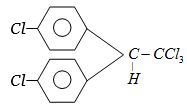
A
$BHC$
B
$DNA$
C
$DDT$
D
$RNA$
Solution
(C) The given structure represents $1,1,1-\text{trichloro}-2,2-\text{bis}(p-\text{chlorophenyl})\text{ethane}$,which is commonly known as $DDT$.
0 likes
View Solution22
MediumMCQ
Which of the following is used in fire extinguishers?
A
$CH_4$
B
$CHCl_3$
C
$CH_2Cl_2$
D
$CCl_4$
Solution
(D) $CCl_4$ (carbon tetrachloride) is used in fire extinguishers.
Its vapours are non-inflammable and heavy,which helps in cutting off the oxygen supply to the fire.
It is commonly known as pyrene.
Its vapours are non-inflammable and heavy,which helps in cutting off the oxygen supply to the fire.
It is commonly known as pyrene.
0 likes
View Solution23
DifficultMCQ
In fire extinguishers,pyrene is:
A
$CO_2$
B
$CCl_4$
C
$CS_2$
D
$CHCl_3$
Solution
(B) $CCl_4$ is known as pyrene. It is stable to red heat and its vapours are non-inflammable,which makes it suitable for use as a fire extinguisher. However,its use is now restricted because,in the presence of water vapor,it can form the highly poisonous phosgene gas $(COCl_2)$. The reaction is: $CCl_4 + H_2O \to COCl_2 + 2HCl$.
0 likes
View Solution24
MediumMCQ
How is mustard gas prepared?
A
By adding dilute acid to mustard seeds
B
By reacting mustard oil with ethylene
C
By the reaction of ethylene with sulfur dichloride
D
None of these
Solution
(C) Mustard gas is prepared by the reaction of ethylene with sulfur dichloride $(SCl_2)$.
$2CH_2=CH_2 + SCl_2 \rightarrow ClCH_2CH_2-S-CH_2CH_2Cl$ (Mustard gas)
$2CH_2=CH_2 + SCl_2 \rightarrow ClCH_2CH_2-S-CH_2CH_2Cl$ (Mustard gas)
0 likes
View Solution25
EasyMCQ
The molecular formula of $DDT$ contains $.....$ chlorine atoms.
A
$5$
B
$4$
C
$3$
D
$2$
Solution
(A) $DDT$ stands for $p,p'$-dichlorodiphenyltrichloroethane.
The chemical structure of $DDT$ is $(ClC_6H_4)_2CHCCl_3$.
Counting the chlorine atoms: there are $2$ chlorine atoms on the benzene rings and $3$ chlorine atoms on the aliphatic carbon chain.
Total number of chlorine atoms $= 2 + 3 = 5$.
The chemical structure of $DDT$ is $(ClC_6H_4)_2CHCCl_3$.
Counting the chlorine atoms: there are $2$ chlorine atoms on the benzene rings and $3$ chlorine atoms on the aliphatic carbon chain.
Total number of chlorine atoms $= 2 + 3 = 5$.
0 likes
View Solution26
MediumMCQ
The carbocation ${C}_{6}{H}_{5}-C{H}_{2}^{+}$ is highly stable due to resonance. Which of the following is a polyhalogenated compound?
A
$DDT$
B
Chloretone
C
Chloropicrin
D
Both $(A)$ and $(C)$
Solution
(D) $1$. The carbocation ${C}_{6}{H}_{5}-C{H}_{2}^{+}$ is a benzyl carbocation,which is stabilized by resonance with the benzene ring.
$2$. $A$ polyhalogenated compound contains more than one halogen atom in its structure.
$3$. $DDT$ (Dichlorodiphenyltrichloroethane) contains multiple chlorine atoms.
$4$. Chloropicrin $(CCl_{3}NO_{2})$ also contains multiple chlorine atoms.
$5$. Therefore,both $DDT$ and Chloropicrin are polyhalogenated compounds.
$2$. $A$ polyhalogenated compound contains more than one halogen atom in its structure.
$3$. $DDT$ (Dichlorodiphenyltrichloroethane) contains multiple chlorine atoms.
$4$. Chloropicrin $(CCl_{3}NO_{2})$ also contains multiple chlorine atoms.
$5$. Therefore,both $DDT$ and Chloropicrin are polyhalogenated compounds.
0 likes
View Solution27
EasyMCQ
Pyrene,used for extinguishing fires,is .....
A
$CO_2$
B
$CCl_4$
C
$CS_2$
D
$CHCl_3$
Solution
(B) Pyrene is the commercial name for carbon tetrachloride $(CCl_4)$.
It is used as a fire extinguisher,especially for electrical fires,because it is non-flammable and its vapors are heavy,which helps in cutting off the oxygen supply to the fire.
It is used as a fire extinguisher,especially for electrical fires,because it is non-flammable and its vapors are heavy,which helps in cutting off the oxygen supply to the fire.
0 likes
View Solution28
EasyMCQ
The full name of $DDT$ is .....
A
$p,p'$-dichlorodiphenyl dichloroethane
B
$p,p'$-dichlorodiphenyl trichloroethane
C
$p,p'$-dichlorodiphenyl tetrachloroethane
D
$p,p'$-trichlorodiphenyl trichloroethane
Solution
(B) $DDT$ stands for $p,p'$-dichlorodiphenyl trichloroethane.
It is a well-known organochlorine insecticide.
The structure consists of two chlorophenyl groups attached to a $1,1,1$-trichloroethane backbone.
It is a well-known organochlorine insecticide.
The structure consists of two chlorophenyl groups attached to a $1,1,1$-trichloroethane backbone.
0 likes
View Solution29
MediumMCQ
When extinguishing a fire in a room using $CCl_4$,it must be ensured that the room is well-ventilated because ....
A
It is combustible at high temperatures.
B
It is toxic.
C
At high temperatures,it reacts with water vapor to form the toxic compound phosgene $(COCl_2)$.
D
It acts as an anesthetic.
Solution
(C) Carbon tetrachloride $(CCl_4)$ is used as a fire extinguisher. However,when it comes in contact with hot surfaces or water vapor at high temperatures,it undergoes a chemical reaction to produce phosgene $(COCl_2)$,which is a highly toxic gas. The reaction is: $CCl_4 + H_2O \rightarrow COCl_2 + 2HCl$. Therefore,proper ventilation is necessary to prevent the accumulation of this toxic gas.
0 likes
View Solution30
EasyMCQ
Westrosol is ......
A
Ethylene dichloride
B
Acetylene trichloride
C
Acetylene tetrachloride
D
None of these
Solution
(C) Westrosol is the common name for $1,1,2,2$-tetrachloroethene,which is also known as acetylene tetrachloride. Its chemical formula is $CHCl_2-CHCl_2$.
0 likes
View Solution31
MediumMCQ
Which of the following is used to extinguish fires caused by oil,fats,and petrol?
A
$CHCl_3$
B
$CH_2Cl_2$
C
$CCl_4$
D
$CH_3Cl$
Solution
(C) $CCl_4$ (Carbon tetrachloride) is used as a fire extinguisher for fires involving oil,fats,and petrol.
It is commonly known by the trade name $Pyrene$.
It works by forming a heavy blanket of vapors over the fire,which cuts off the supply of oxygen.
It is commonly known by the trade name $Pyrene$.
It works by forming a heavy blanket of vapors over the fire,which cuts off the supply of oxygen.
0 likes
View Solution32
EasyMCQ
Iodoform exists in which state at room temperature?
A
Solid
B
Liquid
C
Gas
D
Semi-solid
Solution
(A) Iodoform $(CHI_3)$ is a yellow crystalline solid at room temperature. It has a characteristic antiseptic smell and is used as an antiseptic.
0 likes
View Solution33
MediumMCQ
The reaction of chlorobenzene with ...... produces $DDT$.
A
Acetaldehyde
B
Nitrobenzene
C
$m$-Chloroacetaldehyde
D
Trichloroacetaldehyde
Solution
(D) $DDT$ (Dichlorodiphenyltrichloroethane) is prepared by the condensation reaction of chlorobenzene with trichloroacetaldehyde (chloral) in the presence of concentrated sulfuric acid $(H_2SO_4)$.
The reaction is: $2C_6H_5Cl + CCl_3CHO \xrightarrow{H_2SO_4} (ClC_6H_4)_2CHCCl_3 + H_2O$.
The reaction is: $2C_6H_5Cl + CCl_3CHO \xrightarrow{H_2SO_4} (ClC_6H_4)_2CHCCl_3 + H_2O$.
0 likes
View Solution34
MediumMCQ
The insecticide Gammexane is = .......
A
$D.D.T.$
B
Benzene hexachloride
C
Parathion
D
Chloral
Solution
(B) Gammexane is the common name for the gamma isomer of benzene hexachloride $(B.H.C.)$,which is $1,2,3,4,5,6$-hexachlorocyclohexane. Its chemical formula is $C_6H_6Cl_6$. It is widely used as an insecticide.
0 likes
View Solution35
EasyMCQ
The chemical name of the insecticide Gammexane is.....
A
$DDT$
B
$BHC$
C
Chloral
D
Hexachloroethane
Solution
(B) Gammexane is the common name for the gamma isomer of benzene hexachloride $(BHC)$,which is also known as lindane or $666$. Its chemical name is $1,2,3,4,5,6$-hexachlorocyclohexane.
0 likes
View Solution36
EasyMCQ
The full name of $DDT$ is .....
A
$Dichloro$ $diethyl$ $trichloro$ $ethane$
B
$Dichloro$ $diphenyl$ $trichloro$ $ethane$
C
$Dichloro$ $trichloro$ $dichloro$ $propane$
D
$Dichloro$ $diphenyl$ $dichloro$ $ethane$
Solution
(B) $DDT$ stands for $p,p'$-dichlorodiphenyltrichloroethane.
It is a well-known organochlorine insecticide.
The structure consists of two chlorophenyl groups attached to a central carbon atom,which is also bonded to a trichloromethyl group.
It is a well-known organochlorine insecticide.
The structure consists of two chlorophenyl groups attached to a central carbon atom,which is also bonded to a trichloromethyl group.
0 likes
View Solution37
EasyMCQ
Which of the following is responsible for the depletion of the ozone layer in the upper atmosphere?
A
Polyhalogens
B
Ferrolin
C
Fullerene
D
Freons
Solution
(D) The depletion of the ozone layer in the stratosphere is primarily caused by chlorofluorocarbons $(CFCs)$,commonly known as $Freons$.
These compounds release chlorine atoms in the presence of ultraviolet radiation,which then react with ozone $(O_3)$ to convert it into oxygen $(O_2)$,leading to the thinning of the ozone layer.
These compounds release chlorine atoms in the presence of ultraviolet radiation,which then react with ozone $(O_3)$ to convert it into oxygen $(O_2)$,leading to the thinning of the ozone layer.
0 likes
View Solution38
EasyMCQ
The Freon used in refrigerators is .....
A
$CF_2 = CF_2$
B
$CH_2F_2$
C
$CCl_2F_2$
D
$CF_4$
Solution
(C) Freons are chlorofluorocarbons (CFCs) used as refrigerants.
The most common Freon used in refrigerators is Freon-$12$,which is dichlorodifluoromethane,represented by the chemical formula $CCl_2F_2$.
The most common Freon used in refrigerators is Freon-$12$,which is dichlorodifluoromethane,represented by the chemical formula $CCl_2F_2$.
0 likes
View Solution39
DifficultMCQ
The molecular formula of chloropicrin is:
A
$CHCl_3NO_2$
B
$CCl_3NO_3$
C
$CCl_2NO_2$
D
$CCl_3NO_2$
Solution
(D) Chloropicrin,also known as trichloronitromethane,is formed by the reaction of chloroform with nitric acid.
Its chemical structure consists of a trichloromethyl group attached to a nitro group.
The molecular formula of chloropicrin is $CCl_3NO_2$.
Therefore,the correct option is $(D)$.
Its chemical structure consists of a trichloromethyl group attached to a nitro group.
The molecular formula of chloropicrin is $CCl_3NO_2$.
Therefore,the correct option is $(D)$.
0 likes
View Solution40
DifficultMCQ
Which one of the following is responsible for depletion of the ozone layer in the upper strata of the atmosphere?
A
Polyhalogens
B
Ferrocene
C
Fullerenes
D
Freons
Solution
(D) Freons or chlorofluorocarbons $(CFCs)$ are responsible for the depletion of the ozone layer in the upper strata of the atmosphere.
They are used as propellants,aerosol spray caps,refrigerants,and fire-fighting reagents.
They are stable and chemically inert compounds that absorb $UV$ radiation and break down,liberating free atomic chlorine.
This chlorine atom causes the decomposition of ozone through a free radical reaction,resulting in the depletion of the ozone layer.
Common freons include $Freon-11$ $(CFCl_3)$ and $Freon-12$ $(CF_2Cl_2)$.
The reaction mechanism is as follows:
$Cl^{\bullet} + O_3 \longrightarrow ClO^{\bullet} + O_2$
$ClO^{\bullet} + O_3 \longrightarrow Cl^{\bullet} + 2O_2$
They are used as propellants,aerosol spray caps,refrigerants,and fire-fighting reagents.
They are stable and chemically inert compounds that absorb $UV$ radiation and break down,liberating free atomic chlorine.
This chlorine atom causes the decomposition of ozone through a free radical reaction,resulting in the depletion of the ozone layer.
Common freons include $Freon-11$ $(CFCl_3)$ and $Freon-12$ $(CF_2Cl_2)$.
The reaction mechanism is as follows:
$Cl^{\bullet} + O_3 \longrightarrow ClO^{\bullet} + O_2$
$ClO^{\bullet} + O_3 \longrightarrow Cl^{\bullet} + 2O_2$
0 likes
View Solution41
MediumMCQ
Find the odd compound out:
A
Lindane
B
Gammexane
C
$666$
D
$HCB$
Solution
(D) Lindane,Gammexane,and $666$ are all common names for the same chemical compound,which is the $\gamma$-isomer of benzene hexachloride $(C_6H_6Cl_6)$.
$HCB$ stands for Hexachlorobenzene $(C_6Cl_6)$,which is a different chemical compound.
Therefore,$HCB$ is the odd one out.
$HCB$ stands for Hexachlorobenzene $(C_6Cl_6)$,which is a different chemical compound.
Therefore,$HCB$ is the odd one out.
0 likes
View Solution42
AdvancedMCQ
Chlorobenzene when condensed with chloral in the presence of conc. $H_2SO_4$ yields
A
Gammexane
B
$DDT$
C
$TNB$
D
$C_6Cl_6$
Solution
(B) When two molecules of chlorobenzene react with one molecule of chloral $(CCl_3CHO)$ in the presence of concentrated $H_2SO_4$,they undergo a condensation reaction to form $1,1,1-trichloro-2,2-bis(p-chlorophenyl)ethane$,which is commonly known as $DDT$.
The reaction is as follows:
$2C_6H_5Cl + CCl_3CHO \xrightarrow{conc. H_2SO_4} (ClC_6H_4)_2CHCCl_3 + H_2O$
Thus,the correct option is $B$.
The reaction is as follows:
$2C_6H_5Cl + CCl_3CHO \xrightarrow{conc. H_2SO_4} (ClC_6H_4)_2CHCCl_3 + H_2O$
Thus,the correct option is $B$.
0 likes
View Solution43
MediumMCQ
The number of double bonds in $BHC$ (gammexane) is $...$.
A
$1$
B
$2$
C
$3$
D
$0$
Solution
(D) $BHC$ stands for Benzene Hexachloride,which is $1,2,3,4,5,6$-hexachlorocyclohexane.
Its chemical formula is $C_6H_6Cl_6$.
In this structure,all carbon atoms are $sp^3$ hybridized and are connected by single bonds.
Therefore,there are no double bonds present in the molecule of $BHC$ (gammexane).
Its chemical formula is $C_6H_6Cl_6$.
In this structure,all carbon atoms are $sp^3$ hybridized and are connected by single bonds.
Therefore,there are no double bonds present in the molecule of $BHC$ (gammexane).
0 likes
View Solution44
DifficultMCQ
The insecticide $DDT$ is slowly converted into .......
A
$p,p'-$dichlorodiphenyldichloroethene
B
$p,p'-$dichlorodiphenyldichloroethane
C
$p,p'-$dichlorodiphenylethine
D
$CCl_3, CHO$ and chlorobenzene
Solution
(B) $DDT$ ($p,p'-$dichlorodiphenyltrichloroethane) is a persistent organic pollutant. In the environment,it undergoes slow reductive dechlorination to form $DDD$ ($p,p'-$dichlorodiphenyldichloroethane). Therefore,the correct conversion product is $p,p'-$dichlorodiphenyldichloroethane.
0 likes
View Solution45
MediumMCQ
Which of the following is Chloropicrin,used as an insecticide and a war gas?
A
$CH_2Cl - CCl_3$
B
$CCl_3NO_2$
C
$CH_2(OH) - CH_2Cl$
D
$CHI_3$
Solution
(B) Chloropicrin is chemically known as trichloronitromethane.
Its chemical formula is $CCl_3NO_2$.
It is prepared by the reaction of chloroform with concentrated nitric acid.
Therefore,the correct option is $B$.
Its chemical formula is $CCl_3NO_2$.
It is prepared by the reaction of chloroform with concentrated nitric acid.
Therefore,the correct option is $B$.
0 likes
View Solution46
MediumMCQ
Which of the following is used as a substitute for camphor?
A
$CHCl_3$
B
$CF_2Cl_2$
C
$CF_3CHClBr$
D
$C_2Cl_6$
Solution
(D) Hexachloroethane $(C_2Cl_6)$ is known as artificial camphor.
It is used as a substitute for camphor in the manufacture of celluloid and as a moth repellent.
It is used as a substitute for camphor in the manufacture of celluloid and as a moth repellent.
0 likes
View Solution47
DifficultMCQ
The pesticide $DDT$ slowly changes to
A
$CCl_3-CHO$ and chlorobenzene
B
$p, p'-$ Dichlorodiphenylethene
C
$p, p'-$ Dichlorodiphenyldichloroethane
D
$p, p'-$ Dichlorodiphenyldichloroethene
Solution
(D) $DDT$ (dichlorodiphenyltrichloroethane) is a persistent organic pollutant. In the environment,it undergoes slow degradation. The primary metabolic pathway involves the dehydrochlorination of $DDT$ to form $DDE$ ($p, p'-$ Dichlorodiphenyldichloroethene). This process is facilitated by microorganisms and environmental factors.
0 likes
View Solution48
Easy
What are polyhalogen compounds? Give examples.
Solution
Organic compounds containing more than one halogen atom are known as polyhalogen compounds.
Examples of some polyhalogen compounds are:
$(i)$ Dichloromethane $(CH_{2}Cl_{2})$
$(ii)$ Trichloromethane/Chloroform $(CHCl_{3})$
$(iii)$ Triiodomethane/Iodoform $(CHI_{3})$
$(iv)$ Tetrachloromethane/Carbon tetrachloride $(CCl_{4})$
$(v)$ Freons (chlorofluorocarbons of methane and ethane),Freon-$12$ $(CCl_{2}F_{2})$
$(vi)$ $p,p'-$Dichlorodiphenyltrichloroethane $(DDT)$,$CCl_{3}CH(p-C_{6}H_{4}Cl)_{2}$
Examples of some polyhalogen compounds are:
$(i)$ Dichloromethane $(CH_{2}Cl_{2})$
$(ii)$ Trichloromethane/Chloroform $(CHCl_{3})$
$(iii)$ Triiodomethane/Iodoform $(CHI_{3})$
$(iv)$ Tetrachloromethane/Carbon tetrachloride $(CCl_{4})$
$(v)$ Freons (chlorofluorocarbons of methane and ethane),Freon-$12$ $(CCl_{2}F_{2})$
$(vi)$ $p,p'-$Dichlorodiphenyltrichloroethane $(DDT)$,$CCl_{3}CH(p-C_{6}H_{4}Cl)_{2}$
0 likes
View Solution49
Medium
State the uses and harmful effects of trichloromethane (chloroform) $(CHCl_3)$.
Solution
(N/A) Uses of Chloroform:
It is used as a solvent for fats,alkaloids,iodine,and other substances. Currently,its major use is in the production of the freon refrigerant $R-22$.
Previously,it was used as a general anesthetic in surgery,but it has been replaced by safer and less toxic anesthetics like ether.
$(b)$ Harmful Effects of Chloroform:
Chloroform is an anesthetic; inhaling its vapors depresses the central nervous system.
Inhalation of air containing $900$ parts per million $(ppm)$ of chloroform for a short time can cause dizziness,fatigue,and headache.
Chronic exposure to chloroform can damage the liver and kidneys (it is metabolized to phosgene in the liver).
Direct skin contact with chloroform can cause sores.
$(c)$ Storage of Chloroform:
Chloroform is stored in dark-colored bottles because it is slowly oxidized by air $(O_2)$ in the presence of light to form the highly poisonous gas carbonyl chloride ($COCl_2$,phosgene).
To prevent this,it is stored in dark-colored bottles filled to the brim.
$2CHCl_3 + O_2 \rightarrow 2COCl_2 + 2HCl$
Phosgene $(COCl_2)$ is a toxic gas that causes damage to the liver and kidneys.
It is used as a solvent for fats,alkaloids,iodine,and other substances. Currently,its major use is in the production of the freon refrigerant $R-22$.
Previously,it was used as a general anesthetic in surgery,but it has been replaced by safer and less toxic anesthetics like ether.
$(b)$ Harmful Effects of Chloroform:
Chloroform is an anesthetic; inhaling its vapors depresses the central nervous system.
Inhalation of air containing $900$ parts per million $(ppm)$ of chloroform for a short time can cause dizziness,fatigue,and headache.
Chronic exposure to chloroform can damage the liver and kidneys (it is metabolized to phosgene in the liver).
Direct skin contact with chloroform can cause sores.
$(c)$ Storage of Chloroform:
Chloroform is stored in dark-colored bottles because it is slowly oxidized by air $(O_2)$ in the presence of light to form the highly poisonous gas carbonyl chloride ($COCl_2$,phosgene).
To prevent this,it is stored in dark-colored bottles filled to the brim.
$2CHCl_3 + O_2 \rightarrow 2COCl_2 + 2HCl$
Phosgene $(COCl_2)$ is a toxic gas that causes damage to the liver and kidneys.
0 likes
View Solution50
Medium
State the uses and harmful effects of tetrachloromethane (carbon tetrachloride) $CCl_4$.
Solution
(N/A) Uses of carbon tetrachloride:
It is produced in large quantities for use in the manufacture of refrigerants and propellants for aerosol cans.
It is used as a raw material for the synthesis of chlorofluorocarbons and other chemicals.
Until the mid-$1960$s,it was widely used as a cleaning fluid for grease,a spot remover in homes,and as a fire extinguisher.
$(b)$ Harmful effects of carbon tetrachloride:
Exposure to carbon tetrachloride causes liver cancer in humans.
It causes dizziness,lightheadedness,nausea,and vomiting,which leads to permanent damage to nerve cells.
Severe exposure can cause stupor,coma,and death.
When released into the air,it reaches the atmosphere and depletes the ozone layer.
Depletion of the ozone layer increases human exposure to ultraviolet rays,leading to skin cancer,eye diseases,and disorders,and potential disruption of the immune system.
It is produced in large quantities for use in the manufacture of refrigerants and propellants for aerosol cans.
It is used as a raw material for the synthesis of chlorofluorocarbons and other chemicals.
Until the mid-$1960$s,it was widely used as a cleaning fluid for grease,a spot remover in homes,and as a fire extinguisher.
$(b)$ Harmful effects of carbon tetrachloride:
Exposure to carbon tetrachloride causes liver cancer in humans.
It causes dizziness,lightheadedness,nausea,and vomiting,which leads to permanent damage to nerve cells.
Severe exposure can cause stupor,coma,and death.
When released into the air,it reaches the atmosphere and depletes the ozone layer.
Depletion of the ozone layer increases human exposure to ultraviolet rays,leading to skin cancer,eye diseases,and disorders,and potential disruption of the immune system.
0 likes
View SolutionHaloalkanes and Haloarenes — Polyhalogenated compounds · Frequently Asked Questions
1Are these Haloalkanes and Haloarenes questions useful for JEE and NEET?
Yes. All questions in this section are mapped to JEE Main and NEET exam patterns. Previous year questions from JEE Main, NEET, GUJCET and state-level exams are included with full solutions.
2Can I switch to Hindi or Gujarati for these questions?
Yes. Use the language tabs in the hero section or the sidebar to view the same questions and solutions in English, Hindi or Gujarati.
3How do I generate a question paper from this subtopic?
Use the Vedclass Exam Paper Generator — select the chapter and subtopic, set difficulty, and generate Sets A, B, C, D automatically. First 3 chapters of every subject are free.
Vedclass Products
For Students
Vedclass Test Series
Mock tests in real JEE/NEET style with performance analysis. 5-day free trial.
Start Free TrialFor Teachers
Exam Paper Generator
Generate Set A/B/C/D papers from this chapter in 2 minutes. 3 chapters free.
Try FreeFor Institutes
Online Exam Module
Live online exams with unlimited students, 360° analytics & white-label branding.
See DemoFor Teachers & Institutes
Generate a Haloalkanes and Haloarenes Exam Paper in 2 Minutes
Select subtopic & difficulty — Sets A, B, C, D auto-generated with No Repeat logic.
First 3 chapters of every subject are free — no payment required.