
A English
Properties of Haloalkanes Questions in English
Class 12 Chemistry · Haloalkanes and Haloarenes · Properties of Haloalkanes
1196+
Questions
English
Language
100%
With Solutions
Showing 50 of 1196 questions in English
451
MediumMCQ
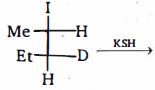
Identify the product of the following reaction:
A
B
C
D
Solution
(D) The reaction of an alkyl halide with $KSH$ typically proceeds via an $S_N2$ mechanism. In an $S_N2$ reaction,the nucleophile $(SH^-)$ attacks the electrophilic carbon from the side opposite to the leaving group $(I^-)$,resulting in an inversion of configuration at the chiral center (Walden inversion). The product is formed by replacing $I$ with $SH$ and inverting the spatial arrangement of the other groups attached to the chiral carbon.
0 likes
View Solution452
MediumMCQ
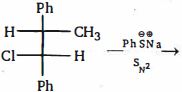
The principal organic product of the reaction will be:
A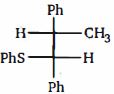
B
C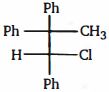
D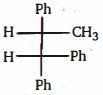
Solution
(B) The reaction proceeds via an $S_{N}2$ mechanism.
In an $S_{N}2$ reaction,the nucleophile $(PhS^-)$ attacks the chiral carbon from the side opposite to the leaving group $(Cl^-)$.
This results in an inversion of configuration at the reaction center (Walden inversion).
Comparing the starting material with the options,option $(B)$ shows the correct stereochemical inversion where the $PhS$ group is placed on the side opposite to where the $Cl$ was originally located.
In an $S_{N}2$ reaction,the nucleophile $(PhS^-)$ attacks the chiral carbon from the side opposite to the leaving group $(Cl^-)$.
This results in an inversion of configuration at the reaction center (Walden inversion).
Comparing the starting material with the options,option $(B)$ shows the correct stereochemical inversion where the $PhS$ group is placed on the side opposite to where the $Cl$ was originally located.
0 likes
View Solution453
MediumMCQ
Reaction of $(R)-2$-butanol with $p$-toluenesulphonyl chloride in pyridine followed by reaction with $LiBr$ gives
A
$(R)-2$-butyl bromide
B
$(S)-2$-butyl tosylate
C
$(R)-2$-butyl tosylate
D
$(S)-2$-butyl bromide
Solution
(D) The reaction proceeds in two steps:
$1$. The reaction of $(R)-2$-butanol with $p$-toluenesulphonyl chloride $(TsCl)$ in pyridine converts the hydroxyl group into a good leaving group,the tosylate group $(-OTs)$. This reaction occurs without breaking the $C-O$ bond,so the configuration at the chiral center remains unchanged,resulting in $(R)-2$-butyl tosylate.
$2$. The subsequent reaction with $LiBr$ involves a nucleophilic substitution $(S_N2)$ reaction. The bromide ion $(Br^-)$ attacks the chiral carbon from the side opposite to the tosylate group,leading to an inversion of configuration (Walden inversion). Thus,$(R)-2$-butyl tosylate is converted into $(S)-2$-butyl bromide.
$1$. The reaction of $(R)-2$-butanol with $p$-toluenesulphonyl chloride $(TsCl)$ in pyridine converts the hydroxyl group into a good leaving group,the tosylate group $(-OTs)$. This reaction occurs without breaking the $C-O$ bond,so the configuration at the chiral center remains unchanged,resulting in $(R)-2$-butyl tosylate.
$2$. The subsequent reaction with $LiBr$ involves a nucleophilic substitution $(S_N2)$ reaction. The bromide ion $(Br^-)$ attacks the chiral carbon from the side opposite to the tosylate group,leading to an inversion of configuration (Walden inversion). Thus,$(R)-2$-butyl tosylate is converted into $(S)-2$-butyl bromide.
0 likes
View Solution454
MediumMCQ
The compound which undergoes $S_{N^1}$ reaction most rapidly is
A
Cyclohexyl bromide
B
$3-$Bromocyclohexene
C
Cyclohexylmethyl bromide
D
Bicyclo[$2.2$.$2$]octyl bromide
Solution
(B) The rate of $S_{N^1}$ reaction is directly proportional to the stability of the carbocation intermediate formed during the rate-determining step.
$(a)$ Cyclohexyl bromide forms a secondary carbocation.
$(b)$ $3-$Bromocyclohexene forms an allylic carbocation,which is resonance-stabilized.
$(c)$ Cyclohexylmethyl bromide forms a primary carbocation.
$(d)$ Bicyclo[$2.2$.$2$]octyl bromide forms a bridgehead carbocation,which is highly unstable due to Bredt's rule.
Since the allylic carbocation formed in option $(b)$ is the most stable among the given choices,$3$-Bromocyclohexene undergoes $S_{N^1}$ reaction most rapidly.
$(a)$ Cyclohexyl bromide forms a secondary carbocation.
$(b)$ $3-$Bromocyclohexene forms an allylic carbocation,which is resonance-stabilized.
$(c)$ Cyclohexylmethyl bromide forms a primary carbocation.
$(d)$ Bicyclo[$2.2$.$2$]octyl bromide forms a bridgehead carbocation,which is highly unstable due to Bredt's rule.
Since the allylic carbocation formed in option $(b)$ is the most stable among the given choices,$3$-Bromocyclohexene undergoes $S_{N^1}$ reaction most rapidly.
0 likes
View Solution455
MediumMCQ
Addition of $KI$ accelerates the hydrolysis of primary alkyl halides because
A
$KI$ is soluble in organic solvents
B
the iodide ion is a weak base and a poor leaving group
C
the iodide ion is a strong base
D
the iodide ion is a powerful nucleophile as well as a good leaving group
Solution
(D) The addition of $KI$ accelerates the hydrolysis of primary alkyl halides because the iodide ion $(I^-)$ acts as a powerful nucleophile,which attacks the alkyl halide to form a more reactive alkyl iodide intermediate $(R-I)$.
Since $I^-$ is also a very good leaving group,it facilitates the subsequent substitution reaction with water or hydroxide ions,thereby increasing the overall rate of hydrolysis.
Since $I^-$ is also a very good leaving group,it facilitates the subsequent substitution reaction with water or hydroxide ions,thereby increasing the overall rate of hydrolysis.
0 likes
View Solution456
MediumMCQ
Which of the following phrases are not correctly associated with $S_N1$ reaction?
$(1)$ Rearrangement is possible
$(2)$ Rate is affected by polarity of solvent
$(3)$ The strength of the nucleophile is important in determining rate
$(4)$ The reactivity series is tertiary $>$ secondary $>$ primary
$(5)$ Proceeds with complete inversion of configuration
$(1)$ Rearrangement is possible
$(2)$ Rate is affected by polarity of solvent
$(3)$ The strength of the nucleophile is important in determining rate
$(4)$ The reactivity series is tertiary $>$ secondary $>$ primary
$(5)$ Proceeds with complete inversion of configuration
A
$3, 5$
B
$5$ only
C
$2, 3, 5$
D
$3$ only
Solution
(A) $S_N1$ reaction characteristics are as follows:
$(1)$ Rearrangement is possible because a carbocation intermediate is formed.
$(2)$ The rate is affected by the polarity of the solvent as it stabilizes the carbocation intermediate.
$(3)$ The strength of the nucleophile is $NOT$ important in determining the rate,as the rate-determining step involves only the substrate.
$(4)$ The reactivity series is tertiary $>$ secondary $>$ primary due to the stability of the carbocation formed.
$(5)$ It proceeds with racemization (not complete inversion) because the nucleophile can attack from either side of the planar carbocation.
Therefore,statements $(3)$ and $(5)$ are not correctly associated with the $S_N1$ reaction.
$(1)$ Rearrangement is possible because a carbocation intermediate is formed.
$(2)$ The rate is affected by the polarity of the solvent as it stabilizes the carbocation intermediate.
$(3)$ The strength of the nucleophile is $NOT$ important in determining the rate,as the rate-determining step involves only the substrate.
$(4)$ The reactivity series is tertiary $>$ secondary $>$ primary due to the stability of the carbocation formed.
$(5)$ It proceeds with racemization (not complete inversion) because the nucleophile can attack from either side of the planar carbocation.
Therefore,statements $(3)$ and $(5)$ are not correctly associated with the $S_N1$ reaction.
0 likes
View Solution457
AdvancedMCQ
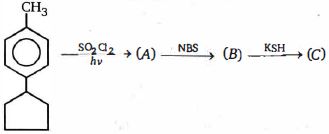
The product $(C)$ in the following reaction sequence is:
A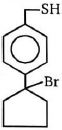
B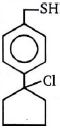
C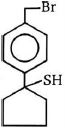
D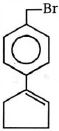
Solution
(A) Step $1$: Reaction with $SO_2Cl_2$ in the presence of $h\nu$ (light) is a free radical chlorination. It selectively chlorinates the tertiary carbon of the cyclopentyl group attached to the benzene ring to form $(A)$,which is $1-chloro-1-phenylcyclopentane$ derivative.
Step $2$: Reaction with $NBS$ ($N$-Bromosuccinimide) is a benzylic bromination. It replaces a hydrogen atom on the methyl group attached to the benzene ring with a bromine atom to form $(B)$,which is $1-chloro-1-(4-(bromomethyl)phenyl)cyclopentane$.
Step $3$: Reaction with $KSH$ is a nucleophilic substitution $(S_N2)$ reaction. The $SH^-$ nucleophile attacks the benzylic carbon,replacing the bromine atom to form $(C)$,which is $1-chloro-1-(4-(mercaptomethyl)phenyl)cyclopentane$.
Step $2$: Reaction with $NBS$ ($N$-Bromosuccinimide) is a benzylic bromination. It replaces a hydrogen atom on the methyl group attached to the benzene ring with a bromine atom to form $(B)$,which is $1-chloro-1-(4-(bromomethyl)phenyl)cyclopentane$.
Step $3$: Reaction with $KSH$ is a nucleophilic substitution $(S_N2)$ reaction. The $SH^-$ nucleophile attacks the benzylic carbon,replacing the bromine atom to form $(C)$,which is $1-chloro-1-(4-(mercaptomethyl)phenyl)cyclopentane$.
0 likes
View Solution458
MediumMCQ
The major product $(A)$ is:
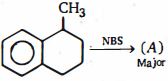
A
$1-$bromo$-1-$methyl$-1,2,3,4-$tetrahydronaphthalene
B
$1-$(bromomethyl)$-1,2,3,4-$tetrahydronaphthalene
C
$4-$bromo$-1-$methyl$-1,2,3,4-$tetrahydronaphthalene
D
$2-$bromo$-1-$methyl$-1,2,3,4-$tetrahydronaphthalene
Solution
(A) $N$-Bromosuccinimide $(NBS)$ is a reagent used for allylic or benzylic bromination via a free radical mechanism.
In the given substrate,$1$-methyl$-1,2,3,4-$tetrahydronaphthalene,the hydrogen atom at the $C-1$ position is benzylic as well as tertiary.
Abstraction of this hydrogen leads to the formation of a stable tertiary benzylic radical,which is further stabilized by resonance with the benzene ring and hyperconjugation.
Subsequent reaction with $Br_2$ (generated in situ by $NBS$) results in the formation of $1-$bromo$-1-$methyl$-1,2,3,4-$tetrahydronaphthalene as the major product.
In the given substrate,$1$-methyl$-1,2,3,4-$tetrahydronaphthalene,the hydrogen atom at the $C-1$ position is benzylic as well as tertiary.
Abstraction of this hydrogen leads to the formation of a stable tertiary benzylic radical,which is further stabilized by resonance with the benzene ring and hyperconjugation.
Subsequent reaction with $Br_2$ (generated in situ by $NBS$) results in the formation of $1-$bromo$-1-$methyl$-1,2,3,4-$tetrahydronaphthalene as the major product.
0 likes
View Solution459
AdvancedMCQ
The product $X$ is
[Image: $1-$chloro$-1-$($2$-chloroethyl)cyclopentane] $\xrightarrow{LiBr/DMSO, S_N2 \text{ conditions}}$ Major product $(X)$
[Image: $1-$chloro$-1-$($2$-chloroethyl)cyclopentane] $\xrightarrow{LiBr/DMSO, S_N2 \text{ conditions}}$ Major product $(X)$
A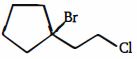
B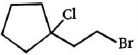
C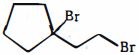
D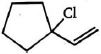
Solution
(B) The reaction involves the substitution of a chlorine atom with a bromine atom using $LiBr$ in $DMSO$ under $S_N2$ conditions.
$S_N2$ reactions are highly sensitive to steric hindrance.
In the given molecule,there are two chlorine atoms: one is a tertiary chloride (at the $1$-position of the cyclopentane ring) and the other is a primary chloride (at the end of the ethyl chain).
$S_N2$ reactions occur much faster at less sterically hindered sites.
Therefore,the primary chloride is significantly more reactive towards $S_N2$ substitution than the tertiary chloride.
The bromine nucleophile $(Br^-)$ will selectively attack the primary carbon,replacing the primary chlorine atom.
The major product is $1$-chloro-$1$-($2$-bromoethyl)cyclopentane.
Thus,the correct option is $(B)$.
$S_N2$ reactions are highly sensitive to steric hindrance.
In the given molecule,there are two chlorine atoms: one is a tertiary chloride (at the $1$-position of the cyclopentane ring) and the other is a primary chloride (at the end of the ethyl chain).
$S_N2$ reactions occur much faster at less sterically hindered sites.
Therefore,the primary chloride is significantly more reactive towards $S_N2$ substitution than the tertiary chloride.
The bromine nucleophile $(Br^-)$ will selectively attack the primary carbon,replacing the primary chlorine atom.
The major product is $1$-chloro-$1$-($2$-bromoethyl)cyclopentane.
Thus,the correct option is $(B)$.
0 likes
View Solution460
AdvancedMCQ
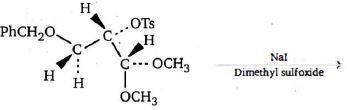
Major product which you expect in the above reaction is
A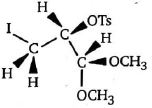
B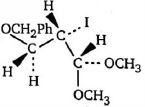
C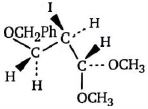
D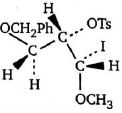
Solution
(B) The reaction involves the substitution of a tosylate group $(-OTs)$ with an iodide ion $(I^-)$ in the presence of a polar aprotic solvent,$DMSO$ (Dimethyl sulfoxide).
This reaction proceeds via an $S_N2$ mechanism.
In an $S_N2$ reaction,the nucleophile $(I^-)$ attacks the electrophilic carbon from the side opposite to the leaving group $(-OTs)$,resulting in an inversion of configuration at the chiral center.
Therefore,the major product is the one where the $-OTs$ group is replaced by $-I$ with an inverted stereochemistry.
This reaction proceeds via an $S_N2$ mechanism.
In an $S_N2$ reaction,the nucleophile $(I^-)$ attacks the electrophilic carbon from the side opposite to the leaving group $(-OTs)$,resulting in an inversion of configuration at the chiral center.
Therefore,the major product is the one where the $-OTs$ group is replaced by $-I$ with an inverted stereochemistry.
0 likes
View Solution461
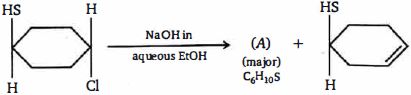
DifficultMCQ
The major product of the above reaction is:
A
B
C
D
Solution
(A) The reaction involves a substrate with a thiol group $(-SH)$ and a chlorine atom $(-Cl)$ in a trans-like orientation on a cyclohexane ring.
In the presence of $NaOH$,the thiol group is deprotonated to form a thiolate ion $(-S^-)$.
This internal nucleophile then attacks the carbon bearing the chlorine atom via an intramolecular nucleophilic substitution reaction,a process known as Neighboring Group Participation $(NGP)$.
This leads to the formation of a cyclic sulfide (a bridged bicyclic compound) as the major product.
In the presence of $NaOH$,the thiol group is deprotonated to form a thiolate ion $(-S^-)$.
This internal nucleophile then attacks the carbon bearing the chlorine atom via an intramolecular nucleophilic substitution reaction,a process known as Neighboring Group Participation $(NGP)$.
This leads to the formation of a cyclic sulfide (a bridged bicyclic compound) as the major product.
0 likes
View Solution462
DifficultMCQ
Major product of the reaction is :
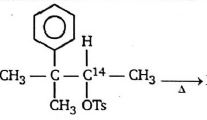
A
$(CH_3)_2C=C(Ph)CH_3$ (where $C$ is $^{14}C$)
B
$CH_3-C(Ph)(CH_3)-^{14}CH=CH_2$
C
$(CH_3)_2C(^{14}C)=C(Ph)CH_3$
D
$(CH_3)_2C=C(^{14}CH_3)Ph$
Solution
(D) The reaction involves the ionization of the tosylate group $(-OTs)$ to form a carbocation.
Due to the presence of the phenyl group,a phenonium ion intermediate is formed via the migration of the phenyl group to the $^{14}C$ atom.
This rearrangement leads to the formation of a more stable carbocation.
Finally,the loss of a proton $(-H^+)$ results in the formation of the alkene.
The $^{14}C$ label remains at the carbon attached to the phenyl group in the final product,which is $(CH_3)_2C=C(^{14}CH_3)Ph$.
Due to the presence of the phenyl group,a phenonium ion intermediate is formed via the migration of the phenyl group to the $^{14}C$ atom.
This rearrangement leads to the formation of a more stable carbocation.
Finally,the loss of a proton $(-H^+)$ results in the formation of the alkene.
The $^{14}C$ label remains at the carbon attached to the phenyl group in the final product,which is $(CH_3)_2C=C(^{14}CH_3)Ph$.
0 likes
View Solution463
MediumMCQ
$(R)-2-$octyl tosylate is solvolyzed in water under ideal $S_{N}1$ conditions. The product$(s)$ will be
A
$(R)-2-$octanol and $(S)-2-$octanol in a $1 : 1$ ratio
B
$(R)-2-$octanol and $(S)-2-$octanol in a $1.5 : 1$ ratio
C
$(R)-2-$octanol only
D
$(S)-2-$octanol only
Solution
(B) In an ideal $S_{N}1$ reaction,the leaving group departs completely to form a free carbocation,which is planar. Nucleophilic attack from both sides should lead to a racemic mixture ($1:1$ ratio of enantiomers).
However,in practice,the leaving group (tosylate) remains close to the carbocation as an 'intimate ion pair' for a short time.
This shields the front side,making the back-side attack by water more favorable.
Therefore,inversion of configuration is slightly favored over retention of configuration.
This results in a mixture where the $(S)-2-$octanol (inversion product) is formed in greater quantity than $(R)-2-$octanol (retention product).
Thus,the ratio of $(S)-2-$octanol to $(R)-2-$octanol is greater than $1:1$,such as $1.5:1$.
However,in practice,the leaving group (tosylate) remains close to the carbocation as an 'intimate ion pair' for a short time.
This shields the front side,making the back-side attack by water more favorable.
Therefore,inversion of configuration is slightly favored over retention of configuration.
This results in a mixture where the $(S)-2-$octanol (inversion product) is formed in greater quantity than $(R)-2-$octanol (retention product).
Thus,the ratio of $(S)-2-$octanol to $(R)-2-$octanol is greater than $1:1$,such as $1.5:1$.
0 likes
View Solution464
MediumMCQ
From each of the following pairs,select the compound that will react faster with sodium iodide in acetone:
Pair-$A$: $(1) \, 2-$Chloropropane,$(2) \, 2-$Bromopropane
Pair-$B$: $(3) \, 1-$Bromobutane,$(4) \, 2-$Bromobutane
Pair-$A$: $(1) \, 2-$Chloropropane,$(2) \, 2-$Bromopropane
Pair-$B$: $(3) \, 1-$Bromobutane,$(4) \, 2-$Bromobutane
A
$1, 3$
B
$1, 4$
C
$2, 3$
D
$2, 4$
Solution
(C) The reaction of alkyl halides with sodium iodide in acetone is a Finkelstein reaction,which follows an $S_N2$ mechanism.
$1.$ In Pair-$A$,$2-$Bromopropane $(2)$ reacts faster than $2-$Chloropropane $(1)$ because the bromide ion $(Br^-)$ is a better leaving group than the chloride ion $(Cl^-)$.
$2.$ In Pair-$B$,$1-$Bromobutane $(3)$ reacts faster than $2-$Bromobutane $(4)$ because $1-$Bromobutane is a primary alkyl halide,which experiences less steric hindrance compared to the secondary alkyl halide $2-$Bromobutane,thus favoring the $S_N2$ pathway.
Therefore,the correct compounds are $(2)$ and $(3)$.
$1.$ In Pair-$A$,$2-$Bromopropane $(2)$ reacts faster than $2-$Chloropropane $(1)$ because the bromide ion $(Br^-)$ is a better leaving group than the chloride ion $(Cl^-)$.
$2.$ In Pair-$B$,$1-$Bromobutane $(3)$ reacts faster than $2-$Bromobutane $(4)$ because $1-$Bromobutane is a primary alkyl halide,which experiences less steric hindrance compared to the secondary alkyl halide $2-$Bromobutane,thus favoring the $S_N2$ pathway.
Therefore,the correct compounds are $(2)$ and $(3)$.
0 likes
View Solution465
DifficultMCQ
Among the given halides,which one will give the same product in both $S_{N^1}$ and $S_{N^2}$ reactions?
$(I) \ CH_3-CH(CH_3)-CH_2-CH(Br)-CH_3$
$(II) \ \text{2-methylcyclohexyl chloride}$
$(III) \ \text{Chlorocyclohexane}$
$(IV) \ CH_3-CH(Br)-CH_2-CH_3$
$(I) \ CH_3-CH(CH_3)-CH_2-CH(Br)-CH_3$
$(II) \ \text{2-methylcyclohexyl chloride}$
$(III) \ \text{Chlorocyclohexane}$
$(IV) \ CH_3-CH(Br)-CH_2-CH_3$
A
Only $(III)$
B
$(I) \ \& \ (II)$
C
$(I), (III) \ \& \ (IV)$
D
$(III) \ \& \ (IV)$
Solution
(D) For a substrate to give the same product in both $S_{N^1}$ and $S_{N^2}$ reactions,the carbocation formed in $S_{N^1}$ must not undergo rearrangement,and the $S_{N^2}$ reaction must occur at the same carbon without stereochemical complexity that leads to different products.
$(I)$ $CH_3-CH(CH_3)-CH_2-CH(Br)-CH_3$ is a secondary halide that can undergo rearrangement to a more stable carbocation.
$(II)$ $\text{2-methylcyclohexyl chloride}$ is a secondary halide where the carbocation can rearrange.
$(III)$ $\text{Chlorocyclohexane}$ is a secondary halide. The carbocation formed is a cyclohexyl cation which does not rearrange. $S_{N^2}$ occurs at the same carbon.
$(IV)$ $CH_3-CH(Br)-CH_2-CH_3$ is a secondary halide $(2\text{-bromobutane})$. The carbocation formed is a secondary carbocation which does not rearrange. $S_{N^2}$ occurs at the same carbon.
Thus,$(III)$ and $(IV)$ give the same product in both mechanisms.
$(I)$ $CH_3-CH(CH_3)-CH_2-CH(Br)-CH_3$ is a secondary halide that can undergo rearrangement to a more stable carbocation.
$(II)$ $\text{2-methylcyclohexyl chloride}$ is a secondary halide where the carbocation can rearrange.
$(III)$ $\text{Chlorocyclohexane}$ is a secondary halide. The carbocation formed is a cyclohexyl cation which does not rearrange. $S_{N^2}$ occurs at the same carbon.
$(IV)$ $CH_3-CH(Br)-CH_2-CH_3$ is a secondary halide $(2\text{-bromobutane})$. The carbocation formed is a secondary carbocation which does not rearrange. $S_{N^2}$ occurs at the same carbon.
Thus,$(III)$ and $(IV)$ give the same product in both mechanisms.
0 likes
View Solution466
MediumMCQ
Which of the following compounds would react faster with $NaCN$ in an $S_N2$ reaction?
A
$2-$methoxy$-2-$methylbutane
B
cyclopentyl tosylate
C
$1-$methoxypropane
D
propyl tosylate
Solution
(D) The $S_N2$ reaction rate is primarily governed by steric hindrance and the quality of the leaving group.
$1$. $S_N2$ reactions prefer primary substrates over secondary or tertiary ones due to lower steric hindrance.
$2$. Tosylate $(-OTs)$ is an excellent leaving group,whereas methoxy $(-OMe)$ is a very poor leaving group and generally does not undergo $S_N2$ substitution.
$3$. Comparing the given options:
- $A$ and $C$ contain $-OMe$ as a potential leaving group,which is poor.
- $B$ is a secondary substrate (cyclopentyl tosylate).
- $D$ is a primary substrate (propyl tosylate).
$4$. Since $D$ is a primary substrate with an excellent leaving group $(-OTs)$,it will react the fastest in an $S_N2$ reaction.
$1$. $S_N2$ reactions prefer primary substrates over secondary or tertiary ones due to lower steric hindrance.
$2$. Tosylate $(-OTs)$ is an excellent leaving group,whereas methoxy $(-OMe)$ is a very poor leaving group and generally does not undergo $S_N2$ substitution.
$3$. Comparing the given options:
- $A$ and $C$ contain $-OMe$ as a potential leaving group,which is poor.
- $B$ is a secondary substrate (cyclopentyl tosylate).
- $D$ is a primary substrate (propyl tosylate).
$4$. Since $D$ is a primary substrate with an excellent leaving group $(-OTs)$,it will react the fastest in an $S_N2$ reaction.
0 likes
View Solution467
DifficultMCQ
$Me_2C = CH - CH_2 - CH_2 - Cl$ $\xrightarrow[CaCO_3]{H_2O} (X);$ What is the major product $(X)$ of the reaction?
A
$Me_2C(OH)-CH_2-CH_2-Cl$
B
$Me_2C = CH - CH_2 - CH_2 - OH$
C
$Me_2C(OH)-CH-CH_2-CH_2-OH$
D
$1-$(cyclopropyl)$-1-$methylethanol
Solution
(D) The reaction involves the participation of the $\pi$-bond in the displacement of the chloride ion,a phenomenon known as Neighboring Group Participation $(NGP)$.
The double bond attacks the carbon bearing the chlorine,leading to the formation of a cyclopropylmethyl cation intermediate.
This intermediate is then attacked by water $(H_2O)$ to form the final alcohol product,which is $1-$(cyclopropyl)$-1-$methylethanol.
The double bond attacks the carbon bearing the chlorine,leading to the formation of a cyclopropylmethyl cation intermediate.
This intermediate is then attacked by water $(H_2O)$ to form the final alcohol product,which is $1-$(cyclopropyl)$-1-$methylethanol.
0 likes
View Solution468
DifficultMCQ
Compare the relative rate of reaction with $H_2O$ for the following compounds:
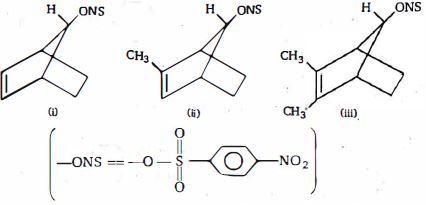
A
$(i) > (ii) > (iii)$
B
$(ii) > (i) > (iii)$
C
$(iii) > (ii) > (i)$
D
$(iii) > (i) > (ii)$
Solution
(C) The reaction involves the solvolysis of the $ONS$ (nosylate) group,which is facilitated by Neighboring Group Participation $(NGP)$ from the double bond.
As the number of electron-donating methyl groups on the double bond increases,the electron density of the alkene increases,making it a better nucleophile for $NGP$.
Compound $(iii)$ has two methyl groups,$(ii)$ has one,and $(i)$ has none.
Therefore,the nucleophilicity of the double bond follows the order: $(iii) > (ii) > (i)$.
Consequently,the rate of reaction follows the same order: $(iii) > (ii) > (i)$.
As the number of electron-donating methyl groups on the double bond increases,the electron density of the alkene increases,making it a better nucleophile for $NGP$.
Compound $(iii)$ has two methyl groups,$(ii)$ has one,and $(i)$ has none.
Therefore,the nucleophilicity of the double bond follows the order: $(iii) > (ii) > (i)$.
Consequently,the rate of reaction follows the same order: $(iii) > (ii) > (i)$.
0 likes
View Solution469
DifficultMCQ
Which of the following statements is correct regarding the rate of hydrolysis of the compounds $(A)$ and $(B)$ by $S_N1$ reaction?
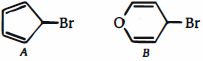
A
$A$ reacts faster than $B$
B
$B$ reacts faster than $A$
C
Both $A$ and $B$ react at the same rate
D
Neither $A$ nor $B$ reacts
Solution
(B) The rate of $S_N1$ reaction depends on the stability of the carbocation intermediate formed after the departure of the leaving group $(Br^-)$.
For compound $(A)$,the carbocation formed is a cyclopentadienyl cation,which has $4\pi$ electrons and is anti-aromatic,making it highly unstable.
For compound $(B)$,the carbocation formed is a pyrylium cation,which has $6\pi$ electrons ($4$ from double bonds and $2$ from the lone pair on oxygen) and is aromatic,making it highly stable.
Since the stability of the carbocation intermediate is directly proportional to the rate of $S_N1$ reaction,compound $(B)$ reacts much faster than compound $(A)$.
For compound $(A)$,the carbocation formed is a cyclopentadienyl cation,which has $4\pi$ electrons and is anti-aromatic,making it highly unstable.
For compound $(B)$,the carbocation formed is a pyrylium cation,which has $6\pi$ electrons ($4$ from double bonds and $2$ from the lone pair on oxygen) and is aromatic,making it highly stable.
Since the stability of the carbocation intermediate is directly proportional to the rate of $S_N1$ reaction,compound $(B)$ reacts much faster than compound $(A)$.
0 likes
View Solution470
AdvancedMCQ
What are reactant $X$ and product $Y$ in the following sequence of reactions?
Reactant $X$ $\xrightarrow{\text{Pyridine, } CH_3C_6H_4SO_2Cl}$ Intermediate $\xrightarrow{NaN_3, \text{Ethanol-water}}$ Product $Y$
Reactant $X$ $\xrightarrow{\text{Pyridine, } CH_3C_6H_4SO_2Cl}$ Intermediate $\xrightarrow{NaN_3, \text{Ethanol-water}}$ Product $Y$

A
B
C
D
Solution
(A) The reaction sequence involves the conversion of an alcohol to a tosylate followed by an $S_N2$ reaction with sodium azide $(NaN_3)$.
$1$. The starting material $X$ is cis$-3-$methylcyclopentanol,where the $-OH$ group and the $-CH_3$ group are on the same side of the cyclopentane ring.
$2$. Reaction with $p$-toluenesulfonyl chloride $(TsCl)$ in pyridine converts the $-OH$ group into a good leaving group (tosylate,$-OTs$) without changing the stereochemistry at the chiral center.
$3$. The subsequent reaction with $NaN_3$ proceeds via an $S_N2$ mechanism,which involves an inversion of configuration at the carbon atom bearing the leaving group.
$4$. Since the starting alcohol is cis$-3-$methylcyclopentanol,the inversion of configuration results in the formation of trans$-3-$azidocyclopentane as product $Y$.
$1$. The starting material $X$ is cis$-3-$methylcyclopentanol,where the $-OH$ group and the $-CH_3$ group are on the same side of the cyclopentane ring.
$2$. Reaction with $p$-toluenesulfonyl chloride $(TsCl)$ in pyridine converts the $-OH$ group into a good leaving group (tosylate,$-OTs$) without changing the stereochemistry at the chiral center.
$3$. The subsequent reaction with $NaN_3$ proceeds via an $S_N2$ mechanism,which involves an inversion of configuration at the carbon atom bearing the leaving group.
$4$. Since the starting alcohol is cis$-3-$methylcyclopentanol,the inversion of configuration results in the formation of trans$-3-$azidocyclopentane as product $Y$.
0 likes
View Solution471
AdvancedMCQ
The transition state of the given $S_N2$ reaction is:

A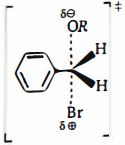
B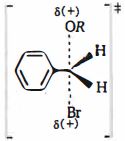
C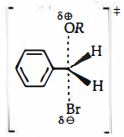
D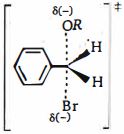
Solution
(D) In an $S_N2$ reaction,the nucleophile $(RO^-)$ attacks the electrophilic carbon from the side opposite to the leaving group $(Br^-)$.
This results in a pentacoordinate transition state where the carbon atom is partially bonded to both the incoming nucleophile and the leaving group.
Both the nucleophile and the leaving group carry a partial negative charge $(\delta^-)$ in the transition state.
Looking at the options,option $D$ correctly represents this transition state with the nucleophile $OR$ and the leaving group $Br$ having partial negative charges $(\delta^-)$ and the carbon atom in a trigonal bipyramidal arrangement.
This results in a pentacoordinate transition state where the carbon atom is partially bonded to both the incoming nucleophile and the leaving group.
Both the nucleophile and the leaving group carry a partial negative charge $(\delta^-)$ in the transition state.
Looking at the options,option $D$ correctly represents this transition state with the nucleophile $OR$ and the leaving group $Br$ having partial negative charges $(\delta^-)$ and the carbon atom in a trigonal bipyramidal arrangement.
0 likes
View Solution472
MediumMCQ
$C_6H_{13}Br + OH^{-} \to C_6H_{13}OH + Br^{-}$ is an example of
A
Nucleophilic addition
B
Nucleophilic substitution
C
Electrophilic addition
D
Electrophilic substitution
Solution
(B) The reaction $C_6H_{13}Br + OH^{-} \to C_6H_{13}OH + Br^{-}$ involves the replacement of a bromide ion $(Br^{-})$ by a hydroxide ion $(OH^{-})$.
Since the hydroxide ion acts as a nucleophile and replaces the leaving group,this is an example of a nucleophilic substitution reaction.
Therefore,the correct option is $(b)$.
Since the hydroxide ion acts as a nucleophile and replaces the leaving group,this is an example of a nucleophilic substitution reaction.
Therefore,the correct option is $(b)$.
0 likes
View Solution473
MediumMCQ
$S_N^1$ and $S_N^2$ reactions are
A
Both stereospecific
B
Both stereoselective
C
Stereoselective and stereospecific respectively
D
Both $(b)$ and $(c)$
Solution
(D) $S_N^1$ reactions are stereoselective because they involve the formation of a carbocation intermediate,which can lead to a mixture of retention and inversion (racemization),though often favoring inversion.
$S_N^2$ reactions are stereospecific because they proceed via a single-step mechanism involving a backside attack,resulting in a complete Walden inversion of configuration.
Therefore,$S_N^1$ is stereoselective and $S_N^2$ is stereospecific.
Thus,the correct option is $(d)$.
$S_N^2$ reactions are stereospecific because they proceed via a single-step mechanism involving a backside attack,resulting in a complete Walden inversion of configuration.
Therefore,$S_N^1$ is stereoselective and $S_N^2$ is stereospecific.
Thus,the correct option is $(d)$.
0 likes
View Solution474
DifficultMCQ
Most reactive compound toward $S_N1$ is
A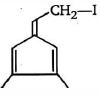
B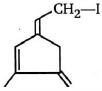
C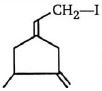
D
Solution
(D) The reactivity of a compound toward $S_N1$ reaction depends on the stability of the carbocation intermediate formed after the departure of the leaving group (in this case,$I^-$).
Option $D$ shows a compound that,upon losing the $I^-$ ion,forms a carbocation that is stabilized by resonance,leading to an aromatic tropylium-like cation structure.
Since the formation of an aromatic carbocation is highly favorable,the compound in option $D$ is the most reactive toward $S_N1$ reactions.
Option $D$ shows a compound that,upon losing the $I^-$ ion,forms a carbocation that is stabilized by resonance,leading to an aromatic tropylium-like cation structure.
Since the formation of an aromatic carbocation is highly favorable,the compound in option $D$ is the most reactive toward $S_N1$ reactions.
0 likes
View Solution475
MediumMCQ
Which of the following alkyl halides gives only one product (excluding stereoisomers) when undergoing an $E_2$ reaction? $(E_2 = \text{elimination bimolecular})$
A
$1-$chloro$-1-$methylcyclohexane
B
$1-$chloro$-2-$methylcyclohexane
C
$1-$chloro$-3-$methylcyclohexane
D
$1-$chloro$-4-$methylcyclohexane
Solution
(D) In an $E_2$ reaction,a base removes a $\beta$-hydrogen atom anti-periplanar to the leaving group $(-Cl)$.
$A$: $1$-chloro-$1$-methylcyclohexane has two types of $\beta$-hydrogens,leading to two different alkenes (exocyclic and endocyclic).
$B$: $1$-chloro-$2$-methylcyclohexane has multiple $\beta$-hydrogens,leading to a mixture of isomers.
$C$: $1$-chloro-$3$-methylcyclohexane also yields a mixture of isomers due to different $\beta$-hydrogens.
$D$: $1$-chloro-$4$-methylcyclohexane is symmetric. The $\beta$-hydrogens at the $C_3$ and $C_5$ positions are equivalent,and the $\beta$-hydrogens at the $C_2$ and $C_6$ positions are equivalent. However,due to the symmetry of the molecule,elimination leads to a single product: $4$-methylcyclohexene.
$A$: $1$-chloro-$1$-methylcyclohexane has two types of $\beta$-hydrogens,leading to two different alkenes (exocyclic and endocyclic).
$B$: $1$-chloro-$2$-methylcyclohexane has multiple $\beta$-hydrogens,leading to a mixture of isomers.
$C$: $1$-chloro-$3$-methylcyclohexane also yields a mixture of isomers due to different $\beta$-hydrogens.
$D$: $1$-chloro-$4$-methylcyclohexane is symmetric. The $\beta$-hydrogens at the $C_3$ and $C_5$ positions are equivalent,and the $\beta$-hydrogens at the $C_2$ and $C_6$ positions are equivalent. However,due to the symmetry of the molecule,elimination leads to a single product: $4$-methylcyclohexene.
0 likes
View Solution476
MediumMCQ
In the above reaction,the maximum Saytzeff product will be obtained when

A
$X = -I$
B
$X = -Cl$
C
$X = -Br$
D
None of these
Solution
(A) In an $E2$ elimination reaction,the nature of the leaving group $(X)$ significantly influences the product distribution between the Saytzeff product (more substituted alkene) and the Hoffmann product (less substituted alkene).
When the leaving group is a good leaving group (like $I^-$,$Br^-$,or $Cl^-$),the transition state resembles the product alkene. The stability of the transition state is governed by the stability of the developing alkene. Since the Saytzeff product is more substituted and thus more stable,it becomes the major product.
Among the halogens,the leaving group ability follows the order: $I^- > Br^- > Cl^- > F^-$.
$I^-$ is the best leaving group among the options provided,leading to the most stable transition state for the formation of the more substituted alkene. Therefore,the maximum amount of Saytzeff product is obtained when $X = -I$.
When the leaving group is a good leaving group (like $I^-$,$Br^-$,or $Cl^-$),the transition state resembles the product alkene. The stability of the transition state is governed by the stability of the developing alkene. Since the Saytzeff product is more substituted and thus more stable,it becomes the major product.
Among the halogens,the leaving group ability follows the order: $I^- > Br^- > Cl^- > F^-$.
$I^-$ is the best leaving group among the options provided,leading to the most stable transition state for the formation of the more substituted alkene. Therefore,the maximum amount of Saytzeff product is obtained when $X = -I$.
0 likes
View Solution477
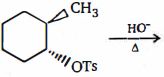
DifficultMCQ
The major product of the reaction is:
A
$1-$methylcyclohexene
B
$3-$methylcyclohexene
C
methylenecyclohexane
D
$4-$methylcyclohexene
Solution
(A) The reaction is an $E_2$ elimination reaction. In $E_2$ reactions,the leaving group $(-OTs)$ and the $\beta$-hydrogen must be in an anti-periplanar conformation to undergo elimination. In the given substrate,the $-OTs$ group is in the equatorial position. For anti-elimination,the $\beta$-hydrogen must be anti to the $-OTs$ group. The hydrogen at the $C_1$ position (bearing the $-CH_3$ group) is anti to the $-OTs$ group. Therefore,the base abstracts this proton,leading to the formation of the double bond between $C_1$ and $C_2$,resulting in $1$-methylcyclohexene as the major product.
0 likes
View Solution478
MediumMCQ
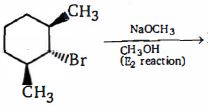
What is the product of the following reaction?
A
$3,4-$dimethylcyclohex$-1-$ene
B
$4,5-$dimethylcyclohex$-1-$ene
C
$3-$methoxy$-4,5-$dimethylcyclohex$-1-$ene
D
No reaction
Solution
(D) The $E_2$ elimination reaction requires an anti-periplanar orientation between the leaving group $(-Br)$ and the $\beta$-hydrogen atom. In the given molecule,the $-Br$ group is in an equatorial position. For anti-elimination to occur,the $\beta$-hydrogen must be anti to the $-Br$ group. In this specific conformation,there is no $\beta$-hydrogen atom available in the anti-position relative to the $-Br$ group. Therefore,the $E_2$ elimination cannot proceed,resulting in no reaction.
0 likes
View Solution479
MediumMCQ
In which of the following reactions is the $Saytzeff$ alkene the major product?
A
$CH_3-CH_2-C(CH_3)_2-NMe_3^+ \xrightarrow[\Delta]{HO^{-}}$
B
$CH_3-CH_2-CH_2-CH(F)-CH_3 \xrightarrow[\Delta]{EtO^{-}}$
C
$CH_3-CH_2-C(Br)(CH_3)_2 \xrightarrow[\Delta]{t-BuOK}$
D
$CH_3-CH_2-CH_2-C(Br)(CH_3)_2 \xrightarrow[\Delta]{CH_3OK}$
Solution
(D) The $Saytzeff$ product is the more substituted alkene,which is generally favored by small,strong bases.
In option $D$,the reaction of $2-bromo-2-methylpentane$ with $CH_3OK$ (a small base) leads to $2-methylpent-2-ene$ as the major product because it is the more substituted (more stable) alkene.
Option $A$ involves the $Hofmann$ elimination of a quaternary ammonium salt.
Option $B$ involves the $Hofmann$ elimination of a fluoride leaving group.
Option $C$ uses $t-BuOK$,a bulky base,which favors the less substituted $Hofmann$ product.
In option $D$,the reaction of $2-bromo-2-methylpentane$ with $CH_3OK$ (a small base) leads to $2-methylpent-2-ene$ as the major product because it is the more substituted (more stable) alkene.
Option $A$ involves the $Hofmann$ elimination of a quaternary ammonium salt.
Option $B$ involves the $Hofmann$ elimination of a fluoride leaving group.
Option $C$ uses $t-BuOK$,a bulky base,which favors the less substituted $Hofmann$ product.
0 likes
View Solution480
MediumMCQ
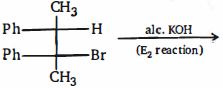
The major product of the reaction is:
A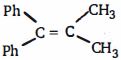
B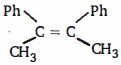
C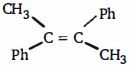
D
$Ph-CH(CH_3)-CH(OH)-Ph$
Solution
(C) The reaction is an $E2$ elimination reaction,which requires an anti-periplanar arrangement of the leaving group $(-Br)$ and the $\beta$-hydrogen atom.
In the given Fischer projection,the $-Br$ and $-H$ are on the same side (syn-periplanar). To undergo $E2$ elimination,the molecule must rotate around the $C-C$ single bond to bring the $-Br$ and $-H$ into an anti-periplanar conformation.
Upon rotation,the two phenyl $(Ph)$ groups will be on opposite sides of the double bond in the resulting alkene,leading to the formation of the trans-isomer as the major product.
In the given Fischer projection,the $-Br$ and $-H$ are on the same side (syn-periplanar). To undergo $E2$ elimination,the molecule must rotate around the $C-C$ single bond to bring the $-Br$ and $-H$ into an anti-periplanar conformation.
Upon rotation,the two phenyl $(Ph)$ groups will be on opposite sides of the double bond in the resulting alkene,leading to the formation of the trans-isomer as the major product.
0 likes
View Solution481
MediumMCQ
For the reaction of $3$-bromohexane with alcoholic $KOH$,find $(x)$,where $(x)$ is the total number of $E_2$ elimination products obtained (including stereoisomers).

A
$3$
B
$4$
C
$5$
D
$6$
Solution
(C) The reaction of $3$-bromohexane with alcoholic $KOH$ proceeds via an $E_2$ mechanism. The substrate is $CH_3CH_2CH(Br)CH_2CH_2CH_3$.
There are two types of $\beta$-hydrogens available for elimination:
$1$. Elimination from $C_2$ gives $hex-2-ene$ $(CH_3CH=CHCH_2CH_2CH_3)$. This product exhibits geometrical isomerism,resulting in two stereoisomers: $cis-hex-2-ene$ and $trans-hex-2-ene$.
$2$. Elimination from $C_4$ gives $hex-3-ene$ $(CH_3CH_2CH=CHCH_2CH_3)$. This product also exhibits geometrical isomerism,resulting in two stereoisomers: $cis-hex-3-ene$ and $trans-hex-3-ene$.
Note: The provided image shows a different substrate (likely $3$-bromo-$3$-methylhexane or similar),but based on the provided solution image,the products are $1$ terminal alkene and $2$ pairs of geometrical isomers,totaling $5$ products.
Thus,$(x) = 5$.
There are two types of $\beta$-hydrogens available for elimination:
$1$. Elimination from $C_2$ gives $hex-2-ene$ $(CH_3CH=CHCH_2CH_2CH_3)$. This product exhibits geometrical isomerism,resulting in two stereoisomers: $cis-hex-2-ene$ and $trans-hex-2-ene$.
$2$. Elimination from $C_4$ gives $hex-3-ene$ $(CH_3CH_2CH=CHCH_2CH_3)$. This product also exhibits geometrical isomerism,resulting in two stereoisomers: $cis-hex-3-ene$ and $trans-hex-3-ene$.
Note: The provided image shows a different substrate (likely $3$-bromo-$3$-methylhexane or similar),but based on the provided solution image,the products are $1$ terminal alkene and $2$ pairs of geometrical isomers,totaling $5$ products.
Thus,$(x) = 5$.
0 likes
View Solution482
MediumMCQ
Which one of the following compounds will be least susceptible to the elimination of hydrogen bromide $(HBr)$?
A
$Br-CH_2-CH_2-NO_2$
B
$Br-CH_2-CH_2-CH_3$
C
$Br-CH_2-CH_2-CN$
D
$Br-CH_2-CH_2-CO_2Et$
Solution
(B) The elimination of $HBr$ from a haloalkane (dehydrohalogenation) typically proceeds via an $E2$ mechanism,which is facilitated by the presence of an electron-withdrawing group ($-M$ or $-I$ effect) at the $\beta$-carbon.
These groups increase the acidity of the $\beta$-hydrogen,making it easier to remove.
In the given options:
$(a)$ $-NO_2$ is a strong electron-withdrawing group.
$(c)$ $-CN$ is a strong electron-withdrawing group.
$(d)$ $-CO_2Et$ is an electron-withdrawing group.
$(b)$ $-CH_3$ is an electron-donating group (via inductive effect),which decreases the acidity of the $\beta$-hydrogen.
Therefore,$Br-CH_2-CH_2-CH_3$ is the least susceptible to elimination.
These groups increase the acidity of the $\beta$-hydrogen,making it easier to remove.
In the given options:
$(a)$ $-NO_2$ is a strong electron-withdrawing group.
$(c)$ $-CN$ is a strong electron-withdrawing group.
$(d)$ $-CO_2Et$ is an electron-withdrawing group.
$(b)$ $-CH_3$ is an electron-donating group (via inductive effect),which decreases the acidity of the $\beta$-hydrogen.
Therefore,$Br-CH_2-CH_2-CH_3$ is the least susceptible to elimination.
0 likes
View Solution483
DifficultMCQ
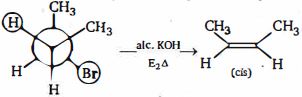
In the dehydrohalogenation of $2$-bromobutane,which conformation leads to the formation of $cis$-but-$2$-ene?
A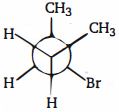
B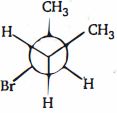
C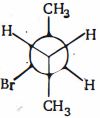
D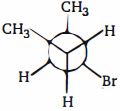
Solution
(A) The dehydrohalogenation of $2$-bromobutane via the $E2$ mechanism requires an anti-periplanar arrangement of the leaving group $(-Br)$ and the $\beta$-hydrogen atom.
To form $cis$-but-$2$-ene,the methyl groups on the $C_2$ and $C_3$ carbons must be on the same side of the developing double bond in the transition state.
Looking at the Newman projections,the conformation that places the $-Br$ atom anti to the $\beta$-hydrogen while keeping the two methyl groups on the same side is represented by the structure in option $A$.
In this conformation,the $C_2$ methyl group and the $C_3$ methyl group are eclipsed or syn-like relative to each other when viewed along the $C_2-C_3$ bond,which leads to the $cis$ isomer upon elimination.
To form $cis$-but-$2$-ene,the methyl groups on the $C_2$ and $C_3$ carbons must be on the same side of the developing double bond in the transition state.
Looking at the Newman projections,the conformation that places the $-Br$ atom anti to the $\beta$-hydrogen while keeping the two methyl groups on the same side is represented by the structure in option $A$.
In this conformation,the $C_2$ methyl group and the $C_3$ methyl group are eclipsed or syn-like relative to each other when viewed along the $C_2-C_3$ bond,which leads to the $cis$ isomer upon elimination.
0 likes
View Solution484
DifficultMCQ
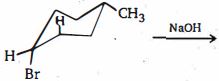
The $E_2$ product of the following reaction will be?
A
$3-$methylcyclohexene
B
$1-$methylcyclohexene
C
$4-$methylcyclohexene
D
$4-$methylcyclohexene
Solution
(A) In an $E_2$ elimination reaction,the leaving group $(-Br)$ and the $\beta$-hydrogen must be in an anti-periplanar conformation.
In the given cyclohexane derivative,the $-Br$ group is in an axial position.
The $\beta$-hydrogen at the $C_3$ position is also in an axial position,which is anti to the $-Br$ group.
Therefore,the elimination occurs between $C_1$ and $C_2$ to form $3$-methylcyclohexene as the major product.
In the given cyclohexane derivative,the $-Br$ group is in an axial position.
The $\beta$-hydrogen at the $C_3$ position is also in an axial position,which is anti to the $-Br$ group.
Therefore,the elimination occurs between $C_1$ and $C_2$ to form $3$-methylcyclohexene as the major product.
0 likes
View Solution485
MediumMCQ
$A$ halide $C_5H_{11}Br$ on treatment with alc. $KOH$ gives $2$-pentene only. The halide will be
A
$CH_3-CH_2-CH_2-CH_2-CH_2-Br$
B
$CH_3-CH_2-CH_2-CH(Br)-CH_3$
C
$CH_3-CH_2-CH(Br)-CH_2-CH_3$
D
$CH_3-CH(CH_3)-C(Br)(CH_3)-CH_3$
Solution
(C) The reaction of an alkyl halide with alcoholic $KOH$ is a dehydrohalogenation reaction (elimination reaction).
For $3$-bromopentane $(CH_3-CH_2-CH(Br)-CH_2-CH_3)$,there are two equivalent $\beta$-carbons.
Removing a hydrogen from either $\beta$-carbon results in the formation of $2$-pentene $(CH_3-CH_2-CH=CH-CH_3)$ as the only product.
In contrast,$2$-bromopentane would yield a mixture of $1$-pentene and $2$-pentene.
For $3$-bromopentane $(CH_3-CH_2-CH(Br)-CH_2-CH_3)$,there are two equivalent $\beta$-carbons.
Removing a hydrogen from either $\beta$-carbon results in the formation of $2$-pentene $(CH_3-CH_2-CH=CH-CH_3)$ as the only product.
In contrast,$2$-bromopentane would yield a mixture of $1$-pentene and $2$-pentene.
0 likes
View Solution486
MediumMCQ
For each of the following pairs of $E_2$ reactions,select the one that occurs with the greater rate constant:
$(1)$ $CH_3-CH_2-CH_2-Cl + CH_3-C(CH_3)_2-O^-$
$(2)$ $CH_3-CH_2-CH_2-I + CH_3-C(CH_3)_2-O^-$
$(3)$ $CH_3-CH(Br)-CH_3 + CH_3-O^-$
$(4)$ $CH_3-CH(Br)-CH_3 + CH_3-S^-$
$(5)$ $Ph-CH_2-CH(Br)-CH_2-CH_3 + OH^-$
$(6)$ $Ph-CH_2-CH_2-CH(Br)-CH_3 + OH^-$
$(1)$ $CH_3-CH_2-CH_2-Cl + CH_3-C(CH_3)_2-O^-$
$(2)$ $CH_3-CH_2-CH_2-I + CH_3-C(CH_3)_2-O^-$
$(3)$ $CH_3-CH(Br)-CH_3 + CH_3-O^-$
$(4)$ $CH_3-CH(Br)-CH_3 + CH_3-S^-$
$(5)$ $Ph-CH_2-CH(Br)-CH_2-CH_3 + OH^-$
$(6)$ $Ph-CH_2-CH_2-CH(Br)-CH_3 + OH^-$
A
$2, 4, 6$
B
$1, 3, 5$
C
$2, 3, 5$
D
$2, 4, 5$
Solution
(C) The correct answer is $(c)$.
- In pair $(1)$ and $(2)$,$I^-$ is a better leaving group than $Cl^-$,so reaction $(2)$ is faster.
- In pair $(3)$ and $(4)$,$CH_3O^-$ is a stronger base than $CH_3S^-$. Since $E_2$ reactions depend on the strength of the base,reaction $(3)$ is faster.
- In pair $(5)$ and $(6)$,reaction $(5)$ involves a secondary alkyl halide where the $\beta$-hydrogen is benzylic,making the transition state more stable due to conjugation with the phenyl ring,leading to a faster reaction compared to $(6)$.
Therefore,the set of faster reactions is $2, 3, 5$.
- In pair $(1)$ and $(2)$,$I^-$ is a better leaving group than $Cl^-$,so reaction $(2)$ is faster.
- In pair $(3)$ and $(4)$,$CH_3O^-$ is a stronger base than $CH_3S^-$. Since $E_2$ reactions depend on the strength of the base,reaction $(3)$ is faster.
- In pair $(5)$ and $(6)$,reaction $(5)$ involves a secondary alkyl halide where the $\beta$-hydrogen is benzylic,making the transition state more stable due to conjugation with the phenyl ring,leading to a faster reaction compared to $(6)$.
Therefore,the set of faster reactions is $2, 3, 5$.
0 likes
View Solution487
MediumMCQ
The following bimolecular elimination reaction $(E_2)$ is carried out with different halogen leaving groups. The per cent yield of the two products ($2$-hexene and $1$-hexene) for each leaving group is listed below.
Which of the following statement$(s)$ is/are true concerning this series of $E_2$ reactions?
| Leaving group | Conj. Acid $pK_a$ | $\%$-yield of $2$-hexene | $\%$-yield of $1$-hexene |
|---|---|---|---|
| $X = I$ | $-10$ | $81\%$ | $19\%$ |
| $X = Br$ | $-9$ | $72\%$ | $28\%$ |
| $X = Cl$ | $-7$ | $67\%$ | $33\%$ |
| $X = F$ | $3.2$ | $30\%$ | $70\%$ |
Which of the following statement$(s)$ is/are true concerning this series of $E_2$ reactions?

A
Based on the $pK_a$ values of the conjugate acid,$I^{-}$ is the best leaving group and $F^{-}$ is the poorest leaving group.
B
When $I^{-}$,$Br^{-}$,and $Cl^{-}$ are used as leaving groups,Zaitsev's rule is followed.
C
$F^{-}$ is the strongest base (and therefore the poorest leaving group) and the transition state for reaction with fluoride as the leaving group has the least double bond character.
D
$a$,$b$,and $c$ are true.
Solution
(D) $1$. The leaving group ability is inversely proportional to the basicity of the leaving group,which is directly related to the $pK_a$ of its conjugate acid. Since $HI$ has the lowest $pK_a$ $(-10)$,$I^{-}$ is the best leaving group,and $HF$ has the highest $pK_a$ $(3.2)$,$F^{-}$ is the poorest leaving group. Thus,statement $(a)$ is true.
$2$. Zaitsev's rule states that the more substituted alkene is the major product. For $I^{-}$,$Br^{-}$,and $Cl^{-}$,the yield of $2$-hexene (more substituted) is greater than $1$-hexene (less substituted),so they follow Zaitsev's rule. Thus,statement $(b)$ is true.
$3$. $F^{-}$ is the strongest base among the halides,making it the poorest leaving group. In $E_2$ reactions with poor leaving groups,the transition state is more 'E1cB-like',meaning the $C-H$ bond is broken more than the $C-X$ bond,resulting in less double bond character in the transition state. Thus,statement $(c)$ is true.
$4$. Since $(a)$,$(b)$,and $(c)$ are all true,the correct option is $(d)$.
$2$. Zaitsev's rule states that the more substituted alkene is the major product. For $I^{-}$,$Br^{-}$,and $Cl^{-}$,the yield of $2$-hexene (more substituted) is greater than $1$-hexene (less substituted),so they follow Zaitsev's rule. Thus,statement $(b)$ is true.
$3$. $F^{-}$ is the strongest base among the halides,making it the poorest leaving group. In $E_2$ reactions with poor leaving groups,the transition state is more 'E1cB-like',meaning the $C-H$ bond is broken more than the $C-X$ bond,resulting in less double bond character in the transition state. Thus,statement $(c)$ is true.
$4$. Since $(a)$,$(b)$,and $(c)$ are all true,the correct option is $(d)$.
0 likes
View Solution488
DifficultMCQ
The major product obtained in the reaction of $1$-phenyl-$2$-bromobutane with $NaOMe$ is:
A
$(E)-1$-phenylbut-$1$-ene
B
$(E)-1$-phenylbut-$2$-ene
C
$1$-phenyl-$2$-ethoxybutane
D
$(Z)-1$-phenylbut-$2$-ene
Solution
(A) The reaction of $1$-phenyl-$2$-bromobutane with $NaOMe$ (a strong base) proceeds via an $E_2$ elimination mechanism.
In this reaction,the base abstracts a proton from the $\beta$-carbon to form a double bond.
The formation of the conjugated alkene,$(E)-1$-phenylbut-$1$-ene,is favored because the double bond is in conjugation with the phenyl ring,which provides extra stability to the product.
Thus,$(E)-1$-phenylbut-$1$-ene is the major product.
In this reaction,the base abstracts a proton from the $\beta$-carbon to form a double bond.
The formation of the conjugated alkene,$(E)-1$-phenylbut-$1$-ene,is favored because the double bond is in conjugation with the phenyl ring,which provides extra stability to the product.
Thus,$(E)-1$-phenylbut-$1$-ene is the major product.
0 likes
View Solution489
MediumMCQ
Which of the following alkyl halides gives the most complex mixture of alkenes in an $E_2$ reaction?
A
$CH_3-CH_2-CH_2-CH_2-Br$
B
$CH_3-CH_2-CH_2-CH(Br)-CH_3$
C
$CH_3-CH_2-CH(Br)-CH_2-CH_3$
D
$CH_3-C(Br)(CH_3)-CH_2-CH_3$
Solution
(B) complex mixture of alkenes in an $E_2$ reaction occurs when there are multiple non-equivalent $\beta$-hydrogens available for abstraction,leading to different structural isomers and stereoisomers (cis/trans).
$A$. $CH_3-CH_2-CH_2-CH_2-Br$: Only one type of $\beta$-hydrogen,gives $1$-butene.
$B$. $CH_3-CH_2-CH_2-CH(Br)-CH_3$: Two types of $\beta$-hydrogens (at $C_1$ and $C_3$). Abstraction at $C_1$ gives $1$-pentene. Abstraction at $C_3$ gives $2$-pentene (as a mixture of $cis$ and $trans$ isomers).
$C$. $CH_3-CH_2-CH(Br)-CH_2-CH_3$: Two types of $\beta$-hydrogens (at $C_2$ and $C_4$),but the molecule is symmetric. It gives $2$-pentene (mixture of $cis$ and $trans$ isomers).
$D$. $CH_3-C(Br)(CH_3)-CH_2-CH_3$: Two types of $\beta$-hydrogens (at $C_1$ and $C_3$). Abstraction at $C_1$ gives $2$-methyl-$1$-butene. Abstraction at $C_3$ gives $2$-methyl-$2$-butene.
Comparing $B$ and $D$,option $B$ produces $1$-pentene,$cis$-$2$-pentene,and $trans$-$2$-pentene ($3$ products). Option $D$ produces $2$-methyl-$1$-butene and $2$-methyl-$2$-butene ($2$ products). Thus,option $B$ yields the most complex mixture.
$A$. $CH_3-CH_2-CH_2-CH_2-Br$: Only one type of $\beta$-hydrogen,gives $1$-butene.
$B$. $CH_3-CH_2-CH_2-CH(Br)-CH_3$: Two types of $\beta$-hydrogens (at $C_1$ and $C_3$). Abstraction at $C_1$ gives $1$-pentene. Abstraction at $C_3$ gives $2$-pentene (as a mixture of $cis$ and $trans$ isomers).
$C$. $CH_3-CH_2-CH(Br)-CH_2-CH_3$: Two types of $\beta$-hydrogens (at $C_2$ and $C_4$),but the molecule is symmetric. It gives $2$-pentene (mixture of $cis$ and $trans$ isomers).
$D$. $CH_3-C(Br)(CH_3)-CH_2-CH_3$: Two types of $\beta$-hydrogens (at $C_1$ and $C_3$). Abstraction at $C_1$ gives $2$-methyl-$1$-butene. Abstraction at $C_3$ gives $2$-methyl-$2$-butene.
Comparing $B$ and $D$,option $B$ produces $1$-pentene,$cis$-$2$-pentene,and $trans$-$2$-pentene ($3$ products). Option $D$ produces $2$-methyl-$1$-butene and $2$-methyl-$2$-butene ($2$ products). Thus,option $B$ yields the most complex mixture.
0 likes
View Solution490
DifficultMCQ
$CH_3-CH_2-C(Br)(CH_2CH_3)-CH_2(CH_2CH_2CH_3) \xrightarrow{alc. KOH} (A)$ (major)
$n-Pr = n-propyl$
Product $(A)$ is
$n-Pr = n-propyl$
Product $(A)$ is
A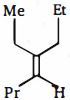
B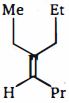
C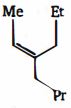
D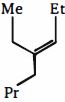
Solution
(C) The reaction of $3-bromo-3-ethylhexane$ with $alc. KOH$ proceeds via an $E2$ elimination mechanism.
The substrate has three types of $\beta$-hydrogens available for abstraction:
$1$. From the $CH_3$ group of the ethyl chain.
$2$. From the $CH_2$ group of the propyl chain.
$3$. From the $CH_2$ group of the ethyl chain.
According to $Zaitsev's$ rule,the major product is the most substituted alkene,which is also the most stable due to hyperconjugation (more $\alpha$-hydrogens).
By eliminating a proton from the $CH_2$ group of the propyl chain,we form the most substituted alkene,which is $3-ethylhex-3-ene$. This product has the highest number of $\alpha$-hydrogens,making it the major product as shown in the solution image.
The substrate has three types of $\beta$-hydrogens available for abstraction:
$1$. From the $CH_3$ group of the ethyl chain.
$2$. From the $CH_2$ group of the propyl chain.
$3$. From the $CH_2$ group of the ethyl chain.
According to $Zaitsev's$ rule,the major product is the most substituted alkene,which is also the most stable due to hyperconjugation (more $\alpha$-hydrogens).
By eliminating a proton from the $CH_2$ group of the propyl chain,we form the most substituted alkene,which is $3-ethylhex-3-ene$. This product has the highest number of $\alpha$-hydrogens,making it the major product as shown in the solution image.
0 likes
View Solution491
MediumMCQ
$Ph-CH(Br)-CH_2-CH_2-Br \xrightarrow[\Delta]{Zn-Cu} \text{Product}$. The product of the above reaction is:
A
$Ph-CH=CH-CH_2-Br$
B
Phenylcyclopropane
C
$Ph-CHBr-CH=CH_2$
D
$Ph-C \equiv C-CH_3$
Solution
(B) The reaction of $1,3$-dibromide with $Zn-Cu$ couple is a classic example of $1,3$-elimination.
$Zn$ acts as a reducing agent,donating electrons to the carbon atom attached to the bromine.
This leads to the formation of a carbanion intermediate at the $C-1$ position.
This carbanion then performs an intramolecular nucleophilic substitution $(S_N2)$ on the $C-3$ carbon,displacing the second bromide ion.
This results in the formation of a three-membered ring.
The final product is phenylcyclopropane.
$Zn$ acts as a reducing agent,donating electrons to the carbon atom attached to the bromine.
This leads to the formation of a carbanion intermediate at the $C-1$ position.
This carbanion then performs an intramolecular nucleophilic substitution $(S_N2)$ on the $C-3$ carbon,displacing the second bromide ion.
This results in the formation of a three-membered ring.
The final product is phenylcyclopropane.
0 likes
View Solution492
AdvancedMCQ
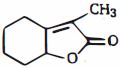
Which of the following reactants is used to obtain the compound $(A)$ shown below? (Assume that $EtO^{-}$ is used in all the reactions)
A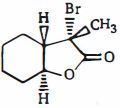
B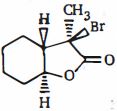
C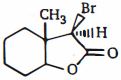
D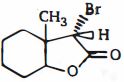
Solution
(A) The reaction involves an $E_2$ elimination mechanism using a strong base,$EtO^-$.
For an $E_2$ elimination to occur,the leaving group (in this case,$Br$) and the $\beta$-hydrogen atom must be in an anti-periplanar (trans-diaxial) orientation to each other.
Therefore,the reactant that allows for this specific geometric arrangement will successfully yield the product $(A)$.
For an $E_2$ elimination to occur,the leaving group (in this case,$Br$) and the $\beta$-hydrogen atom must be in an anti-periplanar (trans-diaxial) orientation to each other.
Therefore,the reactant that allows for this specific geometric arrangement will successfully yield the product $(A)$.
0 likes
View Solution493
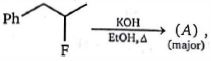
MediumMCQ
The major product $(A)$ of the following reaction is:
A
$Ph-CH_2-CH=CH_2$
B
$Ph-CH=CH-CH_3$
C
$Ph-CH_2-CH(OEt)-CH_3$
D
$Ph-CH_2-CH(OH)-CH_3$
Solution
(B) The reaction is an $E2$ elimination of $1-phenyl-2-fluoropropane$ with an alcoholic base $(KOH/EtOH, \Delta)$.
Fluorine is a poor leaving group,which makes the $C-H$ bond cleavage more significant in the transition state.
This leads to the formation of a carbanion-like transition state at the benzylic position.
The base abstracts the acidic proton from the benzylic carbon $(Ph-CH_2-)$,leading to the formation of the more stable conjugated alkene,$1-phenylprop-1-ene$ $(Ph-CH=CH-CH_3)$.
Fluorine is a poor leaving group,which makes the $C-H$ bond cleavage more significant in the transition state.
This leads to the formation of a carbanion-like transition state at the benzylic position.
The base abstracts the acidic proton from the benzylic carbon $(Ph-CH_2-)$,leading to the formation of the more stable conjugated alkene,$1-phenylprop-1-ene$ $(Ph-CH=CH-CH_3)$.
0 likes
View Solution494
DifficultMCQ
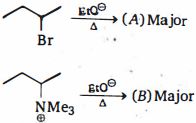
The relation between $(A)$ and $(B)$ is:
A
$G.I.$
B
positional isomer
C
enantiomer
D
chain isomer
Solution
(B) In the first reaction,$sec-butyl$ bromide undergoes $E2$ elimination with $EtO^-$ to form the more stable alkene,$but-2-ene$ (Saytzeff product),as the major product $(A)$.
In the second reaction,$sec-butyl$ trimethylammonium ion undergoes $E2$ elimination with $EtO^-$. Due to the poor leaving group ability of the $-NMe_3^+$ group and the steric hindrance,the transition state $(T.S.)$ develops significant carbanion character. According to the Hofmann rule,the less substituted alkene,$but-1-ene$,is formed as the major product $(B)$.
Since $(A)$ is $but-2-ene$ and $(B)$ is $but-1-ene$,they are positional isomers.
In the second reaction,$sec-butyl$ trimethylammonium ion undergoes $E2$ elimination with $EtO^-$. Due to the poor leaving group ability of the $-NMe_3^+$ group and the steric hindrance,the transition state $(T.S.)$ develops significant carbanion character. According to the Hofmann rule,the less substituted alkene,$but-1-ene$,is formed as the major product $(B)$.
Since $(A)$ is $but-2-ene$ and $(B)$ is $but-1-ene$,they are positional isomers.
0 likes
View Solution495
DifficultMCQ
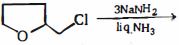
Identify the product of the following reaction:
(See image for reaction scheme)
Product; The product is:
(See image for reaction scheme)
Product; The product is:
A
B
$HC \equiv C - (CH_2)_3 ONa$
C
$NaC \equiv C - (CH_2)_3 ONa$
D
$HC \equiv C - (CH_2)_3 OH$
Solution
(A) The reaction involves the treatment of $2-(chloromethyl)tetrahydrofuran$ with $3$ equivalents of $NaNH_2$ in liquid $NH_3$.
$1$. The first equivalent of $NaNH_2$ acts as a base to perform an elimination reaction,leading to the ring-opening of the tetrahydrofuran ring to form an intermediate with a terminal alkyne and an alkoxide group.
$2$. The subsequent equivalents of $NaNH_2$ are strong enough to deprotonate both the terminal alkyne (forming an acetylide ion) and the hydroxyl group (if it were present,though here the ring opening already generates the alkoxide).
$3$. The final product is the disodium salt,where both the terminal alkyne and the oxygen atom are deprotonated: $Na^+ O^- - (CH_2)_3 - C \equiv C^- Na^+$.
$1$. The first equivalent of $NaNH_2$ acts as a base to perform an elimination reaction,leading to the ring-opening of the tetrahydrofuran ring to form an intermediate with a terminal alkyne and an alkoxide group.
$2$. The subsequent equivalents of $NaNH_2$ are strong enough to deprotonate both the terminal alkyne (forming an acetylide ion) and the hydroxyl group (if it were present,though here the ring opening already generates the alkoxide).
$3$. The final product is the disodium salt,where both the terminal alkyne and the oxygen atom are deprotonated: $Na^+ O^- - (CH_2)_3 - C \equiv C^- Na^+$.
0 likes
View Solution496
MediumMCQ
Which best describes the product of the following reaction?
$Ph-C(CH_3)(Br)-CD_3 \xrightarrow{K^+ t-BuO^-, E_2} \text{product}$
$Ph-C(CH_3)(Br)-CD_3 \xrightarrow{K^+ t-BuO^-, E_2} \text{product}$
A
Absolute configuration has been inverted
B
Absolute configuration has been retained
C
Racemization (loss of absolute configuration) has occurred
D
Loss of chirality has occurred (the product is achiral)
Solution
(D) The reaction is an $E_2$ elimination reaction.
The substrate is a chiral alkyl bromide: $1-bromo-1-phenylethyl-d_3$ (where $d_3$ is $CD_3$).
Upon treatment with a strong base like potassium tert-butoxide $(K^+ t-BuO^-)$,the reaction proceeds via an $E_2$ mechanism to form an alkene.
The product formed is $Ph-C(=CH_2)-CD_3$ (or $Ph-C(CD_3)=CH_2$).
This product is a planar alkene,which does not possess a chiral center.
Therefore,the loss of chirality has occurred,and the product is achiral.
The substrate is a chiral alkyl bromide: $1-bromo-1-phenylethyl-d_3$ (where $d_3$ is $CD_3$).
Upon treatment with a strong base like potassium tert-butoxide $(K^+ t-BuO^-)$,the reaction proceeds via an $E_2$ mechanism to form an alkene.
The product formed is $Ph-C(=CH_2)-CD_3$ (or $Ph-C(CD_3)=CH_2$).
This product is a planar alkene,which does not possess a chiral center.
Therefore,the loss of chirality has occurred,and the product is achiral.
0 likes
View Solution497
AdvancedMCQ
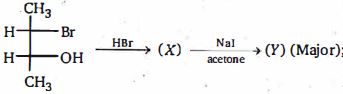
The product $(Y)$ is:
A
cis $-2-$ butene
B
trans $-2-$ butene
C
$1-$ butene
D
Isobutene
Solution
(B) $1$. The starting material is $3-$bromo$butan-2-$ol. Reaction with $HBr$ replaces the $-OH$ group with $-Br$ to form $2,3-$dibromobutane $(X)$.
$2$. The reaction of $2,3-$dibromobutane with $NaI$ in acetone is a debromination reaction (Finkelstein-like conditions leading to elimination).
$3$. The anti-elimination of the two bromine atoms from the meso or racemic form (depending on the stereochemistry of the starting material) leads to the formation of the more stable alkene.
$4$. The major product formed is trans $-2-$ butene due to its higher stability compared to cis $-2-$ butene.
$2$. The reaction of $2,3-$dibromobutane with $NaI$ in acetone is a debromination reaction (Finkelstein-like conditions leading to elimination).
$3$. The anti-elimination of the two bromine atoms from the meso or racemic form (depending on the stereochemistry of the starting material) leads to the formation of the more stable alkene.
$4$. The major product formed is trans $-2-$ butene due to its higher stability compared to cis $-2-$ butene.
0 likes
View Solution498
AdvancedMCQ
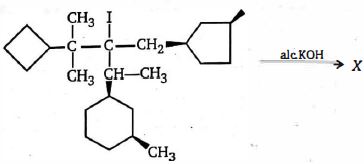
Determine the number of chiral products (including stereoisomers) formed upon $E_2$ elimination of the given substrate with $alc. KOH$.
A
$2$
B
$4$
C
$6$
D
$8$
Solution
(B) The reaction is an $E_2$ elimination. The substrate has two distinct $\beta$-hydrogen positions available for elimination.
$1$. Elimination of the $\beta$-hydrogen from the $-CH_2-$ group attached to the cyclopentyl ring leads to the formation of a double bond between the $\alpha$ and $\beta$ carbons. This alkene can exist as $E$ and $Z$ isomers. Since the molecule contains other chiral centers (the cyclopentyl and cyclohexyl rings),each of these geometric isomers will be chiral,resulting in $2$ chiral products.
$2$. Elimination of the $\beta$-hydrogen from the $-CH(CH_3)-$ group leads to a different alkene. This alkene also exhibits geometric isomerism ($E$ and $Z$). Again,due to the existing chiral centers in the rings,both the $E$ and $Z$ isomers will be chiral,resulting in another $2$ chiral products.
Total number of chiral products = $2 + 2 = 4$.
$1$. Elimination of the $\beta$-hydrogen from the $-CH_2-$ group attached to the cyclopentyl ring leads to the formation of a double bond between the $\alpha$ and $\beta$ carbons. This alkene can exist as $E$ and $Z$ isomers. Since the molecule contains other chiral centers (the cyclopentyl and cyclohexyl rings),each of these geometric isomers will be chiral,resulting in $2$ chiral products.
$2$. Elimination of the $\beta$-hydrogen from the $-CH(CH_3)-$ group leads to a different alkene. This alkene also exhibits geometric isomerism ($E$ and $Z$). Again,due to the existing chiral centers in the rings,both the $E$ and $Z$ isomers will be chiral,resulting in another $2$ chiral products.
Total number of chiral products = $2 + 2 = 4$.
0 likes
View Solution499
DifficultMCQ
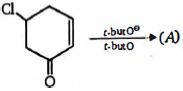
What is the product $(A)$ in the following reaction?
A
$3-$tert-butoxycyclohex$-2-$en$-1-$one
B
Phenoxide ion
C
Cyclohexa$-1,3-$dien$-1-$one
D
$3-$chloro$-5-$tert-butoxycyclohexan$-1-$one
Solution
(A) The starting material is $3-$chlorocyclohex$-2-$en$-1-$one.
This is an $\alpha,\beta$-unsaturated carbonyl compound with a leaving group $(-Cl)$ at the $\beta$-position.
The reagent $t-butO^-$ is a strong nucleophile.
Nucleophilic substitution occurs at the $\beta$-carbon via an addition-elimination mechanism (conjugate addition followed by elimination of the chloride ion).
This results in the replacement of the $-Cl$ group with the $-Ot-Bu$ group,yielding $3-$tert-butoxycyclohex$-2-$en$-1-$one.
This is an $\alpha,\beta$-unsaturated carbonyl compound with a leaving group $(-Cl)$ at the $\beta$-position.
The reagent $t-butO^-$ is a strong nucleophile.
Nucleophilic substitution occurs at the $\beta$-carbon via an addition-elimination mechanism (conjugate addition followed by elimination of the chloride ion).
This results in the replacement of the $-Cl$ group with the $-Ot-Bu$ group,yielding $3-$tert-butoxycyclohex$-2-$en$-1-$one.
0 likes
View Solution500
DifficultMCQ
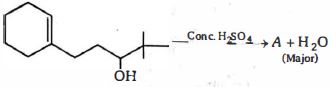
Which of the following is product $A$ in the above reaction?
A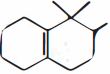
B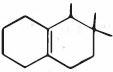
C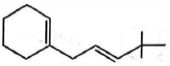
D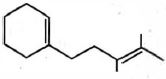
Solution
(B) The reaction involves the acid-catalyzed dehydration of an alcohol using $Conc. H_2SO_4$.
$1$. The hydroxyl group is protonated to form an oxonium ion,which then leaves as $H_2O$ to form a carbocation.
$2$. The resulting carbocation undergoes a cyclization reaction where the double bond of the cyclohexenyl ring attacks the carbocation center.
$3$. This forms a bicyclic carbocation intermediate.
$4$. Finally,the loss of a proton $(H^+)$ from the intermediate leads to the formation of the most stable alkene,which is the major product $A$.
$1$. The hydroxyl group is protonated to form an oxonium ion,which then leaves as $H_2O$ to form a carbocation.
$2$. The resulting carbocation undergoes a cyclization reaction where the double bond of the cyclohexenyl ring attacks the carbocation center.
$3$. This forms a bicyclic carbocation intermediate.
$4$. Finally,the loss of a proton $(H^+)$ from the intermediate leads to the formation of the most stable alkene,which is the major product $A$.
0 likes
View SolutionHaloalkanes and Haloarenes — Properties of Haloalkanes · Frequently Asked Questions
1Are these Haloalkanes and Haloarenes questions useful for JEE and NEET?
Yes. All questions in this section are mapped to JEE Main and NEET exam patterns. Previous year questions from JEE Main, NEET, GUJCET and state-level exams are included with full solutions.
2Can I switch to Hindi or Gujarati for these questions?
Yes. Use the language tabs in the hero section or the sidebar to view the same questions and solutions in English, Hindi or Gujarati.
3How do I generate a question paper from this subtopic?
Use the Vedclass Exam Paper Generator — select the chapter and subtopic, set difficulty, and generate Sets A, B, C, D automatically. First 3 chapters of every subject are free.
Vedclass Products
For Students
Vedclass Test Series
Mock tests in real JEE/NEET style with performance analysis. 5-day free trial.
Start Free TrialFor Teachers
Exam Paper Generator
Generate Set A/B/C/D papers from this chapter in 2 minutes. 3 chapters free.
Try FreeFor Institutes
Online Exam Module
Live online exams with unlimited students, 360° analytics & white-label branding.
See DemoFor Teachers & Institutes
Generate a Haloalkanes and Haloarenes Exam Paper in 2 Minutes
Select subtopic & difficulty — Sets A, B, C, D auto-generated with No Repeat logic.
First 3 chapters of every subject are free — no payment required.