
A English
Properties of Haloalkanes Questions in English
Class 12 Chemistry · Haloalkanes and Haloarenes · Properties of Haloalkanes
1196+
Questions
English
Language
100%
With Solutions
Showing 50 of 1196 questions in English
501
MediumMCQ
Which is the major product expected from the following $S_{N}2$ reaction?
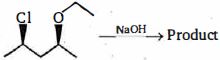
A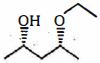
B
C
D
Solution
(A) The reaction involves an $S_{N}2$ mechanism.
In an $S_{N}2$ reaction,the nucleophile ($OH^-$ from $NaOH$) attacks the carbon atom attached to the leaving group.
Between $-Cl$ and $-OEt$,the chloride ion $(-Cl^-)$ is a much better leaving group than the ethoxide ion $(-OEt^-)$.
Therefore,the $OH^-$ nucleophile will preferentially attack the carbon atom bonded to the $-Cl$ atom.
This attack occurs from the backside,leading to an inversion of configuration at that chiral center.
The $-OEt$ group remains unaffected.
Thus,the product is the one where the $-Cl$ group is replaced by an $-OH$ group with inverted stereochemistry.
In an $S_{N}2$ reaction,the nucleophile ($OH^-$ from $NaOH$) attacks the carbon atom attached to the leaving group.
Between $-Cl$ and $-OEt$,the chloride ion $(-Cl^-)$ is a much better leaving group than the ethoxide ion $(-OEt^-)$.
Therefore,the $OH^-$ nucleophile will preferentially attack the carbon atom bonded to the $-Cl$ atom.
This attack occurs from the backside,leading to an inversion of configuration at that chiral center.
The $-OEt$ group remains unaffected.
Thus,the product is the one where the $-Cl$ group is replaced by an $-OH$ group with inverted stereochemistry.
0 likes
View Solution502
DifficultMCQ
What is the product of the following $S_N2$ reaction?
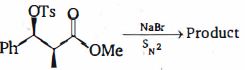
A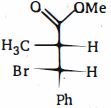
B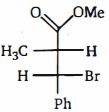
C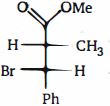
D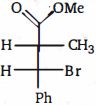
Solution
(D) The reaction proceeds via an $S_N2$ mechanism,which involves a Walden inversion at the chiral center where the leaving group $(-OTs)$ is attached.
$1$. The starting material has the $-OTs$ group on a wedge.
$2$. The $Br^-$ nucleophile attacks from the opposite side (dash),resulting in the inversion of configuration.
$3$. The resulting product has the $-Br$ group on a dash.
$4$. Converting this structure to a Fischer projection involves rotating the molecule to place the carbon chain vertically with the most oxidized group $(-COOMe)$ at the top.
$5$. Following the stereochemical transformation,the correct Fischer projection corresponds to option $D$.
$1$. The starting material has the $-OTs$ group on a wedge.
$2$. The $Br^-$ nucleophile attacks from the opposite side (dash),resulting in the inversion of configuration.
$3$. The resulting product has the $-Br$ group on a dash.
$4$. Converting this structure to a Fischer projection involves rotating the molecule to place the carbon chain vertically with the most oxidized group $(-COOMe)$ at the top.
$5$. Following the stereochemical transformation,the correct Fischer projection corresponds to option $D$.
0 likes
View Solution503
MediumMCQ
Select the reagent that will yield the greater amount of substitution on reaction with $CH_3CH_2Br$.
A
$CH_3CH_2OK$ in dimethyl sulfoxide $(DMSO)$
B
$(CH_3)_3COK$ in dimethyl sulfoxide $(DMSO)$
C
Both $(a)$ and $(b)$ will give comparable amounts of substitution
D
Neither $(a)$ nor $(b)$ will give any amount of substitution
Solution
(A) The reaction of $CH_3CH_2Br$ (a primary alkyl halide) with a base/nucleophile can proceed via $S_N2$ (substitution) or $E2$ (elimination) pathways.
$CH_3CH_2OK$ is a strong,unhindered nucleophile,which favors the $S_N2$ substitution reaction.
$(CH_3)_3COK$ is a strong,sterically hindered base (potassium tert-butoxide),which significantly favors the $E2$ elimination reaction over substitution due to steric hindrance.
Therefore,$CH_3CH_2OK$ will yield a greater amount of substitution product compared to $(CH_3)_3COK$.
$CH_3CH_2OK$ is a strong,unhindered nucleophile,which favors the $S_N2$ substitution reaction.
$(CH_3)_3COK$ is a strong,sterically hindered base (potassium tert-butoxide),which significantly favors the $E2$ elimination reaction over substitution due to steric hindrance.
Therefore,$CH_3CH_2OK$ will yield a greater amount of substitution product compared to $(CH_3)_3COK$.
0 likes
View Solution504
AdvancedMCQ
Under the specified conditions,substrate $X$ undergoes substitution and elimination reactions to give products $A - D$. $A$ and $B$ are stereoisomers,but not enantiomers. $C$ and $D$ are enantiomers. $A$ is not an isomer of $C$. Which of the following could be the starting material $X$ ?
$X \xrightarrow[\Delta]{H_2O} A + B + C + D$
$X \xrightarrow[\Delta]{H_2O} A + B + C + D$

A
$I$
B
$II$
C
$III$
D
$IV$
Solution
(C) The reaction conditions $(H_2O, \Delta)$ favor $S_N1$ and $E1$ mechanisms.
For the starting material $X$ to yield two stereoisomeric alcohols ($A$ and $B$) that are not enantiomers (diastereomers) and two enantiomeric alkenes ($C$ and $D$),the substrate must be a chiral molecule that forms a carbocation intermediate.
Structure $III$ is $1$-bromo-$1$-methyl-$4$-methylcyclohexane. Upon ionization,it forms a carbocation at the $C1$ position.
The attack of $H_2O$ from the top or bottom face of the planar carbocation yields two diastereomeric alcohols ($cis$ and $trans$ isomers),which are $A$ and $B$.
The elimination of a proton from the carbocation can occur in two ways to form alkenes. Due to the presence of the chiral center at $C4$,the resulting alkenes $C$ and $D$ are enantiomers.
Thus,structure $III$ fits all the given criteria.
For the starting material $X$ to yield two stereoisomeric alcohols ($A$ and $B$) that are not enantiomers (diastereomers) and two enantiomeric alkenes ($C$ and $D$),the substrate must be a chiral molecule that forms a carbocation intermediate.
Structure $III$ is $1$-bromo-$1$-methyl-$4$-methylcyclohexane. Upon ionization,it forms a carbocation at the $C1$ position.
The attack of $H_2O$ from the top or bottom face of the planar carbocation yields two diastereomeric alcohols ($cis$ and $trans$ isomers),which are $A$ and $B$.
The elimination of a proton from the carbocation can occur in two ways to form alkenes. Due to the presence of the chiral center at $C4$,the resulting alkenes $C$ and $D$ are enantiomers.
Thus,structure $III$ fits all the given criteria.
0 likes
View Solution505
MediumMCQ
Compare the rate of $E_2$ reaction for the following compounds:
$a$: $(CH_3)_3C-Br$
$b$: $CH_3-CH(Br)-CH_3$
$c$: $CH_3-CH_2-Br$
$a$: $(CH_3)_3C-Br$
$b$: $CH_3-CH(Br)-CH_3$
$c$: $CH_3-CH_2-Br$
A
$c > b > a$
B
$a > b > c$
C
$b > a > c$
D
$c > a > b$
Solution
(B) The rate of an $E_2$ reaction depends on the stability of the transition state,which is influenced by the degree of substitution of the alkyl halide.
For $E_2$ reactions,the order of reactivity is generally $3^\circ > 2^\circ > 1^\circ$ because the transition state for more substituted alkenes is more stable due to hyperconjugation and inductive effects.
Compound $a$ is a tertiary $(3^\circ)$ alkyl halide,compound $b$ is a secondary $(2^\circ)$ alkyl halide,and compound $c$ is a primary $(1^\circ)$ alkyl halide.
Therefore,the order of reactivity is $a > b > c$.
For $E_2$ reactions,the order of reactivity is generally $3^\circ > 2^\circ > 1^\circ$ because the transition state for more substituted alkenes is more stable due to hyperconjugation and inductive effects.
Compound $a$ is a tertiary $(3^\circ)$ alkyl halide,compound $b$ is a secondary $(2^\circ)$ alkyl halide,and compound $c$ is a primary $(1^\circ)$ alkyl halide.
Therefore,the order of reactivity is $a > b > c$.
0 likes
View Solution506
AdvancedMCQ
Which reaction results in the formation of a pair of enantiomers?
A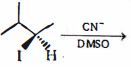
B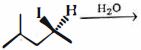
C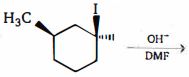
D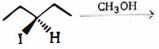
Solution
(B) The formation of a pair of enantiomers (a racemic mixture) occurs in $S_N1$ reactions where a planar carbocation intermediate is formed.
In the reaction of $2$-iodo-$3$-methylbutane with $H_2O$,the mechanism proceeds via the $S_N1$ pathway.
The leaving group $(I^-)$ departs to form a carbocation,which is planar.
The nucleophile $(H_2O)$ can then attack from either side of the planar carbocation,leading to the formation of both enantiomers in equal amounts,resulting in a racemic mixture ($dl$ mixture).
In the reaction of $2$-iodo-$3$-methylbutane with $H_2O$,the mechanism proceeds via the $S_N1$ pathway.
The leaving group $(I^-)$ departs to form a carbocation,which is planar.
The nucleophile $(H_2O)$ can then attack from either side of the planar carbocation,leading to the formation of both enantiomers in equal amounts,resulting in a racemic mixture ($dl$ mixture).
0 likes
View Solution507
MediumMCQ
The rate-limiting step of an $S_N1$ reaction follows the sequence shown below. Based on the assumption that $R$ contains $3$ different groups,which statement is true?
$\mathop R\limits^{\delta \oplus } \,\mathop {Br}\limits^{\delta \Theta } \, \rightleftharpoons \,\mathop {\boxed{{R^ \oplus }Br^\Theta }}\limits_{(a)} \,\,\, \rightleftharpoons \,\mathop {\boxed{{R^ \oplus }}\,\boxed{Br^\Theta }\,}\limits_{(b)} \,\, \rightleftharpoons $ ${\boxed{{R^ \oplus }}}$ $ + $ $\mathop {\,\boxed{Br^\Theta }\,}\limits_{(c)} \,$
$\mathop R\limits^{\delta \oplus } \,\mathop {Br}\limits^{\delta \Theta } \, \rightleftharpoons \,\mathop {\boxed{{R^ \oplus }Br^\Theta }}\limits_{(a)} \,\,\, \rightleftharpoons \,\mathop {\boxed{{R^ \oplus }}\,\boxed{Br^\Theta }\,}\limits_{(b)} \,\, \rightleftharpoons $ ${\boxed{{R^ \oplus }}}$ $ + $ $\mathop {\,\boxed{Br^\Theta }\,}\limits_{(c)} \,$
A
The more stable the carbocation,the greater the proportion of racemization.
B
The more nucleophilic the solvent,the greater the proportion of inversion.
C
In the above sequence,$(b)$ represents separately solvated ion pairs.
D
All of these.
Solution
(D) The $S_N1$ mechanism involves the formation of different types of ion pairs before the final dissociation into free ions.
$(a)$ represents an intimate ion pair.
$(b)$ represents solvent-separated ion pairs.
$(c)$ represents free ions.
As the carbocation becomes more stable,the lifetime of the intermediate increases,leading to higher racemization.
$A$ more nucleophilic solvent can attack the carbocation from the backside before the leaving group completely dissociates,favoring inversion.
Therefore,all the given statements are correct.
$(a)$ represents an intimate ion pair.
$(b)$ represents solvent-separated ion pairs.
$(c)$ represents free ions.
As the carbocation becomes more stable,the lifetime of the intermediate increases,leading to higher racemization.
$A$ more nucleophilic solvent can attack the carbocation from the backside before the leaving group completely dissociates,favoring inversion.
Therefore,all the given statements are correct.
0 likes
View Solution508
DifficultMCQ
The major product of the following reaction is:
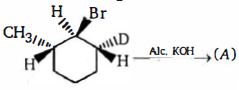
A
$3-$methylcyclohexene
B
$1-$deuterio$-3-$methylcyclohexene
C
$3-$methylcyclohexanol
D
$6-$deuterio$-3-$methylcyclohexene
Solution
(A) The reaction of a haloalkane with alcoholic $KOH$ proceeds via an $E2$ elimination mechanism.
For $E2$ elimination to occur,the leaving group $(-Br)$ and the $\beta$-hydrogen (or deuterium) must be in an anti-periplanar conformation.
In the given molecule,the $-Br$ atom is in an axial position. The adjacent carbon has a deuterium atom in an axial position (anti to $-Br$) and a hydrogen atom in an equatorial position.
Since the deuterium is anti to the $-Br$ group,the $E2$ elimination will involve the removal of $D$ and $Br$ ($-DBr$ elimination).
Therefore,the deuterium atom is removed,and the double bond forms between the carbon that held the $-Br$ and the carbon that held the $-D$.
The resulting product is $3$-methylcyclohexene.
For $E2$ elimination to occur,the leaving group $(-Br)$ and the $\beta$-hydrogen (or deuterium) must be in an anti-periplanar conformation.
In the given molecule,the $-Br$ atom is in an axial position. The adjacent carbon has a deuterium atom in an axial position (anti to $-Br$) and a hydrogen atom in an equatorial position.
Since the deuterium is anti to the $-Br$ group,the $E2$ elimination will involve the removal of $D$ and $Br$ ($-DBr$ elimination).
Therefore,the deuterium atom is removed,and the double bond forms between the carbon that held the $-Br$ and the carbon that held the $-D$.
The resulting product is $3$-methylcyclohexene.
0 likes
View Solution509
DifficultMCQ
The rate of $S_{N}2$ reaction is:
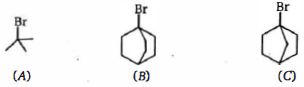
A
$(B) > (A) > (C)$
B
$(C) > (A) > (B)$
C
$(A) > (B) > (C)$
D
$(A) > (C) > (B)$
Solution
(C) The $S_{N}2$ reaction requires a backside attack by the nucleophile on the carbon atom bonded to the leaving group.
$(A)$ is $tert$-butyl bromide,which is a tertiary halide. While $S_{N}2$ is generally slow for tertiary halides due to steric hindrance,it is still more accessible than the bridgehead carbons in bicyclic systems.
$(B)$ is $1$-bromobicyclo$[2.2.2]$octane and $(C)$ is $1$-bromobicyclo$[2.2.1]$heptane. In these bicyclic compounds,the bridgehead carbon is extremely sterically hindered,and a backside attack is geometrically impossible because the rigid cage structure prevents the nucleophile from approaching the carbon from the opposite side of the $C-Br$ bond.
Furthermore,the transition state for an $S_{N}2$ reaction requires a planar arrangement of the bonds around the central carbon,which cannot be achieved in these rigid bicyclic systems.
Therefore,$(A)$ reacts the fastest,followed by $(B)$,and $(C)$ is the slowest due to the higher strain and rigidity of the $[2.2.1]$ system compared to the $[2.2.2]$ system.
Thus,the order of reactivity is $(A) > (B) > (C)$.
$(A)$ is $tert$-butyl bromide,which is a tertiary halide. While $S_{N}2$ is generally slow for tertiary halides due to steric hindrance,it is still more accessible than the bridgehead carbons in bicyclic systems.
$(B)$ is $1$-bromobicyclo$[2.2.2]$octane and $(C)$ is $1$-bromobicyclo$[2.2.1]$heptane. In these bicyclic compounds,the bridgehead carbon is extremely sterically hindered,and a backside attack is geometrically impossible because the rigid cage structure prevents the nucleophile from approaching the carbon from the opposite side of the $C-Br$ bond.
Furthermore,the transition state for an $S_{N}2$ reaction requires a planar arrangement of the bonds around the central carbon,which cannot be achieved in these rigid bicyclic systems.
Therefore,$(A)$ reacts the fastest,followed by $(B)$,and $(C)$ is the slowest due to the higher strain and rigidity of the $[2.2.1]$ system compared to the $[2.2.2]$ system.
Thus,the order of reactivity is $(A) > (B) > (C)$.
0 likes
View Solution510
MediumMCQ
$1,2-\text{dichloroethane} + NaSCH_2CH_2SNa \to C_4H_8S_2 + (P)$
Unknown product $(P)$ of the above reaction is
Unknown product $(P)$ of the above reaction is
A
$1,4-$dithiane
B
$1,4-$dithiacyclohexene
C
$HS^{-}CH_2-CH_2-S^{-}CH_2-CH_2-SH$
D
$HS^{-}CH_2-CH_2-SH$
Solution
(A) The reaction between $1,2-\text{dichloroethane}$ $(ClCH_2CH_2Cl)$ and disodium ethane$-1,2-$dithiolate $(NaSCH_2CH_2SNa)$ is a nucleophilic substitution reaction.
The sulfur atoms in the dithiolate act as nucleophiles and attack the carbon atoms of $1,2-\text{dichloroethane}$,displacing the chloride ions.
This leads to the formation of a six-membered heterocyclic ring known as $1,4-\text{dithiane}$ $(C_4H_8S_2)$ and the byproduct $2NaCl$.
The reaction is: $ClCH_2CH_2Cl + NaSCH_2CH_2SNa \to C_4H_8S_2 + 2NaCl$.
Thus,the product $(P)$ is $2NaCl$.
The sulfur atoms in the dithiolate act as nucleophiles and attack the carbon atoms of $1,2-\text{dichloroethane}$,displacing the chloride ions.
This leads to the formation of a six-membered heterocyclic ring known as $1,4-\text{dithiane}$ $(C_4H_8S_2)$ and the byproduct $2NaCl$.
The reaction is: $ClCH_2CH_2Cl + NaSCH_2CH_2SNa \to C_4H_8S_2 + 2NaCl$.
Thus,the product $(P)$ is $2NaCl$.
0 likes
View Solution511
MediumMCQ
The major product $(A)$ is:
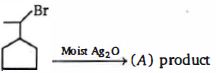
A
$1-$methylcyclopentanol
B
$1-$ethylcyclopentanol
C
$1-$methylcyclohexanol
D
$2-$methylcyclohexanol
Solution
(C) The reaction of $1$-bromo$-1-$cyclopentylethane with moist $Ag_2O$ proceeds via an $S_N1$ mechanism.
$1$. The leaving group $Br^-$ departs to form a secondary carbocation on the side chain.
$2$. This carbocation undergoes ring expansion from a five-membered ring to a more stable six-membered ring carbocation.
$3$. $A$ $1,2$-hydride shift occurs to form a more stable tertiary carbocation at the ring carbon.
$4$. Finally,the nucleophile $OH^-$ attacks the tertiary carbocation to form $1$-methylcyclohexanol as the major product.
$1$. The leaving group $Br^-$ departs to form a secondary carbocation on the side chain.
$2$. This carbocation undergoes ring expansion from a five-membered ring to a more stable six-membered ring carbocation.
$3$. $A$ $1,2$-hydride shift occurs to form a more stable tertiary carbocation at the ring carbon.
$4$. Finally,the nucleophile $OH^-$ attacks the tertiary carbocation to form $1$-methylcyclohexanol as the major product.
0 likes
View Solution512
MediumMCQ
The product of the reaction is:
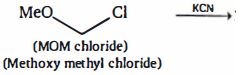
A
$MeO-CH_2-Cl + KCN \rightarrow ?$
B
$MeO-CH_2-CN$
C
$Me-O-CH_2-CH_2-CN$
D
$O(CN)_2$
Solution
(B) The reaction involves the nucleophilic substitution of the chlorine atom in methoxymethyl chloride $(MeO-CH_2-Cl)$ by the cyanide ion $(CN^-)$ from $KCN$.
This is a nucleophilic substitution reaction where the $CN^-$ ion attacks the electrophilic carbon atom attached to the chlorine,displacing the chloride ion.
The product formed is methoxyacetonitrile,which is $MeO-CH_2-CN$.
Therefore,the correct option is $(B)$.
This is a nucleophilic substitution reaction where the $CN^-$ ion attacks the electrophilic carbon atom attached to the chlorine,displacing the chloride ion.
The product formed is methoxyacetonitrile,which is $MeO-CH_2-CN$.
Therefore,the correct option is $(B)$.
0 likes
View Solution513
DifficultMCQ
In the given pair of compounds,in which pair is the second compound more reactive than the first toward $S_N2$ reaction?
A
$1-$Chlorobutane or $2-$chlorobutane
B
Cyclohexylmethyl chloride or chlorocyclohexane
C
$1-$Bromo$-2-$methylpropane or $1-$bromo$-2,2-$dimethylpropane
D
$2-$Chloro$-3,3-$dimethylbutane or $1-$chloro$-3,3-$dimethylbutane
Solution
(D) The reactivity of alkyl halides toward $S_N2$ reaction is primarily governed by steric hindrance. The $S_N2$ mechanism involves the nucleophilic attack from the backside of the carbon atom bonded to the leaving group. As the steric hindrance around the electrophilic carbon increases,the rate of $S_N2$ reaction decreases.
In option $D$,we compare $2$-chloro-$3,3$-dimethylbutane and $1$-chloro-$3,3$-dimethylbutane.
In $2$-chloro-$3,3$-dimethylbutane,the chlorine atom is attached to a secondary carbon,and there is significant branching at the $\beta$-position.
In $1$-chloro-$3,3$-dimethylbutane,the chlorine atom is attached to a primary carbon,and the branching is at the $\gamma$-position.
Since the steric hindrance at the $\alpha$-carbon is much lower in the primary halide ($1$-chloro-$3,3$-dimethylbutane) compared to the secondary halide ($2$-chloro-$3,3$-dimethylbutane),the second compound is more reactive toward $S_N2$ reaction.
In option $D$,we compare $2$-chloro-$3,3$-dimethylbutane and $1$-chloro-$3,3$-dimethylbutane.
In $2$-chloro-$3,3$-dimethylbutane,the chlorine atom is attached to a secondary carbon,and there is significant branching at the $\beta$-position.
In $1$-chloro-$3,3$-dimethylbutane,the chlorine atom is attached to a primary carbon,and the branching is at the $\gamma$-position.
Since the steric hindrance at the $\alpha$-carbon is much lower in the primary halide ($1$-chloro-$3,3$-dimethylbutane) compared to the secondary halide ($2$-chloro-$3,3$-dimethylbutane),the second compound is more reactive toward $S_N2$ reaction.
0 likes
View Solution514
MediumMCQ
Which compound might be synthesized by the $S_N2$ displacement of an alkyl-halide?
A
Cyclohexylmethanol
B
Ethyl cyclohexyl sulfide
C
$Me_3C-O-CH_3$
D
All of these
Solution
(D) The $S_N2$ mechanism involves a concerted nucleophilic substitution where a nucleophile attacks the electrophilic carbon of an alkyl halide,displacing the leaving group.
$(1)$ The conversion of cyclohexylmethyl chloride to cyclohexylmethanol using $NaOH$ in $DMSO$ is an $S_N2$ reaction.
$(2)$ The reaction of cyclohexyl iodide with $NaSEt$ in $DMSO$ to form ethyl cyclohexyl sulfide is an $S_N2$ reaction.
$(3)$ The Williamson ether synthesis,where $Me_3C-O^-Na^+$ reacts with $Me-I$ to form $Me_3C-O-CH_3$,is a classic $S_N2$ reaction involving a primary alkyl halide $(Me-I)$.
Since all three reactions proceed via the $S_N2$ mechanism,the correct answer is $(D)$.
$(1)$ The conversion of cyclohexylmethyl chloride to cyclohexylmethanol using $NaOH$ in $DMSO$ is an $S_N2$ reaction.
$(2)$ The reaction of cyclohexyl iodide with $NaSEt$ in $DMSO$ to form ethyl cyclohexyl sulfide is an $S_N2$ reaction.
$(3)$ The Williamson ether synthesis,where $Me_3C-O^-Na^+$ reacts with $Me-I$ to form $Me_3C-O-CH_3$,is a classic $S_N2$ reaction involving a primary alkyl halide $(Me-I)$.
Since all three reactions proceed via the $S_N2$ mechanism,the correct answer is $(D)$.
0 likes
View Solution515
MediumMCQ
Which reagents shown below would accomplish the following transformation?
$Isopropyl \ bromide \xrightarrow{1. A \ 2. B} Isopropyl \ alcohol$
$Isopropyl \ bromide \xrightarrow{1. A \ 2. B} Isopropyl \ alcohol$
A
$A = H_3O^{+}; B = BH_3-THF; H_2O_2/NaOH$
B
$A = NaOH; B = BH_3-THF; H_2O_2/NaOH$
C
$A = HBr \ \text{in ether}; B = Hg(OAc)_2/H_2O; NaBH_4$
D
$A = NaNH_2; B = Hg(OAc)_2/H_2O; NaBH_4$
Solution
(D) The transformation involves converting $2-bromopropane$ to $propan-2-ol$.
Step $1$: Elimination of $HBr$ from $2-bromopropane$ using a strong base like $NaNH_2$ yields $propene$ $(CH_3-CH=CH_2)$ via an $E_2$ mechanism.
Step $2$: Oxymercuration-demercuration $(Hg(OAc)_2/H_2O; NaBH_4)$ of $propene$ results in the Markovnikov addition of water to form $propan-2-ol$.
Thus,the correct reagents are $A = NaNH_2$ and $B = Hg(OAc)_2/H_2O; NaBH_4$.
Step $1$: Elimination of $HBr$ from $2-bromopropane$ using a strong base like $NaNH_2$ yields $propene$ $(CH_3-CH=CH_2)$ via an $E_2$ mechanism.
Step $2$: Oxymercuration-demercuration $(Hg(OAc)_2/H_2O; NaBH_4)$ of $propene$ results in the Markovnikov addition of water to form $propan-2-ol$.
Thus,the correct reagents are $A = NaNH_2$ and $B = Hg(OAc)_2/H_2O; NaBH_4$.
0 likes
View Solution516
MediumMCQ
What are the products obtained from the following reaction?
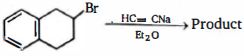
A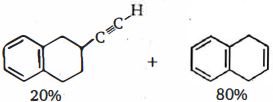
B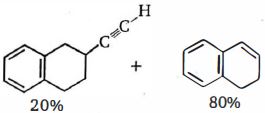
C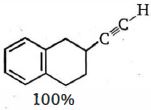
D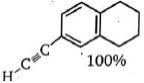
Solution
(B) The reaction involves a secondary alkyl halide reacting with a strong,bulky base,$HC \equiv C^-Na^+$,in diethyl ether $(Et_2O)$.
Since the reagent is a strong base,the elimination reaction $(E2)$ is more favorable than the substitution reaction $(S_N2)$.
The elimination product is $1,2-dihydronaphthalene$ (or similar alkene derivative),and the substitution product is the alkynyl derivative.
Based on the reaction conditions,the elimination product is the major product $(80\%)$ and the substitution product is the minor product $(20\%)$.
Comparing the structures,option $B$ correctly represents the $20\%$ substitution product and $80\%$ elimination product.
Since the reagent is a strong base,the elimination reaction $(E2)$ is more favorable than the substitution reaction $(S_N2)$.
The elimination product is $1,2-dihydronaphthalene$ (or similar alkene derivative),and the substitution product is the alkynyl derivative.
Based on the reaction conditions,the elimination product is the major product $(80\%)$ and the substitution product is the minor product $(20\%)$.
Comparing the structures,option $B$ correctly represents the $20\%$ substitution product and $80\%$ elimination product.
0 likes
View Solution517
MediumMCQ
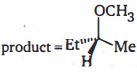
The back-side attack on $2$-bromobutane by methoxide $(CH_3O^{-})$ gives the product shown below. Which Fischer projection represents $2$-bromobutane used as the reactant in this reaction?
A
B
C
D
Solution
(D) $S_N2$ reactions proceed with inversion of configuration (Walden inversion).
In the given product,the methoxy group $(OCH_3)$ is attached to the chiral center.
To obtain this product via an $S_N2$ mechanism,the nucleophile $(CH_3O^{-})$ must attack from the side opposite to the leaving group $(Br^{-})$.
Looking at the provided product structure,the reactant $2$-bromobutane must have the bromine atom positioned such that the incoming methoxide group results in the observed stereochemistry.
Based on the $S_N2$ inversion,the reactant $2$-bromobutane is represented by the Fischer projection where $Br$ is at the top,$Et$ is at the bottom,$Me$ is on the left,and $H$ is on the right.
This corresponds to option $D$.
In the given product,the methoxy group $(OCH_3)$ is attached to the chiral center.
To obtain this product via an $S_N2$ mechanism,the nucleophile $(CH_3O^{-})$ must attack from the side opposite to the leaving group $(Br^{-})$.
Looking at the provided product structure,the reactant $2$-bromobutane must have the bromine atom positioned such that the incoming methoxide group results in the observed stereochemistry.
Based on the $S_N2$ inversion,the reactant $2$-bromobutane is represented by the Fischer projection where $Br$ is at the top,$Et$ is at the bottom,$Me$ is on the left,and $H$ is on the right.
This corresponds to option $D$.
0 likes
View Solution518
AdvancedMCQ
In solvolysis of $1,2$-dimethylpropyl $p$-toluenesulfonate in acetic acid at $75\,^oC$,how many (alkene + substitution) products will be formed?
A
$2$
B
$3$
C
$4$
D
$5$
Solution
(D) The solvolysis of $1,2$-dimethylpropyl $p$-toluenesulfonate in acetic acid proceeds via an $S_N1$ mechanism involving the formation of a carbocation intermediate.
$1$. The initial carbocation formed is a secondary carbocation: $(CH_3)_2CH-CH^+-CH_3$.
$2$. This secondary carbocation can undergo elimination to form two alkenes: $2,3$-dimethylbut-$2$-ene and $2,3$-dimethylbut-$1$-ene.
$3$. The secondary carbocation can also undergo substitution with acetic acid to form $1,2$-dimethylpropyl acetate (as a racemic mixture of $d$ and $l$ isomers).
$4$. Additionally,the secondary carbocation can undergo a $1,2$-hydride shift to form a more stable tertiary carbocation: $(CH_3)_2C^+-CH_2CH_3$.
$5$. This tertiary carbocation undergoes substitution with acetic acid to form $2$-methylbutan-$2$-yl acetate.
$6$. Total products = $2$ (alkenes) + $2$ (substitution from secondary carbocation) + $1$ (substitution from tertiary carbocation) = $5$ products.
$1$. The initial carbocation formed is a secondary carbocation: $(CH_3)_2CH-CH^+-CH_3$.
$2$. This secondary carbocation can undergo elimination to form two alkenes: $2,3$-dimethylbut-$2$-ene and $2,3$-dimethylbut-$1$-ene.
$3$. The secondary carbocation can also undergo substitution with acetic acid to form $1,2$-dimethylpropyl acetate (as a racemic mixture of $d$ and $l$ isomers).
$4$. Additionally,the secondary carbocation can undergo a $1,2$-hydride shift to form a more stable tertiary carbocation: $(CH_3)_2C^+-CH_2CH_3$.
$5$. This tertiary carbocation undergoes substitution with acetic acid to form $2$-methylbutan-$2$-yl acetate.
$6$. Total products = $2$ (alkenes) + $2$ (substitution from secondary carbocation) + $1$ (substitution from tertiary carbocation) = $5$ products.
0 likes
View Solution519
MediumMCQ
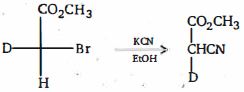
The configurations of the reactant and the product in the following reaction,respectively,are:
A
$S, S$
B
$S, R$
C
$R, S$
D
$R, R$
Solution
(A) The reaction is an $S_N2$ reaction,which proceeds with inversion of configuration at the chiral center.
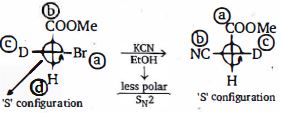
For the reactant: The priorities of the groups attached to the chiral carbon are: $1: -Br$,$2: -CO_2CH_3$,$3: -D$,$4: -H$. Since the lowest priority group $(-H)$ is on a vertical bond,the clockwise sequence $1$ $\rightarrow 2$ $\rightarrow 3$ corresponds to the $S$ configuration.
For the product: The $-CN$ group replaces $-Br$. The priorities are: $1: -CN$,$2: -CO_2CH_3$,$3: -D$,$4: -H$. The lowest priority group $(-H)$ is on a vertical bond. The clockwise sequence $1$ $\rightarrow 2$ $\rightarrow 3$ corresponds to the $S$ configuration.
Thus,both the reactant and the product have the $S$ configuration.
For the reactant: The priorities of the groups attached to the chiral carbon are: $1: -Br$,$2: -CO_2CH_3$,$3: -D$,$4: -H$. Since the lowest priority group $(-H)$ is on a vertical bond,the clockwise sequence $1$ $\rightarrow 2$ $\rightarrow 3$ corresponds to the $S$ configuration.
For the product: The $-CN$ group replaces $-Br$. The priorities are: $1: -CN$,$2: -CO_2CH_3$,$3: -D$,$4: -H$. The lowest priority group $(-H)$ is on a vertical bond. The clockwise sequence $1$ $\rightarrow 2$ $\rightarrow 3$ corresponds to the $S$ configuration.
Thus,both the reactant and the product have the $S$ configuration.
0 likes
View Solution520
DifficultMCQ
$1,4$-dichlorohexane $(1 \ mole)$ + $NaI$ $(1 \ mole)$ $\xrightarrow{Acetone}$ Product of the reaction is
A
$Cl-CH_2-CH_2-CH_2-CH(Cl)-CH_2-CH_3$ (Incorrect structure)
B
$I-CH_2-CH_2-CH_2-CH(Cl)-CH_2-CH_3$
C
$Cl-CH_2-CH_2-CH_2-CH(I)-CH_2-CH_3$
D
$I-CH_2-CH_2-CH_2-CH(I)-CH_2-CH_3$
Solution
(B) The reaction is a Finkelstein reaction,which proceeds via an $S_N2$ mechanism.
In $1,4$-dichlorohexane,there are two chlorine atoms: one at the $C1$ position (primary,$1^{\circ}$) and one at the $C4$ position (secondary,$2^{\circ}$).
$S_N2$ reactions are faster at less sterically hindered positions. Therefore,the primary $(1^{\circ})$ chloride is more reactive towards $S_N2$ substitution than the secondary $(2^{\circ})$ chloride.
With $1 \ mole$ of $NaI$,the substitution occurs selectively at the $C1$ position.
The product is $1$-iodo-$4$-chlorohexane,which is $I-CH_2-CH_2-CH_2-CH(Cl)-CH_2-CH_3$.
In $1,4$-dichlorohexane,there are two chlorine atoms: one at the $C1$ position (primary,$1^{\circ}$) and one at the $C4$ position (secondary,$2^{\circ}$).
$S_N2$ reactions are faster at less sterically hindered positions. Therefore,the primary $(1^{\circ})$ chloride is more reactive towards $S_N2$ substitution than the secondary $(2^{\circ})$ chloride.
With $1 \ mole$ of $NaI$,the substitution occurs selectively at the $C1$ position.
The product is $1$-iodo-$4$-chlorohexane,which is $I-CH_2-CH_2-CH_2-CH(Cl)-CH_2-CH_3$.
0 likes
View Solution521
EasyMCQ
Which alkyl halide has maximum density?
A
$C_3H_7I$
B
$C_2H_5I$
C
$CH_3I$
D
$CH_3Br$
Solution
(A) Density of alkyl halides generally increases with an increase in the number of carbon atoms and the atomic mass of the halogen atom.
Since all the given options contain iodine except $CH_3Br$,we compare the molecular masses of the alkyl iodides.
$C_3H_7I$ has the highest molecular mass among the given options.
Therefore,$C_3H_7I$ has the maximum density.
Since all the given options contain iodine except $CH_3Br$,we compare the molecular masses of the alkyl iodides.
$C_3H_7I$ has the highest molecular mass among the given options.
Therefore,$C_3H_7I$ has the maximum density.
0 likes
View Solution522
MediumMCQ
Which of the following molecules would have a carbon-halogen bond most susceptible to nucleophilic substitution?
A
$2$-fluorobutane
B
$2$-chlorobutane
C
$2$-bromobutane
D
$2$-iodobutane
Solution
(D) The susceptibility of a carbon-halogen bond to nucleophilic substitution depends on the strength of the $C-X$ bond.
As the size of the halogen atom increases down the group $(F < Cl < Br < I)$,the bond length increases and the bond dissociation energy decreases.
Therefore,the $C-I$ bond is the weakest and most easily broken,making it the most reactive towards nucleophilic substitution.
The decreasing order of reactivity is: $2$-iodobutane > $2$-bromobutane > $2$-chlorobutane > $2$-fluorobutane.
Thus,$2$-iodobutane is the most susceptible to nucleophilic substitution.
As the size of the halogen atom increases down the group $(F < Cl < Br < I)$,the bond length increases and the bond dissociation energy decreases.
Therefore,the $C-I$ bond is the weakest and most easily broken,making it the most reactive towards nucleophilic substitution.
The decreasing order of reactivity is: $2$-iodobutane > $2$-bromobutane > $2$-chlorobutane > $2$-fluorobutane.
Thus,$2$-iodobutane is the most susceptible to nucleophilic substitution.
0 likes
View Solution523
MediumMCQ
When benzyl chloride is treated with ethanolic $KCN$,the major product formed is
A
benzyl ethyl ether
B
benzyl alcohol
C
benzyl cyanide
D
benzyl isocyanide
Solution
(C) Benzyl chloride $(Ph-CH_2-Cl)$ reacts with ethanolic $KCN$ via a nucleophilic substitution reaction $(S_N2)$.
Since $KCN$ is an ionic compound,it provides $CN^-$ ions in solution.
The cyanide ion $(CN^-)$ acts as an ambident nucleophile and attacks the carbon atom of the $CH_2-Cl$ group,displacing the chloride ion.
The major product formed is benzyl cyanide $(Ph-CH_2-CN)$.
Since $KCN$ is an ionic compound,it provides $CN^-$ ions in solution.
The cyanide ion $(CN^-)$ acts as an ambident nucleophile and attacks the carbon atom of the $CH_2-Cl$ group,displacing the chloride ion.
The major product formed is benzyl cyanide $(Ph-CH_2-CN)$.
0 likes
View Solution524
MediumMCQ
Which of the following is most reactive towards nucleophilic substitution reaction?
A
$CH_2=CHCl$
B
$C_6H_5Cl$
C
$CH_3CH=CHCl$
D
$ClCH_2-CH=CH_2$
Solution
(D) The reactivity towards nucleophilic substitution depends on the stability of the carbocation formed or the ease of leaving group departure.
In $CH_2=CHCl$,$C_6H_5Cl$,and $CH_3CH=CHCl$,the $C-Cl$ bond has partial double bond character due to resonance,making them less reactive.
In $ClCH_2-CH=CH_2$ (allyl chloride),the carbocation formed after the departure of $Cl^-$ is resonance stabilized $(CH_2=CH-CH_2^+)$,making it highly reactive towards $S_N1$ reactions.
Additionally,it is a primary alkyl halide with an allylic position,which is very reactive towards $S_N2$ reactions due to the stabilization of the transition state by the adjacent $\pi$-bond.
In $CH_2=CHCl$,$C_6H_5Cl$,and $CH_3CH=CHCl$,the $C-Cl$ bond has partial double bond character due to resonance,making them less reactive.
In $ClCH_2-CH=CH_2$ (allyl chloride),the carbocation formed after the departure of $Cl^-$ is resonance stabilized $(CH_2=CH-CH_2^+)$,making it highly reactive towards $S_N1$ reactions.
Additionally,it is a primary alkyl halide with an allylic position,which is very reactive towards $S_N2$ reactions due to the stabilization of the transition state by the adjacent $\pi$-bond.
0 likes
View Solution525
MediumMCQ
Which of the following,when undergoing addition of $HBr$,will form $ONLY$ a pair of diastereomers?
A
Vinylcyclohexane
B
$3-$chloro$-2-$methylpent$-2-$ene
C
$3-$hydroxy$-2-$methylpent$-2-$ene
D
$3,3-$dimethylpent$-1-$ene
Solution
(B) The addition of $HBr$ to an alkene involves the formation of a carbocation intermediate.
If the reactant already contains a chiral center,the addition of $HBr$ across the double bond creates a new chiral center.
Since the existing chiral center remains unchanged,the product will exist as a pair of diastereomers (one with the new center as $R$ and one as $S$,while the original center remains fixed).
Among the options,$3$-chloro-$2$-methylpent-$2$-ene (option $B$) and $3$-hydroxy-$2$-methylpent-$2$-ene (option $C$) contain a chiral center at the $C3$ position.
However,in the context of standard chemistry problems of this type,the molecule that forms a pair of diastereomers upon addition of $HBr$ is typically the one where the existing chiral center is adjacent to the reaction site,such as in $3$-chloro-$2$-methylpent-$2$-ene.
If the reactant already contains a chiral center,the addition of $HBr$ across the double bond creates a new chiral center.
Since the existing chiral center remains unchanged,the product will exist as a pair of diastereomers (one with the new center as $R$ and one as $S$,while the original center remains fixed).
Among the options,$3$-chloro-$2$-methylpent-$2$-ene (option $B$) and $3$-hydroxy-$2$-methylpent-$2$-ene (option $C$) contain a chiral center at the $C3$ position.
However,in the context of standard chemistry problems of this type,the molecule that forms a pair of diastereomers upon addition of $HBr$ is typically the one where the existing chiral center is adjacent to the reaction site,such as in $3$-chloro-$2$-methylpent-$2$-ene.
0 likes
View Solution526
MediumMCQ
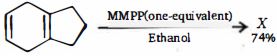
$MMPP \to$ Magnesium monoperoxyphthalate. Product $(X)$ is
A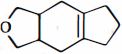
B
C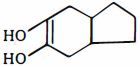
D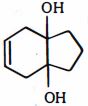
Solution
(B) $MMPP$ (Magnesium monoperoxyphthalate) is a peroxyacid that acts as an electrophilic epoxidizing agent.
It reacts with alkenes to form epoxides.
When a molecule has multiple double bonds,the peroxyacid preferentially attacks the more electron-rich (more substituted) double bond because the transition state leading to the more substituted epoxide is more stable.
In the given substrate,the internal double bond is more substituted than the terminal-like double bond,so the epoxide forms at the more substituted site.
It reacts with alkenes to form epoxides.
When a molecule has multiple double bonds,the peroxyacid preferentially attacks the more electron-rich (more substituted) double bond because the transition state leading to the more substituted epoxide is more stable.
In the given substrate,the internal double bond is more substituted than the terminal-like double bond,so the epoxide forms at the more substituted site.
0 likes
View Solution527
MediumMCQ
Consider the reaction: $1$-methylcyclopentene $+ HBr \xrightarrow{CCl_4} \text{Product}$. Comment upon the optical activity of the product.
A
Racemic mixture
B
Diastereomers
C
Meso
D
Optically inactive due to absence of chiral center
Solution
(A) The reaction of $1$-methylcyclopentene with $HBr$ in $CCl_4$ proceeds via the formation of a tertiary carbocation intermediate at the $C_1$ position.
When the bromide ion $(Br^-)$ attacks the planar carbocation,it can approach from either the top or bottom face with equal probability.
This leads to the formation of $1$-bromo-$1$-methylcyclopentane.
In this product,the carbon atom at position $1$ is bonded to a methyl group,a bromine atom,and two different paths around the cyclopentane ring,making it a chiral center.
Since both enantiomers are formed in equal amounts,the resulting product is a racemic mixture,which is optically inactive.
When the bromide ion $(Br^-)$ attacks the planar carbocation,it can approach from either the top or bottom face with equal probability.
This leads to the formation of $1$-bromo-$1$-methylcyclopentane.
In this product,the carbon atom at position $1$ is bonded to a methyl group,a bromine atom,and two different paths around the cyclopentane ring,making it a chiral center.
Since both enantiomers are formed in equal amounts,the resulting product is a racemic mixture,which is optically inactive.
0 likes
View Solution528
MediumMCQ
In solvolysis of $1,2$-dimethylpropyl $p$-toluenesulfonate in acetic acid at $75^\circ C$,(alkene + substitution products) will be formed by which mechanism?
A
$S_N2, E_2$
B
$S_N2, E_1$
C
$S_N1, E_2$
D
$S_N1, E_1$
Solution
(D) The solvolysis of a secondary substrate like $1,2$-dimethylpropyl $p$-toluenesulfonate in a polar protic solvent such as acetic acid proceeds via the formation of a carbocation intermediate.
Since the solvent is polar protic and the substrate is secondary,the rate-determining step is the ionization of the leaving group ($p$-toluenesulfonate) to form a carbocation.
This carbocation intermediate can then undergo nucleophilic attack by the solvent to form substitution products $(S_N1)$ or lose a proton to form alkenes $(E_1)$.
Both processes follow unimolecular kinetics,hence the mechanism is $S_N1$ and $E_1$.
Since the solvent is polar protic and the substrate is secondary,the rate-determining step is the ionization of the leaving group ($p$-toluenesulfonate) to form a carbocation.
This carbocation intermediate can then undergo nucleophilic attack by the solvent to form substitution products $(S_N1)$ or lose a proton to form alkenes $(E_1)$.
Both processes follow unimolecular kinetics,hence the mechanism is $S_N1$ and $E_1$.
0 likes
View Solution529
MediumMCQ
Which describes the best stereochemical aspects of the following reaction?
$Ph-C(CH_3)(CD_3)(OH) + HBr \rightarrow \text{Product}$
$Ph-C(CH_3)(CD_3)(OH) + HBr \rightarrow \text{Product}$
A
Inversion of configuration occurs at the carbon undergoing substitution
B
Retention of configuration occurs at the carbon undergoing substitution.
C
Racemization (loss of configuration) occurs at the carbon undergoing substitution
D
The carbon undergoing substitution is not stereogenic
Solution
(C) The reaction of a tertiary alcohol with $HBr$ proceeds via an $S_N1$ mechanism.
$1$. The hydroxyl group is protonated to form a good leaving group $(-OH_2^+)$.
$2$. The leaving group departs to form a stable carbocation intermediate $(Ph-C^+(CH_3)(CD_3))$.
$3$. This carbocation is planar (sp$^2$ hybridized).
$4$. The nucleophile $(Br^-)$ can attack the planar carbocation from either side with equal probability,leading to the formation of both enantiomers.
$5$. Therefore,racemization occurs at the chiral center.
$1$. The hydroxyl group is protonated to form a good leaving group $(-OH_2^+)$.
$2$. The leaving group departs to form a stable carbocation intermediate $(Ph-C^+(CH_3)(CD_3))$.
$3$. This carbocation is planar (sp$^2$ hybridized).
$4$. The nucleophile $(Br^-)$ can attack the planar carbocation from either side with equal probability,leading to the formation of both enantiomers.
$5$. Therefore,racemization occurs at the chiral center.
0 likes
View Solution530
MediumMCQ
Reaction of $(R)-2$-butanol with $p$-toluenesulphonyl chloride in pyridine followed by $LiBr$ gives:
A
$(R)-2$-butyl bromide
B
$(S)-2$-butyl tosylate
C
$(R)-2$-butyl tosylate
D
$(S)-2$-butyl bromide
Solution
(D) The reaction proceeds in two steps:
$1$. Reaction of $(R)-2$-butanol with $p$-toluenesulphonyl chloride $(TsCl)$ in pyridine forms $(R)-2$-butyl tosylate. This step involves the breaking of the $O-H$ bond,not the $C-O$ bond,so the configuration at the chiral center is retained.
$2$. The subsequent reaction of $(R)-2$-butyl tosylate with $LiBr$ is an $S_N2$ reaction. The $Br^-$ ion attacks the chiral carbon from the side opposite to the tosylate group,leading to an inversion of configuration.
Therefore,the final product is $(S)-2$-butyl bromide.
$1$. Reaction of $(R)-2$-butanol with $p$-toluenesulphonyl chloride $(TsCl)$ in pyridine forms $(R)-2$-butyl tosylate. This step involves the breaking of the $O-H$ bond,not the $C-O$ bond,so the configuration at the chiral center is retained.
$2$. The subsequent reaction of $(R)-2$-butyl tosylate with $LiBr$ is an $S_N2$ reaction. The $Br^-$ ion attacks the chiral carbon from the side opposite to the tosylate group,leading to an inversion of configuration.
Therefore,the final product is $(S)-2$-butyl bromide.
0 likes
View Solution531
MediumMCQ
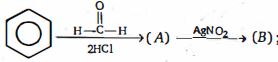
The product $(B)$ of the reaction is:
A
$Ph-CH_2-NO_2$
B
$Ph-CH_2-ONO$
C
$Ph-CHO$
D
$Ph-O-N=O$
Solution
(A) The reaction proceeds in two steps:
$1$. Benzene reacts with formaldehyde $(HCHO)$ and $HCl$ to undergo chloromethylation,forming benzyl chloride $(Ph-CH_2-Cl)$ as product $(A)$.
$2$. Benzyl chloride $(Ph-CH_2-Cl)$ then reacts with silver nitrite $(AgNO_2)$. Since $AgNO_2$ is a covalent compound,the nitrogen atom acts as the nucleophile,leading to the formation of nitrobenzene derivative,phenylnitromethane $(Ph-CH_2-NO_2)$,as the major product $(B)$.
$1$. Benzene reacts with formaldehyde $(HCHO)$ and $HCl$ to undergo chloromethylation,forming benzyl chloride $(Ph-CH_2-Cl)$ as product $(A)$.
$2$. Benzyl chloride $(Ph-CH_2-Cl)$ then reacts with silver nitrite $(AgNO_2)$. Since $AgNO_2$ is a covalent compound,the nitrogen atom acts as the nucleophile,leading to the formation of nitrobenzene derivative,phenylnitromethane $(Ph-CH_2-NO_2)$,as the major product $(B)$.
0 likes
View Solution532
MediumMCQ
The order of $S_{N^1}$ reactivity in aqueous acetic acid solution for the compounds:
$(1)$ $CH_3-CO-CH_2-Cl$
$(2)$ $CH_3-CH_2-CH_2-Cl$
$(3)$ $(CH_3)_3C-Cl$
$(1)$ $CH_3-CO-CH_2-Cl$
$(2)$ $CH_3-CH_2-CH_2-Cl$
$(3)$ $(CH_3)_3C-Cl$
A
$1 > 2 > 3$
B
$1 > 3 > 2$
C
$3 > 2 > 1$
D
$3 > 1 > 2$
Solution
(C) $S_{N^1}$ reactivity depends on the stability of the carbocation intermediate formed after the departure of the leaving group $(Cl^-)$.
$(1)$ $CH_3-CO-CH_2-Cl$ forms $CH_3-CO-CH_2^+$,which is destabilized by the electron-withdrawing carbonyl group ($-I$ effect).
$(2)$ $CH_3-CH_2-CH_2-Cl$ forms a primary carbocation $(CH_3-CH_2-CH_2^+)$,which is unstable.
$(3)$ $(CH_3)_3C-Cl$ forms a tertiary carbocation $((CH_3)_3C^+)$,which is highly stable due to hyperconjugation and inductive effects.
Comparing the stability: $(3)$ (tertiary) is the most stable. Between $(1)$ and $(2)$,$(2)$ is more stable than $(1)$ because the carbonyl group in $(1)$ strongly destabilizes the adjacent positive charge. Thus,the order is $3 > 2 > 1$.
$(1)$ $CH_3-CO-CH_2-Cl$ forms $CH_3-CO-CH_2^+$,which is destabilized by the electron-withdrawing carbonyl group ($-I$ effect).
$(2)$ $CH_3-CH_2-CH_2-Cl$ forms a primary carbocation $(CH_3-CH_2-CH_2^+)$,which is unstable.
$(3)$ $(CH_3)_3C-Cl$ forms a tertiary carbocation $((CH_3)_3C^+)$,which is highly stable due to hyperconjugation and inductive effects.
Comparing the stability: $(3)$ (tertiary) is the most stable. Between $(1)$ and $(2)$,$(2)$ is more stable than $(1)$ because the carbonyl group in $(1)$ strongly destabilizes the adjacent positive charge. Thus,the order is $3 > 2 > 1$.
0 likes
View Solution533
DifficultMCQ
Which one of the following is the best catalyst for the reaction shown below?
$CH_3(CH_2)_8CH_2Br \xrightarrow[benzene]{KCN} CH_3(CH_2)_8CH_2CN$
$CH_3(CH_2)_8CH_2Br \xrightarrow[benzene]{KCN} CH_3(CH_2)_8CH_2CN$
A
$C_6H_5CH_2Cl$
B
$C_6H_5NH_2$
C
$C_6H_5CH_2N^+(CH_3)_3Cl^-$
D
$C_6H_5NHCOCH_3$
Solution
(C) The reaction involves the nucleophilic substitution of a primary alkyl bromide with $CN^-$ in a non-polar solvent (benzene).
Since $KCN$ is ionic and insoluble in non-polar solvents like benzene,a phase transfer catalyst is required to transport the $CN^-$ ion into the organic phase.
Quaternary ammonium salts,such as benzyltrimethylammonium chloride $(C_6H_5CH_2N^+(CH_3)_3Cl^-)$,act as effective phase transfer catalysts because they have both a lipophilic part (to dissolve in benzene) and a cationic part (to associate with the $CN^-$ anion).
Therefore,option $C$ is the correct catalyst.
Since $KCN$ is ionic and insoluble in non-polar solvents like benzene,a phase transfer catalyst is required to transport the $CN^-$ ion into the organic phase.
Quaternary ammonium salts,such as benzyltrimethylammonium chloride $(C_6H_5CH_2N^+(CH_3)_3Cl^-)$,act as effective phase transfer catalysts because they have both a lipophilic part (to dissolve in benzene) and a cationic part (to associate with the $CN^-$ anion).
Therefore,option $C$ is the correct catalyst.
0 likes
View Solution534
DifficultMCQ
The product obtained from the reaction is:

A
$Br-C_6H_4-CH_2CN$
B
$Br-C_6H_4-CH_2Cl$
C
$NC-C_6H_4-CH_2CN$
D
$Br-C_6H_3(CN)-CH_2Cl$
Solution
(A) The reaction involves $p$-bromobenzyl chloride reacting with $NaCN$ in ethanol.
$NaCN$ is a nucleophile that undergoes a nucleophilic substitution reaction $(S_N2)$ with the primary alkyl halide group $(-CH_2Cl)$.
The aryl bromide ($-Br$ attached directly to the benzene ring) is much less reactive towards nucleophilic substitution due to the partial double bond character of the $C-Br$ bond and the electron-rich nature of the benzene ring.
Therefore,the $-Cl$ atom is replaced by the $-CN$ group,while the $-Br$ atom remains unaffected.
The product is $p$-bromophenylacetonitrile $(Br-C_6H_4-CH_2CN)$.
$NaCN$ is a nucleophile that undergoes a nucleophilic substitution reaction $(S_N2)$ with the primary alkyl halide group $(-CH_2Cl)$.
The aryl bromide ($-Br$ attached directly to the benzene ring) is much less reactive towards nucleophilic substitution due to the partial double bond character of the $C-Br$ bond and the electron-rich nature of the benzene ring.
Therefore,the $-Cl$ atom is replaced by the $-CN$ group,while the $-Br$ atom remains unaffected.
The product is $p$-bromophenylacetonitrile $(Br-C_6H_4-CH_2CN)$.
0 likes
View Solution535
DifficultMCQ
Identify the compound $(C)$ in the following reaction sequence:
$\gamma$-butyrolactone $\xrightarrow[(ii) SOCl_2]{(i) HCl} (A)$ $\xrightarrow[AlCl_3]{Ph-H} (B)$ $\xrightarrow{KOH/MeOH} (C)$
$\gamma$-butyrolactone $\xrightarrow[(ii) SOCl_2]{(i) HCl} (A)$ $\xrightarrow[AlCl_3]{Ph-H} (B)$ $\xrightarrow{KOH/MeOH} (C)$
A
$Cl-CH_2-CH_2-CH_2-CO-Cl$
B
$Ph-CO-CH=CH-CH_3$
C
Cyclopropyl phenyl ketone
D
$Ph-CO-CH_2-CH_2-CH_3$
Solution
(C) $1$. The reaction of $\gamma$-butyrolactone with $HCl$ followed by $SOCl_2$ results in the ring opening to form $4-$chlorobutanoyl chloride,$(A) = Cl-CH_2-CH_2-CH_2-COCl$.
$2$. Friedel-Crafts acylation of benzene $(Ph-H)$ with $(A)$ in the presence of $AlCl_3$ yields $4-$chlorobutyrophenone,$(B) = Ph-CO-CH_2-CH_2-CH_2-Cl$.
$3$. Treatment of $(B)$ with $KOH/MeOH$ leads to an intramolecular nucleophilic substitution reaction. The base abstracts an $\alpha$-proton to form an enolate,which then attacks the carbon bearing the chlorine atom,resulting in the formation of a cyclopropyl ring via Neighboring Group Participation $(NGP)$.
$4$. The final product $(C)$ is cyclopropyl phenyl ketone.
$2$. Friedel-Crafts acylation of benzene $(Ph-H)$ with $(A)$ in the presence of $AlCl_3$ yields $4-$chlorobutyrophenone,$(B) = Ph-CO-CH_2-CH_2-CH_2-Cl$.
$3$. Treatment of $(B)$ with $KOH/MeOH$ leads to an intramolecular nucleophilic substitution reaction. The base abstracts an $\alpha$-proton to form an enolate,which then attacks the carbon bearing the chlorine atom,resulting in the formation of a cyclopropyl ring via Neighboring Group Participation $(NGP)$.
$4$. The final product $(C)$ is cyclopropyl phenyl ketone.
0 likes
View Solution536
DifficultMCQ
Which of the following procedures would be best for achieving the following reaction?

A
$i.$ $KOH$ and heat; $ii.$ $CH_3C\equiv C^{-}Br$
B
$i.$ $KMnO_4$ and heat; $ii.$ $CH_3C\equiv C^{(-)}Na^{(+)}$; $iii.$ excess $H_2O$
C
$i.$ $NBS$ in $CCl_4$ and heat; $ii.$ $CH_3C\equiv C^{(-)}Na^{(+)}$
D
$i.$ $Mg$ in ether; $ii.$ $CH_3C\equiv CBr$; $iii.$ excess $H_3PO_4$
Solution
(C) The reaction involves the substitution of the benzylic hydrogen with an alkyne group.
Step $1$: $NBS$ ($N$-Bromosuccinimide) in $CCl_4$ with heat is a standard reagent for free-radical benzylic bromination of $4$-bromotoluene to form $4$-bromobenzyl bromide.
Step $2$: The resulting benzylic bromide is a primary alkyl halide,which undergoes an $S_N2$ reaction with a strong nucleophile like the sodium salt of propyne $(CH_3C\equiv C^{(-)}Na^{(+)})$ to yield the desired product.
Thus,option $C$ is the correct procedure.
Step $1$: $NBS$ ($N$-Bromosuccinimide) in $CCl_4$ with heat is a standard reagent for free-radical benzylic bromination of $4$-bromotoluene to form $4$-bromobenzyl bromide.
Step $2$: The resulting benzylic bromide is a primary alkyl halide,which undergoes an $S_N2$ reaction with a strong nucleophile like the sodium salt of propyne $(CH_3C\equiv C^{(-)}Na^{(+)})$ to yield the desired product.
Thus,option $C$ is the correct procedure.
0 likes
View Solution537
DifficultMCQ
Which of the following will most readily give the dehydrohalogenation product?
A
$3-$bromo$-1-$phenyl$-1,3-$butadiene
B
$3-$bromo$-1,3-$pentadiene
C
$1-$bromocyclohexene
D
Bromobenzene
Solution
(A) Dehydrohalogenation in these systems often proceeds via an $E1cB$ mechanism,where the rate-determining step is the formation of a carbanion intermediate.
The stability of the resulting carbanion determines the ease of the reaction.
In option $(A)$,the structure is $CH_2=CH-CH(Br)-CH=CH-Ph$. Upon removal of the proton at the $C3$ position,the resulting carbanion is stabilized by resonance with both the adjacent vinyl group and the phenyl ring $(Ph)$.
This extensive conjugation makes the carbanion in $(A)$ the most stable among the given choices,thus making it the most reactive towards dehydrohalogenation.
The stability of the resulting carbanion determines the ease of the reaction.
In option $(A)$,the structure is $CH_2=CH-CH(Br)-CH=CH-Ph$. Upon removal of the proton at the $C3$ position,the resulting carbanion is stabilized by resonance with both the adjacent vinyl group and the phenyl ring $(Ph)$.
This extensive conjugation makes the carbanion in $(A)$ the most stable among the given choices,thus making it the most reactive towards dehydrohalogenation.
0 likes
View Solution538
DifficultMCQ
The total number of optically active compounds formed in the following reaction is
$CH_3CH_2C(CH_3)=CHOCH(CH_3)_2$ $\xrightarrow{HBr}$
$CH_3CH_2C(CH_3)=CHOCH(CH_3)_2$ $\xrightarrow{HBr}$
A
$0$
B
$6$
C
$4$
D
$2$
Solution
(C) The reaction of the given vinyl ether with $HBr$ involves the protonation of the double bond followed by the nucleophilic attack of $Br^-$ to form a bromo-ether product.
The product formed has two chiral centers.
For a molecule with $n$ chiral centers,the maximum number of stereoisomers is $2^n$.
Here,$n = 2$,so there are $2^2 = 4$ stereoisomers.
Since all four stereoisomers are chiral (optically active),the total number of optically active compounds formed is $4$.
The product formed has two chiral centers.
For a molecule with $n$ chiral centers,the maximum number of stereoisomers is $2^n$.
Here,$n = 2$,so there are $2^2 = 4$ stereoisomers.
Since all four stereoisomers are chiral (optically active),the total number of optically active compounds formed is $4$.
0 likes
View Solution539
DifficultMCQ
The major product formed in the following reaction is
$1,2-dichloro-3-methyl-5-nitrocyclopentane$ $\xrightarrow[{Heat}]{{NaOCH_3(1 \ eq.)}}$ ?
$1,2-dichloro-3-methyl-5-nitrocyclopentane$ $\xrightarrow[{Heat}]{{NaOCH_3(1 \ eq.)}}$ ?
A
$1-chloro-2-methyl-5-nitrocyclopent-1-ene$
B
$3-chloro-2-methyl-5-nitrocyclopent-1-ene$
C
$4-chloro-5-methyl-3-nitrocyclopent-1-ene$
D
$3-chloro-4-methyl-5-nitrocyclopent-1-ene$
Solution
(B) The reaction is a dehydrohalogenation reaction using a base $(NaOCH_3)$.
The nitro group $(-NO_2)$ is a strong electron-withdrawing group,which increases the acidity of the hydrogen atom on the carbon bearing the nitro group.
Under the influence of the base,the proton adjacent to the nitro group is removed,leading to the elimination of $HCl$ and the formation of a $C=C$ double bond in conjugation with the nitro group.
Therefore,the major product is $3-chloro-2-methyl-5-nitrocyclopent-1-ene$ (as shown in the provided figure $2$).
The nitro group $(-NO_2)$ is a strong electron-withdrawing group,which increases the acidity of the hydrogen atom on the carbon bearing the nitro group.
Under the influence of the base,the proton adjacent to the nitro group is removed,leading to the elimination of $HCl$ and the formation of a $C=C$ double bond in conjugation with the nitro group.
Therefore,the major product is $3-chloro-2-methyl-5-nitrocyclopent-1-ene$ (as shown in the provided figure $2$).
0 likes
View Solution540
DifficultMCQ
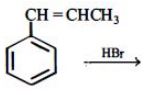
The major product of the following reaction is:
A
$Ph-CH_2-CH_2-CH_2-Br$
B
$Ph-CH(Br)-CH_2-CH_3$
C
$Ph-CH_2-CH(Br)-CH_3$
D
$p-Br-C_6H_4-CH=CH-CH_3$
Solution
(B) The reaction is the electrophilic addition of $HBr$ to $1-phenylpropene$ $(Ph-CH=CH-CH_3)$.
According to Markovnikov's rule,the electrophile $(H^+)$ adds to the carbon atom of the double bond that has more hydrogen atoms,resulting in the formation of the most stable carbocation.
In $Ph-CH=CH-CH_3$,the carbocation formed at the benzylic position $(Ph-CH^+-CH_2-CH_3)$ is highly stabilized by resonance with the phenyl ring.
Therefore,the bromide ion $(Br^-)$ attacks this benzylic carbocation to form $1-phenyl-1-bromopropane$ $(Ph-CH(Br)-CH_2-CH_3)$ as the major product.
According to Markovnikov's rule,the electrophile $(H^+)$ adds to the carbon atom of the double bond that has more hydrogen atoms,resulting in the formation of the most stable carbocation.
In $Ph-CH=CH-CH_3$,the carbocation formed at the benzylic position $(Ph-CH^+-CH_2-CH_3)$ is highly stabilized by resonance with the phenyl ring.
Therefore,the bromide ion $(Br^-)$ attacks this benzylic carbocation to form $1-phenyl-1-bromopropane$ $(Ph-CH(Br)-CH_2-CH_3)$ as the major product.
0 likes
View Solution541
DifficultMCQ
The major product of the following reaction is:
(Structure of $4-$bromo-pent$-2-$en$-2-$amine derivative) $\xrightarrow[{S_N2}]{{KOH}}$
(Structure of $4-$bromo-pent$-2-$en$-2-$amine derivative) $\xrightarrow[{S_N2}]{{KOH}}$
A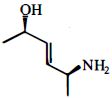
B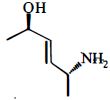
C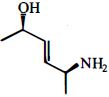
D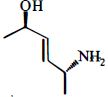
Solution
(A) The reaction proceeds via an $S_N2$ mechanism.
In an $S_N2$ reaction,the nucleophile $(OH^-)$ attacks the electrophilic carbon from the side opposite to the leaving group $(-Br)$.
This results in a Walden inversion (inversion of configuration) at the carbon atom bonded to the bromine.
The $-NH_2$ group is not involved in this substitution reaction and remains in its original configuration.
Therefore,the major product is the one where the $-OH$ group is attached with an inverted stereochemistry relative to the original $-Br$ position.
In an $S_N2$ reaction,the nucleophile $(OH^-)$ attacks the electrophilic carbon from the side opposite to the leaving group $(-Br)$.
This results in a Walden inversion (inversion of configuration) at the carbon atom bonded to the bromine.
The $-NH_2$ group is not involved in this substitution reaction and remains in its original configuration.
Therefore,the major product is the one where the $-OH$ group is attached with an inverted stereochemistry relative to the original $-Br$ position.
0 likes
View Solution542
DifficultMCQ
Which of the following compounds will not undergo Friedel-Crafts reaction with benzene?
A
$CH_2=CH-COCl$ (Acryloyl chloride)
B
$CH_2=CH-Cl$ (Vinyl chloride)
C
$CH_2=CH-CH_2Cl$ (Allyl chloride)
D
$CH_2=C(CH_3)COCl$ (Methacryloyl chloride)
Solution
(B) Friedel-Crafts reaction requires the formation of a stable carbocation or an acylium ion intermediate.
In the case of vinyl chloride $(CH_2=CH-Cl)$,the chlorine atom is directly attached to an $sp^2$ hybridized carbon atom.
The lone pair of electrons on the chlorine atom participates in resonance with the double bond,giving the $C-Cl$ bond partial double bond character.
This makes the cleavage of the $C-Cl$ bond very difficult,and the resulting vinyl carbocation $(CH_2=CH^+)$ is highly unstable due to the $sp$ hybridization of the positively charged carbon.
Therefore,vinyl chloride does not undergo Friedel-Crafts reaction.
In the case of vinyl chloride $(CH_2=CH-Cl)$,the chlorine atom is directly attached to an $sp^2$ hybridized carbon atom.
The lone pair of electrons on the chlorine atom participates in resonance with the double bond,giving the $C-Cl$ bond partial double bond character.
This makes the cleavage of the $C-Cl$ bond very difficult,and the resulting vinyl carbocation $(CH_2=CH^+)$ is highly unstable due to the $sp$ hybridization of the positively charged carbon.
Therefore,vinyl chloride does not undergo Friedel-Crafts reaction.
0 likes
View Solution543
DifficultMCQ
The major product of the following reaction is: $CH_3-CH(Br)-CH_2-CH(Br)-CH_2-CH_3 \xrightarrow[heat]{KOH, CH_3OH}$
A
$CH_2=CH-CH_2-CH=CH-CH_3$
B
$CH_2=CH-CH=CH-CH_2-CH_3$
C
$CH_3-CH=C=CH-CH_2-CH_3$
D
$CH_3-CH=CH-CH=CH-CH_3$
Solution
(D) The reaction is a dehydrohalogenation reaction involving the elimination of two molecules of $HBr$ from $2,4$-dibromohexane using alcoholic $KOH$ and heat.
According to $Saytzeff's$ rule,the most stable alkene is formed as the major product.
In this case,the formation of $2,4$-hexadiene $(CH_3-CH=CH-CH=CH-CH_3)$ is favored because it is a conjugated diene,which provides extra stability due to resonance compared to isolated or cumulated dienes.
According to $Saytzeff's$ rule,the most stable alkene is formed as the major product.
In this case,the formation of $2,4$-hexadiene $(CH_3-CH=CH-CH=CH-CH_3)$ is favored because it is a conjugated diene,which provides extra stability due to resonance compared to isolated or cumulated dienes.
0 likes
View Solution544
DifficultMCQ
The major product of the following reaction is:
$C_6H_5-CH_2-C(Br)(CH_3)-CH_2-CH_3 \xrightarrow[C_2H_5OH]{C_2H_5ONa}$
$C_6H_5-CH_2-C(Br)(CH_3)-CH_2-CH_3 \xrightarrow[C_2H_5OH]{C_2H_5ONa}$
A
$C_6H_5-CH_2-C(CH_3)(OC_2H_5)-CH_2-CH_3$
B
$C_6H_5-CH=C(CH_3)-CH_2-CH_3$
C
$C_6H_5-CH_2-C(CH_3)=CH-CH_3$
D
$C_6H_5-CH_2-C(CH_2-CH_3)=CH_2$
Solution
(B) The reaction is an $E2$ elimination reaction.
The ethoxide ion $(C_2H_5O^-)$ acts as a strong base and abstracts a $\beta$-hydrogen.
The hydrogen on the carbon adjacent to the benzene ring is more acidic due to the electron-withdrawing effect of the phenyl group.
Removal of this hydrogen leads to the formation of $C_6H_5-CH=C(CH_3)-CH_2-CH_3$.
This product is the major product because the double bond is in conjugation with the benzene ring,which provides significant resonance stabilization.
The ethoxide ion $(C_2H_5O^-)$ acts as a strong base and abstracts a $\beta$-hydrogen.
The hydrogen on the carbon adjacent to the benzene ring is more acidic due to the electron-withdrawing effect of the phenyl group.
Removal of this hydrogen leads to the formation of $C_6H_5-CH=C(CH_3)-CH_2-CH_3$.
This product is the major product because the double bond is in conjugation with the benzene ring,which provides significant resonance stabilization.
0 likes
View Solution545
DifficultMCQ
Which one of the following reagents is not suitable for the elimination reaction shown in the image?

A
$NaI$
B
$NaOEt/EtOH$
C
$NaOH/H_2O$
D
$NaOH/EtOH$
Solution
(A) The reaction shown is the dehydrohalogenation of an alkyl halide to form an alkene,which is an elimination reaction.
$NaOEt/EtOH$ (sodium ethoxide in ethanol) is a strong base and is highly effective for $E2$ elimination reactions.
$NaOH/EtOH$ (sodium hydroxide in ethanol) is also a strong base and is commonly used for elimination reactions.
$NaOH/H_2O$ (aqueous sodium hydroxide) primarily favors substitution ($S_N2$ or $S_N1$) over elimination because water is a polar protic solvent that solvates the hydroxide ion,reducing its basicity.
$NaI$ (sodium iodide) is a nucleophile and is typically used in substitution reactions,such as the Finkelstein reaction,to convert alkyl chlorides or bromides into alkyl iodides. It is not a base and therefore cannot promote an elimination reaction.
Thus,both $NaI$ and $NaOH/H_2O$ are not suitable for elimination,but $NaI$ is the most distinct reagent that acts as a nucleophile rather than a base.
$NaOEt/EtOH$ (sodium ethoxide in ethanol) is a strong base and is highly effective for $E2$ elimination reactions.
$NaOH/EtOH$ (sodium hydroxide in ethanol) is also a strong base and is commonly used for elimination reactions.
$NaOH/H_2O$ (aqueous sodium hydroxide) primarily favors substitution ($S_N2$ or $S_N1$) over elimination because water is a polar protic solvent that solvates the hydroxide ion,reducing its basicity.
$NaI$ (sodium iodide) is a nucleophile and is typically used in substitution reactions,such as the Finkelstein reaction,to convert alkyl chlorides or bromides into alkyl iodides. It is not a base and therefore cannot promote an elimination reaction.
Thus,both $NaI$ and $NaOH/H_2O$ are not suitable for elimination,but $NaI$ is the most distinct reagent that acts as a nucleophile rather than a base.
0 likes
View Solution546
DifficultMCQ
The optically inactive compound from the following is
A
$2-$chloropropanal
B
$2-$chlorobutane
C
$2-$chloropentane
D
$2-$chloro$-2-$methylbutane
Solution
(D) An optically inactive compound is one that does not possess a chiral center (a carbon atom bonded to four different groups).
In $2-$chloropropanal $(CH_3-CHCl-CHO)$,the $C2$ carbon is chiral.
In $2-$chlorobutane $(CH_3-CH_2-CHCl-CH_3)$,the $C2$ carbon is chiral.
In $2-$chloropentane $(CH_3-CH_2-CH_2-CHCl-CH_3)$,the $C2$ carbon is chiral.
In $2-$chloro$-2-$methylbutane $(CH_3-CH_2-CCl(CH_3)_2)$,the $C2$ carbon is bonded to two identical methyl groups,making it achiral.
Therefore,$2-$chloro$-2-$methylbutane is optically inactive.
In $2-$chloropropanal $(CH_3-CHCl-CHO)$,the $C2$ carbon is chiral.
In $2-$chlorobutane $(CH_3-CH_2-CHCl-CH_3)$,the $C2$ carbon is chiral.
In $2-$chloropentane $(CH_3-CH_2-CH_2-CHCl-CH_3)$,the $C2$ carbon is chiral.
In $2-$chloro$-2-$methylbutane $(CH_3-CH_2-CCl(CH_3)_2)$,the $C2$ carbon is bonded to two identical methyl groups,making it achiral.
Therefore,$2-$chloro$-2-$methylbutane is optically inactive.
0 likes
View Solution547
MediumMCQ
For the compounds $CH_3Cl$,$CH_3Br$,$CH_3I$,and $CH_3F$,the correct order of increasing $C$-halogen bond length is
A
$CH_3F < CH_3Cl < CH_3Br < CH_3I$
B
$CH_3F < CH_3Br < CH_3Cl < CH_3I$
C
$CH_3F < CH_3I < CH_3Br < CH_3Cl$
D
$CH_3Cl < CH_3Br < CH_3F < CH_3I$
Solution
(A) The bond length depends on the size of the halogen atom.
As the size of the halogen atom increases down the group $(F < Cl < Br < I)$,the bond length of the $C$-halogen bond also increases.
Therefore,the order of increasing bond length is $CH_3F < CH_3Cl < CH_3Br < CH_3I$.
As the size of the halogen atom increases down the group $(F < Cl < Br < I)$,the bond length of the $C$-halogen bond also increases.
Therefore,the order of increasing bond length is $CH_3F < CH_3Cl < CH_3Br < CH_3I$.
0 likes
View Solution548
DifficultMCQ
In a nucleophilic substitution reaction $R - Br + Cl^{-} \xrightarrow{DMF} R - Cl + Br^{-}$,which one of the following undergoes complete inversion of configuration?
A
$C_6H_5CH(C_6H_5)Br$
B
$C_6H_5CH_2Br$
C
$C_6H_5CH(CH_3)Br$
D
$C_6H_5C(CH_3)(C_6H_5)Br$
Solution
(C) The reaction uses $DMF$ (Dimethylformamide),which is a polar aprotic solvent,favoring the $S_N2$ mechanism.
$S_N2$ reactions proceed with complete inversion of configuration (Walden inversion).
Among the given options,$C_6H_5CH(CH_3)Br$ is a secondary alkyl bromide that is sterically accessible for $S_N2$ attack.
$C_6H_5CH_2Br$ is primary and also undergoes $S_N2$,but $C_6H_5CH(CH_3)Br$ is the classic example of an optically active secondary halide showing inversion.
$C_6H_5CH(C_6H_5)Br$ and $C_6H_5C(CH_3)(C_6H_5)Br$ are sterically hindered and likely to proceed via $S_N1$ or show mixed results.
$S_N2$ reactions proceed with complete inversion of configuration (Walden inversion).
Among the given options,$C_6H_5CH(CH_3)Br$ is a secondary alkyl bromide that is sterically accessible for $S_N2$ attack.
$C_6H_5CH_2Br$ is primary and also undergoes $S_N2$,but $C_6H_5CH(CH_3)Br$ is the classic example of an optically active secondary halide showing inversion.
$C_6H_5CH(C_6H_5)Br$ and $C_6H_5C(CH_3)(C_6H_5)Br$ are sterically hindered and likely to proceed via $S_N1$ or show mixed results.
0 likes
View Solution549
DifficultMCQ
Which of the following would not give $2-$phenylbutane as the major product in a Friedel-Crafts alkylation reaction?
A
$1-$butene $+ HF$
B
$2-$butanol $+ H_2SO_4$
C
Butanoyl chloride $+ AlCl_3$ then $Zn, HCl$
D
Butyl chloride $+ AlCl_3$
Solution
(C) Friedel-Crafts alkylation of benzene with $1-$butene or $2-$butanol (via carbocation rearrangement) yields $2-$phenylbutane as the major product.
Butyl chloride $+ AlCl_3$ undergoes rearrangement of the primary carbocation to a secondary carbocation,also yielding $2-$phenylbutane.
However,the reaction of butanoyl chloride with $AlCl_3$ is a Friedel-Crafts acylation,which produces $1-$phenylbutan$-1-$one. Subsequent Clemmensen reduction $(Zn-Hg/HCl)$ yields $n-$butylbenzene ($1-$phenylbutane),not $2-$phenylbutane.
Butyl chloride $+ AlCl_3$ undergoes rearrangement of the primary carbocation to a secondary carbocation,also yielding $2-$phenylbutane.
However,the reaction of butanoyl chloride with $AlCl_3$ is a Friedel-Crafts acylation,which produces $1-$phenylbutan$-1-$one. Subsequent Clemmensen reduction $(Zn-Hg/HCl)$ yields $n-$butylbenzene ($1-$phenylbutane),not $2-$phenylbutane.
0 likes
View Solution550
DifficultMCQ
The $Wurtz-Fittig$ reaction involves the condensation of:
A
two molecules of aryl halides
B
one molecule of each of aryl-halide and alkyl-halide
C
one molecule of each of aryl-halide and phenol
D
two molecules of aralkyl-halides
Solution
(B) The $Wurtz-Fittig$ reaction is the chemical reaction between an alkyl halide and an aryl halide in the presence of sodium metal and dry ether to form an alkylbenzene.
The general reaction is: $Ar-X + 2Na + R-X \xrightarrow{\text{dry ether}} Ar-R + 2NaX$.
For example: $C_6H_5Cl + 2Na + ClCH_3 \xrightarrow{\text{dry ether}} C_6H_5CH_3 \text{ (Toluene)} + 2NaCl$.
The general reaction is: $Ar-X + 2Na + R-X \xrightarrow{\text{dry ether}} Ar-R + 2NaX$.
For example: $C_6H_5Cl + 2Na + ClCH_3 \xrightarrow{\text{dry ether}} C_6H_5CH_3 \text{ (Toluene)} + 2NaCl$.
0 likes
View SolutionHaloalkanes and Haloarenes — Properties of Haloalkanes · Frequently Asked Questions
1Are these Haloalkanes and Haloarenes questions useful for JEE and NEET?
Yes. All questions in this section are mapped to JEE Main and NEET exam patterns. Previous year questions from JEE Main, NEET, GUJCET and state-level exams are included with full solutions.
2Can I switch to Hindi or Gujarati for these questions?
Yes. Use the language tabs in the hero section or the sidebar to view the same questions and solutions in English, Hindi or Gujarati.
3How do I generate a question paper from this subtopic?
Use the Vedclass Exam Paper Generator — select the chapter and subtopic, set difficulty, and generate Sets A, B, C, D automatically. First 3 chapters of every subject are free.
Vedclass Products
For Students
Vedclass Test Series
Mock tests in real JEE/NEET style with performance analysis. 5-day free trial.
Start Free TrialFor Teachers
Exam Paper Generator
Generate Set A/B/C/D papers from this chapter in 2 minutes. 3 chapters free.
Try FreeFor Institutes
Online Exam Module
Live online exams with unlimited students, 360° analytics & white-label branding.
See DemoFor Teachers & Institutes
Generate a Haloalkanes and Haloarenes Exam Paper in 2 Minutes
Select subtopic & difficulty — Sets A, B, C, D auto-generated with No Repeat logic.
First 3 chapters of every subject are free — no payment required.