
A English
Introduction of Halogen containing compounds Questions in English
Class 12 Chemistry · Haloalkanes and Haloarenes · Introduction of Halogen containing compounds
130+
Questions
English
Language
100%
With Solutions
Showing 50 of 130 questions in English
1
MediumMCQ
Phosgene is the common name of
A
Carbonyl chloride
B
Phosphine
C
Phosphorus oxychloride
D
Phosphorus trichloride
Solution
(A) Phosgene is the common name for $COCl_2$,which is chemically known as carbonyl chloride.
It is formed by the oxidation of chloroform $(CHCl_3)$ in the presence of air or oxygen:
$2CHCl_3 + O_2 \to 2COCl_2 + 2HCl$.
It is formed by the oxidation of chloroform $(CHCl_3)$ in the presence of air or oxygen:
$2CHCl_3 + O_2 \to 2COCl_2 + 2HCl$.
0 likes
View Solution2
MediumMCQ
Which of the following is a gem-dihalide?
A
$CH_3-CH(Br)-CH(Br)-CH_3$
B
$CH_2(Br)-CH_2(Br)$
C
$CH(Br)=CH(Br)$
D
$CH_3-CHBr_2$
Solution
(D) In a $gem$-dihalide,both halogen atoms are attached to the same carbon atom.
In a $vic$-dihalide,the two halogen atoms are attached to adjacent carbon atoms.
$CH_3-CHBr_2$ is $1,1$-dibromoethane,which is a $gem$-dihalide.
$CH_2(Br)-CH_2(Br)$ is $1,2$-dibromoethane,which is a $vic$-dihalide.
In a $vic$-dihalide,the two halogen atoms are attached to adjacent carbon atoms.
$CH_3-CHBr_2$ is $1,1$-dibromoethane,which is a $gem$-dihalide.
$CH_2(Br)-CH_2(Br)$ is $1,2$-dibromoethane,which is a $vic$-dihalide.
0 likes
View Solution3
EasyMCQ
$A$ $Gem$-dibromide is:
A
$CH_3CH(Br)CH(Br)CH_3$
B
$CH_3CBr_2CH_3$
C
$CH_2(Br)CH_2CH_2Br$
D
$CH_2BrCH_2Br$
Solution
(B) $Gem$-dihalides are those compounds in which two halogen atoms are attached to the same carbon atom.
In $CH_3CBr_2CH_3$ ($2,2$-dibromopropane),both bromine atoms are attached to the second carbon atom,making it a $Gem$-dibromide.
In $CH_3CBr_2CH_3$ ($2,2$-dibromopropane),both bromine atoms are attached to the second carbon atom,making it a $Gem$-dibromide.
0 likes
View Solution4
MediumMCQ
Ethylidene dibromide is:
A
$CH_3-CH_2-Br$
B
$CH_3-CHBr_2$
C
$Br-CH_2-CH_2-Br$
D
$CH_2=CBr_2$
Solution
(B) Ethylidene dibromide is a geminal dihalide,meaning both bromine atoms are attached to the same carbon atom.
The structure of ethylidene dibromide is $CH_3-CHBr_2$.
The structure of ethylidene dibromide is $CH_3-CHBr_2$.
0 likes
View Solution5
MediumMCQ
What is the chemical formula for Benzylidene chloride?
A
$C_6H_5CH_2Cl$
B
$C_6H_5CHCl_2$
C
$C_6H_4ClCH_2Cl$
D
$C_6H_5CCl_3$
Solution
(B) Benzyl chloride is $C_6H_5CH_2Cl$.
Benzylidene chloride is $C_6H_5CHCl_2$.
Benzotrichloride is $C_6H_5CCl_3$.
Therefore,the correct option is $B$.
Benzylidene chloride is $C_6H_5CHCl_2$.
Benzotrichloride is $C_6H_5CCl_3$.
Therefore,the correct option is $B$.
0 likes
View Solution6
MediumMCQ
Which of the following halides is $2^o$?
A
Isopropyl chloride
B
Isobutyl chloride
C
$n-$propyl chloride
D
$n-$butyl chloride
Solution
(A) The structure of isopropyl chloride is $CH_3-CHCl-CH_3$.
In this molecule,the chlorine atom is attached to a secondary carbon atom,which is a carbon atom bonded to two other carbon atoms.
Therefore,it is a $2^o$ halide.
Thus,the correct option is $(A)$.
In this molecule,the chlorine atom is attached to a secondary carbon atom,which is a carbon atom bonded to two other carbon atoms.
Therefore,it is a $2^o$ halide.
Thus,the correct option is $(A)$.
0 likes
View Solution7
MediumMCQ
Haloforms are trihalogen derivatives of
A
Ethane
B
Methane
C
Propane
D
Benzene
Solution
(B) The correct answer is $(B)$.
Haloforms are compounds with the general formula $CHX_3$,where $X$ is a halogen $(Cl, Br, I)$.
These are derived from $CH_4$ (methane) by replacing three hydrogen atoms with three halogen atoms:
$CH_4 \xrightarrow{-3H, +3X} CHX_3$.
Haloforms are compounds with the general formula $CHX_3$,where $X$ is a halogen $(Cl, Br, I)$.
These are derived from $CH_4$ (methane) by replacing three hydrogen atoms with three halogen atoms:
$CH_4 \xrightarrow{-3H, +3X} CHX_3$.
0 likes
View Solution8
MediumMCQ
The general formula for alkyl halides is
A
$C_nH_{2n+1}X$
B
$C_nH_{2n+2}X$
C
$C_nH_{n+1}X$
D
$C_nH_{2n}X$
Solution
(A) Alkyl halides are derived from alkanes by replacing one hydrogen atom with a halogen atom $(X)$.
The general formula for alkanes is $C_nH_{2n+2}$.
Replacing one $H$ atom with $X$ gives the general formula for alkyl halides as $C_nH_{2n+1}X$.
The general formula for alkanes is $C_nH_{2n+2}$.
Replacing one $H$ atom with $X$ gives the general formula for alkyl halides as $C_nH_{2n+1}X$.
0 likes
View Solution9
EasyMCQ
Phosgene is the common name for
A
$CO_2$ and $PH_3$
B
Phosphoryl chloride
C
Carbonyl chloride
D
Carbon tetrachloride
Solution
(C) The chemical formula for phosgene is $COCl_2$.
It is chemically known as carbonyl chloride.
Therefore,the correct option is $(C)$.
It is chemically known as carbonyl chloride.
Therefore,the correct option is $(C)$.
0 likes
View Solution10
DifficultMCQ
On mixing ethyl acetate with aqueous sodium chloride,the composition of the resultant solution is
A
$CH_3COCl + C_2H_5OH + NaOH$
B
$CH_3COONa + C_2H_5OH$
C
$CH_3COOC_2H_5 + NaCl$
D
$CH_3Cl + C_2H_5COONa$
Solution
(C) . Ethyl acetate $(CH_3COOC_2H_5)$ is an ester. Sodium chloride $(NaCl)$ is a salt that dissociates into $Na^+$ and $Cl^-$ ions in water.
There is no chemical reaction between an ester and a neutral salt like $NaCl$ in an aqueous medium.
Therefore,the composition of the resultant solution remains the same as the mixture of the two reactants: $CH_3COOC_2H_5 + NaCl$.
There is no chemical reaction between an ester and a neutral salt like $NaCl$ in an aqueous medium.
Therefore,the composition of the resultant solution remains the same as the mixture of the two reactants: $CH_3COOC_2H_5 + NaCl$.
0 likes
View Solution11
DifficultMCQ
'Oil of mirbane' is
A
Aniline
B
Nitrobenzene
C
$p-$nitroaniline
D
$p-$aminoazobenzene
Solution
(B) Nitrobenzene is commonly known as 'oil of mirbane'.
It was historically used as an inexpensive perfume for soaps due to its almond-like odor.
It has since been replaced by less toxic chemicals for this purpose.
Nitrobenzene is also a significant chemical intermediate used in the production of the analgesic $paracetamol$.
It was historically used as an inexpensive perfume for soaps due to its almond-like odor.
It has since been replaced by less toxic chemicals for this purpose.
Nitrobenzene is also a significant chemical intermediate used in the production of the analgesic $paracetamol$.
0 likes
View Solution12
EasyMCQ
Nitrobenzene at room temperature is
A
Gas
B
Liquid
C
Solid
D
Solution
Solution
(B) Nitrobenzene $(C_6H_5NO_2)$ is a pale yellow oily liquid at room temperature.
0 likes
View Solution13
MediumMCQ
The silver halide which is soluble in ammonium hydroxide is............
A
Silver chloride
B
Silver bromide
C
Silver fluoride
D
Silver iodide
Solution
(A) Silver chloride $(AgCl)$ is soluble in ammonium hydroxide $(NH_4OH)$ because it forms a soluble complex compound,diamminesilver$(I)$ chloride.
The chemical reaction is:
$AgCl(s) + 2NH_4OH(aq) \rightarrow [Ag(NH_3)_2]Cl(aq) + 2H_2O(l)$
The chemical reaction is:
$AgCl(s) + 2NH_4OH(aq) \rightarrow [Ag(NH_3)_2]Cl(aq) + 2H_2O(l)$
0 likes
View Solution14
MediumMCQ
Which of the following is a primary $(1^o)$ halide?
A
Isopropyl iodide
B
$2^o$-Butyl iodide
C
$3^o$-Butyl bromide
D
Neo-hexyl chloride
Solution
(D) primary $(1^o)$ halide is one where the halogen atom is attached to a primary carbon atom (a carbon atom attached to only one other carbon atom).
$(A)$ Isopropyl iodide: $(CH_3)_2CH-I$ ($2^o$ halide).
$(B)$ $2^o$-Butyl iodide: $CH_3-CH(I)-CH_2-CH_3$ ($2^o$ halide).
$(C)$ $3^o$-Butyl bromide: $CH_3-C(Br)(CH_3)-CH_2-CH_3$ ($3^o$ halide).
$(D)$ Neo-hexyl chloride: $(CH_3)_3C-CH_2-CH_2-Cl$. Here,the carbon attached to the chlorine is a primary carbon because it is attached to only one other carbon atom. Thus,it is a primary $(1^o)$ halide.
$(A)$ Isopropyl iodide: $(CH_3)_2CH-I$ ($2^o$ halide).
$(B)$ $2^o$-Butyl iodide: $CH_3-CH(I)-CH_2-CH_3$ ($2^o$ halide).
$(C)$ $3^o$-Butyl bromide: $CH_3-C(Br)(CH_3)-CH_2-CH_3$ ($3^o$ halide).
$(D)$ Neo-hexyl chloride: $(CH_3)_3C-CH_2-CH_2-Cl$. Here,the carbon attached to the chlorine is a primary carbon because it is attached to only one other carbon atom. Thus,it is a primary $(1^o)$ halide.
0 likes
View Solution15
MediumMCQ
In halide compounds,when the carbon atom bonded to the halogen atom is $sp^2$ hybridized,the types of such compounds are respectively .....
A
Allylic halide and Benzylic halide
B
Vinylic halide and Aryl halide
C
Alkyl halide and Aryl halide
D
Benzylic halide and Aryl halide
Solution
(B) In organic chemistry,compounds where the halogen atom is attached to an $sp^2$ hybridized carbon atom are classified as follows:
$1$. Vinylic halides: The halogen is attached to a carbon-carbon double bond $(C=C-X)$.
$2$. Aryl halides: The halogen is attached directly to an aromatic ring $(Ar-X)$.
Both these types involve an $sp^2$ hybridized carbon atom bonded to the halogen.
$1$. Vinylic halides: The halogen is attached to a carbon-carbon double bond $(C=C-X)$.
$2$. Aryl halides: The halogen is attached directly to an aromatic ring $(Ar-X)$.
Both these types involve an $sp^2$ hybridized carbon atom bonded to the halogen.
0 likes
View Solution16
EasyMCQ
The common name for phosgene is .....
A
$CO_2$ and $PH_3$
B
Phosphoryl chloride
C
Carbonyl chloride
D
Carbon tetrachloride
Solution
(C) Phosgene is the common name for $COCl_2$.
It is formed by the oxidation of chloroform in the presence of light and air:
$2CHCl_3 + O_2 \xrightarrow{\text{Light}} 2COCl_2 \text{ (Phosgene)} + 2HCl$
It is formed by the oxidation of chloroform in the presence of light and air:
$2CHCl_3 + O_2 \xrightarrow{\text{Light}} 2COCl_2 \text{ (Phosgene)} + 2HCl$
0 likes
View Solution17
EasyMCQ
Give the $IUPAC$ name of tertiary butyl chloride.
A
$4-$chlorobutane
B
$2-$chlorobutane
C
$1-$chloro$-3-$methylpropane
D
$2-$chloro$-2-$methylpropane
Solution
(D) The structure of tertiary butyl chloride is $(CH_3)_3CCl$.
To determine the $IUPAC$ name,we identify the longest carbon chain containing the functional group.
The longest chain has $3$ carbon atoms,making it a propane derivative.
The chlorine atom and a methyl group are both attached to the $2^{nd}$ carbon atom.
Therefore,the $IUPAC$ name is $2-$chloro$-2-$methylpropane.
To determine the $IUPAC$ name,we identify the longest carbon chain containing the functional group.
The longest chain has $3$ carbon atoms,making it a propane derivative.
The chlorine atom and a methyl group are both attached to the $2^{nd}$ carbon atom.
Therefore,the $IUPAC$ name is $2-$chloro$-2-$methylpropane.
0 likes
View Solution18
MediumMCQ
How many benzene derivatives are possible for the molecular formula $C_7H_7Cl$?
A
$2$
B
$3$
C
$4$
D
$5$
Solution
(C) The molecular formula $C_7H_7Cl$ corresponds to a degree of unsaturation of $4$,which is consistent with a benzene ring ($4$ degrees of unsaturation).
Possible isomers are:
$1$. $o$-Chlorotoluene
$2$. $m$-Chlorotoluene
$3$. $p$-Chlorotoluene
$4$. Benzyl chloride $(C_6H_5CH_2Cl)$
Thus,there are $4$ possible benzene derivatives.
Possible isomers are:
$1$. $o$-Chlorotoluene
$2$. $m$-Chlorotoluene
$3$. $p$-Chlorotoluene
$4$. Benzyl chloride $(C_6H_5CH_2Cl)$
Thus,there are $4$ possible benzene derivatives.
0 likes
View Solution19
EasyMCQ
Which of the following is a gem-dihalide?
A
$CH_3-C(Cl)_2-CH_3$
B
$CH_3-CH(Br)-CH_2(Cl)$
C
$CH_2(Cl)-CH(Cl)-CH_3$
D
$CH_2(Br)-CH(Br)-CH_3$
Solution
(A) gem-dihalide (geminal dihalide) is a compound in which two halogen atoms are attached to the same carbon atom.
In option $A$,$CH_3-C(Cl)_2-CH_3$ ($2$,$2$-dichloropropane),both chlorine atoms are attached to the second carbon atom.
Therefore,it is a gem-dihalide.
Options $B$,$C$,and $D$ represent vicinal dihalides where the halogens are on adjacent carbon atoms.
In option $A$,$CH_3-C(Cl)_2-CH_3$ ($2$,$2$-dichloropropane),both chlorine atoms are attached to the second carbon atom.
Therefore,it is a gem-dihalide.
Options $B$,$C$,and $D$ represent vicinal dihalides where the halogens are on adjacent carbon atoms.
0 likes
View Solution20
EasyMCQ
Which of the following compounds is not chiral?
A
$CH_3CH_2CH_2Cl$
B
$CH_3CHDCH_2Cl$
C
$CH_3CHClCH_2D$
D
$CH_3CH_2CHDCl$
Solution
(A) molecule is chiral if it contains at least one chiral center (a carbon atom bonded to four different groups).
In $CH_3CH_2CH_2Cl$,the carbon atoms are bonded to identical hydrogen atoms or are part of a chain where no carbon is attached to four distinct groups.
Specifically,the $C_1$ carbon is attached to two $H$ atoms,$C_2$ is attached to two $H$ atoms,and $C_3$ is attached to three $H$ atoms.
Since no carbon atom is bonded to four different groups,$CH_3CH_2CH_2Cl$ is achiral.
In the other options,the presence of deuterium $(D)$ creates a chiral center because $D$ and $H$ are treated as different groups.
In $CH_3CH_2CH_2Cl$,the carbon atoms are bonded to identical hydrogen atoms or are part of a chain where no carbon is attached to four distinct groups.
Specifically,the $C_1$ carbon is attached to two $H$ atoms,$C_2$ is attached to two $H$ atoms,and $C_3$ is attached to three $H$ atoms.
Since no carbon atom is bonded to four different groups,$CH_3CH_2CH_2Cl$ is achiral.
In the other options,the presence of deuterium $(D)$ creates a chiral center because $D$ and $H$ are treated as different groups.
0 likes
View Solution21
EasyMCQ
What is epichlorohydrin?
A
$3-$ chloropropane
B
$3-$ chloropropan $-1-$ ol
C
$3-$ chloro $-1, 2-$ epoxypropane
D
None of these
Solution
(C) Epichlorohydrin is an organochlorine compound and an epoxide. Its chemical structure is $1-$ chloro $-2, 3-$ epoxypropane,which is commonly referred to as $3-$ chloro $-1, 2-$ epoxypropane. The structure is: $CH_2(O)CH-CH_2Cl$.
0 likes
View Solution22
MediumMCQ
What is the common name of the following compound: $CH_3-C(CH_3)_2-CH_2-Cl$?
A
Neopentyl chloride
B
Tertiary pentyl chloride
C
Isopentyl chloride
D
None
Solution
(A) The given structure is $CH_3-C(CH_3)_2-CH_2-Cl$.
In common nomenclature,an alkyl group where a carbon atom is bonded to four other carbon atoms (with one being part of the functional chain) is prefixed as 'neo-'.
Since there are a total of five carbon atoms in the molecule,the alkyl group is called neopentyl.
Therefore,the common name is neopentyl chloride.
In common nomenclature,an alkyl group where a carbon atom is bonded to four other carbon atoms (with one being part of the functional chain) is prefixed as 'neo-'.
Since there are a total of five carbon atoms in the molecule,the alkyl group is called neopentyl.
Therefore,the common name is neopentyl chloride.
0 likes
View Solution23
EasyMCQ
The $IUPAC$ name of the compound is
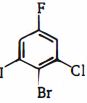
A
$1-$Bromo$-2-$chloro$-3-$fluoro$-6-$iodobenzene
B
$2-$Bromo$-1-$chloro$-5-$fluoro$-3-$iodobenzene
C
$4-$Bromo$-2-$chloro$-5-$iodo$-1-$fluorobenzene
D
$2-$Bromo$-3-$chloro$-1-$iodo$-5-$fluorobenzene
Solution
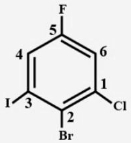
(B) To determine the $IUPAC$ name,we follow the lowest locant rule for numbering the benzene ring substituents.
$1$. The substituents are $F$ (fluoro),$Cl$ (chloro),$Br$ (bromo),and $I$ (iodo).
$2$. Numbering the ring starting from $Cl$ as $1$,$Br$ as $2$,$I$ as $3$,and $F$ as $5$ gives the locant set $(1, 2, 3, 5)$.
$3$. According to the alphabetical order of substituents (Bromo,Chloro,Fluoro,Iodo),the name is constructed as $2-$bromo$-1-$chloro$-5-$fluoro$-3-$iodobenzene.
$\therefore$ The correct $IUPAC$ name is $2-$bromo$-1-$chloro$-5-$fluoro$-3-$iodobenzene.
$1$. The substituents are $F$ (fluoro),$Cl$ (chloro),$Br$ (bromo),and $I$ (iodo).
$2$. Numbering the ring starting from $Cl$ as $1$,$Br$ as $2$,$I$ as $3$,and $F$ as $5$ gives the locant set $(1, 2, 3, 5)$.
$3$. According to the alphabetical order of substituents (Bromo,Chloro,Fluoro,Iodo),the name is constructed as $2-$bromo$-1-$chloro$-5-$fluoro$-3-$iodobenzene.
$\therefore$ The correct $IUPAC$ name is $2-$bromo$-1-$chloro$-5-$fluoro$-3-$iodobenzene.
0 likes
View Solution24
MediumMCQ
The structural formula for Lewisite is:
A
$CHCl=CH-AsCl_3$
B
$CHCl=CH-AsCl$
C
$CHCl=CH-AsCl_2$
D
$CH_2=CH-AsCl_2$
Solution
(C) Lewisite is $2$-chloroethenylarsonous dichloride.
It is prepared by the reaction of acetylene $(C_2H_2)$ and arsenic trichloride $(AsCl_3)$ in the presence of anhydrous $AlCl_3$.
The structural formula is $Cl-CH=CH-AsCl_2$.
It is prepared by the reaction of acetylene $(C_2H_2)$ and arsenic trichloride $(AsCl_3)$ in the presence of anhydrous $AlCl_3$.
The structural formula is $Cl-CH=CH-AsCl_2$.
0 likes
View Solution25
MediumMCQ
The homologue of $CH_3-Cl$ is:
A
$CH_3-CH_2-Br$
B
$CH_3-CH(I)-CH_3$
C
$CH_3-CH_2-Cl$
D
$CH_3-CH_2-CH_2-CH_2-Cl$
Solution
(C) Homologues are members of the same homologous series that possess the same functional group and differ by one or more $-CH_2-$ units.
$CH_3-Cl$ (methyl chloride) belongs to the alkyl chloride series with the general formula $C_nH_{2n+1}Cl$.
Comparing the options,$CH_3-CH_2-Cl$ (ethyl chloride) differs from $CH_3-Cl$ by exactly one $-CH_2-$ unit.
Therefore,$CH_3-CH_2-Cl$ is the correct homologue.
$CH_3-Cl$ (methyl chloride) belongs to the alkyl chloride series with the general formula $C_nH_{2n+1}Cl$.
Comparing the options,$CH_3-CH_2-Cl$ (ethyl chloride) differs from $CH_3-Cl$ by exactly one $-CH_2-$ unit.
Therefore,$CH_3-CH_2-Cl$ is the correct homologue.
0 likes
View Solution26
MediumMCQ
Silver nitrate solution is kept in brown bottles in the laboratory because:
A
it reacts with ordinary white bottles
B
brown bottles cut off the passage of light
C
brown bottles do not react with it
D
ordinary bottles catalyze its decomposition
Solution
(B) Silver nitrate $(AgNO_3)$ decomposes in the presence of sunlight. To prevent this photochemical decomposition,it is stored in brown-colored bottles because these bottles block the passage of light.
0 likes
View Solution27
EasyMCQ
What type of bond is formed between carbon and halogen in haloalkanes and haloarenes?
A
Ionic
B
Coordinate covalent
C
Covalent
D
Metallic
Solution
(C) In haloalkanes and haloarenes,the carbon atom is bonded to a halogen atom $(X = F, Cl, Br, I)$.
Since both carbon and halogen are non-metals,they share electrons to complete their octets.
Therefore,the bond formed between carbon and halogen is a covalent bond.
Since both carbon and halogen are non-metals,they share electrons to complete their octets.
Therefore,the bond formed between carbon and halogen is a covalent bond.
0 likes
View Solution28
EasyMCQ
Which of the following is not a mono-haloalkane compound?
A
$CH_3Cl$
B
$CH_3CH_2Cl$
C
$CH_2Cl-CH_2Cl$
D
$2-\text{chloropropane}$
Solution
(C) mono-haloalkane is a compound that contains only one halogen atom in its structure.
$CH_3Cl$ (chloromethane) contains one chlorine atom.
$CH_3CH_2Cl$ (chloroethane) contains one chlorine atom.
$CH_2Cl-CH_2Cl$ ($1$,$2$-dichloroethane) contains two chlorine atoms,so it is a di-haloalkane.
$2-\text{chloropropane}$ contains one chlorine atom.
Therefore,$CH_2Cl-CH_2Cl$ is not a mono-haloalkane.
$CH_3Cl$ (chloromethane) contains one chlorine atom.
$CH_3CH_2Cl$ (chloroethane) contains one chlorine atom.
$CH_2Cl-CH_2Cl$ ($1$,$2$-dichloroethane) contains two chlorine atoms,so it is a di-haloalkane.
$2-\text{chloropropane}$ contains one chlorine atom.
Therefore,$CH_2Cl-CH_2Cl$ is not a mono-haloalkane.
0 likes
View Solution29
EasyMCQ
Which of the following compounds is a dihaloalkane?
A
Chloroform
B
$1,1-$ Dichloropropane
C
$1,2,3-$ Trichloropropane
D
Chloroethane
Solution
(B) dihaloalkane is an alkane derivative containing two halogen atoms in its structure.
$1,1-$ Dichloropropane has the formula $CH_3CH_2CHCl_2$,which contains two chlorine atoms attached to the same carbon atom,making it a geminal dihaloalkane.
Chloroform $(CHCl_3)$ is a trihaloalkane.
$1,2,3-$ Trichloropropane is a trihaloalkane.
Chloroethane $(CH_3CH_2Cl)$ is a monohaloalkane.
Therefore,the correct option is $B$.
$1,1-$ Dichloropropane has the formula $CH_3CH_2CHCl_2$,which contains two chlorine atoms attached to the same carbon atom,making it a geminal dihaloalkane.
Chloroform $(CHCl_3)$ is a trihaloalkane.
$1,2,3-$ Trichloropropane is a trihaloalkane.
Chloroethane $(CH_3CH_2Cl)$ is a monohaloalkane.
Therefore,the correct option is $B$.
0 likes
View Solution30
EasyMCQ
In which of the following compounds is the carbon atom bonded to the halogen $NOT$ $sp^3$ hybridized?
A
Alkyl halide
B
Allylic halide
C
Benzylic halide
D
Vinylic halide
Solution
(D) In $sp^3$ hybridized alkyl,allylic,and benzylic halides,the carbon atom attached to the halogen is bonded to four other atoms (or groups) via single bonds.
In a vinylic halide,the halogen atom is directly attached to a carbon atom that is part of a carbon-carbon double bond $(C=C)$.
Such carbon atoms are $sp^2$ hybridized.
Therefore,the correct answer is vinylic halide.
In a vinylic halide,the halogen atom is directly attached to a carbon atom that is part of a carbon-carbon double bond $(C=C)$.
Such carbon atoms are $sp^2$ hybridized.
Therefore,the correct answer is vinylic halide.
0 likes
View Solution31
MediumMCQ
Which of the following is a tertiary alkyl halide?
A
$1-$Bromo-$2-$methylpropane
B
$2-$Bromobutane
C
$2-$Chloropropane
D
$2-$Chloro-$2-$methylpropane
Solution
(D) tertiary alkyl halide is one where the halogen atom is attached to a carbon atom that is bonded to three other carbon atoms.
In $2-$chloro-$2-$methylpropane,the chlorine atom is attached to a central carbon atom which is further bonded to three methyl groups $(-CH_3)$.
Thus,it is a tertiary $(3^{\circ})$ alkyl halide.
In $2-$chloro-$2-$methylpropane,the chlorine atom is attached to a central carbon atom which is further bonded to three methyl groups $(-CH_3)$.
Thus,it is a tertiary $(3^{\circ})$ alkyl halide.
0 likes
View Solution32
EasyMCQ
Which of the following is not a benzylic halide?
A
Benzyl chloride
B
($1$-bromoethyl)benzene
C
($2$-chloroethyl)benzene
D
($1$-chloro$-1-$methylethyl)benzene
Solution
(C) benzylic halide is a compound in which the halogen atom is bonded to a carbon atom adjacent to an aromatic ring (i.e.,a $sp^3$ hybridized carbon atom attached to a benzene ring).
$A$. Benzyl chloride $(C_6H_5CH_2Cl)$: The $Cl$ atom is attached to the carbon adjacent to the benzene ring. It is a benzylic halide.
$B$. ($1$-bromoethyl)benzene $(C_6H_5CH(Br)CH_3)$: The $Br$ atom is attached to the carbon adjacent to the benzene ring. It is a benzylic halide.
$C$. ($2$-chloroethyl)benzene $(C_6H_5CH_2CH_2Cl)$: The $Cl$ atom is attached to the second carbon from the benzene ring. This is not a benzylic halide; it is a primary alkyl halide.
$D$. ($1$-chloro$-1-$methylethyl)benzene $(C_6H_5C(Cl)(CH_3)_2)$: The $Cl$ atom is attached to the carbon adjacent to the benzene ring. It is a benzylic halide.
Therefore,($2$-chloroethyl)benzene is not a benzylic halide.
$A$. Benzyl chloride $(C_6H_5CH_2Cl)$: The $Cl$ atom is attached to the carbon adjacent to the benzene ring. It is a benzylic halide.
$B$. ($1$-bromoethyl)benzene $(C_6H_5CH(Br)CH_3)$: The $Br$ atom is attached to the carbon adjacent to the benzene ring. It is a benzylic halide.
$C$. ($2$-chloroethyl)benzene $(C_6H_5CH_2CH_2Cl)$: The $Cl$ atom is attached to the second carbon from the benzene ring. This is not a benzylic halide; it is a primary alkyl halide.
$D$. ($1$-chloro$-1-$methylethyl)benzene $(C_6H_5C(Cl)(CH_3)_2)$: The $Cl$ atom is attached to the carbon adjacent to the benzene ring. It is a benzylic halide.
Therefore,($2$-chloroethyl)benzene is not a benzylic halide.
0 likes
View Solution33
DifficultMCQ
Which of the following is true for benzyl chloride?
A
It is a benzylic halide.
B
The carbon atom attached to the halogen is $sp^3$ hybridized.
C
It is a primary halide.
D
All of the above.
0 likes
View Solution34
DifficultMCQ
Which of the following is an allylic halide?
A
$CH_3CH_2CH_2Cl$
B
$CH_2=CH-CH_2Cl$
C
$3-$chlorocyclohex$-1-$ene
D
Both $B$ and $C$
Solution
(D) An allylic halide is a compound in which the halogen atom is bonded to an $sp^3$ hybridized carbon atom adjacent to a carbon-carbon double bond $(C=C)$.
$1$. In $CH_3CH_2CH_2Cl$,the chlorine is attached to a primary alkyl carbon. This is an alkyl halide.
$2$. In $CH_2=CH-CH_2Cl$,the chlorine is attached to a carbon atom that is adjacent to the $C=C$ double bond. This is an allylic halide.
$3$. In $3-$chlorocyclohex$-1-$ene,the chlorine is attached to a carbon atom that is adjacent to the $C=C$ double bond in the ring. This is also an allylic halide.
Therefore,both $B$ and $C$ are allylic halides.
$1$. In $CH_3CH_2CH_2Cl$,the chlorine is attached to a primary alkyl carbon. This is an alkyl halide.
$2$. In $CH_2=CH-CH_2Cl$,the chlorine is attached to a carbon atom that is adjacent to the $C=C$ double bond. This is an allylic halide.
$3$. In $3-$chlorocyclohex$-1-$ene,the chlorine is attached to a carbon atom that is adjacent to the $C=C$ double bond in the ring. This is also an allylic halide.
Therefore,both $B$ and $C$ are allylic halides.
0 likes
View Solution35
DifficultMCQ
In organic halide compounds,the type of compounds in which the carbon atom attached to the halogen is $sp^2$ hybridized is:
A
Allylic halide and Benzylic halide
B
Vinylic halide and Aryl halide
C
Alkyl halide and Aryl halide
D
Benzylic halide and Aryl halide
Solution
(B) In organic halides,the hybridization of the carbon atom attached to the halogen atom determines the classification.
$1$. In $sp^3$ hybridized carbon compounds,the halogen is attached to an $sp^3$ hybridized carbon (e.g.,Alkyl halides,Allylic halides,Benzylic halides).
$2$. In $sp^2$ hybridized carbon compounds,the halogen is attached to a carbon atom that is part of a double bond or an aromatic ring.
- Vinylic halides: The halogen is attached to a carbon atom of a carbon-carbon double bond $(C=C-X)$,where the carbon is $sp^2$ hybridized.
- Aryl halides: The halogen is attached directly to an aromatic ring carbon,which is $sp^2$ hybridized.
Therefore,Vinylic halides and Aryl halides contain $sp^2$ hybridized carbon atoms attached to the halogen.
$1$. In $sp^3$ hybridized carbon compounds,the halogen is attached to an $sp^3$ hybridized carbon (e.g.,Alkyl halides,Allylic halides,Benzylic halides).
$2$. In $sp^2$ hybridized carbon compounds,the halogen is attached to a carbon atom that is part of a double bond or an aromatic ring.
- Vinylic halides: The halogen is attached to a carbon atom of a carbon-carbon double bond $(C=C-X)$,where the carbon is $sp^2$ hybridized.
- Aryl halides: The halogen is attached directly to an aromatic ring carbon,which is $sp^2$ hybridized.
Therefore,Vinylic halides and Aryl halides contain $sp^2$ hybridized carbon atoms attached to the halogen.
0 likes
View Solution36
EasyMCQ
$1,1,2,2-$Tetrachloroethane is known as $Westron$.
A
Acetylene tetrachloride
B
Acetylene dichloride
C
Trichloroethene
D
$1,1,2-$Trichloroethene
Solution
(A) $1,1,2,2-$Tetrachloroethane $(CHCl_2-CHCl_2)$ is commonly known as $Westron$.
It is used as a solvent for fats,oils,and resins.
It is used as a solvent for fats,oils,and resins.
0 likes
View Solution37
EasyMCQ
Which of the following is a Freon?
A
$CCl_2F_2$
B
$CHCl_3$
C
$CH_3F$
D
$CHF_3$
Solution
(A) Freons are chlorofluorocarbons (CFCs) of methane and ethane.
$CCl_2F_2$ (dichlorodifluoromethane) is the most common Freon,known as Freon-$12$.
Therefore,the correct option is $A$.
$CCl_2F_2$ (dichlorodifluoromethane) is the most common Freon,known as Freon-$12$.
Therefore,the correct option is $A$.
0 likes
View Solution38
MediumMCQ
Which of the following is a primary halide?
A
Neohexyl chloride
B
Secondary butyl iodide
C
Tertiary butyl bromide
D
Iso-propyl iodide
Solution
(A) primary halide is an alkyl halide in which the halogen atom is attached to a primary carbon atom (a carbon atom bonded to only one other carbon atom).
$1$. Neohexyl chloride: $CH_3-C(CH_3)_2-CH_2-CH_2-Cl$. Here,the $Cl$ atom is attached to a carbon that is bonded to only one other carbon. Thus,it is a primary halide.
$2$. Secondary butyl iodide: $CH_3-CH_2-CH(I)-CH_3$. The $I$ atom is attached to a secondary carbon.
$3$. Tertiary butyl bromide: $(CH_3)_3C-Br$. The $Br$ atom is attached to a tertiary carbon.
$4$. Iso-propyl iodide: $(CH_3)_2CH-I$. The $I$ atom is attached to a secondary carbon.
Therefore,the correct option is $A$.
$1$. Neohexyl chloride: $CH_3-C(CH_3)_2-CH_2-CH_2-Cl$. Here,the $Cl$ atom is attached to a carbon that is bonded to only one other carbon. Thus,it is a primary halide.
$2$. Secondary butyl iodide: $CH_3-CH_2-CH(I)-CH_3$. The $I$ atom is attached to a secondary carbon.
$3$. Tertiary butyl bromide: $(CH_3)_3C-Br$. The $Br$ atom is attached to a tertiary carbon.
$4$. Iso-propyl iodide: $(CH_3)_2CH-I$. The $I$ atom is attached to a secondary carbon.
Therefore,the correct option is $A$.
0 likes
View Solution39
Difficult
Draw the structures of all the eight structural isomers that have the molecular formula $C_{5}H_{11}Br$. Name each isomer according to the $IUPAC$ system and classify them as primary,secondary,or tertiary bromides.
Solution
(N/A) $1$. $CH_{3}CH_{2}CH_{2}CH_{2}CH_{2}Br$: $1-$Bromopentane $(1^{\circ})$
$2$. $CH_{3}CH_{2}CH_{2}CH(Br)CH_{3}$: $2-$Bromopentane $(2^{\circ})$
$3$. $CH_{3}CH_{2}CH(Br)CH_{2}CH_{3}$: $3-$Bromopentane $(2^{\circ})$
$4$. $(CH_{3})_{2}CHCH_{2}CH_{2}Br$: $1-$Bromo$-3-$methylbutane $(1^{\circ})$
$5$. $(CH_{3})_{2}CHCH(Br)CH_{3}$: $2-$Bromo$-3-$methylbutane $(2^{\circ})$
$6$. $(CH_{3})_{2}C(Br)CH_{2}CH_{3}$: $2-$Bromo$-2-$methylbutane $(3^{\circ})$
$7$. $CH_{3}CH_{2}CH(CH_{3})CH_{2}Br$: $1-$Bromo$-2-$methylbutane $(1^{\circ})$
$8$. $(CH_{3})_{3}CCH_{2}Br$: $1-$Bromo$-2,2-$dimethylpropane $(1^{\circ})$
$2$. $CH_{3}CH_{2}CH_{2}CH(Br)CH_{3}$: $2-$Bromopentane $(2^{\circ})$
$3$. $CH_{3}CH_{2}CH(Br)CH_{2}CH_{3}$: $3-$Bromopentane $(2^{\circ})$
$4$. $(CH_{3})_{2}CHCH_{2}CH_{2}Br$: $1-$Bromo$-3-$methylbutane $(1^{\circ})$
$5$. $(CH_{3})_{2}CHCH(Br)CH_{3}$: $2-$Bromo$-3-$methylbutane $(2^{\circ})$
$6$. $(CH_{3})_{2}C(Br)CH_{2}CH_{3}$: $2-$Bromo$-2-$methylbutane $(3^{\circ})$
$7$. $CH_{3}CH_{2}CH(CH_{3})CH_{2}Br$: $1-$Bromo$-2-$methylbutane $(1^{\circ})$
$8$. $(CH_{3})_{3}CCH_{2}Br$: $1-$Bromo$-2,2-$dimethylpropane $(1^{\circ})$
0 likes
View Solution40
Easy
Write structures of the following compounds:
$(i)$ $2-$Chloro$-3-$methylpentane
$(ii)$ $1-$Chloro$-4-$ethylcyclohexane
$(iii)$ $4-$tert-Butyl$-3-$iodoheptane
$(iv)$ $1,4-$Dibromobut$-2-$ene
$(v)$ $1-$Bromo$-4-$sec-butyl$-2-$methylbenzene.
$(i)$ $2-$Chloro$-3-$methylpentane
$(ii)$ $1-$Chloro$-4-$ethylcyclohexane
$(iii)$ $4-$tert-Butyl$-3-$iodoheptane
$(iv)$ $1,4-$Dibromobut$-2-$ene
$(v)$ $1-$Bromo$-4-$sec-butyl$-2-$methylbenzene.
Solution
(N/A) $(i) \ CH_3CH_2CH(CH_3)CHClCH_3$
$(ii)$ $A$ cyclohexane ring with a chlorine atom at position $1$ and an ethyl group at position $4$.
$(iii) \ CH_3CH_2CH(I)CH(C(CH_3)_3)CH_2CH_2CH_3$
$(iv) \ BrCH_2CH=CHCH_2Br$
$(v)$ $A$ benzene ring with a bromine atom at position $1$,a methyl group at position $2$,and a sec-butyl group at position $4$.
$(ii)$ $A$ cyclohexane ring with a chlorine atom at position $1$ and an ethyl group at position $4$.
$(iii) \ CH_3CH_2CH(I)CH(C(CH_3)_3)CH_2CH_2CH_3$
$(iv) \ BrCH_2CH=CHCH_2Br$
$(v)$ $A$ benzene ring with a bromine atom at position $1$,a methyl group at position $2$,and a sec-butyl group at position $4$.
0 likes
View Solution41
Easy
Write the structures of all possible dihalogen derivatives of propane.
Solution
(N/A) There are four possible dihalogen derivatives of propane. The structures are as follows:
$(i)$ $CH_3-CH_2-CHBr_2$ $(1,1-Dibromopropane)$
$(ii)$ $CH_3-CBr_2-CH_3$ $(2,2-Dibromopropane)$
$(iii)$ $CH_2Br-CHBr-CH_3$ $(1,2-Dibromopropane)$
$(iv)$ $CH_2Br-CH_2-CH_2Br$ $(1,3-Dibromopropane)$
$(i)$ $CH_3-CH_2-CHBr_2$ $(1,1-Dibromopropane)$
$(ii)$ $CH_3-CBr_2-CH_3$ $(2,2-Dibromopropane)$
$(iii)$ $CH_2Br-CHBr-CH_3$ $(1,2-Dibromopropane)$
$(iv)$ $CH_2Br-CH_2-CH_2Br$ $(1,3-Dibromopropane)$
0 likes
View Solution42
Easy
Name the following halides according to the $IUPAC$ system and classify them as alkyl,allyl,benzyl (primary,secondary,tertiary),vinyl,or aryl halides:
$(i)$ $[CH_3]_2CHCH(Cl)CH_3$
$(ii)$ $CH_3CH_2CH(CH_3)CH(C_2H_5)Cl$
$(iii)$ $CH_3CH_2C[CH_3]_2CH_2I$
$(iv)$ $[CH_3]_3CCH_2CH(Br)C_6H_5$
$(v)$ $CH_3CH(CH_3)CH(Br)CH_3$
$(vi)$ $CH_3C(C_2H_5)_2CH_2Br$
$(vii)$ $CH_3C(Cl)(C_2H_5)CH_2CH_3$
$(viii)$ $CH_3CH=C(Cl)CH_2CH(CH_3)_2$
$(ix)$ $CH_3CH=CHC(Br)(CH_3)_2$
$(x)$ $p-ClC_6H_4CH_2CH(CH_3)_2$
$(xi)$ $m-ClCH_2C_6H_4CH_2C(CH_3)_3$
$(xii)$ $o-BrC_6H_4CH(CH_3)CH_2CH_3$
$(i)$ $[CH_3]_2CHCH(Cl)CH_3$
$(ii)$ $CH_3CH_2CH(CH_3)CH(C_2H_5)Cl$
$(iii)$ $CH_3CH_2C[CH_3]_2CH_2I$
$(iv)$ $[CH_3]_3CCH_2CH(Br)C_6H_5$
$(v)$ $CH_3CH(CH_3)CH(Br)CH_3$
$(vi)$ $CH_3C(C_2H_5)_2CH_2Br$
$(vii)$ $CH_3C(Cl)(C_2H_5)CH_2CH_3$
$(viii)$ $CH_3CH=C(Cl)CH_2CH(CH_3)_2$
$(ix)$ $CH_3CH=CHC(Br)(CH_3)_2$
$(x)$ $p-ClC_6H_4CH_2CH(CH_3)_2$
$(xi)$ $m-ClCH_2C_6H_4CH_2C(CH_3)_3$
$(xii)$ $o-BrC_6H_4CH(CH_3)CH_2CH_3$
Solution
(A) $(i)$ $2-Chloro-3-methylbutane$ (Secondary alkyl halide)
$(ii)$ $3-Chloro-4-methylhexane$ (Secondary alkyl halide)
$(iii)$ $1-Iodo-2,2-dimethylbutane$ (Primary alkyl halide)
$(iv)$ $1-Bromo-3,3-dimethyl-1-phenylbutane$ (Secondary benzyl halide)
$(v)$ $2-Bromo-3-methylbutane$ (Secondary alkyl halide)
$(vi)$ $1-Bromo-2-ethyl-2-methylbutane$ (Primary alkyl halide)
$(vii)$ $3-Chloro-3-methylpentane$ (Tertiary alkyl halide)
$(viii)$ $3-Chloro-5-methylhex-2-ene$ (Vinyl halide)
$(ix)$ $4-Bromo-4-methylpent-2-ene$ (Allyl halide)
$(x)$ $1-Chloro-4-(2-methylpropyl)benzene$ (Aryl halide)
$(xi)$ $1-(Chloromethyl)-3-(2,2-dimethylpropyl)benzene$ (Primary benzyl halide)
$(xii)$ $1-Bromo-2-(1-methylpropyl)benzene$ (Aryl halide)
$(ii)$ $3-Chloro-4-methylhexane$ (Secondary alkyl halide)
$(iii)$ $1-Iodo-2,2-dimethylbutane$ (Primary alkyl halide)
$(iv)$ $1-Bromo-3,3-dimethyl-1-phenylbutane$ (Secondary benzyl halide)
$(v)$ $2-Bromo-3-methylbutane$ (Secondary alkyl halide)
$(vi)$ $1-Bromo-2-ethyl-2-methylbutane$ (Primary alkyl halide)
$(vii)$ $3-Chloro-3-methylpentane$ (Tertiary alkyl halide)
$(viii)$ $3-Chloro-5-methylhex-2-ene$ (Vinyl halide)
$(ix)$ $4-Bromo-4-methylpent-2-ene$ (Allyl halide)
$(x)$ $1-Chloro-4-(2-methylpropyl)benzene$ (Aryl halide)
$(xi)$ $1-(Chloromethyl)-3-(2,2-dimethylpropyl)benzene$ (Primary benzyl halide)
$(xii)$ $1-Bromo-2-(1-methylpropyl)benzene$ (Aryl halide)
0 likes
View Solution43
Easy
Give the $IUPAC$ names of the following compounds:
$(i)$ $CH_3-CH(Cl)-CH(Br)-CH_3$
$(ii)$ $CHF_2-CBrClF$
$(iii)$ $Cl-CH_2-C\equiv C-CH_2-Br$
$(iv)$ $(CCl_3)_3-C-Cl$
$(v)$ $CH_3-C(p-ClC_6H_4)_2-CH(Br)-CH_3$
$(vi)$ $(CH_3)_3-C-CH=CCl-C_6H_4I-p$
$(i)$ $CH_3-CH(Cl)-CH(Br)-CH_3$
$(ii)$ $CHF_2-CBrClF$
$(iii)$ $Cl-CH_2-C\equiv C-CH_2-Br$
$(iv)$ $(CCl_3)_3-C-Cl$
$(v)$ $CH_3-C(p-ClC_6H_4)_2-CH(Br)-CH_3$
$(vi)$ $(CH_3)_3-C-CH=CCl-C_6H_4I-p$
Solution
(N/A) $(i)$ $2-$Bromo$-3-$chlorobutane: $CH_3-CH(Cl)-CH(Br)-CH_3$
$(ii)$ $1-$Bromo$-1-$chloro$-1,2,2-$trifluoroethane: $CHF_2-CBrClF$
$(iii)$ $1-$Bromo$-4-$chlorobut$-2-$yne: $Cl-CH_2-C\equiv C-CH_2-Br$
$(iv)$ $2-$(Trichloromethyl)$-1,1,1,2,3,3,3-$heptachloropropane: $(CCl_3)_3-C-Cl$
$(v)$ $2-$Bromo$-3,3-$bis$(4-$chlorophenyl$)$butane: $CH_3-C(p-ClC_6H_4)_2-CH(Br)-CH_3$
$(vi)$ $1-$Chloro$-1-(4-$iodophenyl$)-3,3-$dimethylbut$-1-$ene: $(CH_3)_3-C-CH=CCl-C_6H_4I-p$
$(ii)$ $1-$Bromo$-1-$chloro$-1,2,2-$trifluoroethane: $CHF_2-CBrClF$
$(iii)$ $1-$Bromo$-4-$chlorobut$-2-$yne: $Cl-CH_2-C\equiv C-CH_2-Br$
$(iv)$ $2-$(Trichloromethyl)$-1,1,1,2,3,3,3-$heptachloropropane: $(CCl_3)_3-C-Cl$
$(v)$ $2-$Bromo$-3,3-$bis$(4-$chlorophenyl$)$butane: $CH_3-C(p-ClC_6H_4)_2-CH(Br)-CH_3$
$(vi)$ $1-$Chloro$-1-(4-$iodophenyl$)-3,3-$dimethylbut$-1-$ene: $(CH_3)_3-C-CH=CCl-C_6H_4I-p$
0 likes
View Solution44
Easy
Write the structures of the following organic halogen compounds:
$(i)$ $2-$Chloro$-3-$methylpentane
$(ii)$ $p-$Bromochlorobenzene
$(iii)$ $1-$Chloro$-4-$ethylcyclohexane
$(iv)$ $2-(2-$Chlorophenyl$)-1-$iodooctane
$(v)$ $2-$Bromobutane
$(vi)$ $4-$tert-Butyl$-3-$iodoheptane
$(vii)$ $1-$Bromo$-4-$sec-butyl$-2-$methylbenzene
$(viii)$ $1,4-$Dibromobut$-2-$ene
$(i)$ $2-$Chloro$-3-$methylpentane
$(ii)$ $p-$Bromochlorobenzene
$(iii)$ $1-$Chloro$-4-$ethylcyclohexane
$(iv)$ $2-(2-$Chlorophenyl$)-1-$iodooctane
$(v)$ $2-$Bromobutane
$(vi)$ $4-$tert-Butyl$-3-$iodoheptane
$(vii)$ $1-$Bromo$-4-$sec-butyl$-2-$methylbenzene
$(viii)$ $1,4-$Dibromobut$-2-$ene
Solution
(N/A) $(i)$ $CH_3-CHCl-CH(CH_3)-CH_2-CH_3$
$(ii)$ $Br-C_6H_4-Cl$ (para-substituted)
$(iii)$ $C_6H_{11}(Cl)(C_2H_5)$ ($1$-chloro$-4-$ethylcyclohexane)
$(iv)$ $I-CH_2-CH(C_6H_4Cl)-CH_2-CH_2-CH_2-CH_2-CH_2-CH_3$
$(v)$ $CH_3-CH(Br)-CH_2-CH_3$
$(vi)$ $CH_3-CH_2-CH(I)-CH(C(CH_3)_3)-CH_2-CH_2-CH_3$
$(vii)$ $C_6H_3(Br)(CH(CH_3)CH_2CH_3)(CH_3)$ ($1$-bromo$-4-$sec-butyl$-2-$methylbenzene)
$(viii)$ $Br-CH_2-CH=CH-CH_2-Br$
$(ii)$ $Br-C_6H_4-Cl$ (para-substituted)
$(iii)$ $C_6H_{11}(Cl)(C_2H_5)$ ($1$-chloro$-4-$ethylcyclohexane)
$(iv)$ $I-CH_2-CH(C_6H_4Cl)-CH_2-CH_2-CH_2-CH_2-CH_2-CH_3$
$(v)$ $CH_3-CH(Br)-CH_2-CH_3$
$(vi)$ $CH_3-CH_2-CH(I)-CH(C(CH_3)_3)-CH_2-CH_2-CH_3$
$(vii)$ $C_6H_3(Br)(CH(CH_3)CH_2CH_3)(CH_3)$ ($1$-bromo$-4-$sec-butyl$-2-$methylbenzene)
$(viii)$ $Br-CH_2-CH=CH-CH_2-Br$
0 likes
View Solution45
Easy
Write the isomers of the compound having formula $C_4H_9Br$.
Solution
(N/A) There are four structural isomers for the compound with the molecular formula $C_4H_9Br$:
$(a)$ $1-Bromobutane$: $CH_3-CH_2-CH_2-CH_2-Br$
$(b)$ $2-Bromobutane$: $CH_3-CH_2-CH(Br)-CH_3$
$(c)$ $1-Bromo-2-methylpropane$: $(CH_3)_2CH-CH_2-Br$
$(d)$ $2-Bromo-2-methylpropane$: $(CH_3)_3C-Br$
$(a)$ $1-Bromobutane$: $CH_3-CH_2-CH_2-CH_2-Br$
$(b)$ $2-Bromobutane$: $CH_3-CH_2-CH(Br)-CH_3$
$(c)$ $1-Bromo-2-methylpropane$: $(CH_3)_2CH-CH_2-Br$
$(d)$ $2-Bromo-2-methylpropane$: $(CH_3)_3C-Br$
0 likes
View Solution46
Medium
Explain the classification of haloalkanes and haloarenes on the basis of the number of halogen atoms with examples.
Solution
(N/A) Haloalkanes and haloarenes are classified as mono-,di-,or polyhalogen (tri-,tetra-,etc.) compounds depending on the number of halogen atoms present in their structure.
$1$. Monohalogen compounds: These contain only one halogen atom. Examples include $C_2H_5-X$ (monohaloalkane) and chlorobenzene (monohaloarene).
$2$. Dihalogen compounds: These contain two halogen atoms. Examples include $CH_2(X)-CH_2(X)$ (dihaloalkane) and $1,2-$dichlorobenzene (dihaloarene).
$3$. Trihalogen compounds: These contain three halogen atoms. Examples include $CH_2(X)-CH(X)-CH_2(X)$ (trihaloalkane) and $1,2,3-$trichlorobenzene (trihaloarene).
$1$. Monohalogen compounds: These contain only one halogen atom. Examples include $C_2H_5-X$ (monohaloalkane) and chlorobenzene (monohaloarene).
$2$. Dihalogen compounds: These contain two halogen atoms. Examples include $CH_2(X)-CH_2(X)$ (dihaloalkane) and $1,2-$dichlorobenzene (dihaloarene).
$3$. Trihalogen compounds: These contain three halogen atoms. Examples include $CH_2(X)-CH(X)-CH_2(X)$ (trihaloalkane) and $1,2,3-$trichlorobenzene (trihaloarene).
0 likes
View Solution47
Medium
Explain the classification of monohalogen compounds on the basis of $sp^3$ $(C-X)$ bonds.
Solution
(N/A) Monohalogen compounds containing $sp^3$ $(C-X)$ bonds are classified into the following categories:
$(a)$ Alkyl Halides: In these,the halogen atom is bonded to an alkyl group. They are further classified as $1^{\circ}$ (primary),$2^{\circ}$ (secondary),and $3^{\circ}$ (tertiary) depending on the nature of the carbon atom to which the halogen is attached.
$(b)$ Allylic Halides: These are the compounds in which the halogen atom is bonded to an $sp^3$ hybridized carbon atom adjacent to a carbon-carbon double bond (i.e.,an allylic carbon).
$(c)$ Benzylic Halides: These are the compounds in which the halogen atom is bonded to an $sp^3$ hybridized carbon atom attached to an aromatic ring.
$(a)$ Alkyl Halides: In these,the halogen atom is bonded to an alkyl group. They are further classified as $1^{\circ}$ (primary),$2^{\circ}$ (secondary),and $3^{\circ}$ (tertiary) depending on the nature of the carbon atom to which the halogen is attached.
$(b)$ Allylic Halides: These are the compounds in which the halogen atom is bonded to an $sp^3$ hybridized carbon atom adjacent to a carbon-carbon double bond (i.e.,an allylic carbon).
$(c)$ Benzylic Halides: These are the compounds in which the halogen atom is bonded to an $sp^3$ hybridized carbon atom attached to an aromatic ring.
0 likes
View Solution48
Medium
Write a note on the halogen compounds containing $sp^{3} C - X$ bonds with examples.
Solution
(N/A) Halogen compounds containing $sp^{3} C - X$ bonds are those in which the halogen atom is bonded to an $sp^{3}$-hybridised carbon atom. These include:
$1$. Alkyl halides $(R-X)$: The halogen atom is bonded to an alkyl group. Examples include $CH_3-CH_2-X$ (Ethyl halide).
$2$. Allylic halides: The halogen atom is bonded to an $sp^{3}$-hybridised carbon atom next to a carbon-carbon double bond $(C=C)$. Example: $CH_2=CH-CH_2-X$.
$3$. Benzylic halides: The halogen atom is bonded to an $sp^{3}$-hybridised carbon atom attached to an aromatic ring. Example: $C_6H_5-CH_2-X$.
$1$. Alkyl halides $(R-X)$: The halogen atom is bonded to an alkyl group. Examples include $CH_3-CH_2-X$ (Ethyl halide).
$2$. Allylic halides: The halogen atom is bonded to an $sp^{3}$-hybridised carbon atom next to a carbon-carbon double bond $(C=C)$. Example: $CH_2=CH-CH_2-X$.
$3$. Benzylic halides: The halogen atom is bonded to an $sp^{3}$-hybridised carbon atom attached to an aromatic ring. Example: $C_6H_5-CH_2-X$.
0 likes
View Solution49
Medium
Classify the compounds containing $sp^2 C - X$ bond.
Solution
Compounds in which the halogen atom is bonded to an $sp^2$ hybridized carbon atom are classified into two types:
$(a)$ Vinylic halides $(C=C-X)$: These are compounds in which the halogen atom is bonded to a carbon atom of a carbon-carbon double bond (an $sp^2$ hybridized carbon).
Example: $CH_2=CHCl$
$(b)$ Aryl halides $(ArX)$: These are compounds in which the halogen atom is bonded directly to a carbon atom of an aromatic ring (an $sp^2$ hybridized carbon).
Example: $C_6H_5X$ (Halobenzene)
$(a)$ Vinylic halides $(C=C-X)$: These are compounds in which the halogen atom is bonded to a carbon atom of a carbon-carbon double bond (an $sp^2$ hybridized carbon).
Example: $CH_2=CHCl$
$(b)$ Aryl halides $(ArX)$: These are compounds in which the halogen atom is bonded directly to a carbon atom of an aromatic ring (an $sp^2$ hybridized carbon).
Example: $C_6H_5X$ (Halobenzene)
0 likes
View Solution50
Medium
What are vinylic and aryl halogen compounds? Explain with examples.
Solution
(N/A) Halogen compounds where the halogen is directly attached to an $sp^2$ hybridized carbon atom are classified as follows:
$(a)$ Vinylic halides $(C=C-X)$: Compounds in which the halogen atom is bonded to a carbon atom that is part of a carbon-carbon double bond ($sp^2$ hybridized carbon) are called vinylic halides.
Example: $CH_2=CHCl$ (Vinyl chloride).
$(b)$ Aryl halides $(Ar-X)$: Compounds in which the halogen atom is directly attached to a carbon atom of an aromatic ring ($sp^2$ hybridized carbon) are called aryl halides.
Example: $C_6H_5-X$ (e.g.,Chlorobenzene,$C_6H_5Cl$).
$(a)$ Vinylic halides $(C=C-X)$: Compounds in which the halogen atom is bonded to a carbon atom that is part of a carbon-carbon double bond ($sp^2$ hybridized carbon) are called vinylic halides.
Example: $CH_2=CHCl$ (Vinyl chloride).
$(b)$ Aryl halides $(Ar-X)$: Compounds in which the halogen atom is directly attached to a carbon atom of an aromatic ring ($sp^2$ hybridized carbon) are called aryl halides.
Example: $C_6H_5-X$ (e.g.,Chlorobenzene,$C_6H_5Cl$).
0 likes
View SolutionHaloalkanes and Haloarenes — Introduction of Halogen containing compounds · Frequently Asked Questions
1Are these Haloalkanes and Haloarenes questions useful for JEE and NEET?
Yes. All questions in this section are mapped to JEE Main and NEET exam patterns. Previous year questions from JEE Main, NEET, GUJCET and state-level exams are included with full solutions.
2Can I switch to Hindi or Gujarati for these questions?
Yes. Use the language tabs in the hero section or the sidebar to view the same questions and solutions in English, Hindi or Gujarati.
3How do I generate a question paper from this subtopic?
Use the Vedclass Exam Paper Generator — select the chapter and subtopic, set difficulty, and generate Sets A, B, C, D automatically. First 3 chapters of every subject are free.
Vedclass Products
For Students
Vedclass Test Series
Mock tests in real JEE/NEET style with performance analysis. 5-day free trial.
Start Free TrialFor Teachers
Exam Paper Generator
Generate Set A/B/C/D papers from this chapter in 2 minutes. 3 chapters free.
Try FreeFor Institutes
Online Exam Module
Live online exams with unlimited students, 360° analytics & white-label branding.
See DemoFor Teachers & Institutes
Generate a Haloalkanes and Haloarenes Exam Paper in 2 Minutes
Select subtopic & difficulty — Sets A, B, C, D auto-generated with No Repeat logic.
First 3 chapters of every subject are free — no payment required.