
A English
Preparation of Haloarenes Questions in English
Class 12 Chemistry · Haloalkanes and Haloarenes · Preparation of Haloarenes
51+
Questions
English
Language
100%
With Solutions
Showing 50 of 51 questions in English
1
MediumMCQ
$(i)$ Chlorobenzene and $(ii)$ benzene hexachloride are obtained from benzene by the reaction of chlorine,in the presence of
A
$(i)$ Direct sunlight and $(ii)$ anhydrous $AlCl_3$
B
$(i)$ Sodium hydroxide and $(ii)$ sulphuric acid
C
$(i)$ Ultraviolet light and $(ii)$ anhydrous $FeCl_3$
D
$(i)$ Anhydrous $AlCl_3$ and $(ii)$ direct sunlight
Solution
(D) The reaction of benzene with chlorine in the presence of a Lewis acid like anhydrous $AlCl_3$ or $FeCl_3$ proceeds via electrophilic aromatic substitution to form chlorobenzene.
In the presence of direct sunlight ($UV$ light),the reaction proceeds via a free-radical addition mechanism to form benzene hexachloride ($BHC$ or $C_6H_6Cl_6$).
Therefore,$(i)$ requires anhydrous $AlCl_3$ and $(ii)$ requires direct sunlight.
In the presence of direct sunlight ($UV$ light),the reaction proceeds via a free-radical addition mechanism to form benzene hexachloride ($BHC$ or $C_6H_6Cl_6$).
Therefore,$(i)$ requires anhydrous $AlCl_3$ and $(ii)$ requires direct sunlight.
0 likes
View Solution2
MediumMCQ
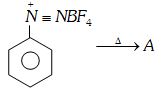
In this process,the product $A$ is:
A
Fluorobenzene
B
Benzene
C
$1, 4$-difluorobenzene
D
$1, 3$-difluorobenzene
Solution
(A) The given reaction is the Balz-Schiemann reaction. In this reaction,benzenediazonium tetrafluoroborate $(C_6H_5N_2^+BF_4^-)$ is heated,which leads to the decomposition of the diazonium salt to form fluorobenzene,nitrogen gas $(N_2)$,and boron trifluoride $(BF_3)$. The reaction is: $C_6H_5N_2^+BF_4^- \xrightarrow{\Delta} C_6H_5F + N_2 + BF_3$. Therefore,the product $A$ is fluorobenzene.
0 likes
View Solution3
MediumMCQ
The chlorobenzene is generally obtained from a corresponding diazonium salt by reacting it with
A
$Cu_2Cl_2$
B
$CuSO_4$
C
$Cu$
D
$Cu(NH_3)_4^{2+}$
Solution
(A) When a diazonium salt is treated with cuprous chloride $(Cu_2Cl_2)$ in the presence of $HCl$,it yields chlorobenzene.
This reaction is known as the Sandmeyer reaction.
This reaction is known as the Sandmeyer reaction.
0 likes
View Solution4
MediumMCQ
Chlorobenzene is prepared commercially by
A
Raschig process
B
Wurtz-Fitting reaction
C
Friedel-Craft's reaction
D
Grignard reaction
Solution
(A) The $Raschig$ process is a commercial method for the production of chlorobenzene.
In this process,benzene reacts with hydrogen chloride $(HCl)$ and oxygen $(O_2)$ in the presence of a copper catalyst to form chlorobenzene $(C_6H_5Cl)$ and water $(H_2O)$.
The reaction is: $2C_6H_6 + 2HCl + O_2 \xrightarrow{CuCl_2} 2C_6H_5Cl + 2H_2O$.
In this process,benzene reacts with hydrogen chloride $(HCl)$ and oxygen $(O_2)$ in the presence of a copper catalyst to form chlorobenzene $(C_6H_5Cl)$ and water $(H_2O)$.
The reaction is: $2C_6H_6 + 2HCl + O_2 \xrightarrow{CuCl_2} 2C_6H_5Cl + 2H_2O$.
0 likes
View Solution5
AdvancedMCQ
$C_6H_5Cl$ is prepared from aniline by:
A
$HCl$
B
$Cu_2Cl_2$
C
$Cl_2$ in the presence of anhydrous $AlCl_3$
D
Treatment with $HNO_2$ followed by heating with $Cu_2Cl_2$
Solution
(D) The preparation of chlorobenzene $(C_6H_5Cl)$ from aniline involves two main steps:
$1$. Diazotization: Aniline reacts with $HNO_2$ (prepared in situ from $NaNO_2 + HCl$) at $0-5 \ ^\circ C$ to form benzene diazonium chloride.
$2$. Sandmeyer reaction: The benzene diazonium chloride is then treated with cuprous chloride $(Cu_2Cl_2)$ in the presence of $HCl$ to yield chlorobenzene,with the evolution of nitrogen gas $(N_2)$.
$1$. Diazotization: Aniline reacts with $HNO_2$ (prepared in situ from $NaNO_2 + HCl$) at $0-5 \ ^\circ C$ to form benzene diazonium chloride.
$2$. Sandmeyer reaction: The benzene diazonium chloride is then treated with cuprous chloride $(Cu_2Cl_2)$ in the presence of $HCl$ to yield chlorobenzene,with the evolution of nitrogen gas $(N_2)$.
0 likes
View Solution6
MediumMCQ
Silver benzoate reacts with bromine to form
A
Bromobenzene
B
Silver bromide
C
$m-$Bromobenzoic acid
D
$o-$Bromobenzoic acid
Solution
(A) The reaction of silver benzoate with bromine in the presence of $CCl_4$ (Hunsdiecker reaction) leads to the formation of bromobenzene,carbon dioxide,and silver bromide.
$C_6H_5COOAg + Br_2 \xrightarrow{CCl_4} C_6H_5Br + CO_2 + AgBr$
Therefore,the correct product is bromobenzene.
$C_6H_5COOAg + Br_2 \xrightarrow{CCl_4} C_6H_5Br + CO_2 + AgBr$
Therefore,the correct product is bromobenzene.
0 likes
View Solution7
MediumMCQ
Which reaction is used to convert benzene diazonium chloride to bromobenzene?
A
Azo coupling reaction
B
Friedel-Crafts reaction
C
Reimer-Tiemann reaction
D
Gattermann reaction
Solution
(D) The conversion of benzene diazonium chloride $(C_6H_5N_2Cl)$ to bromobenzene $(C_6H_5Br)$ is achieved by treating it with hydrogen bromide $(HBr)$ in the presence of copper powder. This reaction is known as the Gattermann reaction. The reaction is: $C_6H_5N_2Cl + HBr \xrightarrow{Cu} C_6H_5Br + N_2 + HCl$.
0 likes
View Solution8
DifficultMCQ
Nitration of toluene is followed by reduction with $Sn + HCl$. The product obtained is then subjected to diazotization followed by heating with $Cu_2Br_2 + HBr$. What is the final product?
A
Mixture of $o-$ and $p-$ bromoaniline
B
Mixture of $o-$ and $m-$ bromoaniline
C
Mixture of $o-$ and $p-$ bromotoluene
D
Mixture of $o-$ and $p-$ dibromobenzene
Solution
(C) $1$. Nitration of toluene $(C_6H_5CH_3)$ gives a mixture of $o-$ and $p-$ nitrotoluene.
$2$. Reduction of these nitro compounds with $Sn + HCl$ converts the $-NO_2$ group to $-NH_2$,yielding $o-$ and $p-$ toluidine.
$3$. Diazotization of $o-$ and $p-$ toluidine with $NaNO_2 + HCl$ at $0-5 \ ^\circ C$ gives the corresponding diazonium salts.
$4$. Heating these diazonium salts with $Cu_2Br_2 + HBr$ (Sandmeyer reaction) replaces the $-N_2^+Cl^-$ group with $-Br$.
$5$. The final products are $o-$ and $p-$ bromotoluene.
$2$. Reduction of these nitro compounds with $Sn + HCl$ converts the $-NO_2$ group to $-NH_2$,yielding $o-$ and $p-$ toluidine.
$3$. Diazotization of $o-$ and $p-$ toluidine with $NaNO_2 + HCl$ at $0-5 \ ^\circ C$ gives the corresponding diazonium salts.
$4$. Heating these diazonium salts with $Cu_2Br_2 + HBr$ (Sandmeyer reaction) replaces the $-N_2^+Cl^-$ group with $-Br$.
$5$. The final products are $o-$ and $p-$ bromotoluene.
0 likes
View Solution9
MediumMCQ
Toluene is nitrated,and the resulting product is reduced. This is then diazotized and heated with cuprous bromide. What are the final products?
A
$O$ and $P$ dibromobenzene
B
$O$ and $P$ bromoaniline
C
$O$ and $M$ bromotoluene
D
$O$ and $P$ bromotoluene
Solution
(D) $1$. Nitration of toluene $(C_6H_5CH_3)$ gives a mixture of $o$-nitrotoluene and $p$-nitrotoluene.
$2$. Reduction of these nitro compounds using $Sn/HCl$ or $Fe/HCl$ yields $o$-toluidine and $p$-toluidine ($o$-methylaniline and $p$-methylaniline).
$3$. Diazotization of these amines with $NaNO_2/HCl$ at $0-5 \ ^\circ C$ produces the corresponding diazonium salts ($o$-methylbenzenediazonium chloride and $p$-methylbenzenediazonium chloride).
$4$. Heating these diazonium salts with cuprous bromide $(CuBr/HBr)$ (Sandmeyer reaction) replaces the diazonium group with a bromine atom,resulting in $o$-bromotoluene and $p$-bromotoluene.
$2$. Reduction of these nitro compounds using $Sn/HCl$ or $Fe/HCl$ yields $o$-toluidine and $p$-toluidine ($o$-methylaniline and $p$-methylaniline).
$3$. Diazotization of these amines with $NaNO_2/HCl$ at $0-5 \ ^\circ C$ produces the corresponding diazonium salts ($o$-methylbenzenediazonium chloride and $p$-methylbenzenediazonium chloride).
$4$. Heating these diazonium salts with cuprous bromide $(CuBr/HBr)$ (Sandmeyer reaction) replaces the diazonium group with a bromine atom,resulting in $o$-bromotoluene and $p$-bromotoluene.
0 likes
View Solution10
MediumMCQ
Which reagent is most suitable for the preparation of chlorobenzene from aniline?
A
Chlorine in the presence of ultraviolet light
B
Chlorine in the presence of $AlCl_3$
C
$Cu_2Cl_2$
D
$HNO_2$,$HCl$ followed by $Cu_2Cl_2$
Solution
(D) The preparation of chlorobenzene from aniline involves two main steps:
$1$. Diazotization: Aniline reacts with $HNO_2$ (formed in situ from $NaNO_2 + HCl$) at $0-5 \ ^\circ C$ to form benzene diazonium chloride.
$2$. Sandmeyer reaction: The benzene diazonium chloride is then treated with cuprous chloride $(Cu_2Cl_2)$ in the presence of $HCl$ to yield chlorobenzene.
Therefore,the sequence $HNO_2, HCl$ followed by $Cu_2Cl_2$ is the correct method.
$1$. Diazotization: Aniline reacts with $HNO_2$ (formed in situ from $NaNO_2 + HCl$) at $0-5 \ ^\circ C$ to form benzene diazonium chloride.
$2$. Sandmeyer reaction: The benzene diazonium chloride is then treated with cuprous chloride $(Cu_2Cl_2)$ in the presence of $HCl$ to yield chlorobenzene.
Therefore,the sequence $HNO_2, HCl$ followed by $Cu_2Cl_2$ is the correct method.
0 likes
View Solution11
DifficultMCQ
What is the name of the following reaction?
$ArN_2^+X^- + Cu_2Cl_2 + HCl \rightarrow \text{Chlorobenzene} + N_2$
$ArN_2^+X^- + Cu_2Cl_2 + HCl \rightarrow \text{Chlorobenzene} + N_2$
A
Chlorination
B
Sandmeyer reaction
C
Perkin reaction
D
Displacement reaction
Solution
(B) The reaction of a diazonium salt with $Cu_2Cl_2$ in the presence of $HCl$ to form chlorobenzene is known as the Sandmeyer reaction.
In this reaction,the diazonium group $(-N_2^+)$ is replaced by a chlorine atom.
In this reaction,the diazonium group $(-N_2^+)$ is replaced by a chlorine atom.
0 likes
View Solution12
MediumMCQ
Chlorobenzene is obtained from its corresponding diazonium salt by reaction with ......
A
$Cu_2Cl_2$ and $HCl$
B
$CuSO_4$
C
$Cu$ powder
D
$[Cu(NH_3)_4]^{+2}$
Solution
(A) The reaction of a benzene diazonium salt with $Cu_2Cl_2$ in the presence of $HCl$ is known as the $Sandmeyer$ reaction. This reaction is used to prepare chlorobenzene from benzene diazonium chloride.
0 likes
View Solution13
MediumMCQ
The reaction of benzene with chlorine in the presence of $Fe$ produces.........
A
$BHC$
B
Chlorobenzene
C
Benzyl chloride
D
Benzoyl chloride
Solution
(B) When benzene reacts with chlorine in the presence of a Lewis acid catalyst like $Fe$ (or $FeCl_3$),it undergoes electrophilic aromatic substitution to form chlorobenzene and hydrogen chloride.
The reaction is: $C_6H_6 + Cl_2 \xrightarrow{Fe} C_6H_5Cl + HCl$.
The reaction is: $C_6H_6 + Cl_2 \xrightarrow{Fe} C_6H_5Cl + HCl$.
0 likes
View Solution14
MediumMCQ
Toluene is nitrated and the resulting product is reduced with tin and hydrochloric acid. The product so obtained is diazotised and then heated with cuprous bromide. The reaction mixture so formed contains
A
mixture of $o-$ and $p-$ bromotoluenes
B
mixture of $o-$ and $p-$ dibromobenzenes
C
mixture of $o-$ and $p-$ bromoanilines
D
mixture of $o-$ and $m-$ bromotoluenes
Solution
(A) $1$. Nitration of $Toluene$ $(C_6H_5CH_3)$ with $HNO_3/H_2SO_4$ gives a mixture of $o-$ and $p-$ nitrotoluenes.
$2$. Reduction of these with $Sn/HCl$ converts the $-NO_2$ group into $-NH_2$ group,yielding $o-$ and $p-$ toluidines.
$3$. Diazotisation of these amines with $NaNO_2/HCl$ at $0-5 \ ^{\circ}C$ forms the corresponding diazonium salts.
$4$. Heating these diazonium salts with cuprous bromide $(CuBr)$ (Sandmeyer reaction) replaces the diazonium group with a bromine atom.
$5$. Thus,the final product is a mixture of $o-$ bromotoluene and $p-$ bromotoluene.
$2$. Reduction of these with $Sn/HCl$ converts the $-NO_2$ group into $-NH_2$ group,yielding $o-$ and $p-$ toluidines.
$3$. Diazotisation of these amines with $NaNO_2/HCl$ at $0-5 \ ^{\circ}C$ forms the corresponding diazonium salts.
$4$. Heating these diazonium salts with cuprous bromide $(CuBr)$ (Sandmeyer reaction) replaces the diazonium group with a bromine atom.
$5$. Thus,the final product is a mixture of $o-$ bromotoluene and $p-$ bromotoluene.
0 likes
View Solution15
AdvancedMCQ
Fluorobenzene $(C_6H_5F)$ can be synthesized in the laboratory
A
by direct fluorination of benzene with $F_2$ gas
B
by reacting bromobenzene with $NaF$ solution
C
by heating phenol with $HF$ and $KF$
D
from aniline by diazotisation followed by heating the diazonium salt with $HBF_4$
Solution
(D) Fluorobenzene is prepared by the Balz-Schiemann reaction.
In this process,aniline is first converted to benzene diazonium chloride using $NaNO_2$ and $HCl$ at $0-5^{\circ}C$.
Then,it is treated with fluoroboric acid $(HBF_4)$ to form benzene diazonium tetrafluoroborate $(C_6H_5N_2^+BF_4^-)$.
Finally,heating this salt leads to the formation of fluorobenzene,$BF_3$,and $N_2$ gas.
In this process,aniline is first converted to benzene diazonium chloride using $NaNO_2$ and $HCl$ at $0-5^{\circ}C$.
Then,it is treated with fluoroboric acid $(HBF_4)$ to form benzene diazonium tetrafluoroborate $(C_6H_5N_2^+BF_4^-)$.
Finally,heating this salt leads to the formation of fluorobenzene,$BF_3$,and $N_2$ gas.
0 likes
View Solution16
DifficultMCQ
Conversion of benzene diazonium chloride to chlorobenzene is an example of which of the following reactions?
A
Claisen
B
Friedel-craft
C
Sandmeyer
D
Wurtz
Solution
(C) The conversion of benzene diazonium chloride to chlorobenzene using $CuCl/HCl$ is a classic example of the Sandmeyer reaction.
The chemical equation is: $C_6H_5N_2Cl \xrightarrow{CuCl/HCl} C_6H_5Cl + N_2$
Therefore,the correct option is $C$.
The chemical equation is: $C_6H_5N_2Cl \xrightarrow{CuCl/HCl} C_6H_5Cl + N_2$
Therefore,the correct option is $C$.
0 likes
View Solution17
DifficultMCQ
Aryl fluoride may be prepared from arene diazonium chloride using
A
$HBF_4 / \Delta$
B
$HBF_4 / NaNO_2, Cu, \Delta$
C
$CuF / HF$
D
$Cu / HF$
Solution
(A) Aryl fluorides are prepared by the Balz-Schiemann reaction. In this reaction,arene diazonium chloride is treated with fluoroboric acid $(HBF_4)$ to form arene diazonium fluoroborate,which upon heating decomposes to give aryl fluoride,nitrogen gas,and boron trifluoride $(BF_3)$. The reaction is: $Ar-N_2^+Cl^- + HBF_4$ $\rightarrow Ar-N_2^+BF_4^- + HCl$ $\rightarrow Ar-F + N_2 + BF_3$.
0 likes
View Solution18
DifficultMCQ
The conversion of benzene diazonium chloride to bromobenzene can be accomplished by
A
Reimer-Tiemann reaction
B
Friedel-Crafts reaction
C
Gattermann reaction
D
Azo-coupling reaction
Solution
(C) The conversion of benzene diazonium chloride to bromobenzene is achieved by treating it with copper powder $(Cu)$ and hydrogen bromide $(HBr)$.
This specific reaction is known as the Gattermann reaction.
The chemical transformation is represented as:
$C_6H_5N_2Cl \xrightarrow{Cu/HBr} C_6H_5Br + N_2 + HCl$
This specific reaction is known as the Gattermann reaction.
The chemical transformation is represented as:
$C_6H_5N_2Cl \xrightarrow{Cu/HBr} C_6H_5Br + N_2 + HCl$
0 likes
View Solution19
MediumMCQ
The best method to introduce fluorine in the benzene ring as a substituent is:
A
Fluorination by electrophilic substitution
B
Balz-Schiemann reaction
C
Gattermann reaction
D
Swarts reaction
Solution
(B) Direct fluorination of benzene is highly exothermic and difficult to control,often leading to explosive reactions or polyfluorinated products.
The $Balz-Schiemann$ reaction is the most effective method for introducing a fluorine atom into the benzene ring.
In this process,an aniline is converted into a benzene diazonium tetrafluoroborate salt $(C_6H_5N_2^+BF_4^-)$ by reaction with $NaNO_2/HCl$ followed by $HBF_4$.
Upon heating,the salt decomposes to yield fluorobenzene,$N_2$ gas,and $BF_3$.
The $Balz-Schiemann$ reaction is the most effective method for introducing a fluorine atom into the benzene ring.
In this process,an aniline is converted into a benzene diazonium tetrafluoroborate salt $(C_6H_5N_2^+BF_4^-)$ by reaction with $NaNO_2/HCl$ followed by $HBF_4$.
Upon heating,the salt decomposes to yield fluorobenzene,$N_2$ gas,and $BF_3$.
0 likes
View Solution20
DifficultMCQ
High yield of aryl halide is formed in
A
Phenol + $PCl_5$ $\xrightarrow{\Delta}$
B
$Sandmeyer$ reaction
C
Benzene + $Cl_2$ $\xrightarrow{Fe}$
D
Styrene + $Br_2/CCl_4$ $\xrightarrow{}$
Solution
(B) The $Sandmeyer$ reaction is a well-known and efficient method for the synthesis of aryl halides from primary aromatic amines via diazonium salts.
It provides a high yield of aryl halides compared to other methods like the direct halogenation of benzene (which often leads to poly-substitution) or the reaction of phenol with $PCl_5$ (which gives poor yields of chlorobenzene).
Therefore,the $Sandmeyer$ reaction is the most suitable for obtaining a high yield of aryl halides.
It provides a high yield of aryl halides compared to other methods like the direct halogenation of benzene (which often leads to poly-substitution) or the reaction of phenol with $PCl_5$ (which gives poor yields of chlorobenzene).
Therefore,the $Sandmeyer$ reaction is the most suitable for obtaining a high yield of aryl halides.
0 likes
View Solution21
DifficultMCQ
How can fluorobenzene be prepared in the laboratory?
A
By heating petrol with $HF$ and $KF$
B
By heating the diazonium salt obtained from the diazotization of aniline with $HBF_4$
C
By direct fluorination of benzene with $F_2$ gas
D
By reacting bromobenzene with $NaF$ solution
Solution
(B) Fluorobenzene is prepared in the laboratory using the $Schiemann$ reaction.
First,aniline is converted to benzene diazonium chloride via diazotization.
Then,it is treated with fluoroboric acid $(HBF_4)$ to form benzene diazonium fluoroborate $(C_6H_5N_2BF_4)$.
Finally,heating this salt causes its decomposition to yield fluorobenzene,$N_2$,and $BF_3$.
First,aniline is converted to benzene diazonium chloride via diazotization.
Then,it is treated with fluoroboric acid $(HBF_4)$ to form benzene diazonium fluoroborate $(C_6H_5N_2BF_4)$.
Finally,heating this salt causes its decomposition to yield fluorobenzene,$N_2$,and $BF_3$.
0 likes
View Solution22
MediumMCQ
Industrially,chlorobenzene is prepared by:
A
Grignard reaction
B
Raschig process
C
Wurtz-Fittig reaction
D
Friedel-Crafts reaction
Solution
(B) Industrially,chlorobenzene is prepared by the $Raschig$ process. In this process,benzene is reacted with $HCl$ and $O_2$ in the presence of a copper catalyst $(CuCl_2)$ at high temperature. The reaction is: $2C_6H_6 + 2HCl + O_2 \xrightarrow{CuCl_2} 2C_6H_5Cl + 2H_2O$.
0 likes
View Solution23
DifficultMCQ
Which of the following are intermediates in the Sandmeyer reaction?
$(i)$ $C_6H_5N^{+} \equiv NCl^{-}$
$(ii)$ $C_6H_5N^{+} \equiv N$
$(iii)$ $\overset{\centerdot }{C}_6H_5$
$(iv)$ $C_6H_5Cl$
$(i)$ $C_6H_5N^{+} \equiv NCl^{-}$
$(ii)$ $C_6H_5N^{+} \equiv N$
$(iii)$ $\overset{\centerdot }{C}_6H_5$
$(iv)$ $C_6H_5Cl$
A
$(ii)$ and $(iii)$
B
$(i)$ and $(iv)$
C
$(ii)$ and $(iv)$
D
$(i)$ and $(ii)$
0 likes
View Solution24
Medium
Describe the methods of preparation of haloarenes.
Solution
(A) Aryl halides cannot be prepared by the methods used for alkyl halides because the $C-OH$ bond in phenols is much stronger than the $C-OH$ bond in alcohols.
$(a)$ Preparation from arenes by electrophilic substitution:
Method: Aryl chlorides and bromides are prepared by the reaction of arenes with chlorine $(Cl_2)$ or bromine $(Br_2)$ in the presence of a Lewis acid catalyst like iron or iron $(III)$ chloride.
Mechanism: This reaction proceeds via electrophilic aromatic substitution. The Lewis acid catalyst generates the electrophiles $Cl^+$ and $Br^+$.
Reactions: $C_6H_6 + X_2 \xrightarrow{Fe/FeX_3} C_6H_5X + HX$ (where $X = Cl, Br$).
The ortho and para isomers can be easily separated due to their large difference in melting points.
Iodination: The reaction is reversible,so an oxidizing agent like $HNO_3$ or $HIO_4$ is required to oxidize $HI$ formed during the reaction.
Fluorination: Fluorine is too reactive to be used directly for this method.
$(b)$ Preparation from amines by Sandmeyer reaction:
$(i)$ Diazotization: Primary aromatic amines dissolved or suspended in cold aqueous mineral acid are treated with sodium nitrite $(NaNO_2)$ to form diazonium salts $(ArN_2^+X^-)$.
$(ii)$ Sandmeyer reaction: The freshly prepared diazonium salt solution is treated with cuprous chloride $(Cu_2Cl_2)$ or cuprous bromide $(Cu_2Br_2)$ to replace the diazonium group with $-Cl$ or $-Br$.
$(a)$ Preparation from arenes by electrophilic substitution:
Method: Aryl chlorides and bromides are prepared by the reaction of arenes with chlorine $(Cl_2)$ or bromine $(Br_2)$ in the presence of a Lewis acid catalyst like iron or iron $(III)$ chloride.
Mechanism: This reaction proceeds via electrophilic aromatic substitution. The Lewis acid catalyst generates the electrophiles $Cl^+$ and $Br^+$.
Reactions: $C_6H_6 + X_2 \xrightarrow{Fe/FeX_3} C_6H_5X + HX$ (where $X = Cl, Br$).
The ortho and para isomers can be easily separated due to their large difference in melting points.
Iodination: The reaction is reversible,so an oxidizing agent like $HNO_3$ or $HIO_4$ is required to oxidize $HI$ formed during the reaction.
Fluorination: Fluorine is too reactive to be used directly for this method.
$(b)$ Preparation from amines by Sandmeyer reaction:
$(i)$ Diazotization: Primary aromatic amines dissolved or suspended in cold aqueous mineral acid are treated with sodium nitrite $(NaNO_2)$ to form diazonium salts $(ArN_2^+X^-)$.
$(ii)$ Sandmeyer reaction: The freshly prepared diazonium salt solution is treated with cuprous chloride $(Cu_2Cl_2)$ or cuprous bromide $(Cu_2Br_2)$ to replace the diazonium group with $-Cl$ or $-Br$.
0 likes
View Solution25
Difficult
Describe the preparation of aryl halides from aromatic hydrocarbons and from amines via the Sandmeyer reaction.
Solution
(N/A) Aryl halides cannot be prepared by the method used for alkyl halides because the $C-OH$ bond in phenol is stronger than in alcohols.
$(a)$ Preparation of aryl halides from arenes by electrophilic substitution:
Method: Arenes react with chlorine $(Cl_2)$ or bromine $(Br_2)$ in the presence of a Lewis acid catalyst like iron or iron $(III)$ chloride to form aryl chlorides and aryl bromides,respectively.
Mechanism: This reaction proceeds via electrophilic aromatic substitution. The catalyst generates electrophiles ($Cl^+$ or $Br^+$).
Reaction: $C_6H_6 + X_2 \xrightarrow{Fe/FeX_3, \Delta} C_6H_5X + HX$ (where $X = Cl, Br$).
The ortho and para isomers can be easily separated due to the large difference in their melting points.
Iodination: Requires an oxidizing agent like $HNO_3$ or $HIO_4$ to oxidize $HI$ formed during the reaction.
Fluorination: Cannot be done by this method due to the extremely high reactivity of fluorine.
$(b)$ Preparation of aryl halides from amines via Sandmeyer reaction:
$(i)$ Diazotization: Primary aromatic amines dissolved or suspended in cold aqueous mineral acid are treated with sodium nitrite $(NaNO_2)$ to form diazonium salts $(ArN_2^+ X^-)$.
Reaction: $C_6H_5NH_2 + NaNO_2 + 2HX \xrightarrow{273-278 K} C_6H_5N_2^+ X^- + 2H_2O + NaX$.
$(ii)$ Sandmeyer reaction: The freshly prepared diazonium salt solution is treated with cuprous chloride $(Cu_2Cl_2)$ or cuprous bromide $(Cu_2Br_2)$ to replace the diazonium group $(N_2^+ X^-)$ with $-Cl$ or $-Br$.
Reaction: $C_6H_5N_2^+ X^- \xrightarrow{Cu_2X_2} C_6H_5X + N_2$.
$(a)$ Preparation of aryl halides from arenes by electrophilic substitution:
Method: Arenes react with chlorine $(Cl_2)$ or bromine $(Br_2)$ in the presence of a Lewis acid catalyst like iron or iron $(III)$ chloride to form aryl chlorides and aryl bromides,respectively.
Mechanism: This reaction proceeds via electrophilic aromatic substitution. The catalyst generates electrophiles ($Cl^+$ or $Br^+$).
Reaction: $C_6H_6 + X_2 \xrightarrow{Fe/FeX_3, \Delta} C_6H_5X + HX$ (where $X = Cl, Br$).
The ortho and para isomers can be easily separated due to the large difference in their melting points.
Iodination: Requires an oxidizing agent like $HNO_3$ or $HIO_4$ to oxidize $HI$ formed during the reaction.
Fluorination: Cannot be done by this method due to the extremely high reactivity of fluorine.
$(b)$ Preparation of aryl halides from amines via Sandmeyer reaction:
$(i)$ Diazotization: Primary aromatic amines dissolved or suspended in cold aqueous mineral acid are treated with sodium nitrite $(NaNO_2)$ to form diazonium salts $(ArN_2^+ X^-)$.
Reaction: $C_6H_5NH_2 + NaNO_2 + 2HX \xrightarrow{273-278 K} C_6H_5N_2^+ X^- + 2H_2O + NaX$.
$(ii)$ Sandmeyer reaction: The freshly prepared diazonium salt solution is treated with cuprous chloride $(Cu_2Cl_2)$ or cuprous bromide $(Cu_2Br_2)$ to replace the diazonium group $(N_2^+ X^-)$ with $-Cl$ or $-Br$.
Reaction: $C_6H_5N_2^+ X^- \xrightarrow{Cu_2X_2} C_6H_5X + N_2$.
0 likes
View Solution26
Advanced
Aryl chlorides and bromides can be easily prepared by electrophilic substitution of arenes with chlorine and bromine respectively in the presence of Lewis acid catalysts. But why does the preparation of aryl iodides require the presence of an oxidizing agent?
Solution
(N/A) Iodination reactions are reversible in nature. The reaction is as follows:
$C_6H_6 + I_2 \rightleftharpoons C_6H_5I + HI$
To carry out the reaction in the forward direction,the $HI$ formed during the reaction must be removed. This is achieved by using an oxidizing agent such as $HIO_3$ (iodic acid),which oxidizes $HI$ back to $I_2$:
$5HI + HIO_3 \rightarrow 3I_2 + 3H_2O$
This prevents the reverse reaction and drives the equilibrium towards the formation of the aryl iodide.
$C_6H_6 + I_2 \rightleftharpoons C_6H_5I + HI$
To carry out the reaction in the forward direction,the $HI$ formed during the reaction must be removed. This is achieved by using an oxidizing agent such as $HIO_3$ (iodic acid),which oxidizes $HI$ back to $I_2$:
$5HI + HIO_3 \rightarrow 3I_2 + 3H_2O$
This prevents the reverse reaction and drives the equilibrium towards the formation of the aryl iodide.
0 likes
View Solution27
Difficult
Discuss the role of Lewis acids in the preparation of aryl bromides and chlorides in the dark.
Solution
(N/A) Lewis acids like $FeX_{3}$ $(X = Cl, Br)$ are used to generate the electrophile,the halonium ion $(X^{\oplus})$,from the halogen molecule $(X_{2})$.
The reaction is as follows:
$X-X + FeX_{3} \rightarrow [FeX_{4}]^{-} + X^{\oplus}$
The electrophile $X^{\oplus}$ then attacks the benzene ring to form a $\sigma$-complex,which subsequently loses a proton to form the aryl halide.
Overall reaction:
$C_{6}H_{6} + X_{2} \xrightarrow{FeX_{3}, \text{dark}} C_{6}H_{5}X + HX$ where $X = Cl, Br$.
The reaction is as follows:
$X-X + FeX_{3} \rightarrow [FeX_{4}]^{-} + X^{\oplus}$
The electrophile $X^{\oplus}$ then attacks the benzene ring to form a $\sigma$-complex,which subsequently loses a proton to form the aryl halide.
Overall reaction:
$C_{6}H_{6} + X_{2} \xrightarrow{FeX_{3}, \text{dark}} C_{6}H_{5}X + HX$ where $X = Cl, Br$.
0 likes
View Solution28
Medium
Write the structures and names of the compounds formed when compound $A$ with molecular formula $C_7H_8$ is treated with $Cl_2$ in the presence of $FeCl_3$.
Solution
(N/A) The compound $A$ with molecular formula $C_7H_8$ is toluene $(C_6H_5CH_3)$.
When toluene is treated with $Cl_2$ in the presence of $FeCl_3$ (a Lewis acid),electrophilic aromatic substitution occurs.
The $-CH_3$ group is ortho and para-directing.
Therefore,the reaction yields a mixture of $o$-chlorotoluene and $p$-chlorotoluene.
The reaction is as follows:
$C_6H_5CH_3 + Cl_2 \xrightarrow{FeCl_3} \text{o-Chlorotoluene} + \text{p-Chlorotoluene}$
When toluene is treated with $Cl_2$ in the presence of $FeCl_3$ (a Lewis acid),electrophilic aromatic substitution occurs.
The $-CH_3$ group is ortho and para-directing.
Therefore,the reaction yields a mixture of $o$-chlorotoluene and $p$-chlorotoluene.
The reaction is as follows:
$C_6H_5CH_3 + Cl_2 \xrightarrow{FeCl_3} \text{o-Chlorotoluene} + \text{p-Chlorotoluene}$
0 likes
View Solution29
Medium
Why can aryl halides not be prepared by the reaction of phenol with $HCl$ in the presence of $ZnCl_{2}$?
Solution
In phenol,the lone pair of electrons on the oxygen atom is involved in resonance with the benzene ring.
This gives the $C-O$ bond a partial double bond character.
Due to this partial double bond character,the $C-O$ bond is much stronger and shorter than a pure single bond,making it difficult to break.
Therefore,the nucleophilic substitution reaction required to replace the $-OH$ group with a $-Cl$ atom cannot occur easily under these conditions.
This gives the $C-O$ bond a partial double bond character.
Due to this partial double bond character,the $C-O$ bond is much stronger and shorter than a pure single bond,making it difficult to break.
Therefore,the nucleophilic substitution reaction required to replace the $-OH$ group with a $-Cl$ atom cannot occur easily under these conditions.
0 likes
View Solution30
Medium
How will you obtain monobromobenzene from aniline?
Solution
(N/A) To obtain monobromobenzene from aniline,the following two-step process is used:
$1$. Diazotization: Aniline is treated with $NaNO_2$ and $HCl$ at a low temperature of $273-278 \ K$ to form benzene diazonium chloride.
$2$. Sandmeyer's Reaction: The benzene diazonium chloride is then treated with cuprous bromide $(Cu_2Br_2)$ in the presence of hydrobromic acid $(HBr)$ to yield bromobenzene.
The reaction sequence is:
$C_6H_5NH_2$ $\xrightarrow{NaNO_2 + HCl, 273-278 \ K} C_6H_5N_2^+Cl^-$ $\xrightarrow{Cu_2Br_2/HBr} C_6H_5Br$
$1$. Diazotization: Aniline is treated with $NaNO_2$ and $HCl$ at a low temperature of $273-278 \ K$ to form benzene diazonium chloride.
$2$. Sandmeyer's Reaction: The benzene diazonium chloride is then treated with cuprous bromide $(Cu_2Br_2)$ in the presence of hydrobromic acid $(HBr)$ to yield bromobenzene.
The reaction sequence is:
$C_6H_5NH_2$ $\xrightarrow{NaNO_2 + HCl, 273-278 \ K} C_6H_5N_2^+Cl^-$ $\xrightarrow{Cu_2Br_2/HBr} C_6H_5Br$
0 likes
View Solution31
Medium
Explain the preparation of aryl halides from aromatic hydrocarbons.
Solution
(N/A) Haloarenes are prepared by the electrophilic substitution of arenes. Aryl chlorides and bromides are prepared by the chlorination and bromination of arenes in the presence of Lewis acid catalysts like iron or iron$(III)$ chloride $(FeCl_3)$.
The reaction of toluene with $X_2$ (where $X = Cl, Br$) in the presence of $Fe$ in the dark yields a mixture of $o$- and $p$-halotoluenes. These isomers can be separated due to the large difference in their melting points.
Direct iodination of arenes is reversible and requires the presence of an oxidizing agent like $HIO_3$ or $HNO_3$ to oxidize the $HI$ formed,thereby driving the reaction forward:
$5 HI + HIO_3 \rightarrow 3 I_2 + 3 H_2O$
Fluoroarenes are not prepared by this method because the high reactivity of fluorine is difficult to control.
The reaction of toluene with $X_2$ (where $X = Cl, Br$) in the presence of $Fe$ in the dark yields a mixture of $o$- and $p$-halotoluenes. These isomers can be separated due to the large difference in their melting points.
Direct iodination of arenes is reversible and requires the presence of an oxidizing agent like $HIO_3$ or $HNO_3$ to oxidize the $HI$ formed,thereby driving the reaction forward:
$5 HI + HIO_3 \rightarrow 3 I_2 + 3 H_2O$
Fluoroarenes are not prepared by this method because the high reactivity of fluorine is difficult to control.
0 likes
View Solution32
MediumMCQ
The reaction: $ArN_2Cl \xrightarrow{Cu / HCl} ArCl + N_2$ is known as
A
Sandmeyer's reaction
B
Finkelstein reaction
C
Gattermann reaction
D
Balz-Schiemann reaction
Solution
(C) The reaction of benzene diazonium chloride $(ArN_2Cl)$ with copper powder $(Cu)$ in the presence of hydrochloric acid $(HCl)$ to form aryl chloride $(ArCl)$ is known as the Gattermann reaction.
Note: If $Cu_2Cl_2 / HCl$ were used instead of $Cu / HCl$,it would be the Sandmeyer reaction.
Note: If $Cu_2Cl_2 / HCl$ were used instead of $Cu / HCl$,it would be the Sandmeyer reaction.
0 likes
View Solution33
Medium
Give the preparation of haloarenes from amine compounds.
Solution
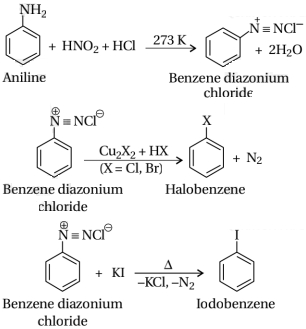
(N/A) $(i)$ Diazotization: When a primary aromatic amine,dissolved or suspended in cold aqueous mineral acid,is treated with sodium nitrite,a diazonium salt is formed. The reaction is known as diazotization.
$(ii)$ Sandmeyer's reaction: Mixing the solution of freshly prepared diazonium salt with cuprous chloride or cuprous bromide results in the replacement of the diazonium group by $-Cl$ or $-Br$.
$(iii)$ Iodide product: Replacement of the diazonium group by iodine does not require the presence of cuprous halide and is done simply by shaking the diazonium salt with potassium iodide.
$(ii)$ Sandmeyer's reaction: Mixing the solution of freshly prepared diazonium salt with cuprous chloride or cuprous bromide results in the replacement of the diazonium group by $-Cl$ or $-Br$.
$(iii)$ Iodide product: Replacement of the diazonium group by iodine does not require the presence of cuprous halide and is done simply by shaking the diazonium salt with potassium iodide.
0 likes
View Solution34
MediumMCQ
Which of the following is suitable to synthesize chlorobenzene?
A
Phenol,$NaNO_{2}, HCl, CuCl$
B
Aniline,$NaNO_{2}, HCl, CuCl$
C
Aniline,$HCl$,Heating
D
Benzene,$Cl_{2}$,anhydrous $FeCl_{3}$
Solution
(D) Chlorobenzene can be synthesized by the electrophilic aromatic substitution of benzene with chlorine in the presence of a Lewis acid catalyst like anhydrous $FeCl_{3}$.
The reaction is:
$C_{6}H_{6} + Cl_{2} \xrightarrow{\text{anhydrous } FeCl_{3}} C_{6}H_{5}Cl + HCl$
Alternatively,it can also be prepared from aniline via the Sandmeyer reaction (using $NaNO_{2}, HCl$ followed by $CuCl$),but option $D$ is a direct and standard method for the synthesis of chlorobenzene from benzene.
The reaction is:
$C_{6}H_{6} + Cl_{2} \xrightarrow{\text{anhydrous } FeCl_{3}} C_{6}H_{5}Cl + HCl$
Alternatively,it can also be prepared from aniline via the Sandmeyer reaction (using $NaNO_{2}, HCl$ followed by $CuCl$),but option $D$ is a direct and standard method for the synthesis of chlorobenzene from benzene.
0 likes
View Solution35
MediumMCQ
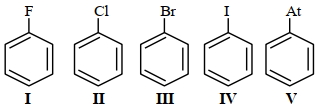
The number of halobenzenes from the following that can be prepared by Sandmeyer's reaction is . . . . . . . . .
A
$8$
B
$3$
C
$7$
D
$2$
Solution
(D) Sandmeyer's reaction involves the treatment of benzene diazonium salts with $CuCl/HCl$ or $CuBr/HBr$ to yield chlorobenzene or bromobenzene,respectively.
Among the given structures:
$I$: Fluorobenzene (prepared by Balz-Schiemann reaction)
$II$: Chlorobenzene (prepared by Sandmeyer's reaction)
$III$: Bromobenzene (prepared by Sandmeyer's reaction)
$IV$: Iodobenzene (prepared by treatment with $KI$)
$V$: Astatobenzene (not prepared by Sandmeyer's reaction)
Thus,only $II$ and $III$ can be prepared by Sandmeyer's reaction.
The total number is $2$.
Among the given structures:
$I$: Fluorobenzene (prepared by Balz-Schiemann reaction)
$II$: Chlorobenzene (prepared by Sandmeyer's reaction)
$III$: Bromobenzene (prepared by Sandmeyer's reaction)
$IV$: Iodobenzene (prepared by treatment with $KI$)
$V$: Astatobenzene (not prepared by Sandmeyer's reaction)
Thus,only $II$ and $III$ can be prepared by Sandmeyer's reaction.
The total number is $2$.
0 likes
View Solution36
EasyMCQ
Which of the following is a Gattermann reaction?
A
$ArN_{2}^{+}X^{-} \xrightarrow{Cu/HCl} ArCl + N_{2} \uparrow$
B
$ArN_{2}^{+}X^{-}$ $\xrightarrow{HBF_{4}} ArN_{2}^{+}BF_{4}^{-}$ $\xrightarrow{\Delta} ArF + N_{2} \uparrow + BF_{3}$
C
$ArN_{2}^{+}X^{-} \xrightarrow{Cu/HBr} ArBr + N_{2} \uparrow$
D
$ArN_{2}^{+}X^{-} \xrightarrow{KI, \Delta} ArI + N_{2} \uparrow + KX$
Solution
(C) In the Gattermann reaction,chlorine or bromine can be introduced into the arene ring by treating the arene diazonium salt solution with the corresponding halogen acid in the presence of copper powder.
Option $C$ represents the Gattermann reaction where $ArN_{2}^{+}X^{-}$ reacts with $Cu/HBr$ to form $ArBr$.
Option $C$ represents the Gattermann reaction where $ArN_{2}^{+}X^{-}$ reacts with $Cu/HBr$ to form $ArBr$.
0 likes
View Solution37
EasyMCQ
What is the name of the reaction involving the replacement of a diazonium group by a chloride ion using a cuprous $(I)$ salt?
A
Wolff-Kishner reduction
B
Friedel-Crafts reaction
C
Sandmeyer's reaction
D
Balz-Schiemann reaction
Solution
(C) $(C)$
Sandmeyer's reaction is the process where the diazonium group $(-N_{2}^{+}X^{-})$ is replaced by a halogen (like $-Cl$ or $-Br$) using the corresponding cuprous salt ($CuCl$ or $CuBr$) in the presence of its acid ($HCl$ or $HBr$).
The chemical equation is: $Ar-N_{2}^{+}X^{-} \xrightarrow{CuCl / HCl} Ar-Cl + N_{2} \uparrow$
Sandmeyer's reaction is the process where the diazonium group $(-N_{2}^{+}X^{-})$ is replaced by a halogen (like $-Cl$ or $-Br$) using the corresponding cuprous salt ($CuCl$ or $CuBr$) in the presence of its acid ($HCl$ or $HBr$).
The chemical equation is: $Ar-N_{2}^{+}X^{-} \xrightarrow{CuCl / HCl} Ar-Cl + N_{2} \uparrow$
0 likes
View Solution38
EasyMCQ
The reaction in which copper$(I)$ salt is used to replace nitrogen in diazonium salt is called,
A
Sandmeyer reaction
B
Hoffmann elimination
C
Gattermann reaction
D
Balz-Schiemann reaction
Solution
(A) The reaction in which a diazonium group $(-N_2^+)$ is replaced by a halogen or a cyano group using copper$(I)$ salts ($CuCl/HCl$,$CuBr/HBr$,or $CuCN/KCN$) is known as the Sandmeyer reaction.
In this reaction,the diazonium salt is treated with the corresponding cuprous halide in the presence of its respective acid to yield aryl halides or aryl nitriles.
In this reaction,the diazonium salt is treated with the corresponding cuprous halide in the presence of its respective acid to yield aryl halides or aryl nitriles.
0 likes
View Solution39
MediumMCQ
Which among the following is true for the Balz-Schiemann reaction?
A
In this,$Ar-Cl$ is obtained from $Ar-N_{2}^{+} X^{-}$
B
It is useful for the preparation of nitrobenzene from benzene diazonium salts
C
In this,$Ar-CN$ is obtained from $Ar-N_{2}^{+} X^{-}$
D
In this,$Ar-F$ is obtained from $Ar-N_{2}^{+} X^{-}$
Solution
(D) The Balz-Schiemann reaction is a chemical reaction used to synthesize aryl fluorides from primary aromatic amines.
In this reaction,the arene diazonium salt is treated with fluoroboric acid $(HBF_{4})$ to form arene diazonium fluoroborate $(Ar-N_{2}^{+} BF_{4}^{-})$,which precipitates out.
Upon heating,this salt decomposes to yield aryl fluoride $(Ar-F)$,boron trifluoride $(BF_{3})$,and nitrogen gas $(N_{2})$.
The reaction is represented as:
$Ar-N_{2}^{+} Cl^{-} + HBF_{4} \rightarrow Ar-N_{2}^{+} BF_{4}^{-} + HCl$
$Ar-N_{2}^{+} BF_{4}^{-} \xrightarrow{\Delta} Ar-F + BF_{3} + N_{2}$
In this reaction,the arene diazonium salt is treated with fluoroboric acid $(HBF_{4})$ to form arene diazonium fluoroborate $(Ar-N_{2}^{+} BF_{4}^{-})$,which precipitates out.
Upon heating,this salt decomposes to yield aryl fluoride $(Ar-F)$,boron trifluoride $(BF_{3})$,and nitrogen gas $(N_{2})$.
The reaction is represented as:
$Ar-N_{2}^{+} Cl^{-} + HBF_{4} \rightarrow Ar-N_{2}^{+} BF_{4}^{-} + HCl$
$Ar-N_{2}^{+} BF_{4}^{-} \xrightarrow{\Delta} Ar-F + BF_{3} + N_{2}$
0 likes
View Solution40
EasyMCQ
Identify the reagent involved in the Sandmeyer reaction.
A
$CuCN / KCN$
B
$Cu$ (Powder) $/ HBr$
C
$H_3PO_3$
D
$CH_3CH_2OH$
Solution
(A) The Sandmeyer reaction is a chemical reaction used to synthesize aryl halides from aryl diazonium salts using copper salts as reagents or catalysts.
Specifically,the reaction of benzene diazonium chloride with $CuCl/HCl$ or $CuBr/HBr$ or $CuCN/KCN$ leads to the formation of chlorobenzene,bromobenzene,or benzonitrile,respectively.
Among the given options,$CuCN / KCN$ is the reagent used to introduce a cyano group via the Sandmeyer reaction.
Specifically,the reaction of benzene diazonium chloride with $CuCl/HCl$ or $CuBr/HBr$ or $CuCN/KCN$ leads to the formation of chlorobenzene,bromobenzene,or benzonitrile,respectively.
Among the given options,$CuCN / KCN$ is the reagent used to introduce a cyano group via the Sandmeyer reaction.
0 likes
View Solution41
EasyMCQ
What type of arenes are obtained when arene diazonium chloride is treated with fluoroboric acid and then heated further?
A
$Ar-NO_2$
B
$Ar-F$
C
$Ar-Cl$
D
$Ar-H$
Solution
(B) When arene diazonium chloride $(Ar-N_2^+Cl^-)$ is treated with fluoroboric acid $(HBF_4)$,it forms arene diazonium fluoroborate $(Ar-N_2^+BF_4^-)$ as a precipitate.
Upon heating,this salt decomposes to yield fluoroarene $(Ar-F)$,boron trifluoride $(BF_3)$,and nitrogen gas $(N_2)$.
The reaction is: $Ar-N_2^+Cl^- + HBF_4 \rightarrow Ar-N_2^+BF_4^- + HCl$.
Then,$Ar-N_2^+BF_4^- \xrightarrow{\Delta} Ar-F + BF_3 + N_2$.
Upon heating,this salt decomposes to yield fluoroarene $(Ar-F)$,boron trifluoride $(BF_3)$,and nitrogen gas $(N_2)$.
The reaction is: $Ar-N_2^+Cl^- + HBF_4 \rightarrow Ar-N_2^+BF_4^- + HCl$.
Then,$Ar-N_2^+BF_4^- \xrightarrow{\Delta} Ar-F + BF_3 + N_2$.
0 likes
View Solution42
MediumMCQ
Which among the following compounds is $NOT$ prepared by Sandmeyer's reaction?
A
Chlorobenzene
B
Iodobenzene
C
Benzonitrile
D
Bromobenzene
Solution
(B) Sandmeyer's reaction involves the conversion of benzene diazonium salts into aryl halides (chloro,bromo) or aryl cyanides using copper$(I)$ salts ($CuCl$,$CuBr$,$CuCN$).
Specifically:
$1$. $Ph-N_2^+Cl^- + CuCl \rightarrow Ph-Cl + N_2$
$2$. $Ph-N_2^+Cl^- + CuBr \rightarrow Ph-Br + N_2$
$3$. $Ph-N_2^+Cl^- + CuCN \rightarrow Ph-CN + N_2$
Iodobenzene $(Ph-I)$ is $NOT$ prepared by Sandmeyer's reaction because it is prepared by treating benzene diazonium salt with potassium iodide $(KI)$ solution,which does not require a copper catalyst.
Specifically:
$1$. $Ph-N_2^+Cl^- + CuCl \rightarrow Ph-Cl + N_2$
$2$. $Ph-N_2^+Cl^- + CuBr \rightarrow Ph-Br + N_2$
$3$. $Ph-N_2^+Cl^- + CuCN \rightarrow Ph-CN + N_2$
Iodobenzene $(Ph-I)$ is $NOT$ prepared by Sandmeyer's reaction because it is prepared by treating benzene diazonium salt with potassium iodide $(KI)$ solution,which does not require a copper catalyst.
0 likes
View Solution43
MediumMCQ
The conversion of benzene diazonium chloride to chlorobenzene in the presence of $CuCl / HCl$ is known as:
A
Sandmeyer reaction
B
Medius reaction
C
Gattermann reaction
D
Hoffmann degradation
Solution
(A) The reaction of benzene diazonium chloride with cuprous chloride $(CuCl)$ in the presence of hydrochloric acid $(HCl)$ to form chlorobenzene is a classic example of the Sandmeyer reaction.
In this reaction,the diazonium group $(-N_2^+Cl^-)$ is replaced by a chlorine atom.
In this reaction,the diazonium group $(-N_2^+Cl^-)$ is replaced by a chlorine atom.
0 likes
View Solution44
MediumMCQ
Which of the following pairs of aryl halides can $\underline{NOT}$ be prepared directly by electrophilic substitution?
A
Aryl bromide and aryl iodide
B
Aryl chloride and aryl bromide
C
Aryl fluoride and aryl chloride
D
Aryl iodide and aryl fluoride
Solution
(D) The correct answer is $D$.
Electrophilic substitution of benzene with iodine is a reversible reaction,requiring an oxidizing agent (like $HNO_3$ or $HIO_4$) to remove $HI$ and drive the reaction forward; hence,it is not considered a direct preparation.
Fluorination is extremely exothermic and highly reactive,making it difficult to control for direct electrophilic substitution.
Therefore,aryl iodide and aryl fluoride cannot be prepared directly by simple electrophilic substitution.
Electrophilic substitution of benzene with iodine is a reversible reaction,requiring an oxidizing agent (like $HNO_3$ or $HIO_4$) to remove $HI$ and drive the reaction forward; hence,it is not considered a direct preparation.
Fluorination is extremely exothermic and highly reactive,making it difficult to control for direct electrophilic substitution.
Therefore,aryl iodide and aryl fluoride cannot be prepared directly by simple electrophilic substitution.
0 likes
View Solution45
MediumMCQ
Which of the following reactions is used to prepare aryl fluorides from diazonium salts and fluoroboric acid?
A
Sandmeyer reaction
B
Balz-Schiemann reaction
C
Gattermann reaction
D
Swarts reaction
Solution
(B) The reaction of a diazonium salt with fluoroboric acid $(HBF_4)$ followed by heating the resulting diazonium fluoroborate salt to yield an aryl fluoride is known as the Balz-Schiemann reaction.
The reaction sequence is:
$C_6H_5N_2^+Cl^- + HBF_4 \rightarrow C_6H_5N_2^+BF_4^- + HCl$
$C_6H_5N_2^+BF_4^- \xrightarrow{\Delta} C_6H_5F + N_2 + BF_3$
The reaction sequence is:
$C_6H_5N_2^+Cl^- + HBF_4 \rightarrow C_6H_5N_2^+BF_4^- + HCl$
$C_6H_5N_2^+BF_4^- \xrightarrow{\Delta} C_6H_5F + N_2 + BF_3$
0 likes
View Solution46
EasyMCQ
The raw material for the Raschig process is
A
$chlorobenzene$
B
$phenol$
C
$benzene$
D
$anisole$
Solution
(C) The Raschig process is a commercial method for the preparation of $chlorobenzene$ from $benzene$.
The reaction is given by:
$C_6H_6 + HCl + \frac{1}{2}O_2 \xrightarrow{CuCl_2, 500 \ K} C_6H_5Cl + H_2O$
Thus,$benzene$ is the raw material used in this process.
The reaction is given by:
$C_6H_6 + HCl + \frac{1}{2}O_2 \xrightarrow{CuCl_2, 500 \ K} C_6H_5Cl + H_2O$
Thus,$benzene$ is the raw material used in this process.
0 likes
View Solution47
EasyMCQ
The decomposition of benzene diazonium chloride using $Cu_{2}Cl_{2} / HCl$ to form chlorobenzene is known as:
A
Raschig's reaction
B
Sandmeyer's reaction
C
Kolbe's reaction
D
Cannizzaro's reaction
Solution
(B) The reaction of benzene diazonium chloride with $Cu_{2}Cl_{2} / HCl$ to produce chlorobenzene is a classic example of Sandmeyer's reaction.
In this reaction,the diazonium group $(-N_{2}^{+}Cl^{-})$ is replaced by a chlorine atom.
In this reaction,the diazonium group $(-N_{2}^{+}Cl^{-})$ is replaced by a chlorine atom.
0 likes
View Solution48
EasyMCQ
Presence of which of the following is suitable for the synthesis of bromobenzene from benzene diazonium salts?
A
$HBr$
B
$MgBr, HBr$
C
$Cu_2Br_2, HBr$
D
$KBr$
Solution
(C) The synthesis of bromobenzene from benzene diazonium salts is a classic example of the Sandmeyer reaction.
In this reaction,the benzene diazonium salt is treated with cuprous bromide $(Cu_2Br_2)$ in the presence of hydrobromic acid $(HBr)$.
The reaction proceeds as follows:
$C_6H_5N_2^+Cl^- + Cu_2Br_2 \xrightarrow{HBr} C_6H_5Br + N_2 + Cu_2Cl_2$
Thus,the presence of $Cu_2Br_2$ and $HBr$ is required.
In this reaction,the benzene diazonium salt is treated with cuprous bromide $(Cu_2Br_2)$ in the presence of hydrobromic acid $(HBr)$.
The reaction proceeds as follows:
$C_6H_5N_2^+Cl^- + Cu_2Br_2 \xrightarrow{HBr} C_6H_5Br + N_2 + Cu_2Cl_2$
Thus,the presence of $Cu_2Br_2$ and $HBr$ is required.
0 likes
View Solution49
EasyMCQ
The reaction $ArN_2^+ Cl^- + Cu + HCl \longrightarrow ArCl + N_2 + CuCl$ is known as:
A
Swarts reaction
B
Gatterman reaction
C
Sandmeyer reaction
D
Stephen reaction
Solution
(B) The reaction $ArN_2^+ Cl^- + Cu + HCl \longrightarrow ArCl + N_2 + CuCl$ is known as the Gattermann reaction.
In this reaction,the diazonium salt reacts with copper metal in the presence of $HCl$ to produce chlorobenzene.
This reaction is a modification of the Sandmeyer reaction,where copper powder is used instead of copper$(I)$ chloride $(CuCl)$ or copper$(I)$ bromide $(CuBr)$.
In this reaction,the diazonium salt reacts with copper metal in the presence of $HCl$ to produce chlorobenzene.
This reaction is a modification of the Sandmeyer reaction,where copper powder is used instead of copper$(I)$ chloride $(CuCl)$ or copper$(I)$ bromide $(CuBr)$.
0 likes
View Solution50
MediumMCQ
In Gattermann reaction,a diazonium group is replaced by $\underline{X}$ using $\underline{Y}$. $\underline{X}$ and $\underline{Y}$ are:
$\underline{X} \quad \underline{Y}$
$\underline{X} \quad \underline{Y}$
A
$Cl^{\ominus} \quad Cu / HCl$
B
$Cl^{\oplus} \quad CuCl_2 / HCl$
C
$Cl^{\ominus} \quad CuCl_2 / HCl$
D
$Cl_2 \quad Cu_2 O / HCl$
Solution
(A) In the Gattermann reaction,the diazonium group $(-N_2^+Cl^-)$ is replaced by a chlorine atom $(-Cl)$ using copper powder $(Cu)$ in the presence of hydrochloric acid $(HCl)$.
Specifically,the nucleophilic species involved in the substitution is the chloride ion $(Cl^{\ominus})$,and the reagents used are $Cu$ powder and $HCl$.
Therefore,$\underline{X} = Cl^{\ominus}$ and $\underline{Y} = Cu / HCl$.
Specifically,the nucleophilic species involved in the substitution is the chloride ion $(Cl^{\ominus})$,and the reagents used are $Cu$ powder and $HCl$.
Therefore,$\underline{X} = Cl^{\ominus}$ and $\underline{Y} = Cu / HCl$.
0 likes
View SolutionHaloalkanes and Haloarenes — Preparation of Haloarenes · Frequently Asked Questions
1Are these Haloalkanes and Haloarenes questions useful for JEE and NEET?
Yes. All questions in this section are mapped to JEE Main and NEET exam patterns. Previous year questions from JEE Main, NEET, GUJCET and state-level exams are included with full solutions.
2Can I switch to Hindi or Gujarati for these questions?
Yes. Use the language tabs in the hero section or the sidebar to view the same questions and solutions in English, Hindi or Gujarati.
3How do I generate a question paper from this subtopic?
Use the Vedclass Exam Paper Generator — select the chapter and subtopic, set difficulty, and generate Sets A, B, C, D automatically. First 3 chapters of every subject are free.
Vedclass Products
For Students
Vedclass Test Series
Mock tests in real JEE/NEET style with performance analysis. 5-day free trial.
Start Free TrialFor Teachers
Exam Paper Generator
Generate Set A/B/C/D papers from this chapter in 2 minutes. 3 chapters free.
Try FreeFor Institutes
Online Exam Module
Live online exams with unlimited students, 360° analytics & white-label branding.
See DemoFor Teachers & Institutes
Generate a Haloalkanes and Haloarenes Exam Paper in 2 Minutes
Select subtopic & difficulty — Sets A, B, C, D auto-generated with No Repeat logic.
First 3 chapters of every subject are free — no payment required.