
A English
Properties of Haloarenes Questions in English
Class 12 Chemistry · Haloalkanes and Haloarenes · Properties of Haloarenes
423+
Questions
English
Language
100%
With Solutions
Showing 50 of 423 questions in English
1
EasyMCQ
Which of the following possesses the highest melting point?
A
Chlorobenzene
B
$o$-dichlorobenzene
C
$m$-dichlorobenzene
D
$p$-dichlorobenzene
Solution
(D) $p$-dichlorobenzene has the highest melting point due to its symmetrical structure,which leads to more efficient packing in the crystal lattice compared to the ortho and meta isomers.
0 likes
View Solution2
DifficultMCQ
Arrange the following compounds in order of increasing dipole moment.
$(I)$ Toluene
$(II)$ $m$-dichlorobenzene
$(III)$ $o$-dichlorobenzene
$(IV)$ $p$-dichlorobenzene
$(I)$ Toluene
$(II)$ $m$-dichlorobenzene
$(III)$ $o$-dichlorobenzene
$(IV)$ $p$-dichlorobenzene
A
$I < IV < II < III$
B
$IV < I < II < III$
C
$IV < I < III < II$
D
$IV < II < I < III$
Solution
(B) The dipole moment $(\mu)$ depends on the vector sum of individual bond dipoles.
$(IV)$ $p$-dichlorobenzene: The two $C-Cl$ bond dipoles are equal and opposite, so $\mu = 0$.
$(I)$ Toluene: The methyl group is electron-donating, creating a small dipole moment.
$(II)$ $m$-dichlorobenzene: The angle between the two $C-Cl$ bonds is $120^{\circ}$, resulting in a net dipole moment.
$(III)$ $o$-dichlorobenzene: The angle between the two $C-Cl$ bonds is $60^{\circ}$, resulting in the largest net dipole moment due to the smaller angle.
Thus, the correct order is: $IV < I < II < III$.
$(IV)$ $p$-dichlorobenzene: The two $C-Cl$ bond dipoles are equal and opposite, so $\mu = 0$.
$(I)$ Toluene: The methyl group is electron-donating, creating a small dipole moment.
$(II)$ $m$-dichlorobenzene: The angle between the two $C-Cl$ bonds is $120^{\circ}$, resulting in a net dipole moment.
$(III)$ $o$-dichlorobenzene: The angle between the two $C-Cl$ bonds is $60^{\circ}$, resulting in the largest net dipole moment due to the smaller angle.
Thus, the correct order is: $IV < I < II < III$.
0 likes
View Solution3
MediumMCQ
Which of the following gives only one monosubstituted product upon further electrophilic substitution?
A
$o$-Dinitrobenzene
B
$m$-Dinitrobenzene
C
$p$-Dinitrobenzene
D
Nitrobenzene
Solution
(B) In $m$-Dinitrobenzene,the two $-NO_2$ groups are at the $1$ and $3$ positions. Both groups are strongly deactivating and meta-directing. The position $5$ is meta to both $-NO_2$ groups,making it the only equivalent position available for electrophilic substitution. Thus,it yields only one monosubstituted product.
0 likes
View Solution4
MediumMCQ
The presence of the chlorine atom on the benzene ring makes the second substituent enter at which position?
A
ortho
B
meta
C
para
D
ortho-para
Solution
(D) The chlorine atom $(Cl)$ exerts an inductive effect ($-I$ effect) and a resonance effect ($+R$ effect).
Although the $-I$ effect is stronger,the $+R$ effect increases the electron density at the ortho and para positions.
Therefore,the chlorine atom is an ortho-para directing group.
Although the $-I$ effect is stronger,the $+R$ effect increases the electron density at the ortho and para positions.
Therefore,the chlorine atom is an ortho-para directing group.
0 likes
View Solution5
DifficultMCQ
Which of the following represents a nucleophilic aromatic substitution reaction?
A
Reaction of benzene with $Cl_2$ in sunlight
B
Hydrolysis of benzyl bromide
C
Reaction of $NaOH$ with dinitrofluorobenzene
D
Both $(b)$ and $(c)$
Solution
(C) Nucleophilic aromatic substitution $(S_NAr)$ involves the replacement of a leaving group on an aromatic ring by a nucleophile.
$A$. Reaction of benzene with $Cl_2$ in sunlight is a free-radical substitution reaction.
$B$. Hydrolysis of benzyl bromide $(C_6H_5CH_2Br)$ is an aliphatic nucleophilic substitution ($S_N1$ or $S_N2$) reaction,not aromatic.
$C$. The reaction of $NaOH$ with dinitrofluorobenzene is a classic example of nucleophilic aromatic substitution,where the $OH^-$ nucleophile attacks the aromatic ring activated by electron-withdrawing nitro groups,displacing the fluoride ion.
Therefore,only $(c)$ represents a nucleophilic aromatic substitution reaction.
$A$. Reaction of benzene with $Cl_2$ in sunlight is a free-radical substitution reaction.
$B$. Hydrolysis of benzyl bromide $(C_6H_5CH_2Br)$ is an aliphatic nucleophilic substitution ($S_N1$ or $S_N2$) reaction,not aromatic.
$C$. The reaction of $NaOH$ with dinitrofluorobenzene is a classic example of nucleophilic aromatic substitution,where the $OH^-$ nucleophile attacks the aromatic ring activated by electron-withdrawing nitro groups,displacing the fluoride ion.
Therefore,only $(c)$ represents a nucleophilic aromatic substitution reaction.
0 likes
View Solution6
DifficultMCQ
Which one of the following is least reactive in a nucleophilic substitution reaction?
A
$CH_3CH_2Cl$
B
$CH_2 = CHCH_2Cl$
C
$(CH_3)_3C - Cl$
D
$CH_2 = CHCl$
Solution
(D) The correct answer is $D$ $(CH_2 = CHCl)$.
In vinyl chloride $(CH_2 = CHCl)$,the lone pair of electrons on the chlorine atom is in conjugation with the $\pi$-bond of the double bond.
This leads to partial double bond character in the $C-Cl$ bond due to resonance.
As a result,the $C-Cl$ bond is stronger and shorter than in alkyl halides,making it very difficult to break in a nucleophilic substitution reaction.
Therefore,it is the least reactive among the given options.
In vinyl chloride $(CH_2 = CHCl)$,the lone pair of electrons on the chlorine atom is in conjugation with the $\pi$-bond of the double bond.
This leads to partial double bond character in the $C-Cl$ bond due to resonance.
As a result,the $C-Cl$ bond is stronger and shorter than in alkyl halides,making it very difficult to break in a nucleophilic substitution reaction.
Therefore,it is the least reactive among the given options.
0 likes
View Solution7
MediumMCQ
Which of the following sets of compounds is $NOT$ arranged in the order of decreasing reactivity towards electrophilic aromatic substitution?
A
$C_6H_5F > C_6H_5Cl > C_6H_5Br$
B
Phenol $> n$-propyl benzene $>$ benzoic acid
C
$p$-chlorotoluene $> p$-nitrotoluene $> 2$-chloro-$4$-nitrotoluene
D
Benzoic acid $>$ phenol $> n$-propyl benzene
Solution
(D) Electrophilic aromatic substitution reactivity depends on the electron density of the ring. Electron-donating groups $(EDG)$ increase reactivity,while electron-withdrawing groups $(EWG)$ decrease it.
$(A)$ Halogens are deactivating but ortho/para directing. Reactivity decreases as electronegativity decreases: $F > Cl > Br$.
$(B)$ Phenol ($-OH$ is strongly activating) $>$ $n$-propyl benzene (alkyl group is weakly activating) $>$ benzoic acid ($-COOH$ is strongly deactivating).
$(C)$ $p$-chlorotoluene has an activating $-CH_3$ and deactivating $-Cl$. $p$-nitrotoluene has a deactivating $-NO_2$. $2$-chloro-$4$-nitrotoluene has two deactivating groups. The order is correct.
$(D)$ Benzoic acid is the least reactive due to the $-COOH$ group. The correct order should be phenol $> n$-propyl benzene $>$ benzoic acid. Thus,option $D$ is not arranged in decreasing order.
$(A)$ Halogens are deactivating but ortho/para directing. Reactivity decreases as electronegativity decreases: $F > Cl > Br$.
$(B)$ Phenol ($-OH$ is strongly activating) $>$ $n$-propyl benzene (alkyl group is weakly activating) $>$ benzoic acid ($-COOH$ is strongly deactivating).
$(C)$ $p$-chlorotoluene has an activating $-CH_3$ and deactivating $-Cl$. $p$-nitrotoluene has a deactivating $-NO_2$. $2$-chloro-$4$-nitrotoluene has two deactivating groups. The order is correct.
$(D)$ Benzoic acid is the least reactive due to the $-COOH$ group. The correct order should be phenol $> n$-propyl benzene $>$ benzoic acid. Thus,option $D$ is not arranged in decreasing order.
0 likes
View Solution8
MediumMCQ
The reaction of toluene with chlorine in the presence of ferric chloride $(FeCl_3)$ gives predominantly:
A
Benzoyl chloride
B
$m-$chlorotoluene
C
Benzyl chloride
D
$o-$ and $p-$chlorotoluenes
Solution
(D) The reaction of toluene with chlorine in the presence of a Lewis acid like ferric chloride $(FeCl_3)$ is an electrophilic aromatic substitution reaction (chlorination).
The methyl group $(-CH_3)$ attached to the benzene ring is an ortho/para-directing group due to its electron-donating inductive effect and hyperconjugation.
Therefore,the chlorine electrophile $(Cl^+)$ attacks the ortho and para positions of the toluene ring,resulting in the formation of $o-$chlorotoluene and $p-$chlorotoluene as the major products.
The reaction is: $C_6H_5CH_3 + Cl_2 \xrightarrow{FeCl_3} C_6H_4(CH_3)Cl + HCl$.
The methyl group $(-CH_3)$ attached to the benzene ring is an ortho/para-directing group due to its electron-donating inductive effect and hyperconjugation.
Therefore,the chlorine electrophile $(Cl^+)$ attacks the ortho and para positions of the toluene ring,resulting in the formation of $o-$chlorotoluene and $p-$chlorotoluene as the major products.
The reaction is: $C_6H_5CH_3 + Cl_2 \xrightarrow{FeCl_3} C_6H_4(CH_3)Cl + HCl$.
0 likes
View Solution9
MediumMCQ
Which of the following would be least reactive towards bromine?
A
Nitrobenzene
B
Phenol
C
Anisole
D
Chlorobenzene
Solution
(A) Nitrobenzene is least reactive towards bromine because the presence of the $-NO_2$ group decreases electron density at $o$ and $p$ positions due to its strong electron-withdrawing nature ($-I$ and $-M$ effects).
Consequently,the attack of the electrophile $(Br^+)$ on the benzene nucleus is difficult because the positive charge at $o$ and $p$ positions repels the incoming electrophile.
Consequently,the attack of the electrophile $(Br^+)$ on the benzene nucleus is difficult because the positive charge at $o$ and $p$ positions repels the incoming electrophile.
0 likes
View Solution10
MediumMCQ
Amongst the following,the compound that is nitrated with difficulty is
A
Benzene
B
Nitrobenzene
C
Toluene
D
Phenol
Solution
(B) Nitration is an electrophilic aromatic substitution reaction. The rate of this reaction depends on the electron density of the benzene ring.
$Nitrobenzene$ contains a $-NO_2$ group,which is a strong electron-withdrawing group $(-EWG)$.
This group decreases the electron density of the benzene ring,making it deactivated towards electrophilic attack.
Therefore,$Nitrobenzene$ undergoes nitration with difficulty compared to $Benzene$,$Toluene$,and $Phenol$.
$Nitrobenzene$ contains a $-NO_2$ group,which is a strong electron-withdrawing group $(-EWG)$.
This group decreases the electron density of the benzene ring,making it deactivated towards electrophilic attack.
Therefore,$Nitrobenzene$ undergoes nitration with difficulty compared to $Benzene$,$Toluene$,and $Phenol$.
0 likes
View Solution11
MediumMCQ
The compound used as an explosive is
A
$2, 4, 6-$ tribromoaniline
B
$1, 3, 5-$ trinitrobenzene
C
$2, 4, 6-$ trichlorotoluene
D
$2, 4, 6-$ trinitrotoluene
Solution
(D) $2, 4, 6-$ trinitrotoluene $(TNT)$ is a well-known chemical compound used as an explosive.
0 likes
View Solution12
MediumMCQ
The product obtained after the nitration of nitrobenzene is:
A
$TNT$
B
$1, 3-$dinitrobenzene
C
Picric acid
D
$1, 4-$dinitrobenzene
Solution
(B) The nitration of nitrobenzene involves the reaction of nitrobenzene with a mixture of concentrated $HNO_3$ and concentrated $H_2SO_4$.
The $-NO_2$ group present in nitrobenzene is a deactivating and meta-directing group.
Therefore,the incoming nitro group enters the meta-position,resulting in the formation of $1, 3-$dinitrobenzene (also known as $m-$dinitrobenzene).
The $-NO_2$ group present in nitrobenzene is a deactivating and meta-directing group.
Therefore,the incoming nitro group enters the meta-position,resulting in the formation of $1, 3-$dinitrobenzene (also known as $m-$dinitrobenzene).
0 likes
View Solution13
MediumMCQ
Which one of the following reactions is most suitable for the preparation of $n$-propyl benzene?
A
Friedel-Craft's reaction
B
Wurtz reaction
C
Wurtz-Fittig reaction
D
Grignard reaction
Solution
(C) $n$-propyl benzene is best prepared using the Wurtz-Fittig reaction.
In this reaction,an alkyl halide $(CH_3CH_2CH_2Br)$ reacts with an aryl halide $(C_6H_5Br)$ in the presence of sodium metal and dry ether.
The reaction is: $CH_3CH_2CH_2Br + C_6H_5Br + 2Na \xrightarrow{\text{dry ether}} C_6H_5CH_2CH_2CH_3 + 2NaBr$.
Friedel-Craft's alkylation is unsuitable because the $n$-propyl carbocation intermediate undergoes rearrangement to a more stable isopropyl carbocation,leading to isopropyl benzene as the major product.
In this reaction,an alkyl halide $(CH_3CH_2CH_2Br)$ reacts with an aryl halide $(C_6H_5Br)$ in the presence of sodium metal and dry ether.
The reaction is: $CH_3CH_2CH_2Br + C_6H_5Br + 2Na \xrightarrow{\text{dry ether}} C_6H_5CH_2CH_2CH_3 + 2NaBr$.
Friedel-Craft's alkylation is unsuitable because the $n$-propyl carbocation intermediate undergoes rearrangement to a more stable isopropyl carbocation,leading to isopropyl benzene as the major product.
0 likes
View Solution14
MediumMCQ
$A$ group which deactivates the benzene ring towards electrophilic substitution but which directs the incoming group principally to the $o-$ and $p-$ positions is
A
$ - NH_2 $
B
$ - Cl $
C
$ - NO_2 $
D
$ - C_2H_5 $
Solution
(B) The correct answer is $(B)$.
Groups that withdraw electrons through the inductive effect ($-I$ effect) deactivate the benzene ring towards electrophilic aromatic substitution.
Halogens like $-Cl$ possess a strong $-I$ effect,which deactivates the ring. However,they also possess a $+M$ (mesomeric) effect due to the presence of lone pairs on the halogen atom,which allows them to donate electron density to the ring via resonance.
This resonance effect is most effective at the $o-$ (ortho) and $p-$ (para) positions,thereby directing the incoming electrophile to these positions.
Therefore,$-Cl$ is a deactivating group that is $o-, p-$ directing.
Groups that withdraw electrons through the inductive effect ($-I$ effect) deactivate the benzene ring towards electrophilic aromatic substitution.
Halogens like $-Cl$ possess a strong $-I$ effect,which deactivates the ring. However,they also possess a $+M$ (mesomeric) effect due to the presence of lone pairs on the halogen atom,which allows them to donate electron density to the ring via resonance.
This resonance effect is most effective at the $o-$ (ortho) and $p-$ (para) positions,thereby directing the incoming electrophile to these positions.
Therefore,$-Cl$ is a deactivating group that is $o-, p-$ directing.
0 likes
View Solution15
MediumMCQ
The only $o, p-$ directing group which is deactivating in nature is
A
$-NH_2$
B
$-OH$
C
$-X$ (halogens)
D
$-R$ (alkyl groups)
Solution
(C) The $o, p-$ directing groups are those that increase the electron density at the ortho and para positions of the benzene ring.
Most $o, p-$ directing groups are activating (e.g.,$-NH_2, -OH, -R$),meaning they increase the rate of electrophilic aromatic substitution.
However,halogens $(-X)$ are unique because they are $o, p-$ directing due to the resonance effect ($+M$ effect) but are deactivating due to their strong inductive effect ($-I$ effect),which withdraws electron density from the ring.
Therefore,the only $o, p-$ directing group that is deactivating in nature is the halogen group $(-X)$.
Most $o, p-$ directing groups are activating (e.g.,$-NH_2, -OH, -R$),meaning they increase the rate of electrophilic aromatic substitution.
However,halogens $(-X)$ are unique because they are $o, p-$ directing due to the resonance effect ($+M$ effect) but are deactivating due to their strong inductive effect ($-I$ effect),which withdraws electron density from the ring.
Therefore,the only $o, p-$ directing group that is deactivating in nature is the halogen group $(-X)$.
0 likes
View Solution16
MediumMCQ
The catalyst used in Raschig's process is
A
$LiAlH_4$
B
Copper chloride
C
Sunlight
D
$Ethanol/Na$
Solution
(B) Raschig's process is used for the industrial production of chlorobenzene by the oxychlorination of benzene.
The reaction involves the treatment of benzene with $HCl$ and $O_2$ in the presence of a catalyst.
The catalyst used in this process is $CuCl_2$ (Copper chloride).
The reaction involves the treatment of benzene with $HCl$ and $O_2$ in the presence of a catalyst.
The catalyst used in this process is $CuCl_2$ (Copper chloride).
0 likes
View Solution17
MediumMCQ
The compound $A$ is formed by the reaction of benzotrichloride with $Br_2$ in the presence of $Fe$. Identify the compound $A$.
A
$3-$Bromobenzotrichloride
B
$2-$Bromobenzotrichloride
C
$3,5-$Dibromobenzotrichloride
D
$4-$Bromobenzotrichloride
Solution
(A) The group $-CCl_3$ is a strongly electron-withdrawing group due to the inductive effect of three chlorine atoms.
It is a deactivating group and is meta-directing in electrophilic aromatic substitution reactions.
Therefore,when benzotrichloride reacts with $Br_2$ in the presence of $Fe$ (a Lewis acid catalyst),the bromine atom is substituted at the meta-position to form $3-$bromobenzotrichloride.
It is a deactivating group and is meta-directing in electrophilic aromatic substitution reactions.
Therefore,when benzotrichloride reacts with $Br_2$ in the presence of $Fe$ (a Lewis acid catalyst),the bromine atom is substituted at the meta-position to form $3-$bromobenzotrichloride.
0 likes
View Solution18
AdvancedMCQ
Chlorobenzene is:
A
Less reactive than benzyl chloride
B
More reactive than ethyl bromide
C
Nearly as reactive as methyl chloride
D
More reactive than isopropyl chloride
Solution
(A) Chlorobenzene is less reactive than benzyl chloride towards nucleophilic substitution reactions.
In chlorobenzene,the lone pairs of electrons on the $Cl$ atom are involved in resonance with the $\pi$-electrons of the benzene ring. This gives the $C-Cl$ bond a partial double bond character,making it stronger and harder to break.
In contrast,benzyl chloride undergoes nucleophilic substitution more easily because the resulting carbocation is stabilized by resonance with the benzene ring.
In chlorobenzene,the lone pairs of electrons on the $Cl$ atom are involved in resonance with the $\pi$-electrons of the benzene ring. This gives the $C-Cl$ bond a partial double bond character,making it stronger and harder to break.
In contrast,benzyl chloride undergoes nucleophilic substitution more easily because the resulting carbocation is stabilized by resonance with the benzene ring.
0 likes
View Solution19
MediumMCQ
Chlorobenzene on fusing with solid $NaOH$ gives
A
Benzene
B
Benzoic acid
C
Phenol
D
Benzene chloride
Solution
(C) When chlorobenzene is fused with solid $NaOH$ at high temperature $(623 \ K)$ and high pressure $(300 \ atm)$,it undergoes nucleophilic substitution to form sodium phenoxide.
Sodium phenoxide on subsequent acidification (hydrolysis) yields phenol.
The reaction is as follows:
$C_6H_5Cl + 2NaOH \xrightarrow{623 \ K, 300 \ atm} C_6H_5ONa + NaCl + H_2O$
$C_6H_5ONa + H^+ \rightarrow C_6H_5OH + Na^+$
Thus,the final product is phenol.
Sodium phenoxide on subsequent acidification (hydrolysis) yields phenol.
The reaction is as follows:
$C_6H_5Cl + 2NaOH \xrightarrow{623 \ K, 300 \ atm} C_6H_5ONa + NaCl + H_2O$
$C_6H_5ONa + H^+ \rightarrow C_6H_5OH + Na^+$
Thus,the final product is phenol.
0 likes
View Solution20
DifficultMCQ
$DDT$ can be prepared by reacting chlorobenzene (in the presence of conc. $H_2SO_4$) with
A
$Cl_2$ in ultraviolet light
B
Chloroform
C
Trichloroacetone
D
Chloral hydrate
Solution
(D) The synthesis of $DDT$ $(Dichloro-diphenyl-trichloro-ethane)$ involves the condensation reaction of two moles of chlorobenzene with one mole of chloral hydrate ($CCl_3CHO \cdot H_2O$ or $Trichloroethanal$).
This reaction occurs in the presence of concentrated $H_2SO_4$,which acts as a dehydrating agent.
The overall reaction is: $2C_6H_5Cl + CCl_3CHO \xrightarrow{conc. H_2SO_4} (ClC_6H_4)_2CHCCl_3 + H_2O$.
This reaction occurs in the presence of concentrated $H_2SO_4$,which acts as a dehydrating agent.
The overall reaction is: $2C_6H_5Cl + CCl_3CHO \xrightarrow{conc. H_2SO_4} (ClC_6H_4)_2CHCCl_3 + H_2O$.
0 likes
View Solution21
DifficultMCQ
Reaction of aqueous sodium hydroxide on $(i)$ ethyl bromide and $(ii)$ chlorobenzene gives
A
$(i)$ Ethene and $(ii)$ $o-$chlorophenol
B
$(i)$ Ethyl alcohol and $(ii)$ $o-$chlorophenol
C
$(i)$ Ethyl alcohol and $(ii)$ phenol
D
$(i)$ Ethyl alcohol and $(ii)$ no reaction
Solution
(C) $(i)$ Ethyl bromide reacts with aqueous $NaOH$ via nucleophilic substitution to form ethyl alcohol:
$C_2H_5Br + NaOH_{(aq)} \to C_2H_5OH + NaBr$
$(ii)$ Chlorobenzene is resistant to nucleophilic substitution under normal conditions due to resonance and $sp^2$ hybridized carbon. However,under drastic conditions $(623 \ K, 300 \ atm)$,it reacts with aqueous $NaOH$ to form sodium phenoxide,which upon acidification gives phenol:
$C_6H_5Cl + 2NaOH_{(aq)} \xrightarrow{623 \ K, 300 \ atm} C_6H_5ONa + NaCl + H_2O$
$C_6H_5ONa + HCl \to C_6H_5OH + NaCl$
$C_2H_5Br + NaOH_{(aq)} \to C_2H_5OH + NaBr$
$(ii)$ Chlorobenzene is resistant to nucleophilic substitution under normal conditions due to resonance and $sp^2$ hybridized carbon. However,under drastic conditions $(623 \ K, 300 \ atm)$,it reacts with aqueous $NaOH$ to form sodium phenoxide,which upon acidification gives phenol:
$C_6H_5Cl + 2NaOH_{(aq)} \xrightarrow{623 \ K, 300 \ atm} C_6H_5ONa + NaCl + H_2O$
$C_6H_5ONa + HCl \to C_6H_5OH + NaCl$
0 likes
View Solution22
MediumMCQ
The set of compounds in which the reactivity of the halogen atom in ascending order is:
A
$Vinyl$ chloride,chloroethane,chlorobenzene
B
$Vinyl$ chloride,chlorobenzene,chloroethane
C
Chloroethane,chlorobenzene,$vinyl$ chloride
D
Chlorobenzene,$vinyl$ chloride,chloroethane
Solution
(D) The reactivity of the halogen atom towards nucleophilic substitution depends on the strength of the $C-X$ bond.
In $chloroethane$ $(CH_3CH_2Cl)$,the $C-Cl$ bond is a pure single bond,making it the most reactive.
In $vinyl$ chloride $(CH_2=CHCl)$ and chlorobenzene $(C_6H_5Cl)$,the $C-Cl$ bond acquires partial double-bond character due to resonance,which makes the bond shorter and stronger,thus reducing reactivity.
Between $vinyl$ chloride and chlorobenzene,the $C-Cl$ bond in chlorobenzene is more stable due to the delocalization of electrons over the entire benzene ring.
Therefore,the ascending order of reactivity is: $Chlorobenzene < Vinyl \text{ } chloride < Chloroethane$.
In $chloroethane$ $(CH_3CH_2Cl)$,the $C-Cl$ bond is a pure single bond,making it the most reactive.
In $vinyl$ chloride $(CH_2=CHCl)$ and chlorobenzene $(C_6H_5Cl)$,the $C-Cl$ bond acquires partial double-bond character due to resonance,which makes the bond shorter and stronger,thus reducing reactivity.
Between $vinyl$ chloride and chlorobenzene,the $C-Cl$ bond in chlorobenzene is more stable due to the delocalization of electrons over the entire benzene ring.
Therefore,the ascending order of reactivity is: $Chlorobenzene < Vinyl \text{ } chloride < Chloroethane$.
0 likes
View Solution23
MediumMCQ
Aryl halide is less reactive than alkyl halide towards nucleophilic substitution because
A
Less stable carbonium ion
B
Due to large $C-Cl$ bond energy
C
Inductive effect
D
Resonance stabilization and $sp^{2}$ hybridization of $C$ attached to halide
Solution
(D) Aryl halides are less reactive than alkyl halides towards nucleophilic substitution due to two main factors:
$1$. Resonance stabilization: The lone pair of electrons on the halogen atom participates in conjugation with the benzene ring,giving the $C-X$ bond a partial double bond character. This makes the bond shorter and stronger,making it difficult to break.
$2$. $sp^{2}$ hybridization: The carbon atom attached to the halogen is $sp^{2}$ hybridized,which is more electronegative than the $sp^{3}$ hybridized carbon in alkyl halides,leading to a shorter and stronger bond.
$1$. Resonance stabilization: The lone pair of electrons on the halogen atom participates in conjugation with the benzene ring,giving the $C-X$ bond a partial double bond character. This makes the bond shorter and stronger,making it difficult to break.
$2$. $sp^{2}$ hybridization: The carbon atom attached to the halogen is $sp^{2}$ hybridized,which is more electronegative than the $sp^{3}$ hybridized carbon in alkyl halides,leading to a shorter and stronger bond.
0 likes
View Solution24
MediumMCQ
The lower reactivity of the chlorine atom in $CH_2 = CH - Cl$ is due to:
A
Inductive effect
B
Resonance stabilization
C
Electromeric effect
D
Electronegativity
Solution
(B) In $CH_2 = CH - Cl$,the lone pair of electrons on the chlorine atom is in conjugation with the $C = C$ double bond.
This leads to the delocalization of electrons,resulting in resonance structures.
Due to this resonance,the $C - Cl$ bond acquires partial double bond character,which makes it stronger and shorter than a pure single bond.
Consequently,the $C - Cl$ bond is difficult to break,leading to lower reactivity towards nucleophilic substitution reactions.
This leads to the delocalization of electrons,resulting in resonance structures.
Due to this resonance,the $C - Cl$ bond acquires partial double bond character,which makes it stronger and shorter than a pure single bond.
Consequently,the $C - Cl$ bond is difficult to break,leading to lower reactivity towards nucleophilic substitution reactions.
0 likes
View Solution25
DifficultMCQ
The reaction between chlorobenzene and chloral in the presence of concentrated sulphuric acid produces
A
Gammexane
B
$p,p$-dichloro diphenyl trichloro ethane
C
Chloropicrin
D
Benzene hexachloride
Solution
(B) The reaction between $2$ moles of chlorobenzene and $1$ mole of chloral $(CCl_3CHO)$ in the presence of concentrated $H_2SO_4$ leads to the formation of $p,p$-dichlorodiphenyltrichloroethane,commonly known as $DDT$.
The reaction is: $2C_6H_5Cl + CCl_3CHO \xrightarrow{conc. H_2SO_4} (ClC_6H_4)_2CHCCl_3 + H_2O$.
The reaction is: $2C_6H_5Cl + CCl_3CHO \xrightarrow{conc. H_2SO_4} (ClC_6H_4)_2CHCCl_3 + H_2O$.
0 likes
View Solution26
DifficultMCQ
$C_6H_6Cl_6$,on treatment with alcoholic $KOH$,yields
A
$C_6H_6$
B
$C_6H_3Cl_3$
C
$(C_6H_6)OH$
D
$C_6H_6Cl_4$
Solution
(B) $C_6H_6Cl_6 + 3KOH \rightarrow C_6H_3Cl_3 + 3KCl + 3H_2O$
When $C_6H_6Cl_6$ (Benzene hexachloride) is treated with alcoholic $KOH$,it undergoes dehydrohalogenation to yield $1,2,4$-trichlorobenzene $(C_6H_3Cl_3)$.
When $C_6H_6Cl_6$ (Benzene hexachloride) is treated with alcoholic $KOH$,it undergoes dehydrohalogenation to yield $1,2,4$-trichlorobenzene $(C_6H_3Cl_3)$.
0 likes
View Solution27
MediumMCQ
The reaction of an aromatic halogen compound with an alkyl halide in the presence of sodium and ether is called:
A
Wurtz reaction
B
Sandmeyer’s reaction
C
Wurtz-Fittig reaction
D
Kolbe reaction
Solution
(C) The reaction between an aryl halide and an alkyl halide in the presence of sodium metal and dry ether is known as the $Wurtz-Fittig$ reaction.
The general equation is: $Ar-X + R-X + 2Na \xrightarrow{\text{dry ether}} Ar-R + 2NaX$.
For example: $C_6H_5Br + CH_3Br + 2Na \xrightarrow{\text{dry ether}} C_6H_5CH_3 + 2NaBr$.
The general equation is: $Ar-X + R-X + 2Na \xrightarrow{\text{dry ether}} Ar-R + 2NaX$.
For example: $C_6H_5Br + CH_3Br + 2Na \xrightarrow{\text{dry ether}} C_6H_5CH_3 + 2NaBr$.
0 likes
View Solution28
MediumMCQ
Reaction of alkyl halides with aromatic compounds in the presence of anhydrous $AlCl_3$ is known as
A
Friedel-Crafts reaction
B
Hofmann degradation
C
Kolbe's synthesis
D
Beckmann rearrangement
Solution
(A) The reaction of alkyl halides with aromatic compounds in the presence of anhydrous $AlCl_3$ is known as the Friedel-Crafts alkylation reaction.
This is a type of electrophilic aromatic substitution.
The general reaction is: $C_6H_6 + CH_3Cl \xrightarrow{\text{anhydrous } AlCl_3} C_6H_5CH_3 + HCl$.
This is a type of electrophilic aromatic substitution.
The general reaction is: $C_6H_6 + CH_3Cl \xrightarrow{\text{anhydrous } AlCl_3} C_6H_5CH_3 + HCl$.
0 likes
View Solution29
DifficultMCQ
An important insecticide is obtained by the action of chloral on chlorobenzene. It is
A
$BHC$
B
$Gammexene$
C
$DDT$
D
$Lindane$
Solution
(C) Chlorobenzene reacts with chloral $(CCl_3CHO)$ in the presence of concentrated sulfuric acid $(H_2SO_4)$ to produce $1,1,1-trichloro-2,2-bis(p-chlorophenyl)ethane$,which is commonly known as $DDT$.
$DDT$ is widely used as an effective insecticide.
$DDT$ is widely used as an effective insecticide.
0 likes
View Solution30
MediumMCQ
The replacement of $Cl$ in chlorobenzene to form phenol requires drastic conditions,but the chlorine in $2,4-$dinitrochlorobenzene is readily replaced because:
A
$NO_2$ makes the ring electron-rich at the ortho and para positions.
B
$NO_2$ withdraws $e^-$ from the meta position.
C
$NO_2$ donates $e^-$ at the meta position.
D
$NO_2$ withdraws $e^-$ from the ortho and para positions.
Solution
(D) The presence of electron-withdrawing groups like $-NO_2$ at the ortho and para positions relative to the halogen atom significantly activates the benzene ring toward nucleophilic aromatic substitution.
This occurs because the $-NO_2$ group stabilizes the carbanion intermediate (Meisenheimer complex) formed during the reaction by withdrawing electron density through both inductive and resonance effects.
In $2,4-$dinitrochlorobenzene,the two $-NO_2$ groups are located at the ortho and para positions,which effectively delocalize the negative charge of the intermediate,thereby lowering the activation energy for the substitution reaction.
This occurs because the $-NO_2$ group stabilizes the carbanion intermediate (Meisenheimer complex) formed during the reaction by withdrawing electron density through both inductive and resonance effects.
In $2,4-$dinitrochlorobenzene,the two $-NO_2$ groups are located at the ortho and para positions,which effectively delocalize the negative charge of the intermediate,thereby lowering the activation energy for the substitution reaction.
0 likes
View Solution31
DifficultMCQ
Which one of the following possesses the highest melting point?
A
Chlorobenzene
B
$o-$dichlorobenzene
C
$m-$dichlorobenzene
D
$p-$dichlorobenzene
Solution
(D) $p-$dichlorobenzene has a symmetrical structure.
It fits well in its crystal lattice due to its symmetry.
This leads to stronger intermolecular forces of attraction compared to the $o-$ and $m-$ isomers.
Therefore,it possesses the highest melting point.
It fits well in its crystal lattice due to its symmetry.
This leads to stronger intermolecular forces of attraction compared to the $o-$ and $m-$ isomers.
Therefore,it possesses the highest melting point.
0 likes
View Solution32
MediumMCQ
Reaction of aqueous sodium hydroxide on $(i)$ ethyl bromide and $(ii)$ chlorobenzene gives:
A
$(i)$ Ethene and $(ii)$ $o$-chlorophenol
B
$(i)$ Ethyl alcohol and $(ii)$ $o$-chlorophenol
C
$(i)$ Ethyl alcohol and $(ii)$ phenol
D
$(i)$ Ethyl alcohol and $(ii)$ no reaction
Solution
(D) $(i)$ Ethyl bromide $(C_2H_5Br)$ undergoes nucleophilic substitution with aqueous $NaOH$ to form ethyl alcohol $(C_2H_5OH)$.
$(ii)$ Chlorobenzene $(C_6H_5Cl)$ is highly resistant to nucleophilic substitution under normal conditions due to the partial double bond character of the $C-Cl$ bond. Therefore,it does not react with aqueous $NaOH$ at room temperature.
$(ii)$ Chlorobenzene $(C_6H_5Cl)$ is highly resistant to nucleophilic substitution under normal conditions due to the partial double bond character of the $C-Cl$ bond. Therefore,it does not react with aqueous $NaOH$ at room temperature.
0 likes
View Solution33
DifficultMCQ
$o$-Toluic acid on reaction with $Br_2 + Fe$ gives:
A
B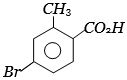
C
D
Solution
(B) The reaction is an electrophilic aromatic substitution (bromination) of $o$-toluic acid.
$o$-Toluic acid contains two groups attached to the benzene ring: a methyl group $(-CH_3)$ and a carboxylic acid group $(-COOH)$.
$1$. The $-CH_3$ group is ortho/para-directing.
$2$. The $-COOH$ group is meta-directing.
In $o$-toluic acid,the positions ortho to the $-CH_3$ group are either occupied by the $-COOH$ group or are sterically hindered. The position para to the $-CH_3$ group is the most reactive site for electrophilic substitution.
Therefore,the bromine atom enters the position para to the $-CH_3$ group,which corresponds to the meta position with respect to the $-COOH$ group.
The product is $5$-bromo-$2$-methylbenzoic acid.
$o$-Toluic acid contains two groups attached to the benzene ring: a methyl group $(-CH_3)$ and a carboxylic acid group $(-COOH)$.
$1$. The $-CH_3$ group is ortho/para-directing.
$2$. The $-COOH$ group is meta-directing.
In $o$-toluic acid,the positions ortho to the $-CH_3$ group are either occupied by the $-COOH$ group or are sterically hindered. The position para to the $-CH_3$ group is the most reactive site for electrophilic substitution.
Therefore,the bromine atom enters the position para to the $-CH_3$ group,which corresponds to the meta position with respect to the $-COOH$ group.
The product is $5$-bromo-$2$-methylbenzoic acid.
0 likes
View Solution34
MediumMCQ
The ortho/para directing group among the following is
A
$-COOH$
B
$-CN$
C
$-COCH_3$
D
$-NHCOCH_3$
Solution
(D) The groups $-COOH$,$-CN$,and $-COCH_3$ are electron-withdrawing groups that deactivate the benzene ring and are meta-directing due to the presence of electron-withdrawing atoms or multiple bonds attached directly to the ring.
In contrast,the $-NHCOCH_3$ group is an ortho/para directing group.
This is because the nitrogen atom has a lone pair of electrons that can be delocalized into the benzene ring through resonance,which increases the electron density at the ortho and para positions.
In contrast,the $-NHCOCH_3$ group is an ortho/para directing group.
This is because the nitrogen atom has a lone pair of electrons that can be delocalized into the benzene ring through resonance,which increases the electron density at the ortho and para positions.
0 likes
View Solution35
MediumMCQ
Nitrobenzene on nitration gives
A
$o-$dinitrobenzene
B
$p-$dinitrobenzene
C
$m-$dinitrobenzene
D
$o-$ and $p-$dinitrobenzene
Solution
(C) The $-NO_2$ group present in nitrobenzene is a strong electron-withdrawing group and is meta-directing in nature.
Therefore,during the electrophilic aromatic substitution reaction (nitration),the incoming electrophile $(-NO_2^+)$ attacks the meta-position of the benzene ring.
Thus,the nitration of nitrobenzene yields $m-$dinitrobenzene as the major product.
Therefore,during the electrophilic aromatic substitution reaction (nitration),the incoming electrophile $(-NO_2^+)$ attacks the meta-position of the benzene ring.
Thus,the nitration of nitrobenzene yields $m-$dinitrobenzene as the major product.
0 likes
View Solution36
MediumMCQ
Which of the following is not used as an explosive?
A
Trinitrotoluene
B
Trinitrobenzene
C
Picric acid
D
Nitrobenzene
Solution
(D) Nitrobenzene is not an explosive.
Nitro compounds like $Trinitrotoluene$ $(TNT)$,$Trinitrobenzene$ $(TNB)$,and $Picric$ $acid$ $(2,4,6-trinitrophenol)$ are highly explosive due to the presence of multiple nitro groups attached to the aromatic ring,which provide oxygen for rapid combustion.
$Nitrobenzene$ $(C_6H_5NO_2)$ is a stable compound and is not used as an explosive.
Nitro compounds like $Trinitrotoluene$ $(TNT)$,$Trinitrobenzene$ $(TNB)$,and $Picric$ $acid$ $(2,4,6-trinitrophenol)$ are highly explosive due to the presence of multiple nitro groups attached to the aromatic ring,which provide oxygen for rapid combustion.
$Nitrobenzene$ $(C_6H_5NO_2)$ is a stable compound and is not used as an explosive.
0 likes
View Solution37
DifficultMCQ
$p-$Nitrobromobenzene can be converted to $p-$nitroaniline by using $NaNH_2$. The reaction proceeds through the intermediate named
A
Carbocation
B
Carbanion
C
Benzyne
D
Dianion
Solution
(C) The reaction of $p-$nitrobromobenzene with $NaNH_2$ proceeds via an elimination-addition mechanism.
In the first step,the strong base $NH_2^-$ abstracts a proton from the ortho position to the bromine atom,followed by the elimination of the bromide ion $(Br^-)$ to form a highly reactive intermediate known as a benzyne (specifically,a substituted benzyne or aryne intermediate).
Subsequently,the nucleophile $NH_3$ attacks the benzyne intermediate to form $p-$nitroaniline.
Therefore,the intermediate formed is a benzyne.
In the first step,the strong base $NH_2^-$ abstracts a proton from the ortho position to the bromine atom,followed by the elimination of the bromide ion $(Br^-)$ to form a highly reactive intermediate known as a benzyne (specifically,a substituted benzyne or aryne intermediate).
Subsequently,the nucleophile $NH_3$ attacks the benzyne intermediate to form $p-$nitroaniline.
Therefore,the intermediate formed is a benzyne.
0 likes
View Solution38
MediumMCQ
Nitrobenzene on further excessive nitration gives
A
Trinitrobenzene
B
$m-$dinitrobenzene
C
$p-$dinitrobenzene
D
All of these
Solution
(B) The $-NO_2$ group is a strong electron-withdrawing group and is meta-directing. When nitrobenzene undergoes further nitration with a mixture of concentrated $HNO_3$ and concentrated $H_2SO_4$,the incoming nitro group is directed to the meta-position,resulting in the formation of $m-$dinitrobenzene. The reaction is: $C_6H_5NO_2 + HNO_3 \xrightarrow{H_2SO_4} C_6H_4(NO_2)_2 + H_2O$.
0 likes
View Solution39
MediumMCQ
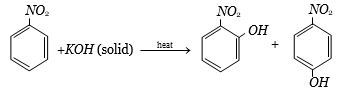
The following reaction is:
A
Nucleophilic substitution
B
Electrophilic substitution
C
Free radical substitution
D
None of these
Solution
(A) The reaction of nitrobenzene with solid $KOH$ under heating conditions is a nucleophilic aromatic substitution reaction.
In this reaction,the $OH^{-}$ ion acts as a nucleophile and attacks the benzene ring,replacing a hydrogen atom (or hydride ion equivalent) to form ortho- and para-nitrophenol.
Since the attacking species is a nucleophile $(OH^{-})$,it is classified as a nucleophilic substitution reaction.
Therefore,the correct option is $A$.
In this reaction,the $OH^{-}$ ion acts as a nucleophile and attacks the benzene ring,replacing a hydrogen atom (or hydride ion equivalent) to form ortho- and para-nitrophenol.
Since the attacking species is a nucleophile $(OH^{-})$,it is classified as a nucleophilic substitution reaction.
Therefore,the correct option is $A$.
0 likes
View Solution40
MediumMCQ
What is formed when chlorobenzene reacts with ammonia in the presence of $Cu_2O$ in xylene at $570 \ K$?
A
Benzylamine
B
Diazonium salt
C
Schiff base
D
Aniline
Solution
(D) The reaction of chlorobenzene with ammonia in the presence of $Cu_2O$ at $570 \ K$ is an ammonolysis reaction used for the preparation of aromatic amines.
The chemical equation is:
$2C_6H_5Cl + 2NH_3 \xrightarrow{Cu_2O, 570 \ K} 2C_6H_5NH_2 + Cu_2Cl_2 + H_2O$
Thus,the product formed is aniline.
The chemical equation is:
$2C_6H_5Cl + 2NH_3 \xrightarrow{Cu_2O, 570 \ K} 2C_6H_5NH_2 + Cu_2Cl_2 + H_2O$
Thus,the product formed is aniline.
0 likes
View Solution41
MediumMCQ
Which of the following reactions cannot be used to prepare an aromatic nitrile $(ArCN)$?
A
$ArX + KCN$
B
$ArN_2^+Cl^- + CuCN$
C
$ArCONH_2 + P_2O_5$
D
$ArCONH_2 + SOCl_2$
Solution
(A) In aryl halides $(ArX)$,the halogen atom is attached to the benzene ring through a $C-X$ bond that has partial double bond character due to resonance.
This makes the $C-X$ bond shorter and stronger,making nucleophilic substitution by $CN^-$ ions extremely difficult under normal conditions.
Therefore,the reaction $ArX + KCN$ does not proceed to form $ArCN$.
Other reactions provided are standard methods:
$ArN_2^+Cl^- + CuCN \to ArCN + N_2 + CuCl$ (Sandmeyer reaction).
$ArCONH_2 + P_2O_5 \to ArCN + H_2O$ (Dehydration).
$ArCONH_2 + SOCl_2 \to ArCN + SO_2 + 2HCl$ (Dehydration).
This makes the $C-X$ bond shorter and stronger,making nucleophilic substitution by $CN^-$ ions extremely difficult under normal conditions.
Therefore,the reaction $ArX + KCN$ does not proceed to form $ArCN$.
Other reactions provided are standard methods:
$ArN_2^+Cl^- + CuCN \to ArCN + N_2 + CuCl$ (Sandmeyer reaction).
$ArCONH_2 + P_2O_5 \to ArCN + H_2O$ (Dehydration).
$ArCONH_2 + SOCl_2 \to ArCN + SO_2 + 2HCl$ (Dehydration).
0 likes
View Solution42
MediumMCQ
In which reaction does nitrobenzene give $o$- and $p$-substituted products?
A
With solid $KOH$
B
With concentrated $H_2SO_4$
C
With concentrated $H_2SO_4$ and fuming $HNO_3$
D
With $Cl_2$ and a catalyst
Solution
(C) Nitrobenzene is a strongly deactivating group due to the $-NO_2$ group,which is electron-withdrawing by both inductive and resonance effects.
It directs incoming electrophiles to the meta-position in electrophilic aromatic substitution reactions.
However,the question asks for $o$- and $p$-substituted products.
Nitrobenzene does not undergo standard electrophilic substitution to give $o$- and $p$-products easily.
Among the given options,none of these reactions typically yield $o$- and $p$-products as major products for nitrobenzene.
However,if the question implies a specific context like nucleophilic substitution (which is also difficult) or if there is an error in the premise,it is important to note that nitrobenzene is meta-directing.
Given the standard chemistry curriculum,nitrobenzene undergoes nitration (Option $C$) to give $m$-dinitrobenzene.
Since the question asks for $o$- and $p$-products,it is technically incorrect as nitrobenzene is meta-directing.
It directs incoming electrophiles to the meta-position in electrophilic aromatic substitution reactions.
However,the question asks for $o$- and $p$-substituted products.
Nitrobenzene does not undergo standard electrophilic substitution to give $o$- and $p$-products easily.
Among the given options,none of these reactions typically yield $o$- and $p$-products as major products for nitrobenzene.
However,if the question implies a specific context like nucleophilic substitution (which is also difficult) or if there is an error in the premise,it is important to note that nitrobenzene is meta-directing.
Given the standard chemistry curriculum,nitrobenzene undergoes nitration (Option $C$) to give $m$-dinitrobenzene.
Since the question asks for $o$- and $p$-products,it is technically incorrect as nitrobenzene is meta-directing.
0 likes
View Solution43
MediumMCQ
What is the product of the reaction between nitrobenzene and $CH_3Cl$ in the presence of anhydrous $AlCl_3$?
A
$o$-nitrotoluene
B
$p$-nitrotoluene
C
Both of the above
D
No reaction occurs
Solution
(D) Nitrobenzene contains a strongly electron-withdrawing $-NO_2$ group,which deactivates the benzene ring towards electrophilic substitution.
Friedel-Crafts reactions (alkylation and acylation) do not occur with nitrobenzene because the $-NO_2$ group is a strong deactivating group and the catalyst $AlCl_3$ forms a complex with the nitrogen atom of the $-NO_2$ group,further deactivating the ring.
Friedel-Crafts reactions (alkylation and acylation) do not occur with nitrobenzene because the $-NO_2$ group is a strong deactivating group and the catalyst $AlCl_3$ forms a complex with the nitrogen atom of the $-NO_2$ group,further deactivating the ring.
0 likes
View Solution44
MediumMCQ
Which of the following is an example of a nucleophilic aromatic substitution reaction?
A
$C_6H_5NO_2 / H_2SO_4$
B
$C_6H_5OH / HNO_3$
C
$C_6H_6 / CH_3Cl / AlCl_3$
D
$C_6H_5NO_2 / KOH \text{ (solid)}$
Solution
(D) Nucleophilic aromatic substitution reactions typically occur in electron-deficient aromatic rings,such as nitrobenzene $(C_6H_5NO_2)$.
When nitrobenzene reacts with solid potassium hydroxide $(KOH)$,it undergoes a nucleophilic substitution reaction to form ortho- or para-nitrophenol derivatives.
Option $D$ represents this type of reaction,where the $OH^-$ ion acts as a nucleophile attacking the electron-deficient ring.
When nitrobenzene reacts with solid potassium hydroxide $(KOH)$,it undergoes a nucleophilic substitution reaction to form ortho- or para-nitrophenol derivatives.
Option $D$ represents this type of reaction,where the $OH^-$ ion acts as a nucleophile attacking the electron-deficient ring.
0 likes
View Solution45
MediumMCQ
In nucleophilic substitution reactions,alkyl halides are more reactive than aryl halides because...
A
Formation of more stable carbocation
B
Higher $C-Cl$ bond energy
C
Inductive effect
D
Resonance stabilization and $sp^2$ hybridization of $C$ attached to the halide
Solution
(D) Aryl halides are less reactive towards nucleophilic substitution reactions compared to alkyl halides due to the following reasons:
$1$. Resonance effect: The lone pair of electrons on the halogen atom participates in conjugation with the benzene ring,resulting in partial double bond character in the $C-X$ bond,which makes it stronger and shorter.
$2$. Difference in hybridization: In aryl halides,the carbon atom attached to the halogen is $sp^2$ hybridized,which is more electronegative and holds the electron pair more tightly than the $sp^3$ hybridized carbon in alkyl halides.
$3$. Instability of phenyl cation: The phenyl cation formed by the self-ionization of aryl halides is not stabilized by resonance.
$1$. Resonance effect: The lone pair of electrons on the halogen atom participates in conjugation with the benzene ring,resulting in partial double bond character in the $C-X$ bond,which makes it stronger and shorter.
$2$. Difference in hybridization: In aryl halides,the carbon atom attached to the halogen is $sp^2$ hybridized,which is more electronegative and holds the electron pair more tightly than the $sp^3$ hybridized carbon in alkyl halides.
$3$. Instability of phenyl cation: The phenyl cation formed by the self-ionization of aryl halides is not stabilized by resonance.
0 likes
View Solution46
MediumMCQ
Heating chlorobenzene with chloral in the presence of concentrated $H_2SO_4$ yields which of the following products?
A
Freon
B
$DDT$
C
Gammexane
D
Hexachloroethane
Solution
(B) When chlorobenzene reacts with chloral in the presence of concentrated $H_2SO_4$,it undergoes a condensation reaction to form $DDT$ (dichlorodiphenyltrichloroethane).
The reaction is as follows:
$2C_6H_5Cl + CCl_3CHO \xrightarrow{conc. H_2SO_4} (ClC_6H_4)_2CHCCl_3 + H_2O$
The reaction is as follows:
$2C_6H_5Cl + CCl_3CHO \xrightarrow{conc. H_2SO_4} (ClC_6H_4)_2CHCCl_3 + H_2O$
0 likes
View Solution47
MediumMCQ
In the reaction of $p$-chlorotoluene with $KNH_2$ in liquid $NH_3$,what is the major product?
A
$p$-toluidine
B
$m$-toluidine
C
$m$-chloroaniline
D
$p$-chloroaniline
Solution
(B) The reaction of $p$-chlorotoluene with $KNH_2$ in liquid $NH_3$ proceeds via the formation of a benzyne intermediate.
$1$. $KNH_2$ acts as a strong base and removes an ortho-hydrogen from $p$-chlorotoluene to form a benzyne intermediate.
$2$. The nucleophilic attack by $NH_2^-$ can occur at either the carbon atom originally attached to the chlorine or the adjacent carbon.
$3$. Due to the inductive effect of the methyl group,the attack results in a mixture of $p$-toluidine and $m$-toluidine.
$4$. In this specific reaction,$m$-toluidine is often formed as a significant product due to the regioselectivity of the nucleophilic attack on the benzyne intermediate.
$1$. $KNH_2$ acts as a strong base and removes an ortho-hydrogen from $p$-chlorotoluene to form a benzyne intermediate.
$2$. The nucleophilic attack by $NH_2^-$ can occur at either the carbon atom originally attached to the chlorine or the adjacent carbon.
$3$. Due to the inductive effect of the methyl group,the attack results in a mixture of $p$-toluidine and $m$-toluidine.
$4$. In this specific reaction,$m$-toluidine is often formed as a significant product due to the regioselectivity of the nucleophilic attack on the benzyne intermediate.
0 likes
View Solution48
DifficultMCQ
What will be the product of the reaction $Ph-Cl + Fe / Br_2$?
A
$o-bromochlorobenzene$
B
$p-bromochlorobenzene$
C
Both $(a)$ and $(b)$
D
$2, 4, 6-tribromochlorobenzene$
Solution
(C) The $-Cl$ group is an ortho/para directing group in electrophilic aromatic substitution reactions.
Since the reaction is an electrophilic bromination,the bromine atom will be substituted at both the ortho and para positions relative to the chlorine atom.
Therefore,both $o-bromochlorobenzene$ and $p-bromochlorobenzene$ are formed as products.
Since the reaction is an electrophilic bromination,the bromine atom will be substituted at both the ortho and para positions relative to the chlorine atom.
Therefore,both $o-bromochlorobenzene$ and $p-bromochlorobenzene$ are formed as products.
0 likes
View Solution49
MediumMCQ
In which of the following is the chlorine atom least reactive towards nucleophilic substitution?
A
Methyl chloride
B
Allyl chloride
C
Ethyl chloride
D
Vinyl chloride
Solution
(D) The chlorine atom in $CH_2=CH-Cl$ (vinyl chloride) is least reactive towards nucleophilic substitution.
This is due to the resonance effect,where the lone pair of electrons on the chlorine atom participates in conjugation with the $C=C$ double bond.
This results in a partial double-bond character between the carbon and chlorine atoms,making the $C-Cl$ bond shorter and stronger,thus preventing the nucleophilic attack.
This is due to the resonance effect,where the lone pair of electrons on the chlorine atom participates in conjugation with the $C=C$ double bond.
This results in a partial double-bond character between the carbon and chlorine atoms,making the $C-Cl$ bond shorter and stronger,thus preventing the nucleophilic attack.
0 likes
View Solution50
MediumMCQ
What is obtained by the reaction of toluene with chlorine in the presence of iron and in the absence of light?
A
$o$-chlorotoluene
B
$p$-chlorotoluene
C
Benzyl chloride
D
$A$ mixture of $(o)$-chlorotoluene and $(p)$-chlorotoluene
Solution
(D) The reaction of toluene with chlorine in the presence of iron (a Lewis acid catalyst) and in the absence of light is an electrophilic aromatic substitution reaction (specifically,chlorination of the benzene ring).
In this reaction,the methyl group $(-CH_3)$ on the benzene ring is an ortho/para-directing group.
Therefore,the chlorine atom will substitute the hydrogen atoms at the ortho and para positions of the benzene ring.
This results in the formation of a mixture of $o$-chlorotoluene and $p$-chlorotoluene.
In this reaction,the methyl group $(-CH_3)$ on the benzene ring is an ortho/para-directing group.
Therefore,the chlorine atom will substitute the hydrogen atoms at the ortho and para positions of the benzene ring.
This results in the formation of a mixture of $o$-chlorotoluene and $p$-chlorotoluene.
0 likes
View SolutionHaloalkanes and Haloarenes — Properties of Haloarenes · Frequently Asked Questions
1Are these Haloalkanes and Haloarenes questions useful for JEE and NEET?
Yes. All questions in this section are mapped to JEE Main and NEET exam patterns. Previous year questions from JEE Main, NEET, GUJCET and state-level exams are included with full solutions.
2Can I switch to Hindi or Gujarati for these questions?
Yes. Use the language tabs in the hero section or the sidebar to view the same questions and solutions in English, Hindi or Gujarati.
3How do I generate a question paper from this subtopic?
Use the Vedclass Exam Paper Generator — select the chapter and subtopic, set difficulty, and generate Sets A, B, C, D automatically. First 3 chapters of every subject are free.
Vedclass Products
For Students
Vedclass Test Series
Mock tests in real JEE/NEET style with performance analysis. 5-day free trial.
Start Free TrialFor Teachers
Exam Paper Generator
Generate Set A/B/C/D papers from this chapter in 2 minutes. 3 chapters free.
Try FreeFor Institutes
Online Exam Module
Live online exams with unlimited students, 360° analytics & white-label branding.
See DemoFor Teachers & Institutes
Generate a Haloalkanes and Haloarenes Exam Paper in 2 Minutes
Select subtopic & difficulty — Sets A, B, C, D auto-generated with No Repeat logic.
First 3 chapters of every subject are free — no payment required.