
A English
Properties of Haloalkanes Questions in English
Class 12 Chemistry · Haloalkanes and Haloarenes · Properties of Haloalkanes
1196+
Questions
English
Language
100%
With Solutions
Showing 50 of 1196 questions in English
651
DifficultMCQ
The reaction $RCl + NaI \xrightarrow{\text{Acetone}} R-I + NaCl$ is known as:
A
Wurtz reaction
B
Fittig reaction
C
Frankland reaction
D
Finkelstein reaction
Solution
(D) The given reaction is $RCl + NaI \xrightarrow{\text{Acetone}} R-I + NaCl$.
This is a halogen exchange reaction where an alkyl chloride or bromide is converted into an alkyl iodide by treatment with sodium iodide in acetone.
This specific reaction is known as the $Finkelstein$ reaction.
This is a halogen exchange reaction where an alkyl chloride or bromide is converted into an alkyl iodide by treatment with sodium iodide in acetone.
This specific reaction is known as the $Finkelstein$ reaction.
0 likes
View Solution652
EasyMCQ
Which of the following is the correct order of boiling points for alkyl halides?
A
$C_2H_5Cl > C_2H_5Br > C_2H_5I$
B
$C_2H_5I > C_2H_5Br > C_2H_5Cl$
C
$C_2H_5I > C_2H_5Cl > C_2H_5Br$
D
$C_2H_5Br > C_2H_5I > C_2H_5Cl$
Solution
(B) The boiling point of alkyl halides depends on the magnitude of van der Waals forces,which increases with the increase in the size and mass of the halogen atom.
As we move from $Cl$ to $Br$ to $I$,the size and molecular mass of the halogen atom increase.
Therefore,the strength of van der Waals forces increases in the order $C_2H_5Cl < C_2H_5Br < C_2H_5I$.
Thus,the correct order of boiling points is $C_2H_5I > C_2H_5Br > C_2H_5Cl$.
As we move from $Cl$ to $Br$ to $I$,the size and molecular mass of the halogen atom increase.
Therefore,the strength of van der Waals forces increases in the order $C_2H_5Cl < C_2H_5Br < C_2H_5I$.
Thus,the correct order of boiling points is $C_2H_5I > C_2H_5Br > C_2H_5Cl$.
0 likes
View Solution653
MediumMCQ
Which of the following represents the correct order of density?
A
$CCl_4 > CHCl_3 > CH_2Cl_2 > CH_3Cl > H_2O$
B
$CCl_4 > CHCl_3 > CH_2Cl_2 > H_2O > CH_3Cl$
C
$H_2O > CH_3Cl > CH_2Cl_2 > CHCl_3 > CCl_4$
D
$CCl_4 > CHCl_3 > H_2O > CH_2Cl_2 > CH_3Cl$
Solution
(B) The density of haloalkanes increases with an increase in the number of halogen atoms and the atomic mass of the halogen atoms.
For the given chloromethanes,the order of density is $CCl_4 (1.59 \ g/mL) > CHCl_3 (1.48 \ g/mL) > CH_2Cl_2 (1.33 \ g/mL) > CH_3Cl (0.92 \ g/mL)$.
Comparing these with water ($H_2O$,density $\approx 1.00 \ g/mL$),the correct order is $CCl_4 > CHCl_3 > CH_2Cl_2 > H_2O > CH_3Cl$.
For the given chloromethanes,the order of density is $CCl_4 (1.59 \ g/mL) > CHCl_3 (1.48 \ g/mL) > CH_2Cl_2 (1.33 \ g/mL) > CH_3Cl (0.92 \ g/mL)$.
Comparing these with water ($H_2O$,density $\approx 1.00 \ g/mL$),the correct order is $CCl_4 > CHCl_3 > CH_2Cl_2 > H_2O > CH_3Cl$.
0 likes
View Solution654
MediumMCQ
Which of the following alkyl halides has the lowest boiling point?
A
$t-$Butyl chloride
B
$n-$Butyl chloride
C
$t-$Butyl bromide
D
$n-$Butyl iodide
Solution
(A) The boiling point of alkyl halides depends on two main factors: molecular mass and surface area (branching).
$1$. As the molecular mass increases,the boiling point increases. Thus,$n-$butyl iodide has the highest boiling point among the given options.
$2$. For isomers,the boiling point decreases with an increase in branching because branching reduces the surface area,leading to weaker van der Waals forces.
$3$. Comparing $t-$butyl chloride and $n-$butyl chloride,$t-$butyl chloride is branched,which results in a smaller surface area compared to the straight-chain $n-$butyl chloride.
$4$. Therefore,$t-$butyl chloride has the lowest boiling point among the given options.
$1$. As the molecular mass increases,the boiling point increases. Thus,$n-$butyl iodide has the highest boiling point among the given options.
$2$. For isomers,the boiling point decreases with an increase in branching because branching reduces the surface area,leading to weaker van der Waals forces.
$3$. Comparing $t-$butyl chloride and $n-$butyl chloride,$t-$butyl chloride is branched,which results in a smaller surface area compared to the straight-chain $n-$butyl chloride.
$4$. Therefore,$t-$butyl chloride has the lowest boiling point among the given options.
0 likes
View Solution655
MediumMCQ
Alkyl iodides on keeping become dark in color due to ...........
A
Hydrolysis
B
Conversion to ether
C
Liberation of iodine
D
Formation of alkane
Solution
(C) Alkyl iodides are sensitive to light and air. On exposure to light,they undergo decomposition to liberate iodine $(I_2)$,which imparts a dark or brown color to the compound. The reaction is: $2R-I \xrightarrow{h\nu} 2R^{\bullet} + I_2$.
0 likes
View Solution656
DifficultMCQ
The reaction of $n$-propyl bromide with alcoholic potassium hydroxide $(KOH)$ produces ...........
A
Propane
B
Propene
C
Propyne
D
Propanol
Solution
(B) The reaction of $n$-propyl bromide $(CH_3CH_2CH_2Br)$ with alcoholic $KOH$ is a dehydrohalogenation reaction (an elimination reaction).
In this reaction,a hydrogen atom is removed from the $\beta$-carbon and the bromine atom is removed from the $\alpha$-carbon,resulting in the formation of a double bond.
The reaction is: $CH_3CH_2CH_2Br + KOH (\text{alc.}) \rightarrow CH_3CH=CH_2 + KBr + H_2O$.
The product formed is propene.
In this reaction,a hydrogen atom is removed from the $\beta$-carbon and the bromine atom is removed from the $\alpha$-carbon,resulting in the formation of a double bond.
The reaction is: $CH_3CH_2CH_2Br + KOH (\text{alc.}) \rightarrow CH_3CH=CH_2 + KBr + H_2O$.
The product formed is propene.
0 likes
View Solution657
MediumMCQ
The reaction of $1-$chlorobutane with alcoholic potassium hydroxide $(KOH)$ yields .....................
A
$1-$butene
B
$1-$butanol
C
$2-$butene
D
$2-$butanol
Solution
(A) The reaction of $1-$chlorobutane $(CH_3CH_2CH_2CH_2Cl)$ with alcoholic $KOH$ is a dehydrohalogenation reaction (an elimination reaction).
In this reaction,the base $(OH^-)$ abstracts a proton from the $\beta$-carbon,leading to the formation of an alkene.
$CH_3CH_2CH_2CH_2Cl + KOH (\text{alc.}) \rightarrow CH_3CH_2CH=CH_2 + KCl + H_2O$.
The product formed is $1-$butene.
In this reaction,the base $(OH^-)$ abstracts a proton from the $\beta$-carbon,leading to the formation of an alkene.
$CH_3CH_2CH_2CH_2Cl + KOH (\text{alc.}) \rightarrow CH_3CH_2CH=CH_2 + KCl + H_2O$.
The product formed is $1-$butene.
0 likes
View Solution658
DifficultMCQ
When $E_2$ competition is not a concern,which of the following is the best nucleophile for an $S_N2$ reaction?
A
$HCOO^-$
B
$H_2O$
C
$Cl^-$
D
$OH^-$
Solution
(D) In an $S_N2$ reaction,the rate depends on the strength of the nucleophile. $A$ stronger nucleophile is typically a stronger base,provided the steric hindrance is not significant.
Comparing the given nucleophiles:
$1$. $H_2O$ is a neutral molecule and a weak nucleophile.
$2$. $Cl^-$ is a weak nucleophile in polar protic solvents due to solvation.
$3$. $HCOO^-$ (formate ion) has resonance stabilization,which reduces the availability of the lone pair,making it a weaker nucleophile compared to $OH^-$.
$4$. $OH^-$ is a strong,small,and highly reactive nucleophile.
Therefore,$OH^-$ is the best nucleophile among the given options for an $S_N2$ reaction when $E_2$ competition is ignored.
Comparing the given nucleophiles:
$1$. $H_2O$ is a neutral molecule and a weak nucleophile.
$2$. $Cl^-$ is a weak nucleophile in polar protic solvents due to solvation.
$3$. $HCOO^-$ (formate ion) has resonance stabilization,which reduces the availability of the lone pair,making it a weaker nucleophile compared to $OH^-$.
$4$. $OH^-$ is a strong,small,and highly reactive nucleophile.
Therefore,$OH^-$ is the best nucleophile among the given options for an $S_N2$ reaction when $E_2$ competition is ignored.
0 likes
View Solution659
DifficultMCQ
Which of the following will undergo $S_{N}2$ reaction most rapidly?
A
$(CH_{3})_{3}C-CH_{2}I$
B
$(CH_{3})_{3}C-Cl$
C
$(CH_{3})_{2}CH-I$
D
$(CH_{3})_{2}CH-CH_{2}CH_{2}CH_{2}I$
Solution
(D) The rate of $S_{N}2$ reaction depends on the steric hindrance around the carbon atom attached to the leaving group. The order of reactivity for $S_{N}2$ is: $\text{Primary} > \text{Secondary} > \text{Tertiary}$.
Additionally,the nature of the leaving group affects the rate: $I^{-} > Cl^{-}$.
Comparing the options:
$(A)$ $(CH_{3})_{3}C-CH_{2}I$ is a primary alkyl halide with steric hindrance at the $\beta$-carbon.
$(B)$ $(CH_{3})_{3}C-Cl$ is a tertiary alkyl halide,which is very slow for $S_{N}2$.
$(C)$ $(CH_{3})_{2}CH-I$ is a secondary alkyl halide.
$(D)$ $(CH_{3})_{2}CH-CH_{2}CH_{2}CH_{2}I$ is a primary alkyl halide with less steric hindrance compared to $(A)$.
Therefore,$(CH_{3})_{2}CH-CH_{2}CH_{2}CH_{2}I$ is the most reactive towards $S_{N}2$ due to being a primary alkyl halide with the best leaving group $(I^{-})$ and minimal steric hindrance at the $\alpha$-carbon.
Additionally,the nature of the leaving group affects the rate: $I^{-} > Cl^{-}$.
Comparing the options:
$(A)$ $(CH_{3})_{3}C-CH_{2}I$ is a primary alkyl halide with steric hindrance at the $\beta$-carbon.
$(B)$ $(CH_{3})_{3}C-Cl$ is a tertiary alkyl halide,which is very slow for $S_{N}2$.
$(C)$ $(CH_{3})_{2}CH-I$ is a secondary alkyl halide.
$(D)$ $(CH_{3})_{2}CH-CH_{2}CH_{2}CH_{2}I$ is a primary alkyl halide with less steric hindrance compared to $(A)$.
Therefore,$(CH_{3})_{2}CH-CH_{2}CH_{2}CH_{2}I$ is the most reactive towards $S_{N}2$ due to being a primary alkyl halide with the best leaving group $(I^{-})$ and minimal steric hindrance at the $\alpha$-carbon.
0 likes
View Solution660
DifficultMCQ
The reaction of $CH_3CD_2CHBr-CH_2CD_3$ with alc. $KOH$ yields:
A
$CH_3CD_2CH=CH-CD_3$
B
$CH_3CD=C=CH-CD_3$
C
$CD_3CD_2CH=CH-CH_3$
D
$CH_3CD=CH-CH_2CD_3$
Solution
(A) The reaction of an alkyl halide with alcoholic $KOH$ is a dehydrohalogenation reaction ($E2$ mechanism).
In $CH_3CD_2CHBr-CH_2CD_3$,the $\alpha$-carbon is the one attached to $Br$.
The $\beta$-hydrogens are available on the adjacent carbons:
$C_2$ (which has $D$ atoms) and $C_4$ (which has $H$ atoms).
However,the $H$ atoms on $C_4$ are more acidic and easier to remove than $D$ atoms on $C_2$ due to the kinetic isotope effect.
Thus,the elimination occurs at the $C_4$ position to form the alkene $CH_3CD_2CH=CH-CD_3$.
In $CH_3CD_2CHBr-CH_2CD_3$,the $\alpha$-carbon is the one attached to $Br$.
The $\beta$-hydrogens are available on the adjacent carbons:
$C_2$ (which has $D$ atoms) and $C_4$ (which has $H$ atoms).
However,the $H$ atoms on $C_4$ are more acidic and easier to remove than $D$ atoms on $C_2$ due to the kinetic isotope effect.
Thus,the elimination occurs at the $C_4$ position to form the alkene $CH_3CD_2CH=CH-CD_3$.
0 likes
View Solution661
DifficultMCQ
Which of the following reactions is an example of an $S_{N}2$ reaction?
A
$CH_3Br + OH^- \to CH_3OH + Br^-$
B
$CH_3CH(Br)CH_3 + OH^- \to CH_3CH(OH)CH_3 + Br^-$
C
$CH_3CH_2OH \to CH_2 = CH_2 + H_2O$
D
$(CH_3)_3C - Br + OH^- \to (CH_3)_3C - OH + Br^-$
Solution
(A) An $S_{N}2$ reaction is a bimolecular nucleophilic substitution reaction that proceeds via a single-step concerted mechanism.
It is favored by primary alkyl halides due to minimal steric hindrance.
Option $A$ involves methyl bromide $(CH_3Br)$,which is a primary substrate and highly reactive towards $S_{N}2$ mechanisms.
Option $B$ is a secondary alkyl halide,which typically undergoes $S_{N}1$ or $S_{N}2$ depending on conditions,but $CH_3Br$ is the classic example of $S_{N}2$.
Option $C$ is an elimination reaction.
Option $D$ involves a tertiary alkyl halide,which undergoes $S_{N}1$ due to steric hindrance and carbocation stability.
It is favored by primary alkyl halides due to minimal steric hindrance.
Option $A$ involves methyl bromide $(CH_3Br)$,which is a primary substrate and highly reactive towards $S_{N}2$ mechanisms.
Option $B$ is a secondary alkyl halide,which typically undergoes $S_{N}1$ or $S_{N}2$ depending on conditions,but $CH_3Br$ is the classic example of $S_{N}2$.
Option $C$ is an elimination reaction.
Option $D$ involves a tertiary alkyl halide,which undergoes $S_{N}1$ due to steric hindrance and carbocation stability.
0 likes
View Solution662
DifficultMCQ
Arrange the following halides in the decreasing order of their reactivity towards $S_{N^1}$ reaction.
$(I) \ CH_3CH_2CH_2Cl$ $(II) \ CH_2 = CH - CH(Cl)CH_3$
$(III) \ CH_3CH_2CH(Cl)CH_3$
$(I) \ CH_3CH_2CH_2Cl$ $(II) \ CH_2 = CH - CH(Cl)CH_3$
$(III) \ CH_3CH_2CH(Cl)CH_3$
A
$I > II > III$
B
$II > III > I$
C
$II > I > III$
D
$III > II > I$
Solution
(B) The reactivity of alkyl halides towards $S_{N^1}$ reaction depends on the stability of the carbocation intermediate formed after the loss of the leaving group $(Cl^-)$.
$1$. For $(I)$,$CH_3CH_2CH_2Cl$ forms a $1^{\circ}$ carbocation $(CH_3CH_2CH_2^+)$,which is the least stable.
$2$. For $(III)$,$CH_3CH_2CH(Cl)CH_3$ forms a $2^{\circ}$ carbocation $(CH_3CH_2CH^+CH_3)$,which is more stable than a $1^{\circ}$ carbocation.
$3$. For $(II)$,$CH_2 = CH - CH(Cl)CH_3$ forms an allylic carbocation $(CH_2 = CH - CH^+CH_3)$. This carbocation is resonance-stabilized,making it the most stable among the three.
Therefore,the order of stability of carbocations is $(II) > (III) > (I)$.
Thus,the decreasing order of reactivity towards $S_{N^1}$ is $II > III > I$.
$1$. For $(I)$,$CH_3CH_2CH_2Cl$ forms a $1^{\circ}$ carbocation $(CH_3CH_2CH_2^+)$,which is the least stable.
$2$. For $(III)$,$CH_3CH_2CH(Cl)CH_3$ forms a $2^{\circ}$ carbocation $(CH_3CH_2CH^+CH_3)$,which is more stable than a $1^{\circ}$ carbocation.
$3$. For $(II)$,$CH_2 = CH - CH(Cl)CH_3$ forms an allylic carbocation $(CH_2 = CH - CH^+CH_3)$. This carbocation is resonance-stabilized,making it the most stable among the three.
Therefore,the order of stability of carbocations is $(II) > (III) > (I)$.
Thus,the decreasing order of reactivity towards $S_{N^1}$ is $II > III > I$.
0 likes
View Solution663
DifficultMCQ
Which of the following compounds will undergo $E_2$ elimination reaction to give a single product in the presence of a strong base?
A
$3-$Bromo$-2-$methylpentane
B
$1-$Bromo$-1-$methylcyclohexane
C
$1-$Bromo$-3,3-$dimethylbutane
D
$2-$Bromo$-3-$methylpentane
Solution
(B) For an $E_2$ reaction to yield a single product,the substrate must have only one type of $\beta$-hydrogen available for abstraction,or the resulting alkenes must be identical due to symmetry.
In $1-$bromo$-1-$methylcyclohexane,the $\beta$-carbons are the $C_2$ and $C_6$ positions of the ring. Due to the symmetry of the molecule,abstraction of a $\beta$-hydrogen from either position leads to the same product: $1-$methylcyclohexene.
Other options like $3-$bromo$-2-$methylpentane and $2-$bromo$-3-$methylpentane have multiple non-equivalent $\beta$-hydrogens,leading to a mixture of isomeric alkenes (Saytzeff and Hofmann products).
In $1-$bromo$-1-$methylcyclohexane,the $\beta$-carbons are the $C_2$ and $C_6$ positions of the ring. Due to the symmetry of the molecule,abstraction of a $\beta$-hydrogen from either position leads to the same product: $1-$methylcyclohexene.
Other options like $3-$bromo$-2-$methylpentane and $2-$bromo$-3-$methylpentane have multiple non-equivalent $\beta$-hydrogens,leading to a mixture of isomeric alkenes (Saytzeff and Hofmann products).
0 likes
View Solution664
DifficultMCQ
Isopropyl chloride undergoes hydrolysis by which mechanism?
A
$S_{N}1$ and $S_{N}2$ mechanisms
B
Neither $S_{N}1$ nor $S_{N}2$ mechanism
C
$S_{N}1$ mechanism only
D
$S_{N}2$ mechanism only
Solution
(A) Isopropyl chloride is a secondary $(2^{\circ})$ alkyl halide.
Secondary alkyl halides can undergo hydrolysis via both $S_{N}1$ and $S_{N}2$ mechanisms depending on the reaction conditions (solvent,nucleophile concentration,etc.).
In polar protic solvents,the $S_{N}1$ pathway is favored due to the formation of a relatively stable secondary carbocation.
In polar aprotic solvents with strong nucleophiles,the $S_{N}2$ pathway is favored.
Secondary alkyl halides can undergo hydrolysis via both $S_{N}1$ and $S_{N}2$ mechanisms depending on the reaction conditions (solvent,nucleophile concentration,etc.).
In polar protic solvents,the $S_{N}1$ pathway is favored due to the formation of a relatively stable secondary carbocation.
In polar aprotic solvents with strong nucleophiles,the $S_{N}2$ pathway is favored.
0 likes
View Solution665
DifficultMCQ
Which of the following is most reactive towards nucleophilic substitution reaction?
A
$C_6H_5Cl$
B
$CH_2=CH-Cl$
C
$ClCH_2-CH=CH_2$
D
$CH_3CH=CH-Cl$
Solution
(C) Nucleophilic substitution reactions in haloalkenes depend on the stability of the transition state and the nature of the $C-X$ bond.
In $C_6H_5Cl$,$CH_2=CH-Cl$,and $CH_3CH=CH-Cl$,the chlorine atom is directly attached to an $sp^2$ hybridized carbon atom,which makes the $C-X$ bond stronger due to partial double bond character caused by resonance.
In $ClCH_2-CH=CH_2$ (allyl chloride),the chlorine is attached to an $sp^3$ hybridized carbon atom.
Upon loss of the chloride ion,the resulting allyl carbocation $(CH_2=CH-CH_2^+)$ is resonance stabilized.
Therefore,$ClCH_2-CH=CH_2$ is the most reactive towards nucleophilic substitution.
In $C_6H_5Cl$,$CH_2=CH-Cl$,and $CH_3CH=CH-Cl$,the chlorine atom is directly attached to an $sp^2$ hybridized carbon atom,which makes the $C-X$ bond stronger due to partial double bond character caused by resonance.
In $ClCH_2-CH=CH_2$ (allyl chloride),the chlorine is attached to an $sp^3$ hybridized carbon atom.
Upon loss of the chloride ion,the resulting allyl carbocation $(CH_2=CH-CH_2^+)$ is resonance stabilized.
Therefore,$ClCH_2-CH=CH_2$ is the most reactive towards nucleophilic substitution.
0 likes
View Solution666
DifficultMCQ
Which of the following alkyl halides is most reactive towards the $E_2$ mechanism?
A
$(CH_3)_3C-CH_2Br$
B
$CH_3CH_2CH(Br)CH_3$
C
$CH_3CH_2CH_2CH_2Br$
D
$(CH_3)_3C-CH(C_2H_5)CH_2Br$
Solution
(B) The reactivity of alkyl halides towards the $E_2$ mechanism depends on the stability of the transition state and steric hindrance.
For $E_2$ reactions,the order of reactivity is generally $3^\circ > 2^\circ > 1^\circ$ alkyl halides.
However,in the given options,we must consider the structure of the $\beta$-carbon.
Option $B$ is a $2^\circ$ alkyl halide,which is more reactive than the $1^\circ$ alkyl halides provided in $A$,$C$,and $D$.
Therefore,$CH_3CH_2CH(Br)CH_3$ is the most reactive towards the $E_2$ mechanism among the choices.
For $E_2$ reactions,the order of reactivity is generally $3^\circ > 2^\circ > 1^\circ$ alkyl halides.
However,in the given options,we must consider the structure of the $\beta$-carbon.
Option $B$ is a $2^\circ$ alkyl halide,which is more reactive than the $1^\circ$ alkyl halides provided in $A$,$C$,and $D$.
Therefore,$CH_3CH_2CH(Br)CH_3$ is the most reactive towards the $E_2$ mechanism among the choices.
0 likes
View Solution667
DifficultMCQ
Which of the following alkyl halides is most reactive towards the $S_{N}1$ mechanism?
A
Secondary butyl chloride
B
Tertiary butyl chloride
C
$n-$butyl chloride
D
Allyl chloride
Solution
(B) The reactivity of alkyl halides towards the $S_{N}1$ mechanism depends on the stability of the carbocation intermediate formed during the rate-determining step.
$S_{N}1$ reactivity order: $\text{Tertiary} > \text{Secondary} > \text{Primary}$.
Among the given options:
$A$: Secondary butyl chloride (Secondary carbocation)
$B$: Tertiary butyl chloride (Tertiary carbocation)
$C$: $n-$butyl chloride (Primary carbocation)
$D$: Allyl chloride (Allylic carbocation)
While the allyl carbocation is resonance-stabilized,the tertiary butyl carbocation is significantly more stable due to the inductive effect and hyperconjugation of nine $\alpha-$hydrogens. Therefore,tertiary butyl chloride is the most reactive towards $S_{N}1$.
$S_{N}1$ reactivity order: $\text{Tertiary} > \text{Secondary} > \text{Primary}$.
Among the given options:
$A$: Secondary butyl chloride (Secondary carbocation)
$B$: Tertiary butyl chloride (Tertiary carbocation)
$C$: $n-$butyl chloride (Primary carbocation)
$D$: Allyl chloride (Allylic carbocation)
While the allyl carbocation is resonance-stabilized,the tertiary butyl carbocation is significantly more stable due to the inductive effect and hyperconjugation of nine $\alpha-$hydrogens. Therefore,tertiary butyl chloride is the most reactive towards $S_{N}1$.
0 likes
View Solution668
EasyMCQ
What is the correct order of reactivity of alkyl halides towards dehydrohalogenation?
A
$R-F > R-Cl > R-Br > R-I$
B
$R-I > R-Br > R-Cl > R-F$
C
$R-I > R-Cl > R-Br > R-F$
D
$R-F > R-I > R-Br > R-Cl$
Solution
(B) Dehydrohalogenation involves the elimination of a hydrogen halide $(HX)$ from an alkyl halide to form an alkene.
The rate-determining step in this reaction involves the breaking of the $C-X$ bond.
The strength of the $C-X$ bond decreases as the size of the halogen atom increases $(C-F > C-Cl > C-Br > C-I)$.
Since the $C-I$ bond is the weakest,it breaks most easily,making alkyl iodides the most reactive towards dehydrohalogenation.
Therefore,the correct order of reactivity is $R-I > R-Br > R-Cl > R-F$.
The rate-determining step in this reaction involves the breaking of the $C-X$ bond.
The strength of the $C-X$ bond decreases as the size of the halogen atom increases $(C-F > C-Cl > C-Br > C-I)$.
Since the $C-I$ bond is the weakest,it breaks most easily,making alkyl iodides the most reactive towards dehydrohalogenation.
Therefore,the correct order of reactivity is $R-I > R-Br > R-Cl > R-F$.
0 likes
View Solution669
DifficultMCQ
The set of compounds in which the reactivity of the halogen atom increases in the order is ..........
A
Chloroethane,Chlorobenzene,Vinyl chloride
B
Chlorobenzene,Vinyl chloride,Chloroethane
C
Vinyl chloride,Chloroethane,Chlorobenzene
D
Vinyl chloride,Chlorobenzene,Chloroethane
Solution
(B) The reactivity of the $C-X$ bond towards nucleophilic substitution depends on the strength of the $C-X$ bond.
In $CH_2=CH-Cl$ (Vinyl chloride) and $C_6H_5-Cl$ (Chlorobenzene),the $C-X$ bond acquires partial double bond character due to resonance,making it stronger and less reactive.
In $CH_3-CH_2-Cl$ (Chloroethane),the $C-X$ bond is a pure single bond,making it the most reactive.
Comparing Vinyl chloride and Chlorobenzene,the $C-Cl$ bond in vinyl chloride is generally considered less reactive than in chlorobenzene due to the specific hybridization and resonance effects.
Thus,the increasing order of reactivity is: $Chlorobenzene < Vinyl chloride < Chloroethane$.
In $CH_2=CH-Cl$ (Vinyl chloride) and $C_6H_5-Cl$ (Chlorobenzene),the $C-X$ bond acquires partial double bond character due to resonance,making it stronger and less reactive.
In $CH_3-CH_2-Cl$ (Chloroethane),the $C-X$ bond is a pure single bond,making it the most reactive.
Comparing Vinyl chloride and Chlorobenzene,the $C-Cl$ bond in vinyl chloride is generally considered less reactive than in chlorobenzene due to the specific hybridization and resonance effects.
Thus,the increasing order of reactivity is: $Chlorobenzene < Vinyl chloride < Chloroethane$.
0 likes
View Solution670
DifficultMCQ
Which of the following compounds will undergo $S_{N^1}$ reaction most easily?
A
$1-$Bromopentane
B
$1-$Bromo$-2-$methylbutane
C
$2-$Bromopentane
D
$2-$Bromo$-2-$methylbutane
Solution
(D) The rate of $S_{N^1}$ reaction depends on the stability of the carbocation intermediate formed during the rate-determining step.
$S_{N^1}$ reaction follows the order: $3^{\circ} > 2^{\circ} > 1^{\circ}$ carbocation stability.
$(A)$ $1-$Bromopentane is a $1^{\circ}$ alkyl halide.
$(B)$ $1-$Bromo$-2-$methylbutane is a $1^{\circ}$ alkyl halide.
$(C)$ $2-$Bromopentane is a $2^{\circ}$ alkyl halide.
$(D)$ $2-$Bromo$-2-$methylbutane is a $3^{\circ}$ alkyl halide.
Since $3^{\circ}$ carbocations are the most stable due to inductive effect and hyperconjugation,$2-$Bromo$-2-$methylbutane will form the most stable carbocation and undergo $S_{N^1}$ reaction most easily.
$S_{N^1}$ reaction follows the order: $3^{\circ} > 2^{\circ} > 1^{\circ}$ carbocation stability.
$(A)$ $1-$Bromopentane is a $1^{\circ}$ alkyl halide.
$(B)$ $1-$Bromo$-2-$methylbutane is a $1^{\circ}$ alkyl halide.
$(C)$ $2-$Bromopentane is a $2^{\circ}$ alkyl halide.
$(D)$ $2-$Bromo$-2-$methylbutane is a $3^{\circ}$ alkyl halide.
Since $3^{\circ}$ carbocations are the most stable due to inductive effect and hyperconjugation,$2-$Bromo$-2-$methylbutane will form the most stable carbocation and undergo $S_{N^1}$ reaction most easily.
0 likes
View Solution671
DifficultMCQ
The reaction of $2-$bromopentane with sodium ethoxide in ethanol yields ........
A
$trans-2-$pentene
B
$2-$ethoxypentane
C
$cis-2-$pentene
D
Both $A$ and $C$
Solution
(D) The reaction of $2-$bromopentane with sodium ethoxide $(NaOCH_2CH_3)$ in ethanol is a dehydrohalogenation reaction (an $E2$ elimination reaction).
Since $2-$bromopentane is an unsymmetrical secondary alkyl halide,it undergoes elimination to form alkenes.
The major product is the more stable alkene,which is $2-$pentene.
$2-$pentene exists as two geometric isomers: $trans-2-$pentene and $cis-2-$pentene.
$trans-2-$pentene is more stable than $cis-2-$pentene due to less steric hindrance.
Therefore,both $trans-2-$pentene and $cis-2-$pentene are formed as products.
Since $2-$bromopentane is an unsymmetrical secondary alkyl halide,it undergoes elimination to form alkenes.
The major product is the more stable alkene,which is $2-$pentene.
$2-$pentene exists as two geometric isomers: $trans-2-$pentene and $cis-2-$pentene.
$trans-2-$pentene is more stable than $cis-2-$pentene due to less steric hindrance.
Therefore,both $trans-2-$pentene and $cis-2-$pentene are formed as products.
0 likes
View Solution672
DifficultMCQ
What will be the major product of the following reaction?
$(CH_3)_2CH-CH_2Br \xrightarrow{CH_3O^- / CH_3OH}$
$(CH_3)_2CH-CH_2Br \xrightarrow{CH_3O^- / CH_3OH}$
A
$(CH_3)_2CH-CH_2OCH_3$
B
$CH_3CH(OCH_3)CH_2CH_3$
C
$(CH_3)_2C=CH_2$
D
$(CH_3)_3C-OCH_3$
Solution
(A) The substrate is a primary alkyl halide,$(CH_3)_2CH-CH_2Br$ (isobutyl bromide).
The reagent is $CH_3O^- / CH_3OH$,which is a strong nucleophile and a strong base.
For a primary alkyl halide,the $S_N2$ reaction is generally favored over $E2$ because there is less steric hindrance at the $\alpha$-carbon.
Therefore,the nucleophile $CH_3O^-$ attacks the $\alpha$-carbon,displacing the bromide ion to form an ether.
The major product is $(CH_3)_2CH-CH_2OCH_3$ (methyl isobutyl ether).
The reagent is $CH_3O^- / CH_3OH$,which is a strong nucleophile and a strong base.
For a primary alkyl halide,the $S_N2$ reaction is generally favored over $E2$ because there is less steric hindrance at the $\alpha$-carbon.
Therefore,the nucleophile $CH_3O^-$ attacks the $\alpha$-carbon,displacing the bromide ion to form an ether.
The major product is $(CH_3)_2CH-CH_2OCH_3$ (methyl isobutyl ether).
0 likes
View Solution673
DifficultMCQ
The major product obtained from the reaction of $CH_3CH_2CH(F)CH_3$ with $CH_3O^- / CH_3OH$ is ..........
A
$CH_3CH_2CH(OCH_3)CH_3$
B
$CH_3CH=CH-CH_3$
C
$CH_3CH_2CH=CH_2$
D
$CH_3CH_2CH_2CH_2OCH_3$
Solution
(B) The reaction involves a secondary alkyl fluoride $(CH_3CH_2CH(F)CH_3)$ reacting with a strong base/nucleophile $(CH_3O^-)$ in a protic solvent $(CH_3OH)$.
Since $CH_3O^-$ is a strong base,the elimination reaction $(E2)$ is favored over substitution $(S_N2)$.
According to Zaitsev's rule,the more substituted alkene is the major product.
Elimination of $H$ from $C_2$ gives $CH_3CH=CHCH_3$ (but$-2-$ene),which is more stable due to hyperconjugation.
Elimination of $H$ from $C_4$ gives $CH_3CH_2CH=CH_2$ (but$-1-$ene),which is less stable.
Therefore,the major product is $CH_3CH=CHCH_3$.
Since $CH_3O^-$ is a strong base,the elimination reaction $(E2)$ is favored over substitution $(S_N2)$.
According to Zaitsev's rule,the more substituted alkene is the major product.
Elimination of $H$ from $C_2$ gives $CH_3CH=CHCH_3$ (but$-2-$ene),which is more stable due to hyperconjugation.
Elimination of $H$ from $C_4$ gives $CH_3CH_2CH=CH_2$ (but$-1-$ene),which is less stable.
Therefore,the major product is $CH_3CH=CHCH_3$.
0 likes
View Solution674
DifficultMCQ
An alkyl bromide reacts with sodium ethoxide and ethanol to give only one alkene. Hydrogenation of this alkene yields $2-$methylbutane. What is the alkyl halide?
A
$1-$Bromobutane
B
$1-$Bromo$-2-$methylbutane
C
$2-$Bromo$-2-$methylbutane
D
$1-$Bromo$-2,2-$dimethylpropane
Solution
(B) The hydrogenation of the alkene gives $2-$methylbutane,which has the structure $CH_3-CH(CH_3)-CH_2-CH_3$.
Since the alkyl bromide gives only one alkene upon reaction with sodium ethoxide (dehydrohalogenation),we look for a structure that eliminates to form a single product.
$1-$Bromo$-2-$methylbutane $(CH_3-CH_2-CH(CH_3)-CH_2Br)$ would undergo elimination to form $2-$methylbut$-1-$ene.
$2-$Bromo$-2-$methylbutane would form a mixture of alkenes.
$1-$Bromo$-2,2-$dimethylpropane cannot undergo $E2$ elimination easily as it has no $\beta-$hydrogen.
Thus,the correct alkyl halide is $1-$bromo$-2-$methylbutane.
Since the alkyl bromide gives only one alkene upon reaction with sodium ethoxide (dehydrohalogenation),we look for a structure that eliminates to form a single product.
$1-$Bromo$-2-$methylbutane $(CH_3-CH_2-CH(CH_3)-CH_2Br)$ would undergo elimination to form $2-$methylbut$-1-$ene.
$2-$Bromo$-2-$methylbutane would form a mixture of alkenes.
$1-$Bromo$-2,2-$dimethylpropane cannot undergo $E2$ elimination easily as it has no $\beta-$hydrogen.
Thus,the correct alkyl halide is $1-$bromo$-2-$methylbutane.
0 likes
View Solution675
DifficultMCQ
Which of the following compounds will produce the product shown in the image upon reaction with $NaCN$ via an $S_N2$ mechanism?
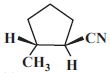
A
trans $-1-$ iodo $-2-$ methylcyclopentane
B
cis $-1-$ iodo $-2-$ methylcyclopentane
C
cis $-2-$ methylcyclopentanol
D
trans $-2-$ methylcyclopentanol
Solution
(A) The $S_N2$ reaction proceeds with inversion of configuration at the chiral center where the nucleophilic substitution occurs.
In the product shown,the $-CN$ group is on the same side as the $-H$ atom at the $C-1$ position,meaning the $-CN$ group is in the cis position relative to the $-CH_3$ group at $C-2$.
Since $S_N2$ involves inversion,the starting material must have the leaving group $(-I)$ in the trans position relative to the $-CH_3$ group.
Therefore,the starting material is trans $-1-$ iodo $-2-$ methylcyclopentane.
In the product shown,the $-CN$ group is on the same side as the $-H$ atom at the $C-1$ position,meaning the $-CN$ group is in the cis position relative to the $-CH_3$ group at $C-2$.
Since $S_N2$ involves inversion,the starting material must have the leaving group $(-I)$ in the trans position relative to the $-CH_3$ group.
Therefore,the starting material is trans $-1-$ iodo $-2-$ methylcyclopentane.
0 likes
View Solution676
DifficultMCQ
What is the correct order of reactivity of halides for the $S_{N}2$ reaction?
A
$CH_3CH_2X < (CH_3)_2CHX < CH_2=CH-CH_2X < PhCH_2X$
B
$(CH_3)_2CHX < CH_3CH_2X < CH_2=CH-CH_2X < PhCH_2X$
C
$PhCH_2X < (CH_3)_2CHX < CH_3CH_2X < CH_2=CH-CH_2X$
D
$CH_2=CH-CH_2X < PhCH_2X < (CH_3)_2CHX < CH_3CH_2X$
Solution
(B) The $S_{N}2$ reaction mechanism is highly sensitive to steric hindrance. The reactivity order for $S_{N}2$ is: $Primary > Secondary > Tertiary$.
However,allylic $(CH_2=CH-CH_2X)$ and benzylic $(PhCH_2X)$ halides are highly reactive in $S_{N}2$ reactions due to the stabilization of the transition state by resonance.
Comparing the given compounds:
$1$. $(CH_3)_2CHX$ is a secondary halide (least reactive).
$2$. $CH_3CH_2X$ is a primary halide.
$3$. $CH_2=CH-CH_2X$ (allyl halide) and $PhCH_2X$ (benzyl halide) are more reactive than primary halides due to resonance stabilization of the transition state.
Between allyl and benzyl,the benzyl group is generally more reactive due to extended conjugation.
The correct order is: $(CH_3)_2CHX < CH_3CH_2X < CH_2=CH-CH_2X < PhCH_2X$.
However,allylic $(CH_2=CH-CH_2X)$ and benzylic $(PhCH_2X)$ halides are highly reactive in $S_{N}2$ reactions due to the stabilization of the transition state by resonance.
Comparing the given compounds:
$1$. $(CH_3)_2CHX$ is a secondary halide (least reactive).
$2$. $CH_3CH_2X$ is a primary halide.
$3$. $CH_2=CH-CH_2X$ (allyl halide) and $PhCH_2X$ (benzyl halide) are more reactive than primary halides due to resonance stabilization of the transition state.
Between allyl and benzyl,the benzyl group is generally more reactive due to extended conjugation.
The correct order is: $(CH_3)_2CHX < CH_3CH_2X < CH_2=CH-CH_2X < PhCH_2X$.
0 likes
View Solution677
DifficultMCQ
Which organic chloro compound shows complete stereochemical inversion during an $S_N2$ reaction?
A
$(C_2H_5)_2CH-Cl$
B
$(CH_3)_3C-Cl$
C
$(CH_3)_2CH-Cl$
D
$CH_3Cl$
Solution
(D) The $S_N2$ reaction mechanism proceeds via a concerted pathway involving a backside attack by the nucleophile,which leads to the Walden inversion (inversion of configuration).
This mechanism is highly sensitive to steric hindrance.
Primary alkyl halides $(1^{\circ})$ are the most reactive towards $S_N2$ due to minimal steric hindrance.
Among the given options:
$(A) (C_2H_5)_2CH-Cl$ is a secondary $(2^{\circ})$ alkyl halide.
$(B) (CH_3)_3C-Cl$ is a tertiary $(3^{\circ})$ alkyl halide.
$(C) (CH_3)_2CH-Cl$ is a secondary $(2^{\circ})$ alkyl halide.
$(D) CH_3Cl$ is a methyl halide $(0^{\circ})$,which is the least sterically hindered and shows the most efficient inversion.
However,in the context of typical textbook examples for $S_N2$ inversion,primary alkyl halides are the standard. Since $CH_3Cl$ is the simplest,it undergoes $S_N2$ most readily.
This mechanism is highly sensitive to steric hindrance.
Primary alkyl halides $(1^{\circ})$ are the most reactive towards $S_N2$ due to minimal steric hindrance.
Among the given options:
$(A) (C_2H_5)_2CH-Cl$ is a secondary $(2^{\circ})$ alkyl halide.
$(B) (CH_3)_3C-Cl$ is a tertiary $(3^{\circ})$ alkyl halide.
$(C) (CH_3)_2CH-Cl$ is a secondary $(2^{\circ})$ alkyl halide.
$(D) CH_3Cl$ is a methyl halide $(0^{\circ})$,which is the least sterically hindered and shows the most efficient inversion.
However,in the context of typical textbook examples for $S_N2$ inversion,primary alkyl halides are the standard. Since $CH_3Cl$ is the simplest,it undergoes $S_N2$ most readily.
0 likes
View Solution678
DifficultMCQ
Which of the following compounds will undergo $S_{N^1}$ reaction most easily?
A
$C_6H_5Cl$
B
$CH_3CH_2CH_2CH(Cl)CH_2CH_3$
C
$CH_3CH_2CH_2CH_2Cl$
D
$CH_3CH_2CH_2CH_2CH_2Cl$
Solution
(B) The rate of $S_{N^1}$ reaction depends on the stability of the carbocation intermediate formed during the rate-determining step.
More stable carbocations are formed more easily,leading to a faster $S_{N^1}$ reaction.
The order of stability of carbocations is: $3^{\circ} > 2^{\circ} > 1^{\circ} > \text{methyl}$.
Option $A$ $(C_6H_5Cl)$ is an aryl halide,which is very unreactive towards $S_{N^1}$ due to partial double bond character.
Option $B$ is a $2^{\circ}$ alkyl halide $(CH_3CH_2CH_2CH(Cl)CH_2CH_3)$,which forms a $2^{\circ}$ carbocation.
Options $C$ and $D$ are $1^{\circ}$ alkyl halides,which form less stable $1^{\circ}$ carbocations.
Therefore,the $2^{\circ}$ alkyl halide in option $B$ will undergo $S_{N^1}$ reaction most easily among the given choices.
More stable carbocations are formed more easily,leading to a faster $S_{N^1}$ reaction.
The order of stability of carbocations is: $3^{\circ} > 2^{\circ} > 1^{\circ} > \text{methyl}$.
Option $A$ $(C_6H_5Cl)$ is an aryl halide,which is very unreactive towards $S_{N^1}$ due to partial double bond character.
Option $B$ is a $2^{\circ}$ alkyl halide $(CH_3CH_2CH_2CH(Cl)CH_2CH_3)$,which forms a $2^{\circ}$ carbocation.
Options $C$ and $D$ are $1^{\circ}$ alkyl halides,which form less stable $1^{\circ}$ carbocations.
Therefore,the $2^{\circ}$ alkyl halide in option $B$ will undergo $S_{N^1}$ reaction most easily among the given choices.
0 likes
View Solution679
DifficultMCQ
Arrange the following alkyl halides in the increasing order of their reactivity towards nucleophilic substitution reaction:
$(I)$ $CH_3CH_2CH(Cl)CH_3$
$(II)$ $CH_2=CHCH(Br)CH_3$
$(III)$ $CH_2=CHCH(Cl)CH_3$
$(IV)$ $CH_3CH=C(Br)CH_3$
$(I)$ $CH_3CH_2CH(Cl)CH_3$
$(II)$ $CH_2=CHCH(Br)CH_3$
$(III)$ $CH_2=CHCH(Cl)CH_3$
$(IV)$ $CH_3CH=C(Br)CH_3$
A
$II > III > I > IV$
B
$I > III > IV > II$
C
$II > I > III > IV$
D
$IV > I > II > III$
Solution
(A) The reactivity towards nucleophilic substitution ($S_N1$ or $S_N2$) depends on the stability of the carbocation formed (for $S_N1$) or steric hindrance (for $S_N2$).
$(I)$ is a secondary alkyl chloride,which is reactive.
$(II)$ is an allylic bromide $(CH_2=CH-CH(Br)-CH_3)$. Allylic halides are highly reactive due to resonance stabilization of the carbocation.
$(III)$ is an allylic chloride $(CH_2=CH-CH(Cl)-CH_3)$. It is also reactive but less than the bromide $(II)$ because $Br^-$ is a better leaving group than $Cl^-$.
$(IV)$ is a vinylic bromide $(CH_3-CH=C(Br)-CH_3)$. Vinylic halides are extremely unreactive towards nucleophilic substitution because the $C-X$ bond has partial double bond character due to resonance.
Comparing the leaving groups,$Br^-$ is a better leaving group than $Cl^-$. Thus,the order of reactivity is $II > III > I > IV$.
$(I)$ is a secondary alkyl chloride,which is reactive.
$(II)$ is an allylic bromide $(CH_2=CH-CH(Br)-CH_3)$. Allylic halides are highly reactive due to resonance stabilization of the carbocation.
$(III)$ is an allylic chloride $(CH_2=CH-CH(Cl)-CH_3)$. It is also reactive but less than the bromide $(II)$ because $Br^-$ is a better leaving group than $Cl^-$.
$(IV)$ is a vinylic bromide $(CH_3-CH=C(Br)-CH_3)$. Vinylic halides are extremely unreactive towards nucleophilic substitution because the $C-X$ bond has partial double bond character due to resonance.
Comparing the leaving groups,$Br^-$ is a better leaving group than $Cl^-$. Thus,the order of reactivity is $II > III > I > IV$.
0 likes
View Solution680
DifficultMCQ
What is the correct decreasing order of the relative rate of solvolysis for the following alkyl halides in formic acid containing a small amount of water?
$(I) \ CH_2=CH-CH_2Cl$
$(II) \ CH_2=CH-CH(CH_3)Cl$
$(III) \ CH_2=C(CH_3)CH_2Cl$
$(IV) \ CH_3CH=CH-CH_2Cl$
$(I) \ CH_2=CH-CH_2Cl$
$(II) \ CH_2=CH-CH(CH_3)Cl$
$(III) \ CH_2=C(CH_3)CH_2Cl$
$(IV) \ CH_3CH=CH-CH_2Cl$
A
$I > II > III > IV$
B
$II > I > IV > III$
C
$II > IV > I > III$
D
$III > IV > II > I$
Solution
(D) The solvolysis reaction in formic acid proceeds via an $S_N1$ mechanism,which involves the formation of a carbocation intermediate.
The rate of reaction depends on the stability of the carbocation formed after the loss of the chloride ion $(Cl^-)$.
$(I)$ forms a primary allylic carbocation: $CH_2=CH-CH_2^+$.
$(II)$ forms a secondary allylic carbocation: $CH_2=CH-CH^+(CH_3)$,which is more stable than $(I)$ due to the $+I$ effect of the methyl group.
$(III)$ forms a primary allylic carbocation: $CH_2=C(CH_3)CH_2^+$,which is more stable than $(I)$ due to the $+I$ effect of the methyl group,but less stable than $(II)$ because it is primary.
$(IV)$ forms a primary allylic carbocation: $CH_3CH=CH-CH_2^+$,which is more stable than $(I)$ due to the $+I$ effect of the methyl group,but less stable than $(II)$ and $(III)$ due to the position of the methyl group.
Comparing the stability: $(II) > (III) > (IV) > (I)$.
Wait,re-evaluating: $(II)$ is secondary allylic (most stable). $(III)$ is primary allylic with a methyl group at the $2$-position (more stable than $(IV)$). $(IV)$ is primary allylic with a methyl group at the $3$-position. $(I)$ is primary allylic (least stable).
Therefore,the order is $(II) > (III) > (IV) > (I)$.
The rate of reaction depends on the stability of the carbocation formed after the loss of the chloride ion $(Cl^-)$.
$(I)$ forms a primary allylic carbocation: $CH_2=CH-CH_2^+$.
$(II)$ forms a secondary allylic carbocation: $CH_2=CH-CH^+(CH_3)$,which is more stable than $(I)$ due to the $+I$ effect of the methyl group.
$(III)$ forms a primary allylic carbocation: $CH_2=C(CH_3)CH_2^+$,which is more stable than $(I)$ due to the $+I$ effect of the methyl group,but less stable than $(II)$ because it is primary.
$(IV)$ forms a primary allylic carbocation: $CH_3CH=CH-CH_2^+$,which is more stable than $(I)$ due to the $+I$ effect of the methyl group,but less stable than $(II)$ and $(III)$ due to the position of the methyl group.
Comparing the stability: $(II) > (III) > (IV) > (I)$.
Wait,re-evaluating: $(II)$ is secondary allylic (most stable). $(III)$ is primary allylic with a methyl group at the $2$-position (more stable than $(IV)$). $(IV)$ is primary allylic with a methyl group at the $3$-position. $(I)$ is primary allylic (least stable).
Therefore,the order is $(II) > (III) > (IV) > (I)$.
0 likes
View Solution681
DifficultMCQ
$A$ dihalogen derivative $X$ of a three-carbon hydrocarbon reacts with alcoholic $KOH$ to give another hydrocarbon,which gives a red precipitate with ammoniacal $Cu_2Cl_2$. Reaction of $X$ with aqueous $KOH$ gives an aldehyde. The compound $X$ is .......
A
$1,2-$dichloropropane
B
$1,3-$dichloropropane
C
$1,1-$dichloropropane
D
$2,2-$dichloropropane
Solution
(C) $1$. The formation of a red precipitate with ammoniacal $Cu_2Cl_2$ indicates the presence of a terminal alkyne $(CH_3-C \equiv CH)$.
$2$. Reaction of $X$ with alcoholic $KOH$ (dehydrohalogenation) yields a terminal alkyne,suggesting $X$ is a geminal or vicinal dihalide.
$3$. Reaction of $X$ with aqueous $KOH$ (hydrolysis) gives an aldehyde. $A$ geminal dihalide $(R-CHX_2)$ on hydrolysis yields an aldehyde $(R-CHO)$.
$4$. For a three-carbon chain,$1,1-$dichloropropane $(CH_3-CH_2-CHCl_2)$ would yield propanal,and $2,2-$dichloropropane $(CH_3-CCl_2-CH_3)$ would yield acetone. However,the question specifies an aldehyde,and $1,1-$dichloropropane is the correct structure for $X$ to form propyne upon dehydrohalogenation $(CH_3-CH_2-CHCl_2 \xrightarrow{alc. KOH} CH_3-C \equiv CH)$.
$5$. Therefore,$X$ is $1,1-$dichloropropane.
$2$. Reaction of $X$ with alcoholic $KOH$ (dehydrohalogenation) yields a terminal alkyne,suggesting $X$ is a geminal or vicinal dihalide.
$3$. Reaction of $X$ with aqueous $KOH$ (hydrolysis) gives an aldehyde. $A$ geminal dihalide $(R-CHX_2)$ on hydrolysis yields an aldehyde $(R-CHO)$.
$4$. For a three-carbon chain,$1,1-$dichloropropane $(CH_3-CH_2-CHCl_2)$ would yield propanal,and $2,2-$dichloropropane $(CH_3-CCl_2-CH_3)$ would yield acetone. However,the question specifies an aldehyde,and $1,1-$dichloropropane is the correct structure for $X$ to form propyne upon dehydrohalogenation $(CH_3-CH_2-CHCl_2 \xrightarrow{alc. KOH} CH_3-C \equiv CH)$.
$5$. Therefore,$X$ is $1,1-$dichloropropane.
0 likes
View Solution682
DifficultMCQ
The order of reactivity of the following halides towards $S_{N}1$ reaction is:
$(1) \ (CH_3)_3CBr$
$(2) \ (C_6H_5)_2CHBr$
$(3) \ (C_6H_5)_2C(CH_3)Br$
$(4) \ (CH_3)_2CHBr$
$(5) \ C_2H_5Br$
$(1) \ (CH_3)_3CBr$
$(2) \ (C_6H_5)_2CHBr$
$(3) \ (C_6H_5)_2C(CH_3)Br$
$(4) \ (CH_3)_2CHBr$
$(5) \ C_2H_5Br$
A
$(3) > (2) > (1) > (4) > (5)$
B
$(5) > (1) > (2) > (4) > (3)$
C
$(1) > (3) > (5) > (2) > (4)$
D
$(5) > (4) > (1) > (2) > (3)$
Solution
(A) The reactivity of halides towards $S_{N}1$ reaction depends on the stability of the carbocation intermediate formed.
More stable the carbocation,faster is the $S_{N}1$ reaction.
Stability order of carbocations:
$(3) \ (C_6H_5)_2C^+(CH_3)$ is a tertiary carbocation stabilized by two phenyl rings and one methyl group.
$(2) \ (C_6H_5)_2CH^+$ is a secondary carbocation stabilized by two phenyl rings.
$(1) \ (CH_3)_3C^+$ is a tertiary carbocation stabilized by three methyl groups (inductive effect).
$(4) \ (CH_3)_2CH^+$ is a secondary carbocation stabilized by two methyl groups.
$(5) \ C_2H_5^+$ is a primary carbocation.
Comparing the stability: $(3) > (2) > (1) > (4) > (5)$.
Therefore,the order of reactivity is $(3) > (2) > (1) > (4) > (5)$.
More stable the carbocation,faster is the $S_{N}1$ reaction.
Stability order of carbocations:
$(3) \ (C_6H_5)_2C^+(CH_3)$ is a tertiary carbocation stabilized by two phenyl rings and one methyl group.
$(2) \ (C_6H_5)_2CH^+$ is a secondary carbocation stabilized by two phenyl rings.
$(1) \ (CH_3)_3C^+$ is a tertiary carbocation stabilized by three methyl groups (inductive effect).
$(4) \ (CH_3)_2CH^+$ is a secondary carbocation stabilized by two methyl groups.
$(5) \ C_2H_5^+$ is a primary carbocation.
Comparing the stability: $(3) > (2) > (1) > (4) > (5)$.
Therefore,the order of reactivity is $(3) > (2) > (1) > (4) > (5)$.
0 likes
View Solution683
DifficultMCQ
The product of the reaction is .....
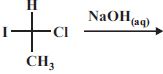
A
B
C
D
Solution
(C) The reaction involves the nucleophilic substitution of a chiral haloalkane with aqueous $NaOH$.
Since the substrate is a secondary alkyl halide,the reaction proceeds via an $S_N2$ mechanism.
In an $S_N2$ reaction,the nucleophile $(OH^-)$ attacks from the side opposite to the leaving group $(Cl^-)$,resulting in the inversion of configuration (Walden inversion).
Starting with the given Fischer projection,the $Cl$ atom is on the right.
After the $S_N2$ inversion,the $OH$ group will be on the left side,while the other groups ($H$ and $CH_3$) remain in their positions.
Therefore,the correct product is the structure with $HO$ on the left,$H$ on top,$I$ on the right,and $CH_3$ on the bottom.
Since the substrate is a secondary alkyl halide,the reaction proceeds via an $S_N2$ mechanism.
In an $S_N2$ reaction,the nucleophile $(OH^-)$ attacks from the side opposite to the leaving group $(Cl^-)$,resulting in the inversion of configuration (Walden inversion).
Starting with the given Fischer projection,the $Cl$ atom is on the right.
After the $S_N2$ inversion,the $OH$ group will be on the left side,while the other groups ($H$ and $CH_3$) remain in their positions.
Therefore,the correct product is the structure with $HO$ on the left,$H$ on top,$I$ on the right,and $CH_3$ on the bottom.
0 likes
View Solution684
DifficultMCQ
At $30\,^\circ C$,the rate of reaction between $2$-bromobutane and $OH^-$ in $75\%$ ethanol and $25\%$ water is given by: $\text{Rate} = 3.20 \times 10^{-5} [2\text{-bromobutane}][OH^-] + 1.5 \times 10^{-6} [2\text{-bromobutane}]$. If $[OH^-] = 1.0\,M$,what percentage of the reaction proceeds via the $S_N2$ mechanism?
A
$96$
B
$94$
C
$92$
D
$93$
Solution
(A) The total rate of reaction is the sum of the rates of $S_N2$ and $S_N1$ mechanisms.
Rate $= \text{Rate}_{S_N2} + \text{Rate}_{S_N1}$
Given: $\text{Rate}_{S_N2} = 3.20 \times 10^{-5} [2\text{-bromobutane}][OH^-]$
Given: $\text{Rate}_{S_N1} = 1.5 \times 10^{-6} [2\text{-bromobutane}]$
For $[OH^-] = 1.0\,M$:
$\text{Rate}_{S_N2} = 3.20 \times 10^{-5} [2\text{-bromobutane}] \times 1.0 = 3.20 \times 10^{-5} [2\text{-bromobutane}]$
$\text{Rate}_{S_N1} = 1.5 \times 10^{-6} [2\text{-bromobutane}]$
Total Rate $= (3.20 \times 10^{-5} + 0.15 \times 10^{-5}) [2\text{-bromobutane}] = 3.35 \times 10^{-5} [2\text{-bromobutane}]$
Percentage of $S_N2 = (\text{Rate}_{S_N2} / \text{Total Rate}) \times 100$
Percentage of $S_N2 = (3.20 \times 10^{-5} / 3.35 \times 10^{-5}) \times 100 \approx 95.52\% \approx 96\%$.
Rate $= \text{Rate}_{S_N2} + \text{Rate}_{S_N1}$
Given: $\text{Rate}_{S_N2} = 3.20 \times 10^{-5} [2\text{-bromobutane}][OH^-]$
Given: $\text{Rate}_{S_N1} = 1.5 \times 10^{-6} [2\text{-bromobutane}]$
For $[OH^-] = 1.0\,M$:
$\text{Rate}_{S_N2} = 3.20 \times 10^{-5} [2\text{-bromobutane}] \times 1.0 = 3.20 \times 10^{-5} [2\text{-bromobutane}]$
$\text{Rate}_{S_N1} = 1.5 \times 10^{-6} [2\text{-bromobutane}]$
Total Rate $= (3.20 \times 10^{-5} + 0.15 \times 10^{-5}) [2\text{-bromobutane}] = 3.35 \times 10^{-5} [2\text{-bromobutane}]$
Percentage of $S_N2 = (\text{Rate}_{S_N2} / \text{Total Rate}) \times 100$
Percentage of $S_N2 = (3.20 \times 10^{-5} / 3.35 \times 10^{-5}) \times 100 \approx 95.52\% \approx 96\%$.
0 likes
View Solution685
DifficultMCQ
In the given reaction,what is $A$?
$4-methylcyclohexyl bromide + OH^- \xrightarrow{S_N2} A$
$4-methylcyclohexyl bromide + OH^- \xrightarrow{S_N2} A$
A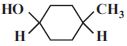
B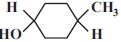
C
Both
D
None
Solution
(B) The reaction is an $S_N2$ mechanism.
$S_N2$ reactions proceed with inversion of configuration at the chiral center where the leaving group is attached.
In the starting material,the $Br$ atom is on one side of the cyclohexane ring (let's assume it is 'up').
During the $S_N2$ attack by $OH^-$,the nucleophile attacks from the side opposite to the leaving group $(Br^-)$.
This results in the $OH$ group being on the opposite side of the ring relative to the original position of the $Br$ atom.
Since the $CH_3$ group is at the $4$-position,the relative stereochemistry between the $CH_3$ group and the $OH$ group will be inverted compared to the $CH_3$ and $Br$ groups.
Therefore,the product $A$ is the trans-isomer of $4$-methylcyclohexanol.
$S_N2$ reactions proceed with inversion of configuration at the chiral center where the leaving group is attached.
In the starting material,the $Br$ atom is on one side of the cyclohexane ring (let's assume it is 'up').
During the $S_N2$ attack by $OH^-$,the nucleophile attacks from the side opposite to the leaving group $(Br^-)$.
This results in the $OH$ group being on the opposite side of the ring relative to the original position of the $Br$ atom.
Since the $CH_3$ group is at the $4$-position,the relative stereochemistry between the $CH_3$ group and the $OH$ group will be inverted compared to the $CH_3$ and $Br$ groups.
Therefore,the product $A$ is the trans-isomer of $4$-methylcyclohexanol.
0 likes
View Solution686
DifficultMCQ
Which of the following compounds is most reactive towards $S_{N^1}$ reaction?
A
Chlorocyclohexane
B
$3-$Chlorocyclohexene
C
$1-$Methyl$-1-$chlorocyclohexane
D
$1-$Methyl$-3-$chlorocyclohexene
Solution
(D) The reactivity of a compound towards $S_{N^1}$ reaction depends on the stability of the carbocation intermediate formed after the departure of the leaving group $(Cl^-)$.
$A$: Chlorocyclohexane forms a secondary $(2^{\circ})$ carbocation.
$B$: $3-$Chlorocyclohexene forms an allylic carbocation,which is stabilized by resonance.
$C$: $1-$Methyl$-1-$chlorocyclohexane forms a tertiary $(3^{\circ})$ carbocation.
$D$: $1-$Methyl$-3-$chlorocyclohexene forms an allylic carbocation that is also tertiary $(3^{\circ})$,making it the most stable carbocation among the given options due to both resonance stabilization and the inductive effect of the methyl group.
Therefore,the compound in option $D$ is the most reactive towards $S_{N^1}$ reaction.
$A$: Chlorocyclohexane forms a secondary $(2^{\circ})$ carbocation.
$B$: $3-$Chlorocyclohexene forms an allylic carbocation,which is stabilized by resonance.
$C$: $1-$Methyl$-1-$chlorocyclohexane forms a tertiary $(3^{\circ})$ carbocation.
$D$: $1-$Methyl$-3-$chlorocyclohexene forms an allylic carbocation that is also tertiary $(3^{\circ})$,making it the most stable carbocation among the given options due to both resonance stabilization and the inductive effect of the methyl group.
Therefore,the compound in option $D$ is the most reactive towards $S_{N^1}$ reaction.
0 likes
View Solution687
DifficultMCQ
An unknown compound $A$ has the molecular formula $C_5H_9Cl$. It does not react with $Br_2 / CCl_4$. When treated with a strong base,it gives a compound $B$ with the molecular formula $C_5H_8$,which reacts with $Br_2 / CCl_4$. Ozonolysis of $B$ followed by treatment with dimethyl sulfide gives a compound with the molecular formula $C_5H_8O_2$. What is the structure of $A$?
A
Cyclobutyl chloride with a methyl group
B
$1-$chloro$-2-$methylcyclobutane
C
$1-$chloro$-2-$ethylcyclopropane
D
Cyclobutyl methyl chloride
Solution
(B) $1$. Compound $A$ has the formula $C_5H_9Cl$. The degree of unsaturation is $5 - (9/2) + (1/2) + 1 = 2$. Since it does not react with $Br_2 / CCl_4$,it must be a bicyclic compound or have two rings.
$2$. Reaction with a strong base gives $B$ $(C_5H_8)$,which reacts with $Br_2 / CCl_4$,indicating $B$ is an alkene. This implies $A$ is a cyclic alkyl halide that undergoes dehydrohalogenation to form a cyclic alkene.
$3$. Ozonolysis of $B$ $(C_5H_8)$ gives $C_5H_8O_2$. This indicates the ring opened to form a dicarbonyl compound.
$4$. Based on the options,$A$ is $1$-chloro-$2$-methylcyclobutane. Dehydrohalogenation gives $1$-methylcyclobutene $(B)$. Ozonolysis of $1$-methylcyclobutene gives $5$-oxopentanal $(C_5H_8O_2)$.
$2$. Reaction with a strong base gives $B$ $(C_5H_8)$,which reacts with $Br_2 / CCl_4$,indicating $B$ is an alkene. This implies $A$ is a cyclic alkyl halide that undergoes dehydrohalogenation to form a cyclic alkene.
$3$. Ozonolysis of $B$ $(C_5H_8)$ gives $C_5H_8O_2$. This indicates the ring opened to form a dicarbonyl compound.
$4$. Based on the options,$A$ is $1$-chloro-$2$-methylcyclobutane. Dehydrohalogenation gives $1$-methylcyclobutene $(B)$. Ozonolysis of $1$-methylcyclobutene gives $5$-oxopentanal $(C_5H_8O_2)$.
0 likes
View Solution688
DifficultMCQ
How many different products are formed from the $E_2$ elimination reaction of the following alkyl iodide?

A
$1$
B
$2$
C
$3$
D
$5$
Solution
(D) The given molecule is $3$-iodo-$3$-methyloctane.
In an $E_2$ elimination reaction,the base abstracts a proton from the $\beta$-carbon atoms adjacent to the carbon bearing the iodine atom.
The $\beta$-carbons are:
$1$. The $CH_2$ group of the ethyl chain ($C$-$2$ position).
$2$. The $CH_2$ group of the pentyl chain ($C$-$4$ position).
$3$. The $CH_3$ group attached to the $C$-$3$ position.
Elimination from the ethyl group gives $3$-methyl-oct-$2$-ene (which can exist as $E$ and $Z$ isomers).
Elimination from the pentyl group gives $3$-methyl-oct-$3$-ene (which can exist as $E$ and $Z$ isomers).
Elimination from the methyl group gives $2$-ethyl-hept-$1$-ene.
Total products = $2$ (from ethyl) + $2$ (from pentyl) + $1$ (from methyl) = $5$ products.
In an $E_2$ elimination reaction,the base abstracts a proton from the $\beta$-carbon atoms adjacent to the carbon bearing the iodine atom.
The $\beta$-carbons are:
$1$. The $CH_2$ group of the ethyl chain ($C$-$2$ position).
$2$. The $CH_2$ group of the pentyl chain ($C$-$4$ position).
$3$. The $CH_3$ group attached to the $C$-$3$ position.
Elimination from the ethyl group gives $3$-methyl-oct-$2$-ene (which can exist as $E$ and $Z$ isomers).
Elimination from the pentyl group gives $3$-methyl-oct-$3$-ene (which can exist as $E$ and $Z$ isomers).
Elimination from the methyl group gives $2$-ethyl-hept-$1$-ene.
Total products = $2$ (from ethyl) + $2$ (from pentyl) + $1$ (from methyl) = $5$ products.
1 likes
View Solution689
DifficultMCQ
Which of the following statements is correct?
A
Reaction of $C_2H_5Br$ with alcoholic $KOH$ gives $C_2H_5OH$.
B
Reaction of $C_2H_5Br$ with metallic sodium gives ethane.
C
Reaction of $C_2H_5Br$ with sodium ethoxide gives diethyl ether.
D
Reaction of $C_2H_5Br$ with $AgCN$ gives ethyl cyanide.
Solution
(C) $1$. Reaction of $C_2H_5Br$ with alcoholic $KOH$ is a dehydrohalogenation reaction,which produces ethene $(C_2H_4)$,not ethanol $(C_2H_5OH)$.
$2$. Reaction of $C_2H_5Br$ with metallic sodium (Wurtz reaction) produces butane $(C_4H_{10})$,not ethane.
$3$. Reaction of $C_2H_5Br$ with sodium ethoxide $(C_2H_5ONa)$ is a Williamson ether synthesis,which produces diethyl ether $(C_2H_5-O-C_2H_5)$. This statement is correct.
$4$. Reaction of $C_2H_5Br$ with $AgCN$ produces ethyl isocyanide $(C_2H_5NC)$,not ethyl cyanide $(C_2H_5CN)$.
$2$. Reaction of $C_2H_5Br$ with metallic sodium (Wurtz reaction) produces butane $(C_4H_{10})$,not ethane.
$3$. Reaction of $C_2H_5Br$ with sodium ethoxide $(C_2H_5ONa)$ is a Williamson ether synthesis,which produces diethyl ether $(C_2H_5-O-C_2H_5)$. This statement is correct.
$4$. Reaction of $C_2H_5Br$ with $AgCN$ produces ethyl isocyanide $(C_2H_5NC)$,not ethyl cyanide $(C_2H_5CN)$.
0 likes
View Solution690
DifficultMCQ
The product obtained by the reaction of ethyl bromide with alcoholic silver nitrite is .............. .
A
Ethane
B
Ethene
C
Ethyl nitrite
D
Nitroethane
Solution
(D) The reaction of ethyl bromide $(C_2H_5Br)$ with alcoholic silver nitrite $(AgNO_2)$ is a nucleophilic substitution reaction.
$AgNO_2$ is a covalent compound,and the nitrogen atom acts as the nucleophile.
Therefore,the reaction proceeds as follows:
$C_2H_5Br + AgNO_2 \rightarrow C_2H_5NO_2 + AgBr$
The product formed is nitroethane $(C_2H_5NO_2)$.
$AgNO_2$ is a covalent compound,and the nitrogen atom acts as the nucleophile.
Therefore,the reaction proceeds as follows:
$C_2H_5Br + AgNO_2 \rightarrow C_2H_5NO_2 + AgBr$
The product formed is nitroethane $(C_2H_5NO_2)$.
0 likes
View Solution691
MediumMCQ
The major product obtained from the reaction of $2$-bromopentane with potassium ethoxide in ethanol is ....................
A
trans-pent-$2$-ene
B
$2$-ethoxypentane
C
pent-$1$-ene
D
cis-pent-$2$-ene
Solution
(A) $2$-bromopentane $(CH_3CH_2CH_2CH(Br)CH_3)$ undergoes dehydrohalogenation in the presence of a strong base like potassium ethoxide $(C_2H_5OK)$ in ethanol.
According to Zaitsev's rule,the more substituted alkene is the major product.
The reaction can proceed via $E2$ mechanism to form pent-$2$-ene.
Since trans-pent-$2$-ene is more stable than cis-pent-$2$-ene due to less steric hindrance,it is the major product.
According to Zaitsev's rule,the more substituted alkene is the major product.
The reaction can proceed via $E2$ mechanism to form pent-$2$-ene.
Since trans-pent-$2$-ene is more stable than cis-pent-$2$-ene due to less steric hindrance,it is the major product.
0 likes
View Solution692
MediumMCQ
The reaction of a mixture of two organic compounds with $Na$ in ether gives $isobutane$ as a product. The two chlorine compounds are:
A
Methyl chloride and propyl chloride
B
Methyl chloride and ethyl chloride
C
Isopropyl chloride and methyl chloride
D
Isopropyl chloride and ethyl chloride
Solution
(C) The reaction of alkyl halides with $Na$ in dry ether is known as the $Wurtz$ reaction.
To obtain $isobutane$ $(CH_3-CH(CH_3)-CH_3)$,we need to combine a $methyl$ group $(CH_3-)$ and an $isopropyl$ group $(-CH(CH_3)_2)$.
Therefore,the reactants must be $methyl$ $chloride$ $(CH_3Cl)$ and $isopropyl$ $chloride$ $(CH_3-CHCl-CH_3)$.
The reaction is: $CH_3Cl + CH_3-CHCl-CH_3 + 2Na \xrightarrow{dry \ ether} CH_3-CH(CH_3)_2 + 2NaCl$.
To obtain $isobutane$ $(CH_3-CH(CH_3)-CH_3)$,we need to combine a $methyl$ group $(CH_3-)$ and an $isopropyl$ group $(-CH(CH_3)_2)$.
Therefore,the reactants must be $methyl$ $chloride$ $(CH_3Cl)$ and $isopropyl$ $chloride$ $(CH_3-CHCl-CH_3)$.
The reaction is: $CH_3Cl + CH_3-CHCl-CH_3 + 2Na \xrightarrow{dry \ ether} CH_3-CH(CH_3)_2 + 2NaCl$.
0 likes
View Solution693
DifficultMCQ
The reaction of ethyl bromide with lead-sodium alloy gives ......... .
A
Tetraethyl lead
B
Tetraethyl lead bromide
C
Both
D
None of these
Solution
(A) The reaction of ethyl bromide $(C_2H_5Br)$ with lead-sodium alloy $(Na_4Pb)$ is a classic method for the preparation of tetraethyl lead $(TEL)$.
The chemical equation is: $4C_2H_5Br + 4Na + Pb \rightarrow (C_2H_5)_4Pb + 4NaBr + 3Na$.
Thus,the product formed is tetraethyl lead.
The chemical equation is: $4C_2H_5Br + 4Na + Pb \rightarrow (C_2H_5)_4Pb + 4NaBr + 3Na$.
Thus,the product formed is tetraethyl lead.
0 likes
View Solution694
DifficultMCQ
The reaction of $t-$butyl bromide with sodium methoxide mainly gives .............
A
Iso-butane
B
Iso-butylene
C
$t-$butyl methyl ether
D
Sodium $t-$butoxide
Solution
(B) The reaction of $t-$butyl bromide $((CH_3)_3CBr)$ with sodium methoxide $(NaOCH_3)$ involves a tertiary alkyl halide and a strong base/nucleophile.
Since $t-$butyl bromide is a tertiary halide,it undergoes an $E2$ elimination reaction rather than an $S_N2$ substitution reaction due to steric hindrance.
Sodium methoxide acts as a base,abstracting a proton from one of the $\beta-$carbons to form $2-$methylpropene (iso-butylene) as the major product.
Therefore,the correct option is $B$.
Since $t-$butyl bromide is a tertiary halide,it undergoes an $E2$ elimination reaction rather than an $S_N2$ substitution reaction due to steric hindrance.
Sodium methoxide acts as a base,abstracting a proton from one of the $\beta-$carbons to form $2-$methylpropene (iso-butylene) as the major product.
Therefore,the correct option is $B$.
0 likes
View Solution695
DifficultMCQ
The $S_{N}2$ reaction mechanism proceeds through ........
A
Carbocation
B
Transition state
C
Free radical
D
Carbanion
Solution
(B) The $S_{N}2$ mechanism is a concerted,single-step process.
In this mechanism,the nucleophile attacks the carbon atom from the side opposite to the leaving group.
This leads to the formation of a pentacoordinate $S_{N}2$ transition state where the bond to the incoming nucleophile is forming and the bond to the leaving group is breaking simultaneously.
Therefore,the reaction proceeds through a transition state.
In this mechanism,the nucleophile attacks the carbon atom from the side opposite to the leaving group.
This leads to the formation of a pentacoordinate $S_{N}2$ transition state where the bond to the incoming nucleophile is forming and the bond to the leaving group is breaking simultaneously.
Therefore,the reaction proceeds through a transition state.
0 likes
View Solution696
DifficultMCQ
The reaction of propylbenzene with bromine in the presence of light and heat gives ...................
A
$C_6H_5-CH_2-CH(Br)-CH_3$
B
$C_6H_5-CH(Br)-CH_2-CH_3$
C
$C_6H_4(Br)-CH_2-CH_2-CH_3$
D
$C_6H_5-CH_2-CH_2-CH_2-Br$
Solution
(B) The reaction of propylbenzene $(C_6H_5-CH_2-CH_2-CH_3)$ with bromine $(Br_2)$ in the presence of light $(h\nu)$ and heat is a free radical substitution reaction.
In alkylbenzenes,the benzylic hydrogen is the most reactive due to the stability of the resulting benzylic radical.
The benzylic radical is stabilized by resonance with the benzene ring.
Therefore,the bromine atom replaces the hydrogen atom at the benzylic position (the carbon atom directly attached to the benzene ring).
Thus,the product formed is $1$-phenyl-$1$-bromopropane,which is $C_6H_5-CH(Br)-CH_2-CH_3$.
In alkylbenzenes,the benzylic hydrogen is the most reactive due to the stability of the resulting benzylic radical.
The benzylic radical is stabilized by resonance with the benzene ring.
Therefore,the bromine atom replaces the hydrogen atom at the benzylic position (the carbon atom directly attached to the benzene ring).
Thus,the product formed is $1$-phenyl-$1$-bromopropane,which is $C_6H_5-CH(Br)-CH_2-CH_3$.
0 likes
View Solution697
DifficultMCQ
The reaction of $p-$bromobenzyl chloride with $NaCN$ in ethanol gives:
A
$4-$bromo$-2-$cyanobenzyl
B
$4-$cyanobenzyl cyanide
C
$4-$cyanobenzyl chloride
D
$4-$bromobenzyl cyanide
Solution
(D) The reaction involves a nucleophilic substitution $(S_N2)$ reaction.
$p-$bromobenzyl chloride contains a primary alkyl halide group $(-CH_2Cl)$ attached to the benzene ring.
The $CN^-$ ion acts as a nucleophile and attacks the electrophilic carbon of the $-CH_2Cl$ group,displacing the chloride ion $(Cl^-)$.
The bromine atom attached to the benzene ring is much less reactive towards nucleophilic substitution under these conditions compared to the benzylic chloride.
Therefore,the product formed is $4-$bromobenzyl cyanide $(Br-C_6H_4-CH_2CN)$.
$p-$bromobenzyl chloride contains a primary alkyl halide group $(-CH_2Cl)$ attached to the benzene ring.
The $CN^-$ ion acts as a nucleophile and attacks the electrophilic carbon of the $-CH_2Cl$ group,displacing the chloride ion $(Cl^-)$.
The bromine atom attached to the benzene ring is much less reactive towards nucleophilic substitution under these conditions compared to the benzylic chloride.
Therefore,the product formed is $4-$bromobenzyl cyanide $(Br-C_6H_4-CH_2CN)$.
0 likes
View Solution698
DifficultMCQ
Which sequence of reagents is useful for the conversion of $C_6H_5CH_2CH_3$ to $C_6H_5CH=CH_2$?
A
$SOCl_2, H_2O$
B
$SO_2Cl_2, alc. KOH$
C
$Cl_2 / hv, H_2O$
D
$NBS, alc. KOH$
Solution
(D) The conversion of ethylbenzene $(C_6H_5CH_2CH_3)$ to styrene $(C_6H_5CH=CH_2)$ requires a two-step process:
$1$. Benzylic bromination using $NBS$ ($N$-Bromosuccinimide) in the presence of light or peroxide to form $C_6H_5CH(Br)CH_3$.
$2$. Dehydrohalogenation using alcoholic $KOH$ $(alc. KOH)$ to eliminate $HBr$ and form the double bond,resulting in styrene $(C_6H_5CH=CH_2)$.
$1$. Benzylic bromination using $NBS$ ($N$-Bromosuccinimide) in the presence of light or peroxide to form $C_6H_5CH(Br)CH_3$.
$2$. Dehydrohalogenation using alcoholic $KOH$ $(alc. KOH)$ to eliminate $HBr$ and form the double bond,resulting in styrene $(C_6H_5CH=CH_2)$.
0 likes
View Solution699
MediumMCQ
The order of reactivity of the following compounds towards the $S_{N}1$ reaction will be:
$(I)$ Benzyl chloride
$(II)$ $p$-Methoxybenzyl chloride
$(III)$ $p$-Nitrobenzyl chloride
$(I)$ Benzyl chloride
$(II)$ $p$-Methoxybenzyl chloride
$(III)$ $p$-Nitrobenzyl chloride
A
$I > II > III$
B
$II > III > I$
C
$II > I > III$
D
$III > II > I$
Solution
(C) The $S_{N}1$ reaction proceeds via the formation of a carbocation intermediate.
The stability of the carbocation determines the reactivity of the substrate.
In the given compounds,the carbocations formed are benzyl carbocations substituted at the $p$-position.
$(II)$ $p$-Methoxybenzyl chloride forms a $p$-methoxybenzyl carbocation,where the $-OCH_{3}$ group exerts a strong $+M$ effect,significantly stabilizing the carbocation.
$(I)$ Benzyl chloride forms a benzyl carbocation with no substituent,providing moderate stability.
$(III)$ $p$-Nitrobenzyl chloride forms a $p$-nitrobenzyl carbocation,where the $-NO_{2}$ group exerts a strong $-I$ and $-M$ effect,which destabilizes the carbocation.
Therefore,the order of stability of the carbocations (and thus reactivity) is: $p$-Methoxybenzyl carbocation > Benzyl carbocation > $p$-Nitrobenzyl carbocation.
The correct order is $II > I > III$.
The stability of the carbocation determines the reactivity of the substrate.
In the given compounds,the carbocations formed are benzyl carbocations substituted at the $p$-position.
$(II)$ $p$-Methoxybenzyl chloride forms a $p$-methoxybenzyl carbocation,where the $-OCH_{3}$ group exerts a strong $+M$ effect,significantly stabilizing the carbocation.
$(I)$ Benzyl chloride forms a benzyl carbocation with no substituent,providing moderate stability.
$(III)$ $p$-Nitrobenzyl chloride forms a $p$-nitrobenzyl carbocation,where the $-NO_{2}$ group exerts a strong $-I$ and $-M$ effect,which destabilizes the carbocation.
Therefore,the order of stability of the carbocations (and thus reactivity) is: $p$-Methoxybenzyl carbocation > Benzyl carbocation > $p$-Nitrobenzyl carbocation.
The correct order is $II > I > III$.
0 likes
View Solution700
DifficultMCQ
In the following reaction,the product $(Y)$ will be:

A
$4-$chloromethylphenol-$OD$
B
$1-$chloromethyl$-4-$deuteriobenzene
C
$4-$bromomethyl$-1-$deuteriobenzene
D
$1-$deuterio$-4-$chloromethylbenzene
Solution
(B) The starting material is $4-bromobenzyl$ chloride $(Cl-CH_2-C_6H_4-Br)$.
Step $1$: Reaction with $Mg$ in ether forms the Grignard reagent,$4-chloromethylphenylmagnesium$ bromide $(Cl-CH_2-C_6H_4-MgBr)$,which is $(X)$.
Step $2$: Reaction of the Grignard reagent with heavy water $(D_2O)$ replaces the $-MgBr$ group with a deuterium atom $(-D)$.
The final product $(Y)$ is $1-chloromethyl-4-deuteriobenzene$ $(Cl-CH_2-C_6H_4-D)$.
Step $1$: Reaction with $Mg$ in ether forms the Grignard reagent,$4-chloromethylphenylmagnesium$ bromide $(Cl-CH_2-C_6H_4-MgBr)$,which is $(X)$.
Step $2$: Reaction of the Grignard reagent with heavy water $(D_2O)$ replaces the $-MgBr$ group with a deuterium atom $(-D)$.
The final product $(Y)$ is $1-chloromethyl-4-deuteriobenzene$ $(Cl-CH_2-C_6H_4-D)$.
0 likes
View SolutionHaloalkanes and Haloarenes — Properties of Haloalkanes · Frequently Asked Questions
1Are these Haloalkanes and Haloarenes questions useful for JEE and NEET?
Yes. All questions in this section are mapped to JEE Main and NEET exam patterns. Previous year questions from JEE Main, NEET, GUJCET and state-level exams are included with full solutions.
2Can I switch to Hindi or Gujarati for these questions?
Yes. Use the language tabs in the hero section or the sidebar to view the same questions and solutions in English, Hindi or Gujarati.
3How do I generate a question paper from this subtopic?
Use the Vedclass Exam Paper Generator — select the chapter and subtopic, set difficulty, and generate Sets A, B, C, D automatically. First 3 chapters of every subject are free.
Vedclass Products
For Students
Vedclass Test Series
Mock tests in real JEE/NEET style with performance analysis. 5-day free trial.
Start Free TrialFor Teachers
Exam Paper Generator
Generate Set A/B/C/D papers from this chapter in 2 minutes. 3 chapters free.
Try FreeFor Institutes
Online Exam Module
Live online exams with unlimited students, 360° analytics & white-label branding.
See DemoFor Teachers & Institutes
Generate a Haloalkanes and Haloarenes Exam Paper in 2 Minutes
Select subtopic & difficulty — Sets A, B, C, D auto-generated with No Repeat logic.
First 3 chapters of every subject are free — no payment required.