
A English
Rate law , Rate constant , Order of Reaction and Molecularity Questions in English
Class 12 Chemistry · Chemical Kinetics · Rate law , Rate constant , Order of Reaction and Molecularity
607+
Questions
English
Language
100%
With Solutions
Showing 50 of 607 questions in English
401
Easy
How can you determine the rate law of the following reaction?
$2 \, NO \, (g) + O_2 \, (g) \to 2 \, NO_2 \, (g)$
$2 \, NO \, (g) + O_2 \, (g) \to 2 \, NO_2 \, (g)$
Solution
(N/A) The rate law is determined experimentally by measuring the initial rate of the reaction at different initial concentrations of the reactants.
$1$. Keep the concentration of one reactant constant and vary the concentration of the other reactant to observe the effect on the reaction rate.
$2$. For the reaction $2 \, NO \, (g) + O_2 \, (g) \to 2 \, NO_2 \, (g)$,if the concentration of $NO$ is doubled while keeping $[O_2]$ constant,the rate increases by a factor of $4$,indicating the order with respect to $NO$ is $2$.
$3$. If the concentration of $O_2$ is doubled while keeping $[NO]$ constant,the rate doubles,indicating the order with respect to $O_2$ is $1$.
$4$. Thus,the rate law is expressed as: $\text{Rate} = k[NO]^2[O_2]^1$.
$1$. Keep the concentration of one reactant constant and vary the concentration of the other reactant to observe the effect on the reaction rate.
$2$. For the reaction $2 \, NO \, (g) + O_2 \, (g) \to 2 \, NO_2 \, (g)$,if the concentration of $NO$ is doubled while keeping $[O_2]$ constant,the rate increases by a factor of $4$,indicating the order with respect to $NO$ is $2$.
$3$. If the concentration of $O_2$ is doubled while keeping $[NO]$ constant,the rate doubles,indicating the order with respect to $O_2$ is $1$.
$4$. Thus,the rate law is expressed as: $\text{Rate} = k[NO]^2[O_2]^1$.
0 likes
View Solution402
EasyMCQ
For which type of reactions,order and molecularity have the same value?
A
Complex reactions
B
Elementary reactions
C
Chain reactions
D
Photochemical reactions
Solution
(B) For an elementary reaction,the order and molecularity have the same value because the reaction occurs in a single step.
0 likes
View Solution403
EasyMCQ
In a reaction,if the concentration of reactant $A$ is tripled,the rate of reaction becomes twenty-seven times. What is the order of the reaction?
A
$1$
B
$2$
C
$3$
D
$4$
Solution
(C) Let the rate of reaction be $r_1 = k[A]^n$,where $n$ is the order of the reaction.
When the concentration of reactant $A$ is tripled,the new concentration is $[A'] = 3[A]$.
The new rate of reaction is $r_2 = k[3A]^n$.
Given that $r_2 = 27r_1$,we have:
$27r_1 = k[3A]^n$
Substituting $r_1 = k[A]^n$ into the equation:
$27(k[A]^n) = k(3^n)[A]^n$
$27 = 3^n$
Since $27 = 3^3$,we get $3^3 = 3^n$.
Therefore,$n = 3$.
When the concentration of reactant $A$ is tripled,the new concentration is $[A'] = 3[A]$.
The new rate of reaction is $r_2 = k[3A]^n$.
Given that $r_2 = 27r_1$,we have:
$27r_1 = k[3A]^n$
Substituting $r_1 = k[A]^n$ into the equation:
$27(k[A]^n) = k(3^n)[A]^n$
$27 = 3^n$
Since $27 = 3^3$,we get $3^3 = 3^n$.
Therefore,$n = 3$.
0 likes
View Solution404
Easy
For a reaction $A + B \to \text{Products}$,the rate law is: $\text{Rate} = k[A][B]^{3/2}$. Can the reaction be an elementary reaction? Explain.
Solution
(N/A) An elementary reaction is a single-step process where the order of the reaction is equal to the sum of the stoichiometric coefficients of the reactants.
For an elementary reaction,the order must be an integer (usually $1, 2, \text{or } 3$).
In the given rate law,$\text{Rate} = k[A]^1[B]^{3/2}$,the overall order of the reaction is $1 + 3/2 = 5/2 = 2.5$.
Since the order of the reaction is fractional,it cannot be an elementary reaction.
For an elementary reaction,the order must be an integer (usually $1, 2, \text{or } 3$).
In the given rate law,$\text{Rate} = k[A]^1[B]^{3/2}$,the overall order of the reaction is $1 + 3/2 = 5/2 = 2.5$.
Since the order of the reaction is fractional,it cannot be an elementary reaction.
0 likes
View Solution405
Easy
For a zero order reaction,will the molecularity be equal to zero? Explain.
Solution
(N/A) No,the molecularity of a reaction can never be zero or a fractional number. Molecularity is defined as the number of reacting species (atoms,ions,or molecules) taking part in an elementary reaction,which must collide simultaneously to bring about a chemical reaction. Since at least one molecule must be present for a collision to occur,the molecularity must be at least $1$.
0 likes
View Solution406
EasyMCQ
Why is the probability of a reaction with molecularity higher than $3$ very rare?
A
Because the collision frequency is too high.
B
Because the simultaneous collision of more than $3$ molecules is statistically very unlikely.
C
Because the activation energy becomes zero.
D
Because the reaction rate becomes independent of concentration.
Solution
(B) Molecularity is defined as the number of reacting species (atoms,ions,or molecules) taking part in an elementary reaction,which must collide simultaneously in order to bring about a chemical reaction.
For a reaction to occur,these species must collide effectively.
The probability of more than $3$ molecules colliding simultaneously is extremely low because it requires a precise orientation and energy alignment for all particles at the same instant.
Therefore,reactions with molecularity greater than $3$ are very rare.
For a reaction to occur,these species must collide effectively.
The probability of more than $3$ molecules colliding simultaneously is extremely low because it requires a precise orientation and energy alignment for all particles at the same instant.
Therefore,reactions with molecularity greater than $3$ are very rare.
0 likes
View Solution407
Easy
Why can’t molecularity of any reaction be equal to zero?
Solution
(N/A) Molecularity is defined as the number of reacting species (atoms,ions,or molecules) taking part in an elementary reaction,which must collide in order to bring about a chemical reaction. Since a chemical reaction cannot occur without the participation of at least one reactant molecule,the minimum value for molecularity is $1$. Therefore,molecularity cannot be zero.
0 likes
View Solution408
Easy
Why is molecularity applicable only for elementary reactions,while order is applicable for both elementary and complex reactions?
Solution
(N/A) An elementary reaction is a single-step process where the molecularity is defined as the number of reacting species taking part in the collision.
In contrast,a complex reaction occurs through a series of elementary steps.
Since each step in a complex reaction may have a different number of molecules involved,the molecularity of the overall complex reaction is not defined or is considered meaningless.
However,the order of a reaction is an experimentally determined quantity that depends on the rate-determining step (the slowest step) of the mechanism,making it applicable to both elementary and complex reactions.
In contrast,a complex reaction occurs through a series of elementary steps.
Since each step in a complex reaction may have a different number of molecules involved,the molecularity of the overall complex reaction is not defined or is considered meaningless.
However,the order of a reaction is an experimentally determined quantity that depends on the rate-determining step (the slowest step) of the mechanism,making it applicable to both elementary and complex reactions.
0 likes
View Solution409
Easy
Why can we not determine the order of a reaction by taking into consideration the balanced chemical equation?
Solution
(N/A) The balanced chemical equation represents the overall stoichiometry of a reaction but does not necessarily reflect the mechanism or the rate-determining step.
$1.$ The order of a reaction is an experimental quantity,whereas the stoichiometry is derived from the balanced equation.
$2.$ Many reactions are complex and occur in multiple steps. The rate of the overall reaction is determined by the slowest step in the mechanism.
$3.$ For example,consider the reaction: $CHCl_3 + Cl_2 \rightarrow CCl_4 + HCl$. Based on the stoichiometry,one might incorrectly predict a second-order reaction,but the experimental rate law is $Rate = k[CHCl_3][Cl_2]^{1/2}$,which is of order $1.5$.
$4.$ Thus,the order of a reaction cannot be determined simply by looking at the balanced chemical equation.
$1.$ The order of a reaction is an experimental quantity,whereas the stoichiometry is derived from the balanced equation.
$2.$ Many reactions are complex and occur in multiple steps. The rate of the overall reaction is determined by the slowest step in the mechanism.
$3.$ For example,consider the reaction: $CHCl_3 + Cl_2 \rightarrow CCl_4 + HCl$. Based on the stoichiometry,one might incorrectly predict a second-order reaction,but the experimental rate law is $Rate = k[CHCl_3][Cl_2]^{1/2}$,which is of order $1.5$.
$4.$ Thus,the order of a reaction cannot be determined simply by looking at the balanced chemical equation.
0 likes
View Solution410
Medium
With the help of an example,explain what is meant by a pseudo first order reaction.
Solution
(N/A) reaction that is actually of higher order but follows first order kinetics under certain conditions is called a pseudo first order reaction.
This usually happens when one of the reactants is present in a large excess.
Example: The acid-catalyzed hydrolysis of ethyl acetate $(CH_3COOC_2H_5 + H_2O \xrightarrow{H^+} CH_3COOH + C_2H_5OH)$.
In this reaction,water is present in a large excess,so its concentration remains practically constant throughout the reaction.
The rate law is given by: $Rate = k[CH_3COOC_2H_5][H_2O]$.
Since $[H_2O]$ is constant,the rate becomes $Rate = k'[CH_3COOC_2H_5]$,where $k' = k[H_2O]$.
Thus,the reaction behaves as a first order reaction.
This usually happens when one of the reactants is present in a large excess.
Example: The acid-catalyzed hydrolysis of ethyl acetate $(CH_3COOC_2H_5 + H_2O \xrightarrow{H^+} CH_3COOH + C_2H_5OH)$.
In this reaction,water is present in a large excess,so its concentration remains practically constant throughout the reaction.
The rate law is given by: $Rate = k[CH_3COOC_2H_5][H_2O]$.
Since $[H_2O]$ is constant,the rate becomes $Rate = k'[CH_3COOC_2H_5]$,where $k' = k[H_2O]$.
Thus,the reaction behaves as a first order reaction.
0 likes
View Solution411
DifficultMCQ
The results given in the below table were obtained during kinetic studies of the following reaction:
$2 A + B \longrightarrow C + D$
$X$ and $Y$ in the given table are respectively :
$2 A + B \longrightarrow C + D$
| Experiment | $[A] / mol \ L^{-1}$ | $[B] / mol \ L^{-1}$ | Initial rate / $mol \ L^{-1} \ min^{-1}$ |
| $I$ | $0.1$ | $0.1$ | $6.00 \times 10^{-3}$ |
| $II$ | $0.1$ | $0.2$ | $2.40 \times 10^{-2}$ |
| $III$ | $0.2$ | $0.1$ | $1.20 \times 10^{-2}$ |
| $IV$ | $X$ | $0.2$ | $7.20 \times 10^{-2}$ |
| $V$ | $0.3$ | $Y$ | $2.88 \times 10^{-1}$ |
$X$ and $Y$ in the given table are respectively :
A
$0.3, 0.4$
B
$0.4, 0.3$
C
$0.4, 0.4$
D
$0.3, 0.3$
Solution
(A) From the rate law expression: $Rate = k [A]^x [B]^y$
Using the data from experiments $I, II,$ and $III$:
$6.00 \times 10^{-3} = k (0.1)^x (0.1)^y \dots(1)$
$2.40 \times 10^{-2} = k (0.1)^x (0.2)^y \dots(2)$
$1.20 \times 10^{-2} = k (0.2)^x (0.1)^y \dots(3)$
Dividing $(3)$ by $(1)$: $2^x = 2 \implies x = 1$
Dividing $(2)$ by $(1)$: $2^y = 4 \implies y = 2$
Thus,the rate law is $Rate = k [A]^1 [B]^2$.
For experiment $IV$:
$7.20 \times 10^{-2} = k (X)^1 (0.2)^2$
Using $k$ from experiment $I$: $k = \frac{6.00 \times 10^{-3}}{(0.1)(0.1)^2} = 6 \ L^2 \ mol^{-2} \ min^{-1}$
$7.20 \times 10^{-2} = 6 \times X \times 0.04 \implies X = \frac{7.20 \times 10^{-2}}{0.24} = 0.3 \ M$
For experiment $V$:
$2.88 \times 10^{-1} = 6 \times (0.3) \times Y^2$
$Y^2 = \frac{2.88 \times 10^{-1}}{1.8} = 0.16 \implies Y = 0.4 \ M$
Therefore,$X = 0.3$ and $Y = 0.4$.
Using the data from experiments $I, II,$ and $III$:
$6.00 \times 10^{-3} = k (0.1)^x (0.1)^y \dots(1)$
$2.40 \times 10^{-2} = k (0.1)^x (0.2)^y \dots(2)$
$1.20 \times 10^{-2} = k (0.2)^x (0.1)^y \dots(3)$
Dividing $(3)$ by $(1)$: $2^x = 2 \implies x = 1$
Dividing $(2)$ by $(1)$: $2^y = 4 \implies y = 2$
Thus,the rate law is $Rate = k [A]^1 [B]^2$.
For experiment $IV$:
$7.20 \times 10^{-2} = k (X)^1 (0.2)^2$
Using $k$ from experiment $I$: $k = \frac{6.00 \times 10^{-3}}{(0.1)(0.1)^2} = 6 \ L^2 \ mol^{-2} \ min^{-1}$
$7.20 \times 10^{-2} = 6 \times X \times 0.04 \implies X = \frac{7.20 \times 10^{-2}}{0.24} = 0.3 \ M$
For experiment $V$:
$2.88 \times 10^{-1} = 6 \times (0.3) \times Y^2$
$Y^2 = \frac{2.88 \times 10^{-1}}{1.8} = 0.16 \implies Y = 0.4 \ M$
Therefore,$X = 0.3$ and $Y = 0.4$.
0 likes
View Solution412
MediumMCQ
Consider the following reactions:
$A$ $\rightarrow P_1; B$ $\rightarrow P_2; C$ $\rightarrow P_3; D$ $\rightarrow P_4$
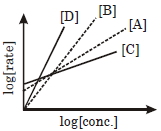
The orders of the above reactions are $a, b, c,$ and $d,$ respectively. The following graph is obtained when $\log[\text{rate}]$ vs. $\log[\text{conc.}]$ are plotted:
Among the following,the correct sequence for the order of the reactions is:
$A$ $\rightarrow P_1; B$ $\rightarrow P_2; C$ $\rightarrow P_3; D$ $\rightarrow P_4$
The orders of the above reactions are $a, b, c,$ and $d,$ respectively. The following graph is obtained when $\log[\text{rate}]$ vs. $\log[\text{conc.}]$ are plotted:
Among the following,the correct sequence for the order of the reactions is:
A
$a > b > c > d$
B
$c > a > b > d$
C
$d > b > a > c$
D
$d > a > b > c$
Solution
(C) For a reaction,the rate law is given by: $\text{Rate} = k[\text{conc.}]^n$,where $n$ is the order of the reaction.
Taking logarithm on both sides:
$\log(\text{rate}) = \log(k) + n \log[\text{conc.}]$
This equation is of the form $y = mx + c$,where the slope $m$ is equal to the order of the reaction $n$.
Comparing the slopes of the lines in the graph:
The slope of line $D$ is the steepest,followed by $B$,then $A$,and finally $C$ is the least steep.
Therefore,the order of the reactions follows the sequence: $d > b > a > c$.
Taking logarithm on both sides:
$\log(\text{rate}) = \log(k) + n \log[\text{conc.}]$
This equation is of the form $y = mx + c$,where the slope $m$ is equal to the order of the reaction $n$.
Comparing the slopes of the lines in the graph:
The slope of line $D$ is the steepest,followed by $B$,then $A$,and finally $C$ is the least steep.
Therefore,the order of the reactions follows the sequence: $d > b > a > c$.
0 likes
View Solution413
MediumMCQ
$2 \ NO_{(g)} + Cl_{2(g)} \rightleftharpoons 2 \ NOCl_{(g)}$
This reaction was studied at $-10^{\circ} C$ and the following data was obtained:
$[NO]_{0}$ and $[Cl_{2}]_{0}$ are the initial concentrations and $r_{0}$ is the initial reaction rate.
The overall order of the reaction is ..........
(Round off to the Nearest Integer).
This reaction was studied at $-10^{\circ} C$ and the following data was obtained:
| $Run$ | $[NO]_{0}$ | $[Cl_{2}]_{0}$ | $r_{0}$ |
| $1$ | $0.10$ | $0.10$ | $0.18$ |
| $2$ | $0.10$ | $0.20$ | $0.35$ |
| $3$ | $0.20$ | $0.20$ | $1.40$ |
$[NO]_{0}$ and $[Cl_{2}]_{0}$ are the initial concentrations and $r_{0}$ is the initial reaction rate.
The overall order of the reaction is ..........
(Round off to the Nearest Integer).
A
$1$
B
$2$
C
$3$
D
$4$
Solution
(C) The rate law is given by $r = k [NO]^{m} [Cl_{2}]^{n}$.
From the data:
$0.18 = k (0.1)^{m} (0.1)^{n} \quad \dots (1)$
$0.35 = k (0.1)^{m} (0.2)^{n} \quad \dots (2)$
$1.40 = k (0.2)^{m} (0.2)^{n} \quad \dots (3)$
Dividing equation $(2)$ by $(1)$:
$\frac{0.35}{0.18} \approx 2 = (\frac{0.2}{0.1})^{n} = 2^{n} \implies n = 1$.
Dividing equation $(3)$ by $(2)$:
$\frac{1.40}{0.35} = 4 = (\frac{0.2}{0.1})^{m} = 2^{m} \implies m = 2$.
The overall order of the reaction is $m + n = 2 + 1 = 3$.
From the data:
$0.18 = k (0.1)^{m} (0.1)^{n} \quad \dots (1)$
$0.35 = k (0.1)^{m} (0.2)^{n} \quad \dots (2)$
$1.40 = k (0.2)^{m} (0.2)^{n} \quad \dots (3)$
Dividing equation $(2)$ by $(1)$:
$\frac{0.35}{0.18} \approx 2 = (\frac{0.2}{0.1})^{n} = 2^{n} \implies n = 1$.
Dividing equation $(3)$ by $(2)$:
$\frac{1.40}{0.35} = 4 = (\frac{0.2}{0.1})^{m} = 2^{m} \implies m = 2$.
The overall order of the reaction is $m + n = 2 + 1 = 3$.
0 likes
View Solution414
EasyMCQ
The reaction $2A + B_{2} \rightarrow 2AB$ is an elementary reaction. For a certain quantity of reactants,if the volume of the reaction vessel is reduced by a factor of $3,$ the rate of the reaction increases by a factor of $.....$. (Round off to the Nearest Integer).
A
$27$
B
$37$
C
$47$
D
$57$
Solution
(A) The given reaction is $2A + B_{2} \rightarrow 2AB$.
Since it is an elementary reaction,the rate law is given by $r_{1} = k[A]^{2}[B_{2}]$.
When the volume of the reaction vessel is reduced by a factor of $3$,the concentration of each reactant increases by a factor of $3$ (since $C = n/V$).
Let the new concentrations be $[A]' = 3[A]$ and $[B_{2}]' = 3[B_{2}]$.
The new rate $r_{2}$ is $r_{2} = k(3[A])^{2}(3[B_{2}])$.
$r_{2} = k \cdot 9[A]^{2} \cdot 3[B_{2}] = 27 \cdot k[A]^{2}[B_{2}] = 27 \cdot r_{1}$.
Thus,the rate of reaction increases by a factor of $27$.
Since it is an elementary reaction,the rate law is given by $r_{1} = k[A]^{2}[B_{2}]$.
When the volume of the reaction vessel is reduced by a factor of $3$,the concentration of each reactant increases by a factor of $3$ (since $C = n/V$).
Let the new concentrations be $[A]' = 3[A]$ and $[B_{2}]' = 3[B_{2}]$.
The new rate $r_{2}$ is $r_{2} = k(3[A])^{2}(3[B_{2}])$.
$r_{2} = k \cdot 9[A]^{2} \cdot 3[B_{2}] = 27 \cdot k[A]^{2}[B_{2}] = 27 \cdot r_{1}$.
Thus,the rate of reaction increases by a factor of $27$.
0 likes
View Solution415
MediumMCQ
The following data was obtained for the chemical reaction given below at $975 \ K$: $2 NO_{(g)} + 2 H_{2(g)} \rightarrow N_{2(g)} + 2 H_{2}O_{(g)}$
The order of the reaction with respect to $NO$ is ..... .
| Experiment | $[NO] \ (mol \ L^{-1})$ | $[H_{2}] \ (mol \ L^{-1})$ | Rate $(mol \ L^{-1} \ s^{-1})$ |
| $1$ | $8 \times 10^{-5}$ | $8 \times 10^{-5}$ | $7 \times 10^{-9}$ |
| $2$ | $24 \times 10^{-5}$ | $8 \times 10^{-5}$ | $2.1 \times 10^{-8}$ |
| $3$ | $24 \times 10^{-5}$ | $32 \times 10^{-5}$ | $8.4 \times 10^{-8}$ |
A
$1$
B
$4$
C
$2$
D
$3$
Solution
(A) The rate law for the reaction is given by: $\text{Rate} = k[NO]^x[H_2]^y$.
Using data from Experiment $1$ and $2$:
$7 \times 10^{-9} = k(8 \times 10^{-5})^x(8 \times 10^{-5})^y$ ... $(i)$
$2.1 \times 10^{-8} = k(24 \times 10^{-5})^x(8 \times 10^{-5})^y$ ... $(ii)$
Dividing equation $(ii)$ by $(i)$:
$\frac{2.1 \times 10^{-8}}{7 \times 10^{-9}} = \left(\frac{24 \times 10^{-5}}{8 \times 10^{-5}}\right)^x$
$3 = (3)^x$
Therefore,$x = 1$.
The order of the reaction with respect to $NO$ is $1$.
Using data from Experiment $1$ and $2$:
$7 \times 10^{-9} = k(8 \times 10^{-5})^x(8 \times 10^{-5})^y$ ... $(i)$
$2.1 \times 10^{-8} = k(24 \times 10^{-5})^x(8 \times 10^{-5})^y$ ... $(ii)$
Dividing equation $(ii)$ by $(i)$:
$\frac{2.1 \times 10^{-8}}{7 \times 10^{-9}} = \left(\frac{24 \times 10^{-5}}{8 \times 10^{-5}}\right)^x$
$3 = (3)^x$
Therefore,$x = 1$.
The order of the reaction with respect to $NO$ is $1$.
0 likes
View Solution416
DifficultMCQ
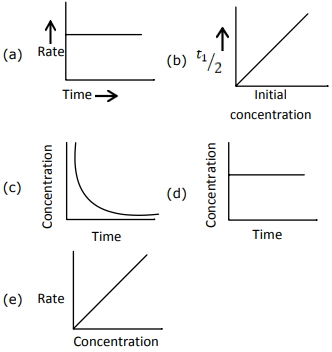
For the following graphs,choose the correct option regarding the order of reaction:
A
$(b)$ and $(d)$ Zero order; $(e)$ First order
B
$(a)$ and $(b)$ Zero order; $(c)$ and $(e)$ First order
C
$(a)$ and $(b)$ Zero order; $(e)$ First order
D
$(b)$ Zero order; $(c)$ and $(e)$ First order
Solution
(B) For a zero order reaction:
$Rate = k[Reactant]^0 = k$. Thus,graph $(a)$ (Rate vs Time) is constant,representing zero order.
$t_{1/2} = [A]_0 / (2k)$. Thus,graph $(b)$ ($t_{1/2}$ vs Initial concentration) is a straight line passing through the origin,representing zero order.
For a first order reaction:
$Rate = k[Concentration]$. Thus,graph $(e)$ (Rate vs Concentration) is a straight line passing through the origin,representing first order.
$[A]_t = [A]_0 e^{-kt}$. Thus,graph $(c)$ (Concentration vs Time) is an exponential decay curve,representing first order.
Graph $(d)$ shows concentration independent of time,which is not standard for these kinetics.
Therefore,$(a)$ and $(b)$ are zero order,while $(c)$ and $(e)$ are first order.
$Rate = k[Reactant]^0 = k$. Thus,graph $(a)$ (Rate vs Time) is constant,representing zero order.
$t_{1/2} = [A]_0 / (2k)$. Thus,graph $(b)$ ($t_{1/2}$ vs Initial concentration) is a straight line passing through the origin,representing zero order.
For a first order reaction:
$Rate = k[Concentration]$. Thus,graph $(e)$ (Rate vs Concentration) is a straight line passing through the origin,representing first order.
$[A]_t = [A]_0 e^{-kt}$. Thus,graph $(c)$ (Concentration vs Time) is an exponential decay curve,representing first order.
Graph $(d)$ shows concentration independent of time,which is not standard for these kinetics.
Therefore,$(a)$ and $(b)$ are zero order,while $(c)$ and $(e)$ are first order.
0 likes
View Solution417
EasyMCQ
For a reaction of order $n$,the unit of the rate constant is :
A
$mol^{1-n} L^{1-n} s^{-1}$
B
$mol^{1-n} L^{n-1} s^{-1}$
C
$mol^{1-n} L^{1-n} s$
D
$mol^{1-n} L^{2n} s^{-1}$
Solution
(B) The rate law for a reaction of order $n$ is given by: $\text{Rate} = k[A]^n$.
The unit of rate is $\text{mol } L^{-1} s^{-1}$.
The unit of concentration $[A]$ is $\text{mol } L^{-1}$.
Substituting these into the rate law: $(\text{mol } L^{-1}) s^{-1} = k(\text{mol } L^{-1})^n$.
Solving for $k$: $k = \frac{(\text{mol } L^{-1}) s^{-1}}{(\text{mol } L^{-1})^n} = (\text{mol } L^{-1})^{1-n} s^{-1} = \text{mol}^{1-n} L^{n-1} s^{-1}$.
The unit of rate is $\text{mol } L^{-1} s^{-1}$.
The unit of concentration $[A]$ is $\text{mol } L^{-1}$.
Substituting these into the rate law: $(\text{mol } L^{-1}) s^{-1} = k(\text{mol } L^{-1})^n$.
Solving for $k$: $k = \frac{(\text{mol } L^{-1}) s^{-1}}{(\text{mol } L^{-1})^n} = (\text{mol } L^{-1})^{1-n} s^{-1} = \text{mol}^{1-n} L^{n-1} s^{-1}$.
0 likes
View Solution418
MediumMCQ
Consider the reaction between chlorine and nitric oxide:
$Cl_{2(g)} + 2NO_{(g)} \rightarrow 2NOCl_{(g)}$
On doubling the concentration of both reactants,the rate of the reaction increases by a factor of $8$. However,if only the concentration of $Cl_2$ is doubled,the rate increases by a factor of $2$. The order of this reaction with respect to $NO$ is :
$Cl_{2(g)} + 2NO_{(g)} \rightarrow 2NOCl_{(g)}$
On doubling the concentration of both reactants,the rate of the reaction increases by a factor of $8$. However,if only the concentration of $Cl_2$ is doubled,the rate increases by a factor of $2$. The order of this reaction with respect to $NO$ is :
A
$0$
B
$1$
C
$2$
D
$3$
Solution
(C) Let the rate law be $Rate = k[Cl_2]^x[NO]^y$.
Given that doubling $[Cl_2]$ increases the rate by a factor of $2$,we have $2^x = 2$,which implies $x = 1$.
When both concentrations are doubled,the rate increases by a factor of $8$,so $2^x \times 2^y = 8$.
Substituting $x = 1$,we get $2^1 \times 2^y = 8$,which simplifies to $2^y = 4$.
Therefore,$y = 2$.
The order of the reaction with respect to $NO$ is $2$.
Given that doubling $[Cl_2]$ increases the rate by a factor of $2$,we have $2^x = 2$,which implies $x = 1$.
When both concentrations are doubled,the rate increases by a factor of $8$,so $2^x \times 2^y = 8$.
Substituting $x = 1$,we get $2^1 \times 2^y = 8$,which simplifies to $2^y = 4$.
Therefore,$y = 2$.
The order of the reaction with respect to $NO$ is $2$.
0 likes
View Solution419
MediumMCQ
At $345 \ K$,the half-life for the decomposition of a sample of a gaseous compound initially at $55.5 \ kPa$ was $340 \ s$. When the pressure was $27.8 \ kPa$,the half-life was found to be $170 \ s$. The order of the reaction is $......$ [integer answer]
A
$1$
B
$0$
C
$2$
D
$3$
Solution
(B) For a gaseous reaction,the half-life $t_{1/2}$ is related to the initial pressure $P_0$ by the relation: $t_{1/2} \propto \frac{1}{(P_0)^{n-1}}$,where $n$ is the order of the reaction.
Given:
$P_1 = 55.5 \ kPa$,$t_1 = 340 \ s$
$P_2 = 27.8 \ kPa$,$t_2 = 170 \ s$
Using the ratio formula:
$\frac{t_1}{t_2} = \left(\frac{P_2}{P_1}\right)^{n-1}$
Substituting the values:
$\frac{340}{170} = \left(\frac{27.8}{55.5}\right)^{n-1}$
$2 = \left(\frac{1}{2}\right)^{n-1}$
$2^1 = (2^{-1})^{n-1}$
$2^1 = 2^{-(n-1)}$
$1 = -(n-1)$
$1 = -n + 1$
$n = 0$
Thus,the order of the reaction is $0$.
Given:
$P_1 = 55.5 \ kPa$,$t_1 = 340 \ s$
$P_2 = 27.8 \ kPa$,$t_2 = 170 \ s$
Using the ratio formula:
$\frac{t_1}{t_2} = \left(\frac{P_2}{P_1}\right)^{n-1}$
Substituting the values:
$\frac{340}{170} = \left(\frac{27.8}{55.5}\right)^{n-1}$
$2 = \left(\frac{1}{2}\right)^{n-1}$
$2^1 = (2^{-1})^{n-1}$
$2^1 = 2^{-(n-1)}$
$1 = -(n-1)$
$1 = -n + 1$
$n = 0$
Thus,the order of the reaction is $0$.
0 likes
View Solution420
MediumMCQ
For a reaction $A \rightarrow 2 B + C$ the half-lives are $100 \ s$ and $50 \ s$ when the concentration of reactant $A$ is $0.5 \ mol \ L^{-1}$ and $1.0 \ mol \ L^{-1}$ respectively. The order of the reaction is (Nearest Integer).
A
$2$
B
$1$
C
$3$
D
$0$
Solution
(A) The half-life of a reaction of order $n$ is related to the initial concentration $[A_0]$ as $t_{\frac{1}{2}} \propto \frac{1}{[A_0]^{n-1}}$.
Given:
$t_{\frac{1}{2}, 1} = 100 \ s$ at $[A_0]_1 = 0.5 \ mol \ L^{-1}$
$t_{\frac{1}{2}, 2} = 50 \ s$ at $[A_0]_2 = 1.0 \ mol \ L^{-1}$
Taking the ratio:
$\frac{t_{\frac{1}{2}, 1}}{t_{\frac{1}{2}, 2}} = \left( \frac{[A_0]_2}{[A_0]_1} \right)^{n-1}$
$\frac{100}{50} = \left( \frac{1.0}{0.5} \right)^{n-1}$
$2 = (2)^{n-1}$
$2^1 = 2^{n-1}$
Comparing the exponents:
$n - 1 = 1$
$n = 2$
The order of the reaction is $2$.
Given:
$t_{\frac{1}{2}, 1} = 100 \ s$ at $[A_0]_1 = 0.5 \ mol \ L^{-1}$
$t_{\frac{1}{2}, 2} = 50 \ s$ at $[A_0]_2 = 1.0 \ mol \ L^{-1}$
Taking the ratio:
$\frac{t_{\frac{1}{2}, 1}}{t_{\frac{1}{2}, 2}} = \left( \frac{[A_0]_2}{[A_0]_1} \right)^{n-1}$
$\frac{100}{50} = \left( \frac{1.0}{0.5} \right)^{n-1}$
$2 = (2)^{n-1}$
$2^1 = 2^{n-1}$
Comparing the exponents:
$n - 1 = 1$
$n = 2$
The order of the reaction is $2$.
0 likes
View Solution421
MediumMCQ
$2 \ NO + 2 \ H_2 \rightarrow N_2 + 2 \ H_2O$
The above reaction has been studied at $800^{\circ} C$. The related data are given in the table below.
The order of the reaction with respect to $NO$ is $...........$
The above reaction has been studied at $800^{\circ} C$. The related data are given in the table below.
| Reaction serial number | Initial pressure of $H_2$ / $kPa$ | Initial Pressure of $NO$ / $kPa$ | Initial rate $(-\frac{dp}{dt}) / (kPa \ s^{-1})$ |
| $1$ | $65.6$ | $40.0$ | $0.135$ |
| $2$ | $65.6$ | $20.1$ | $0.033$ |
| $3$ | $38.6$ | $65.6$ | $0.214$ |
| $4$ | $19.2$ | $65.6$ | $0.106$ |
The order of the reaction with respect to $NO$ is $...........$
A
$1$
B
$0$
C
$2$
D
$3$
Solution
(C) Let the rate law be $Rate = k[P_{NO}]^x [P_{H_2}]^y$.
Comparing experiments $1$ and $2$ where $[P_{H_2}]$ is constant:
$\frac{Rate_1}{Rate_2} = (\frac{P_{NO,1}}{P_{NO,2}})^x$
$\frac{0.135}{0.033} \approx 4.09 \approx 4$
$(\frac{40.0}{20.1})^x \approx 2^x$
$4 = 2^x \implies x = 2$.
Thus,the order of the reaction with respect to $NO$ is $2$.
Comparing experiments $1$ and $2$ where $[P_{H_2}]$ is constant:
$\frac{Rate_1}{Rate_2} = (\frac{P_{NO,1}}{P_{NO,2}})^x$
$\frac{0.135}{0.033} \approx 4.09 \approx 4$
$(\frac{40.0}{20.1})^x \approx 2^x$
$4 = 2^x \implies x = 2$.
Thus,the order of the reaction with respect to $NO$ is $2$.
0 likes
View Solution422
MediumMCQ
The reaction between $X$ and $Y$ is first order with respect to $X$ and zero order with respect to $Y$.
Examine the data of the table and calculate the ratio of the numerical value of $M$ to $0.2$.
| $Experiment$ | $[X] / (mol \ L^{-1})$ | $[Y] / (mol \ L^{-1})$ | $\text{Initial rate} / (mol \ L^{-1} \ min^{-1})$ |
| $I$ | $0.1$ | $0.1$ | $2 \times 10^{-3}$ |
| $II$ | $0.2$ | $0.2$ | $4 \times 10^{-3}$ |
| $III$ | $0.4$ | $0.4$ | $M \times 10^{-3}$ |
| $IV$ | $0.1$ | $0.2$ | $2 \times 10^{-3}$ |
Examine the data of the table and calculate the ratio of the numerical value of $M$ to $0.2$.
A
$20$
B
$30$
C
$40$
D
$50$
Solution
(C) The rate law for the reaction is given by $r = k[X]^1[Y]^0 = k[X]$.
From experiment $I$,$2 \times 10^{-3} = k(0.1) \Rightarrow k = 2 \times 10^{-2} \ min^{-1}$.
For experiment $III$,the concentration of $X$ is $0.4 \ mol \ L^{-1}$.
Therefore,the initial rate is $r = k[X] = (2 \times 10^{-2})(0.4) = 0.8 \times 10^{-2} = 8 \times 10^{-3} \ mol \ L^{-1} \ min^{-1}$.
Comparing this with $M \times 10^{-3}$,we get $M = 8$.
The ratio of the numerical value of $M$ to $0.2$ is $\frac{8}{0.2} = 40$.
From experiment $I$,$2 \times 10^{-3} = k(0.1) \Rightarrow k = 2 \times 10^{-2} \ min^{-1}$.
For experiment $III$,the concentration of $X$ is $0.4 \ mol \ L^{-1}$.
Therefore,the initial rate is $r = k[X] = (2 \times 10^{-2})(0.4) = 0.8 \times 10^{-2} = 8 \times 10^{-3} \ mol \ L^{-1} \ min^{-1}$.
Comparing this with $M \times 10^{-3}$,we get $M = 8$.
The ratio of the numerical value of $M$ to $0.2$ is $\frac{8}{0.2} = 40$.
0 likes
View Solution423
MediumMCQ
The following data are obtained for a reaction,$X + Y \rightarrow$ Products.
The overall order of the reaction is:
| $Expt.$ | $[X]_0 / mol \ L^{-1}$ | $[Y]_0 / mol \ L^{-1}$ | $Rate / mol \ L^{-1} s^{-1}$ |
| $1$ | $0.25$ | $0.25$ | $1.0 \times 10^{-6}$ |
| $2$ | $0.50$ | $0.25$ | $4.0 \times 10^{-6}$ |
| $3$ | $0.25$ | $0.50$ | $8.0 \times 10^{-6}$ |
The overall order of the reaction is:
A
$2$
B
$4$
C
$3$
D
$5$
Solution
(D) The rate law is given by $R = k[X]^x[Y]^y$.
From experiment $1$ and $2$,keeping $[Y]$ constant:
$\frac{R_2}{R_1} = \frac{k[0.50]^x[0.25]^y}{k[0.25]^x[0.25]^y} = \frac{4.0 \times 10^{-6}}{1.0 \times 10^{-6}}$
$2^x = 4$ $\Rightarrow 2^x = 2^2$ $\Rightarrow x = 2$.
From experiment $1$ and $3$,keeping $[X]$ constant:
$\frac{R_3}{R_1} = \frac{k[0.25]^x[0.50]^y}{k[0.25]^x[0.25]^y} = \frac{8.0 \times 10^{-6}}{1.0 \times 10^{-6}}$
$2^y = 8$ $\Rightarrow 2^y = 2^3$ $\Rightarrow y = 3$.
The overall order of the reaction is $x + y = 2 + 3 = 5$.
From experiment $1$ and $2$,keeping $[Y]$ constant:
$\frac{R_2}{R_1} = \frac{k[0.50]^x[0.25]^y}{k[0.25]^x[0.25]^y} = \frac{4.0 \times 10^{-6}}{1.0 \times 10^{-6}}$
$2^x = 4$ $\Rightarrow 2^x = 2^2$ $\Rightarrow x = 2$.
From experiment $1$ and $3$,keeping $[X]$ constant:
$\frac{R_3}{R_1} = \frac{k[0.25]^x[0.50]^y}{k[0.25]^x[0.25]^y} = \frac{8.0 \times 10^{-6}}{1.0 \times 10^{-6}}$
$2^y = 8$ $\Rightarrow 2^y = 2^3$ $\Rightarrow y = 3$.
The overall order of the reaction is $x + y = 2 + 3 = 5$.
0 likes
View Solution424
MediumMCQ
In a one-component second-order reaction,if the concentration of the reactant is reduced to half,the rate
A
increases two times
B
increases four times
C
decreases to one half
D
decreases to one fourth
Solution
(D) The rate law for a second-order reaction is given by $r = k[A]^2$,where $k$ is the rate constant and $[A]$ is the concentration of the reactant.
If the concentration of the reactant is reduced to half,the new concentration becomes $[A]' = \frac{[A]}{2}$.
The new rate $r'$ will be:
$r' = k(\frac{[A]}{2})^2$
$r' = k \times \frac{[A]^2}{4}$
$r' = \frac{1}{4} \times k[A]^2$
$r' = \frac{1}{4} r$
Therefore,the rate decreases to one-fourth of its original value.
If the concentration of the reactant is reduced to half,the new concentration becomes $[A]' = \frac{[A]}{2}$.
The new rate $r'$ will be:
$r' = k(\frac{[A]}{2})^2$
$r' = k \times \frac{[A]^2}{4}$
$r' = \frac{1}{4} \times k[A]^2$
$r' = \frac{1}{4} r$
Therefore,the rate decreases to one-fourth of its original value.
0 likes
View Solution425
DifficultMCQ
$A$ student has studied the decomposition of a gas $AB_3$ at $25^{\circ} C$. He obtained the following data.
The order of the reaction is
| $p \ (mm \ Hg)$ | $50$ | $100$ | $200$ | $400$ |
| Relative $t_{1/2} \ (s)$ | $4$ | $2$ | $1$ | $0.5$ |
The order of the reaction is
A
$0.5$
B
$2$
C
$1$
D
$0$
Solution
(B) For a reaction of order $n$,the half-life $t_{1/2}$ is related to the initial pressure $P_0$ as $t_{1/2} \propto (P_0)^{1-n}$.
Using the data from the table:
$\frac{(t_{1/2})_1}{(t_{1/2})_2} = \left(\frac{(P_0)_1}{(P_0)_2}\right)^{1-n}$
Substituting the values for the first two entries:
$\frac{4}{2} = \left(\frac{50}{100}\right)^{1-n}$
$2 = \left(\frac{1}{2}\right)^{1-n}$
$2 = (2)^{-(1-n)}$
$2^1 = 2^{n-1}$
Equating the exponents:
$1 = n - 1$
$n = 2$
Therefore,the order of the reaction is $2$.
Using the data from the table:
$\frac{(t_{1/2})_1}{(t_{1/2})_2} = \left(\frac{(P_0)_1}{(P_0)_2}\right)^{1-n}$
Substituting the values for the first two entries:
$\frac{4}{2} = \left(\frac{50}{100}\right)^{1-n}$
$2 = \left(\frac{1}{2}\right)^{1-n}$
$2 = (2)^{-(1-n)}$
$2^1 = 2^{n-1}$
Equating the exponents:
$1 = n - 1$
$n = 2$
Therefore,the order of the reaction is $2$.
0 likes
View Solution426
DifficultMCQ
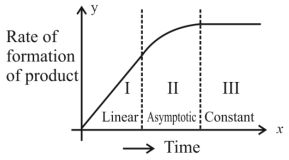
For a certain chemical reaction $X \rightarrow Y$,the rate of formation of the product is plotted against time as shown in the figure. The number of correct statement$(s)$ from the following is $.......$.
$A$. Overall order of this reaction is one
$B$. Order of this reaction cannot be determined
$C$. In region-$I$ and $III$,the reaction is of first and zero order respectively
$D$. In region-$II$,the reaction is of first order
$E$. In region-$II$,the order of reaction is in the range of $0.1$ to $0.9$.
$A$. Overall order of this reaction is one
$B$. Order of this reaction cannot be determined
$C$. In region-$I$ and $III$,the reaction is of first and zero order respectively
$D$. In region-$II$,the reaction is of first order
$E$. In region-$II$,the order of reaction is in the range of $0.1$ to $0.9$.
A
$1$
B
$2$
C
$3$
D
$4$
Solution
(A) The graph shows the rate of formation of the product versus time.
In region-$I$,the rate increases linearly with time,which does not correspond to standard integer-order kinetics.
In region-$II$,the rate approaches a constant value asymptotically.
In region-$III$,the rate becomes constant,which is characteristic of a zero-order reaction (where rate is independent of concentration).
Since the rate of reaction depends on the concentration of reactants,and the graph only shows rate versus time,the order of the reaction cannot be determined solely from this plot without knowing the concentration-time profile.
Therefore,only statement $B$ is correct.
The number of correct statements is $1$.
In region-$I$,the rate increases linearly with time,which does not correspond to standard integer-order kinetics.
In region-$II$,the rate approaches a constant value asymptotically.
In region-$III$,the rate becomes constant,which is characteristic of a zero-order reaction (where rate is independent of concentration).
Since the rate of reaction depends on the concentration of reactants,and the graph only shows rate versus time,the order of the reaction cannot be determined solely from this plot without knowing the concentration-time profile.
Therefore,only statement $B$ is correct.
The number of correct statements is $1$.
0 likes
View Solution427
MediumMCQ
For conversion of compound $A \rightarrow B$,the rate constant of the reaction was found to be $4.6 \times 10^{-5} \ L \ mol^{-1} \ s^{-1}$. The order of the reaction is $..........$
A
$4$
B
$6$
C
$2$
D
$8$
Solution
(C) The unit of the rate constant for a reaction of order $n$ is given by $(\text{mol} \ L^{-1})^{1-n} \ s^{-1}$.
Given the unit is $L \ mol^{-1} \ s^{-1}$,which is equivalent to $(\text{mol} \ L^{-1})^{-1} \ s^{-1}$.
Comparing the exponents: $1 - n = -1$.
Therefore,$n = 2$.
The reaction is of second order.
Given the unit is $L \ mol^{-1} \ s^{-1}$,which is equivalent to $(\text{mol} \ L^{-1})^{-1} \ s^{-1}$.
Comparing the exponents: $1 - n = -1$.
Therefore,$n = 2$.
The reaction is of second order.
0 likes
View Solution428
DifficultMCQ
The number of incorrect statement/s from the following is:
$A$. The successive half-lives of zero-order reactions decrease with time.
$B$. $A$ substance appearing as a reactant in the chemical equation may not affect the rate of reaction.
$C$. Order and molecularity of a chemical reaction can be a fractional number.
$D$. The rate constant units of zero and second-order reactions are $mol \ L^{-1} s^{-1}$ and $mol^{-1} L s^{-1}$ respectively.
$A$. The successive half-lives of zero-order reactions decrease with time.
$B$. $A$ substance appearing as a reactant in the chemical equation may not affect the rate of reaction.
$C$. Order and molecularity of a chemical reaction can be a fractional number.
$D$. The rate constant units of zero and second-order reactions are $mol \ L^{-1} s^{-1}$ and $mol^{-1} L s^{-1}$ respectively.
A
$2$
B
$3$
C
$1$
D
$4$
Solution
(C) . For a zero-order reaction,$t_{1/2} = \frac{[A]_0}{2K}$. As the concentration decreases,the half-life decreases. (Correct statement)
$B$. If the order with respect to a reactant is zero,it will not affect the rate of reaction. (Correct statement)
$C$. Order can be fractional,but molecularity is always a whole number and cannot be fractional. (Incorrect statement)
$D$. For a zero-order reaction,the unit is $mol \ L^{-1} s^{-1}$,and for a second-order reaction,the unit is $mol^{-1} L s^{-1}$. (Correct statement)
Thus,only statement $C$ is incorrect. The number of incorrect statements is $1$.
$B$. If the order with respect to a reactant is zero,it will not affect the rate of reaction. (Correct statement)
$C$. Order can be fractional,but molecularity is always a whole number and cannot be fractional. (Incorrect statement)
$D$. For a zero-order reaction,the unit is $mol \ L^{-1} s^{-1}$,and for a second-order reaction,the unit is $mol^{-1} L s^{-1}$. (Correct statement)
Thus,only statement $C$ is incorrect. The number of incorrect statements is $1$.
0 likes
View Solution429
MediumMCQ
For a chemical reaction $A + B \rightarrow \text{Product}$,the order is $1$ with respect to $A$ and $B$.
What is the value of $x$ and $y$?
| Rate $(mol \ L^{-1} \ s^{-1})$ | $[A]$ $(mol \ L^{-1})$ | $[B]$ $(mol \ L^{-1})$ |
|---|---|---|
| $0.10$ | $20$ | $0.5$ |
| $0.40$ | $x$ | $0.5$ |
| $0.80$ | $40$ | $y$ |
What is the value of $x$ and $y$?
A
$80$ and $2$
B
$40$ and $4$
C
$160$ and $4$
D
$80$ and $4$
Solution
(A) The rate law for the reaction is given by $r = k[A]^1[B]^1$.
For the first experiment: $0.10 = k(20)(0.5)$ $\Rightarrow 0.10 = 10k$ $\Rightarrow k = 0.01 \ L \ mol^{-1} \ s^{-1}$.
For the second experiment: $0.40 = k(x)(0.5)$. Substituting $k = 0.01$: $0.40 = 0.01(x)(0.5)$ $\Rightarrow 0.40 = 0.005x$ $\Rightarrow x = 80 \ mol \ L^{-1}$.
For the third experiment: $0.80 = k(40)(y)$. Substituting $k = 0.01$: $0.80 = 0.01(40)(y)$ $\Rightarrow 0.80 = 0.4y$ $\Rightarrow y = 2 \ mol \ L^{-1}$.
Therefore,the values are $x = 80$ and $y = 2$.
For the first experiment: $0.10 = k(20)(0.5)$ $\Rightarrow 0.10 = 10k$ $\Rightarrow k = 0.01 \ L \ mol^{-1} \ s^{-1}$.
For the second experiment: $0.40 = k(x)(0.5)$. Substituting $k = 0.01$: $0.40 = 0.01(x)(0.5)$ $\Rightarrow 0.40 = 0.005x$ $\Rightarrow x = 80 \ mol \ L^{-1}$.
For the third experiment: $0.80 = k(40)(y)$. Substituting $k = 0.01$: $0.80 = 0.01(40)(y)$ $\Rightarrow 0.80 = 0.4y$ $\Rightarrow y = 2 \ mol \ L^{-1}$.
Therefore,the values are $x = 80$ and $y = 2$.
0 likes
View Solution430
MediumMCQ
The reaction $2 \ NO + Br_2 \rightarrow 2 \ NOBr$ takes place through the mechanism given below:
$NO + Br_2 \Leftrightarrow NOBr_2$ (fast)
$NOBr_2 + NO \rightarrow 2 \ NOBr$ (slow)
The overall order of the reaction is $.....$.
$NO + Br_2 \Leftrightarrow NOBr_2$ (fast)
$NOBr_2 + NO \rightarrow 2 \ NOBr$ (slow)
The overall order of the reaction is $.....$.
A
$4$
B
$3$
C
$5$
D
$6$
Solution
(B) The rate-determining step $(RDS)$ is the slow step: $NOBr_2 + NO \rightarrow 2 \ NOBr$.
The rate law is given by: $r = k [NOBr_2] [NO]$ ---- $(i)$
From the fast equilibrium step: $K_{eq} = \frac{[NOBr_2]}{[NO] [Br_2]}$,which implies $[NOBr_2] = K_{eq} [NO] [Br_2]$ ---- $(ii)$
Substituting $(ii)$ into $(i)$:
$r = k \cdot K_{eq} [NO] [Br_2] [NO]$
$r = k' [NO]^2 [Br_2]^1$
The overall order of the reaction is the sum of the powers of the concentration terms in the rate law: $2 + 1 = 3$.
The rate law is given by: $r = k [NOBr_2] [NO]$ ---- $(i)$
From the fast equilibrium step: $K_{eq} = \frac{[NOBr_2]}{[NO] [Br_2]}$,which implies $[NOBr_2] = K_{eq} [NO] [Br_2]$ ---- $(ii)$
Substituting $(ii)$ into $(i)$:
$r = k \cdot K_{eq} [NO] [Br_2] [NO]$
$r = k' [NO]^2 [Br_2]^1$
The overall order of the reaction is the sum of the powers of the concentration terms in the rate law: $2 + 1 = 3$.
0 likes
View Solution431
MediumMCQ
For a certain reaction,the rate $= k[A]^2[B]$. When the initial concentration of $A$ is tripled keeping the concentration of $B$ constant,the initial rate would:
A
Increase by a factor of $3$
B
Decrease by a factor of $9$
C
Increase by a factor of $6$
D
Increase by a factor of $9$
Solution
(D) The initial rate is given by $r = k[A]^2[B]$.
When the concentration of $A$ is tripled,the new concentration $[A'] = 3[A]$.
The new rate $r'$ is calculated as:
$r' = k[A']^2[B] = k(3[A])^2[B] = k(9[A]^2)[B] = 9k[A]^2[B]$.
Comparing the new rate with the initial rate,$r' = 9r$.
Therefore,the rate increases by a factor of $9$.
When the concentration of $A$ is tripled,the new concentration $[A'] = 3[A]$.
The new rate $r'$ is calculated as:
$r' = k[A']^2[B] = k(3[A])^2[B] = k(9[A]^2)[B] = 9k[A]^2[B]$.
Comparing the new rate with the initial rate,$r' = 9r$.
Therefore,the rate increases by a factor of $9$.
0 likes
View Solution432
DifficultMCQ
Consider the following data for the given reaction $2 HI_{(g)} \rightarrow H_{2_{(g)}} + I_{2_{(g)}}$. The order of the reaction is:
| Experiment | $1$ | $2$ | $3$ |
|---|---|---|---|
| $[HI] \ (mol \ L^{-1})$ | $0.005$ | $0.01$ | $0.02$ |
| Rate $(mol \ L^{-1} \ s^{-1})$ | $7.5 \times 10^{-4}$ | $3.0 \times 10^{-3}$ | $1.2 \times 10^{-2}$ |
A
$1$
B
$2$
C
$3$
D
$4$
Solution
(B) The rate law for the reaction is given by $R = k[HI]^n$.
Using data from Experiment $1$ and Experiment $2$:
$\frac{R_2}{R_1} = \frac{k[HI]_2^n}{k[HI]_1^n}$
$\frac{3.0 \times 10^{-3}}{7.5 \times 10^{-4}} = \left(\frac{0.01}{0.005}\right)^n$
$4 = (2)^n$
Since $2^2 = 4$,we get $n = 2$.
Thus,the order of the reaction is $2$.
Using data from Experiment $1$ and Experiment $2$:
$\frac{R_2}{R_1} = \frac{k[HI]_2^n}{k[HI]_1^n}$
$\frac{3.0 \times 10^{-3}}{7.5 \times 10^{-4}} = \left(\frac{0.01}{0.005}\right)^n$
$4 = (2)^n$
Since $2^2 = 4$,we get $n = 2$.
Thus,the order of the reaction is $2$.
0 likes
View Solution433
MediumMCQ
During the kinetic study of the reaction $2A + B \rightarrow C + D$,the following results were obtained:
Based on the above data,the overall order of the reaction is:
| Experiment | $[A] \ (M), [B] \ (M)$ and Initial rate of formation of $D$ |
|---|---|
| $i. \ [A]=0.1, [B]=0.1$ | $6.0 \times 10^{-3} \ M \ s^{-1}$ |
| $ii. \ [A]=0.3, [B]=0.2$ | $7.2 \times 10^{-2} \ M \ s^{-1}$ |
| $iii. \ [A]=0.3, [B]=0.4$ | $2.88 \times 10^{-1} \ M \ s^{-1}$ |
| $iv. \ [A]=0.4, [B]=0.1$ | $2.40 \times 10^{-2} \ M \ s^{-1}$ |
Based on the above data,the overall order of the reaction is:
A
$2$
B
$3$
C
$4$
D
$5$
Solution
(B) The rate law is given by $r = K[A]^{x}[B]^{y}$.
Using experiment $(i)$ and $(iv)$ where $[B]$ is constant:
$6.0 \times 10^{-3} = K(0.1)^{x}(0.1)^{y}$
$2.40 \times 10^{-2} = K(0.4)^{x}(0.1)^{y}$
Dividing $(iv)$ by $(i)$ gives: $4 = (4)^{x}$,so $x = 1$.
Using experiment $(ii)$ and $(iii)$ where $[A]$ is constant:
$7.2 \times 10^{-2} = K(0.3)^{x}(0.2)^{y}$
$2.88 \times 10^{-1} = K(0.3)^{x}(0.4)^{y}$
Dividing $(iii)$ by $(ii)$ gives: $4 = (2)^{y}$,so $y = 2$.
Overall order $= x + y = 1 + 2 = 3$.
Using experiment $(i)$ and $(iv)$ where $[B]$ is constant:
$6.0 \times 10^{-3} = K(0.1)^{x}(0.1)^{y}$
$2.40 \times 10^{-2} = K(0.4)^{x}(0.1)^{y}$
Dividing $(iv)$ by $(i)$ gives: $4 = (4)^{x}$,so $x = 1$.
Using experiment $(ii)$ and $(iii)$ where $[A]$ is constant:
$7.2 \times 10^{-2} = K(0.3)^{x}(0.2)^{y}$
$2.88 \times 10^{-1} = K(0.3)^{x}(0.4)^{y}$
Dividing $(iii)$ by $(ii)$ gives: $4 = (2)^{y}$,so $y = 2$.
Overall order $= x + y = 1 + 2 = 3$.
0 likes
View Solution434
MediumMCQ
Consider the following single step reaction in gas phase at constant temperature.
$2 \ A_{(g)} + B_{(g)} \rightarrow C_{(g)}$
The initial rate of the reaction is recorded as $r_1$ when the reaction starts with $1.5 \ atm$ pressure of $A$ and $0.7 \ atm$ pressure of $B$. After some time,the rate $r_2$ is recorded when the pressure of $C$ becomes $0.5 \ atm$. The ratio $r_1 : r_2$ is $\qquad$ $\times 10^{-1}$.
(Nearest integer)
$2 \ A_{(g)} + B_{(g)} \rightarrow C_{(g)}$
The initial rate of the reaction is recorded as $r_1$ when the reaction starts with $1.5 \ atm$ pressure of $A$ and $0.7 \ atm$ pressure of $B$. After some time,the rate $r_2$ is recorded when the pressure of $C$ becomes $0.5 \ atm$. The ratio $r_1 : r_2$ is $\qquad$ $\times 10^{-1}$.
(Nearest integer)
A
$318$
B
$317$
C
$315$
D
$319$
Solution
(C) The reaction is $2 \ A_{(g)} + B_{(g)} \longrightarrow C_{(g)}$.
At $t = 0$,$P_A = 1.5 \ atm$ and $P_B = 0.7 \ atm$. The initial rate is $r_1 = K(P_A)^2(P_B) = K(1.5)^2(0.7)$.
When $P_C = 0.5 \ atm$,the pressure of $A$ consumed is $2 \times 0.5 = 1.0 \ atm$ and $B$ consumed is $0.5 \ atm$.
Remaining pressures are $P_A = 1.5 - 1.0 = 0.5 \ atm$ and $P_B = 0.7 - 0.5 = 0.2 \ atm$.
The rate at this time is $r_2 = K(0.5)^2(0.2)$.
Taking the ratio: $\frac{r_1}{r_2} = \frac{K(1.5)^2(0.7)}{K(0.5)^2(0.2)} = \frac{2.25 \times 0.7}{0.25 \times 0.2} = \frac{1.575}{0.05} = 31.5$.
Since $31.5 = 315 \times 10^{-1}$,the value is $315$.
At $t = 0$,$P_A = 1.5 \ atm$ and $P_B = 0.7 \ atm$. The initial rate is $r_1 = K(P_A)^2(P_B) = K(1.5)^2(0.7)$.
When $P_C = 0.5 \ atm$,the pressure of $A$ consumed is $2 \times 0.5 = 1.0 \ atm$ and $B$ consumed is $0.5 \ atm$.
Remaining pressures are $P_A = 1.5 - 1.0 = 0.5 \ atm$ and $P_B = 0.7 - 0.5 = 0.2 \ atm$.
The rate at this time is $r_2 = K(0.5)^2(0.2)$.
Taking the ratio: $\frac{r_1}{r_2} = \frac{K(1.5)^2(0.7)}{K(0.5)^2(0.2)} = \frac{2.25 \times 0.7}{0.25 \times 0.2} = \frac{1.575}{0.05} = 31.5$.
Since $31.5 = 315 \times 10^{-1}$,the value is $315$.
0 likes
View Solution435
MediumMCQ
Consider the following reaction $A + B \rightarrow C$.
The time taken for $A$ to become $1/4$ of its initial concentration is twice the time taken to become $1/2$ of the same. Also,when the change of concentration of $B$ is plotted against time,the resulting graph gives a straight line with a negative slope and a positive intercept on the concentration axis. The overall order of the reaction is . . . . .
The time taken for $A$ to become $1/4$ of its initial concentration is twice the time taken to become $1/2$ of the same. Also,when the change of concentration of $B$ is plotted against time,the resulting graph gives a straight line with a negative slope and a positive intercept on the concentration axis. The overall order of the reaction is . . . . .
A
$5$
B
$4$
C
$3$
D
$1$
Solution
(D) For a reaction,if the time taken for the concentration to become $1/4$ of its initial value $(t_{75\%})$ is twice the time taken to become $1/2$ of its initial value $(t_{50\%})$,it indicates a first-order reaction with respect to $A$.
Mathematically,for first-order: $t_{75\%} = 2 \times t_{50\%}$.
Regarding $B$,the graph of concentration $[B]$ versus time $t$ is a straight line with a negative slope and a positive intercept. This represents a zero-order reaction with respect to $B$,as $[B]_t = [B]_0 - kt$.
Therefore,the overall order of the reaction $= 1 + 0 = 1$.
Mathematically,for first-order: $t_{75\%} = 2 \times t_{50\%}$.
Regarding $B$,the graph of concentration $[B]$ versus time $t$ is a straight line with a negative slope and a positive intercept. This represents a zero-order reaction with respect to $B$,as $[B]_t = [B]_0 - kt$.
Therefore,the overall order of the reaction $= 1 + 0 = 1$.
1 likes
View Solution436
MediumMCQ
For a reaction $A$ $\xrightarrow{K_1} B$ $\xrightarrow{K_2} C$. If the rate of formation of $B$ is set to be zero,then the concentration of $B$ is given by:
A
$K_1 K_2[A]$
B
$(K_1 - K_2)[A]$
C
$(K_1 + K_2)[A]$
D
$(K_1 / K_2)[A]$
Solution
(D) The rate of formation of $B$ is given by the expression:
$\frac{d[B]}{dt} = K_1[A] - K_2[B]$
According to the steady-state approximation,the rate of formation of $B$ is set to zero:
$0 = K_1[A] - K_2[B]$
Rearranging the equation to solve for $[B]$:
$K_2[B] = K_1[A]$
$[B] = \frac{K_1}{K_2}[A]$
$\frac{d[B]}{dt} = K_1[A] - K_2[B]$
According to the steady-state approximation,the rate of formation of $B$ is set to zero:
$0 = K_1[A] - K_2[B]$
Rearranging the equation to solve for $[B]$:
$K_2[B] = K_1[A]$
$[B] = \frac{K_1}{K_2}[A]$
0 likes
View Solution437
MediumMCQ
Consider a reaction $aG + bH \rightarrow$ Products. When the concentration of both reactants $G$ and $H$ is doubled,the rate increases by $8$ times. However,when the concentration of $G$ is doubled keeping the concentration of $H$ fixed,the rate is doubled. The overall order of the reaction is:
A
$0$
B
$1$
C
$2$
D
$3$
Solution
(D) The rate law for the reaction $aG + bH \rightarrow$ Products is given by: $\text{Rate} = k[G]^x[H]^y$.
From the given information:
$1)$ When both concentrations are doubled: $(2)^x(2)^y = 8$,which implies $2^{(x+y)} = 2^3$,so $x + y = 3$.
$2)$ When only $[G]$ is doubled: $(2)^x(1)^y = 2$,which implies $2^x = 2^1$,so $x = 1$.
Substituting $x = 1$ into the equation $x + y = 3$,we get $1 + y = 3$,which gives $y = 2$.
The overall order of the reaction is $x + y = 1 + 2 = 3$.
Therefore,the correct option is $(D)$.
From the given information:
$1)$ When both concentrations are doubled: $(2)^x(2)^y = 8$,which implies $2^{(x+y)} = 2^3$,so $x + y = 3$.
$2)$ When only $[G]$ is doubled: $(2)^x(1)^y = 2$,which implies $2^x = 2^1$,so $x = 1$.
Substituting $x = 1$ into the equation $x + y = 3$,we get $1 + y = 3$,which gives $y = 2$.
The overall order of the reaction is $x + y = 1 + 2 = 3$.
Therefore,the correct option is $(D)$.
0 likes
View Solution438
MediumMCQ
Consider the kinetic data given in the following table for the reaction $A + B + C \rightarrow$ Product.
The rate of the reaction for $[A]=0.15 \ mol \ dm^{-3}, [B]=0.25 \ mol \ dm^{-3}$ and $[C]=0.15 \ mol \ dm^{-3}$ is found to be $Y \times 10^{-5} \ mol \ dm^{-3} \ s^{-1}$. The value of $Y$ is . . . . . .
| Experiment No. | $[A] \ (mol \ dm^{-3})$ | $[B] \ (mol \ dm^{-3})$ | $[C] \ (mol \ dm^{-3})$ | Rate of reaction $(mol \ dm^{-3} \ s^{-1})$ |
| $1$ | $0.2$ | $0.1$ | $0.1$ | $6.0 \times 10^{-5}$ |
| $2$ | $0.2$ | $0.2$ | $0.1$ | $6.0 \times 10^{-5}$ |
| $3$ | $0.2$ | $0.1$ | $0.2$ | $1.2 \times 10^{-4}$ |
| $4$ | $0.3$ | $0.1$ | $0.1$ | $9.0 \times 10^{-5}$ |
The rate of the reaction for $[A]=0.15 \ mol \ dm^{-3}, [B]=0.25 \ mol \ dm^{-3}$ and $[C]=0.15 \ mol \ dm^{-3}$ is found to be $Y \times 10^{-5} \ mol \ dm^{-3} \ s^{-1}$. The value of $Y$ is . . . . . .
A
$6.75$
B
$6.80$
C
$6.85$
D
$6.90$
Solution
(A) The rate law is given by $r = K [A]^{n_1} [B]^{n_2} [C]^{n_3}$.
Comparing experiments $1$ and $2$,$[A]$ and $[C]$ are constant,but $[B]$ changes and the rate remains constant,so $n_2 = 0$.
Comparing experiments $1$ and $3$,$[A]$ and $[B]$ are constant,$[C]$ doubles,and the rate doubles,so $n_3 = 1$.
Comparing experiments $1$ and $4$,$[B]$ and $[C]$ are constant,$[A]$ increases by $1.5$ times,and the rate increases by $1.5$ times,so $n_1 = 1$.
Thus,the rate law is $r = K [A] [C]$.
Using experiment $1$: $6.0 \times 10^{-5} = K \times 0.2 \times 0.1$,which gives $K = 3.0 \times 10^{-3} \ L \ mol^{-1} \ s^{-1}$.
Now,for $[A] = 0.15 \ mol \ dm^{-3}, [B] = 0.25 \ mol \ dm^{-3}, [C] = 0.15 \ mol \ dm^{-3}$:
$r = (3.0 \times 10^{-3}) \times 0.15 \times 0.15 = 6.75 \times 10^{-5} \ mol \ dm^{-3} \ s^{-1}$.
Comparing this with $Y \times 10^{-5}$,we get $Y = 6.75$.
Comparing experiments $1$ and $2$,$[A]$ and $[C]$ are constant,but $[B]$ changes and the rate remains constant,so $n_2 = 0$.
Comparing experiments $1$ and $3$,$[A]$ and $[B]$ are constant,$[C]$ doubles,and the rate doubles,so $n_3 = 1$.
Comparing experiments $1$ and $4$,$[B]$ and $[C]$ are constant,$[A]$ increases by $1.5$ times,and the rate increases by $1.5$ times,so $n_1 = 1$.
Thus,the rate law is $r = K [A] [C]$.
Using experiment $1$: $6.0 \times 10^{-5} = K \times 0.2 \times 0.1$,which gives $K = 3.0 \times 10^{-3} \ L \ mol^{-1} \ s^{-1}$.
Now,for $[A] = 0.15 \ mol \ dm^{-3}, [B] = 0.25 \ mol \ dm^{-3}, [C] = 0.15 \ mol \ dm^{-3}$:
$r = (3.0 \times 10^{-3}) \times 0.15 \times 0.15 = 6.75 \times 10^{-5} \ mol \ dm^{-3} \ s^{-1}$.
Comparing this with $Y \times 10^{-5}$,we get $Y = 6.75$.
0 likes
View Solution439
MediumMCQ
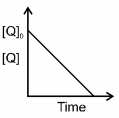
In the reaction,$P + Q \longrightarrow R + S$,the time taken for $75 \%$ reaction of $P$ is twice the time taken for $50 \%$ reaction of $P$. The concentration of $Q$ varies with reaction time as shown in the figure. The overall order of the reaction is
A
$2$
B
$3$
C
$0$
D
$1$
Solution
(D) For reactant $P$,the time taken for $75 \%$ completion $(t_{75 \%})$ is twice the time taken for $50 \%$ completion $(t_{50 \%})$,i.e.,$t_{75 \%} = 2 \times t_{50 \%}$.
This relationship is characteristic of a first-order reaction.
Therefore,the order of the reaction with respect to $P$ is $1$.
For reactant $Q$,the graph shows that the concentration $[Q]$ decreases linearly with time. $A$ linear decrease in concentration with time indicates that the rate of reaction is independent of the concentration of $Q$.
Therefore,the order of the reaction with respect to $Q$ is $0$.
The overall order of the reaction is the sum of the individual orders: $1 + 0 = 1$.
This relationship is characteristic of a first-order reaction.
Therefore,the order of the reaction with respect to $P$ is $1$.
For reactant $Q$,the graph shows that the concentration $[Q]$ decreases linearly with time. $A$ linear decrease in concentration with time indicates that the rate of reaction is independent of the concentration of $Q$.
Therefore,the order of the reaction with respect to $Q$ is $0$.
The overall order of the reaction is the sum of the individual orders: $1 + 0 = 1$.
0 likes
View Solution440
MediumMCQ
For the elementary reaction $M \rightarrow N$,the rate of disappearance of $M$ increases by a factor of $8$ upon doubling the concentration of $M$. The order of the reaction with respect to $M$ is :
A
$4$
B
$3$
C
$2$
D
$1$
Solution
(B) For the reaction $M \rightarrow N$,the rate law is given by $r = k[M]^x$,where $x$ is the order of the reaction with respect to $M$.
When the concentration of $M$ is doubled,the new rate $r'$ becomes $8r$.
So,$r' = k[2M]^x = 8r$.
Substituting $r = k[M]^x$ into the equation:
$k[2M]^x = 8 \times k[M]^x$
$(2)^x = 8$
$(2)^x = (2)^3$
Therefore,$x = 3$.
When the concentration of $M$ is doubled,the new rate $r'$ becomes $8r$.
So,$r' = k[2M]^x = 8r$.
Substituting $r = k[M]^x$ into the equation:
$k[2M]^x = 8 \times k[M]^x$
$(2)^x = 8$
$(2)^x = (2)^3$
Therefore,$x = 3$.
0 likes
View Solution441
AdvancedMCQ
Consider the following reaction,
$2H_{2(g)} + 2NO_{(g)} \rightarrow N_{2(g)} + 2H_2O_{(g)}$
which follows the mechanism given below:
$2NO_{(g)} \underset{k_{-1}}{\stackrel{k_1}{\rightleftharpoons}} N_2O_{2(g)}$ (fast equilibrium)
$N_2O_{2(g)} + H_{2(g)} \stackrel{k_2}{\rightarrow} N_2O_{(g)} + H_2O_{(g)}$ (slow reaction)
$N_2O_{(g)} + H_{2(g)} \stackrel{k_3}{\rightarrow} N_{2(g)} + H_2O_{(g)}$ (fast reaction)
The order of the reaction is
$2H_{2(g)} + 2NO_{(g)} \rightarrow N_{2(g)} + 2H_2O_{(g)}$
which follows the mechanism given below:
$2NO_{(g)} \underset{k_{-1}}{\stackrel{k_1}{\rightleftharpoons}} N_2O_{2(g)}$ (fast equilibrium)
$N_2O_{2(g)} + H_{2(g)} \stackrel{k_2}{\rightarrow} N_2O_{(g)} + H_2O_{(g)}$ (slow reaction)
$N_2O_{(g)} + H_{2(g)} \stackrel{k_3}{\rightarrow} N_{2(g)} + H_2O_{(g)}$ (fast reaction)
The order of the reaction is
A
$1$
B
$2$
C
$3$
D
$4$
Solution
(C) The rate of the reaction is determined by the slowest step,which is the rate-determining step $(RDS)$:
$Rate = k_2[N_2O_2][H_2]$
From the fast equilibrium step,we have:
$K_{eq} = \frac{k_1}{k_{-1}} = \frac{[N_2O_2]}{[NO]^2}$
Therefore,$[N_2O_2] = \frac{k_1}{k_{-1}}[NO]^2$
Substituting this into the rate expression:
$Rate = k_2 \times \frac{k_1}{k_{-1}}[NO]^2[H_2]$
$Rate = k'[NO]^2[H_2]$
The order of the reaction is the sum of the exponents of the concentration terms in the rate law:
$Order = 2 + 1 = 3$
$Rate = k_2[N_2O_2][H_2]$
From the fast equilibrium step,we have:
$K_{eq} = \frac{k_1}{k_{-1}} = \frac{[N_2O_2]}{[NO]^2}$
Therefore,$[N_2O_2] = \frac{k_1}{k_{-1}}[NO]^2$
Substituting this into the rate expression:
$Rate = k_2 \times \frac{k_1}{k_{-1}}[NO]^2[H_2]$
$Rate = k'[NO]^2[H_2]$
The order of the reaction is the sum of the exponents of the concentration terms in the rate law:
$Order = 2 + 1 = 3$
0 likes
View Solution442
MediumMCQ
| $[A]_0 / \text{mol } L^{-1}$ | $t_{1/2} / \text{min}$ |
| $0.100$ | $200$ |
| $0.025$ | $100$ |
For a given reaction $R \rightarrow P$,$t_{1/2}$ is related to $[A]_0$ as given in the table:
Given: $\log 2 = 0.30$
Which of the following is true?
$A.$ The order of the reaction is $1/2$.
$B.$ If $[A]_0$ is $1 \text{ M}$,then $t_{1/2}$ is $200 \sqrt{10} \text{ min}$.
$C.$ The order of the reaction changes to $1$ if the concentration of reactant changes from $0.100 \text{ M}$ to $0.500 \text{ M}$.
$D.$ $t_{1/2}$ is $800 \text{ min}$ for $[A]_0 = 1.6 \text{ M}$.
Choose the correct answer from the options given below:
A
$A$ and $C$ only
B
$A$ and $B$ only
C
$A, B$ and $D$ only
D
$C$ and $D$ only
Solution
(C) For a reaction of order $n$,$t_{1/2} \propto [A]_0^{1-n}$.
Using the data: $\frac{(t_{1/2})_1}{(t_{1/2})_2} = \left( \frac{([A]_0)_1}{([A]_0)_2} \right)^{1-n}$.
$\frac{200}{100} = \left( \frac{0.100}{0.025} \right)^{1-n} \implies 2 = (4)^{1-n}$.
$2 = (2^2)^{1-n} = 2^{2-2n}$.
$1 = 2-2n \implies 2n = 1 \implies n = 1/2$.
Thus,statement $A$ is correct.
Since $n = 1/2$,$t_{1/2} \propto [A]_0^{1-1/2} = [A]_0^{1/2}$.
For $[A]_0 = 1 \text{ M}$: $\frac{200}{t_{1/2}} = \left( \frac{0.1}{1} \right)^{1/2} = \sqrt{0.1} = \frac{1}{\sqrt{10}}$.
$t_{1/2} = 200 \sqrt{10} \text{ min}$. Thus,statement $B$ is correct.
Statement $C$ is incorrect because the order of a reaction is a constant property for a given reaction under specific conditions.
For $[A]_0 = 1.6 \text{ M}$: $\frac{200}{t_{1/2}} = \left( \frac{0.1}{1.6} \right)^{1/2} = \sqrt{\frac{1}{16}} = \frac{1}{4}$.
$t_{1/2} = 200 \times 4 = 800 \text{ min}$. Thus,statement $D$ is correct.
Therefore,$A, B$ and $D$ are correct.
Using the data: $\frac{(t_{1/2})_1}{(t_{1/2})_2} = \left( \frac{([A]_0)_1}{([A]_0)_2} \right)^{1-n}$.
$\frac{200}{100} = \left( \frac{0.100}{0.025} \right)^{1-n} \implies 2 = (4)^{1-n}$.
$2 = (2^2)^{1-n} = 2^{2-2n}$.
$1 = 2-2n \implies 2n = 1 \implies n = 1/2$.
Thus,statement $A$ is correct.
Since $n = 1/2$,$t_{1/2} \propto [A]_0^{1-1/2} = [A]_0^{1/2}$.
For $[A]_0 = 1 \text{ M}$: $\frac{200}{t_{1/2}} = \left( \frac{0.1}{1} \right)^{1/2} = \sqrt{0.1} = \frac{1}{\sqrt{10}}$.
$t_{1/2} = 200 \sqrt{10} \text{ min}$. Thus,statement $B$ is correct.
Statement $C$ is incorrect because the order of a reaction is a constant property for a given reaction under specific conditions.
For $[A]_0 = 1.6 \text{ M}$: $\frac{200}{t_{1/2}} = \left( \frac{0.1}{1.6} \right)^{1/2} = \sqrt{\frac{1}{16}} = \frac{1}{4}$.
$t_{1/2} = 200 \times 4 = 800 \text{ min}$. Thus,statement $D$ is correct.
Therefore,$A, B$ and $D$ are correct.
0 likes
View Solution443
MediumMCQ
The reaction $A_2 + B_2 \rightarrow 2AB$ follows the mechanism $A_2 \underset{k_{-1}}{\stackrel{k_1}{\rightleftharpoons}} 2A$ (fast),$A + B_2 \xrightarrow{k_2} AB + B$ (slow),$A + B \rightarrow AB$ (fast). The overall order of the reaction is:
A
$1.5$
B
$3$
C
$2.5$
D
$2$
Solution
(A) The rate of the reaction is determined by the slow step: $\text{Rate} = k_2[A][B_2] \dots (1)$
From the fast equilibrium step,$A_2 \rightleftharpoons 2A$,the equilibrium constant is $K_{eq} = \frac{[A]^2}{[A_2]} = \frac{k_1}{k_{-1}}$.
Thus,$[A] = \sqrt{\frac{k_1}{k_{-1}}} [A_2]^{1/2}$.
Substituting this into equation $(1)$,we get $\text{Rate} = k_2 \sqrt{\frac{k_1}{k_{-1}}} [A_2]^{1/2} [B_2]^1$.
The overall order of the reaction is the sum of the exponents of the concentration terms: $0.5 + 1 = 1.5$.
From the fast equilibrium step,$A_2 \rightleftharpoons 2A$,the equilibrium constant is $K_{eq} = \frac{[A]^2}{[A_2]} = \frac{k_1}{k_{-1}}$.
Thus,$[A] = \sqrt{\frac{k_1}{k_{-1}}} [A_2]^{1/2}$.
Substituting this into equation $(1)$,we get $\text{Rate} = k_2 \sqrt{\frac{k_1}{k_{-1}}} [A_2]^{1/2} [B_2]^1$.
The overall order of the reaction is the sum of the exponents of the concentration terms: $0.5 + 1 = 1.5$.
0 likes
View Solution444
MediumMCQ
Rate law for a reaction between $A$ and $B$ is given by $R=k[A]^{n}[B]^{m}$. If concentration of $A$ is doubled and concentration of $B$ is halved from their initial value,the ratio of new rate of reaction to the initial rate of reaction $\left(\frac{r_2}{r_1}\right)$ is
A
$2^{(n-m)}$
B
$(n-m)$
C
$(m+n)$
D
$\frac{1}{2^{m+n}}$
Solution
(A) The initial rate of reaction is $r_1 = k[A]^{n}[B]^{m}$.
When the concentration of $A$ is doubled $(2[A])$ and the concentration of $B$ is halved $(\frac{[B]}{2})$,the new rate $r_2$ is given by:
$r_2 = k(2[A])^{n} \cdot \left(\frac{[B]}{2}\right)^{m}$
$r_2 = k \cdot 2^{n} \cdot [A]^{n} \cdot \frac{[B]^{m}}{2^{m}}$
$r_2 = 2^{(n-m)} \cdot k[A]^{n}[B]^{m}$
Therefore,the ratio $\frac{r_2}{r_1} = \frac{2^{(n-m)} k[A]^{n}[B]^{m}}{k[A]^{n}[B]^{m}} = 2^{(n-m)}$.
When the concentration of $A$ is doubled $(2[A])$ and the concentration of $B$ is halved $(\frac{[B]}{2})$,the new rate $r_2$ is given by:
$r_2 = k(2[A])^{n} \cdot \left(\frac{[B]}{2}\right)^{m}$
$r_2 = k \cdot 2^{n} \cdot [A]^{n} \cdot \frac{[B]^{m}}{2^{m}}$
$r_2 = 2^{(n-m)} \cdot k[A]^{n}[B]^{m}$
Therefore,the ratio $\frac{r_2}{r_1} = \frac{2^{(n-m)} k[A]^{n}[B]^{m}}{k[A]^{n}[B]^{m}} = 2^{(n-m)}$.
0 likes
View Solution445
MediumMCQ
For a reaction,$A + B \longrightarrow$ Product; the rate law is given by $r = k[A]^2[B]^{1/2}$. What is the order of the reaction?
A
$2$
B
$2.5$
C
$3$
D
$3.5$
Solution
(B) The rate law for the reaction is given by $r = k[A]^2[B]^{1/2}$.
The order of a reaction is the sum of the powers of the concentration terms in the rate law expression.
Order of reaction $= 2 + 1/2 = 2.5$.
The order of a reaction is the sum of the powers of the concentration terms in the rate law expression.
Order of reaction $= 2 + 1/2 = 2.5$.
0 likes
View Solution446
MediumMCQ
Inversion of cane sugar is an example of $-$
A
Zero order reaction
B
First order reaction
C
Pseudo first order reaction
D
Second order reaction
Solution
(C) The hydrolysis of cane sugar (sucrose) is represented by the equation: $C_{12}H_{22}O_{11} + H_2O \xrightarrow{H^+} C_6H_{12}O_6 + C_6H_{12}O_6$.
Since water is present in large excess,its concentration remains practically constant during the reaction.
Therefore,the rate of reaction depends only on the concentration of sucrose,making it a pseudo first order reaction.
Since water is present in large excess,its concentration remains practically constant during the reaction.
Therefore,the rate of reaction depends only on the concentration of sucrose,making it a pseudo first order reaction.
0 likes
View Solution447
MediumMCQ
The rate constant for the reaction $A \longrightarrow B$ is $2 \times 10^{-4} \ L \ mol^{-1} \ min^{-1}$. The concentration of $A$ at which the rate of the reaction is $(1 / 12) \times 10^{-5} \ M \ sec^{-1}$ is :-
A
$0.25 \ M$
B
$(1 / 20) \sqrt{5 / 3} \ M$
C
$0.5 \ M$
D
None of these
Solution
(C) The units of the rate constant $k = 2 \times 10^{-4} \ L \ mol^{-1} \ min^{-1}$ indicate that the reaction is of second order.
The rate law is $Rate = k[A]^2$.
First,convert the rate constant to $sec^{-1}$ units: $k = (2 \times 10^{-4} \ L \ mol^{-1} \ min^{-1}) / 60 = (1 / 30) \times 10^{-4} \ L \ mol^{-1} \ sec^{-1}$.
Given $Rate = (1 / 12) \times 10^{-5} \ M \ sec^{-1}$,we have $(1 / 12) \times 10^{-5} = (1 / 30) \times 10^{-4} \times [A]^2$.
Simplifying: $[A]^2 = [(1 / 12) \times 10^{-5}] / [(1 / 30) \times 10^{-4}] = (30 / 12) \times 10^{-1} = 2.5 \times 0.1 = 0.25$.
Thus,$[A] = \sqrt{0.25} = 0.5 \ M$.
The rate law is $Rate = k[A]^2$.
First,convert the rate constant to $sec^{-1}$ units: $k = (2 \times 10^{-4} \ L \ mol^{-1} \ min^{-1}) / 60 = (1 / 30) \times 10^{-4} \ L \ mol^{-1} \ sec^{-1}$.
Given $Rate = (1 / 12) \times 10^{-5} \ M \ sec^{-1}$,we have $(1 / 12) \times 10^{-5} = (1 / 30) \times 10^{-4} \times [A]^2$.
Simplifying: $[A]^2 = [(1 / 12) \times 10^{-5}] / [(1 / 30) \times 10^{-4}] = (30 / 12) \times 10^{-1} = 2.5 \times 0.1 = 0.25$.
Thus,$[A] = \sqrt{0.25} = 0.5 \ M$.
0 likes
View Solution448
MediumMCQ
For a reaction $A \longrightarrow P$,a plot between $[A]_0$ $Vs$ $\frac{1}{t_{1/2}}$ is a straight line having a positive slope. When the initial concentration is $1 \times 10^{-2} \ M$,its half-life period is found to be $20 \ min$. When the concentration of $A$ is $2 \times 10^{-2} \ M$,then the half-life will be (in $min$)?
A
$20$
B
$10$
C
$67$
D
$56$
Solution
(B) For a reaction of order $n$,the half-life is given by $t_{1/2} \propto \frac{1}{[A]_0^{n-1}}$.
Given that the plot of $[A]_0$ $Vs$ $\frac{1}{t_{1/2}}$ is a straight line with a positive slope,we have $\frac{1}{t_{1/2}} = k[A]_0$,which implies $t_{1/2} \propto \frac{1}{[A]_0}$.
This corresponds to a reaction of order $n = 2$.
Since $t_{1/2} \times [A]_0 = \text{constant}$,we can write: $(t_{1/2})_1 \times [A]_1 = (t_{1/2})_2 \times [A]_2$.
Substituting the given values: $20 \ min \times 1 \times 10^{-2} \ M = (t_{1/2})_2 \times 2 \times 10^{-2} \ M$.
Solving for $(t_{1/2})_2$,we get $(t_{1/2})_2 = \frac{20 \times 1 \times 10^{-2}}{2 \times 10^{-2}} \ min = 10 \ min$.
Given that the plot of $[A]_0$ $Vs$ $\frac{1}{t_{1/2}}$ is a straight line with a positive slope,we have $\frac{1}{t_{1/2}} = k[A]_0$,which implies $t_{1/2} \propto \frac{1}{[A]_0}$.
This corresponds to a reaction of order $n = 2$.
Since $t_{1/2} \times [A]_0 = \text{constant}$,we can write: $(t_{1/2})_1 \times [A]_1 = (t_{1/2})_2 \times [A]_2$.
Substituting the given values: $20 \ min \times 1 \times 10^{-2} \ M = (t_{1/2})_2 \times 2 \times 10^{-2} \ M$.
Solving for $(t_{1/2})_2$,we get $(t_{1/2})_2 = \frac{20 \times 1 \times 10^{-2}}{2 \times 10^{-2}} \ min = 10 \ min$.
0 likes
View Solution449
MediumMCQ
The half-life periods of decomposition of $PH_3$ for different initial pressures are given below $:$
Determine the order of the reaction.
| Initial Pressure $p$ (torr) | $707$ | $79$ | $37.5$ |
| Half-life $t_{1/2}$ (min) | $84$ | $84$ | $84$ |
A
$1$
B
$0$
C
$1/2$
D
$2$
Solution
(A) The order of a reaction can be determined from the relationship between half-life $(t_{1/2})$ and initial pressure $(p_0)$: $t_{1/2} \propto (p_0)^{1-n}$,where $n$ is the order of the reaction.
Given that the half-life $(t_{1/2} = 84 \text{ min})$ remains constant despite changes in the initial pressure $(707, 79, 37.5 \text{ torr})$,it implies that $t_{1/2}$ is independent of the initial pressure.
For a first-order reaction,$t_{1/2} = \frac{0.693}{k}$,which is independent of the initial concentration or pressure.
Therefore,the reaction is of the first order $(n = 1)$.
Given that the half-life $(t_{1/2} = 84 \text{ min})$ remains constant despite changes in the initial pressure $(707, 79, 37.5 \text{ torr})$,it implies that $t_{1/2}$ is independent of the initial pressure.
For a first-order reaction,$t_{1/2} = \frac{0.693}{k}$,which is independent of the initial concentration or pressure.
Therefore,the reaction is of the first order $(n = 1)$.
0 likes
View Solution450
MediumMCQ
If the rate law of a reaction $n A \rightarrow B$ is expressed as Rate $= -\frac{1}{n} \frac{d[A]}{dt} = \frac{d[B]}{dt} = k[A]^{x}$,the unit of rate constant $k$ will be:
A
$mol^{1-x} \ L^{x-1} \ sec^{-1}$
B
$L^{x-1} \ mol^{1-x} \ sec^{-1}$
C
$mol^{x-1} \ L^{1-x} \ sec^{-1}$
D
$L^{x} \ mol^{-x} \ sec^{-1}$
Solution
(A) The rate of reaction is given by: $\text{Rate} = k[A]^x$.
The unit of rate is $\text{mol} \ L^{-1} \ sec^{-1}$.
The unit of concentration $[A]$ is $\text{mol} \ L^{-1}$.
Substituting these into the rate law equation:
$\text{mol} \ L^{-1} \ sec^{-1} = k \times (\text{mol} \ L^{-1})^x$.
Solving for $k$:
$k = \frac{\text{mol} \ L^{-1} \ sec^{-1}}{(\text{mol} \ L^{-1})^x} = (\text{mol} \ L^{-1})^{1-x} \ sec^{-1}$.
Expanding this,we get:
$k = \text{mol}^{1-x} \ L^{-(1-x)} \ sec^{-1} = \text{mol}^{1-x} \ L^{x-1} \ sec^{-1}$.
The unit of rate is $\text{mol} \ L^{-1} \ sec^{-1}$.
The unit of concentration $[A]$ is $\text{mol} \ L^{-1}$.
Substituting these into the rate law equation:
$\text{mol} \ L^{-1} \ sec^{-1} = k \times (\text{mol} \ L^{-1})^x$.
Solving for $k$:
$k = \frac{\text{mol} \ L^{-1} \ sec^{-1}}{(\text{mol} \ L^{-1})^x} = (\text{mol} \ L^{-1})^{1-x} \ sec^{-1}$.
Expanding this,we get:
$k = \text{mol}^{1-x} \ L^{-(1-x)} \ sec^{-1} = \text{mol}^{1-x} \ L^{x-1} \ sec^{-1}$.
0 likes
View SolutionChemical Kinetics — Rate law , Rate constant , Order of Reaction and Molecularity · Frequently Asked Questions
1Are these Chemical Kinetics questions useful for JEE and NEET?
Yes. All questions in this section are mapped to JEE Main and NEET exam patterns. Previous year questions from JEE Main, NEET, GUJCET and state-level exams are included with full solutions.
2Can I switch to Hindi or Gujarati for these questions?
Yes. Use the language tabs in the hero section or the sidebar to view the same questions and solutions in English, Hindi or Gujarati.
3How do I generate a question paper from this subtopic?
Use the Vedclass Exam Paper Generator — select the chapter and subtopic, set difficulty, and generate Sets A, B, C, D automatically. First 3 chapters of every subject are free.
Vedclass Products
For Students
Vedclass Test Series
Mock tests in real JEE/NEET style with performance analysis. 5-day free trial.
Start Free TrialFor Teachers
Exam Paper Generator
Generate Set A/B/C/D papers from this chapter in 2 minutes. 3 chapters free.
Try FreeFor Institutes
Online Exam Module
Live online exams with unlimited students, 360° analytics & white-label branding.
See DemoFor Teachers & Institutes
Generate a Chemical Kinetics Exam Paper in 2 Minutes
Select subtopic & difficulty — Sets A, B, C, D auto-generated with No Repeat logic.
First 3 chapters of every subject are free — no payment required.