
A English
Zero order reaction Questions in English
Class 12 Chemistry · Chemical Kinetics · Zero order reaction
147+
Questions
English
Language
100%
With Solutions
Showing 50 of 147 questions in English
1
MediumMCQ
In a reaction,reactant $A$ decomposes $10 \%$ in $1 \ hour$,$20 \%$ in $2 \ hours$ and $30 \%$ in $3 \ hours$. The unit of rate constant of this reaction is
A
$sec^{-1}$
B
$mol \ L^{-1} \ sec^{-1}$
C
$L \ mol^{-1} \ sec^{-1}$
D
$L^{2} \ mol^{-2} \ sec^{-1}$
Solution
(B) The reactant $A$ decomposes at a constant rate of $10 \%$ per hour.
This indicates that the rate of reaction is independent of the concentration of the reactant.
Therefore,the reaction follows zero-order kinetics.
The general unit for the rate constant of a zero-order reaction is $mol \ L^{-1} \ time^{-1}$.
Given the options,the correct unit is $mol \ L^{-1} \ sec^{-1}$.
This indicates that the rate of reaction is independent of the concentration of the reactant.
Therefore,the reaction follows zero-order kinetics.
The general unit for the rate constant of a zero-order reaction is $mol \ L^{-1} \ time^{-1}$.
Given the options,the correct unit is $mol \ L^{-1} \ sec^{-1}$.
0 likes
View Solution2
MediumMCQ
The half-life period of a zero order reaction is:
A
Inversely proportional to the concentration
B
Independent of the concentration
C
Directly proportional to the initial concentration
D
Directly proportional to the final concentration
Solution
(C) For a zero order reaction,the rate law is given by $[A] = [A]_0 - kt$.
At half-life,$[A] = \frac{[A]_0}{2}$,so $\frac{[A]_0}{2} = [A]_0 - kt_{1/2}$.
This simplifies to $t_{1/2} = \frac{[A]_0}{2k}$.
Therefore,the half-life period is directly proportional to the initial concentration $[A]_0$.
At half-life,$[A] = \frac{[A]_0}{2}$,so $\frac{[A]_0}{2} = [A]_0 - kt_{1/2}$.
This simplifies to $t_{1/2} = \frac{[A]_0}{2k}$.
Therefore,the half-life period is directly proportional to the initial concentration $[A]_0$.
0 likes
View Solution3
EasyMCQ
$A$ zero order reaction is one whose rate is independent of
A
Temperature of the reaction
B
The concentrations of the reactants
C
The concentration of the products
D
The material of the vessel in which the reaction is carried out
Solution
(B) The rate of a zero order reaction is defined by the rate law expression $Rate = k[A]^0$,where $k$ is the rate constant and $[A]$ is the concentration of the reactant.
Since any value raised to the power of $0$ is $1$,the rate becomes $Rate = k$.
Therefore,the rate of a zero order reaction is independent of the concentrations of the reactants.
Since any value raised to the power of $0$ is $1$,the rate becomes $Rate = k$.
Therefore,the rate of a zero order reaction is independent of the concentrations of the reactants.
0 likes
View Solution4
EasyMCQ
The unit of rate constant for a zero order reaction is
A
$L \, s^{-1}$
B
$L \, mol^{-1} \, s^{-1}$
C
$mol \, L^{-1} \, s^{-1}$
D
$mol \, s^{-1}$
Solution
(C) For a reaction of order $n$,the unit of rate constant $k$ is given by $(mol \, L^{-1})^{1-n} \, s^{-1}$.
For a zero order reaction,$n = 0$.
Therefore,the unit of $k = (mol \, L^{-1})^{1-0} \, s^{-1} = mol \, L^{-1} \, s^{-1}$.
For a zero order reaction,$n = 0$.
Therefore,the unit of $k = (mol \, L^{-1})^{1-0} \, s^{-1} = mol \, L^{-1} \, s^{-1}$.
0 likes
View Solution5
MediumMCQ
The rates of a certain reaction $(dc/dt)$ at different times are as follows:
The reaction is:
| Time $(sec)$ | Rate $(mole \ litre^{-1} \ sec^{-1})$ |
|---|---|
| $0$ | $2.8 \times 10^{-2}$ |
| $10$ | $2.78 \times 10^{-2}$ |
| $20$ | $2.81 \times 10^{-2}$ |
| $30$ | $2.79 \times 10^{-2}$ |
The reaction is:
A
Zero order
B
First order
C
Second order
D
Third order
Solution
(A) The rate of a reaction is defined as the change in concentration of reactants or products per unit time.
For a zero-order reaction,the rate of reaction is independent of the concentration of the reactants,i.e.,$\text{Rate} = k[A]^0 = k$.
In the given data,the rate of the reaction remains approximately constant $(2.8 \times 10^{-2} \ mole \ litre^{-1} \ sec^{-1})$ at all given time intervals $(0, 10, 20, 30 \ sec)$.
Since the rate does not change with time,the reaction must be of zero order.
For a zero-order reaction,the rate of reaction is independent of the concentration of the reactants,i.e.,$\text{Rate} = k[A]^0 = k$.
In the given data,the rate of the reaction remains approximately constant $(2.8 \times 10^{-2} \ mole \ litre^{-1} \ sec^{-1})$ at all given time intervals $(0, 10, 20, 30 \ sec)$.
Since the rate does not change with time,the reaction must be of zero order.
0 likes
View Solution6
EasyMCQ
For a zero order reaction:
A
The concentration of the reactant does not change during the reaction.
B
The concentration changes only when the temperature changes.
C
The rate remains constant throughout.
D
The rate of the reaction is proportional to the concentration.
Solution
(C) For a zero order reaction,the rate law is given by $Rate = k[Reactant]^0 = k$.
Since the rate is equal to the rate constant $k$,the rate of the reaction is independent of the concentration of the reactant and remains constant throughout the reaction.
Since the rate is equal to the rate constant $k$,the rate of the reaction is independent of the concentration of the reactant and remains constant throughout the reaction.
0 likes
View Solution7
EasyMCQ
$A$ reaction $2A \to$ products is found to follow zero order kinetics,then
A
$\frac{dx}{dt} = k[A]^2$
B
$\frac{dx}{dt} = k[A]^0$
C
$\frac{dx}{dt} = k[A]$
D
$\frac{dx}{dt} = k[2A]$
Solution
(B) For a zero order reaction,the rate of reaction is independent of the concentration of the reactant.
Therefore,the rate law is expressed as $\frac{dx}{dt} = k[A]^0$,where $k$ is the rate constant and $[A]$ is the concentration of the reactant $A$.
Therefore,the rate law is expressed as $\frac{dx}{dt} = k[A]^0$,where $k$ is the rate constant and $[A]$ is the concentration of the reactant $A$.
0 likes
View Solution8
EasyMCQ
The unit of the velocity constant in case of zero order reaction is
A
Conc. $\times$ time$^{-1}$
B
Conc.$^{-1}$ $\times$ time
C
Conc.$^{-1}$ $\times$ time$^{-1}$
D
Conc. $\times$ (time)$^{2}$
Solution
(A) For a reaction of order $n$,the unit of rate constant $k$ is given by $(Conc.)^{1-n} \times (time)^{-1}$.
For a zero order reaction,$n = 0$.
Therefore,the unit is $(Conc.)^{1-0} \times (time)^{-1} = Conc. \times time^{-1}$.
For a zero order reaction,$n = 0$.
Therefore,the unit is $(Conc.)^{1-0} \times (time)^{-1} = Conc. \times time^{-1}$.
0 likes
View Solution9
MediumMCQ
If the initial concentration is reduced to its $1/4^{th}$ in a zero order reaction,the time taken for half of the reaction to complete
A
Remains same
B
Becomes $4$ times
C
Becomes one-fourth
D
Doubles
Solution
(C) For a zero order reaction,the half-life is given by $t_{1/2} = \frac{[A]_0}{2k}$.
Let the initial concentration be $[A]_0 = a$.
Then,$t_{1/2} = \frac{a}{2k} \dots (1)$.
When the initial concentration is reduced to one-fourth,the new concentration is $[A]_0' = \frac{1}{4}a$.
The new half-life is $t_{1/2}' = \frac{\frac{1}{4}a}{2k} = \frac{1}{4} \times \frac{a}{2k} \dots (2)$.
Comparing equation $(2)$ with $(1)$,we get $t_{1/2}' = \frac{1}{4} t_{1/2}$.
Therefore,the time taken for half of the reaction to complete becomes one-fourth of the original time. Hence,option $C$ is correct.
Let the initial concentration be $[A]_0 = a$.
Then,$t_{1/2} = \frac{a}{2k} \dots (1)$.
When the initial concentration is reduced to one-fourth,the new concentration is $[A]_0' = \frac{1}{4}a$.
The new half-life is $t_{1/2}' = \frac{\frac{1}{4}a}{2k} = \frac{1}{4} \times \frac{a}{2k} \dots (2)$.
Comparing equation $(2)$ with $(1)$,we get $t_{1/2}' = \frac{1}{4} t_{1/2}$.
Therefore,the time taken for half of the reaction to complete becomes one-fourth of the original time. Hence,option $C$ is correct.
0 likes
View Solution10
MediumMCQ
Which of the following statements about zero order reaction is not true?
A
Its unit is $sec^{-1}$
B
The graph between $\log$ (reactant) versus rate of reaction is a straight line
C
The rate of reaction increases with the decrease in concentration of reactants
D
Both $(a)$ and $(c)$
Solution
(D) For a zero order reaction,the rate is independent of the concentration of reactants,so the rate remains constant.
The unit of rate constant for a zero order reaction is $mol \ L^{-1} \ s^{-1}$.
Statement $(a)$ is false because $sec^{-1}$ is the unit for a first order reaction.
Statement $(c)$ is false because the rate of a zero order reaction does not change with the concentration of reactants.
Therefore,both $(a)$ and $(c)$ are incorrect statements.
The unit of rate constant for a zero order reaction is $mol \ L^{-1} \ s^{-1}$.
Statement $(a)$ is false because $sec^{-1}$ is the unit for a first order reaction.
Statement $(c)$ is false because the rate of a zero order reaction does not change with the concentration of reactants.
Therefore,both $(a)$ and $(c)$ are incorrect statements.
0 likes
View Solution11
EasyMCQ
If the rate of the reaction is equal to the rate constant,the order of the reaction is
A
$3$
B
$0$
C
$1$
D
$2$
Solution
(B) The rate law for a reaction is given by $Rate = k[A]^n$,where $n$ is the order of the reaction.
If the rate of the reaction is equal to the rate constant $(Rate = k)$,then $[A]^n$ must be equal to $1$.
This is only possible when $n = 0$.
Therefore,the reaction is of zero order.
If the rate of the reaction is equal to the rate constant $(Rate = k)$,then $[A]^n$ must be equal to $1$.
This is only possible when $n = 0$.
Therefore,the reaction is of zero order.
0 likes
View Solution12
EasyMCQ
The unit of velocity constant in case of zero order reaction is
A
$Concentration \times Time^{-1}$
B
$Concentration^{-1} \times Time^{-1}$
C
$Concentration \times Time^{2}$
D
$Concentration^{-1} \times Time$
Solution
(A) For a zero order reaction,the rate law is given by: $\text{Rate} = k[A]^0 = k$.
Since $\text{Rate} = \frac{d[Concentration]}{dt}$,the unit of the rate constant $(k)$ is the same as the unit of the rate of reaction.
Therefore,the unit of the velocity constant is $\frac{\text{Concentration}}{\text{Time}} = \text{Concentration} \times \text{Time}^{-1}$.
Since $\text{Rate} = \frac{d[Concentration]}{dt}$,the unit of the rate constant $(k)$ is the same as the unit of the rate of reaction.
Therefore,the unit of the velocity constant is $\frac{\text{Concentration}}{\text{Time}} = \text{Concentration} \times \text{Time}^{-1}$.
0 likes
View Solution13
EasyMCQ
Which statement is correct regarding a zero order reaction?
A
Rate of reaction depends on decay constant
B
Rate of reaction is independent of concentration
C
Unit of rate constant is $\text{concentration}^{-1}$
D
Unit of rate constant is $\text{concentration}^{-1} \text{time}^{-1}$
Solution
(B) For a zero order reaction,the rate of reaction is independent of the concentration of reactants.
Mathematically,the rate law is expressed as: $Rate = k[Reactant]^0 = k$.
Thus,the rate is equal to the rate constant $k$,which is independent of the reactant concentration.
Mathematically,the rate law is expressed as: $Rate = k[Reactant]^0 = k$.
Thus,the rate is equal to the rate constant $k$,which is independent of the reactant concentration.
0 likes
View Solution14
EasyMCQ
Which of the following reactions end in finite time?
A
$0^{th}$ order
B
$1^{st}$ order
C
$2^{nd}$ order
D
$3^{rd}$ order
Solution
(A) . For a zero-order reaction,the rate is independent of the concentration of the reactant,i.e.,$Rate = k[R]^0 = k$.
This leads to the integrated rate law: $[R]_t = [R]_0 - kt$.
The reaction is complete when $[R]_t = 0$,which occurs at time $t = [R]_0 / k$.
Since this is a finite value,zero-order reactions reach completion in a finite time.
For reactions of order $n > 0$,the time required for completion is mathematically infinite.
This leads to the integrated rate law: $[R]_t = [R]_0 - kt$.
The reaction is complete when $[R]_t = 0$,which occurs at time $t = [R]_0 / k$.
Since this is a finite value,zero-order reactions reach completion in a finite time.
For reactions of order $n > 0$,the time required for completion is mathematically infinite.
0 likes
View Solution15
EasyMCQ
If the initial concentration of a reactant is doubled,its half-life period also doubles. Determine the order of the reaction.
A
$1$
B
$2$
C
$3$
D
$0$
Solution
(D) For a zero-order reaction,the half-life is given by $t_{1/2} = \frac{[R]_0}{2k}$.
Since $t_{1/2} \propto [R]_0$,if the initial concentration $[R]_0$ is doubled,the half-life $t_{1/2}$ also doubles.
Therefore,the reaction is of zero order.
Since $t_{1/2} \propto [R]_0$,if the initial concentration $[R]_0$ is doubled,the half-life $t_{1/2}$ also doubles.
Therefore,the reaction is of zero order.
0 likes
View Solution16
MediumMCQ
For a reaction of $n^{th}$ order,the plot of $t_{1/2}$ versus initial concentration $[A]_0$ is a straight line. When the initial concentration is $2 \ mol \ L^{-1}$,the reaction takes $10 \ min$ to complete $50\%$. If the reaction takes $t \ min$ to complete $50\%$ when the initial concentration is $4 \ mol \ L^{-1}$,find $n$ and $t$ respectively.
A
$0, 20 \ min$
B
$1, 10 \ min$
C
$1, 20 \ min$
D
$0, 5 \ min$
Solution
(A) For an $n^{th}$ order reaction,the half-life $t_{1/2}$ is related to the initial concentration $[A]_0$ as $t_{1/2} \propto [A]_0^{1-n}$.
Given that the plot of $t_{1/2}$ versus $[A]_0$ is a straight line,this implies $t_{1/2} \propto [A]_0^1$.
Comparing the powers,$1-n = 1$,which gives $n = 0$.
For a zero-order reaction,$t_{1/2} = \frac{[A]_0}{2k}$.
When $[A]_0 = 2 \ mol \ L^{-1}$,$t_{1/2} = 10 \ min$.
So,$10 = \frac{2}{2k} \implies k = 0.1 \ mol \ L^{-1} \ min^{-1}$.
When $[A]_0 = 4 \ mol \ L^{-1}$,$t = \frac{4}{2 \times 0.1} = \frac{4}{0.2} = 20 \ min$.
Thus,$n = 0$ and $t = 20 \ min$.
Given that the plot of $t_{1/2}$ versus $[A]_0$ is a straight line,this implies $t_{1/2} \propto [A]_0^1$.
Comparing the powers,$1-n = 1$,which gives $n = 0$.
For a zero-order reaction,$t_{1/2} = \frac{[A]_0}{2k}$.
When $[A]_0 = 2 \ mol \ L^{-1}$,$t_{1/2} = 10 \ min$.
So,$10 = \frac{2}{2k} \implies k = 0.1 \ mol \ L^{-1} \ min^{-1}$.
When $[A]_0 = 4 \ mol \ L^{-1}$,$t = \frac{4}{2 \times 0.1} = \frac{4}{0.2} = 20 \ min$.
Thus,$n = 0$ and $t = 20 \ min$.
0 likes
View Solution17
MediumMCQ
For a zero-order reaction $A \rightarrow \text{Product}$,the half-life is $1 \ h$. If the initial concentration of reactant $A$ is $2.0 \ mol \ L^{-1}$,how many hours will it take for the concentration to decrease from $0.50 \ mol \ L^{-1}$ to $0.25 \ mol \ L^{-1}$?
A
$1$
B
$4$
C
$0.5$
D
$0.25$
Solution
(D) For a zero-order reaction,the half-life is given by $t_{1/2} = \frac{[A]_0}{2k}$.
Given $t_{1/2} = 1 \ h$ and $[A]_0 = 2.0 \ mol \ L^{-1}$,we have $1 = \frac{2.0}{2k}$,which gives the rate constant $k = 1.0 \ mol \ L^{-1} \ h^{-1}$.
For a zero-order reaction,the rate law is $[A]_t = [A]_0 - kt$.
To find the time $t$ for the concentration to change from $0.50 \ mol \ L^{-1}$ to $0.25 \ mol \ L^{-1}$,we use $\Delta [A] = k \times t$.
$0.50 - 0.25 = 1.0 \times t$.
$0.25 = 1.0 \times t$.
Therefore,$t = 0.25 \ h$.
Given $t_{1/2} = 1 \ h$ and $[A]_0 = 2.0 \ mol \ L^{-1}$,we have $1 = \frac{2.0}{2k}$,which gives the rate constant $k = 1.0 \ mol \ L^{-1} \ h^{-1}$.
For a zero-order reaction,the rate law is $[A]_t = [A]_0 - kt$.
To find the time $t$ for the concentration to change from $0.50 \ mol \ L^{-1}$ to $0.25 \ mol \ L^{-1}$,we use $\Delta [A] = k \times t$.
$0.50 - 0.25 = 1.0 \times t$.
$0.25 = 1.0 \times t$.
Therefore,$t = 0.25 \ h$.
0 likes
View Solution18
MediumMCQ
For a given reaction,the half-life $t_{1/2}$ varies with different initial concentrations $a$. If $t_{1/2} \propto a$ is constant,then the order of the reaction will be .......
A
$0$
B
$1$
C
$2$
D
$3$
Solution
(A) The general formula for the half-life of a reaction of order $n$ is $t_{1/2} \propto a^{1-n}$.
Given that $t_{1/2} \propto a^1$,we can equate the exponents: $1 - n = 1$.
Solving for $n$,we get $n = 0$.
Therefore,the reaction is of zero order.
Given that $t_{1/2} \propto a^1$,we can equate the exponents: $1 - n = 1$.
Solving for $n$,we get $n = 0$.
Therefore,the reaction is of zero order.
0 likes
View Solution19
EasyMCQ
The reaction $2A \rightarrow B + C$ follows zero-order kinetics when:
A
The rate of reaction is proportional to the square of the concentration of $A$.
B
The rate of reaction remains constant at any concentration of $A$.
C
The rate does not change with the concentrations of $B$ and $C$.
D
The rate of reaction doubles when the concentration of $A$ is doubled.
Solution
(B) For a zero-order reaction,the rate of the reaction is independent of the concentration of the reactants.
Mathematically,$\text{Rate} = k[A]^0 = k$.
Therefore,the rate of reaction remains constant regardless of the concentration of $A$.
Mathematically,$\text{Rate} = k[A]^0 = k$.
Therefore,the rate of reaction remains constant regardless of the concentration of $A$.
0 likes
View Solution20
MediumMCQ
The rate constant of a zero-order reaction is $0.2 \ mol \ m^{-3} \ h^{-1}$. If the concentration of the reactant after $30 \ minutes$ is $0.05 \ mol \ m^{-3}$,then its initial concentration will be ....... $mol \ m^{-3}$.
A
$0.15$
B
$1.05$
C
$0.25$
D
$4.00$
Solution
(A) For a zero-order reaction,the integrated rate equation is: $[A] = [A]_0 - kt$.
Given:
Rate constant $k = 0.2 \ mol \ m^{-3} \ h^{-1}$.
Time $t = 30 \ minutes = 0.5 \ h$.
Concentration at time $t$,$[A] = 0.05 \ mol \ m^{-3}$.
Substituting the values into the equation:
$0.05 = [A]_0 - (0.2 \times 0.5)$
$0.05 = [A]_0 - 0.1$
$[A]_0 = 0.05 + 0.1 = 0.15 \ mol \ m^{-3}$.
Given:
Rate constant $k = 0.2 \ mol \ m^{-3} \ h^{-1}$.
Time $t = 30 \ minutes = 0.5 \ h$.
Concentration at time $t$,$[A] = 0.05 \ mol \ m^{-3}$.
Substituting the values into the equation:
$0.05 = [A]_0 - (0.2 \times 0.5)$
$0.05 = [A]_0 - 0.1$
$[A]_0 = 0.05 + 0.1 = 0.15 \ mol \ m^{-3}$.
0 likes
View Solution21
MediumMCQ
Which of the following is correct for a zero-order reaction?
A
$t_{\frac{1}{2}} \propto [R]_0$
B
$t_{\frac{1}{2}} \propto \sqrt{[R]_0}$
C
$t_{\frac{1}{2}} \propto [R]_0^2$
D
$t_{\frac{1}{2}} \propto \frac{1}{\sqrt{[R]_0}}$
Solution
(A) For a zero-order reaction,the half-life period is given by the formula: $t_{\frac{1}{2}} = \frac{[R]_0}{2k}$.
From this expression,it is clear that $t_{\frac{1}{2}} \propto [R]_0$,where $[R]_0$ is the initial concentration and $k$ is the rate constant.
Therefore,the half-life is directly proportional to the initial concentration of the reactant.
From this expression,it is clear that $t_{\frac{1}{2}} \propto [R]_0$,where $[R]_0$ is the initial concentration and $k$ is the rate constant.
Therefore,the half-life is directly proportional to the initial concentration of the reactant.
0 likes
View Solution22
MediumMCQ
For a reaction $A \rightarrow$ products,the half-life period is $1 \ h$. The initial concentration of reactant $A$ is $2 \ M$. If this reaction is of zero order,how many hours will it take for the concentration of the reactant to decrease from $0.5 \ M$ to $0.25 \ M$?
A
$0.25$
B
$1$
C
$4$
D
$0.5$
Solution
(A) For a zero-order reaction,the half-life is given by $t_{1/2} = \frac{[R]_0}{2k}$.
Given $[R]_0 = 2 \ M$ and $t_{1/2} = 1 \ h$,we find the rate constant $k = \frac{[R]_0}{2t_{1/2}} = \frac{2}{2 \times 1} = 1 \ M \ h^{-1}$.
The time $t$ required for the concentration to change from $[R]_1 = 0.5 \ M$ to $[R]_2 = 0.25 \ M$ is given by $t = \frac{[R]_1 - [R]_2}{k}$.
Substituting the values,$t = \frac{0.5 - 0.25}{1} = 0.25 \ h$.
Given $[R]_0 = 2 \ M$ and $t_{1/2} = 1 \ h$,we find the rate constant $k = \frac{[R]_0}{2t_{1/2}} = \frac{2}{2 \times 1} = 1 \ M \ h^{-1}$.
The time $t$ required for the concentration to change from $[R]_1 = 0.5 \ M$ to $[R]_2 = 0.25 \ M$ is given by $t = \frac{[R]_1 - [R]_2}{k}$.
Substituting the values,$t = \frac{0.5 - 0.25}{1} = 0.25 \ h$.
0 likes
View Solution23
EasyMCQ
For the reaction $R \rightarrow P$,the concentration of $R$ is measured as a function of time and the following data is obtained:
The order of the reaction is:
| $[R] \ (M)$ | $1.0$ | $0.76$ | $0.40$ | $0.10$ |
| $t \ (min)$ | $0.0$ | $0.05$ | $0.12$ | $0.18$ |
The order of the reaction is:
A
$1$
B
$0$
C
$2$
D
$3$
Solution
(B) To determine the order of the reaction,we check the rate of change of concentration with respect to time.
For a zero-order reaction,the rate is constant: $Rate = -\frac{d[R]}{dt} = k$.
Let's calculate the rate for different intervals:
Interval $1$: $t = 0$ to $0.05 \ min$,$\Delta [R] = 1.0 - 0.76 = 0.24 \ M$,$\Delta t = 0.05 \ min$. Rate $= \frac{0.24}{0.05} = 4.8 \ M \ min^{-1}$.
Interval $2$: $t = 0.05$ to $0.12 \ min$,$\Delta [R] = 0.76 - 0.40 = 0.36 \ M$,$\Delta t = 0.07 \ min$. Rate $= \frac{0.36}{0.07} \approx 5.14 \ M \ min^{-1}$.
Interval $3$: $t = 0.12$ to $0.18 \ min$,$\Delta [R] = 0.40 - 0.10 = 0.30 \ M$,$\Delta t = 0.06 \ min$. Rate $= \frac{0.30}{0.06} = 5.0 \ M \ min^{-1}$.
Since the rate of reaction is approximately constant $(4.8, 5.14, 5.0)$,the reaction follows zero-order kinetics.
For a zero-order reaction,the rate is constant: $Rate = -\frac{d[R]}{dt} = k$.
Let's calculate the rate for different intervals:
Interval $1$: $t = 0$ to $0.05 \ min$,$\Delta [R] = 1.0 - 0.76 = 0.24 \ M$,$\Delta t = 0.05 \ min$. Rate $= \frac{0.24}{0.05} = 4.8 \ M \ min^{-1}$.
Interval $2$: $t = 0.05$ to $0.12 \ min$,$\Delta [R] = 0.76 - 0.40 = 0.36 \ M$,$\Delta t = 0.07 \ min$. Rate $= \frac{0.36}{0.07} \approx 5.14 \ M \ min^{-1}$.
Interval $3$: $t = 0.12$ to $0.18 \ min$,$\Delta [R] = 0.40 - 0.10 = 0.30 \ M$,$\Delta t = 0.06 \ min$. Rate $= \frac{0.30}{0.06} = 5.0 \ M \ min^{-1}$.
Since the rate of reaction is approximately constant $(4.8, 5.14, 5.0)$,the reaction follows zero-order kinetics.
0 likes
View Solution24
EasyMCQ
If the rate of a reaction is equal to the rate constant,what is the order of the reaction?
A
$0$
B
$1$
C
$2$
D
$3$
Solution
(A) The rate law for a reaction is given by: $\text{Rate} = k[A]^n$,where $k$ is the rate constant and $n$ is the order of the reaction.
Given that the rate of reaction is equal to the rate constant,we have: $\text{Rate} = k$.
Substituting this into the rate law: $k = k[A]^n$.
This implies $[A]^n = 1$,which is only possible if $n = 0$.
Therefore,the reaction is a zero-order reaction.
Given that the rate of reaction is equal to the rate constant,we have: $\text{Rate} = k$.
Substituting this into the rate law: $k = k[A]^n$.
This implies $[A]^n = 1$,which is only possible if $n = 0$.
Therefore,the reaction is a zero-order reaction.
0 likes
View Solution25
MediumMCQ
For a zero-order reaction,the rate constant $K = 2 \times 10^{-2} \ mol \ L^{-1} \ s^{-1}$. If the concentration of the reactant after $25 \ s$ is $0.5 \ M$,then its initial concentration must be ...... $M$.
A
$0.5$
B
$1.25$
C
$12.5$
D
$1.0$
Solution
(D) For a zero-order reaction,the integrated rate equation is given by:
$Kt = [A]_0 - [A]_t$
Given:
$K = 2 \times 10^{-2} \ mol \ L^{-1} \ s^{-1}$
$t = 25 \ s$
$[A]_t = 0.5 \ M$
Substituting the values into the equation:
$(2 \times 10^{-2}) \times 25 = [A]_0 - 0.5$
$0.5 = [A]_0 - 0.5$
$[A]_0 = 0.5 + 0.5 = 1.0 \ M$
$Kt = [A]_0 - [A]_t$
Given:
$K = 2 \times 10^{-2} \ mol \ L^{-1} \ s^{-1}$
$t = 25 \ s$
$[A]_t = 0.5 \ M$
Substituting the values into the equation:
$(2 \times 10^{-2}) \times 25 = [A]_0 - 0.5$
$0.5 = [A]_0 - 0.5$
$[A]_0 = 0.5 + 0.5 = 1.0 \ M$
0 likes
View Solution26
EasyMCQ
What is the unit of $K$ for a zero-order reaction?
A
$mol \ L^{-1} \ s^{-1}$
B
$s^{-1}$
C
$(mol \ L^{-1})^{-1} \ s^{-1}$
D
$(mol \ L^{-1})^{1-n} \ s^{-1}$
Solution
(A) The general formula for the unit of the rate constant $K$ for a reaction of order $n$ is given by:
$(mol \ L^{-1})^{1-n} \ s^{-1}$.
For a zero-order reaction,$n = 0$.
Substituting $n = 0$ into the formula:
$(mol \ L^{-1})^{1-0} \ s^{-1} = mol \ L^{-1} \ s^{-1}$.
Therefore,the unit of $K$ for a zero-order reaction is $mol \ L^{-1} \ s^{-1}$.
$(mol \ L^{-1})^{1-n} \ s^{-1}$.
For a zero-order reaction,$n = 0$.
Substituting $n = 0$ into the formula:
$(mol \ L^{-1})^{1-0} \ s^{-1} = mol \ L^{-1} \ s^{-1}$.
Therefore,the unit of $K$ for a zero-order reaction is $mol \ L^{-1} \ s^{-1}$.
0 likes
View Solution27
EasyMCQ
If the initial concentration of a reactant is $a$,how much time will it take for a $100\%$ zero-order reaction to complete?
A
$aK$
B
$\frac{a}{2K}$
C
$\frac{a}{K}$
D
$\frac{2K}{a}$
Solution
(C) For a zero-order reaction,the integrated rate equation is given by $t = \frac{[R]_0 - [R]_t}{K}$.
Given that the initial concentration $[R]_0 = a$ and for $100\%$ completion,the final concentration $[R]_t = 0$.
Substituting these values into the equation:
$t = \frac{a - 0}{K} = \frac{a}{K}$.
Given that the initial concentration $[R]_0 = a$ and for $100\%$ completion,the final concentration $[R]_t = 0$.
Substituting these values into the equation:
$t = \frac{a - 0}{K} = \frac{a}{K}$.
0 likes
View Solution28
MediumMCQ
The formation of gas at the surface of tungsten due to adsorption is a reaction of which order?
A
$0$
B
$1$
C
$2$
D
Insufficient data
Solution
(A) The adsorption of gases on solid surfaces,such as the decomposition of $NH_3$ on a tungsten surface at high pressure,follows zero-order kinetics. This is because the surface of the catalyst becomes completely covered with gas molecules,and the rate of reaction becomes independent of the concentration of the reactant. Therefore,the order of reaction is $0$.
0 likes
View Solution29
MediumMCQ
The rate constant of the reaction $A \rightarrow B$ is $0.6 \times 10^{-3} \, mol \, L^{-1} \, s^{-1}.$ If the concentration of $A$ is $5 \, M,$ then the concentration of $B$ after $20$ minutes is ......... $M.$
A
$3.60$
B
$0.36$
C
$0.72$
D
$1.08$
Solution
(C) The reaction is of zero order because the units of the rate constant are $mol \, L^{-1} \, s^{-1}.$
For a zero order reaction,the change in concentration $x$ is given by $x = K \cdot t.$
Given $K = 0.6 \times 10^{-3} \, mol \, L^{-1} \, s^{-1}$ and $t = 20 \, \text{minutes} = 20 \times 60 \, s = 1200 \, s.$
Substituting the values: $x = (0.6 \times 10^{-3}) \times 1200 = 0.72 \, M.$
Thus,the concentration of $B$ formed after $20$ minutes is $0.72 \, M.$
For a zero order reaction,the change in concentration $x$ is given by $x = K \cdot t.$
Given $K = 0.6 \times 10^{-3} \, mol \, L^{-1} \, s^{-1}$ and $t = 20 \, \text{minutes} = 20 \times 60 \, s = 1200 \, s.$
Substituting the values: $x = (0.6 \times 10^{-3}) \times 1200 = 0.72 \, M.$
Thus,the concentration of $B$ formed after $20$ minutes is $0.72 \, M.$
1 likes
View Solution30
EasyMCQ
The unit of rate constant for a zero order reaction is
A
$mol\, L^{-1}\, s^{-1}$
B
$L\, mol^{-1}\, s^{-1}$
C
$L^2\, mol^{-2}\, s^{-1}$
D
$s^{-1}$
Solution
(A) The rate law expression for a zero order reaction is given by: $\text{Rate} = k[A]^0$.
Since the rate of reaction is expressed in units of concentration per unit time $(mol\, L^{-1}\, s^{-1})$,we have:
$mol\, L^{-1}\, s^{-1} = k \times (mol\, L^{-1})^0$.
Since any value raised to the power of $0$ is $1$,the unit of $k$ is equal to the unit of the rate of reaction.
Therefore,the unit of the rate constant for a zero order reaction is $mol\, L^{-1}\, s^{-1}$.
Since the rate of reaction is expressed in units of concentration per unit time $(mol\, L^{-1}\, s^{-1})$,we have:
$mol\, L^{-1}\, s^{-1} = k \times (mol\, L^{-1})^0$.
Since any value raised to the power of $0$ is $1$,the unit of $k$ is equal to the unit of the rate of reaction.
Therefore,the unit of the rate constant for a zero order reaction is $mol\, L^{-1}\, s^{-1}$.
0 likes
View Solution31
DifficultMCQ
The time for the half-life period of a certain reaction $A \rightarrow \text{Products}$ is $1 \ hr$. When the initial concentration of the reactant $A$ is $2.0 \ mol \ L^{-1}$,how many hours does it take for its concentration to decrease from $0.50 \ mol \ L^{-1}$ to $0.25 \ mol \ L^{-1}$ if it is a zero-order reaction?
A
$4$
B
$0.5$
C
$0.25$
D
$1$
Solution
(C) For a zero-order reaction,the half-life is given by $t_{1/2} = \frac{[A]_0}{2k}$.
Given $t_{1/2} = 1 \ hr$ and $[A]_0 = 2.0 \ mol \ L^{-1}$,we calculate the rate constant $k$:
$k = \frac{[A]_0}{2 t_{1/2}} = \frac{2.0 \ mol \ L^{-1}}{2 \times 1 \ hr} = 1 \ mol \ L^{-1} \ hr^{-1}$.
For a zero-order reaction,the time $t$ required for the concentration to change from $[A]_1$ to $[A]_2$ is given by $k = \frac{[A]_1 - [A]_2}{t}$.
Substituting the values: $1 \ mol \ L^{-1} \ hr^{-1} = \frac{0.50 \ mol \ L^{-1} - 0.25 \ mol \ L^{-1}}{t}$.
$t = \frac{0.25 \ mol \ L^{-1}}{1 \ mol \ L^{-1} \ hr^{-1}} = 0.25 \ hr$.
Given $t_{1/2} = 1 \ hr$ and $[A]_0 = 2.0 \ mol \ L^{-1}$,we calculate the rate constant $k$:
$k = \frac{[A]_0}{2 t_{1/2}} = \frac{2.0 \ mol \ L^{-1}}{2 \times 1 \ hr} = 1 \ mol \ L^{-1} \ hr^{-1}$.
For a zero-order reaction,the time $t$ required for the concentration to change from $[A]_1$ to $[A]_2$ is given by $k = \frac{[A]_1 - [A]_2}{t}$.
Substituting the values: $1 \ mol \ L^{-1} \ hr^{-1} = \frac{0.50 \ mol \ L^{-1} - 0.25 \ mol \ L^{-1}}{t}$.
$t = \frac{0.25 \ mol \ L^{-1}}{1 \ mol \ L^{-1} \ hr^{-1}} = 0.25 \ hr$.
0 likes
View Solution32
MediumMCQ
For a zero order reaction,the plot of concentration $(a-x)$ $Vs$ time is linear with
A
$+ive$ slope and zero intercept
B
$-ive$ slope and zero intercept
C
$+ive$ slope and non$-zero$ intercept
D
$-ive$ slope and non$-zero$ intercept
Solution
(D) The integrated rate equation for a zero order reaction is given by: $(a-x) = a - kt$.
Comparing this with the equation of a straight line,$y = mx + c$,where $y = (a-x)$,$x = t$,$m = -k$ (slope),and $c = a$ (intercept).
Therefore,a plot of $(a-x)$ $Vs$ $t$ is a straight line with a $-ive$ slope $(-k)$ and a non$-zero$ intercept $(a)$.
Comparing this with the equation of a straight line,$y = mx + c$,where $y = (a-x)$,$x = t$,$m = -k$ (slope),and $c = a$ (intercept).
Therefore,a plot of $(a-x)$ $Vs$ $t$ is a straight line with a $-ive$ slope $(-k)$ and a non$-zero$ intercept $(a)$.
0 likes
View Solution33
DifficultMCQ
$5$ milli-moles of a solid $A$ was dissolved in $5$ moles of $H_2O$. On adding to the solvent,$A$ starts polymerising into another insoluble solid following zero order kinetics. On adding $6$ milli-moles of another solid solute $C$ (after $20$ minutes) the polymerisation completely stops. The insoluble solid polymer is removed and the resulting solution was cooled to a temperature less than $-0.186\,^{\circ}C$ (melting point of solution) to cause solidification of some liquid water. Calculate the value of $'X'$ if rate constant for polymerisation reaction is represented as $10^{-X}\,moles/minute$. $[K_f(H_2O) = 1.86\, K\, Kg\,mol^{-1}]$
A
$1$
B
$4$
C
$3$
D
$5$
Solution
(B) The rate of polymerization is zero order: $[A]_t = [A]_0 - Kt$.
Given $[A]_0 = 5 \times 10^{-3} \, moles$,$t = 20 \, minutes$,and $K = 10^{-X} \, moles/minute$.
Remaining moles of $A$ after $20$ minutes: $n_A = 5 \times 10^{-3} - 20 \times 10^{-X}$.
After adding $6 \times 10^{-3} \, moles$ of $C$,the total moles of solute in $5 \, moles$ $(0.005 \, kg)$ of water is $n_{total} = (5 \times 10^{-3} - 20 \times 10^{-X}) + 6 \times 10^{-3} = 11 \times 10^{-3} - 20 \times 10^{-X}$.
Using the depression of freezing point formula: $\Delta T_f = K_f \cdot m$.
$0.186 = 1.86 \cdot \frac{n_{total}}{0.005 \, kg}$ $\Rightarrow 0.1 = \frac{n_{total}}{0.005}$ $\Rightarrow n_{total} = 0.0005 \, moles$.
Wait,recalculating based on molality $m = \frac{n_{total}}{0.005} = 0.1 \Rightarrow n_{total} = 0.1 \times 0.005 = 0.0005 \, moles$.
Setting $11 \times 10^{-3} - 20 \times 10^{-X} = 0.5 \times 10^{-3}$ $\Rightarrow 20 \times 10^{-X} = 10.5 \times 10^{-3} = 1.05 \times 10^{-2}$.
$10^{-X} = 0.0525 \times 10^{-2} = 5.25 \times 10^{-4}$.
Re-evaluating the provided solution logic: $0.1 = \frac{n_{total}}{0.090 \, kg}$ (assuming $5 \, moles$ of water is $0.090 \, kg$ is incorrect,$5 \, moles = 0.090 \, kg$ is $90 \, g$).
Given the provided solution steps: $0.1 = \frac{11 \times 10^{-3} - 20 \times 10^{-X}}{0.090}$ $\Rightarrow 0.009 = 0.011 - 20 \times 10^{-X}$ $\Rightarrow 20 \times 10^{-X} = 0.002$ $\Rightarrow 10^{-X} = 10^{-4}$ $\Rightarrow X = 4$.
Given $[A]_0 = 5 \times 10^{-3} \, moles$,$t = 20 \, minutes$,and $K = 10^{-X} \, moles/minute$.
Remaining moles of $A$ after $20$ minutes: $n_A = 5 \times 10^{-3} - 20 \times 10^{-X}$.
After adding $6 \times 10^{-3} \, moles$ of $C$,the total moles of solute in $5 \, moles$ $(0.005 \, kg)$ of water is $n_{total} = (5 \times 10^{-3} - 20 \times 10^{-X}) + 6 \times 10^{-3} = 11 \times 10^{-3} - 20 \times 10^{-X}$.
Using the depression of freezing point formula: $\Delta T_f = K_f \cdot m$.
$0.186 = 1.86 \cdot \frac{n_{total}}{0.005 \, kg}$ $\Rightarrow 0.1 = \frac{n_{total}}{0.005}$ $\Rightarrow n_{total} = 0.0005 \, moles$.
Wait,recalculating based on molality $m = \frac{n_{total}}{0.005} = 0.1 \Rightarrow n_{total} = 0.1 \times 0.005 = 0.0005 \, moles$.
Setting $11 \times 10^{-3} - 20 \times 10^{-X} = 0.5 \times 10^{-3}$ $\Rightarrow 20 \times 10^{-X} = 10.5 \times 10^{-3} = 1.05 \times 10^{-2}$.
$10^{-X} = 0.0525 \times 10^{-2} = 5.25 \times 10^{-4}$.
Re-evaluating the provided solution logic: $0.1 = \frac{n_{total}}{0.090 \, kg}$ (assuming $5 \, moles$ of water is $0.090 \, kg$ is incorrect,$5 \, moles = 0.090 \, kg$ is $90 \, g$).
Given the provided solution steps: $0.1 = \frac{11 \times 10^{-3} - 20 \times 10^{-X}}{0.090}$ $\Rightarrow 0.009 = 0.011 - 20 \times 10^{-X}$ $\Rightarrow 20 \times 10^{-X} = 0.002$ $\Rightarrow 10^{-X} = 10^{-4}$ $\Rightarrow X = 4$.
0 likes
View Solution34
MediumMCQ
Calculate the half life $(t_{1/2})$ and completion time $(T)$ for a zero order reaction if $K = 0.001 \, mol \, L^{-1} \, sec^{-1}$ and initial concentration $(a) = 1 \, M$.
A
$500 \, min, 750 \, min$
B
$500 \, sec, 750 \, sec$
C
$500 \, sec, 1000 \, sec$
D
None of these
Solution
(C) For a zero order reaction,the concentration at time $t$ is given by $[A] = [A]_0 - kt$.
The half-life $(t_{1/2})$ is the time when $[A] = \frac{a}{2}$,so $t_{1/2} = \frac{a}{2k}$.
Substituting the values: $t_{1/2} = \frac{1}{2 \times 0.001} = 500 \, sec$.
The completion time $(T)$ is the time when $[A] = 0$,so $T = \frac{a}{k}$.
Substituting the values: $T = \frac{1}{0.001} = 1000 \, sec$.
The half-life $(t_{1/2})$ is the time when $[A] = \frac{a}{2}$,so $t_{1/2} = \frac{a}{2k}$.
Substituting the values: $t_{1/2} = \frac{1}{2 \times 0.001} = 500 \, sec$.
The completion time $(T)$ is the time when $[A] = 0$,so $T = \frac{a}{k}$.
Substituting the values: $T = \frac{1}{0.001} = 1000 \, sec$.
0 likes
View Solution35
MediumMCQ
Consider the data given below for the hypothetical reaction $A \to X$:
From the above data,the order of the reaction is:
| $Time \ (s)$ | $Rate \ (mol \ L^{-1} s^{-1})$ |
|---|---|
| $0$ | $1.60 \times 10^{-2}$ |
| $10$ | $1.60 \times 10^{-2}$ |
| $20$ | $1.60 \times 10^{-2}$ |
| $30$ | $1.60 \times 10^{-2}$ |
From the above data,the order of the reaction is:
A
$1$
B
$0$
C
$2$
D
Unpredictable
Solution
(B) The rate of reaction is given as $1.60 \times 10^{-2} \ mol \ L^{-1} s^{-1}$ at all time intervals.
Since the rate of reaction is independent of the concentration of the reactant (as it remains constant over time),the reaction follows zero-order kinetics.
Therefore,the order of the reaction is $0$.
Since the rate of reaction is independent of the concentration of the reactant (as it remains constant over time),the reaction follows zero-order kinetics.
Therefore,the order of the reaction is $0$.
0 likes
View Solution36
EasyMCQ
For a zero order reaction,the plot of concentration $(a - x)$ $vs$ time is linear with
A
$+ve$ slope and zero intercept
B
$-ve$ slope and zero intercept
C
$+ve$ slope and non-zero intercept
D
$-ve$ slope and non-zero intercept
Solution
(D) For a zero order reaction,the integrated rate equation is given by: $(a - x) = -kt + a$.
Comparing this with the equation of a straight line,$y = mx + c$,where $y = (a - x)$,$x = t$,$m = -k$,and $c = a$.
Since the slope $m = -k$ is negative and the intercept $c = a$ is non-zero (initial concentration),the plot of $(a - x)$ $vs$ time is linear with a negative slope and a non-zero intercept.
Comparing this with the equation of a straight line,$y = mx + c$,where $y = (a - x)$,$x = t$,$m = -k$,and $c = a$.
Since the slope $m = -k$ is negative and the intercept $c = a$ is non-zero (initial concentration),the plot of $(a - x)$ $vs$ time is linear with a negative slope and a non-zero intercept.
0 likes
View Solution37
EasyMCQ
In the reaction,$A + B \to C + D$,the rate $\left( \frac{dx}{dt} \right)$ when plotted against time $t$ gives a straight line parallel to the time axis. The order and rate of reaction will be
A
$1, k$
B
$0, k$
C
$1, k+1$
D
$0, k+1$
Solution
(B) The rate of reaction is given by $\frac{dx}{dt}$.
Since the plot of rate versus time $t$ is a straight line parallel to the time axis,the rate is constant and independent of time.
For a zero-order reaction,the rate law is expressed as $\text{Rate} = k \times [A]^0 \times [B]^0 = k$.
Since the rate is constant and equal to the rate constant $k$,the reaction is of zero order.
Since the plot of rate versus time $t$ is a straight line parallel to the time axis,the rate is constant and independent of time.
For a zero-order reaction,the rate law is expressed as $\text{Rate} = k \times [A]^0 \times [B]^0 = k$.
Since the rate is constant and equal to the rate constant $k$,the reaction is of zero order.
0 likes
View Solution38
MediumMCQ
$A$ substance (initial concentration $= a$) reacts according to zero order kinetics. The time taken for the completion of reaction is nearly
A
$a/k$
B
$a/2k$
C
$k/a$
D
$2k/a$
Solution
(A) For a zero order reaction,the integrated rate equation is $[A] = [A]_0 - kt$.
At the completion of the reaction,the final concentration $[A] = 0$ and the initial concentration $[A]_0 = a$.
Substituting these values: $0 = a - kt_{completion}$.
Therefore,$t_{completion} = \frac{a}{k}$.
At the completion of the reaction,the final concentration $[A] = 0$ and the initial concentration $[A]_0 = a$.
Substituting these values: $0 = a - kt_{completion}$.
Therefore,$t_{completion} = \frac{a}{k}$.
0 likes
View Solution39
MediumMCQ
In the following reaction $A \to B + C$,the rate constant is $0.001 \, M/sec$. If we start with $1 \, M$ of $A$,the concentrations of $A$ and $B$ after $10$ minutes are respectively:
A
$0.5 \, M, 0.5 \, M$
B
$0.6 \, M, 0.4 \, M$
C
$0.4 \, M, 0.6 \, M$
D
None of these
Solution
(C) The unit of rate constant $(M/sec)$ indicates a zero-order reaction.
For a zero-order reaction: $[A]_t = [A]_0 - kt$
Given: $[A]_0 = 1 \, M$,$k = 0.001 \, M/sec$,$t = 10 \times 60 = 600 \, sec$
$[A]_t = 1 - (0.001 \times 600) = 1 - 0.6 = 0.4 \, M$
Concentration of $B$ formed = $[A]_0 - [A]_t = 1 - 0.4 = 0.6 \, M$.
For a zero-order reaction: $[A]_t = [A]_0 - kt$
Given: $[A]_0 = 1 \, M$,$k = 0.001 \, M/sec$,$t = 10 \times 60 = 600 \, sec$
$[A]_t = 1 - (0.001 \times 600) = 1 - 0.6 = 0.4 \, M$
Concentration of $B$ formed = $[A]_0 - [A]_t = 1 - 0.4 = 0.6 \, M$.
0 likes
View Solution40
DifficultMCQ
At high pressure,the following reaction is zero order:
$2NH_{3(g)} \xrightarrow[Pt \ \text{catalyst}]{1130 \ K} N_{2(g)} + 3H_{2(g)}$
Choose the option which is not true with respect to the reaction,from the choices given below:
$2NH_{3(g)} \xrightarrow[Pt \ \text{catalyst}]{1130 \ K} N_{2(g)} + 3H_{2(g)}$
Choose the option which is not true with respect to the reaction,from the choices given below:
A
Rate of the reaction depends on concentration of $NH_3$
B
Rate constant = Rate of reaction
C
Any further increase in pressure will not change the rate of reaction
D
Rate of decomposition of ammonia will remain constant
Solution
(A) For a zero order reaction,the rate of reaction is independent of the concentration of the reactant.
$1$. The rate law for this reaction is: $\text{Rate} = k[NH_3]^0 = k$.
$2$. Since the rate is equal to the rate constant $(k)$,option $B$ is true.
$3$. At high pressure,the catalyst surface is fully saturated with $NH_3$ molecules. Therefore,increasing the pressure further does not increase the rate of reaction,making option $C$ true.
$4$. Since the rate is constant,the rate of decomposition of ammonia remains constant,making option $D$ true.
$5$. Option $A$ states that the rate depends on the concentration of $NH_3$,which is false for a zero order reaction. Thus,option $A$ is the correct answer.
$1$. The rate law for this reaction is: $\text{Rate} = k[NH_3]^0 = k$.
$2$. Since the rate is equal to the rate constant $(k)$,option $B$ is true.
$3$. At high pressure,the catalyst surface is fully saturated with $NH_3$ molecules. Therefore,increasing the pressure further does not increase the rate of reaction,making option $C$ true.
$4$. Since the rate is constant,the rate of decomposition of ammonia remains constant,making option $D$ true.
$5$. Option $A$ states that the rate depends on the concentration of $NH_3$,which is false for a zero order reaction. Thus,option $A$ is the correct answer.
0 likes
View Solution41
MediumMCQ
The rate constant of a zero order reaction is $2.0 \times 10^{-2} \ mol \ L^{-1} \ s^{-1}$. If the concentration of the reactant after $25 \ s$ is $0.5 \ M$,then find the initial concentration of the reactant. (in $M$)
A
$0.5$
B
$1.25$
C
$12.5$
D
$1.0$
Solution
(D) For a zero order reaction,the integrated rate equation is given by:
$[A]_t = [A]_0 - kt$
Where $[A]_t$ is the concentration at time $t$,$[A]_0$ is the initial concentration,$k$ is the rate constant,and $t$ is the time.
Given:
$k = 2.0 \times 10^{-2} \ mol \ L^{-1} \ s^{-1}$
$[A]_t = 0.5 \ M$
$t = 25 \ s$
Substituting the values into the equation:
$0.5 = [A]_0 - (2.0 \times 10^{-2} \times 25)$
$0.5 = [A]_0 - 0.5$
$[A]_0 = 0.5 + 0.5 = 1.0 \ M$
$[A]_t = [A]_0 - kt$
Where $[A]_t$ is the concentration at time $t$,$[A]_0$ is the initial concentration,$k$ is the rate constant,and $t$ is the time.
Given:
$k = 2.0 \times 10^{-2} \ mol \ L^{-1} \ s^{-1}$
$[A]_t = 0.5 \ M$
$t = 25 \ s$
Substituting the values into the equation:
$0.5 = [A]_0 - (2.0 \times 10^{-2} \times 25)$
$0.5 = [A]_0 - 0.5$
$[A]_0 = 0.5 + 0.5 = 1.0 \ M$
0 likes
View Solution42
DifficultMCQ
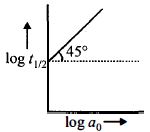
For a reaction $A \to$ Products,a plot of $\log\,t_{1/2}$ versus $\log\,a_0$ is shown in the figure. If the initial concentration of $A$ is represented by $a_0,$ the order of the reaction is
A
$1$
B
$0$
C
$2$
D
$3$
Solution
(B) For a reaction of order $n$,the half-life is given by $t_{1/2} \propto (a_0)^{1-n}$.
Taking logarithm on both sides,we get $\log\,t_{1/2} = (1-n)\log\,a_0 + \text{constant}$.
Comparing this with the equation of a straight line $y = mx + c$,the slope $m = 1-n$.
From the given figure,the slope is $\tan(45^{\circ}) = 1$.
Therefore,$1-n = 1$,which gives $n = 0$.
Taking logarithm on both sides,we get $\log\,t_{1/2} = (1-n)\log\,a_0 + \text{constant}$.
Comparing this with the equation of a straight line $y = mx + c$,the slope $m = 1-n$.
From the given figure,the slope is $\tan(45^{\circ}) = 1$.
Therefore,$1-n = 1$,which gives $n = 0$.
0 likes
View Solution43
DifficultMCQ
The reaction $2X \to B$ is a zeroth order reaction. If the initial concentration of $X$ is $0.2 \ M$,the half-life is $6 \ h$. When the initial concentration of $X$ is $0.5 \ M$,the time required to reach its final concentration of $0.2 \ M$ will be ........ $hr$.
A
$9.0$
B
$12.0$
C
$18.0$
D
$7.2$
Solution
(C) For a zero-order reaction,the integrated rate law is given by $C_0 - C_t = Kt$.
First,calculate the rate constant $K$ using the half-life formula for a zero-order reaction: $t_{1/2} = \frac{C_0}{2K}$.
Given $t_{1/2} = 6 \ h$ and $C_0 = 0.2 \ M$,we have $6 = \frac{0.2}{2K}$,which gives $K = \frac{0.2}{12} = \frac{1}{60} \ M \ h^{-1}$.
Now,for the second condition where initial concentration $C_0 = 0.5 \ M$ and final concentration $C_t = 0.2 \ M$:
Using $C_0 - C_t = Kt$,we get $0.5 - 0.2 = Kt$.
$0.3 = Kt$.
Substituting $K = \frac{1}{60}$,we get $0.3 = \frac{1}{60} \times t$.
$t = 0.3 \times 60 = 18 \ h$.
First,calculate the rate constant $K$ using the half-life formula for a zero-order reaction: $t_{1/2} = \frac{C_0}{2K}$.
Given $t_{1/2} = 6 \ h$ and $C_0 = 0.2 \ M$,we have $6 = \frac{0.2}{2K}$,which gives $K = \frac{0.2}{12} = \frac{1}{60} \ M \ h^{-1}$.
Now,for the second condition where initial concentration $C_0 = 0.5 \ M$ and final concentration $C_t = 0.2 \ M$:
Using $C_0 - C_t = Kt$,we get $0.5 - 0.2 = Kt$.
$0.3 = Kt$.
Substituting $K = \frac{1}{60}$,we get $0.3 = \frac{1}{60} \times t$.
$t = 0.3 \times 60 = 18 \ h$.
0 likes
View Solution44
MediumMCQ
Decomposition of $X$ exhibits a rate constant of $0.05 \ \mu g/year$. How many years are required for the decomposition of $5 \ \mu g$ of $X$ into $2.5 \ \mu g$?
A
$50$
B
$25$
C
$20$
D
$40$
Solution
(A) The unit of the rate constant is $\mu g/year$,which indicates that the reaction is of zero order.
For a zero order reaction,the integrated rate law is $[A] = [A]_0 - kt$.
Here,$[A]_0 = 5 \ \mu g$,$[A] = 2.5 \ \mu g$,and $k = 0.05 \ \mu g/year$.
Substituting these values: $2.5 \ \mu g = 5 \ \mu g - (0.05 \ \mu g/year) \times t$.
$0.05 \ \mu g/year \times t = 2.5 \ \mu g$.
$t = \frac{2.5 \ \mu g}{0.05 \ \mu g/year} = 50 \ years$.
For a zero order reaction,the integrated rate law is $[A] = [A]_0 - kt$.
Here,$[A]_0 = 5 \ \mu g$,$[A] = 2.5 \ \mu g$,and $k = 0.05 \ \mu g/year$.
Substituting these values: $2.5 \ \mu g = 5 \ \mu g - (0.05 \ \mu g/year) \times t$.
$0.05 \ \mu g/year \times t = 2.5 \ \mu g$.
$t = \frac{2.5 \ \mu g}{0.05 \ \mu g/year} = 50 \ years$.
0 likes
View Solution45
MediumMCQ
The rate constant for a zero order reaction is $3 \times 10^{-2} \ mol \ L^{-1} \ s^{-1}$. After $25 \ s$,if the concentration of the reactant is $0.5 \ M$,then the initial concentration of the reactant is ............ $M$.
A
$1.0$
B
$1.25$
C
$0.5$
D
$0.75$
Solution
(B) For a zero order reaction,the integrated rate equation is given by: $[R] = [R]_0 - kt$
Where:
$[R]$ is the concentration of the reactant at time $t = 0.5 \ M$
$[R]_0$ is the initial concentration of the reactant
$k$ is the rate constant $= 3 \times 10^{-2} \ mol \ L^{-1} \ s^{-1}$
$t$ is the time $= 25 \ s$
Substituting the values into the equation:
$0.5 = [R]_0 - (3 \times 10^{-2} \times 25)$
$0.5 = [R]_0 - 0.75$
$[R]_0 = 0.5 + 0.75$
$[R]_0 = 1.25 \ M$
Where:
$[R]$ is the concentration of the reactant at time $t = 0.5 \ M$
$[R]_0$ is the initial concentration of the reactant
$k$ is the rate constant $= 3 \times 10^{-2} \ mol \ L^{-1} \ s^{-1}$
$t$ is the time $= 25 \ s$
Substituting the values into the equation:
$0.5 = [R]_0 - (3 \times 10^{-2} \times 25)$
$0.5 = [R]_0 - 0.75$
$[R]_0 = 0.5 + 0.75$
$[R]_0 = 1.25 \ M$
0 likes
View Solution46
EasyMCQ
Which of the following is true for a zero order reaction?
A
$t_{0.5} \propto a$
B
$t_{0.5} \propto a^{-1}$
C
$t_{0.5} \propto a^{-2}$
D
None of these
Solution
(A) For a zero order reaction,the rate constant $k$ is given by $k = \frac{[A]_0 - [A]}{t}$.
At half-life $(t = t_{0.5})$,the concentration $[A] = \frac{[A]_0}{2}$.
Substituting these values: $k = \frac{[A]_0 - \frac{[A]_0}{2}}{t_{0.5}} = \frac{[A]_0}{2t_{0.5}}$.
Rearranging for $t_{0.5}$,we get $t_{0.5} = \frac{[A]_0}{2k}$.
Since $k$ is constant,$t_{0.5} \propto [A]_0$ (where $a$ is the initial concentration $[A]_0$).
Therefore,$t_{0.5} \propto a$.
At half-life $(t = t_{0.5})$,the concentration $[A] = \frac{[A]_0}{2}$.
Substituting these values: $k = \frac{[A]_0 - \frac{[A]_0}{2}}{t_{0.5}} = \frac{[A]_0}{2t_{0.5}}$.
Rearranging for $t_{0.5}$,we get $t_{0.5} = \frac{[A]_0}{2k}$.
Since $k$ is constant,$t_{0.5} \propto [A]_0$ (where $a$ is the initial concentration $[A]_0$).
Therefore,$t_{0.5} \propto a$.
0 likes
View Solution47
EasyMCQ
For a certain reaction,$10\%$ of the reactant dissociates in $1 \ hour$,$20\%$ of the reactant dissociates in $2 \ hour$,and $30\%$ of the reactant dissociates in $3 \ hour$. What are the units of the rate constant?
A
$hour^{-1}$
B
$mol \ L^{-1} \ hour^{-1}$
C
$L \ mol^{-1} \ hour^{-1}$
D
$mol \ L \ hour^{-1}$
Solution
(B) The rate of dissociation is constant: $10\% \text{ per hour}$.
Since the amount of reactant dissociated is directly proportional to time,the reaction follows zero-order kinetics.
For a zero-order reaction,the rate law is $[R] = [R]_0 - Kt$,which implies $x = Kt$,where $x$ is the concentration of reactant dissociated.
The rate constant $K$ has the same units as the rate of reaction,which is $\text{concentration} \times \text{time}^{-1}$.
Therefore,the unit is $mol \ L^{-1} \ hour^{-1}$.
Since the amount of reactant dissociated is directly proportional to time,the reaction follows zero-order kinetics.
For a zero-order reaction,the rate law is $[R] = [R]_0 - Kt$,which implies $x = Kt$,where $x$ is the concentration of reactant dissociated.
The rate constant $K$ has the same units as the rate of reaction,which is $\text{concentration} \times \text{time}^{-1}$.
Therefore,the unit is $mol \ L^{-1} \ hour^{-1}$.
0 likes
View Solution48
MediumMCQ
For a zero order reaction,which of the following statements is false?
A
The rate is independent of the temperature of the reaction.
B
The rate is independent of the concentration of the reactants.
C
The half-life depends upon the concentration of the reactants.
D
The rate constant has the unit $mol \ L^{-1} \ s^{-1}$.
Solution
(A) For a zero order reaction,the rate law is given by: $\text{Rate} = k[A]^0 = k$.
$1$. The rate is independent of the concentration of the reactants,so statement $B$ is true.
$2$. The rate constant $k$ follows the Arrhenius equation,$k = Ae^{-E_a/RT}$,meaning it is dependent on temperature. Therefore,the rate of reaction is dependent on temperature. Statement $A$ is false.
$3$. The half-life for a zero order reaction is given by $t_{1/2} = [A]_0 / 2k$,which depends on the initial concentration of the reactant. Statement $C$ is true.
$4$. The unit of the rate constant for a zero order reaction is the same as the rate,which is $mol \ L^{-1} \ s^{-1}$. Statement $D$ is true.
$1$. The rate is independent of the concentration of the reactants,so statement $B$ is true.
$2$. The rate constant $k$ follows the Arrhenius equation,$k = Ae^{-E_a/RT}$,meaning it is dependent on temperature. Therefore,the rate of reaction is dependent on temperature. Statement $A$ is false.
$3$. The half-life for a zero order reaction is given by $t_{1/2} = [A]_0 / 2k$,which depends on the initial concentration of the reactant. Statement $C$ is true.
$4$. The unit of the rate constant for a zero order reaction is the same as the rate,which is $mol \ L^{-1} \ s^{-1}$. Statement $D$ is true.
0 likes
View Solution49
EasyMCQ
Which graph represents a zero order reaction $[A_{(g)} \to B_{(g)}]$?
A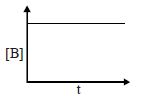
B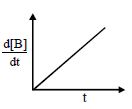
C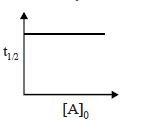
D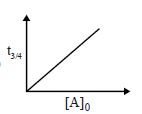
Solution
(D) For a zero order reaction,the rate of reaction is independent of the concentration of the reactant.
$Rate = -\frac{d[A]}{dt} = \frac{d[B]}{dt} = k[A]^0 = k$.
$1$. The concentration of product $[B]$ increases linearly with time $t$ $([B] = kt + [B]_0)$.
$2$. The rate of formation of product,$\frac{d[B]}{dt}$,is constant and independent of time $t$.
$3$. The half-life period $t_{1/2}$ is directly proportional to the initial concentration $[A]_0$ $(t_{1/2} = \frac{[A]_0}{2k})$.
$4$. The time for $3/4$ completion,$t_{3/4}$,is also directly proportional to the initial concentration $[A]_0$ $(t_{3/4} = \frac{3[A]_0}{4k})$.
Looking at the provided options:
- Option $A$ shows $[B]$ vs $t$ as a constant line,which is incorrect.
- Option $B$ shows $\frac{d[B]}{dt}$ vs $t$ as a linear increase,which is incorrect.
- Option $C$ shows $t_{1/2}$ vs $[A]_0$ as a constant line,which is incorrect.
- Option $D$ shows $t_{3/4}$ vs $[A]_0$ as a linear graph passing through the origin,which is correct for a zero order reaction.
$Rate = -\frac{d[A]}{dt} = \frac{d[B]}{dt} = k[A]^0 = k$.
$1$. The concentration of product $[B]$ increases linearly with time $t$ $([B] = kt + [B]_0)$.
$2$. The rate of formation of product,$\frac{d[B]}{dt}$,is constant and independent of time $t$.
$3$. The half-life period $t_{1/2}$ is directly proportional to the initial concentration $[A]_0$ $(t_{1/2} = \frac{[A]_0}{2k})$.
$4$. The time for $3/4$ completion,$t_{3/4}$,is also directly proportional to the initial concentration $[A]_0$ $(t_{3/4} = \frac{3[A]_0}{4k})$.
Looking at the provided options:
- Option $A$ shows $[B]$ vs $t$ as a constant line,which is incorrect.
- Option $B$ shows $\frac{d[B]}{dt}$ vs $t$ as a linear increase,which is incorrect.
- Option $C$ shows $t_{1/2}$ vs $[A]_0$ as a constant line,which is incorrect.
- Option $D$ shows $t_{3/4}$ vs $[A]_0$ as a linear graph passing through the origin,which is correct for a zero order reaction.
0 likes
View Solution50
DifficultMCQ
In the following reaction $A \to B + C,$ the rate constant is $0.001 \ M \ s^{-1}.$ If we start with $1 \ M$ of $A,$ then the concentrations of $A$ and $B$ after $10 \ minutes$ are respectively:
A
$0.5 \ M, \ 0.5 \ M$
B
$0.6 \ M, \ 0.4 \ M$
C
$0.4 \ M, \ 0.6 \ M$
D
None of these
Solution
(C) The reaction is a zero-order reaction because the unit of the rate constant is $M \ s^{-1}.$
The integrated rate equation for a zero-order reaction is $[A]_t = [A]_0 - Kt.$
Given:
$[A]_0 = 1 \ M$
$K = 0.001 \ M \ s^{-1}$
$t = 10 \ minutes = 10 \times 60 \ s = 600 \ s$
Calculating the concentration of $A$ at time $t$:
$[A]_t = 1 - (0.001 \times 600) = 1 - 0.6 = 0.4 \ M.$
Since the stoichiometry of the reaction $A \to B + C$ is $1:1,$ the concentration of $B$ formed is equal to the amount of $A$ consumed:
$[B]_t = [A]_0 - [A]_t = 1 - 0.4 = 0.6 \ M.$
Therefore,the concentrations of $A$ and $B$ are $0.4 \ M$ and $0.6 \ M$ respectively.
The integrated rate equation for a zero-order reaction is $[A]_t = [A]_0 - Kt.$
Given:
$[A]_0 = 1 \ M$
$K = 0.001 \ M \ s^{-1}$
$t = 10 \ minutes = 10 \times 60 \ s = 600 \ s$
Calculating the concentration of $A$ at time $t$:
$[A]_t = 1 - (0.001 \times 600) = 1 - 0.6 = 0.4 \ M.$
Since the stoichiometry of the reaction $A \to B + C$ is $1:1,$ the concentration of $B$ formed is equal to the amount of $A$ consumed:
$[B]_t = [A]_0 - [A]_t = 1 - 0.4 = 0.6 \ M.$
Therefore,the concentrations of $A$ and $B$ are $0.4 \ M$ and $0.6 \ M$ respectively.
0 likes
View SolutionChemical Kinetics — Zero order reaction · Frequently Asked Questions
1Are these Chemical Kinetics questions useful for JEE and NEET?
Yes. All questions in this section are mapped to JEE Main and NEET exam patterns. Previous year questions from JEE Main, NEET, GUJCET and state-level exams are included with full solutions.
2Can I switch to Hindi or Gujarati for these questions?
Yes. Use the language tabs in the hero section or the sidebar to view the same questions and solutions in English, Hindi or Gujarati.
3How do I generate a question paper from this subtopic?
Use the Vedclass Exam Paper Generator — select the chapter and subtopic, set difficulty, and generate Sets A, B, C, D automatically. First 3 chapters of every subject are free.
Vedclass Products
For Students
Vedclass Test Series
Mock tests in real JEE/NEET style with performance analysis. 5-day free trial.
Start Free TrialFor Teachers
Exam Paper Generator
Generate Set A/B/C/D papers from this chapter in 2 minutes. 3 chapters free.
Try FreeFor Institutes
Online Exam Module
Live online exams with unlimited students, 360° analytics & white-label branding.
See DemoFor Teachers & Institutes
Generate a Chemical Kinetics Exam Paper in 2 Minutes
Select subtopic & difficulty — Sets A, B, C, D auto-generated with No Repeat logic.
First 3 chapters of every subject are free — no payment required.