
A English
Collision theory, Energy of activation and Arrhenius equation Questions in English
Class 12 Chemistry · Chemical Kinetics · Collision theory, Energy of activation and Arrhenius equation
499+
Questions
English
Language
100%
With Solutions
Showing 49 of 499 questions in English
1
MediumMCQ
$A$ chemical reaction was carried out at $300 \, K$ and $280 \, K$. The rate constants were found to be $K_1$ and $K_2$ respectively. The energy of activation is $1.157 \times 10^4 \, cal \, mol^{-1}$ and $R = 1.987 \, cal \, K^{-1} \, mol^{-1}$. Then:
A
$K_2 \approx 0.25 K_1$
B
$K_2 \approx 0.5 K_1$
C
$K_2 \approx 4 K_1$
D
$K_2 \approx 2 K_1$
Solution
(A) Using the Arrhenius equation: $\ln(\frac{K_1}{K_2}) = \frac{E_a}{R} (\frac{1}{T_2} - \frac{1}{T_1})$
Given: $T_1 = 300 \, K$,$T_2 = 280 \, K$,$E_a = 1.157 \times 10^4 \, cal \, mol^{-1}$,$R = 1.987 \, cal \, K^{-1} \, mol^{-1}$.
$\ln(\frac{K_1}{K_2}) = \frac{1.157 \times 10^4}{1.987} (\frac{1}{280} - \frac{1}{300})$
$\ln(\frac{K_1}{K_2}) = 5822.85 \times (\frac{20}{84000}) = 5822.85 \times 0.000238 \approx 1.386$
Since $\ln(4) \approx 1.386$,we have $\frac{K_1}{K_2} = 4$,which implies $K_1 = 4 K_2$ or $K_2 = 0.25 K_1$.
Given: $T_1 = 300 \, K$,$T_2 = 280 \, K$,$E_a = 1.157 \times 10^4 \, cal \, mol^{-1}$,$R = 1.987 \, cal \, K^{-1} \, mol^{-1}$.
$\ln(\frac{K_1}{K_2}) = \frac{1.157 \times 10^4}{1.987} (\frac{1}{280} - \frac{1}{300})$
$\ln(\frac{K_1}{K_2}) = 5822.85 \times (\frac{20}{84000}) = 5822.85 \times 0.000238 \approx 1.386$
Since $\ln(4) \approx 1.386$,we have $\frac{K_1}{K_2} = 4$,which implies $K_1 = 4 K_2$ or $K_2 = 0.25 K_1$.
0 likes
View Solution2
EasyMCQ
In a reversible reaction,the catalyst
A
Increases the activation energy of the backward reaction
B
Increases the activation energy of the forward reaction
C
Decreases the activation energy of both,forward and backward reaction
D
Decreases the activation energy of forward reaction
Solution
(C) catalyst provides an alternative reaction pathway with a lower activation energy.
In a reversible reaction,it lowers the activation energy for both the forward and backward reactions equally,thereby increasing the rate of both reactions without affecting the equilibrium constant.
In a reversible reaction,it lowers the activation energy for both the forward and backward reactions equally,thereby increasing the rate of both reactions without affecting the equilibrium constant.
0 likes
View Solution3
EasyMCQ
Regarding the velocity in a reversible reaction,which is the correct explanation of the effect of a catalyst?
A
It provides a new reaction path of lower activation energy.
B
It increases the kinetic energy of reacting molecules.
C
It displaces the equilibrium state to the right side.
D
It decreases the velocity of the backward reaction.
Solution
(A) The correct answer is $(A)$.
$A$ catalyst increases the rate of both forward and backward reactions equally by providing an alternative reaction pathway with a lower activation energy.
As a result,the system reaches the state of equilibrium more quickly.
It does not change the position of the equilibrium or the equilibrium constant.
$A$ catalyst increases the rate of both forward and backward reactions equally by providing an alternative reaction pathway with a lower activation energy.
As a result,the system reaches the state of equilibrium more quickly.
It does not change the position of the equilibrium or the equilibrium constant.
0 likes
View Solution4
MediumMCQ
For a hypothetical reaction $A \to B$,the activation energies for forward and backward reactions are $19 \ kJ/mol$ and $9 \ kJ/mol$ respectively. The heat of reaction is $.... \ kJ$.
A
$28$
B
$19$
C
$10$
D
$9$
Solution
(C) The heat of reaction $(\Delta H)$ is defined as the difference between the activation energy of the forward reaction $(E_{a,f})$ and the activation energy of the backward reaction $(E_{a,b})$.
$\Delta H = E_{a,f} - E_{a,b}$
Given $E_{a,f} = 19 \ kJ/mol$ and $E_{a,b} = 9 \ kJ/mol$.
$\Delta H = 19 \ kJ/mol - 9 \ kJ/mol = 10 \ kJ/mol$.
Therefore,the correct option is $C$.
$\Delta H = E_{a,f} - E_{a,b}$
Given $E_{a,f} = 19 \ kJ/mol$ and $E_{a,b} = 9 \ kJ/mol$.
$\Delta H = 19 \ kJ/mol - 9 \ kJ/mol = 10 \ kJ/mol$.
Therefore,the correct option is $C$.
0 likes
View Solution5
MediumMCQ
The velocity of the chemical reaction doubles every $10^\circ C$ rise of temperature. If the temperature is raised by $50^\circ C$,the velocity of the reaction increases to about .......... times.
A
$32$
B
$16$
C
$20$
D
$50$
Solution
(A) The temperature coefficient is given as $2$ for a $10^\circ C$ rise in temperature.
If the temperature is increased by $\Delta T = 50^\circ C$,the number of $10^\circ C$ intervals is $n = \frac{50}{10} = 5$.
The rate of reaction increases by a factor of $2^n$.
Therefore,the increase in velocity is $2^5 = 32$ times.
If the temperature is increased by $\Delta T = 50^\circ C$,the number of $10^\circ C$ intervals is $n = \frac{50}{10} = 5$.
The rate of reaction increases by a factor of $2^n$.
Therefore,the increase in velocity is $2^5 = 32$ times.
0 likes
View Solution6
EasyMCQ
An increase in temperature by $10\,^{\circ}C$,generally increases the rate of a reaction by .......... times.
A
$2$
B
$10$
C
$9$
D
$100$
Solution
(A) For many reactions,the rate constant approximately doubles or triples when the temperature is increased by $10\,^{\circ}C$. This factor is known as the temperature coefficient. Therefore,the most appropriate answer is $2$.
0 likes
View Solution7
MediumMCQ
The rate of a reaction is doubled for every $10^\circ C$ rise in temperature. The increase in reaction rate as a result of temperature rise from $10^\circ C$ to $100^\circ C$ is
A
$112$
B
$512$
C
$400$
D
$614$
Solution
(B) The temperature coefficient is given as $2$ for every $10^\circ C$ rise.
The number of $10^\circ C$ intervals is calculated as: $\Delta n = \frac{100^\circ C - 10^\circ C}{10^\circ C} = \frac{90}{10} = 9$.
The increase in reaction rate is given by the formula: $\text{Rate increase} = (2)^{\Delta n}$.
Substituting the value: $\text{Rate increase} = 2^9 = 512$.
The number of $10^\circ C$ intervals is calculated as: $\Delta n = \frac{100^\circ C - 10^\circ C}{10^\circ C} = \frac{90}{10} = 9$.
The increase in reaction rate is given by the formula: $\text{Rate increase} = (2)^{\Delta n}$.
Substituting the value: $\text{Rate increase} = 2^9 = 512$.
0 likes
View Solution8
EasyMCQ
$A$ catalyst increases the rate of a chemical reaction by
A
Increasing the activation energy
B
Decreasing the activation energy
C
Reacting with reactants
D
Reacting with products
Solution
(B) Catalyst increases the rate of a chemical reaction by providing an alternative pathway with a lower activation energy $(E_a)$.
By decreasing the activation energy,a larger fraction of reactant molecules can cross the energy barrier at a given temperature,thereby increasing the reaction rate.
By decreasing the activation energy,a larger fraction of reactant molecules can cross the energy barrier at a given temperature,thereby increasing the reaction rate.
0 likes
View Solution9
MediumMCQ
The velocity constant of a reaction at $290 \ K$ was found to be $3.2 \times 10^{-3}$. At $310 \ K$,it will be about:
A
$1.28 \times 10^{-2}$
B
$9.6 \times 10^{-3}$
C
$6.4 \times 10^{-3}$
D
$3.2 \times 10^{-4}$
Solution
(A) For every $10 \ K$ rise in temperature,the rate constant of a reaction approximately doubles.
Given that the temperature increases from $290 \ K$ to $310 \ K$,which is a rise of $20 \ K$.
This corresponds to two intervals of $10 \ K$ each.
Therefore,the rate constant will increase by a factor of $2^2 = 4$.
New rate constant $= 3.2 \times 10^{-3} \times 4 = 12.8 \times 10^{-3} = 1.28 \times 10^{-2}$.
Given that the temperature increases from $290 \ K$ to $310 \ K$,which is a rise of $20 \ K$.
This corresponds to two intervals of $10 \ K$ each.
Therefore,the rate constant will increase by a factor of $2^2 = 4$.
New rate constant $= 3.2 \times 10^{-3} \times 4 = 12.8 \times 10^{-3} = 1.28 \times 10^{-2}$.
0 likes
View Solution10
MediumMCQ
The temperature coefficient of a reaction is defined as:
A
Specific reaction rate at $25\,^{\circ}C$
B
Rate of the reaction at $100\,^{\circ}C$
C
Ratio of the rate constants at temperatures $35\,^{\circ}C$ and $25\,^{\circ}C$
D
Ratio of the rate constants at two temperatures differing by $1\,^{\circ}C$
Solution
(C) The temperature coefficient of a reaction is defined as the ratio of the rate constants of the reaction at two temperatures differing by $10\,^{\circ}C$.
Usually,it is taken as the ratio of rate constants at $35\,^{\circ}C$ and $25\,^{\circ}C$.
Mathematically,$\text{Temperature coefficient} = \frac{K_{T+10}}{K_T} = \frac{K_{35\,^{\circ}C}}{K_{25\,^{\circ}C}} \approx 2$ to $3$ for most reactions.
Usually,it is taken as the ratio of rate constants at $35\,^{\circ}C$ and $25\,^{\circ}C$.
Mathematically,$\text{Temperature coefficient} = \frac{K_{T+10}}{K_T} = \frac{K_{35\,^{\circ}C}}{K_{25\,^{\circ}C}} \approx 2$ to $3$ for most reactions.
0 likes
View Solution11
EasyMCQ
The rate of a reaction:
A
Increases with increase in temperature
B
Decreases with increase in temperature
C
Does not depend on temperature
D
Does not depend on concentration
Solution
(A) The rate of a reaction is given by the expression $r = k[reactant]^n$.
According to the Arrhenius equation,the rate constant $k$ is given by $k = Ae^{-E_a/RT}$.
As the temperature $T$ increases,the term $e^{-E_a/RT}$ increases,which leads to an increase in the rate constant $k$.
Since the rate $r$ is directly proportional to the rate constant $k$,the rate of the reaction increases with an increase in temperature.
According to the Arrhenius equation,the rate constant $k$ is given by $k = Ae^{-E_a/RT}$.
As the temperature $T$ increases,the term $e^{-E_a/RT}$ increases,which leads to an increase in the rate constant $k$.
Since the rate $r$ is directly proportional to the rate constant $k$,the rate of the reaction increases with an increase in temperature.
0 likes
View Solution12
EasyMCQ
$A$ reaction is catalysed by $X$. Here $X$:
A
Decreases the rate constant of reaction
B
Does not affect the equilibrium constant of reaction
C
Decreases the enthalpy of reaction
D
Decreases the activation energy
Solution
(D) The correct answer is $D$.
Catalysts provide an alternative reaction pathway with a lower activation energy $(E_a)$.
By lowering the activation energy,the rate of reaction increases.
Catalysts do not change the enthalpy of reaction $(\Delta H)$ or the equilibrium constant $(K_{eq})$ of the reaction.
Catalysts provide an alternative reaction pathway with a lower activation energy $(E_a)$.
By lowering the activation energy,the rate of reaction increases.
Catalysts do not change the enthalpy of reaction $(\Delta H)$ or the equilibrium constant $(K_{eq})$ of the reaction.
0 likes
View Solution13
MediumMCQ
The velocity constant of a reaction at $290 \ K$ was found to be $3.2 \times 10^{-3}$. At $300 \ K$ it will be
A
$1.28 \times 10^{-2}$
B
$6.4 \times 10^{-3}$
C
$9.6 \times 10^{-3}$
D
$3.2 \times 10^{-4}$
Solution
(B) The rate constant of a reaction generally doubles for every $10 \ K$ rise in temperature.
Given that at $T_1 = 290 \ K$,the rate constant $k_1 = 3.2 \times 10^{-3}$.
For a temperature increase of $10 \ K$ to $T_2 = 300 \ K$,the rate constant $k_2$ becomes approximately double the initial value.
$k_2 = 2 \times k_1$
$k_2 = 2 \times 3.2 \times 10^{-3} = 6.4 \times 10^{-3}$.
Given that at $T_1 = 290 \ K$,the rate constant $k_1 = 3.2 \times 10^{-3}$.
For a temperature increase of $10 \ K$ to $T_2 = 300 \ K$,the rate constant $k_2$ becomes approximately double the initial value.
$k_2 = 2 \times k_1$
$k_2 = 2 \times 3.2 \times 10^{-3} = 6.4 \times 10^{-3}$.
0 likes
View Solution14
EasyMCQ
How does the rate of reaction change with an increase in temperature?
A
Decreases with increase in temperature
B
Increases with increase in temperature
C
May increase or decrease with increase in temperature
D
Does not depend on temperature
Solution
(B) The rate of reaction generally increases with an increase in temperature for most reactions due to an increase in the number of effective collisions. However,the effect can be complex depending on the reaction mechanism. For a simple elementary reaction,the rate constant $k$ increases with temperature according to the Arrhenius equation,$k = Ae^{-E_a/RT}$. While the rate of reaction typically increases,the statement that it 'may increase or decrease' is sometimes used in specific contexts involving complex mechanisms or reversible reactions where equilibrium shifts significantly. However,in standard chemical kinetics,the rate of reaction is primarily expected to increase with temperature.
0 likes
View Solution15
EasyMCQ
The rate constant of a reaction depends on
A
Temperature
B
Mass
C
Weight
D
Time
Solution
(A) The Arrhenius equation is given by $K = A e^{-E_a / RT}$.
From this equation,it is clear that the rate constant $K$ is a function of temperature $T$,where $A$ is the frequency factor and $E_a$ is the activation energy.
From this equation,it is clear that the rate constant $K$ is a function of temperature $T$,where $A$ is the frequency factor and $E_a$ is the activation energy.
0 likes
View Solution16
EasyMCQ
If $R = k[NO]^2[O_2]$,the rate constant can be increased by:
A
Increasing temperature
B
Decreasing temperature
C
Increasing concentration of $O_2$
D
Increasing concentration of $NO$
Solution
(A) According to the Arrhenius equation: $k = A e^{-E_a / (RT)}$.
The rate constant $k$ is independent of the concentration of reactants.
It depends only on the frequency factor $A$,activation energy $E_a$,and temperature $T$.
Increasing the temperature $T$ increases the value of the rate constant $k$.
The rate constant $k$ is independent of the concentration of reactants.
It depends only on the frequency factor $A$,activation energy $E_a$,and temperature $T$.
Increasing the temperature $T$ increases the value of the rate constant $k$.
0 likes
View Solution17
EasyMCQ
The value of the rate constant for the reaction $A + B \to \text{products}$ depends on:
A
Concentration of $A$ and $B$
B
Pressure
C
Temperature
D
All of these
Solution
(C) The rate constant $(k)$ of a reaction is a characteristic property that depends only on the temperature of the system,as described by the Arrhenius equation,$k = Ae^{-E_a/RT}$. It is independent of the concentration of reactants or the pressure of the system.
0 likes
View Solution18
EasyMCQ
The rate constant of a reaction depends upon
A
Extent of reaction
B
Time of reaction
C
Temperature of the system
D
Concentration of the system
Solution
(C) According to the Arrhenius equation,
$K = A e^{-E_a/RT}$
where $K$ is the rate constant,$A$ is the frequency factor,$E_a$ is the activation energy,$R$ is the gas constant,and $T$ is the temperature.
Since $A$ and $E_a$ are constants for a given reaction,the rate constant $K$ depends only upon the temperature of the system.
$K = A e^{-E_a/RT}$
where $K$ is the rate constant,$A$ is the frequency factor,$E_a$ is the activation energy,$R$ is the gas constant,and $T$ is the temperature.
Since $A$ and $E_a$ are constants for a given reaction,the rate constant $K$ depends only upon the temperature of the system.
0 likes
View Solution19
EasyMCQ
The specific rate constant of a $1^{st}$ order reaction depends on the
A
Concentration of the reactants
B
Concentration of the products
C
Time of reaction
D
Temperature of reaction
Solution
(D) The specific rate constant $(k)$ of a reaction is independent of the concentration of reactants or products and the time of the reaction.
It is a characteristic constant for a given reaction at a specific temperature.
According to the Arrhenius equation,$k = A e^{-E_a / RT}$,the rate constant depends significantly on the temperature of the reaction.
It is a characteristic constant for a given reaction at a specific temperature.
According to the Arrhenius equation,$k = A e^{-E_a / RT}$,the rate constant depends significantly on the temperature of the reaction.
0 likes
View Solution20
MediumMCQ
$A$ large increase in the rate of a reaction for a rise in temperature is due to:
A
The decrease in the number of collisions
B
The increase in the number of activated molecules
C
The shortening of the mean free path
D
The lowering of the activation energy
Solution
(B) According to the Arrhenius theory and Maxwell-Boltzmann distribution,as temperature increases,the fraction of molecules possessing energy greater than or equal to the activation energy $(E_a)$ increases significantly.
This leads to a larger number of effective collisions,which increases the rate of the reaction.
Therefore,the correct option is $(b)$.
This leads to a larger number of effective collisions,which increases the rate of the reaction.
Therefore,the correct option is $(b)$.
0 likes
View Solution21
MediumMCQ
Which of the following statements is not true according to the collision theory of reaction rates?
A
Collision of molecules is a precondition for any reaction to occur.
B
All collisions result in the formation of the products.
C
Only activated collisions result in the formation of the products.
D
Molecules which have acquired the energy of activation can collide effectively.
Solution
(B) According to the collision theory,for a reaction to occur,molecules must collide with sufficient energy (activation energy) and proper orientation.
Therefore,not all collisions are effective.
Only those collisions where molecules possess energy equal to or greater than the activation energy $(E_a)$ and have the correct orientation lead to product formation.
Thus,statement $(B)$ is incorrect.
Therefore,not all collisions are effective.
Only those collisions where molecules possess energy equal to or greater than the activation energy $(E_a)$ and have the correct orientation lead to product formation.
Thus,statement $(B)$ is incorrect.
0 likes
View Solution22
MediumMCQ
According to the collision theory of chemical reactions:
A
$A$ chemical reaction occurs with every molecular collision.
B
Rate is directly proportional to the number of collisions per second.
C
Reactions in the gas phase are always of zero order.
D
Reaction rates are of the order of molecular speeds.
Solution
(B) According to the collision theory,the rate of a reaction is directly proportional to the number of collisions per unit time (collision frequency).
An increase in collision frequency leads to an increase in the number of effective collisions,thereby increasing the rate of the reaction.
An increase in collision frequency leads to an increase in the number of effective collisions,thereby increasing the rate of the reaction.
0 likes
View Solution23
MediumMCQ
According to the collision theory of reaction rates,the rate of reaction increases with temperature due to:
A
Greater number of collisions
B
Greater velocity of the reacting molecules
C
Greater number of molecules having activation energy
D
None of the above
Solution
(C) . According to the collision theory,the rate of reaction increases with temperature primarily because a larger fraction of molecules possess energy equal to or greater than the activation energy $(E_a)$.
While the collision frequency also increases,the exponential increase in the number of molecules with energy $\ge E_a$ is the dominant factor.
While the collision frequency also increases,the exponential increase in the number of molecules with energy $\ge E_a$ is the dominant factor.
0 likes
View Solution24
MediumMCQ
The reaction rate at a given temperature becomes slower,then
A
The free energy of activation is higher
B
The free energy of activation is lower
C
The entropy changes
D
The initial concentration of the reactants remains constant
Solution
(A) According to the Arrhenius equation,$k = A e^{-E_a / RT}$.
As the reaction rate decreases,the rate constant $k$ decreases.
For a given temperature $T$,a decrease in $k$ implies an increase in the activation energy $E_a$.
Therefore,the free energy of activation is higher.
As the reaction rate decreases,the rate constant $k$ decreases.
For a given temperature $T$,a decrease in $k$ implies an increase in the activation energy $E_a$.
Therefore,the free energy of activation is higher.
0 likes
View Solution25
MediumMCQ
$A$ rise in temperature increases the velocity of a reaction. It is because it results in
A
An increased number of molecular collisions
B
An increased momentum of colliding molecules
C
An increase in the activation energy
D
$A$ decrease in the activation energy
Solution
(A) The rate of a reaction increases with a rise in temperature primarily because a larger fraction of molecules possess kinetic energy equal to or greater than the activation energy $(E_a)$.
According to the Arrhenius equation,$k = A e^{-E_a/RT}$,the rate constant $k$ increases exponentially with temperature $T$.
While the number of collisions increases slightly,the most significant factor is the increase in the number of molecules having energy $\ge E_a$,which effectively lowers the energy barrier requirement for the reaction to proceed at a higher rate.
According to the Arrhenius equation,$k = A e^{-E_a/RT}$,the rate constant $k$ increases exponentially with temperature $T$.
While the number of collisions increases slightly,the most significant factor is the increase in the number of molecules having energy $\ge E_a$,which effectively lowers the energy barrier requirement for the reaction to proceed at a higher rate.
0 likes
View Solution26
EasyMCQ
The number of collisions depend upon
A
Pressure
B
Concentration
C
Temperature
D
All the above
Solution
(D) The number of collisions in a chemical reaction depends on the frequency of collisions,which is influenced by the concentration of reactants,the pressure of the system (for gases),and the temperature of the system. Therefore,all the given factors affect the number of collisions. Hence,the correct option is $D$.
0 likes
View Solution27
EasyMCQ
If $E_f$ and $E_r$ are the activation energies of forward and reverse reactions and the reaction is known to be exothermic,then
A
$E_f > E_r$
B
$E_f < E_r$
C
$E_f = E_r$
D
No relation can be given between $E_f$ and $E_r$ as data are not sufficient
Solution
(B) For an exothermic reaction,the energy of the products is lower than the energy of the reactants.
The enthalpy change of the reaction is given by $\Delta H = E_f - E_r$.
Since the reaction is exothermic,$\Delta H < 0$.
Therefore,$E_f - E_r < 0$,which implies $E_f < E_r$.
The enthalpy change of the reaction is given by $\Delta H = E_f - E_r$.
Since the reaction is exothermic,$\Delta H < 0$.
Therefore,$E_f - E_r < 0$,which implies $E_f < E_r$.
0 likes
View Solution28
EasyMCQ
According to Arrhenius theory,the activation energy is
A
The energy it should possess so that it can enter into an effective collision
B
The energy which the molecule should possess in order to undergo reaction
C
The energy it has to acquire further so that it can enter into an effective collision
D
The energy gained by the molecules on colliding with another molecule
Solution
(C) According to the Arrhenius theory,activation energy $(E_a)$ is defined as the additional energy that the reactant molecules must acquire over and above their average kinetic energy to reach the threshold energy required for an effective collision.
Therefore,the correct statement is that it is the energy the molecules have to acquire further so that they can enter into an effective collision.
Therefore,the correct statement is that it is the energy the molecules have to acquire further so that they can enter into an effective collision.
0 likes
View Solution29
EasyMCQ
The energy of activation is
A
The energy associated with the activated molecules
B
Threshold energy $-$ energy of normal molecules
C
Threshold energy $+$ energy of normal molecules
D
Energy of products $-$ energy of reactants
Solution
(B) $Activation \ energy$ is the additional energy required by reactant molecules to reach the $Threshold \ energy$ level.
Mathematically,$E_a = E_{threshold} - E_{average}$.
Mathematically,$E_a = E_{threshold} - E_{average}$.
0 likes
View Solution30
EasyMCQ
Which one of the following does not represent the Arrhenius equation?
A
$k = Ae^{-E_a/RT}$
B
$\ln k = \ln A - \frac{E_a}{RT}$
C
$\log_{10} k = \log_{10} A - \frac{E_a}{2.303 RT}$
D
$k = AE^{-RT}$
Solution
(D) The Arrhenius equation is given by $k = Ae^{-E_a/RT}$.
Taking the natural logarithm on both sides: $\ln k = \ln A - \frac{E_a}{RT}$.
Converting to base $10$: $\log_{10} k = \log_{10} A - \frac{E_a}{2.303 RT}$.
Option $D$ $(k = AE^{-RT})$ is incorrect as it does not represent the exponential decay relationship with activation energy $E_a$ and temperature $T$.
Taking the natural logarithm on both sides: $\ln k = \ln A - \frac{E_a}{RT}$.
Converting to base $10$: $\log_{10} k = \log_{10} A - \frac{E_a}{2.303 RT}$.
Option $D$ $(k = AE^{-RT})$ is incorrect as it does not represent the exponential decay relationship with activation energy $E_a$ and temperature $T$.
0 likes
View Solution31
EasyMCQ
On increasing the temperature,the rate of the reaction increases because of
A
Decrease in the number of collisions
B
Decrease in the energy of activation
C
Decrease in the number of activated molecules
D
Increase in the number of effective collisions
Solution
(D) The rate of a chemical reaction increases with an increase in temperature primarily because the fraction of molecules possessing energy greater than the activation energy $(E_a)$ increases.
This leads to an increase in the number of effective collisions per unit time,thereby increasing the reaction rate.
This leads to an increase in the number of effective collisions per unit time,thereby increasing the reaction rate.
0 likes
View Solution32
EasyMCQ
Energy of activation of a reactant is reduced by
A
Increased temperature
B
Reduced temperature
C
Reduced pressure
D
Increased pressure
Solution
(A) The activation energy $(E_a)$ of a reaction is a characteristic property of the reaction itself and is generally considered constant for a given reaction.
However,in the context of chemical kinetics,the presence of a catalyst provides an alternative reaction pathway with a lower activation energy.
Among the given options,the provided solution suggests that increasing the temperature is the intended answer,although scientifically,a catalyst is the primary agent that reduces activation energy.
Given the options provided,$(A)$ is the intended choice as higher temperatures increase the fraction of molecules possessing energy greater than or equal to the activation energy,effectively lowering the barrier for the reaction to proceed.
However,in the context of chemical kinetics,the presence of a catalyst provides an alternative reaction pathway with a lower activation energy.
Among the given options,the provided solution suggests that increasing the temperature is the intended answer,although scientifically,a catalyst is the primary agent that reduces activation energy.
Given the options provided,$(A)$ is the intended choice as higher temperatures increase the fraction of molecules possessing energy greater than or equal to the activation energy,effectively lowering the barrier for the reaction to proceed.
0 likes
View Solution33
EasyMCQ
The minimum energy a molecule should possess in order to enter into a fruitful collision is known as
A
Reaction energy
B
Collision energy
C
Activation energy
D
Threshold energy
Solution
(D) $(D)$. The minimum energy that the colliding molecules must possess for a collision to be effective is called the threshold energy.
0 likes
View Solution34
EasyMCQ
Activation energy is defined as:
A
The amount of energy to be added to the actual energy of a molecule so that the threshold energy is reached
B
The amount of energy the molecule must contain so that it reacts
C
The energy which a molecule should have in order to enter into an effective collision
D
The average kinetic energy of the molecule
Solution
(A) Activation energy $(E_a)$ is the minimum extra amount of energy that must be supplied to the reactant molecules so that their total energy becomes equal to the threshold energy $(E_T)$.
Mathematically,$E_a = E_T - E_{\text{average}}$,where $E_{\text{average}}$ is the average kinetic energy of the reactant molecules.
Therefore,option $(A)$ is the correct definition.
Mathematically,$E_a = E_T - E_{\text{average}}$,where $E_{\text{average}}$ is the average kinetic energy of the reactant molecules.
Therefore,option $(A)$ is the correct definition.
0 likes
View Solution35
EasyMCQ
The reason for almost doubling the rate of reaction on increasing the temperature of the reaction system by $10 \, ^\circ C$ is
A
The value of threshold energy increases
B
Collision frequency increases
C
The fraction of the molecule having energy equal to threshold energy or more increases
D
Activation energy decreases
Solution
(C) The correct answer is $(C)$.
According to the Arrhenius theory,the rate of reaction is proportional to the fraction of molecules having energy greater than or equal to the activation energy $(E_a)$.
When the temperature is increased by $10 \, ^\circ C$,the Maxwell-Boltzmann distribution curve shifts to the right.
This shift significantly increases the number of molecules possessing kinetic energy equal to or greater than the threshold energy.
Although collision frequency increases slightly,the exponential increase in the fraction of effective collisions is the primary reason for the doubling of the reaction rate.
According to the Arrhenius theory,the rate of reaction is proportional to the fraction of molecules having energy greater than or equal to the activation energy $(E_a)$.
When the temperature is increased by $10 \, ^\circ C$,the Maxwell-Boltzmann distribution curve shifts to the right.
This shift significantly increases the number of molecules possessing kinetic energy equal to or greater than the threshold energy.
Although collision frequency increases slightly,the exponential increase in the fraction of effective collisions is the primary reason for the doubling of the reaction rate.
0 likes
View Solution36
EasyMCQ
The activation energy for a simple chemical reaction $A \to B$ is ${E_a}$ in the forward direction. The activation energy for the reverse reaction:
A
Is always double of ${E_a}$
B
Is negative of ${E_a}$
C
Is always less than ${E_a}$
D
Can be less than or more than ${E_a}$
Solution
(D) The relationship between the activation energy of the forward reaction $(E_{a,f})$ and the reverse reaction $(E_{a,r})$ is given by the equation: $E_{a,f} - E_{a,r} = \Delta H$,where $\Delta H$ is the enthalpy change of the reaction.
For an exothermic reaction,$\Delta H < 0$,which implies $E_{a,r} > E_{a,f}$.
For an endothermic reaction,$\Delta H > 0$,which implies $E_{a,r} < E_{a,f}$.
Therefore,the activation energy for the reverse reaction can be less than or more than ${E_a}$ depending on the nature of the reaction.
For an exothermic reaction,$\Delta H < 0$,which implies $E_{a,r} > E_{a,f}$.
For an endothermic reaction,$\Delta H > 0$,which implies $E_{a,r} < E_{a,f}$.
Therefore,the activation energy for the reverse reaction can be less than or more than ${E_a}$ depending on the nature of the reaction.
0 likes
View Solution37
EasyMCQ
The differential form of the Arrhenius equation is:
A
$\frac{d \ln K}{dT} = \frac{\Delta E^*}{RT}$
B
$\frac{d \ln K}{dT} = \frac{\Delta E^*}{RT^2}$
C
$\frac{d \ln K}{dT} = -\frac{\Delta E^*}{RT^2}$
D
$\frac{d \ln K}{dT} = -\frac{\Delta E^*}{RT}$
Solution
(B) The Arrhenius equation is given by $K = A e^{-\frac{E_a}{RT}}$.
Taking the natural logarithm on both sides,we get $\ln K = \ln A - \frac{E_a}{RT}$.
Differentiating both sides with respect to temperature $T$,we get $\frac{d \ln K}{dT} = 0 - \frac{E_a}{R} \times (-\frac{1}{T^2})$.
Therefore,$\frac{d \ln K}{dT} = \frac{E_a}{RT^2}$.
Comparing this with the given options,where $\Delta E^*$ represents the activation energy $E_a$,the correct expression is $\frac{d \ln K}{dT} = \frac{\Delta E^*}{RT^2}$.
Taking the natural logarithm on both sides,we get $\ln K = \ln A - \frac{E_a}{RT}$.
Differentiating both sides with respect to temperature $T$,we get $\frac{d \ln K}{dT} = 0 - \frac{E_a}{R} \times (-\frac{1}{T^2})$.
Therefore,$\frac{d \ln K}{dT} = \frac{E_a}{RT^2}$.
Comparing this with the given options,where $\Delta E^*$ represents the activation energy $E_a$,the correct expression is $\frac{d \ln K}{dT} = \frac{\Delta E^*}{RT^2}$.
0 likes
View Solution38
EasyMCQ
Activation energy of any reaction depends on
A
Temperature
B
Nature of reactants
C
Number of collisions per unit time
D
Concentration of reactants
Solution
(B) . The value of activation energy for a chemical reaction is primarily dependent on the nature of the reacting species.
0 likes
View Solution39
EasyMCQ
The relation between the rate constant and temperature according to the Arrhenius equation is:
A
$\ln A = \ln K + \frac{E_a}{RT}$
B
$\log K = A \frac{E_a}{RT}$
C
$\ln K = \ln A - \frac{E_a}{RT^2}$
D
$\log A = RT \ln E_a - \ln K$
Solution
(A) The Arrhenius equation is given by $K = A e^{-E_a/RT}$.
Taking the natural logarithm on both sides,we get $\ln K = \ln A - \frac{E_a}{RT}$.
Rearranging this equation,we get $\ln A = \ln K + \frac{E_a}{RT}$.
Taking the natural logarithm on both sides,we get $\ln K = \ln A - \frac{E_a}{RT}$.
Rearranging this equation,we get $\ln A = \ln K + \frac{E_a}{RT}$.
0 likes
View Solution40
MediumMCQ
An endothermic reaction $A \to B$ has an activation energy of $15 \ kcal/mol$ and an enthalpy change of reaction of $5 \ kcal/mol$. The activation energy of the reverse reaction $B \to A$ is ......... $kcal/mol$.
A
$20$
B
$15$
C
$10$
D
None of these
Solution
(C) For an endothermic reaction,the relationship between activation energies and the enthalpy change is given by: $\Delta H = E_{a(f)} - E_{a(b)}$.
Here,$\Delta H = 5 \ kcal/mol$ and $E_{a(f)} = 15 \ kcal/mol$.
Substituting the values: $5 = 15 - E_{a(b)}$.
Therefore,$E_{a(b)} = 15 - 5 = 10 \ kcal/mol$.
Here,$\Delta H = 5 \ kcal/mol$ and $E_{a(f)} = 15 \ kcal/mol$.
Substituting the values: $5 = 15 - E_{a(b)}$.
Therefore,$E_{a(b)} = 15 - 5 = 10 \ kcal/mol$.
0 likes
View Solution41
EasyMCQ
Which of the following plots is in accordance with the Arrhenius equation?
A
B
C
D
Solution
(A) The Arrhenius equation is given by $k = A e^{-E_a / RT}$.
Taking the logarithm on both sides,we get $\ln k = \ln A - \frac{E_a}{RT}$.
Converting to base $10$,we have $\log k = \log A - \frac{E_a}{2.303 R} \times \frac{1}{T}$.
Comparing this with the equation of a straight line $y = mx + c$,where $y = \log k$,$x = \frac{1}{T}$,$m = -\frac{E_a}{2.303 R}$,and $c = \log A$.
Therefore,a plot of $\log k$ versus $\frac{1}{T}$ yields a straight line with a negative slope of $-\frac{E_a}{2.303 R}$.
Taking the logarithm on both sides,we get $\ln k = \ln A - \frac{E_a}{RT}$.
Converting to base $10$,we have $\log k = \log A - \frac{E_a}{2.303 R} \times \frac{1}{T}$.
Comparing this with the equation of a straight line $y = mx + c$,where $y = \log k$,$x = \frac{1}{T}$,$m = -\frac{E_a}{2.303 R}$,and $c = \log A$.
Therefore,a plot of $\log k$ versus $\frac{1}{T}$ yields a straight line with a negative slope of $-\frac{E_a}{2.303 R}$.
0 likes
View Solution42
EasyMCQ
The Arrhenius equation expressing the effect of temperature on the rate constant of a reaction is
A
$k = e^{-E_a/RT}$
B
$k = E_a/RT$
C
$k = \log_e \frac{E_a}{RT}$
D
$k = Ae^{-E_a/RT}$
Solution
(D) The Arrhenius equation is given by $k = Ae^{-E_a/RT}$.
Here:
$k$ is the rate constant.
$A$ is the pre-exponential factor (or frequency factor).
$E_a$ is the activation energy.
$R$ is the universal gas constant.
$T$ is the temperature in Kelvin.
This equation describes how the rate constant $k$ varies with temperature $T$.
Therefore,the correct option is $D$.
Here:
$k$ is the rate constant.
$A$ is the pre-exponential factor (or frequency factor).
$E_a$ is the activation energy.
$R$ is the universal gas constant.
$T$ is the temperature in Kelvin.
This equation describes how the rate constant $k$ varies with temperature $T$.
Therefore,the correct option is $D$.
0 likes
View Solution43
EasyMCQ
For a reaction,activation energy $E_a = 0$ and rate constant $K = 3.2 \times 10^6 \ s^{-1}$ at $300 \ K$. What is the value of the rate constant at $300 \ K$?
A
$3.2 \times 10^{-12} \ s^{-1}$
B
$3.2 \times 10^6 \ s^{-1}$
C
$6.4 \times 10^{12} \ s^{-1}$
D
$6.4 \times 10^6 \ s^{-1}$
Solution
(B) According to the Arrhenius equation,$K = A \cdot e^{-E_a / RT}$.
When the activation energy $E_a = 0$,the equation becomes $K = A \cdot e^0 = A$.
This implies that the rate constant $K$ is independent of temperature and is equal to the pre-exponential factor $A$.
Therefore,at $300 \ K$,the rate constant remains $3.2 \times 10^6 \ s^{-1}$.
When the activation energy $E_a = 0$,the equation becomes $K = A \cdot e^0 = A$.
This implies that the rate constant $K$ is independent of temperature and is equal to the pre-exponential factor $A$.
Therefore,at $300 \ K$,the rate constant remains $3.2 \times 10^6 \ s^{-1}$.
0 likes
View Solution44
EasyMCQ
Activation energy is given by the formula
A
$\log \frac{K_2}{K_1} = \frac{E_a}{2.303R} \left[ \frac{T_2 - T_1}{T_1 T_2} \right]$
B
$\log \frac{K_1}{K_2} = - \frac{E_a}{2.303R} \left[ \frac{T_2 - T_1}{T_1 T_2} \right]$
C
$\log \frac{K_1}{K_2} = - \frac{E_a}{2.303R} \left[ \frac{T_1 - T_2}{T_1 T_2} \right]$
D
None of these
Solution
(A) The Arrhenius equation is given by $k = Ae^{-E_a/RT}$.
Taking the logarithm on both sides at two different temperatures $T_1$ and $T_2$ with rate constants $K_1$ and $K_2$ respectively,we get:
$\log K_1 = \log A - \frac{E_a}{2.303RT_1}$
$\log K_2 = \log A - \frac{E_a}{2.303RT_2}$
Subtracting the two equations:
$\log K_2 - \log K_1 = \frac{E_a}{2.303R} \left( \frac{1}{T_1} - \frac{1}{T_2} \right)$
$\log \frac{K_2}{K_1} = \frac{E_a}{2.303R} \left[ \frac{T_2 - T_1}{T_1 T_2} \right]$
Thus,option $A$ is the correct formula.
Taking the logarithm on both sides at two different temperatures $T_1$ and $T_2$ with rate constants $K_1$ and $K_2$ respectively,we get:
$\log K_1 = \log A - \frac{E_a}{2.303RT_1}$
$\log K_2 = \log A - \frac{E_a}{2.303RT_2}$
Subtracting the two equations:
$\log K_2 - \log K_1 = \frac{E_a}{2.303R} \left( \frac{1}{T_1} - \frac{1}{T_2} \right)$
$\log \frac{K_2}{K_1} = \frac{E_a}{2.303R} \left[ \frac{T_2 - T_1}{T_1 T_2} \right]$
Thus,option $A$ is the correct formula.
0 likes
View Solution45
EasyMCQ
$A$ reaction having equal activation energies for forward and reverse reaction has:
A
$\Delta H = 0$
B
$\Delta S = 0$
C
Zero order
D
Both $A$ and $B$
Solution
(A) The activation energy of the forward reaction is denoted as $E_{af}$ and the activation energy of the reverse reaction is denoted as $E_{ar}$.
According to the relationship between enthalpy change and activation energy: $\Delta H = E_{af} - E_{ar}$.
If $E_{af} = E_{ar}$,then $\Delta H = E_{af} - E_{af} = 0$.
Therefore,for a reaction where the activation energies for the forward and reverse reactions are equal,the enthalpy change of the reaction is zero.
According to the relationship between enthalpy change and activation energy: $\Delta H = E_{af} - E_{ar}$.
If $E_{af} = E_{ar}$,then $\Delta H = E_{af} - E_{af} = 0$.
Therefore,for a reaction where the activation energies for the forward and reverse reactions are equal,the enthalpy change of the reaction is zero.
0 likes
View Solution46
EasyMCQ
Collision theory is applicable to
A
First order reactions
B
Zero order reactions
C
Bimolecular reactions
D
Intramolecular reactions
Solution
(C) Collision theory is primarily applicable to bimolecular reactions and reactions with molecularity greater than $2$.
It is not applicable to unimolecular reactions because the theory requires the collision of at least two reacting species (atoms,ions,or molecules) to form an activated complex.
Therefore,collisions are essential for the reaction to occur in bimolecular processes.
It is not applicable to unimolecular reactions because the theory requires the collision of at least two reacting species (atoms,ions,or molecules) to form an activated complex.
Therefore,collisions are essential for the reaction to occur in bimolecular processes.
0 likes
View Solution47
MediumMCQ
$A$ graph plotted between $\log \,K$ vs $\frac{1}{T}$ for calculating activation energy is shown by:
A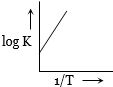
B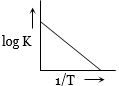
C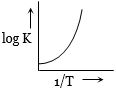
D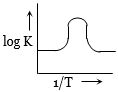
Solution
(B) The Arrhenius equation is given by: $k = A \,e^{-\frac{E_A}{RT}}$
Taking the logarithm on both sides:
$\ln \,k = \ln \,A - \frac{E_A}{RT}$
Converting to base $10$ logarithm:
$\log \,k = \log \,A - \frac{E_A}{2.303 \,RT}$
Comparing this with the equation of a straight line,$y = mx + c$:
Here,$y = \log \,k$,$x = \frac{1}{T}$,$m = -\frac{E_A}{2.303 \,R}$ (slope),and $c = \log \,A$ (intercept).
Since the slope is negative $(-\frac{E_A}{2.303 \,R})$,the graph of $\log \,k$ versus $\frac{1}{T}$ is a straight line with a negative slope,which corresponds to option $B$.
Taking the logarithm on both sides:
$\ln \,k = \ln \,A - \frac{E_A}{RT}$
Converting to base $10$ logarithm:
$\log \,k = \log \,A - \frac{E_A}{2.303 \,RT}$
Comparing this with the equation of a straight line,$y = mx + c$:
Here,$y = \log \,k$,$x = \frac{1}{T}$,$m = -\frac{E_A}{2.303 \,R}$ (slope),and $c = \log \,A$ (intercept).
Since the slope is negative $(-\frac{E_A}{2.303 \,R})$,the graph of $\log \,k$ versus $\frac{1}{T}$ is a straight line with a negative slope,which corresponds to option $B$.
0 likes
View Solution48
MediumMCQ
The rate constant of a reaction at temperature $200 \ K$ is $10$ times less than the rate constant at $400 \ K.$ What is the activation energy $({E_a})$ of the reaction ($R = $ gas constant) (in $R$)?
A
$1842.4$
B
$921.2$
C
$460.6$
D
$230.3$
Solution
(B) $k_1 =$ rate constant at temperature $200 \ K$
$k_2 =$ rate constant at temperature $400 \ K$
Given that $k_1 = k_2 / 10$,so $k_2 / k_1 = 10$.
$T_1 = 200 \ K$,$T_2 = 400 \ K$.
The Arrhenius equation is $\ln(k_2 / k_1) = (E_a / R) \times [(T_2 - T_1) / (T_1 \times T_2)]$.
Substituting the values: $\ln(10) = (E_a / R) \times [(400 - 200) / (200 \times 400)]$.
$2.303 = (E_a / R) \times [200 / 80000]$.
$2.303 = (E_a / R) \times (1 / 400)$.
$E_a / R = 2.303 \times 400 = 921.2$.
Therefore,$E_a = 921.2 \ R$.
$k_2 =$ rate constant at temperature $400 \ K$
Given that $k_1 = k_2 / 10$,so $k_2 / k_1 = 10$.
$T_1 = 200 \ K$,$T_2 = 400 \ K$.
The Arrhenius equation is $\ln(k_2 / k_1) = (E_a / R) \times [(T_2 - T_1) / (T_1 \times T_2)]$.
Substituting the values: $\ln(10) = (E_a / R) \times [(400 - 200) / (200 \times 400)]$.
$2.303 = (E_a / R) \times [200 / 80000]$.
$2.303 = (E_a / R) \times (1 / 400)$.
$E_a / R = 2.303 \times 400 = 921.2$.
Therefore,$E_a = 921.2 \ R$.
0 likes
View Solution49
DifficultMCQ
In respect of the equation $k = A e^{-E_a/RT}$ in chemical kinetics,which one of the following statements is correct?
A
$k$ is equilibrium constant
B
$A$ is adsorption factor
C
$E_a$ is energy of activation
D
$R$ is Rydberg's constant
Solution
(C) The given equation $k = A e^{-E_a/RT}$ is known as the Arrhenius equation.
In this equation:
$k$ is the rate constant.
$A$ is the Arrhenius factor or frequency factor.
$E_a$ is the activation energy.
$R$ is the universal gas constant.
$T$ is the temperature in Kelvin.
Therefore,the statement '$E_a$ is energy of activation' is correct.
In this equation:
$k$ is the rate constant.
$A$ is the Arrhenius factor or frequency factor.
$E_a$ is the activation energy.
$R$ is the universal gas constant.
$T$ is the temperature in Kelvin.
Therefore,the statement '$E_a$ is energy of activation' is correct.
0 likes
View SolutionChemical Kinetics — Collision theory, Energy of activation and Arrhenius equation · Frequently Asked Questions
1Are these Chemical Kinetics questions useful for JEE and NEET?
Yes. All questions in this section are mapped to JEE Main and NEET exam patterns. Previous year questions from JEE Main, NEET, GUJCET and state-level exams are included with full solutions.
2Can I switch to Hindi or Gujarati for these questions?
Yes. Use the language tabs in the hero section or the sidebar to view the same questions and solutions in English, Hindi or Gujarati.
3How do I generate a question paper from this subtopic?
Use the Vedclass Exam Paper Generator — select the chapter and subtopic, set difficulty, and generate Sets A, B, C, D automatically. First 3 chapters of every subject are free.
Vedclass Products
For Students
Vedclass Test Series
Mock tests in real JEE/NEET style with performance analysis. 5-day free trial.
Start Free TrialFor Teachers
Exam Paper Generator
Generate Set A/B/C/D papers from this chapter in 2 minutes. 3 chapters free.
Try FreeFor Institutes
Online Exam Module
Live online exams with unlimited students, 360° analytics & white-label branding.
See DemoFor Teachers & Institutes
Generate a Chemical Kinetics Exam Paper in 2 Minutes
Select subtopic & difficulty — Sets A, B, C, D auto-generated with No Repeat logic.
First 3 chapters of every subject are free — no payment required.