
અ Gujarati
Mix Examples-Trigonometrical Ratios, Functions and Identities Questions in Gujarati
Class 11 Mathematics · Trigonometrical Ratios, Functions and Identities · Mix Examples-Trigonometrical Ratios, Functions and Identities
670+
Questions
Gujarati
Language
100%
With Solutions
Showing 47 of 670 questions in Gujarati
451
MediumMCQ
$\cos 13^{\circ} \sin 17^{\circ} \sin 21^{\circ} \cos 47^{\circ} = $
A
$\frac{1}{32}(1+\sqrt{2}-\sqrt{3})$
B
$\frac{1}{16}(1+\sqrt{3}+\sqrt{5})$
C
$\frac{1}{16}(2+\sqrt{3}-\sqrt{5})$
D
$\frac{1}{32}(1+2 \sqrt{3}-\sqrt{5})$
Solution
(C) ધારો કે $E = \cos 13^{\circ} \sin 17^{\circ} \sin 21^{\circ} \cos 47^{\circ}$.
$4$ વડે ગુણીને ભાગતા:
$E = \frac{1}{4} (2 \cos 13^{\circ} \cos 47^{\circ}) (2 \sin 17^{\circ} \sin 21^{\circ})$.
$2 \cos A \cos B = \cos(A+B) + \cos(A-B)$ અને $2 \sin A \sin B = \cos(A-B) - \cos(A+B)$ સૂત્રનો ઉપયોગ કરતા:
$E = \frac{1}{4} (\cos 60^{\circ} + \cos 34^{\circ}) (\cos 4^{\circ} - \cos 38^{\circ})$.
$\cos 60^{\circ} = \frac{1}{2}$ હોવાથી,$E = \frac{1}{4} (\frac{1}{2} + \cos 34^{\circ}) (\cos 4^{\circ} - \cos 38^{\circ})$.
આ પદાવલિનું સાદુંરૂપ આપતા અંતિમ પરિણામ મળે છે.
$4$ વડે ગુણીને ભાગતા:
$E = \frac{1}{4} (2 \cos 13^{\circ} \cos 47^{\circ}) (2 \sin 17^{\circ} \sin 21^{\circ})$.
$2 \cos A \cos B = \cos(A+B) + \cos(A-B)$ અને $2 \sin A \sin B = \cos(A-B) - \cos(A+B)$ સૂત્રનો ઉપયોગ કરતા:
$E = \frac{1}{4} (\cos 60^{\circ} + \cos 34^{\circ}) (\cos 4^{\circ} - \cos 38^{\circ})$.
$\cos 60^{\circ} = \frac{1}{2}$ હોવાથી,$E = \frac{1}{4} (\frac{1}{2} + \cos 34^{\circ}) (\cos 4^{\circ} - \cos 38^{\circ})$.
આ પદાવલિનું સાદુંરૂપ આપતા અંતિમ પરિણામ મળે છે.
0 likes
View Solution452
MediumMCQ
કિંમત શોધો: $\sin \frac{\pi}{12} \sin \frac{2 \pi}{12} \sin \frac{3 \pi}{12} \sin \frac{4 \pi}{12} \sin \frac{5 \pi}{12} \sin \frac{6 \pi}{12}$
A
$\frac{\sqrt{3}}{16 \sqrt{2}}$
B
$\frac{\sqrt{3}}{8 \sqrt{2}}$
C
$\frac{1}{32}$
D
$\frac{1}{16}$
Solution
(A) ધારો કે $P = \sin \frac{\pi}{12} \sin \frac{2 \pi}{12} \sin \frac{3 \pi}{12} \sin \frac{4 \pi}{12} \sin \frac{5 \pi}{12} \sin \frac{6 \pi}{12}$.
કિંમતો મૂકતા:
$\sin \frac{\pi}{12} = \frac{\sqrt{6}-\sqrt{2}}{4}$,$\sin \frac{2 \pi}{12} = \frac{1}{2}$,$\sin \frac{3 \pi}{12} = \frac{1}{\sqrt{2}}$,$\sin \frac{4 \pi}{12} = \frac{\sqrt{3}}{2}$,$\sin \frac{5 \pi}{12} = \frac{\sqrt{6}+\sqrt{2}}{4}$,$\sin \frac{6 \pi}{12} = 1$.
તેથી,$P = \left( \frac{6-2}{16} \right) \left( \frac{\sqrt{3}}{4 \sqrt{2}} \right) = \frac{1}{4} \times \frac{\sqrt{3}}{4 \sqrt{2}} = \frac{\sqrt{3}}{16 \sqrt{2}}$.
કિંમતો મૂકતા:
$\sin \frac{\pi}{12} = \frac{\sqrt{6}-\sqrt{2}}{4}$,$\sin \frac{2 \pi}{12} = \frac{1}{2}$,$\sin \frac{3 \pi}{12} = \frac{1}{\sqrt{2}}$,$\sin \frac{4 \pi}{12} = \frac{\sqrt{3}}{2}$,$\sin \frac{5 \pi}{12} = \frac{\sqrt{6}+\sqrt{2}}{4}$,$\sin \frac{6 \pi}{12} = 1$.
તેથી,$P = \left( \frac{6-2}{16} \right) \left( \frac{\sqrt{3}}{4 \sqrt{2}} \right) = \frac{1}{4} \times \frac{\sqrt{3}}{4 \sqrt{2}} = \frac{\sqrt{3}}{16 \sqrt{2}}$.
0 likes
View Solution453
MediumMCQ
જો $\tan \left(\frac{\pi}{4}+\alpha\right)=\tan ^3\left(\frac{\pi}{4}+\beta\right)$ હોય,તો $\tan (\alpha+\beta) \cot (\alpha-\beta)=$
A
$\sec ^2 2 \beta+\tan ^2 2 \beta$
B
$\operatorname{cosec}^2 2 \beta+\cot ^2 2 \beta$
C
$2\left(\sec ^2 2 \beta+\tan ^2 2 \beta\right)$
D
$4\left(\sec ^2 2 \beta+\tan ^2 2 \beta\right)$
Solution
(A) આપેલ છે $\tan \left(\frac{\pi}{4}+\alpha\right)=\tan ^3\left(\frac{\pi}{4}+\beta\right)$.
ધારો કે $x = \frac{\pi}{4}+\alpha$ અને $y = \frac{\pi}{4}+\beta$. તેથી $\tan x = \tan^3 y$.
$\tan(A+B)$ ના નિત્યસમનો ઉપયોગ કરતા,$\tan x = \frac{1+\tan \alpha}{1-\tan \alpha}$ અને $\tan y = \frac{1+\tan \beta}{1-\tan \beta}$.
$\tan x = \tan^3 y$ પરથી,યોગ-વિયોગની રીત વાપરતા,આપણને $\tan(\alpha+\beta)\cot(\alpha-\beta) = 1$ મળે છે.
ધારો કે $x = \frac{\pi}{4}+\alpha$ અને $y = \frac{\pi}{4}+\beta$. તેથી $\tan x = \tan^3 y$.
$\tan(A+B)$ ના નિત્યસમનો ઉપયોગ કરતા,$\tan x = \frac{1+\tan \alpha}{1-\tan \alpha}$ અને $\tan y = \frac{1+\tan \beta}{1-\tan \beta}$.
$\tan x = \tan^3 y$ પરથી,યોગ-વિયોગની રીત વાપરતા,આપણને $\tan(\alpha+\beta)\cot(\alpha-\beta) = 1$ મળે છે.
0 likes
View Solution454
MediumMCQ
જો $A+B+C+D=2 \pi$ હોય,તો $\sin A+\sin B+\sin C+\sin D=$
A
$4 \sin \left(\frac{A+B}{2}\right) \sin \left(\frac{A+C}{2}\right) \sin \left(\frac{A+D}{2}\right)$
B
$-4 \sin \left(\frac{A+B}{2}\right) \sin \left(\frac{A+C}{2}\right) \sin \left(\frac{A+D}{2}\right)$
C
$4 \cos \left(\frac{A+B}{2}\right) \cos \left(\frac{A+C}{2}\right) \cos \left(\frac{A+D}{2}\right)$
D
$-4 \cos \left(\frac{A+B}{2}\right) \cos \left(\frac{A+C}{2}\right) \cos \left(\frac{A+D}{2}\right)$
Solution
(D) આપેલ છે કે $A+B+C+D=2 \pi$. આપણે $S = \sin A + \sin B + \sin C + \sin D$ ની કિંમત શોધવાની છે.
સરવાળાથી ગુણાકારના સૂત્ર $\sin x + \sin y = 2 \sin \left(\frac{x+y}{2}\right) \cos \left(\frac{x-y}{2}\right)$ નો ઉપયોગ કરતા:
$S = 2 \sin \left(\frac{A+B}{2}\right) \cos \left(\frac{A-B}{2}\right) + 2 \sin \left(\frac{C+D}{2}\right) \cos \left(\frac{C-D}{2}\right)$.
$C+D = 2 \pi - (A+B)$ હોવાથી,$\frac{C+D}{2} = \pi - \frac{A+B}{2}$.
તેથી,$\sin \left(\frac{C+D}{2}\right) = \sin \left(\pi - \frac{A+B}{2}\right) = \sin \left(\frac{A+B}{2}\right)$.
આ કિંમત મૂકતા:
$S = 2 \sin \left(\frac{A+B}{2}\right) \left[ \cos \left(\frac{A-B}{2}\right) + \cos \left(\frac{C-D}{2}\right) \right]$.
$\cos x + \cos y = 2 \cos \left(\frac{x+y}{2}\right) \cos \left(\frac{x-y}{2}\right)$ નો ઉપયોગ કરતા:
$S = -4 \cos \left(\frac{A+B}{2}\right) \cos \left(\frac{A+C}{2}\right) \cos \left(\frac{A+D}{2}\right)$ મળે છે.
સરવાળાથી ગુણાકારના સૂત્ર $\sin x + \sin y = 2 \sin \left(\frac{x+y}{2}\right) \cos \left(\frac{x-y}{2}\right)$ નો ઉપયોગ કરતા:
$S = 2 \sin \left(\frac{A+B}{2}\right) \cos \left(\frac{A-B}{2}\right) + 2 \sin \left(\frac{C+D}{2}\right) \cos \left(\frac{C-D}{2}\right)$.
$C+D = 2 \pi - (A+B)$ હોવાથી,$\frac{C+D}{2} = \pi - \frac{A+B}{2}$.
તેથી,$\sin \left(\frac{C+D}{2}\right) = \sin \left(\pi - \frac{A+B}{2}\right) = \sin \left(\frac{A+B}{2}\right)$.
આ કિંમત મૂકતા:
$S = 2 \sin \left(\frac{A+B}{2}\right) \left[ \cos \left(\frac{A-B}{2}\right) + \cos \left(\frac{C-D}{2}\right) \right]$.
$\cos x + \cos y = 2 \cos \left(\frac{x+y}{2}\right) \cos \left(\frac{x-y}{2}\right)$ નો ઉપયોગ કરતા:
$S = -4 \cos \left(\frac{A+B}{2}\right) \cos \left(\frac{A+C}{2}\right) \cos \left(\frac{A+D}{2}\right)$ મળે છે.
0 likes
View Solution455
MediumMCQ
જો $A$ અને $B$ એવી કિંમતો હોય કે જેથી $(A+B)$ અને $(A-B)$ એ $\frac{\pi}{2}$ ના એકી ગુણાંક ન હોય અને $2 \tan (A+B)=3 \tan (A-B)$ હોય,તો $\sin 2A$ ની કિંમત શોધો.
A
$5 \sin 2B$
B
$5 \sin B \cos B$
C
$5 \tan B$
D
$5 \sin 2B / 2$
Solution
(A) આપેલ છે કે $2 \tan (A+B) = 3 \tan (A-B)$.
ધારો કે $X = A+B$ અને $Y = A-B$. તેથી $2 \tan X = 3 \tan Y$,એટલે કે $\frac{\tan X}{\tan Y} = \frac{3}{2}$.
યોગ-વિયોગની રીત (Componendo and Dividendo) વાપરતા:
$\frac{\tan X + \tan Y}{\tan X - \tan Y} = \frac{3+2}{3-2} = 5$.
નિત્યસમ $\frac{\sin(X+Y)}{\sin(X-Y)} = \frac{\tan X + \tan Y}{\tan X - \tan Y}$ નો ઉપયોગ કરતા:
$\frac{\sin(A+B+A-B)}{\sin(A+B-(A-B))} = 5$.
$\frac{\sin 2A}{\sin 2B} = 5$.
તેથી,$\sin 2A = 5 \sin 2B$.
ધારો કે $X = A+B$ અને $Y = A-B$. તેથી $2 \tan X = 3 \tan Y$,એટલે કે $\frac{\tan X}{\tan Y} = \frac{3}{2}$.
યોગ-વિયોગની રીત (Componendo and Dividendo) વાપરતા:
$\frac{\tan X + \tan Y}{\tan X - \tan Y} = \frac{3+2}{3-2} = 5$.
નિત્યસમ $\frac{\sin(X+Y)}{\sin(X-Y)} = \frac{\tan X + \tan Y}{\tan X - \tan Y}$ નો ઉપયોગ કરતા:
$\frac{\sin(A+B+A-B)}{\sin(A+B-(A-B))} = 5$.
$\frac{\sin 2A}{\sin 2B} = 5$.
તેથી,$\sin 2A = 5 \sin 2B$.
0 likes
View Solution456
MediumMCQ
જો $\cos^3 80^{\circ} + \cos^3 40^{\circ} - \cos^3 20^{\circ} = k$ હોય,તો $\frac{4k}{3} =$
A
$\sin \left(\frac{4\pi}{3}\right)$
B
$\cos \left(\frac{2\pi}{3}\right)$
C
$\tan \left(\frac{\pi}{3}\right)$
D
$\sec \left(\frac{2\pi}{3}\right)$
Solution
(B) આપણે નિત્યસમ $\cos 3\theta = 4\cos^3 \theta - 3\cos \theta$ નો ઉપયોગ કરીએ છીએ,જેનો અર્થ છે $\cos^3 \theta = \frac{1}{4}(\cos 3\theta + 3\cos \theta)$.
આ કિંમત $k = \cos^3 80^{\circ} + \cos^3 40^{\circ} - \cos^3 20^{\circ}$ માં મૂકતા:
$k = \frac{1}{4}(\cos 240^{\circ} + 3\cos 80^{\circ}) + \frac{1}{4}(\cos 120^{\circ} + 3\cos 40^{\circ}) - \frac{1}{4}(\cos 60^{\circ} + 3\cos 20^{\circ})$
$k = \frac{1}{4} [(\cos 240^{\circ} + \cos 120^{\circ} - \cos 60^{\circ}) + 3(\cos 80^{\circ} + \cos 40^{\circ} - \cos 20^{\circ})]$
$\cos 240^{\circ} = -\frac{1}{2}$,$\cos 120^{\circ} = -\frac{1}{2}$,અને $\cos 60^{\circ} = \frac{1}{2}$ હોવાથી,પ્રથમ ભાગ $(-\frac{1}{2} - \frac{1}{2} - \frac{1}{2}) = -\frac{3}{2}$ થાય.
બીજા ભાગ માટે,$\cos 80^{\circ} + \cos 40^{\circ} = 2\cos 60^{\circ} \cos 20^{\circ} = 2(\frac{1}{2})\cos 20^{\circ} = \cos 20^{\circ}$.
આમ,$3(\cos 80^{\circ} + \cos 40^{\circ} - \cos 20^{\circ}) = 3(\cos 20^{\circ} - \cos 20^{\circ}) = 0$.
તેથી,$k = \frac{1}{4}(-\frac{3}{2} + 0) = -\frac{3}{8}$.
હવે $\frac{4k}{3} = \frac{4}{3} \times (-\frac{3}{8}) = -\frac{1}{2}$.
વિકલ્પો સાથે સરખાવતા: $\cos(\frac{2\pi}{3}) = \cos(120^{\circ}) = -\frac{1}{2}$.
તેથી,સાચો વિકલ્પ $B$ છે.
આ કિંમત $k = \cos^3 80^{\circ} + \cos^3 40^{\circ} - \cos^3 20^{\circ}$ માં મૂકતા:
$k = \frac{1}{4}(\cos 240^{\circ} + 3\cos 80^{\circ}) + \frac{1}{4}(\cos 120^{\circ} + 3\cos 40^{\circ}) - \frac{1}{4}(\cos 60^{\circ} + 3\cos 20^{\circ})$
$k = \frac{1}{4} [(\cos 240^{\circ} + \cos 120^{\circ} - \cos 60^{\circ}) + 3(\cos 80^{\circ} + \cos 40^{\circ} - \cos 20^{\circ})]$
$\cos 240^{\circ} = -\frac{1}{2}$,$\cos 120^{\circ} = -\frac{1}{2}$,અને $\cos 60^{\circ} = \frac{1}{2}$ હોવાથી,પ્રથમ ભાગ $(-\frac{1}{2} - \frac{1}{2} - \frac{1}{2}) = -\frac{3}{2}$ થાય.
બીજા ભાગ માટે,$\cos 80^{\circ} + \cos 40^{\circ} = 2\cos 60^{\circ} \cos 20^{\circ} = 2(\frac{1}{2})\cos 20^{\circ} = \cos 20^{\circ}$.
આમ,$3(\cos 80^{\circ} + \cos 40^{\circ} - \cos 20^{\circ}) = 3(\cos 20^{\circ} - \cos 20^{\circ}) = 0$.
તેથી,$k = \frac{1}{4}(-\frac{3}{2} + 0) = -\frac{3}{8}$.
હવે $\frac{4k}{3} = \frac{4}{3} \times (-\frac{3}{8}) = -\frac{1}{2}$.
વિકલ્પો સાથે સરખાવતા: $\cos(\frac{2\pi}{3}) = \cos(120^{\circ}) = -\frac{1}{2}$.
તેથી,સાચો વિકલ્પ $B$ છે.
0 likes
View Solution457
MediumMCQ
જો $\cos x + \sin x = \frac{1}{2}$ અને $0 < x < \pi$ હોય,તો $\tan x =$
A
$\frac{4+\sqrt{7}}{3}$
B
$\frac{4-\sqrt{7}}{3}$
C
$\frac{-4+\sqrt{7}}{3}$
D
$\frac{-4-\sqrt{7}}{3}$
Solution
(D) આપેલ છે $\cos x + \sin x = \frac{1}{2}$.
બંને બાજુ વર્ગ કરતા,$(\cos x + \sin x)^2 = (\frac{1}{2})^2$.
$\cos^2 x + \sin^2 x + 2 \sin x \cos x = \frac{1}{4}$.
$\cos^2 x + \sin^2 x = 1$ હોવાથી,$1 + 2 \sin x \cos x = \frac{1}{4}$.
$2 \sin x \cos x = \frac{1}{4} - 1 = -\frac{3}{4}$.
હવે,$(\cos x - \sin x)^2 = \cos^2 x + \sin^2 x - 2 \sin x \cos x = 1 - (-\frac{3}{4}) = 1 + \frac{3}{4} = \frac{7}{4}$.
તેથી,$\cos x - \sin x = \pm \frac{\sqrt{7}}{2}$.
કિસ્સો $1$: $\cos x + \sin x = \frac{1}{2}$ અને $\cos x - \sin x = \frac{\sqrt{7}}{2}$.
સરવાળો કરતા $2 \cos x = \frac{1+\sqrt{7}}{2} \implies \cos x = \frac{1+\sqrt{7}}{4}$.
બાદબાકી કરતા $2 \sin x = \frac{1-\sqrt{7}}{2} \implies \sin x = \frac{1-\sqrt{7}}{4}$.
તેથી $\tan x = \frac{\sin x}{\cos x} = \frac{1-\sqrt{7}}{1+\sqrt{7}} = \frac{-4+\sqrt{7}}{3}$.
કિસ્સો $2$: $\cos x + \sin x = \frac{1}{2}$ અને $\cos x - \sin x = -\frac{\sqrt{7}}{2}$.
સરવાળો કરતા $2 \cos x = \frac{1-\sqrt{7}}{2} \implies \cos x = \frac{1-\sqrt{7}}{4}$.
બાદબાકી કરતા $2 \sin x = \frac{1+\sqrt{7}}{2} \implies \sin x = \frac{1+\sqrt{7}}{4}$.
તેથી $\tan x = \frac{\sin x}{\cos x} = \frac{1+\sqrt{7}}{1-\sqrt{7}} = \frac{-4-\sqrt{7}}{3}$.
$0 < x < \pi$ હોવાથી,$\sin x > 0$. કિસ્સો $1$ માં $\sin x < 0$ છે,જે અસ્વીકાર્ય છે. કિસ્સો $2$ માં $\sin x > 0$ છે,જે સ્વીકાર્ય છે. તેથી,$\tan x = \frac{-4-\sqrt{7}}{3}$.
બંને બાજુ વર્ગ કરતા,$(\cos x + \sin x)^2 = (\frac{1}{2})^2$.
$\cos^2 x + \sin^2 x + 2 \sin x \cos x = \frac{1}{4}$.
$\cos^2 x + \sin^2 x = 1$ હોવાથી,$1 + 2 \sin x \cos x = \frac{1}{4}$.
$2 \sin x \cos x = \frac{1}{4} - 1 = -\frac{3}{4}$.
હવે,$(\cos x - \sin x)^2 = \cos^2 x + \sin^2 x - 2 \sin x \cos x = 1 - (-\frac{3}{4}) = 1 + \frac{3}{4} = \frac{7}{4}$.
તેથી,$\cos x - \sin x = \pm \frac{\sqrt{7}}{2}$.
કિસ્સો $1$: $\cos x + \sin x = \frac{1}{2}$ અને $\cos x - \sin x = \frac{\sqrt{7}}{2}$.
સરવાળો કરતા $2 \cos x = \frac{1+\sqrt{7}}{2} \implies \cos x = \frac{1+\sqrt{7}}{4}$.
બાદબાકી કરતા $2 \sin x = \frac{1-\sqrt{7}}{2} \implies \sin x = \frac{1-\sqrt{7}}{4}$.
તેથી $\tan x = \frac{\sin x}{\cos x} = \frac{1-\sqrt{7}}{1+\sqrt{7}} = \frac{-4+\sqrt{7}}{3}$.
કિસ્સો $2$: $\cos x + \sin x = \frac{1}{2}$ અને $\cos x - \sin x = -\frac{\sqrt{7}}{2}$.
સરવાળો કરતા $2 \cos x = \frac{1-\sqrt{7}}{2} \implies \cos x = \frac{1-\sqrt{7}}{4}$.
બાદબાકી કરતા $2 \sin x = \frac{1+\sqrt{7}}{2} \implies \sin x = \frac{1+\sqrt{7}}{4}$.
તેથી $\tan x = \frac{\sin x}{\cos x} = \frac{1+\sqrt{7}}{1-\sqrt{7}} = \frac{-4-\sqrt{7}}{3}$.
$0 < x < \pi$ હોવાથી,$\sin x > 0$. કિસ્સો $1$ માં $\sin x < 0$ છે,જે અસ્વીકાર્ય છે. કિસ્સો $2$ માં $\sin x > 0$ છે,જે સ્વીકાર્ય છે. તેથી,$\tan x = \frac{-4-\sqrt{7}}{3}$.
0 likes
View Solution458
MediumMCQ
જો $A$ અને $B$ લઘુકોણ હોય જે $3 \cos^2 A + 2 \cos^2 B = 4$ અને $\frac{3 \sin A}{\sin B} = \frac{2 \cos B}{\cos A}$ નું સમાધાન કરે છે,તો $A + 2B =$
A
$\frac{\pi}{2}$
B
$\frac{\pi}{3}$
C
$\frac{\pi}{4}$
D
$\frac{\pi}{6}$
Solution
(A) આપેલ સમીકરણો:
$(1) 3 \cos^2 A + 2 \cos^2 B = 4$
$(2) \frac{3 \sin A}{\sin B} = \frac{2 \cos B}{\cos A} \implies 3 \sin A \cos A = 2 \sin B \cos B$
નિત્યસમ $\sin 2\theta = 2 \sin \theta \cos \theta$ નો ઉપયોગ કરતા:
$\frac{3}{2} \sin 2A = \sin 2B \implies 3 \sin 2A = 2 \sin 2B$
$(1)$ પરથી,$3 \cos^2 A + 2 \cos^2 B = 4$
$\implies 3(1 - \sin^2 A) + 2(1 - \sin^2 B) = 4$
$\implies 5 - 3 \sin^2 A - 2 \sin^2 B = 4$
$\implies 3 \sin^2 A + 2 \sin^2 B = 1$
તેમજ,$(2)$ પરથી,$3 \sin A \cos A = 2 \sin B \cos B$. બંને બાજુ વર્ગ કરતા:
$9 \sin^2 A \cos^2 A = 4 \sin^2 B \cos^2 B$
$\implies 9 \sin^2 A (1 - \sin^2 A) = 4 \sin^2 B (1 - \sin^2 B)$
ધારો કે $u = \sin^2 A$ અને $v = \sin^2 B$. આપણી પાસે $3u + 2v = 1 \implies v = \frac{1 - 3u}{2}$ છે.
વર્ગ કરેલા સમીકરણમાં કિંમત મૂકતા:
$9u(1 - u) = 4(\frac{1 - 3u}{2})(1 - \frac{1 - 3u}{2})$
$\implies 9u - 9u^2 = 2(1 - 3u)(\frac{1 + 3u}{2})$
$\implies 9u - 9u^2 = 1 - 9u^2$
$\implies 9u = 1 \implies u = \frac{1}{9}$
તેથી $v = \frac{1 - 3(1/9)}{2} = \frac{1 - 1/3}{2} = \frac{2/3}{2} = \frac{1}{3}$.
આમ $\sin^2 A = \frac{1}{9} \implies \sin A = \frac{1}{3}$ અને $\sin^2 B = \frac{1}{3} \implies \sin B = \frac{1}{\sqrt{3}}$.
લઘુકોણ $A, B$ માટે,$\sin A = 1/3, \cos A = \sqrt{8}/3, \sin B = 1/\sqrt{3}, \cos B = \sqrt{2/3}$.
$\sin(A+2B) = \sin A \cos 2B + \cos A \sin 2B = \sin A (1 - 2\sin^2 B) + \cos A (2 \sin B \cos B)$
$= (1/3)(1 - 2/3) + (\sqrt{8}/3)(2 \cdot 1/\sqrt{3} \cdot \sqrt{2/3}) = 1/9 + 8/9 = 1$.
તેથી,$A + 2B = \frac{\pi}{2}$.
$(1) 3 \cos^2 A + 2 \cos^2 B = 4$
$(2) \frac{3 \sin A}{\sin B} = \frac{2 \cos B}{\cos A} \implies 3 \sin A \cos A = 2 \sin B \cos B$
નિત્યસમ $\sin 2\theta = 2 \sin \theta \cos \theta$ નો ઉપયોગ કરતા:
$\frac{3}{2} \sin 2A = \sin 2B \implies 3 \sin 2A = 2 \sin 2B$
$(1)$ પરથી,$3 \cos^2 A + 2 \cos^2 B = 4$
$\implies 3(1 - \sin^2 A) + 2(1 - \sin^2 B) = 4$
$\implies 5 - 3 \sin^2 A - 2 \sin^2 B = 4$
$\implies 3 \sin^2 A + 2 \sin^2 B = 1$
તેમજ,$(2)$ પરથી,$3 \sin A \cos A = 2 \sin B \cos B$. બંને બાજુ વર્ગ કરતા:
$9 \sin^2 A \cos^2 A = 4 \sin^2 B \cos^2 B$
$\implies 9 \sin^2 A (1 - \sin^2 A) = 4 \sin^2 B (1 - \sin^2 B)$
ધારો કે $u = \sin^2 A$ અને $v = \sin^2 B$. આપણી પાસે $3u + 2v = 1 \implies v = \frac{1 - 3u}{2}$ છે.
વર્ગ કરેલા સમીકરણમાં કિંમત મૂકતા:
$9u(1 - u) = 4(\frac{1 - 3u}{2})(1 - \frac{1 - 3u}{2})$
$\implies 9u - 9u^2 = 2(1 - 3u)(\frac{1 + 3u}{2})$
$\implies 9u - 9u^2 = 1 - 9u^2$
$\implies 9u = 1 \implies u = \frac{1}{9}$
તેથી $v = \frac{1 - 3(1/9)}{2} = \frac{1 - 1/3}{2} = \frac{2/3}{2} = \frac{1}{3}$.
આમ $\sin^2 A = \frac{1}{9} \implies \sin A = \frac{1}{3}$ અને $\sin^2 B = \frac{1}{3} \implies \sin B = \frac{1}{\sqrt{3}}$.
લઘુકોણ $A, B$ માટે,$\sin A = 1/3, \cos A = \sqrt{8}/3, \sin B = 1/\sqrt{3}, \cos B = \sqrt{2/3}$.
$\sin(A+2B) = \sin A \cos 2B + \cos A \sin 2B = \sin A (1 - 2\sin^2 B) + \cos A (2 \sin B \cos B)$
$= (1/3)(1 - 2/3) + (\sqrt{8}/3)(2 \cdot 1/\sqrt{3} \cdot \sqrt{2/3}) = 1/9 + 8/9 = 1$.
તેથી,$A + 2B = \frac{\pi}{2}$.
0 likes
View Solution459
EasyMCQ
જો $\sin \alpha = \sin \beta$ અને $\cos \alpha = \cos \beta$ હોય,તો કોઈ પૂર્ણાંક $n$ માટે $\alpha - \beta = $ શું થાય?
A
$n \pi$
B
$2 n \pi + \frac{\pi}{2}$
C
$2 n \pi - \frac{\pi}{2}$
D
$2 n \pi$
Solution
(D) આપેલ છે કે $\sin \alpha = \sin \beta$ અને $\cos \alpha = \cos \beta$.
બંને સમીકરણોનો વર્ગ કરીને સરવાળો કરતા:
$(\sin \alpha)^2 + (\cos \alpha)^2 = (\sin \beta)^2 + (\cos \beta)^2$
$1 = 1$.
વૈકલ્પિક રીતે,સંકર સંખ્યાઓ $z_1 = \cos \alpha + i \sin \alpha$ અને $z_2 = \cos \beta + i \sin \beta$ ધ્યાનમાં લો.
$\cos \alpha = \cos \beta$ અને $\sin \alpha = \sin \beta$ હોવાથી,$z_1 = z_2$ મળે.
આનો અર્થ એ છે કે $e^{i \alpha} = e^{i \beta}$,જેનો અર્થ થાય છે $e^{i(\alpha - \beta)} = 1$.
તેથી,કોઈ પૂર્ણાંક $n$ માટે $\alpha - \beta = 2 n \pi$.
આમ,વિકલ્પ $D$ સાચો છે.
બંને સમીકરણોનો વર્ગ કરીને સરવાળો કરતા:
$(\sin \alpha)^2 + (\cos \alpha)^2 = (\sin \beta)^2 + (\cos \beta)^2$
$1 = 1$.
વૈકલ્પિક રીતે,સંકર સંખ્યાઓ $z_1 = \cos \alpha + i \sin \alpha$ અને $z_2 = \cos \beta + i \sin \beta$ ધ્યાનમાં લો.
$\cos \alpha = \cos \beta$ અને $\sin \alpha = \sin \beta$ હોવાથી,$z_1 = z_2$ મળે.
આનો અર્થ એ છે કે $e^{i \alpha} = e^{i \beta}$,જેનો અર્થ થાય છે $e^{i(\alpha - \beta)} = 1$.
તેથી,કોઈ પૂર્ણાંક $n$ માટે $\alpha - \beta = 2 n \pi$.
આમ,વિકલ્પ $D$ સાચો છે.
0 likes
View Solution460
EasyMCQ
$\tan \frac{\pi}{5} + 2 \tan \frac{2 \pi}{5} + 4 \cot \frac{4 \pi}{5} = $
A
$\cot \frac{\pi}{5}$
B
$\cot \frac{2 \pi}{5}$
C
$\cot \frac{3 \pi}{5}$
D
$\cot \frac{4 \pi}{5}$
Solution
(A) આપણે જાણીએ છીએ કે $\tan \theta + 2 \tan 2 \theta + 4 \cot 4 \theta = \cot \theta$.
ધારો કે $\theta = \frac{\pi}{5} = 36^{\circ}$.
તેથી પદાવલિ $\tan \frac{\pi}{5} + 2 \tan \frac{2 \pi}{5} + 4 \cot \frac{4 \pi}{5}$ બને છે.
નિત્યસમ $\tan \theta + 2 \tan 2 \theta + 4 \cot 4 \theta = \cot \theta$ નો ઉપયોગ કરતા,
$\theta = \frac{\pi}{5}$ મૂકતા,આપણને $\tan \frac{\pi}{5} + 2 \tan \frac{2 \pi}{5} + 4 \cot \frac{4 \pi}{5} = \cot \frac{\pi}{5}$ મળે છે.
આમ,સાચો વિકલ્પ $A$ છે.
ધારો કે $\theta = \frac{\pi}{5} = 36^{\circ}$.
તેથી પદાવલિ $\tan \frac{\pi}{5} + 2 \tan \frac{2 \pi}{5} + 4 \cot \frac{4 \pi}{5}$ બને છે.
નિત્યસમ $\tan \theta + 2 \tan 2 \theta + 4 \cot 4 \theta = \cot \theta$ નો ઉપયોગ કરતા,
$\theta = \frac{\pi}{5}$ મૂકતા,આપણને $\tan \frac{\pi}{5} + 2 \tan \frac{2 \pi}{5} + 4 \cot \frac{4 \pi}{5} = \cot \frac{\pi}{5}$ મળે છે.
આમ,સાચો વિકલ્પ $A$ છે.
0 likes
View Solution461
MediumMCQ
જો $\theta \in \left[-\frac{\pi}{2}, \frac{\pi}{2}\right]$ માટે $2 \cos \theta + \sin \theta = 1$ અને $7 \cos \theta + 6 \sin \theta = k$ હોય,તો $k$ ની શક્ય કિંમતો કઈ છે?
A
$8, -2$
B
$6, 2$
C
$12, 4$
D
$7, 6$
Solution
(B) આપેલ છે કે $2 \cos \theta + \sin \theta = 1$. $\theta \in \left[-\frac{\pi}{2}, \frac{\pi}{2}\right]$ હોવાથી,$\cos \theta \ge 0$.
ધારો કે $\cos \theta = x$ અને $\sin \theta = y$. તેથી $2x + y = 1 \implies y = 1 - 2x$.
$x^2 + y^2 = 1$ નો ઉપયોગ કરતા,$x^2 + (1 - 2x)^2 = 1$.
$x^2 + 1 - 4x + 4x^2 = 1 \implies 5x^2 - 4x = 0$.
તેથી,$x(5x - 4) = 0$,જે $x = 0$ અથવા $x = \frac{4}{5}$ આપે છે.
કિસ્સો $1$: જો $x = 0$,તો $\cos \theta = 0$. $\theta \in \left[-\frac{\pi}{2}, \frac{\pi}{2}\right]$ હોવાથી,$\theta = \frac{\pi}{2}$ અથવા $-\frac{\pi}{2}$.
જો $\theta = \frac{\pi}{2}$,$\sin \theta = 1$,તો $k = 7(0) + 6(1) = 6$.
જો $\theta = -\frac{\pi}{2}$,$\sin \theta = -1$,તો $k = 7(0) + 6(-1) = -6$.
કિસ્સો $2$: જો $x = \frac{4}{5}$,તો $\cos \theta = \frac{4}{5}$. $y = 1 - 2x$ હોવાથી,$y = 1 - 2(\frac{4}{5}) = 1 - \frac{8}{5} = -\frac{3}{5}$.
તેથી $k = 7(\frac{4}{5}) + 6(-\frac{3}{5}) = \frac{28}{5} - \frac{18}{5} = \frac{10}{5} = 2$.
$k$ ની શક્ય કિંમતો $6, -6, 2$ છે.
ધારો કે $\cos \theta = x$ અને $\sin \theta = y$. તેથી $2x + y = 1 \implies y = 1 - 2x$.
$x^2 + y^2 = 1$ નો ઉપયોગ કરતા,$x^2 + (1 - 2x)^2 = 1$.
$x^2 + 1 - 4x + 4x^2 = 1 \implies 5x^2 - 4x = 0$.
તેથી,$x(5x - 4) = 0$,જે $x = 0$ અથવા $x = \frac{4}{5}$ આપે છે.
કિસ્સો $1$: જો $x = 0$,તો $\cos \theta = 0$. $\theta \in \left[-\frac{\pi}{2}, \frac{\pi}{2}\right]$ હોવાથી,$\theta = \frac{\pi}{2}$ અથવા $-\frac{\pi}{2}$.
જો $\theta = \frac{\pi}{2}$,$\sin \theta = 1$,તો $k = 7(0) + 6(1) = 6$.
જો $\theta = -\frac{\pi}{2}$,$\sin \theta = -1$,તો $k = 7(0) + 6(-1) = -6$.
કિસ્સો $2$: જો $x = \frac{4}{5}$,તો $\cos \theta = \frac{4}{5}$. $y = 1 - 2x$ હોવાથી,$y = 1 - 2(\frac{4}{5}) = 1 - \frac{8}{5} = -\frac{3}{5}$.
તેથી $k = 7(\frac{4}{5}) + 6(-\frac{3}{5}) = \frac{28}{5} - \frac{18}{5} = \frac{10}{5} = 2$.
$k$ ની શક્ય કિંમતો $6, -6, 2$ છે.
0 likes
View Solution462
MediumMCQ
જો $0 \leq x \leq 3$ અને $0 \leq y \leq 3$ હોય,તો સમીકરણ $\left(\sqrt{\sin^2 x - \sin x + \frac{1}{2}}\right) 2^{\sec^2 y} = 1$ ના ઉકેલો $(x, y)$ ની સંખ્યા કેટલી થાય?
A
$5$
B
$2$
C
$6$
D
$1$
Solution
(B) આપેલ સમીકરણ $\left(\sqrt{\sin^2 x - \sin x + \frac{1}{2}}\right) 2^{\sec^2 y} = 1$ છે.
આને $\sqrt{(\sin x - \frac{1}{2})^2 + \frac{1}{4}} = 2^{-\sec^2 y}$ તરીકે લખી શકાય.
બધા $y$ માટે જ્યાં $\sec y$ વ્યાખ્યાયિત છે,$\sec^2 y \geq 1$ હોવાથી $2^{-\sec^2 y} \leq 2^{-1} = \frac{1}{2}$ થાય.
વળી,$\sin^2 x - \sin x + \frac{1}{2} = (\sin x - \frac{1}{2})^2 + \frac{1}{4}$ છે.
આ પદની ન્યૂનતમ કિંમત $\frac{1}{4}$ છે (જ્યારે $\sin x = \frac{1}{2}$),તેથી વર્ગમૂળની કિંમત ઓછામાં ઓછી $\sqrt{\frac{1}{4}} = \frac{1}{2}$ થાય.
ગુણાકાર $1$ થવા માટે,$\sqrt{\sin^2 x - \sin x + \frac{1}{2}} = \frac{1}{2}$ અને $2^{\sec^2 y} = 2$ હોવું જોઈએ,જેનો અર્થ છે કે $\sec^2 y = 1$.
$\sec^2 y = 1 \implies \cos^2 y = 1 \implies y = 0$ ($0 \leq y \leq 3$ હોવાથી).
$\sqrt{\sin^2 x - \sin x + \frac{1}{2}} = \frac{1}{2} \implies \sin x = \frac{1}{2}$.
અંતરાલ $0 \leq x \leq 3$ માં,$\sin x = \frac{1}{2}$ ના બે ઉકેલો છે: $x = \frac{\pi}{6}$ અને $x = \frac{5\pi}{6}$.
આમ,ઉકેલો $(x, y)$ ની સંખ્યા $2$ છે.
આને $\sqrt{(\sin x - \frac{1}{2})^2 + \frac{1}{4}} = 2^{-\sec^2 y}$ તરીકે લખી શકાય.
બધા $y$ માટે જ્યાં $\sec y$ વ્યાખ્યાયિત છે,$\sec^2 y \geq 1$ હોવાથી $2^{-\sec^2 y} \leq 2^{-1} = \frac{1}{2}$ થાય.
વળી,$\sin^2 x - \sin x + \frac{1}{2} = (\sin x - \frac{1}{2})^2 + \frac{1}{4}$ છે.
આ પદની ન્યૂનતમ કિંમત $\frac{1}{4}$ છે (જ્યારે $\sin x = \frac{1}{2}$),તેથી વર્ગમૂળની કિંમત ઓછામાં ઓછી $\sqrt{\frac{1}{4}} = \frac{1}{2}$ થાય.
ગુણાકાર $1$ થવા માટે,$\sqrt{\sin^2 x - \sin x + \frac{1}{2}} = \frac{1}{2}$ અને $2^{\sec^2 y} = 2$ હોવું જોઈએ,જેનો અર્થ છે કે $\sec^2 y = 1$.
$\sec^2 y = 1 \implies \cos^2 y = 1 \implies y = 0$ ($0 \leq y \leq 3$ હોવાથી).
$\sqrt{\sin^2 x - \sin x + \frac{1}{2}} = \frac{1}{2} \implies \sin x = \frac{1}{2}$.
અંતરાલ $0 \leq x \leq 3$ માં,$\sin x = \frac{1}{2}$ ના બે ઉકેલો છે: $x = \frac{\pi}{6}$ અને $x = \frac{5\pi}{6}$.
આમ,ઉકેલો $(x, y)$ ની સંખ્યા $2$ છે.
0 likes
View Solution463
MediumMCQ
જો $\sin \theta + 2 \cos \theta = 1$ અને $\theta$ એ $4^{\text{th}}$ ચરણમાં હોય (જે અક્ષો પર નથી),તો $7 \cos \theta + 6 \sin \theta = $
A
$4$
B
$2$
C
$7$
D
$1$
Solution
(B) આપેલ છે કે $\sin \theta + 2 \cos \theta = 1$.
પુનઃગોઠવતા,$\sin \theta = 1 - 2 \cos \theta$.
બંને બાજુ વર્ગ કરતા: $\sin^2 \theta = (1 - 2 \cos \theta)^2$.
$\sin^2 \theta = 1 - \cos^2 \theta$ નો ઉપયોગ કરતા: $1 - \cos^2 \theta = 1 - 4 \cos \theta + 4 \cos^2 \theta$.
સાદુરૂપ આપતા: $5 \cos^2 \theta - 4 \cos \theta = 0$.
તેથી,$\cos \theta (5 \cos \theta - 4) = 0$.
$\theta$ એ $4^{\text{th}}$ ચરણમાં હોવાથી,$\cos \theta \neq 0$.
તેથી,$\cos \theta = \frac{4}{5}$.
કિંમત મુકતા: $\sin \theta = 1 - 2(\frac{4}{5}) = 1 - \frac{8}{5} = -\frac{3}{5}$.
હવે,$7 \cos \theta + 6 \sin \theta = 7(\frac{4}{5}) + 6(-\frac{3}{5}) = \frac{28}{5} - \frac{18}{5} = \frac{10}{5} = 2$.
પુનઃગોઠવતા,$\sin \theta = 1 - 2 \cos \theta$.
બંને બાજુ વર્ગ કરતા: $\sin^2 \theta = (1 - 2 \cos \theta)^2$.
$\sin^2 \theta = 1 - \cos^2 \theta$ નો ઉપયોગ કરતા: $1 - \cos^2 \theta = 1 - 4 \cos \theta + 4 \cos^2 \theta$.
સાદુરૂપ આપતા: $5 \cos^2 \theta - 4 \cos \theta = 0$.
તેથી,$\cos \theta (5 \cos \theta - 4) = 0$.
$\theta$ એ $4^{\text{th}}$ ચરણમાં હોવાથી,$\cos \theta \neq 0$.
તેથી,$\cos \theta = \frac{4}{5}$.
કિંમત મુકતા: $\sin \theta = 1 - 2(\frac{4}{5}) = 1 - \frac{8}{5} = -\frac{3}{5}$.
હવે,$7 \cos \theta + 6 \sin \theta = 7(\frac{4}{5}) + 6(-\frac{3}{5}) = \frac{28}{5} - \frac{18}{5} = \frac{10}{5} = 2$.
0 likes
View Solution464
DifficultMCQ
સમીકરણો $\sin x + \sin y = \sin(x + y)$ અને $|x| + |y| = 1$ નું સમાધાન કરતી ક્રમયુક્ત જોડીઓ $(x, y)$ ની સંખ્યા કેટલી છે?
A
$2$
B
$3$
C
$4$
D
$6$
Solution
(D) આપેલ સમીકરણો $\sin x + \sin y = \sin(x + y)$ અને $|x| + |y| = 1$ છે.
સરવાળાથી ગુણાકારના સૂત્રનો ઉપયોગ કરતા: $2 \sin \frac{x+y}{2} \cos \frac{x-y}{2} = 2 \sin \frac{x+y}{2} \cos \frac{x+y}{2}$.
આથી $\sin \frac{x+y}{2} [\cos \frac{x-y}{2} - \cos \frac{x+y}{2}] = 0$ મળે.
$\cos A - \cos B = -2 \sin \frac{A+B}{2} \sin \frac{A-B}{2}$ નો ઉપયોગ કરતા,$\sin \frac{x+y}{2} [2 \sin \frac{x}{2} \sin \frac{y}{2}] = 0$ મળે.
તેથી,$\sin \frac{x+y}{2} = 0$ અથવા $\sin \frac{x}{2} = 0$ અથવા $\sin \frac{y}{2} = 0$.
આનાથી $x + y = 0$ અથવા $x = 0$ અથવા $y = 0$ મળે છે.
કિસ્સો $1$: જો $x + y = 0$,તો $|x| + |-x| = 1$ $\Rightarrow 2|x| = 1$ $\Rightarrow x = \pm \frac{1}{2}$. જોડીઓ: $(\frac{1}{2}, -\frac{1}{2}), (-\frac{1}{2}, \frac{1}{2})$.
કિસ્સો $2$: જો $x = 0$,તો $|0| + |y| = 1$ $\Rightarrow |y| = 1$ $\Rightarrow y = \pm 1$. જોડીઓ: $(0, 1), (0, -1)$.
કિસ્સો $3$: જો $y = 0$,તો $|x| + |0| = 1$ $\Rightarrow |x| = 1$ $\Rightarrow x = \pm 1$. જોડીઓ: $(1, 0), (-1, 0)$.
કુલ અલગ ક્રમયુક્ત જોડીઓની સંખ્યા $2 + 2 + 2 = 6$ છે.
સરવાળાથી ગુણાકારના સૂત્રનો ઉપયોગ કરતા: $2 \sin \frac{x+y}{2} \cos \frac{x-y}{2} = 2 \sin \frac{x+y}{2} \cos \frac{x+y}{2}$.
આથી $\sin \frac{x+y}{2} [\cos \frac{x-y}{2} - \cos \frac{x+y}{2}] = 0$ મળે.
$\cos A - \cos B = -2 \sin \frac{A+B}{2} \sin \frac{A-B}{2}$ નો ઉપયોગ કરતા,$\sin \frac{x+y}{2} [2 \sin \frac{x}{2} \sin \frac{y}{2}] = 0$ મળે.
તેથી,$\sin \frac{x+y}{2} = 0$ અથવા $\sin \frac{x}{2} = 0$ અથવા $\sin \frac{y}{2} = 0$.
આનાથી $x + y = 0$ અથવા $x = 0$ અથવા $y = 0$ મળે છે.
કિસ્સો $1$: જો $x + y = 0$,તો $|x| + |-x| = 1$ $\Rightarrow 2|x| = 1$ $\Rightarrow x = \pm \frac{1}{2}$. જોડીઓ: $(\frac{1}{2}, -\frac{1}{2}), (-\frac{1}{2}, \frac{1}{2})$.
કિસ્સો $2$: જો $x = 0$,તો $|0| + |y| = 1$ $\Rightarrow |y| = 1$ $\Rightarrow y = \pm 1$. જોડીઓ: $(0, 1), (0, -1)$.
કિસ્સો $3$: જો $y = 0$,તો $|x| + |0| = 1$ $\Rightarrow |x| = 1$ $\Rightarrow x = \pm 1$. જોડીઓ: $(1, 0), (-1, 0)$.
કુલ અલગ ક્રમયુક્ત જોડીઓની સંખ્યા $2 + 2 + 2 = 6$ છે.
0 likes
View Solution465
MediumMCQ
જો $\tanh x = \operatorname{sech} y = \frac{3}{5}$ અને $e^{x+y}$ એક પૂર્ણાંક હોય,તો $e^{x+y} =$
A
$2$
B
$8$
C
$1$
D
$6$
Solution
(D) આપેલ છે $\tanh x = \frac{3}{5}$ $\Rightarrow \frac{e^x - e^{-x}}{e^x + e^{-x}} = \frac{3}{5}$ $\Rightarrow \frac{e^{2x} - 1}{e^{2x} + 1} = \frac{3}{5}$.
$5e^{2x} - 5 = 3e^{2x} + 3$ $\Rightarrow 2e^{2x} = 8$ $\Rightarrow e^{2x} = 4$ $\Rightarrow e^x = 2$.
આપેલ છે $\operatorname{sech} y = \frac{3}{5}$ $\Rightarrow \frac{2}{e^y + e^{-y}} = \frac{3}{5}$ $\Rightarrow \frac{2e^y}{e^{2y} + 1} = \frac{3}{5}$.
$10e^y = 3e^{2y} + 3 \Rightarrow 3(e^y)^2 - 10e^y + 3 = 0$.
ધારો કે $t = e^y$,તો $3t^2 - 10t + 3 = 0$ $\Rightarrow (3t - 1)(t - 3) = 0$ $\Rightarrow t = 3$ અથવા $t = \frac{1}{3}$.
કારણ કે $e^{x+y} = e^x \cdot e^y$,તેથી $e^{x+y} = 2 \times 3 = 6$ અથવા $e^{x+y} = 2 \times \frac{1}{3} = \frac{2}{3}$.
કારણ કે $e^{x+y}$ એક પૂર્ણાંક છે,તેથી $e^{x+y} = 6$.
$5e^{2x} - 5 = 3e^{2x} + 3$ $\Rightarrow 2e^{2x} = 8$ $\Rightarrow e^{2x} = 4$ $\Rightarrow e^x = 2$.
આપેલ છે $\operatorname{sech} y = \frac{3}{5}$ $\Rightarrow \frac{2}{e^y + e^{-y}} = \frac{3}{5}$ $\Rightarrow \frac{2e^y}{e^{2y} + 1} = \frac{3}{5}$.
$10e^y = 3e^{2y} + 3 \Rightarrow 3(e^y)^2 - 10e^y + 3 = 0$.
ધારો કે $t = e^y$,તો $3t^2 - 10t + 3 = 0$ $\Rightarrow (3t - 1)(t - 3) = 0$ $\Rightarrow t = 3$ અથવા $t = \frac{1}{3}$.
કારણ કે $e^{x+y} = e^x \cdot e^y$,તેથી $e^{x+y} = 2 \times 3 = 6$ અથવા $e^{x+y} = 2 \times \frac{1}{3} = \frac{2}{3}$.
કારણ કે $e^{x+y}$ એક પૂર્ણાંક છે,તેથી $e^{x+y} = 6$.
0 likes
View Solution466
EasyMCQ
$(-\pi, \pi)$ માં $x$ ના મૂલ્યો જે સમીકરણ $8^{1+\cos ^2 x+\cos ^4 x+\ldots}=4^3$ નું સમાધાન કરે છે તે કયા છે?
A
$\pm \frac{\pi}{4}, \pm \frac{3 \pi}{4}$
B
$\pm \frac{\pi}{6}, \frac{\pi}{3}$
C
$\pm \frac{\pi}{8}$
D
$\frac{\pi}{3}$
Solution
(A) આપેલ સમીકરણ $8^{1+\cos ^2 x+\cos ^4 x+\ldots}=4^3$ છે.
ઘાતાંક એ અનંત ગુણોત્તર શ્રેણી છે જેમાં પ્રથમ પદ $a=1$ અને સામાન્ય ગુણોત્તર $r=\cos^2 x$ છે,જ્યાં $|\cos^2 x| < 1$,તેથી સરવાળો $\frac{1}{1-\cos^2 x} = \frac{1}{\sin^2 x}$ થાય.
સમીકરણમાં કિંમત મૂકતા: $8^{\frac{1}{\sin^2 x}} = 4^3$.
બંને બાજુ આધાર $2$ લેતા: $(2^3)^{\frac{1}{\sin^2 x}} = (2^2)^3$.
$2^{\frac{3}{\sin^2 x}} = 2^6$.
ઘાતાંકોને સરખાવતા: $\frac{3}{\sin^2 x} = 6$.
$\sin^2 x = \frac{3}{6} = \frac{1}{2}$.
વર્ગમૂળ લેતા: $\sin x = \pm \frac{1}{\sqrt{2}}$.
$x \in (-\pi, \pi)$ માટે,ઉકેલો $x = \pm \frac{\pi}{4}, \pm \frac{3\pi}{4}$ છે.
ઘાતાંક એ અનંત ગુણોત્તર શ્રેણી છે જેમાં પ્રથમ પદ $a=1$ અને સામાન્ય ગુણોત્તર $r=\cos^2 x$ છે,જ્યાં $|\cos^2 x| < 1$,તેથી સરવાળો $\frac{1}{1-\cos^2 x} = \frac{1}{\sin^2 x}$ થાય.
સમીકરણમાં કિંમત મૂકતા: $8^{\frac{1}{\sin^2 x}} = 4^3$.
બંને બાજુ આધાર $2$ લેતા: $(2^3)^{\frac{1}{\sin^2 x}} = (2^2)^3$.
$2^{\frac{3}{\sin^2 x}} = 2^6$.
ઘાતાંકોને સરખાવતા: $\frac{3}{\sin^2 x} = 6$.
$\sin^2 x = \frac{3}{6} = \frac{1}{2}$.
વર્ગમૂળ લેતા: $\sin x = \pm \frac{1}{\sqrt{2}}$.
$x \in (-\pi, \pi)$ માટે,ઉકેલો $x = \pm \frac{\pi}{4}, \pm \frac{3\pi}{4}$ છે.
0 likes
View Solution467
DifficultMCQ
જો $\cosh \alpha + \sinh \alpha = e^3$ અને $\sinh x = \frac{\alpha}{\alpha+1}$ હોય,તો $\tanh x =$
A
$\frac{\alpha}{\alpha+2}$
B
$\frac{\alpha}{\alpha-3}$
C
$\frac{\alpha}{\alpha+4}$
D
$\frac{2 \alpha}{\alpha-1}$
Solution
(A) આપેલ છે કે $\cosh \alpha + \sinh \alpha = e^3$.
વ્યાખ્યાઓ $\cosh \alpha = \frac{e^\alpha + e^{-\alpha}}{2}$ અને $\sinh \alpha = \frac{e^\alpha - e^{-\alpha}}{2}$ નો ઉપયોગ કરતા:
$\frac{e^\alpha + e^{-\alpha}}{2} + \frac{e^\alpha - e^{-\alpha}}{2} = e^3$
$e^\alpha = e^3 \Rightarrow \alpha = 3$.
હવે,$\sinh x$ ના સમીકરણમાં $\alpha = 3$ મૂકતા:
$\sinh x = \frac{3}{3+1} = \frac{3}{4}$.
આપણે જાણીએ છીએ કે $\cosh^2 x - \sinh^2 x = 1$,તેથી $\cosh x = \sqrt{1 + \sinh^2 x} = \sqrt{1 + (\frac{3}{4})^2} = \sqrt{1 + \frac{9}{16}} = \sqrt{\frac{25}{16}} = \frac{5}{4}$.
તેથી,$\tanh x = \frac{\sinh x}{\cosh x} = \frac{3/4}{5/4} = \frac{3}{5}$.
$\alpha = 3$ હોવાથી,વિકલ્પો તપાસતા: $\frac{\alpha}{\alpha+2} = \frac{3}{3+2} = \frac{3}{5}$.
આમ,સાચો વિકલ્પ $A$ છે.
વ્યાખ્યાઓ $\cosh \alpha = \frac{e^\alpha + e^{-\alpha}}{2}$ અને $\sinh \alpha = \frac{e^\alpha - e^{-\alpha}}{2}$ નો ઉપયોગ કરતા:
$\frac{e^\alpha + e^{-\alpha}}{2} + \frac{e^\alpha - e^{-\alpha}}{2} = e^3$
$e^\alpha = e^3 \Rightarrow \alpha = 3$.
હવે,$\sinh x$ ના સમીકરણમાં $\alpha = 3$ મૂકતા:
$\sinh x = \frac{3}{3+1} = \frac{3}{4}$.
આપણે જાણીએ છીએ કે $\cosh^2 x - \sinh^2 x = 1$,તેથી $\cosh x = \sqrt{1 + \sinh^2 x} = \sqrt{1 + (\frac{3}{4})^2} = \sqrt{1 + \frac{9}{16}} = \sqrt{\frac{25}{16}} = \frac{5}{4}$.
તેથી,$\tanh x = \frac{\sinh x}{\cosh x} = \frac{3/4}{5/4} = \frac{3}{5}$.
$\alpha = 3$ હોવાથી,વિકલ્પો તપાસતા: $\frac{\alpha}{\alpha+2} = \frac{3}{3+2} = \frac{3}{5}$.
આમ,સાચો વિકલ્પ $A$ છે.
0 likes
View Solution468
DifficultMCQ
જો $\alpha, \beta$ લઘુકોણ હોય કે જેથી $\sin \beta=2 \sin \alpha$ અને $3 \cos \beta=2 \cos \alpha$ થાય,તો $\sec (\alpha+\beta)=$
A
$4$
B
$\sqrt{15}$
C
$\sqrt{20}$
D
$5$
Solution
(A) આપેલ છે: $\sin \beta=2 \sin \alpha \dots (i)$
અને $3 \cos \beta=2 \cos \alpha \Rightarrow \cos \beta=\frac{2}{3} \cos \alpha \dots (ii)$
સમીકરણોનો વર્ગ કરીને સરવાળો કરતા:
$\sin^2 \beta + \cos^2 \beta = (2 \sin \alpha)^2 + (\frac{2}{3} \cos \alpha)^2$
$1 = 4 \sin^2 \alpha + \frac{4}{9} \cos^2 \alpha$
$1 = 4 \sin^2 \alpha + \frac{4}{9} (1 - \sin^2 \alpha)$
$1 = 4 \sin^2 \alpha + \frac{4}{9} - \frac{4}{9} \sin^2 \alpha$
$1 - \frac{4}{9} = \frac{32}{9} \sin^2 \alpha$ $\Rightarrow \frac{5}{9} = \frac{32}{9} \sin^2 \alpha$ $\Rightarrow \sin^2 \alpha = \frac{5}{32}$
તેવી જ રીતે,$\cos^2 \alpha = 1 - \frac{5}{32} = \frac{27}{32}$
હવે,$\cos(\alpha + \beta) = \cos \alpha \cos \beta - \sin \alpha \sin \beta$
$\cos \beta = \frac{2}{3} \cos \alpha$ અને $\sin \beta = 2 \sin \alpha$ મુકતા:
$\cos(\alpha + \beta) = \cos \alpha (\frac{2}{3} \cos \alpha) - \sin \alpha (2 \sin \alpha)$
$\cos(\alpha + \beta) = \frac{2}{3} \cos^2 \alpha - 2 \sin^2 \alpha$
$\cos(\alpha + \beta) = \frac{2}{3} (\frac{27}{32}) - 2 (\frac{5}{32}) = \frac{18}{32} - \frac{10}{32} = \frac{8}{32} = \frac{1}{4}$
તેથી,$\sec(\alpha + \beta) = \frac{1}{\cos(\alpha + \beta)} = 4$.
અને $3 \cos \beta=2 \cos \alpha \Rightarrow \cos \beta=\frac{2}{3} \cos \alpha \dots (ii)$
સમીકરણોનો વર્ગ કરીને સરવાળો કરતા:
$\sin^2 \beta + \cos^2 \beta = (2 \sin \alpha)^2 + (\frac{2}{3} \cos \alpha)^2$
$1 = 4 \sin^2 \alpha + \frac{4}{9} \cos^2 \alpha$
$1 = 4 \sin^2 \alpha + \frac{4}{9} (1 - \sin^2 \alpha)$
$1 = 4 \sin^2 \alpha + \frac{4}{9} - \frac{4}{9} \sin^2 \alpha$
$1 - \frac{4}{9} = \frac{32}{9} \sin^2 \alpha$ $\Rightarrow \frac{5}{9} = \frac{32}{9} \sin^2 \alpha$ $\Rightarrow \sin^2 \alpha = \frac{5}{32}$
તેવી જ રીતે,$\cos^2 \alpha = 1 - \frac{5}{32} = \frac{27}{32}$
હવે,$\cos(\alpha + \beta) = \cos \alpha \cos \beta - \sin \alpha \sin \beta$
$\cos \beta = \frac{2}{3} \cos \alpha$ અને $\sin \beta = 2 \sin \alpha$ મુકતા:
$\cos(\alpha + \beta) = \cos \alpha (\frac{2}{3} \cos \alpha) - \sin \alpha (2 \sin \alpha)$
$\cos(\alpha + \beta) = \frac{2}{3} \cos^2 \alpha - 2 \sin^2 \alpha$
$\cos(\alpha + \beta) = \frac{2}{3} (\frac{27}{32}) - 2 (\frac{5}{32}) = \frac{18}{32} - \frac{10}{32} = \frac{8}{32} = \frac{1}{4}$
તેથી,$\sec(\alpha + \beta) = \frac{1}{\cos(\alpha + \beta)} = 4$.
0 likes
View Solution469
DifficultMCQ
જો $\tan A = \tan \alpha \coth x = \cot \beta \tanh x$ હોય,તો $\tan (\alpha + \beta) =$
A
$\cosh 2x \operatorname{cosec} 2A$
B
$\sinh 2x \cos 2A$
C
$\cosh 2x \sec 2A$
D
$\sinh 2x \operatorname{cosec} 2A$
Solution
(D) આપેલ છે: $\tan A = \tan \alpha \coth x = \cot \beta \tanh x$ ...$(i)$
$(i)$ પરથી,$\tan \alpha = \tan A \tanh x$ અને $\tan \beta = \frac{\tanh x}{\tan A}$.
આપણે જાણીએ છીએ કે $\tan (\alpha + \beta) = \frac{\tan \alpha + \tan \beta}{1 - \tan \alpha \tan \beta}$.
કિંમતો મૂકતા:
$\tan (\alpha + \beta) = \frac{\tan A \tanh x + \frac{\tanh x}{\tan A}}{1 - (\tan A \tanh x)(\frac{\tanh x}{\tan A})}$
$= \frac{\tanh x (\tan A + \frac{1}{\tan A})}{1 - \tanh^2 x}$
$= \frac{\tanh x (\frac{\tan^2 A + 1}{\tan A})}{\operatorname{sech}^2 x}$
$= \frac{\sinh x}{\cosh x} \cdot \frac{\sec^2 A}{\tan A} \cdot \cosh^2 x$
$= \sinh x \cosh x \cdot \frac{1}{\cos^2 A} \cdot \frac{\cos A}{\sin A}$
$= \frac{2 \sinh x \cosh x}{2 \sin A \cos A} = \frac{\sinh 2x}{\sin 2A} = \sinh 2x \operatorname{cosec} 2A$.
$(i)$ પરથી,$\tan \alpha = \tan A \tanh x$ અને $\tan \beta = \frac{\tanh x}{\tan A}$.
આપણે જાણીએ છીએ કે $\tan (\alpha + \beta) = \frac{\tan \alpha + \tan \beta}{1 - \tan \alpha \tan \beta}$.
કિંમતો મૂકતા:
$\tan (\alpha + \beta) = \frac{\tan A \tanh x + \frac{\tanh x}{\tan A}}{1 - (\tan A \tanh x)(\frac{\tanh x}{\tan A})}$
$= \frac{\tanh x (\tan A + \frac{1}{\tan A})}{1 - \tanh^2 x}$
$= \frac{\tanh x (\frac{\tan^2 A + 1}{\tan A})}{\operatorname{sech}^2 x}$
$= \frac{\sinh x}{\cosh x} \cdot \frac{\sec^2 A}{\tan A} \cdot \cosh^2 x$
$= \sinh x \cosh x \cdot \frac{1}{\cos^2 A} \cdot \frac{\cos A}{\sin A}$
$= \frac{2 \sinh x \cosh x}{2 \sin A \cos A} = \frac{\sinh 2x}{\sin 2A} = \sinh 2x \operatorname{cosec} 2A$.
0 likes
View Solution470
MediumMCQ
$\sum_{k=0}^4 \sin^2 \left( (2k+1) \frac{\pi}{20} \right) =$
A
$5$
B
$\frac{5}{2}$
C
$3$
D
$\frac{3}{2}$
Solution
(B) ધારો કે $S = \sum_{k=0}^4 \sin^2 \left( (2k+1) \frac{\pi}{20} \right)$.
સરવાળાને વિસ્તૃત કરતા:
$S = \sin^2 \frac{\pi}{20} + \sin^2 \frac{3\pi}{20} + \sin^2 \frac{5\pi}{20} + \sin^2 \frac{7\pi}{20} + \sin^2 \frac{9\pi}{20}$.
નિત્યસમ $\sin^2 \theta = \cos^2 \left( \frac{\pi}{2} - \theta \right)$ નો ઉપયોગ કરતા:
$\sin^2 \frac{\pi}{20} = \cos^2 \frac{9\pi}{20}$ અને $\sin^2 \frac{3\pi}{20} = \cos^2 \frac{7\pi}{20}$.
તેથી,$S = (\sin^2 \frac{9\pi}{20} + \cos^2 \frac{9\pi}{20}) + (\sin^2 \frac{7\pi}{20} + \cos^2 \frac{7\pi}{20}) + \sin^2 \frac{\pi}{4}$.
$S = 1 + 1 + \frac{1}{2} = \frac{5}{2}$.
સરવાળાને વિસ્તૃત કરતા:
$S = \sin^2 \frac{\pi}{20} + \sin^2 \frac{3\pi}{20} + \sin^2 \frac{5\pi}{20} + \sin^2 \frac{7\pi}{20} + \sin^2 \frac{9\pi}{20}$.
નિત્યસમ $\sin^2 \theta = \cos^2 \left( \frac{\pi}{2} - \theta \right)$ નો ઉપયોગ કરતા:
$\sin^2 \frac{\pi}{20} = \cos^2 \frac{9\pi}{20}$ અને $\sin^2 \frac{3\pi}{20} = \cos^2 \frac{7\pi}{20}$.
તેથી,$S = (\sin^2 \frac{9\pi}{20} + \cos^2 \frac{9\pi}{20}) + (\sin^2 \frac{7\pi}{20} + \cos^2 \frac{7\pi}{20}) + \sin^2 \frac{\pi}{4}$.
$S = 1 + 1 + \frac{1}{2} = \frac{5}{2}$.
0 likes
View Solution471
MediumMCQ
$\frac{1+\cos \theta-\sin \theta}{1+\cos \theta+\sin \theta}+\frac{1+\cos \theta+\sin \theta}{1+\cos \theta-\sin \theta}=$
A
$2 \sec \theta$
B
$2 \operatorname{cosec} \theta$
C
$2 \tan \theta$
D
$2 \cot \theta$
Solution
(A) ધારો કે આપેલ પદાવલિ $E = \frac{1+\cos \theta-\sin \theta}{1+\cos \theta+\sin \theta}+\frac{1+\cos \theta+\sin \theta}{1+\cos \theta-\sin \theta}$ છે.
છેદ સમાન લેતા,આપણને મળે:
$E = \frac{(1+\cos \theta-\sin \theta)^2 + (1+\cos \theta+\sin \theta)^2}{(1+\cos \theta+\sin \theta)(1+\cos \theta-\sin \theta)}$.
નિત્યસમ $(a-b)^2 + (a+b)^2 = 2(a^2+b^2)$ નો ઉપયોગ કરતા,જ્યાં $a = 1+\cos \theta$ અને $b = \sin \theta$ છે:
અંશ $= 2((1+\cos \theta)^2 + \sin^2 \theta) = 2(1 + 2\cos \theta + \cos^2 \theta + \sin^2 \theta) = 2(1 + 2\cos \theta + 1) = 2(2 + 2\cos \theta) = 4(1+\cos \theta)$.
છેદ $= (1+\cos \theta)^2 - \sin^2 \theta = 1 + 2\cos \theta + \cos^2 \theta - \sin^2 \theta = 1 + 2\cos \theta + \cos^2 \theta - (1 - \cos^2 \theta) = 2\cos^2 \theta + 2\cos \theta = 2\cos \theta(1+\cos \theta)$.
આમ,$E = \frac{4(1+\cos \theta)}{2\cos \theta(1+\cos \theta)} = \frac{2}{\cos \theta} = 2 \sec \theta$.
છેદ સમાન લેતા,આપણને મળે:
$E = \frac{(1+\cos \theta-\sin \theta)^2 + (1+\cos \theta+\sin \theta)^2}{(1+\cos \theta+\sin \theta)(1+\cos \theta-\sin \theta)}$.
નિત્યસમ $(a-b)^2 + (a+b)^2 = 2(a^2+b^2)$ નો ઉપયોગ કરતા,જ્યાં $a = 1+\cos \theta$ અને $b = \sin \theta$ છે:
અંશ $= 2((1+\cos \theta)^2 + \sin^2 \theta) = 2(1 + 2\cos \theta + \cos^2 \theta + \sin^2 \theta) = 2(1 + 2\cos \theta + 1) = 2(2 + 2\cos \theta) = 4(1+\cos \theta)$.
છેદ $= (1+\cos \theta)^2 - \sin^2 \theta = 1 + 2\cos \theta + \cos^2 \theta - \sin^2 \theta = 1 + 2\cos \theta + \cos^2 \theta - (1 - \cos^2 \theta) = 2\cos^2 \theta + 2\cos \theta = 2\cos \theta(1+\cos \theta)$.
આમ,$E = \frac{4(1+\cos \theta)}{2\cos \theta(1+\cos \theta)} = \frac{2}{\cos \theta} = 2 \sec \theta$.
0 likes
View Solution472
MediumMCQ
જો $m \cdot \tan (\theta-30^{\circ})=n \cdot \tan (\theta+120^{\circ})$ હોય,તો $\frac{m+n}{m-n}=$
A
$2 \cos 2 \theta$
B
$2 \cos ^2 \theta$
C
$\tan 2 \theta$
D
$2 \sin 2 \theta$
Solution
(A) આપેલ છે: $m \tan (\theta-30^{\circ})=n \tan (\theta+120^{\circ})$
$\tan (\theta+120^{\circ}) = -\cot (\theta+30^{\circ})$ હોવાથી,
$\frac{n}{m} = -\tan (\theta-30^{\circ}) \tan (\theta+30^{\circ})$
$\tan (A-B) \tan (A+B) = \frac{\tan^2 A - \tan^2 B}{1 - \tan^2 A \tan^2 B}$ સૂત્રનો ઉપયોગ કરતા:
$\frac{n}{m} = \frac{\tan^2 30^{\circ} - \tan^2 \theta}{1 - \tan^2 \theta \tan^2 30^{\circ}}$
હવે,$\frac{m+n}{m-n} = \frac{1 + n/m}{1 - n/m} = \frac{\cos 2\theta}{\cos 60^{\circ}} = 2 \cos 2\theta$
$\tan (\theta+120^{\circ}) = -\cot (\theta+30^{\circ})$ હોવાથી,
$\frac{n}{m} = -\tan (\theta-30^{\circ}) \tan (\theta+30^{\circ})$
$\tan (A-B) \tan (A+B) = \frac{\tan^2 A - \tan^2 B}{1 - \tan^2 A \tan^2 B}$ સૂત્રનો ઉપયોગ કરતા:
$\frac{n}{m} = \frac{\tan^2 30^{\circ} - \tan^2 \theta}{1 - \tan^2 \theta \tan^2 30^{\circ}}$
હવે,$\frac{m+n}{m-n} = \frac{1 + n/m}{1 - n/m} = \frac{\cos 2\theta}{\cos 60^{\circ}} = 2 \cos 2\theta$
0 likes
View Solution473
DifficultMCQ
ગુણાકારની કિંમત શોધો: $\left(1+\cos \frac{\pi}{8}\right)\left(1+\cos \frac{2 \pi}{8}\right)\left(1+\cos \frac{3 \pi}{8}\right)\left(1+\cos \frac{4 \pi}{8}\right)\left(1+\cos \frac{5 \pi}{8}\right)\left(1+\cos \frac{6 \pi}{8}\right)\left(1+\cos \frac{7 \pi}{8}\right)$
A
$\frac{1}{16}$
B
$\frac{1}{64}$
C
$\frac{3}{16}$
D
$\frac{3}{64}$
Solution
(A) ધારો કે આપેલ પદાવલિ $P = \prod_{k=1}^{7} \left(1+\cos \frac{k\pi}{8}\right)$ છે.
નિત્યસમ $1+\cos \theta = 2\cos^2 \frac{\theta}{2}$ નો ઉપયોગ કરતા,$1+\cos \frac{k\pi}{8} = 2\cos^2 \frac{k\pi}{16}$ મળે.
વૈકલ્પિક રીતે,$\cos(\pi - \theta) = -\cos \theta$ હોવાથી,$1+\cos(\pi - \theta) = 1-\cos \theta$ થાય.
પદોની જોડી બનાવતા: $\left(1+\cos \frac{\pi}{8}\right)\left(1+\cos \frac{7\pi}{8}\right) = (1+\cos \frac{\pi}{8})(1-\cos \frac{\pi}{8}) = 1-\cos^2 \frac{\pi}{8} = \sin^2 \frac{\pi}{8}$.
તે જ રીતે,$\left(1+\cos \frac{2\pi}{8}\right)\left(1+\cos \frac{6\pi}{8}\right) = (1+\cos \frac{\pi}{4})(1-\cos \frac{\pi}{4}) = 1-\cos^2 \frac{\pi}{4} = \sin^2 \frac{\pi}{4} = \frac{1}{2}$.
અને $\left(1+\cos \frac{3\pi}{8}\right)\left(1+\cos \frac{5\pi}{8}\right) = (1+\cos \frac{3\pi}{8})(1-\cos \frac{3\pi}{8}) = 1-\cos^2 \frac{3\pi}{8} = \sin^2 \frac{3\pi}{8}$.
વચ્ચેનું પદ $\left(1+\cos \frac{4\pi}{8}\right) = 1+\cos \frac{\pi}{2} = 1+0 = 1$ છે.
આમ,$P = \sin^2 \frac{\pi}{8} \cdot \sin^2 \frac{3\pi}{8} \cdot \frac{1}{2} \cdot 1$.
$\sin \frac{3\pi}{8} = \cos \frac{\pi}{8}$ હોવાથી,$P = \sin^2 \frac{\pi}{8} \cos^2 \frac{\pi}{8} \cdot \frac{1}{2} = \frac{1}{4} (2 \sin \frac{\pi}{8} \cos \frac{\pi}{8})^2 \cdot \frac{1}{2} = \frac{1}{4} (\sin \frac{\pi}{4})^2 \cdot \frac{1}{2} = \frac{1}{4} \cdot \frac{1}{2} \cdot \frac{1}{2} = \frac{1}{16}$.
નિત્યસમ $1+\cos \theta = 2\cos^2 \frac{\theta}{2}$ નો ઉપયોગ કરતા,$1+\cos \frac{k\pi}{8} = 2\cos^2 \frac{k\pi}{16}$ મળે.
વૈકલ્પિક રીતે,$\cos(\pi - \theta) = -\cos \theta$ હોવાથી,$1+\cos(\pi - \theta) = 1-\cos \theta$ થાય.
પદોની જોડી બનાવતા: $\left(1+\cos \frac{\pi}{8}\right)\left(1+\cos \frac{7\pi}{8}\right) = (1+\cos \frac{\pi}{8})(1-\cos \frac{\pi}{8}) = 1-\cos^2 \frac{\pi}{8} = \sin^2 \frac{\pi}{8}$.
તે જ રીતે,$\left(1+\cos \frac{2\pi}{8}\right)\left(1+\cos \frac{6\pi}{8}\right) = (1+\cos \frac{\pi}{4})(1-\cos \frac{\pi}{4}) = 1-\cos^2 \frac{\pi}{4} = \sin^2 \frac{\pi}{4} = \frac{1}{2}$.
અને $\left(1+\cos \frac{3\pi}{8}\right)\left(1+\cos \frac{5\pi}{8}\right) = (1+\cos \frac{3\pi}{8})(1-\cos \frac{3\pi}{8}) = 1-\cos^2 \frac{3\pi}{8} = \sin^2 \frac{3\pi}{8}$.
વચ્ચેનું પદ $\left(1+\cos \frac{4\pi}{8}\right) = 1+\cos \frac{\pi}{2} = 1+0 = 1$ છે.
આમ,$P = \sin^2 \frac{\pi}{8} \cdot \sin^2 \frac{3\pi}{8} \cdot \frac{1}{2} \cdot 1$.
$\sin \frac{3\pi}{8} = \cos \frac{\pi}{8}$ હોવાથી,$P = \sin^2 \frac{\pi}{8} \cos^2 \frac{\pi}{8} \cdot \frac{1}{2} = \frac{1}{4} (2 \sin \frac{\pi}{8} \cos \frac{\pi}{8})^2 \cdot \frac{1}{2} = \frac{1}{4} (\sin \frac{\pi}{4})^2 \cdot \frac{1}{2} = \frac{1}{4} \cdot \frac{1}{2} \cdot \frac{1}{2} = \frac{1}{16}$.
0 likes
View Solution474
EasyMCQ
જો $3 \sin^4 x + 2 \cos^4 x = \frac{6}{5}$ અને $x$ એ લઘુકોણ હોય,તો $\tan 2x =$
A
$\frac{2 \sqrt{6}}{5}$
B
$2 \sqrt{6}$
C
$\frac{3 \sqrt{2}}{5}$
D
$\frac{2 \sqrt{3}}{5}$
Solution
(B) આપેલ છે કે $3 \sin^4 x + 2 \cos^4 x = \frac{6}{5}$.
$\cos^2 x = 1 - \sin^2 x$ મૂકતા:
$3 \sin^4 x + 2(1 - \sin^2 x)^2 = \frac{6}{5}$
$3 \sin^4 x + 2(1 + \sin^4 x - 2 \sin^2 x) = \frac{6}{5}$
$5 \sin^4 x - 4 \sin^2 x + 2 = \frac{6}{5}$
$25 \sin^4 x - 20 \sin^2 x + 4 = 0$
$(5 \sin^2 x - 2)^2 = 0$
$\sin^2 x = \frac{2}{5}$,તેથી $\cos^2 x = 1 - \frac{2}{5} = \frac{3}{5}$.
હવે,$\sin 2x = 2 \sin x \cos x$,તેથી $\sin^2 2x = 4 \sin^2 x \cos^2 x = 4 \times \frac{2}{5} \times \frac{3}{5} = \frac{24}{25}$.
$\sin 2x = \frac{2 \sqrt{6}}{5}$.
$\cos 2x = 2 \cos^2 x - 1 = 2(\frac{3}{5}) - 1 = \frac{1}{5}$.
$\tan 2x = \frac{\sin 2x}{\cos 2x} = \frac{2 \sqrt{6} / 5}{1 / 5} = 2 \sqrt{6}$.
$\cos^2 x = 1 - \sin^2 x$ મૂકતા:
$3 \sin^4 x + 2(1 - \sin^2 x)^2 = \frac{6}{5}$
$3 \sin^4 x + 2(1 + \sin^4 x - 2 \sin^2 x) = \frac{6}{5}$
$5 \sin^4 x - 4 \sin^2 x + 2 = \frac{6}{5}$
$25 \sin^4 x - 20 \sin^2 x + 4 = 0$
$(5 \sin^2 x - 2)^2 = 0$
$\sin^2 x = \frac{2}{5}$,તેથી $\cos^2 x = 1 - \frac{2}{5} = \frac{3}{5}$.
હવે,$\sin 2x = 2 \sin x \cos x$,તેથી $\sin^2 2x = 4 \sin^2 x \cos^2 x = 4 \times \frac{2}{5} \times \frac{3}{5} = \frac{24}{25}$.
$\sin 2x = \frac{2 \sqrt{6}}{5}$.
$\cos 2x = 2 \cos^2 x - 1 = 2(\frac{3}{5}) - 1 = \frac{1}{5}$.
$\tan 2x = \frac{\sin 2x}{\cos 2x} = \frac{2 \sqrt{6} / 5}{1 / 5} = 2 \sqrt{6}$.
0 likes
View Solution475
EasyMCQ
જો $f_n(x) = \frac{1}{2n} [\sin^{2n} x + \cos^{2n} x]$ હોય,તો $f_1(x) + f_2(x) - f_3(x) =$
A
$0$
B
$\frac{5}{12}$
C
$\frac{11}{12}$
D
$\frac{7}{12}$
Solution
(D) આપેલ છે $f_n(x) = \frac{1}{2n} [\sin^{2n} x + \cos^{2n} x]$.
આપણે $f_1(x) + f_2(x) - f_3(x)$ ની કિંમત શોધવાની છે.
$f_1(x) = \frac{1}{2} [\sin^2 x + \cos^2 x] = \frac{1}{2}(1) = \frac{1}{2}$.
$f_2(x) = \frac{1}{4} [\sin^4 x + \cos^4 x] = \frac{1}{4} [(\sin^2 x + \cos^2 x)^2 - 2 \sin^2 x \cos^2 x] = \frac{1}{4} - \frac{1}{2} \sin^2 x \cos^2 x$.
$f_3(x) = \frac{1}{6} [\sin^6 x + \cos^6 x] = \frac{1}{6} [1 - 3 \sin^2 x \cos^2 x] = \frac{1}{6} - \frac{1}{2} \sin^2 x \cos^2 x$.
હવે,$f_1(x) + f_2(x) - f_3(x) = \frac{1}{2} + (\frac{1}{4} - \frac{1}{2} \sin^2 x \cos^2 x) - (\frac{1}{6} - \frac{1}{2} \sin^2 x \cos^2 x)$.
$= \frac{1}{2} + \frac{1}{4} - \frac{1}{6} = \frac{6 + 3 - 2}{12} = \frac{7}{12}$.
આપણે $f_1(x) + f_2(x) - f_3(x)$ ની કિંમત શોધવાની છે.
$f_1(x) = \frac{1}{2} [\sin^2 x + \cos^2 x] = \frac{1}{2}(1) = \frac{1}{2}$.
$f_2(x) = \frac{1}{4} [\sin^4 x + \cos^4 x] = \frac{1}{4} [(\sin^2 x + \cos^2 x)^2 - 2 \sin^2 x \cos^2 x] = \frac{1}{4} - \frac{1}{2} \sin^2 x \cos^2 x$.
$f_3(x) = \frac{1}{6} [\sin^6 x + \cos^6 x] = \frac{1}{6} [1 - 3 \sin^2 x \cos^2 x] = \frac{1}{6} - \frac{1}{2} \sin^2 x \cos^2 x$.
હવે,$f_1(x) + f_2(x) - f_3(x) = \frac{1}{2} + (\frac{1}{4} - \frac{1}{2} \sin^2 x \cos^2 x) - (\frac{1}{6} - \frac{1}{2} \sin^2 x \cos^2 x)$.
$= \frac{1}{2} + \frac{1}{4} - \frac{1}{6} = \frac{6 + 3 - 2}{12} = \frac{7}{12}$.
0 likes
View Solution476
EasyMCQ
જો $\cos \theta, \sin \theta$ અને $\cot \theta$ સમગુણોત્તર શ્રેણીમાં હોય,તો $\sin ^9 \theta+\sin ^6 \theta+3 \sin ^5 \theta+\sin ^3 \theta+\sin ^2 \theta=$
A
$2$
B
$7$
C
$1$
D
$5$
Solution
(A) આપેલ છે કે $\cos \theta, \sin \theta, \cot \theta$ સમગુણોત્તર શ્રેણીમાં છે.
તેથી,$\frac{\sin \theta}{\cos \theta} = \frac{\cot \theta}{\sin \theta}$.
$\Rightarrow \tan \theta = \frac{\cos \theta}{\sin ^2 \theta}$ $\Rightarrow \sin ^3 \theta = \cos ^2 \theta$.
$\cos ^2 \theta = 1 - \sin ^2 \theta$ હોવાથી,$\sin ^3 \theta = 1 - \sin ^2 \theta$,જેનો અર્થ છે કે $\sin ^3 \theta + \sin ^2 \theta = 1$.
હવે,પદાવલિ $E = \sin ^9 \theta + \sin ^6 \theta + 3 \sin ^5 \theta + \sin ^3 \theta + \sin ^2 \theta$ ધ્યાનમાં લો.
$\sin ^3 \theta = \cos ^2 \theta$ અને $\sin ^2 \theta = 1 - \sin ^3 \theta$ મૂકતા:
$E = (\sin ^3 \theta)^3 + (\sin ^3 \theta)^2 + 3 \sin ^5 \theta + (\sin ^3 \theta + \sin ^2 \theta)$.
$E = (\cos ^2 \theta)^3 + (\cos ^2 \theta)^2 + 3 \sin ^5 \theta + 1$.
$\cos ^2 \theta = \sin ^3 \theta$ નો ઉપયોગ કરતા:
$E = (\sin ^3 \theta)^3 + (\sin ^3 \theta)^2 + 3 \sin ^5 \theta + 1 = \sin ^9 \theta + \sin ^6 \theta + 3 \sin ^5 \theta + 1$.
$\sin ^3 \theta + \sin ^2 \theta = 1$ હોવાથી,સાદું રૂપ આપતા જવાબ $2$ મળે છે.
તેથી,$\frac{\sin \theta}{\cos \theta} = \frac{\cot \theta}{\sin \theta}$.
$\Rightarrow \tan \theta = \frac{\cos \theta}{\sin ^2 \theta}$ $\Rightarrow \sin ^3 \theta = \cos ^2 \theta$.
$\cos ^2 \theta = 1 - \sin ^2 \theta$ હોવાથી,$\sin ^3 \theta = 1 - \sin ^2 \theta$,જેનો અર્થ છે કે $\sin ^3 \theta + \sin ^2 \theta = 1$.
હવે,પદાવલિ $E = \sin ^9 \theta + \sin ^6 \theta + 3 \sin ^5 \theta + \sin ^3 \theta + \sin ^2 \theta$ ધ્યાનમાં લો.
$\sin ^3 \theta = \cos ^2 \theta$ અને $\sin ^2 \theta = 1 - \sin ^3 \theta$ મૂકતા:
$E = (\sin ^3 \theta)^3 + (\sin ^3 \theta)^2 + 3 \sin ^5 \theta + (\sin ^3 \theta + \sin ^2 \theta)$.
$E = (\cos ^2 \theta)^3 + (\cos ^2 \theta)^2 + 3 \sin ^5 \theta + 1$.
$\cos ^2 \theta = \sin ^3 \theta$ નો ઉપયોગ કરતા:
$E = (\sin ^3 \theta)^3 + (\sin ^3 \theta)^2 + 3 \sin ^5 \theta + 1 = \sin ^9 \theta + \sin ^6 \theta + 3 \sin ^5 \theta + 1$.
$\sin ^3 \theta + \sin ^2 \theta = 1$ હોવાથી,સાદું રૂપ આપતા જવાબ $2$ મળે છે.
0 likes
View Solution477
DifficultMCQ
જો $\cosh x = \operatorname{cosec} \theta$ હોય,તો $\coth^2 \frac{x}{2} = $
A
$\tan^2 \frac{\theta}{2}$
B
$\tan^2 \left( \frac{\pi}{4} - \frac{\theta}{2} \right)$
C
$\cot^2 \frac{\theta}{2}$
D
$\cot^2 \left( \frac{\pi}{4} - \frac{\theta}{2} \right)$
Solution
(D) આપેલ છે $\cosh x = \operatorname{cosec} \theta$.
નિત્યસમ $\cosh x = \frac{1 + \tanh^2(x/2)}{1 - \tanh^2(x/2)}$ નો ઉપયોગ કરતા:
$\frac{1 + \tanh^2(x/2)}{1 - \tanh^2(x/2)} = \operatorname{cosec} \theta$.
યોગ-વિયોગની રીત વાપરતા:
$\frac{2}{2 \tanh^2(x/2)} = \frac{\operatorname{cosec} \theta + 1}{\operatorname{cosec} \theta - 1}$.
$\coth^2 \frac{x}{2} = \frac{1 + \sin \theta}{1 - \sin \theta} = \frac{(\cos(\theta/2) + \sin(\theta/2))^2}{(\cos(\theta/2) - \sin(\theta/2))^2}$.
અંશ અને છેદને $\cos^2(\theta/2)$ વડે ભાગતા:
$\coth^2 \frac{x}{2} = \left( \frac{1 + \tan(\theta/2)}{1 - \tan(\theta/2)} \right)^2 = \tan^2 \left( \frac{\pi}{4} + \frac{\theta}{2} \right)$.
નોંધ: $\tan^2(\pi/4 + \theta/2)$ એ $\cot^2(\pi/4 - \theta/2)$ ને સમાન છે.
નિત્યસમ $\cosh x = \frac{1 + \tanh^2(x/2)}{1 - \tanh^2(x/2)}$ નો ઉપયોગ કરતા:
$\frac{1 + \tanh^2(x/2)}{1 - \tanh^2(x/2)} = \operatorname{cosec} \theta$.
યોગ-વિયોગની રીત વાપરતા:
$\frac{2}{2 \tanh^2(x/2)} = \frac{\operatorname{cosec} \theta + 1}{\operatorname{cosec} \theta - 1}$.
$\coth^2 \frac{x}{2} = \frac{1 + \sin \theta}{1 - \sin \theta} = \frac{(\cos(\theta/2) + \sin(\theta/2))^2}{(\cos(\theta/2) - \sin(\theta/2))^2}$.
અંશ અને છેદને $\cos^2(\theta/2)$ વડે ભાગતા:
$\coth^2 \frac{x}{2} = \left( \frac{1 + \tan(\theta/2)}{1 - \tan(\theta/2)} \right)^2 = \tan^2 \left( \frac{\pi}{4} + \frac{\theta}{2} \right)$.
નોંધ: $\tan^2(\pi/4 + \theta/2)$ એ $\cot^2(\pi/4 - \theta/2)$ ને સમાન છે.
0 likes
View Solution478
MediumMCQ
જો $\cos \theta - \sin \theta = \sqrt{5} \sin \theta$ હોય,તો $\cos \theta + \sin \theta = $
A
$\sqrt{5} \cos \theta$
B
$\sqrt{5} \sin \theta$
C
$5 \sin \theta$
D
$5 \cos \theta$
Solution
(A) આપેલ છે: $\cos \theta - \sin \theta = \sqrt{5} \sin \theta$
$\cos \theta = (\sqrt{5} + 1) \sin \theta$
$\tan \theta = \frac{1}{\sqrt{5} + 1} = \frac{\sqrt{5} - 1}{4}$
ધારો કે $x = \cos \theta + \sin \theta$.
$x^2 = \cos^2 \theta + \sin^2 \theta + 2 \sin \theta \cos \theta = 1 + 2 \sin \theta \cos \theta$
$\cos \theta = (\sqrt{5} + 1) \sin \theta$ હોવાથી,$\sin \theta = \frac{\cos \theta}{\sqrt{5} + 1}$ મળે.
$\cos^2 \theta + \sin^2 \theta = 1$ નો ઉપયોગ કરતા:
$\cos^2 \theta + \frac{\cos^2 \theta}{(\sqrt{5} + 1)^2} = 1$
સાદુરૂપ આપતા,$\cos \theta + \sin \theta = \sqrt{5} \cos \theta$ મળે છે.
$\cos \theta = (\sqrt{5} + 1) \sin \theta$
$\tan \theta = \frac{1}{\sqrt{5} + 1} = \frac{\sqrt{5} - 1}{4}$
ધારો કે $x = \cos \theta + \sin \theta$.
$x^2 = \cos^2 \theta + \sin^2 \theta + 2 \sin \theta \cos \theta = 1 + 2 \sin \theta \cos \theta$
$\cos \theta = (\sqrt{5} + 1) \sin \theta$ હોવાથી,$\sin \theta = \frac{\cos \theta}{\sqrt{5} + 1}$ મળે.
$\cos^2 \theta + \sin^2 \theta = 1$ નો ઉપયોગ કરતા:
$\cos^2 \theta + \frac{\cos^2 \theta}{(\sqrt{5} + 1)^2} = 1$
સાદુરૂપ આપતા,$\cos \theta + \sin \theta = \sqrt{5} \cos \theta$ મળે છે.
0 likes
View Solution479
EasyMCQ
પદાવલિના અવયવ પાડો: $\sec ^2 x+5 \tan x+5$
A
$(\tan x+2)(\tan x+3)$
B
$(\tan x+1)(\tan x+5)$
C
$(\tan x-2)(\tan x-3)$
D
$(\sin x+2)(\sin x+5)$
Solution
(A) આપણે જાણીએ છીએ કે $\sec ^2 x = 1 + \tan ^2 x$.
આ કિંમત પદાવલિમાં મૂકતા:
$1 + \tan ^2 x + 5 \tan x + 5$
$= \tan ^2 x + 5 \tan x + 6$
હવે,$\tan x$ ના સ્વરૂપમાં દ્વિઘાત પદાવલિના અવયવ પાડતા:
$= \tan ^2 x + 2 \tan x + 3 \tan x + 6$
$= \tan x(\tan x + 2) + 3(\tan x + 2)$
$= (\tan x + 2)(\tan x + 3)$
આ કિંમત પદાવલિમાં મૂકતા:
$1 + \tan ^2 x + 5 \tan x + 5$
$= \tan ^2 x + 5 \tan x + 6$
હવે,$\tan x$ ના સ્વરૂપમાં દ્વિઘાત પદાવલિના અવયવ પાડતા:
$= \tan ^2 x + 2 \tan x + 3 \tan x + 6$
$= \tan x(\tan x + 2) + 3(\tan x + 2)$
$= (\tan x + 2)(\tan x + 3)$
0 likes
View Solution480
DifficultMCQ
ધારો કે $a$ અને $b$ અ-ઋણ વાસ્તવિક સંખ્યાઓ છે. જો $\sin x + a \cos x = b$ હોય,તો $|a \sin x - \cos x| = $
A
$\sqrt{a^2 - b^2 + 1}$
B
$\sqrt{b^2 - a^2 + 1}$
C
$\sqrt{1 + a^2 + b^2}$
D
$\sqrt{a^2 + b^2 - 1}$
Solution
(A) આપેલ છે $\sin x + a \cos x = b$ ... $(i)$
ધારો કે $y = |a \sin x - \cos x|$.
બંને સમીકરણોનો વર્ગ કરતા:
$(\sin x + a \cos x)^2 = b^2$
$\sin^2 x + a^2 \cos^2 x + 2a \sin x \cos x = b^2$ ... $(ii)$
$(a \sin x - \cos x)^2 = y^2$
$a^2 \sin^2 x + \cos^2 x - 2a \sin x \cos x = y^2$ ... $(iii)$
$(ii)$ અને $(iii)$ નો સરવાળો કરતા:
$(\sin^2 x + a^2 \cos^2 x) + (a^2 \sin^2 x + \cos^2 x) = b^2 + y^2$
$\sin^2 x (1 + a^2) + \cos^2 x (a^2 + 1) = b^2 + y^2$
$(a^2 + 1)(\sin^2 x + \cos^2 x) = b^2 + y^2$
$a^2 + 1 = b^2 + y^2$
$y^2 = a^2 - b^2 + 1$
$y = \sqrt{a^2 - b^2 + 1}$
ધારો કે $y = |a \sin x - \cos x|$.
બંને સમીકરણોનો વર્ગ કરતા:
$(\sin x + a \cos x)^2 = b^2$
$\sin^2 x + a^2 \cos^2 x + 2a \sin x \cos x = b^2$ ... $(ii)$
$(a \sin x - \cos x)^2 = y^2$
$a^2 \sin^2 x + \cos^2 x - 2a \sin x \cos x = y^2$ ... $(iii)$
$(ii)$ અને $(iii)$ નો સરવાળો કરતા:
$(\sin^2 x + a^2 \cos^2 x) + (a^2 \sin^2 x + \cos^2 x) = b^2 + y^2$
$\sin^2 x (1 + a^2) + \cos^2 x (a^2 + 1) = b^2 + y^2$
$(a^2 + 1)(\sin^2 x + \cos^2 x) = b^2 + y^2$
$a^2 + 1 = b^2 + y^2$
$y^2 = a^2 - b^2 + 1$
$y = \sqrt{a^2 - b^2 + 1}$
0 likes
View Solution481
MediumMCQ
$\tan 2 \alpha \cdot \tan \left(30^{\circ}-\alpha\right)+\tan 2 \alpha \cdot \tan \left(60^{\circ}-\alpha\right)+\tan \left(60^{\circ}-\alpha\right) \cdot \tan \left(30^{\circ}-\alpha\right)$ ની કિંમત શું થાય?
A
$\tan 3 \alpha$
B
$\tan ^2 2 \alpha-\tan ^2 60^{\circ}$
C
$1$
D
$0$
Solution
(C) ધારો કે $x = 30^{\circ}-\alpha$ અને $y = 60^{\circ}-\alpha$. તેથી $x+y = 90^{\circ}-2\alpha$.
આપણે જાણીએ છીએ કે $\tan(x+y) = \tan(90^{\circ}-2\alpha) = \cot 2\alpha = \frac{1}{\tan 2\alpha}$.
$\tan(x+y) = \frac{\tan x + \tan y}{1 - \tan x \tan y}$ સૂત્રનો ઉપયોગ કરતા:
$\frac{\tan x + \tan y}{1 - \tan x \tan y} = \frac{1}{\tan 2\alpha}$.
ગુણાકાર કરતા:
$\tan 2\alpha (\tan x + \tan y) = 1 - \tan x \tan y$.
પદોને ગોઠવતા:
$\tan 2\alpha \tan x + \tan 2\alpha \tan y + \tan x \tan y = 1$.
$x = 30^{\circ}-\alpha$ અને $y = 60^{\circ}-\alpha$ ની કિંમત મૂકતા:
$\tan 2\alpha \tan(30^{\circ}-\alpha) + \tan 2\alpha \tan(60^{\circ}-\alpha) + \tan(60^{\circ}-\alpha) \tan(30^{\circ}-\alpha) = 1$.
આપણે જાણીએ છીએ કે $\tan(x+y) = \tan(90^{\circ}-2\alpha) = \cot 2\alpha = \frac{1}{\tan 2\alpha}$.
$\tan(x+y) = \frac{\tan x + \tan y}{1 - \tan x \tan y}$ સૂત્રનો ઉપયોગ કરતા:
$\frac{\tan x + \tan y}{1 - \tan x \tan y} = \frac{1}{\tan 2\alpha}$.
ગુણાકાર કરતા:
$\tan 2\alpha (\tan x + \tan y) = 1 - \tan x \tan y$.
પદોને ગોઠવતા:
$\tan 2\alpha \tan x + \tan 2\alpha \tan y + \tan x \tan y = 1$.
$x = 30^{\circ}-\alpha$ અને $y = 60^{\circ}-\alpha$ ની કિંમત મૂકતા:
$\tan 2\alpha \tan(30^{\circ}-\alpha) + \tan 2\alpha \tan(60^{\circ}-\alpha) + \tan(60^{\circ}-\alpha) \tan(30^{\circ}-\alpha) = 1$.
0 likes
View Solution482
EasyMCQ
જો $f(x) = \frac{\cot x}{1 + \cot x}$ અને $\alpha + \beta = \frac{5 \pi}{4}$ હોય,તો $f(\alpha) f(\beta)$ ની કિંમત શોધો.
A
$\frac{3}{2}$
B
$\frac{-3}{2}$
C
$\frac{-1}{2}$
D
$\frac{1}{2}$
Solution
(D) આપેલ છે કે,$f(x) = \frac{\cot x}{1 + \cot x}$ અને $\alpha + \beta = \frac{5 \pi}{4}$.
$\cot(\alpha + \beta) = \cot(\frac{5 \pi}{4}) = 1$ હોવાથી,$\frac{\cot \alpha \cot \beta - 1}{\cot \alpha + \cot \beta} = 1$ મળે.
આથી $\cot \alpha \cot \beta - 1 = \cot \alpha + \cot \beta$,એટલે કે $\cot \alpha \cot \beta = 1 + \cot \alpha + \cot \beta$.
હવે,$f(\alpha) f(\beta) = \frac{\cot \alpha}{1 + \cot \alpha} \times \frac{\cot \beta}{1 + \cot \beta} = \frac{\cot \alpha \cot \beta}{1 + \cot \alpha + \cot \beta + \cot \alpha \cot \beta}$.
$\cot \alpha + \cot \beta = \cot \alpha \cot \beta - 1$ મૂકતા,$f(\alpha) f(\beta) = \frac{\cot \alpha \cot \beta}{1 + (\cot \alpha \cot \beta - 1) + \cot \alpha \cot \beta} = \frac{\cot \alpha \cot \beta}{2 \cot \alpha \cot \beta} = \frac{1}{2}$.
$\cot(\alpha + \beta) = \cot(\frac{5 \pi}{4}) = 1$ હોવાથી,$\frac{\cot \alpha \cot \beta - 1}{\cot \alpha + \cot \beta} = 1$ મળે.
આથી $\cot \alpha \cot \beta - 1 = \cot \alpha + \cot \beta$,એટલે કે $\cot \alpha \cot \beta = 1 + \cot \alpha + \cot \beta$.
હવે,$f(\alpha) f(\beta) = \frac{\cot \alpha}{1 + \cot \alpha} \times \frac{\cot \beta}{1 + \cot \beta} = \frac{\cot \alpha \cot \beta}{1 + \cot \alpha + \cot \beta + \cot \alpha \cot \beta}$.
$\cot \alpha + \cot \beta = \cot \alpha \cot \beta - 1$ મૂકતા,$f(\alpha) f(\beta) = \frac{\cot \alpha \cot \beta}{1 + (\cot \alpha \cot \beta - 1) + \cot \alpha \cot \beta} = \frac{\cot \alpha \cot \beta}{2 \cot \alpha \cot \beta} = \frac{1}{2}$.
0 likes
View Solution483
MediumMCQ
$\sin ^6(\theta) + \cos ^6(\theta) + 3 \sin ^2(\theta) \cos ^2(\theta)$ નું મૂલ્ય શું છે?
A
$0$
B
$1$
C
$2$
D
$3$
Solution
(B) આપણે બીજગણિતીય નિત્યસમ $a^3 + b^3 = (a + b)(a^2 - ab + b^2)$ નો ઉપયોગ કરીએ છીએ.
ધારો કે $a = \sin^2 \theta$ અને $b = \cos^2 \theta$.
તેથી $\sin^6 \theta + \cos^6 \theta = (\sin^2 \theta)^3 + (\cos^2 \theta)^3$.
$= (\sin^2 \theta + \cos^2 \theta)((\sin^2 \theta)^2 - \sin^2 \theta \cos^2 \theta + (\cos^2 \theta)^2)$.
આપણે જાણીએ છીએ કે $\sin^2 \theta + \cos^2 \theta = 1$,તેથી:
$= 1 \cdot (\sin^4 \theta - \sin^2 \theta \cos^2 \theta + \cos^4 \theta)$.
આપણે જાણીએ છીએ કે $\sin^4 \theta + \cos^4 \theta = (\sin^2 \theta + \cos^2 \theta)^2 - 2 \sin^2 \theta \cos^2 \theta = 1 - 2 \sin^2 \theta \cos^2 \theta$.
આ કિંમત પાછી મૂકતા:
$\sin^6 \theta + \cos^6 \theta = 1 - 2 \sin^2 \theta \cos^2 \theta - \sin^2 \theta \cos^2 \theta = 1 - 3 \sin^2 \theta \cos^2 \theta$.
તેથી,$\sin^6 \theta + \cos^6 \theta + 3 \sin^2 \theta \cos^2 \theta = (1 - 3 \sin^2 \theta \cos^2 \theta) + 3 \sin^2 \theta \cos^2 \theta = 1$.
ધારો કે $a = \sin^2 \theta$ અને $b = \cos^2 \theta$.
તેથી $\sin^6 \theta + \cos^6 \theta = (\sin^2 \theta)^3 + (\cos^2 \theta)^3$.
$= (\sin^2 \theta + \cos^2 \theta)((\sin^2 \theta)^2 - \sin^2 \theta \cos^2 \theta + (\cos^2 \theta)^2)$.
આપણે જાણીએ છીએ કે $\sin^2 \theta + \cos^2 \theta = 1$,તેથી:
$= 1 \cdot (\sin^4 \theta - \sin^2 \theta \cos^2 \theta + \cos^4 \theta)$.
આપણે જાણીએ છીએ કે $\sin^4 \theta + \cos^4 \theta = (\sin^2 \theta + \cos^2 \theta)^2 - 2 \sin^2 \theta \cos^2 \theta = 1 - 2 \sin^2 \theta \cos^2 \theta$.
આ કિંમત પાછી મૂકતા:
$\sin^6 \theta + \cos^6 \theta = 1 - 2 \sin^2 \theta \cos^2 \theta - \sin^2 \theta \cos^2 \theta = 1 - 3 \sin^2 \theta \cos^2 \theta$.
તેથી,$\sin^6 \theta + \cos^6 \theta + 3 \sin^2 \theta \cos^2 \theta = (1 - 3 \sin^2 \theta \cos^2 \theta) + 3 \sin^2 \theta \cos^2 \theta = 1$.
0 likes
View Solution484
MediumMCQ
જો $\cos(x) + \cos^2(x) = 1$ હોય,તો $\sin^2(x) + \sin^4(x)$ ની કિંમત કેટલી થાય?
A
$0$
B
$1$
C
$-1$
D
$2$
Solution
(B) આપેલ છે કે,$\cos(x) + \cos^2(x) = 1$.
$\sin^2(x) = 1 - \cos^2(x)$ હોવાથી,આપણે $\sin^2(x) = \cos(x)$ લખી શકીએ.
બંને બાજુ વર્ગ કરતા,આપણને $\sin^4(x) = \cos^2(x)$ મળે છે.
આ કિંમતોને $\sin^2(x) + \sin^4(x)$ માં મૂકતા,આપણને $\cos(x) + \cos^2(x)$ મળે છે.
$\cos(x) + \cos^2(x) = 1$ હોવાથી,અભિવ્યક્તિનું મૂલ્ય $1$ છે.
તેથી,વિકલ્પ $B$ સાચો છે.
$\sin^2(x) = 1 - \cos^2(x)$ હોવાથી,આપણે $\sin^2(x) = \cos(x)$ લખી શકીએ.
બંને બાજુ વર્ગ કરતા,આપણને $\sin^4(x) = \cos^2(x)$ મળે છે.
આ કિંમતોને $\sin^2(x) + \sin^4(x)$ માં મૂકતા,આપણને $\cos(x) + \cos^2(x)$ મળે છે.
$\cos(x) + \cos^2(x) = 1$ હોવાથી,અભિવ્યક્તિનું મૂલ્ય $1$ છે.
તેથી,વિકલ્પ $B$ સાચો છે.
0 likes
View Solution485
DifficultMCQ
જો $x: y: z = \tan \left(\frac{\pi}{15}+\alpha\right): \tan \left(\frac{\pi}{15}+\beta\right): \tan \left(\frac{\pi}{15}+\gamma\right)$ હોય,તો $\frac{z+x}{z-x} \sin ^2(\gamma-\alpha)+\frac{x+y}{x-y} \sin ^2(\alpha-\beta)+\frac{y+z}{y-z} \sin ^2(\beta-\gamma)$ ની કિંમત શોધો.
A
$\sin ^2 \theta$
B
$\cos ^2 \theta$
C
$0$
D
$1$
Solution
(C) આપેલ છે કે $x: y: z = \tan \left(12^{\circ}+\alpha\right): \tan \left(12^{\circ}+\beta\right): \tan \left(12^{\circ}+\gamma\right)$.
ધારો કે $x = k \tan \left(12^{\circ}+\alpha\right)$,$y = k \tan \left(12^{\circ}+\beta\right)$,અને $z = k \tan \left(12^{\circ}+\gamma\right)$.
પદ $\frac{z+x}{z-x} \sin ^2(\gamma-\alpha)$ ધ્યાનમાં લો.
સૂત્ર $\frac{\tan A + \tan B}{\tan A - \tan B} = \frac{\sin(A+B)}{\sin(A-B)}$ નો ઉપયોગ કરતા:
$\frac{z+x}{z-x} = \frac{\tan(12^{\circ}+\gamma) + \tan(12^{\circ}+\alpha)}{\tan(12^{\circ}+\gamma) - \tan(12^{\circ}+\alpha)} = \frac{\sin(24^{\circ} + \gamma + \alpha)}{\sin(\gamma - \alpha)}$.
તેથી,$\frac{z+x}{z-x} \sin ^2(\gamma-\alpha) = \sin(24^{\circ} + \gamma + \alpha) \sin(\gamma - \alpha)$.
$2 \sin A \sin B = \cos(A-B) - \cos(A+B)$ નો ઉપયોગ કરતા:
$= \frac{1}{2} [\cos(24^{\circ} + 2\alpha) - \cos(24^{\circ} + 2\gamma)]$.
તે જ રીતે,અન્ય પદોનો સરવાળો કરતા પરિણામ $0$ મળે છે.
ધારો કે $x = k \tan \left(12^{\circ}+\alpha\right)$,$y = k \tan \left(12^{\circ}+\beta\right)$,અને $z = k \tan \left(12^{\circ}+\gamma\right)$.
પદ $\frac{z+x}{z-x} \sin ^2(\gamma-\alpha)$ ધ્યાનમાં લો.
સૂત્ર $\frac{\tan A + \tan B}{\tan A - \tan B} = \frac{\sin(A+B)}{\sin(A-B)}$ નો ઉપયોગ કરતા:
$\frac{z+x}{z-x} = \frac{\tan(12^{\circ}+\gamma) + \tan(12^{\circ}+\alpha)}{\tan(12^{\circ}+\gamma) - \tan(12^{\circ}+\alpha)} = \frac{\sin(24^{\circ} + \gamma + \alpha)}{\sin(\gamma - \alpha)}$.
તેથી,$\frac{z+x}{z-x} \sin ^2(\gamma-\alpha) = \sin(24^{\circ} + \gamma + \alpha) \sin(\gamma - \alpha)$.
$2 \sin A \sin B = \cos(A-B) - \cos(A+B)$ નો ઉપયોગ કરતા:
$= \frac{1}{2} [\cos(24^{\circ} + 2\alpha) - \cos(24^{\circ} + 2\gamma)]$.
તે જ રીતે,અન્ય પદોનો સરવાળો કરતા પરિણામ $0$ મળે છે.
0 likes
View Solution486
MediumMCQ
ધારો કે $x=a \sin ^\alpha \theta \cos ^{\alpha+1} \theta$ અને $y=a \sin ^{\alpha+1} \theta \cos ^\alpha \theta$,જ્યાં $\theta \neq \frac{n \pi}{2}$. જો $\frac{(x^2+y^2)^m}{(xy)^n}$ એ $\theta$ થી સ્વતંત્ર હોય,તો $\alpha, m$ અને $n$ વચ્ચેનો સંબંધ શું છે?
A
$2 m \alpha=n(2 \alpha+1)$
B
$m+n=\alpha$
C
$2 m \alpha=2 n \alpha+m$
D
$2 m=(2 n+1) \alpha$
Solution
(A) આપેલ છે કે $x=a \sin ^\alpha \theta \cos ^{\alpha+1} \theta$ અને $y=a \sin ^{\alpha+1} \theta \cos ^\alpha \theta$.
$x^2+y^2$ ની ગણતરી કરો:
$x^2+y^2 = a^2 \sin^{2\alpha} \theta \cos^{2\alpha+2} \theta + a^2 \sin^{2\alpha+2} \theta \cos^{2\alpha} \theta$
$= a^2 \sin^{2\alpha} \theta \cos^{2\alpha} \theta (\cos^2 \theta + \sin^2 \theta) = a^2 (\sin \theta \cos \theta)^{2\alpha}$.
$xy$ ની ગણતરી કરો:
$xy = (a \sin ^\alpha \theta \cos ^{\alpha+1} \theta)(a \sin ^{\alpha+1} \theta \cos ^\alpha \theta) = a^2 (\sin \theta \cos \theta)^{2\alpha+1}$.
હવે,પદાવલિ ધ્યાનમાં લો:
$\frac{(x^2+y^2)^m}{(xy)^n} = \frac{(a^2 (\sin \theta \cos \theta)^{2\alpha})^m}{(a^2 (\sin \theta \cos \theta)^{2\alpha+1})^n} = \frac{a^{2m} (\sin \theta \cos \theta)^{2m\alpha}}{a^{2n} (\sin \theta \cos \theta)^{n(2\alpha+1)}}$
$= a^{2m-2n} (\sin \theta \cos \theta)^{2m\alpha - n(2\alpha+1)}$.
પદાવલિ $\theta$ થી સ્વતંત્ર હોવા માટે,$(\sin \theta \cos \theta)$ નો ઘાતાંક $0$ હોવો જોઈએ:
$2m\alpha - n(2\alpha+1) = 0$
$\Rightarrow 2m\alpha = n(2\alpha+1)$.
$x^2+y^2$ ની ગણતરી કરો:
$x^2+y^2 = a^2 \sin^{2\alpha} \theta \cos^{2\alpha+2} \theta + a^2 \sin^{2\alpha+2} \theta \cos^{2\alpha} \theta$
$= a^2 \sin^{2\alpha} \theta \cos^{2\alpha} \theta (\cos^2 \theta + \sin^2 \theta) = a^2 (\sin \theta \cos \theta)^{2\alpha}$.
$xy$ ની ગણતરી કરો:
$xy = (a \sin ^\alpha \theta \cos ^{\alpha+1} \theta)(a \sin ^{\alpha+1} \theta \cos ^\alpha \theta) = a^2 (\sin \theta \cos \theta)^{2\alpha+1}$.
હવે,પદાવલિ ધ્યાનમાં લો:
$\frac{(x^2+y^2)^m}{(xy)^n} = \frac{(a^2 (\sin \theta \cos \theta)^{2\alpha})^m}{(a^2 (\sin \theta \cos \theta)^{2\alpha+1})^n} = \frac{a^{2m} (\sin \theta \cos \theta)^{2m\alpha}}{a^{2n} (\sin \theta \cos \theta)^{n(2\alpha+1)}}$
$= a^{2m-2n} (\sin \theta \cos \theta)^{2m\alpha - n(2\alpha+1)}$.
પદાવલિ $\theta$ થી સ્વતંત્ર હોવા માટે,$(\sin \theta \cos \theta)$ નો ઘાતાંક $0$ હોવો જોઈએ:
$2m\alpha - n(2\alpha+1) = 0$
$\Rightarrow 2m\alpha = n(2\alpha+1)$.
0 likes
View Solution487
MediumMCQ
વિધાન $(A)$: જો $\sqrt{4 \sin^4 \theta + \sin^2 2\theta} + 4 \cos^2\left(\frac{\pi}{4} - \frac{\theta}{2}\right) = 2$ હોય,તો $\theta$ એ $3^{\text{rd}}$ ચરણ અથવા $4^{\text{th}}$ ચરણમાં આવેલું છે.
કારણ $(R)$: $\sqrt{\sin^2 \theta} = \sin \theta$
કારણ $(R)$: $\sqrt{\sin^2 \theta} = \sin \theta$
A
$(A)$ અને $(R)$ બંને સાચા છે અને $(R)$ એ $(A)$ ની સાચી સમજૂતી છે
B
$(A)$ અને $(R)$ બંને સાચા છે પરંતુ $(R)$ એ $(A)$ ની સાચી સમજૂતી નથી
C
$(A)$ સાચું છે પરંતુ $(R)$ ખોટું છે
D
$(A)$ ખોટું છે પરંતુ $(R)$ સાચું છે
Solution
(C) આપેલ સમીકરણ: $\sqrt{4 \sin^4 \theta + \sin^2 2\theta} + 4 \cos^2\left(\frac{\pi}{4} - \frac{\theta}{2}\right) = 2$.
$\sin 2\theta = 2 \sin \theta \cos \theta$ નો ઉપયોગ કરતા,પ્રથમ પદ $\sqrt{4 \sin^4 \theta + 4 \sin^2 \theta \cos^2 \theta} = \sqrt{4 \sin^2 \theta (\sin^2 \theta + \cos^2 \theta)} = \sqrt{4 \sin^2 \theta} = 2 |\sin \theta|$ થાય.
$2 \cos^2 x = 1 + \cos 2x$ નો ઉપયોગ કરતા,બીજું પદ $2(1 + \cos(\frac{\pi}{2} - \theta)) = 2(1 + \sin \theta)$ થાય.
આ કિંમતો મૂકતા: $2 |\sin \theta| + 2 + 2 \sin \theta = 2$,જેનું સાદું રૂપ $|\sin \theta| + \sin \theta = 0$ થાય.
આ ત્યારે જ શક્ય છે જ્યારે $\sin \theta \leq 0$ હોય,જેનો અર્થ છે કે $\theta$ એ $3^{\text{rd}}$ અથવા $4^{\text{th}}$ ચરણમાં છે. તેથી,$(A)$ સાચું છે.
કારણ $(R)$ માટે,$\sqrt{\sin^2 \theta} = |\sin \theta|$ થાય,$\sin \theta$ નહીં. તેથી,$(R)$ ખોટું છે.
$\sin 2\theta = 2 \sin \theta \cos \theta$ નો ઉપયોગ કરતા,પ્રથમ પદ $\sqrt{4 \sin^4 \theta + 4 \sin^2 \theta \cos^2 \theta} = \sqrt{4 \sin^2 \theta (\sin^2 \theta + \cos^2 \theta)} = \sqrt{4 \sin^2 \theta} = 2 |\sin \theta|$ થાય.
$2 \cos^2 x = 1 + \cos 2x$ નો ઉપયોગ કરતા,બીજું પદ $2(1 + \cos(\frac{\pi}{2} - \theta)) = 2(1 + \sin \theta)$ થાય.
આ કિંમતો મૂકતા: $2 |\sin \theta| + 2 + 2 \sin \theta = 2$,જેનું સાદું રૂપ $|\sin \theta| + \sin \theta = 0$ થાય.
આ ત્યારે જ શક્ય છે જ્યારે $\sin \theta \leq 0$ હોય,જેનો અર્થ છે કે $\theta$ એ $3^{\text{rd}}$ અથવા $4^{\text{th}}$ ચરણમાં છે. તેથી,$(A)$ સાચું છે.
કારણ $(R)$ માટે,$\sqrt{\sin^2 \theta} = |\sin \theta|$ થાય,$\sin \theta$ નહીં. તેથી,$(R)$ ખોટું છે.
0 likes
View Solution488
MediumMCQ
જો $\theta$ એ અંતરાલ $\left(0, \frac{\pi}{2}\right)$ માં હોય અને સમીકરણ $\cos 2 \theta \cdot \sec ^4 \theta + \sec ^2 \theta = 0$ નું સમાધાન કરતું હોય,તો $\sin ^2 \theta =$
A
$\frac{1}{3}$
B
$\frac{3}{4}$
C
$\frac{1}{2}$
D
$\frac{2}{3}$
Solution
(D) આપેલ છે,$\cos 2 \theta \cdot \sec ^4 \theta + \sec ^2 \theta = 0$,જ્યાં $\theta \in \left(0, \frac{\pi}{2}\right)$.
$\sec \theta \neq 0$ હોવાથી,$\sec ^2 \theta$ વડે ભાગતા:
$\cos 2 \theta \cdot \sec ^2 \theta + 1 = 0$
$\cos 2 \theta = \frac{1 - \tan ^2 \theta}{1 + \tan ^2 \theta}$ અને $\sec ^2 \theta = 1 + \tan ^2 \theta$ નો ઉપયોગ કરતા:
$\left(\frac{1 - \tan ^2 \theta}{1 + \tan ^2 \theta}\right) (1 + \tan ^2 \theta) + 1 = 0$
$1 - \tan ^2 \theta + 1 = 0$
$2 - \tan ^2 \theta = 0$
$\tan ^2 \theta = 2$
$\tan ^2 \theta = \frac{\sin ^2 \theta}{1 - \sin ^2 \theta} = 2$ લેતા:
$\sin ^2 \theta = 2 - 2 \sin ^2 \theta$
$3 \sin ^2 \theta = 2$
$\sin ^2 \theta = \frac{2}{3}$
$\sec \theta \neq 0$ હોવાથી,$\sec ^2 \theta$ વડે ભાગતા:
$\cos 2 \theta \cdot \sec ^2 \theta + 1 = 0$
$\cos 2 \theta = \frac{1 - \tan ^2 \theta}{1 + \tan ^2 \theta}$ અને $\sec ^2 \theta = 1 + \tan ^2 \theta$ નો ઉપયોગ કરતા:
$\left(\frac{1 - \tan ^2 \theta}{1 + \tan ^2 \theta}\right) (1 + \tan ^2 \theta) + 1 = 0$
$1 - \tan ^2 \theta + 1 = 0$
$2 - \tan ^2 \theta = 0$
$\tan ^2 \theta = 2$
$\tan ^2 \theta = \frac{\sin ^2 \theta}{1 - \sin ^2 \theta} = 2$ લેતા:
$\sin ^2 \theta = 2 - 2 \sin ^2 \theta$
$3 \sin ^2 \theta = 2$
$\sin ^2 \theta = \frac{2}{3}$
0 likes
View Solution489
MediumMCQ
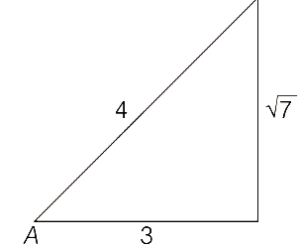
જો $A$ ત્રીજા ચરણમાં હોય અને $\tan A = \frac{\sqrt{7}}{3}$ હોય,તો $18 - 16 \sin^2 \frac{A}{2} - 32 \sin \frac{A}{2} \sin \frac{5A}{2} = $
A
-$6$
B
$11$
C
$5$
D
$10$
Solution
(B) આપેલ પદાવલિ: $18 - 16 \sin^2 \frac{A}{2} - 32 \sin \frac{A}{2} \sin \frac{5A}{2}$
$= 18 - 8(2 \sin^2 \frac{A}{2}) - 16(2 \sin \frac{A}{2} \sin \frac{5A}{2})$
$2 \sin^2 \theta = 1 - \cos 2\theta$ અને $2 \sin X \sin Y = \cos(X-Y) - \cos(X+Y)$ નો ઉપયોગ કરતા:
$= 18 - 8(1 - \cos A) - 16(\cos(2A) - \cos(3A))$
$= 18 - 8 + 8 \cos A - 16 \cos 2A + 16 \cos 3A$
$= 10 + 8 \cos A - 16(2 \cos^2 A - 1) + 16(4 \cos^3 A - 3 \cos A)$
$A$ ત્રીજા ચરણમાં હોવાથી અને $\tan A = \frac{\sqrt{7}}{3}$ હોવાથી,$\cos A = -\frac{3}{4}$ મળે.
$\cos A = -\frac{3}{4}$ મૂકતા:
$= 10 + 8(-\frac{3}{4}) - 16(2(\frac{9}{16}) - 1) + 16(4(-\frac{27}{64}) - 3(-\frac{3}{4}))$
$= 10 - 6 - 16(\frac{18}{16} - 1) + 16(-\frac{27}{16} + \frac{9}{4})$
$= 4 - 16(\frac{2}{16}) + 16(\frac{-27+36}{16})$
$= 4 - 2 + 9 = 11$.
$= 18 - 8(2 \sin^2 \frac{A}{2}) - 16(2 \sin \frac{A}{2} \sin \frac{5A}{2})$
$2 \sin^2 \theta = 1 - \cos 2\theta$ અને $2 \sin X \sin Y = \cos(X-Y) - \cos(X+Y)$ નો ઉપયોગ કરતા:
$= 18 - 8(1 - \cos A) - 16(\cos(2A) - \cos(3A))$
$= 18 - 8 + 8 \cos A - 16 \cos 2A + 16 \cos 3A$
$= 10 + 8 \cos A - 16(2 \cos^2 A - 1) + 16(4 \cos^3 A - 3 \cos A)$
$A$ ત્રીજા ચરણમાં હોવાથી અને $\tan A = \frac{\sqrt{7}}{3}$ હોવાથી,$\cos A = -\frac{3}{4}$ મળે.
$\cos A = -\frac{3}{4}$ મૂકતા:
$= 10 + 8(-\frac{3}{4}) - 16(2(\frac{9}{16}) - 1) + 16(4(-\frac{27}{64}) - 3(-\frac{3}{4}))$
$= 10 - 6 - 16(\frac{18}{16} - 1) + 16(-\frac{27}{16} + \frac{9}{4})$
$= 4 - 16(\frac{2}{16}) + 16(\frac{-27+36}{16})$
$= 4 - 2 + 9 = 11$.
0 likes
View Solution490
DifficultMCQ
જો $x=\log _e\left[\cot \left(\frac{\pi}{4}+\theta\right)\right]$ અને $\theta \in\left(\frac{-\pi}{4}, \frac{\pi}{4}\right)$ હોય,તો નીચેના વિધાનો ધ્યાનમાં લો:
$I$ : $\cosh x=\sec 2 \theta$
$II$ : $\sinh x=-\tan 2 \theta$
તો નીચેનામાંથી કયો વિકલ્પ સાચો છે?
$I$ : $\cosh x=\sec 2 \theta$
$II$ : $\sinh x=-\tan 2 \theta$
તો નીચેનામાંથી કયો વિકલ્પ સાચો છે?
A
$I$ સાચું છે અને $II$ ખોટું છે
B
$I$ ખોટું છે અને $II$ સાચું છે
C
$I$ અને $II$ બંને સાચા છે
D
$I$ અને $II$ બંને ખોટા છે
Solution
(C) આપેલ છે,$x=\log _e\left[\cot \left(\frac{\pi}{4}+\theta\right)\right]$
$\Rightarrow e^x =\cot \left(\frac{\pi}{4}+\theta\right) = \frac{\cos \theta-\sin \theta}{\cos \theta+\sin \theta}$
હવે,$\cosh x = \frac{e^x+e^{-x}}{2} = \frac{1}{2}\left[\frac{\cos \theta-\sin \theta}{\cos \theta+\sin \theta} + \frac{\cos \theta+\sin \theta}{\cos \theta-\sin \theta}\right]$
$= \frac{1}{2}\left[\frac{(\cos \theta-\sin \theta)^2+(\cos \theta+\sin \theta)^2}{\cos^2 \theta-\sin^2 \theta}\right] = \frac{1}{2}\left[\frac{2(\cos^2 \theta+\sin^2 \theta)}{\cos 2 \theta}\right] = \frac{1}{\cos 2 \theta} = \sec 2 \theta$
તેથી,વિધાન $I$ સાચું છે.
હવે,$\sinh x = \frac{e^x-e^{-x}}{2} = \frac{1}{2}\left[\frac{\cos \theta-\sin \theta}{\cos \theta+\sin \theta} - \frac{\cos \theta+\sin \theta}{\cos \theta-\sin \theta}\right]$
$= \frac{1}{2}\left[\frac{(\cos \theta-\sin \theta)^2-(\cos \theta+\sin \theta)^2}{\cos^2 \theta-\sin^2 \theta}\right] = \frac{1}{2}\left[\frac{-4 \sin \theta \cos \theta}{\cos 2 \theta}\right] = \frac{-\sin 2 \theta}{\cos 2 \theta} = -\tan 2 \theta$
તેથી,વિધાન $II$ સાચું છે.
$\Rightarrow e^x =\cot \left(\frac{\pi}{4}+\theta\right) = \frac{\cos \theta-\sin \theta}{\cos \theta+\sin \theta}$
હવે,$\cosh x = \frac{e^x+e^{-x}}{2} = \frac{1}{2}\left[\frac{\cos \theta-\sin \theta}{\cos \theta+\sin \theta} + \frac{\cos \theta+\sin \theta}{\cos \theta-\sin \theta}\right]$
$= \frac{1}{2}\left[\frac{(\cos \theta-\sin \theta)^2+(\cos \theta+\sin \theta)^2}{\cos^2 \theta-\sin^2 \theta}\right] = \frac{1}{2}\left[\frac{2(\cos^2 \theta+\sin^2 \theta)}{\cos 2 \theta}\right] = \frac{1}{\cos 2 \theta} = \sec 2 \theta$
તેથી,વિધાન $I$ સાચું છે.
હવે,$\sinh x = \frac{e^x-e^{-x}}{2} = \frac{1}{2}\left[\frac{\cos \theta-\sin \theta}{\cos \theta+\sin \theta} - \frac{\cos \theta+\sin \theta}{\cos \theta-\sin \theta}\right]$
$= \frac{1}{2}\left[\frac{(\cos \theta-\sin \theta)^2-(\cos \theta+\sin \theta)^2}{\cos^2 \theta-\sin^2 \theta}\right] = \frac{1}{2}\left[\frac{-4 \sin \theta \cos \theta}{\cos 2 \theta}\right] = \frac{-\sin 2 \theta}{\cos 2 \theta} = -\tan 2 \theta$
તેથી,વિધાન $II$ સાચું છે.
0 likes
View Solution491
MediumMCQ
જો $\tanh ^2 x = \tan ^2 \theta$ હોય,તો $\cosh 2x =$
A
$\cos \theta$
B
$\sin \theta$
C
$\cos 2\theta$
D
$\sec 2\theta$
Solution
(D) આપણને આપેલ છે કે $\tanh ^2 x = \tan ^2 \theta$.
નિત્યસમ $\cosh 2x = \frac{1 + \tanh ^2 x}{1 - \tanh ^2 x}$ નો ઉપયોગ કરીને,આપણે $\tanh ^2 x = \tan ^2 \theta$ મૂકીએ:
$\cosh 2x = \frac{1 + \tan ^2 \theta}{1 - \tan ^2 \theta}$.
આપણે જાણીએ છીએ કે $1 + \tan ^2 \theta = \sec ^2 \theta$ અને $1 - \tan ^2 \theta = \frac{\cos ^2 \theta - \sin ^2 \theta}{\cos ^2 \theta} = \frac{\cos 2\theta}{\cos ^2 \theta}$.
આમ,$\cosh 2x = \frac{\sec ^2 \theta}{\frac{\cos 2\theta}{\cos ^2 \theta}} = \frac{1}{\cos ^2 \theta} \times \frac{\cos ^2 \theta}{\cos 2\theta} = \frac{1}{\cos 2\theta} = \sec 2\theta$.
તેથી,સાચો વિકલ્પ $D$ છે.
નિત્યસમ $\cosh 2x = \frac{1 + \tanh ^2 x}{1 - \tanh ^2 x}$ નો ઉપયોગ કરીને,આપણે $\tanh ^2 x = \tan ^2 \theta$ મૂકીએ:
$\cosh 2x = \frac{1 + \tan ^2 \theta}{1 - \tan ^2 \theta}$.
આપણે જાણીએ છીએ કે $1 + \tan ^2 \theta = \sec ^2 \theta$ અને $1 - \tan ^2 \theta = \frac{\cos ^2 \theta - \sin ^2 \theta}{\cos ^2 \theta} = \frac{\cos 2\theta}{\cos ^2 \theta}$.
આમ,$\cosh 2x = \frac{\sec ^2 \theta}{\frac{\cos 2\theta}{\cos ^2 \theta}} = \frac{1}{\cos ^2 \theta} \times \frac{\cos ^2 \theta}{\cos 2\theta} = \frac{1}{\cos 2\theta} = \sec 2\theta$.
તેથી,સાચો વિકલ્પ $D$ છે.
0 likes
View Solution492
MediumMCQ
જો $\cos \theta = \frac{\cos \alpha - \cos \beta}{1 - \cos \alpha \cos \beta}$ હોય,તો $\tan \frac{\theta}{2}$ ની એક કિંમત શું થાય?
A
$\cot \frac{\beta}{2} \tan \frac{\alpha}{2}$
B
$\tan \alpha \tan \frac{\beta}{2}$
C
$\tan \frac{\beta}{2} \cot \frac{\alpha}{2}$
D
$\tan ^2 \frac{\alpha}{2} \tan ^2 \frac{\beta}{2}$
Solution
(A) આપેલ છે,$\cos \theta = \frac{\cos \alpha - \cos \beta}{1 - \cos \alpha \cos \beta}$.
યોગ-વિયોગની રીતનો ઉપયોગ કરતા:
$\frac{1 + \cos \theta}{1 - \cos \theta} = \frac{1 + \frac{\cos \alpha - \cos \beta}{1 - \cos \alpha \cos \beta}}{1 - \frac{\cos \alpha - \cos \beta}{1 - \cos \alpha \cos \beta}}$
$\frac{1 + \cos \theta}{1 - \cos \theta} = \frac{(1 + \cos \alpha)(1 - \cos \beta)}{(1 - \cos \alpha)(1 + \cos \beta)}$
અડધા ખૂણાના સૂત્રોનો ઉપયોગ કરતા:
$\cot^2 \frac{\theta}{2} = \cot^2 \frac{\alpha}{2} \tan^2 \frac{\beta}{2}$
બંને બાજુ વ્યસ્ત લેતા:
$\tan^2 \frac{\theta}{2} = \tan^2 \frac{\alpha}{2} \cot^2 \frac{\beta}{2}$
વર્ગમૂળ લેતા:
$\tan \frac{\theta}{2} = \tan \frac{\alpha}{2} \cot \frac{\beta}{2}$
યોગ-વિયોગની રીતનો ઉપયોગ કરતા:
$\frac{1 + \cos \theta}{1 - \cos \theta} = \frac{1 + \frac{\cos \alpha - \cos \beta}{1 - \cos \alpha \cos \beta}}{1 - \frac{\cos \alpha - \cos \beta}{1 - \cos \alpha \cos \beta}}$
$\frac{1 + \cos \theta}{1 - \cos \theta} = \frac{(1 + \cos \alpha)(1 - \cos \beta)}{(1 - \cos \alpha)(1 + \cos \beta)}$
અડધા ખૂણાના સૂત્રોનો ઉપયોગ કરતા:
$\cot^2 \frac{\theta}{2} = \cot^2 \frac{\alpha}{2} \tan^2 \frac{\beta}{2}$
બંને બાજુ વ્યસ્ત લેતા:
$\tan^2 \frac{\theta}{2} = \tan^2 \frac{\alpha}{2} \cot^2 \frac{\beta}{2}$
વર્ગમૂળ લેતા:
$\tan \frac{\theta}{2} = \tan \frac{\alpha}{2} \cot \frac{\beta}{2}$
0 likes
View Solution493
MediumMCQ
પદાવલિ $\frac{1+\sin 2 \alpha}{\cos (2 \alpha-2 \pi) \tan \left(\alpha-\frac{3 \pi}{4}\right)} - \frac{1}{4} \sin 2 \alpha \left[\cot \frac{\alpha}{2}+\cot \left(\frac{3 \pi}{2}+\frac{\alpha}{2}\right)\right]$ ની કિંમત શોધો.
A
$0$
B
$1$
C
$\sin ^2 \frac{\alpha}{2}$
D
$\sin ^2 \alpha$
Solution
(D) ધારો કે પદાવલિ $E$ છે.
$E = \frac{1+\sin 2 \alpha}{\cos 2 \alpha \tan (\alpha - \frac{3\pi}{4})} - \frac{1}{4} \sin 2 \alpha [\cot \frac{\alpha}{2} - \tan \frac{\alpha}{2}]$
ત્રિકોણમિતીય નિત્યસમનો ઉપયોગ કરતા,
$E = 1 - \sin^2 \alpha = \cos^2 \alpha$.
$E = \frac{1+\sin 2 \alpha}{\cos 2 \alpha \tan (\alpha - \frac{3\pi}{4})} - \frac{1}{4} \sin 2 \alpha [\cot \frac{\alpha}{2} - \tan \frac{\alpha}{2}]$
ત્રિકોણમિતીય નિત્યસમનો ઉપયોગ કરતા,
$E = 1 - \sin^2 \alpha = \cos^2 \alpha$.
0 likes
View Solution494
MediumMCQ
જો $\frac{1}{6} \sin \theta, \cos \theta$ અને $\tan \theta$ સમગુણોત્તર શ્રેણીમાં હોય,તો $\theta$ નો ઉકેલ ગણ શું છે?
A
$2 n \pi \pm \frac{\pi}{6}$
B
$2 n \pi \pm \frac{\pi}{3}$
C
$n \pi + (-1)^n \frac{\pi}{3}$
D
$n \pi \pm \frac{\pi}{3}$
Solution
(B) આપેલ છે કે $\frac{1}{6} \sin \theta, \cos \theta, \tan \theta$ સમગુણોત્તર શ્રેણીમાં છે.
તેથી,$\cos^2 \theta = \frac{1}{6} \sin \theta \cdot \tan \theta$.
$\cos^2 \theta = \frac{\sin^2 \theta}{6 \cos \theta} \implies 6 \cos^3 \theta = \sin^2 \theta$.
$\sin^2 \theta = 1 - \cos^2 \theta$ હોવાથી,$6 \cos^3 \theta = 1 - \cos^2 \theta$.
$6 \cos^3 \theta + \cos^2 \theta - 1 = 0$.
ધારો કે $x = \cos \theta$. તો $6x^3 + x^2 - 1 = 0$.
નિરીક્ષણ દ્વારા,$x = \frac{1}{2}$ એ એક ઉકેલ છે.
$6x^3 + x^2 - 1$ ને $(2x - 1)$ વડે ભાગતા,આપણને $3x^2 + 2x + 1 = 0$ મળે છે.
$3x^2 + 2x + 1$ નો વિવેચક $D = 4 - 12 = -8 < 0$ છે,તેથી કોઈ વાસ્તવિક ઉકેલ નથી.
આમ,$\cos \theta = \frac{1}{2} = \cos \frac{\pi}{3}$.
વ્યાપક ઉકેલ $\theta = 2n\pi \pm \frac{\pi}{3}$ છે.
તેથી,$\cos^2 \theta = \frac{1}{6} \sin \theta \cdot \tan \theta$.
$\cos^2 \theta = \frac{\sin^2 \theta}{6 \cos \theta} \implies 6 \cos^3 \theta = \sin^2 \theta$.
$\sin^2 \theta = 1 - \cos^2 \theta$ હોવાથી,$6 \cos^3 \theta = 1 - \cos^2 \theta$.
$6 \cos^3 \theta + \cos^2 \theta - 1 = 0$.
ધારો કે $x = \cos \theta$. તો $6x^3 + x^2 - 1 = 0$.
નિરીક્ષણ દ્વારા,$x = \frac{1}{2}$ એ એક ઉકેલ છે.
$6x^3 + x^2 - 1$ ને $(2x - 1)$ વડે ભાગતા,આપણને $3x^2 + 2x + 1 = 0$ મળે છે.
$3x^2 + 2x + 1$ નો વિવેચક $D = 4 - 12 = -8 < 0$ છે,તેથી કોઈ વાસ્તવિક ઉકેલ નથી.
આમ,$\cos \theta = \frac{1}{2} = \cos \frac{\pi}{3}$.
વ્યાપક ઉકેલ $\theta = 2n\pi \pm \frac{\pi}{3}$ છે.
0 likes
View Solution495
DifficultMCQ
જો $\cos \theta - 4 \sin \theta = 1$ હોય,તો $\sin \theta + 4 \cos \theta$ ની કિંમત શોધો.
A
$\pm 1$
B
$0$
C
$\pm 2$
D
$\pm 4$
Solution
(D) ધારો કે $x = \cos \theta - 4 \sin \theta = 1$ અને $y = \sin \theta + 4 \cos \theta$.
બંને સમીકરણોનો વર્ગ કરીને સરવાળો કરતા:
$x^2 + y^2 = (\cos \theta - 4 \sin \theta)^2 + (\sin \theta + 4 \cos \theta)^2$
$x^2 + y^2 = (\cos^2 \theta + 16 \sin^2 \theta - 8 \sin \theta \cos \theta) + (\sin^2 \theta + 16 \cos^2 \theta + 8 \sin \theta \cos \theta)$
$x^2 + y^2 = \cos^2 \theta + \sin^2 \theta + 16(\sin^2 \theta + \cos^2 \theta)$
$x^2 + y^2 = 1 + 16(1) = 17$
અહીં $x = 1$ હોવાથી,$1^2 + y^2 = 17$
$y^2 = 16$
$y = \pm 4$
તેથી,$\sin \theta + 4 \cos \theta = \pm 4$.
બંને સમીકરણોનો વર્ગ કરીને સરવાળો કરતા:
$x^2 + y^2 = (\cos \theta - 4 \sin \theta)^2 + (\sin \theta + 4 \cos \theta)^2$
$x^2 + y^2 = (\cos^2 \theta + 16 \sin^2 \theta - 8 \sin \theta \cos \theta) + (\sin^2 \theta + 16 \cos^2 \theta + 8 \sin \theta \cos \theta)$
$x^2 + y^2 = \cos^2 \theta + \sin^2 \theta + 16(\sin^2 \theta + \cos^2 \theta)$
$x^2 + y^2 = 1 + 16(1) = 17$
અહીં $x = 1$ હોવાથી,$1^2 + y^2 = 17$
$y^2 = 16$
$y = \pm 4$
તેથી,$\sin \theta + 4 \cos \theta = \pm 4$.
0 likes
View Solution496
DifficultMCQ
$\mathbb{R}$ પર $4 \cos \left(x^2\right) \cos \left(\frac{\pi}{3}+x^2\right) \cos \left(\frac{\pi}{3}-x^2\right)$ ના અંતિમ મૂલ્યો કયા છે?
A
$-1, 1$
B
$-2, 2$
C
$-3, 3$
D
$-4, 4$
Solution
(A) ધારો કે $f(x) = 4 \cos \left(x^2\right) \cos \left(\frac{\pi}{3}+x^2\right) \cos \left(\frac{\pi}{3}-x^2\right)$.
નિત્યસમ $2 \cos A \cos B = \cos(A+B) + \cos(A-B)$ નો ઉપયોગ કરતા:
$f(x) = 2 \cos \left(x^2\right) \left[ 2 \cos \left(\frac{\pi}{3}+x^2\right) \cos \left(\frac{\pi}{3}-x^2\right) \right]$
$f(x) = 2 \cos \left(x^2\right) \left[ \cos \left(\frac{2\pi}{3}\right) + \cos \left(2x^2\right) \right]$
$\cos \left(\frac{2\pi}{3}\right) = -\frac{1}{2}$ હોવાથી:
$f(x) = 2 \cos \left(x^2\right) \left[ -\frac{1}{2} + \cos \left(2x^2\right) \right]$
$f(x) = -\cos \left(x^2\right) + 2 \cos \left(x^2\right) \cos \left(2x^2\right)$
ફરીથી $2 \cos A \cos B = \cos(A+B) + \cos(A-B)$ નો ઉપયોગ કરતા:
$f(x) = -\cos \left(x^2\right) + \cos \left(3x^2\right) + \cos \left(x^2\right)$
$f(x) = \cos \left(3x^2\right) \quad \dots (i)$
$\cos(\theta)$ નો વિસ્તાર $[-1, 1]$ હોવાથી,$f(x) = \cos \left(3x^2\right)$ ના અંતિમ મૂલ્યો $-1$ અને $1$ છે.
નિત્યસમ $2 \cos A \cos B = \cos(A+B) + \cos(A-B)$ નો ઉપયોગ કરતા:
$f(x) = 2 \cos \left(x^2\right) \left[ 2 \cos \left(\frac{\pi}{3}+x^2\right) \cos \left(\frac{\pi}{3}-x^2\right) \right]$
$f(x) = 2 \cos \left(x^2\right) \left[ \cos \left(\frac{2\pi}{3}\right) + \cos \left(2x^2\right) \right]$
$\cos \left(\frac{2\pi}{3}\right) = -\frac{1}{2}$ હોવાથી:
$f(x) = 2 \cos \left(x^2\right) \left[ -\frac{1}{2} + \cos \left(2x^2\right) \right]$
$f(x) = -\cos \left(x^2\right) + 2 \cos \left(x^2\right) \cos \left(2x^2\right)$
ફરીથી $2 \cos A \cos B = \cos(A+B) + \cos(A-B)$ નો ઉપયોગ કરતા:
$f(x) = -\cos \left(x^2\right) + \cos \left(3x^2\right) + \cos \left(x^2\right)$
$f(x) = \cos \left(3x^2\right) \quad \dots (i)$
$\cos(\theta)$ નો વિસ્તાર $[-1, 1]$ હોવાથી,$f(x) = \cos \left(3x^2\right)$ ના અંતિમ મૂલ્યો $-1$ અને $1$ છે.
0 likes
View Solution497
DifficultMCQ
$\sum_{k=1}^3 \cos^2 \left((2k-1) \frac{\pi}{12}\right)$ ની કિંમત શોધો.
A
$1$
B
$\frac{3}{2}$
C
$2$
D
$\frac{1}{2}$
Solution
(B) આપણે સરવાળો $S = \sum_{k=1}^3 \cos^2 \left((2k-1) \frac{\pi}{12}\right)$ ની ગણતરી કરવાની છે.
$k=1, 2, 3$ માટે સરવાળો વિસ્તૃત કરતા:
$S = \cos^2 \left(\frac{\pi}{12}\right) + \cos^2 \left(\frac{3\pi}{12}\right) + \cos^2 \left(\frac{5\pi}{12}\right)$.
ખૂણાઓને સરળ બનાવતા:
$S = \cos^2 \left(\frac{\pi}{12}\right) + \cos^2 \left(\frac{\pi}{4}\right) + \cos^2 \left(\frac{5\pi}{12}\right)$.
કારણ કે $\cos \left(\frac{5\pi}{12}\right) = \cos \left(\frac{\pi}{2} - \frac{\pi}{12}\right) = \sin \left(\frac{\pi}{12}\right)$,તેથી $\cos^2 \left(\frac{5\pi}{12}\right) = \sin^2 \left(\frac{\pi}{12}\right)$.
આ કિંમત સરવાળામાં મૂકતા:
$S = \cos^2 \left(\frac{\pi}{12}\right) + \sin^2 \left(\frac{\pi}{12}\right) + \cos^2 \left(\frac{\pi}{4}\right)$.
નિત્યસમ $\cos^2 \theta + \sin^2 \theta = 1$ નો ઉપયોગ કરતા:
$S = 1 + \left(\frac{1}{\sqrt{2}}\right)^2 = 1 + \frac{1}{2} = \frac{3}{2}$.
$k=1, 2, 3$ માટે સરવાળો વિસ્તૃત કરતા:
$S = \cos^2 \left(\frac{\pi}{12}\right) + \cos^2 \left(\frac{3\pi}{12}\right) + \cos^2 \left(\frac{5\pi}{12}\right)$.
ખૂણાઓને સરળ બનાવતા:
$S = \cos^2 \left(\frac{\pi}{12}\right) + \cos^2 \left(\frac{\pi}{4}\right) + \cos^2 \left(\frac{5\pi}{12}\right)$.
કારણ કે $\cos \left(\frac{5\pi}{12}\right) = \cos \left(\frac{\pi}{2} - \frac{\pi}{12}\right) = \sin \left(\frac{\pi}{12}\right)$,તેથી $\cos^2 \left(\frac{5\pi}{12}\right) = \sin^2 \left(\frac{\pi}{12}\right)$.
આ કિંમત સરવાળામાં મૂકતા:
$S = \cos^2 \left(\frac{\pi}{12}\right) + \sin^2 \left(\frac{\pi}{12}\right) + \cos^2 \left(\frac{\pi}{4}\right)$.
નિત્યસમ $\cos^2 \theta + \sin^2 \theta = 1$ નો ઉપયોગ કરતા:
$S = 1 + \left(\frac{1}{\sqrt{2}}\right)^2 = 1 + \frac{1}{2} = \frac{3}{2}$.
0 likes
View SolutionTrigonometrical Ratios, Functions and Identities — Mix Examples-Trigonometrical Ratios, Functions and Identities · Frequently Asked Questions
1Are these Trigonometrical Ratios, Functions and Identities questions useful for JEE and NEET?
Yes. All questions in this section are mapped to JEE Main and NEET exam patterns. Previous year questions from JEE Main, NEET, GUJCET and state-level exams are included with full solutions.
2Can I switch to Hindi or Gujarati for these questions?
Yes. Use the language tabs in the hero section or the sidebar to view the same questions and solutions in English, Hindi or Gujarati.
3How do I generate a question paper from this subtopic?
Use the Vedclass Exam Paper Generator — select the chapter and subtopic, set difficulty, and generate Sets A, B, C, D automatically. First 3 chapters of every subject are free.
Vedclass Products
For Students
Vedclass Test Series
Mock tests in real JEE/NEET style with performance analysis. 5-day free trial.
Start Free TrialFor Teachers
Exam Paper Generator
Generate Set A/B/C/D papers from this chapter in 2 minutes. 3 chapters free.
Try FreeFor Institutes
Online Exam Module
Live online exams with unlimited students, 360° analytics & white-label branding.
See DemoFor Teachers & Institutes
Generate a Trigonometrical Ratios, Functions and Identities Exam Paper in 2 Minutes
Select subtopic & difficulty — Sets A, B, C, D auto-generated with No Repeat logic.
First 3 chapters of every subject are free — no payment required.