
A English
Venn Diagram and Operation on Sets Questions in English
Class 11 Mathematics · Set Theory · Venn Diagram and Operation on Sets
135+
Questions
English
Language
100%
With Solutions
Showing 50 of 135 questions in English
1
EasyMCQ
Given the sets $A = \{1, 2, 3\}$,$B = \{3, 4\}$,and $C = \{4, 5, 6\}$,find $A \cup (B \cap C)$.
A
$\{3\}$
B
$\{1, 2, 3, 4\}$
C
$\{1, 2, 4, 5\}$
D
$\{1, 2, 3, 4, 5, 6\}$
Solution
(B) Step $1$: Find the intersection of sets $B$ and $C$.
$B \cap C = \{3, 4\} \cap \{4, 5, 6\} = \{4\}$.
Step $2$: Find the union of set $A$ with the result from Step $1$.
$A \cup (B \cap C) = \{1, 2, 3\} \cup \{4\} = \{1, 2, 3, 4\}$.
$B \cap C = \{3, 4\} \cap \{4, 5, 6\} = \{4\}$.
Step $2$: Find the union of set $A$ with the result from Step $1$.
$A \cup (B \cap C) = \{1, 2, 3\} \cup \{4\} = \{1, 2, 3, 4\}$.
0 likes
View Solution2
MediumMCQ
If the sets $A$ and $B$ are defined as $A = \{ (x, y) : y = \frac{1}{x}, x \in R, x \neq 0 \}$ and $B = \{ (x, y) : y = -x, x \in R \}$,then:
A
$A \cap B = A$
B
$A \cap B = B$
C
$A \cap B = \phi$
D
None of these
Solution
(C) To find the intersection $A \cap B$,we need to find the points $(x, y)$ that satisfy both equations:
$y = \frac{1}{x}$ and $y = -x$.
Substituting the second equation into the first,we get:
$-x = \frac{1}{x}$
$-x^2 = 1$
$x^2 = -1$
Since $x$ must be a real number $(x \in R)$,there is no real value of $x$ that satisfies $x^2 = -1$.
Therefore,there are no common points between sets $A$ and $B$.
Hence,$A \cap B = \phi$.
$y = \frac{1}{x}$ and $y = -x$.
Substituting the second equation into the first,we get:
$-x = \frac{1}{x}$
$-x^2 = 1$
$x^2 = -1$
Since $x$ must be a real number $(x \in R)$,there is no real value of $x$ that satisfies $x^2 = -1$.
Therefore,there are no common points between sets $A$ and $B$.
Hence,$A \cap B = \phi$.
0 likes
View Solution3
EasyMCQ
If $A, B$ and $C$ are non-empty sets,then $(A - B) \cup (B - A)$ equals:
A
$(A \cup B) - B$
B
$A - (A \cap B)$
C
$(A \cup B) - (A \cap B)$
D
$(A \cap B) \cup (A \cup B)$
Solution
(C) The expression $(A - B) \cup (B - A)$ represents the symmetric difference of sets $A$ and $B$,denoted as $A \Delta B$.
By definition,$A - B = A \cap B^c$ and $B - A = B \cap A^c$.
Thus,$(A - B) \cup (B - A) = (A \cap B^c) \cup (B \cap A^c)$.
Using the distributive law,this simplifies to $(A \cup B) - (A \cap B)$,which contains all elements that are in either $A$ or $B$ but not in both.
Therefore,the correct option is $(C)$.
By definition,$A - B = A \cap B^c$ and $B - A = B \cap A^c$.
Thus,$(A - B) \cup (B - A) = (A \cap B^c) \cup (B \cap A^c)$.
Using the distributive law,this simplifies to $(A \cup B) - (A \cap B)$,which contains all elements that are in either $A$ or $B$ but not in both.
Therefore,the correct option is $(C)$.
0 likes
View Solution4
EasyMCQ
If $P, Q$ and $R$ are subsets of a set $A$,then $R \times (P^c \cup Q^c)^c =$
A
$(R \times P) \cap (R \times Q)$
B
$(R \times Q) \cup (R \times P)$
C
$(R \times P) \cup (R \times Q)$
D
None of these
Solution
(A) Given the expression $R \times (P^c \cup Q^c)^c$.
Using De Morgan's Law,we know that $(P^c \cup Q^c)^c = (P^c)^c \cap (Q^c)^c = P \cap Q$.
Substituting this back into the expression,we get $R \times (P \cap Q)$.
Using the distributive property of the Cartesian product over intersection,$R \times (P \cap Q) = (R \times P) \cap (R \times Q)$.
Thus,the correct option is $A$.
Using De Morgan's Law,we know that $(P^c \cup Q^c)^c = (P^c)^c \cap (Q^c)^c = P \cap Q$.
Substituting this back into the expression,we get $R \times (P \cap Q)$.
Using the distributive property of the Cartesian product over intersection,$R \times (P \cap Q) = (R \times P) \cap (R \times Q)$.
Thus,the correct option is $A$.
0 likes
View Solution5
EasyMCQ
If $A = \{2, 3, 4, 8, 10\}$,$B = \{3, 4, 5, 10, 12\}$,and $C = \{4, 5, 6, 12, 14\}$,then $(A \cap B) \cup (A \cap C)$ is equal to
A
$\{3, 4, 10\}$
B
$\{2, 8, 10\}$
C
$\{4, 5, 6\}$
D
$\{3, 5, 14\}$
Solution
(A) First,find the intersection $A \cap B$:
$A \cap B = \{2, 3, 4, 8, 10\} \cap \{3, 4, 5, 10, 12\} = \{3, 4, 10\}$.
Next,find the intersection $A \cap C$:
$A \cap C = \{2, 3, 4, 8, 10\} \cap \{4, 5, 6, 12, 14\} = \{4\}$.
Finally,find the union of these two sets:
$(A \cap B) \cup (A \cap C) = \{3, 4, 10\} \cup \{4\} = \{3, 4, 10\}$.
$A \cap B = \{2, 3, 4, 8, 10\} \cap \{3, 4, 5, 10, 12\} = \{3, 4, 10\}$.
Next,find the intersection $A \cap C$:
$A \cap C = \{2, 3, 4, 8, 10\} \cap \{4, 5, 6, 12, 14\} = \{4\}$.
Finally,find the union of these two sets:
$(A \cap B) \cup (A \cap C) = \{3, 4, 10\} \cup \{4\} = \{3, 4, 10\}$.
0 likes
View Solution6
EasyMCQ
If $A$ and $B$ are any two sets,then $A \cap (A \cup B)$ is equal to
A
$A$
B
$B$
C
$A^c$
D
$B^c$
Solution
(A) By the distributive law of sets,$A \cap (A \cup B) = (A \cap A) \cup (A \cap B)$.
Since $A \cap A = A$,the expression becomes $A \cup (A \cap B)$.
Since $(A \cap B) \subseteq A$,the union of $A$ and a subset of $A$ is simply $A$.
Therefore,$A \cap (A \cup B) = A$.
Since $A \cap A = A$,the expression becomes $A \cup (A \cap B)$.
Since $(A \cap B) \subseteq A$,the union of $A$ and a subset of $A$ is simply $A$.
Therefore,$A \cap (A \cup B) = A$.
0 likes
View Solution7
EasyMCQ
Let $A = \{a, b, c\}, B = \{b, c, d\}, C = \{a, b, d, e\}$. Then $A \cap (B \cup C)$ is
A
$\{a, b, c\}$
B
$\{b, c, d\}$
C
$\{a, b, d, e\}$
D
$\{e\}$
Solution
(A) First,find the union of sets $B$ and $C$:
$B \cup C = \{b, c, d\} \cup \{a, b, d, e\} = \{a, b, c, d, e\}$.
Now,find the intersection of set $A$ with the resulting set:
$A \cap (B \cup C) = \{a, b, c\} \cap \{a, b, c, d, e\} = \{a, b, c\}$.
Therefore,the correct option is $A$.
$B \cup C = \{b, c, d\} \cup \{a, b, d, e\} = \{a, b, c, d, e\}$.
Now,find the intersection of set $A$ with the resulting set:
$A \cap (B \cup C) = \{a, b, c\} \cap \{a, b, c, d, e\} = \{a, b, c\}$.
Therefore,the correct option is $A$.
0 likes
View Solution8
EasyMCQ
If $A$ and $B$ are sets,then $A \cap (B - A)$ is
A
$\phi$
B
$A$
C
$B$
D
None of these
Solution
(A) By the definition of set difference,$B - A$ is the set of elements that are in $B$ but not in $A$.
Therefore,any element $x \in (B - A)$ satisfies $x \notin A$.
Since $A \cap (B - A)$ consists of elements that are in both $A$ and $(B - A)$,and no element can be in both $A$ and $(B - A)$ simultaneously,the intersection is the empty set.
Thus,$A \cap (B - A) = \phi$.
Therefore,any element $x \in (B - A)$ satisfies $x \notin A$.
Since $A \cap (B - A)$ consists of elements that are in both $A$ and $(B - A)$,and no element can be in both $A$ and $(B - A)$ simultaneously,the intersection is the empty set.
Thus,$A \cap (B - A) = \phi$.
0 likes
View Solution9
EasyMCQ
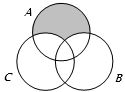
The shaded region in the given figure is
A
$A \cap (B \cup C)$
B
$A \cup (B \cap C)$
C
$A \cap (B - C)$
D
$A - (B \cup C)$
Solution
(D) The shaded region represents the elements that are in set $A$ but are not in set $B$ and not in set $C$.
This means the region belongs to $A$ and excludes the union of sets $B$ and $C$.
Therefore,the shaded region is represented by $A - (B \cup C)$.
This means the region belongs to $A$ and excludes the union of sets $B$ and $C$.
Therefore,the shaded region is represented by $A - (B \cup C)$.
0 likes
View Solution10
EasyMCQ
If $A$ and $B$ are two sets,then $(A - B) \cup (B - A) \cup (A \cap B)$ is equal to
A
$A \cup B$
B
$A \cap B$
C
$A$
D
$B'$
Solution
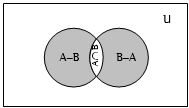
(A) From the Venn diagram,the set $A$ is composed of elements in $(A - B)$ and $(A \cap B)$.
Similarly,the set $B$ is composed of elements in $(B - A)$ and $(A \cap B)$.
The union of these disjoint regions is $(A - B) \cup (B - A) \cup (A \cap B) = A \cup B$.
Similarly,the set $B$ is composed of elements in $(B - A)$ and $(A \cap B)$.
The union of these disjoint regions is $(A - B) \cup (B - A) \cup (A \cap B) = A \cup B$.
0 likes
View Solution11
MediumMCQ
Let $A$ and $B$ be two sets,then $(A \cup B)' \cup (A' \cap B)$ is equal to
A
$A'$
B
$A$
C
$B'$
D
None of these
Solution
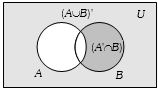
(A) Using De Morgan's Law,$(A \cup B)' = A' \cap B'$.
So,the expression becomes $(A' \cap B') \cup (A' \cap B)$.
By the distributive law,this is equivalent to $A' \cap (B' \cup B)$.
Since $B' \cup B = U$ (the universal set),we have $A' \cap U = A'$.
Thus,$(A \cup B)' \cup (A' \cap B) = A'$.
So,the expression becomes $(A' \cap B') \cup (A' \cap B)$.
By the distributive law,this is equivalent to $A' \cap (B' \cup B)$.
Since $B' \cup B = U$ (the universal set),we have $A' \cap U = A'$.
Thus,$(A \cup B)' \cup (A' \cap B) = A'$.
0 likes
View Solution12
EasyMCQ
Let $A$ and $B$ be two sets such that $n(A) = 0.16$,$n(B) = 0.14$,and $n(A \cup B) = 0.25$. Then $n(A \cap B)$ is equal to:
A
$0.3$
B
$0.5$
C
$0.05$
D
None of these
Solution
(C) We use the formula for the union of two sets:
$n(A \cup B) = n(A) + n(B) - n(A \cap B)$
Substituting the given values:
$0.25 = 0.16 + 0.14 - n(A \cap B)$
Simplifying the equation:
$0.25 = 0.30 - n(A \cap B)$
Solving for $n(A \cap B)$:
$n(A \cap B) = 0.30 - 0.25 = 0.05$
$n(A \cup B) = n(A) + n(B) - n(A \cap B)$
Substituting the given values:
$0.25 = 0.16 + 0.14 - n(A \cap B)$
Simplifying the equation:
$0.25 = 0.30 - n(A \cap B)$
Solving for $n(A \cap B)$:
$n(A \cap B) = 0.30 - 0.25 = 0.05$
0 likes
View Solution13
EasyMCQ
If $A$ and $B$ are disjoint,then $n(A \cup B)$ is equal to
A
$n(A)$
B
$n(B)$
C
$n(A) + n(B)$
D
$n(A) \times n(B)$
Solution
(C) Since $A$ and $B$ are disjoint,$A \cap B = \phi$.
Therefore,$n(A \cap B) = 0$.
Using the formula for the union of two sets:
$n(A \cup B) = n(A) + n(B) - n(A \cap B)$
Substituting the value of $n(A \cap B)$:
$n(A \cup B) = n(A) + n(B) - 0 = n(A) + n(B)$.
Therefore,$n(A \cap B) = 0$.
Using the formula for the union of two sets:
$n(A \cup B) = n(A) + n(B) - n(A \cap B)$
Substituting the value of $n(A \cap B)$:
$n(A \cup B) = n(A) + n(B) - 0 = n(A) + n(B)$.
0 likes
View Solution14
EasyMCQ
If $A$ and $B$ are not disjoint sets,then $n(A \cup B)$ is equal to
A
$n(A) + n(B)$
B
$n(A) + n(B) - n(A \cap B)$
C
$n(A) + n(B) + n(A \cap B)$
D
$n(A) \times n(B)$
Solution
(B) For any two sets $A$ and $B$,the number of elements in their union is given by the inclusion-exclusion principle:
$n(A \cup B) = n(A) + n(B) - n(A \cap B)$
Since $A$ and $B$ are not disjoint,$n(A \cap B) \neq 0$,which confirms the formula.
$n(A \cup B) = n(A) + n(B) - n(A \cap B)$
Since $A$ and $B$ are not disjoint,$n(A \cap B) \neq 0$,which confirms the formula.
0 likes
View Solution15
EasyMCQ
Let $A$ and $B$ be two sets in the universal set. Then $A - B$ equals
A
$A \cap B^c$
B
$A^c \cap B$
C
$A \cap B$
D
None of these
Solution
(A) The difference of two sets $A$ and $B$,denoted by $A - B$,is defined as the set of elements which belong to $A$ but do not belong to $B$.
Mathematically,$A - B = \{x : x \in A \text{ and } x \notin B\}$.
Since $x \notin B$ is equivalent to $x \in B^c$,we have $A - B = \{x : x \in A \text{ and } x \in B^c\}$.
Therefore,$A - B = A \cap B^c$.
Mathematically,$A - B = \{x : x \in A \text{ and } x \notin B\}$.
Since $x \notin B$ is equivalent to $x \in B^c$,we have $A - B = \{x : x \in A \text{ and } x \in B^c\}$.
Therefore,$A - B = A \cap B^c$.
0 likes
View Solution16
EasyMCQ
If $A, B$ and $C$ are any three sets,then $A - (B \cap C)$ is equal to
A
$(A - B) \cup (A - C)$
B
$(A - B) \cap (A - C)$
C
$(A - B) \cup C$
D
$(A - B) \cap C$
Solution
(A) Using the set difference property,$A - (B \cap C) = A \cap (B \cap C)^c$.
By De Morgan's Law,$(B \cap C)^c = B^c \cup C^c$.
So,$A \cap (B^c \cup C^c) = (A \cap B^c) \cup (A \cap C^c)$.
Since $A \cap B^c = A - B$ and $A \cap C^c = A - C$,we get $(A - B) \cup (A - C)$.
By De Morgan's Law,$(B \cap C)^c = B^c \cup C^c$.
So,$A \cap (B^c \cup C^c) = (A \cap B^c) \cup (A \cap C^c)$.
Since $A \cap B^c = A - B$ and $A \cap C^c = A - C$,we get $(A - B) \cup (A - C)$.
0 likes
View Solution17
EasyMCQ
If $A, B, C$ are three sets,then $A \cap (B \cup C)$ is equal to
A
$(A \cup B) \cap (A - C)$
B
$(A \cap B) \cup (A \cap C)$
C
$(A \cup B) \cup (A \cup C)$
D
None of these
Solution
(B) According to the Distributive Law of sets,the intersection of a set with the union of two other sets is given by:
$A \cap (B \cup C) = (A \cap B) \cup (A \cap C)$
Therefore,the correct option is $B$.
$A \cap (B \cup C) = (A \cap B) \cup (A \cap C)$
Therefore,the correct option is $B$.
0 likes
View Solution18
EasyMCQ
If $A = \{1, 2, 3, 4, 5\}, B = \{2, 4, 6\}, C = \{3, 4, 6\},$ then $(A \cup B) \cap C$ is
A
$\{3, 4, 6\}$
B
$\{1, 2, 3\}$
C
$\{1, 4, 3\}$
D
None of these
Solution
(A) First,find the union of sets $A$ and $B$:
$A \cup B = \{1, 2, 3, 4, 5\} \cup \{2, 4, 6\} = \{1, 2, 3, 4, 5, 6\}$.
Next,find the intersection of $(A \cup B)$ with set $C$:
$(A \cup B) \cap C = \{1, 2, 3, 4, 5, 6\} \cap \{3, 4, 6\} = \{3, 4, 6\}$.
Thus,the correct option is $A$.
$A \cup B = \{1, 2, 3, 4, 5\} \cup \{2, 4, 6\} = \{1, 2, 3, 4, 5, 6\}$.
Next,find the intersection of $(A \cup B)$ with set $C$:
$(A \cup B) \cap C = \{1, 2, 3, 4, 5, 6\} \cap \{3, 4, 6\} = \{3, 4, 6\}$.
Thus,the correct option is $A$.
0 likes
View Solution19
MediumMCQ
If $A = \{x : x \text{ is a multiple of } 4\}$ and $B = \{x : x \text{ is a multiple of } 6\}$,then $A \cap B$ consists of all multiples of:
A
$16$
B
$12$
C
$8$
D
$4$
Solution
(B) Given sets are $A = \{4, 8, 12, 16, 20, 24, \dots\}$ and $B = \{6, 12, 18, 24, 30, \dots\}$.
The intersection $A \cap B$ contains elements that are common to both sets $A$ and $B$.
Since $A$ contains multiples of $4$ and $B$ contains multiples of $6$,the common elements are multiples of the least common multiple $(LCM)$ of $4$ and $6$.
$LCM(4, 6) = 12$.
Thus,$A \cap B = \{12, 24, 36, \dots\}$,which represents all multiples of $12$.
The intersection $A \cap B$ contains elements that are common to both sets $A$ and $B$.
Since $A$ contains multiples of $4$ and $B$ contains multiples of $6$,the common elements are multiples of the least common multiple $(LCM)$ of $4$ and $6$.
$LCM(4, 6) = 12$.
Thus,$A \cap B = \{12, 24, 36, \dots\}$,which represents all multiples of $12$.
0 likes
View Solution20
MediumMCQ
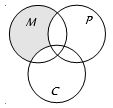
$A$ class has $175$ students. The following data shows the number of students opting for one or more subjects: Mathematics $100$,Physics $70$,Chemistry $40$; Mathematics and Physics $30$,Mathematics and Chemistry $28$,Physics and Chemistry $23$; Mathematics,Physics,and Chemistry $18$. How many students have opted for Mathematics alone?
A
$35$
B
$48$
C
$60$
D
$22$
Solution
(C) Let $M$,$P$,and $C$ represent the sets of students opting for Mathematics,Physics,and Chemistry,respectively.
We are given:
$n(M) = 100$,$n(P) = 70$,$n(C) = 40$
$n(M \cap P) = 30$,$n(M \cap C) = 28$,$n(P \cap C) = 23$
$n(M \cap P \cap C) = 18$
The number of students who have opted for Mathematics alone is given by the formula:
$n(M \text{ only}) = n(M) - n(M \cap P) - n(M \cap C) + n(M \cap P \cap C)$
Substituting the values:
$n(M \text{ only}) = 100 - 30 - 28 + 18$
$n(M \text{ only}) = 100 - 58 + 18$
$n(M \text{ only}) = 42 + 18 = 60$
Thus,$60$ students have opted for Mathematics alone.
We are given:
$n(M) = 100$,$n(P) = 70$,$n(C) = 40$
$n(M \cap P) = 30$,$n(M \cap C) = 28$,$n(P \cap C) = 23$
$n(M \cap P \cap C) = 18$
The number of students who have opted for Mathematics alone is given by the formula:
$n(M \text{ only}) = n(M) - n(M \cap P) - n(M \cap C) + n(M \cap P \cap C)$
Substituting the values:
$n(M \text{ only}) = 100 - 30 - 28 + 18$
$n(M \text{ only}) = 100 - 58 + 18$
$n(M \text{ only}) = 42 + 18 = 60$
Thus,$60$ students have opted for Mathematics alone.
0 likes
View Solution21
EasyMCQ
Consider the following relations:
$(1) \, A - B = A - (A \cap B)$
$(2) \, A = (A \cap B) \cup (A - B)$
$(3) \, A - (B \cup C) = (A - B) \cup (A - C)$
Which of these is/are correct?
$(1) \, A - B = A - (A \cap B)$
$(2) \, A = (A \cap B) \cup (A - B)$
$(3) \, A - (B \cup C) = (A - B) \cup (A - C)$
Which of these is/are correct?
A
$1$ and $3$
B
$2$ only
C
$2$ and $3$
D
$1$ and $2$
Solution
(D) For $(1)$: $A - B$ is the set of elements in $A$ but not in $B$. $A \cap B$ is the set of elements common to $A$ and $B$. Thus,$A - (A \cap B)$ also represents elements in $A$ that are not in $B$. So,$(1)$ is correct.
For $(2)$: The set $A$ can be partitioned into two disjoint sets: elements in $A$ that are also in $B$ $(A \cap B)$ and elements in $A$ that are not in $B$ $(A - B)$. Their union is $A$. So,$(2)$ is correct.
For $(3)$: By De Morgan's Law,$A - (B \cup C) = A \cap (B \cup C)^c = A \cap (B^c \cap C^c) = (A \cap B^c) \cap (A \cap C^c) = (A - B) \cap (A - C)$. The given relation uses $\cup$ instead of $\cap$. So,$(3)$ is incorrect.
Therefore,$(1)$ and $(2)$ are correct.
For $(2)$: The set $A$ can be partitioned into two disjoint sets: elements in $A$ that are also in $B$ $(A \cap B)$ and elements in $A$ that are not in $B$ $(A - B)$. Their union is $A$. So,$(2)$ is correct.
For $(3)$: By De Morgan's Law,$A - (B \cup C) = A \cap (B \cup C)^c = A \cap (B^c \cap C^c) = (A \cap B^c) \cap (A \cap C^c) = (A - B) \cap (A - C)$. The given relation uses $\cup$ instead of $\cap$. So,$(3)$ is incorrect.
Therefore,$(1)$ and $(2)$ are correct.
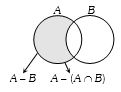
0 likes
View Solution22
EasyMCQ
For any two independent events $E_1$ and $E_2$,$P\{(E_1 \cup E_2) \cap (\bar{E}_1 \cap \bar{E}_2)\}$ is
A
$< \frac{1}{4}$
B
$> \frac{1}{4}$
C
$\ge \frac{1}{2}$
D
None of these
Solution
(A) By De Morgan's Law,we know that $\bar{E}_1 \cap \bar{E}_2 = \overline{E_1 \cup E_2}$.
Let $A = E_1 \cup E_2$. Then the expression becomes $P(A \cap \bar{A})$.
Since $A \cap \bar{A} = \phi$ (the empty set),we have $P(A \cap \bar{A}) = P(\phi) = 0$.
Since $0 < \frac{1}{4}$,the correct option is $A$.
Let $A = E_1 \cup E_2$. Then the expression becomes $P(A \cap \bar{A})$.
Since $A \cap \bar{A} = \phi$ (the empty set),we have $P(A \cap \bar{A}) = P(\phi) = 0$.
Since $0 < \frac{1}{4}$,the correct option is $A$.
0 likes
View Solution23
EasyMCQ
Which Venn diagram represents the truth of the statement "All students are hard working."
Where $U$ = Universal set of human beings,$S$ = Set of all students,$H$ = Set of all hard workers.
Where $U$ = Universal set of human beings,$S$ = Set of all students,$H$ = Set of all hard workers.
A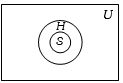
B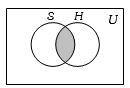
C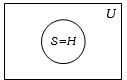
D
None of these
Solution
(A) The statement "All students are hard working" implies that every element of the set $S$ is also an element of the set $H$.
This is mathematically represented as $S \subseteq H$.
In terms of Venn diagrams,this means the circle representing set $S$ must be entirely contained within the circle representing set $H$ inside the universal set $U$.
This corresponds to the diagram in option $A$.
This is mathematically represented as $S \subseteq H$.
In terms of Venn diagrams,this means the circle representing set $S$ must be entirely contained within the circle representing set $H$ inside the universal set $U$.
This corresponds to the diagram in option $A$.
0 likes
View Solution24
EasyMCQ
Which Venn diagram represents the truth of the statement "No child is naughty"?
Where $U$ = Universal set of human beings,$C$ = Set of children,$N$ = Set of naughty persons.
Where $U$ = Universal set of human beings,$C$ = Set of children,$N$ = Set of naughty persons.
A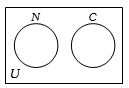
B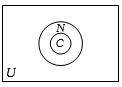
C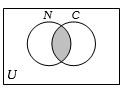
D
None of these
Solution
(A) The statement "No child is naughty" implies that there is no intersection between the set of children $(C)$ and the set of naughty persons $(N)$.
Mathematically,this is represented as $C \cap N = \phi$.
This means that the sets $C$ and $N$ are disjoint,which is correctly represented by the Venn diagram where the two circles do not overlap,as shown in option $A$.
Mathematically,this is represented as $C \cap N = \phi$.
This means that the sets $C$ and $N$ are disjoint,which is correctly represented by the Venn diagram where the two circles do not overlap,as shown in option $A$.
0 likes
View Solution25
EasyMCQ
Which Venn diagram represents the truth of the statement "No policeman is a thief"?
A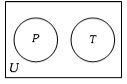
B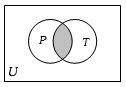
C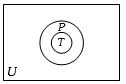
D
None of these.
Solution
(A) The statement "No policeman is a thief" implies that the set of policemen $(P)$ and the set of thieves $(T)$ have no elements in common.
This is represented by disjoint sets in a Venn diagram,where $P \cap T = \phi$.
Therefore,the correct representation is the Venn diagram where the circles for $P$ and $T$ do not overlap.
This is represented by disjoint sets in a Venn diagram,where $P \cap T = \phi$.
Therefore,the correct representation is the Venn diagram where the circles for $P$ and $T$ do not overlap.
0 likes
View Solution26
EasyMCQ
Which Venn diagram represents the truth of the statement "Some teenagers are not dreamers"?
A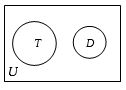
B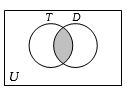
C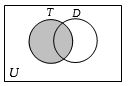
D
None of these
Solution
(C) The statement "Some teenagers are not dreamers" implies that there exists a set of teenagers $(T)$ who are not part of the set of dreamers $(D)$.
In set theory,this corresponds to the region $T - D$ (or $T \cap D^c$),which represents elements that are in $T$ but not in $D$.
Looking at the options:
- Option $A$ shows disjoint sets.
- Option $B$ shows the intersection $T \cap D$.
- Option $C$ shows the region $T$ excluding the intersection $T \cap D$,which is exactly $T - D$.
Therefore,the correct Venn diagram is represented by option $C$.
In set theory,this corresponds to the region $T - D$ (or $T \cap D^c$),which represents elements that are in $T$ but not in $D$.
Looking at the options:
- Option $A$ shows disjoint sets.
- Option $B$ shows the intersection $T \cap D$.
- Option $C$ shows the region $T$ excluding the intersection $T \cap D$,which is exactly $T - D$.
Therefore,the correct Venn diagram is represented by option $C$.
0 likes
View Solution27
EasyMCQ
Which of the following Venn diagrams corresponds to the statement "All mothers are women"? ($M$ is the set of all mothers,$W$ is the set of all women)
A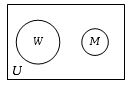
B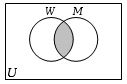
C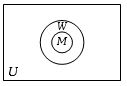
D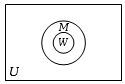
Solution
(C) The statement "All mothers are women" means that every element of the set $M$ (mothers) is also an element of the set $W$ (women).
This is represented by the subset relation $M \subseteq W$.
In a Venn diagram,this means the circle representing set $M$ must be entirely contained within the circle representing set $W$.
This corresponds to the diagram shown in option $C$.
This is represented by the subset relation $M \subseteq W$.
In a Venn diagram,this means the circle representing set $M$ must be entirely contained within the circle representing set $W$.
This corresponds to the diagram shown in option $C$.
0 likes
View Solution28
MediumMCQ
If $X = \{ 4^n - 3n - 1 : n \in N \}$ and $Y = \{ 9(n - 1) : n \in N \}$,then $X \cup Y = \dots$
A
$X$
B
$Y$
C
$N$
D
None of these
Solution
(B) Given $X = \{ 4^n - 3n - 1 : n \in N \}$.
For $n=1, 4^1 - 3(1) - 1 = 0$.
For $n=2, 4^2 - 3(2) - 1 = 16 - 6 - 1 = 9$.
For $n=3, 4^3 - 3(3) - 1 = 64 - 9 - 1 = 54$.
So,$X = \{ 0, 9, 54, \dots \}$.
Given $Y = \{ 9(n - 1) : n \in N \}$.
For $n=1, 9(1-1) = 0$.
For $n=2, 9(2-1) = 9$.
For $n=3, 9(3-1) = 18$.
So,$Y = \{ 0, 9, 18, 27, \dots \}$.
Since every element of $X$ is a multiple of $9$ and $X \subset Y$,it follows that $X \cup Y = Y$.
For $n=1, 4^1 - 3(1) - 1 = 0$.
For $n=2, 4^2 - 3(2) - 1 = 16 - 6 - 1 = 9$.
For $n=3, 4^3 - 3(3) - 1 = 64 - 9 - 1 = 54$.
So,$X = \{ 0, 9, 54, \dots \}$.
Given $Y = \{ 9(n - 1) : n \in N \}$.
For $n=1, 9(1-1) = 0$.
For $n=2, 9(2-1) = 9$.
For $n=3, 9(3-1) = 18$.
So,$Y = \{ 0, 9, 18, 27, \dots \}$.
Since every element of $X$ is a multiple of $9$ and $X \subset Y$,it follows that $X \cup Y = Y$.
0 likes
View Solution29
MediumMCQ
If $A = \{x : f(x) = 0\}$ and $B = \{x : g(x) = 0\}$,then $A \cap B$ will be
A
${[f(x)]^2} + {[g(x)]^2} = 0$
B
$\frac{f(x)}{g(x)} = 0$
C
$\frac{g(x)}{f(x)} = 0$
D
None of these
Solution
(A) The set $A$ contains all $x$ such that $f(x) = 0$.
The set $B$ contains all $x$ such that $g(x) = 0$.
The intersection $A \cap B$ contains all $x$ such that $f(x) = 0$ $AND$ $g(x) = 0$.
If $f(x) = 0$ and $g(x) = 0$,then the sum of their squares must also be zero,i.e.,${[f(x)]^2} + {[g(x)]^2} = 0$.
Thus,$A \cap B = \{x : {[f(x)]^2} + {[g(x)]^2} = 0\}$.
The set $B$ contains all $x$ such that $g(x) = 0$.
The intersection $A \cap B$ contains all $x$ such that $f(x) = 0$ $AND$ $g(x) = 0$.
If $f(x) = 0$ and $g(x) = 0$,then the sum of their squares must also be zero,i.e.,${[f(x)]^2} + {[g(x)]^2} = 0$.
Thus,$A \cap B = \{x : {[f(x)]^2} + {[g(x)]^2} = 0\}$.
0 likes
View Solution30
EasyMCQ
If $A = \{1, 2, 3\}$,$B = \{3, 4\}$,and $C = \{4, 5, 6\}$,then find $A \cup (B \cap C)$.
A
$\{3\}$
B
$\{1, 2, 3, 4\}$
C
$\{1, 2, 4, 5\}$
D
$\{1, 2, 3, 4, 5, 6\}$
Solution
(B) First,find the intersection of sets $B$ and $C$:
$B \cap C = \{3, 4\} \cap \{4, 5, 6\} = \{4\}$.
Next,find the union of set $A$ with the result:
$A \cup (B \cap C) = \{1, 2, 3\} \cup \{4\} = \{1, 2, 3, 4\}$.
Thus,the correct option is $B$.
$B \cap C = \{3, 4\} \cap \{4, 5, 6\} = \{4\}$.
Next,find the union of set $A$ with the result:
$A \cup (B \cap C) = \{1, 2, 3\} \cup \{4\} = \{1, 2, 3, 4\}$.
Thus,the correct option is $B$.
0 likes
View Solution31
EasyMCQ
If $A \subseteq B$,then $A \cup B$ =
A
$A$
B
$B \cap A$
C
$B$
D
None of these
Solution
(C) Since $A \subseteq B$,all elements of $A$ are contained within $B$.
Therefore,the union of $A$ and $B$ is simply the set $B$,i.e.,$A \cup B = B$.
Therefore,the union of $A$ and $B$ is simply the set $B$,i.e.,$A \cup B = B$.
0 likes
View Solution32
MediumMCQ
If sets $A$ and $B$ are defined as follows:
$A = \{(x, y) : y = \frac{1}{x}, 0 \neq x \in R\}$
$B = \{(x, y) : y = -x, x \in R\}$,then
$A = \{(x, y) : y = \frac{1}{x}, 0 \neq x \in R\}$
$B = \{(x, y) : y = -x, x \in R\}$,then
A
$A \cap B = A$
B
$A \cap B = B$
C
$A \cap B = \phi$
D
None of these
Solution
(C) To find the intersection $A \cap B$,we solve the system of equations:
$y = \frac{1}{x}$ and $y = -x$
Substituting $y = -x$ into the first equation,we get:
$-x = \frac{1}{x}$
$-x^2 = 1$
$x^2 = -1$
Since $x$ is a real number $(x \in R)$,$x^2$ cannot be negative.
Therefore,there is no real value of $x$ that satisfies both equations.
Hence,$A \cap B = \phi$.
$y = \frac{1}{x}$ and $y = -x$
Substituting $y = -x$ into the first equation,we get:
$-x = \frac{1}{x}$
$-x^2 = 1$
$x^2 = -1$
Since $x$ is a real number $(x \in R)$,$x^2$ cannot be negative.
Therefore,there is no real value of $x$ that satisfies both equations.
Hence,$A \cap B = \phi$.
0 likes
View Solution33
MediumMCQ
If sets $A$ and $B$ are defined as follows:
$A = \{ (x, y) : y = e^x, x \in R \}$
$B = \{ (x, y) : y = x, x \in R \}$
Then:
$A = \{ (x, y) : y = e^x, x \in R \}$
$B = \{ (x, y) : y = x, x \in R \}$
Then:
A
$B \subseteq A$
B
$A \subseteq B$
C
$A \cap B = \phi$
D
$A \cup B = A$
Solution
(C) The set $A$ represents the graph of the function $f(x) = e^x$.
The set $B$ represents the graph of the function $g(x) = x$.
For any real number $x$,it is a known property that $e^x > x$ for all $x \in R$.
Since the curves $y = e^x$ and $y = x$ never intersect,there are no common points $(x, y)$ between set $A$ and set $B$.
Therefore,$A \cap B = \phi$.
The set $B$ represents the graph of the function $g(x) = x$.
For any real number $x$,it is a known property that $e^x > x$ for all $x \in R$.
Since the curves $y = e^x$ and $y = x$ never intersect,there are no common points $(x, y)$ between set $A$ and set $B$.
Therefore,$A \cap B = \phi$.
0 likes
View Solution34
EasyMCQ
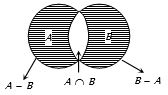
If $A$ and $B$ are two non-empty sets,then $(A - B) \cup (B - A)$ is equal to:
A
$(A \cup B) - B$
B
$A - (A \cap B)$
C
$(A \cup B) - (A \cap B)$
D
$(A \cap B) \cup (A \cup B)$
Solution
(C) The expression $(A - B) \cup (B - A)$ represents the symmetric difference of sets $A$ and $B$,denoted as $A \Delta B$.
By definition,$A - B$ contains elements in $A$ but not in $B$,and $B - A$ contains elements in $B$ but not in $A$.
The union of these two disjoint sets is the set of all elements that are in either $A$ or $B$,excluding the elements that are common to both $A$ and $B$.
Therefore,$(A - B) \cup (B - A) = (A \cup B) - (A \cap B)$.
By definition,$A - B$ contains elements in $A$ but not in $B$,and $B - A$ contains elements in $B$ but not in $A$.
The union of these two disjoint sets is the set of all elements that are in either $A$ or $B$,excluding the elements that are common to both $A$ and $B$.
Therefore,$(A - B) \cup (B - A) = (A \cup B) - (A \cap B)$.
0 likes
View Solution35
EasyMCQ
Let $A = \{1, 2, 3, 4\}$ and $B = \{2, 3, 4, 5, 6\}$. Then $A \cap B$ is equal to:
A
$\{2, 3, 4\}$
B
$\{1, 2, 3\}$
C
$\{5, 6\}$
D
$\{1\}$
Solution
(A) The intersection of two sets $A$ and $B$,denoted by $A \cap B$,is the set of all elements that are common to both $A$ and $B$.
Given $A = \{1, 2, 3, 4\}$ and $B = \{2, 3, 4, 5, 6\}$.
The common elements in both sets are $2, 3,$ and $4$.
Therefore,$A \cap B = \{2, 3, 4\}$.
Given $A = \{1, 2, 3, 4\}$ and $B = \{2, 3, 4, 5, 6\}$.
The common elements in both sets are $2, 3,$ and $4$.
Therefore,$A \cap B = \{2, 3, 4\}$.
0 likes
View Solution36
EasyMCQ
Let $A = \{a, b, c\}, B = \{b, c, d\}, C = \{a, b, d, e\}$. Then $A \cap (B \cup C)$ is:
A
$\{a, b, c\}$
B
$\{b, c\}$
C
$\{a, b, c, d\}$
D
$\{a, b, d\}$
Solution
(A) Given sets are $A = \{a, b, c\}$,$B = \{b, c, d\}$,and $C = \{a, b, d, e\}$.
First,find the union of sets $B$ and $C$:
$B \cup C = \{b, c, d\} \cup \{a, b, d, e\} = \{a, b, c, d, e\}$.
Now,find the intersection of set $A$ with the resulting set $(B \cup C)$:
$A \cap (B \cup C) = \{a, b, c\} \cap \{a, b, c, d, e\}$.
The common elements in both sets are $a, b,$ and $c$.
Therefore,$A \cap (B \cup C) = \{a, b, c\}$.
First,find the union of sets $B$ and $C$:
$B \cup C = \{b, c, d\} \cup \{a, b, d, e\} = \{a, b, c, d, e\}$.
Now,find the intersection of set $A$ with the resulting set $(B \cup C)$:
$A \cap (B \cup C) = \{a, b, c\} \cap \{a, b, c, d, e\}$.
The common elements in both sets are $a, b,$ and $c$.
Therefore,$A \cap (B \cup C) = \{a, b, c\}$.
0 likes
View Solution37
EasyMCQ
If $A = \{2, 3, 4, 8, 10\}, B = \{3, 4, 5, 10, 12\}, C = \{4, 5, 6, 12, 14\}$,then $(A \cup B) \cap (A \cup C)$ is equal to:
A
$\{2, 3, 4, 5, 8, 10, 12\}$
B
$\{2, 4, 8, 10, 12\}$
C
$\{3, 8, 10, 12\}$
D
$\{2, 8, 10\}$
Solution
(A) Given sets are $A = \{2, 3, 4, 8, 10\}$,$B = \{3, 4, 5, 10, 12\}$,and $C = \{4, 5, 6, 12, 14\}$.
First,find $(A \cup B) = \{2, 3, 4, 5, 8, 10, 12\}$.
Next,find $(A \cup C) = \{2, 3, 4, 5, 6, 8, 10, 12, 14\}$.
Now,find the intersection $(A \cup B) \cap (A \cup C) = \{2, 3, 4, 5, 8, 10, 12\} \cap \{2, 3, 4, 5, 6, 8, 10, 12, 14\}$.
The common elements are $\{2, 3, 4, 5, 8, 10, 12\}$.
Alternatively,using the distributive law,$(A \cup B) \cap (A \cup C) = A \cup (B \cap C)$.
$B \cap C = \{4, 5, 12\}$.
$A \cup (B \cap C) = \{2, 3, 4, 8, 10\} \cup \{4, 5, 12\} = \{2, 3, 4, 5, 8, 10, 12\}$.
First,find $(A \cup B) = \{2, 3, 4, 5, 8, 10, 12\}$.
Next,find $(A \cup C) = \{2, 3, 4, 5, 6, 8, 10, 12, 14\}$.
Now,find the intersection $(A \cup B) \cap (A \cup C) = \{2, 3, 4, 5, 8, 10, 12\} \cap \{2, 3, 4, 5, 6, 8, 10, 12, 14\}$.
The common elements are $\{2, 3, 4, 5, 8, 10, 12\}$.
Alternatively,using the distributive law,$(A \cup B) \cap (A \cup C) = A \cup (B \cap C)$.
$B \cap C = \{4, 5, 12\}$.
$A \cup (B \cap C) = \{2, 3, 4, 8, 10\} \cup \{4, 5, 12\} = \{2, 3, 4, 5, 8, 10, 12\}$.
0 likes
View Solution38
EasyMCQ
If $A$ and $B$ are two sets,then $A \cap (B - A)$ is equal to:
A
$\phi$
B
$A$
C
$B$
D
None of these
0 likes
View Solution39
EasyMCQ
If ${N_a} = \{an : n \in N\}$,then the set ${N_6} \cap {N_8} = $
A
${N_6}$
B
${N_8}$
C
${N_{24}}$
D
${N_{48}}$
Solution
(C) Given that ${N_a} = \{an : n \in N\}$.
This represents the set of all multiples of $a$.
Therefore,${N_6} = \{6, 12, 18, 24, 30, 36, 42, 48, \dots\}$ and ${N_8} = \{8, 16, 24, 32, 40, 48, \dots\}$.
The intersection ${N_6} \cap {N_8}$ consists of all numbers that are multiples of both $6$ and $8$.
The common multiples of $6$ and $8$ are the multiples of their least common multiple,$LCM(6, 8)$.
$LCM(6, 8) = 24$.
Thus,${N_6} \cap {N_8} = \{24, 48, 72, \dots\} = {N_{24}}$.
This represents the set of all multiples of $a$.
Therefore,${N_6} = \{6, 12, 18, 24, 30, 36, 42, 48, \dots\}$ and ${N_8} = \{8, 16, 24, 32, 40, 48, \dots\}$.
The intersection ${N_6} \cap {N_8}$ consists of all numbers that are multiples of both $6$ and $8$.
The common multiples of $6$ and $8$ are the multiples of their least common multiple,$LCM(6, 8)$.
$LCM(6, 8) = 24$.
Thus,${N_6} \cap {N_8} = \{24, 48, 72, \dots\} = {N_{24}}$.
0 likes
View Solution40
EasyMCQ
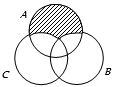
The shaded region in the figure is:
A
$A \cap (B \cup C)$
B
$A \cup (B \cap C)$
C
$A \cap (B - C)$
D
$A - (B \cup C)$
Solution
(D) The shaded region represents the part of set $A$ that does not overlap with set $B$ or set $C$.
This region consists of elements that are in $A$ but not in $B$ and not in $C$.
Mathematically,this is expressed as $A - (B \cup C)$.
This region consists of elements that are in $A$ but not in $B$ and not in $C$.
Mathematically,this is expressed as $A - (B \cup C)$.
0 likes
View Solution41
EasyMCQ
If $A = \{x : f(x) = 0\}$ and $B = \{x : g(x) = 0\}$,then $A \cap B$ is
A
$\{x : [f(x)]^2 + [g(x)]^2 = 0\}$
B
$\{x : \frac{f(x)}{g(x)} = 0\}$
C
$\{x : \frac{g(x)}{f(x)} = 0\}$
D
None of these
Solution
(A) The set $A$ contains all values of $x$ such that $f(x) = 0$.
The set $B$ contains all values of $x$ such that $g(x) = 0$.
The intersection $A \cap B$ contains all values of $x$ such that both $f(x) = 0$ and $g(x) = 0$ are satisfied simultaneously.
For any real numbers $a$ and $b$,$a^2 + b^2 = 0$ if and only if $a = 0$ and $b = 0$.
Therefore,$[f(x)]^2 + [g(x)]^2 = 0$ is equivalent to $f(x) = 0$ and $g(x) = 0$.
Thus,$A \cap B = \{x : [f(x)]^2 + [g(x)]^2 = 0\}$.
The set $B$ contains all values of $x$ such that $g(x) = 0$.
The intersection $A \cap B$ contains all values of $x$ such that both $f(x) = 0$ and $g(x) = 0$ are satisfied simultaneously.
For any real numbers $a$ and $b$,$a^2 + b^2 = 0$ if and only if $a = 0$ and $b = 0$.
Therefore,$[f(x)]^2 + [g(x)]^2 = 0$ is equivalent to $f(x) = 0$ and $g(x) = 0$.
Thus,$A \cap B = \{x : [f(x)]^2 + [g(x)]^2 = 0\}$.
0 likes
View Solution42
EasyMCQ
If $A$ and $B$ are two sets such that $n(A) = 0.16$,$n(B) = 0.14$,and $n(A \cup B) = 0.25$,then $n(A \cap B)$ is equal to:
A
$0.3$
B
$0.5$
C
$0.05$
D
None of these
Solution
(C) We use the formula for the union of two sets:
$n(A \cup B) = n(A) + n(B) - n(A \cap B)$
Given:
$n(A) = 0.16$
$n(B) = 0.14$
$n(A \cup B) = 0.25$
Substituting the values into the formula:
$0.25 = 0.16 + 0.14 - n(A \cap B)$
$0.25 = 0.30 - n(A \cap B)$
$n(A \cap B) = 0.30 - 0.25$
$n(A \cap B) = 0.05$
$n(A \cup B) = n(A) + n(B) - n(A \cap B)$
Given:
$n(A) = 0.16$
$n(B) = 0.14$
$n(A \cup B) = 0.25$
Substituting the values into the formula:
$0.25 = 0.16 + 0.14 - n(A \cap B)$
$0.25 = 0.30 - n(A \cap B)$
$n(A \cap B) = 0.30 - 0.25$
$n(A \cap B) = 0.05$
0 likes
View Solution43
EasyMCQ
If $A$ and $B$ are disjoint sets,then $n(A \cup B) = $
A
$n(A)$
B
$n(B)$
C
$n(A) + n(B)$
D
$n(A) \times n(B)$
Solution
(C) Two sets $A$ and $B$ are said to be disjoint if they have no common elements,i.e.,$A \cap B = \emptyset$.
For any two finite sets $A$ and $B$,the formula for the number of elements in their union is given by:
$n(A \cup B) = n(A) + n(B) - n(A \cap B)$.
Since $A$ and $B$ are disjoint,$n(A \cap B) = 0$.
Therefore,$n(A \cup B) = n(A) + n(B) - 0 = n(A) + n(B)$.
For any two finite sets $A$ and $B$,the formula for the number of elements in their union is given by:
$n(A \cup B) = n(A) + n(B) - n(A \cap B)$.
Since $A$ and $B$ are disjoint,$n(A \cap B) = 0$.
Therefore,$n(A \cup B) = n(A) + n(B) - 0 = n(A) + n(B)$.
0 likes
View Solution44
EasyMCQ
Let $A$ and $B$ be subsets of a set $X$. Then,
A
$A - B = A \cup B$
B
$A - B = A \cap B$
C
$A - B = A^c \cap B$
D
$A - B = A \cap B^c$
Solution
(D) The set difference $A - B$ is defined as the set of all elements that are in $A$ but not in $B$.
Mathematically,this is represented as $A - B = \{x : x \in A \text{ and } x \notin B\}$.
Since $x \notin B$ is equivalent to $x \in B^c$,where $B^c$ is the complement of $B$ with respect to $X$,we can write:
$A - B = \{x : x \in A \text{ and } x \in B^c\}$.
This is equivalent to the intersection of $A$ and $B^c$,which is $A \cap B^c$.
Mathematically,this is represented as $A - B = \{x : x \in A \text{ and } x \notin B\}$.
Since $x \notin B$ is equivalent to $x \in B^c$,where $B^c$ is the complement of $B$ with respect to $X$,we can write:
$A - B = \{x : x \in A \text{ and } x \in B^c\}$.
This is equivalent to the intersection of $A$ and $B^c$,which is $A \cap B^c$.
0 likes
View Solution45
EasyMCQ
Let $A$ and $B$ be two sets in a universal set $U$. Then $A - B$ is equal to:
A
$A \cap B^c$
B
$A^c \cap B$
C
$A \cap B$
D
None of these
Solution
(A) The difference of two sets $A$ and $B$,denoted by $A - B$,is defined as the set of all elements that are in $A$ but not in $B$.
Mathematically,$A - B = \{x : x \in A \text{ and } x \notin B\}$.
Since $x \notin B$ is equivalent to $x \in B^c$ (where $B^c$ is the complement of $B$ with respect to the universal set $U$),
we can write $A - B = \{x : x \in A \text{ and } x \in B^c\}$.
Therefore,$A - B = A \cap B^c$.
Mathematically,$A - B = \{x : x \in A \text{ and } x \notin B\}$.
Since $x \notin B$ is equivalent to $x \in B^c$ (where $B^c$ is the complement of $B$ with respect to the universal set $U$),
we can write $A - B = \{x : x \in A \text{ and } x \in B^c\}$.
Therefore,$A - B = A \cap B^c$.
0 likes
View Solution46
EasyMCQ
If $A, B$,and $C$ are three sets,then $A - (B \cap C)$ is equal to
A
$(A - B) \cup (A - C)$
B
$(A - B) \cap (A - C)$
C
$(A - B) \cup C$
D
$(A - B) \cap C$
Solution
(A) By using De Morgan's Law for sets,we know that the complement of an intersection is the union of the complements: $(B \cap C)^c = B^c \cup C^c$.
Given the expression $A - (B \cap C)$,we can rewrite this as $A \cap (B \cap C)^c$.
Substituting the De Morgan's Law result,we get $A \cap (B^c \cup C^c)$.
Using the distributive property of sets,this becomes $(A \cap B^c) \cup (A \cap C^c)$.
Since $A \cap B^c = A - B$ and $A \cap C^c = A - C$,the expression simplifies to $(A - B) \cup (A - C)$.
Given the expression $A - (B \cap C)$,we can rewrite this as $A \cap (B \cap C)^c$.
Substituting the De Morgan's Law result,we get $A \cap (B^c \cup C^c)$.
Using the distributive property of sets,this becomes $(A \cap B^c) \cup (A \cap C^c)$.
Since $A \cap B^c = A - B$ and $A \cap C^c = A - C$,the expression simplifies to $(A - B) \cup (A - C)$.
0 likes
View Solution47
EasyMCQ
If $A = \{1, 2, 4\}, B = \{2, 4, 5\}, C = \{2, 5\},$ then find $(A - B) \times (B - C)$.
A
$\{(1, 4)\}$
B
$\{(1, 2), (1, 5)\}$
C
$\{(1, 4), (2, 4)\}$
D
None of these
Solution
(A) Given sets are $A = \{1, 2, 4\}, B = \{2, 4, 5\}, C = \{2, 5\}$.
First,find the set difference $(A - B)$:
$A - B = \{x : x \in A \text{ and } x \notin B\} = \{1\}$.
Next,find the set difference $(B - C)$:
$B - C = \{x : x \in B \text{ and } x \notin C\} = \{4\}$.
Finally,find the Cartesian product $(A - B) \times (B - C)$:
$(A - B) \times (B - C) = \{1\} \times \{4\} = \{(1, 4)\}$.
First,find the set difference $(A - B)$:
$A - B = \{x : x \in A \text{ and } x \notin B\} = \{1\}$.
Next,find the set difference $(B - C)$:
$B - C = \{x : x \in B \text{ and } x \notin C\} = \{4\}$.
Finally,find the Cartesian product $(A - B) \times (B - C)$:
$(A - B) \times (B - C) = \{1\} \times \{4\} = \{(1, 4)\}$.
0 likes
View Solution48
EasyMCQ
If $A = \{1, 2, 3\}$ and $B = \{3, 8\}$,then find $(A \cup B) \times (A \cap B)$.
A
$\{(1, 3), (2, 3), (3, 3), (8, 3)\}$
B
$\{(3, 1), (3, 2), (3, 3), (3, 8)\}$
C
$\{(1, 2), (2, 2), (3, 3), (8, 8)\}$
D
$\{(8, 3), (8, 2), (8, 1), (8, 8)\}$
Solution
(A) Given sets are $A = \{1, 2, 3\}$ and $B = \{3, 8\}$.
First,find the union of sets $A$ and $B$: $A \cup B = \{1, 2, 3, 8\}$.
Next,find the intersection of sets $A$ and $B$: $A \cap B = \{3\}$.
Now,calculate the Cartesian product $(A \cup B) \times (A \cap B) = \{1, 2, 3, 8\} \times \{3\}$.
This results in the set of ordered pairs: $\{(1, 3), (2, 3), (3, 3), (8, 3)\}$.
First,find the union of sets $A$ and $B$: $A \cup B = \{1, 2, 3, 8\}$.
Next,find the intersection of sets $A$ and $B$: $A \cap B = \{3\}$.
Now,calculate the Cartesian product $(A \cup B) \times (A \cap B) = \{1, 2, 3, 8\} \times \{3\}$.
This results in the set of ordered pairs: $\{(1, 3), (2, 3), (3, 3), (8, 3)\}$.
0 likes
View Solution49
AdvancedMCQ
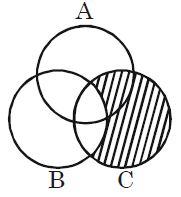
The shaded region in the given figure is-
A
$A \cap B \cup C$
B
$C - (A \cap B)$
C
$C - (B \cap C)$
D
$C - (A \cup B)$
Solution
(D) The shaded region represents the set of all elements that are in set $C$ but are not in set $A$ and not in set $B$.
This is equivalent to removing the intersection of $C$ with $A$ and the intersection of $C$ with $B$ from set $C$.
Mathematically,this is expressed as $C - (A \cup B)$.
This is equivalent to removing the intersection of $C$ with $A$ and the intersection of $C$ with $B$ from set $C$.
Mathematically,this is expressed as $C - (A \cup B)$.
0 likes
View Solution50
MediumMCQ
The shaded region in the Venn diagram can be represented by which of the following?
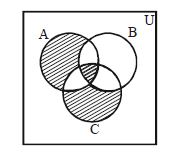
A
$(A \cup C)\cap(A^C \cup B^C )\cup(A^C \cup C^C )\cup(B^C \cup C^C )$
B
$(A \cup C)\cap (A^C \cup B^C )\cap(A^C \cup C^C )\cap(B^C \cup C^C )$
C
$(A \cup C)\cap (A^C \cup B^C )\cap(A^C \cup C^C )\cap(B^C \cup C^C) \cup(A \cap B \cap C)$
D
$(A \cup C)\cap (A^C \cup B^C )\cap(A^C \cup C^C )\cap(B^C \cup C^C \cap(A \cap B \cap C))$
Solution
(C) The shaded region consists of elements that are in $A$ but not in $B$,elements in $C$ but not in $B$,and the intersection $A \cap B \cap C$.
This can be expressed as $(A \setminus B) \cup (C \setminus B) \cup (A \cap B \cap C)$.
Using set identities,$(A \setminus B) = A \cap B^C$ and $(C \setminus B) = C \cap B^C$.
Thus,the region is $(A \cap B^C) \cup (C \cap B^C) \cup (A \cap B \cap C)$.
Simplifying this,we get $(A \cup C) \cap B^C \cup (A \cap B \cap C)$.
Evaluating the given options,option $C$ represents the correct set operation for the shaded region.
This can be expressed as $(A \setminus B) \cup (C \setminus B) \cup (A \cap B \cap C)$.
Using set identities,$(A \setminus B) = A \cap B^C$ and $(C \setminus B) = C \cap B^C$.
Thus,the region is $(A \cap B^C) \cup (C \cap B^C) \cup (A \cap B \cap C)$.
Simplifying this,we get $(A \cup C) \cap B^C \cup (A \cap B \cap C)$.
Evaluating the given options,option $C$ represents the correct set operation for the shaded region.
0 likes
View SolutionSet Theory — Venn Diagram and Operation on Sets · Frequently Asked Questions
1Are these Set Theory questions useful for JEE and NEET?
Yes. All questions in this section are mapped to JEE Main and NEET exam patterns. Previous year questions from JEE Main, NEET, GUJCET and state-level exams are included with full solutions.
2Can I switch to Hindi or Gujarati for these questions?
Yes. Use the language tabs in the hero section or the sidebar to view the same questions and solutions in English, Hindi or Gujarati.
3How do I generate a question paper from this subtopic?
Use the Vedclass Exam Paper Generator — select the chapter and subtopic, set difficulty, and generate Sets A, B, C, D automatically. First 3 chapters of every subject are free.
Vedclass Products
For Students
Vedclass Test Series
Mock tests in real JEE/NEET style with performance analysis. 5-day free trial.
Start Free TrialFor Teachers
Exam Paper Generator
Generate Set A/B/C/D papers from this chapter in 2 minutes. 3 chapters free.
Try FreeFor Institutes
Online Exam Module
Live online exams with unlimited students, 360° analytics & white-label branding.
See DemoFor Teachers & Institutes
Generate a Set Theory Exam Paper in 2 Minutes
Select subtopic & difficulty — Sets A, B, C, D auto-generated with No Repeat logic.
First 3 chapters of every subject are free — no payment required.