
A English
Venn Diagram and Operation on Sets Questions in English
Class 11 Mathematics · Set Theory · Venn Diagram and Operation on Sets
135+
Questions
English
Language
100%
With Solutions
Showing 50 of 135 questions in English
51
AdvancedMCQ
If $A$ and $B$ are any two non-empty sets and $A$ is a proper subset of $B$. If $n(A) = 4$,then the minimum possible value of $n(A \Delta B)$ is (where $\Delta$ denotes the symmetric difference of set $A$ and set $B$).
A
$2$
B
$1$
C
$0$
D
$4$
Solution
(B) The symmetric difference of two sets $A$ and $B$ is defined as $A \Delta B = (A - B) \cup (B - A)$.
Since $A$ is a proper subset of $B$ ($A \subset B$ and $A \neq B$),we have $A - B = \emptyset$,so $n(A - B) = 0$.
Because $A$ is a proper subset of $B$,there must be at least one element in $B$ that is not in $A$,which means $n(B - A) \geq 1$.
Therefore,$n(A \Delta B) = n(A - B) + n(B - A) = 0 + n(B - A) \geq 1$.
The minimum possible value of $n(A \Delta B)$ is $1$.
Since $A$ is a proper subset of $B$ ($A \subset B$ and $A \neq B$),we have $A - B = \emptyset$,so $n(A - B) = 0$.
Because $A$ is a proper subset of $B$,there must be at least one element in $B$ that is not in $A$,which means $n(B - A) \geq 1$.
Therefore,$n(A \Delta B) = n(A - B) + n(B - A) = 0 + n(B - A) \geq 1$.
The minimum possible value of $n(A \Delta B)$ is $1$.
0 likes
View Solution52
EasyMCQ
$A - (A - B)$ is
A
$A \cup B$
B
$A \cap B$
C
$A \cap {B^c}$
D
${A^c} \cap B$
Solution
(B) We know that the set difference $A - B$ is defined as $A \cap B^c$.
Substituting this into the expression,we get:
$A - (A - B) = A - (A \cap B^c)$
Using the property $X - Y = X \cap Y^c$,we have:
$A - (A \cap B^c) = A \cap (A \cap B^c)^c$
By De Morgan's Law,$(A \cap B^c)^c = A^c \cup (B^c)^c = A^c \cup B$.
So,$A \cap (A^c \cup B) = (A \cap A^c) \cup (A \cap B)$.
Since $A \cap A^c = \emptyset$,we get $\emptyset \cup (A \cap B) = A \cap B$.
Therefore,$A - (A - B) = A \cap B$.
Substituting this into the expression,we get:
$A - (A - B) = A - (A \cap B^c)$
Using the property $X - Y = X \cap Y^c$,we have:
$A - (A \cap B^c) = A \cap (A \cap B^c)^c$
By De Morgan's Law,$(A \cap B^c)^c = A^c \cup (B^c)^c = A^c \cup B$.
So,$A \cap (A^c \cup B) = (A \cap A^c) \cup (A \cap B)$.
Since $A \cap A^c = \emptyset$,we get $\emptyset \cup (A \cap B) = A \cap B$.
Therefore,$A - (A - B) = A \cap B$.
0 likes
View Solution53
AdvancedMCQ
Let $A = \{ \theta : 2\cos^2 \theta + \sin \theta \le 2 \}$ and $B = \{ \theta : \frac{\pi}{2} \le \theta \le \frac{3\pi}{2} \}$,then $A \cap B$ is
A
$\left\{ \theta : \theta \in \left[ \pi, \frac{3\pi}{2} \right] \right\}$
B
$\left\{ \theta : \theta \in \left[ \frac{\pi}{2}, \frac{7\pi}{6} \right] \right\}$
C
$\left\{ \theta : \theta \in \left[ \frac{\pi}{2}, \frac{\pi}{6} \right] \right\}$
D
$\left\{ \theta : \theta \in \left[ \frac{\pi}{2}, \frac{5\pi}{6} \right] \cup \left[ \pi, \frac{3\pi}{2} \right] \right\}$
Solution
(D) Given $2\cos^2 \theta + \sin \theta \le 2$.
Using $\cos^2 \theta = 1 - \sin^2 \theta$,we get $2(1 - \sin^2 \theta) + \sin \theta \le 2$.
$2 - 2\sin^2 \theta + \sin \theta \le 2$.
$-2\sin^2 \theta + \sin \theta \le 0$.
$2\sin^2 \theta - \sin \theta \ge 0$.
$\sin \theta (2\sin \theta - 1) \ge 0$.
This inequality holds when $\sin \theta \le 0$ or $\sin \theta \ge \frac{1}{2}$.
For $\sin \theta \le 0$,$\theta \in [\pi, 2\pi]$.
For $\sin \theta \ge \frac{1}{2}$,$\theta \in [\frac{\pi}{6}, \frac{5\pi}{6}]$.
Thus,$A = [\frac{\pi}{6}, \frac{5\pi}{6}] \cup [\pi, 2\pi]$.
Given $B = [\frac{\pi}{2}, \frac{3\pi}{2}]$.
$A \cap B = ([\frac{\pi}{6}, \frac{5\pi}{6}] \cup [\pi, 2\pi]) \cap [\frac{\pi}{2}, \frac{3\pi}{2}]$.
$A \cap B = [\frac{\pi}{2}, \frac{5\pi}{6}] \cup [\pi, \frac{3\pi}{2}]$.
Using $\cos^2 \theta = 1 - \sin^2 \theta$,we get $2(1 - \sin^2 \theta) + \sin \theta \le 2$.
$2 - 2\sin^2 \theta + \sin \theta \le 2$.
$-2\sin^2 \theta + \sin \theta \le 0$.
$2\sin^2 \theta - \sin \theta \ge 0$.
$\sin \theta (2\sin \theta - 1) \ge 0$.
This inequality holds when $\sin \theta \le 0$ or $\sin \theta \ge \frac{1}{2}$.
For $\sin \theta \le 0$,$\theta \in [\pi, 2\pi]$.
For $\sin \theta \ge \frac{1}{2}$,$\theta \in [\frac{\pi}{6}, \frac{5\pi}{6}]$.
Thus,$A = [\frac{\pi}{6}, \frac{5\pi}{6}] \cup [\pi, 2\pi]$.
Given $B = [\frac{\pi}{2}, \frac{3\pi}{2}]$.
$A \cap B = ([\frac{\pi}{6}, \frac{5\pi}{6}] \cup [\pi, 2\pi]) \cap [\frac{\pi}{2}, \frac{3\pi}{2}]$.
$A \cap B = [\frac{\pi}{2}, \frac{5\pi}{6}] \cup [\pi, \frac{3\pi}{2}]$.
0 likes
View Solution54
DifficultMCQ
In a class of $140$ students numbered $1$ to $140$,all even-numbered students opted for the Mathematics course,those whose number is divisible by $3$ opted for the Physics course,and those whose number is divisible by $5$ opted for the Chemistry course. The number of students who did not opt for any of the three courses is:
A
$102$
B
$42$
C
$1$
D
$38$
Solution
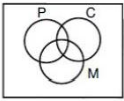
(D) Let $M$,$P$,and $C$ be the sets of students who opted for Mathematics,Physics,and Chemistry,respectively.
$n(M) = \lfloor \frac{140}{2} \rfloor = 70$
$n(P) = \lfloor \frac{140}{3} \rfloor = 46$
$n(C) = \lfloor \frac{140}{5} \rfloor = 28$
Now,find the intersections:
$n(M \cap P) = \lfloor \frac{140}{\text{lcm}(2,3)} \rfloor = \lfloor \frac{140}{6} \rfloor = 23$
$n(M \cap C) = \lfloor \frac{140}{\text{lcm}(2,5)} \rfloor = \lfloor \frac{140}{10} \rfloor = 14$
$n(P \cap C) = \lfloor \frac{140}{\text{lcm}(3,5)} \rfloor = \lfloor \frac{140}{15} \rfloor = 9$
$n(M \cap P \cap C) = \lfloor \frac{140}{\text{lcm}(2,3,5)} \rfloor = \lfloor \frac{140}{30} \rfloor = 4$
Using the Principle of Inclusion-Exclusion:
$n(M \cup P \cup C) = n(M) + n(P) + n(C) - (n(M \cap P) + n(M \cap C) + n(P \cap C)) + n(M \cap P \cap C)$
$n(M \cup P \cup C) = 70 + 46 + 28 - (23 + 14 + 9) + 4 = 144 - 46 + 4 = 102$
The number of students who did not opt for any course is $140 - 102 = 38$.
$n(M) = \lfloor \frac{140}{2} \rfloor = 70$
$n(P) = \lfloor \frac{140}{3} \rfloor = 46$
$n(C) = \lfloor \frac{140}{5} \rfloor = 28$
Now,find the intersections:
$n(M \cap P) = \lfloor \frac{140}{\text{lcm}(2,3)} \rfloor = \lfloor \frac{140}{6} \rfloor = 23$
$n(M \cap C) = \lfloor \frac{140}{\text{lcm}(2,5)} \rfloor = \lfloor \frac{140}{10} \rfloor = 14$
$n(P \cap C) = \lfloor \frac{140}{\text{lcm}(3,5)} \rfloor = \lfloor \frac{140}{15} \rfloor = 9$
$n(M \cap P \cap C) = \lfloor \frac{140}{\text{lcm}(2,3,5)} \rfloor = \lfloor \frac{140}{30} \rfloor = 4$
Using the Principle of Inclusion-Exclusion:
$n(M \cup P \cup C) = n(M) + n(P) + n(C) - (n(M \cap P) + n(M \cap C) + n(P \cap C)) + n(M \cap P \cap C)$
$n(M \cup P \cup C) = 70 + 46 + 28 - (23 + 14 + 9) + 4 = 144 - 46 + 4 = 102$
The number of students who did not opt for any course is $140 - 102 = 38$.
0 likes
View Solution55
DifficultMCQ
Let $A, B$ and $C$ be sets such that $\phi \ne A \cap B \subseteq C$. Then which of the following statements is not true?
A
If $(A - C) \subseteq B$ then $A \subseteq B$
B
If $(A - B) \subseteq C$ then $A \subseteq C$
C
$(C \cup A) \cap (C \cup B) = C$
D
$B \cap C \ne \phi$
Solution
(A) Given $\phi \ne A \cap B \subseteq C$.
Check option $(A)$: If $(A - C) \subseteq B$ then $A \subseteq B$.
Let $A = \{1, 2\}$,$B = \{2, 3\}$,$C = \{2\}$.
Here $A \cap B = \{2\} \subseteq C$ and $A \cap B \ne \phi$.
$A - C = \{1\}$. Since ${1} \not\subseteq \{2, 3\}$,the condition $(A - C) \subseteq B$ is not satisfied for this example.
However,consider $A = \{1, 2\}$,$B = \{1, 3\}$,$C = \{2\}$.
$A \cap B = \{1\} \subseteq C$ is false.
Let $A = \{1, 2\}$,$B = \{2, 3\}$,$C = \{1, 2\}$.
$A \cap B = \{2\} \subseteq C$.
$A - C = \phi \subseteq B$ is true.
But $A = \{1, 2\} \not\subseteq B = \{2, 3\}$.
Thus,the statement in option $(A)$ is not true.
Check option $(A)$: If $(A - C) \subseteq B$ then $A \subseteq B$.
Let $A = \{1, 2\}$,$B = \{2, 3\}$,$C = \{2\}$.
Here $A \cap B = \{2\} \subseteq C$ and $A \cap B \ne \phi$.
$A - C = \{1\}$. Since ${1} \not\subseteq \{2, 3\}$,the condition $(A - C) \subseteq B$ is not satisfied for this example.
However,consider $A = \{1, 2\}$,$B = \{1, 3\}$,$C = \{2\}$.
$A \cap B = \{1\} \subseteq C$ is false.
Let $A = \{1, 2\}$,$B = \{2, 3\}$,$C = \{1, 2\}$.
$A \cap B = \{2\} \subseteq C$.
$A - C = \phi \subseteq B$ is true.
But $A = \{1, 2\} \not\subseteq B = \{2, 3\}$.
Thus,the statement in option $(A)$ is not true.
0 likes
View Solution56
MediumMCQ
If $A = \{x \in R : |x| < 2\}$ and $B = \{x \in R : |x - 2| \geq 3\}$,then:
A
$A \cup B = R - (2, 5)$
B
$A \cap B = (-2, -1)$
C
$B - A = R - (-2, 5)$
D
$A - B = [-1, 2)$
Solution
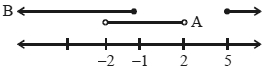
(C) Given $A = \{x \in R : |x| < 2\} = (-2, 2)$.
Given $B = \{x \in R : |x - 2| \geq 3\}$.
This implies $x - 2 \geq 3$ or $x - 2 \leq -3$.
So,$x \geq 5$ or $x \leq -1$.
Thus,$B = (-\infty, -1] \cup [5, \infty)$.
Now,$B - A$ is the set of elements in $B$ that are not in $A$.
$B - A = ((-\infty, -1] \cup [5, \infty)) - (-2, 2)$.
Since $(-2, 2)$ overlaps with $(-\infty, -1]$ only on the interval $(-2, -1]$,we remove this part.
$B - A = (-\infty, -2] \cup [5, \infty)$.
This can be written as $R - (-2, 5)$.
Therefore,the correct option is $C$.
Given $B = \{x \in R : |x - 2| \geq 3\}$.
This implies $x - 2 \geq 3$ or $x - 2 \leq -3$.
So,$x \geq 5$ or $x \leq -1$.
Thus,$B = (-\infty, -1] \cup [5, \infty)$.
Now,$B - A$ is the set of elements in $B$ that are not in $A$.
$B - A = ((-\infty, -1] \cup [5, \infty)) - (-2, 2)$.
Since $(-2, 2)$ overlaps with $(-\infty, -1]$ only on the interval $(-2, -1]$,we remove this part.
$B - A = (-\infty, -2] \cup [5, \infty)$.
This can be written as $R - (-2, 5)$.
Therefore,the correct option is $C$.
0 likes
View Solution57
EasyMCQ
Consider the experiment of rolling a die. Let $A$ be the event 'getting a prime number' and $B$ be the event 'getting an odd number'. Write the set representing the event '$A$ or $B$'.
A
$\{1, 2, 4, 5\}$
B
$\{1, 2, 5\}$
C
$\{1, 2, 3\}$
D
$\{1, 2, 3, 5\}$
Solution
(D) The sample space of rolling a die is $S = \{1, 2, 3, 4, 5, 6\}$.
Event $A$ (getting a prime number) is $A = \{2, 3, 5\}$.
Event $B$ (getting an odd number) is $B = \{1, 3, 5\}$.
The event '$A$ or $B$' is represented by the union of the two sets,$A \cup B$.
$A \cup B = \{1, 2, 3, 5\}$.
Event $A$ (getting a prime number) is $A = \{2, 3, 5\}$.
Event $B$ (getting an odd number) is $B = \{1, 3, 5\}$.
The event '$A$ or $B$' is represented by the union of the two sets,$A \cup B$.
$A \cup B = \{1, 2, 3, 5\}$.
0 likes
View Solution58
EasyMCQ
Consider the experiment of rolling a die. Let $A$ be the event 'getting a prime number' and $B$ be the event 'getting an odd number'. Write the set representing the event '$A$ but not $B$'.
A
$\{1\}$
B
$\{2\}$
C
$\{3\}$
D
$\{5\}$
Solution
(B) The sample space of rolling a die is $S = \{1, 2, 3, 4, 5, 6\}$.
Event $A$ (getting a prime number) is $A = \{2, 3, 5\}$.
Event $B$ (getting an odd number) is $B = \{1, 3, 5\}$.
The event '$A$ but not $B$' is represented by the set difference $A - B$.
$A - B = \{2, 3, 5\} - \{1, 3, 5\} = \{2\}$.
Thus,the correct set is $\{2\}$.
Event $A$ (getting a prime number) is $A = \{2, 3, 5\}$.
Event $B$ (getting an odd number) is $B = \{1, 3, 5\}$.
The event '$A$ but not $B$' is represented by the set difference $A - B$.
$A - B = \{2, 3, 5\} - \{1, 3, 5\} = \{2\}$.
Thus,the correct set is $\{2\}$.
0 likes
View Solution59
EasyMCQ
$A$ die is thrown. Describe the event $A$: a number less than $7$. Find $A \cup B$ if $B$ is the event of getting a number $3$.
A
$\{1, 2, 3, 4, 5, 6\}$
B
$\{1, 2, 3, 4, 5, 6, 3\}$
C
$\{1, 2, 3, 4, 5\}$
D
$\{3\}$
Solution
(A) When a die is thrown,the sample space is $S = \{1, 2, 3, 4, 5, 6\}$.
The event $A$ is defined as a number less than $7$,so $A = \{1, 2, 3, 4, 5, 6\}$.
The event $B$ is defined as getting a number $3$,so $B = \{3\}$.
Therefore,$A \cup B = \{1, 2, 3, 4, 5, 6\} \cup \{3\} = \{1, 2, 3, 4, 5, 6\}$.
The event $A$ is defined as a number less than $7$,so $A = \{1, 2, 3, 4, 5, 6\}$.
The event $B$ is defined as getting a number $3$,so $B = \{3\}$.
Therefore,$A \cup B = \{1, 2, 3, 4, 5, 6\} \cup \{3\} = \{1, 2, 3, 4, 5, 6\}$.
0 likes
View Solution60
EasyMCQ
$A$ die is thrown. Describe the following events: $A$: a number less than $7$,$B$: a number greater than $7$. Find $A \cap B$.
A
$\phi$
B
$\{1, 2, 3, 4, 5, 6\}$
C
$\{7\}$
D
$\{6\}$
Solution
(A) When a die is thrown,the sample space is $S = \{1, 2, 3, 4, 5, 6\}$.
Event $A$ is defined as a number less than $7$,so $A = \{1, 2, 3, 4, 5, 6\}$.
Event $B$ is defined as a number greater than $7$,so $B = \phi$ (since no such number exists on a standard die).
The intersection $A \cap B$ represents the set of elements common to both $A$ and $B$.
Since $B$ is an empty set,$A \cap B = \phi$.
Event $A$ is defined as a number less than $7$,so $A = \{1, 2, 3, 4, 5, 6\}$.
Event $B$ is defined as a number greater than $7$,so $B = \phi$ (since no such number exists on a standard die).
The intersection $A \cap B$ represents the set of elements common to both $A$ and $B$.
Since $B$ is an empty set,$A \cap B = \phi$.
0 likes
View Solution61
EasyMCQ
Let $A = \{2, 4, 6, 8\}$ and $B = \{6, 8, 10, 12\}$. Find $A \cup B$.
A
$\text{A} \cup \text{B} = \{2, 4, 6, 8, 10, 12\}$
B
$\text{A} \cup \text{B} = \{6, 8\}$
C
$\text{A} \cup \text{B} = \{2, 4, 10, 12\}$
D
$\text{A} \cup \text{B} = \{2, 4, 6, 8, 6, 8, 10, 12\}$
Solution
(A) The union of two sets $A$ and $B$,denoted by $A \cup B$,is the set of all elements which are in $A$,in $B$,or in both.
Given $A = \{2, 4, 6, 8\}$ and $B = \{6, 8, 10, 12\}$.
Combining all elements and listing common elements only once,we get:
$A \cup B = \{2, 4, 6, 8, 10, 12\}$.
Given $A = \{2, 4, 6, 8\}$ and $B = \{6, 8, 10, 12\}$.
Combining all elements and listing common elements only once,we get:
$A \cup B = \{2, 4, 6, 8, 10, 12\}$.
0 likes
View Solution62
Easy
Let $A = \{a, e, i, o, u\}$ and $B = \{a, i, u\}$. Show that $A \cup B = A$.
Solution
(N/A) We have $A = \{a, e, i, o, u\}$ and $B = \{a, i, u\}$.
$A \cup B = \{a, e, i, o, u\} \cup \{a, i, u\} = \{a, e, i, o, u\}$.
Since the resulting set is exactly $A$,we have $A \cup B = A$.
This example illustrates that the union of a set $A$ and its subset $B$ is the set $A$ itself,i.e.,if $B \subset A$,then $A \cup B = A$.
$A \cup B = \{a, e, i, o, u\} \cup \{a, i, u\} = \{a, e, i, o, u\}$.
Since the resulting set is exactly $A$,we have $A \cup B = A$.
This example illustrates that the union of a set $A$ and its subset $B$ is the set $A$ itself,i.e.,if $B \subset A$,then $A \cup B = A$.
0 likes
View Solution63
Easy
Let $X = \{ \text{Ram, Geeta, Akbar} \}$ be the set of students of Class $XI$ who are in the school hockey team. Let $Y = \{ \text{Geeta, David, Ashok} \}$ be the set of students from Class $XI$ who are in the school football team. Find $X \cup Y$ and interpret the set.
Solution
(A) The union of two sets $X$ and $Y$ is the set of all elements that are in $X$,in $Y$,or in both.
$X \cup Y = \{ \text{Ram, Geeta, Akbar} \} \cup \{ \text{Geeta, David, Ashok} \} = \{ \text{Ram, Geeta, Akbar, David, Ashok} \}$.
This set represents all students of Class $XI$ who are in the hockey team,the football team,or both.
$X \cup Y = \{ \text{Ram, Geeta, Akbar} \} \cup \{ \text{Geeta, David, Ashok} \} = \{ \text{Ram, Geeta, Akbar, David, Ashok} \}$.
This set represents all students of Class $XI$ who are in the hockey team,the football team,or both.
0 likes
View Solution64
EasyMCQ
Consider the sets $A$ and $B$ where $A = \{2, 4, 6, 8\}$ and $B = \{6, 8, 10, 12\}$. Find $A \cap B$.
A
$\{6, 8\}$
B
$\{2, 4\}$
C
$\{10, 12\}$
D
$\{2, 4, 6, 8, 10, 12\}$
Solution
(A) The intersection of two sets $A$ and $B$,denoted by $A \cap B$,is the set of all elements that are common to both $A$ and $B$.
Given $A = \{2, 4, 6, 8\}$ and $B = \{6, 8, 10, 12\}$.
The elements common to both sets are $6$ and $8$.
Therefore,$A \cap B = \{6, 8\}$.
Given $A = \{2, 4, 6, 8\}$ and $B = \{6, 8, 10, 12\}$.
The elements common to both sets are $6$ and $8$.
Therefore,$A \cap B = \{6, 8\}$.
0 likes
View Solution65
EasyMCQ
Consider the sets $X$ and $Y$ where $X = \{ \text{Ram, Geeta, Akbar} \}$ and $Y = \{ \text{Geeta, David, Ashok} \}$. Find $X \cap Y$.
A
$\text{\{Ram, Geeta\}}$
B
$\text{\{Geeta\}}$
C
$\text{\{Akbar, David\}}$
D
$\text{\{Ram, Geeta, Akbar, David, Ashok\}}$
Solution
(B) The intersection of two sets $X$ and $Y$,denoted by $X \cap Y$,consists of all elements that are common to both sets $X$ and $Y$.
Given $X = \{ \text{Ram, Geeta, Akbar} \}$ and $Y = \{ \text{Geeta, David, Ashok} \}$.
Comparing the elements of both sets,we observe that $\text{Geeta}$ is the only element present in both $X$ and $Y$.
Therefore,$X \cap Y = \{ \text{Geeta} \}$.
Given $X = \{ \text{Ram, Geeta, Akbar} \}$ and $Y = \{ \text{Geeta, David, Ashok} \}$.
Comparing the elements of both sets,we observe that $\text{Geeta}$ is the only element present in both $X$ and $Y$.
Therefore,$X \cap Y = \{ \text{Geeta} \}$.
0 likes
View Solution66
Easy
Let $A = \{1, 2, 3, 4, 5, 6, 7, 8, 9, 10\}$ and $B = \{2, 3, 5, 7\}$. Find $A \cap B$ and hence show that $A \cap B = B$.
Solution
(N/A) The intersection of two sets $A$ and $B$,denoted by $A \cap B$,is the set of all elements which are common to both $A$ and $B$.
Given $A = \{1, 2, 3, 4, 5, 6, 7, 8, 9, 10\}$ and $B = \{2, 3, 5, 7\}$.
The common elements in $A$ and $B$ are $2, 3, 5,$ and $7$.
Therefore,$A \cap B = \{2, 3, 5, 7\}$.
Since the set $\{2, 3, 5, 7\}$ is exactly the set $B$,we have $A \cap B = B$.
Given $A = \{1, 2, 3, 4, 5, 6, 7, 8, 9, 10\}$ and $B = \{2, 3, 5, 7\}$.
The common elements in $A$ and $B$ are $2, 3, 5,$ and $7$.
Therefore,$A \cap B = \{2, 3, 5, 7\}$.
Since the set $\{2, 3, 5, 7\}$ is exactly the set $B$,we have $A \cap B = B$.
0 likes
View Solution67
EasyMCQ
Let $A = \{1, 2, 3, 4, 5, 6\}$ and $B = \{2, 4, 6, 8\}$. Find $A - B$ and $B - A$.
A
$A - B = \{1, 3, 5\}, B - A = \{8\}$
B
$A - B = \{1, 3\}, B - A = \{8\}$
C
$A - B = \{1, 5\}, B - A = \{8\}$
D
$A - B = \{1, 3, 5\}, B - A = \{2, 8\}$
Solution
(A) The difference of two sets $A$ and $B$,denoted by $A - B$,is the set of elements which belong to $A$ but not to $B$.
Given $A = \{1, 2, 3, 4, 5, 6\}$ and $B = \{2, 4, 6, 8\}$.
$A - B = \{x : x \in A \text{ and } x \notin B\} = \{1, 3, 5\}$.
Similarly,$B - A = \{x : x \in B \text{ and } x \notin A\} = \{8\}$.
Thus,$A - B = \{1, 3, 5\}$ and $B - A = \{8\}$.
Given $A = \{1, 2, 3, 4, 5, 6\}$ and $B = \{2, 4, 6, 8\}$.
$A - B = \{x : x \in A \text{ and } x \notin B\} = \{1, 3, 5\}$.
Similarly,$B - A = \{x : x \in B \text{ and } x \notin A\} = \{8\}$.
Thus,$A - B = \{1, 3, 5\}$ and $B - A = \{8\}$.
0 likes
View Solution68
Easy
Let $V = \{a, e, i, o, u\}$ and $B = \{a, i, k, u\}$. Find $V - B$ and $B - V$.
Solution
(N/A) We have,$V - B = \{e, o\}$,since the elements $e, o$ belong to $V$ but not to $B$.
$B - V = \{k\}$,since the element $k$ belongs to $B$ but not to $V$.
We note that $V - B \neq B - V$. Using the set-builder notation,we can rewrite the definition of difference as:
$A - B = \{x : x \in A \text{ and } x \notin B\}$.
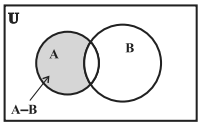
The difference of two sets $A$ and $B$ can be represented by a Venn diagram as shown in the figure below.
The shaded portion represents the difference of the two sets $A$ and $B$.
$B - V = \{k\}$,since the element $k$ belongs to $B$ but not to $V$.
We note that $V - B \neq B - V$. Using the set-builder notation,we can rewrite the definition of difference as:
$A - B = \{x : x \in A \text{ and } x \notin B\}$.
The difference of two sets $A$ and $B$ can be represented by a Venn diagram as shown in the figure below.
The shaded portion represents the difference of the two sets $A$ and $B$.
0 likes
View Solution69
EasyMCQ
Find the union of each of the following pairs of sets:
$X = \{1, 3, 5\}, Y = \{1, 2, 3\}$
$X = \{1, 3, 5\}, Y = \{1, 2, 3\}$
A
$\{1, 2, 3, 5\}$
B
$\{1, 2, 3, 4\}$
C
$\{1, 2, 5\}$
D
$\{3, 5\}$
Solution
(A) The union of two sets $X$ and $Y$,denoted by $X \cup Y$,is the set of all elements which are in $X$,in $Y$,or in both.
Given $X = \{1, 3, 5\}$ and $Y = \{1, 2, 3\}$.
$X \cup Y = \{1, 3, 5\} \cup \{1, 2, 3\} = \{1, 2, 3, 5\}$.
Given $X = \{1, 3, 5\}$ and $Y = \{1, 2, 3\}$.
$X \cup Y = \{1, 3, 5\} \cup \{1, 2, 3\} = \{1, 2, 3, 5\}$.
0 likes
View Solution70
EasyMCQ
Find the union of each of the following pairs of sets:
$A = \{a, e, i, o, u\}$,$B = \{a, b, c\}$
$A = \{a, e, i, o, u\}$,$B = \{a, b, c\}$
A
$\{a, b, c, e, i, o, u\}$
B
$\{a, b, c, e, i, o\}$
C
$\{a, b, c, u\}$
D
$\{e, i, o, u\}$
Solution
(A) The union of two sets $A$ and $B$,denoted by $A \cup B$,is the set of all elements which are in $A$,in $B$,or in both.
Given $A = \{a, e, i, o, u\}$ and $B = \{a, b, c\}$.
$A \cup B = \{a, e, i, o, u\} \cup \{a, b, c\}$.
Combining all unique elements,we get $A \cup B = \{a, b, c, e, i, o, u\}$.
Given $A = \{a, e, i, o, u\}$ and $B = \{a, b, c\}$.
$A \cup B = \{a, e, i, o, u\} \cup \{a, b, c\}$.
Combining all unique elements,we get $A \cup B = \{a, b, c, e, i, o, u\}$.
0 likes
View Solution71
Easy
Find the union of each of the following pairs of sets:
$A = \{ x : x \text{ is a natural number and } 1 < x \le 6 \}$
$B = \{ x : x \text{ is a natural number and } 6 < x < 10 \}$
$A = \{ x : x \text{ is a natural number and } 1 < x \le 6 \}$
$B = \{ x : x \text{ is a natural number and } 6 < x < 10 \}$
Solution
First,represent the sets in roster form:
$A = \{ x : x \in \mathbb{N}, 1 < x \le 6 \} = \{ 2, 3, 4, 5, 6 \}$
$B = \{ x : x \in \mathbb{N}, 6 < x < 10 \} = \{ 7, 8, 9 \}$
The union of two sets $A$ and $B$,denoted by $A \cup B$,is the set of all elements which are in $A$ or in $B$.
$A \cup B = \{ 2, 3, 4, 5, 6, 7, 8, 9 \}$
In set-builder form,this can be written as:
$A \cup B = \{ x : x \in \mathbb{N} \text{ and } 1 < x < 10 \}$
$A = \{ x : x \in \mathbb{N}, 1 < x \le 6 \} = \{ 2, 3, 4, 5, 6 \}$
$B = \{ x : x \in \mathbb{N}, 6 < x < 10 \} = \{ 7, 8, 9 \}$
The union of two sets $A$ and $B$,denoted by $A \cup B$,is the set of all elements which are in $A$ or in $B$.
$A \cup B = \{ 2, 3, 4, 5, 6, 7, 8, 9 \}$
In set-builder form,this can be written as:
$A \cup B = \{ x : x \in \mathbb{N} \text{ and } 1 < x < 10 \}$
0 likes
View Solution72
EasyMCQ
Find the union of each of the following pairs of sets:
$A = \{1, 2, 3\}, B = \varnothing$
$A = \{1, 2, 3\}, B = \varnothing$
A
$A \cup B = \{1, 2, 3\}$
B
$A \cup B = \{1, 2, 3, \varnothing\}$
C
$A \cup B = \varnothing$
D
$A \cup B = \{1, 2, 3, 0\}$
Solution
(A) The union of two sets $A$ and $B$,denoted by $A \cup B$,is the set of all elements which are in $A$ or in $B$ or in both.
Given $A = \{1, 2, 3\}$ and $B = \varnothing$ (the empty set).
Since the empty set contains no elements,the union $A \cup B$ consists only of the elements present in set $A$.
Therefore,$A \cup B = \{1, 2, 3\}$.
Given $A = \{1, 2, 3\}$ and $B = \varnothing$ (the empty set).
Since the empty set contains no elements,the union $A \cup B$ consists only of the elements present in set $A$.
Therefore,$A \cup B = \{1, 2, 3\}$.
0 likes
View Solution73
EasyMCQ
Let $A = \{a, b\}$ and $B = \{a, b, c\}$. Is $A \subset B$? What is $A \cup B$?
A
Yes,$A \subset B$ and $A \cup B = \{a, b, c\}$
B
No,$A \not\subset B$ and $A \cup B = \{a, b, c\}$
C
Yes,$A \subset B$ and $A \cup B = \{a, b\}$
D
No,$A \not\subset B$ and $A \cup B = \{a, b\}$
Solution
(A) Given sets are $A = \{a, b\}$ and $B = \{a, b, c\}$.
Since every element of $A$ is also an element of $B$,$A$ is a subset of $B$,i.e.,$A \subset B$.
The union of two sets $A$ and $B$ is the set of all elements which are in $A$ or in $B$.
Therefore,$A \cup B = \{a, b\} \cup \{a, b, c\} = \{a, b, c\} = B$.
Since every element of $A$ is also an element of $B$,$A$ is a subset of $B$,i.e.,$A \subset B$.
The union of two sets $A$ and $B$ is the set of all elements which are in $A$ or in $B$.
Therefore,$A \cup B = \{a, b\} \cup \{a, b, c\} = \{a, b, c\} = B$.
0 likes
View Solution74
EasyMCQ
If $A$ and $B$ are two sets such that $A \subset B$,then what is $A \cup B$?
A
$A$
B
$B$
C
$\phi$
D
$A \cap B$
Solution
(B) Given that $A \subset B$,every element of set $A$ is also an element of set $B$.
Therefore,the union of $A$ and $B$,denoted by $A \cup B$,consists of all elements that are in $A$ or in $B$.
Since all elements of $A$ are already in $B$,the union $A \cup B$ is equal to $B$.
Therefore,the union of $A$ and $B$,denoted by $A \cup B$,consists of all elements that are in $A$ or in $B$.
Since all elements of $A$ are already in $B$,the union $A \cup B$ is equal to $B$.
0 likes
View Solution75
EasyMCQ
If $A = \{1, 2, 3, 4\}$,$B = \{3, 4, 5, 6\}$,$C = \{5, 6, 7, 8\}$,and $D = \{7, 8, 9, 10\}$,find $A \cup B$.
A
$\{1, 2, 3, 4, 5, 6\}$
B
$\{1, 2, 3, 4, 5\}$
C
$\{3, 4\}$
D
$\{1, 2, 3, 4, 5, 6, 7, 8\}$
Solution
(A) Given sets are $A = \{1, 2, 3, 4\}$ and $B = \{3, 4, 5, 6\}$.
The union of two sets $A$ and $B$,denoted by $A \cup B$,is the set of all elements which are in $A$,in $B$,or in both.
$A \cup B = \{1, 2, 3, 4\} \cup \{3, 4, 5, 6\} = \{1, 2, 3, 4, 5, 6\}$.
The union of two sets $A$ and $B$,denoted by $A \cup B$,is the set of all elements which are in $A$,in $B$,or in both.
$A \cup B = \{1, 2, 3, 4\} \cup \{3, 4, 5, 6\} = \{1, 2, 3, 4, 5, 6\}$.
0 likes
View Solution76
EasyMCQ
If $A=\{1, 2, 3, 4\}, B=\{3, 4, 5, 6\}, C=\{5, 6, 7, 8\}$ and $D=\{7, 8, 9, 10\}$,find $A \cup C$.
A
$\{1, 2, 3, 4, 5, 6, 7, 8\}$
B
$\{1, 2, 3, 4, 5, 6\}$
C
$\{3, 4, 5, 6\}$
D
$\{5, 6, 7, 8\}$
Solution
(A) Given sets are $A = \{1, 2, 3, 4\}$ and $C = \{5, 6, 7, 8\}$.
The union of two sets $A$ and $C$,denoted by $A \cup C$,is the set of all elements that are in $A$,or in $C$,or in both.
$A \cup C = \{1, 2, 3, 4\} \cup \{5, 6, 7, 8\} = \{1, 2, 3, 4, 5, 6, 7, 8\}$.
The union of two sets $A$ and $C$,denoted by $A \cup C$,is the set of all elements that are in $A$,or in $C$,or in both.
$A \cup C = \{1, 2, 3, 4\} \cup \{5, 6, 7, 8\} = \{1, 2, 3, 4, 5, 6, 7, 8\}$.
0 likes
View Solution77
EasyMCQ
If $A = \{1, 2, 3, 4\}$,$B = \{3, 4, 5, 6\}$,$C = \{5, 6, 7, 8\}$,and $D = \{7, 8, 9, 10\}$,find $B \cup C$.
A
$\{3, 4, 5, 6, 7, 8\}$
B
$\{3, 4, 5, 6, 7, 9\}$
C
$\{3, 4, 5, 6, 8, 9\}$
D
$\{3, 4, 5, 6, 7, 10\}$
Solution
(A) Given sets are $B = \{3, 4, 5, 6\}$ and $C = \{5, 6, 7, 8\}$.
The union of two sets $B$ and $C$,denoted by $B \cup C$,is the set of all elements that are in $B$,or in $C$,or in both.
$B \cup C = \{3, 4, 5, 6\} \cup \{5, 6, 7, 8\} = \{3, 4, 5, 6, 7, 8\}$.
The union of two sets $B$ and $C$,denoted by $B \cup C$,is the set of all elements that are in $B$,or in $C$,or in both.
$B \cup C = \{3, 4, 5, 6\} \cup \{5, 6, 7, 8\} = \{3, 4, 5, 6, 7, 8\}$.
0 likes
View Solution78
EasyMCQ
If $A = \{1, 2, 3, 4\}, B = \{3, 4, 5, 6\}, C = \{5, 6, 7, 8\}$ and $D = \{7, 8, 9, 10\}$,find $B \cup D$.
A
$\{3, 4, 5, 6, 7, 8, 9, 10\}$
B
$\{3, 4, 5, 6, 7, 8\}$
C
$\{5, 6, 7, 8\}$
D
$\{3, 4, 9, 10\}$
Solution
(A) Given sets are $B = \{3, 4, 5, 6\}$ and $D = \{7, 8, 9, 10\}$.
The union of two sets $B$ and $D$,denoted by $B \cup D$,is the set of all elements that are in $B$,or in $D$,or in both.
$B \cup D = \{3, 4, 5, 6\} \cup \{7, 8, 9, 10\} = \{3, 4, 5, 6, 7, 8, 9, 10\}$.
The union of two sets $B$ and $D$,denoted by $B \cup D$,is the set of all elements that are in $B$,or in $D$,or in both.
$B \cup D = \{3, 4, 5, 6\} \cup \{7, 8, 9, 10\} = \{3, 4, 5, 6, 7, 8, 9, 10\}$.
0 likes
View Solution79
EasyMCQ
If $A = \{1, 2, 3, 4\}$,$B = \{3, 4, 5, 6\}$,$C = \{5, 6, 7, 8\}$,and $D = \{7, 8, 9, 10\}$,find $A \cup B \cup C$.
A
$\{1, 2, 3, 4, 5, 6, 7, 8\}$
B
$\{1, 2, 3, 4, 5, 6, 7, 9\}$
C
$\{3, 4, 5, 6, 7, 8\}$
D
$\{1, 2, 3, 4, 5, 6, 7, 8, 9, 10\}$
Solution
(A) Given sets are $A = \{1, 2, 3, 4\}$,$B = \{3, 4, 5, 6\}$,and $C = \{5, 6, 7, 8\}$.
The union of sets $A$,$B$,and $C$ is the set of all elements that are in $A$,$B$,or $C$.
$A \cup B \cup C = \{1, 2, 3, 4\} \cup \{3, 4, 5, 6\} \cup \{5, 6, 7, 8\}$
Combining all unique elements,we get:
$A \cup B \cup C = \{1, 2, 3, 4, 5, 6, 7, 8\}$
The union of sets $A$,$B$,and $C$ is the set of all elements that are in $A$,$B$,or $C$.
$A \cup B \cup C = \{1, 2, 3, 4\} \cup \{3, 4, 5, 6\} \cup \{5, 6, 7, 8\}$
Combining all unique elements,we get:
$A \cup B \cup C = \{1, 2, 3, 4, 5, 6, 7, 8\}$
0 likes
View Solution80
EasyMCQ
If $A = \{1, 2, 3, 4\}$,$B = \{3, 4, 5, 6\}$,$C = \{5, 6, 7, 8\}$,and $D = \{7, 8, 9, 10\}$,find $A \cup B \cup D$.
A
$\{1, 2, 3, 4, 5, 6, 7, 8, 9, 10\}$
B
$\{1, 2, 3, 4, 5, 6\}$
C
$\{3, 4, 5, 6, 7, 8\}$
D
$\{1, 2, 9, 10\}$
Solution
(A) Given sets are $A = \{1, 2, 3, 4\}$,$B = \{3, 4, 5, 6\}$,and $D = \{7, 8, 9, 10\}$.
The union of sets $A$,$B$,and $D$ is the set of all elements that are in at least one of the sets $A$,$B$,or $D$.
$A \cup B \cup D = \{1, 2, 3, 4\} \cup \{3, 4, 5, 6\} \cup \{7, 8, 9, 10\}$
Combining all unique elements,we get:
$A \cup B \cup D = \{1, 2, 3, 4, 5, 6, 7, 8, 9, 10\}$
The union of sets $A$,$B$,and $D$ is the set of all elements that are in at least one of the sets $A$,$B$,or $D$.
$A \cup B \cup D = \{1, 2, 3, 4\} \cup \{3, 4, 5, 6\} \cup \{7, 8, 9, 10\}$
Combining all unique elements,we get:
$A \cup B \cup D = \{1, 2, 3, 4, 5, 6, 7, 8, 9, 10\}$
0 likes
View Solution81
EasyMCQ
If $A = \{1, 2, 3, 4\}$,$B = \{3, 4, 5, 6\}$,$C = \{5, 6, 7, 8\}$,and $D = \{7, 8, 9, 10\}$,find $B \cup C \cup D$.
A
$\{3, 4, 5, 6, 7, 8, 9, 10\}$
B
$\{1, 2, 3, 4, 5, 6, 7, 8\}$
C
$\{3, 4, 5, 6, 7, 8\}$
D
$\{5, 6, 7, 8, 9, 10\}$
Solution
(A) Given sets are $B = \{3, 4, 5, 6\}$,$C = \{5, 6, 7, 8\}$,and $D = \{7, 8, 9, 10\}$.
The union of sets $B$,$C$,and $D$ is the set of all elements that are in at least one of the sets $B$,$C$,or $D$.
$B \cup C \cup D = \{3, 4, 5, 6\} \cup \{5, 6, 7, 8\} \cup \{7, 8, 9, 10\}$
Combining all unique elements,we get:
$B \cup C \cup D = \{3, 4, 5, 6, 7, 8, 9, 10\}$.
The union of sets $B$,$C$,and $D$ is the set of all elements that are in at least one of the sets $B$,$C$,or $D$.
$B \cup C \cup D = \{3, 4, 5, 6\} \cup \{5, 6, 7, 8\} \cup \{7, 8, 9, 10\}$
Combining all unique elements,we get:
$B \cup C \cup D = \{3, 4, 5, 6, 7, 8, 9, 10\}$.
0 likes
View Solution82
EasyMCQ
Find the intersection of the given pair of sets:
$X = \{1, 3, 5\}, Y = \{1, 2, 3\}$
$X = \{1, 3, 5\}, Y = \{1, 2, 3\}$
A
$\{1, 3\}$
B
$\{1, 2\}$
C
$\{2, 3\}$
D
$\{1, 2, 3, 5\}$
Solution
(A) The intersection of two sets $X$ and $Y$,denoted by $X \cap Y$,is the set of all elements which are common to both $X$ and $Y$.
Given $X = \{1, 3, 5\}$ and $Y = \{1, 2, 3\}$.
The common elements in both sets are $1$ and $3$.
Therefore,$X \cap Y = \{1, 3\}$.
Given $X = \{1, 3, 5\}$ and $Y = \{1, 2, 3\}$.
The common elements in both sets are $1$ and $3$.
Therefore,$X \cap Y = \{1, 3\}$.
0 likes
View Solution83
EasyMCQ
Find the union of each of the following pairs of sets: $A = \{a, e, i, o, u\}$,$B = \{a, b, c\}$.
A
$\{a, b, c, e, i, o, u\}$
B
$\{a, b, c\}$
C
$\{e, i, o, u\}$
D
$\{a, e, i, o, u, b, c\}$
Solution
(A) The union of two sets $A$ and $B$,denoted by $A \cup B$,is the set of all elements which are in $A$,in $B$,or in both.
Given $A = \{a, e, i, o, u\}$ and $B = \{a, b, c\}$.
$A \cup B = \{a, e, i, o, u, b, c\}$ or $\{a, b, c, e, i, o, u\}$.
Given $A = \{a, e, i, o, u\}$ and $B = \{a, b, c\}$.
$A \cup B = \{a, e, i, o, u, b, c\}$ or $\{a, b, c, e, i, o, u\}$.
0 likes
View Solution84
EasyMCQ
Find the union of each of the following pairs of sets:
$A = \{ x : x \text{ is a natural number and a multiple of } 3 \}$
$B = \{ x : x \text{ is a natural number less than } 6 \}$
$A = \{ x : x \text{ is a natural number and a multiple of } 3 \}$
$B = \{ x : x \text{ is a natural number less than } 6 \}$
A
$\{ 1, 2, 3, 4, 5, 6, 9, 12, \ldots \}$
B
$\{ 3, 6 \}$
C
$\{ 1, 2, 3, 4, 5 \}$
D
$\{ 3, 6, 9, \ldots \}$
Solution
(A) Given sets are:
$A = \{ 3, 6, 9, 12, \ldots \}$
$B = \{ 1, 2, 3, 4, 5 \}$
The union of two sets $A$ and $B$,denoted by $A \cup B$,is the set of all elements which are in $A$ or in $B$ (or in both).
$A \cup B = \{ x : x \in A \text{ or } x \in B \}$
$A \cup B = \{ 1, 2, 3, 4, 5, 6, 9, 12, \ldots \}$
$A = \{ 3, 6, 9, 12, \ldots \}$
$B = \{ 1, 2, 3, 4, 5 \}$
The union of two sets $A$ and $B$,denoted by $A \cup B$,is the set of all elements which are in $A$ or in $B$ (or in both).
$A \cup B = \{ x : x \in A \text{ or } x \in B \}$
$A \cup B = \{ 1, 2, 3, 4, 5, 6, 9, 12, \ldots \}$
0 likes
View Solution85
Easy
Find the union of each of the following pairs of sets:
$A = \{ x : x \text{ is a natural number and } 1 < x \le 6 \}$
$B = \{ x : x \text{ is a natural number and } 6 < x < 10 \}$
$A = \{ x : x \text{ is a natural number and } 1 < x \le 6 \}$
$B = \{ x : x \text{ is a natural number and } 6 < x < 10 \}$
Solution
(A) First,we list the elements of set $A$:
$A = \{ x : x \in \mathbb{N}, 1 < x \le 6 \} = \{ 2, 3, 4, 5, 6 \}$
Next,we list the elements of set $B$:
$B = \{ x : x \in \mathbb{N}, 6 < x < 10 \} = \{ 7, 8, 9 \}$
The union of two sets $A$ and $B$,denoted by $A \cup B$,is the set of all elements which are in $A$,in $B$,or in both.
$A \cup B = \{ 2, 3, 4, 5, 6, 7, 8, 9 \}$
$A = \{ x : x \in \mathbb{N}, 1 < x \le 6 \} = \{ 2, 3, 4, 5, 6 \}$
Next,we list the elements of set $B$:
$B = \{ x : x \in \mathbb{N}, 6 < x < 10 \} = \{ 7, 8, 9 \}$
The union of two sets $A$ and $B$,denoted by $A \cup B$,is the set of all elements which are in $A$,in $B$,or in both.
$A \cup B = \{ 2, 3, 4, 5, 6, 7, 8, 9 \}$
0 likes
View Solution86
EasyMCQ
If $A = \{3, 5, 7, 9, 11\}$,$B = \{7, 9, 11, 13\}$,$C = \{11, 13, 15\}$,and $D = \{15, 17\}$,find $A \cap B$.
A
$\{7, 9, 11\}$
B
$\{7, 9, 13\}$
C
$\{3, 5, 7\}$
D
$\{9, 11, 13\}$
Solution
(A) The intersection of two sets $A$ and $B$,denoted by $A \cap B$,consists of all elements that are common to both sets.
Given $A = \{3, 5, 7, 9, 11\}$ and $B = \{7, 9, 11, 13\}$.
The common elements in $A$ and $B$ are $7, 9,$ and $11$.
Therefore,$A \cap B = \{7, 9, 11\}$.
Given $A = \{3, 5, 7, 9, 11\}$ and $B = \{7, 9, 11, 13\}$.
The common elements in $A$ and $B$ are $7, 9,$ and $11$.
Therefore,$A \cap B = \{7, 9, 11\}$.
0 likes
View Solution87
EasyMCQ
If $A = \{3, 5, 7, 9, 11\}$,$B = \{7, 9, 11, 13\}$,$C = \{11, 13, 15\}$ and $D = \{15, 17\}$; find $B \cap C$.
A
$\{11, 13\}$
B
$\{7, 9, 11\}$
C
$\{11, 15\}$
D
$\{7, 13\}$
Solution
(A) The intersection of two sets $B$ and $C$,denoted by $B \cap C$,consists of all elements that are common to both sets.
Given $B = \{7, 9, 11, 13\}$ and $C = \{11, 13, 15\}$.
The common elements in $B$ and $C$ are $11$ and $13$.
Therefore,$B \cap C = \{11, 13\}$.
Given $B = \{7, 9, 11, 13\}$ and $C = \{11, 13, 15\}$.
The common elements in $B$ and $C$ are $11$ and $13$.
Therefore,$B \cap C = \{11, 13\}$.
0 likes
View Solution88
EasyMCQ
If $A = \{3, 5, 7, 9, 11\}$,$B = \{7, 9, 11, 13\}$,$C = \{11, 13, 15\}$,and $D = \{15, 17\}$,find $A \cap C \cap D$.
A
$\varnothing$
B
$\{11\}$
C
$\{15\}$
D
$\{11, 15\}$
Solution
(A) Given sets are $A = \{3, 5, 7, 9, 11\}$,$C = \{11, 13, 15\}$,and $D = \{15, 17\}$.
First,find the intersection of $A$ and $C$:
$A \cap C = \{3, 5, 7, 9, 11\} \cap \{11, 13, 15\} = \{11\}$.
Next,find the intersection of the result with $D$:
$(A \cap C) \cap D = \{11\} \cap \{15, 17\}$.
Since there are no common elements between $\{11\}$ and $\{15, 17\}$,the result is the empty set $\varnothing$.
First,find the intersection of $A$ and $C$:
$A \cap C = \{3, 5, 7, 9, 11\} \cap \{11, 13, 15\} = \{11\}$.
Next,find the intersection of the result with $D$:
$(A \cap C) \cap D = \{11\} \cap \{15, 17\}$.
Since there are no common elements between $\{11\}$ and $\{15, 17\}$,the result is the empty set $\varnothing$.
0 likes
View Solution89
EasyMCQ
If $A = \{3, 5, 7, 9, 11\}$,$B = \{7, 9, 11, 13\}$,$C = \{11, 13, 15\}$ and $D = \{15, 17\}$,find $A \cap C$.
A
$\emptyset$
B
$\emptyset$
C
$\{11\}$
D
$\{11, 13\}$
Solution
(C) The intersection of two sets $A$ and $C$,denoted by $A \cap C$,consists of all elements that are common to both set $A$ and set $C$.
Given $A = \{3, 5, 7, 9, 11\}$ and $C = \{11, 13, 15\}$.
The only element common to both sets is $11$.
Therefore,$A \cap C = \{11\}$.
Given $A = \{3, 5, 7, 9, 11\}$ and $C = \{11, 13, 15\}$.
The only element common to both sets is $11$.
Therefore,$A \cap C = \{11\}$.
0 likes
View Solution90
Easy
If $A = \{3, 5, 7, 9, 11\}$,$B = \{7, 9, 11, 13\}$,$C = \{11, 13, 15\}$,and $D = \{15, 17\}$,find $B \cap D$.
Solution
(NONE) The intersection of two sets $B$ and $D$ consists of all elements that are common to both sets.
Given $B = \{7, 9, 11, 13\}$ and $D = \{15, 17\}$.
Comparing the elements of $B$ and $D$,we see that there are no common elements.
Therefore,$B \cap D = \varnothing$ or $\{\}$.
Given $B = \{7, 9, 11, 13\}$ and $D = \{15, 17\}$.
Comparing the elements of $B$ and $D$,we see that there are no common elements.
Therefore,$B \cap D = \varnothing$ or $\{\}$.
0 likes
View Solution91
EasyMCQ
If $A=\{3, 5, 7, 9, 11\}, B=\{7, 9, 11, 13\}, C=\{11, 13, 15\}$ and $D=\{15, 17\}$,find $A \cap (B \cup C)$.
A
$\{7, 9, 11\}$
B
$\{7, 9, 13\}$
C
$\{11, 13, 15\}$
D
$\{3, 5, 7\}$
Solution
(A) First,find the union of sets $B$ and $C$:
$B \cup C = \{7, 9, 11, 13\} \cup \{11, 13, 15\} = \{7, 9, 11, 13, 15\}$.
Now,find the intersection of set $A$ with $(B \cup C)$:
$A \cap (B \cup C) = \{3, 5, 7, 9, 11\} \cap \{7, 9, 11, 13, 15\}$.
The common elements are $\{7, 9, 11\}$.
$B \cup C = \{7, 9, 11, 13\} \cup \{11, 13, 15\} = \{7, 9, 11, 13, 15\}$.
Now,find the intersection of set $A$ with $(B \cup C)$:
$A \cap (B \cup C) = \{3, 5, 7, 9, 11\} \cap \{7, 9, 11, 13, 15\}$.
The common elements are $\{7, 9, 11\}$.
0 likes
View Solution92
EasyMCQ
If $A = \{3, 5, 7, 9, 11\}$,$B = \{7, 9, 11, 13\}$,$C = \{11, 13, 15\}$,and $D = \{15, 17\}$,find $A \cap D$.
A
$\varnothing$
B
$\{11\}$
C
$\{7, 9\}$
D
$\{15\}$
Solution
(A) The set $A = \{3, 5, 7, 9, 11\}$ and the set $D = \{15, 17\}$.
To find the intersection $A \cap D$,we look for elements that are common to both sets.
Since there are no common elements between $A$ and $D$,the intersection is the empty set,denoted by $\varnothing$.
To find the intersection $A \cap D$,we look for elements that are common to both sets.
Since there are no common elements between $A$ and $D$,the intersection is the empty set,denoted by $\varnothing$.
0 likes
View Solution93
Easy
If $A=\{3, 5, 7, 9, 11\}, B=\{7, 9, 11, 13\}, C=\{11, 13, 15\}$ and $D=\{15, 17\}$; find $A \cap (B \cup D)$.
Solution
(N/A) First,find the union of sets $B$ and $D$:
$B \cup D = \{7, 9, 11, 13\} \cup \{15, 17\} = \{7, 9, 11, 13, 15, 17\}$.
Next,find the intersection of set $A$ with the result:
$A \cap (B \cup D) = \{3, 5, 7, 9, 11\} \cap \{7, 9, 11, 13, 15, 17\}$.
The common elements are $\{7, 9, 11\}$.
Therefore,$A \cap (B \cup D) = \{7, 9, 11\}$.
$B \cup D = \{7, 9, 11, 13\} \cup \{15, 17\} = \{7, 9, 11, 13, 15, 17\}$.
Next,find the intersection of set $A$ with the result:
$A \cap (B \cup D) = \{3, 5, 7, 9, 11\} \cap \{7, 9, 11, 13, 15, 17\}$.
The common elements are $\{7, 9, 11\}$.
Therefore,$A \cap (B \cup D) = \{7, 9, 11\}$.
0 likes
View Solution94
Easy
If $A = \{3, 5, 7, 9, 11\}$,$B = \{7, 9, 11, 13\}$,$C = \{11, 13, 15\}$,and $D = \{15, 17\}$,find $(A \cap B) \cap (B \cup C)$.
Solution
First,find the intersection of sets $A$ and $B$:
$(A \cap B) = \{3, 5, 7, 9, 11\} \cap \{7, 9, 11, 13\} = \{7, 9, 11\}$.
Next,find the union of sets $B$ and $C$:
$(B \cup C) = \{7, 9, 11, 13\} \cup \{11, 13, 15\} = \{7, 9, 11, 13, 15\}$.
Finally,find the intersection of the two results:
$(A \cap B) \cap (B \cup C) = \{7, 9, 11\} \cap \{7, 9, 11, 13, 15\} = \{7, 9, 11\}$.
$(A \cap B) = \{3, 5, 7, 9, 11\} \cap \{7, 9, 11, 13\} = \{7, 9, 11\}$.
Next,find the union of sets $B$ and $C$:
$(B \cup C) = \{7, 9, 11, 13\} \cup \{11, 13, 15\} = \{7, 9, 11, 13, 15\}$.
Finally,find the intersection of the two results:
$(A \cap B) \cap (B \cup C) = \{7, 9, 11\} \cap \{7, 9, 11, 13, 15\} = \{7, 9, 11\}$.
0 likes
View Solution95
EasyMCQ
If $A=\{3, 5, 7, 9, 11\}$,$B=\{7, 9, 11, 13\}$,$C=\{11, 13, 15\}$,and $D=\{15, 17\}$; find $(A \cup D) \cap (B \cup C)$.
A
$\{7, 9, 11, 15\}$
B
$\{3, 5, 7, 9, 11\}$
C
$\{11, 13, 15\}$
D
$\{7, 9, 11, 13\}$
Solution
(A) First,find the union of sets $A$ and $D$:
$A \cup D = \{3, 5, 7, 9, 11, 15, 17\}$
Next,find the union of sets $B$ and $C$:
$B \cup C = \{7, 9, 11, 13, 15\}$
Finally,find the intersection of the two resulting sets:
$(A \cup D) \cap (B \cup C) = \{3, 5, 7, 9, 11, 15, 17\} \cap \{7, 9, 11, 13, 15\} = \{7, 9, 11, 15\}$
$A \cup D = \{3, 5, 7, 9, 11, 15, 17\}$
Next,find the union of sets $B$ and $C$:
$B \cup C = \{7, 9, 11, 13, 15\}$
Finally,find the intersection of the two resulting sets:
$(A \cup D) \cap (B \cup C) = \{3, 5, 7, 9, 11, 15, 17\} \cap \{7, 9, 11, 13, 15\} = \{7, 9, 11, 15\}$
0 likes
View Solution96
EasyMCQ
If $A = \{ x : x \text{ is a natural number} \}$,$B = \{ x : x \text{ is an even natural number} \}$,$C = \{ x : x \text{ is an odd natural number} \}$,and $D = \{ x : x \text{ is a prime number} \}$,find $A \cap B$.
A
$B$
B
$C$
C
$D$
D
$\emptyset$
Solution
(A) Given sets are:
$A = \{ 1, 2, 3, 4, 5, \ldots \}$
$B = \{ 2, 4, 6, 8, \ldots \}$
$C = \{ 1, 3, 5, 7, 9, \ldots \}$
$D = \{ 2, 3, 5, 7, \ldots \}$
The intersection $A \cap B$ consists of elements that are common to both set $A$ and set $B$.
Since $B$ is a subset of $A$ $(B \subset A)$,the intersection of $A$ and $B$ is $B$ itself.
$A \cap B = \{ x : x \in A \text{ and } x \in B \} = \{ x : x \text{ is an even natural number} \} = B$.
$A = \{ 1, 2, 3, 4, 5, \ldots \}$
$B = \{ 2, 4, 6, 8, \ldots \}$
$C = \{ 1, 3, 5, 7, 9, \ldots \}$
$D = \{ 2, 3, 5, 7, \ldots \}$
The intersection $A \cap B$ consists of elements that are common to both set $A$ and set $B$.
Since $B$ is a subset of $A$ $(B \subset A)$,the intersection of $A$ and $B$ is $B$ itself.
$A \cap B = \{ x : x \in A \text{ and } x \in B \} = \{ x : x \text{ is an even natural number} \} = B$.
0 likes
View Solution97
EasyMCQ
If $A = \{ x : x \text{ is a natural number} \}$,$B = \{ x : x \text{ is an even natural number} \}$,$C = \{ x : x \text{ is an odd natural number} \}$,and $D = \{ x : x \text{ is a prime number} \}$,find $A \cap C$.
A
$A$
B
$B$
C
$C$
D
$D$
0 likes
View Solution98
EasyMCQ
If $A = \{ x : x \text{ is a natural number} \}$,$B = \{ x : x \text{ is an even natural number} \}$,$C = \{ x : x \text{ is an odd natural number} \}$ and $D = \{ x : x \text{ is a prime number} \}$,find $B \cap C$.
A
$\varnothing$
B
$A$
C
$D$
D
$\text{None of these}$
Solution
(A) Given sets are:
$A = \{1, 2, 3, 4, 5, \ldots \}$
$B = \{2, 4, 6, 8, \ldots \}$
$C = \{1, 3, 5, 7, 9, \ldots \}$
$D = \{2, 3, 5, 7, \ldots \}$
The intersection $B \cap C$ represents the set of elements that are common to both $B$ and $C$.
Since $B$ contains only even natural numbers and $C$ contains only odd natural numbers,there are no common elements between them.
Therefore,$B \cap C = \varnothing$.
$A = \{1, 2, 3, 4, 5, \ldots \}$
$B = \{2, 4, 6, 8, \ldots \}$
$C = \{1, 3, 5, 7, 9, \ldots \}$
$D = \{2, 3, 5, 7, \ldots \}$
The intersection $B \cap C$ represents the set of elements that are common to both $B$ and $C$.
Since $B$ contains only even natural numbers and $C$ contains only odd natural numbers,there are no common elements between them.
Therefore,$B \cap C = \varnothing$.
0 likes
View Solution99
EasyMCQ
If $A = \{ x : x \text{ is a natural number} \}$,$B = \{ x : x \text{ is an even natural number} \}$,$C = \{ x : x \text{ is an odd natural number} \}$,and $D = \{ x : x \text{ is a prime number} \}$,find $B \cap D$.
A
$\{ 2 \}$
B
$\{ 3 \}$
C
$\{ 2, 3 \}$
D
$\{ 1, 2 \}$
Solution
(A) $A = \{ 1, 2, 3, 4, 5, \ldots \}$
$B = \{ 2, 4, 6, 8, \ldots \}$
$C = \{ 1, 3, 5, 7, 9, \ldots \}$
$D = \{ 2, 3, 5, 7, \ldots \}$
$B \cap D$ represents the set of elements common to both $B$ and $D$.
Since $2$ is the only even prime number,$B \cap D = \{ 2 \}$.
$B = \{ 2, 4, 6, 8, \ldots \}$
$C = \{ 1, 3, 5, 7, 9, \ldots \}$
$D = \{ 2, 3, 5, 7, \ldots \}$
$B \cap D$ represents the set of elements common to both $B$ and $D$.
Since $2$ is the only even prime number,$B \cap D = \{ 2 \}$.
0 likes
View Solution100
EasyMCQ
If $A = \{ x : x \text{ is a natural number} \}$,$B = \{ x : x \text{ is an even natural number} \}$,$C = \{ x : x \text{ is an odd natural number} \}$,and $D = \{ x : x \text{ is a prime number} \}$,find $C \cap D$.
A
$C \cap D = \{ x : x \text{ is an odd prime number} \}$
B
$C \cap D = \{ x : x \text{ is an even prime number} \}$
C
$C \cap D = \{ x : x \text{ is a natural number} \}$
D
$C \cap D = \emptyset$
Solution
(A) Given sets are:
$A = \{1, 2, 3, 4, 5, \ldots \}$
$B = \{2, 4, 6, 8, \ldots \}$
$C = \{1, 3, 5, 7, 9, \ldots \}$
$D = \{2, 3, 5, 7, 11, \ldots \}$
The intersection $C \cap D$ consists of elements that are common to both set $C$ (odd natural numbers) and set $D$ (prime numbers).
Since $2$ is the only even prime number,all other prime numbers are odd.
Therefore,$C \cap D = \{ x : x \text{ is an odd prime number} \} = \{3, 5, 7, 11, \ldots \}$.
$A = \{1, 2, 3, 4, 5, \ldots \}$
$B = \{2, 4, 6, 8, \ldots \}$
$C = \{1, 3, 5, 7, 9, \ldots \}$
$D = \{2, 3, 5, 7, 11, \ldots \}$
The intersection $C \cap D$ consists of elements that are common to both set $C$ (odd natural numbers) and set $D$ (prime numbers).
Since $2$ is the only even prime number,all other prime numbers are odd.
Therefore,$C \cap D = \{ x : x \text{ is an odd prime number} \} = \{3, 5, 7, 11, \ldots \}$.
0 likes
View SolutionSet Theory — Venn Diagram and Operation on Sets · Frequently Asked Questions
1Are these Set Theory questions useful for JEE and NEET?
Yes. All questions in this section are mapped to JEE Main and NEET exam patterns. Previous year questions from JEE Main, NEET, GUJCET and state-level exams are included with full solutions.
2Can I switch to Hindi or Gujarati for these questions?
Yes. Use the language tabs in the hero section or the sidebar to view the same questions and solutions in English, Hindi or Gujarati.
3How do I generate a question paper from this subtopic?
Use the Vedclass Exam Paper Generator — select the chapter and subtopic, set difficulty, and generate Sets A, B, C, D automatically. First 3 chapters of every subject are free.
Vedclass Products
For Students
Vedclass Test Series
Mock tests in real JEE/NEET style with performance analysis. 5-day free trial.
Start Free TrialFor Teachers
Exam Paper Generator
Generate Set A/B/C/D papers from this chapter in 2 minutes. 3 chapters free.
Try FreeFor Institutes
Online Exam Module
Live online exams with unlimited students, 360° analytics & white-label branding.
See DemoFor Teachers & Institutes
Generate a Set Theory Exam Paper in 2 Minutes
Select subtopic & difficulty — Sets A, B, C, D auto-generated with No Repeat logic.
First 3 chapters of every subject are free — no payment required.