
A English
Venn Diagram and Operation on Sets Questions in English
Class 11 Mathematics · Set Theory · Venn Diagram and Operation on Sets
135+
Questions
English
Language
100%
With Solutions
Showing 35 of 135 questions in English
101
EasyMCQ
Which of the following pairs of sets are disjoint?
${1, 2, 3, 4}$ and ${x : x \text{ is a natural number and } 4 \le x \le 6}$
${1, 2, 3, 4}$ and ${x : x \text{ is a natural number and } 4 \le x \le 6}$
A
The sets are disjoint.
B
The sets are not disjoint.
C
The sets are equal.
D
The sets are equivalent.
Solution
(B) Let $A = \{1, 2, 3, 4\}$.
Let $B = \{x : x \text{ is a natural number and } 4 \le x \le 6\} = \{4, 5, 6\}$.
To check if the sets are disjoint,we find their intersection: $A \cap B = \{1, 2, 3, 4\} \cap \{4, 5, 6\} = \{4\}$.
Since $A \cap B \neq \emptyset$,the sets are not disjoint.
Let $B = \{x : x \text{ is a natural number and } 4 \le x \le 6\} = \{4, 5, 6\}$.
To check if the sets are disjoint,we find their intersection: $A \cap B = \{1, 2, 3, 4\} \cap \{4, 5, 6\} = \{4\}$.
Since $A \cap B \neq \emptyset$,the sets are not disjoint.
0 likes
View Solution102
EasyMCQ
Which of the following pairs of sets are disjoint?
$A = \{a, e, i, o, u\}$ and $B = \{c, d, e, f\}$
$A = \{a, e, i, o, u\}$ and $B = \{c, d, e, f\}$
A
Yes,they are disjoint.
B
No,they are not disjoint.
Solution
(B) Two sets are disjoint if their intersection is the empty set,i.e.,$A \cap B = \emptyset$.
Given sets: $A = \{a, e, i, o, u\}$ and $B = \{c, d, e, f\}$.
The intersection is $A \cap B = \{a, e, i, o, u\} \cap \{c, d, e, f\} = \{e\}$.
Since $A \cap B \neq \emptyset$,the sets are not disjoint.
Given sets: $A = \{a, e, i, o, u\}$ and $B = \{c, d, e, f\}$.
The intersection is $A \cap B = \{a, e, i, o, u\} \cap \{c, d, e, f\} = \{e\}$.
Since $A \cap B \neq \emptyset$,the sets are not disjoint.
0 likes
View Solution103
EasyMCQ
If $A = \{3, 6, 9, 12, 15, 18, 21\}$,$B = \{4, 8, 12, 16, 20\}$,$C = \{2, 4, 6, 8, 10, 12, 14, 16\}$,and $D = \{5, 10, 15, 20\}$,find $A - B$.
A
$\{3, 6, 9, 15, 18, 21\}$
B
$\{3, 6, 9, 12, 15, 18, 21\}$
C
$\{4, 8, 12, 16, 20\}$
D
$\{3, 6, 9, 12, 15, 18, 21\}$
Solution
(A) The difference of two sets $A$ and $B$,denoted by $A - B$,is the set of elements which belong to $A$ but do not belong to $B$.
Given $A = \{3, 6, 9, 12, 15, 18, 21\}$ and $B = \{4, 8, 12, 16, 20\}$.
The common element between $A$ and $B$ is $\{12\}$.
Removing the element $12$ from set $A$,we get $A - B = \{3, 6, 9, 15, 18, 21\}$.
Given $A = \{3, 6, 9, 12, 15, 18, 21\}$ and $B = \{4, 8, 12, 16, 20\}$.
The common element between $A$ and $B$ is $\{12\}$.
Removing the element $12$ from set $A$,we get $A - B = \{3, 6, 9, 15, 18, 21\}$.
0 likes
View Solution104
EasyMCQ
If $A=\{3, 6, 9, 12, 15, 18, 21\}, B=\{4, 8, 12, 16, 20\}, C=\{2, 4, 6, 8, 10, 12, 14, 16\}, D=\{5, 10, 15, 20\};$ find $A-C$.
A
$\{3, 9, 15, 18, 21\}$
B
$\{3, 6, 9, 15, 18, 21\}$
C
$\{3, 6, 15, 18, 21\}$
D
$\{9, 15, 18, 21\}$
Solution
(A) The set $A-C$ consists of elements that are in $A$ but not in $C$.
Given $A = \{3, 6, 9, 12, 15, 18, 21\}$ and $C = \{2, 4, 6, 8, 10, 12, 14, 16\}$.
Comparing the two sets,the common elements are $\{6, 12\}$.
Removing these common elements from set $A$,we get $A-C = \{3, 9, 15, 18, 21\}$.
Given $A = \{3, 6, 9, 12, 15, 18, 21\}$ and $C = \{2, 4, 6, 8, 10, 12, 14, 16\}$.
Comparing the two sets,the common elements are $\{6, 12\}$.
Removing these common elements from set $A$,we get $A-C = \{3, 9, 15, 18, 21\}$.
0 likes
View Solution105
EasyMCQ
If $A=\{3, 6, 9, 12, 15, 18, 21\}, B=\{4, 8, 12, 16, 20\}, C=\{2, 4, 6, 8, 10, 12, 14, 16\}, D=\{5, 10, 15, 20\};$ find $A-D$.
A
$\{3, 6, 9, 12, 18, 21\}$
B
$\{3, 6, 9, 12, 15, 18, 21\}$
C
$\{3, 6, 9, 12, 15, 18\}$
D
$\{6, 9, 12, 18, 21\}$
Solution
(A) The set difference $A-D$ consists of elements that are in $A$ but not in $D$.
Given $A = \{3, 6, 9, 12, 15, 18, 21\}$ and $D = \{5, 10, 15, 20\}$.
We remove the elements of $D$ that are present in $A$.
The only common element is $15$.
Therefore,$A-D = \{3, 6, 9, 12, 18, 21\}$.
Given $A = \{3, 6, 9, 12, 15, 18, 21\}$ and $D = \{5, 10, 15, 20\}$.
We remove the elements of $D$ that are present in $A$.
The only common element is $15$.
Therefore,$A-D = \{3, 6, 9, 12, 18, 21\}$.
0 likes
View Solution106
EasyMCQ
If $A = \{3, 6, 9, 12, 15, 18, 21\}$,$B = \{4, 8, 12, 16, 20\}$,$C = \{2, 4, 6, 8, 10, 12, 14, 16\}$,and $D = \{5, 10, 15, 20\}$,find $B - A$.
A
$\{4, 8, 16, 20\}$
B
$\{4, 8, 12, 16, 20\}$
C
$\{3, 6, 9, 15, 18, 21\}$
D
$\{12\}$
Solution
(A) The difference of two sets $B - A$ is defined as the set of elements that are in $B$ but not in $A$.
Given $A = \{3, 6, 9, 12, 15, 18, 21\}$ and $B = \{4, 8, 12, 16, 20\}$.
We identify the elements present in $B$ that are also in $A$. The only common element is $12$.
Removing $12$ from set $B$,we get $B - A = \{4, 8, 16, 20\}$.
Given $A = \{3, 6, 9, 12, 15, 18, 21\}$ and $B = \{4, 8, 12, 16, 20\}$.
We identify the elements present in $B$ that are also in $A$. The only common element is $12$.
Removing $12$ from set $B$,we get $B - A = \{4, 8, 16, 20\}$.
0 likes
View Solution107
EasyMCQ
If $A = \{3, 6, 9, 12, 15, 18, 21\}$,$B = \{4, 8, 12, 16, 20\}$,$C = \{2, 4, 6, 8, 10, 12, 14, 16\}$,and $D = \{5, 10, 15, 20\}$,find $C - A$.
A
$\{2, 4, 8, 10, 14, 16\}$
B
$\{2, 4, 6, 8, 10, 14, 16\}$
C
$\{2, 4, 8, 10, 12, 14, 16\}$
D
$\{2, 4, 6, 8, 10, 12, 14, 16\}$
Solution
(A) The difference of two sets $C - A$ is defined as the set of elements that are in $C$ but not in $A$.
Given $C = \{2, 4, 6, 8, 10, 12, 14, 16\}$ and $A = \{3, 6, 9, 12, 15, 18, 21\}$.
The common elements between $C$ and $A$ are $\{6, 12\}$.
Removing these elements from $C$,we get $C - A = \{2, 4, 8, 10, 14, 16\}$.
Given $C = \{2, 4, 6, 8, 10, 12, 14, 16\}$ and $A = \{3, 6, 9, 12, 15, 18, 21\}$.
The common elements between $C$ and $A$ are $\{6, 12\}$.
Removing these elements from $C$,we get $C - A = \{2, 4, 8, 10, 14, 16\}$.
0 likes
View Solution108
EasyMCQ
If $A = \{3, 6, 9, 12, 15, 18, 21\}$,$B = \{4, 8, 12, 16, 20\}$,$C = \{2, 4, 6, 8, 10, 12, 14, 16\}$,and $D = \{5, 10, 15, 20\}$,find $D - A$.
A
$\{5, 10, 20\}$
B
$\{5, 10, 15, 20\}$
C
$\{5, 10, 15\}$
D
$\{10, 15, 20\}$
Solution
(A) The difference of two sets $D - A$ is defined as the set of elements that are in $D$ but not in $A$.
Given $D = \{5, 10, 15, 20\}$ and $A = \{3, 6, 9, 12, 15, 18, 21\}$.
We identify the elements of $D$ that are also present in $A$. The element $15$ is common to both sets.
Removing $15$ from $D$,we get $D - A = \{5, 10, 20\}$.
Given $D = \{5, 10, 15, 20\}$ and $A = \{3, 6, 9, 12, 15, 18, 21\}$.
We identify the elements of $D$ that are also present in $A$. The element $15$ is common to both sets.
Removing $15$ from $D$,we get $D - A = \{5, 10, 20\}$.
0 likes
View Solution109
EasyMCQ
If $A = \{3, 6, 9, 12, 15, 18, 21\}$,$B = \{4, 8, 12, 16, 20\}$,$C = \{2, 4, 6, 8, 10, 12, 14, 16\}$,and $D = \{5, 10, 15, 20\}$,find $B - C$.
A
$\{4, 8, 12, 16\}$
B
$\{20\}$
C
$\{4, 8, 16\}$
D
$\{12, 20\}$
Solution
(B) The difference of two sets $B$ and $C$,denoted by $B - C$,is the set of elements which are in $B$ but not in $C$.
Given $B = \{4, 8, 12, 16, 20\}$ and $C = \{2, 4, 6, 8, 10, 12, 14, 16\}$.
Elements of $B$ that are also in $C$ are $\{4, 8, 12, 16\}$.
Removing these elements from $B$,we get $B - C = \{20\}$.
Given $B = \{4, 8, 12, 16, 20\}$ and $C = \{2, 4, 6, 8, 10, 12, 14, 16\}$.
Elements of $B$ that are also in $C$ are $\{4, 8, 12, 16\}$.
Removing these elements from $B$,we get $B - C = \{20\}$.
0 likes
View Solution110
EasyMCQ
If $A = \{3, 6, 9, 12, 15, 18, 21\}, B = \{4, 8, 12, 16, 20\}, C = \{2, 4, 6, 8, 10, 12, 14, 16\}, D = \{5, 10, 15, 20\};$ find $B - D$.
A
$\{4, 8, 12, 16\}$
B
$\{4, 8, 12, 20\}$
C
$\{4, 8, 16, 20\}$
D
$\{8, 12, 16, 20\}$
Solution
(A) The difference of two sets $B$ and $D$,denoted by $B - D$,is the set of all elements that are in $B$ but not in $D$.
Given $B = \{4, 8, 12, 16, 20\}$ and $D = \{5, 10, 15, 20\}$.
We remove the elements of $D$ from $B$.
The element $20$ is present in both $B$ and $D$.
Therefore,$B - D = \{4, 8, 12, 16\}$.
Given $B = \{4, 8, 12, 16, 20\}$ and $D = \{5, 10, 15, 20\}$.
We remove the elements of $D$ from $B$.
The element $20$ is present in both $B$ and $D$.
Therefore,$B - D = \{4, 8, 12, 16\}$.
0 likes
View Solution111
EasyMCQ
If $A = \{3, 6, 9, 12, 15, 18, 21\}$,$B = \{4, 8, 12, 16, 20\}$,$C = \{2, 4, 6, 8, 10, 12, 14, 16\}$,and $D = \{5, 10, 15, 20\}$,find $C - B$.
A
$\{2, 6, 10, 14\}$
B
$\{2, 4, 6, 8, 10, 12, 14, 16\}$
C
$\{4, 8, 12, 16\}$
D
$\{2, 6, 10, 14, 18\}$
Solution
(A) The difference of two sets $C$ and $B$,denoted by $C - B$,is the set of all elements that are in $C$ but not in $B$.
Given $C = \{2, 4, 6, 8, 10, 12, 14, 16\}$ and $B = \{4, 8, 12, 16, 20\}$.
Removing the elements of $B$ from $C$,we get:
$C - B = \{2, 6, 10, 14\}$.
Given $C = \{2, 4, 6, 8, 10, 12, 14, 16\}$ and $B = \{4, 8, 12, 16, 20\}$.
Removing the elements of $B$ from $C$,we get:
$C - B = \{2, 6, 10, 14\}$.
0 likes
View Solution112
EasyMCQ
If $A = \{3, 6, 9, 12, 15, 18, 21\}, B = \{4, 8, 12, 16, 20\}, C = \{2, 4, 6, 8, 10, 12, 14, 16\}, D = \{5, 10, 15, 20\};$ find $D - B$.
A
$\{5, 10, 15\}$
B
$\{5, 10, 15, 20\}$
C
$\{5, 10, 15, 20, 25\}$
D
$\{5, 10, 20\}$
Solution
(A) The difference of two sets $D$ and $B$,denoted by $D - B$,is the set of all elements that are in $D$ but not in $B$.
Given $D = \{5, 10, 15, 20\}$ and $B = \{4, 8, 12, 16, 20\}$.
We remove the elements of $B$ from $D$.
The element $20$ is common to both sets.
Therefore,$D - B = \{5, 10, 15, 20\} - \{4, 8, 12, 16, 20\} = \{5, 10, 15\}$.
Given $D = \{5, 10, 15, 20\}$ and $B = \{4, 8, 12, 16, 20\}$.
We remove the elements of $B$ from $D$.
The element $20$ is common to both sets.
Therefore,$D - B = \{5, 10, 15, 20\} - \{4, 8, 12, 16, 20\} = \{5, 10, 15\}$.
0 likes
View Solution113
EasyMCQ
If $A = \{3, 6, 9, 12, 15, 18, 21\}, B = \{4, 8, 12, 16, 20\}, C = \{2, 4, 6, 8, 10, 12, 14, 16\}, D = \{5, 10, 15, 20\};$ find $C - D$.
A
$\{2, 4, 6, 8, 12, 14, 16\}$
B
$\{2, 4, 6, 8, 10, 12, 14, 16\}$
C
$\{2, 4, 6, 8, 12, 14\}$
D
$\{2, 6, 8, 12, 14, 16\}$
Solution
(A) The difference of two sets $C$ and $D$,denoted by $C - D$,is the set of all elements that are in $C$ but not in $D$.
Given $C = \{2, 4, 6, 8, 10, 12, 14, 16\}$ and $D = \{5, 10, 15, 20\}$.
We remove the elements of $D$ that are present in $C$.
The common element between $C$ and $D$ is $\{10\}$.
Therefore,$C - D = \{2, 4, 6, 8, 10, 12, 14, 16\} - \{5, 10, 15, 20\} = \{2, 4, 6, 8, 12, 14, 16\}$.
Given $C = \{2, 4, 6, 8, 10, 12, 14, 16\}$ and $D = \{5, 10, 15, 20\}$.
We remove the elements of $D$ that are present in $C$.
The common element between $C$ and $D$ is $\{10\}$.
Therefore,$C - D = \{2, 4, 6, 8, 10, 12, 14, 16\} - \{5, 10, 15, 20\} = \{2, 4, 6, 8, 12, 14, 16\}$.
0 likes
View Solution114
EasyMCQ
If $A = \{3, 6, 9, 12, 15, 18, 21\}, B = \{4, 8, 12, 16, 20\}, C = \{2, 4, 6, 8, 10, 12, 14, 16\}, D = \{5, 10, 15, 20\};$ find $D - C$.
A
$\{5, 15\}$
B
$\{5, 15, 20\}$
C
$\{5, 10, 15\}$
D
$\{10, 20\}$
Solution
(B) The difference of two sets $D$ and $C$,denoted by $D - C$,is the set of elements which belong to $D$ but do not belong to $C$.
Given $D = \{5, 10, 15, 20\}$ and $C = \{2, 4, 6, 8, 10, 12, 14, 16\}$.
We identify elements in $D$ that are also in $C$: the element $10$ is present in both sets.
Removing $10$ from set $D$,we get $D - C = \{5, 15, 20\}$.
Given $D = \{5, 10, 15, 20\}$ and $C = \{2, 4, 6, 8, 10, 12, 14, 16\}$.
We identify elements in $D$ that are also in $C$: the element $10$ is present in both sets.
Removing $10$ from set $D$,we get $D - C = \{5, 15, 20\}$.
0 likes
View Solution115
EasyMCQ
If $X = \{a, b, c, d\}$ and $Y = \{f, b, d, g\},$ find $Y - X$.
A
$\{f, g\}$
B
$\{a, c\}$
C
$\{b, d\}$
D
$\{a, b, c, d, f, g\}$
Solution
(A) The difference of two sets $Y - X$ is defined as the set of all elements that are in $Y$ but not in $X$.
Given $X = \{a, b, c, d\}$ and $Y = \{f, b, d, g\}$.
The elements present in $Y$ are $f, b, d, g$.
The elements of $Y$ that are also in $X$ are $b$ and $d$.
Therefore,$Y - X = \{f, g\}$.
Given $X = \{a, b, c, d\}$ and $Y = \{f, b, d, g\}$.
The elements present in $Y$ are $f, b, d, g$.
The elements of $Y$ that are also in $X$ are $b$ and $d$.
Therefore,$Y - X = \{f, g\}$.
0 likes
View Solution116
EasyMCQ
If $X = \{a, b, c, d\}$ and $Y = \{f, b, d, g\},$ find $X \cap Y$.
A
$\{a, c, f, g\}$
B
$\{b, d\}$
C
$\{a, b, c, d, f, g\}$
D
$\{a, b, c, d, f, g\}$
Solution
(B) The intersection of two sets $X$ and $Y$,denoted by $X \cap Y$,consists of all elements that are common to both $X$ and $Y$.
Given $X = \{a, b, c, d\}$ and $Y = \{f, b, d, g\}$.
The common elements in both sets are $b$ and $d$.
Therefore,$X \cap Y = \{b, d\}$.
Given $X = \{a, b, c, d\}$ and $Y = \{f, b, d, g\}$.
The common elements in both sets are $b$ and $d$.
Therefore,$X \cap Y = \{b, d\}$.
0 likes
View Solution117
Easy
State whether the following statement is true or false. Justify your answer.
${2, 3, 4, 5}$ and ${3, 6}$ are disjoint sets.
${2, 3, 4, 5}$ and ${3, 6}$ are disjoint sets.
Solution
(B) False.
Two sets are disjoint if their intersection is the empty set,i.e.,$A \cap B = \emptyset$.
Given sets are $A = \{2, 3, 4, 5\}$ and $B = \{3, 6\}$.
Since $3 \in A$ and $3 \in B$,the intersection is $A \cap B = \{3\}$.
Since $A \cap B \neq \emptyset$,the sets are not disjoint.
Two sets are disjoint if their intersection is the empty set,i.e.,$A \cap B = \emptyset$.
Given sets are $A = \{2, 3, 4, 5\}$ and $B = \{3, 6\}$.
Since $3 \in A$ and $3 \in B$,the intersection is $A \cap B = \{3\}$.
Since $A \cap B \neq \emptyset$,the sets are not disjoint.
0 likes
View Solution118
Easy
State whether the following statement is true or false. Justify your answer.
${a, e, i, o, u}$ and ${a, b, c, d}$ are disjoint sets.
${a, e, i, o, u}$ and ${a, b, c, d}$ are disjoint sets.
Solution
(B) False.
Two sets are disjoint if their intersection is the empty set,i.e.,$A \cap B = \emptyset$.
Here,let $A = \{a, e, i, o, u\}$ and $B = \{a, b, c, d\}$.
Since $a \in A$ and $a \in B$,we have $A \cap B = \{a\}$.
Since $A \cap B \neq \emptyset$,the sets are not disjoint.
Two sets are disjoint if their intersection is the empty set,i.e.,$A \cap B = \emptyset$.
Here,let $A = \{a, e, i, o, u\}$ and $B = \{a, b, c, d\}$.
Since $a \in A$ and $a \in B$,we have $A \cap B = \{a\}$.
Since $A \cap B \neq \emptyset$,the sets are not disjoint.
0 likes
View Solution119
Easy
State whether the following statement is true or false. Justify your answer.
${2, 6, 10, 14}$ and ${3, 7, 11, 15}$ are disjoint sets.
${2, 6, 10, 14}$ and ${3, 7, 11, 15}$ are disjoint sets.
Solution
(A) The statement is $True$.
Two sets are said to be disjoint if their intersection is the empty set,denoted by $\varnothing$.
Let $A = \{2, 6, 10, 14\}$ and $B = \{3, 7, 11, 15\}$.
The intersection of $A$ and $B$ is $A \cap B = \{2, 6, 10, 14\} \cap \{3, 7, 11, 15\} = \varnothing$.
Since the intersection is empty,the sets are disjoint.
Two sets are said to be disjoint if their intersection is the empty set,denoted by $\varnothing$.
Let $A = \{2, 6, 10, 14\}$ and $B = \{3, 7, 11, 15\}$.
The intersection of $A$ and $B$ is $A \cap B = \{2, 6, 10, 14\} \cap \{3, 7, 11, 15\} = \varnothing$.
Since the intersection is empty,the sets are disjoint.
0 likes
View Solution120
Easy
If $U = \{1, 2, 3, 4, 5, 6, 7, 8, 9\}$,$A = \{2, 4, 6, 8\}$ and $B = \{2, 3, 5, 7\}$,verify that $(A \cup B)^{\prime} = A^{\prime} \cap B^{\prime}$.
Solution
Given $U = \{1, 2, 3, 4, 5, 6, 7, 8, 9\}$,$A = \{2, 4, 6, 8\}$,and $B = \{2, 3, 5, 7\}$.
First,find $A \cup B = \{2, 3, 4, 5, 6, 7, 8\}$.
Then,$(A \cup B)^{\prime} = U \setminus (A \cup B) = \{1, 9\}$.
Next,find $A^{\prime} = U \setminus A = \{1, 3, 5, 7, 9\}$ and $B^{\prime} = U \setminus B = \{1, 4, 6, 8, 9\}$.
Then,$A^{\prime} \cap B^{\prime} = \{1, 3, 5, 7, 9\} \cap \{1, 4, 6, 8, 9\} = \{1, 9\}$.
Since $(A \cup B)^{\prime} = \{1, 9\}$ and $A^{\prime} \cap B^{\prime} = \{1, 9\}$,it is verified that $(A \cup B)^{\prime} = A^{\prime} \cap B^{\prime}$.
First,find $A \cup B = \{2, 3, 4, 5, 6, 7, 8\}$.
Then,$(A \cup B)^{\prime} = U \setminus (A \cup B) = \{1, 9\}$.
Next,find $A^{\prime} = U \setminus A = \{1, 3, 5, 7, 9\}$ and $B^{\prime} = U \setminus B = \{1, 4, 6, 8, 9\}$.
Then,$A^{\prime} \cap B^{\prime} = \{1, 3, 5, 7, 9\} \cap \{1, 4, 6, 8, 9\} = \{1, 9\}$.
Since $(A \cup B)^{\prime} = \{1, 9\}$ and $A^{\prime} \cap B^{\prime} = \{1, 9\}$,it is verified that $(A \cup B)^{\prime} = A^{\prime} \cap B^{\prime}$.
0 likes
View Solution121
Easy
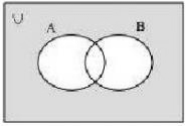
Draw the appropriate Venn diagram for the following set operation: $A^{\prime} \cap B^{\prime}$.
Solution
(N/A) By De Morgan's Law,$A^{\prime} \cap B^{\prime} = (A \cup B)^{\prime}$.
This represents the region in the universal set $U$ that is outside both sets $A$ and $B$.
In the Venn diagram,this is the shaded region covering the entire rectangle excluding the circles $A$ and $B$.
This represents the region in the universal set $U$ that is outside both sets $A$ and $B$.
In the Venn diagram,this is the shaded region covering the entire rectangle excluding the circles $A$ and $B$.
0 likes
View Solution122
Easy
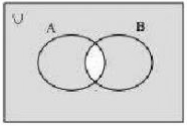
Draw the appropriate Venn diagram for the following expression: $A^{\prime} \cup B^{\prime}$
Solution
(N/A) By De Morgan's Law,we know that $A^{\prime} \cup B^{\prime} = (A \cap B)^{\prime}$.
This represents the region in the universal set $U$ that is outside the intersection of sets $A$ and $B$.
Therefore,the Venn diagram consists of the entire universal set $U$ except for the region where sets $A$ and $B$ overlap.
This represents the region in the universal set $U$ that is outside the intersection of sets $A$ and $B$.
Therefore,the Venn diagram consists of the entire universal set $U$ except for the region where sets $A$ and $B$ overlap.
0 likes
View Solution123
EasyMCQ
If $X$ and $Y$ are two sets such that $X \cup Y$ has $18$ elements,$X$ has $8$ elements,and $Y$ has $15$ elements,how many elements does $X \cap Y$ have?
A
$5$
B
$6$
C
$7$
D
$8$
Solution
(A) It is given that:
$n(X \cup Y) = 18, n(X) = 8, n(Y) = 15$
We know the formula for the number of elements in the union of two sets:
$n(X \cup Y) = n(X) + n(Y) - n(X \cap Y)$
Substituting the given values into the formula:
$18 = 8 + 15 - n(X \cap Y)$
$18 = 23 - n(X \cap Y)$
Rearranging to solve for $n(X \cap Y)$:
$n(X \cap Y) = 23 - 18$
$n(X \cap Y) = 5$
Therefore,the number of elements in $X \cap Y$ is $5$.
$n(X \cup Y) = 18, n(X) = 8, n(Y) = 15$
We know the formula for the number of elements in the union of two sets:
$n(X \cup Y) = n(X) + n(Y) - n(X \cap Y)$
Substituting the given values into the formula:
$18 = 8 + 15 - n(X \cap Y)$
$18 = 23 - n(X \cap Y)$
Rearranging to solve for $n(X \cap Y)$:
$n(X \cap Y) = 23 - 18$
$n(X \cap Y) = 5$
Therefore,the number of elements in $X \cap Y$ is $5$.
0 likes
View Solution124
EasyMCQ
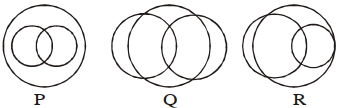
In a school,there are three types of games to be played. Some students play two types of games,but none play all three games. Which Venn diagram$(s)$ can justify the above statement?
A
$P$ and $Q$
B
$P$ and $R$
C
None of these
D
$Q$ and $R$
Solution
(C) Let the three sets of students playing the three games be $A$,$B$,and $C$.
According to the problem,some students play two games,which means the intersection of any two sets is non-empty (i.e.,$A \cap B \neq \emptyset$,$B \cap C \neq \emptyset$,$A \cap C \neq \emptyset$).
However,no student plays all three games,which means the intersection of all three sets must be empty (i.e.,$A \cap B \cap C = \emptyset$).
In diagram $P$,there are only two sets,so it does not represent three games.
In diagram $Q$,the three circles are arranged such that there is a central region where all three overlap,meaning $A \cap B \cap C \neq \emptyset$.
In diagram $R$,the three circles are arranged such that there is no common region shared by all three circles,meaning $A \cap B \cap C = \emptyset$,while pairs of circles still overlap.
Therefore,only diagram $R$ justifies the statement. Since $R$ is not present in any of the options $A$,$B$,or $D$,the correct option is $C$.
According to the problem,some students play two games,which means the intersection of any two sets is non-empty (i.e.,$A \cap B \neq \emptyset$,$B \cap C \neq \emptyset$,$A \cap C \neq \emptyset$).
However,no student plays all three games,which means the intersection of all three sets must be empty (i.e.,$A \cap B \cap C = \emptyset$).
In diagram $P$,there are only two sets,so it does not represent three games.
In diagram $Q$,the three circles are arranged such that there is a central region where all three overlap,meaning $A \cap B \cap C \neq \emptyset$.
In diagram $R$,the three circles are arranged such that there is no common region shared by all three circles,meaning $A \cap B \cap C = \emptyset$,while pairs of circles still overlap.
Therefore,only diagram $R$ justifies the statement. Since $R$ is not present in any of the options $A$,$B$,or $D$,the correct option is $C$.
0 likes
View Solution125
Medium
Show that for any sets $A$ and $B$,$A = (A \cap B) \cup (A - B)$ and $A \cup (B - A) = (A \cup B).$
Solution
(N/A) To show: $A = (A \cap B) \cup (A - B)$
Let $x \in A.$
We know that $x$ must either be in $B$ or not in $B$.
Case $I$: If $x \in B$,then $x \in A \cap B$,so $x \in (A \cap B) \cup (A - B).$
Case $II$: If $x \notin B$,then $x \in A - B$,so $x \in (A \cap B) \cup (A - B).$
Thus,$A \subseteq (A \cap B) \cup (A - B).$ ..........$(1)$
Since $(A \cap B) \subseteq A$ and $(A - B) \subseteq A$,their union must also be a subset of $A$.
Thus,$(A \cap B) \cup (A - B) \subseteq A.$ ..........$(2)$
From $(1)$ and $(2)$,$A = (A \cap B) \cup (A - B).$
To show: $A \cup (B - A) = A \cup B$
Let $x \in A \cup (B - A).$
This implies $x \in A$ or $(x \in B \text{ and } x \notin A).$
By distributive law,this is $(x \in A \text{ or } x \in B) \text{ and } (x \in A \text{ or } x \notin A).$
Since $(x \in A \text{ or } x \notin A)$ is always true,we get $x \in A \cup B.$
Thus,$A \cup (B - A) \subseteq A \cup B.$ ..........$(3)$
Conversely,let $y \in A \cup B.$
This implies $y \in A$ or $y \in B.$
If $y \in A$,then $y \in A \cup (B - A).$
If $y \notin A$ and $y \in B$,then $y \in B - A$,so $y \in A \cup (B - A).$
Thus,$A \cup B \subseteq A \cup (B - A).$ ..........$(4)$
From $(3)$ and $(4)$,$A \cup (B - A) = A \cup B.$
Let $x \in A.$
We know that $x$ must either be in $B$ or not in $B$.
Case $I$: If $x \in B$,then $x \in A \cap B$,so $x \in (A \cap B) \cup (A - B).$
Case $II$: If $x \notin B$,then $x \in A - B$,so $x \in (A \cap B) \cup (A - B).$
Thus,$A \subseteq (A \cap B) \cup (A - B).$ ..........$(1)$
Since $(A \cap B) \subseteq A$ and $(A - B) \subseteq A$,their union must also be a subset of $A$.
Thus,$(A \cap B) \cup (A - B) \subseteq A.$ ..........$(2)$
From $(1)$ and $(2)$,$A = (A \cap B) \cup (A - B).$
To show: $A \cup (B - A) = A \cup B$
Let $x \in A \cup (B - A).$
This implies $x \in A$ or $(x \in B \text{ and } x \notin A).$
By distributive law,this is $(x \in A \text{ or } x \in B) \text{ and } (x \in A \text{ or } x \notin A).$
Since $(x \in A \text{ or } x \notin A)$ is always true,we get $x \in A \cup B.$
Thus,$A \cup (B - A) \subseteq A \cup B.$ ..........$(3)$
Conversely,let $y \in A \cup B.$
This implies $y \in A$ or $y \in B.$
If $y \in A$,then $y \in A \cup (B - A).$
If $y \notin A$ and $y \in B$,then $y \in B - A$,so $y \in A \cup (B - A).$
Thus,$A \cup B \subseteq A \cup (B - A).$ ..........$(4)$
From $(3)$ and $(4)$,$A \cup (B - A) = A \cup B.$
0 likes
View Solution126
Easy
Prove that for any sets $A$ and $B$,$A \cup (A \cap B) = A$.
Solution
(A) To prove: $A \cup (A \cap B) = A$
We know that for any sets $A$ and $B$,the intersection $A \cap B$ is a subset of $A$,i.e.,$(A \cap B) \subset A$.
Also,$A \subset A$.
Therefore,the union of these two sets is $A \cup (A \cap B) \subset A$ ........... $(1)$
Conversely,any element $x \in A$ implies $x \in A \cup (A \cap B)$ by the definition of union,so $A \subset A \cup (A \cap B)$ ........... $(2)$
From $(1)$ and $(2)$,by the definition of set equality,we conclude that $A \cup (A \cap B) = A$.
We know that for any sets $A$ and $B$,the intersection $A \cap B$ is a subset of $A$,i.e.,$(A \cap B) \subset A$.
Also,$A \subset A$.
Therefore,the union of these two sets is $A \cup (A \cap B) \subset A$ ........... $(1)$
Conversely,any element $x \in A$ implies $x \in A \cup (A \cap B)$ by the definition of union,so $A \subset A \cup (A \cap B)$ ........... $(2)$
From $(1)$ and $(2)$,by the definition of set equality,we conclude that $A \cup (A \cap B) = A$.
0 likes
View Solution127
Easy
Two dice are thrown. The events $A, B$ and $C$ are as follows:
$A:$ getting an even number on the first die.
$B:$ getting an odd number on the first die.
$C:$ getting the sum of the numbers on the dice $\leq 5$.
Describe the event $A \cap B^{\prime} \cap C^{\prime}$.
$A:$ getting an even number on the first die.
$B:$ getting an odd number on the first die.
$C:$ getting the sum of the numbers on the dice $\leq 5$.
Describe the event $A \cap B^{\prime} \cap C^{\prime}$.
Solution
(A) When two dice are thrown,the sample space $S$ contains $36$ outcomes.
$A = \{(2,1), (2,2), (2,3), (2,4), (2,5), (2,6), (4,1), (4,2), (4,3), (4,4), (4,5), (4,6), (6,1), (6,2), (6,3), (6,4), (6,5), (6,6)\}$
$B = \{(1,1), (1,2), (1,3), (1,4), (1,5), (1,6), (3,1), (3,2), (3,3), (3,4), (3,5), (3,6), (5,1), (5,2), (5,3), (5,4), (5,5), (5,6)\}$
Since $B$ is the set of all outcomes where the first die is odd,$B^{\prime} = A$.
$C = \{(1,1), (1,2), (1,3), (1,4), (2,1), (2,2), (2,3), (3,1), (3,2), (4,1)\}$
We need to find $A \cap B^{\prime} \cap C^{\prime} = A \cap A \cap C^{\prime} = A \cap C^{\prime}$.
$A \cap C^{\prime}$ represents the set of outcomes in $A$ that are not in $C$.
$A \cap C^{\prime} = \{(2,4), (2,5), (2,6), (4,2), (4,3), (4,4), (4,5), (4,6), (6,1), (6,2), (6,3), (6,4), (6,5), (6,6)\}$
$A = \{(2,1), (2,2), (2,3), (2,4), (2,5), (2,6), (4,1), (4,2), (4,3), (4,4), (4,5), (4,6), (6,1), (6,2), (6,3), (6,4), (6,5), (6,6)\}$
$B = \{(1,1), (1,2), (1,3), (1,4), (1,5), (1,6), (3,1), (3,2), (3,3), (3,4), (3,5), (3,6), (5,1), (5,2), (5,3), (5,4), (5,5), (5,6)\}$
Since $B$ is the set of all outcomes where the first die is odd,$B^{\prime} = A$.
$C = \{(1,1), (1,2), (1,3), (1,4), (2,1), (2,2), (2,3), (3,1), (3,2), (4,1)\}$
We need to find $A \cap B^{\prime} \cap C^{\prime} = A \cap A \cap C^{\prime} = A \cap C^{\prime}$.
$A \cap C^{\prime}$ represents the set of outcomes in $A$ that are not in $C$.
$A \cap C^{\prime} = \{(2,4), (2,5), (2,6), (4,2), (4,3), (4,4), (4,5), (4,6), (6,1), (6,2), (6,3), (6,4), (6,5), (6,6)\}$
0 likes
View Solution128
AdvancedMCQ
Let $X$ be a non-empty set and let $P(X)$ denote the collection of all subsets of $X$. Define $f: X \times P(X) \rightarrow R$ by $f(x, A) = \begin{cases} 1, & \text{if } x \in A \\ 0, & \text{if } x \notin A \end{cases}$. Then,$f(x, A \cup B)$ equals
A
$f(x, A) + f(x, B)$
B
$f(x, A) + f(x, B) - f(x, A)f(x, B)$
C
$f(x, A) + f(x, B) - 1$
D
$f(x, A) + |f(x, A) - f(x, B)|$
Solution
(B) The function $f(x, A)$ is the indicator function of the set $A$,denoted as $\chi_A(x)$.
By definition,$f(x, A \cup B) = 1$ if $x \in A \cup B$,and $0$ otherwise.
We know that $x \in A \cup B$ if and only if $x \in A$ or $x \in B$.
Using the properties of indicator functions:
$f(x, A \cup B) = \max(f(x, A), f(x, B))$.
Alternatively,using the inclusion-exclusion principle for indicator functions:
$f(x, A \cup B) = f(x, A) + f(x, B) - f(x, A \cap B)$.
Since $f(x, A \cap B) = f(x, A) \cdot f(x, B)$,we have $f(x, A \cup B) = f(x, A) + f(x, B) - f(x, A)f(x, B)$.
Comparing this with the given options,if we evaluate the truth table for all cases of $x \in A$ and $x \in B$,we find that the expression $f(x, A) + f(x, B) - f(x, A)f(x, B)$ correctly represents the union.
By definition,$f(x, A \cup B) = 1$ if $x \in A \cup B$,and $0$ otherwise.
We know that $x \in A \cup B$ if and only if $x \in A$ or $x \in B$.
Using the properties of indicator functions:
$f(x, A \cup B) = \max(f(x, A), f(x, B))$.
Alternatively,using the inclusion-exclusion principle for indicator functions:
$f(x, A \cup B) = f(x, A) + f(x, B) - f(x, A \cap B)$.
Since $f(x, A \cap B) = f(x, A) \cdot f(x, B)$,we have $f(x, A \cup B) = f(x, A) + f(x, B) - f(x, A)f(x, B)$.
Comparing this with the given options,if we evaluate the truth table for all cases of $x \in A$ and $x \in B$,we find that the expression $f(x, A) + f(x, B) - f(x, A)f(x, B)$ correctly represents the union.
0 likes
View Solution129
AdvancedMCQ
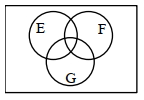
Let $E, F$ and $G$ be three events having probabilities $P(E) = \frac{1}{8}, P(F) = \frac{1}{6}$ and $P(G) = \frac{1}{4}$,and let $P(E \cap F \cap G) = \frac{1}{10}$. For any event $H$,if $H^C$ denotes its complement,then which of the following statements is(are) $TRUE$?
$(A) P(E \cap F \cap G^C) \leq \frac{1}{40}$
$(B) P(E^C \cap F \cap G) \leq \frac{1}{15}$
$(C) P(E \cup F \cup G) \leq \frac{13}{24}$
$(D) P(E^C \cap F^C \cap G^C) \leq \frac{5}{12}$
$(A) P(E \cap F \cap G^C) \leq \frac{1}{40}$
$(B) P(E^C \cap F \cap G) \leq \frac{1}{15}$
$(C) P(E \cup F \cup G) \leq \frac{13}{24}$
$(D) P(E^C \cap F^C \cap G^C) \leq \frac{5}{12}$
A
$A, B, C$
B
$A, B, D$
C
$A, B$
D
$A, C$
Solution
(A) Given: $P(E) = \frac{1}{8}, P(F) = \frac{1}{6}, P(G) = \frac{1}{4}, P(E \cap F \cap G) = \frac{1}{10}$.
$(A)$ We know $P(E) = P(E \cap F \cap G) + P(E \cap F \cap G^C) + P(E \cap F^C \cap G) + P(E \cap F^C \cap G^C)$.
Thus,$P(E \cap F \cap G^C) \leq P(E) - P(E \cap F \cap G) = \frac{1}{8} - \frac{1}{10} = \frac{5-4}{40} = \frac{1}{40}$. So,$(A)$ is $TRUE$.
$(B)$ Similarly,$P(E^C \cap F \cap G) \leq P(F) - P(E \cap F \cap G) = \frac{1}{6} - \frac{1}{10} = \frac{5-3}{30} = \frac{2}{30} = \frac{1}{15}$. So,$(B)$ is $TRUE$.
$(C)$ $P(E \cup F \cup G) = P(E) + P(F) + P(G) - [P(E \cap F) + P(F \cap G) + P(G \cap E)] + P(E \cap F \cap G)$.
Since $P(E \cap F), P(F \cap G), P(G \cap E) \geq P(E \cap F \cap G) = \frac{1}{10}$,we have $P(E \cup F \cup G) \leq \frac{1}{8} + \frac{1}{6} + \frac{1}{4} - 3(\frac{1}{10}) + \frac{1}{10} = \frac{3+4+6}{24} - \frac{2}{10} = \frac{13}{24} - \frac{1}{5} = \frac{65-24}{120} = \frac{41}{120} \leq \frac{13}{24}$. So,$(C)$ is $TRUE$.
$(D)$ $P(E^C \cap F^C \cap G^C) = 1 - P(E \cup F \cup G)$. Since $P(E \cup F \cup G) \geq P(E \cap F \cap G) = \frac{1}{10}$,$P(E^C \cap F^C \cap G^C) \leq 1 - \frac{1}{10} = \frac{9}{10} = 0.9$. The statement $P(E^C \cap F^C \cap G^C) \leq \frac{5}{12} \approx 0.416$ is not necessarily true. So,$(D)$ is $FALSE$.
Thus,the correct options are $A, B, C$.
$(A)$ We know $P(E) = P(E \cap F \cap G) + P(E \cap F \cap G^C) + P(E \cap F^C \cap G) + P(E \cap F^C \cap G^C)$.
Thus,$P(E \cap F \cap G^C) \leq P(E) - P(E \cap F \cap G) = \frac{1}{8} - \frac{1}{10} = \frac{5-4}{40} = \frac{1}{40}$. So,$(A)$ is $TRUE$.
$(B)$ Similarly,$P(E^C \cap F \cap G) \leq P(F) - P(E \cap F \cap G) = \frac{1}{6} - \frac{1}{10} = \frac{5-3}{30} = \frac{2}{30} = \frac{1}{15}$. So,$(B)$ is $TRUE$.
$(C)$ $P(E \cup F \cup G) = P(E) + P(F) + P(G) - [P(E \cap F) + P(F \cap G) + P(G \cap E)] + P(E \cap F \cap G)$.
Since $P(E \cap F), P(F \cap G), P(G \cap E) \geq P(E \cap F \cap G) = \frac{1}{10}$,we have $P(E \cup F \cup G) \leq \frac{1}{8} + \frac{1}{6} + \frac{1}{4} - 3(\frac{1}{10}) + \frac{1}{10} = \frac{3+4+6}{24} - \frac{2}{10} = \frac{13}{24} - \frac{1}{5} = \frac{65-24}{120} = \frac{41}{120} \leq \frac{13}{24}$. So,$(C)$ is $TRUE$.
$(D)$ $P(E^C \cap F^C \cap G^C) = 1 - P(E \cup F \cup G)$. Since $P(E \cup F \cup G) \geq P(E \cap F \cap G) = \frac{1}{10}$,$P(E^C \cap F^C \cap G^C) \leq 1 - \frac{1}{10} = \frac{9}{10} = 0.9$. The statement $P(E^C \cap F^C \cap G^C) \leq \frac{5}{12} \approx 0.416$ is not necessarily true. So,$(D)$ is $FALSE$.
Thus,the correct options are $A, B, C$.
0 likes
View Solution130
EasyMCQ
If $A = \{x \mid x \in N, x \text{ is a prime number less than } 12\}$ and $B = \{x \mid x \in N, x \text{ is a factor of } 10\},$ then $A \cap B = \dots$
A
$\{2\}$
B
$\{2, 5\}$
C
$\{2, 5, 10\}$
D
$\{1, 2, 5, 10\}$
Solution
(B) Given set $A = \{x \mid x \in N, x \text{ is a prime number less than } 12\}$.
Since prime numbers less than $12$ are $2, 3, 5, 7, 11$,we have $A = \{2, 3, 5, 7, 11\}$.
Given set $B = \{x \mid x \in N, x \text{ is a factor of } 10\}$.
Since factors of $10$ are $1, 2, 5, 10$,we have $B = \{1, 2, 5, 10\}$.
The intersection $A \cap B$ consists of elements common to both sets $A$ and $B$.
$A \cap B = \{2, 3, 5, 7, 11\} \cap \{1, 2, 5, 10\} = \{2, 5\}$.
Since prime numbers less than $12$ are $2, 3, 5, 7, 11$,we have $A = \{2, 3, 5, 7, 11\}$.
Given set $B = \{x \mid x \in N, x \text{ is a factor of } 10\}$.
Since factors of $10$ are $1, 2, 5, 10$,we have $B = \{1, 2, 5, 10\}$.
The intersection $A \cap B$ consists of elements common to both sets $A$ and $B$.
$A \cap B = \{2, 3, 5, 7, 11\} \cap \{1, 2, 5, 10\} = \{2, 5\}$.
0 likes
View Solution131
DifficultMCQ
If $X = \{4^n - 3n - 1 : n \in N\}$ and $Y = \{9(n - 1) : n \in N\}$,then $X \cap Y =$
A
$X$
B
$Y$
C
$\phi$
D
$\{0\}$
Solution
(A) Given $X = \{4^n - 3n - 1 : n \in N\}$ and $Y = \{9(n - 1) : n \in N\}$.
By binomial expansion,$4^n = (1 + 3)^n = 1 + n(3) + \frac{n(n-1)}{2!} (3^2) + \dots + 3^n$.
So,$4^n - 3n - 1 = 1 + 3n + \frac{9n(n-1)}{2} + \dots - 3n - 1 = \frac{9n(n-1)}{2} + \dots = 9 \left[ \frac{n(n-1)}{2} + \dots \right]$.
This shows that every element of $X$ is a multiple of $9$,and since $n(n-1)$ is always even,$\frac{n(n-1)}{2}$ is an integer.
Thus,$X \subseteq Y$.
Alternatively,testing values:
For $n=1, X = \{4^1 - 3(1) - 1\} = \{0\}$.
For $n=2, X = \{4^2 - 3(2) - 1\} = \{16 - 6 - 1\} = \{9\}$.
For $n=3, X = \{4^3 - 3(3) - 1\} = \{64 - 9 - 1\} = \{54\}$.
$X = \{0, 9, 54, \dots\}$.
$Y = \{0, 9, 18, 27, 36, 45, 54, \dots\}$.
Since all elements of $X$ are in $Y$,$X \cap Y = X$.
By binomial expansion,$4^n = (1 + 3)^n = 1 + n(3) + \frac{n(n-1)}{2!} (3^2) + \dots + 3^n$.
So,$4^n - 3n - 1 = 1 + 3n + \frac{9n(n-1)}{2} + \dots - 3n - 1 = \frac{9n(n-1)}{2} + \dots = 9 \left[ \frac{n(n-1)}{2} + \dots \right]$.
This shows that every element of $X$ is a multiple of $9$,and since $n(n-1)$ is always even,$\frac{n(n-1)}{2}$ is an integer.
Thus,$X \subseteq Y$.
Alternatively,testing values:
For $n=1, X = \{4^1 - 3(1) - 1\} = \{0\}$.
For $n=2, X = \{4^2 - 3(2) - 1\} = \{16 - 6 - 1\} = \{9\}$.
For $n=3, X = \{4^3 - 3(3) - 1\} = \{64 - 9 - 1\} = \{54\}$.
$X = \{0, 9, 54, \dots\}$.
$Y = \{0, 9, 18, 27, 36, 45, 54, \dots\}$.
Since all elements of $X$ are in $Y$,$X \cap Y = X$.
0 likes
View Solution132
EasyMCQ
If $A = \{ x : x \text{ is an integer and } x^2 - 9 = 0 \}$,$B = \{ x : x \text{ is a natural number and } 2 \leq x < 5 \}$,and $C = \{ x : x \text{ is a prime number } \leq 4 \}$,then $(B - C) \cup A$ is:
A
$\{ -3, 3, 4 \}$
B
$\{ 2, 3, 4 \}$
C
$\{ 3, 4, 5 \}$
D
$\{ 2, 3, 5 \}$
Solution
(A) First,we determine the elements of each set:
$A = \{ x : x \text{ is an integer and } x^2 - 9 = 0 \} = \{ -3, 3 \}$.
$B = \{ x : x \text{ is a natural number and } 2 \leq x < 5 \} = \{ 2, 3, 4 \}$.
$C = \{ x : x \text{ is a prime number } \leq 4 \} = \{ 2, 3 \}$.
Next,calculate $(B - C)$:
$B - C = \{ 2, 3, 4 \} - \{ 2, 3 \} = \{ 4 \}$.
Finally,calculate $(B - C) \cup A$:
$(B - C) \cup A = \{ 4 \} \cup \{ -3, 3 \} = \{ -3, 3, 4 \}$.
$A = \{ x : x \text{ is an integer and } x^2 - 9 = 0 \} = \{ -3, 3 \}$.
$B = \{ x : x \text{ is a natural number and } 2 \leq x < 5 \} = \{ 2, 3, 4 \}$.
$C = \{ x : x \text{ is a prime number } \leq 4 \} = \{ 2, 3 \}$.
Next,calculate $(B - C)$:
$B - C = \{ 2, 3, 4 \} - \{ 2, 3 \} = \{ 4 \}$.
Finally,calculate $(B - C) \cup A$:
$(B - C) \cup A = \{ 4 \} \cup \{ -3, 3 \} = \{ -3, 3, 4 \}$.
0 likes
View Solution133
EasyMCQ
If $A$ and $B$ are finite sets and $A \subset B$,then
A
$n(A \cup B)=n(A)$
B
$n(A \cap B)=n(B)$
C
$n(A \cup B)=n(B)$
D
$n(A \cap B)=\varnothing$
Solution
(C) Given that $A$ is a subset of $B$,denoted as $A \subset B$.
By the definition of subset,every element of $A$ is also an element of $B$.
Therefore,the union of $A$ and $B$ is simply $B$,i.e.,$A \cup B = B$.
Taking the number of elements on both sides,we get $n(A \cup B) = n(B)$.
Similarly,the intersection of $A$ and $B$ is $A$,i.e.,$A \cap B = A$,which implies $n(A \cap B) = n(A)$.
By the definition of subset,every element of $A$ is also an element of $B$.
Therefore,the union of $A$ and $B$ is simply $B$,i.e.,$A \cup B = B$.
Taking the number of elements on both sides,we get $n(A \cup B) = n(B)$.
Similarly,the intersection of $A$ and $B$ is $A$,i.e.,$A \cap B = A$,which implies $n(A \cap B) = n(A)$.

0 likes
View Solution134
MediumMCQ
If $A$ and $B$ are any two events of a sample space,then the set-theoretic description for the event: "Exactly one of the events $A, B$ occurs" is
(Here $E^c$ denotes the complement of the event $E$)
(Here $E^c$ denotes the complement of the event $E$)
A
$A \cap B^c$
B
$(A-B) \cup (A \cup B)$
C
$(A \cap B^c) \cup (A^c \cap B)$
D
$(A \cap B)^c \cup (A^c \cap B^c)$
Solution
(C) When only event $A$ occurs,it is represented as $(A \cap B^c)$.
When only event $B$ occurs,it is represented as $(A^c \cap B)$.
Therefore,the event 'exactly one of the events $A$ or $B$ occurs' is the union of these two disjoint sets: $(A \cap B^c) \cup (A^c \cap B)$.
When only event $B$ occurs,it is represented as $(A^c \cap B)$.
Therefore,the event 'exactly one of the events $A$ or $B$ occurs' is the union of these two disjoint sets: $(A \cap B^c) \cup (A^c \cap B)$.
0 likes
View Solution135
EasyMCQ
For any two sets $A$ and $B$,$A-(A-B)$ equals
A
$B$
B
$A-B$
C
$A \cap B$
D
$A^{C} \cap B^{C}$
Solution
(C) We know that the difference of two sets $A-B = A \cap B^c$.
Substituting this into the expression,we get:
$A-(A-B) = A-(A \cap B^c)$
Using the property $X-Y = X \cap Y^c$:
$= A \cap (A \cap B^c)^c$
Applying De Morgan's Law $(A \cap B^c)^c = A^c \cup (B^c)^c = A^c \cup B$:
$= A \cap (A^c \cup B)$
Using the Distributive Law:
$= (A \cap A^c) \cup (A \cap B)$
Since $A \cap A^c = \emptyset$:
$= \emptyset \cup (A \cap B) = A \cap B$
Therefore,the correct option is $C$.
Substituting this into the expression,we get:
$A-(A-B) = A-(A \cap B^c)$
Using the property $X-Y = X \cap Y^c$:
$= A \cap (A \cap B^c)^c$
Applying De Morgan's Law $(A \cap B^c)^c = A^c \cup (B^c)^c = A^c \cup B$:
$= A \cap (A^c \cup B)$
Using the Distributive Law:
$= (A \cap A^c) \cup (A \cap B)$
Since $A \cap A^c = \emptyset$:
$= \emptyset \cup (A \cap B) = A \cap B$
Therefore,the correct option is $C$.
0 likes
View SolutionSet Theory — Venn Diagram and Operation on Sets · Frequently Asked Questions
1Are these Set Theory questions useful for JEE and NEET?
Yes. All questions in this section are mapped to JEE Main and NEET exam patterns. Previous year questions from JEE Main, NEET, GUJCET and state-level exams are included with full solutions.
2Can I switch to Hindi or Gujarati for these questions?
Yes. Use the language tabs in the hero section or the sidebar to view the same questions and solutions in English, Hindi or Gujarati.
3How do I generate a question paper from this subtopic?
Use the Vedclass Exam Paper Generator — select the chapter and subtopic, set difficulty, and generate Sets A, B, C, D automatically. First 3 chapters of every subject are free.
Vedclass Products
For Students
Vedclass Test Series
Mock tests in real JEE/NEET style with performance analysis. 5-day free trial.
Start Free TrialFor Teachers
Exam Paper Generator
Generate Set A/B/C/D papers from this chapter in 2 minutes. 3 chapters free.
Try FreeFor Institutes
Online Exam Module
Live online exams with unlimited students, 360° analytics & white-label branding.
See DemoFor Teachers & Institutes
Generate a Set Theory Exam Paper in 2 Minutes
Select subtopic & difficulty — Sets A, B, C, D auto-generated with No Repeat logic.
First 3 chapters of every subject are free — no payment required.