
A English
Mix Examples of Set Theory Questions in English
Class 11 Mathematics · Set Theory · Mix Examples of Set Theory
26+
Questions
English
Language
100%
With Solutions
Showing 26 of 26 questions in English
1
EasyMCQ
If $A, B, C$ are three sets such that $A \cup B = A \cup C$ and $A \cap B = A \cap C$,then
A
$A = B$
B
$B = C$
C
$A = C$
D
$A = B = C$
Solution
(B) Given that $A \cup B = A \cup C$ and $A \cap B = A \cap C$.
Consider the set $B$. We can write $B = B \cap (A \cup B)$.
Since $A \cup B = A \cup C$,we have $B = B \cap (A \cup C)$.
Using the distributive law,$B = (B \cap A) \cup (B \cap C)$.
Since $A \cap B = A \cap C$,we have $B = (A \cap C) \cup (B \cap C)$.
By the distributive law,$B = (A \cup B) \cap C$.
Since $A \cup B = A \cup C$,we have $B = (A \cup C) \cap C$.
Since $(A \cup C) \cap C = C$,it follows that $B = C$.
Consider the set $B$. We can write $B = B \cap (A \cup B)$.
Since $A \cup B = A \cup C$,we have $B = B \cap (A \cup C)$.
Using the distributive law,$B = (B \cap A) \cup (B \cap C)$.
Since $A \cap B = A \cap C$,we have $B = (A \cap C) \cup (B \cap C)$.
By the distributive law,$B = (A \cup B) \cap C$.
Since $A \cup B = A \cup C$,we have $B = (A \cup C) \cap C$.
Since $(A \cup C) \cap C = C$,it follows that $B = C$.
0 likes
View Solution2
MediumMCQ
For a real number $x$,$[x]$ denotes the greatest integer less than or equal to $x$. The value of $\left[ \frac{1}{2} \right] + \left[ \frac{1}{2} + \frac{1}{100} \right] + \left[ \frac{1}{2} + \frac{2}{100} \right] + \dots + \left[ \frac{1}{2} + \frac{99}{100} \right]$ is
A
$49$
B
$50$
C
$48$
D
$51$
Solution
(B) Let $S = \sum_{k=0}^{99} \left[ \frac{1}{2} + \frac{k}{100} \right]$.
For $0 \le k \le 49$,we have $0 \le \frac{k}{100} \le 0.49$,so $\frac{1}{2} + \frac{k}{100} = 0.5 + \frac{k}{100} < 1$. Thus,$\left[ \frac{1}{2} + \frac{k}{100} \right] = 0$ for $k = 0, 1, \dots, 49$.
For $50 \le k \le 99$,we have $0.50 \le \frac{k}{100} \le 0.99$,so $1 \le \frac{1}{2} + \frac{k}{100} < 1.49$. Thus,$\left[ \frac{1}{2} + \frac{k}{100} \right] = 1$ for $k = 50, 51, \dots, 99$.
The number of terms from $k = 50$ to $k = 99$ is $99 - 50 + 1 = 50$.
Therefore,the sum is $0 \times 50 + 1 \times 50 = 50$.
For $0 \le k \le 49$,we have $0 \le \frac{k}{100} \le 0.49$,so $\frac{1}{2} + \frac{k}{100} = 0.5 + \frac{k}{100} < 1$. Thus,$\left[ \frac{1}{2} + \frac{k}{100} \right] = 0$ for $k = 0, 1, \dots, 49$.
For $50 \le k \le 99$,we have $0.50 \le \frac{k}{100} \le 0.99$,so $1 \le \frac{1}{2} + \frac{k}{100} < 1.49$. Thus,$\left[ \frac{1}{2} + \frac{k}{100} \right] = 1$ for $k = 50, 51, \dots, 99$.
The number of terms from $k = 50$ to $k = 99$ is $99 - 50 + 1 = 50$.
Therefore,the sum is $0 \times 50 + 1 \times 50 = 50$.
0 likes
View Solution3
EasyMCQ
If $A, B$ and $C$ are three sets such that $A \cap B = A \cap C$ and $A \cup B = A \cup C$,then:
A
$A = C$
B
$B = C$
C
$A \cap B = \emptyset$
D
$A = B$
Solution
(B) Given $A \cap B = A \cap C$ and $A \cup B = A \cup C$.
Consider $B = B \cap (A \cup B)$.
Since $A \cup B = A \cup C$,we have $B = B \cap (A \cup C)$.
Using the distributive law,$B = (B \cap A) \cup (B \cap C)$.
Since $A \cap B = A \cap C$,we have $B = (A \cap C) \cup (B \cap C)$.
$B = (A \cup B) \cap C$.
Since $A \cup B = A \cup C$,we have $B = (A \cup C) \cap C$.
Since $(A \cup C) \cap C = C$,it follows that $B = C$.
Consider $B = B \cap (A \cup B)$.
Since $A \cup B = A \cup C$,we have $B = B \cap (A \cup C)$.
Using the distributive law,$B = (B \cap A) \cup (B \cap C)$.
Since $A \cap B = A \cap C$,we have $B = (A \cap C) \cup (B \cap C)$.
$B = (A \cup B) \cap C$.
Since $A \cup B = A \cup C$,we have $B = (A \cup C) \cap C$.
Since $(A \cup C) \cap C = C$,it follows that $B = C$.
0 likes
View Solution4
DifficultMCQ
Let $S = \{ x \in \mathbb{R} : x \ge 0 \text{ and } 2|\sqrt{x} - 3| + \sqrt{x}(\sqrt{x} - 6) + 6 = 0 \}$. Then $S$:
A
contains exactly one element.
B
contains exactly two elements.
C
contains exactly four elements.
D
is an empty set.
Solution
(B) Let $t = \sqrt{x}$,where $t \ge 0$. The equation becomes $2|t - 3| + t(t - 6) + 6 = 0$.
Case $I$: $0 \le t < 3$ (i.e.,$0 \le x < 9$)
$2(3 - t) + t^2 - 6t + 6 = 0$
$6 - 2t + t^2 - 6t + 6 = 0$
$t^2 - 8t + 12 = 0$
$(t - 6)(t - 2) = 0$
$t = 6$ or $t = 2$.
Since $0 \le t < 3$,we have $t = 2$,which implies $x = 4$.
Case $II$: $t \ge 3$ (i.e.,$x \ge 9$)
$2(t - 3) + t^2 - 6t + 6 = 0$
$2t - 6 + t^2 - 6t + 6 = 0$
$t^2 - 4t = 0$
$t(t - 4) = 0$
$t = 0$ or $t = 4$.
Since $t \ge 3$,we have $t = 4$,which implies $x = 16$.
Thus,$S = \{4, 16\}$,which contains exactly two elements.
Case $I$: $0 \le t < 3$ (i.e.,$0 \le x < 9$)
$2(3 - t) + t^2 - 6t + 6 = 0$
$6 - 2t + t^2 - 6t + 6 = 0$
$t^2 - 8t + 12 = 0$
$(t - 6)(t - 2) = 0$
$t = 6$ or $t = 2$.
Since $0 \le t < 3$,we have $t = 2$,which implies $x = 4$.
Case $II$: $t \ge 3$ (i.e.,$x \ge 9$)
$2(t - 3) + t^2 - 6t + 6 = 0$
$2t - 6 + t^2 - 6t + 6 = 0$
$t^2 - 4t = 0$
$t(t - 4) = 0$
$t = 0$ or $t = 4$.
Since $t \ge 3$,we have $t = 4$,which implies $x = 16$.
Thus,$S = \{4, 16\}$,which contains exactly two elements.
0 likes
View Solution5
EasyMCQ
If $A, B,$ and $C$ are three sets such that $A \cup B = A \cup C$ and $A \cap B = A \cap C$,then
A
$A = B$
B
$B = C$
C
$A = C$
D
$A = B = C$
Solution
(B) Given that $A \cup B = A \cup C$ and $A \cap B = A \cap C$.
Consider the set $B$. We can write $B = B \cap (A \cup B)$.
Since $A \cup B = A \cup C$,we have $B = B \cap (A \cup C)$.
Using the distributive law,$B = (B \cap A) \cup (B \cap C)$.
Since $A \cap B = A \cap C$,we have $B = (A \cap C) \cup (B \cap C)$.
Now consider the set $C$. We can write $C = C \cap (A \cup C)$.
Since $A \cup C = A \cup B$,we have $C = C \cap (A \cup B)$.
Using the distributive law,$C = (C \cap A) \cup (C \cap B)$.
Since $A \cap C = A \cap B$,we have $C = (A \cap B) \cup (C \cap B)$.
Comparing the expressions for $B$ and $C$,we see that $B = (A \cap C) \cup (B \cap C)$ and $C = (A \cap B) \cup (C \cap B)$.
Since $A \cap C = A \cap B$,it follows that $B = C$.
Consider the set $B$. We can write $B = B \cap (A \cup B)$.
Since $A \cup B = A \cup C$,we have $B = B \cap (A \cup C)$.
Using the distributive law,$B = (B \cap A) \cup (B \cap C)$.
Since $A \cap B = A \cap C$,we have $B = (A \cap C) \cup (B \cap C)$.
Now consider the set $C$. We can write $C = C \cap (A \cup C)$.
Since $A \cup C = A \cup B$,we have $C = C \cap (A \cup B)$.
Using the distributive law,$C = (C \cap A) \cup (C \cap B)$.
Since $A \cap C = A \cap B$,we have $C = (A \cap B) \cup (C \cap B)$.
Comparing the expressions for $B$ and $C$,we see that $B = (A \cap C) \cup (B \cap C)$ and $C = (A \cap B) \cup (C \cap B)$.
Since $A \cap C = A \cap B$,it follows that $B = C$.
0 likes
View Solution6
MediumMCQ
If $U$ is the universal set and $A \cup B \cup C = U$,then ${(A - B) \cup (B - C) \cup (C - A)}'$ is equal to:
A
$A \cup B \cup C$
B
$A \cap B \cap C$
C
$A \cap B \cup B \cap C \cup C \cap A$
D
$A \cup B \cap C$
Solution
(B) Let $S = (A - B) \cup (B - C) \cup (C - A)$.
We know that $A - B = A \cap B^c$,$B - C = B \cap C^c$,and $C - A = C \cap A^c$.
So,$S = (A \cap B^c) \cup (B \cap C^c) \cup (C \cap A^c)$.
By De Morgan's Law and set properties,the complement $S'$ is given by:
$S' = (A \cap B^c)' \cap (B \cap C^c)' \cap (C \cap A^c)'$
$S' = (A^c \cup B) \cap (B^c \cup C) \cap (C^c \cup A)$.
Expanding this expression:
$(A^c \cup B) \cap (B^c \cup C) = (A^c \cap B^c) \cup (A^c \cap C) \cup (B \cap B^c) \cup (B \cap C) = (A^c \cap B^c) \cup (A^c \cap C) \cup (B \cap C)$.
Multiplying by $(C^c \cup A)$ results in $A \cap B \cap C$.
We know that $A - B = A \cap B^c$,$B - C = B \cap C^c$,and $C - A = C \cap A^c$.
So,$S = (A \cap B^c) \cup (B \cap C^c) \cup (C \cap A^c)$.
By De Morgan's Law and set properties,the complement $S'$ is given by:
$S' = (A \cap B^c)' \cap (B \cap C^c)' \cap (C \cap A^c)'$
$S' = (A^c \cup B) \cap (B^c \cup C) \cap (C^c \cup A)$.
Expanding this expression:
$(A^c \cup B) \cap (B^c \cup C) = (A^c \cap B^c) \cup (A^c \cap C) \cup (B \cap B^c) \cup (B \cap C) = (A^c \cap B^c) \cup (A^c \cap C) \cup (B \cap C)$.
Multiplying by $(C^c \cup A)$ results in $A \cap B \cap C$.
0 likes
View Solution7
DifficultMCQ
Consider the two sets: $A = \{m \in R : \text{both the roots of } x^{2} - (m+1)x + m+4 = 0 \text{ are real}\}$ and $B = [-3, 5)$. Which of the following is not true?
A
$A - B = (-\infty, -3) \cup [5, \infty)$
B
$A \cap B = \{-3\}$
C
$B - A = (-3, 5)$
D
$A \cup B = R$
Solution
(A) For the roots of the quadratic equation $x^{2} - (m+1)x + m+4 = 0$ to be real,the discriminant $D$ must be greater than or equal to $0$.
$D = (m+1)^{2} - 4(m+4) \geq 0$
$m^{2} + 2m + 1 - 4m - 16 \geq 0$
$m^{2} - 2m - 15 \geq 0$
$(m-5)(m+3) \geq 0$
Thus,$m \in (-\infty, -3] \cup [5, \infty)$,so $A = (-\infty, -3] \cup [5, \infty)$.
Given $B = [-3, 5)$.
Now,evaluate the options:
$A - B = (-\infty, -3) \cup [5, \infty)$ (True)
$A \cap B = \{-3\}$ (True)
$B - A = (-3, 5)$ (True)
$A \cup B = (-\infty, -3] \cup [-3, 5) \cup [5, \infty) = (-\infty, \infty) = R$ (True)
Wait,checking the options again: $A - B = (-\infty, -3) \cup [5, \infty)$. Since $-3 \in B$,it is removed from $A$. So $A - B = (-\infty, -3) \cup [5, \infty)$. This is true.
All options provided are actually true. However,if we re-examine $A \cup B$,it is $R$. If we re-examine $B - A$,it is $(-3, 5)$.
Given the standard nature of this problem,there might be a typo in the question's options. Assuming the question asks for the false statement,and all are true,we identify that $A \cup B = R$ is true,$A \cap B = \{-3\}$ is true,$B - A = (-3, 5)$ is true,and $A - B = (-\infty, -3) \cup [5, \infty)$ is true. Since all are true,the question is flawed.
$D = (m+1)^{2} - 4(m+4) \geq 0$
$m^{2} + 2m + 1 - 4m - 16 \geq 0$
$m^{2} - 2m - 15 \geq 0$
$(m-5)(m+3) \geq 0$
Thus,$m \in (-\infty, -3] \cup [5, \infty)$,so $A = (-\infty, -3] \cup [5, \infty)$.
Given $B = [-3, 5)$.
Now,evaluate the options:
$A - B = (-\infty, -3) \cup [5, \infty)$ (True)
$A \cap B = \{-3\}$ (True)
$B - A = (-3, 5)$ (True)
$A \cup B = (-\infty, -3] \cup [-3, 5) \cup [5, \infty) = (-\infty, \infty) = R$ (True)
Wait,checking the options again: $A - B = (-\infty, -3) \cup [5, \infty)$. Since $-3 \in B$,it is removed from $A$. So $A - B = (-\infty, -3) \cup [5, \infty)$. This is true.
All options provided are actually true. However,if we re-examine $A \cup B$,it is $R$. If we re-examine $B - A$,it is $(-3, 5)$.
Given the standard nature of this problem,there might be a typo in the question's options. Assuming the question asks for the false statement,and all are true,we identify that $A \cup B = R$ is true,$A \cap B = \{-3\}$ is true,$B - A = (-3, 5)$ is true,and $A - B = (-\infty, -3) \cup [5, \infty)$ is true. Since all are true,the question is flawed.
0 likes
View Solution8
AdvancedMCQ
Let $A$ denote the set of all real numbers $x$ such that $x^3-[x]^3=(x-[x])^3$,where $[x]$ is the greatest integer less than or equal to $x$. Then,
A
$A$ is a discrete set of at least two points
B
$A$ contains an interval,but is not an interval
C
$A$ is an interval,but a proper subset of $(-\infty, \infty)$
D
$A=(-\infty, \infty)$
Solution
(B) Given the equation: $x^3 - [x]^3 = (x - [x])^3$.
Let ${x} = x - [x]$. Then the equation becomes $x^3 - [x]^3 = {x}^3$.
We know that $x^3 - [x]^3 = (x - [x])(x^2 + x[x] + [x]^2)$.
So,$(x - [x])(x^2 + x[x] + [x]^2) = (x - [x])^3$.
This implies $(x - [x])[(x^2 + x[x] + [x]^2) - (x - [x])^2] = 0$.
$(x - [x])[x^2 + x[x] + [x]^2 - (x^2 - 2x[x] + [x]^2)] = 0$.
$(x - [x])[3x[x]] = 0$.
This gives two cases:
Case $1$: $x - [x] = 0 \implies x \in \mathbb{Z}$.
Case $2$: $3x[x] = 0 \implies x = 0$ or $[x] = 0$.
If $[x] = 0$,then $0 \le x < 1$.
Combining these,$A = \mathbb{Z} \cup [0, 1)$.
Since $A$ contains the interval $[0, 1)$ but also includes isolated points like $\dots, -2, -1, 2, 3, \dots$,it is not an interval.
Thus,$A$ contains an interval,but is not an interval.
Let ${x} = x - [x]$. Then the equation becomes $x^3 - [x]^3 = {x}^3$.
We know that $x^3 - [x]^3 = (x - [x])(x^2 + x[x] + [x]^2)$.
So,$(x - [x])(x^2 + x[x] + [x]^2) = (x - [x])^3$.
This implies $(x - [x])[(x^2 + x[x] + [x]^2) - (x - [x])^2] = 0$.
$(x - [x])[x^2 + x[x] + [x]^2 - (x^2 - 2x[x] + [x]^2)] = 0$.
$(x - [x])[3x[x]] = 0$.
This gives two cases:
Case $1$: $x - [x] = 0 \implies x \in \mathbb{Z}$.
Case $2$: $3x[x] = 0 \implies x = 0$ or $[x] = 0$.
If $[x] = 0$,then $0 \le x < 1$.
Combining these,$A = \mathbb{Z} \cup [0, 1)$.
Since $A$ contains the interval $[0, 1)$ but also includes isolated points like $\dots, -2, -1, 2, 3, \dots$,it is not an interval.
Thus,$A$ contains an interval,but is not an interval.
0 likes
View Solution9
AdvancedMCQ
Let $x_k$ be real numbers such that $x_k \geq k^4+k^2+1$ for $1 \leq k \leq 2018$. Denote $N=\sum_{k=1}^{2018} k$. Consider the following inequalities.
$I$. $\left(\sum_{k=1}^{2018} k x_k\right)^2 \leq N\left(\sum_{k=1}^{2018} k x_k^2\right)$
$II$. $\left(\sum_{k=1}^{2018} k x_k\right)^2 \leq N\left(\sum_{k=1}^{2018} k^2 x_k^2\right)$
Then,
$I$. $\left(\sum_{k=1}^{2018} k x_k\right)^2 \leq N\left(\sum_{k=1}^{2018} k x_k^2\right)$
$II$. $\left(\sum_{k=1}^{2018} k x_k\right)^2 \leq N\left(\sum_{k=1}^{2018} k^2 x_k^2\right)$
Then,
A
both $I$ and $II$ are true
B
$I$ is true and $II$ is false
C
$I$ is false and $II$ is true
D
both $I$ and $II$ are false
Solution
(A) Let $n = 2018$. We are given $N = \sum_{k=1}^{n} k = \frac{n(n+1)}{2}$.
For inequality $I$,we use the Cauchy-Schwarz inequality in the form $(\sum a_k b_k)^2 \leq (\sum a_k^2)(\sum b_k^2)$.
Let $a_k = \sqrt{k}$ and $b_k = \sqrt{k} x_k$. Then:
$\left(\sum_{k=1}^{n} \sqrt{k} \cdot \sqrt{k} x_k\right)^2 \leq \left(\sum_{k=1}^{n} (\sqrt{k})^2\right) \left(\sum_{k=1}^{n} (\sqrt{k} x_k)^2\right)$
$\left(\sum_{k=1}^{n} k x_k\right)^2 \leq \left(\sum_{k=1}^{n} k\right) \left(\sum_{k=1}^{n} k x_k^2\right) = N \sum_{k=1}^{n} k x_k^2$.
Thus,$I$ is true.
For inequality $II$,we note that since $k \geq 1$,we have $k^2 \geq k$ for all $k \in \{1, 2, \dots, n\}$.
Therefore,$\sum_{k=1}^{n} k^2 x_k^2 \geq \sum_{k=1}^{n} k x_k^2$.
Since $I$ is true,we have $\left(\sum_{k=1}^{n} k x_k\right)^2 \leq N \sum_{k=1}^{n} k x_k^2 \leq N \sum_{k=1}^{n} k^2 x_k^2$.
Thus,$II$ is also true.
Therefore,both $I$ and $II$ are true.
For inequality $I$,we use the Cauchy-Schwarz inequality in the form $(\sum a_k b_k)^2 \leq (\sum a_k^2)(\sum b_k^2)$.
Let $a_k = \sqrt{k}$ and $b_k = \sqrt{k} x_k$. Then:
$\left(\sum_{k=1}^{n} \sqrt{k} \cdot \sqrt{k} x_k\right)^2 \leq \left(\sum_{k=1}^{n} (\sqrt{k})^2\right) \left(\sum_{k=1}^{n} (\sqrt{k} x_k)^2\right)$
$\left(\sum_{k=1}^{n} k x_k\right)^2 \leq \left(\sum_{k=1}^{n} k\right) \left(\sum_{k=1}^{n} k x_k^2\right) = N \sum_{k=1}^{n} k x_k^2$.
Thus,$I$ is true.
For inequality $II$,we note that since $k \geq 1$,we have $k^2 \geq k$ for all $k \in \{1, 2, \dots, n\}$.
Therefore,$\sum_{k=1}^{n} k^2 x_k^2 \geq \sum_{k=1}^{n} k x_k^2$.
Since $I$ is true,we have $\left(\sum_{k=1}^{n} k x_k\right)^2 \leq N \sum_{k=1}^{n} k x_k^2 \leq N \sum_{k=1}^{n} k^2 x_k^2$.
Thus,$II$ is also true.
Therefore,both $I$ and $II$ are true.
0 likes
View Solution10
AdvancedMCQ
Let $A = \{\theta \in R \mid \cos^2(\sin \theta) + \sin^2(\cos \theta) = 1\}$ and $B = \{\theta \in R \mid \cos(\sin \theta) \sin(\cos \theta) = 0\}$. Then,$A \cap B$ is:
A
the empty set
B
has exactly one element
C
has more than one but finitely many elements
D
has infinitely many elements
Solution
(A) For set $A$,we have $\cos^2(\sin \theta) + \sin^2(\cos \theta) = 1$.
Using the identity $\sin^2 x + \cos^2 x = 1$,this equation holds if and only if $\sin^2 \theta = \cos^2 \theta$,which implies $\tan^2 \theta = 1$,so $\tan \theta = \pm 1$.
Thus,$\theta = n\pi \pm \frac{\pi}{4}$.
For set $B$,we have $\cos(\sin \theta) \sin(\cos \theta) = 0$.
This implies $\cos(\sin \theta) = 0$ or $\sin(\cos \theta) = 0$.
Since $-1 \le \sin \theta \le 1$,$\cos(\sin \theta)$ can never be $0$ because $\cos x = 0$ at $x = \pm \frac{\pi}{2} \approx \pm 1.57$,which is outside the range $[-1, 1]$.
Similarly,$\sin(\cos \theta) = 0$ implies $\cos \theta = n\pi$. Since $-1 \le \cos \theta \le 1$,the only possible value is $\cos \theta = 0$.
Thus,$\theta = (2n+1)\frac{\pi}{2}$.
Comparing the sets,$A = \{n\pi \pm \frac{\pi}{4}\}$ and $B = \{(2n+1)\frac{\pi}{2}\}$,we see that there is no common value.
Therefore,$A \cap B = \emptyset$.
Using the identity $\sin^2 x + \cos^2 x = 1$,this equation holds if and only if $\sin^2 \theta = \cos^2 \theta$,which implies $\tan^2 \theta = 1$,so $\tan \theta = \pm 1$.
Thus,$\theta = n\pi \pm \frac{\pi}{4}$.
For set $B$,we have $\cos(\sin \theta) \sin(\cos \theta) = 0$.
This implies $\cos(\sin \theta) = 0$ or $\sin(\cos \theta) = 0$.
Since $-1 \le \sin \theta \le 1$,$\cos(\sin \theta)$ can never be $0$ because $\cos x = 0$ at $x = \pm \frac{\pi}{2} \approx \pm 1.57$,which is outside the range $[-1, 1]$.
Similarly,$\sin(\cos \theta) = 0$ implies $\cos \theta = n\pi$. Since $-1 \le \cos \theta \le 1$,the only possible value is $\cos \theta = 0$.
Thus,$\theta = (2n+1)\frac{\pi}{2}$.
Comparing the sets,$A = \{n\pi \pm \frac{\pi}{4}\}$ and $B = \{(2n+1)\frac{\pi}{2}\}$,we see that there is no common value.
Therefore,$A \cap B = \emptyset$.
0 likes
View Solution11
AdvancedMCQ
$A$ two-digit number $\overline{ab}$ is called almost prime if one obtains a two-digit prime number by changing at most one of its digits $a$ or $b$. (For example,$18$ is an almost prime number because $13$ is a prime number). The number of almost prime two-digit numbers is:
A
$56$
B
$75$
C
$87$
D
$90$
Solution
(D) two-digit number $\overline{ab}$ is almost prime if it can be transformed into a prime number by changing at most one digit.
Every two-digit number $\overline{ab}$ can be written as $10a + b$,where $a \in \{1, 2, \dots, 9\}$ and $b \in \{0, 1, \dots, 9\}$.
There are $90$ two-digit numbers in total,ranging from $10$ to $99$.
Any prime number $p$ (where $10 \le p \le 99$) is itself an almost prime number because we can change zero digits to obtain a prime.
For any non-prime two-digit number,we check if it can be changed into a prime by altering one digit.
Since there are many primes ending in $1, 3, 7, 9$,almost every two-digit number can be converted into a prime by changing the units digit $b$.
For example,any number $\overline{a0}, \overline{a2}, \overline{a4}, \overline{a5}, \overline{a6}, \overline{a8}$ can be changed to a prime by modifying the last digit.
Exhaustive checking shows that all $90$ two-digit numbers satisfy this condition.
Thus,the total count is $90$.
Every two-digit number $\overline{ab}$ can be written as $10a + b$,where $a \in \{1, 2, \dots, 9\}$ and $b \in \{0, 1, \dots, 9\}$.
There are $90$ two-digit numbers in total,ranging from $10$ to $99$.
Any prime number $p$ (where $10 \le p \le 99$) is itself an almost prime number because we can change zero digits to obtain a prime.
For any non-prime two-digit number,we check if it can be changed into a prime by altering one digit.
Since there are many primes ending in $1, 3, 7, 9$,almost every two-digit number can be converted into a prime by changing the units digit $b$.
For example,any number $\overline{a0}, \overline{a2}, \overline{a4}, \overline{a5}, \overline{a6}, \overline{a8}$ can be changed to a prime by modifying the last digit.
Exhaustive checking shows that all $90$ two-digit numbers satisfy this condition.
Thus,the total count is $90$.
0 likes
View Solution12
AdvancedMCQ
The number of polynomials $p(x)$ with integer coefficients such that the curve $y=p(x)$ passes through $(2,2)$ and $(4,5)$ is
A
$0$
B
$1$
C
more than $1$ but finite
D
infinite
Solution
(A) Let $p(x) = a_n x^n + a_{n-1} x^{n-1} + \ldots + a_1 x + a_0$ where $a_i \in \mathbb{Z}$.
Given $p(2) = 2$ and $p(4) = 5$.
By the property of polynomials with integer coefficients,for any two distinct integers $a$ and $b$,$(a-b)$ must divide $(p(a) - p(b))$.
Here,$a = 4$ and $b = 2$.
So,$(4-2)$ must divide $(p(4) - p(2))$.
$(4-2) = 2$ and $(p(4) - p(2)) = 5 - 2 = 3$.
Since $2$ does not divide $3$,there is no such polynomial with integer coefficients.
Therefore,the number of such polynomials is $0$.
Given $p(2) = 2$ and $p(4) = 5$.
By the property of polynomials with integer coefficients,for any two distinct integers $a$ and $b$,$(a-b)$ must divide $(p(a) - p(b))$.
Here,$a = 4$ and $b = 2$.
So,$(4-2)$ must divide $(p(4) - p(2))$.
$(4-2) = 2$ and $(p(4) - p(2)) = 5 - 2 = 3$.
Since $2$ does not divide $3$,there is no such polynomial with integer coefficients.
Therefore,the number of such polynomials is $0$.
0 likes
View Solution13
AdvancedMCQ
Let $S$ be the set of all ordered pairs $(x, y)$ of positive integers,with $\text{HCF}(x, y) = 16$ and $\text{LCM}(x, y) = 48000$. The number of elements in $S$ is
A
$4$
B
$8$
C
$16$
D
$32$
Solution
(B) Given $\text{HCF}(x, y) = 16$ and $\text{LCM}(x, y) = 48000$.
Let $x = 16a$ and $y = 16b$,where $\text{HCF}(a, b) = 1$.
We know that $\text{LCM}(x, y) = \text{HCF}(x, y) \times a \times b$.
$48000 = 16 \times a \times b
\implies ab = \frac{48000}{16} = 3000$.
Prime factorization of $3000 = 3 \times 1000 = 3^1 \times 2^3 \times 5^3$.
Since $\text{HCF}(a, b) = 1$,the prime factors $2^3, 3^1, 5^3$ must be distributed between $a$ and $b$ such that no prime factor is common to both.
For each prime factor $p^k$,we have two choices: either it is a factor of $a$ or it is a factor of $b$.
There are $3$ distinct prime factors $(2, 3, 5)$.
For each prime factor,there are $2$ choices.
Total number of pairs $(a, b) = 2^3 = 8$.
Since each pair $(a, b)$ corresponds to a unique pair $(x, y)$,the number of elements in $S$ is $8$.
Let $x = 16a$ and $y = 16b$,where $\text{HCF}(a, b) = 1$.
We know that $\text{LCM}(x, y) = \text{HCF}(x, y) \times a \times b$.
$48000 = 16 \times a \times b
\implies ab = \frac{48000}{16} = 3000$.
Prime factorization of $3000 = 3 \times 1000 = 3^1 \times 2^3 \times 5^3$.
Since $\text{HCF}(a, b) = 1$,the prime factors $2^3, 3^1, 5^3$ must be distributed between $a$ and $b$ such that no prime factor is common to both.
For each prime factor $p^k$,we have two choices: either it is a factor of $a$ or it is a factor of $b$.
There are $3$ distinct prime factors $(2, 3, 5)$.
For each prime factor,there are $2$ choices.
Total number of pairs $(a, b) = 2^3 = 8$.
Since each pair $(a, b)$ corresponds to a unique pair $(x, y)$,the number of elements in $S$ is $8$.
0 likes
View Solution14
DifficultMCQ
Let $A = \{ x \in R : [x + 3] + [x + 4] \leq 3 \}$ and $B = \{ x \in R : 3^x \left( \sum_{n=1}^{\infty} \frac{3}{10^n} \right)^{x-3} < 3^{-3x} \}$,where $[t]$ denotes the greatest integer function. Then,
A
$A \cap B = \phi$
B
$A = B$
C
$B \subset A, A \neq B$
D
$A \subset B, A \neq B$
Solution
(B) For set $A$: $[x + 3] + [x + 4] \leq 3 \implies [x] + 3 + [x] + 4 \leq 3$.
$2[x] + 7 \leq 3 \implies 2[x] \leq -4 \implies [x] \leq -2$.
Since $[x] \leq -2$,we have $x < -1$,so $A = (-\infty, -1)$.
For set $B$: The sum is a geometric series $\sum_{n=1}^{\infty} \frac{3}{10^n} = 3 \left( \frac{1/10}{1 - 1/10} \right) = 3 \left( \frac{1/10}{9/10} \right) = 3 \left( \frac{1}{9} \right) = \frac{1}{3} = 3^{-1}$.
The inequality becomes $3^x (3^{-1})^{x-3} < 3^{-3x}$.
$3^x \cdot 3^{-x+3} < 3^{-3x} \implies 3^3 < 3^{-3x}$.
$27 < 3^{-3x} \implies 3^3 < 3^{-3x}$.
Comparing exponents: $3 < -3x \implies x < -1$.
Thus,$B = (-\infty, -1)$.
Since $A = (-\infty, -1)$ and $B = (-\infty, -1)$,we conclude $A = B$.
$2[x] + 7 \leq 3 \implies 2[x] \leq -4 \implies [x] \leq -2$.
Since $[x] \leq -2$,we have $x < -1$,so $A = (-\infty, -1)$.
For set $B$: The sum is a geometric series $\sum_{n=1}^{\infty} \frac{3}{10^n} = 3 \left( \frac{1/10}{1 - 1/10} \right) = 3 \left( \frac{1/10}{9/10} \right) = 3 \left( \frac{1}{9} \right) = \frac{1}{3} = 3^{-1}$.
The inequality becomes $3^x (3^{-1})^{x-3} < 3^{-3x}$.
$3^x \cdot 3^{-x+3} < 3^{-3x} \implies 3^3 < 3^{-3x}$.
$27 < 3^{-3x} \implies 3^3 < 3^{-3x}$.
Comparing exponents: $3 < -3x \implies x < -1$.
Thus,$B = (-\infty, -1)$.
Since $A = (-\infty, -1)$ and $B = (-\infty, -1)$,we conclude $A = B$.
0 likes
View Solution15
AdvancedMCQ
Let $S = \{1, 2, 3, 4\}$. The total number of unordered pairs of disjoint subsets of $S$ is equal to
A
$25$
B
$34$
C
$42$
D
$41$
Solution
(D) For each element in the set $S$,there are $3$ possibilities regarding its membership in two disjoint subsets $A$ and $B$:
$1$. The element is in $A$ but not in $B$.
$2$. The element is in $B$ but not in $A$.
$3$. The element is in neither $A$ nor $B$.
Since there are $n = 4$ elements,the total number of ordered pairs of disjoint subsets $(A, B)$ is $3^n = 3^4 = 81$.
To find the number of unordered pairs ${A, B}$,we must account for the case where $A = B$. Since $A$ and $B$ must be disjoint,$A = B$ implies $A = B = \emptyset$. This occurs in exactly $1$ case.
For all other cases where $A \neq B$,the pair ${A, B}$ is counted twice in the ordered list (as $(A, B)$ and $(B, A)$).
The number of unordered pairs is given by $\frac{3^n + 1}{2} = \frac{3^4 + 1}{2} = \frac{81 + 1}{2} = \frac{82}{2} = 41$.
$1$. The element is in $A$ but not in $B$.
$2$. The element is in $B$ but not in $A$.
$3$. The element is in neither $A$ nor $B$.
Since there are $n = 4$ elements,the total number of ordered pairs of disjoint subsets $(A, B)$ is $3^n = 3^4 = 81$.
To find the number of unordered pairs ${A, B}$,we must account for the case where $A = B$. Since $A$ and $B$ must be disjoint,$A = B$ implies $A = B = \emptyset$. This occurs in exactly $1$ case.
For all other cases where $A \neq B$,the pair ${A, B}$ is counted twice in the ordered list (as $(A, B)$ and $(B, A)$).
The number of unordered pairs is given by $\frac{3^n + 1}{2} = \frac{3^4 + 1}{2} = \frac{81 + 1}{2} = \frac{82}{2} = 41$.
0 likes
View Solution16
DifficultMCQ
Let $A = \{(x, y) \in \mathbb{R} \times \mathbb{R} : |x + y| \geq 3\}$ and $B = \{(x, y) \in \mathbb{R} \times \mathbb{R} : |x| + |y| \leq 3\}$. If $C = \{(x, y) \in A \cap B : x = 0 \text{ or } y = 0\}$,then $\sum_{(x, y) \in C} |x + y|$ is :
A
$15$
B
$18$
C
$24$
D
$12$
Solution
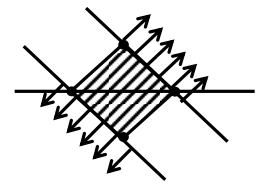
(D) We are given the sets $A = \{(x, y) \in \mathbb{R} \times \mathbb{R} : |x + y| \geq 3\}$ and $B = \{(x, y) \in \mathbb{R} \times \mathbb{R} : |x| + |y| \leq 3\}$.
We need to find the set $C = \{(x, y) \in A \cap B : x = 0 \text{ or } y = 0\}$.
Case $1$: If $x = 0$,then $(0, y) \in A \cap B$.
From $B$,$|0| + |y| \leq 3 \implies |y| \leq 3 \implies -3 \leq y \leq 3$.
From $A$,$|0 + y| \geq 3 \implies |y| \geq 3$.
Combining these,$|y| = 3$,so $y = 3$ or $y = -3$. Thus,$(0, 3)$ and $(0, -3)$ are in $C$.
Case $2$: If $y = 0$,then $(x, 0) \in A \cap B$.
From $B$,$|x| + |0| \leq 3 \implies |x| \leq 3 \implies -3 \leq x \leq 3$.
From $A$,$|x + 0| \geq 3 \implies |x| \geq 3$.
Combining these,$|x| = 3$,so $x = 3$ or $x = -3$. Thus,$(3, 0)$ and $(-3, 0)$ are in $C$.
Therefore,$C = \{(3, 0), (-3, 0), (0, 3), (0, -3)\}$.
Now,we calculate $\sum_{(x, y) \in C} |x + y| = |3 + 0| + |-3 + 0| + |0 + 3| + |0 - 3| = 3 + 3 + 3 + 3 = 12$.
We need to find the set $C = \{(x, y) \in A \cap B : x = 0 \text{ or } y = 0\}$.
Case $1$: If $x = 0$,then $(0, y) \in A \cap B$.
From $B$,$|0| + |y| \leq 3 \implies |y| \leq 3 \implies -3 \leq y \leq 3$.
From $A$,$|0 + y| \geq 3 \implies |y| \geq 3$.
Combining these,$|y| = 3$,so $y = 3$ or $y = -3$. Thus,$(0, 3)$ and $(0, -3)$ are in $C$.
Case $2$: If $y = 0$,then $(x, 0) \in A \cap B$.
From $B$,$|x| + |0| \leq 3 \implies |x| \leq 3 \implies -3 \leq x \leq 3$.
From $A$,$|x + 0| \geq 3 \implies |x| \geq 3$.
Combining these,$|x| = 3$,so $x = 3$ or $x = -3$. Thus,$(3, 0)$ and $(-3, 0)$ are in $C$.
Therefore,$C = \{(3, 0), (-3, 0), (0, 3), (0, -3)\}$.
Now,we calculate $\sum_{(x, y) \in C} |x + y| = |3 + 0| + |-3 + 0| + |0 + 3| + |0 - 3| = 3 + 3 + 3 + 3 = 12$.
0 likes
View Solution17
AdvancedMCQ
Let $A = \{x \in (0, \pi) - \{\frac{\pi}{2}\} : \log_{(2/\pi)}|\sin x| + \log_{(2/\pi)}|\cos x| = 2\}$ and $B = \{x \geq 0 : \sqrt{x}(\sqrt{x} - 4) - 3|\sqrt{x} - 2| + 6 = 0\}$. Then $n(A \cup B)$ is equal to:
A
$4$
B
$2$
C
$8$
D
$6$
Solution
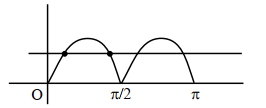
(C) For set $A$: $\log_{(2/\pi)}|\sin x| + \log_{(2/\pi)}|\cos x| = 2$
$\Rightarrow \log_{(2/\pi)}|\sin x \cos x| = 2$
$\Rightarrow |\sin x \cos x| = (2/\pi)^2 = 4/\pi^2$
$\Rightarrow |\frac{1}{2} \sin 2x| = 4/\pi^2$
$\Rightarrow |\sin 2x| = 8/\pi^2$
Since $8/\pi^2 \approx 8/9.86 < 1$,the equation $|\sin 2x| = 8/\pi^2$ has $4$ solutions in $(0, \pi) - \{\pi/2\}$.
For set $B$: Let $t = \sqrt{x} \geq 0$. The equation is $t(t - 4) - 3|t - 2| + 6 = 0$.
Case $1$: $0 \leq t < 2$. Then $|t - 2| = -(t - 2) = 2 - t$.
$t^2 - 4t - 3(2 - t) + 6 = 0$ $\Rightarrow t^2 - 4t - 6 + 3t + 6 = 0$ $\Rightarrow t^2 - t = 0$ $\Rightarrow t(t - 1) = 0$.
Since $0 \leq t < 2$,$t = 0$ and $t = 1$ are solutions. Thus $x = 0^2 = 0$ and $x = 1^2 = 1$.
Case $2$: $t \geq 2$. Then $|t - 2| = t - 2$.
$t^2 - 4t - 3(t - 2) + 6 = 0$ $\Rightarrow t^2 - 4t - 3t + 6 + 6 = 0$ $\Rightarrow t^2 - 7t + 12 = 0$ $\Rightarrow (t - 3)(t - 4) = 0$.
Thus $t = 3$ and $t = 4$. So $x = 3^2 = 9$ and $x = 4^2 = 16$.
Set $B = \{0, 1, 9, 16\}$,so $n(B) = 4$.
Since sets $A$ and $B$ are disjoint,$n(A \cup B) = n(A) + n(B) = 4 + 4 = 8$.
$\Rightarrow \log_{(2/\pi)}|\sin x \cos x| = 2$
$\Rightarrow |\sin x \cos x| = (2/\pi)^2 = 4/\pi^2$
$\Rightarrow |\frac{1}{2} \sin 2x| = 4/\pi^2$
$\Rightarrow |\sin 2x| = 8/\pi^2$
Since $8/\pi^2 \approx 8/9.86 < 1$,the equation $|\sin 2x| = 8/\pi^2$ has $4$ solutions in $(0, \pi) - \{\pi/2\}$.
For set $B$: Let $t = \sqrt{x} \geq 0$. The equation is $t(t - 4) - 3|t - 2| + 6 = 0$.
Case $1$: $0 \leq t < 2$. Then $|t - 2| = -(t - 2) = 2 - t$.
$t^2 - 4t - 3(2 - t) + 6 = 0$ $\Rightarrow t^2 - 4t - 6 + 3t + 6 = 0$ $\Rightarrow t^2 - t = 0$ $\Rightarrow t(t - 1) = 0$.
Since $0 \leq t < 2$,$t = 0$ and $t = 1$ are solutions. Thus $x = 0^2 = 0$ and $x = 1^2 = 1$.
Case $2$: $t \geq 2$. Then $|t - 2| = t - 2$.
$t^2 - 4t - 3(t - 2) + 6 = 0$ $\Rightarrow t^2 - 4t - 3t + 6 + 6 = 0$ $\Rightarrow t^2 - 7t + 12 = 0$ $\Rightarrow (t - 3)(t - 4) = 0$.
Thus $t = 3$ and $t = 4$. So $x = 3^2 = 9$ and $x = 4^2 = 16$.
Set $B = \{0, 1, 9, 16\}$,so $n(B) = 4$.
Since sets $A$ and $B$ are disjoint,$n(A \cup B) = n(A) + n(B) = 4 + 4 = 8$.
0 likes
View Solution18
MediumMCQ
For a real number $x$,$[x]$ denotes the greatest integer less than or equal to $x$. Then the value of $\left[\frac{1}{2}\right] + \left[\frac{1}{2} + \frac{1}{100}\right] + \left[\frac{1}{2} + \frac{2}{100}\right] + \left[\frac{1}{2} + \frac{3}{100}\right] + \ldots + \left[\frac{1}{2} + \frac{99}{100}\right] = $
A
$49$
B
$100$
C
$0$
D
$50$
Solution
(D) Let the given sum be $S = \sum_{k=0}^{99} \left[\frac{1}{2} + \frac{k}{100}\right]$.
We observe the value of each term $\left[\frac{1}{2} + \frac{k}{100}\right]$:
For $0 \le k \le 49$,we have $\frac{1}{2} \le \frac{1}{2} + \frac{k}{100} \le \frac{1}{2} + \frac{49}{100} = 0.99$. Since $0 \le 0.5 + \frac{k}{100} < 1$,the greatest integer part is $0$. There are $50$ such terms (from $k=0$ to $k=49$).
For $50 \le k \le 99$,we have $\frac{1}{2} + \frac{50}{100} \le \frac{1}{2} + \frac{k}{100} \le \frac{1}{2} + \frac{99}{100}$,which simplifies to $1 \le \frac{1}{2} + \frac{k}{100} \le 1.49$. Since $1 \le 0.5 + \frac{k}{100} < 2$,the greatest integer part is $1$. There are $50$ such terms (from $k=50$ to $k=99$).
Thus,$S = (50 \times 0) + (50 \times 1) = 50$.
We observe the value of each term $\left[\frac{1}{2} + \frac{k}{100}\right]$:
For $0 \le k \le 49$,we have $\frac{1}{2} \le \frac{1}{2} + \frac{k}{100} \le \frac{1}{2} + \frac{49}{100} = 0.99$. Since $0 \le 0.5 + \frac{k}{100} < 1$,the greatest integer part is $0$. There are $50$ such terms (from $k=0$ to $k=49$).
For $50 \le k \le 99$,we have $\frac{1}{2} + \frac{50}{100} \le \frac{1}{2} + \frac{k}{100} \le \frac{1}{2} + \frac{99}{100}$,which simplifies to $1 \le \frac{1}{2} + \frac{k}{100} \le 1.49$. Since $1 \le 0.5 + \frac{k}{100} < 2$,the greatest integer part is $1$. There are $50$ such terms (from $k=50$ to $k=99$).
Thus,$S = (50 \times 0) + (50 \times 1) = 50$.
0 likes
View Solution19
EasyMCQ
The missing term in the following table is
$\begin{array}{|c|c|c|c|c|c|} \hline x & 0 & 1 & 2 & 3 & 4 \\ \hline y=f(x) & 1 & 3 & 9 & ? & 81 \\ \hline \end{array}$
$\begin{array}{|c|c|c|c|c|c|} \hline x & 0 & 1 & 2 & 3 & 4 \\ \hline y=f(x) & 1 & 3 & 9 & ? & 81 \\ \hline \end{array}$
A
$27$
B
$30$
C
$31$
D
$34$
Solution
(C) Given the values at $x = 0, 1, 2, 4$,we assume the function $f(x)$ is a polynomial of degree $3$ or less,implying the $4^{th}$ order forward difference is zero: $\Delta^{4} f(0) = 0$.
Using the operator $E$,where $Ef(x) = f(x+1)$,we have $(E-1)^{4} f(0) = 0$.
Expanding this,we get $(E^{4}-4E^{3}+6E^{2}-4E+1) f(0) = 0$.
This simplifies to $f(4) - 4f(3) + 6f(2) - 4f(1) + f(0) = 0$.
Substituting the known values $f(0)=1, f(1)=3, f(2)=9, f(4)=81$:
$81 - 4f(3) + 6(9) - 4(3) + 1 = 0$.
$81 - 4f(3) + 54 - 12 + 1 = 0$.
$124 - 4f(3) = 0$.
$4f(3) = 124$.
$f(3) = 31$.
Using the operator $E$,where $Ef(x) = f(x+1)$,we have $(E-1)^{4} f(0) = 0$.
Expanding this,we get $(E^{4}-4E^{3}+6E^{2}-4E+1) f(0) = 0$.
This simplifies to $f(4) - 4f(3) + 6f(2) - 4f(1) + f(0) = 0$.
Substituting the known values $f(0)=1, f(1)=3, f(2)=9, f(4)=81$:
$81 - 4f(3) + 6(9) - 4(3) + 1 = 0$.
$81 - 4f(3) + 54 - 12 + 1 = 0$.
$124 - 4f(3) = 0$.
$4f(3) = 124$.
$f(3) = 31$.
0 likes
View Solution20
EasyMCQ
In a regular graph of $15$ vertices,the sum of the degrees of the vertices is $60$. Then,the degree of each vertex is:
A
$5$
B
$3$
C
$4$
D
$2$
Solution
(C) Let the degree of each vertex be $K$.
Since the graph is regular,every vertex has the same degree $K$.
The sum of the degrees of all vertices in a graph is given by the product of the number of vertices and the degree of each vertex.
Given that there are $15$ vertices and the sum of their degrees is $60$,we have:
$15 \times K = 60$
Dividing both sides by $15$,we get:
$K = \frac{60}{15} = 4$
Therefore,the degree of each vertex is $4$.
Since the graph is regular,every vertex has the same degree $K$.
The sum of the degrees of all vertices in a graph is given by the product of the number of vertices and the degree of each vertex.
Given that there are $15$ vertices and the sum of their degrees is $60$,we have:
$15 \times K = 60$
Dividing both sides by $15$,we get:
$K = \frac{60}{15} = 4$
Therefore,the degree of each vertex is $4$.
0 likes
View Solution21
MediumMCQ
If $P(x) = x^5 + ax^4 + bx^3 + cx^2 + dx + e$ is a polynomial such that $P(0) = 1, P(1) = 2, P(2) = 5, P(3) = 10$ and $P(4) = 17$,then $P(5) =$
A
$26$
B
$146$
C
$126$
D
$76$
Solution
(B) Given $P(x) = x^5 + ax^4 + bx^3 + cx^2 + dx + e$.
Notice the pattern in the values: $P(x) = x^2 + 1$ for $x = 0, 1, 2, 3, 4$.
Let $Q(x) = P(x) - (x^2 + 1)$.
Since $P(x)$ is a polynomial of degree $5$ and $x^2 + 1$ is of degree $2$,$Q(x)$ is a polynomial of degree $5$ with roots $0, 1, 2, 3, 4$.
Thus,$Q(x) = k(x)(x-1)(x-2)(x-3)(x-4)$ for some constant $k$.
Comparing the coefficient of $x^5$ in $P(x)$,we see $k = 1$.
So,$P(x) = x(x-1)(x-2)(x-3)(x-4) + x^2 + 1$.
To find $P(5)$,substitute $x = 5$:
$P(5) = 5(5-1)(5-2)(5-3)(5-4) + 5^2 + 1$
$P(5) = 5 \times 4 \times 3 \times 2 \times 1 + 25 + 1$
$P(5) = 120 + 26 = 146$.
Notice the pattern in the values: $P(x) = x^2 + 1$ for $x = 0, 1, 2, 3, 4$.
Let $Q(x) = P(x) - (x^2 + 1)$.
Since $P(x)$ is a polynomial of degree $5$ and $x^2 + 1$ is of degree $2$,$Q(x)$ is a polynomial of degree $5$ with roots $0, 1, 2, 3, 4$.
Thus,$Q(x) = k(x)(x-1)(x-2)(x-3)(x-4)$ for some constant $k$.
Comparing the coefficient of $x^5$ in $P(x)$,we see $k = 1$.
So,$P(x) = x(x-1)(x-2)(x-3)(x-4) + x^2 + 1$.
To find $P(5)$,substitute $x = 5$:
$P(5) = 5(5-1)(5-2)(5-3)(5-4) + 5^2 + 1$
$P(5) = 5 \times 4 \times 3 \times 2 \times 1 + 25 + 1$
$P(5) = 120 + 26 = 146$.
0 likes
View Solution22
EasyMCQ
If a set $A$ has $5$ elements,then the number of ways of selecting two subsets $P$ and $Q$ from $A$ such that $P$ and $Q$ are mutually disjoint,is
A
$64$
B
$128$
C
$243$
D
$729$
Solution
(C) For each element in the set $A$,there are $3$ possibilities:
$1$. The element is in subset $P$.
$2$. The element is in subset $Q$.
$3$. The element is in neither $P$ nor $Q$.
Since the subsets $P$ and $Q$ must be mutually disjoint,an element cannot be in both $P$ and $Q$.
Given that set $A$ has $n = 5$ elements,each of the $5$ elements has $3$ choices.
Therefore,the total number of ways to select the subsets $P$ and $Q$ is $3^n = 3^5 = 243$.
$1$. The element is in subset $P$.
$2$. The element is in subset $Q$.
$3$. The element is in neither $P$ nor $Q$.
Since the subsets $P$ and $Q$ must be mutually disjoint,an element cannot be in both $P$ and $Q$.
Given that set $A$ has $n = 5$ elements,each of the $5$ elements has $3$ choices.
Therefore,the total number of ways to select the subsets $P$ and $Q$ is $3^n = 3^5 = 243$.
0 likes
View Solution23
EasyMCQ
Let $A$ and $B$ be finite sets and $P_A$ and $P_B$ respectively denote their power sets. If $P_B$ has $112$ elements more than those in $P_A$,then the number of injective functions from $A$ to $B$ is
A
$224$
B
$56$
C
$120$
D
$840$
Solution
(D) Let $n(A) = m$ and $n(B) = n$.
Given that $P_B$ has $112$ elements more than $P_A$,we have $n(P_B) - n(P_A) = 112$.
Since $n(P_A) = 2^m$ and $n(P_B) = 2^n$,we get $2^n - 2^m = 112$.
Factoring out $2^m$,we have $2^m(2^{n-m} - 1) = 112$.
We can write $112$ as $16 \times 7 = 2^4 \times (8 - 1) = 2^4(2^3 - 1)$.
Comparing both sides,we get $m = 4$ and $n - m = 3$,which implies $n = 7$.
The number of injective functions from $A$ to $B$ is given by the formula $^n P_m$.
Substituting the values,we get $^7 P_4 = \frac{7!}{(7-4)!} = \frac{7 \times 6 \times 5 \times 4 \times 3!}{3!} = 7 \times 6 \times 5 \times 4 = 840$.
Given that $P_B$ has $112$ elements more than $P_A$,we have $n(P_B) - n(P_A) = 112$.
Since $n(P_A) = 2^m$ and $n(P_B) = 2^n$,we get $2^n - 2^m = 112$.
Factoring out $2^m$,we have $2^m(2^{n-m} - 1) = 112$.
We can write $112$ as $16 \times 7 = 2^4 \times (8 - 1) = 2^4(2^3 - 1)$.
Comparing both sides,we get $m = 4$ and $n - m = 3$,which implies $n = 7$.
The number of injective functions from $A$ to $B$ is given by the formula $^n P_m$.
Substituting the values,we get $^7 P_4 = \frac{7!}{(7-4)!} = \frac{7 \times 6 \times 5 \times 4 \times 3!}{3!} = 7 \times 6 \times 5 \times 4 = 840$.
0 likes
View Solution24
EasyMCQ
If $A=\{x \in R: \sqrt{x^2-8x+15} \in R\}$ and $B=\{x \in R: \frac{x-3}{2x-5} < \frac{x-6}{2x-11}\}$,then $A \cap B=$
A
$\phi$
B
$\left(\frac{5}{2}, 3\right] \cup \left[5, \frac{11}{2}\right)$
C
$\left(\frac{5}{2}, \frac{21}{4}\right)$
D
$\left(\frac{5}{2}, \frac{11}{2}\right)$
Solution
(B) For set $A$,we require $x^2-8x+15 \geq 0$.
$(x-3)(x-5) \geq 0$,which gives $x \in (-\infty, 3] \cup [5, \infty)$.
For set $B$,we solve $\frac{x-3}{2x-5} - \frac{x-6}{2x-11} < 0$.
$\frac{(x-3)(2x-11) - (x-6)(2x-5)}{(2x-5)(2x-11)} < 0$.
$\frac{(2x^2-17x+33) - (2x^2-17x+30)}{(2x-5)(2x-11)} < 0$.
$\frac{3}{(2x-5)(2x-11)} < 0$.
This implies $(2x-5)(2x-11) < 0$,so $x \in \left(\frac{5}{2}, \frac{11}{2}\right)$.
Finally,$A \cap B = ((-\infty, 3] \cup [5, \infty)) \cap \left(\frac{5}{2}, \frac{11}{2}\right) = \left(\frac{5}{2}, 3\right] \cup \left[5, \frac{11}{2}\right)$.
$(x-3)(x-5) \geq 0$,which gives $x \in (-\infty, 3] \cup [5, \infty)$.
For set $B$,we solve $\frac{x-3}{2x-5} - \frac{x-6}{2x-11} < 0$.
$\frac{(x-3)(2x-11) - (x-6)(2x-5)}{(2x-5)(2x-11)} < 0$.
$\frac{(2x^2-17x+33) - (2x^2-17x+30)}{(2x-5)(2x-11)} < 0$.
$\frac{3}{(2x-5)(2x-11)} < 0$.
This implies $(2x-5)(2x-11) < 0$,so $x \in \left(\frac{5}{2}, \frac{11}{2}\right)$.
Finally,$A \cap B = ((-\infty, 3] \cup [5, \infty)) \cap \left(\frac{5}{2}, \frac{11}{2}\right) = \left(\frac{5}{2}, 3\right] \cup \left[5, \frac{11}{2}\right)$.
0 likes
View Solution25
DifficultMCQ
Let $S = \{(m, n): m, n \in \{1, 2, 3, \ldots, 50\}\}$. If the number of elements $(m, n)$ in $S$ such that $6^{m} + 9^{n}$ is a multiple of $5$ is $p$ and the number of elements $(m, n)$ in $S$ such that $m + n$ is a square of a prime number is $q$,then $p + q$ is equal to :
A
$1333$
B
$1250$
C
$1350$
D
$1283$
Solution
(A) For $p$: $6^m + 9^n \equiv 1^m + (-1)^n \equiv 1 + (-1)^n \pmod{5}$.
For this to be a multiple of $5$,$1 + (-1)^n \equiv 0 \pmod{5}$,which implies $(-1)^n = -1$.
This occurs when $n$ is odd. In the set $\{1, 2, \ldots, 50\}$,there are $25$ odd values for $n$ and $50$ values for $m$.
Thus,$p = 50 \times 25 = 1250$.
For $q$: $m + n$ must be a square of a prime number. The possible squares of primes are $2^2 = 4$,$3^2 = 9$,$5^2 = 25$,and $7^2 = 49$.
$q = 3 + 8 + 24 + 48 = 83$.
$p + q = 1250 + 83 = 1333$.
For this to be a multiple of $5$,$1 + (-1)^n \equiv 0 \pmod{5}$,which implies $(-1)^n = -1$.
This occurs when $n$ is odd. In the set $\{1, 2, \ldots, 50\}$,there are $25$ odd values for $n$ and $50$ values for $m$.
Thus,$p = 50 \times 25 = 1250$.
For $q$: $m + n$ must be a square of a prime number. The possible squares of primes are $2^2 = 4$,$3^2 = 9$,$5^2 = 25$,and $7^2 = 49$.
| $m + n = 4$ | $3$ pairs: $(1,3), (2,2), (3,1)$ |
| $m + n = 9$ | $8$ pairs: $(1,8), \ldots, (8,1)$ |
| $m + n = 25$ | $24$ pairs: $(1,24), \ldots, (24,1)$ |
| $m + n = 49$ | $48$ pairs: $(1,48), \ldots, (48,1)$ |
$q = 3 + 8 + 24 + 48 = 83$.
$p + q = 1250 + 83 = 1333$.
0 likes
View Solution26
DifficultMCQ
Let $A$ be the set of first $101$ terms of an $A$.$P$.,whose first term is $1$ and the common difference is $5$,and let $B$ be the set of first $71$ terms of an $A$.$P$.,whose first term is $9$ and the common difference is $7$. Then,the number of elements in $A \cap B$ which are divisible by $3$ is:
A
$4$
B
$5$
C
$6$
D
$7$
Solution
(B) The set $A$ consists of terms $a_n = 1 + (n-1)5 = 5n - 4$ for $n = 1, 2, \dots, 101$. The maximum value is $5(101) - 4 = 501$.
The set $B$ consists of terms $b_m = 9 + (m-1)7 = 7m + 2$ for $m = 1, 2, \dots, 71$. The maximum value is $7(71) + 2 = 499$.
For an element $x$ to be in $A \cap B$,we have $x = 5n - 4 = 7m + 2$,which implies $5n = 7m + 6$.
Testing values for $m$: If $m=1, x=9$ (not in $A$). If $m=2, x=16$ ($16 = 5(4)-4$,so $16 \in A$).
The common terms form an $A$.$P$. with common difference $\text{lcm}(5, 7) = 35$. Thus,$x = 35k + 16$.
We require $16 \le 35k + 16 \le 499$,which gives $0 \le k \le 13.8$,so $k \in \{0, 1, 2, \dots, 13\}$.
We want $x$ to be divisible by $3$: $35k + 16 \equiv 2k + 1 \equiv 0 \pmod 3$.
This implies $2k \equiv -1 \equiv 2 \pmod 3$,so $k \equiv 1 \pmod 3$.
The possible values for $k$ are $1, 4, 7, 10, 13$.
There are $5$ such values.
The set $B$ consists of terms $b_m = 9 + (m-1)7 = 7m + 2$ for $m = 1, 2, \dots, 71$. The maximum value is $7(71) + 2 = 499$.
For an element $x$ to be in $A \cap B$,we have $x = 5n - 4 = 7m + 2$,which implies $5n = 7m + 6$.
Testing values for $m$: If $m=1, x=9$ (not in $A$). If $m=2, x=16$ ($16 = 5(4)-4$,so $16 \in A$).
The common terms form an $A$.$P$. with common difference $\text{lcm}(5, 7) = 35$. Thus,$x = 35k + 16$.
We require $16 \le 35k + 16 \le 499$,which gives $0 \le k \le 13.8$,so $k \in \{0, 1, 2, \dots, 13\}$.
We want $x$ to be divisible by $3$: $35k + 16 \equiv 2k + 1 \equiv 0 \pmod 3$.
This implies $2k \equiv -1 \equiv 2 \pmod 3$,so $k \equiv 1 \pmod 3$.
The possible values for $k$ are $1, 4, 7, 10, 13$.
There are $5$ such values.
0 likes
View SolutionSet Theory — Mix Examples of Set Theory · Frequently Asked Questions
1Are these Set Theory questions useful for JEE and NEET?
Yes. All questions in this section are mapped to JEE Main and NEET exam patterns. Previous year questions from JEE Main, NEET, GUJCET and state-level exams are included with full solutions.
2Can I switch to Hindi or Gujarati for these questions?
Yes. Use the language tabs in the hero section or the sidebar to view the same questions and solutions in English, Hindi or Gujarati.
3How do I generate a question paper from this subtopic?
Use the Vedclass Exam Paper Generator — select the chapter and subtopic, set difficulty, and generate Sets A, B, C, D automatically. First 3 chapters of every subject are free.
Vedclass Products
For Students
Vedclass Test Series
Mock tests in real JEE/NEET style with performance analysis. 5-day free trial.
Start Free TrialFor Teachers
Exam Paper Generator
Generate Set A/B/C/D papers from this chapter in 2 minutes. 3 chapters free.
Try FreeFor Institutes
Online Exam Module
Live online exams with unlimited students, 360° analytics & white-label branding.
See DemoFor Teachers & Institutes
Generate a Set Theory Exam Paper in 2 Minutes
Select subtopic & difficulty — Sets A, B, C, D auto-generated with No Repeat logic.
First 3 chapters of every subject are free — no payment required.