
ChemistryQ1–50 of 50 questions
Page 1 of 1 · English
1
ChemistryMCQWBJEE · 2009
$\int_{0}^{1000} e^{x - [x]} \, dx$ is equal to:
A
$e^{1000} - 1$
B
$\frac{e^{1000} - 1}{e - 1}$
C
$1000(e - 1)$
D
$\frac{e - 1}{1000}$
Solution
(C) The function $f(x) = e^{x - [x]}$ is a periodic function with period $T = 1$,where $[x]$ denotes the greatest integer function.
Using the property of definite integrals for periodic functions,$\int_{0}^{nT} f(x) \, dx = n \int_{0}^{T} f(x) \, dx$,we have:
$\int_{0}^{1000} e^{x - [x]} \, dx = 1000 \int_{0}^{1} e^{x - [x]} \, dx$.
For $0 < x < 1$,the value of $[x] = 0$. Therefore,$e^{x - [x]} = e^x$.
Substituting this into the integral:
$1000 \int_{0}^{1} e^x \, dx = 1000 [e^x]_{0}^{1}$.
Evaluating the definite integral:
$1000 (e^1 - e^0) = 1000 (e - 1)$.
Using the property of definite integrals for periodic functions,$\int_{0}^{nT} f(x) \, dx = n \int_{0}^{T} f(x) \, dx$,we have:
$\int_{0}^{1000} e^{x - [x]} \, dx = 1000 \int_{0}^{1} e^{x - [x]} \, dx$.
For $0 < x < 1$,the value of $[x] = 0$. Therefore,$e^{x - [x]} = e^x$.
Substituting this into the integral:
$1000 \int_{0}^{1} e^x \, dx = 1000 [e^x]_{0}^{1}$.
Evaluating the definite integral:
$1000 (e^1 - e^0) = 1000 (e - 1)$.
0 likesView Solution
2
ChemistryMCQWBJEE · 2009
The integrating factor of the differential equation $(x \log x) \frac{dy}{dx} + y = 2 \log x$ is
A
$\log x$
B
$\log (\log x)$
C
$e^x$
D
$x$
Solution
(A) The given differential equation is $(x \log x) \frac{dy}{dx} + y = 2 \log x$.
Dividing both sides by $(x \log x)$,we get:
$\frac{dy}{dx} + \frac{1}{x \log x} y = \frac{2 \log x}{x \log x} = \frac{2}{x}$.
This is a linear differential equation of the form $\frac{dy}{dx} + Py = Q$,where $P = \frac{1}{x \log x}$ and $Q = \frac{2}{x}$.
The integrating factor $(I.F.)$ is given by $e^{\int P dx}$.
$I.F. = e^{\int \frac{1}{x \log x} dx}$.
Let $u = \log x$,then $du = \frac{1}{x} dx$.
So,$\int \frac{1}{x \log x} dx = \int \frac{1}{u} du = \log u = \log(\log x)$.
Therefore,$I.F. = e^{\log(\log x)} = \log x$.
Dividing both sides by $(x \log x)$,we get:
$\frac{dy}{dx} + \frac{1}{x \log x} y = \frac{2 \log x}{x \log x} = \frac{2}{x}$.
This is a linear differential equation of the form $\frac{dy}{dx} + Py = Q$,where $P = \frac{1}{x \log x}$ and $Q = \frac{2}{x}$.
The integrating factor $(I.F.)$ is given by $e^{\int P dx}$.
$I.F. = e^{\int \frac{1}{x \log x} dx}$.
Let $u = \log x$,then $du = \frac{1}{x} dx$.
So,$\int \frac{1}{x \log x} dx = \int \frac{1}{u} du = \log u = \log(\log x)$.
Therefore,$I.F. = e^{\log(\log x)} = \log x$.
0 likesView Solution
3
ChemistryMCQWBJEE · 2009
If the charge on a capacitor is increased by $2 \, C$,the energy stored in it increases by $21 \%$. The original charge on the capacitor (in coulomb) is
A
$10$
B
$20$
C
$30$
D
$40$
Solution
(B) The energy stored in a capacitor is given by $U = \frac{Q^2}{2C}$,where $Q$ is the charge and $C$ is the capacitance.
Let the initial charge be $Q$. The initial energy is $U_1 = \frac{Q^2}{2C}$.
When the charge is increased by $2 \, C$,the new charge is $Q' = Q + 2$.
The new energy is $U_2 = \frac{(Q+2)^2}{2C}$.
Given that the energy increases by $21 \%$,the new energy is $U_2 = U_1 + 0.21 U_1 = 1.21 U_1$.
Substituting the expressions for $U_1$ and $U_2$: $\frac{(Q+2)^2}{2C} = 1.21 \left( \frac{Q^2}{2C} \right)$.
Canceling $\frac{1}{2C}$ from both sides,we get $(Q+2)^2 = 1.21 Q^2$.
Taking the square root of both sides: $Q + 2 = \sqrt{1.21} Q$.
$Q + 2 = 1.1 Q$.
$0.1 Q = 2$.
$Q = \frac{2}{0.1} = 20 \, C$.
Let the initial charge be $Q$. The initial energy is $U_1 = \frac{Q^2}{2C}$.
When the charge is increased by $2 \, C$,the new charge is $Q' = Q + 2$.
The new energy is $U_2 = \frac{(Q+2)^2}{2C}$.
Given that the energy increases by $21 \%$,the new energy is $U_2 = U_1 + 0.21 U_1 = 1.21 U_1$.
Substituting the expressions for $U_1$ and $U_2$: $\frac{(Q+2)^2}{2C} = 1.21 \left( \frac{Q^2}{2C} \right)$.
Canceling $\frac{1}{2C}$ from both sides,we get $(Q+2)^2 = 1.21 Q^2$.
Taking the square root of both sides: $Q + 2 = \sqrt{1.21} Q$.
$Q + 2 = 1.1 Q$.
$0.1 Q = 2$.
$Q = \frac{2}{0.1} = 20 \, C$.
0 likesView Solution
4
ChemistryMCQWBJEE · 2009
The Poisson's ratio of a material is $0.5$. If a force is applied to a wire of this material,there is a decrease in the cross-sectional area by $4 \%$. The percentage increase in the length is ........ $\%$
A
$1$
B
$2$
C
$2.5$
D
$4$
Solution
(D) Given: Poisson's ratio $\sigma = 0.5$. The percentage decrease in cross-sectional area is $\frac{\Delta A}{A} \times 100 = 4 \%$,so $\frac{\Delta A}{A} = 0.04$.
Since the area $A = \pi r^2$,the fractional change in area is related to the fractional change in radius by $\frac{\Delta A}{A} = 2 \frac{\Delta r}{r}$.
Thus,$2 \frac{\Delta r}{r} = 0.04$,which gives the lateral strain $\frac{\Delta r}{r} = 0.02$.
Poisson's ratio is defined as $\sigma = - \frac{\text{Lateral Strain}}{\text{Longitudinal Strain}} = - \frac{\Delta r / r}{\Delta l / l}$.
Taking magnitudes,$0.5 = \frac{0.02}{\Delta l / l}$.
Therefore,the longitudinal strain $\frac{\Delta l}{l} = \frac{0.02}{0.5} = 0.04$.
The percentage increase in length is $\frac{\Delta l}{l} \times 100 = 0.04 \times 100 = 4 \%$.
Since the area $A = \pi r^2$,the fractional change in area is related to the fractional change in radius by $\frac{\Delta A}{A} = 2 \frac{\Delta r}{r}$.
Thus,$2 \frac{\Delta r}{r} = 0.04$,which gives the lateral strain $\frac{\Delta r}{r} = 0.02$.
Poisson's ratio is defined as $\sigma = - \frac{\text{Lateral Strain}}{\text{Longitudinal Strain}} = - \frac{\Delta r / r}{\Delta l / l}$.
Taking magnitudes,$0.5 = \frac{0.02}{\Delta l / l}$.
Therefore,the longitudinal strain $\frac{\Delta l}{l} = \frac{0.02}{0.5} = 0.04$.
The percentage increase in length is $\frac{\Delta l}{l} \times 100 = 0.04 \times 100 = 4 \%$.
0 likesView Solution
5
ChemistryMCQWBJEE · 2009
At a certain place,the horizontal component of earth's magnetic field is $\frac{1}{\sqrt{3}}$ times the vertical component. The angle of dip at that place is (in $^{\circ}$)
A
$30$
B
$45$
C
$60$
D
$90$
Solution
(C) Given that the horizontal component $B_H$ is $\frac{1}{\sqrt{3}}$ times the vertical component $B_V$.
So,$B_H = \frac{1}{\sqrt{3}} B_V$,which implies $\frac{B_V}{B_H} = \sqrt{3}$.
The angle of dip $\delta$ is defined by the relation $\tan \delta = \frac{B_V}{B_H}$.
Substituting the value,we get $\tan \delta = \sqrt{3}$.
Since $\tan 60^{\circ} = \sqrt{3}$,the angle of dip $\delta = 60^{\circ}$.
So,$B_H = \frac{1}{\sqrt{3}} B_V$,which implies $\frac{B_V}{B_H} = \sqrt{3}$.
The angle of dip $\delta$ is defined by the relation $\tan \delta = \frac{B_V}{B_H}$.
Substituting the value,we get $\tan \delta = \sqrt{3}$.
Since $\tan 60^{\circ} = \sqrt{3}$,the angle of dip $\delta = 60^{\circ}$.
0 likesView Solution
6
ChemistryEasyMCQWBJEE · 2009
The hybridisation of the central atom in $NF_3$ is:
A
$sp^3$
B
$sp$
C
$sp^2$
D
$dsp^2$
Solution
(A) In $NF_3$,the central nitrogen atom is bonded to three fluorine atoms by three $\sigma$-bonds and has one lone pair of electrons.
To calculate the hybridisation,we use the formula:
$\text{Steric Number} = \text{Number of } \sigma \text{-bonds} + \text{Number of lone pairs}$.
$\text{Steric Number} = 3 + 1 = 4$.
$A$ steric number of $4$ corresponds to $sp^3$ hybridisation.
To calculate the hybridisation,we use the formula:
$\text{Steric Number} = \text{Number of } \sigma \text{-bonds} + \text{Number of lone pairs}$.
$\text{Steric Number} = 3 + 1 = 4$.
$A$ steric number of $4$ corresponds to $sp^3$ hybridisation.
0 likesView Solution
7
ChemistryEasyMCQWBJEE · 2009
In the compound $HC \equiv C-CH=CH_2$,the hybridization of $C-2$ and $C-3$ carbons are respectively:
A
$sp^3 \& sp^3$
B
$sp^2 \& sp^3$
C
$sp^2 \& sp$
D
$sp^3 \& sp$
Solution
(C) The structure of the compound is $H-C(4) \equiv C(3)-C(2)H=C(1)H_2$.
For $C-2$: It is bonded to one $H$ atom,one $C-3$ atom (via a single bond),and one $C-1$ atom (via a double bond). The number of sigma bonds is $3$ and there are no lone pairs,so the hybridization is $sp^2$.
For $C-3$: It is bonded to one $C-4$ atom (via a triple bond) and one $C-2$ atom (via a single bond). The number of sigma bonds is $2$ and there are no lone pairs,so the hybridization is $sp$.
Therefore,the hybridization of $C-2$ and $C-3$ are $sp^2$ and $sp$ respectively.
For $C-2$: It is bonded to one $H$ atom,one $C-3$ atom (via a single bond),and one $C-1$ atom (via a double bond). The number of sigma bonds is $3$ and there are no lone pairs,so the hybridization is $sp^2$.
For $C-3$: It is bonded to one $C-4$ atom (via a triple bond) and one $C-2$ atom (via a single bond). The number of sigma bonds is $2$ and there are no lone pairs,so the hybridization is $sp$.
Therefore,the hybridization of $C-2$ and $C-3$ are $sp^2$ and $sp$ respectively.
0 likesView Solution
8
ChemistryEasyMCQWBJEE · 2009
For the reaction $SO_2 + \frac{1}{2} O_2 \rightleftharpoons SO_3$,if we write $K_p = K_c(RT)^x$,then $x$ becomes
A
$-1$
B
$-\frac{1}{2}$
C
$\frac{1}{2}$
D
$1$
Solution
(B) The relationship between $K_p$ and $K_c$ is given by $K_p = K_c(RT)^{\Delta n_g}$.
Here,$\Delta n_g$ is the change in the number of moles of gaseous products and reactants.
$\Delta n_g = (\sum n_g)_{\text{products}} - (\sum n_g)_{\text{reactants}}$.
For the reaction $SO_2(g) + \frac{1}{2} O_2(g) \rightleftharpoons SO_3(g)$:
$\Delta n_g = 1 - (1 + \frac{1}{2}) = 1 - \frac{3}{2} = -\frac{1}{2}$.
Comparing this with $K_p = K_c(RT)^x$,we get $x = -\frac{1}{2}$.
Here,$\Delta n_g$ is the change in the number of moles of gaseous products and reactants.
$\Delta n_g = (\sum n_g)_{\text{products}} - (\sum n_g)_{\text{reactants}}$.
For the reaction $SO_2(g) + \frac{1}{2} O_2(g) \rightleftharpoons SO_3(g)$:
$\Delta n_g = 1 - (1 + \frac{1}{2}) = 1 - \frac{3}{2} = -\frac{1}{2}$.
Comparing this with $K_p = K_c(RT)^x$,we get $x = -\frac{1}{2}$.
0 likesView Solution
9
ChemistryEasyMCQWBJEE · 2009
"Electron" is an alloy of
A
$Mg$ and $Zn$
B
$Fe$ and $Mg$
C
$Ni$ and $Zn$
D
$Al$ and $Zn$
Solution
(A) Electron is a magnesium-based alloy.
It typically consists of $Mg (95 \%)$,$Zn (4.5 \%)$,and $Cu (0.5 \%)$.
Therefore,the correct option is $A$.
It typically consists of $Mg (95 \%)$,$Zn (4.5 \%)$,and $Cu (0.5 \%)$.
Therefore,the correct option is $A$.
0 likesView Solution
10
ChemistryEasyMCQWBJEE · 2009
The oxidant which is used as an antiseptic is:
A
$KBrO_3$
B
$KMnO_4$
C
$CrO_3$
D
Merrifield resin
Solution
(B) $KMnO_4$ (Potassium permanganate) acts as a strong oxidizing agent. It is widely used as an antiseptic and disinfectant in dilute solutions for treating skin infections and wounds.
0 likesView Solution
11
ChemistryMediumMCQWBJEE · 2009
Which one of the following formulae does not represent an organic compound?
A
$C_4H_{10}O_4$
B
$C_4H_8O_4$
C
$C_4H_7ClO_4$
D
$C_4H_9O_4$
Solution
(D) The degree of unsaturation (or double bond equivalent) is calculated using the formula: $U = C + 1 - \frac{H + X - N}{2}$.
For a stable organic compound,the degree of unsaturation must be an integer ($0$,$1$,$2$,...).
For $C_4H_{10}O_4$: $U = 4 + 1 - \frac{10}{2} = 0$.
For $C_4H_8O_4$: $U = 4 + 1 - \frac{8}{2} = 1$.
For $C_4H_7ClO_4$: $U = 4 + 1 - \frac{7+1}{2} = 1$.
For $C_4H_9O_4$: $U = 4 + 1 - \frac{9}{2} = 0.5$.
Since the degree of unsaturation cannot be $0.5$ for a stable organic molecule,$C_4H_9O_4$ does not represent a valid organic compound.
For a stable organic compound,the degree of unsaturation must be an integer ($0$,$1$,$2$,...).
For $C_4H_{10}O_4$: $U = 4 + 1 - \frac{10}{2} = 0$.
For $C_4H_8O_4$: $U = 4 + 1 - \frac{8}{2} = 1$.
For $C_4H_7ClO_4$: $U = 4 + 1 - \frac{7+1}{2} = 1$.
For $C_4H_9O_4$: $U = 4 + 1 - \frac{9}{2} = 0.5$.
Since the degree of unsaturation cannot be $0.5$ for a stable organic molecule,$C_4H_9O_4$ does not represent a valid organic compound.
0 likesView Solution
12
ChemistryMediumMCQWBJEE · 2009
Which of the following carbocations will be most stable?
A
$Ph_3C^{+}$
B
$CH_3-CH_2^{+}$
C
$(CH_3)_2CH^{+}$
D
$CH_2=CH-CH_2^{+}$
Solution
(A) The stability of carbocations is determined by factors such as resonance,hyperconjugation,and inductive effect.
$Ph_3C^{+}$ (triphenylmethyl carbocation) is the most stable among the given options because the positive charge on the central carbon atom is delocalized over three phenyl rings through resonance.
This extensive delocalization provides significant stabilization compared to the other carbocations,which are stabilized only by hyperconjugation or simple resonance.
$Ph_3C^{+}$ (triphenylmethyl carbocation) is the most stable among the given options because the positive charge on the central carbon atom is delocalized over three phenyl rings through resonance.
This extensive delocalization provides significant stabilization compared to the other carbocations,which are stabilized only by hyperconjugation or simple resonance.
0 likesView Solution
13
ChemistryDifficultMCQWBJEE · 2009
$A$ compound is formed by the substitution of two hydrogen atoms with two chlorine atoms in propane. The number of possible isomeric compounds is
A
$4$
B
$3$
C
$5$
D
$2$
Solution
(C) The reaction is $C_3H_8 \xrightarrow{-2H, +2Cl} C_3H_6Cl_2$.
The structural isomers of $C_3H_6Cl_2$ are:
$1,1$-dichloropropane
$2,2$-dichloropropane
$1,2$-dichloropropane
$1,3$-dichloropropane
Among these,$1,2$-dichloropropane contains a chiral carbon atom (the $C-2$ atom),which means it exists as a pair of enantiomers (optical isomers).
Therefore,the total number of isomers is $4$ structural isomers + $1$ additional enantiomer = $5$ isomers.
The structural isomers of $C_3H_6Cl_2$ are:
$1,1$-dichloropropane
$2,2$-dichloropropane
$1,2$-dichloropropane
$1,3$-dichloropropane
Among these,$1,2$-dichloropropane contains a chiral carbon atom (the $C-2$ atom),which means it exists as a pair of enantiomers (optical isomers).
Therefore,the total number of isomers is $4$ structural isomers + $1$ additional enantiomer = $5$ isomers.
0 likesView Solution
14
ChemistryMediumMCQWBJEE · 2009
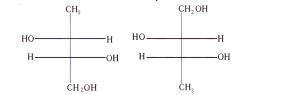
The two structures written below represent:
A
pair of diastereomers
B
pair of enantiomers
C
same molecule
D
both are optically inactive
Solution
(C) To determine the relationship between the two structures,we assign the $R/S$ configuration to the chiral centers.
For the first structure $(I)$:
The top chiral center has $-OH$ $(1)$,$-CH_2OH$ $(2)$,$-CH_3$ $(3)$,and $-H$ $(4)$. With $-H$ on the horizontal,the configuration is $R$.
The bottom chiral center has $-OH$ $(1)$,$-CH(OH)CH_3$ $(2)$,$-CH_2OH$ $(3)$,and $-H$ $(4)$. The configuration is $R$.
For the second structure $(II)$:
Rotating the Fischer projection by $180^{\circ}$ in the plane of the paper does not change the configuration of the chiral centers.
After a $180^{\circ}$ rotation of structure $(II)$,it becomes identical to structure $(I)$.
Therefore,both structures represent the same molecule.
For the first structure $(I)$:
The top chiral center has $-OH$ $(1)$,$-CH_2OH$ $(2)$,$-CH_3$ $(3)$,and $-H$ $(4)$. With $-H$ on the horizontal,the configuration is $R$.
The bottom chiral center has $-OH$ $(1)$,$-CH(OH)CH_3$ $(2)$,$-CH_2OH$ $(3)$,and $-H$ $(4)$. The configuration is $R$.
For the second structure $(II)$:
Rotating the Fischer projection by $180^{\circ}$ in the plane of the paper does not change the configuration of the chiral centers.
After a $180^{\circ}$ rotation of structure $(II)$,it becomes identical to structure $(I)$.
Therefore,both structures represent the same molecule.
0 likesView Solution
15
ChemistryEasyMCQWBJEE · 2009
The addition of $HBr$ to $2-$pentene gives
A
$2-$bromopentane only
B
$3-$bromopentane only
C
$2-$bromopentane and $3-$bromopentane
D
$1-$bromopentane and $3-$bromopentane
Solution
(C) The reaction of $HBr$ with $2-$pentene $(CH_3-CH=CH-CH_2-CH_3)$ is an electrophilic addition reaction.
According to Markovnikov's rule,the proton $(H^+)$ adds to the carbon atom of the double bond that already has more hydrogen atoms,or in this case,to form the more stable carbocation intermediate.
$2-$pentene is a symmetrical alkene with respect to the double bond position relative to the chain ends,but the two carbons of the double bond are not equivalent.
Protonation at $C_2$ gives a secondary carbocation at $C_3$ $(CH_3-CH^+-CH_2-CH_2-CH_3)$,and protonation at $C_3$ gives a secondary carbocation at $C_2$ $(CH_3-CH_2-CH^+-CH_2-CH_3)$.
Both carbocations are secondary and have similar stability.
Therefore,the bromide ion $(Br^-)$ can attack either carbocation,resulting in a mixture of $2-$bromopentane and $3-$bromopentane.
According to Markovnikov's rule,the proton $(H^+)$ adds to the carbon atom of the double bond that already has more hydrogen atoms,or in this case,to form the more stable carbocation intermediate.
$2-$pentene is a symmetrical alkene with respect to the double bond position relative to the chain ends,but the two carbons of the double bond are not equivalent.
Protonation at $C_2$ gives a secondary carbocation at $C_3$ $(CH_3-CH^+-CH_2-CH_2-CH_3)$,and protonation at $C_3$ gives a secondary carbocation at $C_2$ $(CH_3-CH_2-CH^+-CH_2-CH_3)$.
Both carbocations are secondary and have similar stability.
Therefore,the bromide ion $(Br^-)$ can attack either carbocation,resulting in a mixture of $2-$bromopentane and $3-$bromopentane.
0 likesView Solution
16
ChemistryEasyMCQWBJEE · 2009
Ethene can be separated from acetylene by passing the mixture through :
A
fuming $H_2SO_4$
B
pyrogallol
C
ammoniacal $Cu_2Cl_2$
D
Charcoal powder
Solution
(C) Acetylene $(HC \equiv CH)$ is a terminal alkyne with acidic hydrogen atoms.
When passed through ammoniacal cuprous chloride $(Cu_2Cl_2)$,it forms a red precipitate of copper$(I)$ acetylide:
$HC \equiv CH + Cu_2Cl_2 \rightarrow CuC \equiv CCu \downarrow (\text{red ppt}) + 2HCl$.
Ethene $(CH_2=CH_2)$ does not react with ammoniacal $Cu_2Cl_2$ and passes through unchanged.
Therefore,the mixture can be separated using ammoniacal $Cu_2Cl_2$.
When passed through ammoniacal cuprous chloride $(Cu_2Cl_2)$,it forms a red precipitate of copper$(I)$ acetylide:
$HC \equiv CH + Cu_2Cl_2 \rightarrow CuC \equiv CCu \downarrow (\text{red ppt}) + 2HCl$.
Ethene $(CH_2=CH_2)$ does not react with ammoniacal $Cu_2Cl_2$ and passes through unchanged.
Therefore,the mixture can be separated using ammoniacal $Cu_2Cl_2$.
0 likesView Solution
17
ChemistryMediumMCQWBJEE · 2009
Blackened oil painting can be restored into original form by the action of :
A
Chlorine
B
$BaO_2$
C
$H_2 O_2$
D
$MnO_2$
Solution
(C) The blackening of oil paintings is caused by the formation of $PbS$ (lead sulfide) due to atmospheric $H_2S$.
This can be restored by the action of $H_2 O_2$ (hydrogen peroxide),which oxidizes the black $PbS$ into white $PbSO_4$ (lead sulfate).
The chemical reaction is:
$PbS + 4H_2 O_2 \rightarrow PbSO_4 + 4H_2 O$
This can be restored by the action of $H_2 O_2$ (hydrogen peroxide),which oxidizes the black $PbS$ into white $PbSO_4$ (lead sulfate).
The chemical reaction is:
$PbS + 4H_2 O_2 \rightarrow PbSO_4 + 4H_2 O$
0 likesView Solution
18
ChemistryMCQWBJEE · 2009
At a certain place,the horizontal component of earth's magnetic field is $\sqrt{3}$ times the vertical component. The angle of dip at that place is (in $^{\circ}$)
A
$30$
B
$60$
C
$45$
D
$90$
Solution
(A) Let $H$ be the horizontal component and $V$ be the vertical component of the earth's magnetic field.
Given that $H = \sqrt{3} V$.
The angle of dip $\theta$ is defined by the relation $\tan \theta = \frac{V}{H}$.
Substituting the given value of $H$ into the formula:
$\tan \theta = \frac{V}{\sqrt{3} V} = \frac{1}{\sqrt{3}}$.
Since $\tan 30^{\circ} = \frac{1}{\sqrt{3}}$,we have $\theta = 30^{\circ}$.
Given that $H = \sqrt{3} V$.
The angle of dip $\theta$ is defined by the relation $\tan \theta = \frac{V}{H}$.
Substituting the given value of $H$ into the formula:
$\tan \theta = \frac{V}{\sqrt{3} V} = \frac{1}{\sqrt{3}}$.
Since $\tan 30^{\circ} = \frac{1}{\sqrt{3}}$,we have $\theta = 30^{\circ}$.
0 likesView Solution
19
ChemistryEasyMCQWBJEE · 2009
Which of the following statements is not correct?
A
Silicon is extensively used as a semiconductor
B
Carborundum is $SiC$
C
Silicon occurs in free state in nature
D
Mica contains the element silicon
Solution
(C) Silicon is the second most abundant element in the Earth's crust,but it does not occur in the free state in nature.
It is always found in the combined state,primarily as silica $(SiO_2)$ and silicates.
Therefore,the statement that silicon occurs in the free state in nature is incorrect.
It is always found in the combined state,primarily as silica $(SiO_2)$ and silicates.
Therefore,the statement that silicon occurs in the free state in nature is incorrect.
0 likesView Solution
20
ChemistryEasyMCQWBJEE · 2009
Atoms in a $P_4$ molecule of white phosphorus are arranged regularly in the following way:
A
at the corners of a cube
B
at the corners of a octahedron
C
at the corners of a tetrahedron
D
at the centre and corners of a tetrahedron
Solution
(C) In a $P_4$ molecule of white phosphorus,each phosphorus atom is $sp^3$ hybridized.
These four phosphorus atoms are linked to each other by single covalent bonds.
They are arranged at the four corners of a regular tetrahedron,with bond angles of $60^{\circ}$.
These four phosphorus atoms are linked to each other by single covalent bonds.
They are arranged at the four corners of a regular tetrahedron,with bond angles of $60^{\circ}$.
0 likesView Solution
21
ChemistryEasyMCQWBJEE · 2009
The reaction that takes place when $Cl_2$ gas is passed through concentrated $NaOH$ solution is:
A
Oxidation
B
Reduction
C
Displacement
D
Disproportionation
Solution
(D) When $Cl_2$ gas is passed through a hot and concentrated $NaOH$ solution,the reaction is:
$3Cl_2 + 6NaOH \rightarrow 5NaCl + NaClO_3 + 3H_2O$
In this reaction,the oxidation state of chlorine changes from $0$ in $Cl_2$ to $-1$ in $NaCl$ (reduction) and $+5$ in $NaClO_3$ (oxidation).
Since the same element is simultaneously oxidized and reduced,this is a disproportionation reaction.
$3Cl_2 + 6NaOH \rightarrow 5NaCl + NaClO_3 + 3H_2O$
In this reaction,the oxidation state of chlorine changes from $0$ in $Cl_2$ to $-1$ in $NaCl$ (reduction) and $+5$ in $NaClO_3$ (oxidation).
Since the same element is simultaneously oxidized and reduced,this is a disproportionation reaction.
0 likesView Solution
22
ChemistryEasyMCQWBJEE · 2009
Of the following acids,the one which has the capability to form complex compounds and also possesses both oxidizing and reducing properties is:
A
$HNO_3$
B
$HNO_2$
C
$HCOOH$
D
$HCN$
Solution
(B) The correct answer is $HNO_2$.
In $HNO_2$ (nitrous acid),the oxidation state of nitrogen is $+3$.
Since the oxidation state of nitrogen ranges from $-3$ to $+5$,nitrogen in $HNO_2$ can be oxidized to $+5$ (acting as a reducing agent) or reduced to lower oxidation states (acting as an oxidizing agent).
Additionally,$NO_2^-$ (nitrite ion) acts as a ligand and is capable of forming complex compounds with transition metals.
In $HNO_2$ (nitrous acid),the oxidation state of nitrogen is $+3$.
Since the oxidation state of nitrogen ranges from $-3$ to $+5$,nitrogen in $HNO_2$ can be oxidized to $+5$ (acting as a reducing agent) or reduced to lower oxidation states (acting as an oxidizing agent).
Additionally,$NO_2^-$ (nitrite ion) acts as a ligand and is capable of forming complex compounds with transition metals.
0 likesView Solution
23
ChemistryMediumMCQWBJEE · 2009
An organic compound made of $C$,$H$ and $N$ contains $20 \%$ nitrogen. Its molecular weight is:
A
$70$
B
$140$
C
$100$
D
$65$
Solution
(A) The atomic weight of nitrogen is $14 \ g/mol$. In an organic molecule,there must be at least one nitrogen atom present.
Given that the compound contains $20 \%$ nitrogen by mass.
Let the molecular weight be $M$.
Then,$\frac{14}{M} \times 100 = 20$.
Solving for $M$: $M = \frac{14 \times 100}{20} = 70 \ g/mol$.
Thus,the molecular weight is $70$.
Given that the compound contains $20 \%$ nitrogen by mass.
Let the molecular weight be $M$.
Then,$\frac{14}{M} \times 100 = 20$.
Solving for $M$: $M = \frac{14 \times 100}{20} = 70 \ g/mol$.
Thus,the molecular weight is $70$.
0 likesView Solution
24
ChemistryDifficultMCQWBJEE · 2009
Which of the following will decrease the $pH$ of a $50 \ mL$ solution of $0.01 \ M \ HCl$?
A
addition of $5 \ mL$ of $1 \ M \ HCl$
B
addition of $50 \ mL$ of $0.01 \ M \ HCl$
C
addition of $50 \ mL$ of $0.002 \ M \ HCl$
D
addition of $Mg$
Solution
(A) The initial $pH$ of $0.01 \ M \ HCl$ is $-\log(0.01) = 2$.
To decrease the $pH$,the concentration of $H^+$ ions must increase.
Option $A$: Adding $5 \ mL$ of $1 \ M \ HCl$ adds $5 \ mmol$ of $H^+$ to the existing $0.5 \ mmol$. The new concentration becomes $\frac{5.5 \ mmol}{55 \ mL} = 0.1 \ M$. The new $pH$ is $-\log(0.1) = 1$. Since $1 < 2$,the $pH$ decreases.
Option $B$: Adding $50 \ mL$ of $0.01 \ M \ HCl$ results in the same concentration $(0.01 \ M)$,so the $pH$ remains $2$.
Option $C$: Adding $50 \ mL$ of $0.002 \ M \ HCl$ dilutes the solution,decreasing the $H^+$ concentration and increasing the $pH$.
Option $D$: Adding $Mg$ reacts with $HCl$ to consume $H^+$ ions,increasing the $pH$.
To decrease the $pH$,the concentration of $H^+$ ions must increase.
Option $A$: Adding $5 \ mL$ of $1 \ M \ HCl$ adds $5 \ mmol$ of $H^+$ to the existing $0.5 \ mmol$. The new concentration becomes $\frac{5.5 \ mmol}{55 \ mL} = 0.1 \ M$. The new $pH$ is $-\log(0.1) = 1$. Since $1 < 2$,the $pH$ decreases.
Option $B$: Adding $50 \ mL$ of $0.01 \ M \ HCl$ results in the same concentration $(0.01 \ M)$,so the $pH$ remains $2$.
Option $C$: Adding $50 \ mL$ of $0.002 \ M \ HCl$ dilutes the solution,decreasing the $H^+$ concentration and increasing the $pH$.
Option $D$: Adding $Mg$ reacts with $HCl$ to consume $H^+$ ions,increasing the $pH$.
0 likesView Solution
25
ChemistryMCQWBJEE · 2009
The value of $\cos 15^{\circ} \cos 7.5^{\circ} \sin 7.5^{\circ}$ is
A
$\frac{1}{2}$
B
$\frac{1}{8}$
C
$\frac{1}{4}$
D
$\frac{1}{16}$
Solution
(B) We have,$\cos 15^{\circ} \cdot \cos 7.5^{\circ} \cdot \sin 7.5^{\circ}$
$= \frac{1}{2} \cos 15^{\circ} (2 \sin 7.5^{\circ} \cos 7.5^{\circ})$
$= \frac{1}{2} \cos 15^{\circ} \sin(2 \times 7.5^{\circ})$
$= \frac{1}{2} \cos 15^{\circ} \sin 15^{\circ}$
$= \frac{1}{4} (2 \sin 15^{\circ} \cos 15^{\circ})$
$= \frac{1}{4} \sin(2 \times 15^{\circ})$
$= \frac{1}{4} \sin 30^{\circ}$
$= \frac{1}{4} \times \frac{1}{2} = \frac{1}{8}$
$= \frac{1}{2} \cos 15^{\circ} (2 \sin 7.5^{\circ} \cos 7.5^{\circ})$
$= \frac{1}{2} \cos 15^{\circ} \sin(2 \times 7.5^{\circ})$
$= \frac{1}{2} \cos 15^{\circ} \sin 15^{\circ}$
$= \frac{1}{4} (2 \sin 15^{\circ} \cos 15^{\circ})$
$= \frac{1}{4} \sin(2 \times 15^{\circ})$
$= \frac{1}{4} \sin 30^{\circ}$
$= \frac{1}{4} \times \frac{1}{2} = \frac{1}{8}$
0 likesView Solution
26
ChemistryMCQWBJEE · 2009
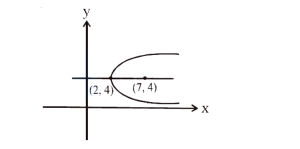
The coordinates of the focus of the parabola described parametrically by $x = 5t^2 + 2, y = 10t + 4$ are
A
$(7, 4)$
B
$(3, 4)$
C
$(3, -4)$
D
$(-7, 4)$
Solution
(A) Given parametric equations are $x = 5t^2 + 2$ and $y = 10t + 4$.
From the second equation,$10t = y - 4$,so $t = \frac{y - 4}{10}$.
Substituting this into the first equation: $x = 5\left(\frac{y - 4}{10}\right)^2 + 2$.
$x - 2 = 5 \cdot \frac{(y - 4)^2}{100} = \frac{(y - 4)^2}{20}$.
Thus,$(y - 4)^2 = 20(x - 2)$.
This is of the form $(y - k)^2 = 4a(x - h)$,where $(h, k) = (2, 4)$ is the vertex and $4a = 20$,so $a = 5$.
The focus of this parabola is $(h + a, k) = (2 + 5, 4) = (7, 4)$.
From the second equation,$10t = y - 4$,so $t = \frac{y - 4}{10}$.
Substituting this into the first equation: $x = 5\left(\frac{y - 4}{10}\right)^2 + 2$.
$x - 2 = 5 \cdot \frac{(y - 4)^2}{100} = \frac{(y - 4)^2}{20}$.
Thus,$(y - 4)^2 = 20(x - 2)$.
This is of the form $(y - k)^2 = 4a(x - h)$,where $(h, k) = (2, 4)$ is the vertex and $4a = 20$,so $a = 5$.
The focus of this parabola is $(h + a, k) = (2 + 5, 4) = (7, 4)$.
0 likesView Solution
27
ChemistryEasyMCQWBJEE · 2009
For the Paschen series,the values of $n_1$ and $n_2$ in the expression $\Delta E = R h c \left( \frac{1}{n_1^2} - \frac{1}{n_2^2} \right)$ are:
A
$n_1 = 1, n_2 = 2, 3, 4 \dots$
B
$n_1 = 2, n_2 = 3, 4, 5 \dots$
C
$n_1 = 3, n_2 = 4, 5, 6 \dots$
D
$n_1 = 4, n_2 = 5, 6, 7 \dots$
Solution
(C) The Rydberg formula for the hydrogen spectrum is given by $\Delta E = R h c \left( \frac{1}{n_1^2} - \frac{1}{n_2^2} \right)$.
For the Paschen series,the electron transitions occur from higher energy levels to the third energy level.
Therefore,the value of $n_1$ is $3$ and $n_2$ can be any integer greater than $3$,i.e.,$n_2 = 4, 5, 6, \dots$.
For the Paschen series,the electron transitions occur from higher energy levels to the third energy level.
Therefore,the value of $n_1$ is $3$ and $n_2$ can be any integer greater than $3$,i.e.,$n_2 = 4, 5, 6, \dots$.
0 likesView Solution
28
ChemistryDifficultMCQWBJEE · 2009
$1$ mole of photons,each of frequency $2500 \ s^{-1}$,would have approximately a total energy of:
A
$10 \ erg$
B
$1 \ Joule$
C
$1 \ eV$
D
$1 \ MeV$
Solution
(A) The total energy $E$ for $N$ moles of photons is given by $E = N_A \times h \times \nu$.
Here,$N_A = 6.022 \times 10^{23} \ mol^{-1}$,$h = 6.626 \times 10^{-34} \ J \cdot s$,and $\nu = 2500 \ s^{-1}$.
$E = (6.022 \times 10^{23}) \times (6.626 \times 10^{-34}) \times 2500 \ J$.
$E \approx 9.97 \times 10^{-7} \ J$.
Since $1 \ J = 10^7 \ erg$,$E \approx 9.97 \times 10^{-7} \times 10^7 \ erg = 9.97 \ erg \approx 10 \ erg$.
Here,$N_A = 6.022 \times 10^{23} \ mol^{-1}$,$h = 6.626 \times 10^{-34} \ J \cdot s$,and $\nu = 2500 \ s^{-1}$.
$E = (6.022 \times 10^{23}) \times (6.626 \times 10^{-34}) \times 2500 \ J$.
$E \approx 9.97 \times 10^{-7} \ J$.
Since $1 \ J = 10^7 \ erg$,$E \approx 9.97 \times 10^{-7} \times 10^7 \ erg = 9.97 \ erg \approx 10 \ erg$.
0 likesView Solution
29
ChemistryEasyMCQWBJEE · 2009
Under which of the following conditions is the relation $\Delta H = \Delta E + P \Delta V$ valid for a closed system?
A
Constant pressure
B
Constant temperature
C
Constant temperature and pressure
D
Constant temperature,pressure and composition
Solution
(A) The enthalpy change is defined as $\Delta H = \Delta E + \Delta(PV)$.
For a system where pressure $(P)$ is constant,the expression becomes $\Delta H = \Delta E + P \Delta V$.
Therefore,the relation is valid under the condition of constant pressure.
For a system where pressure $(P)$ is constant,the expression becomes $\Delta H = \Delta E + P \Delta V$.
Therefore,the relation is valid under the condition of constant pressure.
0 likesView Solution
30
ChemistryMediumMCQWBJEE · 2009
Equal volumes of molar hydrochloric acid and sulphuric acid are neutralized by dilute $NaOH$ solution and $x \ kcal$ and $y \ kcal$ of heat are liberated respectively. Which of the following is true?
A
$x = y$
B
$x = \frac{y}{2}$
C
$x = 2y$
D
None of the above
Solution
(B) The enthalpy of neutralization for $1 \ g$ equivalent of a strong acid with a strong base is constant at $13.7 \ kcal$.
Since the volumes and molarities are equal,let the volume be $V \ L$ and molarity be $M \ M$.
For $HCl$,the number of equivalents is $M \times V \times 1 = MV$.
For $H_2SO_4$,the number of equivalents is $M \times V \times 2 = 2MV$.
Since $H_2SO_4$ provides twice the number of equivalents of $H^+$ ions compared to $HCl$,the heat liberated by $H_2SO_4$ $(y)$ will be twice the heat liberated by $HCl$ $(x)$.
Therefore,$y = 2x$ or $x = \frac{y}{2}$.
Since the volumes and molarities are equal,let the volume be $V \ L$ and molarity be $M \ M$.
For $HCl$,the number of equivalents is $M \times V \times 1 = MV$.
For $H_2SO_4$,the number of equivalents is $M \times V \times 2 = 2MV$.
Since $H_2SO_4$ provides twice the number of equivalents of $H^+$ ions compared to $HCl$,the heat liberated by $H_2SO_4$ $(y)$ will be twice the heat liberated by $HCl$ $(x)$.
Therefore,$y = 2x$ or $x = \frac{y}{2}$.
0 likesView Solution
31
ChemistryEasyMCQWBJEE · 2009
The second law of thermodynamics states that in a cyclic process:
A
work cannot be converted into heat
B
heat cannot be converted into work
C
work cannot be completely converted into heat
D
heat cannot be completely converted into work
Solution
(D) The second law of thermodynamics,specifically the Kelvin-Planck statement,asserts that it is impossible for any device that operates on a thermodynamic cycle to receive heat from a single thermal reservoir and produce a net amount of work.
In other words,heat cannot be completely converted into work in a cyclic process without leaving some effect on the surroundings.
In other words,heat cannot be completely converted into work in a cyclic process without leaving some effect on the surroundings.
0 likesView Solution
32
ChemistryEasyMCQWBJEE · 2009
The equilibrium constant $(K)$ of a reaction may be written as :
A
$K=e^{-\Delta G / RT}$
B
$K=e^{-\Delta G^0 / RT}$
C
$K=e^{-\Delta H / RT}$
D
$K=e^{-\Delta H^0 / RT}$
Solution
(B) The relationship between the standard Gibbs free energy change $(\Delta G^0)$ and the equilibrium constant $(K)$ is given by the equation: $\Delta G^0 = -RT \ln K$.
Rearranging this equation to solve for $K$:
$\ln K = -\frac{\Delta G^0}{RT}$.
Taking the exponential of both sides:
$K = e^{-\Delta G^0 / RT}$.
Rearranging this equation to solve for $K$:
$\ln K = -\frac{\Delta G^0}{RT}$.
Taking the exponential of both sides:
$K = e^{-\Delta G^0 / RT}$.
0 likesView Solution
33
ChemistryMCQWBJEE · 2009
The integrating factor of the differential equation $x \log x \frac{dy}{dx} + y = 2 \log x$ is given by
A
$e^{x}$
B
$\log x$
C
$\log (\log x)$
D
$x$
Solution
(B) The given differential equation is $x \log x \frac{dy}{dx} + y = 2 \log x$.
Dividing both sides by $x \log x$,we get:
$\frac{dy}{dx} + \frac{1}{x \log x} y = \frac{2}{x}$.
This is a linear differential equation of the form $\frac{dy}{dx} + P(x)y = Q(x)$,where $P(x) = \frac{1}{x \log x}$.
The integrating factor $(IF)$ is given by $IF = e^{\int P(x) dx}$.
$IF = e^{\int \frac{1}{x \log x} dx}$.
Let $u = \log x$,then $du = \frac{1}{x} dx$.
$IF = e^{\int \frac{1}{u} du} = e^{\log u} = u = \log x$.
Thus,the integrating factor is $\log x$.
Dividing both sides by $x \log x$,we get:
$\frac{dy}{dx} + \frac{1}{x \log x} y = \frac{2}{x}$.
This is a linear differential equation of the form $\frac{dy}{dx} + P(x)y = Q(x)$,where $P(x) = \frac{1}{x \log x}$.
The integrating factor $(IF)$ is given by $IF = e^{\int P(x) dx}$.
$IF = e^{\int \frac{1}{x \log x} dx}$.
Let $u = \log x$,then $du = \frac{1}{x} dx$.
$IF = e^{\int \frac{1}{u} du} = e^{\log u} = u = \log x$.
Thus,the integrating factor is $\log x$.
0 likesView Solution
34
ChemistryMCQWBJEE · 2009
Three numbers are chosen at random from $1$ to $20$. The probability that they are consecutive is
A
$\frac{1}{190}$
B
$\frac{1}{120}$
C
$\frac{3}{190}$
D
$\frac{5}{190}$
Solution
(C) Total number of ways to choose $3$ numbers from $20$ is given by $^{20}C_3 = \frac{20 \times 19 \times 18}{3 \times 2 \times 1} = 1140$.
Favorable cases are sets of consecutive numbers: $(1, 2, 3), (2, 3, 4), \dots, (18, 19, 20)$.
There are $18$ such sets.
Therefore,the required probability is $\frac{18}{1140} = \frac{3}{190}$.
Favorable cases are sets of consecutive numbers: $(1, 2, 3), (2, 3, 4), \dots, (18, 19, 20)$.
There are $18$ such sets.
Therefore,the required probability is $\frac{18}{1140} = \frac{3}{190}$.
0 likesView Solution
35
ChemistryEasyMCQWBJEE · 2009
Reaction of $R-OH$ with $R'-MgX$ produces :
A
$R-H$
B
$R'-H$
C
$R-R$
D
$R'-R'$
Solution
(B) The reaction between an alcohol $(R-OH)$ and a Grignard reagent $(R'-MgX)$ is an acid-base reaction.
Alcohols contain a weakly acidic hydrogen atom attached to an oxygen atom.
Grignard reagents $(R'-MgX)$ contain a highly nucleophilic/basic alkyl group $(R'^- )$.
The $R'^- $ group abstracts the acidic proton from the alcohol to form an alkane $(R'-H)$ and an alkoxide salt $(R-OMgX)$.
The reaction is: $R-OH + R'-MgX \rightarrow R-OMgX + R'-H$ (Alkane).
Alcohols contain a weakly acidic hydrogen atom attached to an oxygen atom.
Grignard reagents $(R'-MgX)$ contain a highly nucleophilic/basic alkyl group $(R'^- )$.
The $R'^- $ group abstracts the acidic proton from the alcohol to form an alkane $(R'-H)$ and an alkoxide salt $(R-OMgX)$.
The reaction is: $R-OH + R'-MgX \rightarrow R-OMgX + R'-H$ (Alkane).
0 likesView Solution
36
ChemistryMediumMCQWBJEE · 2009
Which statement is incorrect?
A
Phenol is a weak acid
B
Phenol is an aromatic compound
C
Phenol liberates $CO_2$ from $Na_2CO_3$ solution
D
Phenol is soluble in $NaOH$
Solution
(C) Phenol is a weaker acid than carbonic acid $(H_2CO_3)$.
Therefore,it cannot displace carbonic acid from its salts like $Na_2CO_3$.
Consequently,phenol does not liberate $CO_2$ gas from $Na_2CO_3$ solution.
Thus,the statement in option $C$ is incorrect.
Therefore,it cannot displace carbonic acid from its salts like $Na_2CO_3$.
Consequently,phenol does not liberate $CO_2$ gas from $Na_2CO_3$ solution.
Thus,the statement in option $C$ is incorrect.
0 likesView Solution
37
ChemistryEasyMCQWBJEE · 2009
In which of the following reactions is a new carbon-carbon bond not formed?
A
Cannizzaro reaction
B
Wurtz reaction
C
Aldol condensation
D
Friedel-Crafts reaction
Solution
(A) In the Cannizzaro reaction,an aldehyde lacking an $\alpha$-hydrogen undergoes disproportionation in the presence of a concentrated base to form an alcohol and a carboxylic acid salt. No new $C-C$ bond is formed in this process.
For example: $2HCHO + 50\% NaOH \rightarrow CH_3OH + HCOONa$.
For example: $2HCHO + 50\% NaOH \rightarrow CH_3OH + HCOONa$.
0 likesView Solution
38
ChemistryMediumMCQWBJEE · 2009
For making a distinction between $2$-pentanone and $3$-pentanone,the reagent to be employed is
A
$K_2Cr_2O_7 / H_2SO_4$
B
$Zn-Hg / HCl$
C
$SeO_2$
D
None of the above
Solution
(D) $2$-pentanone $(CH_3COCH_2CH_2CH_3)$ contains a $CH_3CO-$ group,which makes it capable of undergoing the iodoform test with $I_2 / NaOH$.
$3$-pentanone $(CH_3CH_2COCH_2CH_3)$ does not contain a $CH_3CO-$ group and therefore does not give the iodoform test.
Since the iodoform test is not listed among the options $(A)$,$(B)$,or $(C)$,the correct choice is $(D)$.
$3$-pentanone $(CH_3CH_2COCH_2CH_3)$ does not contain a $CH_3CO-$ group and therefore does not give the iodoform test.
Since the iodoform test is not listed among the options $(A)$,$(B)$,or $(C)$,the correct choice is $(D)$.
0 likesView Solution
39
ChemistryEasyMCQWBJEE · 2009
Which one of the following is called a carbylamine?
A
$RCN$
B
$RCONH_2$
C
$R-CH=NH$
D
$RNC$
Solution
(D) The term $carbylamine$ is another name for an isocyanide or isonitrile,which has the general chemical formula $RNC$.
In the carbylamine reaction,primary amines react with chloroform $(CHCl_3)$ and an alcoholic base $(KOH)$ to form isocyanides $(RNC)$,which are characterized by their foul smell.
In the carbylamine reaction,primary amines react with chloroform $(CHCl_3)$ and an alcoholic base $(KOH)$ to form isocyanides $(RNC)$,which are characterized by their foul smell.
0 likesView Solution
40
ChemistryMediumMCQWBJEE · 2009
Which of the following contributes to the double helical structure of $DNA$?
A
$Hydrogen$ bond
B
$Covalent$ bond
C
$Disulphide$ bond
D
$Van-der$ Waal's force
Solution
(A) The double helical structure of $DNA$ is primarily stabilized by $hydrogen$ bonds between the complementary nitrogenous bases ($Adenine$ with $Thymine$ and $Guanine$ with $Cytosine$).
These $hydrogen$ bonds hold the two strands of the $DNA$ double helix together.
These $hydrogen$ bonds hold the two strands of the $DNA$ double helix together.
0 likesView Solution
41
ChemistryMediumMCQWBJEE · 2009
If $n_t$ number of radioatoms are present at time $t$,the following expression will be a constant:
A
$n_t / t$
B
$\ln(n_t / t)$
C
$\frac{d \ln n_t}{d t}$
D
$t n_t$
Solution
(C) If $n_t$ is the number of radioactive atoms present at time $t$,radioactive decay follows the law:
$n_t = n_0 e^{-\lambda t}$
Taking the natural logarithm on both sides:
$\ln n_t = \ln n_0 - \lambda t$
Differentiating with respect to time $t$:
$\frac{d}{d t} (\ln n_t) = -\lambda$
Since $\lambda$ (decay constant) is a constant,the expression $\frac{d \ln n_t}{d t}$ is constant.
$n_t = n_0 e^{-\lambda t}$
Taking the natural logarithm on both sides:
$\ln n_t = \ln n_0 - \lambda t$
Differentiating with respect to time $t$:
$\frac{d}{d t} (\ln n_t) = -\lambda$
Since $\lambda$ (decay constant) is a constant,the expression $\frac{d \ln n_t}{d t}$ is constant.
0 likesView Solution
42
ChemistryEasyMCQWBJEE · 2009
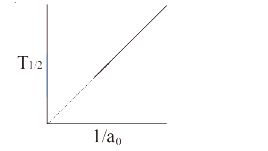
The following graph shows how $T_{1/2}$ (half-life) of a reactant $R$ changes with the initial reactant concentration $a_0$. The order of the reaction will be:
A
$0$
B
$1$
C
$2$
D
$3$
Solution
(C) For a reaction of order $n$,the half-life $T_{1/2}$ is related to the initial concentration $a_0$ by the expression: $T_{1/2} \propto \frac{1}{a_0^{n-1}}$.
From the given graph,$T_{1/2}$ is directly proportional to $\frac{1}{a_0}$.
This means $T_{1/2} \propto (a_0)^{-1}$.
Comparing the exponents of $a_0$,we get $n - 1 = 1$,which implies $n = 2$.
Therefore,the order of the reaction is $2$.
From the given graph,$T_{1/2}$ is directly proportional to $\frac{1}{a_0}$.
This means $T_{1/2} \propto (a_0)^{-1}$.
Comparing the exponents of $a_0$,we get $n - 1 = 1$,which implies $n = 2$.
Therefore,the order of the reaction is $2$.
0 likesView Solution
43
ChemistryDifficultMCQWBJEE · 2009
The time taken for $10 \%$ completion of a first order reaction is $20 \ min$. Then,for $19 \%$ completion,the reaction will take (in $min$)
A
$40$
B
$60$
C
$30$
D
$50$
Solution
(A) For a first order reaction,the rate equation is $t = \frac{2.303}{k} \log \frac{100}{100 - x}$.
For $10 \%$ completion $(x = 10)$: $20 = \frac{2.303}{k} \log \frac{100}{90} = \frac{2.303}{k} \log (10/9)$ $(i)$.
For $19 \%$ completion $(x = 19)$: $t = \frac{2.303}{k} \log \frac{100}{100 - 19} = \frac{2.303}{k} \log \frac{100}{81} = \frac{2.303}{k} \log (10/9)^2 = 2 \times \frac{2.303}{k} \log (10/9)$ (ii).
Dividing equation (ii) by equation $(i)$:
$\frac{t}{20} = \frac{2 \times \frac{2.303}{k} \log (10/9)}{\frac{2.303}{k} \log (10/9)} = 2$.
Therefore,$t = 20 \times 2 = 40 \ min$.
For $10 \%$ completion $(x = 10)$: $20 = \frac{2.303}{k} \log \frac{100}{90} = \frac{2.303}{k} \log (10/9)$ $(i)$.
For $19 \%$ completion $(x = 19)$: $t = \frac{2.303}{k} \log \frac{100}{100 - 19} = \frac{2.303}{k} \log \frac{100}{81} = \frac{2.303}{k} \log (10/9)^2 = 2 \times \frac{2.303}{k} \log (10/9)$ (ii).
Dividing equation (ii) by equation $(i)$:
$\frac{t}{20} = \frac{2 \times \frac{2.303}{k} \log (10/9)}{\frac{2.303}{k} \log (10/9)} = 2$.
Therefore,$t = 20 \times 2 = 40 \ min$.
0 likesView Solution
44
ChemistryDifficultMCQWBJEE · 2009
The half-life of a radioactive element is $10 \ hours$. How much will be left after $4 \ hours$ in a $1 \ g$-atom sample?
A
$45.6 \times 10^{23} \ \text{atoms}$
B
$4.56 \times 10^{23} \ \text{atoms}$
C
$4.56 \times 10^{21} \ \text{atoms}$
D
$4.56 \times 10^{20} \ \text{atoms}$
Solution
(B) Radioactive decay follows first-order kinetics. The decay constant $k = \frac{0.693}{t_{1/2}} = \frac{0.693}{10} \ h^{-1}$.
Using the first-order integrated rate equation: $k = \frac{2.303}{t} \log \frac{N_0}{N_t}$.
Given $N_0 = 1 \ g$-atom,$t = 4 \ h$,and $k = 0.0693 \ h^{-1}$.
$0.0693 = \frac{2.303}{4} \log \frac{1}{N_t} \implies \log \frac{1}{N_t} = \frac{0.0693 \times 4}{2.303} \approx 0.12036$.
$\log N_t = -0.12036 = \bar{1}.87964 \implies N_t = 10^{-0.12036} \approx 0.7579 \ g$-atoms.
Number of atoms $= N_t \times N_A = 0.7579 \times 6.022 \times 10^{23} \approx 4.56 \times 10^{23} \ \text{atoms}$.
Using the first-order integrated rate equation: $k = \frac{2.303}{t} \log \frac{N_0}{N_t}$.
Given $N_0 = 1 \ g$-atom,$t = 4 \ h$,and $k = 0.0693 \ h^{-1}$.
$0.0693 = \frac{2.303}{4} \log \frac{1}{N_t} \implies \log \frac{1}{N_t} = \frac{0.0693 \times 4}{2.303} \approx 0.12036$.
$\log N_t = -0.12036 = \bar{1}.87964 \implies N_t = 10^{-0.12036} \approx 0.7579 \ g$-atoms.
Number of atoms $= N_t \times N_A = 0.7579 \times 6.022 \times 10^{23} \approx 4.56 \times 10^{23} \ \text{atoms}$.
0 likesView Solution
45
ChemistryMediumMCQWBJEE · 2009
In the $Cu$-ammonia complex,the state of hybridization of $Cu^{2+}$ is:
A
$sp^3$
B
$d^3s$
C
$sp^2f$
D
$dsp^2$
Solution
(D) In the complex $\left[Cu(NH_3)_4\right]^{2+}$,the central metal ion is $Cu^{2+}$.
$Cu^{2+}$ has the electronic configuration $[Ar] 3d^9$.
During the formation of the complex,one electron from the $3d$ orbital is promoted to the $4p$ orbital to allow for $dsp^2$ hybridization.
This results in a square planar geometry for the complex.
$Cu^{2+}$ has the electronic configuration $[Ar] 3d^9$.
During the formation of the complex,one electron from the $3d$ orbital is promoted to the $4p$ orbital to allow for $dsp^2$ hybridization.
This results in a square planar geometry for the complex.
0 likesView Solution
46
ChemistryMediumMCQWBJEE · 2009
In aluminium extraction by the Bayer process,alumina is extracted from bauxite by sodium hydroxide at high temperature and pressure: $Al_2O_{3(s)} + 2 OH^-_{(aq)} + 3 H_2O_{(l)} \rightarrow 2 [Al(OH)_4]^-_{(aq)}$. Solid impurities such as $Fe_2O_3$ and $SiO_2$ are removed and then $[Al(OH)_4]^-$ is reprecipitated: $2 [Al(OH)_4]^-_{(aq)} \rightarrow Al_2O_3 \cdot 3 H_2O_{(s)} + 2 OH^-_{(aq)}$. In the industrial world:
A
Carbon dioxide is added to precipitate the alumina
B
Temperature and pressure are dropped and the supersaturated solution is seeded
C
Both $(A)$ and $(B)$ are practised
D
The water is evaporated
Solution
(C) In the industrial Bayer process,the sodium aluminate solution is cooled and seeded with freshly precipitated aluminium hydroxide $(Al(OH)_3)$.
This seeding induces the precipitation of $Al(OH)_3$ from the supersaturated solution.
Additionally,carbon dioxide $(CO_2)$ is often bubbled through the solution to neutralize the excess sodium hydroxide,which further promotes the precipitation of aluminium hydroxide.
Therefore,both methods are commonly practised in industrial settings.
This seeding induces the precipitation of $Al(OH)_3$ from the supersaturated solution.
Additionally,carbon dioxide $(CO_2)$ is often bubbled through the solution to neutralize the excess sodium hydroxide,which further promotes the precipitation of aluminium hydroxide.
Therefore,both methods are commonly practised in industrial settings.
0 likesView Solution
47
ChemistryEasyMCQWBJEE · 2009
Of the following compounds,the most acidic is:
A
$As_2O_3$
B
$P_2O_5$
C
$Sb_2O_3$
D
$Bi_2O_3$
Solution
(B) In a group,as we move downwards,the metallic character increases and the non-metallic character decreases.
Consequently,the acidic nature of oxides decreases down the group.
Among the given oxides of Group $15$ elements,$P$ is at the top of the group,followed by $As$,$Sb$,and $Bi$.
Therefore,$P_2O_5$ is the most acidic oxide.
Consequently,the acidic nature of oxides decreases down the group.
Among the given oxides of Group $15$ elements,$P$ is at the top of the group,followed by $As$,$Sb$,and $Bi$.
Therefore,$P_2O_5$ is the most acidic oxide.
0 likesView Solution
48
ChemistryEasyMCQWBJEE · 2009
The catalyst used for olefin polymerization is
A
Ziegler-Natta Catalyst
B
Wilkinson Catalyst
C
Raney nickel catalyst
D
Merrifield resin
Solution
(A) The catalyst used for the polymerization of olefins (such as ethylene) is the Ziegler-Natta catalyst.
It is typically a mixture of titanium tetrachloride $(TiCl_4)$ or titanium trichloride $(TiCl_3)$ and an organoaluminum compound like triethylaluminum $((C_2H_5)_3Al)$.
It is typically a mixture of titanium tetrachloride $(TiCl_4)$ or titanium trichloride $(TiCl_3)$ and an organoaluminum compound like triethylaluminum $((C_2H_5)_3Al)$.
0 likesView Solution
49
ChemistryEasyMCQWBJEE · 2009
The monomer used to produce orlon is
A
$CH_2=CHF$
B
$CH_2=CCl_2$
C
$CH_2=CHCl$
D
$CH_2=CH-CN$
Solution
(D) Orlon is also known as polyacrylonitrile $(PAN)$.
The monomer used for the preparation of orlon is acrylonitrile,which has the chemical formula $CH_2=CH-CN$.
The monomer used for the preparation of orlon is acrylonitrile,which has the chemical formula $CH_2=CH-CN$.
0 likesView Solution
50
ChemistryMediumMCQWBJEE · 2009
If it is assumed that ${}_{92}^{235}U$ decays only by emitting $\alpha$ and $\beta$ particles,the possible product of the decay is:
A
${}_{89}^{225}Ac$
B
${}_{89}^{227}Ac$
C
${}_{89}^{230}Ac$
D
${}_{89}^{231}Ac$
Solution
(B) The emission of one $\alpha$ particle $({}_{2}^{4}He)$ decreases the mass number by $4$ and the atomic number by $2$.
The emission of one $\beta$ particle $({}_{-1}^{0}e)$ does not change the mass number but increases the atomic number by $1$.
For the product ${}_{89}^{227}Ac$ from ${}_{92}^{235}U$:
Change in mass number $= 235 - 227 = 8$,which corresponds to $2 \alpha$ particles $(2 \times 4 = 8)$.
Change in atomic number $= 92 - 89 = 3$.
With $2 \alpha$ particles,the atomic number decreases by $2 \times 2 = 4$. To reach $89$,we need to increase the atomic number by $1$ using one $\beta$ particle $(92 - 4 + 1 = 89)$.
Thus,the decay involves $2 \alpha$ and $1 \beta$ particle,resulting in ${}_{89}^{227}Ac$.
The emission of one $\beta$ particle $({}_{-1}^{0}e)$ does not change the mass number but increases the atomic number by $1$.
For the product ${}_{89}^{227}Ac$ from ${}_{92}^{235}U$:
Change in mass number $= 235 - 227 = 8$,which corresponds to $2 \alpha$ particles $(2 \times 4 = 8)$.
Change in atomic number $= 92 - 89 = 3$.
With $2 \alpha$ particles,the atomic number decreases by $2 \times 2 = 4$. To reach $89$,we need to increase the atomic number by $1$ using one $\beta$ particle $(92 - 4 + 1 = 89)$.
Thus,the decay involves $2 \alpha$ and $1 \beta$ particle,resulting in ${}_{89}^{227}Ac$.
0 likesView Solution
Vedclass Products
For Students
Vedclass Test Series
Mock tests in real WBJEE style covering Chemistry with performance analysis. 5-day free trial.
Start Free TrialFor Teachers
Exam Paper Generator
Generate Set A/B/C/D Chemistry papers from 7.5L+ questions in 2 minutes. 3 chapters free.
Try FreeFor Institutes
Online Exam Module
Run live WBJEE mock exams with unlimited students, 360° analytics & white-label branding.
See DemoFrequently Asked Questions
How many Chemistry questions are in WBJEE 2009?
There are 50 Chemistry questions from the WBJEE 2009 paper on Vedclass, each with a detailed step-by-step solution in English.
Are WBJEE 2009 Chemistry solutions available in English?
Yes. All solutions on this page are in English. You can also switch to English or Hindi using the language buttons above the questions.
Can I practice WBJEE 2009 Chemistry as a timed test?
Yes. Use the Vedclass Test Series to attempt a full WBJEE mock test covering Chemistry with time limits and instant score analysis.
Can teachers create Chemistry papers from WBJEE previous year questions?
Yes. The Vedclass Exam Paper Generator lets teachers mix WBJEE Chemistry questions and generate Set A/B/C/D papers in minutes.
For Teachers & Institutes
Build a Custom Chemistry Paper
Pick WBJEE 2009 Chemistry questions, set difficulty, and generate Set A/B/C/D in 2 minutes.