
PhysicsQ1–36 of 36 questions
Page 1 of 1 · English
1
PhysicsEasyMCQWBJEE · 2009
Two particles have masses $m$ and $4m$,and their kinetic energies are in the ratio $2:1$. What is the ratio of their linear momenta?
A
$\frac{1}{\sqrt{2}}$
B
$\frac{1}{2}$
C
$\frac{1}{4}$
D
$\frac{1}{16}$
Solution
(A) The relationship between kinetic energy $(K)$ and linear momentum $(p)$ is given by $K = \frac{p^2}{2m}$,which implies $p = \sqrt{2mK}$.
Given masses are $m_1 = m$ and $m_2 = 4m$.
Given kinetic energies are $K_1$ and $K_2$ such that $\frac{K_1}{K_2} = \frac{2}{1}$.
The ratio of their linear momenta is $\frac{p_1}{p_2} = \sqrt{\frac{2m_1 K_1}{2m_2 K_2}} = \sqrt{\frac{m_1}{m_2} \times \frac{K_1}{K_2}}$.
Substituting the values: $\frac{p_1}{p_2} = \sqrt{\frac{m}{4m} \times \frac{2}{1}} = \sqrt{\frac{1}{4} \times 2} = \sqrt{\frac{1}{2}} = \frac{1}{\sqrt{2}}$.
Thus,the ratio of their linear momenta is $\frac{1}{\sqrt{2}}$.
Given masses are $m_1 = m$ and $m_2 = 4m$.
Given kinetic energies are $K_1$ and $K_2$ such that $\frac{K_1}{K_2} = \frac{2}{1}$.
The ratio of their linear momenta is $\frac{p_1}{p_2} = \sqrt{\frac{2m_1 K_1}{2m_2 K_2}} = \sqrt{\frac{m_1}{m_2} \times \frac{K_1}{K_2}}$.
Substituting the values: $\frac{p_1}{p_2} = \sqrt{\frac{m}{4m} \times \frac{2}{1}} = \sqrt{\frac{1}{4} \times 2} = \sqrt{\frac{1}{2}} = \frac{1}{\sqrt{2}}$.
Thus,the ratio of their linear momenta is $\frac{1}{\sqrt{2}}$.
0 likesView Solution
2
PhysicsMediumMCQWBJEE · 2009
If the kinetic energy of a body changes by $20 \%$,then its momentum would change by:
A
$20 \%$
B
$24 \%$
C
$40 \%$
D
None of the above
Solution
(D) The relationship between kinetic energy $K$ and momentum $p$ is given by $K = \frac{p^2}{2m}$.
Let the initial kinetic energy be $K_i$ and the final kinetic energy be $K_f$. Given that the kinetic energy changes by $20 \%$,we have $K_f = 1.20 K_i$.
Since $K \propto p^2$,we can write $\frac{K_f}{K_i} = \left( \frac{p_f}{p_i} \right)^2$.
Substituting the values,$1.20 = \left( \frac{p_f}{p_i} \right)^2$.
Taking the square root on both sides,$\frac{p_f}{p_i} = \sqrt{1.20} \approx 1.0954$.
The percentage change in momentum is given by $\frac{p_f - p_i}{p_i} \times 100 = (1.0954 - 1) \times 100 = 9.54 \%$.
Since $9.54 \%$ is not among the given options,the correct answer is $D$.
Let the initial kinetic energy be $K_i$ and the final kinetic energy be $K_f$. Given that the kinetic energy changes by $20 \%$,we have $K_f = 1.20 K_i$.
Since $K \propto p^2$,we can write $\frac{K_f}{K_i} = \left( \frac{p_f}{p_i} \right)^2$.
Substituting the values,$1.20 = \left( \frac{p_f}{p_i} \right)^2$.
Taking the square root on both sides,$\frac{p_f}{p_i} = \sqrt{1.20} \approx 1.0954$.
The percentage change in momentum is given by $\frac{p_f - p_i}{p_i} \times 100 = (1.0954 - 1) \times 100 = 9.54 \%$.
Since $9.54 \%$ is not among the given options,the correct answer is $D$.
0 likesView Solution
3
PhysicsEasyMCQWBJEE · 2009
The equation of state for $n$ moles of an ideal gas is $PV = nRT$,where $R$ is a constant. The $SI$ unit for $R$ is
A
$J K^{-1}$ per molecule
B
$J K^{-1} mol^{-1}$
C
$J kg^{-1} K^{-1}$
D
$J K^{-1} g^{-1}$
Solution
(B) From the ideal gas equation,$PV = nRT$,we can express the gas constant $R$ as $R = \frac{PV}{nT}$.
Here,$P$ is pressure $(N m^{-2})$,$V$ is volume $(m^3)$,$n$ is the amount of substance $(mol)$,and $T$ is temperature $(K)$.
The unit of $PV$ is $(N m^{-2}) \times (m^3) = N m = J$ (Joule).
Therefore,the unit of $R$ is $\frac{J}{mol \times K} = J K^{-1} mol^{-1}$.
Here,$P$ is pressure $(N m^{-2})$,$V$ is volume $(m^3)$,$n$ is the amount of substance $(mol)$,and $T$ is temperature $(K)$.
The unit of $PV$ is $(N m^{-2}) \times (m^3) = N m = J$ (Joule).
Therefore,the unit of $R$ is $\frac{J}{mol \times K} = J K^{-1} mol^{-1}$.
0 likesView Solution
4
PhysicsEasyMCQWBJEE · 2009
Two massless springs of force constants $K_1$ and $K_2$ are joined end to end. The resultant force constant $K$ of the system is
A
$K = \frac{K_1 + K_2}{K_1 K_2}$
B
$K = \frac{K_1 - K_2}{K_1 K_2}$
C
$K = \frac{K_1 K_2}{K_1 + K_2}$
D
$K = \frac{K_1 K_2}{K_1 - K_2}$
Solution
(C) When two springs with force constants $K_1$ and $K_2$ are connected in series (end to end),the total extension $x$ is the sum of individual extensions $x_1$ and $x_2$.
For a force $F$ applied to the system,$x_1 = F/K_1$ and $x_2 = F/K_2$.
The total extension is $x = x_1 + x_2 = F/K_1 + F/K_2$.
If $K$ is the equivalent force constant,then $x = F/K$.
Therefore,$F/K = F/K_1 + F/K_2$,which simplifies to $1/K = 1/K_1 + 1/K_2$.
Solving for $K$,we get $K = \frac{K_1 K_2}{K_1 + K_2}$.
For a force $F$ applied to the system,$x_1 = F/K_1$ and $x_2 = F/K_2$.
The total extension is $x = x_1 + x_2 = F/K_1 + F/K_2$.
If $K$ is the equivalent force constant,then $x = F/K$.
Therefore,$F/K = F/K_1 + F/K_2$,which simplifies to $1/K = 1/K_1 + 1/K_2$.
Solving for $K$,we get $K = \frac{K_1 K_2}{K_1 + K_2}$.
0 likesView Solution
5
PhysicsMediumMCQWBJEE · 2009
$A$ spring of force constant $k$ is cut into two equal halves. The force constant of each half is
A
$\frac{k}{\sqrt{2}}$
B
$k$
C
$\frac{k}{2}$
D
$2k$
Solution
(D) The force constant $k$ of a spring is inversely proportional to its length $\ell$,i.e.,$k \propto \frac{1}{\ell}$ or $k \ell = \text{constant}$.
When a spring of length $\ell$ and force constant $k$ is cut into two equal halves,the length of each new part becomes $\ell' = \frac{\ell}{2}$.
Let the force constant of each new part be $k'$.
Using the relation $k \ell = k' \ell'$,we get:
$k \ell = k' \left( \frac{\ell}{2} \right)$
$k = \frac{k'}{2}$
$k' = 2k$.
Therefore,the force constant of each half is $2k$.
When a spring of length $\ell$ and force constant $k$ is cut into two equal halves,the length of each new part becomes $\ell' = \frac{\ell}{2}$.
Let the force constant of each new part be $k'$.
Using the relation $k \ell = k' \ell'$,we get:
$k \ell = k' \left( \frac{\ell}{2} \right)$
$k = \frac{k'}{2}$
$k' = 2k$.
Therefore,the force constant of each half is $2k$.
0 likesView Solution
6
PhysicsMediumMCQWBJEE · 2009
Two spheres of equal masses but radii $r_1$ and $r_2$ are allowed to fall in a liquid of infinite column. The ratio of their terminal velocities is
A
$1$
B
$r_1: r_2$
C
$r_2: r_1$
D
$r_2^2: r_1^2$
Solution
(C) The terminal velocity $v_T$ of a sphere of radius $r$ and density $\sigma$ falling in a liquid of density $\rho$ and viscosity $\eta$ is given by $v_T = \frac{2r^2(\sigma - \rho)g}{9\eta}$.
Since the masses are equal,$m = \frac{4}{3}\pi r^3 \sigma$,which implies $\sigma \propto \frac{1}{r^3}$.
Substituting $\sigma = \frac{m}{\frac{4}{3}\pi r^3}$ into the terminal velocity formula:
$v_T = \frac{2r^2}{9\eta} \left( \frac{m}{\frac{4}{3}\pi r^3} - \rho \right)g = \frac{2g}{9\eta} \left( \frac{3m}{4\pi r} - r^2\rho \right)$.
For a liquid of infinite column where the viscous force dominates or assuming the density of the sphere is much larger than the liquid $(\sigma \gg \rho)$,we have $v_T \propto r^2 \sigma$.
Since $r^3 \sigma = \text{constant}$,then $\sigma \propto r^{-3}$.
Therefore,$v_T \propto r^2 \cdot r^{-3} = r^{-1} = \frac{1}{r}$.
Thus,$\frac{v_1}{v_2} = \frac{r_2}{r_1}$.
Since the masses are equal,$m = \frac{4}{3}\pi r^3 \sigma$,which implies $\sigma \propto \frac{1}{r^3}$.
Substituting $\sigma = \frac{m}{\frac{4}{3}\pi r^3}$ into the terminal velocity formula:
$v_T = \frac{2r^2}{9\eta} \left( \frac{m}{\frac{4}{3}\pi r^3} - \rho \right)g = \frac{2g}{9\eta} \left( \frac{3m}{4\pi r} - r^2\rho \right)$.
For a liquid of infinite column where the viscous force dominates or assuming the density of the sphere is much larger than the liquid $(\sigma \gg \rho)$,we have $v_T \propto r^2 \sigma$.
Since $r^3 \sigma = \text{constant}$,then $\sigma \propto r^{-3}$.
Therefore,$v_T \propto r^2 \cdot r^{-3} = r^{-1} = \frac{1}{r}$.
Thus,$\frac{v_1}{v_2} = \frac{r_2}{r_1}$.
0 likesView Solution
7
PhysicsDifficultMCQWBJEE · 2009
The Poisson's ratio of a material is $0.5$. If a force is applied to a wire of this material,there is a decrease in the cross-sectional area by $4 \%$. The percentage increase in the length is: (in $\%$)
A
$1$
B
$2$
C
$2.5$
D
$4$
Solution
(D) The Poisson's ratio $\sigma$ is defined as the ratio of lateral strain to longitudinal strain: $\sigma = -\frac{dD/D}{dL/L}$.
Given $\sigma = 0.5$,we have $0.5 = -\frac{dD/D}{dL/L}$,which implies $\frac{dD}{D} = -0.5 \frac{dL}{L}$.
The cross-sectional area $A$ is given by $A = \pi (D/2)^2 = \frac{\pi D^2}{4}$.
Taking the logarithmic derivative,$\frac{dA}{A} = 2 \frac{dD}{D}$.
Substituting the expression for $\frac{dD}{D}$,we get $\frac{dA}{A} = 2 (-0.5 \frac{dL}{L}) = -\frac{dL}{L}$.
Given that the area decreases by $4 \%$,we have $\frac{dA}{A} = -0.04$.
Therefore,$-0.04 = -\frac{dL}{L}$,which means $\frac{dL}{L} = 0.04$ or $4 \%$.
Thus,the percentage increase in length is $4 \%$.
Given $\sigma = 0.5$,we have $0.5 = -\frac{dD/D}{dL/L}$,which implies $\frac{dD}{D} = -0.5 \frac{dL}{L}$.
The cross-sectional area $A$ is given by $A = \pi (D/2)^2 = \frac{\pi D^2}{4}$.
Taking the logarithmic derivative,$\frac{dA}{A} = 2 \frac{dD}{D}$.
Substituting the expression for $\frac{dD}{D}$,we get $\frac{dA}{A} = 2 (-0.5 \frac{dL}{L}) = -\frac{dL}{L}$.
Given that the area decreases by $4 \%$,we have $\frac{dA}{A} = -0.04$.
Therefore,$-0.04 = -\frac{dL}{L}$,which means $\frac{dL}{L} = 0.04$ or $4 \%$.
Thus,the percentage increase in length is $4 \%$.
0 likesView Solution
8
PhysicsMediumMCQWBJEE · 2009
$A$ bullet is fired with a velocity $u$ making an angle of $60^{\circ}$ with the horizontal plane. The horizontal component of the velocity of the bullet when it reaches the maximum height is
A
$u$
B
$0$
C
$\frac{\sqrt{3}u}{2}$
D
$\frac{u}{2}$
Solution
(D) In projectile motion,the horizontal component of velocity remains constant throughout the flight because there is no acceleration acting in the horizontal direction.
Given the initial velocity is $u$ and the angle of projection is $\theta = 60^{\circ}$.
The horizontal component of the initial velocity is given by $u_x = u \cos(\theta)$.
Substituting the values,we get $u_x = u \cos(60^{\circ})$.
Since $\cos(60^{\circ}) = 1/2$,the horizontal component is $u_x = u \times (1/2) = u/2$.
At the maximum height,the vertical component of velocity becomes zero,but the horizontal component remains unchanged.
Therefore,the horizontal component of the velocity at the maximum height is $u/2$.
Given the initial velocity is $u$ and the angle of projection is $\theta = 60^{\circ}$.
The horizontal component of the initial velocity is given by $u_x = u \cos(\theta)$.
Substituting the values,we get $u_x = u \cos(60^{\circ})$.
Since $\cos(60^{\circ}) = 1/2$,the horizontal component is $u_x = u \times (1/2) = u/2$.
At the maximum height,the vertical component of velocity becomes zero,but the horizontal component remains unchanged.
Therefore,the horizontal component of the velocity at the maximum height is $u/2$.
0 likesView Solution
9
PhysicsDifficultMCQWBJEE · 2009
$A$ particle is projected at $60^{\circ}$ to the horizontal with a kinetic energy $K$. The kinetic energy at the highest point is
A
$K$
B
zero
C
$\frac{K}{4}$
D
$\frac{K}{2}$
Solution
(C) The initial kinetic energy of the particle is given by $K = \frac{1}{2} m v^2$,where $v$ is the initial velocity.
At the highest point of the trajectory,the vertical component of the velocity becomes zero,and the velocity of the particle is equal to the horizontal component,which is $v_x = v \cos \theta$.
Given $\theta = 60^{\circ}$,the velocity at the highest point is $v_x = v \cos 60^{\circ} = \frac{v}{2}$.
The kinetic energy at the highest point $K'$ is given by $K' = \frac{1}{2} m (v_x)^2$.
Substituting the value of $v_x$,we get $K' = \frac{1}{2} m (\frac{v}{2})^2 = \frac{1}{2} m (\frac{v^2}{4}) = \frac{1}{4} (\frac{1}{2} m v^2)$.
Since $K = \frac{1}{2} m v^2$,we have $K' = \frac{K}{4}$.
At the highest point of the trajectory,the vertical component of the velocity becomes zero,and the velocity of the particle is equal to the horizontal component,which is $v_x = v \cos \theta$.
Given $\theta = 60^{\circ}$,the velocity at the highest point is $v_x = v \cos 60^{\circ} = \frac{v}{2}$.
The kinetic energy at the highest point $K'$ is given by $K' = \frac{1}{2} m (v_x)^2$.
Substituting the value of $v_x$,we get $K' = \frac{1}{2} m (\frac{v}{2})^2 = \frac{1}{2} m (\frac{v^2}{4}) = \frac{1}{4} (\frac{1}{2} m v^2)$.
Since $K = \frac{1}{2} m v^2$,we have $K' = \frac{K}{4}$.
0 likesView Solution
10
PhysicsMediumMCQWBJEE · 2009
$19 \ g$ of water at $30^{\circ} C$ and $5 \ g$ of ice at $-20^{\circ} C$ are mixed together in a calorimeter. What is the final temperature of the mixture (in $^{\circ} C$)? Given specific heat of ice $= 0.5 \ cal \ g^{-1} (^{\circ} C)^{-1}$ and latent heat of fusion of ice $= 80 \ cal \ g^{-1}$.
A
$0$
B
$-5$
C
$5$
D
$10$
Solution
(C) Step $1$: Calculate heat required to bring $5 \ g$ of ice from $-20^{\circ} C$ to $0^{\circ} C$: $Q_1 = m_{ice} \cdot c_{ice} \cdot \Delta T = 5 \ g \times 0.5 \ cal \ g^{-1} (^{\circ} C)^{-1} \times 20^{\circ} C = 50 \ cal$.
Step $2$: Calculate heat required to melt $5 \ g$ of ice at $0^{\circ} C$: $Q_2 = m_{ice} \cdot L_f = 5 \ g \times 80 \ cal \ g^{-1} = 400 \ cal$.
Total heat required to convert ice to water at $0^{\circ} C$ is $Q_{total} = 50 + 400 = 450 \ cal$.
Step $3$: Calculate heat released by $19 \ g$ of water cooling from $30^{\circ} C$ to $0^{\circ} C$: $Q_{released} = m_{water} \cdot c_{water} \cdot \Delta T = 19 \ g \times 1 \ cal \ g^{-1} (^{\circ} C)^{-1} \times 30^{\circ} C = 570 \ cal$.
Since $Q_{released} > Q_{total}$,the ice melts completely and the final temperature $T_f$ will be above $0^{\circ} C$.
Step $4$: Apply the principle of calorimetry: Heat lost by water = Heat gained by ice.
$19 \times 1 \times (30 - T_f) = 450 + 5 \times 1 \times (T_f - 0)$.
$570 - 19 T_f = 450 + 5 T_f$.
$120 = 24 T_f$.
$T_f = 5^{\circ} C$.
Step $2$: Calculate heat required to melt $5 \ g$ of ice at $0^{\circ} C$: $Q_2 = m_{ice} \cdot L_f = 5 \ g \times 80 \ cal \ g^{-1} = 400 \ cal$.
Total heat required to convert ice to water at $0^{\circ} C$ is $Q_{total} = 50 + 400 = 450 \ cal$.
Step $3$: Calculate heat released by $19 \ g$ of water cooling from $30^{\circ} C$ to $0^{\circ} C$: $Q_{released} = m_{water} \cdot c_{water} \cdot \Delta T = 19 \ g \times 1 \ cal \ g^{-1} (^{\circ} C)^{-1} \times 30^{\circ} C = 570 \ cal$.
Since $Q_{released} > Q_{total}$,the ice melts completely and the final temperature $T_f$ will be above $0^{\circ} C$.
Step $4$: Apply the principle of calorimetry: Heat lost by water = Heat gained by ice.
$19 \times 1 \times (30 - T_f) = 450 + 5 \times 1 \times (T_f - 0)$.
$570 - 19 T_f = 450 + 5 T_f$.
$120 = 24 T_f$.
$T_f = 5^{\circ} C$.
0 likesView Solution
11
PhysicsDifficultMCQWBJEE · 2009
The height of a waterfall is $50 \ m$. If $g = 9.8 \ m/s^2$,the difference between the temperature at the top and the bottom of the waterfall is: (in $^{\circ} C$)
A
$1.17$
B
$2.17$
C
$0.117$
D
$1.43$
Solution
(C) The potential energy of the water at the top is converted into heat energy at the bottom.
Using the principle of conservation of energy: $mgh = J \cdot ms \Delta t$,where $J$ is the mechanical equivalent of heat ($J = 4.2 \ J/cal$ or $4186 \ J/kg^{\circ}C$).
Here,$s$ is the specific heat capacity of water,$s = 4186 \ J/kg^{\circ}C$.
Rearranging for $\Delta t$: $\Delta t = \frac{gh}{s}$.
Substituting the values: $\Delta t = \frac{9.8 \times 50}{4186} \approx 0.117^{\circ} C$.
Using the principle of conservation of energy: $mgh = J \cdot ms \Delta t$,where $J$ is the mechanical equivalent of heat ($J = 4.2 \ J/cal$ or $4186 \ J/kg^{\circ}C$).
Here,$s$ is the specific heat capacity of water,$s = 4186 \ J/kg^{\circ}C$.
Rearranging for $\Delta t$: $\Delta t = \frac{gh}{s}$.
Substituting the values: $\Delta t = \frac{9.8 \times 50}{4186} \approx 0.117^{\circ} C$.
0 likesView Solution
12
PhysicsMediumMCQWBJEE · 2009
Two rods of equal length and diameter have thermal conductivities $3$ and $4$ units respectively. If they are joined in series,the thermal conductivity of the combination would be
A
$3.43$
B
$3.5$
C
$3.4$
D
$3.34$
Solution
(A) For two rods of equal length $\ell$ and cross-sectional area $A$ joined in series,the equivalent thermal resistance $R_{eq}$ is the sum of individual thermal resistances $R_1$ and $R_2$.
$R_{eq} = R_1 + R_2$
Since $R = \frac{\ell}{KA}$,we have:
$\frac{2\ell}{K_{eff} A} = \frac{\ell}{K_1 A} + \frac{\ell}{K_2 A}$
Canceling $\frac{\ell}{A}$ from both sides:
$\frac{2}{K_{eff}} = \frac{1}{K_1} + \frac{1}{K_2}$
Given $K_1 = 3$ and $K_2 = 4$:
$\frac{2}{K_{eff}} = \frac{1}{3} + \frac{1}{4} = \frac{4+3}{12} = \frac{7}{12}$
$K_{eff} = \frac{24}{7} \approx 3.43$ units.
$R_{eq} = R_1 + R_2$
Since $R = \frac{\ell}{KA}$,we have:
$\frac{2\ell}{K_{eff} A} = \frac{\ell}{K_1 A} + \frac{\ell}{K_2 A}$
Canceling $\frac{\ell}{A}$ from both sides:
$\frac{2}{K_{eff}} = \frac{1}{K_1} + \frac{1}{K_2}$
Given $K_1 = 3$ and $K_2 = 4$:
$\frac{2}{K_{eff}} = \frac{1}{3} + \frac{1}{4} = \frac{4+3}{12} = \frac{7}{12}$
$K_{eff} = \frac{24}{7} \approx 3.43$ units.
0 likesView Solution
13
PhysicsMediumMCQWBJEE · 2009
It is difficult to cook rice in an open vessel by boiling it at high altitudes because of
A
low boiling point and high pressure
B
high boiling point and low pressure
C
low boiling point and low pressure
D
high boiling point and high pressure
Solution
(C) At high altitudes,the atmospheric pressure is significantly lower than at sea level.
Since the boiling point of a liquid depends on the external pressure,a decrease in atmospheric pressure leads to a decrease in the boiling point of water.
Consequently,water boils at a temperature lower than $100 \, ^\circ\text{C}$ at high altitudes.
Because the water boils at a lower temperature,it does not provide enough heat to cook the rice properly,making the cooking process difficult.
Since the boiling point of a liquid depends on the external pressure,a decrease in atmospheric pressure leads to a decrease in the boiling point of water.
Consequently,water boils at a temperature lower than $100 \, ^\circ\text{C}$ at high altitudes.
Because the water boils at a lower temperature,it does not provide enough heat to cook the rice properly,making the cooking process difficult.
0 likesView Solution
14
PhysicsEasyMCQWBJEE · 2009
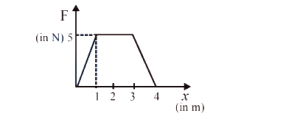
The force $F$ acting on a particle moving in a straight line is shown below. What is the work done by the force on the particle in the $1^{\text{st}}$ meter of the trajectory (in $\,J$)?
A
$5$
B
$10$
C
$15$
D
$2.5$
Solution
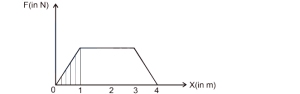
(D) The work done by a variable force is equal to the area under the force-displacement $(F-x)$ graph.
To find the work done in the $1^{\text{st}}$ meter, we calculate the area of the triangle formed between $x = 0$ and $x = 1$.
The base of the triangle is $1 \,m$ and the height is $5 \,N$.
$\text{Work done} = \text{Area of triangle} = \frac{1}{2} \times \text{base} \times \text{height}$
$\text{Work done} = \frac{1}{2} \times 1 \,m \times 5 \,N = 2.5 \,J$.
To find the work done in the $1^{\text{st}}$ meter, we calculate the area of the triangle formed between $x = 0$ and $x = 1$.
The base of the triangle is $1 \,m$ and the height is $5 \,N$.
$\text{Work done} = \text{Area of triangle} = \frac{1}{2} \times \text{base} \times \text{height}$
$\text{Work done} = \frac{1}{2} \times 1 \,m \times 5 \,N = 2.5 \,J$.
0 likesView Solution
15
PhysicsEasyMCQWBJEE · 2009
At a certain place,the horizontal component of earth's magnetic field is $\frac{1}{\sqrt{3}}$ times the vertical component. The angle of dip at that place is (in $^{\circ}$)
A
$30$
B
$45$
C
$60$
D
$90$
Solution
(C) The angle of dip $\theta$ is related to the vertical component $B_V$ and the horizontal component $B_H$ of the Earth's magnetic field by the formula: $\tan \theta = \frac{B_V}{B_H}$.
Given that the horizontal component $B_H$ is $\frac{1}{\sqrt{3}}$ times the vertical component $B_V$,we have $B_H = \frac{1}{\sqrt{3}} B_V$.
Substituting this into the formula: $\tan \theta = \frac{B_V}{\frac{1}{\sqrt{3}} B_V} = \sqrt{3}$.
Since $\tan 60^{\circ} = \sqrt{3}$,the angle of dip is $\theta = 60^{\circ}$.
Given that the horizontal component $B_H$ is $\frac{1}{\sqrt{3}}$ times the vertical component $B_V$,we have $B_H = \frac{1}{\sqrt{3}} B_V$.
Substituting this into the formula: $\tan \theta = \frac{B_V}{\frac{1}{\sqrt{3}} B_V} = \sqrt{3}$.
Since $\tan 60^{\circ} = \sqrt{3}$,the angle of dip is $\theta = 60^{\circ}$.
0 likesView Solution
16
PhysicsEasyMCQWBJEE · 2009
An alternating current of $rms$ value $10 \, A$ is passed through a $12 \, \Omega$ resistor. The maximum potential difference across the resistor is
A
$20 \, V$
B
$90 \, V$
C
$169.68 \, V$
D
none
Solution
(C) Given: $I_{rms} = 10 \, A$ and $R = 12 \, \Omega$.
The peak current $I_0$ is given by the relation $I_0 = I_{rms} \times \sqrt{2}$.
$I_0 = 10 \times 1.414 = 14.14 \, A$.
The maximum potential difference $V_0$ across the resistor is given by Ohm's law: $V_0 = I_0 \times R$.
$V_0 = 14.14 \times 12 = 169.68 \, V$.
The peak current $I_0$ is given by the relation $I_0 = I_{rms} \times \sqrt{2}$.
$I_0 = 10 \times 1.414 = 14.14 \, A$.
The maximum potential difference $V_0$ across the resistor is given by Ohm's law: $V_0 = I_0 \times R$.
$V_0 = 14.14 \times 12 = 169.68 \, V$.
0 likesView Solution
17
PhysicsEasyMCQWBJEE · 2009
If the electron in a hydrogen atom jumps from an orbit with level $n_1=2$ to an orbit with level $n_2=1$,the emitted radiation has a wavelength given by
A
$\lambda = 5 / (3R)$
B
$\lambda = 4 / (3R)$
C
$\lambda = R / 4$
D
$\lambda = 3R / 4$
Solution
(B) The Rydberg formula for the wavelength of emitted radiation is given by $\frac{1}{\lambda} = R \left( \frac{1}{n_f^2} - \frac{1}{n_i^2} \right)$.
Here,the electron jumps from $n_i = 2$ to $n_f = 1$.
Substituting the values: $\frac{1}{\lambda} = R \left( \frac{1}{1^2} - \frac{1}{2^2} \right)$.
$\frac{1}{\lambda} = R \left( 1 - \frac{1}{4} \right) = R \left( \frac{3}{4} \right)$.
Therefore,$\lambda = \frac{4}{3R}$.
Here,the electron jumps from $n_i = 2$ to $n_f = 1$.
Substituting the values: $\frac{1}{\lambda} = R \left( \frac{1}{1^2} - \frac{1}{2^2} \right)$.
$\frac{1}{\lambda} = R \left( 1 - \frac{1}{4} \right) = R \left( \frac{3}{4} \right)$.
Therefore,$\lambda = \frac{4}{3R}$.
0 likesView Solution
18
PhysicsDifficultMCQWBJEE · 2009
If the charge on a capacitor is increased by $2 \ C$,the energy stored in it increases by $21 \%$. The original charge on the capacitor is (in $C$)
A
$10$
B
$20$
C
$30$
D
$40$
Solution
(B) The energy stored in a capacitor is given by $U = \frac{q^2}{2C}$,where $q$ is the charge and $C$ is the capacitance.
Let the initial charge be $q_i = q$ and the final charge be $q_f = q + 2$.
The initial energy is $U_i = \frac{q^2}{2C}$ and the final energy is $U_f = \frac{(q+2)^2}{2C}$.
Given that the energy increases by $21 \%$,we have $U_f = U_i + 0.21 U_i = 1.21 U_i$.
Substituting the expressions for energy: $\frac{(q+2)^2}{2C} = 1.21 \times \frac{q^2}{2C}$.
Canceling $\frac{1}{2C}$ from both sides,we get $(q+2)^2 = 1.21 q^2$.
Taking the square root of both sides: $q + 2 = 1.1 q$.
Rearranging the terms: $1.1 q - q = 2$,which gives $0.1 q = 2$.
Therefore,$q = \frac{2}{0.1} = 20 \ C$.
Let the initial charge be $q_i = q$ and the final charge be $q_f = q + 2$.
The initial energy is $U_i = \frac{q^2}{2C}$ and the final energy is $U_f = \frac{(q+2)^2}{2C}$.
Given that the energy increases by $21 \%$,we have $U_f = U_i + 0.21 U_i = 1.21 U_i$.
Substituting the expressions for energy: $\frac{(q+2)^2}{2C} = 1.21 \times \frac{q^2}{2C}$.
Canceling $\frac{1}{2C}$ from both sides,we get $(q+2)^2 = 1.21 q^2$.
Taking the square root of both sides: $q + 2 = 1.1 q$.
Rearranging the terms: $1.1 q - q = 2$,which gives $0.1 q = 2$.
Therefore,$q = \frac{2}{0.1} = 20 \ C$.
0 likesView Solution
19
PhysicsEasyMCQWBJEE · 2009
Four capacitors of equal capacitance have an equivalent capacitance $C_1$ when connected in series and an equivalent capacitance $C_2$ when connected in parallel. The ratio $\frac{C_1}{C_2}$ is:
A
$1 / 4$
B
$1 / 16$
C
$1 / 8$
D
$1 / 12$
Solution
(B) Let the capacitance of each capacitor be $C$.
When $4$ capacitors are connected in series,the equivalent capacitance $C_1$ is given by $\frac{1}{C_1} = \frac{1}{C} + \frac{1}{C} + \frac{1}{C} + \frac{1}{C} = \frac{4}{C}$,which implies $C_1 = \frac{C}{4}$.
When $4$ capacitors are connected in parallel,the equivalent capacitance $C_2$ is given by $C_2 = C + C + C + C = 4C$.
Now,the ratio $\frac{C_1}{C_2}$ is calculated as $\frac{C/4}{4C} = \frac{1}{16}$.
When $4$ capacitors are connected in series,the equivalent capacitance $C_1$ is given by $\frac{1}{C_1} = \frac{1}{C} + \frac{1}{C} + \frac{1}{C} + \frac{1}{C} = \frac{4}{C}$,which implies $C_1 = \frac{C}{4}$.
When $4$ capacitors are connected in parallel,the equivalent capacitance $C_2$ is given by $C_2 = C + C + C + C = 4C$.
Now,the ratio $\frac{C_1}{C_2}$ is calculated as $\frac{C/4}{4C} = \frac{1}{16}$.
0 likesView Solution
20
PhysicsMediumMCQWBJEE · 2009
Two identical cells each of emf $E$ and internal resistance $r$ are connected in parallel with an external resistance $R$. To get maximum power developed across $R$,the value of $R$ is
A
$R = r / 2$
B
$R = r$
C
$R = r / 3$
D
$R = 2r$
Solution
(A) For two identical cells of emf $E$ and internal resistance $r$ connected in parallel,the equivalent emf $E_{eq} = E$ and the equivalent internal resistance $r_{eq} = r / 2$.
The current $I$ flowing through the external resistance $R$ is given by $I = \frac{E}{R + r_{eq}} = \frac{E}{R + r/2} = \frac{2E}{2R + r}$.
The power $P$ developed across the external resistance $R$ is $P = I^2 R = \left( \frac{2E}{2R + r} \right)^2 R$.
To maximize power,we set $\frac{dP}{dR} = 0$,which leads to the condition $R = r_{eq}$.
Substituting $r_{eq} = r / 2$,we get $R = r / 2$.
The current $I$ flowing through the external resistance $R$ is given by $I = \frac{E}{R + r_{eq}} = \frac{E}{R + r/2} = \frac{2E}{2R + r}$.
The power $P$ developed across the external resistance $R$ is $P = I^2 R = \left( \frac{2E}{2R + r} \right)^2 R$.
To maximize power,we set $\frac{dP}{dR} = 0$,which leads to the condition $R = r_{eq}$.
Substituting $r_{eq} = r / 2$,we get $R = r / 2$.
0 likesView Solution
21
PhysicsEasyMCQWBJEE · 2009
An electrical cable having a resistance of $0.2 \Omega$ delivers $10 \text{ kW}$ at $200 \text{ V}$ $D$.$C$. to a factory. What is the efficiency of transmission (in $\%$)?
A
$65$
B
$75$
C
$85$
D
$95$
Solution
(D) The power delivered to the factory is $P_{out} = 10 \text{ kW} = 10000 \text{ W}$ at a voltage $V = 200 \text{ V}$.
The current $I$ flowing through the cable is given by $I = \frac{P_{out}}{V} = \frac{10000}{200} = 50 \text{ A}$.
The power loss in the cable due to its resistance $R = 0.2 \Omega$ is $P_{loss} = I^2 R = (50)^2 \times 0.2 = 2500 \times 0.2 = 500 \text{ W}$.
The total power generated at the source is $P_{in} = P_{out} + P_{loss} = 10000 + 500 = 10500 \text{ W}$.
The efficiency of transmission is $\eta = \frac{P_{out}}{P_{in}} \times 100 = \frac{10000}{10500} \times 100 \approx 95.24 \%$.
Rounding to the nearest given option, the efficiency is $95 \%$.
The current $I$ flowing through the cable is given by $I = \frac{P_{out}}{V} = \frac{10000}{200} = 50 \text{ A}$.
The power loss in the cable due to its resistance $R = 0.2 \Omega$ is $P_{loss} = I^2 R = (50)^2 \times 0.2 = 2500 \times 0.2 = 500 \text{ W}$.
The total power generated at the source is $P_{in} = P_{out} + P_{loss} = 10000 + 500 = 10500 \text{ W}$.
The efficiency of transmission is $\eta = \frac{P_{out}}{P_{in}} \times 100 = \frac{10000}{10500} \times 100 \approx 95.24 \%$.
Rounding to the nearest given option, the efficiency is $95 \%$.
0 likesView Solution
22
PhysicsMediumMCQWBJEE · 2009
One $kg$ of copper is drawn into a wire of $1 \ mm$ diameter and a wire of $2 \ mm$ diameter. The resistance of the two wires will be in the ratio:
A
$2: 1$
B
$1: 2$
C
$16: 1$
D
$4: 1$
Solution
(C) The mass of the copper wire remains constant. Since $Mass = \text{Volume} \times \text{Density} = (A \times \ell) \times \sigma$,where $A = \pi r^2$ is the cross-sectional area,$\ell$ is the length,and $\sigma$ is the density.
For two wires of the same mass: $\pi r_1^2 \ell_1 \sigma = \pi r_2^2 \ell_2 \sigma \implies \frac{\ell_1}{\ell_2} = \left(\frac{r_2}{r_1}\right)^2$.
Given diameters $d_1 = 1 \ mm$ and $d_2 = 2 \ mm$,the radii ratio is $\frac{r_2}{r_1} = \frac{2}{1} = 2$. Thus,$\frac{\ell_1}{\ell_2} = (2)^2 = 4$.
The resistance $R$ is given by $R = \rho \frac{\ell}{A} = \rho \frac{\ell}{\pi r^2}$.
Therefore,the ratio of resistances is $\frac{R_1}{R_2} = \frac{\ell_1}{\ell_2} \times \left(\frac{r_2}{r_1}\right)^2 = 4 \times (2)^2 = 4 \times 4 = 16$.
Thus,the ratio is $16: 1$.
For two wires of the same mass: $\pi r_1^2 \ell_1 \sigma = \pi r_2^2 \ell_2 \sigma \implies \frac{\ell_1}{\ell_2} = \left(\frac{r_2}{r_1}\right)^2$.
Given diameters $d_1 = 1 \ mm$ and $d_2 = 2 \ mm$,the radii ratio is $\frac{r_2}{r_1} = \frac{2}{1} = 2$. Thus,$\frac{\ell_1}{\ell_2} = (2)^2 = 4$.
The resistance $R$ is given by $R = \rho \frac{\ell}{A} = \rho \frac{\ell}{\pi r^2}$.
Therefore,the ratio of resistances is $\frac{R_1}{R_2} = \frac{\ell_1}{\ell_2} \times \left(\frac{r_2}{r_1}\right)^2 = 4 \times (2)^2 = 4 \times 4 = 16$.
Thus,the ratio is $16: 1$.
0 likesView Solution
23
PhysicsMediumMCQWBJEE · 2009
$A$ wire of resistance $5 \Omega$ is stretched so that its new length is $3$ times its original length. What is the resistance of the new wire?
A
$45 \Omega$
B
$15 \Omega$
C
$5 / 3 \Omega$
D
$5 \Omega$
Solution
(A) The resistance $R$ of a wire is given by $R = \rho \frac{\ell}{A}$.
Since the volume $V = A \ell$ remains constant when the wire is stretched,$A = \frac{V}{\ell}$.
Substituting this into the resistance formula,we get $R = \rho \frac{\ell^2}{V}$.
Since $\rho$ and $V$ are constant,$R \propto \ell^2$.
Given the new length $\ell_2 = 3 \ell_1$,the new resistance $R_2$ is related to the original resistance $R_1$ by the ratio $\frac{R_2}{R_1} = \left(\frac{\ell_2}{\ell_1}\right)^2$.
Substituting the values: $\frac{R_2}{5 \Omega} = (3)^2 = 9$.
Therefore,$R_2 = 5 \Omega \times 9 = 45 \Omega$.
Since the volume $V = A \ell$ remains constant when the wire is stretched,$A = \frac{V}{\ell}$.
Substituting this into the resistance formula,we get $R = \rho \frac{\ell^2}{V}$.
Since $\rho$ and $V$ are constant,$R \propto \ell^2$.
Given the new length $\ell_2 = 3 \ell_1$,the new resistance $R_2$ is related to the original resistance $R_1$ by the ratio $\frac{R_2}{R_1} = \left(\frac{\ell_2}{\ell_1}\right)^2$.
Substituting the values: $\frac{R_2}{5 \Omega} = (3)^2 = 9$.
Therefore,$R_2 = 5 \Omega \times 9 = 45 \Omega$.
0 likesView Solution
24
PhysicsEasyMCQWBJEE · 2009
The number of electrons in $2 \ C$ of charge is:
A
$5 \times 10^{29}$
B
$1.25 \times 10^{19}$
C
$1.6 \times 10^{19}$
D
$9 \times 10^{11}$
Solution
(B) According to the quantization of charge,the total charge $Q$ is given by $Q = ne$,where $n$ is the number of electrons and $e$ is the elementary charge $(e \approx 1.6 \times 10^{-19} \ C)$.
Given $Q = 2 \ C$.
Rearranging the formula for $n$: $n = \frac{Q}{e}$.
Substituting the values: $n = \frac{2}{1.6 \times 10^{-19}} \ C$.
$n = 1.25 \times 10^{19}$ electrons.
Given $Q = 2 \ C$.
Rearranging the formula for $n$: $n = \frac{Q}{e}$.
Substituting the values: $n = \frac{2}{1.6 \times 10^{-19}} \ C$.
$n = 1.25 \times 10^{19}$ electrons.
0 likesView Solution
25
PhysicsMediumMCQWBJEE · 2009
The current flowing through a wire depends on time as $I = 3t^2 + 2t + 5$. The charge flowing through the cross-section of the wire in the time interval from $t = 0$ to $t = 2 \ s$ is: (in $C$)
A
$22$
B
$20$
C
$18$
D
$5$
Solution
(A) The relationship between current $I$ and charge $Q$ is given by $I = \frac{dQ}{dt}$,which implies $Q = \int I \ dt$.
Given $I = 3t^2 + 2t + 5$,we integrate this expression with respect to time from $t = 0$ to $t = 2 \ s$:
$Q = \int_{0}^{2} (3t^2 + 2t + 5) \ dt$
$Q = [t^3 + t^2 + 5t]_{0}^{2}$
$Q = (2^3 + 2^2 + 5(2)) - (0^3 + 0^2 + 5(0))$
$Q = (8 + 4 + 10) - 0$
$Q = 22 \ C$.
Given $I = 3t^2 + 2t + 5$,we integrate this expression with respect to time from $t = 0$ to $t = 2 \ s$:
$Q = \int_{0}^{2} (3t^2 + 2t + 5) \ dt$
$Q = [t^3 + t^2 + 5t]_{0}^{2}$
$Q = (2^3 + 2^2 + 5(2)) - (0^3 + 0^2 + 5(0))$
$Q = (8 + 4 + 10) - 0$
$Q = 22 \ C$.
0 likesView Solution
26
PhysicsMediumMCQWBJEE · 2009
The work done in carrying a charge $Q$ once around a circle of radius $r$ about a charge $q$ at the centre is
A
$\frac{q Q}{4 \pi \varepsilon_0 r}$
B
$\frac{q Q}{4 \pi \varepsilon_0} \frac{1}{\pi r}$
C
$\frac{q Q}{4 \pi \varepsilon_0}\left(\frac{1}{2 \pi r}\right)$
D
$0$
Solution
(D) The electrostatic force is a conservative force.
By definition,the work done by a conservative force in moving a charge along any closed path is always zero.
Since the charge $Q$ is moved once around a circle,which is a closed path,the total work done is $0$.
By definition,the work done by a conservative force in moving a charge along any closed path is always zero.
Since the charge $Q$ is moved once around a circle,which is a closed path,the total work done is $0$.
0 likesView Solution
27
PhysicsEasyMCQWBJEE · 2009
Which of the following relations represents Biot-Savart's law?
A
$d \vec{B} = \frac{\mu_0}{4 \pi} \frac{I (\vec{dl} \times \vec{r})}{r}$
B
$d \vec{B} = \frac{\mu_0}{4 \pi} \frac{I (\vec{dl} \times \hat{r})}{r^3}$
C
$d \vec{B} = \frac{\mu_0}{4 \pi} \frac{I (\vec{dl} \times \vec{r})}{r^3}$
D
$d \vec{B} = \frac{\mu_0}{4 \pi} \frac{I (\vec{dl} \times \vec{r})}{r^4}$
Solution
(C) According to Biot-Savart's law,the magnetic field $d \vec{B}$ due to a current element $I \vec{dl}$ at a position vector $\vec{r}$ is given by:
$d \vec{B} = \frac{\mu_0}{4 \pi} \frac{I (\vec{dl} \times \vec{r})}{r^3}$
Since $\vec{r} = r \hat{r}$,we can also write this as $d \vec{B} = \frac{\mu_0}{4 \pi} \frac{I (\vec{dl} \times \hat{r})}{r^2}$.
Comparing this with the given options,option $C$ represents the correct vector form.
$d \vec{B} = \frac{\mu_0}{4 \pi} \frac{I (\vec{dl} \times \vec{r})}{r^3}$
Since $\vec{r} = r \hat{r}$,we can also write this as $d \vec{B} = \frac{\mu_0}{4 \pi} \frac{I (\vec{dl} \times \hat{r})}{r^2}$.
Comparing this with the given options,option $C$ represents the correct vector form.
0 likesView Solution
28
PhysicsDifficultMCQWBJEE · 2009
Magnetic field intensity $H$ at the centre of a circular loop of radius $r$ carrying current $I$ in e.m.u. is
A
$r/I$ oersted
B
$2 \pi I / r$ oersted
C
$I / 2 \pi r$ oersted
D
$2 \pi r / I$ oersted
Solution
(B) The magnetic field $B$ at the centre of a circular loop of radius $r$ carrying current $I$ is given by $B = \frac{\mu_0 I}{2r}$.
In the electromagnetic unit (e.m.u.) system,the permeability of free space is defined such that $\frac{\mu_0}{4\pi} = 1$.
The magnetic field intensity $H$ is related to the magnetic field $B$ by $B = \mu_0 H$,which implies $H = \frac{B}{\mu_0}$.
Substituting $B = \frac{\mu_0 I}{2r}$ into the expression for $H$,we get $H = \frac{\mu_0 I / 2r}{\mu_0} = \frac{I}{2r}$.
However,in the e.m.u. system,the current $I$ is measured in abamperes,and the formula for the magnetic field at the centre of a circular loop is $H = \frac{2\pi I}{r}$ oersted.
In the electromagnetic unit (e.m.u.) system,the permeability of free space is defined such that $\frac{\mu_0}{4\pi} = 1$.
The magnetic field intensity $H$ is related to the magnetic field $B$ by $B = \mu_0 H$,which implies $H = \frac{B}{\mu_0}$.
Substituting $B = \frac{\mu_0 I}{2r}$ into the expression for $H$,we get $H = \frac{\mu_0 I / 2r}{\mu_0} = \frac{I}{2r}$.
However,in the e.m.u. system,the current $I$ is measured in abamperes,and the formula for the magnetic field at the centre of a circular loop is $H = \frac{2\pi I}{r}$ oersted.
0 likesView Solution
29
PhysicsMediumMCQWBJEE · 2009
What is the particle $x$ in the following nuclear reaction :
${ }_4^9 Be+{ }_2^4 He \rightarrow{ }_6^{12} C+x$
${ }_4^9 Be+{ }_2^4 He \rightarrow{ }_6^{12} C+x$
A
electron
B
proton
C
Photon
D
Neutron
Solution
(D) In a nuclear reaction,both the total atomic number $(Z)$ and the total mass number $(A)$ must be conserved on both sides of the equation.
Given reaction: ${ }_4^9 Be + { }_2^4 He \rightarrow { }_6^{12} C + x$
Let the particle $x$ be represented by ${ }_Z^A X$.
Conservation of mass number $(A)$: $9 + 4 = 12 + A \Rightarrow 13 = 12 + A \Rightarrow A = 1$.
Conservation of atomic number $(Z)$: $4 + 2 = 6 + Z \Rightarrow 6 = 6 + Z \Rightarrow Z = 0$.
The particle with mass number $1$ and atomic number $0$ is a neutron,denoted as ${ }_0^1 n$.
Given reaction: ${ }_4^9 Be + { }_2^4 He \rightarrow { }_6^{12} C + x$
Let the particle $x$ be represented by ${ }_Z^A X$.
Conservation of mass number $(A)$: $9 + 4 = 12 + A \Rightarrow 13 = 12 + A \Rightarrow A = 1$.
Conservation of atomic number $(Z)$: $4 + 2 = 6 + Z \Rightarrow 6 = 6 + Z \Rightarrow Z = 0$.
The particle with mass number $1$ and atomic number $0$ is a neutron,denoted as ${ }_0^1 n$.
0 likesView Solution
30
PhysicsMediumMCQWBJEE · 2009
The distance between an object and a divergent lens is $m$ times the focal length of the lens. The linear magnification produced by the lens is
A
$m$
B
$\frac{1}{m}$
C
$m+1$
D
$\frac{1}{m+1}$
Solution
(D) For a divergent (concave) lens,the focal length $f$ is taken as negative,so $f_{lens} = -f$ (where $f > 0$).
Given the object distance $u = -mf$.
Using the lens formula: $\frac{1}{v} - \frac{1}{u} = \frac{1}{f_{lens}}$.
Substituting the values: $\frac{1}{v} - \frac{1}{-mf} = \frac{1}{-f}$.
$\frac{1}{v} + \frac{1}{mf} = -\frac{1}{f}$.
$\frac{1}{v} = -\frac{1}{f} - \frac{1}{mf} = -\frac{1}{f} \left(1 + \frac{1}{m}\right) = -\frac{1}{f} \left(\frac{m+1}{m}\right)$.
Therefore,$v = -f \left(\frac{m}{m+1}\right)$.
The linear magnification $M$ is given by $M = \frac{v}{u}$.
$M = \frac{-f \left(\frac{m}{m+1}\right)}{-mf} = \frac{1}{m+1}$.
Given the object distance $u = -mf$.
Using the lens formula: $\frac{1}{v} - \frac{1}{u} = \frac{1}{f_{lens}}$.
Substituting the values: $\frac{1}{v} - \frac{1}{-mf} = \frac{1}{-f}$.
$\frac{1}{v} + \frac{1}{mf} = -\frac{1}{f}$.
$\frac{1}{v} = -\frac{1}{f} - \frac{1}{mf} = -\frac{1}{f} \left(1 + \frac{1}{m}\right) = -\frac{1}{f} \left(\frac{m+1}{m}\right)$.
Therefore,$v = -f \left(\frac{m}{m+1}\right)$.
The linear magnification $M$ is given by $M = \frac{v}{u}$.
$M = \frac{-f \left(\frac{m}{m+1}\right)}{-mf} = \frac{1}{m+1}$.
0 likesView Solution
31
PhysicsEasyMCQWBJEE · 2009
$A$ $2.0 \,cm$ object is placed $15 \,cm$ in front of a concave mirror of focal length $10 \,cm$. What is the size and nature of the image?
A
$4 \,cm$,real
B
$4 \,cm$,virtual
C
$1.0 \,cm$,real
D
None
Solution
(A) Given: Object height $h_o = 2.0 \,cm$,Object distance $u = -15 \,cm$,Focal length $f = -10 \,cm$.
Using the mirror formula: $\frac{1}{v} + \frac{1}{u} = \frac{1}{f}$.
Substituting the values: $\frac{1}{v} + \frac{1}{-15} = \frac{1}{-10} \Rightarrow \frac{1}{v} = \frac{1}{15} - \frac{1}{10} = \frac{2-3}{30} = -\frac{1}{30}$.
So,$v = -30 \,cm$.
The magnification $m = -\frac{v}{u} = -\frac{-30}{-15} = -2$.
Image height $h_i = m \times h_o = -2 \times 2.0 = -4.0 \,cm$.
The negative sign indicates that the image is real and inverted. The size of the image is $4.0 \,cm$.
Using the mirror formula: $\frac{1}{v} + \frac{1}{u} = \frac{1}{f}$.
Substituting the values: $\frac{1}{v} + \frac{1}{-15} = \frac{1}{-10} \Rightarrow \frac{1}{v} = \frac{1}{15} - \frac{1}{10} = \frac{2-3}{30} = -\frac{1}{30}$.
So,$v = -30 \,cm$.
The magnification $m = -\frac{v}{u} = -\frac{-30}{-15} = -2$.
Image height $h_i = m \times h_o = -2 \times 2.0 = -4.0 \,cm$.
The negative sign indicates that the image is real and inverted. The size of the image is $4.0 \,cm$.
0 likesView Solution
32
PhysicsMediumMCQWBJEE · 2009
$A$ beam of monochromatic blue light of wavelength $4200 Å$ in air travels in water of refractive index $4/3$. Its wavelength in water will be: (in $Å$)
A
$4200$
B
$5800$
C
$4150$
D
$3150$
Solution
(D) The wavelength of light in a medium is given by the formula $\lambda_m = \frac{\lambda_0}{n}$,where $\lambda_0$ is the wavelength in vacuum (or air) and $n$ is the refractive index of the medium.
Given:
$\lambda_0 = 4200 Å$
$n = 4/3$
Substituting the values:
$\lambda_m = \frac{4200}{4/3} = 4200 \times \frac{3}{4} = 1050 \times 3 = 3150 Å$.
Therefore,the wavelength of the light in water is $3150 Å$.
Given:
$\lambda_0 = 4200 Å$
$n = 4/3$
Substituting the values:
$\lambda_m = \frac{4200}{4/3} = 4200 \times \frac{3}{4} = 1050 \times 3 = 3150 Å$.
Therefore,the wavelength of the light in water is $3150 Å$.
0 likesView Solution
33
PhysicsEasyMCQWBJEE · 2009
$A$ junction diode has a resistance of $25 \Omega$ when forward biased and $2500 \Omega$ when reverse biased. The current in the diode,for the arrangement shown,will be

A
$\frac{1}{15} \text{ A}$
B
$\frac{1}{7} \text{ A}$
C
$\frac{1}{25} \text{ A}$
D
$\frac{1}{180} \text{ A}$
Solution
(B) In the given circuit,the $p$-side of the diode is connected to a higher potential $(5 \text{ V})$ and the $n$-side is connected to a lower potential $(0 \text{ V})$.
Therefore,the diode is forward biased.
The forward bias resistance of the diode is $R_d = 25 \Omega$.
The external resistor is $R = 10 \Omega$.
The total resistance of the circuit is $R_{eq} = R_d + R = 25 \Omega + 10 \Omega = 35 \Omega$.
The potential difference across the circuit is $V = 5 \text{ V} - 0 \text{ V} = 5 \text{ V}$.
Using Ohm's law,the current $I$ in the circuit is given by $I = \frac{V}{R_{eq}} = \frac{5 \text{ V}}{35 \Omega} = \frac{1}{7} \text{ A}$.
Therefore,the diode is forward biased.
The forward bias resistance of the diode is $R_d = 25 \Omega$.
The external resistor is $R = 10 \Omega$.
The total resistance of the circuit is $R_{eq} = R_d + R = 25 \Omega + 10 \Omega = 35 \Omega$.
The potential difference across the circuit is $V = 5 \text{ V} - 0 \text{ V} = 5 \text{ V}$.
Using Ohm's law,the current $I$ in the circuit is given by $I = \frac{V}{R_{eq}} = \frac{5 \text{ V}}{35 \Omega} = \frac{1}{7} \text{ A}$.
0 likesView Solution
34
PhysicsDifficultMCQWBJEE · 2009
To write the decimal number $37$ in binary,how many binary digits are required?
A
$5$
B
$6$
C
$7$
D
$4$
Solution
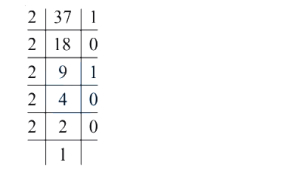
(B) To convert a decimal number to binary,we repeatedly divide the number by $2$ and record the remainders.
$37 \div 2 = 18$ with a remainder of $1$
$18 \div 2 = 9$ with a remainder of $0$
$9 \div 2 = 4$ with a remainder of $1$
$4 \div 2 = 2$ with a remainder of $0$
$2 \div 2 = 1$ with a remainder of $0$
$1 \div 2 = 0$ with a remainder of $1$
Reading the remainders from bottom to top,the binary representation of $37$ is $(100101)_2$.
Counting the digits in $(100101)_2$,we find there are $6$ digits.
Therefore,the correct option is $B$.
$37 \div 2 = 18$ with a remainder of $1$
$18 \div 2 = 9$ with a remainder of $0$
$9 \div 2 = 4$ with a remainder of $1$
$4 \div 2 = 2$ with a remainder of $0$
$2 \div 2 = 1$ with a remainder of $0$
$1 \div 2 = 0$ with a remainder of $1$
Reading the remainders from bottom to top,the binary representation of $37$ is $(100101)_2$.
Counting the digits in $(100101)_2$,we find there are $6$ digits.
Therefore,the correct option is $B$.
0 likesView Solution
35
PhysicsEasyMCQWBJEE · 2009
Which of the following materials is the best conductor of electricity?
A
Platinum
B
Gold
C
Silicon
D
Copper
Solution
(D) Electrical conductivity depends on the number of free electrons available for charge transport. Among the given options,$Copper$ $(Cu)$ is a transition metal with a very high density of free electrons and low resistivity,making it an excellent conductor of electricity. While $Gold$ and $Platinum$ are also good conductors,$Copper$ is widely used in electrical wiring due to its superior conductivity-to-cost ratio. $Silicon$ is a semiconductor,not a conductor.
0 likesView Solution
36
PhysicsEasyMCQWBJEE · 2009
Two identical light waves,propagating in the same direction,have a phase difference $\delta$. After they superpose,the intensity of the resulting wave will be proportional to
A
$\cos \delta$
B
$\cos (\delta / 2)$
C
$\cos ^2(\delta / 2)$
D
$\cos ^2 \delta$
Solution
(C) Let the intensity of each individual wave be $I_0$.
When two waves with the same frequency and amplitude superpose,the resultant intensity $I$ is given by the formula:
$I = I_1 + I_2 + 2\sqrt{I_1 I_2} \cos \delta$
Since the waves are identical,$I_1 = I_2 = I_0$.
Substituting these values:
$I = I_0 + I_0 + 2\sqrt{I_0 I_0} \cos \delta$
$I = 2I_0 + 2I_0 \cos \delta$
$I = 2I_0 (1 + \cos \delta)$
Using the trigonometric identity $1 + \cos \delta = 2 \cos^2(\delta / 2)$:
$I = 2I_0 (2 \cos^2(\delta / 2))$
$I = 4I_0 \cos^2(\delta / 2)$
Therefore,the resultant intensity is proportional to $\cos^2(\delta / 2)$.
When two waves with the same frequency and amplitude superpose,the resultant intensity $I$ is given by the formula:
$I = I_1 + I_2 + 2\sqrt{I_1 I_2} \cos \delta$
Since the waves are identical,$I_1 = I_2 = I_0$.
Substituting these values:
$I = I_0 + I_0 + 2\sqrt{I_0 I_0} \cos \delta$
$I = 2I_0 + 2I_0 \cos \delta$
$I = 2I_0 (1 + \cos \delta)$
Using the trigonometric identity $1 + \cos \delta = 2 \cos^2(\delta / 2)$:
$I = 2I_0 (2 \cos^2(\delta / 2))$
$I = 4I_0 \cos^2(\delta / 2)$
Therefore,the resultant intensity is proportional to $\cos^2(\delta / 2)$.
0 likesView Solution
Vedclass Products
For Students
Vedclass Test Series
Mock tests in real WBJEE style covering Physics with performance analysis. 5-day free trial.
Start Free TrialFor Teachers
Exam Paper Generator
Generate Set A/B/C/D Physics papers from 7.5L+ questions in 2 minutes. 3 chapters free.
Try FreeFor Institutes
Online Exam Module
Run live WBJEE mock exams with unlimited students, 360° analytics & white-label branding.
See DemoFrequently Asked Questions
How many Physics questions are in WBJEE 2009?
There are 36 Physics questions from the WBJEE 2009 paper on Vedclass, each with a detailed step-by-step solution in English.
Are WBJEE 2009 Physics solutions available in English?
Yes. All solutions on this page are in English. You can also switch to English or Hindi using the language buttons above the questions.
Can I practice WBJEE 2009 Physics as a timed test?
Yes. Use the Vedclass Test Series to attempt a full WBJEE mock test covering Physics with time limits and instant score analysis.
Can teachers create Physics papers from WBJEE previous year questions?
Yes. The Vedclass Exam Paper Generator lets teachers mix WBJEE Physics questions and generate Set A/B/C/D papers in minutes.
For Teachers & Institutes
Build a Custom Physics Paper
Pick WBJEE 2009 Physics questions, set difficulty, and generate Set A/B/C/D in 2 minutes.