
PhysicsQ51–61 of 100 questions
Page 2 of 2 · English
51
PhysicsMediumMCQNEET · 2022
Given below are two statements:
Statement $I$: The law of radioactive decay states that the number of nuclei undergoing the decay per unit time is directly proportional to the total number of nuclei in the sample.
Statement $II$: The half-life of a radionuclide is the time required for the number of radioactive nuclei to reduce to half of its initial value at time $t = 0$.
In the light of the above statements, choose the most appropriate answer from the options given below:
Statement $I$: The law of radioactive decay states that the number of nuclei undergoing the decay per unit time is directly proportional to the total number of nuclei in the sample.
Statement $II$: The half-life of a radionuclide is the time required for the number of radioactive nuclei to reduce to half of its initial value at time $t = 0$.
In the light of the above statements, choose the most appropriate answer from the options given below:
A
Both Statement $I$ and Statement $II$ are correct
B
Both Statement $I$ and Statement $II$ are incorrect
C
Statement $I$ is correct but Statement $II$ is incorrect
D
Statement $I$ is incorrect but Statement $II$ is correct
Solution
(B) Statement $I$ is incorrect because the law of radioactive decay states that the rate of decay $(dN/dt)$ is directly proportional to the number of nuclei present $(N)$, i.e., $dN/dt = -\lambda N$.
Statement $II$ is incorrect because the definition provided in the statement describes the mean life (average life), not the half-life. The half-life $(T_{1/2})$ is defined as the time required for the number of radioactive nuclei to reduce to half of its initial value.
Therefore, both statements are incorrect.
Statement $II$ is incorrect because the definition provided in the statement describes the mean life (average life), not the half-life. The half-life $(T_{1/2})$ is defined as the time required for the number of radioactive nuclei to reduce to half of its initial value.
Therefore, both statements are incorrect.
0 likesView Solution
52
PhysicsMediumMCQNEET · 2022
$A$ standard filament lamp consumes $100\,W$ when connected to $200\,V$ $AC$ mains supply. The peak current through the bulb will be $........\,A$.
A
$0.707$
B
$1$
C
$1.414$
D
$2$
Solution
(A) The power consumed by the lamp is given by $P = V_{rms} \times I_{rms}$.
Given $P = 100\,W$ and $V_{rms} = 200\,V$.
Therefore,the root mean square current $I_{rms} = \frac{P}{V_{rms}} = \frac{100}{200} = 0.5\,A$.
The peak current $I_{peak}$ is related to the $RMS$ current by the formula $I_{peak} = I_{rms} \times \sqrt{2}$.
Substituting the value of $I_{rms}$,we get $I_{peak} = 0.5 \times \sqrt{2} = \frac{\sqrt{2}}{2} = \frac{1}{\sqrt{2}} \approx 0.707\,A$.
Given $P = 100\,W$ and $V_{rms} = 200\,V$.
Therefore,the root mean square current $I_{rms} = \frac{P}{V_{rms}} = \frac{100}{200} = 0.5\,A$.
The peak current $I_{peak}$ is related to the $RMS$ current by the formula $I_{peak} = I_{rms} \times \sqrt{2}$.
Substituting the value of $I_{rms}$,we get $I_{peak} = 0.5 \times \sqrt{2} = \frac{\sqrt{2}}{2} = \frac{1}{\sqrt{2}} \approx 0.707\,A$.
0 likesView Solution
53
PhysicsEasyMCQNEET · 2022
Let $R_1$ be the radius of the second stationary orbit and $R_2$ be the radius of the fourth stationary orbit of an electron in Bohr's model. The ratio $\frac{R_1}{R_2}$ is
A
$0.25$
B
$0.5$
C
$2$
D
$4$
Solution
(A) In Bohr's model,the radius of the $n^{th}$ stationary orbit is given by the formula $R_n = a_0 \frac{n^2}{Z}$,where $a_0$ is the Bohr radius and $Z$ is the atomic number.
Since $a_0$ and $Z$ are constant for a given atom,the radius is proportional to the square of the principal quantum number: $R_n \propto n^2$.
For the second orbit $(n_1 = 2)$,the radius is $R_1 \propto 2^2 = 4$.
For the fourth orbit $(n_2 = 4)$,the radius is $R_2 \propto 4^2 = 16$.
Therefore,the ratio is $\frac{R_1}{R_2} = \frac{n_1^2}{n_2^2} = \frac{2^2}{4^2} = \frac{4}{16} = \frac{1}{4} = 0.25$.
Since $a_0$ and $Z$ are constant for a given atom,the radius is proportional to the square of the principal quantum number: $R_n \propto n^2$.
For the second orbit $(n_1 = 2)$,the radius is $R_1 \propto 2^2 = 4$.
For the fourth orbit $(n_2 = 4)$,the radius is $R_2 \propto 4^2 = 16$.
Therefore,the ratio is $\frac{R_1}{R_2} = \frac{n_1^2}{n_2^2} = \frac{2^2}{4^2} = \frac{4}{16} = \frac{1}{4} = 0.25$.
0 likesView Solution
54
PhysicsEasyMCQNEET · 2022
The magnetic flux linked to a circular coil of radius $R$ is given by $\phi = 2t^3 + 4t^2 + 2t + 5 \; Wb$. The magnitude of the induced $emf$ in the coil at $t = 5 \; s$ is $.......... \; V$.
A
$108$
B
$197$
C
$150$
D
$192$
Solution
(D) The magnetic flux is given by $\phi = 2t^3 + 4t^2 + 2t + 5$.
According to Faraday's law of electromagnetic induction,the induced $emf$ $(e)$ is given by the magnitude of the rate of change of magnetic flux:
$e = |\frac{d\phi}{dt}|$
$e = |\frac{d}{dt}(2t^3 + 4t^2 + 2t + 5)|$
$e = |6t^2 + 8t + 2|$
Now,substitute $t = 5 \; s$ into the expression for $e$:
$e = 6(5)^2 + 8(5) + 2$
$e = 6(25) + 40 + 2$
$e = 150 + 40 + 2 = 192 \; V$.
Thus,the magnitude of the induced $emf$ at $t = 5 \; s$ is $192 \; V$.
According to Faraday's law of electromagnetic induction,the induced $emf$ $(e)$ is given by the magnitude of the rate of change of magnetic flux:
$e = |\frac{d\phi}{dt}|$
$e = |\frac{d}{dt}(2t^3 + 4t^2 + 2t + 5)|$
$e = |6t^2 + 8t + 2|$
Now,substitute $t = 5 \; s$ into the expression for $e$:
$e = 6(5)^2 + 8(5) + 2$
$e = 6(25) + 40 + 2$
$e = 150 + 40 + 2 = 192 \; V$.
Thus,the magnitude of the induced $emf$ at $t = 5 \; s$ is $192 \; V$.
1 likesView Solution
55
PhysicsMediumMCQNEET · 2022
An astronomical refracting telescope is being used by an observer to observe planets in normal adjustment. The focal lengths of the objective and eyepiece used in the construction of the telescope are $20\,m$ and $2\,cm$ respectively. Consider the following statements about the telescope:
$(a)$ The distance between the objective and eyepiece is $20.02\,m$.
$(b)$ The magnification of the telescope is $1000$.
$(c)$ The image of the planet is erect and diminished.
$(d)$ The aperture of the eyepiece is smaller than that of the objective.
The correct statements are:
$(a)$ The distance between the objective and eyepiece is $20.02\,m$.
$(b)$ The magnification of the telescope is $1000$.
$(c)$ The image of the planet is erect and diminished.
$(d)$ The aperture of the eyepiece is smaller than that of the objective.
The correct statements are:
A
$(a), (b)$ and $(c)$
B
$(b), (c)$ and $(d)$
C
$(c), (d)$ and $(a)$
D
$(a), (b)$ and $(d)$
Solution
(D) Given:
Focal length of objective,$f_0 = 20\,m = 2000\,cm$.
Focal length of eyepiece,$f_e = 2\,cm$.
For normal adjustment:
$1$. The distance between the objective and the eyepiece is $L = f_0 + f_e = 2000\,cm + 2\,cm = 2002\,cm = 20.02\,m$. Thus,statement $(a)$ is correct.
$2$. The magnifying power (magnification) is $M = \frac{f_0}{f_e} = \frac{2000}{2} = 1000$. Thus,statement $(b)$ is correct.
$3$. In an astronomical telescope,the final image formed is inverted and magnified relative to the object. Thus,statement $(c)$ is incorrect.
$4$. The aperture of the eyepiece is kept smaller than that of the objective to ensure that all light rays collected by the objective enter the eye. Thus,statement $(d)$ is correct.
Therefore,the correct statements are $(a), (b),$ and $(d)$.
Focal length of objective,$f_0 = 20\,m = 2000\,cm$.
Focal length of eyepiece,$f_e = 2\,cm$.
For normal adjustment:
$1$. The distance between the objective and the eyepiece is $L = f_0 + f_e = 2000\,cm + 2\,cm = 2002\,cm = 20.02\,m$. Thus,statement $(a)$ is correct.
$2$. The magnifying power (magnification) is $M = \frac{f_0}{f_e} = \frac{2000}{2} = 1000$. Thus,statement $(b)$ is correct.
$3$. In an astronomical telescope,the final image formed is inverted and magnified relative to the object. Thus,statement $(c)$ is incorrect.
$4$. The aperture of the eyepiece is kept smaller than that of the objective to ensure that all light rays collected by the objective enter the eye. Thus,statement $(d)$ is correct.
Therefore,the correct statements are $(a), (b),$ and $(d)$.
0 likesView Solution
56
PhysicsMediumMCQNEET · 2022
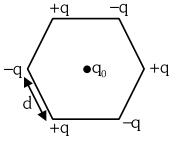
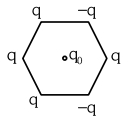
Six charges $+q, -q, +q, -q, +q$ and $-q$ are fixed at the corners of a hexagon of side $d$ as shown in the figure. The work done in bringing a charge $q_0$ to the centre of the hexagon from infinity is: ($\varepsilon_0$ = permittivity of free space)
A
$0$
B
$\frac{-q^2}{4 \pi \varepsilon_0 d}$
C
$\frac{-q^2}{4 \pi \varepsilon_0 d} \left(3-\frac{1}{\sqrt{2}}\right)$
D
$\frac{-q^2}{4 \pi \varepsilon_0 d} \left(6-\frac{1}{\sqrt{2}}\right)$
Solution
(A) The work done in bringing a charge $q_0$ from infinity to a point is given by $W = q_0 V$,where $V$ is the electric potential at that point due to the existing charges.
In a regular hexagon of side $d$,the distance of each corner from the centre is $d$.
The electric potential $V$ at the centre due to the six charges is the sum of the potentials due to each individual charge:
$V = \frac{1}{4 \pi \varepsilon_0} \left( \frac{+q}{d} + \frac{-q}{d} + \frac{+q}{d} + \frac{-q}{d} + \frac{+q}{d} + \frac{-q}{d} \right)$
$V = \frac{1}{4 \pi \varepsilon_0 d} (q - q + q - q + q - q)$
$V = 0$
Therefore,the work done $W = q_0 \times 0 = 0$.
In a regular hexagon of side $d$,the distance of each corner from the centre is $d$.
The electric potential $V$ at the centre due to the six charges is the sum of the potentials due to each individual charge:
$V = \frac{1}{4 \pi \varepsilon_0} \left( \frac{+q}{d} + \frac{-q}{d} + \frac{+q}{d} + \frac{-q}{d} + \frac{+q}{d} + \frac{-q}{d} \right)$
$V = \frac{1}{4 \pi \varepsilon_0 d} (q - q + q - q + q - q)$
$V = 0$
Therefore,the work done $W = q_0 \times 0 = 0$.
0 likesView Solution
57
PhysicsMediumMCQNEET · 2022
The collector current in a common base amplifier using $n-p-n$ transistor is $24\; mA$. If $80\%$ of the electrons released by the emitter are accepted by the collector,then the base current is numerically
A
$6\,mA$ and leaving the base
B
$3\,mA$ and leaving the base
C
$6\,mA$ and entering the base
D
$3\,mA$ and entering the base
Solution
(C) Given collector current $I_C = 24\,mA$.
The current gain $\alpha$ is the ratio of collector current to emitter current,which is given as $80\% = 0.8$.
We know that $I_C = \alpha I_E$,so $I_E = \frac{I_C}{\alpha}$.
Substituting the values: $I_E = \frac{24\,mA}{0.8} = 30\,mA$.
Using Kirchhoff's current law for a transistor,$I_E = I_B + I_C$,so $I_B = I_E - I_C$.
$I_B = 30\,mA - 24\,mA = 6\,mA$.
In an $n-p-n$ transistor,the emitter current enters the transistor,while the collector and base currents leave the transistor. However,the question asks for the base current magnitude and direction relative to the base terminal. Since $I_E = I_B + I_C$,the base current $I_B$ flows into the base region to compensate for the recombination of charge carriers. Thus,the current is $6\,mA$ and entering the base.
The current gain $\alpha$ is the ratio of collector current to emitter current,which is given as $80\% = 0.8$.
We know that $I_C = \alpha I_E$,so $I_E = \frac{I_C}{\alpha}$.
Substituting the values: $I_E = \frac{24\,mA}{0.8} = 30\,mA$.
Using Kirchhoff's current law for a transistor,$I_E = I_B + I_C$,so $I_B = I_E - I_C$.
$I_B = 30\,mA - 24\,mA = 6\,mA$.
In an $n-p-n$ transistor,the emitter current enters the transistor,while the collector and base currents leave the transistor. However,the question asks for the base current magnitude and direction relative to the base terminal. Since $I_E = I_B + I_C$,the base current $I_B$ flows into the base region to compensate for the recombination of charge carriers. Thus,the current is $6\,mA$ and entering the base.
0 likesView Solution
58
PhysicsEasyMCQNEET · 2022
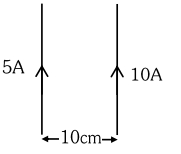
Two very long,straight,parallel conductors $A$ and $B$ carry currents of $5\,A$ and $10\,A$ respectively and are at a distance of $10\,cm$ from each other. The direction of current in the two conductors is the same. The force acting per unit length between the two conductors is: $(\mu_0 = 4\pi \times 10^{-7} \text{ SI unit})$
A
$2 \times 10^{-4} \text{ N/m}$ and is attractive
B
$2 \times 10^{-4} \text{ N/m}$ and is repulsive
C
$1 \times 10^{-4} \text{ N/m}$ and is attractive
D
$1 \times 10^{-4} \text{ N/m}$ and is repulsive
Solution
(C) The formula for the force per unit length between two parallel current-carrying conductors is given by:
$\frac{F}{\ell} = \frac{\mu_0 i_1 i_2}{2 \pi r}$
Given:
$i_1 = 5 \text{ A}$
$i_2 = 10 \text{ A}$
$r = 10 \text{ cm} = 0.1 \text{ m}$
$\mu_0 = 4\pi \times 10^{-7} \text{ T m/A}$
Substituting the values:
$\frac{F}{\ell} = \frac{4\pi \times 10^{-7} \times 5 \times 10}{2\pi \times 0.1}$
$\frac{F}{\ell} = \frac{2 \times 10^{-7} \times 50}{0.1} = \frac{100 \times 10^{-7}}{0.1} = 1000 \times 10^{-7} = 10^{-4} \text{ N/m}$
Since the currents are in the same direction,the force between the conductors is attractive.
$\frac{F}{\ell} = \frac{\mu_0 i_1 i_2}{2 \pi r}$
Given:
$i_1 = 5 \text{ A}$
$i_2 = 10 \text{ A}$
$r = 10 \text{ cm} = 0.1 \text{ m}$
$\mu_0 = 4\pi \times 10^{-7} \text{ T m/A}$
Substituting the values:
$\frac{F}{\ell} = \frac{4\pi \times 10^{-7} \times 5 \times 10}{2\pi \times 0.1}$
$\frac{F}{\ell} = \frac{2 \times 10^{-7} \times 50}{0.1} = \frac{100 \times 10^{-7}}{0.1} = 1000 \times 10^{-7} = 10^{-4} \text{ N/m}$
Since the currents are in the same direction,the force between the conductors is attractive.
0 likesView Solution
59
PhysicsMediumMCQNEET · 2022
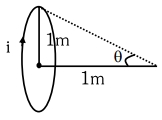
The magnetic field on the axis of a circular loop of radius $R = 100\,cm$ carrying current $I = \sqrt{2}\,A$,at a point $x = 1\,m$ away from the centre of the loop is given by:
A
$3.14 \times 10^{-7}\,T$
B
$6.28 \times 10^{-7}\,T$
C
$3.14 \times 10^{-4}\,T$
D
$6.28 \times 10^{-4}\,T$
Solution
(A) The magnetic field on the axis of a circular loop at a distance $x$ from the center is given by $B = \frac{\mu_0 I R^2}{2(R^2 + x^2)^{3/2}}$.
Given: $R = 100\,cm = 1\,m$,$x = 1\,m$,$I = \sqrt{2}\,A$,and $\mu_0 = 4\pi \times 10^{-7}\,T\cdot m/A$.
Substituting the values:
$B = \frac{4\pi \times 10^{-7} \times \sqrt{2} \times (1)^2}{2(1^2 + 1^2)^{3/2}}$
$B = \frac{4\pi \times 10^{-7} \times \sqrt{2}}{2(2)^{3/2}}$
Since $(2)^{3/2} = 2\sqrt{2}$,we have:
$B = \frac{4\pi \times 10^{-7} \times \sqrt{2}}{2 \times 2\sqrt{2}}$
$B = \frac{4\pi \times 10^{-7}}{4} = \pi \times 10^{-7}\,T$
$B = 3.14 \times 10^{-7}\,T$.
Given: $R = 100\,cm = 1\,m$,$x = 1\,m$,$I = \sqrt{2}\,A$,and $\mu_0 = 4\pi \times 10^{-7}\,T\cdot m/A$.
Substituting the values:
$B = \frac{4\pi \times 10^{-7} \times \sqrt{2} \times (1)^2}{2(1^2 + 1^2)^{3/2}}$
$B = \frac{4\pi \times 10^{-7} \times \sqrt{2}}{2(2)^{3/2}}$
Since $(2)^{3/2} = 2\sqrt{2}$,we have:
$B = \frac{4\pi \times 10^{-7} \times \sqrt{2}}{2 \times 2\sqrt{2}}$
$B = \frac{4\pi \times 10^{-7}}{4} = \pi \times 10^{-7}\,T$
$B = 3.14 \times 10^{-7}\,T$.
0 likesView Solution
60
PhysicsMediumMCQNEET · 2022
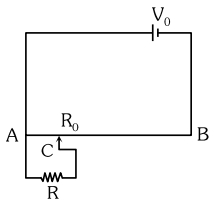
The sliding contact $C$ is at one-fourth of the length of the potentiometer wire $(AB)$ from $A$ as shown in the circuit diagram. If the resistance of the wire $AB$ is $R_0$,then the potential drop $(V)$ across the resistor $R$ is
A
$\frac{4 V_0 R}{3 R_0 + 16 R}$
B
$\frac{4 V_0 R}{3 R_0 + R}$
C
$\frac{2 V_0 R}{4 R_0 + R}$
D
$\frac{2 V_0 R}{2 R_0 + 3 R}$
Solution
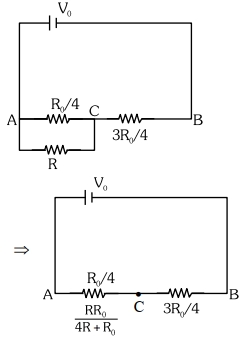
(A) The sliding contact $C$ divides the wire $AB$ into two parts: $AC$ and $CB$. Since $C$ is at one-fourth of the length,the resistance of $AC$ is $R_{AC} = R_0 / 4$ and the resistance of $CB$ is $R_{CB} = 3 R_0 / 4$.
The resistor $R$ is connected in parallel with the part $AC$. The equivalent resistance of the parallel combination of $R$ and $R_{AC}$ is $R_p = \frac{R \cdot (R_0 / 4)}{R + (R_0 / 4)} = \frac{R R_0}{4 R + R_0}$.
Now,the circuit consists of $R_p$ and $R_{CB}$ in series across the voltage source $V_0$. The potential drop $V$ across the resistor $R$ (which is the same as the potential drop across $R_p$) is given by the voltage divider rule:
$V = V_0 \cdot \frac{R_p}{R_p + R_{CB}}$
Substituting the values:
$V = V_0 \cdot \frac{\frac{R R_0}{4 R + R_0}}{\frac{R R_0}{4 R + R_0} + \frac{3 R_0}{4}}$
Multiplying the numerator and denominator by $4(4 R + R_0)$:
$V = V_0 \cdot \frac{4 R R_0}{4 R R_0 + 3 R_0(4 R + R_0)} = V_0 \cdot \frac{4 R R_0}{4 R R_0 + 12 R R_0 + 3 R_0^2} = V_0 \cdot \frac{4 R R_0}{16 R R_0 + 3 R_0^2}$
Dividing by $R_0$:
$V = \frac{4 V_0 R}{16 R + 3 R_0}$
The resistor $R$ is connected in parallel with the part $AC$. The equivalent resistance of the parallel combination of $R$ and $R_{AC}$ is $R_p = \frac{R \cdot (R_0 / 4)}{R + (R_0 / 4)} = \frac{R R_0}{4 R + R_0}$.
Now,the circuit consists of $R_p$ and $R_{CB}$ in series across the voltage source $V_0$. The potential drop $V$ across the resistor $R$ (which is the same as the potential drop across $R_p$) is given by the voltage divider rule:
$V = V_0 \cdot \frac{R_p}{R_p + R_{CB}}$
Substituting the values:
$V = V_0 \cdot \frac{\frac{R R_0}{4 R + R_0}}{\frac{R R_0}{4 R + R_0} + \frac{3 R_0}{4}}$
Multiplying the numerator and denominator by $4(4 R + R_0)$:
$V = V_0 \cdot \frac{4 R R_0}{4 R R_0 + 3 R_0(4 R + R_0)} = V_0 \cdot \frac{4 R R_0}{4 R R_0 + 12 R R_0 + 3 R_0^2} = V_0 \cdot \frac{4 R R_0}{16 R R_0 + 3 R_0^2}$
Dividing by $R_0$:
$V = \frac{4 V_0 R}{16 R + 3 R_0}$
0 likesView Solution
61
PhysicsMediumMCQNEET · 2022
The ratio of Coulomb's electrostatic force to the gravitational force between an electron and a proton separated by some distance is $2.4 \times 10^{39}$. The ratio of the proportionality constant $K = \frac{1}{4 \pi \varepsilon_0}$ to the gravitational constant $G$ is nearly (Given that the charge of the proton and electron each $= 1.6 \times 10^{-19} \; C$,the mass of the electron $= 9.11 \times 10^{-31} \; kg$,the mass of the proton $= 1.67 \times 10^{-27} \; kg$):
A
$10^{20}$
B
$10^{30}$
C
$10^{40}$
D
$10$
Solution
(A) The ratio of electrostatic force $F_e$ to gravitational force $F_G$ is given by:
$\frac{F_e}{F_G} = \frac{\frac{K q_1 q_2}{r^2}}{\frac{G m_1 m_2}{r^2}} = \frac{K}{G} \cdot \frac{q_1 q_2}{m_1 m_2}$
Given $\frac{F_e}{F_G} = 2.4 \times 10^{39}$,$q_1 = q_2 = 1.6 \times 10^{-19} \; C$,$m_1 = 9.11 \times 10^{-31} \; kg$,and $m_2 = 1.67 \times 10^{-27} \; kg$.
Substituting the values:
$2.4 \times 10^{39} = \frac{K}{G} \cdot \frac{(1.6 \times 10^{-19})^2}{(9.11 \times 10^{-31}) \times (1.67 \times 10^{-27})}$
$\frac{K}{G} = \frac{2.4 \times 10^{39} \times (9.11 \times 1.67) \times 10^{-58}}{(1.6)^2 \times 10^{-38}}$
$\frac{K}{G} = \frac{2.4 \times 15.2137 \times 10^{-19}}{2.56 \times 10^{-38}} = \frac{36.51288}{2.56} \times 10^{19} \approx 14.26 \times 10^{19} = 1.426 \times 10^{20}$
Thus,the ratio is approximately $10^{20}$.
$\frac{F_e}{F_G} = \frac{\frac{K q_1 q_2}{r^2}}{\frac{G m_1 m_2}{r^2}} = \frac{K}{G} \cdot \frac{q_1 q_2}{m_1 m_2}$
Given $\frac{F_e}{F_G} = 2.4 \times 10^{39}$,$q_1 = q_2 = 1.6 \times 10^{-19} \; C$,$m_1 = 9.11 \times 10^{-31} \; kg$,and $m_2 = 1.67 \times 10^{-27} \; kg$.
Substituting the values:
$2.4 \times 10^{39} = \frac{K}{G} \cdot \frac{(1.6 \times 10^{-19})^2}{(9.11 \times 10^{-31}) \times (1.67 \times 10^{-27})}$
$\frac{K}{G} = \frac{2.4 \times 10^{39} \times (9.11 \times 1.67) \times 10^{-58}}{(1.6)^2 \times 10^{-38}}$
$\frac{K}{G} = \frac{2.4 \times 15.2137 \times 10^{-19}}{2.56 \times 10^{-38}} = \frac{36.51288}{2.56} \times 10^{19} \approx 14.26 \times 10^{19} = 1.426 \times 10^{20}$
Thus,the ratio is approximately $10^{20}$.
0 likesView Solution
Vedclass Products
For Students
Vedclass Test Series
Mock tests in real NEET style covering Physics with performance analysis. 5-day free trial.
Start Free TrialFor Teachers
Exam Paper Generator
Generate Set A/B/C/D Physics papers from 7.5L+ questions in 2 minutes. 3 chapters free.
Try FreeFor Institutes
Online Exam Module
Run live NEET mock exams with unlimited students, 360° analytics & white-label branding.
See DemoFrequently Asked Questions
How many Physics questions are in NEET 2022?
There are 100 Physics questions from the NEET 2022 paper on Vedclass, each with a detailed step-by-step solution in English.
Are NEET 2022 Physics solutions available in English?
Yes. All solutions on this page are in English. You can also switch to English or Hindi using the language buttons above the questions.
Can I practice NEET 2022 Physics as a timed test?
Yes. Use the Vedclass Test Series to attempt a full NEET mock test covering Physics with time limits and instant score analysis.
Can teachers create Physics papers from NEET previous year questions?
Yes. The Vedclass Exam Paper Generator lets teachers mix NEET Physics questions and generate Set A/B/C/D papers in minutes.
For Teachers & Institutes
Build a Custom Physics Paper
Pick NEET 2022 Physics questions, set difficulty, and generate Set A/B/C/D in 2 minutes.