
BiologyQ1–99 of 100 questions
Page 1 of 2 · English
1
BiologyMediumMCQNEET · 2021
Which of the following are not secondary metabolites in plants?
A
Morphine,Codeine
B
Vinblastine,Curcumin
C
Amino acids,Glucose
D
Rubber,Gums
Solution
(C) Secondary metabolites are chemical compounds produced by plants that are not essential for basic survival (growth, development, or reproduction) but provide ecological advantages like defense against herbivores or pathogens.
Primary metabolites, such as $Amino \text{ } acids$, $Glucose$ (sugars), and $Nucleotides$, are essential for the basic metabolic processes of life.
$Morphine$, $Codeine$, $Vinblastine$, $Curcumin$, $Rubber$, and $Gums$ are all examples of secondary metabolites.
Therefore, $Amino \text{ } acids$ and $Glucose$ are primary metabolites, not secondary metabolites.
Primary metabolites, such as $Amino \text{ } acids$, $Glucose$ (sugars), and $Nucleotides$, are essential for the basic metabolic processes of life.
$Morphine$, $Codeine$, $Vinblastine$, $Curcumin$, $Rubber$, and $Gums$ are all examples of secondary metabolites.
Therefore, $Amino \text{ } acids$ and $Glucose$ are primary metabolites, not secondary metabolites.
1 likesView Solution
2
BiologyMediumMCQNEET · 2021
In which of the following are gemmae found?
A
Mosses
B
Pteridophytes
C
Some liverworts
D
Some gymnosperms
Solution
(C) Gemmae are specialized asexual reproductive structures found in liverworts,such as $Marchantia$.
They are green,multicellular,asexual buds that develop in small receptacles called gemma cups located on the thalli.
When detached from the parent plant,these gemmae germinate to form new individuals.
Therefore,the correct option is $C$.
They are green,multicellular,asexual buds that develop in small receptacles called gemma cups located on the thalli.
When detached from the parent plant,these gemmae germinate to form new individuals.
Therefore,the correct option is $C$.
1 likesView Solution
3
BiologyEasyMCQNEET · 2021
In which stage of meiosis does the splitting of the centromere occur?
A
Metaphase-$I$
B
Metaphase-$II$
C
Anaphase-$II$
D
Telophase-$II$
Solution
(C) Meiosis is a reductional division consisting of two stages: Meiosis-$I$ and Meiosis-$II$.
In Meiosis-$I$,homologous chromosomes separate,but the centromeres remain intact.
In Anaphase-$II$,the centromere of each chromosome splits,allowing the sister chromatids to separate and move toward opposite poles.
Therefore,the splitting of the centromere is a characteristic feature of Anaphase-$II$.
In Meiosis-$I$,homologous chromosomes separate,but the centromeres remain intact.
In Anaphase-$II$,the centromere of each chromosome splits,allowing the sister chromatids to separate and move toward opposite poles.
Therefore,the splitting of the centromere is a characteristic feature of Anaphase-$II$.
0 likesView Solution
4
BiologyMediumMCQNEET · 2021
Match List-$I$ with List-$II$:
Choose the correct answer from the options given below:
| List-$I$ | List-$II$ |
|---|---|
| $(a)$ Lenticels | $(i)$ Phellogen |
| $(b)$ Cork cambium | $(ii)$ Suberin deposition |
| $(c)$ Secondary cortex | $(iii)$ Gaseous exchange |
| $(d)$ Cork | $(iv)$ Phelloderm |
Choose the correct answer from the options given below:
A
$(a)-(iii), (b)-(i), (c)-(iv), (d)-(ii)$
B
$(a)-(ii), (b)-(i), (c)-(iv), (d)-(iii)$
C
$(a)-(iii), (b)-(iv), (c)-(i), (d)-(ii)$
D
$(a)-(i), (b)-(iii), (c)-(ii), (d)-(iv)$
Solution
(A) The correct matching is as follows:
$(a)$ Lenticels are lens-shaped openings in the bark that facilitate $(iii)$ Gaseous exchange.
$(b)$ Cork cambium is also known as $(i)$ Phellogen.
$(c)$ Secondary cortex is also known as $(iv)$ Phelloderm.
$(d)$ Cork cells are dead and possess $(ii)$ Suberin deposition in their cell walls.
Thus,the correct sequence is $(a)-(iii), (b)-(i), (c)-(iv), (d)-(ii)$.
$(a)$ Lenticels are lens-shaped openings in the bark that facilitate $(iii)$ Gaseous exchange.
$(b)$ Cork cambium is also known as $(i)$ Phellogen.
$(c)$ Secondary cortex is also known as $(iv)$ Phelloderm.
$(d)$ Cork cells are dead and possess $(ii)$ Suberin deposition in their cell walls.
Thus,the correct sequence is $(a)-(iii), (b)-(i), (c)-(iv), (d)-(ii)$.
1 likesView Solution
5
BiologyMediumMCQNEET · 2021
Plants follow different pathways in response to the environment or phases of life to form different kinds of structures. This ability is called:
A
Elasticity
B
Plasticity
C
Flexibility
D
Maturity
Solution
(B) Plants exhibit the ability to alter their developmental pathways in response to the environment or phases of life,leading to the formation of different kinds of structures. This phenomenon is known as $Plasticity$.
For example,heterophylly in $Larkspur$,$Buttercup$,and $Cotton$ is a classic example of plasticity,where the leaves produced in juvenile phases are different in shape from those produced in mature phases.
For example,heterophylly in $Larkspur$,$Buttercup$,and $Cotton$ is a classic example of plasticity,where the leaves produced in juvenile phases are different in shape from those produced in mature phases.
1 likesView Solution
6
BiologyMediumMCQNEET · 2021
Match List-$I$ with List-$II$.
Choose the correct answer from the options given below.
| List-$I$ | List-$II$ |
| $(a)$ Cristae | $(i)$ Primary constriction in chromosome |
| $(b)$ Thylakoids | $(ii)$ Disc-shaped sacs in Golgi apparatus |
| $(c)$ Centromere | $(iii)$ Infoldings in mitochondria |
| $(d)$ Cisternae | $(iv)$ Flattened membranous sacs in stroma of plastids |
Choose the correct answer from the options given below.
A
$(iv)-(iii)-(ii)-(i)$
B
$(iii)-(iv)-(i)-(ii)$
C
$(i)-(iv)-(iii)-(ii)$
D
$(ii)-(iii)-(iv)-(i)$
Solution
(B) The correct matches are as follows:
$(a)$ Cristae: These are the infoldings of the inner mitochondrial membrane that increase the surface area for biochemical reactions. Hence,$(a)-(iii)$.
$(b)$ Thylakoids: These are flattened,disc-like membranous sacs found within the stroma of chloroplasts,which are the sites of light-dependent reactions. Hence,$(b)-(iv)$.
$(c)$ Centromere: This is the primary constriction region on a chromosome where spindle fibers attach during cell division. Hence,$(c)-(i)$.
$(d)$ Cisternae: These are the flattened,disc-shaped sacs that make up the Golgi apparatus. Hence,$(d)-(ii)$.
Therefore,the correct sequence is $(a)-(iii), (b)-(iv), (c)-(i), (d)-(ii)$.
$(a)$ Cristae: These are the infoldings of the inner mitochondrial membrane that increase the surface area for biochemical reactions. Hence,$(a)-(iii)$.
$(b)$ Thylakoids: These are flattened,disc-like membranous sacs found within the stroma of chloroplasts,which are the sites of light-dependent reactions. Hence,$(b)-(iv)$.
$(c)$ Centromere: This is the primary constriction region on a chromosome where spindle fibers attach during cell division. Hence,$(c)-(i)$.
$(d)$ Cisternae: These are the flattened,disc-shaped sacs that make up the Golgi apparatus. Hence,$(d)-(ii)$.
Therefore,the correct sequence is $(a)-(iii), (b)-(iv), (c)-(i), (d)-(ii)$.
0 likesView Solution
7
BiologyMediumMCQNEET · 2021
Match List-$I$ with List-$II$.
Choose the correct answer from the options given below:
| List-$I$ | List-$II$ |
| $(a)$ Cohesion | $(i)$ More attraction in liquid phase |
| $(b)$ Adhesion | $(ii)$ Mutual attraction between water molecules |
| $(c)$ Surface tension | $(iii)$ Water loss in liquid phase |
| $(d)$ Guttation | $(iv)$ Attraction towards polar surfaces |
Choose the correct answer from the options given below:
A
$(iii)-(i)-(iv)-(ii)$
B
$(iv)-(iii)-(ii)-(i)$
C
$(ii)-(iv)-(i)-(iii)$
D
$(ii)-(i)-(iv)-(iii)$
Solution
$(C)$ Cohesion refers to the mutual attraction between water molecules.
$(b)$ Adhesion refers to the attraction of water molecules to polar surfaces.
$(c)$ Surface tension explains why water molecules are more attracted to each other in the liquid phase than in the gaseous phase.
$(d)$ Guttation is the process of water loss in liquid form from the tips of leaves.
Therefore, the correct matching is $(a)-(ii), (b)-(iv), (c)-(i), (d)-(iii)$.
$(b)$ Adhesion refers to the attraction of water molecules to polar surfaces.
$(c)$ Surface tension explains why water molecules are more attracted to each other in the liquid phase than in the gaseous phase.
$(d)$ Guttation is the process of water loss in liquid form from the tips of leaves.
Therefore, the correct matching is $(a)-(ii), (b)-(iv), (c)-(i), (d)-(iii)$.
0 likesView Solution
8
BiologyDifficultMCQNEET · 2021
Which of the following statements is incorrect?
A
Microbodies are present in both plants and animals.
B
Mature sieve tube elements possess a conspicuous nucleus and usual cytoplasmic organelles.
C
The perinuclear space forms a barrier between the materials present inside the nucleus and those of the cytoplasm.
D
Nuclear pores act as passages for proteins and $RNA$ molecules in both directions between the nucleus and the cytoplasm.
Solution
(B) The correct answer is $B$.
Mature sieve tube elements in angiosperms are specialized cells that lose their nucleus,ribosomes,vacuoles,and other organelles at maturity to facilitate the efficient transport of food (phloem sap).
Therefore,the statement that they possess a conspicuous nucleus and usual cytoplasmic organelles is incorrect.
Microbodies (like peroxisomes) are found in both plant and animal cells.
The perinuclear space (the space between the two nuclear membranes) acts as a barrier between the nucleoplasm and the cytoplasm.
Nuclear pores are complex structures that regulate the movement of $RNA$ and proteins between the nucleus and the cytoplasm in both directions.
Mature sieve tube elements in angiosperms are specialized cells that lose their nucleus,ribosomes,vacuoles,and other organelles at maturity to facilitate the efficient transport of food (phloem sap).
Therefore,the statement that they possess a conspicuous nucleus and usual cytoplasmic organelles is incorrect.
Microbodies (like peroxisomes) are found in both plant and animal cells.
The perinuclear space (the space between the two nuclear membranes) acts as a barrier between the nucleoplasm and the cytoplasm.
Nuclear pores are complex structures that regulate the movement of $RNA$ and proteins between the nucleus and the cytoplasm in both directions.
0 likesView Solution
9
BiologyEasyMCQNEET · 2021
Match List-$I$ with List-$II$:
Select the correct answer from the options given below:
| List-$I$ | List-$II$ |
|---|---|
| $(a)$ Cells with the capacity to divide actively | $(i)$ Vascular tissue |
| $(b)$ $A$ tissue where all cells are similar in structure and function | $(ii)$ Meristem |
| $(c)$ Tissue having different types of cells | $(iii)$ Sclereid |
| $(d)$ Dead cells with highly thickened walls and narrow lumen | $(iv)$ Simple tissue |
Select the correct answer from the options given below:
A
$(a)-(i), (b)-(ii), (c)-(iii), (d)-(iv)$
B
$(a)-(iv), (b)-(iii), (c)-(ii), (d)-(i)$
C
$(a)-(ii), (b)-(iv), (c)-(i), (d)-(iii)$
D
$(a)-(iii), (b)-(ii), (c)-(iv), (d)-(i)$
Solution
(C) Cells with the capacity to divide actively are known as Meristem $(ii)$.
$(b)$ $A$ tissue where all cells are similar in structure and function is called a Simple tissue $(iv)$.
$(c)$ $A$ tissue having different types of cells is a Complex tissue,such as Vascular tissue $(i)$.
$(d)$ Dead cells with highly thickened walls and narrow lumen are Sclereids $(iii)$.
Therefore,the correct matching is $(a)-(ii), (b)-(iv), (c)-(i), (d)-(iii)$.
$(b)$ $A$ tissue where all cells are similar in structure and function is called a Simple tissue $(iv)$.
$(c)$ $A$ tissue having different types of cells is a Complex tissue,such as Vascular tissue $(i)$.
$(d)$ Dead cells with highly thickened walls and narrow lumen are Sclereids $(iii)$.
Therefore,the correct matching is $(a)-(ii), (b)-(iv), (c)-(i), (d)-(iii)$.
0 likesView Solution
10
BiologyMediumMCQNEET · 2021
Which of the following algae produce carrageen?
A
Green algae
B
Brown algae
C
Red algae
D
Blue-green algae
Solution
(C) Carrageen is a type of phycocolloid,which is a gelatinous substance extracted from the cell walls of certain marine algae.
Specifically,carrageen is obtained from the cell walls of red algae (Rhodophyceae).
These substances are widely used in the food and pharmaceutical industries as thickening and stabilizing agents.
Therefore,the correct option is $C$.
Specifically,carrageen is obtained from the cell walls of red algae (Rhodophyceae).
These substances are widely used in the food and pharmaceutical industries as thickening and stabilizing agents.
Therefore,the correct option is $C$.
0 likesView Solution
11
BiologyEasyMCQNEET · 2021
Some genera like $Selaginella$ and $Salvinia$ produce two kinds of spores. What are such plants called?
A
Homosporous
B
Heterosporous
C
Isosporous
D
Heterosorous
Solution
(B) Plants that produce two different kinds of spores,namely microspores and megaspores,are known as heterosporous plants.
$Selaginella$ and $Salvinia$ are classic examples of pteridophytes that exhibit heterospory.
This phenomenon is considered a precursor to the seed habit in higher plants.
$Selaginella$ and $Salvinia$ are classic examples of pteridophytes that exhibit heterospory.
This phenomenon is considered a precursor to the seed habit in higher plants.
0 likesView Solution
12
BiologyMediumMCQNEET · 2021
Diadelphous stamens are found in:
A
China rose
B
Citrus
C
Pea
D
China rose and Citrus
Solution
(C) In flowering plants, the arrangement of stamens based on the fusion of filaments is classified into different types.
$1$. Monadelphous: Stamens are united into a single bundle (e.g., China rose).
$2$. Diadelphous: Stamens are united into two bundles (e.g., Pea, where $9$ stamens are fused into one bundle and $1$ is free).
$3$. Polyadelphous: Stamens are united into more than two bundles (e.g., Citrus).
Therefore, diadelphous stamens are characteristic of the family Fabaceae, specifically seen in Pea $(Pisum \text{ } sativum)$.
$1$. Monadelphous: Stamens are united into a single bundle (e.g., China rose).
$2$. Diadelphous: Stamens are united into two bundles (e.g., Pea, where $9$ stamens are fused into one bundle and $1$ is free).
$3$. Polyadelphous: Stamens are united into more than two bundles (e.g., Citrus).
Therefore, diadelphous stamens are characteristic of the family Fabaceae, specifically seen in Pea $(Pisum \text{ } sativum)$.
0 likesView Solution
13
BiologyMediumMCQNEET · 2021
When the centromere is situated in the middle of the two equal arms of a chromosome,it is called:
A
Submetacentric
B
Telocentric
C
Metacentric
D
Acrocentric
Solution
(C) chromosome is classified based on the position of the centromere:
$1$. Metacentric: The centromere is in the middle,resulting in two equal arms.
$2$. Submetacentric: The centromere is slightly away from the middle,resulting in one shorter and one longer arm.
$3$. Acrocentric: The centromere is situated close to the end,forming one extremely short and one very long arm.
$4$. Telocentric: The centromere is at the terminal end of the chromosome.
Therefore,when the centromere is in the middle of two equal arms,it is called Metacentric.
$1$. Metacentric: The centromere is in the middle,resulting in two equal arms.
$2$. Submetacentric: The centromere is slightly away from the middle,resulting in one shorter and one longer arm.
$3$. Acrocentric: The centromere is situated close to the end,forming one extremely short and one very long arm.
$4$. Telocentric: The centromere is at the terminal end of the chromosome.
Therefore,when the centromere is in the middle of two equal arms,it is called Metacentric.
0 likesView Solution
14
BiologyMediumMCQNEET · 2021
In which of the following algae is mannitol stored as reserve food material?
A
Gracilaria
B
Ectocarpus
C
Volvox
D
Ulothrix
Solution
(B) The reserve food material in algae varies according to the class:
$1$. Phaeophyceae (Brown algae) store food as complex carbohydrates,usually in the form of mannitol or laminarin.
$2$. Ectocarpus belongs to the class Phaeophyceae.
$3$. Gracilaria belongs to Rhodophyceae (Red algae),which stores food as floridean starch.
$4$. Volvox and Ulothrix belong to Chlorophyceae (Green algae),which store food as starch.
$1$. Phaeophyceae (Brown algae) store food as complex carbohydrates,usually in the form of mannitol or laminarin.
$2$. Ectocarpus belongs to the class Phaeophyceae.
$3$. Gracilaria belongs to Rhodophyceae (Red algae),which stores food as floridean starch.
$4$. Volvox and Ulothrix belong to Chlorophyceae (Green algae),which store food as starch.
0 likesView Solution
15
BiologyMediumMCQNEET · 2021
The first stable product of $CO_{2}$ fixation in sorghum is:
A
Pyruvic acid
B
Oxaloacetic acid
C
Succinic acid
D
Phosphoglyceric acid
Solution
(B) Sorghum is a $C_{4}$ plant.
In $C_{4}$ plants,the primary $CO_{2}$ acceptor is Phosphoenolpyruvate $(PEP)$,which is a $3$-carbon compound.
This reaction is catalyzed by the enzyme $PEP$ carboxylase.
The first stable product formed during the $C_{4}$ cycle is Oxaloacetic acid $(OAA)$,which is a $4$-carbon compound.
Therefore,the correct option is $B$.
In $C_{4}$ plants,the primary $CO_{2}$ acceptor is Phosphoenolpyruvate $(PEP)$,which is a $3$-carbon compound.
This reaction is catalyzed by the enzyme $PEP$ carboxylase.
The first stable product formed during the $C_{4}$ cycle is Oxaloacetic acid $(OAA)$,which is a $4$-carbon compound.
Therefore,the correct option is $B$.
0 likesView Solution
16
BiologyEasyMCQNEET · 2021
The site of perception of light in plants during photoperiodism is:
A
Shoot apex
B
Stem
C
Axillary bud
D
Leaf
Solution
(D) Photoperiodism is the physiological reaction of organisms to the length of night or a dark period.
In plants,the site of perception of light/dark duration is the leaf.
Although the floral induction occurs at the shoot apex,the light stimulus is perceived by the leaves,which then produce a hormonal substance (florigen) that travels to the shoot apex to initiate flowering.
In plants,the site of perception of light/dark duration is the leaf.
Although the floral induction occurs at the shoot apex,the light stimulus is perceived by the leaves,which then produce a hormonal substance (florigen) that travels to the shoot apex to initiate flowering.
0 likesView Solution
17
BiologyMediumMCQNEET · 2021
The plant hormone used to destroy weeds in a field is:
A
$IAA$
B
$NAA$
C
$2,4-D$
D
$IBA$
Solution
(C) The plant hormone $2,4-D$ ($2$,$4$-dichlorophenoxyacetic acid) is a synthetic auxin.
It is widely used as a herbicide to kill dicotyledonous weeds in fields of monocotyledonous crops like wheat and maize.
It does not affect mature monocotyledonous plants,making it a selective weed killer.
Therefore,the correct option is $C$.
It is widely used as a herbicide to kill dicotyledonous weeds in fields of monocotyledonous crops like wheat and maize.
It does not affect mature monocotyledonous plants,making it a selective weed killer.
Therefore,the correct option is $C$.
0 likesView Solution
18
BiologyMediumMCQNEET · 2021
Match Column $- I$ with Column $- II.$
Choose the correct answer from the options given below.
| Column $- I$ | Column $- II$ |
| $(a)$ Nitrococcus | $(i)$ Denitrification |
| $(b)$ Rhizobium | $(ii)$ Conversion of ammonia to nitrite |
| $(c)$ Thiobacillus | $(iii)$ Conversion of nitrite to nitrate |
| $(d)$ Nitrobacter | $(iv)$ Conversion of atmospheric nitrogen to ammonia |
Choose the correct answer from the options given below.
A
$(a)-(ii), (b)-(iv), (c)-(i), (d)-(iii)$
B
$(a)-(i), (b)-(ii), (c)-(iii), (d)-(iv)$
C
$(a)-(iii), (b)-(i), (c)-(iv), (d)-(ii)$
D
$(a)-(iv), (b)-(iii), (c)-(ii), (d)-(i)$
Solution
$(A)$ The correct matching is as follows:
$(a)$ Nitrococcus: It is a nitrifying bacterium that converts ammonia to nitrite. So, $(a)-(ii)$.
$(b)$ Rhizobium: It is a symbiotic nitrogen-fixing bacterium that converts atmospheric nitrogen to ammonia. So, $(b)-(iv)$.
$(c)$ Thiobacillus: It is a denitrifying bacterium that converts nitrates back into atmospheric nitrogen (denitrification). So, $(c)-(i)$.
$(d)$ Nitrobacter: It is a nitrifying bacterium that converts nitrite to nitrate. So, $(d)-(iii)$.
Therefore, the correct sequence is $(a)-(ii), (b)-(iv), (c)-(i), (d)-(iii)$.
$(a)$ Nitrococcus: It is a nitrifying bacterium that converts ammonia to nitrite. So, $(a)-(ii)$.
$(b)$ Rhizobium: It is a symbiotic nitrogen-fixing bacterium that converts atmospheric nitrogen to ammonia. So, $(b)-(iv)$.
$(c)$ Thiobacillus: It is a denitrifying bacterium that converts nitrates back into atmospheric nitrogen (denitrification). So, $(c)-(i)$.
$(d)$ Nitrobacter: It is a nitrifying bacterium that converts nitrite to nitrate. So, $(d)-(iii)$.
Therefore, the correct sequence is $(a)-(ii), (b)-(iv), (c)-(i), (d)-(iii)$.
0 likesView Solution
19
BiologyMediumMCQNEET · 2021
Match List-$I$ with List-$II$.
Choose the correct answer from the options given below.
| List-$I$ | List-$II$ |
| $(a)$ $S$ phase | $(i)$ Proteins are synthesized |
| $(b)$ $G_2$ phase | $(ii)$ Inactive phase |
| $(c)$ Quiescent stage | $(iii)$ Interval between mitosis and initiation of $DNA$ replication |
| $(d)$ $G_1$ phase | $(iv)$ $DNA$ replication |
Choose the correct answer from the options given below.
A
$(iii)-(ii)-(i)-(iv)$
B
$(iv)-(ii)-(iii)-(i)$
C
$(iv)-(i)-(ii)-(iii)$
D
$(ii)-(iv)-(iii)-(i)$
Solution
(C) The correct matching is as follows:
$(a)$ $S$ phase: In this phase, $DNA$ replication occurs. So, $(a)-(iv)$.
$(b)$ $G_2$ phase: In this phase, proteins are synthesized in preparation for mitosis. So, $(b)-(i)$.
$(c)$ Quiescent stage $(G_0)$: Cells in this stage remain metabolically active but do not proliferate unless called upon to do so, often referred to as an inactive phase regarding cell division. So, $(c)-(ii)$.
$(d)$ $G_1$ phase: This is the interval between mitosis and the initiation of $DNA$ replication. So, $(d)-(iii)$.
Therefore, the correct sequence is $(a)-(iv), (b)-(i), (c)-(ii), (d)-(iii)$.
$(a)$ $S$ phase: In this phase, $DNA$ replication occurs. So, $(a)-(iv)$.
$(b)$ $G_2$ phase: In this phase, proteins are synthesized in preparation for mitosis. So, $(b)-(i)$.
$(c)$ Quiescent stage $(G_0)$: Cells in this stage remain metabolically active but do not proliferate unless called upon to do so, often referred to as an inactive phase regarding cell division. So, $(c)-(ii)$.
$(d)$ $G_1$ phase: This is the interval between mitosis and the initiation of $DNA$ replication. So, $(d)-(iii)$.
Therefore, the correct sequence is $(a)-(iv), (b)-(i), (c)-(ii), (d)-(iii)$.
0 likesView Solution
20
BiologyMediumMCQNEET · 2021
Which of the following statements is correct?
A
Fusion of two cells is called Karyogamy.
B
Fusion of protoplasms between two motile or non-motile gametes is called plasmogamy.
C
Organisms that depend on living plants are called saprophytes.
D
Some of the organisms can fix atmospheric nitrogen in specialized cells called sheath cells.
Solution
(B) The correct statement is $B$.
$1$. Plasmogamy is defined as the fusion of protoplasm between two motile or non-motile gametes.
$2$. Karyogamy is the fusion of two nuclei,not two cells.
$3$. Organisms that depend on dead organic matter are called saprophytes,not those depending on living plants (which are parasites).
$4$. Atmospheric nitrogen fixation occurs in specialized cells called heterocysts,not sheath cells.
$1$. Plasmogamy is defined as the fusion of protoplasm between two motile or non-motile gametes.
$2$. Karyogamy is the fusion of two nuclei,not two cells.
$3$. Organisms that depend on dead organic matter are called saprophytes,not those depending on living plants (which are parasites).
$4$. Atmospheric nitrogen fixation occurs in specialized cells called heterocysts,not sheath cells.
0 likesView Solution
21
BiologyMediumMCQNEET · 2021
Match Column $- I$ with Column $- II.$
$[Image]$
Select the correct answer from the options given below.
$(a) -(b)- (c)- (d)$
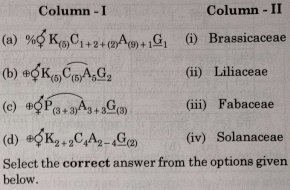
A
$(iii)- (iv) -(ii)- (i)$
B
$(i) -(ii) -(iii) -(iv)$
C
$(i) -(ii) -(iii) -(iv)$
D
$(iv)- (ii) -(i) -(iii)$
0 likesView Solution
22
BiologyMediumMCQNEET · 2021
Which of the following statements is incorrect?
A
Both $ATP$ and $NADPH + H^+$ are synthesized during non-cyclic photophosphorylation.
B
Stroma lamellae have $PS-I$ only and lack $NADP$ reductase.
C
Grana lamellae have both $PS-I$ and $PS-II$.
D
Cyclic photophosphorylation involves both $PS-I$ and $PS-II$.
Solution
(D) In non-cyclic photophosphorylation,both $PS-II$ and $PS-I$ work in series,resulting in the production of both $ATP$ and $NADPH + H^+$.
Stroma lamellae lack $PS-II$ and $NADP$ reductase enzyme,so they only perform cyclic photophosphorylation involving $PS-I$.
Grana lamellae contain both $PS-I$ and $PS-II$,allowing for non-cyclic electron flow.
Cyclic photophosphorylation involves only $PS-I$,not $PS-II$. Therefore,the statement that cyclic photophosphorylation involves both $PS-I$ and $PS-II$ is incorrect.
Stroma lamellae lack $PS-II$ and $NADP$ reductase enzyme,so they only perform cyclic photophosphorylation involving $PS-I$.
Grana lamellae contain both $PS-I$ and $PS-II$,allowing for non-cyclic electron flow.
Cyclic photophosphorylation involves only $PS-I$,not $PS-II$. Therefore,the statement that cyclic photophosphorylation involves both $PS-I$ and $PS-II$ is incorrect.
0 likesView Solution
23
BiologyMediumMCQNEET · 2021
Which of the following statements is incorrect?
A
During aerobic respiration,the role of oxygen is limited to the terminal stage.
B
In $ETC$ (Electron Transport Chain),one molecule of $NADH+H^{+}$ gives rise to $2$ $ATP$ molecules,and one $FADH_{2}$ gives rise to $3$ $ATP$ molecules.
C
$ATP$ is synthesized through complex $V$.
D
Oxidation-reduction reactions produce a proton gradient in respiration.
Solution
(B) The correct answer is $B$.
In the Electron Transport Chain $(ETC)$,the oxidation of one molecule of $NADH+H^{+}$ results in the production of $3$ $ATP$ molecules,while the oxidation of one molecule of $FADH_{2}$ results in the production of $2$ $ATP$ molecules.
Option $B$ states the reverse,making it incorrect.
Oxygen acts as the final electron acceptor at the end of the $ETC$ (terminal stage).
Complex $V$ ($ATP$ synthase) is responsible for the synthesis of $ATP$ using the proton gradient.
The proton gradient is generated by the energy released during oxidation-reduction reactions in the $ETC$.
In the Electron Transport Chain $(ETC)$,the oxidation of one molecule of $NADH+H^{+}$ results in the production of $3$ $ATP$ molecules,while the oxidation of one molecule of $FADH_{2}$ results in the production of $2$ $ATP$ molecules.
Option $B$ states the reverse,making it incorrect.
Oxygen acts as the final electron acceptor at the end of the $ETC$ (terminal stage).
Complex $V$ ($ATP$ synthase) is responsible for the synthesis of $ATP$ using the proton gradient.
The proton gradient is generated by the energy released during oxidation-reduction reactions in the $ETC$.
0 likesView Solution
24
BiologyMediumMCQNEET · 2021
Match List-$I$ with List-$II$.
Choose the correct answer from the options given below.
| List-$I$ | List-$II$ |
|---|---|
| $(a)$ Protein | $(i)$ $C=C$ double bonds |
| $(b)$ Unsaturated fatty acid | $(ii)$ Phosphodiester bonds |
| $(c)$ Nucleic acid | $(iii)$ Glycosidic bonds |
| $(d)$ Polysaccharide | $(iv)$ Peptide bonds |
Choose the correct answer from the options given below.
A
$(iv)-(i)-(ii)-(iii)$
B
$(i)-(iv)-(iii)-(ii)$
C
$(ii)-(i)-(iv)-(iii)$
D
$(iv)-(iii)-(i)-(ii)$
Solution
(A) The correct matching is as follows:
$(a)$ Protein: Proteins are polymers of amino acids linked by $(iv)$ Peptide bonds.
$(b)$ Unsaturated fatty acid: These contain one or more $(i)$ $C=C$ double bonds in their hydrocarbon chain.
$(c)$ Nucleic acid: Nucleotides in nucleic acids are linked by $(ii)$ Phosphodiester bonds.
$(d)$ Polysaccharide: Monosaccharides in polysaccharides are linked by $(iii)$ Glycosidic bonds.
Therefore,the correct sequence is $(a)-(iv), (b)-(i), (c)-(ii), (d)-(iii)$.
$(a)$ Protein: Proteins are polymers of amino acids linked by $(iv)$ Peptide bonds.
$(b)$ Unsaturated fatty acid: These contain one or more $(i)$ $C=C$ double bonds in their hydrocarbon chain.
$(c)$ Nucleic acid: Nucleotides in nucleic acids are linked by $(ii)$ Phosphodiester bonds.
$(d)$ Polysaccharide: Monosaccharides in polysaccharides are linked by $(iii)$ Glycosidic bonds.
Therefore,the correct sequence is $(a)-(iv), (b)-(i), (c)-(ii), (d)-(iii)$.
0 likesView Solution
25
BiologyMediumMCQNEET · 2021
Select the correct pair.
A
Large colorless empty cells in the epidermis of grass leaves $-$ Subsidiary cells
B
In dicot leaves,vascular bundles are surrounded by large thick-walled cells $-$ Conjunctive tissue
C
Cells of medullary rays that form part of cambial ring $-$ Interfascicular cambium
D
Loose parenchyma cells rupturing the epidermis and forming a lens-shaped opening in bark $-$ Spongy parenchyma
Solution
(C) Option $A$ is incorrect because large colorless empty cells in the epidermis of grass leaves are called Bulliform cells.
Option $B$ is incorrect because in dicot leaves,vascular bundles are surrounded by a layer of thick-walled cells called the bundle sheath,not conjunctive tissue.
Option $C$ is correct because the cells of medullary rays that become meristematic and form part of the cambial ring are known as interfascicular cambium.
Option $D$ is incorrect because loose parenchyma cells that rupture the epidermis to form lens-shaped openings in the bark are called complementary cells,which constitute lenticels.
Option $B$ is incorrect because in dicot leaves,vascular bundles are surrounded by a layer of thick-walled cells called the bundle sheath,not conjunctive tissue.
Option $C$ is correct because the cells of medullary rays that become meristematic and form part of the cambial ring are known as interfascicular cambium.
Option $D$ is incorrect because loose parenchyma cells that rupture the epidermis to form lens-shaped openings in the bark are called complementary cells,which constitute lenticels.
0 likesView Solution
26
BiologyMediumMCQNEET · 2021
Which of the following statements wrongly represents the nature of smooth muscle?
A
These muscles have no striations.
B
They are involuntary muscles.
C
Communication among the cells is performed by intercalated discs.
D
These muscles are present in the wall of blood vessels.
Solution
(C) Smooth muscles are non-striated,involuntary muscles found in the walls of internal organs such as blood vessels,the stomach,and the intestine.
Intercalated discs are specialized junctions found exclusively in cardiac muscles,which allow for rapid communication and synchronized contraction of the heart.
Therefore,the statement that communication among smooth muscle cells is performed by intercalated discs is incorrect.
Intercalated discs are specialized junctions found exclusively in cardiac muscles,which allow for rapid communication and synchronized contraction of the heart.
Therefore,the statement that communication among smooth muscle cells is performed by intercalated discs is incorrect.
0 likesView Solution
27
BiologyMediumMCQNEET · 2021
The organelles that are included in the endomembrane system are:
A
Endoplasmic reticulum,Mitochondria,Ribosomes and Lysosomes
B
Endoplasmic reticulum,Golgi complex,Lysosomes and Vacuoles
C
Golgi complex,Mitochondria,Ribosomes and Lysosomes
D
Golgi complex,Endoplasmic reticulum,Mitochondria and Lysosomes
Solution
(B) The endomembrane system consists of organelles whose functions are coordinated.
These include the Endoplasmic Reticulum $(ER)$,Golgi complex,Lysosomes,and Vacuoles.
Since the functions of the Mitochondria and Ribosomes are not coordinated with the above components,they are not considered part of the endomembrane system.
Therefore,the correct option is $B$.
These include the Endoplasmic Reticulum $(ER)$,Golgi complex,Lysosomes,and Vacuoles.
Since the functions of the Mitochondria and Ribosomes are not coordinated with the above components,they are not considered part of the endomembrane system.
Therefore,the correct option is $B$.
0 likesView Solution
28
BiologyEasyMCQNEET · 2021
Succus entericus is referred to as:
A
Pancreatic juice
B
Intestinal juice
C
Gastric juice
D
Chyme
Solution
(B) The term $Succus \ entericus$ is the scientific name for intestinal juice.
It is secreted by the glands of the small intestine,specifically the crypts of $Lieberkühn$ and Brunner's glands.
It contains a variety of enzymes such as disaccharidases (e.g.,maltase,lactase,sucrase),dipeptidases,lipases,and nucleosidases,which complete the final stages of digestion of food in the small intestine.
It is secreted by the glands of the small intestine,specifically the crypts of $Lieberkühn$ and Brunner's glands.
It contains a variety of enzymes such as disaccharidases (e.g.,maltase,lactase,sucrase),dipeptidases,lipases,and nucleosidases,which complete the final stages of digestion of food in the small intestine.
0 likesView Solution
29
BiologyEasyMCQNEET · 2021
Which one of the following belongs to the family $Muscidae$?
A
Fire fly
B
Grasshopper
C
Cockroach
D
House fly
Solution
(D) The family $Muscidae$ includes the common house fly.
$1$. The house fly,scientifically known as $Musca$ $domestica$,belongs to the family $Muscidae$ and the order $Diptera$.
$2$. Fire fly belongs to the family $Lampyridae$.
$3$. Grasshopper belongs to the family $Acrididae$.
$4$. Cockroach belongs to the family $Blattidae$.
Therefore,the correct option is $D$.
$1$. The house fly,scientifically known as $Musca$ $domestica$,belongs to the family $Muscidae$ and the order $Diptera$.
$2$. Fire fly belongs to the family $Lampyridae$.
$3$. Grasshopper belongs to the family $Acrididae$.
$4$. Cockroach belongs to the family $Blattidae$.
Therefore,the correct option is $D$.
0 likesView Solution
30
BiologyMediumMCQNEET · 2021
The centriole undergoes duplication during:
A
$S-$phase
B
Prophase
C
Metaphase
D
$G_{2}$ phase
Solution
(A) In animal cells,the centriole is a crucial organelle involved in the formation of the spindle apparatus during cell division.
During the $S-$phase (Synthesis phase) of the cell cycle,$DNA$ replication occurs in the nucleus.
Simultaneously,the centriole pair in the cytoplasm also undergoes duplication to ensure that each daughter cell receives a pair of centrioles.
Therefore,the correct phase for centriole duplication is the $S-$phase.
During the $S-$phase (Synthesis phase) of the cell cycle,$DNA$ replication occurs in the nucleus.
Simultaneously,the centriole pair in the cytoplasm also undergoes duplication to ensure that each daughter cell receives a pair of centrioles.
Therefore,the correct phase for centriole duplication is the $S-$phase.
0 likesView Solution
31
BiologyMediumMCQNEET · 2021
Chronic autoimmune disorder affecting the neuromuscular junction, leading to fatigue, weakening, and paralysis of skeletal muscle, is called:
A
Arthritis
B
Muscular dystrophy
C
Myasthenia gravis
D
Gout
Solution
(C) $Myasthenia \text{ } gravis$ is a chronic autoimmune disorder.
It affects the neuromuscular junction, which is the site where a motor neuron communicates with a muscle fiber.
In this condition, antibodies block or destroy the acetylcholine receptors at the neuromuscular junction.
This prevents the muscle from receiving signals from the nerve, leading to fatigue, weakening, and eventually paralysis of the skeletal muscles.
It affects the neuromuscular junction, which is the site where a motor neuron communicates with a muscle fiber.
In this condition, antibodies block or destroy the acetylcholine receptors at the neuromuscular junction.
This prevents the muscle from receiving signals from the nerve, leading to fatigue, weakening, and eventually paralysis of the skeletal muscles.
0 likesView Solution
32
BiologyMediumMCQNEET · 2021
Match List-$I$ with List-$II$.
Choose the correct answer from the options given below.
| List-$I$ | List-$II$ |
| $(a)$ Metamerism | $(i)$ Coelenterata |
| $(b)$ Canal system | $(ii)$ Ctenophora |
| $(c)$ Comb plates | $(iii)$ Annelida |
| $(d)$ Cnidoblasts | $(iv)$ Porifera |
Choose the correct answer from the options given below.
A
$(iv)-(iii)-(i)-(ii)$
B
$(iii)-(iv)-(ii)-(i)$
C
$(iii)-(iv)-(i)-(ii)$
D
$(iv)-(i)-(ii)-(iii)$
Solution
(B) The correct matches are as follows:
$(a)$ Metamerism is a characteristic feature of the phylum Annelida $(iii)$.
$(b)$ Canal system (water transport system) is a characteristic feature of the phylum Porifera $(iv)$.
$(c)$ Comb plates are present in the phylum Ctenophora $(ii)$ to help in locomotion.
$(d)$ Cnidoblasts (stinging cells) are characteristic of the phylum Coelenterata (Cnidaria) $(i)$.
Therefore,the correct sequence is $(a)-(iii), (b)-(iv), (c)-(ii), (d)-(i)$.
$(a)$ Metamerism is a characteristic feature of the phylum Annelida $(iii)$.
$(b)$ Canal system (water transport system) is a characteristic feature of the phylum Porifera $(iv)$.
$(c)$ Comb plates are present in the phylum Ctenophora $(ii)$ to help in locomotion.
$(d)$ Cnidoblasts (stinging cells) are characteristic of the phylum Coelenterata (Cnidaria) $(i)$.
Therefore,the correct sequence is $(a)-(iii), (b)-(iv), (c)-(ii), (d)-(i)$.
0 likesView Solution
33
BiologyMediumMCQNEET · 2021
Read the following statements.
$(a)$ Metagenesis is observed in Helminths.
$(b)$ Echinoderms are triploblastic and coelomate animals.
$(c)$ Round worms have organ-system level of body organization.
$(d)$ Comb plates present in ctenophores help in digestion.
$(e)$ Water vascular system is characteristic of Echinoderms.
Choose the correct answer from the options given below.
$(a)$ Metagenesis is observed in Helminths.
$(b)$ Echinoderms are triploblastic and coelomate animals.
$(c)$ Round worms have organ-system level of body organization.
$(d)$ Comb plates present in ctenophores help in digestion.
$(e)$ Water vascular system is characteristic of Echinoderms.
Choose the correct answer from the options given below.
A
$(c), (d)$ and $(e)$ are correct
B
$(a), (b)$ and $(c)$ are correct
C
$(a), (d)$ and $(e)$ are correct
D
$(b), (c)$ and $(e)$ are correct
Solution
(D) Statement $(a)$ is incorrect because Metagenesis is observed in Cnidarians (e.g.,Obelia),not in Helminths.
Statement $(b)$ is correct because Echinoderms are triploblastic and coelomate animals.
Statement $(c)$ is correct because Round worms (Aschelminthes) exhibit organ-system level of body organization.
Statement $(d)$ is incorrect because comb plates in Ctenophores help in locomotion,not digestion.
Statement $(e)$ is correct because the water vascular system is a unique characteristic feature of Echinoderms.
Therefore,statements $(b), (c),$ and $(e)$ are correct.
Statement $(b)$ is correct because Echinoderms are triploblastic and coelomate animals.
Statement $(c)$ is correct because Round worms (Aschelminthes) exhibit organ-system level of body organization.
Statement $(d)$ is incorrect because comb plates in Ctenophores help in locomotion,not digestion.
Statement $(e)$ is correct because the water vascular system is a unique characteristic feature of Echinoderms.
Therefore,statements $(b), (c),$ and $(e)$ are correct.
0 likesView Solution
34
BiologyMediumMCQNEET · 2021
The fruit fly has $8$ chromosomes $(2n)$ in each cell. During interphase of mitosis,if the number of chromosomes at $G_1$ phase is $8$,what would be the number of chromosomes after $S$ phase?
A
$8$
B
$16$
C
$4$
D
$32$
Solution
(A) In the cell cycle,the $S$ phase (Synthesis phase) is characterized by the replication of $DNA$.
During this phase,the amount of $DNA$ per cell doubles (from $2C$ to $4C$),but the number of chromosomes remains the same.
Since the number of chromosomes at the $G_1$ phase is $8$,after the $S$ phase,the number of chromosomes remains $8$ because the sister chromatids remain attached at the centromere.
Therefore,the correct answer is $8$.
During this phase,the amount of $DNA$ per cell doubles (from $2C$ to $4C$),but the number of chromosomes remains the same.
Since the number of chromosomes at the $G_1$ phase is $8$,after the $S$ phase,the number of chromosomes remains $8$ because the sister chromatids remain attached at the centromere.
Therefore,the correct answer is $8$.
0 likesView Solution
35
BiologyEasyMCQNEET · 2021
Sphincter of Oddi is present at:
A
Ileo-caecal junction
B
Junction of hepato-pancreatic duct and duodenum
C
Gastro-oesophageal junction
D
Junction of jejunum and duodenum
Solution
(B) The Sphincter of Oddi (also known as the hepato-pancreatic sphincter) is a muscular valve that controls the flow of digestive juices (bile and pancreatic juice) through the ampulla of Vater into the duodenum.
It is located at the junction where the hepato-pancreatic duct opens into the duodenum.
Therefore,the correct option is $B$.
It is located at the junction where the hepato-pancreatic duct opens into the duodenum.
Therefore,the correct option is $B$.
0 likesView Solution
36
BiologyDifficultMCQNEET · 2021
Which one of the following organisms bears hollow and pneumatic long bones?
A
Neophron
B
Hemidactylus
C
Macropus
D
Ornithorhynchus
Solution
(A) The presence of hollow and pneumatic (air-filled) long bones is a characteristic adaptation of birds (Class $Aves$) to reduce body weight for flight.
Among the given options,$Neophron$ (vulture) belongs to the class $Aves$.
$Hemidactylus$ (wall lizard) is a reptile,$Macropus$ (kangaroo) is a mammal,and $Ornithorhynchus$ (platypus) is a monotreme mammal. None of these possess pneumatic bones.
Among the given options,$Neophron$ (vulture) belongs to the class $Aves$.
$Hemidactylus$ (wall lizard) is a reptile,$Macropus$ (kangaroo) is a mammal,and $Ornithorhynchus$ (platypus) is a monotreme mammal. None of these possess pneumatic bones.
0 likesView Solution
37
BiologyMediumMCQNEET · 2021
The partial pressures (in $mm \ Hg$) of oxygen $(O_{2})$ and carbon dioxide $(CO_{2})$ at the alveoli (the site of diffusion) are:
A
$pO_{2} = 104$ and $pCO_{2} = 40$
B
$pO_{2} = 40$ and $pCO_{2} = 45$
C
$pO_{2} = 95$ and $pCO_{2} = 40$
D
$pO_{2} = 159$ and $pCO_{2} = 0.3$
Solution
(A) In the human respiratory system,the exchange of gases occurs at the alveoli by simple diffusion based on pressure gradients.
At the alveoli,the partial pressure of oxygen $(pO_{2})$ is $104 \ mm \ Hg$.
The partial pressure of carbon dioxide $(pCO_{2})$ at the alveoli is $40 \ mm \ Hg$.
These values facilitate the diffusion of $O_{2}$ from the alveoli into the blood and $CO_{2}$ from the blood into the alveoli.
At the alveoli,the partial pressure of oxygen $(pO_{2})$ is $104 \ mm \ Hg$.
The partial pressure of carbon dioxide $(pCO_{2})$ at the alveoli is $40 \ mm \ Hg$.
These values facilitate the diffusion of $O_{2}$ from the alveoli into the blood and $CO_{2}$ from the blood into the alveoli.
0 likesView Solution
38
BiologyMediumMCQNEET · 2021
Select the favourable conditions required for the formation of oxyhaemoglobin at the alveoli.
A
High $pO_{2}$,low $pCO_{2}$,less $H^{+}$,lower temperature
B
Low $pO_{2}$,high $pCO_{2}$,more $H^{+}$,higher temperature
C
High $pO_{2}$,high $pCO_{2}$,less $H^{+}$,higher temperature
D
Low $pO_{2}$,low $pCO_{2}$,more $H^{+}$,higher temperature
Solution
(A) In the alveoli,the partial pressure of oxygen $(pO_{2})$ is high and the partial pressure of carbon dioxide $(pCO_{2})$ is low.
These conditions are ideal for the binding of oxygen with haemoglobin to form oxyhaemoglobin.
Additionally,lower concentrations of $H^{+}$ ions (higher $pH$) and lower temperatures further promote the association of oxygen with haemoglobin.
Therefore,the conditions at the alveoli are high $pO_{2}$,low $pCO_{2}$,less $H^{+}$,and lower temperature.
These conditions are ideal for the binding of oxygen with haemoglobin to form oxyhaemoglobin.
Additionally,lower concentrations of $H^{+}$ ions (higher $pH$) and lower temperatures further promote the association of oxygen with haemoglobin.
Therefore,the conditions at the alveoli are high $pO_{2}$,low $pCO_{2}$,less $H^{+}$,and lower temperature.
0 likesView Solution
39
BiologyMediumMCQNEET · 2021
Match the following:
Choose the correct answer from the options given below.
| List-$I$ | List-$II$ |
|---|---|
| $(a)$ Physalia | $(i)$ Pearl oyster |
| $(b)$ Limulus | $(ii)$ Portuguese Man of War |
| $(c)$ Ancylostoma | $(iii)$ Living fossil |
| $(d)$ Pinctada | $(iv)$ Hookworm |
Choose the correct answer from the options given below.
A
$(ii)-(iii)-(i)-(iv)$
B
$(iv)-(i)-(iii)-(ii)$
C
$(ii)-(iii)-(iv)-(i)$
D
$(i)-(iv)-(iii)-(ii)$
Solution
(C) The correct matches are as follows:
$1$. $(a)$ Physalia is commonly known as the Portuguese Man of War.
$2$. $(b)$ Limulus is known as the King crab,which is a living fossil.
$3$. $(c)$ Ancylostoma is commonly known as the Hookworm.
$4$. $(d)$ Pinctada is commonly known as the Pearl oyster.
Therefore,the correct matching is $(a)-(ii), (b)-(iii), (c)-(iv), (d)-(i)$.
Thus,the correct option is $C$.
$1$. $(a)$ Physalia is commonly known as the Portuguese Man of War.
$2$. $(b)$ Limulus is known as the King crab,which is a living fossil.
$3$. $(c)$ Ancylostoma is commonly known as the Hookworm.
$4$. $(d)$ Pinctada is commonly known as the Pearl oyster.
Therefore,the correct matching is $(a)-(ii), (b)-(iii), (c)-(iv), (d)-(i)$.
Thus,the correct option is $C$.
0 likesView Solution
40
BiologyEasyMCQNEET · 2021
Which enzyme is responsible for the conversion of inactive fibrinogens to fibrins?
A
Thrombin
B
Renin
C
Epinephrine
D
Thrombokinase
Solution
(A) During the process of blood coagulation,an injury or trauma stimulates the release of factors that activate a cascade of reactions.
$1$. The enzyme $Thrombin$ is formed from inactive $Prothrombin$ in the presence of the enzyme complex $Thrombokinase$.
$2$. $Thrombin$ then acts as a catalyst to convert the inactive,soluble plasma protein $Fibrinogen$ into insoluble $Fibrin$ threads.
$3$. These $Fibrin$ threads form a network that traps blood cells to form a clot.
Therefore,the correct enzyme responsible for the conversion of $Fibrinogen$ to $Fibrin$ is $Thrombin$.
$1$. The enzyme $Thrombin$ is formed from inactive $Prothrombin$ in the presence of the enzyme complex $Thrombokinase$.
$2$. $Thrombin$ then acts as a catalyst to convert the inactive,soluble plasma protein $Fibrinogen$ into insoluble $Fibrin$ threads.
$3$. These $Fibrin$ threads form a network that traps blood cells to form a clot.
Therefore,the correct enzyme responsible for the conversion of $Fibrinogen$ to $Fibrin$ is $Thrombin$.
0 likesView Solution
41
BiologyMediumMCQNEET · 2021
Identify the incorrect pair.
A
Alkaloids $-$ Codeine
B
Toxin $-$ Abrin
C
Lectins $-$ Concanavalin $A$
D
Drugs $-$ Ricin
Solution
(D) Secondary metabolites are chemical compounds produced by plants,fungi,or microbes that are not essential for basic survival but provide ecological advantages.
$1$. Alkaloids include compounds like Codeine and Morphine.
$2$. Toxins include Abrin and Ricin.
$3$. Lectins include Concanavalin $A$.
$4$. Drugs include Vinblastine and Curcumin.
In the given options,Ricin is classified as a Toxin,not a Drug. Therefore,the pair 'Drugs $-$ Ricin' is incorrect.
$1$. Alkaloids include compounds like Codeine and Morphine.
$2$. Toxins include Abrin and Ricin.
$3$. Lectins include Concanavalin $A$.
$4$. Drugs include Vinblastine and Curcumin.
In the given options,Ricin is classified as a Toxin,not a Drug. Therefore,the pair 'Drugs $-$ Ricin' is incorrect.
0 likesView Solution
42
BiologyEasyMCQNEET · 2021
Which stage of meiotic prophase shows terminalisation of chiasmata as its distinctive feature?
A
Leptotene
B
Zygotene
C
Diakinesis
D
Pachytene
Solution
(C) The prophase of meiosis-$I$ is divided into five sub-stages: $Leptotene$, $Zygotene$, $Pachytene$, $Diplotene$, and $Diakinesis$.
$1$. $Leptotene$: Chromosomes become visible as compact threads.
$2$. $Zygotene$: Synapsis occurs between homologous chromosomes.
$3$. $Pachytene$: Crossing over takes place between non-sister chromatids.
$4$. $Diplotene$: The dissolution of the synaptonemal complex occurs, and homologous chromosomes separate except at the sites of crossovers, forming $Chiasmata$.
$5$. $Diakinesis$: This is the final stage of meiotic prophase-$I$. The distinctive feature of this stage is the $terminalisation$ of $chiasmata$. The chromosomes are fully condensed, and the meiotic spindle is assembled to prepare the homologous chromosomes for separation.
$1$. $Leptotene$: Chromosomes become visible as compact threads.
$2$. $Zygotene$: Synapsis occurs between homologous chromosomes.
$3$. $Pachytene$: Crossing over takes place between non-sister chromatids.
$4$. $Diplotene$: The dissolution of the synaptonemal complex occurs, and homologous chromosomes separate except at the sites of crossovers, forming $Chiasmata$.
$5$. $Diakinesis$: This is the final stage of meiotic prophase-$I$. The distinctive feature of this stage is the $terminalisation$ of $chiasmata$. The chromosomes are fully condensed, and the meiotic spindle is assembled to prepare the homologous chromosomes for separation.
0 likesView Solution
43
BiologyEasyMCQNEET · 2021
Persons with $AB$ blood group are called as "Universal recipients". This is due to:
A
Absence of antigens $A$ and $B$ on the surface of $RBCs$
B
Absence of antigens $A$ and $B$ in plasma
C
Presence of antibodies, anti-$A$ and anti-$B$, on $RBCs$
D
Absence of antibodies, anti-$A$ and anti-$B$, in plasma
Solution
(D) In the $ABO$ blood grouping system, individuals with $AB$ blood group possess both $A$ and $B$ antigens on the surface of their $RBCs$.
Because their own immune system recognizes both $A$ and $B$ antigens as 'self', they do not produce anti-$A$ or anti-$B$ antibodies in their blood plasma.
Consequently, they can receive blood from individuals with $A$, $B$, $AB$, or $O$ blood types without triggering an immune reaction (agglutination).
Therefore, they are known as "Universal recipients" due to the absence of anti-$A$ and anti-$B$ antibodies in their plasma.
Because their own immune system recognizes both $A$ and $B$ antigens as 'self', they do not produce anti-$A$ or anti-$B$ antibodies in their blood plasma.
Consequently, they can receive blood from individuals with $A$, $B$, $AB$, or $O$ blood types without triggering an immune reaction (agglutination).
Therefore, they are known as "Universal recipients" due to the absence of anti-$A$ and anti-$B$ antibodies in their plasma.
0 likesView Solution
44
BiologyMediumMCQNEET · 2021
Erythropoietin hormone which stimulates $R.B.C.$ formation is produced by :
A
Alpha cells of pancreas
B
The cells of rostral adenohypophysis
C
The cells of bone marrow
D
Juxtaglomerular cells of the kidney
Solution
(D) Erythropoietin is a glycoprotein hormone that plays a crucial role in erythropoiesis,which is the production of red blood cells $(R.B.C.)$.
This hormone is primarily synthesized and secreted by the juxtaglomerular cells (specifically the interstitial fibroblasts) of the kidney in response to hypoxia or low oxygen levels in the blood.
Once released into the bloodstream,it travels to the bone marrow,where it stimulates the differentiation and proliferation of erythroid progenitor cells into mature red blood cells.
Therefore,the correct answer is the juxtaglomerular cells of the kidney.
This hormone is primarily synthesized and secreted by the juxtaglomerular cells (specifically the interstitial fibroblasts) of the kidney in response to hypoxia or low oxygen levels in the blood.
Once released into the bloodstream,it travels to the bone marrow,where it stimulates the differentiation and proliferation of erythroid progenitor cells into mature red blood cells.
Therefore,the correct answer is the juxtaglomerular cells of the kidney.
0 likesView Solution
45
BiologyMediumMCQNEET · 2021
Which of the following characteristics is incorrect with respect to the cockroach?
A
$A$ ring of gastric caeca is present at the junction of midgut and hindgut.
B
Hypopharynx lies within the cavity enclosed by the mouthparts.
C
In females,$7^{\text{th}}-9^{\text{th}}$ sterna together form a genital pouch.
D
$10^{\text{th}}$ abdominal segment in both sexes bears a pair of anal cerci.
Solution
(A) The correct answer is $A$.
In cockroaches,a ring of $6-8$ blind tubules called hepatic or gastric caeca is present at the junction of the foregut and midgut,not the midgut and hindgut.
Option $B$ is correct: The hypopharynx acts as a tongue and lies within the cavity enclosed by the mouthparts.
Option $C$ is correct: In female cockroaches,the $7^{\text{th}}$ sternum is boat-shaped and together with the $8^{\text{th}}$ and $9^{\text{th}}$ sterna forms a brood or genital pouch.
Option $D$ is correct: The $10^{\text{th}}$ abdominal segment in both male and female cockroaches bears a pair of jointed filamentous structures called anal cerci.
In cockroaches,a ring of $6-8$ blind tubules called hepatic or gastric caeca is present at the junction of the foregut and midgut,not the midgut and hindgut.
Option $B$ is correct: The hypopharynx acts as a tongue and lies within the cavity enclosed by the mouthparts.
Option $C$ is correct: In female cockroaches,the $7^{\text{th}}$ sternum is boat-shaped and together with the $8^{\text{th}}$ and $9^{\text{th}}$ sterna forms a brood or genital pouch.
Option $D$ is correct: The $10^{\text{th}}$ abdominal segment in both male and female cockroaches bears a pair of jointed filamentous structures called anal cerci.
0 likesView Solution
46
BiologyMediumMCQNEET · 2021
Following are the statements with reference to 'lipids'.
$(a)$ Lipids having only single bonds are called unsaturated fatty acids.
$(b)$ Lecithin is a phospholipid.
$(c)$ Trihydroxy propane is glycerol.
$(d)$ Palmitic acid has $20$ carbon atoms including carboxyl carbon.
$(e)$ Arachidonic acid has $16$ carbon atoms.
Choose the correct answer from the options given below.
$(a)$ Lipids having only single bonds are called unsaturated fatty acids.
$(b)$ Lecithin is a phospholipid.
$(c)$ Trihydroxy propane is glycerol.
$(d)$ Palmitic acid has $20$ carbon atoms including carboxyl carbon.
$(e)$ Arachidonic acid has $16$ carbon atoms.
Choose the correct answer from the options given below.
A
$(a)$ and $(b)$ only
B
$(c)$ and $(d)$ only
C
$(b)$ and $(c)$ only
D
$(b)$ and $(e)$ only
Solution
(C) Let us analyze each statement:
$(a)$ Lipids having only single bonds are called saturated fatty acids,not unsaturated. Thus,statement $(a)$ is incorrect.
$(b)$ Lecithin is a well-known phospholipid found in cell membranes. Thus,statement $(b)$ is correct.
$(c)$ Glycerol is chemically known as trihydroxy propane $(CH_2OH-CHOH-CH_2OH)$. Thus,statement $(c)$ is correct.
$(d)$ Palmitic acid has $16$ carbon atoms,not $20$. Thus,statement $(d)$ is incorrect.
$(e)$ Arachidonic acid has $20$ carbon atoms,not $16$. Thus,statement $(e)$ is incorrect.
Therefore,statements $(b)$ and $(c)$ are correct.
$(a)$ Lipids having only single bonds are called saturated fatty acids,not unsaturated. Thus,statement $(a)$ is incorrect.
$(b)$ Lecithin is a well-known phospholipid found in cell membranes. Thus,statement $(b)$ is correct.
$(c)$ Glycerol is chemically known as trihydroxy propane $(CH_2OH-CHOH-CH_2OH)$. Thus,statement $(c)$ is correct.
$(d)$ Palmitic acid has $16$ carbon atoms,not $20$. Thus,statement $(d)$ is incorrect.
$(e)$ Arachidonic acid has $20$ carbon atoms,not $16$. Thus,statement $(e)$ is incorrect.
Therefore,statements $(b)$ and $(c)$ are correct.
0 likesView Solution
47
BiologyMediumMCQNEET · 2021
Identify the types of cell junctions that help to stop the leakage of the substances across a tissue and facilitation of communication with neighbouring cells via rapid transfer of ions and molecules.
A
Gap junctions and Adhering junctions,respectively.
B
Tight junctions and Gap junctions,respectively.
C
Adhering junctions and Tight junctions,respectively.
D
Adhering junctions and Gap junctions,respectively.
Solution
(B) $1$. Tight junctions: These junctions help to stop the leakage of substances across a tissue by forming a seal between adjacent cells.
$2$. Adhering junctions: These perform cementing to keep neighbouring cells together.
$3$. Gap junctions: These facilitate communication between neighbouring cells by connecting the cytoplasm of adjoining cells,allowing for the rapid transfer of ions,small molecules,and sometimes big molecules.
Therefore,the correct sequence is Tight junctions and Gap junctions.
$2$. Adhering junctions: These perform cementing to keep neighbouring cells together.
$3$. Gap junctions: These facilitate communication between neighbouring cells by connecting the cytoplasm of adjoining cells,allowing for the rapid transfer of ions,small molecules,and sometimes big molecules.
Therefore,the correct sequence is Tight junctions and Gap junctions.
0 likesView Solution
48
BiologyMediumMCQNEET · 2021
During muscular contraction,which of the following events occur?
$(a)$ $'H'$ zone disappears
$(b)$ $'A'$ band widens
$(c)$ $'I'$ band reduces in width
$(d)$ Myosin hydrolyzes $ATP$,releasing the $ADP$ and $Pi$
$(e)$ $Z$-lines attached to actins are pulled inwards
Choose the correct answer from the options given below.
$(a)$ $'H'$ zone disappears
$(b)$ $'A'$ band widens
$(c)$ $'I'$ band reduces in width
$(d)$ Myosin hydrolyzes $ATP$,releasing the $ADP$ and $Pi$
$(e)$ $Z$-lines attached to actins are pulled inwards
Choose the correct answer from the options given below.
A
$(a), (c), (d), (e)$ only
B
$(a), (b), (c), (d)$ only
C
$(b), (c), (d), (e)$ only
D
$(b), (d), (e), (a)$ only
Solution
(A) According to the sliding filament theory of muscle contraction:
$1$. The $'H'$ zone disappears as actin filaments slide over myosin filaments.
$2$. The $'A'$ band (anisotropic band) retains its length because it represents the length of the myosin filaments,which do not shorten.
$3$. The $'I'$ band (isotropic band) reduces in width as actin filaments are pulled towards the center of the sarcomere.
$4$. Myosin heads hydrolyze $ATP$ to $ADP$ and $Pi$,providing energy for the power stroke.
$5$. The $Z$-lines attached to actin filaments are pulled inwards towards the center of the sarcomere,shortening the sarcomere.
Therefore,events $(a), (c), (d),$ and $(e)$ are correct.
$1$. The $'H'$ zone disappears as actin filaments slide over myosin filaments.
$2$. The $'A'$ band (anisotropic band) retains its length because it represents the length of the myosin filaments,which do not shorten.
$3$. The $'I'$ band (isotropic band) reduces in width as actin filaments are pulled towards the center of the sarcomere.
$4$. Myosin heads hydrolyze $ATP$ to $ADP$ and $Pi$,providing energy for the power stroke.
$5$. The $Z$-lines attached to actin filaments are pulled inwards towards the center of the sarcomere,shortening the sarcomere.
Therefore,events $(a), (c), (d),$ and $(e)$ are correct.
0 likesView Solution
49
BiologyMediumMCQNEET · 2021
Following are the statements about the prostomium of an earthworm.
$(a)$ It serves as a covering for the mouth.
$(b)$ It helps to open cracks in the soil into which it can crawl.
$(c)$ It is one of the sensory structures.
$(d)$ It is the first body segment.
Choose the correct answer from the options given below.
$(a)$ It serves as a covering for the mouth.
$(b)$ It helps to open cracks in the soil into which it can crawl.
$(c)$ It is one of the sensory structures.
$(d)$ It is the first body segment.
Choose the correct answer from the options given below.
A
$(a), (b)$ and $(c)$ are correct
B
$(a), (b)$ and $(d)$ are correct
C
$(a), (b), (c)$ and $(d)$ are correct
D
$(b)$ and $(c)$ are correct
Solution
(A) The prostomium is a small fleshy lobe that overhangs the mouth of an earthworm.
Statement $(a)$ is correct as it acts as a covering for the mouth.
Statement $(b)$ is correct as it is used as a wedge to force open cracks in the soil.
Statement $(c)$ is correct as the prostomium is sensory in function.
Statement $(d)$ is incorrect because the first body segment of the earthworm is the peristomium (or buccal segment),not the prostomium. The prostomium is a pre-oral lobe located anterior to the first segment.
Therefore,statements $(a), (b)$ and $(c)$ are correct.
Statement $(a)$ is correct as it acts as a covering for the mouth.
Statement $(b)$ is correct as it is used as a wedge to force open cracks in the soil.
Statement $(c)$ is correct as the prostomium is sensory in function.
Statement $(d)$ is incorrect because the first body segment of the earthworm is the peristomium (or buccal segment),not the prostomium. The prostomium is a pre-oral lobe located anterior to the first segment.
Therefore,statements $(a), (b)$ and $(c)$ are correct.
0 likesView Solution
50
BiologyMediumMCQNEET · 2021
Assertion $(A):$ $A$ person goes to high altitude and experiences 'altitude sickness' with symptoms like breathing difficulty and heart palpitations.
Reason $(R):$ Due to low atmospheric pressure at high altitude,the body does not get sufficient oxygen.
In the light of the above statements,choose the correct answer from the options given below.
Reason $(R):$ Due to low atmospheric pressure at high altitude,the body does not get sufficient oxygen.
In the light of the above statements,choose the correct answer from the options given below.
A
Both $(A)$ and $(R)$ are true and $(R)$ is the correct explanation of $(A)$
B
Both $(A)$ and $(R)$ are true but $(R)$ is not the correct explanation of $(A)$
C
$(A)$ is true but $(R)$ is false
D
$(A)$ is false but $(R)$ is true
Solution
(A) At high altitudes,the atmospheric pressure decreases,which leads to a decrease in the partial pressure of oxygen $(pO_2)$.
Because of this low $pO_2$,the body does not get sufficient oxygen,leading to symptoms of 'altitude sickness' such as nausea,fatigue,heart palpitations,and breathing difficulty.
Therefore,both the Assertion $(A)$ and the Reason $(R)$ are true,and $(R)$ is the correct explanation of $(A)$.
Because of this low $pO_2$,the body does not get sufficient oxygen,leading to symptoms of 'altitude sickness' such as nausea,fatigue,heart palpitations,and breathing difficulty.
Therefore,both the Assertion $(A)$ and the Reason $(R)$ are true,and $(R)$ is the correct explanation of $(A)$.
0 likesView Solution
51
BiologyMediumMCQNEET · 2021
Match List-$I$ with List-$II$.
Choose the correct answer from the options given below.
| List-$I$ | List-$II$ |
| $(a)$ Protoplast fusion | $(i)$ Totipotency |
| $(b)$ Plant tissue culture | $(ii)$ Pomato |
| $(c)$ Meristem culture | $(iii)$ Somaclones |
| $(d)$ Micropropagation | $(iv)$ Virus-free plants |
Choose the correct answer from the options given below.
A
$(iii), (iv), (ii), (i)$
B
$(ii), (i), (iv), (iii)$
C
$(iii), (iv), (i), (ii)$
D
$(iv), (iii), (ii), (i)$
Solution
(B) Protoplast fusion: The fusion of protoplasts from two different plant species results in somatic hybrids,such as the 'Pomato' (a hybrid of potato and tomato). Thus,$(a)-(ii)$.
$(b)$ Plant tissue culture: This technique relies on the capacity of a plant cell to regenerate a whole plant,known as totipotency. Thus,$(b)-(i)$.
$(c)$ Meristem culture: Meristems are free from viruses even in infected plants. Therefore,culturing meristems is used to produce virus-free plants. Thus,$(c)-(iv)$.
$(d)$ Micropropagation: This method is used to produce thousands of plants in a short time,which are genetically identical to the original plant,known as somaclones. Thus,$(d)-(iii)$.
The correct matching is $(a)-(ii), (b)-(i), (c)-(iv), (d)-(iii)$.
$(b)$ Plant tissue culture: This technique relies on the capacity of a plant cell to regenerate a whole plant,known as totipotency. Thus,$(b)-(i)$.
$(c)$ Meristem culture: Meristems are free from viruses even in infected plants. Therefore,culturing meristems is used to produce virus-free plants. Thus,$(c)-(iv)$.
$(d)$ Micropropagation: This method is used to produce thousands of plants in a short time,which are genetically identical to the original plant,known as somaclones. Thus,$(d)-(iii)$.
The correct matching is $(a)-(ii), (b)-(i), (c)-(iv), (d)-(iii)$.
0 likesView Solution
52
BiologyMediumMCQNEET · 2021
In the equation $GPP - R = NPP$,what does $R$ represent?
A
Radiant energy
B
Respiration losses
C
Environmental factors
D
Retardation factors
Solution
(B) In the study of ecosystem productivity,$GPP$ stands for Gross Primary Productivity,which is the total rate of production of organic matter during photosynthesis.
$NPP$ stands for Net Primary Productivity,which is the amount of biomass available for consumption by heterotrophs.
$R$ represents the respiration losses,which is the energy used by plants for their own metabolic activities.
The relationship is defined as $NPP = GPP - R$.
$NPP$ stands for Net Primary Productivity,which is the amount of biomass available for consumption by heterotrophs.
$R$ represents the respiration losses,which is the energy used by plants for their own metabolic activities.
The relationship is defined as $NPP = GPP - R$.
0 likesView Solution
53
BiologyMediumMCQNEET · 2021
Which of the following factors causes a population to experience the founder effect?
A
Natural selection
B
Genetic recombination
C
Genetic drift
D
Mutation
Solution
(C) The founder effect is a phenomenon that occurs when a small group of individuals breaks off from a larger population to establish a new colony.
Because the new group is small,it does not possess the full genetic diversity of the original population.
This change in allele frequencies due to chance events in a small population is a specific type of $Genetic \ drift$.
Therefore,$Genetic \ drift$ is the primary factor responsible for the founder effect.
Because the new group is small,it does not possess the full genetic diversity of the original population.
This change in allele frequencies due to chance events in a small population is a specific type of $Genetic \ drift$.
Therefore,$Genetic \ drift$ is the primary factor responsible for the founder effect.
2 likesView Solution
54
BiologyMediumMCQNEET · 2021
How can interspecific parasitism be represented?
A
Species $A (+);$ Species $B (+)$
B
Species $A (-);$ Species $B (0)$
C
Species $A (-);$ Species $B (-)$
D
Species $A (+);$ Species $B (-)$
Solution
(D) Interspecific parasitism is a type of interaction where one species (the parasite) benefits while the other species (the host) is harmed.
In this interaction,the parasite $(A)$ gains nutrition and shelter,represented by a positive sign $(+)$.
The host $(B)$ is harmed because it loses nutrients and may suffer from diseases or reduced fitness,represented by a negative sign $(-)$.
Therefore,parasitism is represented as Species $A (+)$ and Species $B (-)$.
In this interaction,the parasite $(A)$ gains nutrition and shelter,represented by a positive sign $(+)$.
The host $(B)$ is harmed because it loses nutrients and may suffer from diseases or reduced fitness,represented by a negative sign $(-)$.
Therefore,parasitism is represented as Species $A (+)$ and Species $B (-)$.
0 likesView Solution
55
BiologyMediumMCQNEET · 2021
Which of the following describes a typical mature angiosperm embryo sac?
A
$7$-nucleate and $8$-celled
B
$8$-nucleate and $7$-celled
C
$7$-nucleate and $7$-celled
D
$8$-nucleate and $8$-celled
Solution
(B) typical mature angiosperm embryo sac (Polygonum type) is $8$-nucleate and $7$-celled.
It consists of:
$1$. Three antipodal cells at the chalazal end.
$2$. Two synergids and one egg cell (egg apparatus) at the micropylar end.
$3$. One large central cell containing two polar nuclei,which later fuse to form a single diploid secondary nucleus.
Thus,there are $8$ nuclei in total,but they are organized into $7$ cells.
It consists of:
$1$. Three antipodal cells at the chalazal end.
$2$. Two synergids and one egg cell (egg apparatus) at the micropylar end.
$3$. One large central cell containing two polar nuclei,which later fuse to form a single diploid secondary nucleus.
Thus,there are $8$ nuclei in total,but they are organized into $7$ cells.
1 likesView Solution
56
BiologyMediumMCQNEET · 2021
In the purification process of recombinant $DNA$ technology,what does the addition of chilled ethanol precipitate?
A
$RNA$
B
$DNA$
C
Histones
D
Polysaccharides
Solution
(B) In the process of recombinant $DNA$ technology,the isolation of genetic material involves the removal of unwanted cellular components like proteins,$RNA$,and polysaccharides using specific enzymes.
Once the purified $DNA$ is obtained in the solution,it is precipitated by adding chilled ethanol.
This process results in the appearance of $DNA$ as a collection of fine threads in the suspension,which can be removed by spooling.
Once the purified $DNA$ is obtained in the solution,it is precipitated by adding chilled ethanol.
This process results in the appearance of $DNA$ as a collection of fine threads in the suspension,which can be removed by spooling.
0 likesView Solution
57
BiologyMediumMCQNEET · 2021
Which term is used for the transfer of pollen grains from the anther of one plant to the stigma of a different plant,where genetically different types of pollen grains are brought to the stigma during pollination?
A
Geitonogamy
B
Xenogamy
C
Chasmogamy
D
Cleistogamy
Solution
(B) The transfer of pollen grains from the anther to the stigma of a different plant is known as $Xenogamy$ (cross-pollination).
In $Xenogamy$,the pollen grains come from a genetically different plant,which leads to the introduction of genetic variation in the offspring.
$Geitonogamy$ involves the transfer of pollen grains from the anther to the stigma of another flower on the same plant,which is genetically similar to autogamy.
$Chasmogamy$ and $Cleistogamy$ refer to the state of the flower (open or closed) during pollination,not the genetic source of the pollen.
In $Xenogamy$,the pollen grains come from a genetically different plant,which leads to the introduction of genetic variation in the offspring.
$Geitonogamy$ involves the transfer of pollen grains from the anther to the stigma of another flower on the same plant,which is genetically similar to autogamy.
$Chasmogamy$ and $Cleistogamy$ refer to the state of the flower (open or closed) during pollination,not the genetic source of the pollen.
0 likesView Solution
58
BiologyMediumMCQNEET · 2021
Which of the following plants is monoecious?
A
Carica papaya
B
Marchantia polymorpha
C
Chara
D
Cycas circinalis
Solution
(C) monoecious plant is one that bears both male and female reproductive structures on the same individual plant.
In the given options:
$1$. $Carica$ $papaya$ (Papaya) is dioecious,meaning male and female flowers are on separate plants.
$2$. $Marchantia$ $polymorpha$ is dioecious,as the male and female thalli are separate.
$3$. $Chara$ is a monoecious alga,where both the male sex organ (antheridium) and the female sex organ (oogonium) are present on the same plant body.
$4$. $Cycas$ $circinalis$ is dioecious,with male and female cones on separate plants.
Therefore,$Chara$ is the correct answer.
In the given options:
$1$. $Carica$ $papaya$ (Papaya) is dioecious,meaning male and female flowers are on separate plants.
$2$. $Marchantia$ $polymorpha$ is dioecious,as the male and female thalli are separate.
$3$. $Chara$ is a monoecious alga,where both the male sex organ (antheridium) and the female sex organ (oogonium) are present on the same plant body.
$4$. $Cycas$ $circinalis$ is dioecious,with male and female cones on separate plants.
Therefore,$Chara$ is the correct answer.
0 likesView Solution
59
BiologyMediumMCQNEET · 2021
The complete flow chart of the Central Dogma is:

A
$(a)-$Replication; $(b)-$Transcription; $(c)-$Translation; $(d)-$Protein
B
$(a)-$Transformation; $(b)-$Replication; $(c)-$Transcription; $(d)-$Translation
C
$(a)-$Replication; $(b)-$Transcription; $(c)-$Transformation; $(d)-$Protein
D
$(a)-$Translation; $(b)-$Transformation; $(c)-$Replication; $(d)-$Protein
Solution
(A) The Central Dogma of molecular biology describes the flow of genetic information within a biological system.
$1$. $(a)$ represents Replication,where $DNA$ makes a copy of itself.
$2$. $(b)$ represents Transcription,where $DNA$ is used to synthesize $mRNA$.
$3$. $(c)$ represents Translation,where $mRNA$ is used to synthesize a polypeptide chain or Protein $(d)$.
Therefore,the correct sequence is $(a)-$Replication,$(b)-$Transcription,$(c)-$Translation,$(d)-$Protein.
$1$. $(a)$ represents Replication,where $DNA$ makes a copy of itself.
$2$. $(b)$ represents Transcription,where $DNA$ is used to synthesize $mRNA$.
$3$. $(c)$ represents Translation,where $mRNA$ is used to synthesize a polypeptide chain or Protein $(d)$.
Therefore,the correct sequence is $(a)-$Replication,$(b)-$Transcription,$(c)-$Translation,$(d)-$Protein.
0 likesView Solution
60
BiologyEasyMCQNEET · 2021
In plant cells,mutation can be induced by which of the following?
A
Kinetin
B
Gamma rays
C
Infrared rays
D
Zeatin
Solution
(B) Mutation breeding is a technique used in plant breeding to create genetic variation.
$Gamma$ rays are ionizing radiations that are commonly used as mutagens to induce mutations in plant cells.
These radiations cause changes in the $DNA$ sequence,which can lead to the development of new traits.
Kinetin and Zeatin are types of cytokinins (plant growth hormones) and are not used as mutagens.
Infrared rays are non-ionizing and do not have sufficient energy to induce mutations in $DNA$.
$Gamma$ rays are ionizing radiations that are commonly used as mutagens to induce mutations in plant cells.
These radiations cause changes in the $DNA$ sequence,which can lead to the development of new traits.
Kinetin and Zeatin are types of cytokinins (plant growth hormones) and are not used as mutagens.
Infrared rays are non-ionizing and do not have sufficient energy to induce mutations in $DNA$.
0 likesView Solution
61
BiologyMediumMCQNEET · 2021
Which of the following statements is not correct?
A
The pyramid of biomass in the sea is generally inverted.
B
The pyramid of biomass in the sea is generally upright.
C
The pyramid of energy is always upright.
D
The pyramid of numbers in a grassland ecosystem is upright.
Solution
(B) In a marine ecosystem,the total biomass of primary producers (phytoplankton) is much lower than that of consumers (zooplankton and fish) because they have a short lifespan and are consumed rapidly. Therefore,the pyramid of biomass in the sea is generally inverted. The statement in option $B$ that 'the pyramid of biomass in the sea is generally upright' is incorrect. The pyramid of energy is always upright because energy is lost at each trophic level during the flow of energy. In a grassland ecosystem,the pyramid of numbers is upright because the number of producers is significantly higher than the number of consumers.
0 likesView Solution
62
BiologyMediumMCQNEET · 2021
Despite interspecific competition in nature, which mechanism might competing species have evolved for their survival?
A
Mutualism
B
Competitive release
C
Resource partitioning
D
Predation
Solution
(C) In nature, when two species compete for the same limiting resource, they often evolve mechanisms to avoid direct competition to ensure their survival.
This phenomenon is known as $Resource \text{ } partitioning$.
By choosing different times for feeding or different foraging patterns, species can coexist in the same habitat without one driving the other to extinction.
This concept was famously demonstrated by $Robert \text{ } MacArthur$ through his study of warblers, which showed that five closely related species of warblers living on the same tree were able to avoid competition by behavioral differences in their foraging activities.
This phenomenon is known as $Resource \text{ } partitioning$.
By choosing different times for feeding or different foraging patterns, species can coexist in the same habitat without one driving the other to extinction.
This concept was famously demonstrated by $Robert \text{ } MacArthur$ through his study of warblers, which showed that five closely related species of warblers living on the same tree were able to avoid competition by behavioral differences in their foraging activities.
0 likesView Solution
63
BiologyMediumMCQNEET · 2021
When $DNA$ fragments stained with ethidium bromide are viewed under $UV$ radiation,how do they appear?
A
Yellow bands
B
Bright orange bands
C
Dark red bands
D
Bright blue bands
Solution
(B) In the process of gel electrophoresis,$DNA$ fragments are separated based on their size.
To visualize these $DNA$ fragments,the gel is stained with a fluorescent dye called ethidium bromide $(EtBr)$.
When this gel is exposed to ultraviolet $(UV)$ radiation,the $EtBr$ intercalates into the $DNA$ and fluoresces.
Consequently,the $DNA$ fragments appear as bright orange-colored bands under $UV$ light.
To visualize these $DNA$ fragments,the gel is stained with a fluorescent dye called ethidium bromide $(EtBr)$.
When this gel is exposed to ultraviolet $(UV)$ radiation,the $EtBr$ intercalates into the $DNA$ and fluoresces.
Consequently,the $DNA$ fragments appear as bright orange-colored bands under $UV$ light.
0 likesView Solution
64
BiologyMediumMCQNEET · 2021
When a gene is targeted to correct a disease by amplifying the gene,what is this process called?
A
Biopiracy
B
Gene therapy
C
Molecular diagnosis
D
Safety testing
Solution
(B) Gene therapy is a collection of methods that allows correction of a gene defect that has been diagnosed in a child or embryo. Here,genes are inserted into a person's cells and tissues to treat a disease. Correction of a genetic defect involves the delivery of a normal gene into the individual or embryo to take over the function of and compensate for the non-functional gene.
0 likesView Solution
65
BiologyEasyMCQNEET · 2021
Which of the following is the correct sequence of steps in the Polymerase Chain Reaction $(PCR)$?
A
Extension,Denaturation,Annealing
B
Denaturation,Extension,Annealing
C
Denaturation,Annealing,Extension
D
Annealing,Denaturation,Extension
Solution
(C) The Polymerase Chain Reaction $(PCR)$ is a technique used to amplify a specific segment of $DNA$. It involves three main steps that are repeated in cycles:
$1$. Denaturation: The double-stranded $DNA$ is heated to a high temperature (usually around $94-95^{\circ}C$) to separate the two strands.
$2$. Annealing: The temperature is lowered (usually $50-65^{\circ}C$) to allow the primers to bind to the complementary sequences on the single-stranded $DNA$ templates.
$3$. Extension: The temperature is adjusted (usually $72^{\circ}C$) for the $Taq$ $DNA$ polymerase enzyme to synthesize the new $DNA$ strand by adding nucleotides to the primers.
Therefore,the correct sequence is Denaturation,Annealing,and Extension.
$1$. Denaturation: The double-stranded $DNA$ is heated to a high temperature (usually around $94-95^{\circ}C$) to separate the two strands.
$2$. Annealing: The temperature is lowered (usually $50-65^{\circ}C$) to allow the primers to bind to the complementary sequences on the single-stranded $DNA$ templates.
$3$. Extension: The temperature is adjusted (usually $72^{\circ}C$) for the $Taq$ $DNA$ polymerase enzyme to synthesize the new $DNA$ strand by adding nucleotides to the primers.
Therefore,the correct sequence is Denaturation,Annealing,and Extension.
0 likesView Solution
66
BiologyMediumMCQNEET · 2021
Which of the following is $NOT$ an application of $PCR$ (Polymerase Chain Reaction)?
A
Molecular diagnosis
B
Purification of isolated proteins
C
Gene amplification
D
Detection of gene mutations
Solution
(B) $PCR$ (Polymerase Chain Reaction) is a technique used to amplify a specific segment of $DNA$ in vitro.
Its primary applications include:
$1$. $Gene$ $amplification$: Creating millions of copies of a specific $DNA$ sequence.
$2$. $Molecular$ $diagnosis$: Detecting pathogens (like viruses or bacteria) in patients even when their concentration is very low.
$3$. $Detection$ of $gene$ $mutations$: Identifying specific genetic variations or mutations associated with diseases.
$4$. $DNA$ $fingerprinting$ and $forensic$ $analysis$.
Purification of isolated proteins is a downstream processing technique, not an application of $PCR$.
Its primary applications include:
$1$. $Gene$ $amplification$: Creating millions of copies of a specific $DNA$ sequence.
$2$. $Molecular$ $diagnosis$: Detecting pathogens (like viruses or bacteria) in patients even when their concentration is very low.
$3$. $Detection$ of $gene$ $mutations$: Identifying specific genetic variations or mutations associated with diseases.
$4$. $DNA$ $fingerprinting$ and $forensic$ $analysis$.
Purification of isolated proteins is a downstream processing technique, not an application of $PCR$.
0 likesView Solution
67
BiologyEasyMCQNEET · 2021
The amount of nutrients, such as carbon, nitrogen, phosphorus, and calcium, present in the soil at any given time is referred to as:
A
Standing state
B
Standing crop
C
Climax community
D
Climax state
Solution
(A) The amount of inorganic nutrients (such as carbon, nitrogen, phosphorus, and calcium) present in the soil or in the water phase at any given time is known as the $Standing \text{ } state$.
In contrast, the amount of living biomass (organic matter) present in an ecosystem at a given time is referred to as the $Standing \text{ } crop$.
In contrast, the amount of living biomass (organic matter) present in an ecosystem at a given time is referred to as the $Standing \text{ } crop$.
0 likesView Solution
68
BiologyEasyMCQNEET · 2021
The production of gametes by the parents,formation of zygotes,the $F_{1}$ and $F_{2}$ plants,can be understood from a diagram called:
A
Bullet square
B
Punch square
C
Punnett square
D
Net square
Solution
(C) The $Punnett$ $square$ is a graphical representation used to calculate the probability of all possible genotypes of offspring in a genetic cross.
It was developed by the British geneticist $Reginald$ $C.$ $Punnett$.
This diagram helps in visualizing the segregation of alleles during gamete formation and their random fusion during fertilization to form zygotes,which subsequently develop into $F_{1}$ and $F_{2}$ generation plants.
It was developed by the British geneticist $Reginald$ $C.$ $Punnett$.
This diagram helps in visualizing the segregation of alleles during gamete formation and their random fusion during fertilization to form zygotes,which subsequently develop into $F_{1}$ and $F_{2}$ generation plants.
0 likesView Solution
69
BiologyMediumMCQNEET · 2021
In the exponential growth equation $N_{t}=N_{0} e^{rt}$,$e$ represents :
A
The base of number logarithms
B
The base of exponential logarithms
C
The base of natural logarithms
D
The base of geometric logarithms
Solution
(C) The exponential growth equation is given by $N_{t} = N_{0} e^{rt}$.
In this equation,$N_{t}$ is the population density at time $t$,$N_{0}$ is the population density at time zero,$r$ is the intrinsic rate of natural increase,and $t$ is the time period.
The symbol $e$ represents the base of natural logarithms,which is an irrational mathematical constant approximately equal to $2.71828$.
In this equation,$N_{t}$ is the population density at time $t$,$N_{0}$ is the population density at time zero,$r$ is the intrinsic rate of natural increase,and $t$ is the time period.
The symbol $e$ represents the base of natural logarithms,which is an irrational mathematical constant approximately equal to $2.71828$.
0 likesView Solution
70
BiologyMediumMCQNEET · 2021
Identify the correct statement.
A
In capping,methyl guanosine triphosphate is added to the $3^{\prime}$ end of $hnRNA$.
B
$RNA$ polymerase binds with Rho factor to terminate the process of transcription in bacteria.
C
The coding strand in a transcription unit is copied to an $mRNA$.
D
Split gene arrangement is characteristic of prokaryotes.
Solution
(B) Option $B$ is correct. In bacteria,the process of transcription is terminated when the $RNA$ polymerase enzyme encounters the $Rho$ factor ($ρ$ factor),which helps in the dissociation of the $RNA$ polymerase from the $DNA$ template.
Option $A$ is incorrect because in capping,methyl guanosine triphosphate is added to the $5^{\prime}$ end of $hnRNA$,not the $3^{\prime}$ end.
Option $C$ is incorrect because the template strand (not the coding strand) is copied to an $mRNA$ during transcription.
Option $D$ is incorrect because split gene arrangement (presence of introns and exons) is a characteristic feature of eukaryotes,not prokaryotes.
Option $A$ is incorrect because in capping,methyl guanosine triphosphate is added to the $5^{\prime}$ end of $hnRNA$,not the $3^{\prime}$ end.
Option $C$ is incorrect because the template strand (not the coding strand) is copied to an $mRNA$ during transcription.
Option $D$ is incorrect because split gene arrangement (presence of introns and exons) is a characteristic feature of eukaryotes,not prokaryotes.
0 likesView Solution
71
BiologyMediumMCQNEET · 2021
Plasmid $pBR322$ has a $PstI$ restriction enzyme site within the gene $amp^R$ that confers ampicillin resistance. If this enzyme is used for inserting a gene for $\beta$-galactosidase production and the recombinant plasmid is inserted into an $E. coli$ strain:
A
it will not be able to confer ampicillin resistance to the host cell.
B
the transformed cells will have the ability to resist ampicillin as well as produce $\beta$-galactosidase.
C
it will lead to lysis of the host cell.
D
it will be able to produce a novel protein with dual ability.
Solution
(A) The plasmid $pBR322$ contains two antibiotic resistance genes: $amp^R$ (ampicillin resistance) and $tet^R$ (tetracycline resistance).
Insertion of a foreign $DNA$ fragment at the $PstI$ restriction site,which is located within the $amp^R$ gene,results in insertional inactivation of the $amp^R$ gene.
Due to this inactivation,the recombinant plasmid loses its ability to confer ampicillin resistance to the host $E. coli$ cell.
Therefore,the transformed cells will be sensitive to ampicillin but will be able to express the inserted gene for $\beta$-galactosidase.
Insertion of a foreign $DNA$ fragment at the $PstI$ restriction site,which is located within the $amp^R$ gene,results in insertional inactivation of the $amp^R$ gene.
Due to this inactivation,the recombinant plasmid loses its ability to confer ampicillin resistance to the host $E. coli$ cell.
Therefore,the transformed cells will be sensitive to ampicillin but will be able to express the inserted gene for $\beta$-galactosidase.
0 likesView Solution
72
BiologyDifficultMCQNEET · 2021
$DNA$ fingerprinting involves identifying differences in some specific regions in $DNA$ sequence,called as:
A
Satellite $DNA$
B
Repetitive $DNA$
C
Single nucleotides
D
Polymorphic $DNA$
Solution
(B) $DNA$ fingerprinting is a technique used to identify individuals by analyzing specific regions of $DNA$ known as repetitive $DNA$.
These regions consist of short sequences of nucleotides that are repeated many times,often referred to as Variable Number Tandem Repeats $(VNTRs)$.
These sequences show a high degree of polymorphism,meaning they vary significantly between individuals,which allows for unique identification.
While satellite $DNA$ is the category to which these repetitive sequences belong,the specific regions analyzed for fingerprinting are the repetitive $DNA$ sequences.
These regions consist of short sequences of nucleotides that are repeated many times,often referred to as Variable Number Tandem Repeats $(VNTRs)$.
These sequences show a high degree of polymorphism,meaning they vary significantly between individuals,which allows for unique identification.
While satellite $DNA$ is the category to which these repetitive sequences belong,the specific regions analyzed for fingerprinting are the repetitive $DNA$ sequences.
0 likesView Solution
73
BiologyMediumMCQNEET · 2021
Nowadays,it is possible to detect the mutated gene causing cancer by allowing a radioactive probe to hybridize with its complementary $DNA$ in a clone of cells,followed by its detection using autoradiography because:
A
mutated gene partially appears on a photographic film.
B
mutated gene completely and clearly appears on a photographic film.
C
mutated gene does not appear on a photographic film as the probe has no complementarity with it.
D
mutated gene does not appear on photographic film as the probe has complementarity with it.
Solution
(C) The technique used to detect mutated genes is based on the principle of molecular hybridization.
$1$. $A$ radioactive probe is a single-stranded $DNA$ or $RNA$ molecule tagged with a radioactive isotope.
$2$. This probe is designed to be complementary to the normal gene sequence.
$3$. When this probe is introduced to a clone of cells,it will hybridize (bind) to the normal gene sequence present in the cells.
$4$. However,if a gene is mutated,the sequence of the mutated gene will differ from the normal gene.
$5$. Due to this difference,the radioactive probe will not be able to form a stable hybrid with the mutated gene.
$6$. Consequently,when the cells are exposed to a photographic film (autoradiography),the normal genes will show up as radioactive signals,while the mutated gene will not appear on the film because the probe failed to bind to it.
$1$. $A$ radioactive probe is a single-stranded $DNA$ or $RNA$ molecule tagged with a radioactive isotope.
$2$. This probe is designed to be complementary to the normal gene sequence.
$3$. When this probe is introduced to a clone of cells,it will hybridize (bind) to the normal gene sequence present in the cells.
$4$. However,if a gene is mutated,the sequence of the mutated gene will differ from the normal gene.
$5$. Due to this difference,the radioactive probe will not be able to form a stable hybrid with the mutated gene.
$6$. Consequently,when the cells are exposed to a photographic film (autoradiography),the normal genes will show up as radioactive signals,while the mutated gene will not appear on the film because the probe failed to bind to it.
0 likesView Solution
74
BiologyMediumMCQNEET · 2021
What is the role of $RNA$ polymerase $III$ in the process of transcription in eukaryotes?
A
Transcribes $rRNAs$ $(28S, 18S$ and $5.8S)$
B
Transcribes $tRNA, 5S$ $rRNA$ and $snRNA$
C
Transcribes precursor of $mRNA$
D
Transcribes only $snRNAs$
Solution
(B) In eukaryotes,there are three types of $RNA$ polymerases involved in transcription:
$1$. $RNA$ polymerase $I$ transcribes $rRNAs$ ($28S, 18S,$ and $5.8S$).
$2$. $RNA$ polymerase $II$ transcribes the precursor of $mRNA$,which is called heterogeneous nuclear $RNA$ $(hnRNA)$.
$3$. $RNA$ polymerase $III$ is responsible for the transcription of $tRNA, 5S$ $rRNA,$ and small nuclear $RNA$ $(snRNA)$.
Therefore,the correct option is $B$.
$1$. $RNA$ polymerase $I$ transcribes $rRNAs$ ($28S, 18S,$ and $5.8S$).
$2$. $RNA$ polymerase $II$ transcribes the precursor of $mRNA$,which is called heterogeneous nuclear $RNA$ $(hnRNA)$.
$3$. $RNA$ polymerase $III$ is responsible for the transcription of $tRNA, 5S$ $rRNA,$ and small nuclear $RNA$ $(snRNA)$.
Therefore,the correct option is $B$.
0 likesView Solution
75
BiologyMediumMCQNEET · 2021
In some members of which of the following pairs of families,pollen grains retain their viability for months after release?
A
Poaceae; Rosaceae
B
Poaceae; Leguminosae
C
Poaceae; Solanaceae
D
Rosaceae; Leguminosae
Solution
(D) The period for which pollen grains remain viable is highly variable and depends on the prevailing temperature and humidity.
In some cereals such as rice and wheat,pollen grains lose viability within $30$ minutes of their release.
In contrast,in some members of the families $Solanaceae$,$Rosaceae$,and $Leguminosae$,pollen grains maintain their viability for several months.
Therefore,among the given options,the pair $Rosaceae$ and $Leguminosae$ correctly represents families where pollen grains can remain viable for months.
In some cereals such as rice and wheat,pollen grains lose viability within $30$ minutes of their release.
In contrast,in some members of the families $Solanaceae$,$Rosaceae$,and $Leguminosae$,pollen grains maintain their viability for several months.
Therefore,among the given options,the pair $Rosaceae$ and $Leguminosae$ correctly represents families where pollen grains can remain viable for months.
0 likesView Solution
76
BiologyMediumMCQNEET · 2021
Match List-$I$ with List-$II$.
Choose the correct answer from the options given below.
| List-$I$ | List-$II$ |
| $(a)$ Vaults | $(i)$ Entry of sperm through Cervix is blocked |
| $(b)$ $IUDs$ | $(ii)$ Removal of Vas deferens |
| $(c)$ Vasectomy | $(iii)$ Phagocytosis of sperms within the Uterus |
| $(d)$ Tubectomy | $(iv)$ Removal of fallopian tube |
A
$(iv)-(ii)-(i)-(iii)$
B
$(i)-(iii)-(ii)-(iv)$
C
$(ii)-(iv)-(iii)-(i)$
D
$(iii)-(i)-(iv)-(ii)$
Solution
(B) The correct matches are as follows:
$(a)$ Vaults are barrier methods that prevent the entry of sperm through the Cervix. Thus,$(a)-(i)$.
$(b)$ $IUDs$ (Intra Uterine Devices) like Lippes loop increase phagocytosis of sperms within the Uterus. Thus,$(b)-(iii)$.
$(c)$ Vasectomy is a surgical sterilization method in males involving the removal or ligation of a small part of the Vas deferens. Thus,$(c)-(ii)$.
$(d)$ Tubectomy is a surgical sterilization method in females involving the removal or ligation of a small part of the fallopian tube. Thus,$(d)-(iv)$.
Therefore,the correct sequence is $(a)-(i), (b)-(iii), (c)-(ii), (d)-(iv)$,which corresponds to option $(B)$.
$(a)$ Vaults are barrier methods that prevent the entry of sperm through the Cervix. Thus,$(a)-(i)$.
$(b)$ $IUDs$ (Intra Uterine Devices) like Lippes loop increase phagocytosis of sperms within the Uterus. Thus,$(b)-(iii)$.
$(c)$ Vasectomy is a surgical sterilization method in males involving the removal or ligation of a small part of the Vas deferens. Thus,$(c)-(ii)$.
$(d)$ Tubectomy is a surgical sterilization method in females involving the removal or ligation of a small part of the fallopian tube. Thus,$(d)-(iv)$.
Therefore,the correct sequence is $(a)-(i), (b)-(iii), (c)-(ii), (d)-(iv)$,which corresponds to option $(B)$.
0 likesView Solution
77
BiologyEasyMCQNEET · 2021
Which one of the following is an example of a hormone-releasing $IUD$?
A
$CuT$
B
$LNG-20$
C
$Cu-7$
D
Multiload $375$
Solution
(B) Intrauterine devices $(IUDs)$ are effective contraceptive methods. They are categorized into three types:
$1$. Non-medicated $IUDs$: e.g.,Lippes loop.
$2$. Copper-releasing $IUDs$: These increase phagocytosis of sperms within the uterus and suppress sperm motility and fertilizing capacity of sperms. Examples include $CuT$,$Cu-7$,and Multiload $375$.
$3$. Hormone-releasing $IUDs$: These make the uterus unsuitable for implantation and the cervix hostile to the sperms. Examples include Progestasert and $LNG-20$.
Therefore,$LNG-20$ is a hormone-releasing $IUD$.
$1$. Non-medicated $IUDs$: e.g.,Lippes loop.
$2$. Copper-releasing $IUDs$: These increase phagocytosis of sperms within the uterus and suppress sperm motility and fertilizing capacity of sperms. Examples include $CuT$,$Cu-7$,and Multiload $375$.
$3$. Hormone-releasing $IUDs$: These make the uterus unsuitable for implantation and the cervix hostile to the sperms. Examples include Progestasert and $LNG-20$.
Therefore,$LNG-20$ is a hormone-releasing $IUD$.
0 likesView Solution
78
BiologyDifficultMCQNEET · 2021
If Adenine makes $30\%$ of the $DNA$ molecule,what will be the percentage of Thymine,Guanine,and Cytosine in it?
A
$T: 20\%, G: 30\%, C: 20\%$
B
$T: 20\%, G: 20\%, C: 30\%$
C
$T: 30\%, G: 20\%, C: 20\%$
D
$T: 20\%, G: 25\%, C: 25\%$
Solution
(C) According to Chargaff's rule,the amount of Adenine $(A)$ is equal to the amount of Thymine $(T)$,and the amount of Guanine $(G)$ is equal to the amount of Cytosine $(C)$.
Given that Adenine $(A)$ = $30\%$,then Thymine $(T)$ must also be $30\%$.
The total percentage of $A + T = 30\% + 30\% = 60\%$.
The remaining percentage for $G + C$ is $100\% - 60\% = 40\%$.
Since $G = C$,each must be $40\% / 2 = 20\%$.
Therefore,$T = 30\%, G = 20\%, C = 20\%$.
Given that Adenine $(A)$ = $30\%$,then Thymine $(T)$ must also be $30\%$.
The total percentage of $A + T = 30\% + 30\% = 60\%$.
The remaining percentage for $G + C$ is $100\% - 60\% = 40\%$.
Since $G = C$,each must be $40\% / 2 = 20\%$.
Therefore,$T = 30\%, G = 20\%, C = 20\%$.
0 likesView Solution
79
BiologyDifficultMCQNEET · 2021
Receptors for sperm binding in mammals are present on:
A
Corona radiata
B
Vitelline membrane
C
Perivitelline space
D
Zona pellucida
Solution
(D) In mammals,the ovum is surrounded by several layers. The outermost layer is the corona radiata,followed by the zona pellucida,which is a thick,non-cellular glycoprotein layer.
The zona pellucida contains specific receptors (such as $ZP3$ proteins) that are essential for the recognition and binding of the sperm.
This binding process triggers the acrosome reaction in the sperm,allowing it to penetrate the zona pellucida and reach the plasma membrane of the oocyte.
Therefore,the correct answer is $D$.
The zona pellucida contains specific receptors (such as $ZP3$ proteins) that are essential for the recognition and binding of the sperm.
This binding process triggers the acrosome reaction in the sperm,allowing it to penetrate the zona pellucida and reach the plasma membrane of the oocyte.
Therefore,the correct answer is $D$.
0 likesView Solution
80
BiologyMediumMCQNEET · 2021
Which of the following is not an objective of Biofortification in crops?
A
Improve protein content
B
Improve resistance to diseases
C
Improve vitamin content
D
Improve micronutrient and mineral content
Solution
(B) Biofortification is the process of breeding crops to increase their nutritional value.
This includes improving protein content,vitamin content,and micronutrient and mineral content.
Improving resistance to diseases is an objective of plant breeding for disease resistance,not specifically biofortification.
Therefore,the correct answer is $B$.
This includes improving protein content,vitamin content,and micronutrient and mineral content.
Improving resistance to diseases is an objective of plant breeding for disease resistance,not specifically biofortification.
Therefore,the correct answer is $B$.
0 likesView Solution
81
BiologyMediumMCQNEET · 2021
During the process of gene amplification using $PCR$,if very high temperature is not maintained in the beginning,then which of the following steps of $PCR$ will be affected first?
A
Annealing
B
Extension
C
Denaturation
D
Ligation
Solution
(C) The $PCR$ (Polymerase Chain Reaction) process consists of three main steps: $1$. Denaturation,$2$. Annealing,and $3$. Extension.
In the first step,Denaturation,the double-stranded $DNA$ template is heated to a very high temperature (approximately $94-98^{\circ}C$) to separate the two strands by breaking the hydrogen bonds between the complementary base pairs.
If this high temperature is not maintained at the beginning,the $DNA$ strands will not separate,and the subsequent steps (Annealing and Extension) cannot occur.
Therefore,Denaturation is the first step that will be affected.
In the first step,Denaturation,the double-stranded $DNA$ template is heated to a very high temperature (approximately $94-98^{\circ}C$) to separate the two strands by breaking the hydrogen bonds between the complementary base pairs.
If this high temperature is not maintained at the beginning,the $DNA$ strands will not separate,and the subsequent steps (Annealing and Extension) cannot occur.
Therefore,Denaturation is the first step that will be affected.
0 likesView Solution
82
BiologyEasyMCQNEET · 2021
Dobson units $(DU)$ are used to measure the thickness of:
A
$CFCs$
B
Stratosphere
C
Ozone
D
Troposphere
Solution
(C) The thickness of the ozone layer in a column of air from the ground to the top of the atmosphere is measured in terms of Dobson units $(DU)$.
One Dobson unit is the thickness of $0.01 \ mm$ of ozone at standard temperature and pressure $(STP)$.
Therefore,the correct option is $C$.
One Dobson unit is the thickness of $0.01 \ mm$ of ozone at standard temperature and pressure $(STP)$.
Therefore,the correct option is $C$.
0 likesView Solution
83
BiologyMediumMCQNEET · 2021
Which is the "Only enzyme" that has the "Capability" to catalyse initiation,elongation,and termination in the process of transcription in prokaryotes?
A
$DNA$ dependent $DNA$ polymerase
B
$DNA$ dependent $RNA$ polymerase
C
$DNA$ Ligase
D
$DNase$
Solution
(B) In prokaryotes,the process of transcription is carried out by a single type of enzyme known as $DNA$ dependent $RNA$ polymerase.
This enzyme is responsible for all three stages of transcription:
$1$. Initiation: The enzyme binds to the promoter site on the $DNA$ template with the help of a sigma $(\sigma)$ factor.
$2$. Elongation: The enzyme facilitates the polymerization of ribonucleotides to form the $RNA$ chain.
$3$. Termination: Upon reaching the terminator sequence,the enzyme dissociates from the $DNA$ template with the help of a rho $(\rho)$ factor.
Therefore,$DNA$ dependent $RNA$ polymerase is the only enzyme required for the entire process.
This enzyme is responsible for all three stages of transcription:
$1$. Initiation: The enzyme binds to the promoter site on the $DNA$ template with the help of a sigma $(\sigma)$ factor.
$2$. Elongation: The enzyme facilitates the polymerization of ribonucleotides to form the $RNA$ chain.
$3$. Termination: Upon reaching the terminator sequence,the enzyme dissociates from the $DNA$ template with the help of a rho $(\rho)$ factor.
Therefore,$DNA$ dependent $RNA$ polymerase is the only enzyme required for the entire process.
0 likesView Solution
84
BiologyMediumMCQNEET · 2021
$A$ specific recognition sequence identified by endonucleases to make cuts at specific positions within the $DNA$ is:
A
Degenerate primer sequence
B
Okazaki sequences
C
Palindromic Nucleotide sequences
D
Poly$(A)$ tail sequences
Solution
(C) Restriction endonucleases are enzymes that recognize specific base pair sequences in $DNA$ and cut the $DNA$ at those sites.
These specific sequences are known as palindromic nucleotide sequences.
$A$ palindromic sequence in $DNA$ is a sequence of base pairs that reads the same on the two strands when the orientation of reading is kept the same (e.g.,$5' - GAATTC - 3'$ and $3' - CTTAAG - 5'$).
Therefore,the correct option is $C$.
These specific sequences are known as palindromic nucleotide sequences.
$A$ palindromic sequence in $DNA$ is a sequence of base pairs that reads the same on the two strands when the orientation of reading is kept the same (e.g.,$5' - GAATTC - 3'$ and $3' - CTTAAG - 5'$).
Therefore,the correct option is $C$.
0 likesView Solution
85
BiologyEasyMCQNEET · 2021
Match List-$I$ with List-$II$:
Choose the correct answer from the options given below:
| List-$I$ | List-$II$ |
| $(a)$ Aspergillus niger | $(i)$ Acetic Acid |
| $(b)$ Acetobacter aceti | $(ii)$ Lactic Acid |
| $(c)$ Clostridium butylicum | $(iii)$ Citric Acid |
| $(d)$ Lactobacillus | $(iv)$ Butyric Acid |
Choose the correct answer from the options given below:
A
$(iii)-(i)-(iv)-(ii)$
B
$(i)-(ii)-(iii)-(iv)$
C
$(ii)-(iii)-(i)-(iv)$
D
$(iv)-(ii)-(i)-(iii)$
Solution
(A) The correct matches are as follows:
$1$. $Aspergillus niger$ is a fungus used for the commercial production of $Citric Acid$ (Match $a-iii$).
$2$. $Acetobacter aceti$ is a bacterium used for the production of $Acetic Acid$ (Match $b-i$).
$3$. $Clostridium butylicum$ is a bacterium used for the production of $Butyric Acid$ (Match $c-iv$).
$4$. $Lactobacillus$ is a bacterium used for the production of $Lactic Acid$ (Match $d-ii$).
Therefore, the correct sequence is $(a-iii, b-i, c-iv, d-ii)$.
$1$. $Aspergillus niger$ is a fungus used for the commercial production of $Citric Acid$ (Match $a-iii$).
$2$. $Acetobacter aceti$ is a bacterium used for the production of $Acetic Acid$ (Match $b-i$).
$3$. $Clostridium butylicum$ is a bacterium used for the production of $Butyric Acid$ (Match $c-iv$).
$4$. $Lactobacillus$ is a bacterium used for the production of $Lactic Acid$ (Match $d-ii$).
Therefore, the correct sequence is $(a-iii, b-i, c-iv, d-ii)$.
0 likesView Solution
86
BiologyMediumMCQNEET · 2021
In a cross between a male and female, both heterozygous for sickle cell anaemia gene, what percentage of the progeny will be diseased? (In $ \%$ )
A
$50$
B
$75$
C
$25$
D
$100$
Solution
(C) Sickle cell anaemia is an autosomal recessive disorder.
Let the normal allele be $Hb^A$ and the sickle cell allele be $Hb^S$.
Both parents are heterozygous, meaning their genotypes are $Hb^A Hb^S$.
The cross is: $Hb^A Hb^S \times Hb^A Hb^S$.
The Punnett square results are:
$1$ $Hb^A Hb^A$ (Normal)
$2$ $Hb^A Hb^S$ (Carrier/Heterozygous)
$1$ $Hb^S Hb^S$ (Diseased)
Thus, $1$ out of $4$ offspring will be diseased.
Percentage = $(1/4) \times 100 = 25\%$.
Let the normal allele be $Hb^A$ and the sickle cell allele be $Hb^S$.
Both parents are heterozygous, meaning their genotypes are $Hb^A Hb^S$.
The cross is: $Hb^A Hb^S \times Hb^A Hb^S$.
The Punnett square results are:
$1$ $Hb^A Hb^A$ (Normal)
$2$ $Hb^A Hb^S$ (Carrier/Heterozygous)
$1$ $Hb^S Hb^S$ (Diseased)
Thus, $1$ out of $4$ offspring will be diseased.
Percentage = $(1/4) \times 100 = 25\%$.
0 likesView Solution
87
BiologyMediumMCQNEET · 2021
Venereal diseases (Sexually Transmitted Infections) can spread through:
$(a)$ Using sterile needles
$(b)$ Transfusion of blood from an infected person
$(c)$ Infected mother to foetus
$(d)$ Kissing
$(e)$ Inheritance
Choose the correct answer from the options given below.
$(a)$ Using sterile needles
$(b)$ Transfusion of blood from an infected person
$(c)$ Infected mother to foetus
$(d)$ Kissing
$(e)$ Inheritance
Choose the correct answer from the options given below.
A
$(a), (b)$ and $(c)$ only
B
$(b), (c)$ and $(d)$ only
C
$(b)$ and $(c)$ only
D
$(a)$ and $(c)$ only
Solution
(C) Venereal diseases or Sexually Transmitted Infections (STIs) are primarily transmitted through sexual contact.
However,some infections (like $HIV$,which can be sexually transmitted) can also spread through other routes:
$1$. $(b)$ Transfusion of blood from an infected person: This is a known mode of transmission for blood-borne pathogens.
$2$. $(c)$ Infected mother to foetus: Vertical transmission occurs during pregnancy or childbirth.
Using sterile needles $(a)$ prevents the spread of infection,so it is not a mode of transmission. Kissing $(d)$ and inheritance $(e)$ are not standard modes of transmission for these diseases.
Therefore,the correct options are $(b)$ and $(c)$.
However,some infections (like $HIV$,which can be sexually transmitted) can also spread through other routes:
$1$. $(b)$ Transfusion of blood from an infected person: This is a known mode of transmission for blood-borne pathogens.
$2$. $(c)$ Infected mother to foetus: Vertical transmission occurs during pregnancy or childbirth.
Using sterile needles $(a)$ prevents the spread of infection,so it is not a mode of transmission. Kissing $(d)$ and inheritance $(e)$ are not standard modes of transmission for these diseases.
Therefore,the correct options are $(b)$ and $(c)$.
0 likesView Solution
88
BiologyDifficultMCQNEET · 2021
Which of the following $RNAs$ is not required for the synthesis of protein?
A
$mRNA$
B
$tRNA$
C
$rRNA$
D
$siRNA$
Solution
(D) Protein synthesis (translation) requires three main types of $RNA$:
$1$. $mRNA$ (messenger $RNA$): Acts as a template carrying the genetic code.
$2$. $tRNA$ (transfer $RNA$): Brings amino acids to the ribosome.
$3$. $rRNA$ (ribosomal $RNA$): Forms the structural and catalytic core of the ribosome.
$siRNA$ (small interfering $RNA$) is involved in $RNA$ interference $(RNAi)$,a process of gene silencing,and is not a component of the standard protein synthesis machinery.
$1$. $mRNA$ (messenger $RNA$): Acts as a template carrying the genetic code.
$2$. $tRNA$ (transfer $RNA$): Brings amino acids to the ribosome.
$3$. $rRNA$ (ribosomal $RNA$): Forms the structural and catalytic core of the ribosome.
$siRNA$ (small interfering $RNA$) is involved in $RNA$ interference $(RNAi)$,a process of gene silencing,and is not a component of the standard protein synthesis machinery.
0 likesView Solution
89
BiologyMediumMCQNEET · 2021
For effective treatment of the disease,early diagnosis and understanding its pathophysiology is very important. Which of the following molecular diagnostic techniques is very useful for early detection?
A
Western Blotting Technique
B
Southern Blotting Technique
C
$ELISA$ Technique
D
Hybridization Technique
Solution
(C) Early diagnosis is crucial for the effective treatment of diseases.
$ELISA$ (Enzyme-Linked Immunosorbent Assay) is a highly sensitive molecular diagnostic technique used for the early detection of pathogens or diseases.
It works on the principle of antigen-antibody interaction.
In $ELISA$,infection by a pathogen can be detected by the presence of antigens (proteins,glycoproteins,etc.) or by detecting the antibodies synthesized against the pathogen.
Therefore,$ELISA$ is widely used for early diagnosis.
$ELISA$ (Enzyme-Linked Immunosorbent Assay) is a highly sensitive molecular diagnostic technique used for the early detection of pathogens or diseases.
It works on the principle of antigen-antibody interaction.
In $ELISA$,infection by a pathogen can be detected by the presence of antigens (proteins,glycoproteins,etc.) or by detecting the antibodies synthesized against the pathogen.
Therefore,$ELISA$ is widely used for early diagnosis.
0 likesView Solution
90
BiologyDifficultMCQNEET · 2021
With regard to insulin,choose the correct options.
$(a)$ $C$-peptide is not present in mature insulin.
$(b)$ The insulin produced by $rDNA$ technology has $C$-peptide.
$(c)$ The pro-insulin has $C$-peptide.
$(d)$ $A$-peptide and $B$-peptide of insulin are interconnected by disulphide bridges.
Choose the correct answer from the options given below.
$(a)$ $C$-peptide is not present in mature insulin.
$(b)$ The insulin produced by $rDNA$ technology has $C$-peptide.
$(c)$ The pro-insulin has $C$-peptide.
$(d)$ $A$-peptide and $B$-peptide of insulin are interconnected by disulphide bridges.
Choose the correct answer from the options given below.
A
$(b)$ and $(d)$ only
B
$(b)$ and $(c)$ only
C
$(a), (c)$ and $(d)$ only
D
$(a)$ and $(d)$ only
Solution
(C) $1$. Mature insulin consists of two short polypeptide chains,chain $A$ and chain $B$,that are linked together by disulphide bridges. Thus,statement $(d)$ is correct.
$2$. Insulin is synthesized as a pro-hormone (pro-insulin),which contains an extra stretch called the $C$-peptide. This $C$-peptide is removed during maturation into insulin. Thus,statement $(a)$ is correct and statement $(c)$ is correct.
$3$. The insulin produced by $rDNA$ technology (e.g.,Humulin) is synthesized as separate $A$ and $B$ chains in $E. coli$,which are then combined to form mature insulin. It does not contain the $C$-peptide. Thus,statement $(b)$ is incorrect.
$4$. Therefore,statements $(a), (c),$ and $(d)$ are correct.
$2$. Insulin is synthesized as a pro-hormone (pro-insulin),which contains an extra stretch called the $C$-peptide. This $C$-peptide is removed during maturation into insulin. Thus,statement $(a)$ is correct and statement $(c)$ is correct.
$3$. The insulin produced by $rDNA$ technology (e.g.,Humulin) is synthesized as separate $A$ and $B$ chains in $E. coli$,which are then combined to form mature insulin. It does not contain the $C$-peptide. Thus,statement $(b)$ is incorrect.
$4$. Therefore,statements $(a), (c),$ and $(d)$ are correct.
0 likesView Solution
91
BiologyMediumMCQNEET · 2021
The Adenosine deaminase deficiency results into:
A
Dysfunction of Immune system
B
Parkinson's disease
C
Digestive disorder
D
Addison's disease
Solution
(A) Adenosine deaminase $(ADA)$ is an enzyme that is crucial for the proper functioning of the immune system.
Deficiency of this enzyme leads to Severe Combined Immunodeficiency $(SCID)$.
In $SCID$,the body's immune system is unable to fight off infections effectively because the $T$-lymphocytes and $B$-lymphocytes do not function properly.
Therefore,$ADA$ deficiency results in the dysfunction of the immune system.
Deficiency of this enzyme leads to Severe Combined Immunodeficiency $(SCID)$.
In $SCID$,the body's immune system is unable to fight off infections effectively because the $T$-lymphocytes and $B$-lymphocytes do not function properly.
Therefore,$ADA$ deficiency results in the dysfunction of the immune system.
0 likesView Solution
92
BiologyMediumMCQNEET · 2021
Which of the following is not a step in Multiple Ovulation Embryo Transfer Technology $(MOET)?$
A
Cow is administered hormone having $LH$ like activity for super ovulation
B
Cow yields about $6-8$ eggs at a time
C
Cow is fertilized by artificial insemination
D
Fertilized eggs are transferred to surrogate mothers at $8-32$ cell stage
Solution
(A) Multiple Ovulation Embryo Transfer Technology $(MOET)$ is a program for herd improvement.
In this process,a cow is administered hormones,with $FSH$ (Follicle Stimulating Hormone) like activity,to induce follicular maturation and superovulation.
Instead of one egg,which is normal per cycle,the cow produces $6-8$ eggs.
The animal is either mated with an elite bull or artificially inseminated.
The embryos at $8-32$ cell stage are recovered non-surgically and transferred to surrogate mothers.
Option $A$ is incorrect because the hormone used has $FSH$ like activity,not $LH$ like activity.
In this process,a cow is administered hormones,with $FSH$ (Follicle Stimulating Hormone) like activity,to induce follicular maturation and superovulation.
Instead of one egg,which is normal per cycle,the cow produces $6-8$ eggs.
The animal is either mated with an elite bull or artificially inseminated.
The embryos at $8-32$ cell stage are recovered non-surgically and transferred to surrogate mothers.
Option $A$ is incorrect because the hormone used has $FSH$ like activity,not $LH$ like activity.
0 likesView Solution
93
BiologyMediumMCQNEET · 2021
Match List $- I$ with List $- II.$
Choose the correct answer from the options given below.
| List $- I$ | List $- II$ |
|---|---|
| $(a)$ Adaptive radiation | $(i)$ Selection of resistant varieties due to excessive use of herbicides and pesticides |
| $(b)$ Convergent evolution | $(ii)$ Bones of forelimbs in Man and Whale |
| $(c)$ Divergent evolution | $(iii)$ Wings of Butterfly and Bird |
| $(d)$ Evolution by anthropogenic action | $(iv)$ Darwin Finches |
Choose the correct answer from the options given below.
A
$(a)-(iv), (b)-(iii), (c)-(ii), (d)-(i)$
B
$(a)-(iii), (b)-(ii), (c)-(i), (d)-(iv)$
C
$(a)-(ii), (b)-(i), (c)-(iv), (d)-(iii)$
D
$(a)-(i), (b)-(iv), (c)-(iii), (d)-(ii)$
Solution
(A) Adaptive radiation refers to the process of evolution of different species in a given geographical area starting from a point and literally radiating to other areas of geography (habitats),e.g.,Darwin's Finches $(iv)$.
$(b)$ Convergent evolution occurs when different structures evolve for the same function and have similar appearance,e.g.,wings of butterfly and bird $(iii)$.
$(c)$ Divergent evolution occurs when structures have the same origin but perform different functions (homologous organs),e.g.,bones of forelimbs in man and whale $(ii)$.
$(d)$ Evolution by anthropogenic action refers to changes in species due to human activities,such as the selection of resistant varieties due to excessive use of herbicides and pesticides $(i)$.
Therefore,the correct match is $(a)-(iv), (b)-(iii), (c)-(ii), (d)-(i)$.
$(b)$ Convergent evolution occurs when different structures evolve for the same function and have similar appearance,e.g.,wings of butterfly and bird $(iii)$.
$(c)$ Divergent evolution occurs when structures have the same origin but perform different functions (homologous organs),e.g.,bones of forelimbs in man and whale $(ii)$.
$(d)$ Evolution by anthropogenic action refers to changes in species due to human activities,such as the selection of resistant varieties due to excessive use of herbicides and pesticides $(i)$.
Therefore,the correct match is $(a)-(iv), (b)-(iii), (c)-(ii), (d)-(i)$.
0 likesView Solution
94
BiologyMediumMCQNEET · 2021
Which one of the following statements about Histones is wrong?
A
Histones are organized to form a unit of $8$ molecules.
B
The $pH$ of histones is slightly acidic.
C
Histones are rich in amino acids $-$ Lysine and Arginine.
D
Histones carry positive charge in the side chain.
Solution
(B) Histones are basic proteins that are positively charged.
They are rich in basic amino acids,specifically Lysine and Arginine.
These proteins are organized to form a unit of $8$ molecules known as a histone octamer.
Since they are basic proteins,their $pH$ is alkaline (basic),not acidic.
Therefore,the statement that the $pH$ of histones is slightly acidic is incorrect.
They are rich in basic amino acids,specifically Lysine and Arginine.
These proteins are organized to form a unit of $8$ molecules known as a histone octamer.
Since they are basic proteins,their $pH$ is alkaline (basic),not acidic.
Therefore,the statement that the $pH$ of histones is slightly acidic is incorrect.
0 likesView Solution
95
BiologyDifficultMCQNEET · 2021
Which of the following secretes the hormone relaxin during the later phase of pregnancy?
A
Graafian follicle
B
Corpus luteum
C
Foetus
D
Uterus
Solution
(B) During pregnancy,the $Corpus \ luteum$ is the primary structure responsible for secreting the hormone $Relaxin$ in the later stages.
$Relaxin$ helps in the relaxation of the pelvic ligaments and widens the birth canal to facilitate parturition (childbirth).
While the placenta also produces various hormones like $hCG$,$hPL$,$estrogen$,and $progesterone$,$Relaxin$ is specifically secreted by the $Corpus \ luteum$ in humans.
$Relaxin$ helps in the relaxation of the pelvic ligaments and widens the birth canal to facilitate parturition (childbirth).
While the placenta also produces various hormones like $hCG$,$hPL$,$estrogen$,and $progesterone$,$Relaxin$ is specifically secreted by the $Corpus \ luteum$ in humans.
0 likesView Solution
96
BiologyMediumMCQNEET · 2021
Match List $- I$ with List $- II$.
Choose the correct answer from the options given below.
| List $- I$ | List $- II$ |
| $(a)$ Filariasis | $(i)$ Haemophilus influenzae |
| $(b)$ Amoebiasis | $(ii)$ Trichophyton |
| $(c)$ Pneumonia | $(iii)$ Wuchereria bancrofti |
| $(d)$ Ringworm | $(iv)$ Entamoeba histolytica |
A
$(iv)-(i)-(iii)-(ii)$
B
$(iii)-(iv)-(i)-(ii)$
C
$(i)-(ii)-(iv)-(iii)$
D
$(ii)-(iii)-(i)-(iv)$
Solution
(B) The correct matches are as follows:
$(a)$ Filariasis is caused by the filarial worm $Wuchereria \text{ } bancrofti$. Thus, $(a)-(iii)$.
$(b)$ Amoebiasis is caused by the protozoan parasite $Entamoeba \text{ } histolytica$. Thus, $(b)-(iv)$.
$(c)$ Pneumonia is caused by bacteria such as $Streptococcus \text{ } pneumoniae$ and $Haemophilus \text{ } influenzae$. Thus, $(c)-(i)$.
$(d)$ Ringworm is a fungal infection caused by genera like $Trichophyton$, $Microsporum$, and $Epidermophyton$. Thus, $(d)-(ii)$.
Therefore, the correct sequence is $(a)-(iii), (b)-(iv), (c)-(i), (d)-(ii)$.
$(a)$ Filariasis is caused by the filarial worm $Wuchereria \text{ } bancrofti$. Thus, $(a)-(iii)$.
$(b)$ Amoebiasis is caused by the protozoan parasite $Entamoeba \text{ } histolytica$. Thus, $(b)-(iv)$.
$(c)$ Pneumonia is caused by bacteria such as $Streptococcus \text{ } pneumoniae$ and $Haemophilus \text{ } influenzae$. Thus, $(c)-(i)$.
$(d)$ Ringworm is a fungal infection caused by genera like $Trichophyton$, $Microsporum$, and $Epidermophyton$. Thus, $(d)-(ii)$.
Therefore, the correct sequence is $(a)-(iii), (b)-(iv), (c)-(i), (d)-(ii)$.
0 likesView Solution
97
BiologyDifficultMCQNEET · 2021
Which of these is not an important component of the initiation of parturition in humans?
A
Increase in estrogen and progesterone ratio
B
Synthesis of prostaglandins
C
Release of Oxytocin
D
Release of Prolactin
Solution
(D) Parturition is induced by a complex neuroendocrine mechanism.
$1$. The signals for parturition originate from the fully developed fetus and the placenta,which induce mild uterine contractions called the Fetal Ejection Reflex.
$2$. This triggers the release of Oxytocin from the maternal pituitary,which acts on the uterine muscle and causes stronger uterine contractions.
$3$. The ratio of estrogen to progesterone increases,which enhances the sensitivity of the uterus to oxytocin.
$4$. Prostaglandins are also synthesized,which help in further stimulating uterine contractions.
$5$. Prolactin is primarily responsible for milk production (lactogenesis) after childbirth and is not involved in the initiation of parturition.
$1$. The signals for parturition originate from the fully developed fetus and the placenta,which induce mild uterine contractions called the Fetal Ejection Reflex.
$2$. This triggers the release of Oxytocin from the maternal pituitary,which acts on the uterine muscle and causes stronger uterine contractions.
$3$. The ratio of estrogen to progesterone increases,which enhances the sensitivity of the uterus to oxytocin.
$4$. Prostaglandins are also synthesized,which help in further stimulating uterine contractions.
$5$. Prolactin is primarily responsible for milk production (lactogenesis) after childbirth and is not involved in the initiation of parturition.
0 likesView Solution
98
BiologyMediumMCQNEET · 2021
Match List-$I$ with List-$II$.
Choose the correct answer from the options given below.
| List-$I$ | List-$II$ |
| $(a)$ Allen's Rule | $(i)$ Kangaroo rat |
| $(b)$ Physiological adaptation | $(ii)$ Desert lizard |
| $(c)$ Behavioural adaptation | $(iii)$ Marine fish at depth |
| $(d)$ Biochemical adaptation | $(iv)$ Polar seal |
Choose the correct answer from the options given below.
A
$(iv)-(ii)-(iii)-(i)$
B
$(iv)-(i)-(iii)-(ii)$
C
$(iv)-(i)-(ii)-(iii)$
D
$(iv)-(iii)-(ii)-(i)$
Solution
(B) Allen's Rule states that mammals from colder climates generally have shorter ears and limbs to minimize heat loss,exemplified by the Polar seal $(iv)$.
$(b)$ Physiological adaptation: The Kangaroo rat $(i)$ in North American deserts is capable of meeting all its water requirements through its internal fat oxidation,a classic physiological adaptation.
$(c)$ Behavioural adaptation: Desert lizards $(ii)$ manage their body temperature by basking in the sun when cold and moving into the shade when it is too hot,which is a behavioural response.
$(d)$ Biochemical adaptation: Marine fish $(iii)$ living at great depths in the ocean possess special enzymes and biochemical pathways to survive under extreme high-pressure conditions.
Therefore,the correct matching is $(a)-(iv), (b)-(i), (c)-(ii), (d)-(iii)$.
$(b)$ Physiological adaptation: The Kangaroo rat $(i)$ in North American deserts is capable of meeting all its water requirements through its internal fat oxidation,a classic physiological adaptation.
$(c)$ Behavioural adaptation: Desert lizards $(ii)$ manage their body temperature by basking in the sun when cold and moving into the shade when it is too hot,which is a behavioural response.
$(d)$ Biochemical adaptation: Marine fish $(iii)$ living at great depths in the ocean possess special enzymes and biochemical pathways to survive under extreme high-pressure conditions.
Therefore,the correct matching is $(a)-(iv), (b)-(i), (c)-(ii), (d)-(iii)$.
0 likesView Solution
99
BiologyDifficultMCQNEET · 2021
Statement $I :$ The codon $'AUG'$ codes for methionine and phenylalanine.
Statement $II :$ $'AAA'$ and $'AAG'$ both codons code for the amino acid lysine.
In the light of the above statements,choose the correct answer from the options given below.
Statement $II :$ $'AAA'$ and $'AAG'$ both codons code for the amino acid lysine.
In the light of the above statements,choose the correct answer from the options given below.
A
Both Statement $I$ and Statement $II$ are true
B
Both Statement $I$ and Statement $II$ are false
C
Statement $I$ is correct but Statement $II$ is false
D
Statement $I$ is incorrect but Statement $II$ is true
Solution
(D) Statement $I$ is incorrect because the codon $'AUG'$ codes only for methionine. It also acts as an initiation codon. Phenylalanine is coded by $'UUU'$ and $'UUC'$.
Statement $II$ is correct because both $'AAA'$ and $'AAG'$ are degenerate codons that code for the amino acid lysine.
Therefore,Statement $I$ is incorrect and Statement $II$ is true.
Statement $II$ is correct because both $'AAA'$ and $'AAG'$ are degenerate codons that code for the amino acid lysine.
Therefore,Statement $I$ is incorrect and Statement $II$ is true.
0 likesView Solution
Vedclass Products
For Students
Vedclass Test Series
Mock tests in real NEET style covering Biology with performance analysis. 5-day free trial.
Start Free TrialFor Teachers
Exam Paper Generator
Generate Set A/B/C/D Biology papers from 7.5L+ questions in 2 minutes. 3 chapters free.
Try FreeFor Institutes
Online Exam Module
Run live NEET mock exams with unlimited students, 360° analytics & white-label branding.
See DemoFrequently Asked Questions
How many Biology questions are in NEET 2021?
There are 100 Biology questions from the NEET 2021 paper on Vedclass, each with a detailed step-by-step solution in English.
Are NEET 2021 Biology solutions available in English?
Yes. All solutions on this page are in English. You can also switch to English or Hindi using the language buttons above the questions.
Can I practice NEET 2021 Biology as a timed test?
Yes. Use the Vedclass Test Series to attempt a full NEET mock test covering Biology with time limits and instant score analysis.
Can teachers create Biology papers from NEET previous year questions?
Yes. The Vedclass Exam Paper Generator lets teachers mix NEET Biology questions and generate Set A/B/C/D papers in minutes.
For Teachers & Institutes
Build a Custom Biology Paper
Pick NEET 2021 Biology questions, set difficulty, and generate Set A/B/C/D in 2 minutes.