
BiologyQ1–43 of 43 questions
Page 1 of 1 · English
1
BiologyEasyMCQKCET · 2023
Select the correctly matched pair of organisms with their order.
A
$Mangifera$ $indica$ : Primata
B
$Triticum$ $aestivum$ : Sapindales
C
$Musca$ $domestica$ : Diptera
D
$Homo$ $sapiens$ : Poales
Solution
(C) $Musca$ $domestica$ belongs to the order $Diptera$.
$Mangifera$ $indica$ (Mango) belongs to the order $Sapindales$.
$Triticum$ $aestivum$ (Wheat) belongs to the order $Poales$.
$Homo$ $sapiens$ (Human) belongs to the order $Primata$.
Therefore,the correctly matched pair is $Musca$ $domestica$ : $Diptera$.
$Mangifera$ $indica$ (Mango) belongs to the order $Sapindales$.
$Triticum$ $aestivum$ (Wheat) belongs to the order $Poales$.
$Homo$ $sapiens$ (Human) belongs to the order $Primata$.
Therefore,the correctly matched pair is $Musca$ $domestica$ : $Diptera$.
0 likesView Solution
2
BiologyEasyMCQKCET · 2023
The complex formed by a pair of synapsed homologous chromosomes is called,
A
Univalent
B
Pentavalent
C
Triad
D
Bivalent
Solution
(D) The correct answer is $D$.
During the $zygotene$ stage of $prophase-I$ in $meiosis$,homologous chromosomes pair up in a process known as $synapsis$.
This pair of synapsed homologous chromosomes is referred to as a $bivalent$ or a $tetrad$ (because it consists of four chromatids).
During the $zygotene$ stage of $prophase-I$ in $meiosis$,homologous chromosomes pair up in a process known as $synapsis$.
This pair of synapsed homologous chromosomes is referred to as a $bivalent$ or a $tetrad$ (because it consists of four chromatids).
0 likesView Solution
3
BiologyEasyMCQKCET · 2023
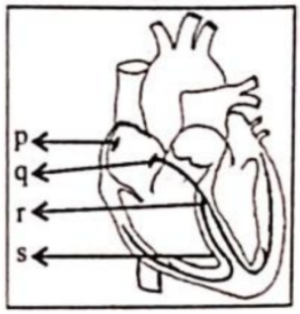
Identify the option showing the correct labeling for $p$,$q$,$r$ and $s$ with reference to the conducting system of the human heart.
A
$p$-Interventricular septum,$q$-$AVN$,$r$-Bundle of His,$s$-$SAN$
B
$p$-$SAN$,$q$-$AVN$,$r$-Bundle of His,$s$-Interventricular septum
C
$p$-$AVN$,$q$-$SAN$,$r$-Interventricular septum,$s$-Bundle of His
D
$p$-Bundle of His,$q$-$SAN$,$r$-Interventricular septum,$s$-$AVN$
Solution
(B) The correct option is $(B)$.
In the human heart's conducting system:
$p$ represents the Sino-Atrial Node $(SAN)$,which is located in the right atrium.
$q$ represents the Atrio-Ventricular Node $(AVN)$,located near the base of the interatrial septum.
$r$ represents the Bundle of His,which originates from the $AVN$ and passes through the interventricular septum.
$s$ represents the Interventricular septum,the wall separating the two ventricles.
In the human heart's conducting system:
$p$ represents the Sino-Atrial Node $(SAN)$,which is located in the right atrium.
$q$ represents the Atrio-Ventricular Node $(AVN)$,located near the base of the interatrial septum.
$r$ represents the Bundle of His,which originates from the $AVN$ and passes through the interventricular septum.
$s$ represents the Interventricular septum,the wall separating the two ventricles.
0 likesView Solution
4
BiologyEasyMCQKCET · 2023
Considering the stroke volume of an adult healthy human being is $70 \ mL$,identify the cardiac output in one hour from the following:
A
$302.4 \ L/hour$
B
$504.0 \ L/hour$
C
$50.40 \ L/hour$
D
$30.24 \ L/hour$
Solution
(A) Cardiac output is the volume of blood pumped by each ventricle per minute.
Formula: $\text{Cardiac Output} = \text{Stroke Volume} \times \text{Heart Rate}$.
Given: $\text{Stroke Volume} = 70 \ mL$,Average $\text{Heart Rate} = 72 \ \text{beats/minute}$.
Cardiac output per minute = $70 \ mL \times 72 = 5040 \ mL/minute = 5.04 \ L/minute$.
To find the cardiac output in one hour $(60 \ \text{minutes})$:
$\text{Cardiac Output per hour} = 5.04 \ L/minute \times 60 \ \text{minutes} = 302.4 \ L/hour$.
Therefore,the correct option is $A$.
Formula: $\text{Cardiac Output} = \text{Stroke Volume} \times \text{Heart Rate}$.
Given: $\text{Stroke Volume} = 70 \ mL$,Average $\text{Heart Rate} = 72 \ \text{beats/minute}$.
Cardiac output per minute = $70 \ mL \times 72 = 5040 \ mL/minute = 5.04 \ L/minute$.
To find the cardiac output in one hour $(60 \ \text{minutes})$:
$\text{Cardiac Output per hour} = 5.04 \ L/minute \times 60 \ \text{minutes} = 302.4 \ L/hour$.
Therefore,the correct option is $A$.
0 likesView Solution
5
BiologyEasyMCQKCET · 2023
Atrial Natriuretic Factor $(ANF)$ acts as a
A
Hypertension inducer
B
Check on Renin-Angiotensin mechanism
C
Promoter on Renin-Angiotensin Mechanism
D
Vasoconstrictor
Solution
(B) The correct answer is $(B)$.
$ANF$ (Atrial Natriuretic Factor) is released by the atrial wall of the heart in response to increased blood flow.
It causes vasodilation (dilation of blood vessels),which leads to a decrease in blood pressure.
Therefore,the $ANF$ mechanism acts as a check or a negative feedback control on the Renin-Angiotensin mechanism,which is responsible for increasing blood pressure.
$ANF$ (Atrial Natriuretic Factor) is released by the atrial wall of the heart in response to increased blood flow.
It causes vasodilation (dilation of blood vessels),which leads to a decrease in blood pressure.
Therefore,the $ANF$ mechanism acts as a check or a negative feedback control on the Renin-Angiotensin mechanism,which is responsible for increasing blood pressure.
0 likesView Solution
6
BiologyEasyMCQKCET · 2023
Match the Column-$I$ with Column-$II$ and choose the correct option from the following:
| Column-$I$ (Plant groups) | Column-$II$ (Examples) |
|---|---|
| $1$. Bryophyta | $p$. Pinus |
| $2$. Gymnosperm | $q$. Adiantum |
| $3$. Algae | $r$. Sphagnum |
| $4$. Pteridophyta | $s$. Ectocarpus |
A
$1-q, 2-s, 3-p, 4-r$
B
$1-s, 2-q, 3-p, 4-r$
C
$1-r, 2-p, 3-s, 4-q$
D
$1-q, 2-p, 3-s, 4-r$
Solution
(C) The correct matching is as follows:
$1$. Bryophyta: $r$. Sphagnum (a moss).
$2$. Gymnosperm: $p$. Pinus (a conifer).
$3$. Algae: $s$. Ectocarpus (a brown alga).
$4$. Pteridophyta: $q$. Adiantum (a fern).
Therefore,the correct sequence is $1-r, 2-p, 3-s, 4-q$.
$1$. Bryophyta: $r$. Sphagnum (a moss).
$2$. Gymnosperm: $p$. Pinus (a conifer).
$3$. Algae: $s$. Ectocarpus (a brown alga).
$4$. Pteridophyta: $q$. Adiantum (a fern).
Therefore,the correct sequence is $1-r, 2-p, 3-s, 4-q$.
0 likesView Solution
7
BiologyEasyMCQKCET · 2023
The function of the contractile vacuole in $Amoeba$ is:
A
Digestion and excretion
B
Excretion and osmoregulation
C
Digestion and respiration
D
Osmoregulation and movement
Solution
(B) The correct option is $B$.
In $Amoeba$,the contractile vacuole plays a vital role in maintaining water balance within the cell,a process known as osmoregulation.
It also helps in the removal of metabolic waste products,thus performing the function of excretion.
Therefore,the primary functions of the contractile vacuole are excretion and osmoregulation.
In $Amoeba$,the contractile vacuole plays a vital role in maintaining water balance within the cell,a process known as osmoregulation.
It also helps in the removal of metabolic waste products,thus performing the function of excretion.
Therefore,the primary functions of the contractile vacuole are excretion and osmoregulation.
0 likesView Solution
8
BiologyEasyMCQKCET · 2023
Flame cells present in the members of Platyhelminthes are specialized to perform:
A
Respiration and Osmoregulation
B
Osmoregulation and Circulation
C
Osmoregulation and Excretion
D
Respiration and Excretion
Solution
(C) The correct answer is $C$.
Flame cells (also known as protonephridia) are specialized excretory structures found in the members of the phylum $Platyhelminthes$ (flatworms).
These cells are primarily responsible for osmoregulation (maintaining water and salt balance) and the excretion of nitrogenous waste products from the body.
Flame cells (also known as protonephridia) are specialized excretory structures found in the members of the phylum $Platyhelminthes$ (flatworms).
These cells are primarily responsible for osmoregulation (maintaining water and salt balance) and the excretion of nitrogenous waste products from the body.
0 likesView Solution
9
BiologyEasyMCQKCET · 2023
Identify the floral formula of a plant belonging to the potato family (Solanaceae).
A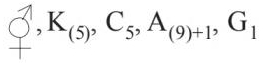
B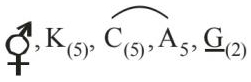
C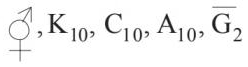
D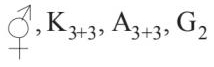
Solution
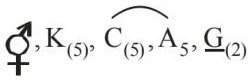
(B) The potato family is known as the Solanaceae family.
Its characteristic floral formula is $\oplus, \text{K}_{(5)}, \text{C}_{(5)}, \text{A}_5, \underline{\text{G}}_{(2)}$.
- $\oplus$: Actinomorphic (radially symmetrical).
- $\text{K}_{(5)}$: Calyx with $5$ sepals,gamosepalous (fused).
- $\text{C}_{(5)}$: Corolla with $5$ petals,gamopetalous (fused).
- $\text{A}_5$: Androecium with $5$ stamens,epipetalous (often attached to petals,though not explicitly shown in this simplified formula).
- $\underline{\text{G}}_{(2)}$: Gynoecium with $2$ carpels,syncarpous (fused),and superior ovary.
Its characteristic floral formula is $\oplus, \text{K}_{(5)}, \text{C}_{(5)}, \text{A}_5, \underline{\text{G}}_{(2)}$.
- $\oplus$: Actinomorphic (radially symmetrical).
- $\text{K}_{(5)}$: Calyx with $5$ sepals,gamosepalous (fused).
- $\text{C}_{(5)}$: Corolla with $5$ petals,gamopetalous (fused).
- $\text{A}_5$: Androecium with $5$ stamens,epipetalous (often attached to petals,though not explicitly shown in this simplified formula).
- $\underline{\text{G}}_{(2)}$: Gynoecium with $2$ carpels,syncarpous (fused),and superior ovary.
0 likesView Solution
10
BiologyEasyMCQKCET · 2023
When the vascular cambium is present between the xylem and phloem,then the vascular bundle is called,
A
Closed
B
Exarch
C
Open
D
Endarch
Solution
(C) The correct answer is $C$.
When the vascular cambium is present between the xylem and phloem,the vascular bundle is known as an open vascular bundle.
This type of vascular bundle is characteristic of dicotyledonous stems,as it allows for secondary growth.
When the vascular cambium is present between the xylem and phloem,the vascular bundle is known as an open vascular bundle.
This type of vascular bundle is characteristic of dicotyledonous stems,as it allows for secondary growth.
0 likesView Solution
11
BiologyEasyMCQKCET · 2023
Match List-$I$ and List-$II$ with respect to proteins and their functions and select the correct option.
| List-$I$ | List-$II$ |
|---|---|
| $1$. Collagen | $p$. Fights infectious agents |
| $2$. Trypsin | $q$. Hormone |
| $3$. Insulin | $r$. Enzyme |
| $4$. Antibody | $s$. Intercellular ground substance |
A
$1-s, 2-p, 3-r, 4-q$
B
$1-q, 2-r, 3-p, 4-s$
C
$1-s, 2-q, 3-r, 4-p$
D
$1-s, 2-r, 3-q, 4-p$
Solution
(D) The correct matching is as follows:
$1$. Collagen: $s$. Intercellular ground substance (provides structural support).
$2$. Trypsin: $r$. Enzyme (a digestive enzyme that breaks down proteins).
$3$. Insulin: $q$. Hormone (regulates blood glucose levels).
$4$. Antibody: $p$. Fights infectious agents (part of the immune system).
Therefore,the correct sequence is $1-s, 2-r, 3-q, 4-p$.
$1$. Collagen: $s$. Intercellular ground substance (provides structural support).
$2$. Trypsin: $r$. Enzyme (a digestive enzyme that breaks down proteins).
$3$. Insulin: $q$. Hormone (regulates blood glucose levels).
$4$. Antibody: $p$. Fights infectious agents (part of the immune system).
Therefore,the correct sequence is $1-s, 2-r, 3-q, 4-p$.
0 likesView Solution
12
BiologyEasyMCQKCET · 2023
Which pair of the following cells in the embryo sac are destined to change their ploidy after fertilization?
A
Egg cell and central cell
B
Antipodals and synergids
C
Synergids and egg cell
D
Central cell and antipodals
Solution
(A) The correct answer is $A$.
In the embryo sac, the $Egg$ $cell$ is haploid $(n)$ before fertilization and becomes a diploid $(2n)$ zygote after fertilization.
The $Central$ $cell$ contains two polar nuclei (each $n$) and is effectively diploid $(2n)$ before fertilization; after fusion with a male gamete $(n)$, it becomes a triploid $(3n)$ primary endosperm nucleus $(PEN)$.
$Synergids$ and $Antipodals$ are haploid cells that degenerate after fertilization without undergoing a change in ploidy.
In the embryo sac, the $Egg$ $cell$ is haploid $(n)$ before fertilization and becomes a diploid $(2n)$ zygote after fertilization.
The $Central$ $cell$ contains two polar nuclei (each $n$) and is effectively diploid $(2n)$ before fertilization; after fusion with a male gamete $(n)$, it becomes a triploid $(3n)$ primary endosperm nucleus $(PEN)$.
$Synergids$ and $Antipodals$ are haploid cells that degenerate after fertilization without undergoing a change in ploidy.
0 likesView Solution
13
BiologyEasyMCQKCET · 2023
Primary endosperm nucleus is formed by the fusion of:
A
Two polar nuclei and two male gametes
B
Two polar nuclei and one male gamete
C
Ovum and male gamete
D
One polar nucleus and male gamete
Solution
(B) The correct answer is $B$.
In angiosperms,the process of double fertilization involves two events: syngamy and triple fusion.
The primary endosperm nucleus $(PEN)$ is formed by the fusion of two haploid polar nuclei (which form the diploid secondary nucleus) and one haploid male gamete.
Since this process involves the fusion of three haploid nuclei,it is termed as triple fusion.
This results in the formation of a triploid $(3n)$ primary endosperm nucleus.
In angiosperms,the process of double fertilization involves two events: syngamy and triple fusion.
The primary endosperm nucleus $(PEN)$ is formed by the fusion of two haploid polar nuclei (which form the diploid secondary nucleus) and one haploid male gamete.
Since this process involves the fusion of three haploid nuclei,it is termed as triple fusion.
This results in the formation of a triploid $(3n)$ primary endosperm nucleus.
0 likesView Solution
14
BiologyEasyMCQKCET · 2023
$A$ flower has $10$ stamens,each having a bilobed,dithecous anther. If each microsporangium has $5$ pollen mother cells,how many pollen grains would be produced by the flower?
A
$1600$
B
$200$
C
$400$
D
$800$
Solution
(D) Each stamen has a bilobed,dithecous anther,which means it contains $4$ microsporangia.
Total number of microsporangia in $10$ stamens = $10 \times 4 = 40$.
Each microsporangium contains $5$ pollen mother cells (PMCs).
Total number of PMCs in the flower = $40 \times 5 = 200$.
Each pollen mother cell undergoes meiosis to produce $4$ pollen grains.
Total number of pollen grains = $200 \times 4 = 800$.
Total number of microsporangia in $10$ stamens = $10 \times 4 = 40$.
Each microsporangium contains $5$ pollen mother cells (PMCs).
Total number of PMCs in the flower = $40 \times 5 = 200$.
Each pollen mother cell undergoes meiosis to produce $4$ pollen grains.
Total number of pollen grains = $200 \times 4 = 800$.
0 likesView Solution
15
BiologyEasyMCQKCET · 2023
Which of the following is called as a detritivore?
A
An animal feeding on a plant
B
An animal feeding on decaying organic matter
C
An animal feeding on another animal
D
$A$ plant feeding on an animal
Solution
(B) Detritivores are organisms that obtain nutrients by consuming detritus,which consists of decaying organic matter,including plant and animal remains and fecal matter.
Examples of detritivores include earthworms,termites,woodlice,and millipedes.
They play a crucial role in the ecosystem by breaking down complex organic materials into simpler substances,thereby facilitating the process of decomposition and nutrient cycling.
Therefore,an animal feeding on decaying organic matter is called a detritivore.
Examples of detritivores include earthworms,termites,woodlice,and millipedes.
They play a crucial role in the ecosystem by breaking down complex organic materials into simpler substances,thereby facilitating the process of decomposition and nutrient cycling.
Therefore,an animal feeding on decaying organic matter is called a detritivore.
0 likesView Solution
16
BiologyEasyMCQKCET · 2023
Identify the incorrect statement regarding the flow of energy between various components of the food chain.
A
Each trophic level loses some energy as heat to the environment.
B
The amount of energy available at each trophic level is $10$% of previous trophic level.
C
Energy flow is unidirectional.
D
Green plants capture about $10$% of the solar energy that falls on leaves.
Solution
(D) The incorrect statement is $D$.
Green plants capture only about $1\%$ of the solar energy that falls on their leaves.
This energy is used in the process of photosynthesis to convert light energy into chemical energy,which is then stored as food.
The other statements $(A, B, C)$ are correct: energy is lost as heat at each trophic level,energy transfer follows the $10\%$ law,and energy flow in an ecosystem is always unidirectional.
Green plants capture only about $1\%$ of the solar energy that falls on their leaves.
This energy is used in the process of photosynthesis to convert light energy into chemical energy,which is then stored as food.
The other statements $(A, B, C)$ are correct: energy is lost as heat at each trophic level,energy transfer follows the $10\%$ law,and energy flow in an ecosystem is always unidirectional.
0 likesView Solution
17
BiologyEasyMCQKCET · 2023
Match Column-$I$ with Column-$II$. Select the option with the correct combination.
| $1$. Standing state | $p$. Mass of living material at a given time |
| $2$. Pioneer species | $q$. Amount of nutrients in the soil at a given time |
| $3$. Detritivores | $r$. Species that invade a bare area |
| $4$. Standing crop | $s$. Breakdown detritus into smaller particles |
A
$1-p, 2-s, 3-r, 4-q$
B
$1-q, 2-r, 3-p, 4-s$
C
$1-p, 2-r, 3-s, 4-q$
D
$1-q, 2-r, 3-s, 4-p$
Solution
(D) The correct matches are as follows:
$1$. Standing state refers to the amount of inorganic nutrients (like nitrogen,phosphorus,etc.) present in the soil at a given time $(1-q)$.
$2$. Pioneer species are the first organisms to colonize a previously bare area during ecological succession $(2-r)$.
$3$. Detritivores are organisms that break down detritus into smaller particles (e.g.,earthworms) $(3-s)$.
$4$. Standing crop refers to the total mass of living material (biomass) present in an ecosystem at a given time $(4-p)$.
Therefore,the correct combination is $1-q, 2-r, 3-s, 4-p$.
$1$. Standing state refers to the amount of inorganic nutrients (like nitrogen,phosphorus,etc.) present in the soil at a given time $(1-q)$.
$2$. Pioneer species are the first organisms to colonize a previously bare area during ecological succession $(2-r)$.
$3$. Detritivores are organisms that break down detritus into smaller particles (e.g.,earthworms) $(3-s)$.
$4$. Standing crop refers to the total mass of living material (biomass) present in an ecosystem at a given time $(4-p)$.
Therefore,the correct combination is $1-q, 2-r, 3-s, 4-p$.
0 likesView Solution
18
BiologyEasyMCQKCET · 2023
According to David Tilman's long-term ecosystem experiments,the total biomass in plots with more species shows,
A
No variation from year-to-year.
B
Less variation from year-to-year.
C
High variation from year-to-year.
D
Average variation from year-to-year.
Solution
(B) The correct answer is $B$.
According to David Tilman's long-term ecosystem experiments,plots with more species showed less year-to-year variation in total biomass.
This indicates that higher biodiversity contributes to greater ecosystem stability and productivity over time.
According to David Tilman's long-term ecosystem experiments,plots with more species showed less year-to-year variation in total biomass.
This indicates that higher biodiversity contributes to greater ecosystem stability and productivity over time.
0 likesView Solution
19
BiologyEasyMCQKCET · 2023
From the following tables,select the option that correctly characterizes various phases of the menstrual cycle.
A
| Menstruation phase | Follicular phase | Luteal phase |
|---|---|---|
| Regeneration of endometrium | High level of progesterone | Developing corpus luteum |
B
| Menstruation phase | Follicular phase | Luteal phase |
|---|---|---|
| Matured follicle | Regression of corpus luteum | Ovulation |
C
| Menstruation phase | Follicular phase | Luteal phase |
|---|---|---|
| Menses | Developing corpus luteum | Follicle maturation |
D
| Menstruation phase | Follicular phase | Luteal phase |
|---|---|---|
| Menses | $LH$ surge | Regeneration of endometrium |
Solution
(D) The correct option is $D$.
In the human menstrual cycle:
$1$. The Menstruation phase is characterized by the shedding of the endometrial lining,known as menses.
$2$. The Follicular phase involves the maturation of follicles and culminates in the $LH$ surge,which triggers ovulation.
$3$. The Luteal phase follows ovulation,where the ruptured follicle transforms into the corpus luteum,which secretes progesterone to maintain the endometrium,leading to its regeneration and preparation for potential implantation.
In the human menstrual cycle:
$1$. The Menstruation phase is characterized by the shedding of the endometrial lining,known as menses.
$2$. The Follicular phase involves the maturation of follicles and culminates in the $LH$ surge,which triggers ovulation.
$3$. The Luteal phase follows ovulation,where the ruptured follicle transforms into the corpus luteum,which secretes progesterone to maintain the endometrium,leading to its regeneration and preparation for potential implantation.
0 likesView Solution
20
BiologyEasyMCQKCET · 2023
In the female reproductive system,a tiny finger-like structure which lies at the upper junction of the two labia minora above the urethral opening is called
A
Vagina
B
Hymen
C
Mons pubis
D
Clitoris
Solution
(D) The correct answer is $D$.
The clitoris is a tiny,finger-like structure that lies at the upper junction of the two labia minora,situated above the urethral opening.
It is a highly sensitive organ homologous to the penis in males.
The clitoris is a tiny,finger-like structure that lies at the upper junction of the two labia minora,situated above the urethral opening.
It is a highly sensitive organ homologous to the penis in males.
0 likesView Solution
21
BiologyEasyMCQKCET · 2023
The male sex accessory ducts include,
A
Rete testis,vasa efferentia,epididymis and vas deferens
B
Rete testis,vasa efferentia,epididymis and seminal vesicle
C
Rete testis,urethra,epididymis and vas deferens
D
Rete testis,vasa efferentia,seminal vesicle and vas deferens
Solution
(A) The male sex accessory ducts consist of the $Rete$ $testis$,$vasa$ $efferentia$,$epididymis$,and $vas$ $deferens$.
These ducts are responsible for the transport and storage of sperms from the $testis$ to the outside through the $urethra$.
$Seminal$ $vesicle$ is an accessory gland,not a duct.
These ducts are responsible for the transport and storage of sperms from the $testis$ to the outside through the $urethra$.
$Seminal$ $vesicle$ is an accessory gland,not a duct.
0 likesView Solution
22
BiologyEasyMCQKCET · 2023
MTPs are considered relatively safe during
A
First trimester
B
Second trimester
C
$24$ weeks of pregnancy
D
$180$ days of pregnancy
Solution
(A) Medical Termination of Pregnancy $(MTP)$ is considered relatively safe during the first trimester of pregnancy.
This is because the fetus is not yet well-developed,and the surgical or medical procedure carries significantly lower risks of complications for the mother compared to later stages of pregnancy.
This is because the fetus is not yet well-developed,and the surgical or medical procedure carries significantly lower risks of complications for the mother compared to later stages of pregnancy.
0 likesView Solution
23
BiologyEasyMCQKCET · 2023
An example of a hormone-releasing $IUD$ is:
A
Implant
B
$LNG-20$
C
Multiload $375$
D
Lippes loop
Solution
(B) $LNG-20$ is a hormone-releasing $IUD$ (Intra Uterine Device).
It releases levonorgestrel,a synthetic progestogen,which makes the uterus unsuitable for implantation and the cervix hostile to sperm.
In contrast,Multiload $375$ is a copper-releasing $IUD$,and Lippes loop is a non-medicated $IUD$.
It releases levonorgestrel,a synthetic progestogen,which makes the uterus unsuitable for implantation and the cervix hostile to sperm.
In contrast,Multiload $375$ is a copper-releasing $IUD$,and Lippes loop is a non-medicated $IUD$.
0 likesView Solution
24
BiologyEasyMCQKCET · 2023
Which of the following is the correct full form of the abbreviation $ZIFT$?
A
Zygote Inter Fallopian Tube
B
Zygote Intra Fallopian Transfer
C
Zygote Inter Fallopian Transfer
D
Zygote Intra Fallopian Tube
Solution
(B) $ZIFT$ stands for Zygote Intra Fallopian Transfer.
In this assisted reproductive technology,the zygote or early embryos (up to $8$ blastomeres) are transferred into the fallopian tube of the female.
In this assisted reproductive technology,the zygote or early embryos (up to $8$ blastomeres) are transferred into the fallopian tube of the female.
0 likesView Solution
25
BiologyEasyMCQKCET · 2023
Which of the following statements is correct?
A
Female carrier for haemophilia may transmit the disease to sons.
B
Thalassemia is a qualitative problem.
C
Change in whole set of chromosomes is called aneuploidy.
D
Sickle cell anaemia is a quantitative problem.
Solution
(A) $1$. Haemophilia is an $X$-linked recessive disorder. $A$ female carrier $(X^HX^h)$ has a $50\%$ chance of passing the defective $X^h$ chromosome to her sons,who will then express the disease.
$2$. Thalassemia is a quantitative problem because it involves the reduced synthesis of one of the globin chains of the haemoglobin molecule.
$3$. $A$ change in the whole set of chromosomes is called polyploidy,whereas aneuploidy refers to the gain or loss of one or more individual chromosomes.
$4$. Sickle cell anaemia is a qualitative problem because it results from a point mutation in the gene coding for the $\beta$-globin chain,leading to the substitution of glutamic acid with valine,which alters the structure and function of the haemoglobin molecule.
$2$. Thalassemia is a quantitative problem because it involves the reduced synthesis of one of the globin chains of the haemoglobin molecule.
$3$. $A$ change in the whole set of chromosomes is called polyploidy,whereas aneuploidy refers to the gain or loss of one or more individual chromosomes.
$4$. Sickle cell anaemia is a qualitative problem because it results from a point mutation in the gene coding for the $\beta$-globin chain,leading to the substitution of glutamic acid with valine,which alters the structure and function of the haemoglobin molecule.
0 likesView Solution
26
BiologyEasyMCQKCET · 2023
In the male heterogametic type of sex determination:
A
Males do not produce gametes.
B
Male parent produces similar gametes.
C
Female parent produces dissimilar gametes.
D
Male parent produces dissimilar gametes.
Solution
(D) The correct answer is $D$.
In the male heterogametic type of sex determination,the male individual produces two different types of gametes (e.g.,$X$ and $Y$ in humans or $X$ and $O$ in some insects),which is why they are called heterogametic. The female,in this case,is homogametic,meaning she produces only one type of gamete $(X)$.
In the male heterogametic type of sex determination,the male individual produces two different types of gametes (e.g.,$X$ and $Y$ in humans or $X$ and $O$ in some insects),which is why they are called heterogametic. The female,in this case,is homogametic,meaning she produces only one type of gamete $(X)$.
0 likesView Solution
27
BiologyEasyMCQKCET · 2023
In one of the hybridisation experiments,a homozygous dominant parent and a homozygous recessive parent are crossed for a trait. (Plant shows Mendelian inheritance pattern)
A
Dominant parent trait appears in $F_2$ generation and recessive parent trait appears only in $F_1$ generation.
B
Dominant parent trait appears in $F_1$ generation and recessive parent trait appears in $F_2$ generation.
C
Dominant parent trait appears in both $F_1$ and $F_2$ generations and recessive parent trait appears in only $F_2$ generations.
D
Dominant parent trait appears in $F_1$ generation and recessive parent trait appears in $F_1$ and $F_2$ generations.
Solution
(C) In a Mendelian cross between a homozygous dominant parent $(AA)$ and a homozygous recessive parent $(aa)$,the $F_1$ generation consists of all heterozygous individuals $(Aa)$ expressing the dominant trait.
When $F_1$ individuals are self-crossed $(Aa \times Aa)$,the $F_2$ generation shows a phenotypic ratio of $3:1$ (dominant to recessive).
Therefore,the dominant trait is expressed in both $F_1$ and $F_2$ generations,while the recessive trait is masked in $F_1$ and only reappears in the $F_2$ generation.
When $F_1$ individuals are self-crossed $(Aa \times Aa)$,the $F_2$ generation shows a phenotypic ratio of $3:1$ (dominant to recessive).
Therefore,the dominant trait is expressed in both $F_1$ and $F_2$ generations,while the recessive trait is masked in $F_1$ and only reappears in the $F_2$ generation.
0 likesView Solution
28
BiologyEasyMCQKCET · 2023
Find the correct statement.
$(1)$ Generally a gene regulates a trait,but sometimes one gene has an effect on multiple traits.
$(2)$ The trait $AB$-blood group of man is regulated by one dominant allele and another recessive allele. Hence it is co-dominant.
$(1)$ Generally a gene regulates a trait,but sometimes one gene has an effect on multiple traits.
$(2)$ The trait $AB$-blood group of man is regulated by one dominant allele and another recessive allele. Hence it is co-dominant.
A
Both the Statements are wrong.
B
Statement $(1)$ is correct.
C
Statement $(2)$ is correct.
D
Both Statements $(1)$ and $(2)$ are correct.
Solution
(B) Statement $(1)$ is correct because it describes the phenomenon of pleiotropy,where a single gene influences multiple phenotypic traits.
Statement $(2)$ is incorrect. The $AB$-blood group in humans is an example of co-dominance,but it is regulated by multiple alleles $(I^A, I^B, i)$,not just one dominant and one recessive allele. Specifically,$I^A$ and $I^B$ are co-dominant,and $i$ is recessive.
Statement $(2)$ is incorrect. The $AB$-blood group in humans is an example of co-dominance,but it is regulated by multiple alleles $(I^A, I^B, i)$,not just one dominant and one recessive allele. Specifically,$I^A$ and $I^B$ are co-dominant,and $i$ is recessive.
0 likesView Solution
29
BiologyEasyMCQKCET · 2023
Gene-mapping technology was developed by
A
Mendel
B
Tschermak
C
Correns
D
Sturtevant
Solution
(D) Sturtevant.
Alfred Sturtevant,a student of Thomas Hunt Morgan,developed the first genetic map in $1913$ based on the frequency of recombination between gene pairs on the same chromosome.
Alfred Sturtevant,a student of Thomas Hunt Morgan,developed the first genetic map in $1913$ based on the frequency of recombination between gene pairs on the same chromosome.
0 likesView Solution
30
BiologyEasyMCQKCET · 2023
Eukaryotic genes are monocistronic,but they are considered 'split genes' because:
A
Introns are interrupted by Mutons.
B
they contain Exons only.
C
they contain Introns only.
D
Exons are interrupted by Introns.
Solution
(D) The correct answer is $D$.
In eukaryotes,monocistronic structural genes possess interrupted coding sequences,which is why they are referred to as 'split genes'.
The coding sequences or expressed sequences are defined as $Exons$.
$Exons$ are the sequences that appear in the mature or processed $RNA$.
These $Exons$ are interrupted by non-coding sequences known as $Introns$.
In eukaryotes,monocistronic structural genes possess interrupted coding sequences,which is why they are referred to as 'split genes'.
The coding sequences or expressed sequences are defined as $Exons$.
$Exons$ are the sequences that appear in the mature or processed $RNA$.
These $Exons$ are interrupted by non-coding sequences known as $Introns$.
0 likesView Solution
31
BiologyEasyMCQKCET · 2023
The $Lac-Operon$ model was elucidated by
A
Jacob and Crick
B
Watson and Crick
C
Francois Jacob and Jacques Monod
D
Hershey and Chase
Solution
(C) $Lac-Operon$ model was elucidated by Francois Jacob and Jacques Monod.
$Lac-Operon$ is a cluster of genes through which $Escherichia coli$ catabolizes lactose.
It was first proposed by $F. Jacob$ and $J. Monod$, who were also awarded the Nobel Prize in Physiology or Medicine in $1965$.
$Lac-Operon$ is a cluster of genes through which $Escherichia coli$ catabolizes lactose.
It was first proposed by $F. Jacob$ and $J. Monod$, who were also awarded the Nobel Prize in Physiology or Medicine in $1965$.
0 likesView Solution
32
BiologyEasyMCQKCET · 2023
Histone proteins are positively charged because they are rich in basic amino acid residues:
A
Arginine and Proline
B
Arginine and Alanine
C
Arginine and Lysine
D
Arginine and Phenylalanine
Solution
(C) The correct answer is $C$.
Histones are positively charged proteins because they contain a very high proportion of basic amino acids,specifically $Lysine$ and $Arginine$.
These amino acids possess positively charged side chains at physiological $pH$.
Because of this positive charge,histones can effectively bind to the negatively charged phosphate backbone of $DNA$ to form nucleosomes.
Histones are positively charged proteins because they contain a very high proportion of basic amino acids,specifically $Lysine$ and $Arginine$.
These amino acids possess positively charged side chains at physiological $pH$.
Because of this positive charge,histones can effectively bind to the negatively charged phosphate backbone of $DNA$ to form nucleosomes.
0 likesView Solution
33
BiologyEasyMCQKCET · 2023
During transcription,the $DNA$ strand with $3' \rightarrow 5'$ polarity of the structural gene always acts as a template because
A
Nucleotides of $DNA$ strand $5' \rightarrow 3'$ are transferred to $mRNA$.
B
Enzyme $DNA$ dependent $RNA$ polymerase always catalyses the polymerisation in $5' \rightarrow 3'$ direction.
C
Enzyme $DNA$ dependent $RNA$ polymerase always catalyses the polymerisation in $3' \rightarrow 5'$ direction.
D
Enzyme $DNA$ dependent $RNA$ polymerase always catalyses polymerisation in both the directions.
Solution
(B) During the process of transcription,the enzyme $DNA$-dependent $RNA$ polymerase is responsible for synthesizing $RNA$.
This enzyme has a strict requirement to catalyze the polymerization of nucleotides only in the $5' \rightarrow 3'$ direction.
Since the two strands of $DNA$ are antiparallel,the strand that runs in the $3' \rightarrow 5'$ direction serves as the template.
This allows the newly synthesized $RNA$ strand to be formed in the $5' \rightarrow 3'$ direction,which is complementary and antiparallel to the template strand.
This enzyme has a strict requirement to catalyze the polymerization of nucleotides only in the $5' \rightarrow 3'$ direction.
Since the two strands of $DNA$ are antiparallel,the strand that runs in the $3' \rightarrow 5'$ direction serves as the template.
This allows the newly synthesized $RNA$ strand to be formed in the $5' \rightarrow 3'$ direction,which is complementary and antiparallel to the template strand.
0 likesView Solution
34
BiologyEasyMCQKCET · 2023
Which of these is $NOT$ an example of adaptive radiation?
A
Long-necked Giraffe
B
Darwin's finches
C
Australian marsupials
D
Placental mammals
Solution
(A) Adaptive radiation is the process of evolution of different species in a given geographical area starting from a point and literally radiating to other areas of geography (habitats).
Darwin's finches,Australian marsupials,and placental mammals are classic examples of adaptive radiation as they show divergent evolution from a common ancestor.
The long-necked giraffe is not an example of adaptive radiation; its evolution is typically explained by the theory of natural selection (Lamarckism or Darwinism) regarding the adaptation of a specific trait within a lineage rather than the diversification of a common ancestor into multiple new species.
Darwin's finches,Australian marsupials,and placental mammals are classic examples of adaptive radiation as they show divergent evolution from a common ancestor.
The long-necked giraffe is not an example of adaptive radiation; its evolution is typically explained by the theory of natural selection (Lamarckism or Darwinism) regarding the adaptation of a specific trait within a lineage rather than the diversification of a common ancestor into multiple new species.
0 likesView Solution
35
BiologyEasyMCQKCET · 2023
In a population of $800$ rabbits showing Hardy-Weinberg equilibrium,the frequency of recessive individuals was $0.16$. What is the frequency of heterozygous individuals?
A
$0.36$
B
$0.4$
C
$0.48$
D
$0.84$
Solution
(C) According to the Hardy-Weinberg principle,the equation is $p^2 + 2pq + q^2 = 1$,where $p$ is the frequency of the dominant allele and $q$ is the frequency of the recessive allele.
Given that the frequency of recessive individuals $(q^2)$ is $0.16$.
Therefore,$q = \sqrt{0.16} = 0.4$.
Since $p + q = 1$,we have $p = 1 - 0.4 = 0.6$.
The frequency of heterozygous individuals is represented by $2pq$.
$2pq = 2 \times 0.6 \times 0.4 = 0.48$.
Thus,the frequency of heterozygous individuals is $0.48$.
Given that the frequency of recessive individuals $(q^2)$ is $0.16$.
Therefore,$q = \sqrt{0.16} = 0.4$.
Since $p + q = 1$,we have $p = 1 - 0.4 = 0.6$.
The frequency of heterozygous individuals is represented by $2pq$.
$2pq = 2 \times 0.6 \times 0.4 = 0.48$.
Thus,the frequency of heterozygous individuals is $0.48$.
0 likesView Solution
36
BiologyEasyMCQKCET · 2023
Match the following columns and choose the correct option:
| Column-$I$ | Column-$II$ |
|---|---|
| $1$. $Haemophilus$ $influenzae$ | $p$. Malignant malaria |
| $2$. $Entamoeba$ $histolytica$ | $q$. Elephantiasis |
| $3$. $Plasmodium$ $falciparum$ | $r$. Pneumonia |
| $4$. $Wuchereria$ $bancrofti$ | $s$. Amoebiasis |
A
$1-r, 2-p, 3-q, 4-s$
B
$1-q, 2-r, 3-s, 4-p$
C
$1-r, 2-s, 3-p, 4-q$
D
$1-s, 2-p, 3-q, 4-r$
Solution
(C) The correct matches are as follows:
$1$. $Haemophilus$ $influenzae$ causes Pneumonia $(r)$.
$2$. $Entamoeba$ $histolytica$ causes Amoebiasis $(s)$.
$3$. $Plasmodium$ $falciparum$ causes Malignant malaria $(p)$.
$4$. $Wuchereria$ $bancrofti$ causes Elephantiasis $(q)$.
Therefore,the correct sequence is $1-r, 2-s, 3-p, 4-q$.
$1$. $Haemophilus$ $influenzae$ causes Pneumonia $(r)$.
$2$. $Entamoeba$ $histolytica$ causes Amoebiasis $(s)$.
$3$. $Plasmodium$ $falciparum$ causes Malignant malaria $(p)$.
$4$. $Wuchereria$ $bancrofti$ causes Elephantiasis $(q)$.
Therefore,the correct sequence is $1-r, 2-s, 3-p, 4-q$.
0 likesView Solution
37
BiologyEasyMCQKCET · 2023
Find the correct match.
A
| Disease | Pathogen | Main organ |
|---|---|---|
| Dysentery | Protozoa | Liver |
B
| Disease | Pathogen | Main organ |
|---|---|---|
| Ringworm | Fungus | Skin |
C
| Disease | Pathogen | Main organ |
|---|---|---|
| Typhoid | Bacteria | Lungs |
D
| Disease | Pathogen | Main organ |
|---|---|---|
| Filariasis | Roundworm | Small intestine |
Solution
(B) is the correct match.
$1$. Ringworm is a common fungal infection caused by genera such as $Microsporum$,$Trichophyton$,and $Epidermophyton$. It primarily affects the skin,nails,and scalp,causing dry,scaly lesions.
$2$. Dysentery is caused by $Entamoeba$ $histolytica$ (a protozoan) and affects the large intestine,not the liver.
$3$. Typhoid is caused by $Salmonella$ $typhi$ (a bacterium) and affects the small intestine,not the lungs.
$4$. Filariasis is caused by $Wuchereria$ $bancrofti$ (a filarial worm) and typically affects the lymphatic vessels of the lower limbs,not the small intestine.
| Disease | Pathogen | Main organ |
|---|---|---|
| Ringworm | Fungus | Skin |
$1$. Ringworm is a common fungal infection caused by genera such as $Microsporum$,$Trichophyton$,and $Epidermophyton$. It primarily affects the skin,nails,and scalp,causing dry,scaly lesions.
$2$. Dysentery is caused by $Entamoeba$ $histolytica$ (a protozoan) and affects the large intestine,not the liver.
$3$. Typhoid is caused by $Salmonella$ $typhi$ (a bacterium) and affects the small intestine,not the lungs.
$4$. Filariasis is caused by $Wuchereria$ $bancrofti$ (a filarial worm) and typically affects the lymphatic vessels of the lower limbs,not the small intestine.
0 likesView Solution
38
BiologyEasyMCQKCET · 2023
Identify the symptoms of pneumonia.
A
High fever,weakness,stomach pain,loss of appetite
B
Difficulty in breathing,fever,chills,cough,headache
C
Nasal congestion and discharge,cough,sore throat,headache
D
Constipation,abdominal pain,cramps,blood clots
Solution
(B) The correct answer is $B$.
$Pneumonia$ is a respiratory infection caused by bacteria such as $Streptococcus$ $pneumoniae$ and $Haemophilus$ $influenzae$.
The symptoms of pneumonia include difficulty in breathing,high fever,chills,cough,and headache.
In severe cases,the lips and fingernails may turn gray or bluish in color.
$Pneumonia$ is a respiratory infection caused by bacteria such as $Streptococcus$ $pneumoniae$ and $Haemophilus$ $influenzae$.
The symptoms of pneumonia include difficulty in breathing,high fever,chills,cough,and headache.
In severe cases,the lips and fingernails may turn gray or bluish in color.
0 likesView Solution
39
BiologyEasyMCQKCET · 2023
Roquefort cheese is ripened by
A
Yeast
B
Bacterium
C
Fungi
D
Virus
Solution
(C) The correct answer is $C$.
Roquefort cheese is ripened by growing a specific fungus,$Penicillium \ roqueforti$,on it.
This fungus provides the cheese with its characteristic flavor and texture.
Roquefort cheese is ripened by growing a specific fungus,$Penicillium \ roqueforti$,on it.
This fungus provides the cheese with its characteristic flavor and texture.
0 likesView Solution
40
BiologyEasyMCQKCET · 2023
Select the correct statements from the following:
A
$DNA$ from one organism will not band $DNA$ from other organism.
B
Genetic engineering works only on animals and not yet successfully used on plants.
C
There are no risk factors associated with r-$DNA$ technology.
D
The first step in $PCR$ is heating which is used to separate both the strands of gene of interest.
Solution
(D) The correct statement is $D$. The first step in $PCR$ is denaturation,which involves heating the $DNA$ to approximately $94-98^{\circ}C$ to separate the two strands of the gene of interest.
Option $A$ is incorrect because $DNA$ from different organisms can be joined (recombinant $DNA$ technology).
Option $B$ is incorrect because genetic engineering is widely and successfully used in plants (e.g.,$Bt$ cotton).
Option $C$ is incorrect because there are ethical and safety concerns (biosafety) associated with $r-DNA$ technology.
Option $A$ is incorrect because $DNA$ from different organisms can be joined (recombinant $DNA$ technology).
Option $B$ is incorrect because genetic engineering is widely and successfully used in plants (e.g.,$Bt$ cotton).
Option $C$ is incorrect because there are ethical and safety concerns (biosafety) associated with $r-DNA$ technology.
0 likesView Solution
41
BiologyEasyMCQKCET · 2023
$PCR$ is used for
A
$DNA$ amplification
B
$DNA$ isolation
C
$DNA$ ligation
D
$DNA$ digestion
Solution
(A) $DNA$ amplification.
$PCR$ is a very sensitive technique that allows rapid amplification of a specific segment of $DNA$.
$PCR$ makes billions of copies of a specific $DNA$ fragment or gene,which allows detection and identification of gene sequences using visual techniques based on size and charge.
$PCR$ is a very sensitive technique that allows rapid amplification of a specific segment of $DNA$.
$PCR$ makes billions of copies of a specific $DNA$ fragment or gene,which allows detection and identification of gene sequences using visual techniques based on size and charge.
0 likesView Solution
42
BiologyEasyMCQKCET · 2023
From the following tools/techniques of genetic engineering,identify those which are required for cloning a bacterial gene in animal cells and choose the correct option:
$I$. Endonuclease $II$. Ligase
$III$. $A. tumefaciens$ $IV$. Microinjection
$V$. Gene gun $VI$. Lysozyme
$VII$. Cellulase $VIII$. Electrophoresis
$I$. Endonuclease $II$. Ligase
$III$. $A. tumefaciens$ $IV$. Microinjection
$V$. Gene gun $VI$. Lysozyme
$VII$. Cellulase $VIII$. Electrophoresis
A
$II, III, IV, VII, VIII$
B
$II, III, V, VIII$
C
$I, II, IV, VIII$
D
$I, III, IV, V, VII$
Solution
(C) The correct option is $C$.
To clone a bacterial gene in animal cells,the following tools and techniques are required:
$I$. Endonuclease: Used to cut the $DNA$ at specific sites.
$II$. Ligase: Used to join the $DNA$ fragments.
$IV$. Microinjection: $A$ direct method for introducing foreign $DNA$ into animal cells.
$VIII$. Electrophoresis: Used for the separation and isolation of $DNA$ fragments.
Note: $A. tumefaciens$ is used for plants,Gene gun is used for plants,Lysozyme is used for bacterial cell wall degradation,and Cellulase is used for plant cell wall degradation.
To clone a bacterial gene in animal cells,the following tools and techniques are required:
$I$. Endonuclease: Used to cut the $DNA$ at specific sites.
$II$. Ligase: Used to join the $DNA$ fragments.
$IV$. Microinjection: $A$ direct method for introducing foreign $DNA$ into animal cells.
$VIII$. Electrophoresis: Used for the separation and isolation of $DNA$ fragments.
Note: $A. tumefaciens$ is used for plants,Gene gun is used for plants,Lysozyme is used for bacterial cell wall degradation,and Cellulase is used for plant cell wall degradation.
0 likesView Solution
43
BiologyEasyMCQKCET · 2023
Which of these is $NOT$ a method to make host cells 'competent' to take up $DNA$?
A
Use of disarmed pathogen vectors
B
Micro-injection
C
Elution
D
Biolistics
Solution
(C) - Elution.
Competent cells are those that are capable of taking up foreign $DNA$ from their environment. Methods to make cells competent include chemical treatment (e.g.,$CaCl_2$),heat shock,micro-injection,biolistics (gene gun),and the use of disarmed pathogen vectors. Elution is a process used in chromatography or gel electrophoresis to extract a substance from a solid or a gel,and it is not a method for transforming host cells.
Competent cells are those that are capable of taking up foreign $DNA$ from their environment. Methods to make cells competent include chemical treatment (e.g.,$CaCl_2$),heat shock,micro-injection,biolistics (gene gun),and the use of disarmed pathogen vectors. Elution is a process used in chromatography or gel electrophoresis to extract a substance from a solid or a gel,and it is not a method for transforming host cells.
0 likesView Solution
Vedclass Products
For Students
Vedclass Test Series
Mock tests in real KCET style covering Biology with performance analysis. 5-day free trial.
Start Free TrialFor Teachers
Exam Paper Generator
Generate Set A/B/C/D Biology papers from 7.5L+ questions in 2 minutes. 3 chapters free.
Try FreeFor Institutes
Online Exam Module
Run live KCET mock exams with unlimited students, 360° analytics & white-label branding.
See DemoFrequently Asked Questions
How many Biology questions are in KCET 2023?
There are 43 Biology questions from the KCET 2023 paper on Vedclass, each with a detailed step-by-step solution in English.
Are KCET 2023 Biology solutions available in English?
Yes. All solutions on this page are in English. You can also switch to English or Hindi using the language buttons above the questions.
Can I practice KCET 2023 Biology as a timed test?
Yes. Use the Vedclass Test Series to attempt a full KCET mock test covering Biology with time limits and instant score analysis.
Can teachers create Biology papers from KCET previous year questions?
Yes. The Vedclass Exam Paper Generator lets teachers mix KCET Biology questions and generate Set A/B/C/D papers in minutes.
For Teachers & Institutes
Build a Custom Biology Paper
Pick KCET 2023 Biology questions, set difficulty, and generate Set A/B/C/D in 2 minutes.