
BiologyQ1–48 of 48 questions
Page 1 of 1 · English
1
BiologyEasyMCQKCET · 2019
Cells in the quiescent stage $(G_0)$
A
always become cancerous
B
show indefinite proliferation
C
remain metabolically inactive
D
remain metabolically active
Solution
(D) The correct answer is $(D)$.
In the quiescent stage $(G_0)$ of the cell cycle,cells exit the cell cycle and enter an inactive state.
Although these cells do not divide,they remain metabolically active and continue to perform their specific cellular functions.
They may remain in this state for a long period or permanently,depending on the requirements of the organism.
In the quiescent stage $(G_0)$ of the cell cycle,cells exit the cell cycle and enter an inactive state.
Although these cells do not divide,they remain metabolically active and continue to perform their specific cellular functions.
They may remain in this state for a long period or permanently,depending on the requirements of the organism.
0 likesView Solution
2
BiologyEasyMCQKCET · 2019
During chemiosmotic synthesis of $ATP$ in photosynthesis,
A
the protons accumulate in the intermembrane space of chloroplast
B
the proton gradient is not required
C
the protons accumulate in the intermembrane space of mitochondrion
D
the protons accumulate within the lumen of the thylakoids
Solution
(D) The correct answer is $D$.
In photosynthesis,$ATP$ synthesis is linked to the development of a proton gradient across the thylakoid membrane.
During the light reaction,protons ($H^+$ ions) are actively pumped into the lumen of the thylakoids.
This accumulation of protons creates a high concentration of $H^+$ inside the lumen compared to the stroma,resulting in a proton gradient.
The movement of these protons back into the stroma through the $CF_0-CF_1$ $ATP$ synthase enzyme provides the energy required for the phosphorylation of $ADP$ to form $ATP$.
In photosynthesis,$ATP$ synthesis is linked to the development of a proton gradient across the thylakoid membrane.
During the light reaction,protons ($H^+$ ions) are actively pumped into the lumen of the thylakoids.
This accumulation of protons creates a high concentration of $H^+$ inside the lumen compared to the stroma,resulting in a proton gradient.
The movement of these protons back into the stroma through the $CF_0-CF_1$ $ATP$ synthase enzyme provides the energy required for the phosphorylation of $ADP$ to form $ATP$.
0 likesView Solution
3
BiologyEasyMCQKCET · 2019
When tripalmitin is used as a respiratory substrate in aerobic respiration,the process consumes $145$ molecules of oxygen and releases $102$ molecules of $CO_2$. What would be the $RQ$ value?
A
$0.5$
B
$0.7$
C
$1.4$
D
$1$
Solution
(B) The Respiratory Quotient $(RQ)$ is defined as the ratio of the volume of $CO_2$ released to the volume of $O_2$ consumed during respiration.
Formula: $RQ = \frac{\text{Volume of } CO_2 \text{ released}}{\text{Volume of } O_2 \text{ consumed}}$
Given:
Volume of $CO_2$ released = $102$
Volume of $O_2$ consumed = $145$
Calculation: $RQ = \frac{102}{145} \approx 0.703$
Rounding to one decimal place,the $RQ$ value is $0.7$.
Formula: $RQ = \frac{\text{Volume of } CO_2 \text{ released}}{\text{Volume of } O_2 \text{ consumed}}$
Given:
Volume of $CO_2$ released = $102$
Volume of $O_2$ consumed = $145$
Calculation: $RQ = \frac{102}{145} \approx 0.703$
Rounding to one decimal place,the $RQ$ value is $0.7$.
0 likesView Solution
4
BiologyEasyMCQKCET · 2019
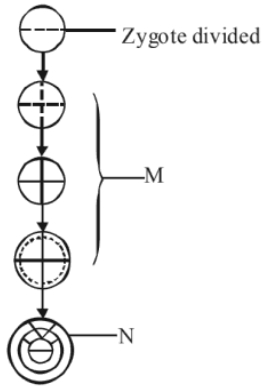
In the following diagrammatic representation showing stages of embryonic development,identify the type of growth phase labelled as $M$ and $N$.
A
$M$ is geometric phase and $N$ is arithmetic phase.
B
Both $M$ and $N$ are arithmetic phases.
C
$M$ is arithmetic phase and $N$ is geometric phase.
D
Both $M$ and $N$ are geometric phases.
Solution
(A) In the provided diagram,the phase labelled as $M$ represents the geometric phase of growth. In this phase,both daughter cells resulting from mitosis retain the ability to divide and continue to do so,leading to an exponential increase in cell number.
The phase labelled as $N$ represents the arithmetic phase of growth. In this phase,following mitotic cell division,only one daughter cell continues to divide while the other differentiates and matures,resulting in a linear increase in cell number.
The phase labelled as $N$ represents the arithmetic phase of growth. In this phase,following mitotic cell division,only one daughter cell continues to divide while the other differentiates and matures,resulting in a linear increase in cell number.
0 likesView Solution
5
BiologyEasyMCQKCET · 2019
Choose the correct statement from the following.
A
Erythroblastosis fetalis may result when fetus is $Rh$ negative and mother is $Rh$ positive.
B
Histamine,serotonin and heparin are secreted by basophils.
C
Atherosclerosis is often referred to as angina pectoris.
D
Person with blood group $AB$ can donate blood to person with blood group $A$.
Solution
(B) is the correct statement.
$1$. $Erythroblastosis$ $fetalis$ occurs when the mother is $Rh$ negative and the fetus is $Rh$ positive,leading to the formation of anti-$Rh$ antibodies in the mother.
$2$. Basophils are granulocytes that secrete histamine,serotonin,and heparin,which are involved in inflammatory reactions.
$3$. Atherosclerosis is a condition where plaque builds up in the arteries,whereas angina pectoris is chest pain due to reduced blood flow to the heart muscle.
$4$. $A$ person with blood group $AB$ is a universal recipient and can only donate blood to individuals with blood group $AB$.
$1$. $Erythroblastosis$ $fetalis$ occurs when the mother is $Rh$ negative and the fetus is $Rh$ positive,leading to the formation of anti-$Rh$ antibodies in the mother.
$2$. Basophils are granulocytes that secrete histamine,serotonin,and heparin,which are involved in inflammatory reactions.
$3$. Atherosclerosis is a condition where plaque builds up in the arteries,whereas angina pectoris is chest pain due to reduced blood flow to the heart muscle.
$4$. $A$ person with blood group $AB$ is a universal recipient and can only donate blood to individuals with blood group $AB$.
0 likesView Solution
6
BiologyEasyMCQKCET · 2019
$A$ boy after attaining sexual maturity shows muscular growth,growth of facial and axillary hair,aggressive behavior,and a low pitch of voice. These changes are attributed to the . . . . . . hormone.
A
estrogen
B
testosterone
C
secretin
D
glucagon
Solution
(B) testosterone.
The $Leydig$ cells or interstitial cells,which are present in the intertubular spaces of the testes,produce a group of hormones called androgens,mainly $testosterone$.
Androgens regulate the development,maturation,and functions of male accessory sex organs such as the epididymis,vas deferens,seminal vesicles,prostate gland,and urethra.
These hormones stimulate muscular growth,the development of facial and axillary hair,aggressiveness,and a low pitch of voice during puberty.
The $Leydig$ cells or interstitial cells,which are present in the intertubular spaces of the testes,produce a group of hormones called androgens,mainly $testosterone$.
Androgens regulate the development,maturation,and functions of male accessory sex organs such as the epididymis,vas deferens,seminal vesicles,prostate gland,and urethra.
These hormones stimulate muscular growth,the development of facial and axillary hair,aggressiveness,and a low pitch of voice during puberty.
0 likesView Solution
7
BiologyEasyMCQKCET · 2019
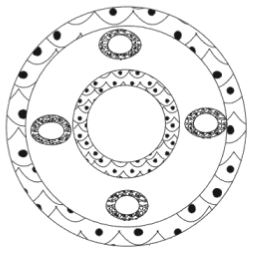
Which of the following phyla possess the body cavity as shown in the diagram below?
A
Annelida
B
Porifera
C
Aschelminthes
D
Coelenterata
Solution
(C) The diagram illustrates a pseudocoelomate body plan,where the body cavity is not lined by mesoderm but instead,the mesoderm is present as scattered pouches in between the ectoderm and endoderm.
This type of body cavity is a characteristic feature of the phylum $Aschelminthes$ (also known as roundworms).
This type of body cavity is a characteristic feature of the phylum $Aschelminthes$ (also known as roundworms).
0 likesView Solution
8
BiologyEasyMCQKCET · 2019
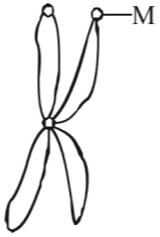
Identify the part labelled as '$M$' in the diagram given below:
A
Chromatid
B
Kinetochore
C
Centromere
D
Satellite
Solution
(D) The correct answer is $D$.
In the provided diagram of a chromosome,the part labelled as '$M$' represents the satellite.
$A$ satellite is a small chromosomal segment separated from the main body of the chromosome by a secondary constriction.
Chromosomes possessing this feature are known as $SAT$-chromosomes.
In the provided diagram of a chromosome,the part labelled as '$M$' represents the satellite.
$A$ satellite is a small chromosomal segment separated from the main body of the chromosome by a secondary constriction.
Chromosomes possessing this feature are known as $SAT$-chromosomes.
0 likesView Solution
9
BiologyEasyMCQKCET · 2019
What is the function of the protein $GLUT-4$?
A
Acts as an enzyme
B
Enables glucose transport into cells
C
Fights infectious agents
D
Functions as intercellular ground substance
Solution
(B) $GLUT-4$ is a specialized transport protein that facilitates the movement of glucose across the plasma membrane into cells.
It is primarily found in adipose tissues and skeletal muscle cells,where it is essential for maintaining glucose homeostasis.
It is primarily found in adipose tissues and skeletal muscle cells,where it is essential for maintaining glucose homeostasis.
0 likesView Solution
10
BiologyEasyMCQKCET · 2019
Which of the following protozoan parasites causes sleeping sickness?
A
Plasmodium
B
Entamoeba
C
Leishmania
D
Trypanosoma
Solution
(D) Trypanosoma.
Sleeping sickness, also known as human African trypanosomiasis, is a parasitic disease caused by the protozoan $Trypanosoma \text{ } brucei$.
It is transmitted to humans through the bite of an infected tsetse fly.
Sleeping sickness, also known as human African trypanosomiasis, is a parasitic disease caused by the protozoan $Trypanosoma \text{ } brucei$.
It is transmitted to humans through the bite of an infected tsetse fly.
0 likesView Solution
11
BiologyEasyMCQKCET · 2019
Nowadays,agricultural practice is expensive for farmers as they need to purchase hybrid seeds every year. Which of the following strategies can be employed to overcome this problem?
A
Synthetic seeds
B
Production of Apomictic seeds
C
Conventional plant breeding
D
Parthenocarpy
Solution
(B) - Production of Apomictic seeds.
Apomixis is a form of asexual reproduction that mimics sexual reproduction. In this process,seeds are produced without fertilization. This significantly reduces the cost of hybrid seed production,allowing plant breeders to develop new varieties more quickly and at a lower cost,which benefits farmers by eliminating the need to purchase new hybrid seeds every year.
Apomixis is a form of asexual reproduction that mimics sexual reproduction. In this process,seeds are produced without fertilization. This significantly reduces the cost of hybrid seed production,allowing plant breeders to develop new varieties more quickly and at a lower cost,which benefits farmers by eliminating the need to purchase new hybrid seeds every year.
0 likesView Solution
12
BiologyEasyMCQKCET · 2019
Testa and tegmen of the seed coat represent
A
dried integuments
B
dried sepals
C
dried tepals
D
dried petals
Solution
(A) The seed coat is the outermost protective covering of a seed.
It is derived from the integuments of the ovule after fertilization.
The outer layer is known as the $Testa$,which develops from the outer integument.
The inner layer is known as the $Tegmen$,which develops from the inner integument.
Therefore,both $Testa$ and $Tegmen$ represent the dried integuments of the ovule.
It is derived from the integuments of the ovule after fertilization.
The outer layer is known as the $Testa$,which develops from the outer integument.
The inner layer is known as the $Tegmen$,which develops from the inner integument.
Therefore,both $Testa$ and $Tegmen$ represent the dried integuments of the ovule.
0 likesView Solution
13
BiologyEasyMCQKCET · 2019
Identify the correct order of steps involved in artificial hybridization in plants.
A
Artificial Pollination $\rightarrow$ Emasculation $\rightarrow$ Rebagging $\rightarrow$ Bagging
B
Rebagging $\rightarrow$ Artificial Pollination $\rightarrow$ Bagging $\rightarrow$ Emasculation
C
Emasculation $\rightarrow$ Bagging $\rightarrow$ Artificial Pollination $\rightarrow$ Rebagging
D
Bagging $\rightarrow$ Artificial Pollination $\rightarrow$ Rebagging $\rightarrow$ Emasculation
Solution
(C) Emasculation $\rightarrow$ Bagging $\rightarrow$ Artificial Pollination $\rightarrow$ Rebagging.
Artificial hybridization of plants involves the following steps:
$(i)$ Emasculation: The removal of anthers from the bisexual flower of the female parent before the anthers dehisce.
$(ii)$ Bagging: The emasculated flower is covered with a suitable bag,generally made of butter paper,to prevent contamination of its stigma with unwanted pollen.
$(iii)$ Artificial Pollination: When the stigma of the bagged flower attains receptivity,mature pollen grains collected from the anthers of the male parent are dusted on the stigma.
$(iv)$ Rebagging: The flower is rebagged after pollination to allow the fruit to develop.
Artificial hybridization of plants involves the following steps:
$(i)$ Emasculation: The removal of anthers from the bisexual flower of the female parent before the anthers dehisce.
$(ii)$ Bagging: The emasculated flower is covered with a suitable bag,generally made of butter paper,to prevent contamination of its stigma with unwanted pollen.
$(iii)$ Artificial Pollination: When the stigma of the bagged flower attains receptivity,mature pollen grains collected from the anthers of the male parent are dusted on the stigma.
$(iv)$ Rebagging: The flower is rebagged after pollination to allow the fruit to develop.
0 likesView Solution
14
BiologyEasyMCQKCET · 2019
In some plants,stigma and anther mature at different times because
A
it attracts pollinators
B
it facilitates self-pollination
C
it prevents cross-pollination
D
it facilitates cross-pollination
Solution
(D) The phenomenon where the stigma and anther of a flower mature at different times is known as $Dichogamy$.
This mechanism ensures that the pollen grains from the same flower cannot fertilize the stigma of the same flower,thereby preventing self-pollination.
Consequently,this process promotes and facilitates cross-pollination,which increases genetic diversity in the offspring.
Therefore,the correct option is $D$.
This mechanism ensures that the pollen grains from the same flower cannot fertilize the stigma of the same flower,thereby preventing self-pollination.
Consequently,this process promotes and facilitates cross-pollination,which increases genetic diversity in the offspring.
Therefore,the correct option is $D$.
0 likesView Solution
15
BiologyEasyMCQKCET · 2019
Which of these is not an advantage of genetically modified crops?
A
Increase efficiency of mineral usage in plants.
B
Reduces the reliance on chemical pesticides.
C
Enhances the nutritional value of food.
D
Increases the post-harvest losses.
Solution
(D) is the correct answer.
Genetically modified $(GM)$ crops are plants whose $DNA$ has been modified through genetic engineering to introduce a new trait that does not occur naturally in the species.
Advantages of $GM$ crops include:
$1$. Improved nutritional quality of crops (e.g.,Golden Rice).
$2$. Reduced reliance on chemical pesticides and insecticides during farming.
$3$. Increased efficiency of mineral usage by plants,which prevents early exhaustion of soil fertility.
$4$. Enhanced tolerance to abiotic stresses like cold,drought,salt,and heat.
Increasing post-harvest losses is a disadvantage,not an advantage,of any agricultural practice.
Genetically modified $(GM)$ crops are plants whose $DNA$ has been modified through genetic engineering to introduce a new trait that does not occur naturally in the species.
Advantages of $GM$ crops include:
$1$. Improved nutritional quality of crops (e.g.,Golden Rice).
$2$. Reduced reliance on chemical pesticides and insecticides during farming.
$3$. Increased efficiency of mineral usage by plants,which prevents early exhaustion of soil fertility.
$4$. Enhanced tolerance to abiotic stresses like cold,drought,salt,and heat.
Increasing post-harvest losses is a disadvantage,not an advantage,of any agricultural practice.
0 likesView Solution
16
BiologyEasyMCQKCET · 2019
Some multinational companies have exploited the traditional knowledge of the indigenous people to produce commercially important bioproducts,without their consent. This is an example of:
A
biopatent
B
bioprospecting
C
biopiracy
D
bioremediation
Solution
(C) biopiracy.
Biopiracy refers to the unauthorized use of bioresources and traditional knowledge by companies or individuals without obtaining proper legal permission or compensation from the concerned indigenous people or countries.
Biopiracy refers to the unauthorized use of bioresources and traditional knowledge by companies or individuals without obtaining proper legal permission or compensation from the concerned indigenous people or countries.
0 likesView Solution
17
BiologyEasyMCQKCET · 2019
From the given options,identify the correct combination of population interactions that correspond to the symbols given here.
A
| $+,+$ | $-,-$ | $+,o$ |
|---|---|---|
| Parasitism | Competition | Mutualism |
B
| $+,+$ | $-,-$ | $+,o$ |
|---|---|---|
| Predation | Competition | Commensalism |
C
| $+,+$ | $-,-$ | $+,o$ |
|---|---|---|
| Mutualism | Competition | Commensalism |
D
| $+,+$ | $-,-$ | $+,o$ |
|---|---|---|
| Mutualism | Parasitism | Amensalism |
Solution
(C) The correct option is $C$.
Population interactions are defined by the effect on the two interacting species:
$1$. $+,+$ (Mutualism): Both interacting species benefit.
$2$. $-,-$ (Competition): Both interacting species are harmed.
$3$. $+,o$ (Commensalism): One species benefits,while the other is neither benefited nor harmed.
In contrast:
- Parasitism $(+,-)$ and Predation $(+,-)$ involve one species benefiting at the expense of the other.
- Amensalism $(-,o)$ involves one species being harmed while the other remains unaffected.
Population interactions are defined by the effect on the two interacting species:
$1$. $+,+$ (Mutualism): Both interacting species benefit.
$2$. $-,-$ (Competition): Both interacting species are harmed.
$3$. $+,o$ (Commensalism): One species benefits,while the other is neither benefited nor harmed.
In contrast:
- Parasitism $(+,-)$ and Predation $(+,-)$ involve one species benefiting at the expense of the other.
- Amensalism $(-,o)$ involves one species being harmed while the other remains unaffected.
0 likesView Solution
18
BiologyEasyMCQKCET · 2019
Read the statements and choose the correct answer.
$Statement-I$: The Monarch butterfly feeds on poisonous weeds during its caterpillar stage.
$Statement-II$: It helps the butterfly to become distasteful to its predator.
$Statement-I$: The Monarch butterfly feeds on poisonous weeds during its caterpillar stage.
$Statement-II$: It helps the butterfly to become distasteful to its predator.
A
$Statement-I$ is true, $Statement-II$ is false.
B
$Statement-I$ is true and $Statement-II$ is its correct explanation.
C
Both $Statement-I$ and $II$ are false.
D
Both $Statement-I$ and $II$ are true, but $Statement-II$ is not the correct explanation of $Statement-I$.
Solution
(B) The correct answer is $B$.
$Statement-I$ is true: The Monarch butterfly feeds on poisonous weeds during its caterpillar stage, which allows it to acquire toxic chemicals.
$Statement-II$ is true: These chemicals make the butterfly highly distasteful to its predators (birds).
Since the accumulation of toxins from the weeds is the direct reason why the butterfly becomes distasteful, $Statement-II$ is the correct explanation of $Statement-I$.
$Statement-I$ is true: The Monarch butterfly feeds on poisonous weeds during its caterpillar stage, which allows it to acquire toxic chemicals.
$Statement-II$ is true: These chemicals make the butterfly highly distasteful to its predators (birds).
Since the accumulation of toxins from the weeds is the direct reason why the butterfly becomes distasteful, $Statement-II$ is the correct explanation of $Statement-I$.
0 likesView Solution
19
BiologyEasyMCQKCET · 2019
Of the total incident solar radiation,the percentage of photosynthetically active radiation $(PAR)$ captured by the plants is
A
$10-20\%$ of $PAR$ only
B
$2-10\%$ of $PAR$ only
C
$0-10\%$ of $PAR$ only
D
$30-40\%$ of $PAR$ only
Solution
(B) The correct answer is $B$.
Photosynthetically active radiation $(PAR)$ consists of light with wavelengths between $400 \ nm$ and $700 \ nm$,which is the specific portion of the light spectrum utilized by plants for photosynthesis.
Out of the total incident solar radiation reaching the Earth,less than $50\%$ constitutes $PAR$.
Plants are only able to capture and utilize approximately $2-10\%$ of this $PAR$ for the process of photosynthesis.
Photosynthetically active radiation $(PAR)$ consists of light with wavelengths between $400 \ nm$ and $700 \ nm$,which is the specific portion of the light spectrum utilized by plants for photosynthesis.
Out of the total incident solar radiation reaching the Earth,less than $50\%$ constitutes $PAR$.
Plants are only able to capture and utilize approximately $2-10\%$ of this $PAR$ for the process of photosynthesis.
0 likesView Solution
20
BiologyEasyMCQKCET · 2019
Net primary productivity $(NPP)$ in an ecosystem is:
A
$GPP - R = NPP$
B
$GPP + R = NPP$
C
$GPP - NPP = R$
D
$R - NPP = GPP$
Solution
(A) The correct option is $A$.
Net primary productivity $(NPP)$ is the biomass available for consumers (herbivores and decomposers) for consumption.
Gross primary productivity $(GPP)$ of an ecosystem is the rate of production of organic matter during photosynthesis.
During respiration $(R)$,organic compounds are oxidized to release energy,producing carbon dioxide and water.
Therefore,when the energy lost through respiration $(R)$ is subtracted from the total gross primary productivity $(GPP)$,we obtain the net primary productivity $(NPP)$.
Mathematically,this is expressed as: $NPP = GPP - R$.
Net primary productivity $(NPP)$ is the biomass available for consumers (herbivores and decomposers) for consumption.
Gross primary productivity $(GPP)$ of an ecosystem is the rate of production of organic matter during photosynthesis.
During respiration $(R)$,organic compounds are oxidized to release energy,producing carbon dioxide and water.
Therefore,when the energy lost through respiration $(R)$ is subtracted from the total gross primary productivity $(GPP)$,we obtain the net primary productivity $(NPP)$.
Mathematically,this is expressed as: $NPP = GPP - R$.
0 likesView Solution
21
BiologyEasyMCQKCET · 2019
Which one of the following ecosystems has the highest annual net primary productivity?
A
Desert
B
Tropical deciduous forest
C
Tropical rain forest
D
Temperate evergreen forest
Solution
(C) The correct answer is $C$.
Net Primary Productivity $(NPP)$ is defined as the amount of biomass available for consumption by heterotrophs (herbivores and decomposers).
Tropical rain forests exhibit the highest $NPP$ among all terrestrial ecosystems.
This is because these regions receive abundant sunlight,high rainfall,and maintain warm temperatures throughout the year,which are optimal conditions for photosynthesis and plant growth.
Consequently,there is a dense concentration of vegetation at all levels,leading to maximum biomass production.
Net Primary Productivity $(NPP)$ is defined as the amount of biomass available for consumption by heterotrophs (herbivores and decomposers).
Tropical rain forests exhibit the highest $NPP$ among all terrestrial ecosystems.
This is because these regions receive abundant sunlight,high rainfall,and maintain warm temperatures throughout the year,which are optimal conditions for photosynthesis and plant growth.
Consequently,there is a dense concentration of vegetation at all levels,leading to maximum biomass production.
0 likesView Solution
22
BiologyEasyMCQKCET · 2019
The historic convention related to the conservation of biological diversity is also known as:
A
Earth Summit
B
Kyoto Protocol
C
World Summit
D
Montreal Protocol
Solution
(A) The correct answer is $A$.
The historic convention related to the conservation of biological diversity is known as the Earth Summit.
The Convention on Biological Diversity $(CBD)$ was held in Rio de Janeiro in $1992$.
It has three main goals:
$1$. The conservation of biological diversity.
$2$. The sustainable use of its components.
$3$. The fair and equitable sharing of benefits arising from genetic resources.
The historic convention related to the conservation of biological diversity is known as the Earth Summit.
The Convention on Biological Diversity $(CBD)$ was held in Rio de Janeiro in $1992$.
It has three main goals:
$1$. The conservation of biological diversity.
$2$. The sustainable use of its components.
$3$. The fair and equitable sharing of benefits arising from genetic resources.
0 likesView Solution
23
BiologyEasyMCQKCET · 2019
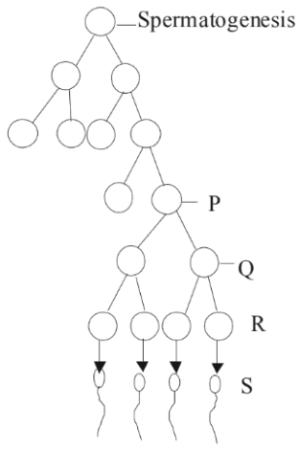
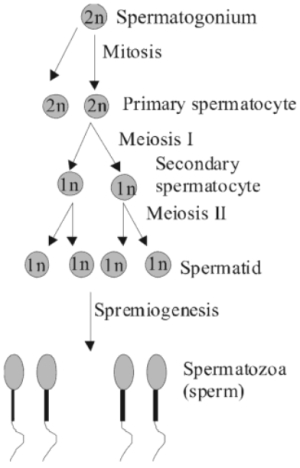
Identify the cells representing $P$,$Q$,$R$,and $S$ in the given schematic representation of spermatogenesis.
A
$P$ - Spermatozoa,$Q$ - Spermatids,$R$ - Secondary spermatocyte,$S$ - Primary spermatocyte
B
$P$ - Primary spermatocyte,$Q$ - Secondary spermatocyte,$R$ - Spermatids,$S$ - Spermatozoa
C
$P$ - Secondary spermatocyte,$Q$ - Spermatids,$R$ - Spermatozoa,$S$ - Primary spermatocyte
D
$P$ - Secondary spermatocyte,$Q$ - Primary spermatocyte,$R$ - Spermatozoa,$S$ - Spermatids
Solution
(B) In the process of spermatogenesis,the sequence of cell development is as follows:
$1$. $P$ represents the Primary spermatocyte,which undergoes Meiosis $I$ to form two haploid cells.
$2$. $Q$ represents the Secondary spermatocyte,which is the product of Meiosis $I$ and undergoes Meiosis $II$.
$3$. $R$ represents the Spermatids,which are the haploid cells formed after Meiosis $II$.
$4$. $S$ represents the Spermatozoa (sperm),which are formed from spermatids through the process of spermiogenesis.
Therefore,the correct sequence is $P$ - Primary spermatocyte,$Q$ - Secondary spermatocyte,$R$ - Spermatids,$S$ - Spermatozoa.
$1$. $P$ represents the Primary spermatocyte,which undergoes Meiosis $I$ to form two haploid cells.
$2$. $Q$ represents the Secondary spermatocyte,which is the product of Meiosis $I$ and undergoes Meiosis $II$.
$3$. $R$ represents the Spermatids,which are the haploid cells formed after Meiosis $II$.
$4$. $S$ represents the Spermatozoa (sperm),which are formed from spermatids through the process of spermiogenesis.
Therefore,the correct sequence is $P$ - Primary spermatocyte,$Q$ - Secondary spermatocyte,$R$ - Spermatids,$S$ - Spermatozoa.
0 likesView Solution
24
BiologyEasyMCQKCET · 2019
If in a normal menstruating woman,menses occur on $5^{\text{th}}$ April,what will be the expected date of ovulation?
A
$10^{\text{th}}$ April
B
$18^{\text{th}}$ April
C
$29^{\text{th}}$ April
D
$14^{\text{th}}$ April
Solution
(B) In a normal menstrual cycle of $28$ days,ovulation typically occurs on the $14^{\text{th}}$ day from the start of the menstrual flow.
However,the question implies a cycle where the ovulation date is calculated based on the standard physiological window.
If the menstrual cycle is $28$ days,the $14^{\text{th}}$ day from $5^{\text{th}}$ April is $18^{\text{th}}$ April $(5 + 13 = 18)$.
Therefore,the expected date of ovulation is $18^{\text{th}}$ April.
However,the question implies a cycle where the ovulation date is calculated based on the standard physiological window.
If the menstrual cycle is $28$ days,the $14^{\text{th}}$ day from $5^{\text{th}}$ April is $18^{\text{th}}$ April $(5 + 13 = 18)$.
Therefore,the expected date of ovulation is $18^{\text{th}}$ April.
0 likesView Solution
25
BiologyEasyMCQKCET · 2019
The nourishing cells in the seminiferous tubules are
A
follicular cells
B
leydig cells
C
sertoli cells
D
spermatogonial cells
Solution
(C) The correct answer is $C$.
Sertoli cells are specialized cells found within the seminiferous tubules of the testes.
Their primary function is to provide nourishment,structural support,and protection to the developing germ cells (spermatids) during the process of spermatogenesis.
Sertoli cells are specialized cells found within the seminiferous tubules of the testes.
Their primary function is to provide nourishment,structural support,and protection to the developing germ cells (spermatids) during the process of spermatogenesis.
0 likesView Solution
26
BiologyEasyMCQKCET · 2019
The method of natural contraception which requires correct knowledge of the menstrual cycle is
A
Periodic abstinence
B
Lactational amenorrhoea
C
IUDs (Intrauterine devices)
D
Coitus interruptus
Solution
(A) Periodic abstinence.
Periodic abstinence is a natural method of contraception where couples avoid or abstain from coitus from day $10$ to $17$ of the menstrual cycle,when ovulation could be expected. This period is called the fertile period. As a result,chances of conception are prevented by abstaining from coitus during this period. This method requires a correct understanding of the menstrual cycle to be effective.
Periodic abstinence is a natural method of contraception where couples avoid or abstain from coitus from day $10$ to $17$ of the menstrual cycle,when ovulation could be expected. This period is called the fertile period. As a result,chances of conception are prevented by abstaining from coitus during this period. This method requires a correct understanding of the menstrual cycle to be effective.
0 likesView Solution
27
BiologyEasyMCQKCET · 2019
$A$ childless couple visits an Assisted Reproductive Technologies (ARTs) centre to get assistance to have a child. On diagnosis,it was noticed that there was a low sperm count in the male partner. Which of the following strategies of $ART$ is most suitable in this case?
A
Gamete Intra-Fallopian Transfer $(GIFT)$
B
Artificial Insemination $(AI)$
C
Zygote Intra-Fallopian Transfer $(ZIFT)$
D
In vitro Fertilisation $(IVF)$
Solution
(B) The correct option is $B$.
Artificial Insemination $(AI)$ is a technique used in cases where the male partner is unable to inseminate the female or has a very low sperm count.
In this procedure,the semen collected either from the husband or a healthy donor is artificially introduced either into the vagina or into the uterus ($IUI$ - Intra-Uterine Insemination) of the female.
Since the male partner has a low sperm count,$AI$ is the most suitable strategy to increase the chances of fertilisation.
Artificial Insemination $(AI)$ is a technique used in cases where the male partner is unable to inseminate the female or has a very low sperm count.
In this procedure,the semen collected either from the husband or a healthy donor is artificially introduced either into the vagina or into the uterus ($IUI$ - Intra-Uterine Insemination) of the female.
Since the male partner has a low sperm count,$AI$ is the most suitable strategy to increase the chances of fertilisation.
0 likesView Solution
28
BiologyEasyMCQKCET · 2019
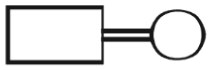
In the following symbols used in human pedigree analysis,identify the symbol that denotes consanguineous mating.
A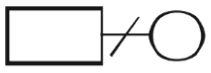
B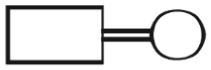
C
D
Solution
(B) In human pedigree analysis,symbols are used to represent different relationships and traits.
$A$ represents a mating between a male and a female with a line crossed through it,indicating a mating that did not result in offspring or a broken relationship.
$B$ represents consanguineous mating,which is a mating between close relatives (such as cousins). It is depicted by two horizontal lines connecting the male and female symbols.
$C$ represents a male and a female with no connection,indicating no mating relationship.
$D$ represents a standard mating between a male and a female,depicted by a single horizontal line connecting them.
Therefore,the correct symbol for consanguineous mating is $B$.
$A$ represents a mating between a male and a female with a line crossed through it,indicating a mating that did not result in offspring or a broken relationship.
$B$ represents consanguineous mating,which is a mating between close relatives (such as cousins). It is depicted by two horizontal lines connecting the male and female symbols.
$C$ represents a male and a female with no connection,indicating no mating relationship.
$D$ represents a standard mating between a male and a female,depicted by a single horizontal line connecting them.
Therefore,the correct symbol for consanguineous mating is $B$.
0 likesView Solution
29
BiologyEasyMCQKCET · 2019
From the chromosomal complements given below,identify the one which shows female heterogamety.
A
$XX$-$XO$
B
$XX$-$XY$
C
$XX$-$XXY$
D
$ZZ$-$ZW$
Solution
(D) In the $ZZ-ZW$ type of sex determination,the male is homogametic $(ZZ)$ and the female is heterogametic $(ZW)$.
This system is commonly observed in birds and some reptiles.
In contrast,$XX-XO$ and $XX-XY$ systems represent male heterogamety,where the male produces two different types of gametes.
This system is commonly observed in birds and some reptiles.
In contrast,$XX-XO$ and $XX-XY$ systems represent male heterogamety,where the male produces two different types of gametes.
0 likesView Solution
30
BiologyEasyMCQKCET · 2019
Identify the odd one among the following disorders.
A
Haemophilia
B
Sickle-cell anaemia
C
Phenylketonuria
D
Thalassemia
Solution
(A) Haemophilia.
Haemophilia is a sex-linked recessive disease.
Sickle-cell anaemia,phenylketonuria,and thalassemia are autosomal recessive diseases.
Haemophilia is a sex-linked recessive disease.
Sickle-cell anaemia,phenylketonuria,and thalassemia are autosomal recessive diseases.
0 likesView Solution
31
BiologyEasyMCQKCET · 2019
In Morgan's experiment with $Drosophila$,when a yellow-bodied,white-eyed female was crossed with a brown-bodied,red-eyed male and their $F_1$ progeny were intercrossed,what was the percentage of recombinants in the $F_2$ generation (in $\%$)?
A
$6.28$
B
$98.7$
C
$1.3$
D
$37.2$
Solution
(C) In $Morgan's$ experiment on $Drosophila$,the genes for body color and eye color are linked and located on the $X$ chromosome.
When a yellow-bodied,white-eyed female is crossed with a brown-bodied,red-eyed male,the $F_1$ generation consists of brown-bodied,red-eyed females and yellow-bodied,white-eyed males.
Upon intercrossing the $F_1$ progeny,the $F_2$ generation shows a significant deviation from the expected $9:3:3:1$ ratio due to genetic linkage.
The parental types are much more frequent than the recombinant types.
The percentage of recombinants observed in this specific cross was $1.3\%$,which indicates a very tight linkage between the genes for body color and eye color.
When a yellow-bodied,white-eyed female is crossed with a brown-bodied,red-eyed male,the $F_1$ generation consists of brown-bodied,red-eyed females and yellow-bodied,white-eyed males.
Upon intercrossing the $F_1$ progeny,the $F_2$ generation shows a significant deviation from the expected $9:3:3:1$ ratio due to genetic linkage.
The parental types are much more frequent than the recombinant types.
The percentage of recombinants observed in this specific cross was $1.3\%$,which indicates a very tight linkage between the genes for body color and eye color.
0 likesView Solution
32
BiologyEasyMCQKCET · 2019
In a crime investigation,the investigating officer collects different biological samples from the crime spot for $DNA$ fingerprinting analysis. Which of the following samples is not helpful in this analysis?
A
Skin shreds
B
Erythrocytes
C
Semen sample
D
Hair follicle
Solution
(B) Erythrocytes.
Erythrocytes (red blood cells) are not helpful for $DNA$ fingerprinting because mature mammalian erythrocytes lack a nucleus and,consequently,do not contain genomic $DNA$.
Erythrocytes (red blood cells) are not helpful for $DNA$ fingerprinting because mature mammalian erythrocytes lack a nucleus and,consequently,do not contain genomic $DNA$.
0 likesView Solution
33
BiologyEasyMCQKCET · 2019
$A$ mature $mRNA$ consists of $900$ bases without any stop codon in between. Calculate the number of amino acids coded by this $mRNA$ during translation.
A
$900$
B
$299$
C
$300$
D
$450$
Solution
(C) The genetic code is a triplet code,meaning $3$ nucleotides (bases) code for $1$ amino acid.
Given that the $mRNA$ has $900$ bases and no stop codon is present,the total number of codons is calculated by dividing the total number of bases by $3$.
Number of codons = $\frac{900}{3} = 300$.
Since each codon codes for one amino acid,the number of amino acids coded is $300$.
Given that the $mRNA$ has $900$ bases and no stop codon is present,the total number of codons is calculated by dividing the total number of bases by $3$.
Number of codons = $\frac{900}{3} = 300$.
Since each codon codes for one amino acid,the number of amino acids coded is $300$.
0 likesView Solution
34
BiologyEasyMCQKCET · 2019
Which of the following amino acids is coded by a single codon?
A
Valine
B
Phenylalanine
C
Tyrosine
D
Tryptophan
Solution
(D) Tryptophan.
In the genetic code,most amino acids are specified by more than one codon (degeneracy).
However,Tryptophan $(Trp)$ and Methionine $(Met)$ are unique because they are each coded by only a single codon.
Tryptophan is coded exclusively by the codon $UGG$.
In the genetic code,most amino acids are specified by more than one codon (degeneracy).
However,Tryptophan $(Trp)$ and Methionine $(Met)$ are unique because they are each coded by only a single codon.
Tryptophan is coded exclusively by the codon $UGG$.
0 likesView Solution
35
BiologyEasyMCQKCET · 2019
According to the Human Genome Project $(HGP)$, the total number of genes in the human genome is estimated at $30,000$. The number of genes on the $Y$ chromosome is: (in $genes$)
A
$2968$
B
$242$
C
$231$
D
$2898$
Solution
(C) The correct answer is $C$.
According to the findings of the Human Genome Project $(HGP)$, the total number of genes in the human genome is estimated to be approximately $30,000$.
Among all human chromosomes, the $Y$ chromosome has the fewest number of genes, which is $231$.
In contrast, Chromosome $1$ has the most genes, totaling $2968$.
According to the findings of the Human Genome Project $(HGP)$, the total number of genes in the human genome is estimated to be approximately $30,000$.
Among all human chromosomes, the $Y$ chromosome has the fewest number of genes, which is $231$.
In contrast, Chromosome $1$ has the most genes, totaling $2968$.
0 likesView Solution
36
BiologyEasyMCQKCET · 2019
Which of the following nitrogen bases is found only in $DNA$?
A
Cytosine
B
Adenine
C
Thymine
D
Guanine
Solution
(C) The correct answer is $C$.
Nitrogenous bases found in $DNA$ are Adenine $(A)$,Guanine $(G)$,Cytosine $(C)$,and Thymine $(T)$.
In $RNA$,Thymine is replaced by Uracil $(U)$.
Therefore,Thymine is the nitrogenous base found exclusively in $DNA$ and not in $RNA$.
Nitrogenous bases found in $DNA$ are Adenine $(A)$,Guanine $(G)$,Cytosine $(C)$,and Thymine $(T)$.
In $RNA$,Thymine is replaced by Uracil $(U)$.
Therefore,Thymine is the nitrogenous base found exclusively in $DNA$ and not in $RNA$.
0 likesView Solution
37
BiologyEasyMCQKCET · 2019
In prokaryotes, the transcription of $DNA$ is initiated with the help of
A
rho factor
B
elongation factor
C
sigma factor
D
termination factor
Solution
(C) The correct answer is $C$.
In prokaryotes, the process of transcription is catalyzed by $DNA$-dependent $RNA$ polymerase.
This enzyme requires a specific initiation factor known as the $\sigma$ factor to recognize the promoter region on the $DNA$ template.
Once the $\sigma$ factor binds to the $RNA$ polymerase, it facilitates the binding of the enzyme to the promoter, thereby initiating the transcription process.
After initiation, the $\sigma$ factor dissociates, and the core enzyme continues the elongation process.
In prokaryotes, the process of transcription is catalyzed by $DNA$-dependent $RNA$ polymerase.
This enzyme requires a specific initiation factor known as the $\sigma$ factor to recognize the promoter region on the $DNA$ template.
Once the $\sigma$ factor binds to the $RNA$ polymerase, it facilitates the binding of the enzyme to the promoter, thereby initiating the transcription process.
After initiation, the $\sigma$ factor dissociates, and the core enzyme continues the elongation process.
0 likesView Solution
38
BiologyEasyMCQKCET · 2019
In $Bougainvillea$ and $Cucurbita$,the axillary bud is modified into thorn and tendril respectively. This is an example of:
A
Co-evolution
B
Divergent evolution
C
Micro evolution
D
Convergent evolution
Solution
(B) $Bougainvillea$ and $Cucurbita$ exhibit homologous structures where the axillary bud is modified into a thorn (for protection) and a tendril (for support),respectively.
These structures share a common anatomical origin but perform different functions,which is a classic characteristic of homologous organs.
Homologous organs are the result of divergent evolution,where species with a common ancestor evolve different traits to adapt to different environmental pressures.
These structures share a common anatomical origin but perform different functions,which is a classic characteristic of homologous organs.
Homologous organs are the result of divergent evolution,where species with a common ancestor evolve different traits to adapt to different environmental pressures.
0 likesView Solution
39
BiologyEasyMCQKCET · 2019
The brain capacity of $Homo \text{ } habilis$ is
A
$1800 \text{ } cc$
B
Between $650 \text{ } cc$ < $800 \text{ } cc$
C
$900 \text{ } cc$
D
$1400 \text{ } cc$
Solution
(B) $Homo \text{ } habilis$ (skillful humans) were considered the first human-like hominids.
Their brain capacity ranged between $650 \text{ } cc$ and $800 \text{ } cc$.
Their brain capacity ranged between $650 \text{ } cc$ and $800 \text{ } cc$.
0 likesView Solution
40
BiologyEasyMCQKCET · 2019
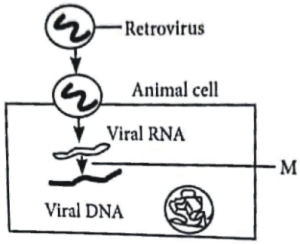
Identify the enzyme that catalyses the step labelled as '$M$' in the given schematic representation of replication of retrovirus.
A
Reverse transcriptase
B
$RNA$ polymerase
C
Recombinase
D
$DNA$ ligase
Solution
(A) The correct answer is $(A)$ Reverse transcriptase.
In the replication cycle of a retrovirus,the viral $RNA$ enters the host cell. The enzyme Reverse transcriptase (also known as $RNA$-dependent $DNA$ polymerase) catalyses the synthesis of viral $DNA$ from the viral $RNA$ template. This process is known as reverse transcription,which is represented by the step labelled '$M$' in the diagram.
In the replication cycle of a retrovirus,the viral $RNA$ enters the host cell. The enzyme Reverse transcriptase (also known as $RNA$-dependent $DNA$ polymerase) catalyses the synthesis of viral $DNA$ from the viral $RNA$ template. This process is known as reverse transcription,which is represented by the step labelled '$M$' in the diagram.
0 likesView Solution
41
BiologyEasyMCQKCET · 2019
Identify the incorrect statement.
A
$HIV$ is transmitted by mosquito bite.
B
Pneumonia is a bacterial disease.
C
Cancer is a non-infectious disease.
D
Ringworm is a fungal disease.
Solution
(A) $HIV$ is not transmitted by mosquito bites. $HIV$ is transmitted only through:
$1$. Sexual contact with an infected person.
$2$. Transfusion of contaminated blood or blood products.
$3$. Sharing infected needles or syringes.
$4$. From an infected mother to her child through the placenta or during childbirth.
Therefore,the statement '$HIV$ is transmitted by mosquito bite' is incorrect.
$1$. Sexual contact with an infected person.
$2$. Transfusion of contaminated blood or blood products.
$3$. Sharing infected needles or syringes.
$4$. From an infected mother to her child through the placenta or during childbirth.
Therefore,the statement '$HIV$ is transmitted by mosquito bite' is incorrect.
0 likesView Solution
42
BiologyEasyMCQKCET · 2019
$A$ man was suffering from mental illness like depression and insomnia. Identify the drug which is normally used as medicine in such cases.
A
Morphine
B
Lysergic Acid Diethylamide $(LSD)$
C
Nicotine
D
Heroin
Solution
(B) Lysergic Acid Diethylamide $(LSD)$.
Lysergic Acid Diethylamide $(LSD)$ is one of the most potent mood-altering chemicals. It is derived from lysergic acid,which is found in the ergot fungus that grows on rye and other grains. It influences brain function by interacting with serotonin receptors in the cortex and deep brain structures. In controlled medical contexts,such substances are sometimes researched for their potential to treat severe mental health conditions like depression and insomnia.
Lysergic Acid Diethylamide $(LSD)$ is one of the most potent mood-altering chemicals. It is derived from lysergic acid,which is found in the ergot fungus that grows on rye and other grains. It influences brain function by interacting with serotonin receptors in the cortex and deep brain structures. In controlled medical contexts,such substances are sometimes researched for their potential to treat severe mental health conditions like depression and insomnia.
0 likesView Solution
43
BiologyEasyMCQKCET · 2019
$A$ person shows symptoms like sneezing,watery eyes,running nose,and difficulty in breathing upon exposure to certain substances in the air. Which type of antibody is produced during such a condition?
A
IgG
B
IgE
C
IgM
D
IgA
Solution
(B) The correct answer is $B$ (IgE).
When a person is exposed to allergens (substances in the air that trigger an allergic reaction),the body's immune system produces a specific type of antibody called Immunoglobulin $E$ $(IgE)$.
These $IgE$ antibodies bind to mast cells and basophils,triggering the release of chemicals like histamine and serotonin.
This release leads to common allergic symptoms such as sneezing,watery eyes,a runny nose,and difficulty in breathing.
When a person is exposed to allergens (substances in the air that trigger an allergic reaction),the body's immune system produces a specific type of antibody called Immunoglobulin $E$ $(IgE)$.
These $IgE$ antibodies bind to mast cells and basophils,triggering the release of chemicals like histamine and serotonin.
This release leads to common allergic symptoms such as sneezing,watery eyes,a runny nose,and difficulty in breathing.
0 likesView Solution
44
BiologyEasyMCQKCET · 2019
$A$ farmer has applied chemical fertilisers in his crop field for many successive seasons. In the next season,the crop growth was poor as the soil lost its fertility. Suggest the suitable micro-organisms that replenish the fertility of the soil in his field.
A
Spirulina
B
Nostoc
C
Chlorella
D
Spirogyra
Solution
(B) $Nostoc$.
Biofertilizers are substances that contain microbes which help in promoting the growth of plants and trees by increasing the supply of essential nutrients.
Cyanobacteria like $Anabaena$,$Nostoc$,and $Oscillatoria$ are known to fix atmospheric nitrogen,thereby enriching the soil with nitrogenous compounds and restoring its fertility.
Biofertilizers are substances that contain microbes which help in promoting the growth of plants and trees by increasing the supply of essential nutrients.
Cyanobacteria like $Anabaena$,$Nostoc$,and $Oscillatoria$ are known to fix atmospheric nitrogen,thereby enriching the soil with nitrogenous compounds and restoring its fertility.
0 likesView Solution
45
BiologyEasyMCQKCET · 2019
Identify the incorrect statement with reference to biocontrol agents.
A
They do not show any negative impact on crop plants.
B
They help to increase the use of synthetic pesticides.
C
They are significant in treating ecologically sensitive areas.
D
They do not affect non-target pests.
Solution
(B) Biocontrol agents are organisms used to control pests and diseases in an eco-friendly manner.
Option $B$ is incorrect because biocontrol agents are specifically used to reduce the reliance on harmful synthetic pesticides and chemicals.
They are beneficial for the environment as they do not harm non-target organisms and are highly effective in ecologically sensitive areas.
Option $B$ is incorrect because biocontrol agents are specifically used to reduce the reliance on harmful synthetic pesticides and chemicals.
They are beneficial for the environment as they do not harm non-target organisms and are highly effective in ecologically sensitive areas.
0 likesView Solution
46
BiologyEasyMCQKCET · 2019
$A$ student while extracting $DNA$ from $Aspergillus$ fungus uses . . . . . . enzyme to break open the cell wall.
A
cellulase
B
lysozyme
C
pectinase
D
chitinase
Solution
(D) chitinase.
$Aspergillus$ is a fungus,and its cell wall has chitin as a structurally important component.
Thus,to break down the fungal cell wall,the enzyme chitinase is required.
$Aspergillus$ is a fungus,and its cell wall has chitin as a structurally important component.
Thus,to break down the fungal cell wall,the enzyme chitinase is required.
0 likesView Solution
47
BiologyEasyMCQKCET · 2019
Identify the $DNA$ sequence which can be cut using $EcoRI$.
A
$5' TGCTTAAGTA 3'$
$3' ACGAATTCAT 5'$
$3' ACGAATTCAT 5'$
B
$5' ACGAATTCAT 3'$
$3' TGCTTAAGTA 5'$
$3' TGCTTAAGTA 5'$
C
$5' TACTTAAGCA 3'$
$3' ATGAATTCGT 5'$
$3' ATGAATTCGT 5'$
D
$3' ACGAATTCAT 5'$
$5' TGCTTAAGTA 3'$
$5' TGCTTAAGTA 3'$
Solution
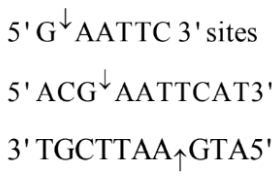
(B) The restriction enzyme $EcoRI$ recognizes the specific palindromic sequence $5'-GAATTC-3'$ and cuts between $G$ and $A$.
Looking at the options,option $B$ contains the sequence $5'-ACGAATTCAT-3'$ which includes the recognition site $GAATTC$ on the top strand.
Specifically,the sequence is $5'-ACG(GAATTC)AT-3'$.
Therefore,the correct sequence is $5'-ACGAATTCAT-3'$ paired with $3'-TGCTTAAGTA-5'$.
Looking at the options,option $B$ contains the sequence $5'-ACGAATTCAT-3'$ which includes the recognition site $GAATTC$ on the top strand.
Specifically,the sequence is $5'-ACG(GAATTC)AT-3'$.
Therefore,the correct sequence is $5'-ACGAATTCAT-3'$ paired with $3'-TGCTTAAGTA-5'$.
0 likesView Solution
48
BiologyEasyMCQKCET · 2019
In cloning vectors,antibiotic resistant genes are helpful for
A
transfer of foreign gene to the host
B
selection of recombinants
C
making the host cells competent
D
cleaving of vector by $REN$
Solution
(B) . Selection of recombinants.
Antibiotic resistance genes present in the cloning vector are primarily used as selectable markers.
These genes allow for the identification and selection of transformed bacterial cells from non-transformed ones.
Cells that have taken up the recombinant vector will survive in a medium containing the specific antibiotic,whereas non-transformed cells will fail to grow.
Antibiotic resistance genes present in the cloning vector are primarily used as selectable markers.
These genes allow for the identification and selection of transformed bacterial cells from non-transformed ones.
Cells that have taken up the recombinant vector will survive in a medium containing the specific antibiotic,whereas non-transformed cells will fail to grow.
0 likesView Solution
Vedclass Products
For Students
Vedclass Test Series
Mock tests in real KCET style covering Biology with performance analysis. 5-day free trial.
Start Free TrialFor Teachers
Exam Paper Generator
Generate Set A/B/C/D Biology papers from 7.5L+ questions in 2 minutes. 3 chapters free.
Try FreeFor Institutes
Online Exam Module
Run live KCET mock exams with unlimited students, 360° analytics & white-label branding.
See DemoFrequently Asked Questions
How many Biology questions are in KCET 2019?
There are 48 Biology questions from the KCET 2019 paper on Vedclass, each with a detailed step-by-step solution in English.
Are KCET 2019 Biology solutions available in English?
Yes. All solutions on this page are in English. You can also switch to English or Hindi using the language buttons above the questions.
Can I practice KCET 2019 Biology as a timed test?
Yes. Use the Vedclass Test Series to attempt a full KCET mock test covering Biology with time limits and instant score analysis.
Can teachers create Biology papers from KCET previous year questions?
Yes. The Vedclass Exam Paper Generator lets teachers mix KCET Biology questions and generate Set A/B/C/D papers in minutes.
For Teachers & Institutes
Build a Custom Biology Paper
Pick KCET 2019 Biology questions, set difficulty, and generate Set A/B/C/D in 2 minutes.