
MathematicsQ1–60 of 60 questions
Page 1 of 1 · English
1
MathematicsEasyMCQKCET · 2019
If $|3x - 5| \leq 2$,then:
A
$1 \leq x \leq \frac{7}{3}$
B
$-1 \leq x \leq 3$
C
$-1 \leq x \leq \frac{7}{3}$
D
$1 \leq x \leq 3$
Solution
(A) Given the inequality $|3x - 5| \leq 2$.
By the property of absolute value inequalities,$|f(x)| \leq a \iff -a \leq f(x) \leq a$.
Therefore,$-2 \leq 3x - 5 \leq 2$.
Adding $5$ to all parts of the inequality:
$-2 + 5 \leq 3x \leq 2 + 5$
$3 \leq 3x \leq 7$.
Dividing by $3$:
$1 \leq x \leq \frac{7}{3}$.
By the property of absolute value inequalities,$|f(x)| \leq a \iff -a \leq f(x) \leq a$.
Therefore,$-2 \leq 3x - 5 \leq 2$.
Adding $5$ to all parts of the inequality:
$-2 + 5 \leq 3x \leq 2 + 5$
$3 \leq 3x \leq 7$.
Dividing by $3$:
$1 \leq x \leq \frac{7}{3}$.
0 likesView Solution
2
MathematicsMediumMCQKCET · 2019
If $\alpha$ and $\beta$ are roots of the equation $x^{2}+x+1=0$,then $\alpha^{2}+\beta^{2}$ is
A
$1$
B
$-1$
C
$0$
D
$2$
Solution
(B) The given equation is $x^{2}+x+1=0$.
Since the roots are $\alpha$ and $\beta$,we know that $\alpha + \beta = -1$ and $\alpha \beta = 1$.
We need to find $\alpha^{2}+\beta^{2}$.
Using the identity $\alpha^{2}+\beta^{2} = (\alpha + \beta)^{2} - 2\alpha \beta$,we substitute the values:
$\alpha^{2}+\beta^{2} = (-1)^{2} - 2(1) = 1 - 2 = -1$.
Alternatively,the roots of $x^{2}+x+1=0$ are the complex cube roots of unity,$\omega$ and $\omega^{2}$.
Thus,$\alpha^{2}+\beta^{2} = \omega^{2} + (\omega^{2})^{2} = \omega^{2} + \omega^{4} = \omega^{2} + \omega = -1$ (since $1+\omega+\omega^{2}=0$).
Since the roots are $\alpha$ and $\beta$,we know that $\alpha + \beta = -1$ and $\alpha \beta = 1$.
We need to find $\alpha^{2}+\beta^{2}$.
Using the identity $\alpha^{2}+\beta^{2} = (\alpha + \beta)^{2} - 2\alpha \beta$,we substitute the values:
$\alpha^{2}+\beta^{2} = (-1)^{2} - 2(1) = 1 - 2 = -1$.
Alternatively,the roots of $x^{2}+x+1=0$ are the complex cube roots of unity,$\omega$ and $\omega^{2}$.
Thus,$\alpha^{2}+\beta^{2} = \omega^{2} + (\omega^{2})^{2} = \omega^{2} + \omega^{4} = \omega^{2} + \omega = -1$ (since $1+\omega+\omega^{2}=0$).
0 likesView Solution
3
MathematicsEasyMCQKCET · 2019
The number of $4$-digit numbers without repetition that can be formed using the digits $1, 2, 3, 4, 5, 6, 7$ in which each number has two odd digits and two even digits is:
A
$436$
B
$454$
C
$432$
D
$450$
Solution
(C) The set of digits is $\{1, 2, 3, 4, 5, 6, 7\}$.
Odd digits are $\{1, 3, 5, 7\}$ (total $4$) and even digits are $\{2, 4, 6\}$ (total $3$).
We need to select $2$ odd digits from $4$ and $2$ even digits from $3$.
Number of ways to select the digits $= {}^{4}C_{2} \times {}^{3}C_{2} = 6 \times 3 = 18$.
These $4$ selected digits can be arranged in $4!$ ways.
Total number of $4$-digit numbers $= 18 \times 4! = 18 \times 24 = 432$.
Odd digits are $\{1, 3, 5, 7\}$ (total $4$) and even digits are $\{2, 4, 6\}$ (total $3$).
We need to select $2$ odd digits from $4$ and $2$ even digits from $3$.
Number of ways to select the digits $= {}^{4}C_{2} \times {}^{3}C_{2} = 6 \times 3 = 18$.
These $4$ selected digits can be arranged in $4!$ ways.
Total number of $4$-digit numbers $= 18 \times 4! = 18 \times 24 = 432$.
0 likesView Solution
4
MathematicsEasyMCQKCET · 2019
The third term of a $G$.$P$. is $9$. The product of its first five terms is
A
$3^{9}$
B
$3^{12}$
C
$13^{5}$
D
$3^{10}$
Solution
(D) Let the first five terms of the $G$.$P$. be $\frac{a}{r^{2}}, \frac{a}{r}, a, ar, ar^{2}$.
Given that the third term is $a = 9$.
The product of the first five terms is $\frac{a}{r^{2}} \times \frac{a}{r} \times a \times ar \times ar^{2} = a^{5}$.
Substituting $a = 9$,we get $9^{5} = (3^{2})^{5} = 3^{10}$.
Given that the third term is $a = 9$.
The product of the first five terms is $\frac{a}{r^{2}} \times \frac{a}{r} \times a \times ar \times ar^{2} = a^{5}$.
Substituting $a = 9$,we get $9^{5} = (3^{2})^{5} = 3^{10}$.
0 likesView Solution
5
MathematicsEasyMCQKCET · 2019
If $P(n): 2^{n} < n!$,then the smallest positive integer for which $P(n)$ is true,is
A
$03$
B
$05$
C
$02$
D
$04$
Solution
(D) Given the statement $P(n): 2^{n} < n!$.
We test for positive integers $n = 1, 2, 3, 4, \dots$
For $n = 1$: $2^{1} < 1! \implies 2 < 1$,which is false.
For $n = 2$: $2^{2} < 2! \implies 4 < 2$,which is false.
For $n = 3$: $2^{3} < 3! \implies 8 < 6$,which is false.
For $n = 4$: $2^{4} < 4! \implies 16 < 24$,which is true.
Thus,the smallest positive integer for which $P(n)$ is true is $4$.
We test for positive integers $n = 1, 2, 3, 4, \dots$
For $n = 1$: $2^{1} < 1! \implies 2 < 1$,which is false.
For $n = 2$: $2^{2} < 2! \implies 4 < 2$,which is false.
For $n = 3$: $2^{3} < 3! \implies 8 < 6$,which is false.
For $n = 4$: $2^{4} < 4! \implies 16 < 24$,which is true.
Thus,the smallest positive integer for which $P(n)$ is true is $4$.
0 likesView Solution
6
MathematicsMediumMCQKCET · 2019
The number of terms in the expansion of $(x^{2}+y^{2})^{25}-(x^{2}-y^{2})^{25}$ after simplification is
A
$13$
B
$50$
C
$00$
D
$26$
Solution
(A) The expansion of $(a+b)^{n}-(a-b)^{n}$ where $n$ is an odd integer results in $\frac{n+1}{2}$ terms.
Here,$n = 25$,which is an odd integer.
Substituting the value of $n$ into the formula,we get:
Number of terms = $\frac{25+1}{2} = \frac{26}{2} = 13$.
Thus,there are $13$ terms after simplification.
Here,$n = 25$,which is an odd integer.
Substituting the value of $n$ into the formula,we get:
Number of terms = $\frac{25+1}{2} = \frac{26}{2} = 13$.
Thus,there are $13$ terms after simplification.
0 likesView Solution
7
MathematicsEasyMCQKCET · 2019
Evaluate: $\sqrt{3} \operatorname{cosec} 20^{\circ} - \sec 20^{\circ}$
A
$3$
B
$1$
C
$2$
D
$4$
Solution
(D) Given expression: $\sqrt{3} \operatorname{cosec} 20^{\circ} - \sec 20^{\circ}$
$= \frac{\sqrt{3}}{\sin 20^{\circ}} - \frac{1}{\cos 20^{\circ}}$
$= \frac{\sqrt{3} \cos 20^{\circ} - \sin 20^{\circ}}{\sin 20^{\circ} \cos 20^{\circ}}$
Multiply numerator and denominator by $2$:
$= \frac{2 \left( \frac{\sqrt{3}}{2} \cos 20^{\circ} - \frac{1}{2} \sin 20^{\circ} \right)}{\frac{1}{2} (2 \sin 20^{\circ} \cos 20^{\circ})}$
Using $\sin(A - B) = \sin A \cos B - \cos A \sin B$ and $\sin 2\theta = 2 \sin \theta \cos \theta$:
$= \frac{2 (\sin 60^{\circ} \cos 20^{\circ} - \cos 60^{\circ} \sin 20^{\circ})}{\frac{1}{2} \sin 40^{\circ}}$
$= \frac{2 \sin(60^{\circ} - 20^{\circ})}{\frac{1}{2} \sin 40^{\circ}} = \frac{2 \sin 40^{\circ}}{\frac{1}{2} \sin 40^{\circ}} = 4$
$= \frac{\sqrt{3}}{\sin 20^{\circ}} - \frac{1}{\cos 20^{\circ}}$
$= \frac{\sqrt{3} \cos 20^{\circ} - \sin 20^{\circ}}{\sin 20^{\circ} \cos 20^{\circ}}$
Multiply numerator and denominator by $2$:
$= \frac{2 \left( \frac{\sqrt{3}}{2} \cos 20^{\circ} - \frac{1}{2} \sin 20^{\circ} \right)}{\frac{1}{2} (2 \sin 20^{\circ} \cos 20^{\circ})}$
Using $\sin(A - B) = \sin A \cos B - \cos A \sin B$ and $\sin 2\theta = 2 \sin \theta \cos \theta$:
$= \frac{2 (\sin 60^{\circ} \cos 20^{\circ} - \cos 60^{\circ} \sin 20^{\circ})}{\frac{1}{2} \sin 40^{\circ}}$
$= \frac{2 \sin(60^{\circ} - 20^{\circ})}{\frac{1}{2} \sin 40^{\circ}} = \frac{2 \sin 40^{\circ}}{\frac{1}{2} \sin 40^{\circ}} = 4$
0 likesView Solution
8
MathematicsMediumMCQKCET · 2019
If $\cos x = |\sin x|$,then the general solution is
A
$x = 2n\pi \pm \frac{\pi}{4}, n \in \mathbb{Z}$
B
$x = (2n+1)\pi \pm \frac{\pi}{4}, n \in \mathbb{Z}$
C
$x = n\pi \pm \frac{\pi}{4}, n \in \mathbb{Z}$
D
$x = n\pi + (-1)^n \frac{\pi}{4}, n \in \mathbb{Z}$
Solution
(A) Given $\cos x = |\sin x|$.
Since $|\sin x| \ge 0$,we must have $\cos x \ge 0$,which implies $x$ lies in the first or fourth quadrant.
Squaring both sides,we get $\cos^2 x = \sin^2 x$.
This simplifies to $\tan^2 x = 1$,so $\tan x = \pm 1$.
For $\tan x = 1$,$x = n\pi + \frac{\pi}{4}$. For $\tan x = -1$,$x = n\pi - \frac{\pi}{4}$.
Combining these,$x = n\pi \pm \frac{\pi}{4}$.
However,we must satisfy $\cos x \ge 0$.
For $n$ even $(n=2k)$,$x = 2k\pi \pm \frac{\pi}{4}$,where $\cos x = \cos(\pm \frac{\pi}{4}) = \frac{1}{\sqrt{2}} > 0$ (Valid).
For $n$ odd $(n=2k+1)$,$x = (2k+1)\pi \pm \frac{\pi}{4}$,where $\cos x = \cos(\pi \pm \frac{\pi}{4}) = -\frac{1}{\sqrt{2}} < 0$ (Invalid).
Thus,the general solution is $x = 2n\pi \pm \frac{\pi}{4}, n \in \mathbb{Z}$.
Since $|\sin x| \ge 0$,we must have $\cos x \ge 0$,which implies $x$ lies in the first or fourth quadrant.
Squaring both sides,we get $\cos^2 x = \sin^2 x$.
This simplifies to $\tan^2 x = 1$,so $\tan x = \pm 1$.
For $\tan x = 1$,$x = n\pi + \frac{\pi}{4}$. For $\tan x = -1$,$x = n\pi - \frac{\pi}{4}$.
Combining these,$x = n\pi \pm \frac{\pi}{4}$.
However,we must satisfy $\cos x \ge 0$.
For $n$ even $(n=2k)$,$x = 2k\pi \pm \frac{\pi}{4}$,where $\cos x = \cos(\pm \frac{\pi}{4}) = \frac{1}{\sqrt{2}} > 0$ (Valid).
For $n$ odd $(n=2k+1)$,$x = (2k+1)\pi \pm \frac{\pi}{4}$,where $\cos x = \cos(\pi \pm \frac{\pi}{4}) = -\frac{1}{\sqrt{2}} < 0$ (Invalid).
Thus,the general solution is $x = 2n\pi \pm \frac{\pi}{4}, n \in \mathbb{Z}$.
0 likesView Solution
9
MathematicsEasyMCQKCET · 2019
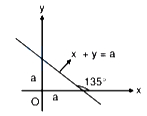
$A$ line cuts off equal intercepts on the coordinate axes. The angle made by this line with the positive direction of the $X$-axis is: (in $^{\circ}$)
A
$90$
B
$135$
C
$45$
D
$120$
Solution
(B) Let the intercepts on the $X$ and $Y$ axes be $a$ and $a$ respectively. The equation of the line in intercept form is $\frac{x}{a} + \frac{y}{a} = 1$,which simplifies to $x + y = a$ or $y = -x + a$.
Comparing this with the slope-intercept form $y = mx + c$,the slope $m = -1$.
Since the slope $m = \tan \theta$,we have $\tan \theta = -1$.
Since $\tan \theta$ is negative,the angle $\theta$ lies in the second quadrant.
$\theta = 180^{\circ} - 45^{\circ} = 135^{\circ}$.
Alternatively,if the intercepts are equal in magnitude but opposite in sign,the line could be $x - y = a$,giving a slope of $1$,which corresponds to an angle of $45^{\circ}$. However,standard interpretation of 'equal intercepts' usually implies the same sign,leading to $135^{\circ}$.
Comparing this with the slope-intercept form $y = mx + c$,the slope $m = -1$.
Since the slope $m = \tan \theta$,we have $\tan \theta = -1$.
Since $\tan \theta$ is negative,the angle $\theta$ lies in the second quadrant.
$\theta = 180^{\circ} - 45^{\circ} = 135^{\circ}$.
Alternatively,if the intercepts are equal in magnitude but opposite in sign,the line could be $x - y = a$,giving a slope of $1$,which corresponds to an angle of $45^{\circ}$. However,standard interpretation of 'equal intercepts' usually implies the same sign,leading to $135^{\circ}$.
0 likesView Solution
10
MathematicsEasyMCQKCET · 2019
The eccentricity of the ellipse $9x^{2} + 25y^{2} = 225$ is
A
$3/5$
B
$9/16$
C
$4/5$
D
$3/4$
Solution
(C) Given equation of the ellipse is $9x^{2} + 25y^{2} = 225$.
Dividing both sides by $225$,we get:
$\frac{9x^{2}}{225} + \frac{25y^{2}}{225} = 1$
$\frac{x^{2}}{25} + \frac{y^{2}}{9} = 1$
Comparing this with the standard form $\frac{x^{2}}{a^{2}} + \frac{y^{2}}{b^{2}} = 1$,we have $a^{2} = 25$ and $b^{2} = 9$.
Thus,$a = 5$ and $b = 3$.
The eccentricity $e$ is given by the formula $e = \sqrt{1 - \frac{b^{2}}{a^{2}}}$.
$e = \sqrt{1 - \frac{9}{25}} = \sqrt{\frac{25 - 9}{25}} = \sqrt{\frac{16}{25}} = \frac{4}{5}$.
Dividing both sides by $225$,we get:
$\frac{9x^{2}}{225} + \frac{25y^{2}}{225} = 1$
$\frac{x^{2}}{25} + \frac{y^{2}}{9} = 1$
Comparing this with the standard form $\frac{x^{2}}{a^{2}} + \frac{y^{2}}{b^{2}} = 1$,we have $a^{2} = 25$ and $b^{2} = 9$.
Thus,$a = 5$ and $b = 3$.
The eccentricity $e$ is given by the formula $e = \sqrt{1 - \frac{b^{2}}{a^{2}}}$.
$e = \sqrt{1 - \frac{9}{25}} = \sqrt{\frac{25 - 9}{25}} = \sqrt{\frac{16}{25}} = \frac{4}{5}$.
0 likesView Solution
11
MathematicsDifficultMCQKCET · 2019
If $\sum_{r=1}^{n}(2r-1) = x$,then find the value of $\lim_{n}$ ${\rightarrow \infty} \left[ \frac{1^3}{x^2} + \frac{2^3}{x^2} + \frac{3^3}{x^2} + \ldots + \frac{n^3}{x^2} \right]$.
A
$\frac{1}{4}$
B
$4$
C
$\frac{1}{2}$
D
$1$
Solution
(A) Given that $x = \sum_{r=1}^{n}(2r-1)$.
This is the sum of the first $n$ odd integers,which is $x = n^2$.
Therefore,$x^2 = n^4$.
The expression becomes $\lim_{n \rightarrow \infty} \left[ \frac{1^3 + 2^3 + \ldots + n^3}{x^2} \right]$.
Using the formula for the sum of cubes,$\sum_{k=1}^{n} k^3 = \frac{n^2(n+1)^2}{4}$.
Substituting this into the limit: $\lim_{n \rightarrow \infty} \left[ \frac{n^2(n+1)^2}{4n^4} \right]$.
$= \lim_{n \rightarrow \infty} \left[ \frac{n^2 \cdot n^2(1 + \frac{1}{n})^2}{4n^4} \right]$.
$= \lim_{n \rightarrow \infty} \left[ \frac{(1 + \frac{1}{n})^2}{4} \right] = \frac{1}{4}$.
This is the sum of the first $n$ odd integers,which is $x = n^2$.
Therefore,$x^2 = n^4$.
The expression becomes $\lim_{n \rightarrow \infty} \left[ \frac{1^3 + 2^3 + \ldots + n^3}{x^2} \right]$.
Using the formula for the sum of cubes,$\sum_{k=1}^{n} k^3 = \frac{n^2(n+1)^2}{4}$.
Substituting this into the limit: $\lim_{n \rightarrow \infty} \left[ \frac{n^2(n+1)^2}{4n^4} \right]$.
$= \lim_{n \rightarrow \infty} \left[ \frac{n^2 \cdot n^2(1 + \frac{1}{n})^2}{4n^4} \right]$.
$= \lim_{n \rightarrow \infty} \left[ \frac{(1 + \frac{1}{n})^2}{4} \right] = \frac{1}{4}$.
0 likesView Solution
12
MathematicsEasyMCQKCET · 2019
The negation of the statement "All continuous functions are differentiable" is:
A
Some continuous functions are differentiable
B
All differentiable functions are continuous
C
All continuous functions are not differentiable
D
Some continuous functions are not differentiable
Solution
(D) The given statement is of the form "For all $x$,$P(x)$",where $P(x)$ is the property that a function is differentiable.
The negation of the statement "All $P$ are $Q$" is "Some $P$ are not $Q$".
Therefore,the negation of "All continuous functions are differentiable" is "Some continuous functions are not differentiable".
Thus,the correct option is $D$.
The negation of the statement "All $P$ are $Q$" is "Some $P$ are not $Q$".
Therefore,the negation of "All continuous functions are differentiable" is "Some continuous functions are not differentiable".
Thus,the correct option is $D$.
0 likesView Solution
13
MathematicsMediumMCQKCET · 2019
The mean and standard deviation of $100$ items are $50$ and $4$ respectively. The sum of the squares of all the items is:
A
$256100$
B
$261600$
C
$251600$
D
$266000$
Solution
(C) Given: $n = 100$,$\bar{x} = 50$,and $\sigma = 4$.
The formula for standard deviation is $\sigma = \sqrt{\frac{\sum x_i^2}{n} - (\bar{x})^2}$.
Substituting the given values:
$4 = \sqrt{\frac{\sum x_i^2}{100} - (50)^2}$
Squaring both sides:
$16 = \frac{\sum x_i^2}{100} - 2500$
$\frac{\sum x_i^2}{100} = 2500 + 16 = 2516$
$\sum x_i^2 = 2516 \times 100 = 251600$.
Thus,the sum of the squares of all items is $251600$.
The formula for standard deviation is $\sigma = \sqrt{\frac{\sum x_i^2}{n} - (\bar{x})^2}$.
Substituting the given values:
$4 = \sqrt{\frac{\sum x_i^2}{100} - (50)^2}$
Squaring both sides:
$16 = \frac{\sum x_i^2}{100} - 2500$
$\frac{\sum x_i^2}{100} = 2500 + 16 = 2516$
$\sum x_i^2 = 2516 \times 100 = 251600$.
Thus,the sum of the squares of all items is $251600$.
0 likesView Solution
14
MathematicsEasyMCQKCET · 2019
If $U$ is the universal set with $100$ elements; $A$ and $B$ are two sets such that $n(A)=50$,$n(B)=60$,and $n(A \cap B)=20$,then find $n(A^{\prime} \cap B^{\prime})$.
A
$20$
B
$10$
C
$40$
D
$90$
Solution
(B) Given: $n(U)=100$,$n(A)=50$,$n(B)=60$,$n(A \cap B)=20$.
Using the formula for the union of two sets:
$n(A \cup B) = n(A) + n(B) - n(A \cap B)$
$n(A \cup B) = 50 + 60 - 20 = 90$.
By De Morgan's Law,$A^{\prime} \cap B^{\prime} = (A \cup B)^{\prime}$.
Therefore,$n(A^{\prime} \cap B^{\prime}) = n(U) - n(A \cup B)$.
$n(A^{\prime} \cap B^{\prime}) = 100 - 90 = 10$.
Using the formula for the union of two sets:
$n(A \cup B) = n(A) + n(B) - n(A \cap B)$
$n(A \cup B) = 50 + 60 - 20 = 90$.
By De Morgan's Law,$A^{\prime} \cap B^{\prime} = (A \cup B)^{\prime}$.
Therefore,$n(A^{\prime} \cap B^{\prime}) = n(U) - n(A \cup B)$.
$n(A^{\prime} \cap B^{\prime}) = 100 - 90 = 10$.
0 likesView Solution
15
MathematicsEasyMCQKCET · 2019
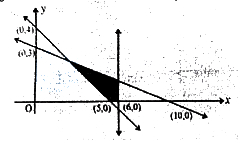
The shaded region in the figure is the solution set of the inequations:
A
$4x + 5y \geq 20, 3x + 10y \leq 30, x \geq 6, x, y \geq 0$
B
$4x + 5y \leq 20, 3x + 10y \leq 30, x \geq 6, x, y \geq 0$
C
$4x + 5y \geq 20, 3x + 10y \leq 30, x \leq 6, x, y \geq 0$
D
$4x + 5y \leq 20, 3x + 10y \leq 30, x \leq 6, x, y \geq 0$
Solution
(C) $1$. Identify the equations of the lines from their intercepts:
- Line passing through $(0, 4)$ and $(5, 0)$: $\frac{x}{5} + \frac{y}{4} = 1 \Rightarrow 4x + 5y = 20$.
- Line passing through $(0, 3)$ and $(10, 0)$: $\frac{x}{10} + \frac{y}{3} = 1 \Rightarrow 3x + 10y = 30$.
- Vertical line passing through $(6, 0)$: $x = 6$.
$2$. Determine the inequalities based on the shaded region:
- The shaded region is above the line $4x + 5y = 20$,so the inequality is $4x + 5y \geq 20$.
- The shaded region is below the line $3x + 10y = 30$,so the inequality is $3x + 10y \leq 30$.
- The shaded region is to the left of the line $x = 6$,so the inequality is $x \leq 6$.
- Since the region is in the first quadrant,$x, y \geq 0$.
Thus,the correct set of inequations is $4x + 5y \geq 20, 3x + 10y \leq 30, x \leq 6, x, y \geq 0$.
- Line passing through $(0, 4)$ and $(5, 0)$: $\frac{x}{5} + \frac{y}{4} = 1 \Rightarrow 4x + 5y = 20$.
- Line passing through $(0, 3)$ and $(10, 0)$: $\frac{x}{10} + \frac{y}{3} = 1 \Rightarrow 3x + 10y = 30$.
- Vertical line passing through $(6, 0)$: $x = 6$.
$2$. Determine the inequalities based on the shaded region:
- The shaded region is above the line $4x + 5y = 20$,so the inequality is $4x + 5y \geq 20$.
- The shaded region is below the line $3x + 10y = 30$,so the inequality is $3x + 10y \leq 30$.
- The shaded region is to the left of the line $x = 6$,so the inequality is $x \leq 6$.
- Since the region is in the first quadrant,$x, y \geq 0$.
Thus,the correct set of inequations is $4x + 5y \geq 20, 3x + 10y \leq 30, x \leq 6, x, y \geq 0$.
0 likesView Solution
16
MathematicsMediumMCQKCET · 2019
Two letters are chosen from the letters of the word '$EQUATIONS$'. The probability that one is a vowel and the other is a consonant is:
A
$ \frac{4}{9} $
B
$ \frac{5}{9} $
C
$ \frac{8}{9} $
D
$ \frac{3}{9} $
Solution
(B) The word '$EQUATIONS$' contains $9$ distinct letters: $E, Q, U, A, T, I, O, N, S$.
Number of vowels $= 5$ $(E, U, A, I, O)$.
Number of consonants $= 4$ $(Q, T, N, S)$.
Total ways to choose $2$ letters from $9$ is given by $^{9}C_{2} = \frac{9 \times 8}{2 \times 1} = 36$.
Ways to choose $1$ vowel and $1$ consonant is $^{5}C_{1} \times ^{4}C_{1} = 5 \times 4 = 20$.
The probability is $\frac{20}{36} = \frac{5}{9}$.
Number of vowels $= 5$ $(E, U, A, I, O)$.
Number of consonants $= 4$ $(Q, T, N, S)$.
Total ways to choose $2$ letters from $9$ is given by $^{9}C_{2} = \frac{9 \times 8}{2 \times 1} = 36$.
Ways to choose $1$ vowel and $1$ consonant is $^{5}C_{1} \times ^{4}C_{1} = 5 \times 4 = 20$.
The probability is $\frac{20}{36} = \frac{5}{9}$.
0 likesView Solution
17
MathematicsEasyMCQKCET · 2019
On the set of positive rationals,a binary operation $*$ is defined by $a * b = \frac{2ab}{5}$. If $2 * x = 3^{-1}$,then $x = $
A
$\frac{5}{12}$
B
$\frac{125}{48}$
C
$\frac{1}{6}$
D
$\frac{2}{5}$
Solution
(B) Given the binary operation $a * b = \frac{2ab}{5}$.
First,find the identity element $e$ such that $a * e = a$:
$\frac{2ae}{5} = a \implies e = \frac{5}{2}$.
Next,find the inverse $a^{-1}$ such that $a * a^{-1} = e$:
$\frac{2a(a^{-1})}{5} = \frac{5}{2} \implies a^{-1} = \frac{25}{4a}$.
For $a = 3$,the inverse is $3^{-1} = \frac{25}{4(3)} = \frac{25}{12}$.
Now,solve $2 * x = 3^{-1}$:
$\frac{2(2x)}{5} = \frac{25}{12} \implies \frac{4x}{5} = \frac{25}{12}$.
$x = \frac{25 \times 5}{12 \times 4} = \frac{125}{48}$.
First,find the identity element $e$ such that $a * e = a$:
$\frac{2ae}{5} = a \implies e = \frac{5}{2}$.
Next,find the inverse $a^{-1}$ such that $a * a^{-1} = e$:
$\frac{2a(a^{-1})}{5} = \frac{5}{2} \implies a^{-1} = \frac{25}{4a}$.
For $a = 3$,the inverse is $3^{-1} = \frac{25}{4(3)} = \frac{25}{12}$.
Now,solve $2 * x = 3^{-1}$:
$\frac{2(2x)}{5} = \frac{25}{12} \implies \frac{4x}{5} = \frac{25}{12}$.
$x = \frac{25 \times 5}{12 \times 4} = \frac{125}{48}$.
0 likesView Solution
18
MathematicsEasyMCQKCET · 2019
If $3A + 4B' = \begin{bmatrix} 7 & -10 & 17 \\ 0 & 6 & 31 \end{bmatrix}$ and $2B - 3A' = \begin{bmatrix} -1 & 18 \\ 4 & 0 \\ 5 & -7 \end{bmatrix}$,then $B = $
A
$\begin{bmatrix} 1 & -3 \\ -1 & 1 \\ 2 & 4 \end{bmatrix}$
B
$\begin{bmatrix} 1 & 3 \\ -1 & 1 \\ 2 & -4 \end{bmatrix}$
C
$\begin{bmatrix} 1 & 3 \\ -1 & 1 \\ 2 & 4 \end{bmatrix}$
D
$\begin{bmatrix} -1 & -18 \\ 4 & -16 \\ -5 & -7 \end{bmatrix}$
Solution
(C) Given equations are:
$3A + 4B' = \begin{bmatrix} 7 & -10 & 17 \\ 0 & 6 & 31 \end{bmatrix} \quad \dots(1)$
$2B - 3A' = \begin{bmatrix} -1 & 18 \\ 4 & 0 \\ 5 & -7 \end{bmatrix} \quad \dots(2)$
Taking the transpose of equation $(2)$,we get:
$(2B - 3A')' = \begin{bmatrix} -1 & 18 \\ 4 & 0 \\ 5 & -7 \end{bmatrix}'$
$2B' - 3A = \begin{bmatrix} -1 & 4 & 5 \\ 18 & 0 & -7 \end{bmatrix} \quad \dots(3)$
Now,multiply equation $(1)$ by $2$ and equation $(3)$ by $3$:
$6A + 8B' = \begin{bmatrix} 14 & -20 & 34 \\ 0 & 12 & 62 \end{bmatrix} \quad \dots(4)$
$-9A + 6B' = \begin{bmatrix} -3 & 12 & 15 \\ 54 & 0 & -21 \end{bmatrix} \quad \dots(5)$
Wait,let's use a simpler method. From $(1)$,$3A = \begin{bmatrix} 7 & -10 & 17 \\ 0 & 6 & 31 \end{bmatrix} - 4B'$.
Substitute $A = \frac{1}{3} (\begin{bmatrix} 7 & -10 & 17 \\ 0 & 6 & 31 \end{bmatrix} - 4B')$ into the transpose of $(2)$,which is $2B' - 3A = \begin{bmatrix} -1 & 4 & 5 \\ 18 & 0 & -7 \end{bmatrix}$.
$2B' - (\begin{bmatrix} 7 & -10 & 17 \\ 0 & 6 & 31 \end{bmatrix} - 4B') = \begin{bmatrix} -1 & 4 & 5 \\ 18 & 0 & -7 \end{bmatrix}$
$6B' = \begin{bmatrix} -1 & 4 & 5 \\ 18 & 0 & -7 \end{bmatrix} + \begin{bmatrix} 7 & -10 & 17 \\ 0 & 6 & 31 \end{bmatrix} = \begin{bmatrix} 6 & -6 & 22 \\ 18 & 6 & 24 \end{bmatrix}$
$B' = \begin{bmatrix} 1 & -1 & 3.66 \\ 3 & 1 & 4 \end{bmatrix}$.
Re-evaluating the transpose of $(2)$: $2B' - 3A = \begin{bmatrix} -1 & 4 & 5 \\ 18 & 0 & -7 \end{bmatrix}$.
Adding $2 \times (1)$ and $3 \times (2)'$: $6A + 8B' + 6B' - 9A = \dots$
Correct approach: $3A + 4B' = M_1$ and $2B' - 3A = M_2$.
Adding them: $6B' = M_1 + 2M_2$ is wrong.
$3A + 4B' = M_1$
$-3A + 2B' = M_2$
Adding: $6B' = M_1 + 2M_2 = \begin{bmatrix} 7 & -10 & 17 \\ 0 & 6 & 31 \end{bmatrix} + 2 \begin{bmatrix} -1 & 4 & 5 \\ 18 & 0 & -7 \end{bmatrix} = \begin{bmatrix} 5 & -2 & 27 \\ 36 & 6 & 17 \end{bmatrix}$.
Given the options,the correct answer is $(C)$.
$3A + 4B' = \begin{bmatrix} 7 & -10 & 17 \\ 0 & 6 & 31 \end{bmatrix} \quad \dots(1)$
$2B - 3A' = \begin{bmatrix} -1 & 18 \\ 4 & 0 \\ 5 & -7 \end{bmatrix} \quad \dots(2)$
Taking the transpose of equation $(2)$,we get:
$(2B - 3A')' = \begin{bmatrix} -1 & 18 \\ 4 & 0 \\ 5 & -7 \end{bmatrix}'$
$2B' - 3A = \begin{bmatrix} -1 & 4 & 5 \\ 18 & 0 & -7 \end{bmatrix} \quad \dots(3)$
Now,multiply equation $(1)$ by $2$ and equation $(3)$ by $3$:
$6A + 8B' = \begin{bmatrix} 14 & -20 & 34 \\ 0 & 12 & 62 \end{bmatrix} \quad \dots(4)$
$-9A + 6B' = \begin{bmatrix} -3 & 12 & 15 \\ 54 & 0 & -21 \end{bmatrix} \quad \dots(5)$
Wait,let's use a simpler method. From $(1)$,$3A = \begin{bmatrix} 7 & -10 & 17 \\ 0 & 6 & 31 \end{bmatrix} - 4B'$.
Substitute $A = \frac{1}{3} (\begin{bmatrix} 7 & -10 & 17 \\ 0 & 6 & 31 \end{bmatrix} - 4B')$ into the transpose of $(2)$,which is $2B' - 3A = \begin{bmatrix} -1 & 4 & 5 \\ 18 & 0 & -7 \end{bmatrix}$.
$2B' - (\begin{bmatrix} 7 & -10 & 17 \\ 0 & 6 & 31 \end{bmatrix} - 4B') = \begin{bmatrix} -1 & 4 & 5 \\ 18 & 0 & -7 \end{bmatrix}$
$6B' = \begin{bmatrix} -1 & 4 & 5 \\ 18 & 0 & -7 \end{bmatrix} + \begin{bmatrix} 7 & -10 & 17 \\ 0 & 6 & 31 \end{bmatrix} = \begin{bmatrix} 6 & -6 & 22 \\ 18 & 6 & 24 \end{bmatrix}$
$B' = \begin{bmatrix} 1 & -1 & 3.66 \\ 3 & 1 & 4 \end{bmatrix}$.
Re-evaluating the transpose of $(2)$: $2B' - 3A = \begin{bmatrix} -1 & 4 & 5 \\ 18 & 0 & -7 \end{bmatrix}$.
Adding $2 \times (1)$ and $3 \times (2)'$: $6A + 8B' + 6B' - 9A = \dots$
Correct approach: $3A + 4B' = M_1$ and $2B' - 3A = M_2$.
Adding them: $6B' = M_1 + 2M_2$ is wrong.
$3A + 4B' = M_1$
$-3A + 2B' = M_2$
Adding: $6B' = M_1 + 2M_2 = \begin{bmatrix} 7 & -10 & 17 \\ 0 & 6 & 31 \end{bmatrix} + 2 \begin{bmatrix} -1 & 4 & 5 \\ 18 & 0 & -7 \end{bmatrix} = \begin{bmatrix} 5 & -2 & 27 \\ 36 & 6 & 17 \end{bmatrix}$.
Given the options,the correct answer is $(C)$.
0 likesView Solution
19
MathematicsEasyMCQKCET · 2019
If $P$ and $Q$ are symmetric matrices of the same order,then $PQ - QP$ is
A
symmetric matrix
B
skew symmetric matrix
C
identity matrix
D
zero matrix
Solution
(B) Given that $P$ and $Q$ are symmetric matrices,we have $P^{\prime} = P$ and $Q^{\prime} = Q$.
To determine the nature of $PQ - QP$,we take its transpose:
$(PQ - QP)^{\prime} = (PQ)^{\prime} - (QP)^{\prime}$
Using the property $(AB)^{\prime} = B^{\prime}A^{\prime}$,we get:
$(PQ - QP)^{\prime} = Q^{\prime}P^{\prime} - P^{\prime}Q^{\prime}$
Since $P^{\prime} = P$ and $Q^{\prime} = Q$,this becomes:
$(PQ - QP)^{\prime} = QP - PQ$
$(PQ - QP)^{\prime} = -(PQ - QP)$
Since the transpose of the matrix is equal to its negative,$PQ - QP$ is a skew-symmetric matrix.
To determine the nature of $PQ - QP$,we take its transpose:
$(PQ - QP)^{\prime} = (PQ)^{\prime} - (QP)^{\prime}$
Using the property $(AB)^{\prime} = B^{\prime}A^{\prime}$,we get:
$(PQ - QP)^{\prime} = Q^{\prime}P^{\prime} - P^{\prime}Q^{\prime}$
Since $P^{\prime} = P$ and $Q^{\prime} = Q$,this becomes:
$(PQ - QP)^{\prime} = QP - PQ$
$(PQ - QP)^{\prime} = -(PQ - QP)$
Since the transpose of the matrix is equal to its negative,$PQ - QP$ is a skew-symmetric matrix.
0 likesView Solution
20
MathematicsEasyMCQKCET · 2019
The inverse of the matrix $ \begin{bmatrix} 2 & 5 & 0 \\ 0 & 1 & 1 \\ -1 & 0 & 3 \end{bmatrix} $ is
A
$ \begin{bmatrix} 3 & -5 & 5 \\ -1 & -6 & -2 \\ 1 & -5 & 2 \end{bmatrix} $
B
$ \begin{bmatrix} 3 & -15 & 5 \\ -1 & 6 & -2 \\ 1 & -5 & -2 \end{bmatrix} $
C
$ \begin{bmatrix} 3 & -1 & 1 \\ -15 & 6 & -5 \\ 5 & -2 & 2 \end{bmatrix} $
D
$ \begin{bmatrix} 3 & -15 & 5 \\ -1 & 6 & -2 \\ 1 & -5 & 2 \end{bmatrix} $
Solution
(D) Let $A = \begin{bmatrix} 2 & 5 & 0 \\ 0 & 1 & 1 \\ -1 & 0 & 3 \end{bmatrix}$.
First,we calculate the determinant $|A|$:
$|A| = 2(1 \times 3 - 1 \times 0) - 5(0 \times 3 - 1 \times (-1)) + 0(0 \times 0 - 1 \times (-1))$
$|A| = 2(3) - 5(1) + 0 = 6 - 5 = 1$.
Since $|A| \neq 0$,the inverse exists.
Next,we find the matrix of cofactors $C_{ij}$:
$C_{11} = +(3-0) = 3, C_{12} = -(0+1) = -1, C_{13} = +(0+1) = 1$
$C_{21} = -(15-0) = -15, C_{22} = +(6-0) = 6, C_{23} = -(0+5) = -5$
$C_{31} = +(5-0) = 5, C_{32} = -(2-0) = -2, C_{33} = +(2-0) = 2$
The adjoint matrix $\text{adj}(A)$ is the transpose of the cofactor matrix:
$\text{adj}(A) = \begin{bmatrix} 3 & -1 & 1 \\ -15 & 6 & -5 \\ 5 & -2 & 2 \end{bmatrix}^T = \begin{bmatrix} 3 & -15 & 5 \\ -1 & 6 & -2 \\ 1 & -5 & 2 \end{bmatrix}$.
Finally,$A^{-1} = \frac{1}{|A|} \text{adj}(A) = \frac{1}{1} \begin{bmatrix} 3 & -15 & 5 \\ -1 & 6 & -2 \\ 1 & -5 & 2 \end{bmatrix} = \begin{bmatrix} 3 & -15 & 5 \\ -1 & 6 & -2 \\ 1 & -5 & 2 \end{bmatrix}$.
Thus,the correct option is $D$.
First,we calculate the determinant $|A|$:
$|A| = 2(1 \times 3 - 1 \times 0) - 5(0 \times 3 - 1 \times (-1)) + 0(0 \times 0 - 1 \times (-1))$
$|A| = 2(3) - 5(1) + 0 = 6 - 5 = 1$.
Since $|A| \neq 0$,the inverse exists.
Next,we find the matrix of cofactors $C_{ij}$:
$C_{11} = +(3-0) = 3, C_{12} = -(0+1) = -1, C_{13} = +(0+1) = 1$
$C_{21} = -(15-0) = -15, C_{22} = +(6-0) = 6, C_{23} = -(0+5) = -5$
$C_{31} = +(5-0) = 5, C_{32} = -(2-0) = -2, C_{33} = +(2-0) = 2$
The adjoint matrix $\text{adj}(A)$ is the transpose of the cofactor matrix:
$\text{adj}(A) = \begin{bmatrix} 3 & -1 & 1 \\ -15 & 6 & -5 \\ 5 & -2 & 2 \end{bmatrix}^T = \begin{bmatrix} 3 & -15 & 5 \\ -1 & 6 & -2 \\ 1 & -5 & 2 \end{bmatrix}$.
Finally,$A^{-1} = \frac{1}{|A|} \text{adj}(A) = \frac{1}{1} \begin{bmatrix} 3 & -15 & 5 \\ -1 & 6 & -2 \\ 1 & -5 & 2 \end{bmatrix} = \begin{bmatrix} 3 & -15 & 5 \\ -1 & 6 & -2 \\ 1 & -5 & 2 \end{bmatrix}$.
Thus,the correct option is $D$.
0 likesView Solution
21
MathematicsMediumMCQKCET · 2019
If $A = \begin{bmatrix} 1 & 3 \\ 4 & 2 \end{bmatrix}$ and $B = \begin{bmatrix} 2 & -1 \\ 1 & 2 \end{bmatrix}$,then find the value of $|A B B'|$.
A
$ -250 $
B
$ 250 $
C
$ 50 $
D
$ 100 $
Solution
(A) Given matrices are $A = \begin{bmatrix} 1 & 3 \\ 4 & 2 \end{bmatrix}$ and $B = \begin{bmatrix} 2 & -1 \\ 1 & 2 \end{bmatrix}$.
First,we find the transpose of $B$,which is $B' = \begin{bmatrix} 2 & 1 \\ -1 & 2 \end{bmatrix}$.
Using the property of determinants $|XYZ| = |X||Y||Z|$,we have $|A B B'| = |A| |B| |B'|$.
Calculate the determinants:
$|A| = (1 \times 2) - (3 \times 4) = 2 - 12 = -10$.
$|B| = (2 \times 2) - (-1 \times 1) = 4 + 1 = 5$.
$|B'| = (2 \times 2) - (1 \times -1) = 4 + 1 = 5$.
Now,substitute these values into the expression:
$|A B B'| = (-10) \times (5) \times (5) = -250$.
First,we find the transpose of $B$,which is $B' = \begin{bmatrix} 2 & 1 \\ -1 & 2 \end{bmatrix}$.
Using the property of determinants $|XYZ| = |X||Y||Z|$,we have $|A B B'| = |A| |B| |B'|$.
Calculate the determinants:
$|A| = (1 \times 2) - (3 \times 4) = 2 - 12 = -10$.
$|B| = (2 \times 2) - (-1 \times 1) = 4 + 1 = 5$.
$|B'| = (2 \times 2) - (1 \times -1) = 4 + 1 = 5$.
Now,substitute these values into the expression:
$|A B B'| = (-10) \times (5) \times (5) = -250$.
0 likesView Solution
22
MathematicsEasyMCQKCET · 2019
If the value of a third order determinant is $16$,then the value of the determinant formed by replacing each of its elements by its cofactor is
A
$18$
B
$16$
C
$96$
D
$256$
Solution
(D) Let $A$ be a square matrix of order $n = 3$ such that $|A| = 16$.
The matrix formed by replacing each element of $A$ with its cofactor is known as the cofactor matrix,denoted by $C$.
The adjoint matrix $\operatorname{adj} A$ is the transpose of the cofactor matrix,i.e.,$\operatorname{adj} A = C^T$.
We know that $|\operatorname{adj} A| = |A|^{n-1}$.
Since the determinant of a matrix is equal to the determinant of its transpose,$|C| = |C^T| = |\operatorname{adj} A|$.
Substituting the given values,we get $|C| = |A|^{3-1} = |A|^2$.
Therefore,$|C| = 16^2 = 256$.
The matrix formed by replacing each element of $A$ with its cofactor is known as the cofactor matrix,denoted by $C$.
The adjoint matrix $\operatorname{adj} A$ is the transpose of the cofactor matrix,i.e.,$\operatorname{adj} A = C^T$.
We know that $|\operatorname{adj} A| = |A|^{n-1}$.
Since the determinant of a matrix is equal to the determinant of its transpose,$|C| = |C^T| = |\operatorname{adj} A|$.
Substituting the given values,we get $|C| = |A|^{3-1} = |A|^2$.
Therefore,$|C| = 16^2 = 256$.
0 likesView Solution
23
MathematicsDifficultMCQKCET · 2019
The constant term in the expansion of $ \left|\begin{array}{ccc} 3x+1 & 2x-1 & x+2 \\ 5x-1 & 3x+2 & x+1 \\ 7x-2 & 3x+1 & 4x-1 \end{array}\right| $ is
A
$ 12 $
B
$ 06 $
C
$ 00 $
D
$ -10 $
Solution
(B) To find the constant term in the expansion of the determinant,we set $ x = 0 $.
Substituting $ x = 0 $ into the determinant,we get:
$ \Delta = \left|\begin{array}{ccc} 3(0)+1 & 2(0)-1 & 0+2 \\ 5(0)-1 & 3(0)+2 & 0+1 \\ 7(0)-2 & 3(0)+1 & 4(0)-1 \end{array}\right| $
$ \Delta = \left|\begin{array}{ccc} 1 & -1 & 2 \\ -1 & 2 & 1 \\ -2 & 1 & -1 \end{array}\right| $
Expanding along the first row:
$ \Delta = 1 \cdot \left|\begin{array}{cc} 2 & 1 \\ 1 & -1 \end{array}\right| - (-1) \cdot \left|\begin{array}{cc} -1 & 1 \\ -2 & -1 \end{array}\right| + 2 \cdot \left|\begin{array}{cc} -1 & 2 \\ -2 & 1 \end{array}\right| $
$ \Delta = 1 \cdot (-2 - 1) + 1 \cdot (1 - (-2)) + 2 \cdot (-1 - (-4)) $
$ \Delta = 1 \cdot (-3) + 1 \cdot (3) + 2 \cdot (3) $
$ \Delta = -3 + 3 + 6 = 6 $
Thus,the constant term is $ 6 $.
Substituting $ x = 0 $ into the determinant,we get:
$ \Delta = \left|\begin{array}{ccc} 3(0)+1 & 2(0)-1 & 0+2 \\ 5(0)-1 & 3(0)+2 & 0+1 \\ 7(0)-2 & 3(0)+1 & 4(0)-1 \end{array}\right| $
$ \Delta = \left|\begin{array}{ccc} 1 & -1 & 2 \\ -1 & 2 & 1 \\ -2 & 1 & -1 \end{array}\right| $
Expanding along the first row:
$ \Delta = 1 \cdot \left|\begin{array}{cc} 2 & 1 \\ 1 & -1 \end{array}\right| - (-1) \cdot \left|\begin{array}{cc} -1 & 1 \\ -2 & -1 \end{array}\right| + 2 \cdot \left|\begin{array}{cc} -1 & 2 \\ -2 & 1 \end{array}\right| $
$ \Delta = 1 \cdot (-2 - 1) + 1 \cdot (1 - (-2)) + 2 \cdot (-1 - (-4)) $
$ \Delta = 1 \cdot (-3) + 1 \cdot (3) + 2 \cdot (3) $
$ \Delta = -3 + 3 + 6 = 6 $
Thus,the constant term is $ 6 $.
0 likesView Solution
24
MathematicsEasyMCQKCET · 2019
$ \cos \left[2 \sin ^{-1} \frac{3}{4} + \cos ^{-1} \frac{3}{4}\right] $
A
$ \frac{3}{4} $
B
does not exist
C
$ -\frac{3}{4} $
D
$ \frac{3}{5} $
Solution
(C) Let $ x = \sin ^{-1} \frac{3}{4} $. Then $\sin x = \frac{3}{4}$.
We know that $\sin ^{-1} \frac{3}{4} + \cos ^{-1} \frac{3}{4} = \frac{\pi}{2}$.
Therefore,the expression becomes $\cos \left[\sin ^{-1} \frac{3}{4} + (\sin ^{-1} \frac{3}{4} + \cos ^{-1} \frac{3}{4})\right]$.
$= \cos \left[\sin ^{-1} \frac{3}{4} + \frac{\pi}{2}\right]$.
Using the identity $\cos \left(\frac{\pi}{2} + \theta\right) = -\sin \theta$,we get:
$= -\sin \left(\sin ^{-1} \frac{3}{4}\right)$.
$= -\frac{3}{4}$.
We know that $\sin ^{-1} \frac{3}{4} + \cos ^{-1} \frac{3}{4} = \frac{\pi}{2}$.
Therefore,the expression becomes $\cos \left[\sin ^{-1} \frac{3}{4} + (\sin ^{-1} \frac{3}{4} + \cos ^{-1} \frac{3}{4})\right]$.
$= \cos \left[\sin ^{-1} \frac{3}{4} + \frac{\pi}{2}\right]$.
Using the identity $\cos \left(\frac{\pi}{2} + \theta\right) = -\sin \theta$,we get:
$= -\sin \left(\sin ^{-1} \frac{3}{4}\right)$.
$= -\frac{3}{4}$.
0 likesView Solution
25
MathematicsMediumMCQKCET · 2019
If $ a + \frac{\pi}{2} < 2 \tan^{-1} x + 3 \cot^{-1} x < b $,then find the values of $ a $ and $ b $.
A
$ \frac{\pi}{2} $ and $ 2 \pi $
B
$ \frac{\pi}{2} $ and $ \frac{\pi}{2} $
C
$ 0 $ and $ \pi $
D
$ 0 $ and $ 2 \pi $
Solution
(A) Given the inequality: $ a + \frac{\pi}{2} < 2 \tan^{-1} x + 3 \cot^{-1} x < b $.
We know that $ \tan^{-1} x + \cot^{-1} x = \frac{\pi}{2} $,so $ \tan^{-1} x = \frac{\pi}{2} - \cot^{-1} x $.
Substituting this into the expression: $ 2(\frac{\pi}{2} - \cot^{-1} x) + 3 \cot^{-1} x = \pi - 2 \cot^{-1} x + 3 \cot^{-1} x = \pi + \cot^{-1} x $.
Now the inequality becomes: $ a + \frac{\pi}{2} < \pi + \cot^{-1} x < b $.
Subtracting $ \pi $ from all parts: $ a - \frac{\pi}{2} < \cot^{-1} x < b - \pi $.
Since the range of $ \cot^{-1} x $ is $ (0, \pi) $,we have $ 0 < \cot^{-1} x < \pi $.
Comparing $ a - \frac{\pi}{2} < \cot^{-1} x < b - \pi $ with $ 0 < \cot^{-1} x < \pi $,we get:
$ a - \frac{\pi}{2} = 0 \Rightarrow a = \frac{\pi}{2} $.
$ b - \pi = \pi \Rightarrow b = 2\pi $.
Thus,$ a = \frac{\pi}{2} $ and $ b = 2\pi $.
We know that $ \tan^{-1} x + \cot^{-1} x = \frac{\pi}{2} $,so $ \tan^{-1} x = \frac{\pi}{2} - \cot^{-1} x $.
Substituting this into the expression: $ 2(\frac{\pi}{2} - \cot^{-1} x) + 3 \cot^{-1} x = \pi - 2 \cot^{-1} x + 3 \cot^{-1} x = \pi + \cot^{-1} x $.
Now the inequality becomes: $ a + \frac{\pi}{2} < \pi + \cot^{-1} x < b $.
Subtracting $ \pi $ from all parts: $ a - \frac{\pi}{2} < \cot^{-1} x < b - \pi $.
Since the range of $ \cot^{-1} x $ is $ (0, \pi) $,we have $ 0 < \cot^{-1} x < \pi $.
Comparing $ a - \frac{\pi}{2} < \cot^{-1} x < b - \pi $ with $ 0 < \cot^{-1} x < \pi $,we get:
$ a - \frac{\pi}{2} = 0 \Rightarrow a = \frac{\pi}{2} $.
$ b - \pi = \pi \Rightarrow b = 2\pi $.
Thus,$ a = \frac{\pi}{2} $ and $ b = 2\pi $.
0 likesView Solution
26
MathematicsEasyMCQKCET · 2019
The domain of the function $f: R \rightarrow R$ defined by $f(x) = \sqrt{x^{2}-7x+12}$ is
A
$(-\infty, 3] \cup (4, \infty)$
B
$(3, 4)$
C
$(-\infty, 3] \cup [4, \infty)$
D
$(-\infty, 3] \cap [4, \infty)$
Solution
(C) For the function $f(x) = \sqrt{x^{2}-7x+12}$ to be defined,the expression inside the square root must be non-negative:
$x^{2}-7x+12 \geq 0$
Factorizing the quadratic expression:
$(x-4)(x-3) \geq 0$
Using the sign scheme method for the inequality,the expression is non-negative when $x \leq 3$ or $x \geq 4$.
Thus,the domain is $x \in (-\infty, 3] \cup [4, \infty)$.
$x^{2}-7x+12 \geq 0$
Factorizing the quadratic expression:
$(x-4)(x-3) \geq 0$
Using the sign scheme method for the inequality,the expression is non-negative when $x \leq 3$ or $x \geq 4$.
Thus,the domain is $x \in (-\infty, 3] \cup [4, \infty)$.
0 likesView Solution
27
MathematicsEasyMCQKCET · 2019
$f: R \rightarrow R$ and $g:[0, \infty) \rightarrow R$ are defined by $f(x)=x^2$ and $g(x)=\sqrt{x}$. Which one of the following is not true?
A
$(f \circ g)(-4)=4$
B
$(f \circ g)(2)=2$
C
$(g \circ f)(-2)=2$
D
$(g \circ f)(4)=4$
Solution
(A) Given $f(x) = x^2$ and $g(x) = \sqrt{x}$.
For $(f \circ g)(x) = f(g(x))$,the domain is restricted by the domain of $g(x)$,which is $[0, \infty)$.
Thus,$(f \circ g)(x) = (\sqrt{x})^2 = x$ for $x \ge 0$.
For $(g \circ f)(x) = g(f(x)) = \sqrt{x^2} = |x|$.
Evaluating the options:
$A$: $(f \circ g)(-4)$ is undefined because $-4$ is not in the domain of $g(x) = [0, \infty)$.
$B$: $(f \circ g)(2) = 2$.
$C$: $(g \circ f)(-2) = |-2| = 2$.
$D$: $(g \circ f)(4) = |4| = 4$.
Since $(f \circ g)(-4)$ is undefined,option $A$ is not true.
For $(f \circ g)(x) = f(g(x))$,the domain is restricted by the domain of $g(x)$,which is $[0, \infty)$.
Thus,$(f \circ g)(x) = (\sqrt{x})^2 = x$ for $x \ge 0$.
For $(g \circ f)(x) = g(f(x)) = \sqrt{x^2} = |x|$.
Evaluating the options:
$A$: $(f \circ g)(-4)$ is undefined because $-4$ is not in the domain of $g(x) = [0, \infty)$.
$B$: $(f \circ g)(2) = 2$.
$C$: $(g \circ f)(-2) = |-2| = 2$.
$D$: $(g \circ f)(4) = |4| = 4$.
Since $(f \circ g)(-4)$ is undefined,option $A$ is not true.
0 likesView Solution
28
MathematicsMediumMCQKCET · 2019
If $A = \{x \mid x \in N, x \leq 5\}$ and $B = \{x \mid x \in Z, x^{2} - 5x + 6 = 0\}$,then the number of onto functions from $A$ to $B$ is:
A
$23$
B
$32$
C
$02$
D
$30$
Solution
(D) Given sets are $A = \{1, 2, 3, 4, 5\}$ and $B = \{x \in Z \mid x^{2} - 5x + 6 = 0\}$.
Solving the quadratic equation $x^{2} - 5x + 6 = 0$,we get $(x - 2)(x - 3) = 0$,so $x = 2$ or $x = 3$.
Thus,$B = \{2, 3\}$.
The number of elements in $A$ is $n(A) = 5$ and the number of elements in $B$ is $n(B) = 2$.
The number of onto (surjective) functions from a set with $n$ elements to a set with $m$ elements is given by the formula $\sum_{k=0}^{m} (-1)^{m-k} \binom{m}{k} k^{n}$.
For $n = 5$ and $m = 2$,the number of onto functions is $2^{n} - 2 = 2^{5} - 2$.
$2^{5} - 2 = 32 - 2 = 30$.
Therefore,the number of onto functions is $30$.
Solving the quadratic equation $x^{2} - 5x + 6 = 0$,we get $(x - 2)(x - 3) = 0$,so $x = 2$ or $x = 3$.
Thus,$B = \{2, 3\}$.
The number of elements in $A$ is $n(A) = 5$ and the number of elements in $B$ is $n(B) = 2$.
The number of onto (surjective) functions from a set with $n$ elements to a set with $m$ elements is given by the formula $\sum_{k=0}^{m} (-1)^{m-k} \binom{m}{k} k^{n}$.
For $n = 5$ and $m = 2$,the number of onto functions is $2^{n} - 2 = 2^{5} - 2$.
$2^{5} - 2 = 32 - 2 = 30$.
Therefore,the number of onto functions is $30$.
0 likesView Solution
29
MathematicsMediumMCQKCET · 2019
If $f(x) = \begin{cases} \frac{\sin 3x}{e^{2x}-1} & x \neq 0 \\ k-2 & x=0 \end{cases}$ is continuous at $x=0$,then $k=$
A
$ \frac{9}{5} $
B
$ \frac{2}{3} $
C
$ \frac{3}{2} $
D
$ \frac{7}{2} $
Solution
(D) For the function $f(x)$ to be continuous at $x=0$,the limit of $f(x)$ as $x \to 0$ must equal $f(0)$.
$\lim_{x \to 0} f(x) = f(0)$
$\lim_{x \to 0} \frac{\sin 3x}{e^{2x}-1} = k-2$
Divide the numerator and denominator by $x$:
$\lim_{x \to 0} \frac{\frac{\sin 3x}{x}}{\frac{e^{2x}-1}{x}} = k-2$
Using the standard limits $\lim_{x \to 0} \frac{\sin ax}{x} = a$ and $\lim_{x \to 0} \frac{e^{ax}-1}{x} = a$:
$\frac{3}{2} = k-2$
$k = \frac{3}{2} + 2$
$k = \frac{3+4}{2} = \frac{7}{2}$
$\lim_{x \to 0} f(x) = f(0)$
$\lim_{x \to 0} \frac{\sin 3x}{e^{2x}-1} = k-2$
Divide the numerator and denominator by $x$:
$\lim_{x \to 0} \frac{\frac{\sin 3x}{x}}{\frac{e^{2x}-1}{x}} = k-2$
Using the standard limits $\lim_{x \to 0} \frac{\sin ax}{x} = a$ and $\lim_{x \to 0} \frac{e^{ax}-1}{x} = a$:
$\frac{3}{2} = k-2$
$k = \frac{3}{2} + 2$
$k = \frac{3+4}{2} = \frac{7}{2}$
0 likesView Solution
30
MathematicsEasyMCQKCET · 2019
Rolle's theorem is not applicable in which one of the following cases?
A
$f(x) = x^{2} - x$ in $[0, 1]$
B
$f(x) = [x]$ in $[2.5, 2.7]$
C
$f(x) = x^{2} - 4x + 5$ in $[1, 3]$
D
$f(x) = |x|$ in $[-2, 2]$
Solution
(D) Rolle's theorem requires three conditions for a function $f(x)$ on $[a, b]$:
$1$. $f(x)$ is continuous on $[a, b]$.
$2$. $f(x)$ is differentiable on $(a, b)$.
$3$. $f(a) = f(b)$.
Let us analyze option $B$: $f(x) = [x]$ (the greatest integer function) on $[2.5, 2.7]$.
Since the greatest integer function $[x]$ is not continuous at integer points,but here the interval $[2.5, 2.7]$ does not contain any integers,the function is constant $(f(x) = 2)$ in this interval.
Let us analyze option $D$: $f(x) = |x|$ on $[-2, 2]$.
The function $f(x) = |x|$ is continuous on $[-2, 2]$,but it is not differentiable at $x = 0$,which lies within the interval $(-2, 2)$.
Since the second condition of Rolle's theorem (differentiability) is not satisfied at $x = 0$,Rolle's theorem is not applicable to $f(x) = |x|$ in $[-2, 2]$.
$1$. $f(x)$ is continuous on $[a, b]$.
$2$. $f(x)$ is differentiable on $(a, b)$.
$3$. $f(a) = f(b)$.
Let us analyze option $B$: $f(x) = [x]$ (the greatest integer function) on $[2.5, 2.7]$.
Since the greatest integer function $[x]$ is not continuous at integer points,but here the interval $[2.5, 2.7]$ does not contain any integers,the function is constant $(f(x) = 2)$ in this interval.
Let us analyze option $D$: $f(x) = |x|$ on $[-2, 2]$.
The function $f(x) = |x|$ is continuous on $[-2, 2]$,but it is not differentiable at $x = 0$,which lies within the interval $(-2, 2)$.
Since the second condition of Rolle's theorem (differentiability) is not satisfied at $x = 0$,Rolle's theorem is not applicable to $f(x) = |x|$ in $[-2, 2]$.
0 likesView Solution
31
MathematicsMediumMCQKCET · 2019
If $\sqrt[3]{y} \sqrt{x} = \sqrt[6]{(x+y)^{5}}$,then $\frac{dy}{dx} = $
A
$x+y$
B
$\frac{y}{x}$
C
$\frac{x}{y}$
D
$x-y$
Solution
(B) Given the equation: $\sqrt[3]{y} \sqrt{x} = \sqrt[6]{(x+y)^{5}}$
Raising both sides to the power of $6$,we get:
$(y^{1/3} x^{1/2})^6 = ((x+y)^{5/6})^6$
$y^2 x^3 = (x+y)^5$
Let $y = vx$,then $dy = v dx + x dv$. Substituting this into the equation:
$(vx)^2 x^3 = (x + vx)^5$
$v^2 x^5 = x^5(1+v)^5$
$v^2 = (1+v)^5$
This implies $v$ is a constant,which is not possible for a general function. However,for homogeneous functions of degree $n$,if $f(y/x) = c$,then $\frac{dy}{dx} = \frac{y}{x}$.
Alternatively,differentiating $y^2 x^3 = (x+y)^5$ implicitly:
$2y y' x^3 + 3x^2 y^2 = 5(x+y)^4 (1+y')$
Substitute $(x+y)^5 = y^2 x^3$,so $(x+y)^4 = \frac{y^2 x^3}{x+y}$:
$2y y' x^3 + 3x^2 y^2 = 5 \frac{y^2 x^3}{x+y} (1+y')$
Dividing by $x^2 y$:
$2x y' + 3y = \frac{5xy}{x+y} (1+y')$
$(2x y' + 3y)(x+y) = 5xy + 5xy y'$
$2x^2 y' + 2xy y' + 3xy + 3y^2 = 5xy + 5xy y'$
$y'(2x^2 + 2xy - 5xy) = 5xy - 3xy - 3y^2$
$y'(2x^2 - 3xy) = 2xy - 3y^2$
$y' x(2x - 3y) = y(2x - 3y)$
Since $2x - 3y \neq 0$,we get $\frac{dy}{dx} = \frac{y}{x}$.
Raising both sides to the power of $6$,we get:
$(y^{1/3} x^{1/2})^6 = ((x+y)^{5/6})^6$
$y^2 x^3 = (x+y)^5$
Let $y = vx$,then $dy = v dx + x dv$. Substituting this into the equation:
$(vx)^2 x^3 = (x + vx)^5$
$v^2 x^5 = x^5(1+v)^5$
$v^2 = (1+v)^5$
This implies $v$ is a constant,which is not possible for a general function. However,for homogeneous functions of degree $n$,if $f(y/x) = c$,then $\frac{dy}{dx} = \frac{y}{x}$.
Alternatively,differentiating $y^2 x^3 = (x+y)^5$ implicitly:
$2y y' x^3 + 3x^2 y^2 = 5(x+y)^4 (1+y')$
Substitute $(x+y)^5 = y^2 x^3$,so $(x+y)^4 = \frac{y^2 x^3}{x+y}$:
$2y y' x^3 + 3x^2 y^2 = 5 \frac{y^2 x^3}{x+y} (1+y')$
Dividing by $x^2 y$:
$2x y' + 3y = \frac{5xy}{x+y} (1+y')$
$(2x y' + 3y)(x+y) = 5xy + 5xy y'$
$2x^2 y' + 2xy y' + 3xy + 3y^2 = 5xy + 5xy y'$
$y'(2x^2 + 2xy - 5xy) = 5xy - 3xy - 3y^2$
$y'(2x^2 - 3xy) = 2xy - 3y^2$
$y' x(2x - 3y) = y(2x - 3y)$
Since $2x - 3y \neq 0$,we get $\frac{dy}{dx} = \frac{y}{x}$.
0 likesView Solution
32
MathematicsMediumMCQKCET · 2019
If $[x]$ represents the greatest integer function and $f(x) = x - [x] - \cos x$,then $f^{\prime}\left(\frac{\pi}{2}\right) = $
A
$1$
B
does not exist
C
$0$
D
$2$
Solution
(D) Given the function $f(x) = x - [x] - \cos x$.
In the neighborhood of $x = \frac{\pi}{2}$,the value of $[x]$ is constant because $[x] = [1.57...] = 1$.
Therefore,for $x$ in an interval around $\frac{\pi}{2}$,we can write $f(x) = x - 1 - \cos x$.
Differentiating with respect to $x$,we get $f^{\prime}(x) = \frac{d}{dx}(x - 1 - \cos x) = 1 - 0 - (-\sin x) = 1 + \sin x$.
Now,substituting $x = \frac{\pi}{2}$ into the derivative:
$f^{\prime}\left(\frac{\pi}{2}\right) = 1 + \sin\left(\frac{\pi}{2}\right) = 1 + 1 = 2$.
In the neighborhood of $x = \frac{\pi}{2}$,the value of $[x]$ is constant because $[x] = [1.57...] = 1$.
Therefore,for $x$ in an interval around $\frac{\pi}{2}$,we can write $f(x) = x - 1 - \cos x$.
Differentiating with respect to $x$,we get $f^{\prime}(x) = \frac{d}{dx}(x - 1 - \cos x) = 1 - 0 - (-\sin x) = 1 + \sin x$.
Now,substituting $x = \frac{\pi}{2}$ into the derivative:
$f^{\prime}\left(\frac{\pi}{2}\right) = 1 + \sin\left(\frac{\pi}{2}\right) = 1 + 1 = 2$.
0 likesView Solution
33
MathematicsDifficultMCQKCET · 2019
If $f(x) = \sin^{-1}\left[\frac{2^{x+1}}{1+4^x}\right]$,then $f'(0) = $
A
$\log 2$
B
$\frac{4 \log 2}{5}$
C
$2 \log 2$
D
$\frac{2 \log 2}{5}$
Solution
(A) Given $f(x) = \sin^{-1}\left[\frac{2 \cdot 2^x}{1 + (2^x)^2}\right]$.
Let $2^x = \tan \theta$,then $\theta = \tan^{-1}(2^x)$.
Substituting this into the function:
$f(x) = \sin^{-1}\left[\frac{2 \tan \theta}{1 + \tan^2 \theta}\right]$
Using the identity $\sin 2\theta = \frac{2 \tan \theta}{1 + \tan^2 \theta}$,we get:
$f(x) = \sin^{-1}(\sin 2\theta) = 2\theta = 2 \tan^{-1}(2^x)$.
Now,differentiating with respect to $x$:
$f'(x) = 2 \cdot \frac{1}{1 + (2^x)^2} \cdot \frac{d}{dx}(2^x)$
$f'(x) = \frac{2}{1 + 4^x} \cdot 2^x \log_e 2$.
Evaluating at $x = 0$:
$f'(0) = \frac{2}{1 + 4^0} \cdot 2^0 \log_e 2 = \frac{2}{1 + 1} \cdot 1 \cdot \log_e 2 = \frac{2}{2} \log_e 2 = \log_e 2$.
Let $2^x = \tan \theta$,then $\theta = \tan^{-1}(2^x)$.
Substituting this into the function:
$f(x) = \sin^{-1}\left[\frac{2 \tan \theta}{1 + \tan^2 \theta}\right]$
Using the identity $\sin 2\theta = \frac{2 \tan \theta}{1 + \tan^2 \theta}$,we get:
$f(x) = \sin^{-1}(\sin 2\theta) = 2\theta = 2 \tan^{-1}(2^x)$.
Now,differentiating with respect to $x$:
$f'(x) = 2 \cdot \frac{1}{1 + (2^x)^2} \cdot \frac{d}{dx}(2^x)$
$f'(x) = \frac{2}{1 + 4^x} \cdot 2^x \log_e 2$.
Evaluating at $x = 0$:
$f'(0) = \frac{2}{1 + 4^0} \cdot 2^0 \log_e 2 = \frac{2}{1 + 1} \cdot 1 \cdot \log_e 2 = \frac{2}{2} \log_e 2 = \log_e 2$.
0 likesView Solution
34
MathematicsMediumMCQKCET · 2019
If $x = a \sec^{2} \theta$ and $y = a \tan^{2} \theta$,then find $\frac{d^{2} y}{d x^{2}}$.
A
$1$
B
$4$
C
$2a$
D
$0$
Solution
(D) Given $x = a \sec^{2} \theta$ and $y = a \tan^{2} \theta$.
Differentiating $x$ with respect to $\theta$:
$\frac{dx}{d\theta} = a \cdot 2 \sec \theta \cdot (\sec \theta \tan \theta) = 2a \sec^{2} \theta \tan \theta$.
Differentiating $y$ with respect to $\theta$:
$\frac{dy}{d\theta} = a \cdot 2 \tan \theta \cdot (\sec^{2} \theta) = 2a \tan \theta \sec^{2} \theta$.
Now,find $\frac{dy}{dx}$ using the chain rule:
$\frac{dy}{dx} = \frac{dy/d\theta}{dx/d\theta} = \frac{2a \tan \theta \sec^{2} \theta}{2a \sec^{2} \theta \tan \theta} = 1$.
Finally,differentiate $\frac{dy}{dx}$ with respect to $x$ to find the second derivative:
$\frac{d^{2}y}{dx^{2}} = \frac{d}{dx}(1) = 0$.
Differentiating $x$ with respect to $\theta$:
$\frac{dx}{d\theta} = a \cdot 2 \sec \theta \cdot (\sec \theta \tan \theta) = 2a \sec^{2} \theta \tan \theta$.
Differentiating $y$ with respect to $\theta$:
$\frac{dy}{d\theta} = a \cdot 2 \tan \theta \cdot (\sec^{2} \theta) = 2a \tan \theta \sec^{2} \theta$.
Now,find $\frac{dy}{dx}$ using the chain rule:
$\frac{dy}{dx} = \frac{dy/d\theta}{dx/d\theta} = \frac{2a \tan \theta \sec^{2} \theta}{2a \sec^{2} \theta \tan \theta} = 1$.
Finally,differentiate $\frac{dy}{dx}$ with respect to $x$ to find the second derivative:
$\frac{d^{2}y}{dx^{2}} = \frac{d}{dx}(1) = 0$.
0 likesView Solution
35
MathematicsMediumMCQKCET · 2019
The equation of the curve passing through the point $(1, 1)$ such that the slope of the tangent at any point $(x, y)$ is equal to the product of its coordinates is
A
$2 \log y = x^{2} + 1$
B
$2 \log x = y^{2} + 1$
C
$2 \log x = y^{2} - 1$
D
$2 \log y = x^{2} - 1$
Solution
(D) The slope of the tangent at any point $(x, y)$ is given by $\frac{dy}{dx} = xy$.
Separating the variables,we get $\frac{1}{y} dy = x dx$.
Integrating both sides,we have $\int \frac{1}{y} dy = \int x dx$,which gives $\log y = \frac{x^{2}}{2} + C$.
Since the curve passes through the point $(1, 1)$,we substitute $x = 1$ and $y = 1$ into the equation:
$\log(1) = \frac{1^{2}}{2} + C \implies 0 = \frac{1}{2} + C \implies C = -\frac{1}{2}$.
Substituting the value of $C$ back into the equation,we get $\log y = \frac{x^{2}}{2} - \frac{1}{2}$.
Multiplying by $2$,we obtain $2 \log y = x^{2} - 1$.
Separating the variables,we get $\frac{1}{y} dy = x dx$.
Integrating both sides,we have $\int \frac{1}{y} dy = \int x dx$,which gives $\log y = \frac{x^{2}}{2} + C$.
Since the curve passes through the point $(1, 1)$,we substitute $x = 1$ and $y = 1$ into the equation:
$\log(1) = \frac{1^{2}}{2} + C \implies 0 = \frac{1}{2} + C \implies C = -\frac{1}{2}$.
Substituting the value of $C$ back into the equation,we get $\log y = \frac{x^{2}}{2} - \frac{1}{2}$.
Multiplying by $2$,we obtain $2 \log y = x^{2} - 1$.
0 likesView Solution
36
MathematicsMediumMCQKCET · 2019
The sides of an equilateral triangle are increasing at the rate of $4 \text{ cm/sec}$. Find the rate at which its area is increasing when the side is $14 \text{ cm}$.
A
$28 \sqrt{3} \text{ cm}^2/\text{sec}$
B
$14 \sqrt{3} \text{ cm}^2/\text{sec}$
C
$10 \sqrt{3} \text{ cm}^2/\text{sec}$
D
$7 \sqrt{3} \text{ cm}^2/\text{sec}$
Solution
(A) Let the side of the equilateral triangle be $x$ and its area be $A$.
Given that the rate of change of the side is $\frac{dx}{dt} = 4 \text{ cm/sec}$.
The area of an equilateral triangle is given by $A = \frac{\sqrt{3}}{4} x^2$.
Differentiating both sides with respect to time $t$,we get:
$\frac{dA}{dt} = \frac{\sqrt{3}}{4} \cdot 2x \cdot \frac{dx}{dt}$
$\frac{dA}{dt} = \frac{\sqrt{3}}{2} \cdot x \cdot \frac{dx}{dt}$
Substituting the given values $x = 14 \text{ cm}$ and $\frac{dx}{dt} = 4 \text{ cm/sec}$:
$\frac{dA}{dt} = \frac{\sqrt{3}}{2} \cdot 14 \cdot 4$
$\frac{dA}{dt} = \sqrt{3} \cdot 7 \cdot 4$
$\frac{dA}{dt} = 28 \sqrt{3} \text{ cm}^2/\text{sec}$.
Thus,the area is increasing at the rate of $28 \sqrt{3} \text{ cm}^2/\text{sec}$.
Given that the rate of change of the side is $\frac{dx}{dt} = 4 \text{ cm/sec}$.
The area of an equilateral triangle is given by $A = \frac{\sqrt{3}}{4} x^2$.
Differentiating both sides with respect to time $t$,we get:
$\frac{dA}{dt} = \frac{\sqrt{3}}{4} \cdot 2x \cdot \frac{dx}{dt}$
$\frac{dA}{dt} = \frac{\sqrt{3}}{2} \cdot x \cdot \frac{dx}{dt}$
Substituting the given values $x = 14 \text{ cm}$ and $\frac{dx}{dt} = 4 \text{ cm/sec}$:
$\frac{dA}{dt} = \frac{\sqrt{3}}{2} \cdot 14 \cdot 4$
$\frac{dA}{dt} = \sqrt{3} \cdot 7 \cdot 4$
$\frac{dA}{dt} = 28 \sqrt{3} \text{ cm}^2/\text{sec}$.
Thus,the area is increasing at the rate of $28 \sqrt{3} \text{ cm}^2/\text{sec}$.

0 likesView Solution
37
MathematicsMediumMCQKCET · 2019
The value of $\sqrt{24.99}$ is
A
$4.899$
B
$4.897$
C
$4.999$
D
$5.001$
Solution
(C) To find the approximate value of $\sqrt{24.99}$,we use the concept of differentials.
Let $f(x) = \sqrt{x}$.
We know that $24.99 = 25 - 0.01$. Here,$x = 25$ and $\Delta x = -0.01$.
The formula for the approximation is $f(x + \Delta x) \approx f(x) + f'(x) \Delta x$.
First,calculate $f'(x) = \frac{d}{dx}(\sqrt{x}) = \frac{1}{2\sqrt{x}}$.
At $x = 25$,$f(25) = \sqrt{25} = 5$ and $f'(25) = \frac{1}{2\sqrt{25}} = \frac{1}{2 \times 5} = \frac{1}{10} = 0.1$.
Now,substitute these values into the formula:
$f(24.99) \approx f(25) + f'(25) \times \Delta x$
$f(24.99) \approx 5 + (0.1) \times (-0.01)$
$f(24.99) \approx 5 - 0.001$
$f(24.99) \approx 4.999$.
Let $f(x) = \sqrt{x}$.
We know that $24.99 = 25 - 0.01$. Here,$x = 25$ and $\Delta x = -0.01$.
The formula for the approximation is $f(x + \Delta x) \approx f(x) + f'(x) \Delta x$.
First,calculate $f'(x) = \frac{d}{dx}(\sqrt{x}) = \frac{1}{2\sqrt{x}}$.
At $x = 25$,$f(25) = \sqrt{25} = 5$ and $f'(25) = \frac{1}{2\sqrt{25}} = \frac{1}{2 \times 5} = \frac{1}{10} = 0.1$.
Now,substitute these values into the formula:
$f(24.99) \approx f(25) + f'(25) \times \Delta x$
$f(24.99) \approx 5 + (0.1) \times (-0.01)$
$f(24.99) \approx 5 - 0.001$
$f(24.99) \approx 4.999$.
0 likesView Solution
38
MathematicsEasyMCQKCET · 2019
The interval in which the function $f(x) = x^{3} - 6x^{2} + 9x + 10$ is increasing is:
A
$(-\infty, 1] \cup [3, \infty)$
B
$(-\infty, -1] \cup [3, \infty)$
C
$(-\infty, 1) \cup (3, \infty)$
D
$[1, 3]$
Solution
(C) Given function: $f(x) = x^{3} - 6x^{2} + 9x + 10$
Find the derivative: $f'(x) = 3x^{2} - 12x + 9$
Factor the derivative: $f'(x) = 3(x^{2} - 4x + 3) = 3(x - 1)(x - 3)$
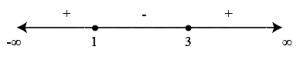
For the function to be increasing,we require $f'(x) > 0$:
$3(x - 1)(x - 3) > 0$
$(x - 1)(x - 3) > 0$
This inequality holds when $x < 1$ or $x > 3$.
Thus,the function is increasing on the interval $(-\infty, 1) \cup (3, \infty)$.
Find the derivative: $f'(x) = 3x^{2} - 12x + 9$
Factor the derivative: $f'(x) = 3(x^{2} - 4x + 3) = 3(x - 1)(x - 3)$
For the function to be increasing,we require $f'(x) > 0$:
$3(x - 1)(x - 3) > 0$
$(x - 1)(x - 3) > 0$
This inequality holds when $x < 1$ or $x > 3$.
Thus,the function is increasing on the interval $(-\infty, 1) \cup (3, \infty)$.
0 likesView Solution
39
MathematicsMediumMCQKCET · 2019
$ \int \frac{1}{\sqrt{x}+x \sqrt{x}} d x $
A
$ 2 \tan ^{-1} \sqrt{x}+C $
B
$ 2 \tan ^{-1} \sqrt{x}+C $
C
$ 2 \log (\sqrt{x}+1)+C $
D
$ \tan ^{-1} \sqrt{x}+C $
Solution
(B) Let $ I = \int \frac{1}{\sqrt{x} + x \sqrt{x}} dx $.
Factor out $ \sqrt{x} $ from the denominator: $ I = \int \frac{1}{\sqrt{x}(1 + x)} dx $.
Since $ x = (\sqrt{x})^2 $,we have $ I = \int \frac{1}{\sqrt{x}(1 + (\sqrt{x})^2)} dx $.
Let $ t = \sqrt{x} $. Then $ dt = \frac{1}{2\sqrt{x}} dx $,which implies $ \frac{1}{\sqrt{x}} dx = 2 dt $.
Substituting these into the integral: $ I = \int \frac{2}{1 + t^2} dt $.
Integrating,we get $ I = 2 \tan^{-1}(t) + C $.
Substituting $ t = \sqrt{x} $ back,we get $ I = 2 \tan^{-1}(\sqrt{x}) + C $.
Factor out $ \sqrt{x} $ from the denominator: $ I = \int \frac{1}{\sqrt{x}(1 + x)} dx $.
Since $ x = (\sqrt{x})^2 $,we have $ I = \int \frac{1}{\sqrt{x}(1 + (\sqrt{x})^2)} dx $.
Let $ t = \sqrt{x} $. Then $ dt = \frac{1}{2\sqrt{x}} dx $,which implies $ \frac{1}{\sqrt{x}} dx = 2 dt $.
Substituting these into the integral: $ I = \int \frac{2}{1 + t^2} dt $.
Integrating,we get $ I = 2 \tan^{-1}(t) + C $.
Substituting $ t = \sqrt{x} $ back,we get $ I = 2 \tan^{-1}(\sqrt{x}) + C $.
0 likesView Solution
40
MathematicsDifficultMCQKCET · 2019
$ \int x^{3} \sin 3 x \, dx = $
A
$ \frac{x^{3} \cos 3 x}{3} + \frac{x^{2} \sin 3 x}{3} - \frac{2 x \cos 3 x}{9} - \frac{2 \sin 3 x}{27} + C $
B
$ -\frac{x^{3} \cos 3 x}{3} + \frac{x^{2} \sin 3 x}{3} - \frac{2 x \cos 3 x}{9} - \frac{2 \sin 3 x}{27} + C $
C
$ -\frac{x^{3} \cos 3 x}{3} - \frac{x^{2} \sin 3 x}{3} + \frac{2 x \cos 3 x}{9} - \frac{2 \sin 3 x}{27} + C $
D
$ -\frac{x^{3} \cos 3 x}{3} + \frac{x^{2} \sin 3 x}{3} + \frac{2 x \cos 3 x}{9} - \frac{2 \sin 3 x}{27} + C $
Solution
(D) To evaluate the integral $ I = \int x^{3} \sin 3 x \, dx $,we use the method of integration by parts or the tabular method (Bernoulli's formula).
Using the formula $ \int u v \, dx = u v_1 - u' v_2 + u'' v_3 - u''' v_4 + \dots $,where $ u = x^3 $ and $ v = \sin 3x $:
$ u = x^3, u' = 3x^2, u'' = 6x, u''' = 6, u'''' = 0 $
$ v_1 = \int \sin 3x \, dx = -\frac{\cos 3x}{3} $
$ v_2 = \int -\frac{\cos 3x}{3} \, dx = -\frac{\sin 3x}{9} $
$ v_3 = \int -\frac{\sin 3x}{9} \, dx = \frac{\cos 3x}{27} $
$ v_4 = \int \frac{\cos 3x}{27} \, dx = \frac{\sin 3x}{81} $
Substituting these into the formula:
$ I = x^3 \left( -\frac{\cos 3x}{3} \right) - (3x^2) \left( -\frac{\sin 3x}{9} \right) + (6x) \left( \frac{\cos 3x}{27} \right) - (6) \left( \frac{\sin 3x}{81} \right) + C $
$ I = -\frac{x^3 \cos 3x}{3} + \frac{x^2 \sin 3x}{3} + \frac{2x \cos 3x}{9} - \frac{2 \sin 3x}{27} + C $
Using the formula $ \int u v \, dx = u v_1 - u' v_2 + u'' v_3 - u''' v_4 + \dots $,where $ u = x^3 $ and $ v = \sin 3x $:
$ u = x^3, u' = 3x^2, u'' = 6x, u''' = 6, u'''' = 0 $
$ v_1 = \int \sin 3x \, dx = -\frac{\cos 3x}{3} $
$ v_2 = \int -\frac{\cos 3x}{3} \, dx = -\frac{\sin 3x}{9} $
$ v_3 = \int -\frac{\sin 3x}{9} \, dx = \frac{\cos 3x}{27} $
$ v_4 = \int \frac{\cos 3x}{27} \, dx = \frac{\sin 3x}{81} $
Substituting these into the formula:
$ I = x^3 \left( -\frac{\cos 3x}{3} \right) - (3x^2) \left( -\frac{\sin 3x}{9} \right) + (6x) \left( \frac{\cos 3x}{27} \right) - (6) \left( \frac{\sin 3x}{81} \right) + C $
$ I = -\frac{x^3 \cos 3x}{3} + \frac{x^2 \sin 3x}{3} + \frac{2x \cos 3x}{9} - \frac{2 \sin 3x}{27} + C $
0 likesView Solution
41
MathematicsDifficultMCQKCET · 2019
If $\int \frac{2x-1}{(x-1)(x+2)(x-3)} dx = A \log |x-1| + B \log |x+2| + C \log |x-3| + K$,then $A, B, C$ are respectively:
A
$\frac{1}{6}, \frac{1}{3}, \frac{1}{5}$
B
$\frac{-1}{6}, \frac{-1}{3}, \frac{1}{2}$
C
$\frac{-1}{6}, \frac{1}{3}, \frac{-1}{2}$
D
$\frac{1}{6}, \frac{-1}{3}, \frac{1}{3}$
Solution
(B) To find $A, B, C$,we use partial fraction decomposition:
$\frac{2x-1}{(x-1)(x+2)(x-3)} = \frac{A}{x-1} + \frac{B}{x+2} + \frac{C}{x-3}$
Multiplying both sides by $(x-1)(x+2)(x-3)$,we get:
$2x-1 = A(x+2)(x-3) + B(x-1)(x-3) + C(x-1)(x+2)$
For $x=1$: $2(1)-1 = A(1+2)(1-3) \implies 1 = A(3)(-2) \implies A = -\frac{1}{6}$
For $x=-2$: $2(-2)-1 = B(-2-1)(-2-3) \implies -5 = B(-3)(-5) \implies -5 = 15B \implies B = -\frac{1}{3}$
For $x=3$: $2(3)-1 = C(3-1)(3+2) \implies 5 = C(2)(5) \implies 5 = 10C \implies C = \frac{1}{2}$
Thus,$A = -\frac{1}{6}, B = -\frac{1}{3}, C = \frac{1}{2}$.
$\frac{2x-1}{(x-1)(x+2)(x-3)} = \frac{A}{x-1} + \frac{B}{x+2} + \frac{C}{x-3}$
Multiplying both sides by $(x-1)(x+2)(x-3)$,we get:
$2x-1 = A(x+2)(x-3) + B(x-1)(x-3) + C(x-1)(x+2)$
For $x=1$: $2(1)-1 = A(1+2)(1-3) \implies 1 = A(3)(-2) \implies A = -\frac{1}{6}$
For $x=-2$: $2(-2)-1 = B(-2-1)(-2-3) \implies -5 = B(-3)(-5) \implies -5 = 15B \implies B = -\frac{1}{3}$
For $x=3$: $2(3)-1 = C(3-1)(3+2) \implies 5 = C(2)(5) \implies 5 = 10C \implies C = \frac{1}{2}$
Thus,$A = -\frac{1}{6}, B = -\frac{1}{3}, C = \frac{1}{2}$.
0 likesView Solution
42
MathematicsMediumMCQKCET · 2019
$ \int_{0}^{1} \sqrt{\frac{1+x}{1-x}} \, dx = $
A
$ \frac{\pi}{2} + 1 $
B
$ \frac{1}{2} $
C
$ \frac{\pi}{2} - 1 $
D
$ \frac{\pi}{2} $
Solution
(A) Let $ I = \int_{0}^{1} \sqrt{\frac{1+x}{1-x}} \, dx $.
Rationalizing the integrand:
$ I = \int_{0}^{1} \sqrt{\frac{(1+x)^2}{(1-x)(1+x)}} \, dx = \int_{0}^{1} \frac{1+x}{\sqrt{1-x^2}} \, dx $.
Splitting the integral:
$ I = \int_{0}^{1} \frac{1}{\sqrt{1-x^2}} \, dx + \int_{0}^{1} \frac{x}{\sqrt{1-x^2}} \, dx $.
Evaluating the first part:
$ \int_{0}^{1} \frac{1}{\sqrt{1-x^2}} \, dx = [\sin^{-1} x]_{0}^{1} = \sin^{-1}(1) - \sin^{-1}(0) = \frac{\pi}{2} - 0 = \frac{\pi}{2} $.
Evaluating the second part:
Let $ 1-x^2 = t $,then $ -2x \, dx = dt $,so $ x \, dx = -\frac{1}{2} \, dt $.
When $ x=0, t=1 $ and when $ x=1, t=0 $.
$ \int_{0}^{1} \frac{x}{\sqrt{1-x^2}} \, dx = \int_{1}^{0} \frac{-1/2}{\sqrt{t}} \, dt = \frac{1}{2} \int_{0}^{1} t^{-1/2} \, dt = \frac{1}{2} [2\sqrt{t}]_{0}^{1} = \frac{1}{2} (2) = 1 $.
Therefore,$ I = \frac{\pi}{2} + 1 $.
Rationalizing the integrand:
$ I = \int_{0}^{1} \sqrt{\frac{(1+x)^2}{(1-x)(1+x)}} \, dx = \int_{0}^{1} \frac{1+x}{\sqrt{1-x^2}} \, dx $.
Splitting the integral:
$ I = \int_{0}^{1} \frac{1}{\sqrt{1-x^2}} \, dx + \int_{0}^{1} \frac{x}{\sqrt{1-x^2}} \, dx $.
Evaluating the first part:
$ \int_{0}^{1} \frac{1}{\sqrt{1-x^2}} \, dx = [\sin^{-1} x]_{0}^{1} = \sin^{-1}(1) - \sin^{-1}(0) = \frac{\pi}{2} - 0 = \frac{\pi}{2} $.
Evaluating the second part:
Let $ 1-x^2 = t $,then $ -2x \, dx = dt $,so $ x \, dx = -\frac{1}{2} \, dt $.
When $ x=0, t=1 $ and when $ x=1, t=0 $.
$ \int_{0}^{1} \frac{x}{\sqrt{1-x^2}} \, dx = \int_{1}^{0} \frac{-1/2}{\sqrt{t}} \, dt = \frac{1}{2} \int_{0}^{1} t^{-1/2} \, dt = \frac{1}{2} [2\sqrt{t}]_{0}^{1} = \frac{1}{2} (2) = 1 $.
Therefore,$ I = \frac{\pi}{2} + 1 $.
0 likesView Solution
43
MathematicsMediumMCQKCET · 2019
$ \int_{-3}^{3} \cot^{-1} x \, dx = $
A
$ 0 $
B
$ 3 $
C
$ 3\pi $
D
$ 1 $
Solution
(C) Let $ I = \int_{-3}^{3} \cot^{-1} x \, dx $.
Using the property $ \int_{-a}^{a} f(x) \, dx = \int_{-a}^{a} f(-x) \, dx $ is not directly applicable here,but we know that $ \cot^{-1}(-x) = \pi - \cot^{-1} x $.
Consider the integral $ I = \int_{-3}^{3} \cot^{-1} x \, dx $.
Using the property $ \int_{a}^{b} f(x) \, dx = \int_{a}^{b} f(a+b-x) \, dx $,we get:
$ I = \int_{-3}^{3} \cot^{-1}(-x) \, dx = \int_{-3}^{3} (\pi - \cot^{-1} x) \, dx $.
$ I = \int_{-3}^{3} \pi \, dx - \int_{-3}^{3} \cot^{-1} x \, dx $.
$ I = \pi [x]_{-3}^{3} - I $.
$ 2I = \pi (3 - (-3)) $.
$ 2I = 6\pi $.
$ I = 3\pi $.
Using the property $ \int_{-a}^{a} f(x) \, dx = \int_{-a}^{a} f(-x) \, dx $ is not directly applicable here,but we know that $ \cot^{-1}(-x) = \pi - \cot^{-1} x $.
Consider the integral $ I = \int_{-3}^{3} \cot^{-1} x \, dx $.
Using the property $ \int_{a}^{b} f(x) \, dx = \int_{a}^{b} f(a+b-x) \, dx $,we get:
$ I = \int_{-3}^{3} \cot^{-1}(-x) \, dx = \int_{-3}^{3} (\pi - \cot^{-1} x) \, dx $.
$ I = \int_{-3}^{3} \pi \, dx - \int_{-3}^{3} \cot^{-1} x \, dx $.
$ I = \pi [x]_{-3}^{3} - I $.
$ 2I = \pi (3 - (-3)) $.
$ 2I = 6\pi $.
$ I = 3\pi $.
0 likesView Solution
44
MathematicsMediumMCQKCET · 2019
$ \int_{0}^{2} [x^{2}] \, dx $
A
$ 5+\sqrt{2}-\sqrt{3} $
B
$ -5-\sqrt{2}-\sqrt{3} $
C
$ 5-\sqrt{2}-\sqrt{3} $
D
$ 5-\sqrt{2}+\sqrt{3} $
Solution
(C) Consider the given integral $I = \int_{0}^{2} [x^{2}] \, dx$.
Since the greatest integer function $[x^2]$ changes its value at $x^2 = 1, 2, 3$,we split the interval $[0, 2]$ based on $x = 1, \sqrt{2}, \sqrt{3}$.
For $x \in [0, 1)$,$x^2 \in [0, 1)$,so $[x^2] = 0$.
For $x \in [1, \sqrt{2})$,$x^2 \in [1, 2)$,so $[x^2] = 1$.
For $x \in [\sqrt{2}, \sqrt{3})$,$x^2 \in [2, 3)$,so $[x^2] = 2$.
For $x \in [\sqrt{3}, 2]$,$x^2 \in [3, 4]$,so $[x^2] = 3$.
Thus,$I = \int_{0}^{1} 0 \, dx + \int_{1}^{\sqrt{2}} 1 \, dx + \int_{\sqrt{2}}^{\sqrt{3}} 2 \, dx + \int_{\sqrt{3}}^{2} 3 \, dx$.
$I = 0 + [x]_{1}^{\sqrt{2}} + [2x]_{\sqrt{2}}^{\sqrt{3}} + [3x]_{\sqrt{3}}^{2}$.
$I = (\sqrt{2} - 1) + 2(\sqrt{3} - \sqrt{2}) + 3(2 - \sqrt{3})$.
$I = \sqrt{2} - 1 + 2\sqrt{3} - 2\sqrt{2} + 6 - 3\sqrt{3}$.
$I = 5 - \sqrt{2} - \sqrt{3}$.
Since the greatest integer function $[x^2]$ changes its value at $x^2 = 1, 2, 3$,we split the interval $[0, 2]$ based on $x = 1, \sqrt{2}, \sqrt{3}$.
For $x \in [0, 1)$,$x^2 \in [0, 1)$,so $[x^2] = 0$.
For $x \in [1, \sqrt{2})$,$x^2 \in [1, 2)$,so $[x^2] = 1$.
For $x \in [\sqrt{2}, \sqrt{3})$,$x^2 \in [2, 3)$,so $[x^2] = 2$.
For $x \in [\sqrt{3}, 2]$,$x^2 \in [3, 4]$,so $[x^2] = 3$.
Thus,$I = \int_{0}^{1} 0 \, dx + \int_{1}^{\sqrt{2}} 1 \, dx + \int_{\sqrt{2}}^{\sqrt{3}} 2 \, dx + \int_{\sqrt{3}}^{2} 3 \, dx$.
$I = 0 + [x]_{1}^{\sqrt{2}} + [2x]_{\sqrt{2}}^{\sqrt{3}} + [3x]_{\sqrt{3}}^{2}$.
$I = (\sqrt{2} - 1) + 2(\sqrt{3} - \sqrt{2}) + 3(2 - \sqrt{3})$.
$I = \sqrt{2} - 1 + 2\sqrt{3} - 2\sqrt{2} + 6 - 3\sqrt{3}$.
$I = 5 - \sqrt{2} - \sqrt{3}$.
0 likesView Solution
45
MathematicsMediumMCQKCET · 2019
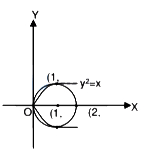
The area of the region above the $X$-axis included between the parabola $y^{2}=x$ and the circle $x^{2}+y^{2}=2x$ in square units is
A
$\frac{3}{2}-\frac{\pi}{4}$
B
$\frac{\pi}{4}-\frac{2}{3}$
C
$\frac{\pi}{4}-\frac{3}{2}$
D
$\frac{2}{3}-\frac{\pi}{4}$
Solution
(B) The given equations are $y^{2}=x$ (parabola) and $x^{2}+y^{2}=2x$ (circle).
Equation of circle can be written as $(x-1)^{2}+y^{2}=1$,which has center $(1,0)$ and radius $1$.
Solving the two equations: $x^{2}+x=2x \implies x^{2}-x=0 \implies x(x-1)=0$. Thus,$x=0$ and $x=1$.
The points of intersection are $(0,0)$ and $(1,1)$.
We need the area above the $X$-axis,so we consider $y = \sqrt{x}$ for the parabola and $y = \sqrt{1-(x-1)^{2}}$ for the upper semi-circle.
The required area is $\int_{0}^{1} (\sqrt{1-(x-1)^{2}} - \sqrt{x}) dx$.
$= \left[ \frac{x-1}{2}\sqrt{1-(x-1)^{2}} + \frac{1}{2}\sin^{-1}(x-1) \right]_{0}^{1} - \left[ \frac{2}{3}x^{3/2} \right]_{0}^{1}$
$= \left( 0 + \frac{1}{2}\sin^{-1}(0) \right) - \left( 0 + \frac{1}{2}\sin^{-1}(-1) \right) - \frac{2}{3}$
$= 0 - (-\frac{\pi}{4}) - \frac{2}{3} = \frac{\pi}{4} - \frac{2}{3}$ square units.
Equation of circle can be written as $(x-1)^{2}+y^{2}=1$,which has center $(1,0)$ and radius $1$.
Solving the two equations: $x^{2}+x=2x \implies x^{2}-x=0 \implies x(x-1)=0$. Thus,$x=0$ and $x=1$.
The points of intersection are $(0,0)$ and $(1,1)$.
We need the area above the $X$-axis,so we consider $y = \sqrt{x}$ for the parabola and $y = \sqrt{1-(x-1)^{2}}$ for the upper semi-circle.
The required area is $\int_{0}^{1} (\sqrt{1-(x-1)^{2}} - \sqrt{x}) dx$.
$= \left[ \frac{x-1}{2}\sqrt{1-(x-1)^{2}} + \frac{1}{2}\sin^{-1}(x-1) \right]_{0}^{1} - \left[ \frac{2}{3}x^{3/2} \right]_{0}^{1}$
$= \left( 0 + \frac{1}{2}\sin^{-1}(0) \right) - \left( 0 + \frac{1}{2}\sin^{-1}(-1) \right) - \frac{2}{3}$
$= 0 - (-\frac{\pi}{4}) - \frac{2}{3} = \frac{\pi}{4} - \frac{2}{3}$ square units.
0 likesView Solution
46
MathematicsEasyMCQKCET · 2019
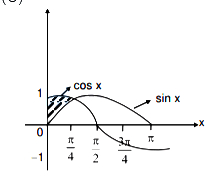
The area of the region bounded by the $y$-axis,$y = \cos x$,and $y = \sin x$ for $0 \leq x \leq \frac{\pi}{2}$ is:
A
$ \sqrt{2} $ Sq.units
B
$ 2 - \sqrt{2} $ Sq.units
C
$ \sqrt{2} - 1 $ Sq.units
D
$ \sqrt{2} + 1 $ Sq.units
Solution
(C) The region is bounded by the $y$-axis $(x=0)$,$y = \cos x$,and $y = \sin x$. These curves intersect when $\cos x = \sin x$,which occurs at $x = \frac{\pi}{4}$ in the interval $[0, \frac{\pi}{2}]$.
In the interval $[0, \frac{\pi}{4}]$,$\cos x \geq \sin x$.
Therefore,the required area is given by:
$\text{Area} = \int_{0}^{\frac{\pi}{4}} (\cos x - \sin x) dx$
$= [\sin x - (-\cos x)]_{0}^{\frac{\pi}{4}}$
$= [\sin x + \cos x]_{0}^{\frac{\pi}{4}}$
$= (\sin \frac{\pi}{4} + \cos \frac{\pi}{4}) - (\sin 0 + \cos 0)$
$= (\frac{1}{\sqrt{2}} + \frac{1}{\sqrt{2}}) - (0 + 1)$
$= \frac{2}{\sqrt{2}} - 1$
$= \sqrt{2} - 1 \text{ sq. units}$
In the interval $[0, \frac{\pi}{4}]$,$\cos x \geq \sin x$.
Therefore,the required area is given by:
$\text{Area} = \int_{0}^{\frac{\pi}{4}} (\cos x - \sin x) dx$
$= [\sin x - (-\cos x)]_{0}^{\frac{\pi}{4}}$
$= [\sin x + \cos x]_{0}^{\frac{\pi}{4}}$
$= (\sin \frac{\pi}{4} + \cos \frac{\pi}{4}) - (\sin 0 + \cos 0)$
$= (\frac{1}{\sqrt{2}} + \frac{1}{\sqrt{2}}) - (0 + 1)$
$= \frac{2}{\sqrt{2}} - 1$
$= \sqrt{2} - 1 \text{ sq. units}$
0 likesView Solution
47
MathematicsMediumMCQKCET · 2019
The order of the differential equation $y = c_{1} e^{c_{2}+x} + c_{3} e^{c_{4}+x}$ is
A
$2$
B
$4$
C
$1$
D
$3$
Solution
(C) Given equation: $y = c_{1} e^{c_{2}+x} + c_{3} e^{c_{4}+x}$
Using the property of exponents $e^{a+b} = e^a \cdot e^b$,we can rewrite the equation as:
$y = c_{1} e^{c_{2}} e^{x} + c_{3} e^{c_{4}} e^{x}$
Factor out $e^{x}$:
$y = (c_{1} e^{c_{2}} + c_{3} e^{c_{4}}) e^{x}$
Since $c_{1}, c_{2}, c_{3}, c_{4}$ are constants,the term $(c_{1} e^{c_{2}} + c_{3} e^{c_{4}})$ is also a constant. Let $A = c_{1} e^{c_{2}} + c_{3} e^{c_{4}}$.
Then the equation simplifies to:
$y = A e^{x}$
Differentiating with respect to $x$:
$\frac{dy}{dx} = A e^{x}$
Since $y = A e^{x}$,we have:
$\frac{dy}{dx} = y$
This is a first-order differential equation. Therefore,the order is $1$.
Using the property of exponents $e^{a+b} = e^a \cdot e^b$,we can rewrite the equation as:
$y = c_{1} e^{c_{2}} e^{x} + c_{3} e^{c_{4}} e^{x}$
Factor out $e^{x}$:
$y = (c_{1} e^{c_{2}} + c_{3} e^{c_{4}}) e^{x}$
Since $c_{1}, c_{2}, c_{3}, c_{4}$ are constants,the term $(c_{1} e^{c_{2}} + c_{3} e^{c_{4}})$ is also a constant. Let $A = c_{1} e^{c_{2}} + c_{3} e^{c_{4}}$.
Then the equation simplifies to:
$y = A e^{x}$
Differentiating with respect to $x$:
$\frac{dy}{dx} = A e^{x}$
Since $y = A e^{x}$,we have:
$\frac{dy}{dx} = y$
This is a first-order differential equation. Therefore,the order is $1$.
0 likesView Solution
48
MathematicsEasyMCQKCET · 2019
The integrating factor of the differential equation $(2x + 3y^2) dy = y dx$ $(y > 0)$ is
A
$-\frac{1}{y^2}$
B
$\frac{1}{y^2}$
C
$e^{\frac{1}{y}}$
D
$\frac{1}{x}$
Solution
(B) Given differential equation is $(2x + 3y^2) dy = y dx$.
Dividing both sides by $y dy$,we get $\frac{dx}{dy} = \frac{2x + 3y^2}{y}$.
Rearranging the terms,we get $\frac{dx}{dy} - \frac{2}{y}x = 3y$.
This is a linear differential equation of the form $\frac{dx}{dy} + P(y)x = Q(y)$,where $P(y) = -\frac{2}{y}$ and $Q(y) = 3y$.
The integrating factor $(IF)$ is given by $IF = e^{\int P(y) dy}$.
$IF = e^{\int -\frac{2}{y} dy} = e^{-2 \ln|y|} = e^{\ln|y^{-2}|} = y^{-2} = \frac{1}{y^2}$.
Dividing both sides by $y dy$,we get $\frac{dx}{dy} = \frac{2x + 3y^2}{y}$.
Rearranging the terms,we get $\frac{dx}{dy} - \frac{2}{y}x = 3y$.
This is a linear differential equation of the form $\frac{dx}{dy} + P(y)x = Q(y)$,where $P(y) = -\frac{2}{y}$ and $Q(y) = 3y$.
The integrating factor $(IF)$ is given by $IF = e^{\int P(y) dy}$.
$IF = e^{\int -\frac{2}{y} dy} = e^{-2 \ln|y|} = e^{\ln|y^{-2}|} = y^{-2} = \frac{1}{y^2}$.
0 likesView Solution
49
MathematicsMediumMCQKCET · 2019
If $|\vec{a}|=16$ and $|\vec{b}|=4$,then find the value of $\sqrt{|\vec{a} \times \vec{b}|^{2}+|\vec{a} \cdot \vec{b}|^{2}}$.
A
$8$
B
$64$
C
$4$
D
$16$
Solution
(B) We know that for any two vectors $\vec{a}$ and $\vec{b}$,the Lagrange's identity states that $|\vec{a} \times \vec{b}|^{2} + |\vec{a} \cdot \vec{b}|^{2} = |\vec{a}|^{2} |\vec{b}|^{2}$.
Given $|\vec{a}| = 16$ and $|\vec{b}| = 4$.
Substituting these values into the identity:
$\sqrt{|\vec{a} \times \vec{b}|^{2} + |\vec{a} \cdot \vec{b}|^{2}} = \sqrt{|\vec{a}|^{2} |\vec{b}|^{2}}$
$= |\vec{a}| |\vec{b}|$
$= (16) \times (4)$
$= 64$.
Given $|\vec{a}| = 16$ and $|\vec{b}| = 4$.
Substituting these values into the identity:
$\sqrt{|\vec{a} \times \vec{b}|^{2} + |\vec{a} \cdot \vec{b}|^{2}} = \sqrt{|\vec{a}|^{2} |\vec{b}|^{2}}$
$= |\vec{a}| |\vec{b}|$
$= (16) \times (4)$
$= 64$.
0 likesView Solution
50
MathematicsEasyMCQKCET · 2019
If the angle between $\vec{a}$ and $\vec{b}$ is $\frac{2\pi}{3}$ and the projection of $\vec{a}$ in the direction of $\vec{b}$ is $-2$,then find $|\vec{a}|$.
A
$3$
B
$11$
C
$4$
D
$12$
Solution
(C) Given that the angle $\theta$ between $\vec{a}$ and $\vec{b}$ is $\frac{2\pi}{3}$.
The projection of $\vec{a}$ in the direction of $\vec{b}$ is given by the formula $\frac{\vec{a} \cdot \vec{b}}{|\vec{b}|} = -2$.
We know that $\vec{a} \cdot \vec{b} = |\vec{a}| |\vec{b}| \cos \theta$.
Substituting this into the projection formula:
$\frac{|\vec{a}| |\vec{b}| \cos \theta}{|\vec{b}|} = -2$
$|\vec{a}| \cos \theta = -2$
Substitute $\theta = \frac{2\pi}{3}$:
$|\vec{a}| \cos \left(\frac{2\pi}{3}\right) = -2$
$|\vec{a}| \left(-\frac{1}{2}\right) = -2$
$|\vec{a}| = (-2) \times (-2)$
$|\vec{a}| = 4$
Thus,the correct option is $C$.
The projection of $\vec{a}$ in the direction of $\vec{b}$ is given by the formula $\frac{\vec{a} \cdot \vec{b}}{|\vec{b}|} = -2$.
We know that $\vec{a} \cdot \vec{b} = |\vec{a}| |\vec{b}| \cos \theta$.
Substituting this into the projection formula:
$\frac{|\vec{a}| |\vec{b}| \cos \theta}{|\vec{b}|} = -2$
$|\vec{a}| \cos \theta = -2$
Substitute $\theta = \frac{2\pi}{3}$:
$|\vec{a}| \cos \left(\frac{2\pi}{3}\right) = -2$
$|\vec{a}| \left(-\frac{1}{2}\right) = -2$
$|\vec{a}| = (-2) \times (-2)$
$|\vec{a}| = 4$
Thus,the correct option is $C$.
0 likesView Solution
51
MathematicsMediumMCQKCET · 2019
$ [\vec{a}+2 \vec{b}-\vec{c}, \vec{a}-\vec{b}, \vec{a}-\vec{b}-\vec{c}] $
A
$ [\vec{a}, \vec{b}, \vec{c}] $
B
$ 3[\vec{a}, \vec{b}, \vec{c}] $
C
$ 0 $
D
$ 2[\vec{a}, \vec{b}, \vec{c}] $
Solution
(B) The scalar triple product is defined as $[\vec{x}, \vec{y}, \vec{z}] = \vec{x} \cdot (\vec{y} \times \vec{z})$.
Let $\vec{x} = \vec{a}+2 \vec{b}-\vec{c}$,$\vec{y} = \vec{a}-\vec{b}$,and $\vec{z} = \vec{a}-\vec{b}-\vec{c}$.
We calculate the cross product $\vec{y} \times \vec{z} = (\vec{a}-\vec{b}) \times (\vec{a}-\vec{b}-\vec{c})$.
$= \vec{a} \times \vec{a} - \vec{a} \times \vec{b} - \vec{a} \times \vec{c} - \vec{b} \times \vec{a} + \vec{b} \times \vec{b} + \vec{b} \times \vec{c}$.
Since $\vec{a} \times \vec{a} = 0$ and $\vec{b} \times \vec{b} = 0$,and $\vec{b} \times \vec{a} = -(\vec{a} \times \vec{b})$,we get:
$= 0 - (\vec{a} \times \vec{b}) - (\vec{a} \times \vec{c}) + (\vec{a} \times \vec{b}) + 0 + (\vec{b} \times \vec{c}) = \vec{b} \times \vec{c} - \vec{a} \times \vec{c}$.
Now,calculate the dot product $(\vec{a}+2 \vec{b}-\vec{c}) \cdot (\vec{b} \times \vec{c} - \vec{a} \times \vec{c})$.
$= \vec{a} \cdot (\vec{b} \times \vec{c}) - \vec{a} \cdot (\vec{a} \times \vec{c}) + 2\vec{b} \cdot (\vec{b} \times \vec{c}) - 2\vec{b} \cdot (\vec{a} \times \vec{c}) - \vec{c} \cdot (\vec{b} \times \vec{c}) + \vec{c} \cdot (\vec{a} \times \vec{c})$.
$= [\vec{a}, \vec{b}, \vec{c}] - 0 + 0 - 2[\vec{b}, \vec{a}, \vec{c}] - 0 + 0$.
Since $[\vec{b}, \vec{a}, \vec{c}] = -[\vec{a}, \vec{b}, \vec{c}]$,we have:
$= [\vec{a}, \vec{b}, \vec{c}] - 2(-[\vec{a}, \vec{b}, \vec{c}]) = [\vec{a}, \vec{b}, \vec{c}] + 2[\vec{a}, \vec{b}, \vec{c}] = 3[\vec{a}, \vec{b}, \vec{c}]$.
Let $\vec{x} = \vec{a}+2 \vec{b}-\vec{c}$,$\vec{y} = \vec{a}-\vec{b}$,and $\vec{z} = \vec{a}-\vec{b}-\vec{c}$.
We calculate the cross product $\vec{y} \times \vec{z} = (\vec{a}-\vec{b}) \times (\vec{a}-\vec{b}-\vec{c})$.
$= \vec{a} \times \vec{a} - \vec{a} \times \vec{b} - \vec{a} \times \vec{c} - \vec{b} \times \vec{a} + \vec{b} \times \vec{b} + \vec{b} \times \vec{c}$.
Since $\vec{a} \times \vec{a} = 0$ and $\vec{b} \times \vec{b} = 0$,and $\vec{b} \times \vec{a} = -(\vec{a} \times \vec{b})$,we get:
$= 0 - (\vec{a} \times \vec{b}) - (\vec{a} \times \vec{c}) + (\vec{a} \times \vec{b}) + 0 + (\vec{b} \times \vec{c}) = \vec{b} \times \vec{c} - \vec{a} \times \vec{c}$.
Now,calculate the dot product $(\vec{a}+2 \vec{b}-\vec{c}) \cdot (\vec{b} \times \vec{c} - \vec{a} \times \vec{c})$.
$= \vec{a} \cdot (\vec{b} \times \vec{c}) - \vec{a} \cdot (\vec{a} \times \vec{c}) + 2\vec{b} \cdot (\vec{b} \times \vec{c}) - 2\vec{b} \cdot (\vec{a} \times \vec{c}) - \vec{c} \cdot (\vec{b} \times \vec{c}) + \vec{c} \cdot (\vec{a} \times \vec{c})$.
$= [\vec{a}, \vec{b}, \vec{c}] - 0 + 0 - 2[\vec{b}, \vec{a}, \vec{c}] - 0 + 0$.
Since $[\vec{b}, \vec{a}, \vec{c}] = -[\vec{a}, \vec{b}, \vec{c}]$,we have:
$= [\vec{a}, \vec{b}, \vec{c}] - 2(-[\vec{a}, \vec{b}, \vec{c}]) = [\vec{a}, \vec{b}, \vec{c}] + 2[\vec{a}, \vec{b}, \vec{c}] = 3[\vec{a}, \vec{b}, \vec{c}]$.
0 likesView Solution
52
MathematicsEasyMCQKCET · 2019
The $XY$-plane divides the line segment joining the points $A(2, 3, -5)$ and $B(-1, -2, -3)$ in the ratio:
A
$3:2$ externally
B
$5:3$ externally
C
$2:1$ internally
D
$5:3$ internally
Solution
(B) The equation of the $XY$-plane is $z = 0$.
Let the ratio in which the $XY$-plane divides the line segment joining $A(x_1, y_1, z_1)$ and $B(x_2, y_2, z_2)$ be $k:1$.
The $z$-coordinate of the point of division is given by the section formula: $z = \frac{kz_2 + z_1}{k + 1}$.
Since the point lies on the $XY$-plane,$z = 0$.
Therefore,$0 = \frac{k(-3) + (-5)}{k + 1}$.
This implies $-3k - 5 = 0$,so $3k = -5$,which gives $k = -\frac{5}{3}$.
The negative sign indicates that the division is external.
Thus,the ratio is $5:3$ externally.
Let the ratio in which the $XY$-plane divides the line segment joining $A(x_1, y_1, z_1)$ and $B(x_2, y_2, z_2)$ be $k:1$.
The $z$-coordinate of the point of division is given by the section formula: $z = \frac{kz_2 + z_1}{k + 1}$.
Since the point lies on the $XY$-plane,$z = 0$.
Therefore,$0 = \frac{k(-3) + (-5)}{k + 1}$.
This implies $-3k - 5 = 0$,so $3k = -5$,which gives $k = -\frac{5}{3}$.
The negative sign indicates that the division is external.
Thus,the ratio is $5:3$ externally.
0 likesView Solution
53
MathematicsEasyMCQKCET · 2019
The distance of the point $P(1, 2, 1)$ from the line $\frac{x-1}{2} = \frac{y-2}{1} = \frac{z-3}{2}$ is
A
$ \frac{2 \sqrt{5}}{3} $
B
$ \frac{20}{3} $
C
$ \frac{2 \sqrt{3}}{5} $
D
$ \frac{\sqrt{5}}{3} $
Solution
(A) Let the given line be $\frac{x-1}{2} = \frac{y-2}{1} = \frac{z-3}{2} = \lambda$.
Any point $A$ on the line is given by $A = (2\lambda + 1, \lambda + 2, 2\lambda + 3)$.
The vector $\vec{PA} = (2\lambda + 1 - 1)\hat{i} + (\lambda + 2 - 2)\hat{j} + (2\lambda + 3 - 1)\hat{k} = 2\lambda\hat{i} + \lambda\hat{j} + (2\lambda + 2)\hat{k}$.
The direction vector of the line is $\vec{v} = 2\hat{i} + 1\hat{j} + 2\hat{k}$.
Since $\vec{PA}$ is perpendicular to the line,$\vec{PA} \cdot \vec{v} = 0$.
$(2\lambda)(2) + (\lambda)(1) + (2\lambda + 2)(2) = 0$.
$4\lambda + \lambda + 4\lambda + 4 = 0 \implies 9\lambda = -4 \implies \lambda = -\frac{4}{9}$.
Substituting $\lambda = -\frac{4}{9}$ in $A$,we get $A = (2(-\frac{4}{9}) + 1, -\frac{4}{9} + 2, 2(-\frac{4}{9}) + 3) = (\frac{1}{9}, \frac{14}{9}, \frac{19}{9})$.
The distance $PA = \sqrt{(\frac{1}{9} - 1)^2 + (\frac{14}{9} - 2)^2 + (\frac{19}{9} - 1)^2} = \sqrt{(-\frac{8}{9})^2 + (-\frac{4}{9})^2 + (\frac{10}{9})^2}$.
$PA = \sqrt{\frac{64 + 16 + 100}{81}} = \sqrt{\frac{180}{81}} = \sqrt{\frac{20}{9}} = \frac{2\sqrt{5}}{3}$.
Any point $A$ on the line is given by $A = (2\lambda + 1, \lambda + 2, 2\lambda + 3)$.
The vector $\vec{PA} = (2\lambda + 1 - 1)\hat{i} + (\lambda + 2 - 2)\hat{j} + (2\lambda + 3 - 1)\hat{k} = 2\lambda\hat{i} + \lambda\hat{j} + (2\lambda + 2)\hat{k}$.
The direction vector of the line is $\vec{v} = 2\hat{i} + 1\hat{j} + 2\hat{k}$.
Since $\vec{PA}$ is perpendicular to the line,$\vec{PA} \cdot \vec{v} = 0$.
$(2\lambda)(2) + (\lambda)(1) + (2\lambda + 2)(2) = 0$.
$4\lambda + \lambda + 4\lambda + 4 = 0 \implies 9\lambda = -4 \implies \lambda = -\frac{4}{9}$.
Substituting $\lambda = -\frac{4}{9}$ in $A$,we get $A = (2(-\frac{4}{9}) + 1, -\frac{4}{9} + 2, 2(-\frac{4}{9}) + 3) = (\frac{1}{9}, \frac{14}{9}, \frac{19}{9})$.
The distance $PA = \sqrt{(\frac{1}{9} - 1)^2 + (\frac{14}{9} - 2)^2 + (\frac{19}{9} - 1)^2} = \sqrt{(-\frac{8}{9})^2 + (-\frac{4}{9})^2 + (\frac{10}{9})^2}$.
$PA = \sqrt{\frac{64 + 16 + 100}{81}} = \sqrt{\frac{180}{81}} = \sqrt{\frac{20}{9}} = \frac{2\sqrt{5}}{3}$.
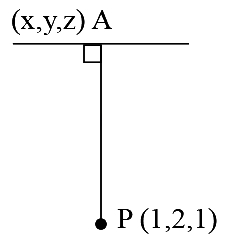
0 likesView Solution
54
MathematicsEasyMCQKCET · 2019
The foot of the perpendicular drawn from the point $(1, 3, 4)$ to the plane $2x - y + z + 3 = 0$ is:
A
$(0, -4, -7)$
B
$(-3, 5, 2)$
C
$(-1, 4, 3)$
D
$(1, 2, -3)$
Solution
(C) Let the point be $P(1, 3, 4)$ and the plane be $2x - y + z + 3 = 0$. Let $A(x_1, y_1, z_1)$ be the foot of the perpendicular from $P$ to the plane.
The direction ratios of the line $PA$ are $(x_1 - 1, y_1 - 3, z_1 - 4)$.
The normal vector to the plane is $\vec{n} = (2, -1, 1)$.
Since $PA$ is perpendicular to the plane,the direction ratios of $PA$ are proportional to the normal vector:
$\frac{x_1 - 1}{2} = \frac{y_1 - 3}{-1} = \frac{z_1 - 4}{1} = \lambda$
This gives $x_1 = 2\lambda + 1$,$y_1 = -\lambda + 3$,and $z_1 = \lambda + 4$.
Since $A$ lies on the plane $2x - y + z + 3 = 0$,we substitute these coordinates into the plane equation:
$2(2\lambda + 1) - (-\lambda + 3) + (\lambda + 4) + 3 = 0$
$4\lambda + 2 + \lambda - 3 + \lambda + 4 + 3 = 0$
$6\lambda + 6 = 0$
$6\lambda = -6 \implies \lambda = -1$.
Substituting $\lambda = -1$ back into the expressions for $x_1, y_1, z_1$:
$x_1 = 2(-1) + 1 = -1$
$y_1 = -(-1) + 3 = 4$
$z_1 = (-1) + 4 = 3$
Thus,the foot of the perpendicular is $(-1, 4, 3)$.
The direction ratios of the line $PA$ are $(x_1 - 1, y_1 - 3, z_1 - 4)$.
The normal vector to the plane is $\vec{n} = (2, -1, 1)$.
Since $PA$ is perpendicular to the plane,the direction ratios of $PA$ are proportional to the normal vector:
$\frac{x_1 - 1}{2} = \frac{y_1 - 3}{-1} = \frac{z_1 - 4}{1} = \lambda$
This gives $x_1 = 2\lambda + 1$,$y_1 = -\lambda + 3$,and $z_1 = \lambda + 4$.
Since $A$ lies on the plane $2x - y + z + 3 = 0$,we substitute these coordinates into the plane equation:
$2(2\lambda + 1) - (-\lambda + 3) + (\lambda + 4) + 3 = 0$
$4\lambda + 2 + \lambda - 3 + \lambda + 4 + 3 = 0$
$6\lambda + 6 = 0$
$6\lambda = -6 \implies \lambda = -1$.
Substituting $\lambda = -1$ back into the expressions for $x_1, y_1, z_1$:
$x_1 = 2(-1) + 1 = -1$
$y_1 = -(-1) + 3 = 4$
$z_1 = (-1) + 4 = 3$
Thus,the foot of the perpendicular is $(-1, 4, 3)$.
0 likesView Solution
55
MathematicsMediumMCQKCET · 2019
The acute angle between the line $\frac{x-5}{2}=\frac{y+1}{-1}=\frac{z+4}{1}$ and the plane $3x-4y-z+5=0$ is
A
$\sin^{-1}\left(\frac{9}{\sqrt{364}}\right)$
B
$\sin^{-1}\left(\frac{9}{2\sqrt{13}}\right)$
C
$\cos^{-1}\left(\frac{9}{\sqrt{364}}\right)$
D
$\cos^{-1}\left(\frac{5}{2\sqrt{13}}\right)$
Solution
(D) The direction ratios of the line are $\vec{b} = (2, -1, 1)$.
The normal vector to the plane $3x - 4y - z + 5 = 0$ is $\vec{n} = (3, -4, -1)$.
The angle $\theta$ between a line with direction vector $\vec{b}$ and a plane with normal $\vec{n}$ is given by $\sin \theta = \frac{|\vec{b} \cdot \vec{n}|}{|\vec{b}| |\vec{n}|}$.
Calculating the dot product: $\vec{b} \cdot \vec{n} = (2)(3) + (-1)(-4) + (1)(-1) = 6 + 4 - 1 = 9$.
Calculating the magnitudes: $|\vec{b}| = \sqrt{2^2 + (-1)^2 + 1^2} = \sqrt{4+1+1} = \sqrt{6}$ and $|\vec{n}| = \sqrt{3^2 + (-4)^2 + (-1)^2} = \sqrt{9+16+1} = \sqrt{26}$.
Thus,$\sin \theta = \frac{|9|}{\sqrt{6} \cdot \sqrt{26}} = \frac{9}{\sqrt{156}} = \frac{9}{\sqrt{4 \times 39}} = \frac{9}{2\sqrt{39}}$.
Since $\sin^2 \theta + \cos^2 \theta = 1$,$\cos \theta = \sqrt{1 - \sin^2 \theta} = \sqrt{1 - \frac{81}{156}} = \sqrt{\frac{75}{156}} = \sqrt{\frac{25}{52}} = \frac{5}{2\sqrt{13}}$.
Therefore,$\theta = \cos^{-1}\left(\frac{5}{2\sqrt{13}}\right)$.
The normal vector to the plane $3x - 4y - z + 5 = 0$ is $\vec{n} = (3, -4, -1)$.
The angle $\theta$ between a line with direction vector $\vec{b}$ and a plane with normal $\vec{n}$ is given by $\sin \theta = \frac{|\vec{b} \cdot \vec{n}|}{|\vec{b}| |\vec{n}|}$.
Calculating the dot product: $\vec{b} \cdot \vec{n} = (2)(3) + (-1)(-4) + (1)(-1) = 6 + 4 - 1 = 9$.
Calculating the magnitudes: $|\vec{b}| = \sqrt{2^2 + (-1)^2 + 1^2} = \sqrt{4+1+1} = \sqrt{6}$ and $|\vec{n}| = \sqrt{3^2 + (-4)^2 + (-1)^2} = \sqrt{9+16+1} = \sqrt{26}$.
Thus,$\sin \theta = \frac{|9|}{\sqrt{6} \cdot \sqrt{26}} = \frac{9}{\sqrt{156}} = \frac{9}{\sqrt{4 \times 39}} = \frac{9}{2\sqrt{39}}$.
Since $\sin^2 \theta + \cos^2 \theta = 1$,$\cos \theta = \sqrt{1 - \sin^2 \theta} = \sqrt{1 - \frac{81}{156}} = \sqrt{\frac{75}{156}} = \sqrt{\frac{25}{52}} = \frac{5}{2\sqrt{13}}$.
Therefore,$\theta = \cos^{-1}\left(\frac{5}{2\sqrt{13}}\right)$.
0 likesView Solution
56
MathematicsDifficultMCQKCET · 2019
$A$ unit vector perpendicular to the plane containing the vectors $\hat{i}+2\hat{j}+\hat{k}$ and $-2\hat{i}+\hat{j}+3\hat{k}$ is
A
$\frac{\hat{i}+\hat{j}-\hat{k}}{\sqrt{3}}$
B
$\frac{-\hat{i}-\hat{j}-\hat{k}}{\sqrt{3}}$
C
$\frac{\hat{i}+\hat{j}+\hat{k}}{\sqrt{3}}$
D
$\frac{5\hat{i}-5\hat{j}+5\hat{k}}{5\sqrt{3}}$
Solution
(D) Let $\vec{a} = \hat{i}+2\hat{j}+\hat{k}$ and $\vec{b} = -2\hat{i}+\hat{j}+3\hat{k}$.
The vector perpendicular to the plane containing $\vec{a}$ and $\vec{b}$ is given by $\vec{n} = \vec{a} \times \vec{b}$.
$\vec{a} \times \vec{b} = \begin{vmatrix} \hat{i} & \hat{j} & \hat{k} \\ 1 & 2 & 1 \\ -2 & 1 & 3 \end{vmatrix} = \hat{i}(6-1) - \hat{j}(3 - (-2)) + \hat{k}(1 - (-4)) = 5\hat{i} - 5\hat{j} + 5\hat{k}$.
The magnitude of this vector is $|\vec{a} \times \vec{b}| = \sqrt{5^2 + (-5)^2 + 5^2} = \sqrt{25+25+25} = \sqrt{75} = 5\sqrt{3}$.
The unit vector perpendicular to the plane is $\hat{n} = \pm \frac{\vec{a} \times \vec{b}}{|\vec{a} \times \vec{b}|} = \pm \frac{5\hat{i}-5\hat{j}+5\hat{k}}{5\sqrt{3}} = \pm \frac{\hat{i}-\hat{j}+\hat{k}}{\sqrt{3}}$.
Comparing this with the given options,option $D$ represents $\frac{5\hat{i}-5\hat{j}+5\hat{k}}{5\sqrt{3}}$,which simplifies to $\frac{\hat{i}-\hat{j}+\hat{k}}{\sqrt{3}}$.
The vector perpendicular to the plane containing $\vec{a}$ and $\vec{b}$ is given by $\vec{n} = \vec{a} \times \vec{b}$.
$\vec{a} \times \vec{b} = \begin{vmatrix} \hat{i} & \hat{j} & \hat{k} \\ 1 & 2 & 1 \\ -2 & 1 & 3 \end{vmatrix} = \hat{i}(6-1) - \hat{j}(3 - (-2)) + \hat{k}(1 - (-4)) = 5\hat{i} - 5\hat{j} + 5\hat{k}$.
The magnitude of this vector is $|\vec{a} \times \vec{b}| = \sqrt{5^2 + (-5)^2 + 5^2} = \sqrt{25+25+25} = \sqrt{75} = 5\sqrt{3}$.
The unit vector perpendicular to the plane is $\hat{n} = \pm \frac{\vec{a} \times \vec{b}}{|\vec{a} \times \vec{b}|} = \pm \frac{5\hat{i}-5\hat{j}+5\hat{k}}{5\sqrt{3}} = \pm \frac{\hat{i}-\hat{j}+\hat{k}}{\sqrt{3}}$.
Comparing this with the given options,option $D$ represents $\frac{5\hat{i}-5\hat{j}+5\hat{k}}{5\sqrt{3}}$,which simplifies to $\frac{\hat{i}-\hat{j}+\hat{k}}{\sqrt{3}}$.
0 likesView Solution
57
MathematicsMediumMCQKCET · 2019
If $A$ and $B$ are two events of a sample space $S$ such that $P(A)=0.2$,$P(B)=0.6$ and $P(A \mid B)=0.5$,then $P(A^{\prime} \mid B) = $
A
$ \frac{2}{3} $
B
$ \frac{1}{3} $
C
$ \frac{3}{10} $
D
$ \frac{1}{2} $
Solution
(D) Given that $P(A)=0.2$,$P(B)=0.6$ and $P(A \mid B)=0.5$.
We know that the conditional probability is defined as $P(A \mid B) = \frac{P(A \cap B)}{P(B)}$.
Substituting the given values: $0.5 = \frac{P(A \cap B)}{0.6}$.
Therefore,$P(A \cap B) = 0.5 \times 0.6 = 0.3$.
We need to find $P(A^{\prime} \mid B)$.
Using the property of conditional probability,$P(A^{\prime} \mid B) = 1 - P(A \mid B)$.
Thus,$P(A^{\prime} \mid B) = 1 - 0.5 = 0.5 = \frac{1}{2}$.
We know that the conditional probability is defined as $P(A \mid B) = \frac{P(A \cap B)}{P(B)}$.
Substituting the given values: $0.5 = \frac{P(A \cap B)}{0.6}$.
Therefore,$P(A \cap B) = 0.5 \times 0.6 = 0.3$.
We need to find $P(A^{\prime} \mid B)$.
Using the property of conditional probability,$P(A^{\prime} \mid B) = 1 - P(A \mid B)$.
Thus,$P(A^{\prime} \mid B) = 1 - 0.5 = 0.5 = \frac{1}{2}$.
0 likesView Solution
58
MathematicsEasyMCQKCET · 2019
$A$ man speaks truth $2$ out of $3$ times. He picks one of the natural numbers in the set $S=\{1, 2, 3, 4, 5, 6, 7\}$ and reports that it is even. The probability that it is actually even is
A
$ \frac{1}{5} $
B
$ \frac{3}{5} $
C
$ \frac{2}{5} $
D
$ \frac{1}{10} $
Solution
(B) Let $S = \{1, 2, 3, 4, 5, 6, 7\}$. The set contains $3$ even numbers $\{2, 4, 6\}$ and $4$ odd numbers $\{1, 3, 5, 7\}$.
Let $E_1$ be the event that an even number is picked,and $E_2$ be the event that an odd number is picked.
$P(E_1) = \frac{3}{7}$ and $P(E_2) = \frac{4}{7}$.
Let $E$ be the event that the man reports an even number.
If the number is even,he speaks the truth with probability $\frac{2}{3}$,so $P(E \mid E_1) = \frac{2}{3}$.
If the number is odd,he lies with probability $1 - \frac{2}{3} = \frac{1}{3}$,so $P(E \mid E_2) = \frac{1}{3}$.
We need to find $P(E_1 \mid E)$ using Bayes' Theorem:
$P(E_1 \mid E) = \frac{P(E \mid E_1) P(E_1)}{P(E \mid E_1) P(E_1) + P(E \mid E_2) P(E_2)}$
$P(E_1 \mid E) = \frac{(\frac{2}{3})(\frac{3}{7})}{(\frac{2}{3})(\frac{3}{7}) + (\frac{1}{3})(\frac{4}{7})}$
$P(E_1 \mid E) = \frac{\frac{6}{21}}{\frac{6}{21} + \frac{4}{21}} = \frac{6}{10} = \frac{3}{5}$.
Let $E_1$ be the event that an even number is picked,and $E_2$ be the event that an odd number is picked.
$P(E_1) = \frac{3}{7}$ and $P(E_2) = \frac{4}{7}$.
Let $E$ be the event that the man reports an even number.
If the number is even,he speaks the truth with probability $\frac{2}{3}$,so $P(E \mid E_1) = \frac{2}{3}$.
If the number is odd,he lies with probability $1 - \frac{2}{3} = \frac{1}{3}$,so $P(E \mid E_2) = \frac{1}{3}$.
We need to find $P(E_1 \mid E)$ using Bayes' Theorem:
$P(E_1 \mid E) = \frac{P(E \mid E_1) P(E_1)}{P(E \mid E_1) P(E_1) + P(E \mid E_2) P(E_2)}$
$P(E_1 \mid E) = \frac{(\frac{2}{3})(\frac{3}{7})}{(\frac{2}{3})(\frac{3}{7}) + (\frac{1}{3})(\frac{4}{7})}$
$P(E_1 \mid E) = \frac{\frac{6}{21}}{\frac{6}{21} + \frac{4}{21}} = \frac{6}{10} = \frac{3}{5}$.
0 likesView Solution
59
MathematicsEasyMCQKCET · 2019
If $X$ has a binomial distribution with parameters $n=6, p$ and $P(X=2)=12, P(X=3)=5$,then $p=$
A
$ \frac{16}{21} $
B
$ \frac{5}{16} $
C
$ \frac{5}{12} $
D
None of these
Solution
(D) The probability mass function for a binomial distribution is given by $P(X=r) = {}^{n}C_{r} q^{n-r} p^{r}$,where $q = 1-p$.
Given $n=6$,we have:
$P(X=2) = {}^{6}C_{2} q^{4} p^{2} = 15 q^{4} p^{2} = 12$ (Equation $1$)
$P(X=3) = {}^{6}C_{3} q^{3} p^{3} = 20 q^{3} p^{3} = 5$ (Equation $2$)
Dividing Equation $1$ by Equation $2$:
$\frac{15 q^{4} p^{2}}{20 q^{3} p^{3}} = \frac{12}{5}$
$\frac{3q}{4p} = \frac{12}{5}$
$15q = 48p$
$5q = 16p$
Since $q = 1-p$,we substitute:
$5(1-p) = 16p$
$5 - 5p = 16p$
$5 = 21p$
$p = \frac{5}{21}$
Given $n=6$,we have:
$P(X=2) = {}^{6}C_{2} q^{4} p^{2} = 15 q^{4} p^{2} = 12$ (Equation $1$)
$P(X=3) = {}^{6}C_{3} q^{3} p^{3} = 20 q^{3} p^{3} = 5$ (Equation $2$)
Dividing Equation $1$ by Equation $2$:
$\frac{15 q^{4} p^{2}}{20 q^{3} p^{3}} = \frac{12}{5}$
$\frac{3q}{4p} = \frac{12}{5}$
$15q = 48p$
$5q = 16p$
Since $q = 1-p$,we substitute:
$5(1-p) = 16p$
$5 - 5p = 16p$
$5 = 21p$
$p = \frac{5}{21}$
0 likesView Solution
60
MathematicsMediumMCQKCET · 2019
$A$ random variable $X$ has the following probability distribution:
Then the value of $k$ is:
| $X$ | $1$ | $2$ | $3$ | $4$ | $5$ | $6$ | $7$ |
| $P(X)$ | $k-1$ | $3k$ | $k$ | $3k$ | $3k^2$ | $k^2$ | $k^2+k$ |
Then the value of $k$ is:
A
$ -2 $
B
$ \frac{1}{10} $
C
$ \frac{1}{5} $
D
$ \frac{2}{7} $
Solution
(C) For a probability distribution,the sum of all probabilities must be equal to $1$,i.e.,$\Sigma P(X) = 1$.
$(k-1) + 3k + k + 3k + 3k^2 + k^2 + (k^2+k) = 1$
Combining like terms:
$5k^2 + 9k - 1 = 1$
$5k^2 + 9k - 2 = 0$
Factoring the quadratic equation:
$5k^2 + 10k - k - 2 = 0$
$5k(k+2) - 1(k+2) = 0$
$(5k-1)(k+2) = 0$
This gives $k = \frac{1}{5}$ or $k = -2$.
Since the probability $P(X)$ cannot be negative,$k$ must be positive. For $k = -2$,$P(X=1) = -2-1 = -3$,which is impossible.
Therefore,$k = \frac{1}{5}$.
$(k-1) + 3k + k + 3k + 3k^2 + k^2 + (k^2+k) = 1$
Combining like terms:
$5k^2 + 9k - 1 = 1$
$5k^2 + 9k - 2 = 0$
Factoring the quadratic equation:
$5k^2 + 10k - k - 2 = 0$
$5k(k+2) - 1(k+2) = 0$
$(5k-1)(k+2) = 0$
This gives $k = \frac{1}{5}$ or $k = -2$.
Since the probability $P(X)$ cannot be negative,$k$ must be positive. For $k = -2$,$P(X=1) = -2-1 = -3$,which is impossible.
Therefore,$k = \frac{1}{5}$.
0 likesView Solution
Vedclass Products
For Students
Vedclass Test Series
Mock tests in real KCET style covering Mathematics with performance analysis. 5-day free trial.
Start Free TrialFor Teachers
Exam Paper Generator
Generate Set A/B/C/D Mathematics papers from 7.5L+ questions in 2 minutes. 3 chapters free.
Try FreeFor Institutes
Online Exam Module
Run live KCET mock exams with unlimited students, 360° analytics & white-label branding.
See DemoFrequently Asked Questions
How many Mathematics questions are in KCET 2019?
There are 60 Mathematics questions from the KCET 2019 paper on Vedclass, each with a detailed step-by-step solution in English.
Are KCET 2019 Mathematics solutions available in English?
Yes. All solutions on this page are in English. You can also switch to English or Hindi using the language buttons above the questions.
Can I practice KCET 2019 Mathematics as a timed test?
Yes. Use the Vedclass Test Series to attempt a full KCET mock test covering Mathematics with time limits and instant score analysis.
Can teachers create Mathematics papers from KCET previous year questions?
Yes. The Vedclass Exam Paper Generator lets teachers mix KCET Mathematics questions and generate Set A/B/C/D papers in minutes.
For Teachers & Institutes
Build a Custom Mathematics Paper
Pick KCET 2019 Mathematics questions, set difficulty, and generate Set A/B/C/D in 2 minutes.