
BiologyQ1–47 of 47 questions
Page 1 of 1 · English
1
BiologyEasyMCQKCET · 2014
The centrosome duplicates during the
A
$G_2$-phase of cell cycle
B
$S$-phase of cell cycle
C
Prophase of cell cycle
D
$G_1$-phase of cell cycle
Solution
(B) The correct answer is $B$.
During the $S$-phase (Synthesis phase) of the cell cycle,$DNA$ replication occurs within the nucleus.
Simultaneously,the centrosome,which is responsible for organizing microtubules,also duplicates in the cytoplasm.
This ensures that each daughter cell receives a pair of centrosomes during cell division.
During the $S$-phase (Synthesis phase) of the cell cycle,$DNA$ replication occurs within the nucleus.
Simultaneously,the centrosome,which is responsible for organizing microtubules,also duplicates in the cytoplasm.
This ensures that each daughter cell receives a pair of centrosomes during cell division.
0 likesView Solution
2
BiologyEasyMCQKCET · 2014
Statement $A$: Photorespiration decreases photosynthetic output.
Statement $B$: In photorespiratory pathway,neither $ATP$ nor $NADPH$ is produced.
Statement $B$: In photorespiratory pathway,neither $ATP$ nor $NADPH$ is produced.
A
Statement $A$ is correct and statement $B$ is wrong.
B
Both the statements $A$ and $B$ are correct.
C
Statement $B$ is correct and statement $A$ is wrong.
D
Both statements $A$ and $B$ are wrong.
Solution
(B) The correct answer is $B$. Both statements $A$ and $B$ are correct.
Photorespiration is a wasteful process in $C_3$ plants.
In $C_3$ plants,some $O_2$ binds to $RuBisCO$ instead of $CO_2$,which decreases the efficiency of $CO_2$ fixation.
In this pathway,$RuBP$ binds with $O_2$ to form one molecule of phosphoglycerate $(3C)$ and one molecule of phosphoglycolate $(2C)$.
During the photorespiratory pathway,there is no synthesis of sugars,$ATP$,or $NADPH$. Instead,it leads to the release of $CO_2$ and the consumption of $ATP$.
Photorespiration is a wasteful process in $C_3$ plants.
In $C_3$ plants,some $O_2$ binds to $RuBisCO$ instead of $CO_2$,which decreases the efficiency of $CO_2$ fixation.
In this pathway,$RuBP$ binds with $O_2$ to form one molecule of phosphoglycerate $(3C)$ and one molecule of phosphoglycolate $(2C)$.
During the photorespiratory pathway,there is no synthesis of sugars,$ATP$,or $NADPH$. Instead,it leads to the release of $CO_2$ and the consumption of $ATP$.
0 likesView Solution
3
BiologyEasyMCQKCET · 2014
Match the organic compounds listed under Column-$I$ with the explanation given under Column-$II$. Choose the appropriate option from the given choices.
| Column-$I$ | Column-$II$ |
|---|---|
| $A$. Phosphoenol pyruvate $(PEP)$ | $p$. $6$-carbon compound |
| $B$. Ribulose biphosphate $(RuBP)$ | $q$. $2$-carbon compound |
| $C$. Oxaloacetic acid $(OAA)$ | $r$. $4$-carbon compound |
| $D$. Acetyl coenzyme $A$ | $s$. $5$-carbon compound |
| - | $t$. $3$-carbon compound |
A
$A-t; B-s; C-r; D-q$
B
$A-r; B-s; C-t; D-p$
C
$A-t; B-p; C-q; D-r$
D
$A-q; B-r; C-s; D-t$
Solution
(A) The correct matching is as follows:
$1$. Phosphoenol pyruvate $(PEP)$ is a $3$-carbon compound $(t)$.
$2$. Ribulose biphosphate $(RuBP)$ is a $5$-carbon compound $(s)$.
$3$. Oxaloacetic acid $(OAA)$ is a $4$-carbon compound $(r)$.
$4$. Acetyl coenzyme $A$ is a $2$-carbon compound $(q)$.
Therefore,the correct sequence is $A-t, B-s, C-r, D-q$.
$1$. Phosphoenol pyruvate $(PEP)$ is a $3$-carbon compound $(t)$.
$2$. Ribulose biphosphate $(RuBP)$ is a $5$-carbon compound $(s)$.
$3$. Oxaloacetic acid $(OAA)$ is a $4$-carbon compound $(r)$.
$4$. Acetyl coenzyme $A$ is a $2$-carbon compound $(q)$.
Therefore,the correct sequence is $A-t, B-s, C-r, D-q$.
0 likesView Solution
4
BiologyEasyMCQKCET · 2014
Match the items listed under Column-$I$ with those given under Column-$II$. Choose the appropriate option from the given choices.
| Column-$I$ | Column-$II$ |
|---|---|
| $A$. Residual volume $(RV)$ | $p$. $4000 \text{ ml} - 4600 \text{ ml}$ |
| $B$. Inspiratory Reserve Volume $(IRV)$ | $q$. $1100 \text{ ml} - 1200 \text{ ml}$ |
| $C$. Vital capacity $(VC)$ | $r$. $1000 \text{ ml} - 1100 \text{ ml}$ |
| $D$. Expiratory Reserve Volume $(ERV)$ | $s$. $3000 \text{ ml} - 3500 \text{ ml}$ |
| $E$. Inspiratory capacity $(IC)$ | $t$. $2500 \text{ ml} - 3000 \text{ ml}$ |
A
$A-t, B-q, C-s, D-r, E-p$
B
$A-q, B-r, C-s, D-t, E-p$
C
$A-q, B-t, C-p, D-r, E-s$
D
$A-r, B-t, C-p, D-q, E-s$
Solution
(C) $A-q, B-t, C-p, D-r, E-s$
$1$. Residual Volume $(RV)$ is the volume of air remaining in the lungs even after a forcible expiration, which is approximately $1100 \text{ ml} - 1200 \text{ ml}$.
$2$. Inspiratory Reserve Volume $(IRV)$ is the additional volume of air, a person can inspire by a forcible inspiration, which is $2500 \text{ ml} - 3000 \text{ ml}$.
$3$. Vital Capacity $(VC)$ is the maximum volume of air a person can breathe in after a forced expiration, which is $4000 \text{ ml} - 4600 \text{ ml}$.
$4$. Expiratory Reserve Volume $(ERV)$ is the additional volume of air, a person can expire by a forcible expiration, which is $1000 \text{ ml} - 1100 \text{ ml}$.
$5$. Inspiratory Capacity $(IC)$ is the total volume of air a person can inspire after a normal expiration, which is $3000 \text{ ml} - 3500 \text{ ml}$.
$1$. Residual Volume $(RV)$ is the volume of air remaining in the lungs even after a forcible expiration, which is approximately $1100 \text{ ml} - 1200 \text{ ml}$.
$2$. Inspiratory Reserve Volume $(IRV)$ is the additional volume of air, a person can inspire by a forcible inspiration, which is $2500 \text{ ml} - 3000 \text{ ml}$.
$3$. Vital Capacity $(VC)$ is the maximum volume of air a person can breathe in after a forced expiration, which is $4000 \text{ ml} - 4600 \text{ ml}$.
$4$. Expiratory Reserve Volume $(ERV)$ is the additional volume of air, a person can expire by a forcible expiration, which is $1000 \text{ ml} - 1100 \text{ ml}$.
$5$. Inspiratory Capacity $(IC)$ is the total volume of air a person can inspire after a normal expiration, which is $3000 \text{ ml} - 3500 \text{ ml}$.
0 likesView Solution
5
BiologyEasyMCQKCET · 2014
The knee joint is an example of:
A
pivot joint
B
ball and socket joint
C
gliding joint
D
hinge joint
Solution
(D) The correct answer is $D$.
The knee joint is an example of a hinge joint.
$A$ hinge joint is a type of synovial joint that allows movement primarily in one plane,similar to the hinge of a door.
It is characterized by the presence of a fluid-filled synovial cavity between the articulating surfaces of the two bones,which facilitates smooth movement.
The knee joint is an example of a hinge joint.
$A$ hinge joint is a type of synovial joint that allows movement primarily in one plane,similar to the hinge of a door.
It is characterized by the presence of a fluid-filled synovial cavity between the articulating surfaces of the two bones,which facilitates smooth movement.
0 likesView Solution
6
BiologyEasyMCQKCET · 2014
Which one of the following hormones also produces anti-inflammatory reactions in man and suppresses the immune response in addition to its primary functions?
A
Thyrocalcitonin
B
Cortisol
C
Erythropoietin
D
Thymosin
Solution
(B) The correct answer is $B$ (Cortisol).
$1$. Cortisol is a glucocorticoid secreted by the adrenal cortex.
$2$. In addition to its primary role in carbohydrate metabolism,it plays a crucial role in maintaining the cardiovascular system and kidney functions.
$3$. Cortisol is well-known for producing anti-inflammatory reactions and suppressing the immune response,which is why it is often used clinically to treat inflammatory conditions and autoimmune diseases.
$4$. It also stimulates the production of red blood cells $(RBCs)$.
$1$. Cortisol is a glucocorticoid secreted by the adrenal cortex.
$2$. In addition to its primary role in carbohydrate metabolism,it plays a crucial role in maintaining the cardiovascular system and kidney functions.
$3$. Cortisol is well-known for producing anti-inflammatory reactions and suppressing the immune response,which is why it is often used clinically to treat inflammatory conditions and autoimmune diseases.
$4$. It also stimulates the production of red blood cells $(RBCs)$.
0 likesView Solution
7
BiologyEasyMCQKCET · 2014
$Marchantia$ is considered as a heterothallic plant because it is
A
monoecious
B
heterogametic
C
dioecious
D
bisexual
Solution
(C) $Marchantia$ is considered a heterothallic plant because it is dioecious.
In $Marchantia$,the male and female reproductive structures (antheridiophore and archegoniophore) are borne on separate individual thalli.
Therefore,the plant body is unisexual,which is referred to as dioecious or heterothallic.
In $Marchantia$,the male and female reproductive structures (antheridiophore and archegoniophore) are borne on separate individual thalli.
Therefore,the plant body is unisexual,which is referred to as dioecious or heterothallic.
0 likesView Solution
8
BiologyEasyMCQKCET · 2014
Match the storage products listed under Column-$I$ with the organisms given under Column-$II$. Choose the appropriate option from the given choices.
| Column $I$ | Column $II$ |
|---|---|
| $A$. Glycogen | $t$. Agaricus |
| $B$. Pyrenoids | $s$. Spirogyra |
| $C$. Laminarin and mannitol | $p$. Sargassum |
| $D$. Floridean starch | $r$. Polysiphonia |
A
$A-t, B-s, C-p, D-r$
B
$A-r, B-s, C-p, D-t$
C
$A-q, B-p, C-s, D-r$
D
$A-s, B-r, C-t, D-q$
Solution
(A) The correct matching is as follows:
$1$. $A$. Glycogen: It is the stored food material in fungi,such as $Agaricus$ $(t)$.
$2$. $B$. Pyrenoids: These are proteinaceous storage bodies found in the chloroplasts of green algae,such as $Spirogyra$ $(s)$.
$3$. $C$. Laminarin and mannitol: These are the characteristic stored food products of brown algae,such as $Sargassum$ $(p)$.
$4$. $D$. Floridean starch: This is the stored food material in red algae,which is very similar to amylopectin and glycogen in structure,such as $Polysiphonia$ $(r)$.
Therefore,the correct sequence is $A-t, B-s, C-p, D-r$.
$1$. $A$. Glycogen: It is the stored food material in fungi,such as $Agaricus$ $(t)$.
$2$. $B$. Pyrenoids: These are proteinaceous storage bodies found in the chloroplasts of green algae,such as $Spirogyra$ $(s)$.
$3$. $C$. Laminarin and mannitol: These are the characteristic stored food products of brown algae,such as $Sargassum$ $(p)$.
$4$. $D$. Floridean starch: This is the stored food material in red algae,which is very similar to amylopectin and glycogen in structure,such as $Polysiphonia$ $(r)$.
Therefore,the correct sequence is $A-t, B-s, C-p, D-r$.
0 likesView Solution
9
BiologyEasyMCQKCET · 2014
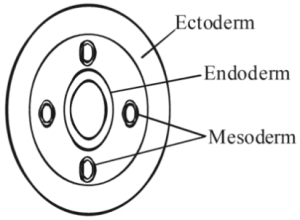
The kind of coelom represented in the diagram given below is characteristic of
A
round worm
B
earthworm
C
tape worm
D
cockroach
Solution
(A) The correct answer is $A$ (round worm).
The diagram illustrates a pseudocoelom,which is a body cavity that is not completely lined by mesoderm. Instead,the mesoderm is present as scattered pouches between the ectoderm and endoderm.
$1$. Round worms (Phylum Aschelminthes) are characterized by the presence of a pseudocoelom.
$2$. Earthworms (Phylum Annelida) and cockroaches (Phylum Arthropoda) are eucoelomate (true coelomates).
$3$. Tapeworms (Phylum Platyhelminthes) are acoelomate (lack a body cavity).
The diagram illustrates a pseudocoelom,which is a body cavity that is not completely lined by mesoderm. Instead,the mesoderm is present as scattered pouches between the ectoderm and endoderm.
$1$. Round worms (Phylum Aschelminthes) are characterized by the presence of a pseudocoelom.
$2$. Earthworms (Phylum Annelida) and cockroaches (Phylum Arthropoda) are eucoelomate (true coelomates).
$3$. Tapeworms (Phylum Platyhelminthes) are acoelomate (lack a body cavity).
0 likesView Solution
10
BiologyEasyMCQKCET · 2014
Which of the following statements is correct?
A
The core of cilium or flagellum is the basal body.
B
Elaioplasts store starch whereas aleuroplasts store proteins.
C
Membranous extensions into the cytoplasm in cyanobacteria which contain pigments are called chromatophores.
D
Acrocentric chromosomes have only one arm.
Solution
(C) Option $C$ is correct. In some prokaryotes like cyanobacteria,there are other membranous extensions into the cytoplasm called chromatophores which contain pigments.
Explanation of other options:
- Option $A$: The core of a cilium or flagellum is called the axoneme,not the basal body.
- Option $B$: Elaioplasts store oils and fats,while amyloplasts store starch. Aleuroplasts store proteins.
- Option $D$: Acrocentric chromosomes have two arms,one very short and one very long,with the centromere situated close to one end.
Explanation of other options:
- Option $A$: The core of a cilium or flagellum is called the axoneme,not the basal body.
- Option $B$: Elaioplasts store oils and fats,while amyloplasts store starch. Aleuroplasts store proteins.
- Option $D$: Acrocentric chromosomes have two arms,one very short and one very long,with the centromere situated close to one end.
0 likesView Solution
11
BiologyEasyMCQKCET · 2014
$RuBisCO$ and $Collagen$ are the most abundant proteins in the living world.
A
$PEPcase$ of plants and $Keratin$ of animals
B
$Ribozyme$ of plants and $Collagen$ of animals
C
$Alcohol \text{ } dehydrogenase$ of plants and $Melanin$ of animals
D
$RuBisCO$ of plants and $Collagen$ of animals
Solution
(D) $RuBisCO$ (Ribulose bisphosphate carboxylase-oxygenase) is the most abundant protein in the plant world, as it is essential for the process of photosynthesis.
$Collagen$ is the most abundant protein in the animal world, providing structural support to tissues.
Therefore, $RuBisCO$ of plants and $Collagen$ of animals are the most abundant proteins in the living world.
$Collagen$ is the most abundant protein in the animal world, providing structural support to tissues.
Therefore, $RuBisCO$ of plants and $Collagen$ of animals are the most abundant proteins in the living world.
0 likesView Solution
12
BiologyEasyMCQKCET · 2014
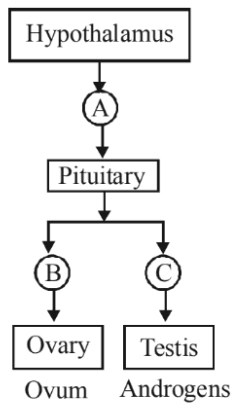
Identify the hormones '$A$','$B$',and '$C$' that are labelled in the given flow chart.
A
$A - GnRH, B - PRL, C - ICSH$
B
$A - GnRH, B - ICSH, C - ISH$
C
$A - GnRH, B - FSH, C - LH$
D
$A - GnRH, B - FSH, C - LHH$
Solution
(C) The correct option is $C$.
$A$ represents $GnRH$ (Gonadotropin-releasing hormone),which is secreted by the hypothalamus.
$GnRH$ stimulates the anterior pituitary gland to release gonadotropins,which are $FSH$ (Follicle-stimulating hormone) and $LH$ (Luteinizing hormone).
$B$ represents $FSH$,which acts on the ovaries to stimulate the growth of ovarian follicles.
$C$ represents $LH$,which acts on the testes to stimulate Leydig cells to secrete androgens (testosterone).
$A$ represents $GnRH$ (Gonadotropin-releasing hormone),which is secreted by the hypothalamus.
$GnRH$ stimulates the anterior pituitary gland to release gonadotropins,which are $FSH$ (Follicle-stimulating hormone) and $LH$ (Luteinizing hormone).
$B$ represents $FSH$,which acts on the ovaries to stimulate the growth of ovarian follicles.
$C$ represents $LH$,which acts on the testes to stimulate Leydig cells to secrete androgens (testosterone).
0 likesView Solution
13
BiologyMediumMCQKCET · 2014
In humans,what is the ratio of the number of gametes produced from one male primary sex cell to the number of gametes produced from one female primary sex cell?
A
$1:3$
B
$4:1$
C
$1:4$
D
$1:1$
Solution
(B) In males,one primary spermatocyte undergoes meiosis to produce $4$ functional,viable sperm cells.
In females,one primary oocyte undergoes meiosis,but due to unequal cytoplasmic division,it produces only $1$ functional,viable ovum and $2$ or $3$ non-functional polar bodies that eventually degenerate.
Therefore,the ratio of gametes produced from one male primary sex cell to one female primary sex cell is $4:1$.
In females,one primary oocyte undergoes meiosis,but due to unequal cytoplasmic division,it produces only $1$ functional,viable ovum and $2$ or $3$ non-functional polar bodies that eventually degenerate.
Therefore,the ratio of gametes produced from one male primary sex cell to one female primary sex cell is $4:1$.
0 likesView Solution
14
BiologyEasyMCQKCET · 2014
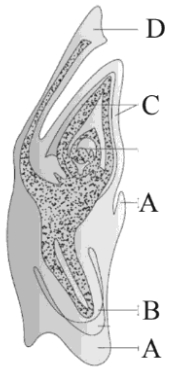
In this diagram showing the $L$.$S$. of an embryo of grass,identify the answer having the correct combination of alphabets with the right part.
A
$A$-Epiblast,$B$-Scutellum,$C$-Coleoptile,$D$-Radicle,$E$-Coleorrhiza,$F$-Shoot apex
B
$A$-Root cap,$B$-Coleoptile,$C$-Scutellum,$D$-Coleorrhiza,$E$-Epiblast,$F$-Shoot apex
C
$A$-Epiblast,$B$-Radicle,$C$-Coleoptile,$D$-Scutellum,$E$-Coleorrhiza,$F$-Shoot apex
D
$A$-Shoot apex,$B$-Epiblast,$C$-Coleorrhiza,$D$-Scutellum,$E$-Coleoptile,$F$-Radicle
Solution
(A) Based on the standard diagram of the $L$.$S$. of a grass embryo (monocot embryo) as provided in the $NCERT$ textbook:
- $A$ represents the Epiblast (the small,rudimentary second cotyledon).
- $B$ represents the Radicle (the embryonic root).
- $C$ represents the Coleoptile (the protective sheath covering the plumule).
- $D$ represents the Scutellum (the large,shield-shaped cotyledon).
- The structure covering the radicle is the Coleorrhiza.
- The top portion represents the Shoot apex (plumule).
Comparing these labels with the given options,option $A$ provides the correct identification for the parts labeled in the standard diagram of a grass embryo.
- $A$ represents the Epiblast (the small,rudimentary second cotyledon).
- $B$ represents the Radicle (the embryonic root).
- $C$ represents the Coleoptile (the protective sheath covering the plumule).
- $D$ represents the Scutellum (the large,shield-shaped cotyledon).
- The structure covering the radicle is the Coleorrhiza.
- The top portion represents the Shoot apex (plumule).
Comparing these labels with the given options,option $A$ provides the correct identification for the parts labeled in the standard diagram of a grass embryo.
0 likesView Solution
15
BiologyEasyMCQKCET · 2014
The germ pores in the pollen grain are the regions
A
which are made up of lignin and suberin
B
that can withstand high temperature and strong acids and alkalies
C
which lack sporopollenin
D
through which sperms are released into the female gametophyte
Solution
(C) The correct answer is $C$.
In a mature pollen grain,the outer protective layer is known as the exine,which is composed of a highly resistant organic material called sporopollenin.
However,at certain specific locations,the exine is absent or very thin,and these regions lack sporopollenin.
These specific regions are termed as germ pores.
During the process of pollen germination,the pollen tube emerges from the pollen grain through these germ pores.
In a mature pollen grain,the outer protective layer is known as the exine,which is composed of a highly resistant organic material called sporopollenin.
However,at certain specific locations,the exine is absent or very thin,and these regions lack sporopollenin.
These specific regions are termed as germ pores.
During the process of pollen germination,the pollen tube emerges from the pollen grain through these germ pores.
0 likesView Solution
16
BiologyEasyMCQKCET · 2014
In castor and maize plants, . . . . . .
A
male and female flowers are borne by different plants
B
autogamy is prevented but not geitonogamy
C
the anthers and stigma are placed at different positions to encourage cross pollination
D
both autogamy and geitonogamy are prevented
Solution
(B) In castor and maize plants,both male and female flowers are present on the same plant (monoecious condition).
Since the flowers are unisexual,self-pollination within the same flower (autogamy) is prevented.
However,pollen grains can be transferred from the anther of one flower to the stigma of another flower on the same plant,which is known as geitonogamy.
Therefore,autogamy is prevented but geitonogamy is not.
Since the flowers are unisexual,self-pollination within the same flower (autogamy) is prevented.
However,pollen grains can be transferred from the anther of one flower to the stigma of another flower on the same plant,which is known as geitonogamy.
Therefore,autogamy is prevented but geitonogamy is not.
0 likesView Solution
17
BiologyEasyMCQKCET · 2014
With respect to angiosperms,identify the incorrect pair from the following.
A
Primary endosperm nucleus - $3n$
B
Antipodals - $2n$
C
Cells of nucellus of ovule - $2n$
D
Vegetative cell of male gametophyte - $n$
Solution
(B) The correct answer is $B$.
Antipodal cells are formed after the mitotic division of the functional megaspore within the embryo sac.
Since the megaspore is haploid $(n)$,the antipodal cells formed from it are also haploid $(n)$,not diploid $(2n)$.
Therefore,the pair 'Antipodals - $2n$' is incorrect.
Antipodal cells are formed after the mitotic division of the functional megaspore within the embryo sac.
Since the megaspore is haploid $(n)$,the antipodal cells formed from it are also haploid $(n)$,not diploid $(2n)$.
Therefore,the pair 'Antipodals - $2n$' is incorrect.
0 likesView Solution
18
BiologyEasyMCQKCET · 2014
During somatic hybridisation in plants,
A
the cell walls and the middle lamella are digested before fusing the cells
B
somaclones are produced in large numbers
C
crop plants with higher levels of vitamins,proteins and minerals are hybridised
D
the apical meristems are cultured to get virus-free plants
Solution
(A) Somatic hybridisation is a technique in plant tissue culture where protoplasts from two different plant species are fused to form a hybrid protoplast.
To achieve this,the cell walls and the middle lamella must be removed or digested using enzymes like cellulase and pectinase.
Once the cell walls are removed,the resulting protoplasts are fused to create a somatic hybrid,which can then be regenerated into a new plant.
Therefore,the correct process involves the digestion of cell walls and middle lamella before fusion.
To achieve this,the cell walls and the middle lamella must be removed or digested using enzymes like cellulase and pectinase.
Once the cell walls are removed,the resulting protoplasts are fused to create a somatic hybrid,which can then be regenerated into a new plant.
Therefore,the correct process involves the digestion of cell walls and middle lamella before fusion.
0 likesView Solution
19
BiologyEasyMCQKCET · 2014
$RNA$ interference,which is employed in making tobacco plants resistant to $Meloidogyne \ incognita$,is essentially involved in:
A
preventing the process of replication of $DNA$
B
preventing the process of translation of mRNA
C
preventing the process of splicing of hnRNA
D
preventing the process of transcription
Solution
(B) - preventing the process of translation of mRNA.
$RNA$ interference $(RNAi)$ is a biological process in which $RNA$ molecules inhibit gene expression or translation by neutralizing targeted mRNA molecules.
In the case of $Meloidogyne \ incognita$ infecting tobacco plants,$dsRNA$ is introduced into the host cells.
This $dsRNA$ initiates the $RNAi$ pathway,which leads to the degradation of the specific mRNA of the nematode,thereby preventing its translation into essential proteins required for the parasite's survival.
$RNA$ interference $(RNAi)$ is a biological process in which $RNA$ molecules inhibit gene expression or translation by neutralizing targeted mRNA molecules.
In the case of $Meloidogyne \ incognita$ infecting tobacco plants,$dsRNA$ is introduced into the host cells.
This $dsRNA$ initiates the $RNAi$ pathway,which leads to the degradation of the specific mRNA of the nematode,thereby preventing its translation into essential proteins required for the parasite's survival.
0 likesView Solution
20
BiologyEasyMCQKCET · 2014
$ADA$ deficiency results in
A
chromosomal disorders
B
increased risk of infertility
C
decrease in the yield of crop plants
D
inability of the immune system to function normally
Solution
(D) $ADA$ stands for adenosine deaminase.
This enzyme is crucial for the proper functioning of the immune system.
The deficiency of this enzyme leads to a condition known as Severe Combined Immunodeficiency $(SCID)$.
In patients with $SCID$, the body lacks functional $T$-lymphocytes, which are essential for mounting an immune response.
Consequently, the immune system is unable to function normally.
This enzyme is crucial for the proper functioning of the immune system.
The deficiency of this enzyme leads to a condition known as Severe Combined Immunodeficiency $(SCID)$.
In patients with $SCID$, the body lacks functional $T$-lymphocytes, which are essential for mounting an immune response.
Consequently, the immune system is unable to function normally.
0 likesView Solution
21
BiologyEasyMCQKCET · 2014
Identify the incorrect statement from the following.
A
Pyramid of biomass in sea is generally inverted as the biomass of fish far exceeds that of phytoplanktons.
B
Pyramid of energy is mostly upright, but sometimes it may be inverted.
C
Food chains are generally short with few trophic levels as only $10\%$ of the energy is transferred to each trophic level from the lower trophic level.
D
Pyramids of number and biomass may be either upright or inverted.
Solution
(B) The incorrect statement is $B$.
$1$. The pyramid of energy is always upright because energy flow in an ecosystem is unidirectional and follows the $10\%$ law, where energy is lost as heat at each successive trophic level.
$2$. It is impossible for a pyramid of energy to be inverted because energy cannot be created at higher trophic levels.
$3$. The pyramid of biomass in the sea is inverted because the standing crop of phytoplankton (producers) is smaller than that of the zooplankton and fish (consumers) at any given time.
$4$. Pyramids of number and biomass can be upright or inverted depending on the ecosystem structure.
$1$. The pyramid of energy is always upright because energy flow in an ecosystem is unidirectional and follows the $10\%$ law, where energy is lost as heat at each successive trophic level.
$2$. It is impossible for a pyramid of energy to be inverted because energy cannot be created at higher trophic levels.
$3$. The pyramid of biomass in the sea is inverted because the standing crop of phytoplankton (producers) is smaller than that of the zooplankton and fish (consumers) at any given time.
$4$. Pyramids of number and biomass can be upright or inverted depending on the ecosystem structure.
0 likesView Solution
22
BiologyEasyMCQKCET · 2014
One of the chief reasons among the following for the depletion in the number of species making it endangered is
A
over-hunting and poaching
B
greenhouse effect
C
competition and predation
D
habitat destruction
Solution
(D) The correct answer is $D$.
Habitat destruction,defined as the elimination or alteration of the conditions necessary for animals and plants to survive,is the primary cause of species extinction and endangerment.
It not only impacts individual species but also the overall health of the global ecosystem.
Habitats are destroyed or fragmented by various human activities such as industrial development,deforestation,and pollution.
While over-hunting and poaching also have harmful effects,habitat loss remains the most significant threat to biodiversity.
Habitat destruction,defined as the elimination or alteration of the conditions necessary for animals and plants to survive,is the primary cause of species extinction and endangerment.
It not only impacts individual species but also the overall health of the global ecosystem.
Habitats are destroyed or fragmented by various human activities such as industrial development,deforestation,and pollution.
While over-hunting and poaching also have harmful effects,habitat loss remains the most significant threat to biodiversity.
0 likesView Solution
23
BiologyEasyMCQKCET · 2014
One of the following statements is incorrect with reference to biodiversity. Identify it.
A
The richest reservoirs of animal and plant life (high species richness) with few or no threatened species are called "biodiversity hotspots".
B
Biodiversity increases from higher altitudes to lower altitudes.
C
Biodiversity decreases from the equator to polar regions.
D
Depletion in genetic diversity of crop plants is mainly due to the introduction of better varieties with high yield, disease resistance, etc.
Solution
(A) The correct answer is $A$. The statement that the richest reservoirs of animal and plant life with few or no threatened species are called "biodiversity hotspots" is incorrect.
Biodiversity hotspots are regions that are characterized by high levels of species richness and high degree of endemism, but they are also the most threatened regions due to habitat loss and fragmentation.
They are identified based on three main criteria:
$(i)$ Degree of endemism (presence of species found nowhere else).
$(ii)$ Degree of threat to the habitat due to degradation and fragmentation.
$(iii)$ High number of species or species diversity.
Biodiversity hotspots are regions that are characterized by high levels of species richness and high degree of endemism, but they are also the most threatened regions due to habitat loss and fragmentation.
They are identified based on three main criteria:
$(i)$ Degree of endemism (presence of species found nowhere else).
$(ii)$ Degree of threat to the habitat due to degradation and fragmentation.
$(iii)$ High number of species or species diversity.
0 likesView Solution
24
BiologyEasyMCQKCET · 2014
Which of the following hormones are secreted in large quantities during pregnancy in women?
A
$LH$,estrogen and estradiol
B
$hCG$,progesterone,estradiol and $FSH$
C
$hCG$ and $hPL$
D
$hCG$,$hPL$,progesterone,estrogen and $LH$
Solution
(C) The correct answer is $C$.
During pregnancy,the placenta acts as an endocrine tissue and produces several hormones,including human chorionic gonadotropin $(hCG)$,human placental lactogen $(hPL)$,estrogens,and progestogens.
$hCG$,$hPL$,and relaxin are hormones that are produced in women only during pregnancy.
Additionally,the levels of other hormones such as estrogens,progestogens,cortisol,prolactin,and thyroxine are increased several-fold in the maternal blood to support fetal growth,metabolic changes,and the maintenance of pregnancy.
During pregnancy,the placenta acts as an endocrine tissue and produces several hormones,including human chorionic gonadotropin $(hCG)$,human placental lactogen $(hPL)$,estrogens,and progestogens.
$hCG$,$hPL$,and relaxin are hormones that are produced in women only during pregnancy.
Additionally,the levels of other hormones such as estrogens,progestogens,cortisol,prolactin,and thyroxine are increased several-fold in the maternal blood to support fetal growth,metabolic changes,and the maintenance of pregnancy.
0 likesView Solution
25
BiologyEasyMCQKCET · 2014
Which one of the following causes population explosion?
A
Decrease in infant mortality rate and increase in death rate.
B
Decrease in death rate,maternal mortality rate and infant mortality rate.
C
Decrease in infant mortality rate and decrease in the number of people in reproductive age.
D
Decrease in death rate and increase in maternal mortality rate.
Solution
(B) Population explosion is primarily caused by a rapid increase in the human population size.
This is driven by a significant decline in death rates,including a reduction in maternal mortality rate $(MMR)$ and infant mortality rate $(IMR)$,while birth rates remain relatively high.
Therefore,the correct option is $(B)$.
This is driven by a significant decline in death rates,including a reduction in maternal mortality rate $(MMR)$ and infant mortality rate $(IMR)$,while birth rates remain relatively high.
Therefore,the correct option is $(B)$.
0 likesView Solution
26
BiologyEasyMCQKCET · 2014
Which of the following statements is true regarding $IUDs$ used by females?
A
They are implanted under the skin and release progesterone and estrogen.
B
They act as spermicidal jellies.
C
They release copper ions in the uterus that increase phagocytosis of sperm.
D
They block the entry of sperms into the vagina.
Solution
(C) The correct answer is $C$.
$IUDs$ (Intrauterine Devices) are effective contraceptive methods used by females.
Copper-releasing $IUDs$ (like $CuT$,$Cu7$,and $Multiload$ $375$) release copper ions $(Cu^{2+})$ into the uterus.
These ions suppress sperm motility and the fertilizing capacity of sperms.
Additionally,they increase the phagocytosis of sperms within the uterus,thereby preventing fertilization.
$IUDs$ (Intrauterine Devices) are effective contraceptive methods used by females.
Copper-releasing $IUDs$ (like $CuT$,$Cu7$,and $Multiload$ $375$) release copper ions $(Cu^{2+})$ into the uterus.
These ions suppress sperm motility and the fertilizing capacity of sperms.
Additionally,they increase the phagocytosis of sperms within the uterus,thereby preventing fertilization.
0 likesView Solution
27
BiologyEasyMCQKCET · 2014
Down's syndrome is an example of
A
syndrome caused by mutation
B
aneuploidy of sex chromosome
C
loss of one sex chromosome from the diploid set
D
aneuploidy of autosome
Solution
(D) Down's syndrome is an example of aneuploidy of autosome.
Down's syndrome is a genetic disorder caused by the presence of an extra copy of chromosome number $21$ (trisomy $21$).
Since chromosome $21$ is an autosome,this condition is classified as an autosomal aneuploidy.
It occurs due to the nondisjunction of chromosomes during meiosis,leading to a cell having $47$ chromosomes instead of the normal $46$.
Down's syndrome is a genetic disorder caused by the presence of an extra copy of chromosome number $21$ (trisomy $21$).
Since chromosome $21$ is an autosome,this condition is classified as an autosomal aneuploidy.
It occurs due to the nondisjunction of chromosomes during meiosis,leading to a cell having $47$ chromosomes instead of the normal $46$.
0 likesView Solution
28
BiologyEasyMCQKCET · 2014
Sickle cell anaemia is caused due to the substitution of
A
valine at the $6^{\text{th}}$ position of beta globin chain by glutamine
B
valine at the $6^{\text{th}}$ position of alpha globin chain by glutamic acid
C
glycine at the $6^{\text{th}}$ position of alpha globin chain by glutamic acid
D
glutamic acid at the $6^{\text{th}}$ position of beta globin chain by valine
Solution
(D) is the correct answer.
Sickle-cell anaemia is an autosomal recessive genetic disorder.
It is caused by a point mutation in the gene coding for the $\beta$-globin chain of haemoglobin.
Specifically,the $6^{\text{th}}$ amino acid of the $\beta$-globin chain,which is normally glutamic acid,is replaced by valine.
This substitution changes the structure of the haemoglobin molecule,causing red blood cells to become sickle-shaped under low oxygen conditions.
Sickle-cell anaemia is an autosomal recessive genetic disorder.
It is caused by a point mutation in the gene coding for the $\beta$-globin chain of haemoglobin.
Specifically,the $6^{\text{th}}$ amino acid of the $\beta$-globin chain,which is normally glutamic acid,is replaced by valine.
This substitution changes the structure of the haemoglobin molecule,causing red blood cells to become sickle-shaped under low oxygen conditions.
0 likesView Solution
29
BiologyEasyMCQKCET · 2014
In garden pea,round shape of seeds is dominant over wrinkled shape. $A$ pea plant heterozygous for round shape of seed is selfed and $1600$ seeds produced during the cross are subsequently germinated. How many seedlings would have the parental phenotype?
A
$400$
B
$1600$
C
$1200$
D
$800$
Solution
(C) The genotype of the heterozygous parent is $Rr$.
When this plant is selfed $(Rr \times Rr)$,the resulting progeny genotypes are $RR, Rr, Rr, rr$.
The phenotypic ratio is $3$ round : $1$ wrinkled.
The parental phenotype is 'round' (since the parent is heterozygous for round seeds).
Out of the total $1600$ seeds,the number of round-seeded plants is $\frac{3}{4} \times 1600 = 1200$.
Therefore,$1200$ seedlings will exhibit the parental phenotype.
When this plant is selfed $(Rr \times Rr)$,the resulting progeny genotypes are $RR, Rr, Rr, rr$.
The phenotypic ratio is $3$ round : $1$ wrinkled.
The parental phenotype is 'round' (since the parent is heterozygous for round seeds).
Out of the total $1600$ seeds,the number of round-seeded plants is $\frac{3}{4} \times 1600 = 1200$.
Therefore,$1200$ seedlings will exhibit the parental phenotype.
0 likesView Solution
30
BiologyEasyMCQKCET · 2014
$Statement A$: For a particular character in an individual,each gamete gets only one allele.
$Statement B$: Chromatids of a chromosome split (separate) and move towards opposite poles during anaphase of mitosis.
$Statement B$: Chromatids of a chromosome split (separate) and move towards opposite poles during anaphase of mitosis.
A
$Statement A$ is correct and $Statement B$ is wrong.
B
Both the statements are correct and $B$ is the reason for $A$.
C
$Statement B$ is correct and $Statement A$ is wrong.
D
Both the statements are correct and $B$ is not the reason for $A$.
Solution
(D) $Statement A$ is correct because according to the Law of Segregation,alleles of a gene pair segregate from each other during gamete formation,such that each gamete carries only one allele for a given trait.
$Statement B$ is correct because during the anaphase stage of mitosis,the centromere splits and the sister chromatids separate,moving towards opposite poles of the cell.
Since $Statement B$ describes a process of cell division (mitosis) and $Statement A$ describes the principle of inheritance (meiosis/gametogenesis),$Statement B$ is not the reason for $Statement A$.
$Statement B$ is correct because during the anaphase stage of mitosis,the centromere splits and the sister chromatids separate,moving towards opposite poles of the cell.
Since $Statement B$ describes a process of cell division (mitosis) and $Statement A$ describes the principle of inheritance (meiosis/gametogenesis),$Statement B$ is not the reason for $Statement A$.
0 likesView Solution
31
BiologyEasyMCQKCET · 2014
Some of the steps of $DNA$ fingerprinting are given below. Identify the correct sequence from the options given.
$A$. Electrophoresis of $DNA$ fragments
$B$. Hybridisation with $DNA$ probe
$C$. Digestion of $DNA$ by $RENS$
$D$. Autoradiography
$E$. Blotting of $DNA$ fragments to nitrocellulose membrane
$A$. Electrophoresis of $DNA$ fragments
$B$. Hybridisation with $DNA$ probe
$C$. Digestion of $DNA$ by $RENS$
$D$. Autoradiography
$E$. Blotting of $DNA$ fragments to nitrocellulose membrane
A
$C-A-B-E-D$
B
$C-A-E-B-D$
C
$A-E-C-B-D$
D
$A-C-E-D-B$
Solution
(B) The correct sequence is $C-A-E-B-D$.
The steps involved in $DNA$ fingerprinting are as follows:
$1$. Isolation of $DNA$ from the sample cell.
$2$. Amplification of $DNA$ (if required) using $PCR$.
$3$. Digestion of $DNA$ by restriction endonucleases $(RENS)$ $(C)$.
$4$. Separation of $DNA$ fragments by gel electrophoresis $(A)$.
$5$. Transferring (blotting) of separated $DNA$ fragments to synthetic membranes like nitrocellulose or nylon $(E)$.
$6$. Hybridisation using labelled variable number tandem repeat $(VNTR)$ probe $(B)$.
$7$. Detection of hybridised $DNA$ fragments by autoradiography $(D)$.
The steps involved in $DNA$ fingerprinting are as follows:
$1$. Isolation of $DNA$ from the sample cell.
$2$. Amplification of $DNA$ (if required) using $PCR$.
$3$. Digestion of $DNA$ by restriction endonucleases $(RENS)$ $(C)$.
$4$. Separation of $DNA$ fragments by gel electrophoresis $(A)$.
$5$. Transferring (blotting) of separated $DNA$ fragments to synthetic membranes like nitrocellulose or nylon $(E)$.
$6$. Hybridisation using labelled variable number tandem repeat $(VNTR)$ probe $(B)$.
$7$. Detection of hybridised $DNA$ fragments by autoradiography $(D)$.
0 likesView Solution
32
BiologyEasyMCQKCET · 2014
Which of the following events would occur in 'Lac operon' of $E. coli$ when the growth medium has high concentration of lactose?
A
The repressor protein attaches to the promoter sequence and derepresses the operator.
B
The structural genes fail to produce polycistronic mRNA.
C
The inducer molecule binds to repressor protein and $RNA$ polymerase binds to promoter sequence.
D
The repressor protein binds to $RNA$ polymerase and prevents translation.
Solution
(C) is the correct answer.
In the 'Lac' operon model,lactose (or allolactose) acts as an inducer.
When lactose is present in high concentration in the growth medium,it binds to the repressor protein.
This binding changes the conformation of the repressor protein,preventing it from binding to the operator gene.
Consequently,the $RNA$ polymerase is free to bind to the promoter region,allowing the transcription of structural genes into polycistronic $mRNA$.
In the 'Lac' operon model,lactose (or allolactose) acts as an inducer.
When lactose is present in high concentration in the growth medium,it binds to the repressor protein.
This binding changes the conformation of the repressor protein,preventing it from binding to the operator gene.
Consequently,the $RNA$ polymerase is free to bind to the promoter region,allowing the transcription of structural genes into polycistronic $mRNA$.
0 likesView Solution
33
BiologyEasyMCQKCET · 2014
The result of which of the following reaction experiments carried out by Avery et al. on $Streptococcus \text{ } pneumoniae$ has proved conclusively that $DNA$ is the genetic material?
A
Live '$R$' strain + $DNA$ from '$S$' strain + $RNAase$
B
Live '$R$' strain + $DNA$ from '$S$' strain + $DNAase$
C
Live '$R$' strain + Denatured $DNA$ of '$S$' strain + protease
D
Heat killed '$R$' strain + $DNA$ from '$S$' strain + $DNAase$
Solution
(A) The correct answer is $A$.
Oswald Avery, Colin MacLeod, and Maclyn McCarty worked to determine the biochemical nature of the 'transforming principle' in Griffith's experiment.
They purified biochemicals (proteins, $DNA$, $RNA$) from the heat-killed '$S$' cells to see which ones could transform live '$R$' cells into '$S$' cells.
They discovered that digestion with $proteases$ and $RNAases$ did not affect transformation, meaning neither protein nor $RNA$ was the genetic material.
However, digestion with $DNAase$ inhibited the transformation, proving that $DNA$ is the substance that causes the transformation of '$R$' strain into '$S$' strain.
Therefore, the experiment that conclusively proved $DNA$ is the genetic material involved the addition of $DNAase$ to the mixture, which prevented the transformation.
Oswald Avery, Colin MacLeod, and Maclyn McCarty worked to determine the biochemical nature of the 'transforming principle' in Griffith's experiment.
They purified biochemicals (proteins, $DNA$, $RNA$) from the heat-killed '$S$' cells to see which ones could transform live '$R$' cells into '$S$' cells.
They discovered that digestion with $proteases$ and $RNAases$ did not affect transformation, meaning neither protein nor $RNA$ was the genetic material.
However, digestion with $DNAase$ inhibited the transformation, proving that $DNA$ is the substance that causes the transformation of '$R$' strain into '$S$' strain.
Therefore, the experiment that conclusively proved $DNA$ is the genetic material involved the addition of $DNAase$ to the mixture, which prevented the transformation.
0 likesView Solution
34
BiologyEasyMCQKCET · 2014
$Statement A$: The primary transcript produced in eukaryotes is translated without undergoing any modification or processing.
$Statement B$: The $hnRNA$ in humans has exons and introns.
$Statement B$: The $hnRNA$ in humans has exons and introns.
A
$Statement B$ is correct and $Statement A$ is wrong.
B
Both the statements $A$ and $B$ are correct.
C
$Statement A$ is correct and $Statement B$ is wrong.
D
Both the statements $A$ and $B$ are wrong.
Solution
(A) $Statement B$ is correct and $Statement A$ is wrong.
In eukaryotes,the primary transcript (pre-$mRNA$) undergoes significant post-transcriptional modifications such as splicing,capping,and tailing before it is translated.
$Statement A$ is incorrect because the primary transcript is not translated directly.
$Statement B$ is correct because the $hnRNA$ (heterogeneous nuclear $RNA$) contains both coding sequences (exons) and non-coding sequences (introns),which must be removed via splicing.
In eukaryotes,the primary transcript (pre-$mRNA$) undergoes significant post-transcriptional modifications such as splicing,capping,and tailing before it is translated.
$Statement A$ is incorrect because the primary transcript is not translated directly.
$Statement B$ is correct because the $hnRNA$ (heterogeneous nuclear $RNA$) contains both coding sequences (exons) and non-coding sequences (introns),which must be removed via splicing.
0 likesView Solution
35
BiologyEasyMCQKCET · 2014
Thorns of $Bougainvillea$ and tendrils of $Cucurbita$ are examples of:
A
adaptive radiation
B
convergent evolution
C
co-evolution
D
divergent evolution
Solution
(D) divergent evolution.
$Thorns$ of $Bougainvillea$ and $tendrils$ of $Cucurbita$ are modified branches and are $axillary$ in position.
This means $axillary$ branches in $Bougainvillea$ are modified into $thorns$ for protection from browsing animals, and in $Cucurbita$ into $tendrils$ for climbing.
These are called $homologous$ $organs$ and they are the result of $divergent$ $evolution$, i.e., they have a common ancestry but perform different functions.
$Thorns$ of $Bougainvillea$ and $tendrils$ of $Cucurbita$ are modified branches and are $axillary$ in position.
This means $axillary$ branches in $Bougainvillea$ are modified into $thorns$ for protection from browsing animals, and in $Cucurbita$ into $tendrils$ for climbing.
These are called $homologous$ $organs$ and they are the result of $divergent$ $evolution$, i.e., they have a common ancestry but perform different functions.
0 likesView Solution
36
BiologyEasyMCQKCET · 2014
Which compounds were used by Miller in his experiment for obtaining amino acids and other organic substances?
A
Ammonia,methane,hydrogen and water vapour
B
Carbon dioxide,water vapour and methane
C
Ammonia,methane and carbon dioxide
D
Methane,ammonia,water vapour and hydrogen cyanide
Solution
(A) The correct answer is $A$.
Stanley $L$. Miller and Harold $C$. Urey conducted a landmark experiment in $1953$ to test the chemical origin of life theory.
They created a closed system simulating the conditions of the primitive Earth.
The mixture used in the spark-discharge apparatus consisted of methane $(CH_4)$,ammonia $(NH_3)$,hydrogen $(H_2)$,and water vapour $(H_2O)$ in a ratio of $2:2:1$ (for $CH_4:NH_3:H_2$).
This experiment successfully produced simple amino acids like glycine,alanine,and aspartic acid,demonstrating that organic molecules could be synthesized from inorganic precursors under prebiotic conditions.
Stanley $L$. Miller and Harold $C$. Urey conducted a landmark experiment in $1953$ to test the chemical origin of life theory.
They created a closed system simulating the conditions of the primitive Earth.
The mixture used in the spark-discharge apparatus consisted of methane $(CH_4)$,ammonia $(NH_3)$,hydrogen $(H_2)$,and water vapour $(H_2O)$ in a ratio of $2:2:1$ (for $CH_4:NH_3:H_2$).
This experiment successfully produced simple amino acids like glycine,alanine,and aspartic acid,demonstrating that organic molecules could be synthesized from inorganic precursors under prebiotic conditions.
0 likesView Solution
37
BiologyEasyMCQKCET · 2014
Which one of the following is incorrect about cancer cells?
A
They exhibit mass proliferation
B
They exhibit the property of contact inhibition.
C
They are produced when cellular oncogenes of normal cells are activated.
D
They are metastatic.
Solution
(B) The correct answer is $B$.
Cancer cells lose the property of contact inhibition.
Contact inhibition is a mechanism that prevents normal cells from dividing when they come into contact with other cells.
Cancer cells ignore these signals and continue to divide uncontrollably,leading to the formation of a tumor.
Therefore,the statement that they exhibit contact inhibition is incorrect.
Cancer cells lose the property of contact inhibition.
Contact inhibition is a mechanism that prevents normal cells from dividing when they come into contact with other cells.
Cancer cells ignore these signals and continue to divide uncontrollably,leading to the formation of a tumor.
Therefore,the statement that they exhibit contact inhibition is incorrect.
0 likesView Solution
38
BiologyEasyMCQKCET · 2014
The mature infective stages of the malarial parasite which are transferred from mosquito to man are:
A
trophozoites
B
sporozoites
C
gametocytes
D
merozoites
Solution
(B) The correct answer is $B$.
Malaria is caused by a protozoan parasite belonging to the genus $Plasmodium$.
The infective stage of the $Plasmodium$ parasite for human beings is the $sporozoite$.
These $sporozoites$ are stored in the salivary glands of the female $Anopheles$ mosquito and are injected into the human bloodstream during the mosquito's blood meal.
Malaria is caused by a protozoan parasite belonging to the genus $Plasmodium$.
The infective stage of the $Plasmodium$ parasite for human beings is the $sporozoite$.
These $sporozoites$ are stored in the salivary glands of the female $Anopheles$ mosquito and are injected into the human bloodstream during the mosquito's blood meal.
0 likesView Solution
39
BiologyEasyMCQKCET · 2014
Internal bleeding,muscular pain,blockage of the intestinal passage,and anemia are some of the symptoms caused due to infection by:
A
Ascaris
B
Wuchereria
C
Plasmodium
D
Trichophyton
Solution
(A) $Ascaris$ is a common roundworm parasite that infects the human intestine.
Symptoms of ascariasis include internal bleeding,muscular pain,fever,anemia,and blockage of the intestinal passage due to the accumulation of a large number of worms.
Therefore,the correct option is $A$.
Symptoms of ascariasis include internal bleeding,muscular pain,fever,anemia,and blockage of the intestinal passage due to the accumulation of a large number of worms.
Therefore,the correct option is $A$.
0 likesView Solution
40
BiologyEasyMCQKCET · 2014
Heroin is
A
commonly called 'coke' or 'crack'
B
a cannabinoid
C
used to treat mental illness like depression and insomnia
D
diacetylmorphine (chemically)
Solution
(D) is the correct answer.
Heroin,commonly known as smack,is chemically diacetylmorphine.
It is a white,odorless,bitter,crystalline compound.
It is extracted from the latex of the poppy plant ($Papaver$ $somniferum$) and is prepared by the acetylation of morphine.
Heroin,commonly known as smack,is chemically diacetylmorphine.
It is a white,odorless,bitter,crystalline compound.
It is extracted from the latex of the poppy plant ($Papaver$ $somniferum$) and is prepared by the acetylation of morphine.
0 likesView Solution
41
BiologyEasyMCQKCET · 2014
Read the following statements:
< b>Statement $I$: Morphine is obtained by acetylation of Heroin.
< b>Statement $II$: Cannabinoids are known for their effect on the cardiovascular system.
Which of the following options is correct with reference to these statements?
< b>Statement $I$: Morphine is obtained by acetylation of Heroin.
< b>Statement $II$: Cannabinoids are known for their effect on the cardiovascular system.
Which of the following options is correct with reference to these statements?
A
Both Statements $I$ and $II$ are correct
B
Statement $I$ is correct and Statement $II$ is incorrect
C
Statement $I$ is incorrect and Statement $II$ is correct
D
Both Statements $I$ and $II$ are incorrect
Solution
(C) Statement $I$ is incorrect because Heroin (diacetylmorphine) is obtained by the acetylation of morphine,not the other way around.
Statement $II$ is correct because cannabinoids are a group of chemicals that interact with cannabinoid receptors in the brain and are well-known for their significant effects on the cardiovascular system of the body.
Statement $II$ is correct because cannabinoids are a group of chemicals that interact with cannabinoid receptors in the brain and are well-known for their significant effects on the cardiovascular system of the body.
0 likesView Solution
42
BiologyEasyMCQKCET · 2014
'Roquefort cheese' is ripened by using a
A
bacterium
B
type of yeast
C
cyanobacteria
D
fungus
Solution
(D) fungus.
Cheese can be classified on the basis of its texture, hardness, and ripening process.
'Roquefort cheese' is a semi-soft cheese.
In this cheese, spores of the fungus $Penicillium roqueforti$ are added to the curd before the final stages of cheese production to provide its characteristic flavor and texture.
Cheese can be classified on the basis of its texture, hardness, and ripening process.
'Roquefort cheese' is a semi-soft cheese.
In this cheese, spores of the fungus $Penicillium roqueforti$ are added to the curd before the final stages of cheese production to provide its characteristic flavor and texture.
0 likesView Solution
43
BiologyEasyMCQKCET · 2014
Match the microbial products listed under Column-$I$ with the related microbes given under Column-$II$.
Choose the appropriate option from the given choices.
| Column-$I$ | Column-$II$ |
|---|---|
| $A$. Citric acid | $p$. Methanobacterium |
| $B$. Cyclosporin $A$ | $q$. Monascus purpureus |
| $C$. Statin | $r$. Aspergillus niger |
| $D$. Gobar gas | $s$. Trichoderma polysporum |
| $t$. Clostridium butylicum |
Choose the appropriate option from the given choices.
A
$A-q; B-s; C-t; D-r$
B
$A-r; B-s; C-q; D-p$
C
$A-r; B-s; C-q; D-t$
D
$A-t; B-q; C-s; D-r$
Solution
(B) The correct matches are as follows:
$1$. Citric acid is produced by the fungus $Aspergillus$ $niger$ $(A-r)$.
$2$. Cyclosporin $A$ is an immunosuppressive agent produced by the fungus $Trichoderma$ $polysporum$ $(B-s)$.
$3$. Statins are blood-cholesterol lowering agents produced by the yeast $Monascus$ $purpureus$ $(C-q)$.
$4$. Gobar gas (biogas) is produced by methanogens like $Methanobacterium$ $(D-p)$.
Therefore,the correct matching is $A-r, B-s, C-q, D-p$. The correct option is $B$.
$1$. Citric acid is produced by the fungus $Aspergillus$ $niger$ $(A-r)$.
$2$. Cyclosporin $A$ is an immunosuppressive agent produced by the fungus $Trichoderma$ $polysporum$ $(B-s)$.
$3$. Statins are blood-cholesterol lowering agents produced by the yeast $Monascus$ $purpureus$ $(C-q)$.
$4$. Gobar gas (biogas) is produced by methanogens like $Methanobacterium$ $(D-p)$.
Therefore,the correct matching is $A-r, B-s, C-q, D-p$. The correct option is $B$.
0 likesView Solution
44
BiologyEasyMCQKCET · 2014
$Floc$ is . . . . . .
A
a mesh-like structure formed by the association of bacteria and fungal filaments in sewage treatment.
B
the primary sludge produced in sewage treatment.
C
the effluent in primary treatment tank obtained during sewage treatment.
D
a type of biofortified food.
Solution
(A) is the correct answer.
In a sewage treatment plant,during secondary treatment,a large number of aerobic heterotrophic microbes grow in the aeration tank.
These microbes include bacteria and some filamentous fungi and yeasts,which form $Flocs$.
$Flocs$ are mesh-like structures formed by the interweaving of fungal filaments and bacterial cells.
In a sewage treatment plant,during secondary treatment,a large number of aerobic heterotrophic microbes grow in the aeration tank.
These microbes include bacteria and some filamentous fungi and yeasts,which form $Flocs$.
$Flocs$ are mesh-like structures formed by the interweaving of fungal filaments and bacterial cells.
0 likesView Solution
45
BiologyEasyMCQKCET · 2014
Identify the $DNA$ segment which is not a palindromic sequence.
A
$5$' $GGATCC$ $3$'
$3$' $GGTACC$ $5$'
$3$' $GGTACC$ $5$'
B
$5$' $GAATTC$ $3$'
$3$' $CTTAAG$ $5$'
$3$' $CTTAAG$ $5$'
C
$5$' $GCGGCCGC$ $3$'
$3$' $CGCCGGCG$ $5$'
$3$' $CGCCGGCG$ $5$'
D
$5$' $CCCGGG$ $3$'
$3$' $GGGCCC$ $5$'
$3$' $GGGCCC$ $5$'
Solution
(A) palindromic $DNA$ sequence is a sequence of base pairs that reads the same when the orientation of reading is the same,i.e.,$5'$ to $3'$ on both strands.
Let's analyze the options:
$A$: $5'-GGATCC-3'$ and $3'-GGTACC-5'$. The complementary strand of $5'-GGATCC-3'$ is $3'-CCTAGG-5'$. Since $3'-GGTACC-5'$ does not match $3'-CCTAGG-5'$,this is not a palindrome.
$B$: $5'-GAATTC-3'$ and $3'-CTTAAG-5'$. This is a palindrome (EcoRI site).
$C$: $5'-GCGGCCGC-3'$ and $3'-CGCCGGCG-5'$. This is a palindrome (NotI site).
$D$: $5'-CCCGGG-3'$ and $3'-GGGCCC-5'$. This is a palindrome (SmaI site).
Therefore,option $A$ is the correct answer.
Let's analyze the options:
$A$: $5'-GGATCC-3'$ and $3'-GGTACC-5'$. The complementary strand of $5'-GGATCC-3'$ is $3'-CCTAGG-5'$. Since $3'-GGTACC-5'$ does not match $3'-CCTAGG-5'$,this is not a palindrome.
$B$: $5'-GAATTC-3'$ and $3'-CTTAAG-5'$. This is a palindrome (EcoRI site).
$C$: $5'-GCGGCCGC-3'$ and $3'-CGCCGGCG-5'$. This is a palindrome (NotI site).
$D$: $5'-CCCGGG-3'$ and $3'-GGGCCC-5'$. This is a palindrome (SmaI site).
Therefore,option $A$ is the correct answer.
0 likesView Solution
46
BiologyEasyMCQKCET · 2014
Identify the desirable characteristics for a plasmid used in $rDNA$ technology from the following.
$A$. Ability to multiply and express outside the host in a bioreactor.
$B$. $A$ highly active promoter
$C$. $A$ site at which replication can be initiated
$D$. One or more identifiable marker genes
$E$. One or more unique restriction sites.
$A$. Ability to multiply and express outside the host in a bioreactor.
$B$. $A$ highly active promoter
$C$. $A$ site at which replication can be initiated
$D$. One or more identifiable marker genes
$E$. One or more unique restriction sites.
A
$A, C, D$ and $E$ only
B
$B, C$ and $D$ only
C
$C, D$ and $E$ only
D
$B, C$ and $E$ only
Solution
(C) The desirable characteristics for a cloning vector (plasmid) are:
$1$. Origin of replication $(ori)$: $A$ site at which replication can be initiated $(C)$.
$2$. Selectable markers: One or more identifiable marker genes $(D)$ to identify and eliminate non-transformants.
$3$. Cloning sites: One or more unique restriction sites $(E)$ for the insertion of foreign $DNA$.
Therefore,the correct characteristics are $C, D,$ and $E$. Option $A$ is incorrect because plasmids must replicate inside the host cell. Option $B$ is a feature of expression vectors,not necessarily cloning vectors.
$1$. Origin of replication $(ori)$: $A$ site at which replication can be initiated $(C)$.
$2$. Selectable markers: One or more identifiable marker genes $(D)$ to identify and eliminate non-transformants.
$3$. Cloning sites: One or more unique restriction sites $(E)$ for the insertion of foreign $DNA$.
Therefore,the correct characteristics are $C, D,$ and $E$. Option $A$ is incorrect because plasmids must replicate inside the host cell. Option $B$ is a feature of expression vectors,not necessarily cloning vectors.
0 likesView Solution
47
BiologyEasyMCQKCET · 2014
EcoRI is
A
used to join two $DNA$ fragments
B
a restriction enzyme
C
the abbreviation for bacterium Escherichia coli
D
a plasmid
Solution
(B) $EcoRI$ is a restriction endonuclease enzyme that cuts $DNA$ between $G$ and $A$ in the base sequence $5'-GAATTC-3'$.
0 likesView Solution
Vedclass Products
For Students
Vedclass Test Series
Mock tests in real KCET style covering Biology with performance analysis. 5-day free trial.
Start Free TrialFor Teachers
Exam Paper Generator
Generate Set A/B/C/D Biology papers from 7.5L+ questions in 2 minutes. 3 chapters free.
Try FreeFor Institutes
Online Exam Module
Run live KCET mock exams with unlimited students, 360° analytics & white-label branding.
See DemoFrequently Asked Questions
How many Biology questions are in KCET 2014?
There are 47 Biology questions from the KCET 2014 paper on Vedclass, each with a detailed step-by-step solution in English.
Are KCET 2014 Biology solutions available in English?
Yes. All solutions on this page are in English. You can also switch to English or Hindi using the language buttons above the questions.
Can I practice KCET 2014 Biology as a timed test?
Yes. Use the Vedclass Test Series to attempt a full KCET mock test covering Biology with time limits and instant score analysis.
Can teachers create Biology papers from KCET previous year questions?
Yes. The Vedclass Exam Paper Generator lets teachers mix KCET Biology questions and generate Set A/B/C/D papers in minutes.
For Teachers & Institutes
Build a Custom Biology Paper
Pick KCET 2014 Biology questions, set difficulty, and generate Set A/B/C/D in 2 minutes.