
MathematicsQ1–60 of 60 questions
Page 1 of 1 · English
1
MathematicsMediumMCQKCET · 2014
If the function $f(x)$ satisfies $\lim_{x \rightarrow 1} \frac{f(x)-2}{x^{2}-1} = \pi$,then $\lim_{x \rightarrow 1} f(x) = $
A
$02$
B
$03$
C
$01$
D
$00$
Solution
(A) Given that $\lim_{x \rightarrow 1} \frac{f(x)-2}{x^{2}-1} = \pi$.
Since the limit exists and the denominator $x^2-1$ approaches $0$ as $x \rightarrow 1$,the numerator $f(x)-2$ must also approach $0$ for the limit to be a finite value $\pi$.
Therefore,$\lim_{x \rightarrow 1} (f(x)-2) = 0$.
This implies $\lim_{x \rightarrow 1} f(x) = 2$.
Since the limit exists and the denominator $x^2-1$ approaches $0$ as $x \rightarrow 1$,the numerator $f(x)-2$ must also approach $0$ for the limit to be a finite value $\pi$.
Therefore,$\lim_{x \rightarrow 1} (f(x)-2) = 0$.
This implies $\lim_{x \rightarrow 1} f(x) = 2$.
0 likesView Solution
2
MathematicsEasyMCQKCET · 2014
Which of the following is not a correct statement?
A
$ \sqrt{3} $ is a prime number.
B
The sun is a star.
C
Mathematics is interesting.
D
$ \sqrt{2} $ is an irrational number.
Solution
(A) statement is a declarative sentence that is either true or false,but not both.
$(A)$ $ \sqrt{3} $ is a prime number: This is a false statement because $ \sqrt{3} \approx 1.732 $,which is not an integer,and prime numbers must be integers.
$(B)$ The sun is a star: This is a true statement.
$(C)$ Mathematics is interesting: This is an opinion,not a mathematical statement,but in the context of logic,it is often treated as subjective.
$(D)$ $ \sqrt{2} $ is an irrational number: This is a true statement.
Since we are looking for a statement that is not correct (i.e.,false),option $A$ is the correct answer.
$(A)$ $ \sqrt{3} $ is a prime number: This is a false statement because $ \sqrt{3} \approx 1.732 $,which is not an integer,and prime numbers must be integers.
$(B)$ The sun is a star: This is a true statement.
$(C)$ Mathematics is interesting: This is an opinion,not a mathematical statement,but in the context of logic,it is often treated as subjective.
$(D)$ $ \sqrt{2} $ is an irrational number: This is a true statement.
Since we are looking for a statement that is not correct (i.e.,false),option $A$ is the correct answer.
0 likesView Solution
3
MathematicsEasyMCQKCET · 2014
In a class of $60$ students,$25$ students play cricket and $20$ students play tennis,and $10$ students play both the games. The number of students who play neither is:
A
$00$
B
$35$
C
$15$
D
$25$
Solution
(D) Let $n(U) = 60$ be the total number of students.
Let $C$ be the set of students who play cricket,$n(C) = 25$.
Let $T$ be the set of students who play tennis,$n(T) = 20$.
Given $n(C \cap T) = 10$.
The number of students who play at least one game is $n(C \cup T) = n(C) + n(T) - n(C \cap T)$.
$n(C \cup T) = 25 + 20 - 10 = 35$.
The number of students who play neither game is $n(U) - n(C \cup T)$.
$60 - 35 = 25$.
Let $C$ be the set of students who play cricket,$n(C) = 25$.
Let $T$ be the set of students who play tennis,$n(T) = 20$.
Given $n(C \cap T) = 10$.
The number of students who play at least one game is $n(C \cup T) = n(C) + n(T) - n(C \cap T)$.
$n(C \cup T) = 25 + 20 - 10 = 35$.
The number of students who play neither game is $n(U) - n(C \cup T)$.
$60 - 35 = 25$.
0 likesView Solution
4
MathematicsMediumMCQKCET · 2014
Which one of the following is not correct for the features of the exponential function given by $f(x) = b^{x}$ where $b > 1$?
A
The domain of the function is $R$,the set of real numbers.
B
The range of the function is the set of all positive real numbers.
C
For very large negative values of $x$,the function is very close to $0$.
D
The point $(1, 0)$ is always on the graph of the function.
Solution
(D) Given the function $f(x) = b^{x}$ where $b > 1$.
For any exponential function of the form $f(x) = b^{x}$,the point $(0, 1)$ always lies on the graph because $f(0) = b^{0} = 1$.
The point $(1, b)$ lies on the graph because $f(1) = b^{1} = b$.
Therefore,the point $(1, 0)$ does not lie on the graph of the function $f(x) = b^{x}$.
Thus,option $D$ is not correct.
For any exponential function of the form $f(x) = b^{x}$,the point $(0, 1)$ always lies on the graph because $f(0) = b^{0} = 1$.
The point $(1, b)$ lies on the graph because $f(1) = b^{1} = b$.
Therefore,the point $(1, 0)$ does not lie on the graph of the function $f(x) = b^{x}$.
Thus,option $D$ is not correct.
0 likesView Solution
5
MathematicsEasyMCQKCET · 2014
The distance of the point $P(a, b, c)$ from the $x$-axis is
A
$\sqrt{b^{2}+c^{2}}$
B
$\sqrt{a^{2}+c^{2}}$
C
$\sqrt{a^{2}+b^{2}}$
D
$a$
Solution
(A) The coordinates of the point $P$ are $(a, b, c)$.
To find the distance of point $P$ from the $x$-axis,we project the point onto the $x$-axis.
The projection of point $P(a, b, c)$ on the $x$-axis is the point $A(a, 0, 0)$.
The distance $d$ between two points $(x_1, y_1, z_1)$ and $(x_2, y_2, z_2)$ is given by the formula $d = \sqrt{(x_2-x_1)^2 + (y_2-y_1)^2 + (z_2-z_1)^2}$.
Substituting the coordinates of $P(a, b, c)$ and $A(a, 0, 0)$:
$d = \sqrt{(a-a)^2 + (0-b)^2 + (0-c)^2}$
$d = \sqrt{0^2 + (-b)^2 + (-c)^2}$
$d = \sqrt{b^2 + c^2}$.
To find the distance of point $P$ from the $x$-axis,we project the point onto the $x$-axis.
The projection of point $P(a, b, c)$ on the $x$-axis is the point $A(a, 0, 0)$.
The distance $d$ between two points $(x_1, y_1, z_1)$ and $(x_2, y_2, z_2)$ is given by the formula $d = \sqrt{(x_2-x_1)^2 + (y_2-y_1)^2 + (z_2-z_1)^2}$.
Substituting the coordinates of $P(a, b, c)$ and $A(a, 0, 0)$:
$d = \sqrt{(a-a)^2 + (0-b)^2 + (0-c)^2}$
$d = \sqrt{0^2 + (-b)^2 + (-c)^2}$
$d = \sqrt{b^2 + c^2}$.
0 likesView Solution
6
MathematicsEasyMCQKCET · 2014
Two dice are thrown simultaneously. The probability of obtaining a total score of $5$ is
A
$ \frac{1}{18} $
B
$ \frac{1}{12} $
C
$ \frac{1}{9} $
D
$ \frac{1}{36} $
Solution
(C) When two dice are thrown simultaneously,the total number of possible outcomes is $6 \times 6 = 36$.
The favorable outcomes for obtaining a total score of $5$ are the pairs $(1, 4), (4, 1), (2, 3), \text{ and } (3, 2)$.
The number of favorable outcomes is $4$.
The probability $P(E)$ is given by the ratio of the number of favorable outcomes to the total number of outcomes:
$P(E) = \frac{4}{36} = \frac{1}{9}$.
The favorable outcomes for obtaining a total score of $5$ are the pairs $(1, 4), (4, 1), (2, 3), \text{ and } (3, 2)$.
The number of favorable outcomes is $4$.
The probability $P(E)$ is given by the ratio of the number of favorable outcomes to the total number of outcomes:
$P(E) = \frac{4}{36} = \frac{1}{9}$.
0 likesView Solution
7
MathematicsDifficultMCQKCET · 2014
If the events $A$ and $B$ are independent,and $P(A^{\prime}) = \frac{2}{3}$ and $P(B^{\prime}) = \frac{2}{7}$,then $P(A \cap B)$ is equal to:
A
$ \frac{5}{21} $
B
$ \frac{3}{21} $
C
$ \frac{4}{21} $
D
$ \frac{1}{21} $
Solution
(A) Given that $A$ and $B$ are independent events.
We know that $P(A) = 1 - P(A^{\prime})$ and $P(B) = 1 - P(B^{\prime})$.
Given $P(A^{\prime}) = \frac{2}{3}$,so $P(A) = 1 - \frac{2}{3} = \frac{1}{3}$.
Given $P(B^{\prime}) = \frac{2}{7}$,so $P(B) = 1 - \frac{2}{7} = \frac{5}{7}$.
Since $A$ and $B$ are independent,$P(A \cap B) = P(A) \cdot P(B)$.
Therefore,$P(A \cap B) = \frac{1}{3} \cdot \frac{5}{7} = \frac{5}{21}$.
We know that $P(A) = 1 - P(A^{\prime})$ and $P(B) = 1 - P(B^{\prime})$.
Given $P(A^{\prime}) = \frac{2}{3}$,so $P(A) = 1 - \frac{2}{3} = \frac{1}{3}$.
Given $P(B^{\prime}) = \frac{2}{7}$,so $P(B) = 1 - \frac{2}{7} = \frac{5}{7}$.
Since $A$ and $B$ are independent,$P(A \cap B) = P(A) \cdot P(B)$.
Therefore,$P(A \cap B) = \frac{1}{3} \cdot \frac{5}{7} = \frac{5}{21}$.
0 likesView Solution
8
MathematicsMediumMCQKCET · 2014
The equation of the circle with center $(-a, -b)$ and radius $\sqrt{a^{2}-b^{2}}$ is:
A
$x^{2}+y^{2}-2ax-2by-2b^{2}=0$
B
$x^{2}+y^{2}-2ax+2by+2a^{2}=0$
C
$x^{2}+y^{2}+2ax+2by+2b^{2}=0$
D
$x^{2}+y^{2}-2ax-2by+2b^{2}=0$
Solution
(C) The standard equation of a circle with center $(h, k)$ and radius $r$ is given by $(x-h)^{2} + (y-k)^{2} = r^{2}$.
Given center $(h, k) = (-a, -b)$ and radius $r = \sqrt{a^{2}-b^{2}}$.
Substituting these values into the formula:
$(x - (-a))^{2} + (y - (-b))^{2} = (\sqrt{a^{2}-b^{2}})^{2}$
$(x+a)^{2} + (y+b)^{2} = a^{2}-b^{2}$
Expanding the squares:
$x^{2} + 2ax + a^{2} + y^{2} + 2by + b^{2} = a^{2} - b^{2}$
Subtracting $a^{2}$ from both sides and adding $b^{2}$ to both sides:
$x^{2} + y^{2} + 2ax + 2by + b^{2} + b^{2} = 0$
$x^{2} + y^{2} + 2ax + 2by + 2b^{2} = 0$.
Given center $(h, k) = (-a, -b)$ and radius $r = \sqrt{a^{2}-b^{2}}$.
Substituting these values into the formula:
$(x - (-a))^{2} + (y - (-b))^{2} = (\sqrt{a^{2}-b^{2}})^{2}$
$(x+a)^{2} + (y+b)^{2} = a^{2}-b^{2}$
Expanding the squares:
$x^{2} + 2ax + a^{2} + y^{2} + 2by + b^{2} = a^{2} - b^{2}$
Subtracting $a^{2}$ from both sides and adding $b^{2}$ to both sides:
$x^{2} + y^{2} + 2ax + 2by + b^{2} + b^{2} = 0$
$x^{2} + y^{2} + 2ax + 2by + 2b^{2} = 0$.
0 likesView Solution
9
MathematicsEasyMCQKCET · 2014
$A$ straight line passes through the points $(5,0)$ and $(0,3)$. The length of the perpendicular from the point $(4,4)$ to the line is:
A
$\frac{\sqrt{13}}{2}$
B
$\sqrt{\frac{17}{2}}$
C
$\frac{15}{\sqrt{34}}$
D
$\frac{17}{2}$
Solution
(B) The equation of a line passing through $(x_1, y_1)$ and $(x_2, y_2)$ is given by $\frac{y-y_1}{x-x_1} = \frac{y_2-y_1}{x_2-x_1}$.
Substituting the points $(5,0)$ and $(0,3)$,we get $\frac{y-0}{x-5} = \frac{3-0}{0-5} = -\frac{3}{5}$.
This simplifies to $5y = -3(x-5)$,which is $3x + 5y - 15 = 0$.
The length of the perpendicular from a point $(x_0, y_0)$ to the line $ax + by + c = 0$ is given by $d = \frac{|ax_0 + by_0 + c|}{\sqrt{a^2 + b^2}}$.
Substituting $(x_0, y_0) = (4,4)$ and the line equation $3x + 5y - 15 = 0$:
$d = \frac{|3(4) + 5(4) - 15|}{\sqrt{3^2 + 5^2}} = \frac{|12 + 20 - 15|}{\sqrt{9 + 25}} = \frac{17}{\sqrt{34}}$.
Rationalizing the denominator,we get $d = \frac{17\sqrt{34}}{34} = \frac{\sqrt{34}}{2} = \sqrt{\frac{34}{4}} = \sqrt{\frac{17}{2}}$.
Substituting the points $(5,0)$ and $(0,3)$,we get $\frac{y-0}{x-5} = \frac{3-0}{0-5} = -\frac{3}{5}$.
This simplifies to $5y = -3(x-5)$,which is $3x + 5y - 15 = 0$.
The length of the perpendicular from a point $(x_0, y_0)$ to the line $ax + by + c = 0$ is given by $d = \frac{|ax_0 + by_0 + c|}{\sqrt{a^2 + b^2}}$.
Substituting $(x_0, y_0) = (4,4)$ and the line equation $3x + 5y - 15 = 0$:
$d = \frac{|3(4) + 5(4) - 15|}{\sqrt{3^2 + 5^2}} = \frac{|12 + 20 - 15|}{\sqrt{9 + 25}} = \frac{17}{\sqrt{34}}$.
Rationalizing the denominator,we get $d = \frac{17\sqrt{34}}{34} = \frac{\sqrt{34}}{2} = \sqrt{\frac{34}{4}} = \sqrt{\frac{17}{2}}$.
0 likesView Solution
10
MathematicsDifficultMCQKCET · 2014
The area of the triangle formed by the lines joining the vertex of the parabola $x^{2}=12y$ to the ends of the latus rectum is
A
$18 \text{ sq. units}$
B
$19 \text{ sq. units}$
C
$20 \text{ sq. units}$
D
$17 \text{ sq. units}$
Solution
(A) The given equation of the parabola is $x^{2}=12y$.
Comparing this with the standard form $x^{2}=4ay$,we get $4a=12$,which implies $a=3$.
The vertex of the parabola is at $(0,0)$.
The ends of the latus rectum are at $(2a, a)$ and $(-2a, a)$,which are $(6, 3)$ and $(-6, 3)$.
The area of the triangle formed by the vertex $(0,0)$ and the points $(6, 3)$ and $(-6, 3)$ is given by:
$\text{Area} = \frac{1}{2} \times \text{base} \times \text{height}$
Here,the base is the length of the latus rectum,which is $4a = 12$.
The height is the distance from the vertex to the latus rectum,which is $a = 3$.
$\text{Area} = \frac{1}{2} \times 12 \times 3 = 18 \text{ sq. units}$.
Comparing this with the standard form $x^{2}=4ay$,we get $4a=12$,which implies $a=3$.
The vertex of the parabola is at $(0,0)$.
The ends of the latus rectum are at $(2a, a)$ and $(-2a, a)$,which are $(6, 3)$ and $(-6, 3)$.
The area of the triangle formed by the vertex $(0,0)$ and the points $(6, 3)$ and $(-6, 3)$ is given by:
$\text{Area} = \frac{1}{2} \times \text{base} \times \text{height}$
Here,the base is the length of the latus rectum,which is $4a = 12$.
The height is the distance from the vertex to the latus rectum,which is $a = 3$.
$\text{Area} = \frac{1}{2} \times 12 \times 3 = 18 \text{ sq. units}$.
0 likesView Solution
11
MathematicsMediumMCQKCET · 2014
In a triangle $ABC$,$a[b \cos C - c \cos B] = $
A
$a^2$
B
$b^2$
C
$0$
D
$b^2 - c^2$
Solution
(D) We are given the expression $a[b \cos C - c \cos B]$.
Using the projection formula for a triangle,we know that $a = b \cos C + c \cos B$.
Substituting this into the expression,we get $(b \cos C + c \cos B)(b \cos C - c \cos B)$.
This is in the form $(x+y)(x-y) = x^2 - y^2$,so it simplifies to $b^2 \cos^2 C - c^2 \cos^2 B$.
Alternatively,using the Law of Cosines,$\cos C = \frac{a^2 + b^2 - c^2}{2ab}$ and $\cos B = \frac{a^2 + c^2 - b^2}{2ac}$.
Substituting these values: $a \left[ b \left( \frac{a^2 + b^2 - c^2}{2ab} \right) - c \left( \frac{a^2 + c^2 - b^2}{2ac} \right) \right]$.
$= a \left[ \frac{a^2 + b^2 - c^2}{2a} - \frac{a^2 + c^2 - b^2}{2a} \right]$.
$= a \left[ \frac{a^2 + b^2 - c^2 - a^2 - c^2 + b^2}{2a} \right]$.
$= a \left[ \frac{2b^2 - 2c^2}{2a} \right] = b^2 - c^2$.
Using the projection formula for a triangle,we know that $a = b \cos C + c \cos B$.
Substituting this into the expression,we get $(b \cos C + c \cos B)(b \cos C - c \cos B)$.
This is in the form $(x+y)(x-y) = x^2 - y^2$,so it simplifies to $b^2 \cos^2 C - c^2 \cos^2 B$.
Alternatively,using the Law of Cosines,$\cos C = \frac{a^2 + b^2 - c^2}{2ab}$ and $\cos B = \frac{a^2 + c^2 - b^2}{2ac}$.
Substituting these values: $a \left[ b \left( \frac{a^2 + b^2 - c^2}{2ab} \right) - c \left( \frac{a^2 + c^2 - b^2}{2ac} \right) \right]$.
$= a \left[ \frac{a^2 + b^2 - c^2}{2a} - \frac{a^2 + c^2 - b^2}{2a} \right]$.
$= a \left[ \frac{a^2 + b^2 - c^2 - a^2 - c^2 + b^2}{2a} \right]$.
$= a \left[ \frac{2b^2 - 2c^2}{2a} \right] = b^2 - c^2$.
0 likesView Solution
12
MathematicsDifficultMCQKCET · 2014
If $ \alpha $ and $ \beta $ are two different complex numbers with $ |\beta|=1 $,then $ \left|\frac{\beta-\alpha}{1-\bar{\alpha} \beta}\right| $ is equal to
A
$ 1 $
B
$ 11 $
C
$ \frac{1}{2} $
D
$ -1 $
Solution
(A) Let $ z = \frac{\beta-\alpha}{1-\bar{\alpha} \beta} $. We want to find $ |z| $.
Consider $ |z|^2 = z \cdot \bar{z} = \left( \frac{\beta-\alpha}{1-\bar{\alpha} \beta} \right) \left( \frac{\bar{\beta}-\bar{\alpha}}{1-\alpha \bar{\beta}} \right) $.
Expanding the numerator: $ (\beta-\alpha)(\bar{\beta}-\bar{\alpha}) = \beta \bar{\beta} - \beta \bar{\alpha} - \alpha \bar{\beta} + \alpha \bar{\alpha} = |\beta|^2 - \beta \bar{\alpha} - \alpha \bar{\beta} + |\alpha|^2 $.
Expanding the denominator: $ (1-\bar{\alpha} \beta)(1-\alpha \bar{\beta}) = 1 - \alpha \bar{\beta} - \bar{\alpha} \beta + \bar{\alpha} \alpha \beta \bar{\beta} = 1 - \alpha \bar{\beta} - \bar{\alpha} \beta + |\alpha|^2 |\beta|^2 $.
Since $ |\beta|=1 $,we have $ |\beta|^2 = 1 $.
Substituting $ |\beta|^2 = 1 $ into the expressions:
Numerator: $ 1 - \beta \bar{\alpha} - \alpha \bar{\beta} + |\alpha|^2 $.
Denominator: $ 1 - \alpha \bar{\beta} - \bar{\alpha} \beta + |\alpha|^2 (1) = 1 - \alpha \bar{\beta} - \bar{\alpha} \beta + |\alpha|^2 $.
Since the numerator and denominator are equal,$ |z|^2 = 1 $,which implies $ |z| = 1 $.
Consider $ |z|^2 = z \cdot \bar{z} = \left( \frac{\beta-\alpha}{1-\bar{\alpha} \beta} \right) \left( \frac{\bar{\beta}-\bar{\alpha}}{1-\alpha \bar{\beta}} \right) $.
Expanding the numerator: $ (\beta-\alpha)(\bar{\beta}-\bar{\alpha}) = \beta \bar{\beta} - \beta \bar{\alpha} - \alpha \bar{\beta} + \alpha \bar{\alpha} = |\beta|^2 - \beta \bar{\alpha} - \alpha \bar{\beta} + |\alpha|^2 $.
Expanding the denominator: $ (1-\bar{\alpha} \beta)(1-\alpha \bar{\beta}) = 1 - \alpha \bar{\beta} - \bar{\alpha} \beta + \bar{\alpha} \alpha \beta \bar{\beta} = 1 - \alpha \bar{\beta} - \bar{\alpha} \beta + |\alpha|^2 |\beta|^2 $.
Since $ |\beta|=1 $,we have $ |\beta|^2 = 1 $.
Substituting $ |\beta|^2 = 1 $ into the expressions:
Numerator: $ 1 - \beta \bar{\alpha} - \alpha \bar{\beta} + |\alpha|^2 $.
Denominator: $ 1 - \alpha \bar{\beta} - \bar{\alpha} \beta + |\alpha|^2 (1) = 1 - \alpha \bar{\beta} - \bar{\alpha} \beta + |\alpha|^2 $.
Since the numerator and denominator are equal,$ |z|^2 = 1 $,which implies $ |z| = 1 $.
0 likesView Solution
13
MathematicsMediumMCQKCET · 2014
If $\sin \theta = \sin \alpha$,then which of the following is true?
A
$\frac{\theta+\alpha}{2}$ is any odd multiple of $\frac{\pi}{2}$ or $\frac{\theta-\alpha}{2}$ is any multiple of $\pi$
B
$\frac{\theta+\alpha}{2}$ is any even multiple of $\frac{\pi}{2}$ and $\frac{\theta-\alpha}{2}$ is any odd multiple of $\pi$
C
$\frac{\theta+\alpha}{2}$ is any multiple of $\frac{\pi}{2}$ and $\frac{\theta-\alpha}{2}$ is any odd multiple of $\pi$
D
$\frac{\theta+\alpha}{2}$ is any multiple of $\frac{\pi}{2}$ and $\frac{\theta-\alpha}{2}$ is any even multiple of $\pi$
Solution
(A) Given $\sin \theta = \sin \alpha$.
Subtracting $\sin \alpha$ from both sides,we get $\sin \theta - \sin \alpha = 0$.
Using the trigonometric identity $\sin C - \sin D = 2 \cos \left(\frac{C+D}{2}\right) \sin \left(\frac{C-D}{2}\right)$,we have:
$2 \cos \left(\frac{\theta+\alpha}{2}\right) \sin \left(\frac{\theta-\alpha}{2}\right) = 0$.
This product is zero if either $\cos \left(\frac{\theta+\alpha}{2}\right) = 0$ or $\sin \left(\frac{\theta-\alpha}{2}\right) = 0$.
If $\cos \left(\frac{\theta+\alpha}{2}\right) = 0$,then $\frac{\theta+\alpha}{2} = (2n+1) \frac{\pi}{2}$,which means $\frac{\theta+\alpha}{2}$ is an odd multiple of $\frac{\pi}{2}$.
If $\sin \left(\frac{\theta-\alpha}{2}\right) = 0$,then $\frac{\theta-\alpha}{2} = n\pi$,which means $\frac{\theta-\alpha}{2}$ is a multiple of $\pi$.
Thus,the condition is that $\frac{\theta+\alpha}{2}$ is an odd multiple of $\frac{\pi}{2}$ $OR$ $\frac{\theta-\alpha}{2}$ is a multiple of $\pi$.
Subtracting $\sin \alpha$ from both sides,we get $\sin \theta - \sin \alpha = 0$.
Using the trigonometric identity $\sin C - \sin D = 2 \cos \left(\frac{C+D}{2}\right) \sin \left(\frac{C-D}{2}\right)$,we have:
$2 \cos \left(\frac{\theta+\alpha}{2}\right) \sin \left(\frac{\theta-\alpha}{2}\right) = 0$.
This product is zero if either $\cos \left(\frac{\theta+\alpha}{2}\right) = 0$ or $\sin \left(\frac{\theta-\alpha}{2}\right) = 0$.
If $\cos \left(\frac{\theta+\alpha}{2}\right) = 0$,then $\frac{\theta+\alpha}{2} = (2n+1) \frac{\pi}{2}$,which means $\frac{\theta+\alpha}{2}$ is an odd multiple of $\frac{\pi}{2}$.
If $\sin \left(\frac{\theta-\alpha}{2}\right) = 0$,then $\frac{\theta-\alpha}{2} = n\pi$,which means $\frac{\theta-\alpha}{2}$ is a multiple of $\pi$.
Thus,the condition is that $\frac{\theta+\alpha}{2}$ is an odd multiple of $\frac{\pi}{2}$ $OR$ $\frac{\theta-\alpha}{2}$ is a multiple of $\pi$.
0 likesView Solution
14
MathematicsMediumMCQKCET · 2014
If $\tan x = \frac{3}{4}$ and $\pi < x < \frac{3\pi}{2}$,then the value of $\cos \frac{x}{2}$ is
A
$\frac{3}{\sqrt{10}}$
B
$-\frac{3}{\sqrt{10}}$
C
$-\frac{1}{\sqrt{10}}$
D
$\frac{1}{\sqrt{10}}$
Solution
(C) Given,$\tan x = \frac{3}{4}$ and $\pi < x < \frac{3\pi}{2}$.
Since $\pi < x < \frac{3\pi}{2}$,dividing by $2$ gives $\frac{\pi}{2} < \frac{x}{2} < \frac{3\pi}{4}$,which means $\frac{x}{2}$ lies in the second quadrant.
In the second quadrant,$\cos \theta$ is negative.
We know that $\sec^2 x = 1 + \tan^2 x = 1 + (\frac{3}{4})^2 = 1 + \frac{9}{16} = \frac{25}{16}$.
Therefore,$\sec x = \pm \frac{5}{4}$.
Since $x$ is in the third quadrant,$\cos x$ must be negative,so $\cos x = -\frac{4}{5}$.
Using the half-angle formula,$\cos^2 \frac{x}{2} = \frac{1 + \cos x}{2}$.
Substituting the value of $\cos x$,we get $\cos^2 \frac{x}{2} = \frac{1 - \frac{4}{5}}{2} = \frac{1/5}{2} = \frac{1}{10}$.
Since $\frac{x}{2}$ is in the second quadrant,$\cos \frac{x}{2}$ must be negative.
Thus,$\cos \frac{x}{2} = -\sqrt{\frac{1}{10}} = -\frac{1}{\sqrt{10}}$.
Since $\pi < x < \frac{3\pi}{2}$,dividing by $2$ gives $\frac{\pi}{2} < \frac{x}{2} < \frac{3\pi}{4}$,which means $\frac{x}{2}$ lies in the second quadrant.
In the second quadrant,$\cos \theta$ is negative.
We know that $\sec^2 x = 1 + \tan^2 x = 1 + (\frac{3}{4})^2 = 1 + \frac{9}{16} = \frac{25}{16}$.
Therefore,$\sec x = \pm \frac{5}{4}$.
Since $x$ is in the third quadrant,$\cos x$ must be negative,so $\cos x = -\frac{4}{5}$.
Using the half-angle formula,$\cos^2 \frac{x}{2} = \frac{1 + \cos x}{2}$.
Substituting the value of $\cos x$,we get $\cos^2 \frac{x}{2} = \frac{1 - \frac{4}{5}}{2} = \frac{1/5}{2} = \frac{1}{10}$.
Since $\frac{x}{2}$ is in the second quadrant,$\cos \frac{x}{2}$ must be negative.
Thus,$\cos \frac{x}{2} = -\sqrt{\frac{1}{10}} = -\frac{1}{\sqrt{10}}$.
0 likesView Solution
15
MathematicsEasyMCQKCET · 2014
If the coefficient of variation and standard deviation are $ 60 $ and $ 21 $ respectively,the arithmetic mean of the distribution is:
A
$ 30 $
B
$ 21 $
C
$ 60 $
D
$ 35 $
Solution
(D) We know that the formula for the coefficient of variation $(CV)$ is given by:
$CV = \frac{\sigma}{\mu} \times 100$
where $\sigma$ is the standard deviation and $\mu$ is the arithmetic mean.
Given: $CV = 60$ and $\sigma = 21$.
Substituting these values into the formula:
$60 = \frac{21}{\mu} \times 100$
Rearranging to solve for $\mu$:
$\mu = \frac{21 \times 100}{60}$
$\mu = \frac{2100}{60}$
$\mu = 35$
Therefore,the arithmetic mean of the distribution is $35$.
$CV = \frac{\sigma}{\mu} \times 100$
where $\sigma$ is the standard deviation and $\mu$ is the arithmetic mean.
Given: $CV = 60$ and $\sigma = 21$.
Substituting these values into the formula:
$60 = \frac{21}{\mu} \times 100$
Rearranging to solve for $\mu$:
$\mu = \frac{21 \times 100}{60}$
$\mu = \frac{2100}{60}$
$\mu = 35$
Therefore,the arithmetic mean of the distribution is $35$.
0 likesView Solution
16
MathematicsEasyMCQKCET · 2014
The set $A = \{x : |2x + 3| < 7\}$ is equal to which of the following sets?
A
$B = \{x : -3 < x < 7\}$
B
$C = \{x : -13 < 2x < 4\}$
C
$D = \{x : 0 < x + 5 < 7\}$
D
$E = \{x : -7 < x < 7\}$
Solution
(C) Given the set $A = \{x : |2x + 3| < 7\}$.
We know that the inequality $|f(x)| < a$ is equivalent to $-a < f(x) < a$.
Applying this to the given inequality:
$-7 < 2x + 3 < 7$
Subtracting $3$ from all parts:
$-7 - 3 < 2x < 7 - 3$
$-10 < 2x < 4$
Dividing by $2$:
$-5 < x < 2$
Now,let us check the condition for set $D = \{x : 0 < x + 5 < 7\}$:
$0 < x + 5 < 7$
Subtracting $5$ from all parts:
$0 - 5 < x < 7 - 5$
$-5 < x < 2$
Since the range of $x$ for set $A$ and set $D$ is the same,set $A$ is equal to set $D$.
We know that the inequality $|f(x)| < a$ is equivalent to $-a < f(x) < a$.
Applying this to the given inequality:
$-7 < 2x + 3 < 7$
Subtracting $3$ from all parts:
$-7 - 3 < 2x < 7 - 3$
$-10 < 2x < 4$
Dividing by $2$:
$-5 < x < 2$
Now,let us check the condition for set $D = \{x : 0 < x + 5 < 7\}$:
$0 < x + 5 < 7$
Subtracting $5$ from all parts:
$0 - 5 < x < 7 - 5$
$-5 < x < 2$
Since the range of $x$ for set $A$ and set $D$ is the same,set $A$ is equal to set $D$.
0 likesView Solution
17
MathematicsEasyMCQKCET · 2014
If $21^{\text{st}}$ and $22^{\text{nd}}$ terms in the expansion of $(1+x)^{44}$ are equal,then $x$ is equal to
A
$ \frac{21}{22} $
B
$ \frac{23}{24} $
C
$ \frac{8}{7} $
D
$ \frac{7}{8} $
Solution
(D) The general term in the expansion of $(1+x)^n$ is given by $T_{r+1} = {}^nC_r x^r$.
For the expansion of $(1+x)^{44}$,the $21^{\text{st}}$ term is $T_{21} = T_{20+1} = {}^{44}C_{20} x^{20}$.
The $22^{\text{nd}}$ term is $T_{22} = T_{21+1} = {}^{44}C_{21} x^{21}$.
Given that $T_{21} = T_{22}$,we have ${}^{44}C_{20} x^{20} = {}^{44}C_{21} x^{21}$.
Dividing both sides by $x^{20}$ (assuming $x \neq 0$),we get $x = \frac{{}^{44}C_{20}}{{}^{44}C_{21}}$.
Using the formula ${}^nC_r = \frac{n!}{r!(n-r)!}$,we have:
$x = \frac{44!}{20!24!} \times \frac{21!23!}{44!} = \frac{21!}{20!} \times \frac{23!}{24!} = \frac{21}{1} \times \frac{1}{24} = \frac{21}{24} = \frac{7}{8}$.
For the expansion of $(1+x)^{44}$,the $21^{\text{st}}$ term is $T_{21} = T_{20+1} = {}^{44}C_{20} x^{20}$.
The $22^{\text{nd}}$ term is $T_{22} = T_{21+1} = {}^{44}C_{21} x^{21}$.
Given that $T_{21} = T_{22}$,we have ${}^{44}C_{20} x^{20} = {}^{44}C_{21} x^{21}$.
Dividing both sides by $x^{20}$ (assuming $x \neq 0$),we get $x = \frac{{}^{44}C_{20}}{{}^{44}C_{21}}$.
Using the formula ${}^nC_r = \frac{n!}{r!(n-r)!}$,we have:
$x = \frac{44!}{20!24!} \times \frac{21!23!}{44!} = \frac{21!}{20!} \times \frac{23!}{24!} = \frac{21}{1} \times \frac{1}{24} = \frac{21}{24} = \frac{7}{8}$.
0 likesView Solution
18
MathematicsEasyMCQKCET · 2014
How many $5$ digit telephone numbers can be constructed using the digits $0$ to $9$,if each number starts with $67$ and no digit appears more than once?
A
$336$
B
$337$
C
$335$
D
$338$
Solution
(A) $5$ digit telephone number starts with $67$.
Since the first two digits are fixed as $6$ and $7$,we need to fill the remaining $3$ positions.
The available digits are ${0, 1, 2, 3, 4, 5, 8, 9}$,which are $8$ distinct digits.
Since no digit can be repeated,we need to arrange $3$ digits out of these $8$ available digits.
The number of ways to arrange $3$ digits out of $8$ is given by the permutation formula $^nP_r = \frac{n!}{(n-r)!}$.
Here,$n = 8$ and $r = 3$.
$^8P_3 = \frac{8!}{(8-3)!} = \frac{8!}{5!} = 8 \times 7 \times 6 = 336$.
Since the first two digits are fixed as $6$ and $7$,we need to fill the remaining $3$ positions.
The available digits are ${0, 1, 2, 3, 4, 5, 8, 9}$,which are $8$ distinct digits.
Since no digit can be repeated,we need to arrange $3$ digits out of these $8$ available digits.
The number of ways to arrange $3$ digits out of $8$ is given by the permutation formula $^nP_r = \frac{n!}{(n-r)!}$.
Here,$n = 8$ and $r = 3$.
$^8P_3 = \frac{8!}{(8-3)!} = \frac{8!}{5!} = 8 \times 7 \times 6 = 336$.
0 likesView Solution
19
MathematicsDifficultMCQKCET · 2014
Consider an infinite geometric series with first term $ a $ and common ratio $ r $. If the sum is $ 4 $ and the second term is $ \frac{3}{4} $,then find the values of $ a $ and $ r $.
A
$ a=\frac{4}{7}, r=\frac{3}{7} $
B
$ a=3, r=\frac{1}{4} $
C
$ a=2, r=\frac{3}{8} $
D
$ a=\frac{3}{2}, r=\frac{1}{2} $
Solution
(B) The sum of an infinite geometric series is given by $ S = \frac{a}{1-r} $,where $ |r| < 1 $.
Given $ S = 4 $,we have $ \frac{a}{1-r} = 4 \Rightarrow a = 4(1-r) = 4 - 4r \Rightarrow a + 4r = 4 \dots(1) $.
The second term of a geometric series is $ t_2 = ar $.
Given $ t_2 = \frac{3}{4} $,we have $ ar = \frac{3}{4} \Rightarrow a = \frac{3}{4r} \dots(2) $.
Substituting $ a $ from $(2)$ into $(1)$:
$ \frac{3}{4r} + 4r = 4 $.
Multiplying by $ 4r $: $ 3 + 16r^2 = 16r \Rightarrow 16r^2 - 16r + 3 = 0 $.
Factoring the quadratic equation: $ 16r^2 - 12r - 4r + 3 = 0 \Rightarrow 4r(4r - 3) - 1(4r - 3) = 0 \Rightarrow (4r - 1)(4r - 3) = 0 $.
Thus,$ r = \frac{1}{4} $ or $ r = \frac{3}{4} $.
If $ r = \frac{1}{4} $,then $ a = 4(1 - \frac{1}{4}) = 4(\frac{3}{4}) = 3 $.
If $ r = \frac{3}{4} $,then $ a = 4(1 - \frac{3}{4}) = 4(\frac{1}{4}) = 1 $.
Comparing with the given options,the pair $ (a=3, r=\frac{1}{4}) $ matches option $ B $.
Given $ S = 4 $,we have $ \frac{a}{1-r} = 4 \Rightarrow a = 4(1-r) = 4 - 4r \Rightarrow a + 4r = 4 \dots(1) $.
The second term of a geometric series is $ t_2 = ar $.
Given $ t_2 = \frac{3}{4} $,we have $ ar = \frac{3}{4} \Rightarrow a = \frac{3}{4r} \dots(2) $.
Substituting $ a $ from $(2)$ into $(1)$:
$ \frac{3}{4r} + 4r = 4 $.
Multiplying by $ 4r $: $ 3 + 16r^2 = 16r \Rightarrow 16r^2 - 16r + 3 = 0 $.
Factoring the quadratic equation: $ 16r^2 - 12r - 4r + 3 = 0 \Rightarrow 4r(4r - 3) - 1(4r - 3) = 0 \Rightarrow (4r - 1)(4r - 3) = 0 $.
Thus,$ r = \frac{1}{4} $ or $ r = \frac{3}{4} $.
If $ r = \frac{1}{4} $,then $ a = 4(1 - \frac{1}{4}) = 4(\frac{3}{4}) = 3 $.
If $ r = \frac{3}{4} $,then $ a = 4(1 - \frac{3}{4}) = 4(\frac{1}{4}) = 1 $.
Comparing with the given options,the pair $ (a=3, r=\frac{1}{4}) $ matches option $ B $.
0 likesView Solution
20
MathematicsEasyMCQKCET · 2014
If $ y = (\tan^{-1} x)^2 $,then $ (x^2 + 1)^2 y_2 + 2x(x^2 + 1) y_1 $ is equal to
A
$ 0 $
B
$ 1 $
C
$ 4 $
D
$ 2 $
Solution
(D) Given $ y = (\tan^{-1} x)^2 $.
First,differentiate with respect to $ x $:
$ y_1 = \frac{dy}{dx} = 2(\tan^{-1} x) \cdot \frac{1}{1+x^2} $.
This implies $ (1+x^2) y_1 = 2 \tan^{-1} x $.
Differentiate both sides again with respect to $ x $ using the product rule:
$ (1+x^2) y_2 + y_1(2x) = 2 \cdot \frac{1}{1+x^2} $.
Multiply the entire equation by $ (1+x^2) $:
$ (1+x^2)^2 y_2 + 2x(1+x^2) y_1 = 2 $.
Thus,the value is $ 2 $.
First,differentiate with respect to $ x $:
$ y_1 = \frac{dy}{dx} = 2(\tan^{-1} x) \cdot \frac{1}{1+x^2} $.
This implies $ (1+x^2) y_1 = 2 \tan^{-1} x $.
Differentiate both sides again with respect to $ x $ using the product rule:
$ (1+x^2) y_2 + y_1(2x) = 2 \cdot \frac{1}{1+x^2} $.
Multiply the entire equation by $ (1+x^2) $:
$ (1+x^2)^2 y_2 + 2x(1+x^2) y_1 = 2 $.
Thus,the value is $ 2 $.
0 likesView Solution
21
MathematicsEasyMCQKCET · 2014
If $y=(1+x)(1+x^{2})(1+x^{4})$,then $\frac{dy}{dx}$ at $x=1$ is
A
$28$
B
$00$
C
$20$
D
$11$
Solution
(A) Given $y=(1+x)(1+x^{2})(1+x^{4})$.
We can write $y = \frac{(1-x)(1+x)(1+x^{2})(1+x^{4})}{1-x} = \frac{1-x^{8}}{1-x}$ for $x \neq 1$.
Using the quotient rule,$\frac{dy}{dx} = \frac{(1-x)(-8x^{7}) - (1-x^{8})(-1)}{(1-x)^{2}} = \frac{-8x^{7}+8x^{8}+1-x^{8}}{(1-x)^{2}} = \frac{7x^{8}-8x^{7}+1}{(1-x)^{2}}$.
Applying $L$'Hopital's rule or expanding the series,we evaluate the limit as $x \to 1$.
Alternatively,using logarithmic differentiation: $\ln y = \ln(1+x) + \ln(1+x^{2}) + \ln(1+x^{4})$.
$\frac{1}{y} \frac{dy}{dx} = \frac{1}{1+x} + \frac{2x}{1+x^{2}} + \frac{4x^{3}}{1+x^{4}}$.
At $x=1$,$y = (2)(2)(2) = 8$.
$\frac{1}{8} \frac{dy}{dx} = \frac{1}{2} + \frac{2}{2} + \frac{4}{2} = \frac{1}{2} + 1 + 2 = 3.5$.
$\frac{dy}{dx} = 8 \times 3.5 = 28$.
We can write $y = \frac{(1-x)(1+x)(1+x^{2})(1+x^{4})}{1-x} = \frac{1-x^{8}}{1-x}$ for $x \neq 1$.
Using the quotient rule,$\frac{dy}{dx} = \frac{(1-x)(-8x^{7}) - (1-x^{8})(-1)}{(1-x)^{2}} = \frac{-8x^{7}+8x^{8}+1-x^{8}}{(1-x)^{2}} = \frac{7x^{8}-8x^{7}+1}{(1-x)^{2}}$.
Applying $L$'Hopital's rule or expanding the series,we evaluate the limit as $x \to 1$.
Alternatively,using logarithmic differentiation: $\ln y = \ln(1+x) + \ln(1+x^{2}) + \ln(1+x^{4})$.
$\frac{1}{y} \frac{dy}{dx} = \frac{1}{1+x} + \frac{2x}{1+x^{2}} + \frac{4x^{3}}{1+x^{4}}$.
At $x=1$,$y = (2)(2)(2) = 8$.
$\frac{1}{8} \frac{dy}{dx} = \frac{1}{2} + \frac{2}{2} + \frac{4}{2} = \frac{1}{2} + 1 + 2 = 3.5$.
$\frac{dy}{dx} = 8 \times 3.5 = 28$.
0 likesView Solution
22
MathematicsMediumMCQKCET · 2014
If $f(x) = x^{3}$ and $g(x) = x^{3} - 4x$ in the interval $[-2, 2]$,consider the following statements:
$(a)$ $f(x)$ and $g(x)$ satisfy the Mean Value Theorem.
$(b)$ $f(x)$ and $g(x)$ both satisfy Rolle's Theorem.
$(c)$ Only $g(x)$ satisfies Rolle's Theorem.
Which of these statements is correct?
$(a)$ $f(x)$ and $g(x)$ satisfy the Mean Value Theorem.
$(b)$ $f(x)$ and $g(x)$ both satisfy Rolle's Theorem.
$(c)$ Only $g(x)$ satisfies Rolle's Theorem.
Which of these statements is correct?
A
$(a)$ alone is correct
B
$(a)$ and $(c)$ are correct
C
$(a)$ and $(b)$ are correct
D
None is correct
Solution
(B) Given $f(x) = x^{3}$ and $g(x) = x^{3} - 4x$ on $[-2, 2]$.
Since $f(x)$ and $g(x)$ are polynomials,they are continuous on $[-2, 2]$ and differentiable on $(-2, 2)$. Thus,both satisfy the Mean Value Theorem.
For Rolle's Theorem,we check $f(a) = f(b)$:
$f(-2) = (-2)^{3} = -8$ and $f(2) = (2)^{3} = 8$. Since $f(-2) \neq f(2)$,$f(x)$ does not satisfy Rolle's Theorem.
$g(-2) = (-2)^{3} - 4(-2) = -8 + 8 = 0$ and $g(2) = (2)^{3} - 4(2) = 8 - 8 = 0$. Since $g(-2) = g(2)$,$g(x)$ satisfies Rolle's Theorem.
Therefore,statement $(a)$ and statement $(c)$ are correct.
Since $f(x)$ and $g(x)$ are polynomials,they are continuous on $[-2, 2]$ and differentiable on $(-2, 2)$. Thus,both satisfy the Mean Value Theorem.
For Rolle's Theorem,we check $f(a) = f(b)$:
$f(-2) = (-2)^{3} = -8$ and $f(2) = (2)^{3} = 8$. Since $f(-2) \neq f(2)$,$f(x)$ does not satisfy Rolle's Theorem.
$g(-2) = (-2)^{3} - 4(-2) = -8 + 8 = 0$ and $g(2) = (2)^{3} - 4(2) = 8 - 8 = 0$. Since $g(-2) = g(2)$,$g(x)$ satisfies Rolle's Theorem.
Therefore,statement $(a)$ and statement $(c)$ are correct.
0 likesView Solution
23
MathematicsEasyMCQKCET · 2014
If $f(x) = \begin{cases} \frac{3 \sin(\pi x)}{5x} & x \neq 0 \\ 2K & x = 0 \end{cases}$ is continuous at $x = 0$,then the value of $K$ is:
A
$\frac{3\pi}{10}$
B
$\frac{3\pi}{5}$
C
$\frac{\pi}{10}$
D
$\frac{3\pi}{2}$
Solution
(A) For a function to be continuous at $x = 0$,the limit of the function as $x \to 0$ must be equal to the value of the function at $x = 0$.
Given $f(x) = \frac{3 \sin(\pi x)}{5x}$ for $x \neq 0$ and $f(0) = 2K$.
We know that $\lim_{x \to 0} \frac{\sin(\theta x)}{x} = \theta$.
Therefore,$\lim_{x \to 0} f(x) = \lim_{x \to 0} \frac{3 \sin(\pi x)}{5x} = \frac{3}{5} \lim_{x \to 0} \frac{\sin(\pi x)}{x} = \frac{3}{5} \times \pi = \frac{3\pi}{5}$.
Since the function is continuous at $x = 0$,we have $\lim_{x \to 0} f(x) = f(0)$.
So,$\frac{3\pi}{5} = 2K$.
Solving for $K$,we get $K = \frac{3\pi}{10}$.
Given $f(x) = \frac{3 \sin(\pi x)}{5x}$ for $x \neq 0$ and $f(0) = 2K$.
We know that $\lim_{x \to 0} \frac{\sin(\theta x)}{x} = \theta$.
Therefore,$\lim_{x \to 0} f(x) = \lim_{x \to 0} \frac{3 \sin(\pi x)}{5x} = \frac{3}{5} \lim_{x \to 0} \frac{\sin(\pi x)}{x} = \frac{3}{5} \times \pi = \frac{3\pi}{5}$.
Since the function is continuous at $x = 0$,we have $\lim_{x \to 0} f(x) = f(0)$.
So,$\frac{3\pi}{5} = 2K$.
Solving for $K$,we get $K = \frac{3\pi}{10}$.
0 likesView Solution
24
MathematicsDifficultMCQKCET · 2014
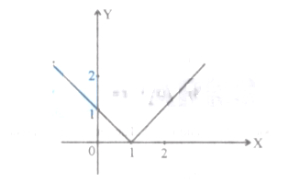
The function represented by the following graph is,
A
Differentiable but not continuous at $x=1$
B
Neither continuous nor differentiable at $x=1$
C
Continuous but not differentiable at $x=1$
D
Continuous and differentiable at $x=1$
Solution
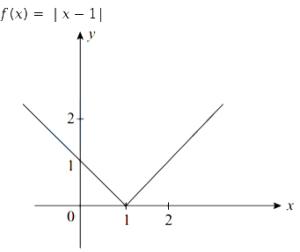
(C) The graph represents the function $f(x) = |x-1|$.
At $x=1$,the graph is continuous because there is no break in the curve.
However,at $x=1$,there is a sharp corner (or cusp),which means the left-hand derivative and right-hand derivative are not equal.
Specifically,the left-hand derivative is $-1$ and the right-hand derivative is $1$.
Therefore,the function is continuous but not differentiable at $x=1$.
At $x=1$,the graph is continuous because there is no break in the curve.
However,at $x=1$,there is a sharp corner (or cusp),which means the left-hand derivative and right-hand derivative are not equal.
Specifically,the left-hand derivative is $-1$ and the right-hand derivative is $1$.
Therefore,the function is continuous but not differentiable at $x=1$.
0 likesView Solution
25
MathematicsMediumMCQKCET · 2014
The tangent to the curve $y = x^{3} + 1$ at $(1, 2)$ makes an angle $\theta$ with the $y$-axis. Then the value of $\tan \theta$ is
A
$3$
B
$\frac{1}{3}$
C
$-\frac{1}{3}$
D
$-3$
Solution
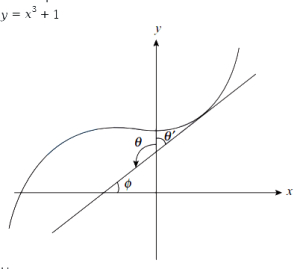
(C) Let $\phi$ be the angle made by the tangent with the positive $x$-axis. The slope of the tangent $m$ is given by $\tan \phi = \left. \frac{dy}{dx} \right|_{(1, 2)}$.
Given $y = x^{3} + 1$,we have $\frac{dy}{dx} = 3x^{2}$.
At $(1, 2)$,the slope $m = \tan \phi = 3(1)^{2} = 3$.
From the geometry of the line and the $y$-axis,the angle $\theta$ made with the $y$-axis satisfies $\theta + \phi = 90^{\circ}$ or $\theta = 90^{\circ} - \phi$ (depending on the orientation). Based on the provided diagram,the angle $\theta$ is the obtuse angle between the tangent and the positive $y$-axis,such that $\theta = 90^{\circ} + \phi$.
Then,$\tan \theta = \tan(90^{\circ} + \phi) = -\cot \phi$.
Since $\tan \phi = 3$,we have $\cot \phi = \frac{1}{3}$.
Therefore,$\tan \theta = -\frac{1}{3}$.
Given $y = x^{3} + 1$,we have $\frac{dy}{dx} = 3x^{2}$.
At $(1, 2)$,the slope $m = \tan \phi = 3(1)^{2} = 3$.
From the geometry of the line and the $y$-axis,the angle $\theta$ made with the $y$-axis satisfies $\theta + \phi = 90^{\circ}$ or $\theta = 90^{\circ} - \phi$ (depending on the orientation). Based on the provided diagram,the angle $\theta$ is the obtuse angle between the tangent and the positive $y$-axis,such that $\theta = 90^{\circ} + \phi$.
Then,$\tan \theta = \tan(90^{\circ} + \phi) = -\cot \phi$.
Since $\tan \phi = 3$,we have $\cot \phi = \frac{1}{3}$.
Therefore,$\tan \theta = -\frac{1}{3}$.
0 likesView Solution
26
MathematicsEasyMCQKCET · 2014
If the function $f(x)$ is defined by $f(x) = \frac{x^{100}}{100} + \frac{x^{99}}{99} + \dots + \frac{x^2}{2} + x + 1$,then $f'(0) = $
A
$100$
B
$-1$
C
$100 f'(0)$
D
$1$
Solution
(D) Given the function $f(x) = \frac{x^{100}}{100} + \frac{x^{99}}{99} + \dots + \frac{x^2}{2} + x + 1$.
To find $f'(x)$,we differentiate $f(x)$ with respect to $x$ using the power rule $\frac{d}{dx}(x^n) = nx^{n-1}$:
$f'(x) = \frac{100x^{99}}{100} + \frac{99x^{98}}{99} + \dots + \frac{2x}{2} + 1$.
Simplifying this,we get $f'(x) = x^{99} + x^{98} + \dots + x + 1$.
Now,substituting $x = 0$ into the derivative:
$f'(0) = 0^{99} + 0^{98} + \dots + 0 + 1 = 1$.
To find $f'(x)$,we differentiate $f(x)$ with respect to $x$ using the power rule $\frac{d}{dx}(x^n) = nx^{n-1}$:
$f'(x) = \frac{100x^{99}}{100} + \frac{99x^{98}}{99} + \dots + \frac{2x}{2} + 1$.
Simplifying this,we get $f'(x) = x^{99} + x^{98} + \dots + x + 1$.
Now,substituting $x = 0$ into the derivative:
$f'(0) = 0^{99} + 0^{98} + \dots + 0 + 1 = 1$.
0 likesView Solution
27
MathematicsMediumMCQKCET · 2014
If $f(x) = f(\Pi + e - x)$ and $\int_{e}^{\Pi} f(x) dx = \frac{2}{e + \Pi}$,then $\int_{e}^{\Pi} x f(x) dx$ is equal to
A
$\frac{\Pi + e}{2}$
B
$\frac{\Pi - e}{2}$
C
$\Pi - e$
D
$1$
Solution
(D) Let $I = \int_{e}^{\Pi} x f(x) dx$.
Using the property $\int_{a}^{b} f(x) dx = \int_{a}^{b} f(a + b - x) dx$,we have:
$I = \int_{e}^{\Pi} (e + \Pi - x) f(e + \Pi - x) dx$.
Since $f(e + \Pi - x) = f(x)$,this becomes:
$I = \int_{e}^{\Pi} (e + \Pi - x) f(x) dx = (e + \Pi) \int_{e}^{\Pi} f(x) dx - \int_{e}^{\Pi} x f(x) dx$.
$I = (e + \Pi) \left( \frac{2}{e + \Pi} \right) - I$.
$2I = 2$.
$I = 1$.
Using the property $\int_{a}^{b} f(x) dx = \int_{a}^{b} f(a + b - x) dx$,we have:
$I = \int_{e}^{\Pi} (e + \Pi - x) f(e + \Pi - x) dx$.
Since $f(e + \Pi - x) = f(x)$,this becomes:
$I = \int_{e}^{\Pi} (e + \Pi - x) f(x) dx = (e + \Pi) \int_{e}^{\Pi} f(x) dx - \int_{e}^{\Pi} x f(x) dx$.
$I = (e + \Pi) \left( \frac{2}{e + \Pi} \right) - I$.
$2I = 2$.
$I = 1$.
0 likesView Solution
28
MathematicsEasyMCQKCET · 2014
The domain of the function $f(x) = \sqrt{\cos x}$ is
A
$[0, \frac{\pi}{2}]$
B
$[0, \frac{\pi}{2}] \cup [\frac{3\pi}{2}, 2\pi]$
C
$[\frac{3\pi}{2}, 2\pi]$
D
$[-\frac{\pi}{2}, \frac{\pi}{2}]$
Solution
(B) The function $f(x) = \sqrt{\cos x}$ is defined only when $\cos x \geq 0$.
In the interval $[0, 2\pi]$,$\cos x$ is non-negative in the first quadrant $[0, \frac{\pi}{2}]$ and the fourth quadrant $[\frac{3\pi}{2}, 2\pi]$.
Thus,the domain for $n=0$ is $[0, \frac{\pi}{2}] \cup [\frac{3\pi}{2}, 2\pi]$.
In the interval $[0, 2\pi]$,$\cos x$ is non-negative in the first quadrant $[0, \frac{\pi}{2}]$ and the fourth quadrant $[\frac{3\pi}{2}, 2\pi]$.
Thus,the domain for $n=0$ is $[0, \frac{\pi}{2}] \cup [\frac{3\pi}{2}, 2\pi]$.
0 likesView Solution
29
MathematicsMediumMCQKCET · 2014
If $a, b,$ and $c$ are in $A$.$P$.,then the value of $\left|\begin{array}{lll}x+2 & x+3 & x+a \\ x+4 & x+5 & x+b \\ x+6 & x+7 & x+c\end{array}\right|$ is
A
$x-(a+b+c)$
B
$9x^{2}+a+b+c$
C
$0$
D
$a+b+c$
Solution
(C) Let $\Delta = \left|\begin{array}{ccc}x+2 & x+3 & x+a \\ x+4 & x+5 & x+b \\ x+6 & x+7 & x+c\end{array}\right|$.
Applying row operations $R_{1} \rightarrow R_{1}-R_{2}$ and $R_{2} \rightarrow R_{2}-R_{3}$:
$\Delta = \left|\begin{array}{ccc}(x+2)-(x+4) & (x+3)-(x+5) & (x+a)-(x+b) \\ (x+4)-(x+6) & (x+5)-(x+7) & (x+b)-(x+c) \\ x+6 & x+7 & x+c\end{array}\right|$
$\Delta = \left|\begin{array}{ccc}-2 & -2 & a-b \\ -2 & -2 & b-c \\ x+6 & x+7 & x+c\end{array}\right|$.
Since $a, b, c$ are in $A$.$P$.,we have $b-a = c-b$,which implies $a-b = b-c$.
Thus,the first two rows $R_{1}$ and $R_{2}$ are identical.
Since two rows are identical,the value of the determinant is $0$.
Applying row operations $R_{1} \rightarrow R_{1}-R_{2}$ and $R_{2} \rightarrow R_{2}-R_{3}$:
$\Delta = \left|\begin{array}{ccc}(x+2)-(x+4) & (x+3)-(x+5) & (x+a)-(x+b) \\ (x+4)-(x+6) & (x+5)-(x+7) & (x+b)-(x+c) \\ x+6 & x+7 & x+c\end{array}\right|$
$\Delta = \left|\begin{array}{ccc}-2 & -2 & a-b \\ -2 & -2 & b-c \\ x+6 & x+7 & x+c\end{array}\right|$.
Since $a, b, c$ are in $A$.$P$.,we have $b-a = c-b$,which implies $a-b = b-c$.
Thus,the first two rows $R_{1}$ and $R_{2}$ are identical.
Since two rows are identical,the value of the determinant is $0$.
0 likesView Solution
30
MathematicsEasyMCQKCET · 2014
If linear functions $f(x)$ and $g(x)$ satisfy $\int[(3x-1) \cos x + (1-2x) \sin x] dx = f(x) \cos x + g(x) \sin x + C$,then:
A
$f(x) = 3x-5$
B
$g(x) = 3+x$
C
$f(x) = 3(x-1)$
D
$g(x) = 3(x-1)$
Solution
(D) Let $I = \int[(3x-1) \cos x + (1-2x) \sin x] dx$.
Using integration by parts,$\int u dv = uv - \int v du$:
For $\int (3x-1) \cos x dx$: Let $u = 3x-1, dv = \cos x dx \Rightarrow du = 3 dx, v = \sin x$.
$\int (3x-1) \cos x dx = (3x-1) \sin x - \int 3 \sin x dx = (3x-1) \sin x + 3 \cos x$.
For $\int (1-2x) \sin x dx$: Let $u = 1-2x, dv = \sin x dx \Rightarrow du = -2 dx, v = -\cos x$.
$\int (1-2x) \sin x dx = (1-2x)(-\cos x) - \int (-\cos x)(-2) dx = (2x-1) \cos x - 2 \sin x$.
Adding these: $I = (3x-1) \sin x + 3 \cos x + (2x-1) \cos x - 2 \sin x + C$.
$I = (3x-1-2) \sin x + (3+2x-1) \cos x + C = (3x-3) \sin x + (2x+2) \cos x + C$.
Comparing with $f(x) \cos x + g(x) \sin x + C$,we get $f(x) = 2x+2$ and $g(x) = 3x-3 = 3(x-1)$.
Using integration by parts,$\int u dv = uv - \int v du$:
For $\int (3x-1) \cos x dx$: Let $u = 3x-1, dv = \cos x dx \Rightarrow du = 3 dx, v = \sin x$.
$\int (3x-1) \cos x dx = (3x-1) \sin x - \int 3 \sin x dx = (3x-1) \sin x + 3 \cos x$.
For $\int (1-2x) \sin x dx$: Let $u = 1-2x, dv = \sin x dx \Rightarrow du = -2 dx, v = -\cos x$.
$\int (1-2x) \sin x dx = (1-2x)(-\cos x) - \int (-\cos x)(-2) dx = (2x-1) \cos x - 2 \sin x$.
Adding these: $I = (3x-1) \sin x + 3 \cos x + (2x-1) \cos x - 2 \sin x + C$.
$I = (3x-1-2) \sin x + (3+2x-1) \cos x + C = (3x-3) \sin x + (2x+2) \cos x + C$.
Comparing with $f(x) \cos x + g(x) \sin x + C$,we get $f(x) = 2x+2$ and $g(x) = 3x-3 = 3(x-1)$.
0 likesView Solution
31
MathematicsMediumMCQKCET · 2014
The inverse of the matrix $A = \begin{bmatrix} 2 & 0 & 0 \\ 0 & 3 & 0 \\ 0 & 0 & 4 \end{bmatrix}$ is
A
$\begin{bmatrix} 2 & 0 & 0 \\ 0 & 3 & 0 \\ 0 & 0 & 4 \end{bmatrix}$
B
$\begin{bmatrix} 1/2 & 0 & 0 \\ 0 & 1/3 & 0 \\ 0 & 0 & 1/4 \end{bmatrix}$
C
$\frac{1}{24} \begin{bmatrix} 2 & 0 & 0 \\ 0 & 3 & 0 \\ 0 & 0 & 4 \end{bmatrix}$
D
$\frac{1}{24} \begin{bmatrix} 1 & 0 & 0 \\ 0 & 1 & 0 \\ 0 & 0 & 1 \end{bmatrix}$
Solution
(B) Given the diagonal matrix $A = \begin{bmatrix} 2 & 0 & 0 \\ 0 & 3 & 0 \\ 0 & 0 & 4 \end{bmatrix}$.
For a diagonal matrix $A = \text{diag}(a, b, c)$,the inverse is given by $A^{-1} = \text{diag}(\frac{1}{a}, \frac{1}{b}, \frac{1}{c})$.
Substituting the values $a=2, b=3, c=4$,we get:
$A^{-1} = \begin{bmatrix} \frac{1}{2} & 0 & 0 \\ 0 & \frac{1}{3} & 0 \\ 0 & 0 & \frac{1}{4} \end{bmatrix}$.
Thus,option $B$ is the correct answer.
For a diagonal matrix $A = \text{diag}(a, b, c)$,the inverse is given by $A^{-1} = \text{diag}(\frac{1}{a}, \frac{1}{b}, \frac{1}{c})$.
Substituting the values $a=2, b=3, c=4$,we get:
$A^{-1} = \begin{bmatrix} \frac{1}{2} & 0 & 0 \\ 0 & \frac{1}{3} & 0 \\ 0 & 0 & \frac{1}{4} \end{bmatrix}$.
Thus,option $B$ is the correct answer.
0 likesView Solution
32
MathematicsEasyMCQKCET · 2014
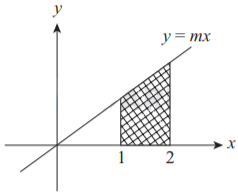
The area of the region bounded by the lines $y=mx$,$x=1$,$x=2$,and the $x$-axis is $6$ sq. units. Then,the value of $m$ is:
A
$11$
B
$04$
C
$13$
D
$12$
Solution
(B) Given the equation of the line $y=mx$ and the boundaries $x=1$ and $x=2$.
The required area is given by the definite integral:
$\text{Area} = \int_{1}^{2} mx \, dx = 6$
$\Rightarrow m \left[ \frac{x^2}{2} \right]_{1}^{2} = 6$
$\Rightarrow \frac{m}{2} (2^2 - 1^2) = 6$
$\Rightarrow \frac{m}{2} (4 - 1) = 6$
$\Rightarrow \frac{3m}{2} = 6$
$\Rightarrow 3m = 12$
$\Rightarrow m = 4$
The required area is given by the definite integral:
$\text{Area} = \int_{1}^{2} mx \, dx = 6$
$\Rightarrow m \left[ \frac{x^2}{2} \right]_{1}^{2} = 6$
$\Rightarrow \frac{m}{2} (2^2 - 1^2) = 6$
$\Rightarrow \frac{m}{2} (4 - 1) = 6$
$\Rightarrow \frac{3m}{2} = 6$
$\Rightarrow 3m = 12$
$\Rightarrow m = 4$
0 likesView Solution
33
MathematicsEasyMCQKCET · 2014
The general solution of the differential equation $\frac{dy}{dx} + \frac{y}{x} = 3x$ is
A
$y = x + \frac{C}{x}$
B
$y = x^2 + \frac{C}{x}$
C
$y = x - \frac{C}{x}$
D
$y = x^2 + \frac{C}{x^2}$
Solution
(B) The given differential equation is a linear differential equation of the form $\frac{dy}{dx} + Py = Q$,where $P = \frac{1}{x}$ and $Q = 3x$.
First,we find the integrating factor $(IF)$:
$IF = e^{\int P dx} = e^{\int \frac{1}{x} dx} = e^{\ln|x|} = x$.
Multiplying the differential equation by the integrating factor $x$,we get:
$x \frac{dy}{dx} + y = 3x^2$.
This can be written as:
$\frac{d}{dx}(xy) = 3x^2$.
Integrating both sides with respect to $x$:
$\int \frac{d}{dx}(xy) dx = \int 3x^2 dx$.
$xy = x^3 + C$.
Dividing by $x$,we get the general solution:
$y = x^2 + \frac{C}{x}$.
First,we find the integrating factor $(IF)$:
$IF = e^{\int P dx} = e^{\int \frac{1}{x} dx} = e^{\ln|x|} = x$.
Multiplying the differential equation by the integrating factor $x$,we get:
$x \frac{dy}{dx} + y = 3x^2$.
This can be written as:
$\frac{d}{dx}(xy) = 3x^2$.
Integrating both sides with respect to $x$:
$\int \frac{d}{dx}(xy) dx = \int 3x^2 dx$.
$xy = x^3 + C$.
Dividing by $x$,we get the general solution:
$y = x^2 + \frac{C}{x}$.
0 likesView Solution
34
MathematicsMediumMCQKCET · 2014
The angle between two diagonals of a cube is:
A
$30^{\circ}$
B
$45^{\circ}$
C
$\cos^{-1}\left(\frac{1}{3}\right)$
D
$\cos^{-1}\left(\frac{1}{\sqrt{3}}\right)$
Solution
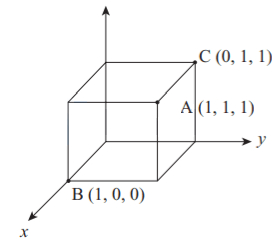
(C) Consider a cube with side length $1$. Let the vertices be represented in a $3D$ coordinate system as shown in the figure.
Let the two diagonals be $\vec{OA}$ and $\vec{BC}$.
The coordinates are $O(0,0,0)$,$A(1,1,1)$,$B(1,0,0)$,and $C(0,1,1)$.
The vector $\vec{OA} = (1-0, 1-0, 1-0) = (1, 1, 1)$.
The vector $\vec{BC} = (0-1, 1-0, 1-0) = (-1, 1, 1)$.
The angle $\theta$ between two vectors $\vec{u}$ and $\vec{v}$ is given by $\cos \theta = \frac{\vec{u} \cdot \vec{v}}{|\vec{u}| |\vec{v}|}$.
$\vec{OA} \cdot \vec{BC} = (1)(-1) + (1)(1) + (1)(1) = -1 + 1 + 1 = 1$.
$|\vec{OA}| = \sqrt{1^2 + 1^2 + 1^2} = \sqrt{3}$.
$|\vec{BC}| = \sqrt{(-1)^2 + 1^2 + 1^2} = \sqrt{3}$.
Therefore,$\cos \theta = \frac{1}{\sqrt{3} \cdot \sqrt{3}} = \frac{1}{3}$.
Thus,$\theta = \cos^{-1}\left(\frac{1}{3}\right)$.
Let the two diagonals be $\vec{OA}$ and $\vec{BC}$.
The coordinates are $O(0,0,0)$,$A(1,1,1)$,$B(1,0,0)$,and $C(0,1,1)$.
The vector $\vec{OA} = (1-0, 1-0, 1-0) = (1, 1, 1)$.
The vector $\vec{BC} = (0-1, 1-0, 1-0) = (-1, 1, 1)$.
The angle $\theta$ between two vectors $\vec{u}$ and $\vec{v}$ is given by $\cos \theta = \frac{\vec{u} \cdot \vec{v}}{|\vec{u}| |\vec{v}|}$.
$\vec{OA} \cdot \vec{BC} = (1)(-1) + (1)(1) + (1)(1) = -1 + 1 + 1 = 1$.
$|\vec{OA}| = \sqrt{1^2 + 1^2 + 1^2} = \sqrt{3}$.
$|\vec{BC}| = \sqrt{(-1)^2 + 1^2 + 1^2} = \sqrt{3}$.
Therefore,$\cos \theta = \frac{1}{\sqrt{3} \cdot \sqrt{3}} = \frac{1}{3}$.
Thus,$\theta = \cos^{-1}\left(\frac{1}{3}\right)$.
0 likesView Solution
35
MathematicsEasyMCQKCET · 2014
The equation of the plane perpendicular to the line $\frac{x}{1}=\frac{y}{2}=\frac{z}{3}$ and passing through the point $(2, 3, 4)$ is:
A
$x+2y+3z=9$
B
$x+2y+3z=20$
C
$2x+3y+z=17$
D
$3x+2y+z=16$
Solution
(B) The given line is $\frac{x}{1}=\frac{y}{2}=\frac{z}{3}$.
Since the plane is perpendicular to this line,the direction ratios of the normal to the plane are the same as the direction ratios of the line,which are $(1, 2, 3)$.
The general equation of a plane with normal $(a, b, c)$ is $ax+by+cz+d=0$.
Substituting the direction ratios,we get $1x+2y+3z+d=0$.
Since the plane passes through the point $(2, 3, 4)$,we substitute these coordinates into the equation:
$1(2)+2(3)+3(4)+d=0$
$2+6+12+d=0$
$20+d=0$
$d=-20$.
Therefore,the equation of the plane is $x+2y+3z-20=0$,or $x+2y+3z=20$.
Since the plane is perpendicular to this line,the direction ratios of the normal to the plane are the same as the direction ratios of the line,which are $(1, 2, 3)$.
The general equation of a plane with normal $(a, b, c)$ is $ax+by+cz+d=0$.
Substituting the direction ratios,we get $1x+2y+3z+d=0$.
Since the plane passes through the point $(2, 3, 4)$,we substitute these coordinates into the equation:
$1(2)+2(3)+3(4)+d=0$
$2+6+12+d=0$
$20+d=0$
$d=-20$.
Therefore,the equation of the plane is $x+2y+3z-20=0$,or $x+2y+3z=20$.
0 likesView Solution
36
MathematicsEasyMCQKCET · 2014
The line $\frac{x-2}{3}=\frac{y-3}{4}=\frac{z-4}{5}$ is parallel to the plane
A
$3x+4y+5z=7$
B
$x+y+z=2$
C
$2x+3y+4z=0$
D
$2x+y-2z=0$
Solution
(D) The direction ratios of the given line are $(3, 4, 5)$.
For a line to be parallel to a plane,the normal vector of the plane must be perpendicular to the direction vector of the line.
If the plane equation is $ax+by+cz=d$,the normal vector is $(a, b, c)$.
The condition for perpendicularity is $a_1a_2 + b_1b_2 + c_1c_2 = 0$.
Checking option $D$: $2x+y-2z=0$,the normal vector is $(2, 1, -2)$.
Calculating the dot product: $3(2) + 4(1) + 5(-2) = 6 + 4 - 10 = 0$.
Since the dot product is $0$,the line is parallel to the plane $2x+y-2z=0$.
For a line to be parallel to a plane,the normal vector of the plane must be perpendicular to the direction vector of the line.
If the plane equation is $ax+by+cz=d$,the normal vector is $(a, b, c)$.
The condition for perpendicularity is $a_1a_2 + b_1b_2 + c_1c_2 = 0$.
Checking option $D$: $2x+y-2z=0$,the normal vector is $(2, 1, -2)$.
Calculating the dot product: $3(2) + 4(1) + 5(-2) = 6 + 4 - 10 = 0$.
Since the dot product is $0$,the line is parallel to the plane $2x+y-2z=0$.
0 likesView Solution
37
MathematicsMediumMCQKCET · 2014
The lines $\frac{x-2}{1}=\frac{y-3}{1}=\frac{z-4}{-K}$ and $\frac{x-1}{K}=\frac{y-4}{2}=\frac{z-5}{1}$ are coplanar if
A
$K=0$
B
$K=-1$
C
$K=2$
D
$K=3$
Solution
(A) The given lines are $\frac{x-2}{1}=\frac{y-3}{1}=\frac{z-4}{-K}$ and $\frac{x-1}{K}=\frac{y-4}{2}=\frac{z-5}{1}$.
For two lines $\frac{x-x_1}{a_1}=\frac{y-y_1}{b_1}=\frac{z-z_1}{c_1}$ and $\frac{x-x_2}{a_2}=\frac{y-y_2}{b_2}=\frac{z-z_2}{c_2}$ to be coplanar,the condition is $\begin{vmatrix} x_2-x_1 & y_2-y_1 & z_2-z_1 \\ a_1 & b_1 & c_1 \\ a_2 & b_2 & c_2 \end{vmatrix} = 0$.
Here,$(x_1, y_1, z_1) = (2, 3, 4)$ and $(x_2, y_2, z_2) = (1, 4, 5)$.
Also,$(a_1, b_1, c_1) = (1, 1, -K)$ and $(a_2, b_2, c_2) = (K, 2, 1)$.
Substituting these values into the determinant:
$\begin{vmatrix} 1-2 & 4-3 & 5-4 \\ 1 & 1 & -K \\ K & 2 & 1 \end{vmatrix} = 0$
$\begin{vmatrix} -1 & 1 & 1 \\ 1 & 1 & -K \\ K & 2 & 1 \end{vmatrix} = 0$
Expanding the determinant:
$-1(1 - (-2K)) - 1(1 - (-K^2)) + 1(2 - K) = 0$
$-1(1 + 2K) - 1(1 + K^2) + 2 - K = 0$
$-1 - 2K - 1 - K^2 + 2 - K = 0$
$-K^2 - 3K = 0$
$K(K + 3) = 0$
Thus,$K = 0$ or $K = -3$. Since $K = -3$ is not in the options,the correct value is $K = 0$.
For two lines $\frac{x-x_1}{a_1}=\frac{y-y_1}{b_1}=\frac{z-z_1}{c_1}$ and $\frac{x-x_2}{a_2}=\frac{y-y_2}{b_2}=\frac{z-z_2}{c_2}$ to be coplanar,the condition is $\begin{vmatrix} x_2-x_1 & y_2-y_1 & z_2-z_1 \\ a_1 & b_1 & c_1 \\ a_2 & b_2 & c_2 \end{vmatrix} = 0$.
Here,$(x_1, y_1, z_1) = (2, 3, 4)$ and $(x_2, y_2, z_2) = (1, 4, 5)$.
Also,$(a_1, b_1, c_1) = (1, 1, -K)$ and $(a_2, b_2, c_2) = (K, 2, 1)$.
Substituting these values into the determinant:
$\begin{vmatrix} 1-2 & 4-3 & 5-4 \\ 1 & 1 & -K \\ K & 2 & 1 \end{vmatrix} = 0$
$\begin{vmatrix} -1 & 1 & 1 \\ 1 & 1 & -K \\ K & 2 & 1 \end{vmatrix} = 0$
Expanding the determinant:
$-1(1 - (-2K)) - 1(1 - (-K^2)) + 1(2 - K) = 0$
$-1(1 + 2K) - 1(1 + K^2) + 2 - K = 0$
$-1 - 2K - 1 - K^2 + 2 - K = 0$
$-K^2 - 3K = 0$
$K(K + 3) = 0$
Thus,$K = 0$ or $K = -3$. Since $K = -3$ is not in the options,the correct value is $K = 0$.
0 likesView Solution
38
MathematicsDifficultMCQKCET · 2014
Area of the region bounded by two parabolas $y=x^{2}$ and $x=y^{2}$ is
A
$1/3$
B
$3$
C
$1/4$
D
$4$
Solution
(A) The given parabolas are $y=x^{2}$ and $x=y^{2}$.
First,we find the points of intersection by substituting $y=x^{2}$ into $x=y^{2}$:
$x=(x^{2})^{2} \implies x=x^{4} \implies x^{4}-x=0 \implies x(x^{3}-1)=0$.
This gives $x=0$ and $x=1$.
For $x=0$,$y=0$,and for $x=1$,$y=1$. The intersection points are $(0,0)$ and $(1,1)$.
The area $A$ is given by the integral of the upper curve minus the lower curve from $x=0$ to $x=1$:
$A = \int_{0}^{1} (\sqrt{x} - x^{2}) dx$.
Evaluating the integral:
$A = [\frac{x^{3/2}}{3/2} - \frac{x^{3}}{3}]_{0}^{1} = [\frac{2}{3}x^{3/2} - \frac{1}{3}x^{3}]_{0}^{1}$.
$A = (\frac{2}{3} - \frac{1}{3}) - (0 - 0) = \frac{1}{3}$ square units.
First,we find the points of intersection by substituting $y=x^{2}$ into $x=y^{2}$:
$x=(x^{2})^{2} \implies x=x^{4} \implies x^{4}-x=0 \implies x(x^{3}-1)=0$.
This gives $x=0$ and $x=1$.
For $x=0$,$y=0$,and for $x=1$,$y=1$. The intersection points are $(0,0)$ and $(1,1)$.
The area $A$ is given by the integral of the upper curve minus the lower curve from $x=0$ to $x=1$:
$A = \int_{0}^{1} (\sqrt{x} - x^{2}) dx$.
Evaluating the integral:
$A = [\frac{x^{3/2}}{3/2} - \frac{x^{3}}{3}]_{0}^{1} = [\frac{2}{3}x^{3/2} - \frac{1}{3}x^{3}]_{0}^{1}$.
$A = (\frac{2}{3} - \frac{1}{3}) - (0 - 0) = \frac{1}{3}$ square units.
0 likesView Solution
39
MathematicsEasyMCQKCET · 2014
The order and degree of the differential equation $ y = x \frac{dy}{dx} + \frac{2}{dy/dx} $ are
A
$ 1, 3 $
B
$ 1, 1 $
C
$ 1, 2 $
D
$ 2, 1 $
Solution
(C) Given the differential equation: $ y = x \frac{dy}{dx} + \frac{2}{dy/dx} $.
Multiply both sides by $ \frac{dy}{dx} $ to eliminate the fraction:
$ y \left( \frac{dy}{dx} \right) = x \left( \frac{dy}{dx} \right)^2 + 2 $.
Rearranging the terms,we get: $ x \left( \frac{dy}{dx} \right)^2 - y \left( \frac{dy}{dx} \right) + 2 = 0 $.
The highest order derivative present is $ \frac{dy}{dx} $,so the order is $ 1 $.
The highest power of the highest order derivative is $ 2 $,so the degree is $ 2 $.
Therefore,the order and degree are $ 1 $ and $ 2 $ respectively.
Multiply both sides by $ \frac{dy}{dx} $ to eliminate the fraction:
$ y \left( \frac{dy}{dx} \right) = x \left( \frac{dy}{dx} \right)^2 + 2 $.
Rearranging the terms,we get: $ x \left( \frac{dy}{dx} \right)^2 - y \left( \frac{dy}{dx} \right) + 2 = 0 $.
The highest order derivative present is $ \frac{dy}{dx} $,so the order is $ 1 $.
The highest power of the highest order derivative is $ 2 $,so the degree is $ 2 $.
Therefore,the order and degree are $ 1 $ and $ 2 $ respectively.
0 likesView Solution
40
MathematicsEasyMCQKCET · 2014
$A$ gardener is digging a plot of land. As he gets tired,he works more slowly. After $t$ minutes,he is digging at a rate of $\frac{2}{\sqrt{t}}$ square metres per minute. How long will it take him to dig an area of $40$ square metres?
A
$10$ minutes
B
$40$ minutes
C
$100$ minutes
D
$30$ minutes
Solution
(C) Given the rate of digging $\frac{dA}{dt} = \frac{2}{\sqrt{t}}$.
Integrating both sides with respect to $t$:
$A = \int \frac{2}{\sqrt{t}} dt = 2 \int t^{-1/2} dt = 2 \cdot \frac{t^{1/2}}{1/2} + C = 4\sqrt{t} + C$.
At $t = 0$,the area dug $A = 0$,so $C = 0$.
Thus,$A = 4\sqrt{t}$.
To find the time $t$ to dig $40$ square metres,set $A = 40$:
$40 = 4\sqrt{t} \Rightarrow \sqrt{t} = 10$.
Squaring both sides,$t = 10^2 = 100$ minutes.
Integrating both sides with respect to $t$:
$A = \int \frac{2}{\sqrt{t}} dt = 2 \int t^{-1/2} dt = 2 \cdot \frac{t^{1/2}}{1/2} + C = 4\sqrt{t} + C$.
At $t = 0$,the area dug $A = 0$,so $C = 0$.
Thus,$A = 4\sqrt{t}$.
To find the time $t$ to dig $40$ square metres,set $A = 40$:
$40 = 4\sqrt{t} \Rightarrow \sqrt{t} = 10$.
Squaring both sides,$t = 10^2 = 100$ minutes.
0 likesView Solution
41
MathematicsMediumMCQKCET · 2014
Let $S$ be the set of all real numbers. $A$ relation $R$ has been defined on $S$ by $a R b \Leftrightarrow |a-b| \leq 1$. Then $R$ is:
A
reflexive and transitive but not symmetric
B
an equivalence relation
C
symmetric and transitive but not reflexive
D
reflexive and symmetric but not transitive
Solution
(D) Given $a R b \Leftrightarrow |a-b| \leq 1$.
$1$. Reflexivity: For any $a \in S$,$|a-a| = 0 \leq 1$. Thus,$a R a$ holds. $R$ is reflexive.
$2$. Symmetry: If $a R b$,then $|a-b| \leq 1$. Since $|a-b| = |b-a|$,it follows that $|b-a| \leq 1$,so $b R a$ holds. $R$ is symmetric.
$3$. Transitivity: Consider $a = 1, b = 2, c = 3$.
$|a-b| = |1-2| = 1 \leq 1$ (True,so $a R b$).
$|b-c| = |2-3| = 1 \leq 1$ (True,so $b R c$).
However,$|a-c| = |1-3| = 2 > 1$ (False,so $a$ is not related to $c$).
Thus,$R$ is not transitive.
Conclusion: $R$ is reflexive and symmetric but not transitive.
$1$. Reflexivity: For any $a \in S$,$|a-a| = 0 \leq 1$. Thus,$a R a$ holds. $R$ is reflexive.
$2$. Symmetry: If $a R b$,then $|a-b| \leq 1$. Since $|a-b| = |b-a|$,it follows that $|b-a| \leq 1$,so $b R a$ holds. $R$ is symmetric.
$3$. Transitivity: Consider $a = 1, b = 2, c = 3$.
$|a-b| = |1-2| = 1 \leq 1$ (True,so $a R b$).
$|b-c| = |2-3| = 1 \leq 1$ (True,so $b R c$).
However,$|a-c| = |1-3| = 2 > 1$ (False,so $a$ is not related to $c$).
Thus,$R$ is not transitive.
Conclusion: $R$ is reflexive and symmetric but not transitive.
0 likesView Solution
42
MathematicsMediumMCQKCET · 2014
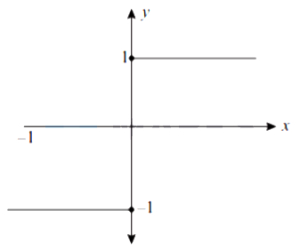
The local minimum value of the function $f'(x)$,where $f(x) = 3 + |x|$ for $x \in \mathbb{R}$,is:
A
$3$
B
$0$
C
$-1$
D
$1$
Solution
(C) Given the function $f(x) = 3 + |x|$.
We know that the derivative of $|x|$ is given by:
$f'(x) = \frac{d}{dx}(3 + |x|) = \frac{d}{dx}(|x|) = \text{sgn}(x)$
Where $\text{sgn}(x)$ is the signum function defined as:
$f'(x) = \begin{cases} 1, & x > 0 \\ -1, & x < 0 \end{cases}$
The function $f'(x)$ is undefined at $x = 0$.
Looking at the values of $f'(x)$,it takes only two values: $1$ for $x > 0$ and $-1$ for $x < 0$.
The minimum value of this function $f'(x)$ is $-1$.
We know that the derivative of $|x|$ is given by:
$f'(x) = \frac{d}{dx}(3 + |x|) = \frac{d}{dx}(|x|) = \text{sgn}(x)$
Where $\text{sgn}(x)$ is the signum function defined as:
$f'(x) = \begin{cases} 1, & x > 0 \\ -1, & x < 0 \end{cases}$
The function $f'(x)$ is undefined at $x = 0$.
Looking at the values of $f'(x)$,it takes only two values: $1$ for $x > 0$ and $-1$ for $x < 0$.
The minimum value of this function $f'(x)$ is $-1$.
0 likesView Solution
43
MathematicsEasyMCQKCET · 2014
$A$ stone is dropped into a quiet lake and waves move in circles at the speed of $ 5 \text{ cm s}^{-1} $. At that instant,when the radius of the circular wave is $ 8 \text{ cm} $,how fast is the enclosed area increasing?
A
$ 8 \pi \text{ cm}^2 \text{ s}^{-1} $
B
$ 80 \pi \text{ cm}^2 \text{ s}^{-1} $
C
$ 6 \pi \text{ cm}^2 \text{ s}^{-1} $
D
$ 800 \pi \text{ cm}^2 \text{ s}^{-1} $
Solution
(B) Given that the rate of change of the radius is $ \frac{dr}{dt} = 5 \text{ cm s}^{-1} $.
The area of a circle is given by $ A = \pi r^2 $.
Differentiating both sides with respect to time $ t $,we get:
$ \frac{dA}{dt} = \frac{d}{dt}(\pi r^2) = 2\pi r \frac{dr}{dt} $.
Substituting the given values $ r = 8 \text{ cm} $ and $ \frac{dr}{dt} = 5 \text{ cm s}^{-1} $:
$ \frac{dA}{dt} = 2 \pi (8) (5) = 80 \pi \text{ cm}^2 \text{ s}^{-1} $.
Thus,the enclosed area is increasing at a rate of $ 80 \pi \text{ cm}^2 \text{ s}^{-1} $.
The area of a circle is given by $ A = \pi r^2 $.
Differentiating both sides with respect to time $ t $,we get:
$ \frac{dA}{dt} = \frac{d}{dt}(\pi r^2) = 2\pi r \frac{dr}{dt} $.
Substituting the given values $ r = 8 \text{ cm} $ and $ \frac{dr}{dt} = 5 \text{ cm s}^{-1} $:
$ \frac{dA}{dt} = 2 \pi (8) (5) = 80 \pi \text{ cm}^2 \text{ s}^{-1} $.
Thus,the enclosed area is increasing at a rate of $ 80 \pi \text{ cm}^2 \text{ s}^{-1} $.
0 likesView Solution
44
MathematicsEasyMCQKCET · 2014
The value of the integral $\int_{-\frac{\pi}{4}}^{\frac{\pi}{4}} \log (\sec \theta - \tan \theta) \, d\theta$ is
A
$0$
B
$\frac{\pi}{4}$
C
$\frac{\pi}{2}$
D
$\pi$
Solution
(A) Let $I = \int_{-\frac{\pi}{4}}^{\frac{\pi}{4}} \log (\sec \theta - \tan \theta) \, d\theta$.
Consider the function $f(\theta) = \log (\sec \theta - \tan \theta)$.
We check if $f(\theta)$ is an odd function by evaluating $f(-\theta)$:
$f(-\theta) = \log (\sec(-\theta) - \tan(-\theta)) = \log (\sec \theta + \tan \theta)$.
Since $\sec \theta + \tan \theta = \frac{1}{\sec \theta - \tan \theta}$,we have:
$f(-\theta) = \log \left( \frac{1}{\sec \theta - \tan \theta} \right) = -\log (\sec \theta - \tan \theta) = -f(\theta)$.
Since $f(\theta)$ is an odd function and the interval $[-\frac{\pi}{4}, \frac{\pi}{4}]$ is symmetric about the origin,the integral of an odd function over this interval is $0$.
Therefore,$I = 0$.
Consider the function $f(\theta) = \log (\sec \theta - \tan \theta)$.
We check if $f(\theta)$ is an odd function by evaluating $f(-\theta)$:
$f(-\theta) = \log (\sec(-\theta) - \tan(-\theta)) = \log (\sec \theta + \tan \theta)$.
Since $\sec \theta + \tan \theta = \frac{1}{\sec \theta - \tan \theta}$,we have:
$f(-\theta) = \log \left( \frac{1}{\sec \theta - \tan \theta} \right) = -\log (\sec \theta - \tan \theta) = -f(\theta)$.
Since $f(\theta)$ is an odd function and the interval $[-\frac{\pi}{4}, \frac{\pi}{4}]$ is symmetric about the origin,the integral of an odd function over this interval is $0$.
Therefore,$I = 0$.
0 likesView Solution
45
MathematicsDifficultMCQKCET · 2014
For any two real numbers,an operation $*$ defined by $a * b = 1 + ab$ is
A
commutative but not associative
B
associative but not commutative
C
neither commutative nor associative
D
both commutative and associative
Solution
(A) Given that,$a * b = 1 + ab$ $\rightarrow (1)$
For commutativity,check if $a * b = b * a$:
$b * a = 1 + ba = 1 + ab = a * b$
Since $a * b = b * a$,the operation is commutative.
For associativity,check if $(a * b) * c = a * (b * c)$:
$(a * b) * c = (1 + ab) * c = 1 + (1 + ab)c = 1 + c + abc$
$a * (b * c) = a * (1 + bc) = 1 + a(1 + bc) = 1 + a + abc$
Since $1 + c + abc \neq 1 + a + abc$,the operation is not associative.
Therefore,the operation is commutative but not associative.
For commutativity,check if $a * b = b * a$:
$b * a = 1 + ba = 1 + ab = a * b$
Since $a * b = b * a$,the operation is commutative.
For associativity,check if $(a * b) * c = a * (b * c)$:
$(a * b) * c = (1 + ab) * c = 1 + (1 + ab)c = 1 + c + abc$
$a * (b * c) = a * (1 + bc) = 1 + a(1 + bc) = 1 + a + abc$
Since $1 + c + abc \neq 1 + a + abc$,the operation is not associative.
Therefore,the operation is commutative but not associative.
0 likesView Solution
46
MathematicsDifficultMCQKCET · 2014
The value of $\sin \left(2 \sin ^{-1} 0.8\right)$ is equal to
A
$\sin 1.2^{\circ}$
B
$0.96$
C
$0.48$
D
$\sin 1.6^{\circ}$
Solution
(B) Given that,$\sin \left(2 \sin ^{-1} 0.8\right)$.
Let $\sin ^{-1} 0.8 = \theta$,which implies $\sin \theta = 0.8$.
Since $\cos^2 \theta = 1 - \sin^2 \theta$,we have $\cos \theta = \sqrt{1 - (0.8)^2} = \sqrt{1 - 0.64} = \sqrt{0.36} = 0.6$.
Using the trigonometric identity $\sin 2\theta = 2 \sin \theta \cos \theta$,we substitute the values:
$\sin 2\theta = 2 \times 0.8 \times 0.6$.
$\sin 2\theta = 1.6 \times 0.6 = 0.96$.
Thus,the value is $0.96$.
Let $\sin ^{-1} 0.8 = \theta$,which implies $\sin \theta = 0.8$.
Since $\cos^2 \theta = 1 - \sin^2 \theta$,we have $\cos \theta = \sqrt{1 - (0.8)^2} = \sqrt{1 - 0.64} = \sqrt{0.36} = 0.6$.
Using the trigonometric identity $\sin 2\theta = 2 \sin \theta \cos \theta$,we substitute the values:
$\sin 2\theta = 2 \times 0.8 \times 0.6$.
$\sin 2\theta = 1.6 \times 0.6 = 0.96$.
Thus,the value is $0.96$.
0 likesView Solution
47
MathematicsMediumMCQKCET · 2014
Given $0 \leq x \leq \frac{1}{2}$,then the value of $\tan \left[\sin ^{-1}\left\{\frac{x}{\sqrt{2}}+\frac{\sqrt{1-x^{2}}}{\sqrt{2}}\right\}-\sin ^{-1} x\right]$ is:
A
$ \sqrt{3} $
B
$ \frac{1}{\sqrt{3}} $
C
$ 1 $
D
$ -1 $
Solution
(C) Let the given expression be $E = \tan \left[\sin ^{-1}\left\{\frac{x}{\sqrt{2}}+\frac{\sqrt{1-x^{2}}}{\sqrt{2}}\right\}-\sin ^{-1} x\right]$.
Substitute $x = \sin \theta$,where $\theta = \sin^{-1} x$.
Since $0 \leq x \leq \frac{1}{2}$,we have $0 \leq \theta \leq \frac{\pi}{6}$.
The expression inside the $\sin^{-1}$ becomes $\frac{\sin \theta}{\sqrt{2}} + \frac{\cos \theta}{\sqrt{2}} = \sin \theta \cos \frac{\pi}{4} + \cos \theta \sin \frac{\pi}{4} = \sin \left(\theta + \frac{\pi}{4}\right)$.
Now,the expression becomes $E = \tan \left[\sin ^{-1}\left\{\sin \left(\theta + \frac{\pi}{4}\right)\right\} - \theta\right]$.
Since $0 \leq \theta \leq \frac{\pi}{6}$,then $\frac{\pi}{4} \leq \theta + \frac{\pi}{4} \leq \frac{\pi}{6} + \frac{\pi}{4} = \frac{5\pi}{12}$.
Since $\frac{\pi}{4} \leq \theta + \frac{\pi}{4} \leq \frac{5\pi}{12}$,the value lies within the principal range of $\sin^{-1}$,so $\sin^{-1}(\sin(\theta + \frac{\pi}{4})) = \theta + \frac{\pi}{4}$.
Thus,$E = \tan \left(\theta + \frac{\pi}{4} - \theta\right) = \tan \frac{\pi}{4} = 1$.
Substitute $x = \sin \theta$,where $\theta = \sin^{-1} x$.
Since $0 \leq x \leq \frac{1}{2}$,we have $0 \leq \theta \leq \frac{\pi}{6}$.
The expression inside the $\sin^{-1}$ becomes $\frac{\sin \theta}{\sqrt{2}} + \frac{\cos \theta}{\sqrt{2}} = \sin \theta \cos \frac{\pi}{4} + \cos \theta \sin \frac{\pi}{4} = \sin \left(\theta + \frac{\pi}{4}\right)$.
Now,the expression becomes $E = \tan \left[\sin ^{-1}\left\{\sin \left(\theta + \frac{\pi}{4}\right)\right\} - \theta\right]$.
Since $0 \leq \theta \leq \frac{\pi}{6}$,then $\frac{\pi}{4} \leq \theta + \frac{\pi}{4} \leq \frac{\pi}{6} + \frac{\pi}{4} = \frac{5\pi}{12}$.
Since $\frac{\pi}{4} \leq \theta + \frac{\pi}{4} \leq \frac{5\pi}{12}$,the value lies within the principal range of $\sin^{-1}$,so $\sin^{-1}(\sin(\theta + \frac{\pi}{4})) = \theta + \frac{\pi}{4}$.
Thus,$E = \tan \left(\theta + \frac{\pi}{4} - \theta\right) = \tan \frac{\pi}{4} = 1$.
0 likesView Solution
48
MathematicsEasyMCQKCET · 2014
$A$ and $B$ are two events such that $P(A) \neq 0$. Find $P(B \mid A)$ if: $(i)$ $A \subset B$ (ii) $A \cap B = \phi$.
A
$0$ and $1$
B
$1$ and $0$
C
$1$ and $1$
D
$0$ and $0$
Solution
(B) We are given that $P(A) \neq 0$. The conditional probability is defined as $P(B \mid A) = \frac{P(A \cap B)}{P(A)}$.
$(i)$ If $A \subset B$,then $A \cap B = A$. Therefore,$P(B \mid A) = \frac{P(A \cap B)}{P(A)} = \frac{P(A)}{P(A)} = 1$.
(ii) If $A \cap B = \phi$,then $P(A \cap B) = P(\phi) = 0$. Therefore,$P(B \mid A) = \frac{P(A \cap B)}{P(A)} = \frac{0}{P(A)} = 0$.
Thus,the values are $1$ and $0$ respectively.
$(i)$ If $A \subset B$,then $A \cap B = A$. Therefore,$P(B \mid A) = \frac{P(A \cap B)}{P(A)} = \frac{P(A)}{P(A)} = 1$.
(ii) If $A \cap B = \phi$,then $P(A \cap B) = P(\phi) = 0$. Therefore,$P(B \mid A) = \frac{P(A \cap B)}{P(A)} = \frac{0}{P(A)} = 0$.
Thus,the values are $1$ and $0$ respectively.
0 likesView Solution
49
MathematicsMediumMCQKCET · 2014
Suppose $f(x)=(x+1)^{2}$ for $x \geq -1$. If $g(x)$ is a function whose graph is the reflection of the graph of $f(x)$ in the line $y=x$,then $g(x) = $
A
$-\sqrt{x}-1$
B
$\sqrt{x}-1$
C
$\frac{1}{(x+1)^{2}}, x > -1$
D
$\sqrt{x}+1$
Solution
(B) Given that $f(x)=(x+1)^{2}$ for $x \geq -1$.
Since $g(x)$ is the reflection of the graph of $f(x)$ in the line $y=x$,$g(x)$ is the inverse function of $f(x)$,denoted as $f^{-1}(x)$.
To find the inverse,let $y = (x+1)^{2}$.
Since $x \geq -1$,we have $x+1 \geq 0$,so taking the square root of both sides gives $\sqrt{y} = x+1$.
Solving for $x$,we get $x = \sqrt{y} - 1$.
By interchanging $x$ and $y$,we obtain $f^{-1}(x) = \sqrt{x} - 1$.
Thus,$g(x) = \sqrt{x} - 1$.
Since $g(x)$ is the reflection of the graph of $f(x)$ in the line $y=x$,$g(x)$ is the inverse function of $f(x)$,denoted as $f^{-1}(x)$.
To find the inverse,let $y = (x+1)^{2}$.
Since $x \geq -1$,we have $x+1 \geq 0$,so taking the square root of both sides gives $\sqrt{y} = x+1$.
Solving for $x$,we get $x = \sqrt{y} - 1$.
By interchanging $x$ and $y$,we obtain $f^{-1}(x) = \sqrt{x} - 1$.
Thus,$g(x) = \sqrt{x} - 1$.
0 likesView Solution
50
MathematicsEasyMCQKCET · 2014
Consider the following statements :
$(a)$ If any two rows or columns of a determinant are identical,then the value of the determinant is zero.
$(b)$ If the corresponding rows and columns of a determinant are interchanged,then the value of the determinant does not change.
$(c)$ If any two rows (or columns) of a determinant are interchanged,then the value of the determinant changes in sign.
Which of these are correct?
$(a)$ If any two rows or columns of a determinant are identical,then the value of the determinant is zero.
$(b)$ If the corresponding rows and columns of a determinant are interchanged,then the value of the determinant does not change.
$(c)$ If any two rows (or columns) of a determinant are interchanged,then the value of the determinant changes in sign.
Which of these are correct?
A
$(a)$ and $(b)$
B
$(b)$ and $(c)$
C
$(a)$ and $(c)$
D
$(a)$,$(b)$ and $(c)$
Solution
(D) Statement $(a)$ is a fundamental property of determinants: if two rows or columns are identical,the determinant is $0$.
Statement $(b)$ refers to the property that the determinant of a matrix $A$ is equal to the determinant of its transpose $A^T$,i.e.,$|A| = |A^T|$. Thus,interchanging rows and columns does not change the value.
Statement $(c)$ is a property stating that swapping any two rows or columns multiplies the determinant by $-1$,thus changing its sign.
Therefore,all statements $(a)$,$(b)$,and $(c)$ are correct.
Statement $(b)$ refers to the property that the determinant of a matrix $A$ is equal to the determinant of its transpose $A^T$,i.e.,$|A| = |A^T|$. Thus,interchanging rows and columns does not change the value.
Statement $(c)$ is a property stating that swapping any two rows or columns multiplies the determinant by $-1$,thus changing its sign.
Therefore,all statements $(a)$,$(b)$,and $(c)$ are correct.
0 likesView Solution
51
MathematicsMediumMCQKCET · 2014
The symmetric part of the matrix $A = \begin{bmatrix} 1 & 2 & 4 \\ 6 & 8 & 2 \\ 2 & -2 & 7 \end{bmatrix}$ is
A
$ \begin{bmatrix} 1 & 4 & 3 \\ 2 & 8 & 0 \\ 3 & 0 & 7 \end{bmatrix} $
B
$ \begin{bmatrix} 1 & 4 & 3 \\ 4 & 8 & 0 \\ 3 & 0 & 7 \end{bmatrix} $
C
$ \begin{bmatrix} 0 & -2 & -1 \\ -2 & 0 & -2 \\ -1 & -2 & 0 \end{bmatrix} $
D
$ \begin{bmatrix} 0 & -2 & 1 \\ 2 & 0 & 2 \\ -1 & 2 & 0 \end{bmatrix} $
Solution
(B) The symmetric part of a square matrix $A$ is given by the formula $\frac{1}{2}(A + A^T)$.
Given $A = \begin{bmatrix} 1 & 2 & 4 \\ 6 & 8 & 2 \\ 2 & -2 & 7 \end{bmatrix}$,its transpose $A^T$ is $\begin{bmatrix} 1 & 6 & 2 \\ 2 & 8 & -2 \\ 4 & 2 & 7 \end{bmatrix}$.
Now,$A + A^T = \begin{bmatrix} 1+1 & 2+6 & 4+2 \\ 6+2 & 8+8 & 2-2 \\ 2+4 & -2+2 & 7+7 \end{bmatrix} = \begin{bmatrix} 2 & 8 & 6 \\ 8 & 16 & 0 \\ 6 & 0 & 14 \end{bmatrix}$.
Finally,$\frac{1}{2}(A + A^T) = \frac{1}{2} \begin{bmatrix} 2 & 8 & 6 \\ 8 & 16 & 0 \\ 6 & 0 & 14 \end{bmatrix} = \begin{bmatrix} 1 & 4 & 3 \\ 4 & 8 & 0 \\ 3 & 0 & 7 \end{bmatrix}$.
Given $A = \begin{bmatrix} 1 & 2 & 4 \\ 6 & 8 & 2 \\ 2 & -2 & 7 \end{bmatrix}$,its transpose $A^T$ is $\begin{bmatrix} 1 & 6 & 2 \\ 2 & 8 & -2 \\ 4 & 2 & 7 \end{bmatrix}$.
Now,$A + A^T = \begin{bmatrix} 1+1 & 2+6 & 4+2 \\ 6+2 & 8+8 & 2-2 \\ 2+4 & -2+2 & 7+7 \end{bmatrix} = \begin{bmatrix} 2 & 8 & 6 \\ 8 & 16 & 0 \\ 6 & 0 & 14 \end{bmatrix}$.
Finally,$\frac{1}{2}(A + A^T) = \frac{1}{2} \begin{bmatrix} 2 & 8 & 6 \\ 8 & 16 & 0 \\ 6 & 0 & 14 \end{bmatrix} = \begin{bmatrix} 1 & 4 & 3 \\ 4 & 8 & 0 \\ 3 & 0 & 7 \end{bmatrix}$.
0 likesView Solution
52
MathematicsDifficultMCQKCET · 2014
If $A$ is a $3 \times 4$ matrix and $B$ is a matrix such that $A^{\prime}B$ and $BA^{\prime}$ are both defined,then $B$ is of the type:
A
$3 \times 4$
B
$3 \times 3$
C
$4 \times 4$
D
$4 \times 3$
Solution
(A) Given that $A$ is a $3 \times 4$ matrix.
Then,the transpose matrix $A^{\prime}$ is a $4 \times 3$ matrix.
For the product $A^{\prime}B$ to be defined,the number of columns in $A^{\prime}$ must equal the number of rows in $B$. Since $A^{\prime}$ is $4 \times 3$,$B$ must have $3$ rows.
For the product $BA^{\prime}$ to be defined,the number of columns in $B$ must equal the number of rows in $A^{\prime}$. Since $A^{\prime}$ has $4$ rows,$B$ must have $4$ columns.
Therefore,$B$ must be a $3 \times 4$ matrix.
Then,the transpose matrix $A^{\prime}$ is a $4 \times 3$ matrix.
For the product $A^{\prime}B$ to be defined,the number of columns in $A^{\prime}$ must equal the number of rows in $B$. Since $A^{\prime}$ is $4 \times 3$,$B$ must have $3$ rows.
For the product $BA^{\prime}$ to be defined,the number of columns in $B$ must equal the number of rows in $A^{\prime}$. Since $A^{\prime}$ has $4$ rows,$B$ must have $4$ columns.
Therefore,$B$ must be a $3 \times 4$ matrix.
0 likesView Solution
53
MathematicsMediumMCQKCET · 2014
If $A$ is a matrix of order $3$,such that $A(\operatorname{adj} A) = 10I$,then $|\operatorname{adj} A| = $
A
$10$
B
$10I$
C
$11$
D
$100$
Solution
(D) We are given the property $A(\operatorname{adj} A) = |A|I$.
Comparing this with the given equation $A(\operatorname{adj} A) = 10I$,we get $|A| = 10$.
We know the property for the determinant of the adjoint of a matrix: $|\operatorname{adj} A| = |A|^{n-1}$,where $n$ is the order of the matrix.
Here,$n = 3$,so $|\operatorname{adj} A| = |A|^{3-1} = |A|^2$.
Substituting the value of $|A|$,we get $|\operatorname{adj} A| = 10^2 = 100$.
Comparing this with the given equation $A(\operatorname{adj} A) = 10I$,we get $|A| = 10$.
We know the property for the determinant of the adjoint of a matrix: $|\operatorname{adj} A| = |A|^{n-1}$,where $n$ is the order of the matrix.
Here,$n = 3$,so $|\operatorname{adj} A| = |A|^{3-1} = |A|^2$.
Substituting the value of $|A|$,we get $|\operatorname{adj} A| = 10^2 = 100$.
0 likesView Solution
54
MathematicsEasyMCQKCET · 2014
$A$ box contains $100$ bulbs,out of which $10$ are defective. $A$ sample of $5$ bulbs is drawn. The probability that none is defective is
A
$(\frac{1}{10})^{5}$
B
$(\frac{1}{2})^{5}$
C
$\frac{9}{10}$
D
$(\frac{9}{10})^{5}$
Solution
(D) Total number of bulbs $N = 100$.
Number of defective bulbs $D = 10$.
Number of non-defective bulbs $G = 100 - 10 = 90$.
We are drawing a sample of $n = 5$ bulbs without replacement.
The probability that none is defective is given by the hypergeometric distribution formula:
$P(X = 0) = \frac{\binom{90}{5} \binom{10}{0}}{\binom{100}{5}}$
$P(X = 0) = \frac{\frac{90 \times 89 \times 88 \times 87 \times 86}{5 \times 4 \times 3 \times 2 \times 1}}{\frac{100 \times 99 \times 98 \times 97 \times 96}{5 \times 4 \times 3 \times 2 \times 1}}$
$P(X = 0) = \frac{90 \times 89 \times 88 \times 87 \times 86}{100 \times 99 \times 98 \times 97 \times 96} \approx (0.9)^{5}$.
Given the options provided,the intended model is binomial approximation (sampling with replacement),where $p = \frac{90}{100} = 0.9$ is the probability of picking a non-defective bulb.
Thus,$P(X = 0) = (0.9)^{5} = (\frac{9}{10})^{5}$.
Number of defective bulbs $D = 10$.
Number of non-defective bulbs $G = 100 - 10 = 90$.
We are drawing a sample of $n = 5$ bulbs without replacement.
The probability that none is defective is given by the hypergeometric distribution formula:
$P(X = 0) = \frac{\binom{90}{5} \binom{10}{0}}{\binom{100}{5}}$
$P(X = 0) = \frac{\frac{90 \times 89 \times 88 \times 87 \times 86}{5 \times 4 \times 3 \times 2 \times 1}}{\frac{100 \times 99 \times 98 \times 97 \times 96}{5 \times 4 \times 3 \times 2 \times 1}}$
$P(X = 0) = \frac{90 \times 89 \times 88 \times 87 \times 86}{100 \times 99 \times 98 \times 97 \times 96} \approx (0.9)^{5}$.
Given the options provided,the intended model is binomial approximation (sampling with replacement),where $p = \frac{90}{100} = 0.9$ is the probability of picking a non-defective bulb.
Thus,$P(X = 0) = (0.9)^{5} = (\frac{9}{10})^{5}$.
0 likesView Solution
55
MathematicsDifficultMCQKCET · 2014
The area of the parallelogram whose adjacent sides are $\hat{i}+\hat{k}$ and $2\hat{i}+\hat{j}+\hat{k}$ is
A
$\sqrt{2}$
B
$\sqrt{3}$
C
$13$
D
$4$
Solution
(B) Given the adjacent sides of the parallelogram are $\vec{a} = \hat{i} + \hat{k}$ and $\vec{b} = 2\hat{i} + \hat{j} + \hat{k}$.
The area of a parallelogram with adjacent sides $\vec{a}$ and $\vec{b}$ is given by the magnitude of their cross product: $|\vec{a} \times \vec{b}|$.
First,calculate the cross product $\vec{a} \times \vec{b}$:
$\vec{a} \times \vec{b} = \begin{vmatrix} \hat{i} & \hat{j} & \hat{k} \\ 1 & 0 & 1 \\ 2 & 1 & 1 \end{vmatrix}$
$= \hat{i}(0(1) - 1(1)) - \hat{j}(1(1) - 1(2)) + \hat{k}(1(1) - 0(2))$
$= \hat{i}(-1) - \hat{j}(-1) + \hat{k}(1)$
$= -\hat{i} + \hat{j} + \hat{k}$.
Now,calculate the magnitude of the resulting vector:
$|\vec{a} \times \vec{b}| = \sqrt{(-1)^2 + (1)^2 + (1)^2}$
$= \sqrt{1 + 1 + 1} = \sqrt{3}$.
Thus,the area of the parallelogram is $\sqrt{3}$ square units.
The area of a parallelogram with adjacent sides $\vec{a}$ and $\vec{b}$ is given by the magnitude of their cross product: $|\vec{a} \times \vec{b}|$.
First,calculate the cross product $\vec{a} \times \vec{b}$:
$\vec{a} \times \vec{b} = \begin{vmatrix} \hat{i} & \hat{j} & \hat{k} \\ 1 & 0 & 1 \\ 2 & 1 & 1 \end{vmatrix}$
$= \hat{i}(0(1) - 1(1)) - \hat{j}(1(1) - 1(2)) + \hat{k}(1(1) - 0(2))$
$= \hat{i}(-1) - \hat{j}(-1) + \hat{k}(1)$
$= -\hat{i} + \hat{j} + \hat{k}$.
Now,calculate the magnitude of the resulting vector:
$|\vec{a} \times \vec{b}| = \sqrt{(-1)^2 + (1)^2 + (1)^2}$
$= \sqrt{1 + 1 + 1} = \sqrt{3}$.
Thus,the area of the parallelogram is $\sqrt{3}$ square units.
0 likesView Solution
56
MathematicsEasyMCQKCET · 2014
If $\vec{a}$ and $\vec{b}$ are two unit vectors inclined at an angle $\frac{\pi}{3}$,then the value of $|\vec{a}+\vec{b}|$ is
A
greater than $1$
B
less than $1$
C
equal to $1$
D
equal to $0$
Solution
(A) Given that $|\vec{a}| = |\vec{b}| = 1$ and the angle $\theta = \frac{\pi}{3}$.
Using the property of the magnitude of the sum of two vectors:
$|\vec{a} + \vec{b}|^2 = |\vec{a}|^2 + |\vec{b}|^2 + 2(\vec{a} \cdot \vec{b})$
$|\vec{a} + \vec{b}|^2 = |\vec{a}|^2 + |\vec{b}|^2 + 2|\vec{a}||\vec{b}| \cos \theta$
Substituting the given values:
$|\vec{a} + \vec{b}|^2 = 1^2 + 1^2 + 2(1)(1) \cos \frac{\pi}{3}$
$|\vec{a} + \vec{b}|^2 = 1 + 1 + 2 \times \frac{1}{2}$
$|\vec{a} + \vec{b}|^2 = 1 + 1 + 1 = 3$
Taking the square root on both sides:
$|\vec{a} + \vec{b}| = \sqrt{3}$
Since $\sqrt{3} \approx 1.732$,which is greater than $1$,the value of $|\vec{a} + \vec{b}|$ is greater than $1$.
Using the property of the magnitude of the sum of two vectors:
$|\vec{a} + \vec{b}|^2 = |\vec{a}|^2 + |\vec{b}|^2 + 2(\vec{a} \cdot \vec{b})$
$|\vec{a} + \vec{b}|^2 = |\vec{a}|^2 + |\vec{b}|^2 + 2|\vec{a}||\vec{b}| \cos \theta$
Substituting the given values:
$|\vec{a} + \vec{b}|^2 = 1^2 + 1^2 + 2(1)(1) \cos \frac{\pi}{3}$
$|\vec{a} + \vec{b}|^2 = 1 + 1 + 2 \times \frac{1}{2}$
$|\vec{a} + \vec{b}|^2 = 1 + 1 + 1 = 3$
Taking the square root on both sides:
$|\vec{a} + \vec{b}| = \sqrt{3}$
Since $\sqrt{3} \approx 1.732$,which is greater than $1$,the value of $|\vec{a} + \vec{b}|$ is greater than $1$.
0 likesView Solution
57
MathematicsDifficultMCQKCET · 2014
Let $f: N \rightarrow N$ be defined by $f(n) = \begin{cases} \frac{n+1}{2}; & \text{if } n \text{ is odd} \\ \frac{n}{2}; & \text{if } n \text{ is even} \end{cases}$. Then $f$ is:
A
one-one and onto
B
one-one but not onto
C
onto but not one-one
D
neither one-one nor onto
Solution
(C) Given the function $f: N \rightarrow N$ defined by $f(n) = \begin{cases} \frac{n+1}{2} & n \text{ is odd} \\ \frac{n}{2} & n \text{ is even} \end{cases}$.
To check for one-one: Consider $n=1$ (odd) and $n=2$ (even).
$f(1) = \frac{1+1}{2} = 1$.
$f(2) = \frac{2}{2} = 1$.
Since $f(1) = f(2)$ but $1 \neq 2$,the function $f$ is not one-one.
To check for onto: For any $y \in N$,we need to find $n \in N$ such that $f(n) = y$.
If $y$ is any natural number,we can choose $n = 2y$ (which is even). Then $f(2y) = \frac{2y}{2} = y$.
Since for every $y \in N$,there exists an $n \in N$ such that $f(n) = y$,the function $f$ is onto.
Thus,$f$ is onto but not one-one.
To check for one-one: Consider $n=1$ (odd) and $n=2$ (even).
$f(1) = \frac{1+1}{2} = 1$.
$f(2) = \frac{2}{2} = 1$.
Since $f(1) = f(2)$ but $1 \neq 2$,the function $f$ is not one-one.
To check for onto: For any $y \in N$,we need to find $n \in N$ such that $f(n) = y$.
If $y$ is any natural number,we can choose $n = 2y$ (which is even). Then $f(2y) = \frac{2y}{2} = y$.
Since for every $y \in N$,there exists an $n \in N$ such that $f(n) = y$,the function $f$ is onto.
Thus,$f$ is onto but not one-one.
0 likesView Solution
58
MathematicsMediumMCQKCET · 2014
The value of $[\vec{a}-\vec{b} \quad \vec{b}-\vec{c} \quad \vec{c}-\vec{a}]$ is equal to
A
$1$
B
$2$
C
$0$
D
$2[\vec{a} \vec{b} \vec{c}]$
Solution
(C) The scalar triple product is defined as $[\vec{x} \quad \vec{y} \quad \vec{z}] = \vec{x} \cdot (\vec{y} \times \vec{z})$.
Given expression: $[\vec{a}-\vec{b} \quad \vec{b}-\vec{c} \quad \vec{c}-\vec{a}] = (\vec{a}-\vec{b}) \cdot ((\vec{b}-\vec{c}) \times (\vec{c}-\vec{a}))$.
First,calculate the cross product: $(\vec{b}-\vec{c}) \times (\vec{c}-\vec{a}) = \vec{b} \times \vec{c} - \vec{b} \times \vec{a} - \vec{c} \times \vec{c} + \vec{c} \times \vec{a}$.
Since $\vec{c} \times \vec{c} = 0$,this simplifies to $\vec{b} \times \vec{c} + \vec{a} \times \vec{b} + \vec{c} \times \vec{a}$.
Now,take the dot product with $(\vec{a}-\vec{b})$:
$(\vec{a}-\vec{b}) \cdot (\vec{b} \times \vec{c} + \vec{a} \times \vec{b} + \vec{c} \times \vec{a})$
$= \vec{a} \cdot (\vec{b} \times \vec{c}) + \vec{a} \cdot (\vec{a} \times \vec{b}) + \vec{a} \cdot (\vec{c} \times \vec{a}) - \vec{b} \cdot (\vec{b} \times \vec{c}) - \vec{b} \cdot (\vec{a} \times \vec{b}) - \vec{b} \cdot (\vec{c} \times \vec{a})$.
Using the property that the scalar triple product is zero if any two vectors are identical:
$= [\vec{a} \vec{b} \vec{c}] + 0 + 0 - 0 - 0 - [\vec{b} \vec{c} \vec{a}]$.
Since $[\vec{a} \vec{b} \vec{c}] = [\vec{b} \vec{c} \vec{a}]$,the expression becomes $[\vec{a} \vec{b} \vec{c}] - [\vec{a} \vec{b} \vec{c}] = 0$.
Given expression: $[\vec{a}-\vec{b} \quad \vec{b}-\vec{c} \quad \vec{c}-\vec{a}] = (\vec{a}-\vec{b}) \cdot ((\vec{b}-\vec{c}) \times (\vec{c}-\vec{a}))$.
First,calculate the cross product: $(\vec{b}-\vec{c}) \times (\vec{c}-\vec{a}) = \vec{b} \times \vec{c} - \vec{b} \times \vec{a} - \vec{c} \times \vec{c} + \vec{c} \times \vec{a}$.
Since $\vec{c} \times \vec{c} = 0$,this simplifies to $\vec{b} \times \vec{c} + \vec{a} \times \vec{b} + \vec{c} \times \vec{a}$.
Now,take the dot product with $(\vec{a}-\vec{b})$:
$(\vec{a}-\vec{b}) \cdot (\vec{b} \times \vec{c} + \vec{a} \times \vec{b} + \vec{c} \times \vec{a})$
$= \vec{a} \cdot (\vec{b} \times \vec{c}) + \vec{a} \cdot (\vec{a} \times \vec{b}) + \vec{a} \cdot (\vec{c} \times \vec{a}) - \vec{b} \cdot (\vec{b} \times \vec{c}) - \vec{b} \cdot (\vec{a} \times \vec{b}) - \vec{b} \cdot (\vec{c} \times \vec{a})$.
Using the property that the scalar triple product is zero if any two vectors are identical:
$= [\vec{a} \vec{b} \vec{c}] + 0 + 0 - 0 - 0 - [\vec{b} \vec{c} \vec{a}]$.
Since $[\vec{a} \vec{b} \vec{c}] = [\vec{b} \vec{c} \vec{a}]$,the expression becomes $[\vec{a} \vec{b} \vec{c}] - [\vec{a} \vec{b} \vec{c}] = 0$.
0 likesView Solution
59
MathematicsEasyMCQKCET · 2014
If $x+y \leq 2, x \geq 0, y \geq 0$,the point at which the maximum value of $3x+2y$ is attained will be:
A
$(0,0)$
B
$(\frac{1}{2}, \frac{1}{2})$
C
$(0,2)$
D
$(2,0)$
Solution
(D) The given constraints are $x+y \leq 2$,$x \geq 0$,and $y \geq 0$.
These constraints define a feasible region in the first quadrant with corner points $(0,0)$,$(2,0)$,and $(0,2)$.
We evaluate the objective function $Z = 3x+2y$ at these corner points:
$1$. At $(0,0)$: $Z = 3(0) + 2(0) = 0$.
$2$. At $(2,0)$: $Z = 3(2) + 2(0) = 6$.
$3$. At $(0,2)$: $Z = 3(0) + 2(2) = 4$.
Comparing these values,the maximum value is $6$,which occurs at the point $(2,0)$.
These constraints define a feasible region in the first quadrant with corner points $(0,0)$,$(2,0)$,and $(0,2)$.
We evaluate the objective function $Z = 3x+2y$ at these corner points:
$1$. At $(0,0)$: $Z = 3(0) + 2(0) = 0$.
$2$. At $(2,0)$: $Z = 3(2) + 2(0) = 6$.
$3$. At $(0,2)$: $Z = 3(0) + 2(2) = 4$.
Comparing these values,the maximum value is $6$,which occurs at the point $(2,0)$.
0 likesView Solution
60
MathematicsEasyMCQKCET · 2014
$\int \frac{\sin(2x)}{\sin^2(x) + 2\cos^2(x)} dx = $
A
$\log |1 + \cos^2(x)| + c$
B
$-\log |1 + \sin^2(x)| + c$
C
$\log |1 + \tan^2(x)| + c$
D
$-\log |1 + \cos^2(x)| + c$
Solution
(D) Let $I = \int \frac{\sin(2x)}{\sin^2(x) + 2\cos^2(x)} dx$.
Using the identity $\sin^2(x) = 1 - \cos^2(x)$,the denominator becomes $1 - \cos^2(x) + 2\cos^2(x) = 1 + \cos^2(x)$.
So,$I = \int \frac{\sin(2x)}{1 + \cos^2(x)} dx$.
Let $t = 1 + \cos^2(x)$.
Then $dt = 2\cos(x)(-\sin(x)) dx = -\sin(2x) dx$.
This implies $\sin(2x) dx = -dt$.
Substituting these into the integral:
$I = \int \frac{-dt}{t} = -\log |t| + c$.
Substituting back $t = 1 + \cos^2(x)$,we get $I = -\log |1 + \cos^2(x)| + c$.
Thus,option $D$ is correct.
Using the identity $\sin^2(x) = 1 - \cos^2(x)$,the denominator becomes $1 - \cos^2(x) + 2\cos^2(x) = 1 + \cos^2(x)$.
So,$I = \int \frac{\sin(2x)}{1 + \cos^2(x)} dx$.
Let $t = 1 + \cos^2(x)$.
Then $dt = 2\cos(x)(-\sin(x)) dx = -\sin(2x) dx$.
This implies $\sin(2x) dx = -dt$.
Substituting these into the integral:
$I = \int \frac{-dt}{t} = -\log |t| + c$.
Substituting back $t = 1 + \cos^2(x)$,we get $I = -\log |1 + \cos^2(x)| + c$.
Thus,option $D$ is correct.
0 likesView Solution
Vedclass Products
For Students
Vedclass Test Series
Mock tests in real KCET style covering Mathematics with performance analysis. 5-day free trial.
Start Free TrialFor Teachers
Exam Paper Generator
Generate Set A/B/C/D Mathematics papers from 7.5L+ questions in 2 minutes. 3 chapters free.
Try FreeFor Institutes
Online Exam Module
Run live KCET mock exams with unlimited students, 360° analytics & white-label branding.
See DemoFrequently Asked Questions
How many Mathematics questions are in KCET 2014?
There are 60 Mathematics questions from the KCET 2014 paper on Vedclass, each with a detailed step-by-step solution in English.
Are KCET 2014 Mathematics solutions available in English?
Yes. All solutions on this page are in English. You can also switch to English or Hindi using the language buttons above the questions.
Can I practice KCET 2014 Mathematics as a timed test?
Yes. Use the Vedclass Test Series to attempt a full KCET mock test covering Mathematics with time limits and instant score analysis.
Can teachers create Mathematics papers from KCET previous year questions?
Yes. The Vedclass Exam Paper Generator lets teachers mix KCET Mathematics questions and generate Set A/B/C/D papers in minutes.
For Teachers & Institutes
Build a Custom Mathematics Paper
Pick KCET 2014 Mathematics questions, set difficulty, and generate Set A/B/C/D in 2 minutes.