
BiologyQ1–43 of 43 questions
Page 1 of 1 · English
1
BiologyEasyMCQKCET · 2025
Identify the incorrect statement with respect to the rules of Binomial Nomenclature.
A
Biological names are underlined separately when hand-written.
B
Biological names are printed in Italics to indicate their non-Latin origin.
C
The first word represents the genus while the second component denotes the specific epithet.
D
Biological names are generally in Latin or Latinised irrespective of their origin.
Solution
(B) According to the rules of Binomial Nomenclature:
$1$. Biological names are generally in Latin or derived from Latin,irrespective of their origin.
$2$. The first word in a biological name represents the genus,while the second component denotes the specific epithet.
$3$. Both the words in a biological name,when handwritten,are separately underlined,or printed in italics to indicate their Latin origin.
$4$. Therefore,the statement that biological names are printed in italics to indicate their non-Latin origin is incorrect,as italics are used to indicate their Latin origin.
$1$. Biological names are generally in Latin or derived from Latin,irrespective of their origin.
$2$. The first word in a biological name represents the genus,while the second component denotes the specific epithet.
$3$. Both the words in a biological name,when handwritten,are separately underlined,or printed in italics to indicate their Latin origin.
$4$. Therefore,the statement that biological names are printed in italics to indicate their non-Latin origin is incorrect,as italics are used to indicate their Latin origin.
0 likesView Solution
2
BiologyEasyMCQKCET · 2025
Match the stages of prophase $I$ given in Column-$I$ with their features in Column-$II$ and choose the correct options from the choices given below:
| Column $I$ | Column $II$ |
|---|---|
| $A$. Leptotene | $i$. Chromosomes visible under light microscope |
| $B$. Zygotene | $ii$. Chromosomes start pairing together |
| $C$. Pachytene | $iii$. Exchange of genetic materials between non-sister chromatids of the homologous chromosomes. |
| $D$. Diplotene | $iv$. Dissolution of synaptonemal complex |
| $E$. Diakinesis | $v$. Terminalisation of chiasmata |
A
$A-ii, B-iv, C-i, D-iii, E-v$
B
$A-i, B-ii, C-iii, D-iv, E-v$
C
$A-iv, B-i, C-ii, D-iii, E-v$
D
$A-v, B-iv, C-i, D-iii, E-ii$
Solution
(B) The correct matching is as follows:
$A$. Leptotene: During this stage, chromosomes become visible under a light microscope.
$B$. Zygotene: During this stage, homologous chromosomes start pairing together, a process called synapsis.
$C$. Pachytene: During this stage, crossing over occurs, which is the exchange of genetic material between non-sister chromatids of homologous chromosomes.
$D$. Diplotene: During this stage, the synaptonemal complex dissolves, and homologous chromosomes begin to separate except at the sites of crossovers (chiasmata).
$E$. Diakinesis: This is the final stage of prophase $I$, characterized by the terminalisation of chiasmata.
Therefore, the correct sequence is $A-i, B-ii, C-iii, D-iv, E-v$.
$A$. Leptotene: During this stage, chromosomes become visible under a light microscope.
$B$. Zygotene: During this stage, homologous chromosomes start pairing together, a process called synapsis.
$C$. Pachytene: During this stage, crossing over occurs, which is the exchange of genetic material between non-sister chromatids of homologous chromosomes.
$D$. Diplotene: During this stage, the synaptonemal complex dissolves, and homologous chromosomes begin to separate except at the sites of crossovers (chiasmata).
$E$. Diakinesis: This is the final stage of prophase $I$, characterized by the terminalisation of chiasmata.
Therefore, the correct sequence is $A-i, B-ii, C-iii, D-iv, E-v$.
0 likesView Solution
3
BiologyEasyMCQKCET · 2025
$A$ student observed a slide of mitosis under the microscope and noted that the chromosomes were positioned at the opposite poles. Which stage was the student observing?
A
Metaphase
B
Telophase
C
Prophase
D
Anaphase
Solution
(D) In mitosis,the $Anaphase$ stage is characterized by the splitting of the centromere of each chromosome,allowing the sister chromatids to separate. These separated chromatids,now referred to as daughter chromosomes,are pulled towards the opposite poles of the cell by the spindle fibers. Therefore,observing chromosomes at the opposite poles indicates that the cell is in the $Anaphase$ stage.
0 likesView Solution
4
BiologyEasyMCQKCET · 2025
Read the given statements and choose the correct option:
< b>Statement-$I$: In Calvin cycle,carboxylation is catalysed by $PEP$ carboxylase.
< b>Statement-$II$: In Hatch-Slack pathway,carboxylation is catalysed by $RuBP$ carboxylase.
< b>Statement-$I$: In Calvin cycle,carboxylation is catalysed by $PEP$ carboxylase.
< b>Statement-$II$: In Hatch-Slack pathway,carboxylation is catalysed by $RuBP$ carboxylase.
A
Statement $I$ is false but Statement $II$ is true
B
Both Statement $I$ and Statement $II$ are false
C
Both Statement $I$ and Statement $II$ are true
D
Statement $I$ is true but Statement $II$ is false
Solution
(B) Both Statement $I$ and Statement $II$ are false.
In the Calvin cycle ($C_3$ cycle),the primary carboxylation reaction is catalysed by the enzyme $RuBisCO$ (ribulose$-1,5-$bisphosphate carboxylase/oxygenase).
In the Hatch-Slack pathway ($C_4$ cycle),the primary carboxylation reaction is catalysed by the enzyme $PEP$ carboxylase $(PEPCase)$.
In the Calvin cycle ($C_3$ cycle),the primary carboxylation reaction is catalysed by the enzyme $RuBisCO$ (ribulose$-1,5-$bisphosphate carboxylase/oxygenase).
In the Hatch-Slack pathway ($C_4$ cycle),the primary carboxylation reaction is catalysed by the enzyme $PEP$ carboxylase $(PEPCase)$.
0 likesView Solution
5
BiologyEasyMCQKCET · 2025
The $TCA$ cycle starts with the condensation of an acetyl group with:
A
$\alpha$-Ketoglutaric acid
B
Succinic acid
C
Oxaloacetic acid
D
Citric acid
Solution
(C) The correct answer is $C$.
The $TCA$ cycle (also known as the Krebs cycle or Citric acid cycle) begins with the condensation of an acetyl group $(2C)$ with Oxaloacetic acid $(4C)$ in the presence of water to form Citric acid $(6C)$.
This reaction is catalyzed by the enzyme Citrate synthase.
The $TCA$ cycle (also known as the Krebs cycle or Citric acid cycle) begins with the condensation of an acetyl group $(2C)$ with Oxaloacetic acid $(4C)$ in the presence of water to form Citric acid $(6C)$.
This reaction is catalyzed by the enzyme Citrate synthase.
0 likesView Solution
6
BiologyEasyMCQKCET · 2025
Match the plant growth hormones of Column-$I$ with suitable chemical derivatives present in Column-$II$ and choose the correct option given below:
| Column-$I$ | Column-$II$ |
|---|---|
| $A$. Abscisic acid | $(i)$ Adenine derivative |
| $B$. Gibberellins | $(ii)$ Indole acetic acid |
| $C$. Kinetin | $(iii)$ Carotenoid derivative |
| $D$. Auxin | $(iv)$ Terpenes |
A
$A-iii, B-iv, C-i, D-ii$
B
$A-iii, B-i, C-ii, D-iv$
C
$A-i, B-ii, C-iii, D-iv$
D
$A-iii, B-i, C-iv, D-ii$
Solution
$(A)$ The chemical nature of plant growth regulators is as follows:
$1$. Abscisic acid $(ABA)$ is a derivative of carotenoids $(A-iii)$.
$2$. Gibberellins $(GA)$ are chemically terpenes $(B-iv)$.
$3$. Kinetin is a modified form of adenine, which is a purine derivative $(C-i)$.
$4$. Auxin, specifically Indole$-3-$acetic acid $(IAA)$, is an indole derivative $(D-ii)$.
Therefore, the correct matching is $A-iii, B-iv, C-i, D-ii$.
$1$. Abscisic acid $(ABA)$ is a derivative of carotenoids $(A-iii)$.
$2$. Gibberellins $(GA)$ are chemically terpenes $(B-iv)$.
$3$. Kinetin is a modified form of adenine, which is a purine derivative $(C-i)$.
$4$. Auxin, specifically Indole$-3-$acetic acid $(IAA)$, is an indole derivative $(D-ii)$.
Therefore, the correct matching is $A-iii, B-iv, C-i, D-ii$.
0 likesView Solution
7
BiologyEasyMCQKCET · 2025
The respiratory mechanism controlled by the medulla oblongata can be altered by:
A
Both Pneumotaxic and Chemosensitive areas of pons and medulla oblongata
B
Corpus callosum of brain
C
Pneumotaxic center in the pons
D
Chemosensitive area in the medulla
Solution
(C) The respiratory rhythm center is primarily located in the medulla oblongata region of the brain.
However,a specialized center called the Pneumotaxic center is present in the pons region of the brain.
This center can moderate the functions of the respiratory rhythm center by reducing the duration of inspiration and thereby altering the respiratory rate.
Therefore,the correct option is $C$.
However,a specialized center called the Pneumotaxic center is present in the pons region of the brain.
This center can moderate the functions of the respiratory rhythm center by reducing the duration of inspiration and thereby altering the respiratory rate.
Therefore,the correct option is $C$.
0 likesView Solution
8
BiologyEasyMCQKCET · 2025
Which among the three layers of blood vessel wall—$Tunica \text{ intima}$, $Tunica \text{ media}$, and $Tunica \text{ externa}$—is comparatively thin in the veins?
A
Tunica externa
B
Both tunica media and tunica externa
C
Tunica media
D
Tunica intima
Solution
(C) The wall of blood vessels consists of three layers: $Tunica \text{ intima}$ (innermost), $Tunica \text{ media}$ (middle), and $Tunica \text{ externa}$ (outermost).
In arteries, the $Tunica \text{ media}$ is thick and muscular to withstand high blood pressure.
In veins, the $Tunica \text{ media}$ is comparatively much thinner than in arteries because the blood pressure in the venous system is significantly lower.
Therefore, the $Tunica \text{ media}$ is the layer that is characteristically thin in veins.
In arteries, the $Tunica \text{ media}$ is thick and muscular to withstand high blood pressure.
In veins, the $Tunica \text{ media}$ is comparatively much thinner than in arteries because the blood pressure in the venous system is significantly lower.
Therefore, the $Tunica \text{ media}$ is the layer that is characteristically thin in veins.
0 likesView Solution
9
BiologyEasyMCQKCET · 2025
In the nephron, the transport of substances like sodium chloride and urea is facilitated by a special arrangement called the counter-current mechanism, which comprises of:
A
Vasa recta and collecting duct
B
Ascending limb and collecting duct
C
Henle's loop and vasa recta
D
Henle's loop and glomerulus
Solution
(C) The correct answer is $C$.
In the nephron, the counter-current mechanism is a specialized arrangement that maintains the concentration gradient in the medullary interstitium.
This mechanism is primarily facilitated by the close proximity and opposite flow of filtrate in the $Henle's$ loop and blood in the $vasa \text{ } recta$.
This system helps in concentrating the urine by allowing the reabsorption of water and solutes.
In the nephron, the counter-current mechanism is a specialized arrangement that maintains the concentration gradient in the medullary interstitium.
This mechanism is primarily facilitated by the close proximity and opposite flow of filtrate in the $Henle's$ loop and blood in the $vasa \text{ } recta$.
This system helps in concentrating the urine by allowing the reabsorption of water and solutes.
0 likesView Solution
10
BiologyEasyMCQKCET · 2025
In the mechanism of muscle contraction or shortening of muscle,the . . . . . . get reduced whereas the . . . . . . retain the length.
A
$Z$ line,$I$ bands
B
$A$ bands,$Z$ line
C
$A$ bands,$I$ bands
D
$I$ bands,$A$ bands
Solution
(D) According to the sliding filament theory of muscle contraction,the thin filaments slide over the thick filaments.
During this process,the $I$ bands (isotropic bands) get reduced in length as the actin filaments move deeper into the $A$ bands.
Conversely,the $A$ bands (anisotropic bands) retain their original length because the myosin filaments do not change in size.
Therefore,the correct answer is $I$ bands,$A$ bands.
During this process,the $I$ bands (isotropic bands) get reduced in length as the actin filaments move deeper into the $A$ bands.
Conversely,the $A$ bands (anisotropic bands) retain their original length because the myosin filaments do not change in size.
Therefore,the correct answer is $I$ bands,$A$ bands.
0 likesView Solution
11
BiologyEasyMCQKCET · 2025
Identify the correct sequence of action potential transmission as it arrives at the axon terminal from the choices given below:
A
Axon terminal $\rightarrow$ Post-synaptic membrane $\rightarrow$ Synaptic cleft $\rightarrow$ Synaptic vesicles $\rightarrow$ Post-synaptic neuron
B
Axon terminal $\rightarrow$ Synaptic vesicles $\rightarrow$ Post-synaptic membrane $\rightarrow$ Synaptic cleft $\rightarrow$ Post-synaptic neuron
C
Axon terminal $\rightarrow$ Synaptic vesicles $\rightarrow$ Synaptic cleft $\rightarrow$ Post-synaptic membrane $\rightarrow$ Post-synaptic neuron
D
Axon terminal $\rightarrow$ Synaptic cleft $\rightarrow$ Synaptic vesicles $\rightarrow$ Post-synaptic neuron $\rightarrow$ Post-synaptic membrane
Solution
(C) When an action potential reaches the axon terminal,it triggers the following sequence of events:
$1$. The depolarization of the axon terminal membrane causes the opening of voltage-gated calcium channels.
$2$. Calcium ions enter the terminal,which stimulates the synaptic vesicles to move towards and fuse with the pre-synaptic membrane.
$3$. The neurotransmitters are released into the synaptic cleft via exocytosis.
$4$. These neurotransmitters diffuse across the synaptic cleft and bind to specific receptors on the post-synaptic membrane.
$5$. This binding leads to the generation of a new action potential in the post-synaptic neuron.
Therefore,the correct sequence is: Axon terminal $\rightarrow$ Synaptic vesicles $\rightarrow$ Synaptic cleft $\rightarrow$ Post-synaptic membrane $\rightarrow$ Post-synaptic neuron.
$1$. The depolarization of the axon terminal membrane causes the opening of voltage-gated calcium channels.
$2$. Calcium ions enter the terminal,which stimulates the synaptic vesicles to move towards and fuse with the pre-synaptic membrane.
$3$. The neurotransmitters are released into the synaptic cleft via exocytosis.
$4$. These neurotransmitters diffuse across the synaptic cleft and bind to specific receptors on the post-synaptic membrane.
$5$. This binding leads to the generation of a new action potential in the post-synaptic neuron.
Therefore,the correct sequence is: Axon terminal $\rightarrow$ Synaptic vesicles $\rightarrow$ Synaptic cleft $\rightarrow$ Post-synaptic membrane $\rightarrow$ Post-synaptic neuron.
0 likesView Solution
12
BiologyEasyMCQKCET · 2025
Identify the statement/s given below that does not correspond to the functions of $Cortisol$:
$(i)$ Maintains cardiovascular system and kidney functions
$(ii)$ Produces anti-inflammatory reactions
$(iii)$ Maintains electrolyte balance,osmosis and blood pressure
$(iv)$ Suppresses immune response
$(v)$ Stimulates $RBC$ production
$(i)$ Maintains cardiovascular system and kidney functions
$(ii)$ Produces anti-inflammatory reactions
$(iii)$ Maintains electrolyte balance,osmosis and blood pressure
$(iv)$ Suppresses immune response
$(v)$ Stimulates $RBC$ production
A
$iii$ only
B
$iv$ only
C
$i$ and $ii$ only
D
$iii$ and $iv$ only
Solution
(A) $Cortisol$ is a glucocorticoid primarily involved in carbohydrate metabolism,anti-inflammatory reactions,and immune suppression.
Statement $(i)$ is correct as $Cortisol$ supports cardiovascular and kidney functions.
Statement $(ii)$ is correct as it produces anti-inflammatory reactions.
Statement $(iii)$ is incorrect because the maintenance of electrolyte balance,body fluid volume,osmotic pressure,and blood pressure is primarily the function of $Aldosterone$ (a mineralocorticoid),not $Cortisol$.
Statement $(iv)$ is correct as it suppresses the immune response.
Statement $(v)$ is correct as it stimulates $RBC$ production.
Therefore,only statement $(iii)$ does not correspond to the functions of $Cortisol$.
Statement $(i)$ is correct as $Cortisol$ supports cardiovascular and kidney functions.
Statement $(ii)$ is correct as it produces anti-inflammatory reactions.
Statement $(iii)$ is incorrect because the maintenance of electrolyte balance,body fluid volume,osmotic pressure,and blood pressure is primarily the function of $Aldosterone$ (a mineralocorticoid),not $Cortisol$.
Statement $(iv)$ is correct as it suppresses the immune response.
Statement $(v)$ is correct as it stimulates $RBC$ production.
Therefore,only statement $(iii)$ does not correspond to the functions of $Cortisol$.
0 likesView Solution
13
BiologyEasyMCQKCET · 2025
Match Column-$I$ with Column-$II$ and choose the correct option given below:
| Column-$I$ (Bacteria) | Column-$II$ (Shape) |
|---|---|
| $A$. Coccus | $iii$. Spherical |
| $B$. Bacillus | $i$. Rod-shaped |
| $C$. Vibrio | $iv$. Comma-shaped |
| $D$. Spirillum | $ii$. Spiral |
A
$A-iii, B-ii, C-iv, D-i$
B
$A-iv, B-iii, C-ii, D-i$
C
$A-iv, B-i, C-ii, D-iii$
D
$A-iii, B-i, C-iv, D-ii$
Solution
(D) The shapes of bacteria are classified based on their morphology:
$1$. $A$. Coccus: These are spherical or oval-shaped bacteria.
$2$. $B$. Bacillus: These are rod-shaped bacteria.
$3$. $C$. Vibrio: These are comma-shaped bacteria.
$4$. $D$. Spirillum: These are spiral-shaped bacteria.
Therefore,the correct matching is $A-iii, B-i, C-iv, D-ii$.
$1$. $A$. Coccus: These are spherical or oval-shaped bacteria.
$2$. $B$. Bacillus: These are rod-shaped bacteria.
$3$. $C$. Vibrio: These are comma-shaped bacteria.
$4$. $D$. Spirillum: These are spiral-shaped bacteria.
Therefore,the correct matching is $A-iii, B-i, C-iv, D-ii$.
0 likesView Solution
14
BiologyEasyMCQKCET · 2025
The cell wall-less prokaryote among the following is:
A
Cyanobacteria
B
Mycoplasma
C
Bacteria
D
Blue-Green Algae
Solution
(B) $Mycoplasma$ is the correct answer.
$Mycoplasma$ are the smallest living cells known and are unique because they completely lack a cell wall,which makes them naturally resistant to antibiotics like penicillin that target cell wall synthesis.
$Mycoplasma$ are the smallest living cells known and are unique because they completely lack a cell wall,which makes them naturally resistant to antibiotics like penicillin that target cell wall synthesis.
0 likesView Solution
15
BiologyEasyMCQKCET · 2025
The reserve material in prokaryotic cells is stored in the cytoplasm in the form of:
A
Exclusion and inclusion bodies
B
Fat bodies
C
Exclusion bodies
D
Inclusion bodies
Solution
(D) Inclusion bodies.
In prokaryotic cells,reserve materials are stored in the cytoplasm in the form of inclusion bodies. These are not bound by any membrane system and lie free in the cytoplasm. Examples include phosphate granules,cyanophycean granules,and glycogen granules.
In prokaryotic cells,reserve materials are stored in the cytoplasm in the form of inclusion bodies. These are not bound by any membrane system and lie free in the cytoplasm. Examples include phosphate granules,cyanophycean granules,and glycogen granules.
0 likesView Solution
16
BiologyEasyMCQKCET · 2025
Read the given statements and choose the correct option:
Statement $I$: Gemmae are green unicellular sexual buds which develop in receptacles called gemma cups.
Statement $II$: Protonema develops directly from a spore.
Statement $I$: Gemmae are green unicellular sexual buds which develop in receptacles called gemma cups.
Statement $II$: Protonema develops directly from a spore.
A
Statement $I$ is false but Statement $II$ is true
B
Both Statement $I$ and Statement $II$ are false
C
Both Statement $I$ and Statement $II$ are true
D
Statement $I$ is true but Statement $II$ is false
Solution
(A) Statement $I$ is false because gemmae are green,multicellular,asexual buds,not sexual buds.
Statement $II$ is true because in mosses,the spore germinates to form a filamentous,creeping,green,branched,and frequently filamentous stage called the protonema.
Therefore,Statement $I$ is false and Statement $II$ is true.
Statement $II$ is true because in mosses,the spore germinates to form a filamentous,creeping,green,branched,and frequently filamentous stage called the protonema.
Therefore,Statement $I$ is false and Statement $II$ is true.
0 likesView Solution
17
BiologyEasyMCQKCET · 2025
During a field trip,a student observed a marine organism with a worm-like body. The cylindrical body was divided into a proboscis,collar,and a long trunk. The organism may be . . . . . .
A
Pterophyllum
B
Trygon
C
Balanoglossus
D
Ophiura
Solution
(C) . $Balanoglossus$.
During a field trip,a student observed a marine organism with a worm-like body. The cylindrical body of $Balanoglossus$ (a hemichordate) is distinctly divided into three parts: a proboscis,a collar,and a long trunk. Therefore,the organism is $Balanoglossus$.
During a field trip,a student observed a marine organism with a worm-like body. The cylindrical body of $Balanoglossus$ (a hemichordate) is distinctly divided into three parts: a proboscis,a collar,and a long trunk. Therefore,the organism is $Balanoglossus$.
0 likesView Solution
18
BiologyEasyMCQKCET · 2025
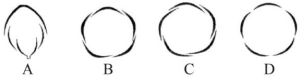
Identify the types of aestivation in corolla labelled as $A$,$B$,$C$ and $D$.
A
$A$-Vexillary,$B$-Imbricate,$C$-Twisted,$D$-Valvate
B
$A$-Vexillary,$B$-Imbricate,$C$-Valvate,$D$-Twisted
C
$A$-Vexillary,$B$-Twisted,$C$-Imbricate,$D$-Valvate
D
$A$-Imbricate,$B$-Valvate,$C$-Vexillary,$D$-Twisted
Solution
(A) The mode of arrangement of sepals or petals in a floral bud with respect to the other members of the same whorl is known as aestivation.
- $A$ represents Vexillary aestivation,where the largest petal (standard) overlaps the two lateral petals (wings),which in turn overlap the two smallest anterior petals (keel).
- $B$ represents Imbricate aestivation,where the margins of sepals or petals overlap one another but not in any particular direction.
- $C$ represents Twisted aestivation,where one margin of the appendage overlaps that of the next one and so on in a regular pattern.
- $D$ represents Valvate aestivation,where the sepals or petals in a whorl just touch one another at the margin,without overlapping.
Thus,the correct sequence is $A$-Vexillary,$B$-Imbricate,$C$-Twisted,$D$-Valvate.
- $A$ represents Vexillary aestivation,where the largest petal (standard) overlaps the two lateral petals (wings),which in turn overlap the two smallest anterior petals (keel).
- $B$ represents Imbricate aestivation,where the margins of sepals or petals overlap one another but not in any particular direction.
- $C$ represents Twisted aestivation,where one margin of the appendage overlaps that of the next one and so on in a regular pattern.
- $D$ represents Valvate aestivation,where the sepals or petals in a whorl just touch one another at the margin,without overlapping.
Thus,the correct sequence is $A$-Vexillary,$B$-Imbricate,$C$-Twisted,$D$-Valvate.
0 likesView Solution
19
BiologyEasyMCQKCET · 2025
Match the Column-$I$ with Column-$II$ and choose the correct option:
| Column-$I$ (characteristics of vascular bundle) | Column-$II$ (Transverse section) |
| $A$. Radial,tetrarch,cambial ring between xylem and phloem at later stages | $i$. $T.S$ of monocot stem |
| $B$. Conjoint,open and endarch | $ii$. $T.S$ of dicot root |
| $C$. Radial,Polyarch,large pith without cambial ring | $iii$. $T.S$ of monocot root |
| $D$. Conjoint,closed with sclerenchymatous bundle sheath | $iv$. $T.S$ of dicot stem |
A
$A-ii, B-iv, C-iii, D-i$
B
$A-iii, B-iv, C-i, D-ii$
C
$A-i, B-ii, C-iii, D-iv$
D
$A-ii, B-iii, C-iv, D-i$
Solution
$(A)$. Radial,tetrarch,cambial ring between xylem and phloem at later stages corresponds to $T.S$ of dicot root $(A-ii)$.
$B$. Conjoint,open and endarch vascular bundles are characteristic of dicot stem $(B-iv)$.
$C$. Radial,polyarch,large pith without cambial ring is characteristic of monocot root $(C-iii)$.
$D$. Conjoint,closed with sclerenchymatous bundle sheath is characteristic of monocot stem $(D-i)$.
Therefore,the correct matching is $A-ii, B-iv, C-iii, D-i$.
$B$. Conjoint,open and endarch vascular bundles are characteristic of dicot stem $(B-iv)$.
$C$. Radial,polyarch,large pith without cambial ring is characteristic of monocot root $(C-iii)$.
$D$. Conjoint,closed with sclerenchymatous bundle sheath is characteristic of monocot stem $(D-i)$.
Therefore,the correct matching is $A-ii, B-iv, C-iii, D-i$.
0 likesView Solution
20
BiologyEasyMCQKCET · 2025
$A$ student observed the $T.S.$ of a plant organ slide under a microscope. He observed the vascular bundles in the stelar region as conjoint,collateral,and open. Based on these features of the vascular bundle,identify the correct option from below.
A
Monocot Root
B
Monocot stem
C
Dicot Root
D
Dicot Stem
Solution
(D) The vascular bundles are described as conjoint,collateral,and open.
$1$. Conjoint: Xylem and phloem are present on the same radius.
$2$. Collateral: Phloem is located towards the outer side and xylem towards the inner side.
$3$. Open: The presence of cambium between xylem and phloem allows for secondary growth.
These characteristics are diagnostic features of a Dicot Stem.
In contrast,Monocot stems have closed vascular bundles (no cambium),and roots have radial vascular bundles (xylem and phloem on different radii).
$1$. Conjoint: Xylem and phloem are present on the same radius.
$2$. Collateral: Phloem is located towards the outer side and xylem towards the inner side.
$3$. Open: The presence of cambium between xylem and phloem allows for secondary growth.
These characteristics are diagnostic features of a Dicot Stem.
In contrast,Monocot stems have closed vascular bundles (no cambium),and roots have radial vascular bundles (xylem and phloem on different radii).
0 likesView Solution
21
BiologyEasyMCQKCET · 2025
Which of the following statements are correct with respect to $Frogs$?
$A$. $Bidder's$ canals are present in male $Frogs$
$B$. Copulatory pads are present in female $Frogs$
$C$. Sound producing vocal sacs are present in male $Frogs$
$D$. $Cloaca$ is present in male $Frog$ only
Choose the most appropriate answer from the options given below:
$A$. $Bidder's$ canals are present in male $Frogs$
$B$. Copulatory pads are present in female $Frogs$
$C$. Sound producing vocal sacs are present in male $Frogs$
$D$. $Cloaca$ is present in male $Frog$ only
Choose the most appropriate answer from the options given below:
A
$A$ and $C$
B
$B$ and $D$
C
$A$ and $D$
D
$A$ and $B$
Solution
(A) The correct statements are $A$ and $C$.
$1$. $Bidder's$ canals are present in the kidneys of male $Frogs$ and are involved in the transport of spermatozoa.
$2$. Copulatory pads (nuptial pads) are present on the first digit of the forelimbs in male $Frogs$ to assist in amplexus during mating.
$3$. Vocal sacs are present in male $Frogs$ to produce sound for attracting females.
$4$. The $Cloaca$ is a common chamber for the urinary,reproductive,and digestive tracts,and it is present in both male and female $Frogs$.
$1$. $Bidder's$ canals are present in the kidneys of male $Frogs$ and are involved in the transport of spermatozoa.
$2$. Copulatory pads (nuptial pads) are present on the first digit of the forelimbs in male $Frogs$ to assist in amplexus during mating.
$3$. Vocal sacs are present in male $Frogs$ to produce sound for attracting females.
$4$. The $Cloaca$ is a common chamber for the urinary,reproductive,and digestive tracts,and it is present in both male and female $Frogs$.
0 likesView Solution
22
BiologyEasyMCQKCET · 2025
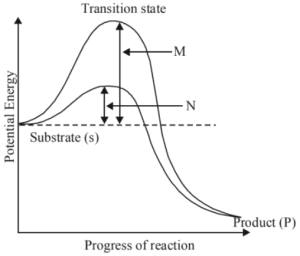
The graph showing the concept of activation energy of an enzyme is given below. Observe the graph and choose the correct option for $M$ and $N$.
A
$M$-High temperature,High activation energy,$N$-Low temperature,Low activation energy
B
$M$-High substrate,High activation energy,$N$-Low substrate,Low activation energy
C
$M$-Activation energy without enzyme,$N$-Activation energy with enzyme
D
$M$-Activation energy with enzyme,$N$-Activation energy without enzyme
Solution
(C) The graph represents the potential energy changes during a chemical reaction.
$M$ represents the activation energy required for the reaction to proceed in the absence of an enzyme,which is higher.
$N$ represents the activation energy required for the reaction to proceed in the presence of an enzyme,which is lower because enzymes lower the activation energy barrier.
Therefore,$M$ is the activation energy without an enzyme and $N$ is the activation energy with an enzyme.
The correct option is $C$.
$M$ represents the activation energy required for the reaction to proceed in the absence of an enzyme,which is higher.
$N$ represents the activation energy required for the reaction to proceed in the presence of an enzyme,which is lower because enzymes lower the activation energy barrier.
Therefore,$M$ is the activation energy without an enzyme and $N$ is the activation energy with an enzyme.
The correct option is $C$.
0 likesView Solution
23
BiologyEasyMCQKCET · 2025
Identify the incorrect statement with respect to the rules of Binomial Nomenclature.
A
Biological names are underlined separately when hand-written.
B
Biological names are printed in Italics to indicate their non-Latin origin.
C
The first word represents the genus while the second component denotes the specific epithet.
D
Biological names are generally in Latin or Latinised irrespective of their origin.
Solution
(B) The correct answer is $B$.
According to the rules of Binomial Nomenclature,biological names are printed in italics to indicate their Latin origin,not their non-Latin origin.
Option $A$ is correct because hand-written scientific names must be underlined separately to indicate their Latin origin.
Option $C$ is correct because the first word in a biological name represents the genus and the second component denotes the specific epithet.
Option $D$ is correct because biological names are derived from Latin or are Latinised,regardless of their actual origin.
According to the rules of Binomial Nomenclature,biological names are printed in italics to indicate their Latin origin,not their non-Latin origin.
Option $A$ is correct because hand-written scientific names must be underlined separately to indicate their Latin origin.
Option $C$ is correct because the first word in a biological name represents the genus and the second component denotes the specific epithet.
Option $D$ is correct because biological names are derived from Latin or are Latinised,regardless of their actual origin.
0 likesView Solution
24
BiologyEasyMCQKCET · 2025
If $8$ individuals in a laboratory population of $80$ fruit flies died during a specified time interval, the death rate in the population during that period is
A
$0.1$ individual/time interval
B
$1$ individual/time interval
C
$0.01$ individual/time interval
D
$0.001$ individual/time interval
Solution
(A) The death rate is calculated as the number of deaths divided by the initial population size over a specific time interval.
Death rate = $\frac{\text{Number of deaths}}{\text{Initial population size}}$
Death rate = $\frac{8}{80} = 0.1$ individual per individual per time interval.
Therefore, the death rate is $0.1$ individual/time interval.
Death rate = $\frac{\text{Number of deaths}}{\text{Initial population size}}$
Death rate = $\frac{8}{80} = 0.1$ individual per individual per time interval.
Therefore, the death rate is $0.1$ individual/time interval.
0 likesView Solution
25
BiologyEasyMCQKCET · 2025
Choose the correct sequence of sperm transport during ejaculation.
A
Seminiferous tubules $\rightarrow$ vasa efferentia $\rightarrow$ rete testis $\rightarrow$ epididymis $\rightarrow$ vas deferens $\rightarrow$ ejaculatory duct
B
Seminiferous tubules $\rightarrow$ rete testis $\rightarrow$ epididymis $\rightarrow$ vas deferens $\rightarrow$ vasa efferentia $\rightarrow$ ejaculatory duct
C
Seminiferous tubules $\rightarrow$ rete testis $\rightarrow$ vasa efferentia $\rightarrow$ epididymis $\rightarrow$ vas deferens $\rightarrow$ ejaculatory duct
D
Seminiferous tubules $\rightarrow$ rete testis $\rightarrow$ epididymis $\rightarrow$ vasa efferentia $\rightarrow$ vas deferens $\rightarrow$ ejaculatory duct
Solution
(C) The correct pathway of sperm transport from the testes to the outside is as follows:
$1$. Sperm are produced in the $\text{Seminiferous tubules}$.
$2$. They move into the $\text{rete testis}$.
$3$. From the $\text{rete testis}$,they pass through the $\text{vasa efferentia}$.
$4$. They then enter the $\text{epididymis}$ for maturation and storage.
$5$. From the $\text{epididymis}$,they travel through the $\text{vas deferens}$.
$6$. Finally,they reach the $\text{ejaculatory duct}$ before being expelled through the urethra.
Therefore,the correct sequence is: $\text{Seminiferous tubules} \rightarrow \text{rete testis} \rightarrow \text{vasa efferentia} \rightarrow \text{epididymis} \rightarrow \text{vas deferens} \rightarrow \text{ejaculatory duct}$.
$1$. Sperm are produced in the $\text{Seminiferous tubules}$.
$2$. They move into the $\text{rete testis}$.
$3$. From the $\text{rete testis}$,they pass through the $\text{vasa efferentia}$.
$4$. They then enter the $\text{epididymis}$ for maturation and storage.
$5$. From the $\text{epididymis}$,they travel through the $\text{vas deferens}$.
$6$. Finally,they reach the $\text{ejaculatory duct}$ before being expelled through the urethra.
Therefore,the correct sequence is: $\text{Seminiferous tubules} \rightarrow \text{rete testis} \rightarrow \text{vasa efferentia} \rightarrow \text{epididymis} \rightarrow \text{vas deferens} \rightarrow \text{ejaculatory duct}$.
0 likesView Solution
26
BiologyEasyMCQKCET · 2025
Match the hormone with its site of production:
| Hormone | Site of production |
|---|---|
| $A$. $hCG$ and $hPL$ | $(ii)$ Placenta |
| $B$. Progesterone | $(iii)$ Corpus luteum |
| $C$. Androgens | $(iv)$ Leydig cells |
| $D$. Relaxin | $(i)$ Ovary |
A
$A-iv, B-i, C-ii, D-iii$
B
$A-i, B-ii, C-iv, D-iii$
C
$A-ii, B-iii, C-iv, D-i$
D
$A-iii, B-i, C-iv, D-ii$
Solution
(C) The correct matches are as follows:
$1$. $hCG$ (human Chorionic Gonadotropin) and $hPL$ (human Placental Lactogen) are produced by the placenta during pregnancy.
$2$. Progesterone is primarily secreted by the corpus luteum in the ovary after ovulation.
$3$. Androgens (mainly testosterone) are synthesized and secreted by the Leydig cells (interstitial cells) of the testes.
$4$. Relaxin is produced by the ovary (specifically the corpus luteum) during the later stages of pregnancy.
Therefore,the correct matching is $A-ii, B-iii, C-iv, D-i$.
$1$. $hCG$ (human Chorionic Gonadotropin) and $hPL$ (human Placental Lactogen) are produced by the placenta during pregnancy.
$2$. Progesterone is primarily secreted by the corpus luteum in the ovary after ovulation.
$3$. Androgens (mainly testosterone) are synthesized and secreted by the Leydig cells (interstitial cells) of the testes.
$4$. Relaxin is produced by the ovary (specifically the corpus luteum) during the later stages of pregnancy.
Therefore,the correct matching is $A-ii, B-iii, C-iv, D-i$.
0 likesView Solution
27
BiologyEasyMCQKCET · 2025
Select the mismatched pair:
$A$. First month of pregnancy - Formation of heart
$B$. Second month of pregnancy - Movement of foetus
$C$. Third month of pregnancy - Formation of most of the major organ systems
$D$. Sixth month of pregnancy - Eye lids separate and eye lashes are formed
$A$. First month of pregnancy - Formation of heart
$B$. Second month of pregnancy - Movement of foetus
$C$. Third month of pregnancy - Formation of most of the major organ systems
$D$. Sixth month of pregnancy - Eye lids separate and eye lashes are formed
A
$C$
B
$D$
C
$A$
D
$B$
Solution
(B) The correct answer is $B$. The pair "Second month of pregnancy - Movement of foetus" is mismatched.
According to human development milestones:
$1$. During the first month, the heart is formed.
$2$. During the second month, the foetus develops limbs and digits.
$3$. By the end of the third month (first trimester), most major organ systems are formed.
$4$. During the fifth month, the first movements of the foetus and appearance of hair on the head are observed.
$5$. By the end of the sixth month (second trimester), the body is covered with fine hair, eye-lids separate, and eye-lashes are formed.
According to human development milestones:
$1$. During the first month, the heart is formed.
$2$. During the second month, the foetus develops limbs and digits.
$3$. By the end of the third month (first trimester), most major organ systems are formed.
$4$. During the fifth month, the first movements of the foetus and appearance of hair on the head are observed.
$5$. By the end of the sixth month (second trimester), the body is covered with fine hair, eye-lids separate, and eye-lashes are formed.
0 likesView Solution
28
BiologyEasyMCQKCET · 2025
Read the following statements:
Statements - $I$: $MTP$ is to get rid of unwanted pregnancies due to casual unprotected intercourse or failure of contraceptives used during coitus or rapes.
Statements - $II$: $MTPs$ are performed legally by qualified doctors by giving proper medical justification.
Choose the correct answer from the options given below:
Statements - $I$: $MTP$ is to get rid of unwanted pregnancies due to casual unprotected intercourse or failure of contraceptives used during coitus or rapes.
Statements - $II$: $MTPs$ are performed legally by qualified doctors by giving proper medical justification.
Choose the correct answer from the options given below:
A
Statements -$I$ is correct but Statements-$II$ is incorrect
B
Statements -$I$ is incorrect but Statements-$II$ is correct
C
Statements -$I$ and $II$ are correct
D
Statements -$I$ and $II$ are incorrect
Solution
(C) $MTP$ stands for Medical Termination of Pregnancy.
Statement-$I$ is correct because $MTP$ is primarily used to terminate unwanted pregnancies resulting from unprotected intercourse, contraceptive failure, or rape.
Statement-$II$ is also correct because $MTP$ is a legal procedure that must be performed by qualified medical practitioners under specific medical or social justifications to ensure safety and legality.
Statement-$I$ is correct because $MTP$ is primarily used to terminate unwanted pregnancies resulting from unprotected intercourse, contraceptive failure, or rape.
Statement-$II$ is also correct because $MTP$ is a legal procedure that must be performed by qualified medical practitioners under specific medical or social justifications to ensure safety and legality.
0 likesView Solution
29
BiologyEasyMCQKCET · 2025
Out of the following options,identify which one is $NOT$ a natural method of contraception.
A
Lactational amenorrhea
B
Periodic abstinence
C
Coitus interruptus
D
Implants
Solution
(D) The correct answer is $D$.
Natural methods of contraception work on the principle of avoiding chances of ovum and sperm meeting.
$A$,$B$,and $C$ are natural methods.
$D$ (Implants) are hormonal preparations that are inserted under the skin,which are considered a chemical or barrier-based artificial method of contraception,not a natural one.
Natural methods of contraception work on the principle of avoiding chances of ovum and sperm meeting.
$A$,$B$,and $C$ are natural methods.
$D$ (Implants) are hormonal preparations that are inserted under the skin,which are considered a chemical or barrier-based artificial method of contraception,not a natural one.
0 likesView Solution
30
BiologyEasyMCQKCET · 2025
Which one of the following population attributes contributes to an increase in population density?
A
Natality and Emigration
B
Mortality and Immigration
C
Natality and Immigration
D
Mortality and Emigration
Solution
(C) The population density of an area increases due to two main factors:
$1$. Natality $(B)$: It refers to the number of births during a given period in the population that are added to the initial density.
$2$. Immigration $(I)$: It refers to the number of individuals of the same species that have come into the habitat from elsewhere during the time period under consideration.
Therefore,both Natality and Immigration contribute to an increase in population density.
$1$. Natality $(B)$: It refers to the number of births during a given period in the population that are added to the initial density.
$2$. Immigration $(I)$: It refers to the number of individuals of the same species that have come into the habitat from elsewhere during the time period under consideration.
Therefore,both Natality and Immigration contribute to an increase in population density.
0 likesView Solution
31
BiologyEasyMCQKCET · 2025
In Zygote Intrafallopian Transfer $(ZIFT)$,the embryo up to . . . . . . stage is transferred into the fallopian tube.
A
$8$ blastomeres
B
$32$ blastomeres
C
$2$ blastomeres
D
$16$ blastomeres
Solution
(A) The correct answer is $A$.
In the assisted reproductive technology known as Zygote Intrafallopian Transfer $(ZIFT)$,the zygote or early embryo containing up to $8$ blastomeres is collected from the laboratory and transferred into the fallopian tube of the female.
If the embryo has developed beyond the $8$-blastomere stage (e.g.,$16$ or $32$ blastomeres),it is instead transferred into the uterus,a procedure known as Intrauterine Transfer $(IUT)$.
In the assisted reproductive technology known as Zygote Intrafallopian Transfer $(ZIFT)$,the zygote or early embryo containing up to $8$ blastomeres is collected from the laboratory and transferred into the fallopian tube of the female.
If the embryo has developed beyond the $8$-blastomere stage (e.g.,$16$ or $32$ blastomeres),it is instead transferred into the uterus,a procedure known as Intrauterine Transfer $(IUT)$.
0 likesView Solution
32
BiologyEasyMCQKCET · 2025
Which of the following statements are correct with reference to the prokaryotic genome?
$A$. Monocistronic structural genes
$B$. Introns absent in structural genes
$C$. Transcription and translation are coupled processes
$D$. Primary transcript undergoes splicing
$E$. Only one $RNA$ polymerase is present
$A$. Monocistronic structural genes
$B$. Introns absent in structural genes
$C$. Transcription and translation are coupled processes
$D$. Primary transcript undergoes splicing
$E$. Only one $RNA$ polymerase is present
A
Only $A, D$ and $E$ are correct
B
Only $A, D$ and $E$ are not correct
C
Only $A, B$ and $D$ are correct
D
Only $B, C$ and $E$ are correct
Solution
(D) In prokaryotes:
$A$. Prokaryotic structural genes are typically polycistronic,not monocistronic. Thus,statement $A$ is incorrect.
$B$. Prokaryotic genes do not contain introns (non-coding sequences). Thus,statement $B$ is correct.
$C$. Since there is no nuclear membrane,transcription and translation occur in the same compartment and are coupled. Thus,statement $C$ is correct.
$D$. Splicing is a process required to remove introns from eukaryotic pre-mRNA. Since prokaryotes lack introns,they do not undergo splicing. Thus,statement $D$ is incorrect.
$E$. Prokaryotes possess only a single type of $RNA$ polymerase that transcribes all types of $RNA$ $(mRNA, tRNA, rRNA)$. Thus,statement $E$ is correct.
Therefore,statements $B, C$,and $E$ are correct.
$A$. Prokaryotic structural genes are typically polycistronic,not monocistronic. Thus,statement $A$ is incorrect.
$B$. Prokaryotic genes do not contain introns (non-coding sequences). Thus,statement $B$ is correct.
$C$. Since there is no nuclear membrane,transcription and translation occur in the same compartment and are coupled. Thus,statement $C$ is correct.
$D$. Splicing is a process required to remove introns from eukaryotic pre-mRNA. Since prokaryotes lack introns,they do not undergo splicing. Thus,statement $D$ is incorrect.
$E$. Prokaryotes possess only a single type of $RNA$ polymerase that transcribes all types of $RNA$ $(mRNA, tRNA, rRNA)$. Thus,statement $E$ is correct.
Therefore,statements $B, C$,and $E$ are correct.
0 likesView Solution
33
BiologyEasyMCQKCET · 2025
Which of the following enzymes increases the permeability of the bacterial cell to lactose?
A
Transacetylase
B
Amylase
C
$\beta$-galactosidase
D
Permease
Solution
(D) In the $lac$ operon of $E. coli$, three structural genes are involved: $lacZ$, $lacY$, and $lacA$.
$1$. $lacZ$ encodes $\beta$-galactosidase, which hydrolyzes lactose into glucose and galactose.
$2$. $lacY$ encodes Permease, which increases the permeability of the cell membrane to $\beta$-galactosides like lactose, allowing it to enter the cell.
$3$. $lacA$ encodes Transacetylase, which transfers an acetyl group from acetyl-CoA to $\beta$-galactosides.
Therefore, the enzyme responsible for increasing the permeability of the bacterial cell to lactose is Permease.
$1$. $lacZ$ encodes $\beta$-galactosidase, which hydrolyzes lactose into glucose and galactose.
$2$. $lacY$ encodes Permease, which increases the permeability of the cell membrane to $\beta$-galactosides like lactose, allowing it to enter the cell.
$3$. $lacA$ encodes Transacetylase, which transfers an acetyl group from acetyl-CoA to $\beta$-galactosides.
Therefore, the enzyme responsible for increasing the permeability of the bacterial cell to lactose is Permease.
0 likesView Solution
34
BiologyEasyMCQKCET · 2025
$RNA$ polymerase $II$ is responsible for the transcription of . . . . . .
A
hnRNA
B
snRNA
C
tRNA
D
rRNA
Solution
(A) The correct answer is $A$ (hnRNA).
In eukaryotes,there are three types of $RNA$ polymerases in the nucleus.
$1$. $RNA$ polymerase $I$ transcribes $rRNA$ ($28S, 18S,$ and $5.8S$).
$2$. $RNA$ polymerase $II$ transcribes the precursor of $mRNA$,which is known as heterogeneous nuclear $RNA$ $(hnRNA)$.
$3$. $RNA$ polymerase $III$ is responsible for the transcription of $tRNA$,$5S$ $rRNA$,and $snRNA$ (small nuclear $RNA$).
In eukaryotes,there are three types of $RNA$ polymerases in the nucleus.
$1$. $RNA$ polymerase $I$ transcribes $rRNA$ ($28S, 18S,$ and $5.8S$).
$2$. $RNA$ polymerase $II$ transcribes the precursor of $mRNA$,which is known as heterogeneous nuclear $RNA$ $(hnRNA)$.
$3$. $RNA$ polymerase $III$ is responsible for the transcription of $tRNA$,$5S$ $rRNA$,and $snRNA$ (small nuclear $RNA$).
0 likesView Solution
35
BiologyEasyMCQKCET · 2025
Choose the correct statement from the following:
$A$. Charles Darwin travelled around the world in a ship called $HMS$ Beagle
$B$. There has been gradual evolution of life forms
$C$. According to Darwin,fitness refers to physical fitness only
$D$. Fossils are remains of hard parts of life forms found in rocks
$E$. Hugo De Vries,a naturalist worked in Malay Archipelago.
$A$. Charles Darwin travelled around the world in a ship called $HMS$ Beagle
$B$. There has been gradual evolution of life forms
$C$. According to Darwin,fitness refers to physical fitness only
$D$. Fossils are remains of hard parts of life forms found in rocks
$E$. Hugo De Vries,a naturalist worked in Malay Archipelago.
A
$A, B$ and $D$ are correct
B
$A, C$ and $D$ are correct
C
$A, B$ and $E$ are correct
D
$A, C$ and $E$ are correct
Solution
(A) . Charles Darwin travelled around the world in a ship called $HMS$ Beagle. This is a correct statement.
$B$. Evolution is a gradual process where life forms change over time. This is a correct statement.
$C$. According to Darwin,fitness refers to reproductive fitness (the ability to survive and produce offspring),not just physical fitness. This is an incorrect statement.
$D$. Fossils are the preserved remains or traces of organisms (often hard parts like bones or shells) found in sedimentary rocks. This is a correct statement.
$E$. Alfred Russel Wallace,not Hugo De Vries,worked in the Malay Archipelago. Hugo De Vries is known for his work on mutation theory in evening primrose. This is an incorrect statement.
Therefore,statements $A, B$,and $D$ are correct.
$B$. Evolution is a gradual process where life forms change over time. This is a correct statement.
$C$. According to Darwin,fitness refers to reproductive fitness (the ability to survive and produce offspring),not just physical fitness. This is an incorrect statement.
$D$. Fossils are the preserved remains or traces of organisms (often hard parts like bones or shells) found in sedimentary rocks. This is a correct statement.
$E$. Alfred Russel Wallace,not Hugo De Vries,worked in the Malay Archipelago. Hugo De Vries is known for his work on mutation theory in evening primrose. This is an incorrect statement.
Therefore,statements $A, B$,and $D$ are correct.
0 likesView Solution
36
BiologyEasyMCQKCET · 2025
Darwin's finches represent one of the best examples of . . . . . .
A
Chemical evolution
B
Genetic equilibrium
C
Seasonal migration
D
Adaptive radiation
Solution
(D) Darwin's finches are a classic example of $Adaptive \text{ } radiation$.
During his voyage to the Galapagos Islands, Charles Darwin observed a variety of small birds, now known as Darwin's finches.
He noted that these birds had evolved from a single ancestral species into various forms with different beak shapes, adapted to different feeding habits (such as eating seeds, insects, or nectar).
This process of evolution of different species in a given geographical area starting from a point and literally radiating to other areas of geography (habitats) is called $Adaptive \text{ } radiation$.
During his voyage to the Galapagos Islands, Charles Darwin observed a variety of small birds, now known as Darwin's finches.
He noted that these birds had evolved from a single ancestral species into various forms with different beak shapes, adapted to different feeding habits (such as eating seeds, insects, or nectar).
This process of evolution of different species in a given geographical area starting from a point and literally radiating to other areas of geography (habitats) is called $Adaptive \text{ } radiation$.
0 likesView Solution
37
BiologyEasyMCQKCET · 2025
When a change in the gene frequency of population occurs by chance,it is called . . . . . .
A
Genetic recombination
B
Genetic drift
C
Founder effect
D
Gene migration
Solution
(B) Genetic drift is defined as the change in the frequency of an existing gene variant (allele) in a population due to random sampling of organisms.
It occurs by chance and is more pronounced in small populations.
Unlike natural selection,which is a non-random process,genetic drift is a stochastic (random) process.
Therefore,the correct answer is Genetic drift.
It occurs by chance and is more pronounced in small populations.
Unlike natural selection,which is a non-random process,genetic drift is a stochastic (random) process.
Therefore,the correct answer is Genetic drift.
0 likesView Solution
38
BiologyEasyMCQKCET · 2025
In which of the following,$HIV$ replicates and produces its progeny viruses?
A
Killer $T$-lymphocytes
B
Suppressor $T$-lymphocytes
C
Helper $T$-lymphocytes
D
Memory $T$-lymphocytes
Solution
(C) After entering the human body,the $HIV$ virus enters into macrophages where the $RNA$ genome of the virus replicates to form viral $DNA$ with the help of the enzyme reverse transcriptase.
This viral $DNA$ gets incorporated into the host cell's $DNA$ and directs the infected cells to produce virus particles.
The macrophages continue to produce virus particles and in this way,they act like an $HIV$ factory.
Simultaneously,$HIV$ enters into $Helper$ $T$-lymphocytes ($T_H$ cells),replicates,and produces progeny viruses.
The progeny viruses released in the blood attack other $Helper$ $T$-lymphocytes.
This leads to a progressive decrease in the number of $Helper$ $T$-lymphocytes in the body of the infected person.
This viral $DNA$ gets incorporated into the host cell's $DNA$ and directs the infected cells to produce virus particles.
The macrophages continue to produce virus particles and in this way,they act like an $HIV$ factory.
Simultaneously,$HIV$ enters into $Helper$ $T$-lymphocytes ($T_H$ cells),replicates,and produces progeny viruses.
The progeny viruses released in the blood attack other $Helper$ $T$-lymphocytes.
This leads to a progressive decrease in the number of $Helper$ $T$-lymphocytes in the body of the infected person.
0 likesView Solution
39
BiologyEasyMCQKCET · 2025
The drug prescribed to patients who have undergone organ transplant is . . . . . . and is produced by . . . . . . .
A
Cyclosporin-$A$, Trichoderma polysporum
B
Statins, Trichoderma polysporum
C
Cyclosporin-$A$, Monascus purpureus
D
Statins, Monascus purpureus
Solution
(A) The correct answer is $A$.
$Cyclosporin-A$ is an immunosuppressive agent used in patients who have undergone organ transplantation to prevent organ rejection.
It is produced by the fungus $Trichoderma polysporum$.
$Cyclosporin-A$ is an immunosuppressive agent used in patients who have undergone organ transplantation to prevent organ rejection.
It is produced by the fungus $Trichoderma polysporum$.
0 likesView Solution
40
BiologyEasyMCQKCET · 2025
Match the Column-$I$ with Column-$II$. Choose the correct option given below.
| Column-$I$ | Column-$II$ |
|---|---|
| $A$. Streptococcus | $(i)$ Free living nitrogen fixing bacteria |
| $B$. Penicillium | $(ii)$ Clot buster |
| $C$. Methanogens | $(iii)$ Source of antibiotic |
| $D$. Anabaena | $(iv)$ Biogas production |
A
$A-iv, B-iii, C-i, D-ii$
B
$A-iv, B-i, C-iii, D-ii$
C
$A-ii, B-iii, C-iv, D-i$
D
$A-ii, B-iv, C-iii, D-i$
Solution
(C) The correct matches are as follows:
$1$. $Streptococcus$ is used as a 'clot buster' because it produces streptokinase,which is used to remove clots from the blood vessels of patients who have undergone myocardial infarction $(A-ii)$.
$2$. $Penicillium$ is a fungus that serves as the source of the first antibiotic,penicillin $(B-iii)$.
$3$. $Methanogens$ are bacteria that grow anaerobically on cellulosic material and produce large amounts of methane,which is used in biogas production $(C-iv)$.
$4$. $Anabaena$ is a cyanobacterium that acts as a free-living nitrogen-fixing bacterium in the soil $(D-i)$.
Therefore,the correct sequence is $A-ii, B-iii, C-iv, D-i$.
$1$. $Streptococcus$ is used as a 'clot buster' because it produces streptokinase,which is used to remove clots from the blood vessels of patients who have undergone myocardial infarction $(A-ii)$.
$2$. $Penicillium$ is a fungus that serves as the source of the first antibiotic,penicillin $(B-iii)$.
$3$. $Methanogens$ are bacteria that grow anaerobically on cellulosic material and produce large amounts of methane,which is used in biogas production $(C-iv)$.
$4$. $Anabaena$ is a cyanobacterium that acts as a free-living nitrogen-fixing bacterium in the soil $(D-i)$.
Therefore,the correct sequence is $A-ii, B-iii, C-iv, D-i$.
0 likesView Solution
41
BiologyEasyMCQKCET · 2025
To isolate $DNA$ from fungal cells,bacterial cells,and plant cells,the enzymes required are respectively:
A
Chitinase,Lysozyme,and Cellulase
B
Cellulase,Protease,and Lysozyme
C
Lysozyme,Cellulase,and Chitinase
D
Lysozyme,Proteases,and Ribonuclease
Solution
(A) To isolate $DNA$ from cells,the cell wall must be broken down to release the genetic material.
$1$. Fungal cells have a cell wall made of chitin,which is broken down by the enzyme $Chitinase$.
$2$. Bacterial cells have a cell wall made of peptidoglycan,which is broken down by the enzyme $Lysozyme$.
$3$. Plant cells have a cell wall made of cellulose,which is broken down by the enzyme $Cellulase$.
Therefore,the correct sequence of enzymes is $Chitinase$,$Lysozyme$,and $Cellulase$.
$1$. Fungal cells have a cell wall made of chitin,which is broken down by the enzyme $Chitinase$.
$2$. Bacterial cells have a cell wall made of peptidoglycan,which is broken down by the enzyme $Lysozyme$.
$3$. Plant cells have a cell wall made of cellulose,which is broken down by the enzyme $Cellulase$.
Therefore,the correct sequence of enzymes is $Chitinase$,$Lysozyme$,and $Cellulase$.
0 likesView Solution
42
BiologyEasyMCQKCET · 2025
Match the contents of List-$I$ with List-$II$:
| List-$I$ | List-$II$ |
| $A$. Bioreactors | $(i)$ Insulin produced by rDNA technology |
| $B$. Downstream processing | $(ii)$ Vessels which convert raw material into specific product |
| $C$. Recombinant protein | $(iii)$ Detect mutated genes in suspected cancer patient |
| $D$. $PCR$ | $(iv)$ Involves separation and purification |
A
$A-i, B-ii, C-iv, D-iii$
B
$A-ii, B-i, C-iii, D-iv$
C
$A-ii, B-iv, C-i, D-iii$
D
$A-iv, B-ii, C-iii, D-i$
Solution
(C) . Bioreactors are vessels in which raw materials are biologically converted into specific products using microbial,plant,or animal cells.
$B$. Downstream processing refers to the processes of separation and purification of the product after the biosynthetic stage.
$C$. Recombinant protein refers to the protein encoded by the recombinant $DNA$,such as insulin produced by rDNA technology.
$D$. $PCR$ (Polymerase Chain Reaction) is a technique used to amplify $DNA$ segments and can be used to detect mutated genes in suspected cancer patients.
Therefore,the correct match is $A-ii, B-iv, C-i, D-iii$.
$B$. Downstream processing refers to the processes of separation and purification of the product after the biosynthetic stage.
$C$. Recombinant protein refers to the protein encoded by the recombinant $DNA$,such as insulin produced by rDNA technology.
$D$. $PCR$ (Polymerase Chain Reaction) is a technique used to amplify $DNA$ segments and can be used to detect mutated genes in suspected cancer patients.
Therefore,the correct match is $A-ii, B-iv, C-i, D-iii$.
0 likesView Solution
43
BiologyEasyMCQKCET · 2025
The part of the plasmid that codes for proteins involved in the replication of the $pBR322$ plasmid is:
A
rop
B
cloning site
C
Ori site
D
Selectable marker
Solution
(A) The correct answer is $A$.
In the $pBR322$ plasmid,the $rop$ gene codes for proteins involved in the replication of the plasmid.
$rop$ stands for 'repressor of primer'.
It regulates the copy number of the plasmid.
In the $pBR322$ plasmid,the $rop$ gene codes for proteins involved in the replication of the plasmid.
$rop$ stands for 'repressor of primer'.
It regulates the copy number of the plasmid.
0 likesView Solution
Vedclass Products
For Students
Vedclass Test Series
Mock tests in real KCET style covering Biology with performance analysis. 5-day free trial.
Start Free TrialFor Teachers
Exam Paper Generator
Generate Set A/B/C/D Biology papers from 7.5L+ questions in 2 minutes. 3 chapters free.
Try FreeFor Institutes
Online Exam Module
Run live KCET mock exams with unlimited students, 360° analytics & white-label branding.
See DemoFrequently Asked Questions
How many Biology questions are in KCET 2025?
There are 43 Biology questions from the KCET 2025 paper on Vedclass, each with a detailed step-by-step solution in English.
Are KCET 2025 Biology solutions available in English?
Yes. All solutions on this page are in English. You can also switch to English or Hindi using the language buttons above the questions.
Can I practice KCET 2025 Biology as a timed test?
Yes. Use the Vedclass Test Series to attempt a full KCET mock test covering Biology with time limits and instant score analysis.
Can teachers create Biology papers from KCET previous year questions?
Yes. The Vedclass Exam Paper Generator lets teachers mix KCET Biology questions and generate Set A/B/C/D papers in minutes.
For Teachers & Institutes
Build a Custom Biology Paper
Pick KCET 2025 Biology questions, set difficulty, and generate Set A/B/C/D in 2 minutes.