
BiologyQ1–51 of 51 questions
Page 1 of 1 · English
1
BiologyEasyMCQKCET · 2018
The correct sequence of taxonomic hierarchy is
A
Genus $\rightarrow$ Family $\rightarrow$ Class $\rightarrow$ Order $\rightarrow$ Phylum $\rightarrow$ Kingdom $\rightarrow$ Species
B
Species $\rightarrow$ Genus $\rightarrow$ Family $\rightarrow$ Order $\rightarrow$ Class $\rightarrow$ Phylum $\rightarrow$ Kingdom
C
Species $\rightarrow$ Family $\rightarrow$ Genus $\rightarrow$ Kingdom $\rightarrow$ Order $\rightarrow$ Class $\rightarrow$ Phylum
D
Species $\rightarrow$ Genus $\rightarrow$ Family $\rightarrow$ Class $\rightarrow$ Order $\rightarrow$ Phylum $\rightarrow$ Kingdom
Solution
(B) The taxonomic hierarchy is the sequence of arrangements of taxonomic categories in a descending order during the classification of an organism.
The standard sequence from the lowest to the highest rank is:
$Species \rightarrow$ Genus $\rightarrow$ Family $\rightarrow$ Order $\rightarrow$ Class $\rightarrow$ Phylum (or Division for plants) $\rightarrow$ Kingdom.
Option $B$ follows this correct ascending order.
The standard sequence from the lowest to the highest rank is:
$Species \rightarrow$ Genus $\rightarrow$ Family $\rightarrow$ Order $\rightarrow$ Class $\rightarrow$ Phylum (or Division for plants) $\rightarrow$ Kingdom.
Option $B$ follows this correct ascending order.
0 likesView Solution
2
BiologyEasyMCQKCET · 2018
In the maize plant,$CO_2$ fixation occurs in both mesophyll and bundle sheath cells. The enzymes involved in these cells for the process respectively are
A
RuBisCO and $PEP$ kinase
B
$PEP$ kinase and Pepsin
C
RuBisCO and $PEP$ carboxylase
D
$PEP$ carboxylase and RuBisCO
Solution
(D) The correct answer is $D$.
Maize is a $C_4$ plant. In $C_4$ plants,$CO_2$ fixation occurs in two stages in different cell types.
In the mesophyll cells,the primary $CO_2$ acceptor is phosphoenol pyruvate $(PEP)$,a $3$-carbon molecule. The enzyme responsible for this initial fixation is $PEP$ carboxylase $(PEPcase)$.
After the formation of $C_4$ acids,they are transported to the bundle sheath cells.
In the bundle sheath cells,the $C_4$ acids are broken down to release $CO_2$,which is then fixed by the enzyme $RuBisCO$ via the Calvin cycle to produce sugars.
Therefore,the enzymes involved in mesophyll and bundle sheath cells are $PEP$ carboxylase and $RuBisCO$,respectively.
Maize is a $C_4$ plant. In $C_4$ plants,$CO_2$ fixation occurs in two stages in different cell types.
In the mesophyll cells,the primary $CO_2$ acceptor is phosphoenol pyruvate $(PEP)$,a $3$-carbon molecule. The enzyme responsible for this initial fixation is $PEP$ carboxylase $(PEPcase)$.
After the formation of $C_4$ acids,they are transported to the bundle sheath cells.
In the bundle sheath cells,the $C_4$ acids are broken down to release $CO_2$,which is then fixed by the enzyme $RuBisCO$ via the Calvin cycle to produce sugars.
Therefore,the enzymes involved in mesophyll and bundle sheath cells are $PEP$ carboxylase and $RuBisCO$,respectively.
0 likesView Solution
3
BiologyEasyMCQKCET · 2018
In the following reaction,identify $X$ and $Y$ respectively.
$\text{Pyruvic acid} + \text{CoA} + \text{NAD}^+ \xrightarrow[X]{\text{Mg}^{2+}} Y + \text{CO}_2 + \text{NADH} + \text{H}^+$
$\text{Pyruvic acid} + \text{CoA} + \text{NAD}^+ \xrightarrow[X]{\text{Mg}^{2+}} Y + \text{CO}_2 + \text{NADH} + \text{H}^+$
A
Water,Acetyl CoA
B
Acetyl CoA,Pyruvate dehydrogenase
C
Pyruvate dehydrogenase,Acetyl CoA
D
Pyruvate dehydrogenase,Oxaloacetic acid
Solution
(C) The correct answer is $C$.
In the given reaction,Pyruvic acid undergoes oxidative decarboxylation to form Acetyl CoA.
This reaction is catalyzed by the enzyme complex Pyruvate dehydrogenase in the presence of $Mg^{2+}$ ions.
Therefore,$X$ represents the enzyme Pyruvate dehydrogenase and $Y$ represents the product Acetyl CoA.
The overall reaction is:
$\text{Pyruvic acid} + \text{CoA} + \text{NAD}^+ \xrightarrow[\text{Pyruvate dehydrogenase}]{\text{Mg}^{2+}} \text{Acetyl CoA} + \text{CO}_2 + \text{NADH} + \text{H}^+$
In the given reaction,Pyruvic acid undergoes oxidative decarboxylation to form Acetyl CoA.
This reaction is catalyzed by the enzyme complex Pyruvate dehydrogenase in the presence of $Mg^{2+}$ ions.
Therefore,$X$ represents the enzyme Pyruvate dehydrogenase and $Y$ represents the product Acetyl CoA.
The overall reaction is:
$\text{Pyruvic acid} + \text{CoA} + \text{NAD}^+ \xrightarrow[\text{Pyruvate dehydrogenase}]{\text{Mg}^{2+}} \text{Acetyl CoA} + \text{CO}_2 + \text{NADH} + \text{H}^+$
0 likesView Solution
4
BiologyEasyMCQKCET · 2018
Which of the following factors is favourable for the formation of oxyhaemoglobin in the alveoli of human lungs?
A
High $pCO_2$
B
Lower temperature
C
High $H^+$ concentration
D
Low $pO_2$
Solution
(B) The correct answer is $B$.
In the alveoli,the conditions are high $pO_2$,low $pCO_2$,lower $H^+$ concentration,and lower temperature.
These factors are favourable for the binding of oxygen with haemoglobin to form oxyhaemoglobin.
Conversely,in the tissues,low $pO_2$,high $pCO_2$,high $H^+$ concentration,and higher temperature promote the dissociation of oxygen from oxyhaemoglobin.
Therefore,$O_2$ binds to haemoglobin in the lungs and dissociates in the tissues.
In the alveoli,the conditions are high $pO_2$,low $pCO_2$,lower $H^+$ concentration,and lower temperature.
These factors are favourable for the binding of oxygen with haemoglobin to form oxyhaemoglobin.
Conversely,in the tissues,low $pO_2$,high $pCO_2$,high $H^+$ concentration,and higher temperature promote the dissociation of oxygen from oxyhaemoglobin.
Therefore,$O_2$ binds to haemoglobin in the lungs and dissociates in the tissues.
0 likesView Solution
5
BiologyEasyMCQKCET · 2018
Select the correct Rh-blood groups of the parents,whose child is affected with erythroblastosis fetalis.
A
Both father and mother are Rh+ ve
B
Mother is Rh + ve and father is Rh - ve
C
Both father and mother are Rh - ve
D
Father is Rh + ve and mother is Rh - ve
Solution
(D) Erythroblastosis fetalis is a condition that occurs when there is an Rh incompatibility between the mother and the fetus.
This condition typically arises when the mother is $Rh-$ (Rh-negative) and the father is $Rh+$ (Rh-positive).
If the fetus inherits the $Rh+$ antigen from the father,the mother's immune system may produce antibodies against the $Rh$ factor during the first pregnancy.
In subsequent pregnancies,if the fetus is again $Rh+$,these maternal antibodies can cross the placenta and destroy the fetal red blood cells,leading to erythroblastosis fetalis.
Therefore,the correct combination is that the father is $Rh+$ and the mother is $Rh-$.
This condition typically arises when the mother is $Rh-$ (Rh-negative) and the father is $Rh+$ (Rh-positive).
If the fetus inherits the $Rh+$ antigen from the father,the mother's immune system may produce antibodies against the $Rh$ factor during the first pregnancy.
In subsequent pregnancies,if the fetus is again $Rh+$,these maternal antibodies can cross the placenta and destroy the fetal red blood cells,leading to erythroblastosis fetalis.
Therefore,the correct combination is that the father is $Rh+$ and the mother is $Rh-$.
0 likesView Solution
6
BiologyEasyMCQKCET · 2018
The hormones of "Fright, Fight and Flight" are
A
thyroxine and oxytocin
B
thyroxine and melatonin
C
adrenaline and noradrenaline
D
gastrin and secretin
Solution
(C) $Adrenaline$ and $noradrenaline$ are secreted rapidly in response to stress of any kind and during emergency situations.
Because of their role in these situations, they are commonly referred to as emergency hormones or the hormones of $Fright, Fight$ and $Flight$.
Because of their role in these situations, they are commonly referred to as emergency hormones or the hormones of $Fright, Fight$ and $Flight$.
0 likesView Solution
7
BiologyEasyMCQKCET · 2018
In which of the following groups do the male and female gametophytes have independent,free-living existence?
A
Bryophytes and gymnosperms
B
Bryophytes and pteridophytes
C
Pteridophytes and gymnosperms
D
Algae and gymnosperms
Solution
(B) The correct answer is $B$.
In $Bryophytes$,the gametophyte is the dominant phase and is independent.
In $Pteridophytes$,the gametophyte (prothallus) is small,multicellular,and usually independent and free-living.
In $Gymnosperms$ and $Angiosperms$,the gametophytes are reduced and dependent on the sporophyte for nutrition and protection.
In $Bryophytes$,the gametophyte is the dominant phase and is independent.
In $Pteridophytes$,the gametophyte (prothallus) is small,multicellular,and usually independent and free-living.
In $Gymnosperms$ and $Angiosperms$,the gametophytes are reduced and dependent on the sporophyte for nutrition and protection.
0 likesView Solution
8
BiologyEasyMCQKCET · 2018
Match the animals of Column $I$ with their respective classes in Column $II$ and choose the correct answer.
Select the code for the correct answer from the options given below.
| Column $I$ | Column $II$ |
|---|---|
| $A$. Aptenodytes | $p$. Aves |
| $B$. Hemidactylus | $s$. Reptilia |
| $C$. Carcharodon | $q$. Chondrichthyes |
| $D$. Pteropus | $r$. Mammalia |
Select the code for the correct answer from the options given below.
A
$A-t, B-q, C-s, D-p$
B
$A-p, B-s, C-r, D-q$
C
$A-t, B-p, C-q, D-r$
D
$A-p, B-s, C-q, D-r$
Solution
(D) The correct matching is $A-p, B-s, C-q, D-r$.
$1$. Aptenodytes (Penguin) belongs to the class Aves.
$2$. Hemidactylus (Wall lizard) belongs to the class Reptilia.
$3$. Carcharodon (Great white shark) belongs to the class Chondrichthyes.
$4$. Pteropus (Flying fox) belongs to the class Mammalia.
Therefore,the correct option is $D$.
$1$. Aptenodytes (Penguin) belongs to the class Aves.
$2$. Hemidactylus (Wall lizard) belongs to the class Reptilia.
$3$. Carcharodon (Great white shark) belongs to the class Chondrichthyes.
$4$. Pteropus (Flying fox) belongs to the class Mammalia.
Therefore,the correct option is $D$.
0 likesView Solution
9
BiologyEasyMCQKCET · 2018
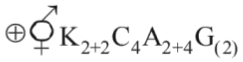
Choose the correct floral formula for the given floral diagram.

A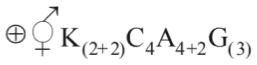
$\oplus \; \text{O} \; K_{(2+2)} C_4 A_{4+2} G_{(3)}$
B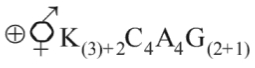
$\oplus \; \text{O} \; K_{(3)+2} C_4 A_4 G_{(2+1)}$
C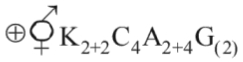
$\oplus \; \text{O} \; K_{2+2} C_4 A_{2+4} G_{(2)}$
D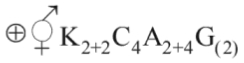
$\oplus \; \text{O} \; K_{2+2} C_4 A_{2+4} G_{(2)}$
Solution
(C) The given floral diagram represents the family Brassicaceae (formerly Cruciferae).
$1$. The flower is actinomorphic $(\oplus)$,
bisexual ($\text{O}$ with male and female symbols).
$2$. The calyx $(K)$ consists of $4$ sepals arranged in two whorls of $2+2$.
$3$. The corolla $(C)$ consists of $4$ petals arranged in a cruciform manner.
$4$. The androecium $(A)$ consists of $6$ stamens arranged in two whorls of $2+4$ (tetradynamous condition).
$5$. The gynoecium $(G)$ is bicarpellary,syncarpous,and superior,represented as $G_{(2)}$.
Thus,the correct floral formula is $\oplus \; \text{O} \; K_{2+2} C_4 A_{2+4} G_{(2)}$.
$1$. The flower is actinomorphic $(\oplus)$,
bisexual ($\text{O}$ with male and female symbols).
$2$. The calyx $(K)$ consists of $4$ sepals arranged in two whorls of $2+2$.
$3$. The corolla $(C)$ consists of $4$ petals arranged in a cruciform manner.
$4$. The androecium $(A)$ consists of $6$ stamens arranged in two whorls of $2+4$ (tetradynamous condition).
$5$. The gynoecium $(G)$ is bicarpellary,syncarpous,and superior,represented as $G_{(2)}$.
Thus,the correct floral formula is $\oplus \; \text{O} \; K_{2+2} C_4 A_{2+4} G_{(2)}$.
0 likesView Solution
10
BiologyEasyMCQKCET · 2018
Conjunctive tissue is present between $(i)$ and (ii) in (iii).
A
$(i)$ Pericycle (ii) Endodermis (iii) Dicot root
B
$(i)$ Xylem (ii) Phloem (iii) Dicot root
C
$(i)$ Palisade parenchyma (ii) Spongy parenchyma (iii) Dicot root
D
$(i)$ Xylem (ii) Palisade parenchyma (iii) Dicot root
Solution
(B) The correct answer is $B$.
In the anatomy of a dicotyledonous root,the parenchymatous cells that are located between the xylem and phloem vascular bundles are specifically referred to as conjunctive tissue.
These cells play a role in the storage of food and can sometimes become meristematic during secondary growth.
In the anatomy of a dicotyledonous root,the parenchymatous cells that are located between the xylem and phloem vascular bundles are specifically referred to as conjunctive tissue.
These cells play a role in the storage of food and can sometimes become meristematic during secondary growth.
0 likesView Solution
11
BiologyEasyMCQKCET · 2018
In which type of vascular bundles are xylem and phloem present at the same radius?
A
Radial
B
Closed
C
Conjoint
D
Exarch
Solution
(C) The correct answer is $C$.
In a $Conjoint$ type of vascular bundle,both xylem and phloem are present on the same radius of the vascular bundle.
This arrangement is commonly found in the stems and leaves of flowering plants.
In a $Conjoint$ type of vascular bundle,both xylem and phloem are present on the same radius of the vascular bundle.
This arrangement is commonly found in the stems and leaves of flowering plants.
0 likesView Solution
12
BiologyEasyMCQKCET · 2018
Identify the major site of biosynthesis of lipids.
A
Golgi apparatus
B
Mitochondria
C
Smooth endoplasmic reticulum $(SER)$
D
Rough endoplasmic reticulum $(RER)$
Solution
(C) Smooth endoplasmic reticulum $(SER)$.
The smooth endoplasmic reticulum $(SER)$ is the primary site for the biosynthesis of lipids,including steroids and phospholipids,within the cell.
The smooth endoplasmic reticulum $(SER)$ is the primary site for the biosynthesis of lipids,including steroids and phospholipids,within the cell.
0 likesView Solution
13
BiologyEasyMCQKCET · 2018
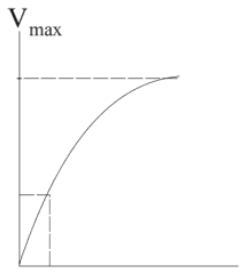
The following graph shows the effect of substrate concentration on enzyme activity. What does the $Y$-axis represent?
A
Temperature
B
Velocity of reaction
C
$pH$
D
Pressure
Solution
(B) The correct answer is $(B)$.
In the Michaelis-Menten enzyme kinetics graph,the $X$-axis represents the substrate concentration $[S]$,and the $Y$-axis represents the velocity of the reaction $(V)$.
As the substrate concentration increases,the velocity of the reaction increases until it reaches a maximum velocity,denoted as $V_{max}$.
In the Michaelis-Menten enzyme kinetics graph,the $X$-axis represents the substrate concentration $[S]$,and the $Y$-axis represents the velocity of the reaction $(V)$.
As the substrate concentration increases,the velocity of the reaction increases until it reaches a maximum velocity,denoted as $V_{max}$.
0 likesView Solution
14
BiologyEasyMCQKCET · 2018
Even in the absence of pollinators,assured seed set will be there in
A
Chasmogamous flowers
B
Geitonogamy
C
Cleistogamous flowers
D
Xenogamy
Solution
(C) The correct answer is $C$.
Cleistogamous flowers are those flowers which do not open at all.
In such flowers,the anthers and stigma lie close to each other.
When anthers dehisce in the flower buds,pollen grains come in contact with the stigma to effect pollination.
Thus,cleistogamous flowers produce assured seed set even in the absence of pollinators.
Cleistogamous flowers are those flowers which do not open at all.
In such flowers,the anthers and stigma lie close to each other.
When anthers dehisce in the flower buds,pollen grains come in contact with the stigma to effect pollination.
Thus,cleistogamous flowers produce assured seed set even in the absence of pollinators.
0 likesView Solution
15
BiologyEasyMCQKCET · 2018
When a pollen grain is shed at the $3$-celled stage,name the cells it contains.
A
$1$ vegetative cell and $2$ male gametes
B
$2$ vegetative cells and $1$ male gamete
C
$2$ generative cells and $1$ male gamete
D
$2$ male gametes and $1$ generative cell
Solution
(A) The correct answer is $A$.
In angiosperms,the pollen grain can be shed at either the $2$-celled stage or the $3$-celled stage.
At the $3$-celled stage,the generative cell undergoes mitosis to form two male gametes.
Therefore,the pollen grain contains one large vegetative cell (tube cell) and two male gametes.
In angiosperms,the pollen grain can be shed at either the $2$-celled stage or the $3$-celled stage.
At the $3$-celled stage,the generative cell undergoes mitosis to form two male gametes.
Therefore,the pollen grain contains one large vegetative cell (tube cell) and two male gametes.
0 likesView Solution
16
BiologyEasyMCQKCET · 2018
Among the following statements related to pollens, choose the correct one.
Statement $I$: In $40\%$ of angiosperms, pollen grains are shed at the $3$-celled stage.
Statement $II$: Intine is made of cellulose and pectin, and it is discontinuous with germ pores.
Statement $I$: In $40\%$ of angiosperms, pollen grains are shed at the $3$-celled stage.
Statement $II$: Intine is made of cellulose and pectin, and it is discontinuous with germ pores.
A
Both statements $I$ and $II$ are correct.
B
Both statements $I$ and $II$ are incorrect.
C
Statement $I$ is correct and Statement $II$ is incorrect.
D
Statement $I$ is incorrect and Statement $II$ is correct.
Solution
(C) Statement $I$ is correct: In approximately $40\%$ of angiosperms, the generative cell divides mitotically to form two male gametes before the pollen grains are shed, resulting in a $3$-celled stage. In the remaining $60\%$ of species, pollen grains are shed at the $2$-celled stage.
Statement $II$ is incorrect: The inner wall of the pollen grain is called the intine. It is a thin and continuous layer made up of cellulose and pectin. It is not discontinuous; rather, the exine (outer layer) is discontinuous at the germ pores.
Statement $II$ is incorrect: The inner wall of the pollen grain is called the intine. It is a thin and continuous layer made up of cellulose and pectin. It is not discontinuous; rather, the exine (outer layer) is discontinuous at the germ pores.
0 likesView Solution
17
BiologyEasyMCQKCET · 2018
dsRNA is used to develop pest-resistant tobacco plants by a technique called:
A
Polymerase Chain Reaction $(PCR)$
B
$RNA$ interference $(RNAi)$
C
Electrophoresis
D
Insertional activation
Solution
(B) $RNA$ interference $(RNAi)$ is a method of cellular defense in all eukaryotic organisms. In this technique,double-stranded $RNA$ $(dsRNA)$ is used to silence specific messenger $RNA$ $(mRNA)$ of the pest. When a nematode infects the transgenic tobacco plant,the $dsRNA$ produced by the plant triggers the $RNAi$ mechanism,which prevents the translation of the pest's essential genes,thereby protecting the plant.
0 likesView Solution
18
BiologyEasyMCQKCET · 2018
Silencing of a specific $mRNA$ translation could be achieved through:
A
antisense $RNA$
B
$RNA$ interference technique
C
both $(a)$ and $(b)$
D
microinjection
Solution
(C) The silencing of a specific $mRNA$ translation can be achieved by preventing the translation of the $mRNA$ into a protein.
$1$. Antisense $RNA$ is a single-stranded $RNA$ that is complementary to a protein-coding messenger $RNA$ $(mRNA)$ with which it hybridizes,thereby blocking its translation.
$2$. $RNA$ interference $(RNAi)$ is a biological process in which $RNA$ molecules inhibit gene expression or translation,by neutralizing targeted $mRNA$ molecules.
Therefore,both methods are used for gene silencing.
$1$. Antisense $RNA$ is a single-stranded $RNA$ that is complementary to a protein-coding messenger $RNA$ $(mRNA)$ with which it hybridizes,thereby blocking its translation.
$2$. $RNA$ interference $(RNAi)$ is a biological process in which $RNA$ molecules inhibit gene expression or translation,by neutralizing targeted $mRNA$ molecules.
Therefore,both methods are used for gene silencing.
0 likesView Solution
19
BiologyEasyMCQKCET · 2018
Verhulst-Pearl logistic growth is described by the equation $\frac{dN}{dt} = rN \left[\frac{K - N}{K}\right]$,where '$r$' and '$K$' represent:
A
$r$-intrinsic rate of natural decrease,$K$-carrying capacity
B
$r$-intrinsic rate of natural increase,$K$-carrying capacity
C
$r$-extrinsic rate of natural increase,$K$-productive capacity
D
$r$-extrinsic rate of natural decrease,$K$-carrying capacity
Solution
(B) The correct option is $B$.
The Verhulst-Pearl logistic growth model is represented by the differential equation:
$\frac{dN}{dt} = rN \left[\frac{K - N}{K}\right]$
In this equation:
$1$. $r$ stands for the intrinsic rate of natural increase,which represents the biotic potential of a population.
$2$. $N$ represents the population density at time $t$.
$3$. $K$ stands for the carrying capacity,which is the maximum population size that an environment can sustain given the available resources.
The Verhulst-Pearl logistic growth model is represented by the differential equation:
$\frac{dN}{dt} = rN \left[\frac{K - N}{K}\right]$
In this equation:
$1$. $r$ stands for the intrinsic rate of natural increase,which represents the biotic potential of a population.
$2$. $N$ represents the population density at time $t$.
$3$. $K$ stands for the carrying capacity,which is the maximum population size that an environment can sustain given the available resources.
0 likesView Solution
20
BiologyEasyMCQKCET · 2018
Which among the following is not a functional unit of the ecosystem?
A
Decomposition
B
Nutrient cycling
C
Energy flow
D
Pollution
Solution
(D) The correct answer is $D$. Pollution is not a functional unit of the ecosystem.
The major functional aspects (or components) of an ecosystem are:
$1$. Productivity
$2$. Decomposition
$3$. Energy flow
$4$. Nutrient cycling
Pollution is an external environmental issue caused by human activities and is not a natural functional process of an ecosystem.
The major functional aspects (or components) of an ecosystem are:
$1$. Productivity
$2$. Decomposition
$3$. Energy flow
$4$. Nutrient cycling
Pollution is an external environmental issue caused by human activities and is not a natural functional process of an ecosystem.
0 likesView Solution
21
BiologyEasyMCQKCET · 2018
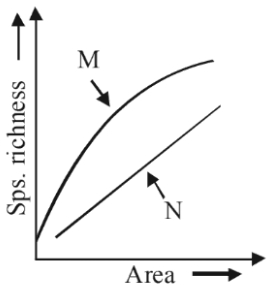
Match $M$ and $N$ with the species-area relationship shown in the graphic representation below and choose the correct option.
A
$M \rightarrow S = CA^Z, N \rightarrow \log S = \log C + Z \log A$
B
$M \rightarrow S = CZ^A, N \rightarrow \log C = \log S + Z \log A$
C
$M \rightarrow S = CA^Z, N \rightarrow \log S = \log C + A \log Z$
D
$M \rightarrow S = AZ^C, N \rightarrow \log ZA = \log C + \log S$
Solution
(A) The correct option is $A$.
In the given graph,$M$ represents the species-area relationship on a normal scale,which is a rectangular hyperbola described by the equation $S = CA^Z$.
$N$ represents the same relationship on a logarithmic scale,which results in a straight line described by the equation $\log S = \log C + Z \log A$.
Here,$S$ represents species richness,$A$ represents area,$Z$ represents the slope of the line (regression coefficient),and $C$ represents the $Y$-intercept.
In the given graph,$M$ represents the species-area relationship on a normal scale,which is a rectangular hyperbola described by the equation $S = CA^Z$.
$N$ represents the same relationship on a logarithmic scale,which results in a straight line described by the equation $\log S = \log C + Z \log A$.
Here,$S$ represents species richness,$A$ represents area,$Z$ represents the slope of the line (regression coefficient),and $C$ represents the $Y$-intercept.
0 likesView Solution
22
BiologyEasyMCQKCET · 2018
Select the option from the following which is not a major characteristic feature of biodiversity hotspots.
A
Large number of species
B
Destruction of habitats
C
Abundance of endemic species
D
Large number of exotic species
Solution
(D) The correct option is $D$.
Biodiversity hotspots are biogeographic regions characterized by high levels of biodiversity and significant threats of habitat destruction.
The concept was introduced by $Dr. Norman Myers$ in $1988$.
To qualify as a biodiversity hotspot, an area must meet two strict criteria:
$1$. It must contain at least $1,500$ species of vascular plants as endemics (i.e., species found nowhere else on Earth).
$2$. It must have lost at least $70\%$ of its primary native vegetation.
Therefore, a large number of exotic (non-native) species is not a defining characteristic of a biodiversity hotspot; rather, the focus is on the high density of endemic species and the urgent need for conservation due to habitat loss.
Biodiversity hotspots are biogeographic regions characterized by high levels of biodiversity and significant threats of habitat destruction.
The concept was introduced by $Dr. Norman Myers$ in $1988$.
To qualify as a biodiversity hotspot, an area must meet two strict criteria:
$1$. It must contain at least $1,500$ species of vascular plants as endemics (i.e., species found nowhere else on Earth).
$2$. It must have lost at least $70\%$ of its primary native vegetation.
Therefore, a large number of exotic (non-native) species is not a defining characteristic of a biodiversity hotspot; rather, the focus is on the high density of endemic species and the urgent need for conservation due to habitat loss.
0 likesView Solution
23
BiologyEasyMCQKCET · 2018
The process of conversion of non-motile spermatids into motile spermatozoa is called:
A
spermiogenesis
B
oogenesis
C
sporogenesis
D
spermatogenesis
Solution
(A) The correct answer is $A$ (spermiogenesis).
$1$. The process of transformation of non-motile spermatids into mature,motile spermatozoa is known as spermiogenesis.
$2$. This process represents the final stage of spermatogenesis,where the spermatids undergo structural changes to become functional sperm cells.
$3$. During this phase,the spermatid loses most of its cytoplasm,develops an acrosome,and forms a tail for motility.
$1$. The process of transformation of non-motile spermatids into mature,motile spermatozoa is known as spermiogenesis.
$2$. This process represents the final stage of spermatogenesis,where the spermatids undergo structural changes to become functional sperm cells.
$3$. During this phase,the spermatid loses most of its cytoplasm,develops an acrosome,and forms a tail for motility.
0 likesView Solution
24
BiologyEasyMCQKCET · 2018
The signals for the parturition process originate from
A
muscles of uterus
B
fully developed fetus and placenta
C
placenta
D
hormones of ovaries and uterus
Solution
(B) The signals for parturition originate from the fully developed fetus and the placenta.
This process induces the fetal ejection reflex,which triggers mild uterine contractions.
These contractions further stimulate the release of oxytocin from the maternal pituitary gland,leading to stronger uterine contractions and eventually the expulsion of the baby.
This process induces the fetal ejection reflex,which triggers mild uterine contractions.
These contractions further stimulate the release of oxytocin from the maternal pituitary gland,leading to stronger uterine contractions and eventually the expulsion of the baby.
0 likesView Solution
25
BiologyEasyMCQKCET · 2018
Several mammary ducts join to form a wider structure called:
A
lactiferous duct
B
mammary lobe
C
mammary ampulla
D
mammary tubules
Solution
(C) The correct answer is $C$.
Functional mammary glands are a characteristic feature of all female mammals.
The glandular tissue of each breast is divided into $15-20$ mammary lobes containing clusters of cells called alveoli.
The cells of the alveoli secrete milk,which is stored in the cavities (lumens) of the alveoli.
The alveoli open into mammary tubules.
The tubules of each lobe join to form a mammary duct.
Several mammary ducts join to form a wider mammary ampulla,which is connected to the lactiferous duct through which milk is sucked out.
Functional mammary glands are a characteristic feature of all female mammals.
The glandular tissue of each breast is divided into $15-20$ mammary lobes containing clusters of cells called alveoli.
The cells of the alveoli secrete milk,which is stored in the cavities (lumens) of the alveoli.
The alveoli open into mammary tubules.
The tubules of each lobe join to form a mammary duct.
Several mammary ducts join to form a wider mammary ampulla,which is connected to the lactiferous duct through which milk is sucked out.
0 likesView Solution
26
BiologyEasyMCQKCET · 2018
Match the following Column $I$ with Column $II$.
Select the code for the correct answer from the options given below.
| Column $I$ | Column $II$ |
| $(A)$ Surgical methods | $(p)$ Condom |
| $(B)$ Barrier methods | $(q)$ Pills |
| $(C)$ Natural methods | $(r)$ Tubectomy |
| $(D)$ Chemical methods | $(s)$ Lactational amenorrhea |
A
$A-(r), B-(p), C-(s), D-(q)$
B
$A-(q), B-(p), C-(s), D-(r)$
C
$A-(s), B-(r), C-(q), D-(p)$
D
$A-(q), B-(p), C-(r), D-(s)$
Solution
$(A)$ The correct matching is as follows:
$(A)$ Surgical methods: These are permanent contraceptive methods, such as Tubectomy (in females) and Vasectomy (in males). Thus, $(A)-(r)$.
$(B)$ Barrier methods: These prevent the physical meeting of sperm and ovum, such as Condoms. Thus, $(B)-(p)$.
$(C)$ Natural methods: These work on the principle of avoiding chances of ovum and sperm meeting, such as Lactational amenorrhea. Thus, $(C)-(s)$.
$(D)$ Chemical methods: These involve the use of hormonal preparations to prevent ovulation, such as oral contraceptive Pills. Thus, $(D)-(q)$.
Therefore, the correct sequence is $A-(r), B-(p), C-(s), D-(q)$.
$(A)$ Surgical methods: These are permanent contraceptive methods, such as Tubectomy (in females) and Vasectomy (in males). Thus, $(A)-(r)$.
$(B)$ Barrier methods: These prevent the physical meeting of sperm and ovum, such as Condoms. Thus, $(B)-(p)$.
$(C)$ Natural methods: These work on the principle of avoiding chances of ovum and sperm meeting, such as Lactational amenorrhea. Thus, $(C)-(s)$.
$(D)$ Chemical methods: These involve the use of hormonal preparations to prevent ovulation, such as oral contraceptive Pills. Thus, $(D)-(q)$.
Therefore, the correct sequence is $A-(r), B-(p), C-(s), D-(q)$.
0 likesView Solution
27
BiologyEasyMCQKCET · 2018
The following factors indicate improved reproductive health of the society. Choose the correct option.
$A$. Better detection and cure of diseases
$B$. Better post-natal care
$C$. Medically assisted deliveries
$D$. Increased $MMR$
Select the code for the correct answer from the options given below.
$A$. Better detection and cure of diseases
$B$. Better post-natal care
$C$. Medically assisted deliveries
$D$. Increased $MMR$
Select the code for the correct answer from the options given below.
A
$B, C$ and $D$ only
B
$A, B$ and $C$ only
C
$A, C$ and $D$ only
D
$A, B$ and $D$ only
Solution
(B) Reproductive health refers to a total well-being in all aspects of reproduction. Indicators of improved reproductive health include:
$1$. Better detection and cure of diseases related to the reproductive system $(A)$.
$2$. Better post-natal care,which ensures the health of both mother and child after birth $(B)$.
$3$. Medically assisted deliveries,which reduce complications during childbirth $(C)$.
$4$. Decreased $MMR$ (Maternal Mortality Rate) and $IMR$ (Infant Mortality Rate) are indicators of improved health,whereas increased $MMR$ is a negative indicator.
Therefore,factors $A, B$,and $C$ indicate improved reproductive health.
$1$. Better detection and cure of diseases related to the reproductive system $(A)$.
$2$. Better post-natal care,which ensures the health of both mother and child after birth $(B)$.
$3$. Medically assisted deliveries,which reduce complications during childbirth $(C)$.
$4$. Decreased $MMR$ (Maternal Mortality Rate) and $IMR$ (Infant Mortality Rate) are indicators of improved health,whereas increased $MMR$ is a negative indicator.
Therefore,factors $A, B$,and $C$ indicate improved reproductive health.
0 likesView Solution
28
BiologyEasyMCQKCET · 2018
Both male and female have normal vision though their fathers were colour blind,and mothers did not have any gene for colour blindness. The probability of their daughter becoming colour blind is (in $\%$)
A
$0$
B
$15$
C
$25$
D
$50$
Solution
(A) Colour blindness is an $X$-linked recessive trait.
Since the fathers of both the male and female were colour blind,the male received his $Y$ chromosome from his father and his $X$ chromosome from his mother. Since the mother did not have the gene,the male is $XY$ (normal).
The female received one $X$ chromosome from her colour-blind father $(X^c)$ and one $X$ chromosome from her mother. Since the female has normal vision,she must be a carrier $(X^c X)$.
When a normal male $(XY)$ marries a carrier female $(X^c X)$,the possible genotypes for their daughters are $XX$ (normal) and $X^c X$ (carrier).
None of the daughters will be colour blind $(X^c X^c)$,because the father is normal and does not pass the recessive gene to his daughters.
Therefore,the probability of their daughter becoming colour blind is $0 \%$.
Since the fathers of both the male and female were colour blind,the male received his $Y$ chromosome from his father and his $X$ chromosome from his mother. Since the mother did not have the gene,the male is $XY$ (normal).
The female received one $X$ chromosome from her colour-blind father $(X^c)$ and one $X$ chromosome from her mother. Since the female has normal vision,she must be a carrier $(X^c X)$.
When a normal male $(XY)$ marries a carrier female $(X^c X)$,the possible genotypes for their daughters are $XX$ (normal) and $X^c X$ (carrier).
None of the daughters will be colour blind $(X^c X^c)$,because the father is normal and does not pass the recessive gene to his daughters.
Therefore,the probability of their daughter becoming colour blind is $0 \%$.
0 likesView Solution
29
BiologyEasyMCQKCET · 2018
Sickle-cell anaemia is caused by the following mutant gene mutation ($DNA$ level):
A
$CTC$-$CAC$
B
$CTC$-$GAC$
C
$CAC$-$GUG$
D
$GAG$-$GUG$
Solution
(A) The correct answer is $GAG-GUG$ (at the mRNA level) or $CTC-CAC$ (at the $DNA$ template strand level).
In sickle-cell anaemia,a point mutation occurs in the $\beta$-globin gene.
Specifically,the codon $GAG$ (coding for glutamic acid) is mutated to $GUG$ (coding for valine) at the sixth position of the $\beta$-globin chain.
At the $DNA$ level,the template strand codon $CTC$ is mutated to $CAC$,which results in the transcription of $GUG$ instead of $GAG$.
This substitution of valine for glutamic acid causes the haemoglobin molecules to polymerize under low oxygen tension,leading to the characteristic sickle shape of the red blood cells.
In sickle-cell anaemia,a point mutation occurs in the $\beta$-globin gene.
Specifically,the codon $GAG$ (coding for glutamic acid) is mutated to $GUG$ (coding for valine) at the sixth position of the $\beta$-globin chain.
At the $DNA$ level,the template strand codon $CTC$ is mutated to $CAC$,which results in the transcription of $GUG$ instead of $GAG$.
This substitution of valine for glutamic acid causes the haemoglobin molecules to polymerize under low oxygen tension,leading to the characteristic sickle shape of the red blood cells.
0 likesView Solution
30
BiologyEasyMCQKCET · 2018
$ABO$ blood type in man is an example of
$A$. Pleiotropy
$B$. Incomplete dominance
$C$. Co-dominance
$D$. Multiple allelism
Select the code for the correct answer from the options given below.
$A$. Pleiotropy
$B$. Incomplete dominance
$C$. Co-dominance
$D$. Multiple allelism
Select the code for the correct answer from the options given below.
A
$A, B$ and $C$ only
B
$A, C$ and $D$ only
C
$C$ and $D$ only
D
$A, B$ and $D$ only
Solution
(C) The correct answer is $C$ and $D$ only.
$1$. In human $ABO$ blood grouping,the alleles $I^A$ and $I^B$ are co-dominant,meaning both are expressed equally in the $AB$ blood type,which is an example of Co-dominance.
$2$. The $ABO$ blood system is controlled by three alleles $(I^A, I^B, i)$,which is more than the two alleles typically found for a gene. This phenomenon is known as Multiple allelism.
$1$. In human $ABO$ blood grouping,the alleles $I^A$ and $I^B$ are co-dominant,meaning both are expressed equally in the $AB$ blood type,which is an example of Co-dominance.
$2$. The $ABO$ blood system is controlled by three alleles $(I^A, I^B, i)$,which is more than the two alleles typically found for a gene. This phenomenon is known as Multiple allelism.
0 likesView Solution
31
BiologyEasyMCQKCET · 2018
Choose the possible genotype responsible for lightest skin colour in human beings.
A
$AABBCC$
B
AaBbCc
C
aabbcc
D
AABbCc
Solution
(C) The correct option is $C$,$aabbcc$.
Human skin colour is an example of polygenic inheritance,where three genes $(A, B, C)$ control the trait.
Each gene has two alleles,where the dominant alleles $(A, B, C)$ contribute to the production of more melanin (darker skin),and the recessive alleles $(a, b, c)$ contribute to the production of less melanin (lighter skin).
The effect of these alleles is cumulative.
Therefore,the genotype $AABBCC$ results in the darkest skin colour due to the presence of six dominant alleles.
Conversely,the genotype $aabbcc$ results in the lightest skin colour because it lacks all dominant alleles,leading to the minimum production of melanin.
Human skin colour is an example of polygenic inheritance,where three genes $(A, B, C)$ control the trait.
Each gene has two alleles,where the dominant alleles $(A, B, C)$ contribute to the production of more melanin (darker skin),and the recessive alleles $(a, b, c)$ contribute to the production of less melanin (lighter skin).
The effect of these alleles is cumulative.
Therefore,the genotype $AABBCC$ results in the darkest skin colour due to the presence of six dominant alleles.
Conversely,the genotype $aabbcc$ results in the lightest skin colour because it lacks all dominant alleles,leading to the minimum production of melanin.
0 likesView Solution
32
BiologyEasyMCQKCET · 2018
In which of the following steps in the $DNA$ fingerprinting technique are labelled $VNTR$ probes used?
A
During isolation of $DNA$
B
During digestion of $DNA$ by $REN$
C
During electrophoresis
D
During hybridisation
Solution
(D) The correct option is $D$.
In the $DNA$ fingerprinting technique,the process involves several steps: isolation of $DNA$,digestion of $DNA$ by restriction endonucleases $(REN)$,separation of $DNA$ fragments by electrophoresis,transfer (blotting) of separated $DNA$ fragments to synthetic membranes,and finally,hybridisation using labelled $VNTR$ probes.
Therefore,labelled $VNTR$ probes are specifically used during the hybridisation step to detect the complementary sequences.
In the $DNA$ fingerprinting technique,the process involves several steps: isolation of $DNA$,digestion of $DNA$ by restriction endonucleases $(REN)$,separation of $DNA$ fragments by electrophoresis,transfer (blotting) of separated $DNA$ fragments to synthetic membranes,and finally,hybridisation using labelled $VNTR$ probes.
Therefore,labelled $VNTR$ probes are specifically used during the hybridisation step to detect the complementary sequences.
0 likesView Solution
33
BiologyEasyMCQKCET · 2018
The codons on $mRNA$ are $CAU-CCU-AAA-CUG$. Identify the correct sequence of amino acids.
A
His-Pro-Lys-Leu
B
Pro-His-Lys-Leu
C
His-Pro-Leu-Lys
D
Pro-Leu-Lys-His
Solution
(A) The correct sequence is $A$.
$CAU$ codes for histidine $(His)$.
$CCU$ codes for proline $(Pro)$.
$AAA$ codes for lysine $(Lys)$.
$CUG$ codes for leucine $(Leu)$.
Therefore,the sequence of amino acids is $His-Pro-Lys-Leu$.
$CAU$ codes for histidine $(His)$.
$CCU$ codes for proline $(Pro)$.
$AAA$ codes for lysine $(Lys)$.
$CUG$ codes for leucine $(Leu)$.
Therefore,the sequence of amino acids is $His-Pro-Lys-Leu$.
0 likesView Solution
34
BiologyMediumMCQKCET · 2018
Find the nucleotide sequence of $mRNA$ which codes for the sequence of amino acids 'Met-Leu-Val-Arg' and choose the correct option from below:
A
$AUG-GAU-GAA-UAU-UGU$
B
$AUG-GAU-GAA-CGU-GCC$
C
$AUG-CUA-GUG-UAU-UGU$
D
$AUG-CUA-GUG-CGU-GCC$
Solution
(D) The genetic code is degenerate and universal. The codons for the given amino acids are as follows:
$1$. Methionine $(Met)$: $AUG$
$2$. Leucine $(Leu)$: $CUA$
$3$. Valine $(Val)$: $GUG$
$4$. Arginine $(Arg)$: $CGU$
Combining these codons,the $mRNA$ sequence is $AUG-CUA-GUG-CGU$. Option $D$ provides the sequence $AUG-CUA-GUG-CGU-GCC$,where the final $GCC$ is an additional codon (likely for Alanine),but the prefix matches the required sequence perfectly compared to other options. Therefore,the correct option is $D$.
$1$. Methionine $(Met)$: $AUG$
$2$. Leucine $(Leu)$: $CUA$
$3$. Valine $(Val)$: $GUG$
$4$. Arginine $(Arg)$: $CGU$
Combining these codons,the $mRNA$ sequence is $AUG-CUA-GUG-CGU$. Option $D$ provides the sequence $AUG-CUA-GUG-CGU-GCC$,where the final $GCC$ is an additional codon (likely for Alanine),but the prefix matches the required sequence perfectly compared to other options. Therefore,the correct option is $D$.
0 likesView Solution
35
BiologyEasyMCQKCET · 2018
When does $lac$ operon in $E. coli$ become "switched on"?
A
Repressor binds to operator.
B
$RNA$ polymerase binds to operator.
C
Lactose is present, and it binds to the repressor.
D
Lactose is present, and it binds to $RNA$ polymerase.
Solution
(C) The correct answer is $C$.
In the $lac$ operon, the repressor protein is synthesized in an active form that binds to the operator region, preventing $RNA$ polymerase from transcribing the structural genes.
When lactose is present in the medium, it acts as an inducer.
Lactose binds to the repressor protein, causing a conformational change that prevents the repressor from binding to the operator.
As a result, the operator becomes free, allowing $RNA$ polymerase to bind to the promoter and initiate the transcription of the structural genes.
Thus, the $lac$ operon is switched on in the presence of lactose.
In the $lac$ operon, the repressor protein is synthesized in an active form that binds to the operator region, preventing $RNA$ polymerase from transcribing the structural genes.
When lactose is present in the medium, it acts as an inducer.
Lactose binds to the repressor protein, causing a conformational change that prevents the repressor from binding to the operator.
As a result, the operator becomes free, allowing $RNA$ polymerase to bind to the promoter and initiate the transcription of the structural genes.
Thus, the $lac$ operon is switched on in the presence of lactose.
0 likesView Solution
36
BiologyEasyMCQKCET · 2018
$DNA$,present in the nucleus,was named as 'Nuclein' by
A
James Watson and Crick
B
Friedrich Miescher
C
Maurice Wilkins
D
Rosalind Franklin
Solution
(B) In $1869$,the Swiss physiological chemist $Friedrich \ Miescher$ isolated a substance from the nuclei of pus cells (leukocytes) obtained from discarded surgical bandages.
He named this substance 'Nuclein' because it was found specifically in the nucleus.
Later,this substance was identified as $DNA$ (Deoxyribonucleic acid).
Therefore,the correct answer is $Friedrich \ Miescher$.
He named this substance 'Nuclein' because it was found specifically in the nucleus.
Later,this substance was identified as $DNA$ (Deoxyribonucleic acid).
Therefore,the correct answer is $Friedrich \ Miescher$.
0 likesView Solution
37
BiologyEasyMCQKCET · 2018
Match the process in Column-$I$ with the enzyme involved in Column-$II$.
Select the code for the correct answer from the options given below.
| Column-$I$ | Column-$II$ |
|---|---|
| $(A)$ $DNA$ replication | $(p)$ $RNA$ polymerase |
| $(B)$ Translation | $(q)$ $DNA$ polymerase |
| $(C)$ Transcription | $(r)$ Reverse transcriptase |
| $(D)$ Reverse transcription | $(s)$ Aminoacyl synthetase |
Select the code for the correct answer from the options given below.
A
$A-(q), B-(s), C-(r), D-(p)$
B
$A-(q), B-(s), C-(p), D-(r)$
C
$A-(q), B-(r), C-(s), D-(p)$
D
$A-(q), B-(p), C-(s), D-(r)$
Solution
(B) The correct matches are as follows:
$1$. $(A)$ $DNA$ replication: This process involves the synthesis of a new $DNA$ strand from a $DNA$ template,catalyzed by the enzyme $(q)$ $DNA$ polymerase.
$2$. $(B)$ Translation: This process involves the synthesis of proteins from mRNA. The enzyme $(s)$ Aminoacyl-tRNA synthetase is responsible for charging the tRNA with the appropriate amino acid.
$3$. $(C)$ Transcription: This process involves the synthesis of $RNA$ from a $DNA$ template,catalyzed by the enzyme $(p)$ $RNA$ polymerase.
$4$. $(D)$ Reverse transcription: This process involves the synthesis of $DNA$ from an $RNA$ template,catalyzed by the enzyme $(r)$ Reverse transcriptase.
Therefore,the correct matching is $A-(q), B-(s), C-(p), D-(r)$.
$1$. $(A)$ $DNA$ replication: This process involves the synthesis of a new $DNA$ strand from a $DNA$ template,catalyzed by the enzyme $(q)$ $DNA$ polymerase.
$2$. $(B)$ Translation: This process involves the synthesis of proteins from mRNA. The enzyme $(s)$ Aminoacyl-tRNA synthetase is responsible for charging the tRNA with the appropriate amino acid.
$3$. $(C)$ Transcription: This process involves the synthesis of $RNA$ from a $DNA$ template,catalyzed by the enzyme $(p)$ $RNA$ polymerase.
$4$. $(D)$ Reverse transcription: This process involves the synthesis of $DNA$ from an $RNA$ template,catalyzed by the enzyme $(r)$ Reverse transcriptase.
Therefore,the correct matching is $A-(q), B-(s), C-(p), D-(r)$.
0 likesView Solution
38
BiologyEasyMCQKCET · 2018
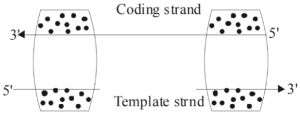
In the given transcription unit,identify the regions $I$ and $II$ respectively.
A
Promoter and Terminator
B
Rho factor and sigma factor
C
Terminator and Promoter
D
Operator and Inhibitor
Solution
(A) The correct answer is $(A)$.
In a transcription unit,the promoter is located at the $5'$-end of the coding strand (upstream),which provides the binding site for $RNA$ polymerase.
The terminator is located at the $3'$-end of the coding strand (downstream),which signals the end of the transcription process.
Based on the provided diagram,region $I$ represents the Promoter and region $II$ represents the Terminator.
In a transcription unit,the promoter is located at the $5'$-end of the coding strand (upstream),which provides the binding site for $RNA$ polymerase.
The terminator is located at the $3'$-end of the coding strand (downstream),which signals the end of the transcription process.
Based on the provided diagram,region $I$ represents the Promoter and region $II$ represents the Terminator.
0 likesView Solution
39
BiologyEasyMCQKCET · 2018
Which of the following sequences of mRNA are required for the translation process but are not translated?
A
Stop codons
B
Anticodons
C
Sense codons
D
$UTR$
Solution
(D) The correct answer is $D$.
Untranslated regions $(UTRs)$ are specific sequences present on the $mRNA$ that are required for efficient translation but are not translated into proteins.
These regions are located before the start codon at the $5'$-end and after the stop codon at the $3'$-end.
Untranslated regions $(UTRs)$ are specific sequences present on the $mRNA$ that are required for efficient translation but are not translated into proteins.
These regions are located before the start codon at the $5'$-end and after the stop codon at the $3'$-end.
0 likesView Solution
40
BiologyEasyMCQKCET · 2018
The allele frequency of '$A$' and '$a$' in a population are $0.6$ and $0.4$ respectively. The expected frequency of heterozygous individuals is: (in $\%$)
A
$48$
B
$36$
C
$16$
D
$24$
Solution
(A) The correct answer is $A$ $(48\%)$.
In a population,the frequency of alleles and genotypes can be calculated using the Hardy-Weinberg equilibrium principle.
The algebraic expression is $p^2 + 2pq + q^2 = 1$.
Here,$p$ represents the frequency of the dominant allele '$A$' $(p = 0.6)$.
$q$ represents the frequency of the recessive allele '$a$' $(q = 0.4)$.
The term $2pq$ represents the frequency of heterozygous individuals $(Aa)$.
Calculation: $2 \times p \times q = 2 \times 0.6 \times 0.4 = 0.48$.
Converting this to a percentage: $0.48 \times 100 = 48\%$.
Thus,the expected frequency of heterozygous individuals is $48\%$.
In a population,the frequency of alleles and genotypes can be calculated using the Hardy-Weinberg equilibrium principle.
The algebraic expression is $p^2 + 2pq + q^2 = 1$.
Here,$p$ represents the frequency of the dominant allele '$A$' $(p = 0.6)$.
$q$ represents the frequency of the recessive allele '$a$' $(q = 0.4)$.
The term $2pq$ represents the frequency of heterozygous individuals $(Aa)$.
Calculation: $2 \times p \times q = 2 \times 0.6 \times 0.4 = 0.48$.
Converting this to a percentage: $0.48 \times 100 = 48\%$.
Thus,the expected frequency of heterozygous individuals is $48\%$.
0 likesView Solution
41
BiologyEasyMCQKCET · 2018
The primary gases that were used by Miller in his experiment are
A
$CH_4, NH_3, H_2O, H_2$
B
$CH_4, CO_2, N_2, NH_3$
C
$CH_4, CO_2, N_2, NH_2$
D
$CH_4, N_2, NH_3, H_2$
Solution
(A) The correct option is $A$.
Stanley Miller and Harold Urey supported the chemical origin of life theory proposed by Oparin and Haldane.
In their experiment,they used a mixture of methane $(CH_4)$,ammonia $(NH_3)$,hydrogen $(H_2)$,and water vapor $(H_2O)$ in a ratio of $2:1:2$.
These gases were chosen to simulate the reducing atmosphere of the primitive Earth.
Stanley Miller and Harold Urey supported the chemical origin of life theory proposed by Oparin and Haldane.
In their experiment,they used a mixture of methane $(CH_4)$,ammonia $(NH_3)$,hydrogen $(H_2)$,and water vapor $(H_2O)$ in a ratio of $2:1:2$.
These gases were chosen to simulate the reducing atmosphere of the primitive Earth.
0 likesView Solution
42
BiologyEasyMCQKCET · 2018
During the replication of a retrovirus,what is introduced into the host cell?
A
Viral protein is introduced into the host cell.
B
Viral $RNA$ is introduced into the host cell.
C
Viral $DNA$ is introduced into the host cell.
D
Transcriptase enzyme is introduced into the host cell.
Solution
(B) The correct answer is $B$.
When a retrovirus (such as $HIV$) infects a host cell,it introduces its genetic material,which is viral $RNA$,into the host cell.
Inside the host cell,the virus sheds its protein coat.
$A$ viral enzyme called reverse transcriptase then reads the viral $RNA$ strand and makes a complementary $DNA$ copy.
This viral $DNA$ copy is then integrated into the host cell's genome,allowing the virus to replicate using the host's machinery.
When a retrovirus (such as $HIV$) infects a host cell,it introduces its genetic material,which is viral $RNA$,into the host cell.
Inside the host cell,the virus sheds its protein coat.
$A$ viral enzyme called reverse transcriptase then reads the viral $RNA$ strand and makes a complementary $DNA$ copy.
This viral $DNA$ copy is then integrated into the host cell's genome,allowing the virus to replicate using the host's machinery.
0 likesView Solution
43
BiologyEasyMCQKCET · 2018
Identify the odd one from the following:
A
$\alpha$-Interferon
B
Oncogenic virus
C
Proto-oncogenes
D
$UV$ rays
Solution
(A) The correct answer is $A$.
$\alpha$-Interferon is a biological response modifier used in the treatment of cancer.
On the other hand,oncogenic viruses,proto-oncogenes (when mutated),and $UV$ rays are all classified as carcinogens or cancer-causing agents.
Therefore,$\alpha$-Interferon is the odd one out.
$\alpha$-Interferon is a biological response modifier used in the treatment of cancer.
On the other hand,oncogenic viruses,proto-oncogenes (when mutated),and $UV$ rays are all classified as carcinogens or cancer-causing agents.
Therefore,$\alpha$-Interferon is the odd one out.
0 likesView Solution
44
BiologyEasyMCQKCET · 2018
In malignant tumours,the cells divide rapidly and move to distant parts of the body to cause new tumours. This property is called:
A
metastasis
B
metagenesis
C
teratogenesis
D
mitosis
Solution
(A) metastasis.
In malignant tumours,the cells divide rapidly and move to distant parts of the body through blood or lymph to form new tumours at secondary sites. This unique and dangerous property of malignant tumours is known as metastasis.
In malignant tumours,the cells divide rapidly and move to distant parts of the body through blood or lymph to form new tumours at secondary sites. This unique and dangerous property of malignant tumours is known as metastasis.
0 likesView Solution
45
BiologyEasyMCQKCET · 2018
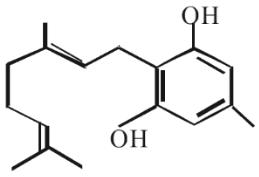
From which of the given plants is the drug whose skeletal structure is given below extracted?
A
Papaver somniferum
B
Atropa belladonna
C
Cannabis sativa
D
Erythroxylum coca
Solution
(C) The chemical structure shown in the image is that of a cannabinoid,specifically Cannabinol or a related compound derived from the plant Cannabis sativa.
Cannabinoids are a group of chemicals that interact with cannabinoid receptors in the brain.
Cannabis sativa is the source of various drugs such as marijuana,ganja,hashish,and charas.
Therefore,the correct option is $(C)$.
Cannabinoids are a group of chemicals that interact with cannabinoid receptors in the brain.
Cannabis sativa is the source of various drugs such as marijuana,ganja,hashish,and charas.
Therefore,the correct option is $(C)$.
0 likesView Solution
46
BiologyEasyMCQKCET · 2018
Match the items in Column-$I$ with those of Column-$II$ and choose the correct answer.
Select the code for the correct answer from the options given below.
| Column-$I$ | Column-$II$ |
|---|---|
| $(A)$ Hepatitis $B$ vaccine | $(p)$ $IgA$ |
| $(B)$ Preformed antibodies | $(q)$ Against snake venom |
| $(C)$ Colostrum | $(r)$ Neutrophils |
| $(D)$ $PMNL$ | $(s)$ Yeast |
| $(t)$ Basophils |
Select the code for the correct answer from the options given below.
A
$A-s, B-q, C-p, D-r$
B
$A-p, B-q, C-s, D-r$
C
$A-s, B-q, C-p, D-t$
D
$A-t, B-q, C-s, D-p$
Solution
(A) The correct matching is as follows:
$1$. $(A)$ Hepatitis $B$ vaccine is produced using recombinant $DNA$ technology in yeast cells. Thus,$(A-s)$.
$2$. $(B)$ Preformed antibodies are administered for passive immunity,such as in the case of snake venom treatment. Thus,$(B-q)$.
$3$. $(C)$ Colostrum,the yellowish fluid secreted by the mother during initial days of lactation,is rich in $IgA$ antibodies. Thus,$(C-p)$.
$4$. $(D)$ $PMNL$ (Polymorphonuclear leukocytes) are a type of innate immune cell,specifically neutrophils. Thus,$(D-r)$.
Therefore,the correct sequence is $A-s, B-q, C-p, D-r$.
$1$. $(A)$ Hepatitis $B$ vaccine is produced using recombinant $DNA$ technology in yeast cells. Thus,$(A-s)$.
$2$. $(B)$ Preformed antibodies are administered for passive immunity,such as in the case of snake venom treatment. Thus,$(B-q)$.
$3$. $(C)$ Colostrum,the yellowish fluid secreted by the mother during initial days of lactation,is rich in $IgA$ antibodies. Thus,$(C-p)$.
$4$. $(D)$ $PMNL$ (Polymorphonuclear leukocytes) are a type of innate immune cell,specifically neutrophils. Thus,$(D-r)$.
Therefore,the correct sequence is $A-s, B-q, C-p, D-r$.
0 likesView Solution
47
BiologyEasyMCQKCET · 2018
Match the following bacteria/fungi of Column $I$ with their commercial products of Column $II$.
Select the code for the correct answer from the options given below.
| Column $I$ | Column $II$ |
|---|---|
| $A$. Lactobacillus | $p$. Butyric acid |
| $B$. Aspergillus niger | $q$. Acetic acid |
| $C$. Acetobacter aceti | $r$. Lactic acid |
| $D$. Clostridium butylicum | $s$. Citric acid |
Select the code for the correct answer from the options given below.
A
$A-r, B-q, C-s, D-p$
B
$A-p, B-s, C-r, D-q$
C
$A-r, B-s, C-q, D-p$
D
$A-r, B-s, C-p, D-q$
Solution
(C) The correct matching is: $A-r, B-s, C-q, D-p$.
$1$. $Lactobacillus$ produces lactic acid, which helps in the coagulation of milk proteins to form curd.
$2$. $Aspergillus$ $niger$ (a fungus) is used for the commercial production of citric acid.
$3$. $Acetobacter$ $aceti$ (a bacterium) is used for the production of acetic acid (vinegar) by oxidizing ethyl alcohol.
$4$. $Clostridium$ $butylicum$ (a bacterium) is responsible for the production of butyric acid.
$1$. $Lactobacillus$ produces lactic acid, which helps in the coagulation of milk proteins to form curd.
$2$. $Aspergillus$ $niger$ (a fungus) is used for the commercial production of citric acid.
$3$. $Acetobacter$ $aceti$ (a bacterium) is used for the production of acetic acid (vinegar) by oxidizing ethyl alcohol.
$4$. $Clostridium$ $butylicum$ (a bacterium) is responsible for the production of butyric acid.
0 likesView Solution
48
BiologyEasyMCQKCET · 2018
The microorganisms involved in floc formation during sewage treatment are
A
anaerobic bacteria and fungus
B
aerobic bacteria and fungus
C
autotrophic bacteria and yeast
D
fungus and algae
Solution
(B) The correct answer is $B$.
During the secondary treatment of sewage,the primary effluent is passed into large aeration tanks where it is constantly agitated mechanically and air is pumped into it.
This allows vigorous growth of useful aerobic microbes into flocs.
Flocs are masses of bacteria associated with fungal filaments to form mesh-like structures.
These microorganisms consume the major part of the organic matter in the effluent,thereby significantly reducing the $BOD$ (Biochemical Oxygen Demand) of the sewage.
During the secondary treatment of sewage,the primary effluent is passed into large aeration tanks where it is constantly agitated mechanically and air is pumped into it.
This allows vigorous growth of useful aerobic microbes into flocs.
Flocs are masses of bacteria associated with fungal filaments to form mesh-like structures.
These microorganisms consume the major part of the organic matter in the effluent,thereby significantly reducing the $BOD$ (Biochemical Oxygen Demand) of the sewage.
0 likesView Solution
49
BiologyEasyMCQKCET · 2018
Choose the bacterium which is not a source of $REN$.
A
Haemophilus influenzae
B
Escherichia coli
C
Agrobacterium tumefaciens
D
Bacillus amyloliquefaciens
Solution
(C) $Agrobacterium$ $tumefaciens$ is not a source of restriction endonucleases $(REN)$.
$Haemophilus$ $influenzae$ is the source of $HindIII$.
$Escherichia$ $coli$ is the source of $EcoRI$.
$Bacillus$ $amyloliquefaciens$ is the source of $BamHI$.
Therefore,the correct option is $C$.
$Haemophilus$ $influenzae$ is the source of $HindIII$.
$Escherichia$ $coli$ is the source of $EcoRI$.
$Bacillus$ $amyloliquefaciens$ is the source of $BamHI$.
Therefore,the correct option is $C$.
0 likesView Solution
50
BiologyEasyMCQKCET · 2018
The technique of bombarding plant cells with high velocity microparticles of gold or tungsten,coated with $DNA$,is known as:
A
microinjection
B
biolistic method
C
heat shock method
D
disarmed pathogen vector
Solution
(B) biolistic method.
The biolistic method,also known as the gene gun method,is a physical technique used to introduce foreign $DNA$ into plant cells.
In this process,microparticles of gold or tungsten are coated with the target $DNA$ and are bombarded into the host cells at high velocity.
This method is particularly effective for plant cells because it can penetrate the rigid cell wall.
The biolistic method,also known as the gene gun method,is a physical technique used to introduce foreign $DNA$ into plant cells.
In this process,microparticles of gold or tungsten are coated with the target $DNA$ and are bombarded into the host cells at high velocity.
This method is particularly effective for plant cells because it can penetrate the rigid cell wall.
0 likesView Solution
51
BiologyEasyMCQKCET · 2018
Identify the palindromic sequence in the following base sequences.
A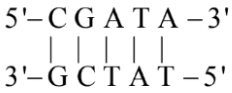
$5$'-$CGATA$-$3$'
$3$'-$GCTAT$-$5$'
$3$'-$GCTAT$-$5$'
B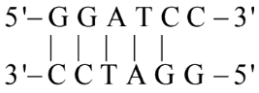
$5$'-$GGATCC$-$3$'
$3$'-$CCTAGG$-$5$'
$3$'-$CCTAGG$-$5$'
C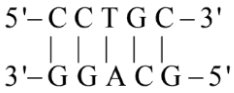
$5$'-$CCTGC$-$3$'
$3$'-$GGACG$-$5$'
$3$'-$GGACG$-$5$'
D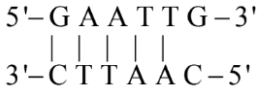
$5$'-$GAATTG$-$3$'
$3$'-$CTTAAC$-$5$'
$3$'-$CTTAAC$-$5$'
Solution
(B) The correct answer is $B$.
$A$ palindromic nucleotide sequence in a $DNA$ molecule is a sequence of base pairs that reads the same on the two strands when the orientation of reading is kept the same (i.e.,$5' \rightarrow 3'$ direction).
In option $B$:
$5'-GGATCC-3'$
$3'-CCTAGG-5'$
If we read the top strand in the $5' \rightarrow 3'$ direction,we get $G-G-A-T-C-C$.
If we read the bottom strand in the $5' \rightarrow 3'$ direction (from right to left),we get $G-G-A-T-C-C$.
Since both strands read the same in the $5' \rightarrow 3'$ direction,this is a palindromic sequence.
$A$ palindromic nucleotide sequence in a $DNA$ molecule is a sequence of base pairs that reads the same on the two strands when the orientation of reading is kept the same (i.e.,$5' \rightarrow 3'$ direction).
In option $B$:
$5'-GGATCC-3'$
$3'-CCTAGG-5'$
If we read the top strand in the $5' \rightarrow 3'$ direction,we get $G-G-A-T-C-C$.
If we read the bottom strand in the $5' \rightarrow 3'$ direction (from right to left),we get $G-G-A-T-C-C$.
Since both strands read the same in the $5' \rightarrow 3'$ direction,this is a palindromic sequence.
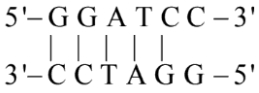
0 likesView Solution
Vedclass Products
For Students
Vedclass Test Series
Mock tests in real KCET style covering Biology with performance analysis. 5-day free trial.
Start Free TrialFor Teachers
Exam Paper Generator
Generate Set A/B/C/D Biology papers from 7.5L+ questions in 2 minutes. 3 chapters free.
Try FreeFor Institutes
Online Exam Module
Run live KCET mock exams with unlimited students, 360° analytics & white-label branding.
See DemoFrequently Asked Questions
How many Biology questions are in KCET 2018?
There are 51 Biology questions from the KCET 2018 paper on Vedclass, each with a detailed step-by-step solution in English.
Are KCET 2018 Biology solutions available in English?
Yes. All solutions on this page are in English. You can also switch to English or Hindi using the language buttons above the questions.
Can I practice KCET 2018 Biology as a timed test?
Yes. Use the Vedclass Test Series to attempt a full KCET mock test covering Biology with time limits and instant score analysis.
Can teachers create Biology papers from KCET previous year questions?
Yes. The Vedclass Exam Paper Generator lets teachers mix KCET Biology questions and generate Set A/B/C/D papers in minutes.
For Teachers & Institutes
Build a Custom Biology Paper
Pick KCET 2018 Biology questions, set difficulty, and generate Set A/B/C/D in 2 minutes.