
PhysicsQ1–60 of 60 questions
Page 1 of 1 · English
1
PhysicsEasyMCQKCET · 2014
$A$ person is driving a vehicle at a uniform speed of $5 \text{ ms}^{-1}$ on a level curved track of radius $5 \text{ m}$. The coefficient of static friction between the tyres and the road is $0.1$. Will the person slip while taking the turn with the same speed? (Take $g = 10 \text{ ms}^{-2}$)
A
$A$ person will slip if $v^2 = 5 \text{ ms}^{-1}$
B
$A$ person will slip if $v^2 > 5 \text{ ms}^{-1}$
C
$A$ person will slip if $v^2 < 5 \text{ ms}^{-1}$
D
$A$ person will slip if $v^2 > 10 \text{ ms}^{-1}$
Solution
(B) The maximum speed $v_{max}$ to avoid slipping on a level circular path is given by the condition $v_{max} = \sqrt{\mu_s rg}$.
Squaring both sides,we get $v_{max}^2 = \mu_s rg$.
Given values are $\mu_s = 0.1$,$r = 5 \text{ m}$,and $g = 10 \text{ ms}^{-2}$.
Substituting these values: $v_{max}^2 = 0.1 \times 5 \times 10 = 5 \text{ m}^2\text{s}^{-2}$.
For the vehicle to not slip,the condition is $v^2 \leq v_{max}^2$,which means $v^2 \leq 5 \text{ m}^2\text{s}^{-2}$.
If the square of the actual speed $v^2$ exceeds this value,the vehicle will slip.
Therefore,the person will slip if $v^2 > 5 \text{ m}^2\text{s}^{-2}$.
Squaring both sides,we get $v_{max}^2 = \mu_s rg$.
Given values are $\mu_s = 0.1$,$r = 5 \text{ m}$,and $g = 10 \text{ ms}^{-2}$.
Substituting these values: $v_{max}^2 = 0.1 \times 5 \times 10 = 5 \text{ m}^2\text{s}^{-2}$.
For the vehicle to not slip,the condition is $v^2 \leq v_{max}^2$,which means $v^2 \leq 5 \text{ m}^2\text{s}^{-2}$.
If the square of the actual speed $v^2$ exceeds this value,the vehicle will slip.
Therefore,the person will slip if $v^2 > 5 \text{ m}^2\text{s}^{-2}$.
0 likesView Solution
2
PhysicsMediumMCQKCET · 2014
$A$ body starts from rest and moves with constant acceleration for $t$ seconds. It travels a distance $x_{1}$ in the first half of the time and $x_{2}$ in the next half of the time. Then:
A
$x_{2} = x_{1}$
B
$x_{2} = 2x_{1}$
C
$x_{2} = 3x_{1}$
D
$x_{2} = 4x_{1}$
Solution
(C) Let the total time be $t$ and acceleration be $a$. The initial velocity $u = 0$.
For the first half of the time,$t_{1} = t/2$:
$x_{1} = u t_{1} + \frac{1}{2} a t_{1}^{2} = 0 + \frac{1}{2} a (t/2)^{2} = \frac{1}{8} a t^{2}$.
For the total time $t$,the total distance $x_{total} = x_{1} + x_{2} = \frac{1}{2} a t^{2}$.
Substituting $x_{1} = \frac{1}{8} a t^{2}$ into the total distance equation:
$\frac{1}{8} a t^{2} + x_{2} = \frac{1}{2} a t^{2}$.
$x_{2} = \frac{1}{2} a t^{2} - \frac{1}{8} a t^{2} = \frac{4-1}{8} a t^{2} = \frac{3}{8} a t^{2}$.
Comparing $x_{1}$ and $x_{2}$:
$x_{2} = 3 \times (\frac{1}{8} a t^{2}) = 3 x_{1}$.
For the first half of the time,$t_{1} = t/2$:
$x_{1} = u t_{1} + \frac{1}{2} a t_{1}^{2} = 0 + \frac{1}{2} a (t/2)^{2} = \frac{1}{8} a t^{2}$.
For the total time $t$,the total distance $x_{total} = x_{1} + x_{2} = \frac{1}{2} a t^{2}$.
Substituting $x_{1} = \frac{1}{8} a t^{2}$ into the total distance equation:
$\frac{1}{8} a t^{2} + x_{2} = \frac{1}{2} a t^{2}$.
$x_{2} = \frac{1}{2} a t^{2} - \frac{1}{8} a t^{2} = \frac{4-1}{8} a t^{2} = \frac{3}{8} a t^{2}$.
Comparing $x_{1}$ and $x_{2}$:
$x_{2} = 3 \times (\frac{1}{8} a t^{2}) = 3 x_{1}$.
0 likesView Solution
3
PhysicsMediumMCQKCET · 2014
$A$ physical quantity $Q$ is found to depend on observables $x, y$ and $z$,obeying the relation $Q = \frac{x^3 y^2}{z}$. The percentage errors in the measurements of $x, y$ and $z$ are $1\%, 2\%$ and $4\%$ respectively. What is the percentage error in the quantity $Q$ (in $\%$)?
A
$1$
B
$3$
C
$11$
D
$1$
Solution
(C) Given the relation: $Q = \frac{x^3 y^2}{z}$.
Using the formula for propagation of errors,the relative error in $Q$ is given by: $\frac{\Delta Q}{Q} = 3 \frac{\Delta x}{x} + 2 \frac{\Delta y}{y} + \frac{\Delta z}{z}$.
Given percentage errors:
$\frac{\Delta x}{x} \times 100 = 1\%$
$\frac{\Delta y}{y} \times 100 = 2\%$
$\frac{\Delta z}{z} \times 100 = 4\%$
Substituting these values into the error equation:
$\frac{\Delta Q}{Q} \times 100 = 3(1\%) + 2(2\%) + 1(4\%)$
$= 3\% + 4\% + 4\% = 11\%$.
Therefore,the percentage error in $Q$ is $11\%$.
Using the formula for propagation of errors,the relative error in $Q$ is given by: $\frac{\Delta Q}{Q} = 3 \frac{\Delta x}{x} + 2 \frac{\Delta y}{y} + \frac{\Delta z}{z}$.
Given percentage errors:
$\frac{\Delta x}{x} \times 100 = 1\%$
$\frac{\Delta y}{y} \times 100 = 2\%$
$\frac{\Delta z}{z} \times 100 = 4\%$
Substituting these values into the error equation:
$\frac{\Delta Q}{Q} \times 100 = 3(1\%) + 2(2\%) + 1(4\%)$
$= 3\% + 4\% + 4\% = 11\%$.
Therefore,the percentage error in $Q$ is $11\%$.
0 likesView Solution
4
PhysicsMediumMCQKCET · 2014
$A$ rotating wheel changes its angular speed from $ 1800 \ rpm $ to $ 3000 \ rpm $ in $ 20 \ s $. What is the angular acceleration,assuming it to be uniform?
A
$ 6 \pi \ rad \ s^{-2} $
B
$ 9 \pi \ rad \ s^{-2} $
C
$ 2 \pi \ rad \ s^{-2} $
D
$ 4 \pi \ rad \ s^{-2} $
Solution
(C) Initial angular speed $\omega_{1} = 1800 \ rpm = \frac{1800 \times 2\pi}{60} \ rad \ s^{-1} = 60\pi \ rad \ s^{-1}$.
Final angular speed $\omega_{2} = 3000 \ rpm = \frac{3000 \times 2\pi}{60} \ rad \ s^{-1} = 100\pi \ rad \ s^{-1}$.
Time interval $t = 20 \ s$.
Angular acceleration $\alpha = \frac{\omega_{2} - \omega_{1}}{t}$.
$\alpha = \frac{100\pi - 60\pi}{20} = \frac{40\pi}{20} = 2\pi \ rad \ s^{-2}$.
Final angular speed $\omega_{2} = 3000 \ rpm = \frac{3000 \times 2\pi}{60} \ rad \ s^{-1} = 100\pi \ rad \ s^{-1}$.
Time interval $t = 20 \ s$.
Angular acceleration $\alpha = \frac{\omega_{2} - \omega_{1}}{t}$.
$\alpha = \frac{100\pi - 60\pi}{20} = \frac{40\pi}{20} = 2\pi \ rad \ s^{-2}$.
0 likesView Solution
5
PhysicsEasyMCQKCET · 2014
$A$ $10 \,kg$ metal block is attached to a spring of spring constant $1000 \,N \,m^{-1}$. The block is displaced from the equilibrium position by $10 \,cm$ and released. The maximum acceleration of the block is: (in $\,m/s^2$)
A
$10$
B
$100$
C
$200$
D
$0.1$
Solution
(A) Given: mass $m = 10 \,kg$, spring constant $k = 1000 \,N/m$, and amplitude $A = 10 \,cm = 0.1 \,m$.
In simple harmonic motion, the restoring force is $F = -kx$.
The maximum force occurs at maximum displacement (amplitude), so $F_{max} = kA$.
Using Newton's second law, $F_{max} = m a_{max}$.
Therefore, $m a_{max} = kA$.
$a_{max} = \frac{kA}{m} = \frac{1000 \,N/m \times 0.1 \,m}{10 \,kg} = \frac{100}{10} = 10 \,m/s^2$.
The maximum acceleration of the block is $10 \,m/s^2$.
In simple harmonic motion, the restoring force is $F = -kx$.
The maximum force occurs at maximum displacement (amplitude), so $F_{max} = kA$.
Using Newton's second law, $F_{max} = m a_{max}$.
Therefore, $m a_{max} = kA$.
$a_{max} = \frac{kA}{m} = \frac{1000 \,N/m \times 0.1 \,m}{10 \,kg} = \frac{100}{10} = 10 \,m/s^2$.
The maximum acceleration of the block is $10 \,m/s^2$.
0 likesView Solution
6
PhysicsMediumMCQKCET · 2014
Which of the following is not a vector quantity?
A
Weight
B
Nuclear spin
C
Momentum
D
Potential energy
Solution
(D) vector quantity is defined as a physical quantity that possesses both magnitude and direction.
Conversely,a scalar quantity is defined as a physical quantity that possesses only magnitude and no direction.
$1$. Weight is the force of gravity acting on an object,which has both magnitude and direction (downward),making it a vector.
$2$. Nuclear spin is an intrinsic angular momentum of a nucleus,which is a vector quantity.
$3$. Momentum is defined as the product of mass and velocity $(p = mv)$. Since velocity is a vector,momentum is also a vector.
$4$. Potential energy is a scalar quantity because it represents the energy stored in an object due to its position or configuration,which does not have a specific direction.
Therefore,potential energy is not a vector quantity.
Conversely,a scalar quantity is defined as a physical quantity that possesses only magnitude and no direction.
$1$. Weight is the force of gravity acting on an object,which has both magnitude and direction (downward),making it a vector.
$2$. Nuclear spin is an intrinsic angular momentum of a nucleus,which is a vector quantity.
$3$. Momentum is defined as the product of mass and velocity $(p = mv)$. Since velocity is a vector,momentum is also a vector.
$4$. Potential energy is a scalar quantity because it represents the energy stored in an object due to its position or configuration,which does not have a specific direction.
Therefore,potential energy is not a vector quantity.
0 likesView Solution
7
PhysicsDifficultMCQKCET · 2014
$A$ force $\vec{F} = 5\hat{i} + 2\hat{j} - 5\hat{k}$ acts on a particle whose position vector is $\vec{r} = \hat{i} - 2\hat{j} + \hat{k}$. What is the torque about the origin?
A
$8\hat{i} + 10\hat{j} + 12\hat{k}$
B
$8\hat{i} + 10\hat{j} - 12\hat{k}$
C
$8\hat{i} - 10\hat{j} - 8\hat{k}$
D
$10\hat{i} - 10\hat{j} - \hat{k}$
Solution
(A) Given: $\vec{F} = 5\hat{i} + 2\hat{j} - 5\hat{k}$ and $\vec{r} = \hat{i} - 2\hat{j} + \hat{k}$.
Torque $\vec{\tau}$ is defined as the cross product of the position vector and the force vector: $\vec{\tau} = \vec{r} \times \vec{F}$.
Using the determinant method:
$\vec{\tau} = \begin{vmatrix} \hat{i} & \hat{j} & \hat{k} \\ 1 & -2 & 1 \\ 5 & 2 & -5 \end{vmatrix}$
Expanding the determinant:
$\vec{\tau} = \hat{i}((-2)(-5) - (1)(2)) - \hat{j}((1)(-5) - (1)(5)) + \hat{k}((1)(2) - (-2)(5))$
$\vec{\tau} = \hat{i}(10 - 2) - \hat{j}(-5 - 5) + \hat{k}(2 + 10)$
$\vec{\tau} = 8\hat{i} - (-10)\hat{j} + 12\hat{k}$
$\vec{\tau} = 8\hat{i} + 10\hat{j} + 12\hat{k}$.
Torque $\vec{\tau}$ is defined as the cross product of the position vector and the force vector: $\vec{\tau} = \vec{r} \times \vec{F}$.
Using the determinant method:
$\vec{\tau} = \begin{vmatrix} \hat{i} & \hat{j} & \hat{k} \\ 1 & -2 & 1 \\ 5 & 2 & -5 \end{vmatrix}$
Expanding the determinant:
$\vec{\tau} = \hat{i}((-2)(-5) - (1)(2)) - \hat{j}((1)(-5) - (1)(5)) + \hat{k}((1)(2) - (-2)(5))$
$\vec{\tau} = \hat{i}(10 - 2) - \hat{j}(-5 - 5) + \hat{k}(2 + 10)$
$\vec{\tau} = 8\hat{i} - (-10)\hat{j} + 12\hat{k}$
$\vec{\tau} = 8\hat{i} + 10\hat{j} + 12\hat{k}$.
0 likesView Solution
8
PhysicsEasyMCQKCET · 2014
An aeroplane executes a horizontal loop at a speed of $720 \text{ km/h}$ with its wings banked at $45^{\circ}$. What is the radius of the loop (in $\text{ km}$)? Take $g = 10 \text{ m/s}^2$.
A
$4$
B
$4.5$
C
$7.2$
D
$2$
Solution
(A) Given, speed of aeroplane $v = 720 \text{ km/h} = 720 \times \frac{5}{18} \text{ m/s} = 200 \text{ m/s}$.
Angle of banking $\theta = 45^{\circ}$.
Acceleration due to gravity $g = 10 \text{ m/s}^2$.
The formula for the radius of a horizontal loop is given by $\tan \theta = \frac{v^2}{rg}$.
Rearranging for $r$, we get $r = \frac{v^2}{g \tan \theta}$.
Substituting the values: $r = \frac{(200)^2}{10 \times \tan 45^{\circ}}$.
Since $\tan 45^{\circ} = 1$, we have $r = \frac{40000}{10 \times 1} = 4000 \text{ m}$.
Converting to kilometers, $r = 4 \text{ km}$.
Angle of banking $\theta = 45^{\circ}$.
Acceleration due to gravity $g = 10 \text{ m/s}^2$.
The formula for the radius of a horizontal loop is given by $\tan \theta = \frac{v^2}{rg}$.
Rearranging for $r$, we get $r = \frac{v^2}{g \tan \theta}$.
Substituting the values: $r = \frac{(200)^2}{10 \times \tan 45^{\circ}}$.
Since $\tan 45^{\circ} = 1$, we have $r = \frac{40000}{10 \times 1} = 4000 \text{ m}$.
Converting to kilometers, $r = 4 \text{ km}$.
0 likesView Solution
9
PhysicsMediumMCQKCET · 2014
In anomalous expansion of water, at what temperature is the density of water maximum?
A
$ 4^{\circ} C $
B
< $ 4^{\circ} C $
C
> $ 4^{\circ} C $
D
$ 10^{\circ} C $
Solution
(A) Anomalous expansion of water is a unique property where water contracts instead of expanding when heated between $ 0^{\circ} C $ and $ 4^{\circ} C $.
Since density is defined as mass per unit volume $( \rho = m/V )$, as the volume decreases while the mass remains constant, the density increases.
At $ 4^{\circ} C $, the volume of a given mass of water is minimum.
Therefore, the density of water is maximum at $ 4^{\circ} C $.
Since density is defined as mass per unit volume $( \rho = m/V )$, as the volume decreases while the mass remains constant, the density increases.
At $ 4^{\circ} C $, the volume of a given mass of water is minimum.
Therefore, the density of water is maximum at $ 4^{\circ} C $.
0 likesView Solution
10
PhysicsMediumMCQKCET · 2014
$A$ body having a moment of inertia about its axis of rotation equal to $3 \ kg \ m^{2}$ is rotating with an angular velocity of $3 \ rad \ s^{-1}$. The kinetic energy of this rotating body is the same as that of a body of mass $27 \ kg$ moving with velocity $v$. The value of $v$ is: (in $m \ s^{-1}$)
A
$1$
B
$0.5$
C
$2$
D
$1.5$
Solution
(A) Given: Moment of inertia $I = 3 \ kg \ m^{2}$,angular velocity $\omega = 3 \ rad \ s^{-1}$,and mass $m = 27 \ kg$.
The rotational kinetic energy of the body is given by $K_{rot} = \frac{1}{2} I \omega^{2}$.
The translational kinetic energy of the second body is given by $K_{trans} = \frac{1}{2} m v^{2}$.
According to the problem,$K_{rot} = K_{trans}$.
Therefore,$\frac{1}{2} I \omega^{2} = \frac{1}{2} m v^{2}$.
$I \omega^{2} = m v^{2}$.
$v^{2} = \frac{I \omega^{2}}{m}$.
$v = \omega \sqrt{\frac{I}{m}}$.
Substituting the values: $v = 3 \times \sqrt{\frac{3}{27}} = 3 \times \sqrt{\frac{1}{9}} = 3 \times \frac{1}{3} = 1 \ m \ s^{-1}$.
The rotational kinetic energy of the body is given by $K_{rot} = \frac{1}{2} I \omega^{2}$.
The translational kinetic energy of the second body is given by $K_{trans} = \frac{1}{2} m v^{2}$.
According to the problem,$K_{rot} = K_{trans}$.
Therefore,$\frac{1}{2} I \omega^{2} = \frac{1}{2} m v^{2}$.
$I \omega^{2} = m v^{2}$.
$v^{2} = \frac{I \omega^{2}}{m}$.
$v = \omega \sqrt{\frac{I}{m}}$.
Substituting the values: $v = 3 \times \sqrt{\frac{3}{27}} = 3 \times \sqrt{\frac{1}{9}} = 3 \times \frac{1}{3} = 1 \ m \ s^{-1}$.
0 likesView Solution
11
PhysicsMediumMCQKCET · 2014
What is the source temperature of the Carnot engine required to get $70 \%$ efficiency (in $^{\circ}C$)? Given sink temperature $= 27^{\circ}C$.
A
$1000$
B
$90$
C
$270$
D
$727$
Solution
(D) Given,efficiency,$\eta = 70 \% = 0.7$.
Sink temperature,$T_2 = 27^{\circ}C = 273 + 27 = 300 \ K$.
The efficiency of a Carnot engine is given by the formula: $\eta = 1 - \frac{T_2}{T_1}$.
Substituting the given values: $0.7 = 1 - \frac{300}{T_1}$.
Rearranging the terms: $\frac{300}{T_1} = 1 - 0.7 = 0.3$.
Solving for source temperature $T_1$: $T_1 = \frac{300}{0.3} = 1000 \ K$.
Converting the temperature back to Celsius: $T_1 = 1000 - 273 = 727^{\circ}C$.
Therefore,the source temperature required is $727^{\circ}C$.
Sink temperature,$T_2 = 27^{\circ}C = 273 + 27 = 300 \ K$.
The efficiency of a Carnot engine is given by the formula: $\eta = 1 - \frac{T_2}{T_1}$.
Substituting the given values: $0.7 = 1 - \frac{300}{T_1}$.
Rearranging the terms: $\frac{300}{T_1} = 1 - 0.7 = 0.3$.
Solving for source temperature $T_1$: $T_1 = \frac{300}{0.3} = 1000 \ K$.
Converting the temperature back to Celsius: $T_1 = 1000 - 273 = 727^{\circ}C$.
Therefore,the source temperature required is $727^{\circ}C$.
0 likesView Solution
12
PhysicsDifficultMCQKCET · 2014
$A$ flow of liquid is streamline if the Reynolds number is
A
less than $1000$
B
greater than $1000$
C
between $2000$ to $3000$
D
between $4000$ to $5000$
Solution
$(A)$ The Reynolds number $(Re)$ is a dimensionless quantity that represents the ratio of inertial forces to viscous forces in a fluid flow.
It is used to predict the flow regime of a fluid.
For a flow in a pipe, if the Reynolds number is less than $2000$, the flow is considered to be streamline or laminar.
If the Reynolds number is between $2000$ and $4000$, the flow is in a transition state.
If the Reynolds number is greater than $4000$, the flow is turbulent.
Among the given options, the condition for streamline flow is satisfied by the range less than $1000$.
It is used to predict the flow regime of a fluid.
For a flow in a pipe, if the Reynolds number is less than $2000$, the flow is considered to be streamline or laminar.
If the Reynolds number is between $2000$ and $4000$, the flow is in a transition state.
If the Reynolds number is greater than $4000$, the flow is turbulent.
Among the given options, the condition for streamline flow is satisfied by the range less than $1000$.
0 likesView Solution
13
PhysicsEasyMCQKCET · 2014
$A$ car moves from $A$ to $B$ with a speed of $30 \ km/h$ and from $B$ to $A$ with a speed of $20 \ km/h$. What is the average speed of the car (in $km/h$)?
A
$25$
B
$24$
C
$50$
D
$10$
Solution
(B) Let the distance between $A$ and $B$ be $d$.
Time taken to travel from $A$ to $B$ is $t_{1} = \frac{d}{v_{1}} = \frac{d}{30}$.
Time taken to travel from $B$ to $A$ is $t_{2} = \frac{d}{v_{2}} = \frac{d}{20}$.
Average speed is defined as the total distance divided by the total time.
Average speed $= \frac{\text{Total distance}}{\text{Total time}} = \frac{d + d}{t_{1} + t_{2}} = \frac{2d}{\frac{d}{30} + \frac{d}{20}}$.
Average speed $= \frac{2d}{d(\frac{20 + 30}{600})} = \frac{2 \times 600}{50} = \frac{1200}{50} = 24 \ km/h$.
Time taken to travel from $A$ to $B$ is $t_{1} = \frac{d}{v_{1}} = \frac{d}{30}$.
Time taken to travel from $B$ to $A$ is $t_{2} = \frac{d}{v_{2}} = \frac{d}{20}$.
Average speed is defined as the total distance divided by the total time.
Average speed $= \frac{\text{Total distance}}{\text{Total time}} = \frac{d + d}{t_{1} + t_{2}} = \frac{2d}{\frac{d}{30} + \frac{d}{20}}$.
Average speed $= \frac{2d}{d(\frac{20 + 30}{600})} = \frac{2 \times 600}{50} = \frac{1200}{50} = 24 \ km/h$.
0 likesView Solution
14
PhysicsEasyMCQKCET · 2014
$A$ train is approaching a platform with a speed of $10 \,ms^{-1}$ while blowing a whistle of frequency $340 \,Hz$. What is the frequency of the whistle heard by a stationary observer on the platform (in $\,Hz$)? (Given speed of sound $= 340 \,ms^{-1}$)
A
$330$
B
$350$
C
$340$
D
$360$
Solution
(B) According to the Doppler effect, the apparent frequency $f^{\prime}$ heard by an observer when the source is moving towards a stationary observer is given by the formula:
$f^{\prime} = \left( \frac{v}{v - v_{s}} \right) f$
Where:
$f = 340 \,Hz$ (frequency of the source)
$v = 340 \,ms^{-1}$ (speed of sound)
$v_{s} = 10 \,ms^{-1}$ (speed of the source/train)
Substituting the values into the formula:
$f^{\prime} = \left( \frac{340}{340 - 10} \right) \times 340$
$f^{\prime} = \left( \frac{340}{330} \right) \times 340$
$f^{\prime} = \frac{115600}{330} \approx 350.3 \,Hz$
Rounding to the nearest integer, the frequency heard is $350 \,Hz$.
$f^{\prime} = \left( \frac{v}{v - v_{s}} \right) f$
Where:
$f = 340 \,Hz$ (frequency of the source)
$v = 340 \,ms^{-1}$ (speed of sound)
$v_{s} = 10 \,ms^{-1}$ (speed of the source/train)
Substituting the values into the formula:
$f^{\prime} = \left( \frac{340}{340 - 10} \right) \times 340$
$f^{\prime} = \left( \frac{340}{330} \right) \times 340$
$f^{\prime} = \frac{115600}{330} \approx 350.3 \,Hz$
Rounding to the nearest integer, the frequency heard is $350 \,Hz$.
0 likesView Solution
15
PhysicsEasyMCQKCET · 2014
$A$ stone is thrown vertically at a speed of $30 \,ms^{-1}$ making an angle of $45^{\circ}$ with the horizontal. What is the maximum height reached by the stone (in $\,m$)? Take $g=10 \,ms^{-2}$.
A
$30$
B
$22.5$
C
$15$
D
$10$
Solution
(B) Given: Initial speed $u = 30 \,ms^{-1}$, angle of projection $\theta = 45^{\circ}$, and acceleration due to gravity $g = 10 \,ms^{-2}$.
The formula for the maximum height $H$ reached by a projectile is given by:
$H = \frac{u^2 \sin^2 \theta}{2g}$
Substituting the given values into the formula:
$H = \frac{(30)^2 \times (\sin 45^{\circ})^2}{2 \times 10}$
Since $\sin 45^{\circ} = \frac{1}{\sqrt{2}}$, then $\sin^2 45^{\circ} = \frac{1}{2}$.
$H = \frac{900 \times \frac{1}{2}}{20} = \frac{450}{20} = 22.5 \,m$.
Therefore, the maximum height reached by the stone is $22.5 \,m$.
The formula for the maximum height $H$ reached by a projectile is given by:
$H = \frac{u^2 \sin^2 \theta}{2g}$
Substituting the given values into the formula:
$H = \frac{(30)^2 \times (\sin 45^{\circ})^2}{2 \times 10}$
Since $\sin 45^{\circ} = \frac{1}{\sqrt{2}}$, then $\sin^2 45^{\circ} = \frac{1}{2}$.
$H = \frac{900 \times \frac{1}{2}}{20} = \frac{450}{20} = 22.5 \,m$.
Therefore, the maximum height reached by the stone is $22.5 \,m$.
0 likesView Solution
16
PhysicsEasyMCQKCET · 2014
$A$ pipe of $30 \text{ cm}$ long and open at both ends produces harmonics. Which harmonic mode of the pipe resonates with a $1.1 \text{ kHz}$ source? (Given: speed of sound in air $v = 330 \text{ ms}^{-1}$)
A
Fifth harmonic
B
Fourth harmonic
C
Third harmonic
D
Second harmonic
Solution
(D) Given: Length of pipe $L = 30 \text{ cm} = 0.3 \text{ m}$.
Frequency $f = 1.1 \text{ kHz} = 1100 \text{ Hz}$.
Speed of sound $v = 330 \text{ ms}^{-1}$.
For an open pipe,the frequency of the $n^{th}$ harmonic is given by $f_n = n \times \frac{v}{2L}$.
Substituting the values: $1100 = n \times \frac{330}{2 \times 0.3}$.
$1100 = n \times \frac{330}{0.6}$.
$1100 = n \times 550$.
$n = \frac{1100}{550} = 2$.
Therefore,the pipe resonates in the second harmonic mode.
Frequency $f = 1.1 \text{ kHz} = 1100 \text{ Hz}$.
Speed of sound $v = 330 \text{ ms}^{-1}$.
For an open pipe,the frequency of the $n^{th}$ harmonic is given by $f_n = n \times \frac{v}{2L}$.
Substituting the values: $1100 = n \times \frac{330}{2 \times 0.3}$.
$1100 = n \times \frac{330}{0.6}$.
$1100 = n \times 550$.
$n = \frac{1100}{550} = 2$.
Therefore,the pipe resonates in the second harmonic mode.
0 likesView Solution
17
PhysicsMediumMCQKCET · 2014
$A$ cycle tyre bursts suddenly. What is the type of this process?
A
Isothermal
B
Adiabatic
C
Isochoric
D
Isobaric
Solution
(B) When a cycle tyre bursts suddenly,the process is adiabatic.
This is because the expansion of air occurs very rapidly,leaving no time for heat exchange between the system (the air inside the tyre) and the surroundings.
Since $dQ = 0$,the process satisfies the condition for an adiabatic process.
This is because the expansion of air occurs very rapidly,leaving no time for heat exchange between the system (the air inside the tyre) and the surroundings.
Since $dQ = 0$,the process satisfies the condition for an adiabatic process.
0 likesView Solution
18
PhysicsMediumMCQKCET · 2014
What is the period of revolution of an Earth satellite? Ignore the height of the satellite above the surface of the Earth.
Given:
$(1)$ The value of gravitational acceleration $g = 10 \ ms^{-2}$.
$(2)$ Radius of Earth $R_E = 6400 \ km$. Take $\pi = 3.14$.
Given:
$(1)$ The value of gravitational acceleration $g = 10 \ ms^{-2}$.
$(2)$ Radius of Earth $R_E = 6400 \ km$. Take $\pi = 3.14$.
A
$85$ minutes
B
$156$ minutes
C
$83.73$ minutes
D
$90$ minutes
Solution
(C) The period of revolution $T$ of a satellite orbiting very close to the Earth's surface is given by the formula:
$T = 2 \pi \sqrt{\frac{R_E}{g}}$
Given values:
$R_E = 6400 \ km = 6.4 \times 10^6 \ m$
$g = 10 \ ms^{-2}$
$\pi = 3.14$
Substituting these values into the formula:
$T = 2 \times 3.14 \times \sqrt{\frac{6.4 \times 10^6}{10}}$
$T = 6.28 \times \sqrt{6.4 \times 10^5} = 6.28 \times \sqrt{64 \times 10^4}$
$T = 6.28 \times 800 = 5024 \ s$
To convert the time into minutes:
$T = \frac{5024}{60} \ min \approx 83.73 \ min$
Therefore, the period of revolution is $83.73$ minutes.
$T = 2 \pi \sqrt{\frac{R_E}{g}}$
Given values:
$R_E = 6400 \ km = 6.4 \times 10^6 \ m$
$g = 10 \ ms^{-2}$
$\pi = 3.14$
Substituting these values into the formula:
$T = 2 \times 3.14 \times \sqrt{\frac{6.4 \times 10^6}{10}}$
$T = 6.28 \times \sqrt{6.4 \times 10^5} = 6.28 \times \sqrt{64 \times 10^4}$
$T = 6.28 \times 800 = 5024 \ s$
To convert the time into minutes:
$T = \frac{5024}{60} \ min \approx 83.73 \ min$
Therefore, the period of revolution is $83.73$ minutes.
0 likesView Solution
19
PhysicsMediumMCQKCET · 2014
The time period of a geostationary satellite is (in $\text{ h}$)
A
$24$
B
$12$
C
$30$
D
$48$
Solution
(A) geostationary satellite orbits around the Earth above the equator such that it remains stationary as seen from the Earth.
This means the satellite completes one revolution around the Earth in the same time it takes for the Earth to complete one rotation about its axis.
The rotational period of the Earth is $24 \text{ h}$.
Therefore,the time period of a geostationary satellite is $24 \text{ h}$.
This means the satellite completes one revolution around the Earth in the same time it takes for the Earth to complete one rotation about its axis.
The rotational period of the Earth is $24 \text{ h}$.
Therefore,the time period of a geostationary satellite is $24 \text{ h}$.
0 likesView Solution
20
PhysicsEasyMCQKCET · 2014
$A$ metallic wire of $1 \ m$ length has a mass of $10 \times 10^{-3} \ kg$. If a tension of $100 \ N$ is applied to the wire,what is the speed of the transverse wave (in $ms^{-1}$)?
A
$100$
B
$10$
C
$200$
D
$0.1$
Solution
(A) Given: Length of wire,$l = 1 \ m$; Mass of wire,$m = 10 \times 10^{-3} \ kg$; Tension,$T = 100 \ N$.
The speed of a transverse wave in a stretched string is given by the formula: $v = \sqrt{\frac{T}{\mu}}$,where $\mu$ is the linear mass density.
Linear mass density $\mu = \frac{m}{l} = \frac{10 \times 10^{-3} \ kg}{1 \ m} = 10 \times 10^{-3} \ kg/m$.
Substituting the values into the formula:
$v = \sqrt{\frac{100}{10 \times 10^{-3}}} = \sqrt{\frac{100}{0.01}} = \sqrt{10000} = 100 \ ms^{-1}$.
Therefore,the speed of the transverse wave is $100 \ ms^{-1}$.
The speed of a transverse wave in a stretched string is given by the formula: $v = \sqrt{\frac{T}{\mu}}$,where $\mu$ is the linear mass density.
Linear mass density $\mu = \frac{m}{l} = \frac{10 \times 10^{-3} \ kg}{1 \ m} = 10 \times 10^{-3} \ kg/m$.
Substituting the values into the formula:
$v = \sqrt{\frac{100}{10 \times 10^{-3}}} = \sqrt{\frac{100}{0.01}} = \sqrt{10000} = 100 \ ms^{-1}$.
Therefore,the speed of the transverse wave is $100 \ ms^{-1}$.
0 likesView Solution
21
PhysicsDifficultMCQKCET · 2014
The force between two protons is the same as the force between a proton and a neutron. The nature of the force is:
A
Weak nuclear force
B
Strong nuclear force
C
Electrical force
D
Gravitational force
Solution
(B) The force between two protons is the same as the force between a proton and a neutron. This is a characteristic property of the strong nuclear force,which is charge-independent. The strong nuclear force acts between nucleons (protons and neutrons) and is responsible for holding the nucleus together. It is extremely strong at short distances and becomes negligible at larger distances.
0 likesView Solution
22
PhysicsMediumMCQKCET · 2014
$A$ circular coil of radius $10 \text{ cm}$ and $100$ turns carries a current of $1 \text{ A}$. What is the magnetic moment of the coil?
A
$3.142 \times 10^{4} \text{ A m}^{2}$
B
$10^{4} \text{ A m}^{2}$
C
$3.142 \text{ A m}^{2}$
D
$3 \text{ A m}^{2}$
Solution
(C) Given: Radius of the coil $r = 10 \text{ cm} = 0.1 \text{ m}$.
Number of turns $N = 100$.
Current $I = 1 \text{ A}$.
The magnetic moment $M$ of a current-carrying coil is given by the formula $M = N I A$,where $A$ is the area of the coil.
The area $A = \pi r^{2} = \pi \times (0.1 \text{ m})^{2} = 0.01 \pi \text{ m}^{2}$.
Substituting the values into the formula:
$M = 100 \times 1 \times (0.01 \times 3.142) \text{ A m}^{2}$.
$M = 100 \times 0.03142 \text{ A m}^{2} = 3.142 \text{ A m}^{2}$.
Thus,the magnetic moment of the coil is $3.142 \text{ A m}^{2}$.
Number of turns $N = 100$.
Current $I = 1 \text{ A}$.
The magnetic moment $M$ of a current-carrying coil is given by the formula $M = N I A$,where $A$ is the area of the coil.
The area $A = \pi r^{2} = \pi \times (0.1 \text{ m})^{2} = 0.01 \pi \text{ m}^{2}$.
Substituting the values into the formula:
$M = 100 \times 1 \times (0.01 \times 3.142) \text{ A m}^{2}$.
$M = 100 \times 0.03142 \text{ A m}^{2} = 3.142 \text{ A m}^{2}$.
Thus,the magnetic moment of the coil is $3.142 \text{ A m}^{2}$.
0 likesView Solution
23
PhysicsMediumMCQKCET · 2014
What is the value of shunt resistance required to convert a galvanometer of resistance $ 100 \Omega $ into an ammeter of range $ 1 \text{ A} $? Given: Full scale deflection of the galvanometer is $ 5 \text{ mA} $.
A
$ \frac{5}{9.95} \Omega $
B
$ \frac{9.95}{5} \Omega $
C
$ 0.5 \Omega $
D
$ 0.05 \Omega $
Solution
(A) Given: Resistance of galvanometer $ G = 100 \Omega $; Range of ammeter $ I = 1 \text{ A} $; Full scale deflection current $ I_{g} = 5 \text{ mA} = 5 \times 10^{-3} \text{ A} $.
To convert a galvanometer into an ammeter,a shunt resistance $ S $ is connected in parallel with it.
The formula for shunt resistance is $ S = \frac{I_{g} G}{I - I_{g}} $.
Substituting the given values:
$ S = \frac{5 \times 10^{-3} \times 100}{1 - 5 \times 10^{-3}} $
$ S = \frac{0.5}{1 - 0.005} $
$ S = \frac{0.5}{0.995} \Omega $
$ S = \frac{500}{995} \Omega = \frac{100}{199} \Omega $.
Wait,calculating $ \frac{0.5}{0.995} $ gives $ \frac{500}{995} = \frac{100}{199} \approx 0.5025 \Omega $.
Checking the options provided,$ \frac{5}{9.95} = \frac{500}{995} = \frac{100}{199} $. Thus,option $ A $ is correct.
To convert a galvanometer into an ammeter,a shunt resistance $ S $ is connected in parallel with it.
The formula for shunt resistance is $ S = \frac{I_{g} G}{I - I_{g}} $.
Substituting the given values:
$ S = \frac{5 \times 10^{-3} \times 100}{1 - 5 \times 10^{-3}} $
$ S = \frac{0.5}{1 - 0.005} $
$ S = \frac{0.5}{0.995} \Omega $
$ S = \frac{500}{995} \Omega = \frac{100}{199} \Omega $.
Wait,calculating $ \frac{0.5}{0.995} $ gives $ \frac{500}{995} = \frac{100}{199} \approx 0.5025 \Omega $.
Checking the options provided,$ \frac{5}{9.95} = \frac{500}{995} = \frac{100}{199} $. Thus,option $ A $ is correct.
0 likesView Solution
24
PhysicsMediumMCQKCET · 2014
$A$ solenoid of inductance $2 \ H$ carries a current of $1 \ A$. What is the magnetic energy stored in the solenoid (in $J$)?
A
$1$
B
$2$
C
$4$
D
$0.5$
Solution
(A) The magnetic energy $E$ stored in a solenoid with inductance $L$ carrying a current $I$ is given by the formula:
$E = \frac{1}{2} L I^2$
Given:
Inductance $L = 2 \ H$
Current $I = 1 \ A$
Substituting the values into the formula:
$E = \frac{1}{2} \times 2 \times (1)^2$
$E = 1 \times 1 = 1 \ J$
Therefore,the magnetic energy stored in the solenoid is $1 \ J$.
$E = \frac{1}{2} L I^2$
Given:
Inductance $L = 2 \ H$
Current $I = 1 \ A$
Substituting the values into the formula:
$E = \frac{1}{2} \times 2 \times (1)^2$
$E = 1 \times 1 = 1 \ J$
Therefore,the magnetic energy stored in the solenoid is $1 \ J$.
0 likesView Solution
25
PhysicsMediumMCQKCET · 2014
$A$ susceptibility of a certain magnetic material is $ 400 $. What is the class of the magnetic material $ ? $
A
Diamagnetic
B
Paramagnetic
C
Ferromagnetic
D
Ferroelectric
Solution
(C) Magnetic susceptibility $\chi$ is a dimensionless quantity that indicates the degree of magnetization of a material in response to an applied magnetic field.
For diamagnetic materials, $\chi$ is small and negative.
For paramagnetic materials, $\chi$ is small and positive.
For ferromagnetic materials, $\chi$ is large and positive.
Given that the susceptibility is $ 400 $, which is a large positive value, the material belongs to the class of ferromagnetic materials.
For diamagnetic materials, $\chi$ is small and negative.
For paramagnetic materials, $\chi$ is small and positive.
For ferromagnetic materials, $\chi$ is large and positive.
Given that the susceptibility is $ 400 $, which is a large positive value, the material belongs to the class of ferromagnetic materials.
0 likesView Solution
26
PhysicsEasyMCQKCET · 2014
The relation between half-life $(T)$ and decay constant $(\lambda)$ is
A
$\lambda T=1$
B
$\lambda T=\frac{1}{2}$
C
$\lambda T=\log _{e} 2$
D
$\lambda=\log 2 T$
Solution
(C) The radioactive decay law is given by $N(t) = N_0 e^{-\lambda t}$.
At half-life $t = T$,the number of undecayed nuclei $N(T) = \frac{N_0}{2}$.
Substituting these values into the decay law:
$\frac{N_0}{2} = N_0 e^{-\lambda T}$
$\frac{1}{2} = e^{-\lambda T}$
Taking the natural logarithm on both sides:
$\ln(1/2) = -\lambda T$
$-\ln(2) = -\lambda T$
$\lambda T = \ln(2) = \log_{e} 2$.
At half-life $t = T$,the number of undecayed nuclei $N(T) = \frac{N_0}{2}$.
Substituting these values into the decay law:
$\frac{N_0}{2} = N_0 e^{-\lambda T}$
$\frac{1}{2} = e^{-\lambda T}$
Taking the natural logarithm on both sides:
$\ln(1/2) = -\lambda T$
$-\ln(2) = -\lambda T$
$\lambda T = \ln(2) = \log_{e} 2$.
0 likesView Solution
27
PhysicsEasyMCQKCET · 2014
The diameter of the objective of a telescope is $200 \text{ cm}$. What is the resolving power of the telescope? Take the wavelength of light $\lambda = 5000 \text{ \AA}$.
A
$6.56 \times 10^{6}$
B
$3.28 \times 10^{5}$
C
$1 \times 10^{6}$
D
$3.28 \times 10^{6}$
Solution
(D) The resolving power of a telescope is given by the formula:
$RP = \frac{D}{1.22 \lambda}$
Where $D$ is the diameter of the objective and $\lambda$ is the wavelength of light.
Given:
$D = 200 \text{ cm} = 2 \text{ m}$
$\lambda = 5000 \text{ \AA} = 5000 \times 10^{-10} \text{ m} = 5 \times 10^{-7} \text{ m}$
Substituting the values:
$RP = \frac{2}{1.22 \times 5 \times 10^{-7}}$
$RP = \frac{2}{6.1 \times 10^{-7}}$
$RP = \frac{2}{6.1} \times 10^{7}$
$RP \approx 0.32786 \times 10^{7}$
$RP \approx 3.28 \times 10^{6}$
Therefore, the resolving power of the telescope is $3.28 \times 10^{6}$.
$RP = \frac{D}{1.22 \lambda}$
Where $D$ is the diameter of the objective and $\lambda$ is the wavelength of light.
Given:
$D = 200 \text{ cm} = 2 \text{ m}$
$\lambda = 5000 \text{ \AA} = 5000 \times 10^{-10} \text{ m} = 5 \times 10^{-7} \text{ m}$
Substituting the values:
$RP = \frac{2}{1.22 \times 5 \times 10^{-7}}$
$RP = \frac{2}{6.1 \times 10^{-7}}$
$RP = \frac{2}{6.1} \times 10^{7}$
$RP \approx 0.32786 \times 10^{7}$
$RP \approx 3.28 \times 10^{6}$
Therefore, the resolving power of the telescope is $3.28 \times 10^{6}$.
0 likesView Solution
28
PhysicsDifficultMCQKCET · 2014
In a potentiometer experiment, a cell of emf $1.25 \,V$ gives a balancing length of $30 \,cm$. If the cell is replaced by another cell, the balancing length is found to be $40 \,cm$. What is the emf of the second cell?
A
$ \simeq 1.57 \,V $
B
$ \simeq 1.67 \,V $
C
$ \simeq 1.47 \,V $
D
$ \simeq 1.37 \,V $
Solution
(B) In a potentiometer experiment, the emf $E$ of a cell is directly proportional to its balancing length $L$, given by the relation $E \propto L$.
Given for the first cell: $E_{1} = 1.25 \,V$ and $L_{1} = 30 \,cm$.
For the second cell: $E_{2} = ?$ and $L_{2} = 40 \,cm$.
Using the ratio formula: $\frac{E_{1}}{E_{2}} = \frac{L_{1}}{L_{2}}$.
Substituting the values: $\frac{1.25}{E_{2}} = \frac{30}{40}$.
Simplifying the equation: $\frac{1.25}{E_{2}} = \frac{3}{4}$.
Solving for $E_{2}$: $E_{2} = 1.25 \times \frac{4}{3} = \frac{5}{3} \approx 1.666 \,V$.
Rounding to two decimal places, we get $E_{2} \simeq 1.67 \,V$.
Given for the first cell: $E_{1} = 1.25 \,V$ and $L_{1} = 30 \,cm$.
For the second cell: $E_{2} = ?$ and $L_{2} = 40 \,cm$.
Using the ratio formula: $\frac{E_{1}}{E_{2}} = \frac{L_{1}}{L_{2}}$.
Substituting the values: $\frac{1.25}{E_{2}} = \frac{30}{40}$.
Simplifying the equation: $\frac{1.25}{E_{2}} = \frac{3}{4}$.
Solving for $E_{2}$: $E_{2} = 1.25 \times \frac{4}{3} = \frac{5}{3} \approx 1.666 \,V$.
Rounding to two decimal places, we get $E_{2} \simeq 1.67 \,V$.
0 likesView Solution
29
PhysicsEasyMCQKCET · 2014
$A$ polarized light of intensity $I_{0}$ is passed through another polarizer whose pass axis makes an angle of $60^{\circ}$ with the pass axis of the former. What is the intensity of emergent polarized light from the second polarizer?
A
$I = I_{0}$
B
$I = I_{0} / 6$
C
$I = I_{0} / 5$
D
$I = I_{0} / 4$
Solution
(D) According to Malus's Law,the intensity of the emergent light is given by:
$I = I_{0} \cos^{2} \theta$
where $I$ is the intensity of the emergent polarized light,$I_{0}$ is the intensity of the incident polarized light,and $\theta$ is the angle between the pass axes of the two polarizers.
Given that $\theta = 60^{\circ}$,we substitute this value into the formula:
$I = I_{0} \cos^{2}(60^{\circ})$
Since $\cos(60^{\circ}) = 1/2$,we have:
$I = I_{0} \times (1/2)^{2}$
$I = I_{0} \times (1/4)$
$I = I_{0} / 4$
Thus,the intensity of the emergent polarized light from the second polarizer is $I_{0} / 4$.
$I = I_{0} \cos^{2} \theta$
where $I$ is the intensity of the emergent polarized light,$I_{0}$ is the intensity of the incident polarized light,and $\theta$ is the angle between the pass axes of the two polarizers.
Given that $\theta = 60^{\circ}$,we substitute this value into the formula:
$I = I_{0} \cos^{2}(60^{\circ})$
Since $\cos(60^{\circ}) = 1/2$,we have:
$I = I_{0} \times (1/2)^{2}$
$I = I_{0} \times (1/4)$
$I = I_{0} / 4$
Thus,the intensity of the emergent polarized light from the second polarizer is $I_{0} / 4$.
0 likesView Solution
30
PhysicsDifficultMCQKCET · 2014
If a charge on the body is $1 \ nC$,then how many electrons are present on the body?
A
$1.6 \times 10^{19}$
B
$6.25 \times 10^{9}$
C
$6.25 \times 10^{27}$
D
$6.25 \times 10^{28}$
Solution
(B) The quantization of charge is given by the formula $q = n e$,where $q$ is the total charge,$n$ is the number of electrons,and $e$ is the elementary charge $(e \approx 1.6 \times 10^{-19} \ C)$.
To find the number of electrons $n$,we rearrange the formula: $n = \frac{q}{e}$.
Given the charge $q = 1 \ nC = 1 \times 10^{-9} \ C$.
Substituting the values: $n = \frac{1 \times 10^{-9} \ C}{1.6 \times 10^{-19} \ C}$.
$n = \frac{1}{1.6} \times 10^{10} = 0.625 \times 10^{10} = 6.25 \times 10^{9}$.
Therefore,the number of electrons present on the body is $6.25 \times 10^{9}$.
To find the number of electrons $n$,we rearrange the formula: $n = \frac{q}{e}$.
Given the charge $q = 1 \ nC = 1 \times 10^{-9} \ C$.
Substituting the values: $n = \frac{1 \times 10^{-9} \ C}{1.6 \times 10^{-19} \ C}$.
$n = \frac{1}{1.6} \times 10^{10} = 0.625 \times 10^{10} = 6.25 \times 10^{9}$.
Therefore,the number of electrons present on the body is $6.25 \times 10^{9}$.
0 likesView Solution
31
PhysicsDifficultMCQKCET · 2014
$A$ series $LCR$ circuit contains inductance $5 \ mH$,capacitance $2 \ \mu F$,and resistance $10 \ \Omega$. If the frequency of the $A.C.$ source is varied,what is the frequency at which maximum power is dissipated?
A
$ \frac{10^{5}}{\pi} \ Hz $
B
$ \frac{10^{-5}}{\pi} \ Hz $
C
$ \frac{2}{\pi} \times 10^{5} \ Hz $
D
$ \frac{5}{\pi} \times 10^{3} \ Hz $
Solution
(D) Maximum power is dissipated in an $LCR$ circuit at the resonant frequency.
Given: Inductance $L = 5 \ mH = 5 \times 10^{-3} \ H$,Capacitance $C = 2 \ \mu F = 2 \times 10^{-6} \ F$.
The resonant frequency $f_R$ is given by the formula:
$f_R = \frac{1}{2 \pi \sqrt{LC}}$
Substituting the values:
$f_R = \frac{1}{2 \pi \sqrt{5 \times 10^{-3} \times 2 \times 10^{-6}}}$
$f_R = \frac{1}{2 \pi \sqrt{10 \times 10^{-9}}} = \frac{1}{2 \pi \sqrt{10^{-8}}}$
$f_R = \frac{1}{2 \pi \times 10^{-4}}$
$f_R = \frac{10^4}{2 \pi} = \frac{10 \times 10^3}{2 \pi} = \frac{5 \times 10^3}{\pi} \ Hz$.
Given: Inductance $L = 5 \ mH = 5 \times 10^{-3} \ H$,Capacitance $C = 2 \ \mu F = 2 \times 10^{-6} \ F$.
The resonant frequency $f_R$ is given by the formula:
$f_R = \frac{1}{2 \pi \sqrt{LC}}$
Substituting the values:
$f_R = \frac{1}{2 \pi \sqrt{5 \times 10^{-3} \times 2 \times 10^{-6}}}$
$f_R = \frac{1}{2 \pi \sqrt{10 \times 10^{-9}}} = \frac{1}{2 \pi \sqrt{10^{-8}}}$
$f_R = \frac{1}{2 \pi \times 10^{-4}}$
$f_R = \frac{10^4}{2 \pi} = \frac{10 \times 10^3}{2 \pi} = \frac{5 \times 10^3}{\pi} \ Hz$.
0 likesView Solution
32
PhysicsEasyMCQKCET · 2014
What is the nature of the Gaussian surface involved in Gauss's law of electrostatics?
A
Scalar
B
Electrical
C
Magnetic
D
Vector
Solution
(D) In Gauss's law,the Gaussian surface is a closed,imaginary surface in three-dimensional space through which the flux of a vector field is calculated.
By definition,any surface element $d\vec{S}$ on a Gaussian surface is treated as a vector quantity,where the magnitude is the area of the element and the direction is normal to the surface.
Since the flux $\Phi_E = \oint \vec{E} \cdot d\vec{S}$ involves the dot product of the electric field vector and the area vector,the surface element itself is fundamentally a vector.
Therefore,the nature of the surface element used in the calculation is vector.
By definition,any surface element $d\vec{S}$ on a Gaussian surface is treated as a vector quantity,where the magnitude is the area of the element and the direction is normal to the surface.
Since the flux $\Phi_E = \oint \vec{E} \cdot d\vec{S}$ involves the dot product of the electric field vector and the area vector,the surface element itself is fundamentally a vector.
Therefore,the nature of the surface element used in the calculation is vector.
0 likesView Solution
33
PhysicsEasyMCQKCET · 2014
What is the electric potential at a distance of $9 \text{ cm}$ from a charge of $3 \text{ nC}$ (in $\text{ V}$)?
A
$270$
B
$3$
C
$300$
D
$30$
Solution
(C) The electric potential $V$ at a distance $r$ from a point charge $q$ is given by the formula:
$V = \frac{1}{4 \pi \epsilon_{0}} \frac{q}{r}$
Given values:
Charge $q = 3 \text{ nC} = 3 \times 10^{-9} \text{ C}$
Distance $r = 9 \text{ cm} = 9 \times 10^{-2} \text{ m}$
Coulomb's constant $\frac{1}{4 \pi \epsilon_{0}} = 9 \times 10^{9} \text{ N m}^2/\text{C}^2$
Substituting these values into the formula:
$V = (9 \times 10^{9}) \times \frac{3 \times 10^{-9}}{9 \times 10^{-2}}$
$V = \frac{9 \times 3 \times 10^{0}}{9 \times 10^{-2}}$
$V = 3 \times 10^{2} \text{ V} = 300 \text{ V}$
Therefore, the electric potential is $300 \text{ V}$.
$V = \frac{1}{4 \pi \epsilon_{0}} \frac{q}{r}$
Given values:
Charge $q = 3 \text{ nC} = 3 \times 10^{-9} \text{ C}$
Distance $r = 9 \text{ cm} = 9 \times 10^{-2} \text{ m}$
Coulomb's constant $\frac{1}{4 \pi \epsilon_{0}} = 9 \times 10^{9} \text{ N m}^2/\text{C}^2$
Substituting these values into the formula:
$V = (9 \times 10^{9}) \times \frac{3 \times 10^{-9}}{9 \times 10^{-2}}$
$V = \frac{9 \times 3 \times 10^{0}}{9 \times 10^{-2}}$
$V = 3 \times 10^{2} \text{ V} = 300 \text{ V}$
Therefore, the electric potential is $300 \text{ V}$.
0 likesView Solution
34
PhysicsEasyMCQKCET · 2014
$A$ voltmeter reads $4 \ V$ when connected to a parallel plate capacitor with air as a dielectric. When a dielectric slab is introduced between the plates for the same configuration,the voltmeter reads $2 \ V$. What is the dielectric constant of the material?
A
$0.5$
B
$2$
C
$4$
D
$8$
Solution
(B) We know that the charge $Q$ on the capacitor remains constant if the battery is disconnected,or the potential difference changes based on the capacitance. Given $Q = CV$,we have $V = Q/C$,which implies $V \propto 1/C$.
The capacitance with air is $C_0 = \epsilon_0 A / d$.
The capacitance with a dielectric slab is $C = K C_0$,where $K$ is the dielectric constant.
Therefore,the ratio of the potentials is given by $V_{dielectric} / V_0 = C_0 / C = C_0 / (K C_0) = 1/K$.
Given $V_0 = 4 \ V$ and $V_{dielectric} = 2 \ V$.
Substituting the values: $2 / 4 = 1/K$.
This gives $1/2 = 1/K$,so $K = 2$.
The capacitance with air is $C_0 = \epsilon_0 A / d$.
The capacitance with a dielectric slab is $C = K C_0$,where $K$ is the dielectric constant.
Therefore,the ratio of the potentials is given by $V_{dielectric} / V_0 = C_0 / C = C_0 / (K C_0) = 1/K$.
Given $V_0 = 4 \ V$ and $V_{dielectric} = 2 \ V$.
Substituting the values: $2 / 4 = 1/K$.
This gives $1/2 = 1/K$,so $K = 2$.
0 likesView Solution
35
PhysicsMediumMCQKCET · 2014
$A$ spherical conductor of radius $2 \text{ cm}$ is uniformly charged with $3 \text{ nC}$. What is the electric field at a distance of $3 \text{ cm}$ from the center of the sphere?
A
$3 \times 10^{6} \text{ Vm}^{-1}$
B
$3 \text{ Vm}^{-1}$
C
$3 \times 10^{4} \text{ Vm}^{-1}$
D
$3 \times 10^{-4} \text{ Vm}^{-1}$
Solution
(C) The electric field $E$ at a point outside a spherical conductor at a distance $r$ from its center is given by the formula:
$E = \frac{1}{4 \pi \varepsilon_{0}} \frac{q}{r^{2}}$
Given values:
Charge $q = 3 \text{ nC} = 3 \times 10^{-9} \text{ C}$
Distance $r = 3 \text{ cm} = 3 \times 10^{-2} \text{ m}$
Constant $\frac{1}{4 \pi \varepsilon_{0}} = 9 \times 10^{9} \text{ Nm}^{2}\text{C}^{-2}$
Substituting these values into the formula:
$E = (9 \times 10^{9}) \times \frac{3 \times 10^{-9}}{(3 \times 10^{-2})^{2}}$
$E = \frac{9 \times 10^{9} \times 3 \times 10^{-9}}{9 \times 10^{-4}}$
$E = \frac{27}{9 \times 10^{-4}} = 3 \times 10^{4} \text{ Vm}^{-1}$
Thus,the electric field at a distance of $3 \text{ cm}$ from the center of the sphere is $3 \times 10^{4} \text{ Vm}^{-1}$.
$E = \frac{1}{4 \pi \varepsilon_{0}} \frac{q}{r^{2}}$
Given values:
Charge $q = 3 \text{ nC} = 3 \times 10^{-9} \text{ C}$
Distance $r = 3 \text{ cm} = 3 \times 10^{-2} \text{ m}$
Constant $\frac{1}{4 \pi \varepsilon_{0}} = 9 \times 10^{9} \text{ Nm}^{2}\text{C}^{-2}$
Substituting these values into the formula:
$E = (9 \times 10^{9}) \times \frac{3 \times 10^{-9}}{(3 \times 10^{-2})^{2}}$
$E = \frac{9 \times 10^{9} \times 3 \times 10^{-9}}{9 \times 10^{-4}}$
$E = \frac{27}{9 \times 10^{-4}} = 3 \times 10^{4} \text{ Vm}^{-1}$
Thus,the electric field at a distance of $3 \text{ cm}$ from the center of the sphere is $3 \times 10^{4} \text{ Vm}^{-1}$.
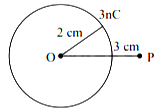
0 likesView Solution
36
PhysicsMediumMCQKCET · 2014
$A$ charged particle experiences a magnetic force in the presence of a magnetic field. Which of the following statements is correct?
A
The particle is moving and the magnetic field is perpendicular to the velocity.
B
The particle is moving and the magnetic field is parallel to the velocity.
C
The particle is stationary and the magnetic field is perpendicular.
D
The particle is stationary and the magnetic field is parallel.
Solution
(A) The magnetic force on a charged particle is given by the formula $\vec{F} = q(\vec{v} \times \vec{B})$.
For the force to be non-zero,the particle must be moving (i.e.,velocity $\vec{v} \neq 0$) and the velocity must not be parallel to the magnetic field $\vec{B}$.
If the particle is stationary,$\vec{v} = 0$,so $\vec{F} = 0$.
If the velocity is parallel or anti-parallel to the magnetic field,the cross product $\vec{v} \times \vec{B} = 0$,so $\vec{F} = 0$.
Therefore,for a magnetic force to exist,the particle must be moving,and the velocity vector must have a component perpendicular to the magnetic field vector.
For the force to be non-zero,the particle must be moving (i.e.,velocity $\vec{v} \neq 0$) and the velocity must not be parallel to the magnetic field $\vec{B}$.
If the particle is stationary,$\vec{v} = 0$,so $\vec{F} = 0$.
If the velocity is parallel or anti-parallel to the magnetic field,the cross product $\vec{v} \times \vec{B} = 0$,so $\vec{F} = 0$.
Therefore,for a magnetic force to exist,the particle must be moving,and the velocity vector must have a component perpendicular to the magnetic field vector.
0 likesView Solution
37
PhysicsEasyMCQKCET · 2014
$A$ microscope has an objective of focal length $1 \ cm$ and an eyepiece of focal length $6 \ cm$. If the tube length is $30 \ cm$ and the image is formed at the least distance of distinct vision,what is the magnification produced by the microscope? Take $D = 25 \ cm$.
A
$6$
B
$150$
C
$15$
D
$125$
Solution
(B) Given: Focal length of objective,$f_{o} = 1 \ cm$; Focal length of eyepiece,$f_{e} = 6 \ cm$; Tube length,$L = 30 \ cm$; Least distance of distinct vision,$D = 25 \ cm$.
For a compound microscope,the magnifying power $M$ when the final image is formed at the near point $(D)$ is given by:
$M = \frac{L}{f_{o}} \left(1 + \frac{D}{f_{e}}\right)$
Substituting the given values:
$M = \frac{30}{1} \left(1 + \frac{25}{6}\right)$
$M = 30 \left(\frac{6 + 25}{6}\right)$
$M = 30 \left(\frac{31}{6}\right)$
$M = 5 \times 31 = 155$.
Rounding to the nearest provided option,the magnification is approximately $150$.
For a compound microscope,the magnifying power $M$ when the final image is formed at the near point $(D)$ is given by:
$M = \frac{L}{f_{o}} \left(1 + \frac{D}{f_{e}}\right)$
Substituting the given values:
$M = \frac{30}{1} \left(1 + \frac{25}{6}\right)$
$M = 30 \left(\frac{6 + 25}{6}\right)$
$M = 30 \left(\frac{31}{6}\right)$
$M = 5 \times 31 = 155$.
Rounding to the nearest provided option,the magnification is approximately $150$.
0 likesView Solution
38
PhysicsEasyMCQKCET · 2014
$A$ fringe width of a certain interference pattern is $\beta = 0.002 \text{ cm}$. What is the distance of the $5^{\text{th}}$ dark fringe from the center?
A
$1 \times 10^{-2} \text{ cm}$
B
$11 \times 10^{-2} \text{ cm}$
C
$1.1 \times 10^{-2} \text{ cm}$
D
None of the above
Solution
(D) The fringe width is given as $\beta = 0.002 \text{ cm}$.
For a Young's double-slit interference pattern,the distance of the $n^{\text{th}}$ dark fringe from the central bright fringe is given by the formula $x_n = (n - 0.5) \beta$,where $n$ is the order of the dark fringe $(n = 1, 2, 3, \dots)$.
For the $5^{\text{th}}$ dark fringe,$n = 5$.
Substituting the values: $x_5 = (5 - 0.5) \times 0.002 \text{ cm}$.
$x_5 = 4.5 \times 0.002 \text{ cm} = 0.009 \text{ cm}$.
Converting to scientific notation: $0.009 \text{ cm} = 0.9 \times 10^{-2} \text{ cm}$.
Comparing this result with the given options,none of the options match the calculated value.
Therefore,the correct choice is $D$.
For a Young's double-slit interference pattern,the distance of the $n^{\text{th}}$ dark fringe from the central bright fringe is given by the formula $x_n = (n - 0.5) \beta$,where $n$ is the order of the dark fringe $(n = 1, 2, 3, \dots)$.
For the $5^{\text{th}}$ dark fringe,$n = 5$.
Substituting the values: $x_5 = (5 - 0.5) \times 0.002 \text{ cm}$.
$x_5 = 4.5 \times 0.002 \text{ cm} = 0.009 \text{ cm}$.
Converting to scientific notation: $0.009 \text{ cm} = 0.9 \times 10^{-2} \text{ cm}$.
Comparing this result with the given options,none of the options match the calculated value.
Therefore,the correct choice is $D$.
0 likesView Solution
39
PhysicsDifficultMCQKCET · 2014
$A$ multimeter reads a voltage of a certain $A$.$C$. source as $ 100 \,V $. What is the peak value of voltage of the $A$.$C$. source (in $\,V$)?
A
$200$
B
$100$
C
$141.4$
D
$400$
Solution
(C) The root mean square $(RMS)$ value of voltage,$ V_{rms} $,and the peak voltage,$ V_{0} $,of an $A$.$C$. source are related by the formula:
$ V_{rms} = \frac{V_{0}}{\sqrt{2}} $
Given that the multimeter reads the $RMS$ value,$ V_{rms} = 100 \,V $.
To find the peak voltage $ V_{0} $,we rearrange the formula:
$ V_{0} = V_{rms} \times \sqrt{2} $
Substituting the given value:
$ V_{0} = 100 \times 1.414 = 141.4 \,V $
Thus,the peak value of the voltage of the $A$.$C$. source is $ 141.4 \,V $.
$ V_{rms} = \frac{V_{0}}{\sqrt{2}} $
Given that the multimeter reads the $RMS$ value,$ V_{rms} = 100 \,V $.
To find the peak voltage $ V_{0} $,we rearrange the formula:
$ V_{0} = V_{rms} \times \sqrt{2} $
Substituting the given value:
$ V_{0} = 100 \times 1.414 = 141.4 \,V $
Thus,the peak value of the voltage of the $A$.$C$. source is $ 141.4 \,V $.
0 likesView Solution
40
PhysicsEasyMCQKCET · 2014
In $n$-type semiconductor,electrons are majority charge carriers,but it does not show any negative charge. The reason is:
A
electrons are stationary
B
electrons neutralize with holes
C
mobility of electrons is extremely small
D
atom is electrically neutral
Solution
(D) In an $n$-type semiconductor,although electrons are the majority charge carriers,the material as a whole remains electrically neutral.
This is because the semiconductor crystal is composed of atoms that are electrically neutral,containing an equal number of protons in the nucleus and orbiting electrons.
When a pentavalent impurity is added to create an $n$-type semiconductor,the added impurity atom itself is also electrically neutral.
Therefore,the total negative charge of the free electrons is exactly balanced by the total positive charge of the ionized donor atoms and the protons in the crystal lattice.
This is because the semiconductor crystal is composed of atoms that are electrically neutral,containing an equal number of protons in the nucleus and orbiting electrons.
When a pentavalent impurity is added to create an $n$-type semiconductor,the added impurity atom itself is also electrically neutral.
Therefore,the total negative charge of the free electrons is exactly balanced by the total positive charge of the ionized donor atoms and the protons in the crystal lattice.
0 likesView Solution
41
PhysicsMediumMCQKCET · 2014
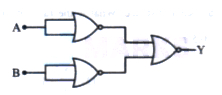
For the given digital circuit, identify the logic gate it represents:
A
$OR$-Gate
B
$NOR$-Gate
C
$NAND$-Gate
D
$AND$-Gate
Solution
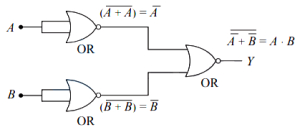
(D) The given circuit consists of two $NOR$ gates acting as $NOT$ gates, followed by a $NOR$ gate. Let the inputs be $A$ and $B$.
The first two gates are $NOR$ gates with both inputs tied together. The output of the first gate is $\overline{A+A} = \bar{A}$.
The output of the second gate is $\overline{B+B} = \bar{B}$.
These outputs are fed into the final $NOR$ gate. The output $Y$ is given by:
$Y = \overline{\bar{A} + \bar{B}}$
Using De Morgan's theorem, $\overline{\bar{A} + \bar{B}} = \overline{\bar{A}} \cdot \overline{\bar{B}} = A \cdot B$.
Thus, the circuit represents an $AND$ gate.
The first two gates are $NOR$ gates with both inputs tied together. The output of the first gate is $\overline{A+A} = \bar{A}$.
The output of the second gate is $\overline{B+B} = \bar{B}$.
These outputs are fed into the final $NOR$ gate. The output $Y$ is given by:
$Y = \overline{\bar{A} + \bar{B}}$
Using De Morgan's theorem, $\overline{\bar{A} + \bar{B}} = \overline{\bar{A}} \cdot \overline{\bar{B}} = A \cdot B$.
Thus, the circuit represents an $AND$ gate.
| $A$ | $B$ | $Y = A \cdot B$ |
| $0$ | $0$ | $0$ |
| $0$ | $1$ | $0$ |
| $1$ | $0$ | $0$ |
| $1$ | $1$ | $1$ |
0 likesView Solution
42
PhysicsMediumMCQKCET · 2014
Two equal and opposite charges of masses $m_{1}$ and $m_{2}$ are accelerated in a uniform electric field through the same distance. What is the ratio of their accelerations if the ratio of their masses is $\frac{m_{1}}{m_{2}}=0.5$?
A
$\frac{a_{1}}{a_{2}}=0.5$
B
$\frac{a_{1}}{a_{2}}=1$
C
$\frac{a_{1}}{a_{2}}=2$
D
$\frac{a_{1}}{a_{2}}=3$
Solution
(C) Since the charges are equal in magnitude and placed in a uniform electric field $E$,the magnitude of the force acting on each charge is $F = qE$.
Since the magnitude of the force $F$ is the same for both charges,we have $F_{1} = F_{2}$.
Using Newton's second law,$F = ma$,we can write $m_{1}a_{1} = m_{2}a_{2}$.
Rearranging this gives the ratio of accelerations as $\frac{a_{1}}{a_{2}} = \frac{m_{2}}{m_{1}}$.
Given that $\frac{m_{1}}{m_{2}} = 0.5$,we have $\frac{m_{2}}{m_{1}} = \frac{1}{0.5} = 2$.
Therefore,the ratio of their accelerations is $\frac{a_{1}}{a_{2}} = 2$.
Since the magnitude of the force $F$ is the same for both charges,we have $F_{1} = F_{2}$.
Using Newton's second law,$F = ma$,we can write $m_{1}a_{1} = m_{2}a_{2}$.
Rearranging this gives the ratio of accelerations as $\frac{a_{1}}{a_{2}} = \frac{m_{2}}{m_{1}}$.
Given that $\frac{m_{1}}{m_{2}} = 0.5$,we have $\frac{m_{2}}{m_{1}} = \frac{1}{0.5} = 2$.
Therefore,the ratio of their accelerations is $\frac{a_{1}}{a_{2}} = 2$.
0 likesView Solution
43
PhysicsEasyMCQKCET · 2014
If $ \alpha $-current gain of a transistor is $ 0.98 $,what is the value of $ \beta $-current gain of the transistor?
A
$ 0.49 $
B
$ 49 $
C
$ 4.9 $
D
$ 55 $
Solution
(B) For a transistor,the $ \beta $-current gain and $ \alpha $-current gain are related by the formula:
$\beta = \frac{\alpha}{1 - \alpha}$
Given that the $ \alpha $-current gain is $ 0.98 $.
Substituting the value into the formula:
$\beta = \frac{0.98}{1 - 0.98} = \frac{0.98}{0.02} = 49$
Thus,the $ \beta $-current gain of the transistor is $ 49 $.
$\beta = \frac{\alpha}{1 - \alpha}$
Given that the $ \alpha $-current gain is $ 0.98 $.
Substituting the value into the formula:
$\beta = \frac{0.98}{1 - 0.98} = \frac{0.98}{0.02} = 49$
Thus,the $ \beta $-current gain of the transistor is $ 49 $.
0 likesView Solution
44
PhysicsMediumMCQKCET · 2014
$A$ tuned amplifier circuit is used to generate a carrier frequency of $ 2 \text{ MHz} $ for amplitude modulation. The value of $ \sqrt{LC} $ is
A
$ \frac{1}{2 \pi \times 10^{6}} $
B
$ \frac{1}{2 \times 10^{6}} $
C
$ \frac{1}{3 \pi \times 10^{6}} $
D
$ \frac{1}{4 \pi \times 10^{6}} $
Solution
(D) The resonant frequency $ f $ of a tuned amplifier circuit ($LC$ circuit) is given by the formula: $ f = \frac{1}{2 \pi \sqrt{LC}} $.
Rearranging the formula to solve for $ \sqrt{LC} $,we get: $ \sqrt{LC} = \frac{1}{2 \pi f} $.
Given the carrier frequency $ f = 2 \text{ MHz} = 2 \times 10^{6} \text{ Hz} $.
Substituting the value of $ f $ into the equation: $ \sqrt{LC} = \frac{1}{2 \pi \times (2 \times 10^{6})} $.
Calculating the denominator: $ \sqrt{LC} = \frac{1}{4 \pi \times 10^{6}} $.
Rearranging the formula to solve for $ \sqrt{LC} $,we get: $ \sqrt{LC} = \frac{1}{2 \pi f} $.
Given the carrier frequency $ f = 2 \text{ MHz} = 2 \times 10^{6} \text{ Hz} $.
Substituting the value of $ f $ into the equation: $ \sqrt{LC} = \frac{1}{2 \pi \times (2 \times 10^{6})} $.
Calculating the denominator: $ \sqrt{LC} = \frac{1}{4 \pi \times 10^{6}} $.
0 likesView Solution
45
PhysicsMediumMCQKCET · 2014
The equivalent resistance of two resistors connected in series is $6 \ \Omega$ and their parallel equivalent resistance is $\frac{4}{3} \ \Omega$. What are the values of the resistances?
A
$2 \ \Omega, 4 \ \Omega$
B
$8 \ \Omega, 1 \ \Omega$
C
$4 \ \Omega, 2 \ \Omega$
D
$6 \ \Omega, 2 \ \Omega$
Solution
(C) Let the two resistances be $R_{1}$ and $R_{2}$.
When they are connected in series,the equivalent resistance is $R_{s} = R_{1} + R_{2} = 6 \ \Omega$ $(1)$.
When they are connected in parallel,the equivalent resistance is $R_{p} = \frac{R_{1} R_{2}}{R_{1} + R_{2}} = \frac{4}{3} \ \Omega$ $(2)$.
Substituting $R_{1} + R_{2} = 6$ into equation $(2)$:
$\frac{R_{1} R_{2}}{6} = \frac{4}{3} \Rightarrow R_{1} R_{2} = 6 \times \frac{4}{3} = 8 \ \Omega^{2}$ $(3)$.
From $(1)$,$R_{2} = 6 - R_{1}$. Substituting this into $(3)$:
$R_{1}(6 - R_{1}) = 8 \Rightarrow 6R_{1} - R_{1}^{2} = 8 \Rightarrow R_{1}^{2} - 6R_{1} + 8 = 0$.
Solving the quadratic equation:
$(R_{1} - 4)(R_{1} - 2) = 0$.
Thus,$R_{1} = 4 \ \Omega$ or $R_{1} = 2 \ \Omega$.
If $R_{1} = 4 \ \Omega$,then $R_{2} = 2 \ \Omega$. If $R_{1} = 2 \ \Omega$,then $R_{2} = 4 \ \Omega$.
Therefore,the two resistances are $4 \ \Omega$ and $2 \ \Omega$.
When they are connected in series,the equivalent resistance is $R_{s} = R_{1} + R_{2} = 6 \ \Omega$ $(1)$.
When they are connected in parallel,the equivalent resistance is $R_{p} = \frac{R_{1} R_{2}}{R_{1} + R_{2}} = \frac{4}{3} \ \Omega$ $(2)$.
Substituting $R_{1} + R_{2} = 6$ into equation $(2)$:
$\frac{R_{1} R_{2}}{6} = \frac{4}{3} \Rightarrow R_{1} R_{2} = 6 \times \frac{4}{3} = 8 \ \Omega^{2}$ $(3)$.
From $(1)$,$R_{2} = 6 - R_{1}$. Substituting this into $(3)$:
$R_{1}(6 - R_{1}) = 8 \Rightarrow 6R_{1} - R_{1}^{2} = 8 \Rightarrow R_{1}^{2} - 6R_{1} + 8 = 0$.
Solving the quadratic equation:
$(R_{1} - 4)(R_{1} - 2) = 0$.
Thus,$R_{1} = 4 \ \Omega$ or $R_{1} = 2 \ \Omega$.
If $R_{1} = 4 \ \Omega$,then $R_{2} = 2 \ \Omega$. If $R_{1} = 2 \ \Omega$,then $R_{2} = 4 \ \Omega$.
Therefore,the two resistances are $4 \ \Omega$ and $2 \ \Omega$.
0 likesView Solution
46
PhysicsEasyMCQKCET · 2014
The gyromagnetic ratio of an electron revolving in a circular orbit of a hydrogen atom is $ 8.8 \times 10^{10} \ C \ kg^{-1} $. What is the mass of the electron? Given the charge of the electron $ e = 1.6 \times 10^{-19} \ C $.
A
$ 1 \times 10^{-29} \ kg $
B
$ 0.1 \times 10^{-29} \ kg $
C
$ 1.1 \times 10^{-29} \ kg $
D
$ \frac{1}{11} \times 10^{-29} \ kg $
Solution
(D) The gyromagnetic ratio is defined as the ratio of the magnetic dipole moment to the angular momentum of the electron,which is given by the formula: $\gamma = \frac{e}{2m_e}$.
Given,gyromagnetic ratio $\gamma = 8.8 \times 10^{10} \ C \ kg^{-1}$.
Charge of the electron $e = 1.6 \times 10^{-19} \ C$.
Rearranging the formula to solve for the mass of the electron $m_e$:
$m_e = \frac{e}{2\gamma}$.
Substituting the given values:
$m_e = \frac{1.6 \times 10^{-19}}{2 \times 8.8 \times 10^{10}}$.
$m_e = \frac{1.6 \times 10^{-19}}{17.6 \times 10^{10}}$.
$m_e = \frac{16}{176} \times 10^{-29} \ kg$.
$m_e = \frac{1}{11} \times 10^{-29} \ kg$.
Thus,the mass of the electron is $\frac{1}{11} \times 10^{-29} \ kg$.
Given,gyromagnetic ratio $\gamma = 8.8 \times 10^{10} \ C \ kg^{-1}$.
Charge of the electron $e = 1.6 \times 10^{-19} \ C$.
Rearranging the formula to solve for the mass of the electron $m_e$:
$m_e = \frac{e}{2\gamma}$.
Substituting the given values:
$m_e = \frac{1.6 \times 10^{-19}}{2 \times 8.8 \times 10^{10}}$.
$m_e = \frac{1.6 \times 10^{-19}}{17.6 \times 10^{10}}$.
$m_e = \frac{16}{176} \times 10^{-29} \ kg$.
$m_e = \frac{1}{11} \times 10^{-29} \ kg$.
Thus,the mass of the electron is $\frac{1}{11} \times 10^{-29} \ kg$.
0 likesView Solution
47
PhysicsMediumMCQKCET · 2014
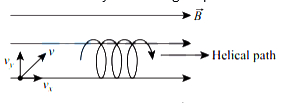
If a charged particle moves through a magnetic field with a velocity that has both perpendicular and parallel components,what is the path followed by the particle?
A
Circular
B
Elliptical
C
Linear
D
Helical
Solution
(D) When a charged particle moves in a uniform magnetic field $\vec{B}$ with a velocity $\vec{v}$ that is not parallel or perpendicular to the field,it can be resolved into two components:
$1$. The component $v_{\perp} = v \sin \theta$ perpendicular to the magnetic field,which provides the necessary centripetal force for circular motion.
$2$. The component $v_{\parallel} = v \cos \theta$ parallel to the magnetic field,which remains unaffected by the magnetic force and causes the particle to move linearly along the direction of the field.
The combination of these two motions—circular motion in the plane perpendicular to the field and linear motion along the field—results in a helical path.
$1$. The component $v_{\perp} = v \sin \theta$ perpendicular to the magnetic field,which provides the necessary centripetal force for circular motion.
$2$. The component $v_{\parallel} = v \cos \theta$ parallel to the magnetic field,which remains unaffected by the magnetic force and causes the particle to move linearly along the direction of the field.
The combination of these two motions—circular motion in the plane perpendicular to the field and linear motion along the field—results in a helical path.
0 likesView Solution
48
PhysicsEasyMCQKCET · 2014
$A$ carbon film resistor has colour code Green,Black,Violet,Gold. The value of the resistor is
A
$50 \ M\Omega$
B
$500 \ M\Omega$
C
$500 \pm 5\% \ M\Omega$
D
$500 \pm 10\% \ M\Omega$
Solution
(C) The colour code for the resistor is Green,Black,Violet,Gold.
According to the standard resistor colour code:
Green corresponds to the digit $5$.
Black corresponds to the digit $0$.
Violet corresponds to the multiplier $10^7$.
Gold corresponds to the tolerance $\pm 5\%$.
The resistance value is calculated as: $50 \times 10^7 \pm 5\% \ \Omega$.
Converting this to Megaohms $(M\Omega)$: $50 \times 10^7 \ \Omega = 500 \times 10^6 \ \Omega = 500 \ M\Omega$.
Including the tolerance,the final value is $500 \pm 5\% \ M\Omega$.
According to the standard resistor colour code:
Green corresponds to the digit $5$.
Black corresponds to the digit $0$.
Violet corresponds to the multiplier $10^7$.
Gold corresponds to the tolerance $\pm 5\%$.
The resistance value is calculated as: $50 \times 10^7 \pm 5\% \ \Omega$.
Converting this to Megaohms $(M\Omega)$: $50 \times 10^7 \ \Omega = 500 \times 10^6 \ \Omega = 500 \ M\Omega$.
Including the tolerance,the final value is $500 \pm 5\% \ M\Omega$.
0 likesView Solution
49
PhysicsEasyMCQKCET · 2014
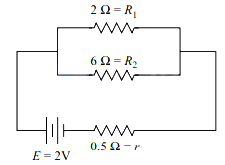
Two resistors of resistances $2 \Omega$ and $6 \Omega$ are connected in parallel. This combination is then connected to a battery of emf $2 \text{ V}$ and internal resistance $0.5 \Omega$. What is the current flowing through the battery?
A
$1 \text{ A}$
B
$\frac{4}{3} \text{ A}$
C
$\frac{4}{17} \text{ A}$
D
$2 \text{ A}$
Solution
(A) The current $I$ flowing through the battery is given by the formula $I = \frac{E}{R_{eq} + r}$,where $E$ is the emf,$R_{eq}$ is the equivalent external resistance,and $r$ is the internal resistance.
Since the two resistors $R_1 = 2 \Omega$ and $R_2 = 6 \Omega$ are connected in parallel,their equivalent resistance $R_{eq}$ is calculated as:
$\frac{1}{R_{eq}} = \frac{1}{R_1} + \frac{1}{R_2} = \frac{1}{2} + \frac{1}{6} = \frac{3 + 1}{6} = \frac{4}{6} = \frac{2}{3} \Omega^{-1}$.
Therefore,$R_{eq} = \frac{3}{2} = 1.5 \Omega$.
Now,substituting the values into the current formula:
$I = \frac{2}{1.5 + 0.5} = \frac{2}{2.0} = 1 \text{ A}$.
Thus,the current flowing through the battery is $1 \text{ A}$.
Since the two resistors $R_1 = 2 \Omega$ and $R_2 = 6 \Omega$ are connected in parallel,their equivalent resistance $R_{eq}$ is calculated as:
$\frac{1}{R_{eq}} = \frac{1}{R_1} + \frac{1}{R_2} = \frac{1}{2} + \frac{1}{6} = \frac{3 + 1}{6} = \frac{4}{6} = \frac{2}{3} \Omega^{-1}$.
Therefore,$R_{eq} = \frac{3}{2} = 1.5 \Omega$.
Now,substituting the values into the current formula:
$I = \frac{2}{1.5 + 0.5} = \frac{2}{2.0} = 1 \text{ A}$.
Thus,the current flowing through the battery is $1 \text{ A}$.
0 likesView Solution
50
PhysicsEasyMCQKCET · 2014
$A$ solenoid has a length of $0.4 \,m$, a radius of $1 \,cm$, and $400$ turns of wire. If a current of $5 \,A$ is passed through this solenoid, what is the magnetic field inside the solenoid?
A
$6.28 \times 10^{-3} \,T$
B
$6.28 \times 10^{-2} \,T$
C
$6.28 \times 10^{-4} \,T$
D
$6.28 \,T$
Solution
(A) Given: Length of solenoid $l = 0.4 \,m$, number of turns $N = 400$, current $I = 5 \,A$.
The number of turns per unit length $n = \frac{N}{l} = \frac{400}{0.4} = 1000 \,m^{-1}$.
The magnetic field inside a long solenoid is given by $B = \mu_0 n I$.
Substituting the values: $B = (4\pi \times 10^{-7}) \times 1000 \times 5$.
$B = 4 \times 3.14159 \times 10^{-7} \times 5000$.
$B = 20 \times 3.14159 \times 10^{-4} = 62.83 \times 10^{-4} = 6.28 \times 10^{-3} \,T$.
The number of turns per unit length $n = \frac{N}{l} = \frac{400}{0.4} = 1000 \,m^{-1}$.
The magnetic field inside a long solenoid is given by $B = \mu_0 n I$.
Substituting the values: $B = (4\pi \times 10^{-7}) \times 1000 \times 5$.
$B = 4 \times 3.14159 \times 10^{-7} \times 5000$.
$B = 20 \times 3.14159 \times 10^{-4} = 62.83 \times 10^{-4} = 6.28 \times 10^{-3} \,T$.
0 likesView Solution
51
PhysicsEasyMCQKCET · 2014
$A$ step-down transformer has $50$ turns on the secondary and $1000$ turns on the primary winding. If the transformer is connected to a $220 \ V, 1 \ A$ $A$.$C$. source,what is the output current of the transformer?
A
$1/20 \ A$
B
$20 \ A$
C
$100 \ A$
D
$2 \ A$
Solution
(B) Given: Number of turns on secondary,$N_{s} = 50$; Number of turns on primary,$N_{p} = 1000$; Primary voltage,$V_{p} = 220 \ V$; Primary current,$I_{p} = 1 \ A$.
We know the transformer ratio formula: $\frac{N_{s}}{N_{p}} = \frac{V_{s}}{V_{p}} = \frac{I_{p}}{I_{s}}$.
Using the relation $\frac{N_{s}}{N_{p}} = \frac{I_{p}}{I_{s}}$,we can find the output current $I_{s}$ as: $I_{s} = \frac{N_{p}}{N_{s}} \times I_{p}$.
Substituting the given values: $I_{s} = \frac{1000}{50} \times 1$.
$I_{s} = 20 \times 1 = 20 \ A$.
Thus,the output current of the transformer is $20 \ A$.
We know the transformer ratio formula: $\frac{N_{s}}{N_{p}} = \frac{V_{s}}{V_{p}} = \frac{I_{p}}{I_{s}}$.
Using the relation $\frac{N_{s}}{N_{p}} = \frac{I_{p}}{I_{s}}$,we can find the output current $I_{s}$ as: $I_{s} = \frac{N_{p}}{N_{s}} \times I_{p}$.
Substituting the given values: $I_{s} = \frac{1000}{50} \times 1$.
$I_{s} = 20 \times 1 = 20 \ A$.
Thus,the output current of the transformer is $20 \ A$.
0 likesView Solution
52
PhysicsMediumMCQKCET · 2014
$A$ plane electromagnetic wave of frequency $20 \text{ MHz}$ travels through space along the $x$-direction. If the electric field vector at a certain point in space is $6 \text{ V m}^{-1}$,what is the magnetic field vector at that point?
A
$2 \times 10^{-8} \text{ T}$
B
$\frac{1}{2} \times 10^{-8} \text{ T}$
C
$2 \text{ T}$
D
$\frac{1}{2} \text{ T}$
Solution
(A) The relationship between the magnitude of the electric field $(E)$ and the magnetic field $(B)$ in an electromagnetic wave is given by the equation:
$E = cB$,where $c$ is the speed of light in vacuum.
Given values are $E = 6 \text{ V m}^{-1}$ and $c = 3 \times 10^{8} \text{ m s}^{-1}$.
Rearranging the formula to solve for $B$:
$B = \frac{E}{c}$
Substituting the values:
$B = \frac{6}{3 \times 10^{8}}$
$B = 2 \times 10^{-8} \text{ T}$.
Therefore,the magnitude of the magnetic field vector at that point is $2 \times 10^{-8} \text{ T}$.
$E = cB$,where $c$ is the speed of light in vacuum.
Given values are $E = 6 \text{ V m}^{-1}$ and $c = 3 \times 10^{8} \text{ m s}^{-1}$.
Rearranging the formula to solve for $B$:
$B = \frac{E}{c}$
Substituting the values:
$B = \frac{6}{3 \times 10^{8}}$
$B = 2 \times 10^{-8} \text{ T}$.
Therefore,the magnitude of the magnetic field vector at that point is $2 \times 10^{-8} \text{ T}$.
0 likesView Solution
53
PhysicsMediumMCQKCET · 2014
Two capacitors of $10 \ pF$ and $20 \ pF$ are connected to $200 \ V$ and $100 \ V$ sources respectively. If they are connected by a wire,what is the common potential of the capacitors (in $V$)?
A
$133.3$
B
$150$
C
$300$
D
$400$
Solution
(A) The common potential $V$ of two capacitors connected in parallel is given by the formula: $V = \frac{C_1 V_1 + C_2 V_2}{C_1 + C_2}$.
Given: $C_1 = 10 \ pF$,$V_1 = 200 \ V$,$C_2 = 20 \ pF$,$V_2 = 100 \ V$.
Substituting the values:
$V = \frac{(10 \times 10^{-12} \times 200) + (20 \times 10^{-12} \times 100)}{10 \times 10^{-12} + 20 \times 10^{-12}}$
$V = \frac{2000 \times 10^{-12} + 2000 \times 10^{-12}}{30 \times 10^{-12}}$
$V = \frac{4000 \times 10^{-12}}{30 \times 10^{-12}} = \frac{400}{3} \approx 133.33 \ V$.
Thus,the common potential is $133.33 \ V$.
Given: $C_1 = 10 \ pF$,$V_1 = 200 \ V$,$C_2 = 20 \ pF$,$V_2 = 100 \ V$.
Substituting the values:
$V = \frac{(10 \times 10^{-12} \times 200) + (20 \times 10^{-12} \times 100)}{10 \times 10^{-12} + 20 \times 10^{-12}}$
$V = \frac{2000 \times 10^{-12} + 2000 \times 10^{-12}}{30 \times 10^{-12}}$
$V = \frac{4000 \times 10^{-12}}{30 \times 10^{-12}} = \frac{400}{3} \approx 133.33 \ V$.
Thus,the common potential is $133.33 \ V$.
0 likesView Solution
54
PhysicsEasyMCQKCET · 2014
What is the de Broglie wavelength of an electron accelerated through a potential difference of $ 100 \ V $ (in $\text{Å}$)?
A
$12.27$
B
$1.227$
C
$0.1227$
D
$0.001227$
Solution
(B) The de Broglie wavelength $\lambda$ of an electron accelerated through a potential difference $V$ is given by the formula:
$\lambda = \frac{12.27}{\sqrt{V}} \ \text{Å}$
Given that the potential difference $V = 100 \ V$,we substitute this value into the equation:
$\lambda = \frac{12.27}{\sqrt{100}}$
$\lambda = \frac{12.27}{10}$
$\lambda = 1.227 \ \text{Å}$
Thus,the de Broglie wavelength of the electron is $1.227 \ \text{Å}$.
$\lambda = \frac{12.27}{\sqrt{V}} \ \text{Å}$
Given that the potential difference $V = 100 \ V$,we substitute this value into the equation:
$\lambda = \frac{12.27}{\sqrt{100}}$
$\lambda = \frac{12.27}{10}$
$\lambda = 1.227 \ \text{Å}$
Thus,the de Broglie wavelength of the electron is $1.227 \ \text{Å}$.
0 likesView Solution
55
PhysicsEasyMCQKCET · 2014
An object is placed at $20 \ cm$ in front of a concave mirror,which produces a three times magnified real image. What is the focal length of the concave mirror (in $cm$)?
A
$15$
B
$6.6$
C
$10$
D
$7.5$
Solution
(A) Given: Object distance $u = -20 \ cm$ (by sign convention).
Magnification $m = -3$ (since the image is real and magnified).
Using the magnification formula $m = -\frac{v}{u}$,we have:
$-3 = -\frac{v}{-20} \Rightarrow v = -60 \ cm$.
Using the mirror formula $\frac{1}{f} = \frac{1}{v} + \frac{1}{u}$,we get:
$\frac{1}{f} = \frac{1}{-60} + \frac{1}{-20} = \frac{-1 - 3}{60} = \frac{-4}{60} = -\frac{1}{15}$.
Therefore,the focal length $f = -15 \ cm$.
The magnitude of the focal length is $15 \ cm$.
Magnification $m = -3$ (since the image is real and magnified).
Using the magnification formula $m = -\frac{v}{u}$,we have:
$-3 = -\frac{v}{-20} \Rightarrow v = -60 \ cm$.
Using the mirror formula $\frac{1}{f} = \frac{1}{v} + \frac{1}{u}$,we get:
$\frac{1}{f} = \frac{1}{-60} + \frac{1}{-20} = \frac{-1 - 3}{60} = \frac{-4}{60} = -\frac{1}{15}$.
Therefore,the focal length $f = -15 \ cm$.
The magnitude of the focal length is $15 \ cm$.
0 likesView Solution
56
PhysicsEasyMCQKCET · 2014
What is the energy of the electron revolving in the third orbit expressed in $ eV $ (in $eV$)?
A
$-1.51$
B
$-3.4$
C
$-13.6$
D
$-0.85$
Solution
(A) The energy of an electron in the $ n^{\text{th}} $ orbit of a hydrogen atom is given by the formula: $ E_n = \frac{-13.6 \ eV}{n^2} $.
For the third orbit,we substitute $ n = 3 $ into the equation:
$ E_3 = \frac{-13.6}{3^2} = \frac{-13.6}{9} $.
Calculating this,we get $ E_3 \approx -1.51 \ eV $.
Thus,the energy of the electron in the third orbit is $ -1.51 \ eV $.
For the third orbit,we substitute $ n = 3 $ into the equation:
$ E_3 = \frac{-13.6}{3^2} = \frac{-13.6}{9} $.
Calculating this,we get $ E_3 \approx -1.51 \ eV $.
Thus,the energy of the electron in the third orbit is $ -1.51 \ eV $.
0 likesView Solution
57
PhysicsEasyMCQKCET · 2014
Which of the following spectral series of the hydrogen atom lies in the visible range of the electromagnetic spectrum?
A
Paschen series
B
Pfund series
C
Lyman series
D
Balmer series
Solution
(D) The hydrogen spectrum consists of five main spectral series: Lyman,Balmer,Paschen,Brackett,and Pfund.
$1$. The Lyman series lies in the ultraviolet region.
$2$. The Balmer series lies in the visible region.
$3$. The Paschen,Brackett,and Pfund series lie in the infrared region.
Therefore,the Balmer series is the correct answer.
$1$. The Lyman series lies in the ultraviolet region.
$2$. The Balmer series lies in the visible region.
$3$. The Paschen,Brackett,and Pfund series lie in the infrared region.
Therefore,the Balmer series is the correct answer.
0 likesView Solution
58
PhysicsEasyMCQKCET · 2014
The maximum kinetic energy of the photo-electrons depends only on
A
potential
B
frequency
C
incident angle
D
pressure
Solution
(B) When light of suitable frequency falls on a metal plate,electrons are emitted. This phenomenon is known as the photoelectric effect.
According to Einstein's photoelectric equation,the maximum kinetic energy $(K_{\max})$ of the emitted photo-electrons is given by:
$K_{\max} = hf - \phi_0$
where $h$ is Planck's constant,$f$ is the frequency of the incident light,and $\phi_0$ is the work function of the metal.
Since $h$ and $\phi_0$ are constants for a given metal,the maximum kinetic energy depends only on the frequency $(f)$ of the incident light.
According to Einstein's photoelectric equation,the maximum kinetic energy $(K_{\max})$ of the emitted photo-electrons is given by:
$K_{\max} = hf - \phi_0$
where $h$ is Planck's constant,$f$ is the frequency of the incident light,and $\phi_0$ is the work function of the metal.
Since $h$ and $\phi_0$ are constants for a given metal,the maximum kinetic energy depends only on the frequency $(f)$ of the incident light.
0 likesView Solution
59
PhysicsEasyMCQKCET · 2014
The average power dissipated in an $A.C.$ circuit is $2 \ W$. If the current flowing through the circuit is $2 \ A$ and the impedance is $1 \ \Omega$,what is the power factor of the $A.C.$ circuit?
A
$0.5$
B
$11$
C
$00$
D
$\frac{1}{\sqrt{2}}$
Solution
(A) The average power dissipated in an $A.C.$ circuit is given by the formula: $P = I_{rms}^2 Z \cos \phi$,where $P$ is the power,$I_{rms}$ is the root mean square current,$Z$ is the impedance,and $\cos \phi$ is the power factor.
Given values are: $P = 2 \ W$,$I = 2 \ A$,and $Z = 1 \ \Omega$.
Substituting these values into the formula: $2 = (2)^2 \times 1 \times \cos \phi$.
$2 = 4 \times \cos \phi$.
$\cos \phi = \frac{2}{4} = 0.5$.
Thus,the power factor of the $A.C.$ circuit is $0.5$.
Given values are: $P = 2 \ W$,$I = 2 \ A$,and $Z = 1 \ \Omega$.
Substituting these values into the formula: $2 = (2)^2 \times 1 \times \cos \phi$.
$2 = 4 \times \cos \phi$.
$\cos \phi = \frac{2}{4} = 0.5$.
Thus,the power factor of the $A.C.$ circuit is $0.5$.
0 likesView Solution
60
PhysicsMediumMCQKCET · 2014
The focal length of a lens is $10 \ cm$. What is the power of the lens in dioptre (in $D$)?
A
$0.1$
B
$10$
C
$15$
D
$20$
Solution
(B) Given,focal length $f = 10 \ cm = 0.1 \ m$.
Power of a lens $P$ is defined as the reciprocal of the focal length in meters.
$P = \frac{1}{f(m)} = \frac{1}{0.1 \ m} = 10 \ D$.
Thus,the power of the lens is $10 \ D$.
Power of a lens $P$ is defined as the reciprocal of the focal length in meters.
$P = \frac{1}{f(m)} = \frac{1}{0.1 \ m} = 10 \ D$.
Thus,the power of the lens is $10 \ D$.
0 likesView Solution
Vedclass Products
For Students
Vedclass Test Series
Mock tests in real KCET style covering Physics with performance analysis. 5-day free trial.
Start Free TrialFor Teachers
Exam Paper Generator
Generate Set A/B/C/D Physics papers from 7.5L+ questions in 2 minutes. 3 chapters free.
Try FreeFor Institutes
Online Exam Module
Run live KCET mock exams with unlimited students, 360° analytics & white-label branding.
See DemoFrequently Asked Questions
How many Physics questions are in KCET 2014?
There are 60 Physics questions from the KCET 2014 paper on Vedclass, each with a detailed step-by-step solution in English.
Are KCET 2014 Physics solutions available in English?
Yes. All solutions on this page are in English. You can also switch to English or Hindi using the language buttons above the questions.
Can I practice KCET 2014 Physics as a timed test?
Yes. Use the Vedclass Test Series to attempt a full KCET mock test covering Physics with time limits and instant score analysis.
Can teachers create Physics papers from KCET previous year questions?
Yes. The Vedclass Exam Paper Generator lets teachers mix KCET Physics questions and generate Set A/B/C/D papers in minutes.
For Teachers & Institutes
Build a Custom Physics Paper
Pick KCET 2014 Physics questions, set difficulty, and generate Set A/B/C/D in 2 minutes.